Monthly Archives: October 2026

The Moral Economy of the Crowd

When Ordinary People Decided What Was Fair

Imagine that a wagon loaded with grain is leaving an English market town during a food shortage.

The grain has been legally grown.

It has been legally purchased.

Its owner has every legal right to transport it elsewhere and sell it for whatever price another buyer is willing to pay.

Then a crowd blocks the road.

The grain is unloaded.

It is taken back to the marketplace and sold at a lower price determined by the crowd.

But something rather strange happens.

The crowd does not simply steal it.

The owner is paid.

To modern eyes, this seems contradictory. If these people are rioters and thieves, why bother paying? If they respect private property sufficiently to compensate its owner, why seize the grain in the first place?

The answer lies in one of the most influential ideas in the study of popular history:

the moral economy of the crowd.

The phrase is particularly associated with the British historian E. P. Thompson, whose landmark 1971 essay, “The Moral Economy of the English Crowd in the Eighteenth Century,” challenged the traditional interpretation of food riots.

Thompson argued that many eighteenth-century food riots were neither random explosions of hunger nor mindless attacks upon property.

The crowds were acting according to an understood system of rights, obligations, customs and expectations.

They believed that there were things you simply did not do when people were hungry.

The law might disagree.

The market might disagree.

The merchant certainly might disagree.

But the crowd believed that there was another law operating alongside them:

the law of fairness.

Hunger Alone Does Not Explain a Riot

It seems obvious to say that hungry people riot because they are hungry.

But Thompson thought that explanation was inadequate.

He described such interpretations dismissively as a kind of “spasmodic” history: food prices rise, stomachs become empty and crowds automatically erupt.

Human beings do not work quite so mechanically.

Thousands of people throughout history have experienced hunger without rioting.

Something else has to happen.

People must believe not merely that they are suffering, but that their suffering is unjust.

That distinction is crucial.

A failed harvest might be regarded as a tragedy.

A merchant withholding grain from the market while waiting for its price to rise could be regarded as an outrage.

The first was misfortune.

The second involved human choice.

And therefore somebody could be blamed.

What Was a “Moral Economy”?

Thompson was not suggesting that eighteenth-century crowds had developed an alternative economic theory in the modern academic sense.

There was no textbook entitled The Poor Man’s Guide to Ethical Grain Distribution.

The moral economy consisted instead of customary assumptions about how essential goods should be produced, marketed and sold.

Those assumptions had deep historical roots.

Food was not regarded as an ordinary commodity.

Grain became bread.

Bread kept people alive.

Therefore, the person who possessed grain also carried certain obligations towards the wider community.

A farmer was entitled to make a living.

A miller was entitled to make a living.

A baker was entitled to make a living.

A merchant was entitled to make a living.

But there was believed to be a point at which legitimate profit became illegitimate exploitation.

The difficulty, naturally, was deciding where that point lay.

The crowd and the merchant frequently had very different answers.

The Old Rules of the Marketplace

The moral economy had not appeared from nowhere.

For centuries English authorities had attempted to regulate the supply and sale of food.

Markets operated according to rules.

Weights and measures were supervised.

Bakers could be punished for selling underweight bread.

Authorities worried about forestalling — buying goods before they reached the open market.

They worried about engrossing — accumulating large quantities of goods.

They worried about regrating — purchasing goods in a market and reselling them for profit.

These practices were feared because they appeared to allow middlemen to manipulate supply and increase prices.

The medieval and early modern state did not generally regard the food market as something that should simply be left alone.

Government possessed a responsibility to ensure order.

And ensuring order included ensuring that people could obtain food.

Over generations, those principles became embedded within popular expectations.

Ordinary people believed that magistrates had obligations towards them.

When authorities failed to fulfil those obligations, the crowd could claim the right to intervene.

The “Just Price”

At the heart of the moral economy was an ancient idea: the just price.

It did not necessarily mean that everyone believed bread should always cost exactly the same amount.

People understood that harvests varied.

They understood scarcity.

They understood that prices could rise.

But they also believed there were limits.

A sudden and enormous increase could provoke suspicion.

Why had the price risen?

Was grain genuinely scarce?

Or was somebody hiding it?

Was a merchant sending local grain elsewhere because he could obtain a higher price?

Was a miller manipulating supply?

Was somebody making a fortune from everybody else’s misery?

The market price answered one question:

What will somebody pay?

The moral price answered another:

What should somebody be allowed to charge?

Those two answers could be very different.

Adam Smith Enters the Marketplace

By the eighteenth century, however, economic thinking was changing.

The emerging political economy associated particularly with thinkers such as Adam Smith increasingly emphasised the benefits of freer trade.

Smith’s The Wealth of Nations, published in 1776, challenged many older assumptions about regulating the grain trade.

From this perspective, allowing grain to move freely was ultimately beneficial.

If grain was expensive in one district and cheaper in another, merchants would transport grain towards the area where prices were higher.

The higher price encouraged supply.

Eventually the market corrected itself.

Attempts to prevent merchants moving grain could therefore make shortages worse rather than better.

Economically, the argument possessed considerable logic.

But imagine explaining it to a hungry labourer’s wife watching a wagon of grain leave her town.

She was being asked to accept that allowing today’s bread to disappear might create a more efficient distribution of grain tomorrow.

Her children were hungry today.

There, in miniature, was the collision between political economy and moral economy.

“That Grain Belongs Here”

One of the most provocative sights during food shortages was grain physically leaving a community.

A cart, wagon, boat or ship loaded with food became a visible symbol of the market’s apparent indifference.

The grain might be going only twenty miles away.

It might be travelling to a place suffering an even greater shortage.

The merchant might have perfectly legitimate commercial reasons for transporting it.

None of that necessarily mattered to the people watching it leave.

They saw local food being removed while local people struggled to eat.

So they stopped it.

Food rioters frequently intercepted grain in transit.

Sometimes it was returned to the marketplace.

Sometimes it was distributed.

Sometimes it was sold.

The crowd was asserting an unwritten community claim over food produced or marketed locally.

Not ownership exactly.

Something closer to first moral claim.

Before you profit elsewhere, feed us.

The Extraordinary Ritual of Price-Setting

Perhaps the clearest evidence for Thompson’s argument was the disciplined behaviour sometimes displayed by food rioters.

A crowd might seize grain or flour and then sell it at a price the crowd considered fair.

The proceeds could subsequently be given to its owner.

This practice is often described by historians using the French expression taxation populaire — popular price-setting.

Its importance is difficult to exaggerate.

A thief takes something without paying.

These crowds could insist upon paying.

Their quarrel was therefore not necessarily with property itself.

Their quarrel was with the way property was being used.

The crowd effectively announced:

This grain is yours.

You will be paid for it.

But you will not decide its price.

For a few hours, economic authority changed hands.

The marketplace ceased to belong entirely to merchants.

The crowd became the regulator.

A Riot with Rules

This helps explain another curious feature of many food riots: their selectivity.

Crowds might attack one miller while leaving another alone.

They might target a particular merchant accused of profiteering.

They might stop grain but ignore other valuable goods.

They might break machinery associated with unpopular practices while leaving unrelated property untouched.

This does not mean food riots were always peaceful or disciplined.

They could involve violence, threats, intimidation, theft and destruction.

Crowds were crowds, and once large numbers of angry people gathered, events could become unpredictable.

But there was often an underlying pattern.

People knew what they were angry about.

They knew whom they blamed.

And frequently they knew what they wanted.

Affordable food.

Local supply.

Honest weights.

Reasonable prices.

No hoarding.

No profiteering.

These were demands, not simply explosions of rage.

The Magistrate’s Dilemma

The local magistrate occupied an unenviable position.

His legal duty was clear.

Property had to be protected.

Public order had to be maintained.

Rioting was illegal.

Yet magistrates were also members of local communities.

They knew when harvests had failed.

They knew when families were hungry.

They sometimes knew perfectly well which merchants had acquired reputations for questionable behaviour.

And older paternalistic traditions suggested that local elites possessed responsibilities towards poorer neighbours.

Authorities could therefore find themselves negotiating with people who were technically breaking the law while simultaneously acknowledging that their grievances were genuine.

Some magistrates pressured farmers to bring grain to market.

Some encouraged merchants to sell at reduced prices.

Some organised subscriptions or subsidised food.

Others read the Riot Act and summoned troops.

Much depended upon circumstances.

But repression alone could be dangerous.

A government that appeared to send soldiers to protect profiteers from hungry families risked destroying its own moral authority.

Women and the Moral Economy

Women occupied a particularly important place within this system.

Their customary responsibility for feeding households gave them an authority that formal politics denied them.

A woman might possess no parliamentary vote and virtually no official political influence.

But she knew exactly what bread had cost last week.

She knew how much her husband earned.

She knew how much flour remained in the house.

She knew how many mouths needed feeding.

And she knew whether the family’s money would last until payday.

Women therefore experienced inflation not as an abstract economic statistic but as an immediate household crisis.

This explains why women repeatedly appear at the forefront of food protests.

Their social role provided both motive and justification.

They could claim that they were not interfering in politics.

They were feeding their families.

Yet the moment they collectively dictated prices, stopped grain shipments or confronted merchants, household management became political action.

The domestic economy had marched into the marketplace.

The French Revolution Changes Everything

The moral economy became particularly politically sensitive during the 1790s.

The French Revolution had terrified much of the British establishment.

Revolutionary France demonstrated what could happen when economic hardship, political resentment and mass mobilisation combined.

Britain then went to war with France in 1793.

Food shortages and high prices followed during the decade, particularly during the severe crisis of 1795.

Suddenly a crowd was not simply a crowd.

Authorities wondered whether radicals were behind it.

Was a gathering demanding cheaper bread really concerned only with bread?

Was political reform lurking underneath?

Were revolutionary ideas spreading?

Sometimes radical politics and economic protest did overlap.

But many food rioters were remarkably conservative in their demands.

They were not necessarily demanding a new social order.

In many cases they were demanding the restoration of an older one.

They wanted authorities to regulate markets.

They wanted merchants to behave responsibly.

They wanted customary protections enforced.

In that sense, the food riot could employ radical methods in defence of traditional values.

The Crowd Was Not Necessarily Anti-Market

This is one of the most important misunderstandings to avoid.

The moral economy was not necessarily an argument against markets.

People bought and sold goods every day.

Working people understood commerce perfectly well.

Nor did they necessarily oppose profit.

What they objected to was the belief that market rights were absolute.

To the moral economy, economic freedom carried social obligations.

A merchant could trade.

But should he export grain during a local famine?

A farmer could seek a good price.

But should he withhold grain while waiting for desperate buyers to offer more?

A baker could make a profit.

But should he exploit scarcity?

The answer of the moral economy was:

There are limits.

The New Political Economy Says Otherwise

The emerging free-market philosophy increasingly rejected those limits.

Its argument was powerful.

Interfering with prices could discourage suppliers.

Preventing grain exports from one locality could produce shortages elsewhere.

Punishing merchants for seeking higher prices could reduce incentives to bring grain to places where it was most desperately required.

What looked like profiteering might actually be the mechanism by which supply responded to scarcity.

The market, not the crowd, was supposedly better equipped to distribute resources.

This created one of the great ideological conflicts of the age.

The moral economy said:

Food is too important to leave entirely to the market.

Political economy increasingly replied:

The market is precisely what will ensure food reaches where it is needed.

Versions of that argument continue today.

Was Thompson Right?

Thompson’s interpretation became enormously influential, but historians have also challenged and refined it.

One criticism is that the concept of a single “moral economy of the crowd” can make popular attitudes appear more uniform than they actually were.

Different communities behaved differently.

Local customs varied.

Relationships between farmers, merchants, consumers and magistrates varied.

Some disturbances were highly disciplined.

Others were much less so.

Economic self-interest also mattered.

A crowd preventing grain leaving its town might defend local families while simultaneously making shortages worse somewhere else.

What appeared morally just from one community’s perspective could be decidedly less attractive from its neighbour’s.

Historians such as John Bohstedt have consequently emphasised the importance of local circumstances, negotiation and community relationships.

The moral economy should therefore not be imagined as a written constitution universally understood throughout Britain.

It was more fluid.

A collection of expectations.

A language of fairness.

A belief that survival created obligations that property alone could not extinguish.

The Decline of the Food Riot

During the nineteenth century, the traditional food riot gradually became less common.

Several things changed.

Markets became increasingly integrated.

Transport improved.

Industrialisation transformed communities.

Older paternalistic relationships weakened.

The state became increasingly capable of policing large gatherings.

Free-market ideas gained greater political legitimacy.

The old expectation that local authorities should directly regulate food supplies became harder to sustain.

The crowd gradually lost its customary claim to police the marketplace.

But the underlying idea did not disappear.

The Moral Economy Is Still With Us

Modern societies still make distinctions between ordinary profit and morally unacceptable profit.

After natural disasters, businesses accused of dramatically increasing prices can face public fury.

During pandemics or emergencies, shortages of essential goods can produce demands for government intervention.

Energy companies making enormous profits while households struggle with bills provoke arguments remarkably similar to those heard during eighteenth-century food crises.

Housing provides another example.

Legally, landlords may charge whatever the market permits within existing regulations.

But when rents rise dramatically, public discussion quickly moves beyond legality.

People ask whether the increases are fair.

That is the language of moral economy.

The terminology changes.

The underlying argument does not.

There are some things society regards as too fundamental to be treated as ordinary commodities without ethical limits.

Food.

Shelter.

Water.

Energy.

Medicine.

The eighteenth-century crowd would recognise the argument immediately.

Joanie’s Grain

This is what makes Joanie’s actions in Ken Follett’s The Armour of Light such an illuminating fictional example.

Hornbeam has sold grain outside Kingsbridge.

Joanie intercepts it before it can be taken away.

But she does not simply steal Hornbeam’s property.

Indeed, by this stage it is no longer Hornbeam’s grain at all.

It belongs to the man who purchased it from him.

Joanie pays that purchaser.

The crucial issue is the price.

She pays according to the earlier market price, before Hornbeam’s manoeuvring has helped push prices to what she regards as an extortionate level. The grain is then made available to Kingsbridge’s bakers.

From the perspective of strict property rights, her behaviour is outrageous.

She has interfered with a legitimate commercial transaction.

She has prevented a lawful owner transporting his property.

She has imposed a price without authority.

But according to the moral economy, her behaviour possesses its own logic.

The purchaser retains his right to payment.

Kingsbridge retains what Joanie considers its moral claim to essential food.

And profiteering is denied its reward.

She has effectively transformed herself into the market regulator that official authority has failed to provide.

This also explains why Hornbeam’s fury goes beyond the financial loss.

His authority has been challenged.

Joanie has publicly demonstrated that his wealth does not automatically grant him moral legitimacy.

She has obeyed one set of rules while breaking another.

The law says Hornbeam can do what he likes with his grain.

The community says:

Not when we are hungry.

Who Gets to Decide What Is Fair?

Ultimately, that is the question at the centre of the moral economy.

Who determines fairness?

The merchant?

The government?

The courts?

The marketplace?

Or the community?

There is no simple answer.

The free market solved genuine problems that older systems of local regulation could not. Moving grain between regions could alleviate shortages. Price increases could attract supplies. Commercial networks could feed rapidly growing towns and cities far more effectively than purely local economies.

But Thompson’s great insight was that economic behaviour cannot be understood purely through economics.

People judge economic systems morally.

They always have.

A starving person does not necessarily accept that something is just because it is legal.

A community does not automatically regard a price as fair because somebody is willing to pay it.

Property rights do not erase social expectations.

And when the distance between what is legal and what people believe is right becomes too wide, trouble begins.

Sometimes that trouble took the form of petitions.

Sometimes negotiation.

Sometimes political agitation.

And sometimes a group of women stood in front of a wagon loaded with grain and refused to move.

They were breaking the law.

But in their minds, someone else had broken the rules first.

That is the moral economy of the crowd.

Tim Alderman ©️2026

Sources and Further Reading

E. P. Thompson, “The Moral Economy of the English Crowd in the Eighteenth Century,” Past & Present, No. 50, February 1971. The foundational essay establishing Thompson’s interpretation of food riots as disciplined actions informed by customary ideas of economic justice.

E. P. Thompson, “The Moral Economy Reviewed,” in Customs in Common, Merlin Press, 1991. Thompson revisits the concept and responds to criticisms and subsequent scholarship.

Adam Smith, An Inquiry into the Nature and Causes of the Wealth of Nations, 1776, particularly discussions concerning the corn trade and the role of merchants in distributing grain.

John Bohstedt, The Politics of Provisions: Food Riots, Moral Economy, and Market Transition in England, c.1550–1850, Ashgate, 2010. An important reassessment of Thompson emphasising regional differences, negotiation and changing relationships between communities and markets.

Adrian Randall and Andrew Charlesworth (eds.), Markets, Market Culture and Popular Protest in Eighteenth-Century Britain and Ireland, Liverpool University Press, 1996. Explores the interaction between market development and popular expectations of economic fairness.

John E. Archer, Social Unrest and Popular Protest in England, 1780–1840, Cambridge University Press. A useful broader examination of food riots and other forms of popular protest during industrialisation.

John Walter, Crowds and Popular Politics in Early Modern England, Manchester University Press, 2006. Places eighteenth-century crowd action within the longer history of English popular politics and subsistence protest.

George Rudé, The Crowd in History: A Study of Popular Disturbances in France and England, 1730–1848. A classic study challenging older portrayals of crowds as irrational mobs and examining their social composition and objectives.

Andrew Charlesworth, An Atlas of Rural Protest in Britain 1548–1900. Useful for locating food disturbances within the broader geography and chronology of British popular protest.

Ken Follett, The Armour of Light, Pan Macmillan, 2023. Historical fiction set during the Industrial Revolution and Napoleonic era, incorporating food shortages, economic upheaval, industrial change and popular protest.
Bread, Justice and the Women Who Rioted

Women’s Role in Britain’s Food Riots

History has traditionally had a rather convenient way of describing popular unrest. Men become rebels, radicals and revolutionaries; women become an unruly mob.

Yet in the food riots that repeatedly swept through Britain during the eighteenth and early nineteenth centuries, women were often far more than anonymous members of a hungry crowd. They could initiate disturbances, organise neighbours, confront merchants, stop carts and wagons, seize grain, dictate the price at which food would be sold and, remarkably often, ensure that the owner was actually paid.

These were not necessarily riots in the modern sense of indiscriminate looting and destruction. Many operated according to surprisingly strict rules.

The women involved often believed that they were enforcing rules that merchants, millers and grain dealers had themselves broken.

At the heart of their actions lay one simple conviction:

People had a right to eat.

And when the mechanisms of the market threatened that right, ordinary people sometimes decided that the market needed correcting.

The Woman Who Bought the Bread

For most working-class families, food occupied an enormous proportion of household expenditure. Bread in particular was not simply another item on the shopping list. It was the foundation of the diet.

The person most directly confronted with its changing price was frequently a woman.

Women bought bread, flour, meat, vegetables and other necessities. They stood in markets, dealt with bakers and shopkeepers, compared prices and attempted to stretch inadequate household incomes sufficiently far to feed children and husbands.

They knew when prices changed.

They knew which baker had put up his prices.

They knew which miller was suspected of withholding flour.

They knew when grain was being transported out of a district in which local families were struggling to find enough bread.

And they knew what yesterday’s loaf had cost.

This gave women a peculiar form of economic expertise that formal political structures denied them.

They could not vote in parliamentary elections. Most possessed very limited independent legal power, particularly if married. They occupied a society that regarded politics overwhelmingly as a masculine concern.

Yet they understood the economics of survival extraordinarily well.

The marketplace was therefore one of the places where working women exercised genuine knowledge and authority.

When food became scarce, that knowledge could become political power.

When Hunger Became Political

Britain experienced repeated waves of food disturbances during the eighteenth century and into the early nineteenth.

Particularly serious outbreaks occurred during periods such as 1756–57, 1766–68, 1794–96 and 1800–01.

The great crises of the 1790s and early 1800s occurred against an especially volatile background.

Britain was at war with revolutionary and then Napoleonic France. Harvests could be poor. Grain prices rose. Wages frequently failed to keep pace with the cost of food.

But high prices alone did not necessarily cause riots.

What particularly infuriated communities was the belief that someone was profiting from scarcity.

A farmer might be accused of withholding grain while waiting for its price to rise.

A dealer might purchase grain locally and transport it somewhere else where it commanded a higher price.

A merchant might buy enormous quantities and thereby appear to manipulate the local supply.

Middlemen were particularly mistrusted because they appeared to make money simply by buying something cheaply and selling it more dearly.

From the modern economic perspective, much of this could be explained as the normal operation of supply and demand.

To an eighteenth-century labourer’s family watching grain leave their district while their children went hungry, it could look very different.

It looked like profiteering.

And there was a deeply rooted belief that essential foodstuffs were not commodities quite like everything else.

Property had rights.

But property also carried obligations.

Profit was legitimate.

Profiteering from hunger was not.

The Moral Economy

The historian E. P. Thompson famously described this collection of beliefs as the “moral economy of the crowd.”

His argument transformed historians’ understanding of the food riot.

Earlier interpretations could portray such disturbances as almost automatic explosions of desperation: the price of bread rose, hungry people became angry, and a riot followed.

Thompson suggested something much more sophisticated.

Crowds possessed ideas about how markets ought to operate.

These ideas had grown from older traditions in which authorities were expected to intervene in food markets during times of scarcity. Governments and magistrates had historically regulated markets, weights, measures and certain prices and attempted to prevent practices regarded as exploitative.

There was therefore a customary expectation that the supply of food carried social responsibilities.

The transition towards a freer market increasingly collided with those expectations.

A grain dealer might say:

The grain belongs to me. I am entitled to sell it wherever I can obtain the highest price.

The crowd effectively replied:

Not if our families are starving.

That disagreement went to the heart of the food riot.

Women as Guardians of the Moral Economy

Women possessed particular authority in this dispute because feeding the household was considered part of their social role.

This created an extraordinary contradiction.

The same society that told women that their proper place was within domestic life inadvertently supplied them with a justification for entering public protest.

If a woman’s duty was to feed her children, what was she supposed to do when merchants made feeding them impossible?

The domestic role could therefore become politically explosive.

A woman confronting a grain merchant could argue, implicitly or explicitly, that she was not abandoning her proper female responsibilities.

She was fulfilling them.

She was acting as a wife.

She was acting as a mother.

She was protecting her household.

And because many other women faced precisely the same problem, an individual domestic responsibility could rapidly become collective action.

The kitchen entered the street.

They Were Not Simply Stealing

One of the most fascinating features of many British food riots was what historians call taxation populaire — popular price-setting.

A crowd might intercept a wagon carrying grain or flour.

They might take it to the marketplace.

But rather than simply stealing its contents, they could sell the food at what they considered a reasonable price.

The money might then be handed to the owner.

Sometimes the crowd carefully supervised the transaction.

This distinction mattered enormously to participants.

They were not necessarily claiming:

“This grain belongs to us.”

They were claiming:

“You are entitled to sell this grain — but you are not entitled to exploit our hunger.”

The difference is fundamental.

There are recorded examples in which people stopped bread or grain, took what they needed, paid for it and dispersed peacefully.

The crowd was temporarily assuming the regulatory authority it believed magistrates or other officials should have exercised.

In effect, ordinary people created an improvised market regulator.

The price was wrong.

The authorities had failed to correct it.

So the crowd corrected it themselves.

Stop That Wagon

Another frequent source of anger was the physical removal of food from a community.

Imagine the scene.

A harvest has been poor.

Bread is becoming increasingly expensive.

Families are already reducing what they eat.

Then a wagon loaded with grain passes through the village.

Everyone knows where it is going.

Not to the local mill.

Not to the local baker.

It is going to another market because somebody can obtain a better price there.

Legally, there might be nothing wrong with that.

Morally, the community could regard it as intolerable.

Stopping carts, wagons and boats carrying grain therefore became one of the characteristic actions of food protesters.

This was particularly important because the issue was not merely price.

It was availability.

People feared that local supplies were being drained away.

The merchant saw a national or regional market.

The hungry family saw bread disappearing down the road.

Women Could Be Formidable Rioters

Female participation in food protest was not unusual.

Indeed, women appear repeatedly in accounts of disturbances stretching back centuries.

At Maldon in Essex in 1629, for example, more than one hundred women and children boarded a ship that was carrying grain. The incident arose amid rising food prices and anger about grain being taken away from the locality. The women forced grain to be distributed.

This was no trivial gathering.

A large group of women had collectively intervened in commercial trade because they believed the survival of the local community took precedence over the unrestricted movement of grain.

Similar patterns appeared repeatedly.

Women could surround merchants.

They could stop carts.

They could demand reductions in prices.

They could encourage others to join them.

They could intimidate traders.

And, where persuasion failed, they could participate in physical violence and destruction.

It would be romanticising these events to portray every food riot as peaceful female community activism. Threats, assaults, property destruction and intimidation occurred.

But violence was frequently selective rather than indiscriminate.

The objective was usually food — its availability and its price — rather than destruction for destruction’s sake.

The Advantage of Being a Woman

There may also have been a tactical reason for women taking prominent roles.

Authorities could hesitate before treating women with the same severity routinely inflicted upon male rioters.

Eighteenth-century assumptions about female weakness could therefore work unexpectedly in women’s favour.

Women might be considered less threatening.

A gathering of mothers demanding affordable bread did not initially possess the same political appearance as a crowd of male labourers making demands.

Women could exploit that assumption.

There was also an expectation that women acting to obtain food for their families possessed at least some legitimate grievance.

This certainly did not provide immunity from arrest or punishment. Women were prosecuted for riot and associated offences.

But gender could complicate the authorities’ response.

A magistrate faced an uncomfortable question.

Was this woman a dangerous criminal?

Or was she a desperate mother trying to obtain bread?

The answer was not always straightforward.

Aprons as Political Equipment

There is something particularly striking about the imagery surrounding women in food disturbances.

The objects of ordinary domestic life could become the equipment of protest.

Aprons could carry grain.

Baskets intended for household shopping could carry food taken from an intercepted shipment.

The marketplace itself — normally associated with mundane household purchasing — became a political arena.

There was no manifesto.

There was no political party.

There was rarely a formal organisation.

Yet these actions contained a clear political argument:

The community possessed rights that the market could not simply erase.

For women excluded from formal politics, this was a form of political participation that grew directly from everyday experience.

“We Will Decide the Price”

Perhaps the most radical moment came when the crowd imposed its own price.

This reversed the normal relationship between seller and buyer.

Ordinarily the merchant named the price and the customer decided whether to purchase.

During a food riot, the crowd could effectively tell the merchant:

You will sell — and this is what you will charge.

Yet the fact that payment was often made demonstrates that protesters continued to recognise private property.

They were not necessarily attempting to abolish commerce.

They were trying to discipline it.

That makes the traditional word riot slightly misleading.

Some disturbances certainly became riots.

Others resembled unauthorised market regulation backed by the threat of collective force.

The protesters believed that merchants had violated accepted rules of economic behaviour.

Their response was to enforce those rules themselves.

The Authorities Had a Problem

Local authorities occupied an awkward position.

They were expected to maintain order and defend property.

But magistrates also understood that hungry crowds could become dangerous crowds.

Furthermore, some officials shared the belief that profiteering during scarcity was morally objectionable.

Authorities therefore sometimes attempted to negotiate.

They might pressure farmers to bring grain to market.

They might encourage merchants to reduce prices.

They might arrange subsidised supplies.

They might seek charitable subscriptions.

Sometimes troops were summoned.

Sometimes arrests followed.

But repression carried risks.

Sending soldiers against people whose principal demand was affordable bread could transform an economic grievance into a political crisis.

And soldiers themselves were not immune from high food prices.

Militiamen occasionally sympathised with food protesters and could even participate in disturbances.

Hunger had an inconvenient habit of crossing social boundaries.

1795: A Dangerous Year

The food crisis of 1795 illustrates the combustible mixture particularly well.

Britain was fighting France.

The harvest was poor.

Grain prices soared.

Working families struggled.

The authorities were already nervous about the influence of the French Revolution and radical political societies within Britain.

A gathering demanding bread could therefore appear to contain something more sinister.

Was it merely a food riot?

Or was it revolution?

The government increasingly feared crowds of almost any description.

Yet most food protesters were not demanding the overthrow of the monarchy or Parliament.

Their demands were often strikingly conservative.

They wanted older obligations restored.

They wanted fair dealing.

They wanted merchants restrained.

They wanted magistrates to protect the community.

They wanted bread at a price ordinary people could afford.

Their methods could be radical.

Their objectives often were not.

Women, Revolution and Respectability

Female participation made these disturbances especially difficult to categorise.

The political culture of the period did not readily recognise poor women as legitimate political actors.

A woman discussing parliamentary reform could be dismissed as behaving outside her proper sphere.

A woman demanding bread for her children was harder to dismiss.

Food provided women with a socially understandable language of protest.

Motherhood itself could become a political claim.

A woman might have no constitutional voice whatsoever.

But she could stand in a marketplace and demand that a miller lower his price.

She could persuade fifty neighbours to join her.

And suddenly the supposedly powerless woman possessed considerable bargaining power.

This was politics conducted without the vocabulary of formal politics.

The Limits of the Romantic Image

There is a temptation to turn female food rioters into heroic figures — mothers defending their children against wicked profiteers.

Reality was inevitably more complicated.

Not every merchant was deliberately creating scarcity.

Not every price increase represented profiteering.

Britain’s food economy was becoming increasingly complex, and moving grain between regions could actually help relieve shortages elsewhere.

Preventing grain from leaving one district might protect local consumers while worsening scarcity in another.

The moral economy therefore contained its own contradictions.

The local community naturally prioritised itself.

A merchant operating across several markets viewed supply differently.

Both perspectives had an internal logic.

Nor should every woman participating in a disturbance be assumed to have shared an identical motivation. Hunger, anger, community loyalty, resentment of particular merchants and simple opportunity could all play roles.

But acknowledging those complexities does not diminish the significance of women’s participation.

It makes it more interesting.

From Household Management to Political Action

Women’s role in the food riots exposes one of the great contradictions of eighteenth-century society.

Women were formally excluded from most political power.

Yet they performed work essential to the functioning of households and communities.

Purchasing food was one of those responsibilities.

That placed women directly at the point where great economic forces became painfully personal.

War.

Harvest failure.

Inflation.

Trade.

Agricultural markets.

Wages.

National economic policy.

All eventually arrived at the market stall in the form of one brutally simple question:

How much does the bread cost today?

A government minister might discuss grain imports.

An economist might discuss markets.

A merchant might discuss profit.

The woman with three hungry children had to turn those abstractions into dinner.

That gave her an entirely different perspective on political economy.

Joanie and

The Armour of Light

Ken Follett draws upon precisely this historical world in The Armour of Light.

Joanie’s intervention when grain is being removed from Kingsbridge is particularly revealing because she does not simply steal it.

She intervenes in the transaction.

The grain has already been sold by Hornbeam to another buyer. Joanie stops it from being taken away and pays that purchaser — not Hornbeam — according to the price that had prevailed before Hornbeam’s profiteering drove prices upwards. She then ensures that the grain remains available to the Kingsbridge bakers.

That distinction is important.

Her fictional action closely resembles the historical logic of taxation populaire.

She is not denying ownership.

She is denying what she regards as an unjust price and the right to remove desperately needed food from the community.

To Hornbeam, of course, this is an intolerable challenge.

It undermines more than his financial interests.

It undermines his authority.

Joanie has effectively declared that ownership does not give a wealthy man unlimited moral authority over a community’s food supply.

And she has demonstrated that ordinary people can intervene when those in authority refuse to do so.

That is precisely why seemingly simple disputes over grain could become politically dangerous.

The Politics of a Loaf of Bread

It is easy, looking backwards from a society of supermarkets and complicated international supply chains, to underestimate what bread represented.

Bread could consume an enormous portion of a poor household’s income.

Its price could determine whether children ate adequately.

A few pennies mattered.

A failed harvest mattered.

A wagon of grain leaving town mattered.

And the woman responsible for somehow turning inadequate wages into enough food for a family understood those facts intimately.

That is why women appear so persistently in the history of food protest.

Their involvement was not an accidental intrusion into male politics.

Food was their politics.

The domestic responsibilities imposed upon women gave them knowledge of markets, prices and household survival. When those markets appeared to violate accepted standards of fairness, women could transform that knowledge into collective action.

They marched.

They shouted.

They stopped wagons.

They confronted millers.

They boarded ships.

They seized grain.

Sometimes they dictated its price.

And remarkably often, having done all that, they paid for it.

That last detail tells us something fundamental about the British food riot.

These women were not necessarily trying to destroy the market.

They were trying to make it behave.

They demanded neither charity nor revolution.

They demanded justice.

And sometimes justice began with something as ordinary — and as politically explosive — as a loaf of bread.

Tim Alderman ©️2026

Sources and Further Reading

E. P. Thompson, “The Moral Economy of the English Crowd in the Eighteenth Century,” Past & Present, No. 50, 1971. The foundational study that developed the concept of the “moral economy” and transformed historical interpretation of food riots.

E. P. Thompson, “The Moral Economy Reviewed,” in Customs in Common, 1991. Thompson’s later reconsideration and defence of the concept.

John E. Archer, Social Unrest and Popular Protest in England, 1780–1840, Cambridge University Press. Particularly useful on food riots, their frequency, objectives and relationship to wider popular protest.

John Bohstedt, The Politics of Provisions: Food Riots, Moral Economy, and Market Transition in England, c.1550–1850, Ashgate, 2010. A major examination of food protest and changing market relationships.

Adrian Randall and Andrew Charlesworth (eds.), Markets, Market Culture and Popular Protest in Eighteenth-Century Britain and Ireland, Liverpool University Press, 1996. Essays exploring the relationship between market expectations, food supplies and popular protest.
John Walter, Crowds and Popular Politics in Early Modern England, Manchester University Press, 2006. Valuable for the longer history of food protest, including the remarkable female-led Maldon grain disturbance of 1629.

Carl J. Griffin, research on rural workers and eighteenth-century English food rioting, including the importance of stopping carts and wagons, popular price-setting and the relationship between rural communities and market towns.

Institute of Historical Research, work and seminars on women, food and power, including scholarship examining women’s economic authority within household provisioning and food production.

Cambridge University Press, research on household provision and the moral authority of wives and mothers in early modern England, examining how women’s responsibility for feeding families gave them a particular legitimacy in subsistence protests.

Gay History: Finding Home at Mandate — St Kilda After Dark

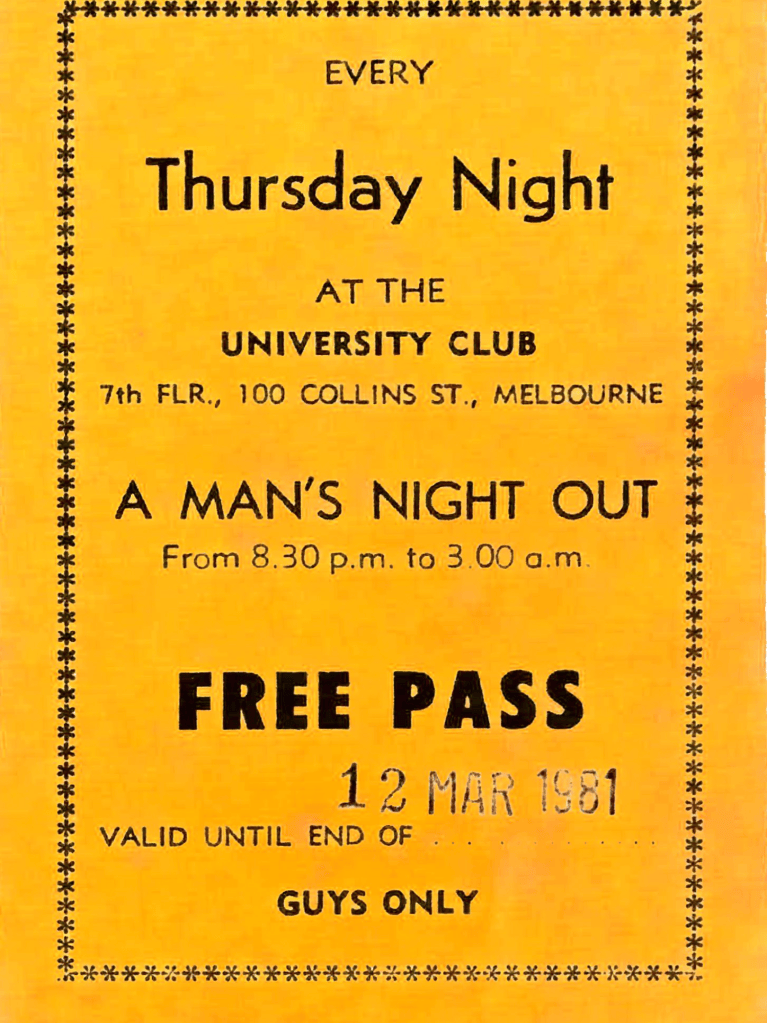
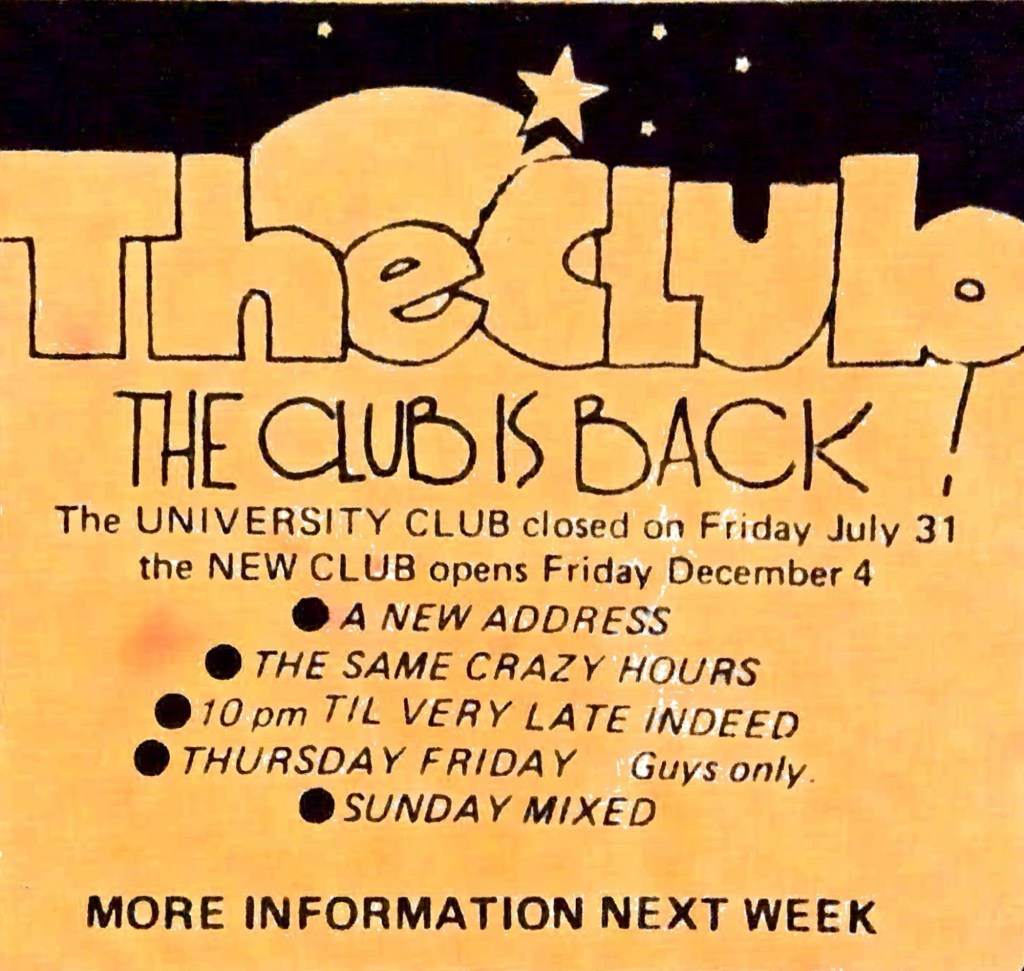
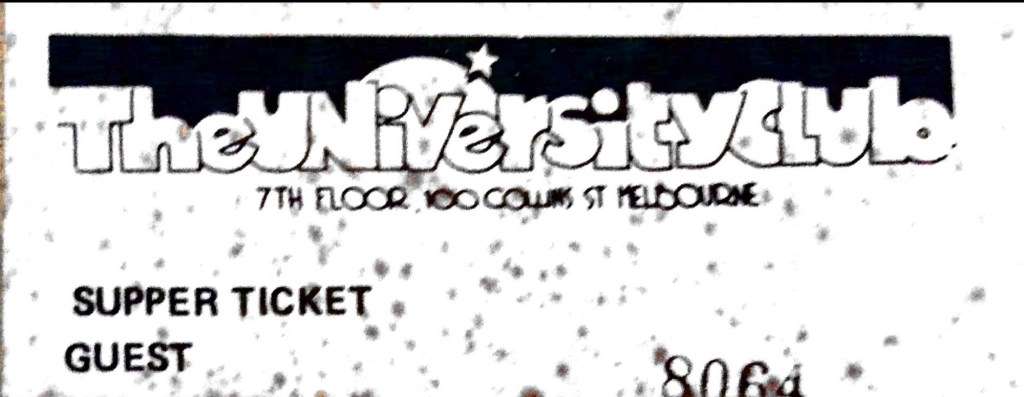
I came out in 1981. My first experience of a gay night in a club had been at the University Club at 100 Collins Street, in the city: a first glimpse of a world that, until then, I had only approached from the edges. Then I discovered Mandate in St Kilda—and found my home.

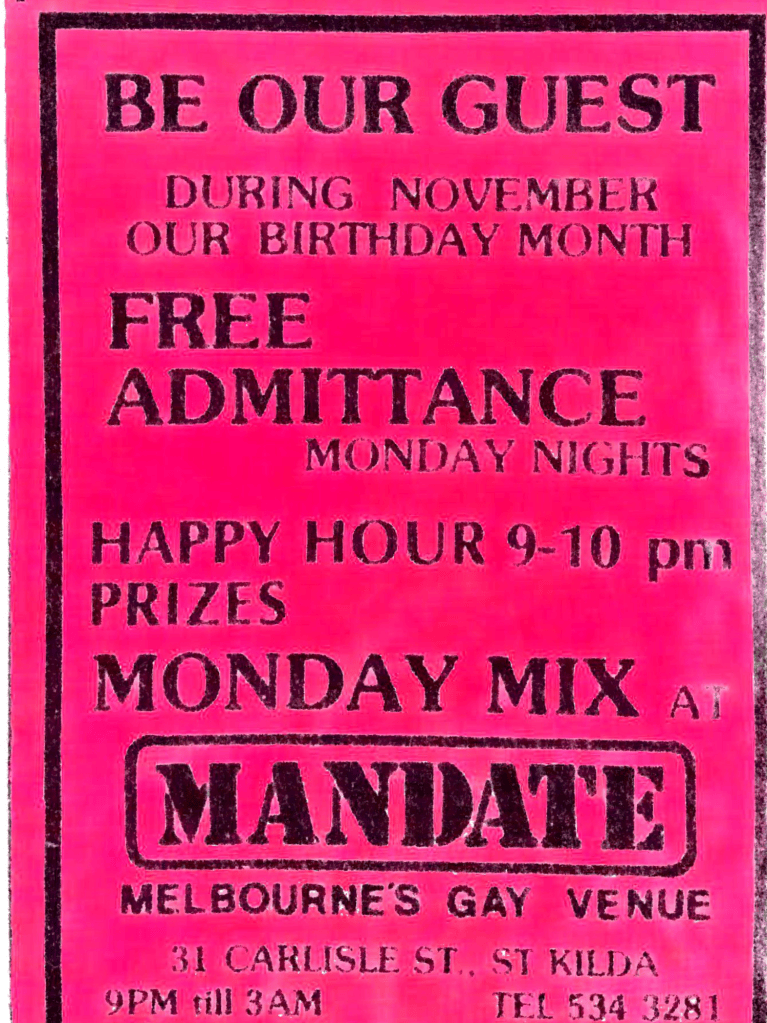
From authors ephemera collection

That is how I remember it. Not as a footnote in a list of Melbourne venues, but as a place where the music, the men, the clothes and the atmosphere all seemed to make sense to me. Mandate was somewhere I wanted to go back to. Somewhere I felt I belonged.

Melbourne had plenty of gay history before Mandate. There were bars, private clubs, social nights and venues where gay men gathered, sometimes openly and sometimes with discretion. The University Club was among the city venues of the 1970s and early 1980s; the La Trobe Journal’s history of Melbourne’s gay and lesbian venues lists it as operating from 1976 to 1981, with both mixed and men-only nights. But much of the earlier scene was scattered across the city, and a gay night might mean a particular evening at a pub rather than a venue built around gay customers. (latrobejournal.slv.vic.gov.au, emelbourne.net.au)

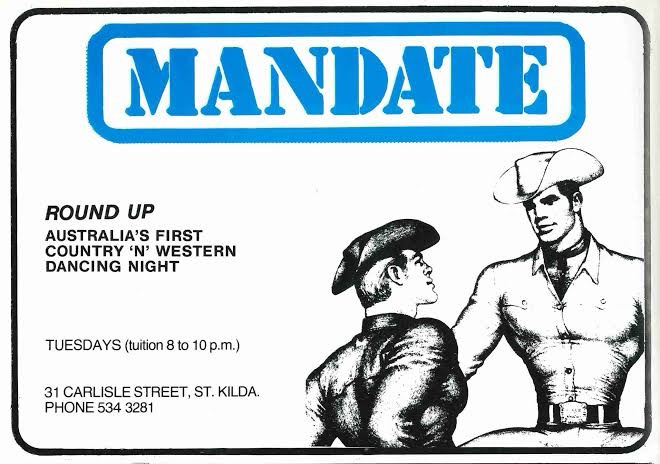
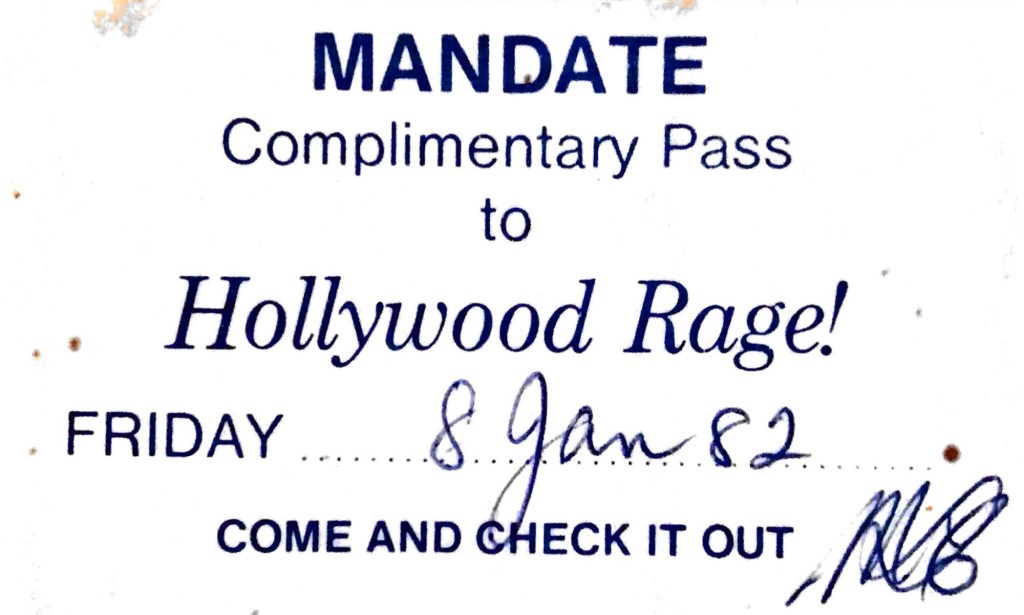
Mandate represented something different. It operated upstairs at 31 Carlisle Street from 1980 to 1989. The Australian Queer Archives describes it as a full-time gay bar and disco that attracted crowds throughout the week, at a time when venues often relied on a single gay night. It wasn’t Melbourne’s first gay gathering place, but it was an unusually visible, purpose-built expression of a gay social life that was becoming more confident and more public. (alga.org.au)

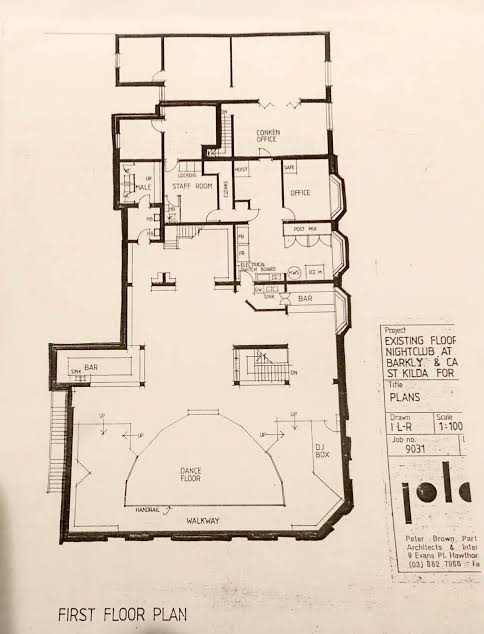
The stairs, the bar, the dance floor

I remember a backroom beneath the stairs at the entrance. It was part of Mandate’s world, but it wasn’t my scene, and I never used it. What I loved was upstairs: the dance bar, the floor, the men and the music.

The copper dance floor could be slick with talc. There were barred areas around it, and kegs served as tables. It had a rough, physical quality that suited the place. The room didn’t feel designed to make you sit decorously with a drink. It felt made for movement, bodies and noise.

Mandate introduced me to Hi-NRG dance music, which I loved. The beat seemed to belong to the room: driving, bright, insistent. You could lose yourself in it. You could watch the crowd, find someone’s eye, dance with a man, or simply be there among other men without having to explain yourself.

That feeling of ease mattered. A venue could be more than a place to drink or dance. It could be a place where the way you dressed, the men you looked at, and the way you moved through a room did not need translating for the outside world.

Jeans, leather and the clone look

Mandate was a hangout for the emerging clone culture. Jeans, T-shirts and flannelette shirts could feel almost like a uniform; leather vests and cowboy hats fitted naturally into the mix. Short hair and moustaches were part of the look too. It was a deliberately masculine style, but it wasn’t one single costume. Men made it their own.

The style reflected a wider gay male fashion that had spread internationally: denim, boots, plaid shirts, leather and facial hair. A 1994 academic study of clone identity describes much the same visual vocabulary. At Mandate, though, this wasn’t an abstract trend to me. It was what I saw around me, night after night, and part of the world I was drawn into. (pubmed.ncbi.nlm.nih.gov)

Bandanas and keys in pockets could also carry messages about what a man wanted sexually. These codes let men signal interests and preferences without announcing them across a crowded room. The meanings could depend on colour, placement and context, but what stays with me is the atmosphere of shared understanding: people reading small details that might pass unnoticed elsewhere. The hanky code has been documented as a form of signalling used in gay leather culture from the 1970s into the 1980s. (digitalcommons.uri.edu, intellectdiscover.com)

And Mandate was very, very male. Public sex was not unusual…{ know this from experience…, even in the upstairs bar. That was part of the club’s character, though not every man was there for the same reason. Some came to dance; some to cruise; some to meet friends; some to see what might happen. I loved the dance floor. The backroom and the barred spaces weren’t my territory, but they belonged to the same scene.

It’s easy, looking back, to turn a place like Mandate into a symbol and smooth away those differences. But it mattered partly because it could hold them together: dancing, flirting, fashion, sexual signalling, spectacle and ordinary socialising all under one roof.

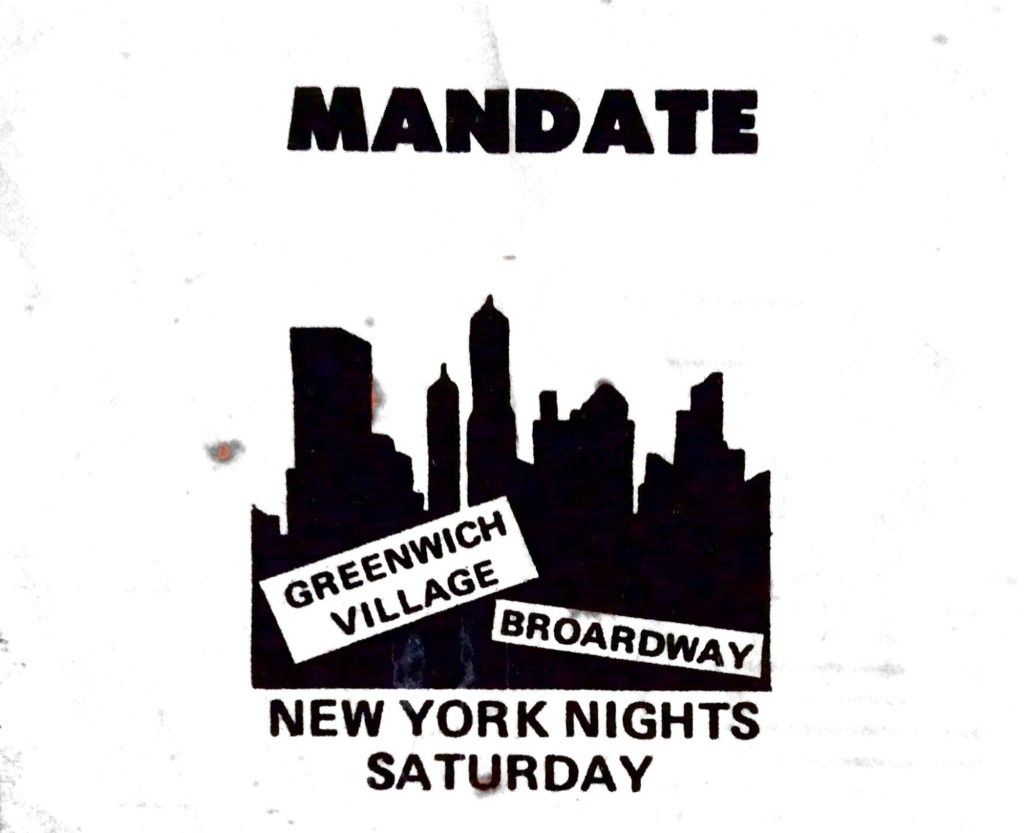
Some spelling errors
From authors ephemera collection

St Kilda had more than one kind of gay night

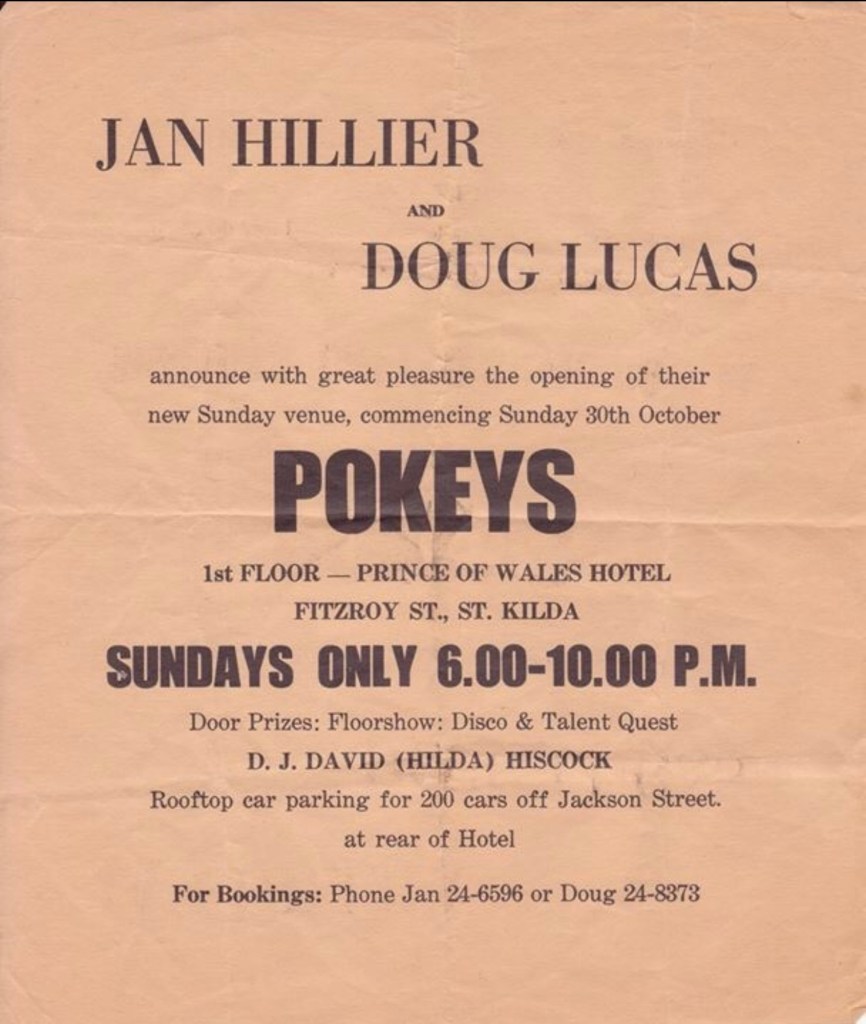
Mandate was part of a wider St Kilda landscape. At the Prince of Wales, Pokey’s brought another kind of gay night: Sunday gatherings upstairs, with drag and a different theatrical energy. I used to go there. The Prince of Wales’ own history remembers the hotel’s gay and lesbian community, its drag shows and Sunday-night gatherings; the La Trobe account dates Pokey’s to 1977–1992 and describes the upstairs Band Room as its home. (latrobejournal.slv.vic.gov.au, theprince.com.au)

Pokey’s and Mandate weren’t interchangeable. One had the draw of drag and performance; the other, for me, meant the dance bar, the floor, the Hi-NRG and the masculine world gathered around it. Both made St Kilda a place where gay men could find a night out, but each offered its own pleasures and its own crowd.

There were other ways to spend an evening, too. Friends might go from one venue to another, or finish late with coffee somewhere that stayed open. The NGV’s account of Melbourne nightlife recalls a patron who went to Mandate and other clubs before stopping at Trish’s Coffee Lounge in North Melbourne around three or four in the morning. That’s a small detail, but it evokes a whole rhythm of going out: one place leading to the next, with the night stretching well past the hour when the rest of the city had gone quiet. (ngv.vic.gov.au)

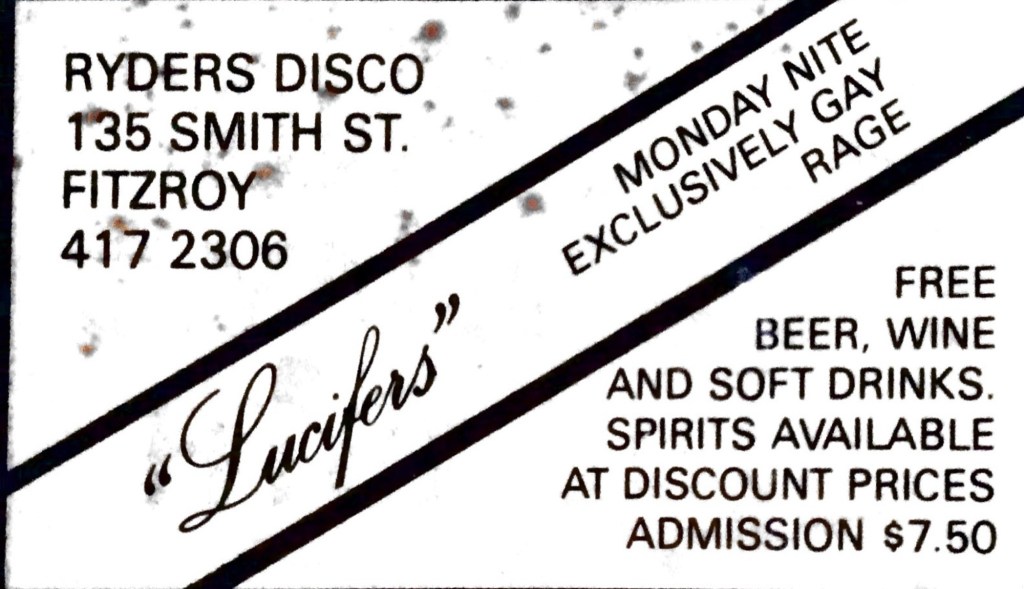
From authors ephemera collection

A club in a changing decade

Mandate opened at a turning point. Victoria repealed its sodomy law in 1980, with decriminalisation taking effect in 1981. The club was already opening its doors as those changes were unfolding. It was an openly gay venue in a society where public acceptance still lagged behind legal reform. The Australian Queer Archives records repeated criticism from the local council, while the heritage assessment places Mandate among the venues that appeared around the time of law reform. (alga.org.au, d1juosud05elln.cloudfront.net)

The 1980s also brought HIV and AIDS, fear and grief, and hostility directed at gay men. The history of gay nightlife cannot be told as an uncomplicated story of liberation. A dance floor could offer a sense of freedom and connection, while outside the club there were still laws, prejudice and danger. Inside, men built ways to be together, to signal to each other and to live parts of their lives in the open.

Mandate’s record is still incomplete. The archives cite Ken Payne’s 1989 City Rhythm article, “After eight years of Mandate, it’s time for the last waltz,” along with a 1999 Brother Sister piece. Those sources, the histories gathered by the Australian Queer Archives, and the memories of patrons together give us more than dates and addresses. They let us start to recover what the place felt like. (alga.org.au)

From authorsbephemera collection

Finding home

When I think of Mandate, I think of that copper floor, perhaps with talc underfoot; of kegs repurposed as tables; of the bars and the men around them; of flannelette shirts, leather vests and cowboy hats; and of Hi-NRG filling the room. I think of a place that was unapologetically male, where different men could come for different reasons, and where I found a scene that felt like mine.

I had come out in 1981. The University Club gave me my first taste of a gay night in a club. Mandate gave me something more lasting: a place I wanted to return to, a dance floor I loved, and a sense of home.

Nostalgia can make a venue glow brighter than it did at the time. It can soften the awkward nights and sharpen the happy ones. But remembering is not the same as pretending everything was perfect. It is recognising that these places mattered: for the men who danced, the men who met one another, the men who watched from the bar, and the men who found, as I did, somewhere they could belong.

Mandate is gone. The building on Carlisle Street remains, but the upper-floor club has become apartments. The room where so many different nights unfolded is now private space. What survives is the written record, the photographs and ephemera that have been kept, and the memories people are willing to share. (d1juosud05elln.cloudfront.net)

For those of us who were there, the details are still vivid: copper underfoot, talc in the air, the beat rising, and a room full of men who knew exactly where they wanted to be.

Tim Alderman ©️2026

Sources

Australian Queer Archives, A History of LGBTIQ+ Victoria in 100 Places and Objects, “Mandate.” (alga.org.au)

La Trobe Journal, “Aspects of Gay and Lesbian Life in Seventies Melbourne.” (latrobejournal.slv.vic.gov.au)

Heritage Victoria, Greyhound Hotel, St Kilda: Cultural Heritage Values Assessment. (d1juosud05elln.cloudfront.net)

The Prince Hotel, “Our History.” (theprince.com.au)

National Gallery of Victoria, “Sites of refuge, connection, creation, resistance and loss: the queer bar and nightclub in the twentieth century.” (ngv.vic.gov.au)

Barry D. Adam, “Political-economic construction of gay male clone identity,” Journal of Homosexuality (1994). (pubmed.ncbi.nlm.nih.gov)

No Clause 28; It’s Just Another Term for Hate

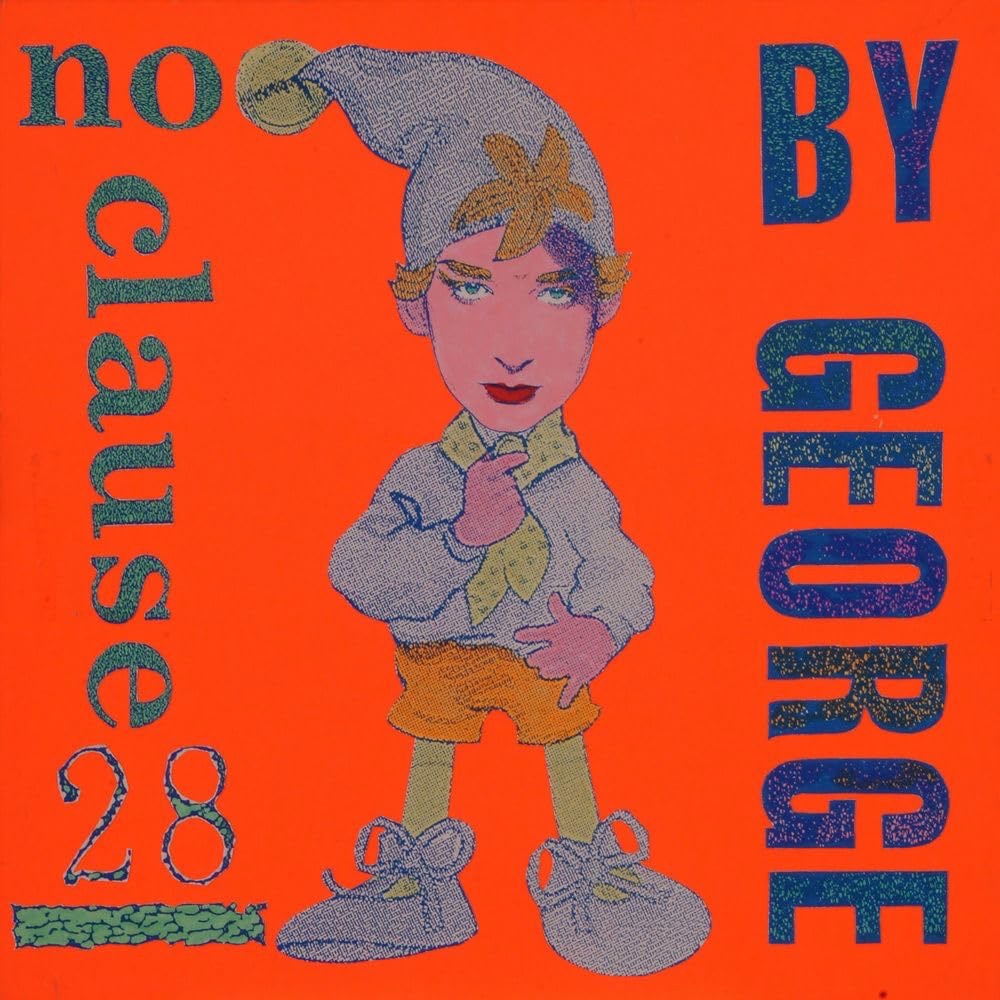
In 1988, Boy George released a protest song.

It was not subtle.

It was not intended to be.

“No Clause 28” was an angry response to legislation then passing through the British Parliament — legislation that would become one of the most notorious measures affecting gay people in modern British history.

George addressed Margaret Thatcher directly. He attacked the government’s record on AIDS, the National Health Service and homosexuality. At one point he asked the “Iron Lady” whether Britain was “moving to the right.”

Boy George – No Clause 28

It was pop music as political protest.

But behind the beat lay something much darker.

Britain was living through the AIDS crisis. Gay men were dying. Newspapers routinely portrayed homosexuality through the lenses of disease, danger and scandal. Public anxiety about AIDS became entangled with older anxieties about sexuality, morality, children and the family.

Then Parliament legislated against the supposed “promotion of homosexuality.”

Boy George – No Clause 28

Officially it was Clause 28.

Once enacted, it became Section 28.

For a generation of gay people, however, it represented something much simpler.

A government had decided that their lives, their relationships and their families were something children should not be encouraged to regard as acceptable.

No Clause 28.

It’s just another term for hate.

Britain Before Section 28

To understand Section 28, we have to return to the Britain of the 1980s.

It was a period of enormous social and political conflict.

Margaret Thatcher had entered Downing Street in 1979. Her governments pursued privatisation, restrictions upon trade unions and a profound restructuring of Britain’s economy.

There was another battle underway as well.

A battle over values.

What was a family?

What should children be taught?

What constituted morality?

How far should local councils be permitted to pursue socially progressive policies?

And increasingly:

What place should gay men and lesbians occupy in British society?

The gay liberation movement had become increasingly visible during the 1970s.

Some Labour-controlled local councils developed policies intended to combat discrimination and recognise gay and lesbian communities.

To their supporters, this was equality.

To their opponents, it was political correctness, social engineering — and eventually “promoting homosexuality.”

The language mattered.

It suggested homosexuality was something that could be advertised, encouraged or taught.

And if homosexuality could be promoted, children could supposedly be recruited into it.

An old fear had acquired new political language.

Then Came AIDS

Into this already volatile environment came HIV/AIDS.

The first recognised cases appeared at the beginning of the 1980s.

Gay men were disproportionately affected during the early epidemic in Britain, as they were in several Western countries.

Fear spread faster than reliable information.

AIDS became associated in the public imagination with gay men.

Some newspapers used openly hostile language.

Gay sexuality could now be presented not merely as immoral but as dangerous.

People were dying while politicians, newspapers, doctors, activists and community organisations argued about how the epidemic should be discussed.

Britain eventually mounted one of the world’s most memorable public-health campaigns — “Don’t Die of Ignorance.”

But AIDS also intensified existing prejudices.

This is the atmosphere in which Section 28 must be understood.

It was not enacted in a social vacuum.

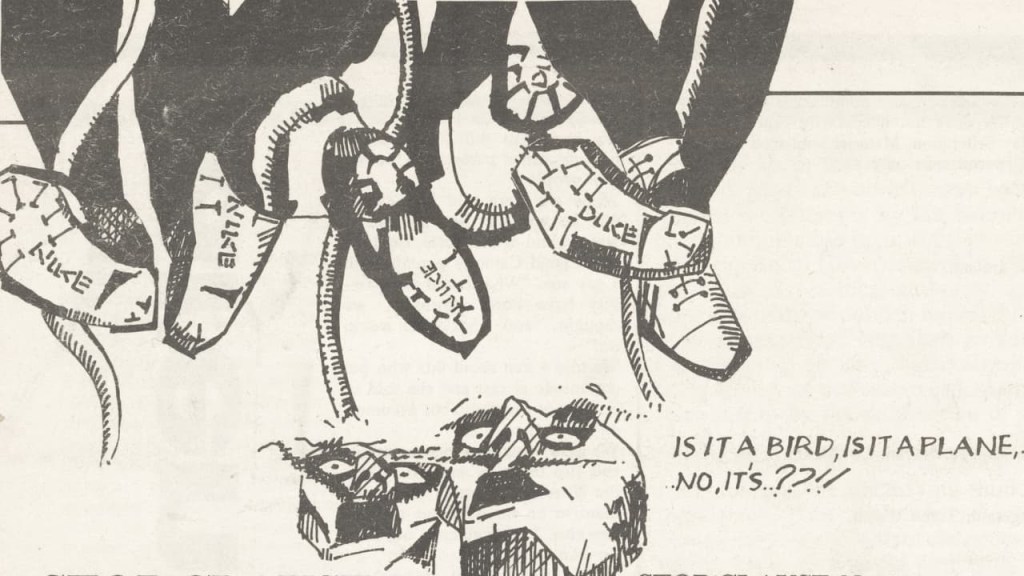
Stop Clause 28

“Positive Images for Gays”

Margaret Thatcher herself made the political direction remarkably clear.

Speaking to the Young Conservative Conference in February 1987, she complained that parents did not want teachers forcing what she called “Positive images for gays” upon innocent children.

Later that year, at the Conservative Party Conference, she went further.

Children who needed traditional moral values, she said, were being taught that they possessed “an inalienable right to be gay.”

She concluded that such children were being cheated of a sound start in life.

Those words are extraordinary when read decades later.

But they are crucial because they demonstrate that the eventual legislation did not emerge from nowhere.

The Conservative government was explicitly presenting positive discussion of homosexuality in schools as part of a wider struggle over education and morality.

Jenny Lives With Eric and Martin

And then there was a children’s book.

Its name was Jenny Lives with Eric and Martin.

Written by Danish author Susanne Bösche, the book depicted a little girl living with her father and his male partner.

Today that premise sounds almost spectacularly ordinary.

In 1980s Britain it became political dynamite.

A copy was discovered in the library system of the Inner London Education Authority.

The controversy became vastly larger than the book itself.

Opponents presented it as evidence that local authorities were actively encouraging homosexuality among children.

During parliamentary debate, Conservative MP Jill Knight attacked the book and material of its kind in extraordinarily hostile terms.

She described such material collectively as a “pile of filth.”

The debate was no longer simply about whether gay people should be protected against discrimination.

It was about children.

And once a political argument becomes framed as protecting children from danger, compromise becomes considerably harder.

From Clause 28 to Section 28

During its passage through Parliament it was known as Clause 28.

That explains Boy George’s title.

When the Local Government Act received Royal Assent on 24 May 1988, Clause 28 became Section 28.

Technically it inserted a new Section 2A into the Local Government Act 1986.

The provision stated that a local authority should not intentionally promote homosexuality or publish material with the intention of promoting homosexuality.

It also prohibited local authorities from promoting teaching in maintained schools of the acceptability of homosexuality as a:

“pretended family relationship.”

Those three words became infamous.

Pretended.

Family.

Relationship.

The implication was difficult to miss.

A man and woman raising children constituted a family.

Two men or two women?

According to the language Parliament had placed into law, their relationship could be characterised as pretended.

What Section 28 Actually Did

This point is important because Section 28 has sometimes been described rather loosely as a law that made it illegal for teachers to discuss homosexuality.

Strictly speaking, that wasn’t what the legislation said.

The statutory restriction was placed upon local authorities.

It did not simply say:

“Teachers must not talk about homosexuality.”

Indeed, during later arguments over repeal, even supporters and opponents acknowledged that Section 28 did not directly regulate individual teachers in the simple way popular memory sometimes suggests.

It also contained an exception concerning action taken for the purpose of preventing or treating disease.

That matters when discussing AIDS: the law did not formally prohibit HIV-prevention work simply because it involved homosexuality.

But law does not operate only through prosecution.

It also operates through fear.

The Chilling Effect

Imagine being a teacher.

You know your local authority is legally prohibited from promoting homosexuality.

But what exactly constitutes promotion?

A book containing two fathers?

A lesson acknowledging gay relationships?

A gay teacher answering a pupil’s question?

Helping a pupil who thinks he might be gay?

Challenging another pupil who calls him a poof?

Discussing same-sex families?

Nobody wants to become the test case that discovers where the legal boundary lies.

So the safest response is obvious.

Say nothing.

That became one of Section 28’s most damaging legacies.

Its power was not simply what authorities were prosecuted for doing.

Its power lay in what people became frightened of doing at all.

The Gay Child in the Classroom

And somewhere in those classrooms sat gay children.

Some knew they were gay.

Some suspected.

Some had no word yet for what they were feeling.

Around them heterosexuality was everywhere.

Boys talked about girls.

Girls talked about boys.

Television showed husbands and wives.

Books contained princes marrying princesses.

Teachers referred to mothers and fathers.

None of this was called the promotion of heterosexuality.

It was simply regarded as life.

But presenting homosexuality positively could potentially be characterised as promotion.

That created an extraordinary imbalance.

One sexuality was ordinary.

The other became something adults approached nervously.

For a frightened gay teenager, silence itself carried a message.

“Pretended Family Relationship”

Perhaps nothing encapsulated that message more brutally than those words.

Pretended family relationship.

Gay people already had families.

They had partners.

They had children.

They had parents and siblings.

They created homes.

They cared for one another.

During the AIDS epidemic, gay men frequently created extraordinary networks of care when lovers and friends became sick — sometimes when biological families had rejected them.

Yet Parliament had inserted language into British law suggesting that homosexual relationships could be presented as something pretending to be a family.

Words in legislation are never merely words.

They tell citizens something about how the state regards them.

Boy George Answers Back

Boy George was never particularly renowned for political timidity.

In 1988 he answered the government through music.

“No Clause 28” attacked the proposed legislation while simultaneously attacking the political environment surrounding it.

AIDS appears in the song.

So does the NHS.

So does Thatcher.

So does political alienation.

George asks the Iron Lady whether Britain is moving to the right.

Most significantly, he refuses the underlying assumption that gay people should quietly accept the government’s definition of them.

The record wasn’t a major commercial hit.

Its historical value lies elsewhere.

It allows us to hear anger while Section 28 was actually happening.

This isn’t somebody looking back thirty years later and explaining why the legislation was harmful.

This is a gay man in 1988 saying:

No.

Ian McKellen Says Something Too

Another famous British gay man made a rather different intervention.

In January 1988, actor Ian McKellen participated in a BBC radio discussion about the proposed legislation.

During the discussion he publicly stated that he was homosexual.

It was effectively his coming out.

The political battle had turned something intensely personal into something public.

McKellen subsequently became one of Britain’s most prominent campaigners for gay equality.

And Section 28 helped produce something the legislation’s supporters presumably hadn’t intended.

It helped organise the opposition.

The Women Who Invaded the BBC News

Then came one of the great pieces of direct action in British gay and lesbian history.

On 23 May 1988, lesbian activists entered BBC Television Centre.

During the live Six O’Clock News, protesters disrupted the broadcast.

Newsreader Sue Lawley continued reading while the disturbance unfolded.

Millions of viewers suddenly encountered resistance to Clause 28 in their living rooms.

It was chaotic.

It was audacious.

And it was impossible to ignore.

The protesters understood something political campaigners have always understood:

If respectable channels won’t give you sufficient attention, create an event they cannot avoid reporting.

Abseiling Into Parliament

Other lesbian activists chose an even more spectacular method.

During protests surrounding the legislation, women entered the House of Lords and used rope to lower themselves into the chamber.

Think about the symbolism.

Parliament was legislating about homosexuality.

Gay and lesbian people were being discussed.

Their families were being discussed.

Their lives were being discussed.

So lesbian protesters literally dropped themselves into the debate.

They refused to remain outside while politicians decided how their existence could be represented.

Manchester Says No

Resistance was not confined to London.

On 20 February 1988, an enormous demonstration against Clause 28 took place in Manchester.

Tens of thousands participated.

The size of the protest demonstrated something important.

The British gay and lesbian community was no longer prepared simply to endure hostile legislation quietly.

A community that had spent generations being told to remain invisible was becoming politically impossible to ignore.

A law designed partly to restrict positive representations of homosexuality had produced an extraordinary amount of homosexual visibility.

History has a sense of irony.

From Protest to Stonewall

Section 28 also helped produce one of Britain’s most influential gay-rights organisations.

In the aftermath of the legislation, campaigners including Ian McKellen and actor Michael Cashman helped establish Stonewall.

Its strategy differed from some more confrontational activist organisations.

Stonewall concentrated heavily upon political lobbying and legislative reform.

The message was clear.

If Parliament could be used to restrict gay people’s lives, Parliament could also be persuaded to protect them.

The battle would increasingly move inside the political system itself.

Why Did People Support Section 28?

Historical fairness requires that we ask this question.

Supporters did not generally describe themselves as people attempting to persecute gay children.

They argued that homosexuality should not be actively promoted by taxpayer-funded local authorities.

Some believed schools had become vehicles for left-wing social engineering.

Some objected specifically to sexual material being made available to children.

Some believed traditional heterosexual marriage deserved a privileged place in education.

Some sincerely believed they were protecting children.

The controversy surrounding Jenny Lives with Eric and Martin became powerful precisely because it fitted that narrative.

But good intentions claimed by supporters do not settle the historical question.

We also have to ask:

What did the law actually communicate and produce?

Protecting children from sexually explicit material is one thing.

Treating positive acknowledgement of gay relationships as inherently suspect is another.

Section 28 blurred that distinction.

A child did not have to encounter sexually explicit material to learn that two men could love one another.

Yet homosexuality itself became entangled with the language of protection.

AIDS Makes the Silence More Troubling

The timing made this particularly disturbing.

Gay men were dying from AIDS.

Public-health authorities desperately needed to communicate frankly about sex.

Gay teenagers needed accurate information.

Fear and misinformation were themselves dangerous.

Section 28 technically permitted measures designed to prevent disease.

Nevertheless, it belonged to a broader political culture in which homosexuality could simultaneously be discussed as a public-health problem while positive representations of gay relationships were treated with suspicion.

Boy George saw the contradiction.

His song links Clause 28 directly with AIDS and government priorities.

For gay people living through the epidemic, these weren’t separate political subjects.

They were happening simultaneously.

The Long Years

Margaret Thatcher left office in 1990.

Section 28 remained.

John Major became prime minister.

Section 28 remained.

Tony Blair won his enormous Labour victory in 1997.

Section 28 still remained.

Repeal proved surprisingly difficult.

By then the provision had acquired enormous symbolic importance for both sides.

For opponents, repeal represented the removal of institutionalised prejudice.

For defenders, repeal could be portrayed as abandoning protection for children and traditional family values.

The original culture war simply continued into another decade.

Scotland Goes First

Devolution changed the situation.

The newly established Scottish Parliament repealed Scotland’s equivalent provision in 2000.

The campaign was bitter.

Once again arguments about homosexuality became arguments about children, schools and families.

But Scotland removed the restriction.

England and Wales would have to wait another three years.

Section 28 had never applied to Northern Ireland.

18 November 2003

Section 28 was finally repealed in England and Wales through the Local Government Act 2003.

Fifteen years had passed since its enactment.

By then Britain was changing rapidly.

The age of consent for gay men had been equalised.

Gay people were becoming increasingly visible in television, politics and public life.

Civil partnerships were about to arrive.

Eventually same-sex marriage would follow.

The state that had described homosexual relationships through the language of “pretended family relationship” would ultimately recognise those relationships as marriages.

That transformation occurred within a generation.

An Apology

There was another remarkable moment in 2009.

David Cameron — then leader of the Conservative Party — apologised for Section 28.

The party that had introduced the measure was acknowledging that it had been wrong.

Political apologies cannot undo history.

But they can reveal how dramatically accepted political values have changed.

Language once considered defensible government policy had become something a future Conservative prime minister felt compelled to repudiate.

The Legacy Wasn’t Repealed Overnight

Laws can disappear faster than cultures.

Section 28 vanished from the statute book.

Its effects did not necessarily vanish from classrooms.

Teachers who had spent years avoiding subjects associated with homosexuality did not instantly become comfortable discussing them.

Schools did not suddenly acquire inclusive resources.

Homophobic bullying did not disappear.

And the generation who had grown up beneath Section 28 did not suddenly forget what its silence had taught them.

For some, the lesson had been painfully simple:

Your heterosexual classmates can imagine their futures openly.

You should keep yours quiet.

That is the damage a chilling law can accomplish without prosecuting anybody.

“Promotion”

Perhaps the most revealing word in the entire controversy was not homosexuality.

It was:

promotion.

Can acknowledging the existence of gay people make children gay?

Can reading about two fathers manufacture homosexuality?

Can telling a gay teenager that his feelings are normal recruit him into homosexuality?

The premise assumes heterosexuality exists naturally while homosexuality requires encouragement.

History provides little support for that idea.

Gay people existed when homosexuality was punishable by death.

They existed when it meant imprisonment.

They existed when it could destroy a career.

They existed when psychiatrists attempted to cure it.

They existed beneath Section 28.

Silence never made gay people disappear.

It merely made some of their lives lonelier.

From the Buggery Act to Section 28

There is an uncomfortable historical echo here.

In 1533, Henry VIII’s government brought buggery explicitly within English secular felony law.

In 1988, Margaret Thatcher’s government legislated about how homosexuality could be represented by local government.

These laws were not equivalent.

The Buggery Act could send a man to the gallows.

Section 28 did nothing remotely comparable.

We should never flatten history by pretending otherwise.

Yet both belong to a much longer history of the state attempting to determine the boundaries surrounding same-sex sexuality.

What may people do?

What may they say?

What may children be told?

What constitutes a legitimate relationship?

What constitutes a family?

Across centuries, the answers changed.

But remarkably, governments kept asking the questions.

No Clause 28

Boy George’s protest record now belongs to another era.

Margaret Thatcher is dead.

Section 28 is repealed.

Same-sex couples can marry in Britain.

Gay people appear openly in schools, Parliament, television, sport and family life.

But history shouldn’t be rewritten simply because society moved on.

In 1988, gay men were watching friends die from AIDS.

Gay teenagers were trying to understand themselves.

Lesbians were fighting for recognition.

Teachers were trying to negotiate increasingly politicised classrooms.

And Parliament passed legislation declaring that local authorities must not promote the teaching of homosexuality as an acceptable “pretended family relationship.”

People protested.

Women invaded television news.

Women descended into the House of Lords.

Tens of thousands marched.

Ian McKellen came out.

Campaigners organised.

Stonewall emerged.

And a flamboyant gay singer who had already spent years refusing to conform picked up a microphone and told Margaret Thatcher exactly what he thought.

No Clause 28.

Sometimes history is written in Acts of Parliament.

Sometimes it is written by the people who refuse to accept them.

And sometimes it comes with a bloody good beat.

Tim Alderman ©️2026

Sources and Further Reading

UK Parliament, House of Commons Library, The 20th Anniversary of the Repeal of Section 28 of the Local Government Act 1988 — detailed account of the origins, operation, controversy and repeal of Section 28.

Local Government Act 1988, Section 28 — original statutory wording and insertion of Section 2A into the Local Government Act 1986.

UK Parliament, Hansard — parliamentary debates surrounding the legislation, including contemporary arguments concerning Jenny Lives with Eric and Martin and the alleged “promotion” of homosexuality.

Margaret Thatcher Foundation, speeches and archival material — particularly Thatcher’s 1987 Young Conservative Conference speech and Conservative Party Conference speech concerning “positive images for gays,” education and “traditional moral values.”

Stonewall, Our History and LGBTQ+ historical timeline — Section 28, Ian McKellen and the development of Stonewall.

Susanne Bösche, Jenny Lives with Eric and Martin — the children’s book that became central to the political controversy surrounding homosexuality and education.

Boy George, No Clause 28 (1988) — contemporary protest song responding to the legislation and its wider political context.

For broader context, contemporary British newspaper archives and gay and lesbian publications from 1987–89 provide valuable evidence of how the legislation was presented and experienced at the time.

Peterloo: When the Demand for Democracy Met the Sabre

Introduction

On 16 August 1819, tens of thousands of men, women and children gathered peacefully at St Peter’s Field in Manchester.

They had not assembled to overthrow the government.

They had come to demand something that today seems remarkably modest:

a meaningful political voice.

Manchester had become one of Britain’s great industrial centres, yet it had no Member of Parliament of its own.

Working people endured high food prices, unemployment, poor housing and industrial upheaval while possessing almost no influence over the laws governing their lives.

The crowd gathered to hear the celebrated radical speaker Henry Hunt call for parliamentary reform.

Within hours, mounted men carrying sabres had charged into them.

People lay dead and hundreds were injured.

The event became known as the Peterloo Massacre—a bitter parody of the British victory at Waterloo four years earlier.

Peterloo became one of the defining moments in the long struggle for British democracy.

Peterloo massacre

Britain After Waterloo

The defeat of Napoleon in 1815 should have brought relief.

Instead, peace created new problems.

Thousands of soldiers returned home looking for work.

Wartime industries contracted.

Food remained expensive.

The Corn Laws of 1815 protected domestic grain producers by restricting cheaper foreign imports, helping keep bread prices high.

Industrial workers suffered particularly badly.

Wages fell in several industries.

Mechanisation threatened skilled trades.

Unemployment increased.

Meanwhile Britain’s parliamentary system remained profoundly unrepresentative.

The people being transformed by industrialisation had almost no political means of shaping that transformation.

Manchester Without Representation

Manchester’s population had exploded during the Industrial Revolution.

Cotton manufacturing made it one of Britain’s most economically important towns.

Yet Manchester did not elect its own MPs.

By contrast, tiny constituencies known as rotten boroughs could return Members of Parliament despite having only a handful of voters.

To reformers, the contradiction was absurd.

The new industrial Britain was producing enormous wealth while the political system remained rooted in an older world of landed property and patronage.

Peterloo massacre

What Did the Reformers Want?

Radicals varied considerably in their demands.

Some wanted relatively modest parliamentary reform.

Others wanted:

broader male suffrage;

more equal electoral districts;

secret ballots;

annual or frequent parliaments;

an end to corrupt boroughs.

These ideas alarmed the government.

The French Revolution remained a powerful memory.

British authorities often interpreted large political gatherings through the nightmare image of Parisian mobs, revolution and regicide.

A crowd demanding reform could therefore be viewed not simply as citizens exercising political rights, but as a possible revolutionary army.

Henry Hunt

The principal speaker invited to Manchester was Henry “Orator” Hunt.

Hunt was famous for addressing enormous outdoor meetings.

He advocated parliamentary reform and was particularly associated with mass peaceful political mobilisation.

The Manchester meeting was deliberately organised to demonstrate discipline.

Participants were encouraged to arrive:

sober;

orderly;

neatly dressed;

and unarmed.

Some groups marched considerable distances in formation.

Women participated prominently, including organised female reform societies.

Families attended.

For many people, Peterloo was intended almost as a civic festival of democracy.

60,000 People on St Peter’s Field

Modern estimates generally place attendance at around 60,000, though contemporary reports sometimes claimed considerably more.

The National Archives describes the gathering as orderly and peaceful before the intervention of the authorities. (National Archives)

Imagine the sight.

Banners moved above the crowd.

Bands played.

Reform societies arrived behind flags carrying slogans demanding liberty and political representation.

Women wearing white dresses formed conspicuous contingents.

Then Henry Hunt arrived.

The authorities were watching from nearby.

The Magistrates

This is where Peterloo connects directly with the world of Georgian power we have been discussing.

Local magistrates were responsible for maintaining order.

They were not politically neutral bureaucrats in the modern sense.

They belonged overwhelmingly to the propertied classes and many regarded radicalism as profoundly dangerous.

As the crowd assembled, the magistrates decided Hunt and several other leaders should be arrested.

The problem was obvious.

How do you arrest men standing on a platform surrounded by tens of thousands of people?

Their answer was cavalry.

Peterloo riots

The Manchester and Salford Yeomanry

The Manchester and Salford Yeomanry were local part-time cavalry.

Unlike regular soldiers, many of them came from the same commercial and property-owning milieu that felt threatened by radical politics.

The magistrates ordered them into the crowd to arrest Hunt.

Mounted men entered St Peter’s Field.

The dense crowd could not easily move aside.

Horses pushed into people.

Sabres were drawn.

Panic spread.

People were knocked down and trampled.

Others were cut with swords.

The regular 15th Hussars were then sent in as the authorities attempted to clear the field.

Within a remarkably short time, the enormous meeting had been dispersed. (National Archives)

The Casualties

The precise casualty figures varied between contemporary accounts and later research.

Current National Archives material gives an estimate of about 18 deaths and up to 700 injuries. (National Archives)

Among the dead was a small child.

Women were among those seriously injured.

Many victims had been crushed beneath horses or other people attempting to escape.

Others suffered sabre wounds.

Peterloo was particularly shocking because the crowd had not arrived prepared for battle.

This was not two armed forces confronting one another.

It was a political meeting violently dispersed by mounted troops.

Why “Peterloo”?

The name appeared almost immediately.

Only four years earlier British forces under Wellington had defeated Napoleon at the Battle of Waterloo.

Radical journalists combined “Peter”—from St Peter’s Field—with “Waterloo.”

Thus:

Peterloo.

The name was intentionally sarcastic.

At Waterloo, British cavalry had attacked Napoleon’s army.

At Peterloo, critics said, British cavalry had attacked their own people.

The term became politically explosive.

The Government’s Response

One might imagine that such bloodshed would have led the government to condemn the magistrates.

It did not.

Home Secretary Lord Sidmouth supported them.

The Prince Regent also expressed approval of their conduct.

A Home Office communication of 23 August praised the magistrates’ “prompt, decisive and efficient measures” for preserving public tranquillity. (National Archives)

For critics, this was almost as disturbing as the massacre itself.

The government appeared to be saying that the use of force against peaceful reformers was legitimate because maintaining order mattered more than their political grievances.

Two Completely Different Versions of Reality

Peterloo demonstrates beautifully how historical events depend upon perspective.

To reformers:

The crowd was peaceful.

The cavalry attacked without justification.

The massacre exposed the brutality of an unreformed political system.

To many magistrates and government officials:

The enormous organised crowd looked threatening.

Radical banners and disciplined marching suggested possible insurrection.

The authorities had prevented something potentially worse.

One Lancashire magistrate described the gathering as resembling insurrection and claimed its organisation terrified loyal subjects. (National Archives)

Both sides looked at the same field and saw completely different things.

Peterloo

Fear of Revolution

The authorities’ fear was not entirely imaginary.

Britain had experienced significant unrest.

There had been:

food riots;

Luddite disturbances;

radical political organisations;

mass meetings;

industrial conflict.

Government ministers remained haunted by the French Revolution.

The question was whether that fear justified treating peaceful reformers as potential revolutionaries.

Peterloo suggested that the governing classes increasingly had difficulty distinguishing between demands for reform and threats to the state.

Women at Peterloo

Women played a striking role in the reform movement.

Female reform societies appeared in several northern towns.

Women created banners, marched in organised groups and participated publicly in political campaigns.

This was remarkable in a society where women possessed no parliamentary vote whatsoever.

Their presence at Peterloo also challenged assumptions that politics belonged solely to men.

Women suffered disproportionately among some categories of the injured, possibly because distinctive female reform contingents were highly visible.

Peterloo therefore belongs not only to the history of male suffrage but also to the longer history of women’s political activism.

The Radical Press

Peterloo might have disappeared into local history had newspapers and pamphleteers not publicised it.

Radical journalists quickly circulated descriptions and images of cavalry attacking civilians.

Engravings portrayed mounted men cutting through crowds.

The government faced a major propaganda problem.

Attempts were made to justify the authorities’ actions and dispute claims about casualties.

One official publication even attempted to defend the authorities in connection with the death of the child William Fildes. (National Archives)

Instead of silencing criticism, such responses often intensified public anger.

The Six Acts

The government’s reaction was not liberalisation.

It was further repression.

Later in 1819 Parliament enacted measures collectively known as the Six Acts.

They restricted:

large political meetings;

radical newspapers and publications;

certain forms of political organisation;

and activities authorities associated with sedition.

Rather than interpreting Peterloo as evidence that representation needed reform, ministers largely concluded that radicalism needed tighter control. (National Archives)

It repeated a pattern already visible in Pitt’s repressive legislation and the Combination Acts.

When confronted by popular mobilisation, the state often responded first by restricting it.

Peterloo and the Luddites

Peterloo and Luddism are closely connected.

Both grew from the profound disruption caused by early industrialisation.

But the responses were different.

The Luddites attacked machinery.

The Peterloo reformers attempted peaceful mass politics.

One used direct industrial action.

The other demanded parliamentary change.

Yet both encountered an establishment deeply suspicious of organised working people.

This created a bleak political lesson.

Machine breaking could lead to execution.

Striking could bring prosecution.

Political organisation could be restricted.

A peaceful demonstration could be charged by cavalry.

For working-class reformers, the question increasingly became:

The 197th memorial to the Peterloo massacre

What lawful path to change actually remained?

Peterloo Did Not Immediately Win Reform

Peterloo did not suddenly create democracy.

There was no immediate extension of voting rights.

The Reform Act did not arrive until 1832, thirteen years later.

Even that Act left most working-class men without the vote.

Further Reform Acts followed in 1867 and 1884.

Women waited much longer.

Yet Peterloo became part of the mythology of British democracy.

It demonstrated both the danger of denying representation and the extraordinary determination of ordinary people to demand it.

From Subjects to Citizens

Perhaps the deepest importance of Peterloo lies in a changing idea of political identity.

The traditional view held that respectable men of property governed on behalf of everyone else.

Reformers increasingly rejected that assumption.

They argued that working people were not merely subjects to be governed.

They possessed political interests of their own.

They deserved representation.

That change in thinking would ultimately prove impossible to reverse.

Peterloo and

The Mill

Peterloo fits naturally into dramas such as The Mill because industrial communities were not isolated from political reform.

Mill workers understood that low wages, poor conditions and political exclusion were interconnected.

If workers could not influence Parliament, then Parliament could pass:

Combination Acts;

Corn Laws;

harsh criminal laws;

restrictions upon protest,

without fearing the electoral consequences from those most affected.

Economic reform therefore increasingly required political reform.

The factory floor and the ballot box became part of the same struggle.

Peterloo and

The Armour of Light

The same tension runs through Ken Follett’s The Armour of Light.

Characters such as Jarge live in a society undergoing enormous economic transformation while political institutions lag far behind.

The wealthy can invest, borrow, build mills and influence local society.

Workers experience the consequences but possess little formal political power.

Joanie’s transportation illustrates another element of that imbalance.

An individual caught up in collective unrest could be removed from Britain altogether.

Transportation did not merely punish criminals.

It also demonstrated the enormous coercive power available to the Georgian state.

When we reach Peterloo, all these themes converge.

Work.

Hunger.

Property.

Law.

Political exclusion.

Fear of disorder.

And government force.

Conclusion

Peterloo was not simply an unfortunate riot.

Nor was it simply an uncomplicated massacre perpetrated by cartoon villains.

It was the catastrophic result of two visions of Britain colliding.

One vision believed society should continue to be governed primarily by property-owning elites who maintained order on behalf of everyone.

The other believed Britain’s growing industrial population had earned the right to participate in deciding how the country was governed.

On 16 August 1819 those visions met at St Peter’s Field.

One side carried banners.

The other carried sabres.

The banners lost that afternoon.

But ultimately, the ideas printed upon them won.

Tim Alderman ©️2026

Sources

The National Archives (UK), The Peterloo Massacre.

The National Archives (UK), How Did the Government Respond to a Mass Protest at Peterloo in 1819?

Robert Poole, Peterloo: The English Uprising.

Joyce Marlow, The Peterloo Massacre.

E. P. Thompson, The Making of the English Working Class.

Boyd Hilton, A Mad, Bad, and Dangerous People? England 1783–1846.

Donald Read, Peterloo: The “Massacre” and Its Background.

Power and Justice in Georgian England: When Property, Politics and the Law Belonged to the Same Men

Introduction

To a labourer living in Britain around 1800, power could appear remarkably concentrated.

The man who owned the land might also employ him. The man who employed him might own his cottage. The landlord might be a justice of the peace. The justice might command the local militia, influence parliamentary elections, determine who received poor relief, and sit on the bench when labourers were prosecuted.

None of this necessarily involved corruption.

It was simply how Georgian Britain was governed.

Britain possessed Parliament, courts, juries and an ancient tradition of common law, and contemporaries proudly contrasted their liberties with the absolutist governments of continental Europe. Yet political and legal power remained overwhelmingly concentrated among landowners and wealthy men.

The Industrial Revolution complicated this old hierarchy by creating another increasingly powerful group: manufacturers, merchants, bankers and mill owners whose fortunes came not primarily from land but from capital.

By the period of the Combination Acts and the Luddite disturbances, Britain’s traditional landed elite was being joined by an industrial elite.

For working people, however, the result could look remarkably similar.

Those who possessed property also possessed power.

A Country Governed Locally

Modern Britain has professional police forces, local councils, government departments and salaried public officials.

Georgian Britain possessed remarkably few of these things.

Much everyday government was carried out locally by members of the landed classes.

Central government in London was comparatively small. Parliament made laws, ministers conducted national policy and royal judges travelled throughout the country, but enormous responsibility for actually governing communities rested with local gentlemen.

At the centre of this system stood one particularly important figure:

the Justice of the Peace.

The Justice of the Peace

Justices of the Peace—or JPs—were usually substantial landowners or other respected local gentlemen appointed to maintain order within a county.

They were normally unpaid.

Yet their responsibilities were enormous.

Magistrates dealt with matters including:

theft and minor criminal offences;

assault;

drunkenness and disorder;

disputes involving servants;

vagrancy;

poor relief;

licensing inns and alehouses;

enforcement of numerous economic regulations;

preliminary hearings for serious crimes;

and increasingly, industrial disturbances.

Several magistrates sitting together formed the Quarter Sessions, which met four times a year and dealt with more substantial criminal and administrative matters.

The magistracy therefore combined functions that today would be distributed among judges, police authorities, councils and government departments.

The local gentleman was not simply administering justice.

He was helping administer society.

Property and the Assumption of Independence

Why were wealthy landowners considered suitable for these responsibilities?

Georgian political thought contained an assumption that now seems distinctly peculiar:

property made a man independent.

A labourer depended upon wages.

A tenant depended upon his landlord.

A tradesman depended upon customers.

But a gentleman possessing sufficient land supposedly depended upon nobody.

Because he possessed an independent income, Georgian society reasoned, he could exercise independent judgment.

Property was therefore regarded not merely as wealth but almost as evidence of fitness to govern.

This assumption helped justify restricting political participation to a comparatively small section of society.

Parliament Was Hardly Representative

Before the Reform Act of 1832, Britain’s parliamentary system contained extraordinary anomalies.

Voting qualifications varied considerably.

Some constituencies contained thousands of voters.

Others contained only a handful.

The notorious rotten boroughs might elect Members of Parliament despite having tiny populations.

Meanwhile rapidly expanding industrial cities could be seriously underrepresented.

Manchester, which became one of the great centres of the Industrial Revolution, did not elect its own MPs before 1832.

Powerful patrons could effectively control some parliamentary seats.

Votes were sometimes openly influenced through employment, patronage, bribery or intimidation.

Britain had parliamentary government.

It certainly did not yet possess representative democracy in the modern sense.

The Arrival of the Industrial Capitalist

Into this world stepped a new kind of wealthy man.

The factory owner.

His wealth came not principally from acres of countryside but from:

machinery;

buildings;

manufacturing;

credit;

commerce;

and increasingly sophisticated financial networks.

Some members of the traditional aristocracy regarded these newly wealthy industrialists with disdain.

But money has a remarkable ability to acquire respectability.

Successful manufacturers purchased estates.

Their children married into established families.

They became magistrates.

Some entered Parliament.

Industrial wealth gradually bought access to the social and political institutions previously dominated by landed wealth.

When Your Employer Was Also Your Landlord

Industrialisation could give an employer extraordinary control over workers.

Some factory owners constructed entire settlements around their mills.

Housing workers nearby made practical sense. Industrial production required large numbers of employees who could reach the workplace reliably and quickly.

But employer-owned housing also created dependency.

If a worker lost his employment, he might also lose his home.

His family could therefore depend upon the same man for both:

wages and shelter.

Company shops or employer-controlled credit could deepen that dependence further.

Not every industrial community operated in exactly the same way, and some paternalistic employers genuinely attempted to provide decent housing and facilities.

Nevertheless, the imbalance of power was enormous.

The Worker Had Very Few Weapons

A worker possessed one obvious economic weapon.

He could refuse to work.

But one worker refusing to work was easily replaced.

Workers therefore needed to act collectively.

And that brought them directly into conflict with the Combination Acts of 1799 and 1800.

Workers combining to raise wages or improve conditions could find themselves on the wrong side of the criminal law.

Thus an extraordinary imbalance emerged.

An employer possessed capital.

He possessed machinery.

He might own housing.

He could dismiss workers.

He could recruit replacements.

Workers possessed their labour—but were severely restricted in their ability to organise that labour collectively.

Little wonder industrial disputes became explosive.

Enter the Strike-Breaker

When workers nevertheless struck, employers could recruit replacements.

These workers became bitterly known as strike-breakers or, eventually, “scabs.”

Sometimes they came from neighbouring districts.

Sometimes employers recruited labour from much farther away, including Ireland.

This created an especially poisonous social situation.

The striking worker saw someone taking his livelihood.

The replacement worker often saw desperately needed employment.

The employer saw a means of keeping expensive machinery operating.

All three might be acting rationally according to their circumstances.

But only one possessed substantial economic power.

The Mill Could Not Simply Stop

Industrialisation created another problem rarely experienced to the same degree by traditional craftsmen.

Factories required enormous investment.

An entrepreneur might borrow heavily to construct:

the mill;

water systems or steam engines;

machinery;

warehouses;

workers’ housing.

Once that capital had been committed, production needed to continue.

Interest on loans did not disappear because workers were striking.

Machinery sitting idle produced nothing.

An extended shutdown could bankrupt an owner.

This does not excuse exploitation.

But it explains why industrial disputes became so ferocious.

Both sides could believe their survival was at stake.

The worker feared starvation.

The owner feared financial ruin.

Where Was the Police Force?

Another striking difference from modern Britain was the absence, for much of this period, of a professional national policing system.

London’s Metropolitan Police was not established until 1829.

Elsewhere policing remained fragmented.

Communities relied upon:

parish constables;

watchmen;

magistrates;

private prosecution;

and, during major disturbances, soldiers.

This is one reason industrial unrest could escalate so dramatically.

If hundreds of workers attacked a mill, there was no local riot squad waiting nearby.

Authorities might summon troops.

And soldiers were trained for warfare, not crowd control.

The consequences could be catastrophic.

Peterloo

The most infamous example occurred at St Peter’s Field in Manchester on 16 August 1819.

Tens of thousands gathered peacefully to demand parliamentary reform.

Local magistrates became alarmed by the size of the crowd and ordered the arrest of speakers.

The Manchester and Salford Yeomanry entered the crowd.

Sabres were drawn.

People were killed and hundreds injured.

The event became known bitterly as the Peterloo Massacre, an ironic reference to the Battle of Waterloo four years earlier.

Peterloo exposed the fundamental problem of Georgian government.

Those responsible for maintaining public order frequently came from the same social classes whose political dominance demonstrators were challenging.

The Assizes

Serious criminal cases went beyond the magistrates.

England and Wales were divided into circuits travelled by royal judges who periodically held Assize Courts.

The arrival of the Assize judge was an important local event.

Cases could include:

murder;

rape;

serious assault;

burglary;

robbery;

major theft;

and offences carrying capital punishment.

Juries decided guilt.

Judges interpreted the law and imposed sentences.

For defendants, the Assizes could be terrifying.

Trials were often extremely rapid by modern standards.

Defendants had far fewer procedural protections than modern accused persons.

And hanging remained available for an astonishing range of offences.

The Bloody Code

Eighteenth- and early nineteenth-century English criminal law became notorious for what later historians called the Bloody Code.

At its height, more than 200 offences could theoretically attract the death penalty.

Many involved property.

People could face death for offences that seem astonishingly minor by modern standards.

Why?

Because property was considered fundamental to social order.

Britain lacked a large professional police force. Legislators therefore relied heavily upon deterrence.

The terrifying possibility of the gallows was supposed to discourage crime.

In practice, matters were more complicated.

Juries sometimes deliberately undervalued stolen goods so defendants would avoid capital punishment.

Judges recommended mercy.

The Crown issued pardons.

Many death sentences were commuted.

Nevertheless, executions remained a very real feature of Georgian justice.

Transportation

There was another solution.

Remove the offender entirely.

For much of the eighteenth century Britain transported convicts to its American colonies.

The American Revolution closed that outlet.

Attention subsequently turned towards Australia.

The First Fleet arrived at Sydney Cove in 1788.

Transportation increasingly provided British courts with a punishment that sat somewhere between imprisonment and execution.

A person convicted in England might suddenly receive a sentence of seven years, fourteen years or life—and find himself or herself transported thousands of kilometres away.

Thus Britain’s Georgian criminal justice system became intimately connected with the European colonisation of Australia.

Justice Was Not Simply Bought

It would nevertheless be misleading to portray Georgian courts as nothing more than instruments of rich men.

English law possessed genuine traditions of judicial independence.

Juries sometimes defied expectations.

Judges sometimes ruled against powerful interests.

Lawyers could challenge government prosecutions.

Radical defendants occasionally won spectacular victories.

The courts mattered precisely because law possessed legitimacy.

The problem was more subtle.

The people who made laws, administered communities and served as magistrates overwhelmingly came from property-owning society.

They naturally tended to view threats to property and social hierarchy as threats to society itself.

Justice therefore did not need to be deliberately corrupt to favour the existing order.

The assumptions underlying the system already did much of that work.

Why Machine Breaking Was So Terrifying

This helps explain the extraordinary reaction to the Luddites.

To a desperate textile worker, smashing a machine might mean destroying the instrument that had destroyed his livelihood.

To the governing classes, however, machine breaking meant something far more alarming.

It represented:

an organised attack upon property.

And property lay at the heart of Georgian society.

Machine breaking therefore became a capital offence under the Frame Breaking Act of 1812.

Workers who believed they were defending their livelihoods could consequently find themselves facing the gallows.

The Luddite’s Impossible Choice

Imagine being a skilled textile worker in 1812.

Your employer introduces machinery that reduces the value of your skill.

Your wages fall.

Food prices remain high.

You cannot vote for meaningful political change.

Combination with fellow workers is heavily restricted.

Striking risks dismissal.

Your employer can hire replacements.

If you attack the machinery, you can be executed.

If you protest politically, authorities may regard you as a revolutionary.

What lawful avenue remains?

This does not make violence inevitable or justified.

But it helps explain why some workers concluded that conventional avenues offered them virtually nothing.

The hammer became political speech for people who possessed little other political voice.

A System Beginning to Crack

Yet Georgian Britain was changing.

Industrialisation created huge towns whose populations could no longer plausibly remain politically invisible.

A growing middle class demanded representation.

Workers increasingly organised despite legal restrictions.

Campaigners attacked the Bloody Code.

Reformers demanded changes to prisons and policing.

The old system of government by landed gentlemen gradually became impossible to sustain.

The Reform Act of 1832 began redistributing parliamentary representation.

The nineteenth century subsequently brought:

further electoral reform;

professional policing;

legal trade unions;

factory regulation;

criminal law reform;

reduced use of capital punishment;

and increasingly professional local government.

None arrived quickly.

None arrived without opposition.

But the Georgian system slowly gave way.

From Manor House to Mill

Perhaps the most fascinating feature of Georgian Britain is that it stood between two worlds.

The older world was dominated by land.

Power belonged to aristocrats, squires and great estates.

The emerging world was dominated increasingly by capital.

Power began shifting towards manufacturers, merchants, financiers and industrialists.

For ordinary workers, however, the transition did not initially produce greater freedom.

Sometimes it merely produced a new master.

The medieval labourer had depended upon the landowner.

The industrial labourer increasingly depended upon the factory owner.

And both operated within political systems designed primarily by men of property.

Conclusion

Georgian Britain liked to regard itself as a land of liberty.

Compared with many contemporary European states, there was considerable truth in that claim. Britain possessed Parliament, common law, juries, a relatively independent judiciary and a vigorous culture of political debate.

But liberty was distributed unevenly.

Property brought independence.

Independence brought influence.

Influence brought political and judicial power.

For those without property, the institutions of government could consequently seem remote and hostile.

The Industrial Revolution intensified that contradiction. Workers were increasingly described as free labourers while possessing remarkably little control over the economic circumstances governing their lives.

That contradiction produced strikes, riots, political movements and occasionally machine breaking.

The Luddites were therefore not an inexplicable outbreak of primitive rage against technology.

They emerged from a society in which economic transformation was occurring far faster than political reform.

The machines were new.

The concentration of power was not.

And therein lay the conflict that would help shape nineteenth-century Britain.

Tim Alderman ©️2026

Sources

E. P. Thompson, The Making of the English Working Class.

Douglas Hay et al., Albion’s Fatal Tree: Crime and Society in Eighteenth-Century England.

Leon Radzinowicz, A History of English Criminal Law and Its Administration from 1750.

John H. Langbein, The Origins of Adversary Criminal Trial.

Eric Hobsbawm, Industry and Empire.

Boyd Hilton, A Mad, Bad, and Dangerous People? England 1783–1846.

Malcolm I. Thomis, The Luddites: Machine-Breaking in Regency England.

UK Parliament, historical material concerning parliamentary reform and the Reform Act 1832.

The National Archives (UK), historical material concerning crime, punishment, transportation and Georgian justice.

Old Bailey Proceedings Online, records of criminal trials and punishment in eighteenth- and nineteenth-century London.

The Luddites: More Than Machine Smashers

Introduction

Today the word “Luddite” is commonly used to describe someone who dislikes technology. It conjures images of people refusing to use computers, smartphones, or the internet.

History tells a very different story.

The original Luddites were not opposed to machinery itself. Rather, they opposed the way new technology was being used by factory owners to cut wages, replace skilled craftsmen, and increase profits while ordinary families sank deeper into poverty.

Between 1811 and 1817, thousands of textile workers across Nottinghamshire, Yorkshire and Lancashire became involved in one of Britain’s first major industrial protest movements. Their actions frightened the government so much that more troops were eventually deployed against them than were serving under the Duke of Wellington in parts of the Peninsular War.

Far from being enemies of progress, the Luddites were fighting for dignity, fairness and survival.

Britain on the Edge

The years following the Combination Acts saw conditions deteriorate even further.

Britain remained at war with Napoleonic France.

Trade suffered.

Food prices remained high.

Harvests were poor.

Industrialisation accelerated.

Traditional skilled trades disappeared.

Factory owners increasingly introduced machines capable of producing goods more cheaply than experienced craftsmen working by hand.

For many families, generations of specialised knowledge suddenly became almost worthless.

Who Was “Ned Ludd”?

The movement supposedly took its name from Ned (or Edward) Ludd.

According to popular legend, a young apprentice named Ned Ludd smashed two knitting frames in Leicestershire during the late eighteenth century after being punished by his employer.

Whether Ned Ludd ever actually existed remains uncertain.

Most historians believe he became a mythical figure—a symbolic leader rather than a real one.

Luddites often signed threatening letters:

“General Ludd”

or

“King Ludd.”

The mythical leader united thousands of workers who never actually met one another.

What Were They Fighting?

Contrary to popular belief, Luddites did not smash every machine they encountered.

Instead, they targeted specific machines used by employers whom they believed were acting unfairly.

These employers often:

cut wages dramatically

hired untrained labour

produced poor-quality goods

ignored long-standing agreements with skilled craftsmen

exploited desperate workers

Machine breaking became a form of industrial protest.

It was aimed at employers rather than technology itself.

The Night Raids

Many attacks took place after dark.

Groups of masked men would gather secretly before marching to mills or workshops.

Armed with heavy hammers, they destroyed:

stocking frames

shearing frames

power looms

spinning equipment

Some raids lasted only minutes.

The men then disappeared into the countryside before soldiers arrived.

Communities frequently protected them by refusing to identify participants.

Yorkshire and the Woollen Mills

Yorkshire became one of the movement’s strongest centres.

The woollen industry had relied upon highly skilled cloth finishers known as croppers.

New shearing frames allowed employers to replace many experienced craftsmen with cheaper, less-skilled labour.

For croppers, the machine represented unemployment.

The issue was never simply technology.

It was who benefited from it.

William Cartwright and Rawfolds Mill

One of the most famous confrontations occurred in April 1812.

Mill owner William Cartwright fortified Rawfolds Mill near Huddersfield, expecting an attack.

When several hundred Luddites assaulted the mill, they found armed defenders waiting.

Shots were exchanged.

Several Luddites were killed.

The failed attack marked a turning point.

Government determination to crush the movement intensified.

Parliament Responds

The British government reacted with extraordinary severity.

Thousands of troops were sent into industrial districts.

Informers were rewarded.

Suspected leaders were arrested.

In 1812 Parliament passed the Frame Breaking Act, making machine breaking punishable by death.

It was one of the harshest responses ever directed at an industrial protest movement.

Trials and Executions

The government intended to make examples of those involved.

Following mass arrests in Yorkshire and Nottinghamshire:

dozens received transportation

many were imprisoned

several were executed

Executions took place publicly.

Authorities hoped fear would destroy the movement.

Instead, many workers regarded the condemned as martyrs.

Employers Strike Back

Factory owners also adapted.

Some hired armed guards.

Others built stronger mills.

Many recruited replacement workers from elsewhere.

This was the beginning of a pattern that would continue throughout the nineteenth century.

Employers frequently imported labour from other districts—or from Ireland—to keep mills operating during strikes.

The newcomers were often branded “scabs” by striking workers.

Yet many of these men were victims themselves, driven by hunger and unemployment rather than any desire to betray fellow workers.

Employers exploited desperation on both sides, deepening divisions among working people while preserving their own profits.

Were the Luddites Successful?

In the short term, no.

The movement was crushed.

Industrialisation continued.

Factories expanded.

Machines became even more widespread.

Yet the Luddites left an important legacy.

They forced Britain to confront difficult questions.

Should technological progress benefit everyone?

Or only those who owned the machines?

Those questions remain remarkably relevant today.

Modern Parallels

The Luddites are often misunderstood because history remembers the smashed machinery rather than the reasons behind it.

Modern workers face similar anxieties.

Automation.

Artificial intelligence.

Robotics.

Digital technology.

Again, the debate is not whether technology should exist.

It is whether society shares its benefits fairly.

In that sense, the Luddites were asking questions that continue into the twenty-first century.

Luddites on trial

The Armour of Light

Ken Follett captures this period exceptionally well.

The strike, Hornbeam’s use of replacement workers from Dublin, the overcrowded back-to-back housing, and the growing bitterness between employers and employees all reflect real practices of the early Industrial Revolution.

Hornbeam is not merely a fictional villain. He represents a type of mill owner who embraced technological innovation while resisting any suggestion that workers deserved a voice in how those changes affected their lives. His willingness to import strike-breakers illustrates another historical reality: employers often found it easier to pit one group of workers against another than to negotiate improvements in wages or conditions.

Conclusion

The Luddites were never simply enemies of progress.

They were skilled workers watching their livelihoods disappear in an age of breathtaking technological change. Their protest was born not from ignorance but from fear that industrial progress was enriching a few while impoverishing many.

Although the movement was defeated, its struggle helped shape later debates over workers’ rights, trade unions, collective bargaining and the social responsibilities that accompany technological innovation.

Perhaps the greatest injustice done to the Luddites is that their name has become shorthand for resisting technology, when in reality they were among the first people to ask a question that still echoes today:

Who truly benefits from progress?

Tim Alderman ©️2026

Sources

E. P. Thompson, The Making of the English Working Class.

Malcolm I. Thomis, The Luddites: Machine-Breaking in Regency England.

Adrian Randall, Before the Luddites.

Eric Hobsbawm, Industry and Empire.

Kirkpatrick Sale, Rebels Against the Future.

Parliamentary Archives (UK), records relating to the Frame Breaking Act (1812).

Trades Union Congress (TUC), historical resources on the origins of British trade unionism.

The Combination Act 1800: Tightening the Noose Around Britain’s Workers

Introduction

The Combination Act of 1800 is often overshadowed by its predecessor of 1799, yet the two Acts were intended to work together. If the first Act declared that combinations of workers were illegal, the second refined the law, strengthened enforcement, and attempted to remove loopholes that workers might exploit.

Together they marked one of the most determined efforts by the British government to suppress organised labour. Coming at a time of war with Revolutionary France, political unrest, food shortages, and rapid industrial change, the legislation reflected a ruling class deeply fearful that Britain’s workers might follow the path of the French Revolution.

For readers of Ken Follett’s The Armour of Light, these Acts explain why so many characters are terrified of meetings, why employers possess enormous power, and why even asking for higher wages could lead to imprisonment.

Britain in 1800

The turn of the nineteenth century was an anxious time.

Britain remained locked in conflict with France.

Industrialisation accelerated.

Mechanised factories replaced traditional craftsmen.

Food prices remained painfully high.

Many families struggled simply to survive.

The government believed stability depended upon preventing workers from acting collectively.

To ministers, trade unions were not economic organisations.

They were potential revolutionary cells.

Prime Minister William Pitt the Younger believed that maintaining order justified severe restrictions on civil liberties.

What Did the 1800 Act Do?

The Act expanded and clarified the legislation passed the previous year.

It made clear that workers could not:

combine to raise wages

combine to reduce working hours

organise strikes

persuade fellow workers to join industrial action

collect funds to support striking workers

threaten employers through collective action

pressure other workers to stop working

The law also prohibited employers from joining together for unlawful purposes, but in practice enforcement overwhelmingly targeted workers.

This imbalance became one of the chief criticisms of the legislation.

Why the Government Was So Afraid

Today we tend to think of trade unions as negotiating organisations.

The British government in 1800 saw something entirely different.

Officials looked across the English Channel and saw:

the French Revolution

violent crowds

attacks on aristocrats

political clubs

revolutionary propaganda

workers demanding rights

Many believed organised workers represented the first step toward revolution.

Even peaceful meetings became suspicious.

The distinction between economic protest and political rebellion largely disappeared in the minds of government officials.

Employers Held Most of the Power

The Industrial Revolution transformed relationships between employers and workers.

Previously, many artisans worked independently or in small workshops.

Factories changed everything.

Owners controlled:

machinery

buildings

employment

wages

working conditions

Workers possessed only one bargaining tool:

their labour.

If they could not combine, each individual negotiated alone.

The employer almost always won.

Punishments

Workers convicted under the Acts faced serious consequences.

These included:

fines

imprisonment

hard labour

dismissal from employment

blacklisting

Once labelled an agitator, finding work elsewhere became extremely difficult.

For many families, punishment extended far beyond the courtroom.

Secret Meetings

Ironically, the Acts encouraged secrecy.

Since open organisation became illegal, workers increasingly met:

in taverns

private homes

fields

barns

isolated cottages

Many organisations developed passwords, coded language, and trusted messengers.

Rather than eliminating worker organisation, the Acts drove it underground.

Friendly Societies

One of the unintended consequences was the growth of Friendly Societies.

Officially these organisations existed to provide:

sickness benefits

funeral expenses

financial assistance for widows

mutual aid

Most genuinely performed these charitable functions.

However, they also became places where workers could quietly discuss wages and conditions.

Government officials frequently suspected Friendly Societies of acting as disguised trade unions.

Sometimes those suspicions proved justified.

The Human Cost

For ordinary families the legislation had devastating consequences.

Imagine a textile worker whose wages had fallen while bread prices doubled.

If he complained alone, he could simply be dismissed.

If he complained alongside his fellow workers, he risked prosecution.

The law effectively forced workers to choose between poverty and criminality.

Many endured dangerous conditions because the alternatives seemed even worse.

Why the Acts Failed

Although intended to suppress worker organisation, the Acts ultimately failed.

Several reasons explain why.

Economic Reality

Workers continued facing low wages and poor conditions.

Laws could not remove those grievances.

Growing Industry

Factories employed increasing numbers of workers.

Large workforces naturally developed shared interests.

Public Sympathy

Some judges and politicians gradually recognised the unfairness of criminalising peaceful negotiation.

Practical Enforcement

The sheer number of workplaces made enforcement inconsistent.

Workers simply became more discreet.

Repeal

Growing criticism eventually persuaded Parliament that the legislation had gone too far.

The Combination Acts were repealed in 1824.

Workers once again gained the legal right to organise.

However, employers immediately complained that strikes had become too common.

As a result, Parliament passed the Combination of Workmen Act 1825.

This new law legalised trade unions in principle but imposed significant restrictions on strikes, picketing, and collective action.

It represented a compromise rather than complete freedom.

Long-Term Legacy

The Combination Acts occupy an important place in labour history.

They demonstrated that governments could use criminal law to regulate industrial relations.

Yet they also revealed an important truth.

Economic hardship cannot simply be legislated away.

Attempts to suppress organisation often strengthen workers’ determination instead.

Over the following century Britain witnessed:

the rise of trade unions

Chartism

legal recognition of unions

collective bargaining

improved factory legislation

safer workplaces

shorter working hours

Many of these later reforms grew from the struggles experienced during the years when combination itself was treated as a crime.

Connection to

The Armour of Light

Ken Follett places his story at precisely the moment when these laws shaped everyday life.

Characters cannot openly protest falling wages.

Meetings must be held discreetly.

Workers fear informers.

Employers possess enormous leverage.

The tension running throughout the novel is not simply fictional drama—it reflects the genuine legal environment of early nineteenth-century Britain. Understanding the Combination Acts helps explain why even modest demands for fair treatment could carry life-changing consequences.

Conclusion

The Combination Act of 1800 was intended to preserve social order during one of Britain’s most uncertain periods. Instead, it exposed the growing conflict between an industrial economy and a legal system determined to protect established power.

Although the law temporarily weakened organised labour, it could not extinguish workers’ desire for fairness. In time, the Acts became symbols not of successful repression but of the long struggle that eventually secured the right of ordinary men and women to organise, negotiate collectively, and seek safer, fairer working lives.

Tim Alderman ©️2026

Sources

E. P. Thompson, The Making of the English Working Class.

Eric Hobsbawm, Industry and Empire.

Asa Briggs, The Age of Improvement 1783–1867.

Robert J. Steinfeld, Coercion, Contract and Free Labor in the Nineteenth Century.

Parliamentary Archives (UK), records relating to the Combination Acts of 1799 and 1800.

UK Parliamentary historical resources on early labour legislation.

Trades Union Congress (TUC) historical materials on the origins of British trade unionism.

The Seditious Meetings Acts: William Pitt’s War on Dissent

“The liberty of the press, the right to assemble, and the freedom to criticise government are often regarded today as pillars of democracy. Yet there was a time in Britain when attending a political meeting, distributing reform pamphlets, or speaking too critically of Parliament could place an ordinary citizen under suspicion of sedition.”

Introduction

The closing years of the eighteenth century were among the most turbulent in British history. Across the English Channel, the French Revolution had overturned centuries of monarchy, aristocratic privilege, and established order. What began in 1789 with calls for liberty and constitutional reform soon descended into violence, mass executions, and the Reign of Terror.

To Britain’s political leaders, these events were both alarming and instructive. They feared that revolutionary ideas might spread across the Channel and ignite similar upheaval among Britain’s growing urban working class.

No one embodied those fears more than William Pitt the Younger, Prime Minister from 1783 to 1801 and again from 1804 until his death in 1806. Faced with war against Revolutionary France, economic uncertainty, and increasing demands for parliamentary reform at home, Pitt’s government responded with legislation designed to preserve order—but at a significant cost to civil liberties.

Among the most controversial of these measures were the Seditious Meetings Act of 1795 and the Unlawful Societies Act of 1799, laws intended to curb political agitation and prevent the spread of what ministers regarded as revolutionary ideas.

The Sedition Acts:

Britain in an Age of Fear

Modern readers sometimes underestimate just how frightened Britain’s ruling elite had become.

Only a few years earlier, France had appeared to be a stable European monarchy.

Now its king and queen had been executed.

Church lands had been confiscated.

Nobles had fled.

Crowds dominated the streets.

The guillotine had become the symbol of revolutionary justice.

For Britain’s aristocracy and governing classes, these were not distant events but a warning of what might happen if radical political movements were allowed to flourish unchecked.

Britain already possessed many of the ingredients that seemed capable of producing unrest.

Rapid population growth had crowded expanding towns.

Food shortages periodically drove prices beyond the reach of ordinary families.

Industrialisation was beginning to disrupt traditional employment.

Many working people lacked the vote and had little direct influence over Parliament.

Calls for parliamentary reform were growing louder.

The government increasingly viewed these demands not as constitutional debate but as potential revolution.

What Did “Sedition” Mean?

Today, the word sedition often suggests attempts to overthrow a government by force.

In eighteenth-century Britain, however, the concept was considerably broader.

Speech, publications, meetings, and public criticism could all be regarded as seditious if authorities believed they encouraged public disorder or undermined confidence in the Crown or Parliament.

The definition remained deliberately flexible.

That flexibility gave governments considerable discretion in deciding who should be investigated or prosecuted.

The Seditious Meetings Act of 1795

The immediate catalyst came in October 1795.

King George III was travelling to open Parliament when his carriage was surrounded by angry crowds protesting food shortages and government policy.

Although the King escaped unharmed, the incident profoundly shocked ministers.

Pitt responded with two major pieces of legislation known collectively as the “Two Acts.”

One strengthened the law of treason.

The other became known as the Seditious Meetings Act.

The Act placed significant restrictions upon public political meetings.

Large gatherings discussing political reform often required prior notice to magistrates.

Authorities received wider powers to regulate or prohibit meetings they believed might threaten public order.

Lectures and debates could be monitored.

Meeting places themselves came under greater official scrutiny.

Although ministers argued that peaceful discussion remained lawful, many reformers believed the legislation was designed to discourage political participation altogether.

The Seditious Meetings Acts 1846

The Unlawful Societies Act of 1799

Government concern did not diminish.

If anything, it intensified.

Organisations such as the London Corresponding Society, whose members included many artisans and skilled workers, advocated parliamentary reform and wider political participation.

While the Society largely pursued peaceful methods, ministers increasingly viewed it through the lens of events in France.

The Unlawful Societies Act outlawed a number of organisations considered dangerous to the state.

Secret oaths became illegal.

Many political societies were dissolved.

Printing presses and publications attracted closer government attention.

Informers and surveillance became increasingly common.

The legislation reflected Pitt’s determination to prevent the emergence of organised political movements that might challenge established authority.

Critics of the Legislation

Opponents argued that the government had confused reform with revolution.

Many campaigners sought nothing more radical than fairer parliamentary representation, freedom of discussion, and measures to reduce corruption.

They contended that peaceful political debate was being suppressed because ministers feared criticism rather than insurrection.

Some newspapers condemned the legislation as an assault upon traditional English liberties.

Others defended it as a regrettable but necessary response to extraordinary circumstances.

The debate divided British society.

Gagging acts

Did Pitt Save Britain?

This remains one of the enduring historical questions.

Supporters argue that Pitt’s policies helped Britain avoid the revolutionary violence experienced in France.

By acting decisively, they contend, he preserved constitutional government during one of Europe’s most dangerous periods.

Critics reach a different conclusion.

They argue that Britain possessed stronger constitutional traditions than France and that widespread revolution was never truly imminent.

From this perspective, Pitt’s legislation unnecessarily curtailed freedoms of speech, assembly, and political organisation.

Most historians today adopt a more nuanced view.

The threat of unrest was genuine.

So too were the restrictions placed upon civil liberties.

The legislation reflected a government struggling to balance national security against individual freedom—a tension that continues to resonate in modern democracies.

Legacy

The Seditious Meetings Acts did not eliminate demands for reform.

Instead, they delayed them.

During the nineteenth century Britain gradually expanded political participation through a series of Reform Acts, legalised trade unions, broadened freedom of association, and eventually extended the vote to much larger sections of society.

Ironically, many of the reforms that Pitt feared ultimately became accepted features of British democracy.

His legislation nevertheless remains significant because it illustrates how governments under pressure often respond by increasing their powers.

The questions raised in the 1790s remain surprisingly familiar today.

How much freedom should citizens surrender in the interests of security?

When does legitimate protest become a threat to public order?

And how should democratic societies respond when fear threatens to overwhelm liberty?

The answers continue to evolve, just as they did more than two centuries ago.

Tim Alderman ©️2026

Sources

Clive Emsley, British Society and the French Wars, 1793–1815.

John Barrell, Imagining the King’s Death: Figurative Treason, Fantasies of Regicide 1793–1796.

Michael Duffy, The Younger Pitt.

Eric J. Evans, The Forging of the Modern State.

Linda Colley, Britons: Forging the Nation 1707–1837.

UK Parliament historical resources on the Treasonable Practices Act and Seditious Meetings Act.

Oxford Dictionary of National Biography (entries on William Pitt the Younger and the London Corresponding Society).