There can have been few sights more alarming to an eighteenth-century British seaman than a naval officer accompanied by a group of determined-looking men appearing at the door of his favourite waterfront tavern.
Britain was at war. The Royal Navy needed sailors.
And he had just become extremely popular.
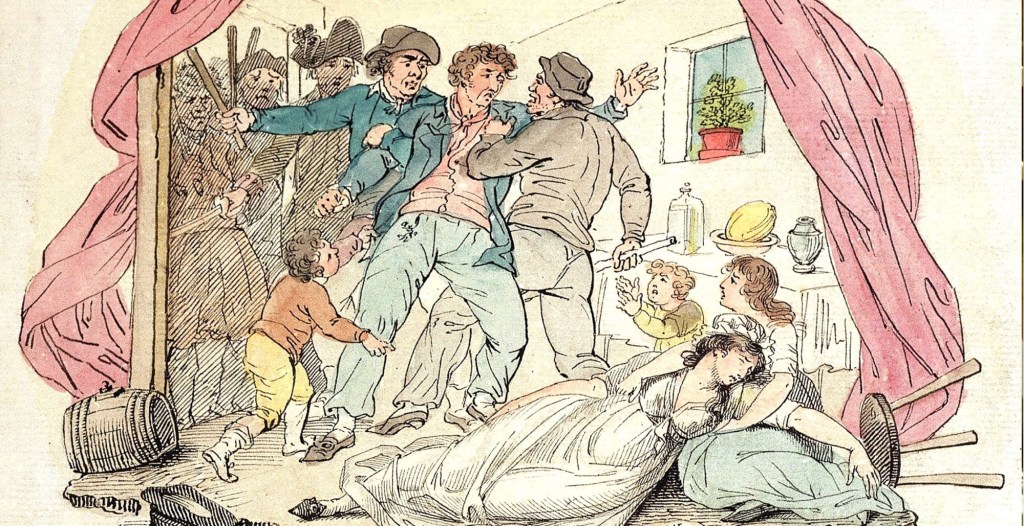
For several centuries, Britain maintained one of the strangest systems of military recruitment in its history: impressment, popularly associated with the notorious press gangs. Men could be compelled into naval service without volunteering, sometimes seized in circumstances bearing an uncomfortable resemblance to kidnapping.
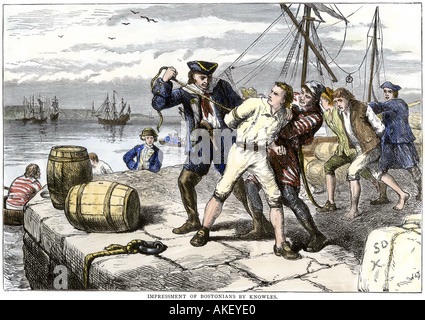
The popular image is irresistible: press gangs roaming the streets, knocking sailors unconscious, dragging innocent farmers from their beds and carrying drunken men directly from taverns onto waiting warships.
There is truth behind the legend.
But the real history of impressment is considerably more complicated — and perhaps more disturbing — because this was not simply lawless kidnapping conducted by naval thugs.
It was kidnapping given the authority of the state.
Britain Had Ships — But It Needed Men
The fundamental problem was remarkably simple.
Britain’s rise as a naval power required enormous numbers of sailors.
During peacetime, the Royal Navy could dramatically reduce its manpower. When war arrived, however, it suddenly needed tens of thousands more men.
A sailing warship was extraordinarily labour-intensive. Its great expanses of canvas had to be raised, lowered and adjusted constantly. Heavy ropes and cables had to be handled. Guns required crews. Pumps needed operating. Decks required maintenance. Damage sustained in battle or storms had to be repaired, sometimes while the ship was still fighting.
And a skilled sailor could not simply be created overnight.
Britain possessed a large merchant marine containing exactly the men the Navy required.
There was only one difficulty.
Many merchant sailors had absolutely no desire to join it.
Merchant service could offer better wages and, importantly, greater personal freedom. Naval service meant rigid discipline, long periods away from home, dangerous combat and the possibility of being sent almost anywhere British strategic interests required.
The Navy therefore relied upon a mixture of volunteers and compulsion.
That compulsion became impressment.
What Was Impressment?
The principle that the Crown could compel men into naval service had medieval precedents, although the system evolved considerably over the centuries.
By the seventeenth and eighteenth centuries, impressment had become an established method of rapidly expanding naval manpower during wartime.
The government issued authority for men to be impressed, and naval officers organized parties to find them.
These became popularly known as press gangs.
The word “gang” can give the misleading impression of an unofficial mob. A press gang was generally an authorized recruiting party operating under naval authority.
It might consist of a lieutenant accompanied by sailors, petty officers or other men employed to assist him.
Their task was straightforward:
Find suitable men and bring them into naval service.
Whether the men wished to come was another matter entirely.
Who Could Be Pressed?
Contrary to popular legend, press gangs were not officially supposed to grab every able-bodied man they encountered.
The Navy particularly wanted experienced seamen.
This makes practical sense. Taking a farm labourer who had never seen the sea might provide another pair of hands, but taking an experienced merchant sailor gave the Navy someone who already understood ships, rigging and life at sea.
The distinction between an able seaman, an ordinary seaman and a completely inexperienced landsman mattered enormously aboard a sailing warship.
Certain categories of men also possessed protections or exemptions, although the exact rules varied over time and enforcement could be messy.
Apprentices, some merchant seamen engaged in protected trades, and men holding appropriate certificates might claim exemption.
In theory, therefore, impressment was selective.
In practice, when Britain desperately needed manpower during a major war, the boundary between who could and who should not be impressed could become remarkably flexible.
The Waterfront Was Dangerous Territory
For an experienced sailor attempting to avoid the Navy, British port towns could become hazardous places during wartime.
London, Portsmouth, Plymouth, Bristol, Liverpool and other maritime centres contained enormous populations of sailors moving between ships, boarding houses, taverns and employment.
These were obvious hunting grounds.
A sailor coming ashore after months at sea might receive his wages and head immediately for the pleasures of the waterfront.
Unfortunately, the Navy knew precisely where sailors went when they were paid.
Taverns and lodging houses therefore became obvious places for press gangs to search.
There are numerous accounts of sailors attempting to evade impressment by hiding, disguising themselves, obtaining questionable certificates of exemption or simply avoiding ports where pressing was particularly vigorous.
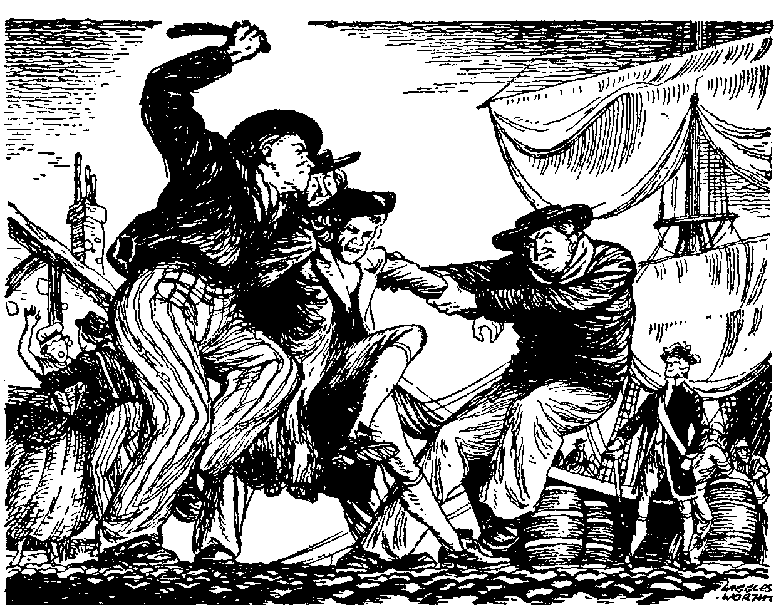
Sometimes confrontations became violent.
The men being pressed were not necessarily passive victims.
Sailors could fight back.
Crowds could intervene.
Families could protest.
Local communities sometimes resisted.
And occasionally the press gang discovered that attempting to seize several muscular, angry and possibly drunken sailors was not quite as straightforward as the Admiralty might have imagined.
Were Men Really Kidnapped?
In ordinary modern language, sometimes the answer has to be yes.
A man could be forcibly detained and compelled to serve aboard a warship against his wishes.
The important historical distinction is that impressment was carried out under claimed legal authority.
That does not make the experience voluntary.
Nor did sailors necessarily recognize fine distinctions between lawful impressment and kidnapping while being physically hauled away.
Some men were seized ashore.
Others were taken from merchant vessels.
The latter practice could be particularly infuriating because naval ships might stop merchantmen and remove experienced sailors from their crews.
Britain’s determination to exercise this claimed right eventually had international consequences.
The Impressment of Americans
Here the story crosses the Atlantic.
During the Napoleonic Wars, the Royal Navy desperately needed manpower while simultaneously confronting desertion.
British sailors sometimes escaped naval service and found employment aboard American ships.
Britain did not accept that simply joining an American vessel necessarily ended its claim upon a British subject.
Royal Navy ships therefore stopped American vessels and searched for alleged British deserters.
The problem was obvious.
How did you prove, in the middle of the Atlantic, whether a sailor was British or American?
British officers sometimes removed men who claimed to be American citizens.
To Americans, this was an outrageous violation of sovereignty.
The issue became one of several major causes of deteriorating relations between Britain and the United States preceding the War of 1812.
Thus the humble press gang was no longer merely terrorizing sailors in British ports.
Impressment had become an international diplomatic problem.
The Press Gang and the Tavern
One of the most enduring images of impressment involves the sailor who wakes after a heroic night’s drinking to discover himself aboard a Royal Navy ship.
Stories developed of men being deliberately intoxicated before being pressed.
Then there is perhaps the most famous legend of all:
the King’s shilling.
According to popular tradition, a recruiting agent might secretly drop a shilling into a man’s drink. Once the unfortunate drinker accepted the coin — perhaps unknowingly swallowing it — he had technically accepted the King’s money and therefore enlisted.
This story is wonderfully colourful.
Unfortunately, it is largely folklore.
It has also produced the frequently repeated claim that glass-bottomed tankards were invented so drinkers could check whether a recruiting shilling had been dropped into their beer.
Again, it is a wonderful story.
Again, historians have found little convincing evidence for it.
And there is a more fundamental problem.
The press gang did not need to trick a legally eligible man into volunteering.
The whole point of impressment was that his consent was unnecessary.
There was therefore little reason to construct elaborate schemes involving hidden coins when the state already claimed the power to take him.
Resistance
Impressment was deeply unpopular in many maritime communities.
Women sometimes played an important role in resisting press gangs, whether by warning men, hiding relatives, confronting officials or participating in crowds attempting to prevent seizures.
The authorities had to balance naval necessity against the possibility of public disorder.
A particularly aggressive press could provoke riots.
Press gangs themselves could face physical attack.
The romantic image of terrified civilians fleeing naval bullies therefore tells only half the story.
Sometimes the hunters became the hunted.
An unpopular press gang entering the wrong neighbourhood could encounter an entire community prepared to defend its sailors.
The Impress Service
By the eighteenth century, impressment had become sufficiently important to require considerable administration.
The Impress Service operated through officers stationed around the country, particularly in major ports.
Temporary rendezvous were established where pressed men could be held before transfer to ships.
This is another important corrective to the Hollywood image.
Men were not necessarily grabbed beside a tavern and immediately rowed directly to HMS Whatever waiting conveniently offshore.
There could be an administrative process involving detention, examination and transfer.
That bureaucracy makes impressment somehow even stranger.
The seizure of unwilling men had become institutionalized.
There were officers.
There were regulations.
There were records.
There were exemptions.
There were disputes over eligibility.
Britain had effectively constructed a bureaucratic system for coercive naval recruitment.
Life After Impressment
Once aboard ship, the distinction between volunteer and pressed man became less important to the daily functioning of the vessel.
Everyone lived under naval discipline.
Conditions varied enormously according to ship, captain, station and period.
The stereotypical Royal Navy warship was certainly harsh by modern standards. Discipline could involve flogging, although popular depictions sometimes exaggerate its indiscriminate use. Food was monotonous and deteriorated during long voyages. Disease could kill far more efficiently than enemy gunfire.
Yet naval life was not simply continuous misery.
Ships were complicated communities with their own hierarchies, routines, friendships and traditions.
Sailors could receive prize money when enemy vessels were captured. Skilled men could advance. Food provision, while hardly luxurious, was a major logistical concern because an unhealthy crew was a useless crew.
And the Navy sometimes provided a degree of security unavailable in precarious civilian employment.
This helps explain an apparent contradiction.
The same institution that forcibly impressed sailors could also attract enormous numbers of volunteers.
Men did not have one universal attitude toward naval service.
Some actively sought it.
Some tolerated it.
Some deserted from it.
And some did everything imaginable to avoid it.
Desertion
The Royal Navy’s manpower problem did not end once a sailor stepped aboard.
He could leave.
Or at least attempt to.
Desertion was a persistent problem.
Ships therefore had to prevent sailors from disappearing when they reached port.
Shore leave could be restricted, particularly when desertion was feared.
This created a vicious circle.
Harsh restrictions made sailors more determined to escape.
Escapes increased the Navy’s manpower shortage.
The shortage encouraged greater use of impressment.
Greater impressment produced more unwilling sailors.
And unwilling sailors were more likely to desert.
The Navy had created, at least partly, its own recruitment nightmare.
Could You Escape the Press Gang?
Certainly.
Men developed numerous strategies.
Sailors might remain inland while pressing was active. Others sought protected employment or carried documents demonstrating exemption.
Some disguised themselves.
Some hid aboard merchant vessels.
Some simply ran.
Local knowledge was invaluable. A sailor who knew the maze of alleys surrounding a port had a significant advantage over an unfamiliar naval lieutenant attempting to catch him.
Warnings could travel rapidly through maritime communities.
The arrival of a press gang was unlikely to remain secret for long.
Doors closed.
Sailors vanished.
Taverns suddenly contained a suspicious number of men claiming never to have been aboard a ship in their lives.
The Great Wars
Impressment became particularly important during periods when Britain’s demand for sailors exploded.
The wars against Revolutionary and Napoleonic France placed extraordinary pressure upon naval manpower.
The fleet expanded enormously.
Britain depended upon control of the sea for trade, imperial communication, defence against invasion and the ability to wage war across the globe.
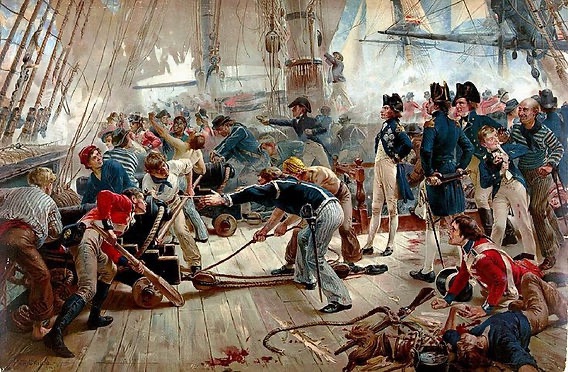
The victory at Trafalgar in 1805 became one of the defining moments of British history.
But Nelson’s fleet did not sail through patriotism alone.
Behind the heroic paintings of admirals standing on quarterdecks lay an enormous manpower system containing volunteers, career sailors, foreigners — and men who had never volunteered to be there at all.
The mythology of Britain’s “wooden walls” therefore has an uncomfortable underside.
Some of the men defending those walls had been compelled to do so.
Was Impressment Legal?
This question generated controversy even at the time.
The Crown’s right to impress sailors rested upon long-established custom and judicial acceptance rather than a simple comprehensive statute saying that every sailor could be seized whenever the Navy pleased.
Critics challenged both the morality and application of the system.
Supporters responded with an argument governments have made throughout history:
national survival required extraordinary obligations from individuals.
Britain’s dependence upon naval power gave that argument considerable force.
If the fleet could not be manned, Britain could not adequately defend itself.
But that raises an uncomfortable question.
How much individual liberty may a state take away in the name of national survival?
That is what makes impressment more than an entertaining tale of drunken sailors and waterfront thugs.
It is part of the much larger history of compulsory military service, state power and individual rights.
The Decline of Impressment
Impressment was not abolished in one dramatic humanitarian moment.
Instead, after the defeat of Napoleon in 1815, Britain entered a period in which the enormous wartime demand for naval manpower subsided.
The Navy no longer required pressing on the previous scale.
Impressment consequently fell into disuse.
Later nineteenth-century naval recruitment developed along different lines, while technological change gradually transformed the nature of seamanship itself.
The press gang faded from reality.
But it flourished in memory.
The Press Gang of Popular Imagination
Novelists, filmmakers and storytellers found the press gang irresistible.
It contains everything historical fiction requires:
dark waterfront taverns,
mysterious strangers,
violent confrontations,
ships waiting in the harbour,
men torn from families,
arbitrary authority,
escape attempts,
and the possibility that an ordinary man might wake one morning to discover that his entire life had changed.
The press gang therefore became larger in popular imagination than it had ever been in reality.
Some stories exaggerated its powers until practically any British male could apparently be clubbed unconscious and carried aboard a frigate.
Historical impressment was more regulated and more targeted than that.
But correcting the exaggeration should not sanitize what remained a profoundly coercive institution.
An experienced sailor could indeed be seized against his will.
He could indeed be removed from his civilian employment.
He could indeed be placed aboard a Royal Navy warship.
And he could indeed be required to risk his life fighting Britain’s enemies.
Kidnapped — With Official Approval
Perhaps that is the strangest thing about the press gangs.
They occupy an uncomfortable boundary between the familiar and the alien.
Britain had courts, Parliament, property rights and a developing political culture increasingly concerned with personal liberty.
At the same time, the state maintained the right to compel certain men into naval service because national defence supposedly required it.
To the Admiralty, impressment was manpower policy.
To Parliament, it could be a necessary evil.
To naval officers, it was a recruiting system.
To the sailor dragged away from his home, employment or tavern, such distinctions may have seemed considerably less important.
He had been living one life.
Someone representing the King had appeared.
And now he belonged to the Navy.
Tim Alderman ©️2026
Sources and Further Reading
J. R. Hill, ed., The Oxford Illustrated History of the Royal Navy, Oxford University Press.
N. A. M. Rodger, The Wooden World: An Anatomy of the Georgian Navy, Collins / Naval Institute Press.
N. A. M. Rodger, The Command of the Ocean: A Naval History of Britain, 1649–1815, Allen Lane.
Denver Brunsman, The Evil Necessity: British Naval Impressment in the Eighteenth-Century Atlantic World, University of Virginia Press.
Nicholas Rogers, The Press Gang: Naval Impressment and Its Opponents in Georgian Britain, Continuum.
Brian Lavery, Nelson’s Navy: The Ships, Men and Organisation, 1793–1815, Conway Maritime Press.
National Archives (UK), research materials and Admiralty records concerning Royal Navy personnel and impressment.
UK Parliament historical materials concerning naval recruitment and impressment.
Encyclopaedia Britannica, historical overview of impressment and its role in Anglo-American relations.

