Tag Archives: PM William Pitt the Younger

The Combination Act 1800: Tightening the Noose Around Britain’s Workers

Introduction

The Combination Act of 1800 is often overshadowed by its predecessor of 1799, yet the two Acts were intended to work together. If the first Act declared that combinations of workers were illegal, the second refined the law, strengthened enforcement, and attempted to remove loopholes that workers might exploit.

Together they marked one of the most determined efforts by the British government to suppress organised labour. Coming at a time of war with Revolutionary France, political unrest, food shortages, and rapid industrial change, the legislation reflected a ruling class deeply fearful that Britain’s workers might follow the path of the French Revolution.

For readers of Ken Follett’s The Armour of Light, these Acts explain why so many characters are terrified of meetings, why employers possess enormous power, and why even asking for higher wages could lead to imprisonment.

Britain in 1800

The turn of the nineteenth century was an anxious time.

Britain remained locked in conflict with France.

Industrialisation accelerated.

Mechanised factories replaced traditional craftsmen.

Food prices remained painfully high.

Many families struggled simply to survive.

The government believed stability depended upon preventing workers from acting collectively.

To ministers, trade unions were not economic organisations.

They were potential revolutionary cells.

Prime Minister William Pitt the Younger believed that maintaining order justified severe restrictions on civil liberties.

What Did the 1800 Act Do?

The Act expanded and clarified the legislation passed the previous year.

It made clear that workers could not:

combine to raise wages

combine to reduce working hours

organise strikes

persuade fellow workers to join industrial action

collect funds to support striking workers

threaten employers through collective action

pressure other workers to stop working

The law also prohibited employers from joining together for unlawful purposes, but in practice enforcement overwhelmingly targeted workers.

This imbalance became one of the chief criticisms of the legislation.

Why the Government Was So Afraid

Today we tend to think of trade unions as negotiating organisations.

The British government in 1800 saw something entirely different.

Officials looked across the English Channel and saw:

the French Revolution

violent crowds

attacks on aristocrats

political clubs

revolutionary propaganda

workers demanding rights

Many believed organised workers represented the first step toward revolution.

Even peaceful meetings became suspicious.

The distinction between economic protest and political rebellion largely disappeared in the minds of government officials.

Employers Held Most of the Power

The Industrial Revolution transformed relationships between employers and workers.

Previously, many artisans worked independently or in small workshops.

Factories changed everything.

Owners controlled:

machinery

buildings

employment

wages

working conditions

Workers possessed only one bargaining tool:

their labour.

If they could not combine, each individual negotiated alone.

The employer almost always won.

Punishments

Workers convicted under the Acts faced serious consequences.

These included:

fines

imprisonment

hard labour

dismissal from employment

blacklisting

Once labelled an agitator, finding work elsewhere became extremely difficult.

For many families, punishment extended far beyond the courtroom.

Secret Meetings

Ironically, the Acts encouraged secrecy.

Since open organisation became illegal, workers increasingly met:

in taverns

private homes

fields

barns

isolated cottages

Many organisations developed passwords, coded language, and trusted messengers.

Rather than eliminating worker organisation, the Acts drove it underground.

Friendly Societies

One of the unintended consequences was the growth of Friendly Societies.

Officially these organisations existed to provide:

sickness benefits

funeral expenses

financial assistance for widows

mutual aid

Most genuinely performed these charitable functions.

However, they also became places where workers could quietly discuss wages and conditions.

Government officials frequently suspected Friendly Societies of acting as disguised trade unions.

Sometimes those suspicions proved justified.

The Human Cost

For ordinary families the legislation had devastating consequences.

Imagine a textile worker whose wages had fallen while bread prices doubled.

If he complained alone, he could simply be dismissed.

If he complained alongside his fellow workers, he risked prosecution.

The law effectively forced workers to choose between poverty and criminality.

Many endured dangerous conditions because the alternatives seemed even worse.

Why the Acts Failed

Although intended to suppress worker organisation, the Acts ultimately failed.

Several reasons explain why.

Economic Reality

Workers continued facing low wages and poor conditions.

Laws could not remove those grievances.

Growing Industry

Factories employed increasing numbers of workers.

Large workforces naturally developed shared interests.

Public Sympathy

Some judges and politicians gradually recognised the unfairness of criminalising peaceful negotiation.

Practical Enforcement

The sheer number of workplaces made enforcement inconsistent.

Workers simply became more discreet.

Repeal

Growing criticism eventually persuaded Parliament that the legislation had gone too far.

The Combination Acts were repealed in 1824.

Workers once again gained the legal right to organise.

However, employers immediately complained that strikes had become too common.

As a result, Parliament passed the Combination of Workmen Act 1825.

This new law legalised trade unions in principle but imposed significant restrictions on strikes, picketing, and collective action.

It represented a compromise rather than complete freedom.

Long-Term Legacy

The Combination Acts occupy an important place in labour history.

They demonstrated that governments could use criminal law to regulate industrial relations.

Yet they also revealed an important truth.

Economic hardship cannot simply be legislated away.

Attempts to suppress organisation often strengthen workers’ determination instead.

Over the following century Britain witnessed:

the rise of trade unions

Chartism

legal recognition of unions

collective bargaining

improved factory legislation

safer workplaces

shorter working hours

Many of these later reforms grew from the struggles experienced during the years when combination itself was treated as a crime.

Connection to

The Armour of Light

Ken Follett places his story at precisely the moment when these laws shaped everyday life.

Characters cannot openly protest falling wages.

Meetings must be held discreetly.

Workers fear informers.

Employers possess enormous leverage.

The tension running throughout the novel is not simply fictional drama—it reflects the genuine legal environment of early nineteenth-century Britain. Understanding the Combination Acts helps explain why even modest demands for fair treatment could carry life-changing consequences.

Conclusion

The Combination Act of 1800 was intended to preserve social order during one of Britain’s most uncertain periods. Instead, it exposed the growing conflict between an industrial economy and a legal system determined to protect established power.

Although the law temporarily weakened organised labour, it could not extinguish workers’ desire for fairness. In time, the Acts became symbols not of successful repression but of the long struggle that eventually secured the right of ordinary men and women to organise, negotiate collectively, and seek safer, fairer working lives.

Tim Alderman ©️2026

Sources

E. P. Thompson, The Making of the English Working Class.

Eric Hobsbawm, Industry and Empire.

Asa Briggs, The Age of Improvement 1783–1867.

Robert J. Steinfeld, Coercion, Contract and Free Labor in the Nineteenth Century.

Parliamentary Archives (UK), records relating to the Combination Acts of 1799 and 1800.

UK Parliamentary historical resources on early labour legislation.

Trades Union Congress (TUC) historical materials on the origins of British trade unionism.
The Seditious Meetings Acts: William Pitt’s War on Dissent

“The liberty of the press, the right to assemble, and the freedom to criticise government are often regarded today as pillars of democracy. Yet there was a time in Britain when attending a political meeting, distributing reform pamphlets, or speaking too critically of Parliament could place an ordinary citizen under suspicion of sedition.”

Introduction

The closing years of the eighteenth century were among the most turbulent in British history. Across the English Channel, the French Revolution had overturned centuries of monarchy, aristocratic privilege, and established order. What began in 1789 with calls for liberty and constitutional reform soon descended into violence, mass executions, and the Reign of Terror.

To Britain’s political leaders, these events were both alarming and instructive. They feared that revolutionary ideas might spread across the Channel and ignite similar upheaval among Britain’s growing urban working class.

No one embodied those fears more than William Pitt the Younger, Prime Minister from 1783 to 1801 and again from 1804 until his death in 1806. Faced with war against Revolutionary France, economic uncertainty, and increasing demands for parliamentary reform at home, Pitt’s government responded with legislation designed to preserve order—but at a significant cost to civil liberties.

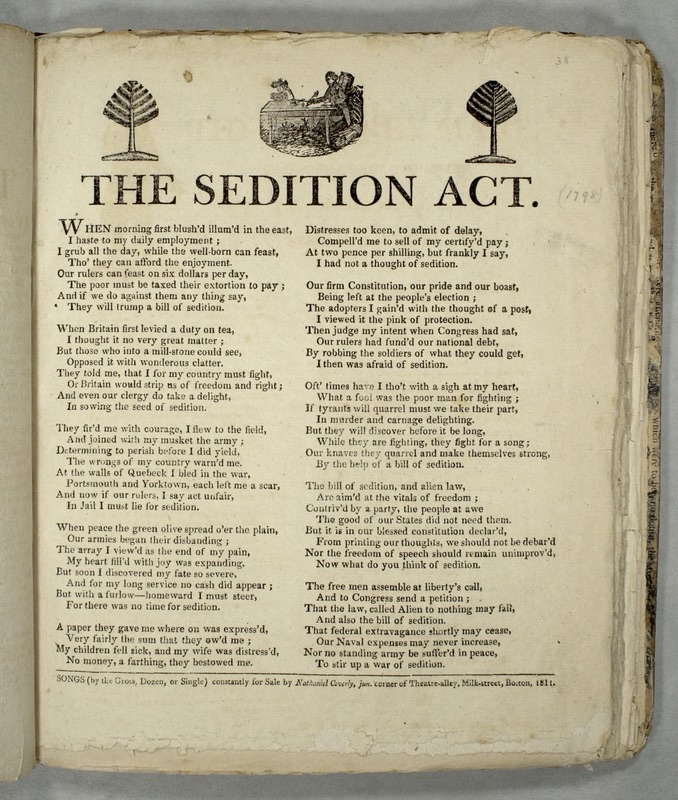
Among the most controversial of these measures were the Seditious Meetings Act of 1795 and the Unlawful Societies Act of 1799, laws intended to curb political agitation and prevent the spread of what ministers regarded as revolutionary ideas.

The Sedition Acts:

Britain in an Age of Fear

Modern readers sometimes underestimate just how frightened Britain’s ruling elite had become.

Only a few years earlier, France had appeared to be a stable European monarchy.

Now its king and queen had been executed.

Church lands had been confiscated.

Nobles had fled.

Crowds dominated the streets.

The guillotine had become the symbol of revolutionary justice.

For Britain’s aristocracy and governing classes, these were not distant events but a warning of what might happen if radical political movements were allowed to flourish unchecked.

Britain already possessed many of the ingredients that seemed capable of producing unrest.

Rapid population growth had crowded expanding towns.

Food shortages periodically drove prices beyond the reach of ordinary families.

Industrialisation was beginning to disrupt traditional employment.

Many working people lacked the vote and had little direct influence over Parliament.

Calls for parliamentary reform were growing louder.

The government increasingly viewed these demands not as constitutional debate but as potential revolution.

What Did “Sedition” Mean?

Today, the word sedition often suggests attempts to overthrow a government by force.

In eighteenth-century Britain, however, the concept was considerably broader.

Speech, publications, meetings, and public criticism could all be regarded as seditious if authorities believed they encouraged public disorder or undermined confidence in the Crown or Parliament.

The definition remained deliberately flexible.

That flexibility gave governments considerable discretion in deciding who should be investigated or prosecuted.

The Seditious Meetings Act of 1795

The immediate catalyst came in October 1795.

King George III was travelling to open Parliament when his carriage was surrounded by angry crowds protesting food shortages and government policy.

Although the King escaped unharmed, the incident profoundly shocked ministers.

Pitt responded with two major pieces of legislation known collectively as the “Two Acts.”

One strengthened the law of treason.

The other became known as the Seditious Meetings Act.

The Act placed significant restrictions upon public political meetings.

Large gatherings discussing political reform often required prior notice to magistrates.

Authorities received wider powers to regulate or prohibit meetings they believed might threaten public order.

Lectures and debates could be monitored.

Meeting places themselves came under greater official scrutiny.

Although ministers argued that peaceful discussion remained lawful, many reformers believed the legislation was designed to discourage political participation altogether.

The Seditious Meetings Acts 1846

The Unlawful Societies Act of 1799

Government concern did not diminish.

If anything, it intensified.

Organisations such as the London Corresponding Society, whose members included many artisans and skilled workers, advocated parliamentary reform and wider political participation.

While the Society largely pursued peaceful methods, ministers increasingly viewed it through the lens of events in France.

The Unlawful Societies Act outlawed a number of organisations considered dangerous to the state.

Secret oaths became illegal.

Many political societies were dissolved.

Printing presses and publications attracted closer government attention.

Informers and surveillance became increasingly common.

The legislation reflected Pitt’s determination to prevent the emergence of organised political movements that might challenge established authority.

Critics of the Legislation

Opponents argued that the government had confused reform with revolution.

Many campaigners sought nothing more radical than fairer parliamentary representation, freedom of discussion, and measures to reduce corruption.

They contended that peaceful political debate was being suppressed because ministers feared criticism rather than insurrection.

Some newspapers condemned the legislation as an assault upon traditional English liberties.

Others defended it as a regrettable but necessary response to extraordinary circumstances.

The debate divided British society.

Gagging acts

Did Pitt Save Britain?

This remains one of the enduring historical questions.

Supporters argue that Pitt’s policies helped Britain avoid the revolutionary violence experienced in France.

By acting decisively, they contend, he preserved constitutional government during one of Europe’s most dangerous periods.

Critics reach a different conclusion.

They argue that Britain possessed stronger constitutional traditions than France and that widespread revolution was never truly imminent.

From this perspective, Pitt’s legislation unnecessarily curtailed freedoms of speech, assembly, and political organisation.

Most historians today adopt a more nuanced view.

The threat of unrest was genuine.

So too were the restrictions placed upon civil liberties.

The legislation reflected a government struggling to balance national security against individual freedom—a tension that continues to resonate in modern democracies.

Legacy

The Seditious Meetings Acts did not eliminate demands for reform.

Instead, they delayed them.

During the nineteenth century Britain gradually expanded political participation through a series of Reform Acts, legalised trade unions, broadened freedom of association, and eventually extended the vote to much larger sections of society.

Ironically, many of the reforms that Pitt feared ultimately became accepted features of British democracy.

His legislation nevertheless remains significant because it illustrates how governments under pressure often respond by increasing their powers.

The questions raised in the 1790s remain surprisingly familiar today.

How much freedom should citizens surrender in the interests of security?

When does legitimate protest become a threat to public order?

And how should democratic societies respond when fear threatens to overwhelm liberty?

The answers continue to evolve, just as they did more than two centuries ago.

Tim Alderman ©️2026

Sources

Clive Emsley, British Society and the French Wars, 1793–1815.

John Barrell, Imagining the King’s Death: Figurative Treason, Fantasies of Regicide 1793–1796.

Michael Duffy, The Younger Pitt.

Eric J. Evans, The Forging of the Modern State.

Linda Colley, Britons: Forging the Nation 1707–1837.

UK Parliament historical resources on the Treasonable Practices Act and Seditious Meetings Act.

Oxford Dictionary of National Biography (entries on William Pitt the Younger and the London Corresponding Society).