Introduction
To a labourer living in Britain around 1800, power could appear remarkably concentrated.
The man who owned the land might also employ him. The man who employed him might own his cottage. The landlord might be a justice of the peace. The justice might command the local militia, influence parliamentary elections, determine who received poor relief, and sit on the bench when labourers were prosecuted.
None of this necessarily involved corruption.
It was simply how Georgian Britain was governed.
Britain possessed Parliament, courts, juries and an ancient tradition of common law, and contemporaries proudly contrasted their liberties with the absolutist governments of continental Europe. Yet political and legal power remained overwhelmingly concentrated among landowners and wealthy men.
The Industrial Revolution complicated this old hierarchy by creating another increasingly powerful group: manufacturers, merchants, bankers and mill owners whose fortunes came not primarily from land but from capital.
By the period of the Combination Acts and the Luddite disturbances, Britain’s traditional landed elite was being joined by an industrial elite.
For working people, however, the result could look remarkably similar.
Those who possessed property also possessed power.
A Country Governed Locally
Modern Britain has professional police forces, local councils, government departments and salaried public officials.
Georgian Britain possessed remarkably few of these things.
Much everyday government was carried out locally by members of the landed classes.
Central government in London was comparatively small. Parliament made laws, ministers conducted national policy and royal judges travelled throughout the country, but enormous responsibility for actually governing communities rested with local gentlemen.
At the centre of this system stood one particularly important figure:
the Justice of the Peace.
The Justice of the Peace
Justices of the Peace—or JPs—were usually substantial landowners or other respected local gentlemen appointed to maintain order within a county.
They were normally unpaid.
Yet their responsibilities were enormous.
Magistrates dealt with matters including:
theft and minor criminal offences;
assault;
drunkenness and disorder;
disputes involving servants;
vagrancy;
poor relief;
licensing inns and alehouses;
enforcement of numerous economic regulations;
preliminary hearings for serious crimes;
and increasingly, industrial disturbances.
Several magistrates sitting together formed the Quarter Sessions, which met four times a year and dealt with more substantial criminal and administrative matters.
The magistracy therefore combined functions that today would be distributed among judges, police authorities, councils and government departments.
The local gentleman was not simply administering justice.
He was helping administer society.
Property and the Assumption of Independence
Why were wealthy landowners considered suitable for these responsibilities?
Georgian political thought contained an assumption that now seems distinctly peculiar:
property made a man independent.
A labourer depended upon wages.
A tenant depended upon his landlord.
A tradesman depended upon customers.
But a gentleman possessing sufficient land supposedly depended upon nobody.
Because he possessed an independent income, Georgian society reasoned, he could exercise independent judgment.
Property was therefore regarded not merely as wealth but almost as evidence of fitness to govern.
This assumption helped justify restricting political participation to a comparatively small section of society.
Parliament Was Hardly Representative
Before the Reform Act of 1832, Britain’s parliamentary system contained extraordinary anomalies.
Voting qualifications varied considerably.
Some constituencies contained thousands of voters.
Others contained only a handful.
The notorious rotten boroughs might elect Members of Parliament despite having tiny populations.
Meanwhile rapidly expanding industrial cities could be seriously underrepresented.
Manchester, which became one of the great centres of the Industrial Revolution, did not elect its own MPs before 1832.
Powerful patrons could effectively control some parliamentary seats.
Votes were sometimes openly influenced through employment, patronage, bribery or intimidation.
Britain had parliamentary government.
It certainly did not yet possess representative democracy in the modern sense.
The Arrival of the Industrial Capitalist
Into this world stepped a new kind of wealthy man.
The factory owner.
His wealth came not principally from acres of countryside but from:
machinery;
buildings;
manufacturing;
credit;
commerce;
and increasingly sophisticated financial networks.
Some members of the traditional aristocracy regarded these newly wealthy industrialists with disdain.
But money has a remarkable ability to acquire respectability.
Successful manufacturers purchased estates.
Their children married into established families.
They became magistrates.
Some entered Parliament.
Industrial wealth gradually bought access to the social and political institutions previously dominated by landed wealth.
When Your Employer Was Also Your Landlord
Industrialisation could give an employer extraordinary control over workers.
Some factory owners constructed entire settlements around their mills.
Housing workers nearby made practical sense. Industrial production required large numbers of employees who could reach the workplace reliably and quickly.
But employer-owned housing also created dependency.
If a worker lost his employment, he might also lose his home.
His family could therefore depend upon the same man for both:
wages and shelter.
Company shops or employer-controlled credit could deepen that dependence further.
Not every industrial community operated in exactly the same way, and some paternalistic employers genuinely attempted to provide decent housing and facilities.
Nevertheless, the imbalance of power was enormous.
The Worker Had Very Few Weapons
A worker possessed one obvious economic weapon.
He could refuse to work.
But one worker refusing to work was easily replaced.
Workers therefore needed to act collectively.
And that brought them directly into conflict with the Combination Acts of 1799 and 1800.
Workers combining to raise wages or improve conditions could find themselves on the wrong side of the criminal law.
Thus an extraordinary imbalance emerged.
An employer possessed capital.
He possessed machinery.
He might own housing.
He could dismiss workers.
He could recruit replacements.
Workers possessed their labour—but were severely restricted in their ability to organise that labour collectively.
Little wonder industrial disputes became explosive.
Enter the Strike-Breaker
When workers nevertheless struck, employers could recruit replacements.
These workers became bitterly known as strike-breakers or, eventually, “scabs.”
Sometimes they came from neighbouring districts.
Sometimes employers recruited labour from much farther away, including Ireland.
This created an especially poisonous social situation.
The striking worker saw someone taking his livelihood.
The replacement worker often saw desperately needed employment.
The employer saw a means of keeping expensive machinery operating.
All three might be acting rationally according to their circumstances.
But only one possessed substantial economic power.
The Mill Could Not Simply Stop
Industrialisation created another problem rarely experienced to the same degree by traditional craftsmen.
Factories required enormous investment.
An entrepreneur might borrow heavily to construct:
the mill;
water systems or steam engines;
machinery;
warehouses;
workers’ housing.
Once that capital had been committed, production needed to continue.
Interest on loans did not disappear because workers were striking.
Machinery sitting idle produced nothing.
An extended shutdown could bankrupt an owner.
This does not excuse exploitation.
But it explains why industrial disputes became so ferocious.
Both sides could believe their survival was at stake.
The worker feared starvation.
The owner feared financial ruin.
Where Was the Police Force?
Another striking difference from modern Britain was the absence, for much of this period, of a professional national policing system.
London’s Metropolitan Police was not established until 1829.
Elsewhere policing remained fragmented.
Communities relied upon:
parish constables;
watchmen;
magistrates;
private prosecution;
and, during major disturbances, soldiers.
This is one reason industrial unrest could escalate so dramatically.
If hundreds of workers attacked a mill, there was no local riot squad waiting nearby.
Authorities might summon troops.
And soldiers were trained for warfare, not crowd control.
The consequences could be catastrophic.
Peterloo
The most infamous example occurred at St Peter’s Field in Manchester on 16 August 1819.
Tens of thousands gathered peacefully to demand parliamentary reform.
Local magistrates became alarmed by the size of the crowd and ordered the arrest of speakers.
The Manchester and Salford Yeomanry entered the crowd.
Sabres were drawn.
People were killed and hundreds injured.
The event became known bitterly as the Peterloo Massacre, an ironic reference to the Battle of Waterloo four years earlier.
Peterloo exposed the fundamental problem of Georgian government.
Those responsible for maintaining public order frequently came from the same social classes whose political dominance demonstrators were challenging.
The Assizes
Serious criminal cases went beyond the magistrates.
England and Wales were divided into circuits travelled by royal judges who periodically held Assize Courts.
The arrival of the Assize judge was an important local event.
Cases could include:
murder;
rape;
serious assault;
burglary;
robbery;
major theft;
and offences carrying capital punishment.
Juries decided guilt.
Judges interpreted the law and imposed sentences.
For defendants, the Assizes could be terrifying.
Trials were often extremely rapid by modern standards.
Defendants had far fewer procedural protections than modern accused persons.
And hanging remained available for an astonishing range of offences.
The Bloody Code
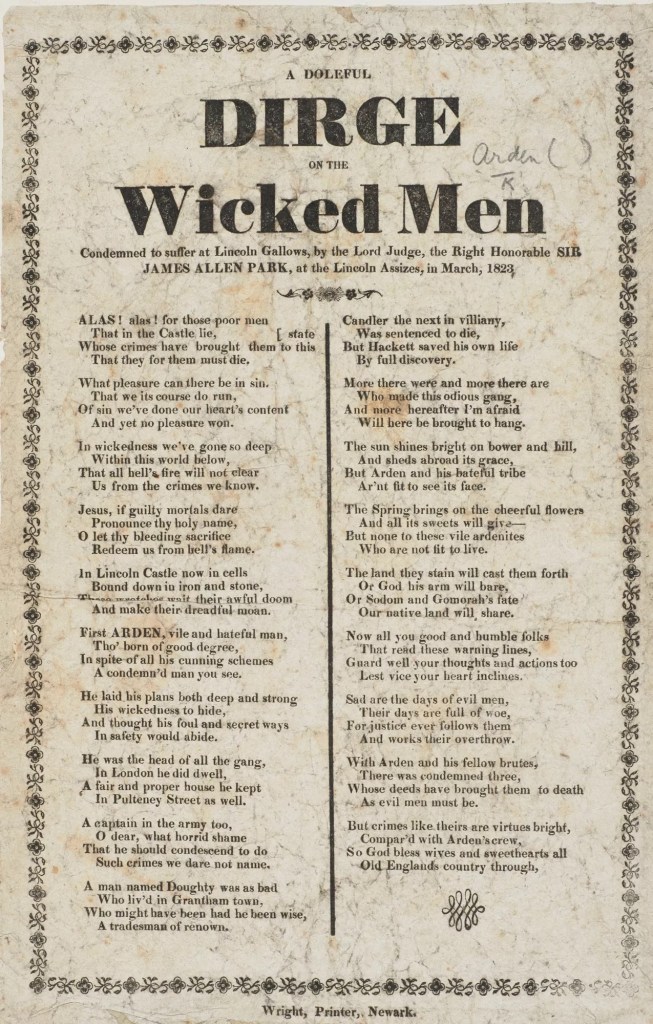
Eighteenth- and early nineteenth-century English criminal law became notorious for what later historians called the Bloody Code.
At its height, more than 200 offences could theoretically attract the death penalty.
Many involved property.
People could face death for offences that seem astonishingly minor by modern standards.
Why?
Because property was considered fundamental to social order.
Britain lacked a large professional police force. Legislators therefore relied heavily upon deterrence.
The terrifying possibility of the gallows was supposed to discourage crime.
In practice, matters were more complicated.
Juries sometimes deliberately undervalued stolen goods so defendants would avoid capital punishment.
Judges recommended mercy.
The Crown issued pardons.
Many death sentences were commuted.
Nevertheless, executions remained a very real feature of Georgian justice.
Transportation
There was another solution.
Remove the offender entirely.
For much of the eighteenth century Britain transported convicts to its American colonies.
The American Revolution closed that outlet.
Attention subsequently turned towards Australia.
The First Fleet arrived at Sydney Cove in 1788.
Transportation increasingly provided British courts with a punishment that sat somewhere between imprisonment and execution.
A person convicted in England might suddenly receive a sentence of seven years, fourteen years or life—and find himself or herself transported thousands of kilometres away.
Thus Britain’s Georgian criminal justice system became intimately connected with the European colonisation of Australia.
Justice Was Not Simply Bought
It would nevertheless be misleading to portray Georgian courts as nothing more than instruments of rich men.
English law possessed genuine traditions of judicial independence.
Juries sometimes defied expectations.
Judges sometimes ruled against powerful interests.
Lawyers could challenge government prosecutions.
Radical defendants occasionally won spectacular victories.
The courts mattered precisely because law possessed legitimacy.
The problem was more subtle.
The people who made laws, administered communities and served as magistrates overwhelmingly came from property-owning society.
They naturally tended to view threats to property and social hierarchy as threats to society itself.
Justice therefore did not need to be deliberately corrupt to favour the existing order.
The assumptions underlying the system already did much of that work.
Why Machine Breaking Was So Terrifying
This helps explain the extraordinary reaction to the Luddites.
To a desperate textile worker, smashing a machine might mean destroying the instrument that had destroyed his livelihood.
To the governing classes, however, machine breaking meant something far more alarming.
It represented:
an organised attack upon property.
And property lay at the heart of Georgian society.
Machine breaking therefore became a capital offence under the Frame Breaking Act of 1812.
Workers who believed they were defending their livelihoods could consequently find themselves facing the gallows.
The Luddite’s Impossible Choice
Imagine being a skilled textile worker in 1812.
Your employer introduces machinery that reduces the value of your skill.
Your wages fall.
Food prices remain high.
You cannot vote for meaningful political change.
Combination with fellow workers is heavily restricted.
Striking risks dismissal.
Your employer can hire replacements.
If you attack the machinery, you can be executed.
If you protest politically, authorities may regard you as a revolutionary.
What lawful avenue remains?
This does not make violence inevitable or justified.
But it helps explain why some workers concluded that conventional avenues offered them virtually nothing.
The hammer became political speech for people who possessed little other political voice.
A System Beginning to Crack
Yet Georgian Britain was changing.
Industrialisation created huge towns whose populations could no longer plausibly remain politically invisible.
A growing middle class demanded representation.
Workers increasingly organised despite legal restrictions.
Campaigners attacked the Bloody Code.
Reformers demanded changes to prisons and policing.
The old system of government by landed gentlemen gradually became impossible to sustain.
The Reform Act of 1832 began redistributing parliamentary representation.
The nineteenth century subsequently brought:
further electoral reform;
professional policing;
legal trade unions;
factory regulation;
criminal law reform;
reduced use of capital punishment;
and increasingly professional local government.
None arrived quickly.
None arrived without opposition.
But the Georgian system slowly gave way.
From Manor House to Mill
Perhaps the most fascinating feature of Georgian Britain is that it stood between two worlds.
The older world was dominated by land.
Power belonged to aristocrats, squires and great estates.
The emerging world was dominated increasingly by capital.
Power began shifting towards manufacturers, merchants, financiers and industrialists.
For ordinary workers, however, the transition did not initially produce greater freedom.
Sometimes it merely produced a new master.
The medieval labourer had depended upon the landowner.
The industrial labourer increasingly depended upon the factory owner.
And both operated within political systems designed primarily by men of property.
Conclusion
Georgian Britain liked to regard itself as a land of liberty.
Compared with many contemporary European states, there was considerable truth in that claim. Britain possessed Parliament, common law, juries, a relatively independent judiciary and a vigorous culture of political debate.
But liberty was distributed unevenly.
Property brought independence.
Independence brought influence.
Influence brought political and judicial power.
For those without property, the institutions of government could consequently seem remote and hostile.
The Industrial Revolution intensified that contradiction. Workers were increasingly described as free labourers while possessing remarkably little control over the economic circumstances governing their lives.
That contradiction produced strikes, riots, political movements and occasionally machine breaking.
The Luddites were therefore not an inexplicable outbreak of primitive rage against technology.
They emerged from a society in which economic transformation was occurring far faster than political reform.
The machines were new.
The concentration of power was not.
And therein lay the conflict that would help shape nineteenth-century Britain.
Tim Alderman ©️2026
Sources
E. P. Thompson, The Making of the English Working Class.
Douglas Hay et al., Albion’s Fatal Tree: Crime and Society in Eighteenth-Century England.
Leon Radzinowicz, A History of English Criminal Law and Its Administration from 1750.
John H. Langbein, The Origins of Adversary Criminal Trial.
Eric Hobsbawm, Industry and Empire.
Boyd Hilton, A Mad, Bad, and Dangerous People? England 1783–1846.
Malcolm I. Thomis, The Luddites: Machine-Breaking in Regency England.
UK Parliament, historical material concerning parliamentary reform and the Reform Act 1832.
The National Archives (UK), historical material concerning crime, punishment, transportation and Georgian justice.
Old Bailey Proceedings Online, records of criminal trials and punishment in eighteenth- and nineteenth-century London.