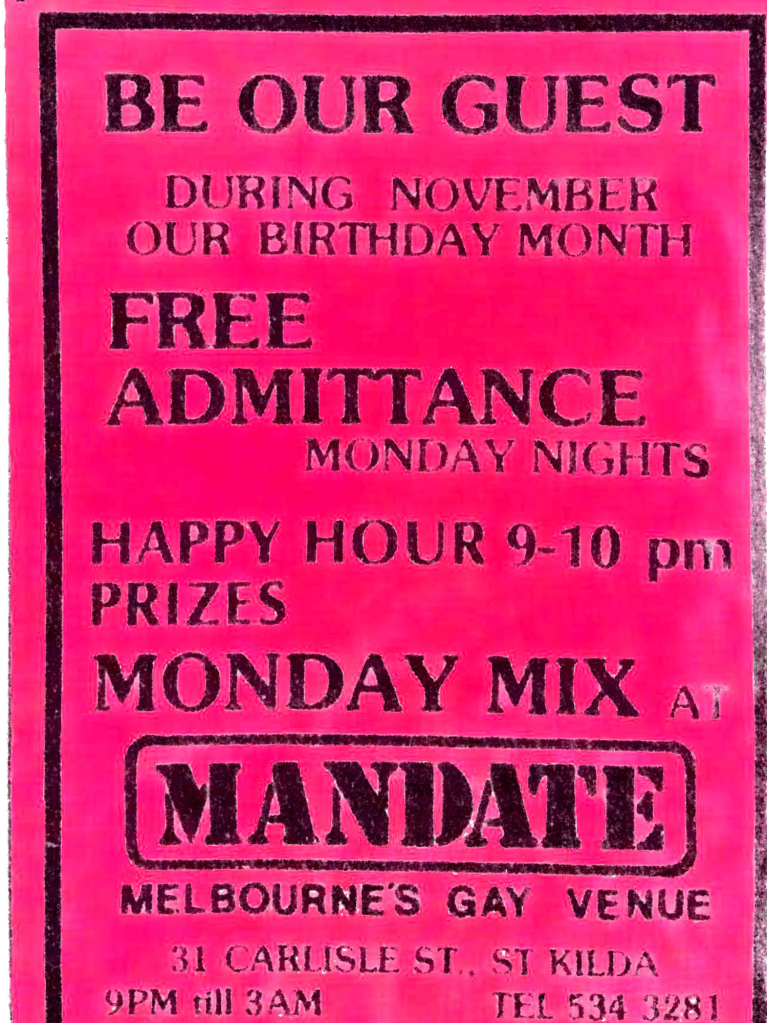
I came out in 1981. My first experience of a gay night in a club had been at the University Club at 100 Collins Street, in the city: a first glimpse of a world that, until then, I had only approached from the edges. Then I discovered Mandate in St Kilda—and found my home.
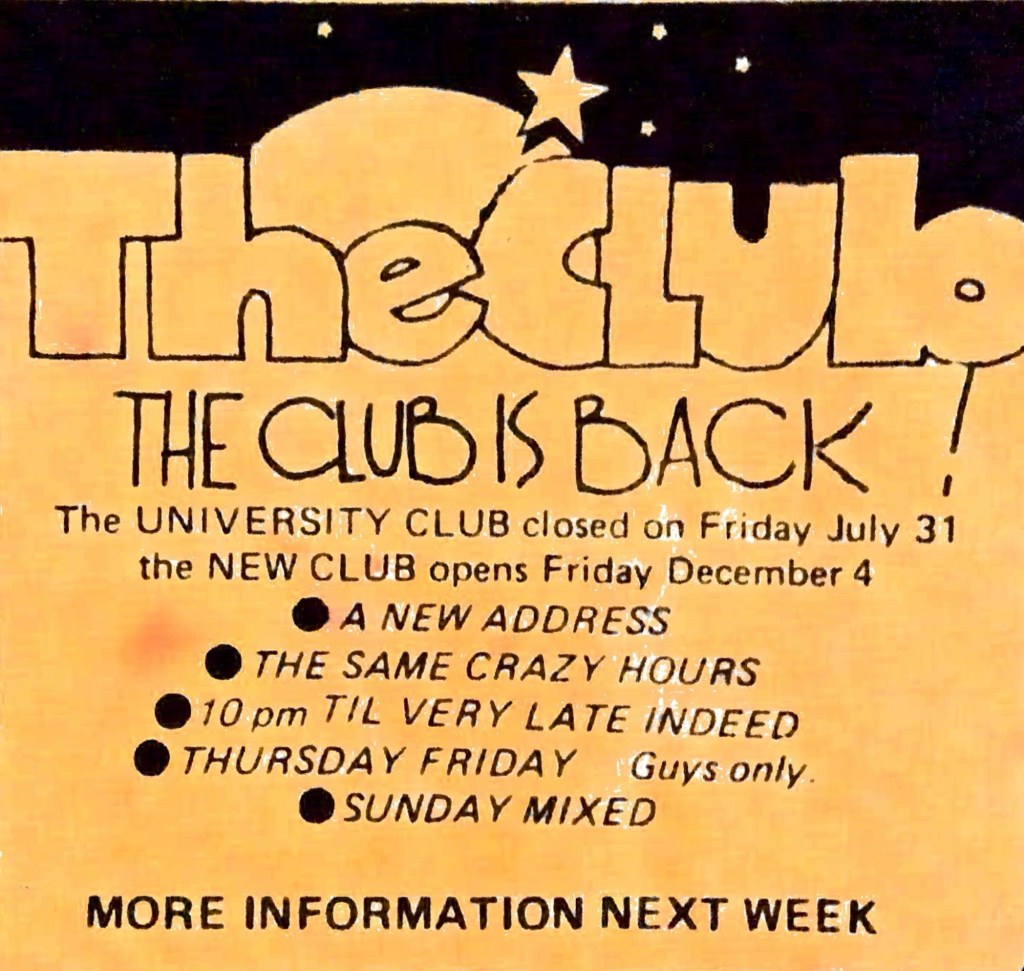
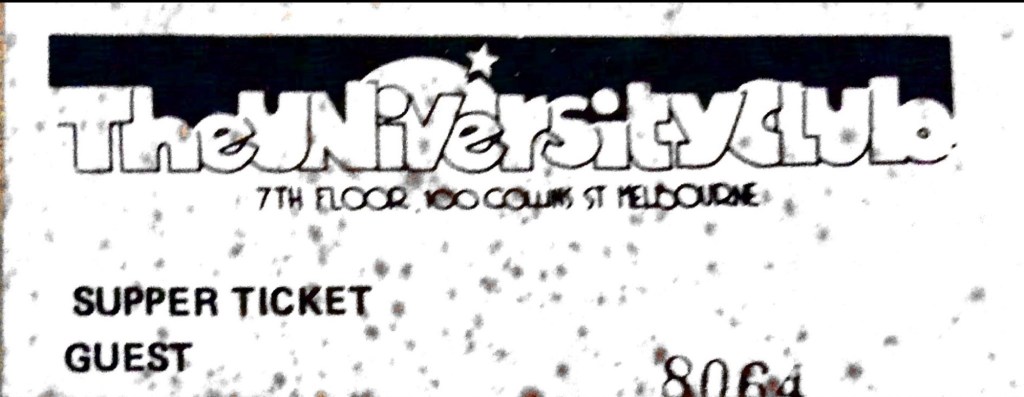
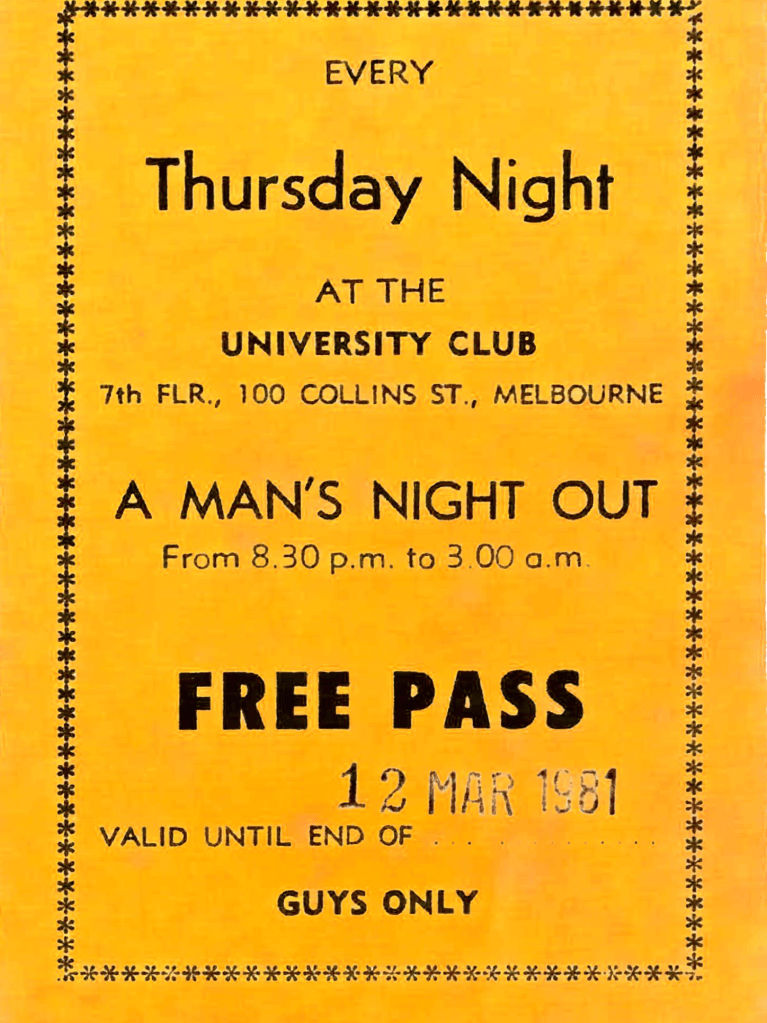
That is how I remember it. Not as a footnote in a list of Melbourne venues, but as a place where the music, the men, the clothes and the atmosphere all seemed to make sense to me. Mandate was somewhere I wanted to go back to. Somewhere I felt I belonged.
Melbourne had plenty of gay history before Mandate. There were bars, private clubs, social nights and venues where gay men gathered, sometimes openly and sometimes with discretion. The University Club was among the city venues of the 1970s and early 1980s; the La Trobe Journal’s history of Melbourne’s gay and lesbian venues lists it as operating from 1976 to 1981, with both mixed and men-only nights. But much of the earlier scene was scattered across the city, and a gay night might mean a particular evening at a pub rather than a venue built around gay customers. (latrobejournal.slv.vic.gov.au, emelbourne.net.au)
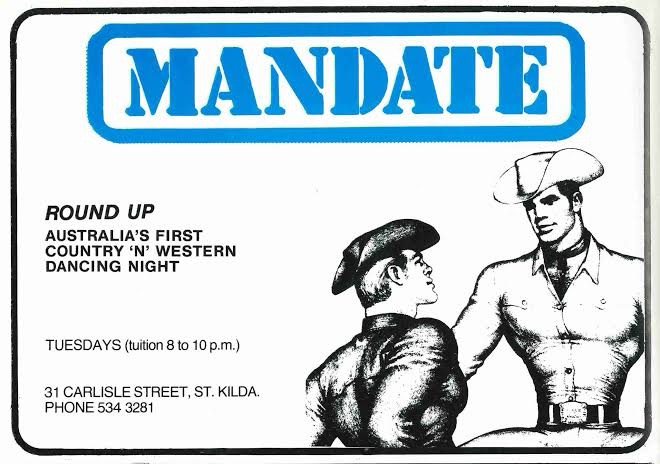
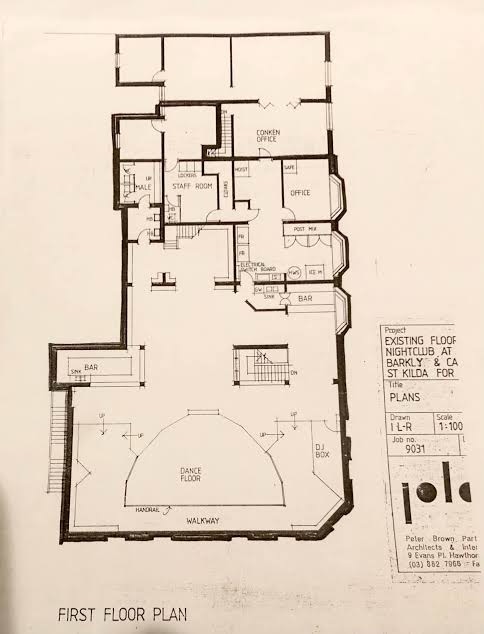
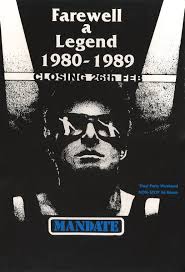
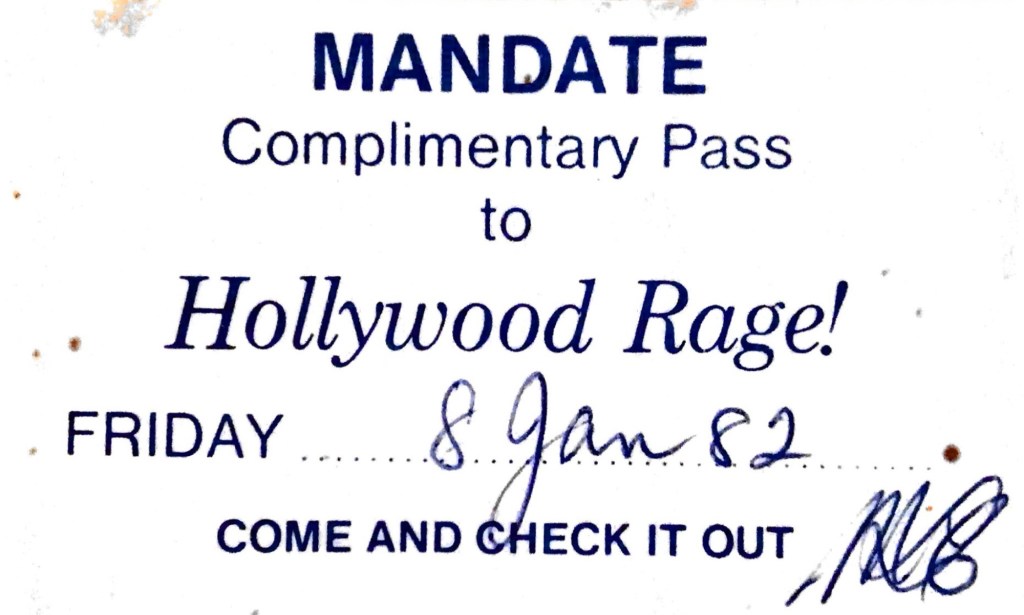
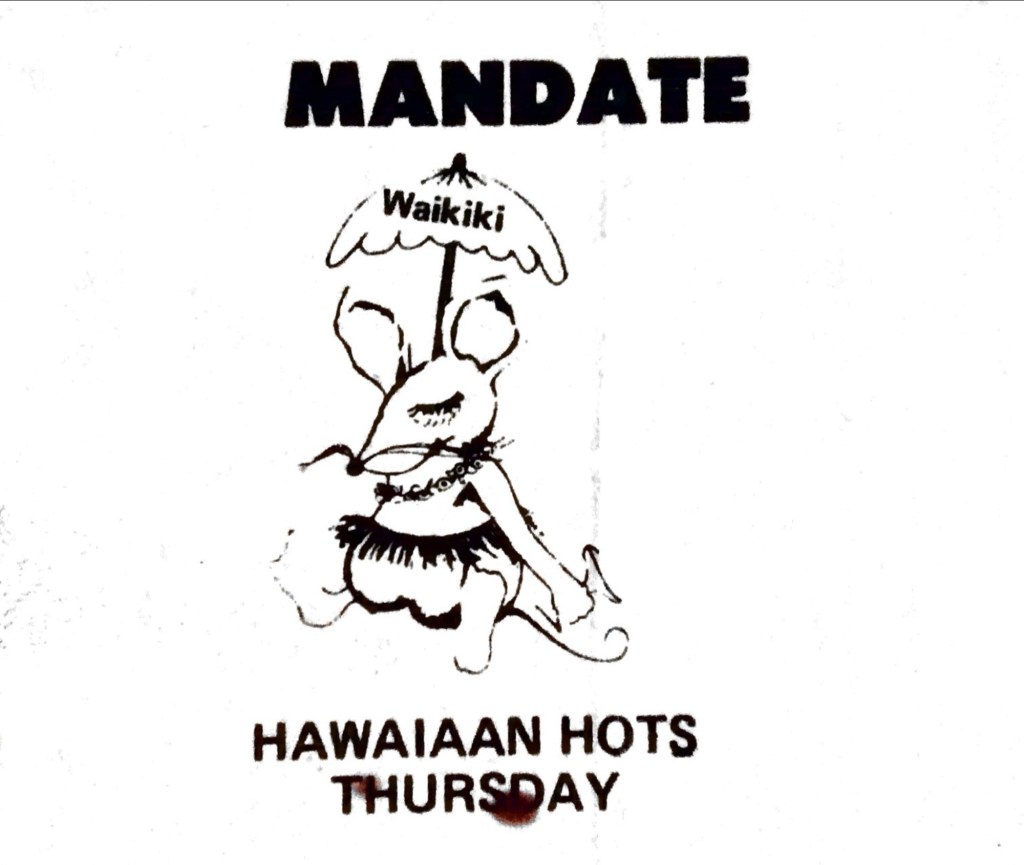
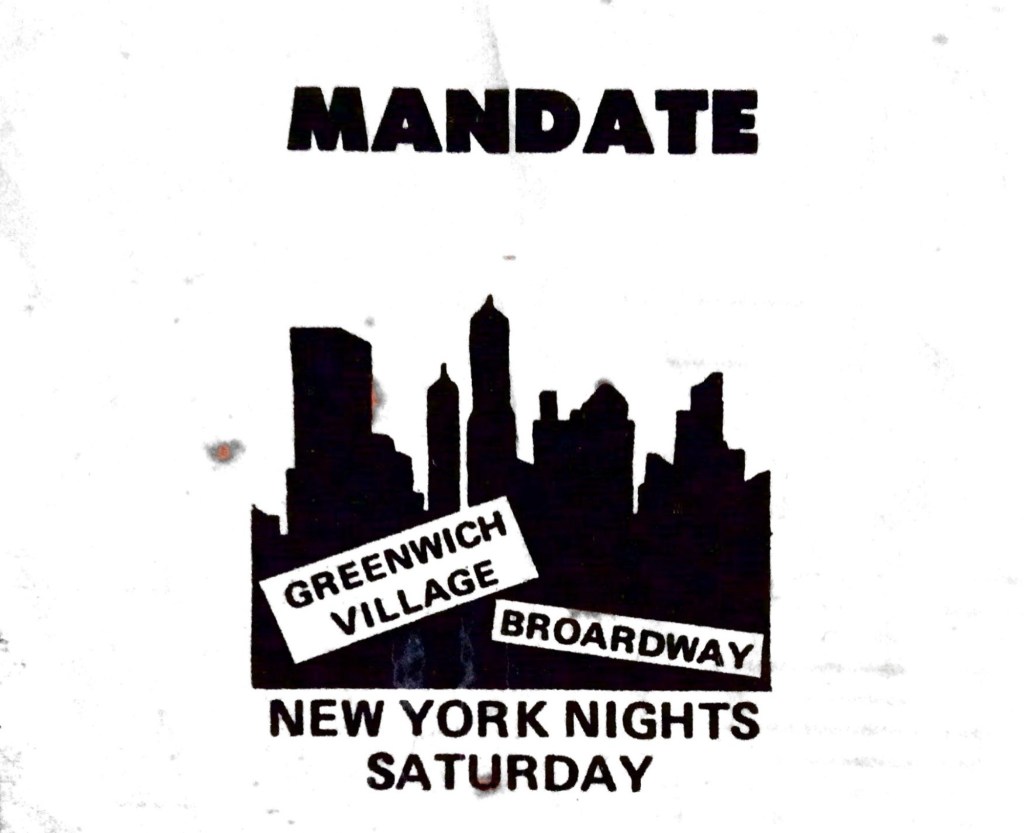
Mandate represented something different. It operated upstairs at 31 Carlisle Street from 1980 to 1989. The Australian Queer Archives describes it as a full-time gay bar and disco that attracted crowds throughout the week, at a time when venues often relied on a single gay night. It wasn’t Melbourne’s first gay gathering place, but it was an unusually visible, purpose-built expression of a gay social life that was becoming more confident and more public. (alga.org.au)
The stairs, the bar, the dance floor
I remember a backroom beneath the stairs at the entrance. It was part of Mandate’s world, but it wasn’t my scene, and I never used it. What I loved was upstairs: the dance bar, the floor, the men and the music.
The copper dance floor could be slick with talc. There were barred areas around it, and kegs served as tables. It had a rough, physical quality that suited the place. The room didn’t feel designed to make you sit decorously with a drink. It felt made for movement, bodies and noise.
Mandate introduced me to Hi-NRG dance music, which I loved. The beat seemed to belong to the room: driving, bright, insistent. You could lose yourself in it. You could watch the crowd, find someone’s eye, dance with a man, or simply be there among other men without having to explain yourself.
That feeling of ease mattered. A venue could be more than a place to drink or dance. It could be a place where the way you dressed, the men you looked at, and the way you moved through a room did not need translating for the outside world.
Jeans, leather and the clone look
Mandate was a hangout for the emerging clone culture. Jeans, T-shirts and flannelette shirts could feel almost like a uniform; leather vests and cowboy hats fitted naturally into the mix. Short hair and moustaches were part of the look too. It was a deliberately masculine style, but it wasn’t one single costume. Men made it their own.
The style reflected a wider gay male fashion that had spread internationally: denim, boots, plaid shirts, leather and facial hair. A 1994 academic study of clone identity describes much the same visual vocabulary. At Mandate, though, this wasn’t an abstract trend to me. It was what I saw around me, night after night, and part of the world I was drawn into. (pubmed.ncbi.nlm.nih.gov)
Bandanas and keys in pockets could also carry messages about what a man wanted sexually. These codes let men signal interests and preferences without announcing them across a crowded room. The meanings could depend on colour, placement and context, but what stays with me is the atmosphere of shared understanding: people reading small details that might pass unnoticed elsewhere. The hanky code has been documented as a form of signalling used in gay leather culture from the 1970s into the 1980s. (digitalcommons.uri.edu, intellectdiscover.com)
And Mandate was very, very male. Public sex was not unusual…{ know this from experience…, even in the upstairs bar. That was part of the club’s character, though not every man was there for the same reason. Some came to dance; some to cruise; some to meet friends; some to see what might happen. I loved the dance floor. The backroom and the barred spaces weren’t my territory, but they belonged to the same scene.
It’s easy, looking back, to turn a place like Mandate into a symbol and smooth away those differences. But it mattered partly because it could hold them together: dancing, flirting, fashion, sexual signalling, spectacle and ordinary socialising all under one roof.
St Kilda had more than one kind of gay night
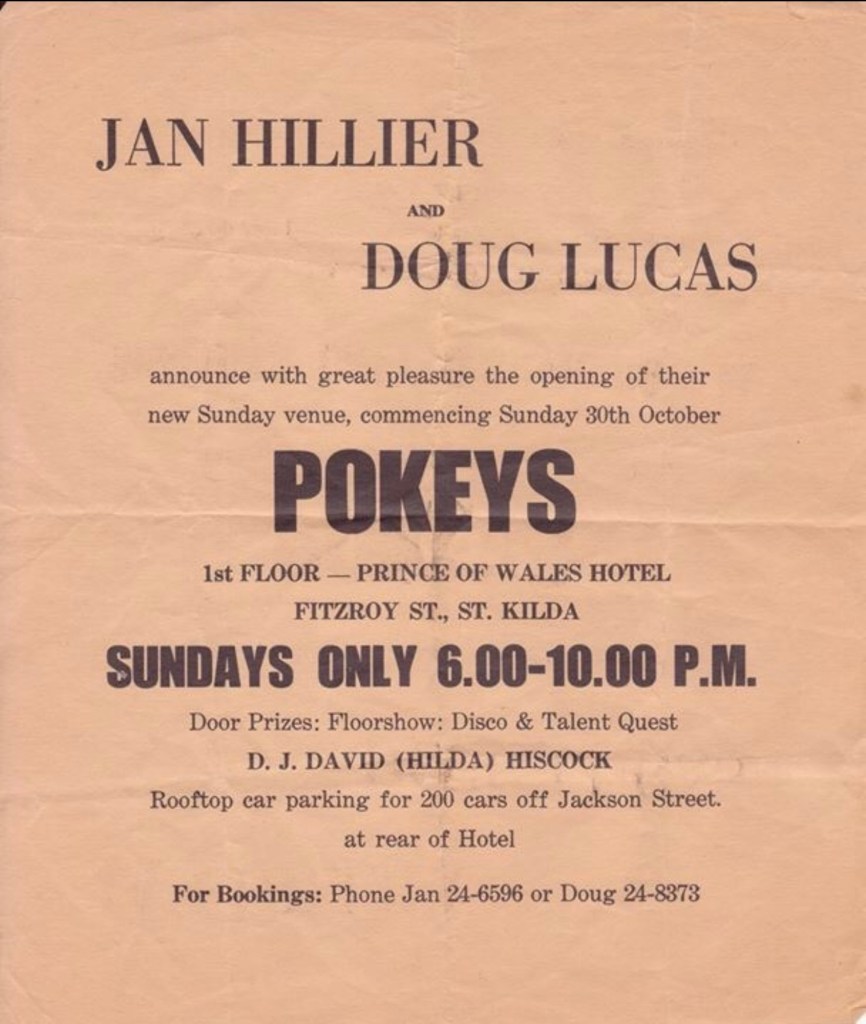
Mandate was part of a wider St Kilda landscape. At the Prince of Wales, Pokey’s brought another kind of gay night: Sunday gatherings upstairs, with drag and a different theatrical energy. I used to go there. The Prince of Wales’ own history remembers the hotel’s gay and lesbian community, its drag shows and Sunday-night gatherings; the La Trobe account dates Pokey’s to 1977–1992 and describes the upstairs Band Room as its home. (latrobejournal.slv.vic.gov.au, theprince.com.au)
Pokey’s and Mandate weren’t interchangeable. One had the draw of drag and performance; the other, for me, meant the dance bar, the floor, the Hi-NRG and the masculine world gathered around it. Both made St Kilda a place where gay men could find a night out, but each offered its own pleasures and its own crowd.
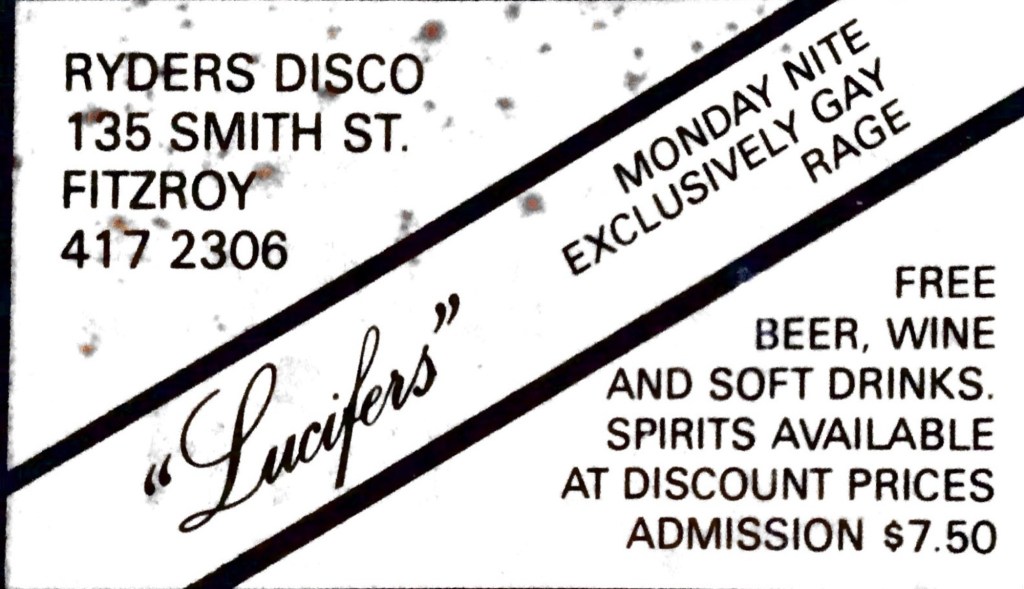
There were other ways to spend an evening, too. Friends might go from one venue to another, or finish late with coffee somewhere that stayed open. The NGV’s account of Melbourne nightlife recalls a patron who went to Mandate and other clubs before stopping at Trish’s Coffee Lounge in North Melbourne around three or four in the morning. That’s a small detail, but it evokes a whole rhythm of going out: one place leading to the next, with the night stretching well past the hour when the rest of the city had gone quiet. (ngv.vic.gov.au)
A club in a changing decade
Mandate opened at a turning point. Victoria repealed its sodomy law in 1980, with decriminalisation taking effect in 1981. The club was already opening its doors as those changes were unfolding. It was an openly gay venue in a society where public acceptance still lagged behind legal reform. The Australian Queer Archives records repeated criticism from the local council, while the heritage assessment places Mandate among the venues that appeared around the time of law reform. (alga.org.au, d1juosud05elln.cloudfront.net)
The 1980s also brought HIV and AIDS, fear and grief, and hostility directed at gay men. The history of gay nightlife cannot be told as an uncomplicated story of liberation. A dance floor could offer a sense of freedom and connection, while outside the club there were still laws, prejudice and danger. Inside, men built ways to be together, to signal to each other and to live parts of their lives in the open.
Mandate’s record is still incomplete. The archives cite Ken Payne’s 1989 City Rhythm article, “After eight years of Mandate, it’s time for the last waltz,” along with a 1999 Brother Sister piece. Those sources, the histories gathered by the Australian Queer Archives, and the memories of patrons together give us more than dates and addresses. They let us start to recover what the place felt like. (alga.org.au)
Finding home
When I think of Mandate, I think of that copper floor, perhaps with talc underfoot; of kegs repurposed as tables; of the bars and the men around them; of flannelette shirts, leather vests and cowboy hats; and of Hi-NRG filling the room. I think of a place that was unapologetically male, where different men could come for different reasons, and where I found a scene that felt like mine.
I had come out in 1981. The University Club gave me my first taste of a gay night in a club. Mandate gave me something more lasting: a place I wanted to return to, a dance floor I loved, and a sense of home.
Nostalgia can make a venue glow brighter than it did at the time. It can soften the awkward nights and sharpen the happy ones. But remembering is not the same as pretending everything was perfect. It is recognising that these places mattered: for the men who danced, the men who met one another, the men who watched from the bar, and the men who found, as I did, somewhere they could belong.
Mandate is gone. The building on Carlisle Street remains, but the upper-floor club has become apartments. The room where so many different nights unfolded is now private space. What survives is the written record, the photographs and ephemera that have been kept, and the memories people are willing to share. (d1juosud05elln.cloudfront.net)
For those of us who were there, the details are still vivid: copper underfoot, talc in the air, the beat rising, and a room full of men who knew exactly where they wanted to be.
Tim Alderman ©️2026
Sources
Australian Queer Archives, A History of LGBTIQ+ Victoria in 100 Places and Objects, “Mandate.” (alga.org.au)
La Trobe Journal, “Aspects of Gay and Lesbian Life in Seventies Melbourne.” (latrobejournal.slv.vic.gov.au)
Heritage Victoria, Greyhound Hotel, St Kilda: Cultural Heritage Values Assessment. (d1juosud05elln.cloudfront.net)
The Prince Hotel, “Our History.” (theprince.com.au)
National Gallery of Victoria, “Sites of refuge, connection, creation, resistance and loss: the queer bar and nightclub in the twentieth century.” (ngv.vic.gov.au)
Barry D. Adam, “Political-economic construction of gay male clone identity,” Journal of Homosexuality (1994). (pubmed.ncbi.nlm.nih.gov)

