Introduction
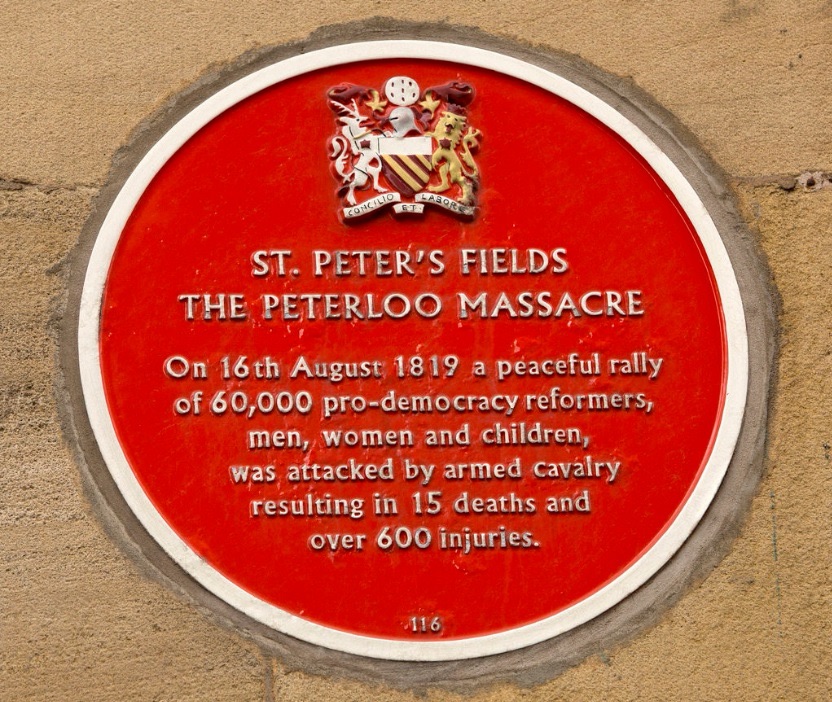
On 16 August 1819, tens of thousands of men, women and children gathered peacefully at St Peter’s Field in Manchester.
They had not assembled to overthrow the government.
They had come to demand something that today seems remarkably modest:
a meaningful political voice.
Manchester had become one of Britain’s great industrial centres, yet it had no Member of Parliament of its own.
Working people endured high food prices, unemployment, poor housing and industrial upheaval while possessing almost no influence over the laws governing their lives.
The crowd gathered to hear the celebrated radical speaker Henry Hunt call for parliamentary reform.
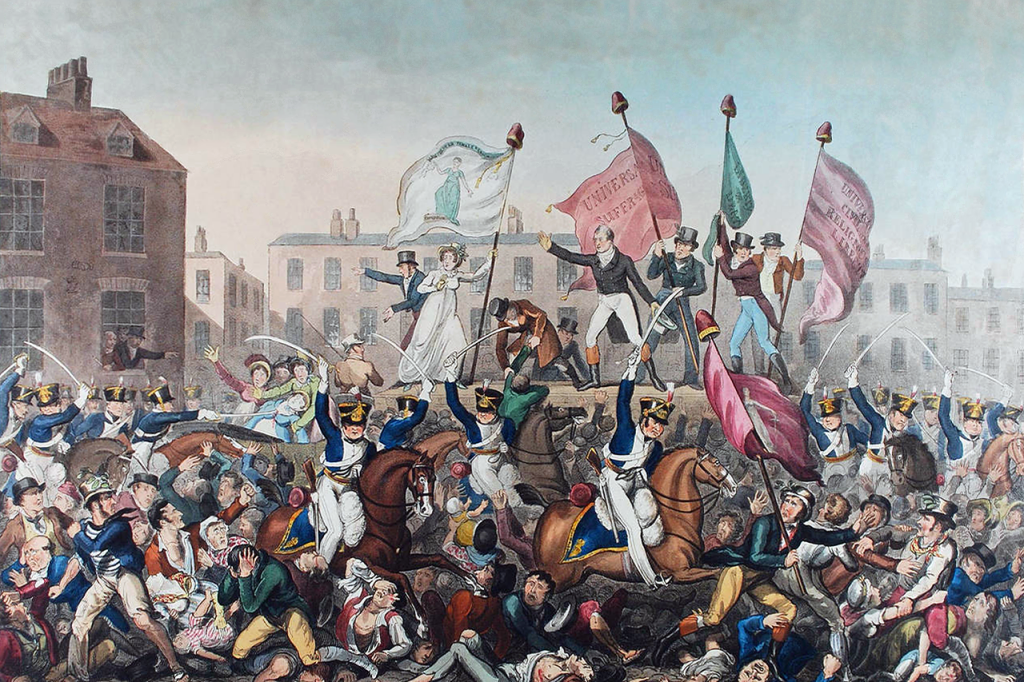
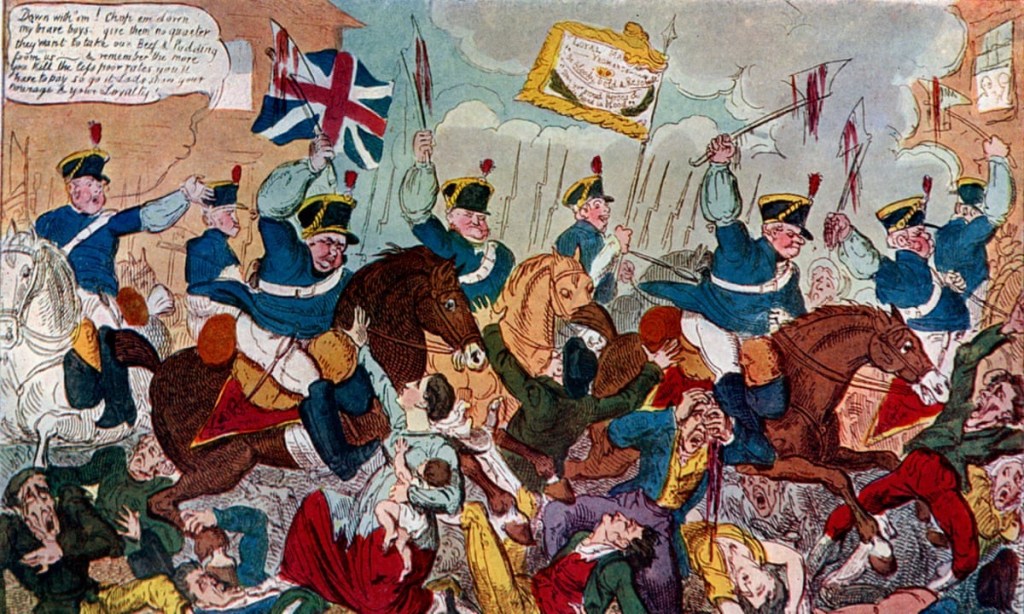
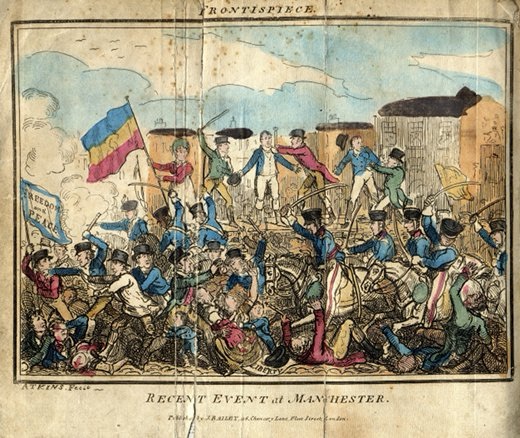
Within hours, mounted men carrying sabres had charged into them.
People lay dead and hundreds were injured.
The event became known as the Peterloo Massacre—a bitter parody of the British victory at Waterloo four years earlier.
Peterloo became one of the defining moments in the long struggle for British democracy.
Britain After Waterloo
The defeat of Napoleon in 1815 should have brought relief.
Instead, peace created new problems.
Thousands of soldiers returned home looking for work.
Wartime industries contracted.
Food remained expensive.
The Corn Laws of 1815 protected domestic grain producers by restricting cheaper foreign imports, helping keep bread prices high.
Industrial workers suffered particularly badly.
Wages fell in several industries.
Mechanisation threatened skilled trades.
Unemployment increased.
Meanwhile Britain’s parliamentary system remained profoundly unrepresentative.
The people being transformed by industrialisation had almost no political means of shaping that transformation.
Manchester Without Representation
Manchester’s population had exploded during the Industrial Revolution.
Cotton manufacturing made it one of Britain’s most economically important towns.
Yet Manchester did not elect its own MPs.
By contrast, tiny constituencies known as rotten boroughs could return Members of Parliament despite having only a handful of voters.
To reformers, the contradiction was absurd.
The new industrial Britain was producing enormous wealth while the political system remained rooted in an older world of landed property and patronage.
What Did the Reformers Want?
Radicals varied considerably in their demands.
Some wanted relatively modest parliamentary reform.
Others wanted:
broader male suffrage;
more equal electoral districts;
secret ballots;
annual or frequent parliaments;
an end to corrupt boroughs.
These ideas alarmed the government.
The French Revolution remained a powerful memory.
British authorities often interpreted large political gatherings through the nightmare image of Parisian mobs, revolution and regicide.
A crowd demanding reform could therefore be viewed not simply as citizens exercising political rights, but as a possible revolutionary army.
Henry Hunt
The principal speaker invited to Manchester was Henry “Orator” Hunt.
Hunt was famous for addressing enormous outdoor meetings.
He advocated parliamentary reform and was particularly associated with mass peaceful political mobilisation.
The Manchester meeting was deliberately organised to demonstrate discipline.
Participants were encouraged to arrive:
sober;
orderly;
neatly dressed;
and unarmed.
Some groups marched considerable distances in formation.
Women participated prominently, including organised female reform societies.
Families attended.
For many people, Peterloo was intended almost as a civic festival of democracy.
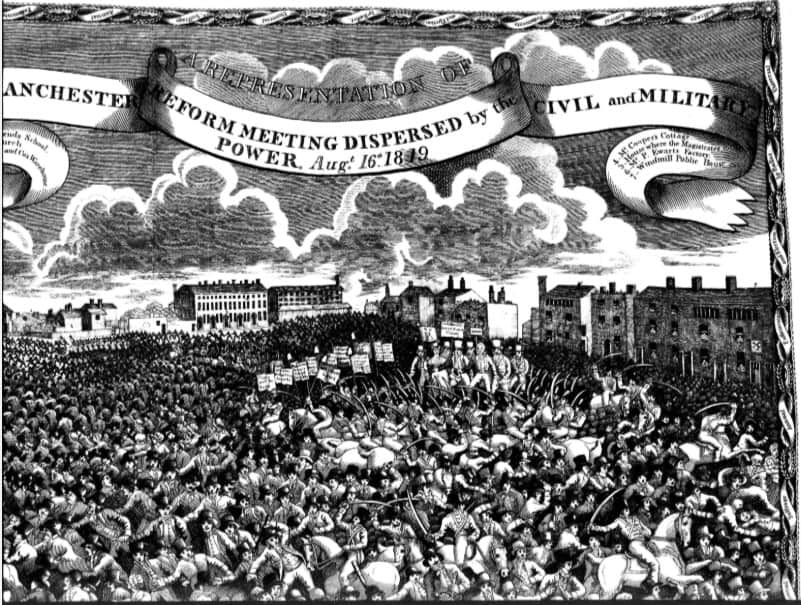
60,000 People on St Peter’s Field
Modern estimates generally place attendance at around 60,000, though contemporary reports sometimes claimed considerably more.
The National Archives describes the gathering as orderly and peaceful before the intervention of the authorities. (National Archives)
Imagine the sight.
Banners moved above the crowd.
Bands played.
Reform societies arrived behind flags carrying slogans demanding liberty and political representation.
Women wearing white dresses formed conspicuous contingents.
Then Henry Hunt arrived.
The authorities were watching from nearby.
The Magistrates
This is where Peterloo connects directly with the world of Georgian power we have been discussing.
Local magistrates were responsible for maintaining order.
They were not politically neutral bureaucrats in the modern sense.
They belonged overwhelmingly to the propertied classes and many regarded radicalism as profoundly dangerous.
As the crowd assembled, the magistrates decided Hunt and several other leaders should be arrested.
The problem was obvious.
How do you arrest men standing on a platform surrounded by tens of thousands of people?
Their answer was cavalry.
The Manchester and Salford Yeomanry
The Manchester and Salford Yeomanry were local part-time cavalry.
Unlike regular soldiers, many of them came from the same commercial and property-owning milieu that felt threatened by radical politics.
The magistrates ordered them into the crowd to arrest Hunt.
Mounted men entered St Peter’s Field.
The dense crowd could not easily move aside.
Horses pushed into people.
Sabres were drawn.
Panic spread.
People were knocked down and trampled.
Others were cut with swords.
The regular 15th Hussars were then sent in as the authorities attempted to clear the field.
Within a remarkably short time, the enormous meeting had been dispersed. (National Archives)
The Casualties
The precise casualty figures varied between contemporary accounts and later research.
Current National Archives material gives an estimate of about 18 deaths and up to 700 injuries. (National Archives)
Among the dead was a small child.
Women were among those seriously injured.
Many victims had been crushed beneath horses or other people attempting to escape.
Others suffered sabre wounds.
Peterloo was particularly shocking because the crowd had not arrived prepared for battle.
This was not two armed forces confronting one another.
It was a political meeting violently dispersed by mounted troops.
Why “Peterloo”?
The name appeared almost immediately.
Only four years earlier British forces under Wellington had defeated Napoleon at the Battle of Waterloo.
Radical journalists combined “Peter”—from St Peter’s Field—with “Waterloo.”
Thus:
Peterloo.
The name was intentionally sarcastic.
At Waterloo, British cavalry had attacked Napoleon’s army.
At Peterloo, critics said, British cavalry had attacked their own people.
The term became politically explosive.
The Government’s Response
One might imagine that such bloodshed would have led the government to condemn the magistrates.
It did not.
Home Secretary Lord Sidmouth supported them.
The Prince Regent also expressed approval of their conduct.
A Home Office communication of 23 August praised the magistrates’ “prompt, decisive and efficient measures” for preserving public tranquillity. (National Archives)
For critics, this was almost as disturbing as the massacre itself.
The government appeared to be saying that the use of force against peaceful reformers was legitimate because maintaining order mattered more than their political grievances.
Two Completely Different Versions of Reality
Peterloo demonstrates beautifully how historical events depend upon perspective.
To reformers:
The crowd was peaceful.
The cavalry attacked without justification.
The massacre exposed the brutality of an unreformed political system.
To many magistrates and government officials:
The enormous organised crowd looked threatening.
Radical banners and disciplined marching suggested possible insurrection.
The authorities had prevented something potentially worse.
One Lancashire magistrate described the gathering as resembling insurrection and claimed its organisation terrified loyal subjects. (National Archives)
Both sides looked at the same field and saw completely different things.
Fear of Revolution
The authorities’ fear was not entirely imaginary.
Britain had experienced significant unrest.
There had been:
food riots;
Luddite disturbances;
radical political organisations;
mass meetings;
industrial conflict.
Government ministers remained haunted by the French Revolution.
The question was whether that fear justified treating peaceful reformers as potential revolutionaries.
Peterloo suggested that the governing classes increasingly had difficulty distinguishing between demands for reform and threats to the state.
Women at Peterloo
Women played a striking role in the reform movement.
Female reform societies appeared in several northern towns.
Women created banners, marched in organised groups and participated publicly in political campaigns.
This was remarkable in a society where women possessed no parliamentary vote whatsoever.
Their presence at Peterloo also challenged assumptions that politics belonged solely to men.
Women suffered disproportionately among some categories of the injured, possibly because distinctive female reform contingents were highly visible.
Peterloo therefore belongs not only to the history of male suffrage but also to the longer history of women’s political activism.
The Radical Press
Peterloo might have disappeared into local history had newspapers and pamphleteers not publicised it.
Radical journalists quickly circulated descriptions and images of cavalry attacking civilians.
Engravings portrayed mounted men cutting through crowds.
The government faced a major propaganda problem.
Attempts were made to justify the authorities’ actions and dispute claims about casualties.
One official publication even attempted to defend the authorities in connection with the death of the child William Fildes. (National Archives)
Instead of silencing criticism, such responses often intensified public anger.
The Six Acts
The government’s reaction was not liberalisation.
It was further repression.
Later in 1819 Parliament enacted measures collectively known as the Six Acts.
They restricted:
large political meetings;
radical newspapers and publications;
certain forms of political organisation;
and activities authorities associated with sedition.
Rather than interpreting Peterloo as evidence that representation needed reform, ministers largely concluded that radicalism needed tighter control. (National Archives)
It repeated a pattern already visible in Pitt’s repressive legislation and the Combination Acts.
When confronted by popular mobilisation, the state often responded first by restricting it.
Peterloo and the Luddites
Peterloo and Luddism are closely connected.
Both grew from the profound disruption caused by early industrialisation.
But the responses were different.
The Luddites attacked machinery.
The Peterloo reformers attempted peaceful mass politics.
One used direct industrial action.
The other demanded parliamentary change.
Yet both encountered an establishment deeply suspicious of organised working people.
This created a bleak political lesson.
Machine breaking could lead to execution.
Striking could bring prosecution.
Political organisation could be restricted.
A peaceful demonstration could be charged by cavalry.
For working-class reformers, the question increasingly became:
What lawful path to change actually remained?
Peterloo Did Not Immediately Win Reform
Peterloo did not suddenly create democracy.
There was no immediate extension of voting rights.
The Reform Act did not arrive until 1832, thirteen years later.
Even that Act left most working-class men without the vote.
Further Reform Acts followed in 1867 and 1884.
Women waited much longer.
Yet Peterloo became part of the mythology of British democracy.
It demonstrated both the danger of denying representation and the extraordinary determination of ordinary people to demand it.
From Subjects to Citizens
Perhaps the deepest importance of Peterloo lies in a changing idea of political identity.
The traditional view held that respectable men of property governed on behalf of everyone else.
Reformers increasingly rejected that assumption.
They argued that working people were not merely subjects to be governed.
They possessed political interests of their own.
They deserved representation.
That change in thinking would ultimately prove impossible to reverse.
Peterloo and
The Mill
Peterloo fits naturally into dramas such as The Mill because industrial communities were not isolated from political reform.
Mill workers understood that low wages, poor conditions and political exclusion were interconnected.
If workers could not influence Parliament, then Parliament could pass:
Combination Acts;
Corn Laws;
harsh criminal laws;
restrictions upon protest,
without fearing the electoral consequences from those most affected.
Economic reform therefore increasingly required political reform.
The factory floor and the ballot box became part of the same struggle.
Peterloo and
The Armour of Light
The same tension runs through Ken Follett’s The Armour of Light.
Characters such as Jarge live in a society undergoing enormous economic transformation while political institutions lag far behind.
The wealthy can invest, borrow, build mills and influence local society.
Workers experience the consequences but possess little formal political power.
Joanie’s transportation illustrates another element of that imbalance.
An individual caught up in collective unrest could be removed from Britain altogether.
Transportation did not merely punish criminals.
It also demonstrated the enormous coercive power available to the Georgian state.
When we reach Peterloo, all these themes converge.
Work.
Hunger.
Property.
Law.
Political exclusion.
Fear of disorder.
And government force.
Conclusion
Peterloo was not simply an unfortunate riot.
Nor was it simply an uncomplicated massacre perpetrated by cartoon villains.
It was the catastrophic result of two visions of Britain colliding.
One vision believed society should continue to be governed primarily by property-owning elites who maintained order on behalf of everyone.
The other believed Britain’s growing industrial population had earned the right to participate in deciding how the country was governed.
On 16 August 1819 those visions met at St Peter’s Field.
One side carried banners.
The other carried sabres.
The banners lost that afternoon.
But ultimately, the ideas printed upon them won.
Tim Alderman ©️2026
Sources
The National Archives (UK), The Peterloo Massacre.
The National Archives (UK), How Did the Government Respond to a Mass Protest at Peterloo in 1819?
Robert Poole, Peterloo: The English Uprising.
Joyce Marlow, The Peterloo Massacre.
E. P. Thompson, The Making of the English Working Class.
Boyd Hilton, A Mad, Bad, and Dangerous People? England 1783–1846.
Donald Read, Peterloo: The “Massacre” and Its Background.

