This article and listing is from 2010, so some have possibly disappeared, and new groups appeared. I think this is an important part of our history, a constant reminder that there has always been, and will continue to be, groups whose sole purpose is to discriminate, demoralise, spread misinformation, and use hate-speech against the LGBT community. We could add our own local groups like the so-called Australian Christian Lobby, and Family First. These groups like to glorify the word “family” with no nod or acknowledgement to the changing faces of “family” in today’s world. Mind you, these are the same groups who suggest that, if you are the victim of domestic abuse, you should just suffer it for the sake of your “family”. Says it all, really!
A small coterie of groups now comprise the hard core of the anti-gay movement
Even as some well-known anti-gay groups like Focus on the Family moderate their views, a hard core of smaller groups, most of them religiously motivated, have continued to pump out demonizing propaganda aimed at homosexuals and other sexual minorities. These groups’ influence reaches far beyond what their size would suggest, because the “facts” they disseminate about homosexuality are often amplified by certain politicians, other groups and even news organizations. Of the 18 groups profiled below, the Southern Poverty Law Center (SPLC) will be listing 13 next year as hate groups, reflecting further research into their views; those are each marked with an asterisk. Generally, the SPLC’s listings of these groups is based on their propagation of known falsehoods — claims about LGBT people that have been thoroughly discredited by scientific authorities — and repeated, groundless name-calling. Viewing homosexuality as unbiblical does not qualify organizations for listing as hate groups.
*Abiding Truth Ministries
Springfield, Mass.
Abiding Truth Ministries serves mainly as a launching pad for an international anti-gay campaign. Its founder, Scott Lively, is also responsible for a book, widely cited by gay-bashers, accusing homosexuals of running the Nazi Party.
Lively first emerged as an anti-gay activist when he became communications director for the Oregon Citizens Alliance, which was backing that state’s notorious Measure 9 vote in 1992. The measure, which failed, would have added language to the state constitution listing homosexuality, along with pedophilia and masochism, as “abnormal behavior.” Lively later served as California director of the American Family Association, another particularly hard-line anti-gay group (see below).
Lively is best known for co-authoring, with Kevin Abrams, The Pink Swastika: Homosexuality in the Nazi Party. The book makes a series of claims that virtually no serious historian agrees with: that Hitler was gay, that “the Nazi Party was entirely controlled by militaristic homosexuals,” and that gays were especially selected for the SS because of their innate brutality. The claims are entirely false; in fact, the Nazis murdered significant numbers of gays and made homosexuality a death penalty offense in 1942. In the foreword, Abrams adds that homosexuality is “primarily a predatory addiction striving to take the weak and unsuspecting down with it. … They have no idea of how to act in the best interests of their country… . Their intention is to serve none but themselves.”
Lively has taken his message abroad to Eastern Europe (see Watchmen on the Walls, below), Africa and Russia. In a 2007 open letter to the Russian people, he asserted that “homosexuality is a personality disorder that involves various, often dangerous sexual addictions and aggressive, anti-social impulses.” In 2009, he went to Uganda to speak at a major conference on the evils of homosexuality, saying, among other things: “The gay movement is an evil institution. The goal of the gay movement is to defeat the marriage-based society and replace it with a culture of sexual promiscuity.” He also met with Ugandan lawmakers. A month after Lively left the country, a bill was introduced that called for the death penalty for certain homosexual acts and prison for those who fail to disclose gays’ identities.
In 2008, Lively started the Redemption Gate Mission Society, a church that seeks to “re-Christianize” the city of Springfield, Mass., where he lives.

*American Family Association
Methodist minister Donald E. Wildmon formed the National Federation for Decency in 1977, changing its name to the American Family Association (AFA) in 1988. Today, the group, which was taken over by Tim Wildmon after his father’s 2010 retirement, claims a remarkable 2 million online supporters and 180,000 subscribers to its AFA Journal. It also broadcasts over nearly 200 radio stations.
The AFA seeks to support “traditional moral values,” but in recent years it has seemed to specialize in “combating the homosexual agenda.” In 2009, it hired Bryan Fischer, the former executive director of the Idaho Values Alliance, as its director of analysis for government and policy. Taking a page from the anti-gay fabulist Scott Lively (see Abiding Truth Ministries, above), Fischer claimed in a blog post last May 27 that “[h]omosexuality gave us Adolph Hitler, and homosexuals in the military gave us the Brown Shirts, the Nazi war machine and 6 million dead Jews.” (Ironically, the elder Wildmon was widely denounced as an anti-Semite after suggesting that Jews control the media, which the AFA says “shows a genuine hostility towards Christians.”) Fischer has described Hitler as “an active homosexual” who sought out gays “because he could not get straight soldiers to be savage and brutal and vicious enough.” He proposed criminalizing homosexual behavior in another 2010 blog post and has advocated forcing gays into “reparative” therapy. In a 2010 “action alert,” the AFA warned that if homosexuals are allowed to openly serve in the military, “your son or daughter may be forced to share military showers and barracks with active and open homosexuals.”
Gays aren’t the AFA’s only enemies. In late 2009, Fischer suggested that all Muslims should be banned from joining the U.S. military. “Islam is a totalitarian political ideology,” Fischer added in August 2010. “It is as racist as the KKK. … Allowing a mosque to be built in town is fundamentally no different that granting a building permit to a KKK cultural center built in honor of some King Kleagle.” A little later, according to the Huffington Post, Fischer said that whatever the government does to “to make it unthinkable for America’s youth to join a white supremacist group,” it should also do “to make it as unthinkable for a resident of America to embrace Islam.” Around the same time, the Huffington Post said, he blogged that Muslim values are “grossly incompatible with American values,” and therefore no place in America should allow a mosque to be built.
And then there are the promiscuous. On his May 26, 2010, radio show, Fischer recounted the biblical story of Phineas, who used a spear to kill a man and a woman who were having sex. Citing the nation’s “rampant sexual immorality,” Fischer said, “God is obviously looking for more Phineases in our day.”

*Americans for Truth About Homosexuality
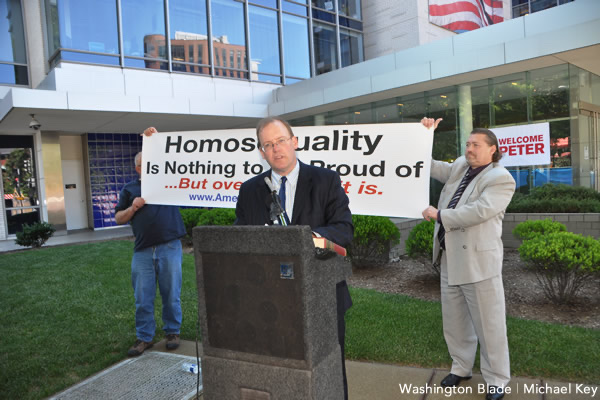
Americans for Truth About Homosexuality (AFTAH) was formed as a part-time venture in 1996 by long-time gay-basher Peter LaBarbera, who reorganized it in 2006 as a much more serious and influential, if often vicious, operation.
A one-time reporter for the conservative Washington Times, LaBarbera has been an energetic campaigner against “the radical homosexual agenda” since at least 1993, when he launched The Lambda Report, which claimed to do first-hand reporting to expose its gay enemies. Over the years, he has been an official with Accuracy in Media, Concerned Women for America, the Family Research Council and the Illinois Family Institute (see below for the last three). He left the Illinois Family Institute, where he’d been executive director, in 2006.
AFTAH is notable for its posting of the utterly discredited work of Paul Cameron (of the Family Research Institute; see below), who has claimed that gays and lesbians live vastly shorter lives than heterosexuals. Among the Cameron propaganda published by AFTAH are 2007 claims that gays and lesbians in Norway and Denmark live 24 fewer years than heterosexuals. Reviewing that claim, Danish epidemiologist Morten Frisch found that it had no scientific basis. LaBarbera himself, in 2002, compared the alleged dangers of homosexuality to those of “smoking, alcohol and drug abuse.” Similarly, AFTAH’s website carries essays describing homosexuality as a “lethal behavior addiction,” a “dangerous” practice that is “neither normal nor benign.”
In 2007, LaBarbera claimed there was “a disproportionate incidence of pedophilia” among gay men — yet another false assertion. The same year, he posted an open letter to the Lithuanian people from long-time gay-basher Scott Lively (see Abiding Truth Ministries, above), who has made a series of false claims about gays running the German Nazi Party. In the piece posted to the AFTAH website, Lively said homosexuals are trying to take away free speech from all opponents of gays and to silence all religious opinions on the matter.
The AFTAH site repeats bogus claims like the idea that a proposed bill in California would “promote cross-dressing, sex-change operations, bisexuality and homosexuality” to kindergartners and other children. And it ran an essay that falsely asserted that hate crime laws would “restrict our speech.”
*American Vision
Led since 1986 by Gary DeMar, American Vision is one of the primary exponents of the doctrine of “Christian Reconstruction” — the idea that the U.S. was founded as a “Christian nation” and that its democracy should be replaced with a theocratic government based on Old Testament law. As a practical matter, that means American Vision, which describes its goal as “restor[ing] America’s Biblical foundation,” backs the death penalty for practicing homosexuals.
DeMar has modified that dictum slightly in the past, saying that homosexuals wouldn’t all be executed under a “reconstructed” government, but that he did believe that the occasional execution of “sodomites” would serve society well because “the law that requires the death penalty for homosexual acts effectively drives the perversion of homosexuality underground, back into the closet.” More recently, while hosting American Vision’s “The Gary DeMar Show” in December 2009, Joel McDurmon, the group’s research director, agreed that the Bible does call for killing homosexuals. And, he said, “when most of a society is Christian, is biblical, then it [execution of gays] is perfectly normal; it should definitely be in place.”
In April 2009, DeMar said: “Homosexuals aren’t content with only having the bedroom. They have taken their perversion into the classrooms, teaching that such practices are normal. There is nothing normal about what homosexuals do.”
DeMar, who was closely allied with the late D. James Kennedy of Coral Ridge Ministries (see below), is a central figure in Reconstruction theology, which was founded by R.J. Rushdoony (see Chalcedon Foundation, below). He is co-author of Christian Reconstruction: What It Is, What It Isn’t with Gary North.
DeMar has also said that a “long-term goal” should be “the execution of abortionists and their parents.” Islam is another enemy, he said in August 2010: “The long-term goal of Islam is the abolition of our constitutional freedoms.”

*Chalcedon Foundation
Vallecito, Calif.
The Chalcedon Foundation, named after a 451 A.D. council that proclaimed the state’s subservience to God, was started in 1965 by Rousas John Rushdoony, who is known as “father of Christian Reconstruction” theology. Led by Rushdoony’s son, Mark, since the elder Rushdoony’s death in 2001, the foundation continues to push for the imposition of Old Testament law on America and the world.
Reconstruction, as described in R.J. Rushdoony’s foundational 1973 book The Institutes of Biblical Law, is opposed to modern notions of equality, democracy or tolerance — instead, it embraces the most draconian of religious views. Rushdoony supported the death penalty for homosexuals, among other “abominators.” He also opposed what he called “unequal yoking” — interracial marriage — and “enforced integration,” insisting that “[a]ll men are NOT created equal before God” (the Bible, he explained, “recognizes that some people are by nature slaves”). Rushdoony also denied the Holocaust, saying the murder of 6 million Jews was “false witness.”
Rushdoony’s Reconstruction is indeed radical, even including “incorrigible children” among those deserving death. And virtually all of his works remain for sale on the Chalcedon Foundation website.
Today, most fundamentalist leaders deny holding such views. But a Who’s Who of the religious right — including Tim and Beverly LaHaye (see Concerned Women for America, below), Donald Wildmon (American Family Association, above), and the late D. James Kennedy (Coral Ridge Ministries, below) — once served alongside the elder Rushdoony on the Coalition for Revival, a group formed in 1984 to “reclaim America.” Rushdoony reportedly was also a member of the secretive Council of National Policy, a group of archconservative leaders.
Christian Anti-Defamation Commission
Vista, Calif.
Originally incorporated in 1999 by retired Army Gen. William Hollis, the Christian Anti-Defamation Commission (CADC) says its goal is to serve as a “first line of response to anti-Christian defamation, bigotry and discrimination.” It was largely inactive until 2007, when it brought in as its new leader the Rev. Gary Cass, who claims that Christian-bashing, “the last acceptable form of bigotry in America, is alive and well and growing more intense and hysterical by the day.”
The CADC is heavily focused on the alleged evils of homosexuality. It has called the idea of allowing gays to serve openly in the military “evil”; opposed hate crimes legislation (which many religious-right groups falsely assert would make it easy to send pastors to prison for condemning homosexuality); and raged against a judge’s overturning of California’s Proposition 8, which had invalidated same-sex marriages. With regard to that last, it said: “Homosexuals have turned away from humbly worshipping the true and living God and his transcendent moral order in order to make an idol out of their sexual perversion and chaos.”
The group also has protested a lawsuit seeking to end public use of the motto, “In God We Trust”; encouraged the IRS to investigate the anti-theocratic Americans United for Separation of Church and State; and opposed a proposed Islamic center in New York City, saying Muslims “are exploiting the liberty we afford them to honor a murderous ideology that denies religious liberty every where [sic] it can.”
Although it is somewhat benign by comparison, the CADC has an advisory board that includes some of the country’s most hard-line anti-gay activists: Lou Sheldon, head of the Traditional Values Coalition (see below); Donald Wildmon, the founder of the American Family Association (above); and O’Neal Dozier, a pastor who wrote in his 2008 book that “[h]omosexuality not only spreads disease and neutralizes God’s command,” but also “destroys families.” The board also includes Carmen Mercer, a former top official of the Minuteman Civil Defense Corps, a now-defunct nativist group that once ran its own armed civilian border patrols.

Concerned Women for America
Washington, D.C.
San Diego, Calif., activist Beverly LaHaye, whose husband Tim would go on to become famous as co-author of the Left Behind novels depicting the end times, started Concerned Women for America (CWA) in 1979 to create an anti-feminist group that matched the power of the National Organization for Women. Today, CWA claims more than 500,000 members organized into state chapters, a radio program that reaches more than 1 million listeners, and a cadre of attorneys and researchers devoted to the group’s mission of promoting biblical values.
LaHaye has blamed gay people for a “radical leftist crusade” in America and, over the years, has occasionally equated homosexuality with pedophilia. In 2001, she hired prominent anti-gay propagandists Robert Knight (now with Coral Ridge Ministries; see below) and Peter LaBarbera (now with Americans for Truth About Homosexuality, above) to launch CWA’s Culture and Family Institute. Matt Barber was CWA’s policy director for cultural issues in 2007 and 2008 before moving on to similar work with the Liberty Counsel (below).
While at CWA, on April 12, 2007, Barber suggested against all the evidence that there were only a “miniscule number” of anti-gay hate crimes and most of those “may very well be rooted in fraudulent reports.” In comments that have since disappeared from CWA’s website, Barber demanded a federal probe of “homosexual activists” for their alleged fabrications of hate crime reports.
CWA long relied on and displayed Knight’s articles and talking points, including claims that “homosexuality carries enormous physical and mental health risks” and “gay marriage entices children to experiment with homosexuality.” Most remarkably, Knight cited the utterly discredited work of Paul Cameron (see Family Research Institute, below) to bolster claims that homosexuality is harmful.
Today, CWA continues to make arguments against homosexuality on the basis of dubious claims. President Wendy Wright said this August that gay activists were using same-sex marriage “to indoctrinate children in schools to reject their parents’ values and to harass, sue and punish people who disagree.” Last year, CWA accused the Gay, Lesbian, and Straight Education Network (GLSEN), a group that works to stop anti-gay bullying in schools, of using that mission as a cover to promote homosexuality in schools, adding that “teaching students from a young age that the homosexual lifestyle is perfectly natural … will [cause them to] develop into adults who are desensitized to the harmful, immoral reality of sexual deviance.”

Coral Ridge Ministries
Fort Lauderdale, Fla.
The late Rev. D. James Kennedy started turning fundamentalist Coral Ridge Presbyterian into a mega-church in the 1960s, adding Coral Ridge Ministries (CRM) as its action arm in 1974 and claiming some 10,000 members by the 1990s. During the fiscal year ending in June 2009, CRM raised almost $18 million and spent more than $6 million of that on television and radio outreach efforts.
Over the years, Kennedy emphasized anti-gay rhetoric, particularly in his TV ministry. He recommended as “essential” the virulent work of R.J. Rushdoony (see Chalcedon Foundation, above), who believed practicing gays should be executed. In an especially nasty 1989 edition of a CRM newsletter, Kennedy ran photographs of children along with the tagline, “Sex With Children? Homosexuals Say Yes!”
After Kennedy died in 2007, Coral Ridge Presbyterian seemed to change course, merging in 2009 with New City Presbyterian Church under its pastor, Tullian Tchividjian, a grandson of evangelist Billy Graham. Tchividjian began to move the church away from divisive social issues; some 500 members of Coral Ridge, including Kennedy’s daughter, left as a result. Today, Tchividjian says that the church, with 2,400 congregants, is entirely separate from CRM.
CRM, however, has continued its hard-line course. In 2009, it hired anti-gay activist Robert Knight as a senior writer and Washington, D.C., correspondent. Knight has used the work of discredited researcher Paul Cameron (see Family Research Institute, below). In one recent essay on the CRM website, he argued against allowing homosexuals to serve openly in the military, saying that “Bible-believing Christians would quickly find themselves unwelcome in Barney Frank’s new pansexual, cross-dressing military.” (Hector Padron, CRM’s executive vice president, wrote last May that such a change would post a “grave threat to the military.”)
In 2002, before joining CRM, Knight wrote that gay marriage “entices children to experiment with homosexuality” and that accepting homosexuality leads to “a loss of stability in communities, with a rise in crime, sexually transmitted diseases and other social pathologies. Still another is a shortage of employable, stable people.”

*Dove World Outreach Center
Gainesville, Fla.
The Dove World Outreach Center was founded in 1986 by Don Northrup and described itself as a “total concept church” in which all would be served. But Northrup died in 1996, and his successor brought in long-time Northrup associate Terry Jones as Dove’s leader in 2001. Since then, Jones has spouted increasingly vicious attacks on gays and Muslims, culminating in a plan that drew worldwide condemnation this September to hold an “International Burn a Koran Day.”
Jones and his family had spent some 20 years in Cologne, Germany, running a church that was allied with Dove. When he was asked to take over the Gainesville church, he apparently divided his time between the two until 2008, when the Cologne church was closed amid criticism of Jones by its congregants.
Jones pushed himself into the headlines last March, when he surrounded Dove with signs aimed at Craig Lowe, a Gainesville city commissioner who was running for mayor, that said “No Homo Mayor.” After an electioneering complaint was filed with the IRS (nonprofit churches cannot intervene in political campaigns), Jones had the signs shortened to the more generic “No Homo.” At one point, Jones and 30 of his congregants joined an anti-gay rally by the Westboro Baptist Church, which runs the Godhatesfags.com website and regularly pickets the funerals of U.S. soldiers, saying God is killing soldiers because America is a “fag-enabling” nation.
Jones is also the author of a book entitled Islam is of the Devil, and he has used that phrase on another set of signs posted around his church and sent his followers’ children to school in T-shirts bearing that slogan. (The school refused to let the children wear the shirts, and the ACLU filed suit against it as a result.) He regularly repeats the phrase on his “Braveheart Show,” an Internet video program where he asserted last April that “[h]omosexuality makes God throw up.”
Jones and his tiny congregation became momentarily famous this September, when he said he would burn Korans to protest Islam, which he describes as “an evil religion.” The threat drew public condemnation from Gen. David Petraeus, the commander of U.S. troops in Afghanistan, and several leading members of the Obama Administration, and sparked anti-U.S. rallies in Muslim countries. In the end, Jones withdrew his threat and rapidly sank back into political obscurity.

*Faithful Word Baptist Church
Tempe, Ariz.
Steven Anderson, formerly affiliated with Sacramento, Calif.-based Regency Baptist Church, started Faithful Word Baptist Church in Arizona on Christmas Day 2005 as a “totally independent” organization. With “well over a hundred chapters of the Bible memorized word-for-word,” Anderson quickly led his congregation into a series of extremely radical stands.
Much of his venom was aimed at homosexuals, who he suggests should be killed (“The biggest hypocrite in the world is the person who believes in the death penalty for murderers but not for homosexuals”). In an August 2009 sermon, he attacked the United Methodist Church, saying “10% of their preachers are queers” and adding, “they got a dyke and a faggot behind the pulpit.” He has described gays as “sodomites” who “recruit through rape” and “recruit through molestation.”
Anderson is also a virulent government hater. As operator of the True Sons of Liberty website, the pastor calls for abolishing the IRS, the Federal Reserve, Social Security and Child Protective Services state agencies. In April 2009, he refused to get out of his car or answer questions from Border Patrol agents at the California-Arizona border. Agents broke his window and tased him as a result.
Anderson brought his church national notoriety in August 2009, when a member of his congregation, Christopher Broughton, went to an Obama appearance in Phoenix legally carrying an assault rifle and a pistol. It turned out that Anderson had preached a day earlier to Broughton and others that he “hates Obama” and would “pray that he dies and goes to hell.” Two weeks later, he told openly gay columnist Michelangelo Signorile that he “would not judge or condemn” anyone who killed the president. Then, for good measure, he told Signorile at the end of the interview, “If you’re a homosexual, I hope you get brain cancer and die like Ted Kennedy.”

*Family Research Council
Washington, D.C.
Started as a small think tank in 1983, the Family Research Council (FRC) merged in 1988 with the much larger religious-right group Focus on the Family in 1988, and brought on Gary Bauer, former U.S. undersecretary of education under Ronald Reagan, as president. In 1992, the two groups legally separated to protect Focus on the Family’s tax-exempt status, although Focus founder James Dobson and two other Focus officials were placed on the FRC’s newly independent board. By that time, FRC had become a powerful group on its own.
Headed since 2003 by former Louisiana State Rep. Tony Perkins, the FRC has been a font of anti-gay propaganda throughout its history. It relies on the work of Robert Knight, who also worked at Concerned Women for America but now is at Coral Ridge Ministries (see above for both), along with that of FRC senior research fellows Tim Dailey (hired in 1999) and Peter Sprigg (2001). Both Dailey and Sprigg have pushed false accusations linking gay men to pedophilia: Sprigg has written that most men who engage in same-sex child molestation “identify themselves as homosexual or bisexual,” and Dailey and Sprigg devoted an entire chapter of their 2004 book Getting It Straight to similar material. The men claimed that “homosexuals are overrepresented in child sex offenses” and similarly asserted that “homosexuals are attracted in inordinate numbers to boys.”
That’s the least of it. In a 1999 publication (Homosexual Behavior and Pedophilia) that has since disappeared from its website, the FRC claimed that “one of the primary goals of the homosexual rights movement is to abolish all age of consent laws and to eventually recognize pedophiles as the ‘prophets’ of a new sexual order,” according to unrefuted research by AMERICAblog. The same publication argued that “homosexual activists publicly disassociate themselves from pedophiles as part of a public relations strategy.” FRC offered no evidence for these remarkable assertions, and has never publicly retracted the allegations. (The American Psychological Association, among others, has concluded that “homosexual men are not more likely to sexually abuse children than heterosexual men are.”)
In fact, in a Nov. 30, 2010, debate on MSNBC’s “Hardball with Chris Matthews” between Perkins and the Southern Poverty Law Center’s Mark Potok, Perkins defended FRC’s association of gay men with pedophilia, saying: “If you look at the American College of Pediatricians, they say the research is overwhelming that homosexuality poses a danger to children. So Mark is wrong. He needs to go back and do his own research.” In fact, the college, despite its hifalutin name, is a tiny, explicitly religious-right breakaway group from the American Academy of Pediatrics, the 60,000-member association of the profession. Publications of the American College of Pediatricians, which has some 200 members, have been roundly attacked by leading scientific authorities who say they are baseless and accuse the college of distorting and misrepresenting their work.
Elsewhere, according to AMERICAblog, Knight, while working at the FRC, claimed that “[t]here is a strong current of pedophilia in the homosexual subculture. … [T]hey want to promote a promiscuous society.” AMERICAblog also reported that then-FRC official Yvette Cantu, in an interview published on Americans for Truth About Homosexuality’s website, said, “If they [gays and lesbians] had children, what would happen when they were too busy having their sex parties?”
More recently, in March 2008, Sprigg, responding to a question about uniting gay partners during the immigration process, said: “I would much prefer to export homosexuals from the United States than to import them.” He later apologized, but then went on, last February, to tell MSNBC host Chris Matthews, “I think there would be a place for criminal sanctions on homosexual behavior.” “So we should outlaw gay behavior?” Matthews asked. “Yes,” Sprigg replied. At around the same time, Sprigg claimed that allowing gay people to serve openly in the military would lead to an increase in gay-on-straight sexual assaults.
Perkins has his own unusual history. In 1996, while managing the U.S. Senate campaign of Republican State Rep. Louis “Woody” Jenkins of Louisiana, Perkins paid $82,500 to use the mailing list of former Klan chieftain David Duke. The campaign was fined $3,000 (reduced from $82,500) after Perkins and Jenkins filed false disclosure forms in a bid to hide the link to Duke. Five years later, on May 17, 2001, Perkins gave a speech to the Louisiana chapter of the Council of Conservative Citizens (CCC), a white supremacist group that has described black people as a “retrograde species of humanity.” Perkins claimed not to know the group’s ideology at the time, but it had been widely publicized in Louisiana and the nation. In 1999, after Republican Senate Majority Leader Trent Lott was embroiled in a national scandal over his ties to the group, GOP chairman Jim Nicholson urged Republicans to quit the CCC because of its “racist views.” That statement and the nationally publicized Lott controversy came two years before Perkins’ 2001 speech.

*Family Research Institute
Colorado Springs, Colo.
Started in 1987 by psychologist Paul Cameron, the Family Research Institute (FRI) has become the anti-gay movement’s main source for what Cameron claims is “cutting-edge research” — but is, in fact, completely discredited junk science pushed out by a man who has been condemned by three professional organizations.
Over nearly three decades, Cameron has published “research studies” (though almost never in peer-reviewed journals) that suggest that homosexuals are predatory and diseased perverts who victimize children. Among his more recent defamations was an FRI pamphlet asserting the primary activity of the gay rights movement is “seeking to legitimize child-adult homosexual sex.” In another, he claimed that with “the rise of the gay rights movement, homosexual rape of men appears to have increased.” In yet another, he wrote, “Homosexuals were three times more likely to admit to having made an obscene phone call” and “a third more apt to report a traffic ticket or traffic accident in the past 5 years.”
Some of Cameron’s more infamous claims include the idea that homosexuals molest children at far higher rates than heterosexuals and that homosexuals have extremely short lives. Last February, he wrote on FRI’s website that “[i]f homosexuals are allowed to serve in the military, they will be recruiting in showers, having sex in the barracks… . Before long, the U.S. may be defended by the sex-obsessed and those who can tolerate kowtowing to them.” After all, writes Cameron — a man who proposes that parents promote teen heterosexual activity to keep kids straight — “homosexual sex overwhelms rationality [and] overwhelms the desire to serve.”
Cameron’s colleagues have condemned him repeatedly. In 1983, he was thrown out of the American Psychological Association for ethical violations. In 1984, the Nebraska Psychological Association disassociated itself from Cameron’s statements about sexuality. In 1985, the American Sociological Association adopted a resolution saying Cameron “has consistently misinterpreted and misrepresented sociological research on sexuality” and “repeatedly campaigned for the abrogation of the civil rights of lesbians and gay men”; the following year, the same group formally condemned Cameron for that misrepresentation of research.
In late 2010, reacting to reports that his group had once again been listed by the Southern Poverty Law Center as a hate group, Cameron told The (Colorado Springs, Colo.) Gazette that he believed homosexuality should be criminalized in America and that he was fine with a proposed bill in Uganda that would punish some gay sexual acts with death (“Whatever they decide, I’m OK with”). He also proposed heavily taxing gays and single adults because of their failure to produce children. And he suggested that gays and lesbians undergo a “public shaming” of some kind.
Despite all this — and the fact that Cameron’s propaganda is widely known to be false or misleading — many groups have continued to use his claims, though often without citing their source. They include the American Family Association, Americans for Truth About Homosexuality, Concerned Women for America, Coral Ridge Ministries, the Family Research Council (see above for all five) and, until recently, the Illinois Family Institute (see below).

*Heterosexuals Organized for a Moral Environment
Downers Grove, Ill.
Heterosexuals Organized for a Moral Environment (HOME) was founded by 62-year-old Wayne Lela, a former Catholic who now describes himself as an agnostic. Until recently, the 20-year-old group has had a fairly low profile.
The group, which is entirely focused on the alleged evils of homosexuality, attacks gay people on a wide variety of levels. But it keeps coming back to the idea that gay sexual activity should be illegal. “[P]enalizing people for engaging in homosexual behavior is clearly not discrimination, just like penalizing people for exhibitionism or incest is not discrimination,” HOME’s website says. In a second website comment, it adds, “[H]eterosexual activity is not illegalizeable … while homosexual activity is definitely illegalizeable.” And in a third, it insists that “legalizing homosexual deviations” leads to a “confused and sick society.”
HOME doesn’t stop there. It says that gays should apologize “for all the STDs [sexually transmitted diseases] they’ve spread, and all the money those STDs have cost, and especially for setting bad moral examples for our children.” It accuses homosexuals of having a “pathological attitude” toward the opposite sex. It says homosexuality shouldn’t have been removed from the American Psychiatric Association’s list of mental disorders. It says gays threaten free speech because they seek hate crime law protections. It argues that gay film directors are working to “condition men to bond with other men at the expense of women.” And it claims that pedophilia and necrophilia are a sexual orientations like homosexuality, going on to suggest that they could therefore be legalized.
And then there’s this: Freemasonry may be connected to “the homosexual movement,” with members evidently engaging in sodomy and “homosexual orgies.” Thus, HOME says, there is a “very real possibility that this group is using its influence to try to impose pro-homosexual ‘values’ on the public.”

*Illinois Family Institute
Carol Stream, Ill.
The Illinois Family Institute (IFI), which says it dedicates itself to issues surrounding “marriage, family, life and liberty,” is heavily focused on attacking gay people and homosexuality in general. It maintains “working partnerships” with other hard-line groups including the Family Research Council (see above) and the Alliance Defense Fund, a conservative legal center based in Phoenix. In early 2010, it launched Illinois Family Action as a political-action sister organization.
In 2006, then-Executive Director Peter LaBarbera (see Americans for Truth About Homosexuality, above), told a religious-right gathering hosted by Vision America that homosexuality was “disgusting” and demanded the closing down of all “homosexual establishments.” He called for the repeal of all “sexual orientation laws” — laws that ban discrimination against gays — and spoke of the “need to find ways to bring back shame to those practicing homosexual behavior.”
Over the years, the group also has occasionally embraced the groundless propaganda of Paul Cameron (see Family Research Institute, above). Until 2009, it carried an article on Cameron — “New Study Shows that Homosexuals Live 20 Fewer Years” — preceded by a full-throated endorsement LaBarbera. “Paul Cameron’s work has been targeted for ridicule by homosexual activists, and he’s been demonized by the left,” LaBarbera wrote in his introduction, “but that should not discount his findings.” IFI also posted a video attacking school anti-bullying programs that claimed, based on Cameron, that gay men’s median age of death is 42. Both were removed in response to the Southern Poverty Law Center’s 2009 listing of IFI as a hate group, which was largely based on its use of Cameron.
That response, however, hardly indicated that the IFI was backing down on its hard-line position. This year, Focus on the Family — for years, the powerhouse of anti-gay religious organizations in America — moderated its position markedly after founder James Dobson retired and pastor Jim Daly took over. In April, Daly told an interviewer: “I will continue to defend traditional marriage, but I’m not going to demean human beings in the process. It’s not about being highly confrontational.” The response of Laurie Higgins, IFI’s belligerent director of school advocacy, was that Daly was showing “surprising naïveté,” using the same language as pro-gay “homosexualists,” and failing to confront “the pro-homosexual juggernaut.”
In 2009, Higgins compared homosexuality to Nazism, likening the German Evangelical Church’s weak response to fascism to the “American church’s failure to respond appropriately to the spread of radical, heretical, destructive views of homosexuality.” Elsewhere, Higgins has pined for the days when gays were in the closet. “There was something profoundly good for society about the prior stigmatization of homosexual practice… . [W]hen homosexuals were ‘in the closet,’ (along with fornicators, polyamorists, cross-dressers, and ‘transexuals’), they weren’t acquiring and raising children.” She’s also said that McDonald’s, because it ran a gay-friendly TV ad, is “hell bent on using its resources to promote subversive moral, social, and political views about homosexuality to our children.”

Liberty Counsel
Orlando, Fla.
Created in 1989, Liberty Counsel is affiliated with Liberty University Law School in Lynchburg, Va., a legacy of the late conservative icon Jerry Falwell. It was founded and is still chaired by Mathew (Mat) Staver, who also serves as director of the Liberty Center for Law and Policy at Liberty University, and provides legal assistance with regard to religious liberty, abortion and the family.
The organization may be best known for its campaigns to ensure that “public displays of religion” are maintained during the Christmas holiday, and it has adopted broad right-wing views, including the allegation that the Obama Administration has a “socialist liberal agenda.” But it also has focused heavily on anti-gay activism.
In 2009, J. Matt Barber, formerly with Concerned Women for America and Americans for Truth About Homosexuality (see above for both), joined Liberty Counsel as director of cultural affairs (also becoming Liberty University’s associate dean for career and professional development). A year earlier, Barber had argued that given “medical evidence about the dangers of homosexuality,” it should be considered “criminally reckless for educators to teach children that homosexual conduct is a normal, safe and perfectly acceptable alternative.”
The Counsel also has been active in battling same-sex marriage, saying it would destroy the “bedrock of society.” In 2005, the group’s blog said: “People who … support the radical homosexual agenda will not rest until marriage has become completely devalued. Children will suffer most from this debauchery.” A 2007 blog posting said same-sex marriage would “severely impact future generations.”
Like other anti-gay groups, Liberty Counsel argues that hate crime laws are “actually ‘thought crimes’ laws that violate the right to freedom and of conscience” — an opinion rejected by the Supreme Court. In fact, the laws raise penalties for crimes already on the books — assault, murder and so on — that were motivated by hatred of people based on their sexual orientation. They do not, and could not under the Constitution, punish people for voicing opinions.
Since 2006, Liberty Counsel has also run its “Change is Possible” campaign with Parents and Friends of Ex-Gays to protect people who say they’ve changed from gay to straight from “discrimination” by “intolerant homosexuals.”
*MassResistance
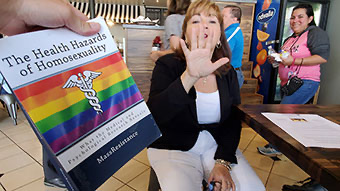
MassResistance, “the leading pro-family grassroots activist group in Massachusetts,” began life in 1995 as the Parents’ Rights Coalition, became the Article 8 Alliance in 2003, and took on its current name in 2006. Its leader, Brian Camenker, is a programmer who was an official of the Article 8 Alliance and also headed the Newton, Mass., chapter of the National Taxpayers’ Association.
As president of yet another group, the Interfaith Coalition of Massachusetts, Camenker spearheaded the drafting of a bill that passed in 1996 and required that parents be notified of any sex education in their children’s schools. That same year, Camenker claimed that suicide prevention programs aimed at gay youth actually were “put together by homosexual activists to normalize homosexuality.” Later, MassResistance charged that groups like the Gay, Lesbian and Straight Education Network (GLSEN), which support school anti-bullying programs, actually want to lure children into homosexuality and, very possibly, sadomasochism.
At a 2006 religious right gathering in Washington, D.C., Camenker insisted that gays were trying to get legislation passed to allow sex with animals. “One bill in Massachusetts takes away all the penalties for bestiality,” he claimed. “This is where this [homosexual] agenda is going.” A little later, he added, “They [gays and lesbians] are pushing perversion on our kids.”
In 2006-2007, Mass-Resistance pushed for an amendment of the 1996 statute that would have required that parents be notified of any discussion of gay or lesbian issues in the schools. The group proposed language that lumped sexual orientation (which includes heterosexuality, homosexuality and bisexuality) in with criminal behaviors like bestiality and polygamy. During legislative testimony supporting the amendment, Camenker falsely claimed that no homosexuals died in the Holocaust and that the pink triangle the Nazis forced imprisoned gays to wear actually signified Catholic priests. The amendment did not pass.
Camenker, who has long focused on the purported “homosexual agenda” in the schools and frequently claimed gays are dangerous to kids, has repeatedly cited discredited claims from organizations like the National Association for Research and Therapy of Homosexuality that link homosexuality and pedophilia.
In 2008, Camenker made another accusation for which there was no supporting evidence at all — the claim that the state of Massachusetts had had to spend more money every year since same-sex marriage became legal in that state. That, he said, was because of “skyrocketing homosexual domestic violence” and because of the “extreme dysfunctional nature of homosexual relationships.”
This year, MassResistance called Boston Gay Pride events a “depraved” display that featured “a great deal of obviously disturbed, dysfunctional, and extremely self-centered people whose aim was to push their agenda.”
National Organization for Marriage
Princeton, N.J.
The National Organization for Marriage (NOM), which is dedicated to fighting same-sex marriage in state legislatures, was organized in 2007 by conservative syndicated columnist Maggie Gallagher and Princeton University politics professor Robert George. George is an influential Christian thinker who co-authored the 2009 “Manhattan Declaration,” a manifesto developed after a New York meeting of conservative church leaders that “promises resistance to the point of civil disobedience against any legislation that might implicate their churches or charities in abortion, embryo-destructive research or same sex marriage.”
NOM’s first public campaign was in 2008, supporting California’s Proposition 8, which sought to invalidate same-sex marriage in that state. It was widely mocked, including in a parody by satirist Stephen Colbert, for the “Gathering Storm” video ad it produced at the time. Set to somber music and a dark and stormy background, the ad had actors expressing fears that gay activism would “take away” their rights, change their lifestyle, and force homosexuality on their kids.
The group, whose president is now former executive director Brian Brown, has become considerably more sophisticated since then, emphasizing its respect for homosexuals. “Gays and Lesbians have a right to live as they choose,” NOM says on its website, “[but] they don’t have the right to redefine marriage for all of us.”
For a time, NOM’s name was used by a bus driver named Louis Marinelli, who drove a van for NOM’s “Summer for Marriage Tour” this year. Marinelli called himself a “NOM strategist” and sent out electronic messages under the NOM logo that repeated falsehoods about homosexuals being pedophiles and gay men having extremely short lifespans. In homemade videos posted on his own YouTube page, he said same-sex marriage would lead to “prostitution, pedophilia and polygamy.” But this July, NOM said it was not associated with Marinelli.

*Traditional Values Coalition
Anaheim, Calif.
Former Presbyterian minister Lou Sheldon has been warning Americans about the “gay threat” since 1980, when he founded the Traditional Values Coalition (TVC), which also is concerned with abortion and national security and takes on liberal activists on a range of issues. The TVC, which today claims to speak for 43,000 churches, lobbies Congress and also mobilizes churches to oppose legislation that it disagrees with. Sheldon’s daughter Andrea Lafferty, a former Reagan Administration official, serves as executive director of the organization.
The group has at times enjoyed remarkable access to the halls of power — during the George W. Bush Administration, Sheldon and Lafferty visited the White House a combined 69 times, meeting personally with Bush in eight of the visits. But that does not mean that it has not long had a record of extreme gay-bashing.
In 1985, Sheldon suggested forcing AIDS victims into “cities of refuge.” In 1992, columnist Jimmy Breslin said that Sheldon told him that “homosexuals are dangerous. They proselytize. They come to the door, and if your son answers and nobody is there to stop it, they grab the son and run off with him. They steal him. They take him away and turn him into a homosexual.” Sheldon later denied that he made the comments, but his website today includes strikingly similar language: “[S]ince homosexuals can’t reproduce, they will simply go after your children for seduction and conversion to homosexuality.” Elsewhere, it claims that “[t]he effort to push adult/child sex … is part of the overall homosexual movement.”
The TVC also asserts that “it is evident that homosexuals molest children at a far greater rate than do their heterosexual counterparts” — a falsehood based on conflating male-male molestation with homosexuality. Gays, it says, molest children at “epidemic rates,” adding: “As homosexuals continue to make inroads into public schools, more children will be molested and indoctrinated into the world of homosexuality. Many of them will die in that world.” With regard to LGBT teen suicides, TVC, under the headline “Homosexual Urban Legends,” claims that “[t]he cold, hard fact is that teens who are struggling with homosexual feelings are more likely to be sexually molested by a homosexual school counselor or teacher than to commit suicide over their feelings of despair.”
The TVC also makes assertions on its website about disproportionate homosexual pedophilia and attacks the idea that people are born gay and the claim that gays want the right to marry for the same reasons that heterosexuals do — the TVC suggests the real purpose of marriage equality is to destroy the concept of marriage and ultimately replace it altogether with group sex and polygamy.

Reference
- 18 ANTI-GAY GROUPS AND THEIR PROPAGANDA, Southern Poverty Law Centre, 4 November 2010, by Evelyn Schlatte https://www.splcenter.org/fighting-hate/intelligence-report/2010/18-anti-gay-groups-and-their-propaganda