Tag Archives: Gay

Gay History: The ‘Macaroni’ Scandal of 1772: ‘Gay’ Trial A Century Before Oscar Wilde

Much derision was directed toward aesthetes in the late 19th century, who, led by Oscar Wilde, declared their devotion to beauty in all its forms. That moment in the history of men and their fashions is remembered today because of the fate of Wilde, imprisoned for what was then the crime of “gross indecency”. But this was not the first sensational trial of a high-profile homosexual. That had happened long before, such as in the notorious “macaroni” case of 1772.

Over the centuries, all manner of dandies have attempted to make their place in society. Wilde’s predecessor, George Bryan “Beau” Brummell became an arbiter of men’s fashion in Regency England despite his obscure social origins and lack of interest in women. Part of the secret of his success was his cultivation of a refined but understated style that avoided the kind of flashiness that could get a man condemned for “effeminate” flamboyance.

In the 1760s and 1770s, there was an explosion of public interest in the “macaronis”, fashionable society gents who were given that name because, in the eyes of the penny press of the day, they committed such cardinal sins as rejecting good old English roast beef for dainty foods from continental Europe – such as pasta. Those finicky eaters, who also sported excessive French fashions in clothing, were in some ways the predecessors of Wildean aesthetes, but they have largely been forgotten today.

Wilde, by contrast, is remembered because of his talent and for the way he was treated by the British legal system. In the 1980s and 1990s, he became a kind of “gay icon” with a new relevance to a generation struggling with the horrors of the AIDS epidemic. His disgrace at the end of the 19th century was reinterpreted as a kind of queer martyrdom that presaged later struggles for lesbian and gay liberation.

Queer theory

Enthusiasm for Wilde on the part of lesbian and gay activists in the late 20th century was connected to the rise of a new form of cultural and literary analysis known as “queer theory”. This development was heavily influenced by the work of the French philosopher Michel Foucault on the ways in which textual discourse operates. The focus was no longer on identifying gay men or lesbians in past centuries but on identifying when and why those terms were used.

It was this thinking that led the prominent scholar of Alan Sinfield, a leading British queer theorist, to identity the Wilde trials of 1895 as a “queer moment” when dandyism became linked with same sex desire.

Print: ‘How d’ye like me’, Carington Bowles, London, 1772.

The stereotypical proto-homosexual man emerged as a being that was attracted to younger men, who was theatrical rather than understated, effeminate rather than manly, and artistic rather than sporting. But it was not true that Wilde became obvious as a homosexual during the course of his trial – for the simple reason that the term “homosexual” was not reported in the British media until the time of another scandal, that surrounding the Prussian Prince of Eulenburg, that unfolded between 1906 and 1909.

And the fact is that Wilde was far from the first allegedly effeminate “sodomite” or “bugger” – and here I use terms that were widely employed at the time – to be disgraced in court.

The scandal of Captain Jones

Hester Thrale (1741 – 1821) was a member of the literary circle surrounding the famous encyclopediast Dr Samuel Johnson. She kept a fascinating diary in which she noted a wide variety of sexual foibles and eccentricities in the society circles of her time. She had a striking ability to recognise homosexuals (both male and female). Thus, in the entry for March 29, 1794 she discussed “finger-twirlers” as being a “decent word for sodomite”. In one passage, recorded in late March or early April 1778, she recalled the time six years earlier when a certain Captain Jones had been convicted of crimes against nature, and sentenced to die:

He was a Gentleman famous for his Invention in the Art of making Fireworks, and adapting Subjects fit to be represented in that Genre; & had already entertained the Town with two particular Devices which were exhibited at Marylebone Gardens & greatly admired: viz: the Forge of Vulcan in the Cave of Mount Etna, & the calling of Eurydice out of Hell – If he is pardoned says Stevens, He may shew off the Destruction of Sodom and Gomorrah; it will have an admirable Effect.

Jones was a man of fashion in society who had been convicted at the Old Bailey for sodomising a 13-year-old boy. The link that Thrale made between camp dandyism and same sex scandal was rife in the papers of the time. As one correspondent put it in a letter to the Public Ledger on August 5, 1772, Captain Jones was “too much engaged in every scene of idle Dissipation and wanton Extravagance”. He was referred to as this “MILITARY MACCARONI [original emphasis]”. And, the writer concluded, “therefore, ye Beaux, ye sweet-scented, simpering He-She things, deign to learn wisdom from the death of a Brother”.

Arguments were brought forward that the boy’s testimony was unreliable and Jones was granted a royal pardon on the condition that he left the country. Members of the public seethed with indignation at the thought of an establishment cover-up and a variety of men fled to the Continent.

The macaronis have, however, been remembered for their style rather than for imputed sexual notoriety. We remember the uncouth revolutionary soldier who was originally mocked by the British as a “Yankee Doodle” for having “Stuck a feather in his cap / And called it macaroni”. But we’ve forgotten how queerly peculiar such an act may have seemed in the wake of a trial that bears comparison with those endured by Wilde a century later. That Americans could appropriate the song as a patriotic air implies a degree of innocence or, perhaps, of convenient forgetting.

Reference

Gay History: Send in the Clones

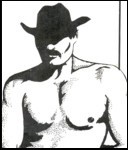
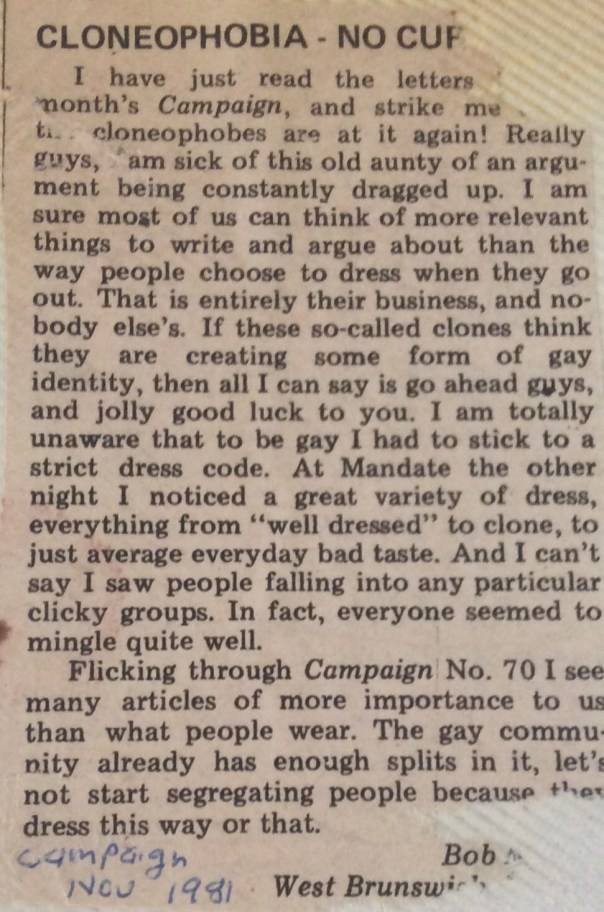
I was an 80s Clone…many would have said an arch-Clone! I lived the life, and the look. Levi’s jeans, “Bonds” tee-shirts and singlets, plaid flannelette shirts, “Blundstone” boots (Blunnies), or Doc Martins, huge handlebar moustache, a transient beard in any of a number of styles, short or buzz-cut hair, an “Akubra” cowboy hat. I lived in pubs like The Oxford, and danced…half naked…in nightclubs like “Mandate” (Melbourne), and “Midnight Shift” or “Stronghold” in Sydney. I sniffed Amyl, blew whistles, banged tambourines, ingested LSD & Speed when the mood took me, sprinkled talc on dancefloors, and danced in a jockstrap on occasion. Leather vests, belts, armbands and cockrings. Pierced ears, pierced nipples, tattoos. I loved it…though many other gay men, especially older “dinner party” gays, hated it and thought we leaned too heavily on straight stereotypes for our look. What they couldn’t see was that this extreme stereotyping WAS gay! That at THAT time, THEY were the stereotype…along with the effeminate, lisping, limp-wristed stereotype that was the general impression of gay men…was what we were trying to move away from, by presenting a more “macho” type of gay men…that we wanted to be seen as men, not as a parody of! The Clone look, along with Hi NRG dance music became looks and sounds that very much defined the 80s.

Don’t ask me why it started, but by the beginning of the 80’s ‘the clone’ was beginning to become a universal phenomenon (and I don’t mean Dolly the sheep!).

Some commentators suggest the first clones appeared in San Francisco’s Castro Street; others that they came from New York’s ‘Village’. Either way, by the 80’s the look had been adopted by gay men around the world.

The most obvious elements were the (obligatory) moustache and ‘the uniform’. Depending on where you lived, the latter would be based on a Lacoste sports shirt, chinos and ‘loafers’ (USA) or checked shirt, jeans and trainers (UK). These minor national differences notwithstanding, the overall look was an overt and unambiguous statement – not just about dress sense but also masculinity and sexuality.

The Clone Ranger. Extract from gay club advert.

This was an extremely significant act for that time – not least because gay men were, on the whole, still largely closetted. Yet, in spite of this, here were large groups of gay men choosing an image – and a highly sexualised one at that – for themselves. Prior to this, the only ‘sexualised’ images of gay men were as predators – of ‘defenceless’ straight men and, of course, children since we were all paedophiles. And, needless to say, they weren’t images of our choosing.

Within the UK this was also another indication of the Americanisation of gay men or, perhaps more accurately, the gay identity. In a sense, it was almost inevitable, given the sustained hostility to all things gay in the UK (e.g. Mary Whitehouse’s attacks on Gay News, the raiding of Gay’s the Word and other bookshops). The USA was the principal source of many gay resources – from porn to political material. (I shall cover this in more detail in a later blog.)

Get a room! Gay hotel ad.

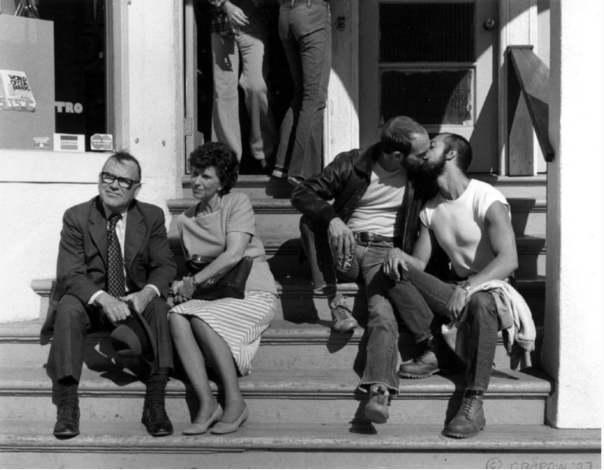
It could be argued that it was the clones who started to put the sex into homosexual: there are certainly some commentators who believe that they paved the way for other groups such as leather men and bears. Certainly, the collective visibility of so many self-defined gay clones can only have helped put us on the map as a population that was much larger – and a lot less apologetic – than many people had imagined.

Of course, there were always some queens who took it all a bit too seriously. Thankfully, there were others who managed to combine the playful and political elements of the clone. No one in the UK did this more successfully than the artist David Shenton, through his character ‘Stanley’, who appeared regularly in Gay News and then Capital Gay.

Stanley (second from right) pops into his local gay bar. Taken from ‘Stanley and the Mask of Mystery’ by David Shenton. Reproduced by kind permission of the artist. World copyright © David Shenton

I’m not sure if the clone has totally disappeared from the gay scene or simply merged into one of the other diverse ‘identities’ our community now has. But it would be a shame if we were to forget what was our first, ‘home-grown’ positive gay stereotype.

A letter I wrote to “Campaign”…a gay newspaper popular in the 70s & 80s…in response to someone criticising the Clone look – then in its starting phase
The blogger in Clone days circa 1986/87

Remaking the Castro Clone

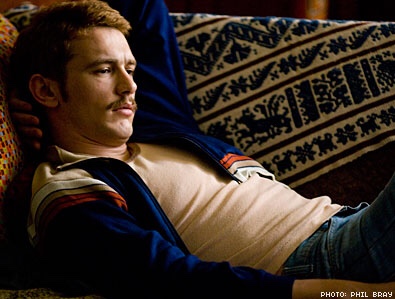
Levis 501 jeans. Skin tight. Sanded down at the knees and crotch for that perfectly worn-in look. Third button unbuttoned to create a bit of allure. T-shirt, also skin tight. A Levis snap-front plaid. That was the uniform of the Castro clone, the gay fashion icon spawned in the 70s that — with surprisingly minor evolution or alteration — can still be seen on the streets of San Francisco today.

Danny Glicker, thankfully, is in love with the look. As the costume designer on Milk, Gus Van Sants biopic of the slain civil rights leader Harvey Milk, Glicker had to outfit hundreds of actors, from leading men Sean Penn, James Franco and Emile Hirsch to an army of extras, all dressed to span a full decades worth of fashion dos and donts.

Period films always present challenges to their costumers, but those based on true stories are that much more complicated. Glicker was saddled with another great expectation while preparing the highly anticipated film: Milks characters are not only real, they lived during a time many viewers can still recall themselves. And Milk owned a camera shop and lived an incredibly well documented life, which took some of the guesswork out of the equation, but also meant that there would be no excuse with eagle-eyed fans for anything less than absolute authenticity.

Simply recreating the clothes wouldnt have been sufficient — the bodies on todays actors are more defined and muscled than those of the leaner Milk and his comrades. Instead Glicker had to tailor the clothes to look as if they were hanging off of a 70s frame.

We created these enormous books of research that specifically address each character within the timeline, says Glicker, a young, unassuming, bespectacled man with a head of thick black curls whose previous work include Transamerica, Thank You For Smoking and HBOs True Blood. It was sort of overwhelming, because after awhile it was hard to edit down the material. I was very interested in recreating outfits exactly as they were, partially because I knew that Gus was going to be incorporating so much archival footage into the movie, and I didnt know exactly where.

Given access to the archives of the San Francisco GLBT Historical Society, Glicker and his team managed to get their hands on a fair amount of Milks actual clothing. Then they went shopping. Glicker, who prefers vintage pieces, combed hundreds of stores and amassed a huge collection of items, which he then authenticated using his research books before altering to fit the actors. No tiny detail of the evolution of fashion went unchecked — there are, after all, key differences between a 1976 shirt and a 1978 shirt (such as the collar width), and Glicker was determined to be accurate.

What couldnt be bought was recreated (and sometimes what was bought was still recreated so that spare sets were available), including T-shirts from now-defunct Castro bars, protest Ts found in the archive, and the suit Milk was killed in, which they had viewed at the Historical Society. That was a very, very meticulous recreation, says Glicker, who had to wear cotton gloves while handling the suit, which is kept in a temperature and light controlled environment and wrapped in acid free tissue. We were measuring everything from the lapels to the belt loops and leg openings. The fabric, every aspect of the fit, it was all done to match as closely as possible.

And when the thrift stores and archives didnt have what he needed, Glicker went to Levis corporate headquarters in San Francisco. The uniform of choice for Harvey Milk, his friends and many in the LBGT community at the time was the Levis 501 button fly jean, says Robert Hanson, President of Levi Strauss & Co.s Levis Brand Division. If you saw anything but Levis in the film it would have been wrong.

Levis gave me a tremendous amount of access to both their archive and retail store, says Glicker. Hanson (who is gay) and Levis, an early pioneer and longtime stalwart supporter for gay causes, thought the film was a perfect match for the brand. The movie is really about a very specific movement at a specific time in the city, Glicker says. These people wore Levis. It was what they were about and where they were. Its more than just a brand of clothes in this case, its an iconic part of America and the Castro.

When I started reading about what people wore, adds screenwriter Dustin Lance Black. I thought, What was that Levis clone look about? It didn’t take much to realize that it was about a group of people who had been called pansies and fags reclaiming their masculinity and being men.

That held true even when going butch went beyond the basics. I remember reading someone complaining that the guys were actually going too far with it — trying to be too butch, actor James Franco, who plays Milks longtime lover, Scott Smith, told Black in his Out cover interview. I saw a lot of guys from the Castro where they [actually] looked like construction workers.

Thats why the Castro clone, Glicker says, is actually a deceptively simple look. It has to be perfectly played, he says. In order to make it look good, you have to find the perfect fit and you have to feel great in it to be able to sell the outfit. It was a uniform because it was accessible for everybody. It wasnt out of peoples grasp. It was about the wearer more than the means of the wearer. And whether or not Milk launches a vintage resurgence, the basic elements havent been put out to pasture. I see the influence of it everywhere. Its not going anywhere. Its like the gay communitys little black dress.

The gay clone, illustrated.
Leather enthusiasts at the 1978 San Francisco Gay Day Parade.

2001 Michael Tolliver is wearing jeans, with an opened flannel shirt to show off his body. This look depicts the Castro Clone style of the 1970s.

Reference

Gay History: The Complete Guide to Every Queer Pride Flag

Whether you’re celebrating Pride in New York or Tel Aviv, you’ll be seeing all sorts of flags — and not just those in the traditional rainbow. There are many sexualities in on the queer spectrum, and we’ve identified the flags for each. Did we miss any? Let us know in the comments.

Gilbert Baker Pride Flag

In 1977, Harvey Milk challenged Gilbert Baker, a veteran who taught himself to sew, to come up with a symbol of pride for the gay community. His response? The original Pride flag. Inspired by Judy Garland’s “Over the Rainbow,” these colors flew at the San Francisco Gay Freedom Day Parade celebration on June 25, 1978. Though some dispute whether Baker was the sole creator of the flag that started it all, its symbolism remains. Each color celebrates an aspect of queer Pride:

Hot pink =  Sex

Red = Life

Orange = Healing

Yellow = Sunlight

Green = Nature

Turquoise = Magic/Art

Indigo = Serenity

Violet = Spirit

1978-1999 Pride Flag

After the assassination of Harvey Milk, many wanted the Pride flag he commissioned to commemorate his accomplishments for the community and their personal support. The demand was greater than the available fabric, so the Paramount Flag Company began selling this version of the flag, as did Gilbert Baker, who had trouble getting hot pink fabric.

Traditional Gay Pride Flag

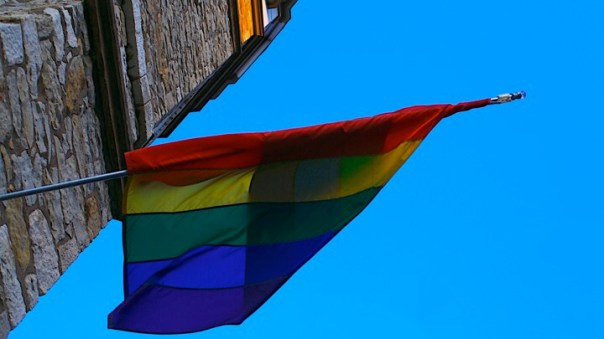
This is the most familiar flag. In 1979, the community landed on this six-color version, which was hung from lampposts in San Francisco. Numerous complications over having an odd-number of colors led to turquoise being dropped, at least according to reports. Read more about the modern flag here.

Philadelphia People Of Color Inclusive Flag

Noting that queer people of color are often not fully included in the LGBT community, the city of Philadelphia added two colors — black and brown — to the Pride flag in their honor. The city had previously faced accusations of racial discrimination in its gay bars, which led 11 queer nightlife venues to take antiracism training. Many white men were outraged by the flag, claiming that rainbow includes all skin colors, but with a star like Lena Waithe donning it at the Met Gala, it seems the design is here to stay.

Progress Pride Flag

This new flag seeks to take Philadelphia’s inclusive approach a step further. Daniel Quasar, who identifies as queer and nonbinary, designed this flag. The white, pink, and light blue reflect the colors of the transgender flag, while the brown and black stripes represent people of color and those lost to AIDS. “When the Pride flag was recreated in the last year to include both black/brown stripes as well as the trans stripes included this year, I wanted to see if there could be more emphasis in the design of the flag to give it more meaning,” Quasar explained on his Kickstarter.

Bisexual Flag

Designed by Michael Page, the flag brings visibility to the bisexual community, showing the overlap of the stereotypical colors for boys and girls. The flag was inspired by an older symbol of bisexuality: the “biangles,” two overlapping pink and dark blue triangles.

Pansexual Pride

Created on the web in 2010, this flag has colors that represent pansexuality’s interest in all genders as partners. The pink represents women, yellow nonbinary and gender-nonconforming people, and the blue is for men.

Asexual Flag

Like the pansexual flag, the asexual flag was created in 2010. Inspired by the Asexual Visibility and Education Network logo, it represents many ace identities, including graysexuals (the fluid area between sexuals and asexuals) and demisexuals (people who don’t experience sexual attraction unless they have an emotional connection with their partners.

Labrys Lesbian Pride Flag

Oddly enough, this sapphic symbol was created by a man. Created in 1999 by gay graphic designer Sean Campbell, the flag has not gained much traction in the lesbian community. It features a labrys, an ax-like weapon used by Grecian amazons.

Polyamory Flag

Featuring the symbol for the infinite numberpi, which shares the first letter of “polyamory,” this flag celebrates the infinite selection of partners available to polyamorous people. The letter is gold to represent the emotional attachment we have with others as friends and romantic partnerss, rather than just our carnal relationships.

Intersex Flag

Designed in 2013 by the organization Intersex International Australia, this flag intentionally features nongendered colors that celebrate living outside the binary.

Transgender Flag

Monica Helms, a trans woman, designed this flag in 1999, and it was first flown at a Pride Parade in Phoenix a year later. “The light blue is the traditional color for baby boys, pink is for girls, and the white in the middle is for those who are transitioning, those who feel they have a neutral gender or no gender, and those who are intersexed,” Helms noted. “The pattern is such that no matter which way you fly it, it will always be correct. This symbolizes us trying to find correctness in our own lives.”

Genderfluid/Genderflexible Flag

Encompassing the fluctuations and the flexibility of gender in genderfluid people, the flag features colors associated with femininity, masculinity, and everything in between. The pink stands for femininity. The white represents the lack of gender. The purple represents the combination of masculinity and femininity. The black symbolizes all genders, including third genders. The blue reflects masculinity.

Genderqueer Flag

Created in 2011 by Marilyn Roxie, the genderqueer flag highlights androgyny with lavender, agender identities with white, and nonbinary people with green. Some people refer to it as a nonbinary flag if they feel queer is a slur.

Lipstick Lesbian Flag

If you want the most feminine pride flag, here it is. Although it’s not a widely used symbol, it celebrates the femmes in the lesbian community, lovingly called “lipstick lesbians.”

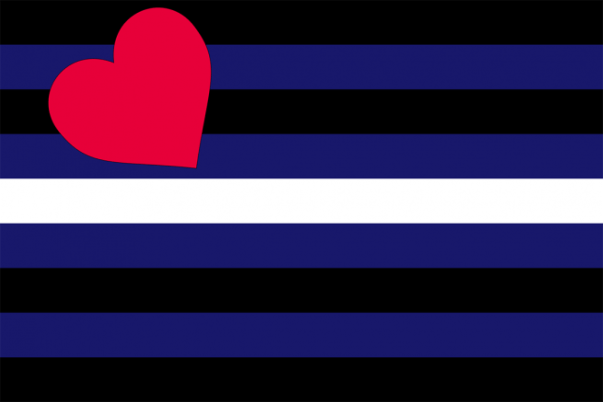
Leather, Latex, & BDSM Flag

Whether the kink community should be added in the acronym LGBT is a heated debate, but there is no denying that the community has several of its own flags. This one was designed by Tony DeBlase for Chicago’s International Mr. Leather celebration in 1989. This symbol is not exclusively gay, but rather for the leather and BDSM community. The original flag is on display at the Leather Archives and Museum in Chicago.

Bear Brotherhood Flag

Though The New York Times named 2018 “the age of the twink,” only the bears — as gay men lovingly refer to the beefier, more hirsute guys — have their own flag. Craig Byrnes designed it in 1995 for the International Bear Brotherhood. Its colors are to match the fur of bears living in the woods.

Rubber Pride Flag

This symbol is for members of the rubber and latex fetish community and is similar to its predecessor, the leather Pride flag. Peter Tolos and Scott Moats created the design in 1995 “as a means to identifying like-minded men and [it] reflects the sensory, sensual, and mental passion we have for rubber.” They say the black color represents “our lust for the look and feel for shiny black rubber,” the red symbolizes “our blood passion for rubber and rubbermen,” while yellow highlights “our drive for intense rubber play and fantasies.” It also features a literal kink, for obvious reasons.

Polysexual Flag

Polysexuality, unlike pansexuality, is the attraction to multiple genders but not all. A middle ground between bisexuality and pansexuality, it is centered more around attractions to femininity and masculinity rather than gender itself. The pink represents attraction to females; the blue for males. The green is for an attraction to those who don’t conform to either gender.

Agender Flag

While genderqueer people bend the rules of gender, agender people reject a gender completely. For their flag, the black and white stripes represent the absence of gender, while green, the inverse of the gender-heavy purple, represents nonbinary genders.

Aromantic Flag

While asexual flags use purple to show their lack of sexual attraction, aromantic flags use green to celebrate the people who live without romantic attraction.

Non Binary Flag

Created by 17-year-old Kye Rowan in 2014, this flag was a response to nonbinary people feeling improperly represented by the genderqueer flag. This symbol was not to replace Roxie’s creation but sit beside it as an option. The yellow symbolizes gender outside a binary. The white, a mix of all colors, represents those with many or all genders. Purple stands in for those who feel both binary male and female or fluid between them. The black is for the agender community, without sexuality or color.

Pony Flag

Pony play is a distinct fetish where people are treated like horses by wearing hooves, ears, and  saddles and pulling carts. Carrie P created this flag in 2007; it uses black in solidarity with the leather community at large.

Straight Ally Flag

The flag equivalent of “I support LGBT people, but no homo,” this makes everyone feel included at Pride marches, even if they’re celebrating other people’s sexualities.

Reference

Gay History: Unearthing The “Knights of the Clock”.

Enigmatic might be the best word to describe this organization, which was variously called the Knights of the Clock or Clocks. Gay and lesbian historians differ in their reporting of who founded the group, when it was founded, and what its exact name was. The ONE Gay and Lesbian Archives in L.A. maintains that Merton L. Bird, an African-American accountant about whom little is known, was the cofounder, and that it started up around June 1951. The other co-founder was W. Dorr Legg, who used about a dozen pseudonyms throughout his life, and whose name appears in virtually every anthology of gay history. He earned a master’s degree in landscape architecture with a specialty in urban planning, taught at Oregon State University, lived in New York and Florida, and came home to Ann Arbor, Michigan to care for his elderly parents. Legg’s lovers were, for the most part, African-American, and he experienced racial discrimination first hand (though not, according to John D’Emilio, in Detroit’s black community). Some historians hold that Bird and Legg met in Michigan, drove around looking for a comfortable place for interracial gay couples, and landed in L.A. in the late 1940’s. Lillian Fader-man and Stuart Timmons hold that Marvin Edwards, not Bird, went to L.A. with Legg. Timmons interviewed Edwards for their 2006 book, Gay L.A., which includes a very youthful candid photo. Edwards was forced to leave L.A. after a year or so, when his landlady discovered he was gay.

Legg has been variously described as charismatic, charming, poised, witty, intelligent, controlling, inflexible, and opinionated. A Republican in politics, he chose to live off the earnings of younger men (according to an interview in Joseph Hansen’s 1998 biography of Don Slater). In Legg’s 1994 book, Homophile Studies in Theory and Practice, he described Bird as brilliant and gives all credit for the Knights’ founding to Bird. “Hostility and harassment were the daily lot of interracial same-sex couples in 1950. … [Bird’s] idea was that by coming together to form a mutual aid society, the group could at the very least offer each other encouragement. The decision was to form a California nonprofit corporation and call it the Knights of the Clocks, a deliberately ambiguous title.” Many historians, such as Paul Cain, have quoted from Legg’s book, Homosexuals Today; A Handbook of Organizations & Publications (1956), which he wrote under the name of Marvin Cutler, stating that the aim of the Knights was to “promote fellowship and understanding between homosexuals themselves, specifically between other races and the Negro, as well as to offer its members aid in securing employment and suitable housing. Special attention was given to the housing problems of interracial couples of which there were several in the group.”

Although most sources give June 1951 as the Knights’ founding date, others range from the late 1940’s to the early 1950’s. Perhaps the L.A. group known as the Cloistered Loyal Order of the Conclaved Knights of Sophisticracy (or, sometimes, Sophistocracy, and known as the C.L.O.C.K.S.) lent its name to Bird and Legg’s Knights. It may or may not have been formally incorporated. Jonathan Ned Katz was unable to turn up the legal papers when he searched back in the 1970’s, but Edward Sagarin (the pseudonym of Donald Webster Cory) states in what was originally his NYU thesis, later published, that the Knights incorporated in 1950. Three undated typescripts in the ONE Archives’ file on the Knights contain some information about the C.L.O.C.K.S. Their oath of office, following a Masonic-type ritual, was to “practice the arts of sophisticracy diligently, honestly, courteously, amicably, faithfully, and with all of my ability.” At the end of the installation, the installing officer and “honor guard” intoned: “By the authority vested in me by the State of California, and as a duly elected officer of this corporation, I hereby declare you [name of office]. Honi soit qui mal y pense.” This, the motto of the Order of the Garter, founded in mid- 14th-century England, can be roughly translated as “shamed be he who thinks evil of it.” Instead of the usual titles (president, VP, etc.), the C.L.O.C.K.S. used medieval ones: Exalted Knight, Senior Knight, Bursar, and Scribe (who kept a Tablet instead of minutes).

In the ONE’s file, a few handwritten entries beginning on May 24, 1951, were recorded in an unused 1944 calendar from what appears to be an insurance company. On that date, “application forms were passed out,” “minutes were approved as read,” and the “Vice President spoke of aims of Club.” Gone is the mystique of the Cloistered Loyal Order. One of the Knights’ events was planned to take place in June at the Wilfandel Club. According to the still-active club’s website, wilfandelclub.com, it was established on November 21, 1945, by two black women to provide “people of all races with a public meeting place in Los Angeles during the 1950’s.” Another meeting note, dated July 1, listed members who would sing, play an instrument, dance, and make speeches at an upcoming party. (Bird was listed as one of the speech-makers.) On that same date, there was an entry for a rough draft of letterhead, “The C.L.O.C.K.S./Incorporated/Los Angeles/Calif.” The name “Josephine Baker” appears fleetingly in a meeting note, leaving one to imagine all kinds of possibilities.

Yet another event, dated August 4, was to be a “midsummer frolic” beginning at 9 p.m., with draft beer and spaghetti. The last social event mentioned was a Valentine’s meeting with a “social program” planned for Saturday, February 16 [1952]. Events seemed to be admission-by-card only. Other cryptic entries mentioned the Loan Fund, Housing & Employment Committee, the Membership Committee, the Entertainment Committee, and the Legal Aid Committee, of which Bird was chair. “NAACP” is noted without any further comment. Interestingly, Bird’s name is consistently spelled “Byrd” throughout, and C. Todd White’s book lists “M. Byrd” as Merton Bird’s pseudonym. Some members’ names and addresses are written throughout the entries, and there’s an intriguing mention of a seal and articles of incorporation. Sagarin remarked that meetings were originally held monthly, and then semimonthly. Meetings, he said, usually drew about 35 attendees, with a larger group attending the socials.

Reproduced in Legg’s 1994 book and credited to “ONE’s Baker Memorial Library and Archives” is a 1951 invitation, engraved in Gothic script, to a Knights social event: the fourth anniversary party of “Gene and Edward” on May 12, 1951, from 9 p.m. to 3 a.m. Legg stated that guests at that event were “a comfortable mix of races and assorted personal relationships including both men’s Beverly Hills employers and their families.” ONE Archives’ handwritten meeting notes do include some female first names, and one name that could possibly begin with “Mrs.”

When did the end come? ONE Archives’ file contains no information about the group beyond a handwritten list, dated February 15, 1952, of fourteen members (including Bird and Legg) who owed dues. On that date, the group had $14.15 in the bank. In 1952, Legg and Bird numbered among the founders of ONE, Inc., a group within the Mattachine that published ONE magazine. White mentions that Bird appeared to have offered the Knights’ charter as a model, or to offer a merger with the Knights, neither of which were accepted. Sagarin noted that “for all practical purposes it had disappeared from the scene” by 1953, though an occasional meeting was held after that date.

A 1966 article in Tangents magazine by Richard Conger implied that the Knights, “formerly of Los Angeles,” were represented at the ONE Institute Midwinter Session, an educational program for gay men and lesbians held on an almost yearly basis in various cities and considered a precursor to today’s academic programs. The Institute was the brainchild of Legg. Sidney Roth-man reported of the Knights: “Its originality lay in its avowed intention to enroll men and women alike and their parents and other relatives on an interracial basis. Its meetings and large social gatherings appear not to have been matched in attendance until this present year (1965) by a few social events staged in San Francisco as the joint effort of several homophile organizations in that city. The Knights continued for three or four years but eventually found themselves overshadowed by another Los Angeles development … The Mattachine.” (Conger and Rothman were, according to Vern Bullough, two of Legg’s pseudonyms.)

When Legg died in 1994 at the age of 89, he was survived by his partner of over thirty years, John (Johnny) Nojima, who died a few years ago. Very little is known at this time about Merton L. Bird.

ONE’s file contains the names and addresses of some of the earliest Knights. Can any of them be traced? Are any of their addresses close to those noted on the map of “significant locations” in White’s book? What might the archives of other California institutions contain? Did any of the Knights’ files migrate to other gay organizations following a very celebrated “heist” of papers in 1965 by another ONE, Inc. founder, Don Slater, due to personal and professional disputes with Legg? Does the NAACP’s L.A. chapter keep records back to the 1950’s? What about the archives of the Wilfandel Club? More research is waiting to be done on this fascinating and pioneering organization.

I’m grateful to the archivists at ONE National Gay & Lesbian Archives in LA., particularly to Loni Shibuyama. This article would not have been possible without Lillian Faderman ‘s assistance, and I would, also like to thank Philip Clark, Wayne Dynes, Joseph Hawkins, and C. Todd White.

References

  • Bullough, Vern L. Before Stonewall; Activists for Gay and Lesbian Rights in Historical Context. Harrington Park Press, 2002.
  • Cain, Paul D. Leading the Parade: Conversations with America’s Most Influential Lesbians and Gay Men. Scarecrow Press, 2002.
  • Conger, Richard (pseud.). Where the Mainstream Flows. ONE 14:2, 1966.
  • D’Emilio, John. Sexual Politics, Sexual Communities: The Making of a Homosexual Minority in the United States. 1940-1970. Univ. of Chicago Press, 1983.
  • Dynes, Wayne. “W. Dorr Legg.” in Gay & Lesbian Biography, edited by Michael J. Tyrkus. St. James Press, 1997.
  • Faderman, Lillian, and Stuart Timmons. Gay LA.: A History of Sexual Outlaws, Power Politics, and Lipstick Lesbians. Basic Books, 2006.
  • Hansen, Joseph. A Few Doors West of Hope: The Life and Times of Dauntless Don Slater. Homosexual Information Center, 1998.
  • Katz, Jonathan. Gay American History: Lesbians and Gay Men in the USA.: A Documentary. Crowell, 1976.
  • Knights of the Clock(s) File. ONE National Gay & Lesbian Archives, Los Angeles. Legg, W. Dorr, ed. Homophile Studies in Theory and Practice. ONE Institute Press, 1994.
  • Rothman, Sidney (pseud.). The Homophile Movement. ONE 13:12, 1965.
  • Sagarin, Edward (pseud.). Structure and Ideology in an Association of Deviants. Arno Press, 1966.
  • White, C. Todd. Pre-Gay LA.: A Social History of the. Movement for Homosexual Rights. Univ. of Illinois Press, 2009.
  • Martha E. Stone, literary editor of this magazine, is a reference librarian by day.

Gay History: The Unbelievably True Story of Jobriath, Music’s First Openly Gay Rock Star

Imagine watching the Empire State Building suddenly transform into giant spurting penis to ejaculate a figure dressed in a major King Kong look across a stage. Now, imagine this mysterious figure shedding the ape costume and emerging as the most fabulous Marlene Dietrich you’ve ever seen.

No, this isn’t the fever dream of a Hell’s Kitchen gay after watching Kong: Skull Island. This flamboyant and provocative series of events almost happened. The performance, set to take place at the Paris Opera House in 1973, would’ve introduced the world to glam rock’s first openly gay rock star. Through a sea of glitter, the crowd was to feel a potent mix of astonishment and arousal before whispering his name: Jobriath.

That you’re almost certainly wondering who the hell Jobriath is should betray the fact that his grand entrance never happened, but to dismiss Jobriath as yet another failed rock star would do a disservice to his legacy. The truth is, for all his failures, Jobriath paved a path for queer musicians. Without rock’s self-proclaimed “true fairy,” artists like ILoveMakonnen, Frank Ocean, PWR BTTM, Mykki Blanco and everyone in between might not be around to queer up the music industry.

Decades ago, in an era punctuated by the queerbaiting antics of Lou Reed and David Bowie, Jobriath’s star power proved to shine too bright, too fast—he was the Icarus of glam rock with a gloomy ending to match. Spanning multiple identities, enough tragedy to fill a Lifetime Original Movie, and a wealth of ideas that would never come to pass, this is the story of America’s first gay rock star.

The Adolescence and Abandonment of Bruce Wayne Campbell

You’d be forgiven if you thought the story of Jobriath’s adolescence was written by an overeager fiction writer. After all, his name shares similarities with both Batman and the star of Evil Dead and hails from a town that sounds like a history book. Yet, Bruce Wayne Campbell of King of Prussia, Pennsylvania really did exist. And he was even something of a child prodigy on the piano.

The Film Collaborative

Born the son of an Army man in the dirt track town, Campbell spent his youth moving from army base to army base with his family. It was a childhood light on friends and heavy on a blooming sexual identity that infuriated his family. It was an existence that wasn’t meant to last and, after a brief stint in the Army that ended with him going AWOL, he ran away to start a new life as Jobriath Salisbury in the sun-soaked streets of Los Angeles.

Detours and the Discovery of Jobriath Salisbury

Like any great glam rock origin story, Jobriath’s rise began with a little bark and a lot of hair follicles. A short time after arriving in LA, he accompanied his friend to the audition for the notoriously outlandish musical Hair. Despite only going to help the friend with lines, he was cast into the role of Woof and was soon performing to sold out crowds every night. Under the bright lights, he got a taste of stardom that changed his life.

Though as talented as he may have been in his role, he wasn’t immune to the vices of the 1960s. A cocktail of drugs strong enough to tranquilize a herd of buffalo mixed with his overinflated ego and he eventually left Hair in a blaze of glory—taking two of his costars with him to start a band called Pidgeon. You know, because it was 1969 and naming your band after sky rats was glam. The trio recorded a strange, baroque folk album that sounded like a chipper nightmare before the band promptly fell apart.

It was from this point that Jobriath’s AWOL status caught up to him and he was detained by military police. He was thrown into a military psychiatric hospital, suffered his first big breakdown, and then broke away from the padded walls to take on California one last time. It didn’t take long for him to pick up his old habits As he recalled years later, “I was floating down in the gutter. I didn’t eat. I just drank beer all the time. With no money, I hustled for booze and drugs.”

While he hustled, a new chapter in Jobriath’s story was being written thousands of miles away in New York. It was there that Jerry Brandt, legendary manager of Carly Simon, sat in the offices of Columbia Records’ Clive Davis listening to Jobriath’s demo tape. To his ears, he’d found the star he was waiting for.

The Film Collaborative

Jobriath Boone and Jerry Brandt’s Big, Gay American Disaster

The year was 1972 and Jobriath had just shed his steak-themed last name and emerged as Jobriath Boone—–just in time for Brandt to change his life forever. After search through LA to find him, Brandt quickly whisked the burgeoning star back to New York, got him a record contract with Elektra Records rumored to be worth $500,000, and began one of the most ambitious advertising campaigns of the decade.

“Jobriath is going to be the biggest artist in the world. He is a singer, dancer, woman, man. He has the glamour of Garbo. He is beautiful,” Brandt explained to Melody Maker before telling Music Week: “It’s Sinatra, Elvis, The Beatles, and now Jobriath.” To Brandt, Jobriath was glam rock’s gay, glittered Jesus Christ and he wanted the world to know his name.

Jobriath’s face was plastered across full page ads in Vogue, Penthouse, and Rolling Stone and put on posters on hundreds New York City buses. For Brandt’s pièce de résistance, a 41’ by 43’ billboard high atop Times Square was erected featuring Jobriath naked and posed as a Roman statue broken at the base and crawling across the floor.

The AV Club

When it came time to record the album, Brandt convinced Elektra Records to book them at Olympic Studios, the famed recording studio favored by bands like The Rolling Stones. It was within these soundproofed walled that a 55-piece orchestra accompanied Jobriath on a glam rock journey through the eleven tracks that made up his self-titled debut album. Despite the aggressively sexual S&M ballad “Take Me I’m Yours” and the swaggering bravado of “I’m a Man,” reviews were warm and encouraging.

The problem was that outside of the industry, Jobriath’s flagrant sexuality produced a product the public just wasn’t ready for. By the time the giant wave of marketing finally crashed down, Jobriath’s overhyped debut had become a disastrous joke. A debut concert at the Paris Opera House with a $200,000 price tag and the Empire State building ejaculating the star was quickly scrapped.

He made his television debut in an unforgettable yet restrained performance on a prominent nightly show called The Midnight Special. It was notable for his outlandish costume that could best be described as ‘spaceman by way of hamster tunnel tubing’ and was restrained because, after being barred from performing his S&M jam “Take Me I’m Yours” by producers, he instead performed “Rock of Ages” and his single “I’m a Man.” Late night just couldn’t handle a glitter-dipped gay rocker singing, “Any day you could buy me or tie me up.”

Alongside his TV debut, he headlined two sold out shows at The Bottom Line in all his unsheathed, gay glory to modest, 400-person crowds. The positive response brought some hope to Jobriath and Brandt but that momentum crashed down at a follow-up concert at Nassau Coliseum. There, the crowds immediately bombarded him with shouts of “faggot” as trash was thrown until he fled the stage. Elektra Records quickly pushed out the second and final album, Creatures of the Street, shortly after that disastrous show with leftover material from the Jobriath recording sessions and dropped him from their label.

With no future at Elektra, Jobriath embarked on one final tour and severed his partnership with Brandt. Like any good rock star though, Jobriath went out with a bang. His final show at the University of Alabama led to five encores that ended when the excited crowd pulled the fire alarm and sent the fire department rushing in. It was glorious moment that showcased the star Jobriath could’ve become had the country been ready to embrace that courageous homosexuality of rock’s first true fairy but ultimately signaled the end to his life as Jobriath.

The Downfall and Death of Cole Berlin

In 1975, high above the iconic Chelsea Hotel in a pyramid-topped apartment, Jobriath Boone was laid to rest alongside his brief career. From his ashes, the character of Cole Berlin emerged. When he wasn’t hustling or auditioning for the role of Al Pacino’s lover in Dog Day Afternoon, Cole spent his nights performing 1930s cabaret songs at The Covenant Gardens restaurant. His existence, perhaps for the first and only time, appeared restrained and mundane for a few years. It wasn’t until 1979 that the façade of normality was ripped away in an interview with Omega One magazine.

“Jobriath committed suicide in a drug, alcohol and publicity overdose. That whole hype just drove him crazy,” Cole said of his former identity. It was the statement of a broken man and, as the interview continued, he didn’t hesitate to talk about his personas as if they were a polyamorous family he’d moved in with. “Schizophrenia is my lifestyle. I think everybody is schizophrenic but they’ll all fighting it,” he explained. “I, or should I say we, are not fighting it. Come over. I’ll ask some of us to come out and play.”

Years after the interview, his lifestyle on the streets caught up with him and he soon contracted AIDs. On the Chelsea Hotel’s 100th anniversary in November 1982, he played his last public performance and, on the morning of August 4, 1983, police broke up the front door of his rooftop apartment and found his dead body. A decade after towering over Times Square, he died alone and abandoned—–his body decaying for four days before anyone found him.

The Great, Rock Resurgence of Jobriath

As tragic as his career and life were, time has ultimately been kinder to Jobriath. In the years following his death, the glamorous singer has become ingrained in the rock and roll folklore thanks to one of rock’s most iconic queer artists. In one of the strangest twists in Jobriath’s story, rock legend Morrissey of The Smiths has become integral in establishing the singer’s legacy.

In 1992, Morrissey expressed interest in having him as the opening act for his “Your Arsenal” tour–—unaware that the singer had died nearly ten years ago. It was a tragic request but, ultimately, served as a catalyst for Jobriath’s revitalization. In the two and a half decades since Morrissey first took an interest in rock’s first true fairy, a wealth of information and music has unearthed his story. Previously unreleased music filled Lonely Planet Boy in 2004 and As the River Flows in 2014; his first two albums saw a rerelease in 2008; and, finally, a documentary by Kieran Turner called Jobriath A.D. came out in 2012.

Four decades after crooning for audiences to let him be who he was on the track “I’m a Man,” the repercussions of Jobriath’s fearless embrace of his sexuality, Empire State Building ejaculation and all, are finally being celebrated.

Reference

Gay History: The Downfall of the Ex-Gay Movement

What went wrong with the conversion ministry, according to Alan Chambers, who once led its largest organization

TERRY JOHNSTON / FLICKR

In 2001, Alan Chambers was hired as the president of the world’s largest ex-gay ministry, Exodus International. That same year, U.S. Surgeon General David Satcher issued a report that stated, “there is no valid evidence showing that sexual orientation can be changed.”

Like most conservative Christian leaders at the time, Chambers considered the countercultural nature of his work a point of pride. During the latter part of the 20th century, Exodus and similar conservative groups promoted the idea that gay people could—and should try to—become straight. Ex-gay leaders traveled to churches and appeared on television news programs citing a litany of examples of happily married “former homosexuals” to demonstrate that sexual orientation is a choice and that change is possible.

But Chambers would undergo a radical change of heart. In 2013, he publicly apologized to the LGBT community for the “pain and hurt” Exodus had caused and announced that the ministry was permanently shutting down. Chambers’s decision effectively delivered the deathblow to the beleaguered ex-gay movement. And his story of transformation, detailed in a new memoir, My Exodus: From Fear to Grace with a foreword by CNN’s Lisa Ling, will likely resonate with many traditionalists who are searching for new ways to think about LGBT issues.

Chambers, 43, was raised by an ex-military father in a Southern Baptist home and realized he was attracted to other males at a young age. Most of his early sexual encounters with men were anonymous, which bred in him a deep self-hatred. At 19, he connected with an Exodus-affiliated ministry where he hoped to rid himself of same-sex attraction once and for all.

While the ministry did not make Chambers straight, he claims that it saved his life and many others because it provided a “safe space for many” to talk about their sexuality. At the time, there was no national network for LGBT Christians and most churches were not places of sexual transparency. But, he says, Exodus’s emphasis on “change” made it “fatally flawed.”

In 1998, Chambers married his wife, Leslie, with whom he adopted two children. In My Exodus, he recounts his inability to consummate the union for eight months, but he says their sex life is now “good.”

“While many relationships are built on sex, ours just includes sex,” Chambers says. “We love it and value it because we worked hard for it.”

As a former Exodus participant who once lived a “gay lifestyle” but was able to achieve a successful straight marriage, Chambers was the perfect candidate to lead the organization. And by 2001, Exodus needed all the help it could get.

At its peak, Exodus International had an annual operating budget of more than $1 million, had 25 employees, and served as an umbrella organization for more than 400 local ministries across 17 countries. But over the years since its founding in 1976, many of the leaders Exodus’ touted as success stories had become cautionary tales instead.

Cofounder Michael Bussee left the group in 1979 and entered a relationship with another Exodus leader, Gary Cooper. Bussee would later admit, “I never saw one of our members or other Exodus leaders or other Exodus members become heterosexual, so deep down I knew that it wasn’t true.” Throughout the 1980s and ‘90s, many former Exodus members became vocal critics of the ministry, claiming it had caused them psychological distress. And in September 2000, Exodus’s chairman John Paulk was photographed cruising for men at a gay bar in Washington, D.C. He was ousted from his position and later confessed, “I do not believe that reparative therapy changes sexual orientation; in fact, it does great harm to many people.”

The movement traditionalists believed would be their saving grace in the fight against LGBT rights was quickly becoming their Achilles’ heel.

Being chosen to lead Exodus in 2001 was like becoming the ex-gay Pope following the Catholic sex-abuse scandals. The ministry’s board knew it could not survive another public scandal, so it questioned Chambers rigorously before deciding to hire him. During the interview process, Chambers recalls a board member asking him what success would look like under his leadership. He replied, “It looks like Exodus going out of business because the church is doing its job.”

Chambers words would later seem prophetic, but he first needed to travel a long road. In 2005, he called homosexuality “one of the many evils this world has to offer.” And in 2006, he lobbied for a constitutional amendment banning gay marriage. But Chambers admits that during the same year his thinking began to evolve.

“As I heard more stories and evaluated my own realities,” Chambers said, “I realized change in orientation was not possible or happening.”

Though the ex-gay leader was stewing on the inside, he seemed as resolute as ever on the outside. He advocated for California’s Proposition 8, which sought to ban gay marriage in the state. In 2009, he published a book called Leaving Homosexuality: A Practical Guide for Men and Women Looking for a Way Out. He admits to immediately regretting the book’s title and some of its content.

Chambers’s thinking continued morphing until his dramatic announcement that the ministry would shut down in 2013: “Exodus is an institution in the conservative Christian world, but we’ve ceased to be a living, breathing organism. For quite some time, we’ve been imprisoned in a worldview that’s neither honoring toward our fellow human beings, nor biblical.”

By this point, the ex-gay movement was already in shambles. A 2013 Pew Research poll showed that only 36 percent of Americans believe a gay or lesbian person’s orientation can be changed. As Satcher reported, modern science had delivered crushing blows to the ex-gay movement with peer-reviewed research showing that its ideology was bunk. And a national movement to ban reparative therapy for minors was taking shape and had already been successful in several states.

The closing of Exodus International became the “tipping point” in conservative Christians’ conversations about the nature of sexual orientation. Today, even top Southern Baptist leaders have denounced ex-gay therapy, and the school newspaper for the Jerry Falwell-founded Liberty University has editorialized against it.

“Shutting down Exodus dealt a fatal blow to the whole idea that orientation can be changed and that God somehow loves you more because of the choices you make,” Chambers says. “Some ministries still promote this idea, but they are not going to achieve the same level of success that Exodus had. That position is more of a minority than it has ever been.”

The release of Chambers’s memoir this month marks another step in the leader’s evolution. He has voiced his support for President Obama’s effort to ban orientation-change therapies for minors and celebrated the Supreme Court’s decision to legalize gay marriage. And now he even admits that he believes committed, monogamous same-sex relationships can be holy.

“I look at gay and lesbian people who are in committed relationships and I believe they can reflect the image of God,” Chambers says. “That belief has continued to evolve, but heterosexuals don’t have a corner on the market of healthy, holy relationships.”

While many culture-warring conservatives will undoubtedly see Chamber’s openness as a cowardly capitulation, others will call him courageous. The former ex-gay leader chooses to focus on just being honest, instead. As he said in a chapter intended for his memoir but cut by the publisher, “Every part of my life, all of my compartmentalization is reconciled. My message and story are no longer different depending on the group to whom I’m speaking.”

Chambers describes his current sexual orientation as “complicated.” While he is still attracted to men, he also says that he and Leslie have a healthy marriage with a robust sex life. But he no longer claims that every person with same-sex attraction should follow his path.

“For those who cannot reconcile their faith and sexuality, they can be affirmed in their choice of celibacy and devote their lives to causes more life giving than ‘ridding themselves of the demon homosexuality,’” Chambers says. “And the gay Christian community can be affirmed in who they already are: beloved.”

Reference

Domestic Violence A ‘Silent Epidemic’ In Gay Relationships

Back in my dim, dark past I was picked up one night in the Midnight Shift by a very cute guy. Nothing odd about that…until he took me to the back of the bar and introduced me to his boyfriend. The intention was obvious, they were both good looking men…and I didn’t say no. The sex was great and both guys seemed quite at ease in the threesome situation, and I stayed the night. However, the next morning was a real eye-opener…over breakfast, things took a real turn to the dark side…and I was caught right in the middle of it…with no idea what to do. Graeme…the guy who had picked me up the last evening…was relentlessly verbally abused by his partner, Peter. It was as though I wasn’t even there, as the abuse went on around me, and needless to say, it was a very uncomfortable breakfast. It seemed that Graeme could neither do, nor say, anything right. I never witnessed any physical abuse, but you could feel it underlying the verbals. Peter ordered Graeme to drive me home, and said he’d be timing it. I felt so bad for Graeme, as he was a really lovely, gentle guy. We got to my apartment building and I asked him if he would like to come in for a coffee…but he stated the obvious! If he wasn’t home in the allotted time, he’d cop it. A number of months later, I ran into Graeme in my local watering hole. The whole puck-up thing happened, though this time he was on his own. When I questioned what was happening with Peter, he said they’d parted company. I mentally breathed a sigh of relief. Graeme and I then went on to have a fuck-buddy thing for about 4 years. Last time I saw him…about 20 years ago now…he was in a happy relationship with another guy. I all my years on the gay scene, both amongst a large, close social circle, and in my day-zoo-day picks ups, fuck buddies and one night stands, that was the only incidence of gay domestic violence that I’ve ever encountered. However, it made me very aware of its existence, and how it can be so easily covered up just by presenting the normal semblance of a relationship. It did make me wonder just how much could have been going on amongst those I did know.

Domestic violence has become a “silent epidemic” in the gay and lesbian community despite being the subject of increasing scrutiny in heterosexual relationships, according to the AIDS Council of NSW.

Roughly one in three lesbian, gay bisexual, transgender, and intersex (LGBTI) couples experience domestic violence. Those statistics are echoed among the general population.

After years of fighting to prove their love is valid, LGBTI victims of domestic violence can feel like they are in another closet, making it harder to get help.

Russ Vickery was six months into his first gay relationship when the violence began.

“We went out for dinner and then drinks at a local pub … he got angry about something and the night ended with me having a broken nose,” Vickery says

Same-sex couple Russ Vickery (L) and Matthew Parsons have both been in domestic violence situations in their previous relationships. CREDIT: PAUL JEFFERS

“After the first time he was very apologetic and it was never going to happen again.” But it did happen, again and again over a period of five years, culminating in Vickery being thrown down a set of stairs at home in front of his children.

For Matthew Parsons, domestic violence came in other forms – psychological, financial and emotional abuse.

The smallest of triggers would set off a torrent of abuse, like the time he left the do not disturb sign on a hotel room door.

“When we returned, the room hadn’t been serviced for towels and so he flipped out and threw champagne, strawberries and chocolate across the room. I spent the night crying in the parking lot.”

Parsons had no control over his own finances either. The final straw came when his partner knowingly withheld from him the few dollars he needed to purchase lunch.

“I thought, you don’t even think of me as human, I’m just your play thing. That was a really horrible realisation to come to.”

It took both men years to realise they were experiencing domestic abuse, which is little talked about in the LGBTI community.

“He kept telling me that when two men get involved in a relationship, things turn physical,” says Vickery, who had been in a 17-year marriage prior to coming out. “I had no barometer so I just assumed that was how it worked.”

Parsons says the gay and lesbian community has spent so long trying to prove their love is valid, they are afraid to ruin it by admitting domestic abuse occurs.

“There’s an unspoken fear that if we start to tell the mainstream community that actually sometimes our relationships are toxic and horrible and abusive, then that will be used against us to say, ‘see it’s all unnatural and a sin anyway’.”

Vickery likens it to coming out a second time.

“A lot of people ask me why I didn’t leave [sooner] … but I’d come out and told everyone it was a wonderful thing. I didn’t want to come out again…”

ACON chief executive, Nicolas Parkhill, says for this reason, domestic violence is under-reported within the LGBTI community.

And because same-sex domestic violence “doesn’t look the same” as in heterosexual relationships, people don’t always recognise it, Parkhill says.

Unique to LGBTI victims is the fear the abusive partner will “out” them to family, friends and work colleagues, or reveal their HIV status.

Within the LGBTI community abuse is more frequently reported by women and transgender males than by gay men but Parkhill says more research is needed to determine the full extent of the problem.

He applauds the naming of Rosie Batty as Australian of the Year which has already raised the profile of domestic violence in the community, but says “the silent epidemic within this public profile raising is how that plays out in relationships that aren’t perceived as ‘the normal’.”

More needs to be done to raise awareness of domestic violence in gay and lesbian relationships, Parkhill says, and more government funding is needed for LGBTI-specific support services.

Matthew Parsons remembers calling a domestic violence hotline only to discover it was run by a Christian organisation.

“They were very unhelpful to say the least and I thought from that experience there wasn’t help out there, which isn’t true,” he says.

He eventually found help through the website Another Closet and counselling which encouraged him to do a “pack and dash” – fleeing while his partner was out.

The stair incident was the catalyst for Vickery to leave, but it still took him a year to come to terms with the relationship loss.

The men have been together now for four years and finally know what it is like to feel happy and safe.

Drawing on those experiences, they co-created a highly acclaimed cabaret show My Other Closet about domestic violence in gay relationships, for the Sydney Mardi Gras festival in 2013 and have plans to revive the show in Melbourne.

“[Our] horrible relationships … taught us both everything we never want to have in a relationship again,” Parsons says.

“We want to turn our negative experiences into a positive and put the message out there … that abuse is abuse and it’s the same in any relationship.”

Reference

Gay History: Violence is No Stranger to the LGBT Community: David Mixner

Turning and turning in the widening gyre

The falcon cannot hear the falconer;

Things fall apart; the centre cannot hold;

Mere anarchy is loosed upon the world,

The blood-dimmed tide is loosed, and everywhere

The ceremony of innocence is drowned.

The best lack all conviction, while the worst

Are full of passionate intensity.

From “The Second Coming” by William Butler Yeats

Not since June 24, 1973 when a madman fire-bombed the UpStairs Lounge in New Orleans has the LGBT community suffered such slaughter at the hands of hate. On that horrible day, 43 years ago, 32 of our own were burned to death. No one was ever charged or punished for that crime. Ever since, unfortunately, random violence has shadowed our journey to freedom. Over a dozen MCC churches have been burned to the ground. Every one of us knows someone who has been gay-bashed. Many have been beaten so badly that they never regain their ability to function in the world. None of us will ever forget Matthew Shepard crucified on a fence in the barren and desolate prairie of Wyoming.

For the LGBT community, the news that terrorists aim to kill us is certainly not new. We have recoiled time and time again as videos show our brothers and sisters in the Middle East stoned to death or hurled off the tops of buildings. In Africa we see members of our community burned to death encased in the infamous ‘neckless’ (a burning tire around their neck). A generation of us witnessed first hand as our brothers endured a prolonged and brutal death from AIDS while our own government turned its back on us. American preachers have called for the death sentence for LGBT Americans and dispatched missionaries overseas to urge third world nations to inflict hate and violence on their own LGBT citizens.

For the most part we have suffered all this amid the silence of others; it has almost become a way of life for us. The lack of outrage or even coverage of the repression and terror directed toward us from the media is striking. Also, the fact that thirteen nations have the death penalty simply for being homosexual — and many of them are American allies. As ACT UP said so eloquently, silence really does equal death.

Now another place, another name has joined the long list: Pulse. Ironically the name of the Orlando bar is the means to ascertain if a person is still alive.

Oh yes, we are still alive. They have not invented a bullet, a gun or firebomb that can come close to murdering our spirit or our determination to be free. For every one of our fallen there are ten to take their place.

The slaughterhouse in Orlando hits close to home. I have spoken there at a community event. Every city in America has a bar like Pulse. We have all danced to the same music! We all know it can happen anywhere, anytime in our community. We are all always at risk.

President Obama rightly called the slaughter in Orlando both a terrorist act and a hate crime. The two can’t be separated.

Let’s be honest. Not only was this twisted terrorist inspired by ISIS; he had plenty of permission here in America to hate us.

There are precincts of American politics filled with rhetoric against our community, our rights, our very being. Pastors advocate hate from their pulpits and legislation is submitted and enacted to demean us and sanction anti-LGBT discrimination. There are states passing laws to permit our fellow citizens to deny us a meal in a restaurant, a place to sleep at night, or even access to a restroom. Do these agents of bigotry really believe their cynical fear-mongering and attempts to write hate into the stature books did not contribute to the massacre at Pulse? Really?

What can we do in the face of such horror?

For years to come and without question we will have to continue fighting our oppressors in the streets and at the ballot box. We cannot rest until every hate-filled law is overturned. The best memorial to the dead of Orlando is a new birth of freedom.

In the short term, many of the killed or injured are poor and they and their families need our financial assistance. Equality Florida has established a “Go Fund Me” page for us to help pay for funerals and medical expenses.

The LGBT community in Texas — and all decent citizens –have a special obligation and that is to remove Lt. Governor Patrick from office for his hateful tweet: “You reap what you sow.” He dishonors his office and America.

The Republican Party must stop exploiting gay-baiting as a tool to turn out their base.

Finally, we must stand tall, proud and open. All of us are sickened and angered by the mass execution of our brothers and sisters, but we are not bowed and not defeated. Never!

Reference

Gay History: ONE, Inc.

ONE, Inc. was an early gay rights organisation in the USA.

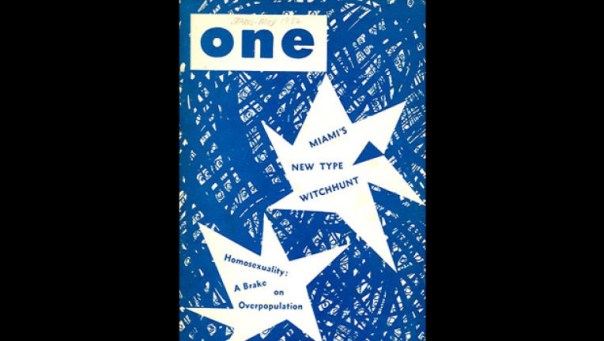
The idea for a publication dedicated to homosexuals emerged from a Mattachine Society discussion meeting held on October 15, 1952. ONE Magazine’s first editors included founders of Mattachine Societyand also  The Knights of the Clock, a support group for interracial gay couples that had begun in Los Angeles in 1950.

ONE Inc.’s Articles of Incorporation were signed on Nov. 15, 1952 and were signed by “Tony Sanchez” (a pseudonym), Martin Block, and Dale Jennings. Other founders were Merton Bird, W. Dorr Legg, Don Slater, and Chuck Rowland. Jennings and Rowland were also Mattachine Society founders.

In January 1953 ONE, Inc. began publishing ONE Magazine, the first U.S. pro-gay publication, and sold it openly on the streets of Los Angeles. In October 1954 the U.S. Postal Service declared the magazine ‘obscene’. ONE sued, and finally won in 1958, as part of the landmark First Amendment case, Roth v. United States.[1] The magazine continued until 1967. 

ONE also published ONE Institute Quarterly (now the Journal of Homosexuality). It began to run symposia, and contributed greatly to scholarship on the subject of same-sex love (then called ‘homophile studies’).

ONE readily admitted women, and Joan Corbin (as Eve Elloree), Irma Wolf (as Ann Carrl Reid), Stella Rush (as Sten Russell), Helen Sandoz (as Helen Sanders), and Betty Perdue (as Geraldine Jackson) were vital to its early success. ONE and Mattachine in turn provided vital help to the Daughters of Bilitis in the launching of their newsletter The Ladder (Magazine) in 1956. The Daughters of Bilitis was the counterpart lesbian organisation to the Mattachine Society, and the organisations worked together on some campaigns and ran lecture-series. Bilitis came under attack in the early 1970s for ‘siding’ with Mattachine and ONE, rather than with the new separatist feminists.

In 1965, ONE separated over irreconcilable differences between ONE’s business manager Dorr Legg and ONE Magazine editor Don Slater. After a two-year court battle, Dorr Legg’s faction retained the name “ONE, Inc.” and Don Slater’s faction retained most of the corporate library and archives. In 1968, Slater’s faction became the Homosexual Information Center or HIC, a non-profit corporation that survives today.

In 1996, ONE, Inc. merged with ISHR, the Institute for the Study of Human Resources, a non-profit organization created by transgendered philanthropist Reed Erickson, with ISHR being the surviving organization and ONE being the merging corporation. In 2005, the HIC donated many of its historic materials, including most of ONE Incorporated’s Blanche M. Baker Memorial Library, to the Vern and Bonnie Bullough Collection on Sex and Gender, a special collection within Oviatt Library at California State University, Northridge. 

A Timeline History of ONE, Incorporated 1947–1967

This timeline links to several primary documents, such as court records, corporate minutes, letters of resignation, and correspondence between several of the pioneers of the early movement for homosexual rights in the United States. It ends in 1967 after the division of ONE, Inc. was finalized after a grueling two-year court battle.

White’s book Pre-Gay L.A.: A Social History for the Movement for Homosexual Rights, published by the University of Illinois Press in May of 2009, discusses many of the documents linked to this page.

1947

  • June: Edythe Eyde publishes Vice Versa: America’s Gayest Magazine, the first regularly published newsletter in the United States dedicated to homosexual issues. The newsletter was typewritten at her employer’s, RKO Studios in Los Angeles. Eyde distributed 16 copies to friends such as Jim Kepner between June 1947 and February 1948. Eyde later became know to readers of The Ladder through her pen-name, “Lisa Ben,” an anagram for Lesbian.
    Note: The HIC secured official right to use Eyde’s true name in print, in the summer of 2015.

1948

  • Alfred Kinsey et al.’s Sexual Behavior in the Human Male is published, asserting that one in three American males had experienced some form of homosexual encounter in their lifetime and that between four and eight percent were exclusively homosexual.
  • February: final (ninth) issue of Vice Versa distributed.
  • August: Harry Hay attends a beer bust near the University of Southern California campus, where the idea is sprung to start a political organization called “Bachelors for Wallace.” Upon returning home that night, Hay began his first draft of a prospectus to form an organization dedicated to the welfare of homosexuals.

1949

  • Publication of Nial Kent’s The Divided Path.

1950

  • Physique Pictorial magazine is first published, by Bob Mizer.
  • (Future activist) Betty Berzon moves to Los Angeles.
  • James Barr’s Quatrefoil published by Greenberg.
  • President Eisenhower signs Executive Order 10450, citing “sexual perversions” as reasons for preventing homosexuals from being employed by the federal government.
  • Nov 11: Harry Hay, Rudy Gernreich, Chuck Rowland, Dale Jennings, and Bob Hull meet at Hay’s home in Silver Lake to discuss his Preliminary Concepts for unifying homosexuals into social action. The group meet again two days later, on Nov. 13th.
  • Dec: A Senate subcommittee issues a report stating that homosexuals working within the Federal government could be considered a threat to national security.
  • Dec. 11: First organized discussion group of Hay’s secret society, which would later become known as Mattachine.

1951

  • Jim Kepner moves to 2141 Baxter Street in Echo Park, where he is to reside for the next 21 years.
  • Donald Webster Cory’s The Homosexual in America—A Subjective Approach is published by Greenberg.
  • Fritz Peters’s novel Finistère is published by Farrar, Straus & Company.
  • April: Lovers Konrad Stevens and James Gruber (christened collectively as “Stim” by Dale Jennings) join Harry Hay’s “Society of Fools.” The organization decides to call itself “Mattachine.” First Missions and Purposes of the Mattachine Society are written.
  • June: Dorr Legg (known as Bill Lambert), Merton Bird, and others found Knights of the Clocks, an organization of interracial homosexuals.
  • July 20: Missions and Purposes of the Mattachine Society are ratified.

1953

  • UCLA psychologist Evelyn Hooker contacts Mattachine in search of subjects for her study of differences between male homosexuals and heterosexuals.
  • January: Premier Issue of ONE Magazine, edited by Martin Block, Dale Jennings, and Don Slater, with William Lambert as Business Manager and Donald Webster Cory as Contributing Editor.
    • Jim Kepner attends his first Mattachine meeting by invitation of his friend Betty Perdue.
  • February 7 [Sa]: ONE, Incorporated’s Articles of Incorporation filed with the Secretary of State in Sacramento, CA, signed by Martin Block, Dale Jennings, and Tony Reyes, the First Directors of ONE, Inc. Also on this day: a Business Meeting
  • March 21 [Sa]: Business Meeting
  • April 11–12 [Sa–Su]: Mattachine Conference to create a new constitution.
  • Spring: Irma “Corky” Wolf, known in print as “Ann Carl Reid,” begins working for ONE, Inc.
  • May 27 [We]: ONE, Incorporated’s Charter Granted by the State of California.
  • June: Martin Block resigns as editor of ONE magazine; Dale Jennings takes over.
  • June 7 [Su]: Business Meeting
  • August: An issue of ONE magazine dealing with homosexual marriage is confiscated by the Los Angeles Postmaster.
    Attorney
     Eric Julber later secures the magazine’s release.
  • Sept: ONE is first distributed in New York City.
  • October 16 [Fr]: By-Laws for ONE, Incorporated are filed with the Secretary of State in Sacramento, California.
  • Nov. 1 [Su]: First Official Board Meeting for ONE, Incorporated. Martin Block is elected Chair, Tony Reyes Vice Chair, and Dale Jennings becomes the Secretary-Treasurer.
  • The cover of the November issue of ONE reads “The Homosexual Magazine” for the first time.
  • Nov. 14 [Sa]: Dale Jennings addresses the Mattachine Society Banquet for having received the 1953 Achievement Award, for his work on ONE magazine
  • By year’s end, Mattachine-like discussion groups are being held throughout Los Angeles and in Long Beach, Laguna Beach, Fresno, San Diego, San Francisco, Oakland, Berkeley, and Chicago.

1954

  • January 22 [Fr]: Annual Business Meeting.
    The Board of Directors of ONE, Incorporated elect
     William Lambert as Chairman, Irma Wolf as vice-Chairman, and Dale Jennings as Secretary-Treasurer, each to serve a three-year term.
  • Feb.: Dale Jennings resigns as editor of ONE. Irma Wolf is recruited to the editorial board.
  • March 31 [We]: Don Slater becomes interim director of ONE, Inc.
    Jim Kepner, as “Lyn Pedersen,” publishes his first article in ONE, “The Importance of Being Different.”
  • May: Jim Kepner, as “Lyn Pedersen,” becomes a member of the Editorial Staff for ONE,replacing Ben Tabor.
  • July: Irma “Corky” Wolf, as “Ann Carll Reid,” becomes Managing Editor of ONE magazine.
  • October: Los Angeles Postmaster Otto K. Oleson refuses to deliver the October issue of ONE, calling the content “obscene.” Attorney Eric Julber agrees to help ONE engage Oleson in a lawsuit.

1955

  • January: ONE’s Education Division, called ONE Institute for Homophile Studies, sponsors its first public meeting, a Midwinter Institute.
  • Feb. 27 [Su]: Date of Jim Kepner’s (first) Letter of Resignation from ONE, Incorporated.

1956

  • ONE Inc. begins its ONE Institute of Homophile Studies program, lead by Jim Kepner, Merritt Thompson, and W. Dorr Legg. This is the first educational institution in the United States dedicated to the study of homosexuality.
  • ONE Confidential launched and distributed to the Friends of ONE in response to the onslaught of mail and increased public attention.
  • ONE, Incorporated’s Publications Division publishes Homosexuals Today: A Handbook of Organizations & Publications, with William Lambert [Marvin Cutler], as Editor.
  • Jim Kepner contributes over 400 books to ONE Incorporated’s library, more than doubling the size of the collection. Don Slater becomes ONE’s first librarian.
  • Jan. 27–29: Second annual Midwinter Institute. Harry Hay is a featured speaker.
  • March 1 [Th]: Chuck Rowland resigns from ONE’s Social Services Division.
    • Irma “Corky” Wolf, as “Ann Carll Reid,” is promoted to Editor of ONE Magazine.
    • U.S. District Judge Thurmond Clarke rules that the October 1954 issue of ONE Magazine had contained “filthy and obscene material obviously calculated to stimulate the lust of the homosexual reader” and was thus unmailable. ONE’s attorney Eric Julber appeals.

1957

  • The Wolfenden Report is published, recommending that homosexuality be decriminalized in England.
  • Harry Benjamin coins the word “transsexual.”
  • A Navy committee investigating homosexuals in the military publishes The Crittenden Report, stating that there was no legitimate basis for excluding homosexuals from the armed forces.
  • Federal government astronomer Frank Kameny is fired for being a homosexual.
  • UCLA Psychologist Evelyn Hooker publishes a study proclaiming that homosexual men are just as well adjusted as heterosexual men.
  • Jan. 25–27: Third annual Midwinter Institute.
    Theme: “The Homosexual Answers His Critics.”
    Harry Hay presents a paper titled “The Homophile in Search of an Historical Context and Cultural Continuity.”
  • Dale Jennings, as Jeff Winters, again appears in ONE magazine, as author of the short story “The Little Guy.”
  • March: California’s Ninth Circuit Court of Appeals Judges Barnes, Hamley, and Ross uphold Judge Clarke’s ruling from a year prior that the October 1954 issue of ONE was obscene and thus not mailable. Julber decides to appeal.
  • June 13 [Th]: Eric Julber files a nine-page petition with the U.S. Supreme Court (with appendix) on behalf of ONE, Incorporated.
  • June 24 [Mon]: Supreme Court rules in Roth vs. United States that “obscenity” is not protected by the First Amendment and that “The standard for judging obscenity…is whether, to the average person…the dominant theme of the material, taken as a whole, appeals to prurient interests.”
  • Summer: “The Homosexual Viewpoint” first printed on the cover of ONE magazine.
  • Oct. 17 [Th]: Irma “Corky” Wolf resigns as Editor of ONE due to health issues and continued conflicts with W. Dorr Legg [William Lambert].

1958

Barbara Gittings founds a Daughters of Bilitis chapter in New York.

  • Jan. 13 [Mo]: The United States Supreme Court rules that the October 1954 issue of ONE Magazine was not obscene and should be protected as an exercise of free speech. The court battle between ONE Inc. and Los Angeles Postmaster Otto Oleson is over.
  • Jan. 31 [Fr]: Annual Business Meeting. Don Slater elected a Director to fill the unexpired two-year term of Ann Carll Reid.
  • Jan. 31–Feb. 2: 4th annual Midwinter Institute. Theme: Homosexuality: A Way of Life.
  • June 6 [Fr]: ONE Institute Quarterly for Homophile Studies first published, by W. Dorr Legg, Merritt M. Thompson, and Jim Kepner.

1959

  • Jan. 29–31: 5th annual Midwinter Institute.
    Theme: Mental Health and Homosexuality.
  • Sept. 4–7: 6th annual Mattachine Convention in Denver. Theme: New Frontiers in Acceptance of the Homophile. Jim Kepner is a featured speaker. Billy Glover attends and decides to work for the movement.
  • Late December: Jim Schneider contacts Don Slater at ONE’s offices in downtown Los Angeles and becomes an active volunteer for the organization.

1960

  • Jan. 29–31: ONE’s 6th annual Midwinter Institute.
    Theme: “The Homosexual in the Community.”
  • Feb. 2: [Mon]: Board of Directors Meeting.
    Jim Kepner is elected Chairman, Don Slater Vice Chairman, and William LambertSecretary-Treasurer.
  • Nov. 1 [Tue]: Jim Kepner’s letter explaining his resignation to the Members of ONE, Inc.
  • Nov. 15 [Sat]: Date of Jim Kepner’s second letter of resignation from ONE, Incorporated, and from the editorial board of ONE magazine. Ross Ingersoll takes his place.
José SarriaJosé Sarria at the Black Cat Bar

1961

  • Wayne Placek introduces Joseph Hansen to Don Slater, to see if Slater would publish one of Hansen’s poems or short stories.
  • San Francisco drag artist José Sarria becomes the first openly gay person to run for political office in the nation.
  • Jan. 28–29: 7th Annual Midwinter Institute and “Bill of Rights” fiasco.
  • Jan. 27 [Fr]: Fred Frisbie (known as “George Mortenson”) becomes a director of ONE, Incorporated, replacing Jim Kepner, who had resigned the prior November.
  • Jan. 28 [Sa]: Frank Kameny writes to ONE, Inc. advising them of the Writ of Certiorari he had filed with the Supreme Court the day before.
  • July 12 [We]: Stella Rush, known as “Sten Russell,” resigns from ONE magazine’s editorial board in a phone conversation with Don Slater.
  • July 23 [Su]: Date of Stella Rush’s Letter of Resignation from ONE’s board and as Associate Editor of ONE magazine.
  • Dec. 11: Psychologist and long-time friend of ONE Blanche M. Baker dies.

1962

  • Joseph Hansen joins ONE’s Editorial Board.
  • Jan. 26 [Fr]: 10th Annual Business Meeting for ONE, Incorporated. Fred Frisbie (known as “George Mortenson”) becomes ONE’s Chairman. Don Slater is elected Vice-chair and W. Dorr Legg becomes Secretary/Treasurer. Actor Morgan Farley is elected to membership.
  • Jan. 26–28: 8th Annual Midwinter Institute. Harry Hay is an honored speaker.
  • March: Joseph Hansen makes his debut in ONE.
  • May 1: ONE, Inc., moves to Venice Blvd. after being evicted from its Hill Street office due to earthquake retrofitting.
    Actor Morgan Farley helps to secure the new office for ONE Inc.
  • May 1: Mattachine founder Bob Hull commits suicide.
  • Sep. 7: Fall semester begins at ONE Institute for Homophile Studies, with courses taught by Don Slater, Morgan Farley, and W. Dorr Legg.
  • Dec. 2: Morgan Farley resigns from corporate membership.

1963

  • John Rechy’s novel City of Night published by Grove Press.
  • The Society for Individual Rights [SIR] founded in San Francisco to help organize the gay community.
  • In Britain, a group of Quakers publish a pamphlet titled Toward a Quaker View of Sex that argued that society “should no more deplore homosexuality than lefthandedness.”
  • Jan. 25–27 [Fr–Su]: 9th Annual Midwinter Institute
  • Jan. 25 [Fr]: ONE Inc.’s Annual Meeting. Monwell Boyfrank becomes a director.
  • Feb. 1 [Fr]: ONE’s election of officers. Joseph Aaron is elected Chairman. W. Dorr Legg is elected Vice-chairman, and Monwell Boyfrank becomes Secretary/Treasurer.
  • Feb. 11 [Mo]: Spring semester begins at ONE Institute for Homophile Studies.
  • May: Harry Hay moves in with Jim Kepner in Echo Park. (They had started dating earlier in the year.
  • May 31 [Fri]: Joseph Arron resigns as Chair of ONE Incorporated’s Promotions Committee. Jim Schneider is installed in his place.
  • July 28 [Sun]: Joan Corbin, known as “Eve Elloree,” is dropped from corporate membership due to poor attendance.
  • Sept: Harry Hay meets John Burnside and the two begin living together two months later. Hay and Burnside remain lovers until Hay’s death on Oct. 24, 2002.
  • Nov. 12 [Tue]: Corporate meeting. ONE, Inc. becomes divided over who should be elected into membership at the next annual meeting in January. Slater, Reyes, and Steinert favor electing Billy Glover to corporate membership; Lambert, Aaron, and Boyfrank reject Glover in favor of others. It is decided to submit the names of Harry Hay, John Burnside, and Billy Glover as candidates.
  • Nov. 22 [Fri]: President John F. Kennedy assassinated in Dallas. Billy Glover meets Melvin Cain later that afternoon, and they become lovers and friends.

1964

  • Joseph Hansen, as “James Colton,” publishes his first novel, Lost on Twilight Road.
  • Jan. 15: Monwell Boyfrank submits a formal letter of resignation, due to health reasons, at a board meeting chaired by Bill Lambert. Jim Schneider elected to Board of Directors of ONE, Inc.
  • Jan. 25 and 26: ONE Inc.’s Annual Business Meeting, chaired by Joe Weaver (a.k.a. Joseph Aaron). Manuel Boyfrank was Secretary. Other members present: Antonio Reyes, Rudolf Steinert (“Stuart”), Bill Lambert, and Don Slater. Harry Hay and John Burnside are elected to serve as Directors then resign shortly after due to a conflict over whether or not to elect Billy Glover as a director.
    • Don Slater’s account of the 1964, 1965 Elections at ONE, Incorporated.
  • June 26: ONE, Inc., is featured in a Life magazine article titled “Homosexuality in America.”
  • June 28: Erickson Educational Foundation founded by Reed Erickson in Baton Rouge, Louisiana.
  • July 4: Louisiana millionaire Reed Erickson contacts ONE Inc. to offer financial assistance to the organization.
  • August 15th: Monwell Boyfrank’s letter to Don Slater stating that no compromise was possible and that ONE Inc. was in deadlock.
    • The Institute for the Study of Human Resources (ISHR) founded by Don Slater, Antonio Sanchez, and W. Dorr Legg.
  • Rudi Steinert’s letter to Chairman Joe Aaron requesting a Corporate Meeting, dated Sept. 9, 1964 (signed “R. H. Stuart”).
  • Sept. 21: ISHR granted exemption from franchise tax by the State of California Franchise Tax Board, as a non-profit organization dedicated exclusively to scientific research and education.

1965

  • Joseph Hansen, as James Colton, publishes his second novel, Strange Marriage.
  • Jan. 29th and 30th: ONE Inc.’s Annual Business Meeting. Meeting adjourned on the 29thwith no business conducted and resumed on Sat., without quorum Second meeting adjourned with no time or place set for a follow up meeting.
  • Feb. 5: Dorr Legg convenes a meeting as a continuation of the adjourned Corporate Meeting despite Slater’s protest that it was instead a “special meeting,” citing Roberts Rules of Order and the California Civil Code. Slater again protested the 1964 “election” of Winn and Bonham. Legg announced that Rudi Steinert, who was away conducting ONE’s business in Europe, would not be allowed to vote by proxy even though substantial changes in the bylaws were being prepared. Legg further announced that they were going to elect additional members and that Slater would be dismissed as a member of the corporation. Slater withdraws in protest.
  • March 2 [Tu]: Corporate meeting. Tony Reyes attends to address new members, but the chair, W. Dorr Legg, does not allow him the floor.
  • March 7 [Su]: Attorney Stuart Simke presents a lecture on “The California Sex Laws: Prospects for Reform” as part of the 1964–1965 ONE Institute Series.
  • April 12 [Mo]: W. Dorr Legg storms into an editors’ meeting and forces the resignation of the editors of ONE Magazine, telling them they had no right to discuss or attempt to influence corporate policy.
  • April 14 [We]: Ross Ingersoll, known as “Marcel Martin,” resigns as Associate Editor of ONE magazine. Ingersoll had served as an editor since the resignation of Jim Kepner in November of 1960.
  • April 15 [Th]: Don Slater signs a lease for office space on Cahuenga Blvd. in Universal City.
  • April 18 [Su]: Don Slater, Tony Reyes, and Billy Glover move ONE’s library and office from Venice to Cahuenga Blvd. “for the protection of the property of the corporation.” They soon begin calling themselves The Tangent Group, after a regular news column in ONE magazine usually written by Jim Kepner, and maintain that they are indeed “the majority of legally elected board members of ONE.” Kepner and others dub the event “The Heist,” but Slater describes the event as more of a mutiny.
  • April 20 [Tu]: Jim Schneider’s letter to Don Slater expressing concern over the recent split of ONE, Incorporated.
  • April 21 [Wed]: Jim Schneider sends a letter to ONE Inc. members calling for an informal meeting in his home and demanding the resignation or reconciliation of W. Dorr Legg and Don Slater.
  • April 23 [Fr]: Joe Aaron resigns from ONE, Inc. due to “the present corporate dilemma.”
  • April 23 (or 25): Legg’s faction votes in a special meeting to remove Don Slater from membership in ONE, Inc.
  • May 11 [Tu]: Don Slater sends a Letter to “Former Friends and Subscribers” of ONE Magazine, announcing ONE Inc.’s move from Venice to Cahuenga Blvd., in Hollywood and asking for help and “moral support.”
  • May 12 [We]: Jim Schneider sends a letter to Don Slater.
  • May 16 [Su]: Rudi Steinert and Tony Reyes are removed from membership in ONE, Inc. by W. Dorr Legg’s faction.
  • May 18 [Tu]: Monwell Boyfrank’s letter to Jim Schneider advising him that ONE’s board of directors had removed him from membership in the corporation.
  • June 5 [Sa]: The Institute for the Study of Human Resources [ISHR] is incorporated and granted tax exempt status under §501(c)(3) of the Internal Revenue Code.
    • Don Slater voted off the board of ISHR based on allegations made by W. Dorr Legg.
  • July 27 [Tu]: First public meeting of Mattachine Midwest
  • Sept. 16th [Th]: Don Slater’s deposition taken in the law offices of Hillel Chodos, in Beverly Hills.

1966

  • Jan. 26 [We]: W. Dorr Legg answers Don Slater’s interrogatories in the law offices of Hillel Chodos, in Beverly Hills.
  • Feb. 19–20: Don Slater attends the National Planning Conference of Homophile Organizations held in Kansas City, Missouri, where it was decided to launch a national campaign to protest the exclusion of homosexuals by the U.S. Military. Forty leaders attend from fourteen different homophile organizations.
    The organizations unite to form NACHO, the North American Conference of Homophile Organizations.
  • March 18 [Fr]: Committee to Fight Exclusion of Homosexuals from the Armed Forces issues a statement and a press release.
  • May 21 [Sa]: Los Angeles Motorcade in protest of the exclusion of homosexuals from the U. S. Armed Forces.
  • Nov. 3 [Th]: Odorizzi v. Bloomfield School District resolved. (This case was sponsored by the HIC.)

1967

  • Jan. 1 [Su]: Los Angeles Police raid the Black Cat Bar within minutes after midnight New Year’s eve.
    Six male patrons are charged with kissing, and sixteen people are arrested. Several bar-goers are injured, leading to future protests and a legal case.
  • Feb. 11 [Sa]: Rally outside of the Black Cat Bar in Los Angeles. (Jim Kepner helped to organize.)
  • April 25 [Tu]: Agreement of Settlement between the parties to the action of ONE, Incorporated vs. Slater, et al.
  • April 27 [Th]: Dismissal entered for case number 864 824 without prejudice, as to all defendants and cross-defendants, and as to all causes of action in the complaint and in the cross-complaint. The court battle between ONE, Incorporated and Don Slater, et al., is officially over, the organization permanently divided.
  • ROTH V. UNITED STATES

    The U.S. Supreme Court, in Roth v. United States and Alberts v. California, 354 U.S. 476, 77 S. Ct. 1304, 1 L. Ed. 2d 1498 (1957), issued a landmark ruling on obscenity and its relation to the first amendment. The Court held that obscenity was not a protected form of expression and could be restricted by the states. In addition, the Court announced a test for courts to use in evaluating whether material was obscene.

    The Court consolidated the appeals of Samuel Roth and David Alberts. Roth had been convicted of violating a federal statute (18 U.S.C.A. § 1461) that made it a crime to mail obscene advertising and reading materials

    Justice william j. brennan jr., in his majority opinion, reviewed the history of freedom of expression and concluded that not every type of utterance was protected in the thirteen original colonies. libel, blasphemy, and profanity were among the statutory crimes. In addition, that every state and the federal government had obscenity statutes showed that the First Amendment “was not intended to protect every utterance.” Obscenity is denied protection because it is “utterly without redeeming social importance.”

    Having ruled that obscenity is not within the area of constitutionally protected speech or press, Brennan noted that sex in art and literature was not, by itself, obscene

    Indeed, “sex, a great and mysterious motive force in human life” had interested “mankind through the ages; it is one of the vital problems of human interest and public concern.” In the past, however, mere sexual content was enough to have a novel banned under the test courts used in assessing whether something was obscene.

    For a legal definition of obscenity, U.S. courts looked to the English case of Regina v. Hicklin, L.R. 3 Q.B. 360 (1868). The Hicklin test was “whether the tendency of the matter charged as obscenity is to deprave and corrupt those whose minds are open to such immoral influences, and into whose hands a publication of this sort may fall.” This test permitted prosecutors and judges to select objectionable words or passages without regard for the work as a whole and without respect to any artistic, literary, or scientific value the work might have.

    Brennan rejected the Hicklin test as being “unconstitutionally restrictive of the freedoms of speech and press.” It was essential that the work as a whole be evaluated before being declared obscene

    Brennan endorsed the test used in both Roth’s and Alberts’s trials: “whether to the average person, applying contemporary community standards, the dominant theme of the material taken as a whole appeals to a prurient [lewd or lustful] interest.” The new test was applicable to both state and federal government obscenity prosecutions.

    The Roth test did not settle the question of what is obscenity, however. In fact, the Court was drawn into a long-term inquiry over virtually every element of the new obscenity test. The Court has never reached full agreement on what constitutes an appeal to “prurient interest.” The phrase “redeeming social importance” has also failed to generate a consensus. Nor, in the years immediately following Roth, could the Court agree on whether “community” referred to the nation as a whole or to individual states or localities

    References

    Gay History: 18 Anti-Gay Groups And Their Propaganda

    This article and listing is from 2010, so some have possibly disappeared, and new groups appeared. I think this is an important part of our history, a constant reminder that there has always been, and will continue to be, groups whose sole purpose is to discriminate, demoralise, spread misinformation, and use hate-speech against the LGBT community. We could add our own local groups like the so-called Australian Christian Lobby, and Family First. These groups like to glorify the word “family” with no nod or acknowledgement to the changing faces of “family” in today’s world. Mind you, these are the same groups who suggest that, if you are the victim of domestic abuse, you should just suffer it for the sake of your “family”. Says it all, really!

    A small coterie of groups now comprise the hard core of the anti-gay movement

    Even as some well-known anti-gay groups like Focus on the Family moderate their views, a hard core of smaller groups, most of them religiously motivated, have continued to pump out demonizing propaganda aimed at homosexuals and other sexual minorities. These groups’ influence reaches far beyond what their size would suggest, because the “facts” they disseminate about homosexuality are often amplified by certain politicians, other groups and even news organizations. Of the 18 groups profiled below, the Southern Poverty Law Center (SPLC) will be listing 13 next year as hate groups, reflecting further research into their views; those are each marked with an asterisk. Generally, the SPLC’s listings of these groups is based on their propagation of known falsehoods — claims about LGBT people that have been thoroughly discredited by scientific authorities — and repeated, groundless name-calling. Viewing homosexuality as unbiblical does not qualify organizations for listing as hate groups.

    *Abiding Truth Ministries
    Springfield, Mass.

    Abiding Truth Ministries serves mainly as a launching pad for an international anti-gay campaign. Its founder, Scott Lively, is also responsible for a book, widely cited by gay-bashers, accusing homosexuals of running the Nazi Party.

    Lively first emerged as an anti-gay activist when he became communications director for the Oregon Citizens Alliance, which was backing that state’s notorious Measure 9 vote in 1992. The measure, which failed, would have added language to the state constitution listing homosexuality, along with pedophilia and masochism, as “abnormal behavior.” Lively later served as California director of the American Family Association, another particularly hard-line anti-gay group (see below).

    Lively is best known for co-authoring, with Kevin Abrams, The Pink Swastika: Homosexuality in the Nazi Party. The book makes a series of claims that virtually no serious historian agrees with: that Hitler was gay, that “the Nazi Party was entirely controlled by militaristic homosexuals,” and that gays were especially selected for the SS because of their innate brutality. The claims are entirely false; in fact, the Nazis murdered significant numbers of gays and made homosexuality a death penalty offense in 1942. In the foreword, Abrams adds that homosexuality is “primarily a predatory addiction striving to take the weak and unsuspecting down with it. … They have no idea of how to act in the best interests of their country… . Their intention is to serve none but themselves.”

    Lively has taken his message abroad to Eastern Europe (see Watchmen on the Walls, below), Africa and Russia. In a 2007 open letter to the Russian people, he asserted that “homosexuality is a personality disorder that involves various, often dangerous sexual addictions and aggressive, anti-social impulses.” In 2009, he went to Uganda to speak at a major conference on the evils of homosexuality, saying, among other things: “The gay movement is an evil institution. The goal of the gay movement is to defeat the marriage-based society and replace it with a culture of sexual promiscuity.” He also met with Ugandan lawmakers. A month after Lively left the country, a bill was introduced that called for the death penalty for certain homosexual acts and prison for those who fail to disclose gays’ identities.

    In 2008, Lively started the Redemption Gate Mission Society, a church that seeks to “re-Christianize” the city of Springfield, Mass., where he lives.

    Anti-Gay Scott Lively Closing Down ‘Hate Group’ Abiding Truth Ministries

    *American Family Association

    Methodist minister Donald E. Wildmon formed the National Federation for Decency in 1977, changing its name to the American Family Association (AFA) in 1988. Today, the group, which was taken over by Tim Wildmon after his father’s 2010 retirement, claims a remarkable 2 million online supporters and 180,000 subscribers to its AFA Journal. It also broadcasts over nearly 200 radio stations.

    The AFA seeks to support “traditional moral values,” but in recent years it has seemed to specialize in “combating the homosexual agenda.” In 2009, it hired Bryan Fischer, the former executive director of the Idaho Values Alliance, as its director of analysis for government and policy. Taking a page from the anti-gay fabulist Scott Lively (see Abiding Truth Ministries, above), Fischer claimed in a blog post last May 27 that “[h]omosexuality gave us Adolph Hitler, and homosexuals in the military gave us the Brown Shirts, the Nazi war machine and 6 million dead Jews.” (Ironically, the elder Wildmon was widely denounced as an anti-Semite after suggesting that Jews control the media, which the AFA says “shows a genuine hostility towards Christians.”) Fischer has described Hitler as “an active homosexual” who sought out gays “because he could not get straight soldiers to be savage and brutal and vicious enough.” He proposed criminalizing homosexual behavior in another 2010 blog post and has advocated forcing gays into “reparative” therapy. In a 2010 “action alert,” the AFA warned that if homosexuals are allowed to openly serve in the military, “your son or daughter may be forced to share military showers and barracks with active and open homosexuals.”

    Gays aren’t the AFA’s only enemies. In late 2009, Fischer suggested that all Muslims should be banned from joining the U.S. military. “Islam is a totalitarian political ideology,” Fischer added in August 2010. “It is as racist as the KKK. … Allowing a mosque to be built in town is fundamentally no different that granting a building permit to a KKK cultural center built in honor of some King Kleagle.” A little later, according to the Huffington Post, Fischer said that whatever the government does to “to make it unthinkable for America’s youth to join a white supremacist group,” it should also do “to make it as unthinkable for a resident of America  to embrace Islam.” Around the same time, the Huffington Post said, he blogged that Muslim values are “grossly incompatible with American values,” and therefore no place in America should allow a mosque to be built.

    And then there are the promiscuous. On his May 26, 2010, radio show, Fischer recounted the biblical story of Phineas, who used a spear to kill a man and a woman who were having sex. Citing the nation’s “rampant sexual immorality,” Fischer said, “God is obviously looking for more Phineases in our day.”

    Right-wing radio host Bryan Fischer is being mocked online after he said that gay men won’t get into heaven for their parts in a “homosexual liaison.”

    *Americans for Truth About Homosexuality

    Americans for Truth About Homosexuality (AFTAH) was formed as a part-time venture in 1996 by long-time gay-basher Peter LaBarbera, who reorganized it in 2006 as a much more serious and influential, if often vicious, operation.

    A one-time reporter for the conservative Washington Times, LaBarbera has been an energetic campaigner against “the radical homosexual agenda” since at least 1993, when he launched The Lambda Report, which claimed to do first-hand reporting to expose its gay enemies. Over the years, he has been an official with Accuracy in Media, Concerned Women for America, the Family Research Council and the Illinois Family Institute (see below for the last three). He left the Illinois Family Institute, where he’d been executive director, in 2006.

    AFTAH is notable for its posting of the utterly discredited work of Paul Cameron (of the Family Research Institute; see below), who has claimed that gays and lesbians live vastly shorter lives than heterosexuals. Among the Cameron propaganda published by AFTAH are 2007 claims that gays and lesbians in Norway and Denmark live 24 fewer years than heterosexuals. Reviewing that claim, Danish epidemiologist Morten Frisch found that it had no scientific basis. LaBarbera himself, in 2002, compared the alleged dangers of homosexuality to those of “smoking, alcohol and drug abuse.” Similarly, AFTAH’s website carries essays describing homosexuality as a “lethal behavior addiction,” a “dangerous” practice that is “neither normal nor benign.”

    In 2007, LaBarbera claimed there was “a disproportionate incidence of pedophilia” among gay men — yet another false assertion. The same year, he posted an open letter to the Lithuanian people from long-time gay-basher Scott Lively (see Abiding Truth Ministries, above), who has made a series of false claims about gays running the German Nazi Party. In the piece posted to the AFTAH website, Lively said homosexuals are trying to take away free speech from all opponents of gays and to silence all religious opinions on the matter.

    The AFTAH site repeats bogus claims like the idea that a proposed bill in California would “promote cross-dressing, sex-change operations, bisexuality and homosexuality” to kindergartners and other children. And it ran an essay that falsely asserted that hate crime laws would “restrict our speech.”

    Peter LaBarbera of the anti-gay group Americans for Truth About Homosexuality, organized the Pride Week news conference. (Washington Blade photo by Michael Key)

    *American Vision

    Led since 1986 by Gary DeMar, American Vision is one of the primary exponents of the doctrine of “Christian Reconstruction” — the idea that the U.S. was founded as a “Christian nation” and that its democracy should be replaced with a theocratic government based on Old Testament law. As a practical matter, that means American Vision, which describes its goal as “restor[ing] America’s Biblical foundation,” backs the death penalty for practicing homosexuals.

    DeMar has modified that dictum slightly in the past, saying that homosexuals wouldn’t all be executed under a “reconstructed” government, but that he did believe that the occasional execution of “sodomites” would serve society well because “the law that requires the death penalty for homosexual acts effectively drives the perversion of homosexuality underground, back into the closet.” More recently, while hosting American Vision’s “The Gary DeMar Show” in December 2009, Joel McDurmon, the group’s research director, agreed that the Bible does call for killing homosexuals. And, he said, “when most of a society is Christian, is biblical, then it [execution of gays] is perfectly normal; it should definitely be in place.”

    In April 2009, DeMar said: “Homosexuals aren’t content with only having the bedroom. They have taken their perversion into the classrooms, teaching that such practices are normal. There is nothing normal about what homosexuals do.”

    DeMar, who was closely allied with the late D. James Kennedy of Coral Ridge Ministries (see below), is a central figure in Reconstruction theology, which was founded by R.J. Rushdoony (see Chalcedon Foundation, below). He is co-author of Christian Reconstruction: What It Is, What It Isn’t with Gary North.

    DeMar has also said that a “long-term goal” should be “the execution of abortionists and their parents.” Islam is another enemy, he said in August 2010: “The long-term goal of Islam is the abolition of our constitutional freedoms.”

    Texas Lt. Gov. Dan Patrick, center, announces “Operation One Million Voices” to promote Senate Bill 6, the so-called bathroom bill, on March 6, 2017. The effort is being lead by Vision America and the Family Research Council, two groups with long histories of opposing LGBT rights. (Eric Gay / AP)

    *Chalcedon Foundation
    Vallecito, Calif.

    The Chalcedon Foundation, named after a 451 A.D. council that proclaimed the state’s subservience to God, was started in 1965 by Rousas John Rushdoony, who is known as “father of Christian Reconstruction” theology. Led by Rushdoony’s son, Mark, since the elder Rushdoony’s death in 2001, the foundation continues to push for the imposition of Old Testament law on America and the world.

    Reconstruction, as described in R.J. Rushdoony’s foundational 1973 book The Institutes of Biblical Law, is opposed to modern notions of equality, democracy or tolerance — instead, it embraces the most draconian of religious views. Rushdoony supported the death penalty for homosexuals, among other “abominators.” He also opposed what he called “unequal yoking” — interracial marriage — and “enforced integration,” insisting that “[a]ll men are NOT created equal before God” (the Bible, he explained, “recognizes that some people are by nature slaves”). Rushdoony also denied the Holocaust, saying the murder of 6 million Jews was “false witness.”

    Rushdoony’s Reconstruction is indeed radical, even including “incorrigible children” among those deserving death. And virtually all of his works remain for sale on the Chalcedon Foundation website.

    Today, most fundamentalist leaders deny holding such views. But a Who’s Who of the religious right — including Tim and Beverly LaHaye (see Concerned Women for America, below), Donald Wildmon (American Family Association, above), and the late D. James Kennedy (Coral Ridge Ministries, below) — once served alongside the elder Rushdoony on the Coalition for Revival, a group formed in 1984 to “reclaim America.” Rushdoony reportedly was also a member of the secretive Council of National Policy, a group of archconservative leaders.

    The Chalcedon Foundation is a think tank founded by Reconstructionist, Rousas Jouh Rushdoony in 1965. Rushdooney is the guru of the Dominionist realm. The Foundation publishes books, newsletters and reports which are all geared toward advancing the theological teachings of the Reconstructionist movement. The role of influence of this Foundation of Christianity on politics is staggering.

    Christian Anti-Defamation Commission
    Vista, Calif.

    Originally incorporated in 1999 by retired Army Gen. William Hollis, the Christian Anti-Defamation Commission (CADC) says its goal is to serve as a “first line of response to anti-Christian defamation, bigotry and discrimination.” It was largely inactive until 2007, when it brought in as its new leader the Rev. Gary Cass, who claims that Christian-bashing, “the last acceptable form of bigotry in America, is alive and well and growing more intense and hysterical by the day.”

    The CADC is heavily focused on the alleged evils of homosexuality. It has called the idea of allowing gays to serve openly in the military “evil”; opposed hate crimes legislation (which many religious-right groups falsely assert would make it easy to send pastors to prison for condemning homosexuality); and raged against a judge’s overturning of California’s Proposition 8, which had invalidated same-sex marriages. With regard to that last, it said: “Homosexuals have turned away from humbly worshipping the true and living God and his transcendent moral order in order to make an idol out of their sexual perversion and chaos.”

    The group also has protested a lawsuit seeking to end public use of the motto, “In God We Trust”; encouraged the IRS to investigate the anti-theocratic Americans United for Separation of Church and State; and opposed a proposed Islamic center in New York City, saying Muslims “are exploiting the liberty we afford them to honor a murderous ideology that denies religious liberty every where [sic] it can.”

    Although it is somewhat benign by comparison, the CADC has an advisory board that includes some of the country’s most hard-line anti-gay activists: Lou Sheldon, head of the Traditional Values Coalition (see below); Donald Wildmon, the founder of the American Family Association (above); and O’Neal Dozier, a pastor who wrote in his 2008 book that “[h]omosexuality not only spreads disease and neutralizes God’s command,” but also “destroys families.” The board also includes Carmen Mercer, a former top official of the Minuteman Civil Defense Corps, a now-defunct nativist group that once ran its own armed civilian border patrols.

    The Christian Anti-Defamation Commission has released its ‘Top 10 list of Anti-Christian Acts of 2009’ and they point the finger at Larry David, Obama, the Department of Homeland Security, but mostly at gays, and the oh-so-scary gay marching band that participated in the inauguration.

    Concerned Women for America
    Washington, D.C
    .

    San Diego, Calif., activist Beverly LaHaye, whose husband Tim would go on to become famous as co-author of the Left Behind novels depicting the end times, started Concerned Women for America (CWA) in 1979 to create an anti-feminist group that matched the power of the National Organization for Women. Today, CWA claims more than 500,000 members organized into state chapters, a radio program that reaches more than 1 million listeners, and a cadre of attorneys and researchers devoted to the group’s mission of promoting biblical values.

    LaHaye has blamed gay people for a “radical leftist crusade” in America and, over the years, has occasionally equated homosexuality with pedophilia. In 2001, she hired prominent anti-gay propagandists Robert Knight (now with Coral Ridge Ministries; see below) and Peter LaBarbera (now with Americans for Truth About Homosexuality, above) to launch CWA’s Culture and Family Institute. Matt Barber was CWA’s policy director for cultural issues in 2007 and 2008 before moving on to similar work with the Liberty Counsel (below).

    While at CWA, on April 12, 2007, Barber suggested against all the evidence that there were only a “miniscule number” of anti-gay hate crimes and most of those “may very well be rooted in fraudulent reports.” In comments that have since disappeared from CWA’s website, Barber demanded a federal probe of “homosexual activists” for their alleged fabrications of hate crime reports.

    CWA long relied on and displayed Knight’s articles and talking points, including claims that “homosexuality carries enormous physical and mental health risks” and “gay marriage entices children to experiment with homosexuality.” Most remarkably, Knight cited the utterly discredited work of Paul Cameron (see Family Research Institute, below) to bolster claims that homosexuality is harmful.

    Today, CWA continues to make arguments against homosexuality on the basis of dubious claims. President Wendy Wright said this August that gay activists were using same-sex marriage “to indoctrinate children in schools to reject their parents’ values and to harass, sue and punish people who disagree.” Last year, CWA accused the Gay, Lesbian, and Straight Education Network (GLSEN), a group that works to stop anti-gay bullying in schools, of using that mission as a cover to promote homosexuality in schools, adding that “teaching students from a young age that the homosexual lifestyle is perfectly natural … will [cause them to] develop into adults who are desensitized to the harmful, immoral reality of sexual deviance.”

    The group has pushed a plethora of Christian right causes over the years, including criminalizing abortion, banning same-sex marriage, and rolling back sex education for students.

    Coral Ridge Ministries
    Fort Lauderdale, Fla.

    The late Rev. D. James Kennedy started turning fundamentalist Coral Ridge Presbyterian into a mega-church in the 1960s, adding Coral Ridge Ministries (CRM) as its action arm in 1974 and claiming some 10,000 members by the 1990s. During the fiscal year ending in June 2009, CRM raised almost $18 million and spent more than $6 million of that on television and radio outreach efforts.

    Over the years, Kennedy emphasized anti-gay rhetoric, particularly in his TV ministry. He recommended as “essential” the virulent work of R.J. Rushdoony (see Chalcedon Foundation, above), who believed practicing gays should be executed. In an especially nasty 1989 edition of a CRM newsletter, Kennedy ran photographs of children along with the tagline, “Sex With Children? Homosexuals Say Yes!”

    After Kennedy died in 2007, Coral Ridge Presbyterian seemed to change course, merging in 2009 with New City Presbyterian Church under its pastor, Tullian Tchividjian, a grandson of evangelist Billy Graham. Tchividjian began to move the church away from divisive social issues; some 500 members of Coral Ridge, including Kennedy’s daughter, left as a result. Today, Tchividjian says that the church, with 2,400 congregants, is entirely separate from CRM.

    CRM, however, has continued its hard-line course. In 2009, it hired anti-gay activist Robert Knight as a senior writer and Washington, D.C., correspondent. Knight has used the work of discredited researcher Paul Cameron (see Family Research Institute, below). In one recent essay on the CRM website, he argued against allowing homosexuals to serve openly in the military, saying that “Bible-believing Christians would quickly find themselves unwelcome in Barney Frank’s new pansexual, cross-dressing military.” (Hector Padron, CRM’s executive vice president, wrote last May that such a change would post a “grave threat to the military.”)

    In 2002, before joining CRM, Knight wrote that gay marriage “entices children to experiment with homosexuality” and that accepting homosexuality leads to “a loss of stability in communities, with a rise in crime, sexually transmitted diseases and other social pathologies. Still another is a shortage of employable, stable people.”

    After decades of being known as Coral Ridge Ministries, the ministry Dr. D. James Kennedy founded is now called Truth in Action Ministries

    *Dove World Outreach Center
    Gainesville, Fla.

    The Dove World Outreach Center was founded in 1986 by Don Northrup and described itself as a “total concept church” in which all would be served. But Northrup died in 1996, and his successor brought in long-time Northrup associate Terry Jones as Dove’s leader in 2001. Since then, Jones has spouted increasingly vicious attacks on gays and Muslims, culminating in a plan that drew worldwide condemnation this September to hold an “International Burn a Koran Day.”

    Jones and his family had spent some 20 years in Cologne, Germany, running a church that was allied with Dove. When he was asked to take over the Gainesville church, he apparently divided his time between the two until 2008, when the Cologne church was closed amid criticism of Jones by its congregants.

    Jones pushed himself into the headlines last March, when he surrounded Dove with signs aimed at Craig Lowe, a Gainesville city commissioner who was running for mayor, that said “No Homo Mayor.” After an electioneering complaint was filed with the IRS (nonprofit churches cannot intervene in political campaigns), Jones had the signs shortened to the more generic “No Homo.” At one point, Jones and 30 of his congregants joined an anti-gay rally by the Westboro Baptist Church, which runs the Godhatesfags.com website and regularly pickets the funerals of U.S. soldiers, saying God is killing soldiers because America is a “fag-enabling” nation.

    Jones is also the author of a book entitled Islam is of the Devil, and he has used that phrase on another set of signs posted around his church and sent his followers’ children to school in T-shirts bearing that slogan. (The school refused to let the children wear the shirts, and the ACLU filed suit against it as a result.) He regularly repeats the phrase on his “Braveheart Show,” an Internet video program where he asserted last April that “[h]omosexuality makes God throw up.”

    Jones and his tiny congregation became momentarily famous this September, when he said he would burn Korans to protest Islam, which he describes as “an evil religion.” The threat drew public condemnation from Gen. David Petraeus, the commander of U.S. troops in Afghanistan, and several leading members of the Obama Administration, and sparked anti-U.S. rallies in Muslim countries. In the end, Jones withdrew his threat and rapidly sank back into political obscurity.

    Close to 100 protester showed with signs and chanted slogans in opposition the Dove World Outreach Center and their leader Terry Jones in Gainesville, Florida September 11, 2010. UPI/Mark Wallheiser

    *Faithful Word Baptist Church
    Tempe, Ariz.

    Steven Anderson, formerly affiliated with Sacramento, Calif.-based Regency Baptist Church, started Faithful Word Baptist Church in Arizona on Christmas Day 2005 as a “totally independent” organization. With “well over a hundred chapters of the Bible memorized word-for-word,” Anderson quickly led his congregation into a series of extremely radical stands.

    Much of his venom was aimed at homosexuals, who he suggests should be killed (“The biggest hypocrite in the world is the person who believes in the death penalty for murderers but not for homosexuals”). In an August 2009 sermon, he attacked the United Methodist Church, saying “10% of their preachers are queers” and adding, “they got a dyke and a faggot behind the pulpit.” He has described gays as “sodomites” who “recruit through rape” and “recruit through molestation.”

    Anderson is also a virulent government hater. As operator of the True Sons of Liberty website, the pastor calls for abolishing the IRS, the Federal Reserve, Social Security and Child Protective Services state agencies. In April 2009, he refused to get out of his car or answer questions from Border Patrol agents at the California-Arizona border. Agents broke his window and tased him as a result.

    Anderson brought his church national notoriety in August 2009, when a member of his congregation, Christopher Broughton, went to an Obama appearance in Phoenix legally carrying an assault rifle and a pistol. It turned out that Anderson had preached a day earlier to Broughton and others that he “hates Obama” and would “pray that he dies and goes to hell.” Two weeks later, he told openly gay columnist Michelangelo Signorile that he “would not judge or condemn” anyone who killed the president. Then, for good measure, he told Signorile at the end of the interview, “If you’re a homosexual, I hope you get brain cancer and die like Ted Kennedy.”

    *Family Research Council
    Washington, D.C.

    Started as a small think tank in 1983, the Family Research Council (FRC) merged in 1988 with the much larger religious-right group Focus on the Family in 1988, and brought on Gary Bauer, former U.S. undersecretary of education under Ronald Reagan, as president. In 1992, the two groups legally separated to protect Focus on the Family’s tax-exempt status, although Focus founder James Dobson and two other Focus officials were placed on the FRC’s newly independent board. By that time, FRC had become a powerful group on its own.

    Headed since 2003 by former Louisiana State Rep. Tony Perkins, the FRC has been a font of anti-gay propaganda throughout its history. It relies on the work of Robert Knight, who also worked at Concerned Women for America but now is at Coral Ridge Ministries (see above for both), along with that of FRC senior research fellows Tim Dailey (hired in 1999) and Peter Sprigg (2001). Both Dailey and Sprigg have pushed false accusations linking gay men to pedophilia: Sprigg has written that most men who engage in same-sex child molestation “identify themselves as homosexual or bisexual,” and Dailey and Sprigg devoted an entire chapter of their 2004 book Getting It Straight to similar material. The men claimed that “homosexuals are overrepresented in child sex offenses” and similarly asserted that “homosexuals are attracted in inordinate numbers to boys.”

    That’s the least of it. In a 1999 publication (Homosexual Behavior and Pedophilia) that has since disappeared from its website, the FRC claimed that “one of the primary goals of the homosexual rights movement is to abolish all age of consent laws and to eventually recognize pedophiles as the ‘prophets’ of a new sexual order,” according to unrefuted research by AMERICAblog. The same publication argued that “homosexual activists publicly disassociate themselves from pedophiles as part of a public relations strategy.” FRC offered no evidence for these remarkable assertions, and has never publicly retracted the allegations. (The American Psychological Association, among others, has concluded that “homosexual men are not more likely to sexually abuse children than heterosexual men are.”)

    In fact, in a Nov. 30, 2010, debate on MSNBC’s “Hardball with Chris Matthews” between Perkins and the Southern Poverty Law Center’s Mark Potok, Perkins defended FRC’s association of gay men with pedophilia, saying: “If you look at the American College of Pediatricians, they say the research is overwhelming that homosexuality poses a danger to children. So Mark is wrong. He needs to go back and do his own research.” In fact, the college, despite its hifalutin name, is a tiny, explicitly religious-right breakaway group from the American Academy of Pediatrics, the 60,000-member association of the profession. Publications of the American College of Pediatricians, which has some 200 members, have been roundly attacked by leading scientific authorities who say they are baseless and accuse the college of distorting and misrepresenting their work.

    Elsewhere, according to AMERICAblog, Knight, while working at the FRC, claimed that “[t]here is a strong current of pedophilia in the homosexual subculture. … [T]hey want to promote a promiscuous society.” AMERICAblog also reported that then-FRC official Yvette Cantu, in an interview published on Americans for Truth About Homosexuality’s website, said, “If they [gays and lesbians] had children, what would happen when they were too busy having their sex parties?”

    More recently, in March 2008, Sprigg, responding to a question about uniting gay partners during the immigration process, said: “I would much prefer to export homosexuals from the United States than to import them.” He later apologized, but then went on, last February, to tell MSNBC host Chris Matthews, “I think there would be a place for criminal sanctions on homosexual behavior.” “So we should outlaw gay behavior?” Matthews asked. “Yes,” Sprigg replied. At around the same time, Sprigg claimed that allowing gay people to serve openly in the military would lead to an increase in gay-on-straight sexual assaults.

    Perkins has his own unusual history. In 1996, while managing the U.S. Senate campaign of Republican State Rep. Louis “Woody” Jenkins of Louisiana, Perkins paid $82,500 to use the mailing list of former Klan chieftain David Duke. The campaign was fined $3,000 (reduced from $82,500) after Perkins and Jenkins filed false disclosure forms in a bid to hide the link to Duke. Five years later, on May 17, 2001, Perkins gave a speech to the Louisiana chapter of the Council of Conservative Citizens (CCC), a white supremacist group that has described black people as a “retrograde species of humanity.” Perkins claimed not to know the group’s ideology at the time, but it had been widely publicized in Louisiana and the nation. In 1999, after Republican Senate Majority Leader Trent Lott was embroiled in a national scandal over his ties to the group, GOP chairman Jim Nicholson urged Republicans to quit the CCC because of its “racist views.” That statement and the nationally publicized Lott controversy came two years before Perkins’ 2001 speech.

    The Family Research Council has chosen to celebrate Humanism as a way to advance its agenda of hate against LGBT persons.

    *Family Research Institute
    Colorado Springs, Colo.

    Started in 1987 by psychologist Paul Cameron, the Family Research Institute (FRI) has become the anti-gay movement’s main source for what Cameron claims is “cutting-edge research” — but is, in fact, completely discredited junk science pushed out by a man who has been condemned by three professional organizations.

    Over nearly three decades, Cameron has published “research studies” (though almost never in peer-reviewed journals) that suggest that homosexuals are predatory and diseased perverts who victimize children. Among his more recent defamations was an FRI pamphlet asserting the primary activity of the gay rights movement is “seeking to legitimize child-adult homosexual sex.” In another, he claimed that with “the rise of the gay rights movement, homosexual rape of men appears to have increased.” In yet another, he wrote, “Homosexuals were three times more likely to admit to having made an obscene phone call” and “a third more apt to report a traffic ticket or traffic accident in the past 5 years.”

    Some of Cameron’s more infamous claims include the idea that homosexuals molest children at far higher rates than heterosexuals and that homosexuals have extremely short lives. Last February, he wrote on FRI’s website that “[i]f homosexuals are allowed to serve in the military, they will be recruiting in showers, having sex in the barracks… . Before long, the U.S. may be defended by the sex-obsessed and those who can tolerate kowtowing to them.” After all, writes Cameron — a man who proposes that parents promote teen heterosexual activity to keep kids straight — “homosexual sex overwhelms rationality [and] overwhelms the desire to serve.”

    Cameron’s colleagues have condemned him repeatedly. In 1983, he was thrown out of the American Psychological Association for ethical violations.  In 1984, the Nebraska Psychological Association disassociated itself from Cameron’s statements about sexuality. In 1985, the American Sociological Association adopted a resolution saying Cameron “has consistently misinterpreted and misrepresented sociological research on sexuality” and “repeatedly campaigned for the abrogation of the civil rights of lesbians and gay men”; the following year, the same group formally condemned Cameron for that misrepresentation of research.

    In late 2010, reacting to reports that his group had once again been listed by the Southern Poverty Law Center as a hate group, Cameron told The (Colorado Springs, Colo.) Gazette that he believed homosexuality should be criminalized in America and that he was fine with a proposed bill in Uganda that would punish some gay sexual acts with death (“Whatever they decide, I’m OK with”). He also proposed heavily taxing gays and single adults because of their failure to produce children. And he suggested that gays and lesbians undergo a “public shaming” of some kind.

    Despite all this — and the fact that Cameron’s propaganda is widely known to be false or misleading — many groups have continued to use his claims, though often without citing their source. They include the American Family Association, Americans for Truth About Homosexuality, Concerned Women for America, Coral Ridge Ministries, the Family Research Council (see above for all five) and, until recently, the Illinois Family Institute (see below).

    *Heterosexuals Organized for a Moral Environment
    Downers Grove, Ill.

    Heterosexuals Organized for a Moral Environment (HOME) was founded by 62-year-old Wayne Lela, a former Catholic who now describes himself as an agnostic. Until recently, the 20-year-old group has had a fairly low profile.

    The group, which is entirely focused on the alleged evils of homosexuality, attacks gay people on a wide variety of levels. But it keeps coming back to the idea that gay sexual activity should be illegal. “[P]enalizing people for engaging in homosexual behavior is clearly not discrimination, just like penalizing people for exhibitionism or incest is not discrimination,” HOME’s website says. In a second website comment, it adds, “[H]eterosexual activity is not illegalizeable … while homosexual activity is definitely illegalizeable.” And in a third, it insists that “legalizing homosexual deviations” leads to a “confused and sick society.”

    HOME doesn’t stop there. It says that gays should apologize “for all the STDs [sexually transmitted diseases] they’ve spread, and all the money those STDs have cost, and especially for setting bad moral examples for our children.” It accuses homosexuals of having a “pathological attitude” toward the opposite sex. It says homosexuality shouldn’t have been removed from the American Psychiatric Association’s list of mental disorders. It says gays threaten free speech because they seek hate crime law protections. It argues that gay film directors are working to “condition men to bond with other men at the expense of women.” And it claims that pedophilia and necrophilia are a sexual orientations like homosexuality, going on to suggest that they could therefore be legalized.

    And then there’s this: Freemasonry may be connected to “the homosexual movement,” with members evidently engaging in sodomy and “homosexual orgies.” Thus, HOME says, there is a “very real possibility that this group is using its influence to try to impose pro-homosexual ‘values’ on the public.”

    *Illinois Family Institute
    Carol Stream, Ill.

    The Illinois Family Institute (IFI), which says it dedicates itself to issues surrounding “marriage, family, life and liberty,” is heavily focused on attacking gay people and homosexuality in general. It maintains “working partnerships” with other hard-line groups including the Family Research Council (see above) and the Alliance Defense Fund, a conservative legal center based in Phoenix. In early 2010, it launched Illinois Family Action as a political-action sister organization.

    In 2006, then-Executive Director Peter LaBarbera (see Americans for Truth About Homosexuality, above), told a religious-right gathering hosted by Vision America that homosexuality was “disgusting” and demanded the closing down of all “homosexual establishments.” He called for the repeal of all “sexual orientation laws” — laws that ban discrimination against gays — and spoke of the “need to find ways to bring back shame to those practicing homosexual behavior.”

    Over the years, the group also has occasionally embraced the groundless propaganda of Paul Cameron (see Family Research Institute, above). Until 2009, it carried an article on Cameron — “New Study Shows that Homosexuals Live 20 Fewer Years” — preceded by a full-throated endorsement LaBarbera. “Paul Cameron’s work has been targeted for ridicule by homosexual activists, and he’s been demonized by the left,” LaBarbera wrote in his introduction, “but that should not discount his findings.” IFI also posted a video attacking school anti-bullying programs that claimed, based on Cameron, that gay men’s median age of death is 42. Both were removed in response to the Southern Poverty Law Center’s 2009 listing of IFI as a hate group, which was largely based on its use of Cameron.

    That response, however, hardly indicated that the IFI was backing down on its hard-line position. This year, Focus on the Family — for years, the powerhouse of anti-gay religious organizations in America — moderated its position markedly after founder James Dobson retired and pastor Jim Daly took over. In April, Daly told an interviewer: “I will continue to defend traditional marriage, but I’m not going to demean human beings in the process. It’s not about being highly confrontational.” The response of Laurie Higgins, IFI’s belligerent director of school advocacy, was that Daly was showing “surprising naïveté,” using the same language as pro-gay “homosexualists,” and failing to confront “the pro-homosexual juggernaut.”

    In 2009, Higgins compared homosexuality to Nazism, likening the German Evangelical Church’s weak response to fascism to the “American church’s failure to respond appropriately to the spread of radical, heretical, destructive views of homosexuality.” Elsewhere, Higgins has pined for the days when gays were in the closet. “There was something profoundly good for society about the prior stigmatization of homosexual practice… . [W]hen homosexuals were ‘in the closet,’ (along with fornicators, polyamorists, cross-dressers, and ‘transexuals’), they weren’t acquiring and raising children.” She’s also said that McDonald’s, because it ran a gay-friendly TV ad, is “hell bent on using its resources to promote subversive moral, social, and political views about homosexuality to our children.”

    Liberty Counsel
    Orlando, Fla.

    Created in 1989, Liberty Counsel is affiliated with Liberty University Law School in Lynchburg, Va., a legacy of the late conservative icon Jerry Falwell. It was founded and is still chaired by Mathew (Mat) Staver, who also serves as director of the Liberty Center for Law and Policy at Liberty University, and provides legal assistance with regard to religious liberty, abortion and the family.

    The organization may be best known for its campaigns to ensure that “public displays of religion” are maintained during the Christmas holiday, and it has adopted broad right-wing views, including the allegation that the Obama Administration has a “socialist liberal agenda.” But it also has focused heavily on anti-gay activism.

    In 2009, J. Matt Barber, formerly with Concerned Women for America and Americans for Truth About Homosexuality (see above for both), joined Liberty Counsel as director of cultural affairs (also becoming Liberty University’s associate dean for career and professional development). A year earlier, Barber had argued that given “medical evidence about the dangers of homosexuality,” it should be considered “criminally reckless for educators to teach children that homosexual conduct is a normal, safe and perfectly acceptable alternative.”

    The Counsel also has been active in battling same-sex marriage, saying it would destroy the “bedrock of society.” In 2005, the group’s blog said: “People who … support the radical homosexual agenda will not rest until marriage has become completely devalued. Children will suffer most from this debauchery.” A 2007 blog posting said same-sex marriage would “severely impact future generations.”

    Like other anti-gay groups, Liberty Counsel argues that hate crime laws are “actually ‘thought crimes’ laws that violate the right to freedom and of conscience” — an opinion rejected by the Supreme Court. In fact, the laws raise penalties for crimes already on the books — assault, murder and so on — that were motivated by hatred of people based on their sexual orientation. They do not, and could not under the Constitution, punish people for voicing opinions.

    Since 2006, Liberty Counsel has also run its “Change is Possible” campaign with Parents and Friends of Ex-Gays to protect people who say they’ve changed from gay to straight from “discrimination” by “intolerant homosexuals.”

    *MassResistance

    MassResistance, “the leading pro-family grassroots activist group in Massachusetts,” began life in 1995 as the Parents’ Rights Coalition, became the Article 8 Alliance in 2003, and took on its current name in 2006. Its leader, Brian Camenker, is a programmer who was an official of the Article 8 Alliance and also headed the Newton, Mass., chapter of the National Taxpayers’ Association.

    As president of yet another group, the Interfaith Coalition of Massachusetts, Camenker spearheaded the drafting of a bill that passed in 1996 and required that parents be notified of any sex education in their children’s schools. That same year, Camenker claimed that suicide prevention programs aimed at gay youth actually were “put together by homosexual activists to normalize homosexuality.” Later, MassResistance charged that groups like the Gay, Lesbian and Straight Education Network (GLSEN), which support school anti-bullying programs, actually want to lure children into homosexuality and, very possibly, sadomasochism.

    At a 2006 religious right gathering in Washington, D.C., Camenker insisted that gays were trying to get legislation passed to allow sex with animals. “One bill in Massachusetts takes away all the penalties for bestiality,” he claimed. “This is where this [homosexual] agenda is going.” A little later, he added, “They [gays and lesbians] are pushing perversion on our kids.”

    In 2006-2007, Mass-Resistance pushed for an amendment of the 1996 statute that would have required that parents be notified of any discussion of gay or lesbian issues in the schools. The group proposed language that lumped sexual orientation (which includes heterosexuality, homosexuality and bisexuality) in with criminal behaviors like bestiality and polygamy. During legislative testimony supporting the amendment, Camenker falsely claimed that no homosexuals died in the Holocaust and that the pink triangle the Nazis forced imprisoned gays to wear actually signified Catholic priests. The amendment did not pass.

    Camenker, who has long focused on the purported “homosexual agenda” in the schools and frequently claimed gays are dangerous to kids, has repeatedly cited discredited claims from organizations like the National Association for Research and Therapy of Homosexuality that link homosexuality and pedophilia.

    In 2008, Camenker made another accusation for which there was no supporting evidence at all — the claim that the state of Massachusetts had had to spend more money every year since same-sex marriage became legal in that state. That, he said, was because of “skyrocketing homosexual domestic violence” and because of the “extreme dysfunctional nature of homosexual relationships.”

    This year, MassResistance called Boston Gay Pride events a “depraved” display that featured “a great deal of obviously disturbed, dysfunctional, and extremely self-centered people whose aim was to push their agenda.”

    National Organization for Marriage
    Princeton, N.J.

    The National Organization for Marriage (NOM), which is dedicated to fighting same-sex marriage in state legislatures, was organized in 2007 by conservative syndicated columnist Maggie Gallagher and Princeton University politics professor Robert George. George is an influential Christian thinker who co-authored the 2009 “Manhattan Declaration,” a manifesto developed after a New York meeting of conservative church leaders that “promises resistance to the point of civil disobedience against any legislation that might implicate their churches or charities in abortion, embryo-destructive research or same sex marriage.”

    NOM’s first public campaign was in 2008, supporting California’s Proposition 8, which sought to invalidate same-sex marriage in that state. It was widely mocked, including in a parody by satirist Stephen Colbert, for the “Gathering Storm” video ad it produced at the time. Set to somber music and a dark and stormy background, the ad had actors expressing fears that gay activism would “take away” their rights, change their lifestyle, and force homosexuality on their kids.

    The group, whose president is now former executive director Brian Brown, has become considerably more sophisticated since then, emphasizing its respect for homosexuals. “Gays and Lesbians have a right to live as they choose,” NOM says on its website, “[but] they don’t have the right to redefine marriage for all of us.”

    For a time, NOM’s name was used by a bus driver named Louis Marinelli, who drove a van for NOM’s “Summer for Marriage Tour” this year. Marinelli called himself a “NOM strategist” and sent out electronic messages under the NOM logo that repeated falsehoods about homosexuals being pedophiles and gay men having extremely short lifespans. In homemade videos posted on his own YouTube page, he said same-sex marriage would lead to “prostitution, pedophilia and polygamy.” But this July, NOM said it was not associated with Marinelli.

    *Traditional Values Coalition
    Anaheim, Calif.

    Former Presbyterian minister Lou Sheldon has been warning Americans about the “gay threat” since 1980, when he founded the Traditional Values Coalition (TVC), which also is concerned with abortion and national security and takes on liberal activists on a range of issues. The TVC, which today claims to speak for 43,000 churches, lobbies Congress and also mobilizes churches to oppose legislation that it disagrees with. Sheldon’s daughter Andrea Lafferty, a former Reagan Administration official, serves as executive director of the organization.

    The group has at times enjoyed remarkable access to the halls of power — during the George W. Bush Administration, Sheldon and Lafferty visited the White House a combined 69 times, meeting personally with Bush in eight of the visits. But that does not mean that it has not long had a record of extreme gay-bashing.

    In 1985, Sheldon suggested forcing AIDS victims into “cities of refuge.” In 1992, columnist Jimmy Breslin said that Sheldon told him that “homosexuals are dangerous. They proselytize. They come to the door, and if your son answers and nobody is there to stop it, they grab the son and run off with him. They steal him. They take him away and turn him into a homosexual.” Sheldon later denied that he made the comments, but his website today includes strikingly similar language: “[S]ince homosexuals can’t reproduce, they will simply go after your children for seduction and conversion to homosexuality.” Elsewhere, it claims that “[t]he effort to push adult/child sex … is part of the overall homosexual movement.”

    The TVC also asserts that “it is evident that homosexuals molest children at a far greater rate than do their heterosexual counterparts”  — a falsehood based on conflating male-male molestation with homosexuality. Gays, it says, molest children at “epidemic rates,” adding: “As homosexuals continue to make inroads into public schools, more children will be molested and indoctrinated into the world of homosexuality. Many of them will die in that world.” With regard to LGBT teen suicides, TVC, under the headline “Homosexual Urban Legends,” claims that “[t]he cold, hard fact is that teens who are struggling with homosexual feelings are more likely to be sexually molested by a homosexual school counselor or teacher than to commit suicide over their feelings of despair.”

    The TVC also makes assertions on its website about disproportionate homosexual pedophilia and attacks the idea that people are born gay and the claim that gays want the right to marry for the same reasons that heterosexuals do — the TVC suggests the real purpose of marriage equality is to destroy the concept of marriage and ultimately replace it altogether with group sex and polygamy.

    Reference