Decades before gay marriage became legal anywhere in the US, same-sex couples were committing themselves to each other in front of friends and loved ones. Few records of these ceremonies existed – until now, writes Jonathan Berr.
In 1957, a man dropped off a roll of film at a pharmacy in Philadelphia. But the developed photos were never returned to their owners.
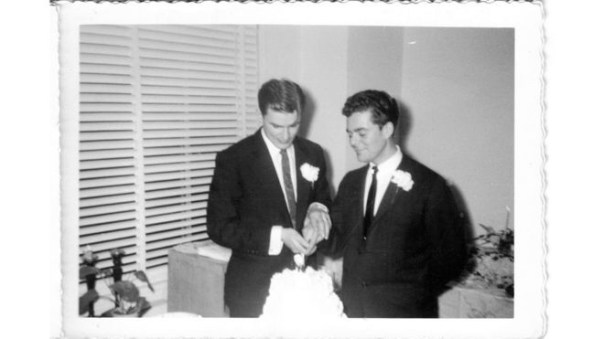
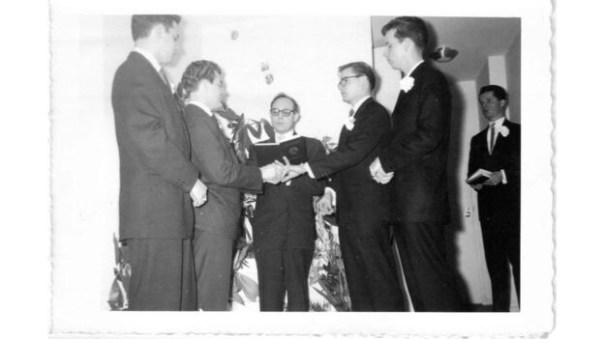
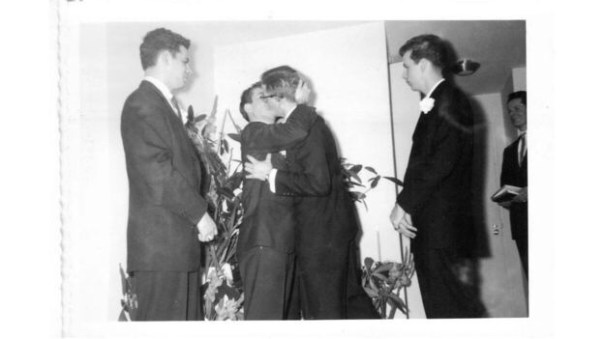
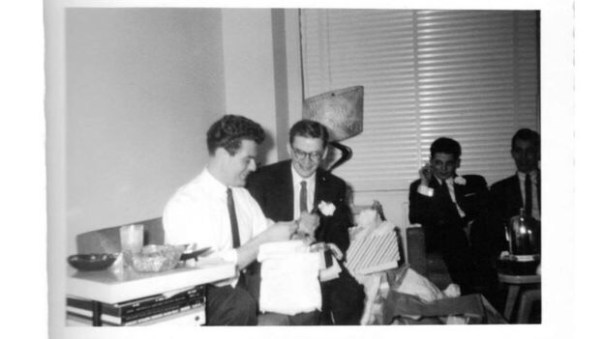
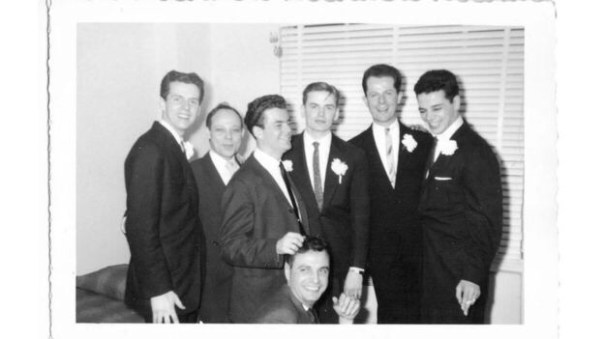
The pictures appear to depict a gay wedding, nearly 50 years before same-sex marriage was legal anywhere in the US and almost 60 years before it became a federally-recognised right.
Now, a trio of gay producers and writers are trying to identify the grooms to learn their story and to find out whether a pharmacy employee balked at providing the snaps because they objected to their subject.
The writers are documenting their efforts in a reality show The Mystery of the 1957 Gay Wedding Photos.
The programme, which doesn’t yet have a platform to call home, is being produced in conjunction with Endemol Shine Group, whose shows include Big Brother, The Biggest Loser and Extreme Makeover: Home Edition.
ONE Archives at USC
“It’s a passion project for us,” says Michael J. Wolfe, a Los Angeles-based writer. “We are turning over every stone, interviewing dozens of people in the Philadelphia area and beyond, and consulting with investigators, historians, and experts across many different fields.”
The photos were acquired by a collector a few years ago who had bought them at an online auction. He realised their significance and donated them to ONE Archives at the USC Libraries in Los Angeles and at the Wilcox Archives in Philadelphia.
The couple in the pictures appear to be in their 20s or 30s, so they would be in their 80s or 90s if they were alive today. The grooms and their guests are dressed up in dark suits with flowers in their lapels.
The celebration took place in a modest flat with the blinds drawn. It featured a ceremony officiated by someone who appears to be a member of the clergy. The grooms are shown kissing, cutting their wedding cake and opening presents.
ONE Archives at USC
Mr Wolfe and his partners, filmmaker PJ Palmer and TV writer/producer Neal Baer, have not identified the mystery couple yet.
“We are recovering amazing, important stories all sorts of them… and more gay history that’s been buried,” he says.
“There is a very rich history that’s been suppressed… I wish as a child [that] I had seen family photos of a marriage like this… I would have felt more normal as a kid. I would have known that I was okay.”
Couples who fell in love sometimes committed themselves to one another in unions that were not acknowledged by either governments or religions.
The US Supreme Court didn’t recognise the right for gay people to marry the person of their choice until 2015, 11 years after Massachusetts did so.
ONE Archives at USC
“We don’t know how common or uncommon it was for couples to hold ceremonies to marry each other [because] there is so little photographic or film record of how people actually lived,” says Eric Marcus, host of the Making Gay History podcast.
“It’s important to remember that people found ways to live their lives quietly away from the prying eyes of the straight world.”
Of course, that was easier said than done.
Wedding guests at the mystery wedding ONE Archives at USC
Several years before the wedding took place, President Dwight Eisenhower signed an executive order banning gays from working for the federal government.
In 1952, The American Psychiatric Association classified homosexuality as a “sociopathic personality disturbance” in the first edition of its Diagnostic and Statistical Manual (DSM), the listing of known psychiatric disorders.
After considerable lobbying by activists, the APA removed homosexuality from the second edition of the DSM in 1973.
The Stonewall Riots, considered to be the birth of the modern gay rights movement, had happened a few years before that in 1969 – 12 years after the wedding.
ONE Archives at USC
It’s not just the passage of time that will hinder the search for the grooms. The filmmakers believe the Aids crisis may also be factor – about 700,000 Americans have died since the start of the epidemic in the 1980s, according to the Kaiser Family Foundation.
“We are talking about a generation of people who were decimated by Aids,” Mr Wolfe said. “There are a lot of missing people who otherwise would have made a search like this much easier. All of that happened before social media.”
If the couple is ever identified, they would certainly add another chapter in the history of gay rights for doing something extraordinary that is now becoming increasingly ordinary.
The Order of Chaeronea was a secret society for the cultivation of a homosexual moral, ethical, cultural and spiritual ethos. It was founded by socialist[1] George Cecil Ives in 1897, as a result of his belief that homosexuals would not be accepted openly in society and must therefore have a means of underground communication.
The society is named after the location of the battle where the Sacred Band of Thebes was finally annihilated in 338 BC.
Establishment and organisation
In the 1860s, the German lawyer Karl Heinrich Ulrichs, may have been the first modern European to publicly declare his homosexuality. Ulrichs wrote dozens of books and pamphlets that made a crucial argument: The preference for same-sex love is hereditary; therefore it should not be a crime. He introduced the word “Uranian” as a synonym for homosexual relations, and even demanded that homosexuals be granted the right to marry.
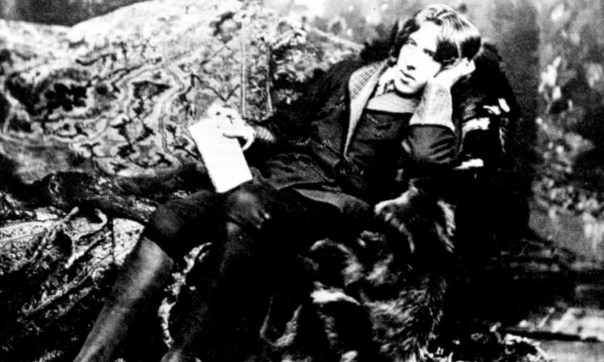
Less radical thinkers in Germany, Austria and France began to argue that same-sex attraction and relations between men were a psychological disturbance to be treated by physicians, rather than a crime to be punished by the courts. As a result, by 1876 “psychological” had become a term that Oscar Wilde and his peers used to describe anything pertaining to gay sex. At the same time, McKenna writes, “aestheticism seemed to spring to life, fully formed, towards the end of the 1870s.” It was “a heady mix of art, idealism and politics, which sought to propagate a new gospel of Beauty.
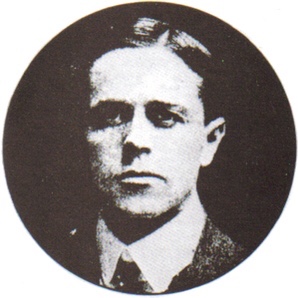
In 1893, shortly after meeting Wilde, George Cecil Ives, a friend of Wilde’s whose diaries contain many new details of the writer’s life, founded a secret society called the Order of Chaeronea, aimed at promoting ‘the Cause’ The society was named “after the battle where the male lovers of the Theban Band were slaughtered in 338 BC.” Ives and other members dated letters and other materials from the year of the battle, so that 1900 would be written as C.2238.
The ‘Rules of Purpose’ stated that the Order was to be ‘A Religion, A Theory of Life, and Ideal of Duty’, although its purpose was primarily political. Members of the Order were ‘Brothers of the Faith’, and were required to swear under the ‘Service of Initiation’, that “you will never vex or persecute lovers” and “That all real love shall be to you as sanctuary.”
The group was male dominated, but did include a few lesbian members
At its peak ‘the Elect’ numbered perhaps two or three hundred, but no membership lists survive. Oscar Wilde was, however, likely an early recruit, along with Lord Alfred Douglas “Bosie”. Other members may have included Charles Kains Jackson, Samuel Elsworth Cottam, Montague Summers, and John Gambril Nicholson.
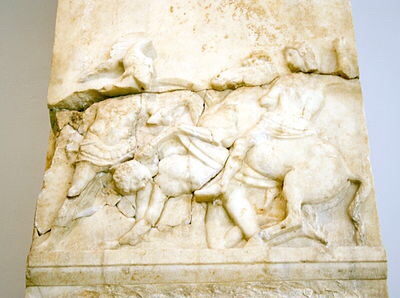
Funerary relief for Athenian footman Pancahres, who probably fell at the Battle of Chaeronea.
An elaborate system of rituals, ceremonies, a service of initiation, seals, codes, and passwords were established. The Order, according to Ives’ notebooks, had a specific purpose, distinct prescriptions and philosophy, and its particular symbolism: the “sign-word” AMRRHAO and “the seal of the double wreath.” The prerequisites of membership were indicated to be “Zeal, Learning and Discipline.” The principle of secrecy was conveyed by the metaphor of “The Chain” underlining that one should never reveal any information about the order or its members. The writings of Walt Whitman were particularly revered.
Ives was keen to stress that the Order was to be an ascetic movement, not to be used as a forum for men to meet men for sex, although he accepted a degree of ‘passionate sensuality’ could take place. He also believed that love and sex between men was a way to undermine the rigid class system, as a true form of democracy. The Secret Society became a worldwide organisation, and Ives took advantage of every opportunity to spread the word about the “Cause.”
In Ives’ words:
We believe in the glory of passion. We believe in the inspiration of emotion. We believe in the holiness of love. Now some in the world without have been asking as to our faith, and mostly we find that we have no answer for them. Scoffers there be, to whom we need not reply, and foolish ones to whom our words would convey no meaning. For what are words? Symbols of kindred comprehended conceptions, and like makes appeal to like.
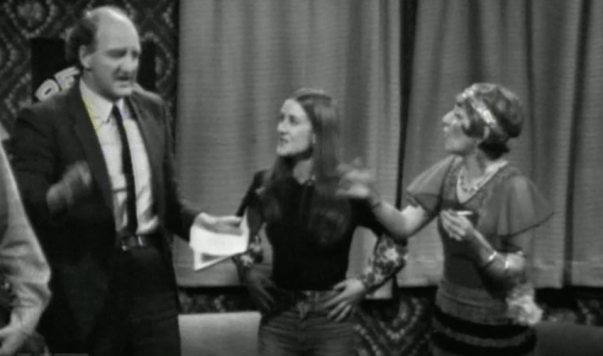
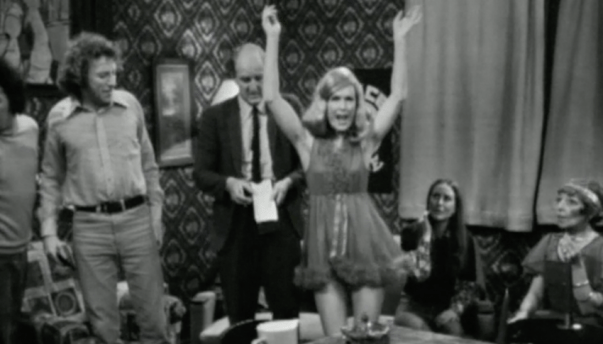
Buck House was an edgy cable drama wrapped up in a 70s sitcom
Buck House was an edgy sitcom from the 70s that manages to still be edgy and different now, though not for the right reasons. Sam Brooks muses upon the distinct pleasures of Buck House.
When I think of the 70s, I think of Yakety Sax, Mary Tyler Moore and a show where a guy had to pretend to be gay so he could live with two women.
I don’t think of a show where a dude tries to start a brothel in his flat.
Buck House, a New Zealand sitcom from the mid-70s that preceded the more famous floptacular homegrown sitcom Melody Rules, is a bizarre proposal. One, it has popular newscaster, personality and Shortland Street stunt cast member Paul Holmes in the lead role. Two, the actual content of the show aligns more with a wannabe edgy cable drama than a sitcom that premiered over forty years ago.
Here’s a few things that make it more like an acclaimed HBO show that all your friends watch but you just can’t bring yourself to because there’s so much TV to watch nowadays:
THIS HAIR IS PREMIUM CONTENT.
Paul Holmes’ hair
C’mon. You wouldn’t put that hair on network TV nowadays. That’s premium level hair. That’s pay-per-view hair. We should be putting this article behind a paywall, that’s how much this hair should cost.
DON’T TRUST THIS GUY TO START YOUR BROTHEL.
One of the flatmates is trying to start a brothel
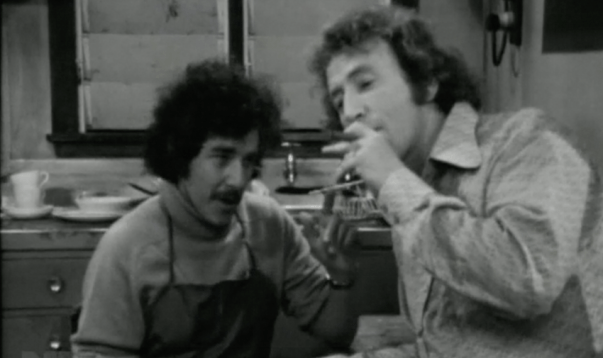
The central joke of Buck House, or at least the very first episode, and presumably the rest of the series, is that Reggie is the normal flatmate and Joe is the aggrieved flatmate. Reggie is normal in that he just wants to cook dinner for his girlfriend, answer the phone (seriously, about five minutes of this twenty minute episode revolves around Paul Holmes talking very unconvincingly on the telephone) and wearing a floral apron.
On the other hand, Joe wants to start a brothel. This is played for laughs. Full-on ‘oh look how naughty he’s being laughs!’. So much so that I assumed that it would all be a misunderstanding, he wasn’t actually trying to start a brothel but people had just gotten their wires crossed.
Don’t get me wrong, people get their wires crossed in hilarious sitcom fashion all the way throughout the episode, but starting a brothel is not the source of one of them.
Joe genuinely wants to start a brothel, with the very imaginative name ‘Escorts Unlimited Limited’ (which is a pretty funny joke, admittedly). The episode revolves around him interviewing women to work at the brothel. He thinks it’s a great business idea, and who am I to judge? What do I know about economic realities in the 70s?
You can guarantee if this show was made now it would be a half-hour show starring the Duplass Brothers and it would be very relatable for a certain part of the population, deemed problematic in our time by another part of the population and remain extremely unknown to a much, much larger part of the population.
Another character is assaulted by a police officer
This happens off screen and is brushed off, but one of the characters, Jo, has been squatting at a house and was forcibly evicted by a police officer. This is not quite played for laughs, which is weird because most things in a sitcom are played for laughs. Especially in the 70s, which was before the era of half-hour comedies where nobody laughs and people are just a bit sad for half an hour.
WIGS, WIGS, WIGS ACROSS THE BOARD.
This wig
This wig is definitely auditioning for RuPaul’s Drag Race. The woman wearing this wig, Sheila Harrison, puts on a Cockney accent for absolutely no reason other than that it is a little bit funny. At one point, she breaks into famous Sweet Charity song ‘Big Spender’, and if this was made nowadays this would win her an Emmy for Best Supporting Actress in a Drama Series because it would be oh so very sad.
DON’T TRUST THIS MAN.
The cop is clearly corrupt
One, he shows up at the house of a woman who he just ‘laid hands on’ (which they say a lot during this episode, and means a lot of different things, but in this context, I’m going to assume it means that he definitely assaulted her) at her invitation, which is weird!
Two, and this is less a sign of corruption and more of tremendous stupidity, but he briefly believes that these men are setting up a house for budgies, because this is from an era when men could refer to women as ‘birds’ and not be shunned by all reasonable society.
Three, he goes home with one of the women who are interviewing to be escorts at this new escort business, in a carefully implicit exchange for his silence. You can tell this was written in the 70s by a dude because the woman is like ‘yeah sure this is fine!’ rather than finding it gross and completely inappropriate for a police officer to do.
THIS WOMAN IS CALLED MYRA DE GROOT IN REAL LIFE, WHICH IS ABOUT AS LYNCHIAN AS YOU CAN GET.
This lady
Who is she? Where does she come from? What’s her background? The episode introduces her as another escort who interviews for a place at Escorts Unlimited Limited, but everything about her vibe is straight out of Twin Peaks. She is bringing Grace Zabriskie in Inland Empire realness, and I am here for it.
There’s really not that many jokes
Honestly, the only thing that really separates this from It’s Always Sunny in Philadelphia is that It’s Always Sunny in Philadelphia (which you can stream quite handily on Lightbox) has about as many mean-spirited jokes as you can fit into a half-hour, whereas this show spends a languid five minutes on telephone jokes.
You can absolutely feel the show reaching to be edgy and break boundaries, and while it’s hard to know exactly what boundaries it was breaking back in the 70s, you can feel the self-satisfaction oozing off the screen.
It’s the same kind of feel you get from some of today’s least successful cable shows, the kind that are one unsubtle gesture away from having a character look at the camera and say “Can you believe that we’re doing this?” Nowadays, it’s every death, every drug-take, every sex scene. In the 70s, it was Tony Barry smoking a cigar inside and being proud that he’d come up with the totally original and never-done-before idea of starting a brothel.
THIS IS THE VERY PORTRAIT OF DESPAIR.
But the biggest thing I’ve learned from watching old New Zealand shows on NZ on Screen is how much style is tied into time – and sometimes that relationship can be unexplainable. Buck House, like Melody Rules twenty years later, still owes so much of the craft behind its production to stagebound theatrics. We weren’t making TV; we were making theatre on a small screen. Paul Holmes is playing to the back row here, and while he already has the charisma that made him the face of 7pm for an entire generation, when you give him lines and make him act jokes, it becomes flop-sweaty.
In the show’s defence, this was 1974! People were still afraid of the possibility of nuclear war! They weren’t distracted by their mobile phones! They could happily sit down and watch Buck House and wait for something that could easily be resolved in five minutes of open conversation be dragged out for twenty minutes excluding credits. The pace is excruciating in an age of bingewatching, of consuming everything as immediately as we possibly can, dissecting it quickly and moving onto the next thing.
Do I want to go back to the pace of Buck House? God no. You’d miss five news cycles by the time you got to the first ad break. But it’s enough to give me pause, and when you’re watching a forty-four year old sitcom, sometimes that’s all you need.
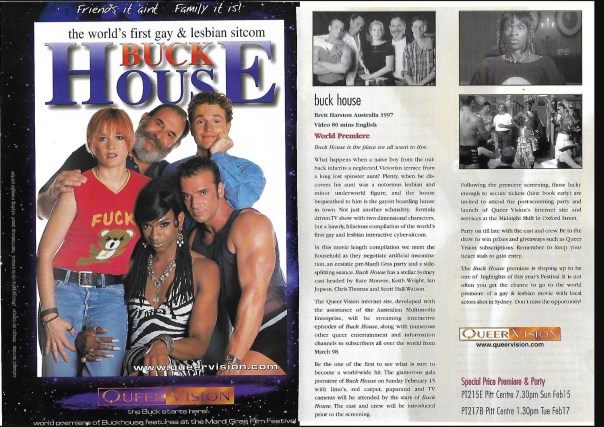
AND AN AUSSIE SITCOM OF THE SAME NAME FROM 1997
For the record…I missed this! Sometimes, it doesn’t matter how gay you are, you miss gay things! In my defence, I was a bit preoccupied with removing from a run- in with AIDS in 1997…which, I dare say, explains this gap in my gay consciousness. I would like to thank Lost Gay Sydney for drawing my attention to it.
What happens when a naive straight boy from the outback inherits a rundown terrace house from an unknown spinster aunt?
Plenty, when he discovers his aunt was a notorious lesbian with underworld dealings and the house he’s inherited is the queerest boarding house in Sydney.
A hidden stash, mafia connections, and bizarre interventions from beyond the grave all come together, providing non-stop entertainment in this highly original Aussie sitcom.
Core Characters
• GIVEN NAME: Elizabeth Beatrice Anne
• PREFERRED NAME: Liz
• AGE: 24
• SEXUALITY: Lesbian – Got a problem with that?
• MARITAL STATUS: Do not subscribe to this outdated patriarchal heterosexist enslavement of women – single, but could be interested if the right woman came along.
• OCCUPATION: Co-manager of “Buck’s Bargains”.
• HOBBIES: Practicing to be a DJ and writing a book – “A Feminist Manifesto for the New Millenium” – it will be a best seller!
• FAVOURITE FOOD: Anything fresh, fruity and vegetarian – and nothing that Ted cooks!
• FAVOURITE DRINK: Spanish beer with a twist of lemon or a “Naked Lady”.
• FAVOURITE BOOK: Gertrude Stein’s Biography.
• FAVOURITE MOVIE: “Orlando”.
• FAVOURITE SAYING: “I feel so sorry for men…”
• FAVOURITE SONG: Anything by kd Lang, Melissa Etheridge and Patsy Cline.
.:: played by KATE MONROE ::.
• GIVEN NAME: Bernard Felcher
• PREFERRED NAME: Dog
• AGE: 28
• SEXUALITY: Gay – out and proud.
• MARITAL STATUS: Happy to be single – not ready to settle down yet.
• OCCUPATION: Private trainer and I help out at Ipjana’s club on weekends.
• HOBBIES: With all my training I don’t get much time for a hobby, but I’m interested in bonsai, ikebana and I’d like to try my hand at interior design.
• FAVOURITE FOOD: Steak Tartare – unless Ted cooks it.
• FAVOURITE DRINK: Banana Smoothies and Power drinks.
• FAVOURITE BOOK: Charles Atlas Biography – the man is a legend – the father of modern body building.
• FAVOURITE MOVIE: Anything that Big Arnie is in – not only does he have a great body but he’s also a really good actor – he’s one of my role models.
• FAVOURITE SAYING: “Life’s too short to dance with ugly men”.
• FAVOURITE SONG: “Wind Beneath My Wings” – Bette Midler
.:: played by IAN JOPSON ::.
GIVEN NAME: Edward Bruinsen
• PREFERED NAME: Ted
• AGE: 50…ish.
• SEXUALITY: Last time I looked, Gay.
• MARITAL STATUS: Still looking for Mr Right, however will settle for Mr Anybody-at-all-just-as-long-as-he’s-still-breathing.
• OCCUPATION: Handyman/caretaker. Also help Liz run “Buck’s Bargains”.
• HOBBIES: Cooking – however I get a little discouraged by culinary philistines who tell me that I have “colourblind taste buds”. Also enjoy cruising – mostly in Oxford Street, Kings Cross and several male-only establishments!
• FAVOURITE FOOD: Spinach Surprise – one of my own creations – spinach, baked beans and banana with scrambled egg in a blue cheese ‘n chilli sauce.
• FAVOURITE DRINK: Victoria Bitter Beer.
• FAVOURITE BOOK: “The Complete Works of Tom of Finland”.
• FAVOURITE MOVIE: “Top Buns – the Young and the Hung”.
• FAVOURITE SAYING: “So many men, so few offers”.
• FAVOURITE SONG: “Somewhere, Over the Rainbow” – Judy Garland.
.:: played by CHRIS THOMAS ::.
• GIVEN NAME: Ipjana Von Trapp
• PREFERRED NAME: Ipjana
• AGE: Old enough to know better, but young enough to
• do it again!
• SEXUALITY: Honey, if you don’t know, I’m not going to tell you.
• MARITAL STATUS: Someday my prince will come, but until then I’m available.
• OCCUPATION: Manageress of the fabulous night spot, “The Slimey Codpiece”. Although I predict that my part-time psychic consultancy will soon become my dominant occupation.
• HOBBIES: Costume design and singing (an old family tradition).
• FAVOURITE FOOD: Vienna Schnitzel (of course!) but nothing that Ted cooks.
• FAVOURITE DRINK: Peppermint schnapps, Dom Perignon.
• FAVOURITE BOOK: “The Sound of Music”
• FAVOURITE MOVIE: “The Sound of Music”
• FAVOURITE SAYING: “It’s not the men in my life… it’s the life in my men!”
• FAVOURITE SONG: The entire score of “Porgy & Bess”, everything that Diana Ross has done, and anything that I can really get down to.
• .:: played by KEITH WRIGHT ::.
• GIVEN NAME: Harrison Buck
• PREFERRED NAME: Harry
• AGE: 22
• SEXUALITY: Why do you need to ask?
• MARITAL STATUS: Single.
• OCCUPATION: Looking for work.
• HOBBIES: Playing “Supermarket Slaughter”, “Gates of Hell” and designing a video card to make them run faster.
• FAVOURITE FOOD: I’ll eat almost anything – except some things that Ted cooks (his vegetable curry is truly the grossest thing I’ve ever eaten).
• FAVOURITE DRINK: Iced weak tea with two sugars and a slice of lemon.
• FAVOURITE BOOK: The “Computer Superstore Warehouse Catalogue ” – it changed my life.
• FAVOURITE MOVIE: “Attack of the 50ft Woman” – I love old horror movies.
• FAVOURITE SAYING: “The computer hasn’t crashed… it’s just having a rest.”
Justice minister hails ‘momentous day’ as so-called Turing’s law receives royal assent, but critics say move does not go far enough
The legislation follows a posthumous pardon for the Enigma codebreaker Alan Turing who was convicted of gross indecency. Photograph: Sherborne school/AFP/Getty
Thousands of men convicted of offences that once criminalised homosexuality but are no longer on the statute book have been posthumously pardoned under a new law.
A clause in the policing and crime bill, which received royal assent on Tuesday, extends to those who are dead the existing process of purging past criminal records.
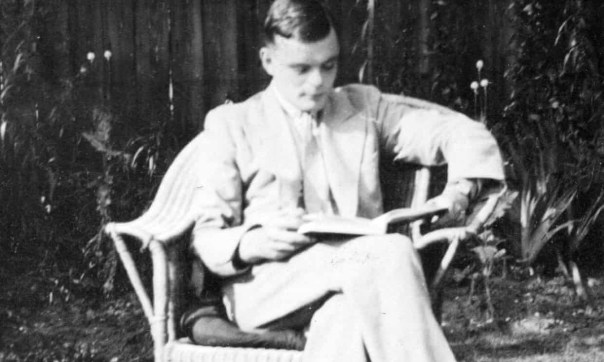
The general pardon is modelled on the 2013 royal pardon granted by the Queen to Alan Turing, the mathematician who broke the German Enigma codes during the second world war. He killed himself in 1954, at the age of 41, after his conviction for gross indecency.
Welcoming the legislation, the justice minister Sam Gyimah said: “This is a truly momentous day. We can never undo the hurt caused, but we have apologised and taken action to right these wrongs. I am immensely proud that ‘Turing’s law’ has become a reality under this government.”
There is already a procedure in place for the living to apply to the Home Office to have their past convictions, relating to same-sex relationships, expunged from their criminal records.
Under what is known as the disregard process, anyone previously found guilty of past sexual offences that are no longer criminal matters can ask to have them removed.
A disregard can be granted only if the past offence was a consensual relationship and both men were over 16. The conduct must also not constitute what remains an offence of sexual activity in a public lavatory.
Sam Gyimah, justice minister, says the government has ‘taken action to right these wrongs’. Photograph: Rex/Shutterstock
Each disregard application is checked to prevent people from claiming to be cleared of offences that are still crimes. Those granted a disregard will also be pardoned.
No lists of past pardons will be published but the new law will allow future historians to point out that those imprisoned or fined for consensual gay relationships would not under modern legislation have committed a crime.
Rewriting history will not be easy. The complexity of the evidence, for example, that led to Oscar Wilde’s conviction in 1895 for gross indecency – including evidence of procuring male prostitutes – would make it difficult to assess.
The gay rights organisation Stonewall has suggested the playwright and author, who was sentenced to two years hard labour in Reading jail, should be entitled to a pardon.
The Ministry of Justice said there would be no historical limit in relation to past offences. It declined, however, to say whether Wilde would be among those deemed posthumously pardoned.
The amendments to the bill were tabled by Lord Sharkey, Lord Cashman and Lord Lexden with government support.
A private member’s bill with a similar aim and a blanket pardon, brought forward by the SNP MP John Nicolson, was not supported by the government. It would have backdated pardons only to 1919.
A Stonewall spokesperson said: “This is significant. And it’s as important to the whole lesbian, gay, bi and trans community, as it is for the gay and bi men affected.
“The more equality is enshrined into our law books, the stronger our equality becomes, and the stronger we as a community become.
“This month the government issued a clear and powerful apology to every gay and bi man who had been unjustly criminalised for being who they are. This is not just equality for gay and bi men; the passing of this law is justice.
“We’re working to ensure that this new process is brought quickly and correctly, and to ensure all gay and bi men unjustly persecuted and prosecuted can finally receive the justice they deserve.”
Welcoming the new law, the human rights campaigner Peter Tatchell said: “This pardon is an important, valuable advance that will remedy the grave injustices suffered by many of the estimated 50,000 to 100,000 men who were convicted under discriminatory anti-gay laws between 1885 and 2003 – the latter being the year when all homophobic sexual offences legislation was finally repealed in England and Wales.
“A pardon has connotations of forgiveness for a wrong done. These men and the wider LGBT community believe they did no wrong.
“The legislation has a few omissions. It does not explicitly allow for the pardoning of men convicted of soliciting and procuring homosexual relations under the 1956 and 1967 Sexual Offences Acts. Nor does it pardon those people, including some lesbians, convicted for same-sex kissing and cuddling under laws such as the Public Order Act 1986, the common law offence of outraging public decency, the Town Police Clauses Act 1847, the Ecclesiastical Courts Jurisdiction Act 1860 and the army, navy and air force acts and other diverse statutes.
“However, agreements secured by Lord Cashman mean that people convicted under these other laws can also apply for a pardon.”
The last men who were executed for homosexuality in England were James Pratt and John Smith who were hanged in 1835.
Sharkey, the Liberal Democrat peer who drafted the amendment to the bill, said: “This is a momentous day for thousands of families up and down the UK who have been campaigning on this issue for decades.
“It is a wonderful thing that we have been able to build on the pardon granted to Alan Turing and extend it to thousands of men unjustly convicted for sexual offences that would not be crimes today.”
Posthumous pardons law may see Oscar Wilde exonerated
Ministry of Justice announces initiative to wipe criminal records of gay and bisexual men convicted of sexual offences that are no longer illegal
The complexity of the evidence for Oscar Wilde’s conviction in 1895 for gross indecency makes it difficult to assess whether he should receive a pardon. Photograph: PA
Is Oscar Wilde about be posthumously pardoned? In a symbolic gesture announced by the government on Thursday, deceased gay and bisexual men convicted of sexual offences that are no longer illegal will have their criminal records wiped.
Announcing the initiative, the Ministry of Justice (MoJ) said that no individuals would be named or singled out – leaving the status of past scandals unresolved.
If the historical homosexual crime is no longer illegal and involved a consensual act with someone over the age of 16, then those convicted will be deemed to have received a posthumous pardon.
The complexity of the evidence that led to Wilde’s conviction in 1895 for gross indecency – including evidence of procuring male prostitutes – would make it difficult to assess. The gay rights organisation Stonewall suggested that the playwright and author, who was sentenced to two years hard labour in Reading jail, should now be entitled to a pardon.
The justice minister, Sam Gyimah, said that a clause would be introduced into the policing and crime bill. “It is hugely important that we pardon people convicted of historical sexual offences who would be innocent of any crime today,” he said. “Through pardons and the existing disregard process we will meet our manifesto commitment to put right these wrongs.”
The disregard process is already open to those who are alive and wish to remove from their criminal record any past sexual offences that are no longer illegal. They will be entitled to a statutory pardon under the new legislation.
In 2013 Alan Turing, the gay mathematician who broke the German Enigma codes, was posthumously pardoned by the Queen. He killed himself by taking cyanide in 1954, at the age of 41, following his conviction for gross indecency.
The MoJ said it would partially follow Lord Sharkey’s amendment to the Protection of Freedoms Act 2012 although it would grant a blanket pardon for those who have died and not investigate individual historical cases.
Sharkey said: “This is a momentous day for thousands of families up and down the UK who have been campaigning on this issue for decades. I am very grateful for the government’s support and the support of many of my colleagues in parliament.”
The government has declined to support a private members’ bill on the subject, brought forward by an SNP MP, John Nicolson, which is due to be debated in parliament later this week.
Ministers said they fear that bill would allow some people to claim they have been cleared of offences that are still crimes – including sex with a minor and non-consensual sexual activity.
Gyimah said: “I understand and support the intentions behind Mr Nicolson’s bill, however I worry that he has not fully thought through the consequences. A blanket pardon, without the detailed investigations carried out by the Home Office under the disregard process, could see people guilty of an offence which is still a crime today claiming to be pardoned.”
The MoJ said there would be no historical limit in relation to past offences. It declined to say whether Wilde would be among those deemed posthumously pardoned.
Nicolson, the former BBC newsreader and front bench SNP culture spokesman, told the Guardian that the former justice secretary Michael Gove had promised him government support for his private member’s bill. His would only backdate pardons to 1919. “I hope that the government will sit and read my bill carefully,” he said. “Mine would also be a blanket pardon. A lot of those people [who are alive] are very old and would not want their names listed.”
Paul Twocock, director of campaigns at Stonewall, said: “We welcome the government announcement to issue a posthumous pardon to all gay and bi men unjustly prosecuted for being who they are, but we don’t think it goes far enough. John Nicolson MP’s proposed bill closes a loophole that means some gay and bi men who are still alive and living with those convictions still can’t have them deleted, despite them being unjust and not illegal today. We urge the government to look at bringing this into their proposal.
“We also don’t agree with the government’s interpretation of John Nicolson MP’s bill – it explicitly excludes pardoning anyone convicted of offences that would still be illegal today, including non-consensual sex and sex with someone under 16.”
Family of Alan Turing to demand government pardon 49,000 other men
Campaigners to bring petition to Downing Street, demanding all men convicted under gross indecency law for their homosexuality are pardoned
Alan Turing was convicted in 1952 of gross indecency, but was given a posthumous royal pardon in 2013. Photograph: Rex
The family of the codebreaker Alan Turing will visit Downing Street on Monday to demand the government pardons 49,000 other men persecuted like him for their homosexuality.
Turing, whose work cracking the German military codes was vital to the British war effort against Nazi Germany, was convicted in 1952 of gross indecency with a 19-year-old man, was chemically castrated, and two years later died from cyanide poisoning in an apparent suicide.
He was given a posthumous royal pardon in 2013 and campaigners want the government to pardon all the men convicted under the outdated law.
Turing’s great-nephew, Nevil Hunt, his great-niece, Rachel Barnes, and her son, Thomas, will hand over the petition, which attracted almost 500,000 signatures, to 10 Downing Street.
Ms Barnes said: “I consider it to be fair and just that everybody who was convicted under the Gross Indecency law is given a pardon. It is illogical that my great uncle has been the only one to be pardoned when so many were convicted of the same crime. I feel sure that Alan Turing would have also wanted justice for everybody.”
Matthew Todd, the editor of Attitude Magazine, who will also visit Downing Street, said: “Generations of gay and bisexual men were forced to live their lives in a state of terror.
“Men convicted of gross indecency were often considered to have brought huge shame on their families and many took their own lives. We still live with the legacy of this period today and it’s about time the country addressed this appalling part of our history.”
Benedict Cumberbatch’s Oscar-nominated portrayal of Turing has brought the pioneering scientist’s story to a wider audience. The film follows him from his days as a second world war code breaker at Bletchley Park to his work at Manchester University, which saw him hailed as the father of modern computing, and his tragic death.
Turing led a team decoding messages at Bletchley Park, whose work remained secret until many years after the end of the war, and also designed the Bombe machine which decrypted German messages. Their work helped shorten the conflict and saved many thousands of lives.
QUESTIONABLE gay history! There is nothing in any of the accounts of Beau Brummell’s life to indicate he was gay. But there is also no indication that he was straight…in fact, no romantic trysts at all, with men, or women. There are suggestions that he may have been bisexual, but however you look at it – boy…he sure comes across as gay!
The name Beau Brummell is synonymous with Regency England, but what do you know about him? Researching this article I found that people associate him with silks, satins, and snuff, while one thought he was a fictional detective. It seemed the French writer Barbey d’Aurevilly was right: once the most famous man in the kingdom was “nothing but a name mysteriously sparkling in all the memoirs of his time.” So, what happened to Beau Brummell?
George Bryan Brummell was born in 10 Downing Street on 7th June 1778. He was the youngest son of William Brummell – an enterprising man who had risen to the position of Private Secretary to the Prime Minister, with all the influence and trappings that came with the role – a grace and favour apartment in Hampton Court Palace, a country house in Berkshire, and friendship with Charles James Fox, Richard Sheridan, and Sir Joshua Reynolds, who painted the two curly-haired Brummell boys in 1781. The Brummell family had risen a long way in two generations and young George was to take the family name to even greater heights, and depths. He became a legend in his own lifetime and worked as hard at this as his father had done as a junior clerk.
In 1783, William Brummell retired with an income of about £2,500 a year – enough to send his two sons to Eton. There, George was well liked. He was good natured and clever but lazy and already developing his fastidious nature, avoiding the streets in wet weather and careful of his dignity. George went on to Oriel College at Oxford but left in 1794 when his father died, and instead joined the Prince of Wales’ own regiment, the Tenth Dragoons – or ‘The Elegant Extracts’ as they were known. The Dragoons were based in Brighton until civil unrest called them to the north and Brummell resigned immediately, saying that Manchester would be too disagreeable for him. His £40,000 inheritance meant he could afford to concentrate on being a gentleman. Quickly given the soubriquet ‘Beau’, he proved to be a witty and observant figure who made many friends. Charles Stanhope said
“I could understand a good deal of the secret of Brummell’s extraordinary success and influence in the highest society. He was a vast deal more than a mere dandy; he had wit as well as humour and drollery, and the most perfect coolness and self-possession.”
To be part of Brummell’s set was Society’s top cachet, and to be cut by him was social death. In the novel Granby there is a poorly disguised portrait.
“In the art of cutting he shone unrivalled. He could assume that calm but wandering gaze which veers, as if unconsciously, round the proscribed individual, neither fixing not to be fixed, not looking on vacancy nor on any one object, neither occupied nor abstracted, a look which perhaps excuses you to the person cut and, at any rate, prevents him from accosting you.”
Brummell was careful to remain free from obligations or attachments (he is said to have cut his own brother) and there were no signs of any relationships – either with women or men. His first biographer, Captain Jesse, thought that Brummell “had too much self love ever to be really in love.” Beau himself told Lady Hester Stanhope that he had adopted the only course possible to distance himself from ordinary men. As Oscar Wilde said more than a century later “to love oneself is the beginning of a life-long romance.”
His friendship with the Prince of Wales did not last. As Brummell ceased to need the Prince’s patronage, so the Prince became jealous of Brummell’s position, but Brummell did not care. “I made him what he is and I can unmake him.” he quipped in an unguarded moment. By 1813 the end of the friendship was scandalously public when the Prince arrived at a party with Lord Alvanley and coldly ignored Brummell.
“Ah, Alvanley,” Brummell’s voice rang out clearly over the shocked silence, “Who is your fat friend?”
Brummell maintained his image so well that everyone was shocked when debts forced him to Calais in May 1816. In London, his effects were sold at auction, including his fine cellar “10 dozen Capital Old Port, 16 dozen of Burgundy, Claret, and Still Champagne. . .” They were, the publicity assured potential buyers, “the genuine property of a man of fashion, gone to the continent.” The auction raised £1000, but this was not enough to enable Brummell to return.
However, life in Calais was bearable. “No one can lead a more pleasant life than Brummell, for he passes his time between London and Paris” the British ambassador quipped, and Brummell’s friends visited him there, bring presents of money or gifts such as his favourite Façon de Paris snuff. In 1818 rumours abounded that he had been offered £5 thousand to write his memoirs, and that the Prince of Wales had offered £6 thousand for him not to do it.
Brummell became very popular in Calais “We used to call him Le Roi de Calais. He was a truly fine man, very elegant, and really well off – he always paid his bills and was very good to the poor; everyone was very sorry when he left.” said a Calais shopkeeper. Brummell was always careful to settle his debts with tradesmen – instead he owed increasingly vast amounts of money to bankers and his friends but his good nature and wit charmed them all.
When asked to make a contribution towards a Church of England chapel in Calais, he replied “I am very sorry you did not call last week, for it was only yesterday that I became a catholic.”
In 1827 Brummell’s patron the Duke of York died, and Brummell’s creditors began to close in. That summer, Brummell’s letters contained a note of panic. “I am sadly alarmed lest some overwhelming disaster should befall me” he wrote. While George IV was king, there was little hope of rapprochement, but good fortune did come along in June 1830 when Brummell was appointed His Majesty’s Consul for the departments of Calvados, La Manche, and Ille et Vilaine. The post was paid £400 a year and was based in Caen. However, there was a problem; with more than £1000 of debts, Brummell’s creditors were very reluctant to see him leave Calais. It was not until he signed a crippling agreement to assign his salary to his attorneys to deal with his debts that he was allowed to leave.
In Caen, he soon became a popular figure, noted for the way he would tiptoe across the cobbles to avoid getting dirt on his boots. He struck up a friendship with the grocer and wine merchant Charles Armstrong, who also cashed bills and money orders. Money remained a problem and he continued to press for a superior job; he wrote to Lord Palmerston that the post at Caen was not needed and he (Brummell) could do something better. On the 21st March 1832 he received a reply: HM Govt had “come to the conclusion that the post of British Consul at Caen may be abolished without prejudice to the public service . . . your salary will cease on the 31st May.” The news did not stay secret for long and he only escaped from the bailiffs when his landlady hid him in a wardrobe.
Armstrong went to England to collect money from Brummell’s friends and arranged £120 a year for his keep. Although generous, this was a pittance which at one time he would have spent in less than a month – when asked how much it would cost to launch a young man into London society, he once replied “with strict economy, it might be done for eight hundred pounds a year.”
His situation began to tell upon his mind, “I am incompetent to do anything but to ruminate over the broken toys of my past days” he mourned to his landlady’s daughter. That summer, the stress and worry probably contributed to his first stroke, and he moved to smaller lodgings at L’ Hotel d’Angleterre where, in April 1834, he had his second stroke whilst dining. Recovery was slow this time and he became dogged with a sense of his own mortality: “they are weaving a shroud about me; still I trust I shall yet escape” he wrote. A third stroke ended that year and the following May he was arrested for debt and taken to gaol where he shared a stone cell with three others. He had not been allowed to dress properly before his arrest and the degradation bewildered him.
“Image a position more wretched than mine! They have put me with all the common people! I am surrounded by the greatest villains and have nothing but prison fare!”
Once again, his remarkable friends rallied round and although they could not raise enough to secure his release, they paid for him to share the private room of political prisoner, Charles Godefroy. Armstrong arranged food, laundry, and sent in his washing basin so that he could perform his famous toilette – to Godefroy’s amazement. Armstrong also looked after his property and went to Calais and London to raise a fund for him. This time, Lord Palmerston agreed to £200 in recognition of the severance of the Caen contract, and once again his friends contributed, including £100 from King William IV.
Brummell was released on the 21st July 1835, and Armstrong made it clear that he would not honour any debts run up without his knowledge. The fastidious Beau was reduced to wearing cast-off clothes and a black silk cravat instead of white linen to save on the washing. When his trousers needed mending, he stayed in bed because they were his only pair. Brummell’s tragedy was that he outlived his time. His fairy-tale had ended twenty years before and now the new young Queen was ushering in the Victorian era while his friends were themselves passing into shadows.
As his illness grew, the former dandy neglected his cleanliness and threw fantasy parties for friends who were long dead. In 1839, he was taken to the asylum of the Bon Saveur – shrieking they were putting him into prison but where his last months were peaceful and he died in his bed on 30th March 1840. The legendary Beau Brummell lies in a plain grave in Calais, unnoticed and forgotten, the name more glittering and the man more elusive with each passing year.
A brutal murder that took place over 40 years ago in San Francisco shocked and catalyzed that city’s gay community and resulted in exposing the mostly hidden to the public- eye violence against gay people.
On the night of June 21, 1977, Robert Hillsborough, and his roommate, Jerry Taylor, went out to a disco for a night of dancing. They left sometime after midnight and stopped for a bite to eat at the Whiz Burger a few blocks from their apartment in the Mission District. When they left the burger joint, they were accosted by a gang of young men shouting anti-gay slurs at them. Hillsborough and Taylor ran into Hillsborough’s car as several of the attackers climbed onto the car’s roof and hood. Hillsborough drove off, and thought that he left his troubles behind him. What he didn’t know was that they were following him in another car. Hillsborough parked just four blocks away from their apartment. When they got out of the car four men jumped out the other car and attacked them again. Jerry Taylor was beaten, but he managed to escape. Robert Hillsborough wasn’t so lucky.
Robert was brutally beaten and stabbed 15 times by 19-year-old John Cordova who was yelling, “Faggot! Faggot! Faggot!” Witnesses also reported that Cordoba yelled, “This one’s for Anita!” Neighbors were awakened by the commotion, and one woman screamed that she was calling the police, which prompted the four attackers to flee. Neighbors rushed to Hillsborough’s aid, but it was too late. Hillsborough died 45 minutes later at Mission Emergency Hospital. Cordoba and the three other assailants were arrested later that morning.
Because Hillsborough was employed as a city gardener, Mayor George Moscone followed longstanding practice and ordered flags at City Hall and other city properties to be lowered to half-mast. He also directed his anger to Anita Bryant and California State Sen. John Briggs, who was running for governor and an anti-gay platform. Anita Bryant’s anti-gay campaign in Miami which resulted in the defeat of a gay rights ordinance three weeks earlier had inspired Briggs to hold a new conference in front of city hall the week before Hillsborough’s death to announce a campaign to remove gays and lesbians from teaching. Moscone called Briggs an anti-homosexual “demagogue” and held him responsible for “inciting trouble by walking right into San Francisco, knowing the emotional state of his community. He stirred people into action. He will have to live with his conscience.”
Hillsborough’s death also struck a deep nerve in the gay community. ”We live in a paranoid state,” said Harvey Milk, who was preparing his run for the San Francisco Board of Supervisors, “and the death of Robert is only the culmination of a lot of violence that’s been directed at us.” San Francisco’s Pride celebration, which took place just a few days later, attracted a record-breaking 300,000 people, and it became an impromptu memorial march as participants erected a makeshift shrine at City Hall.
Cordova was charged with a single count of murder, along with Thomas J. Spooner, 21. The other two passengers in the car were not charged.
Cordova was convicted of second degree murder and sentenced to only 10 years in prison. Charges were later dropped against Spooner.
The parents of Robert Hillsborough filed a $5 million lawsuit accusing Anita Bryant of conducting a hate campaign against homosexuals. Hillsborough’s parents claimed and rightfully so that Miss Bryant’s public comments constituted “a campaign of hate, bigotry, ignorance, fear, intimidation and prejudice” against their son and other homosexuals. This, they said, amounted to a conspiracy to deprive Hillsborough of his civil rights.
U.S. District Judge Stanley A. Weigel dismissed the case saying that he lacked jurisdiction because Miss Bryant lives in Florida.
And still 40 years later the violence continues to this day. We must never forget those who lost their lives to hatred and bigotry.
Robert L. Hillsborough Born: March 10, 1944 Died: June 22, 1977
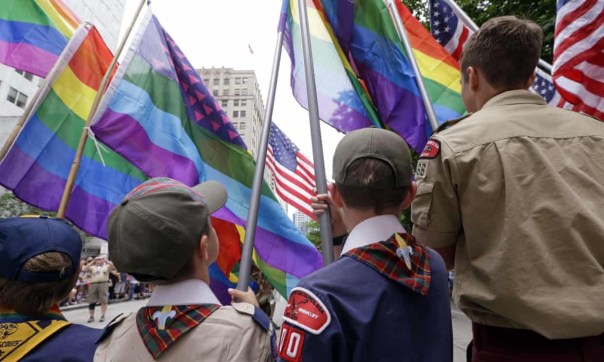
Organisation now bases enrollment in boys-only programs on the gender listed on application to become a scout
Boy Scouts of America says it is allowing transgender children who identify as boys to enroll in its boys-only programs. Photograph: Sipa Press / Rex Features
The Boy Scouts of America now allows transgender children who identify as boys to enroll in its boys-only programs.
The organization said on Monday it had decided to begin basing enrollment in its boys-only programs on the gender a child or parent lists on the application to become a scour, rather than birth certificate.
Rebecca Rausch, a spokeswoman for the organization, said the organization’s leadership had considered a recent case in Secaucus, New Jersey, where an eight-year-old transgender child had been asked to leave his Scout troop after parents and leaders found out he is transgender, but that the change was made because of the national conversation about gender identity.
“For more than 100 years, the Boy Scouts of America, along with schools, youth sports and other youth organizations, have ultimately deferred to the information on an individual’s birth certificate to determine eligibility for our single-gender programs,” the statement said.
“However, that approach is no longer sufficient as communities and state laws are interpreting gender identity differently, and these laws vary widely from state to state.”
Rausch said the enrollment decision went into effect immediately.
“Our organization’s local councils will help find units that can provide for the best interest of the child,” the statement said.
Boy Scouts of America leaders lifted a blanket ban on gay troop leaders and employees in July 2015.
BUT
Transgender boy removed from Boy Scouts troop in New Jersey
Joe Maldonado is at the center of the first known case of a trans child being banned from organization
The Boy Scouts of America recently lifted bans on gay scouts and leaders, which Joe Maldonado’s mother took as a sign that the organization would accept her transgender son. Photograph: Elaine Thompson/AP
Joe Maldonado wanted to join the Boy Scouts because many of his friends were a part of it. The eight-year-old went to school with the boys in the group, hung out with them and played on the basketball team with some of them, said Kristie Maldonado, his mother.
But about a month after joining Pack 87 in Secaucus, New Jersey, Joe was asked to leave because he is transgender, according to Kristie Maldonado. His case is believed to be the first known in which a scout was rejected based on their gender, Justin Wilson, the executive director of Scouts for Equality, told NorthJersey.com.
“Because he wasn’t born a boy, he was no longer able to go back into the Boy Scouts,” Maldonado told the Guardian.
Maldonado said she was unaware of any issues with her son until she received a call from a scouting official, asking whether Joe was born a girl. “At first, well, I didn’t answer him. I just said, you guys didn’t ask for a birth certificate. I said no one had ever seen my child naked,” she said.
The call came as a surprise to Maldonado because Joe was open about his gender identity and had been accepted as a boy at school. The other kids in the troop had never had an issue with him, Maldonado said.
But the official told her that some parents had mentioned Joe’s name had previously been Jodi, and that Joe could no longer be a part of the troop, Maldonado said.
“If they had said right from the beginning, because I know it’s a touchy subject and I know it’s a private organization, I would have said, OK, we can’t join. We can’t do it this year. I would have made an excuse for Joe,” she said, “But you don’t accept a child, then a month later you throw them out.”
The Boy Scouts of America endured years of controversy before ultimately lifting bans on gay scouts and leaders in recent years. Maldonado said she took this as a sign that her son would be allowed to join. “I took it as, OK, if they’re accepted, why not transgender?”
But a spokeswoman, Effie Delimarkos, said in a statement the organization considered transgender children as a separate issue.
“No youth may be removed from any of our programs on the basis of his or her sexual orientation,” she said, but added: “Gender identity isn’t related to sexual orientation.”
The Boy Scouts declined to directly address Joe’s situation or say whether there was a written policy on transgender participants. The statement said Cub Scout programs were for those identified as boys on their birth certificates.
Wilson told NorthJersey.com that the Boy Scouts of America organization was not known to have rejected any scouts due to gender identity prior to Joe’s case. He knew of at least two transgender boys who were Cub Scouts in other states and did not know of any instances in which scouts were asked for birth certificates as a condition of membership.
Eric Chamberlin of the Northern New Jersey Council of Boy Scouts acknowledged having called Maldonado last month, NorthJersey.com reported. He declined further comment and referred questions to the scouts’ national office, saying the issue involved “our membership standards”.
Earlier this year, the Boy Scouts told the Associated Press that it would admit transgender children to its coeducational programs, but not to programs that are for boys only, like the Cub Scouts and Boy Scouts.
By making the family’s story public, Kristie Maldonado is also hoping for change. “The change is I want for them to go not by birth certificate or what they’re born with, but go by their identity. Our definition of identity is how you feel,” Maldonado said. “When they say identity, they’re going by the birth certificate.” She wants transgender kids to be included, “no questions asked”.
The national Girl Scouts organization, which is not affiliated with the Boy Scouts, has accepted transgender members for years.
The Boy Scouts did not respond to questions about whether the group would accept a transgender girl whose birth certificate indicated she was assigned male at birth.
Boy Scouts of America ends ban on gay and lesbian troop leaders
On the heels of gay marriage legalization, the organization’s new policy allows local units to select their leaders to appease both liberal and religious groups
The national governing body of the Boy Scouts of America has ended a blanket ban on gay adult leaders while allowing church-sponsored Scout units to maintain the exclusion because of their faith.
The new policy, aimed at easing a controversy that embroiled the Boy Scouts for years and threatened the organization with lawsuits, takes effect immediately. It was approved on Monday night by the BSA’s 80-member national executive board in a teleconference.
The ban pitted leaders and members of the 105-year-old organization against each other, often fragmenting according to faith. The new policy seeks a compromise between more liberal groups, such as the New York City scouting group, and regions whose groups are run by staunchly conservative faiths, such as the Mormon church.
Under the new policy, local units will be able to select their own leaders according to their own standards, meaning church-run groups can “choose adult leaders whose beliefs are consistent with their own”, according to a statement from organization executives.
“It is not a victory but it certainly is progress,” said Zach Wahls, an Eagle Scout and executive director of Scouts for Equality, told the Guardian earlier on Monday. “I think this is the most progressive resolution we could’ve expected from the Boy Scouts.”
Wahls noted that the organization had banned gay people since 1978, and that its decentralized structure – religious organizations charter about 70% of Boy Scout troops – means some prejudices have deep roots.
“What really has to happen is change in the sponsoring organizations,” he said, adding that his concern was not with specific religious groups but for full inclusion.
“I’m not worried about Mormon units not allowing gay leaders as there aren’t a lot of openly gay Mormons anywhere,” he said. “But discrimination sends a harmful message to gay youths and straight youths, and it has no place in scouting.”
Scouting law says that a boy scout is cheerful, so we’ll be OK
Zach Wahls, Scouts for Equality
On 13 July, the organization’s executive committee, headed by president and former defense secretary Robert Gates, unanimously approved the resolution, saying there had been a “sea change in the law with respect to gay rights”.
“The BSA national policy that prohibits gay adults from serving as leaders is no longer legally defensible,” the organization said in a statement earlier this month. “However, the BSA’s commitment to duty to God and the rights of religious chartered organizations to select their leaders is unwavering.”
The vote took place only a month and a day after the US supreme court legalized same-sex marriage throughout the US, striking down state bans and punctuating the swift progress of gay rights with its 5-4 vote.
The board’s vote also follows only two years after a long and bitter debate at the organization’s 2013 meeting in Texas, where 60% of some 1,400 scout leaders voted to end the ban. The organization said at the time that it had no intentions of revisiting the issue.
But earlier this year the New York City chapter hired a gay camp counsellor, and said it would force the issue in court if necessary to keep the counsellor employed.
The Boy Scouts has about 2.5 million members between the ages of seven and 21, as well as 960,000 volunteers in local units, according to the organization. Membership has steadily declined about 4-6% each year for several years, contributing to the internal crisis over what to do.
John Stemberger, chairman of the breakaway Christian youth outdoor program Trail Life USA, told Reuters on Friday that lifting the ban was an affront to Christian morals and would make it “even more challenging for a church to integrate a [Boy Scouts] unit as part of a church’s ministry offerings”.
But major Catholic and Mormon supporters appeared to approve of the new policy. On its site, the National Catholic Committee on Scouting said that the Boy Scouts did not endorse homosexuality. The committee then wrote: “Any sexual conduct, whether homosexual or heterosexual, by youth of Scouting age is contrary to the virtues of Scouting.”
The Mormon church meanwhile reasserted itself earlier this month, saying in a statement that it has “always had the right to select Scout leaders who adhere to moral and religious principles that are consistent with our doctrines and beliefs”.
This is what Britain’s Gay Liberation Front movement looked like in the 1970s
Protests, parades, pamphlets, and policy change
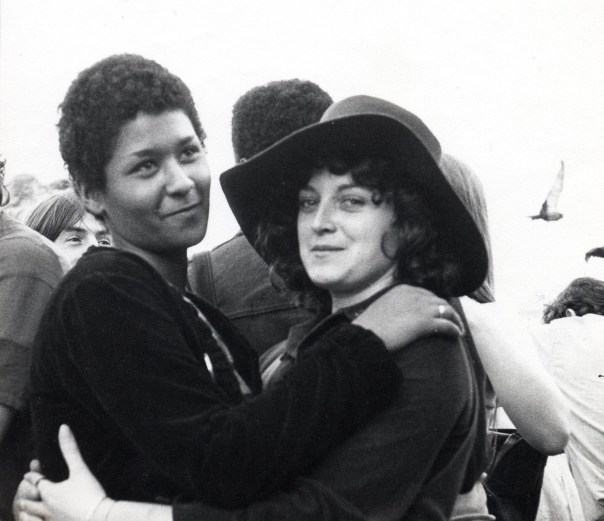
Couple at a Gay Liberation Front gathering. (Hall-Carpenter Archives via London School of Economics Library)
Last month marked the 50th anniversary of the 1967 Sexual Offences Act, a landmark piece of legislation in the United Kingdom that ceased the prosecution of men for homosexual acts. It wasn’t a perfect law by any means — it did not fully decriminalize sexual acts with persons of the same sex — but it was the first legislative step toward equality for LGBTQ people under British law.
Prior to the 1970s, few gay people in Britain were publicly out and even fewer publicly campaigned. Dedicated activists knew that taking to the streets, being visible and not cowed was a key strategy in the pursuit of equal rights. They called for people up and down the country to come out.
Festival of Light, 1970s. (Hall-Carpenter Archives/LSE Library)
These days, gay pride marches are among the largest and most joyful gatherings. So, it might be difficult to imagine the extent to which a public showing of support for LGBTQ rights was radical.
Archive photographs, journals, and organizing literature provide testament to early activism in Britain. Recently, such papers and prints in the Hall-Carpenter Archives at the London School of Economics (LSE) were brought together for Glad to be Gay: The Struggle for Legal Equality, an exhibition of ephemera and social movement materials.
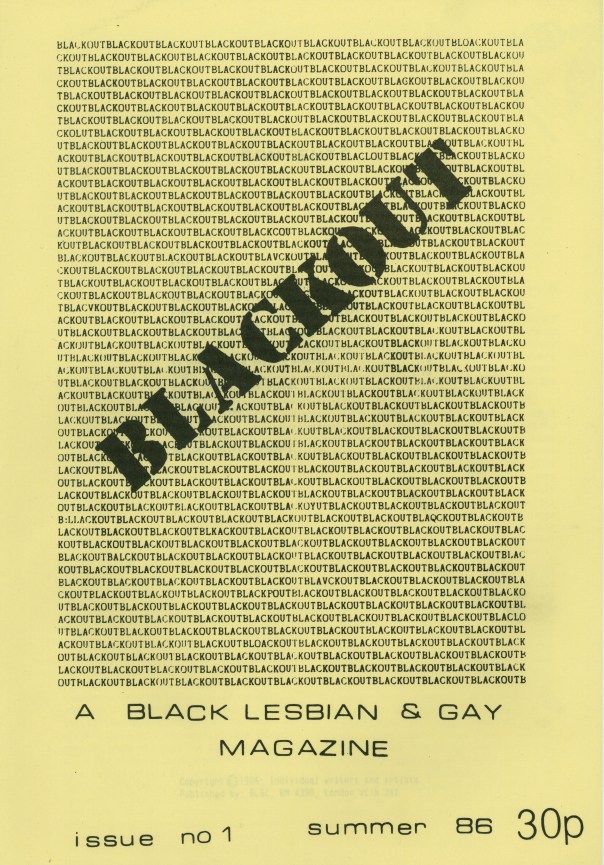
We witness the gatherings, think-ins, political actions, and marches. We see the self-made pamphlets, zines, and newsletters that forged solidarity of thought. These objects galvanized citizens who refused to remain silent; they propelled a movement.
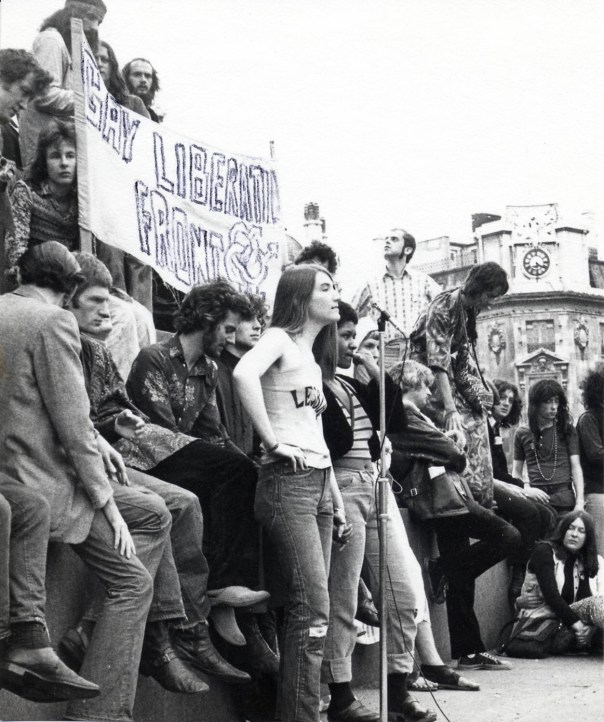
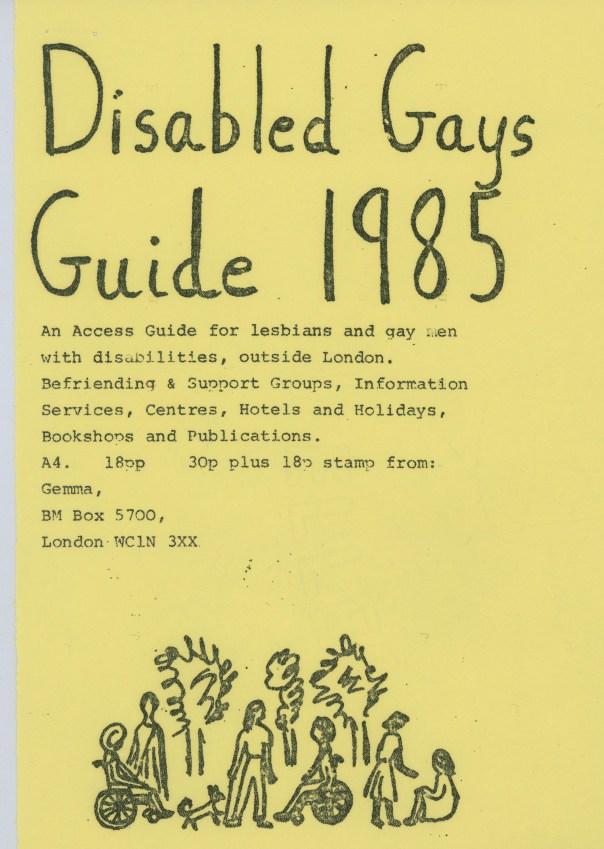
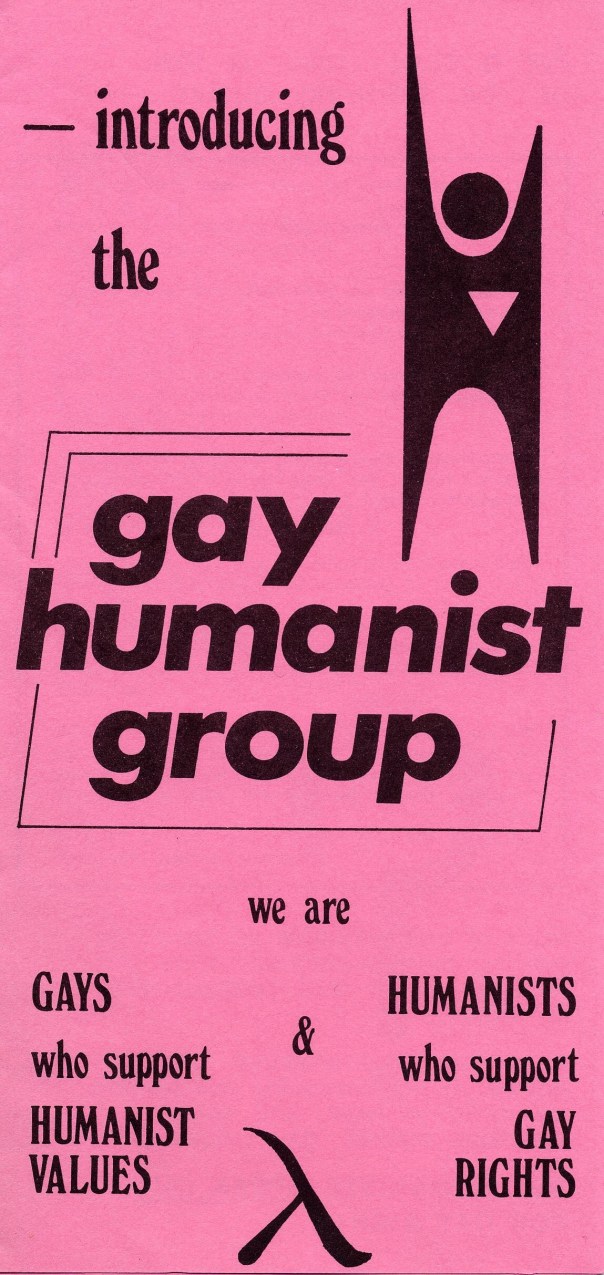
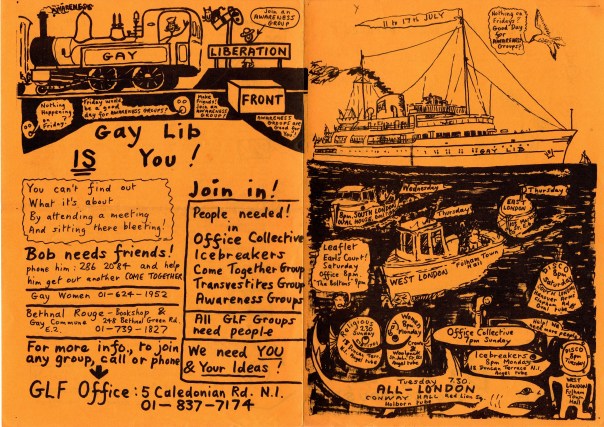
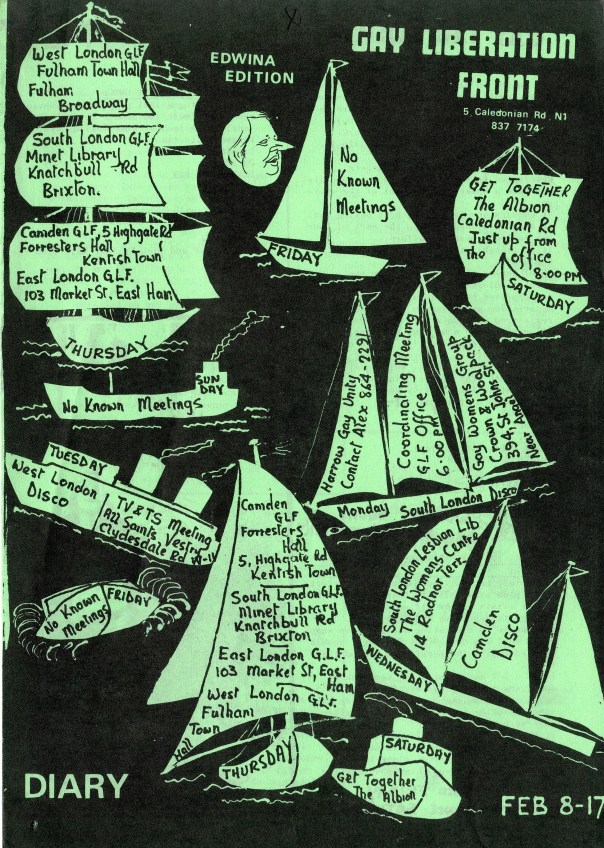
Members of the Gay Liberation Front demonstrate in London in 1972. (Hall-Carpenter Archives/LSE Library)Disabled Gays Guide, 1985.Gay humanist group ephemeraGay Liberation Front ephemera, 1973. (Hall-Carpenter Archives/LSE Library)GLF party flyer. (Hall-Carpenter Archives/LSE Library)Gay Liberation Front street theatre. (Hall-Carpenter Archives/LSE Library)
LSE has an important historical role in the push for LGBTQ rights. The first ever Gay Liberation Front (GLF) meeting in the UK was convened in a basement classroom there. The date was October 13, 1970.
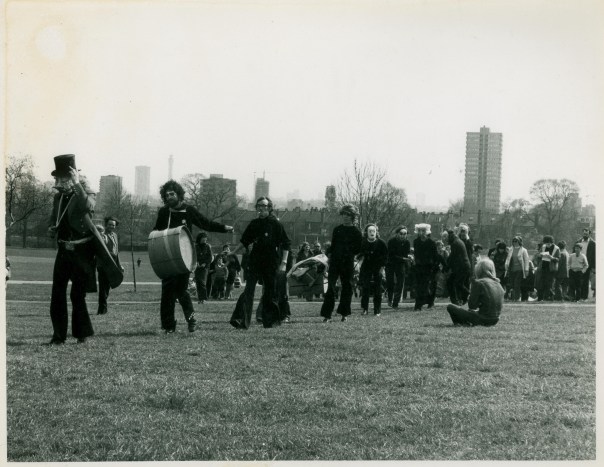
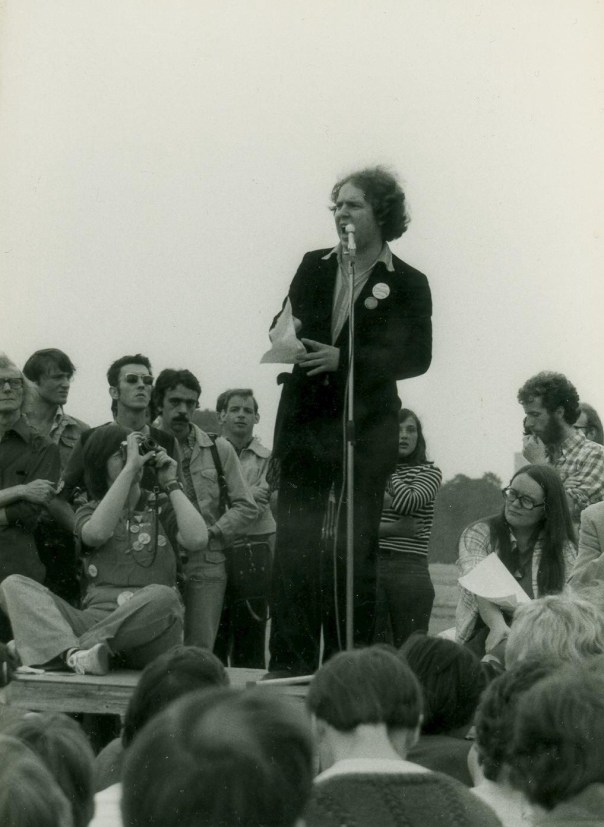
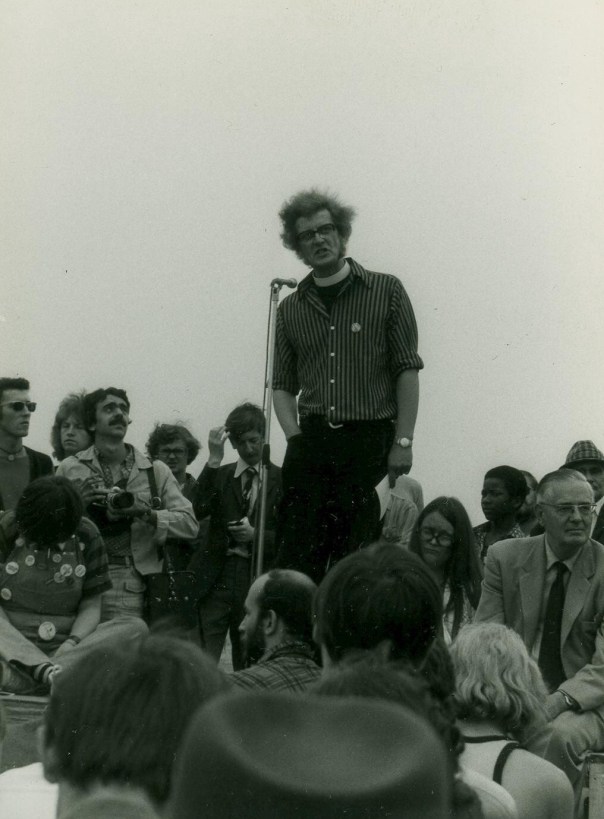
Inspired by the GLF movement in the United States, the UK GLF drew up demands and focused on group activities to root those demands — street theatre, “gay days,” festivals, and sit-ins. At first, it was very informal, but soon the GLF realized the power of collective voice. Its activities led to London’s first Gay Pride March in 1972.
The curator of Glad To Be Gay, Gillian Murphy, explains that until the 1950s homosexuality was a taboo subject. Male homosexuality was illegal and lesbianism wasn’t even recognized as an emotional, sexual, or social reality.
In 1957, UK Parliament published the Wolfenden Report, which recommended that the law should no longer judge nor punish sex conducted in private between consenting same-sex adults. The report didn’t come so much from a position of moral enlightenment, but more a realistic appraisal of privacy, its legal protections, and the impossibility of enforcement. Throughout the 1960s, the Homosexual Law Reform Society and campaigners such as Tony Dyson and Antony Grey pressed politicians to decriminalize homosexuality.
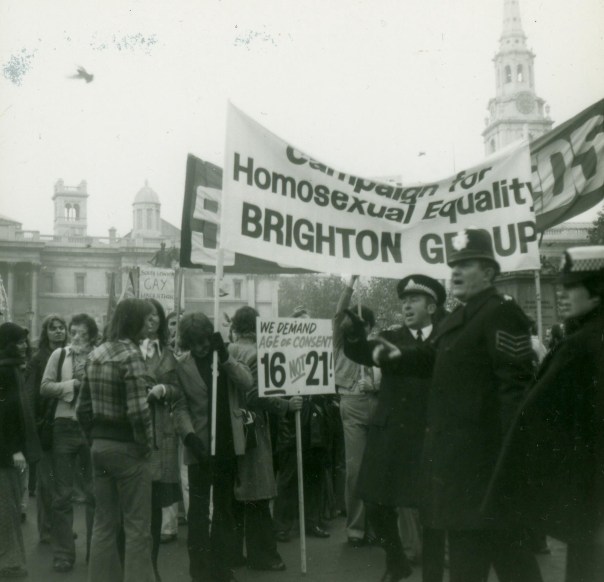
Passage of the 1967 Sexual Offences Act was a huge leap forward, but it also had negative consequences. It formalized the legal age of consent at 21 (it was lowered to 18 in 1994, and to 16 until 2001) and as a result, vast numbers of young gay adults, in their love, remained outside the law. Under the Sexual Offences Act, homosexual acts in the military also remained illegal. Furthermore, the law only applied to England and Wales and homosexual sex remained a crime for millions in Scotland and Northern Ireland until the early 80s.
Lifelong gay rights activist Peter Tatchell said in his book Europe in The Pink (1992) that the 1967 Sexual Offences Act actually facilitated an increase in prosecutions against homosexual men. Tatchell told The Guardian recently that between 1967 and the passage of the 2003 Sexual Offences Act, at least 15,000 men were convicted of same-sex acts, which would never have been prosecuted had the partner been of the other sex.
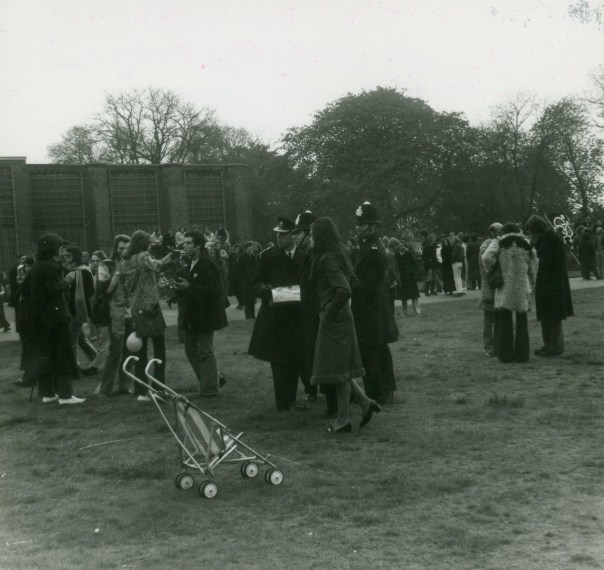
GLF Street Theatre, Parliament Hill Fields, May Day 1971. (Hall-Carpenter Archives/LSE Library)
An early Gay Pride march, London, early 1970s. (Hall-Carpenter Archives/LSE Library)
These photographs show the actions behind the LGBTQ community’s call for gay persons to come out. In the second half of the 20th century, gay, lesbian, and queer identified people found strength in numbers. They raised consciousness among the public at large and refused to feel shame any longer. The Gay Liberation Front brought a new energy to gay activism. Newly established grassroots organizations such as the Joint Council for Gay Teenagers, Gay Activists Alliance, and FRIEND (Fellowship for the Relief of the Isolated and Emotionally in Need and Distress) met specific needs of diverse groups within the LGBTQ community.
Looking at these images, reading this history, and tracing the legislative changes (especially the 2003 repeal of the remaining discriminatory laws from 1967), you might be forgiven for thinking the fight has been won. Far from it. The activism of the 1960s and 1970s began a fight which continues today. Transphobia, limited access to medical and mental healthcare, and general homophobic attitudes persist in British society. The fight for equality adopted back then isn’t just a chapter in history; it is also part of a continuum of speaking out, winning freedoms, and promoting love that is ongoing.
Gay Pride march, London, early 1970s. (Hall-Carpenter Archives/LSE Library)Gay Liberation Front diary, 1973. (Hall-Carpenter Archives/LSE Library)Gay Liberation Front diary, 1973. (Hall-Carpenter Archives/LSE Library)
Gay march demonstration, early 1970s. (Hall-Carpenter Archives/LSE Library)GLF Gay Day, Holland Park, 1971. (Hall-Carpenter Archives/LSE Library)GLF Gay Day, Holland Park, 1971. (Hall-Carpenter Archives/LSE Library)
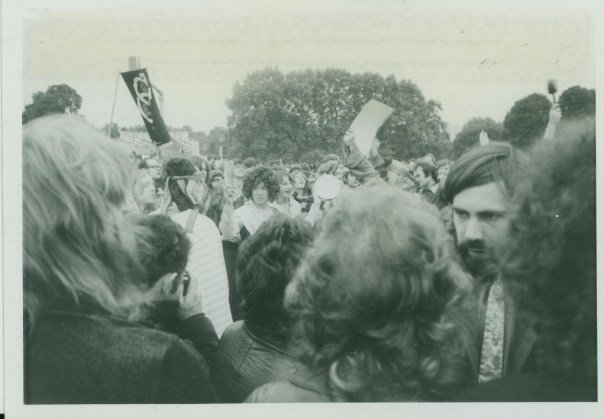
GLF Gay Day, Holland Park, 1971. (Hall-Carpenter Archives/LSE Library)
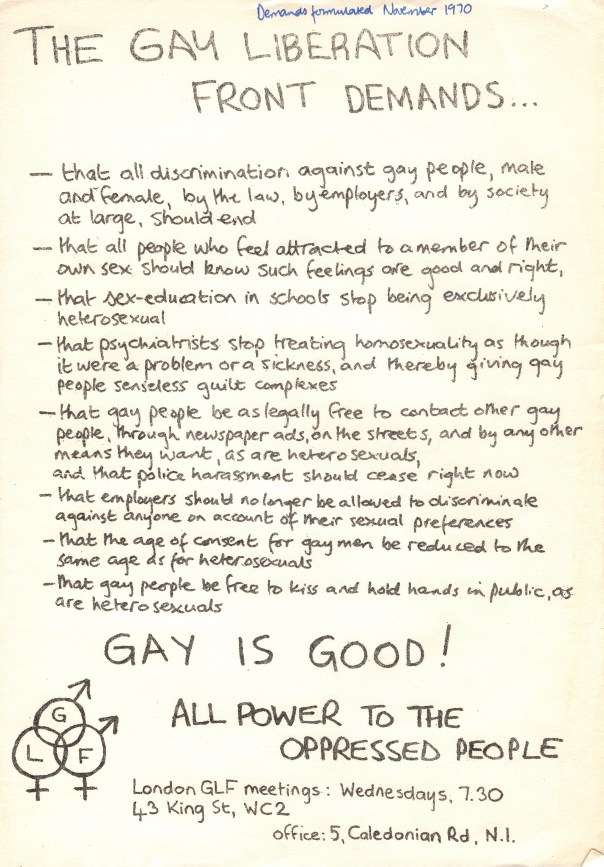
Gay Liberation Front demands, November 1970. (Hall-Carpenter Archives/LSE Library)
Gay Liberation Front demands, February 1971. (Hall-Carpenter Archives/LSE Library)
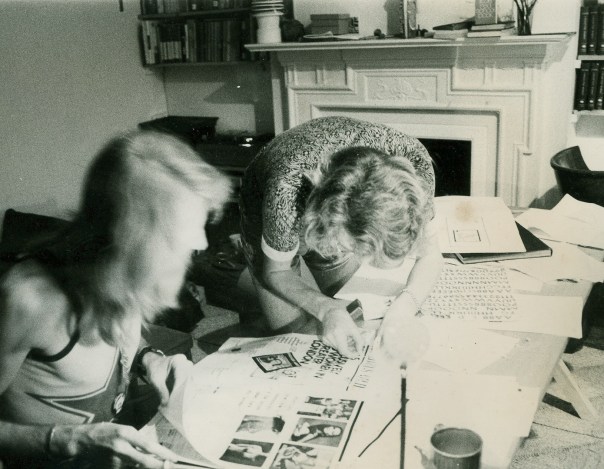
Production of Come Together magazine in Aubrey Walter’s flat, circa 1972. (Hall-Carpenter Archives/LSE Library)
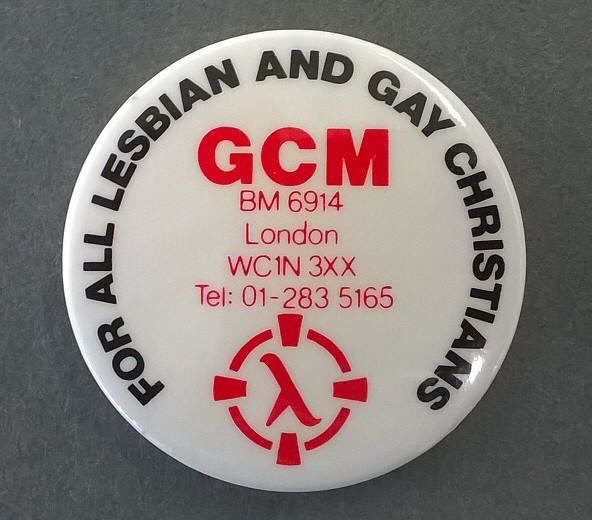
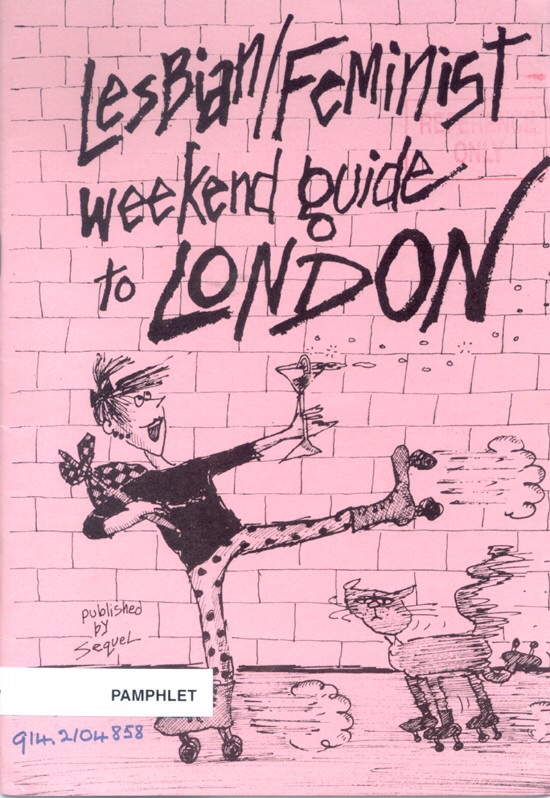
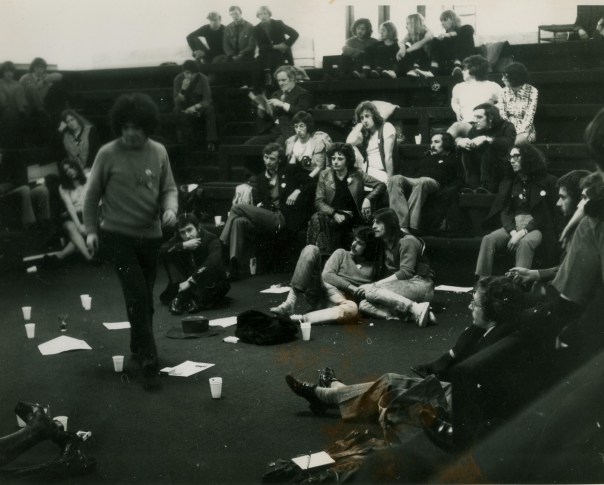
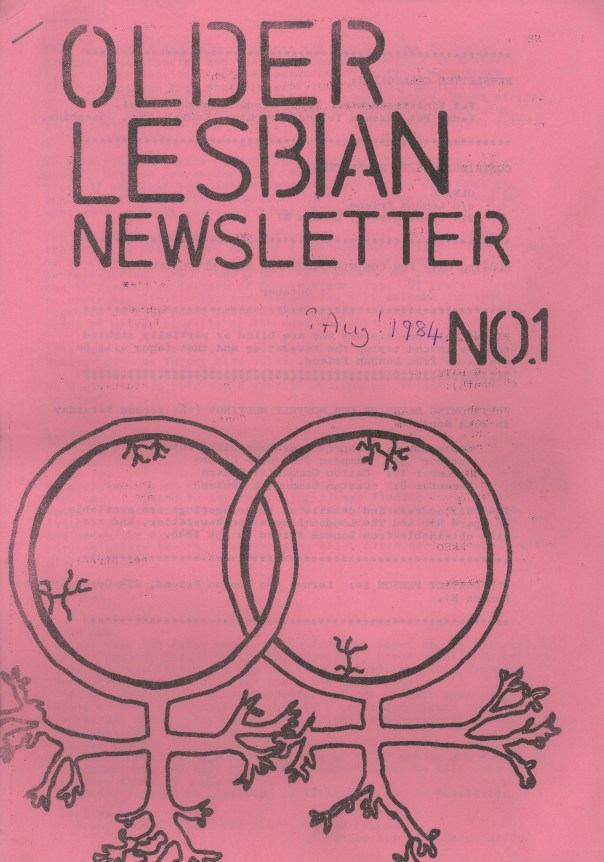
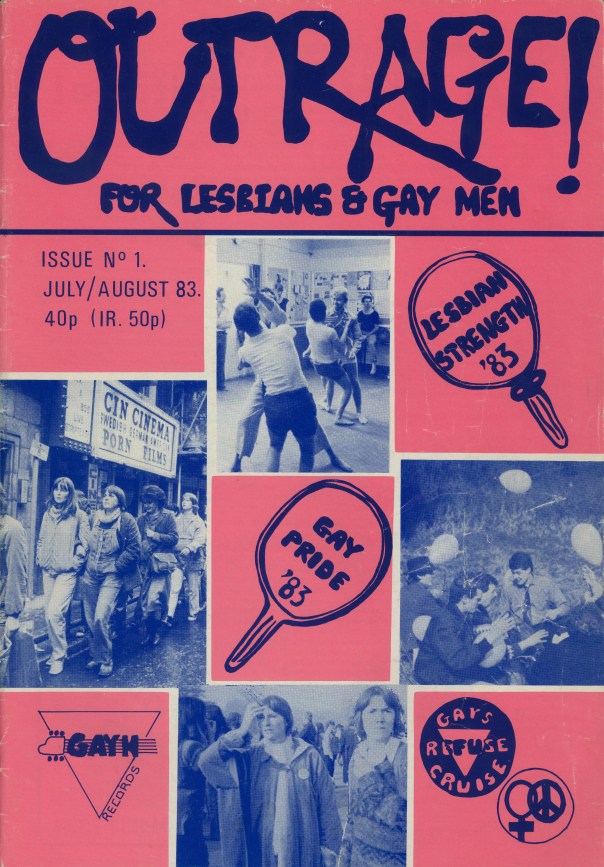
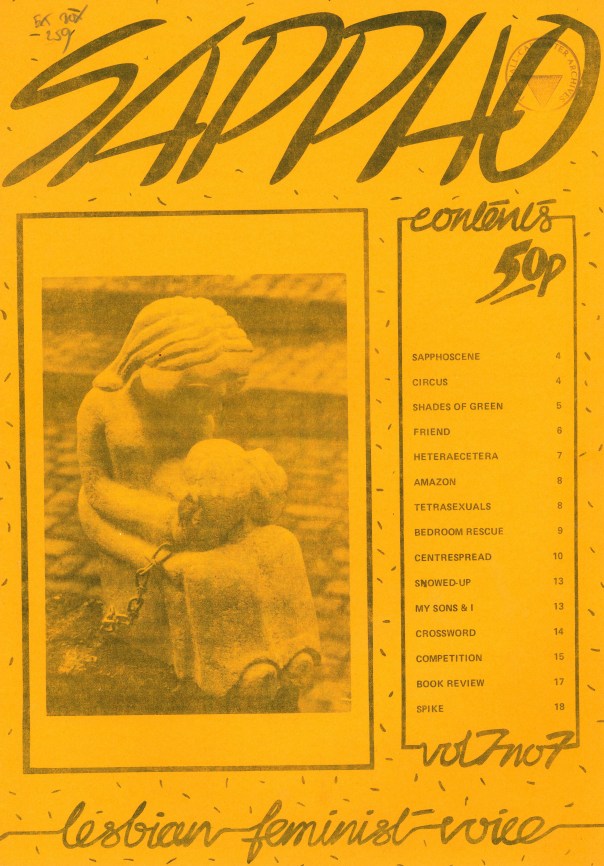
Lesbian and Gay Christian Movement badge.Lesbian Feminist weekend guide to London. (Hall-Carpenter Archives/LSE Library)Outwrite Women’s Newspaper, May 1988. (Hall-Carpenter Archives/LSE Library)UK Lesbian and Gay Switchboard hotline. (Hall-Carpenter Archives/LSE Library)“We Are Nature’s Children Too.” Marchers and police at a Gay Pride march, London, 1974. (Hall-Carpenter Archives/LSE Library)Festival of Light, 1970s. |The first Gay Liberation Front dance leaflet, 1970. (Hall-Carpenter Archives/LSE Library)The first National Convention, or “Think-In,” at Leeds University Union connected GLF groups across the country. (Hall-Carpenter Archives/LSE Library)Older Lesbian Newsletter, 1984.Outrage magazine, 1983.Sappho journal. (Hall-Carpenter Archives/LSE Library)
In the UK, the GLF had its first meeting in the basement of the London School of Economics on 13 October 1970. Bob Mellors and Aubrey Walter had seen the effect of the GLF in the United States and created a parallel movement based on revolutionary politics.
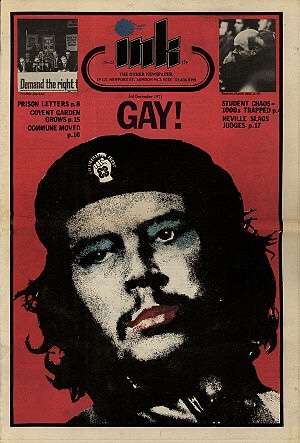
1971 GLF cover version of Ink magazine, London
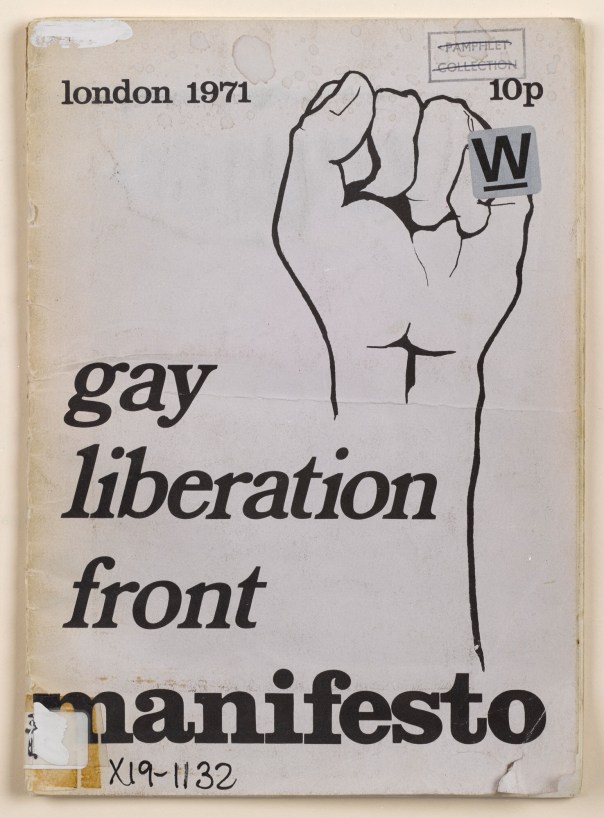
By 1971, the UK GLF was recognized as a political movement in the national press, holding weekly meetings of 200 to 300 people. The GLF Manifesto was published, and a series of high-profile direct actions, were carried out, such as the disruption of the launch of the Church-based morality campaign, Festival of Light.
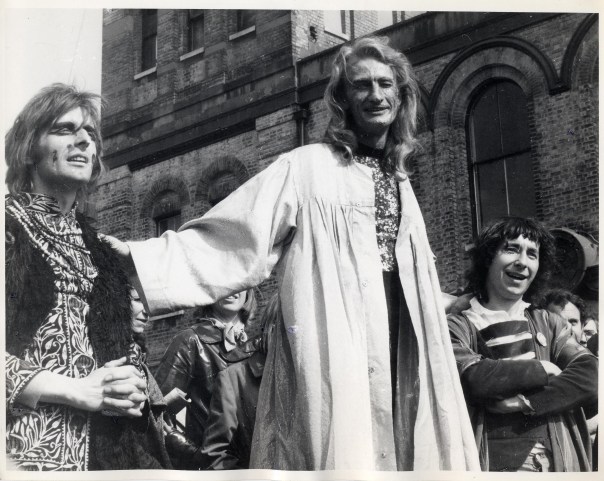
The disruption of the opening of the 1971 Festival of Light was the best organised GLF action. The first meeting of the Festival of Light was organised by Mary Whitehouse at Methodist Central Hall. Groups of GLF members in drag invaded and spontaneously kissed each other; others released mice, sounded horns, and unveiled banners, and a contingent dressed as workmen obtained access to the basement and shut off the lights.
Easter 1972 saw the Gay Lib annual conference held in the Guild of Undergraduates Union (students union) building at the University of Birmingham.
By 1974, internal disagreements had led to the movement’s splintering. Organizations that spun off from the movement included the London Lesbian and Gay Switchboard, Gay News, and Icebreakers. The GLF Information Service continued for a few further years providing gay related resources. GLF branches had been set up in some provincial British towns (e.g., Bradford, Bristol, Leeds, and Leicester) and some survived for a few years longer. The Leicester Gay Liberation Front founded by Jeff Martin was noted for its involvement in the setting up of the local “Gayline”, which is still active today and has received funding from the National Lottery. They also carried out a high-profile campaign against the local paper, the Leicester Mercury, which refused to advertise Gayline’s services at the time.
The papers of the GLF are among the Hall-Carpenter Archives at the London School of Economics.
Several members of the GLF, including Peter Tatchell, continued campaigning beyond the 1970s under the organisation of OutRage!, which was founded in 1990 and dissolved in 2011, using similar tactics to the GLF (such as “zaps” and performance protest to attract a significant level of media interest and controversy.[citation needed] It was at this point that a divide emerged within the gay activist movement, mainly due to a difference in ideologies, after which a number of groups including Organization for Lesbian and Gay Alliance (OLGA), the Lesbian Avengers, Sisters of Perpetual Indulgence, Dykes And Faggots Together (DAFT), Queer Nation, Stonewall (which focused on lobbying tactics) and OutRage! co-existed.
These groups were very influential following the HIV/AIDS pandemic of the 1980s and 1990s and the violence against lesbians and gay men that followed.
Throughout recorded history, oppressed groups have organised to claim their rights and obtain their needs. Homosexuals, who have been oppressed by physical violence and by ideological and psychological attacks at every level of social interaction, are at last becoming angry.
To you, our gay sisters and brothers, we say that you are oppressed; we intend to show you examples of the hatred and fear with which straight society relegates us to the position and treatment of sub-humans, and to explain their basis. We will show you how we can use our righteous anger to uproot the present oppressive system with its decaying and constricting ideology, and how we, together with other oppressed groups, can start to form a new order, and a liberated lifestyle, from the alternatives which we offer.
HOW We Are Oppressed
FAMILY
The oppression of gay people starts in the most basic unit of society, the family. consisting of the man in charge, a slave as his wife, and their children on whom they force themselves as the ideal models. The very form of the family works against homosexuality.
At some point nearly all gay people have found it difficult to cope with having the restricting images of man or woman pushed on them by their parents. It may have been from very early on, when the pressures to play with the ‘right’ toys, and thus prove boyishness or girlishness, drove against the child’s inclinations. But for all of us this is certainly a problem by the time of adolescence, when we are expected to prove ourselves socially to our parents as members of the right sex (to bring home a boy/girl friend) and to start being a ‘real’ (oppressive) young man or a ‘real’ (oppressed) young woman. The tensions can be very destructive.
The fact that gay people notice they are different from other men and women in the family situation, causes them to feel ashamed, guilty and failures. How many of us have really dared by honest with our parents? How many of us have been thrown out of home? How many of us have been pressured into marriage, sent to psychiatrists, frightened into sexual inertia, ostracised, banned, emotionally destroyed-all by our parents?
SCHOOL
Family experiences may differ widely, but in their education all children confront a common situation. Schools reflect the values of society in their formal academic curriculum, and reinforce them in their morality and discipline. Boys learn competitiv ego-building sports, and have more opportunity in science, whereas girls are given emphasis on domestic subjects, needlework etc. Again, we gays were all forced into a rigid sex role which we did not want or need. It is quite common to discipline children for behaving in any way like the opposite sex; degrading titles like ‘sissy’ and ‘tomboy’ are widely used.
In the content of education, homosexuality is generally ignored, even where we know it exists, as in history and literature. Even sex education, which has been considered a new liberal dynamic of secondary schooling, proves to be little more than an extension of Christian morality. Homosexuality is again either ignored, or attacked with moralistic warnings and condemnations. The adolescent recognising his or her homosexuality might feel totally alone in the world, or a pathologically sick wreck.
CHURCH
Formal religious education is still part of everyone’s schooling, and our whole legal structure is supposedly based on Christianity whose archaic and irrational teachings support the family and marriage as the only permitted condition for sex. Gay people have been attacked as abominable and sinful since the beginning of both Judaism and Christianity, and even if today the Church is playing down these strictures on homosexuality, its new ideology is that gay people are pathetic objects for sympathy.
THE MEDIA
The press, radio, television and advertising are used as reinforcements against us, and make possible the control of people’s thoughts on an unprecedented scale. Entering everyone’s home, affecting everyone’s life, the media controllers, all representatives of the rich, male-controlled world, can exaggerate or suppress whatever information suits them
Under different circumstances, the media might not be the weapon of a small minority. The present controllers are therefore dedicated defenders of things as they stand. Accordingly, the images of people which they transmit in their pictures and words do not subvert, but support society’s image of ‘normal’ man and woman. It follows that we are characterised as scandalous, obscene perverts; as rampant, wild sex-monsters; as pathetic, doomed and compulsive degenerates; while the truth is blanketed under a conspiracy of silence.
WORDS
Anti-homosexual morality and ideology, at every level of society, manifest themselves in a special vocabulary for denigrating gay people. There is abuse like ‘pansy’, ‘fairy’, ‘lesbo’ to hurl at men and women who can’t or won’t fit stereotyped preconceptions. There are words like ‘sick’, ‘bent’ and ‘neurotic’ for destroying the credence of gay people. But there are no positive words. The ideological intent of our language makes it very clear that the generation of words and meanings is, at the moment, in the hands of the enemy. And that so many gay people pretend to be straight, and call each other ‘butch dykes’ or ‘screaming queens only makes that fact the more real.
The verbal attack on men and women who do not behave as they are supposed to, reflects the ideology of masculine superiority. A man who behaves like a woman is seen as losing something, and a woman who behaves like a man is put down for threatening men’s environment of their privileges.
EMPLOYMENT
If our upbringing so often produces guilt and shame, the experience of an adult gay person is oppressive in every aspect. In their work situation, gay people face the ordeal of spending up to fifty years of their lives confronted with the anti-homosexual hostility of their fellow employees.
A direct consequence of the fact that virtually all employers are highly privileged heterosexual men, is that there are some fields of work which are closed to gay people, and others which they feel some compulsion to enter. A result of this control for gay women is that they are perceived as a threat in the man’s world. They have none of the sexual ties of dependence to men which make most women accept men as their ‘superiors’. They are less likely to have the bind of children, and so there is nothing to stop them showing that they are as capable as any man, and thus deflating the man’s ego, and exposing the myth that only men can cope with important jobs.
We are excluded from many jobs in high places where being married is the respectable guarantee, but being homosexual apparently makes us unstable, unreliable security risks. Neither, for example, are we allowed the job of teaching children, because we are all reckoned to be compulsive, child molesting maniacs.
There are thousands of examples of people having lost their jobs due to it becoming known that they were gay, though employers usually contrive all manner of spurious reasons.
There occurs, on the other hand, in certain jobs, such a concentration of gay people as to make an occupational ghetto. This happens, for women, in the forces, ambulance driving, and other uniformed occupations: and for men, in the fashion, entertainment and theatrical professions, all cases where the roles of ‘man’ and ‘woman’ can perhaps be undermined or overlooked [note: last phrase unclear in copy used for HTML]
THE LAW
If you live in Scotland or Ireland; if you are under 21, or over 21 but having sex with someone under 21; if you are in the armed forces or the merchant navy; if you have sex with more than one other person at the same time-and you are a gay male, you are breaking the law
The 1967 Sexual Offences Act gave a limited license to adult gay men. Common law however can restrict us from talking about and publicising both male and female homosexuality by classing it as ‘immoral’. Beyond this there are a whole series of specific minor offences. Although ‘the act’ is not illegal, asking someone to go to bed with you can be classed as ‘importuning for an immoral act’, and kissing in public is classed as ‘public indecency’
Even if you do not get into trouble, you will find yourself hampered by the application of the law in your efforts to set up home together, to raise children, and to express your love as freely as straight people may do.
The practice of the police in ‘enforcing’ the law makes sure that cottagers and cruisers will be zealously hunted, while queer-bashers may be apprehended, half-heartedly after the event.
PHYSICAL VIOLENCE
On 25 September 1969 a man walked onto Wimbledon Common . We know the common to be a popular cruising ground, and believe the man to have been one of our gay brothers. Whether or not this is the case, the man was set upon by a group of youths from a nearby housing estate, and literally battered to death with clubs and boots. Afterwards, a boy from the same estate said: ‘When you’re hitting a queer, you don’t think you’re doing wrong. You think you’re doing good. If you want money off a queer, you can get it off him-there’s nothing to be scared of from the law, cause you know they won’t go to the law’. (Sunday Times, 7/21/1971).
Since that time, another man has been similarly murdered on Hampstead Heath. But murder is only the most extreme form of violence to which we are exposed, not having the effective rights of protection. Most frequently we are ‘rolled’ for our money, or just beaten up: and this happens to butch looking women in some districts.
PSYCHIATRY
One way of oppressing people and preventing them getting too angry about it, is to convince them, and everyone else, that they are sick. There has hence arisen a body of psychiatric ‘theory’ and ‘therapy’ to deal with the ‘problems’ and ‘treatment’ of homosexuality .
Bearing in mind what we have so far described, it is quite understandable that gay people get depressed and paranoid; but it is also, of course, part of the scheme that gay people should retreat to psychiatrists in times of troubles.
Operating as they do on the basis of social convention and prejudice, NOT scientific truth, mainstream psychiatrists accept society’s prevailing view that the male and female sex roles are ‘good’ and ‘normal’, and try to adjust people to them. If that fails, patients are told to ‘accept themselves’ as ‘deviant’. For the psychiatrist to state that homosexuality was perfectly valid and satisfying, and that the hang-up was society’s inability to accept that fact, would result in the loss of a large proportion of his patients.
Psychiatric ‘treatment’ can take the form either of mindbending ‘psychotherapy’, or of aversion therapy which operates on the crude conditioning theory that if you hit a person hard enough, he’ll do what you want. Another form of ‘therapy’ is chemically induced castration, and there is a further form of ‘treatment’ which consists in erasing part of the brain, with the intent (usually successful) of making the subject an asexual vegetable.
This ‘therapy’ is not the source of the psychiatrist’s power, however. Their social power stems from the facile and dangerous arguments by which they contrive to justify the prejudice that homosexuality is bad or unfortunate, and to mount this fundamental attack upon our right to do as we think best. In this respect, there is little difference between the psychiatrist who says: ‘From statistics we can show that homosexuality is connected with madness’, and the one who says: ‘Homosexuality is unfortunate because it is socially rejected’. The former is a dangerous idiot-he cannot see that it is society which drives gay people mad. The second is a pig because he does see this, but sides consciously with the oppressors.
That psychiatrists command such credence and such income is surprising if we remember the hysterical disagreements of theory and practice in their field, and the fact that in formulating their opinions, they rarely consult gay people. In fact, so far as is possible, they avoid talking to them at all, because they know that such confrontation would wreck their theories.
SELF-OPPRESSION
The ultimate success of all forms of oppression is our self-oppression. Self-oppression is achieved when the gay person has adopted and internalised straight people’s definition of what is good and bad. Self-oppression is saying: ‘When you come down to it, we are abnormal’. Or doing what you most need and want to do, but with a sense of shame and loathing, or in a state of disassociation, pretending it isn’t happening; cruising or cottaging not because you enjoy it, but because you’re afraid of anything less anonymous. Self-oppression is saying: ‘I accept what I am’, and meaning: ‘I accept that what I am is second-best and rather pathetic’. Self-oppression is any other kind of apology: ‘We’ve been living together for ten years and all our married friends know about us and think we’re just the same as them’. Why? You’re not.
Self-oppression is the dolly lesbian who says: ‘I can’t stand those butch types who look like truck drivers’; the virile gay man who shakes his head at the thought of ‘those pathetic queens’. This is self-oppression because it’s just another way of saying: ‘I’m a nice normal gay. just like an attractive heterosexual’.
The ultimate in self-oppression is to avoid confronting straight society, and thereby provoking further hostility: Self-oppression is saying, and believing: ‘I am not oppressed’.
WHY we’re oppressed
Gay people are oppressed. As we’ve just shown, we face the prejudice, hostility and violence of straight society, and the opportunities open to us in work and leisure are restricted, compared with those of straight people. Shouldn’t we demand reforms that will give us tolerance and equality? certainly we should-in a liberal-democratic society, legal equality and protection from attack are the very least we should ask for. They are our civil rights.
But gay liberation does not just mean reforms. It means a revolutionary change in our whole society. Is this really necessary? Isn’t it hard enough for us to win reforms within the present society, and how will we engage the support of straight people if we get ourselves branded as revolutionaries?
Reforms may makes things better for a while; changes in the law can make straight people a little less hostile, a little more tolerant-but reform cannot change the deep-down attitude of straight people that homosexuality is at best inferior to their own way of life, at worst a sickening perversion. It will take more than reforms to change this attitude, because it is rooted in our society’s most basic institution-the Patriarchal Family.
We’ve all been brought up to believe that the family is the source of our happiness and comfort. But look at the family more closely. Within the small family unit, in which the dominant man and submissive woman bring up their children in their own image, all our attitudes towards sexuality are learned at a very early age. Almost before we can talk, certainly before we can think for ourselves, we are taught that there are certain attributes that are ‘feminine’ and other that are ‘masculine’, and that they are God-given and unchangeable. Beliefs learned so young are very hard to change; but in fact these are false beliefs. What we are taught about the differences between man and woman is propaganda, not truth.
The truth is that there are no proven systematic differences between male and female, apart from the obvious biological ones. Male and female genitals and reproductive systems are different, and so are certain other physical characteristics, but all differences of temperament, aptitudes and so on, are the result of upbringing and social pressures. They are not inborn.
Human beings could be much more various than our constricted patterns of ‘masculine’ and ‘feminine’ permit-we should be free to develop with greater individuality. But as things are at present, there are only these two stereotyped roles into which everyone is supposed to fit, and most people-including gay people too-are apt to be alarmed when they hear these stereotypes or gender roles attacked, fearing that children ‘won’t know how to grow up if they have no one to identify with’, or that ‘everyone will be the same’, i.e. that there will be either utter chaos or total conformity. There would in fact be a greater variety of models and more freedom for experimentation, but there is no reason to suppose this will lead to chaos.
By our very existence as gay people, we challenge these roles. it can easily be seen that homosexuals don’t fit into the stereotypes of masculine and feminine, and this is one of the main reasons why we become the object of suspicion, since everyone is taught that these and only these two roles are appropriate.
Our entire society is build around the patriarchal family and its enshrinement of these masculine and feminine roles. Religion, popular morality art, literature and sport all reinforce these stereotypes. In other words, this society is a sexist society, in which one’s biological sex determines almost all of what one does and how one does it; a situation in which men are privileged, and women are mere adjuncts of men and objects for their use, both sexually and otherwise.
Since all children are taught so young that boys should be aggressive and adventurous, girls passive and pliant, most children do tend to behave in these ways as they get older, and to believe that other people should do so too.
So sexism does not just oppose gay people, but all women as well. It is assumed that because women bear children they should and must rear them, and be simultaneously excluded from all other spheres of achievement.
However, as the indoctrination of the small child with these attitudes is not always entirely successful (if it were, there would be no gay people for a start), the ideas taken in by the young child almost unconsciously must be reinforced in the older child and teenager by a consciously expressed male chauvinism: the ideological expression of masculine superiority. Male chauvinism is not hatred of women, but male chauvinists accept women only on the basis that they are in fact lesser beings. It is an expression of male power and male privilege, and while it’s quite possible for a gay man to be a male chauvinist, his very existence does also challenge male chauvinism in so far as he rejects his male supremacist role over women, and perhaps particularly if he rejects ‘masculine’ qualities.
It is because of the patriarchal family that reforms are not enough. Freedom for gay people will never be permanently won until everyone is freed from sexist role-playing and the straightjacket of sexist rules about our sexuality. And we will not be freed from these so long as each succeeding generation is brought up in the same old sexist way in the Patriarchal family.
But why can’t we just change the way in which children are brought up without attempting to transform the whole fabric of society?
Because sexism is not just an accident-it is an essential part of our present society, and cannot be changed without the whole society changing with it. In the first place, our society is dominated at every level by men, who have an interest in preserving the status quo; secondly, the present system of work and production depends on the existence of the patriarchal family. Conservative sociologists have pointed out that the small family unit of two parents and their children is essential in our contemporary advanced industrial family where work is minutely subdivided and highly regulated-in other words, for the majority very boring. A man would not work at the assembly line if he had no wife and family to support; he would not give himself fully to his work without the supportive and reassuring little group ready to follow him about and gear itself to his needs, to put up with his ill temper when he is frustrated or put down by the boss at work.
Were it not also for the captive wife, educated by advertising and everything she reads into believing that she needs ever more new goodies for the home, for her own beautification and for the childrens’ well-being, our economic system could not function properly, depending as it does on people buying far more manufactured goods than they need. The housewife, obsessed with the ownership of as many material goods as possible, is the agent of this high level of spending. None of these goods will ever satisfy her, since there is always something better to be had, and the surplus of these pseudo ‘necessities’ goes hand in hand with the absence of genuinely necessary goods and services, such as adequate housing and schools.
The ethic and ideology of our culture has been conveniently summed up by the enemy. Here is a quotation, intended quite seriously, from an American psychiatric primer. The author, Dr. Fred Brown, states:
Our values in Western civilisation are founded upon the sanctity of the family, the right to property, and the worthwhileness of ‘getting ahead ‘ The family can be established on/y through heterosexual intercourse, and this gives the woman a high value. (Note the way in which woman is appraised as a form of property.} Property acquisition and worldly success are viewed as distinctly masculine aims. The individual who is outwardly masculine but appears to fall into the feminine class by reason . . . of his preference for other men denies these values of our civilisation. In denying them he belittles those goals which carry weigh t and much emotional co/ouring in our society and thereby earns the hostility of those to whom these values are of great importance.
We agree with his description of our society and its values-but we reach a different conclusion. We gay men and women do deny these values of our civilisation. We believe that the society Dr. Brown describes is an evil society. We believe that work in an advanced industrial society could be organised on more humane lines, with each job more varied and more pleasurable, and that the way society is at present organised operates in the interests of a small ruling group of straight men who claim most of the status and money, and not in the interests of the people as a whole. We also believe that our economic resources could be used in a much more valuable and constructive way than they are at the moment-but that will not happen until the present pattern of male dominance in our society changes too.
That is why any reforms we might painfully exact from our rulers would only be fragile and vulnerable; that is why we, along with the women’s movement, must fight for something more than reform. We must aim at the abolition of the family, so that the sexist, male supremacist system can no longer be nurtured there.
WE CAN DO IT
Yet although this struggle will be hard, and our victories not easily won, we are not in fact being idealistic to aim at abolishing the family and the cultural distinctions between men and women. True, these have been with us throughout history, yet humanity is at last in a position where we can progress beyond this.
Only reactionaries and conservatives believe in the idea of ‘natural man’. Just what is so different in human beings from the rest of the animal kingdom is their ‘unnaturalness’. Civilisation is in fact our evolution away from the limitations of the natural environment and towards its ever more complex control. It is not ‘natural’ to travel in planes. It is not ‘natural’ to take medicines and perform operations. Clothing and shoes do not grow on trees. Animals do not cook their food. This evolution is made possible by the development of technology-i.e. all those tools and skills which help us to control the natural environment.
We have now reached a stage at which the human body itself, and even the reproduction of the species, is being ‘unnaturally’ interfered with (i.e. improved) by technology. Reproduction used to be left completely to the uncontrolled biological processes inherited from our animal ancestors, but modern science, by drastically lowering infant mortality, has made it unnecessary for women to have more than two or three babies, while contraceptives have made possible the conscious control of pregnancy and the freeing of sexuality from reproduction. Today, further advances are on the point of making it possible for women to be completely liberated from their biology by means of the development of artificial wombs. Women need no longer by burdened with the production of children at their main task in life. and need be still less in the future
The present gender-role system of ‘masculine’ and ‘feminine’ is based on the way that reproduction was originally organised. Men’s freedom from the prolonged physical burden of bearing children gave them a privileged position which was then reinforced by an ideology of male superiority. But technology has now advanced to a stage at which the gender-role system is no longer necessary.
However, social evolution does not automatically take place with the steady advance of technology, The gender-role system and the family unit built around it will not disappear just because they have ceased to be necessary. The sexist culture gives straight men privileges which, like those of any privileged class, will not be surrendered without a struggle, so that all of us who are oppressed by this culture (women and gay people), must band together to fight it. The end of the sexist culture and of the family will benefit all women, and gay people. We must work together with women, since their oppression is our oppression, and by working together we can advance the day of our common liberation.
A NEW LIFE-STYLE
In the final section we shall outline some of the practical steps gay liberation will take to make this revolution. But linked with this struggle to change society there is an important aspect of gay liberation that we can begin to build here and now- a NEW, LIBERATED LIFE-STYLE which will anticipate, as far as possible, the free society of the future.
Gay shows the way. In some ways we are a/ready more advanced than straight people. We are already outside the family and we have already, in part at least, rejected the ‘masculine’ or ‘feminine’ roles society has designed for us. In a society dominated by the sexist culture it is very difficult, if not impossible, for heterosexual men and women to escape their rigid gender-role structuring and the roles of oppressor and oppressed. But gay men don’t need to oppress women in order to fulfill their own psycho-sexual needs, and gay women don’t have to relate sexually to the male oppressor, so that at this moment in time, the freest and most equal relationships are most likely to be between homosexuals.
But because the sexist culture has oppressed us and distorted our lives too, this is not always achieved. In our mistaken, placating efforts to be accepted and tolerated, we’ve too often submitted to the pressures to conform to the straightjacket of society’s rules and hang ups about sex.
Particularly oppressive aspects of gay society are the Youth Cult, Butch and Femme role-playing, and Compulsive Monogamy.
THE YOUTH CULT. Straight women are the most exposed in our society to the commercially manipulated (because very profitable) cult of youth and ‘beauty’- i.e. the conformity to an ideal of ‘sexiness’ and ‘femininity’ imposed from without, not chosen by women themselves. Women are encouraged to look into the mirror and love themselves because an obsession with clothes and cosmetics dulls their appreciation of where they’re really at . . . until it’s too late. The sight of an old woman bedizened with layers of make-up, her hair tortured into artificial turrets, provokes ridicule on all sides. Yet this grotesque denial of physical aging is merely the logical conclusion to the life of a woman who has been taught that her value lies primarily in her degree of sexual attractiveness.
Gay women, like straight men, are rather less into the compulsive search for youth, perhaps because part of their rebellion has been the rejection of themselves as sex objects-like men they see themselves as people; as subjects rather than objects. But gay men are very apt to fall victim to the cult of youth-those sexual parades in the ‘glamorous’ meat-rack bars of London and New York, those gay beaches of the South of France and Los Angeles haven’t anything to do with liberation. Those are the hang-outs of the plastic gays who are obsessed with image and appearance. In love with their own bodies, these gay men dread the approach of age, because to be old is to be ‘ugly’, and with their youth they lose also the right to love and be loved, and are valued only if they can pay. This obsession with youth is destructive. We must all get away from the false commercial standards of ‘beauty’ imposed on us by movie moguls and advertising firms, because the youth/beauty hang-up sets us against one another in a frenzied competition for attention, and leads in the end to an obsession with self which is death to real affection or real sensual love. Some gay men have spent so much time staring at themselves in the mirror that they’ve become hypnotised by their own magnificence and have ended up by being made unable to see anyone else
BUTCH AND FEMME. Many gay men and women needlessly restrict their lives by compulsive role playing. They may restrict their own sexual behaviour by feeling that they must always take either a butch or a femme role, and worse, these roles are transposed to make even more distorting patterns in general social relationships. We gay men and women are outside the gender-role system anyway, and therefore it isn’t surprising if some of us -of either six-are more ‘masculine’ and others more ‘feminine’. There is nothing wrong with this. What is bad is when gay people try to impose on themselves and on one another the masculine and feminine stereotypes of straight society, the butch seeking to expand his ego by dominating his/her partner’s life and freedom, and the femme seeking protection by submitting to the butch. Butch really is bad-the oppression of others is an essential part of the masculine gender role. We must make gay men and women who lay claim to the privileges of straight males understand what they are doing; and those gay men and women who are caught up in the femme role must realise, as straight women increasingly do, that any security this brings is more than offset by their loss of freedom
COMPULSIVE MONOGAMY. We do not deny that it is as possible for gay couples as for some straight couples to live happily and constructively together. We question however as an ideal, the finding and settling down eternally with one ‘right’ partner. This is the blueprint of the straight world which gay people have taken over. It is inevitably a parody, since they haven’t even the justification of straight couples-the need to provide a stable environment for their children (though in any case we believe that the suffocating small family unit is by no means the best atmosphere for bringing up children.
Monogamy is usually based on ownership-the woman sells her services to the man in return for security for herself and her children-and is entirely bound up in the man’s idea of property furthermore in our society the monogamous couple, with or without children, is an isolated, shut-in, up-tight unit, suspicious of and hostile to outsiders. And though we don’t lay down rules or tell gay people how they should behave in bed or in their relationships, we do want them to question society’s blueprint for the couple. The blueprint says ‘we two against the world’, and that can be protective and comforting. But it can also be suffocating, leading to neurotic dependence and underlying hostility, the emotional dishonesty of staying in the comfy safety of the home and garden, the security and narrowness of the life built for two, with the secret guilt of fancying someone else while remaining in thrall to the idea that true love lasts a lifetime-as though there were a ration of relationships, and to want more than one were greedy. Not that sexual fidelity is necessarily wrong; what is wrong is the inturned emotional exclusiveness of the couple which students the partners so they can no longer operate at all as independent beings in society. People need a variety of relationships in order to develop and grow, and to learn about other human beings.
It is especially important for gay people to stop copying straight-we are the ones who have the best opportunities to create a new lifestyle and if we don’t, no one else will. Also, we need one another more than straight people do, because we are equals suffering under an insidious oppression from a society too primitive to come to terms with the freedom we represent. Singly, or isolated in couples, we are weak-the way society wants us to be. Society cannot put us down so easily if we fuse together. We have to get together, understand one another, live together.
Two ways we can do this are by developing consciousness-raising groups and gay communes.
Our gay communes and collectives must not be mere convenient living arrangements or worse, just extensions of the gay ghetto. They must be a focus of consciousness-raising lie. raising or increasing our awareness of our real oppression} and of gay liberation activity, a new focal point for members of the gay community. It won’t be easy, because this society is hostile to communal living. And besides the practical hang-ups of finding money and a place large enough for a collective to live in, there are our own personal hang-ups: we have to change our attitudes to our personal property, to our lovers, to our day-to day priorities in work and leisure, even to our need for privacy.
But victory will come. If we’re convinced of the importance of the new life-style, we can be strong and we can win through.
AIMS
The long-term goal of Gay Liberation, which inevitably brings us into conflict with the institutionalised sexism of this society, is to rid society of the gender-role system which is at the root of our oppression. This can only be achieved by eliminating the social pressures on men and women to conform to narrowly defined gender roles. It is particularly important that children and young people be encouraged to develop their own talents and interests and to express their own individuality rather than act out stereotyped parts alien to their nature.
As we cannot carry out this revolutionary change alone, and as the abolition of gender rotes is also a necessary condition of women’s liberation, we will work to form a strategic alliance with the women’s liberation movement, aiming to develop our ideas and our practice in close inter-relation. In order to build this alliance, the brothers in gay liberation will have to be prepared to sacrifice that degree of male chauvinism and male privilege that they still all possess.
To achieve our long term goal will take many years, perhaps decades. But attitudes to the appropriate place of men and women in our society are changing rapidly, particularly the belief in the subordinate place for women. Modern conditions are placing increasing strain on the small nuclear family containing one adult male and one adult female with narrowly defined roles and bound together for life.
The way forward
FREE OUR H EADS
The starting point of our liberation must be to rid ourselves of the oppression which lies in the head of every one of us. This means freeing our heads from self oppression and male chauvinism, and no longer organising our lives according to the patterns with which we are indoctrinated by straight society. It means that we mustroot outthe idea that homosexuality is bad, sick or immoral, and develop a gaypride.In order to survive, most of us have either knuckled under to pretended that no oppression exists, and the result of this has been further to distort our heads. Within gay liberation, a number of consciousness-raising groups have already developed, in which we try to understand our oppression and learn new ways of thinking and behaving. The aim is to step outside the experience permitted by straight society, and to learn to love and trust one another. This is the precondition for acting and struggling together.
By freeing our heads we get the confidence to come out publicly and proudly as gay people, and to win over our gay brothers and sisters to the ideas of gay liberation.
CAMPAIGN Before we can create the new society of the future, we have to defend our interests as gay people here and now against all forms of oppression and victimisation. We have therefore drawn up the following list of immediate demands.
that all discrimination against gay people, male and female, by the law, by employers, and by society at large, should end.
that all people who feel attracted to a member of their own sex be taught that such feeling are perfectly valid.
that sex education in schools stop being exclusively heterosexual.
that psychiatrists stop treating homosexuality as though it were a sickness, thereby giving gay people senseless guilt complexes.
that gay people be as legally free to contact other gay people, though newspaper ads, on the streets and by any other means they may want as are heterosexuals, and that police harassment should cease right now.
that employers should no longer be allowed to discrim inate against anyone on accou nt of their sexual preferences.
that the age of consent for gay males be reduced to the same as for straight.
that gay people be free to hold hands and kiss in public, as are heterosexuals.
Those who believe in gay liberation need to support actively their local gay group. With the rapid spread of the ideas of gay liberation, it is inevitable that many members of such groups have only partially come to terms with their homosexuality. The degree of self-oppression is often such that it is difficult to respect individuals in the group, and activists frequently feel tempted to despair. But if we are to succeed in transforming our society we must persuade others of the merits of our ideas, and there is no way we can achieve this if we cannot even persuade those most affected by our oppression to join us in fighting for justice.
We do not intend to ask for anything.We intend to stand firm and assert our basic rights.If this involves violence, it will not be we who initiate this, but those who attempt to stand in our way to freedom
It’s a dilemma for some of us…do we fight against the “Daddy” label, or just give in and accept it? I think I garner more attention from younger guys these days than I ever did when I was on the scene…despite being a youngster who preferred to have liaisons with older guys. Even up to a week ago I received a message on Instagram from a younger…dare I say in his 30s…very good looking English guy, suggesting that if I was after a “sugar babe” to hit him up! I should point out that I don’t have the financial cred to be a Sugar Daddy…but I can’t say I wasn’t flattered! I was! I have spent the last 15 years fighting off the label of “Daddy”, but now find myself questioning why! I think the problem has always been the way gay Daddies are promoted – both in the media, and in movies. Usually older men who are financially independent, and have the money to fulfil the whims of the young guys in their company. However, a bit of reading on the subject dispels that myth. Yes, there are young guys out there who partner with older guys for financial reasons, but there are equally a number of guys who do it for less material reasons…they find the company of older men more stimulating than guys in their own peer group, often for intellectual reasons; they prefer the experiences of older guys, both sexually and emotionally; or they just prefer older guys…full stop. Having now come to the realisation that it’s not all about money, I’m thinking that…provided they are not after financial support (fuck knows it’s difficult enough to support ones self on a pension), I should embrace my inner Daddy. After all, aren’t the emotional and sexually experienced traits of older guys the reason I used to chase them!
It’s my job to write about celebrities from 9 to 5, and when a hot male steps out, I’m the first to call him “Daddy.” Usually, I’ll chat my friend and co-worker Erin with links to photos of hot guys, with comments like this:
“Doesn’t Kanye look like such a daddy in his Yeezys?”
“Gerard Butler could literally ask me to tie his shoes and I’d do it.”
“Ryan Gosling is an actual father but wow, what a daddy.”
“Drake is such a dad.”
She tends to agree, and often, we’ll debate over the exact qualifications of what gives a dude “Daddy” status. It’s a funny game that keeps us entertained. But where exactly does this term stem from? And why have empowered women suddenly picked it up as a phrase to toss around?
From my perspective as a homosexual male, use of the term “daddy” in gay culture, where it’s specifically popular, boils down to your sexual preferences. “Bottoms,” the label for generally submissive types in bed, if they’re so inclined, call their dominant partners, labeled “tops,” “daddy.” It outlines the power dynamics of the sexual relationship and boils down to sex.
Outside of gay culture, however, I’ve noticed pop culture has adopted the term too. Issa Rae’s lead character on Insecure throws the term around, and in 2017, “daddy” has seemingly morphed into “zaddy,” another version of the term that essentially has the same meaning.
According to Urban Dictionary, guys considered “zaddy” basically have the “It” factor. They’re stylish. They’re perceived as cool. They have their s— together. And obviously they’re hot. Typically, they’re rich. Ty Dolla $ign has a song called “Zaddy” in which he boasts about women flocking to him for his wealth and his ability to provide them with a better, more opulent lifestyle.
Zayn Malik often comes to mind when we think of “Zaddy” because fans have used the term to call him sexy on social media. The first letter of his name is “Z,” like, you know, “Zaddy,” so there’s that, too. As to why people pick up the slang word in instances when they’re not talking about the singer? I’m not so sure, and I’m not so sure it matters. It’s simply a way of labeling a man as attractive and automatically giving him the dominant role in the relationship.
The term “dad” is also used popularly, and it essentially equates to the same as “zaddy” or “daddy.”
But does the use of this term have anything to do with actual fathers? Not really. While some women may refer to their biological fathers as “daddy,” the use of the term in this particular instance has nothing to do with kinship. Most of my friends, at least, are uncomfortable with the term. “Ew, I’d never call a guy daddy. It reminds me of my dad,” friends tell me.
Designer Rachel Antonoff created a white shirt labeled with “daddy” on the front for her fall collection. Why? “I had wanted to do a shirt that said, ‘No more daddy-daughter dance’ just because, from the perspective of it being really heteronormative,” she says. “Then we changed it to daddy-daughter dance, and then we just shortened it to ‘daddy.’ It sort of had a weird little journey that actually had nothing to do with current pop culture.”
“On some level, there’s an element of creepy factor, like it’s just a gross word for some reason, and the idea of someone actually referring to their father as such, even though many people do, but it still is funny to me, which I think is part of why we were so amused by the idea of the daddy-daughter dance in the first place,” she added. “I think there’s an element of humor to it, to just tossing that word out there.”
I agree.
But still, where the hell does this term come from, and why is it so polarizing?
A Reddit thread from two years ago proves that most of us have no idea why we’re using this, yet we still are. In the thread, a tweet Lorde shared about Kim Kardashian was referenced to try to offer an explanation.
“I retweeted Kim’s amazing cover and wrote ‘MOM,’ which among the youthz is a compliment; it basically joking means ‘adopt me/be my second mom/I think of you as a mother figure you are so epic,” she wrote after a fan said that doing so wasn’t very feminist of her.
One Redditor chimed in, “The same thing happens with ‘Dad.’ I’m not sure how much is serious, how much is delusional, and how much is it weird daddy issues. You will find a mix of all of these.”