Category Archives: Gay Interest

Gay History: Queer, Black & Blue: Sister Rosetta Tharpe Is Muva Of Them All

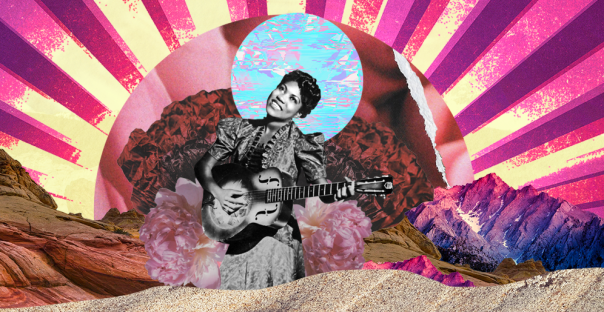
Artwork by Kendrick Daye

Rock-n-Roll was invented by a queer Black woman born in 1915 Arkansas. Your disordered hardcore punk rock was sanctioned by a kinky-haired Black girl born to two cotton pickers in the Jim Crow South. The electric guitar was first played in ways very few people could have ever imagined by a woman who wasn’t even allowed to play at music venues around the country.

The Patron Saint of rock music is Sister Rosetta Tharpe. The original punk rebel from which we were all born, SRT is muva.

Born Rosetta Nubin in Cotton Plant, Arkansas to parents Katie Bell Nubin and Willis Atkins. Two regular folks both passionate about music. Growing up in the Church of God in Christ (her mother was a preacher), religious worship through musical expression, Tharpe musicality was fostered in an encouraging environment from the jump. Described as a music prodigy, four-year-old Nubin began singing and playing her beloved guitar in the church. Even in that way, Tharpe is representative of an American musical history born in the Black church.

By six, Tharpe was a featured performer in a traveling evangelical troupe where she accompanied her mother to gospel concerts all across the country, playing with people like Duke Ellington, before eventually settling in Chicago. Traveling influenced her a lot, and her music was flavored both by urban contemporary and the sounds of rural, backwoods towns. By 19, she had met and married Thomas Thorpe, a preacher, too. But that didn’t last long. And by 1948, ol’ girl had left her husband—taking his last name with her, which she adopted as a stage name. Thanks for that, Thomas.

1938 would turn out to be a banner year for Tharpe. During this time she recorded her first pieces of music, with the backing of Lucky Millinder’s jazz orchestra, This would mark the first time a gospel act would lay down tracks for Decca Records, a British lael that boasted other icons like Bing Crosby. But Tharpe was still just an icon in the making. Somewhat of a legend all on her own. During this time she came out with her first hit, “Rock Me” by Thomas Dorsey. And that shit is kinda emo! And powerful. Not only a talented guitarist, but Tharpe’s soaring vocals on the track also knock the wind out of you to this day.

Performing as both a solo artist and occasionally in collaborations with groups like the all-white group, the Jordanaires and Cab Calloway, Tharpe brought her show to places like the Cotton Club and Carnegie Hall. Shocking and then captivating audiences, most people at that time had never even seen a Black woman play an electric guitar before. Let alone one who could command one to make such noises. Both controversial and respected for her undeniability, SRT brought gospel music to mainstream popularity every night she performed. Blending the sounds of her childhood with jazz, blues, and the genre she was inventing all her own. Even when this ostracized her from the gospel community.

In 1944, another seminal year in Tharpe’s career, she released “Strange Things Happening Every Day”. A song that went on to become the first gospel to chart on Billboard’s Harlem Hit Parade (now R&B chart). It is considered by some to be the first rock song, ever. Fast-forward two years and Tharpe is witnessing Marie Knight and Mahalia Jackson live in concert in New York City. Utterly spellbound by Marie Knight, Tharpe tracked her down and the two set out to perform together. While Knight sang and played piano, SRT did both, plus guitar. The two became lovers and creative partners through the rest of the decade. During this time they recorded “Up Above My Head”.

Sister Rosetta Tharpe continued to tour and make new music throughout the fifties and into the sixties. In 1964 she performed the now infamous show at an abandoned railroad station where it was broadcast nationwide in England. Dressed in that luxurious fur coat and driven by a horse-drawn carriage, Tharpe was rock-and-roll royalty whether people knew it then or not. Regardless of how historic and inspirational this show was, the sixties were when her popularity began to fade. Blues began to surge and she toured Europe as part of the Blues and Gospel Caravan alongside Muddy Waters and Otis Spann. But with the rise of male and white rock singers and musicians who appealed more to mainstream culture–as well as Tharpe’s devotion to recording religious material—she was pushed to the fringes of the musical movements she helped inspire.

And inspired many she did. Everyone from Chuck Berry to Elvis was influenced by Tharpe’s musicality. During his induction speech at the Rock-n-Roll Hall of Fame, the Man in Black, Johnny Cash shouted her out as his favorite singer. A fact daughter-in-law Rosanne would later back up. Everyone from Jerry Lee Lewis to Aretha Franklin credit her musicianship as an important influence on them. “She influenced Elvis Presley, she influenced Johnny Cash, she influenced Little Richard,” says Tharpe’s biographer Gayle Wald. “She influenced innumerable other people who we recognize as foundational figures in rock and roll.”

“When people would ask her about her music,” Wald says, “she would say, ‘Oh, these kids and rock and roll — this is just sped up rhythm and blues. I’ve been doing that forever.’”

Sister Rosetta Tharpe died from a stroke in Philadelphia in 1973. She had been living there with her mother in a modest home after her leg was amputated as the result of diabetes-related complications. Marie Knight was there to do the makeup and hair for her burial. Tharpe was buried in an unmarked Philly grave that has since been annotated.

Reference

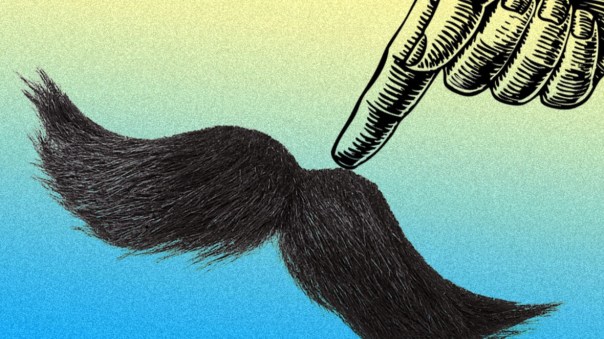
Gay History: When Did We Turn on the Moustache?

Or: When did the moustache stop turning us on?

Quick thought experiment: Close your eyes and, in the hairiest part of your mind, try to picture the most iconic beards from history.

Done?

Odds are, you’ll have been imagining an assortment of upstanding, wise gentlemen — the likes of Charles Darwin, Santa Claus, Abraham Lincoln, Dumbledore.

Now try the same sort of whiskers visualization with mustaches.

What do you get?

Adolf Hitler and Joseph Stalin, every time.

For some reason, mustaches make us reach straight for the villains. But what about all the famous ’stache-toters who have had a positive influence on the world: Einstein? Gandhi? Martin Luther King? John Oates from Hall & Oates?

There’s clearly some sort of facial prejudice going on here, because while full beards have been warmly accepted by fashion and society at large for a decade or more now, mustaches on their own have been sneered at as second-class frizz for far, far longer than most of us have been able to grow one.

According to Lucinda Hawksley, art historian and author of Moustaches, Whiskers and Beards —  who happens to be a great-great-great-granddaughter of the fantastically whiskered Charles Dickens —  the fact that the mustache was “hijacked by the dictators” actually had a huge historical impact on above-the-mouth fashions. Whereas in the 1930s, the elegant lip-strips of silver-screen stars like Clark Gable, Errol Flynn and Ronald Colman had bestowed glamor, prestige and enormous popularity upon the mustache, says Hawksley, its associations with both Nazi Germany and Soviet Russia made the thought of wearing one feel decidedly less dashing in the decades following World War II.

Still, for all that the Führer’s trademark toothbrush mustache and Uncle Joe’s walrus style in particular suffered by association, the ’stache remained a viable option in other guises for men interested in projecting an image of rugged machismo. This reached an apex of billowing perfection in the early 1980s with Tom Selleck as Magnum P.I. But for Hawksley, this was also the decade in which the mustache categorically lost its luster across the board. After that, she says, Selleck “still managed to have a moustache and carry it off, but for pretty much everybody else, it was completely outdated.”

Hawksley believes there were two main reasons for this. The first was the advent of designer stubble: “That became the big thing,” she says. “So, suddenly, instead of having a mustache and no beard you’d have a small amount of both.” The second is a recurring theme she sees in evidence “throughout the history of men’s facial hair: It’s that the younger generation wants to do the opposite of what their fathers had done. In the late-Victorian period, for example, by the 1890s, you’ve got young men saying, ‘I’m not having a beard — my dad and my grandfather had beards, and they’re just completely old-fashioned.’ And that’s exactly what happened in the 1980s: ‘Oh my God, a mustache! That’s such a 1970s look!’”

At around that time, though, something else was undermining the status of the mustache as the height of heterosexual manliness. In his book One Thousand Beards, Allan Peterkin (who has been a mustache consultant for Jimmy Fallon) points to Selleck’s 1980s thicket as one of the last great American specimens, too. But he argues that Magnum also represented a mainstream, TV-friendly offshoot of a popular gay look of the era: “The so-called ‘clone,’ with his obligatory mustache, bomber jacket, beefed-up shoulders and muscular butt under tight jeans.”

This Freddie Mercury-esque “clone” look had evolved in turn, writes Peterkin, from the subculture of “leathermen” in the gay clubs of the 1970s, whose “sadomasochistic practises and role-playing flourished and became a new homoerotic norm. The look was hypermasculine,” he continues. “Think Tom of Finland iconography — and both mustaches and sideburns topped (and bottomed) it off.”

Peterkin also highlights the Village People, whose stage routines for hits such as “Y.M.C.A.” and “Go West” featured both a leatherman and a mustachioed cowboy, helping to make Middle America aware of the mustache’s prominent status in gay culture.

Perhaps equally devastating for the ’stache’s popularity in straight society was the running joke in the first four Police Academy movies — from 1984 to 1987 — in which hapless male characters find themselves trapped in a fictional gay club, the neon-lit Blue Oyster Bar, where they’re forced to dance with fuzzy-lipped leathermen. It was an increasingly unfunny gag, which simultaneously managed to entrench a daft homophobic stereotype and torpedo the mustache as a macho status symbol for straight men.

What really made mustaches utterly unwearable, though, wasn’t so much their association with gay and S&M subcultures but that — as epitomized by those Blue Oyster skits — they became the subject of ridicule. Hawksley points out that when “it stopped having that macho look about it, the man with the mustache became a bit of a joke. It was the bank manager, the annoying teacher…”

If the mustache’s appeal was entirely wrapped up with its machismo, how did it acquire its super-manly image in the first place? For Hawksley, the answer lies in its surprisingly important place in military history. Facial hair initially became a trend thanks to British soldiers fighting the Crimean Warin the mid-1850s. Says Hawksley: “It was the first time they’d ever been able to grow a beard in the army, simply because they hadn’t been able to shave — the shaving water would freeze; they didn’t have enough shaving soap… And so when they came back, it was the sign of a hero because the Crimean War was so widely publicized.”

Elaborate face topiary acquired a similar heroic status during the American Civil War in the following decade, with the U.S. Army having relaxed its outright ban on mustaches (except for soldiers serving in the cavalry regiments) in 1857. In military traditions on both sides of the Atlantic, full beards quickly gave way to mustaches as the mark of a whiskered warrior. Incredibly, while beards were banned from 1860 onwards, the British Army actually required all soldiers to grow mustaches until World War I; after that, they became associated with the higher ranks, especially in the Royal Air Force.

Even today, while U.S. Army regulations outlaw beards, mustaches are permitted as long as they “will not present a chopped off or bushy appearance, and no portion of the mustache will cover the upper lip line, extend sideways beyond a vertical line drawn upward from the corners of the mouth… or extend above a parallel line at the lowest portion of the nose.”

The Ultimate Mustache Grooming Guide

Mustache grooming made easy.

Mustache grooming can be tedious, since you’re working within the cramped space between your nose and top lip. There’s also an overwhelming number of mustache styles to choose from, which can make the very act of mustache grooming a bit convoluted.

But really, there’s one mustache style that can teach you the ins and outs of mustache grooming better than all the rest: The Chevron, famously worn by the likes of Tom Selleck and Freddy Mercury. Below, you’ll find a mustache grooming guide built around this mustache style, which will leave you with everything you need to know about how to shave a mustache.

Step #1: Trim your entire mustache using a pair of electric clippers set to the longest setting (or whatever your desired length is) — that way, your mustache hairs will be a single, uniform length.

Step #2: The edges of the mustache should extend just half an inch beyond the corners of your mouth — use a razor to shave any hairs growing further towards your cheeks.

Step #3: Finally, brush the mustache hairs upward using a small mustache comb and trim any stray hairs hanging over your upper lip using a pair of grooming scissors.

That’s it: The basis of mustache grooming. Achieving other mustache styles is simply a matter of leaving a little more hair there and a little less hair here. Take the classic handlebar mustache, for instance:

Step #1: Part your mustache hairs down the middle, then comb each side down and out.

Step #2: Use a small pair of grooming scissors to lightly trim any stray hairs — start towards the middle, cutting less and less hair length as you make your way to the edges of the mustache

Step #3: Apply a wax or a pomade to hold the hairs in place — once applied evenly throughout the mustache, twist the hairs together with your fingers, then curl the still-twisted hairs up and in.

Step #4: Lastly, and most importantly, eye the curls for evenness in the mirror. Make adjustments if necessary.

If the handlebar mustache is a little too hipster for you, the horseshoe mustache is another mustache style that can only be achieved if you have a basic understanding of mustache grooming:

Step #1: Use a pair of electric clippers to trim the entire mustache to your desired length (the #8 or #10 guard are good choices for this mustache style).

Step #2: Put the tip of your finger on the corner of your mouth, making a straight line down to your jaw, and use it as a guide for trimming the bars of hair with your electric clippers — just be careful not to cut your finger.

Step #3: Once the bars on each side of the mustache are even, eye them for your desired length. Make adjustments if necessary.

If you’re interested in other mustache styles — like the slick pencil mustache or the bushy walrus mustache — check out this advice on how to cultivate and care for various mustache styles. Alternatively, if you’re less interested in mustache grooming and more interested in starting anew, read up on the best way to shave that tricky patch of face smooth.

Now get out there, and keep your top lip warm (or bare that subtle skin) in style, bucko.

Reference

Gay History: Raymond Burr’s Secret Life

mages may be subject to copyright. Learn more

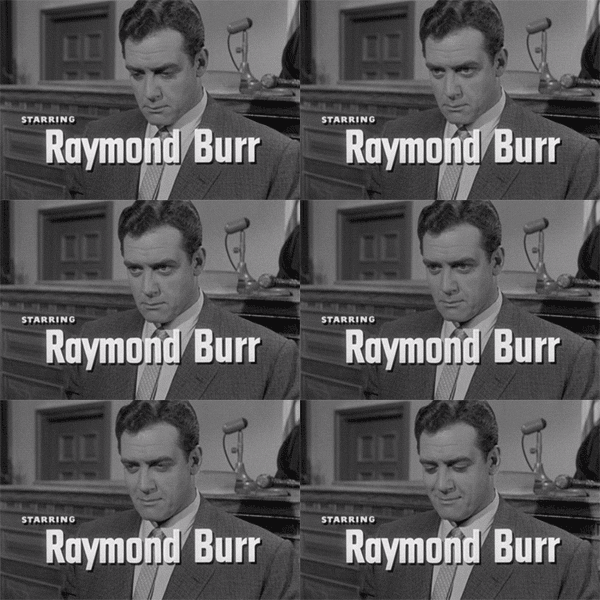
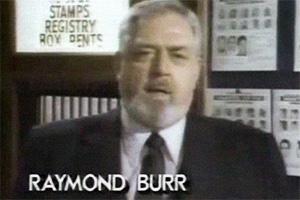
Raymond Burr was in excruciating pain as he filmed the final “Perry Mason” episodes in 1993. Almost no one on the set knew he was dying of cancer. Biographer Michael Seth Starr is not surprised. According to Hiding in Plain Sight: The Secret Life of Raymond Burr (published by Applause), secrecy was second nature to the actor. He became one of the world’s most familiar TV stars during the original run of “Perry Mason” (1956-1966) and went on to another popular if less remembered series, “Ironside” (1967-1975). And there he was, instantly recognizable and in the public eye, a gay man who kept his sexuality concealed.

Any admission of homosexuality would have poisoned his career at any time before the 1980s. Times changed but Burr kept his own counsel through the end. He was actually once married, briefly, and went on to invent no less than two dead wives and even a dead son to fill out the blank spaces in his life story. Along with false reports of his service during World War II, he repeated these additions to his autobiography so long and so often that they found their way into his obituaries. In the 1950s he was “romantically linked” with rising starlet Natalie Wood. They were genuinely fond of each other but sparks never flew. Burr met his life companion, onetime actor Robert Benevides, in 1957 on the “Perry Mason” set. They were together through Burr’s death.

The story of a deeply closeted Hollywood lifestyle isn’t entirely unique; the backdrop of Burr’s career adds to its interest. Typecast as a “heavy” when he drifted into Hollywood after World War II, his hulking presence and brooding scowl made him ideal for film noir and crime dramas generally. He played the furtive murderous husband across the courtyard in Hitchcock’s classic Rear Window (1954) and finally stood on the right side of the law as the district attorney dismantling Montgomery Clift’s testimony in A Place in the Sun (1951). Never considered an A-list movie actor, he became a star in the emerging medium of television. Playing the title role in “Perry Mason,” he became one of TV’s best paid and best known faces. Later, as the wheelchair-riding detective in “Ironside,” he might even have spurred the drive toward ramps and accessible facilities for the handicapped.

Starr notes that throughout his public life Burr was unfailingly generous to charities and gave much of his time (when he wasn’t keeping a grueling work schedule) to public service of one sort or another. That the author only assembled a relatively slender volume out of Burr’s life probably indicates that the actor carried many of his secrets to the grave.

11 things you might not know about Raymond Burr

Learn how the ‘Perry Mason’ star links to orchids, Godzilla, wine and the history of synthesizers.

Top image: AP Photo

Raymond Burr is synonymous with Perry Mason. Yet the Canadian-born actor was far more than television’s greatest defense lawyer. Of course, he played the titular wheelchair-bound police consultant on Ironside, too. Early in his film career, he was a natural in film noirs. Beyond the screen, Burr was a horticulturist, an oenophile and a seashell collector.

Burr’s fascinating biography was filled with fabrication and speculation, as he and his publicists obscured his private life. Here are things you might not know about Raymond Burr.

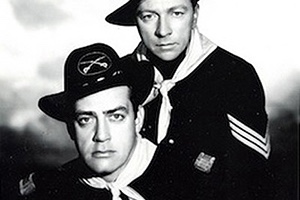
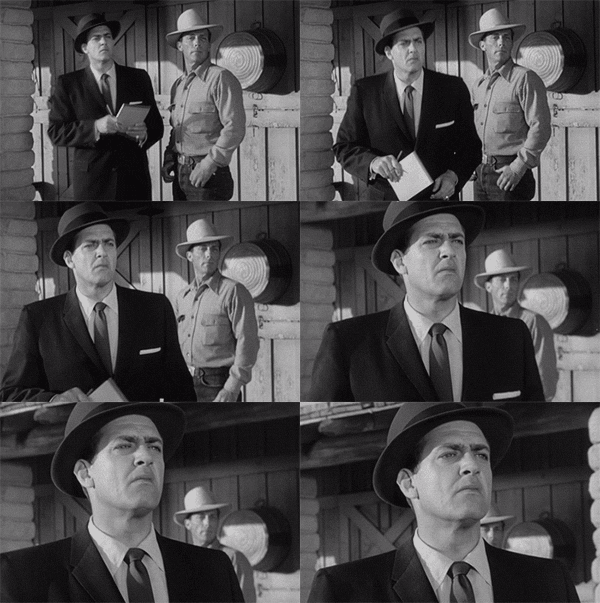
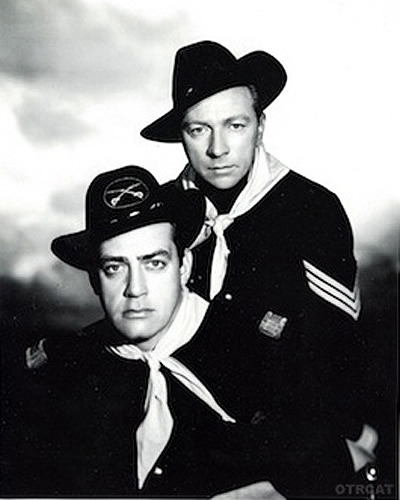
1. He starred in the radio program ‘Fort Laramie’ and read his lines from a wheelchair

Image: radiospirits

Gifted with a rich, resonating voice, Burr naturally found work in radio. In the 1956 program Fort Laramie, Burr starred as Cavalry Cpt. Lee Quince. In a foreshadowing of his Ironsiderole, he had to record much of his lines while confined to a wheelchair, after injuring his leg during the filming of Crime of Passion.

2. He was considered for the role of Marshal Matt Dillon.

Though his roots were in noir, he could have been a Western star, and not just on the radio. Burr was up for the lead role of Matt Dillon in Gunsmoke, though he was deemed too overweight for the role, as was William Conrad, the man who played the Marshal on the radio. Producer-director Charles Marquis Warren was reported to have proclaimed, “When he stood up, his chair stood up with him.”

3. He was asked to lose weight for the role of Perry Mason.

Thankfully, the creators of Perry Mason found the right man for the role. Though the 40-year-old’s weight would again be an issue with producers. Burr beat out around 50 actors who auditioned for the gig, according to the book Raymond Burr: A Film, Radio and Television Biography. One catch: They made him take a crash diet, dropping his weight to 210 pounds.

4. He was in a Godzilla movie, but never interacted with the Japanese actors.

Image: Toho Company

The arrival of Godzilla in 1954 shook the film industry. In 1956, Jewell Enterprises took the monster movie and re-edited it for American audiences. Burr was cast as an American reporter, and footage of him was deftly inserted into the original to make it seem as if he were interacting with the other actors, who had completed their work two years prior. It was rumored that all his scenes were filmed in one day, but that seems to have been debunked, as his work likely was shot over the course of six days.

5. He portrayed Perry Mason in four different decades.

Just how popular was Perry Mason? After the series’ original run from 1957–66, Burr returned to the role for a string of 30 TV movies that aired from 1985–95. Burr headlined 27 of them, up until his death in 1993. The character was around in the 1970s, too, in the flop series The New Perry Mason, with Monte Markham playing the ace lawyer.

6. He was the original host of ‘Unsolved Mysteries.’

Image: NBC

Robert Stack, sporting his trench coat, is well remembered as the host of Unsolved Mysteries. He was not the first choice, however. On January 20, 1987, he hosted the NBC special that became the pilot for the series, though his services would prove to be too costly for the network to keep him on as host.

7. He made wine.

Image: AP Photo/Eric Risberg

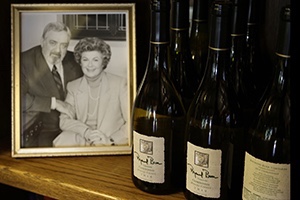
Raymond Burr Vineyards are located in Dry Creek County, California. The operation started in 1986 with the planting of Cabernet Sauvignon, Chardonnay and Portuguese grapes.

8. His show ‘Ironside’ featured the first synthesizer-based TV theme.

Legendary producer Quincy Jones composed the killer theme to the 1967 crime series, about a consultant to the SFPD who had been paralyzed from the waist down by a bullet. If you’re unfamiliar, you might recognize the siren-like synthesizers from the Kill Bill movies. Jones later included a longer version of the tune on his 1971 album Smackwater Jack

9. He lived on a small island in Fiji.

Looking for privacy? You’ll find it on the tiny island of Naitaba, Fiji. Burr and his partner raised coconuts and cattle on the Pacific getaway.

10. He grew orchids and named a hybrid after his ‘Perry Mason’ costar

Another of Burr’s passions was flowers. He was a skilled grower of orchids, and with his partner, Robert Benevides, he hybridized approximately 1500 varieties. One hybrid was named for Barbara Hale, the actress who played Perry Mason’s loyal secretary, Della Street.

11. His partner was an actor, too.

Image: The Outer Limits / MGM Home Entertainment 

Benevides had experience on television, as well. He landed a handful of guest roles on shows such as The Loretta Young Showand West Point. His best-known performance is perhaps the Outer Limits episode “O.B.I.T.” He is the military man choked to death by an eerie creature as he monitors the Outer Band Individuated Teletracer.

Reference

Gay History: Taboo or Not Taboo, The Fashions Of Leigh Bowery

Reading The Face magazine in early 1984 I was overwhelmed by a double-page spread entitled The New Glitterati featuring Leigh Bowery photographed in his ‘Paki from outer space’ look. His face was camouflaged in bright Plasticine-blue make-up, his head adorned with a mock leather military cap emblazoned in sequins and badges, while his entire body dripped with jewels, piercing and lots of body glitter. He wore a masterful creation – a bright green velour top with plunging neckline, fitted with this amazing red, asymmetrical zipper. Bowery looked like some exotic fashion god, a contemporary Krishna put through the blender with an extraterrestrial. It was kitsch and outrageous. It was inspirational. Did Jean Paul Gaultier, John Galliano or Vivienne Westwood design these clothes? Intrigued, I wanted to know more. The writer of the article observed:

One glance at these blinding photographs reveals why designer and jovial poseur Leigh Bowery – 22 years old, Abba addict and unrepentant champion of platform shoes – chose to leave his native Australia and cultivate his own outrageous style on the fringes of London’s club scene. They just didn’t understand him in the outback.1

 I sighed … finally, an Australian designer had made it into the pages of this influential style journal. Bowery did more for Australian fashion in two pages than had occurred in the past century … and the best was yet to come.

An extra extrovert, the ultimate spectacle, the fashionable performer, the grand poseur, Bowery communicated through his blatant sexuality, his extreme physical exaggerations, and his outrageous dress codes. Bowery was not simply dressing up; it was his lifestyle and commentary on the mundane, a joke about appearance. His collections or ‘looks’ were based on himself manipulating his body with clothing and make-up. Working outside the comfort zone, he developed a clothing aesthetic that few would dare follow. Original, provocative, evolutionary; Bowery manipulated clothing to totally change one’s appearance, like a form of cosmetic surgery. ‘In an age when pop stars, actors, designers – those who traditionally dictated stylistic trends – are almost indistinguishable in their uniformity and blandness, Leigh Bowery stands out like an erection in a convent.’2

Leigh Bowery’s place in fashion, art and popular culture is seditionary. The fashions he created were not worn on the streets, very rarely seen in daylight, or generated for mass consumption. His dress style hailed from club culture,3 and the concepts of dressing up and masquerade.

Bowery was born in Sunshine – a baby-boomer, semi-industrial suburban sprawl, west of Melbourne – on 26 March 1961.4 He attended Sunshine Primary School and later, Melbourne High School. He passionately wanted to be a fashion designer and studied for two years at Royal Melbourne Institute of Technology (RMIT) before becoming disillusioned by the restrictions imposed by formal training. Fuelled by the visual culture of style magazines, Bowery was attracted to London by the new romantic/blitz movement of the early 1980s where fashion, art and music were fused under the glamorous spotlight of the nightclub scene. Pop stars and bands such as David Bowie, Steve Strange, Spandau Ballet, Duran Duran and Culture Club influenced style. This was the breeding ground for the most creative, experimental and sexually charged clothing. Clubs were the stage for dressing-up; men and women wearing outlandish garments, big hairstyles and faces plastered with make-up. Gender boundaries were easily challenged in this world and androgynous looks abounded.5 Pretty clothes and special effects like frilly shirts, kilts, lace, satin and make-up were all worn by men – gay or straight – ‘it was almost like a love affair with yourself’.6 In the 1970s David Bowie, especially with his Ziggy Stardust persona, had ‘invented a whole language of art posing, he[‘d] invented the language to express gender confusion’.7 Fantasy and escapism were attractive vehicles to express individuality through clothing, make-up and hair. The key rationale for clubbers was attracting attention and being the centre of attention: dressing up was very competitive.

In 1984 the relaunch of London Fashion Week provided a platform for British designers to show their wares. This event, combined with vibrant street styles and the underground club scene, spawned the most creative and eccentric clothes, making London a potent source for world fashion trends. It nurtured and gained recognition for the fashion designers Vivienne Westwood, John Galliano, and in recent times, Alexander McQueen and Hussein Chalayan. However, it was clubs that provided the major venue, market and audience for generating clothing that was beyond one’s wildest dreams/nightmares.

Without working from ‘classics’, referencing the cultures of the world, fashions of previous decades or centuries, emulating a favourite designer or the current pages of French Vogue, Bowery was inspired to create something that bore no resemblance to anything. Early in his career he had begun to despise fashion because it was too restrictive and conservative. Bowery’s looks were incredibly fresh and up-to-the-minute fashionable. Making items over a short period of time, for a special event or club night out, his garments were a spontaneous response to the immediacy of his environment.

I believe that fashion (where all the girls have clear skins, blue eyes, blond blow-waved hair and a size ten figure and where all the men have clear skins, moustaches, short blow-waved hair and masculine physique and appearance) STINKS. I think that firstly individuality is important, and that there should be no main rules for appearance and behaviour. Therefore I want to look as best I can, through my means of individuality and expressiveness.8

 Bowery’s costume designs were complex, technically difficult and fantastic. By 1985 they bore no similarity to the catwalk or street styles of London or the rest of the world. Vivienne Westwood initially was a great inspiration to Bowery, particularly her anti-establishment spirit, her distortion of clothing and body forms, and her design mantra that ‘clothing could be subversive’.9 Bowery garments were worn by performers like Boy George, who recalled:

I was dressed like a Jewish bathroom, gold chains, safety-pins, badges and buckles, champagne corks and tassels. The costumes designed by Judy Blame and Leigh Bowery were meant to hide my expanding girth, although it was hard to look thin in an A-line smock with angel-wings jutting out the back.10

 In 1985 Bowery evolved from a fashion designer into an aesthetic revolutionary when he became the public face of the nightclub Taboo. The name said it all. Situated in the Maximus discotheque at Leicester Square, the club was originally staged only once a fortnight. Wearing a different outfit every week, Bowery was the main attraction. Some of his kitsch looks included a

short pleated skirt, with a glittery denim, Chanel-style jacket teamed with scab-make-up and a cheap, plastic, souvenir policeman’s hat11 … yellow gingham jacket printed with red spots with matching shirt and face12 … a denim jacket covered with Lady Jayne hair slides and his bald head decorated with dribbled dyed glue. The club’s dress code was ‘dress as though your life depends on it, or don’t bother’.13

 The taste for the ridiculous, and his constantly changing looks, ensured that when Bowery entered the club, everyone else looked boring. Taboo was not an exclusively gay club, however, it attracted a large gay following lured by the opportunity to be part of the outrageous fashion scene. The Taboo nightclub symbolised the excesses of the 1980s, looking fantastic was taken to extremes. Unfortunately, it closed after a year due to drug soliciting. Boy George has turned this club phenomenon into the Broadway musical Taboo.14

Without the assistance of the slick, branded imagery associated with major fashion labels and huge marketing budgets, Bowery’s fame and reputation rested solely on being seen. His creations were documented and celebrated in the London style magazines, i-D, The Face and Blitz; his antics were reviewed in the club pages, communicating his visual language. Promoting the fringe, these magazines gave copy and editorial to the young and original, promoting an ideas culture that supported independent design.15 In Melbourne the enclave of independent fashion designers and boutiques situated in Greville and Chapel streets would proudly display the latest edition of The Face or i-D in the shop window, and they were indispensable reading in every hairdressing salon. Many Australians followed Bowery’s career and lifestyle through this source, even the interior of his flat that he shared with Trojan16 was featured – walls covered in Star Trek wallpaper, clumps of plastic flowers decorating the skirting, and UV-lit. Interviewer: ‘Does the interior of your home match the interior of your mind?’ Leigh and Trojan: ‘Yes, it’s an extension of what we wear.’17

Bowery was a great fan of the American film director John Waters whose movies had a profound effect on the development of his dress aesthetic, his humour and body politics. Waters pushed the boundaries of taste, making films with outrageous plots and an offbeat humour merged with an unseemly collage of characters, scenery and costumes. This ‘trash’ aesthetic is best portrayed in the film Pink Flamingos, 1972, about the search for the filthiest person alive, which was Bowery’s favourite movie.18 The principle actor, Harris Glen Milstead, working under the name Divine and affectionately known as the Queen of Sleaze, and a cult figure in his own right, was a cross-dresser. His huge physique was featured wearing figure-hugging gowns or sack dresses. The representation of the ‘fashionable’ unfashionable person was meticulously crafted, with huge, bouffant hairstyles and highly stylised make-up, reminiscent of the Kabuki theatre, accompanying Divine’s extensive wardrobe. This image of alternative, Baltimore glamour was one Bowery chose to follow.
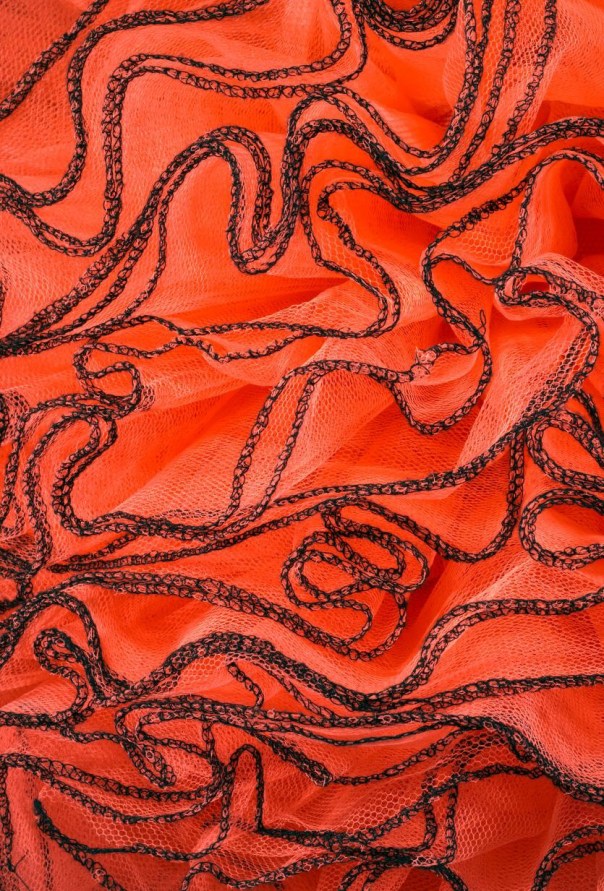
The magnitude of Bowery’s costumes is unforgettable, both in physical scale and psychological effect. The Metropolitan, c. 1988 – christened by Nicola Bowery in reference to its most famous appearance at The Metropolitan Museum of Art, New York, at the opening of the Lucian Freud retrospective in 1993 – had been worn by Bowery to various events (figs 1–4,8)19 Like many of his fashioned items, The Metropolitan was a work in progress that would simply be upgraded or reaccessorised to suit the occasion. This dress reads like a masculine ballgown, it is not intended to be drag or transvestite costume. Gender bending was common in the 1980s; the most infamous example was the skirted male suit produced by Jean Paul Gaultier in 1985. It was an attempt to blur the distinctions between male and female dress, however, the translations into mainstream fashion were commercially unsuccessful.20

Forged from a garish floral sateen, The Metropolitan boy’s dress has a square, flat bodice with a right breast pocket and open underarms. The bodice extends into a full-face mask with cut-out holes for the eyes and mouth. The mask was a device Bowery employed to prevent ruining his clothes from greasy make-up stains; in Metropolitan he could apply make-up only to his eyes and lips. Using extensive metreage, the enormous skirt appears to hover, supported by a series of taffeta and tulle petticoats, producing a fashionable silhouette reminiscent of 1950s haute couture. Bowery was serious about the history of fashion and his private library contained many books relating to designers, including the major French couturiers Cristobal Balenciaga and Christian Dior, the pre-eminent role models who practised the very expensive, drop-dead-gorgeous philosophy of French high fashion. Restricted by money, Bowery still participated in fashion’s excesses by relying on inventive detailing and utilising entire bolts of inexpensive fabrics for the production of major works. His selection of ‘tasteless’, out of date, patterned prints purchased from discounted fabric shops defiantly challenged the grand-ballgown tradition. In this case, the floral motifs are enlivened with clusters of blue sequins painstakingly sewn on individually by Nicola Bowery in a mock Dior/Balenciaga style.21

Bowery was a professional dressmaker; he drafted patterns, cut fabric and sewed. His garments were solid constructions, strong enough to survive the rigours of clubbing. When he lived with the corsetiere Mr Pearl, they would purchase second-hand corsets, pull them apart and remake them to learn the exacting construction techniques.22 

The Metropolitan is a total disguise, providing an obvious reference to traditions of fancy dress and masquerade,23 a perfect choice for a gallery opening depicting the wearer’s naked portraits! The art world was familiar territory; Bowery visited museums and he avidly collected art books and catalogues. Bowery even played the role of an art exhibit in 1988, performing at Anthony D’Offay’s London gallery wearing a different outrageous, tasteless, memorable look each day. Bowery desperately wanted his artware to be acknowledged by this elite. Nicola Bowery intentionally named this costume The Metropolitan in the hope that it would enter that prestigious collection.
In a rather perverse way, Bowery loved fashion protocols and niceties; wearing gloves, hats, belts and shoes. Gloves were a particular favourite and an expensive item to buy, so he would often steal these to complete his ensemble. Like the leader of a militant fashion army, Bowery walked into the Metropolitan wearing a floral dress with a Kaiser helmet, a pair of khaki camouflage-print gloves, a leather neck-and-waist belt and a pair of candy-pink platform shoes, and literally invaded the space. In all the fashion galas and openings held at the Metropolitan, no one had ever seen anything like this. His entrance would have been either very funny or very frightening. Just like a scene from a John Waters movie, he stole the show. Bowery’s exposure and main recognition in the mainstream art world came through the hauntingly beautiful, naked portraits of him painted by Lucian Freud. With his curvaceous, plump body and luminescent, waxed skin and his un-made-up natural face with pierced cheeks in-filled with clear plastic plugs, this was the Bowery the art-museum world could relate to.

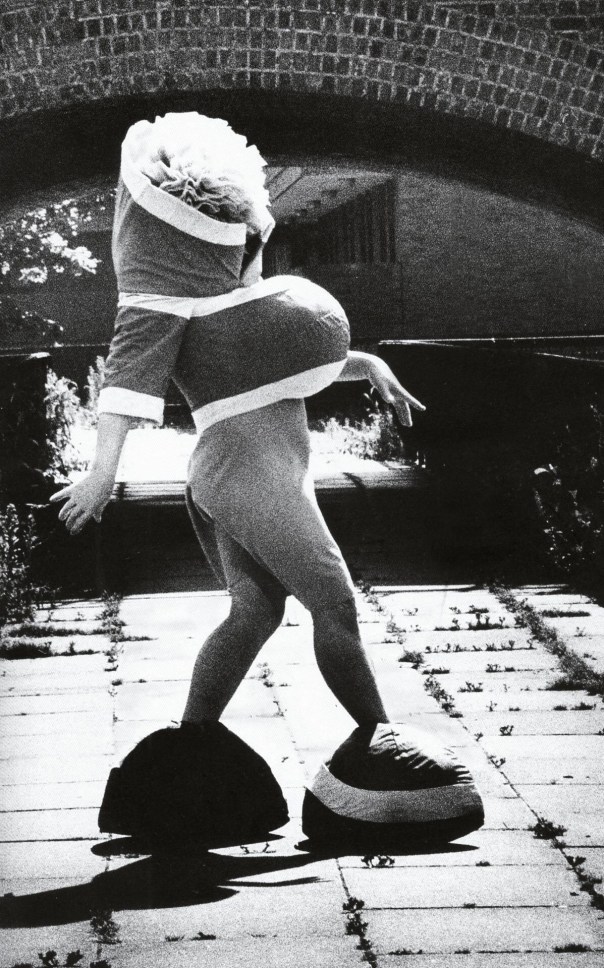
After 1990 Bowery stopped using fancy decorations on his clothing, instead, his work became much more abstract and surreal. During a trip to Japan he had discovered a catalogue of Transformer robots. These sophisticated toys provided a catalyst for Bowery to reconfigure his body and clothing in strange ways: he became a transformer. The Pregnant tutu head, c. 1992, costume is an experiment with scale and form (figs 5-7). Bowery in his performance pieces had already mesmerised his audience with giving birth to Nicola Bowery on stage.24 He was fascinated by the body’s capacity to change shape, and pregnancy was the most obvious example. Bowery’s clothing rituals often involved pain, discomfort and restrictions that produced difficulties with breathing, urinating and mobility. Although not intentionally designed for sadomasochistic pleasures, he applied any device, physical or manufactured, to achieve the masterpieces of his imagination, and this was pleasure enough.

Bowery had already attempted to distort his own body with unorthodox combinations of clothing forms and the deception of make-up. The Pregnant tutu head‘s top has a protruding belly suggesting the silhouette of a pregnant woman and the continuation of the species; it is worn with stretch pants. To continue this exaggerated silhouette and reinforce the symbol of growth, Bowery crafted half-circle, fabric shoes from large pieces of foam rubber covered in brown fabric. The bulbous shoes look ridiculous, like the cartoon models worn by Mickey and Minnie Mouse. The headpiece is formed like a large pompom made from tiers of orange tulle frills zipping up the back; the wearer encapsulated in a puff of fabric. A pair of full-length, dark blue gloves complete this ensemble. Bowery’s 1990s clothing is often visually disturbing, as he experimented with costume freakery.

Since his death in 1994,25 Bowery’s contribution to fashion and style culture has begun to be assessed and acknowledged in wider forums beyond style magazines and the club subcultures. Today, the boy from Sunshine is recognised internationally as a major style icon of the twentieth century, he was ‘surely a predictor of fashion!!!!’.26 Phaidon published The Fashion Book in 1998,27 a gigantic tome devoted to the 500 leading designers who had created and inspired world fashion over the past 150 years. Only three Australians made the final cut: Colette Dinnigan, Akira Isogawa and Leigh Bowery. Bowery’s recognition came not from commercial success or as a known fashion brand, but from his creativity and originality, described in the book as ‘part voodoo part clown’. He was indexed as an icon alongside the likes of David Bowie and Johnny Rotten. Bowery was not about setting fashionable trends, however, the influence of his creations is seen in the work of designers such as Vivienne Westwood, Alexander McQueen and Hussein Chalayan, and in the conceptual approach of much contemporary fashion, reinforcing the ‘continuing importance of this experimental dimension of fashion culture’.28

An exhibition of Leigh Bowery’s work was staged in Australia in 1999: Leigh Bowery: Look at Me at the RMIT Gallery, Melbourne, curated by Robert Buckingham and designed by Randal Marsh, included original costumes, videos and photographs. For many Australians this was their primary exposure to Bowery’s work in a local context,29 and certainly, to see actual costumes was provoking. Unexpectedly, these crafted, one-off garments designed for club wear and art performance were neither pretty, fashionable nor utilitarian. Instead, they had the power and capacity to confront issues relating to appearance, sex and politics. For many viewers this experience was a revelation. Bowery’s genre was as provocateur. The National Gallery of Victoria acquired two costumes from this exhibition and it is the only gallery in the world (at the time of writing) to represent his costumes.30 Bowery is finally an official part of Australia’s material culture.

Perhaps the best recognition and understanding of Bowery’s work is the inclusion of The Metropolitan in the inaugural hang at the Ian Potter Centre: NOV Australia, at a gallery devoted to Australian art. ‘Leigh would be ecstatic’ if he knew he was part of a major public collection.31

Reference & Notes

This article focuses only on aspects of Bowery’s clothing design, in particular, the examination of his work in a broader fashion context, and does not attempt to cover his extensive repertoire, particularly his performance work or collaboration with the Michael Clarke Ballet Troupe.

1     L. White, ‘The new glitterati’, The Face, no. 48, April, 1984, p. 56. For a discussion of influence and role of the style magazine and fashion journalism see C. McDermott, Streetstyle: British Design in the 80s, New York, 1987, pp. 81–88; for an examination of the nature of fashion journalism see A. McRobbie, British Fashion Design: Rag Trade or Image Industry?, London, 1998, pp. 151–174.

2     A. Sharkey, ‘The undiluted Leigh Bowery’, i-D, no. 42, The Plain English Issue, June 1987, p. 63.

3     ‘Because clubbing and raving are done by a narrow segment of the population after most people go to bed, the scale of the social phenomenon often goes unnoticed.’ S. Thornton, Club Cultures, Cambridge, 1995 p. 14.

4     For a complete account of Bowery’s life, see S. Tilley, The Life and Times of an Icon, London, 1997; and R. Violette (ed.), Leigh Bowery, London, 1998.

5     S. Cole, Don We Now Our Gay Apparel, New York, 2000, p. 158.

6     ibid., p.159.

7     J. Savage, Time Travel, Pop, Media and Sexuality 1976-96, London, 1996, p. 112.

8     Tilley, p. 97.

9     McDermott, p. 26. Vivienne Westwood collaborated with Malcolm McLaren from 1971 to 1983 before embarking on a solo career.

10     B. George with S. Bright, Take It Like a Man, London, 1995, p. 521.

11     Tilley, p. 57.

12     ibid., p.61.

13     ibid., p.53.

14     Music and lyrics by Boy George, based on the story by Mark Davies. Directed by Christopher Renshaw. Matt Lucas, Boy George, and most recently, Marilyn, have played the role of Bowery.

15     T. Jones (ed.), Fashion and Style: The Best from 20 Years of i-D, Koln, 2001.

16     Pseudonym used by Gary Barnes, 1966–86, who described himself as an ‘artist and prostitute’. Encouraged by Bowery, he painted confronting works in a Daliesque/naive style. They lived together for several years, Bowery dressing him in his latest fashion designs.

17     F. Russell-Powell, ‘Penthouse’. i-D, The Inside Out Issue, no.19, October 1984, p. 8.

18     Nicola Bowery, discussion with the author, 23 May 2002.

19     N. Bowery, discussion, 17 July 2002. The Metropolitan was purchased from Bowery’s widow, Nicola Bowery. She generously donated Pregnant tutu head to the National Gallery of Victoria in 1999.

20     S. Mower, ‘Gaultier’, Arena, London, July/August 1987, p.85. Gaultier produced only 3000 suits worldwide.

21     N. Bowery, discussion, 23 May 2002.

22     N. Bowery, discussion.

23     See A. Ribeiro. ‘Fantasy and fancy dress’, Dress in Eighteenth Century Europe, New Haven, 2002, pp. 245–282. The custom of masking or disguise goes back to antiquity. ‘The masquerade provided opportunities for role-playing and subversion of propriety in defiance of the conventions of society’ Ibid., p. 245.

24     For photographs relating to Leigh Bowery’s performances, from Wigstock to his pop group Minty, and his performances with the Michael Clarke Ballet Troupe, see Violette.

25     ‘The fabulous Leigh Bowery passed away on New Year’s Eve, 1994, and London lost another mirror ball. No one knew Leigh had Aids because he didn’t want them to. He said, “I want to be remembered as a person with ideas, not Aids.”’ George with Bright, p. 566.

26     Walter Von Beirendonck, letter to the author, 14 June 2002.

27     The Fashion Book, London, 1998. See Leigh Bowery entry, p.70; Colette Dinnigan, p. 135; Akira Isogawa, p.225.

28     D. Gilbert, ‘Urban outfitting’, in Fashion Cultures: Theories, Explorations and Analysis, eds S. Bruzzi & P. Gibson, London, 2001, p. 9.

29     In 1987 Bowery performed with the Michael Clarke Ballet Troupe at the Melbourne Town Hall, horrifying his parents and most of the audience with his obscene acts.

30     Nicola Bowery, discussion, 17 July 2002.

31     Nicola Bowery, discussion.
Gay History: The Weird Science of Homophobes Who Turn Out to Be Gay

There is some research suggesting a link between being closeted and being anti-gay. But while the notion feeds many jokes, it also obscures very real homophobia.

Photo Illustration by The Daily Beast

2017 has been a banner year for the armchair psychological theory that anti-gay public figures are secretly gay themselves.

Never mind the long-running jokes and memes about Mike Pence covering up some secret homosexual identity. There have been actual examples this year of outspoken anti-LGBT figures exhibiting behavior that seems to contradict their political ideology.

The same idea emerges every time: The hypothesis is that their bigotry doesn’t just make their sexual behavior hypocritical, it actually functions as a cover for it, consciously or otherwise.

Recently, there has been former Ohio state Rep. Wesley Goodman, who resigned late last week after it came out that he had had sex with a man in his office.

In March, former Oklahoma state Sen. Ralph Shortey resigned after being hit with child prostitution charges for allegedly soliciting sex from a 17-year-old boy. Shortey has reportedly decided this week to plead guilty to a child sex trafficking charge.

Both Goodman and Shortey are married men who were clear political opponents of the LGBT community while in office.

After Shortey was arrested, the Associated Press noted that he “routinely” voted for anti-LGBT bills, quoting the director of the LGBT advocacy organization Freedom Oklahoma who said, “He was never vitriolic about it, but he would make the bad votes.”

More strident was Goodman who, as the Columbus Dispatch reported, “consistently touted his faith and conservative values,” with a Twitter bio that read: “Christian. American. Conservative. Republican.”

As more information about their alleged misdeeds emerges—Goodman now stands accused of fondling an 18-year-old man at a conservative event, and of pursuing several young gay men—there is a certain grim catharsis in seeing such hypocrisy exposed.

The LGBT community will never tire of bringing up the long history of Republican gay sex scandals every time new—and increasingly unsurprising—allegations emerge, precisely because they seem to be so predictable in hindsight.

(As GQ sarcastically put it in response to the Goodman news: “Anti-Gay Ohio Republican Resigns After, Surprise, Having Sex with a Man in the State Capitol.”)

A 2012 study in the Journal of Personality and Social Psychology generated a fair number of headlines that year—including The New York Times’ “Homophobic? Maybe You’re Gay”—for suggesting that some self-avowed straight people who showed signs of same-sex desire were more likely to hold discriminatory attitudes.

Two authors on the study—psychologists Richard M. Ryan and William S. Ryan—wrote in their accompanying New York Times opinion piece that they had asked 784 college students to rate their sexual orientation on a 10-point scale and then told them to sort “images and words indicative of hetero- and homosexuality” into categories.

The “twist,” as they put it, were subliminal flashes of the words “me” or “other” before each image that can theoretically reveal subconscious bias based on how long it takes the subjects to sort images that don’t match their self-described sexual identity into the right category.

The result: The researchers isolated a “subgroup of participants”—more than “20 percent of self-described highly straight individuals”—who “indicated some level of same-sex attraction,” and who were “significantly more likely than other participants to favor anti-gay policies; to be willing to assign significantly harsher punishments to perpetrators of petty crimes if they were presumed to be homosexual; and to express greater implicit hostility toward gay subjects.”

“Thus our research suggests that some who oppose homosexuality do tacitly harbor same-sex attraction,” they concluded.

The psychological mechanism behind this subgroup’s anti-LGBT vitriol is, in theory, relatively simple: They are taking out their own issues with sexual identity on other people.

As Netta Weinstein, the study’s lead author, said in a press release, they “may be threatened by gays and lesbians because homosexuals remind them of similar tendencies within themselves.” So if you’re an American politician, there may be no more effective way to prove to yourself that you’re straight than to target LGBT people.

The 2012 study is certainly suggestive. It’s continually cited whenever it seems to apply to a homophobic figure, like after Pulse nightclub gunman Omar Mateen was rumored to have frequented the LGBT nightclub in the buildup to the shooting.

There are other studies that have come to similar conclusions. As Science magazine reported after Pulse, there is a “scattering of research” that suggests “some conflicted gay men might indeed be homophobic,” like a small 1996 study in the Journal of Abnormal Psychology that measured penile arousal and found a link between “homophobia” and “homosexual arousal.”

But the keyword in all of the above literature is “some.”

There is, at this point, enough research in this area to suggest that there may be something deeper to the armchair psychology. But the “secretly gay homophobe” theory is far from being a complete explanation of anti-LGBT prejudice in American politics.

Twenty percent of people who describe themselves as “highly straight” is still 10 percent fewer than the 32 percent of Americans who oppose same-sex marriage.

Just because that 20-percent subgroup is “significantly more likely” to tout an anti-LGBT ideology doesn’t mean we can assume someone like Mike Pence is likely to be covering up a secret past as a gay clubgoer just because of his anti-LGBT track record. So-called closet cases may be abundant, but there’s no way to prove that every Republican who tries to legalize anti-LGBT discrimination is hiding something.

In fact, overgeneralizing and joking as if that were the case may hurt LGBT people.

On Twitter, comedian Cameron Esposito, herself a lesbian, has criticized the homophobic undertones of the constant Mike Pence jokes—and has called out the media for being seemingly more interested in the salacious “homophobe caught having gay sex” story than in the mistreatment of LGBT people writ large.

Reference

‘Dream Daddy’ Is A Surprisingly Earnest Dating Simulator Where You Can Date Gay Dads

Steam

“Dream Daddy” is a brand-new dating simulator in which you play a dad trying to romance other hot dads, and I’m pleased to report it’s much more charming, earnest and goofy than I expected it to be.

My main source of apprehension stemmed from the fact that “Dream Daddy” was produced by Game Grumps, a “Let’s Play”-style YouTube channel with 3.9 million subscribers. It’s run by Arin Hanson and Dan Avidan, both of whom are known for their over-the-top, juvenile, shock-based senses of humor. For example, their most recent “best of” video features a clip where one of the two asks the other if he thought he could “stuff tits into [his] asshole.”

So, to say that I was fearful about whether this game would treat its same-sex romances with respect is an understatement. However, I’m happy to report that after playing “Dream Daddy” for a couple of hours, my fears were (mostly) unfounded.

Wait, back up. What’s a dating simulator? How do you play “Dream Daddy”?

If the dating simulator genre is a totally foreign concept, here’s how it works: They’re essentially video game versions of those choose-your-own-adventure books.

In “Dream Daddy,” you design your own character — which, notably, include “binder” body options for trans characters — and help shape their story with the decisions you make.

If you’re having a conversation with another character, you’ll sometimes have to choose between one of several responses. Sometimes, these responses will affect another character’s perception of you, which is indicated by an explosion of hearts (good) or a murky, black ink cloud (bad). Other times, these options simply alter the way a conversation unfolds, but there isn’t a tangible, numbers-based outcome.

Ultimately, your goal is to pursue one — or several, if you’re feeling frisky — romances with another character. But if you choose the wrong responses in conversation, they might not return your affection. Kinda like real life, really.

The sweetest relationship in “Dream Daddy” isn’t with another dad

“Dream Daddy” is, of course, about romancing hunky men, but there’s actually a different relationship at the heart of the story: The one between your character and his daughter, Amanda.

The whole conceit of the story is that you’re a single dad who’s moving to a new neighborhood with Amanda — and, in the process of getting to know the new digs, meet a bunch of hot dads. It’s implied that you’re downsizing because your character’s spouse died in the somewhat recent past. Also, Amanda is in her senior year of high school and will be going off to college soon.

Amanda is the main vector by which the story moves forward, and it works surprisingly well. She’s the one pushing you to get to know the people in your new neighborhood — spoiler alert: They’re all dads — and she’s a nice, familiar face that helps ground everything in between all the flirtation.

In the opening minutes of the game, I was already getting choked up over the pair’s conversation about my character’s late husband, which is not what I was expecting out of a game called “Dream Daddy.” You can choose whether your spouse was a man or a woman, but this game is about romancing dudes, so, the choice was pretty clear.

I’ve also been surprised at how invested I am in her own narrative about troubles in school. I haven’t delved too deeply into her story yet, but I’m intrigued to see where it goes.

So, who can you date in “Dream Daddy”?

All right, enough about Amanda. What you’re really here for is hot dads. I get it.

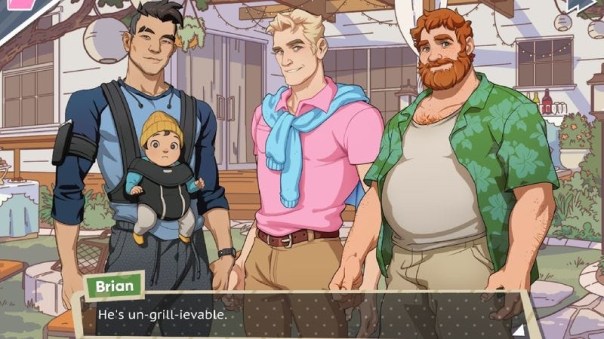
I’ve met all the dads so far, and my current favorite is Craig, a sporty, reformed frat bro who’s settling into his new role as a divorced, mature(ish) dad. He regularly pantomimes a voice for River, the wide-eyed tot strapped to his chest. He also works out a lot. I’m not down with his fratty masculinity — he’s bound to have “masc4masc” in his Grindr profile, right? — but for now, he seems like a good option.

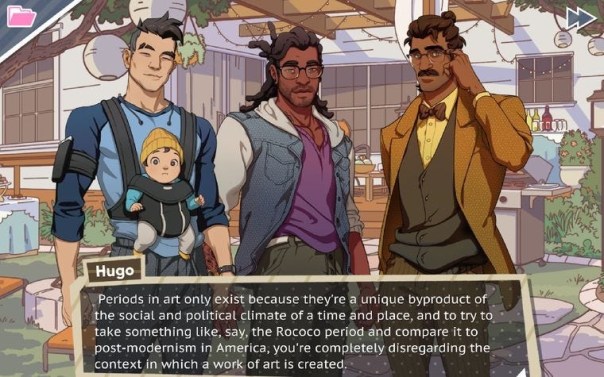
At first, I was partial to Hugo, a charming English teacher at Amanda’s school, but then I found out he had a son named Ernest Hemingway Vega. That’s simply too much.

I’m only a couple of hours into my first playthrough, so we’ll see how things go. Overall, I’m genuinely surprised at how much I’m enjoying it, but I do have some qualms with the way the writing fails to engage with gay culture in a meaningful way, despite relying entirely on the idea of gayness for its success.

But that’s a topic for another day. I’ll have more thoughts on “Dream Daddy” soon.

Reference

Gay History: Martyrs Among Us: Deifying Matthew Shepard, Harvey Milk + more

IMAGE ABOVE: JAKE GYLLENHAAL AND HEATH LEDGER IN BROKEBACK MOUNTAIN; COVER STORY IMAGE: HILLARY SWANK IN BOYS DON’T CRY

When news broke that Matthew Shepard’s remains were finally buried at the National Cathedral some 20 years after his death, we were reminded of the collective grief the nation felt after the brutal, senseless murder of the waiflike 21-year-old. In the intervening years since he happened into a bar where he met up with two men who lured him into their truck, robbed him, and drove him to a desolate stretch of highway outside Laramie, Wyoming where they pistol-whipped him, tied him to a wooden fence and left him for dead in the cold night air, Shepard had become more than an emblem of the senseless hate crimes perpetrated against the gay community, he had become a martyr.

Matthew Shepard was an openly gay student at the University of Wyoming who was brutally attacked in a hate crime at the age of 21.

Shepard’s place among sacrificial victims was solidified when more than 5,000 people gathered on the steps of the Capitol to mourn his death and cemented when Congress passed the Matthew Shepard and James Byrd Jr. Hate Crimes Prevention Act, which broadened existing law to include crimes triggered by sexual orientation, gender, gender identity, race and disability. Byrd was an African American man murdered by three white supremacists in Jasper, Texas. On June 7, 1998, they dragged his body for three miles behind their pickup truck. Although Byrd wasn’t gay, his inhumane murder serves to remind us of the hate that permeates society.

In his book, Dying to Be Normal: Gay Martyrs and the Transformation of Sexual Politics, author Brett Krutszch theorizes that LGBTQ activists are using religion to make the argument that gays are essentially the same as straights and deserve the same equal rights. He points to the veneration of Shepard, Harvey Milk and other high profile gay victims, as well as campaigns like the It Gets Better Project, which he believes promotes the notion that “like Christ’s suffering on the cross, one’s trials today can lead to a better tomorrow.” Krutszch says that national tragedies like Orlando’s Pulse nightclub shooting show how activists use headline-grabbing deaths to gain acceptance, shape the debate over LGBTQ rights and foster assimilation.

Krutszch maintains that Mr. Shepard’s 1998 murder is steeped in religious imagery. Just the thought of the all-American boy-next-door tied to a fence conjures up images of the crucifixion. He concludes that Matthew Shepard’s resulting canonization is due to the interplay of religion, death and LGBTQ politics and that “martyrs as emblems can be changed into more respectable figures than they were in their lifetime.” We may never know if Mr. Shepard was the innocent victim most people believe he was, or as The Book of Matt: Hidden Truths About the Murder of Matthew Shepard indicates, he was a meth dealer who not only knew his killers, but was sexually involved with one and that his death was the result of a drug robbery gone bad.

Whatever the motive for his murder, Shepard has become a shining symbol in the pantheon of almost exclusively white gay martyrs. The group dates back to the 4th century when Sergius and Bacchus, two Roman Christian soldiers who happened to be lovers, took part in a rite called adelphopoiesis (the ancient equivalent of same sex marriage) and refused to attend sacrifices for Zeus, thereby revealing their Christianity. The pair was paraded through what is now Syria. They were dressed in women’s clothing and tortured to death. They lived on through fervent followers and the churches that were dedicated to them throughout The Byzantine Empire.

Any conversation about modern-day martyrs would not be complete without mentioning Harvey Milk. He was the first openly gay elected official in California. Krutszch described Milk as “a secular Jewish, Yiddish-speaking, anti-monogamist” who was transformed by activists who “downplayed his Jewishness, depicted him as committed to fidelity and presented him as someone whose death, like Christ’s crucifixion, transformed the world.” One can argue the validity of that characterization, but it is hard to deny the contributions Milk made as San Francisco’s District 5 Supervisor. Those included defeating Proposition 6 that would have banned lesbian and gay educators from teaching in California public schools, and his efforts to pass legislation that prohibited discrimination in housing and employment based on sexual orientation.

Harvey Milk

Tyler Clemente may be less well known than Milk and Shepard, but like their deaths, his was another flashpoint. You may remember reading about his suicide in 2010. Clemente was an 18-year-old Rutgers University student who jumped from the George Washington Bridge after his roommate used a webcam to spy on him kissing another man. The video was posted on Twitter.

Most homosexual martyrs are white, but they are not all men. Brandon Teena, born Teena Renae Brandon, became famous when Hilary Swank played him in Boys Don’t Cry. The 21-year-old Teena was living a quiet transgender life in Humboldt, Nebraska, dating 18-year-old Lana Tisdel and hanging out with two ex-convicts John Lotter and Marvin Thomas “Tom” Nissen. Everything was fine until December 19, 1993, when Teena was arrested for forging checks. He used his one phone call to call Tisdel. She got the surprise of her life when she came to bail him out and was directed to the women’s prison where Teena was being held.

Brandon Teena

At a Christmas Eve party a few weeks later, Lotter and Nissen forced Teena to remove his pants, proving to Tisdale that he was a woman. Later that night, Lotter and Nissen forced Teena into a car, drove him to a deserted area, attacked and gang-raped him. Fearful that Brandon would file a police complaint, the pair murdered him on New Year’s Eve. While his family buried him as a female (his tombstone reads “Teena R. Brandon, Daughter, Sister and Friend”), the death of Brandon Teena is credited with raising awareness of transgender issues in the same way that Matthew Shepard’s became a clarion call for injustices directed toward gay men.

Teen Lana Tisdale

While real-life suffering seems like a necessary prerequisite for martyrdom, some fictional characters like Brokeback Mountain’s Jack Twist and Ennis Del Mar have transcended fictional status to take their place in the cultural zeitgeist. Brokeback author, Annie Proulx, said the characters Jack and Ennis were her first two that felt “really damned real” and “got a life of their own.” She also said, “Unfortunately, they got a life of their own for too many other people, too … the audience that Brokeback reached most strongly have powerful fantasy lives. They can’t bear the way it ends. So they invent all kinds of boyfriends and new lovers and so forth after Jack is killed. They can’t understand that the story isn’t about Jack and Ennis, it’s about homophobia.”

Gay martyrs like Matthew Shepard, Harvey Milk, Brandon Teena and even Brokeback’s fictional characters are often a byproduct of homophobia, when people who find themselves outside the mainstream and are struggling to just be who they are.

Reference

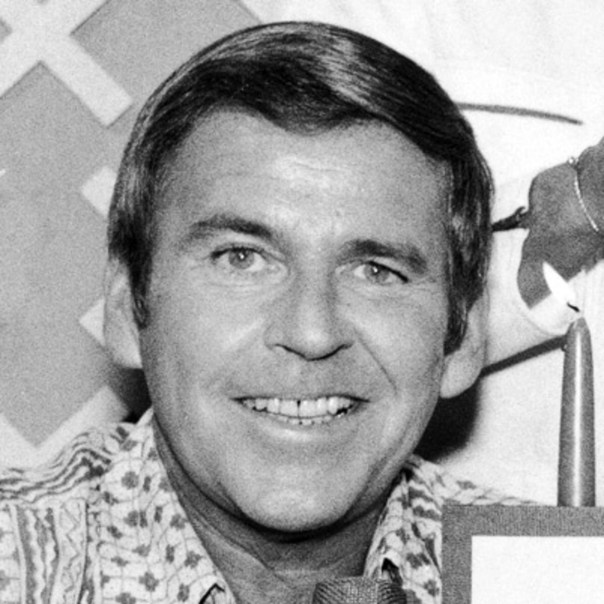
Gay History: Paul Lynde 1926–1982

American comedian, character actor, and Hollywood center square. He began his career doing stand-up before moving into theater, where he got his biggest break playing the father in the musical Bye Bye Birdie. He reprised the role in the film adaptation to great success. From there, he was sought after to make appearances on television and variety shows including The Munsters, I Dream of Jeannie, and most notably in the role of Uncle Arthur on Bewitched. In 1966, Lynde made his first appearance on the new gameshow Hollywood Squares. His snarky one-liners were so popular, he became the regular center square for most of the show’s run. Throughout his career, Lynde’s humor was built on camp and a flamboyant persona; during Hollywood Squares, his jokes were often thinly veiled references to his own homosexuality. But although he made subversive gay humor palatable for American homes, he never actually came out, except to close friends. He sometimes blamed his sexuality for keeping him from better roles, but it also may have been his reputation as a mean and occasionally violent alcoholic. He managed to quit drinking at the age of 53, but died of a heart attack two years later.

Real People: The “Openly Closeted” Paul Lynde

Despite the entertainment industry being hindered for years in portraying explicitly homosexual characters, those “in the know” were well aware of how this restriction was subverted by the very presence of certain actors and celebrities whose outrageous, decidedly “unmanly” personas could be interpreted as covertly gay. The movies had such jittery, effete ninnies like Edward Everett Horton and Franklin Pangborn, while television offered the likes of glittery, flamboyantly attired Liberace, who rocked the boat in the staid ‘50s by pushing his camp mannerisms to the limit; the mincingly nervous Charles Nelson Riley; and perhaps the most hilariously “sissified” of the bunch, the exasperated, acid-tongued Paul Lynde. 

Despite his initial efforts to be taken seriously as an actor, Lynde realized early on that his exaggerated vocal inflections and stinging way of delivering a line got him easy laughs, so he accepted comedy as his future. He first gained attention on the Broadway stage as one of the comedic highlights of the revue New Faces of 1952, doing a version of his “African Hunter” monologue that had gained him a New York nightclub following. From this more specialized universe he leaped into the big time with his performance as the uptight dad in the hit musical Bye Bye Birdie (introducing the hit song “Kids”), a role he was asked to repeat on the big screen in 1963. Lynde was soon being hired both for film and television to deliver his patented acerbic remarks, often done with a shake of the head, a nasally snarl, and a drip of prissy sarcasm, certain words emphasized with campy relish for added impact. Fellow gays cherished Lynde for honing to perfection what could only be described as “the bitchy queen,” lobbing a withering retort at straight-laced America, who laughed as well at what they perceived to be nothing more than a “quirky” comedian, since there was no thought of casting Lynde in roles that were deliberately gay.

While fans fondly remembered him for playing prankster warlock Uncle Arthur on Bewitched or as the host of one of the kitschiest of all ‘70s variety offerings, The Paul Lynde Halloween Special, it was being added to the cast of the daytime game show The Hollywood Squares that brought him his greatest fame. Positioned in the “center square,” he became the go-to favorite among the celebrity guests, being fed questions that ensured a tart, often surprisingly risqué reply, some of his answers clearly suggesting a coded, campy gay sensibility: i.e., the question “Why do Hells Angels wear leather?” received the reply, “Because chiffon wrinkles too easily.” During his eleven-year run as a series regular (1968–79), Lynde became revered as one of show business’s great “put down” comics. To most of America he was just a “smart ass” who talked kind of funny, but to the gay community his unapologetic, scalding manner was something to which they responded, perhaps interpreting the Lynde wit as a defense mechanism against an intolerant world.

Reference

Gay History:The Briggs Initiative: Remembering a Crucial Moment in Gay History

Homophobe John Briggs promoting his initiative

A lot of people are saying this year’s midterm election is the most crucial of our lifetime. It may well be, given the need to elect officials who will fight Donald Trump’s loathsome agenda. But another midterm election, 40 years ago, was one of the most crucial as well, at least in California.

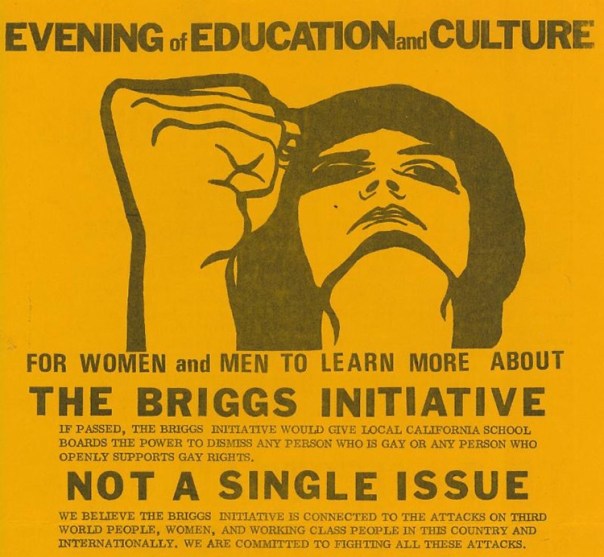
In 1978, State Sen. John Briggs put an initiative on the ballot that would have mandated the firing of any gay or lesbian teacher in California public schools, or any teacher who supported gay rights (the term LGBT wasn’t used back then). Thanks to a Herculean effort by California grassroots activists — Harvey Milk, Cleve Jones, Sally Miller Gearhart, hundreds of others — Briggs’s Proposition 6, popularly known as the Briggs Initiative, was resoundingly defeated, by more than a million votes. It was the first time voters had rejected an antigay measure.

To mark the 40th anniversary of this milestone, the GLBT Historical Society in San Francisco is mounting an exhibition called “The Briggs Initiative: A Scary Proposition,” recounting the story of the initiative and how it was turned back. It opens September 14.

“This exhibition will bring a scary time for LGBTQ people zinging back for those of us who were there, reminding us that we can fight the forces of anti-LGBTQ discrimination and win even against long odds,” said co-curator Sue Englander, a veteran of the anti-Briggs Initiative effort, in a press release. “And if you weren’t here 40 years ago, the story will sear itself into your consciousness. The differences between 1978 and today aren’t as big as they may look.”

Indeed, there are similarities between 1978 and today. The gay rights movement jump-started by the Stonewall riots and other events of the 1960s had made some gains in the 1970s. Gays and lesbians were getting elected to state- or city-level public office, or coming out and getting reelected — Elaine Noble in Massachusetts, Allan Spear in Minnesota, Harvey Milk in San Francisco. Many cities and counties, including San Francisco and Miami-Dade County, were adopting ordinances banning antigay discrimination. Major cities across the nation were holding Pride parades, usually around the anniversary of Stonewall in late June. The American Psychiatric Association announced it no longer considered homosexuality a mental illness.

This amount of progress pales in comparison with that of the 21st century, which brought nationwide marriage equality, many more antidiscrimination laws, and, for a time, a president who wholeheartedly supported LGBTQ equality. But just as the Trump administration and other anti-LGBTQ forces are trying to undo civil rights progress today, homophobes came out of the woodwork to try to strip away the advances of the 1970s. The Briggs Initiative was part of this backlash, as was Anita Bryant’s campaign to repeal the Miami-Dade County gay rights law. But where she succeeded, Briggs would fail.

Briggs was a far-right Republican from a district in Orange County, a conservative enclave between Los Angeles and San Diego. In a state that makes greater use of the citizen initiative process than almost any other that has it, he hoped Prop. 6 would boost his political career. Specifically, he aspired to become California’s governor.

But one of the forces who helped persuade voters to reject the initiative was a former governor — Ronald Reagan. When he became president a few years later, Reagan didn’t build a gay-friendly record — he courted the religious right and notoriously ignored the AIDS crisis. But in 1978, he announced his opposition to the Briggs Initiative in an informal letter and in responses to reporters’ questions, and on November 1, six days before the election, he published a commentary in the Los Angeles Herald-Examiner denouncing the measure.

“Whatever else it is, homosexuality is not a contagious disease like the measles,” he wrote. “Prevailing scientific opinion is that an individual’s sexuality is determined at a very early age and that a child’s teachers do not really influence this.” That language may sound pretty tepid now, but at the time it was a significant statement. Then-President Jimmy Carter and his predecessor, Gerald Ford, also opposed the initiative.

Opponents meet: John Briggs and Harvey Milk

But the credit for defeating the Briggs Initiative really should go not to high-profile politicians but to the many grassroots activists who worked against it. The opposition started with gay and lesbian advocates and the women’s movement, but they formed alliances with organized labor, progressive religious groups, and community organizations representing a variety of populations. Milk and Gearheart famously debated John Briggs, as chronicled in the documentary The Times of Harvey Milk and the narrative film Milk (although the latter left out Gearheart). They made mincemeat out of Briggs’s arguments, particularly about his initiative being a way to combat child molestation; Gearheart cited government data showing that this is overwhelmingly committed by straight men.

But most important, gay people came out. “We can defeat the Briggs Initiative if all the gay people come out to your family, your friends — if indeed they are your friends, your coworkers, your neighbors,” Milk said at the time. “You will hurt them if you come out, but think of how they will hurt you if they vote for Briggs. If they don’t come out, then it will be a very tight race.”

Indeed, gay people and their allies managed to flip the script on the initiative, as Ramy K. Khalil noted in his Western Washington University master’s thesis on the campaign. In August, just three months before the election, opinion polls showed support for the measure at 61 percent, opposition at 31 percent. By September, the polls showed a toss-up. And on November 7, voters delivered a resounding defeat, with the proposition losing by a margin of 58.4 percent to 41.6 percent, and not even carrying Briggs’s home county.

“One decisive factor was the mistake by Briggs himself of over-reaching — of promoting an initiative that was more extreme than the anti-gay ballot initiatives in other states,” Khalil wrote. “Proposition 6 required school districts to terminate employment of LGBT or straight people who expressed any sympathy toward homosexuality, on or off the job, whereas the ballot initiatives in other states merely repealed special protections against discrimination for gays or lesbians. Most importantly, though, Proposition 6 was defeated by LGBT people, labor unions, feminists, and other allies who organized a powerful grassroots movement involving highly visible protests and actions that successfully confronted the homophobic arguments behind Proposition 6.”

One of the posters to be featured in the exhibit
“Never Again! Fight Back!” (San Francisco: Too Much Graphics, 1978); silk-screened poster sold as a fundraiser for the No on Six campaign, GLBT Historical Society.
“No on 6” bumper sticker (San Francisco: Bay Area Committee Against the Briggs Initiative, 1978). Collection of the GLBT Historical Society.

Reference

Further to the last blog post “Behind the Weird Internet Scheme to Associate Pedophiles with the LGBTQ+ Community”

There was a reference made to a MAP (Minor Attracted Persons) Pride flag in the article. This is not a legitimate or recognised Pride flag, and here is the information about it.

NO, THIS ISN’T A REAL PRID4 FLAG – IT REPRESENTS PEDOPHILES

Groups of pedophiles are attempting to be part of the LGBTI community.

A group known as MAPs (or Minor Attracted Persons, not to be confused with the Multidisciplinary Association for Psychedelic Studies) has been circulating its own version of the Pride flag.

Another term for ‘pedophile’

MAPs attempts to soften the idea of pedophilia by insisting it’s not wrong if there is no contact.

‘”John” was suicidal. He had been bullied by trolls on social media for most of his life for being different. The bullies were primarily people who claimed, based on their religious beliefs, that “John” was going to hell and deserved to die. They described how they would kill him on his twitter page and people supported their hate. Desperate for help, John sought treatment for his shame, depression, and suicidality. Although he was scared to share about himself with a stranger, he felt desperate for help as he had NO desire to harm anyone, ever. Once he shared about his attraction to children, his therapist told him, “I don’t treat sex offenders,”’ a passage on The Prevention Project about MAPs reads.

‘First, let’s be clear. “John” is not a child molester nor is he a sex offender. He has an attraction to children. He is also fervent about helping prevent child sexual abuse by speaking out against it and by showing his support of global child sexual abuse prevention programs on his social media. “John” deserves support as do others who have a minor attraction. After all, isolation and depression are known to increase one’s risk of doing something they might regret.

By the way, we have talked to “Janes” who are women who identify as anti-contact, non-offending pedophiles and like “John”, they have no desire to sexually harm children.’

Considering the long-standing trope that LGBTI people are rapists and/or child molesters, the fact those who actually have attraction to children are attempting to co-opt LGBTI spaces is disturbing.

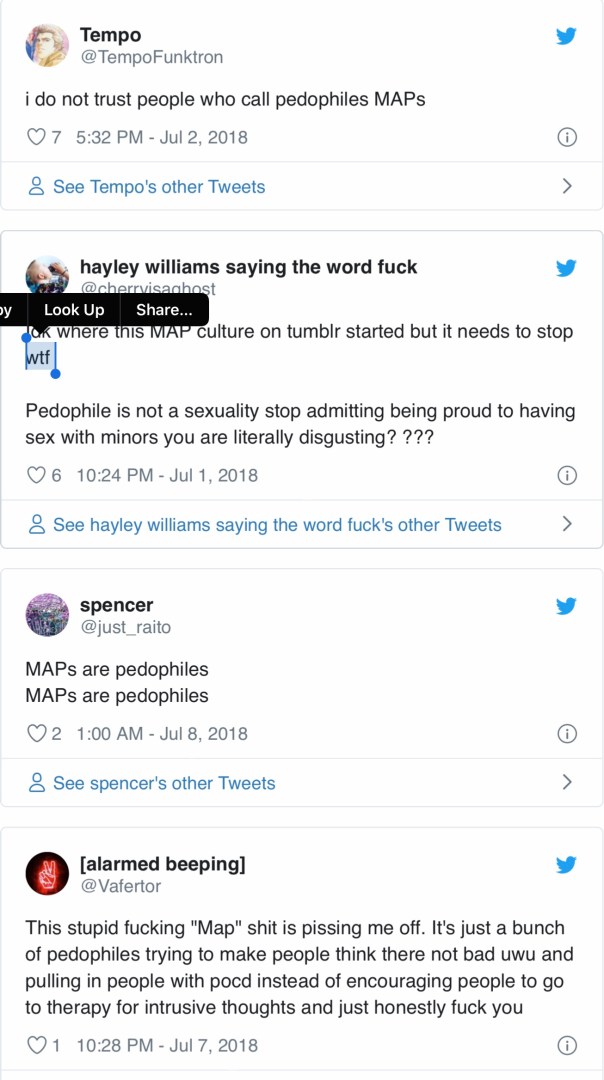
Social media reactions

Many on social media are warning LGBTI people and allies to be wary of the MAPs flag during Pride season. Additionally, many also called out the problematic nature of using a term like ‘minor attracted persons’ to normalize pedophilia.

Offline and in the real world

This isn’t just happening online, either. A photo of drag kid Desmond Napoles was recently used on a flyer in Oregon, promoting a fake Pride event for pedophiles. The posters were allegedly distributed by a group called the National Association of Man-Boy Love (NAMBLA).

When Napoles and his family learned about his picture being featured on the flyer, they took to Instagram to urge people in Oregon to ‘tear them down immediately.’

UPDATE 28 July: Fact-checking website Snopes has concluded that this flag was a hoax. Not officially associated with MAPs or NAMBLA, it seems to have originated on Tumblr. It is unclear what the motivations behind the hoax were.

Reference