Category Archives: Article

Coming Out Of The Dark Ages! (The UK Fight For LGBT Rights).

Originally published in the UK Guardian, 24 June, 2007. By Geraldine Bedell.

For most people the Sixties was a time of sexual awakening and experimentation. But it wasn’t until 1967 that gay and bisexual men could share that freedom. On the 40th anniversary of the decriminalisation of homosexuality, we revisit the appallingly repressive atmosphere of the Fifties and Sixties that ruined lives, destroyed reputations and finally sparked a campaign for change.

Forty years ago in Britain, loving the wrong person could make you a criminal. Smiling in the park could lead to arrest and being in the wrong address book could cost you a prison sentence. Homosexuality was illegal and hundreds of thousands of men feared being picked up by zealous police wanting easy convictions, often for doing nothing more than looking a bit gay.

At 5.50am on 5 July 1967, a bill to legalise homosexuality limped through its final stages in the House of Commons. It was a battered old thing and, in many respects, shabby. It didn’t come close to equalising the legal status of heterosexuals and homosexuals (that would take another 38 years). It didn’t stop the arrests: between 1967 and 2003, 30,000 gay and bisexual men were convicted for behaviour that would not have been a crime had their partner been a woman. But it did transform the lives of men like Antony Grey, who had fought so hard for it, meaning that he and his lifelong partner no longer felt that every moment of every day they were at risk.

It is hard for us to imagine now how repressive was the atmosphere surrounding homosexuality in the 1950s. ‘It was so little spoken about, you could be well into late adolescence before you even realised it was a crime,’ says Allan Horsfall, who campaigned for legal change in the north west, where he lived with his partner, a headmaster. ‘Some newspapers reported court cases but they talked of “gross indecency” because they couldn’t bring themselves to mention it, so young people were lucky if they could work out what was going on.’

Antony Grey, who later became secretary of the Homosexual Law Reform Society (HLRS), describes having to make ‘painstaking circular tours through the dictionary’ to articulate the feelings he’d had since he was nine. The one thing he did manage to pick up was that ‘there was a hideous aura of criminality and degeneracy and abnormality surrounding the matter’. Grey, a middle-class boy, fearful of breaking the law, remained ‘solitary, frustrated and apprehensive’ until he met his partner at the age of 32.

Grey is now 89 and has a civil partnership with that same man (Grey’s partner has always remained anonymous and prefers to do so now). I met them at their house in north-west London, where we talked in a room overflowing with books. Grey is tall and used to look distinguished; he has had leukaemia and is gaunt now. But his memories of the period are precise. In the early days, they tell me, living together was a dangerous business. When a drunk coach driver crashed into their car outside their house in the night, ‘the first thing we had to do was make up the spare bed. We knew from experience that if you called the police and they suspected you were homosexual, they would ignore the original crime and concentrate on the homosexuality.’

This was what happened to Alan Turing, the mathematician and Enigma codebreaker. In 1952, he reported a break-in and was subsequently convicted of gross indecency. Though he escaped prison, he was forced to undergo hormone therapy and lost his security clearance; he later committed suicide by eating an apple laced with cyanide.

For all that the law was draconian, it was also unenforceable. As a result, arrests often seemed to have an arbitrary, random quality. When Allan Horsfall became a Bolton councillor in 1958, he discovered that a public lavatory used for cottaging was well known to police and magistrates, yet there hadn’t been a conviction in 30 years. On the other hand, there would be intermittent trawls through address books of suspected homosexuals, with the result that up to 20 men at a time would appear in the dock, accused of being a ‘homosexual ring’, even though many of them might never have met many of the others.

A case of this kind, involving eight men in Bolton, spurred Horsfall to set up the North Western Homosexual Law Reform Society (later the Campaign for Homosexual Equality). He explains: ‘In this case, there was no public sex, no underage sex, no multiple sex. Yet they were all dragged to court and a 21-year-old considered to be the ringleader was sentenced to 21 months. I wrote a letter to the Bolton Evening News. They had four more letters in support and none against and the deputy editor was visited by the local police, who wanted to know if he thought this was what the people of Bolton really thought about the enforcement of this law.’

Horsfall thought it probably was and set up his campaigning group, which would play an important role in demonstrating to politicians that reform wasn’t merely the preoccupation of a metropolitan coterie. When the objection was made, as it often was, that the powerful miners’ groups wouldn’t stand for legalisation, Horsfall was able to point out that he ran his campaign from a house in a mining village where he lived with another man and had never had any trouble with the neighbours.

In the mid-1950s, there was an atmosphere of a witch-hunt (probably not unrelated to what was happening in America with McCarthy), with consequent opportunities for blackmail. Leo Abse, who eventually piloted the Sexual Law Reform Act through Parliament, recalls that, as a lawyer in Cardiff, his fees from criminals suddenly all started coming from the account of one man. He investigated and found he was ‘a poor vicar. The bastards were bleeding him. I sent for one of the criminals and told him if I had another cheque from this man, I’d get him sent down for 10 years. I sent for the vicar and told him to come to me if they approached him again.’

MPs on both sides of the House began to demand action. One or two newspapers ran leaders. And then there was another high-profile case in which the police were called on one matter and ended up prosecuting another. Edward Montagu, later Lord Beaulieu, contacted the police over a stolen camera and ended up in prison for a year for gross indecency. Two of his friends, Michael Pitt-Rivers and Peter Wildeblood, got 18 months. Their trial in 1954 probably played into the decision of the Home Secretary, David Maxwell-Fyfe, to establish the Wolfenden Committee to consider whether a change in the law was necessary.

As Lord Kilmuir, Maxwell-Fyfe led the opposition to law reform in the Lords, so it was ironic that he started the process. Perhaps he thought, by handing over to a committee, to shelve the issue. Perhaps he assumed Wolfenden would find against, in which case, he chose a curious chairman, because Wolfenden had a gay son, Jeremy. Antony Grey told me that when Wolfenden accepted the job, he wrote to Jeremy saying it would be better if he weren’t seen around him too often in lipstick and make-up.

Allan Horsfall believes homosexuality was tacked on very late in the day to the business of a committee that had already been set up to look into the legal status of prostitution. (Certainly, its remit covered both; its findings were popularly referred to as the Vice report.) That would make sense of the choice of chairman, although it is also possible that, given the secretive atmosphere of the time, Maxwell-Fyfe didn’t know Wolfenden had a son who wore make-up.

The Wolfenden Committee sat for three years and recommended that homosexual acts between consenting adults in private should no longer be illegal. Setting the tone for the discussion about law reform that would follow, it made no attempt to argue that homosexuality wasn’t immoral, only that the law was impractical. The age of consent should, in the committee’s view, be set at 21 (it was 16 for heterosexuals). The weedy reasoning behind this was that young men left the control of their parents for university or national service. In fact, it seems to have reflected a general prejudice that homosexuals were even more simple-minded than girls.

I met Leo Abse at his beautiful house overlooking the Thames at Kew where, he says, he is kept alive by his young wife Ania. He is 90 now and deaf, but mentally acute and still writing books. We talked in his first-floor drawing room as swans floated by outside. For all its shortcomings, the Wolfenden report is usually regarded as the key turning point in the fight for legalisation, the moment at which a government-appointed body said unequivocally that the law should change.

Abse insisted that its importance has been exaggerated. ‘People talk sloppily about Wolfenden, which was not by any means a key turning-point. A myth has grown up: the myth of pre-Wolfenden and after. It was only a staging post. When I arrived in the Commons after Wolfenden, the vote against it was overwhelming. Ten years of struggle came after.’

It’s true that an awful lot of lobbying remained to be done. The HLRS got off the ground in 1958, following a letter to the Times signed by 30 of the great and the good, including former Prime Minister Clement Attlee, philosophers AJ Ayer and Isaiah Berlin, poets C Day Lewis and Stephen Spender, playwright JB Priestley and various bishops. (From our perspective of the early 21st century, when the churches seem so afraid of homosexuality, it’s interesting that in this period they consistently and visibly backed reform.)

Antony Grey became secretary in 1962, using the pen name he used for any letters he had published (his real name is Anthony Edward Gartside Wright): ‘My father was dying. I didn’t tell my parents I was gay until I was nearly 30 and they thought it was some foul disease. They were never comfortable with it.’

A long campaign ensued of talks to the WI and Rotary Clubs, university debates, public meetings and letter-writing. The meagre amount that the HLRS could afford to pay Grey was supplemented by means of a Saturday sub-editing job on The Observer, offered him by David Astor, then the paper’s owner and editor, who was a supporter of reform.

The campaigning work was exhausting and often thankless and the opposition a mixture of vituperative and mad. Grey once caused consternation at a Rotary dinner when asked what homosexuals were really like, by answering, ‘rather like a Rotary Club’. An opponent in a Cambridge University debate, Dame Peggy Shepherd, asked him over a nightcap at their hotel, ‘Tell me, why are you so concerned about these unfortunate people?

Various stabs were made at bringing the matter before Parliament, but the first really promising development came with a bill in the Lords in July 1965. It was sponsored by Lord Arran, an unlikely reformer: known to his friends as Boofy, he kept a pet badger. Grey recalls going for tea with him, with the creature in his lap. He had inherited the title because his older brother, who was gay, had committed suicide.

‘He wasn’t the sort of person you’d think would do it,’ Grey says. ‘But he was invaluable. He was related to everyone and was always saying things like, “I’ll have a word with Cousin Salisbury about that.” He was a bit mad – he referred to the bill as William – and he became an alcoholic while he was doing it. He more or less had to be dried out afterwards.’

For the opposition, Lord Kilmuir warned against licensing the ‘buggers’ clubs’ which he claimed were operating behind innocent-looking doors all over London. But Arran, supported by the Archbishops of Canterbury and York, won his third reading by 96 votes to 31.

In the Sixties, the Lords led the way, quite unlike the situation in 2000, when the age of consent was finally equalised after the government invoked the rarely used Parliament Act to overrule a House of Lords that had thrown it out three times. Like the churches, the Lords has become more conservative about homosexuality over the years. The Catholic Archbishops of Westminster and Birmingham argued for exemptions in the 2007 Equality Act which would have allowed homosexuals to be turned away from soup kitchens and hospices.

Arran’s bill ran out of parliamentary time, but its success meant the pressure was now on for the Commons. A Conservative MP, Humphrey Berkeley, tried to sponsor a bill in the lower house. He was gay and in many ways, the lobby, certainly Grey, would have preferred him. ‘He was a nice person and not as quirky as Leo,’ Grey says now. ‘Both Arran and Abse thought that having got so far, they needed to make concessions, placate the implacable. It seemed to me that most people weren’t worried about the details.’

Abse takes a different view. ‘The House didn’t like Humphrey Berkeley. He was gay and everyone knew. He was an enfant terrible who never grew up. I don’t think he could have got it through.’ Berkeley ran out of parliamentary time and then lost his seat at the 1966 general election. Back in the new Parliament, Abse gave notice in the July that he intended to move a 10-Minute Rule bill. By his own account, he was not the man the Home Secretary, Roy Jenkins (who wanted reform, fought for it in cabinet, guaranteed parliamentary time and assiduously sat through all the debates) would have chosen to pilot it through. ‘We had a reconciliation before he died, but when Roy Jenkins talked to me in those days, he used to shut his eyes, as though he wanted to blot me out.’

Abse believes Jenkins would have preferred Michael Foot, for two reasons. First, he says, Jenkins wanted ‘to bog down Michael’, whom he saw as a potential rival in any leadership contest; and second, he ‘thought I was too dangerous a character. I was too colourful’. He points to a shield on the wall, given to him by the Clothing Federation for being the best-dressed MP in Parliament. ‘I used to dress up. My wife – my first wife – used to dress me up. By God, they needed some colour in Parliament! It wasn’t only my narcissism. It was a part of opening up society. But I think Jenkins found it somewhat… he didn’t feel comfortable.’

Abse’s story is that he and Foot, who were and are great friends, outmanoeuvred the Home Secretary. Foot didn’t want the job. ‘He hadn’t specially involved himself in the homo issue’ (even allowing for the fact that he is 90, Abse’s language seems a bit odd here), and when he realised what was involved, politely backed off. Jenkins did then give his support, Abse acknowledges, ‘although on the way there were a couple of occasions when he lost his nerve and I didn’t’.

Human-rights campaigner Peter Tatchell points out: ‘The tone of the parliamentary debate alternated between vicious homophobia on one side and patronising, apologetic tolerance on the other.’ The Earl of Dudley’s contribution in the Lords sums up the level of the opposition’s argument: ‘I cannot stand homosexuals. They are the most disgusting people in the world. I loathe them. Prison is much too good a place for them.’

But, as Tatchell suggests, the tone of the supporters is, from this distance, hardly less cringe-inducing. No one mentioned equality or love. The consistent position was that homosexuals were pitiful and in need of Christian compassion. Abse argues now that much of this was tactical. ‘The thrust of all the arguments we put to get it was, “Look, these people, these gays, poor gays, they can’t have a wife, they can’t have children, it’s a terrible life. You are happy family men. You’ve got everything. Have some charity.” Nobody knew better than I what bloody nonsense that was.

‘My inspiration was ideology. It’s a dirty word these days, but I was and am an ideologue. I am a Freudian. And I had been taught by Freud that men and women are bisexual. People should come to terms with their bisexuality, not repudiate it and become homophobic. You knew you were doing more than releasing thousands of people from criminality,’ he explains. ‘It was the start of opening up society to be more caring and sensitive. One was battling for all men and women to have a greater freedom.’

Commentators have argued over whether Abse was sufficiently ambitious with the substance of the bill, but there is no doubt that he was an adept tactician. He kept the mining MPs away from all the votes, ‘calling in my debts’. He used his friendship with the chief whip, John Silkin, to ensure there was enough time and he drew the opposition’s sting by gingering up a row over whether the law should apply to merchant seamen.

For a bit, it looked as though this arcane dispute might scupper the bill, but then Abse produced a compromise which, though patently absurd (merchant seamen could have homosexual sex with passengers and foreign seamen, but not each other) wrong-footed his opponents at a crucial moment. Right at the end, in the report stage, he managed to keep the required 100-plus supporters in the chamber all night so as to call for closure on the various amendments. On the last of these, he had 101 people there, which was all he needed but which, he says, ‘shows how precarious the bill was, and it’s why I get so damned annoyed when people say Wolfenden was a watershed. We got that bill through on one vote.’

Perhaps Abse is so anti-Wolfenden because his bill has been accused of being even more tentative than that report a decade earlier. Certainly, for those who had been lobbying, the act was a disappointment in several respects, not least in its confirmation of Wolfenden’s age of consent. ‘Of course, 21 was absurdly high,’ Abse acknowledges now, ‘but I wouldn’t have had a hope of getting it through under that.’ This does not seem to be his entire thinking though because he also says: ‘Adolescence is a difficult time and many young men go through a homosexual phase. Great care is needed in that you don’t corroborate them in their fixation.’

To make matters worse, the maximum penalty for any man over 21 committing acts of ‘gross indecency’ (which included masturbation and oral sex) with a 16- to 21-year-old was increased from two years to five years. Same-sex relations were also legal only in private, which was interpreted, as Tatchell says, as being ‘behind locked doors and windows and with no other person present on the premises’.

While sex may have been legal, most of the things that might lead to it were still classified as ‘procuring’ and ‘soliciting’. ‘It remained unlawful for two consenting adult men to chat up each other in any non-private location,’ Tatchell says. ‘It was illegal for two men even to exchange phone numbers in a public place or to attempt to contact each other with a view to having sex.’ Thus the 1967 law established the risible anomaly that to arrange to do something legal was itself illegal.

We shouldn’t think this provision was quietly ignored either. In 1989, during the Conservative campaign for family values, more than 2,000 men were prosecuted for gross indecency, as many as during the 1950s and nearly three times the numbers in the mid-Sixties.

So, is Abse right that he got as much as he could in the circumstances? Antony Grey thinks certainly not; Allan Horsfall is more equivocal. It is hard to judge at this distance, although the experience of recent years suggests there is a lot to be said for moving swiftly to consolidate positions gained, as Stonewall has done in sweeping on from Section 28 to civil partnership to protections for sexual orientation legislation. Stonewall’s chief executive, Ben Summerskill, acknowledges that in recent years, MPs with trade union backgrounds like John Prescott or Alan Johnson have been prepared to assert that equality means equality, which simply wasn’t the case in the 1960s. Other Labour ministers of the recent past have been susceptible to arguments about their legacy, where Harold Wilson’s government was mainly preoccupied with economic troubles and international crises.

Abse was disappointed in a different way by the aftermath of his Sexual Offences Act. ‘Those of us putting the bill through thought that, by ending criminality, we’d get the gays to integrate. But I was disconcerted and frightened at first because they were coming out and turning themselves into a self-created ghetto.’ Abse’s views of integration sound rather more like wholesale capitulation to majority behaviour. But, in any case, he is wrong. Horsfall says: ‘Nobody in the circles I moved in realised things had changed. It was 1970 before the Gay Liberation Front appeared and we were well into the Seventies before the Labour Party campaign for gay rights.’

Abse is disappointed that ‘the gays’ weren’t more grateful. ‘On my 90th birthday, I had lots of telegrams. I never had one word of thanks from any gay activist or lobby. When I’ve shown any reservations about the gays, they haven’t forgotten. The ghetto suggests they are not at ease. They’ve got to have a gay world. Perhaps it was presumptuous to think they would integrate and become part of society. They use the excuse of external pressure and discrimination, but really it’s not good enough.’

He is, unfortunately, taking a partial view. The single thing that more than any other has ‘normalised’ gay relationships has been civil partnerships. They could only have come about through lobbying, not by bien pensant intellectuals as before 1967, but by gay people themselves. And while it seems inconceivable now that we could ever go backwards, it is worth remembering the discrimination Abse dismisses was unchecked only recently.

Summerskill points out that recent events in Russia when gay activists, including Tatchell, were beaten up, possibly by plainclothes police, ‘were not unthinkable in Britain 20 years ago’. Those archbishops arguing for the exclusion of homosexuals from hospices in 2007 offered a glimpse of a grimy homophobia that still sits mouldering on the underbelly of some British institutions.

The 1967 act was terribly flawed, but the world changed overnight for those like Antony Grey and Allan Horsfall who lived with their partners. The law also emboldened them and others to campaign for the right for those partnerships to have the same standing in law as any other marriage and for other rights to be themselves and have the same freedoms as everyone else. Mealy-mouthed, half-hearted, embarrassed by itself as it was, the act made possible the equality that has since been so painstakingly fought for.

A 40-year journey from shame to pride

1967 Sexual Offences Act in England and Wales decriminalises homosexual acts between two men over 21 years and in private. Scotland legalises it in 1980; Northern Ireland in 1982.

1971 First ever gay march in London, finishing with a rally in Trafalgar Square.

1976 Tom Robinson releases ‘Glad to be Gay’, which reaches No 18 in the singles chart.

1979 First ever gay television series Gay Life commissioned by LWT.

1982 UK’s first HIV/Aids charity, the Terrence Higgins Trust launched.

1983 Labour Party candidate Peter Tatchell defeated in Bermondsey by-election after anti-gay campaign by tabloid press and local Liberals.

1984 Chris Smith, the UK’s first openly gay MP, comes out while in office.

1988 Section 28, preventing the ‘promotion’ of homosexuality, introduced as part of the Local Government Act on 24 May.

1992 London hosts the first international Europride festival with a crowd of 100,000.

1994 Age of consent lowered to 18 from 21, despite unsuccessful campaign to lower it to 16, the consensual age for heterosexuals.

1998 Waheed Alli, one of the world’s few openly gay Muslims, becomes the youngest and first openly gay life peer in Parliament.

2000 Government lifts ban on lesbian and gay men in the armed forces.

2001 Age of consent lowered to 16.

2003 Section 28 successfully repealed on 18 November.

2005 First civil partnerships take place.

Gordon Agar

· The following correction was printed in the Observer’s For the record column, Sunday July 1 2007. The article above referred to Allan Horsfall as ‘a former Bolton councillor’. Although in 1963 he was a resident of Bolton when he set up what became the Campaign for Homosexual Equality, he wasn’t a councillor there. He was, however, a councillor in Nelson, Lancashire in the late 1950s.

Gay History: Alan McKail, Designer, Melbourne (1888-1931).

Alan McKail

b. 31 January 1888,

Beaumont, Hay, New South Wales

d. 5 November 1931

Warrandyte, Victoria

Buried Box Hill, Melbourne, Victoria

Also known as Hugh John Alan McKail, Alan M’Kail, Allan McKail

Designer (Textile Artist / Fashion Designer), Designer (Theatre / Film Designer)

A Melburnian auctioneer, fashion and theatre designer known for his costumes at Melbourne’s Artists’ Balls. Contemporary police and media reactions to his more flamboyant costumes give an insight into attitudes towards gay male and transgender identity in early twentieth century Melbourne.

AS EARLY AS 1868, the Block on Collins Street’s north side, stretching from Elizabeth to Swanston Street, was fashionable: ‘ablaze with its crowds of colonial fashionables and celebrities . . . passing the hour in an easy, careless, lounging, gossipy manner’. Whilst ‘doing the block’ on Saturday mornings, middle-class Melbourne showed that it was the best dressed in Australia. So popular indeed, that soon this celebrated stretch was sold, demolished and replaced, as it has been twice since.

Back then, the most desirable place to be seen in Melbourne was Café Gunsler on the Block, later known as the Vienna Café. In 1916 it was remodelled as the splendid, spacious Café Australia, and in 1927 became the Australia Hotel. In 1939 this was demolished and replaced by the larger, glamorous Hotel Australia, some of whose bars immediately became the most popular meeting place in Melbourne for homosexual (‘camp’) men, particularly the Collins Street first floor cocktail bar and the basement public bar, which from 1970-80 became the Woolshed. In 1992 the Hotel Australia and an adjoining hotel were demolished and replaced by Australia on Collins. This site has a significant architectural history in which creative women played a strong role, but after briefly tracing its development, I want to explore the much less known experiences and memories of its gay clientele, mainly from 1930-1992, as far as evidence allows.

Most of the rich experiences of gay men recounted in this article were concealed from the community and straight historians at least until the 1970s, and even today. Most of the gay men whose stories are quoted here seem to have led happy lives and did not feel oppressed, but they knew the limit of their behaviour, without exposing themselves and their friends to risk. So describing their lives openly for the public record was risky. Aberrant lives are known from court records, but until ALGA oral history interviews, the social experience of ordinary lesbians and gay men in Melbourne before about 1980 remained systematically unexplored. For instance, although it describes other underworlds and minority behaviour, Andrew Brown-May’s Melbourne Street Life, published in 1988, only once mentions homosexuality, and that as a nuisance in public urinals.

There is only the slightest evidence of whether the Café Australia, or the pre-war Prince of Wales supported a gay culture, or even that one existed in private. Other than the legal records and Truth’s prurient histrionics, the earliest evidence of generalised gay social life is from c.1930, from the gays born during the Great War who lived long enough and were courageous enough to record their memories on tape.

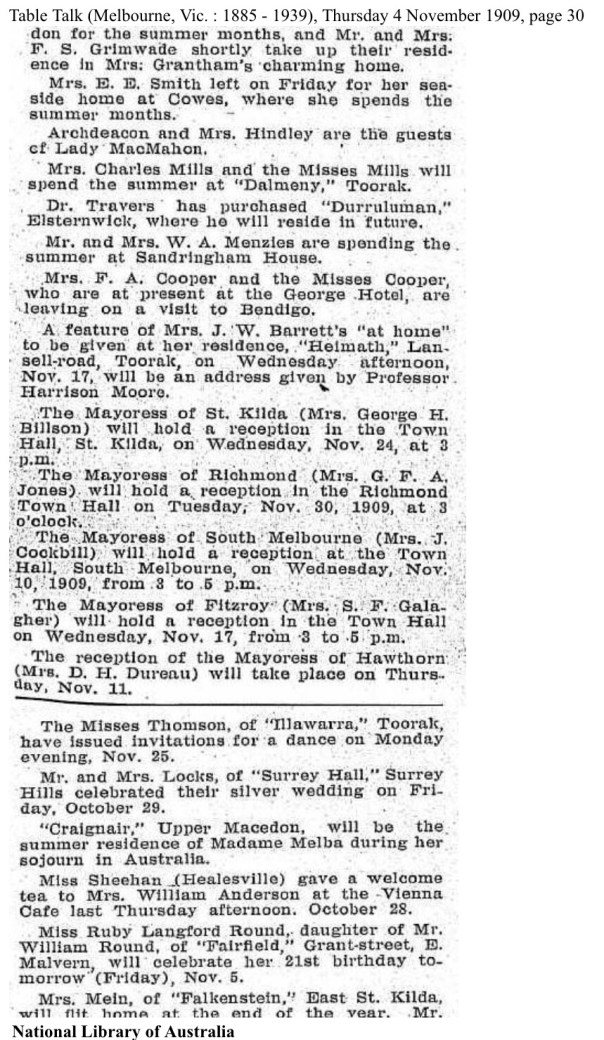
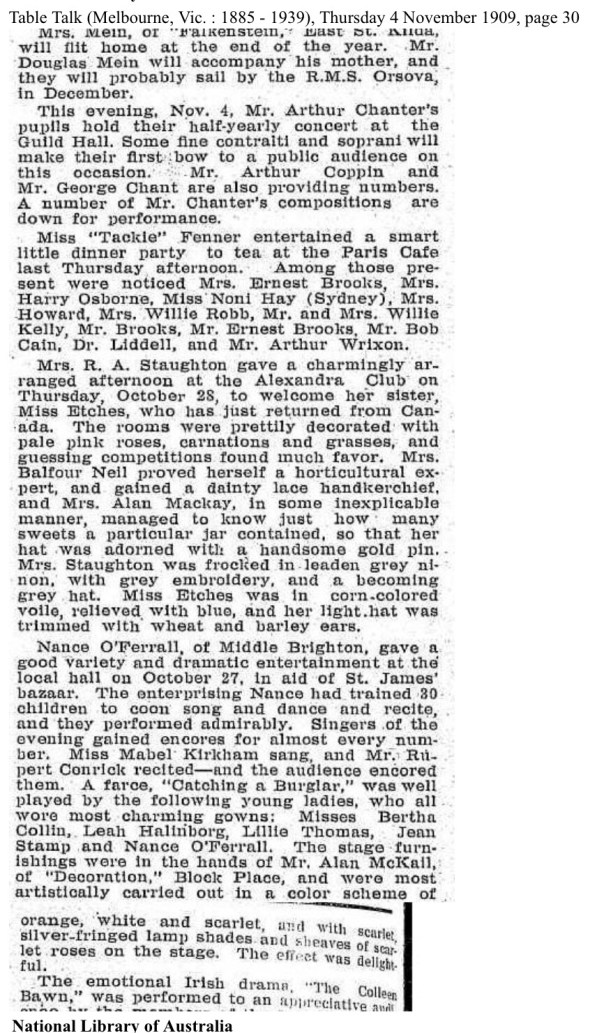
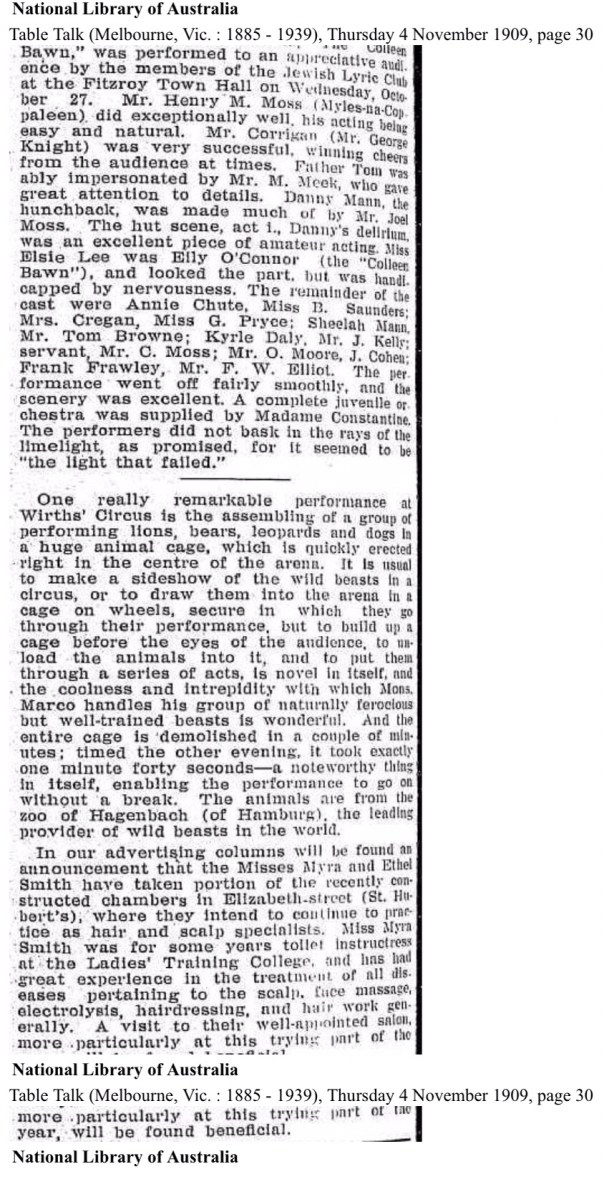
The eminent architect Lloyd Tayler designed Harrington’s Buildings (1879-1939) for the new owner and in 1891 the first building of the ambitious Block Arcade was completed. Soon after, Café Gunsler’s (to its left) was bought by Austrians who renamed it the Vienna Café (1890-1915). It remained fashionable and popular: theatre celebrities and famous men gathered there and its Melbourne Cup festivities were the highlight of the year, when Collins Street was thick with hansom cabs and often the vice-regal party attended. Oral history interviews can take us back as far as living memory allows (to about 1930). Before that often the only information about unconventional behaviour we have comes from court records. On 22 September 1908, Alan McKail (aged 20), Douglas Ogilvie (22) and Tom Page (25) were three young men-about-town who decided to dress as fashionable ladies, and have a champagne supper at the Vienna Cafe on the fashionable “Block” of Collins Street. The three were observed “going the pace” at the Vienna Cafe on the evening of 22 September, 1908. According to their statements, the three had come into the city that Saturday night in disguise to attempt to gain entry to the Scandinavian Ball. When refused entry to that function, they went to the theatre and decided to finish off their evening with supper at the most fashionable restaurant in Melbourne. Apparently, while there, “their behaviour was such to attract attention.” As they left the restaurant, a hostile crowd gathered in the street and the three were roughly handled by some of the toughs in the crowd. The police were called and the three found themselves in the City Court. They were charged with behaving indecently in a public place, Collins Street.

The presiding magistrate was unsure as to whether the defendants were “sexual perverts or brainless young idiots who needed to be brought up with a round turn.” He was of the firm opinion that “such conduct as theirs was a menace to every respectable woman, and not only a riot, but even murder, might take place if young men were permitted to carry on in that manner in a public cafe” and stated that the difference between male and female apparel was one of the “cornerstones of civilisation and no-one could be allowed to flaunt that convention.” Page and Ogilvie worked for the Melbourne Steamship Company, whilst McKail was ‘well connected’, had £500 a year and trained as a fashion designer in Paris.

Mr. Fogarty, for defendants, without calling any evidence in defence contended that not the slightest testimony had been given that defendants had behaved in an improper or an indecent manner. Their disguise was obvious. If they could not go to a fancy dress ball in female costume the’ University students’ precession and characters in this Eight-hours demonstration,were also illegal.

Mr. Dwyer, P.M., said the suggestions made against the defendants in the case had not been justified by the evidence. They had not conducted themselves improperly, nor taken other undue advantages of tho costumes they were wearing. Unless there was a law which forbade man to assume the garb of woman, or vice versa, there seemed to be nothing against defendants. Still, they wore silly young donkeys, and he (Mr. Dwyer) did not for a: moment regard their action as a proper proceeding, which only tended to raise scandal and injure their reputations; They were treading on thin ice, and might get themselves into trouble without the intervention of the law if they were not more careful.

‘Defendants were discharged.

In late 1915, the significant Chicago architect of Canberra, Walter Burley Griffin (1876-1937) and his wife Marion Mahony (1871-1961) redesigned and rebuilt the interiors as ‘the most beautiful café in Australia’, and our earliest architectural modernism. When it opened in November 1916 Australia was at war with the Austro-Hungarian Empire whose capital was Vienna, so the name was sensibly switched to Café Australia. Six o’clock closing had been imposed that October, substantially reducing its opening hours. At least one patron remembered the Café Australia as being ‘slightly gay’ in the 1930s.
In 1927 it was renamed the Australia Hotel and by 1932, sold to hotelier Norman Carlyon’s company, The Australia Hotel Pty Ltd.10 Later, Carlyon owned the freehold with Frederick Matear (1888-1968). The State Library of Victoria holds an evocative mid-1930s street photograph looking east, depicting the Block Arcade, the Australia, the Tatler Bar and their neighbours.
The twenties: the decline and fall of our hero Alan McKail.

After getting so much unwanted attention parading around Melbourne’s ‘Block’ dragged-up as a Gibson Girl in the Edwardian years, then charming the social pages as a cubist Pierrot during the Indian Summer of the pre-war era, one would have imagined the Roaring Twenties would have been Alan McKail’s crowning glory. But, although our Alan could obviously still turn heads in the Jazz Age, noted among the well-dressed patrons of the Moonee Valley racecourse in ‘Table Talk’ in January 1925, he seems to have been falling out of the social spotlight.

The twenties began with McKail in a sound enough position to help out friends in need, purchasing ‘The Robins’, artist Penleigh Boyd’s Warrandyte retreat, after Boyd’s tragic death in a car accident in 1923 had left his family in financial limbo. McKail’s company, Decoration Co., who had worked with Penleigh Boyd on the sale of his studio contents only a few month earlier, handled the sale of Boyd’s estate. As Steve Duke pointed out, the security afforded by McKail’s purchase and the estate sale ensured that Boyd’s youngest son Robin would go on to write ‘The Australian Ugliness’, his influential book about poor aesthetic standards in local architecture and design, among many other career highlights.In February 1926 the Decoration Co. auction business, whose shareholders included Alan McKail, his former life partner Cyril John McClelland and his aunt Effie Eliza Ball, was valued by Melbourne ‘Herald’ at £20,000 (about A$1,500,000 in today’s money). Later that year ‘The Herald’ reported that McKail was about to head off to Colombo, Ceylon (Sri Lanka), for a holiday.

But things weren’t all going well in The Robins. Steve Duke often speculated that Alan McKail’s poverty-stricken death from tuberculosis in 1931 may have been caused by the renowned excesses of the age. Evidence has recently emerged from Victoria’s health records which, sadly, confirms Steve’s theory.

In November 1925 Alan McKail checked into the Pleasant View licensed house in his childhood home suburb of Preston, staying there for a week. The idyllic name of the house, which looked across the Lower Yarra Valley towards the Dandenongs, disguised its purpose; it was a clinic for recovering alcoholics. Nineteen months later, and not too long after his return from Colombo, McKail voluntarily checked into the less euphemistically-titled Lara Inebriates Retreat, north of Geelong, for another week’s drying out.

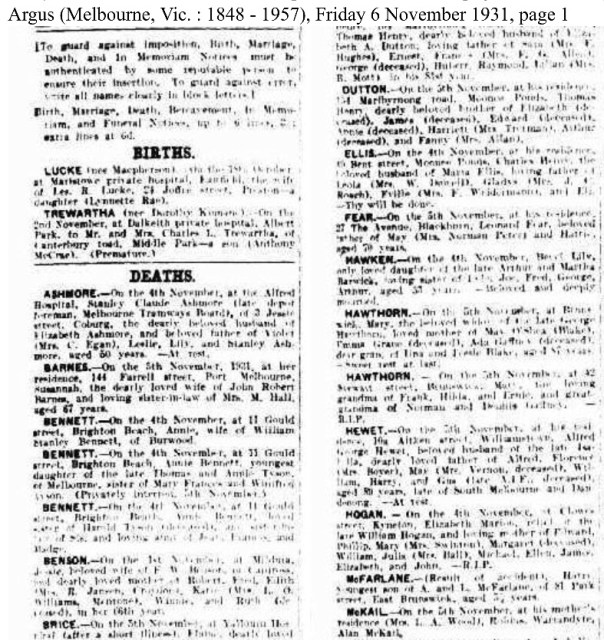
On the 2nd July 1927, Alan McKail checked out of the Lara Inebriates Retreat. At the time of writing, there are no further known references to him in the Melbourne press until his death notices appeared in November 1931. [1]

There is an Alan McKail Day cemetery walk at Box Hill cemetery in January (see link in References) which visits LGBT graves in the cemetery and plants rainbow flags on them.

Citation [1] The twenties: the decline and fall of our hero Alan McKail by Steve Duke BA FRGS (1957-2017) and Eric Ridder. By permission, and with thanks to Eric Riddler, and the Three Mullets Club https://www.facebook.com/threemulletsclub/?fref=ts

References

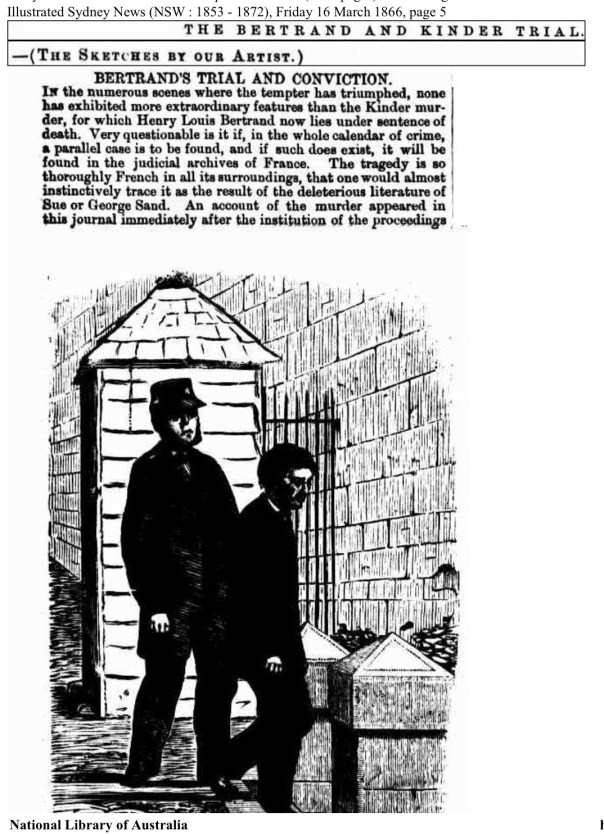
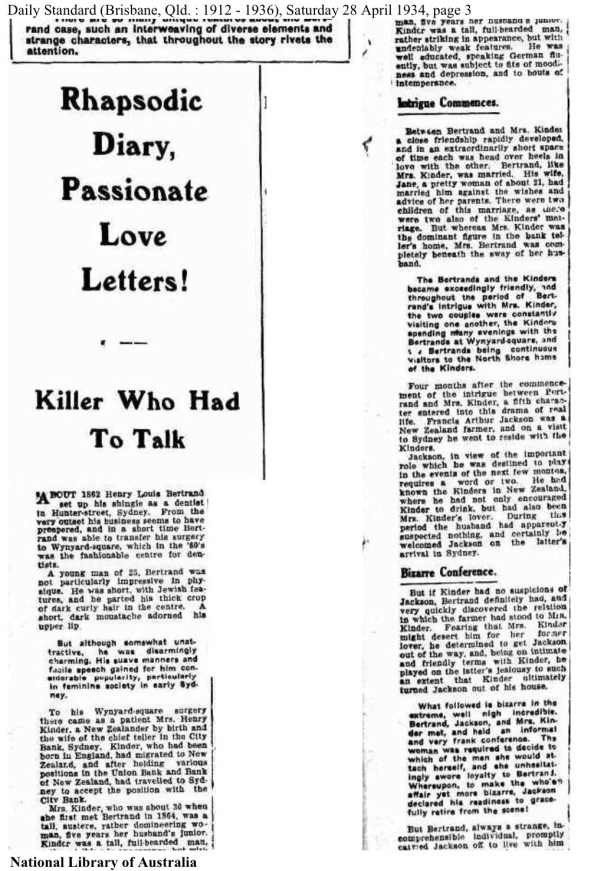
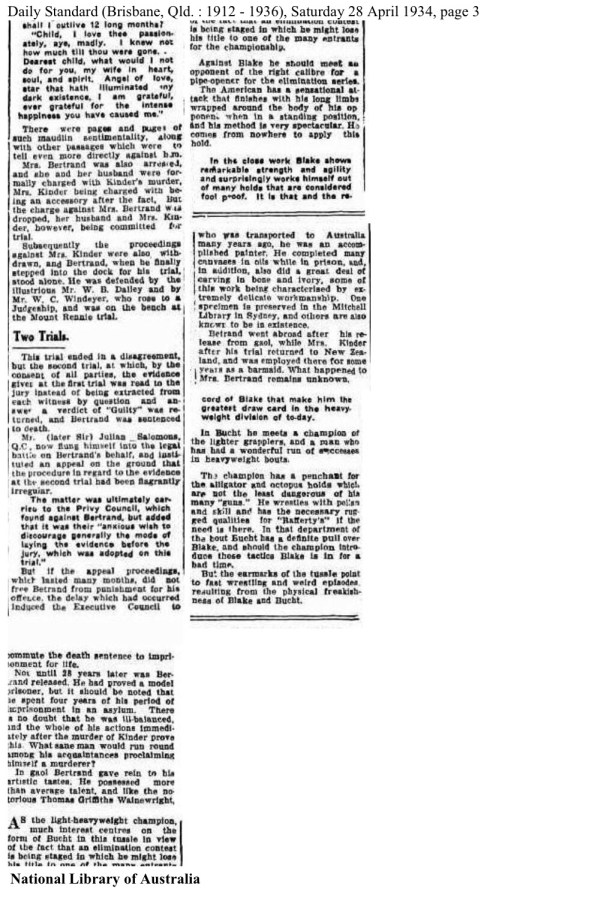
The Demon Dentist of Wynyard Square – Henry Louis Bertrand.

Originally published in the Daily Telegraph, March 10, 2015. By Naomi White.

HENRY Louis Bertrand was many things. Husband, father, dentist, self-proclaimed mesmeriser, philanderer… murderer.

His tale of murderous desire and betrayal took place on the streets of Sydney 150 years ago, but is proving intriguing today, revived in an exhibition of historical crime held at the Justice and Police Museum, the former site of the Water Police Courts that operated from 1856-1924, whose walls Bertrand would have passed through after his arrest.

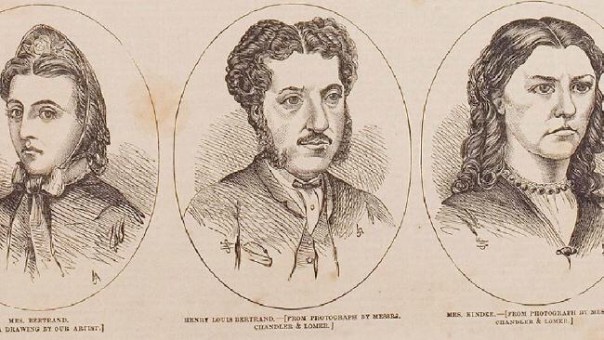
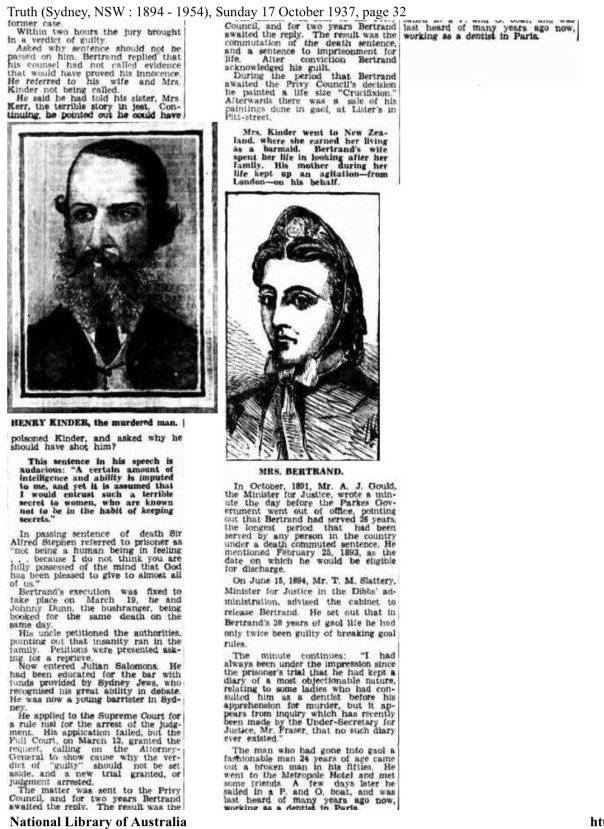
Portraits of Mrs Bertrand, Henry Louis Bertrand and Mrs Kinder, from the Illustrated Sydney News, circa 1865. Picture: NSW State Library

Bertrand, a native of London, had moved to Australia as a young man and set up a dentistry practise in the CBD, building a thriving business on claims he could mesmerise patients so they would feel no pain.

But it would be one of these patients who would be his undoing, after he struck up an affair with a married woman that ended with the murder of her husband in 1865.

“It’s one of those really incredible stories in criminal history and one that not only the Australian public were really interested in, it also ignited quite a bit of interest overseas in New Zealand and London and throughout Europe because it just had so many unusual and dramatic twists and turns in it,” exhibition curator Nerida Campbell said.

As his obsession intensified, his assistant took to arming himself with an axe

“And Bertrand himself was such an unusual character, you know, he was larger than life. The things he said were quite often just remarkable and the way he acted was also. One of the journalists at the time thought he had been influenced by reading too many romantic novels and that was part of the character he had chosen to create for himself.”

THE AFFAIR

Maria ‘Ellen’ Kinder had been married to Henry Kinder, 35, a heavy drinker and teller at City Bank who was in financial strife, for five years when she booked in as a patient at Bertrand’s dental practice.

The two quickly began an affair, with 25-year-old Bertrand imposing himself and his wife Jane and their two children into the Kinders’ lives, striking up a friendship with Mr Kinder and making regular calls to their north shore home over 10 months on the pretence of cards and suppers.

But it would not be the only visits he’d make, with Bertrand regularly forcing his dental assistant, a young man known as Byrne, to row him across the harbour for midnight reconnaissance missions to spy on the couple.

Henry & Ellen Kinder in early undated portrait, Ellen allowed lover Henry Bertrand to kill her husband in 1865 before she moved in with him and his wife.

He reportedly went as far as breaking into their home to survey its layout as part of his master plan to dispose of Mr Kinder.

As his obsession intensified, his behaviour became increasingly erratic, so much so that Byrne, in fear of his own safety, had taken to secretly arming himself with an axe.

Bertrand continued to force him to do his dirty work, dressing as a woman and accompanying Byrne as he visited a gun-shop and negotiated the purchase of two pistols to use in the murder.

Sydney dentist Henry Louis Bertrand in early undated portrait, mastermind of one of the most bizarre ‘crimes of passion’ in Australia when he killed his lover Ellen Kinder’s husband. Picture: Supplied

He then bought a pig’s head which he kept at the surgery to practise his aim on.

“He fell in love, heavily in love with her and she returned his affection and they started an adulterous affair,” Ms Campbell said.

“This went on for a period of time until it became clear to Bertrand that he needed her, that he had to have her, that he wasn’t prepared to share her with her husband any longer. And his plan was to kill her husband, Henry Kinder and divorce his own wife Jane so that the two of them could be together”.

THE CRIME

After travelling to the home several times with the intent to murder him, he finally found the courage to fire a single shot at Kinder’s head, as he sat on a chair in his home, in front of both his wife Jane and his lover.

But it failed to kill him and Kinder was carried to his bed to recover, while Bertrand, with the help of both women, convinced police Kinder’s financial woes and drinking had got the better of him and he had tried to kill himself.

Looking down Margaret Street to George Street showing Wynyard Square on the right where Bertrand worked as a dentist. Picture: NSW State Library

“So Kinder is upstairs in bed and the police have visited, they’ve accepted the story of this attempted suicide, but he’s not dying, he seems to be getting better. It’s at this stage that Bertrand apparently convinced the two women to poison Kinder and apparently it was his own wife Maria that allegedly fed him the poison which ended his life.”

The coroner assessed his death on the evidence of a past suicide attempt and ruled it non-suspicious.

“I am satisfied, thus once more I perish my enemies”

A diary entry from Bertrand

However it brought him no closer to Maria Kinder, who moved to her parent’s home in Bathurst to preserve her reputation. Bertrand at least appeared to have got away with it.

THE BLACKMAILING

That was until a past lover of Maria Kinder’s turned up, got wind of Bertrand’s involvement and sent him a note demanding 20 pounds (more than $2,000 AUD today) for his silence.

“And Bertrand then showed what kind of a daring and quite heartless criminal he could be. He took that letter to the police and said ‘look, this man is attempting to blackmail me, smirch my reputation’ and they charged him. So Francis Jackson actually went through the Water Police Court, which is the current Justice and Police Museum, on trial for attempted blackmail and he was convicted to spend time in prison.”

Water Police Court at Phillip Street, Sydney. Picture: NSW State Library

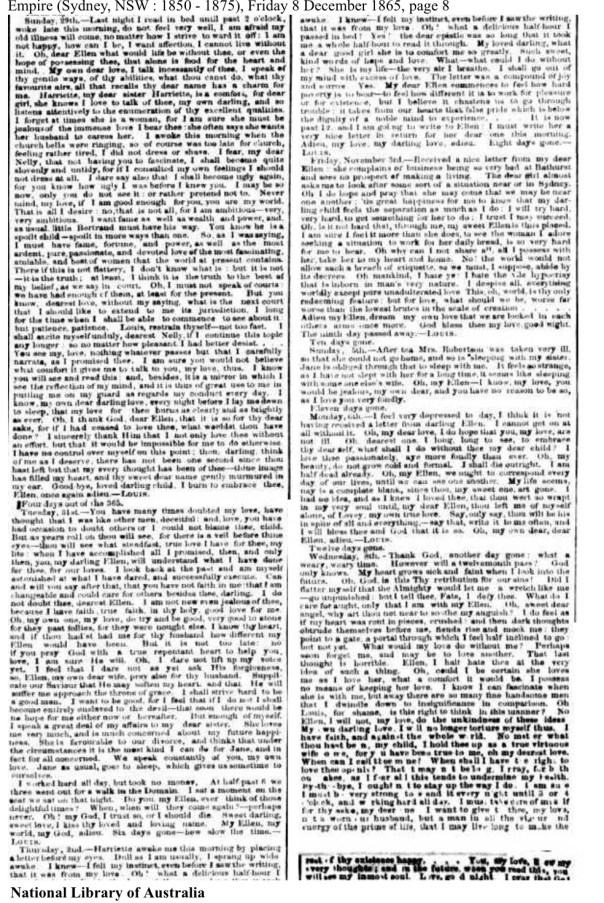
Bertrand noting in his diary, kept to communicate with Maria Kinder, that “’I am satisfied, thus once more I perish my enemies” after Jackson was handed a 12 month gaol sentence.

And so he may have if it wasn’t for his own boastings that he had murdered Kinder.

This got back to an original juror of the blackmailing trial, who took it to the police who arrested both Bertrand, his wife and Mrs Kinder, charging all three with murder.

THE TRIAL

The cases against the women were dismissed quickly, Mrs Bertrand’s as she could not give evidence against her husband, Mrs Kinder due to lack of evidence.

But Bertrand’s trial was a long and messy affair that captured headlines.

It was said Bertrand had several uncles who had been committed to asylums and there was much speculation that Bertrand, too, was ‘mad.’

“It was really he who stood trial and during that trial of course the media were incredibly interested. It was very salacious, there were stories about the three of them sharing a bedroom and poison and mesmerism and how he could control people and make them do his will through his mesmeric powers. There were all kinds of rumours and I suppose to an extent the journalists beating up the story and making it even more sensational than it was,” Ms Campbell said.

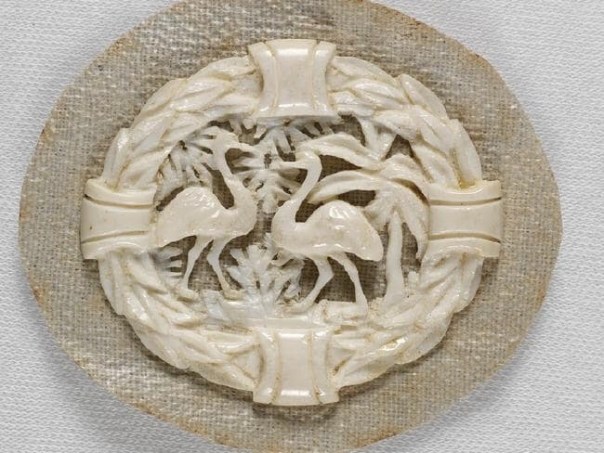
Bone carving by Henry Louis Bertrand while in hospital. Picture: NSW State Libra

Not only the details of the affair, but the cruel treatment of his own wife was exposed in the trial, showing a history of “dreadful” domestic violence, beatings, whippings, control and humiliation in Bertrand inviting Mrs Kinder to live in their home.

“One of the things about Bertrand, one of the things that shocked many people was the way he treated his wife,” Ms Campbell said.

“At that time, because her family had disowned her when she married him, she had two young children and she really had nowhere else to go, there was a lot of sympathy for her and for what she had endured.”

DARLINGHURST GAOL

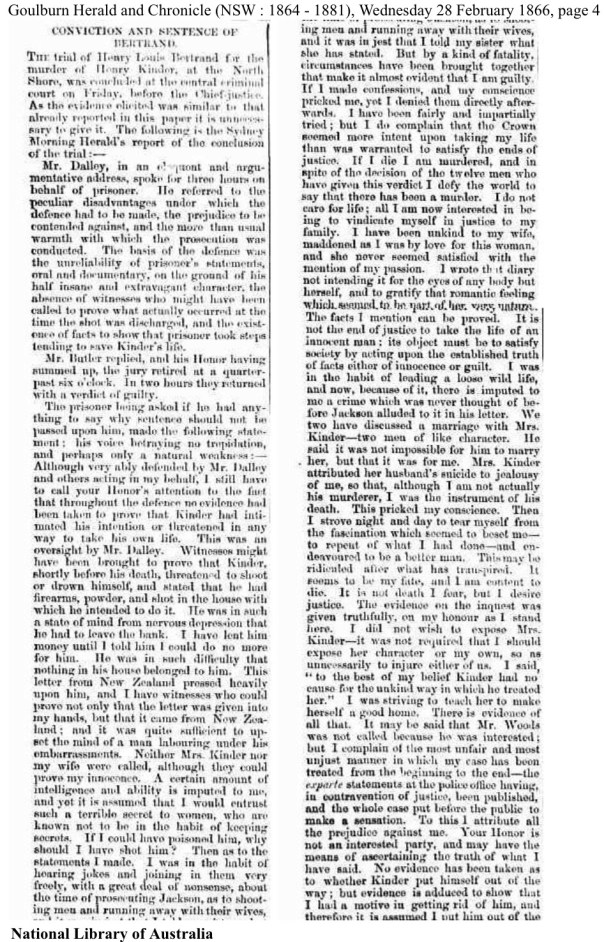
Bertrand was found guilty of Kinder’s murder, but controversially, spared the nominal punishment of the day — hanging, sentenced instead to 28 years at Darlinghurst Gaol.

The murderer spent his prison time honing his artistic side, producing accomplished watercolours of the inside of the gaol and making intricate bone carvings.

Until his release in 1893 when he slipped into obscurity after boarding a boat to London, believed to have been en-route to live with a well off aunt.

A watercolour of the inside of Darlinghurst Gaol painted by Henry Louis Bertrand in 1891, two years before his release Picture: State Library of NSW

While Jane Bertrand, overwhelmed by the public attention of the case, moved to New Zealand with their two children to begin a new life.

Mrs Kinder is also believed to have settled there, where she had lived previously with late husband.

The two pistols, along with two pen holders carved by Bertrand during his prison term can be seen at the Notorious Criminals exhibition currently on show at the Justice and Police Museum.

A photo of Henry Louis Bertrand by the Zimmer Brothers. National Library of Australia.

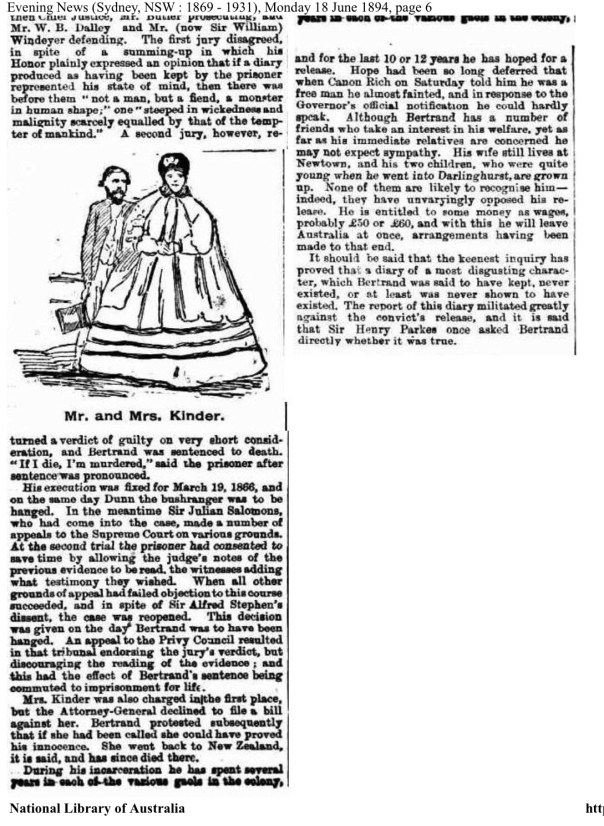
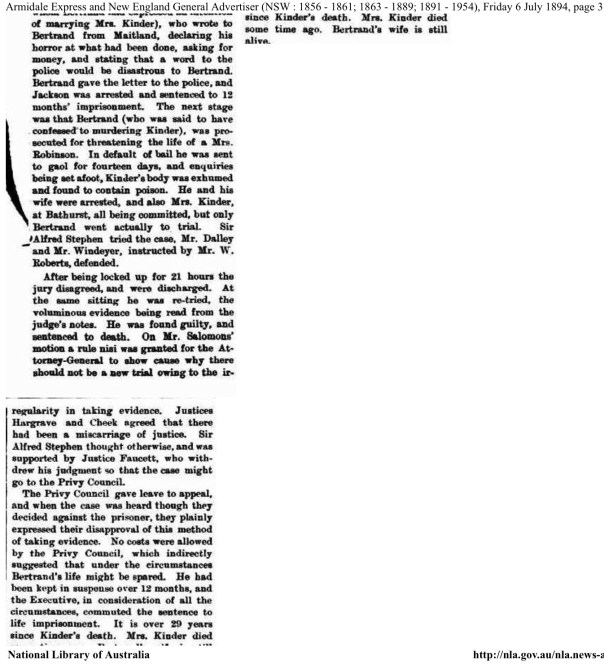
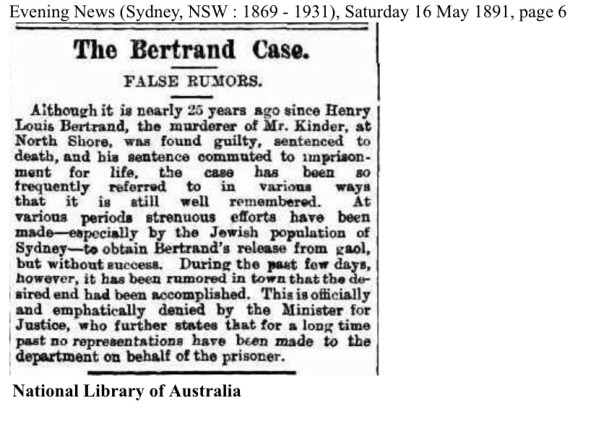
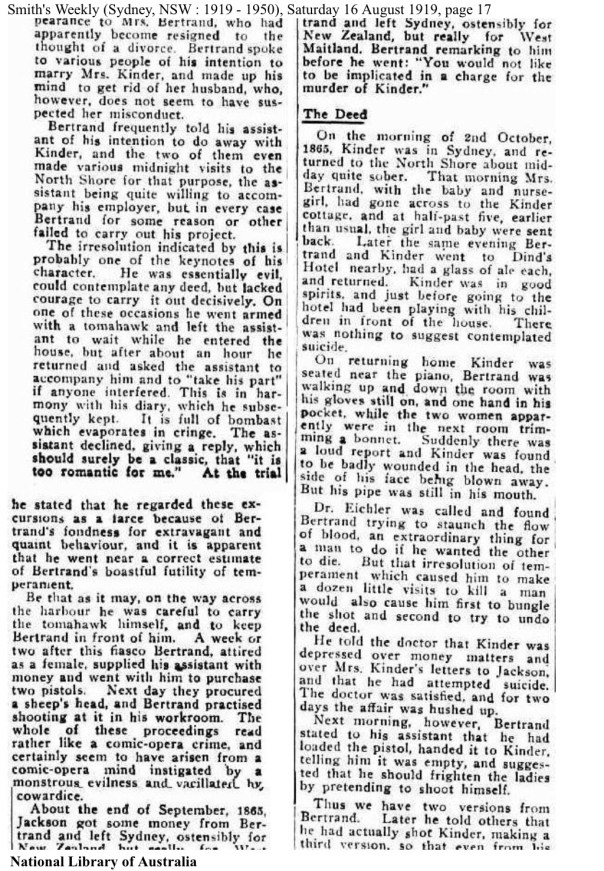
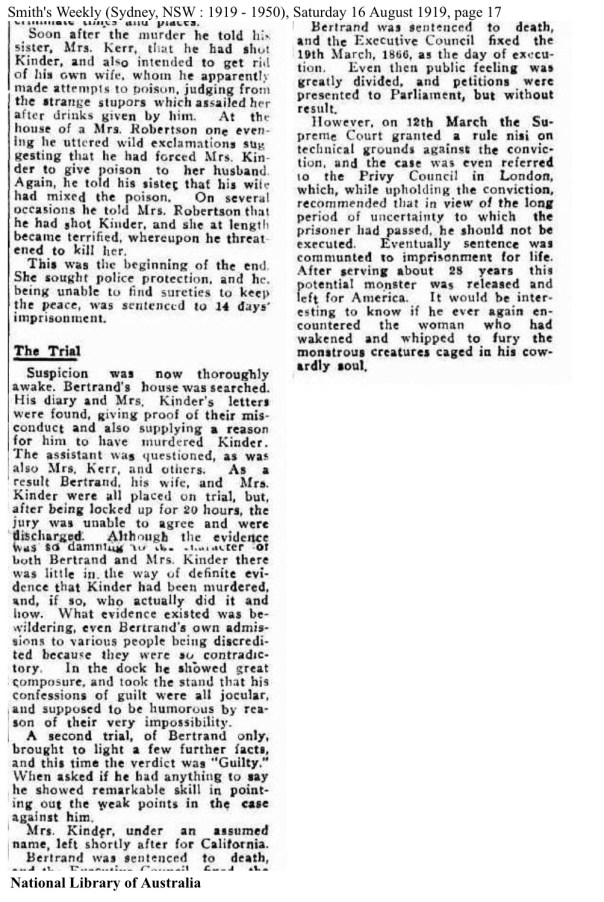
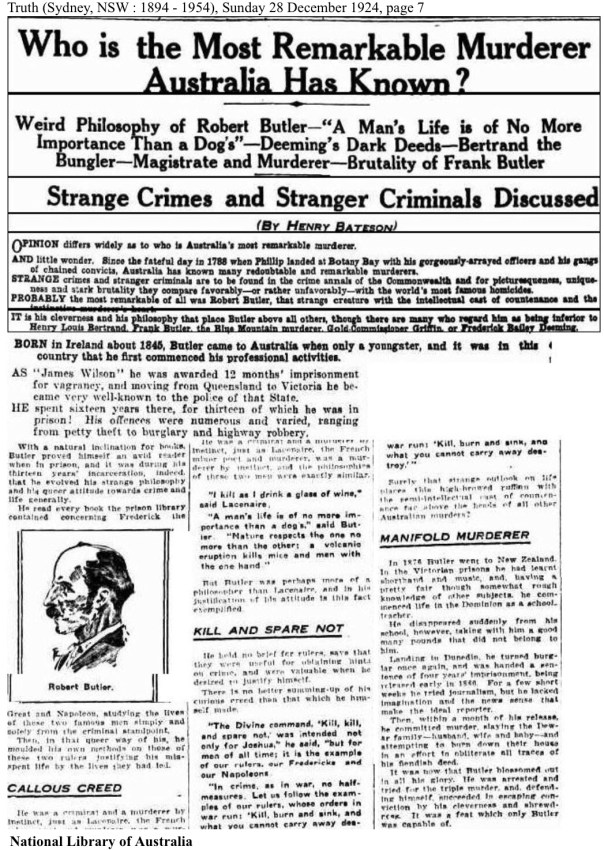
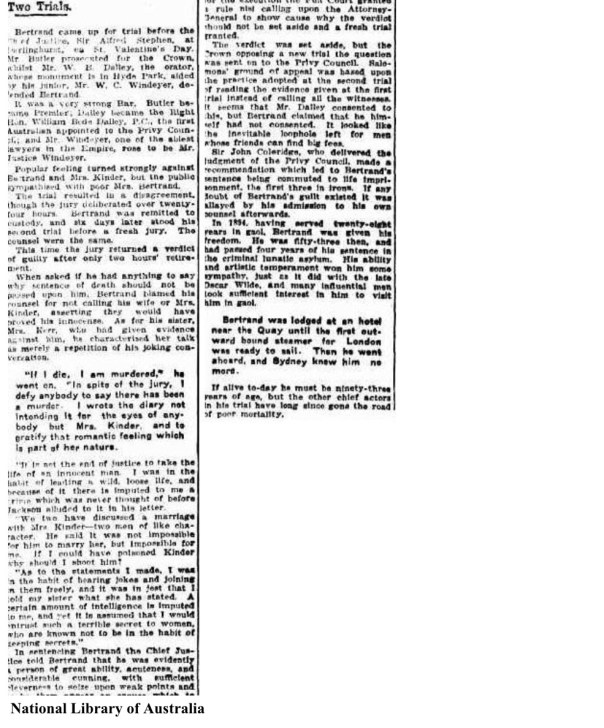
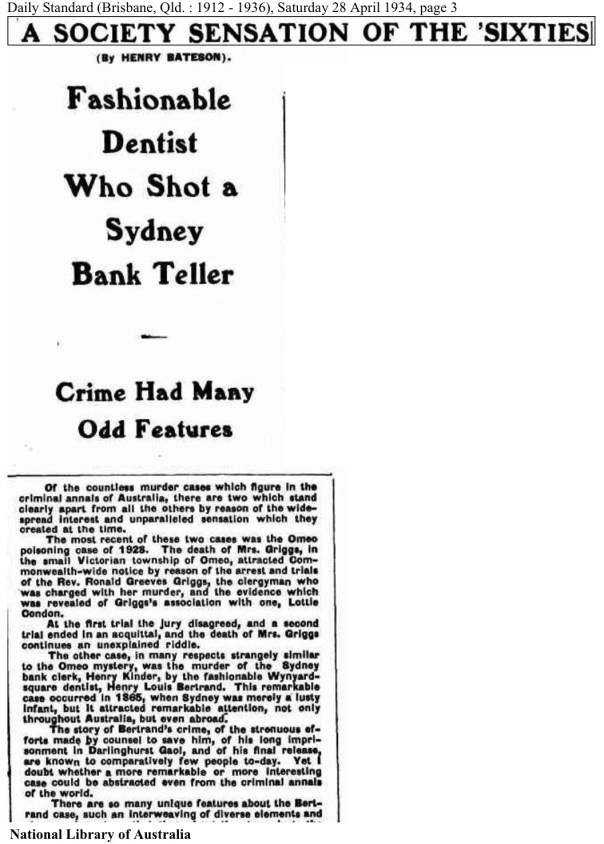
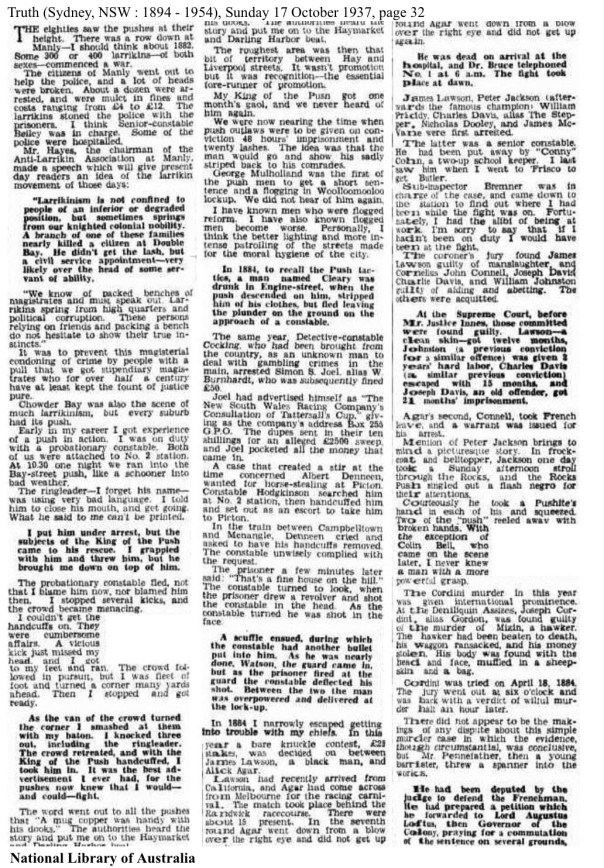
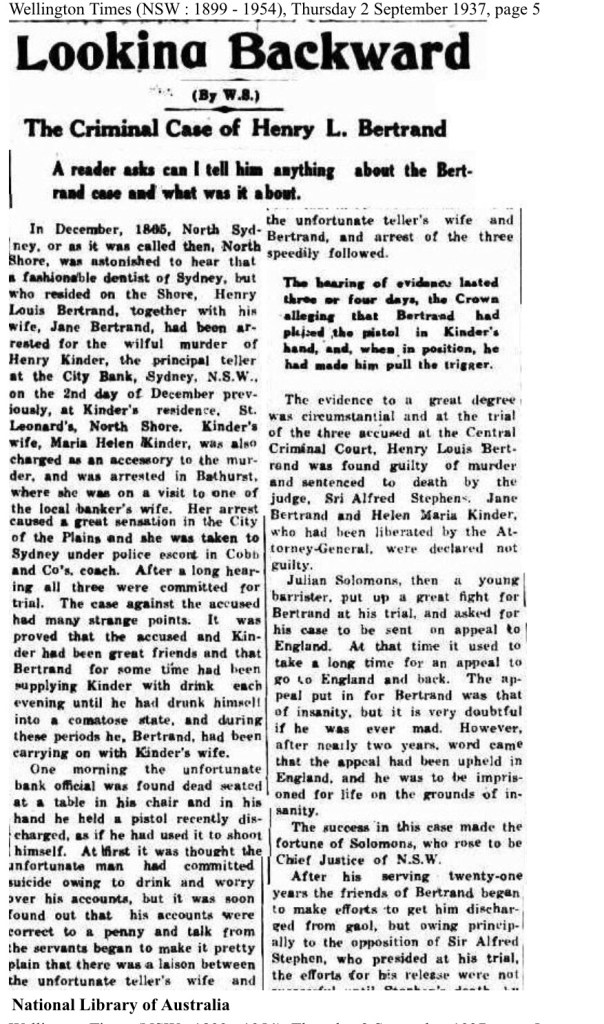
The following are newspaper accounts of the life, times, crimes and trials of Henry Louis Bertrand. The details are repeated in many of them, but I am posting them because of the many differences in how individual papers and journalists handled the facts, both at the time, and further down the line.

Sydney Morning Herald, 16 October 1865

Empire, 8 December 1865

Goulburn Herald and Chronicl, 28 February 1866

Illustrated Sydney News, 16 March 1866

Empire, 17 September, 1866

Sydney Mail, 7 September 1867

Armidale Express and New England General Advertiser, 11 January 1889,

Truth, 17 June, 1894

Evening News, 18 June 1894

Newcastle Morning Herald, 18 June, 1894

Crookwell Gazette, 20 June, 1894

Armidale Express and New England General Advertise, 6 July 1894

Zeehan and Dundas Herald, 4 July 1894

Evening News, 16 May 1891

Herald, 18 June 1894

Richmond River Herald and Northern Districts Advertise, 15 February 1895.
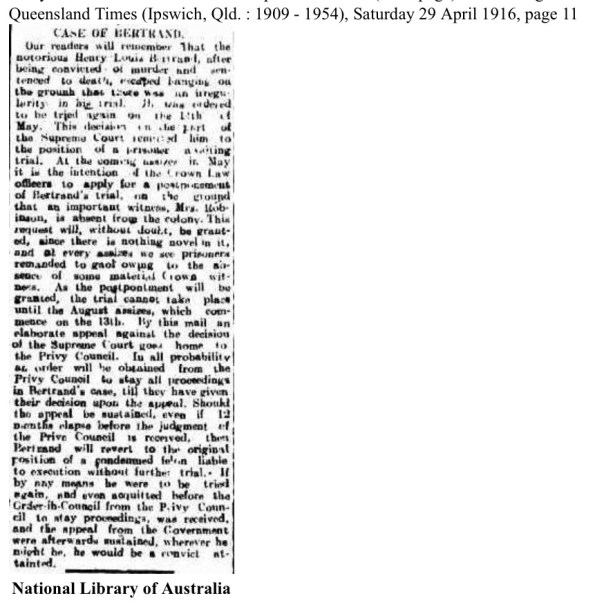
Queensland Times, 29 April, 1916

Smith’s Weekly, 16 August 1919

Truth, 28 December 1924

Truth, 15 March, 1925

Daily Standard (Brisbane), 28 April 1934

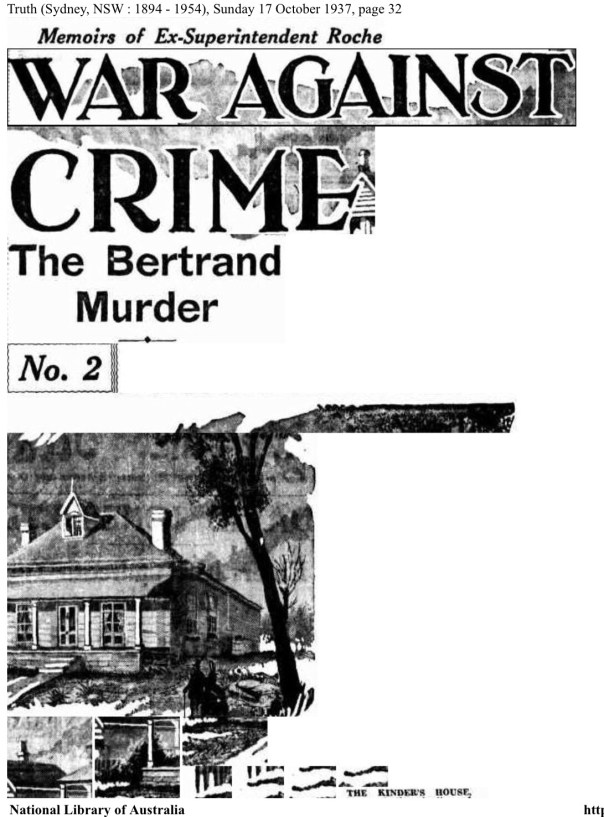
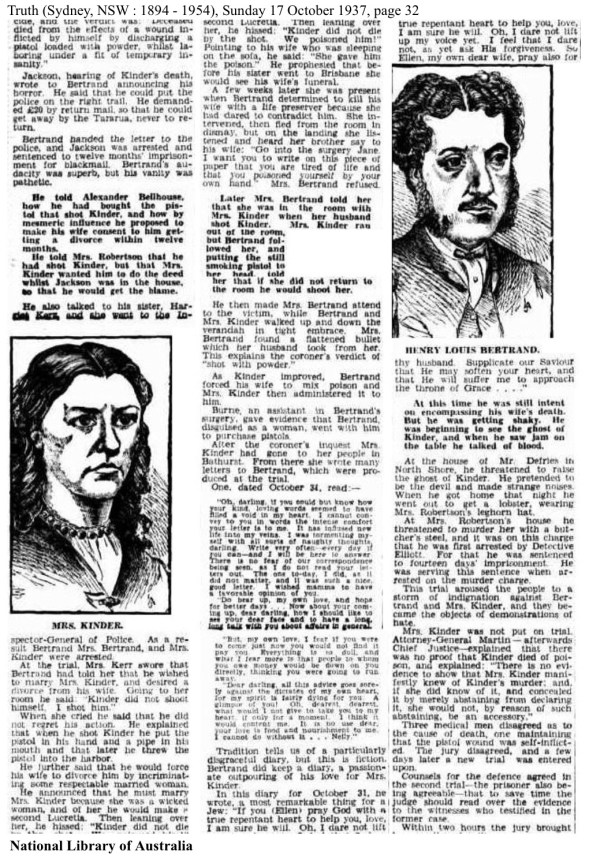
Truth, 17 October 1937

Wellington Times, 2 September 1937

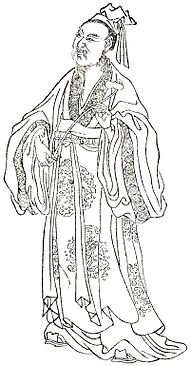
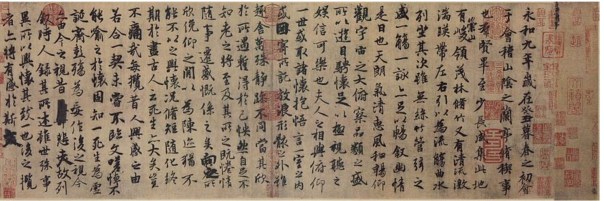
Preface to the Poems Composed at the Orchid Pavilion, by Wang Xizhi

The Orchid Pavilion Gathering of 353 CE was a cultural and poetic event during the Six Dynasties era, in China. This event itself has a certain inherent and poetic interest in regard to the development of landscape poetry and the philosophical ideas of Zhuangzi. The gathering at the Orchid Pavilion is also famous for the artistry of the calligraphy of Wang Xizhi who was both one of the participants as well as the author and calligrapher of the Lantingti Xu, or Preface To The Poems Composed At The Orchid Pavilion, not to mention the literary mastery of this introduction.

The Orchid Pavilion Gathering of 42 literati included Xie An and Sun Chuo, and Wang Pin-Chih at the Orchid Pavilion (Lanting) on Mount Kuaiji just south of Kuaiji (present-day Shaoxing in Zhajiang), during the Spring Purification Ceremony on the third day of the third month, to compose poems and enjoy huangjiu. The gentlemen had engaged in a drinking contest: rice-wine cups were floated down a small winding creek as the men sat along its banks; whenever a cup stopped, the man closest to the cup was required to empty it and write a poem. This was known as “floating goblets” (流觴, liúshāng). In the end, twenty-six of the participants composed thirty-seven poems.

蘭亭集序 lán tíng jí xù

王羲之 Wáng Xīzhī

永和九Y年, Yǒnghé jiǔ nián

歲在癸丑, suì zài guǐ chǒu

暮春之初, lán tíng jí xù

會于會稽山陰之蘭亭, huì yú Guìjī Shānyīn zhī lán

修禊事也。 xiūxì shì yě

群賢畢至, qún xián bì zh

少長咸集。 shào zhǎng xián jí

此地有崇山峻嶺, cǐdì yǒu chóngshānjùnlǐng

茂林修竹, màolínxiūzhú

又有清流激湍, yòu yǒu qīngliú jī tuān

映帶左右。 yìng dài zuǒyòu

引以為流觴曲水, 列坐其次; yǐn yǐ wéi liú shāng qū shuǐ, lièzuò qícì

雖無絲竹管弦之盛, suī wú sīzhú guǎnxián zhī shèng

一觴一詠, 亦足以暢敘幽情。yī shāng yī yǒng, yì zúyǐ chàngxù yōuqíng

是日也, 天朗氣清, shì rì yě, tiān lǎng qì qīng

惠風和暢, 仰觀宇宙之大, huìfēnghéchàng, yǎng guān yǔzhòu zhī dà

俯察品類之盛, 所以遊目騁懷, fǔ chá pǐn lèi zhī shèng, suǒyǐ yóu mù chěnghuái

足以極視聽之娛, 信可樂也。zúyǐ jí shìtīng zhī yú, xìn kě lè yě

夫人之相與俯仰一世, fú rén zhī xiāngyǔ fǔyǎng yī shì

或因寄所托, 放浪形骸之外。huò yīn jì suǒ tuō, fànglàngxínghái zhī wài

雖趣舍萬殊, 靜躁 不同, suī qǔshě wàn shū, jìng zào bùtóng

當其欣于所遇, 暫得于己, dāng qí xīn yú suǒ yù, zàn dé yú jǐ

快然自足, 不知老之將至。kuài rán zìzú, bùzhī lǎo zhī jiāng zhì

及其所之既倦, 情隨事, jí qí suǒ zhī jì juàn, qíng suí shì qiān

感慨係之矣。gǎnkǎi xì zhī yǐ

向之所欣, 俯仰之間, xiàng zhī suǒ xīn, fǔyǎng zhī jiān

已為陳迹, 猶不能不以之興懷; yǐ wéi chén jī, yóu bùnéngbù yǐ zhī xìng huái

況修短隨化, 終期于盡。kuàng xiū duǎn suí huà, zhōng qī yú jìn

古人云: [死生亦大矣。] gǔrén yún: sǐ shēng yì dà yǐ

豈不痛哉! qǐbù tòng zāi

每覽昔人興感之由, měi lǎn xí rén xìng gǎn zhī yóu

若合一契, 未嘗不臨文嗟悼, ruò hé yī qì, wèicháng bù lín wén jiē dào

不能喻之于懷。bùnéng yù zhī yú huái

固知一死生為虛誕, gù zhī yī sǐ shēng wéi xūdàn

齊彭殤為妄作。qí péng shāng wéi wàngzuò

後之視今, 亦由今之視昔。hòu zhī shì jīn, yì yóu jīn zhī shì xī

悲夫! 故列敘時人, bēi fú! gù liè xù shí rén

錄其所述, 雖世殊事異, lù qí suǒ shù, suī shì shū shì yì

所以興懷, 其致一也。suǒ yǐ xìng huái, qí zhì yī yě

後之覽者, 亦將有感於斯文。hòu zhī lǎn zhě, yì jiāng yǒu gǎn yú sī wén

Translation

Preface to the poems composed at the Orchid Pavilion/ (by Wang Xizhi)/ It is the ninth year of Emperor Mu of Jin‘s Yongheera (20 Feb 353 – 8 Feb 354)/ The year of the Yin Water Ox/ At the beginning of the third lunar month (after April 20, 353),/ We are all gathered at the orchid pavilion in Shanyin County, GuijiCommandery,/ For the Spring Purification Festival./ All of the prominent people have arrived,/ From old to young./ This is an area of high mountains and lofty peaks,/ With an exuberant growth of trees and bamboos,/ It also has clear rushing water,/ Reflecting the sunlight as it flows past either side of the pavilion./ The guests are seated side by side to play the drinking game where a wine cup is floated down the stream and the first person sitting in front of the cup when it stops must drink./ Although we lack the boisterousness of a live orchestra,/ With a cup of wine here and a reciting of poetry there, it is sufficient to allow for a pleasant exchange of cordial conversations./ Today, the sky is bright and the air is clear,/ With a gentle breeze that is blowing freely. When looking up, one can see the vastness of the heavens,/ And when looking down, one can observe the abundance of things. The contentment of allowing one’s eyes to wander,/ Is enough to reach the heights of delight for the sight and sound. What a joy./ Now all people live in this world together,/ Still others will abandon themselves to reckless pursuits./ Even though everyone makes different choices in life, some thoughtful and some rash,/ When a person meets with joy, he will temporarily be pleased,/ And will feel content, but he is not mindful that old age will soon overtake him./ Wait until that person becomes weary, or has a change of heart about something,/ And will thus be filled with regrets./ The happiness of the past, in the blink of an eye,/ Will have already become a distant memory, and this cannot but cause one to sigh./ In any case, the length of a man’s life is determined by the Creator, and we will all turn to dust in the end./ The ancients have said, “Birth and Death are both momentous occasions.”/ Isn’t that sad!/ Every time I consider the reasons for why the people of old had regrets,/ I am always moved to sadness by their writings,/ And I can not explain why I am saddened./ I most certainly know that it is false and absurd to treat life and death as one and the same,/ And it is equally absurd to think of dying at an old age as being the same as dying at a young age./ When future generations look back to my time, it will probably be similar to how I now think of the past./ What a shame! Therefore, when I list out the people that were here,/ And record their musings, even though times and circumstances will change,/ As for the things that we regret, they are the same./ For the people who read this in future generations, perhaps you will likewise be moved by these words.

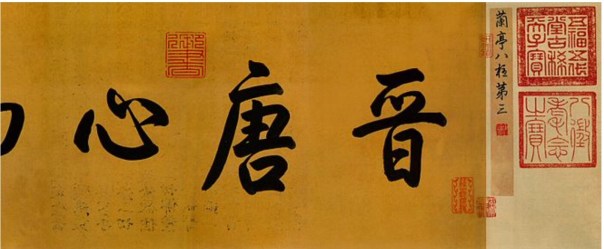
Lantingji Xu is Wang Xizhi‘s most famous work, which described the beauty of the landscape around the Orchid Pavilion and the get-together of Wang Xizhi and 41 literati friends. The original is lost. Some believed that it was buried with Emperor Taizong of the Tang dynasty in his mausoleum. This Tang era copy by Feng Chengsu (馮承素), dated between 627-650, is considered the best of all the subsequent copies.[4] It is located in the Palace Museum in Beijing. The scroll is meant to read right to left.

References

Larger Than Life: Rosaleen Norton – The Witch of King’s Cross!

Australia can’t claim many famous witches but Rosaleen ”Roie” Norton, a talented bohemian painter, adhering to a form of pantheistic / Neopagan witchcraft which was devoted to the pagan god Pan, was known for most of her life as the ”Witch of Kings Cross”.

Rosaleen Miriam “Roie” Norton was born on the 2 October 1917, in Dunedin, New Zealand to Beena & Albert Norton, an English middle class, Anglican family who had moved to the country a number of years before. She was the third of three sisters and her siblings, Cecily and Phyllis, were each over a decade older than her.

When she herself was eight, in June 1925, her family emigrated to Sydney, Australia, where they settled in Wolseley Street, Lindfield. As a child, she never liked being conventional, and disliked most other children, as well as authority figures, including her mother, with whom her relationship was very strained. Her father, who was a sailor, was regularly away from home, although provided enough of an income so that the Nortons were able to live comfortably. Nonetheless, she would later describe her life at this time as being “a generally wearisome period of senseless shibboleths, prying adults, detestable or depressing children whom I was supposed to like, and parental reproaches. Due to this, she kept herself to herself, sleeping not in the house, but in a tent which she pitched in the garden for three years, and kept a pet spider at the entrance which she named Horatius, as well as other pets including cats, lizards, tortoises, toads, dogs and a goat.

She later claimed she was born with certain markings that set her apart as a witch, such as pointed ears, blue markings on her left knee and a strand of flesh that hung on her body.

Norton was enrolled at a Church of England girls’ school, where she was eventually expelled for being disruptive and drawing images of demons, vampires and other such beings which the teachers claimed had a corrupting influence on other pupils. She subsequently began attending East Sydney Technical College, studying art under the sculptor Rayner Hoff, a man who encouraged her artistic talent and whom she greatly admired.

Following her art college studies, Norton set herself up to become a professional writer, with the newspaper Smith’s Weekly publishing a number of her horror stories in 1934, when she was sixteen, after which they gave her the job as a cadet journalist and then as an illustrator. However, her graphic illustrations were deemed too controversial, and she lost her job at the paper. Leaving Smith’s Weekly, Norton moved out of her family home following the death of her mother, and sought employment as an artists’ model, working for such painters as Norman Lindsay. To supplement this income, she also took up other forms of work, including as a hospital’s kitchen maid, a waitress and a toy designer. Meanwhile, she had taken up a room in the Ship and Mermaid Inn, which overlooked Circular Quay, Sydney, where she began reading various books on the subject of the Western Esoteric Tradition, including those on demonology, the Qabalah and comparative religion.

In 1935, Rosaleen met a man named Beresford Lionel Conroy and they married on 14 December 1940, before going on a hitch-hiking trip across Australia, from Sydney to Melbourne, and on through to Brisbane and Cairns. Returning to Sydney, Conroy enlisted as a commando and went off to serve in New Guinea during the Second World War, and upon his return, Norton, who had been forced to live in a stable during this period, demanded a divorce, which was finally settled in 1951. During their marriage, the couple lived at 46 Bayswater Road, Kings Cross in 1943. Now single once more, Norton took up residence in a boarding house known as the Merangaroo in the Rocks area, which she enjoyed for its “eccentric, communal living.”. She began looking for illustration work once more, being employed by a monthly free-thinking magazine known as Pertinent, which had been founded in 1940 and which was edited by the poet Leon Batt. Batt admired Norton’s work, which was being increasingly influenced by pagan themes, describing her as “an artist worthy of comparison with some of the best Continental, American and English contemporaries.”

By the age of 32, she had held an exhibition of her art at the University of Melbourne’s Rowden White Library, where four paintings were removed by the prudish Melbourne police, who argued they were obscene.

Norton was subsequently charged under the Police Offences Act of 1928. At the court case, held in Melbourne’s Carlton Court, she was defended by A.L. Abrahams, who argued that the images in the recently published The History of Sexual Magic, a book that the Australian censors permitted, were of a far more obscene nature than Norton’s paintings. She won the case, and was awarded £4/4/- in compensation from the police department.

Artist Rosaleen Norton, known as the Witch of Kings Cross, at her home in 1950.

While working at Pertinent, she met a younger man named Gavin Greenlees (1930–1983). Greenlees had grown up in a middle-class family where he had developed an early interest in surrealism, and had become a relatively successful poet, having his work published in such newspapers as ABC Weekly and Australia Monthly. By mid-1949, the two had become good friends.

She returned to Sydney in 1951 and settled in Kings Cross, becoming an integral part of the suburb’s bohemian scene. Norton and Greenlees (who had become lovers), moved into the house at 179 Brougham Street. This was in the area known as Kings Cross, which at the time was renowned for being a red light district and for housing many of those living bohemian lifestyles, particularly artists, writers and poets. and mixing with the likes of Dulcie Deamer the ”Queen of Bohemia”, drawing large occult murals. Visitors were greeted with a sign declaring: ”Welcome to the house of ghosts, goblins, werewolves, vampires, witches, wizards and poltergeists.”

The police saw her as a menace and arrested her for vagrancy. When she appeared in court, she was saved from prosecution by Walter Glover, a publisher who employed her and subsequently published The Art of Rosaleen Norton, which ensured her enduring infamy. Glover was charged with the production of an obscene publication and two images had to be blacked out before the book could be sold. Norton was called into court to explain the nature of her works. The judge ruled that two of the images in the book, The Adversary and Fohat, did qualify as being obscene under Australian law, and that they had to be removed from all existing copies of the book. The authorities in the United States were even stricter, and actively destroyed any copies of the book that were imported into their country.[21] The controversy had helped gain publicity for Norton’s work, although the whole affair had bankrupted Glover, and the book’s binder Alan Cross, realising that he would never get paid, was instead given his pick of Norton’s work, for which he chose Fohat

Norton’s “Seance”

Norton’s reputation as a witch was compounded in 1955, when she was falsely accused of holding a satanic Black Mass. In 1955, a mentally ill vagrant named Anna Karina Hoffman swore at a police officer, and was subsequently charged, but at her trial claimed that her life had fallen apart after taking part in a SatanicBlack Mass run by Rosaleen Norton, a claim which was picked up in by the sensationalist tabloids. Norton, who did not consider herself to be a Satanist but a pagan, denied these claims, and indeed Hoffman later admitted that she had made them up. However, by this time, the press had picked up on the idea of Norton as a devil worshipper, and spun stories around the idea, for instance claiming that she committed animal sacrifice, a practice which in reality Norton abhorred. With this public outcry against her work, the police once more began to act against her and those who supported her. In 1955, they successfully took the proprietor of a local restaurant, the Kashmir, to court, for displaying some of her works publicly.That year the police raided Norton and Greenless’ home, and accused them of performing “an unnatural sexual act”, evidence for which they had obtained in a photograph displaying Greenless in ritual garb flagellating Norton’s buttocks. It was subsequently revealed that the photos had been taken at Norton’s birthday party, and stolen by two members of their coven, Francis Honer and Raymond Ager, who planned to sell it to The Sun newspaper for £200.

The following year, she was caught up in an obscenity scandal surrounding British conductor Sir Eugene Goossens, who was then in Australia and who had an interest in the occult, read a copy of The Art of Rosaleen Norton and decided to write to the artist herself. She invited him to meet her, and the two, alongside Gavin Greenless, became friends and lovers. In March 1956, Goossens was arrested attempting to bring 800 erotic photographs, some film and ritual masks into Australia from London, and was charged under Section 233 of the Customs Act. In court, he pleaded guilty to bringing “blasphemous, indecent or obscene works” into the country and was fined £100. He resigned his positions at both the Sydney Symphony Orchestra and New South Wales Conservatorium of Music and returned to Britain, his international career ending in disgrace. Norton’s relationship with Goossens ended, and soon the life that she had held with Greenless also collapsed, as he was admitted to Callan Park Hospital with schizophrenia. She would continue to visit and support him, and in 1964 he was let off on temporary release, but suffered a schizophrenic attack and attempted to kill Norton with a knife before being re-admitted. He would only be discharged permanently in 1983, approximately four years after her death.

Norton openly declared herself to be a Witch. She tried to explain her beliefs to interviewers, emphasising her faith in pantheism. Along with selling her paintings, she was also making charms and casting hexes for people, using witchcraft to supplement her income.

For a short period, Norton moved in to live with her sister Cecily, one of the few family members whom she got on well with, at her flat in Kirribilli, although in 1967 moved back to Kings Cross, taking up residence in a derelict house in Bourke Street, Darlinghurst. She later moved into a block of flats in Roslyn Gardens, Elizabeth Bay, accompanied by her pets. Here she began to live a more reclusive and private existence, avoiding the media attention of previous decades.

Although her two main sexual relationships in her life were with men (Gavin Greenlees and Sir Eugene Goossens respectively), Norton was bisexual, and allegedly enjoyed all forms of sexual activity with both men and women, including bondage and sado-masochism. She was also known to enjoy sexual intercourse with gay men, believing that in such situations she could play the active role. She also actively engaged in sex magic amongst her coven, having learned much about it from the writings of Aleister Crowley and from Goossens, who himself had been very much interested in Crowley’s work.Norton died in 1979 from colon cancer at the Sacred Heart Hospice for the Dying, in Darlinghurst, Sydney, still worshiping Pan;[21] a pagan until her death. Shortly before she died she is reported as saying: “I came into the world bravely; I’ll go out bravely. A plaque dedicated to her has since been installed in Darlinghurst Road, Kings Cross.

Rosaleen’s commemorative plaque in Bourke Street

In December 1982, a play opened at the Tom Mann Theatre in Sydney entitled Rosaleen – Wicked Witch of the Cross, by Barry Lowe. It starred Jane Parker as Norton, Peter Laurence as Glover, Christopher Lyons as Greenlees and Alan Archer as Pan, and was attended by both Wally Glover and Gavin Greenlees themselves. However, according to Nevill Drury, who was invited to the show by Glover, “the play itself had most of the weaknesses of an amateur production – it was unconvincingly acted and was not acclaimed a critical success.

In 1988, the anthropologist Nevill Drury, who had published a number of books on the subject of witchcraft and magic, released a biography of Norton entitled Pan’s Daughter: The Strange World of Rosaleen Norton. This volume was subsequently re-released under the title The Witch of Kings Cross. He later “substantially expanded and reworked” this into a new book titled Homage to Pan: The Life, Art and Sex-Magic of Rosaleen Norton, which was published in 2009. Drury had himself met her only on one occasion, at her apartment in 1977, at a time when she had become somewhat of a recluse.[34]

In 2000, an exhibition of Norton’s paintings was held in Kings Cross, Sydney, organised by various enthusiasts including Keith Richmond, and Barry Hale of the Australian Ordo Templi Orientis. A full-colour catalogue, The Occult Visions of Rosaleen Norton was published to accompany this exhibition.In 2009, Teitan Press published Thorn in the Flesh: A Grim-memoir by Norton, with an introduction by Australian Norton scholar Keith Richmond. The volume comprises poetry (often humorous), reminiscences, and various occult jottings by Rosaleen Norton, with reproductions of two stunning photographs of Norton, as well as some half-a-dozen examples of her art (mainly in color).

In 2012 Norton’s work was including in the major exhibition, “Windows to the Sacred” curated by Robert Buratti, which toured a number of Australian museums until 2016. The exhibition drew together drawings and paintings alongside work by Aleister Crowley, Austin Osman Spare, surrealist James Gleeson and many others.

References

Gay History: The Murder of Drag Entertainer,Wendy Wayne; King’s Cross, April 30, 1985.

The names Wendy & Wayne, and gender terms him and her are all used in this article. The newspapers used the male terminologies, though only ever knowing Wayne as Wendy I felt more comfortable using the female terminologies. Where people have been quoted, the terminologies they used are included.

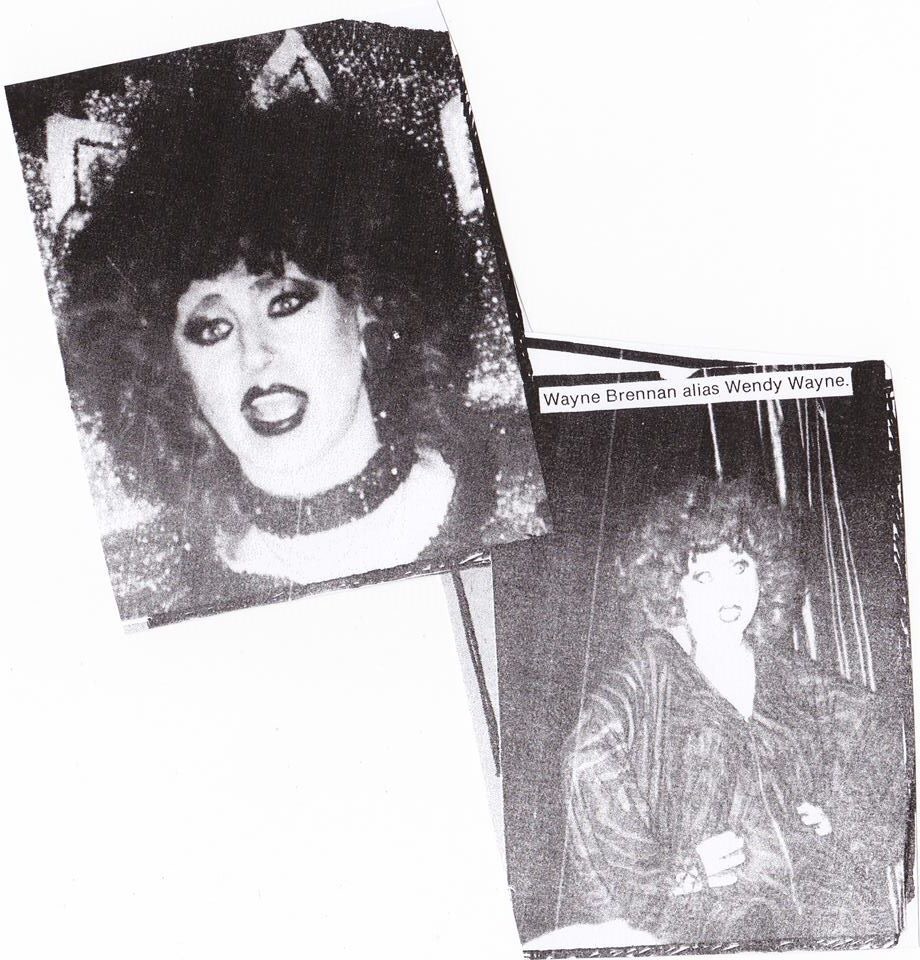
On the evening of April 30, 1985, well known and popular gay drag entertainer, Wendy Wayne (Wayne Kerry Brennan), 35, was murdered in his small Darlinghurst Road, King’s Cross, bedsitter. He had been knocked unconsciius by a blow to the head, then shot twice in the back. It was thought by police that the killer may have been a client.

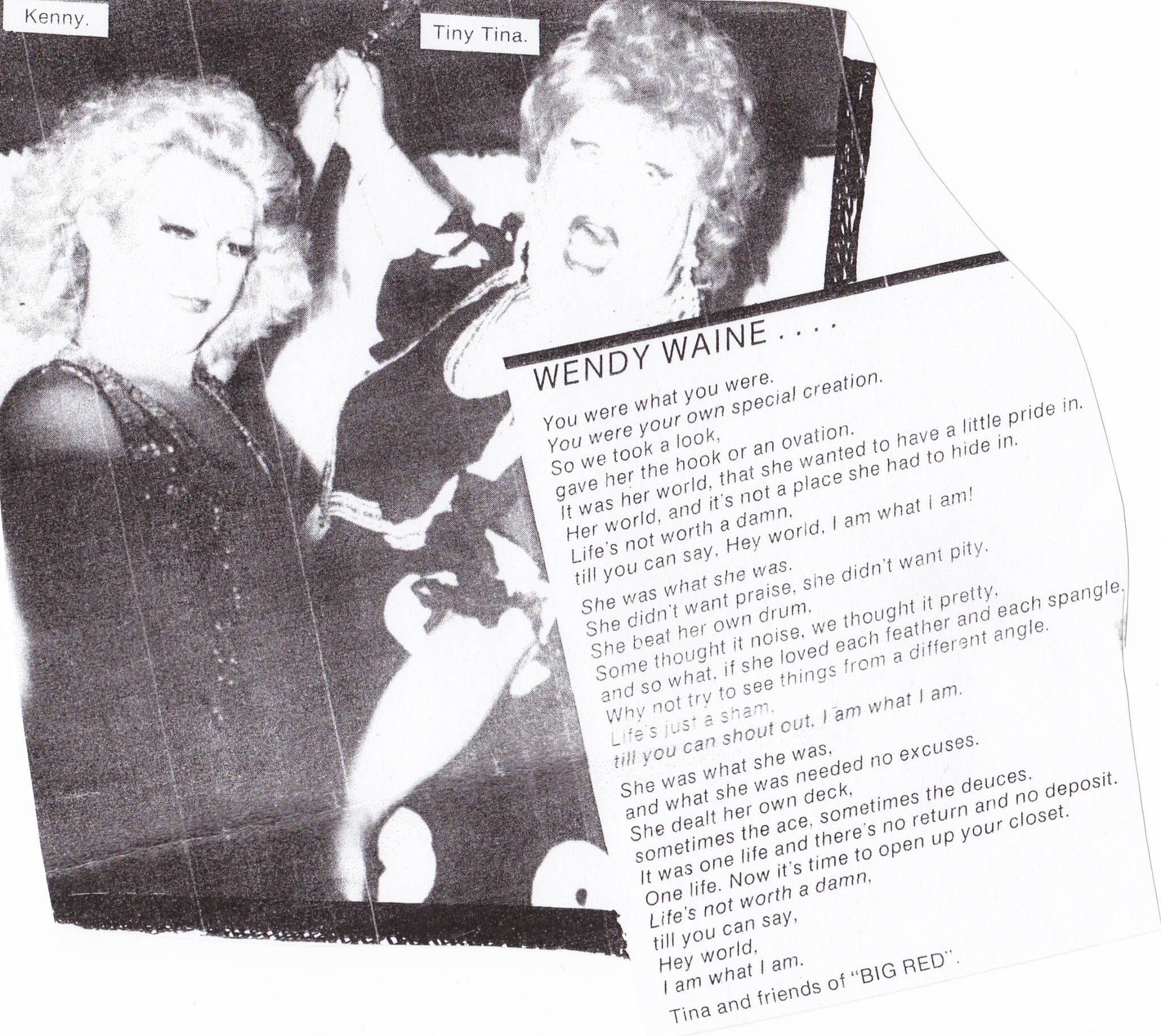
I did not personally know Wendy, though had seen her perform at Pete’s Beat in Oxford Street, and had actually met her on 25 February that year, when she attended a party at a friends flat (Barry Costello) on the corner of  Oxford & Crown streets in Darlinghurst, then joined us on the awning outside the flat to watch the Mardi Gras parade. She attended the party with Tiny Tina – another performer at Petr’s Beat. Little did we know at that time, that 8 weeks later she would be dead.

Tiny Tina (left); Wendy Wayne and Barry Costello at Mardi Gras, February 25, 1985. Photo taken in Barry’s flat (Writer’s private photo collection)

Friend’s were distraught and puzzled.  Wayne had geen well loved, and was known to many people, both straight and gay. To everyones knowledge, he had no enemies. He was a popular performer at Pete’s Beat, and also at Les Girls, where he put in occasional guest appearances.

An autopsy indicated that the murder was quite brutal, with him being knocked unconscious by a hard blow to the back of his head. The murderer had then shot him with what appeared to be a .45 ecalibre gun with two shots at close rang in his back. One shot had been placed between the shoulder blades, and exited through the neck. He was shot a second time through the  base of the skull, with the bullet exiting through the chin. He was then covered within a leopard skin. He was discovered by a friend, Kenneth Beckham, the next morning. The door to the bedsit was open’ and the television & heater were both on. Police were unable to find the killer, the gun, or bullets involved in the murder.

Accoding to Kenneth “Wendy was the nicest person you could ever meet”. “She was loved by her workmates, and all her friends”. “No one knew of any ill-feeling between her, or anyone else. She was just too kind”. Kenneth also informed police that Wayne had grown up in Newcastle, and had geen a performer for some years. He stated that there had been no arguments, either professionally, or romantically. He was well known by many in pubs in Darlinghurst, Moore Park, and Surry Hills.

There were fears among both gays and other transvestites that a sex killer could be on the loose. Police claimed that Wayne was kniwn to other King’s Cross prostitutes, and personalities. Kenneth stated ” I just hope police find this killer, in case he strikes again!”.

Gloria Murphy, friend and colleague of Wayne’s, said “I’d love to lay my hands on the bastard who did it. I’m not scared, just angry and daddened by the whole business!”. Gloria had known Wayne for 20 years, and they both performed together in the Hallelujah Hollywood show at Pete’s Beat. “I knew Wendy when she was just a 16-year-old kid who ran away from home” she said. “She performed around all the old traps such as the Pink Pussycat, and the Pink Panther”.

Wendy’s friends cimed that she had only recently become a prostitute, and may have attracted a “bad” client. Talent co-ordinator of Pete’s Beat, Tina, also appeared in the stage show with Wendy and saud “I’m sure it was no one known to our social circle, we’re a pretty tight knit group and don’t associate with weirdo’s”. Graham King, stage manager of Pes Beat, sobbed as he said “As soon as Wendy stepped on stage it was magic. It will never be the same again”. “Wendy was a real performer who joked, sang, danced, and really drew a crowd. She made over 400 costumes for her acts over the last three years”.

Terry Grimley, lighting technician of Pete’s Beat, agreed. “She was excellent. Really tops”. And as Gloria says “The show must go on!”.

A month after her murder, police still had no leads  in finding her killer. On the 13 May, Detective Sgt Smith, of Darlinghurst police, appealed to anyone with information in connection to the murder to contact him.

On Sunday night, 12 May, Kandy Johnson & Simone Troy threw open the doors to the upstairs var and entertainment area in the Oaddington Green Hotel, for a genefit for Wendy. Trixie Lamont and Lirraine Campbell-Craig diverged from their usual Sunday night show to host an evening of fund-raising for Wendy’s family. Both of Wendy’s sisters were present, to receive a total of $2,500 donated by local gay businesses, and attendee’s at the event. The elite of Sydney’s drag community performed on the night, including Kandy, Trixie, Lorraine, the performers from the apet’s Beat show, Beau’s and Les Girls.

The murder of Wendy Wayne has never been solved. Whacky conspiracy theories that she was murdered by a detective, or that Sydney bar owner and personality Dawn O’Donnell was involved have not been taken seriously, and have never been investigated.

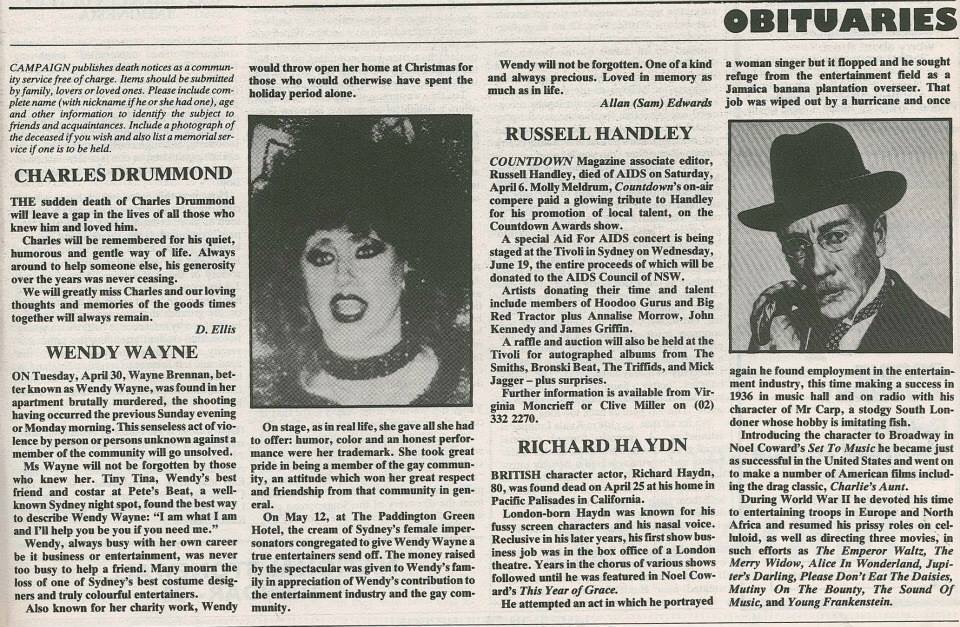
Obituaries, Campaign 114, June 1985

Tim Alderman (2017)

References

  • Drag queen’s death hunt Pt 1, Daily Mirror, Wednesday 1 May 1985
  • Drag queens death riddle Pt 2 of above, Daily Mirror, Wednesday 1 May 1985
  • Killer could strike again (Peter Holder, Steve Brian), The Sun, Wednesday 1 May 1985
  • Killer could strike again (Peter Holder), The Sun, Wednesday 1May 1985
  • Police hunt transvestite killer (Mark Forbes), Sydney Morning Herald, Wednesday 1 May 1985
  • Wendy killing shocks gays (Alan Hardie), Daily Telegraph, Wednesday 1 May 1985
  • Drag queen was prostitute – Daily Mirror , Thursday 2 May 1985
  • We’ll avenge Wendy’s murder (Monica Beagle), The Sun, Thursday 2 May 1985
  • Obituaries, Campaign 114, June 1985
  • Sydney entertainer Wendy Wayne, murdered, Campaign 114, June 1985
  • Sydney gay entertainer murdered, Outrage 25, June 1985

The New Genocide?

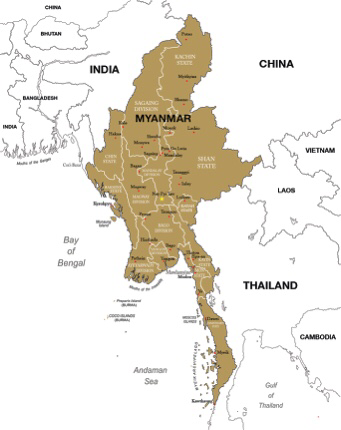
What is happening in Myanmar (Burma) is truly terrible, but seems to be a microcosm of events currently occuring in many corners of the world! A toxic mix of religious intolerance (religion, as always, causing problems, no matter its breed or creed!); intolerance of ethnicity (when are we going to accept others for just being what they are -people!); environmental vandalism (FFS leave things alone!); brought about by multi-national corporate greed! These huge, unethical, money-grabbing corporations are going to destroy us long before climate change does!; politics – a hedonistic institution at its best, destructive and nihilistic at its worst! Add media misinformation, and bias, into the mix, often stirring up trouble that was never there in the first place, and you have a sure recipe for disaster. This beautiful country, once famous for its ancient culture and tea, is now a place of potential genocide. This is how we manage to change beautiful landscapes into ruination! The following article sheds interesting insights into the current state of affairs in Myanmar.


Religion is not the only reason Rohingyas are being forced out of Myanmar
September 12, 2017 4.35am SAST

Updated September 19, 2017 3.43am SAST

 Giuseppe Forino, Jason von Meding, and Thomas Johnson

Minorities in Myanmar, including the Rohingya, are resilient in the face of persecution. Giuseppe Forino, Author provided
Recent weeks have seen an escalation of violence against the Rohingya in Rakhine, the poorest state of Myanmar. A tide of displaced people are seeking refuge from atrocities – they are fleeing both on foot and by boat to Bangladesh. It is the latest surge of displaced people, and is exacerbated by the recent activity of the Arakan Rohingya Salvation Army (ARSA).

Religious and ethnic differences have been widely considered the leading cause of the persecution. But it is becoming increasingly hard to believe that there are not other factors at play. Especially given that Myanmar is home to 135 official recognised ethnic groups (the Rohingya were removed from this list in 1982).
In analysing the recent violence, much of the western media has focused on the role of the military and the figure of the de facto leader Aung San Suu Kyi. Her status as a Nobel Peace prize laureate has been widely questioned since the latest evidence of atrocities emerged.
She continues to avoid condemning the systematic violence against the Rohingya. At least the media gaze has finally shifted somewhat towards their plight.
But there remain issues that are not being explored. It is also critical to look beyond religious and ethnic differences towards other root causes of persecution, vulnerability and displacement.
We must consider vested political and economic interests as contributing factors to forced displacement in Myanmar, not just of the Rohingya people but of other minorities such as the Kachin, the Shan, the Karen, the Chin, and the Mon.
Major ethnic groups in Myanmar. Al Jazeera

Land grabbing

Land grabbing and confiscation in Myanmar is widespread. It is not a new phenomenon.
Since the 1990s, military juntas have been taking away the land of smallholders across the country, without any compensation and regardless of ethnicity or religious status.
Land has often been acquired for “development” projects, including military base expansions, natural resource exploitation and extraction, large agriculture projects, infrastructure and tourism. For example, in Kachin state the military confiscated more than 500 acres of villagers’ land to support extensive gold mining.
Development has forcibly displaced thousands of people – both internally and across borders with Bangladesh, India, and Thailand – or compelled them to set out by sea to Indonesia, Malaysia and Australia.
In 2011, Myanmar instituted economic and political reforms that led it to be dubbed “Asia’s final frontier” as it opened up to foreign investment. Shortly afterwards, in 2012, violent attacks escalated against the Rohingya in Rakhine state and, to a lesser extent, against the Karen. Meanwhile, the government of Myanmar established several laws relating to the management and distribution of farmland.
These moves were severely criticised for reinforcing the ability of large corporations to profit from land grabs. For instance, agribusiness multinationals such as POSCO Daewoo have eagerly entered the market, contracted by the government.

A regional prize

Myanmar is positioned between countries that have long eyed its resources, such as China and India. Since the 1990s, Chinese companies have exploited timber, rivers and minerals in Shan State in the North.
This led to violent armed conflicts between the military regime and armed groups, including the Kachin Independence Organization (KIO) and its ethnic allies in eastern Kachin State and northern Shan State.
In Rakhine State, Chinese and Indian interests are part of broader China-India relations. These interests revolve principally around the construction of infrastructure and pipelines in the region. Such projects claim to guarantee employment, transit fees and oil and gas revenues for the whole of Myanmar.
Among numerous development projects, a transnational pipeline built by China National Petroleum Company (CNPC) connecting Sittwe, the capital of Rakhine, to Kunming, China, began operations in September 2013. The wider efforts to take Myanmar oil and gas from the Shwe gas field to Guangzhou, China, are well documented.

Rohingya Muslims tell of gang rapes and secret killings in Myanmar’s hidden region

Pipeline from the Shwe gas field to China. The Shwe Gas Movement

A parallel pipeline is also expected to send Middle East oil from the Kyaukphyu port to China. However, the neutral Advisory Commission on Rakhine State has urged the Myanmar government to carry out a comprehensive impact assessment.

In fact, the Commission recognises that pipelines put local communities at risk. There is significant local tension related to land seizures, insufficient compensation for damages, environmental degradation, and an influx of foreign workers rather than increased local employment opportunities.
Meanwhile, the Sittwe deep-sea port was financed and constructed by India as part of the Kaladan Multi-modal Transit Transport Project. The aim is to connect the northeast Mizoram state in India with the Bay of Bengal.
Coastal areas of Rakhine State are clearly of strategic importance to both India and China. The government of Myanmar therefore has vested interests in clearing land to prepare for further development and to boost its already rapid economic growth.
All of this takes place within the wider context of geopolitical maneuvering. The role of Bangladesh in fuelling ethnic tensions is also hotly contested. In such power struggles, the human cost is terribly high.

Compounding the vulnerability of minorities

In Myanmar, the groups that fall victim to land grabbing have often started in an extremely vulnerable state and are left even worse off. The treatment of the Rohingya in Rakhine State is the highest profile example of broader expulsion that is inflicted on minorities.
When a group is marginalised and oppressed it is difficult to reduce their vulnerability and protect their rights, including their property. In the case of the Rohingya, their ability to protect their homes was decimated through the revocation of their Burmese citizenship.
Rohingya settlement near Sittwe. Thomas Johnson
Since the late 1970s around a million Rohingya have fled Myanmar to escape persecution. Tragically, they are often marginalised in their host countries.

With no country willing to take responsibility for them, they are either forced or encouraged to continuously cross borders. The techniques used to encourage this movement have trapped the Rohingya in a vulnerable state.
The tragedy of the Rohingya is part of a bigger picture which sees the oppression and displacement of minorities across Myanmar and into neighbouring countries.
The relevance and complexity of religious and ethnic issues in Myanmar are undeniable. But we cannot ignore the political and economic context and the root causes of displacement that often go undetected.

This article was amended after publication to correct the mislabelling of the Karen as Muslim.

Sacrilege: Living HIV Outside The Square!

“Sacrilege” may seem like a strange word to use in relationship to ones life. Its religious connotation is “the violation or profanation of anything sacred or held sacred” thus by a very loose expansion of the meaning – a human life, as it is, in many respects, regarded as sacred. Stretching definitions even further – and many would not be surprised that I don’t take it literally – infecting it with HIV could be considered a sacrilege, be it intentional or unintentional. The sacred has been violated! Also, as a HIV+ man, it is expected that I will follow a set of “rules” as dictated by various community groups, doctors and specialists! To totally ignore the expected, and go off down your own path would be considered by many to be sacrilege!

I can’t contemplate continuing to live with HIV without viewing it within the framework of my life! No war is without its battles, without its dark times, yet still seeing the light at the end of the tunnel! If I had to use a word to describe myself, belligerant comes straight to mind – but then I think to myself “That’s a bit harsh!”. Okay…cantankerous is one that has been used by those close to me, so that’s sort of acceptable, and it’s true! Curmudgeonly… a word I love, but I’m not really surly enough! So I’ll just stick with stubborn! I could claim that it’s a Capricornian trait, but it goes deeper than that.

At 12-years-of-age, my stubborn streak was already settling in. Though unrecognised by me at the time, it was a survival mechanism that was to serve me well for most of my life. It is only when I look back to 1965, that I realise what a testing ground it was: my mother left my father; a bitch of a housekeeper who was to forever change our family dynamics; and my father jumping over The Gap with Kevin, my brother – resulting in my brothers death – would have sent a less resilient person into dark depths that they may never have risen from! Considering the lack of psychological & emotional support available at that time, to have come out of that year relatively unscathed had to show a stoicism way beyond that normally expected from one so young. By digging my heels in, ignoring all the negativity around me, and just “getting on with it” – a philosophy I still embrace – I was to set in place a mental tenacity that was to impact my life for decades to come!

There was no love lost between my father & myself! Even prior to Kevin’s death, I had seen – and felt –  a violent streak in his nature; almost a need to punish those who had a life contrary to his. He could be a right royal cunt! The only way I could establish my own independence – which had flowered rapidly after Kev’s death – was open defiance! He told me not to smoke…so I smoked; not to drink…so I drank; to get a trade…I went in every direction but; and to get my hair cut…I left it to grow – despite a threat, after an argument about it, to “knock my block off”! He even denied me a 21st birthday celebration, because he had been at war when his fell due…I organised it myself. My grandmother left me a small inheritance, and just after my 21st, I moved out of home, into my own apartment. After he remarried and moved to Vincentia (on the south coast of NSW), we had little contact. After his suicide via carbon monoxide poisoning in his car in 1978, I never cried a single tear – but just let out a massive sigh of relief! I was free! As the ultimate act of a true prick, he left me nothing in his will – it all went to my step-family! Just to show that they were all tarred with the same brush, directly after his death his sisters indulged themselves in a game of telephone harrassment against my step-mother. I was glad to walk away from them all!

As soon as the old man died, I came out! It is the one time my usual defiance was kept capped. I had seen what he wss capable of with my brother, and my survival instinct whispered to me to be  quiet about this issue. Again, I had witnessed him & his mates yelling “poofter” out of the car window to some poor guy who did nothing more than wear a pink shirt! As I said – they were pricks! Stubbornness does not necessarily equal a death wish! Then, having stepped out of the closet, I megaphoned my life choice to all and sundry, including my employees. No one seemed particularly surprised! There were some in my workplace who were not impressed with my sexual preferences, and made no secret of it! My pure indifference to them was reward enough. My decision to desert the security of a regular job had nothing to do with my detractors…it was based purely on a desire to break free of a life I wanted to leave behind. But the curve balls were to keep coming, with no inkling at that time of the odd parallel path that both being gay, and being HIV+ were going to lead me down!


Even as I was coming out in Melbourne in 1980, snippets about a lethal cancer, that was killing gay men who frequented the saunas in the USA, were appearing in the local press here. I read them, and like many others, though not panicking, was left with a feeling of unease. That unease turned to immense consternation over the next couple of years, as the reports became more alarmist, and HIV crossed the ocean to our shores. By the time they developed a test in 1985, I for one was already stacking the odds – and not in my favour! In retrospect, this may have been a defence mechanism against coming up HIV+…that if I did, I was already prepared for it, and if I didn’t I could just breath a sigh of relief. The former proved to be true!

Back in the day, there was a severe lack of counselling, and given the sheer volume of testing results coming in at that time, was cursory at its best. When I went to get my result – and I don’t know why I made the presumption I did – the positive result was not a shock. These were strange (ethereal?) times, and for those of us admitting to our – then – death sentence, it was almost like belonging to a select club.

There was a two year window given at that time, between diagnosis and the advent of AIDS, leading, so they thought, to an inevitable death. Some didn’t make it to the window period, and my first friend, Andrew Todd, died at the end of 1986. I made it to the two year point…and was still very healthy. By then, the window for those diagnosed in 1985 had been expanded to five years, so the waiting game for many of us continued.  Up to 1990 is a very convoluted journey, and I don’t want to rehash history that has already been covered in many writings, and is really outside the parameters of this article. I decided to make this a useful period, and did a number of trials. It was better than just sitting around and waiting. This was a time when I made my one bad decision regarding my healthcare – I allowed my doctor to – after a najor ethical battle with her – to put me onto AZT! There has been much written about AZT, and its history as a drug…which was not exclusively formulated for use with HIV. I am not a conspiracy theorist, but my thinking on HIV has always been a bit radical, and I, along with others, gravitate to the thinking that HIV and AIDS – despite our use of them as co-joined conditions – are separate illnesses, and HIV doesn’t necessarily lead to AIDS, but AIDS as an independent condition, brought about by the deterioration of the immune system. 

So, I had a diagnosis of HIV, with no related conditions that would have rated a diagnosis of AIDS. Even with a CD4 count on the decline, I still had good health – which admittedly may have been a lot better if I wasn’t knocking myself around by chain-smoking, and chronic abuse of alcohol – until…I started AZT! Many of those still around from that time will acknowledge that the decline in their health status is directly parallel to starting AZT. It wasn’t nicknamed “human Rat-Sac”for nothing. It’s negative affects from then up until now are also well documented. Damaged nerves, liver & kidney problems, the leaching of calcium from bones, and other neurological problems can all be traced back to AZT usage. I wish I had stuck by my guns, and refused to use it! There is no evidence that it saved one single life. I wouldn’t have refused trestment with other drugs that came along shortly after – I didn’t have a suicide wish – but I have no doubt that if I had refused AZT, some ongoing problems I have now would not have happened. I have an undisguised hate of Big Pharma, and its tactics, and lack of ethics where it comes to flogging a drug, and how they went about flogging this incredibly toxic drug to a desperate and unsuspecting demographic is truly horrifying – more on this shortly.

So, dispite heavy smoking, alcohol abuse, long work hours, and a shit diet…I made it to 1990, and with my health still okay. I won’t say I was unscathed, as the relentless list of those who died over this time, with many more to come, was physically, mentally, and emotionally destructive. I am by nature – and experience – a stoic in the face of death. I accept the reality, and inevitability of it – but any sign of the existance of God in this obliteration was missing – no just, loving God would ever allow this! My conversion to Atheism was complete. However, the combination of all that was happening was starting to wear me down, and encountering on-the-job bullying by an Area Manager brought about my decision to leave the workforce in 1993, and go onto disability, and get a housing subsidy. It was a forgone conclusion back then that this was the road to take because – after all – none of us would survive for all that long. At this stage, under the most positive of thinking, I gave myself two more years. 

I actually got to mid-1996 before it all started to come undone. I have written about the circumstances surrounding all the events that happened at this stage, so won’t repeat them here, but will give you an intimate insight into my thinking on my situation when I was finally admitted to Prince Henry Hospital in June, 1996. Given that I was already close to death when admitted, with a plethora of conditions that really should have killed me earlier, and that I really thought I would never leave there any other way than via a wooden box gives a good indication of how serious things were. It was in Mark’s Pavilion there that my stoicism, my acceptance of reality, possibly should have been tested, but instead gave me a calmness, an acceptance of my own potential death that I had pondered about prior to this. I was chronically ill, I was tired and in some respects, if other factors hadn’t intervened, death just seemed like such a pleasant, restful reality, leaving all that was happening behind, joining all those that I had loved and lost over the last 10 years. It was an acceptance of death that I wasn’t expecting to be quite so complete, so easy, so without fear. 

But I picked my moment, didn’t I! Big changes were happening in the treatment of AIDS, and shortly after being admitted, not going down the road of death, that I expected to go down, I walked – well, taxied – out of Prince Henry. I exited that taxi into a world that was in no way prepared for the living dead of HIV. If I ever thought my battles were behind me, I could not have been more wrong. The next couple of years – a long period of recuperation – were intense. There was a seemingly neverending period of specialists, doctors, clinics, pharmacy, counselling, peer support groups, drug compliance groups, massive – and I mean massive – amounts of medication, side effects, dental work, anxiety and panic attacks, and drug trials. It was a time where one wanted to initiate great change in the direction of ones life  – with no one there to assist. Change had to be fought for, had to be forced. All these community groups gathering money and prestige, sitting in meetings and forums, listening to the likes of me yelling about what we needed…and just turning deaf ears! It was a frusteating period where everything was years behind where it needed to be, and if you wanted to get on with your life without being trapped in the system, you had to do it under your own steam! So I did!

Some volunterr work, some work in the community sector, a flowering writing career that demanded and exposed…when I eas “allowed” as one didn’t question the system – led to a brief period of full-time work – that didn’t help my health at all – then onto university & TAFE to experience at last that which gad been denied me in my youth. This led to an interesting period of experiences, from spending 12 years talking about the HIV experience through the Posituve Speakers Bureau, to 15 years writing for “Taljabout” magazine and various other publications, starting several businesses – the most recent of which was destroyed by the GFC, to where I am now – happy, balanced, and reasonably fulfilled.

However, the last few years haven’t been without its challenges, and my mental tenacity, combined with a fairly laud-back approach to life, have seen me get through things without any apparent negativity. I do health care on my own terms these days, because if one just relies on mrdico’s, one would rattle like a pill bottle. I want less pills, not more! About 15 years ago, I halved my HIV medications. I have been waiting for some red-faced, fuming doctor to lecture me about it (has no one realised how rarely I get scripts?) but no one ever has. In the interim, my blood readings get better and better, with CD4s on the rise, and an ongoing undetectable viral load. Okay, I no longer smoke – gave that up in ‘96, drink bugger all, have turned vegetarian, and exercise daily, but nothing else. Big Pharma be fucked! Your drug resistance tests – a farce! You just don’t want people on old drugs! Over-prescribing? You bet you do…big time! I wouldn’t trust you as far as ai could kick you! 

Have I mentioned my shit vision? Whoops…overlooked that. Blind in one eye thanks to CMV (also covered in articles on my blog), and almost blind in the other. The most major decision over the last couple of years? Having my blind eye removed voluntarily, and replaced with a prosthetic. Does it stop me getting around? Not fucking likely! I might be slow, but I get there! I have a white cane (laughingly called my whacking stick), but rarely use it. I walk the dogs, do the shopping, get to gym! It might be done with a slight feeling of nervousness, but it gets done.

I don’t hold any grudges. What has been, has been! In a way, I thank my father for the rough younger years. It gave me a set of survival tools that have served ne well – and still do – throughout my life. Maybe I was born in an auspicious astrological period, or maybe my natural survival instincts are genetic, endowing me with stoicism and mental tenacity! Whatever it is, it has seen me through nicely! Life is to be enjoyed, and despite the occasional downs, it should be lived to its fullest. Just step outside that square, and do it on your own terms!

Tim Alderman (©2017)

Gay History: The Wall & Green Park, Darlinghurst, NSW.

Historical information

Graffiti on The Wall.

This is a wall. It is also “The Wall”.

The Wall is the most infamous gay pickup strip in Sydney. There are probably others – but this 100m of convinct built sandstone wall has a unique synergy. It runs along the eastern boundary of the old Darlinghurst Gaol commencing at the rear of the Supreme Court of NSW. Street prostitution is illegal in Sydney, whether it be same sex or mixed.
The wall (all four legs of it) was designed and constructed under the aegis of Francis Greenway from 1820 to 1822 but he, being a convict, was removed from the project, no matter his architectural gifts to the colony under Governor Macquarie. Convict markings can be seen in the sandstone blocks all along The Wall. They were used to ensure that each man did his fair share and did not slack off. Progress was painfully slow, however, in 1841, existing prisoners were marched from the original Sydney Gaol near the corner of George & Alfred Streets (the site of the current Four Seasons Hotel) to the partially erected Darlinghurst Gaol on a hill overlooking the colony from the SE.
So, what is the graffiti? It is not actually on The Wall but just around the corner in Burton Street. It is tempting to see it as man and boy – but that is my flight of fancy. And note that the graffiti is on concrete “implants”. Maybe the man with the spray can valued the sandstone more than the government who contracted out repairs to this historic structure.

A Sad Story From The Wall

Arron Light … confirmed dead.

“Chapter closes on the sad story of a missing teenage prostitute

By Les Kennedy, Chief Police Reporter

April 16 2002”

Arron James Light ran away from his inner Sydney home when he was barely 15.

To support himself on the streets and have what police described as a “fun time”, he became a teenage prostitute working the infamous Wall at Darlinghurst.
But in 1997, aged 17, he disappeared without trace after turning key witness to a special police task force investigating pedophile rings in Sydney. The task force also went on to hunt down and extradite infamous pederast Robert “Dolly” Dunn from South America for successful prosecution.
For seven years, Arron’s disappearance remained a mystery. Then, four weeks ago, workmen clearing a bush-covered vacant block at Sydenham for use as a park unearthed skeletal remains in a shallow grave bordering the Alexandria canal.
Arron had been stabbed at least six times in the chest. His killer wrapped his body in a tarpaulin before burying it. Police who viewed the scene believe his body would never have been found had it not been for the workmen.
DNA tests yesterday confirmed Arron’s identity to Newtown detectives, who informed his parents of their worst fears since they reported their son missing in December 1997.

Detectives have reopened old case files from the now defunct Task Force Shad, which between 1995 and 1997 charged and prosecuted 30 alleged pedophiles operating in several child porn and sex networks in Sydney.
Before its disbandment, the task force uncovered 140 juvenile victims and laid more than 300 charges.

Detective Inspector Ian Lynch said yesterday that Arron was crucial to a prosecution brief being prepared at the time against alleged members of one of the rings and was also an alleged victim of pederasts.

He said charges against four men were dropped as a consequence of his sudden disappearance.
It is understood that Arron’s allegations related to a pedophile ring dubbed “Circle of Friends”. The group is also known to operate in Britain, where juveniles preyed on have also been murdered. Detective Inspector Lynch said that, while police had evidence to suggest that Arron was involved in drugs and that it was possible his lifestyle could have contributed to his death, the firmest lead police still had was that he had turned key witness.
Detective Inspector Lynch said his new investigation, code-named Operation Valley View, had spoken to associates of Arron and former officers involved in Task Force Shad, who were convinced his disappearance related to their investigations.
“Arron was known to frequent the Wall area of Darlinghurst and Darlinghurst Road as well as Kings Cross, Botany, Rosebery and Bourke Street, Darlinghurst, where he shared a place with a group of other people,” Detective Inspector Lynch said.
“Inquiries have revealed that he was last seen alive in August 1997 before he was formally reported missing in December that year by his family, whom he kept in regular touch with despite his lifestyle.”

Detective Inspector Lynch said Arron’s bank account was last used to make a cash withdrawal from a Commonwealth Bank teller machine in Oxford Street, Darlinghurst, during business hours on Friday, September 12, 1997.

Green Park, in Darlinghurst Road, was named after Alderman James Green, who represented the district from 1869 to 1883, although it is often thought that the park was named after Alexander Green, one of Sydney’s most notorious hangmen, who lived in a whitewashed hut outside the eastern wall of nearby Darlinghurst Gaol, in what is now Green Park.

In the 1860s the site was set aside for ‘accommodation for aged and infirm females’ but when these plans fell through, the site was given to the City Council in 1875 for a ‘public recreation ground’. In the centre of the park is an ornate bandstand, erected in 1925 for concerts which were a common feature of the interwar years. A memorial to the surgeon Victor Chang, who performed Australia’s first heart transplant at nearby St Vincent’s Hospital in 1984, and died in a bungled extortion attempt in 1991, stood in the park for some years. It was later moved to the Victor Chang Cardiac Research Institute nearby.

Green Park, Darlinghurst, early 1930s (Contributed By City of Sydney Archives [035\035059] (SRC8656))

 The park has also had a long significance for Sydney’s gay community. The Gay and Lesbian Holocaust Memorial – a pink triangle with black poles – sits on the western side of the park, commemorating those lesbians and gay men who were killed by the Nazis during World War II. Gay Fair Days have been held there; the AIDS Memorial Candlelight Rally has started there; political demonstrations have been called there; public meetings have been held there to discuss issues of concern for the local gay community. One of Sydney’s best-remembered gay restaurants, on Oxford Street, called itself the Green Park Diner so that it would attract a gay clientele. And one of the most sacred possessions of the Sydney chapter of the Sisters of Perpetual Indulgence is part of the urinal of the toilet that was located on the beat there, in Darlinghurst Road . Even though the toilet was demolished – and the urinal spirited away in the dark of night – the beat, as they say, goes on.

Constructing of an Air Raid Shelter in Green Park, Darlinghurst, Eastern Sydney in the 40s

Sexual adventures have always been part of Green Park and its history. Part of this unusual history has to do with Green Park’s unique location; part of it has more to do with the social history of gay men’s need in general to ‘subvert’ public space for their own purposes. This is true of where and how gay men could meet, particularly in the period before decriminalisation of homosexual acts in 1984. Denied the possibility of meeting other gay men openly at institutions commonly used by heterosexuals for such purposes – at work, at local churches or social clubs, at the P&C Association, at sporting or bridge clubs, for example – gay men found it necessary to use various public spaces to meet others. Thus parks, beaches, promenades, quiet bush walks, or open woodlands, known as beats in gay parlance, have all been used by gay men at some time or another as discreet places for meeting other gay men. Sexual access has often been an important purpose for such beats, but beats have always played an important role as mere meeting places for gay men, since legitimate commercial venues for meeting other gays have emerged only in the very recent past. And many such places were of dubious legality, and subject to police attention: we perhaps ought not enquire too closely about how they were able to continue to operate.

Gay and Lesbian Holocaust Memorial, Green Park, Darlinghurst c2005 (Curtesy Sydney City Council)

Thus, in Sydney, virtually any park (and in particular those in the inner-city area, where population densities are highest), has served, and in some cases, still does serve, as a beat. Green Park, and ‘The Wall’ – the stretch of Darlinghurst Road from Oxford Street to Burton Street – should be seen in this tradition. The location in Darlinghurst, between Kings Cross and Oxford Street, has meant that there have always been men walking back and forth between these two areas, both known for their nightlife. Indeed, it is this central location of the park, in a residential area with a high transient population, that has meant that Green Park has served as a focal point for men meeting men over much of the twentieth century.
Men’s public toilet, Green Park, Darlinghurst c1934 (Contributed By City of Sydney Archives [020\020299] (NSCA CRS 538/039, Cleansing Department photographs, 1929-1939))


The folliwing review appeared in “Lonely Planet”

Once the residence of Alexander Green, hangman of Darlinghurst Gaol, Green Park is a cheery space during the day, but as the many syringe-disposal bins attest, it’s best avoided nocturnally. At the top of the slope, the inverted pink triangular prism backed by black pillars is the Gay & Lesbian Holocaust Memorial.

The memorial was founded by the late Dr Kitty Fischer, who as a young Jewish girl in Auschwitz was kept alive by food smuggled to her by a gay inmate forced to wear the pink triangle. In a lower corner of the park is the Victor Chang Memorial – before he was murdered in 1991, he was a famed heart surgeon who worked at neighbouring St Vincent’s Hospital.

The Sisters of Perpetual Indulgence, and “That!” Urinal

The Sisters outside the Green Park toilet prior to demolition. (Photo curtesy of Ian Gray, Lost Gay Sydney).

Sisters of Perpetual Indulgence paying homage to urinal that they rescued from the old Green Park beat before it was demolished. c 1984 (Photo curtesy of Lost Gay Sydney)

Above – 3 photos from the memorial service held by the OPI for the Green Park Toilet in May 1984. (Photos curtesy Paul van Reyk, Lost Gay Sydney).

Addendum: There have been comments left with this article, regarding a beat in Boomerang Street, Woolloomooloo (near St Mary’s Cathedral) in the 1970s. It lost popularity due to bashings and robberies. Any stories or memories regarding this beat would be appreciated by the author.

Tim Alderman (2017)

References