Tag Archives: indulgences

Indulgences: Salvation for Sale? The Controversial Practice That Changed Christianity

For centuries, the Roman Catholic Church taught that while sin could be forgiven through confession, the consequences of that sin might still remain. To address this, the Church developed one of the most controversial doctrines in Christian history—the indulgence.

To believers, indulgences represented God’s mercy administered through the Church. To critics, they became symbols of greed, corruption and spiritual manipulation. Their abuse would eventually spark the Protestant Reformation, permanently dividing Western Christianity.

Understanding the Concept

An indulgence is often misunderstood as the forgiveness of sin. It is not.

According to Catholic theology, there are two consequences of sin:

Eternal punishment, removed through genuine repentance and absolution in the Sacrament of Confession.

Temporal punishment, the lingering spiritual effects of sin that still require purification.

An indulgence removes all or part of this temporal punishment.

The Church teaches that Christ, together with the saints, accumulated an infinite “Treasury of Merit.” Because Jesus’ sacrifice was perfect and the saints lived exceptionally holy lives, their merits exceeded what was needed for their own salvation. The Pope, as successor to Saint Peter, was believed to possess the authority to dispense these merits for the benefit of the faithful.

This theological framework became one of the most distinctive features of medieval Catholicism.

Purgatory: The Missing Piece

The doctrine of indulgences cannot be understood without understanding Purgatory.

By the twelfth century, belief in Purgatory had become firmly established. It was viewed as a temporary state where souls destined for Heaven were purified before entering God’s presence.

This purification could be long and painful.

Naturally, Christians wanted to shorten that suffering—for themselves and for deceased loved ones.

Indulgences appeared to offer hope.

Early Indulgences

The earliest indulgences looked nothing like those that later scandalised Europe.

During the early Middle Ages, bishops granted reductions in severe public penances. A sinner might have been ordered to fast for years or undertake lengthy pilgrimages.

An indulgence simply reduced these earthly penalties.

Gradually the concept evolved.

Instead of reducing earthly penance, indulgences increasingly came to be understood as reducing punishment in Purgatory.

Crusades and Spiritual Rewards

The Crusades transformed indulgences.

In 1095 Pope Urban II promised a plenary indulgence—complete remission of temporal punishment—to those who fought in the First Crusade.

This proved enormously popular.

Suddenly military service could be viewed as an act of spiritual devotion.

Over succeeding centuries indulgences became attached to pilgrimages, charitable works, church building projects and religious observances.

Partial and Plenary Indulgences

Two forms developed.

Partial Indulgence

Removed part of the temporal punishment due to sin.

Plenary Indulgence

Removed all temporal punishment, provided certain conditions were met.

Modern Catholic teaching requires:

Sacramental confession

Reception of Holy Communion

Prayer for the Pope’s intentions

Complete detachment from all sin

Performance of the prescribed work

This last condition is often the one people notice—but it is only one element among several.

The Money Problem

The trouble began when indulgences became linked with fundraising.

Churches, monasteries, hospitals and cathedrals required enormous sums of money.

Popes increasingly authorised indulgences connected with donations.

Officially, money was never supposed to purchase forgiveness.

Rather, the donation was considered evidence of charity and repentance.

In practice, however, many ordinary Christians concluded that they were buying spiritual benefits.

That distinction proved disastrous.

Building St Peter’s Basilica

Perhaps the most famous indulgence campaign funded the rebuilding of St Peter’s Basilica in Rome.

Construction began under Pope Julius II and continued under Pope Leo X.

The project required staggering amounts of money.

Indulgence preachers travelled throughout Europe encouraging donations.

The campaign became especially controversial in the German states.

Johann Tetzel

No individual became more associated with indulgences than the Dominican friar Johann Tetzel.

He was a gifted preacher and fundraiser.

Although historians debate precisely what he said, he became associated with the famous rhyme:

“As soon as the coin in the coffer rings,
the soul from Purgatory springs.”

Whether Tetzel actually coined the phrase or whether opponents exaggerated his methods remains debated.

Nevertheless, many contemporaries believed indulgences had become little more than commercial transactions.

Martin Luther Strikes Back

On 31 October 1517 an Augustinian monk named Martin Luther challenged the practice.

His Ninety-five Theses criticised not the existence of indulgences themselves, but their abuse.

Among his complaints were:

Christians were being misled.

Genuine repentance mattered more than purchased certificates.

The Pope could not free souls from Purgatory simply through financial transactions.

Poor people were giving away money they desperately needed.

Thanks to the recently invented printing press, Luther’s arguments spread across Europe with astonishing speed.

The result was the Protestant Reformation.

The Church Responds

Initially, Church authorities attempted to defend indulgences.

However, the abuses had become impossible to ignore.

The Council of Trent (1545–1563) reaffirmed the legitimacy of indulgences but condemned dishonest fundraising and prohibited their commercial exploitation.

Professional indulgence sellers disappeared.

The theology remained.

The abuses were officially rejected.

Do Indulgences Still Exist?

Yes.

The Catholic Church still grants indulgences today.

Modern indulgences are associated with acts such as:

Reading Scripture prayerfully.

Eucharistic adoration.

Pilgrimages.

The Rosary.

Works of mercy.

Visiting designated holy sites during Jubilee Years.

Money no longer plays any official role.

Instead, the emphasis is placed upon sincere conversion, prayer and charity.

Common Myths

Several misconceptions persist.

Myth: Indulgences forgive sins.

Reality: Only repentance and sacramental confession forgive sin.

Myth: You can buy your way into Heaven.

Reality: Catholic teaching rejects this completely.

Myth: The Church sold Heaven.

Reality: While many clergy behaved as though spiritual benefits could be bought, official doctrine was more nuanced. The scandal arose because practice often failed to match theology.

Political Consequences

Indulgences did more than reshape theology.

They undermined confidence in Church leadership.

Princes who supported Luther gained greater independence from Rome.

Religious wars followed.

Entire nations rejected papal authority.

The map of Europe changed forever.

It is difficult to overstate the historical significance of indulgences.

A theological doctrine concerning the consequences of sin became one of the principal catalysts for one of the greatest upheavals in Western civilisation.

Legacy

Today, indulgences occupy a far quieter place within Catholic life.

They remain part of official teaching, but the dramatic fundraising campaigns that characterised the late Middle Ages belong to history.

Yet the controversy still echoes.

For many Protestants, indulgences remain symbolic of medieval corruption.

For Catholics, they represent a misunderstood expression of God’s mercy, one that suffered from very human abuse.

Perhaps the greatest lesson is not about indulgences themselves, but about the dangers that arise whenever religious authority, political power and money become too closely entwined. History shows that even sincere theological ideas can become distorted when financial interests enter the picture.

Tim Alderman 2026

Sources

Catechism of the Catholic Church, §§1471–1479.

Pope Paul VI, Indulgentiarum Doctrina (1967).

Council of Trent, Session XXV, Decree on Indulgences (1563).

Martin Luther, Ninety-five Theses (1517).

Eamon Duffy, Saints and Sinners: A History of the Popes.

Diarmaid MacCulloch, The Reformation: A History.

R. N. Swanson, Indulgences in Late Medieval England.

Thomas F. Madden, The New Concise History of the Crusades.

Top 10 Bizarre Aspects of Catholicism

The Catholic Church claims that it is the oldest Christian Church in the world, dating back to Jesus himself. In the time that the Church has been on earth, many unusual traditions have arisen. While most of them seem perfectly normal to Catholics, to non-Catholics they often seem outright bizarre. This is a list of the ten most bizarre aspects of Catholicism. In no particular order

10: Stigmata

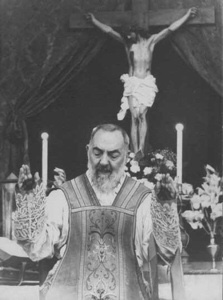
Saint Pio of Peitrelcina

Stigmata is when a person has unexplained wounds on their body that coincide with the traditional wounds that Christ had. In some cases the wounds can appear in only one or two of the areas, but there have been instances of it occurring in all five places that Christ was wounded. The wounds can cause considerable pain which has been known to worsen on certain religious feast days. There have been occasional cases of falsified stigmata in the past and some people claim that even those which are not proven to be falsified are somehow part of a hoax.

The photograph above is of Saint Pio of Pietrelcina (Canonized in 2002) who is the most recent stigmatic in the Catholic Church. Saint Pio is the latest in a long line of famous stigmatics – the most famous of whom is probably St Francis of Assisi. Writing to his spiritual director, Saint Pio said:

Then last night something happened which I can neither explain nor understand. In the middle of the palms of my hands a red mark appeared, about the size of a penny, accompanied by acute pain in the middle of the red marks. The pain was more pronounced in the middle of the left hand, so much so that I can still feel it. Also under my feet I can feel some pain.

It is also alleged that Saint Pio was able to bi-locate (appear in two places at once) and to read the sins on a person’s soul

9: The Cilice

A cilice is an item worn on the body to inflict pain or discomfort for the sake of penance (remorse for your past actions). Originally a cilice was an undergarment made of rough hair (such as a hairshirt) or cloth. In recent times it has been seen as more discreet to wear a chain which has spikes on it. Contrary to popular belief, the cilice does not break the skin – it merely causes discomfort. It is usually worn around the thigh.

The Catholic Encylopedia of 1913 says:

“In modern times the use of the hairshirt [(cilice)] has been generally confined to the members of certain religious orders. At the present day only the Carthusians and Carmelites wear it by rule; with others it is merely a matter of custom or voluntary mortification.”

In recent years the cilice has gained a great deal of publicity due to the book The Da Vinci Code in which it is worn by the main antagonist of the story – though in the story it is exaggeratedly described as causing wounds. Wearing the cilice has always been an optional practice for Catholics. Some famous people in the past to have worn them are Saint Thomas More and Saint Patrick.

8: The Flagrum

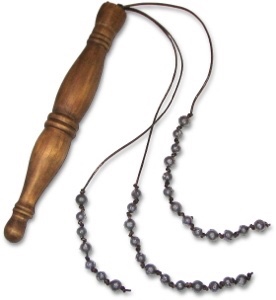
The Flagrum is a type of scourge with small hard objects attached to the length of its cords. It is traditionally used to whip oneself (self-flagellation) and is most commonly found in conservative religious orders. The flagrum is held in one hand and thrown over the shoulder in order to cause the cords to strike the flesh. The purpose of self-flagellation is voluntary penance and mortification of the flesh (a safeguard against committing further sins).

The most famous Saint to use the flagrum is probably Saint John Vianney, who would give his parishoners very light penances in confession and then flog himself in privacy for their benefit (it is believed by Catholics that acts of penance can be offered for the sins of other living people or the souls of the dead). When Saint John Vianney died, the walls of his bedroom had spatterings of blood on them from his extreme use of the flagrum.

According to the Catholic Encyclopedia:

“St. Peter Damian (died 1072) […] wrote a special treatise in praise of self-flagellation; though blamed by some contemporaries for excess of zeal, his example and the high esteem in which he was held did much to popularize the voluntary use of the scourge or “discipline” as a means of mortification and penance.”

Most Catholics who practice this form of discipline will not admit it publicly as it would be seen as a lack of humility that could lead to the sin of pride.

7: Confraternities of the Cord

The third, (and final) of the penance-related objects, the Confraternities of the Cord are groups who wear a knotted cord around their waist as a form of penance and in order to help prevent future sins. The cord can be worn loosely in remembrance of the Saint for whom the cord is named, or it can be worn tight enough to cause pain, as has been the case with numerous saints in history.

St Joseph, St Francis, St Thomas, and St Augustine, St Nicholas, and St Monica all have Confraternities of the Cord named after them. The Catholic Encylopedia says:

In the early Church virgins wore a cincture as a sign and emblem of purity, and hence it has always been considered a symbol of chastity as well as of mortification and humility. The wearing of a cord or cincture in honour of a saint is of very ancient origin, and we find the first mention of it in the life of St. Monica.

The various confraternities differ in the number of knots on the cord.

6: Relics

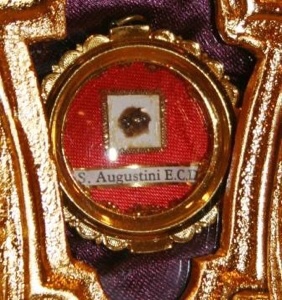
Relic of St Augustine

Relics are objects related to Saints. There are three categories of relics (from wikipedia):

1st Class

Items directly associated with the events of Christ’s life (manger, cross, etc.), or the physical remains of a saint (a bone, a hair, a limb, etc.). Traditionally, a martyr’s relics are often more prized than the relics of other saints. Also, some saints relics are known for their extraordinary incorruptibility and so would have high regard. It is important to note that parts of the saint that were significant to that saint’s life are more prized relics. For instance, King St. Stephen of Hungary’s right forearm is especially important because of his status as a ruler. A famous theologian’s head may be his most important relic.

2nd Class

An item that the saint wore (a sock, a shirt, a glove, etc.) Also included is an item that the saint owned or frequently used, for example, a crucifix, book etc. Again, an item more important in the saint’s life is thus a more important relic.

3rd Class

Anything which has touched a first or second class relic of a saint.

In order to prevent abuses, Catholic Church law (Canon Law) forbids the sale of Relics (Can. 1190 §1). Catholics venerate relics in the same way as they venerate images, statues, and saints. This is often confused for idol worship, but veneration is actually the act of giving respect, rather than the act of worshipping which is forbidden. By canon law there must be a relic in the altar stone of any altar in a Catholic Church upon which Mass is to be offered.

5: Indulgences

Catholics believe that when a person sins, they have two punishments to suffer – eternal (Hell) and temporal (punishment by suffering on earth or in Purgatory). Indulgences are special actions that a person can perform in order to reduce or remove the temporal punishment they are owed. The idea behind it is that certain acts of holiness can take the place of punishment. Indulgences must be declared by the Pope.

There are two types of indulgence: Plenary (removes all temporal punishment) and partial (removes some punishment). A partial indulgence can be for a specific number of days or years. Some indulgences only apply to the souls in Purgatory but any personal indulgences can also be offered for those souls, rather than your own. An example of an indulence is: “An indulgence, applicable only to the Souls in Purgatory, is granted to the faithful, who devoutly visit a cemetery and pray, even if only mentally, for the departed. The indulgence is plenary each day from the 1st to the 8th of November; on other days of the year it is partial.” (from the Enchiridion of Indulgences).

During the middle ages, a number of Bishops and Priests, seeking to make money, told people that they could pay for indulgences. This abuse partly contributed to the sparking off of the protestant reformation. While the Catholic Church tried to suppress this behavior, it took a great deal of time for the traffic in indulgences to stop completely.

It is quite common for the Pope to announce new indulgences from time to time, to mark special occasions – such as the Jubilee in which Pope John Paul II granted a plenary indulgence.

4: The Real Presence

The Real Presence is the term used to describe the bread and wine in a Catholic Mass. Catholics believe that after the words of consecration have been spoken by the Priest, the bread (host) and wine change their substance to become the body and blood of Jesus. It is considered by Catholics, therefore, to be appropriate to worship and adore the changed objects. This is often seen as idol worship by non-Catholics as they do not believe the change of substance has occurred.

Because of this belief, Catholics have a special ceremony called Benediction, in which a consecrated host is placed in an ornate case called a monstrance and the people are blessed with it and kneel and pray before it. you can see an image of Pope Benedict XVI blessing people with a monstrance here.

An interesting side note is that it is believed that the modern term “hocus pocus” comes from an aberration of the words used by a priest at the moment of the consecration, in which he says: “Hoc est enim corpus Meum” meaning “for this is My body”.

3: Exorcism

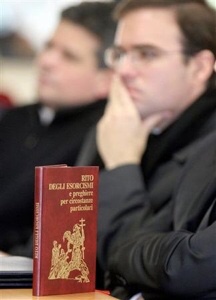
Exorcism is the practice of evicting demons or other evil spiritual entities from a person or place which they are believed to have possessed (taken control of). Solemn exorcisms, according to the Canon law of the church, can only be exercised by an ordained priest (or higher prelate), with the express permission of the local bishop, and only after a careful medical examination to exclude the possibility of mental illness. The Catholic Encyclopaedia says:

“Superstition ought not to be confounded with religion, however much their history may be interwoven, nor magic, however white it may be, with a legitimate religious rite”

During the ritual of exorcism, the priest commands the devils within the body of the afflicted to leave and uses a number of blessings with Holy Water and oils. To listen to two authentic recordings of exorcisms, visit the Top 10 Incredible Recordings. Of interesting note, the Catholic Church gave permission for a priest to appear in the film The Exorcist on the grounds that is was true to the methods used by the Church to determine whether an exorcism is warranted. A much more indepth article on exorcism including audio, videos, and images can be found here.

2: Papal Infallibility

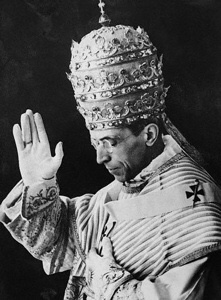
Venerable Pope Pius XII

Roman Catholics believe that, under certain circumstances, the pope is infallible (that is, he can not make a mistake). The Catholic Church defines three conditions under which the Pope is infallible:

I. The Pope must be making a decree on matters of faith or morals
II. The declaration must be binding on the whole Church
III. The Pope must be speaking with the full authority of the Papacy, and not in a personal capacity.

This means that when the Pope is speaking on matters of science, he can make errors (as we have seen in the past with issues such as Heliocentricity). However, when he is teaching a matter of religion and the other two conditions above are met, Catholics consider that the decree is equal to the Word of God. It can not contradict any previous declarations and it must be believed by all Catholics. Catholics believe that if a person denies any of these solemn decrees, they are committing a mortal sin – the type of sin that sends a person to hell. Here is an example of an infallible decree from the Council of Trent (under Pope Pius V):

If anyone denies that in the sacrament of the most Holy Eucharist are contained truly, really and substantially the body and blood together with the soul and divinity of our Lord Jesus Christ, and consequently the whole Christ, but says that He is in it only as in a sign, or figure or force, let him be anathema.

The last section of the final sentence “let him be anathema” is a standard phrase that normally appears at the end of an infallible statement. It means “let him be cursed”.

1: The Scapular

The Scapular is a type of necklace worn by many Catholics. It is worn across the scapular bones (hence its name) and it consists of two pieces of wool connected by string. One piece of wool rests on the back while the other piece rests on the chest. When a Catholic wishes to wear the scapular, a Priest says a set of special prayers and blesses the scapular. This only occurs the first time a person wears one.

For wearing the scapular, Catholics believe that Mary, the mother of Jesus, will ensure that they do not die a horrible death (for example by fire or drowning) and that they will have access to a priest for confession and the last rites before they die. As a condition for wearing the scapular and receiving these benefits, the Catholic must say certain prayers every day. The Catholic Encyclopedia says this:

According to a pious tradition the Blessed Virgin appeared to St. Simon Stock at Cambridge, England, on Sunday, 16 July, 1251. In answer to his appeal for help for his oppressed order, she appeared to him with a scapular in her hand and said: “Take, beloved son this scapular of thy order as a badge of my confraternity and for thee and all Carmelites a special sign of grace; whoever dies in this garment, will not suffer everlasting fire. It is the sign of salvation, a safeguard in dangers, a pledge of peace and of the covenant”. 

The brown scapular, known as the Scapular of Our Lady of Mount Carmel is the most commonly worn scapular, though others do exist. When the scapular is worn out it is either buried or burnt and a new one is worn in its place.

Reference