Tag Archives: Catholic Church

Indulgences: Salvation for Sale? The Controversial Practice That Changed Christianity

For centuries, the Roman Catholic Church taught that while sin could be forgiven through confession, the consequences of that sin might still remain. To address this, the Church developed one of the most controversial doctrines in Christian history—the indulgence.

To believers, indulgences represented God’s mercy administered through the Church. To critics, they became symbols of greed, corruption and spiritual manipulation. Their abuse would eventually spark the Protestant Reformation, permanently dividing Western Christianity.

Understanding the Concept

An indulgence is often misunderstood as the forgiveness of sin. It is not.

According to Catholic theology, there are two consequences of sin:

Eternal punishment, removed through genuine repentance and absolution in the Sacrament of Confession.

Temporal punishment, the lingering spiritual effects of sin that still require purification.

An indulgence removes all or part of this temporal punishment.

The Church teaches that Christ, together with the saints, accumulated an infinite “Treasury of Merit.” Because Jesus’ sacrifice was perfect and the saints lived exceptionally holy lives, their merits exceeded what was needed for their own salvation. The Pope, as successor to Saint Peter, was believed to possess the authority to dispense these merits for the benefit of the faithful.

This theological framework became one of the most distinctive features of medieval Catholicism.

Purgatory: The Missing Piece

The doctrine of indulgences cannot be understood without understanding Purgatory.

By the twelfth century, belief in Purgatory had become firmly established. It was viewed as a temporary state where souls destined for Heaven were purified before entering God’s presence.

This purification could be long and painful.

Naturally, Christians wanted to shorten that suffering—for themselves and for deceased loved ones.

Indulgences appeared to offer hope.

Early Indulgences

The earliest indulgences looked nothing like those that later scandalised Europe.

During the early Middle Ages, bishops granted reductions in severe public penances. A sinner might have been ordered to fast for years or undertake lengthy pilgrimages.

An indulgence simply reduced these earthly penalties.

Gradually the concept evolved.

Instead of reducing earthly penance, indulgences increasingly came to be understood as reducing punishment in Purgatory.

Crusades and Spiritual Rewards

The Crusades transformed indulgences.

In 1095 Pope Urban II promised a plenary indulgence—complete remission of temporal punishment—to those who fought in the First Crusade.

This proved enormously popular.

Suddenly military service could be viewed as an act of spiritual devotion.

Over succeeding centuries indulgences became attached to pilgrimages, charitable works, church building projects and religious observances.

Partial and Plenary Indulgences

Two forms developed.

Partial Indulgence

Removed part of the temporal punishment due to sin.

Plenary Indulgence

Removed all temporal punishment, provided certain conditions were met.

Modern Catholic teaching requires:

Sacramental confession

Reception of Holy Communion

Prayer for the Pope’s intentions

Complete detachment from all sin

Performance of the prescribed work

This last condition is often the one people notice—but it is only one element among several.

The Money Problem

The trouble began when indulgences became linked with fundraising.

Churches, monasteries, hospitals and cathedrals required enormous sums of money.

Popes increasingly authorised indulgences connected with donations.

Officially, money was never supposed to purchase forgiveness.

Rather, the donation was considered evidence of charity and repentance.

In practice, however, many ordinary Christians concluded that they were buying spiritual benefits.

That distinction proved disastrous.

Building St Peter’s Basilica

Perhaps the most famous indulgence campaign funded the rebuilding of St Peter’s Basilica in Rome.

Construction began under Pope Julius II and continued under Pope Leo X.

The project required staggering amounts of money.

Indulgence preachers travelled throughout Europe encouraging donations.

The campaign became especially controversial in the German states.

Johann Tetzel

No individual became more associated with indulgences than the Dominican friar Johann Tetzel.

He was a gifted preacher and fundraiser.

Although historians debate precisely what he said, he became associated with the famous rhyme:

“As soon as the coin in the coffer rings,
the soul from Purgatory springs.”

Whether Tetzel actually coined the phrase or whether opponents exaggerated his methods remains debated.

Nevertheless, many contemporaries believed indulgences had become little more than commercial transactions.

Martin Luther Strikes Back

On 31 October 1517 an Augustinian monk named Martin Luther challenged the practice.

His Ninety-five Theses criticised not the existence of indulgences themselves, but their abuse.

Among his complaints were:

Christians were being misled.

Genuine repentance mattered more than purchased certificates.

The Pope could not free souls from Purgatory simply through financial transactions.

Poor people were giving away money they desperately needed.

Thanks to the recently invented printing press, Luther’s arguments spread across Europe with astonishing speed.

The result was the Protestant Reformation.

The Church Responds

Initially, Church authorities attempted to defend indulgences.

However, the abuses had become impossible to ignore.

The Council of Trent (1545–1563) reaffirmed the legitimacy of indulgences but condemned dishonest fundraising and prohibited their commercial exploitation.

Professional indulgence sellers disappeared.

The theology remained.

The abuses were officially rejected.

Do Indulgences Still Exist?

Yes.

The Catholic Church still grants indulgences today.

Modern indulgences are associated with acts such as:

Reading Scripture prayerfully.

Eucharistic adoration.

Pilgrimages.

The Rosary.

Works of mercy.

Visiting designated holy sites during Jubilee Years.

Money no longer plays any official role.

Instead, the emphasis is placed upon sincere conversion, prayer and charity.

Common Myths

Several misconceptions persist.

Myth: Indulgences forgive sins.

Reality: Only repentance and sacramental confession forgive sin.

Myth: You can buy your way into Heaven.

Reality: Catholic teaching rejects this completely.

Myth: The Church sold Heaven.

Reality: While many clergy behaved as though spiritual benefits could be bought, official doctrine was more nuanced. The scandal arose because practice often failed to match theology.

Political Consequences

Indulgences did more than reshape theology.

They undermined confidence in Church leadership.

Princes who supported Luther gained greater independence from Rome.

Religious wars followed.

Entire nations rejected papal authority.

The map of Europe changed forever.

It is difficult to overstate the historical significance of indulgences.

A theological doctrine concerning the consequences of sin became one of the principal catalysts for one of the greatest upheavals in Western civilisation.

Legacy

Today, indulgences occupy a far quieter place within Catholic life.

They remain part of official teaching, but the dramatic fundraising campaigns that characterised the late Middle Ages belong to history.

Yet the controversy still echoes.

For many Protestants, indulgences remain symbolic of medieval corruption.

For Catholics, they represent a misunderstood expression of God’s mercy, one that suffered from very human abuse.

Perhaps the greatest lesson is not about indulgences themselves, but about the dangers that arise whenever religious authority, political power and money become too closely entwined. History shows that even sincere theological ideas can become distorted when financial interests enter the picture.

Tim Alderman 2026

Sources

Catechism of the Catholic Church, §§1471–1479.

Pope Paul VI, Indulgentiarum Doctrina (1967).

Council of Trent, Session XXV, Decree on Indulgences (1563).

Martin Luther, Ninety-five Theses (1517).

Eamon Duffy, Saints and Sinners: A History of the Popes.

Diarmaid MacCulloch, The Reformation: A History.

R. N. Swanson, Indulgences in Late Medieval England.

Thomas F. Madden, The New Concise History of the Crusades.
How the Catholic Church’s Hierarchy Makes It Difficult To Punish Sexual Abusers

A report released on Tuesday, July 18, found “a high degree of plausibility” that hundreds of boys at a prestigious Catholic boys’ choir in Germany were physically or sexually abused between 1945 and 1992. The choir was led at the time by Emeritus Pope Benedict XVI’s elder brother, Georg Ratzinger.

Just over a week ago – on July 10 – Cardinal George Pell, a top adviser to Pope Francis, returned to his native Australia to face criminal charges related to sexual assault. While the specific allegations and names of the accusers have not been made public, Cardinal Pell maintains that he has been a victim of “character assassination.” His case will be decided by an Australian court.

These are not the first times the Catholic Church has been rocked by charges of sexual abuse. While reforms in the Catholic Church in the United States have made it mandatory for priests to report instances of sexual abuse, there still remains much work to be done in the Catholic Church worldwide.

From my perspective as a Catholic scholar of religion, one of the challenges in tackling this issue is the hierarchy of the church itself. It is still difficult to hold high-ranking clerics responsible, either for the misdeeds of their subordinates or for the crimes that they may have committed themselves.

Church structure

At the top of the Catholic Church’s hierarchy is the pope. He is said to be the successor of the Apostle Peter, about whom Christ said, “You are Peter and on this rock I will build my church.” For Catholics, the pope is that “rock” that gives the church a firm foundation. The pope is considered to speak infallibly, “without error,” under specific conditions concerning doctrine and morals. But he is not infallible when it comes to personal judgment such as whom he chooses to get advice from.

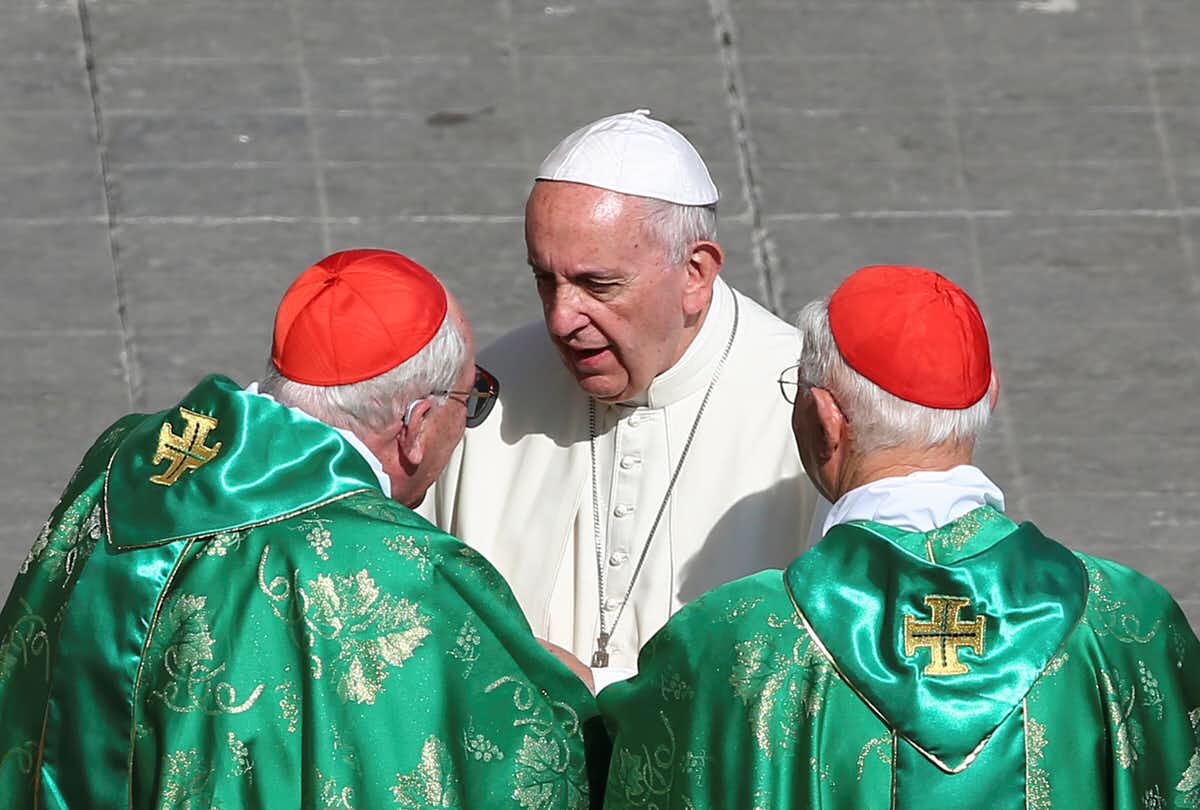
Pope Francis speaks with two cardinals at the Vatican. Alessandro Bianchi/Reuters

Under the pope are bishops, who serve the pope as successors to the original 12 apostles who followed Jesus.

There are also cardinals, who are appointed by the pope, and only they can elect his successor. Cardinals also govern the church between papal elections. Cardinals rank higher than bishops, so not all bishops are cardinals. But now all cardinals are bishops, although in the past there have been exceptions. George Pell is both a bishop and a cardinal, as well as the third-ranking official at the Vatican.

The hierarchical structure of the Catholic Church resembles the military with its high level of administrative control. But the “church” in Catholic understanding is not just a bureaucratic body. It also is a sacred institution that is willed by God.

Priests and obedience

Male priests have the lowest rank in the formal hierarchy. When they are ordained, they take vows of chastity, poverty and obedience to superiors. Usually priests are under the immediate authority of their local bishop, whose administrative area is called a “diocese.”

While priests in many countries are mandated both by the church and civil law to report sexual abuse to church commissions and legal authorities, there has been a culture of denial and secrecy that prevented allegations from being fully investigated. A 1962 Vatican document instructed bishops to observe the strictest secrecy in sexual abuse cases and to address sexual abuse, or “solicitation,” as an internal church matter, not as an offense that should be reported to local authorities.

Despite establishing a commission to look into the problem and address a backlog of cases, Pope Francis has still not established any protocol for handling sex abuse allegations for the Catholic Church as a whole. But the pope has set guidelines for removing bishops who have been “negligent” in addressing cases of abuse. Still, some commentators believe this is not enough.

Sexual abuse ignored

The fact is that there has been a long history of protecting highly placed Catholic leaders from charges of sexual abuse.

When reports surfaced in 1995 that Austrian Cardinal Hans Hermann Groer had molested monks and schoolboys, the sexual abuse was dismissed by Bishop Kurt Krenn as “boyish pranks.” There were also claims that victims were paid “hush money” to buy their silence. The allegations of sexual abuse against Cardinal Groer proved to be true.

In another case from the late 1940s, Marcial Maciel, the Mexican founder of a religious order, The Legionaries of Christ, was a sexual abuser multiple times over. When allegations against Maciel were initially raised, John Paul II ignored them. Joseph Ratzinger, John Paul II’s confident and later successor, remarked: “one can’t put on trial such a close friend of the pope.” Though Maciel was eventually disciplined by Ratzinger when he took over as Pope Benedict XVI, Maciel avoided prosecution until his death in 2008.

In the United States, Cardinal Bernard Law, who protected abuser priests in the Boston archdiocese during his 1984-2004 tenure, has also escaped prosecution. In fact, Law was effectively promoted to a prestigious position as head of one of Catholicism’s most famous churches, Santa Maria Maggiore in Rome.

Challenges to reporting

In all these cases, the hierarchical structure of the church made it difficult to bring high-ranking figures to justice. When you give superiors nearly absolute obedience, the threshold for acting against them is high. By the same token, superiors can often protect offending priests.

A presumption of integrity goes with a high position in the Catholic Church. It is often difficult to believe that a bishop could commit or cover up a terrible crime such as rape or sexual abuse. Also, if the Catholic Church is a divine institution necessary for salvation, then there are those who will protect its reputation at all costs.

There is a tipping point, however. The key moment leading to the resignation of Cardinal Law was a letter, signed by 58 priests, asking him to resign.

Pell’s prosecution, a decisive moment

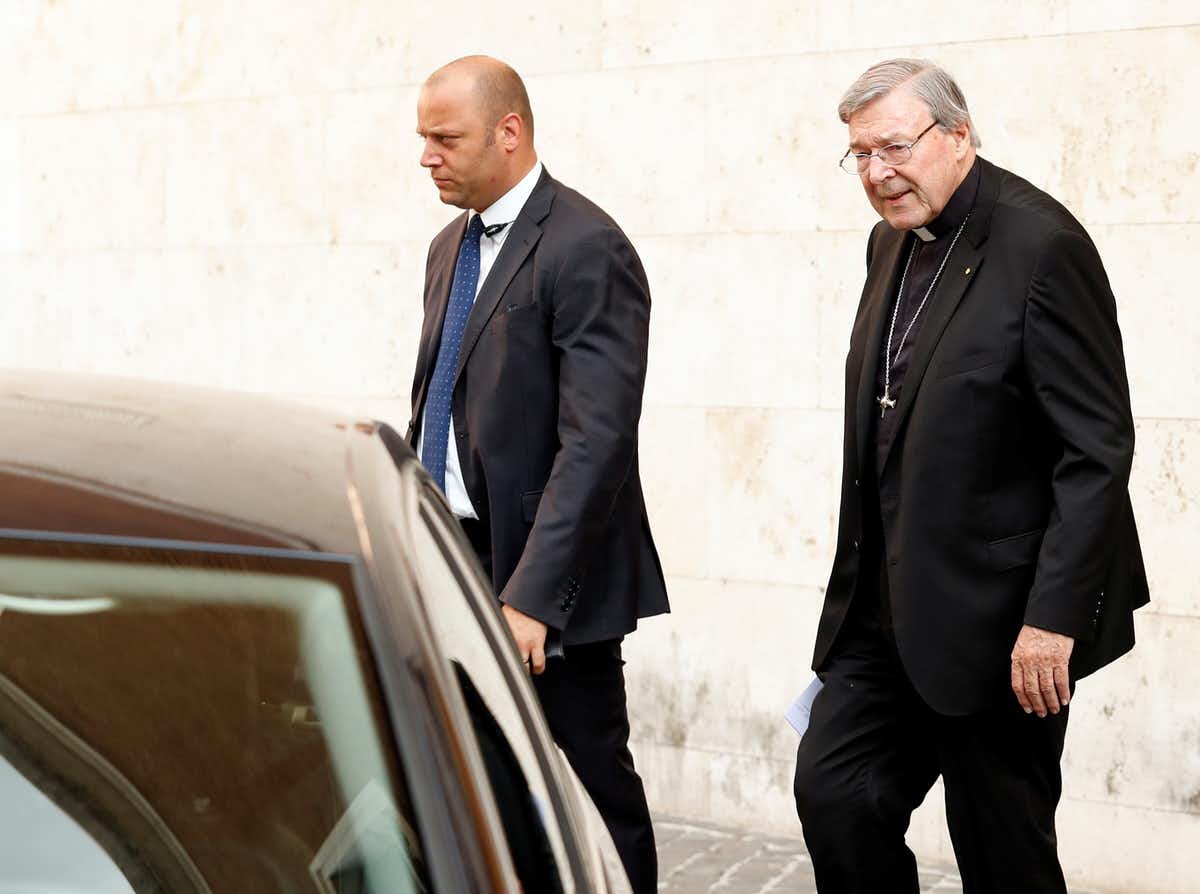
Cardinal George Pell leaves his house in Rome, Italy on June 29, 2017. Remo Casilli/Reuters

The compendium of Catholic beliefs, “The Catechism of the Catholic Church,” observes that the “sanctity” of the church is “real” but also “imperfect.” In other words, the church is composed of human beings who have their limitations. From this perspective, the problem is not hierarchy itself, but how people in high positions misuse their power.

While all Catholics are aware of the “humanness” of their church, the charges against Cardinal Pell are still traumatic for many Catholics who expect integrity in their leaders.

Cardinal Pell’s case marked yet another chapter in the Catholic Church’s struggle to address sexual abuse in its ranks. And now with this latest report concerning the choir school once led by the brother of the former Pope, the Catholic church clearly has much work to do in responding to allegations of sexual abuse.

Reference

The Hidden Side of Sex Offences

As a kid who spent three years in a Catholic boarding school I was exposed to an underworld of dark sex offenses without realising what was going on around me. When I think back on it now, it was quite scary…

In 1967, due to some family problems – a book of stories on it’s own – and with moving the family home from Sylvania to Kogarah, it was decided that instead of sending me to James Cook High School, I would be taken out of the public school system, and sent to a private school. Mind you, being the era it was, I didn’t have a lot of say in this decision.

As a late applicant – and Protestant – to Marist Brothers St Gregory’s Agricultural College at Campbelltown, I had to wait for all the Catholic applications to be processed first, to see if there were any vacancies available. I was to eventually spend three years there, attaining my School Certificate un 1969. There are two events that occurred in my time there that are quire disturbing, and probably part of the current investigations and Royal Commissiom into child sexual abuse.

Being a boarding school, we all spent our mornings and nights in large open dormitories – just called dorms. Brother Brian was the Dorm Master of Dorn 2, and had an enclosed bedroom just off the entry to the dorm. He was also the Instructor for the school swimming team. As with most school swimming teams, we had our own swimming trunks – burgundy and blue – especially made. With the arrival of the swim trunks, along came their time for distribution. It took me a while to work out what was going on. As I lay in bed after lights-out, there would be a stream of kids on the swimming team individually visiting Brother Brian in his room at night. Evidently, Brother was giving the boys specialised fitting of their swim trunks, getting them to strip off, and try the trunks on to “ensure the correct fit”. Shortly after this event, Brother Brian mysteriously disappeared…transferred to somewhere or other. I had just, unwittingly, observed my first instance of sexual abuse. In keeping with the era, no explanation was given, and the incident was never discussed.

Being a Protestant – Congregational – in a Catholic environment, and voluntarily not exempting myself from Mass , rosary, Station of the Cross. Retreats etc, eventually the religion rubbed off on me. Being raised in the simplicity of Protestantism, I found the rituals, devotions and customs of the Catholic church overwhelming, and in 1969 I converted.

Reverend Father Peter Comensoli was the Parish Priest of St John the Evangelist Church in Campbelltown, and St Gregory’s College Chaplain. As such, he baptized me in the college chapel, and in fact bestowed on me his Christian name Peter as my baptismal name, and later that year I was confirmed in the Parish Church in Campbelltown. Yet another name – Francis – to add to my collection. Father Comensoli spent a lot of time at the college, and was very friendly to all the boys.

So you can only imagine my total lack of surprise, when watching the news many, many years later, at seeing Father Cominsole being arrested for molesting his altar boys.

Both incidents made me realise just how close I could have been to being a victim of sexual abuse myself!

http://www.abc.net.au/7.30/content/2013/s3810321.htm
http://www.brokenrites.org.au/drupal/node/194
http://www.christianchat.com.au/christian-chat-articles/1996/4/16/police-were-slow-to-act-on-clergy-sex-assault-claim/

Please – if you have been a victim of sexual abuse, or know of instances of sexual abuse please report it to authorities.

Tim Alderman (C) 2014