Despite criticism in his highly haredi town of Lakewood, NJ, Rabbi Mike Moskowitz says serving queer Jews at New York’s Congregation Beit Simchat Torah is a fulfillment of his duty
Rabbi Mike Moskowitz just took a job at Congregation Beit Simchat Torah, a New York City synagogue serving the LGBT community. Next to him is the synagogue’s senior rabbi, Sharon Kleinbaum. (Courtesy of CBST/via JTA)
NEW YORK (JTA) — In many ways, Mike Moskowitz is a typical ultra-Orthodox rabbi.
He wears a black suit and black hat. He sports a thick, curly beard beneath a closely shaved head. He peppers his speech with liturgical Hebrew and Yiddish words. He quotes from Jewish legal texts.
Moskowitz sometimes closes his eyes when he talks, swaying back and forth and rubbing his fingers together as if he’s engaged in deep Talmud study. He spent years upon years studying at traditional haredi yeshivas. Today he lives in Lakewood, a New Jersey shore town of some 100,000 residents well known for its largely haredi population.
On a recent weekday afternoon, Moskowitz is sitting in a Jewish study room at this city’s Congregation Beit Simchat Torah in front of shelves filled with tractates of the Talmud. But the rest of the setting is decidedly, well, unorthodox.
The bathrooms around the corner are gender-neutral. A memorial plaque in the sanctuary pays tribute to those who have died in the AIDS epidemic. The prayer book, published specifically for this synagogue, includes a special prayer for the weekend of New York’s Pride Parade. Four rainbow flags hang in the lobby.
Most haredi rabbis probably would not take a job at a synagogue that serves New York’s LGBT community. Standard Orthodox interpretations of Jewish law strictly prohibit not only same-sex relations but gender fluidity and cross-dressing. But Moskowitz says his new job as CBST’s scholar-in-residence for trans and queer Jewish studies is a perfect fit.
Moskowitz, 38, says serving queer Jews is a fulfillment of his duty as an Orthodox rabbi, not a contradiction. To him, this job is simply the best way to help those in dire need.
The walls of the restrooms at Congregation Beit Simchat Torah are adorned with historical photographs, while the stalls fly the rainbow colors of the pride flag. (Courtesy CBST)
“The religious community has a unique responsibility to provide sanctuary, a literal sanctuary for people who are searching,” he says. “How can we broaden the tent to allow people to feel communally engaged in and taking responsibility for their unique relationship with God?”
Moskowitz knows what it’s like to be an outsider. He grew up in a secular Jewish family in Virginia and encountered religious observance through USY, the Conservative Jewish youth group. He went on to study for four years each at the Mir Yeshiva in Jerusalem and Beis Medrash Govoha in Lakewood, two prestigious haredi institutions, and work as a student advisor and leader of a Torah study program, or kollel, back home in Richmond.
Despite Orthodoxy’s clear boundaries around gender and sexual orientation, Moskowitz says compassion for people, no matter who they are, was built into his traditionalist education. His rabbis advocated “people being themselves in relationship with God.” That idea led him, in Richmond, to reach out to intermarried couples, despite Orthodoxy’s prohibition of interfaith marriage.
Moskowitz started counseling transgender Jews three years ago when he worked with Columbia University students on behalf of Aish Hatorah, an Orthodox outreach organization. He also met queer Jews while serving concurrently as rabbi of the Old Broadway Synagogue, which draws a diverse crowd as one of the only synagogues in Manhattan’s Harlem neighborhood. Around the same time, a close family member began transitioning genders, giving Moskowitz close personal exposure to the transgender experience.
In December 2016, Moskowitz presented a sermon to the synagogue advocating acceptance of trans Jews — using an obscure 16th-century Torah commentary to make his point. At about the same time, he wrote a letter urging a Jewish day school not to expel a transgender student. Shortly after, he was let go from both jobs — neither gave his LGBT advocacy as the official reason.
“It’s the holiest among us that are often the most vulnerable because their light is the brightest,”’ he said in the sermon, referring to the symbolism of the menorah’s candlelight. “To such an extent that some aren’t even aware that darkness exists. Are we going to protect that light?”
Congregation Beit Simchat Torah. (Courtesy)
Moskowitz believes that Orthodox communities have much work to do in accepting LGBT members. While they claim to be warm, accepting places in theory, he says, they often fail to make space for Jews who are the most vulnerable or on society’s margins.
“There are absolutely ways that religion can be a system for oppression like all others,” he says. “When it comes to the theoretical, they’re quick to say ‘of course we should be inclusive.’ When it comes to the practical, there’s a huge gap between the ideal and the way in which it actually manifests.”
Moskowitz also says that normative Orthodoxy gets Jewish law wrong when it comes to transgender identity. He says, for example, that the biblical ban on cross-dressing is actually a prohibition on misrepresenting one’s gender identity — no matter what it is — through clothing.
And he says the Orthodox community places undue emphasis on gender and sexual prohibitions because of social norms. Instead, he says, the Jewish religious community should worry less about biblical injunctions and more about how to embrace transgender Jews so they don’t succumb to the transgender community’s high suicide rate.
“Transgender as an awareness is just a presence of understanding,” he says. “There’s no prohibition to acknowledge the reality of something when it comes to one’s identity. If a person says about themselves ‘this is who I am,’ it’s not a space of choice.”
After leaving Columbia, Moskowitz served as senior educator for Uri L’Tzedek, an Orthodox social justice group. He also began blogging for Keshet, a Jewish LGBT organization, and even shaved his beard for a time so he could fit in better with a more liberal crowd.
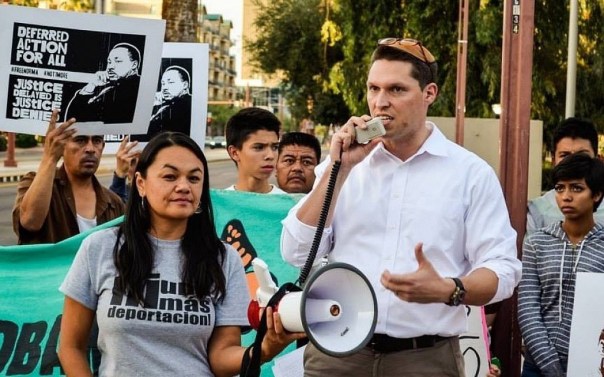
Illustrative: Rabbi Dr. Shmuly Yanklowitz, founder of Uri L’Tzedek: Orthodox Social Justice at a November 2014 immigrant rights protest. (courtesy)
He became connected to Congregation Beit Simchat Torah when he met its senior rabbi, Sharon Kleinbaum: Both were arrested in January at the US Capitol for protesting on behalf of immigrants. Hired by the synagogue on May 1, Moskowitz serves a dual function: He connects the Jewish LGBT experience to the traditional Jewish texts he has spent decades studying, and counsels Orthodox LGBT Jews and their families.
On the day he spoke to JTA, he also had phone conversations with three parents of transgender youth.
“He’s already working overtime,” Kleinbaum said. “The demand is like a floodgate has opened. People are reaching out to him for pastoral help. Their kids are trans, they are trans, they haven’t had an [observant] rabbi to talk to who hasn’t said to them something besides ‘you’re going to …’”
Moskowitz still faces tension between his professional and personal lives. Living in Lakewood, he receives hate mail due to his work, and has been ostracized from synagogues and other institutions there.
But the rabbi appears to take it in stride. There is still a synagogue where he and his family are welcome. And the animosity he experiences, he says, is just a sliver of what transgender people have to deal with every day.
“Do the right thing, you end up in the right space, but it’s not geshmak,” he says of his Lakewood experience, usually a Yiddish word that means “delicious.” “But again, this is what trans folks feel going to the grocery store.”
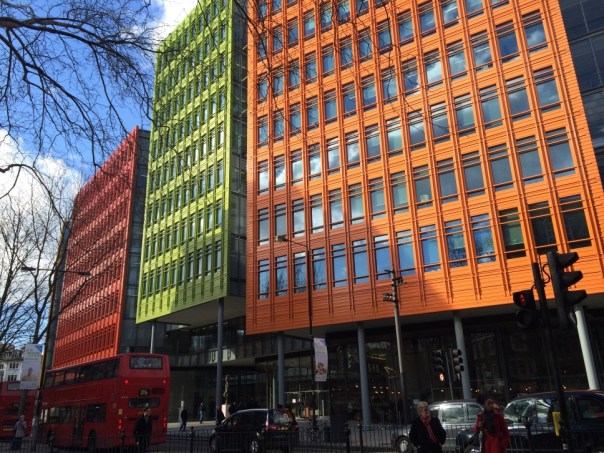
On a weekday lunchtime the brightly coloured Central Saint Giles, to the east of Oxford Street and Tottenham Court Road, is buzzing with activity. Workers pour out of their offices into the shops and restaurants set around a covered courtyard forming the heart of this £450 million development. On either side are two buildings towering 15 storeys into the sky, home to Google and other companies. Designed by Italian architect Renzo Piano and completed in 2010, Central Saint Giles has quickly become a West End landmark. Passers-by can hardly miss the place thanks to its distinctive facades, covered with more than 130,000 bright green, orange, lime and yellow glazed tiles.
Central Saint Giles
With the Crossrail construction work taking place just around the corner, this area is going through an enormous amount of change. The new Tottenham Court Road station will open in time for the launch of the line that will bring fast travel across London from 2018. Even Centre Point, one of London’s first skyscrapers and completed in 1966, is getting a makeover – apartments will replace what has in the past been occupied by offices. Once development around Tottenham Court Road is complete property speculators who invested in real estate several years ago will make a tidy profit.
But as a result of all the change in the area, St Giles, which has a history stretching back more than a thousand years, has lost its identity. Indeed, St Giles High Street is a short stretch in central London with little more than a pub and a convenience store, set across from Central Saint Giles. Surrounded by modern developments and sandwiched between Covent Garden, Soho and Oxford Street, it’s one of the capital’s lost neighbourhoods.
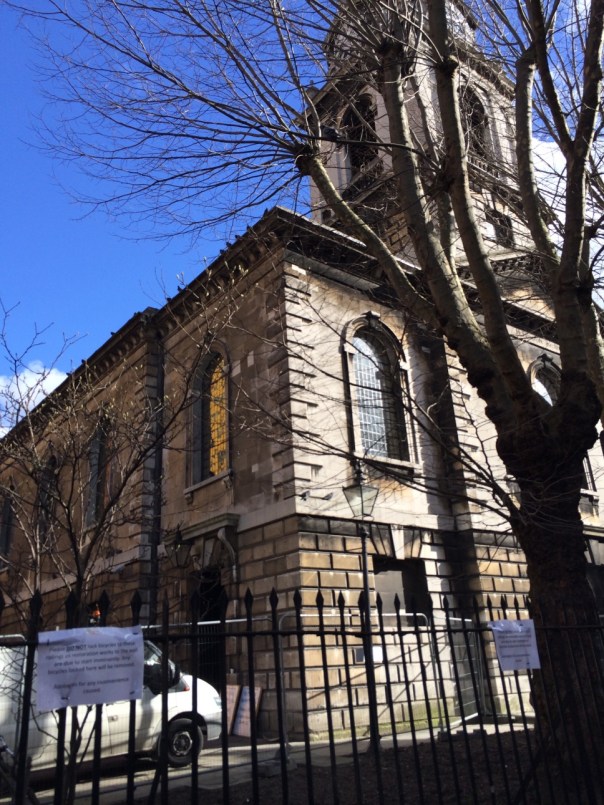
What’s probably oblivious to most that pass through this area on a daily basis is that it was once notorious for being one of London’s most unruly slums, where thieving and prostitution were rife. Given that streets have been built over and buildings demolished, traces of it have virtually disappeared. St Giles parish church (a religious institution since Saxon times), for example, is one of the few landmarks that would have been familiar to visitors to the area two hundred years ago.
St Giles parish church
When the clergyman Thomas Beames travelled here as part of research for his 1852 Rookeries of London book, he found thousands of destitute people living in “crumbling houses, flanked by courts and alleys…… in the very densest part of which the wretchedness of London takes shelter.” For him, it was like entering a different world:
“You have scarce gone a hundred yards when you are in The Rookery. The change is marvellous: squalid children, haggard men, with long uncombed hair, in rags, most of them smoking, many speaking Irish; women without shoes or stockings – a babe perhaps at the breast, with a single garment, confined to the waist by a bit of string; wolfish looking dogs; decayed vegetables strewing the pavement; low public houses; linen hanging across the street to dry; the population stagnant in the midst of activity; lounging about in remnants of shooting jackets, leaning on the window frames, blocking up the courts and alleys; with young boys gathered round them, looking exhausted as though they had not been to bed.”
Visiting the (now lost) George Street and Church Lane in St Giles, Beames found it hard to comprehend how up to 40 people could manage to sleep in a single room. Complete strangers slept next to each other, paying the landlord of the property a small amount for the privilege of a night’s stay. Inequality was rife in this district. Just a year before Beames published his book, statistics showed that there were 221.2 people per acre living in the district, compared to 16.2 and 5.3 per acre in Kensington and Hampstead respectively.
The residents suffered from “the want of water, with which these courts are very inadequately supplied, even where it is turned on; and this takes place, in many instances, only twice a-week, though the companies have a plentiful supply at command; and few investments have turned out so profitable as those made in the shares of these different societies.” Conditions were terrible given that “many of the houses are so far below the level of the street, that, in wet weather, they are flooded; perhaps this is the only washing the wretched floorings get; the boards seem matted together by filth.” Beames described one shocking scene:
“In a back alley, opening into Church street, was a den which looked more like a cow-house than a room for human beings – little, if any light, through the small diamond panes of the windows; and that, obstructed by the rags which replaced the broken glass-a door whose hinges were rotting, in which time had made many crevices, and yet seventeen human beings eat, drank, and slept there; the floor was damp and below the level of the court; the gutters overflowed; when it rained, the rain gushed in at the apertures.”
Those living in the Rookery lived a precarious life, getting by on petty theft, begging and from selling goods on the streets. Beames said that “oranges, herrings, water-cresses, onions, seemed to be the most marketable articles.” Others worked as sweepers or stray luggage porters. Some inhabitants spent a month in a property, others a week and others still were “trampers”, moving on after a single night, carrying all their life’s possessions with them.
Beames looked to history to understand how the Rookery in St Giles had grown to be as miserable as it was in his day, tracing it’s development from being a medieval leper hospital founded by Queen Matilda, wife of Henry II, in the 12th century. The marshes and open fields in which it was built provided a physical barrier separating it from London. While the hospital only survived until the mid 16th century, its presence in St Giles firmly establish the parish as a place for outcasts – a label that the district is only really now shaking off. As early as the mid 17th century, church wardens reported “a great influx of poor people” as vagrants expelled from the city settled in the St Giles and sought its generous charitable relief.
Although from early on there was a lot of poverty in the parish, it also attracted some wealthy residents from the late 16th century. But from Georgian affluence in 18th century, those that could afford it moved westwards to newly built squares and the area declined rapidly to the state that Beames described in his book. As I’ve written before, William Hogarth captured St Giles in a 1751 print called ‘Gin Lane’. In a busy scene set in front of the parish church, Hogarth pictured the poverty and despair of a community dependent on gin. The only businesses that thrived were those linked to the sale of the spirit.
By the 19th century many campaigners were highlighting the plight of the inhabitants of St Giles. Residents themselves wrote to the Times in 1849 to express their protest: “We live in muck and filth. We aint got no priviz no dust bins, no drains, no water-splies, and no drain or suer in the hole place.” But authorities’ were doing little – their solution was to simply bulldoze slums and replace with new roads, as was the case with New Oxford Street (completed in 1847). While the venture may have been a commercial success, no thought was given to where the 5,000 made homeless by the construction project would be housed. Beames was scathing:
“If Rookeries are pulled down, you must build habitable dwellings for the population you have displaced, otherwise, you will not merely have typhus, but plague; some fearful pestilence worse than cholera or Irish fever, which will rage, as the periodical miasmata of other times were wont to do, numbering its victims by tens of thousands!”
As slums were torn down over the course of the 19th century inhabitants were simply moved on to some of the other Rookeries in London. Following in the footsteps of Thomas Beames and his 1852, I’ll be visiting five more of these districts in the coming weeks and will see that St Giles is by now means an isolated case.
Map of the area in 1794. Church Lane and others are now lost following modern development
“They can’t say that a gay man can’t play in the Majors, because I’m a gay man and I made it.”- Glenn Burke
Major League Baseball has been going strong now for well over a century. Many thousands of players have taken the field since the beginning of organized professional baseball, but only one, Glenn Burke, ever “came out of the closet” during his playing career, letting managers, teammates, and owners know he was gay. Burke also is noted as being the man who popularized, and possibly invented, the high-five.
Burke was born in 1952 in Oakland, California. By the age of 18, he was voted Northern California’s high school “basketball player of the year”. A highly gifted athlete, Glenn could reputedly dunk a basketball with either hand- quite a feat considering he was just over six feet tall. But he soon turned all his attention to baseball.
An outfielder, he was drafted by the L.A. Dodgers and, as so often happens with young “toolsy” prospects when scouts are trying to hype them, he was quickly compared to one of the greats of all time- touted as “the next Willie Mays”.
Burke made his MLB debut on April 9, 1976. From the word go, Burke made no secret of the fact that he was gay, freely talking about it with teammates and management. As a result of this, during his time with the Dodgers, then General Manager Al Campanis offered to treat Burke to a lavish honeymoon (actually offering him $75,000), if Burke would just agree to get married- no doubt worried that the fact that Burke was gay would be leaked or discovered by the media at some point with how open Burke was about it. Burke responded to this marriage request by saying, “I guess you mean to a woman?” He refused the offer.
Despite management apparently being uncomfortable about Burke’s sexual preferences, players didn’t seem to feel the same way. Burke was often described in his Dodger days as “the life of the clubhouse”.
While things were great with his teammates, problems arose with manager Tommy Lasorda. The issue started when Burke befriended Lasorda’s gay son, Tommy “Spunky” Lasorda Jr. According to Burke’s sister, Burke and Spunky were just very close friends, not intimate. In Burke’s 1995 autobiography, Out At Home, he purposefully didn’t go into details about the extent of his relationship with Lasorda’s son, saying that it was “my business”.
Regardless, Lasorda Sr. and Burke’s relationship quickly soured. Lasorda Sr. was in denial that his son, Spunky, was gay, at least publicly, despite the fact that Lasorda Jr. made no great secret of the fact. (Sadly, Spunky died in 1991 at the age of 33 from pneumonia and was thought to be suffering from AIDS at the time).
Whatever he actually believed, Lasorda Sr. was not happy at all about Burke and his son being friends. Given Lasorda Sr.’s position on the subject, it’s probably for the best that they abandoned a prank Spunky and Burke were going to play on Lasorda Sr. The two dressed up in drag and showed up at Lasorda Sr.’s house for dinner. When they got to the door, Burke said they chickened out and just went home without knocking.
Even without showing up to dinner in drag, Lasorda Sr.’s liking for Burke completely soured and Burke’s clubhouse antics, which Lasorda used to love for keeping the team loose, now were no longer appreciated by the skipper resulting in a major chewing out of Burke after one particular dugout incident. Burke’s sister, Lutha Davis, later said,
Glenn had such an abundance of respect and love for Tommy Lasorda. When things went bad at the end, it was almost like a father turning his back on his son.
This all came to a head in 1978, when the Dodgers suddenly traded Burke away to the Oakland Athletics for Billy North. One L.A. sportswriter stated after the fact that “[the trade] sucked the life out of the Dodger’s clubhouse.” He even claimed to have seen a couple of the players crying when they heard Burke was traded.
When Burke arrived in Oakland, his welcome was not good. A’s manager Billy Martin supposedly introduced him as a “faggot” in front of his teammates and reportedly referred to him that way several times. Further, there were rumors that many of his new teammates would not take showers or undress if Burke was around.
With this added strain, Burke’s play on the field suffered greatly and was later compounded by a knee injury. He went down to the Minor Leagues once his knee healed up, playing in 25 games there, but then decided to call it quits. “It’s the first thing in my life I ever backed down from,” Burke said. “Prejudice just won out.”
In his 4-season career (1976-1979), Burke, who showed some promise when he first came up and was a very hyped prospect, ended up hitting just .237 in 523 at-bats, including 38 RBI’s, 2 home runs and 35 stolen bases.
Besides being the first MLB player to come out during his playing career, at least with teammates and management, Glenn Burke is also often credited with being the guy who invented the high-five. To be clear, “low-fives” had been around for several decades at this point, particularly within the African American community, and there are a few people who claim to have “invented” the high-five. Perhaps they really did perform a high-five first at some point- it being not exactly a complicated extension of the already popular low-five. The reason Burke is so often given credit is there is substantial documented evidence of his first high-five, unlike so many other claimants. Further, after he started doing this, it caught on with the Dodgers and later throughout baseball and the world. So even if he was not really the first person to have the bright idea to convert the low-five to a high-five (which seems likely), he at least was integral in popularizing the switch.
This “first” momentous high-five happened in 1977 when Burke ran onto the field to congratulate his Dodger teammate Dusty Baker who’d just hit his 30th home run. Rather than do a low-five, Burke raised his hand over his head as Baker jogged home from third base. Baker got what Burke was going for and slapped Burke’s hand, thus “inventing” the high-five. After retiring from baseball, Burke used the high five as a symbol for gay pride, even at the same time the Dodgers were selling trademarked “high-five” symbol t-shirts due to the tradition of high-fiving teammates started by Burke.
As tragic as Glenn Burke’s baseball career may seem, it was a picnic compared to his post-baseball life. At first things went well for him. He became a star shortstop in his local gay softball league and led his club to the Gay Softball World Series. He said of this:
I was making money playing ball and not having any fun. Now I’m not making money, but I’m having fun.
He also competed in the Gay Games in 1982 and 1986 in basketball and a few running events. He even took home medals in the 100 and 200 meter sprints in 1982. He also initially had aspirations of trying to pick back up his once promising basketball career and perhaps become the first openly gay NBA player, with that distinction, of course, now going to Jason Collins.
One of Burke’s gay friends, Jack McGowan, said of Burke at this time,
He was a hero to us. He was athletic, clean cut, masculine. He was everything that we wanted to prove to the world that we could be.
However, things soon took a turn for the worse. For reasons known only to him, Burke started doing drugs… a lot of them. Things got even worse when, in 1987, his leg and foot were crushed when he was hit by a car in San Francisco. Struggling to find work and now thoroughly addicted to cocaine, he found himself on the streets. During this period, he was also arrested for drug possession and grand theft. To add a healthy dose of lemon juice to his cuts, in 1993, he tested positive for HIV. Just two years later, now living with his sister in Oakland, Burke passed away from complications due to AIDS on May 30, 1995 at the age of just 42.
Bonus fact
Since Burke, one other Major League Baseball player has announced to the world that he is gay, though he waited to tell anyone until after his career was finished. The man is Billy Beane… No, not the current Money Ball GM of the Oakland Athletics. William Daro “Billy” Beane who played for the Tigers, Dodgers, Padres from 1987 to 1995, and also played in Japan one year during that span. In 1999, four years after retiring, Beane announced to the world that he is gay, and later wrote a book, Going the Other Way: Lessons from a Life in and out of Major League Baseball.
Matthew Shepard was abducted, beaten and killed 20 years ago because he was gay.
Twenty years ago, Matthew Shepard was a “smart, funny” 21-year-old, no different than any other young man that age.
He was an “ordinary kid who wanted to make the world a better place,” his parents remembered.
But in October 1998, that all changed, when the openly gay college student was abducted, beaten and tied to a fence in Wyoming.
His life ended a few days later, and with it came a widespread awareness of the dangers that members of the LGBTQ community face every day. The homophobic brutal killing also served as a catalyst for progress in America’s laws and culture.
In the two decades that have passed, however, it remains debatable how far the country has come since the shock of that crime.
A gruesome attack
Shepard, a student at the University of Wyoming in Laramie, spent Oct. 6, 1998, at a meeting of the school’s LGBTQ student group planning upcoming events for LGBTQ awareness week, Jason Marsden, executive director of the Matthew Shepard Foundation, told ABC News.
He then grabbed coffee with friends before heading to a bar in Laramie in southeastern Wyoming.
Shepard was sitting alone at the bar, drinking a beer, when he was approached by Aaron McKinney and Russell Henderson. They later confessed they had “developed a rouse in which they’d pretend to be gay to win Matt’s confidence,” Marsden said.
“They could offer him a ride home and rob him,” he added.
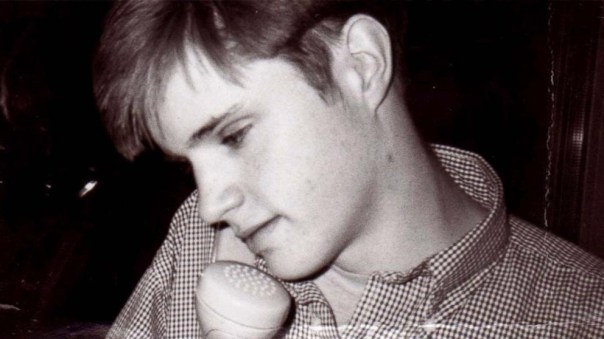
Matthew Shepard is seen in this undated photo. Matthew Shepard is seen in this undated photo. Matthew Shepard Foundation
McKinney and Henderson kidnapped Shepard and told him he was being robbed, Marsden said.
“(MORE: ‘Gay panic’ defense still used in violence cases may be banned by new federal bill)
McKinney hit Shepard about 20 times in the head and face with the end of the pistol, Marsden said, before the two stole Shepard’s shoes, got in their truck and drove back to town.
Shepard was found the next day, 18 hours later, by a passing cyclist. He was taken to a Laramie hospital but his head injuries were so severe that he needed a neurosurgeon, so he was moved to a Colorado hospital, Marsden said.
Shepard’s parents at the time were in Saudi Arabia, where his father worked. They flew back and were with their son at the hospital for his final few days, Marsden said.
When his mother, Judy Shepard, saw the badly beaten college student in the hospital, “he was all bandaged, face swollen, stitches everywhere,” she told ABC News’ “Nightline.” “His fingers curled, toes curled, one eye was a little bit open.”
Shepard died on Oct. 12.
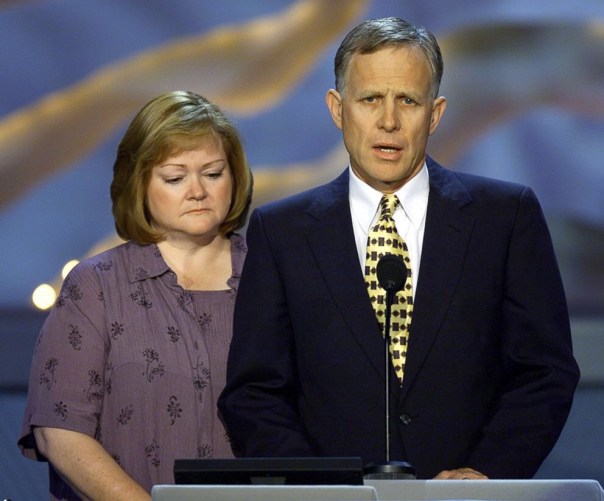
Judy and Dennis Shepard speak at the Democratic National Convention at the Staples Center in Los Angeles, Aug. 16, 2000. Judy and Dennis Shepard speak at the Democratic National Convention at the Staples Center in Los Angeles, Aug. 16, 2000. Paul J. Richards/AFP/Getty Images, FILE
The loss “never heals,” his father, Dennis Shepard, told “Nightline.” “He was just an ordinary kid who wanted to make the world a better place. And they took that away from him. And from us.”
A promising young life cut short
Matthew Shepard was a mischievous, stubborn and argumentative child, his father said.
“We didn’t realize the amount of violence and discrimination … against the gay community until after he died.”
He grew up to become very interested in international human rights, particularly women’s rights in the Middle East and Asia, and he studied political science, said Marsden.
“His goal was to work for the State Department to try to bring the same privileges and rights he thought he had in America to other countries,” Dennis Shepard said.
A few years before his death, Matthew Shepard came out to his mother on the phone.
“He said, ‘Mom I’m gay.’ And I said, ‘What took you so long to tell me?'” she recalled. “Rejection was not ever an issue in our family.”
Their son was then living an openly out life.
“Everybody he met, he said, ‘Just to let you know ahead of time, I’m gay,'” Dennis Shepard said.
“It was like, ‘This is who I am, and that’s the way it’s going to be,'” added Judy Shepard.
Dennis Shepard wasn’t worried about his son’s safety.
“We didn’t realize the amount of violence and discrimination … against the gay community until after he died,” he said. “We thought, he was born here … he has all the rights, responsibilities, duties and privileges of every other American citizen.”
The nation mourns
The shocking homophobic crime in the sparsely-populated state garnered national sympathy. The outpouring of love was immediate as flowers and stuffed animals filled the hospital.
“This is before the term viral existed, but it really did go viral,” Marsden said.
“It spawned candlelight vigils all over the country. There was a mass protest on Fifth Avenue in New York in which almost 100 people were arrested,” Marsden said, as well as a vigil at the U.S. Capitol with celebrities and members of Congress.
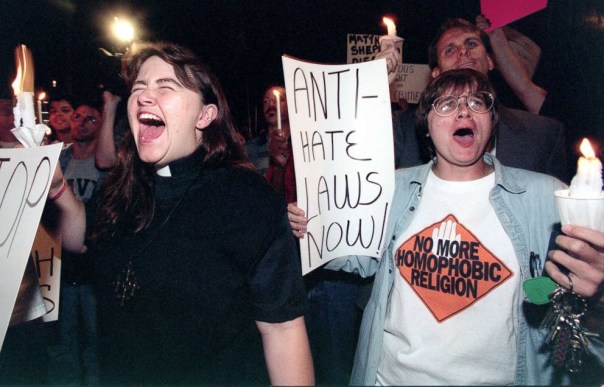
A candlelight vigil is held for Slain gay Wyoming student Matthew Shepard, Oct. 19, 1998. A candlelight vigil is held for Slain gay Wyoming student Matthew Shepard, Oct. 19, 1998. Evan Agostini/Getty Images FILE
“All of these spontaneous vigils were organized by volunteers independently of one another. All of the calls to action for hate crime legislation were the work of individual civic and political leaders,” Marsden explained. “It was a spontaneous outrage about the severity of this crime and the overall phenomenon of hate crimes against LGBT people, which were starting to get more social attention around this time than they had received in previous years.”
But it wasn’t all sympathy.
Members of the Westboro Baptist Church protested the funeral, picketing with anti-gay signs.
Rev. Fred Phelps and his parishioners traveled from Kansas to Laramie for the funeral and trial, protesting with brightly colored signs and spewing hatred.
Friends of the slain student dressed in angel costumes and staged a counter-protest encircling the parishioners so their signs wouldn’t be visible.
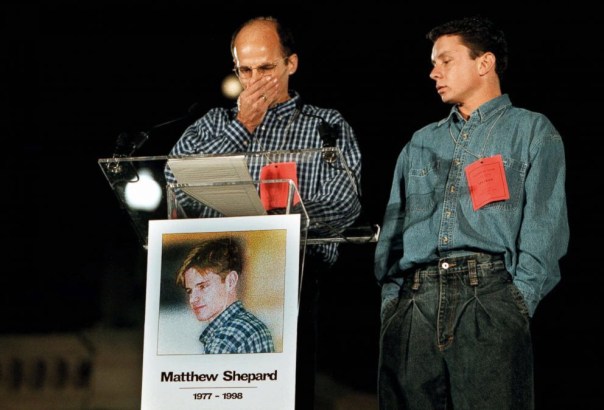
Matthew Shepard’s friends Walter Boulden and Alex Trout, from left, get emotional as they speak during a national vigil for Shepard,Oct. 14, 1998, at the steps of the U.S. Capitol. Matthew Shepard’s friends Walter Boulden and Alex Trout, from left, get emotional as they speak during a national vigil for Shepard,Oct. 14, 1998, at the steps of the U.S. Capitol. Juana Arias/The Washington Post/AP
Two killers head to court
After McKinney and Henderson were arrested, Henderson waived his pre-trial investigation and took a plea agreement, agreeing to two life sentences.
McKinney went to trial, and defense attorneys argued his violent actions were “gay panic” — a reaction to Shepard making a sexual advance.
“When the defense gets out there and starts talking out of, the victim’s fault, you know, ‘gay panic,’ … you just really want to scream,” Judy Shepard said. “One of the portions of his statement was that Matt was coming onto him … if that’s your defense, then every woman in a bar who gets hit on, she has the right to murder the guy sitting on her? That’s just absurd.”
The “gay panic” defense is still legal in most states but has been outlawed in a few. It’s been used since the 1960s in more than half of the states in the country, according to the Williams Institute at UCLA School of Law.
McKinney was convicted on numerous kidnapping and murder charges. Before sentencing, his attorneys, the Shepards and the prosecutors agreed to two consecutive life sentences in exchange for taking the death penalty off the table.
McKinney has declined to speak to ABC News while Henderson did not immediately respond to a request for comment.
Change in Washington
Shepard’s murder shined a light on the scope of federal hate crime laws, which at the time did not include sexual orientation or gender identity.
Two gay activists demonstrate in the streets of North Hollywood to protest against the death of Wyoming University student Mathew Shepard, Oct. 13, 1998. Two gay activists demonstrate in the streets of North Hollywood to protest against the death of Wyoming University student Mathew Shepard, Oct. 13, 1998. Hector Mata/AFP via Getty Images FILE
Demonstrators protest the hate killing of gay student Matthew Shepard, Oct. 19, 1998. Demonstrators protest the hate killing of gay student Matthew Shepard, Oct. 19, 1998. Andrew Savulich/NY Daily News Archive via Getty Images
“Matt’s murder immediately raised the visibility of that effort and, although it took until 2009, it did eventually pass and was signed into law by President Obama,” Marsden said.
The Matthew Shepard and James Byrd, Jr. Hate Crimes Prevention Act added crimes motivated by the victim’s gender, sexual orientation, gender identity and disability to the federal hate crime law.
James Byrd Jr., who was black, was murdered by three white supremacists in Texas in June 1998. Byrd was dragged behind a pickup truck, decapitated and dismembered.
The moment Obama signed the hate crimes law “was amazing,” Judy Shepard said. “He understood social injustice. And to be there with James Byrd’s sisters when they, when he actually signed, signed into law, it was an incredible experience. And it was a relief and it was also a total understanding that there was just really a lot more left to do.”
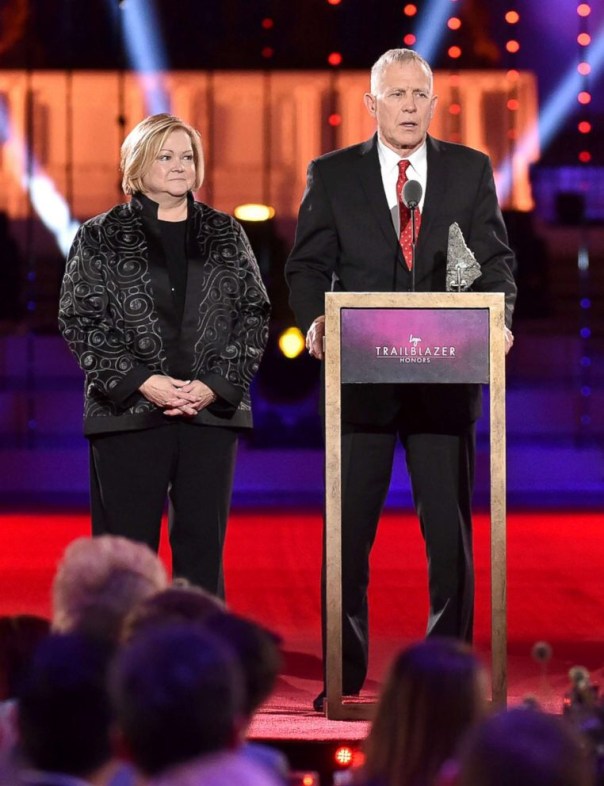
Judy Shepard and Dennis Shepard speak onstage at Logo’s “Trailblazer Honors” 2015 at the Cathedral of St. John the Divine in New York City, June 25, 2015. Judy Shepard and Dennis Shepard speak onstage at Logo’s “Trailblazer Honors” 2015 at the Cathedral of St. John the Divine in New York City, June 25, 2015. Michael Loccisano/Getty Images, FILE
For Judy Shepard, one of the best signs of cultural progress is seeing Gay Straight Alliance groups ramping up in schools. In Wyoming, where there’s a population of just 500,000, she said there are 19 Gay Straight Alliances.
Matthew Shepard’s story has also lived on through various creative works, including the “The Laramie Project” and “The Laramie Project: Ten Years Later” plays, which tell the story of how Laramie residents reacted to the murder.
They are among the most performed plays in American high schools, Marsden said, and have even been performed across the world in different languages, Judy Shepard said.
“It’s a universal story,” she said. “If you remove the sexuality from the story and insert race or religion, it’s exactly the same story of intolerance in a community or intolerance of individuals and how it affects a community.”
“Matt’s story, I think, was inspirational to many people, especially people his age who had not previously been active in LGBT rights who started doing so. Some have gone on to be really prominent activists in the community,” Marsden said
Back to ‘ground zero’
“I thought we were making such great progress in the Obama administration,” Judy Shepard said, but after the 2016 presidential election, she felt the progress of the foundation was at “ground zero again.”
The Trump administration has brought changes including an order to ban transgender troops in the military and a new “religious liberty task force” that advocates fear will provide an excuse for discrimination.
Just this month, a new policy went into effect in which the Trump administration will no longer provide visas for same-sex domestic partners of foreign diplomats and U.N. officials serving in the U.S.
“I’m just so mad that we are regressing,” Judy Shepard said. “We’re back on the road talking about hate and acceptance and loving your neighbor and, you know, all those things again.”
During the Obama administration, the Department of Justice “was working with us.”
“They would set up conferences to educate law enforcement, NGOs and nonprofits on how to deal with hate crimes. How to address them, how to identify them, how to work with victims. And they would invite us to come,” Judy Shepard said. “We visited several countries, 25 countries with [the] State Department. Now we’re not.”
“Now the [Department of Justice] definitely does not want to work with us,” she continued. “Civil rights is not an issue, a primary issue, for the DOJ anymore. … So we don’t get calls from them anymore.”
To Marsden, the degrees of progress for LGBTQ rights in the past 20 years vary.
Especially in urban areas, Marsden said he thinks “LGBT people have a good deal more personal freedom, career opportunities, are much less subject to discrimination. I think a lot of our schools are safer, including bullying issues, which of course affect people way beyond the LGBT community — they affect anyone who is different in some way or another than the perceived norm.
“However, if you look back in history every time there’s great progress there’s also a great backlash going on,” he said, citing how the end of slavery prompted the evolution of KKK and Jim Crow, while the 1960s Civil Rights movement ignited racial violence.
“All of the advances we’ve made have been great but they haven’t reached everyone. It’s still a very hard time to be a [transgender] kid in America even in more enlightened parts of the country, certainly in more rural parts of the country.”
A Gallup poll from May 2018 found that 31 percent of people don’t think marriages between same-sex couples should be recognized by the law as valid, with the same rights as traditional marriages.
“The overall lesson about looking back on progress is you have to fight to keep it. It can be very easy politically in this time in America to reverse the accomplishments made in the last 10 or 15 years,” Marsden said.
“I want people to be very conscious of their safety,” said Judy Shepard, warning that hate is still very much out there and that women, people and members of the LGBT community are especially vulnerable. “Especially now, when we hear so much vitriol being shouted from our leaders.”
“The number of hate crimes against LGBT people has gone up in the last two years, just like racial and religious hate crimes have,” Marsden said.
Reported hate crimes in the nation’s 10 biggest cities rose 12.5 percent last year — the fourth consecutive annual rise in a row and the highest total in over 10 years, according to an analysis from California State University San Bernardino’s Center for the Study of Hate & Extremism.
“Most hate crimes and discrimination are racial or religious — LGBT is a smaller percentage,” Marsden said. “We see, sadly, the kind of person who hates a certain race it’s pretty likely you’re the kind of person that hates a certain religion or a certain sexual orientation or gender identity, as well.”
A legacy — and life — memorialized
To the slain student’s mother, Matthew Shepard shouldn’t just be remembered for his legacy — he should be remembered for his life.
“I want people to remember that he was a person, that he was more than this icon in the photograph and the stories,” Judy Shepard said. “He was just, he was a 21-year-old college student who drank too much, who smoked too much and didn’t go to class enough. Just like every other 21-year-old college student. He had flaws. He was smart, funny. People just were drawn to him. And there was a great loss not just to us, but to all his friends. And people who hadn’t met him yet.”
Stephen Port murdered men he met through a gay dating app to fulfil his sexual fetish for ‘twinks’
A GRINDR serial killer drugged and murdered four young men he met on the gay dating app – but who is he?
Here we explain who he is, how long he has been jailed for, and whether he is appealing his conviction…
Stephen Port was convicted of four murdersCredit: SWNS:South West News Service
Who is Stephen Port?
Stephen Port, who was trained as a chef, has previously been reported to have worked as a rent boy.
He featured in an episode of Celebrity Masterchef two years ago, wearing chef’s whites and mingling with famous faces.
The killer, now 41, helped celebrity chefs make pasta and meatballs for more than 100 bus drivers in an episode broadcast in 2014.
He is thought to have worked at the West Ham bus garage for more than 10 years.
Port was found guilty in November of the murder of Anthony Walgate, Jack Taylor, Daniel Whitworth and Gabriel KovariCredit: PA:Press Association
The Daily Mail reported one ex-boyfriend said he also worked in door-to-door sales, and he had just started a new job stocktaking before his arrest.
Port also claimed to have spent time as a special needs teacher at a catering college in King’s Cross and to have served in the Royal Navy.
After his arrest his parents said these claims, and that of his status as an Oxford University graduate, was false.
His mother said his school thought her son was deaf because he didn’t “speak up”.
Throughout the trial the court heard Port, of Cooke Street, Barking, east London, was obsessed with “drug rape” pornography and this led him to drug and sexually assault gay men.
He was a frequent user of the gay dating app Grindr, and would meet men using this app and other sites over the course of more than three and a half years.
In August 2018 The Sun revealed he was handed £136,000 in legal aid to fund his defence and that he was set to appeal his sentence.
sources close to his family have revealed the monster – dubbed “The Grindr Killer” after luring victims on gay dating sites – has shown no remorse.
And he is now seeking legal advice to launch an appeal claiming his murder and rape convictions are unsafe and he was guilty of lesser manslaughter charges.
Who were Stephen Port’s victims?
Jack Taylor was killed by Stephen Port after the pair met on a gay dating appCredit: Central News
21-year-old chef Daniel Whitworth was found dead with an forged suicide note in a churchyard near Port’s homeCredit: SWNS:South West News Service
22-year-old Slovakian national Gabriel Kovari was also killed by PortCredit: News Group Newspapers Ltd
Fashion student Anthony Walgate was the first to be found deadCredit: Central News
He is guilty of the murder of Anthony Walgate, Jack Taylor, Daniel Whitworth and Gabriel Kovari, with an overdose of date-rape drug GHB.
Anthony Walgate was a student who had dreams of being a famous fashion designer.
Port had pleaded guilty to perverting the course of justice in relation Mr Walgate’s death and was sentenced to eight months imprisonment.
But, by the time he was jailed Port had gone on to claim the lives of two young men.
Slovakian Mr Kovari, 22, and 21-year-old chef Mr Whitworth, from Gravesend, in Kent, were murdered within weeks of each other in August and September 2014.
Both, like Mr Walgate, had died of GHB poisoning and were found in an almost identical position in St Margaret’s churchyard – near Port’s flat in Barking.
Port killed again just three months after being released from prison, in September 2015, when night shift forklift truck driver Jack Taylor, 25, was found near the same churchyard.
The families of the victims have since spoken out, slamming “homophobic” police for failing to link the deaths of the four young men.
A relative of Anthony told the BBC for the programme How Police Missed The Grindr Killer: “I totally believe that the Barking and Dagenham police that investigated Anthony’s death and the others are homophobic.
“I genuinely believe that if Anthony had been a girl left outside like trash they would’ve put a lot more effort into it, a lot more effort. As they were all young boys, they did nothing.”
An IPCC investigation was launched into the Metropolitan Police’s handling of the response to the four deaths, this is still ongoing.
The mother of Jack said: “Stephen Port took Jack’s life but they let that happen as far as we’re concerned.
“They are just as guilty as him, they should be held accountable for his death as they could’ve prevented it and we have to live with that for the rest of our lives.”
Why is Stephen Port known as the Grindr serial killer?
Port met his victims on the dating app Grindr.
After his arrest he was dubbed the Grindr serial killer.
He filmed himself having sex with unconscious men, was obsessed with drug-rape pornography, and was attracted to smaller, boyish-type men known as ‘twinks’.
Port drugged his victims by spiking their drinks or injecting them in the anus with drugs which he claimed were lubrication.
In total, 12 men are said to have been attacked by Port over three-and-a-half years, between 2012 and 2015, four of which died of an overdose of the party drug GHB.
Port denied four counts of murder, four counts of manslaughter, four counts of administering a poison with intent to endanger life or inflict grievous bodily harm, seven counts of rape, six counts of administering a substance with intent to overpower to allow sexual activity, and four counts of sexual assault by penetration.
What is GHB – gammahydroxybutyrate?
Gammahydroxybutyrate (GHB), otherwise known as the date rape drug, was used by Stephen Port during the string of horrific murders targeting young gay men.
The drug can be used as a general anaesthetic but due to its stimulating, addictive properties, has also become a known party drug.
It can make a user feel numb or groggy, as well as leaving them with little ability to recall events while under the influence of the drug.
It was made illegal in 2003, with a derivative GBL then being manufactured before it was made illegal as well in 2009.
Met Police announced last year that it would examine more than 50 deaths related to the drug after the conviction of serial killer Stephen Port, BBC reported.
A documentary which unravels Port’s sinister character How Police Missed the Grinder Killer will be shown on BBC One on Tuesday at 10.45pm.
In August 2018 it was revealed he is seeking legal advice to launch an appeal claiming his murder and rape convictions are unsafe and he was guilty of lesser manslaughter charges.
A source close to the Port family told The Sun: “Stephen’s conviction for murder was way too high and untrue.
“If anything it should have been manslaughter as these deaths were a series of self inflicted accidental drug overdoses.
“It was proven in court that they had other drugs, medication and alcohol in their systems before they met up with Stephen.
“All of these can be lethal if taken alongside GHB. Stephen did not poison them.
“The rape charges will be dropped once the case is downgraded to manslaughter. Stephen didn’t murder anyone.”
‘I am still shaking’: Stunned parents of alleged serial killer tell of their shock as their male escort son is accused of murdering four men he met on gay websites and poisoning them with party drug GHB
The parents of an alleged serial killer revealed their shock today as their male escort son was accused of murdering four men he met on gay websites.
Stephen Port, 40, of Barking, east London, is accused of using the party drug GHB – known as liquid ecstasy – to poison his four victims in a string of attacks spanning 14 months.
And Joan and Albert Port said today the allegations had ‘shaken’ them, adding that their son’s claim on Facebook that he was an Oxford University graduate and a special needs teacher was false.
Meanwhile, the Metropolitan Police tonight referred itself to the Independent Police Complaints Commission concerning ‘potential vulnerabilities in the response’ to the deaths of the four men – who were found dead in June, August and September of last year and September this year.
The Port couple – who protested their son’s innocence – said they only found out that he had been arrested for murder on the news this morning.
The Ports, who also live in Barking, added that they had taken their son books by adventure and thriller novelist Clive Cussler when he rang them from custody after being arrested on Thursday.
Pictured: This is Stephen Port, 40, above on Facebook and below in the dock, who today appeared in court accused of murdering four young men by poisoning them in the past 15 months
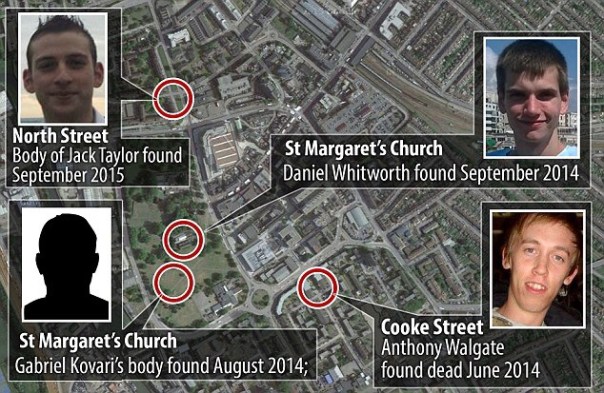
Map: Port lives in a flat in Cooke Street, Barking, and one body was found in the same street last year. Two bodies were later found in the nearby grounds of St Margaret’s Church and another was found on North Street, next to the Abbey Ruins. All the deaths happened in the space of 15 months
Mrs Port, 74, said: ‘The first we heard of it was on the news this morning. I was shocked. I am still shaking. We last spoke to him last night.’
And Mr Port, 73, added: ‘He phoned me up about half 10. He just said, “Can I have a bit of money and some books, something to read by tomorrow morning?”
‘So I had to go up there with a couple of books and £40 – you have to have a bit of money. He didn’t explain why he was there. He didn’t say nothing.’
Stephen Port, who also claimed to have served in the Royal Navy and has worked as a male escort, is said to have met the men online and then invited them back to his flat for sex.
Between June 2014 and September this year the four victims were allegedly given fatal doses of GHB, known as a date rape drug because it is colourless, odourless and tasteless.
The men, all in their early twenties, were found dead within half a mile of Port’s Barking flat but were considered accidental drug overdoses until police launched a murder investigation last week.
Three of the bodies were found either in or close to the churchyard of St Margaret’s Church in Barking. Another alleged victim was found on the same street Port lived in, Cooke Street, Barking.
Port was arrested after a police raid on his flat and has been charged with four counts of murder and four counts of administering a poison with intent to endanger life or inflict grievous bodily harm.
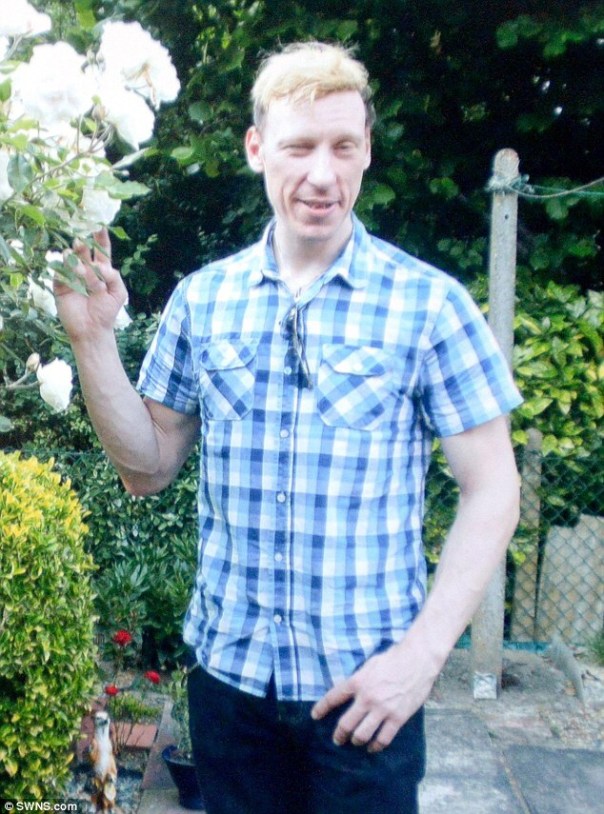
Most recent photograph: This is a photograph of Stephen Port taken in the back garden of his parents’ home in February
Port, who has blonde hair but is now nearly bald with only a few tufts of hair on his head, appeared in the dock at Barkingside Magistrates accompanied by three uniformed officers.
He spoke only to confirm his name, age and address during the brief hearing.
Wearing a prison issue grey tracksuit he held one of his arms and repeatedly glanced at the floor. He gave no indication of plea.
Deputy District Judge Shlomo Kreiman remanded Port in custody to appear at the Old Bailey on Wednesday.
His first alleged victim is said to be Anthony Patrick Walgate, 23, from Barnet, who was found dead on Cooke Street on June 19, 2014.
Gabriel Kovari, 22, from Lewisham, was found dead in the churchyard of St Margaret’s Church, North Street in Barking, on August 28 2014.
Less than a month later Daniel Whitworth, 21, from Gravesend, Kent, was also found dead in the same graveyard.
Jack Taylor, 25, from Dagenham, whose body was found near the Abbey Ruins close to North Street on September 14 this year, is believed to be his most recent victim.
Port describes himself on Facebook as a special needs teacher at Westminster Kingsway College in King’s Cross. It says he attended the University of Oxford between 2000 and 2003.
He is believed to have worked as a chef and may have helped disabled students learn to cook while one ex-boyfriend said he also worked in door-to-door sales.
His likes include a number of gay websites and lesbian, gay, transsexual and bisexual support groups, and it has also emerged he may have been a rent boy in the past.
Mr and Mrs Port, who live just two and a half miles from their son’s Barking home, said they only found out their son was gay when their daughter told them a ‘couple of years ago’, and that Mr Port disapproved of his son’s gay lifestyle.
Speaking from the front room of their small terraced house, asked what her son was like Mrs Port said: ‘He is a quiet boy, tall, 6ft 3in, size 14 shoes. He doesn’t say a lot. He had different boyfriends – he is gay.’
Mr Port added: ‘Don’t me get wrong – I’m against it. We thought he would be alright now – he has just started a new job.
‘He goes round different shops stocktaking – the pound shop and car show rooms. He was a chef for 13 years at the bus garage in West Ham.’
Mrs Port said her son had lived in his current flat for nine years – which he kept tidy – and they regularly went to visit him.
They said he is in regular touch with his sister Sharon, 43, who lives in Clacton and were aware of an older man who stayed in his flat but insisted they were not in a relationship.
Mr Port said: ‘He lived on his own. He’s got this older chap who has known for donkey’s and he has got to have somewhere to live as well. He pays the bills.’
Pictured: This is Stephen Port, 40, pictured above and below, who allegedly drugged the four men and killed them after inviting them back to his flat
Mrs Port insisted she believed her son was not to blame. She said: ‘I don’t think he has done it. He will have got involved and taken the blame for other people.
‘He was like that at school – he didn’t speak up. They thought he was deaf because he didn’t speak up.’
Speaking about his son’s predicament and the court proceedings, Mr Port said: ‘There’s nothing to say, nothing to do, you’ve just got to let it go on.
He added: ‘We still like him – don’t get me wrong. He is too quiet. He has been led astray. He won’t speak up, he won’t argue.
‘If I say something, “don’t do it”, he’ll say “yes, dad, yes dad” and then he will go and do it.
‘He had a girlfriend about two years ago – but it was a case of she liked him more than he liked her.
Anthony Walgate, the first alleged victim, was a student at the University of Middlesex who had dreams of being a famous fashion designer.
Police found him dead in the street at 4am on June 19, 2014.
At the time his devastated mother Sarah Sak, from Hull, said she was convinced her son would not have drunk too much or taken drugs before he died.
Toxicology tests later confirmed that he had only a small amount of alcohol in his system and no traces of illegal drugs.
The second and third alleged victims Gabriel Kovari, 22, and Daniel Whitworth, 21, were found at the same Barking church within one month of each other.
An inquest earlier this year heard both men had taken GHB and methadone.
Mr Whitworth had ‘blamed himself for Mr Kovari’s death’ after they took the drug GHB at an orgy, Walthamstow Coroner’s Court heard in June.
A dog walker found Slovakian-born Mr Kovari on August 28 last year while Mr Whitworth, from Kent, was found on September 20.
The coroner was told that Mr Whitworth was found dead holding a note in his left hand, which said: ‘I can’t go on anymore, I took the life of my friend Gabriel.
‘We were just having some fun at a mate’s place and I got carried away and gave him another shot of G[HB]. It was an accident, I know I will go to prison if I go to the police.’
The note said the men had sex at the party and added: ‘I have taken what G[HB] I had left, with sleeping pills – if it does kill me it’s what I deserve. This way I can at least be with Gabriel again.’
A statement by Mr Kovari’s family was issued at the time.
It read: ‘He was full of love and care for others and loved the company of his friends,’ a letter from his brother and mum which was read out in court, said. ‘He had been a very inquisitive and special child gifted in arts.
‘He had excellent relationships with all his relatives and the desire to prove himself to the world.’
Mr Kovari’s flatmate, John Pape, told the inquest he had seen him with Mr Whitworth and was meeting men through gay social network site Grindr.
A statement from Mr Whitworth’s father, Adam Whitworth, was read to the inquest.
It said: ‘He was an active and intelligent outdoors boy who loved days on his bike exploring leafy byways,’ it read. ‘Those who knew him were shocked by this terrible news.’
Ms Persaud recorded an open verdict.
The final alleged victim, Jack Taylor, 25, was found dead in September.
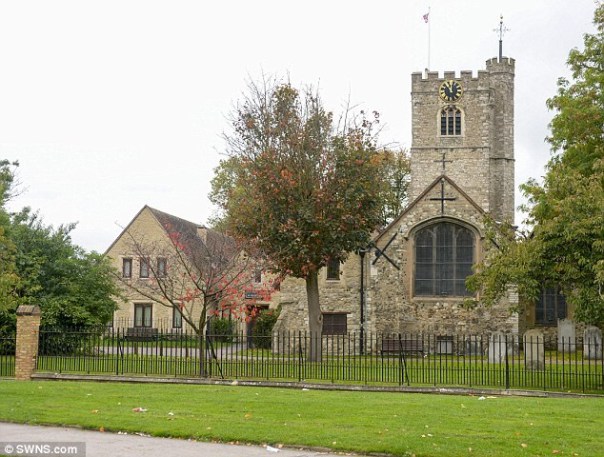
Home: Port’s first alleged victim is said to be Anthony Walgate, 23, from Barnet, who was pronounced dead outside the alleged serial killer’s flat on Cooke Street, Barking on June 19, 2014Deaths: The second and third alleged victims Gabriel Kovari, 22, and Daniel Whitworth, 21, were found here in the graveyard of St Margaret’s Church last summer, pictured todayVictim: Last month Port’s final alleged victim Jack Taylor, 25, from Dagenham, was found close to the Abbey Ruins, next to the churchyard, also pictured today
The 25-year-old, who worked on night shifts as a forklift operator, had been out with friends on the Saturday evening before he was found dead in the early hours of the morning.
He was last seen meeting a man at Barking station at around 2am and walking towards the Abbey Ruins.
His body was found around 300 yards from where Mr Whitworth and Mr Kovari were found dead by a dog walker.
Stephen Port lived in a one bedroom ground floor flat in a block of 12 in Barking, where his first alleged victim Anthony Walgate, 23, was found dead in the street last year.
Kristina Piliciauskaite, who lives with her husband and 11-month-old son in a flat two floors above Port, described how police examined the body.
She said: ‘We woke up at about 4 o’clock in the morning because we heard police and ambulance sirens.
Neighbours: People living in the same block as Port described him as quiet and shy and someone not keen to speak to them
‘We looked out of the window and there was a body right outside the door covered with a sheet.
‘The legs were sticking out and we could see the jeans and trainers of a man. The police were here for about a week, checking everyone in and out of the block of flats and asking us if we saw anything’
Describing how she used to see Port apparently smoking cannabis in his garden she added: ‘I used to see him quite often because during the summer I sit out on my balcony and it looks straight down onto his front garden below.
‘He was nearly always dressed in a sports tracksuit and would sit outside in the garden playing loud music from his phone and smoking grass.
‘We could hear shouting coming from the flat late at night sometimes too.
‘He would come in and out of the flat a lot. Sometimes three or four times a day, always walking around and then buzzing the door. If someone didn’t let him in then he would hop over the garden fence and knock on the garden door.
‘He would never speak if you saw him in the corridor or outside’.
Nenita Enriquez, 69, a retired nurse who lives on the same floor, said: ‘He doesn’t talk to anyone. He doesn’t say hello he just walks around quietly’.
Speaking about the body that was discovered outside the block of flats in June last year, she said: ‘The body was found just to the left of the door as you come in – where the gas box is. And the forensics tent went right across the entrance to the block – where all our mail boxes are.’
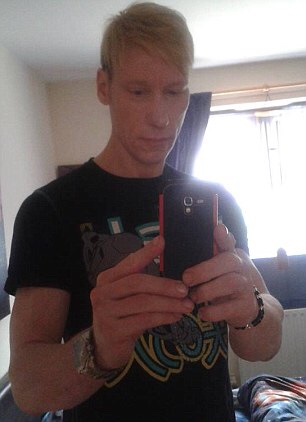
Posing: Port’s Facebook site and other social media profiles contain dozens of selfies showing himself clothed or with his shirt off
Ollie Sharp, 19, was working on the block of flats on the three days before Port’s arrest last Thursday.
He said: ‘I had been working in his flat since last Monday.
‘On Thursday about 12 police came up to the door and asked me to let them in to the building. They all went up to the front door and then smashed down the door with one of those red battering rams like you see in films.
‘On Friday, one of his friends turned up and buzzed the door and I heard the police talking to him. He was a small guy, with red hair and a neck tattoo.
‘The red haired guy said he was coming to visit a friend and his ex lived in the flat and had cheated on him loads. And then not long after CID came and put him in a van and took him away too.
‘One minute I am painting, the next he is getting arrested for four murders.
‘The police haven’t explained or said anything – I didn’t even know what he had been arrested for at the beginning.’
He added: ‘I was supposed to be painting his outside windows and door frames.
‘But when I went in I could instantly see it wasn’t the cleanest of places. It was messy and disorganised. It just looked dirty.
‘It wasn’t rubbish – it was just his stuff everywhere – not organised. He never went out to work – he was always there.
Paid work: This online advert reveals that Stephen Port is believed to have worked as a male escort while in his early thirties
An alleged serial killer worked as a rent boy charging £200-per-night, it was revealed today.
Stephen Port, who claimed to be an Oxford graduate who worked as a special needs teacher, advertised his services online.
Reviews reveal he was highly recommended by men who visited him at home for sex.
One American client described him as ‘bright interesting, loving and enjoys laughing’ and even considered paying for Port to fly to the US.
The alleged murderer was described as being ‘shy’ but ‘easy and friendly’ and sent the client ‘nice messages’.
In an anonymous review he wrote: ‘Stephen was a dream come true. Everything was better than he promised. All dealings with him were easy and again the reality was better that I had expected. How do you describe a dream come true?’
Port wooed the older man to the point the customer feared he could be ‘hurt emotionally’ him. The reviewer said he thought he was under-charging for his services.
Compared to any ‘regular London escort’ he was a ‘wonderful guy’ and ‘such a kind individual’, the client said.
The testimonial was left on an escort review site after a liaison in May 2007 when the American client, then in his late 50s, met him a number of times.
Port was said to charge £100 for a session and £200 for an overnight stay.
Port was described as the ‘ideal trip companion’ and an American client said he wanted to pay for him to travel to the US the following winter.
What the Thorpe affair reveals about the history of elite men seeking sex and relationships with other men
When British Liberal Party leader Jeremy Thorpe was acquitted of conspiracy to murder on June 22, 1979, the press had a field day. Thorpe allegedly paid to have his lover of fifteen years — the horse groom and sometime model Norman Scott — assassinated. The outing of a popular, charismatic politician was only one of many sensationalist elements, which included: a cast of characters comprising several senior members of the Liberal Party and a crew of incompetent Welsh gangsters; a botched assassination attempt in which Scott’s dog had been shot instead of him; and, that favored British theme, class antagonism. The trial pitted patrician Thorpe — from a prominent political family, educated at Eton and Oxford, and married to an aristocrat — against working-class Scott. The judge’s partial summing-up sought to discredit the prosecution witnesses while describing Thorpe as “a national figure with a very distinguished public record”; when the jury acquitted Thorpe, the verdict was widely regarded as a miscarriage of justice, in which the establishment had rallied round to protect its own. Evidence is still emerging about the extent to which the government and the police colluded in protecting Thorpe at Scott’s expense.
A recent high-profile BBC dramatization of the events of the Thorpe affair, A Very English Scandal, reintroduced the British public to these events. The three-part miniseries, directed by Stephen Frears with a screenplay by Russell T. Davies, stars Hugh Grant as Thorpe and Ben Whishaw as Scott, and is based on a book-length account of the scandal that had been published to commemorate the 1967 decriminalization of sex between men in England and Wales. The drama thus drew on the talents of many of the leading lights of queer British film and TV, and staked out a place for the Thorpe scandal in the LGBT history of Britain.
The show also offers a more nuanced — and, to this historian, more plausible — representation of how masculinity and male homosexuality worked in Britain before around 1980 than usually appears in the popular media. The period between the Criminal Law Amendment Act 1885, which allowed for men to be prosecuted for same-sex sex without the prosecution having to prove anatomically that anal sex had taken place, and the Sexual Offences Act 1967, which decriminalized sex between men in private, is usually understood as a time when a clearly-identified category of “the homosexual” — constructed in binary opposition to the “heterosexual” or “normal” man — was harshly oppressed by the legal and medical establishment. In the twenty-first century, this has become part of Britain’s national heritage. The story of Oscar Wilde’s tragic downfall at the hands of the establishment continues to pull in audiences, with a number of movies depicting the playwright’s life. In 2013, the computer science pioneer Alan Turing received an official royal pardon, which was extended three years later to all men who had been prosecuted for gross indecency, thus allowing the Conservative government of the time, under David Cameron, to draw a contrast between those prejudiced times and our own enlightened age.
A Very English Scandal makes clear, though, that in the world Thorpe inhabited, there were clear limits within which elite men seeking sex and relationships with other men could pursue their inclinations without controversy. When Scott first made a public statement about his affair with Thorpe, a police report went on file just in case, in the environment of the Cold War, the prominent politician might become a blackmail risk — but no prosecutions were set in motion, even though sex between men was still illegal. While Thorpe’s colleagues and friends suggest his poll numbers might improve if he marries, they evince no surprise or concern about the fact that he clearly prefers men. Though it is not clear that there is an evidence basis for this, the drama suggests that many of Thorpe’s circle might themselves prefer men too.
This could be interpreted as the establishment wagon-circling and closing ranks to protect its own — and at the time of the trial, many did interpret it as such: a BBC investigation at the time repeatedly asked people involved in the case if there had been a cover-up. But another way to think about this is that, in fact, for much of modern British history, norms surrounding male homoeroticism have been extremely context-specific. From the early nineteenth century until very recently, most elite men spent the part of their lives before marriage (perhaps in their late 20s or early 30s) immersed in single-sex environments, many of these residential: boarding schools, residential universities, gentlemen’s clubs, regimental halls, professional associations, political associations, dining clubs and discussion societies. In these contexts, very close romantic — and sometimes, though not always, sexual — attachments between men were thought a normal and appropriate part of the homosocial life-stage that most men would put aside when they married; within this highly class-hierarchical environment, exploitation of non-elite men for sex was thought not to be much different from exploitation of non-elite women for the same purpose. A significant minority of men — particularly around the turn of the twentieth century, when it was widely thought that too many men were choosing the bachelor lifestyle over marriage to eligible women — found that they preferred this environment to the prospect of matrimony, and stayed, doting on the boys and young men who passed through their care.
Because my historical research focuses on elite educational institutions, I find such men everywhere, working as teachers. In the forties, Thorpe surely met several at Eton and at Trinity College, Oxford. In the still heavily Latin-and-Greek-centric curricula of those days, men seeking paradigms within which to understand their desires often turned to ancient literature, where they would find idealized, romanticized descriptions of the pure and noble love an older man could bear towards a younger man or adolescent. One nineteenth-century Eton teacher, William Johnson Cory, wrote poetry based in large part on the Greek Anthology. His work, which enjoyed considerable mainstream popularity in its time, inspired generations of men who sought to put their own feelings into verse. One such man was Oscar Wilde, whose relationship with Alfred Douglas only came within the purview of the law after it moved outside the walls of Magdalen College, Oxford. But others included a significant social network of men — perhaps the majority of whom worked in education — who circulated amongst each other information that ranged from classical texts to scientific studies to pornography. Those at Eton and Oxford who read Johnson Cory’s poetry collection Ionica in its 1891 and 1905 editions may well have still been there when Thorpe arrived 40 years later.
That life-cycles and generations have a tendency to work like this means that conversation about a particular classically-influenced paradigm of same-sex desire — as well as forms of homoeroticism that were not at all acknowledged, talked about, recorded, or understood as a matter of identity — persisted in these institutions long after the Wilde trials were meant to have shut down all talk about homosexuality, long after the world wars, and long after the Sexual Offences Act. In 1998, a prominent Oxford classicist, who had spent 30 years in that university (and, prior to that, five at Eton), published a mainstream book about Virgil in which he held that a classical conception of pederasty was one of the major paradigms in which people in the nineties might continue to understand homosexuality, and that “[i]t is well known that many adolescents themselves pass through such a phase, and that it can be prolonged or created in institutions from which women are excluded…” This construction of a classical paradigm to understand modern homosexuality does not sound so different from, for example, the writing of the early theorist of male homosexuality John Addington Symonds, who made similar observations in the 1880s and 1890s.
In A Very English Scandal, Davies and Frears show the elite paradigm of male homoeroticism with which Thorpe was familiar butting up against the very different face of seventies gay liberation, the old giving way to the new. Outside the courtroom, a group of gay lib demonstrators give Scott a rapturous reception, welcoming him not only as out and proud, but also as a figure seeking to puncture the hypocrisy of the establishment and their desire to protect their own. When he is acquitted, Thorpe gives a hollow victory speech accompanied by his wife and son, whose lukewarm reception is overshadowed by gay libbers in the background carrying signs with bold slogans. That gay and lesbian activists of the time could paint Thorpe’s behavior as hypocrisy — much like how we now debate whether to out duplicitously closeted politicians — suggests that by then, in 1979, understandings of male sexuality were not so classed as they had once been. This was part of the broader shift in society and politics that accompanied, and followed on from, the victory of Margaret Thatcher and the Conservative Party in the general election of that year. The eighties were when David Cameron, Boris Johnson, and, a few years behind them, Jacob Rees-Mogg attended Eton and Oxford; when they entered politics in the nineties, it was in a more prosperous, more outward-looking, more socially liberal Britain. Though at that time Section 28 of the Local Government Act 1988, which forbade “promoting” homosexuality, still reigned, Cameron commented at the end of his parliamentary career that same-sex marriage was the prime ministerial achievement of which he was proudest.
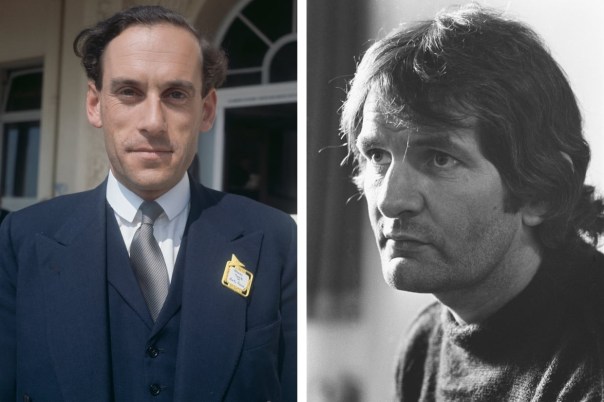
Jeremy Thorpe (L) and Norman Scott, who had a secret relationship in the early 1960s. Rolls Press/Popperfoto/Getty Images & Mirrorpix/Getty Images
To understand how we got here, though, we have to understand the links with the past, and the ways in which continuity operates as well as change. Though the present parliament is the most educationally diverse on record, institutions like Eton and Oxford still exert a peculiar influence over public life, as much in demotic conceptualizations of class and social inequality as in hard social-scientific data. Many viewers of A Very English Scandal will likely notice the differences between the world it depicts and our own: the cars, the seventies outfits, the social attitudes, the cod in parsley sauce. But Davies and Frears also went out of their way to emphasize the continuities, from Thorpe’s pro-European politics to the tabloids’ intrusion into the lives of public figures and, of course, the evergreen draw of a story that pits the entitled rich against the bold and scrappy poor who stand up for justice. It’s telling that we look at the story of a cross-class same-sex love affair that went wrong and think that there is something “very English” about it. Watching A Very English Scandal, I come away with a sense of how quickly the country has changed, how the Britain I encountered when I first came to live here in 2011, when Cameron was prime minister, is different — only just — from the Britain in which my friends’ parents grew up, when Thorpe was leader of the Liberal Party. As a historian of gender and sexuality in modern Britain, I come away with a renewed conviction that my late-nineteenth-century classics teachers were not mere marginal eccentrics, but in their own way key to understanding power and politics in modern Britain.
Whether you’re celebrating Pride in New York or Tel Aviv, you’ll be seeing all sorts of flags — and not just those in the traditional rainbow. There are many sexualities in on the queer spectrum, and we’ve identified the flags for each. Did we miss any? Let us know in the comments.
Gilbert Baker Pride Flag
In 1977, Harvey Milk challenged Gilbert Baker, a veteran who taught himself to sew, to come up with a symbol of pride for the gay community. His response? The original Pride flag. Inspired by Judy Garland’s “Over the Rainbow,” these colors flew at the San Francisco Gay Freedom Day Parade celebration on June 25, 1978. Though some dispute whether Baker was the sole creator of the flag that started it all, its symbolism remains. Each color celebrates an aspect of queer Pride:
Hot pink = Sex
Red = Life
Orange = Healing
Yellow = Sunlight
Green = Nature
Turquoise = Magic/Art
Indigo = Serenity
Violet = Spirit
1978-1999 Pride Flag
After the assassination of Harvey Milk, many wanted the Pride flag he commissioned to commemorate his accomplishments for the community and their personal support. The demand was greater than the available fabric, so the Paramount Flag Company began selling this version of the flag, as did Gilbert Baker, who had trouble getting hot pink fabric.
Traditional Gay Pride Flag
This is the most familiar flag. In 1979, the community landed on this six-color version, which was hung from lampposts in San Francisco. Numerous complications over having an odd-number of colors led to turquoise being dropped, at least according to reports. Read more about the modern flag here.
Philadelphia People Of Color Inclusive Flag
Noting that queer people of color are often not fully included in the LGBT community, the city of Philadelphia added two colors — black and brown — to the Pride flag in their honor. The city had previously faced accusations of racial discrimination in its gay bars, which led 11 queer nightlife venues to take antiracism training. Many white men were outraged by the flag, claiming that rainbow includes all skin colors, but with a star like Lena Waithe donning it at the Met Gala, it seems the design is here to stay.
Progress Pride Flag
This new flag seeks to take Philadelphia’s inclusive approach a step further. Daniel Quasar, who identifies as queer and nonbinary, designed this flag. The white, pink, and light blue reflect the colors of the transgender flag, while the brown and black stripes represent people of color and those lost to AIDS. “When the Pride flag was recreated in the last year to include both black/brown stripes as well as the trans stripes included this year, I wanted to see if there could be more emphasis in the design of the flag to give it more meaning,” Quasar explained on his Kickstarter.
Bisexual Flag
Designed by Michael Page, the flag brings visibility to the bisexual community, showing the overlap of the stereotypical colors for boys and girls. The flag was inspired by an older symbol of bisexuality: the “biangles,” two overlapping pink and dark blue triangles.
Pansexual Pride
Created on the web in 2010, this flag has colors that represent pansexuality’s interest in all genders as partners. The pink represents women, yellow nonbinary and gender-nonconforming people, and the blue is for men.
Asexual Flag
Like the pansexual flag, the asexual flag was created in 2010. Inspired by the Asexual Visibility and Education Network logo, it represents many ace identities, including graysexuals (the fluid area between sexuals and asexuals) and demisexuals (people who don’t experience sexual attraction unless they have an emotional connection with their partners.
Labrys Lesbian Pride Flag
Oddly enough, this sapphic symbol was created by a man. Created in 1999 by gay graphic designer Sean Campbell, the flag has not gained much traction in the lesbian community. It features a labrys, an ax-like weapon used by Grecian amazons.
Polyamory Flag
Featuring the symbol for the infinite numberpi, which shares the first letter of “polyamory,” this flag celebrates the infinite selection of partners available to polyamorous people. The letter is gold to represent the emotional attachment we have with others as friends and romantic partnerss, rather than just our carnal relationships.
Intersex Flag
Designed in 2013 by the organization Intersex International Australia, this flag intentionally features nongendered colors that celebrate living outside the binary.
Transgender Flag
Monica Helms, a trans woman, designed this flag in 1999, and it was first flown at a Pride Parade in Phoenix a year later. “The light blue is the traditional color for baby boys, pink is for girls, and the white in the middle is for those who are transitioning, those who feel they have a neutral gender or no gender, and those who are intersexed,” Helms noted. “The pattern is such that no matter which way you fly it, it will always be correct. This symbolizes us trying to find correctness in our own lives.”
Genderfluid/Genderflexible Flag
Encompassing the fluctuations and the flexibility of gender in genderfluid people, the flag features colors associated with femininity, masculinity, and everything in between. The pink stands for femininity. The white represents the lack of gender. The purple represents the combination of masculinity and femininity. The black symbolizes all genders, including third genders. The blue reflects masculinity.
Genderqueer Flag
Created in 2011 by Marilyn Roxie, the genderqueer flag highlights androgyny with lavender, agender identities with white, and nonbinary people with green. Some people refer to it as a nonbinary flag if they feel queer is a slur.
Lipstick Lesbian Flag
If you want the most feminine pride flag, here it is. Although it’s not a widely used symbol, it celebrates the femmes in the lesbian community, lovingly called “lipstick lesbians.”
Leather, Latex, & BDSM Flag
Whether the kink community should be added in the acronym LGBT is a heated debate, but there is no denying that the community has several of its own flags. This one was designed by Tony DeBlase for Chicago’s International Mr. Leather celebration in 1989. This symbol is not exclusively gay, but rather for the leather and BDSM community. The original flag is on display at the Leather Archives and Museum in Chicago.
Bear Brotherhood Flag
Though The New York Times named 2018 “the age of the twink,” only the bears — as gay men lovingly refer to the beefier, more hirsute guys — have their own flag. Craig Byrnes designed it in 1995 for the International Bear Brotherhood. Its colors are to match the fur of bears living in the woods.
Rubber Pride Flag
This symbol is for members of the rubber and latex fetish community and is similar to its predecessor, the leather Pride flag. Peter Tolos and Scott Moats created the design in 1995 “as a means to identifying like-minded men and [it] reflects the sensory, sensual, and mental passion we have for rubber.” They say the black color represents “our lust for the look and feel for shiny black rubber,” the red symbolizes “our blood passion for rubber and rubbermen,” while yellow highlights “our drive for intense rubber play and fantasies.” It also features a literal kink, for obvious reasons.
Polysexual Flag
Polysexuality, unlike pansexuality, is the attraction to multiple genders but not all. A middle ground between bisexuality and pansexuality, it is centered more around attractions to femininity and masculinity rather than gender itself. The pink represents attraction to females; the blue for males. The green is for an attraction to those who don’t conform to either gender.
Agender Flag
While genderqueer people bend the rules of gender, agender people reject a gender completely. For their flag, the black and white stripes represent the absence of gender, while green, the inverse of the gender-heavy purple, represents nonbinary genders.
Aromantic Flag
While asexual flags use purple to show their lack of sexual attraction, aromantic flags use green to celebrate the people who live without romantic attraction.
Non Binary Flag
Created by 17-year-old Kye Rowan in 2014, this flag was a response to nonbinary people feeling improperly represented by the genderqueer flag. This symbol was not to replace Roxie’s creation but sit beside it as an option. The yellow symbolizes gender outside a binary. The white, a mix of all colors, represents those with many or all genders. Purple stands in for those who feel both binary male and female or fluid between them. The black is for the agender community, without sexuality or color.
Pony Flag
Pony play is a distinct fetish where people are treated like horses by wearing hooves, ears, and saddles and pulling carts. Carrie P created this flag in 2007; it uses black in solidarity with the leather community at large.
Straight Ally Flag
The flag equivalent of “I support LGBT people, but no homo,” this makes everyone feel included at Pride marches, even if they’re celebrating other people’s sexualities.
Imagine watching the Empire State Building suddenly transform into giant spurting penis to ejaculate a figure dressed in a major King Kong look across a stage. Now, imagine this mysterious figure shedding the ape costume and emerging as the most fabulous Marlene Dietrich you’ve ever seen.
No, this isn’t the fever dream of a Hell’s Kitchen gay after watching Kong: Skull Island. This flamboyant and provocative series of events almost happened. The performance, set to take place at the Paris Opera House in 1973, would’ve introduced the world to glam rock’s first openly gay rock star. Through a sea of glitter, the crowd was to feel a potent mix of astonishment and arousal before whispering his name: Jobriath.
That you’re almost certainly wondering who the hell Jobriath is should betray the fact that his grand entrance never happened, but to dismiss Jobriath as yet another failed rock star would do a disservice to his legacy. The truth is, for all his failures, Jobriath paved a path for queer musicians. Without rock’s self-proclaimed “true fairy,” artists like ILoveMakonnen, Frank Ocean, PWR BTTM, Mykki Blanco and everyone in between might not be around to queer up the music industry.
Decades ago, in an era punctuated by the queerbaiting antics of Lou Reed and David Bowie, Jobriath’s star power proved to shine too bright, too fast—he was the Icarus of glam rock with a gloomy ending to match. Spanning multiple identities, enough tragedy to fill a Lifetime Original Movie, and a wealth of ideas that would never come to pass, this is the story of America’s first gay rock star.
The Adolescence and Abandonment of Bruce Wayne Campbell
You’d be forgiven if you thought the story of Jobriath’s adolescence was written by an overeager fiction writer. After all, his name shares similarities with both Batman and the star of Evil Dead and hails from a town that sounds like a history book. Yet, Bruce Wayne Campbell of King of Prussia, Pennsylvania really did exist. And he was even something of a child prodigy on the piano.
The Film Collaborative
Born the son of an Army man in the dirt track town, Campbell spent his youth moving from army base to army base with his family. It was a childhood light on friends and heavy on a blooming sexual identity that infuriated his family. It was an existence that wasn’t meant to last and, after a brief stint in the Army that ended with him going AWOL, he ran away to start a new life as Jobriath Salisbury in the sun-soaked streets of Los Angeles.
Detours and the Discovery of Jobriath Salisbury
Like any great glam rock origin story, Jobriath’s rise began with a little bark and a lot of hair follicles. A short time after arriving in LA, he accompanied his friend to the audition for the notoriously outlandish musical Hair. Despite only going to help the friend with lines, he was cast into the role of Woof and was soon performing to sold out crowds every night. Under the bright lights, he got a taste of stardom that changed his life.
Though as talented as he may have been in his role, he wasn’t immune to the vices of the 1960s. A cocktail of drugs strong enough to tranquilize a herd of buffalo mixed with his overinflated ego and he eventually left Hair in a blaze of glory—taking two of his costars with him to start a band called Pidgeon. You know, because it was 1969 and naming your band after sky rats was glam. The trio recorded a strange, baroque folk album that sounded like a chipper nightmare before the band promptly fell apart.
It was from this point that Jobriath’s AWOL status caught up to him and he was detained by military police. He was thrown into a military psychiatric hospital, suffered his first big breakdown, and then broke away from the padded walls to take on California one last time. It didn’t take long for him to pick up his old habits As he recalled years later, “I was floating down in the gutter. I didn’t eat. I just drank beer all the time. With no money, I hustled for booze and drugs.”
While he hustled, a new chapter in Jobriath’s story was being written thousands of miles away in New York. It was there that Jerry Brandt, legendary manager of Carly Simon, sat in the offices of Columbia Records’ Clive Davis listening to Jobriath’s demo tape. To his ears, he’d found the star he was waiting for.
The Film Collaborative
Jobriath Boone and Jerry Brandt’s Big, Gay American Disaster
The year was 1972 and Jobriath had just shed his steak-themed last name and emerged as Jobriath Boone—–just in time for Brandt to change his life forever. After search through LA to find him, Brandt quickly whisked the burgeoning star back to New York, got him a record contract with Elektra Records rumored to be worth $500,000, and began one of the most ambitious advertising campaigns of the decade.
“Jobriath is going to be the biggest artist in the world. He is a singer, dancer, woman, man. He has the glamour of Garbo. He is beautiful,” Brandt explained to Melody Maker before telling Music Week: “It’s Sinatra, Elvis, The Beatles, and now Jobriath.” To Brandt, Jobriath was glam rock’s gay, glittered Jesus Christ and he wanted the world to know his name.
Jobriath’s face was plastered across full page ads in Vogue, Penthouse, and Rolling Stone and put on posters on hundreds New York City buses. For Brandt’s pièce de résistance, a 41’ by 43’ billboard high atop Times Square was erected featuring Jobriath naked and posed as a Roman statue broken at the base and crawling across the floor.
The AV Club
When it came time to record the album, Brandt convinced Elektra Records to book them at Olympic Studios, the famed recording studio favored by bands like The Rolling Stones. It was within these soundproofed walled that a 55-piece orchestra accompanied Jobriath on a glam rock journey through the eleven tracks that made up his self-titled debut album. Despite the aggressively sexual S&M ballad “Take Me I’m Yours” and the swaggering bravado of “I’m a Man,” reviews were warm and encouraging.
The problem was that outside of the industry, Jobriath’s flagrant sexuality produced a product the public just wasn’t ready for. By the time the giant wave of marketing finally crashed down, Jobriath’s overhyped debut had become a disastrous joke. A debut concert at the Paris Opera House with a $200,000 price tag and the Empire State building ejaculating the star was quickly scrapped.
He made his television debut in an unforgettable yet restrained performance on a prominent nightly show called The Midnight Special. It was notable for his outlandish costume that could best be described as ‘spaceman by way of hamster tunnel tubing’ and was restrained because, after being barred from performing his S&M jam “Take Me I’m Yours” by producers, he instead performed “Rock of Ages” and his single “I’m a Man.” Late night just couldn’t handle a glitter-dipped gay rocker singing, “Any day you could buy me or tie me up.”
Alongside his TV debut, he headlined two sold out shows at The Bottom Line in all his unsheathed, gay glory to modest, 400-person crowds. The positive response brought some hope to Jobriath and Brandt but that momentum crashed down at a follow-up concert at Nassau Coliseum. There, the crowds immediately bombarded him with shouts of “faggot” as trash was thrown until he fled the stage. Elektra Records quickly pushed out the second and final album, Creatures of the Street, shortly after that disastrous show with leftover material from the Jobriath recording sessions and dropped him from their label.
With no future at Elektra, Jobriath embarked on one final tour and severed his partnership with Brandt. Like any good rock star though, Jobriath went out with a bang. His final show at the University of Alabama led to five encores that ended when the excited crowd pulled the fire alarm and sent the fire department rushing in. It was glorious moment that showcased the star Jobriath could’ve become had the country been ready to embrace that courageous homosexuality of rock’s first true fairy but ultimately signaled the end to his life as Jobriath.
The Downfall and Death of Cole Berlin
In 1975, high above the iconic Chelsea Hotel in a pyramid-topped apartment, Jobriath Boone was laid to rest alongside his brief career. From his ashes, the character of Cole Berlin emerged. When he wasn’t hustling or auditioning for the role of Al Pacino’s lover in Dog Day Afternoon, Cole spent his nights performing 1930s cabaret songs at The Covenant Gardens restaurant. His existence, perhaps for the first and only time, appeared restrained and mundane for a few years. It wasn’t until 1979 that the façade of normality was ripped away in an interview with Omega One magazine.
“Jobriath committed suicide in a drug, alcohol and publicity overdose. That whole hype just drove him crazy,” Cole said of his former identity. It was the statement of a broken man and, as the interview continued, he didn’t hesitate to talk about his personas as if they were a polyamorous family he’d moved in with. “Schizophrenia is my lifestyle. I think everybody is schizophrenic but they’ll all fighting it,” he explained. “I, or should I say we, are not fighting it. Come over. I’ll ask some of us to come out and play.”
Years after the interview, his lifestyle on the streets caught up with him and he soon contracted AIDs. On the Chelsea Hotel’s 100th anniversary in November 1982, he played his last public performance and, on the morning of August 4, 1983, police broke up the front door of his rooftop apartment and found his dead body. A decade after towering over Times Square, he died alone and abandoned—–his body decaying for four days before anyone found him.
The Great, Rock Resurgence of Jobriath
As tragic as his career and life were, time has ultimately been kinder to Jobriath. In the years following his death, the glamorous singer has become ingrained in the rock and roll folklore thanks to one of rock’s most iconic queer artists. In one of the strangest twists in Jobriath’s story, rock legend Morrissey of The Smiths has become integral in establishing the singer’s legacy.
In 1992, Morrissey expressed interest in having him as the opening act for his “Your Arsenal” tour–—unaware that the singer had died nearly ten years ago. It was a tragic request but, ultimately, served as a catalyst for Jobriath’s revitalization. In the two and a half decades since Morrissey first took an interest in rock’s first true fairy, a wealth of information and music has unearthed his story. Previously unreleased music filled Lonely Planet Boy in 2004 and As the River Flows in 2014; his first two albums saw a rerelease in 2008; and, finally, a documentary by Kieran Turner called Jobriath A.D. came out in 2012.
Four decades after crooning for audiences to let him be who he was on the track “I’m a Man,” the repercussions of Jobriath’s fearless embrace of his sexuality, Empire State Building ejaculation and all, are finally being celebrated.
Three Melbourne Builder & Co tradies on a worksite in Prahran sport different length shorts: Dale Cheesman, Dylan Milligan and Shaun Caton from L to R. Picture: Tim Carrafa
TRADIES are pulling up short this summer.
According to a new survey by RSEA Safety, which asked tradesmen how short they like to wear their shorts, a staggering 60 per cent of blue-collar workers quizzed have revealed they prefer their shorts “as short as possible”.
While some of those who voted in the social media campaign preferred the modesty of a longer hemline of nine or ten inches, the much more revealing four inch short-length proved the most popular.
The shorter the better — they’re easier to work in and the legs are getting a good tan,” says Dylan Milligan (middle). Picture: Tim CarrafaBrands are competing to offer tradies the “shortest short”. Picture: Tim Carrafa
Lilly Lee, general manager of marketing at RSEA Safety, said many new season shorts combine functionality with style, and the trend was definitely thigh-high.
“We are expecting at least a 30 per cent increase in short sales in the coming months, and this season we are noticing an increase in shorter styles, with brands almost in competition with each other over who can offer the shortest short,” Ms Lee said.
“ELEVEN have launched a 4-inch ‘Chizeled’ short and FXD WS-2 have designed a ‘short short’ while Corc’s have introduced a ‘shorty short’ style. We thought it would be fun to ask tradies in our #shortorshorter campaign how they wear theirs and we’ve had some hilarious responses with an overwhelming number of tradies voting for “as short as possible’”
Melbourne tradies Dale Cheesman, Shaun Caton-Robertson and Dyllan Milligan, from The Melbourne Builder & Co, showcased an array of summer shorts at a Prahran building site this week.
Mr Milligan is among those advocating for shorter shorts this summer.
“The shorter the better — they’re easier to work in and the legs are getting a good tan.”
What went wrong with the conversion ministry, according to Alan Chambers, who once led its largest organization
TERRY JOHNSTON / FLICKR
In 2001, Alan Chambers was hired as the president of the world’s largest ex-gay ministry, Exodus International. That same year, U.S. Surgeon General David Satcher issued a report that stated, “there is no valid evidence showing that sexual orientation can be changed.”
Like most conservative Christian leaders at the time, Chambers considered the countercultural nature of his work a point of pride. During the latter part of the 20th century, Exodus and similar conservative groups promoted the idea that gay people could—and should try to—become straight. Ex-gay leaders traveled to churches and appeared on television news programs citing a litany of examples of happily married “former homosexuals” to demonstrate that sexual orientation is a choice and that change is possible.
But Chambers would undergo a radical change of heart. In 2013, he publicly apologized to the LGBT community for the “pain and hurt” Exodus had caused and announced that the ministry was permanently shutting down. Chambers’s decision effectively delivered the deathblow to the beleaguered ex-gay movement. And his story of transformation, detailed in a new memoir, My Exodus: From Fear to Grace with a foreword by CNN’s Lisa Ling, will likely resonate with many traditionalists who are searching for new ways to think about LGBT issues.
Chambers, 43, was raised by an ex-military father in a Southern Baptist home and realized he was attracted to other males at a young age. Most of his early sexual encounters with men were anonymous, which bred in him a deep self-hatred. At 19, he connected with an Exodus-affiliated ministry where he hoped to rid himself of same-sex attraction once and for all.
While the ministry did not make Chambers straight, he claims that it saved his life and many others because it provided a “safe space for many” to talk about their sexuality. At the time, there was no national network for LGBT Christians and most churches were not places of sexual transparency. But, he says, Exodus’s emphasis on “change” made it “fatally flawed.”
In 1998, Chambers married his wife, Leslie, with whom he adopted two children. In My Exodus, he recounts his inability to consummate the union for eight months, but he says their sex life is now “good.”
“While many relationships are built on sex, ours just includes sex,” Chambers says. “We love it and value it because we worked hard for it.”
As a former Exodus participant who once lived a “gay lifestyle” but was able to achieve a successful straight marriage, Chambers was the perfect candidate to lead the organization. And by 2001, Exodus needed all the help it could get.
At its peak, Exodus International had an annual operating budget of more than $1 million, had 25 employees, and served as an umbrella organization for more than 400 local ministries across 17 countries. But over the years since its founding in 1976, many of the leaders Exodus’ touted as success stories had become cautionary tales instead.
Cofounder Michael Bussee left the group in 1979 and entered a relationship with another Exodus leader, Gary Cooper. Bussee would later admit, “I never saw one of our members or other Exodus leaders or other Exodus members become heterosexual, so deep down I knew that it wasn’t true.” Throughout the 1980s and ‘90s, many former Exodus members became vocal critics of the ministry, claiming it had caused them psychological distress. And in September 2000, Exodus’s chairman John Paulk was photographed cruising for men at a gay bar in Washington, D.C. He was ousted from his position and later confessed, “I do not believe that reparative therapy changes sexual orientation; in fact, it does great harm to many people.”
The movement traditionalists believed would be their saving grace in the fight against LGBT rights was quickly becoming their Achilles’ heel.
Being chosen to lead Exodus in 2001 was like becoming the ex-gay Pope following the Catholic sex-abuse scandals. The ministry’s board knew it could not survive another public scandal, so it questioned Chambers rigorously before deciding to hire him. During the interview process, Chambers recalls a board member asking him what success would look like under his leadership. He replied, “It looks like Exodus going out of business because the church is doing its job.”
Chambers words would later seem prophetic, but he first needed to travel a long road. In 2005, he called homosexuality “one of the many evils this world has to offer.” And in 2006, he lobbied for a constitutional amendment banning gay marriage. But Chambers admits that during the same year his thinking began to evolve.
“As I heard more stories and evaluated my own realities,” Chambers said, “I realized change in orientation was not possible or happening.”
Though the ex-gay leader was stewing on the inside, he seemed as resolute as ever on the outside. He advocated for California’s Proposition 8, which sought to ban gay marriage in the state. In 2009, he published a book called Leaving Homosexuality: A Practical Guide for Men and Women Looking for a Way Out. He admits to immediately regretting the book’s title and some of its content.
Chambers’s thinking continued morphing until his dramatic announcement that the ministry would shut down in 2013: “Exodus is an institution in the conservative Christian world, but we’ve ceased to be a living, breathing organism. For quite some time, we’ve been imprisoned in a worldview that’s neither honoring toward our fellow human beings, nor biblical.”
By this point, the ex-gay movement was already in shambles. A 2013 Pew Research poll showed that only 36 percent of Americans believe a gay or lesbian person’s orientation can be changed. As Satcher reported, modern science had delivered crushing blows to the ex-gay movement with peer-reviewed research showing that its ideology was bunk. And a national movement to ban reparative therapy for minors was taking shape and had already been successful in several states.
The closing of Exodus International became the “tipping point” in conservative Christians’ conversations about the nature of sexual orientation. Today, even top Southern Baptist leaders have denounced ex-gay therapy, and the school newspaper for the Jerry Falwell-founded Liberty University has editorialized against it.
“Shutting down Exodus dealt a fatal blow to the whole idea that orientation can be changed and that God somehow loves you more because of the choices you make,” Chambers says. “Some ministries still promote this idea, but they are not going to achieve the same level of success that Exodus had. That position is more of a minority than it has ever been.”
The release of Chambers’s memoir this month marks another step in the leader’s evolution. He has voiced his support for President Obama’s effort to ban orientation-change therapies for minors and celebrated the Supreme Court’s decision to legalize gay marriage. And now he even admits that he believes committed, monogamous same-sex relationships can be holy.
“I look at gay and lesbian people who are in committed relationships and I believe they can reflect the image of God,” Chambers says. “That belief has continued to evolve, but heterosexuals don’t have a corner on the market of healthy, holy relationships.”
While many culture-warring conservatives will undoubtedly see Chamber’s openness as a cowardly capitulation, others will call him courageous. The former ex-gay leader chooses to focus on just being honest, instead. As he said in a chapter intended for his memoir but cut by the publisher, “Every part of my life, all of my compartmentalization is reconciled. My message and story are no longer different depending on the group to whom I’m speaking.”
Chambers describes his current sexual orientation as “complicated.” While he is still attracted to men, he also says that he and Leslie have a healthy marriage with a robust sex life. But he no longer claims that every person with same-sex attraction should follow his path.
“For those who cannot reconcile their faith and sexuality, they can be affirmed in their choice of celibacy and devote their lives to causes more life giving than ‘ridding themselves of the demon homosexuality,’” Chambers says. “And the gay Christian community can be affirmed in who they already are: beloved.”