Brent Bozell is one of those right-wingers who has made a career of being indignant at every hour of the day, always on the lookout for an excuse to whine and complain. One of the things that upsets him is that some comic books feature openly gay characters. “The world of comic books has sure changed a lot since we were young,” Bozell wrote in a 2006 column. “Who would have predicted, 10 years ago, that the comics would become a red-light neighborhood where sexually perverted superheroes would be packaged to elicit from children fascination and sympathy?”
Like most professional moralists, Bozell has no real sense of history: he’s a traditionalist with no grounding in the past. If Bozell knew anything about earlier times, he would realize that gays have been portrayed in comics for decades, not just in comic books but even in comic strips that ran in family newspapers.
What could be more wholesome than Mickey Mouse, the big-eared emblem of the Disney empire? Yet a Mickey Mouse comic strip from January 22, 1931 shows the little rodent meeting a big cat who displays all the markers stereotypically given to gay characters during that period: a lisp, a limp handshake, and a general effeminacy of manner (in this case, batting eyelashes). Revealing himself to be not just homophobic but a violent gay-basher, Mickey attacks the big cat.
In the early decades of the 20th century, many cartoonists featured characters that were gay stereotypes: swishy men and butch women. I’ve sprinkled examples throughout this essay. Here are some notes on them (to maximize enjoyment of these images, I suggest clicking on each one):
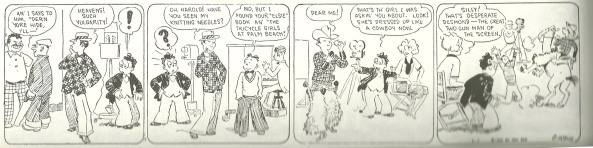
Roy Crane’s Wash Tubbs
1. In an April 11, 1925 Wash Tubbs sequence, the hero meets a “girl” who turns out to be Desperate Desmond, a cowboy actor.
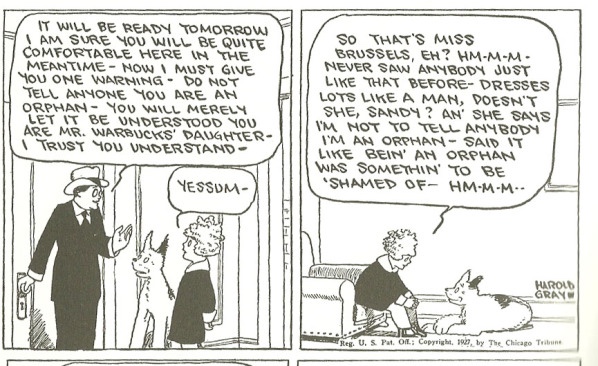
Harold Gray’s Little Orphan Annie
2.In a January 11, 1927, Little Orphan Annie strip, the pupil-less waif talks to Miss Brussels, a very manly woman who runs an all-girls schools (which were, in popular folk-lore, places where Sapphic love flourished). “Hm-m-m- Never saw anyone just like that before,” Annie reflects. “Dresses lots like a man, doesn’t she, Sandy?” Like many of the masculine women in Annie, Miss Brussels turns out to be a very bad egg, who mistreats the poor orphan. (Later on in the Cold War era, Annie meets some traitorous State Department diplomats who seemed very effeminate, conforming to the commonly-held notion that gays were more likely to betray their country).
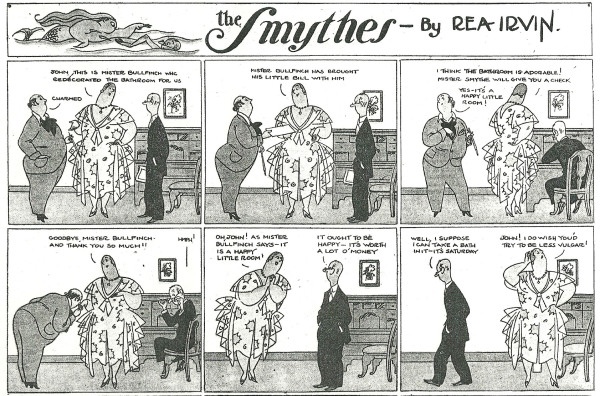
Rea Irvin’s The Smythes
3. A 1930 Sunday page of The Smythes, a domestic comedy drawn by Rea Irwin, the famed cartoonist who was so instrumental in creating the visual ambience of The New Yorker magazine, features a very foppish interior decorator named Mr. Bullfinch.
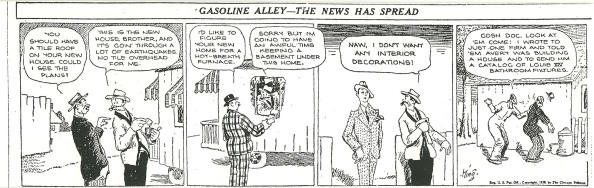
Frank King’s Gasoline Alley
4.Frank King also used an “interior decorators are gay” gag in a June 06, 1930 Gasoline Alley strip.
5.Terry and the Pirates in the late 1930s, which had a lesbian villain (Madam Sanjak from 1939) and a gay villain Papa Pyzon (in 1936) based on Charles Laughton (who was himself gay and also collected comic strip art). Madame Sanjak specialized in kidnapping and hypnotising young girls, and making them her slaves. For more on these characters see this article.
Will Eisner’s The Spirit, part
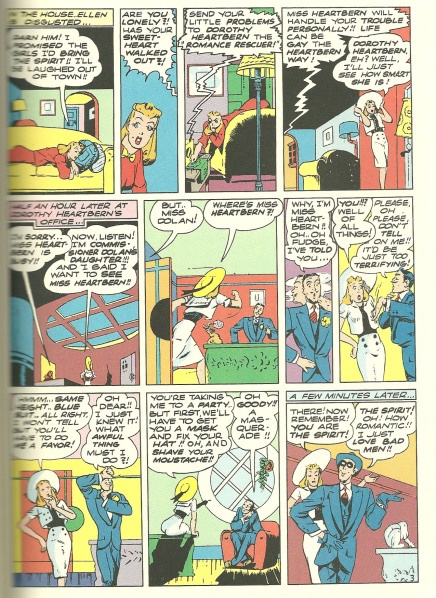
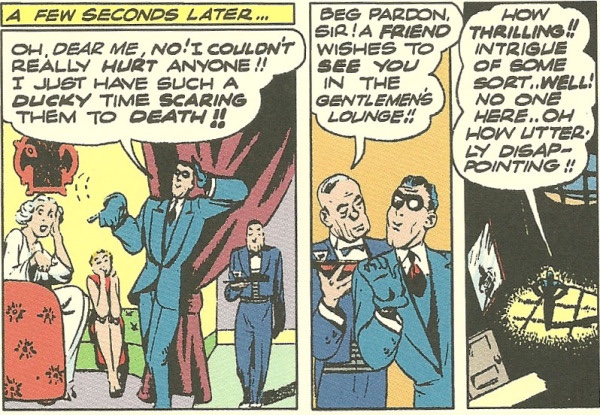
6. A Spirit story, by Will Eisner, from September 07, 1941 introduces a character named Miss Dorothy Heartbern, who turns out to be a very fey man. Asked to impersonate the Spirit, he says, “The Spirit! Oh! How romantic!! I just love bad men!!” The phrase “a friend of Dorothy” was commonly used to describe gay men in that period.
There are enough of these gay characters that one could easily do an anthology called “The Gay Image In Comics before Stonewall.” The general point to make about these characters is that they are all homophobic stereotypes, although the tone of the representation varies greatly. Sometimes the cartoonists were mildly satirical (as swishy she-men), sometimes melodramatically hostile (as vile seducers of children).
Will Eisner’s The Spirit part 2
One last point needs to be made: conservatives like Bozell never objected to these gay stereotypes when they flourished in the comics. So what people of this ilk are upset about is not the representation of homosexual per se, but about the fact that gays are increasingly shown in a neutral or favourable light. As long as gays are represented in a homophobic way, Bozell and his political allies would never raise a voice of objection. For the Bozells of the world, it is okay to show gays, as long as you don’t show them as human beings.
Reference
Mickey Mouse, Homophobe, sans everything, 16 December 2009, by Jeet Heer
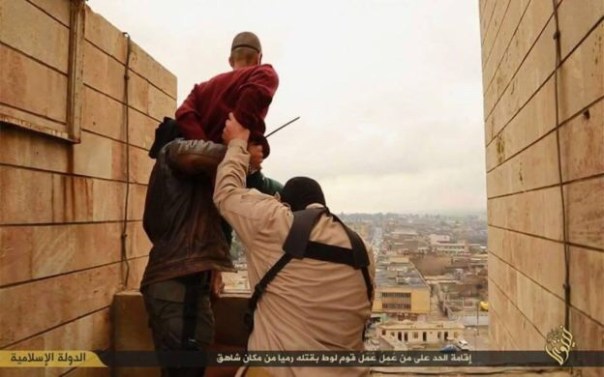
The group that calls itself Islamic State (IS or Isis) has a special punishment for gay people – it kills them by throwing them off high buildings. Taim, a 24-year-old medical student, tells the story of how he only escaped this fate by fleeing from Iraq to Lebanon.
In our society, being gay means death. When Isis kills gays, most people are happy because they think we’re sick.
I first realised I was gay when I was about 13 or 14. I too thought homosexuality was a sickness and I just wanted to feel normal. During my first year of college, I started having therapy for it. My therapist told me to tell friends that I was going through a “difficult phase” and to ask for their support.
I’m of Muslim background but my ex-boyfriend was from a Christian background and I had a bunch of Christian friends, whom I used to hang out with. In 2013 I got into a fight with a fellow student, Omar – who later joined Isis – about hanging out with Christians. A friend of mine told him to go easy on me because I was going through a hard time, having treatment for being gay. That’s how people knew. I think my friend’s intention was noble but what happened as a result ruined my life.
Still from an IS video
In November 2013, Omar attacked me with two of his friends. I was just walking home after a really lovely day. They beat me, threw me to the ground and shaved my head, saying to me: “This is just a lesson to you for the moment, because your father is a religious man. Watch what you do!” He meant that I wouldn’t be killed then and there out of respect for my dad, because I’m from a religious family.
I left town for a few days and didn’t go to university but then I went back, and in March 2014 I made Omar angry again, this time by suggesting that non-Muslims shouldn’t have to pay the “jizya”, the tax paid by non-Muslims to a Muslim government. I was washing my hands in the university bathroom when he and others attacked me again. They came at me from behind, but I recognised one of them from his green watch. It was the same group. They kicked me half-unconscious. I was barely able to walk and stopped going to university for a month.
Then, in the middle of final exams, Isis took over. Omar called me and asked me to repent and join them. I hung up the phone.
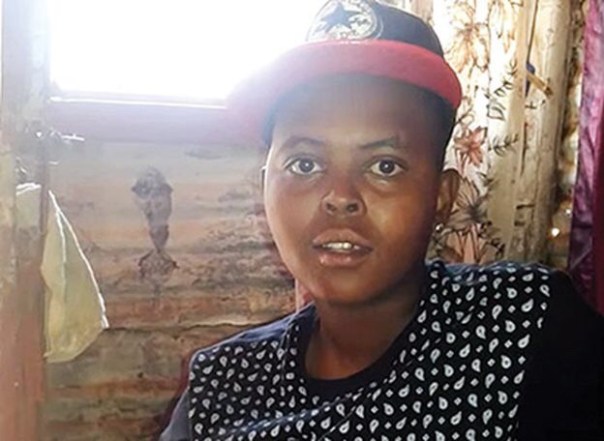
Taim with shaved head
On 4 July, a group of fighters from Isis came to my home. My father answered the door and apparently they said to him: “Your son is an infidel and a homosexual and we have come to carry out God’s punishment on him.”
My dad is a religious man and luckily for me he was able to tell them to come back the next day, to give him time to find out whether the accusation was correct. He came inside the house and started screaming. Finally, he said: “If these accusations are true, I will hand you over to them myself, happily.” And I just stood there, not knowing what to do and what to say, or how to defend myself.
I was in shock. But my mother decided that I should leave the house immediately, and she started working on getting me out of Iraq for good. It was midnight and she said to me: “We’re leaving right now.” She took me to her sister’s house. The next day she booked me a plane ticket to Turkey and got me a visa. But I had to travel via Erbil and they wouldn’t let us into Kurdistan. I stayed in a village near Erbil for two weeks, trying to get in but I never managed it. I tried to leave via Baghdad but there were clashes on the road and the driver wouldn’t go on. I tried to get out so many times, and failed.
Eventually, in August, after weeks in hiding, my mum arranged somehow for me to get to Kirkuk, driving there through fields and on unpaved roads. From there, I went to Sulaymaniyah. I’d planned to go to Turkey but the first available flight was to Beirut and I didn’t need a visa – so here I am.
If I’d stayed, Isis would have come for me and killed me the way they’ve killed others. If Isis didn’t get me, members of my family would have done it. A few days after I left, I learned that my uncle – my father’s brother – had taken an oath to cleanse the family honour.
Recently, I received an anonymous Facebook message – but my mother thinks it was from my uncle. It said: “I know you’re in Beirut. Even if you went to hell, I would follow you there.”
All I want now is to be in a safe place, unreachable by my dad or anyone with extremist thoughts. I want to be safe, to be free, and to be myself – to get my degree and start living… I just want to start living.
Human rights lawyers from the Iraqi Refugee Assistance Project have helped me get refugee status and are working on getting me resettled in another country, where I want to continue my studies. Here I’m living in one room, the size of my bathroom back home. I’m in limbo.
I think I will recover eventually but there will always be a memory of this dark period when I literally had to run for my life to avoid being killed. It was very stressful, but luckily I made it.
I’ve lost contact with most of my family. A month after I fled, my younger brother sent me a Facebook message saying: “I have had to leave town. The family is shattered and it’s all because of you.”
I was angry and didn’t reply. But then on New Year’s Eve I missed him, so I wrote to him, saying: “It’s not my fault that I was born this way. They (Isis) are the criminals.” And after that we had a long conversation on Facebook about our childhoods.
I’ve not spoken to my father. What he did was very hurtful. He’s my father. He’s supposed to protect me and defend me, no matter what. But when he said that he’d hand me over to Isis, he knew what they were going to do to me. He knew. Maybe in the future I can forgive him, but right now I don’t even want to think about him. I want him out of my life.
I talk to my mum every week, though. It’s hard for her because there’s no network coverage and she has to go out of town to get a signal. She’s the most amazing woman in the whole world. She’s cultured, respectful – very bright. She loves me and when she was trying to smuggle me out, we never discussed my homosexuality. She was just focused on getting me to safety. Because she is my mother, I think she always knew that I was gay. But all I felt from her was her love, her ultimate love. I never said goodbye to her because when I actually managed to escape, there had been so many failed attempts that I was sure I would be back and see her again.
All I need is a hug from her.
I still have gay friends at home but we’re not in contact any more, for their own safety.
Earlier this year one of my best friends, who stayed behind, was killed.
He was thrown off the main government building.
He was a great man – a very kind person. He was 22 years old, a medical student, and he was really calm and really smart – a bit of a genius. He used to talk to me about the latest scientific discoveries.
He always got straight As. You never saw him without a book.
We met first online – gay Iraqis hang out a lot in online communities – and then face to face. In person, he was quite quiet – but online he never stopped talking. Sometimes he would chat until the power went off and we lost the internet. He shared his deepest secrets with me. As gay men, we all had to lead secret lives. But he was the kind of person you love to talk to.
I don’t know how he was outed because he was very careful – but maybe through a text or online message. When Isis capture people, they go through all their contacts.
The last time I saw him in the flesh was a few days after Isis took over our town, but we continued talking online until I fled.
When I first saw the pictures of him, I can’t describe what I felt. The video images follow me in my nightmares. I see myself falling through the air. I dream that I’m arrested and then thrown from a building – facing the same fate as my friend.
It was devastating to see him go in that brutal way. He was blindfolded but I knew it was him from his skin tone and from his build. It looked like he died immediately but a friend told me he didn’t – perhaps the building wasn’t high enough. The friend said he’d been stoned to death.
I wanted to break down. I couldn’t believe it. One day he was alive, active, just living his life.
And now he is gone.
Isis are professional when it comes to tracking gay people – they hunt them down one by one
Even before Isis arrived, I was living in constant fear. There are no laws to protect you. Militiamen were killing people in secret, and no-one would say anything. To them, we’re just a bunch of dirty criminals they need to get rid of because we bring God’s anger and are – as they see it – the source of all evil.
For the past few years it’s been really, really hard. There were militiamen or security men who – if they found out someone was gay – would arrest him, rape him, torture him. There were lots of murders supervised by the Iraqi army. Videos came out of people being burned alive or stoned and you can see soldiers there. I have seen a video where some gay men had ropes put around their necks and they were dragged around the streets and people were throwing stones at them and when they were half-dead they were set on fire. Some people had their rectums glued up and were then left to die in the desert.
Before Isis, I think that maybe the power of my family protected me. But let’s assume that Isis disappeared this second, the threat to my life would be just as serious, now that I’ve been identified as gay.
The difference now is that Isis has only one horrible method of killing people – throwing them off buildings and, if they don’t die, stoning them. I know that if Isis had captured me, that would have been my fate.
What’s also changed is that the media are focusing on what Isis is doing, because it’s Isis. And Isis films everything and releases the video and says: “We killed these people for being gay and this is their punishment according to our Holy Book.”
Isis are also professional when it comes to tracking gay people. They hunt them down one by one. When they capture people, they go through his phone and his contacts and Facebook friends. They are trying to track down every gay man. And it’s like dominoes. If one goes, the others will be taken down too.
We have feelings and we have souls – stop hating us just because we’re born different
It’s devastating to see the public reaction to the killings. Usually, when Isis posts pictures online, people sympathise with the victims – but not if they’re gay. You should see the Facebook comments after they post video of the killings. It’s devastating. “We hate Isis but when they do things like this, we love them. God bless you Isis.” “I am against Isis but I am totally with Isis when they kill gays.” “Amazing news. This is the least that gays deserve.” “The most horrible crime on earth is homosexuality. Good job Isis.” “The scene is ugly but they deserve it.” “Those dirty people deserve Isis.”
And there are thousands of people agreeing with these comments full of hate. That is what is so disturbing. This is the society I fled from.
Islam is against homosexuality. My father made me study Sharia law for six years because he wanted me to be a religious man like him. There is a hadith [an ethical guideline thought to be a saying of the prophet] that instructs gay men to be thrown off a cliff and then it’s up to a judge or the Caliph to decide if they should be burned or stoned to death.
Imam and Islamic scholar Dr Usama Hasan from the Quilliam Foundation says there are many hadiths and traditions ascribed to the Prophet Muhammad and his disciples on the subject of punishment for homosexuals. “However, all are disputed and there has never been any consensus on them, especially since they seem to contradict the Koran, 4:15-16.” He adds that some scholars have argued that Muhammad could not have given any such ruling since no confirmed case of homosexuality was ever brought to him.
I think Isis is throwing gay men from buildings because our society hates us and it’s a way of gaining support.
I try not to look at Isis’s videos. But to be honest I do look for their martyrdom videos. I want to see if I can see Omar, the man who ruined my life.
I worry a lot about the gay men still left there. I have dozens of friends who can’t leave because they can’t afford to. But, after our friend’s death, I said goodbye to them online and blocked them, for their own safety.
I’m speaking out to honour my friend who was killed – and for the gay men I know who are still in Iraq. I want Iraqis to know that we’re human beings, we’re not criminals. We have feelings and we have souls. Stop hating us just because we’re born different.
I was lucky to get out. I saved my soul. But what about them? Will they be lucky enough to survive? And, if they survive, will they recover from the trauma of being hunted? It’s a disaster. They’re all targets.
Taim told his story to the BBC’s Caroline Hawley. Taim is not his real name, nor is Omar the real name of his persecutor.
She prays that one day she will face the people who killed her daughter and find out why they did it.
“I want to know, that’s the point,” she says. “I want those who did this thing to my child to be arrested, all of them.”
Almost 4 months after Pasca was murdered, no-one has been arrested.
For many LGBTI people and their families in South Africa, safety, justice, and the promise of a truly rainbow nation still feel a long way off.
South Africa’s constitution was the first in the world to protect people from discrimination because of their sexual orientation. The country was also the first in Africa to legalise same-sex marriage. But after a spate of murders, gay people say more needs to be done to stop hate crimes.
Betty Melamu sits on a brown leather sofa in her living room in the township of Evaton, just south of Johannesburg. She’s cradling a framed picture of her daughter Motshidisi Pascalina, known as Pasca.
In a quiet, wavering voice, she sings Pasca’s favourite song.
“Whenever she would listen to radio or go to church she would sing that song,” she remembers.
When I ask if Pasca was a good singer she says, “Yes,” and laughs – apparently Pasca was more spirited than talented, constantly switching between parts as she sang.
She loved football too, studied hard at school and wanted to be a politician.
“She wanted to do something good,” says Melamu with pride.
But the laughter and happy memories are fleeting, and sadness is etched in her thin, drawn face. Pasca was a lesbian, something her family knew and accepted. She had just turned 21 and completed her final high school exams when she went to a party in December.
“I don’t know what happened after the party,” says Melamu. “But she didn’t come back.”
Two days later Pasca’s body was found in a field in a neighbouring township. She had been beaten and mutilated. At the morgue her family couldn’t recognise her face and could only identify her by a tattoo on her leg.
“At that time I was strong,” Melamu remembers. “But after that I feel like I am crazy woman.”
And as we talk, she repeats one question, over and over.
“Why? Why did this happen to my child?”
Pasca was was born in 1994, the year apartheid ended and Nelson Mandela was elected president – she was one of the first of South Africa’s so-called born free generation.
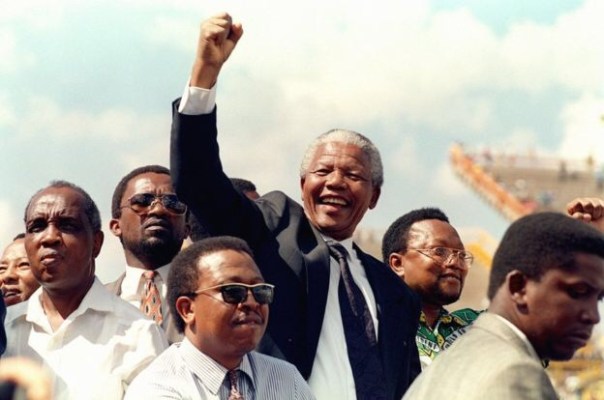
In his inauguration speech, Mandela promised to “build a society in which all South Africans will be able to walk tall, without any fear in their hearts… a rainbow nation at peace with itself and the world.”
But 21 years later, this promise remains largely unfulfilled for the country’s lesbian, gay, bisexual, transgender and intersex (LGBTI) community.
In a country where crime rates in general are high, black lesbians in poor townships face particular risks and often suffer the most violent crimes.
As women, they’re vulnerable in a country with one of the highest rates of rape in the world. As lesbians in an often homophobic and patriarchal society, they face a further danger – the idea that they can be “changed” and “made into women” through what is known as “corrective rape”.
It’s suspected this may have happened to Pasca, although the post-mortem was unable to determine this.
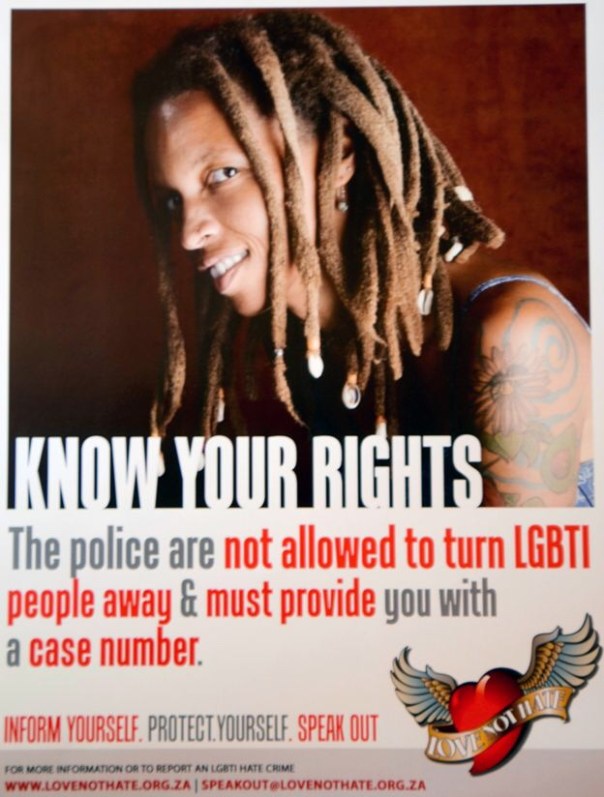
And when crimes happen, there’s no guarantee that the response will be adequate. Victims say they often face secondary harassment by police or health care workers.
Pasca’s case was assigned to a police officer who was on leave at the time, only returning to work two and a half weeks later.
Frustrated at the delay in this and two other rape cases, in January activists took to the streets of Evaton with rainbow flags and banners. Chanting “Pasca is our sister,” they marched to the local police station to demand justice.
“The police are not doing anything,” Lindiwe Nhlapo told me several weeks later. She’s part of Vaal LGBTI, one of the groups that organised the march. “The police are failing us big time.”
Since then, the police have tried to address concerns about the investigation into Pasca’s death, but frustration with the justice system is a common story.
Lindiwe Nhlapo wants justice for Pasca
In the nearby township of KwaThema, silver drapes and rainbow flags adorn the living room of the small house that’s the headquarters of the Ekurhuleni Pride Organising Committee (EPOC).
There’s also a bar down one end and a sign on the wall – Divas and Dykes Lounge. Day or night, this is a safe place for gay and transgender people to socialise.
“I can’t walk with my partner on the street and hold their hand,” says Bontle Kahlo, from EPOC. “I can’t go out at night and say ‘I’m going to dance somewhere,’ because I’m not safe. I might get killed because of who I am, because of who I love.”
Bontle Kahlo (right) with her partner Ntsupe Mohapi
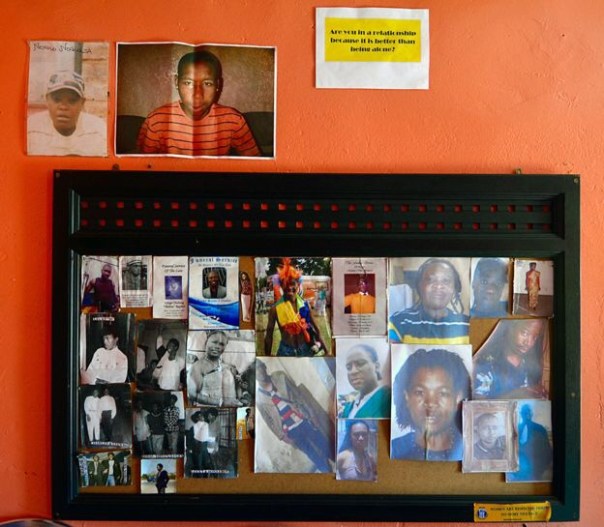
She points to a frame on the wall containing photos of dozens of LGBTI men and women.
“This is our memory wall,” she says. Some of them died of natural causes, but many of the lesbians in the pictures were murdered because of their sexual orientation.
“Women are less than men,” says Kahlo. “If you’re a black woman, you are even less, and if you’re a black lesbian woman you are basically nothing in this country.”
Among the faces on the wall is Noxolo Nogwaza, a 24-year-old lesbian who was raped, mutilated and murdered in 2011.
Noxolo Nogwaza’s photo is top left – she is wearing a baseball cap and white top
But five years later, no-one has been prosecuted.
“The feeling we got from the police is that they expected us to do all the work for them,” says Kahlo.
“It’s very tiring to be an activist but to also be a police officer and to try as hard as you can, and to have a government which is not supportive.”
Her partner and fellow campaigner Ntuspe Mohapi nods in agreement.
“They’re good at talking but not at acting,” she says.
When they heard about Pasca’s murder, there was a familiar sadness.
“I think it’s getting worse,” Mohapi says. “And these are just the cases of murder that we are talking about. We haven’t started with rape, or hate speech, and the bullying in schools, and the suicides of gay teenagers.”
South African law doesn’t classify hate crimes differently from other crimes, so there are no official statistics to turn to.
The organisation Iranti-org is funded by the EU to document violence against LGBTI people – it has counted more than 30 murders and rapes in the country since 2012.
Pasca was just one of three LGBTI people killed in South Africa during a six week period late last year. The deaths barely received a mention in the mainstream media.
There hasn’t always been a lack of interest though. After the murder of Noxolo Nogwaza and several other lesbians in 2011, there was a global outcry. 170,000 people signed a petition calling on the government to act.
In response, the government set up a National Task Team and drew up a National Intervention Strategy to reduce hate crimes.
It also established a Rapid Response Team to make sure that hate crimes are properly investigated and the perpetrators prosecuted. This has had some success in clearing a backlog of murders and other crimes.
Mpaseka “Steve” Letsike says more should be done to change attitudes
But the government is not doing enough says Mpaseka “Steve” Letsike, co-chairwoman of the National Task Team and head of LGBTI organisation Access Chapter 2.
“We are not getting it right. There’s a huge gap. We need to invest our energies into prevention, into conversations, into dialogues.”
The government is doing some of this – funding awareness campaigns and training police and health workers. But “it’s still a drop in the ocean,” says Letsike.
To get a sense of the challenge South Africa faces, I travel to the Johannesburg suburb of Yeoville. It’s home to many migrants from more traditional, rural parts of the country.
In a tiny room, barely big enough for a bed and a fridge, I perch on an upturned bucket and speak to two men. The elder of the two speaks softly, but has a fearsome clarity when our conversation turns to homosexuality.
“Homosexuality is a taboo to us,” he says. “I’ll go back to African traditions, there’s no word for that in our language.”
I ask what would happen if one of his daughters told him she was a lesbian.
“I might kill her myself. That thing is unnatural, it’s awkward, so I cannot accept something that is awkward in my house.
“If someone said choose between keeping this child or killing it, I would kill it.”
His views reflect the gap between the law and the attitude of many South Africans. It shows that the government has failed to create a truly rainbow nation, say activists.
“Conditions for LGBTI people in South Africa have improved substantially since 1994,” says John Jeffery, deputy minister of justice and constitutional development. His department is responsible for the National Intervention Strategy.
“We are trying to educate people about LGBTI rights, that gay rights are human rights,” he says, and adds that he is frustrated with the criticism.
“There’s no use complaining outside that government is not doing enough,” he says. “I unfortunately have not heard proposals from civil society organisations about things we should be doing that we’re not doing. They need to tell us where they think we should be improving.”
While open to suggestions, he says there are limits to what he can do.
“More could be done, but the extent to which we can run awareness programmes would depend on budget and what money we’ve got, and unfortunately government is facing budget cuts.”
The government is currently in the process of preparing legislation to outlaw hate crimes and hate speech, which should allow better monitoring of crimes and, it’s hoped, reduce homophobic abuse.
“There’s no magic solution, it’s a process and that process takes time,” says Jeffery.
Betty Melamu is still waiting.
She prays that one day she will face the people who killed her daughter and find out why they did it.
“I want to know, that’s the point,” she says. “I want those who did this thing to my child to be arrested, all of them.”
Almost 4 months after Pasca was murdered, no-one has been arrested.
For many LGBTI people and their families in South Africa, safety, justice, and the promise of a truly rainbow nation still feel a long way off.
The Orlando shooting was a hate crime against gay people – even if, once it emerged that the attacker had been a Muslim, many people claimed this as a terrorist attack rather than a hate crime. And, in an important sense, this was also a terror attack, since its aim was to spread fear in the LGBT community.
Since the massacre there has been a lot of speculation about Islam and homosexuality and there are fears that one man’s despicable act of terrorism could fan the flames of Islamophobia and other forms of social exclusion, leading to discord and unrest in an era of elevated Islamophobia.
It is difficult to define the “Islamic position” on homosexuality, as a monolithic phenomenon, simply because Islam is a very diverse faith group with some 1.6 billion followers on six continents. In most Muslim countries, homosexuality is illegal and in some countries, including Iran and Saudi Arabia, it is punishable by death. But in others, such as Jordan and Turkey, homosexuality is not considered a crime.
Most Islamic scholars are in agreement that homosexuality is incompatible with Islamic theology. They tend to draw on the story of Lot in the Koran (also in the Old Testament) which recounts the destruction of the tribe of Lot allegedly due to their engagement in homosexual acts as “evidence” for God’s condemnation of homosexuality. Many scholars also cite the Ahadith (statements attributed to the Prophet Muhammed) that are condemnatory of homosexuality. Theological and legal condemnations of homosexuality can engender perceptions at a social level that homosexuality is wrong and that it should not be permitted.
Muslims on homosexuality
In 2009, a Gallup survey revealed negative attitudes towards homosexuality among European Muslims. In France, 35% of Muslims viewed homosexuality as “morally acceptable” (versus 78% of the general public). In Germany, 19% of Muslims viewed it as morally acceptable (versus 68% of the general public). In the UK, none of the Muslim respondents viewed homosexuality as morally acceptable (versus 58% of the general public who did).
Earlier this year, a survey commissioned by Channel 4 was conducted among a random sample of 1,081 individuals who self-identified as Muslim. The results found that 18% of the British Muslim respondents agreed that homosexuality should be legal in Britain while the majority (52%) disagreed. Conversely, only 5% of the general public thought homosexuality should be illegal. Furthermore, 47% of the British Muslim respondents indicated that they did not believe that it was acceptable for a gay person to become a teacher. These data suggest that there are low levels of acceptance of homosexuality in Muslim communities in the UK.
However, qualitative interview data can provide more nuanced understandings of what Muslims think and why they might hold these views.
In my research into attitudes concerning homosexuality among samples of first and second-generation British Muslims of Pakistani descent, I found that attitudes tend to be largely negative. Although research into attitudes towards homosexuality in the general population points to demographic variables, such as age and level of education, as key determinants of the nature of attitudes, this has not been the case in my own work with British Muslims. Muslims of various ages, education levels and socio-economic backgrounds have participated in my studies and generally perceive homosexuality in negative terms. In substantiating these attitudes people often draw on holy scripture. As one 54-year-old woman said:
It says it in the Koran that it’s wrong and sorry I’m not the one who made it. It’s what the God revealed to the Prophet so it’s the truth and that’s my belief system.
Many interviewees draw upon holy scripture as the basis of their views regarding homosexuality. There appears to be a desire not to “re-interpret” holy scripture – to accommodate homosexuality – because of the divinity of its origin. Moreover, there was a fundamental rejection of essentialist arguments concerning the origins of sexual orientation – that people are born gay and that they do not “choose” to be gay – and interviewees often argued that people had “chosen” to be gay. One 28-year-old man said:
God doesn’t create gay people. It’s a path they’ve chosen and that’s an incorrect path according to our faith.
Indeed, previous research has shown that believing the essentialist argument regarding homosexuality is correlated with less discrimination and greater acceptance.
What does the Koran say about homosexuality? Lord Harris/BritishMuseum, CC BY
First-hand relationships
Although many British Muslims may disapprove of the concept of homosexuality, several individuals reported positive first-hand experiences of contact with LGBT people. A 45-year-old man said:
Homosexuality is wrong, I believe … I have a gay neighbour and he lives with his partner. He’s a very nice guy – both of them [are]. They are very respectful. We consider them friends.
Some people spoke fondly of their LGBT friends, neighbours and acquaintances, suggesting that first-hand contact may challenge homophobia which exists at an abstract, conceptual level. It is also vital to stress that the Muslim interviewees overwhelmingly rejected violence against LGBT people. As one woman put it:
Violence and hate crimes are un-Islamic. We are not supposed to kill or hurt others, as Muslims. No, they can’t have it both ways so they won’t be accepted in our community but it’s for God to punish, not us.
It was difficult for British Muslim interviewees to accept homosexuality given the overwhelming “evidence” of its prohibition in Islam. Individuals simply had no positive theological frame of reference given the absence of LGBT affirmative voices at an institutional level. This led some individuals to view endorsement of homosexuality as a violation of their religious faith and its norms:
Being gay is un-Islamic and so is encouraging it.
Put simply, the acceptance or endorsement of homosexuality was perceived as contravening key tenets of Islam.
Gay Muslims speak out
Clearly, the stigma attached to homosexuality in Islamic communities can have profound effects for those Muslims who also self-identify as gay. For almost a decade, I have been researching the social psychological aspects of being Muslim and gay. In view of the generally negative attitudes towards homosexuality in Muslim communities and the silence that can surround discussions of sexuality, most of my Muslim gay interviewees have manifested a poor self-image and low psychological well-being. Many view their sexual orientation as “wrong” and, thus, express a hope to change it in the future. One young gay Muslim man said:
It’s [being gay] wrong, really, isn’t it? … In the mosque we’re told that Shaitan [Satan] tries to tempt Muslims because he is evil and he makes us do evil things. I know that doing gay things is evil but I hope I’ll change my ways and take the right path soon … It’s all about temptation, really. Life is a big test.
Those gay Muslims who conceptualise their sexuality as immoral and wrong can understandably struggle to derive self-esteem, which is key to well-being. They may come to view their sexual orientation as “evil” and resist it. Some attempt to change their sexual orientation, sometimes by entering into marriages of convenience. This conceptualisation of homosexuality stems from their understanding of the Islamic stance on it. Said by a 28-year-old man:
What the Prophet said was right and that’s always going to stand, yeah. Men having sex with other men was wrong in his eyes. He hated it.
It is easy to see how belief in the negativity of homosexuality from the perspective of one’s faith (which, in countless studies has emerged as an important identity among British Asian Muslims) could cause some gay Muslims to develop internalised homophobia and, in some cases, to doubt the authenticity of their Muslim identity.
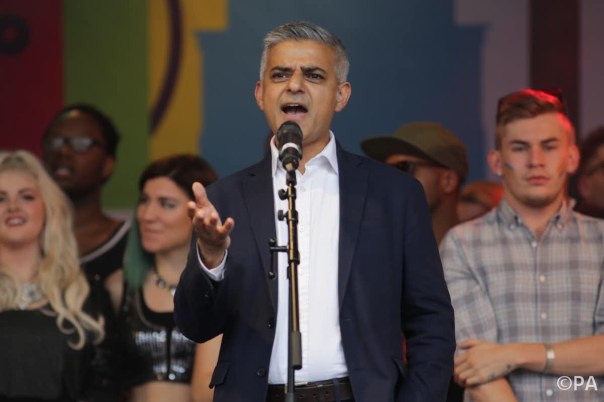
Sadiq Khan, mayor of London, received death threats after voting in favour of same-sex marriage. Daniel Leal-Olivas / PA Wire/Press Association Images
Gay Muslims may cope with this internal conflict in a number of ways. While some hope to change their sexual orientation and to “become” straight, others may deny that they are actually gay:
Maybe I’m not bisexual because I’ve never been with a woman but I can’t call myself gay either … I refuse to do that because I just don’t feel gay.
Crucially, in making sense of the “causes” underlying their sexual orientation, some gay Muslims were of the view that they had “become” gay as a result of their social environment and consequently blamed British society:
I’m gay because I was brought up here [in Britain] but I reckon if I’d been brought up in Pakistan then I would have turned out straight because this doesn’t happen that much there. Like I haven’t heard of any gays in our village. Here there are clubs and that and so I just kind of fell into the gay culture.
We tend to attribute aspects of our identity that we see as undesirable to external factors. This is a means of protecting one’s sense of self from threats. Some of the gay Muslim interviewees in my studies have identified British (or Western) culture as the reason for their sexual orientation.
Reconciling homosexuality and Islam
Many individuals of religious faith struggle to accept homosexuality given the centrality of heterosexuality to faith life, according to most faith groups. Muslims are no exception. Individuals use all sorts of strategies for protecting their sense of identity and some of these strategies can actually have poor social and psychological outcomes. Social psychologists have long argued that intergroup contact is a good starting-point for improving relations between different social groups.
Universities are obvious contexts in which different groups can come together – LGBT and Islamic student societies on university campuses could collaborate with the aim of increasing inter-group contact between Muslims and LGBT people (and indeed those who identify with both categories).
Of course, inter-group contact needs to be characterised by positive images of the outgroup. So there needs to be much more discussion of homosexuality in Muslim communities – which will admittedly be difficult given the cultural taboo around sexuality. Faith and community leaders should broach the topic. My view is that people need to be exposed to LGBT affirmative images. This has already happen to some extent.
As I’ve written elsewhere, the Eastenders storyline concerning Syed Mehmood, a gay Muslim character who struggles to come out to his parents, generated some discussion in the British Muslim community and led some individuals to acknowledge the existence of homosexuality within their community.
Coming out: Syed from Eastenders on Twitter. Twitter
This is a positive step forward and one that can be built on. Similarly, there needs to be more acknowledgement and acceptance of faith groups in LGBT contexts which tend to be secular. In my research, I’ve also found that gay Muslims can face Islamophobia on the gay scene, which can hinder their sense of belonging in these spaces.
In addition to improving relations between groups, it is likely that this exercise will have positive outcomes for well-being among those individuals who self-identify as Muslim and gay. Growing up in an environment in which you are led to believe that your sexual orientation is wrong, sinful or symptomatic of mental illness can lead to profound social and psychological challenges, including internalised homophobia, low self-esteem, depression and, in some cases, suicidal thoughts.
The reasons underlying the horrendous attacks perpetrated by Omar Mateen in Orlando may never be fully understood. But if it is true that he was a closeted homosexual – it was reported that he had used gay dating applications and frequented gay bars, including the one that he attacked – he clearly had a very difficult relationship with this aspect of his identity. There is already some empirical evidence that homophobia is associated with homosexual arousal, which suggests that homophobia might be a means of distancing homosexuality from one’s sense of self.
Could it be that his actions were in part a result of his internalised homophobia? Did he attack the LGBT community in an attempt to distance his own sexuality from his sense of self?
In any case, we as a society have a responsibility to acknowledge diversity and to allow people the space and opportunity to self-identify in ways in which they choose. We have a responsibility to challenge prejudice (of all kinds) when it shows its ugly face. We have a responsibility to support and protect minorities who are vulnerable to marginalisation and exclusion. Sometimes this will be challenging particularly when it means that we have engage with sensitive issues such as religious norms and customs but we must persevere – for the sake of freedom, peace and well-being for all of society.
We are all familiar with the colloquialism “gaydar” which refers to a person’s intuitive, and often wildly inaccurate, ability to assess the sexual orientation of another person.
In the 1960s, the Royal Canadian Mounted Police (RCMP) attempted to use a slightly more scientific, though equally flawed, approach- a machine to detect if a person was gay or not. This was in an attempt to eliminate homosexuals from the Canadian military, police and civil service. The specific machine, dubbed the “Fruit Machine”, was invented by Dr. Robert Wake, a Carelton University Psychology professor.
Taking the lead from the United States’ McCarthyism, the Canadian government considered all homosexual public servants to be a threat to national security for various absurd reasons. In order to deal with the “security threats” posed by gay people, a special team in the RCMP was formed. Section A-3’s sole mission was to identify and dismiss from service every homosexual working for the Canadian government. Identified homosexuals were immediately fired or forced to resign.
Initial efforts included following people around and undercover work at various clubs, but this proved to be extremely costly and somewhat inefficient. Thus, Section A-3 decided they needed a new plan, a way to screen every employee directly. This new plan was the “Fruit Machine”.
The Fruit Machine primarily used the “pupil area response test” as an indicator of a person’s sexual orientation, as well as perspiration levels and pulse rate. While undergoing the test, the subject would sit in a dentist-style chair. They’d then be shown various images, some completely mundane, while others depicted naked or semi-naked photos of women and men. If the subject’s pupils dilated when being shown erotic photos of people of the same gender, s/he was assumed to be homosexual.
Besides the “science” behind the machine being completely flawed, there were other problems as well. For instance, each photograph changed the amount of light hitting the person’s eyes. If the difference from one slide to another was large enough, this obviously would change the subject’s pupil dilation, but was not accounted for in the results.
The Fruit Machine was not a stand alone test, but many of the other methods used were just as ridiculous. For instance, another test run by the RCMP included monitoring subjects’ physiological responses to specific words such as queer, gay, drag and even bar.
As you might expect, once word got out that the Fruit Machine test was attempting to determine if you were gay or not, rather than a stress testing machine as people were initially told, getting people to take the test became nearly impossible. That, along with numerous mechanical failures with the machine itself, soon got funding for that particular part of the program cut off and the RCMP’s dream of having a gaydar to screen all Public Employees with was put on hold, though that didn’t stop them from continuing their work trying to root out “dangerous” homosexuals from the Canadian payroll.
Not to be deterred, the RCMP eventually started using a new type of machine, this one, a type of plethysmograph that measured blood flow to genitals while the subject is shown various images. While not nearly as scientifically flawed as the Fruit Machine, this one also, as you might expect, doesn’t give terribly accurate results on the whole and eventually the program for trying to root out homosexuals was abandoned by the Canadian government, but not before at least 400 people lost their jobs after being accused of being gay (with some estimates being significantly higher).
Bonus Facts:
▪ Despite that penile plethsymograph and the vaginal photoplethysmograph are somewhat flawed in detecting someone’s sexual orientation, it is still used to this day in nations like Canada and the United States to try to measure sexual arousal in certain people, though now being used primarily on pedophiles, ephebophiles, and rapists. Some have even pushed for its use in trials, but to date such evidence is not generally admissible in court in either the U.S. or Canada owing to the highly flawed nature of the results of the test. Despite this, there are exceptions, such as that courts do use the results of these tests to monitor convicted offenders to help determine things like if they are likely to become repeat offenders if let out of prison.
▪ In Czechoslovakia, such a test was recently used to try to determine if refugees from Iran were actually gay or not, to see if they should be given asylum. (The penalty for being gay in Iran is death and the two in question claimed if they were sent back to Iran, they’d be killed as the police were looking for them due to their homosexuality.)
▪ Funny enough, according to a 1996 study at the University of Georgia, using the somewhat flawed penile plethsymograph test (so take these results with a grain of salt), they found that homophobic men were more likely to be sexually aroused by depictions of gay sex than non-homophobic men.
▪
Canada is not the only country ashamed to have a Fruit Machine as part of their history. The American version of the Fruit Machine (pictured right) is currently on display at the new war museum in Ottawa, Canada. The Canadian Fruit Machine, which was much more elaborate than its American counterpart, has been lost and thought to have been destroyed when that part of the program was shut down.
▪ Delta airlines once argued in a plane crash litigation case that they should pay less for gay passenger deaths owing to the fact that the gay person may have had AIDS, so at that time would have died soon anyways… Delta Airlines later apologized for making that argument.
▪ In 1952, the Unites States Congress enacted a law banning lesbians and gay foreigners from entering the country. The law was on the books until it was repealed in 1990.
▪ A “beard” is someone of the opposite sex who knowingly dates a closeted lesbian or gay man to provide that person with a heterosexual “disguise,” usually for family or career purposes.
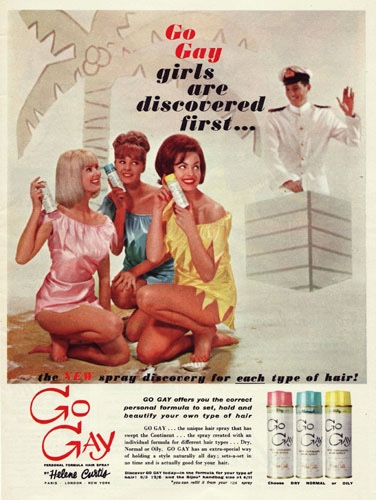
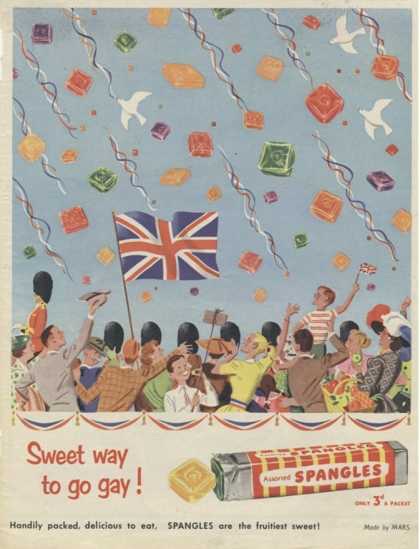
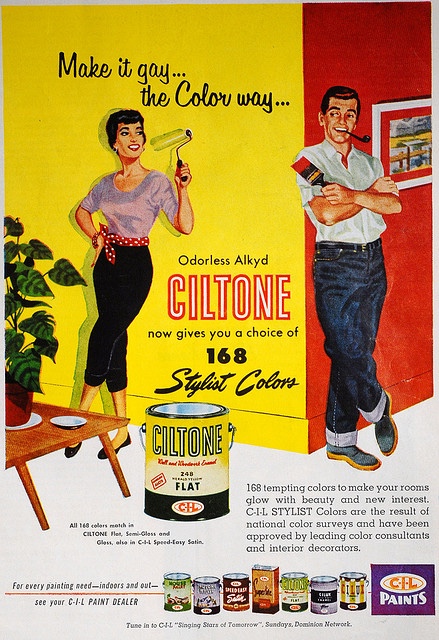
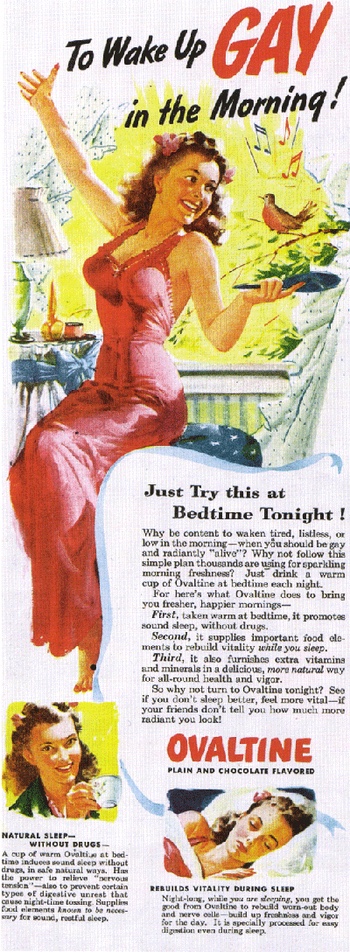
“Gay” is a great word. Here’s why: it rhymes with everything. Also, it’s brief. Therefore it should be no surprise that even before it meant “inverted sinner pervert homosexual” and still meant “happy.” What happened next was that gayness and happiness split up, but they’ve been getting back together ever since and are going strong. Look at our ancestors in gayness!
16 Vintage “Gay” Ads That Weren’t Actually About Gay People But Should Be Now
16.
which makes 4th of july a gay holiday
15.
the captain is actually waving goodbye to these girls who he hasn’t got a chance with anymore
14.
before R Family, there were these guys
13.
as we know it from watching ‘the real l word’!
12.
we go way back with beer
11.
if you know what haviland & riese vlog this line is from, you win a pony
10.
this teapot inspired the romi klinger hit track, “gay in LA”
9.
it’s a white tank top
8.
there are a lot of ways to look at this situation, i haven’t picked just one yet
7.
not as sweet as lesbian sex, but sweet
6.
but lately we’ve been really into these color-coded bandana things?
5.
it’s every straight girl’s favorite fantasy
4.
3.
this paint roller is detachable, p.s.
2.
every little girl’s dream, every parent’s nightmare
One doesn’t commonly associate the slogan “make love not war” with the U.S. military. Indeed, the United States military is feared and formidable precisely because it has proven so effective at conceptualizing clever and innovative ways to search, find and destroy, often with the simple push of a button.
However, in a departure from these hostile traditions, in 1994 the Wright Laboratory, part of the U.S. Air Force, produced a three page proposal for a “gay bomb”.
Documentation obtained by the Sunshine Project, an anti-biological weapons non-governmental organization, found that the Ohio-based Wright Lab requested a 6 year, $7.5 million grant to create a variety of non-lethal weapons. The bluntly titled project, called “Harassing, Annoying and ‘Bad Guy’ Identifying Chemicals” reads like a bawdy proposal penned by a Bond Villian- Auric Goldfinger perhaps?
It proposed a bomb “that contained a chemical that would cause enemy soldiers to become gay, and to have their units break down because all their soldiers became irresistibly attractive to one another”. While the laboratory also came up with similarly questionable ideas, such as bad-breath bombs, flatulence bombs and bombs designed to attract swarms of stinging insects to enemy combatants, one has to admit that the gay bomb is certainly the most novel.
The Pentagon maintains that the love affair with the gay bomb idea was brief. However, the Sunshine Project thinks the Pentagon doth protest too much, finding that they “submitted the proposal to the highest scientific review body in the country for them to consider”. Indeed, the proposal’s information was submitted to the National Academy of Sciences in 2002.
The Pentagon certainly admits giving the project consideration, releasing a statement affirming: “The department of defence is committed to identifying, researching and developing non-lethal weapons that will support our men and women in uniform.”
Nonetheless, the project never made it off the ground. But the question remains: how did they even come up with such an idea? Perhaps the best clue lies in the political climate at the time. When newly elected President Bill Clinton attempted to lift the ban on homosexuals in the military, there was a din of saber rattling, pitchfork sharpening and moral hand-wringing from the military brass.
The general consensus among many leaders of the military was touted by the Department of Defence, “Homosexuality is incompatible with military service.” And that allowing gay people in the military would pose a security risk and disrupt the needed order for the military to be effective.The resulting Don’t Ask Don’t Tell (later fully called Don’t Ask, Don’t Tell, Don’t Pursue, and Don’t Harass) compromise, which has since been struck down, was less than thrilling for the Pentagon at time.
In such a political climate, with rampant unfounded paranoia about gay people disrupting military discipline and morale, this project seems, notwithstanding its highly flawed premise, somewhat more understandable in terms of how they came up with the idea and why they believed it might be an effective weapon.
As to the science behind this military farce, while various companies, peddling scented sprays and rub-ons, find it expedient to claim that their product contains human pheromones which have an aphrodisiac effect, lab testing has lagged behind somewhat in actually confirming any of this. Admittedly, one section of the documents, entitled “New Discoveries Needed” acknowledges that, thus far, no such chemicals have been found to exist.
While the Gay Bomb project never became perhaps more than a pie in the sky dream of the Wright Lab, it has gained a second lease on life through news media, popular culture and even academia.
The news of this proposed weapon of mass de-lovin’ even spawned a musical, disappointingly entitled “Gay Bomb – The Musical”. Why they chose this title, as opposed to say “Brothers-in-Arms”, “Das Booty”, or “Saving Ryan’s Privates” is a mystery we may never solve…
For the attempt at making a gay bomb, the Wright Lab had the honor of winning the Ig Nobel Peace Prize in 2007. As the prize is organized by the Annals of Improbable Research, it seems to be an excellent home for the project, though perhaps a step down from the National Academy of Sciences.
Among other 2007 IG Nobel prize winners were Mayu Yamamoto (Chemistry), awarded for extracting vanilla flavour from cow dung, and Dan Meyer and Brian Witcombe, (Medicine) awarded for researching the side effects of swallowing swords. The levity of the event seemed lost on the gay bomb creators, however, who kept a straight face about the whole matter; they declined to attend the award ceremony to accept the prize personally. One hopes they were not insulted by this tongue-in-cheek gesture. After all, is all not fair in love and war?
A report released on Tuesday, July 18, found “a high degree of plausibility” that hundreds of boys at a prestigious Catholic boys’ choir in Germany were physically or sexually abused between 1945 and 1992. The choir was led at the time by Emeritus Pope Benedict XVI’s elder brother, Georg Ratzinger.
Just over a week ago – on July 10 – Cardinal George Pell, a top adviser to Pope Francis, returned to his native Australia to face criminal charges related to sexual assault. While the specific allegations and names of the accusers have not been made public, Cardinal Pell maintains that he has been a victim of “character assassination.” His case will be decided by an Australian court.
These are not the first times the Catholic Church has been rocked by charges of sexual abuse. While reforms in the Catholic Church in the United States have made it mandatory for priests to report instances of sexual abuse, there still remains much work to be done in the Catholic Church worldwide.
From my perspective as a Catholic scholar of religion, one of the challenges in tackling this issue is the hierarchy of the church itself. It is still difficult to hold high-ranking clerics responsible, either for the misdeeds of their subordinates or for the crimes that they may have committed themselves.
Church structure
At the top of the Catholic Church’s hierarchy is the pope. He is said to be the successor of the Apostle Peter, about whom Christ said, “You are Peter and on this rock I will build my church.” For Catholics, the pope is that “rock” that gives the church a firm foundation. The pope is considered to speak infallibly, “without error,” under specific conditions concerning doctrine and morals. But he is not infallible when it comes to personal judgment such as whom he chooses to get advice from.
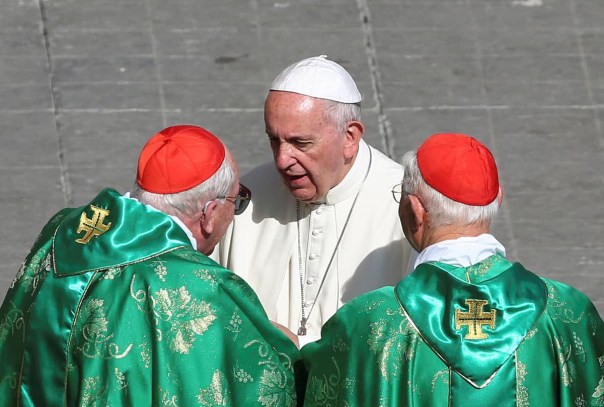
Pope Francis speaks with two cardinals at the Vatican. Alessandro Bianchi/Reuters
Under the pope are bishops, who serve the pope as successors to the original 12 apostles who followed Jesus.
There are also cardinals, who are appointed by the pope, and only they can elect his successor. Cardinals also govern the church between papal elections. Cardinals rank higher than bishops, so not all bishops are cardinals. But now all cardinals are bishops, although in the past there have been exceptions. George Pell is both a bishop and a cardinal, as well as the third-ranking official at the Vatican.
The hierarchical structure of the Catholic Church resembles the military with its high level of administrative control. But the “church” in Catholic understanding is not just a bureaucratic body. It also is a sacred institution that is willed by God.
Priests and obedience
Male priests have the lowest rank in the formal hierarchy. When they are ordained, they take vows of chastity, poverty and obedience to superiors. Usually priests are under the immediate authority of their local bishop, whose administrative area is called a “diocese.”
While priests in many countries are mandated both by the church and civil law to report sexual abuse to church commissions and legal authorities, there has been a culture of denial and secrecy that prevented allegations from being fully investigated. A 1962 Vatican document instructed bishops to observe the strictest secrecy in sexual abuse cases and to address sexual abuse, or “solicitation,” as an internal church matter, not as an offense that should be reported to local authorities.
Despite establishing a commission to look into the problem and address a backlog of cases, Pope Francis has still not established any protocol for handling sex abuse allegations for the Catholic Church as a whole. But the pope has set guidelines for removing bishops who have been “negligent” in addressing cases of abuse. Still, some commentators believe this is not enough.
Sexual abuse ignored
The fact is that there has been a long history of protecting highly placed Catholic leaders from charges of sexual abuse.
When reports surfaced in 1995 that Austrian Cardinal Hans Hermann Groer had molested monks and schoolboys, the sexual abuse was dismissed by Bishop Kurt Krenn as “boyish pranks.” There were also claims that victims were paid “hush money” to buy their silence. The allegations of sexual abuse against Cardinal Groer proved to be true.
In another case from the late 1940s, Marcial Maciel, the Mexican founder of a religious order, The Legionaries of Christ, was a sexual abuser multiple times over. When allegations against Maciel were initially raised, John Paul II ignored them. Joseph Ratzinger, John Paul II’s confident and later successor, remarked: “one can’t put on trial such a close friend of the pope.” Though Maciel was eventually disciplined by Ratzinger when he took over as Pope Benedict XVI, Maciel avoided prosecution until his death in 2008.
In the United States, Cardinal Bernard Law, who protected abuser priests in the Boston archdiocese during his 1984-2004 tenure, has also escaped prosecution. In fact, Law was effectively promoted to a prestigious position as head of one of Catholicism’s most famous churches, Santa Maria Maggiore in Rome.
Challenges to reporting
In all these cases, the hierarchical structure of the church made it difficult to bring high-ranking figures to justice. When you give superiors nearly absolute obedience, the threshold for acting against them is high. By the same token, superiors can often protect offending priests.
A presumption of integrity goes with a high position in the Catholic Church. It is often difficult to believe that a bishop could commit or cover up a terrible crime such as rape or sexual abuse. Also, if the Catholic Church is a divine institution necessary for salvation, then there are those who will protect its reputation at all costs.
There is a tipping point, however. The key moment leading to the resignation of Cardinal Law was a letter, signed by 58 priests, asking him to resign.
Pell’s prosecution, a decisive moment
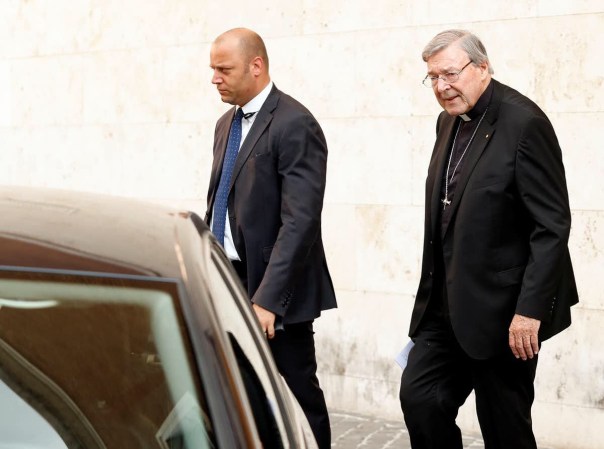
Cardinal George Pell leaves his house in Rome, Italy on June 29, 2017. Remo Casilli/Reuters
The compendium of Catholic beliefs, “The Catechism of the Catholic Church,” observes that the “sanctity” of the church is “real” but also “imperfect.” In other words, the church is composed of human beings who have their limitations. From this perspective, the problem is not hierarchy itself, but how people in high positions misuse their power.
While all Catholics are aware of the “humanness” of their church, the charges against Cardinal Pell are still traumatic for many Catholics who expect integrity in their leaders.
Cardinal Pell’s case marked yet another chapter in the Catholic Church’s struggle to address sexual abuse in its ranks. And now with this latest report concerning the choir school once led by the brother of the former Pope, the Catholic church clearly has much work to do in responding to allegations of sexual abuse.
It used to be a tribal signal but as gay style has moved into the mainstream, the look has become harder to pin down. It’s forcing creatives to really push the boundaries if they want to make a statement
Now and then … Sylvester in the 80s and John Grant in 2015. Composite: Getty
When he was studying at Central Saint Martins, London, in the late 00s, Craig Green wrote his dissertation on the adoption of gay style subcultures by straight men. In the preceding decades, perfumed dandies, dilly boys, mods, skins, clones, new romantics, scallies, fierce vogueing divas and muscle Marys had all been sieved out of their natural habitat on to the high street for brief moments of mass consumption. But by the time Green – currently reigning menswear designer of the year at the British fashion awards – was weighing up his thesis, things had changed. The bears – hirsute, gay men – crowded on the dancefloor of London’s XXL nightclub were barely distinguishable from bearded Bon Iver fans.
A reciprocal shared wardrobe, common across menswear emerged. “When I was younger,” says Green, who was born in 1986, “what I thought of as a very gay look was really a metrosexual thing, a bit Italian, clothes a tiny bit too tight, skinny jeans, tanned, tight T-shirt, worked out. Most of the men who dressed like that were straight. Gay men all seemed to be growing beards, too. It was a less specific time. You couldn’t really tell who was who any more. Had we come to a melting point?”
From the vantage point of the DJ booth in the capital’s Horse Meat Disco, Luke Howard has been well positioned to watch the changing appearance of gay men over the past 16 years. He has noticed something similar to Green. “Lads in a straight club in Sheffield or Leeds don’t look that different from an average crowd we get at Horse Meat Disco,” he says. “These days I can barely tell the difference between straight men and gay.”
At the beginning of last year I started writing a book, Good As You, about the mainstreaming of gay pop culture as gay men headed towards complete equality in British law; roughly, a journey from Smalltown Boy to same-sex marriage that felt personal and lived, but would hopefully reflect a wider shift in the country as the gay culture has come into the light. Across the 30 years I looked at (1984-2014), the sheer number and range of signals that gay men sent out through their personal, often tribal, style fitted a wider emerging narrative, reframing the British gay man’s story from victimhood to a kind of valiant heroism. By the time I had finished the book, a moustache was no longer a moustache, it was part of a suit of no-nonsense sex armour.
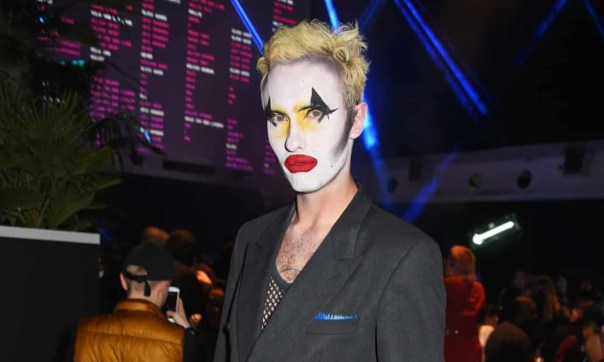
UK designer Charles Jeffrey. Photograph: Dave Benett/Getty Images for Daz
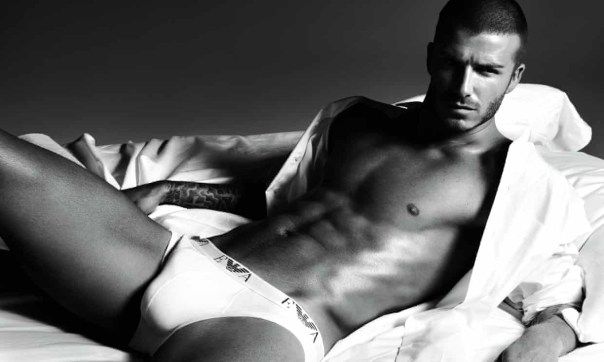
“Traditionally,” says Tim Blanks, editor-at-large of Business of Fashion, “gay style was about men who took a lot of care and attention about their appearance.” The Beckhamification of culture that begot the metrosexual ended all that. The most popular gay cultural figures in its slipstream were visibly paying less attention to their clobber than the majority. For Blanks, this is even truer of gay cultural figures now. “Where is gay style now concentrated?” he asks. “[Singer] John Grant’s statement is the most chic, stylish and sophisticated art. But it isn’t visual.” Like the musician Perfume Genius, AKA Mike Hadreas, Grant favours contemplation of the interior life over the exterior.
Yet just as the gay scruff-as-cultural-archetype boomed, a raft of new figures emerged, reframing sexuality and style, both in and out of high fashion. Demna Gvasalia (Vetements, Balenciaga) and Alessandro Michele (Gucci) became the most influential designers of their era by taking – respectively – utilitarian street style and ornate embellishment down strange, pleasingly radical avenues, upsetting the strict tenets of buttoned-up, sartorial menswear. Meanwhile, American designer Rick Owens has looked to the brilliantly extreme edges of performance art, taking inspiration from the purposefully surreal, absurdist and unsettling physical disposition of David Hoyle and Christeene Vale. Things have shifted. “Oh, I could look at [queer experimentalist] Arca 24 hours a day,” says Blanks. “He is phenomenal. His look embodies transgression, intellectual depth, incredible provocation and sensuality in exactly the way Bowie’s and Lou Reed’s did when I was teenage.”
For a young breed of designers, a sense of controlled, thrilling outrage – a sense incubated in gay nightlife – is once more tickling the underbelly of fashion. “You have all those children of Kim Jones,” Blanks notes. Jones, head of menswear at Louis Vuitton, made a path from 90s London gay club culture to the apex of men’s fashion. He was a regular at 90s gay clubs from Kinky Gerlinky to Queer Nation, which he has heavily referenced in his collections. Young designers including Christopher Shannon and Bobby Abley have done their own idiosyncratic takes on that journey, too. It’s a path that can work in reverse, too. In their earliest incarnation, Take That, five straight men from the north-west, were styled to catch the eyes of ritzy gay clubbers at La Cage in Manchester.
Another who trod that path was Green, whose richly specific fashion vernacular feels technically in the lineage of Yohji Yamamoto and Issey Miyake. Then there’s JW Anderson’s fruity gender play, putting men in frilly boob tubes and thigh boots during his early years.
As Green was writing his thesis, the young designer Charles Jeffrey was being beaten up in Glasgow for his appearance. An obsessive fan of Southend gothic revivalists the Horrors, he tried to emulate their style on a pocket-money budget. “I wanted the panda eyes and the big black hair but I had to buy winklepickers from Burton and women’s blouses from Primark,” he recalls. Hair was a big thing for Jeffrey, his point of differentiation, the “this is me” moment that many men have traditionally alighted on when they adapt publicly into a chosen gay identity. “I was called a ‘faggot’ and a ‘poof’ for having bright orange hair in what I thought of as really quite an aggressive look. I didn’t see it as being gay at all and I was punched in the face in George Square for it.”
“Gay men have co-opted both masculine and feminine imagery,” says Howard, “in an either/or way as regards their choices of clothes.” This delineation has precedent. “In the late 70s, you had new romantics with their velvet and face powder, which coincided with the clone look – handlebar moustache, muir cap, leather and denim – inspired by construction workers and uniformed personnel.” He thinks the reason these polarities exist might be connected to deeper identity questions. “Boys that grow up to become gay men have often personally experienced or at least witnessed anti-gay bullying, which perhaps then becomes either externalised – I’ll be as flamboyant as I want in my attire and to hell with you all – or internalised: I’ll be more masculine-looking than the most heterosexual men.”
Clubbers at Leigh Bowery’s club Taboo in 1986. Photograph: UniversalImagesGroup/UIG via Getty Images
The digital age has complicated personal identity issues for everyone. For many gay men, the closure of bespoke social spaces, as clubs and bars shut up shop, has meant formalising an identity online. “At the Blitz and Taboo,” says Blanks of the legendary London gay clubs, “it was always about not wanting to be stuck at home.” Times change and styles change with them. “Now, it is absolutely all about staying in.” The 2017 gay male archetype could easily be the bearded, topless selfie guy, stomach clenched, puckering up in his bathroom mirror, who routinely clogs the suggestion feeds of gay Facebook and Instagram users.
“What a shame,” Blanks continues. “The notion of community used to be absolute. The internet presents a different sense of immediacy. Your desire is now more important than your style.” In this sense, the most useful arbiter of gay style may be Ernesto Sarezale, the London nightclub fixture who frequently attends, dances and leaves completely naked.
Jeffrey’s Loverboy parties have seen the emergence of a newly radical slant on the club kids who have defined gay culture. “What I love about someone like [Loverboy regular] Harry Charlesworth,” says Blanks, “is that he’s sitting dressed like a southern belle with a hairy chest that Burt Reynolds would be proud of. It’s that visual idea that ties back to the Cockettes.” The revolutionary late 60s/early 70s San Francisco drag ensemble – a template for wild expression – are a touchstone in the gay style story.
“My gay style icon would have to be Sylvester,” says Howard, about the Cockette who broke free from the underground to define the sound, look and spiritual outer edges of disco. “He used his body and the clothes he wore as a way to express his liberation from the oppressive restrictions of heteronormative culture. If only more men, gay and straight, myself included, could be more like him.”
Model wearing a Tom of Finland print swim shorts. Photograph: The Washington Post/Getty Images
Wardrobe constraints can be further complicated by the thorny issue of sex. “Dress codes are generally about getting laid,” says GQ Style’s editor, Luke Day. “The connecting tissue between all gay subcultures is that you’re generally expressing your sexual preference in some sort of way. We are trying to attract. What we put out there is what we fancy.”
“There are gay men that I like the style of,” says Green. He mentions his former stylist and collaborator Julian Ganio, the fashion director of Fantastic Man magazine. “He wears things really well. It’s quite difficult to look good in denim shorts, a bucket hat and a pair of shearling loafers, but he’s got a magic way of holding himself.”
Ganio himself doesn’t think that gay men’s style has changed much over his time. “It never really does,” he says. “In 30 years’ time, it’s more than likely the leather queens will still wear leather, the bears will wear a plaid shirt and beard and the scallies will wear Reebok Classics with a Ralph Lauren polo shirt.”
Howard thinks the real influence of gay men on mainstream style may not even be on their own kind. “Perhaps, traditionally, gay men have had more time and money to spend on their clothes and bodies, but gay men have arguably had more influence on women’s style and fashion than men’s.” The recent appointment of Edward Enninful as editor of British Vogue would suggest that. As for the question that haunts the debate of gay men and style, Ganio has a simple and succinct answer.
Why are so many gay men designers?
“Because gays are fab,” he says.
Seven key gay styles
he Village People. Photograph: PA
The clone
Origins: Tom of Finland.
Subcultural habitat: The End-Up nightclub, San Francisco.
Crossover moment: Tom Selleck as Magum PI, the Village People.
The dilly boy
Origins: The rent boys of yore plying their trade at Piccadilly Circus.
Subcultural habitat: Smoking a Virginia Slim louchely under Eros with a Jean Genet paperback.
How outspoken gay figures like Milo Yiannopoulos and Caolan Robertson go down with right-wingers, who – traditionally – haven’t been big fans of the gays.
MILO YIANNOPOULOS AT THE REPUBLICAN NATIONAL CONVENTION CLEVELAND OHIO, USA, 21ST JULY 2016 (MARK REINSTEIN / ALAMY STOCK PHOTO)
In March of 2017, a terror attack in Westminster left 49 people injured and six dead or dying. While victims were still being driven away in ambulances, English Defence League (EDL) founder Tommy Robinson rushed to the scene with a camera crew to pace around outside the police cordon and rant about Muslims. Not long after he’d started, a younger man took over.
Pinching his thumb and forefinger together, the man raises his pinky and tells the camera: “If you import a culture, you get a culture.” Barking at unimpressed spectators, he finishes: “The blood. Is on. Your. Fucking. Hands,” with all the sassy-camp cadence of a RuPaul’s Drag Race queen.
That man was Caolan Robertson, a video producer with 12,000 YouTube subscribers, 41,000 Facebook followers and 35,000 Twitter followers. Robertson, who is gay, says that while “all religions are pretty bad… Islam is particularly worse”. Like fellow gay right-wing figure Milo Yiannopoulos – who became a darling of the alt-right on an anti-political correctness agenda – he has taken arch-campness to a twisted place.
That two public figures on the hard-right are openly gay might surprise some people, given that poster boys of this political persuasion are usually family-oriented and Christian-leaning, like Tommy Robinson and Britain First, or dullard conspiracy theorists, like Paul Joseph Watson. Also, right-wingers – from small-C conservatives up to neo-Nazis – historically haven’t been that keen on gays.
However, gay right-wingers aren’t actually as uncommon as you might think.
The recent case of neo-Nazi Ethan Stables, for example, who was convicted of preparing a terrorist act after plotting to attack a Pride event in Barrow, sharply counters this idea of heteronormative masculinity, as his defence involved an assertion of his own bisexuality. Elsewhere, European hard-right politicians Geert Wilders and Marine Le Pen have played to an LGB – but not T – crowd, while Germany’s far-right Alternative for Deutschland party promoted lesbian Alice Weidel to its leadership.
But how do people like Yiannopoulos – a gay man who harasses trans students on campuses – fit into the UK’s radical right?
Historically, brief radical right acceptance of white gay men plays against a backdrop of institutionalised homophobia. The Nazis’ momentary permissiveness of the gay Storm Battalion co-founder Ernst Rohm is a blip compared to the 50,000 homosexuals imprisoned and 15,000 homosexuals killed during the Holocaust. In 1999, neo-Nazi nail-bomber David Copeland attacked gay people, Bengali Muslims and black people with equal measures of hatred. Nicky Crane may have been a violent neo-Nazi secretly enjoying gay dalliances, but when he came out in 1992 he cast his political views aside, declaring them incompatible with his sexuality.
Then came 9/11, and a shifting – at least in the radical right’s eyes – of the hierarchy of minorities. Here was an opportunity to knit together different factions of the right against a common enemy: Islam.
Just as the Taliban’s treatment of women was seized upon by the Bush administration and its supporters to justify the war on terror, its treatment of queer people was used to cast all Muslims as anti-gay. In 2009, a Gallup Centre for Muslim Studies report seemingly backed up the radical right’s assertions: while 58 percent of the British general public thought homosexual acts were “morally acceptable”, zero percent of British Muslims agreed.
Even the liberal press focused on this statistic: “Patriotic, respectful, homophobic”, read The Independent’s summation. “Muslims in Britain have zero tolerance of homosexuality, says poll,” said The Guardian. Right-wing outlets, still bothered about gays in the Anglican church and the impending doom of same-sex marriage, didn’t quite know where to pitch up.
The day of the shooting at Orlando’s Pulse gay club in 2016, wChose Islam Over Gays. Now 100 People Are Dead Or Maimed”. In it, he describes the actions of an extremist as representing all of Islam, using the poll to back up his claims: “This isn’t about ‘radical’ Islam. This isn’t a tiny fringe,” he writes. “In Britain, a 2009 Gallup survey found that not one Muslim believed that homosexual acts were acceptable. Not one!”
Days later, Yiannopoulos addressed a small crowd in a YouTube livestream, calling for a Muslim ban on that basis. “This is not radical Islam… this is Muslims in the West,” he said, ignoring the fact that the same poll found that 19 percent of German Muslims and 35 percent of French Muslims thought homosexual acts were acceptable, implying countries with a longer legacy of Muslim immigration have more LGB-tolerant Muslims.which killed 49 people, Yiannopoulos wrote an article for Breitbart titled “The Left Chose Islam Over Gays. Now 100 People Are Dead Or Maimed”. In it, he describes the actions of an extremist as representing all of Islam, using the poll to back up his claims: “This isn’t about ‘radical’ Islam. This isn’t a tiny fringe,” he writes. “In Britain, a 2009 Gallup survey found that not one Muslim believed that homosexual acts were acceptable. Not one!”
Days later, Yiannopoulos addressed a small crowd in a YouTube livestream, calling for a Muslim ban on that basis. “This is not radical Islam… this is Muslims in the West,” he said, ignoring the fact that the same poll found that 19 percent of German Muslims and 35 percent of French Muslims thought homosexual acts were acceptable, implying countries with a longer legacy of Muslim immigration have more LGB-tolerant Muslims.
With that, the clash of civilisations narrative was set.
Weeks later, Donald Trump – whose campaign manager at the time was Stephen Bannon, then-CEO of Breitbart – became the first ever Republican nominee for the US presidency to mention LGBT people, using them as leverage to call for a Muslim immigration ban.
As Matthew Feldman – co-director of the Centre for Fascist, Anti-fascist and Post-fascist Studies, and Professor of the History of Modern Ideas at Teeside University – puts it: “The thinking is: ‘If this is another stick to beat Muslims with, we’ll take it. We’ll be silent on the LGBT question, we’ll just talk about their rights in the abstract.'”
ANNE-MARIE WATERS (PHOTO BY JAMES POULTER)
Trump’s views on LGBT people have since wavered, but other British groups are unafraid to exploit professed support for LGBT rights to attack Islam.
In 2016, a Stockton-on-Tees Pride march was organised by a group with no previous affiliations to the LGBT community, but many links to the EDL and Pegida UK, also founded by Tommy Robinson. The march was “appropriating tragedies to promote further bigotry”, warned anti-Islamophobia project Tell MAMA.
The next year, Gays Against Sharia (GAS) – set up by Tommy English, known as Tommy Cook, founder of the EDL LGBT division – carried the baton. Though Tommy Robinson hijacked one of GAS’s marches, rebranding it Unite Against Hate, in September of 2017 GAS held its own parade in Bristol. Footage shows English holding a rainbow flag reading “UNITED TOGETHER, TODAY AND FOREVER. HELP US STOP THE GROWTH OF AN EVIL, HATE-FILLED IDEOLOGY”. Pictured helping carry this banner is Anne-Marie Waters, the lesbian who ran for candidacy of UKIP on an anti-Islam ticket.
The demonstrators had re-framed Islam as the real and sole oppressors of LGBT people, and the far-right as minorities’ protectors – a narrative that’s as transparent as it is cynical.
As for the Gallup analysis, Dalia Mogahed – Director of Research at the Institute for Social Policy and Understanding – tells VICE it has been misinterpreted: “Saying homosexual acts are morally wrong is not evidence that Muslims will hurt the LGBTQ community.”
“Muslims have been part of the UK for literally hundreds of years, and unlike the Christian right do not advocate against the LGBTQ community,” added Mogahed. “In a democratic society, freedom of thought and belief are central principles, including beliefs that we may not agree with. We erode our own values when we start policing thought.”
Mogahed also pointed out the paradox of Yiannopoulos complaining about Muslim bigotry against LGBT people while advocating for the Muslim ban.
Luckily, Yiannopoulos isn’t the threat he once was, having lost the radical right’s affections, Breitbart’s employ and Robert Mercer’s funding after footage surfaced of him defending pederasty. Mind you, he’s still at it: his new website, Milo Inc, both damns gays and uses them as a shield to deflect accusations of Islamophobia. Two headlines read: “All The Studies Show, Gay Parents Are Not Good For Kids”, and “GOOGLE Aids Indonesia’s Muslim Government In Anti-Gay Crackdown”. There is, after all, a limit to how much homosexuality radical right LGBT people can appear to condone.
Caolan Robertson is more overt in his disdain for gay culture. In a video for far-right Canadian YouTube channel The Rebel Media, he attends London Pride 2017, mocks interviewees and calls the event “the most degenerate festival I’ve ever seen”. He also mentions a 2016 ICM poll with questionable methodology which suggests that 52 percent of British Muslims think homosexuality should be illegal, quoting when the stat before asking left-wing journalist and campaigner Owen Jones, “Do you think that’s something that’s a threat to gays in our country?”
Jones replies, succinctly: “Far-right groups… try to cynically appropriate gay rights for Islamophobia.”
In an another video – this time an interview with radical right vlogger, Millennial Woes – Robertson cites an unknown report alleging that “60 percent of gays in the UK admit to having over 500 partners”, adding, “[Gays] have literally shit all over all of the people who fought for their rights to be able to exist by behaving like this.” The only record which correlates to this is a 1978 sociological study regularly shared on Christian websites.
Robertson later left Rebel Media acrimoniously, and now works behind the camera on documentaries with fellow Rebel alumni, alt-right Canadian vlogger Lauren Southern.
Failed UKIP leader Anne-Marie Waters’ beliefs about LGBT rights and Islam can be summed up by one of her tweets: “I’m a gay woman who values my freedom, believe me, Islam is out to get me.” However, her new party, For Britain, makes no mention of LGBT people in its manifesto. Perhaps this is because the radical-right has little space for lesbians, who, as Patrik Hermansson of Hope Not Hate – who spent a year undercover in the alt-right – explains, “aren’t even discussed” due to its boys’ club chauvinism.
Hermansson understands how gay men come to be part of and celebrated by the radical right: “There’s this glorifying of the male body and an idea that men are the best in every possible way. It makes sense, then, that when men are close together, in those groups, homosexuality doesn’t have to be so strange.” He also cites the manosphere – made up of single men who feel “left out and oppressed by what they perceive as feminism” – as a common entry point to the radical right. Feldman agrees: “A close male bonding can go from homosociality to homoerotic to LGBT.”
There’s an argument to be had about the point at which fetishistic enjoyment of fascist iconography can tip into full-blown appreciation of the Nazi ideal of the Ubermensch – a strong, muscular and healthy Aryan man. Think Kenneth Anger’s Scorpio Rising, Tom of Finland’s predilection for uniformed antagonists and the gay skins culture. As Hermansson points out: “It’s like the bullied turning into bullies, but it only happens to white men because they’ve got that possibility.”
More pressing, though, is supposedly pro-LGBT groups leveraging a minority status to provide a get-out-of-bigotry-free-card in a cynical and manipulative attempt to gain the hard-right ethical kudos and more members. Not only can their arguments – propped up by sloppy and wilfully misinterpreted polling – be convincing, but these people also attempt to cast the left as the real oppressors of gay people. It was a Conservative government which introduced same-sex marriage to the UK, yes, but LGBT rights are more than marriage.
As that long fight showed, sexual orientation doesn’t always imply a political orientation, and it’s incumbent on everyone across ideological and political spectrums to continue the conversation about how the religious and socially conservative consider and treat LGBT people.
The radical right’s rebranding as well-dressed, slick and intellectual operators has worked to give the movement an undue credibility, but the gay-tolerant rendition of Islamophobia is transparently exploitative. It’s only a matter of time before they get found out.