Part II – The Act, the King’s Politics, and the Transformation of English Law
In the years immediately following Henry VIII’s break with Rome, Parliament became one of the King’s most powerful instruments. A succession of Acts fundamentally altered the relationship between Crown, Church and people. Historians often refer to these measures collectively as the Henrician Reformation, and among them was one relatively brief statute whose influence would echo for centuries: The Buggery Act of 1533.
Although only a few hundred words long, the Act fundamentally altered English criminal law. It did not invent the offence of buggery; rather, it changed who had the authority to prosecute it, how it would be punished, and who would ultimately benefit from convictions.
The Buggery Act of 1533
Officially titled An Acte for the punishment of the vice of Buggerye, the statute declared that the offence of buggery would henceforth be tried in the King’s courts rather than the ecclesiastical courts.
This seemingly administrative change was revolutionary.
The Church lost one of its long-standing judicial responsibilities.
The Crown gained another.
The Act provided that anyone convicted of the offence would suffer the punishment imposed for felony.
In Tudor England, that meant:
death by hanging
forfeiture of lands
confiscation of goods and property
loss of inheritance rights
Unlike many offences heard by Church courts, there was no opportunity to escape punishment through repentance or spiritual penance.
The offence had become one against the King himself.
Why Was Henry Interested?
This is where history becomes particularly interesting.
Many older histories assumed Henry VIII introduced the Act because he held especially strong moral objections to homosexual behaviour.
Modern historians tend to disagree.
Henry’s reign demonstrates repeatedly that moral consistency was not his defining characteristic.
He broke with the Pope.
Married six times.
Executed two queens.
Maintained mistresses.
Ordered political opponents to their deaths.
Altered religious doctrine whenever political necessity required.
His overriding concern was almost always power.
The Buggery Act therefore fits comfortably within Henry’s broader programme of centralisation.
Every responsibility removed from Church authority increased royal authority.
Every legal matter transferred to secular courts strengthened the Crown.
The legislation should therefore be understood as part of Henry’s constitutional revolution rather than an isolated moral crusade.
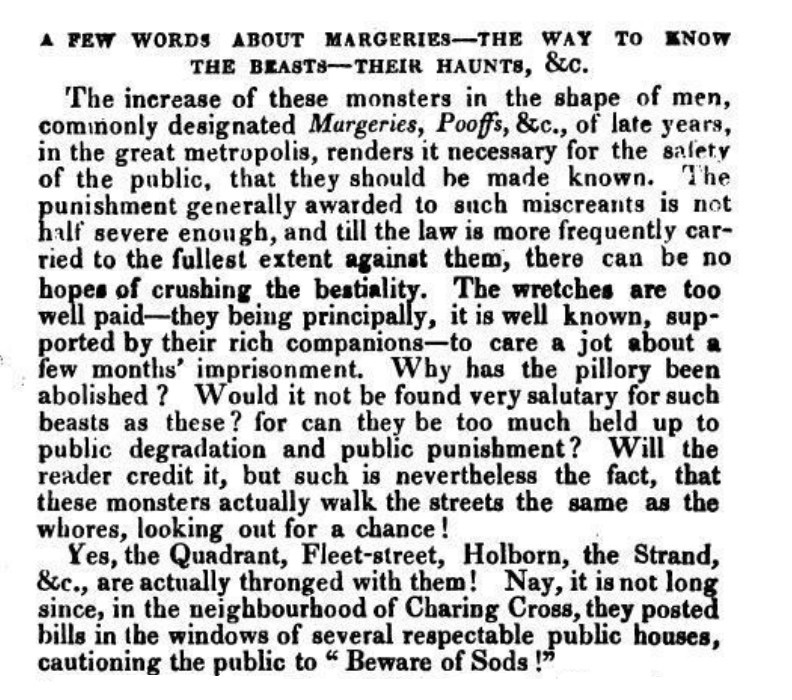
The Yokel’s Preceptor, a contemporary magazine, said this:
The End of Ecclesiastical Monopoly
For centuries, bishops and Church courts had exercised significant judicial power.
Henry gradually dismantled that system.
The Buggery Act declared that offences previously heard before ecclesiastical judges would now be prosecuted before royal judges.
This reflected an emerging Tudor principle:
The King—not the Pope—was the ultimate source of justice in England.
That principle extended far beyond sexual offences.
It affected marriage.
Inheritance.
Appeals.
Clerical discipline.
Property.
Monastic wealth.
And eventually almost every aspect of public life.
The Buggery Act therefore formed one piece of a much larger constitutional puzzle.
The Dissolution of the Monasteries
Only a few years after the Act, Henry began dissolving England’s monasteries.
Between 1536 and 1541, hundreds of religious houses disappeared.
Their lands became Crown property.
Their wealth flowed into royal coffers.
Their libraries were dispersed.
Their buildings destroyed or converted.
For the King, monasteries represented two things:
enormous wealth
and
potential loyalty to Rome.
Removing them weakened papal influence while enriching the Crown.
Sexual Accusations and Anti-Monastic Propaganda
One uncomfortable aspect of this period concerns the widespread allegations made against monasteries.
Royal commissioners investigating religious houses frequently reported accusations of:
sodomy
sexual immorality
corruption
financial dishonesty
moral decay
Modern historians urge considerable caution.
Many of these reports were gathered by officials who already knew what the King hoped to find.
Some accusations were undoubtedly genuine.
Others were probably exaggerated.
Some may have been entirely fabricated.
The commissioners’ task was not impartial historical investigation.
It was building a political case for dissolution.
By portraying monasteries as morally corrupt, Henry’s government made their destruction appear both necessary and righteous.
The Buggery Act provided another legal framework within which such accusations could be pursued.
Defining “Buggery”
One of the greatest difficulties facing historians is determining exactly what Tudor legislators meant by the word.
The Act itself offered no definition.
Instead, judges relied upon legal custom and previous interpretations.
Generally speaking, prosecutions involved:
anal intercourse between men
anal intercourse between a man and a woman
bestiality
Modern readers are often surprised that the law was not directed exclusively at male same-sex relations.
The offence concerned certain sexual acts rather than sexual orientation.
Again, this reflects Tudor thinking.
People were punished for what they were believed to have done—not for belonging to an identity category.
The concepts of heterosexuality and homosexuality would not emerge until more than three centuries later.
The Challenge of Proof
Although the penalties were severe, successful prosecutions were surprisingly difficult.
English common law demanded evidence.
By later legal standards, conviction generally required proof that:
penetration had occurred,
and
the act had been completed.
Witnesses were rare.
Confessions were uncommon.
Accusations frequently collapsed for lack of evidence.
As a result, the number of executions was considerably lower than many people imagine.
The existence of the law generated far more fear than actual convictions.
Yet fear itself can be an extraordinarily effective form of social control.
Many people regulated their own behaviour simply because the consequences of conviction were so catastrophic.
Who Was Prosecuted?
Most recorded prosecutions involved men.
This reflects both legal practice and prevailing assumptions about sexuality.
Women rarely appeared before the courts on charges of buggery.
This was not because female same-sex relationships were accepted.
Rather, English judges often struggled to determine whether existing legal definitions could encompass sexual acts between women.
Without penile penetration, many judges questioned whether the offence had technically occurred.
Consequently, women accused of same-sex intimacy were more likely to face social condemnation than prosecution under the Buggery Act itself.
A Weapon Beyond Sexuality
Like many Tudor laws, the Buggery Act possessed political utility.
An accusation alone could destroy reputations.
Even unsuccessful prosecutions carried enormous consequences.
Political enemies, unpopular clergy and social outsiders could all find themselves vulnerable.
Whether every accusation reflected genuine criminal behaviour is impossible to determine.
What is clear is that the law added another powerful weapon to the Tudor state’s expanding legal arsenal.
Fear, Reputation and Silence
Perhaps the Act’s greatest impact lay not in executions but in silence.
The possibility of prosecution encouraged secrecy.
Friendships became suspect.
Affection became dangerous.
Rumour acquired enormous power.
For centuries afterwards, many men lived under the constant awareness that an accusation—whether true or false—could destroy careers, families and lives.
That climate of fear became one of the Act’s most enduring legacies.
Looking Ahead
By the time Henry VIII died in 1547, England had been transformed.
The Pope no longer exercised authority over the English Church.
The monasteries had vanished.
The Crown controlled unprecedented legal and religious powers.
Among the many reforms Henry left behind was the Buggery Act—a statute that would survive kings, queens, civil wars, religious revolutions and even the British Empire itself.
Tim Alderman ©️2026


Thank you for the clarity of the cause and the justification. This provides many answers sought but unclear. 🙂 Naked hugs!