Tag Archives: LGBT

Gay History: Taboo or Not Taboo, The Fashions Of Leigh Bowery

Reading The Face magazine in early 1984 I was overwhelmed by a double-page spread entitled The New Glitterati featuring Leigh Bowery photographed in his ‘Paki from outer space’ look. His face was camouflaged in bright Plasticine-blue make-up, his head adorned with a mock leather military cap emblazoned in sequins and badges, while his entire body dripped with jewels, piercing and lots of body glitter. He wore a masterful creation – a bright green velour top with plunging neckline, fitted with this amazing red, asymmetrical zipper. Bowery looked like some exotic fashion god, a contemporary Krishna put through the blender with an extraterrestrial. It was kitsch and outrageous. It was inspirational. Did Jean Paul Gaultier, John Galliano or Vivienne Westwood design these clothes? Intrigued, I wanted to know more. The writer of the article observed:

One glance at these blinding photographs reveals why designer and jovial poseur Leigh Bowery – 22 years old, Abba addict and unrepentant champion of platform shoes – chose to leave his native Australia and cultivate his own outrageous style on the fringes of London’s club scene. They just didn’t understand him in the outback.1

 I sighed … finally, an Australian designer had made it into the pages of this influential style journal. Bowery did more for Australian fashion in two pages than had occurred in the past century … and the best was yet to come.

An extra extrovert, the ultimate spectacle, the fashionable performer, the grand poseur, Bowery communicated through his blatant sexuality, his extreme physical exaggerations, and his outrageous dress codes. Bowery was not simply dressing up; it was his lifestyle and commentary on the mundane, a joke about appearance. His collections or ‘looks’ were based on himself manipulating his body with clothing and make-up. Working outside the comfort zone, he developed a clothing aesthetic that few would dare follow. Original, provocative, evolutionary; Bowery manipulated clothing to totally change one’s appearance, like a form of cosmetic surgery. ‘In an age when pop stars, actors, designers – those who traditionally dictated stylistic trends – are almost indistinguishable in their uniformity and blandness, Leigh Bowery stands out like an erection in a convent.’2

Leigh Bowery’s place in fashion, art and popular culture is seditionary. The fashions he created were not worn on the streets, very rarely seen in daylight, or generated for mass consumption. His dress style hailed from club culture,3 and the concepts of dressing up and masquerade.

Bowery was born in Sunshine – a baby-boomer, semi-industrial suburban sprawl, west of Melbourne – on 26 March 1961.4 He attended Sunshine Primary School and later, Melbourne High School. He passionately wanted to be a fashion designer and studied for two years at Royal Melbourne Institute of Technology (RMIT) before becoming disillusioned by the restrictions imposed by formal training. Fuelled by the visual culture of style magazines, Bowery was attracted to London by the new romantic/blitz movement of the early 1980s where fashion, art and music were fused under the glamorous spotlight of the nightclub scene. Pop stars and bands such as David Bowie, Steve Strange, Spandau Ballet, Duran Duran and Culture Club influenced style. This was the breeding ground for the most creative, experimental and sexually charged clothing. Clubs were the stage for dressing-up; men and women wearing outlandish garments, big hairstyles and faces plastered with make-up. Gender boundaries were easily challenged in this world and androgynous looks abounded.5 Pretty clothes and special effects like frilly shirts, kilts, lace, satin and make-up were all worn by men – gay or straight – ‘it was almost like a love affair with yourself’.6 In the 1970s David Bowie, especially with his Ziggy Stardust persona, had ‘invented a whole language of art posing, he[‘d] invented the language to express gender confusion’.7 Fantasy and escapism were attractive vehicles to express individuality through clothing, make-up and hair. The key rationale for clubbers was attracting attention and being the centre of attention: dressing up was very competitive.

In 1984 the relaunch of London Fashion Week provided a platform for British designers to show their wares. This event, combined with vibrant street styles and the underground club scene, spawned the most creative and eccentric clothes, making London a potent source for world fashion trends. It nurtured and gained recognition for the fashion designers Vivienne Westwood, John Galliano, and in recent times, Alexander McQueen and Hussein Chalayan. However, it was clubs that provided the major venue, market and audience for generating clothing that was beyond one’s wildest dreams/nightmares.

Without working from ‘classics’, referencing the cultures of the world, fashions of previous decades or centuries, emulating a favourite designer or the current pages of French Vogue, Bowery was inspired to create something that bore no resemblance to anything. Early in his career he had begun to despise fashion because it was too restrictive and conservative. Bowery’s looks were incredibly fresh and up-to-the-minute fashionable. Making items over a short period of time, for a special event or club night out, his garments were a spontaneous response to the immediacy of his environment.

I believe that fashion (where all the girls have clear skins, blue eyes, blond blow-waved hair and a size ten figure and where all the men have clear skins, moustaches, short blow-waved hair and masculine physique and appearance) STINKS. I think that firstly individuality is important, and that there should be no main rules for appearance and behaviour. Therefore I want to look as best I can, through my means of individuality and expressiveness.8

 Bowery’s costume designs were complex, technically difficult and fantastic. By 1985 they bore no similarity to the catwalk or street styles of London or the rest of the world. Vivienne Westwood initially was a great inspiration to Bowery, particularly her anti-establishment spirit, her distortion of clothing and body forms, and her design mantra that ‘clothing could be subversive’.9 Bowery garments were worn by performers like Boy George, who recalled:

I was dressed like a Jewish bathroom, gold chains, safety-pins, badges and buckles, champagne corks and tassels. The costumes designed by Judy Blame and Leigh Bowery were meant to hide my expanding girth, although it was hard to look thin in an A-line smock with angel-wings jutting out the back.10

 In 1985 Bowery evolved from a fashion designer into an aesthetic revolutionary when he became the public face of the nightclub Taboo. The name said it all. Situated in the Maximus discotheque at Leicester Square, the club was originally staged only once a fortnight. Wearing a different outfit every week, Bowery was the main attraction. Some of his kitsch looks included a

short pleated skirt, with a glittery denim, Chanel-style jacket teamed with scab-make-up and a cheap, plastic, souvenir policeman’s hat11 … yellow gingham jacket printed with red spots with matching shirt and face12 … a denim jacket covered with Lady Jayne hair slides and his bald head decorated with dribbled dyed glue. The club’s dress code was ‘dress as though your life depends on it, or don’t bother’.13

 The taste for the ridiculous, and his constantly changing looks, ensured that when Bowery entered the club, everyone else looked boring. Taboo was not an exclusively gay club, however, it attracted a large gay following lured by the opportunity to be part of the outrageous fashion scene. The Taboo nightclub symbolised the excesses of the 1980s, looking fantastic was taken to extremes. Unfortunately, it closed after a year due to drug soliciting. Boy George has turned this club phenomenon into the Broadway musical Taboo.14

Without the assistance of the slick, branded imagery associated with major fashion labels and huge marketing budgets, Bowery’s fame and reputation rested solely on being seen. His creations were documented and celebrated in the London style magazines, i-D, The Face and Blitz; his antics were reviewed in the club pages, communicating his visual language. Promoting the fringe, these magazines gave copy and editorial to the young and original, promoting an ideas culture that supported independent design.15 In Melbourne the enclave of independent fashion designers and boutiques situated in Greville and Chapel streets would proudly display the latest edition of The Face or i-D in the shop window, and they were indispensable reading in every hairdressing salon. Many Australians followed Bowery’s career and lifestyle through this source, even the interior of his flat that he shared with Trojan16 was featured – walls covered in Star Trek wallpaper, clumps of plastic flowers decorating the skirting, and UV-lit. Interviewer: ‘Does the interior of your home match the interior of your mind?’ Leigh and Trojan: ‘Yes, it’s an extension of what we wear.’17

Bowery was a great fan of the American film director John Waters whose movies had a profound effect on the development of his dress aesthetic, his humour and body politics. Waters pushed the boundaries of taste, making films with outrageous plots and an offbeat humour merged with an unseemly collage of characters, scenery and costumes. This ‘trash’ aesthetic is best portrayed in the film Pink Flamingos, 1972, about the search for the filthiest person alive, which was Bowery’s favourite movie.18 The principle actor, Harris Glen Milstead, working under the name Divine and affectionately known as the Queen of Sleaze, and a cult figure in his own right, was a cross-dresser. His huge physique was featured wearing figure-hugging gowns or sack dresses. The representation of the ‘fashionable’ unfashionable person was meticulously crafted, with huge, bouffant hairstyles and highly stylised make-up, reminiscent of the Kabuki theatre, accompanying Divine’s extensive wardrobe. This image of alternative, Baltimore glamour was one Bowery chose to follow.
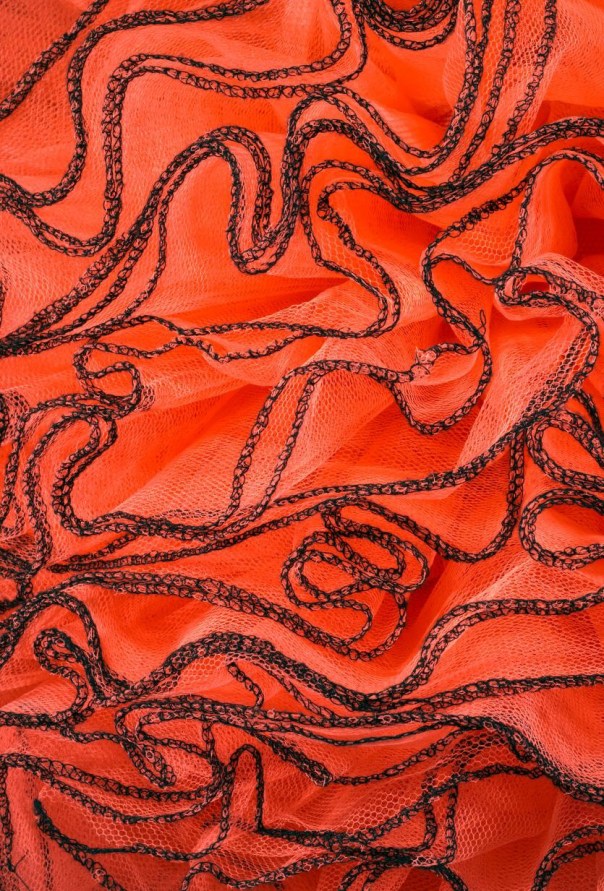
The magnitude of Bowery’s costumes is unforgettable, both in physical scale and psychological effect. The Metropolitan, c. 1988 – christened by Nicola Bowery in reference to its most famous appearance at The Metropolitan Museum of Art, New York, at the opening of the Lucian Freud retrospective in 1993 – had been worn by Bowery to various events (figs 1–4,8)19 Like many of his fashioned items, The Metropolitan was a work in progress that would simply be upgraded or reaccessorised to suit the occasion. This dress reads like a masculine ballgown, it is not intended to be drag or transvestite costume. Gender bending was common in the 1980s; the most infamous example was the skirted male suit produced by Jean Paul Gaultier in 1985. It was an attempt to blur the distinctions between male and female dress, however, the translations into mainstream fashion were commercially unsuccessful.20

Forged from a garish floral sateen, The Metropolitan boy’s dress has a square, flat bodice with a right breast pocket and open underarms. The bodice extends into a full-face mask with cut-out holes for the eyes and mouth. The mask was a device Bowery employed to prevent ruining his clothes from greasy make-up stains; in Metropolitan he could apply make-up only to his eyes and lips. Using extensive metreage, the enormous skirt appears to hover, supported by a series of taffeta and tulle petticoats, producing a fashionable silhouette reminiscent of 1950s haute couture. Bowery was serious about the history of fashion and his private library contained many books relating to designers, including the major French couturiers Cristobal Balenciaga and Christian Dior, the pre-eminent role models who practised the very expensive, drop-dead-gorgeous philosophy of French high fashion. Restricted by money, Bowery still participated in fashion’s excesses by relying on inventive detailing and utilising entire bolts of inexpensive fabrics for the production of major works. His selection of ‘tasteless’, out of date, patterned prints purchased from discounted fabric shops defiantly challenged the grand-ballgown tradition. In this case, the floral motifs are enlivened with clusters of blue sequins painstakingly sewn on individually by Nicola Bowery in a mock Dior/Balenciaga style.21

Bowery was a professional dressmaker; he drafted patterns, cut fabric and sewed. His garments were solid constructions, strong enough to survive the rigours of clubbing. When he lived with the corsetiere Mr Pearl, they would purchase second-hand corsets, pull them apart and remake them to learn the exacting construction techniques.22 

The Metropolitan is a total disguise, providing an obvious reference to traditions of fancy dress and masquerade,23 a perfect choice for a gallery opening depicting the wearer’s naked portraits! The art world was familiar territory; Bowery visited museums and he avidly collected art books and catalogues. Bowery even played the role of an art exhibit in 1988, performing at Anthony D’Offay’s London gallery wearing a different outrageous, tasteless, memorable look each day. Bowery desperately wanted his artware to be acknowledged by this elite. Nicola Bowery intentionally named this costume The Metropolitan in the hope that it would enter that prestigious collection.
In a rather perverse way, Bowery loved fashion protocols and niceties; wearing gloves, hats, belts and shoes. Gloves were a particular favourite and an expensive item to buy, so he would often steal these to complete his ensemble. Like the leader of a militant fashion army, Bowery walked into the Metropolitan wearing a floral dress with a Kaiser helmet, a pair of khaki camouflage-print gloves, a leather neck-and-waist belt and a pair of candy-pink platform shoes, and literally invaded the space. In all the fashion galas and openings held at the Metropolitan, no one had ever seen anything like this. His entrance would have been either very funny or very frightening. Just like a scene from a John Waters movie, he stole the show. Bowery’s exposure and main recognition in the mainstream art world came through the hauntingly beautiful, naked portraits of him painted by Lucian Freud. With his curvaceous, plump body and luminescent, waxed skin and his un-made-up natural face with pierced cheeks in-filled with clear plastic plugs, this was the Bowery the art-museum world could relate to.

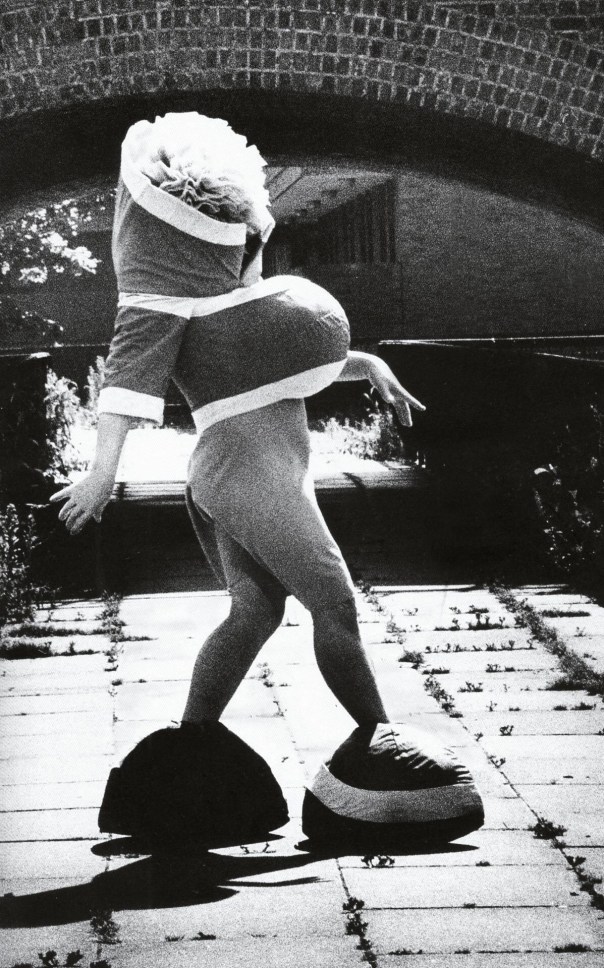
After 1990 Bowery stopped using fancy decorations on his clothing, instead, his work became much more abstract and surreal. During a trip to Japan he had discovered a catalogue of Transformer robots. These sophisticated toys provided a catalyst for Bowery to reconfigure his body and clothing in strange ways: he became a transformer. The Pregnant tutu head, c. 1992, costume is an experiment with scale and form (figs 5-7). Bowery in his performance pieces had already mesmerised his audience with giving birth to Nicola Bowery on stage.24 He was fascinated by the body’s capacity to change shape, and pregnancy was the most obvious example. Bowery’s clothing rituals often involved pain, discomfort and restrictions that produced difficulties with breathing, urinating and mobility. Although not intentionally designed for sadomasochistic pleasures, he applied any device, physical or manufactured, to achieve the masterpieces of his imagination, and this was pleasure enough.

Bowery had already attempted to distort his own body with unorthodox combinations of clothing forms and the deception of make-up. The Pregnant tutu head‘s top has a protruding belly suggesting the silhouette of a pregnant woman and the continuation of the species; it is worn with stretch pants. To continue this exaggerated silhouette and reinforce the symbol of growth, Bowery crafted half-circle, fabric shoes from large pieces of foam rubber covered in brown fabric. The bulbous shoes look ridiculous, like the cartoon models worn by Mickey and Minnie Mouse. The headpiece is formed like a large pompom made from tiers of orange tulle frills zipping up the back; the wearer encapsulated in a puff of fabric. A pair of full-length, dark blue gloves complete this ensemble. Bowery’s 1990s clothing is often visually disturbing, as he experimented with costume freakery.

Since his death in 1994,25 Bowery’s contribution to fashion and style culture has begun to be assessed and acknowledged in wider forums beyond style magazines and the club subcultures. Today, the boy from Sunshine is recognised internationally as a major style icon of the twentieth century, he was ‘surely a predictor of fashion!!!!’.26 Phaidon published The Fashion Book in 1998,27 a gigantic tome devoted to the 500 leading designers who had created and inspired world fashion over the past 150 years. Only three Australians made the final cut: Colette Dinnigan, Akira Isogawa and Leigh Bowery. Bowery’s recognition came not from commercial success or as a known fashion brand, but from his creativity and originality, described in the book as ‘part voodoo part clown’. He was indexed as an icon alongside the likes of David Bowie and Johnny Rotten. Bowery was not about setting fashionable trends, however, the influence of his creations is seen in the work of designers such as Vivienne Westwood, Alexander McQueen and Hussein Chalayan, and in the conceptual approach of much contemporary fashion, reinforcing the ‘continuing importance of this experimental dimension of fashion culture’.28

An exhibition of Leigh Bowery’s work was staged in Australia in 1999: Leigh Bowery: Look at Me at the RMIT Gallery, Melbourne, curated by Robert Buckingham and designed by Randal Marsh, included original costumes, videos and photographs. For many Australians this was their primary exposure to Bowery’s work in a local context,29 and certainly, to see actual costumes was provoking. Unexpectedly, these crafted, one-off garments designed for club wear and art performance were neither pretty, fashionable nor utilitarian. Instead, they had the power and capacity to confront issues relating to appearance, sex and politics. For many viewers this experience was a revelation. Bowery’s genre was as provocateur. The National Gallery of Victoria acquired two costumes from this exhibition and it is the only gallery in the world (at the time of writing) to represent his costumes.30 Bowery is finally an official part of Australia’s material culture.

Perhaps the best recognition and understanding of Bowery’s work is the inclusion of The Metropolitan in the inaugural hang at the Ian Potter Centre: NOV Australia, at a gallery devoted to Australian art. ‘Leigh would be ecstatic’ if he knew he was part of a major public collection.31

Reference & Notes

This article focuses only on aspects of Bowery’s clothing design, in particular, the examination of his work in a broader fashion context, and does not attempt to cover his extensive repertoire, particularly his performance work or collaboration with the Michael Clarke Ballet Troupe.

1     L. White, ‘The new glitterati’, The Face, no. 48, April, 1984, p. 56. For a discussion of influence and role of the style magazine and fashion journalism see C. McDermott, Streetstyle: British Design in the 80s, New York, 1987, pp. 81–88; for an examination of the nature of fashion journalism see A. McRobbie, British Fashion Design: Rag Trade or Image Industry?, London, 1998, pp. 151–174.

2     A. Sharkey, ‘The undiluted Leigh Bowery’, i-D, no. 42, The Plain English Issue, June 1987, p. 63.

3     ‘Because clubbing and raving are done by a narrow segment of the population after most people go to bed, the scale of the social phenomenon often goes unnoticed.’ S. Thornton, Club Cultures, Cambridge, 1995 p. 14.

4     For a complete account of Bowery’s life, see S. Tilley, The Life and Times of an Icon, London, 1997; and R. Violette (ed.), Leigh Bowery, London, 1998.

5     S. Cole, Don We Now Our Gay Apparel, New York, 2000, p. 158.

6     ibid., p.159.

7     J. Savage, Time Travel, Pop, Media and Sexuality 1976-96, London, 1996, p. 112.

8     Tilley, p. 97.

9     McDermott, p. 26. Vivienne Westwood collaborated with Malcolm McLaren from 1971 to 1983 before embarking on a solo career.

10     B. George with S. Bright, Take It Like a Man, London, 1995, p. 521.

11     Tilley, p. 57.

12     ibid., p.61.

13     ibid., p.53.

14     Music and lyrics by Boy George, based on the story by Mark Davies. Directed by Christopher Renshaw. Matt Lucas, Boy George, and most recently, Marilyn, have played the role of Bowery.

15     T. Jones (ed.), Fashion and Style: The Best from 20 Years of i-D, Koln, 2001.

16     Pseudonym used by Gary Barnes, 1966–86, who described himself as an ‘artist and prostitute’. Encouraged by Bowery, he painted confronting works in a Daliesque/naive style. They lived together for several years, Bowery dressing him in his latest fashion designs.

17     F. Russell-Powell, ‘Penthouse’. i-D, The Inside Out Issue, no.19, October 1984, p. 8.

18     Nicola Bowery, discussion with the author, 23 May 2002.

19     N. Bowery, discussion, 17 July 2002. The Metropolitan was purchased from Bowery’s widow, Nicola Bowery. She generously donated Pregnant tutu head to the National Gallery of Victoria in 1999.

20     S. Mower, ‘Gaultier’, Arena, London, July/August 1987, p.85. Gaultier produced only 3000 suits worldwide.

21     N. Bowery, discussion, 23 May 2002.

22     N. Bowery, discussion.

23     See A. Ribeiro. ‘Fantasy and fancy dress’, Dress in Eighteenth Century Europe, New Haven, 2002, pp. 245–282. The custom of masking or disguise goes back to antiquity. ‘The masquerade provided opportunities for role-playing and subversion of propriety in defiance of the conventions of society’ Ibid., p. 245.

24     For photographs relating to Leigh Bowery’s performances, from Wigstock to his pop group Minty, and his performances with the Michael Clarke Ballet Troupe, see Violette.

25     ‘The fabulous Leigh Bowery passed away on New Year’s Eve, 1994, and London lost another mirror ball. No one knew Leigh had Aids because he didn’t want them to. He said, “I want to be remembered as a person with ideas, not Aids.”’ George with Bright, p. 566.

26     Walter Von Beirendonck, letter to the author, 14 June 2002.

27     The Fashion Book, London, 1998. See Leigh Bowery entry, p.70; Colette Dinnigan, p. 135; Akira Isogawa, p.225.

28     D. Gilbert, ‘Urban outfitting’, in Fashion Cultures: Theories, Explorations and Analysis, eds S. Bruzzi & P. Gibson, London, 2001, p. 9.

29     In 1987 Bowery performed with the Michael Clarke Ballet Troupe at the Melbourne Town Hall, horrifying his parents and most of the audience with his obscene acts.

30     Nicola Bowery, discussion, 17 July 2002.

31     Nicola Bowery, discussion.

Gay History: The Weird Science of Homophobes Who Turn Out to Be Gay

There is some research suggesting a link between being closeted and being anti-gay. But while the notion feeds many jokes, it also obscures very real homophobia.

Photo Illustration by The Daily Beast

2017 has been a banner year for the armchair psychological theory that anti-gay public figures are secretly gay themselves.

Never mind the long-running jokes and memes about Mike Pence covering up some secret homosexual identity. There have been actual examples this year of outspoken anti-LGBT figures exhibiting behavior that seems to contradict their political ideology.

The same idea emerges every time: The hypothesis is that their bigotry doesn’t just make their sexual behavior hypocritical, it actually functions as a cover for it, consciously or otherwise.

Recently, there has been former Ohio state Rep. Wesley Goodman, who resigned late last week after it came out that he had had sex with a man in his office.

In March, former Oklahoma state Sen. Ralph Shortey resigned after being hit with child prostitution charges for allegedly soliciting sex from a 17-year-old boy. Shortey has reportedly decided this week to plead guilty to a child sex trafficking charge.

Both Goodman and Shortey are married men who were clear political opponents of the LGBT community while in office.

After Shortey was arrested, the Associated Press noted that he “routinely” voted for anti-LGBT bills, quoting the director of the LGBT advocacy organization Freedom Oklahoma who said, “He was never vitriolic about it, but he would make the bad votes.”

More strident was Goodman who, as the Columbus Dispatch reported, “consistently touted his faith and conservative values,” with a Twitter bio that read: “Christian. American. Conservative. Republican.”

As more information about their alleged misdeeds emerges—Goodman now stands accused of fondling an 18-year-old man at a conservative event, and of pursuing several young gay men—there is a certain grim catharsis in seeing such hypocrisy exposed.

The LGBT community will never tire of bringing up the long history of Republican gay sex scandals every time new—and increasingly unsurprising—allegations emerge, precisely because they seem to be so predictable in hindsight.

(As GQ sarcastically put it in response to the Goodman news: “Anti-Gay Ohio Republican Resigns After, Surprise, Having Sex with a Man in the State Capitol.”)

A 2012 study in the Journal of Personality and Social Psychology generated a fair number of headlines that year—including The New York Times’ “Homophobic? Maybe You’re Gay”—for suggesting that some self-avowed straight people who showed signs of same-sex desire were more likely to hold discriminatory attitudes.

Two authors on the study—psychologists Richard M. Ryan and William S. Ryan—wrote in their accompanying New York Times opinion piece that they had asked 784 college students to rate their sexual orientation on a 10-point scale and then told them to sort “images and words indicative of hetero- and homosexuality” into categories.

The “twist,” as they put it, were subliminal flashes of the words “me” or “other” before each image that can theoretically reveal subconscious bias based on how long it takes the subjects to sort images that don’t match their self-described sexual identity into the right category.

The result: The researchers isolated a “subgroup of participants”—more than “20 percent of self-described highly straight individuals”—who “indicated some level of same-sex attraction,” and who were “significantly more likely than other participants to favor anti-gay policies; to be willing to assign significantly harsher punishments to perpetrators of petty crimes if they were presumed to be homosexual; and to express greater implicit hostility toward gay subjects.”

“Thus our research suggests that some who oppose homosexuality do tacitly harbor same-sex attraction,” they concluded.

The psychological mechanism behind this subgroup’s anti-LGBT vitriol is, in theory, relatively simple: They are taking out their own issues with sexual identity on other people.

As Netta Weinstein, the study’s lead author, said in a press release, they “may be threatened by gays and lesbians because homosexuals remind them of similar tendencies within themselves.” So if you’re an American politician, there may be no more effective way to prove to yourself that you’re straight than to target LGBT people.

The 2012 study is certainly suggestive. It’s continually cited whenever it seems to apply to a homophobic figure, like after Pulse nightclub gunman Omar Mateen was rumored to have frequented the LGBT nightclub in the buildup to the shooting.

There are other studies that have come to similar conclusions. As Science magazine reported after Pulse, there is a “scattering of research” that suggests “some conflicted gay men might indeed be homophobic,” like a small 1996 study in the Journal of Abnormal Psychology that measured penile arousal and found a link between “homophobia” and “homosexual arousal.”

But the keyword in all of the above literature is “some.”

There is, at this point, enough research in this area to suggest that there may be something deeper to the armchair psychology. But the “secretly gay homophobe” theory is far from being a complete explanation of anti-LGBT prejudice in American politics.

Twenty percent of people who describe themselves as “highly straight” is still 10 percent fewer than the 32 percent of Americans who oppose same-sex marriage.

Just because that 20-percent subgroup is “significantly more likely” to tout an anti-LGBT ideology doesn’t mean we can assume someone like Mike Pence is likely to be covering up a secret past as a gay clubgoer just because of his anti-LGBT track record. So-called closet cases may be abundant, but there’s no way to prove that every Republican who tries to legalize anti-LGBT discrimination is hiding something.

In fact, overgeneralizing and joking as if that were the case may hurt LGBT people.

On Twitter, comedian Cameron Esposito, herself a lesbian, has criticized the homophobic undertones of the constant Mike Pence jokes—and has called out the media for being seemingly more interested in the salacious “homophobe caught having gay sex” story than in the mistreatment of LGBT people writ large.

Reference

‘Dream Daddy’ Is A Surprisingly Earnest Dating Simulator Where You Can Date Gay Dads

Steam

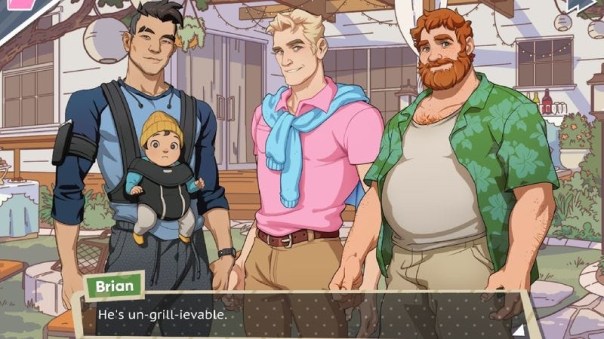
“Dream Daddy” is a brand-new dating simulator in which you play a dad trying to romance other hot dads, and I’m pleased to report it’s much more charming, earnest and goofy than I expected it to be.

My main source of apprehension stemmed from the fact that “Dream Daddy” was produced by Game Grumps, a “Let’s Play”-style YouTube channel with 3.9 million subscribers. It’s run by Arin Hanson and Dan Avidan, both of whom are known for their over-the-top, juvenile, shock-based senses of humor. For example, their most recent “best of” video features a clip where one of the two asks the other if he thought he could “stuff tits into [his] asshole.”

So, to say that I was fearful about whether this game would treat its same-sex romances with respect is an understatement. However, I’m happy to report that after playing “Dream Daddy” for a couple of hours, my fears were (mostly) unfounded.

Wait, back up. What’s a dating simulator? How do you play “Dream Daddy”?

If the dating simulator genre is a totally foreign concept, here’s how it works: They’re essentially video game versions of those choose-your-own-adventure books.

In “Dream Daddy,” you design your own character — which, notably, include “binder” body options for trans characters — and help shape their story with the decisions you make.

If you’re having a conversation with another character, you’ll sometimes have to choose between one of several responses. Sometimes, these responses will affect another character’s perception of you, which is indicated by an explosion of hearts (good) or a murky, black ink cloud (bad). Other times, these options simply alter the way a conversation unfolds, but there isn’t a tangible, numbers-based outcome.

Ultimately, your goal is to pursue one — or several, if you’re feeling frisky — romances with another character. But if you choose the wrong responses in conversation, they might not return your affection. Kinda like real life, really.

The sweetest relationship in “Dream Daddy” isn’t with another dad

“Dream Daddy” is, of course, about romancing hunky men, but there’s actually a different relationship at the heart of the story: The one between your character and his daughter, Amanda.

The whole conceit of the story is that you’re a single dad who’s moving to a new neighborhood with Amanda — and, in the process of getting to know the new digs, meet a bunch of hot dads. It’s implied that you’re downsizing because your character’s spouse died in the somewhat recent past. Also, Amanda is in her senior year of high school and will be going off to college soon.

Amanda is the main vector by which the story moves forward, and it works surprisingly well. She’s the one pushing you to get to know the people in your new neighborhood — spoiler alert: They’re all dads — and she’s a nice, familiar face that helps ground everything in between all the flirtation.

In the opening minutes of the game, I was already getting choked up over the pair’s conversation about my character’s late husband, which is not what I was expecting out of a game called “Dream Daddy.” You can choose whether your spouse was a man or a woman, but this game is about romancing dudes, so, the choice was pretty clear.

I’ve also been surprised at how invested I am in her own narrative about troubles in school. I haven’t delved too deeply into her story yet, but I’m intrigued to see where it goes.

So, who can you date in “Dream Daddy”?

All right, enough about Amanda. What you’re really here for is hot dads. I get it.

I’ve met all the dads so far, and my current favorite is Craig, a sporty, reformed frat bro who’s settling into his new role as a divorced, mature(ish) dad. He regularly pantomimes a voice for River, the wide-eyed tot strapped to his chest. He also works out a lot. I’m not down with his fratty masculinity — he’s bound to have “masc4masc” in his Grindr profile, right? — but for now, he seems like a good option.

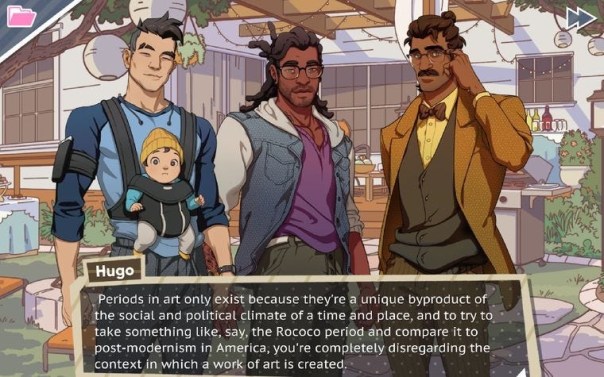
At first, I was partial to Hugo, a charming English teacher at Amanda’s school, but then I found out he had a son named Ernest Hemingway Vega. That’s simply too much.

I’m only a couple of hours into my first playthrough, so we’ll see how things go. Overall, I’m genuinely surprised at how much I’m enjoying it, but I do have some qualms with the way the writing fails to engage with gay culture in a meaningful way, despite relying entirely on the idea of gayness for its success.

But that’s a topic for another day. I’ll have more thoughts on “Dream Daddy” soon.

Reference

Gay History: Martyrs Among Us: Deifying Matthew Shepard, Harvey Milk + more

IMAGE ABOVE: JAKE GYLLENHAAL AND HEATH LEDGER IN BROKEBACK MOUNTAIN; COVER STORY IMAGE: HILLARY SWANK IN BOYS DON’T CRY

When news broke that Matthew Shepard’s remains were finally buried at the National Cathedral some 20 years after his death, we were reminded of the collective grief the nation felt after the brutal, senseless murder of the waiflike 21-year-old. In the intervening years since he happened into a bar where he met up with two men who lured him into their truck, robbed him, and drove him to a desolate stretch of highway outside Laramie, Wyoming where they pistol-whipped him, tied him to a wooden fence and left him for dead in the cold night air, Shepard had become more than an emblem of the senseless hate crimes perpetrated against the gay community, he had become a martyr.

Matthew Shepard was an openly gay student at the University of Wyoming who was brutally attacked in a hate crime at the age of 21.

Shepard’s place among sacrificial victims was solidified when more than 5,000 people gathered on the steps of the Capitol to mourn his death and cemented when Congress passed the Matthew Shepard and James Byrd Jr. Hate Crimes Prevention Act, which broadened existing law to include crimes triggered by sexual orientation, gender, gender identity, race and disability. Byrd was an African American man murdered by three white supremacists in Jasper, Texas. On June 7, 1998, they dragged his body for three miles behind their pickup truck. Although Byrd wasn’t gay, his inhumane murder serves to remind us of the hate that permeates society.

In his book, Dying to Be Normal: Gay Martyrs and the Transformation of Sexual Politics, author Brett Krutszch theorizes that LGBTQ activists are using religion to make the argument that gays are essentially the same as straights and deserve the same equal rights. He points to the veneration of Shepard, Harvey Milk and other high profile gay victims, as well as campaigns like the It Gets Better Project, which he believes promotes the notion that “like Christ’s suffering on the cross, one’s trials today can lead to a better tomorrow.” Krutszch says that national tragedies like Orlando’s Pulse nightclub shooting show how activists use headline-grabbing deaths to gain acceptance, shape the debate over LGBTQ rights and foster assimilation.

Krutszch maintains that Mr. Shepard’s 1998 murder is steeped in religious imagery. Just the thought of the all-American boy-next-door tied to a fence conjures up images of the crucifixion. He concludes that Matthew Shepard’s resulting canonization is due to the interplay of religion, death and LGBTQ politics and that “martyrs as emblems can be changed into more respectable figures than they were in their lifetime.” We may never know if Mr. Shepard was the innocent victim most people believe he was, or as The Book of Matt: Hidden Truths About the Murder of Matthew Shepard indicates, he was a meth dealer who not only knew his killers, but was sexually involved with one and that his death was the result of a drug robbery gone bad.

Whatever the motive for his murder, Shepard has become a shining symbol in the pantheon of almost exclusively white gay martyrs. The group dates back to the 4th century when Sergius and Bacchus, two Roman Christian soldiers who happened to be lovers, took part in a rite called adelphopoiesis (the ancient equivalent of same sex marriage) and refused to attend sacrifices for Zeus, thereby revealing their Christianity. The pair was paraded through what is now Syria. They were dressed in women’s clothing and tortured to death. They lived on through fervent followers and the churches that were dedicated to them throughout The Byzantine Empire.

Any conversation about modern-day martyrs would not be complete without mentioning Harvey Milk. He was the first openly gay elected official in California. Krutszch described Milk as “a secular Jewish, Yiddish-speaking, anti-monogamist” who was transformed by activists who “downplayed his Jewishness, depicted him as committed to fidelity and presented him as someone whose death, like Christ’s crucifixion, transformed the world.” One can argue the validity of that characterization, but it is hard to deny the contributions Milk made as San Francisco’s District 5 Supervisor. Those included defeating Proposition 6 that would have banned lesbian and gay educators from teaching in California public schools, and his efforts to pass legislation that prohibited discrimination in housing and employment based on sexual orientation.

Harvey Milk

Tyler Clemente may be less well known than Milk and Shepard, but like their deaths, his was another flashpoint. You may remember reading about his suicide in 2010. Clemente was an 18-year-old Rutgers University student who jumped from the George Washington Bridge after his roommate used a webcam to spy on him kissing another man. The video was posted on Twitter.

Most homosexual martyrs are white, but they are not all men. Brandon Teena, born Teena Renae Brandon, became famous when Hilary Swank played him in Boys Don’t Cry. The 21-year-old Teena was living a quiet transgender life in Humboldt, Nebraska, dating 18-year-old Lana Tisdel and hanging out with two ex-convicts John Lotter and Marvin Thomas “Tom” Nissen. Everything was fine until December 19, 1993, when Teena was arrested for forging checks. He used his one phone call to call Tisdel. She got the surprise of her life when she came to bail him out and was directed to the women’s prison where Teena was being held.

Brandon Teena

At a Christmas Eve party a few weeks later, Lotter and Nissen forced Teena to remove his pants, proving to Tisdale that he was a woman. Later that night, Lotter and Nissen forced Teena into a car, drove him to a deserted area, attacked and gang-raped him. Fearful that Brandon would file a police complaint, the pair murdered him on New Year’s Eve. While his family buried him as a female (his tombstone reads “Teena R. Brandon, Daughter, Sister and Friend”), the death of Brandon Teena is credited with raising awareness of transgender issues in the same way that Matthew Shepard’s became a clarion call for injustices directed toward gay men.

Teen Lana Tisdale

While real-life suffering seems like a necessary prerequisite for martyrdom, some fictional characters like Brokeback Mountain’s Jack Twist and Ennis Del Mar have transcended fictional status to take their place in the cultural zeitgeist. Brokeback author, Annie Proulx, said the characters Jack and Ennis were her first two that felt “really damned real” and “got a life of their own.” She also said, “Unfortunately, they got a life of their own for too many other people, too … the audience that Brokeback reached most strongly have powerful fantasy lives. They can’t bear the way it ends. So they invent all kinds of boyfriends and new lovers and so forth after Jack is killed. They can’t understand that the story isn’t about Jack and Ennis, it’s about homophobia.”

Gay martyrs like Matthew Shepard, Harvey Milk, Brandon Teena and even Brokeback’s fictional characters are often a byproduct of homophobia, when people who find themselves outside the mainstream and are struggling to just be who they are.

Reference

Gay History:The Briggs Initiative: Remembering a Crucial Moment in Gay History

Homophobe John Briggs promoting his initiative

A lot of people are saying this year’s midterm election is the most crucial of our lifetime. It may well be, given the need to elect officials who will fight Donald Trump’s loathsome agenda. But another midterm election, 40 years ago, was one of the most crucial as well, at least in California.

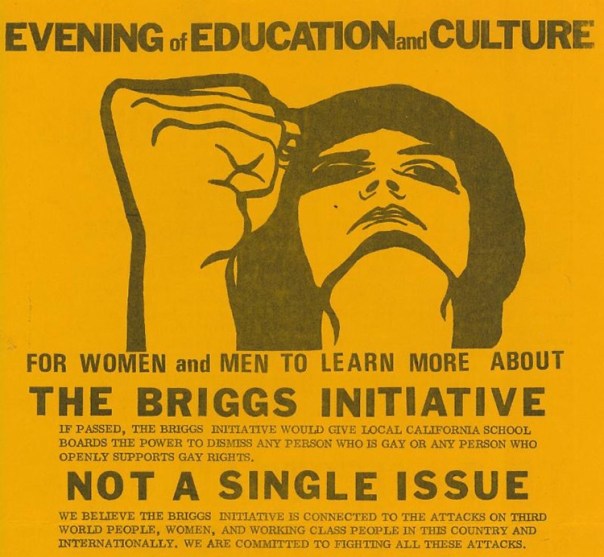
In 1978, State Sen. John Briggs put an initiative on the ballot that would have mandated the firing of any gay or lesbian teacher in California public schools, or any teacher who supported gay rights (the term LGBT wasn’t used back then). Thanks to a Herculean effort by California grassroots activists — Harvey Milk, Cleve Jones, Sally Miller Gearhart, hundreds of others — Briggs’s Proposition 6, popularly known as the Briggs Initiative, was resoundingly defeated, by more than a million votes. It was the first time voters had rejected an antigay measure.

To mark the 40th anniversary of this milestone, the GLBT Historical Society in San Francisco is mounting an exhibition called “The Briggs Initiative: A Scary Proposition,” recounting the story of the initiative and how it was turned back. It opens September 14.

“This exhibition will bring a scary time for LGBTQ people zinging back for those of us who were there, reminding us that we can fight the forces of anti-LGBTQ discrimination and win even against long odds,” said co-curator Sue Englander, a veteran of the anti-Briggs Initiative effort, in a press release. “And if you weren’t here 40 years ago, the story will sear itself into your consciousness. The differences between 1978 and today aren’t as big as they may look.”

Indeed, there are similarities between 1978 and today. The gay rights movement jump-started by the Stonewall riots and other events of the 1960s had made some gains in the 1970s. Gays and lesbians were getting elected to state- or city-level public office, or coming out and getting reelected — Elaine Noble in Massachusetts, Allan Spear in Minnesota, Harvey Milk in San Francisco. Many cities and counties, including San Francisco and Miami-Dade County, were adopting ordinances banning antigay discrimination. Major cities across the nation were holding Pride parades, usually around the anniversary of Stonewall in late June. The American Psychiatric Association announced it no longer considered homosexuality a mental illness.

This amount of progress pales in comparison with that of the 21st century, which brought nationwide marriage equality, many more antidiscrimination laws, and, for a time, a president who wholeheartedly supported LGBTQ equality. But just as the Trump administration and other anti-LGBTQ forces are trying to undo civil rights progress today, homophobes came out of the woodwork to try to strip away the advances of the 1970s. The Briggs Initiative was part of this backlash, as was Anita Bryant’s campaign to repeal the Miami-Dade County gay rights law. But where she succeeded, Briggs would fail.

Briggs was a far-right Republican from a district in Orange County, a conservative enclave between Los Angeles and San Diego. In a state that makes greater use of the citizen initiative process than almost any other that has it, he hoped Prop. 6 would boost his political career. Specifically, he aspired to become California’s governor.

But one of the forces who helped persuade voters to reject the initiative was a former governor — Ronald Reagan. When he became president a few years later, Reagan didn’t build a gay-friendly record — he courted the religious right and notoriously ignored the AIDS crisis. But in 1978, he announced his opposition to the Briggs Initiative in an informal letter and in responses to reporters’ questions, and on November 1, six days before the election, he published a commentary in the Los Angeles Herald-Examiner denouncing the measure.

“Whatever else it is, homosexuality is not a contagious disease like the measles,” he wrote. “Prevailing scientific opinion is that an individual’s sexuality is determined at a very early age and that a child’s teachers do not really influence this.” That language may sound pretty tepid now, but at the time it was a significant statement. Then-President Jimmy Carter and his predecessor, Gerald Ford, also opposed the initiative.

Opponents meet: John Briggs and Harvey Milk

But the credit for defeating the Briggs Initiative really should go not to high-profile politicians but to the many grassroots activists who worked against it. The opposition started with gay and lesbian advocates and the women’s movement, but they formed alliances with organized labor, progressive religious groups, and community organizations representing a variety of populations. Milk and Gearheart famously debated John Briggs, as chronicled in the documentary The Times of Harvey Milk and the narrative film Milk (although the latter left out Gearheart). They made mincemeat out of Briggs’s arguments, particularly about his initiative being a way to combat child molestation; Gearheart cited government data showing that this is overwhelmingly committed by straight men.

But most important, gay people came out. “We can defeat the Briggs Initiative if all the gay people come out to your family, your friends — if indeed they are your friends, your coworkers, your neighbors,” Milk said at the time. “You will hurt them if you come out, but think of how they will hurt you if they vote for Briggs. If they don’t come out, then it will be a very tight race.”

Indeed, gay people and their allies managed to flip the script on the initiative, as Ramy K. Khalil noted in his Western Washington University master’s thesis on the campaign. In August, just three months before the election, opinion polls showed support for the measure at 61 percent, opposition at 31 percent. By September, the polls showed a toss-up. And on November 7, voters delivered a resounding defeat, with the proposition losing by a margin of 58.4 percent to 41.6 percent, and not even carrying Briggs’s home county.

“One decisive factor was the mistake by Briggs himself of over-reaching — of promoting an initiative that was more extreme than the anti-gay ballot initiatives in other states,” Khalil wrote. “Proposition 6 required school districts to terminate employment of LGBT or straight people who expressed any sympathy toward homosexuality, on or off the job, whereas the ballot initiatives in other states merely repealed special protections against discrimination for gays or lesbians. Most importantly, though, Proposition 6 was defeated by LGBT people, labor unions, feminists, and other allies who organized a powerful grassroots movement involving highly visible protests and actions that successfully confronted the homophobic arguments behind Proposition 6.”

One of the posters to be featured in the exhibit
“Never Again! Fight Back!” (San Francisco: Too Much Graphics, 1978); silk-screened poster sold as a fundraiser for the No on Six campaign, GLBT Historical Society.
“No on 6” bumper sticker (San Francisco: Bay Area Committee Against the Briggs Initiative, 1978). Collection of the GLBT Historical Society.

Reference

Gay History: What Were The White Night Riots?

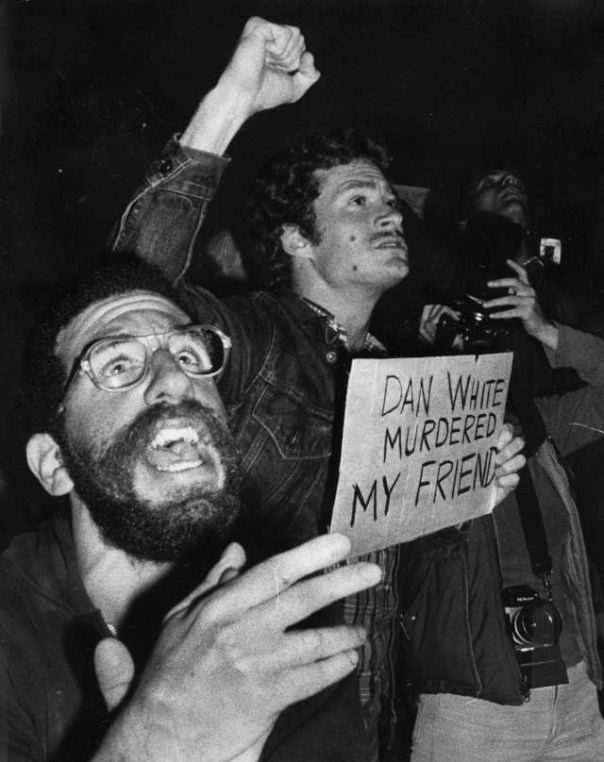
‘Dan White murdered my friend’: When anger boiled over into violence at City Hall and San Francisco police raided a Castro bar

On May 21, 1979, thousands of members of San Francisco’s predominantly gay Castro District community took to the streets to protest the lenient sentence received by Dan White for the murders of local politician and gay rights activist Harvey Milk and Mayor George Moscone. Their anger–combined with the actions of police who arrived to quell the scene–soon boiled over into rioting. The resulting violence affected San Francisco’s LGBT community for decades to come.

Harvey Milk rose to prominence as a gay rights activist and became the first openly gay person elected to a public office in the state of California when he was elected to the San Francisco Board of Supervisors in 1977. His murder, as well as that of Mayor Moscone, devastated not just the gay community, but the city as a whole.

Dan White was a former member of the Board of Supervisors who had clashed with Milk during their time serving the city together. In November of 1978, White resigned from his post, but changed his mind and asked to be reinstated. Mayor Moscone denied the request–with Milk lobbying against White’s reappointment. On November 27, White entered City Hall through a basement window and shot both men to death in their offices.

Six months later, White was convicted, not of first-degree murder, but voluntary manslaughter. White’s defense team had pointed to his diminished mental capacity and emotional state at the time of the murders, as indicated by the once-health conscious White consuming too much junk food– a ploy that became known as the “Twinkie Defense.” The jury-predominantly white, Roman Catholic and heterosexual—bought into it, recommending the lesser charge, which led to a sentence of just 7 years and 8 months.

When news of the verdict broke on the night of May 21, Cleve Jones–a close friend of Milk’s who would eventually go on to become one of the creators of the AIDS Quilt–spoke to a crowd of about 500 gatherers on Castro Street, and a peaceful march was quickly organized. By the time the crowd of protestors had made its second trip around the block, they were 1,500 strong. They then marched to City Hall, where their numbers expanded to an estimated 5,000.

As the crowd grew, so did the anger. Police soon arrived to try to control the situation, but that only served to enrage the crowd more. The police had raised over $100,000 for White’s defense–he was a former police officer–and many in the community believed the department had conspired to reduce White’s charges and sentencing. Although ordered to simply hold the crowd back, many officers began attacking the protestors with night sticks. Many had even taped over their badges, so as not to be identified.

Chaos erupted, as the crowd fought with police and destroyed a dozen police vehicles, as well as parts of City Hall itself. After three hours, officers moved in to quell the rioting for good, using tear gas in the process, and the crowd dispersed. In all, 59 officers and 124 protestors were injured, with about two dozen arrests made.

Hours later, several police officers gathered on their own to raid the Castro neighborhood, vandalizing a local bar and assaulting patrons. They shouted anti-gay slurs at the victims, and eventually turned their attention to attacking anyone that happened to be out on Castro Street.

After two hours, Police Chief Charles Gain was made aware of the rogue officers’ activities, and he made his way to the Castro to put a stop to it. No officers were reprimanded for the attacks, as officials were never able to determine who had ordered it, but the violence was finally over.

The next day, on what would have been Milk’s 49th birthday, 20,000 San Franciscans gathered to remember him. That October, more than 75,000 people marched for gay rights in Washington, D.C., and gay rights activists from around the country were inspired to continue their fight.

In San Francisco, the riots led to a wave of political changes, as more and more LGBT politicians were elected over the next decades. LGBT presence on the police forced also dramatically increased, and has continued to increase to this day.

Reference

Gay History: Student Homophile League at Earl Hall, Columbia University

OVERVIEW

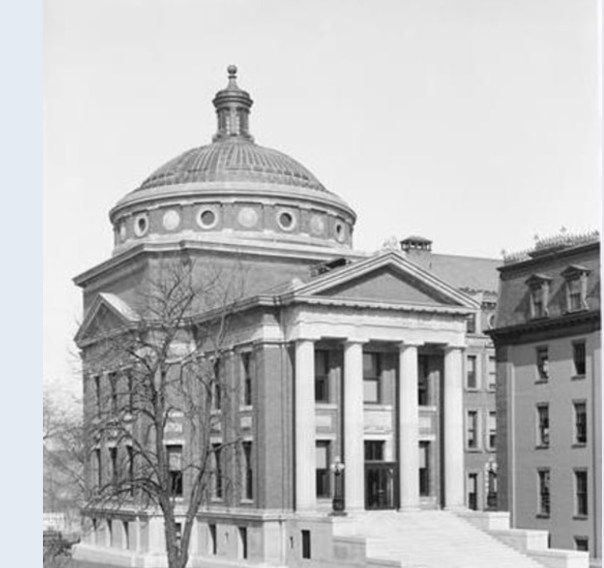
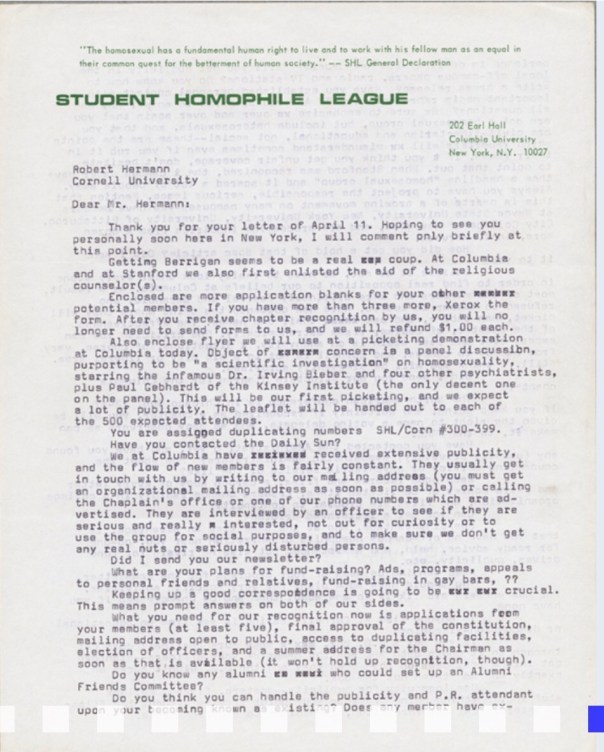
The Student Homophile League, the first gay student organization in the country, was founded at Columbia University in 1966 and held many of its activities in Earl Hall.

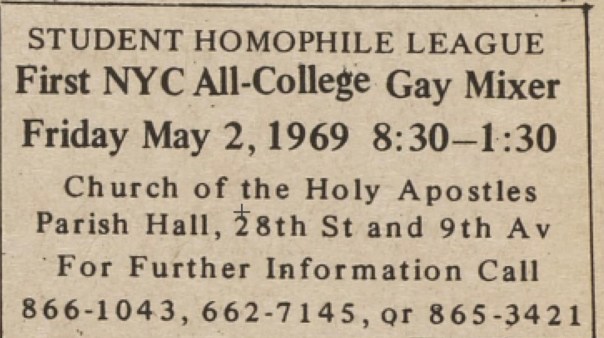
In 1970, the group became the more activist Gay People at Columbia (also known as Gay People at Columbia-Barnard), which sponsored a series of popular Friday-night dances in Earl Hall’s auditorium.

In 1971, gay students established a gay lounge in Furnald Hall, which is now known as the Stephen Donaldson Queer Lounge.

Credit: Christopher D. Brazee/NYC LGBT Historic Sites Project, 2016.

HISTORY

In 1966, Columbia University became the first collegiate institution in the United States, and possibly the first in the world, with an LGBT student group. In the fall of that year, bisexual sophomore Robert Martin (using the pseudonym Stephen Donaldson) founded the Student Homophile League (SHL) following a meeting with Columbia and Barnard representatives, religious advisers, and two of the most important national leaders for gay and lesbian rights, Frank Kameny and Barbara Gittings.

The small student group had the support of the university chaplain and, thus, gained space in Earl Hall, the center of student religious life. The university officially recognized the group in April 1967 with the stipulation that it not organize social events. A subsequent front page article in the New York Times resulted in outrage from hundreds of alumni and negative editorials in many newspapers; one alum wrote “Tolerance has its limits. Let the pansies go elsewhere.” The SHL sponsored lectures, held “rap sessions” about homosexuality on dorm floors, and advocated for the acceptance of homosexuals in society in generally, with specific emphasis on ending discrimination in the military and the psychiatric community.

By 1970, Columbia’s gay student group had become the more activist Gay People at Columbia (also known as Gay People at Columbia-Barnard), which sought to “present as complete a view as possible of the contemporary gay experience: socially, educationally and politically.” Its most popular activity was monthly Friday-night dances, beginning in 1970, held in the auditorium on the third floor of Earl Hall, which welcomed the entire gay and lesbian community of New York. The dances reached their peak popularity in the 1980s and were especially popular with those who enjoyed the relaxed atmosphere that contrasted with the clubs and bars downtown. The group still exists as the Columbia Queer Alliance (CQA) and hosts “First Friday” dance events in Alfred Lerner Hall.

In 1971, gay students, led by Morty Manford (later the head of the Gay Activists Alliance and son of PFLAG founder Jeanne Manford), requested space for a gay lounge. Although denied permission by the university, the group took over an unused space in the basement of the Furnald Hall dormitory. The lounge eventually was recognized by the university and the space is still in use, now known as the Stephen Donaldson Queer Lounge.

In March 2018, the NYC LGBT Historic Sites Project successfully nominated Earl Hall to the National Register of Historic Places, following its listing on the New York State Register in January 2018. The nomination is available in the “Read More” section below.

Reference

  • Student Homophile League at Earl Hall, Columbia University ,Student Homophile League at Earl Hall, Columbia University,

Weird Tales from My Year on Gay Dating Apps

I learned what “racial play” is and had a rather shitty experience with a “straight” guy who was into having sex with men.

ILLUSTRATIONS BY CLAIRE MILBRATH

After breaking up with a boyfriend in 2011, I wanted to explore online dating and give being single in Toronto a shot before jumping into anything serious. Unfortunately for me, I soon realized that the gay dating world came with its own set of rules, most of which are pretty weird and somewhat racist. Race, body shaming, identity politics, and masculinity seemed to come up a lot and eventually I just said “fuck it” and deleted every dating site I was on. I needed a break. I needed to hear something other than “looking for whites only” or “straight-acting only.” It got to a point where I felt shitty about wanting to get laid and needed give the online thing a rest.

In 2013, I came out of “online dating retirement” and decided to explore it again. Every so often I’d hear my friends gush about all the great dates and hot sex they were having on Grindr and Scruff. It took a lot of convincing, but I gave a few of these apps a shot. I downloaded both Grindr and Scruff and immediately starting messaging people. 

Throughout that year, there were a few really nice conversations that didn’t really go anywhere, the occasional good ass and/or dick pics, and an older couple in their 80s that always messaged me in Spanish. But aside from that, the string of weird encounters just got worse every time. In January, I finally deleted all the apps and have sworn off online dating and hookups for good. But it wasn’t all for nothing. Below, you’ll find three stories that I’ll probably never forget.

Picture Tag Gone Wrong

Around Thanksgiving last year, I got a message from an Irish guy visiting the city for a few weeks. I chatted him up about all things Ireland and told him about a trip I was planning for spring 2016. The vibe was friendly for the first few days, and then he wanted to see some pics, which I was more than willing to share. I sent a face pic to start and he sent one back. He was a bald, rugged, bearded man with green eyes. Suffice to say the dude was really hot and definitely checked off a few boxes in the “my type” department.

We talked for a week and he eventually asked me if I had a dick pic. I sent the most recent one and waited for him to send something back. Two hours later he sends a pic, but it’s not of a body part or another sexy face pic, it’s a picture of him and his sister with the caption “hot pic.” I wasn’t sure if this was a mistake or a joke, but I decided to just brush it off and send another dick pic. He then responded with a picture of him smiling with his grandmother, saying nothing else. 

Two days later he messaged me to ask what I was doing. I told him I was just enjoying my day off and asked him what he had planned for the day. He then sent a picture of his spread asshole dripping with cum, a picture of him and his dog, and then a picture of him having family dinner, again saying nothing else. At this point, I wasn’t even mad or upset. The dude clearly wasn’t serious. That or he had a fucked-up sense of humor. 

As funny as the whole thing was, I decided to stop communicating with him entirely. I often wonder what a dripping asshole, playing with your dog, and eating dinner with your family could be code for, but I guess I’ll ever know.

“Racial Play”
I messaged a guy after work one day just to see if he’d reply. He messaged me back and said he comes to Toronto for work every day and wondered if we could hook up later that evening. I told him we should drink a few beers at my place and see where it goes. He came over around 10:30 PM, and made a few weird comments about the beer we were drinking, calling it “hipster beer.” That sort of turned me off, but I decided not to read too much into it. 

I wasn’t expecting things to heat up after the weird beer comment, but after six beers we just went for it and started making out. Before things escalated, he stopped me and said he needed to tell me something. I remember being puzzled and asking what was wrong. He told me he was into a few kinks, but didn’t know how to talk about them. Fetish is always an awkward subject for people, but I assured him I wasn’t easily weirded out. He looked extremely flustered and scared to say it, but after about five minutes of circling around the big confession, he sheepishly blurted out that he was into “racial play.”

I kind of giggled and then looked at him again. At that moment I realized he was being serious and took a deep breath because, as a black man and a human being, the whole thing had just thrown me off. Solely based on curiosity, I asked him exactly what this type of roleplay scene would entail. It scared me to imagine where this conversation was going to go, but I still couldn’t quite process what I just heard. I’ve done some weird shit, but this whole thing was fucked up and I didn’t understand what turned him on about it exactly. He asked me if I was mad that he was into that. I told him no because I actually wasn’t pissed at all. After having another beer he got into the finer details of how a “racial play” scene would go down.

According to him, a play scene would involve me in a cage, getting choked with his dick, while he spits on me and calls me nigger a few times. He assured me that while it was a lot to handle, it was actually a pretty popular fetish. It’s just something that nobody talks about. I looked at him, extremely puzzled after that statement. He stood, confident in his belief that was an acceptable thing to get off to, and it took a minute for me to figure out the best way to respond. Wanting to end this interaction on a peaceful note, I told him that while I respect his honesty, the thought of a man getting off to calling me racial slurs and performing violent sex acts on me was enough to make me want to commit murder.

When I said that he laughed it off, but once he saw the expression on my face, I could tell he knew it was probably in his best interest to call it a night. After he left I Googled “racial play” and found a lot of crazy shit, most of which I wish I could unsee. There are certain thoughts and images that linger in the subconscious and lead us to the fetishes we have. I think most things are fair game, but if me picking cotton gets you horny, there probably won’t be a second date.

Runaway Cucumber
One of the first guys I met on Grindr was a university student who had just moved to Toronto for school. During our first hangout we drank a few beers and talked about Toronto, which was a nice change from the usual in-and-out hook up. We immediately hit it off and it turned into an ongoing thing. We met up for sex about twice a month for a couple of months. It was really low-key, which has awesome because I wasn’t after anything serious at the time.

One night he came over and dropped a bomb on me. Apparently he had a girlfriend, which was news to me. He said he wasn’t gay—he just met up with guys because his girlfriend wasn’t into anal play. This all seemed messy and complicated, so I told him we should cool it on the sex until he and his girlfriend had a serious conversation. It would be one thing if they were in an open relationship, but it seemed more like their lack of communication had led to him sneaking out to get fucked by guys behind her back. It just didn’t seem healthy for me to continue sleeping with him if that was the case.

He texted me out of the blue three months later, asking if we could meet. I had my reservations about it, but I decided to let him stop by and get an update on what was going on with him and his situation. He came over and immediately went for my crotch, but before I could let it go any further, I needed to ask what the status of his relationship was. Apparently he had broken up with his girlfriend and was exclusively fucking guys. The way he talked about these new relationships was very strange. He maintained that he was still straight, but just really loved bottoming and couldn’t get enough.

We proceeded to play around a bit and eventually I was fucking him. I don’t know if fate was punishing me for allowing my thirst to blind me from the obvious mess of a situation this was, but ten minutes into it I’d felt something wet go down my leg. Let’s just say that he wasn’t ready to bottom and by the time I stopped the evidence of that was all over my bed.

When you’re having butt sex, there’s always the slight possibility of a little shit, but this was literally a shit storm. He felt really bad and I didn’t want to make a big deal about it, so I said we should just shower and call it a night. I let him go first so I could throw away the sheets and after he got out I went in to get myself cleaned up. When I walked out of the shower, what I saw him doing brought new meaning to the phrase “by any means necessary.” I stood quietly by the door and watched as he began squatting down on a cucumber from my fridge, trying to fuck himself with it. He was jerking off and heavily breathing as he attempted to fit the entire cucumber up his ass.

After a minute or so, I purposely slammed the bathroom door and he freaked out when he saw me standing there. He could tell I was pissed and he kept trying to avoid eye contact. I asked him what he was doing still naked, which left him stuttering as he tried to make up a good excuse. I snatched the cucumber out of his hand and asked him to put on his clothes while I finished getting dressed in the bathroom. 

After we were both dressed I walked him out of my apartment and told him he shouldn’t contact me again. I didn’t want to be an asshole, but between his first lie about the girlfriend and the shit-stained bed I had to throw out, I felt like the universe was trying to tell me this needed to end.

To make matters worse, when I went back into the house, I checked the fridge and the fucking cucumber was gone. I was short an ingredient for my next lunch. I ordered a new bed and went to buy groceries the next day. Thank you universe! I definitely got the message.

Reference

Gay History: More Than Words: Gay Pt. 1 — We’re Going Gay

“Gay” was the first queer word I ever learned, and the first queer thing I ever called myself.  Something about “lesbian” didn’t sit right with me, and I wasn’t yet aware of reclamation, of the bright side of pejoratives — the spark that happens when you turn a weapon on itself. Plus I liked the sneakiness. Gay meant happy, right? You could claim it while admitting nothing. It was a rainbow dream mask.

But even before it got the rest of its colors, this word blushed. Pleasure, joy, and other gaieties are perpetually societally fraught, and gay has the scars to prove it — it’s been punned on, leaned on, worn proudly, hidden behind, argued over, and ping-ponged across the net of respectability ever since it was invented. If words could break, gay might have a long time ago. Luckily it bent instead. Here’s the beginning of how it happened.

The most common etymology of the word “gay” has it rooted in the Proto-Indo-European root *gey- (“to go”). This evolved into *gheng- (“to stride”) which became the Proto-Germanic *ganhaz/*ganhwaz (“sudden”), and then the Old High German gahi (“quick, impulsive”). The move to Old French jai (“merry”) brought the recognizable definition and a nice modern jauntiness. Jai became gai likely due to the influence of Gothic gaheis (“impetuous”), and soon we had the Middle English gay, direct ancestor of the word we use today.

Easy enough — except that etymology is an inexact science based on barely traceable exchanges that took place thousands of years ago, so not everyone agrees on what happened. Anatoly Liberman has an alternate theory that roots gay in Old High German wahi (“shining”/”beautiful”), based on a g/w interchangibility that we see borne out in word pairs like “guardian” and “warden,” or “guerrilla” and “war.” But he’s even more attached to a different explanation from the 19th century master Frank Chance. An “excellent etymologist, now almost forgotten,” Chance used to publish almost exclusively in Notes and Queries, a quarterly where scholars and hobbyists traded notes and asked each other questions — kind of like an early Formspring, but for linguistics and lexicography. In an 1861 Note, Chance took on “gay” via an analogy to the French gaîne, or “sheath,” which comes from the Latin vagina, also “sheath” (and also your bonus etymology-of-the-day).

“SON, WE SHALL NAME YOU FRANK CHANCE, DOOMING YOU TO A LIFE OF GAMBLING AND/OR ETYMOLOGY”

“The g in gaîne,” Chance explains, “corresponds to the v in vagina… In a similar way, I think, our adjective “gay” might be readily deduced from the Latin vagus, or perhaps from the corresponding Italian vago, which means both wandering, roaming, and pleasant, agreeable.” About a century and a third later, German linguist Harri Meier added some evidence to the pile, listing Italian cognates like svagarsi (“amuse oneself”) and svago (“diversion”).

I have also become attached to this theory, not only because it’s more fun, but also because it means that the start of  gay’s backstory involves a gradual influx of positive feeling — what semantician Stephen Ullman calls an “amelioration of meaning.”  As Liberman points out, the Latin vagus often meant “flighty” or “frivolous,” which, though not the worst possible things to call someone, aren’t as sunshiney as the merriment and joie de vivre implied by “gay” — see, for example, Propertius’s Elegy V, in which a “vagis puellis” is compared negatively to Cynthia, a “docta puella” or “learned girl,” and Propertius’s perpetual muse.  So somewhere over the course of its initial leap into English, gay enjoyed a rise in reputation — a fine beginning for a word that would spend the rest of its life undergoing a roller coaster ride of semantic shifts.

“Gay” first hit paper in 1325, in a transcription of a Middle English song called “Blow, Northerne Wynd.” When I started reading it, I thought it was about how the narrator would brave the northern wind to get to his beloved, who is described as semly and menskful and lossom (“seemly,” “worshipful,” and “lovely,” if you prefer boring new English words). But in the end, he’s actually asking the wind to blow his suetyng (“sweetheart”) to him, which honestly sounds kind of mean and lazy. Dave Wilton found the relevant stanza:

“Heo is dereworþe in day
graciouse, stout, ant gay
gentil, iolyf so þe iay
worhliche when heo wakeþ.
Maiden murgest of mouþ;
bi est, bi west, by norþ ant souþ,
þer nis fiele ne crouþ
þat such murþes makeþ.
Blow northerne wynd!
Send thou me my suetyng!
Blow northerne wynd! blow, blow, blow!”

(TRANSLATION: “She is precious in day / gracious, stout, and gay / gentle, jolly as the jay/ noble when she wakes. / Maiden merriest of mouth / by East, West, North and South / Neither fiddle nor crowd / Makes such abundance. / Blow northern wind! / Send me my sweetheart! / Blow northern wind! Blow, blow, blow!”)

Gay is a nice-sounding, one-syllable word that rhymes with a lot of things — all the makings of a poetic mainstay. To the delight of decades of middle school English students, no one could get enough of it for centuries and centuries. Chaucer used it in 1385. Robert Mannyng used it in his “story of England,” in the late 14th century. The lyrics of “Deck The Halls” are from 1862. Shakespeare used it thirteen times in total. Here’s Iago, in Othello, written in 1603: “She that was ever fair and never proud / Had tongue at will and yet was never loud / Never lack’d gold and yet went never gay.” I’m trying to be mature here but Shakespeare makes it hard.

DON’T LISTEN TO HIM, DESDEMONA! YOU’RE BETTER OFF GOLD AND GAY

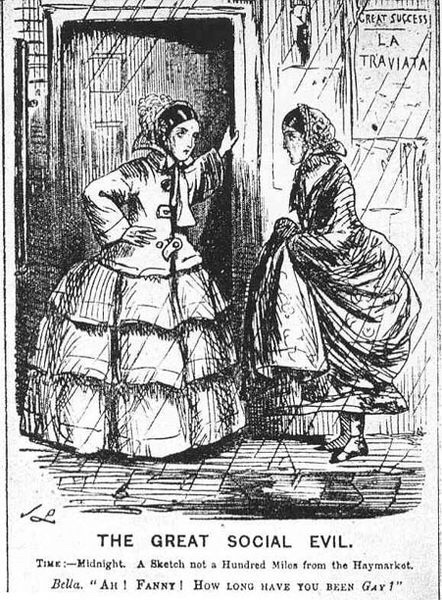
Over this time, though, “gay” began experiencing a “pejoration of meaning” — it’s the opposite of the aforementioned amelioration, and you use it when a word’s reputation starts going downhill. Some think this started as far back as the 14th century, but it was definitely established by the 17th, when, according to the OED, it was generally used to describe those “addicted to pleasures and dissipations.” Carefreeness had flipped back to frivolity. You can even see it in the above Shakespeare, as Iago uses “gay” to mean “flashy” and sets it in parallel with pride and loudness, two then-undesirable traits). This frivolity developed into a general lack of inhibitions, and often referred to sexual carefreeness — by at least 1799, a “gay man” was a womanizer, a “gay woman” a prostitute, and a “gay house” a brothel.

A DIFFERENT KIND OF COMING OUT (VIA PUNCH MAGAZINE ARCHIVES)

In a nice return to its roots, “to go gay” was to live a life of hedonism. For proper usage, see this sentence, from Edward Montague Compton MacKenzie’s Carnival, that was far ahead of its time:

“After dinner Jenny went back to Hagworth Street, and had a flaming quarrel with her mother, who accused her of “going gay”; demanded to know how she dared put in an appearance dressed in another woman’s clothes; insisted she was to come home immediately after dinner; forbade a hundred things, and had the door slammed in her face for the advice.”

While this meaning became more prevalent, another now-familiar one snuck up alongside it. Next time we’ll talk about when gay started meaning what it does now — and take another few dips up and down the semantic roller coaster.

Reference

Gay History: The Mystery Photos Of A 1957 Gay Wedding

ONE Archives at USC

Decades before gay marriage became legal anywhere in the US, same-sex couples were committing themselves to each other in front of friends and loved ones. Few records of these ceremonies existed – until now, writes Jonathan Berr.

In 1957, a man dropped off a roll of film at a pharmacy in Philadelphia. But the developed photos were never returned to their owners.

The pictures appear to depict a gay wedding, nearly 50 years before same-sex marriage was legal anywhere in the US and almost 60 years before it became a federally-recognised right.

Now, a trio of gay producers and writers are trying to identify the grooms to learn their story and to find out whether a pharmacy employee balked at providing the snaps because they objected to their subject.

The writers are documenting their efforts in a reality show The Mystery of the 1957 Gay Wedding Photos.

The programme, which doesn’t yet have a platform to call home, is being produced in conjunction with Endemol Shine Group, whose shows include Big Brother, The Biggest Loser and Extreme Makeover: Home Edition.

ONE Archives at USC

“It’s a passion project for us,” says Michael J. Wolfe, a Los Angeles-based writer. “We are turning over every stone, interviewing dozens of people in the Philadelphia area and beyond, and consulting with investigators, historians, and experts across many different fields.”

The photos were acquired by a collector a few years ago who had bought them at an online auction. He realised their significance and donated them to ONE Archives at the USC Libraries in Los Angeles and at the Wilcox Archives in Philadelphia.

The couple in the pictures appear to be in their 20s or 30s, so they would be in their 80s or 90s if they were alive today. The grooms and their guests are dressed up in dark suits with flowers in their lapels.

The celebration took place in a modest flat with the blinds drawn. It featured a ceremony officiated by someone who appears to be a member of the clergy. The grooms are shown kissing, cutting their wedding cake and opening presents.

ONE Archives at USC

Mr Wolfe and his partners, filmmaker PJ Palmer and TV writer/producer Neal Baer, have not identified the mystery couple yet. 

They request any tipsters to contact them through their website and Facebook page.

ONE Archives at USC

For Palmer, the pictures were especially moving.

“We are recovering amazing, important stories all sorts of them… and more gay history that’s been buried,” he says.

“There is a very rich history that’s been suppressed… I wish as a child [that] I had seen family photos of a marriage like this… I would have felt more normal as a kid. I would have known that I was okay.”

Couples who fell in love sometimes committed themselves to one another in unions that were not acknowledged by either governments or religions.

The US Supreme Court didn’t recognise the right for gay people to marry the person of their choice until 2015, 11 years after Massachusetts did so.

ONE Archives at USC

“We don’t know how common or uncommon it was for couples to hold ceremonies to marry each other [because] there is so little photographic or film record of how people actually lived,” says Eric Marcus, host of the Making Gay History podcast.

“It’s important to remember that people found ways to live their lives quietly away from the prying eyes of the straight world.”

Of course, that was easier said than done.

Wedding guests at the mystery wedding ONE Archives at USC

Several years before the wedding took place, President Dwight Eisenhower signed an executive order banning gays from working for the federal government.

In 1952, The American Psychiatric Association classified homosexuality as a “sociopathic personality disturbance” in the first edition of its Diagnostic and Statistical Manual (DSM), the listing of known psychiatric disorders.

After considerable lobbying by activists, the APA removed homosexuality from the second edition of the DSM in 1973.

The Stonewall Riots, considered to be the birth of the modern gay rights movement, had happened a few years before that in 1969 – 12 years after the wedding.

ONE Archives at USC

It’s not just the passage of time that will hinder the search for the grooms. The filmmakers believe the Aids crisis may also be factor – about 700,000 Americans have died since the start of the epidemic in the 1980s, according to the Kaiser Family Foundation.

“We are talking about a generation of people who were decimated by Aids,” Mr Wolfe said. “There are a lot of missing people who otherwise would have made a search like this much easier. All of that happened before social media.”

If the couple is ever identified, they would certainly add another chapter in the history of gay rights for doing something extraordinary that is now becoming increasingly ordinary.

Reference