Tag Archives: buggery

Bugger: From Heresy to Humour – The Extraordinary Journey of One English Word

The English language contains few words as adaptable—or as misunderstood—as bugger. Depending on where you are and how you say it, it can express annoyance, affection, admiration, sympathy, frustration, disbelief, or simple bad luck. In Australia and Britain it is often almost harmless, while in North America it remains far stronger and far less common.

Yet behind this everyday expression lies a surprisingly dark history involving medieval religious persecution, sexual laws, kings, executions, and changing social attitudes. Like many words, bugger has travelled a long way from where it began.

A Word Born from Heresy

The origins of bugger have nothing to do with swearing.

It derives from the Medieval Latin Bulgarus, meaning Bulgarian.

During the Middle Ages a Christian religious sect known as the Bogomils flourished in Bulgaria. The Bogomils were considered heretics by both the Roman Catholic and Eastern Orthodox Churches. Their beliefs rejected many official church teachings, wealth, elaborate ceremonies and ecclesiastical authority.

As often happened in medieval Europe, theological disagreement soon became moral slander.

Church authorities accused these heretics of every imaginable vice. Among those accusations were allegations of “unnatural sexual practices.” Whether such accusations had any basis in reality is doubtful. Medieval authorities routinely associated heresy with moral corruption to justify persecution.

By the thirteenth century, words derived from Bulgarus had entered French as bougre, referring not simply to a Bulgarian, but to a heretic supposedly guilty of sexual depravity.

English later borrowed the word as bugger.

Thus an ethnic description became an accusation.

From Insult to Criminal Offence

During the late Middle Ages the word became increasingly associated with male homosexual acts.

English law eventually adopted the term as a legal definition.

This culminated in one of England’s harshest pieces of legislation.

In 1533, during the reign of Henry VIII, Parliament passed the famous Buggery Act.

The Act defined buggery as a capital crime.

Although modern readers often assume the law targeted homosexuality alone, its scope was much broader. Depending on the period and interpretation, it covered:

Sexual relations between men.

Bestiality.

Certain forms of heterosexual intercourse considered “against nature.”

The law carried one terrifying penalty:

Death.

Unlike many church offences, this became a matter for the Crown rather than ecclesiastical courts.

Thousands of lives would be shaped—or destroyed—by laws based upon this terminology over the following centuries.

Ironically, by this stage the original connection with Bulgarians had long since been forgotten.

A Convenient Insult

By the seventeenth century the legal meaning remained, but everyday speech had broadened considerably.

Someone could be called:

“You bugger.”

without necessarily accusing them of homosexual activity.

Instead it implied someone was:

troublesome

dishonest

irritating

mischievous

contemptible

Gradually the sexual meaning faded in ordinary conversation.

Instead, bugger became simply a colourful insult.

Britain Makes It Funny

One reason the word survived is that the British possess an extraordinary ability to drain offensive language of its sting through humour.

Today, among friends, bugger often carries almost no real hostility.

Examples include:

“Lucky bugger.”

Someone who has enjoyed unexpected good fortune.

“Poor bugger.”

Someone deserving sympathy.

“Silly bugger.”

Someone behaving foolishly.

“Funny bugger.”

An eccentric individual.

“Crafty bugger.”

Someone surprisingly clever.

“Old bugger.”

Often used affectionately about elderly men.

Notice how context completely changes the meaning.

Tone matters more than the word itself.

Australia Adopts It

Australians inherited these expressions enthusiastically.

In Australian English the word became almost a national institution.

You might hear:

“Bugger me!”

Expression of surprise.

“Bugger that!”

Absolutely not.

“Bugger off!”

Go away.

“Bugger all.”

Almost nothing.

“I’m buggered.”

Completely exhausted.

“Everything’s buggered.”

Broken beyond repair.

“Bugger!”

Something has gone wrong.

Australians have an extraordinary ability to fit the word into almost any conversation.

It often carries little genuine offence.

Indeed, hearing an Australian exclaim “Bugger!” after dropping the barbecue tongs probably says more about gravity than sexuality.

The Toyota Advertisement

Perhaps the clearest sign that the word had entered mainstream Australian culture came in 1999.

Toyota released a television commercial featuring farmers, fishermen and ordinary Australians repeatedly saying one word:

“Bugger.”

The advertisement became one of Australia’s most famous commercials.

Some television stations initially refused to air it.

Others received complaints.

Yet many viewers regarded it as harmless Australian humour.

Ironically, the controversy made the advertisement even more popular.

It demonstrated just how differently Australians viewed the word compared with more conservative English-speaking societies.

Is It Still Offensive?

The answer depends entirely upon where you are.

Australia

Usually mild.

Often humorous.

Frequently affectionate.

Britain

Generally considered low-level profanity.

Common among older generations.

Often heard on television.

United States

Far stronger.

Many Americans know the word only in its original sexual sense.

Consequently it sounds much harsher than it does in Australia.

Within the Gay Community

This is where history becomes especially interesting.

Historically, bugger was often directed at gay men as an insult because of its association with sodomy laws.

Today many gay men—particularly in Britain and Australia—use it without any reference to sexuality at all.

Like many formerly offensive words, context and speaker matter enormously.

Among close friends it may simply be comic exaggeration.

Used maliciously by strangers, however, it can still evoke its long history as a term of abuse.

Language Loses Its Baggage

The evolution of bugger illustrates one of the great truths about language.

Words rarely remain fixed.

Their meanings shift with society.

What begins as an ethnic label becomes a theological accusation.

The accusation becomes a criminal offence.

The legal term becomes an insult.

The insult becomes a joke.

Eventually many speakers forget entirely where it came from.

Few Australians saying “Bugger me!” while changing a tyre realise they are unknowingly using a word whose ancestry stretches back through medieval heresy, Henry VIII’s legal reforms and centuries of persecution.

The Curious Expression “Bugger All”

One particularly Australian and British phrase deserves special mention.

Bugger all means almost nothing.

Examples include:

“I’ve got bugger all money.”

“There was bugger all left.”

Its origins remain uncertain.

Most linguists believe it simply evolved from using bugger as an intensifier, eventually producing a colourful expression meaning “virtually none.”

Despite its vulgar origins, many speakers use it almost unconsciously.

Why Has It Survived?

Unlike many swear words, bugger is unusually flexible.

It can express:

anger

surprise

admiration

affection

sympathy

exhaustion

disbelief

disappointment

humour

Very few English words perform so many different emotional functions.

Its versatility has ensured its survival.

Conclusion

Few words demonstrate the unpredictable life of language better than bugger. Born from medieval religious conflict, shaped by centuries of legal persecution, and once associated with one of England’s most severe criminal offences, it has become—at least in Britain and Australia—a remarkably adaptable piece of everyday speech.

That transformation reminds us that words are not fixed monuments but living things. They accumulate meanings, lose old ones, and reflect the changing values of the societies that use them. The journey of bugger from the courts of Henry VIII to the Australian barbecue is one of the most extraordinary semantic adventures in the English language.

Today, whether uttered in frustration after dropping a hammer, affectionately describing a lucky mate, or as the punchline to a joke, the word carries echoes of a thousand years of history—though few who say it would ever suspect that such a humble expletive began life as a reference to medieval Bulgarian heretics.

Tim Alderman ©️2026

Sources

Oxford English Dictionary (entries: bugger, buggery, bougre)

Geoffrey Hughes, An Encyclopedia of Swearing: The Social History of Oaths, Profanity, Foul Language and Ethnic Slurs (M.E. Sharpe, 2006)

Eric Partridge, A Dictionary of Slang and Unconventional English

Paul Baker, Fantabulosa: A Dictionary of Polari and Gay Slang

Randolph Quirk et al., The Oxford Companion to the English Language

H.G. Cocks, Nameless Offences: Homosexual Desire in the Nineteenth Century

The Buggery Act 1533 (25 Hen. VIII c.6)

James A. Brundage, Law, Sex and Christian Society in Medieval Europe

David Crystal, The Stories of English
It’s Gone to Buggery: How Australians Turned a Tudor Capital Crime into a National Expression Part 3

Toyota and One Word That Captured Australia

If anyone doubted that bugger had become part of mainstream Australian English, Toyota settled the argument in 1999.

The television commercial was deceptively simple.

A succession of Australian farmers, stockmen, tradesmen and country characters encountered everyday mishaps.

A gate refused to open.

Livestock escaped.

Equipment failed.

The response was invariably the same.

“Bugger.”

The advertisement became an instant classic.

Ironically, complaints arrived almost as quickly as the laughs.

Some viewers regarded the word as offensive.

Others couldn’t understand what all the fuss was about.

For millions of Australians, however, Toyota had simply reflected everyday speech.

Many people who would never dream of using stronger profanity thought nothing of saying “bugger.”

The commercial became one of Australia’s most memorable advertising campaigns, not because it was shocking, but because it was instantly recognisable.

It spoke Australian.

Lost in Translation

Interestingly, the word rarely travels well.

Visitors from the United States often find Australian uses of bugger confusing.

American English developed along a different path.

Expressions such as:

“Poor bugger.”

“Lucky bugger.”

“Funny bugger.”

carry little emotional weight in Australia, yet can sound surprisingly harsh to overseas ears.

Likewise, Australians visiting Britain occasionally discover that some uses of the word retain a stronger edge than they do at home.

Language is never universal.

It reflects the history of the people who speak it.

A Word and the Gay Community

No discussion of bugger would be complete without acknowledging its place in gay history.

For centuries, the word was unquestionably associated with accusations directed at men suspected of same-sex relationships.

It appeared in legal documents.

Court records.

Religious sermons.

Newspaper reports.

Schoolyard insults.

For many gay men, particularly those who grew up before decriminalisation, the word could evoke painful memories of discrimination and social rejection.

Yet language is rarely experienced in exactly the same way by everyone.

Many Australians of your generation—including many gay men—have spent decades hearing the word used in completely non-sexual ways.

Someone says:

“Poor bugger.”

No offence is intended.

Someone remarks:

“The mower’s buggered.”

No reference to sexuality exists.

Another says:

“Bugger all happened today.”

Again, the original meaning has all but disappeared.

Others, however, still dislike the word because they remain conscious of its history.

Both responses are understandable.

Words carry different emotional baggage depending upon our own experiences.

What one person hears as harmless Australian slang, another may hear as an echo of prejudice.

Neither reaction is inherently right or wrong.

Both reflect lived experience.

The People’s Language

Linguists often observe that governments create dictionaries of law.

Ordinary people create dictionaries of language.

The Buggery Act attempted to define a crime.

Australians eventually redefined the word itself.

No parliament voted for the change.

No court approved it.

No academic committee planned it.

It simply happened.

One conversation at a time.

One generation after another.

The language quietly slipped its legal leash.

Henry VIII Would Never Have Believed It

There is delicious irony in imagining Henry VIII transported into twenty-first-century Australia.

He wanders into a suburban barbecue.

Someone drops the sausages.

Another discovers the gas bottle is empty.

The cricket is on television.

Australia has just lost three wickets for two runs.

Someone scratches his head and sighs:

“Well…it’s all gone to buggery.”

Henry waits.

Surely arrests will follow.

Surely someone will summon a magistrate.

Instead…

Everyone laughs.

Someone opens another beer.

Another throws fresh sausages onto the barbecue.

Life moves on.

One suspects the King would be utterly bewildered.

Five centuries earlier, he had transformed the word into one of the most serious offences known to English law.

Now it had become little more than an expression of mild inconvenience.

History, it seems, has a sense of humour.

The Australian Genius for Understatement

Perhaps this is what the story really tells us.

Australians have always preferred resilience to melodrama.

Rather than dwelling upon catastrophe, they reduce it to a sentence.

The cyclone was “a bit of a blow.”

The drought was “a bit dry.”

The old ute is “a bit buggered.”

The expression is not intended to minimise hardship.

It is intended to make hardship bearable.

Humour becomes a form of endurance.

Language becomes a form of resilience.

That spirit has shaped Australian English from the earliest convict settlements to the present day.

Conclusion

The journey of the word bugger is one of the most extraordinary stories in the English language.

Born from medieval accusations of heresy, transformed into a legal term under Henry VIII, feared for centuries as the name of a capital crime, it eventually crossed oceans with convicts, soldiers and settlers to Australia.

Here, something remarkable happened.

Australians stripped the word of much of its original terror.

They laughed at it.

Adapted it.

Softened it.

Turned it into a dozen expressions of affection, sympathy, annoyance, surprise and resignation.

In doing so, they demonstrated an enduring truth about language.

Governments can pass laws.

Kings can impose punishments.

Courts can define crimes.

But only ordinary people decide what words will ultimately mean.

Today, when an Australian shrugs and says:

“Well…it’s all gone to buggery.”

they are almost certainly not thinking about Henry VIII, Tudor law or medieval theology.

They are participating in a uniquely Australian tradition of meeting life’s frustrations with humour rather than despair.

That, perhaps, is the greatest irony of all.

A word once capable of sending a person to the gallows now most commonly accompanies a burnt snag, a flat tyre, a broken lawn mower or a cricket collapse.

If Henry VIII could hear it today…

…he’d probably think the English language had gone to buggery.

Tim Alderman ©️2026

Sources

Bruce Moore, Speaking Our Language: The Story of Australian English.

Bruce Moore (ed.), The Australian Oxford Dictionary.

Sidney J. Baker, The Australian Language.

G. A. Wilkes, A Dictionary of Australian Colloquialisms.

Green’s Dictionary of Slang.

The Oxford Dictionary of Slang.

Australian National Dictionary Centre.

National Film and Sound Archive of Australia (Toyota “Bugger” advertising campaign).

Oxford English Dictionary (etymology of bugger, bougre and buggery).

It’s Gone to Buggery: How Australians Turned a Tudor Capital Crime into a National Expression Part 2

Australia’s Great Linguistic Makeover

By the late nineteenth century, Australia had developed a reputation for treating the English language rather differently from the English themselves.

Where Britain often preserved distinctions of class through speech, Australians delighted in flattening them.

Judges, labourers, politicians and shearers all became simply “mate.”

Titles were shortened.

Names became nicknames.

Authority became something to be gently mocked rather than feared.

Even the language of the law was not immune.

If there is one characteristic that distinguishes Australian slang, it is its extraordinary ability to rob serious words of their solemnity.

This is a nation that affectionately calls redheads “Blue,” enormous men “Tiny,” and someone who has just suffered a spectacular mishap “a poor bugger.”

Nothing remains serious for very long.

Including words once associated with the gallows.

Bugger Becomes Australian

By the twentieth century, bugger had become one of the most versatile words in Australian English.

It no longer required any connection whatsoever with sexuality.

Instead, context supplied the meaning.

That single word could express sympathy.

Admiration.

Disbelief.

Frustration.

Affection.

Envy.

Humour.

Or simple resignation.

Few words in the English language perform so much work with so little effort.

It is, in many respects, the Swiss Army knife of Australian slang.

The Australian Dictionary of “Bugger”

If an overseas visitor wanted to understand Australia, they could do far worse than learning the many meanings of one remarkable word.

Bugger

Perhaps the simplest form.

Depending entirely upon tone, it may mean:

An idiot.

A nuisance.

An amusing rogue.

Or merely “that fellow.”

Examples:

“Who’s that bugger over there?”

“He’s a decent old bugger.”

“That little bugger pinched my sandwich.”

Notice that none of these expressions necessarily carries genuine hostility.

Indeed, some are positively affectionate.

Bugger It

Australia’s universal expression of surrender.

The printer jams.

The rain begins.

The barbecue won’t light.

Rather than becoming dramatic, Australians simply announce:

“Bugger it.”

Translation:

“I’ve reached the point where further effort seems pointless.”

It represents resignation rather than rage.

Buggered

Perhaps Australia’s favourite variation.

It has dozens of meanings.

“I’m buggered.”

Exhausted.

“The washing machine’s buggered.”

Broken.

“The holiday plans are buggered.”

Ruined.

“We’re buggered.”

Hopeless situation.

“That’s buggered the whole project.”

Completely disrupted.

Few languages possess a single adjective capable of covering such extraordinary territory.

Bugger All

An expression meaning almost nothing.

Examples:

“There’s bugger all left.”

“He knows bugger all about history.”

“We’ve had bugger all rain.”

It is concise.

Emphatic.

Entirely Australian.

Poor Bugger

Perhaps the gentlest use of the word.

It expresses sympathy.

Compassion.

Even affection.

“Poor bugger lost his house.”

“Poor bugger’s worked all weekend.”

There is nothing insulting about the expression.

Indeed, it often signals genuine concern.

Lucky Bugger

Envy without bitterness.

“Won first prize again.”

“Lucky bugger.”

Australians rarely resent success openly.

They are far more likely to tease the successful person than flatter them.

Funny Bugger

One of Australia’s favourite character assessments.

A “funny bugger” is not necessarily humorous.

He may simply be eccentric.

Unpredictable.

Difficult.

Slightly odd.

Every town appears to have one.

Silly Bugger

Self-explanatory.

Usually delivered with affection.

Occasionally directed at oneself.

“I locked myself out.”

“Silly bugger.”

Old Bugger

One of Australia’s great contradictions.

It can sound insulting.

Yet among friends it is frequently affectionate.

“He’s a good old bugger.”

One sentence.

Three compliments.

No offence intended.

Australian Humour at Work

These expressions reveal something deeper than vocabulary.

They reveal a national temperament.

Australians have long preferred understatement to melodrama.

A catastrophic mechanical failure becomes:

“She’s a bit buggered.”

A disastrous cricket collapse becomes:

“Well…that went to buggery.”

A life-changing setback becomes:

“Could’ve been worse.”

This tendency has puzzled overseas visitors for generations.

It reflects a culture shaped by droughts, bushfires, floods, isolation and economic uncertainty.

Humour became a practical coping mechanism.

Language followed.

The Great Australian Equaliser

One remarkable feature of Australian slang is that it often removes social hierarchy.

A millionaire may be called:

“Lucky bugger.”

A pensioner:

“Poor bugger.”

A Prime Minister:

“Silly bugger.”

An Olympic champion:

“Clever bugger.”

The word itself conveys surprisingly little.

Everything depends upon context, tone and relationship.

In this respect, Australians trust shared understanding more than precise vocabulary.

Did Australians Forget the Original Meaning?

Not entirely.

Most Australians understand that the word once possessed sexual connotations.

Few, however, think about them when speaking.

The process is known as semantic drift, where a word gradually acquires new meanings far removed from its origins, and semantic bleaching, where its emotional intensity fades through repeated everyday use.

This explains why an Australian can sincerely express sympathy by saying:

“Poor bugger.”

without making the slightest reference to sexuality.

Language evolves because speakers evolve.

Governments can legislate behaviour.

They cannot permanently legislate meaning.

Tim Alderman ©️2026

It’s Gone to Buggery: How Australians Turned a Tudor Capital Crime into a National Expression Part 1

Introduction

Few expressions are more unmistakably Australian than the resigned declaration:

“Well…it’s all gone to buggery.”

The car won’t start.

The lawn mower dies halfway through mowing.

Your football team is thirty points down at half-time.

The computer crashes just before you’ve saved two hours of work.

Without missing a beat, someone mutters:

“Bugger.”

Or perhaps:

“Bugger it.”

Or simply:

“It’s gone to buggery.”

To most Australians, these expressions are little more than colourful ways of acknowledging that things have gone spectacularly wrong. They belong to the same rich tradition of Australian understatement that turns disasters into jokes and frustrations into stories worth telling over a beer.

Yet few Australians realise that these harmless expressions descend from one of the most feared words in English legal history.

Five hundred years ago, “buggery” was not a joke.

It was a capital crime.

Conviction could lead to execution.

Property could be confiscated.

Families could be ruined.

The word itself carried a fear that is almost impossible to appreciate today.

Its transformation from a crime punishable by death into an affectionate piece of Australian slang is one of the most remarkable journeys in the history of the English language.

Like so much Australian English, it is also a story of ordinary people refusing to allow authority—even linguistic authority—to dictate how words should be used.

A Word Born Far from Australia

Ironically, the story begins nowhere near Australia, England or even Britain.

Its origins lie deep within medieval Europe.

The English word bugger ultimately derives from the Old French bougre, itself originating from the Medieval Latin bulgarus, meaning “Bulgarian.”

At first glance, this makes little sense.

What do Bulgarians have to do with Australian slang?

The answer lies in medieval religious conflict.

During the Middle Ages, a Christian movement known as the Bogomils emerged in Bulgaria. Their beliefs differed significantly from those of the established Church, and they were declared heretics by both the Eastern Orthodox and Roman Catholic Churches.

As often happened in medieval Europe, accusations soon moved beyond theology.

Opponents accused heretics of every imaginable vice.

Immorality.

Devil worship.

Sexual depravity.

Many of these allegations were little more than propaganda designed to discredit religious opponents.

Gradually the word bougre ceased referring specifically to Bulgarians and instead became a general insult meaning heretic, villain or morally corrupt person.

Only later did it acquire specifically sexual meanings.

The original Bulgarians had long since disappeared from the story.

The insult remained.

Henry VIII Gives the Word Teeth

For centuries, the word existed largely within religious vocabulary.

Then came Henry VIII.

As we explored in the previous article, Henry’s Buggery Act of 1533 transformed what had largely been an ecclesiastical offence into a secular crime prosecuted by the Crown.

From that point onwards, buggery ceased being merely a theological concept.

It became a legal one.

Its consequences were terrifying.

Conviction meant death.

Confiscation of property.

Public disgrace.

The word entered legal records, court proceedings and government documents.

It carried the full authority of the Tudor state.

For several centuries, simply being accused could destroy a person’s reputation.

Words have power.

During the Tudor period, few words possessed greater power than buggery.

Yet language has a remarkable habit of refusing to stay where governments place it.

When Ordinary People Take Over

Laws are written by governments.

Language belongs to everyone else.

This distinction explains much of what happened next.

While judges continued using “buggery” in courtrooms, ordinary people began adapting the shorter word bugger in everyday conversation.

At first it remained insulting.

Someone described as a “bugger” was generally considered dishonest, unpleasant or morally suspect.

Gradually, however, something curious occurred.

The word began losing its original emotional intensity.

Linguists refer to this process as semantic bleaching.

Over time, repeated everyday use wears away a word’s original force.

It does not necessarily lose all meaning.

Rather, the emotional sting fades.

Consider words like awful, which once meant “full of awe,” or terrific, which originally described something terrifying.

Neither retains its original meaning today.

The same process happened to bugger.

By the eighteenth and nineteenth centuries, many speakers were using it as a general expression of annoyance rather than a literal accusation of sexual behaviour.

The law remained severe.

Everyday speech had already begun moving on.

Convicts, Sailors and Soldiers

If Britain softened the word, Australia truly adopted it.

The earliest generations of European Australians consisted largely of convicts, soldiers, sailors and labourers.

These were not people known for delicate language.

Their speech was practical, colourful and often profane.

Words that shocked polite society frequently flourished among working people.

Many expressions regarded as offensive in Victorian drawing rooms became perfectly ordinary around campfires, wharves, shearing sheds and goldfields.

Australia’s vast distances and harsh environment encouraged a conversational style that valued directness over refinement.

Humour became a survival mechanism.

So did understatement.

When disaster struck, Australians preferred to laugh rather than lament.

The word bugger fitted perfectly into that tradition.

It was flexible.

Expressive.

Slightly irreverent.

Entirely Australian.

Tim Alderman ©️2026

The Buggery Act of 1533: Henry VIII, Power, Politics, and the Criminalisation of “Unnatural Offences” Part 3

Part III – From Tudor England to the British Empire: A Legacy That Refused to Die

Henry VIII died on 28 January 1547, leaving behind a kingdom profoundly altered. England had broken with Rome, monasteries lay in ruins, and the Crown possessed powers that earlier monarchs could scarcely have imagined.

Yet the Buggery Act itself was far from secure.

Like much of Tudor legislation, its fortunes rose and fell with the religious convictions of successive monarchs.

Ironically, the law’s first years were almost as turbulent as the reign that produced it.

Edward VI – Reform and Repeal

Henry’s only legitimate son, Edward VI, inherited the throne at the age of nine.

Real power rested with Protestant regents who accelerated England’s religious transformation.

During Edward’s reign, large sections of Henry’s legislation were reviewed and reorganised.

Among the Acts repealed in 1547 was the original Buggery Act.

At first glance, this appears to represent a sudden burst of compassion.

It was nothing of the sort.

The repeal formed part of a broader legal housekeeping exercise, removing numerous statutes considered technically defective or unnecessarily complicated.

The offence itself did not disappear from English law.

Rather, legislators soon realised they still wished to prosecute it.


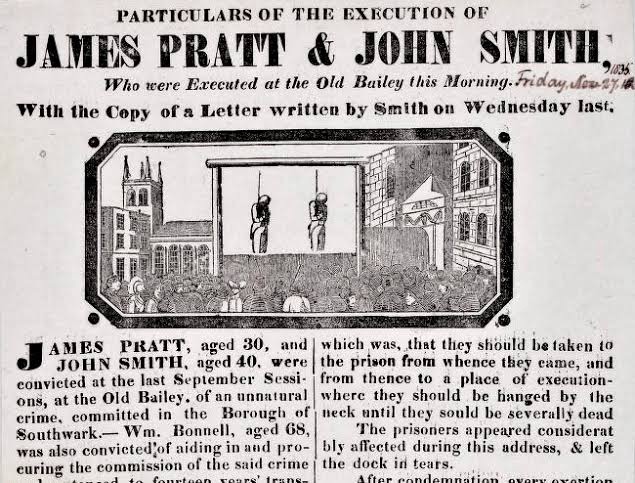
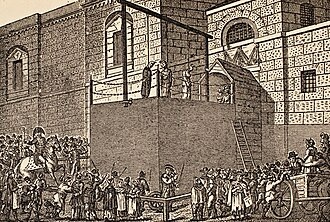
Execution outside Newgate Prison in London, early 19th century

Mary I – England Returns to Rome

Everything changed again in 1553.

Mary I, Henry’s eldest daughter by Catherine of Aragon, became Queen and immediately sought reconciliation with the Roman Catholic Church.

England briefly returned to papal authority.

Many Protestant reforms were reversed.

Ironically, this meant that the jurisdiction over offences such as buggery shifted once more.

The legal landscape became increasingly confused as religious and political authority changed hands.

Mary’s reign lasted only five years, but it demonstrated how closely criminal law remained tied to England’s religious identity.

Elizabeth I – Permanence at Last

When Elizabeth I succeeded her half-sister in 1558, England once again embraced Protestantism.

In 1563 Parliament passed a new Buggery Act.

This legislation largely restored Henry VIII’s original approach but with clearer drafting and improved legal procedure.

Unlike Henry’s statute, Elizabeth’s version endured.

For more than three centuries it formed the foundation of English criminal law relating to male same-sex sexual acts and bestiality.

The Act survived:

the Spanish Armada

the English Civil War

Oliver Cromwell

the Restoration

the Glorious Revolution

the Industrial Revolution

Kings and queens came and went.

Governments rose and fell.

Empires expanded.

Yet the law remained.

The Rise of the British Empire

During the seventeenth and eighteenth centuries Britain established colonies across the globe.

Settlers did not simply transport language and customs.

They transported law.

One of the fundamental principles of British colonisation was that English criminal law accompanied the Crown into new territories unless specifically altered.

Consequently, legislation derived from the Tudor Buggery Acts travelled with British administrators to North America, the Caribbean, India, Africa and, eventually, Australia.

Henry VIII could never have imagined Sydney.

Yet his legal revolution would eventually shape the criminal law of New South Wales.

Australia Inherits Tudor Law

When the First Fleet arrived in 1788, Governor Arthur Phillip brought with him English law.

Among the inherited offences was buggery.

Initially, prosecutions were relatively uncommon.

The realities of frontier life often meant authorities concentrated upon theft, violence, desertion and maintaining public order.

Nevertheless, the offence remained available to prosecutors.

Throughout the nineteenth century, colonial legislatures retained laws criminalising male same-sex sexual activity.

By then, however, the legislation owed as much to Victorian morality as it did to Tudor politics.

The legal principle established under Henry VIII had become deeply embedded within British legal tradition.

Australia inherited not merely one Act but an entire legal culture.

From Sin to Medical Condition

One of history’s great ironies emerged during the nineteenth century.

For centuries same-sex relations had primarily been viewed through religious and legal lenses.

Gradually another interpretation emerged.

Medicine.

Psychiatry.

Sexology.

Rather than asking whether such acts were sinful, many nineteenth-century scholars began asking why some individuals appeared consistently attracted to members of the same sex.

Among the most influential figures were:

Karl Heinrich Ulrichs

Richard von Krafft-Ebing

Magnus Hirschfeld

Havelock Ellis

By the late nineteenth century, the concept of homosexuality as a distinct identity had begun replacing the older legal emphasis upon isolated acts.

Ironically, this new understanding produced both progress and new prejudice.

People increasingly recognised that sexual orientation was more than behaviour.

Yet many physicians simultaneously classified homosexuality as a mental illness.

The Long Road Towards Reform

By the twentieth century, attitudes had begun changing.

One of the most significant turning points came with the Wolfenden Report of 1957.

After extensive investigation, the committee reached a conclusion that seems almost self-evident today but was revolutionary at the time:

“There must remain a realm of private morality and immorality which is, in brief and crude terms, not the law’s business.”

Those words represented a complete reversal of Henry VIII’s philosophy.

The Tudor state had expanded its authority into private sexual behaviour.

The Wolfenden Committee argued the state should withdraw from it.

Ten years later, England partially decriminalised consensual homosexual acts between adult men through the Sexual Offences Act 1967.


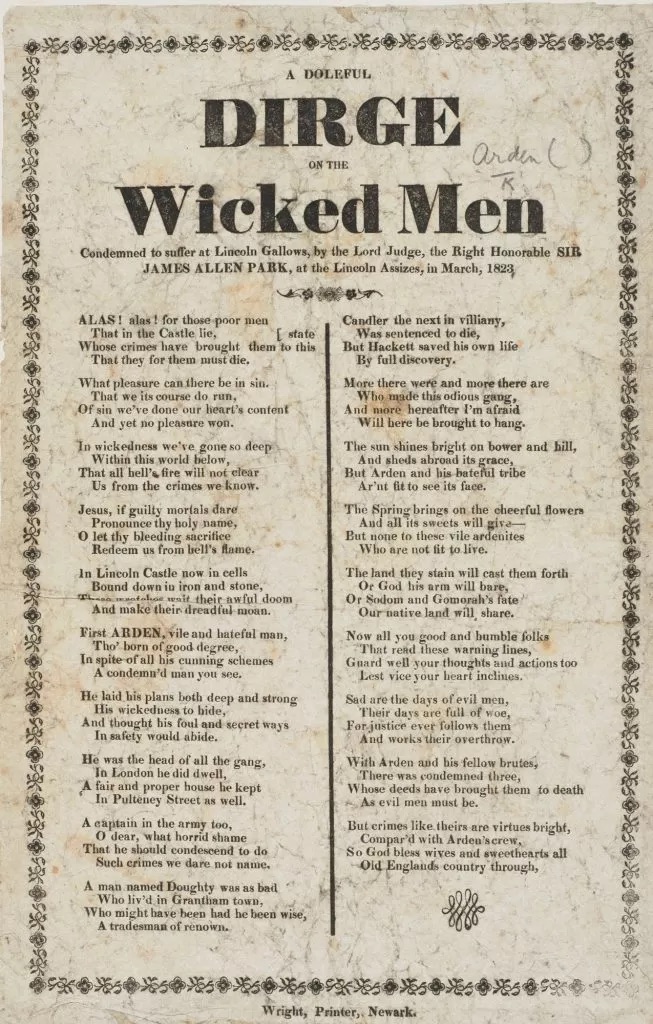
A Doleful Dirge on the Wicked Men: This newspaper goes to great lengths to allude to ‘crimes’ that these men have been tried and found guilty of’. / British Library, Public DomainBrowse Digital Magazines

Australia Follows

Australia moved more slowly.

South Australia became the first Australian jurisdiction to decriminalise consensual homosexual acts in 1975.

Other states followed over several decades.

Tasmania remained the last Australian state to repeal its criminal laws in 1997 after sustained legal and political pressure, including intervention by the United Nations Human Rights Committee.

By then, more than 460 years had passed since Henry VIII’s original legislation.

Henry’s Unexpected Legacy

Henry VIII never set out to influence gay rights debates.

He sought power.

He wanted control over England’s Church.

He wanted freedom from papal interference.

The Buggery Act formed one relatively small component of that larger constitutional struggle.

Yet history often remembers rulers for consequences they never anticipated.

The law Henry introduced eventually travelled around the world.

It shaped criminal justice systems on several continents.

It affected countless lives over nearly five centuries.

For millions of gay men, its descendants became symbols of fear, secrecy and exclusion.

Reassessing Henry VIII

Modern historians increasingly encourage us to view the Buggery Act through two lenses simultaneously.

The first is political.

It represented another stage in Henry VIII’s relentless concentration of power within the English Crown.

The second is human.

Whatever Henry’s intentions, the legislation established a legal framework that later generations used to persecute individuals whose only offence was engaging in consensual intimacy.

These two realities are not contradictory.

Indeed, they help explain why the Act endured for so long.

It served governments well.

It reflected prevailing religious beliefs.

It became embedded within legal tradition.

Only when society itself changed did the law finally begin to unravel.

Conclusion

The Buggery Act of 1533 occupies a unique place in legal history.

It was born amid the political upheaval of the English Reformation, forged in Henry VIII’s determination to subordinate the Church to the Crown. Although couched in the language of morality, its deeper significance lay in the transfer of judicial authority from ecclesiastical courts to the King’s courts. In doing so, it demonstrated one of the defining characteristics of the Tudor state: the increasing reach of royal power into areas of life once governed by the Church.

The Act’s consequences, however, extended far beyond Henry’s immediate ambitions. Re-enacted under Elizabeth I, absorbed into English common law, and carried across the globe by the expansion of the British Empire, it shaped legal systems on several continents. Generations of men lived under laws whose ancestry could be traced directly to the political struggles of sixteenth-century England.

Perhaps the greatest irony is that Henry VIII is remembered as much for his turbulent private life as for his legislation. A monarch whose reign was marked by multiple marriages, accusations of adultery, political executions and personal ambition became associated with one of history’s most enduring attempts to regulate the private conduct of others. That contradiction reminds us that laws often tell us less about morality than about power.

Today, historians no longer view the Buggery Act simply as an anti-homosexual statute. Instead, it is recognised as part of a much larger constitutional transformation that redefined the relationship between Church, State and individual. Yet acknowledging its political origins does not diminish its human cost. For centuries, its legal descendants contributed to fear, persecution and silence among countless people whose lives were shaped by its legacy.

History rarely unfolds as its participants intend. Henry VIII sought to create a stronger monarchy. Instead, he also created one of the most influential criminal statutes in the English-speaking world—one whose shadow would linger long after the Tudor dynasty, the British Empire and even the world that produced it had passed into history.

Tim Alderman ©️2026

Sources

Sir John Baker, An Introduction to English Legal History (5th ed., Oxford University Press, 2019).

J. A. Guy, Tudor England (Oxford University Press, 1988).

G. R. Elton, England Under the Tudors (Routledge, revised editions).

Diarmaid MacCulloch, Thomas Cromwell: A Life (Allen Lane, 2018).

Diarmaid MacCulloch, The Reformation: A History (Penguin, 2004).

The King’s Reformation.

The Stripping of the Altars.

Wolfenden Report (1957).

The National Archives – records of Tudor statutes and legal proceedings.

Parliament of the United Kingdom – historical texts of the Buggery Acts and subsequent legislation.

The Buggery Act of 1533: Henry VIII, Power, Politics, and the Criminalisation of “Unnatural Offences” Part 1

Introduction

Few pieces of legislation have cast such a long shadow over the lives of gay men and other sexual minorities as England’s Buggery Act of 1533. Commonly remembered as the first English law to make homosexual acts a secular capital offence, the Act is often portrayed as little more than an expression of King Henry VIII’s moral outrage. While morality undoubtedly played a part in Tudor thinking, modern historians increasingly argue that the legislation was driven by something much broader: Henry’s determination to centralise power, weaken the authority of the Roman Catholic Church, and establish the supremacy of the English Crown.

The Act marked a turning point in English legal history. Before 1533, accusations of sodomy or “buggery” generally fell under the jurisdiction of ecclesiastical courts. After the Act, they became crimes against the state itself, punishable by death and accompanied by the forfeiture of lands and property. This seemingly technical legal change had enormous consequences, not only for Tudor England but eventually for much of the British Empire. As English law spread across the globe, so too did legislation derived from Henry VIII’s reforms. Australia, India, Canada, Africa, the Caribbean and countless other territories inherited legal traditions whose origins could be traced back to this single Act.

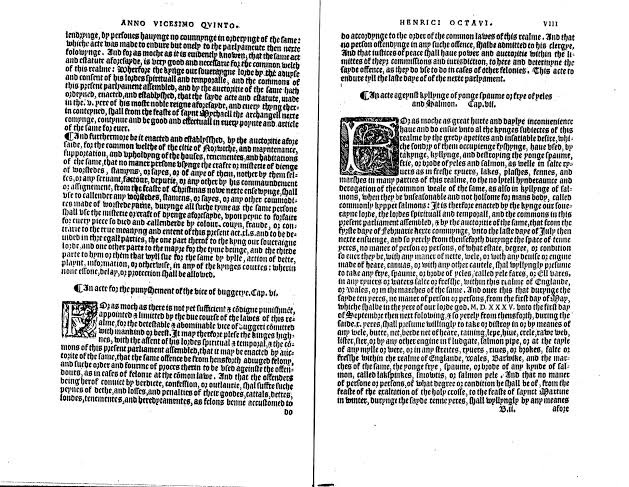
The Buggery Act 1533, formally An Act for the punishment of the vice of Buggerie

Ironically, the legislation has outlived the circumstances that created it. Henry VIII sought to secure his authority against the Pope, yet one of the most enduring legacies of his reign became a law regulating private sexual conduct. Centuries later, long after England abandoned public executions and the British Empire disappeared, versions of the Buggery Act still lingered in the statute books of former colonies.

To understand the Act properly, however, one must begin before Henry VIII—back in medieval Europe, where ideas about sexuality, religion and criminality were already taking shape.

England Before the Buggery Act

Contrary to popular belief, Henry VIII did not invent laws condemning same-sex sexual activity. Medieval Christian Europe had long regarded sexual acts that could not lead to procreation as sinful. These ideas drew upon interpretations of biblical passages—particularly the story of Sodom and Gomorrah in the Book of Genesis—and upon the writings of influential theologians such as St Augustine and St Thomas Aquinas.

In medieval England, however, there was an important distinction between sin and crime.

Most offences involving sexual behaviour were dealt with by ecclesiastical courts, not by the Crown. Church courts handled matters relating to marriage, adultery, fornication, clerical misconduct and what was often described as the “sin against nature.”

Punishments imposed by Church authorities were generally spiritual rather than corporal. Offenders might be ordered to undertake public penance, fast, make pilgrimages or face excommunication. Although the penalties could be severe within the religious life of the community, they were very different from execution.

The offence itself was also less clearly defined than many modern readers imagine.

The medieval Latin term peccatum contra naturam (“the sin against nature”) encompassed a wide range of sexual behaviours. Depending upon the jurisdiction and period, this could include:

sexual acts between men

certain sexual acts between a man and a woman

bestiality

non-procreative sexual practices generally

The word buggery itself was not originally a sexual term at all.

Its linguistic ancestry is surprisingly complex. It derives from the Medieval Latin bulgaria, referring to Bulgaria. During the Middle Ages, members of the dualist Bogomil religious movement were accused by their enemies of heresy and various moral corruptions. Over time, “Bulgar” or “bougre” became a general insult in French and later English, eventually acquiring sexual connotations that had little to do with the historical Bogomils themselves.

Language, prejudice and religion had become intertwined.

Medieval Reality Versus Modern Assumptions

Popular imagination often pictures medieval Europe as relentlessly prosecuting homosexual behaviour.

The historical record paints a more complicated picture.

Surviving records show relatively few prosecutions compared with later centuries. This does not necessarily mean such relationships were accepted. Rather, it reflects several factors:

First, evidence was difficult to obtain.

Secondly, Church courts often preferred confession and repentance over spectacular punishment.

Thirdly, many accusations were folded into broader cases involving heresy, clerical misconduct or other offences.

This relative inconsistency would change dramatically during the Tudor period, when England experienced one of the greatest constitutional revolutions in its history.

Henry VIII’s Great Break

Henry VIII did not begin his reign intending to establish an independent English Church.

Indeed, he was one of Catholicism’s most enthusiastic defenders.

In 1521 he published Assertio Septem Sacramentorum (Defence of the Seven Sacraments), attacking Martin Luther’s criticisms of the Church. Pope Leo X rewarded Henry with the title Fidei Defensor—“Defender of the Faith”—a title British monarchs still bear today.

Everything changed because of Henry’s desperate desire for a legitimate male heir.

His marriage to Catherine of Aragon had produced only one surviving child, the future Mary I. Henry became convinced—or perhaps persuaded himself—that his marriage was invalid because Catherine had previously been married to his late brother, Arthur.

When Pope Clement VII refused to grant an annulment, partly because Catherine’s nephew was the powerful Holy Roman Emperor Charles V, Henry gradually abandoned attempts to obtain papal approval.

Instead, he embarked upon a constitutional revolution.

Between 1532 and 1534 Parliament passed a series of statutes that fundamentally altered England.

The Crown increasingly assumed powers previously exercised by Rome.

Appeals to the Pope were prohibited.

The Archbishop of Canterbury declared Henry’s marriage void.

Anne Boleyn became Queen.

Finally, in 1534, the Act of Supremacy proclaimed Henry VIII the Supreme Head of the Church of England.

England had not merely changed churches.

It had changed the entire relationship between Church and State.

Within this broader programme of reform, numerous legal powers formerly exercised by ecclesiastical authorities were transferred to secular courts.

The Buggery Act was one element—albeit an especially significant one—of that larger transformation.

Tim Alderman ©️2026

LGBT History In Surrey – Crime & Punishment

Homosexuality was illegal in England until 1967. The treatment of homosexuals in earlier times is difficult to gauge as the historical record rarely exists for anything other than criminal activity. Early punishments ranged from fines, hard labour, hanging, and the pillory (a wooden frame with holes for the head and hands, in which offenders were placed and exposed to public abuse). From the seventeenth to the nineteenth centuries the court of Quarter Sessions dealt with any complaints and allegations of homosexual behaviour, frequently referred to in the court records as ‘an unnatural crime’.

In Surrey, there are several examples which appear in the records, although survival of all evidence from the arrest to the sentencing of prisoners is not complete. Many of the accused were acquitted through lack of evidence. In the cases found, punishment ranged from the equivalent of a good behaviour bond to the pillory, or imprisonment for up to two years in one of the local houses of correction.

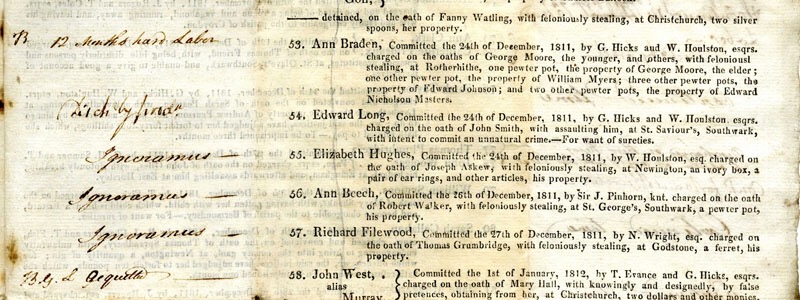
Calendar of prisoners for the House of Correction, Newington, 1812

Prisoner No.54. is Edward Long, committed on 24 Dec 1811.

Following the oath of John Smith, Long is charged with assaulting him at St Saviour’s, Southwark, with intent to commit an ‘unnatural crime’. He was detained for want of sureties (i.e. no one pledged money for his good behaviour) but this was eventually secured.

IMG_8756.JPG
Calendar of prisoners, featuring Edward Long, 14 Jan 1812 (SHC ref QS2/6/1812/Eph)

Calendar of prisoners, featuring Edward Long, 14 Jan 1812 (SHC ref QS2/6/1812/Eph)
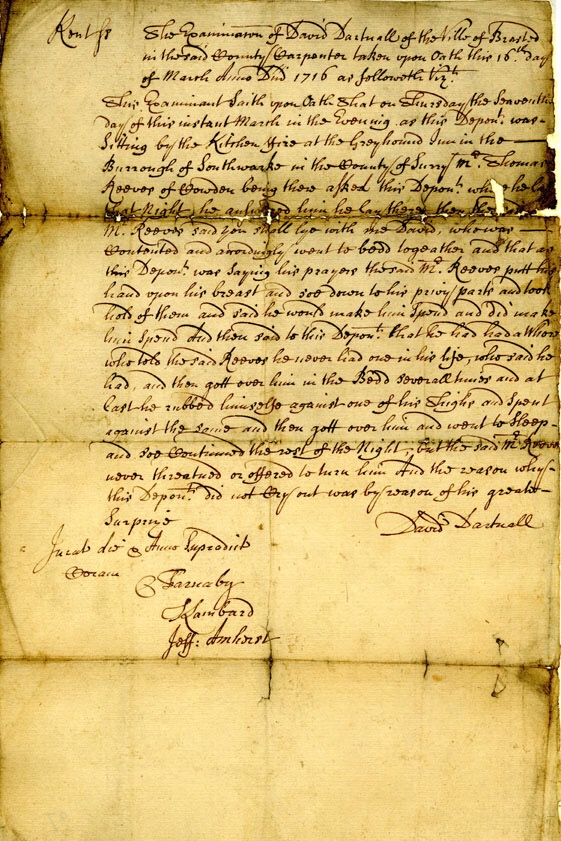
Examination regarding an alleged assault, Southwark, 1716

This curious case involved David Dartnall, a carpenter of Brasted, who in his examination claimed that whilst sitting by the fire in the kitchen of the Greyhound Inn, Southwark, he was approached by Thomas Reeves and asked where he would lie that night. Dartnall replied that he was sleeping at the inn and Reeves declared that he would lie with him. The examination gives a graphic account of the activities that took place but Dartnall did not protest and implied that Reeves ‘never threatened or offered to turn him’. The examination finished with Dartnall declaring ‘the reason why he did not cry out was the reason of his greater surprise’!

Unfortunately, as the further evidence for this case has not yet been located we do not know whether Reeves was punished or not. Click on the image below to see a larger version.

IMG_8757.JPG
Transcript of examination of David Dartnall, 1716 (Ref.QS2/6/1717/Eas/87).

The examination of David Dartnall of the ville of Brasted in the said County, carpenter taken upon oath this 16th day of March Anno D[omini] 1716 as followeth viz:
This examinant saith upon oath that on Thursday the seventeenth day of this instant March in the evening as this Def[endant] was sitting by the kitchen fire at the Greyhound Inn in the Burrough of Southwark in the County of Surrey, Mr Thomas Reeves of Cowden being there asked this Def[endant] where he lay that night, he answered him he lay there then the said Mr Reeves said you shall lye with me David, who was contented and accordingly went to bedd together and that as this Def[endant] was saying his prayers the said Mr Reeves putt his hand upon his breast and soo down to his private parts and took hold of them and said he would make him spend and did make him spend. And then said to this Def that he had had a whore who told him the said Reeves that he never had had one in his life, who said he had, and then gott over himin the bedd several times and at last he rubbed himself against one of his thighs and spent against the same and the gott over him and went to sleep – and soo continued the ret of the night; but the said Mr Reeves never threatened or offered to turn him And the reason ehy this Def[endant] did not Cry out was by reason of his greater Surprise.
[signed] David Dartnall
Jucat die et Anno superdictam
Coram
C Farnaby
S lambard Jeff. Arnhurst

LGBT Legislation

The 1885 Criminal Law Amendment Act made any homosexual act illegal, even in private.
Section 11 of the Act stated that any man convicted ‘shall be liable at the discretion of the court to be imprisoned for any term not exceeding two years, with or without hard labour’.
Controversially, this part of the Act was inserted at the last minute after being drafted by the MP Henry Labouchere. It did not fit in with the rest of the Act, which dealt with sex crimes relating to young women, but was still passed by the House of Commons.
The amendment was described as a ‘blackmailer’s charter’ as it effectively outlawed every form of male homosexuality. It prompted a number of prosecutions, most famously Oscar Wilde in 1895. Wilde served his sentence in Reading Gaol.
The Act was repealed in England and Wales in 1956, but homosexuality was not fully legalised until 1967. In Scotland this did not come into force until 1980, and in Northern Ireland, not until 1982.
The Gender Recognition Act of 2004 allowed transsexual people to change their legal gender.
Current legislation bans some anti-gay discrimination, as well as religion-based hate speech against homosexuals.

Information curtesy of Surrey History Centre and Exploring Surrey’s Past
http://www.exploringsurreyspast.org.uk/themes/subjects/diversity/lgbt-history/qs/