“Dance music is my love, is my passion, is my life. I live for my fans and take my art very seriously.” Steve Aoki
Well, this one does, and though I know I’m going against the grain – I’ll always do so.
I work at alternative ends of the spectrum as far as dance music goes, and though I play and do mixes of Handbag music, my preferred dance genre is Uplifting Vocal Trance. My roots lie in a mix of Handbag and House music in the 90s, and HI-NRG in the 80s.
I started DJing as resident DJ in the Oxford Hotel in Sydney’s Golden Mile (the gay ghetto) of Darlinghurst in 1990, and had a resident Sunday night spot at The Stronghold Bar (a leather bar), situated in the Clock Hotel in Crown Street, Surry Hills from 1992-1996. I will be the first to admit that back in the day, my muxing wasn’t all that great…but I was saved by selecting great music that gave me a following, and a certain popularity. The dance style that really made me popular was – Handbag.
The Urban Dictionary defines Handbag House dance music as “A type of House music. Handbag house consists of the obligatory disco diva lyrics, simple four-on-the-floor TR-909 kick drums, hi-hats on the upbeats, Basic synth stabs in a minor key, and sometimes a snare on beats two and four. Videos often feature the singer in a leather costume dancing around while a sculpted bald black man gyrates his hips whilst also attempting to look threatening. Its name comes from the phenomenon of a group of women dancing around a pile of their handbags.
Damn son this handbag house shit is GAY!” Perhaps a bit cliche…but close to the truth.
It is often referred to as trash or cheese music due to its “fluffy” style, and artists such as Kylie Minogue, Madonna, Jason Donovan, Bananarama, Mel & Kim, Pepsi & Shirley, Dead or Alive, Rick Astley, Paul Lakakis et al, and music labels such as SAW, PWL, and Almighty specialised in its production.
“Serious” DJs hated it – with a passion! Wikipedia is a lot kinder in its description, and historical background. They use the “Diva House” terminology, and assert “The term “handbag house” appears to be particularly popular on British dancefloors and refers to the notion of a group of female club-goers dancing around a pile of their handbags.[3] Dance culture’s usage of the word ‘handbag house’ started life as a derogatory term.
In the 1990s, as gay clubs and gay culture became more mainstream so did house music. The accessibility of diva house lead to the mainstreaming of gay club music. In the UK especially, handbag house became emblematic of the clubbing culture. According to music historians Bill Brewster and Frank Broughton, by the mid-1990s handbag house had helped to make clubbing into a “mainstream leisure activity.”[4] With the mainstreaming of gay culture in the 1990s, “diva” was the word that bound house music to the gay dance scene, which was previously only defined by Italo disco compositions.
Music critic Simon Reynolds asserts that handbag house was “initially a disparaging term, coined by condescending cognoscenti vis-à-vis the anthemic, chart-penetrating house tunes that allegedly appealed to women, and above all to the folk-mythic construct of Sharon and Tracy.” [5] According to electronic music producer Ewan Pearson and academic Jeremy Gilbert, “handbag house” is often derided as “plastic disco” by dance music fans who prefer “the more esoteric sound of musics which eschew the ‘mainstream’ musical priorities of melody and verbal language.” [6] The mainstream appeal of handbag house caused underground dance music purists to flock to the spin-off genres of hardbag, progressive house, deep house, and garage house.[5] Sociologist Dunja Brill argues that criticism of handbag house carries a “misogynist slant in club cultural representations of the denigrated mainstream of ‘Handbag House’ against which Ravers define their subculture.”[7] Brill maintains that bias against handbag house “is expressed most clearly in a femininisation of the denigrated ‘mainstream’ of pop culture against which subcultures define themselves.”[8]”
Despite being considered “plastic” , and the term Handbag being used in a derogatory way, it continues to be popular, especially amongst gay males across all age groups. When DJing at The Oxford Hotel, its popularity was instantly noticeable by the bopping around of clientele, miming the words and a general feeling of fun, which yas always geen associated with the genre. I was initially introduced to Handbag through Stock Aitken Waterman, and despite often disparaging their music…I still played it, as I knew that despite every track sounding pretty well exactly the same – it was popular. In the 90s I was exposed to the covers and remixes released through the British “Almighty” label (“Call Me Tonight” by Destiny Love was my first exposure to the label – a track I played to death), and which I primarily still,play now, as they have covered and remixed many popular gay dancefloor hits from the 80s – an era I have a particular affection for. Again, the purists are aghast that anyone would dare cover the music of that era. But to je, it is all about keeping the music alive, and relevant – despite who is doing it.
Handbag is, at its very heart, fun party music. If you were to put on a 2 hour mix of handbag tracks at a party at home you would ve watching nearly everyone there moving to the tracks, miming the words, and talking about memories the tracks invoked. Isn’t this what, in some respects, the music should be about? Does it always have to be serious and esoteric, existing on strobed dancefloors amongst a drug culture that needs a continual mind-fuck!
I upload all my mixes – both Trance & Handbag – to an online DJ service called Mixcloud. Of everything I upload, the most favourited, and most shared, mixes are the Handbag ones. Indeed, within minutes of going up, any mix with the word “Handbag” in the title will be shared. Because they are so popular, I continue to do them. I can’t say I don’t enjoy mixing them…because I do. They are a lot of fun to compile.
Instead of pigeonholing and denigrating any form of dance music, perhaps we need to pose the question – why is it popular? Surely that a form of music like Handbag can initiate sensations of fun and frivolity, girlishness, and just getting people dancing can’t be a bad thing! It’s about a feeling, an atmosphere, a scene of jubilation and nostalgia. At its heart is the intention to…just make people smile!
Tim Alderman (C) 2016
References
3^ “handbag house@Everything2.com”. Everything2.com. 2001-12-14. Retrieved 2011-02-10.
4^ Brewster, Bill; Frank Broughton; Frank Broughton (2000). “Last Night a DJ Saved My Life: The History of the Disc Jockey”. Last Night a DJ Saved My Life: The History of the Disc Jockey. Headline Book Publishing. p. 396. Retrieved 28 December 2014.
5^ a b Reynolds, Simon (August 21, 1998). Energy Flash: A Journey Through Rave Music and Dance Culture. Picador. Retrieved 23 October 2012.
6^ Gilbert, Jeremy (September 19, 1999). “Discographies: Dance Music Culture and the Politics of Sound”. Discographies: Dance Music Culture and the Politics of Sound. Routledge. p. 70. Retrieved 23 October 2012.
8^ Brill, Dunja; Deicke, Wolfgang; Hodkinson, Paul (2007). “”Gender, status and subcultural status in the goth scene.””. Youth Cultures: Scenes, Subcultures and Tribes. Routledge. p. 122.
kintsukuroi tea bowl
Kintsukuroi (“golden mend”) is the Japanese art of mending broken pottery using lacquer resin laced with gold or silver. As well as a nifty form of repair, kintsukuroi has a deeper philosophical significance. The mended flaws become part of the object’s design, and some people believe the pottery to be even more beautiful having gone through the process of being broken and repaired.
Through kintsukuroi, the cracks and seams are merely a symbol of an event that happened in the life of the object, rather than the cause of its destruction.
Like pots, bowls, cups, and plates, we endure our own bumps and scrapes. We experience drops from a dizzying height and unexpected knocks.
Sometimes we experience things that plant the seeds of shame: rejection, betrayal, abandonment, failure. So we try to avoid experiences that leave us vulnerable to these feelings as much as possible, lest the people around us see the evidence of just how imperfect, flawed, and “not good enough” we really are.
In other words, we stay hidden in the cupboard, right behind the best silver, because we don’t want to get a chip, a crack, or a complete break.
That’s not to say that I believe trauma or tragedy automatically makes us more beautiful—I don’t. I’ve known people who have dealt with these things and come out on the other end about as ugly as it gets.
I do believe these experiences change us though—and I think we have a choice.
We can choose to reject our bitter experiences and flaws, to wish and will them away, to regret, to pine, and to live in the land of “If only…” We can disguise with false-self personas, cover up with defences, distract with busyness.
Or we can choose to see these experiences for what they are: our golden seams.
The times when we get scratched, chipped, cracked and broken can feel totally shitty, but there can also be a strange beauty in the way we process them and the lessons we take from them afterwards… if we want.
Our experiences don’t define us, but they do influence us. We can decide to hide, or we can decide to embrace these experiences that have shaped us in some small way, the experiences to which we’ve applied our own special coating of gold-laced resin. We can decide to cover up, or we can decide to walk out into the world as ourselves, mended breaks and all.
Once upon a time, in the far, far east, east even of Eden, lived a great emperor, in a great palace, gorgeously stocked with the richest of goods. It was early spring, and the season of royal visits, when kings and princes called on one another and admired each others’ choicest possessions, gave wonderful gifts and enjoyed bountiful banquets. And this year was special, because the visitors would see the investiture of his beloved son Kintsukuroi as Crown Prince of the empire.
The emperor was excited this year because he had a new and beautiful bowl to show to his friends, specially made for him by the finest of craftsmen from the finest of materials. Imagine then his horror when on going to his cabinet he discovered that it was broken apart, into a hundred pieces. How could it have happened? No-one knew. What could be done about it before the first visitors arrived? No-one could offer any idea, for the time was too short to start again and make another one.
The emperor was dismayed, sad that he could not show off his beautiful bowl, but even sadder that something so beautiful should have broken. He retired into his private apartments with only his beloved son to share his sorrow, and they talked long into the night together.
Next morning the emperor woke to the sound of a great commotion. His senior ministers demanded to see him urgently. The cabinet of treasures had now been broken into, and this time the great new golden diadem that has been made for his beloved son, ready for the investiture, was quite simply gone – along with the broken pieces of the broken bowl, but who cared about those now.
What is more, the thief had been seen, but not recognized, since he was covered in dirt and scars, with nothing to distinguish him from a thousand other down-and-outs who hung around the palace, for the emperor – to the annoyance of his ministers – refused to turn them out but shared his food with them.
No-one knew for sure where the thief had gone, but he had, they thought, run off towards the princes apartments. There the doors were most unusually now locked and there was no answer to their knocking, though they could hear sounds inside. Would the emperor give his permission for them to break down the door: they dare not act without it.
The emperor was silent for many minutes. On his face his ministers saw sadness but not anger, lament but also love. What was going on? Eventually the emperor spoke. “Leave the prince and his apartments alone. If he is ready to rule, he must be allowed to act. His will and my will are as one.” The ministers were not at all sure just what this meant, but the message was clear. They were to do precisely nothing.
So the day passed. The emperor remained in his private apartments. Those of the prince remained locked, though smoke could be seen coming out of the chimney and a fire had obviously been lit. And eventually the ministers tired of their waiting and went to bed. The important guests were expected the very next day.
Imagine now their surprise in the morning when they went to the treasure cabinet to prepare its items for display and found the precious bowl back in its place, whole again, but glistening with veins of gold where the cracks had been. Its beauty seemed all the greater. And by it the prince’s crown, a slim band now, but speaking in its simplicity of a strength, an authority all the more striking, because it had given itself away and given glory to another, but was the greater itself for it. The investiture could go ahead.
A smile of secret understanding passed between the emperor and the son whose newly scarred hands had shown him worthy to come into the kingdom. https://philipchircop.wordpress.com/2013/11/10/the-fable-of-kintsukuroi/
This often-maligned compound now comes in a dazzling array of flavours and textures from countries across the globe, writes Helen Greenwood.
We all know too much salt is bad for us. Yet we can’t live without the ionic compound known as sodium chloride or NaCl. Remove salt from the diet and you die. What’s more, your food tastes better with salt.
Thomas Keller writes in The French Laundry Cookbook: “The ability to salt food properly is the single most important skill in cooking … Salt opens up flavours, makes them sparkle. But if you taste salt in a dish, it’s too salty.”
The question is, which salt? In the past few years, Sydney cooks have been deluged with a flood of artisan salts. They are extracted from the Himalayas in Pakistan, skimmed at Halen Mon in Wales, drawn from pans in Brittany in France or evaporated from the sea at Trapani in Sicily. We are now inundated with choices. And colours. And textures.
Gourmet salts can be white (Maldon), pink (Murray River), black (Cypriot), red or green (Hawaiian) and grey or natural (Italian). They can be flaky or grainy, pyramid- or crystal-shaped. They can be damp, dry or powdery.
More importantly, these gourmet salts have different mineralities that give each one a different flavour. They have depth, power and pungency and need only to be used sparingly to great effect.
At Rock Restaurant in the Hunter Valley, chef and owner Andrew Clarke has been playing with gourmet salts. “We use anywhere up to 12 different salts in the restaurant,” he says. “We use the vanilla Halen Mon with balmain bugs after they’ve been grilled. We use a coarse-grain curing salt for meats. We use iodised salts to flavour blanching water. We use the Cyprus black salt to finish off our wood-roasted goat. We put Maldon on the table because it’s clean and has a soft sea-saltiness.”
All salt comes from the sea, whether it’s mined high in the Himalayan mountains or collected from salt flats in Bolivia. Yet this inorganic mineral carries the flavour of the environment in which it was formed. In the case of the famous French fleur de sel, or flower of the salt, which is “young” crystals that form on the surface of salt evaporation ponds, the flavour varies from region to region – like fine wines.
Alderman Providore is a specialist online food retailer that sells Himalayan, Hawaiian, Bolivian and French sea and rock salts. Former co-owner Tim Alderman maintains salts from different countries impart different flavours. “Each one has a different minerally quality, as distinct from Saxa,” he says. “The grey salt has a distinct mineral taste, the pink and rose salts tend to be more subtle and are different the Murray River salt. The textures change, too.”
This is a contrast to the traditional view of salt as a mono-flavouring. Most of us grew up with an iodised salt that just tasted, well, salty. It was mined and refined to remove most of its minerals and took away bitter – and any other – tastes. Plain table salt was also available but most people preferred iodised salt, which manufacturers starting producing in the 1920s after US studies found people were suffering from goitre, an enlargement of the thyroid gland caused by iodine deficiency. It is believed Australians’ consumption of iodine has dropped considerably in the past few decades.
Humans need less than 225 micrograms of iodine a day. The mineral is found in seafood and sea salts, both natural replacements for refined salt.
Sea salts are harvested from salt pans, ponds or marshes, or by channelling ocean water into large clay trays and allowing the sun and wind to evaporate it naturally. Sea salts are less treated than other commercial salts so they retain traces of iron, magnesium, calcium, potassium, manganese, zinc and iodine. Sea salts’ fans rave about their bright, subtle flavours.
Gourmet salts can be used for cooking or for finishing a dish and sometimes both. Like a spice or herbs, different salts lend themselves to being used at different times as you cook.
Kala Namak, or Indian black salt or sanchal, is an unrefined mineral salt that, despite it’s name, is a pearl-pink grey. It’s strong, sulphuric odour dissipates when used in Indian cooking and is magic with eggplant. You can also sprinkle it on melon or yoghurt as a final seasoning.
Italian sea salts, such as Ravida from Trapani, is produced from the low waters along the coast of Sicily. They are rich in iodine, fluorine, magnesium and potassium with a lower percentage of sodium chloride than regular table salt. Delicate but with a defined flavour, they are finishing salts that bring a salad or a sauce to life.
Both these salts were part of a tasting held by The Salt Book. A dozen gourmet, plain and flavoured salts were lined up and paired with a variety of foods.
The exercise was fascinating. Strips of rare, grilled sirloin fared better or worse depending on which salt you used.
The coarse rock crystals of pink Himalayan salt looked pretty but the Ravida sea salt from Sicily made the meat jump in your mouth. The green Hawaiian salt was recommended with yellow fin tuna but added a polish to prawns.
James Ballingall, program director at the William Blue College of Hospitality Management in North Sydney, which hosted the tasting, used a brine made from Olsson’s macrobiotic salt to cure a chicken before roasting. The wonderful, tender, firm flesh tasted more like chicken than most birds, apart from organic chooks.
Good all-rounders, favoured by chefs and home cooks, are the Maldon sea salt and the home-grown Murray River salt. Guerande Fleur de Sel stood out as a pure, light seasoning that should only be used at the table.
Fleur de sel is a soft, moist salt that looks like sea foam and surprises consumers who are used to their salt being dry and grainy. Italian salts such as those from Trapani are also moist and often off-white.
The wonderful Riserva Camillone from Cervia in the Emilia Romagna region is strangely sweet. Flavoured salts such as Netherlands smoked salt, Tetsuya’s truffle salt, Cyprus lemon salt flakes and vanilla fleur de sel figured in the tasting, too.
They overpowered the plain ones and need to be used carefully.
Suggestions include salmon, kipfler potatoes, poached prawns and desserts respectively.
The key to a healthy diet is to cook fresh produce and then season it with a salt that has personality and provenance.
The Salt Book, Arbon Publishing, by Fritz Gubler and David Glynn, $34.99.
PROCESSED FOODS: THE REAL SINNERS
About 20 per cent of the world’s salt production is used in food. The remainder is used in the chemical industry and applications such as de-icing roads.
Most of the 20 per cent we consume is “hidden salt” in manufactured foods, from breakfast cereals to instant soups.
The Australian division of World Action on Salt and Health (AWASH) has reported many Australians consume 10 times the amount of salt they need for a healthy diet. The recommended daily intake for salt is four grams but many Australians regularly consume up to 40 grams.
The chairman of AWASH, Professor Bruce Neal, has asked manufacturers of processed food to reduce the salt content of their products by 5 per cent a year.
AWASH’s research has shown excessive consumption of salt comes mainly from eating processed food and can lead to high blood pressure, kidney damage and stomach cancer.
A leading nutritionist, Rosemary Stanton, (pictured), advises people to avoid such products in the first place. “The problem is we eat so much of it,” she says. “That’s why our salt intake has increased so much in the past few decades.”
KNOW YOUR SODIUM CHLORIDE
COOKING SALTS
Kala namak (also known as sanchal) Use in Indian cooking, on raw tropical fruits and cooked vegetables. It’s sold at Indian grocery stores.
Celtic salt, French grey sea salt Use for general purpose, soups, stews and sauces. Buy Coarse Guerande Salt.
Coarse salt Use for salt crusts on meat or fish, curing and flavouring in soups, stews and sauces. Buy Himalayan Pink, La Baleine, Esprit du Sel.
Rock salt Use for curing and brining. Not ideal for the table.
FINISHING SALTS
Flake salt Use as an all-round general salt in cooking or at the table. Buy Maldon, Murray River, Halen Mon, Pyramid.
Fleur de Sel (Flower of Salt) Use for salads, cooked fresh vegetables and grilled meats. Buy Le Paludier.
French sea salt Use in salads and on cooked fresh vegetables and grilled meat. Buy Le Paludier.
Grey salt (sel gris, Celtic sea salt) Use at the end of the cooking process or on the table. Good for casseroles and stews. Buy Le Paludier, Riserva Camillone sale di Cervia, Trapani.
Hawaiian sea salt (alaea, Hawaiian red salt) A natural mineral called alaea (volcanic baked red clay) adds iron oxide and imparts a mellow flavour. Used to preserve and season native Hawaiian dishes. Good for meats. Buy Alaea.
Italian sea salt Use for salads and to finish roasts and sauces. Great as a garnish on bruschetta. Buy Ravida.
Organic salt Standards include purity of the water, cleanliness of salt beds and how the salt is harvested and packaged. Certifiers include Nature et Progres (France), BioGro (New Zealand), Soil Association Certified (Wales). Buy Halen Mon, Olsson’s.
SUPPLIERS
GJ Food The Fine Food Connection (Le Paludier Fleur du Sel and others from Guerande).
Cantarella Bros (Ravida).
Lario Imports (Trapani, Riserva Camillone sale di Cervia).
Alderman Providore, aldermanprovidore.com.au (Himalayan Pink, Alaea, Bolivian Rose, Sel Gris de Guerande).
Simon Johnson (Halen Mon).
F. Mayer Imports (Maldon).
The Essential Ingredient (Murray River Salt).
Waimea Trading, 0409 219 280 (Cyprus Black sea salt).
Olsson Industries, olssons.com.au (Olsson’s Pacific Salt).
HBC Trading, 9958 5688 (Himalayan Pink).
Kirk Food (Pyramid).
The original font & graphics for Alderman Providore
The ghosts of my business still survive in cyber-space. Alderman Providore started in 2006 as the next step along from Alderman Catering – a truly exhausting, though exciting business doing top-end party catering. The Providore was designed as an online business – still a very daring and risky step to take in 2006. It was started with $5000 that I begged, borrowed and stole (not really) and was originally a small store on Ebay, created from Ebay templates.
By the end of 2006, I paid a website designer to create a site for a business, registered the name and domain, used a friend who is a graphic artist to design the typeface and graphic, and aldermanprovidore.com.au hit the internet. I bought gourmet grocery products from all sorts of rare and unique mum ‘n dad, hobby, localised, unknown businesses and created a unique space for their products. The sales started as a small trickle, but grew exponentially over time. David & I introduced product tasting parties, and along with some targeted advertising the business grew and grew.
At the end of 2008, due to a personal interest in tea and teawares, and due to the rapid expansion of that area, I launched a second web site TeaCoffeeChocolate using the same premise as for the providore, along with a very large range of organic and free-trade products.
Alderman Providore products in a magazine Christmas gift guide
By this time I had altered the business plan to embrace products from outside Australia IF it was a product that could not be sourced from within Australia. At this time an overhaul of the Alderman Providore site resulted in a fresher, more contemporary look. Magazines started approaching us for both advertising, and to supply products to use as props and in gift guides. Reps from companies contacted me about stocking their products. Sales grew and grew, and we had built a reputation for service, quality, uniqueness, pricing, and product delivery. Ideas were added – and subtracted ,often through being impractical.
As Christmas 2009 approached, I started early purchasing preparations, and started to stock up on what should gave been our biggest Christmas ever. Like all small retail businesses, I purchased 20% more stock each year, which usually just covered growth, and ensured I wasn’t stuck with stick at the end of the season. If you didn’t get in early, and the product sold out…then bad luck. And the stock rolled in. Cakes, puddings, glacé fruit, sauces, relishes, fruit mince, biscuits and more. I was excited, and pumped for the excitement to come.
Then greed came to town. People who abuse the systems, deal illegally and fraudulently, who use other peoples money to satisfy their own selfish need. They created a monster that came to be known as the Global Financial Crisis (GFC). Everyone stopped buying. Online purchasing, in a growth phase at that time, was the first to be hit. That Christmas I sold…nothing. Thousands of dollars tied up in stock…and no market. By the time Christmas Eve rolled around, I was effectively broke. Money the business earned was sunk back into it. There was no excess. I remember ringing David, and a pudding supplier in tears, because, thanks to somebody else’s greed my business, my dream, was destroyed.
Early 2010 I put the business, good will, and web sites on the market. It sold to a mum in Brisbane who had an interest in food (but as I was to see…not a passion), and so it changed hands, and eventually a new name. Before we moved from Dulwich Hill to Brisbane, we had a HUGE market in our backyard to clear out the remainder of the stock. Anything left from that went to Vinnies.
So, for some unknown reason, today I searched for the ghost of my business. And it’s still there. A lot more than I expected, in fact. And a story of a past glory came out of it. Who knows what the future holds, as dreams do live on!
This is a question I have been asking myself, especially in the light of a recent experience.
I had started using the app for Find-a-Grave to locate any family members listed, and to add family that I have details of. I became a member of the group, but after finding that someone had added death details and pictures of the memorial for my Pickhills grandparents, and finding I couldn’t edit it to add birth details I enquired why. These two people are, after all, my family. A reply to my enquiry informed me “Hello Tim, Thank you for contacting Find A Grave. In order to update a memorial, please go to the memorial on the website, http://www.findagrave.com Click on the edit tab located in the upper right of the memorial page. Choose an option to update the memorial. The update will be sent to the manager of the memorial page. If you are related within transfer guidelines, http://www.findagrave.com/cgi-bin/fg.cgi?page=listFaqs#79 you may ask for a transfer with the edit tab under “suggest any other correction or addition”.Sincerely, (name withheld)”.
In othe words, someone who is not a member of my family, and doesn’t know them from a bar of soap, currently has the management of grave details for my family in this app/web site! Okay, I can request that management be transferred to me, but the point is…if I hadn’t wanted to edit the details, and request the teansfer as a relative of the deceased, this person would have had control of my grandparents details at this sire permanently!
These are the guidelines for requesting a teansfer “How do I get a relative’s memorial transferred to me? First, Determine if you really need the memorial transferred to you for management. Only request transferring of management if you have extensive changes to make to a memorial. You can add photos and suggest corrections without having to request management. Simply having someone in your family tree is not grounds for a management transfer request. With hundreds of thousands of contributors, we have many overlapping family trees and it would be impossible for all contributors to manage their entire tree.
Second, Transfer requests will be for direct relatives within four generations. This would be your siblings, parents, grandparents, great-grandparents, children, grandchildren, and great-grandchildren.
Third, If you have extensive additions/changes to make to a memorial, please contact the Find A Grave member who created the memorial via the “Suggest a Correction” link under the “Edit” tab on the memorial in question with your request to have the memorial management transferred to you. This will send an email request to the contributor, even if there is not an email address listed on their contributor page.
Fourth, Explain your relationship in the request! Any non-direct relatives (aunts, uncles, cousins, etc) are not required to be transferred. Keep in mind that the original contributor may also be related to the memorial and may not make the transfer. Again, always include your relationship to the memorial on a transfer request, in order for it to be considered. You may also want to include your specific interest in the memorial. Bulk surname requests must not be made. Be advised that memorials listed as famous or maintained by Find A Grave will not be transferred.
Fifth, The “Suggest a correction” feature may also be used to submit corrections, an original biography, and family links to memorials that do not fall under the above definition. (Be sure to include the memorial ID#s for the family links and how they are related, father, mother or spouse. The original contributor will make any corrections and add any additional information you have for that memorial, such as links to parents and spouses, provided the information is accurate.
Sixth, Please note that it is not appropriate to request a transfer and then, after receiving the transfer, delete that page and substitute it with a new memorial that you have created. This practice denies credit to the original contributor. Please use the original memorial page to make updates and add information.
NOTE: If you are unable to edit a memorial after it has been transferred to your account, try logging out of Find A Grave then logging back in.”
The same applies to a memorial for one of my mother’s brothers. Personally, I find this a bit distressing. I have, needless to say, requested the memorials be transferred to my name.
The second incident involved a photograph of my great grandparents headstone. Yes, I did request through Find-a-Grave that someone photograph the memorial for me – though in the future I’ll organise it myself – and a photographer snapped it for me. When checking out the shot, I noticed that to the right, and in shot, another Barron memorial. I cropped the picture, and added the edited photograph to his memorial on the site. Naturally, within the hour, the photographer contacted me, reminding me that the photo was hers, and I was in breach of the apps photographs policy. I apologised, and removed the “offending” photo’s. But then I started thinking about it. I am the first to acknowledge the intellectual property rights of artists, and perhaps that is what niggles me! It s not as though she had photographed her own families graves. Again, this was a memorial with no connection to her whatsoever, total strangers who are nothing more than hames carved into stone. In a just world, the copyright on these types of ohotographs would be turned over – lock, stock & barrel – to the family of the graves photographed. I feel it is only just to do so, instead of blithly crying thief, and grasping control of the material.
Everybody involved in the distribution of family history information and documents greedily has their hands out these days. Anything advertised as “free” will only give you the bare bones. If you want the body and soul…fork out the money, honey! Even to look and see if there is any material pertaining to your family will cop you a fee on some sites. If there are records being held, it will cost you even more. Subscriptions to genealogy sites like Ancestry don’t come cheap, and often come with a catch 22. I subscribe to record collections of Australia and United Kngdom on Ancestry. Very little of my family history resides in America, and to add America to my subscription adds a lot to its cost, with little value, in my view. So I get my records from Australa and the UK within my monthly fee, but for any of the rest of the world I pay per record – which can be anything from $1.49 to $2.49 per record. In the meantime, Ancestry has access to all the information that goes onto my tree – for which they pay…zilch!
So, it would appear that we don’t own any of our family history, except that that can be added from personal or family recollection. It would appear that our families are owned by bureaucrats, big business, ancestry sights, photographers, apps, and just about anyone else who can make a quid out of it. There are even people with family tree’s who think that those accessing information from it should pay! For the record – if you want information from mine…help yourself. If others can benefit from my research, then good!
In many respects, it us appalling that others can lay claim to our family name, our family history. It is appalling that we often have to say “no” to accessing a snippet of information, as the cost is too high. Unfortunately, we live in a greedy, grasping world. Our relatives would literally “turn in their graves” if they knew. Just as well they don’t!
“A donkey vote is a ballot cast in an election that uses a preference voting system, where a voter is permitted or required to rank candidates on the ballot paper, and ranks them based on the order they appear on the ballot paper. The voter that votes in this manner is referred to as a donkey voter.”
Could we, like America, be heading into a donkey vote election? Given the current sad lack of choice – both in major parties, minor parties and Independents – could the voters, fed up with over a decade of bad government, and potentially nothing to look forward to in the political arena, just decide to vote for…anyone! It is not a good scenario, I know that, but noone could blame them. The last term of Howard, followed by the Rudd/Gillard/Rudd/Abbott/Turnbull fiasco has worn everyone out, and made us a country of cynics in the democraric process. What a joke this has made of our political system! No educated voter – probably becoming a rare species with education cuts – takes our current batch of politicians seriously. Our choice of likeable, decent, fair-minded, secular politicians is about…zero. With the likes of Morrison, Joyce, Pyne, Abbott (the bad smell that just won’t go away! The man’s delusion is staggering!) et al has taken politics to a new low in this country. The opposition is no better, and the minor parties are just that – minor, and even that they are there at all makes one question the often dubious nature of our voting system.
So, maybe we should all do a donkey vote on July 2. Who knows – Fiona Patten for PM?…
Frederick Lindsay was born at Chatswood, New South Wales, on the 10th July 1922 to Frederick George Rickinson Pickhills and Ethel Osmond, both from Bourke. He was the second-eldest child of four siblings, and the only male. His sisters are Dorothy, Dulcie and Eileen. I know little about his younger years other than that he was trained as a motor mechanic and a carpenter, two trades he was proficient in till the day he died. Photographs of the young (and the older) Frederick are few and far between, though what I do have show a man who was perhaps happier pre-war than post-war. There are photographs of him in overalls outside a garage where he worked during the 30’s; in Army uniform, and with his slightly cocked hat shows quite a handsome man; a casual photo in shorts; a small photo with his three sisters as youngsters: on a motor bike with a friend, a personal passion until a serious accident in the late 50’s; a lovely photograph with my mother that looks very 40’s; and a wedding photograph outside the church they were married in. He never, ever spoke about his military service and I have no idea of how his war experiences affected him other than that, apart from taking me to several ANZAC day marches, he never really approved of this wartime celebration and had nothing to do with his war comrades. However, I do have his war record and know that he enlisted at the Martin Place Recruiting Depot in Sydney on the 3rd of November 1941. His army number is NX50073. He had obviously lied about his age (he was 19 at the time of enlistment) as it is listed as 21 and three months which is then struck through and his true age inserted. He is listed as being single and a motor mechanic. A surprising find on the Attestation Form is his next of kin, noted as a Norman Emmanuel, who lived in Hillside Flats in Elizabeth St, Artarmon., and is an uncle. It is odd that he didn’t have a parent with him, and I have absolutely no idea who this supposed relative is. He took his oath of allegiance on the same day. There are small front and side photo’s at the bottom of the form. I also have his Army driving license no. 246312 which shows his rank as CFN (Craftsman), and lists the vehicle types he could drive. I also have his Record of Service Book which tells us he was 5’91/2″, weighed 131 lbs, had a 331/2″ chest, fair complexion, light brown hair, hazel eyes and a small scar right frontal region. He had qualified on the firing range, had done a motor mechanics course, he appears to have been appointed as a mechanic in 1941, and was a tester of motor vehicles in 1943. I’m of the thinking that he was a driving instructor. There is a listing of his leave, including in New Guinea and Borneo up till his discharge. We know he passed a chest x-ray in 1941. As for medals he received the 1939/45 Star, and the Pacific Star. His next of kin is listed here as Ethel Pickhills (mother) at 14 Saywell St, Chatswood. We also have all his Proceedings for Discharge, Determination of Demobilisation Priority, his Service and Casualty Forms and a copy of his Certificate of Discharge No. 401253 which informs us that No. NX50073 Craftsman Frederick Lindsay Pickhills of the 2/53 Aust Light Aid Detachment served on continuous full-time war service in the Australian Imperial Force from 3/11/1941 to 14/2/1946 for a total effective period of 1,565 days which included Active Service in Australia for 819 days and outside Australia for 584 days. He received the War Badge R.A.S. No. A.234189 and that he was discharged from the AIF on 14/2/1946.
I believe that the Australia he returned to was not the Australia he left, and I don’t think he ever came to terms with that. He maintained his 1940’s attitudes throughout the rest of his life which made him a difficult father as he could never reconcile himself to a more contemporary age. No wonder I rebelled. He never claimed his military service medals. I have attempted to claim them over the last couple of years, but due to his Last Will and Testament being made out in my step-mother and step-brothers favour I have not been able to procure them. I will follow this up at a later time.
Robert Douglas-Fairhurst reviews Strangers: Homosexual Love in the Nineteenth Century by Graham Robb
12:01AM GMT 03 Nov 2003
How do you pick out a gay man in a crowd? According to Dr La Forest Potter’s Strange Loves, published in 1933, “the average homosexual” differs from “ordinary men” in 10 easily identifiable ways: he has “large, easily aroused nipples”, “a mincing walk”, “sloped and rounded shoulders”, “thick, luxuriant hair”, “a hairless chest”, “soft, delicate skin” free of manly spots, a lack of “dogmatic energy”, a “peculiar swinging motion of the hips” due to anatomical defects in the spine and pelvis, “a considerable deposit of fat in the region of hips, breasts and thighs”, and – the clinching clue – “feminine buttocks”.
Clearly the author of Strange Loves was a little peculiar himself (how could he know that homosexual nipples were “easily aroused”?), but he is hardly an isolated figure in the troubled history of 20th-century attitudes towards homosexuality. From Raphael Kirchner’s 1908 German handbook, How to Recognise Homosexuals, to the two-page guide on “How to Spot a Possible Homo” published in the Sunday Mirror in 1963 (“shifty glances”, “dropped eyes”, “a fondness for the theatre”), it has long been popular wisdom that “one of them” is easily distinguishable from “one of us”. Whether seen as a choice or a compulsion, in everything from lifestyle to hairstyle, the assumption has been that homosexuality is a secret that simply cannot be kept. It is as if the world had been told that the root of “homosexual”, “homos”, is Greek for “same”, meaning that there are men who fall in love with other men, and had misunderstood it to mean that homosexuals are all the same.
Recently, much of the blame for this sorry state of affairs has been laid at the door of the Victorians. According to the most popular line of argument, although there had always been same-sex activity between men, only during the 19th century did the exclusively homosexual person emerge as a distinct social type. Both as a word and a concept, “homosexuality” was a Victorian invention. From the doctors who attempted to diagnose homosexuality (Ambroise Tardieu claimed in 1857 that the telltale signs in men included a corkscrew-shaped penis and a large bottom: “I have seen one pederast whose buttocks were joined and formed a single, perfect sphere”) to the politicians who attempted to legislate against it, the 19th century gave birth not only to “the homosexual” but to the repressive social forces that continued to echo through the 20th century.
This, at least, is the version of events, much influenced by Michel Foucault’s writings on sexuality, which is dutifully wheeled out by most histories of gay life. But then, Foucault was never one to let the facts get in the way of a good theory and, as Graham Robb’s revisionist account proves, the truth was rather more complicated and a lot more interesting.
Almost every page of this book reverberates with the sound of stereotypes being flattened. For example, the assumption that the Victorians were repressive in their attitudes towards illicit sexual behaviour hardly squares with what was accepted and even celebrated. Consider the case of “Fanny” Park, a drag queen arrested for using the ladies’ room at the Strand Theatre, whose acquittal on sodomy charges in 1870 – secured by his solicitor, the wonderfully named Mr Straight – was loudly cheered; or the tight-trousered rent boys (“mollies”) who were an established tourist attraction in both London and New York; or the odd couples, such as the “married” artists Charles Ricketts and Charles Shannon, whose unconventional households attracted some notoriety and a great deal of indifference.
Indeed, for a love that supposedly dared not speak its name, homosexuality was a surprisingly noisy part of Victorian life, less a subculture than a parallel culture that ran alongside and occasionally ran into the heterosexual mainstream. Even Jane Austen, who was hardly in the vanguard of permissiveness, allowed herself a sly joke about gay sex, when Mary Crawford in Mansfield Park discusses her knowledge of admirals: “Of Rears, and Vices, I saw enough. Now, do not be suspecting me of a pun, I entreat.”
Not that the 19th century was an oasis of tolerance and good sense. Most gay men and women remained strangers to the society that had the power to ostracise them or lock them up. Many also remained strangers to one another. It could be hard to recognise a like-minded soul, and Robb has some moving examples of the tactics needed to sound someone out about their sexuality, simultaneously leading on and backing off, without risking rejection or assault.
Even if this hurdle was overcome, there was no guarantee that two gay people, like any other two people, would have anything to talk about. Oscar Wilde cannot have been alone in finding it hard to reconcile his ideals of a pure Grecian love with the pimply youths he took to bed, like the two Cockney lads Frank Harris recalled seeing him with at the Café Royal, talking about the Olympic Games. “‘Did you sy they was niked?’ ‘Of course,’ Oscar replied, ‘nude, clothed only in sunshine and beauty.'”
Perhaps inevitably, such public displays in the period are rare; the history of Victorian gay life is less one of explicit confessions than it is of flirtatious hints and glimpses. Fleshing out these details into a rich and satisfying narrative, Robb is an ideal guide to the period – unfailingly intelligent, compassionate and discreetly witty.
His earlier biographies of Hugo and Rimbaud showed that he has a sharp eye for the way that real lives tend to resist the neat shapes we impose on them, and Strangers is crammed with statistics and anecdotes that succeed brilliantly in changing what we thought we knew about homosexuality, both then and now. In seeking to explain some of the messy and unpredictable workings of love, Robb has produced a rare thing: not just a book with ideas, but a book with heart.
How to spot a homosexual: A step by step guide – 11-07-2010, 04:56 PM
Homosexuals are amongst us. Every day, they discreetly pollute the Good Lord’s Earth with their filthy ways. Luckily, me and Dimitri, at the Domnino League Against Sodomites, have compiled a list of data that will assist you in telling whether your closest friends are secretly queers.
Eating and Drinking:
Whether at the bathhouse, drinking beverages (in appropriate amounts, as prescribed in Timothy 5:23) in the company of fellow Christians, or simply eating lunch on the truck roads of northern Siberia, eating and drinking habits of those within your group of friends will reveal whether or not they are Closetfags™. Foods consumed by men:
Anything with more than half a pound of meat.
Anything fried or deep fried.
Anything pie-like of the appropriate size.
Anything hunted/skinned yourself and cooked by your wife and/or daughter(s).
Foods consumed by homosexuals:
Anything that comes in small, faggy portions (Sushi, “Cocktail Snacks”)
Anything with a foreign name (Especially if in French)
Anything that is shared with other men (Tapas)
Drinks consumed by men:
Wine (Only if you are depressed. Wine must have a pronouncable name to avoid being mixed with “Faggy wine” [See below] ) Proverbs 31:6-7
Spirits (See Wine)
Beer (See Wine)
Water
Anything produced by the Coca-Cola Company, except drinks which reference fruit. These are considered “fruity”, e.g. homosexual beverages.
e.g. Coca-Cola Cherry.
Drinks consumed by homosexuals:
Cocktails (Notice the name!) – Not a proper drink. Any drink that is a mixture of two or more normally separate drinks is considered a cocktail.
Faggy Wine – Wine made outside of own country, probably in France. The name is distinctly not-English sounding and the label will most likely have pictures of men holding hands.
Conversation:
Homosexuals can often be caught out by listening to their conversation.
Conversation Word Limit
Men talk to exchange information. If any man exceeds the standard limit of 20 words per minute (Unless he is recounting a glorious story of conquest, preaching or praying), he is surely a homosexual.
If you fear you are nearly exceeding this limit in daily conversation, try the following tricks:
* Cut down on words like “Sure.”, “Okay.”, “Nah.” and replace them with indistinct grunts, or glares in the general direction of the person with whom the conversation is occuring.
* Ignore questions, then reproach them for asking you the same thing twice.
Topics of conversation suitable for men;
Comparing engine/tyre/gas tank sizes
Car/truck/van mechanical problems
Comparing your current events (Awful times) to similar events occuring 1/5/10/20 years ago (Good, Holy Christian times)
Your wife/daughter’s inability to cook/clean/etc.
Most recent [manly sport of your choice] game.
Women (In appropriate Christian fashion)
The Bible.
Topics of conversation considered homosexual:
The Weather (In a positive manner):
e.g. “The stars are so beautiful today.”
‘Famous people’ you haven’t heard of.
Clothes
Anything that uses the word “Gorgeous” or synonyms.
Indepth descriptions of sexual activities with other men.
Anything that is prefaced with “You’ll never guess what I saw in Vogue today!”
Other Signs
* In public toilets, a man uses a urinal next to your own.
* He often walks like a cowboy, but you have never seen him ride a horse.
* When you take a shower, he looks through your bathroom window.
Please add to our list if you find anything that is miss. Dimitri & I work very hard and will update once we discover more about this plague. If you suspect you have homosexuals in your neighbourhood, please seek professional aid and do not go outside alone.
Praise Christ.
Tim Alderman 2015
The Cleveland Street scandal occurred in 1889, when a homosexual male brothel in Cleveland Street, Fitzrovia, London, was discovered by police. At the time, sexual acts between men were illegal in Britain, and the brothel’s clients faced possible prosecution and certain social ostracism if discovered. It was rumoured that one client was Prince Albert Victor, who was the eldest son of the Prince of Wales and second-in-line to the British throne, though this rumour has never been substantiated. The government was accused of covering up the scandal to protect the names of any aristocratic patrons.
Another client was said to be Lord Arthur Somerset, an equerry to the Prince of Wales. Both he and the brothel keeper, Charles Hammond, managed to flee abroad before a prosecution could be brought. The male prostitutes, who also worked as telegraph messenger boys for the Post Office, were given light sentences and no clients were prosecuted. After Henry James FitzRoy, Earl of Euston, was named in the press as a client, he successfully sued for libel. The British press never named Prince Albert Victor, and there is no evidence he ever visited the brothel, but his inclusion in the rumours has coloured biographers’ perceptions of him since.
The scandal fuelled the attitude that male homosexuality was an aristocratic vice that corrupted lower-class youths. Such perceptions were still prevalent in 1895 when the Marquess of Queensberry accused Oscar Wilde of being an active homosexual.
Male brothel
Illustration of Inspector Frederick Abberline from a contemporary newspaper
In July 1889, Police Constable Luke Hanks was investigating a theft from the London Central Telegraph Office. During the investigation, a fifteen-year-old telegraph boy named Charles Thomas Swinscow was discovered to be in possession of fourteen shillings, equivalent to several weeks of his wages. At the time, messenger boys were not permitted to carry any personal cash in the course of their duties, to prevent their own money being mixed with that of the customers. Suspecting the boy’s involvement in the theft, Constable Hanks brought him in for questioning. After hesitating, Swinscow admitted that he earned the money working as a prostitute for a man named Charles Hammond, who operated a male brothel at 19 Cleveland Street. According to Swinscow, he was introduced to Hammond by a General Post Office clerk, eighteen-year-old Henry Newlove. In addition, he named two seventeen-year-old telegraph boys who also worked for Hammond: George Alma Wright and Charles Ernest Thickbroom. Constable Hanks obtained corroborating statements from Wright and Thickbroom and, armed with these, a confession from Newlove.[1]
Constable Hanks reported the matter to his superiors and the case was given to Detective Inspector Frederick Abberline. Inspector Abberline went to the brothel on 6 July with a warrant to arrest Hammond and Newlove for violation of Section 11 of the Criminal Law Amendment Act 1885. The Act made all homosexual acts between men, as well as procurement or attempted procurement of such acts, punishable by up to two years’ imprisonment with or without hard labour. He found the house locked and Hammond gone, but Abberline was able to apprehend Newlove at his mother’s house in Camden Town.[2] In the time between his statement to Hanks and his arrest, Newlove had gone to Cleveland Street and warned Hammond, who had consequently escaped to his brother’s house in Gravesend.[3]
Notable clienrs
Caricature of Lord Arthur Somerset, 1887
On the way to the police station, Newlove named Lord Arthur Somerset and Henry FitzRoy, Earl of Euston, as well as an army colonel by the name of Jervois, as visitors to Cleveland Street.[4] Somerset was the head of the Prince of Wales’s stables. Although Somerset was interviewed by police, no immediate action was taken against him, and the authorities were slow to act on the allegations of Somerset’s involvement.[5] A watch was placed on the now-empty house and details of the case shuffled between government departments.[6]
On 19 August, an arrest warrant was issued in the name of George Veck, an acquaintance of Hammond’s who pretended to be a clergyman. Veck had actually worked at the Telegraph Office, but had been sacked for “improper conduct” with the messenger boys.[7] A seventeen-year-old youth found in Veck’s London lodgings revealed to the police that Veck had gone to Portsmouth and was returning shortly by train. The police arrested Veck at London Waterloo railway station. In his pockets they discovered letters from Algernon Allies. Abberline sent Constable Hanks to interview Allies at his parents’ home in Sudbury, Suffolk. Allies admitted to receiving money from Somerset, having a sexual relationship with him, and working at Cleveland Street for Hammond.[8] On 22 August, police interviewed Somerset for a second time, after which Somerset left for Bad Homburg,[9] where the Prince of Wales was taking his summer holiday.[10]
On 11 September, Newlove and Veck were committed for trial. Their defence was handled by Somerset’s solicitor, Arthur Newton, with Willie Mathews appearing for Newlove, and Charles Gill for Veck. Somerset paid the legal fees.[11] By this time, Somerset had moved on to Hanover, to inspect some horses for the Prince of Wales, and the press was referring to “noble lords” implicated in the trial.[12] Newlove and Veck pleaded guilty to indecency on 18 September and the judge, Sir Thomas Chambers, a former Liberal Member of Parliament who had a reputation for leniency, sentenced them to four and nine months’ hard labour respectively.[13] The boys were also given sentences that were considered at the time to be very lenient.[14] Hammond escaped to France, but the French authorities expelled him after pressure from the British. Hammond moved on to Belgium from where he emigrated to the United States. Newton, acting for Somerset, paid for Hammond’s passage.[15] On the advice of the Prime Minister, Lord Salisbury, no extradition proceedings were attempted, and the case against Hammond was quietly dropped.[16]
Somerset returned to Britain in late September to attend horse sales at Newmarket but suddenly left for Dieppe on 26 September, probably after being told by Newton that he was in danger of being arrested.[17] He returned again on 30 September. A few days later, his grandmother, Emily Somerset, Dowager Duchess of Beaufort, died and he attended her funeral.[18] The Hon. Hamilton Cuffe, Assistant Treasury Solicitor, and James Monro, Commissioner of Police, pressed for action to be taken against Somerset, but the Lord Chancellor, Lord Halsbury, blocked any prosecution.[19] Rumours of Somerset’s involvement were circulating, and on 19 October Somerset fled back to France. Lord Salisbury was later accused of warning Somerset through Sir Dighton Probyn, who had met Lord Salisbury the evening before, that a warrant for his arrest was imminent.[20] This was denied by Lord Salisbury[21] and the Attorney General, Sir Richard Webster.[22] The Prince of Wales wrote to Lord Salisbury, expressing satisfaction that Somerset had been allowed to leave the country and asking that if Somerset should “ever dare to show his face in England again”, he would remain unmolested by the authorities,[23] but Lord Salisbury was also being pressured by the police to prosecute Somerset. On 12 November, a warrant for Somerset’s arrest was finally issued.[24] By this time, Somerset was already safely abroad, and the warrant caught little public attention.[25] After an unsuccessful search for employment in Turkey and Austria-Hungary, Somerset lived the rest of his life in self-imposed and comfortable exile in the south of France.[26]
Public revelations
Newspaper clipping
American newspapers claimed that Prince Albert Victor was “mixed up” in the scandal.
Because the press barely covered the story, the affair would have faded quickly from public memory if not for journalist Ernest Parke. The editor of the obscure politically radical weekly The North London Press, Parke got wind of the affair when one of his reporters brought him the story of Newlove’s conviction. Parke began to question why the prostitutes had been given such light sentences relative to their offence (the usual penalty for “gross indecency” was two years) and how Hammond had been able to evade arrest. His curiosity aroused, Parke found out that the boys had named prominent aristocrats. He subsequently ran a story on 28 September hinting at their involvement but without detailing specific names.[27] It was only on 16 November that he published a follow up story specifically naming Henry Fitzroy, Earl of Euston, in “an indescribably loathsome scandal in Cleveland Street”.[28] He further alleged that Euston may have gone to Peru and that he had been allowed to escape to cover up the involvement of a more highly placed person,[29] who was not named but was believed by some to be Prince Albert Victor, the son of the Prince of Wales.[30]
Euston was in fact still in England and immediately filed a case against Parke for libel. At the trial, Euston admitted that when walking along Piccadilly a tout had given him a card which read “Poses plastiques. C. Hammond, 19 Cleveland Street”. Euston testified that he went to the house believing Poses plastiques meant a display of female nudes. He paid a sovereign to get in but upon entering Euston said he was appalled to discover the “improper” nature of the place and immediately left. The defence witnesses contradicted each other, and could not describe Euston accurately.[31] The final defence witness, John Saul, was a male prostitute who had earlier been involved in a homosexual scandal at Dublin Castle, and featured in a clandestinely published erotic novel The Sins of the Cities of the Plain which was cast as his autobiography.[32] Delivering his testimony in a manner described as “brazen effrontery”, Saul admitted to earning his living by leading an “immoral life” and “practising criminality”, and detailed his alleged sexual encounters with Euston at the house.[33] The defence did not call either Newlove or Veck as witnesses, and could not produce any evidence that Euston had left the country. On 16 January 1890, the jury found Parke guilty and the judge sentenced him to twelve months in prison.[34] One historian considers Euston was telling the truth and only visited Cleveland Street once because he was misled by the card.[35] However, another has alleged Euston was a well-known figure in the homosexual underworld, and was extorted so often by the notorious blackmailer Robert Clifford, that Oscar Wilde had quipped Clifford deserved the Victoria Cross for his tenacity.[36] Saul stated that he told the police his story in August, which provoked the judge to rhetorically enquire why the authorities had not taken action.[37]
The judge, Sir Henry Hawkins, had a distinguished career, as did the other lawyers employed in the case. The prosecuting counsels, Charles Russell and Willie Mathews, went on to become Lord Chief Justice and Director of Public Prosecutions, respectively. The defence counsel, Frank Lockwood, later became Solicitor General for England and Wales, and he was assisted by H. H. Asquith, who became Prime Minister of the United Kingdom twenty years later.[38] Henry Labouchère accused the government of conspiring to hush up the scandal.
While Parke’s conviction cleared Euston, another trial began on 16 December 1889 when Newlove’s and Somerset’s solicitor, Arthur Newton, was charged with obstruction of justice. It was alleged that he conspired to prevent Hammond and the boys from testifying by offering or giving them passage and money to go abroad. Newton was defended by Charles Russell, who had prosecuted Ernest Parke, and the prosecutor was Sir Richard Webster, the Attorney General. Newton pleaded guilty to one of the six charges against him, claiming that he had assisted Hammond to flee merely to protect his clients, who were not at that time charged with any offence or under arrest, from potential blackmail. The Attorney General accepted Newton’s pleas and did not present any evidence on the other five charges.[39] On 20 May, the judge, Sir Lewis Cave, sentenced Newton to six weeks in prison,[40] which was widely considered by members of the legal profession to be harsh. A petition signed by 250 London law firms was sent to the Home Secretary, Henry Matthews, protesting at Newton’s treatment.[41
During Newton’s trial, a motion in Parliament sought to investigate Parke’s allegations of a cover-up. Henry Labouchère, a Member of Parliament from the Radical wing of the Liberal Party, was staunchly against homosexuality and had campaigned successfully to add the “gross indecency” amendment (known as the “Labouchère Amendment”) to the Criminal Law Amendment Act 1885. He was convinced that the conspiracy to cover up the scandal went further up the government than assumed. Labouchère made his suspicions known in Parliament on 28 February 1890. He denied that “a gentleman of very high position”—presumably Prince Albert Victor—was in any way involved with the scandal, but accused the government of conspiracy to pervert the course of justice by hampering the investigation, allowing Somerset and Hammond to escape, delaying the trials and failing to prosecute the case with vigour. Labouchère’s accusations were rebutted by the Attorney General, Sir Richard Webster, who was also the prosecutor in the Newton case. Charles Russell, who had prosecuted Parke and was defending Newton, sat on the Liberal benches with Labouchère but refused to be drawn into the debate. After an often passionate debate over seven hours, during which Labouchère was expelled from Parliament after saying “I do not believe Lord Salisbury” and refusing to withdraw his remark, the motion was defeated by a wide margin, 206–66.[42]
Aftermath
Public interest in the scandal eventually faded. Nevertheless, newspaper coverage reinforced negative attitudes about male homosexuality as an aristocratic vice, presenting the telegraph boys as corrupted and exploited by members of the upper class. This attitude reached its climax a few years later when Oscar Wilde was tried for gross indecency as the result of his affair with Lord Alfred Douglas.
Oscar Wilde alluded to the scandal in The Picture of Dorian Gray, first published in 1890.[43] Reviews of the novel were hostile; in a clear reference to the Cleveland Street scandal, one reviewer called it suitable for “none but outlawed noblemen and perverted telegraph boys”.[44][45][46] Wilde’s 1891 revision of the novel omitted certain key passages, which were considered too homoerotic.[46][47] In 1895, Wilde unsuccessfully sued Lord Alfred’s father, the Marquess of Queensberry, for libel. Sir Edward Carson, Lord Queensberry’s counsel, used quotes from the novel against Wilde and questioned him about his associations with young working men.[48] After the failure of his suit, Wilde was charged with gross indecency, found guilty and subsequently sentenced to two years’ hard labour. He was prosecuted by Charles Gill, who had defended Veck in the Cleveland Street case.[
Prince Albert Victor of Wales was created Duke of Clarence and Avondale the year after the scandal.
Prince Albert Victor died in 1892, but society gossip about his sex life continued. Sixty years after the scandal the official biographer of King George V, Harold Nicolson, was told by Lord Goddard, who was a twelve-year-old schoolboy at the time of the scandal, that Prince Albert Victor “had been involved in a male brothel scene, and that a solicitor had to commit perjury to clear him. The solicitor was struck off the rolls for his offence, but was thereafter reinstated.”[50] In fact, none of the lawyers involved in the case was convicted of perjury or struck off at the time, indeed most had very distinguished careers. However, Arthur Newton was struck off for 12 months for professional misconduct in 1910 after falsifying letters from another of his clients—the notorious murderer Harvey Crippen.[51] In 1913, he was struck off indefinitely and sentenced to three years’ imprisonment for obtaining money by false pretences.[52] Newton may have invented and spread the rumours about Prince Albert Victor in an attempt to protect his clients from prosecution by forcing a cover-up.[53] State papers on the case in the Public Record Office, released to the public in the 1970s, provide no information on the prince’s involvement other than Newton’s threat to implicate him.[54] Hamilton Cuffe wrote to the Director of Public Prosecutions, Sir Augustus Stephenson, “I am told that Newton has boasted that if we go on a very distinguished person will be involved (PAV). I don’t mean to say that I for one instant credit it—but in such circumstances as this one never knows what may be said, be concocted or be true.”[55] Surviving private letters from Somerset to his friend Lord Esher, confirm that Somerset knew of the rumours but did not know if they were true. He writes, “I can quite understand the Prince of Wales being much annoyed at his son’s name being coupled with the thing … we were both accused of going to this place but not together … I wonder if it is really a fact or only an invention.”[56] In his correspondence, Sir Dighton Probyn refers to “cruel and unjust rumours with regard to PAV” and “false reports dragging PAV’s name into the sad story”.[57] When Prince Albert Victor’s name appeared in the American press, the New York Herald published an anonymous letter, almost certainly written by Charles Hall, saying “there is not, and never was, the slightest excuse for mentioning the name of Prince Albert Victor.”[58] Biographers who believe the rumours suppose that Prince Albert Victor was bisexual,[59] but this is strongly contested by others who refer to him as “ardently heterosexual” and his involvement in the rumours as “somewhat unfair”.[60]
Notes & Sources
Aronson, pp. 8–10 and Hyde, The Cleveland Street Scandal, pp. 20–23
Aronson, pp. 11, 16–17 and Hyde, The Cleveland Street Scandal, pp. 23–24
Hyde, The Cleveland Street Scandal, p. 23
Aronson, p. 11 and Hyde, The Cleveland Street Scandal, p. 25
Aronson, p. 135
Hyde, The Cleveland Street Scandal, pp. 26–33
Aronson, pp. 11, 133 and Hyde, The Cleveland Street Scandal, p. 25
Aronson, pp. 134–135 and Hyde, The Cleveland Street Scandal, pp. 34–35
Hyde, The Cleveland Street Scandal, p. 35
Hyde, The Cleveland Street Scandal, p. 38
Hyde, The Cleveland Street Scandal, pp. 35, 45, 47
Hyde, The Cleveland Street Scandal, pp. 42, 46
Hyde, The Cleveland Street Scandal, pp. 47–53
Aronson, p. 137
Hyde, The Cleveland Street Scandal, pp. 74–77
Aronson, p. 136 and Hyde, The Cleveland Street Scandal, pp. 27, 34
Hyde, The Cleveland Street Scandal, p. 61
Aronson, p. 140 and Hyde, The Cleveland Street Scandal, pp. 80–81
Hyde, The Cleveland Street Scandal, pp. 82–86
Aronson, p. 142
Hyde, The Cleveland Street Scandal, p. 93
Hyde, The Cleveland Street Scandal, p. 94
Hyde, The Cleveland Street Scandal, p. 97
Aronson, p. 144 and Hyde, The Cleveland Street Scandal, pp. 98–99
Aronson, p. 150
Aronson, p. 175
Hyde, The Cleveland Street Scandal, pp. 106–107
North London Press, 16 November 1889, quoted in Hyde, The Other Love, p. 125
Aronson, p. 150 and Hyde, The Other Love, p. 125
Hyde, The Other Love, p. 123
Aronson, pp. 151–159 and Hyde, The Cleveland Street Scandal, pp. 113–116, 139–143
Hyde, The Cleveland Street Scandal, p. 108
Saul quoted in Hyde, The Cleveland Street Scandal, pp. 146–147
Aronson, pp. 151–159 and Hyde, The Other Love, pp. 125–127
Hyde, The Other Love, p. 127
Aronson, p. 160
Lord Euston’s Libel Case, South Australian Register, 18 February 1890, p. 5
Aronson, p. 153 and Hyde, The Cleveland Street Scandal, p. 135
Hyde, The Cleveland Street Scandal, pp. 162–207
Aronson, p. 173
Hyde, The Cleveland Street Scandal, pp. 208–212
Hyde, The Cleveland Street Scandal, pp. 215–231
In chapter 12 of the original 1890 version, one of the characters, Basil Hallward, refers to “Sir Henry Ashton, who had to leave England, with a tarnished name”.
“Reviews and Magazines”. Scots Observer, 5 July 1890, p. 181
Bristow, Joseph (2006). “Introduction” In: Wilde, Oscar. The Picture of Dorian Gray. Oxford World’s Classic, Oxford University Press. ISBN 978-0-19-280729-8. p. xxi
Ackroyd, Peter (1985). “Appendix 2: Introduction to the First Penguin Classics Edition” In: Wilde, Oscar. The Picture of Dorian Gray. Penguin Classics, Penguin Books. ISBN 978-0-14-043784-3. pp. 224–225
Mighall, Robert (2000). “Introduction” In: Wilde, Oscar. The Picture of Dorian Gray. Penguin Classics, Penguin Books. ISBN 978-0-14-043784-3. p. xvi
Kaplan, Morris B. (2004). “Literature in the Dock: The Trials of Oscar Wilde”. Journal of Law and Society 31: (No. 1) 113–130
Hyde, The Cleveland Street Scandal, p. 45
Lees-Milne, p. 231
Cook, pp. 284–285
Cook, pp. 285–286 and Hyde, The Cleveland Street Scandal, p. 253
Prince Eddy: The King We Never Had. Channel 4. Accessed 1 May 2010.
Cook, pp. 172–173
Hyde, The Cleveland Street Scandal, p. 55
Lord Arthur Somerset to Reginald Brett, 2nd Viscount Esher, 10 December 1889, quoted in Cook, p. 197
Hyde, The Cleveland Street Scandal, p. 127
Hyde, The Cleveland Street Scandal, p. 129
Aronson, pp. 116–120, 170, 217
Bradford, p. 10
References
Aronson, Theo (1994). Prince Eddy and the Homosexual Underworld. London: John Murray. ISBN 0-7195-5278-8
Bradford, Sarah (1989). King George VI. London: Weidenfeld & Nicolson. ISBN 0-297-79667-4
Cook, Andrew (2006). Prince Eddy: The King Britain Never Had. Stroud, Gloucestershire: Tempus Publishing Ltd. ISBN 0-7524-3410-1
Hyde, H. Montgomery (1970). The Other Love: An Historical and Contemporary Survey of Homosexuality in Britain. London: Heinemann. ISBN 0-434-35902-5
Hyde, H. Montgomery (1976). The Cleveland Street Scandal. London: W. H. Allen. ISBN 0-491-01995-5
Lees-Milne, James (1981). Harold Nicolson: A Biography. Volume 2: 1930–1968 London: Chatto & Windus. ISBN 0-7011-2602-7
Lord Henry Arthur George Somerset
Major Lord Henry Arthur George Somerset DL (17 November 1851 – 26 May 1926) was the third son of the 8th Duke of Beaufort and his wife, the former Lady Georgiana Curzon. He was head of the stables of the future King Edward VII (then Prince of Wales) and a Major in the Royal Horse Guards.
He was linked with the Cleveland Street scandal, wherein he was identified and named by several male prostitutes as a customer of their services. He was interviewed by police on 7 August 1889; although the record of the interview has not survived, it resulted in a report being made by the Attorney-General, Solicitor-General and Director of Prosecutions urging that proceedings should be taken against him under section 11 of the Criminal Law Amendment Act 1885. A piece of paper was pasted over Somerset’s name in the report, as it was deemed so sensitive. However, the Director was told that the Home Secretary wished him to take no action for the moment.[1] The police obtained a further statement implicating Somerset, while Somerset arranged for his solicitor to act in the defence of the boys arrested over the scandal. After the police saw him for a second time on 22 August, Somerset obtained leave from his regiment and permission to go abroad.[2]
Lord Arthur went to Homburg, although he returned to England. When tipped off in September that charges were imminent, he fled to France to avoid them. From there he travelled through Constantinople, Budapest, Vienna, and then back to France, where he settled and died in 1926, aged 74.[3
References
H. Montgomery Hyde, “The Cleveland Street Scandal” (W.H. Allen Ltd, 1976), p. 32-3.
H. Montgomery Hyde, “The Cleveland Street Scandal” (W.H. Allen Ltd, 1976), p. 35.
Kaplan, Morris B. (2005), Sodom on the Thames: Sex, Love, And Scandal in Wilde Times, Cornell University Press, ISBN 0-8014-3678-8
Henry James FitzRoy, Earl of Euston
Euston in Masonic attire
Henry James FitzRoy, Earl of Euston DL (28 November 1848 – 10 May 1912) was the eldest son and heir apparent of Augustus FitzRoy, 7th Duke of Grafton.
Euston married Kate Walsh, daughter of John Walsh, on 29 May 1871 at St. Michael’s Church, Worcester. His wife died in 1903, nine years before him. They had no children. Euston was appointed a deputy lieutenant of Northamptonshire in 1907.[1] He died at Wakefield Lodge, Potterspury, Northamptonshire, six years before his father, and so never inherited his father’s lands and titles. His younger brother, Alfred, became the 8th Duke of Grafton.
Euston was embroiled in the Cleveland Street scandal when he was accused of visiting a male brothel at 19 Cleveland Street in London by The North London Press, an obscure radical weekly newspaper. Euston sued for libel. At the trial Euston admitted that when walking along Piccadilly he had been given a card by a tout which read “Poses plastiques. C. Hammond, 19 Cleveland Street”. Euston testified that he went along to the house, believing Poses plastiques to mean a display of female nudes. He paid a sovereign to get in. On entry, Euston said he was appalled to discover the “improper” nature of the place and immediately left. The defence witnesses contradicted each other, and could not describe Euston accurately.[2] The final defence witness, John Saul, was a male prostitute who admitted to earning his living by leading an “immoral life” and “practising criminality”.[3] The jury did not believe the defence witnesses and found in favour of Euston.[4] H. Montgomery Hyde, an eminent historian of homosexuality, later wrote that there was little doubt that Euston was telling the truth and only visited 19 Cleveland Street once because he was misled by the card.[5]
Robert Cliburn, a young man who specialized in blackmailing older homosexual men, told Oscar Wilde that Euston was one of his victims [6]
Note
The London Gazette: no. 28054. p. 5868. 27 August 1907.
Hyde, The Cleveland Street Scandal, pp.113–116, 139–143
Hyde, The Cleveland Street Scandal, pp.146–147
Hyde, The Other Love, p.125–127
Hyde, The Other Love, p.127
McKenna, p.182
Reference
Hyde, H. Montgomery (1970). The Other Love: An Historical and Contemporary Survey of Homosexuality in Britain. London: Heinemann. ISBN 0-434-35902-5
Hyde, H. Montgomery (1976). The Cleveland Street Scandal. London: W. H. Allen. ISBN 0-491-01995-5
McKenna, Neil (2005). The Secret Life of Oscar Wilde. New York: Basic Books.
HISTORICAL NOTES: In 1889, the year in which this scandal takes place, it is legal for girls aged 12 and boys aged 14 to marry (with parental consent). Most people started work at the age of 6 (or younger) to help support their families and men had a life expectancy of just 40-45 years of age. Male homosexuality was illegal and punishable, if convicted of buggery, to penal servitude for life or for any term of not less than ten years. The death penalty for buggery had only recently been abolished in 1861.
Towards the end of the nineteenth century a gentleman by the name of Charles Hammond ran a male brothel located at No 19 Cleveland Street in London, just north of Oxford Street near Tottenham Court Road.
Hammond catered for a largely aristocratic clientele and for a number of years the existence of his establishment remained unknown to the authorities.
This all changed on 4th July 1889 when a 15 year old telegraph boy called Charles Swinscow was searched as part of an ongoing investigation into money theft at his employers, the General Post Office.
It was a telegraph boys job to cycle around London delivering telegrams and urgent messages to homes and businesses. His wage would have been about eleven shillings per week, however when he was searched, eighteen shillings were found in his pockets, more than a weeks salary to such a young man. Swinscow was taken in for questioning as part of the police operation.
When asked how he came to have such a large sum of money in his possession, Swinscow panicked and confessed he’d been recruited by Charles Hammond to work at a house in Cleveland Street where, for the sum of four shillings a time, he would permit the brothel’s clients to “have a go between my legs” and “put their persons into me”.
He then identified a number of other young telegraph boys who were also renting themselves out in this manner at the Cleveland Street establishment, leading to the apprehension and questioning of Henry Newlove, Algernon Allies and Charles Thickbroom.
Who Was Involved:
Henry Horace Newlove 16 yrs Telegraph Boy – GPO ‘Recruiter’ for Hammond
Charles Thomas Swinscow 15 yrs Telegraph Boy – First boy arrested for ‘theft’
George Alma Wright 17 yrs Telegraph Boy – ‘Performed’ with Newlove for voyeurs
Charles Ernest Thickbroom 17 yrs Telegraph Boy
William Meech Perkins 16 yrs Telegraph Boy – ID’s Lord Alfred Somerset as a ‘client’
Algernon Edward Allies 19 yrs Houseboy – The Marlborough Club, used by Lord Somerset
George Barber 17 yrs George Veck’s ‘Private Secretary’ and boyfriend
John Saul 37 yrs Infamous London rent boy – Possibly aka Jack Saul
Charles Hammond 35 yrs Brothel keeper of 19 Cleveland Street, London
George Daniel Veck aka Rev George Veck aka Rev George Barber40 yrs Ex General Post Office (GPO) employee, sacked for indecency with Telegraph boys. Lives at 19 Cleveland Street. Kept a coffee house in Gravesend, Kent. Has an 18 year old ‘son’ that travels with him.
PC Luke Hanks Police officer attached to the General Post Office
Mr Phillips Snr postal official who questions Swinscow with Hanks
Mr C H Raikes The Postmaster General
Mr James Monro Metropolitan Police Commissioner
Frederick Abberline 46 yrs Police Chief Inspector, infamous for the ‘Jack the Ripper’ investigations in 1888, London’s Whitechapel district
PC Richard Sladden Police officer who carried out observations on the Cleveland Street brothel following Swinscow’s arrest
Arthur Newton Lord Arthur Somerset’s solicitor. Later to defend Oscar Wilde at his trial in 1895 and notorious murderer Dr Crippen
Prince Albert Victor, the Duke of Clarence 25 yrs Rumoured to be a ‘Brothel Client’ – Went on a seven month tour of British India in Sept 1889 to avoid the press & trials
Colonel Jervois of the 2nd Life Guards ‘Brothel Client’ – Winchester Army Barracks
Lord Arthur Somerset, aka Mr Brown 37 yrs ‘Brothel Client’ – Named in Allies letters as ‘Mr Brown’
Henry James Fitzroy, 39 yrs Accused of being a ‘Brothel Client’ – Earl of Euston
Sir Augustus Stephenson Director of Public Prosecutions (DPP)
Hon Hamilton Cuffe Assistant DPP – Six years later he would prosecute Oscar Wilde at his trial in 1895 as the Director of Public Prosecutions
Ernest Parke Journalist – North London Press
After The Arrests
The officer in charge of the case was Chief Inspector Frederick Abberline, famous for being in charge of the detectives investigating the Jack-The_Ripper murders a year earlier in 1888
Abberline procured a warrant to arrest Charles Hammond on a charge of conspiracy to “to commit the abominable crime of buggery”, but when officers went to Cleveland Street, they found that Hammond had already absconded.
The police made arrangements to observe the comings and goings at No 19 Cleveland Street in case Hammond returned. They noted that a ‘Mr Brown’ called at the address on the 9th and 13th July 1889, later identified by both Swinscow and Thickbroom on the 25th July as one of the their clients.
Police followed Mr Brown back to army barracks in Knightsbridge where he was formally identified as Lord Arthur Somerset, younger son of Henry Charles Somerset, the 8th Duke of Beaufort. Lord Arthur was a Major in the Royal Horse Guards and equerry to Edward, Prince of Wales, who later became King Edward VII.
Papers were sent to the Director of Public Prosecutions with a view to prosecuting Lord Arthur on a charge of gross indecency. The Prince of Wales was incredulous when he heard of it
“I won’t believe it, any more than I should if they accused the Archbishop of Canterbury” he said.
Despite this gesture of support, Lord Somerset placed the matter in the hands of his solicitor Arthur Newton.
Newton contacted the DPP and mentioned that if his client were to be prosecuted, he might have to name Prince Albert Victor, the Duke of Clarence, as another brothel client whilst giving his evidence in court.
Given that Prince Albert Victor was the eldest son of the Prince of Wales and second in line to the throne, it was clear that the government would not want his name associated with the homosexual brothel at Cleveland Street.
The authorities appeared to drag their heels over the matter, delaying the court case, which allowed Lord Arthur Somerset the opportunity to flee abroad. By the 18th October 1889 he was safely in Boulogne, France. He remained in exile for the remainder of his life and eventually died on the French Riviera in 1926.
But whilst Somerset escaped prosecution, the same could not be said of the unfortunate ‘rent boys’ caught up in the investigation. Swinscow together with Henry Newlove, Algernon Allies and Charles Thickbroom were brought before the Old Bailey in September 1889 and charged with gross indecency. All were convicted. Newlove received a sentence of four months with hard labour whilst the others each got nine months.
This might have been the end of the story had it not been for a journalist named Ernest Parke, who ran a story on 28th September 1889 in the ‘North London Press’, claiming that the “heir to a duke and the younger son of a duke” had frequented Cleveland Street.
Again, on the 16th November 1889 Parke went so far as to name both Arthur Somerset and Henry James Fitzroy, the Earl of Euston, as the men in question and dropped a broad hint to his readers that a member of the royal family was also involved, referring to a gentleman “more distinguished and more highly placed”.
Ernest Parke believed that it was safe to name the two young aristocrats as they had both fled the country. He was correct as far as Lord Arthur Somerset was concerned, but the Earl of Euston was not in Peru as Parke thought, but still in England. In order to defend his reputation, Henry James Fitzroy felt obliged to bring a charge for criminal libel against Edward Parke.
The trial was heard at the Old Bailey on the 19th January 1890. Whilst Henry James Fitzroy admitted that he had been to 19 Cleveland Street, he claimed that it was all a mistake. According to his own testimony, he had only gone there after being given a card touting a ‘tableaux plastique’ (nude women) at the address, and that once he realised the true nature of the establishment, had made his excuses and left.
Ernest Parke however produced a witness named John Saul (AKA Jack Saul), who went into some detail describing the kind of services that he had provided for Henry James Fitzroy at the Cleveland Street brothel. Being a self-confessed prostitute, Saul’s evidence was easily ‘discredited’ and Ernest Parke was found guilty of libel without justification and sentenced to one year’s imprisonment with hard labour.
One more trial was to arise as a result of the Cleveland Street scandal in respect of the activities of Arthur Newton, defence solicitor to the aforementioned Arthur Somerset who, it was believed, had helped Somerset evade justice. Newton was brought before the court on the 12th December 1889 and charged with conspiracy to pervert the course of justice for allegedly interfering with witnesses and arranging their disappearance to France.
He was convicted but received the relatively mild punishment of six weeks in prison. He was even allowed to resume his legal practice, representing the author and playwright Oscar Wilde in own trial for gross indecency with other men five years later in 1895.
This was still not quite the end of the matter as the MP Henry Labouchère, a noted campaigner against ‘homosexual vice’, who had earlier been responsible for including the offence of ‘gross indecency’ within the Criminal Law Amendment Act 1885, became convinced that some kind of ‘cover-up’ had been launched by the authorities.
On the 28th February 1890 he tried to persuade Parliament to establish a committee to investigate the whole affair, but his motion was defeated by a vote of 204 to 66. Henry felt so strongly on the matter that he became over animated during the debate on his motion and he was suspended from Parliament for a week.
Finally…
Thus the Cleveland Street Scandal passed into history and ceased to be a matter of contemporary significance, however, from evidence that has since become available, it now appears that the Duke of Clarence was indeed a likely client of the Cleveland Street brothel. If indeed it were true, it would be very likely that some kind of damage limitation exercise was carried out at the highest levels of the British Government to protect him.
I grateful acknowledge the following works used in my research:
The Cleveland Street Affair – Colin Simpson, Lewis Chester & David Leitch
The Cleveland Street Scandal – H Montgomery Hyde
Cleveland Street ‘The Musical’ – Glenn Chandler & Matt Devereaux


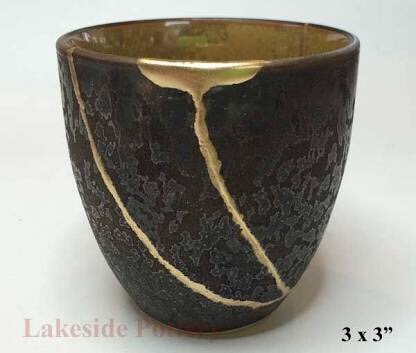
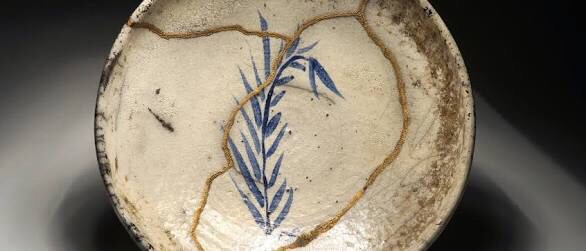

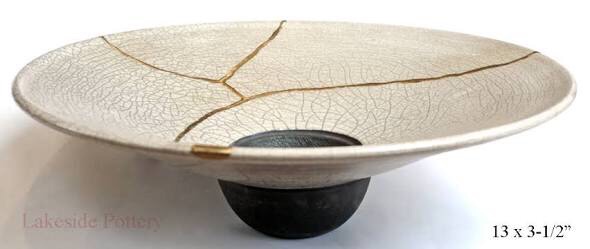


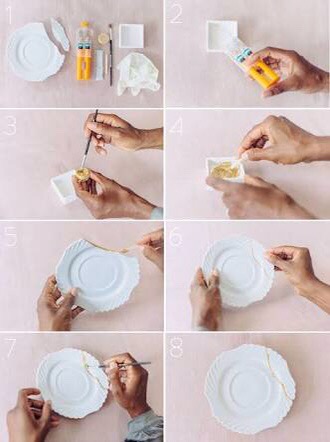






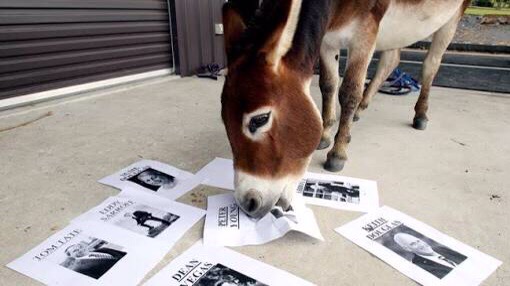
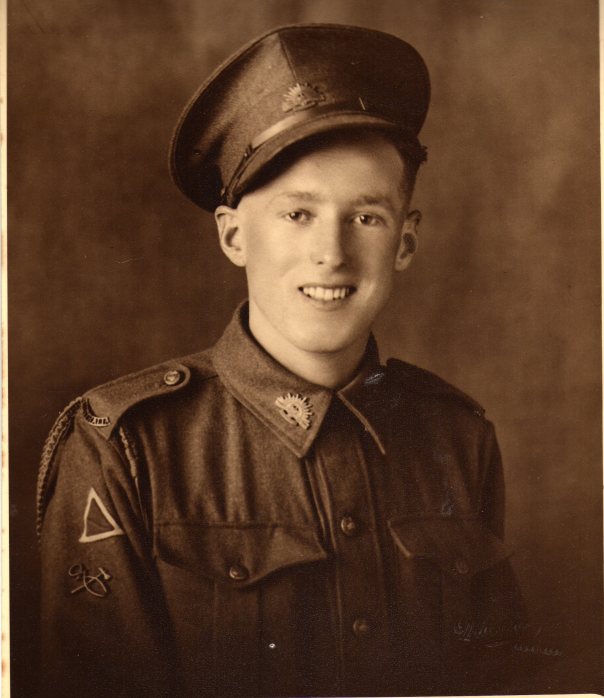


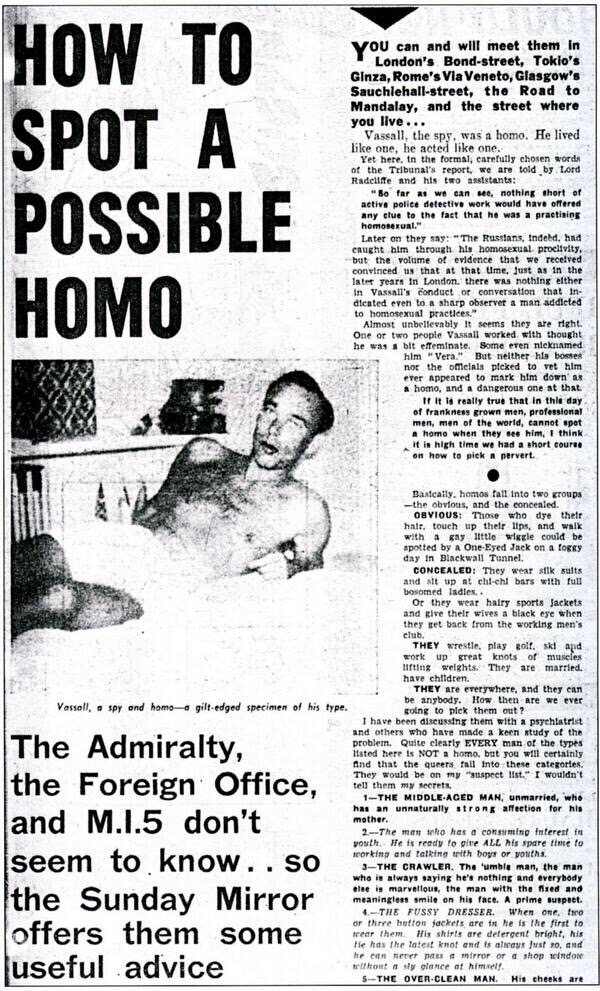


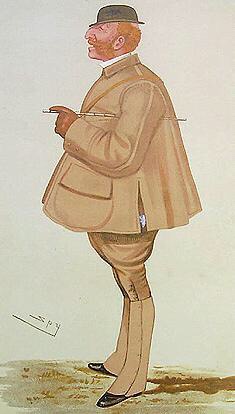
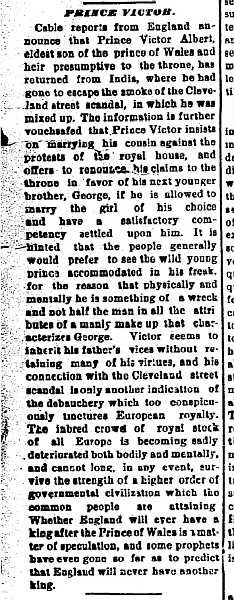
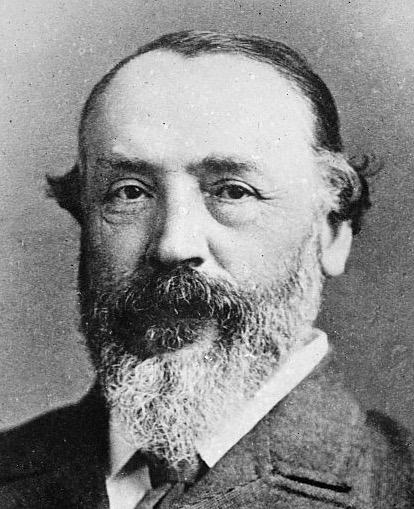
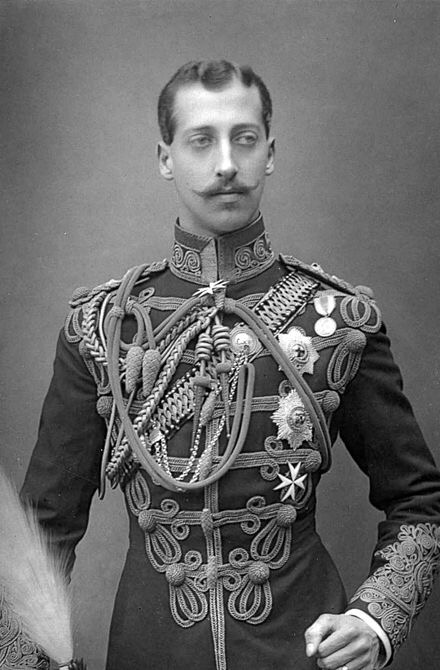
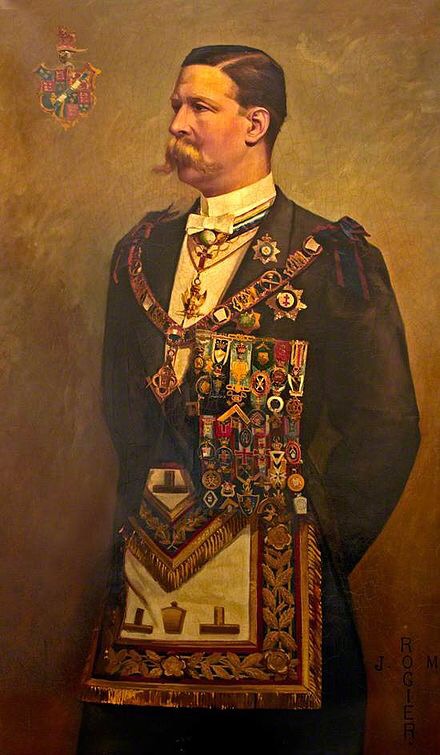
 timalderman