Hideki Tojo was the leader of Japan for much of World War II.(Supplied: Wikipedia)
“Accused Hideki Tojo, on the counts of the indictment of which you have been convicted, the International Military Tribunal for the Far East sentences you to death by hanging.”
With those words on November 12, 1948, a judge of the High Court of Australia unwillingly passed a death sentence on the wartime leader of one of the major Axis powers.
As president of the International Military Tribunal for the Far East, Sir William Webb presided over one of the two multinational tribunals established to prosecute the Axis crimes of World War II (the other being the International Military Tribunal at Nuremberg).
No Australian jurist before or since has ever held such responsibility, yet his part and Australia’s key role in the prosecution of hundreds of accused Japanese war criminals throughout the Asia-Pacific are little remembered today.
Webb’s scruples about the death sentence did not come from sympathy for Tojo or the other six defendants also sentenced to hang.
Rather, it was the joint decision of the Allied Governments to grant Emperor Hirohito immunity in exchange for his cooperation.
“It would be a travesty of justice, seriously reflecting on the United Nations, to hang or shoot the common Japanese soldier or Korean guard while granting immunity to his sovereign perhaps even more guilty than he,” Webb had written in September 1945.
Having spent three years investigating war crimes in the Pacific, he was convinced that responsibility for Japanese atrocities needed to be pursued all the way to the very top.
The Australian Government came around to his view, but its British and American Allies did not. The Emperor was left in power, used as a buffer to soften Japan’s rough and rapid transition to democracy. As a consolation prize, perhaps, General Douglas Macarthur appointed Webb as president of the tribunal.
Sir William Webb was a judge of the Supreme Court of Queensland and the High Court of Australia.(Supplied: Queensland State Archives)
Webb out of his depth
Webb was a diligent and effective investigator, but he was out of his depth in Tokyo. Balancing the competing legal and political objectives of the cosmopolitan court would have required a subtle and confident judge, extremely knowledgeable in international law and able to deal effectively with the international bench and the Japanese defendants.
Webb was not such a man. New Zealand judge Erima Harvey Northcroft described him as “brusque to the point of rudeness. He does not control the court with dignity, he is pre-emptory and ungracious in his treatment of counsel and witnesses, and instead of giving shortly the legal justification which in most cases exists for his decisions, he leaves everyone in the court with the impression his rulings are dictated by petulance or impatience and an impression, which may easily develop in the future, of prejudice.”
Nuremberg was wrapped up and the death sentences carried out by the end of October 1946. Tokyo, afflicted with administrative troubles, translation difficulties, and the incompetent management of the prosecution case by lead prosecutor Joseph Keenan, limped on into late 1948.
Hermann Goering sits in the dock at the Nuremberg trial in 1946.(www.freeinfosociety.com)
Carrying on without the president
Webb’s authority with the court, already weak, suffered a fatal blow in early 1947 when the Australian Government, in a breathtakingly parochial decision, summoned him to home to sit on the High Court for the bank nationalisation case.
By the time he returned to Tokyo in December, he was president of the court in name only.
Three judges — Northcroft, Lord Patrick of the United Kingdom, and Edward Stuart McDougall of Canada — had decided to take matters into their own hands.
All three men had served in one world war, seen a second, and had become determined that there should not be a third.
They knew that the prosecution’s case was struggling, particularly following Tojo able handling of Keenan’s botched cross-examination. And they also knew that two of the other judges, Bert Roling of the Netherlands and Henri Barnard of France, had serious reservations about convicting men under laws which they believed the court was making up as it went along.
Northcroft, Patrick and McDougall succeeded in pulling together a solid but not overwhelming majority of seven judges out of 11.
As president, it still fell to Webb to read the majority judgement, even though he played no role in writing it.
Reading the judgement and the sentences took him eight days; the sentences were read on November 12.
Tojo accepted his fate with characteristic stoicism. Taking off the headphones through which he had heard a translator announce Webb’s sentence in Japanese, he stood up, smiled at Webb, nodded, and bowed very deeply. Turning sharply, he walked out of the courtroom.
War crimes court presided over by the Australian High Court judge Sir William Webb.(Suppled: State Library of Victoria)
‘He has lost his belief in war’
Five of the judges wrote partial or full dissents of their own, although these were not read to the court and were only published later.
Most controversially, openly pro-Axis judge Radhabinod Pal of India wrote a massive and inflammatory dissent where he suggested that Japan had fought a justified war against Western imperialism, implied that evidence of Japanese war crimes against Asian civilians had been exaggerated for propaganda purposes, compared the atomic bombings of Hiroshima and Nagasaki to the Holocaust, and argued that all of the defendants should have been acquitted of all of the charges.
In a short partial dissent, Webb agreed with the majority on their interpretation of the law but expressed reservations about the sentencing: “I do not suggest the Emperor should have been prosecuted. That is beyond my province. His immunity was, no doubt, decided upon in the best interests of all the Allied Powers. Justice requires me to take into consideration the Emperor’s immunity when determining the punishment of the accused found guilty: that is all.”
This mild statement still inflamed Macarthur, who believed Webb was cynically exploiting anti-Hirohito feeling to boost his popularity in Australia, and compelled the prosecution to issue a statement affirming that there had been no grounds to prosecute the Emperor.
In his final public statements before his execution on December 23, 1948, Tojo repeated his satisfaction that the Emperor had escaped prosecution, confirmed his faith in the people of Japan, and called for world peace.
He was now under the guidance of a Buddhist priest, Dr Hanayama, who was pleased with the progress his pupil was making.
“Since he embraced the Buddhist faith six months ago, he has lost his belief in war,” Dr Hanayama told the media in a press conference in early December.
“A devout belief in Buddhism, together with the knowledge of the suffering the war has caused the world’s peoples, has convinced him that there are other, better means of solving world’s problems.”
That, at least, is a good lesson.
Adam Wakeling is the author of The Last Fifty Miles: Australia and the End of the Great War and Stern Justice: Australia in the Pacific War Crimes Trials.
The Beauchamp Hotel in Darlinghurst is named after this former governor of NSW.
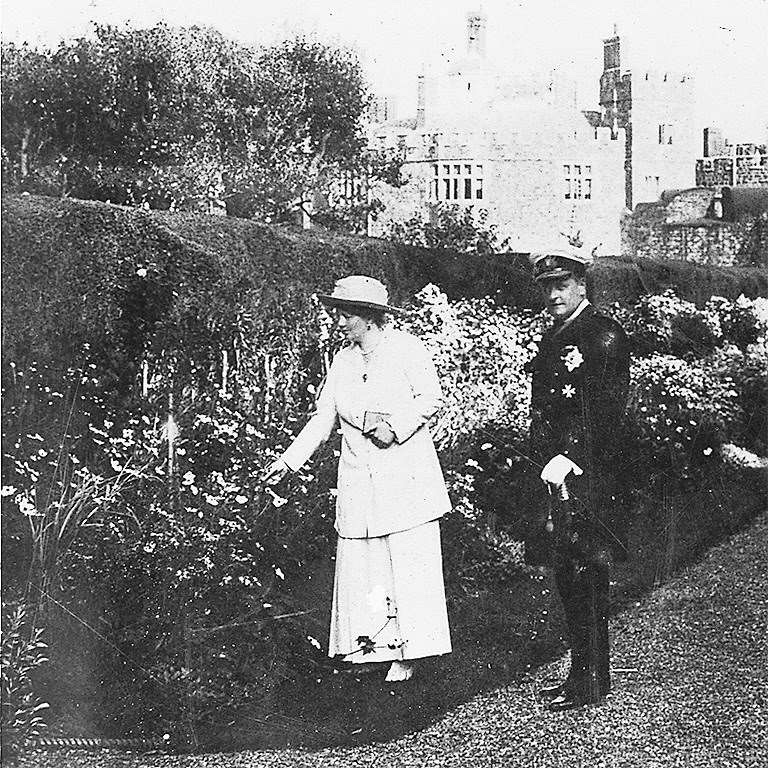
Built in 1540 to guard the English coast against foreign invasions, Walmer Castle is one of Kent’s most prominent landmarks. Since the 18th century it has been the official residence of the Lord Warden of the Cinque Ports. During the 1920s Walmer was home to William Lygon, 7th Earl of Beauchamp, who held lavish homosexual parties at the castle. This led eventually to his dramatic fall from grace, the break-up of his family, and the inspiration for Evelyn Waugh’s most famous novel, Brideshead Revisited.
CABINET MINISTER AND FAMILY MAN
Born in 1872, William Lygon was a well-known public figure from a young age. Succeeding his father as Earl Beauchamp in 1891, he became mayor of Worcester at the age of 23, and was appointed governor of New South Wales, Australia, in 1899. A high-flying figure in the Liberal Party, he rose to become a senior cabinet minister in 1910. He was also appointed First Commissioner of the Office of Works (later English Heritage), in charge of works to royal residences and government buildings.
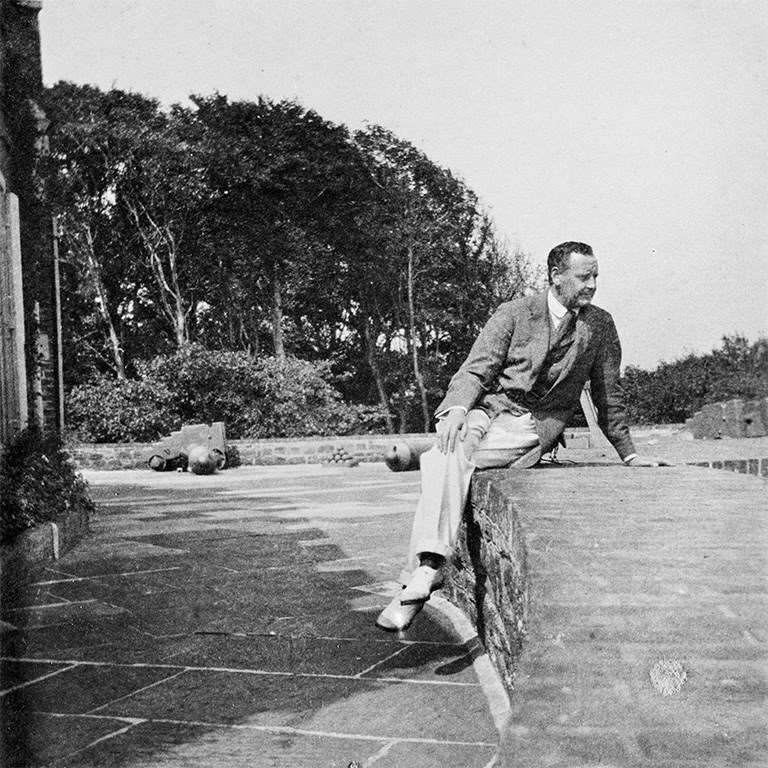
In 1913, Beauchamp was appointed Lord Warden of the Cinque Ports. He enjoyed the pomp and ceremony that came with the role of Lord Warden: one of his duties was to welcome visiting foreign dignitaries at Dover on behalf of the king. Equally, however, he spent time at Walmer Castle with his family. In 1902, he had married Lettice Grosvenor, sister of Hugh Grosvenor, 2nd Duke of Westminster. Family photographs show Beauchamp, Lettice and their seven children enjoying their surroundings and each other’s company at Walmer.
Beauchamp’s family life appeared conventional. However, during the 1920s he is known to have thrown some rather racy parties at Walmer, to which he invited his high-class friends, along with local fishermen and youths. A hint of their nature is given in the memoirs of Lady Christabel Aberconway, who wrote that:
One Sunday, my host, Lord Jowitt, asked my husband if he and I would like to see one of the famous castles of the Cinque Ports. Delightedly we accepted. … We arrived [at Walmer] and were shown into a garden surrounding a grass tennis court. There was the actor Ernest Thesiger, a friend of mine, nude to the waist and covered with pearls.
The gardens at Walmer Castle
CAUGHT OUT
In 1930 Beauchamp became embroiled in a scandal that would prove disastrous to his career and personal life. He had embarked on a round-the-world tour in August that year, spending two months in Sydney, Australia. He was accompanied by a young valet, who lived with him as his lover. This did not go unnoticed, and Beauchamp’s tastes were reported in the Australian Star newspaper:
The most striking feature of the vice-regal ménage is the youthfulness of its members … Rosy cheeked footmen, clad in liveries of fawn, heavily ornamented in silver and red brocade, with many lanyards of the same hanging in festoons from their broad shoulders, [who] stood in the doorway, and bowed as we passed in … Lord Beauchamp deserves great credit for his taste in footmen.
Following this report, Beauchamp’s brother-in-law, the Duke of Westminster, hired detectives and began to gather evidence of Beauchamp’s activities.
The Duke of Westminster was reported to be a bullying, womanising, angry man, once described as ‘nothing but a fatuous, spoilt, ageing playboy’. He had always disliked Beauchamp, jealous of his brother-in-law’s public office and apparent domestic happiness. In addition, the duke was a staunch Tory, whereas Beauchamp was the Liberal Party’s leader in the House of Lords. To ruin Beauchamp would not only satisfy Westminster’s personal vendetta, but would also be politically advantageous.
In 1931 Westminster publicly denounced Beauchamp as a homosexual to George V, who reportedly responded, ‘Why, I thought people like that always shot themselves’. Westminster insisted that Beauchamp be arrested, forcing him into exile.
Beauchamp fled first to Germany, where he contemplated suicide, but was dissuaded from it by his son Hugh. He later split his time between Paris, Venice, Sydney and San Francisco – four cities that were relatively tolerant of his sexual orientation.
Meanwhile, Westminster presented his evidence to his sister Lettice, who suffered a nervous breakdown at the news. She submitted a petition for divorce, moved to her brother’s Cheshire estate and took to her bed. The divorce petition described Beauchamp as:
A man of perverted sexual practices, [who] has committed acts of gross indecency with male servants and other male persons and has been guilty of sodomy … throughout the married life … the Respondent habitually committed acts of gross indecency with certain of his male servants.
Westminster ordered Beauchamp’s children to testify against their father, but they all refused. Though his wife had deserted him, his children’s support never wavered. They shunned their mother and never made peace with her (except the youngest son, Dickie). Westminster became their worst enemy and he let it be known that anyone dealing with the Lygons would be dropped from society. In an extraordinary display of spite, Westminster wrote Beauchamp a short letter, simply stating:
Dear Bugger-in-Law, You got what you deserved. Yours, Westminster.
Cut off from the rest of society, Beauchamp’s children took turns to visit their father abroad. According to Beauchamp’s daughter Sibell, he never grumbled, nor mentioned Westminster again, but grew resigned to his exile.
It was not until George VI came to the throne in 1936 that the warrant for Beauchamp’s arrest was lifted. Beauchamp returned to England in July 1937. He moved back to Madresfield, the family home, and wasted no time in painting out his wife’s image from a fresco in their personal chapel. The family threw her bust into the house’s moat.
Beauchamp died of cancer in 1938. His various misfortunes inspired Evelyn Waugh’s 1945 novel Brideshead Revisited – the character of Lord Marchmain was based on Beauchamp himself, while his son Hugh proved the inspiration for the ill-fated Sebastian Flyte.
The death in custody of 31-year-old Stefano Cucchi has brought the abuse of police power under scrutiny in Italy. After losing her brother and enduring the subsequent trial, Ilaria Cucchi is now receiving harassment and online threats from police officers. Sociologists say Stefano’s case is not isolated and ask what the country will do to clean up its policing.
The Netflix film On My Skin (Sulla Mia Pelle), directed by Alessio Cremonini and starring Alessandro Borghi, premiered at the Venice Film Festival in August 2018.
At the end of the screening, Ilaria, a woman wearing a red dress, walked towards the film’s director, who was standing in the front row of the cinema receiving applause, and wrapped her arms around his neck.
The embrace momentarily hid their noticeably moved faces from the gaze of the surrounding crowd.
On My Skin (featured in our collection of human rights documentaries) tells the story of a man who was arrested by Carabinieri (Italy’s domestic police) officers in Rome and died in unclear circumstances after seven days of being in precautionary custody.
The man was Ilaria’s younger brother, Stefano Cucchi.
Since his death in 2009, Stefano, 31, has become an icon of the abuse of police power in Italy.
He was arrested on 15 October 2009, after being caught handing a dose of cannabis to his friend Emanuele Mancini.
He spent his first night in custody in a Carabinieri cell. The next day he was taken to a prison wing of the local general hospital with distinct marks and bruises on his eyes, back pain and injuries to his legs.
Seven days after his arrest, at 6.15am on 22 October, Stefano was found dead in his hospital bed.
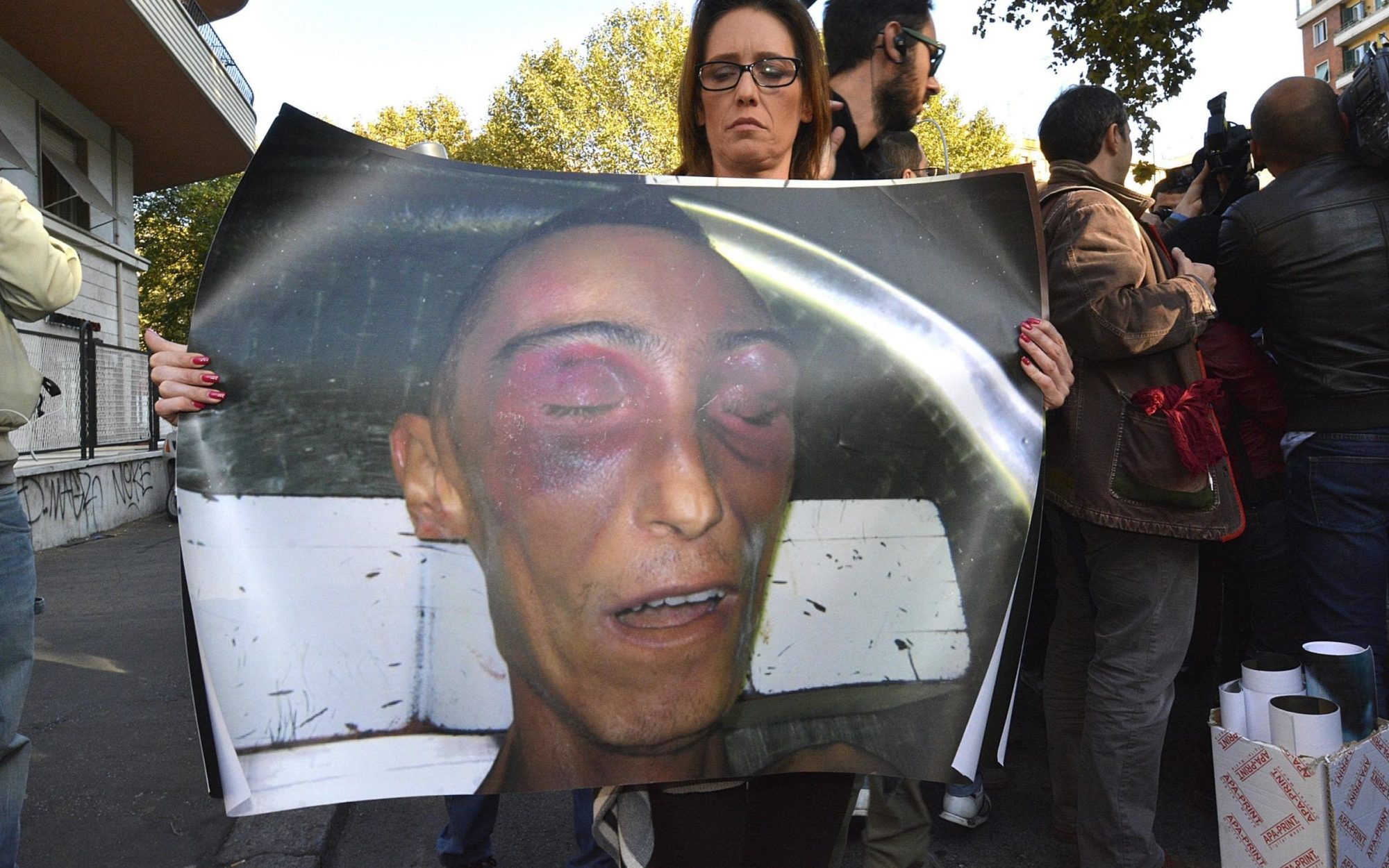
This young amateur boxer was in good health before his arrest but his family obtained photographs from the morgue showing Stefano’s emaciated body covered in purple bruises. They rejected the assertion that Stefano had died of natural causes and began a campaign for justice.
A SISTER’S FIGHT FOR JUSTICE
Stefano’s story sparked a debate about the abuse of police power at a national level. The case polarised the Italian public, as the story was heavily politicised and peppered with accusations, slander, threats and cover-ups.
Stefano’s sister Ilaria received support from many, but she also received criticism and scorn from those who believed the Carabinieri officers’ integrity and innocence.
However, this year – seven years after the first trial – one of the Carabinieri officers involved in the trial added a new twist to the story.
On My Skin (Sulla Mia Pelle) film poster
On 11 October 2018, Francesco Tedesco, one of the three indicted officers, confessed that Stefano had been beaten, accusing his two colleagues, Alessio di Bernardo and Raffaele D’Alessandro. Tedesco claimed he was only a witness to the abuse and tried to stop the other two officers as they beat him for refusing to cooperate.
Furthermore, he accused his superiors of forcing him to stay silent about what happened that night.
He claimed to have written a report about the beating, but said it was suppressed by his managers.
Seven years after the first trial, following 45 hearings, dozens of reports, investigations and more than 100 testimonies collected from witnesses, the second trial is still not concluded. The confession of Francesco Tedesco, however, could add a new direction.
Stefano’s sister Ilaria Cucchi hasn’t been alone in her battle as she has significant public support in fighting for justice.
Nevertheless, since the release of On My Skin, Ilaria has been receiving death threats on Facebook from supporters of the Northern League (one of Italy’s two co-ruling political parties) and from accounts she believes belong to police officers.
On 20 October 2018, Ilaria posted one such comment on Facebook, saying she feels that she and her loved ones (as well as lawyer Fabio Anselmo, who followed Stefano’s case from the beginning) are in danger.
SHINING A LIGHT ON POLICE BRUTALITY IN ITALY
Anselmo’s law career spans some of the most renowed cases of abuse of power in Italy.
In 2005, he represented the family of 18-year-old Federico Aldrovandi, who was killed by four police officers when he was returning to his home in Ferrara. The trial ended in 2012 with the four officers sentenced to three years and six months each. This was later reduced by the Italian parliament to just six months each and the officers have now returned to work.
Lawyer Fabio Anselmo
Anselmo was also involved in the case of Giuseppe Uva, who died in unclear circumstances in 2008 while in police custody. The trial is ongoing.
These and other cases have brought to public opinion the concept of “morti di Stato” (deaths at the hands of the Italian State), a term which defines all those incidents of violent deaths in police custody and the corresponding abuse of power.
While the abuse of police power is not unusual in Italy, it’s not easy to obtain statistics or figures on the topic as the only available sources are the witnesses in the trials.
And while the stories of Stefano Cucchi, Federico Aldrovandi and Giuseppe Uva are the most well known among the Italian public, there are many more cases which have not yet had media coverage.
Federico Aldrovandi before his death
International organisations such as the UN and the EU have criticised Italian policing of certain events.
One of the most widely reported episodes in recent years of abuse of police power in Italy occurred in July 2001, during the 27th G8 summit hosted by Italy, in Genoa.
The two-day summit was attended by leaders of Canada, France, Germany, Italy, Japan, Russia, the UK and the US. The summit drew 200,000 protesters from all over the world for a mass demonstration.
Between July 19 and 22, hundreds of demonstrators were involved in clashes with Italian police officers. Many were injured and 23-year-old Carlo Giuliani, was shot dead by officer Mario Placanica as he and other protesters attacked the officer’s van.
On 21st July, the day after Giuliani’s death, 250 police officers raided the Armando Diaz school with additional support from Carabinieri officers, beat demonstrators who were spending the night there. Police authorities justified the assault claiming that they were looking for black-bloc members (hard left protesters who wear black and obscure their faces) who had devastated part of the city of Genoa during the previous days of the summit. They arrested 93 people, but only one belonged to the black-bloc group. Nevertheless, 61 of them were taken to hospital with injuries.
In the same night, the police brought some of the activists and demonstrators arrested in the school to holding cells in the barracks of Bolzaneto, a suburb of Genoa. There, some of the officers tortured several people, mentally and physically, using humiliation, threats and beatings. They even forced some to exalt Fascism.
In 2015, The European Court of Human Rights (ECHR) condemned Italy for the events, defining the violence committed by police officers as acts of torture. Later, Italy financially compensated 29 people who were beaten at Armando Diaz School and six who were tortured in the Bolzaneto barracks.
ITALIAN LAWS FAIL TO MEET INTERNATIONAL STANDARDS
At an international level, Italy ratified the United Nations Convention against Torture in 1989, but did not introduce the convention into its legal system. In 2016, Ilaria Cucchi launched a petition on Change.orgto introduce a law against torture. She gained more than 240,000 signatures. Eventually, Italy introduced the law in 2017, motivated by the verdicts of the ECHR
However, according to the UN, as well as some experts and international human rights associations, the new law doesn’t respect international standards. As Human Rights Watch highlighted in their report, “the text of the new law requires ‘multiple acts’ for torture to occur. The [UN] convention, reflecting the international law, affirms ‘any act’ might be torture if it meets the gravity standard. The new law also requires that psychological trauma be ‘verifiable’ to establish ‘psychological’ torture”.
In the same report, Human Rights Watch said the discrepancy between the definition of torture drafted in the UN convention and the new law adopted by Italy (article 613-bis of the Penal Code) implies that “the restrictive definition and short statute of limitations – in a country whose judiciary system is infamous for its lengthy trials – raises the risks that torture will go unpunished, as well as hinder the ability of victims to get redress. This means that Italy will continue to be in violation of its international obligations.”.
Criticism about the new law, but for opposite reasons, came from some Italian right-wing movements too. On 12th July 2018, Fratelli D’Italia (Brothers of Italy) leader Giorgia Meloni announced on Twitter two proposals to abolish the crime of torture in Italy, on the grounds that the law would hinder the police officers to work properly. Her tweet has been widely criticised.
Two years before the introduction of the law, the current Deputy Prime Minister of Italy and Minister of the Interior Matteo Salvini criticised the verdict of the ECHR concerning the G8 in 2001 and said that a law against torture is a nonsense law that would allow criminals to blackmail police officers.
COULD CUCCHI’S CASE LEAD TO IMPROVEMENTS IN POLICING?
Based at the University of Genoa, professor of sociology Salvatore Palidda is one of the few Italian researchers focusing on the relationship between police and civil society.
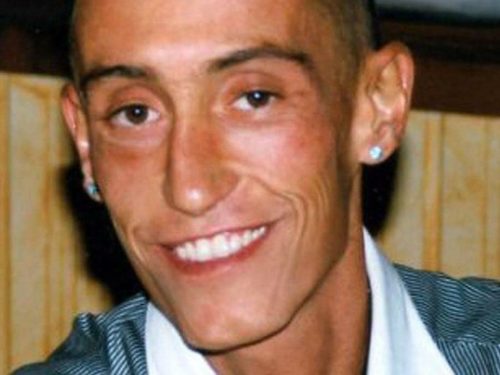
Stefano Cucchi before his death
According to Palidda, there are hundreds of cases like Cucchi’s, Aldrovandi’s and Uva’s that have not received media coverage, because they concern outcasts or immigrants without residency permits.
“The activity of police forces is always characterised by the coexistence of a peaceful management and a violent one. The discretion of power held by officers may turn into free will and lead to torture and murder”, Palidda said.
Key to understanding the violence perpetrated by some officers is their sense of impunity. “Some police managers tolerate and cover up illicit behaviours of officers in order to earn the respect of other subordinates and police trade unions,” Palidda explained.
Another factor that facilitates impunity is the reticence of police force members to report their colleagues. The stories of Aldrovandi, Cucchi and Uva, as well as the facts of the 2001 G8 in Genoa and many others are characterised by cover-ups and silence imposed by the officer’s superiors and colleagues. Indeed, the unexpected confession of the Carabinieri officer Francesco Tedesco regarding the death of Stefano Cucchi is a rare breach of this convention.
Palidda says one practical method of containing and controlling police brutality in Italy is to “establish an independent authority that would monitor and regulate the activities of police forces. This should bring impunity to an end and tribunals would investigate the alleged crimes without the support of police”.
However, he added, “these measures are possible only in a country where most of the population has an effective sense of democracy”.
Pink triangles were originally used in concentration camps to identify gay prisoners.
Before the pink triangle became a worldwide symbol of gay power and pride, it was intended as a badge of shame. In Nazi Germany, a downward-pointing pink triangle was sewn onto the shirts of gay men in concentration camps—to identify and further dehumanize them. It wasn’t until the 1970s that activists would reclaim the symbol as one of liberation.
Homosexuality was technically made illegal in Germany in 1871, but it was rarely enforced until the Nazi Party took power in 1933. As part of their mission to racially and culturally “purify” Germany, the Nazis arrested thousands of LGBT individuals, mostly gay men, whom they viewed as degenerate.
The United States Holocaust Memorial Museum estimates 100,000 gay men were arrested and between 5,000 and 15,000 were placed in concentration camps. Just as Jews were forced to identify themselves with yellow stars, gay men in concentration camps had to wear a large pink triangle. (Brown triangles were used for Romani people, red for political prisoners, green for criminals, blue for immigrants, purple for Jehovah’s Witnesses and black for “asocial” people, including prostitutes and lesbians.)
Homosexual prisoners at the concentration camp at Sachsenhausen, Germany, wearing pink triangles on their uniforms on December 19, 1938. Corbis/Getty Images
At the camps, gay men were treated especially harshly, by guards and fellow prisoners alike. “There was no solidarity for the homosexual prisoners; they belonged to the lowest caste,” Pierre Seel, a gay Holocaust survivor, wrote in his memoir I, Pierre Seel, Deported Homosexual: A Memoir of Nazi Terror.
An estimated 65 percent of gay men in concentration camps died between 1933 and 1945. Even after World War II, both East and West Germany upheld the country’s anti-gay law, and many gays remained incarcerated until the early 1970s. (The law was not officially repealed until 1994.)
The early 1970s was also when the gay rights movement began to emerge in Germany. In 1972, The Men with the Pink Triangle, the first autobiography of a gay concentration camp survivor, was published. The next year, post-war Germany’s first gay rights organization, Homosexuelle Aktion Westberlin (HAW), reclaimed the pink triangle as a symbol of liberation.
“At its core, the pink triangle represented a piece of our German history that still needed to be dealt with,” Peter Hedenström, one of HAW’s founding members said in 2014.
Memorial plaques for homosexuals, Jehovah’s Witnesses and Wehrmacht deserters are placed where once stood one of the demolished barracks in Buchenwald concentration camp near Weimar, Germany. Horacio Villalobos/Corbis/Getty Images
Afterwards, it began cropping up in other LGBT circles around the world. In 1986, six New York City activists created a poster with the words SILENCE = DEATH and a bright pink upward-facing triangle, meant to call attention to the AIDs crisis that was decimating populations of gay men across the country. The poster was soon adopted by the organization ACT UP and became a lasting symbol of the AIDS advocacy movement.
The triangle continues to figure prominently in imaging for various LGBT organizations and events. Since the 1990s, signs bearing a pink triangle enclosed in a green circle have been used as a symbol identifying “safe spaces” for queer people. There are pink triangle memorials in San Francisco and Sydney, which honor LGBT victims of the Holocaust. In 2018, for Pride Month, Nike released acollection of shoes featuring pink triangles.
Although the pink triangle has been reclaimed as an empowering symbol, it is ultimately a reminder to never forget the past—and to recognize the persecution LGBT people still face around the world.
Flyer for Gay Liberation Front protest at the Examiner Building October 31, 1969, Courtesy of the GLBT Historical Society
“San Francisco is a refugee camp for homosexuals. We have fled here from every part of the nation, and like refugees elsewhere, we came not because it is so great here, but because it was so bad there. By the tens of thousands, we fled small towns where tobe ourselves would endanger our jobs and any hope of a decent life….”
Refugees from Amerika: A Gay Manifesto — Carl Wittman, December, 1969
Cover of Gay Sunshine, October 1970
By the time of the first night of protests at New York City’s Stonewall Inn, San Francisco had experienced months of demonstrations related to gay rights that would continue for the next few years.
Unlike Stonewall, the disturbances in San Francisco started over job rights, and a bar was not involved. But because the disturbances spread and issues multiplied, they would eventually include at least three bars, including Oakland’s White Horse.
The people who lit the fuse were recent arrivals. Gale Chester Whittington came from Denver in 1968 and Leo Laurence from Indianapolis in 1966.
Whittington got a job as an accounting clerk at the States Steamship Company (320 California).
Laurence was a journalist for the underground newspaper Berkeley Barb and the editor of the Society for Individual Rights magazine Vector.They met when Whittington volunteered to write for Vector.
A Vector photographer shared a photo from a shoot of Laurence and Whittington with The Barb. It was paired with an article from March 23, 1969, titled “Homo Revolt: Don’t Hide it.”
The article covered Laurence’s editorial call for gay revolution in Vector. Since the Barb had sex ads, it was read by several of Whittington’s straight colleagues at the shipping company. The day it was published, Whittington was fired. Because of the editorial Laurence was removed as editor of Vector.
Homo Revolt, Dont Hide It, Berkeley Barb, March 28, 1969
Whittington and Laurence then formed the Committee for Homosexual Freedom. Max Scheer, editor of The Barb, promised to cover their actions. On April 9, 1969 the picketing of the steamship company began with signs saying, “Let Gays Live,” “Free The Queers” and “Freedom for Homos Now.”
The protests continued for months. In May, The Advocate picked up coverage of the protests and by June the Rev. Troy Perry had begun a sympathy strike at the company’s Los Angeles offices.
Ultimately the protests didn’t succeed in getting Whittington’s job back, but because the San Francisco Chronicle, The Advocate and The Barb covered the protest (on an almost weekly basis) it spread the word nationally and CHF grew.
In Whittington’s autobiographical work, Beyond Normal: The Birth of Gay Pride, he mentions that Hibiscus and Lendon Sadler (of the Cockettes) and Carl Wittman (author of Refugees from Amerika: A Gay Manifesto) all took part in early CHF protests. Wittman read early drafts of his manifesto to the group.
By May protests spread to a second site: Tower Records. Employee Frank Denaro was fired after a security guard reported to management that he had returned the wink of a male customer. Unlike the steamship company, however, the record store was swayed by public opinion and by June the management offered Denaro his job back.
States Steamship Protest, Berkeley Barb, April 25 – May 1, 1969
Purple rain News about what was happening in San Francisco continued to spread. Berkeley Tribeprinted a letter saying Laurence’s articles, reprinted in a Minneapolis campus newspaper, had inspired a class in Homosexual Revolution from their Free University. In Beyond Normal, Whittington relates he received a telegram from New Yorkers who were at Stonewall and had been inspired by articles in The Barb. In October, both Laurence and Whittington were interviewed in the L.A. magazine Tangents.
By October 1969, Gay Liberation Front chapters opened in Berkeley and San Francisco. Two protests on Halloween show both coordination and fragmentation between new and old organizations.
At the first, called “Friday of the Purple Hand,” the Society for Individual Rights worked with CHF and both GLF groups to protest the editorial policies of the San Francisco Examiner. Earlier that week, Robert Patterson of the Examiner had written “The Dreary Revels of S.F. ‘Gay’ Clubs” which referred to gays as “semi-males” and lesbians as “women who aren’t exactly women” as well as referring to both as deviates.
Around 100 protesters picketed the Examiner building, and then had printers ink dumped on them from an upper floor by Examiner employees. The protesters used the ink to make purple hand prints all over the building (which gave the protest its name). The protesters were then attacked by the police Tactical Squad. Twelve people were injured and fifteen were arrested.
Friday of the Purple Hand coverage, San Francisco Free Press
The second event that day was a protest of the Beaux Arts Ball in the Merchandise Mart by Gay Guerrilla Theater and the Gay Liberation Coalition. Laurence reported in the Berkeley Tribe that the protest was focused on the acceptance of laws that only allowed drag on Halloween and New Year’s. He reported:
“I don’t dig drag myself (can’t imagine being a bearded lady)…but by God, I do feel the drags should have the right to do their thing; not just twice a year, but every day; not just at a drag ball, but at work, school, church and on the streets.”
This was among the first confrontations between older gay organizations and newer, more radical groups. Others included a protest of a S.I.R. dinner in February 1972 where Willie Brown was speaking on reforming sex laws (protested because of the cover charge of $12) and a takeover of the North American Conference of Homophile Organizations (NACHO) by the Gay Liberation Front in August 1970. GLF demanded that NACHO affirm its support of the Black Panther Party and Women’s Liberation and organize a national gay strike.
Clearly there was a generational difference between members of homophile organizations and the gay liberationists. Many of the younger generation had ties to the New Left and anti-war movements.
Laurence had been in Chicago for the ’68 Democratic convention and Wittman had written for the SDS before, for example. GLF members formed a gay contingent for the Nov. 15, 1969 Moratorium March Against the War. And by and large they read the underground press, not the gay press.
Demands for White Horse Protest, Gay Sunshine, October 1970
Horse sense The most dramatic confrontation between gay liberationists and gay bars came at the White Horse Bar in Oakland. Konstantin Berlandt, a long-time gay activist in Berkeley, was thrown out of the bar for selling Gay Sunshine by the owner Joe Johansen. The Gay Sunshine collective worked with the Berkeley GLF and picketed the bar. A list of demands included one that patrons be allowed to touch one another and slow dance. Within a week the bar capitulated to the protesters.
The White Horse wasn’t the only bar to raise the ire of liberationists.
Leonarda’s also refused to sell Gay Sunshineand a boycott was suggested (it’s hard to know how serious to take this, as the underground press kept reporting the bar’s name as “Leonardo’s”). The Stud also upset writers at the Berkeley Tribe by checking IDs at the door. They may, however, have just been opposed to bars as institutions. The article in the Tribesuggested:
“The bars can’t be liberated, they must be destroyed. They rip off our money, keep us in ghettos playing the same old weary games thinking that we are satisfied, and maintain all the divisions in Amerika — women and men, gay women and gay men, black and white, young and old. The Stud mentality in our heads has to be rooted out and killed too.”
Ultimately it was not the bars but the gay liberationists that disappeared as the 1970s progressed. I asked Gary Alinder, who was a member of Berkeley’s GLF, about burnout and the disappearance of Gay Lib in the ’70s.
“It evolved,” he said. “Gay liberation was a sudden uprising. Most of us were anti-organization. It was not meant to stay around for a long time. It was a burst of energy — an explosion. A second generation would come along that was more organized. But the message — to make people happy in themselves and come out — was valid.”
That burst of energy had a massive effect — it spread through LGBT organizations with programs like gay rap sessions to campuses across the country and created an explosion of new publications. Those publications and organizations did reach people. As a teen who picked up the Detroit Gay Liberator in the early ’70s, and who attended a gay rap meeting on my college campus, I can testify that those of us who followed were grateful for the work of the Stonewall generation.
Reference
From Stonewall to the White Horse: The Bay Area’s part in uprisings that changed the world, Bay Area Reporter, 26 June 2019, by Michael Flanagan https://www.ebar.com/bartab/bars//278089
Synopsis: A British Businessman in South Africa, Member of Parliament in the Cape Colony, Prime Minister of the Cape Colony, imperialist, acquired a British Royal Charter, formed the British South African Company (BSAC) that colonized Zimbabwe.First Name: Cecil JohnLast Name: RhodesDate of Birth: 5 July 1853Date of Death: 26 March 1902
The Early Years
Cecil John Rhodes was born on 5 July 1853 in the small hamlet of Bishops Stortford, England. He was the fifth son of Francis William Rhodes and his second wife, Louisa Peacock. A priest of the Church of England, his father served as curate of Brentwood Essex for fifteen years, until 1849, when he became the vicar of Bishop’s Stortford, where he remained until 1876. Rhodes had nine brothers and two sisters and attended the grammar school at Bishop’s Stortford. When he was growing up Rhodes read voraciously but vicariously, his favourite book being The Meditations by Marcus Aurelius, but he equally adored the highly esteemed historian Edward Gibbon and his works on the great Roman Empire.
Rhodes fell ill shortly after leaving school and, as his lungs were affected, it was decided that he should visit his brother, Herbert, who had recently immigrated to Natal. It was also believed, by both Rhodes and his father, that the business opportunities offered in South Africa would be able to provide Rhodes with a more promising future than staying in England. At the tender age of 17 Rhodes arrived in Durban on 1 September 1870. He brought with him three thousand pounds that his aunt had lent him and used it to invest in diamond diggings in Kimberley.
After a brief stay with the Surveyor-General of Natal, Dr. P. C. Sutherland, in Pietermaritzburg, Rhodes joined his brother on his cotton farm in the Umkomaas valley in Natal. By the time Rhodes arrived at the farm his brother had already left the farm to travel 650 kilometres north, to the diamond fields in Kimberley. Left on his own Rhodes began to work his brother’s farm, growing and selling its cotton, proving himself to be an astute businessman despite his young age. Cotton farming was not Rhodes’ passion and the diamond mines beckoned. At 18, in October 1871, Rhodes left the Natal colony to follow his brother to the diamond fields of Kimberley. In Kimberley he supervised the working of his brother’s claim and speculated on his behalf. Among his associates in the early days were John X Merriman and Charles D. Rudd, of the infamous Rudd Concession, who later became his partner in the De Beers Mining Company and the British South Africa Company.
In 1872 Rhodes suffered a slight heart attack. Partly to recuperate, but also to investigate the prospects of finding gold in the interior, the Rhodes brothers trekked north by ox wagon. Their trek took them along the missionary road in Bechuanaland as far north as Mafeking, then eastwards through the Transvaal as far as the Murchison range. The journey inspired a love of the country in Rhodes and marked the beginning of his interest in the road to the north and the northern interior itself.
In 1873 Rhodes left his diamond fields in the care of his partner, Rudd, and sailed for England to complete his studies. He was admitted to Oriel College Oxford, but only stayed for one term in 1873 and only returned for his second term in 1876. He was greatly influenced by John Ruskin’s inaugural lecture at Oxford, which reinforced his own attachment to the cause of British Imperialism. Among his Oxford associates were Rochefort Maguire, later a fellow of All Souls and a director of the British South Africa Company, and Charles Metcalfe. At university Rhodes was also taken up with the idea of creating a ‘secret society’ of British men who would be able to lead the world, and spread to all corners of the globe the spirit of the Englishman that Rhodes so admired. He wrote of this society,
Why should we not form a secret society with but one object the furtherance of the British Empire and the bringing of the whole uncivilised world under British rule for the recovery of the United States for the making the Anglo-Saxon race but one Empire.’
His university career engendered in Rhodes his admiration for the Oxford ‘system’ which was eventually to mature in his scholarship scheme: ‘Wherever you turn your eye – except in science – an Oxford man is at the top of the tree’.
An Arch Imperialist
One of Rhodes’ guiding principles throughout his life, that underpinned almost all of his actions, was his firm belief that the Englishman was the greatest human specimen in the world and that his rule would be a benefit to all. Rhodes was the ultimate imperialist, he believed, above all else, in the glory of the British Empire and the superiority of the Englishman and British Rule, and saw it as his God given task to expand the Empire, not only for the good of that Empire, but, as he believed, for the good of all peoples over whom she would rule. At the age of 24 he had already shared this vision with his fellows in a tiny shack in a mining town in Kimberley, when he told them,
‘The object of which I intend to devote my life is the defence and extension of the British Empire. I think that object a worthy one because the British Empire stands for the protection of all the inhabitants of a country in life, liberty, property, fair play and happiness and it is the greatest platform the world has ever seen for these purposes and for human enjoyment’.
Rhodes’ British Empire corridor through Africa. Source
A few months later, in a confession written at Oxford in 1877, Rhodes articulated this same imperial vision, but with words that clearly showed his disdain for the people whom the British Empire should rule:
“I contend that we are the first race in the world, and that the more of the world we inhabit the better it is for the human race. Just fancy those parts that are at present inhabited by the most despicable specimen of human being, what an alteration there would be in them if they were brought under Anglo-Saxon influence…if there be a God, I think that what he would like me to do is paint as much of the map of Africa British Red as possible…”
One of Rhodes’ greatest dreams was a ribbon of red, demarcating British territory, which would cross the whole of Africa, from South Africa to Egypt. Part of this vision was his desire to construct a Cape to Cairo railway, one of his most famous projects. It was this expansive vision of British Imperial control, and the great lengths that Rhodes went to in order to fulfil this vision, which led many of his contemporaries and his biographers to mark him as a great visionary and leader.
Rhodes was both ruthless and incredibly successful in his pursuit of this scheme of a great British Empire. His contemporaries marvelled both at his prowess and incredible energy and capacity, but they also shuddered at his callousness and depravity in all his pursuit. His contemporaries, both awed and appalled by the man, wrote of him as a man of original ideas who sought more than the mere ‘getting and spending which limits the ambitions and lays waste the powers of the average man’. Yet although many people at the time saw Rhodes as a man of great vision, an unconquerable leader with the ability to pursue his aims across the vast African continent, there were nonetheless dissident voices who were shocked by Rhodes’ actions and those of his British South Africa Company. One such voice was that of Olive Schreiner, who, initially awed by Rhodes, had come to abhor him. In April of 1897 she wrote, in a letter to her friend, John Merriman:
“We fight Rhodes because he means so much of oppression, injustice, & moral degradation to South Africa; – but if he passed away tomorrow there still remains the terrible fact that something in our society has formed the matrix which has fed, nourished, built up such a man!”
The King of Diamonds
Rhodes’ plans for the Cape To Cairo Railway, 1899 Source
Whilst at Oxford, Rhodes continued to prosper in Kimberley. Before his departure for Oxford Rhodes had realised that the changing laws in the Kimberley area would force the ‘small man’ out of the diamond fields and would only leave larger companies able to operate in the mines. In light of this he sought to consolidate a number of mines with his partner, Charles Rudd. Rhodes had also decided to move away from the ‘New Rush’ Kimberley mine fields, that were higher in the ground and thus more accessible, back to the lower yielding ‘Old Rush’ area. Here Rhodes and Rudd bought the costly claim of what was known as old De Beers (Vooruitzicht Farm) which owed its name to Johannes Nicolaas de Beer and his brother, Diederik Arnoldus de Beer, the original owners of the farm Vooruitzicht. It was this farm that would lend its name to Rhodes and Rudd’s ever growing diamond company.
In 1874 and 1875 the diamond fields were in the grip of depression, but Rhodes and Rudd were among those who stayed to consolidate their interests. They believed that diamonds would be numerous in the hard blue ground that had been exposed after the softer, yellow layer near the surface had been worked out. During this time the technical problem of clearing out the water that was flooding the mines became serious and he and Rudd obtained the contract for pumping the water out of the three main mines.
Rhodes had come to the realisation that the only way to avoid the cyclical boom and bust of the diamond industry was to have far greater control over the production and distribution of diamonds. And so, in April 1888, in search of an oligopoly over diamond production, Rhodes and Rudd launched the De Beers Consolidated Mines mining company. With 200 000 pounds capital the Company, of which Rhodes was secretary, owned the largest interest in mines in South Africa. Rhodes greatest coup was to get Barney Barnato, owner of the Kimberley mine, to go partnership with Rhodes’ De Beers Company. Of the encounter Barnato later wrote:
“When you have been with him half an hour you not only agree with him, but come to believe you have always held his opinion. No one else in the world could have induced me to into this partnership. But Rhodes had an extraordinary ascendancy over men: he tied them up, as he ties up everybody. It is his way. You can’t resist him; you must be with him.”
With his acquisition of most of the world’s diamond mines Rhodes became an incredibly rich man. But Rhodes was not after wealth for wealth’s sake, he was acutely aware of the relationship between money and power, and it was power which he sought. Hans Sauer wrote of a conversation he had had with Rhodes whilst looking over the Kimberley diamond mine, where Sauer had asked Rhodes, ‘what do you see here?’, and, Sauer writes, ‘with a slow sweep of his hand, Rhodes answered with the single word: “Power”.’
In the early 1880s gold was discovered in the Transvaal, sparking the Witwatersrand Gold Rush. Rhodes considered joining the rush to open gold mines in the region, but Rudd, convinced him that the Witwatersrand was merely the beginning, and that far greater gold fields lay to the north, in present day Zimbabwe and Zambia. As a result Rhodes held back while other Kimberley capitalists hastened to the Transvaal to stake the best claims. In 1887 when Rhodes finally did act and formed the Goldfields of South Africa Company with his brother Frank, most of the best claims were already taken. Goldfields South Africa performed very poorly, prompting Rhodes to look towards the north for the gold fields that Rudd had assured him were lying in wait.
The Statesman
In 1880 Rhodes prepared to enter public life at the Cape. With the incorporation of Griqualand West into the Cape Colony in 1877 the area obtained six seats in the Cape House of Assembly. Rhodes chose the constituency of Barkley West, a rural constituency in which Boer voters predominated, and at age 29 was elected as its parliamentary representative. Barkley West remained faithful to Rhodes even after the Jameson Raid and he continued as its member until his death.
The chief preoccupation of the Cape Parliament when Rhodes became a member was the future of Basutoland, where the ministry of Sir Gordon Sprigg was trying to restore order after a rebellion in 1880. The ministry had precipitated the revolt by applying its policy of disarmament to the Basuto. Seeking expansion to the north and with prospects of building his great dream of a Cape to Cairo railway, Rhodes persuaded Britain to establish a protectorate over Bechuanaland (now Botswana) in 1884, eventually leading to Britain annexing this territory.
Rhodes seemed to have immense influence in Parliament despite the fact that he was acknowledged to be a poor speaker, with a thin, high pitched voice, with little aptitude for oration and a poor physical presence. What made Rhodes nonetheless so incredibly convincing to his contemporaries has remained much of a mystery to his biographers.
The Push for Mashonaland
Rhodes’ imperial vision for Africa was never far from his mind. In 1888 Rhodes looked further north towards Matabeleland and Mashonaland, in present day Zimbabwe. Matabeleland fell squarely in the territory which Rhodes hoped to conquer, from the Cape to Cairo, in the name of the British Empire. It also was believed to hold vast, untapped gold fields, which Rudd believed would be of far greater value than those discovered in the Witwatersrand.
In pursuit of his imperial dream and in his desire to make up for the failure of his Gold Fields Mining Company, Rhodes began to explore ways in which to exploit the mineral wealth of Matabeleland and Mahsonaland. The King of Matabeleland, King Lobengula, who was believed by the British to also rule over Mashonaland, had already allowed a number of British miners mineral rights in his kingdom. He had also sent a number of his men to labour in the diamond mines, thus setting a precedence for engagement with him. However, the King had consistently stated quite clearly that he wanted no British interference in his own territory.
In 1887 Lobengula signed a treaty with the Transvaal Government, an act that convinced Rhodes that the Boere were trying to steal ‘his north’. By this stage the ‘scramble for Africa’ was also already well under way and Rhodes became convinced that the Germans, French and Portuguese were going to try to take Matabeleland. These fears made Rhodes rapidly mobilise in order to get Matabeleland under British control. Although the British government at the time was against further colonial expansion to the north of South Africa, Rhodes was able to use the threat of other imperial powers, such as Germany, taking over the land to push the British Government to take action.
The Government sent John Smith Moffat, the then Assistant Commissioner to Sir Sidney Shippard in Bechuanaland (now Botswana) who was well known to the Matabele Chief Lobengula as their fathers were friends, to negotiate a treaty with Lobengula. The result was the Moffat Treaty of February 1888, essentially a relaxed British protection treaty. The Moffat Treaty was however between Lobengula and the British Government, Rhodes himself was hardly a relevant player in this. Worried that the Moffat Treaty was too weak to hold Matabeleland, and convinced that the Dutch and Germans were making plans to take the territory and desperate for exclusive mining rights in the region, Rhodes concocted to his own plan to take control of the territory. With his business partner Rudd, Rhodes formed the British South Africa Company (BSAC), crafted on the British and Dutch East India company models. The BSAC was a commercial-political entity aiming at exploiting economic resources and political power to advance British finance capital.
Shortly after the Moffat Treaty, in March 1888, Rhodes sent his business partner Charles Rudd to get Lobengula to sign an exclusive mining concession to the British South Africa Company. When Rudd arrived at Lobengula’s kraal however, there were a number of other British concession hunters already there, seeking to undertake the exact same manoeuvre as Rhodes’ BSAC. Through Rhodes influence however, Rudd was able to win over the support of the local British officials staying with Lobengula, a move which ultimately convinced Lobengula that Rudd had more power and influence than any of the other petitioners seeking concessions from him.
After much negotiation Rudd was eventually able to get Lobengula to sign a concession giving exclusive mining rights to the BSAC in exchange for protection against the Boere and neighbouring tribes. This concession became known as the Rudd Concession. Lobengula’s young warriors were angry and inflamed and were itching to kill the white men who were entering their lands. Lobengula however feared his people would be defeated if they attacked the whites, and so it is likely that he signed the Rudd Concession in the hopes of gaining British protection and thereby preventing a Boer migration into his lands which would then incite his warriors to battle. For Lobengula his options were essentially to either concede to the British or to the Dutch. In the belief that he was protecting his interests he sided with the seemingly more lenient and liberal British. Like so many documents signed by Africans during the colonial period, the Rudd Concession was however not what it claimed to be, but rather became a justifying document for the colonisation of the Ndebele and the Shona.
Using the Rudd Concession, despite initial protests by the British Government, Rhodes managed to acquire a Royal Charter (approval from the British monarch) for his British South Africa Company. The Royal Charter allowed Rhodes to act on behalf of British interests in Matabeleland. It gave the company full imperial and colonial powers as it was allowed to create a police force, fly its own flag, construct roads, railways, telegraphs, engage in mining operations, settle on acquired territories and create financial institutions.
Rhodes convinced the British Government to give his company the right to control those parts of Matabeleland and Mashonaland that were ‘not in use’ by the African residents there and to provide ‘protection’ for the Africans on the land that was reserved for them. This proposal, which would cost the British taxpayer nothing but would extend the reaches of the British Empire, eventually found favour in London. The charter was officially granted on 29 October 1889. For Rhodes is BSAC with its Royal charter was the means whereby which to expand the British Empire, which a timid government and penurious British treasury were not about to accomplish
Rhodes reclining on one of his many voyages to the north. Source
After gaining his charter from the British Government Rhodes and his compatriots in the BSAC essentially felt that Matabeleland and Mashonaland were now under their control. Rhodes felt that war with the Ndebele was inevitable and would not allow his plans for extending the British Empire to be thwarted by “a savage chief with about 8 000 warriors”. Rhodes was determined that white settlers would soon occupy Matabeleland and Mashonaland, and the Ndebele could not resist them.
To gain power over Matabeleland and Mashonaland Rhodes hired Frank Johnson and Maurice Heany, two mercenaries, to raise a force of 5 00 white men who would support BammaNgwato, enemies of Lobengula’s, in an attack on Lobengula’s kraal. Johnson offered to deliver to Rhodes the Ndebele and Shona territory in nine month for £87 500. Johnson was joined by Frederick Selous, a hunter with professed close knowledge of Mashonaland. Rhodes advised Johnson to select as recruits primarily the sons of rich families, with the intention that, if the attack did fail and the British were captured, the British Government would be left with no choice but to send armed forces into Matabeleland to rescue the sons of Britain’s elite. In the end Johnson’s attack was called off because Rhodes had received news that Lobengula was going to allow Rhodes’ men into Matabele and Mashonaland without any opposition.
Despite Lobengula capitulating and giving permission for vast numbers of BSAC miners to enter his territory, Rhodes calculated a new plan to gain power in the region. In 1890 Rhodes sent a ‘Pioneer Column’ into Mashonaland, a column consisting of around 192 prospecting miners and around 480 armed troopers of the newly formed British South Africa Company Police, who were ostensibly there to ‘protect’ the miners. By sending in this column, Rhodes had deviously planned a move which would either force Lobengula to attack the settlers and then be crushed, or force him to allow a vast military force to take seat in his country. In the words of Rutherfoord Harris, a compatriot of Rhodes:
“….if he attack us, he is doomed, if he does not, his fangs will be drawn and the pressure of civilisation on all his border will press more and more heavily upon him, and the desired result, the disappearance of the Matabele as a power, if delayed is yet the more certain.”
The men who formed part of the Pioneer Column were all promised both gold concessions and land if they were successful in settling in Mashonaland.
On 13 September 1890, a day after the Pioneer Column arrived in Mashonaland,Rhodes’s BSAC invaded and occupied Mashonaland without any resistance from Lobengula. They settled at the site of what was later to become the town of Salisbury, present day Harare, marking the beginning of white settler occupation on the Zimbabwean plateau. They raised the Union Jack (the British national flag) in Salisbury, proclaiming it British territory.
The prospectors and the company had hoped to find a ‘second Rand’ from the ancient gold mines of the Mashona, but the gold had been worked out of the ground long before. After failing to find this perceived ‘Second Rand’, Rhodes, instead of allowing the settlers mining rights, as had been agreed to by Lobengula, granted farming land to settler pioneers, something which went expressly against the Rudd Concession.
The end of the Matabele
In conceding Mashonaland to the BSAC Lobengula had avoided going to war with the British and had kept his people alive, and much of his territory intact. But unfortunately he had only been able to delay the inevitable. With no gold was found in Mashonaland, Rhodes’ BSAC was facing complete financial ruin. Leander Jameson suggested to Rhodes that ‘getting Matabeleland open would give us a tremendous life in shares and everything else’. Gaining the Matabeleland territory would also play directly into Rhodes megalomaniac vision of expanding the British Empire across Africa.
And so, in 1893, the BSAC eventually clashed with the Ndebele, in what Rhodes had perceived as an inevitable war. The settlers justified their initial attacks against the Ndebele to the British Government by arguing that they were protecting the Shona against the ‘vicious’ and ‘savage’ Ndebele impis. This was however a ploy, consciously concucted by Jameson in conjunction with Rhodes, in order to ensure that the British Government would not object to their further intrusions into Matabeleland by creating the impression that the Ndebele were the first aggressors. To fight their war the company recruited large bands of young mercenaries who were promised land and gold in exchange for their fighting power.
The final blow any hopes that the Ndebele might avoid war, came when Jameson was able to convince the British Government that Lobengula had sent a massive impi of 7 000 men into Mashonaland, who then gave Jameson leave to engage in defensive tactics. There is no indication that the impi Jamseon reported on had ever existed. Lobengula himself, in a last appeal to the legal/rational system the British seemed to so fervently uphold, wrote to the British High Commissioner saying, “Every day I hear from you reports which are nothing but lies. I am tired of hearing nothing but lies. What Impi of mine have your people seen and where do they come from? I know nothing of them.”
An artist’s impression of the British battling against the Ndebele Source
It was however far too late for Lobengula. With the permission to engage in defensive action from the British Government Rhodes joined Jameson in Matabeleland and his group of mercenary soldiers struck a quick and fatal blow at the Ndebele. Rhodes’ mercenaries were in possession of the latest in munitions technology, carrying with them into the veld maxim guns, which, like machine guns, could fire rapid rounds. The Ndebele Impis were helpless in the face of this brutal killing technology and were slaughtered in their thousands. Lobengula himself realised he could not face the British in open combat and so he burnt down his own capital and fled with a few warriors. He is presumed to have died shortly afterwards in January of 1894 from ill health.
The war against the Matabele, fought mostly by voluntary mercenaries, cost around £66 000. Most of the money to pay for this war came directly from Rhodes Consolidated Goldfields Company, which by this point had begun to produce excellent yields from the deeper lying gold fields. The conquered lands were named Southern and Northern Rhodesia, to honour Rhodes. Today, these are the countries of Zimbabwe and Zambia. By the 1890s these conquered territories were being called Southern and Nothern Rhodesia.
The Precursor to Apartheid
In July 1890 Rhodes became the Prime Minister of the Cape colony, after getting support from the English-speaking white and non-white voters and a number of Afrikaner-bond, whom he had offered shares in the British South Africa Company. One of Rhodes most notorious and infamous undertakings as Prime Minister in South Africa, was his institution of the Glen Grey Act, a document that is often seen as the blueprint for the Apartheid regime that was to come.
On 27 July 1894, Rhodes gave a rousing speech, full of arrogance and optimism, to the Parliament of Cape Town that lasted more than 100 minutes. In this speech Rhodes was opening debate on the ‘Native’ Bill that he had been working on for two years. The bill had initially been intended merely as an administrative act to bring more order to the overcrowded eastern Cape district of Glen Grey, but in his typical fashion Rhodes had turned this routine administrative task into something far bigger, the formulation of what he described as a ‘Native Bill for Africa’. In much of his speech Rhodes set out, in clear cut terms, the chief purpose of his ‘Native Bill’, to force more Africans into the wage-labour market, a pursuit which would undoubtedly also help Rhodes in his own mining claims in Kimberley and the Transvaal.
Rhodes opened his speech on the Glen Grey Act with the following words:
‘There is, I think, a general feeling that the natives are a distinct source of trouble and loss to the country. Now, I take a different view. When I see the labour troubles that are occurring in the United States, and when I see the troubles that are going to occur with the English people in their own country on the social question and the labour question, I feel rather glad that the labour question here is connected with the native question.’
He then continued,
‘The proposition that I would wish to put to the House is this, that I do not feel that the fact of our having to live with the natives in this country is a reason for serious anxiety. In fact, I think the natives should be a source of great assistance to most of us. At any rate, if the whites maintain their position as the supreme race, the day may come when we shall all be thankful that we have the natives with us in their proper position….. I feel that I am responsible for about two millions of human beings. The question which has submitted itself to my mind with regard to the natives is this ”” What is their present state? I find that they are increasing enormously. I find that there are certain locations for them where, without any right or title to the land, they are herded together. They are multiplying to an enormous extent, and these locations are becoming too small…. The natives there are increasing at an enormous rate. The old diminutions by war and pestilence do not occur… W e have given them no share in the government ”” and I think rightly, too ”” and no interest in the local development of their country. What one feels is that there are questions like bridges, roads, education, plantations of trees, and various local questions, to which the natives might devote themselves with good results. At present we give them nothing to do, because we have taken away their power of making war ”” an excellent pursuit in its way ”” which once employed their minds…. We do not teach them the dignity of labour, and they simply loaf about in sloth and laziness. They never go out and work. This is what we have failed to consider with reference to our native population… What I would like in regard to a native area is that there should be no white men in its midst. I hold that the natives should be apart from white men, and not mixed up with them… The Government looks upon them as living in a native reserve, and desires to make the transfer and alienation of land as simple as possible… We fail utterly when we put natives on an equality with ourselves. If we deal with them differently and say, ” Yes, these people have their own ideas,” and so on, then we are all right ; but when once we depart from that position and put them on an equality with ourselves, we may give the matter up… As to the question of voting, we say that the natives are in a sense citizens, but not altogether citizens ”” they are still children….’
The Glen Grey Act was to pressure Africans to enter the labour market firstly by severely restricting African access to land and landownership rights so that they could not become owners of the means of production, and secondly by imposing a 10 shilling labour tax on all Africans who could not prove that they had been in ‘bona fide’ wage employment for at least three months in a year. This land shortage coupled with a tax for not engaging in wage labour would push thousands of Africans into the migrant labour market. These were all measures essentially designed to ensure a system of labour migration which would feed the mines in both Kimberley and the Rand with cheap migrant labour. This section of the act instigated the terrible migrant-labour system that was to be so destructive in 20th century South Africa.
Another pernicious outcome of the Glen Grey Act was its affected on African land rights claims and restricted and controlled where they could live. According to the act ‘natives’, as African peoples were then termed, were no longer allowed to sell land without the permission of the governor, nor where they allowed to divide or sublet the land or give it as inheritance to more than one heir. The act also laid out that the Glen Grey area and the Transkei should remain “purely native territories”. This act was eventually to become the foundation of the 1913 Natives Land Act, a precursor to much of the Apartheid policy of separate development and the creation of the Bantustans.
Lastly the Glen Grey Act radically reduced the voting franchise for Africans. One of Rhodes primary policies as Prime Minister was to aim for the creation of a South African Federation under the British flag. A unified South Africa was an incredibly important political goal for Rhodes, and so when the Afrikaner Bondsmen came to Rhodes to complain about the number and rise of propertied Africans, who were competing with the Afrikaners and characteristically voted for English, rather than Afrikaans, representative. In response to the Afrikaners’ complaints, Rhodes decided to give them, in the Glen Grey Act, a policy which would disenfranchise the Africans competing with Afrikaners whilst also ensuring Africans could not own farms which would compete with the Afrikaners.
To disenfranchise Africans the Act raised the property requirements for the franchise and required each voter to be able to write his own name, address and occupation before being allowed to vote. This radically curtailed the number of Africans who could vote, essentially marking the beginning of the end for the African franchise. This new law allowed for the voter-less annexation of Pondoland. The Glen Grey Act also denied the vote to Africans from Pondoland no matter their education or property. Through the adoption of the Act, Rhodes managed to gradually persuade Parliament to abandon Britain’s priceless nineteenth-century ideal that in principle all persons, irrespective of colour, were equal before the law.
The Glen Grey Act was vigorously opposed by the English speaking members of the Cape Parliament, but Rhodes, with his forceful character, was able to push the act through Parliament, and in August 1984 Rhodes’ Glen Grey Act became law. The Glen Grey Act, which created the migrant labour system, formalised the ‘native reserves’ and removed the franchise of almost all Africans, is seen by many as lying the ground work for the Apartheid system of the 20th century.
The Fall of Giants
By 1895, at the height of his powers, Rhodes was the unquestioned master of South Africa, ruling over the destiny of the Cape and its white and African subjects, controlling nearly all of the world’s diamonds and much of its gold, and effectively ruling over three colonial dependencies in the heart of Africa.
‘The Rhodes Colosuss striding from Cape Town to Cairo’, from Punch Magazine, 1892 Source
Although Rhodes’ policies were instrumental in the development of British imperial policies in South Africa, he did not, however, have direct political power over the Boer Republic of the Transvaal. He often disagreed with the Transvaal government’s policies and felt he could use his money and his power to overthrow the Boer government and install a British colonial government supporting mine-owners’ interests in its place. In 1895, Rhodes precipitated his own spectacular fall from power when he supported an attack on the Transvaal under the leadership of his old friend, Leander Jameson. It was a complete failure and Rhodes had to resign as Prime Minister of the Cape and head of the British South Africa Company in January 1896. After having befriended the Afrikaners for so many years, Rhodes’ support of the Jameson Raid and his attempts to get the miners in Johannesburg to rise up in a coup against the leaders of the Transvaal, were seen by the Bondsmen and Afrikaners as a complete betrayal, and Rhodes’ hopes of ever uniting South Africa under one flag were dashed against the rocks.
Despite his meteoric loss of power and prestige Rhodes nonetheless continued his political activities. In mid 1896 the Shona and Ndebele people in Southern Rhodesia, present day Zimbabwe, rose up against their colonial oppressors in a bid for freedom. Rhodes personally travelled to the region to take charge of the colonial response. In his attacks on the Ndebele and Shona he was vindictive, resorting to a scorched earth policy and destroying all their villages and crops.
After months of fighting Rhodes decided that conciliation was the only option. Looking to negotiate a peace settlement with the Ndebele and Shona he headed into the Matopo Mountains where a great indaba was held. Rhodes asked the chiefs why the Africans had risen up in war against the colonisers. The chiefs replied that the Africans had for decades been humiliated by the white settlers, subjected to police brutality and pushed into forced labour. Rhodes listened to the complaints and told the chiefs, “All that is over”. The chiefs saw this as a promise that the conditions for them and their countrymen would be improved, and so they agreed with Rhodes that they would end their hostilities. As a part of their agreement Rhodes spent many days in the Matopo hills, and every day the Ndebele would come to him and voice all their complaints. In belief that their worries and complaints would be given just recognition, the Ndebele and Shona chiefs laid down their arms and returned to their fields. When he left Rhodes was lauded by the people whose suffering by the hands of colonists was only to increase in the next century, as the ‘Umlamulanmkunzi’, the peacemaker.
Vintage postage stamp of Cecil John Rhodes, founder of Rhodesia former Zimbabwe.
Thereafter, Rhodes was in ill-health, but he began concentrating on developing Rhodesia and especially in extending the railway, which he dreamed would one day reach Cairo, Egypt.
After the Anglo-Boer war that broke out in October 1899, Rhodes rushed to Kimberley to organise the defence of the town. However, his health was worsened by the siege, and after travelling to Europe he returned to the Cape in February 1902. He died on 26 March 1902 at Muizenberg in the Cape Colony (now Cape Town). Reportedly some of his last words were, ‘so little done, so much to do’. Rhodes was buried at the Matopos Hills, Rhodesia (Zimbabwe). He left £6 million (approx USD 960 million in 2015), most of which went to Oxford University to establish the Rhodes scholarships to provide places at Oxford for students from the United States, the British colonies, and Germany.
Rhodes never married and he did not have any known children and there is some suggestion that he was homosexual. This suggestion is based on the care and concern he showed to some men, but it is not enough to offer any solid truth
Almost 114 years after the death of Cecil Rhodes his memory lives on, with the Rhodes Must Fall campaign spreading from Cape Town to Oxford.
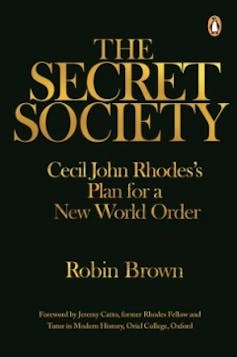
Once glorified by white colonialists, Rhodes is now more widely viewed as a prime villain in southern African history. Since his death he has been the subject of more than 30 biographies, so one is left to wonder if there is anything new that could be said about him. An attempt is made in the latest book by Robin Brown, The Secret Society: Cecil John Rhodes’s Plan for a New World Order – an attempt that fails.
The main claim of the book is that Rhodes established a “secret society” whose task was to extend British rule across the globe. This society continued to exist in different guises long after Rhodes’ death in 1902. Thereafter the society came to operate within, or under the guise of, other bodies – the Rhodes Trust operating as the “top layer of the structure”; in 1909 the society was renamed the Round Table; and from 1920 the Institute of International Affairs became its new face.
… a homosexual hegemony – which was already operative in the Secret Society – went on to influence, if not control, British politics at the beginning of the twentieth century.
Rhodes himself, the book alleges, was gay, and because homosexuality was a criminal offence in Britain at the time, he realised that gays only survived if they operated in:
… a society that remained secret, ring-fenced by wealth and political influence.
So it appears that the society’s secrecy was necessitated by both imperial aspirations and sexual inclinations.
The book contains major flaws, the chief of which is the lack of solid, supporting evidence. Brown claims that “Rhodes documented everything” – which was not actually the case in this regard. Just about the only documentary evidence cited to support the existence of this secret society is the codicil attached to Rhodes’ first will, which did indeed proclaim his intention to form such a society.
The problem is that this will was drawn up in 1877 when Rhodes had not yet accumulated great wealth. According to this early will he would leave all his worldly goods in trust to allow for the formation of a secret society, but his limited wealth at the time could hardly have made this possible.
The plan to form such a society also did not appear in Rhodes’ final will. One has to agree with Robert L. Rotberg – whose biography of Rhodes is the most substantial – that to read Rhodes’ plan today is:
… to sense the ruminations and even fantasies of a madcap bumbler.
Each chapter of Brown’s book has just a handful of endnotes, and there are hardly any references to source material that might substantiate the claims made. The problem is highlighted on pages 237-38. First it is stated that there is “clear evidence” that Lord Alfred Milner took over and transformed the secret society after Rhodes’ death. But on the very next page Brown writes that during this transformation process Milner “kept things covert” so that ‘there is little hard evidence’ of the society’s existence at the time.
This is the problem throughout the book – because the society was so secret it presumably kept no surviving records, meaning that there is no proof of its existence. The book thus comes to be based heavily on surmise and assertion. While critics can argue that it is impossible to prove that the society existed at all, Brown can retort that it is impossible to prove that it did not exist. What cannot be contested is that the book lacks referenced source material to substantiate its claims.
The suggestion that the Rhodes Trust was closely linked to the secret society is not credible. In Anthony Kenny’s massive bookon the history of the trust there are only three brief references to the idea of a secret society – and one of those is to a letter by Leo Amery stating that there was no such society.
The book contains some basic errors which undermine one’s confidence in the content and analysis. The cotton farm where Rhodes joined his brother on arrival in Natal in 1870 was not north-east of Durban, but to the west (p.6). Rhodes was not “of the era of British reformers who caused slavery to be outlawed”, nor did he display “liberal attitudes towards blacks” (p.19). Jameson was imprisoned for four months, not one (p.22). Rhodes’ brokers were not John Rudd and Robert Moffat – they were Charles Rudd and J.S. Moffat (p.57).
George V did not precede Victoria (p.154). Clinton’s presidential nomination speech was in 1991, not 1981 (p.168). Chamberlain was the colonial secretary, not foreign secretary (p.222 and elsewhere).
The book would have worked better had it been presented as an examination of the personal networks that Rhodes developed. There is no doubt that he succeeded in cultivating influential figures in the world of politics, business and finance in Britain, but Brown’s attempt to conjure up a secret society out of these networks is misguided and not adequately substantiated.
he book adds another dimension to this central thesis, making a rather startling assertion on page 144:
There was no missing these blocks of flats as you came out on the north side of the Harbour Bridge. Personally, I always thought they were a bit of an eyesore, though they undoubtedly would have been considered very contemporary living in the 1950s/60s.
‘Greenway Flats’ from Milson Park. Photograph by Zoltan Klinger, 2003. Stanton Library
When it opened in 1954, ‘Greenway’ was the largest flat complex in Australia.
Named after the colony’s first public architect, Francis Greenway, it comprised four buildings, housing 309 one and two bedroom flats. The two taller 11 storey-buildings, A and C blocks, have steel frames. The smaller B and D blocks are concrete framed. The thick brick walls helped to bear the load. Before 1957, building heights in Sydney were restricted to 150 feet. ‘Greenway’ was 130 feet high.
Materials and labour were in such short supply after World War Two that construction took six years. The few exterior design features and modest window size, despite the view across the harbour, helped to reduce cost. Flats were leased as each block was finished.
Mr and Mrs Morgan photographed on the eve of the 50th anniversary of ‘Greenway’, in the flat they moved into when the building opened in 1954. Photograph by Tony Peri 2003, Stanton Library
‘Greenway’ was designed in the modern Functionalist style, a European idiom widely adopted in Australia in the 1930s. This rejected unnecessary decoration while relating a building’s form to its function. However, the architect Percy J. Gordon of the firm Morrow and Gordon was almost certainly influenced as well by the huge housing ‘projects’ being built on the east side of Manhattan in the 1940s. ‘Greenway’ bears a striking resemblance to the post-war apartments in New York’s Bedford-Stuyvesant area.
Upon completion, the project was favourably compared to nearby Victorian-era terraces, then regarded as ‘slums’. The first tenants were delighted. When Mrs V.W.H Briggs moved into her flat in 1953 she declared ‘If I won the lottery seven times over I wouldn’t leave here. This will do me!’ (Sunday Herald, 1 March, 1953) Part of the appeal was the provision of modern appliances. Electric stoves were installed in favour of gas units, stainless steel sinks were standard and the old-style kitchen dresser gave way to built-in cupboards. ‘Greenway’ consumed so much electricity that the County Council had to install a special substation beneath the building to provide power to the many washers, dryers and lifts, as well as 2308 lights, 1666 power outlets and 309 electric stoves.
A sense of community was quick to develop. Residents came to regard others on their own floor as neighbours. However, getting to know everyone in such a large complex was difficult. For this reason, the shared laundry facilities in the basement of each block served as meeting places for women who were generally responsible for washing and cleaning.
The experiences of ‘Greenway’ residents have varied much over the five decades since its opening. At first, the Housing Commission let the flats primarily to families and couples – ‘working class’ people unable to get adequate housing in the inadequate private rental market. Tenants ‘won’ their place there in publicly announced ‘lotteries’. In the 1980s, tenants were being drawn from a wide range of groups – single parents, aged pensioners, the unemployed and the disabled. The result is an increasingly diverse body of residents. Similarly in 1954 Australia was still a predominantly Anglo-Celtic society and most of those who lived at ‘Greenway’ were English-speaking. In 2001 there were 23 language groups represented in the buildings.
A living room in ‘Greenway’, 1954. NSW Housing Commission photograph. State Library of New South Wales
Public attitudes towards ‘Greenway’ also vary. When the building was opened, Milsons Point still had a large working class population and the tenants of the flats were of similar social background to those in the surrounding streets. Today, the harbour suburb is gentrified and the presence of community housing in such a desirable area is sometimes seen as an anomaly. However, as ex-resident Penny McKeon said in 2004, ‘There’s no reason why being of modest economic means should mean you’re not entitled to live in a place that just happens to have harbour views’.
In 2004 the Greenway Tenants Group and North Sydney Council commemorated the 50th anniversary of their home with ceramics and photography workshops and the publication of two books on the history of the buildings. Then, resident and historian Geoffrey Barrett wrote from direct experience: ‘I’m sure that the people responsible for the construction of Greenway… would be delighted, if not amazed, to know that their efforts are still providing decent housing half a century on, and within their building is a proud, neighbourly community – a community that has survived. (Greenway the great survivor: Fifty Years in the Life of a Public Housing Estate, 2004)
Audio: Listen to Penny McKeon’s memories of growing up at ‘Greenway’ in the 1960s from an interview with historian Ian Hoskins in 2004. Merle Coppell Oral History Collection, OH303
A man was walking his dog through Centennial Park in Sydney on the morning of February 7, 1986 when he noticed the body of a woman floating in Busby Pond. After police were alerted, two uniformed constables rowed out and dragged her in.
When detectives rolled her over on the riverbank, they realised it was 31-year old Sallie-Anne Huckstepp – the high-profile police whistle-blower and sex worker.
Huckstepp knew her days were numbered when she appeared on 60 Minutes in 1981and accused NSW detective sergeant Roger Rogerson of being a cold-blooded killer. The man she claimed Rogerson had killed was her boyfriend, heroin dealer Warren Lanfranchi.
The Lanfranchi hit
After robbing another dealer, Lanfranchi fired shots at a young policeman. To avoid facing charges, he asked his associate, notorious standover man Neddy Smith, to negotiate a price with Rogerson.
At the time, Rogerson had a sterling reputation in the force, and was slated to potentially become the next police commissioner.
Rogerson arranged for Neddy to drop Lanfranchi at Dangar Place in Chippendale, where he was waiting with 18 police officers.
He then shot Lanfranchi twice, later claiming it was in self-defence. Subsequent investigations found that while Rogerson may not have acted in self-defence, he had not done anything untoward. Rogerson was commended for his bravery.
Lanfranchi was the third man Rogerson had shot dead in a public place in five years.
Whistle-blowing
Two weeks later, Huckstepp turned up at police headquarters with her father and detailed a string of allegations against NSW police.
The claims included that Rogerson had executed her boyfriend, and stolen the $10,000 Lanfranchi had turned up to bribe the officer with. Huckstepp also gave details of payments she had been making to Vice and Drug Squad detectives for the past 10 years, while she had been a sex worker on Darlinghurst Road.
A life on the wild side
Huckstepp was born into a middle-class Jewish family and grew up in Sydney’s Eastern Suburbs. She attended the exclusive Dover Heights High School. But there was trouble at home. She didn’t get on with her step-mother and her behaviour became unruly.
At 14, she was sent to the Minda Remand Centre in Lidcombe. After being released, she found a job as a waitress at the Kings Cross club Whiskey A Go Go. She then got into heroin, and to support both her and her boyfriend’s habits, she started working the streets.
It was through her associations in Sydney’s underworld that Huckstepp became keenly aware that NSW police were heavily involved in criminal activities, and that Rogerson was one of the kingpins.
Partners in crime
In 1980, when Rogerson was moved to the Darlinghurst police station, he was the star detective of the Armed Holdup Squad. At the time, the heroin market was going through the roof in Kings Cross, and the opportunity to make some extra cash was hard to resist.
Neddy Smith was one of the top heroin distributors in the city, and he was raking it in. He and Rogerson formed a mutually-beneficial association.
Smith became a police whistle-blower in the early 1990s, testifying at the Independent Commission Against Corruption that Armed Holdup Squad detectives had been supplying information that enabled him to carry out a string of holdups.
However, Smith refused to name Rogerson during the hearing.
Society pages
Huckstepp had always lived a charmed, and somewhat tragic life. She shot to stardom after her television appearance, coming across as an articulate and engaging figure. And she had a significant impact in alerting the public to the high level of corruption amongst NSW police.
Penguin publishers gave her an advance to write an autobiography, and author Richard Neville arranged for her to move into artist Martin Sharp’s house.
Many believe her notoriety prevented Huckstepp from being knocked-off straightaway.
A life cut short
But by the time her body was dragged out of the water, five years had passed. She was using again and back working the streets. No one was paying attention anymore.
On the night she was murdered, Huckstepp received a phone call from heroin dealer Warren Richards: an associate of Rogerson and Smith. She told her flatmate that she had to step out for a moment, and would be back in 10 minutes. That was the last time she was seen alive.
False confessions
Smith ended up serving two life sentences for beating a tow truck driver to death, and for shooting brothel-keeper Harvey Jones. Police suspected that Smith was connected with a string of drug-related murders, so they bugged his cell and got his cellmate to chat with him.
Sure enough, Neddy bragged about killing seven people, one of which was Sallie-Anne. He outlined how he strangled her to death, and held her head under the water. His confession led to her body being exhumed from Rookwood Cemetery for DNA testing.
Smith later claimed he’d made up the story, as he knew he was being recorded. He went to trial for her murder, but was acquitted in 1999.
He claimed Rogerson wanted Huckstepp dead because she was “bugging” him by “ringing him up and leaving messages that he was a dog.” He said it was an associate of Rogerson who strangled Huckstepp, performing the deed to get on the good side of the detective. He said the man had never been to prison.
Smith added that the reason Huckstepp was left floating in the pond was that Rogerson wanted to leave a message.
Just desserts
Rogerson had an alibi for the night of the murder – he was drinking with police prosecutor Mal Spence in a Merrylands pub.
But Rogerson had no alibi when he stood trial earlier this year for the murder of 20-year-old UTS student Jamie Gao, as he was captured on CCTV footage.
In June, he was found guilty of murdering Gao during a drug deal at a Padstow storage facility in May, 2014. In September, he was sentenced to life in prison.
On the night of November 18, 1901, in Mexico City, a disgruntled citizen called for the authorities to break up a party being held nearby. This party was a ball not the first, nor the last of its kind in the city, in which male elites dressed to the nines and danced the night away, oftentimes concluding the evening with a raffle in which the coveted prize was a male escort.
At this particular event, 42 men were in attendance half wore suits, the other half in expensive gowns and wigs. All but one were detained and later subjected to public ridicule; forced to sweep up the streets in dresses in plain daylight where the public was free to throw things and hurl insults at them. This would become a common punishment, not excluding police brutality, for homosexual acts. The incident was dubbed by newspapers “The Dance of the Forty-One” or “El Baile De Los Cuarenta y Uno.”
Due in large part to their social status, and overall influence on the authorities, the names of the detainees were never publicly released after the fact. In addition, all publications mentioning the event were destroyed and banned from further coverage, leaving only folklore and a vague though negative association to the number 41 and the LGBTQ community in Mexico, as well as the legend of the 42nd guest, Ignacio De La Torre y Mier, son-in-law to then-President Porfirio Díaz.
Frida Kahlo, poet Juana Inéz de la Cruz, both queer women whose contributions to Literature and art have cemented them as greats within Mexico’s vast history, are generally depicted as straight. Though tolerance for the LGBTQ community has (slowly) spread, history and religion are still seen as sacred and not to be questioned. This is especially harmful to queer kids coming to terms with their identity because it paints homosexuality as a relatively new development.
Growing up I’d heard relatives occasionally refer to the number 41 when making some kind of tasteless gay joke. I didn’t know what it meant or where it came from, but going by tone alone, I could sense it was a homophobic slur of some sort. A few weeks ago, while reading on the Mexican Revolution of 1910, one name kept peripherally popping up, and this piqued my interest. One dive into a Google black hole later, I found myself reading through every small piece of information most of it in Spanish that I could find on this guy. Significant historical figures have always been whitewashed in favor of heterosexual culture, so it’s no surprise that even people briefly connected to, say, a former President would be difficult to successfully research.
Born into a prominent family of sugar manufacturers, Ignacio De La Torre was brought up knowing only the best. He attended private schools in both Mexico and the U.S., and he was praised as a gifted student, furthermore, he was generally well-liked. At the age of 15, after his father’s passing, Ignacio took over the family business and ran it surprisingly well. The already fruitful franchise thrived further under his direction, due greatly to the tunnel vision like ambition young Ignacio possessed; a stubborn and competitive attitude toward business and finance that made him infamous for his reckless actions.
On one occasion, he even went as far as blocking a river channel that passed through his land for the sake of aesthetic, effectively causing multiple floods in the surrounding towns, yet he managed to avoid legal consequence; the incident was never even acknowledged by the authorities.
More than business savvy, however, Ignacio was known for his recreational activities, often involving alcohol, and his affinity for men. Money allowed him to live lavishly as well as shamelessly, and while Mexico’s toxic general views on homosexuality were no less inflammatory then than they are now, his reputation as a well-respected businessman was never tattered. It helped that he was admired for his charisma. He was so charming, in fact, that President Porfirio Díaz offered Ignacio his daughter’s hand in marriage despite his problematic reputation. Ignacio accepted, but the marriage quickly took a turn.
Not long after they were married, Amada Díaz and De La Torre grew apart; his drinking and dalliances leading up The Dance of The 41 proving to be too much for his bride. Eventually, the pair split up, though they remained legally married and living under the same roof, in different wings of their estate.
Only a few years after his involvement with the raid, Ignacio found himself connected to yet another public figure: future hero of the Mexican Revolution Emiliano Zapata.
Emiliano Zapata was well known amongst peasant workers and farmers as an organizer of protests against Hacienda owners and the monopolizing of land and natural resources. He was also known for his extreme dislike of queer and effeminate men. In addition, it was common knowledge that Zapata held a general dislike for Dictator Diaz, who was the personification of everything the agricultural movement was against. This was the primary source for public speculation regarding his connection to Ignacio De La Torre.
A descendant of a long line of farmers, Zapata was an expert horse trainer. As such, he was hired by De La Torre to get his horses and stables in order. The pair spent a period of six months together, alone for the most part, before abruptly going their separate ways.
Of course whatever official records that may have existed documenting their encounter will likely never be found, as is the fate of most queer history. However, pieces of their connection have been discovered elsewhere; such as in prison records indicating that on one occasion, after the overthrow of Porfirio Díaz in 1911, Zapata personally had De La Torre freed from detainment. In addition, there is an account in Amada Díaz’s personal journals citing the discovery of her husband in a compromising position with Emiliano Zapata in the stables.
Having lost his influence due to his connection to the former President, De La Torre came to realize he was no longer held in as high regard, and his shenanigans landed him in jail on several occasions. In one particular instance, he attempted to pass himself off as Emiliano Zapata in order to pull off a grain manufacturing-related scheme. Upon discovering this, Zapata had him arrested. This is speculated to have been what finally severed ties between them.
Ignacio De La Torre died in New York in 1919 of complications during a surgery relating to a severe hemorrhoid condition. He had fled prosecution in 1913 for his suspected involvement in the assassination of President Francisco I. Madero. He left behind an obscene amount of debt and a tale as colorful as the man himself.
Mexico is a country of rituals and tradition, and it is rich in culture. However, a large portion of that culture is rooted in Misogynist Patriarchal ideals and deeply religious beliefs that have heavily and negatively impacted the progression or lack thereof of LGBTQ rights. It has buried its queer history behind an antiquated belief system, and while our icons are loved and admired, their identities are nearly always erased.
Ignacio De La Torre was not a great painter or writer, and his wealth didn’t make him a philanthropist, but denying his connection to great figures does more harm than good. That being said, the extra elbow grease it takes to track down our past is all the more rewarding when it leads us to characters like De La Torre if only to assure ourselves and the world that we’ve always held a significant place in history.
Today, the national Latinx non-profit organization Honor41 is named in those who attended the dance. They work to promote “positive images of our community, creates awareness about our issues and builds an online family/community” and say that “by adopting 41 in our name, we take away the negative, oppressive power associated to the number; we educate others about this important moment in LGBTQ history; we honor their legacy, and honor our own lives and contributions to society.”
Betty Makoni is a former teacher who lives and works in Zimbabwe, where she directs the Girl Child Network, which she herself set up. In a 2007 article entitled “Giving Zimbabwe’s Girls a Voice”, she explained the reasons that led her to give up her official teaching job and devote herself to protecting and supporting the young girls of her country. “It is my own personal story that led me to do what I have done. I had been raped at the age of six by a man who raped young girls without any embarrassment and, at the age of nine, my mother died due to an act of violence in my family. When I was eight, I had rebelled and tried to convince my mother to report the violence she suffered at the hands of my father, but she had placed a finger against my mouth to stop me broaching that subject in public. That order, so common all over Africa, is precisely what I was determined to reject when I grew up. It was not only I and my mother that suffered but virtually every girl or woman that saw such abuse ‘hidden under the carpet’. That was the norm”. As an adult Betty chose to work as a teacher. She used part of the money she earned selling fruit and vegetables in the street markets to pay for her studies. Having graduated in socio-linguistics and with various specializations, she was assigned a teaching job in Chitungwiza, a densely populated suburb of Harare. In her position as a teacher, she frequently heard about abuse being committed against her pupils and she was frustrated to see how many girls dropped out of the education system at the beginning of each school year. In 1998 she decided to set up a group with nine girls, in which they all shared their stories and problems and tried to find solutions to them together. In 1999 she founded the “Girl Child Network” (GCN), with the aim of providing school-age girls with economic support, assisting them psychologically, offering them hospitality and advice, rehabilitating those who had suffered abuse and placing cases of violence and sexual abuse against children into the public domain. Betty sees to the material needs of the girls she takes in, but above all ensures them an education. Since GCN was first set up, Betty has rescued over 7,000 girls from child labour, forced marriages, abuse, human trafficking and sexual aggression. By 2007 there were 500 such groups in 49 of Zimbabwe’s 58 districts, providing services to some 30,000 girls. One of Betty’s commitments is to denounce sexual abuse committed by high-ranking members of society, who expect impunity thanks to their power of blackmail. In a context like the one in which Betty Makoni works, hers is a high-risk occupation, as demonstrated by the constant threats and acts of intimidation against her, as well as arbitrary arrests. Over the years Betty Makoni has received awards and acknowledgements from numerous children’s rights and human rights organizations.