There are moments in history when an apparently simple action acquires enormous political meaning.
In August 1842, thousands of workers across industrial Britain walked into mills and factories and did something remarkably effective.
They pulled the plugs from steam boilers.
Water poured out.
Steam pressure disappeared.
Engines stopped.
Machinery fell silent.
Production ceased.
Within days, what had begun amid wage disputes in the industrial districts around Manchester had spread across much of northern and central England and into other parts of Britain.
Cotton workers joined miners.
Miners joined factory workers.
Men, women and children appeared in enormous demonstrations.
Some demanded higher wages.
Others demanded political reform.
Many demanded both.
Troops were deployed.
Workers were arrested.
People were shot dead.
For several extraordinary weeks, industrial Britain confronted something approaching a general strike.
History remembers it as the Plug Riots or Plug Plot of 1842.
The name sounds almost comic.
The events were anything but.
Britain in the Hungry Forties
The Britain of the early 1840s was simultaneously extraordinarily wealthy and desperately poor.
Industrialisation was transforming the country.
Cotton mills dominated towns across Lancashire.
Coal powered factories and homes.
Railways were expanding.
Steam engines drove machinery on a scale unimaginable only decades earlier.
Fortunes were being made.
Yet many of the people producing that wealth lived precariously close to destitution.
The early 1840s brought severe economic depression.
Trade declined.
Factories reduced production.
Unemployment increased.
Wages fell.
Food remained painfully expensive.
For working families who already spent much of their income on basic necessities, even a relatively small reduction in wages could mean hunger.
This period became remembered as part of the “Hungry Forties.”
The anger generated by economic hardship was intensified by something else.
Most working people possessed virtually no political power.
The Reform That Didn’t Reform Enough
The Great Reform Act of 1832 is often presented as a major milestone in British democracy.
It was.
But democracy remained a very long way away.
The Act removed some notorious “rotten boroughs,” redistributed parliamentary representation and extended the franchise.
But its principal beneficiaries were middle-class property-owning men.
The overwhelming majority of working-class men still could not vote.
Women could not vote at all.
This created enormous frustration.
Working people had participated in agitation for parliamentary reform.
Then Parliament reformed itself while largely leaving them outside.
The lesson was difficult to miss:
Parliament could change the rules without sharing political power with the people demanding change.
Out of that disappointment grew the greatest working-class political movement nineteenth-century Britain had yet seen.
The People’s Charter
In 1838 the People’s Charter set out six demands.
The Chartists wanted universal male suffrage.
A secret ballot.
Equal electoral districts.
Payment for Members of Parliament.
Removal of the property qualification for MPs.
And annual parliamentary elections.
Some of these demands now seem completely ordinary.
At the time, they appeared revolutionary.
Payment of MPs, for example, mattered enormously.
If parliamentary service was unpaid, how could an ordinary working man afford to become an MP?
Political reform was therefore inseparable from class.
Chartism became a mass movement.
Meetings attracted thousands.
Newspapers spread its ideas.
Petitions gathered enormous numbers of signatures.
And Parliament repeatedly said no.
1842
The second great Chartist petition was presented to Parliament in May 1842.
It contained millions of signatures.
Parliament rejected it overwhelmingly.
Meanwhile the economic crisis continued.
This combination was explosive.
Workers were experiencing falling wages while simultaneously being reminded that they possessed almost no influence over the Parliament governing them.
Economic grievance and political grievance began merging.
Then the cotton districts around Manchester ignited.
Stalybridge
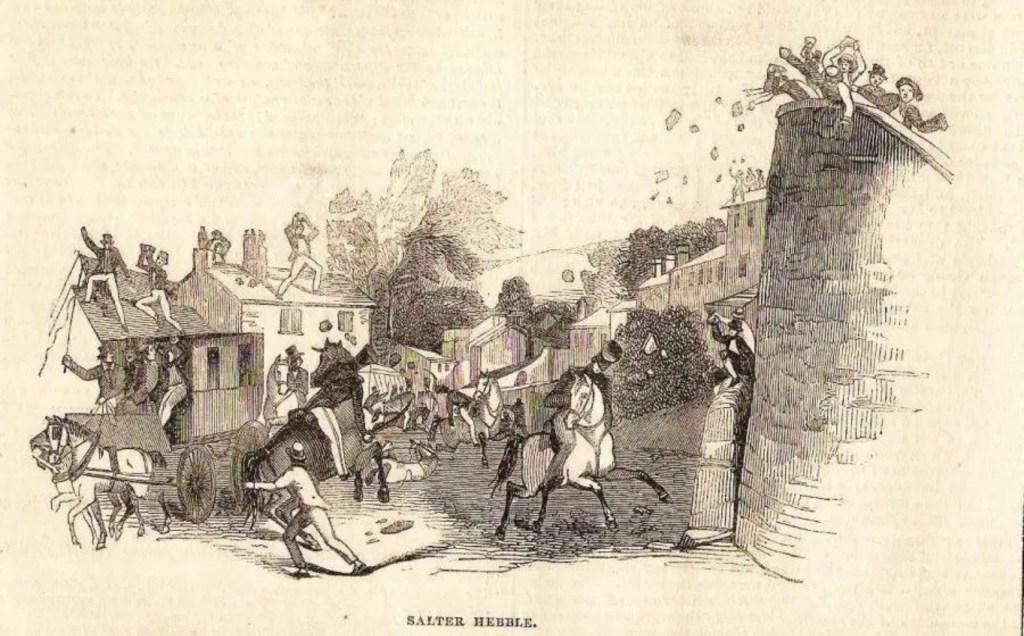
The immediate origins of the great strike are usually associated with Stalybridge, an industrial town east of Manchester.
Cotton manufacturers were attempting further wage reductions.
Workers had had enough.
In early August 1842, mill workers began turning out.
But instead of simply leaving their own workplaces, groups moved to other factories and encouraged — or sometimes compelled — other workers to join them.
They needed a way to stop production.
Steam provided the answer.
Pull the Plug
A steam-powered mill depended upon its boiler.
Water was heated.
Steam generated pressure.
That pressure drove the engine.
The engine drove belts and shafts.
Those powered machinery throughout the factory.
Stop the steam engine and the entire industrial organism stopped with it.
Workers discovered an elegantly simple method.
Remove the boiler plug.
The water escaped.
The boiler could no longer generate steam.
The engine stopped.
And suddenly a factory filled with expensive machinery was useless.
This is where the term Plug Riots originated.
The workers weren’t blindly attacking technology.
They understood it.
They knew precisely where the vulnerability lay.
A Luddite might destroy a machine considered threatening to a trade.
The plug puller could stop an entire factory without necessarily destroying its machinery.
It was industrial sabotage requiring remarkably little equipment.
From Mill to Mill
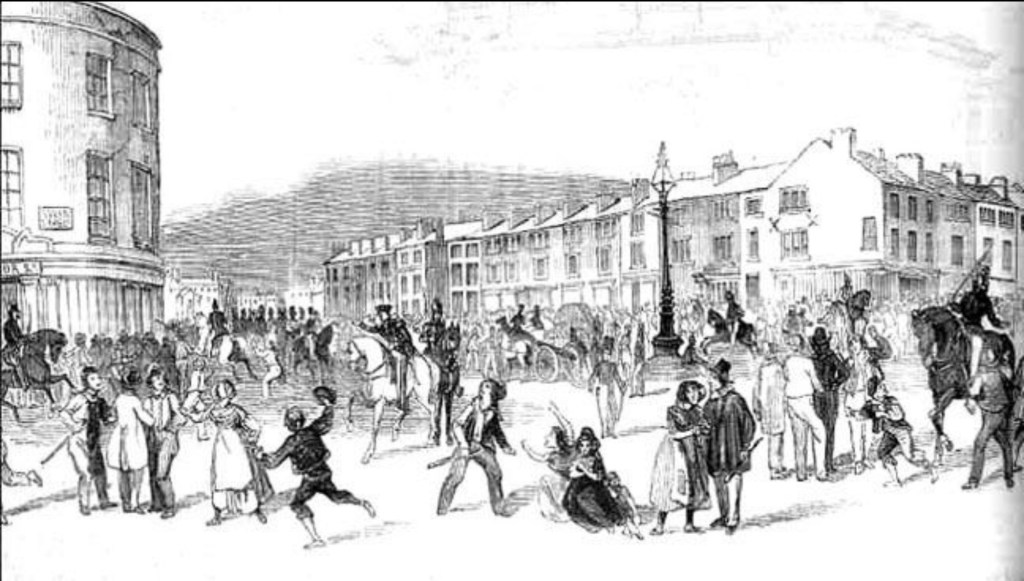
The strike spread rapidly.
Workers moved through Ashton-under-Lyne, Hyde, Dukinfield, Denton, Oldham, Manchester and surrounding districts.
Mills were stopped.
Workers poured into the streets.
Colliers joined factory workers.
Other trades became involved.
Contemporary reports repeatedly describe crowds travelling from workplace to workplace demanding that production cease.
The word used was “turn-out.”
Workers were being turned out of the factories.
But the movement was no longer confined to individual disputes between workers and individual employers.
Whole industrial districts were stopping.
The implications terrified employers and authorities.
“A Fair Day’s Wage”
At Mottram Moor, thousands assembled.
Contemporary evidence recorded two demands that reveal the dual character of the movement.
Workers wanted:
“a fair day’s wage for a fair day’s work”
and
“the People’s Charter.”
There lies the central historical problem of 1842.
Was this a strike about wages?
Or was it a political uprising demanding Chartism?
The answer is:
Both — but not necessarily everywhere and not necessarily from the beginning.
Bread or the Charter?
Historians have debated the relationship between Chartism and the strike ever since.
The original disturbances emerged substantially from industrial grievances, particularly wage reductions.
Workers wanted wages restored to earlier levels.
But once mass strikes began spreading, Chartist activists recognised an extraordinary opportunity.
If workers refused to return until the Charter became law, economic action might force political reform.
This was a profoundly important idea.
Workers possessed little electoral power.
But they possessed something else.
Their labour.
And industrial Britain could not function without it.
The strike therefore raised an extraordinary possibility:
What if people excluded from political power used their economic power instead?
The General Strike Before the General Strike
The expression general strike was not yet commonly used in its later sense.
But that is remarkably close to what parts of Britain experienced.
The movement eventually involved enormous numbers of workers across Lancashire, Cheshire, Yorkshire, Staffordshire and the Midlands, with disturbances and strikes elsewhere.
Cotton mills stopped.
Mines stopped.
Potteries were affected.
Transport workers participated in places.
Factories stood idle.
This wasn’t a modern centrally organised national strike with union officials coordinating ballots and strike funds.
It spread unevenly.
Local motivations differed.
Communication was imperfect.
Leadership was contested.
But the scale was extraordinary.
Britain was witnessing one of the earliest mass industrial shutdowns in its history.
Manchester
Manchester was the symbolic heart of industrial Britain.
Cotton had transformed it.
Its factories represented both the astonishing productivity of industrialisation and the social inequality accompanying it.
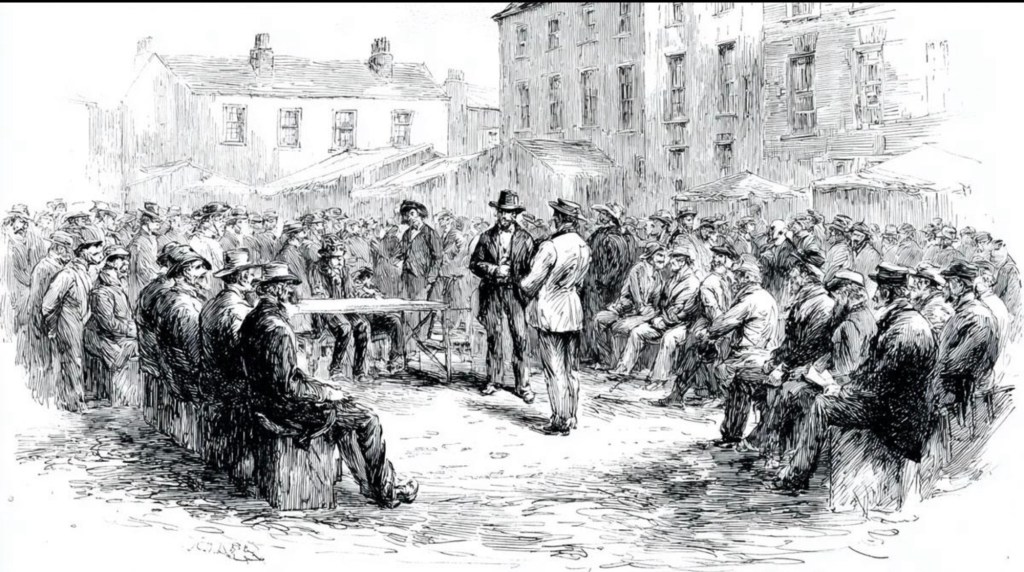
When the strike reached Manchester, enormous crowds gathered.
Factories were stopped.
Chartist leaders attempted to direct the movement towards political objectives.
A conference of trades delegates met in Manchester.
The question before them was momentous.
Should workers remain out until the People’s Charter became law?
For radical Chartists, this was the opportunity they had dreamed of.
The government saw something rather different.
Potential revolution.
Memories of Revolution
British ruling elites had good reason to fear large crowds.
The French Revolution remained within living memory.
Britain had already experienced Luddism.
The Spa Fields disturbances.
The Pentrich Rising.
Peterloo.
The Swing Riots.
The Newport Rising.
And repeated Chartist demonstrations.
Again and again, governments confronted the same frightening question:
What happens if large numbers of ordinary people simply stop obeying?
Britain liked to imagine itself as stable.
Its rulers knew stability could not be taken for granted.
The sight of tens of thousands of workers moving between factories and stopping industrial production looked ominously like authority passing from magistrates and employers into the streets.
Troops were mobilised.
Hunger at Stockport
At Stockport, economic desperation became particularly visible.
Unemployment and hunger were severe.
Crowds attacked the workhouse and sought food.
This reminds us that political movements are rarely powered solely by abstract constitutional principles.
The Charter mattered.
So did dinner.
A man unable to vote might resent Parliament.
A man unable to feed his children had considerably more immediate reasons for anger.
The great strike therefore cannot be understood without hunger.
Behind arguments about suffrage and representation stood households trying to survive.
Women in the Streets
And, as we have discovered repeatedly in our journey through food riots and industrial unrest, women were there.
Contemporary accounts of demonstrations during the Plug Riots describe substantial numbers of women and young people participating.
That should not surprise us.
Industrialisation employed women and children extensively.
A reduction in wages affected entire households.
Food prices affected women particularly because they frequently managed household purchasing.
Women also possessed virtually no formal political power.
Yet they could participate in collective action.
The street could provide political visibility unavailable through the ballot box.
Working-class protest was never exclusively male.
History simply became very good at remembering it that way.
Preston
Then came one of the darkest episodes of the strike.
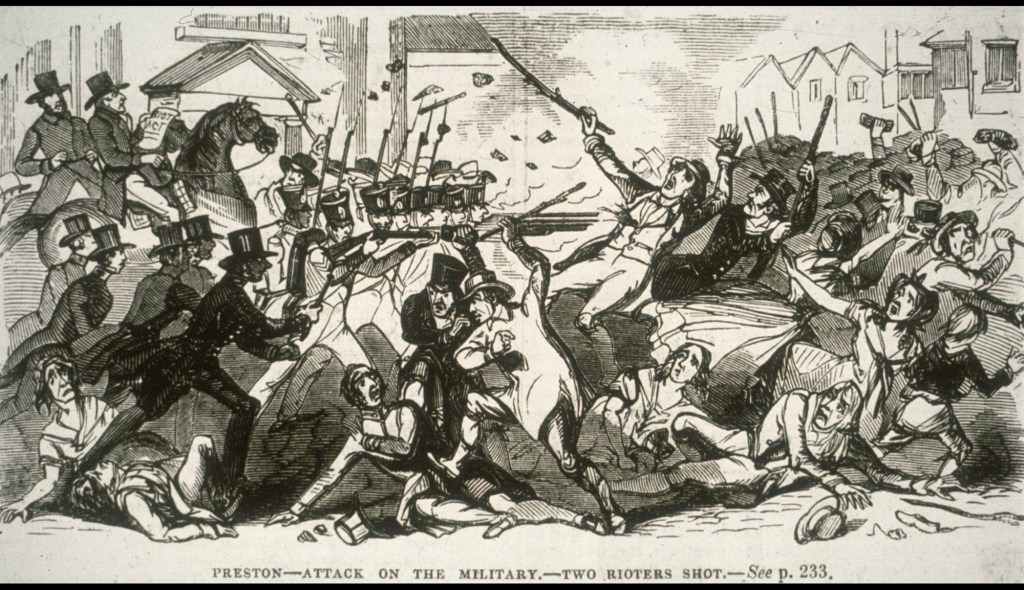
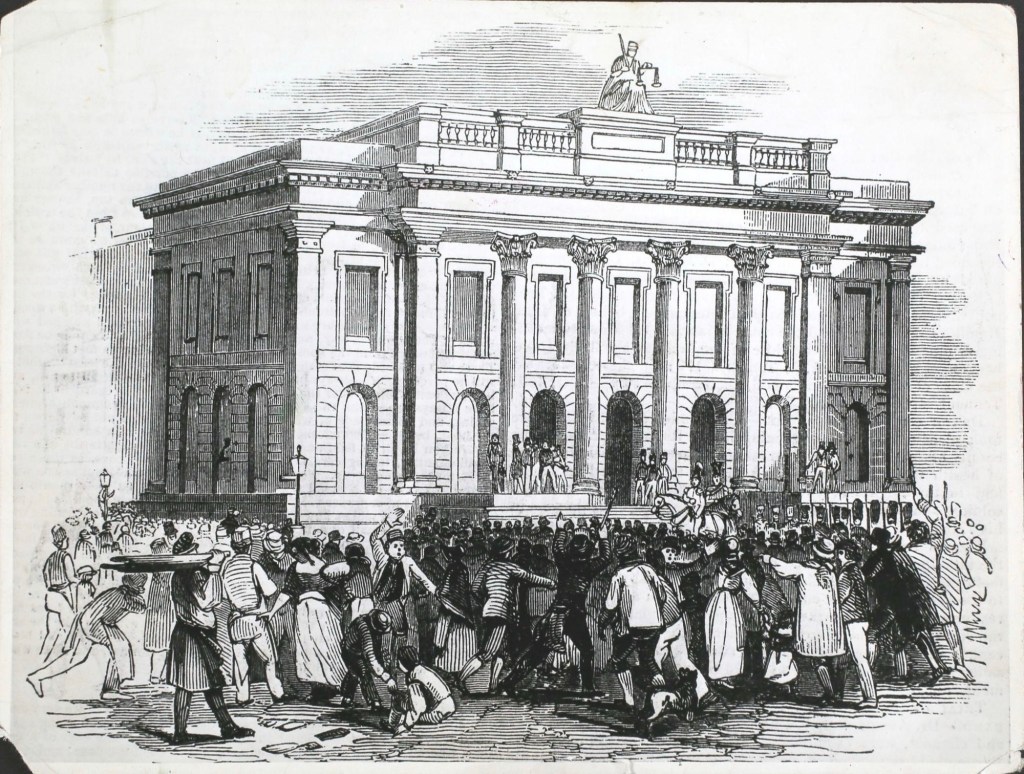
On 13 August 1842, unrest reached Preston.
Workers moved through the town stopping factories.
A large crowd assembled.
Authorities attempted to disperse it.
The Riot Act was read.
Soldiers and police confronted demonstrators.
Stones were thrown.
Then troops fired.
Several people were killed and others wounded.
Among the dead were young workers.
The confrontation demonstrated the limits of Victorian tolerance for mass protest.
The state might accept petitions.
It might tolerate meetings.
But when workers began physically stopping industrial production and refusing orders to disperse, military force remained available.
Peterloo had occurred only twenty-three years earlier.
The memory must have been chilling.
“Riot” or Strike?
Even the name Plug Riots deserves examination.
Calling an event a riot immediately frames it in a particular way.
A riot suggests disorder.
Violence.
A mob.
Criminality.
But much of what occurred in 1842 was organised industrial action.
Workers stopped factories.
They demanded wages.
They attended meetings.
They discussed political objectives.
There was violence.
There was intimidation.
Property was attacked.
Some workers were undoubtedly compelled to stop work against their wishes.
But describing the entire movement simply as rioting can obscure its political and industrial character.
Likewise, calling it purely a Chartist uprising ignores workers whose primary concern was wages.
Perhaps the awkwardness of naming the events tells us something useful.
1842 was simultaneously strike, protest, political agitation, direct action, disorder and, in some places, riot.
Mass movements rarely fit neatly into filing cabinets.
The Government Strikes Back
The government responded firmly.
Troops were deployed throughout affected districts.
Police and special constables were mobilised.
Meetings were disrupted.
Leaders were arrested.
As production gradually resumed, the authorities pursued Chartist organisers and others considered responsible.
Hundreds faced legal proceedings.
Among the most prominent defendants was the great Chartist leader Feargus O’Connor.
The government wanted to demonstrate that political leaders could not use industrial unrest to coerce Parliament.
But prosecution could not erase the lesson of August 1842.
Working people had demonstrated an entirely new scale of collective power.
Why the Strike Failed
The strike ultimately failed to secure either its full economic objectives or the People’s Charter.
There were several reasons.
The movement lacked unified leadership.
Different areas wanted different things.
Some workers primarily demanded restoration of wages.
Chartists wanted constitutional reform.
Not every striker accepted the idea of remaining out until the Charter became law.
Families without substantial savings could not remain indefinitely without wages.
Employers resisted.
Authorities used police and military force.
Leaders were arrested.
And maintaining a huge strike across geographically scattered industrial communities was extraordinarily difficult.
Eventually people returned to work.
The steam engines restarted.
The mills filled again.
The plugs went back in.
Parliament remained unreformed.
On the surface, the government had won.
But Something Had Changed
The deeper significance of 1842 lies elsewhere.
Industrialisation had created enormous concentrations of workers.
That created misery and exploitation.
But it also created something employers hadn’t necessarily intended:
collective power.
A handloom weaver working independently possessed limited leverage.
Thousands of workers concentrated in factories and mines could organise.
Industrial capitalism brought workers together physically.
They talked.
They shared grievances.
They formed societies.
They subscribed to newspapers.
They attended meetings.
They learned how dependent employers were upon uninterrupted labour.
The factory therefore created both industrial discipline and the possibility of industrial resistance.
Pulling the plug symbolised that discovery beautifully.
From the Luddites to the Plug Pullers
There is a tempting but misleading version of industrial history in which workers gradually became more sophisticated.
First, supposedly ignorant Luddites smashed machines.
Later, enlightened trade unionists learned to negotiate.
Reality was far more interesting.
The Luddites often understood industrial technology extremely well.
Their attacks were targeted against particular machines, employers and working practices.
Likewise, the Plug Rioters understood exactly how industrial production worked.
They didn’t hate steam.
They exploited its weakness.
In both movements, technology became a battlefield because control over technology meant control over work.
Who determined how machines were used?
Who benefited from increased productivity?
Who determined wages?
Who controlled working hours?
Who carried the cost when markets collapsed?
These questions remained central to industrial relations long after the last boiler plug had been replaced.
Chartism After 1842
Chartism survived.
There would be another enormous petition in 1848, during a year of revolutions across Europe.
Again, Parliament rejected Chartist demands.
Eventually the movement declined.
And yet Chartism suffered one of history’s most interesting forms of defeat.
It lost.
Then, gradually, much of what it demanded happened anyway.
The property qualification for MPs disappeared.
Voting became secret.
MPs were eventually paid.
Electoral districts became more equal.
The male franchise expanded dramatically.
Annual Parliaments never arrived, and universal suffrage took much longer — particularly for women.
But five of the six Chartist demands were eventually achieved in substantial form.
The radicals of one generation became the constitutional normality of another.
The Long Road to Trade Union Power
The Plug Riots also belong within a much longer story.
The Combination Acts had attempted to suppress worker organisation.
The Luddites had resisted industrial change imposed on unfavourable terms.
The Tolpuddle labourers would be transported for organising and administering an oath.
Chartists demanded political representation.
The workers of 1842 demonstrated the enormous potential of coordinated withdrawal of labour.
Later trade unions would develop more permanent structures.
Strike funds.
Branches.
Officials.
National organisations.
Collective bargaining.
Eventually the labour movement would create its own parliamentary representation.
None of this happened in a straight line.
But 1842 belongs unmistakably to that journey.
Power Without the Vote
Perhaps the greatest importance of the Plug Riots lies in a simple discovery.
Most working men couldn’t vote.
No women could vote.
Parliament could reject petitions containing millions of signatures.
Workers therefore confronted an uncomfortable question:
What power do we possess when the political system refuses to give us any?
One answer was labour.
The mill owner possessed capital.
He owned the building.
He owned the machinery.
He bought the raw materials.
But none of them produced anything without workers.
A factory without labour was merely an expensive collection of stationary objects.
For a few weeks in 1842, workers demonstrated that fact on an enormous scale.
The Little Plug That Stopped a Factory
And that brings us back to the wonderfully ordinary object that gave the events their name.
A plug.
Small.
Cheap.
Technologically insignificant.
Yet removing it could silence an enormous steam engine.
That makes it an almost perfect symbol for the industrial struggle.
The workers themselves could appear insignificant to employers and politicians.
Individual labourers were replaceable.
They possessed little property.
Most had no vote.
They occupied the bottom of Britain’s political hierarchy.
But remove enough of them from the industrial system and suddenly something remarkable happened.
The machine stopped.
The Plug Riots failed to deliver the People’s Charter.
They failed to permanently reverse the economic forces pushing down wages.
Their leaders faced prosecution.
Their crowds were dispersed.
Their dead were buried.
But for several extraordinary weeks in the summer of 1842, Britain’s workers demonstrated something that governments and employers would never entirely forget.
Industrial society had created a new kind of power.
And sometimes exercising it required nothing more complicated than knowing which plug to pull.
Tim Alderman ©️2026
Sources and Further Reading
The National Archives (UK), “What Was Chartism?” — excellent primary-source collection covering Chartism, the 1842 disturbances, Preston, Manchester and contemporary descriptions of the Plug Plot.
The National Archives, contemporary reports concerning Mottram Moor, Manchester and the 1842 disturbances — particularly valuable for the combination of wage demands and support for the People’s Charter.
Malcolm Chase, Chartism: A New History — a major modern history of Chartism placing the 1842 strike within the movement’s wider political and social development.
Dorothy Thompson, The Chartists: Popular Politics in the Industrial Revolution — important study emphasising Chartism as a working-class social and political movement rather than merely a campaign for parliamentary reform.
Mick Jenkins, The General Strike of 1842 — detailed study of the strike and its relationship with Chartism.
F. C. Mather, “The General Strike of 1842: A Study in Leadership, Organisation and the Threat of Revolution during the Plug Plot Disturbance,” The Webbs, Fabianism and Feminism / related historical scholarship on nineteenth-century labour protest — useful for debates concerning organisation, leadership and revolutionary potential.
British Library collections on Chartism — background on the People’s Charter, petitions and development of Britain’s first mass working-class political movement.
UK Parliament, historical material on Chartism and electoral reform — useful for tracing how many Chartist demands were ultimately incorporated into Britain’s parliamentary system.

