Sometime during the early 1840s, a traveller on a lonely road in rural Wales might have encountered a decidedly peculiar scene.
It was night.
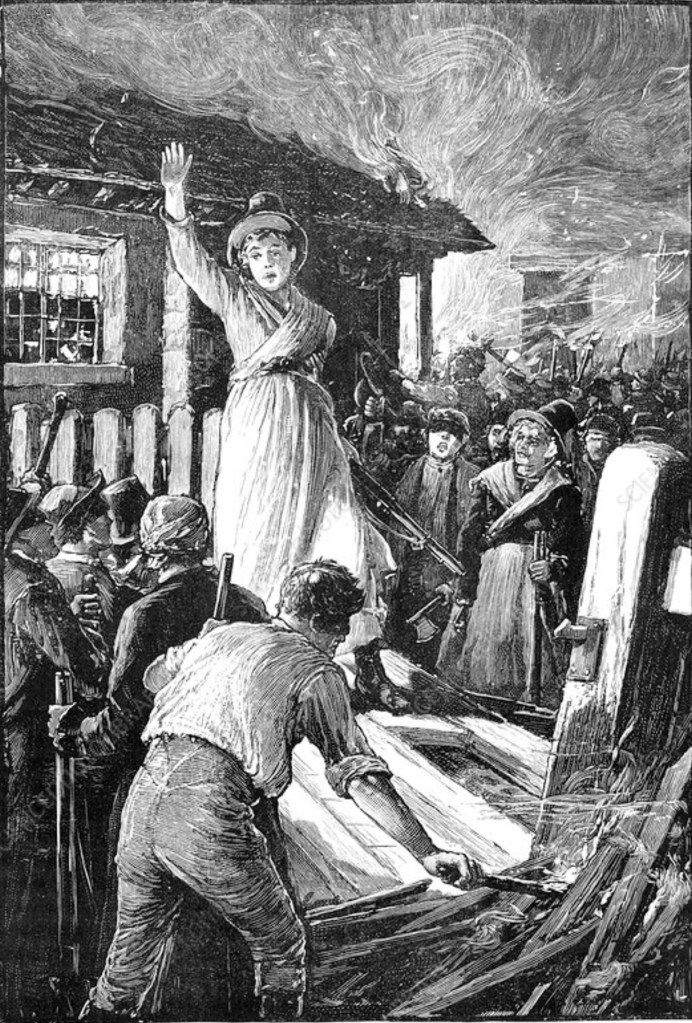
A crowd had gathered around a toll gate.
Among them were men disguised in women’s clothing, their faces concealed or blackened. One particularly imposing figure might be addressed as Rebecca.
Around her stood her “daughters.”
A conversation followed.
Rebecca demanded to know what obstacle had been placed across the road.
One of her daughters explained that a gate prevented the people from passing.
Rebecca pronounced judgement.
The crowd surged forward.
And the toll gate was torn from its hinges.
Welcome to the Rebecca Riots — one of the strangest, most theatrical and, beneath the costumes, most serious episodes of popular protest in nineteenth-century Britain.
Between roughly 1839 and 1843, communities across rural west and south-west Wales attacked toll gates and other symbols of authority.
Their grievances included road tolls, poverty, rents, tithes, the administration of the Poor Law and a political system dominated by landowners.
But instead of marching beneath an ordinary political banner, the protesters created a character.
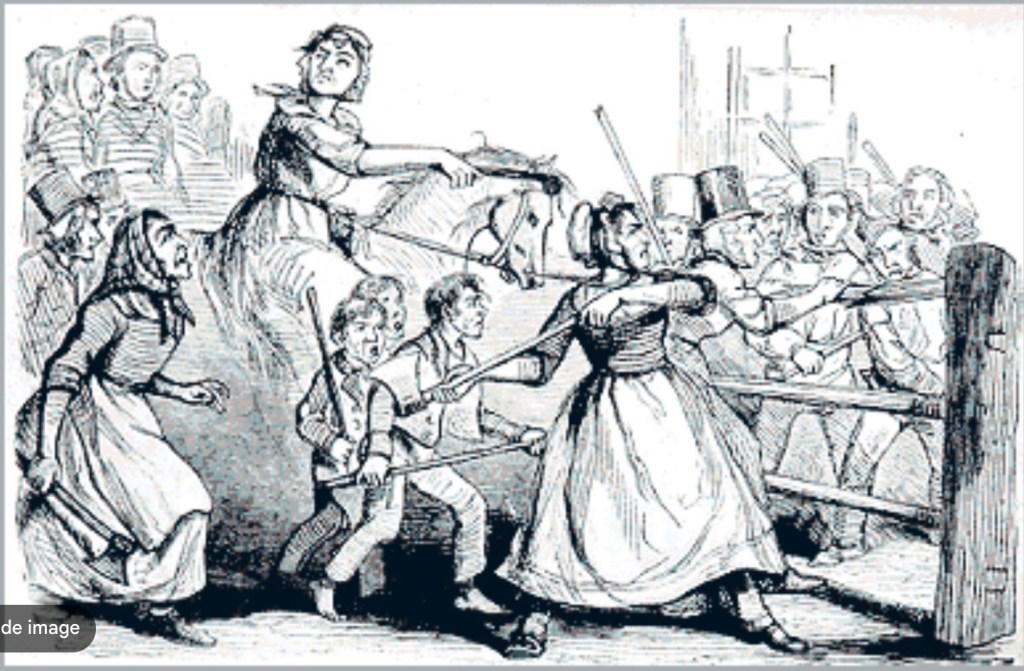
Rebecca.
And Rebecca had daughters.
Lots of them.
Before We Meet the Drag Queens…
There is one important historical qualification.
Calling the Rebecca Rioters drag queens is irresistible.
It is also anachronistic.
The men who dressed as women during the riots weren’t necessarily expressing a female or gay identity, nor were they performing drag in its modern entertainment sense.
Cross-dressing has appeared repeatedly in European traditions of protest, carnival and social inversion.
Clothing could disguise identity.
But it could also turn the normal social order upside down.
Men became women.
Labourers became judges.
The powerless issued commands.
Respectability became ridiculous.
Authority was mocked.
So while Kylie Minogue sadly wasn’t available to provide the soundtrack, the Rebeccas understood one enduring principle of political theatre:
If you’re going to challenge authority, make sure everybody remembers the performance.
Wales Under Pressure
The world from which Rebecca emerged was overwhelmingly rural.
Much of west Wales consisted of small farms operating on difficult land.
Farmers and agricultural labourers lived precariously.
Bad harvests could devastate household finances.
Rents had to be paid.
Church tithes remained burdensome, particularly galling in communities where many Welsh people were Nonconformists yet financial obligations were associated with the established Anglican Church.
Then there was the New Poor Law of 1834.
The workhouse embodied one of the harshest principles of nineteenth-century social policy: assistance to the destitute should be sufficiently unpleasant that people would avoid seeking it unless absolutely necessary.
Poverty was increasingly treated not merely as misfortune but as something requiring discipline.
And through this already strained countryside ran the turnpike roads.
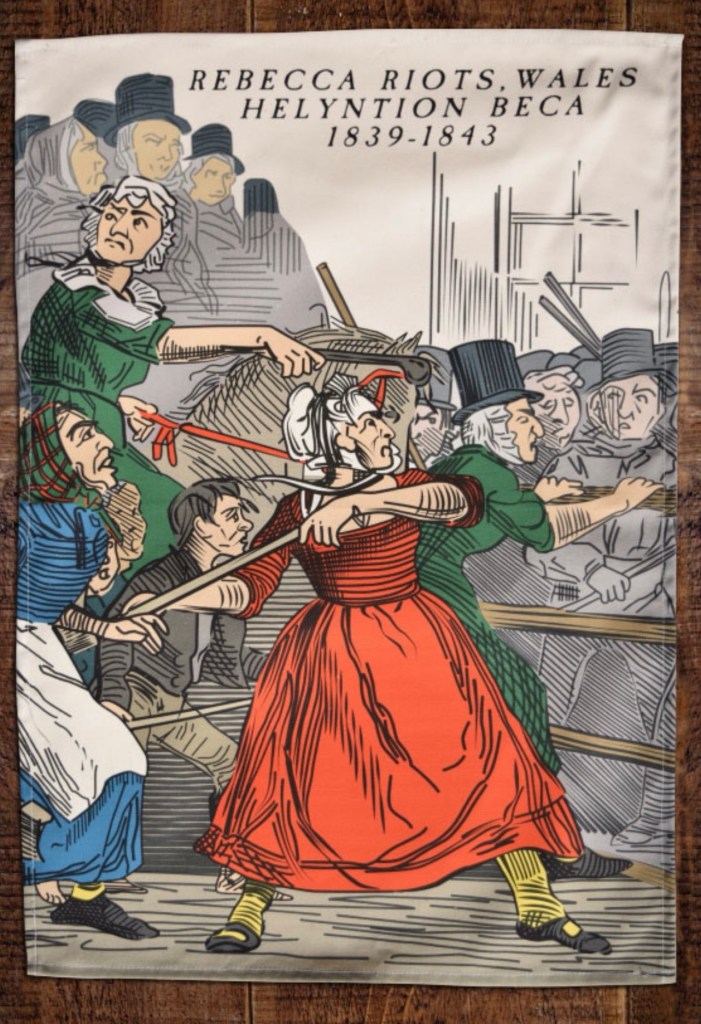
The Hated Toll Gate
Britain’s roads had long been maintained partly through turnpike trusts.
Parliament authorised trusts to maintain particular roads and collect tolls from those using them.
In principle, travellers paid for better roads.
In practice, rural communities could experience the system very differently.
Farmers didn’t use roads merely for occasional journeys.
They used them repeatedly.
Livestock had to be moved.
Produce had to reach markets.
Lime had to be transported for improving acidic Welsh soils.
Animals, carts and goods might all attract charges under different arrangements.
And the proliferation or placement of toll gates could make short local journeys expensive.
To a wealthy traveller, a toll might be irritating.
To a struggling farmer repeatedly passing through gates in the ordinary course of earning a living, tolls could become a serious economic burden.
People began asking a dangerous question:
Why should we keep paying?
Enter Rebecca
The first major outbreak usually associated with the Rebecca movement occurred in 1839, around Efailwen in Carmarthenshire.
A newly erected toll gate became the target.
Local men assembled.
Some disguised themselves in women’s clothing.
The gate was destroyed.
When it was rebuilt, they returned.
And destroyed it again.
The movement temporarily subsided.
Then economic hardship intensified.
By 1842–43, Rebecca returned on a much larger scale.
Toll gates across west Wales began disappearing.
Why “Rebecca”?
The traditional explanation leads us into the Bible.
In Genesis 24:60, Rebekah is blessed with words traditionally rendered along the lines that her descendants should possess the gate of those who hate them.
For people attacking gates, the symbolism was almost suspiciously convenient.
Rebecca became the imaginary mother of the protesters.
Her followers became her daughters.
Contemporary accounts also record ritualised exchanges in which Rebecca questioned her children about the offending gate.
Why was it there?
Who had put it there?
What should be done about it?
The answer was rarely favourable to the continued architectural integrity of the gate.
Rebecca Holds Court
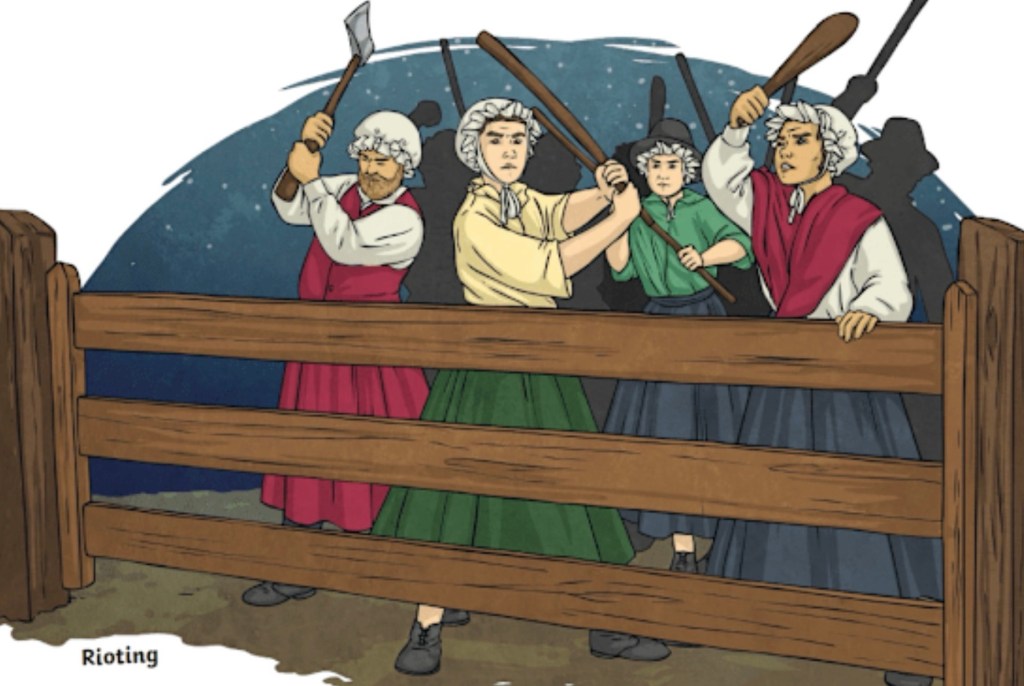
Imagine the scene.
Dark countryside.
Lanterns or torches.
Dozens — sometimes hundreds — of people assembling.
Faces concealed.
Some men wearing bonnets, shawls, gowns or other female clothing.
One conspicuous figure representing Rebecca.
Then came the performance.
Rebecca might call to her children.
A daughter answered.
Rebecca demanded to know why the road was blocked.
The daughter explained that the gate prevented poor people from passing.
Rebecca asked what must be done.
The daughters knew.
Remove it.
Then axes, hammers, crowbars and sheer manpower went to work.
The toll gate came down.
Sometimes the tollhouse itself was attacked.
The protesters disappeared into the darkness.
By morning, the road was open.
Rebecca had delivered judgement.
Why Women’s Clothing?
There probably wasn’t one single reason.
The most practical was disguise.
These were illegal acts.
Participants faced arrest and prosecution.
Changing clothing and concealing faces made identification more difficult, particularly within communities where neighbours might be reluctant to inform.
But disguise alone doesn’t fully explain the choice.
The cross-dressing also belonged to an older tradition sometimes described by historians as ritual inversion.
During carnival, folk customs and certain forms of popular protest, normal hierarchies could temporarily be reversed.
Men dressed as women.
The poor imitated their social superiors.
Mock courts tried authority.
Crowds created imaginary kings, queens or officials.
The world was symbolically turned upside down.
Rebecca was therefore more than camouflage.
She was theatre.
The Power of Ridicule
Governments can sometimes deal more easily with straightforward rebellion than ridicule.
A conventional rebel acknowledges the seriousness of authority by fighting it.
Rebecca mocked it.
A toll gate backed by an Act of Parliament was transformed into a ridiculous object awaiting judgement from a fictitious Welsh matriarch and her strangely hairy daughters.
Officials became characters in a farce.
Toll collectors became targets of mockery.
The people who possessed almost no formal political authority temporarily created an alternative authority of their own.
Rebecca decided whether the gate was legitimate.
Rebecca’s daughters enforced the verdict.
It was funny.
It was intimidating.
And it was politically potent.
Not Just the Gates
This is where the popular image of the Rebecca Riots becomes misleading.
The toll gates were spectacular.
But grievances extended much further.
Rural Welsh society contained enormous inequalities of power.
Landowners dominated local government.
Tenant farmers depended upon landlords.
Agricultural labourers possessed little economic security.
The established Church collected tithes in communities where Nonconformity was deeply rooted.
The Poor Law threatened destitute families with the workhouse.
And ordinary Welsh people possessed little influence over the institutions controlling their lives.
Rebecca gradually became a vehicle through which these grievances could be expressed.
Threatening letters appeared.
Officials were intimidated.
Property associated with perceived injustice could be targeted.
What began as opposition to turnpikes broadened into a more diffuse rural revolt.
The Rebecca Letters
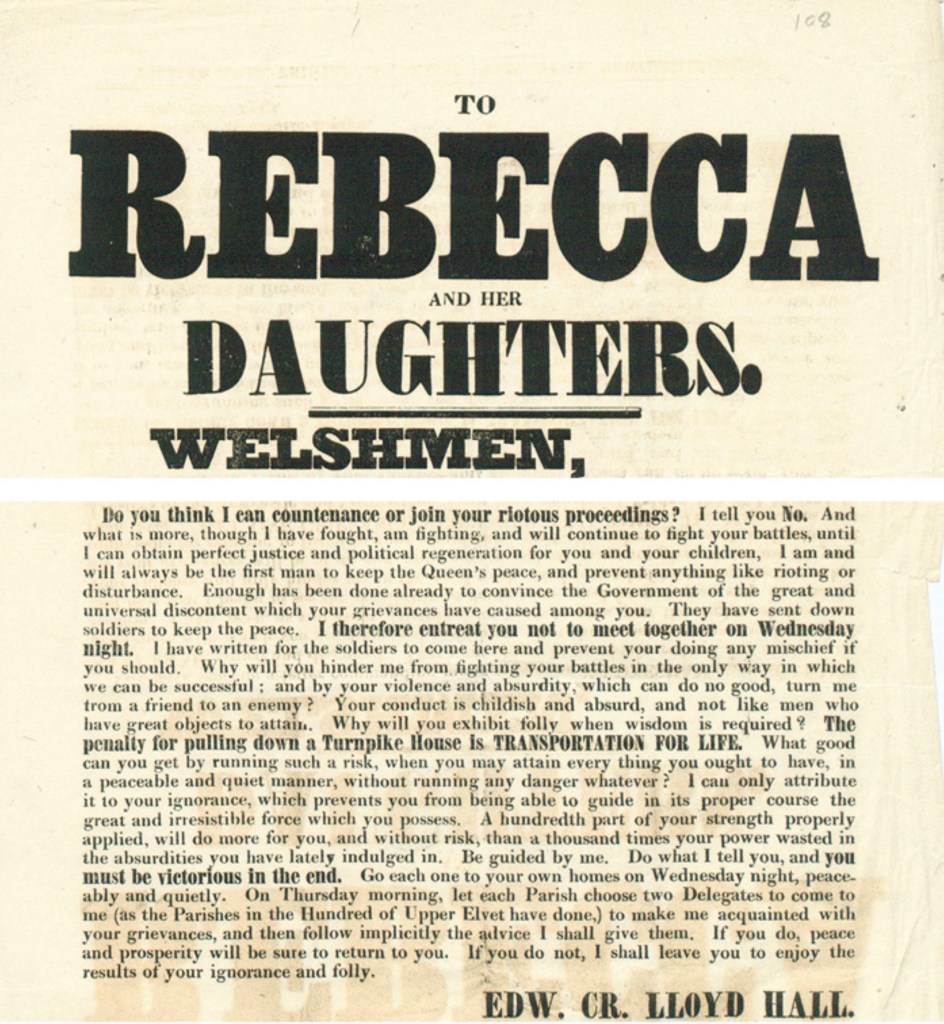
Like several British protest movements, Rebecca developed her own threatening correspondence.
Letters were sent in Rebecca’s name.
They warned toll collectors, officials, landlords and others accused of mistreating local people.
Some were menacing.
Some were theatrical.
Some were probably written by individuals with no direct connection to organised attacks.
Once Rebecca became a recognised symbol, almost anyone could borrow her identity.
That presented authorities with an awkward problem.
Rebecca wasn’t a person.
She was an idea.
You couldn’t arrest Rebecca.
You could arrest individual rioters.
But another Rebecca could put on a bonnet the following night.
Violence Escalates
It is tempting to romanticise the riots because their theatrical elements are so colourful.
That would be a mistake.
The movement became increasingly violent.
Property was destroyed.
People were threatened.
Firearms appeared.
And eventually somebody died.
On 7 September 1843, protesters attacked the toll gate at Hendy, near Swansea.
The gatekeeper was Sarah Williams, a woman in her seventies.
During the attack, she was shot and killed.
Her death marked an ugly escalation.
A movement claiming to defend poor communities from oppression had produced an innocent victim.
Popular protest is rarely morally tidy.
The grievances behind Rebecca were real.
That doesn’t make every action undertaken in Rebecca’s name defensible.
The Government Responds
As attacks multiplied, the authorities deployed soldiers and police.
But suppressing Rebecca wasn’t easy.
Rural geography helped the protesters.
So did community solidarity.
Participants could gather rapidly and disappear.
Officials often struggled to identify individuals hidden behind disguises.
Local witnesses might know perfectly well who had been involved and remain remarkably unable to remember anything useful when questioned.
Nevertheless, arrests increased.
Some participants were imprisoned.
Others were sentenced to transportation.
The movement gradually lost momentum.
By the end of 1843, the great wave of Rebecca attacks was largely over.
But government couldn’t simply pretend nothing had happened.
The Inquiry
In October 1843 the government established a commission to investigate the causes of the disturbances in South Wales.
This matters enormously.
Rebellion had forced government to investigate why rebellion had occurred.
The inquiry heard evidence about turnpike trusts, tolls, road administration and wider rural grievances.
The resulting reforms didn’t create a Welsh rural paradise.
Poverty remained.
Landlord power remained.
Social inequality remained.
But the turnpike system was subsequently reorganised, and some of the worst abuses that had helped provoke Rebecca were addressed.
Rebecca had not simply smashed gates.
She had forced Westminster to look through them.
Rebecca and Chartism
The Rebecca Riots occurred at almost exactly the same moment as the Plug Riots of 1842 and the great wave of Chartist agitation.
Yet the movements emerged from different environments.
Chartism was particularly powerful in industrial communities.
Its demands were explicitly political and constitutional.
Rebecca was primarily rural and focused initially upon immediate local economic grievances.
But underneath both lay a remarkably similar problem:
ordinary people lacked effective political power.
If Parliament didn’t represent you, what did you do?
Petition.
Strike.
March.
Pull the plug from a boiler.
Or put on a bonnet and demolish the toll gate.
Different communities developed different methods.
The underlying question was the same.
Women and the Curious Problem of Rebecca
There is an irony here worth considering.
Rebecca was female.
Her followers called themselves daughters.
Yet the most famous participants were men.
Real women certainly lived under the same economic pressures and participated in Welsh community life and protest, but the public mythology of Rebecca largely centred upon men temporarily adopting female identities.
That tells us something intriguing about gender and protest.
Female disguise allowed men to step symbolically outside respectable masculine behaviour.
Rebecca could behave in ways an ordinary respectable farmer supposedly could not.
She could shriek.
Command.
Threaten.
Mock.
Destroy.
And then disappear.
The female persona became a licence for disorder.
Yet Rebecca herself was also powerful.
She wasn’t presented as weak or submissive.
She was a commanding mother protecting her children.
Her authority came from the claim that the community was her family.
Attack the poor and you attacked Rebecca’s daughters.
And Mother Rebecca was not amused.
Cross-Dressing as Protest
The Rebeccas weren’t unique.
British and European popular protest contains numerous examples of men adopting women’s clothing or female identities.
The practice appears in forms of rural protest, customary disorder and communal punishment.
Sometimes it concealed identities.
Sometimes it invoked folk traditions.
Sometimes it represented the idea that ordinary social rules had temporarily been suspended because authority itself had behaved unjustly.
The Rebecca Riots are particularly memorable because cross-dressing wasn’t incidental.
It became central to the movement’s identity.
A protester didn’t merely disguise himself.
He became one of Rebecca’s daughters.
Political resistance had acquired a costume.
Were They Criminals?
Legally?
Yes.
They destroyed property, intimidated people and sometimes committed serious violence.
But history allows us to ask a different question.
Were they only criminals?
Clearly not.
The riots emerged from genuine economic and political grievances.
The government itself effectively acknowledged this by investigating the conditions that produced them.
This tension appears repeatedly in the history of popular protest.
The Luddites destroyed machinery.
Food rioters seized grain.
Plug Rioters stopped factories.
Rebecca’s daughters demolished gates.
Governments described such behaviour as criminal disorder.
Participants often understood themselves as enforcing a different conception of justice.
Not necessarily legal justice.
Moral justice.
The community believed certain practices had become intolerable.
When formal institutions refused to intervene, people intervened themselves.
That doesn’t excuse violence.
But it helps explain why communities sometimes protected those responsible.
The Moral Economy Returns
And here our earlier exploration of the moral economy comes wandering back into view.
Ordinary people often accepted inequality provided certain customary expectations were respected.
Landlords could collect rents.
Merchants could make profits.
Authorities could levy charges.
But there were limits.
When economic practices appeared predatory rather than legitimate, communities sometimes believed they possessed a moral right to intervene.
Rebecca’s daughters didn’t necessarily oppose roads being maintained.
They opposed what they regarded as unreasonable tolls imposed upon people who had little power to resist them.
The same principle appeared in food riots.
People didn’t necessarily demand free grain.
They frequently demanded grain at what they considered a fair price.
The protest was not always against markets.
It was against markets behaving immorally.
The End of Rebecca
By 1844, large-scale Rebecca activity had largely subsided.
Repression played a role.
So did arrests and prosecutions.
The movement had also become harder to control as violence escalated.
But the grievances couldn’t simply be dismissed.
Legislation eventually reformed the turnpike system in South Wales, consolidating trusts and reducing some of the burdens that had provoked the disturbances.
Rebecca disappeared from the roads.
Her daughters returned to their ordinary clothes.
The toll gates stopped falling.
But the story remained embedded in Welsh popular memory.
The Politics of Performance
The Rebecca Riots demonstrate something easily overlooked when we study political history.
Politics isn’t conducted only through Parliament.
It occurs through symbols.
Songs.
Clothing.
Processions.
Rituals.
Names.
Humour.
Mockery.
Performance.
Rebecca worked because everyone understood the joke.
A fictional woman had become more powerful than the officials supposedly governing the countryside.
Her daughters were ridiculous and frightening simultaneously.
And every destroyed gate communicated a message that required no manifesto:
We no longer accept your authority to do this to us.
And Thus Ends the Show
It is difficult not to imagine the scene theatrically.
The Welsh night.
A crowd emerging from darkness.
A large man in a bonnet and gown stepping forward.
“Rebecca” calls to her daughters.
Her daughters answer.
A mock trial begins.
The gate is accused.
The gate is found guilty.
Sentence is immediate.
Demolition.
Then Rebecca and her daughters disappear back into the countryside.
No Kylie.
No glitter ball.
No lip-syncing.
History can be terribly disappointing sometimes.
But underneath the theatrical absurdity was something deadly serious.
Rural communities suffering poverty and political exclusion had discovered that costume, anonymity and collective action could temporarily reverse the balance of power.
For a few remarkable years, whenever another toll gate appeared across the roads of west Wales, the authorities had reason to wonder whether somewhere in the darkness a bonnet was being tied beneath a bearded chin.
Because Rebecca was coming.
And Mother had brought her daughters.
Tim Alderman ©️2026
Sources and Further Reading
David Williams, The Rebecca Riots: A Study in Agrarian Discontent — the classic detailed historical study of the movement and the social and economic conditions that produced it.
Rhian E. Jones, Petticoat Heroes: Gender, Culture and Popular Protest in the Rebecca Riots — particularly useful for understanding gender, disguise, popular culture and the theatrical dimensions of Rebecca.
Welsh Government / People’s Collection Wales historical material on the Rebecca Riots — useful collections of Welsh historical material, images and accounts relating to the disturbances.
National Library of Wales collections — contemporary newspapers, ballads, documents and other material relating to Rebecca and nineteenth-century Welsh social history.
UK Parliament, reports of the 1843 Commission of Inquiry into the state of South Wales — invaluable contemporary evidence concerning turnpike roads and the broader grievances behind the disturbances.
David J. V. Jones, Rebecca’s Children: A Study of Rural Society, Crime and Protest — broader examination of protest and social conflict in nineteenth-century rural Wales.
E. P. Thompson, The Making of the English Working Class — not specifically a history of Rebecca, but essential background for understanding popular protest, class formation and the traditions from which nineteenth-century collective action emerged.
Eric Hobsbawm and George Rudé, Captain Swing — useful comparative reading on rural protest, customary resistance and collective action in nineteenth-century Britain.

