Category Archives: Article

Why Do Gay Men Insist On F*cking Themselves?

Boyfriend twins are all too real, and a little unsettling. Why are gay dudes so into themselves?

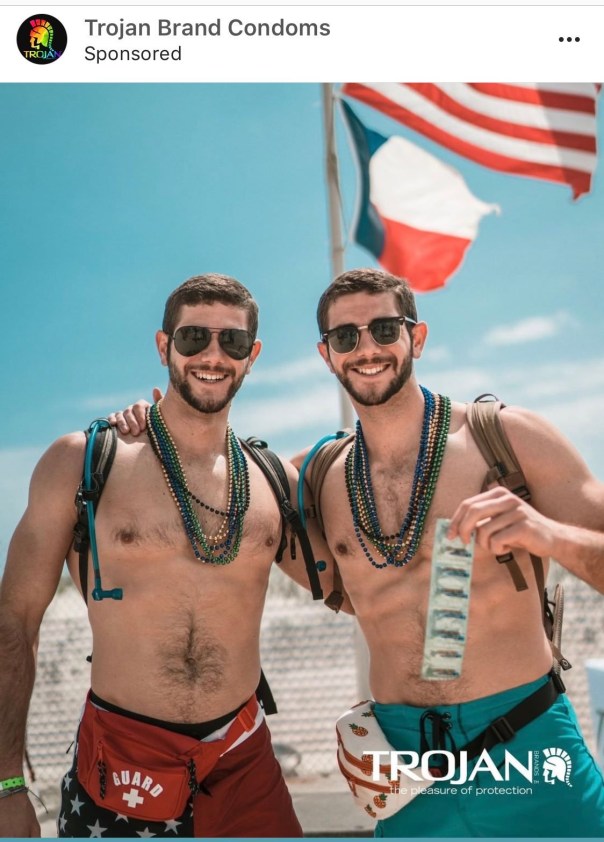
Boyfriend twins. Dopplebangers. Clonefuckers. Whatever you call them, the concept remains the same: two gay men in a relationship who are, if not completely indistinguishable from one another, look at least so similar that they wouldn’t seem out of place at the same family reunion. The phenomenon isn’t exactly new, but has seen renewed attention recently. ‘Tis the season to see men who could be brothers making out at your local Pride parade.

Boyfriend twins are a uniquely gay occurrence. There are certainly plenty of straight couples who look like they belong to the same gene pool, but heterosexual couples have the inherent division of gender, and also, who pays attention to straight people? It’s much more uncanny to see two men who look extremely alike making out in front of you at a gay bar while Robyn’s unreleased “Honey” demo plays in the background — but it’s also an experience that most queer people are deeply familiar with. The boyfriend twin phenomenon is so pervasive that there are entire Tumblrs devoted to tracking it, collecting photos of these romantic lookalikes for posterity and entertainment.

The one thing no one seems to be doing is investigating why so many gay men are romantically and/or sexually interested in men who look exactly like them — but that’s mostly because the answer is fairly obvious: most gay men want to fuck themselves.

Rembrandt Duran, a New York City-based Twitter Gay™ who has been profiled for his extracurricular duties as a “sexual matchmaker” and has written about his progressive take on “top privilege,” thinks that boyfriend twins are a natural manifestation of the human need for familiarity. “I think we just feel more comfortable dating [people who seem] familiar to us,” he says. “Most groups of people are homophilous, so of course dating pools would be that way, too.” Personally, Duran thinks clonefuckers are “kinda gross but mostly hilarious, especially when people just aren’t aware of it.”

Which raises an interesting point: While boyfriend twins certainly aren’t hurting anyone, many of them seem to be remarkably unaware of their particular proclivities, which suggests something about their disinterest or unwillingness to examine their own desires. As boyfriend twins seem to be most prominent among white gay cisgender men, some would say that this desire is subconsciously racist — a step beyond men who state a racial preference on their Grindr bio and actively seek partners who are as ethnically close to them as possible.

“There is nothing that racism doesn’t touch, but to say it’s just that wouldn’t be digging deep enough into it,” says Duran. “I also feel like it’s conditioned into us that most ‘successful’ relationships are those with people who we have a lot in common with, which I think is more Disney romance false bullshit.”

I spoke with a close friend of mine — we’ll call him Todd — who is one-half of a boyfriend twin couple. He says that while he’s absolutely aware of how alike he and his partner look, he doesn’t mind at all — but his boyfriend definitely does. “He’s very upset by it. It makes him feel like a basic gay because people give us shit for it,” says Todd. “Every time we go out someone makes a comment about it, but I think it’s cute.” Todd also notes that as they’ve dated, he and his boyfriend have almost assimilated into each other, dressing more and more alike, which only exacerbates their resemblance. He also says that they have been regularly mistaken for one another, but to be honest, I think all white gay men in New York City look alike.

“I’ve had some people make comments that are kind of rude, asking why am I that shallow that I’m only going to date someone that looks like me, but I think that’s a very narrow view, because they’d probably also be mad at me for dating another attractive white guy [who didn’t look like me]. They think we’re part of the problem, which I think is kinda silly.”

“I’m always on the fence about forcing people to examine their desires too much,” adds Duran, who explains that he feels there are those who overcompensate by swinging too drastically in the opposite direction. “There are people who end up using others as a buffer for their guilt by filling a sort of quota — by going out and fucking different kinds of people — when honestly, the simpler fix for that is to stop valuing the gaze of white masculine men and saying ‘who cares if they want to fuck me’ and start accepting love and attraction from everyone else.”

The real tea about doppelbangers is this: Are you really all that surprised that hot gay men want to fuck other hot gay men? In other news, water is wet and Trinity Taylor was robbed in season nine of Drag Race.

Todd recalled that he’d been at a party where the other two other pairs of clonefuckers approached him and his partner. “‘Hey, we’re all boyfriend twins,’” he recounted, in a tone suggesting… well, you get it. He laughed. “Ok, that’s weird.”

The obvious question: Did that turn into a sixsome? Unfortunately not.

Reference


13 Cults and Secretive Religions, and the Best Documentaries About Each

“Wild Wild Country” is earning strong buzz on Netflix for investigating the rise and fall of a spiritual cult that made headlines in Oregon throughout the 1980s. The documentary is one of many titles in the fascinating subgenre of controversial religious documentaries.

RAJNEESH MOVEMENT, “WILD WILD COUNTRY”

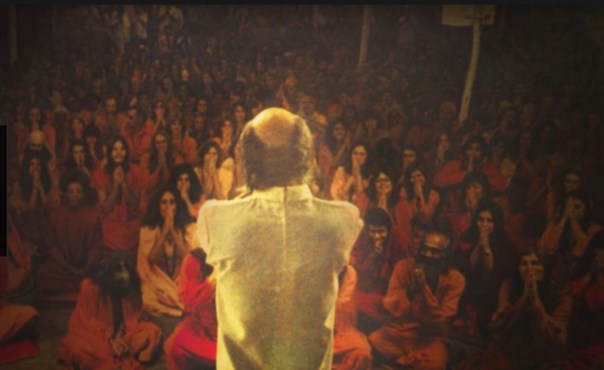
Netflix’s six-part series chronicles the rise and fall of the Rajneesh movement, founded by Bhagwan Shree Rajneesh in the 1980s. The cult established Rajneeshpuram, a 64,000-acre Oregon ranch, and poisoned the local community in order to win a political election.

BUDDHAFIELD CULT, “HOLY HELL”

Will Allen was a member of the Buddhafield movement for 22 years and the footage he recorded inside the cult provides the basis for “Holy Hell.” Allen also shot interviews of ex-members to paint a chilling portrait of group founder Michel Rostand.

SCIENTOLOGY, “GOING CLEAR”

Alex Gibney’s “Going Clear” is considered the definitive Scientology documentary with a thorough history of the religion, founder L. Ron Hubbard, and its manipulative and life-threatening policies under current leader David Miscavige.

FLDS, “PROPHET’S PREY”

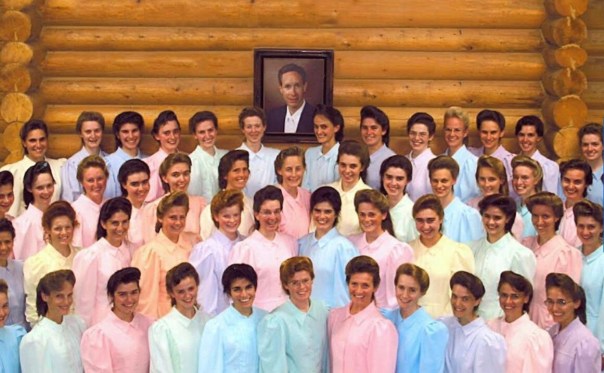
Amy Berg’s film takes aim at Warren Jeffs, leader of the polygamist Fundamentalist Church of Jesus Christ of Latter-Day Saints. Jeffs currently runs the cult from prison, where he’s serving a life sentence for raping two teenage girls. 

PEOPLES TEMPLE, “THE LIFE AND DEATH OF PEOPLES TEMPLE”

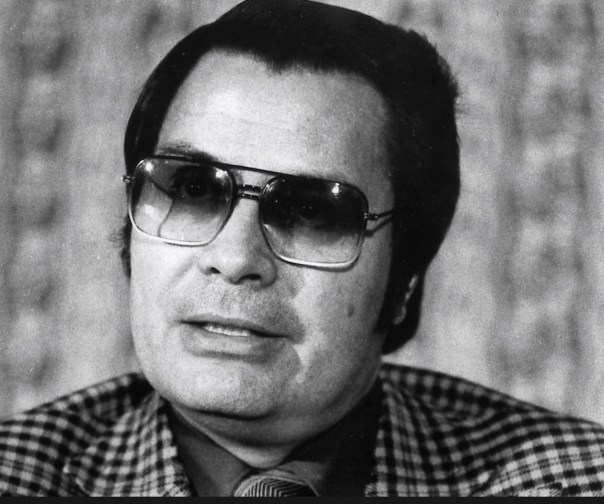
Stanley Nelson’s Tribeca-winning documentary centers on Peoples Temple leader Jim Jones, who established the Jonestown settlement in Guyana. Jones famously carried out a mass suicide, poisoning 918 members in 1978.

THE FAMILY, “CHILDREN OF GOD”

John Smithson’s 1994 “Children of God” interviews one family about being raised in The Family, a cult in which sexually abusing children was common practice. Rose McGowan and Joaquin Phoenix were born into The Family, but fled with relatives when they were children.

BRANCH DAVIDIANS, “WACO: THE RULES OF ENGAGEMENT

William Gazecki’s 1997 Oscar-nominated documentary looks at the 1993 Waco incident with the Branch Davidians, a religious cult run by David Koresh. An ATF raid led to a shootout and a 51-day FBI standoff that resulted in the deaths of Koresh and 82 of his followers.

MANSON FAMILY, “MANSON”

Robert Hendrickson and Laurence Merrick’s 1973 Oscar-nominated documentary provides an intimate look at the Manson Family with interviews with Charles Manson and his former members, plus footage that takes viewers inside the family’s Devil’s Canyon compound. 

HEAVEN’S GATE, “HEAVEN’S GATE: THE UNTOLD TRUE STORY”

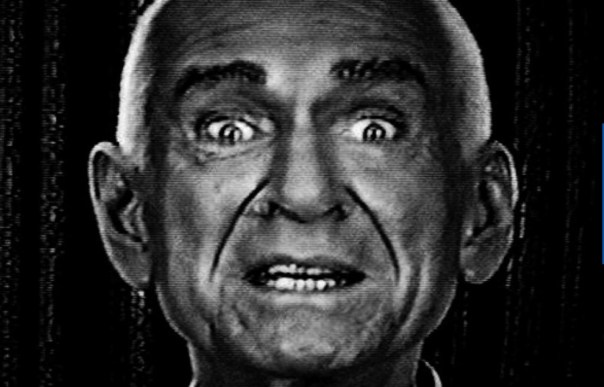
“Haven’s Gate” was a San Diego-based UFO religious cult founded in 1974 by Marshall Applewhite. Sergio Myers’ film tells the origin story leading up to March 1997, when 39 members participated in a mass suicide in order to reach an extraterrestrial spacecraft.

THE SOURCE FAMILY, “THE SOURCE FAMILY”

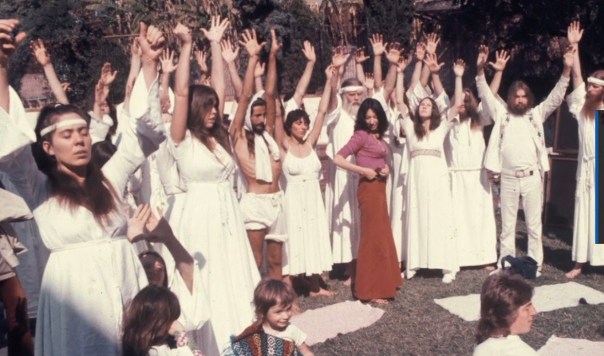
Jodi Wille’s 2012 documentary tells the story of Father Yod, who founded the group and created a commune in the Hollywood Hills. After clashes with Los Angeles authorities, the cult ultimately fled to Hawaii.

AUM SHINRIKYO CULT, “A”

Tatsuya Mori’s 1998 documentary about the Aum Shinrikyo cult follows a 28-year-old group spokesperson who had to sever all family ties to join the sect. The cult carried out the 1995 Tokyo subway sarin gas attack, which killed 12 people and affected over 1,000 others.

STRONG CITY, “THE CULT AT THE END OF THE WORLD”

Strong City, aka the Lord Our Righteousness Church, was a remote religious community in New Mexico founded by Michael Travesser. Directed by Ben Anthony, the 2007 film follows the cult in real time as Travesser tells his followers that the world will end in October 2007.

SYMBIONESE LIBERATION ARMY, “GUERRILLA: THE TAKING OF PATTY HEARST”

The Symbionese Liberation Army was a domestic terrorist organization active between 1973 and 1975. Robert Stone’s PBS documentary investigates the SLA’s kidnapping of Patty Hearst when she was 19, where she was sexually assaulted and brainwashed.

Reference

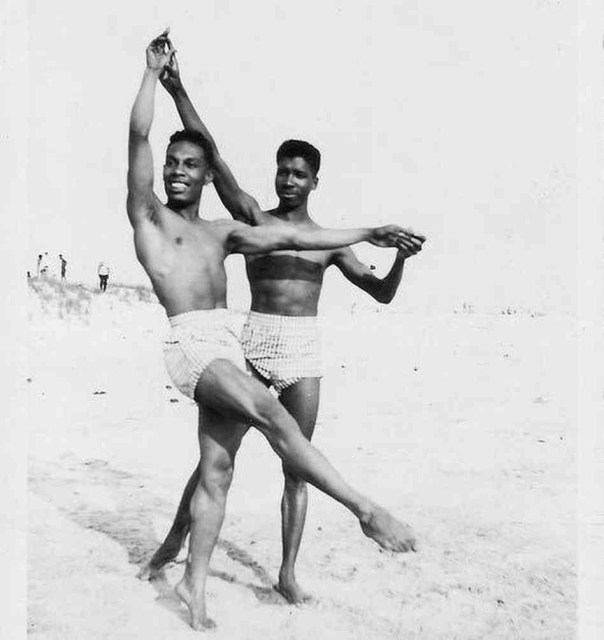
Gay History: PHOTOS: A History of Man-On-Man Affection

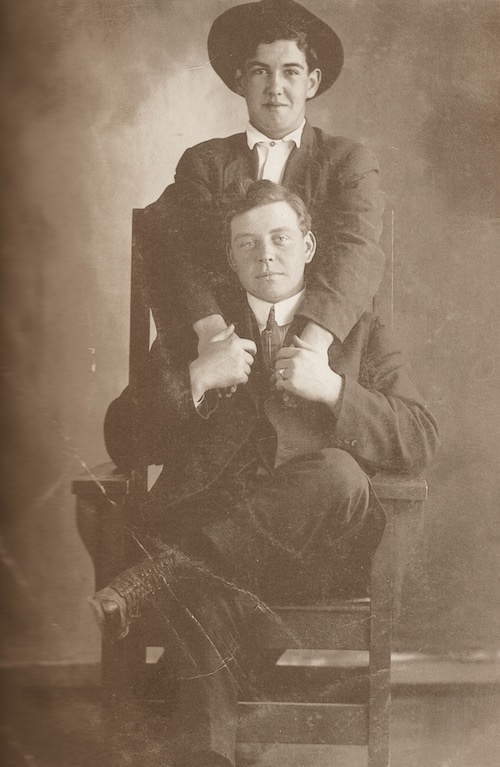
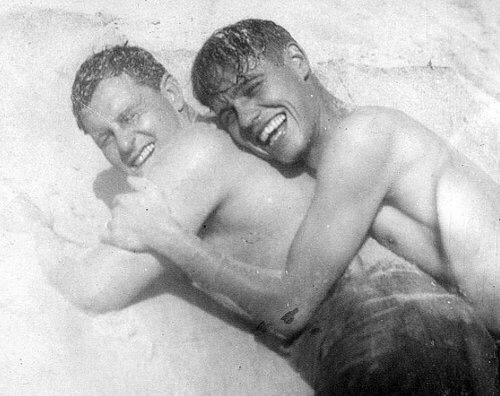
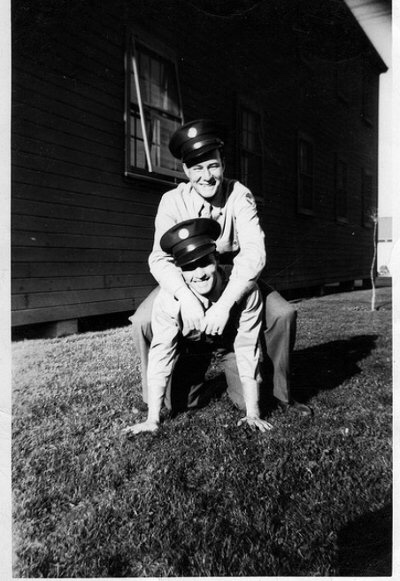
A recent study found that some straight guys still think gay guys aren’t masculine. Evidently, one male displaying affection towards another male isn’t considered “manly.” But that wasn’t always the case. Once upon a time, men were much more forthcoming when it came to showing their softer sides.

Check out these vintage pictures of men from yesteryear displaying sweet man-on-man affection.

Reference

Gay History: The (Sodomy) Law in England, 1290-1885

There was no royal or parliamentary law against homosexual activity in England until 1533, but a number of medieval legal sources do discuss “sodomy:.

Fleta, xxxviii.3: Those who have dealings with Jews or Jewesses, those who commit bestiality, and sodomists, are to be buried alive after legal proof that they were atken in the act, and public conviction” 

[Fleta, seu Commentarius Juris Anglicani, (London: 1735), as trans in Derrick Sherwin Bailey, Homosexuality and the Western Christian Tradition, (London: Longmans, Green, 1955), 145] 

Bailey notes that it is improbable that the penalty or burial alive was ever inflicted in medieval times [although Tacitus refers to it among ancient Germans in Germania 12].

Britton, i.10: “Let enquiry also be made of those who feloniously in time of peace have burnt other’s corn or houses, and those who are attainted thereof shall be burnt, so that they might be punished in like manner as they have offended. The same sentence shall be passed upon sorcerers, sorceresses, renegades, sodomists, and heretics publicly convicted” 

[Britton, ed. F.M. Nichols, (Oxford: 1865), Vol 1:41-42 and Bailey, 146]

Bailey notes that this implies a process in which ecclesiastical courts made the charges and convictions and the state put them into effect. There do not seem, however, to have been serious efforts made to put theory into practice. The preamble to the 1533 Law seems to make this clear.

25 Henry VIII. C6

Le Roy le veult
“Forasmuch as there is not yet sufficient and condign punishment appointed and limited by the due course of the Laws of this Realm for the detestable and abominable Vice of Buggery committed with mankind of beast: It may therefore please the King’s Highness with the assent of the Lords Spiritual and the Commons of this present parliament assembled, that it may be enacted by the authority of the same, that the same offence be from henceforth ajudged Felony and that such an order and form of process therein to be used against the offenders as in cases of felony at the Common law. And that the offenders being herof convict by verdict confession or outlawry shall suffer such pains of death and losses and penalties of their good chattels debts lands tenements and hereditaments as felons do according to the Common Laws of this Realme. And that no person offending in any such offence shall be admitted to his Clergy, And that Justices of the Peace shall have power and authority within the limits of their commissions and Jurisdictions to hear and determine the said offence, as they do in the cases of other felonies. This Act to endure till the last day. of the next Parliament” 

[Bailey, 147-148, and H. Montgomery Hyde, The Love That Dared Not Speak Its Name: A Candid History of Homosexuality in Britain, (Boston: Little, Brown, 1970) [British title: The Other Love] 

Note that the law only ran until the end of the next Parliament. The law was reenacted three times, and then in 1541 it was enacted to continue in force for ever. In 1547, Edward VI’s first Parliament repealed all felonies created in the last reign [I Edw. VI. C.12]. In 1548 the provisions of the 1533 Act were given new force, with minor amendments – the penalty remained death, but goods and lands were not forfeit, and the rights of wives and heirs were safeguarded. Mary’s accession brought about the repeal of all Edward’s acts in 1548 [1 Mar c.1]. It was not until 1563, that Elizabeth I’s second Parliament reenacted the law [5 Eliz I. C.17] and the law of 1533 (not 1548) were given permanent force. 

In 1828, the statute of 1563 was revoked by a consolidating act, but the death penalty was retained. In 1861 life imprisonment, or a jail time of at least ten years, was substituted for the death penalty. All these laws were against buggery, and indeed the law of 1828 had discussed matters of proof in terms of penetration. Note that other sexual activities were not specifically criminalised.

In 1885 Mr. Labouchere introduced an amendment to the Criminal Amendment Act of 1885. It read:-

48&49 Vict. c.69, 11: “Any male person who, in public or private, commits or is party to the commission of, or procures or attempts to procure the commission by any male person of any act of gross indecency with another male person, shall be guilty of a misdemeanour, and being convicted thereof shall be liable at the discretion of the Court to be imprisoned for any term not exceeding two years, with or without hard labour” 

So for the first time private acts were brought under the scope of the law, as were acts other than anal penetration. This became the famous blackmailer’s charter, and was the law used to convict Oscar Wilde.

[for all the above see Bailey 145-152]

It was the Act of 1533, then, which first made buggery an offense under English criminal law. This law survived in various forms England until 1967, although it was amended in 1861 to substitute life imprisonment for the penalties of death and forfeiture of property. 

But the direct effects of this law were not restricted to England. Because of England’s success as a colonial power, and its tendency to impose its entire legal structure on the ruled areas, legal prohibitions against homosexual activity derived from this law extended well outside England. In Scotland, for instance, (which has a separate legal system) the law was not changed until 1979. In many American states “sodomy” laws are still on the books, as also in former British colonies in the Caribbean.

.[ref. H. Montgomery Hyde, The Love That Dared Not Speak Its Name: A Candid History of Homosexuality in Britain, (Boston: Little, Brown, 1970)]

Reference

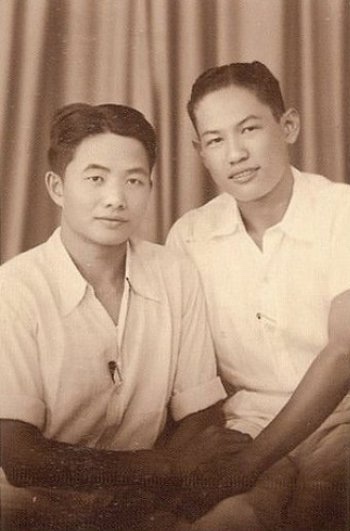
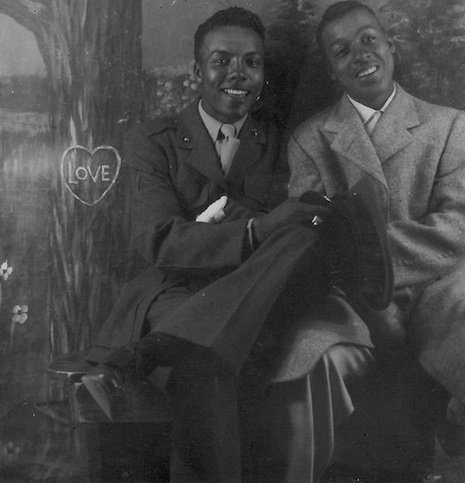
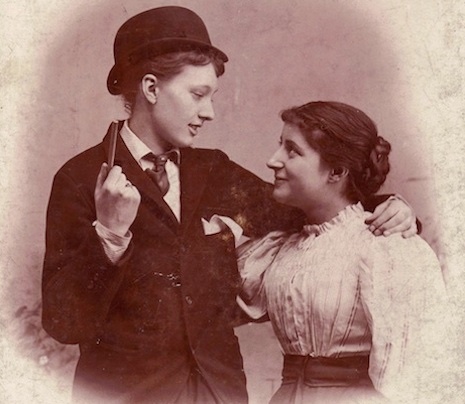
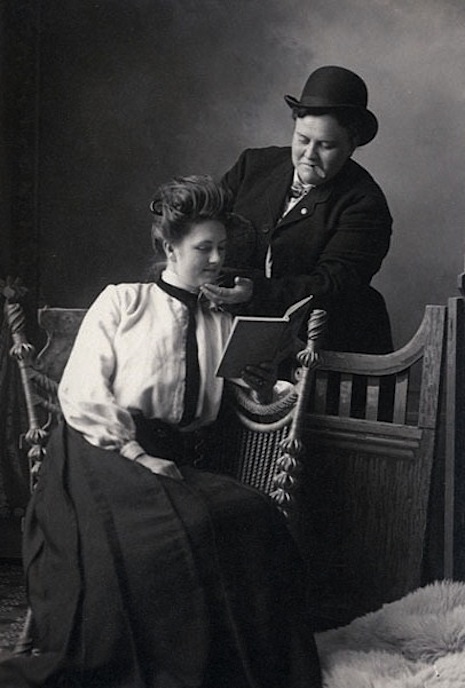
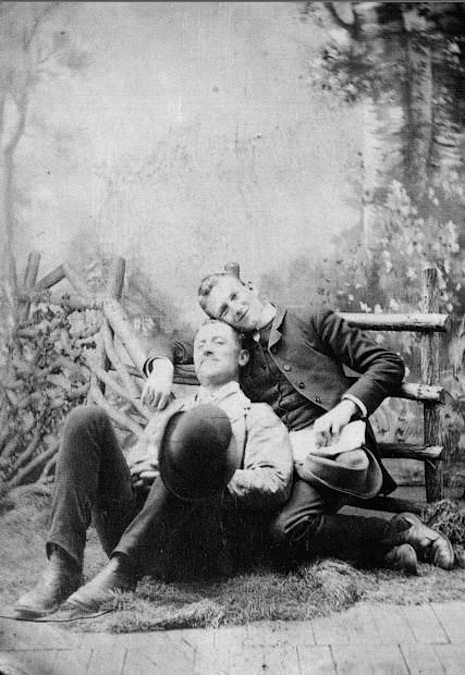
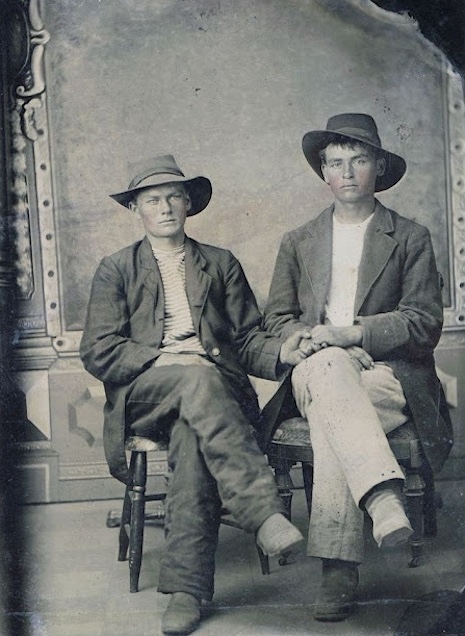
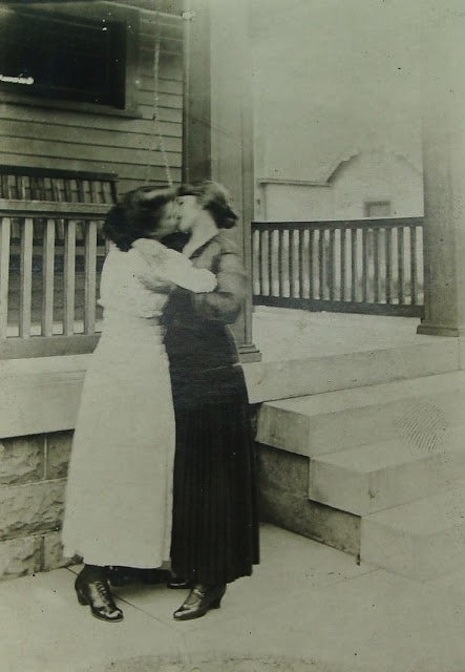
Gay History: Love And Affection: Vintage Photos Of Gay And Lesbian Couples

A couple’s photographic portrait is an affirmation of their relationship. It states for all to see: “We love each other. We care for each other. We are proud of who we are together.”

During the Victorian era many gay and lesbian couples proudly expressed their love for each other in studio portraits. Unlike the common belief that such relationships were “the love that dare not speak its name,” as Oscar Wilde so famously described same sex attraction in his poem “Two Loves,” gays and lesbians often dared to show their love. Indeed, many gay and lesbian couples more or less lived openly together throughout their lives. This was far easier for women than for men as women were expected to live together if they were not married, or to live with the euphemistically termed “female companion.”

Men, no historical surprises here, had their own haunts for meeting like-minded souls. In London these could be found in the “Molly houses” and gentlemen’s clubs or pick-ups haunts at Lincoln’s Inn, or St. James Park or the path on the City’s Moorfields, which was charmingly referred to as “Sodomites Walk.”

Theaters and circuses were also well-known dens of homosexual activity—this can be traced all the way back to Elizabethan England, when male prostitutes plied their trade at theaters.

The armed forces, in particular the Royal Navy was notorious for gay relationships—understandable with all the horny seamen looking for any port in a storm. Apparently word got around.

It is a moot point that the change in public attitude towards homosexuality commenced with the Labouchere Amendment to the Sexual Offences Act in 1885, which “prohibited gross indecency between males.” This was the law under which Wilde was infamously prosecuted and the law that heightened discrimination against gays.

Before that there had been the Buggery Act—against anal penetration and bestiality—which was introduced during the reign of Henry VIII. This led to numerous executions (hangings) and imprisonments. It was briefly repealed, then reinstated by Elizabeth I. However, there were few prosecutions under the act and it was repealed again in 1828—though “buggery” remained a capital offense. James Pratt and John Smith became the last two men to be executed for buggery, in 1835.

The Labouchere Amendment outlawed homosexuality and made it more difficult for gay men to live the lives they desired. Labouchere did not include lesbians in the act as he believed drawing attention to lesbianism would only encourage sapphic desires amongst most Victorian women.

So even when gay relationships were outlawed in England, they still thrived in open secret. In America, the sodomy laws varied from state to state. What one state tolerated or had no opinion about, another state punished. However, as with England in the Victorian era, America gay and lesbian couples would often openly express their love for each other in portrait photographs.

This collection of beautiful, brave people gives us a small visual history of LGBT relationships from the 1860s-1960s. Many of the couples are unidentifiable, but where possible their names have been given. (Editor writes: Mild disclaimer: Of course it’s difficult to say that in all cases these photos are of gay couples.)

Reference

Gay History: Photos Of Same-Sex Couples From The 1880s – 1920s

Vintage Gay Love: A Look Back At The Early Gay Pioneers in Photos

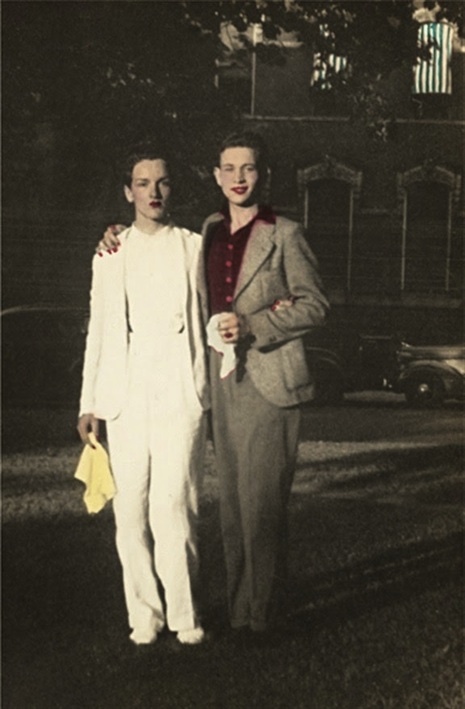
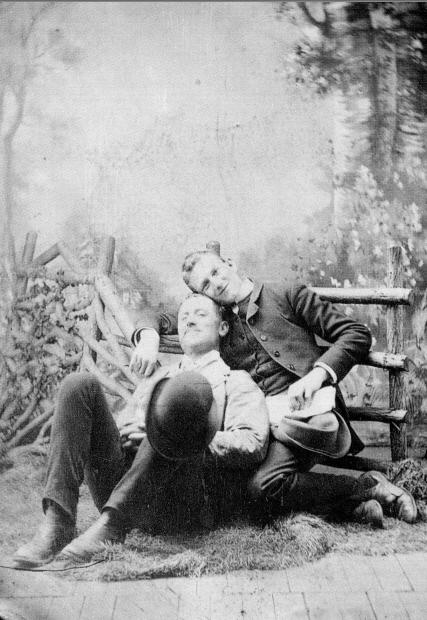
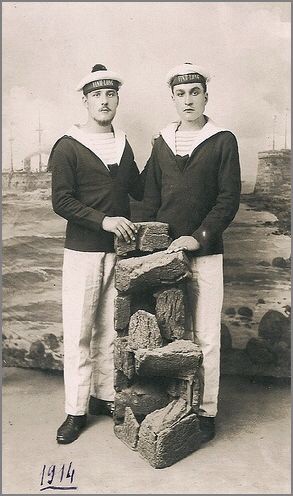
The following is a photo tribute to gay couples from the late 19th century and first half of the 20th Century. It is a testament to the early pioneers of the LGBT movement who have made the world a more accepting and compassionate place for everyone today. It is also a reminder that homosexuality has been around since the beginning of mankind and is not something which can be legislated back into the closet.

England, 1875

Unknown location, 1880’s

New York, 1900

Unknown, Early 1900’s

Europe, 1906

New York, 1907

“A friend of mine found this old photograph in a shoe box in his Grandmother’s attic. On the back was written… Aunty Mary and her “friend” Ruth, 1910. I wonder if those quotation marks imply what I think they do, by the look on their faces, I would say they do”

Unknown, 1912

Unknown, 1914

Unknown Lesbian Couple, 1915

WWI couple, England, sometime between 1914-1918

California, 1923

Unknown, 1925

Unknown

Unknown

Unknown

Source: Flickr / gaytwogether.com / and are the property of their owners.

Reference

Gay History: Nigerian Student Uses Magnets To ‘Prove’ Gay Marriage Is Wrong

A student in Nigeria claims he has scientific proof that same-sex marriage is wrong. 

The so-called discovery was made by Chibuihem Amalaha, a postgraduate student at the University of Lagos who told Nigeria’s This Day Live that same-sex marriage is “eating deep into the fabric of our human nature all over the world.” Amalaha said he conducted “experiments” in physics, chemistry, biology and mathematics to test his theory. Ultimately, he deduced that the repellence of two similar entities (magnets, for instance) proves that same-sex marriage is wrong. 

In a series of befuddling explanations, Amalaha cited magnets, electrolysis, animal mating and simple addition as rationale for why gay relationships just aren’t right. His entire thesis boils down to the fact that “like” does not attract “like.” 

Via This Day Live:

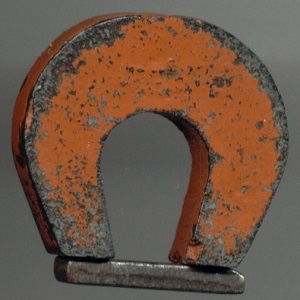
A bar magnet is a horizontal magnet that has the North Pole and the South Pole and when you bring two bar magnets and you bring the North Pole together you find that the two North Poles will not attract. They will repel, that is, they will push away themselves showing that a man should not attract a man. If you bring two South Poles together you find that the two South Poles will not attract indicating that same sex marriage should not hold. A female should not attract a female as South Pole of a magnet does not attract the South Pole of a magnet. But, when you bring a North Pole of a magnet and a South Pole of a magnet they will attract because they are not the same, indicating that a man will attract a woman because of the way nature has made a female.

Amalaha hopes to win a Nobel Prize someday for his work. 

Homosexuality is criminalized in Nigeria. Human Rights Watch notes the country’s federal criminal code carries a 14-year punishment on consensual gay relationships. In states within the nation where Sharia law is enacted, gay relations are punishable by death. 

Luiz DeBarros, of gay-centric blog Mamba Online, critiqued the coverage of Amalaha’s “high-school standard experiments” by This Day Live as “uncritical and uninformed,” saying it will likely add to homophobia in the region. 

Last year, Nigeria passed an anti-gay marriage bill, despite international outcry against it. This legislation not only targets same-sex marriages, but also anyone who aids or abets gay couples as well as any couple displaying a “public show” of affection.

University of Lagos: Magnets prove homosexuality is unnatural

Staff of the University of Lagos have lauded the work of one of their postgraduate students, Chibuihem Amalaha, for an experiment in which he claimed observations of magnets provided proof that homosexuality is unnatural.

Mr Amalaha claimed that as the poles of magnets repel those of the same type, this “means that man cannot attract another man because they are the same, and a woman should not attract a woman because they are the same. That is how I used physics to prove gay marriage wrong”.

Nigerian news website This Day Live reported on the experiment:

“A University of Lagos post graduate student, Chibuihem Amalaha, from Imo State has used science to prove that gay marriage is improper among other breakthroughs.”

In an interview for This Day Live, Mr Amalaha explained the motivation for his experiments.

“In recent time I found that gay marriage, which is homosexuality and lesbianism, is eating deep into the fabric of our human nature all over the world and this was why nations of Sodom and Gomora were destroyed by God because they were into gay practice,” he said.

Mr Amalaha added that his tutors have praised his research: “Recently my lecturer at the Department of Chemical Engineering, Profesor D S Aribuike, pointedly told me that I will win Nobel prize one day, because he found that my works are real and nobody has done it in any part of the world.”

He said his next goal is to get his research published in international journals.

Luiz DeBarros of South African LGBT website Mambaonline said: “It’s debatable as to whether the embarrassing article is more damming [sic] of the standard of education at the University of Lagos or of the standard of journalism at This Day.

“The uncritical and uninformed article is likely to add to the ignorance and prejudice surrounding homosexuality in Nigeria.”

Reference

Gay History: What Are My “Gay History” Blog Posts All About?

As many of my blog followers would have noticed, I put a slightly perverse twist on the word “history”.

I love history, and always have. I excelled at it at school, right from the first day of what was then “Social Studies” at high school, which then morphed into history. As soon as the teacher started on about ancient Greece and Rome, I was hooked.

Ancient Greece & Rome – the beginnings of an addiction to History

In first form at High School, I was given the more complicated history projects, as Mrs Wilson, my asocial Studies teacher, knew I’d do the research, and put it all together in a professional way. I always scored high marks in history exams, and entered my School Certificate exam at Ordinary level for history, coming out with an Advanced pass. I had the ability that, even if I couldn’t recollect exact dates of events, I could fill in the gaps with a whole raft of other facts and figures surrounding the event. It’s a shame I can’t say the same for Math, Geography & Science – all subjects I had no love for.

This love of history has been with me all my life, and shows no signs of slowing. One of the great things I have applauded in recent years has been a strong movement towards telling the truth about history. Like many others, I grew up with a sugar-coated view of history. It was almost like we had to be protected from the very events that have placed us where we are right now! Yes, wars happened, but it was about the actual battles and the total outcome that was taught, not the actual human cost, the great blunders that cost lives…and I point directly at Gallipoli here as an example…the cities and towns and villages that were obliterated, and the millions left homeless and wandering. It never spoke of the hardships of the battlefield, where survival was an unexpected turn for those caught up in the romantic notions of war sold to them to get them to enlist. We were never taught about the aftermath of war, the disabilities, the mental anguish whereby that supposed “return to normality” never happened. My own father, who was in New Guinea and Borneo during the war, never recovered from the savageries of war, and was very much a twisted man up to his eventual suicide in 1978.

The history I grew up with extolled the virtues of the wrong people, like the ever adored Winston Churchill, who is credited…controversially…with helping to win WWII. We were never told of his drinking, his depression, his arrogance, unpopularity within parliament, his many bad decisions that resulted in the deaths of untold hundreds of thousands of people…decision making from afar, with no concern for the losses. Likewise, the Holocaust was totally ignored, the long years of events that led to Hitlers rise to power, nor the staggering death legacy of people like Stalin, and Mao Tse Tung. These were names that were just dropped into, and pulled out of, history as if their existence had no consequence. With the release of records, and film footage over the last few decades, we now have a clearer picture of the events that shaped the world around us.

But having said that, history is not just about the major events that happen around us, both in the past, and now. If we take the word ‘history’ literally, what has just happened is, in the blink of an eye, history! It is not just about what has happened in the past, but is happening right now around us, globally. The good…and the bad! Nor is it about great people, those with prestige and power. It’s about the tiny events by almost unknown people that has a long-term affect on the world. It’s about inventions, taking chances and risks, writing notes and letters, or just being a bit out-there and wacky. History isn’t just about all the serious shit – it has, quite often, an amusing and eccentric side to it.

And this is what I look for!

How many of you would read my blog posts if they were about the known, and mundane! As a gay man, I have lived through some major milestones of gay history, everything from the activism of the 70s and 80s, to the ghettoisation of the lgbt communities, to the devastation of HIV/AIDS, and the advent of Gay Pride.

However, like the world view of history, I don’t want to bore my followers by banging on about events they are already aware of. We all know about Stonewall, Gay Pride, Larry Kramer and the beginnings and politics of HIV. We know about Harvey Milk et al. Amongst all the night club dancing, the drugs, the sex, there was…and is… a plethora of other events happening. In many respects we have a bit of a blinkered view of our history on the gay scene (déjà vu?), seeing it mainly as events that happened from the mid-70s onwards. As you would have seen from the scope of my posts, the affects of both out-there and closeted gay people has been around for centuries. It is the weird, wacky, eccentric, brilliant, sad, funny, serious, fun, and downright fascinating shit that makes gay lives the earth-shattering influence they can be. That is what I want YOU to know about. If I can make you gasp, roll your eyes, or laugh then my aim has been a success.

I know there are politically correct individuals out there in Gayland who probably take offence to my calling the category “gay” history…and I don’t care, quite frankly. Their bleating falls on deaf ears. I identify as a GAY man, and as such use that term to define everything I do. However, that does not make me narrow-minded in the scope of what I post. I do not change terminologies to suit my own agenda. If an article is on queer, or trans, or homo, or bisexual…or any other terminologies within our community…culture, that is how it will be posted. I might be a narky old 80s queen, but I can assure you my world view is wide, and inclusive. The very multi-directional way our community has evolved is part of its…history.

Finally, I have to say I have loved putting these posts out there. It has indeed been an education for me as well. Who knew there was this much weirdness out there! And as gay people there is one thing I do know…the weirdness will never end as long as our community, and the individuals within it, are out there.

Bring on the Gay History!

Tim Alderman 2019

The blog owner Tim Alderman, with one of his two adored Jack Russells. They inspire me every day.

Gay History: A Famous Drag Queen, a Mummy in the Closet, and a Baffling Mystery

Sequined gowns weren’t the only thing stashed in Dorian Corey’s wardrobe.

Dorian Corey in a still from Paris is Burning. ALL IMAGES FROM PARIS IS BURNING

IN OCTOBER OF 1993, LOIS Taylor entered the Harlem apartment of Dorian Corey, a drag performer and dressmaker who’d died of AIDS two months earlier at the age of 56. Accompanied by two men searching for Halloween costumes, Taylor, a fellow New York drag queen and caretaker of Corey in her final days, was hoping to sell them a small fraction of Corey’s wardrobe. They rifled through fabric, feathers, and sequins before they encountered a large closet, where, Taylor said, the sight of a musty green-plaid garment bag folded over on the floor piqued their collective interest.

“I only weigh 135 pounds. I couldn’t lift that thing,” Taylor told New York magazine in 1993. Resigning to her powerlessness to find the zipper, Taylor handed a pair of scissors to one of the men, only to learn that what the curious mass lacked in portability, it made up for in distinct malodor. Without inspecting further, Taylor called the police.

Peeling through multiple layers—first the bag’s fabric, then taped wrappings of what was likely Naugahyde, a type of faux leather, and plastic—detectives revealed a grisly sight: a partially mummified body in the fetal position, its formerly brown complexion now purple and yellow, its ears mere cartilaginous vestiges, its blue-and-white boxer shorts tattered, with a bullet hole in its head. Encased within the layers, detective Raul Figueroa observed, were detachable pull-tabs from flip-top beer cans, whose prime in the United States ranged from the 1960s to the 1970s.

Despite the technical hurdles posed by decay, Figueroa managed to extract fingerprints from the corpse. The body was identified as Robert “Bobby” Worley, born December 18, 1938. The only extant records from Worley’s life were criminal; he’d been arrested for raping and assaulting a woman in 1963 and served three years in prison. By most accounts, he was estranged from his family and hadn’t been seen since the mid- to late ’60s. Coupling this with Figueroa’s pull-tab dating method, detectives concluded the shooting must have happened at least 20 years prior.

Superficial cues might dictate that Dorian Corey had little reason to engage in violent crime. A graduate from the Parsons School of Design, she had a knack for graphic design, which she parlayed into repute as a costumer. In the Harlem drag ball scene—where veteran drag queens and their young breakdancing and voguing counterparts participated in tongue-in-cheek pageants to showcase humor, irony, and ambition through performance—Corey was a stalwart diva. Her experience led her to mentor and support young queens as the mother of her drag family, the House of Corey. “You lend money to your friends—not very much money—and [give] advice…sometimes, if someone got evicted or whatever, you might take them in,” she explained on a 1991 episode of the Joan Rivers Show.

What stands in starkest contrast to the gruesome implications in her closet, perhaps, is Corey’s demeanor. The most extensive video footage of Corey is from the 1990 Jennie Livingston documentary Paris Is Burning, an examination of the aforementioned ball culture; in interviews, she was witty, realistic, and unflappable. In contrast to the grandiosity of aspiring models and housewives, she had a self-possessed cadence and world-weary observations, which endeared her to a comparatively mainstream audience.

“Everybody wants to make an impression, some mark upon the world,” she says in the film. “Then you think, you’ve made a mark on the world if you just get through it, and a few people remember your name…If you shoot an arrow and it goes real high, hooray for you.”

Yet it’s apparent, from her interviews and an alleged silence about her life with Worley, that Corey was also guarded. Considered in tandem with the circumstances of the discovery, plenty of questions remain. Why might she have committed murder? What was her relationship to Robert Worley? How and why was the body preserved and not disposed of? Despite a lack of evidence or sources who are still living (many queens who knew Corey have succumbed to either disease or violence), these questions have provoked a number of theories.

Though the idea has now fallen out of favor, some posited that Corey was “protecting” the real murderer. In 1988—between the probable time of Worley’s and Corey’s deaths—Corey moved from her apartment at 150th Street and St. Nicholas Avenue to one located 10 blocks over on West 140th Street. The notion that the body was in the closet before she moved, the hypothesis goes, is more plausible than that of Dorian’s lugging a corpse from one home to another.

Others maintain, more credibly, that Worley was a burglar who broke into Corey’s home, prompting Corey to act in self-defense. Corey lived in later-20th-century Harlem, where violent crime ran rampant. (Livingston recalled numerous gunfights outside Corey’s apartment during interviews for the film.) For her own protection, she presumably owned a gun; her friend Jessie Torres affirmed she had “a little .22” in an interview shortly after news of the murder surfaced. More telling, Corey had allegedly attached a note to the body reading “This poor man broke into my home and was trying to rob me.” Furthermore, the theory suggests a possible reason she kept the body: a black drag queen who lived in a poor, dangerous area in the ‘60s or ‘70s had little chance of garnering sympathy from the police.

Prevailing sentiment, however, contends that Corey and Worley had a turbulent romantic relationship that reached a tragic conclusion in a crime of passion. According to Taylor, Corey wrote a short, third-person story about a transgender woman who killed her lover after he browbeat her into having sex reassignment surgery. Handwritten on a piece of paper yellowed with age, the story seemed at least loosely autobiographical—Corey had had breast implants and possibly taken female hormones—and was peppered with references to her life, including the Pearl Box Revue, a touring drag show she’d performed with in the ‘60s.

Additional clues point to this supposition. Torres had relayed that Corey, hospitalized and in a haze of AZT and morphine, had confessed to her friend Sally in Corey’s final days. Richard Mailman, whose upcoming play Dorian’s Closet explores the story, says that, according to a police interview with Worley’s brother, Worley “showed up at his [brother’s] house one night drunk, and he was going on and on and on about Dorian. There was that sort of corroboration that he was in a relationship and did know Dorian.”

Indeed, any relationship they had was fraught. Reg Flowers, whose one-man play Out of the Bag plumbs the psyche of Robert Worley, suggests that Worley may have struggled to reconcile the pressures of appearing masculine and straight with his attraction to Corey, lashing out at her in bouts of frustration. “Being in a relationship with someone who was abusive would make sense [as an explanation], especially when you’re talking about when men are attracted to trans people,” he says. “My sense is that we’re talking about someone who might be closeted about their homosexuality as well, and so there might have been all kinds of internalized hatred and internalized oppression. My sense of it is that it was a dangerous situation that Dorian needed to get out of.”   

As for the body, Mailman postulates that Corey, fearing disposing of it would be too conspicuous in congested Manhattan, covered it in baking soda and wrapped it tightly to neutralize the inevitable odor. Decades’ worth of chemical reactions likely rendered an amateur mummification job. “I don’t think she had a criminal mind. She didn’t plan the murder, and when it happened, she had to think fast,” he says. “In the mind of someone who commits a crime of passion, that kind of makes sense.”

Still, how did Corey get away with murder? At least three factors may explain this: Corey’s consistent cool and grace, and Worley’s estrangement from his family and the lack of documentation about his life, and the suppression of the corpse’s stench. But perhaps the murder’s obscurity is primarily owed to a fourth, socioeconomic factor: the othering and invisibility of two poor, sexually complex black people navigating internal and external turmoil in 1960s and ‘70s America.

A definitive answer remains elusive and probably always will. It’s unsurprising: Corey was part of a highly marginalized world, and her life—even the part ripe for a campy tabloid headline—attracted little attention. Still, whatever brought these two together—and whatever happened the day of Worley’s death—Dorian Corey has made an indelible mark.

Reference