Monthly Archives: August 2019

10 Strange And Obscure Secret Societies

Secret societies like the Illuminati and the Freemasons always seem to get the limelight. However, a good number of lesser-known groups have their own strange stories to tell that make them just as interesting as their more famous counterparts.

10: The Order Of Chaeronea

The Battle of Chaeronea in 338 B.C. saw the defeat of the Sacred Band Of Thebes, an elite ancient Greek fighting unit consisting of 150 soldiers and their male lovers. Years later, in 1899, Chaeronea lent its name to a slightly related but very different group—the Order of Chaeronea, an English political organization for gay men.

Cecil Ives founded the group as a means to communicate without fear of persecution. He patterned the order like a true secret society, devising ceremonies and passwords for its members. He also devised a strict set of rules, which kept members from using the society for sexual meet-ups.

Many prominent gay intellectuals joined—Oscar Wilde was reportedly a member. The organization soon spread around the world, enabling Ives to promote gay rights through books and numerous lectures. The order became a modern precursor to 20th-century rights organizations. After Ives’s death, the movement faltered, gaining steam again during the 1990s, especially in the US, and inspiring several offshoots.

9: The Knights Of The Apocalypse
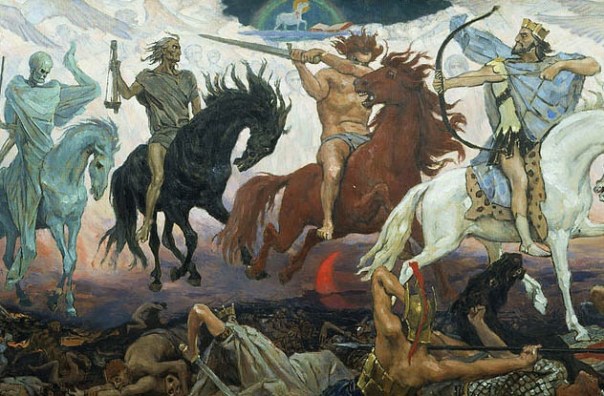
This group formed in 1693 to protect the Catholic Church against the supposed coming of the Antichrist. Members were noted for their peculiar habits, such as bringing swords to work and wearing clothing with an elaborately drawn star on the breast.

The society’s strange behavior could be blamed on the founder himself, a merchant’s son by the name of Agostino Gabrino. A certifiably insane man, Gabrino was known to have disrupted two church masses by waving a sword and proclaiming he was the “King Of Glory.” At his group’s founding, he declared himself a “Monarch of the Holy Trinity” and devised a bizarre set of rules for his knights, which included the practice of polygamy and exclusive marriage to virgins.

A year after the group began, one knight betrayed its existence to the Inquisition. The order was disbanded, and its knights were thrown into prison.

8: The Order Of The Occult Hand

This group had just one goal. Its members inserted one particular phrase—“it was as if an occult hand had“—into newspapers and other publications.

The group had its beginnings when Joseph Flanders, a reporter for the Charlotte News, innocently used the phrase in a report. His friends liked the wording so much that they conspired to copy it as often as possible. Pretty soon, other reporters and journalists from all over the world began using the phrase in their own stories.

The conspiracy was undone in 2004, when James Fanega, a reporter for the Chicago Tribune, managed to track down the perpetrators and list the publications they had infiltrated. However, the group bounced back in 2006 when leader Paul Greenberg and the chief members announced that they had picked a new phrase to carry on the tradition. So far, no one has succeeded in finding out the new phrase, which Greenberg claims has already appeared in many major outlets.

7: The Calves’ Head Club
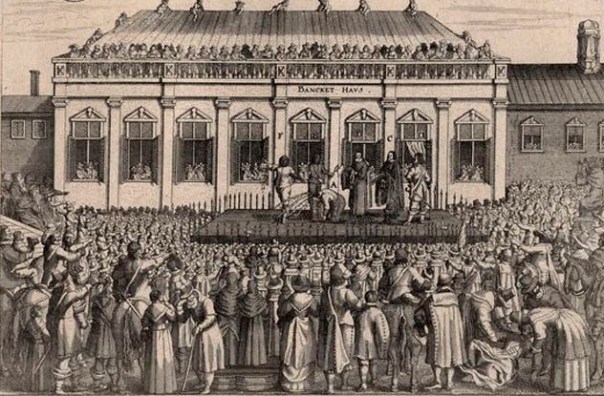
Shortly after the execution of King Charles I in 1649, his opponents formed the Calves’ Head Club to mock his memory. Members met once a year on January 30—the execution’s anniversary—and celebrated a very bizarre dinner, replete with a symbolic axe hung high over the dining room. The menu itself included calves’ heads (which represented the king’s royal office and supporters), a cod’s head (which represented the king himself), and a large pike and boar’s head stuffed with a smaller pike and an apple respectively (which represented the king’s tyranny).

The members had their own anthem that praised the king’s death, and they toasted it with wine from cups made of calf skulls. They also burned a copy of the king’s autobiography while swearing by John Milton’s treatise supporting his execution—Milton himself allegedly founded the group.

After the restoration of the monarchy in 1660, The Calves’ Head Club had to meet secretly. The club finally met its demise in February 1735, when a mob invaded a meeting and almost lynched several members.

6: The Arioi
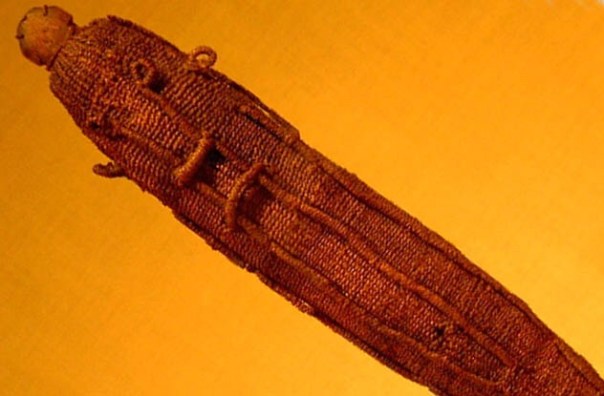
The Arioi was a secret society that existed in Tahiti well before any Europeans found their way to the island. The group dedicated itself to the worship of its patron deity Oro, and it traveled extensively in search of new recruits.

To attract new applicants, members did elaborate ritual dances. Anyone could ask to join, but only the most handsome and beautiful were eventually selected, since the society linked beauty to spiritual prowess.

Members had to memorize their rituals perfectly to be recognized; otherwise, they were mocked mercilessly. In addition, the society preached a very free lifestyle, as evidenced by some of their sexually charged rituals. Their behavior evidently disgusted Christian missionaries assigned to the place, with one describing them as “privileged libertines who engaged in abominable, unutterable, and obscene exhibitions.”

For all their profligate habits, the Arioi had a strict rule that forbade childbirth; children would interfere with members’ duties. They routinely aborted the unborn and killed infants. Parents whose children did survive were demoted within the society.

Christian proselytizing eventually put an end to the Arioi by the 19th century.

5: The Scotch Cattle

In response to unfair working conditions, Welsh miners in the 1820s formed a secret union called the Scotch Cattle, named for the fearsome breed of Highland cattle. Each mining town in the region had its own chapter, led by a leader called “the Bull.” Together, members intimidated and attacked those perceived to oppose their cause. Their targets were not limited to oppressive bosses; scabs were also fair prey.

The group usually first sent a warning letter to the offending party. If it was ignored, the members—with blackened faces and dressed in cowskins—would invade the unlucky man’s home at midnight and destroy his property. Sometimes, the members would also beat the man; before leaving, the group would always paint a red bull’s head on the vicitm’s front door.

The Scotch Cattle continued its operations until the 1840s, when more organized trade unions took its place.

4: The Order Of The Peacock Angel
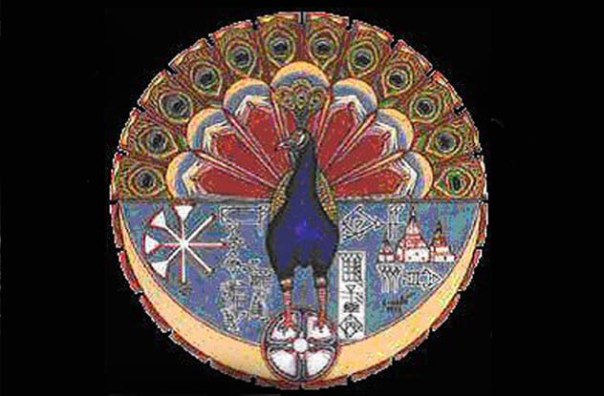
This secret society first formed in Britain in the 1960s, founded on the ancient religious beliefs of the Yezidis—a group that has faced accusations of devil worship from Muslims and Christians alike. The group actually worshiped Melek Taus, the Peacock Angel, represented by either a stone statue of a peacock or by a real live bird.

Members believe that the Peacock Angel has the power to answer prayers, and they revere it accordingly. Their meeting room is usually filled with hallowed images of the Peacock Angel; the altar itself is placed in the middle and contains the main symbol of veneration. Members often do a slow ritual dance around the altar while they silently express their wishes. The dance gradually takes on a frenzied pace as religious fervor builds. It ends in ecstatic bliss, with the members satisfied that they are now filled with the Peacock Angel’s divine power.

3: The Leopard Society

Although it had adherents in East Africa, the age-old bloodthirsty Leopard Society thrived mainly in West African nations such as Nigeria and Sierra Leone. Members of this cult engaged in ritual human sacrifice and cannibalism. Dressed up in a leopard skin and armed with sharp metal claws and teeth, a member would ambush and maul an unwary victim to death. Afterward, the leopard-man collected the victim’s blood and used it to make a potion that he believed would give him supernatural powers.

Following a spate of killings after World War I, colonial authorities in Sierra Leone and Nigeria wrongly thought they had successfully suppressed the cult. The Leopard Society again reared its ugly head after the Second World War, killing more than 40 people. Locals refused to provide any information about the cult because they believed in the leopard-men’s invulnerability. Only after the authorities managed to kill a member in 1948 did several witnesses express their willingness to help.

That breakthrough allowed authorities to find the cult’s hideout, imprison 34 members, and hang another 39. To spread the story that the members were just human, the authorities allowed several local chiefs to view the executions.

2: The Bald Knobbers
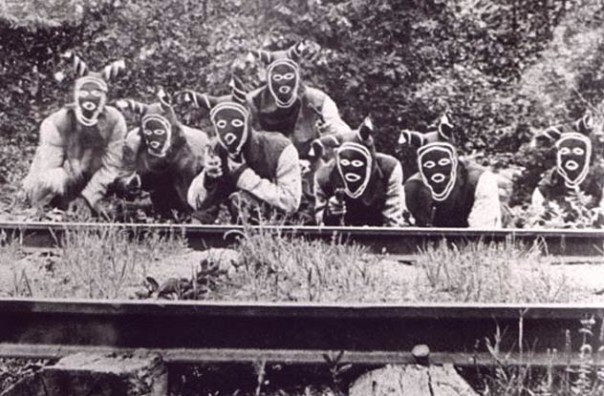
This secret vigilante group sprang up in response to the rampant crime and lawlessness that plagued southwest Missouri after the Civil War. Led by their founder, a hulking veteran named Nat Kinney, the Bald Knobbers of Taney Count—so-called because they held secret meetings above bare mountaintops—proceeded to take the law into their own hands. Wearing their coats backward and sporting odd, horned masks, the Bald Knobbers employed such heavy-handed tactics as whipping, beating, and even killing suspected criminals. Eventually, some Bald Knobbers began to use their membership to protect their own criminal activities.

The group’s notoriety peaked in 1887 when they killed two critics and injured their families. Authorities arrested 20 members and executed four others. A year later, Kinney—who had already left the group before the shootings—was killed by an opponent of the organization. Although minor conflicts continued after that, the Bald Knobbers had effectively reached their end by 1889.

1: The Secte Rouge
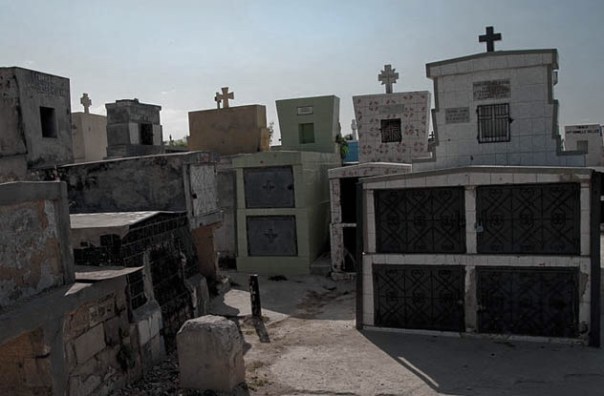
According to Zora Neale Hurston, an African-American author who traveled to Haiti in the 1930s, the Secte Rouge—also known as Cochon Gris or Vinbrindingue—was a secret society that practiced ritual cannibalism and grave robbing. Although she had no firsthand experience with the society, she had three indirect encounters with the cult.

The first occurred in 1936, when Hurston heard an odd beating of drums late one evening. She wanted to go out to investigate, but her house girl warned her to stay inside, or else they’d risk the cult’s wrath. The second time happened when she questioned a man burning rubber tires near her house. The man explained that the tire smoke was to deter the cult members from abducting his child. Finally, she saw militiamen on a secret operation to suppress an unknown group in a remote area of the island.

All this, plus accounts from locals who swore of the group’s existence, painted the portrait of a murderous cult that met at night in a cemetery and engaged in macabre rituals, including waylaying travelers for human sacrifices.

+: The Skoptsy
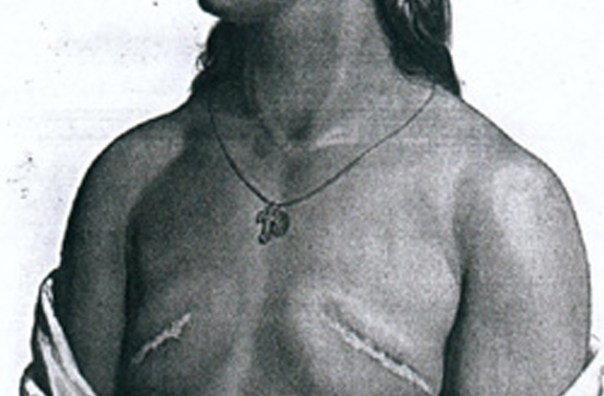
In line with some of the craziest rituals ever performed in the name of religion, the Skoptsy of Russia castrated themselves in the belief that it would lead to salvation. Founded in the mid-18th century by two peasants named Andrei Ivanov and Kondratii Selivanov, the Skoptsy believed that genitals and breasts appeared only after Adam and Eve ate the forbidden fruit; consequently, these organs must be removed to live a perfect life.

Shortly after the group’s founding, authorities arrested the two leaders and exiled them to Siberia. Selivanov managed to escape and traveled to St. Petersburg, where he titled himself the Messiah and claimed to be the reincarnation of Tsar Peter III. His preaching attracted many followers. It also attracted renewed attention from the authorities, who arrested him repeatedly and finally locked him up in a monastery for good.

Selivanov’s incarceration and subsequent death did nothing to dampen the sect’s growth. At its height, the Skoptsy were believed to number more than 100,000 and included members of the Russian elite. Following the Communist revolution, the sect’s numbers drastically declined. Today, it is estimated that there are just over 100 left, most located in the sect’s birthplace.

Reference

Gay History: 6 Sites Recognised By Britain For Significence To Gay History.

Originally published in the New York Times

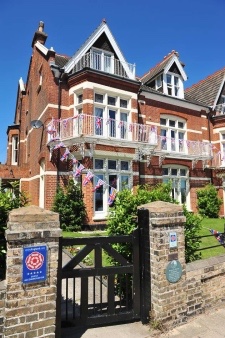
LONDON >> The former homes of the writer Oscar Wilde and the composer Benjamin Britten are among six sites that were recognized on Friday by an arm of the British government for their significance in lesbian, gay, bisexual and transgender history.

Oscar Wilde’s house, 34 Tite St, Chelsea

Historic England, a body that designates places worthy of legal protection, announced the decision, the latest in an effort to showcase “queer history.” Last September, Historic England gave the Royal Vauxhall Tavern, a well-known gay pub, a Grade II listing, meaning that it cannot be demolished, extended or altered without special permission.

Similar efforts to recognize gay history are underway in the United States. In June, President Barack Obama designated the Stonewall Inn, the location of a 1969 police raid and subsequent protest that galvanized the gay rights movement, and surrounding sites a national monument.

Duncan Wilson, the chief executive of Historic England, said in a telephone interview that the decision was “part of a deliberate policy of looking at what we protect and commemorate by a listing, to see that it is more representative of society as a whole.”

Through a research project called Pride of Place, people have been invited to submit places of importance to gay history, many of them forgotten or obscure. More than 1,600 submissions have come in. The project will in part serve to commemorate the 50th anniversary next year of the partial decriminalization of homosexuality in England and Wales (1967).

Britten House, Lowestoft. Home of the Suffolk born composer, Benjamin Britten.

There are about 500,000 listed buildings in England, of which 2.5 percent are in Grade I, reserved for buildings of “exceptional interest,” like Stonehenge and St. Paul’s Cathedral, and 5.5 percent are in Grade II*, which covers “particularly important buildings of more than special interest.” The rest are in Grade II.

Of the six sites announced Friday, one is a new Grade II listing: the grave of Amelia Edwards — a writer, musician and founder of Egyptology in St. Mary’s Churchyard, in Bristol. She and her partner, Ellen Braysher, lived in the nearby town of Weston-super-Mare, where Edwards died of pneumonia in 1892, a few months after Braysher’s death.

(The New York Times, which covered a lecture she delivered at the Brooklyn Academy of Music in 1889 on the hidden cities of ancient Egypt, said that an 1875 trip to that country was the “turning point” in her life.)

The Burdett-Coutts Memorial at St. Pancras Gardens in London, was given a higher listing, Grade II*. The memorial commemorates, among others, the Chevalier d’Eon, who was a French spy and diplomat in the 18th century.

A minor aristocrat from Burgundy, the chevalier was sent to Russia as a spy, fought in the Seven Years’ War and helped negotiate the treaty that ended war between Britain and France. The chevalier lived the first part of his life as a man, and the last few decades as a woman; the remarkable story has inspired art, plays and studies.

The Royal Vauxhall Tavern

The memorial is made of limestone, granite and marble, includes a sundial and is built in the High Victorian style.

The other four properties were given updated descriptions in the National Heritage List for England, the searchable online database that Historic England maintains, to better reflect their significance to gay history.

Two are well-known to arts lovers. One is the house at 34 Tite Street, in the Chelsea neighborhood of London, where Oscar Wilde lived with his wife, Constance Lloyd, and their two children from 1884 until his trial for “gross indecency” in 1895. Convicted of having sex with men, Wilde was sentenced to two years of hard labor. The law under which he was convicted was not repealed until 2003. (The house, which has a blue plaque outside, is still a private residence.)

After catching influenza, Edwards died on 15 April 1892 at Weston-super-Mare, having lived at Westbury-on-Trym, Bristol since 1864. She was buried in the churchyard of St Mary the Virgin, Henbury, Bristol, where her grave is marked by an obelisk, with a stone ankh at the foot.

The other is theRed House, in Aldeburgh, a town on the east coast of England. Benjamin Britten and his partner, the tenor Peter Pears, lived together there from 1957 until Britten’s death in 1976. (The house, run by the Britten-Pears Foundation, is open to the public.)

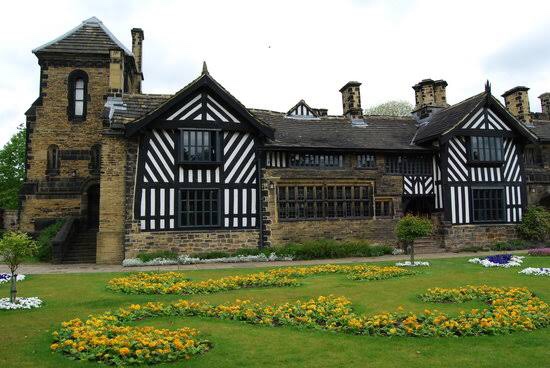
The remaining two sites were used by people who had to shield parts of their lives. n West Yorkshire, was the home of Anne Lister, a landowner who kept diaries, part of them in code, about her relationships with women. She lived in the house for several years with her partner, Ann Walker.

Shibden Hall, Halifax

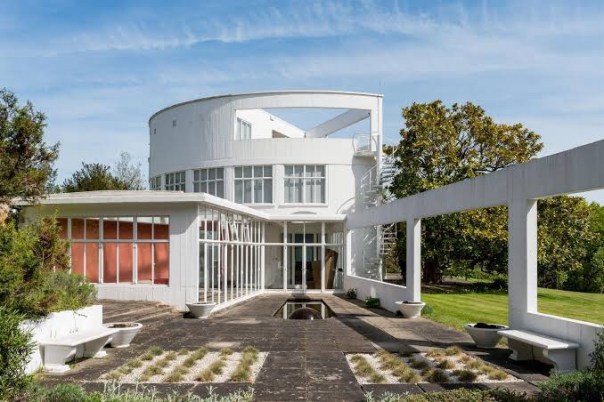
In Chertsey, a suburban town in Surrey, is St. Ann’s Court, which Historic England cited as an example of “queer architecture.” The concrete house, built between 1936 and 1937, was the home of Gerald Schlesinger and Christopher Tunnard, a gay couple who designed their home in response to laws that made homosexual sex a crime, even in the privacy of one’s home.

Burdett-Coutts Memorial Sundial

The house’s master bedroom could be separated into two, promoting an image to visitors that the two men slept separately. Phil Manzanera, a guitarist with the rock band Roxy Music, later lived in the house.

St. Anne’s Court, Chertsey, Surrey

Reference

Gay History: The White Swan, The Gay Brothel in Vere Street.

By Lucy Inglis, @ The History Girls

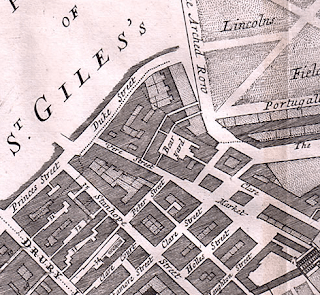
This weekend, the new Archbishop of Canterbury invoked the Easter spirit of tolerance and forgiveness into the debate over gay marriage and female bishops. As a state (if not a nation), we are still struggling to come to terms with the idea that gay people exist throughout society and may wish to avail themselves of the same legal rights and social status as their straight counterparts. I spend much of my working life researching and writing about the people on the margins of society in eighteenth century London, and in that work come across many ordinary gay men and women, trying to make their own way regardless of the strictures of their society. Gay men are usually more visible as their relationships were deemed criminal at the time and so it is court cases that illuminate their world. Two of the most famous are Mother Margaret Clapp’s Molly House (details of which can be found in the Old Bailey Online records) and The White Swan in Vere Street. Margaret Clapp’s was more of a coffee-house primarily for homosexual clientele, rather than a place where gay sex was traded for money and The White Swan was one of the first and most accurately recorded establishments had been set up with the aim of making money. It stood in a medieval street just to the west of Lincoln’s Inn and was part of the area of London obliterated by Kingsway.

On the 8th of July, 1810 the Bow Street Police raided The White Swan, a tumbledown pub of Tudor origin near Drury Lane. Twenty-seven men were arrested on suspicion of sodomy and attempted sodomy. The Swan had been going for less than six months, established by two men, Cook and Yardley, but already had a considerable following. Cook, whose wife ran an ordinary pub nearby called the White Horse, was proud of his amenities, and his clientele. ‘Cook states that a person in a respectable house in the city, frequently came to his pub, and stayed several days and nights together; during which time he generally amused himself with eight, ten, and sometimes a dozen different boys and men!’

Cook and Yardley had furnished their establishment for its purpose. ‘Four beds were provided in one room – another was fitted up for the ladies’ dressing-room, with a toilette, and every appendage of rouge, &c. &c….The upper part of the house was appropriated to youths who were constantly in waiting for casual customers; who practised all the allurements that are found in a brothel, by the more natural description of prostitutes. Men of rank, and respectable situations in life, might be seen wallowing either in or on beds with wretches of the lowest description’.

The account of The White Swan raid and the subsequent trials was told in 1813 by Robert Holloway, later Cook’s lawyer, who sold many copies of his account. In it there are some excellent observations of the behaviour within the house, where faux marriages were conducted to ‘bless’ the coming union. The descriptions of these weddings make them appear parodies of the traditional service, but they were common enough that on some level they must have had meaning for those performing in them.

Many of the clientele assumed feigned names, though often not very appropriate to their calling in life. ‘Kitty Cambric is a Coal Merchant; Miss Selina a Runner at a Police Office; Blackeyed Leonora, a Drummer; Pretty Harriet, a Butcher; Lady Godiva, a Waiter; the Duchess of Gloucester, a gentleman’s servant; Duchess of Devonshire, a Blacksmith; and Miss Sweet Lips, a Country Grocer. It is a generally received opinion, and a very natural one, that the prevalency of this passion has for its object effeminate delicate beings only: but this seems to be, by Cook’s account, a mistaken notion; and the reverse is so palpable in many instances, that Fanny Murry, Lucy Cooper, and Kitty Fisher, are now personified by an athletic bargeman, an Herculean Coal-heaver, and a deaf Tyre-Smith.’

It is Blackeyed Leonora, the drummer who stands out amongst this motley crowd, for Leonora was in fact most likely Thomas White, a 16 year old drummer in the Guards. Thomas was one of the ‘youths’ who stood and waited in the upper part of the house. He was a great favourite amongst the ‘more exalted’ visitors to the house, according to Holloway. Almost every single one of the people at The White Swan had an mainstream occupation. Of course, some were visitors, but White worked there. No doubt it was his youth, and probably his looks that drew attention from the richer customers. ‘White, being an universal favourite, was very deep in the secrets of the fashionable part of the coterie.’

Poor Thomas, who wasn’t even at The Swan on the night of the raid, was too quick to confess, and was executed for his ‘crime’ after almost a year in prison, although there was no doubt he was guilty of the charge. With him died a man called John Hepburn, aged 46, who had procured White’s services with the help of a witness who testified against him. White was prosecuted as the giver, rather than the receiver which made it almost impossible for the court to avoid the death sentence when the jury convicted him of ‘buggery’. At White’s execution, various people of note were recorded. ‘A vast concourse of people attended to witness the awful scene. The Duke of Cumberland, Lord Sefton, Lord Yarmouth, and several other noblemen were in the press-yard.’ The Duke of Cumberland had avoided a homosexual scandal by a razor thin margin in June 1810 when his servant was found with a cut throat after threatening to out his master after catching the Duke and his valet ‘in an improper and unnatural situation’. Perhaps Cumberland was one of White’s ‘fashionable’ guests.

Of the other 25 or so, only six were found guilty and they were pilloried and imprisoned, including Cook the landlord. Yardley seems to have got away with the whole thing. The White Swan affair raised the public ire, and the convicted men suffered at the hands of a mob. ‘The disgust felt by all ranks in Society at the detestable conduct of these wretches occasioned many thousands to become spectators of their punishment. At an early hour the Old Bailey was completely blockaded, and the increase of the mob about 12 o’clock, put a stop to the business of the sessions. The shops from Ludgate Hill to the Haymarket were shut up, and the streets lined with people, waiting to see the offenders pass….A number of fishwomen attended with stinking flounders and entrails of other fish which had been in preparation for several days.’

Cook refused to implicate any more clients, but on his release he began to blackmail two members of the clergy who had escaped prosecution during the raid and investigation. In what was probably a set-up, he ended up in prison for assault and debt and his whole family were systematically ruined in a series of evictions and persecutions that Holloway attributed to ‘influential persons’. Just how influential, we will never know.

Reference

Gay History: The Raid On The Tasty Nightclub, Victoria, 1994.

“There was an escalating feeling that the police weren’t finding what they were looking for. They knew they couldn’t find anything. They were getting angry.”

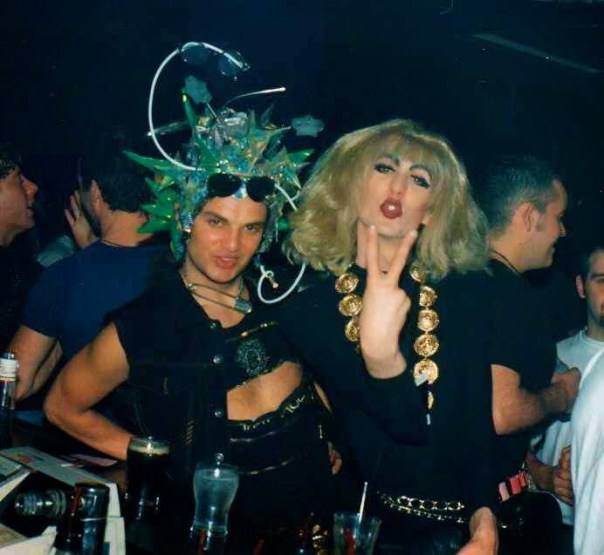
In the early hours of 7 August 1994, Victoria Police raided Tasty, a nightclub in Melbourne’s CBD with a predominately queer clientele. Hundreds were strip-searched under the pretence of a drug search. The police didn’t find a thing.

Ron Van Houwelingen is now a Melbourne LGBTI activist, but in 1994, he was a 27-year-old hospitality worker and Tasty regular. “You went down a laneway and the thumping music would get louder. It was a place for gays, lesbians, trans people, drag queens, artists – it was a place for freaks!” He describes the mood at Tasty as one of euphoria, of celebration. “We’d survived the ’80s, losing our friends to HIV. This was the start of something else.”

The venue managers had been tipped off several weeks prior that there would be a raid, but according to Van Houwelingen, no one had anticipated its scale. “Before it happened, it was just another fun night. The bar staff seemed apprehensive but the party went on.

“I happened to be in the ladies toilets, about 2am, with a friend having a chat. Suddenly we heard sirens and a female police officer stormed in and immediately separated my friend and me.”

What happened next was an ordeal that went for hours. Each of the 463 patrons at Tasty was made one-by-one to strip and bend over for Victoria Police to perform a search.

“I was one of the first to be stripped”, said Van Houwelingen, “but there were a couple of hours before of just standing with our hands against the wall, waiting to be searched. Anytime you got tired and your hands would slip, an officer would yell out: ‘Hey faggot! Hands back on the wall!’”

There was an added level of humiliation for Tasty’s drag queens and trans patrons, who were also forced to undergo a full strip-search.

By the time everyone was out of the club, a group of patrons had already begun planning their next move. Among the group was Melbourne lawyer Gary Singer, who mobilised activists to meet at LGBTI radio station Joy FM’s studios the next day. “We knew it was wrong, so we started the ball rolling, making some noise”, said Van Houwelingen.

The media backlash around the event was an embarrassment for the Kennett government at the time. There was disbelief in the LGBTI community and the wider public. Singer led a successful class action for some 250 Tasty patrons, on the grounds of false imprisonment and assault, winning each $10,000.

Tasty wasn’t the last time police assaulted queers in Australia. Last year, NSW police assaulted Jamie Jackson Reed, a young gay man attending Sydney’s Mardi Gras. The incident was followed some days later by a march of 1,500 people to a Sydney police station, against police brutality. Police around the country now routinely employ gay and lesbian liaison officers, but it’s clear from recent incidents like the one involving Jackson Reed that these liaison officers are nothing more than pinkwashing.

The police have a long history of terrorising the queer community. The first Mardi Gras itself was a political protest commemorating the Stonewall Riots. Although the protesters had originally obtained a permit to march, this was revoked, and the police violently suppressed the demonstration, arresting 53 people.

For many decades, day-to-day harassment of LGBTI individuals was par for the course. As homosexuality was widely criminalised until the 1980s, many men who were arrested for homosexuality still have that charge listed on their record.

Recently, Victoria Police apologised for the Tasty raid. While Van Houwelingen welcomed the apology, he had mixed feelings.  “Why has it taken 20 years?” More than an apology, the best thing to have come out of Tasty is the lesson that our strength lies in our ability to struggle collectively. For the patrons at Tasty, collectivity was something learned through the AIDS crisis. “AIDS was the reason we became active. There was a general camaraderie based on lost members of the community, lost friends. We were already a wounded community, but that gave us our strength.”

Victoria Police apologise for Tasty raid

Victoria Police has apologised for the “extreme” and “disturbing” 1994 Tasty raid in which more than 450 patrons at a Melbourne gay club were strip-searched.

Acting Chief Commissioner Lucinda Nolan apologised on behalf of the force on Monday night to coincide with the 20th anniversary of the raid this week.

“The events that took place that night caused distress to people and had a significant impact on the relationship between Victoria Police and the wider LGBTI [lesbian, gay, bi-sexual, transgender and intersex] community,” Acting Commissioner Nolan said.

“It is therefore appropriate we extend a sincere apology to the community members who were affected by the events on that night and also to the broader LGBTI community for the impact this event has had on our relationship over the past two decades.”

The apology took place during a meeting at the Victoria Police Museum with the police’s newly established LGBTI community reference group.

It was the morning of August 7, 1994, when the music died, the lights went on and, according to witnesses, police ordered the “faggots” to put their hands up.

The victims were not criminals, but clubbers targeted during a questionable drug raid.

The 463 patrons in Tasty Nightclub in Flinders Lane were subjected to a terrifying and humiliating strip search.

It was a political nightmare for Victoria Police and premier Jeff Kennett, who denounced the raid as “extreme” and “disturbing”.

A successful class action by about 250 patrons for false imprisonment and assault cost the state $6 million.

The class action was led by lawyer and former Melbourne deputy lord mayor Gary Singer, who was at the nightclub when 40 police burst through the doors.

He was one of first to receive the apology at the private function on Monday night.

“It’s really exciting. I think it’s a great leap forward when the Chief Commissioner comes out and apologises,” Mr Singer said.

“It’s never too late and 20 years is not a long time when it comes to governments or bureaucracies. This is the beginning of a new chapter and we are seeing the police force recognise they need to deal fairly with various sections of the community.”

Mr Singer led the class action on behalf of Sally Gordon, who was awarded $10,000. Other cases were settled for the same amount.

“We wind the clock back 20 years and they [Victoria Police] certainly weren’t doing anything then. We fought that case and it was a very difficult case to fight. It went on for six or seven weeks and every police witness gave a version of events that simply wasn’t true.”

Shaun Miller was also there during the raid.

“Even though it was 20 years ago, I still remember the lights going on,” he told LGBTI publication Melbourne Community Voice.

“I remember what the police said, I remember being strip-searched – the whole thing.

“In my view, the police apology is genuine and sincere and a wonderful milestone in the road to improving the relationship between the LGBTI community and the Victoria Police.”

Another vocal victim was pyjama king Peter Alexander: “The fact that innocent people in their hundreds were stripped and humiliated still haunts me and reminds me that we have to keep check on people in authority.”

Acting Commissioner Nolan said while the force has made “great strides” in the recognition and celebration of gender and sexual diversity, there was “still work to be done”.

“We know there is under-reporting of homophobic, biphobic and transphobic incidents and offences. We understand that in order for these reporting rates to increase, the LGBTI community needs to have confidence that their reports will be taken seriously and their complaints will be treated respectfully.

“We are committed to ensuring that every LGBTI Victorian has a positive experience with our organisation, whether they approach us for help, see us in the street, or indeed work within our ranks or aspire to do so.”

References

Straight Guys Reveal Why They Love Bottoming. NSFW

One straight guy said: ‘[It] really makes a man out of you’

Josephrucker | Instagram

More and more straight men are into bottoming, at least according to one prominent sexpert.

It’s a phenomenon known as pegging and it’s the idea of a woman performing anal sex on a man, usually with a dildo or strap-on.

Sex columnist Tracey Cox says her blog posts about anal play get the most clicks out of any other posts.

‘Pegging was the hottest sex trend in 2016,’ she wrote. ‘And far from being a fad, is fast becoming something most couples try at least once.’

‘I remember writing about pegging about 20 years ago and everyone’s reaction was “What! My boyfriend/husband’s not gay, why the hell would he want me to do that to him?”‘

But a recent thread on Reddit is helping to dispel myths about straight men liking anal pleasure.

The thread starts off with a straight guy asking for tips on how to bottom.

He writes: ‘I just found out my girlfriend plans on pegging me tomorrow.

‘I can’t really say no since I promised her a weekend of submission, allowing to indulge in things like spanking, foot worship and forced nudity, but this is something new,’ he said.

He eventually asks: ‘So what does it feel like?

One user responds: ‘As someone whose girlfriend pegs him VERY regularly, pushing out makes it feel even better, especially when you’re near orgasm. Also, the usual advice: LUBE, LUBE, AND MORE LUBE.’

Another warned: ‘Be careful, dude.

‘This is probably the one time you don’t want to be hyper-masculine. If you feel pain, then speak-up,’ he said.

‘Getting pegged really makes a man out of you’

Sunday World recently asked their straight male readers if they’d ever tried pegging and found some surprising answers.

27-year-old man, with the pseudonym Kamogelo said: ‘I told her [his girlfriend] I wanted to be penetrated with a dildo and when she did it, I reached climax in the most satisfactory manner.

‘I have never felt like that before; it was amazing,’ he said.

Similarly, PopBuzz interviewed 10 straight guys about their bottoming fantasies.

Devin from Detroit said: ‘When I get pegged by my wife, it allows me to better understand what it is like for her when she sits on top of me. And so once a month, she puts on her piece and I ride her for a little bit.’

Brad from Chicago said: ‘Getting pegged really makes a man out of you.

He continued: ‘We first started out with a four inch strap on… and then a six inch. I’m happy to report that today, we are up to a full 10 inches. Our goal for the new year is 12 inches! Soon, I’ll be a power bottom!’

Kent from Santa Fe said: ‘One night when I was drunk, I talked to my girlfriend about it. Before I knew it, I was bouncing on it like it was some kind of toy.’

Are you a straight guy who enjoys pegging?

Male Criminals Who Became Women Behind Bars,

WHILE US wife killer Robert “Michelle” Kosilek captures headlines for his bid to have a state funded sex change, Australia has a history of violent men who become women behind bars.

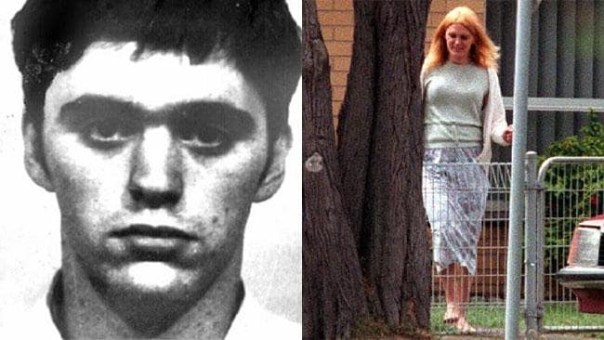
Geoffrey Ian Websdale went on a murderous rampage on a country sheep station, shooting the girl who rejected him, killing two others and rendering another young man a quadriplegic.

Years later in a NSW prison, he started wearing make-up and calling himself Michelle.

Noel Crompton Hall put a sawn-off shotgun in a man’s mouth and blew the back of his head off, in a drug deal gone wrong.

While serving time in jail, he got the state to fund his sex change.

Lesley ‘Krista’ Richards Photo: Sally Harding/Supplied

Leslie “Krista” Richards underwent an orchiectomy (removal of the testicles), while in an Adelaide jail after being arrested for offences which have been suppressed. Richards then complained that prison authorities refused to let him wear women’s clothes around the yard.

Paul Luckman partnered his army boyfriend, Robin Reid, in one of the most sadistic child murders in Australian criminal history.

In prison, he became Nicole Louise Pearce and now lives as a woman in Victoria.

As American audiences are transfixed by the story of Kosilek, who strangled his wife in the East Coast state of Massachusetts and is now battling in court to have gender reassignment surgery, news.com.au can reveal the bizarre but true stories of Australian killers who change their gender while incarcerated.

Noel Crompton/Maddison Hall. Photos: Supplied/Cameron Richardson

Maddison Hall was a tattooed 26-year-old drug dealer by the name of Noel Crompton Hall living with his wife in south-western Sydney when he went on a road trip to deliver drugs and gave South Australian man Lyn Saunders, 28, a lift.

The pair argued and Hall shot Saunders in the back and then again in the mouth.

Sentenced to 22 years, Hall began dressing as a woman in jail and self-harming, complaining that he was a woman trapped in a man’s body.

Some transgender inmates can remain in male prisons, where they may become the “girlfriends” of other prisoners, and some are moved to women’s prisons while they are still functioning males.

Maddison Hall claimed he belonged in a female jail, and was moved to the an all-woman maximum security prison, where he gained a reputation as a sexual predator and was charged with raping his cellmate.

Returned to a man’s jail, Hall sued the NSW Department of Corrective Services, claiming psychological trauma and won a $25,000 out-of-court settlement, which funded his full sex change surgery in 2003.

Despite having her parole revoked after appearing on prison video link with a bleached blonde hairdo, Hall eventually gained release in 2010.

Paul Wayne Luckman/Nicole Louise Pearce. Photos: Supplied/Andrew Batsch

Nicole Louise Pearce was born Paul Luckman who joined the army as a 17-year-old and was stationed at the Brisbane army barracks at Enoggera.

There he met Robin Reid and entered into a relationship based on shared interests in weapons, violence, sexual torture fantasies, Satanism and homosexuality.

On May 4, 1982 the pair took a 4WD vehicle down the Pacific highway into NSW, where they picked up two Brisbane schoolboys who were hitch-hiking.

Peter Aston and Terry Ryan, both 13, were handcuffed and driven 60km to an isolated beach near Kingscliff in northern NSW.

Peter was kicked, punched, stripped and hair was cut from his head and pubic region.

Terry was forced by the men to eat the hair and perform an indecent act on Peter, who was hit on the head with a shovel and a rifle, tortured with lit cigarettes and had an aerosol spray ignited near his face.

Peter was then repeatedly stabbed while screaming for mercy, had sand shovelled on to his face and was pushed into a shallow grave.

Sentenced to 24 years, Luckman and Reid were sent to separate NSW jails.

Luckman applied for female hormone treatment in prison and changed his name to Nicole Louise Pearce.

He was released on parole in October 1999 and now lives as a woman in Victoria.

Geoffrey Websdale. Photo: SBS

For Michelle Websdale, it was a case of sexual rejection which sparked his fury on a property called Carrathool near the NSW/Victorian border.

Then Geoffrey Ian Websdale, the 21-year-old had been working as a rouseabout and living in quarters with other young workers and a team of eight shearers.

Websdale had a one night stand with Deborah Astill, 19, who subsequently rejected any further advances from him.

On the night on November 7, 1989, after drinking beer with the shearers, Websdale kicked down the door of one of the cottages where another couple was sleeping.

He shot dead Karen Deacon, 20, and 24-year-old Ian Hutchinson.

He then shot Darryl Lamb in the back, leaving him a quadriplegic with his wounds. Deborah Astill survived with bullet wounds in her arm and back.

In prison, Websdale learned to play guitar. Around 2005, began fashioning his prison greens into skirts and grew his curly hair long.

He asked jail authorities to have his name card changed to “Michelle”.

Other jail transformations:

Prisoner Paul Denyer seeking taxpayer funded sex change while in a Victorian jail. Photo: Supplied

Donald Geoffrey McPherson, convicted of murder in 1978, received a full sentence of 50 years. While in a NSW prison, he began identifying as a woman and changed his name to Kimmie McPherson.

Victoria serial killer Paul Denyer, who is is serving three consecutive life sentences for the murders of three young women in Frankston, Victoria in 1993, is currently battling with prison authorities to be able to wear make-up and female attire in jail.

Lyralisa Stevens, born a man, a transgender inmate in San Francisco, California filed a lawsuit asking the state to pay for the removal of her male genitalia in order to protect him from rape and attack by male inmates.

Robert/Michelle Kosilek sits in Bristol County Superior Court

Forensic psychologist Dr Chris Lennings said inmates who changed their gender were taking on a new identity and leaving behind the factors they didn’t like about themselves, which could include violent behaviour and connections with other violent people.

“There’s a fairly complex set of factors about identity when a person goes through a transgender operation,” he said.

“When a person feels trapped in a male body, they can be angry, nasty and aggressive and once they achieve their gender transformation, they experience relief with their new identity.

“Along with the biochemical changes in a gender changes such as the suppression of (the male horomones) androgens, this can bring about a very powerful change.

“The person can often reject entirely their former self, the person they once was, so as to avoid that violent period of their lives.

“They will form completely new associations, new friends, a new name and find a new, more acceptable environment to live in.”

References/Sources

Gay History: The Incredible True Gay History Of Christmas.

It started with naked young men running around, not in a stable in Nazareth

Movie The Eagle showed a young slave given to a Roman, who would have complete use over his body.

Midwinter; fires are crackling, the home smells sharp of evergreen, candles flicker, glass glitters, the table sags. Drink flows like rivers and you and your partner snuggle up on a couch to shag and booze the holiday away.

But this isn’t Christmas: it’s Saturnalia, the ancient Roman festival dedicated to the fertility god Saturn around the first century BC. And it’s the true origin of Christmas.

What a queer festival it was. Sources mention lads running naked about the place, cross-dressing for dinner, tops becoming bottoms, masters waiting on their servants (just for a day, mind), sausages, wine, cunnilingus and fruitcake.

The Warren Cup in the British Museum depicts ancient Roman gay sex.

There’s less solid historical information about lesbians and trans men, sadly, but of course they would have been there.

As most good things come in gay packages, most of our traditions, from Christmas trees to Christmas presents, are rip-offs of gay pagan solstice celebrations.

25th December

This was the day the Sun was reborn and so was sacred to the deity Sol Invictus, the Unconquerable Sun. He was a beefcake of a god, popularised around 220AD by that great same-sex, selfish, cross-dressing, proto-transgendered Emperor, Elagabalus.

The beautiful young Elagabalus loved a good party. His dancing during the midwinter festival wowed the Roman legions into declaring him emperor. He shimmied his way to power.

But his Saturnalian practical jokes could go too far. One group of banqueting guests were literally suffocated by the weight of violets dropped through a false ceiling. Others might wake from a drunken debauch to find a pet tiger sniffing their crotch.

Roll reversal isn’t just for Saturnalia though: Elagabalus said he was ‘delighted to be called the mistress, the wife, the Queen of Hierocles,’ his lover who was a charioteer.

Not surprisingly, his reign lasted less than four years but Sol Invictus became a favourite of the Roman people.

Even Saint Augustine (of whom more below) later admitted its importance, saying Christ’s birthday replaced that of the Sun.

Christmas presents

Everyone loves presents, and so did the Romans during the Saturnalia. They gave statuettes of beautiful youths and ‘hermaphrodites’, phallic cakes, books of filthy epigrams, cosmetics and hair extensions for either sex.

Not just statues, either, but real life slave youths and hermaphrodites would be given.

The Christmas tradition wrongly insists the first gifts were brought by the Magi. But even this Bible myth may have a real queer history.

In 63 CE Tiridates of Armenia came to Rome with his entourage of Magi to end a drawn-out war and do homage to the Emperor Nero, that great bisexual showman of Roman history.

They gave gifts, the wise men made their predictions and Nero sang some early version of Three Coins in a Fountain.

He extravagantly kissed handsome Tiridates to seal the bargain. And he closed the doors of the temple of Janus, the two faced god who represents beginnings and endings, including New Year and January, to symbolize peace on earth.

Not long after, someone remembered this: and the three Magi and their kingly gifts made their first and only appearance in Matthew’s Gospel doing homage to the ruler of the earth.

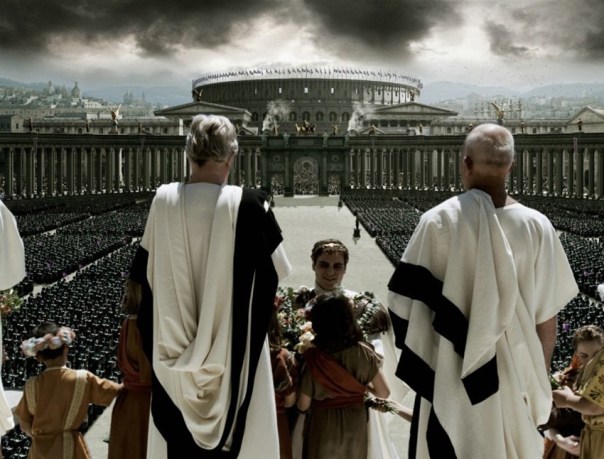
The Gladiator film showed the scale of ceremony in Rome.

Christmas trees

Greenery was used to decorate the house during midwinter festivals from ancient Rome to Tudor England’s Yuletide in the 1500s.

Christmas trees are an invention of the pagan North: a symbol of rebirth or, according to one tradition, a Christian replacement for the pagan oak in the spiritual lives of the ancient Germans.

But the best story about the first Christmas tree is surely this:

Long ago a young count of Luxembourg called Otto was famous for spurning all the young women of the neighbourhood. He preferred the company of his male friends and ‘manly’ pursuits.

Like all young men who reject the charms of comely maidens, one Christmas Eve he fell for a fairy who, in return, gave him a wondrous tree all decked out with silver lights and shiny baubles. It was quite the campest thing he’d ever seen, and from then on his heart belonged to those creatures who are neither one thing nor the other.

Mistletoe

Kissing under the mistletoe, has even queerer credentials, almost lost in the mists of the ancient lands it came from.

In Iron Age Britain, Ireland and Gaul, Druids were the ‘professional classes’ and religious leaders. One of their jobs was to gather mistletoe at the winter Solstice.

Many Druids were also gay, their otherness singling them out as special and holy. All good until that ‘otherness’ meant they were called on to sacrifice themselves to save the tribe in times of war or want.

If that happened, they’d eat mistletoe berries, the juice of which was thought to be gods’ semen.

Do NOT try this at home. Mistletoe is also poisonous.

Christmas dinner

Saturnalia was an enormous feast. Masters would serve their slaves, as all were equal in the golden age of Saturn’s reign.

The well-healed were supposed to let their less wealthy neighbours gorge at their tables, but as Lucian, a second century satirist, complains they could be as tight-fisted as Scrooge. His revenge was to pray all their fine clothes be eaten by mice and their pretty boyfriends’ hair fall out.

To avoid this, gay Emperor Hadrian preserved his lover’s locks by insisting on sampling all the trimmings from all the tables at dinners he hosted.

Saturnalian dinners were just a prelude to something even better than a feast…

As the first century Roman poet, Martial says: ‘give me kisses, boy, wet with wine/… if on top you’ll add a fuck, Jove couldn’t be happier with his Ganymede than I am with mine.’

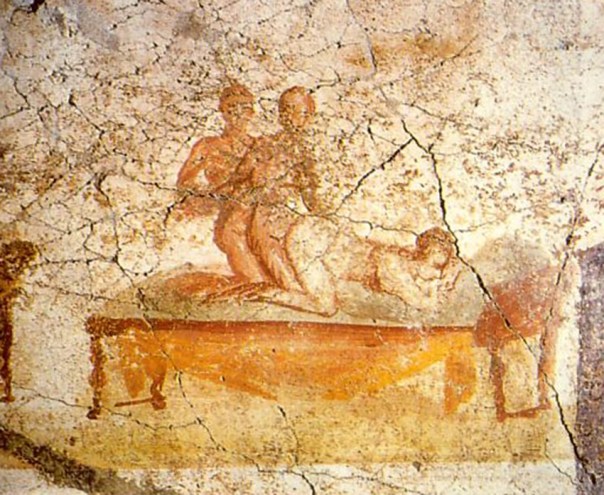
A threesome depicted on the wall of a bathhouse in the ancient Roman city of Pompeii.

The crib

There’s nothing ancient about Jesus in his crib. The first Nativity scene was a piece of live theatre organised by Saint Francis in 1223.

As he moved ox and sheep and Virgin around to strike the perfect tableau, one of the people watching was Elias, the man Francis had loved since boyhood.

Francis spent all his time with Elias, sharing intimate secrets, calling him ‘Mother’. In a sweet slip of the quill, Elias even confessed he knew Francis’ body intimately.

He was present at all the turning points in Francis’ life and death, but later biographers wrote him out of the story.

The Christmas sermon

St Augustine didn’t write the first one but he is credited with popularizing the festival in the late fourth century, through sermons reminding Christians that on this day ‘God became man’.

Augustine wrote some pretty vile stuff about gay people too, but then he had the zeal of a convert. In his youth he loved a boy his age so violently and passionately and physically, he was devastated when the young man died. He turned to religion.

Peace and goodwill

The ghosts of Christmas present owe a lot to those of Christmas past. The great tradition of tolerance and warmth that Christmas borrowed from gay Roman Saturnalia is with us still.

Jesus is a god of love, even if some of his followers forget that.

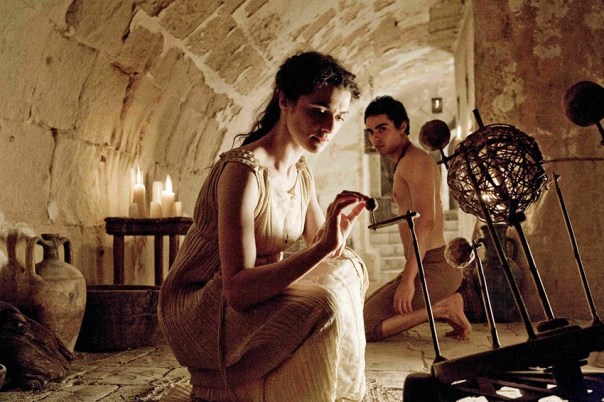
The film Agora showed how the early Christians turned from the persecuted to persecutors.

As the pagans in the fourth century fought to preserve their ways and festivals, one of them made an eloquent plea to a Christian Emperor. It serves just as well for a Christmas message:

‘We gaze up at the same stars; the sky covers us all; the same universe encompasses us. Does it matter what practical system we adopt in our search for the Truth? The heart of so great a mystery cannot be reached by following one road only.’

Merry Christmas everybody! Io Saturnalia!

References

History Forgot This Rogue Aristocrat Who Discovered Dinosaurs and Died Penniless.

Now fallen into shadow, the Romania-born Baron Franz Nopcsa was a groundbreaking scientist, adventurer — and would-be king

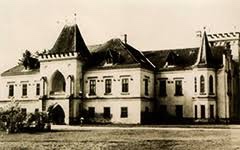
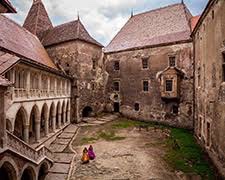
Sacel Castle, in a part of Transylvania known locally as the Land of Hateg, is not open to the public, but Dacian Muntean, my guide, has arranged for us to get in. I’ve seen the entryway in old photographs—Persian rugs, a piano, a grand staircase lit by a round, cathedral-like window of leaded glass.

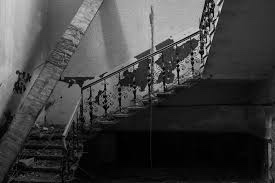
That is nothing like what I find before me. If it weren’t for the window, I wouldn’t recognize it at all. Swallows fly through where the panes once were and sunshine pours down on stairs now covered in rubble. Two huge ceiling beams have fallen and are lying askew on the landing. Others are detached on one side and hang down precariously.

“Is it safe to go up?” I ask Dacian. He considers. “Yes,” he says. “I think so.” A dog with matted fur follows us, along with her lame puppy. It’s clear that this crumbling, abandoned castle is their home. They scamper over the rubble; one stops to pee on a pile of debris.

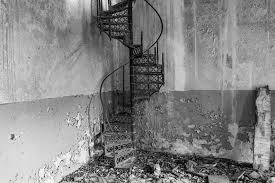
Upstairs, every window is gone. The floorboards are rotten. The walls are pockmarked with holes where treasure seekers, hearing a legend of hidden gold inside, have punched through. We come into what was once a stately library. Dacian points at a bay window. A breeze blows through the sockets. “I like to imagine him here reading,” he says. In the corner, an ornate wrought-iron spiral staircase leads up to nowhere, and I see light coming through a hole in the roof.

The castle was once the family home of Baron Franz Nopcsa von Felso-Szilvas, an Austro-Hungarian aristocrat born in 1877. Baron Nopcsa was a notorious figure in his day. A wild genius with a flair for the dandyish and the dramatic, he was an explorer, spy, polyglot and master of disguise. He crossed the Albanian Alps on foot and befriended local mountain men, sometimes involving himself in their tribal feuds. Once, he was nearly crowned King of Albania. It was said that he would disappear for months at a time only to arrive for polite tea at posh European hotels dressed as a peasant. Along with a younger man whom he called his secretary, he traversed swaths of the Balkans on motorcycle. He kept up years-long correspondences with famous and learned men all across Europe. Later in his life, he was known for chasing villagers from his estate with a pistol.

It is easy for the intrigue and romance of Nopcsa’s exploits, and the manner of his tragic death, to obscure the quieter fact that the baron was one of the great scholars and scientific minds of his time—and was largely self-taught. He was one of the first scientists to look at fossilized dinosaur bones and see a living, social creature. In fact, he was a staunch believer in the evolutionary relationship between birds and dinosaurs, decades before the idea became widely accepted among paleontologists. His overall contributions to the field have led some to call him the forgotten father of dinosaur paleobiology. “Nopcsa was asking questions nobody else was asking,” says David Weishampel, a paleontologist at the Center for Functional Anatomy and Evolution at John Hopkins University School of Medicine.

Nopcsa was equally brilliant as a structural geologist. While most of the scientific community still scoffed at the theory of continental drift, he provided some of the strongest evidence for such movement. He mapped the geology of Albania and became one of the country’s foremost ethnographers and historians. “It would be no exaggeration to say that he knew the country and its people better than any foreigner of his day,” says Robert Elsie, a scholar of Albania and the translator and editor of Nopcsa’s memoirs, published in English in 2014.

Over his career, Nopcsa published several tomes and more than 150 scientific papers. Yet his name barely appears in textbooks. No historical plaque adorns any of the places he lived or taught. Even his grave is unmarked.

Baron Franz Nopcsa von Felső-Szilvás was one of the first to consider the biology of dinosaurs. His work helped him found the field of palaeobiology. Image via Wikimedia Commons

Nopcsa was born to a wealthy noble family, the eldest of three children raised at Sacel. He had a typical upbringing for an aristocrat in a provincial backwater of an aging empire. At home he spoke Hungarian and learned Romanian, English, German and French. His father, Alexius, had fought in Mexico against Benito Juárez, in 1867, as a hussar in the army of Maximilian, Archduke of Austria and Emperor of Mexico. Later Alexius became a vice-director at the Hungarian Royal Opera, in Budapest. Nopcsa’s mother, Matilde, came from an aristocratic family from the nearby city of Arad.

In 1895, Nopcsa’s sister Ilona was walking along a riverbank near the family home when she found an unusual-looking skull, and she brought it to her teenaged brother. It soon became his obsession.

The skull belonged to a previously undiscovered duck-billed herbivore from the dusk of the Mesozoic, around 70 million years ago, and was buried in sediment before a mass extinction that would wipe out three-quarters of all plant and animal species on earth. Crushed by geological forces, the skull was in terrible shape.

In the fall, Nopcsa entered the University of Vienna and took the skull with him. Like a cat with a gift rat, he presented it to his professor, a famous geologist, expecting him to take it from there. But the professor sent Nopcsa back to Transylvania and told him to figure it out for himself. Whether it was lack of interest or funding or the cunning strategy of a master teacher, it was the making of a great scientist.

In the library of Sacel Castle, Nopcsa taught himself geology, physiology, anatomy and neurology. He wrote to scientists all over Europe asking for more books. At the time, very few European dinosaurs had been found. Unable to compare his fossils with others, he relied on his imagination. Working along the river strata, he began to excavate, preparing the fossils he found with homemade glue. From the tiniest scratch on the fossilized braincase, he speculated about the relationship between the pituitary gland, which regulates growth, and an organism’s size, applying what he’d learned of soft tissue and blood circulation. Drawing on the jaw mechanics of lizards and alligators, he rearticulated his dinosaur’s jaw and envisioned its musculature. In this, he was breaking new ground—comparing his dinosaur to living things.

Later, he would look at the pelvis and hind limbs of crocodiles to understand the mechanics of how running flight may have evolved in early birds. From watching birds themselves, he recognized brooding patterns in dinosaur nests, reasoning that since the hatchlings were too undeveloped at birth to defend themselves from predators, some dinosaurs must have parented their young. These ideas, too, were utterly new.

Nopcsa returned to Vienna and, at the age of 22, presented his work to the Austrian Academy of Sciences, one of the foremost scientific bodies in the world. His entry onto the international stage was anything but discreet. During his lecture, Nopcsa skewered the dinosaur classification system of a prominent scientist named Georg Baur with little concern for etiquette or empathy. His genius was clear, but so was his colossal talent for rudeness, which would shape his academic relationships throughout his life.

In time, Nopcsa would identify 25 genera of reptiles and five dinosaurs—the duck-billed Telmatosaurus transylvanicus, the beaked and bipedal Zalmoxes robustus, the armored Struthiosaurus transylvanicus and Magyarosaurus dacus and the meat-eating Megalosaurus. Four of these would become the “type specimens” of their species, the fossil blueprints against which all examples would be judged.

The Hateg dinosaurs turned out to be unique. They were unusually small—in some cases nearly miniatures. Nopcsa’s titanosaur belonged to a family of massive sauropods reaching lengths of 100 feet and weights of 80 tons, yet M. dacus was the size of a horse. His Telmatosaurus was smaller than a crocodile. Others were roughly an eighth the size of their non-Romanian cousins. The question was, why?

The most obvious possibility was that Nopcsa had found juveniles. Yet he didn’t believe this to be the case, and he was determined to prove otherwise. Certain bones grow together with age, and a good comparative anatomist, which Nopcsa was, can tell the developmental age of an organism by examining these sutures—so long as he has the right bones. But paleontologists don’t get to choose their bones, and Nopcsa’s Transylvanian miniatures presented either the wrong ones or were crushed beyond analysis. Looking for other ways to discern age, Nopcsa began to examine slices of bone under a microscope to study cell structure.

“Bones grow from the inside out, like trees,” explains Weishampel. “It’s possible to guess an age by counting the rings.” Today this method is known as paleohistology, and Nopcsa’s significant early contributions, particularly in determining which bones are most useful for analysis, remain largely uncredited, according to Weishampel.

Certain that his dinosaurs weren’t juveniles, Nopcsa looked to explain why they seemed unable to grow beyond a certain size. And he began to formulate the argument that Hateg was once an island—another claim supported by research after his death. Hateg Island’s environmental pressures, he concluded, limited the dinosaurs’ development.

“Islands are unique places, where biology gets a free hand,” says Weishampel. “Large animals tend to get smaller—for example, the dwarf elephants of Malta, hippos in the Mediterranean.” And, as it happens, the dwarf dinosaurs of Transylvania. The theory is that fewer food options lead to the success of animals with smaller anatomies. “And small animals,” Weishampel continues, “tend to get larger, like Komodo dragons, boas and tortoises in the Galápagos.” Nopcsa correctly identified the first set of conditions, and the second, scientists now speculate, can be explained by the idea that animals whose body sizes are held in check by predators on large landmasses tend to expand on an island with fewer of them. Nopcsa’s theory of what he called “island insularity” developed into what scientists now know as the “island rule.”

But though Nopcsa possessed many talents, he also possessed a private affliction, the symptoms of which can be discerned in letters he sent to Arthur Smith Woodward, the famous geological curator of the British Museum. The two men corresponded more or less monthly from 1901 until Nopcsa’s death in 1933. Nopcsa’s tone is touchingly deferential no matter how close the men became: The baron never failed to address his elder as “sir.”

Leafing through the great cache of letters, each page preserved between sheets of plastic and bound in a dozen volumes now held in an archive at the Natural History Museum in London, you can see the places where Nopcsa’s customary scrawl becomes spidery, as though his thoughts were turning in on themselves. Once, in 1910, after Nopcsa failed to arrive in London for a meeting, Smith Woodward received a note instead from Nopcsa’s mother, the baroness. As if excusing a child from school, she explained that her son was unable to visit due to a recurring illness.

Nopcsa’s life continued to be punctuated by periods of extreme productivity, extensive fieldwork and prolific writing, but over time his illness worsened. He later referred to what devastated him as “shattered nerves.” Today we would likely call it manic depression.

**********

Even as Nopcsa was establishing himself as a scientist, he became enthralled by tales of Albania’s mountain tribesmen, whom he first heard about from a man thought to be his first lover, Louis Draskovic, a Transylvanian count two years his senior. Nopcsa soon determined to visit the mountains and study the land and the people there.

At the turn of the 20th century, fieldwork wasn’t funded as it might be today, with university grants or stipends. And in this fundamental way Nopcsa’s aristocratic status cannot be separated from his life as a scientist. He had social access and money for schooling. He met Smith Woodward through his parents, and his first geological foray into Albania, in 1903, was paid for by his uncle, a favorite courtier of Empress Elisabeth of Austria. In the years to come many of Nopcsa’s Albanian adventures were paid for by the Austro-Hungarian Empire itself, the fruit of a different kind of relationship: At some point Nopcsa began to work for the vast and crumbling empire as a spy.

Albania was then the buffer zone between Austria-Hungary and the Ottoman Empire. As tensions rose in the run-up to World War I, the Austrian Imperial Council felt that it would be useful to have an accurate geographical and cultural map of the country. Nopcsa’s resulting studies and photographs documenting the country’s highland culture would become canonical for future ethnographers.

In 1906, while planning a trip, Nopcsa hired a young Albanian man to be his secretary. Bajazid Elmaz Doda was from a shepherd’s village high in the mountains. Nopcsa wrote in his journal that Doda was “the only person who has truly loved me” since Louis Draskovic. The feeling was apparently mutual. Nopcsa would later name a species of ancient turtle after Doda—Kallakobotion bajazidi, or “beautiful and round Bajazid.”

From the time they met until the outbreak of World War I in 1914, Doda and Nopcsa were often on the road. Nopcsa became fluent in local Albanian dialects and built friendships with the tribesmen. He was fascinated by their sense of honor. In a letter to Smith Woodward, he describes with great admiration witnessing a man take tea with the murderer of his son and saying nothing, because both were guests in another’s house—a feat of self-restraint, Nopcsa wrote, that no European gentlemen could have matched.

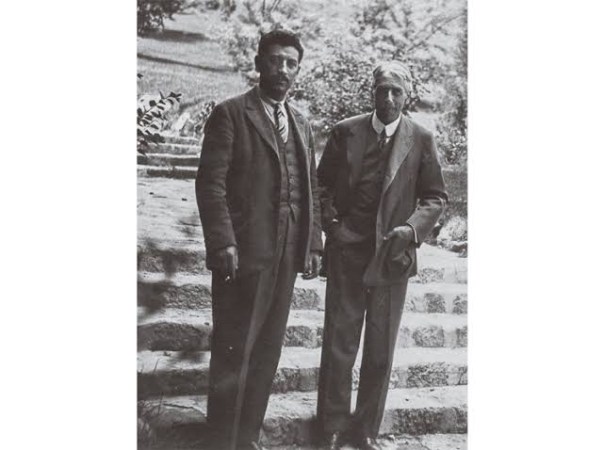
Doda, left, and Nopcsa, circa 1931. They spent nearly 30 years together. (Hungarian Natural History Museum)

Nopcsa continued to do collecting in the Haţeg Basin, at least until the beginning of the First World War. Among the fossils that Nopcsa studied were the duck-billed Telmatosaurus transylvanicus, the bipedal and beaked Zalmoxes robustus, the armored Struthiosaurus transylvanicus, and the sauropod Magyarosaurus dacus. In addition, he made extensive travels across much of Europe to visit palaeontological museums and to meet fellow scientists. In his field trips Nopcsa was now accompanied by Elmas Doda Bajazid, whom Nopcsa met in Albania and convinced to become his secretary. The men spent nearly 30 years togheter.

On 25 April 1933, Nopcsa’s body and that of his secretary Bajazid were found at their Singerstrasse residence. Nopcsa left a letter to the police: ”The motive for my suicide is a nervous breakdown. The reason that I shot my longtime friend and secretary, Mr Bayazid Elmas Doda, in his sleep without his suspecting at all is that I did not wish to leave him behind sick, in misery and without a penny, because he would have suffered too much. I wish to be cremated.”

References:

David B. Weishampel & Oliver Kerscher (2012): Franz Baron Nopcsa, Historical Biology: An International Journal of Paleobiology, DOI:10.1080/08912963.2012.689745

CSIKI, Z. & BENTON, M.J. (2010): An island of dwarfs – Reconstructing the Late Cretaceous Haþeg palaeoecosystem. Palaeogeography, Palaeoclimatology, Palaeoecology 293: 265 – 270 doi:10.1016/j.palaeo.2010.05.032

Dumbravă, M. D. et al. A dinosaurian facial deformity and the first occurrence of ameloblastoma in the fossil record. Sci. Rep. 6, 29271; doi: 10.1038/srep29271 (2016).

Smithsonian Magazine, July 2016, By Vanessa Veselka; Photographs by Cristian Movilă, https://www.smithsonianmag.com/history/history-forgot-rogue-aristocrat-discovered-dinosaurs-died-penniless-180959504/
Gay History: Here are 46 more weird and wonderful facts from LGBTI history

Know your herstory

1. Olive oil was used for many things in Ancient Greece, including as a popular lube for anal sex.

2. Christmas has its origins in Saturnalia, a Roman festival around first century BC. Instead of family lunch, it was a celebration of sex, fertility and homosexuality. During the festivities, men ran around naked, tops became bottoms and masters waited on servants.

3. There is no record whatsoever of Jesus or Muhammad preaching against homosexuality.

4. St Paulinas of York, who was bisexual, invented the tradition of bells calling parishioners to church.

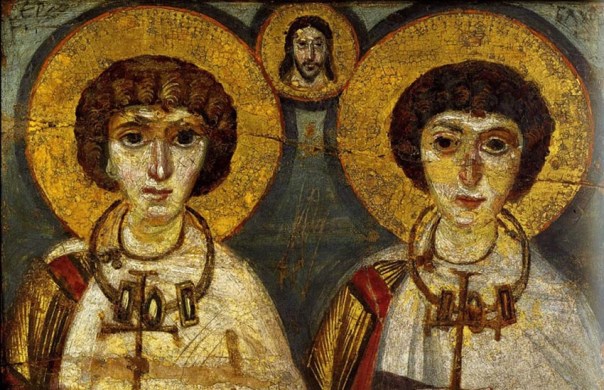
5. The earliest form of same-sex marriage was a Christian ceremony called adelphopoiesis. St Sergius, a commander in the Roman army in the third century, and St Bacchus, his second in command, were lovers who had their union in this way. The Catholic Church stripped them of ‘saint’ status in 1969.

St Sergius and St Bacchus

6. William II was ‘addicted to every kind of vice, particularly lust and especially sodomy’, according to early records. He kept his male courtiers hair long, and reportedly promoted them based on their talents in bed.

7. Eleanor Rykener, who may have been a trans woman, was a 14th century prostitute working in London. Arrested in 1395 for cross-dressing, this is the only surviving legal records from that age which mentions sodomy. Rykener claimed to have many clients, and preferred priests as they ‘paid better than others’.

8. Leonardo Da Vinci was arrested for gay sex, twice, at 24 years old. He was acquitted. If he had been killed, the world would never have had the Mona Lisa or The Last Supper.

9. In around 1600, William Shakespeare wrote As You Like It and Twelfth Night. Both feature women who cross-dress as men. It is thought this was a direct response to a Puritan campaign that objected to the ‘gay’ practice of young boys cross-dressing on stage.

10. At the first ever trial in Canada for homosexuality in 1648, a gay military drummer was sentenced to death. His life was spared on the condition he accepted the position of New France’s first permanent executioner.

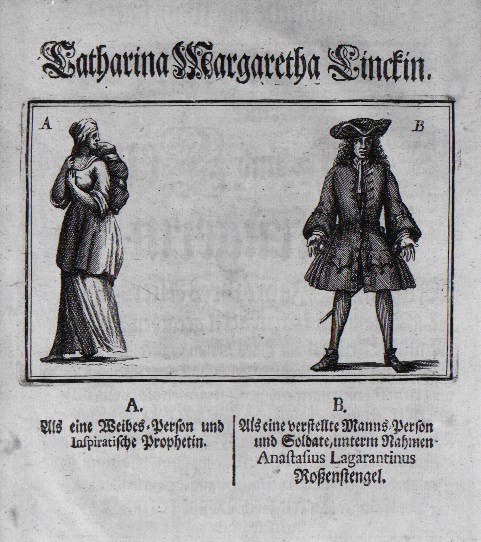
11. Catharina Linck, in 1721, was executed for being gay in Germany, who would dress as a man. It was found she had been sleeping with women using a leather stuffed horn. Acting as a funnel, it also allowed her to urinate standing up.

Catharina Linck

12. Deborah Sampson joined the Continental Army in 1782 and served 17 months as ‘Robert Shurtliff’, living, dressing and fighting as a man. They also reportedly had a lot of sex with women. A renowned soldier, they also once carved a bullet from their thigh.

Frontispiece of The Female Review: Life of Deborah Sampson, the Female Soldier in the War of Revolution.

13. Charles Dickens went to a London prison in 1835 and visited the last two men hanged for homosexuality in the UK.

14. Japan has one of the shortest-lived sodomy laws in the world. The statute was in place from 1873 to 1883. Samurai warriors, who had a long tradition of same-sex relations, mounted strong opposition to the law and helped to get it repealed.

15. Using ‘they’ as a third person gender-neutral singular was the most popular pronoun in the English language until the 1800s, when ‘he’ and ‘she’ became widespread to make English more like Latin.

16. The author of America the Beautiful, Katharine Lee Bates, was an ardent feminist who lived for 25 years with another woman believed (based on Bates’ own writing) to be her lesbian partner.

17. The Duke of Kent, the bisexual younger brother of British kings George VI and Edward VIII, was arrested alongside theatre legend Noel Coward under suspicion of prostitution. They had been going around Soho in London dressed as women.

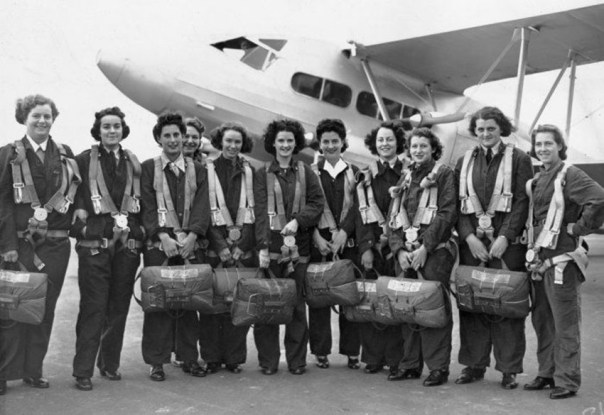
The Women’s Auxiliary Air Force in 1942

18. When a desperate mother asked Sigmund Freud to cure her gay son in 1935, he wrote her back explaining why her son had nothing to be ashamed of.

19. There was an attempt to make a film adaptation of The Children’s Hour, about the dangers of homophobia. However censors demanded any mention of homosexuality were completely removed.

20. In early 1940, a Women’s Auxiliary Air Force report came to a conclusion on lesbianism: ‘Naturally, it is a vice that is going to be impossible to keep out of the WAAF altogether.’

21. In 1970, the State of Connecticut denied a gay man a driver’s license on the basis that his sexuality made him dangerous to other drivers.

22. Dusty Springfield, one of the biggest superstars at the time, came out as bisexual in 1970. ‘I know that I’m as perfectly capable of being swayed by a girl as by a boy’

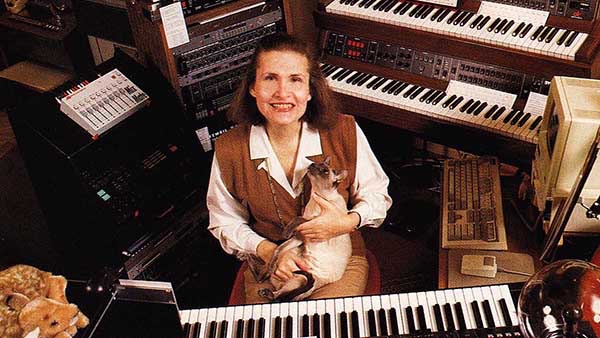
23. Wendy Carlos, a transgender woman, helped to pioneer electronic music. In 1968 she experimented with a series of recordings of compositions by JS Bach played on a Moog synthesizer.  She won three Grammys and recorded music for the soundtrack of Clockwork Orange.

Wendy Carlos

24. Years before Stonewall in New York City, there was a queer rebellion against police harassment in San Francisco in 1966. Trans people fought back against police outside Compton’s Cafeteria in San Francisco.

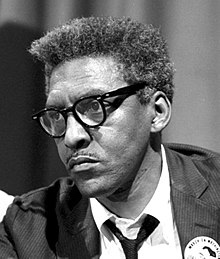
25. Bayard Rustin, an openly gay black man, inspired Martin Luther King Jr’s use of non-violent protest from which Bayard learned in India taking part in Ghandi’s movement.

Rustin at a news briefing on the March on Washington in Washington, D.C., on August 27, 1963

26. A young stripper named Shelly Bauman lost her leg in a freak confetti cannon accident. She sued and used the money from the settlement to open Seattle’s first gay bar, which she named ‘Shelly’s Leg’.

Shelly’s Leg sign in the Museum of History and Industry.

27. The first openly gay LGBTI person to be elected to office was not Harvey Milk. It was Kathy Kozachenko, in 1974, who won a seat on the Ann Arbor, Michigan city council.

28. Shakuntala Devi wrote the first study of homosexuality in India, The World Of Homosexuals, in 1977. It treated homosexuality in an understanding light and is considered pioneering.

29. Singer Johnny Mathis came out as gay in a 1982 magazine article, but the magazine had to retract the statement because Mathis received numerous death threats.

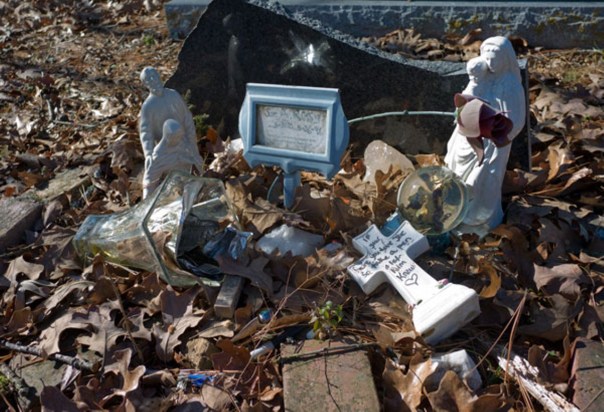
30. In a private cemetery in Arkansas, Ruth Coker-Burks single-handedly buried and gave funerals to more than 40 gay men during the height of the AIDS epidemic. She had to do this because their families wouldn’t claim them.

31. When scientists first realized American gay men and Africans in France were both suffering from AIDS, French researchers sent over a sample to be tested. But a scientist with a grudge against the French institute switched out the sample, setting research back years.

32. An official Star Trek novel was published with scenes depicting Kirk and Spock as lovers in 1985. While these parts were supposed to be edited out, the wrong version was printed. It then became a collector’s item.

33. OJ Simpson’s father was a gay drag queen who died of AIDS.

(L-R) O.J. Simpson and his father.

34. Before Matt Groening created The Simpsons, he created a cartoon featuring a gay couple.

35. Dorian Corey, the older drag queen featured heavily Paris Is Burning, kept a mummified corpse in her apartment for an untold amount of years. Shot in the head, wrapped in fake leather and stuffed in a suitcase, it was only discovered after her death.

36. The first primetime male gay kiss in the US is up for debate. While many consider it to be Dawson’s Creek in 1995, On Will & Grace, Will and Jack kissed (for political reasons) three months earlier.

37. Sailor Moon in Japan had a lesbian couple, Sailor Uranus and Sailor Neptune. In the English translation this is censored, stating they are cousins instead. Due to the dubbing the flirting that was left in, this meant some viewers thought their relationship was incestuous.

Haruka in her Super Sailor Uranus form, as seen in the anime.

38. George Clooney once was asked if he would ever play a gay role. His response was: ‘I already did — as Batman’.

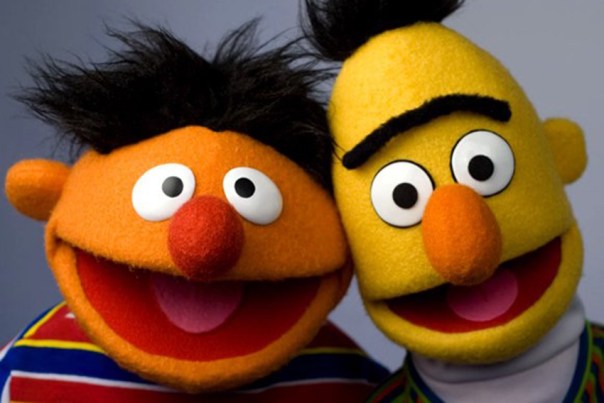
39. When asked if Bert and Ernie were gay in 1994, Sesame Streett CEO Gary Knell replied ‘They are not gay, they are not straight. They are puppets. They don’t exist below the waist.’

40. Man! I Feel Like A Woman was inspired by Shania Twain’s visit to a drag bar.

41. Oscar, the character from the US version of The Office, was not originally intended to be gay. This choice was inspired by an early episode in which he wore a pink shirt.

42. In 2004, a Mario game had a transgender playable character with a subplot about being accepted by her family. This was censored in the American version.

43. Eminem gave Elton John a pair of diamond studded cock-rings as a wedding gift.

44. A Nigerian ‘scientist‘ claimed he had ‘proved’ being gay was wrong by using magnets in 2013. He then promptly demanded to be given the Nobel prize for his research. He didn’t get one.

45. Satanists performed a ‘Pink Mass‘ on the grave of Fred Phelps’ mother in order to turn her into a lesbian in the afterlife.

46. A woman in Nebraska tried to sue all gay people in 2015. Her appeal had no legal references, but quoted Webster’s Dictionary and the Bible. It obviously did not succeed.

References

Gay History: 15 Ways To Spot A Lesbian According To Some Really Old Medical Journals

Dell Richards’ book “Lesbian Lists,” published in 1990, contains “a look at lesbian culture, history, and personalities,” through various lists like “19 Lesbian Novelists” and “14 Cult Films With Lesbian Characters.” These lists are both entertaining and educational.

One of the lists is entitled “20 Turn-of-the-Century “Ways to Tell” if a Girl Would Become Gay or if a Woman Was a Lesbian — according to the Medical Journals of the Day.” The list offers an opportunity for us to look back on the silly assholes of Medical History who sought to quell the viral nature of young madiens’ ripe homosexuality by educating the public regarding how to spot lesbians and subsequently convert or destroy them. You never know when a lesbian is in your neighborhood, driving their car down your street, or shopping next to you at the grocery store.

We have selected 15 of the items from this list to share with you today and have illustrated these items with helpful photographs. As you can see, they were clearly completely right about everything and In parentheses you will find the year in which the cited medical journal was printed.

(15 Turn-of-the-Century “Ways to Tell” if a Girl Would Become Gay or if a Woman Was a Lesbian — According to the Medical Journals of the Day)

(via Lesbian Lists:A look at Lesbian culture, history and personalities by Dell Richards, 1990)

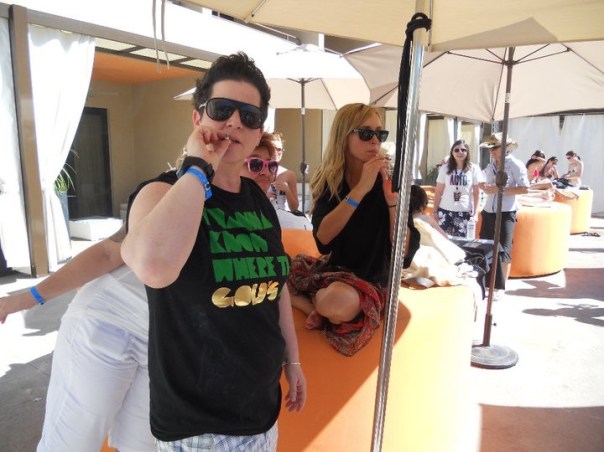
1. Smokes cigarettes in public. (1890)

confirmed lesbian julie goldman smoking cigarettes at poolside

2. Has a capacity for athletics and an incapacity for needlework and other domestic occupations. (1890)

natasha kai, confirmed lesbian with athletic capacities, screams “I hate needlepoint” on a soccer field

3. “Tomboy Habits” (1895)

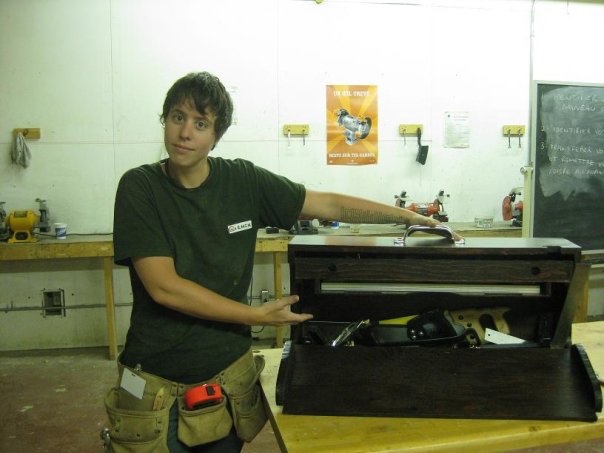
autostraddle editor-in-chief riese’s girlfriend (a confirmed homosexual) participating in carpentry, a certified tomboy habit

4. Dresses in Boys’ Clothing (1895)

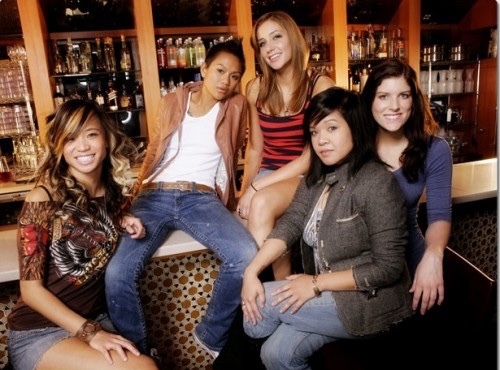
kim stolz, confirmed lesbian, wearing boys’ clothing on a reality television program. after the program, she continued to wear boys’ clothing in other contexts while romancing women of the same sex.

5. Abandons Dolls and Girlfriends for Marbles and Masculine Games (1895)

although these women may not be have been lesbians before this photograph was captured, this riveting game of marbles will surely transform them into lesbians

6. Prefers the Laboratory to the Nursery (1900)

fictional confirmed lesbian lexy is a doctor on the television program “Lip Service,” which requires the laboratory. furthermore, she does not have children or a nursery.

7. Goes to Bars (1900)

“gimme sugar” was a reality television program about lesbians who went to bars and also worked in bars, and yelled at each other.

8. Is Anti-Social (1900)

we are confident that there is a lesbian hiding behind this book

9. Has a firmness to her walk, a long step, and a rather heavy timbre to her voice. (1900)

kd lang, actual lesbian, records musical cds featuring her timbered voice

10. Talks loud and uses slang. (1900)

in this picture, confirmed lesbian sandra bernhard is swearing loudly using slang, probably slang for a vagina

11. Has no breasts to speak of (1900)

shane, confirmed lesbian, is not speaking of her breasts

12. Is square-shouldered and solid (1900)

skyler cooper has shoulders for days, likes girls

13. Has a strong, self-assured look in her eye (1910)

jessica clark, confirmed lesbian, is seducing you with her eyeballs

lesbian jenny shimizu seduced angelina jolie with these eyeballs

14. Shows mental arrogance and is abnormally deficient in natural female shyness (1910)

this photograph is self-explanatory

15. Has intellectual attributes usually associated with men – an acuteness of comprehension and lucid objectivity (1910)

confirmed lesbian rachel maddow hosts an acute and lucid television program

In conclusion, it would seem that the doctors of the 19th century were 100% correct when they made these scientific determinations. I wish you all luck in identifying and executing lesbians in your neighborhood as you see fit.

Reference