Tag Archives: transportation

The Tolpuddle Martyrs: Six Labourers, a Secret Oath and a Sentence to Australia

In February 1834, six agricultural labourers from a tiny Dorset village were arrested.

They had not burned down a farmhouse.

They had not smashed a threshing machine.

They had not attacked a landowner.

They had not stolen anything.

Their great act of rebellion was considerably more dangerous.

They had organised.

The six men had formed a trade union and agreed that agricultural labourers should stand together against falling wages.

The union itself was legal.

So the authorities found something else with which to prosecute them.

The men had sworn an oath of loyalty to one another.

For that, six impoverished farm labourers were sentenced to seven years’ transportation to Australia.

Their punishment was intended as a warning.

Instead, it created martyrs.

Their names were:

George Loveless
James Loveless
Thomas Standfield
John Standfield
James Brine
James Hammett.

They became known to history as the Tolpuddle Martyrs.
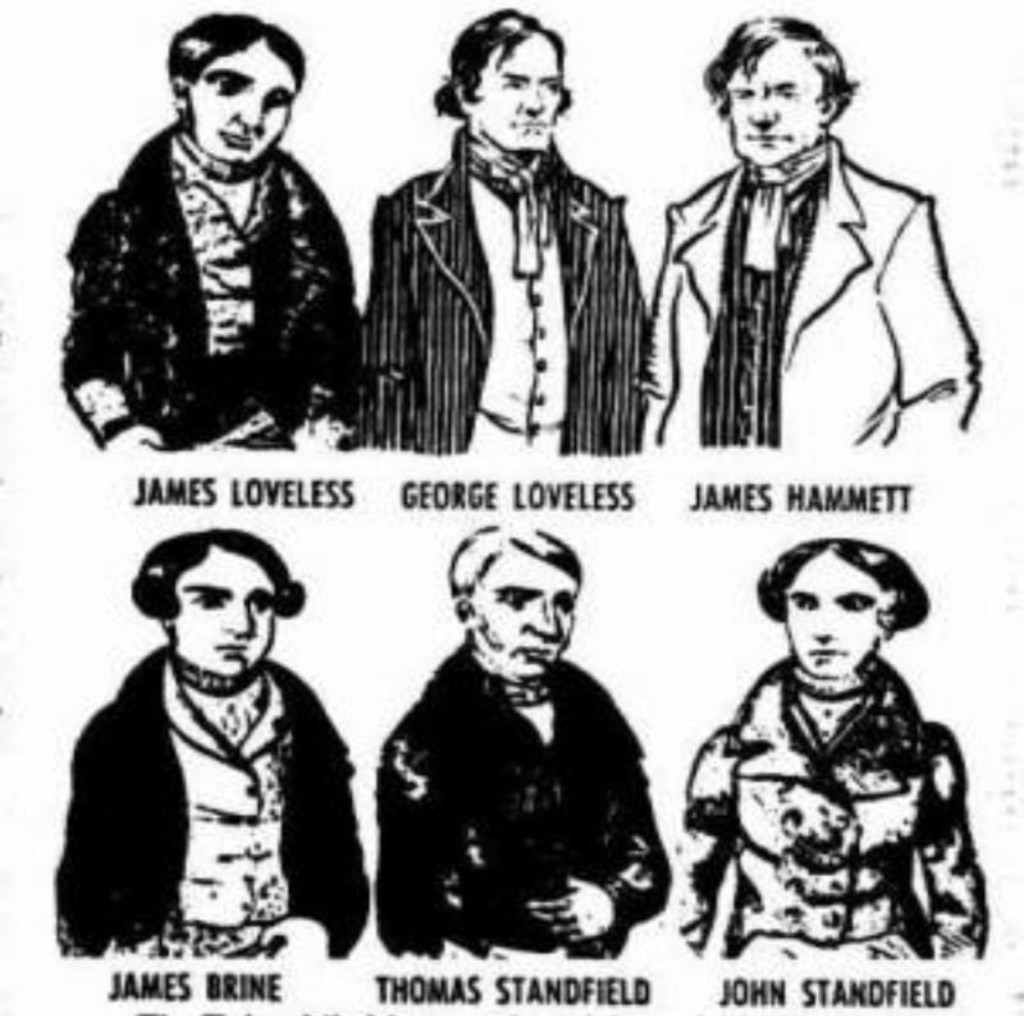
Tolpuddle Martyrs

And their story became one of the founding legends of the British trade union movement.

A Pretty Village and Desperate Poverty

Tolpuddle lies in Dorset, in the gentle countryside of southern England.

It is difficult to imagine a landscape farther removed from the smoke-blackened industrial towns we encountered during the Plug Riots.

There were no enormous cotton mills.

No forests of chimneys.

No great steam engines requiring somebody to pull the plug.

Yet rural England could be every bit as brutal for the working poor.

Agricultural labourers occupied near the bottom of the rural economy.

They owned little or no land.

Their survival depended upon wages paid by farmers and landowners.

And those wages were falling.

According to the history preserved by the Trades Union Congress, George Loveless had been earning around nine shillings a week in 1830.

That fell to eight.

Then seven.

And another reduction threatened to bring wages down to six shillings a week. (TUC 150 Stories)

For a labourer supporting a wife and children, this wasn’t an inconvenience.

It threatened hunger.

Rural England After Captain Swing

Landowners had good reason to be nervous.

Only a few years earlier, rural southern England had erupted during the Swing Riots of 1830.

Agricultural workers attacked threshing machines, burned property and sent threatening letters signed by the mysterious fictional figure “Captain Swing.”

The disturbances emerged from many of the same grievances facing Tolpuddle:

low wages,

unemployment,

mechanisation,

poverty,

and resentment of rural elites.

The government had responded ferociously.

People were executed.

Hundreds were transported.

Others imprisoned.

Order was restored.

The grievances weren’t.

And now agricultural workers were experimenting with another weapon.

Organisation.
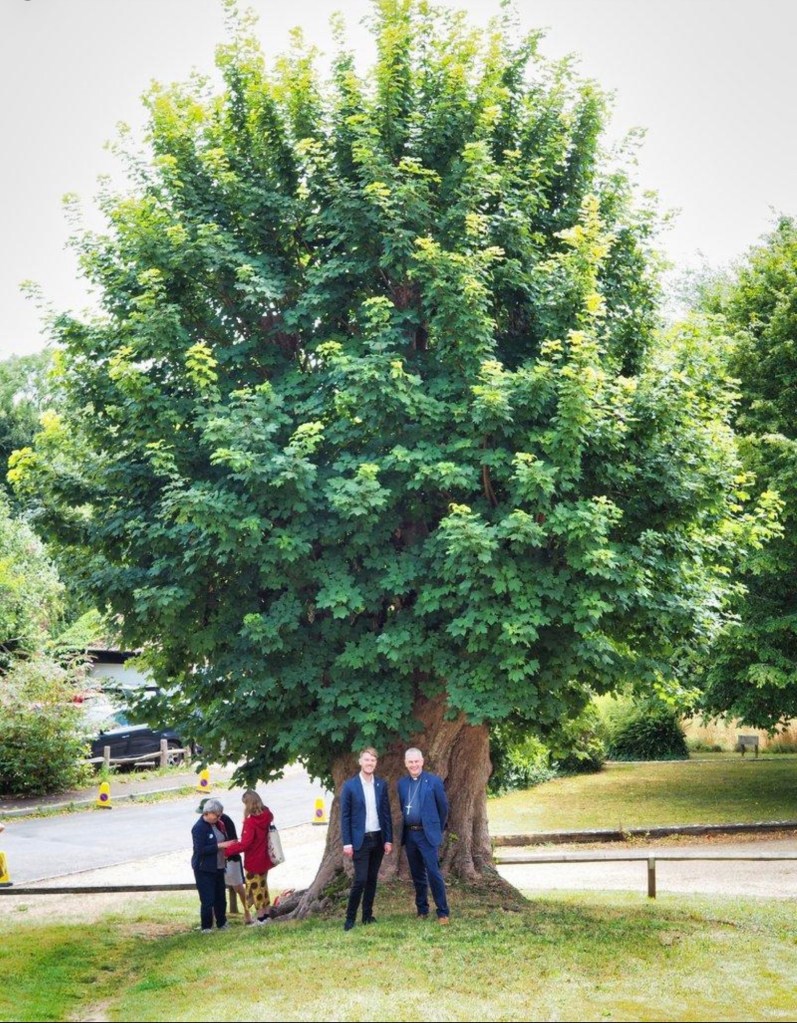
The Sycamore tree

The Combination Acts

For decades, British governments had attempted to prevent workers combining to improve their wages.

The Combination Acts of 1799 and 1800 restricted collective organisation by workers.

But those Acts were repealed in the 1820s.

Trade unions therefore weren’t simply illegal by 1834.

This is essential to understanding Tolpuddle.

The six men were not legally transported merely because they formed a trade union.

The government needed another offence.

And it found one.

The Friendly Society of Agricultural Labourers

George Loveless was a Methodist local preacher as well as an agricultural labourer.

He was literate, thoughtful and clearly capable of leadership.

The Tolpuddle labourers attempted to negotiate over wages.

When those efforts failed, they formed the Friendly Society of Agricultural Labourers.

Friendly societies were hardly unusual.

Working people had long pooled money to provide support during sickness, unemployment or death.

Trade societies similarly allowed workers to act collectively rather than negotiate individually with employers.

And that was precisely what frightened local landowners.

One labourer asking for higher wages could be dismissed.

An entire village refusing to work below an agreed wage was another matter entirely.

The dangerous word was:

we.

The Sycamore Tree

Tradition associates the formation of the Tolpuddle union with meetings beneath a great sycamore tree in the village.

The tree survives and has become one of the most famous living monuments in British labour history.

Beneath trees and in cottages, labourers discussed wages and solidarity.

Members of the society underwent an initiation.

And during that initiation, an oath was administered.

That provided the authorities with their opportunity.

Enter Squire Frampton

One of the central figures in the prosecution was local magistrate and landowner James Frampton.

Frampton regarded the new union with alarm.

The authorities feared that organised agricultural labour might spread.

This wasn’t simply about six men in one Dorset village.

Britain’s ruling classes had recently witnessed the Swing disturbances, agitation for parliamentary reform and the growth of organised labour.

The government had no intention of allowing rural unionism to develop unchecked.

But how could it prosecute men for belonging to a legal organisation?

Frampton sought advice.

The answer lay in legislation originally created for a rather different purpose.
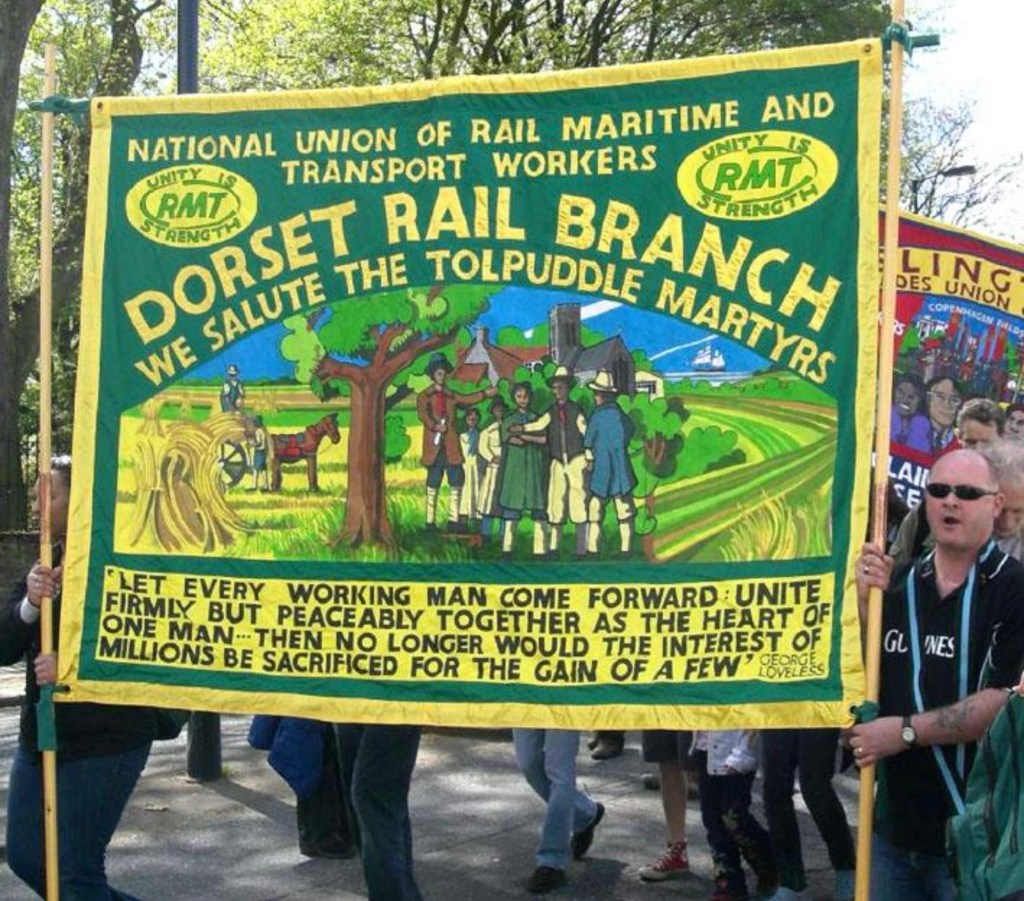
175th ANNIVERSARY OF THE GREAT DEMONSTRATION OF 1834 TO FREE THE TOLPUDDLE MARTYRS!

The Illegal Oath

The prosecution relied upon legislation dating from 1797, enacted in an age of fear about naval mutiny, secret societies and revolutionary conspiracy.

Administering certain secret or unlawful oaths was prohibited.

The Tolpuddle men had sworn an oath during their union initiation.

There was the offence.

It was an ingenious piece of legal manoeuvring.

The authorities could say:

“We are not prosecuting these men for forming a union.”

Technically, they weren’t.

They were prosecuting them for the oath.

But almost nobody missed the real point.

The union was the target.

Arrest

On 24 February 1834, George Loveless was arrested.

The other five followed.

The men were imprisoned at Dorchester and brought to trial the following month.

Imagine the disparity in power.

On one side stood six impoverished agricultural labourers.

On the other:

landowners,

magistrates,

government officials,

the courts,

and the British state.

The outcome was not encouraging.

The Trial

The men were tried at the Dorset Assizes in Dorchester in March 1834.

They were convicted of administering or taking an unlawful oath.

Then came the sentence.

Seven years’ transportation.

Even by contemporary standards it was savage.

Transportation wasn’t simply imprisonment somewhere warmer.

For many convicts it amounted to permanent exile.

The journey to Australia took months.

Families could be separated forever.

Convicts were assigned to labour under harsh conditions.

Disease, punishment and physical exhaustion were ever-present risks.

The six men had organised to prevent wages falling to starvation level.

Britain responded by sending them approximately halfway around the planet.

“We Will, We Will, We Will”

George Loveless later became associated with lines written during his imprisonment:

“God is our guide! from field, from wave,
From plough, from anvil, and from loom…”

The famous verses end with the repeated declaration:

“We will, we will, we will be free!”

Whether encountered as poetry, song or labour-movement memory, the words capture something fundamental about Tolpuddle.

These weren’t revolutionaries plotting to overthrow the monarchy.

They were working men discovering that individual weakness could become collective strength.

That principle was precisely what made them threatening.
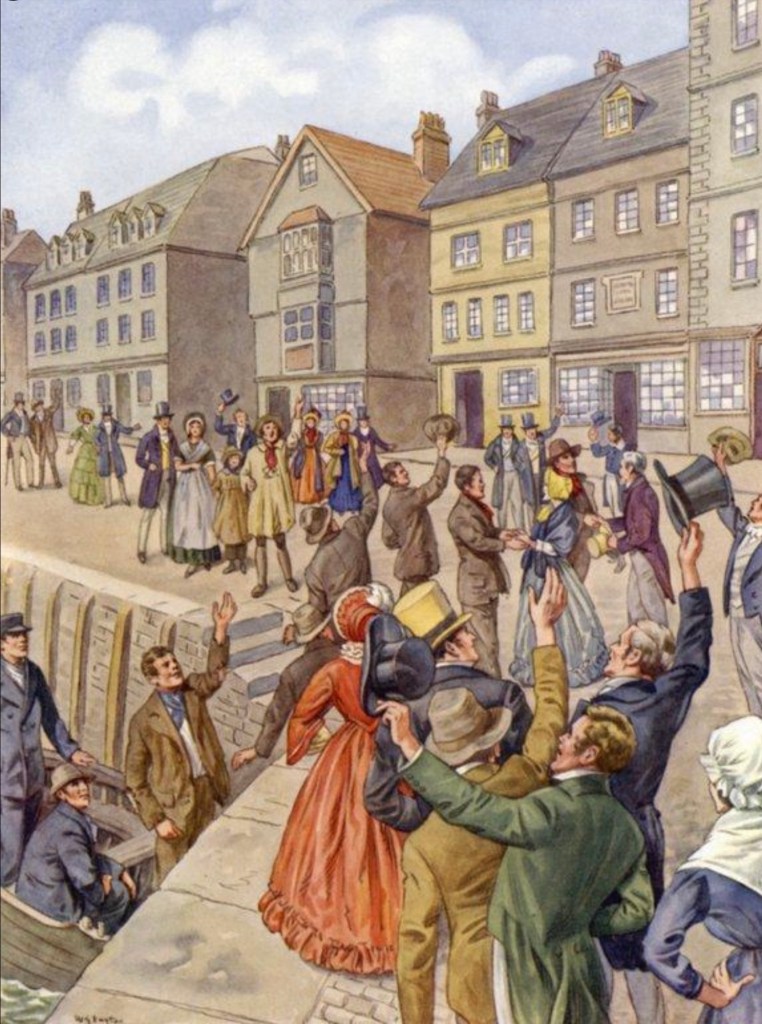
Demonstration against the convictions

Off to Australia’s Penal Colonies

The men were transported.

Five eventually went to New South Wales.

George Loveless was sent separately to Van Diemen’s Land, modern Tasmania.

The punishment deliberately broke up the group.

Once in Australia, transported convicts could be assigned to work for settlers or government.

Their freedom of movement was restricted.

Discipline could be severe.

The Tolpuddle men had attempted to escape rural poverty in Dorset through collective bargaining.

They found themselves labouring as convicts in Britain’s Australian colonies.

But something remarkable was happening back home.

Britain Explodes in Anger

The severity of the sentence caused outrage.

The authorities had hoped to frighten workers away from trade unions.

Instead they created one of the greatest popular causes of the decade.

The six obscure Dorset labourers became national figures.

Meetings were organised.

Money was raised.

Petitions circulated.

Trade unionists rallied behind them.

The word Martyrs stuck.

On 21 April 1834, a huge demonstration assembled at Copenhagen Fields in London before marching towards Whitehall. Contemporary labour-movement accounts put attendance above 30,000, while the wider petition campaign eventually amassed hundreds of thousands of signatures. (TUC 150 Stories)

The procession was disciplined.

Banners flew.

Trade societies marched.

The government prepared for disorder.

But the protesters gave it little excuse for repression.

The campaign demonstrated something the Tolpuddle men themselves had been punished for discovering:

organisation worked.

And What of Their Families?

Here we encounter the people easily lost from the traditional story.

The wives and children.

Transportation didn’t punish only the convicted man.

It removed a family’s wage earner.

The women left behind faced possible destitution.

The wives of the Tolpuddle men sought parish relief.

Local authorities were not exactly sympathetic.

According to material preserved by the TUC, Frampton rejected assistance, effectively arguing that the men should have considered their families before spending money on union subscriptions. (TUC)

But the labour movement stepped in.

Funds raised during the campaign supported the families.

That matters.

Trade unionism wasn’t merely about strikes.

It was about solidarity.

If an employer could starve a striker’s family, the employer possessed enormous power.

If workers collectively supported one another’s families, that power diminished.

The women of Tolpuddle therefore belong within the story too.

They endured the consequences of the men’s prosecution while the growing labour movement demonstrated that solidarity could extend beyond the workplace.

A Political Disaster

The government had achieved a legal victory.

Politically, it was becoming a disaster.

The sentence looked vindictive.

The prosecution appeared transparently designed to suppress union organisation.

And the campaign refused to disappear.

Petitions continued.

Pressure mounted.

The six Dorset labourers became symbols of injustice.

Eventually the government retreated.
Pardoned

In March 1836, full pardons were granted.

That sentence deserves emphasis.

The British government had transported six men thousands of kilometres to demonstrate its authority.

Mass political pressure forced it to pardon them.

The labour movement had won.

But pardoning someone in Australia did not magically deposit him back in Dorset.

Communication was slow.

Transport was slower.

Arrangements for returning the men became complicated.

George Loveless, in particular, insisted upon returning as a genuinely free man rather than accepting compromises that might diminish the principle for which the campaign had fought.

The homecomings consequently occurred gradually. (TUC)

Home From Australia

George Loveless returned to Britain in 1837.

James Loveless, Thomas and John Standfield and James Brine followed.

James Hammett was the last to return, reaching England in 1839. (TUC 150 Stories)

They were no longer obscure Dorset labourers.

They were symbols.

Supporters raised money to help establish them after their return.

But most did not ultimately remain in Tolpuddle.

And, remarkably, several crossed the Atlantic and began again.

Canada

Five of the six eventually emigrated to Canada.

George Loveless and his family settled in Ontario.

So did several of his fellow martyrs.

There is something extraordinary about that final migration.

These men had once been forcibly removed from Britain.

Later they chose migration for themselves.

The distinction could hardly be greater.

Transportation said:

You will go.

Emigration said:

We choose to go.

Only James Hammett remained permanently associated with Tolpuddle itself.

Were They Really Martyrs?

Strictly speaking, none died for the cause.

The word martyr therefore isn’t being used in its narrowest sense.

But politically it was brilliant.

Calling them the Tolpuddle Martyrs transformed six convicted labourers into victims of persecution.

The state had wanted them remembered as criminals.

The labour movement remembered them as heroes.

History largely adopted the labour movement’s version.

That itself demonstrates the power of historical memory.

The Myth and the Reality

There is a simplified version of Tolpuddle that says:

Six men formed a trade union, trade unions were illegal, and they were transported to Australia.

That isn’t quite right.

And correcting it makes the story more interesting, not less.

Trade unions weren’t simply illegal in 1834.

The Combination Acts had already been repealed.

The authorities therefore used legislation against unlawful oaths.

The prosecution demonstrates something subtler than straightforward prohibition.

When governments wish to suppress a movement but cannot conveniently prosecute the movement itself, they may search for another legal mechanism.

The oath became that mechanism.

The offence was real under the law.

The political motivation behind prosecuting it was equally real.

From Tolpuddle to Chartism

The Tolpuddle affair occurred just before the great flowering of Chartism.

The connections are obvious.

Workers were beginning to realise that economic power and political power were intertwined.

Why were agricultural wages so low?

Why could landowners dominate local institutions?

Why could Parliament make laws affecting workers who had no vote?

Why could magistrates drawn from the landowning classes sit in judgement upon labourers?

Trade unionism could address wages.

Political reform could address power.

The two struggles increasingly overlapped.

Several Tolpuddle men later appeared at Chartist meetings, and George Loveless continued writing and speaking on political and religious questions. (TUC)

The Dangerous Principle

What frightened the authorities about Tolpuddle was not six men.

It was multiplication.

Six could become sixty.

Sixty could become six thousand.

A union in one Dorset village could inspire another village.

Then another.

Agricultural workers who had traditionally negotiated individually with employers could begin acting collectively.

That threatened a social system based partly upon workers remaining isolated from one another.

The same principle appeared in industrial towns.

A single cotton worker had little power.

Thousands pulling boiler plugs could stop Manchester.

A single Dorset labourer had little bargaining strength.

An organised workforce could demand ten shillings rather than accept six.

The crucial transformation was from:

I

to

we.

A Remarkably British Revolution

The story of British labour rights is sometimes presented as wonderfully peaceful.

No revolution!

No guillotines!

Just gradual reform and sensible parliamentary government.

Tolpuddle complicates that comforting picture.

Rights were frequently granted only after agitation.

Workers were imprisoned.

Demonstrators were attacked.

Strikers were prosecuted.

Protesters were transported.

Soldiers fired into crowds.

Governments feared revolution and legislated accordingly.

Britain avoided the revolutionary upheavals experienced elsewhere in Europe, but that doesn’t mean its political transformation occurred without conflict.

The Tolpuddle Martyrs are remembered precisely because ordinary people paid a price for demanding changes later generations came to regard as perfectly reasonable.

From Criminals to National Memory

Today Tolpuddle occupies a remarkable place in British labour history.

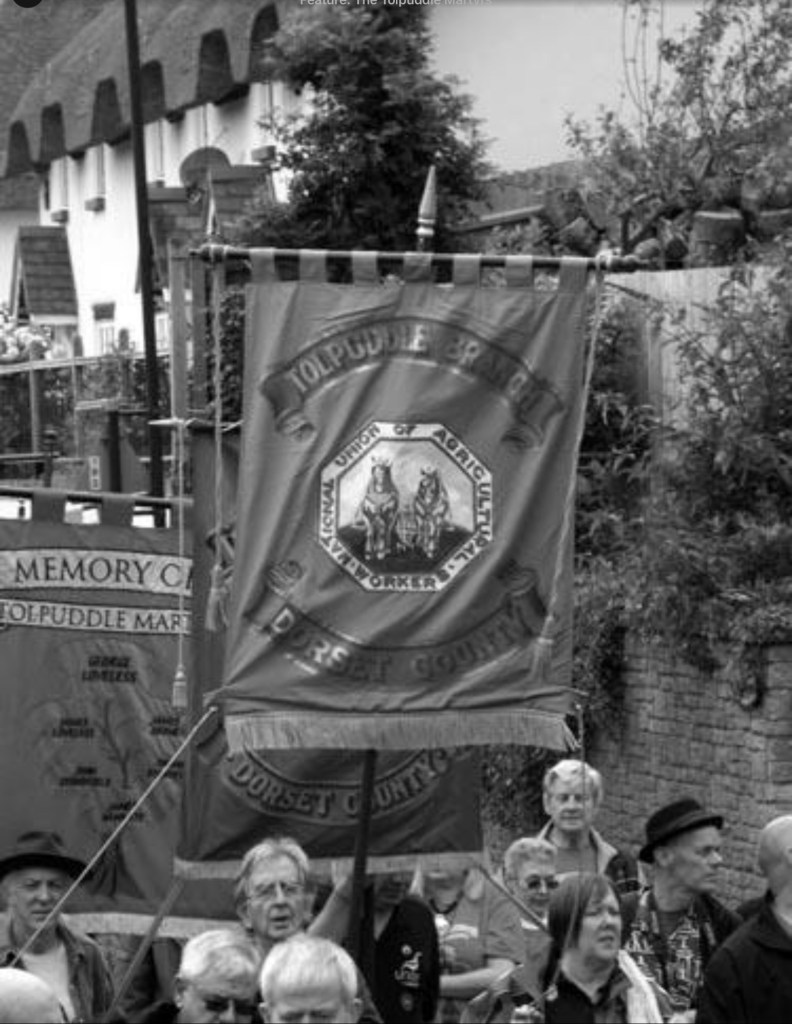
The village hosts the Tolpuddle Martyrs’ Museum, and thousands continue to gather for the annual Tolpuddle Martyrs’ Festival, with trade-union banners, speeches, music and processions commemorating the six agricultural labourers. (TUC)

The transformation is almost complete.

In 1834 the state treated their organisation as dangerous enough to justify transportation.

Today their story is commemorated as part of Britain’s democratic heritage.

The criminals became heroes.

The illegal oath became solidarity.

The tiny village became a place of pilgrimage for the labour movement.

And the sycamore became a monument.

The Road From Tolpuddle

The Tolpuddle Martyrs didn’t invent trade unionism.

Nor did their pardon suddenly establish modern trade-union rights.

The development of organised labour remained long, difficult and uneven.

But their story demonstrated several things.

Workers could organise.

Government could attempt to crush them.

Public opinion could mobilise in response.

Families could be supported collectively.

Petitions and demonstrations could exert pressure.

And governments could retreat.

Most importantly, the Tolpuddle campaign turned an apparently local injustice into a national political issue.

Six agricultural workers became everybody’s business.
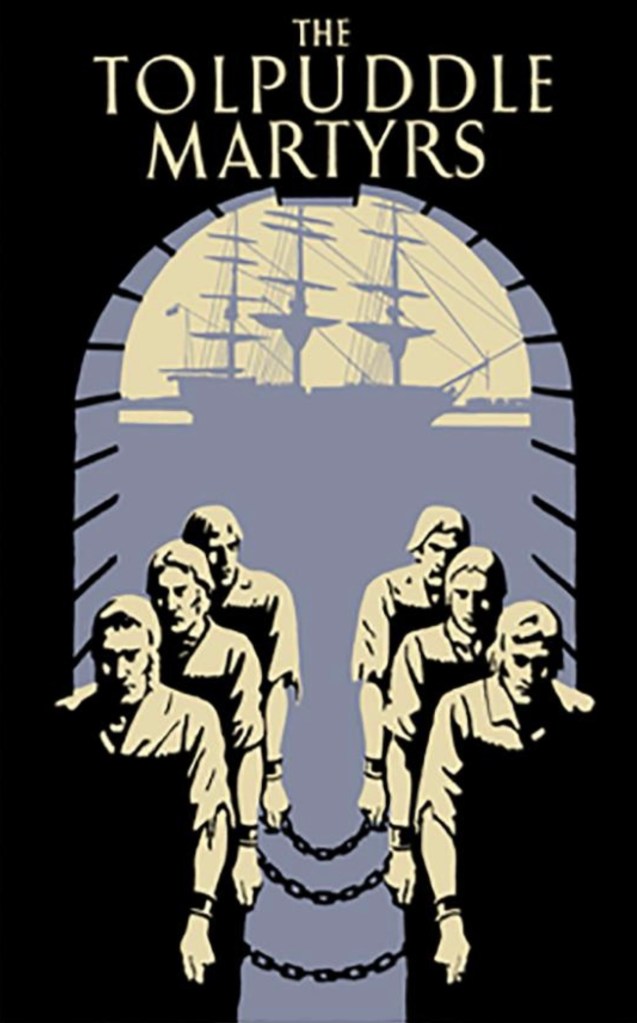
Tolpuddle Martyrs and Ship poster

Six Men Beneath a Tree

Perhaps that is why the story survives.

There is something wonderfully simple about it.

Six men in a Dorset village.

Wages falling.

Families to feed.

A meeting.

A society.

An oath.

Then suddenly:

arrest,

trial,

transportation,

Australia,

mass demonstrations,

hundreds of thousands of petition signatures,

pardon,

homecoming,

and immortality within the labour movement.

The authorities intended their sentence to deliver a warning:

Do not organise.

History transformed it into almost the opposite message:

Organisation works.

The government possessed Parliament.

The magistrates possessed the courts.

The landowners possessed the farms.

The employers possessed the jobs.

The six labourers possessed very little.

Except one another.

And in the end, that proved considerably more powerful than anyone expected.

Tim Alderman ©️2026

Sources and Further Reading

Trades Union Congress, “The Tolpuddle Martyrs” and Tolpuddle Martyrs’ Museum material — detailed accounts of the wage dispute, arrests, transportation, mass campaign, pardons and eventual return of the six men. (TUC 150 Stories)

Trades Union Congress, material on the return of the Tolpuddle Martyrs — particularly useful for the complicated story of the pardons and the men’s journeys home from Australia. (TUC)

Trades Union Congress, “Honouring the Women of Tolpuddle” — valuable corrective to accounts concentrating entirely upon the six men, including the economic consequences suffered by their wives and children. (TUC)

Joyce Marlow, The Tolpuddle Martyrs — detailed modern narrative of the affair and its political context.

A. J. Peacock, The Tolpuddle Martyrs — study of the six labourers, their union and prosecution.

George Loveless, The Victims of Whiggery — Loveless’s own account, invaluable as the voice of one of the transported men, though naturally read as a participant’s polemical account rather than detached history.

Dorset Museum, collections relating to popular and labour history — holds material relating to nineteenth-century Dorset and the later commemoration of the Tolpuddle story. (Dorset Museum & Art Gallery)

E. P. Thompson, The Making of the English Working Class — broader context for working-class organisation, radicalism and the transformation of British political culture.

The Final Two Executions For Sodomy In Britain – 1835. James Pratt & John Smith – A Travesty Of Justice!

Old Bailey judgements in this case:

“1934. JOHN SMITH and JAMES PRATT were indicted for b—g—y at the parish of Christ Church, Surrey; and WILLIAM BONILL was indicted as an accessory before the fact.

SMITH— GUILTY.— DEATH . Aged 40.

PRATT— GUILTY.— DEATH . Aged 30.

BONILL— GUILTY . Aged 68.— Transported for Fourteen Years.

Third Jury, before Mr. Justice Williams..”

James Pratt (1805–1835)[1][2] also known as John Pratt, and John Smith (1795–1835)[1][2] were two London men who, in November 1835, became the last two to be executed for sodomy in England.[3] Pratt and Smith were arrested in August of that year after being convicted of having sex in the room of another man, William Bonill.

William Bonill, aged 68, had lived for 13 months in a rented room at a house near the Blackfriars Road, Southwark, London. His landlord later stated that Bonill had frequent male visitors, who generally came in pairs, and that his suspicions became aroused on the afternoon of 29 August 1835, when Pratt and Smith came to visit Bonill. The landlord climbed to an outside vantage point in the loft of a nearby stable building, where he could see through the window of Bonill’s room, before coming down to look into the room through the keyhole. Both the landlord and his wife later claimed they both looked through the keyhole and saw sexual intimacy between Pratt and Smith, so the landlord broke open the door to confront them. Bonill was absent, but returned a few minutes later with a jug of ale. The landlord went to fetch a policeman and all three men were arrested.[1]

Pratt, Smith and Bonill were tried on 21 September 1835 at the Central Criminal Court, before Baron Gurney,[4] a judge who had the reputation of being independent and acute, but also harsh.[5] Pratt and Smith were convicted under section 15 of the Offences against the Person Act 1828, which had replaced the 1533 Buggery Act, and were sentenced to death.[Note 1][Note 2] William Bonill was convicted as an accessory[6] and sentenced to 14 years of penal transportation.[4] James Pratt was a groom,[3] who lived with his wife and children at Deptford, London. A number of witnesses came forward to testify to his good character.[1] John Smith was from Southwark Christchurch[1] and was described in court proceedings[4] and newspaper reports as an unmarried labourer[2] although other sources state he was married and worked as a servant.[3] At the trial, no character witnesses came forward to testify on his behalf.[4]

The conviction of the three men rested entirely on what the landlord and his wife claimed to have witnessed through the keyhole; there was no other evidence against them. One modern commentator has cast doubt on their testimony, based on the narrow field of vision afforded by a keyhole and the range of acts the couple claimed to have witnessed during the brief length of time they were looking.[7]
The magistrate Hensleigh Wedgwood, who had committed the three men to trial,[8] subsequently wrote to the Home Secretary, Lord John Russel, arguing for the commutation of the death sentences, stating:
“It is the only crime where there is no injury done to any individual and in consequence it requires a very small expense to commit it in so private a manner and to take such precautions as shall render conviction impossible. It is also the only capital crime that is committed by rich men but owing to the circumstances I have mentioned they are never convicted.”
Wedgwood described the men as “degraded creatures” in another letter. Nevertheless, he argued that the law was unfair in their case as wealthy men who wished to have sex could easily afford a private space in which to do it with virtually no chance of discovery. Pratt and Smith were condemned only because they could only afford to use a room in a lodging house, in which they were easily spied upon.[9]
On 5 November 1835, Charles Dickens and the newspaper editor John Black visited Newgate Prison; Dickens wrote an account of this in Sketches by Boz and described seeing Pratt and Smith while they were being held there:[10]
“The other two men were at the upper end of the room. One of them, who was imperfectly seen in the dim light, had his back towards us, and was stooping over the fire, with his right arm on the mantel-piece, and his head sunk upon it. The other was leaning on the sill of the farthest window. The light fell full upon him, and communicated to his pale, haggard face, and disordered hair, an appearance which, at that distance, was ghastly. His cheek rested upon his hand; and, with his face a little raised, and his eyes wildly staring before him, he seemed to be unconsciously intent on counting the chinks in the opposite wall.”

— A Visit to Newgate
The jailer who was escorting Dickens confidently predicted to him that the two would be executed and was proven correct. Seventeen individuals were sentenced to death at the September and October sessions of the Central Criminal Court for offences that included burglary, robbery and attempted murder. On 21 November, all were granted remission of their death sentences under the Royal Prerogative of Mercy with the exceptions of Pratt and Smith.[11] This was despite an appeal for mercy submitted by the men’s wives that was heard by the Privy Council.[12]

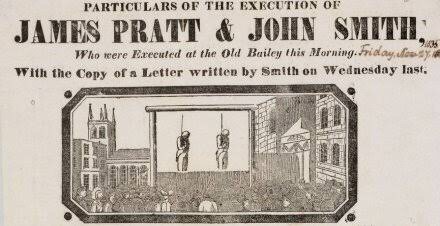
Pratt and Smith were hanged in front of Newgate Prison on the morning of 27 November. The crowd of spectators was described in a newspaper report as larger than usual;[13] this was possibly because the hanging was the first to have taken place at Newgate in nearly two years.[14][Note 3] The event was sufficiently notable for a printed broadside to be published and sold. This described the men’s trial and included the purported text of a final letter that was claimed to have been written by John Smith to a friend.[15]
William Bonill was one of 290 prisoners transported to Australia on the ship Asia, which departed England on 5 November 1835 and arrived in Van Diemen’s Land (now Tasmania) on 21 February 1836.[16] Bonill died at the New Norfolk Hospital in Van Diemen’s Land on 29 April 1841.[17]

Newspaper Reports on the Execution

Monday 23 November 1835

On Saturday the Recorder made his report to his Majesty, at Brighton, of the undermentioned capital convicts under sentence of death in Newgate, convicted at the September and October sessions of the Central Criminal Court: – . . . Robert Swan, 28; for robbery. John Smith, 49, and James Pratt, 30, for an unnatural crime. . . . to all of whom his Majesty has extended his royal mercy, except John Smith and James Pratt, who are left for execution on Friday next. (London Standard)

Saturday 28 November 1835

 RECORDER’S REPORT – On Friday the Recorder made his Report to his Majesty in Council at Brighton, of the prisoners who were capitally convicted at the September and October Sessions of the Central Criminal Court: – viz James Pratt and John Smith, for a nameless offence, committed in the borough of Southwark; Robert Swan, for extorting money from Thomas Reynolds, a Quaker, under a threat of accusing him of a nameless offence; R. Lavender, D. Ward, B. Vines, M. Collins, J. Coleman, and M. Harris, for burglary; . . . [and others] all of whom his Majesty was graciously pleased to respite, except James Pratt and John Smith, upon whom the law is left to take its course, and who were ordered for execution yesterday. The Council were in deliberation a considerable time on the case of Robert Swan, and did not break up until half-past eight o’clock in the evening. The Recorder came immediately to town by post, and made known the result of the Council to the Governor of Newgate, who lost no time in communicating it to the convicts whose cases had been reported. (Huntingdon, Bedford & Peterborough Gazette; virtually the same report appeared in the Derby Mercury for 25 Nov. 1835, the Manchester Courier for 29 Nov. 1835, and many others)
Charles Dickens, in his essay “A Visit to Newgate” published in Sketches by Boz in 1836, describes his visit to the press-room of the condemned ward of Newgate where he saw Pratt and Smith awaiting their execution, together with Joseph Swan who would eventually be transported rather than executed (for extortion involving the threat to swear sodomy against someone – see Newspaper Reports for 1835). All three men were kept separate from the other condemned men becasue of the sodomitical nature of their offences, and Swann also distanced himself from Pratt and Smith because he was a blackmailer of sodomites rather than a sodomite himself.
In the press-room below, were three men, the nature of whose offence rendered it necessary to separate them, even from their companions in guilt. It is a long, sombre room, with two windows sunk into the stone wall, and here the wretched men are pinioned on the morning of their execution, before moving towards the scaffold. The fate of one of these prisoners [Swan] was uncertain; some mitigatory circumstances having come to light since his trial, which had been humanely represented in the proper quarter. The other two [Pratt and Smith] had nothing to expect from the mercy of the crown; their doom was sealed; no plea could be urged in extenuation of their crime, and they well knew that for them there was no hope in this world. ‘The two short ones,’ the turnkey whispered, ‘were dead men.’ 
          The man to whom we have alluded as entertaining some hopes of escape [i.e. Swan], was lounging, at the greatest distance he could place between himself and his companions, in the window nearest to the door. He was probably aware of our approach, and had assumed an air of courageous indifference; his face was purposely averted towards the window, and he stirred not an inch while we were present. The other two men were at the upper end of the room. One of them [probably Smith], who was imperfectly seen in the dim light, had his back towards us, and was stooping over the fire, with his right arm on the mantel-piece, and his head sunk upon it. The other [probably Pratt] was leaning on the sill of the farthest window. The light fell full upon him, and communicated to his pale, haggard face, and disordered hair, an appearance which, at that distance, was ghastly. His cheek rested upon his hand; and, with his face a little raised, and his eyes wildly staring before him, he seemed to be unconsciously intent on counting the chinks in the opposite wall. We passed this room again afterwards. The first man [i.e. Swan] was pacing up and down the court with a firm military step – he had been a soldier in the foot-guards – and a cloth cap jauntily thrown on one side of his head. He bowed respectfully to our conductor, and the salute was returned. The other two still remained in the positions we have described, and were as motionless as statues.

Saturday 28 November 1835

EXECUTION.
Yesterday morning, at the usual hour, the sentence of the law was carried into effect upon James Pratt, aged 32, and John Smith, aged 34, who were convicted at the September Sessions of the Central Criminal Court of a capital offence. The Sheriffs arrived at Newgate about half-past seven o’clock, and immediately proceeded to visit the prisoners, whom they found engaged in prayer with the Rev. Mr. Cotton, the chaplain of the gaol, and Mr. Baker. Both the culprits appeared in a very weak state, and when eight o’clock arrived, the hour of execution, it was found necessary almost to carry them from their cell to the press room. Pratt, especially, appeared dreadfull weak and dejected. While Smith was being pinioned, Pratt appeared to suffer dreadfully. His groans resounded through the prison, and while he was pinioning he repeatedly exclaimed, “Oh God, this is horrible, this is indeed horrible.” He at this time was so weak that the executioner’s assistants found it necessary to hold him in their arms to prevent him from falling to the ground. All the preparations having been completed the melancholy procession proceeded to the scaffold, and in the room leading from the debtors’ door, as it is called, the ceremony of delivering up the prisoners to the Sheriffs of Middlesex was performed by Mr. Cope, the Governor of Newgate. Smith was the first who ascended the scaffold, and immediately afterwards Pratt was also assisted up the seps and placed under a beam. The moment the culprits were perceived they were received with groans and hisses, which lasted during the whole of the time the hangman was making the necessary preparations. These having been performed the bolt was drawn, and after a very short struggle the culprits ceased to exist. Pratt was a married man, the other culprit was single. (Morning Post)

Sunday 29 November 1835

EXECUTION. – On Friday morning, at the usual hour, the sentence of the law was carried into effect upon James Pratt, aged thirty-two, and John Smith, aged thirty-four, who were convicted at the September session of the Central Criminal Cour, of an unnatural offence. There were very few persons present at the execution. Both the wretched men to the last moment denied their guilt; they were convicted on the testimony of their landlady. The soldier, Swan, has been respited. (The Examiner)

Monday 30 November 1835

LONDON,
MONDAY, NOVEMBER 23.

Brighton, Sunday. – On Friday, his Majesty held a Privy Council, at which the Recorder attended, when two miserable convicts, John Smith and James Pratt, was ordered for execution on Friday next. In the evening, the Ministers and a large party dined with their Majesties. – This morning, their Majesties attended Divine Service in the Palace chapel. In the afternoon, the Queen attended at St. George’s chapel. (Salisbury and Winchester Journal)

Monday 30 November 1835

LONDON,
SATURDAY, NOVEMBER 28.

The two wretched culprits, James Pratt and John Smith, suffered the last penalty of the law yesterday morning in front of Newgate. (Salisbury and Winchester Journal)

Wednesday 2 December 1835

LONDON, SATURDAY, NOVEMBER 28.
EXECUTION. – Yesterday morning, at the usual hour, the sentence of the law was carried into effect upon James Pratt, aged 32, and John Smith, aged 34, who were convicted at the September sessions of the Central Criminal Court, of an unnatural offence. Thursday night Pratt was visited by a respectable Dissenting Minister. The Rev. gentleman exhorted him to repentance, and he confessed his guilt. The Sheriffs arrived at Newgate about half-past seven o’clock yesterday morning, and immiedately proceeded to visit the prisoners, whom they found engaged in prayer. While Smith was being pinioned, Pratt appeared to suffer horribly. His groans resounded through the prison, and while he was being pinioned he repeatedly exclaimed “Oh, God, this is horrible; this is indeed horrible!” He at this time was so weak that the executioner’s assistants found it necessary to hold him in their arms, to prevent him from falling to the ground. All the preparations having been completed, the melancholy procession proceeded towards the scaffold, which was first ascended by Smith with a firm step, but his companion needed support to the last moment. The executioner with amazing celerity adjusted the ropes, and cause the plank to fall which closed the world upon them. The crowd was excessive, but exceedingly decorous. (Hereford Journal)

The following is an account of the case, with personal observations, by Father Frank Ryan & Peter Tatchell, who were convinced that the men were innocent!

Father Frank Ryan casts new doubt on the 1835 convictions
The wrongful conviction & execution of James Pratt & John Smith for ‘buggery’ in 1835
By Father Frank Ryan
The last Saturday of August 1835 was a beautiful hot day. James Pratt (30) left his wife and two young daughters in Deptford, searching for work – promising to return by 6pm. He was a labourer and needed a better job.
Pratt first visited his aunt in Holborn, before heading to Blackfriars. His aunt thought he’d had too much to drink and needed a rest, but he pressed on. In an ale house he met John Smith, a labourer aged 40, and William Bonill (sometimes spelled Bonell), aged 68. Neither could offer him a job to improve his financial situation but their company was hospitable. Bonill invited Pratt and Smith back to his rented flat and they accepted.
Little did they know as they made their way to his premises in nearby George Street, that this encounter would result in their execution – and that Bonill would be banished to the penal colony of Australia – all within a mere three months.
The landlords of 45 George Street, Southwark, Jane and George (also known as John) Berkshire, were determined to curtail the activities of their tenant, William Bonill, who they regarded as an “old villain.” He had been bringing male “couples” back to his flat on a regular basis; sometimes two a day. George was determined to put a stop to this practice and get rid of what he regarded as a disagreeable and troublesome lodger.
Shortly after the three men arrived, the suspicious, antagonistic George spied into Bonill’s room through a nearby window. A little later, over tea, he told his wife that he saw Pratt sitting on Bonill’s knees and then on Smith’s. There was much laughing and conversation, he said. Jane slipped upstairs and peeped through Bonhill’s keyhole. After a brief look, she returned to tell her husband that she had witnessed sexual acts. He became enraged, went upstairs and also looked through the keyhole. He then burst into the room to confront Pratt and Smith, who were in a compromising position, according to George Berkshire.
At this point, Bonill, who had gone out for a drink, returned and entered the room. An effort to calm down Berkshire was unsuccessful. George went off to seek the police.
Pratt, Smith and Bonill were soon arrested and taken into custody. Pratt and Smith were charged with ‘buggery’ (anal sex) and Bonill as an accessory. They went on trial for their lives before Judge Baron Gurney at the Old Bailey on 21 September 1835.
The arresting police officer had no material evidence to support the charge. The account that Jane Berkshire told the jury is improbable. She said she watched for less minute but claimed to have witnessed the alleged sex acts, from the men undressing to laying on the floor and the “appearance” of anal penetration. She said she saw the men’s private parts but did not answer when asked whether either man had an erection. It seems doubtful that the keyhole could have provided the range of vision needed to see what she claimed.
The testimony of George was very similar to Jane’s. It had a whiff of coordination. His evidence supported the charge that buggery had taken place. However, he failed to testify if the men had an erection or if he had seen actual penetration; though he claimed to have sighted their genitals and their bodies in motion.
The anatomical description of intimacy described by George Berkshire would have been very difficult to witness. As in the case with Jane’s testimony, the keyhole probably could not have provided a sufficient angle of sight to provide the evidence he imparted to the jury.
Neither James Pratt nor John Smith were allowed to give evidence at their trial. Both pleaded “not guilty” to the charge. Nevertheless, the jury returned a guilty verdict.
The law against ‘buggery’ (not repealed until 2003) was based on an interpretation of the Bible that regarded homosexual acts as an abomination and worthy of death; a particularly evil sin that must be severely punished and eradicated. It was a capital crime.
The judge had no hesitation in sentencing James Pratt and John Smith to death. He warned them their chances on appeal were hopeless and they could expect no reprieve. They had to prepare, he said, to receive God’s judgement upon departing this life. Both men left the dock in tears.
William Bonill was sentenced to 14 years transportation to Australia. He died in Tasmania in 1841.
As well as Pratt and Smith, there were many death sentences for different crimes handed down during the autumn 1835. The process of petitioning for clemency and commutation began.
While being held in Newgate Prison, Pratt and Smith were visited by Charles Dickens who wrote they “had nothing to expect from the mercy of the crown, their doom was sealed.” The turnkey whispered to Dickens that they were “dead men.”
John Smith, it seems, had no friends. But the friends of James Pratt commenced a vigorous campaign to save him. They gathered a substantial petition which included the trial prosecutor, former employers, neighbours and even George and Jane Berkshire, their accusers.
All the documents were prepared for a Privy Council meeting with the King, William IV, to be held in Brighton.
On 24 November, 12 men sentenced to death were reprieved by the King’s mercy. Pratt and Smith were not among them. Judge Baron Gurney’s warning had prevailed. In their case, the law was to be allowed to take its course.
News of the pending execution spread around London, confirmed by the erection of the scaffold outside Newgate Prison.
On Friday 27 November, the two prisoners were taken from their cells and brought to the place of execution, still protesting their innocence. Pratt was weak and had to be helped up the scaffold. The crowd began to hiss, possibly in disagreement with the execution. These were probably the last sounds the men heard. The hangman pulled the bolt and after a short struggle on the rope Pratt and Smith were dead.
They are buried in a common grave, with others executed at Newgate, in the City Cemetery, Manor Park, London E12.
In 2014, I petitioned the Secretary of State for Justice, Chris Grayling MP, to grant a posthumous pardon to James Pratt and John Smith on the grounds that even by the standards of those days their convictions were unsafe. Further, the ‘buggery’ law itself was unjust. Consenting adult homosexuality should have not been a crime.
In reply, the Justice Ministry regretted the men’s execution, acknowledging that it should never have happened, but said the conditions for granting a pardon had not been met. However, since the pardoning of Alan Turing for same-sex relations has established a legal precedent, hopefully the Justice Minister will, with further pressure, re-examine the case and grant a long overdue pardon to Pratt and Smith.
• The full story of Pratt and Smith is retold in the book, The law to take its course – Redeeming the past, securing our future. It is available as a self-printed manuscript from the author, Father Frank Ryan, for the cost of printing (about £14): fmryan33@hotmail.com 
• The book and this article are based on Ryan’s original research at the National Archives, British Library and London Metropolitan Archives, plus newspapers reports. 

• This article was written by Frank Ryan, with the assistance of Peter Tatchell.


And what of William Bonill?

Convicted on the 25 September, 1835 to 14 years transportation at the Old Bailey, in London. He was shipped onboard the convict shop “Asia” on the 5 November 1835, to Tasmania (Van Diemen’s Land).

He arrived in Tasmania on the 21 February 1836. He died on the 29 April 1841. 

We have an entry from the Daily Sick Book, onboard the Asia “William Bonill, aged 71, Convict; disease or hurt, febris ephemera. Put on sick list, 9 November 1835. Discharged, 14 November 1835. Folio 2: ”

There does not appear to be any other records for him.

Notes

  1.  In the period from 1810 to 1835, 46 people convicted of sodomy were hanged and 32 sentenced to death but reprieved. A further 716 were imprisoned or sentenced to the pillory, before its use was restricted in 1816 (See: Lauterbach and Alber (2009), p.49).
  2. The sentence of death was mandatory, but under the Judgement of Death Act 1823, Gurney would have had the power to commute it to imprisonment.
  3. ^Pratt and Smith were the only people to be executed at Newgate in the three year period 1834–1836; this partial, temporary moratorium may have been for political reasons and because of a change in the law. Prior to 1834, individuals had been executed for any of 20 different offences; after 1836, only convicted murderers were hanged outside Newgate, until the ending of public execution in 1868. See A history of London’s Newgate Prison

References 1

  •  Old Bailey Proceedings Online (www.oldbaileyonline.org, version 7.0, 08 March 2013), September 1835 (t18350921)
  • “Execution”. The Morning Post (20273). London. November 28, 1835.
  • Cook et al (2007), p.109
  • Old Bailey Proceedings Online (www.oldbaileyonline.org, version 7.0, 26 December 2012), September 1835, trial of JOHN SMITH JAMES PRATT WILLIAM BONILL (t18350921-1934).
  • Hamilton, J.A. (2004). “Oxford DNB article: Gurney, Sir John (subscription needed)”. Oxford University Press. Retrieved 7 January 2010.
  • “Central Criminal Court, Saturday, Sept. 26.”. The Times (15906). London. September 28, 1835. p. 4.
  • Ryan, Frank (24 March 2015). “Pratt & Smith – Last UK men hanged for sodomy”. Peter Thatchell Foundation. Retrieved 1 December 2015.
  • Cocks (2010) p.38
  •  Upchurch (2009), p.112.
  •  Lauterbach and Alber (2009), p.49
  • “Multiple News Items”. The Standard (2664). London. November 23, 1835.
  • Cook et al (2007), p.110
  •  “Execution”. The Times (15959). London. November 28, 1835. p. 3.
  • “A history of London’s Newgate prison.”. http://www.capitalpunishmentuk.org. Retrieved March 24, 2013.
  • Anonymous, “The Particulars of the Execution of James Pratt & John Smith” (1835), London printed by T. Birt. OCLC 83814830, Harvard Law School Library, Historical and Special Collection
  • “Asia voyage to Van Diemen’s Land, Australia in 1835 with 290 passengers”. Convict Records of Australia. Retrieved 7 March 2014.
  • William Bonill”. Convict Records of Australia. Retrieved 14 October 2013.

Bibliography

  1. Cocks, Dr Harry (2010). Nameless Offences, Homosexual Desire in the 19th Century. I.B.Taurus & Co. ISBN 9781848850903.
  2. Cook, Matt; Mills, Robert; Trumback, Randolph; Cocks, Harry (2007). A Gay History of Britain: Love and Sex Between Men Since the Middle Ages. Greenwood World Publishing. ISBN 1846450020.
  3. Lauterbach, Frank; Alber, Jan (2009). Stones of Law, Bricks of Shame: Narrating Imprisonment in the Victorian Age. University of Toronto Press. ISBN 0802098975.
  4. Upchurch, Charles (2009). Before Wilde: Sex between Men in Britain’s Age of Reform. University of California Press. ISBN 0520258533.

References 2