By Tim Alderman
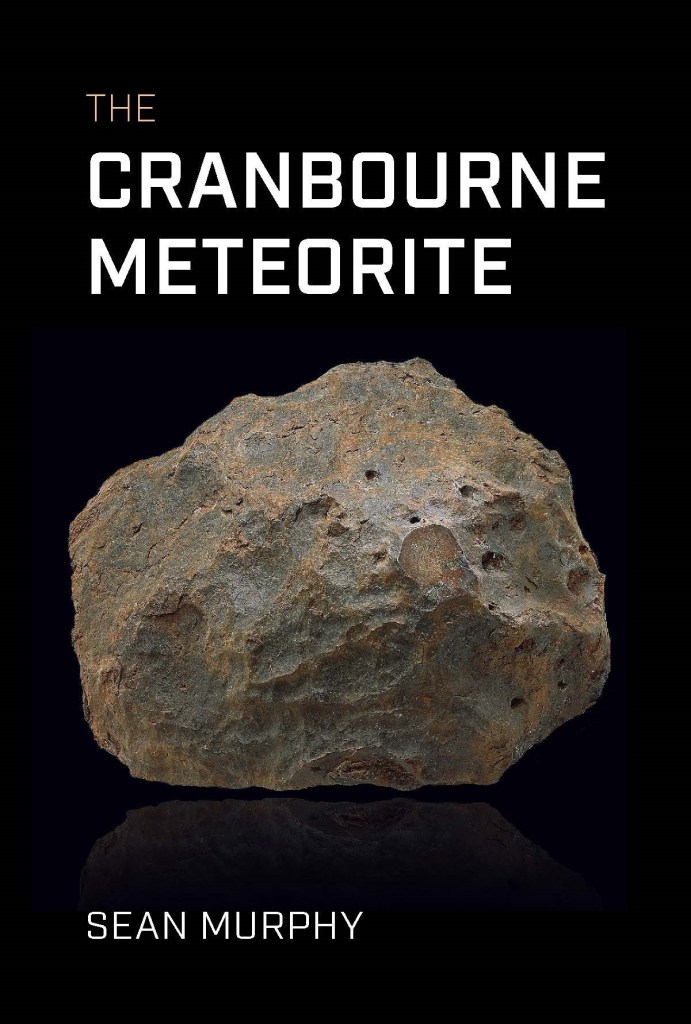
Few Australians have heard of the Cranbourne meteorite, despite it being one of the most extraordinary meteorites ever discovered.
Today, its largest surviving fragment sits not in Australia, but thousands of kilometres away in London’s Natural History Museum. Its removal remains one of colonial Australia’s most controversial scientific episodes—a scandal involving wealthy landowners, rival museums, government indecision, and the export of one of the country’s greatest geological treasures.
A visitor from deep space
Long before Europeans settled Victoria, an enormous iron meteorite had crashed into what is now the Cranbourne-Devon Meadows district southeast of Melbourne.
Scientists believe the meteorite fragmented into numerous pieces before or during impact, scattering massive iron blocks across the landscape. Collectively these fragments weigh more than 8.6 tonnes, making the Cranbourne meteorite Australia’s second-largest known meteorite and, when first recognised by science, the largest known iron meteorite in the world.
Unlike the stony meteorites that occasionally fall today, the Cranbourne meteorite consists almost entirely of iron and nickel.
Its distinctive octahedral crystal structure formed over billions of years as molten metal slowly cooled inside the core of an ancient asteroid before that asteroid was shattered by collisions in the early Solar System.
The meteorite therefore represents material older than Earth itself.
The first custodians
One of the most remarkable—and often overlooked—parts of the story concerns the Bunurong people.
When Scottish settler Alexander McKay arrived in the district during the 1830s, he found Aboriginal people already familiar with the great iron mass.
According to McKay’s later recollections, Bunurong people gathered around the meteorite, striking it with stone tomahawks and dancing while enjoying the unusual metallic ringing it produced.
Modern historians rightly treat nineteenth-century recollections cautiously, yet the account strongly suggests the meteorite already possessed cultural significance before Europeans understood what it actually was.
Unfortunately, almost nothing was recorded about Bunurong traditions connected with the object.
Like so much Indigenous knowledge during colonisation, these stories were largely ignored.
A very unusual rock
European settlers initially regarded the enormous lump of iron simply as an inconvenience.
Some attempted to cut pieces from it.
One section was reportedly fashioned into a horseshoe and exhibited in Melbourne during the 1850s—without anyone recognising its extraterrestrial origin.
Imagine possessing one of the world’s greatest meteorites and using it to shoe horses.
Only later would scientists realise what had almost been destroyed.
Science arrives
In 1860, Melbourne Town Clerk Edmund Gerald FitzGibbon—an enthusiastic amateur geologist—recognised that two enormous iron masses near Cranbourne were probably meteorites.
The following year distinguished German scientist Georg von Neumayer visited the site, conducted investigations and confirmed the extraordinary discovery.
News spread rapidly throughout the scientific world.
Museums across Europe became intensely interested.
Large iron meteorites were exceedingly rare.
The Cranbourne discovery instantly became internationally significant.
Enter James Bruce
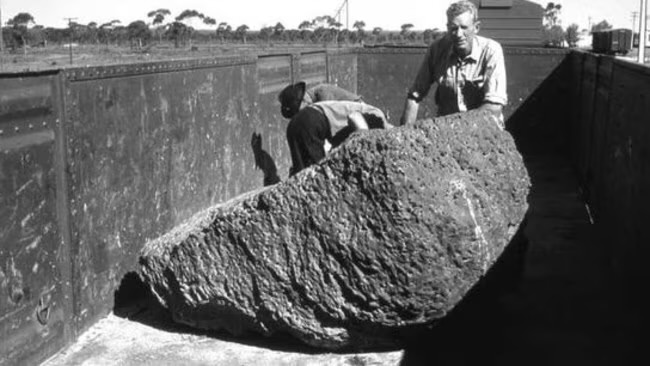
The largest fragment—now known as the Bruce meteorite—weighed around 3.5 tonnes.
Neighbouring landowner James Bruce acquired ownership of the giant mass.
Rather than remaining an Australian scientific treasure, Bruce decided he wished to donate it to the British Museum in London.
At first glance this may appear generous.
However, it ignited one of Australia’s earliest heritage controversies.
Many colonial scientists were horrified.
Victoria was beginning to establish its own museums, universities and scientific institutions.
Why should Australia’s greatest meteorite leave the colony?
The battle begins
The Bruce meteorite was transported to Melbourne before shipment overseas.
There it became the centre of a fierce public debate.
Members of the Royal Society of Victoria petitioned vigorously for it to remain in Melbourne.
They argued that such a unique scientific specimen belonged where it had been found.
Why should Britain receive yet another colonial treasure?
It was hardly an isolated issue.
Throughout the nineteenth century, museums in London accumulated enormous collections from across the Empire.
Australian fossils, Aboriginal artefacts, plants, animals and geological specimens routinely departed the colonies.
Many never returned.
The Cranbourne meteorite became another example of that pattern.
A controversial compromise
Eventually an agreement was reached.
Britain would receive the enormous Bruce meteorite.
In exchange, another major Cranbourne fragment—the Abel meteorite—would be returned to Victoria.
On paper it seemed reasonable.
In reality many regarded it as a poor bargain.
Australia surrendered the largest and most spectacular fragment forever.
The Bruce meteorite arrived in London in 1865.
More than 160 years later, it remains there.
Could it have been stopped?
From a modern perspective the obvious answer seems yes.
Today, objects of such outstanding scientific importance would almost certainly be protected by heritage legislation.
Export permits would be scrutinised.
Governments would intervene.
Museums would mount campaigns to retain nationally significant material.
But colonial Australia was different.
British institutions were viewed by many as the natural home for the Empire’s greatest discoveries.
Scientific prestige flowed towards London.
Colonial museums were often treated as junior partners.
The decision reflected the values of the age.
That does not necessarily make it any less regrettable.
More fragments appear
The story did not end with Bruce.
Over subsequent decades additional pieces continued to emerge as farming expanded across the district.
Eventually thirteen recognised fragments were identified.
Some entered Australian museum collections.
Others were sold overseas.
One disappeared completely after being lost during shipping.
Another eventually found its way to the National Museum of Natural History.
The meteorite’s scattered pieces are now dispersed among museums and collections around the world.
Scientific importance
The Cranbourne meteorite continues to surprise researchers.
Modern analytical techniques have revealed previously unknown minerals within some fragments.
In late 2024 scientists identified traces of the rare mineral muonionalustaite in material held by Melbourne Museum, demonstrating that even after more than 160 years this meteorite continues to produce new scientific discoveries.
Each fragment contains valuable information about the formation of the Solar System over 4.5 billion years ago.
These are literally pieces of planetary history.
A colonial lesson
The Cranbourne meteorite story raises uncomfortable questions.
Who owns natural heritage?
Does discovery by settlers override the cultural connections of Indigenous peoples?
Should nationally significant objects remain where they were found?
Should museums return objects removed during colonial times?
These debates now surround Aboriginal cultural material, fossils, artworks and human remains.
The Cranbourne meteorite belongs within that wider conversation.
Unlike many museum disputes, no theft occurred.
Ownership transferred through legal agreements recognised at the time.
Yet legality does not always settle questions of heritage or ethics.
Many Australians still believe the Bruce meteorite belongs in the country where it landed thousands of years ago.
Could it ever come home?
The prospect is slim.
Major museums rarely relinquish world-famous specimens unless overwhelming ethical grounds exist.
Unlike looted antiquities or human remains, meteorites occupy a more ambiguous legal and moral category.
For now, Australians wanting to see the largest Cranbourne meteorite must travel to London.
Smaller but still impressive fragments remain in Melbourne, allowing visitors to appreciate at least part of this remarkable extraterrestrial visitor.
The Cranbourne meteorite is more than an enormous lump of iron.
It is a symbol of Australia’s scientific coming of age, a reminder of colonial assumptions about ownership, and evidence that Indigenous Australians recognised the significance of unusual natural objects long before Western science understood them.
Its story also illustrates a familiar pattern in nineteenth-century Australia: priceless natural and cultural treasures leaving the colony for Britain, often with little consideration of what was being lost.
Whether one views the export of the Bruce meteorite as an unfortunate necessity or a genuine scandal, it remains one of the most fascinating—and least remembered—episodes in Australian scientific history.
Tim Alderman ©️2026
Sources
Natural History Museum – Collections relating to the Bruce Meteorite.
Museums Victoria – Cranbourne meteorite collections and scientific research.
R. Henry Walcott, Descriptions of the Victorian Meteorites, Memoirs of Museum Victoria (1915).
Meteoritical Society – Cranbourne meteorite classification and catalogue.
Recent mineralogical analysis of Cranbourne meteorite fragments (2024).
 timalderman