Category Archives: History

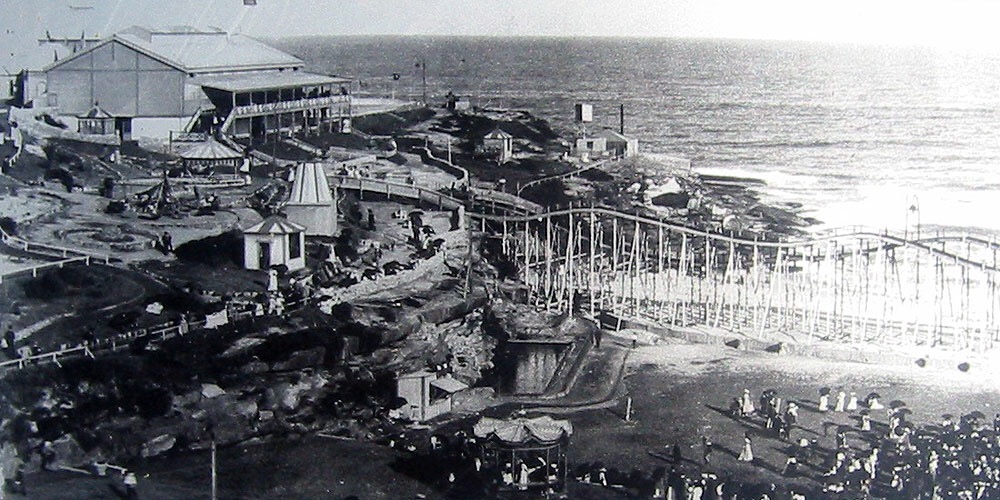
Australian Icons: Wonderland City, Tamarama NSW. Formerly the Royal Aquarium and Pleasure Grounds.

IMG_0233

To look at Tamarama beach today, it is hard to envisage that it was once the site of the largest open-air amusement park in the southern hemisphere, nor that there were attempts in the early 20th century to ban swimmers from the area.

Originally the site for the Royal Aquarium and Pleasure Grounds (commonly referred to as the Bondi Aquarium), it was an amusement park situated in Fletcher’s Glen at Tamarama beach.


It opened on the 1st October 1887 and touted a Great Military Band, merry-go-rounds, swings, shooting gallery, water boats, Camera Obscura, Punch ‘n Judy show, and dancing in the Grand Hall.

There were huge marine aquarium tanks featuring many fish varieties, sting rays, lobsters, turtles, wobbegong and tiger sharks. Seals shared a pond with a solitary penguin. There was a switchback railway, a roller coaster ride above the sand on Tamarama beach, two roller skating rinks, which eere “illiminated by the electric light”. Every Wednesday, Pain’s Grand Fireworks exploded overhead, and there were Sacred and Classical concerts every Sunday.

In typical early 1900s tradition, feats of daring-do were a must. Alexander, an Australian wire walker, walked a wire from cliff to cliff. Captain George Drevar floated on a “cask raft” in the surf. There was a Grand Balloon Ascent and Parachute Descent. Headliners from the Tivoli Theatre perforned on the Aquarium Curcuit.


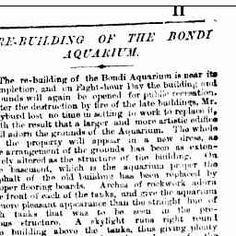
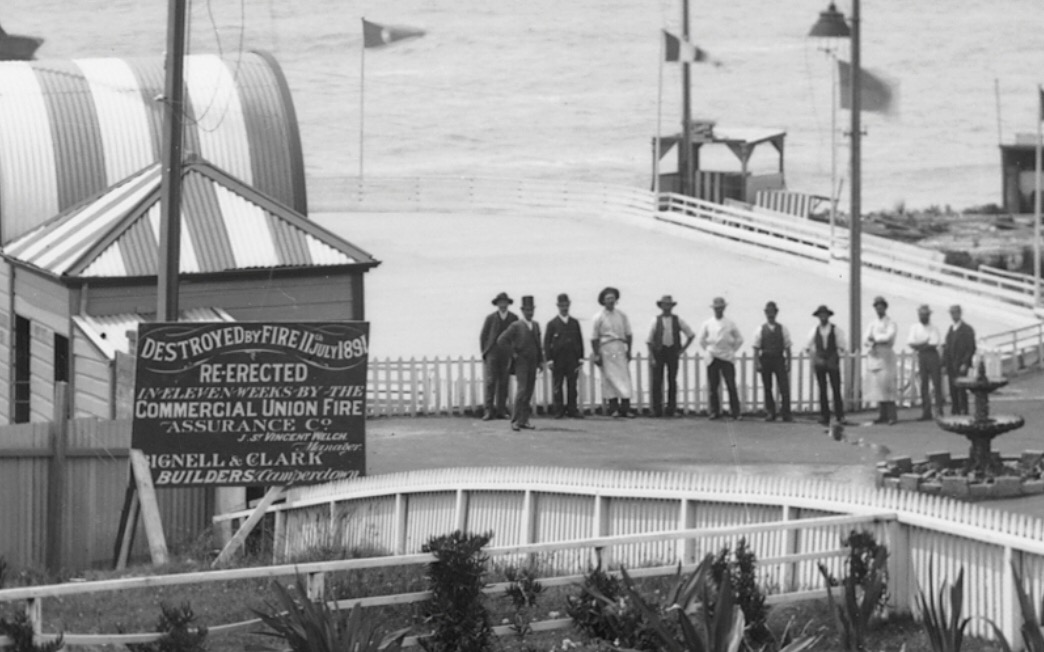
Fire destroyed the Aquarium and Pavilion on 11th July 1891, but it rose from the ashes in September the same year, and continued on. The ladt known concert there was a fund-raiser for the Waverley Benevolent Society in 1906. Ownership and management chantes several times over the coarse of its existence, and it was finally sold by Mrs Margaret J Lachaume to William Anderson in 1906. He transformed and renamed it Wonderland City.                                                                        IMG_0232
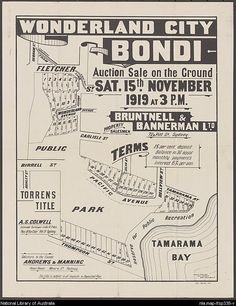
Anderson was a Prominent theatrical entrepreneur, leased the land in Tamarama Park, minus a 12-footbstrip of coastline, to allow the public access to the beach. He also leased a further 20-acres of land in Tamarama Gully – formerly Tamarama Glen, or “the Glen” – and started to transform it into an amusement park.

The main entrance was a large white weatherboard building in Wonderland Avenue near the point at which it joins Fletcher Street. The entry price was 6 pence for adults and 3 pence for children with all rides costing an additional fee.

Opening on Saturday, 1 December 1906 Wonderland claimed to equal ‘those amusement grounds… of the far famed Coney Island, New York, or White City, Chicago’. William Anderson also claimed “there weren’t sufficient trams in Sydney to transport the crowd … for the opening.” On this opening night approximately 20,00 people travelled out to Wonderland to go on fairground rides, view the novelty attractions and walk among the natural beauty of Tamarama Glen, which was lit by strings of electric lights and described as a ‘fairy city’.

Some of the attraction included an artificial lake; the first outdoor ice skating timk in Australia; a roller skating rink which doubled as a boxing ring; double-decker merry-go-round; Haunted House and Helter Skelter; steam-driven swutchback railway; maze; circus ring; fun factory; the Airum Scarum, an airship that moved on a cable from cliff to cliff, was supported at bith ends by huge wooden structures, and at high tide moved over the sea; wax works; Katzenjammer Castle; Hall of Laughter; Box Ball Alley; Alice the elephant; a sea pond and aquarium; Japanese tearooms; Alpine slide;  and The King’s Theatre – a music hall – that could seat 1,000 people.

IMG_0236

Employing over 160 people, Wonderland set a new standard for Australian outdoor pleasure grounds. Large crowds, estimated at 2,000 people came every summer weekend, with seventy turnstiles at the entrance doing a brisk trade. Wonderland was known for its novelty and ‘shocking’ acts, with William Anderson the consummate showman. He organised for a couple to be married at Wonderland, and then paraded through the grounds on the back of Alice the elephant. One daredevil performer,  Jack Lewis,  roller skated down a ramp, through a hoop of fire and landed in a tank with sharks – much to the horror of the crowd. Miraculously Jack always survived unharmed.

Unfortunately, conflict with swimmers was bound to happen. Despite the 12-foot public beach access strip being excluded from his lease, William Anderson erected a 8-foot high wire fence over it anyway, insisting it wss hecessary, as fare-evaders wrre using the strip as a way to access the park via his beachfront boundary fence.

The barbed wire fence extended down the cliff on the southern end of the beach, across the rocks and sand to the rocks at the beach’s northern end. However this wire fence also blocked access for swimmers to the beach. Some of these swimmers were influential businessmen and having their local beach cut off incensed them. The swimmers started an ongoing battle with Anderson; they would cut his wire fence, he would repair it and contact the police. The police would arrive and warn the swimmers and the following weekend the same scenario would be re-enacted. George B. Philip, the foundation President of the Tamarama Surf Life Saving Club, was one of these swimmers and he later recalled how he got around one particular wire fence gatekeeper. ‘I scaled under the barbed wire fence practically every day, I knew every nook and corner of it – until I was caught by the gatekeeper. The outcome of this was that I came to an arrangement with him whereby that if I carried his billy of tea from the kiosk to (the) main gate at 5 o’clock each day, I could walk in and out when I liked (much to the envy of my mates, who were not caught)…’

The stalemate between the swimmers and William Anderson continued, with the swimmers eventually taking a deputation to NSW Parliament. On 6 March 1907, the Minister for Lands, James Ashton, issued an order to resume the 12-foot strip of land fronting the beach to “give free access for all time to the beach at Tamarama Bay.” At the Tamarama Surf Life Saving Club’s centenary celebrations Ken Stewart, grandson of one of the original fence cutters Bill Stewart, reenacts his grandfather’s cutting of the barbed wire in 19061907 Many of these victorious swimmers formed the nucleus of a new surf club, the Tamarama Surf Life Saving Club. On 11 February 1908 the first surf ‘gymkhana’, equivalent to a surf carnival, was held at Wonderland on Tamarama Beach and was held each year until Wonderland closed.

Meanwhile, bad publicity dogged Wonderland. The conflict with local swimmers and the wire fence incident soured the public image of Wonderland, as did complaints that the animals were being poorly housed and mistreated. The occasional breakdown of the Airem Scarem airship above the dangerous surf caused accusations of safety breaches and resident opposition to the weekend revellers at Wonderland grew.

The crowd numbers dropped but Williams Anderson fought back bringing in famous entertainers and more daring acts from his national touring circuit to perform at the King’s Theatre. Anderson responded with more elaborate public exhibitions, but the public was tiring of Wonderland and the crowds dropped. It struggled on from March 1908 to December 1910 with poor crowds and low revenue, finally closing in 1911. William Anderson is said to have lost £15,000 on Wonderland City. Wonderland was the precursor of Luna Park, setting unprecedented standards for popular outdoor entertainment in Sydney. In its day it was the largest open-air amusement park in the Southern Hemisphere, and its decline does not diminish the grandeur of William Anderson’s vision.

Although little visible evidence of Wonderland survives today, with the possible exception of the two paths on the northern boundary of Tamarama Gully, the NSW Heritage Office still considers the site to be of archaeological significance. Today a mural commissioned by the Tamarama Surf Life Saving Club on the side of their clubhouse celebrates the history of Wonderland and the part it played in the formation of their club.


Published by Waverley Library from sources in the Local History Collection, 2008.


Tamarama Beach today. The beach is popular with the gay community, and is referred to as “Glamarama” due to the number of muscle boys who like to pose around there.

Australian Icons: Leyland Brothers World, Karuha, NSW.

  
The rock. or whats left of it at the long-gone Leyland Brothers World on the NSW mid coast at Karuah

http://journals.worldnomads.com/stowaway/photo/6392/171049/Australia/The-rock-or-whats-left-of-it-at-the-long-gone-Leyland-Brothers-World-on-the-NS

Mike Leyland, MBE (4 September 1941– 14 September 2009) and Mal Leyland, MBE (born 1945), also known as the Leyland brothers, were Australian explorers and documentary film-makers, best known for their popular television show, Ask the Leyland Brothers. The show ran on Australian television from 1976 until 1984.

In November 1990 the Leyland Brothers opened the theme park Leyland Brothers World (32°37′3″S 152°4′48″E), on a 40 ha property at North Arm Cove on the Pacific Highway north of Newcastle, New South Wales. It included a 1/40 scale replica of Uluru, as well as amusement rides, playground, roadhouse, museum and a 144 student capacity bush camp. In a 1997 article in the Sunday Age, Mike Leyland said that the initial A$1 million loan blew out due to rain during construction and a 27% interest rate. In July 1992 Chris Palmer of BDO Nelson was appointed receiver and manager of the park when the Leyland Brothers company failed to meet its loan commitment to the Commonwealth Bank. Auctioneers Colliers Jardine estimated the yearly attendance of the park to be about 400,000 people, with 10,000 students for the bush camp. After an auction held by the receiver on 26 November 1992 the theme park was sold for $800,000, and continues to trade successfully as the Great Aussie Bushcamp.[ The brothers went bankrupt.

After the 1992 bankruptcy, Mike and his wife Margie ran a New Lambton video store and worked for the park’s new owner. In 1997 Mike sold part of his Tea Gardens property to fund the production of a far north Queensland film for Channel Seven. Mike and his wife Margie signed a contract with Channel Seven for 12 one-hour documentaries, the first of which aired in 1998 in The World Around Us slot. On 14 September 2009 Mike Leyland died from Parkinson’s disease. He was 68 years old. Mike is survived by his wife Margie, his daughters Kerry, Sandy and Dawn, his stepdaughters Sarah and Alison, and seven grandchildren.

Mal and his wife Laraine ran a photo processing lab in Queensland and launched a travel magazine. In 1997 Mal and Laraine launched a bi-monthly magazine, Leyland’s Australia. In 2000 Mal produced the television show Leyland’s Australia, with his wife Laraine, daughter Carmen and her husband Robert Scott – travelling around Australia in a caravan. In April 2000 Channel 9 cancelled the show after 6 episodes but the series was then picked up by Network Ten.
 

Leyland Brothers: Mal Leyland reveals financial rift tore popular brothers apart

Australian Story By Brietta Hague

Updated 16 Feb 2015, 11:34am

 Mal and Mike Leyland in the Simpson Desert
  
PHOTO: Mal and Mike Leyland film in the Simpson Desert in central Australia, 1989.

MAP: NSW

Long before Steve Irwin was jumping on crocodiles, Mike and Mal Leyland were sailing down the Darling River in a chaotic dinghy without oars — all in the name of entertainment.

They were the television legends whose wild adventures captured Australia’s imagination.
Armed with a camera and a catchy song that few can forget, they pioneered a successful outback documentary format and made millions of dollars along the way.
But it was their disastrous decision to branch out into the tourism industry by building their theme park Leyland Brothers World that would end the brothers’ collaboration — and relationship.
Mike Leyland died in 2009 and his brother Mal, now 70, has now agreed to repeated requests from Australian Story to tell their story.
“This is the first time that I’ve publicly spoken about what happened to the Leyland Brothers and why Mike and I went our separate ways,” Mal Leyland said.
“We made a conscious effort to make sure that people thought we were still travelling together.
“We didn’t want people to feel as though we were actually ready to rip each other’s throats out.”
By the time the project collapsed in 1992, they had lost more than $6 million and were bankrupt.
“The receivers came in and took possession of the whole lot,” Leyland said.
Who were the Leyland Brothers?
Australian explorers and documentary film-makers
Best known for their TV show Ask the Leyland Brothers, which ran from 1976-1984

Starred in a following series called Leyland Brothers’ World

Both brothers were awarded MBEs in 1980

“In hindsight, Leyland Brothers World was a huge mistake, the biggest mistake we ever made.”

Amid the financial woes, media reports claimed the brothers had transferred more than $1 million of assets into their wives’ names over an 18-month period.
“I didn’t really mind losing the money. I objected to being treated like a criminal because I lost the money,” Leyland said.
“The partnership that Mike and I had for 29 years was crumbling before my eyes and I knew would never be the same again.
“And since there was now nothing left that we jointly owned, there was no need for us to stay in partnership, so for the first time we went our separate ways.”
Brothers were original Ten Pound Poms
Despite their quintessentially Australian characters, the brothers were born in England and arrived in New South Wales in 1950.
Even at a young age they were fascinated by the outback and all things Australian.
The Brothers first set off to explore the country with their cameras in 1961 when Mal Leyland was just 15 and television was first starting to come to Australia.
Mal Leyland speaks with Australian Story
  
PHOTO: Mal Leyland says the financial rift over the failed theme park ended up pushing the brothers apart. (ABC: Anthony Sines)

They were the first to film Uluru in the wet and first to travel the length of the Darling River in a dinghy.

“We had no idea what we were letting ourselves in for. We were so inexperienced; we had no oars and only an outboard motor,” Mal Leyland said.
The adventures grew in size and ambition.
Their decision to travel from Australia’s western-most to eastern-most point was a feat never before captured on camera.
It was this entrepreneurial take on filmmaking that led to their early success.
“We decided we would road show the film, we would take it around the country and hire town halls, cinemas if we could, and advertise it ourselves and see how we went,” Mal Leyland said.
It was a risk that paid off.
“At the end of the two-week season we’d recovered $15,000, enough money to buy three houses at the time,” he said.
And so the Leyland Brothers were born.
Before long, their quirky television program Ask the Leyland Brothers was attracting some of the highest ratings of the 1970s and 80s, and the theme song is still a familiar tune to millions of Australians.
“Their place in television history is there forever. Historically, the films are incredibly important,” said entrepreneur Dick Smith, whose decision to make his own travel documentaries was inspired by the success of the Leyland Brothers.
http://www.abc.net.au/news/2015-02-16/mal-leyland-reveals-financial-rift-tore-popular-brothers-apart/6091042


Above 2 photos taken in 2002. Private collection of Tim Alderman (Author)

Tim Alderman 2015

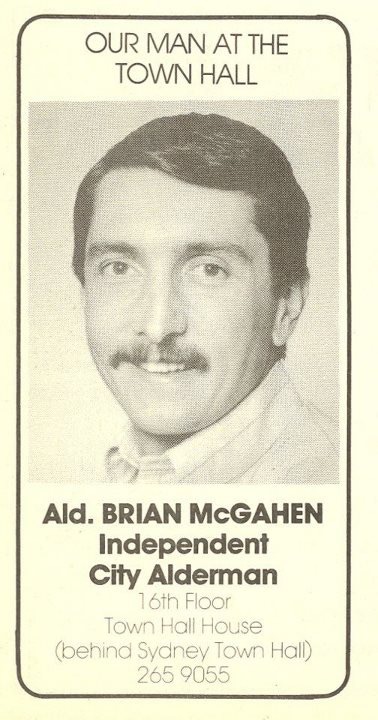
Australian Gay Icons: Brian Patrick McGahen

McGahen, Brian Patrick (1952–1990)
by Phillip Black
This article was published in Australian Dictionary of Biography, Volume 18, (MUP), 2012
Brian Patrick McGahen (1952-1990), city councillor, social worker, gay activist and social libertarian, was born on 3 March 1952 at Camperdown, Sydney, elder son of Patrick James McGahen (d.1963), hairdresser, and his wife Monica Marie Anderson, née Pettit, both born in New South Wales. Brian was educated at De La Salle College, Ashfield, and the University of Sydney (B.Soc.Stud., 1974). At the age of 17 he opposed the Vietnam War; he refused to register for conscription and was convicted of sedition for advocating draft resistance. He joined the Eureka Youth League of Australia, the Communist Party of Australia and the Draft Resisters’ Union.
In 1974-75 McGahen was employed as a social worker and drug counsellor in the methadone program of the Health Commission of New South Wales. When the Australian Social Welfare Union was created in 1976, he was a founding member. After travelling overseas that year, in 1977 he was an organiser for the Chile Solidarity Campaign. Over the next three years he worked on projects for the State Department of Youth and Community Services. With Social Research and Evaluation Ltd in the early 1980s, he reviewed the New South Wales Family Support Services Scheme.
Sexual politics had emerged as a social force worldwide by the mid-1970s. McGahen found like-minded activists in the Sydney Gay Liberation and subsequently in the Socialist Lesbians & Male Homosexuals. In 1978 he was part of a collective that organised the National Homosexual Conference on discrimination and employment. He was chairman (director) of the Sydney Gay Mardi Gras Association from 1981 to 1984, providing the young organisation with structure, direction and vision.
Remaining a member of the CPA until 1984, McGahen stood unsuccessfully in 1980 as its candidate in the election for the lord mayor of Sydney. In 1984, having campaigned as a leader of the gay community against the Australian Labor Party State government’s failure to repeal anti-homosexual laws, he was elected (as an Independent) to the Sydney City Council for the Flinders ward. A member of various council committees, he served from 14 April 1984 until the council was dismissed on 26 March 1987. Policies were implemented to prevent discrimination against homosexuals in council services.
McGahen became a director of a Sydney home care service in 1986, hoping to extend the service to people suffering from acquired immune deficiency syndrome. He was also concerned about immigration rights for the partners of gay men. Throughout the 1980s he was a consistent advocate for a permanent gay and lesbian community centre, preferably a registered club. In 1989 he joined the Pride steering committee, became treasurer, and soon gained support to set up such a club.
In 1987 McGahen was diagnosed positive for the human immunodeficiency virus. He decided to show that his carefully considered choice of voluntary euthanasia could be achieved in a dignified manner. Never married, he died on 3 April 1990 at his Elizabeth Bay home, accompanied by five close friends, and was cremated. He had fought with determination and enthusiasm for what he believed in, often against great opposition. In 1986 a homosexual social group, Knights of the Chameleons, had made him the Empress of Sydney, and in 1992 he was inducted into the Sydney Gay and Lesbian Mardi Gras Association Hall of Fame.
Select Bibliography

G. Wotherspoon, City of the Plain, 1991

R. Perdon (comp), Sydney’s Aldermen, 1995

Sydney Morning Herald, 17 September 1984, p 4

Sydney Star Observer, 6 April 1990, p 17

Sydney Morning Herald, 23 June 1990, p 69

McGahen papers (State Library of New South Wales)

Citation details

Phillip Black, ‘McGahen, Brian Patrick (1952–1990)’, Australian Dictionary of Biography, National Centre of Biography, Australian National University, http://adb.anu.edu.au/biography/mcgahen-brian-patrick-14206/text25218, published first in hardcopy 2012, accessed online 17 September 2015.

This article was first published in hardcopy in Australian Dictionary of Biography, Volume 18, (MUP), 2012


Bad Eggs, Weirdos, and Heroes: A Story of Families

There is an adage that you can choose your friends, but you can’t choose your family…and fortunately – or unfortunately – it’s true. And oddly, as distinct from family groups in centuries past where family history and lineage was often passed down through word-of-mouth, these days we seem to know very little about our family history, or who we are, and how we are related to others in our “group”.

I attempted to trace my family roots in the early 80s. I had the basics – mothers parents and grandparents, brothers and sisters and their families. My fathers sisters and their families, but that was about it. Tracing family history back then, in the dark ages, wasn’t as easy as it is now. There was no internet, no Ancestry or Family Search, no apps for tracing BDM, graves or potential record matches for family members. No little leaves popping up against names. I contacted my mother with a list of dates and relationships I required to move forward, only to find she wasn’t interested in family, and could only supply limited family information. With my father deceased, and his family alienated, my chances of getting very far looked grim. I entered up what info I had in a large family bible – the only thing that had family tree pages – and put it all on the backburner.

Fast forward to ten years ago. The internet is in full bloom, and Mr Google is a knight-mine of information. I put Pickhills into a search engine, and suddenly all this information came to light through the newly published sets of census from England. A full, colourful family history, hidden from a blinkered families sight, came into full bloom. My family had no idea what they had missed by cutting themselves off from the curiosity to know what their forebears had done! No one knew of my Great Great Grandmother (Paternal) Elizabeth Pickhills nee Appleyard, who was dragged all over Yorkshire by her husband, Rickinson, gave birth to 12 children and had most of them die in her lifetime, who visited her 2 sons in South Australia, was arrested twice, was shipped back to England (presumably) because she was too much of a handful for her kin), and died of “senile decay” – dementia – in Tooting Bec Mental Asylum in London. Nor of my Great Grand Aunt Clara who married into the prestigious De Bomford family in Tasmania, nor my Great Grand Uncles who captained steamers up and down the Darling, Murrumbidgee and Murray Rivers. One of these uncles led such a prolific life that I have a whole arch-folder dedicated to him, and it is suggested that the book “Dreadnought of the Darling” by the famous Australian war correspondent Charles Bean was based on the recollections of Captain George Rickinson Swan Pickhills’ life on the Darling River. Nor would they know that my Great Great Great Geandmother, Clara Pickhills nee Rickinson, was related to the very old and prominent Rickinson family from Robin Hood’s Bay in Yorkshire. What a shame that all this colourful heritage was lost to my family, caught up as they were in the dross of their own lives!

The family tree currently stands at around 8,500 people, related either through blood or marriage. Lineages grow exponentially, so in reality there are no ends, and finding beginnings can be difficult. I am sure the tree is 95% accurate, and I am currently working on sorting out a couple of messy lines. It has proven an interesting experience, and many characters involved have had a hand in world history. We have Cornish miners (my mothers family) who travelled all the way here, hoping for a getter life than that offered in Cornwall and established themselves in South Australia, Broken Hill and Cobar; a Rickinson who was an engineer on Ernest Shackleton’s exprdition to Antartica; many who died in mining accidents; those who fought in WWI and are buried in Villers-Brettoneux; there are several protestant ministers; at least four convicts; bankrupts; relatives in England, Wales, Ireland, the Channel aislands, America, Canada, Germany and New Zealand. We are related to the Henschke – yes, the South Australian wine people – family in South Australia. We have humour, like Happy Victoria Morris marrying Spencer Lemon, thus becoming a Happy Lemon. And, as described below, a host of cads to keep everyone on their toes. Welcome to the world of family!

Errant Family

Elizabeth Pickhills nee Appleyard (my Great Great Grandmother) arrived here after the death of her husband Rickinson. They had 12 children within a short space of time, and of the 12, Edward, Jane, Frederick William 1, Walter and Mary died either in infancy or within a few years of birth. Henry Moorsom joined the Admiralty at 14 and died of Cholera in Bengal when he was about 21. Frederick George, George Rickinson Swan and Clara all moved to Austrlia at a fairly young age, and Charles Edward died while visiting his brothers here. Whether she intended originally to emigrate or just visit is unknown, but her stay was memorable! Anyway, she did ship herself here, and for a while probably lived with George Ruckinson and his wife, Ellen in Goolwa, South Australia. According to the South Austrlian Police Gazette, June 21, 1876 ” .A warrant has been issued at Yankalilla for the apprehension of Elizabeth Pickhills, a widow, and mother of Captain Pickills, of the Goolwa, for larceny of 2lbs. of butter from Messrs. Smith & Swan, sheep farmers, Bullapabaringa. Offender is said to be living at Mr. Luffin’s, Goolwa.” Not quite the thing you can imagine GG Gran doing. We know nothing more about the case except for this note in the South Australian Police Gazette, May 1, 1878 “re – Larceny from Smith and Swan – The warrant for Elizabeth Pickhills has been withdrawn.”. One has to wonder if George hadn’t had a few words to Smith and Swan about his mothers mental condition, and got them to be lenient. It didn’t end there. A writ appears with the Goolwa police dated 2nd May, 1889 against Elizabeth Pickhills . She appeared before a Justice of the Peace, Thomas Goode, charged with that on the 28th April 1889 she did “unlawfully use abusive words in a certain public place, to wit The Parade in North Goolwa, with intent to invoke a breach of the peace”. She had to pay a fine of £2. This incident received a mention in “A Land Abounding – A History of the Port Elliot and Goolwa Region, South Australia” by Rob Linn, chapter 5, page

On the evening of 16 December 1965 at Sylvania, Frederick Lindsay Pickhills – my father – .took his 7-year-old son Kevin out to The Gap at Watsons Bay, and jumped over with him. Frederick survived, but Kevin’s body was found 3 days later by fishermen, floating in Broken Bay.

Colin Edward Campbell...gaoled sheep stealing.

William Thomas Onions went missing whilst supposedly leaving Broken Hill and heading to SA or WA, leaving his wife, Agnes, and 5 children in destitute circumstances.

Above listed as. Cess-pit attendant in the 1895 Wagga Wagga borough expenses.

19 jul 1851 Joseph Onions charged with larceny
25 January 1928 William Joseph Onions (25) indecently assaulted Edna May Hollis (14) and committed for trial at Goulburn Quarter Sessions. On 15 February 1928 was acquitted.

James Greenwood broke into home of Rickenson Pickhills and stole some dresses and a firearm.

John Magg – family convict ancestor. Convicted in Surrey Quarter Sessions in 1822, and sentenced to 7 years in NSW. Arrived here onboard the Surry in 1823.

Richard Blinksell – a wife-basher and thief: Transcription of article from the Queanbeyan Age dated 18 May 1883; “THREATENING LANGUAGE; Richard Blinksell was brought up in custody charged with threatening the life of his wife Sarah Blinksell, of Molonglo. The prisoner had been arrested on this charge by Constable Goodhew, having been given into custody by his wife. After the evidence of the arresting constable, Sarah Blinksell, on oath stated – I am the wife of the defendant now before the court. I gave him into custody of the police on the 11th of the present month for threatening to do me some harm. On Sunday evening, the 6th inst. defendant accused me of stealing his mare, and said to me, If the mare is not brought back to-night I will jump your ____ out. This occurred between one and two o’clock. I said, I never touched your mare. Defendant said, You are a ____ liar; and whatever row we have had before it will be nothing to what there will be to-night. He then went and laid down on the bed. While he was lying there I ran away. I stayed at my father’s house (John Edmonds) for three days. I then came home to my husband again, and brought my daughter and son-in-law with me. As soon as I came in the door the defendant jumped up and asked me why I did not bring his mare back that night. I told him I had never touched her. He told me I was a ____ liar, for he saw me take her. I told him then that I did not want to live with him any longer; I only wanted my three little children. Defendant told me I could take the ____. I called my children together and gathered up their things. As I was going out of the door with them, he called them all back again. I told him he could keep his children, but I did not intend to stop myself. He caught hold of me and was pushing me about to bring me back again. When my daughter found he would not let me go she went for the police. I mean she went to Carwoola and telegraphed to Queanbeyan for the police. I went into the house with my son-in-law; but when the latter went out defendant got up and barred the door against him. I remained with him all night. After staying there some time he told me to take my frock off and go to bed. I did so. After I was in bed some time he asked me if I was asleep. I was not, but did not answer him. He said, You had better enjoy it for it may be the last ____ sleep you’ll ever have. He kept using unbecoming language to me all night. I got up in the morning and prepared his and the children’s breakfast. On leaving to go to my father’s place to do some ploughing defendant walked up to me and spat in my face, making use of some expression which I forget. When he left the house I ran away into the bush and stayed there until the policeman came. I then went with the policeman to my father’s house and gave him in charge. From all that has passed I am afraid to live with him, fearing he might do me some bodily harm. I therefore pray that he may be required to find sureties to keep the peace towards me. To the Bench – I never laid my hands on the mare since the 18th of April last when I rode her home from my daughter’s place. Defendant has often struck me before – both me and my daughter. The last time he struck me was on the 20th of April. To the defendant – I was lying on the bed with my little child when you ordered me to take my frock off. I was trying to get the child to sleep, and did not wish to go to sleep myself. Defendant was then sworn, and stated – I am a farmer and live at Molonglo. On last Sunday week my wife went away from the place and told the children she was going to meet the little boys with the sheep. That led me astray. She had not returned at dark, and when I got my little children asleep I went to look for her, fearing something had happened to her. It was raining hard and I got off and washed my feet in the floods. I heard the next day that she was at her father’s place, and I sent her two messages to come home for an hour or two. She never came home till late on Thursday evening. I asked her how she came to go away in such a clandestine manner without telling me. The daughter then said something; she was there with her husband, Anderson; they came with my wife. I got Anderson and his wife out of the house, and shut them outside, and my wife, my children, and I remained in the house altogether that night. I told my wife she would not be obliged to herself for fetching her son-in-law there. I never that night attempted to raise my hand to her. I did say something to her, but I ‘disremember’ what it was”.

January 19, 1857 at Wheeo. William Apps charged with theft of two cows & 2 heifers.

March 29 1854. Narrawa. William Apps cautions people not to harbour his daughter Ellen, who has abandoned her family home without cause.

William Apps: William was tried at Canterbury on 7th April 1826 on a charge of stealing corn. Found guilty, he was sentenced to seven years transportation to NSW, arriving at Port Jackson on 26th November 1826 on the vessel “Speke”. In 1831 William was granted his Ticket-of-Leave only to have it cancelled on December the same year for receiving a blanket under false pretences from his former master, Mr. William Broughton. For this misdemeanour Apps was sentenced to a week on the treadmill at Hyde Park Barracks. This punishment completed he was re-assigned, but his spirit was unbroken and within days he escaped from his new assignment. His re-capture was notified in the Sydney Gazette on 22nd December 1831. Finally Apps received his Ticket-of-Leave in 1833. From Convict Indents it is known that he was a short man, standing 4 feet, 11 inches tall with a fresh, unmarked complexion, brown eyes and hair. In April 1935 William Apps, aged 32, made application to marry Margery Campbell. Following their marriage, William and Margery Apps continued to live in the vicinity of Sydney and were in Parramatta in 1837 when their oldest daughter, Ellen, was born in that year. By 1849 the family moved to Wheeo, being among the earliest in that district.

Margery Campbell (wife of William Apps), from Sligo, Ireland, was the daughter of William Campbell. When she was 23 she was tried in County Down for receiving stolen goods. For this offence, her first, she was sentenced to seven years transportation. She sailed on the “Palambam” from Cork on 23rd March 1830 arriving in Sydney on 31st July the same year. Margery was 4 feet 11 inches tall with a ruddy, freckled complexion and hazel to grey eyes. On her disembarkment in the colony she was assigned to Mr. James Taylor of Sutton Forest.

Jane Langley – Jane’s story begins on the 14th of September 1785 when she was tried at the Old Bailey with Mary Finn for stealing five guineas from a Robert Robinson, on the 29th of July 1785. Jane’s parentage is unclear but she was possibly the daughter of Edward and Elizabeth Langley, at St George Parish Hanover Sq The birth occurred on the 16th of September 1761 at the Holborn lying in hospital in Endell St. At the time of her trial Jane was a Tambour worker and was described as a tall dark girl with very curly hair, she appeared to be self supporting and doubt exist as to her need to be involved in crime. On the 6th of January 1787 she was boarded on the “Lady Penrhyn” during the Voyage to Australia Jane Langley had the first of her children a daughter Henrietta born on the 23rd of October 1787. There is some speculation regarding Henrietta’s father, Phillip Scriven or Shewring who was a seaman on the The Lady Penrhyn or Thomas Gilbert the ships Master on the Charlotte was also throught to be her father.

Henrietta Shewing (1787—1828) Married to Edward Fletcher 1807 Henrietta, one of twenty little souls born on the convict transports known as the First Fleet, was to be always known as English, and never in England. Henrietta is the only child born on the First Fleet known to have Australian descendants [1]. Henrietta was born on board the Lady Penrhyn at Capetown Harbour, South Africa on 23rd October 1787 [2]. Three of the women convicts on the ship were known to be midwives: Mary Parker, Ann Colpits and Sarah Burdo. The ship’s surgeon Arthur Bowes Symth was definitely not present, and even recorded later Henrietta in the surgeon’s log as male. The ship’s log at least got the sex correct! Rev. Richard Johnson came on board to baptise the baby on the 4th November 1787, an event well liked by the crew because they received an extra ration of grog. The sailors who also had fathered children had the opportunity to buy tea and other little extras at Cape Town for their women [3]. Henrietta arrived on the shores of Port Jackson 6th February 1788, a sultry stormy evening. The next two years were hard and famine was severe in the colony, taking its toll especially of the small children. It was decided to send five of the surviving children and their mothers to Norfolk Island. That in itself was an adventure, as they arrived in high seas and were only at great peril able to be landed at Cascade with the seas breaking into the boat which was very frightening and caused much panic and screaming. That night the Sirus was swept on to rocks and shipwrecked. Henrietta lived on Norfolk Island for the next five years and in that time her mother married the marine Thomas Chipp. A brother Robert was born (and died) and a sister Ann, and a third child is recorded. I think this could have been little Thomas Chipp whose death is recorded early 1795 but most members of the family think the evidence is too flimsy. There were school classes taken by a number of individuals and eventually in 1792 Thomas McQueen was appointed schoolmaster and Susannah Hunter his assistant for seventy five pupils. We could imagine Henrietta would have been one of the pupils. Norfolk Island had passed from its early idyllic days to a wilder rougher life, and Thomas Chipp and his family decided to leave there and return to Sydney Town which had also become a pretty wild and rough place. The Governor’s wife Mrs. King started an Orphan School to house the homeless girls living on the streets of Sydney. This first Orphan School stood on the corner of Bridge and George Street. Not all the girls in the institute were orphans. In two of her letters Henrietta refers to having been in the Orphan School. The family was on record as being “on stores” in 1804. Stores were the equivalent of social security. On the 23rd March 1807 nineteen year old Henrietta was married to the convict Edward Fletcher by the Reverend Henry Fulton at St. John’s Parramatta. Edward had been working for the Knights as a servant, as was her thirteen year old sister Mary Chipp, so we assume they met through mutual acquaintances. This is the period of time Henrietta’s stepfather would have had land at Toongabbie (Seven Hills, later to be known as Bella Vista) and Isaac Knight had the adjoining farm. Henrietta applied for a land grant and a cow on the grounds she had been an inmate of the Orphan School and was granted a thirty acres at Bankstown. Today the land is occupied by Liverpool Hospital. Governor Macquarie revoked all the land grants made by the Rum Corp after the overthrow of Governor Bligh and Henrietta reapplied and was granted the Liverpool land again. The annual rent was to be 2 shillings a year after 5 years. Thomas Moore [4] apparently wanted the grant Henrietta had at Liverpool but probably helped her to obtain the grant at Narellan plus an extra ten acres, which became known as Fletcher’s Farm, and today is the land near Springs Road, Narellan. Henrietta had six children: Edward born 8th March 1808 in Campbelltown, baptised at St. Luke’s Liverpool; John born the 10th May 1810 at Cowpastures and baptised by the Reverend Samuel Marsden at St Luke’s on 15th May 1810. Eliza was born at 12th August 1812 at Campbelltown. Susanna was born on the 12th May 1815 at Fletcher’s Farm, Campbelltown; Blanche was born 17th December 1823 and Elizabeth 26th April 1828. Since 1810 Edward had been employed as a constable in the Cowpastures District. Henrietta’s health had declined over the years and by the time she died at the age of forty-one years, she was blind and crippled. Thirteen year old Susanna was working for the Rev Thomas Hassall as a maidservant on a nearby property, but William Boyle Henrietta’s nephew was living with the family, his father having died. William’s mother Mary was not coping with the change in her circumstances and her sisters took in her children. Edward had a reputation for drinking, but it was said he was always kind and thoughtful to his wife and children, and Henrietta was described as “an exceedingly reputable woman who bestowed great pains in bringing up her children”. In 1828 there was the first outbreak of whooping cough in the colony and two thousand people died as a result of it. One could be excused for wondering if Elizabeth and Henrietta were two of the victims. Henrietta and Edward Fletcher are buried in St. Peter’s churchyard Campbelltown in a well-cared-for grave, which also has a First Fleeter’s plaque for Henrietta. Though Henrietta never lived to see her grand children she had thirty six grand children. There are other family graves St Peters churchyard including Susanna Chapman’s Henrietta and Edward’s daughter. Thomas Chipp always accepted Henrietta as part of his family, and Henrietta was involved in her sisters’ marriages and lives. Thomas was the only grandfather her children knew. NB Surname: Henrietta is variously quoted with the surnames Scriven, Shewring, Skirwin, Chipp and Langley before marriage. Grandson: MH has also written a piece about William Henry Fletcher who was a grandson of Henrietta. Notes [1] A number of children born to marines on the journey, returned with their families to England. (‘Orphans of History —The Forgotten Children of the First Fleet’ by Robert Holden). [2] The baby was born at 1pm so in navy parlance was dated the 23rd as their dates changed at noon. She was also recorded as the child of T..G.. which 198 years later was to cause speculation on who was T..G.. With the passing of sailing ships the navy parlance for calling sailors after their job had been forgotten. Philip Scriven was the foremast man responsible for the Top Gallant sail.[3] As recorded in Jonathan King’s book ‘The First Fleet’.[4] This is the same Thomas Moore who is credited with founding Moore Theological College. He was a land dealer in the early colony.NMargaret Hardwick, 2009


Lynn Shepherd
was indicted for robbery in 1838, found guilty and sentenced to life on Norfolk Island

Addison Mitchell was indicted for murdering William Ablett on 8 Nov 1856 at the old Lachlan Road. John Collins testified at the trial before Mr Justice Therry at Bathurst Circuit Court] “John Collins, lives at No. 1 Swamp, near Carcoar, I recollect on 7th of November, 1856, being in company with Ablett, and prisoner; in answer to an inquiry made by prisoner, he said his name was Ablett, and he was a native of Cambridgeshire ; I should say he was about 20 years of age, 5 feet 9 inches in height, fair complexion, without whiskers, light hair, dressed in a light tweed cap, plaid jumper, fustian trousers, and watertight boots ; in prisoner’s presence, he told me that if he could find an old horse he would buy it to carry his swag to the Ovens ; I sold him an old bay horse, saddle, and bridle, for £6 ; he paid me in prisoner’s presence, with two £5-notes ; prisoner drew out the receipt; Ablett had a tent with him, and I noticed a shingling hammer (hammer found near fire shown) ; I believe this is the hammer deceased Ablett had; I noticed the boots he wore, and noticed that nails were out in front of the left boot ; to the best of my belief the boots I now see in Court are those I saw on Ablett ; the bridle now produced (found in prisoner’s bundle) is the one I sold to Ablett; I saw Ablett last at Radburn’s, 1 mile and a half from my house; he started, leading the horse with his swag placed across the saddle ; this was on Saturday ; he went in the direction of the junction of the Wagoola and Grabine roads with the Lachlan road; the horse might travel 20 or 25 miles a day ; after I left deceased, and on my return home, prisoner complained of his hands being sore from blisters ; I said we would spell that day, and commence again on Monday morning ; prisoner afterwards went out in the same direction that Ablett took ; about an hour afterwards; I did not see him again until next day, Sunday, about 2 p.m ; he was then very dirty ; he washed himself, and shortly afterwards I received information that my horse that I sold Ablett was near my house ; I went out and found the horse hobbled close at hand; I said, in prisoner’s presence, that the horse had been brought back ; prisoner said he had strayed back ; in the evening I told prisoner that it was no use in saying he did not bring the horse back, as he had been seen riding him ; he said, “well what of it, you don’t know Ablett as well as I do, he is a bolter, and there are constables after him in all directions ; that he was within a quarter of a mile of the place, but was afraid to come in ;” whilst I was sitting near the fire with prisoner, I saw the remains of a pocket-book in the ashes ; it had a clasp like the one I saw with Ablett ; I was frightened to put it in my pocket as I was alone with the prisoner; after prisoner left my house I searched for it, but could not find it ; I identify the handkerchief now produced, found in prisoner’s bundle, as one I gave to Ablett with flour in it, also the saddle and bridle sold by me to Ablett, and found concealed near my hut; on the Monday morning I discharged prisoner being suspicious of him; as he left I saw him pick up the bridle now produced; I identify it as the one sold by me to Ablett; I gave information to the police. Constable McFadden re-called : In consequence of information given by last witness prisoner was apprehended for horse-stealing: it was in looking for and making enquiries about Ablett that I found the camping ground on the old Lachlan road ; there were appearances of a tent having been pitched, there, and about half a mile distant in the scrub I found the ashes of the fire in which I found the bones, buttons, shingling hammer, hair, and buckles, which have been produced ; I made enquiries in the neighbourhood of the camp, but could find no traces of any person answering to Ablett’s description being seen in that neighbourhood. Thomas Radburn, of Carcoar, recollects Collins coming to his hut on 8th November, to change a 5 pound note ; he was accompanied by a young man; witness’s description tallied with that already given by Corby, Wood, and Collins. James Bradburn, son of last witness, gave the same evidence as to appearance and dress of Ablett ; two and a half hours afterwards saw prisoner following in the direction taken by Ablett ; when Collins told prisoner next day that he had been seen riding the horse, prisoner replied, well, what of it ? Katherine Radburn gives same description to that already given of Ablett, and thinks that the prisoner was the man she saw going in the same direction to that taken by Ablett two hours after. Richard Byrne, knows, the prisoner ; saw him on Sunday morning, 9th of November, between eleven and twelve a.m., at a place on the Lachlan road; about two and a half miles from the junction of the Wagoola and Grabine roads with the old Lachlan road; he was riding on a short brown-tailed horse, it was very thin, he had a bundle before him as full as it could hold ; I saw the horse prisoner was riding afterwards at the Court House ; prisoner was very dirty, like a man after a long journey. William Mulaly lives at Black Hill Creek, on the left of the Lachlan road, about quarter of a mile off the road; on Sunday, the 8th of November, prisoner came to my house between 11 and 12 a.m.; he-had a very poor brown horse with him ; I asked him whom the horse belonged to ; he said it was Collins’s he lent it me so that I could come over to you to get employment ; I asked him if his name was Mitchell; he said, yes ; there was neither saddle nor bridle on the horse when I saw him, prisoner’s appearance was that of a man after a hard day’s work, he was very dirty. Cross examined by Mr. Dalley: No appearance of having been engaged about a fire; his clothes were not burnt; he looked like a man after a hard day’s work. John Radburn identified the saddle as being found by him concealed at the foot of a tree near Collins’s hut. John Meiklejohn, constable in Carcoar police: On Sunday morning, the 9th of November, I was on the Lachlan Road, near the junction of the Wagoola and Grabine roads; I saw a fire in the distance, off the road about half a mile. I afterwards was taken to the place by McFadden, and I then recognised it as the place where I had seen the fire on the 9th November; looked for tracks at the junction, but could not find any. James Grant, the prisoner, was in my employment as a shepherd; he knew the country well in the neighbourhood of the junction of the roads to Wagoola and Grabine with the Lachlan road. On Sunday, 23rd November, McFadden and I found remains of a fire in a scrub, half a mile off the road; we found bones, buttons, a hammer, and portions of hair there; at the junction a tent had been pitched ; this was half a mile from the fire in the scrub. ………………The jury, after a short absence, found the prisoner guilty; and the Judge; in a most impressive manner, passed sentence of death upon the prisoner.This case occupied the whole day from 10 a.m. to 8 p.m.

Doris Olive Irene Nunns charged Thomas Henry Roy Jackson of attempted rape on 14 July 1920. He was acquitted.

Richard Cole Seaton charged with stabbing his wife with a knife and inflicting serious wounds, and also assaulting his niece.

John Henry Theodore Merrion was killed when falling from a roof during a demolition in Ngahauranga, NZ.

On 11/5/1903 Ellen Prest was remanded in gaol at Murrumburrah for 8 days due to “unsound mind”

Private Alfred Sydney Polglase deserted the army on July 21, 1916 and there was a warrant out for his arrest

Thomas Henry Roy Jackson charged with the attempted rape of Doris Olive Irene Nunns nee Polglase on 14 July 1920. Acquitted.

Squire Brooks – convict ancestor on my maternal grandmothers side – the Collins family

1924 Horace William Brooks, 9yo, drowned in Eastern Creek along with an 11 yo friend.

Sat 28 Sep 1867 at Braidwood Police Court. Thomas & Eliza Hobbs daughter Esther, 10yo, (born out of wedlock) was being prostituted by her father – a drunkard – and his wife – a drunkard and prostitute. Frederick Stephens, a witness, recollected that on Christmas Day saw Esther and a man named Dean naked together in a waterhole..the details here being too lurid to print. He had heard that it was common for liberties to be taken with the girl. Dean was known as a regular with the girl, and had been arrested for sexually assaulting her, but had been acquitted. Her parents received her earnings. The parents were known to often leave all the children on their own for long periods, to fend for themselves. The object of having the girl in court was to save her from her parents. She was sent to the industrial School. The Hobbs family members were regularly in court for drunkenness and foul language…and never argued the charges.  On Friday 18th sep 1874 at Braidwood, the above Dean was admitted to hospital, having been brutally beaten, and died that night. He was found about a mile and a half from the Hobbs house, after having been out drinking. The Coroners Court jury found that death had been caused by person or persons unknown.

1884 Lynn David Nettleton had a warrant for his arrest issued for disobeying an order to financially support his illegitimate child.

Ada Camden was excited to be marrying Harris Horder...so excited, so it seems, that she forgot to divorce Roland Watts. Henry had their marriage dissolved on the basis of bigamy.

In 1885 Richard Camden alias Crib alias Snow was accused of stealing two horses belonging to James Hemsley and Thompson Ross. He was described as being 5’10”-11″, no age given, stout build, sandy complexion, and sporting Dreadweary whiskers. He was thought to have gone to Tambar Springs. No warrant was issued.

In 1919, Horace Horder (17) and a group of boys were charged with breaking and entering the home of William Clement and stealing jewellery etc to the value of £10 (part recovered). The boys were committed for trial, bail allowed.

Baptism Certificate for Sarah Camden in 1852 seems to have some difficulty deciding whether the surname should be Jones, or Camden. The transcriber made a note at the end of the certificate that the minister had added after the mothers name, on the original, that the child was born as the result of adultery. It would appear that the 17yo Richard had a dalliance with the 37yo Elizabeth Hale…with the predictable result. Sarah ended up a Camden.

In 1883, Gertrude Agnes Finke (the future Mrs Catherine Agnes Bottrill), was admitted to the Adelaide Destitute Asylum, along with 6-month old David. David died shortly after.

In 1773, at Helston Cornwall, Robert Barwick Scadden and his wife Anne were excommunicated. No clear reason is given.

24 December 1890, Thomas Ironfield charged with breaking & entering three homes in Leichhardt & Balmain. Jewellery & watches stolen. Later charged with pick-pocketing crowds in The Domain. His wife later charged him with desertion, claiming he had assaulted her for no good reason, then throwing her and her children out of the house. He also had her tossed out of a lodging house. He, in turn, said he had no desire to live with her. He was gaoled in 1898 for the robberies.

Mining Accidents – CLEAVES William

Name: CLEAVES William
Age: 0
Date: 05/02/1845
Year: 1845
Occupation:
Colliery: Hayeswood Coalworks
Owner: S.S.P. Samborne and Co.
Town: Timsbury
County: Somerset
Notes: Adjoining were old workings which had lain unused for many years and were filled with water. About 100 men descended for the day shift at about 5 a.m. Mr Evans, the overseer noticed there was an unusual appearance of damp but initially he did not become too alarmed as he thought it was only “the bleeding of the coal”. William’s body, along with that of George Palmer was not recovered until the following October. Two weeks later John Flower was brought out. Later another body was found and was buried in the name of Joseph Gullick. The mistake was discovered when the body of Joseph Gullick was found. 11 killed. Left a wife and 6 children.

17 Feb 1952 Adolphus Stead reversed over Margarey Ann Gould, aged 4, in his car at Broken Hill. She suffered fatal head injuries.

1903, Elizabeth Stead dies after inadvertently taking strychnine after an afternoon of consuming alcohol. 

Tim Alderman (C) 2015

Another Coming Out Story!

“Life’s not worth a damn till you can shout out – I am what I am!”
Gloria Gaynor – I am What I Am

There is nothing worse than being 9 years-old in the 1960s, knowing that you are different to all the other boys around you, and not knowing how or why, or even having a word to describe it. I was just “Different”!

My father had a word for it though..poofter, though I could never quite work out who or what these poofter people were…perhaps from a country I hadn’t heard of…maybe! In the car one day with dad in the passenger seat, and Uncle Peter…a mate of dads…driving. There was a guy walking along the footpath in a pink shirt. My fathers window was quickly opened, and in unison both father and uncle screamed “POOFTER” out the window. On observing the guy through the back seat window…I could see nothing to help me define that word! However, I have a word to describe my father! It came into my vocabulary shortly after that age. Cunt! As you can already see…this was not a family who would facilitate…or appreciate…my coming out as gay!

Now let me see…what qualities singled me out as “Different”; playing with the girls in the school yard for starters. And unlike the boys, they accepted me into their girls clique with no recrimination or name-calling. I was an excellent skip-roper, and picked up the intricacies of French skipping (done with elastic) very quickly. It could have been my playing with dolls, which my mother actually bought for me…secretly of course! Or my penchant for hiding away in quiet corners and reading books…or my total dislike of sports…my keen eye for fashionable ladies wear…my creative science fiction inspired composition (essay) writing… my artistic streak…my perchant for playing “dress up” in my mothers clothes (which perhaps lead to the evolution of my gutter drag persona…Cleo…in the 1980s)…even my over-active imagination all kept me apart from the other boys I knew. At the beach I was attracted to…and stared at…guys in Speedo swimwear. This was the era of nylon Speedo briefs, and the young men hung very nicely out of them, to say the least. Even the nylon briefs with a “modesty panel” across the front did nothing to hide their manly virtues, as the panels tended to ride up, further emphasising their manliness! And I tore adverts for men’s underwear or photos of lifesavers or any other scantily dressed males out of magazines and newspapers. These adverts, for underwear such as Jockey y-fronts, or Bonds horizontal fly s’port briefs showed no real bulges…but I could imagine them, so to me they were erotic (and now my underwear fetish). I imagined a bulge on the lycra-clad comic strips heroes of the time…The Phantom, Superman, and Batman and Robin.

I also had my first orgasm at 9…and that was something I wasn’t prepared for. I can remember it like it was yesterday. I wasn’t even looking at anything that I fancied…just sitting class, gazing out a window. An erection…which I knew nothing about…just happened. Slightly moving backwards and forwards produced this pleasing sensation…and within seconds I blew. Confusion reigned, as it was such an unexpected occasion. I never mentioned it to anyone, though there was a thorough examination of my cock at bath time to make sure everything was okay. It was! I also started growing pubic hair, which I used to pull out as quickly as it appeared as I was embarrassed by its growth. A discreet viewing of the other boys in the change room revealed no hair on them, so this was obviously a freakish thing happening just to me. My parents weren’t great with the birds and the bees stuff! However, it must have clicked with them that something was going on…perhaps a discolouration in my Jockeys…or the fact that I learnt to masturbate by rolling onto my stomach, and rubbing my cock on the sheet until I came, thus unknowingly creating stiff patches on the sheets…may have been a hint that puberty had started. Nothing like a Christian sex pamphlet discreetly left by the bedside to educate you in the dynamics of sex. I was horrified! No wonder I was confused! Thank heaven for my little stash of adverts!

So I guess I just tucked all my “Different” away. After leaving school, and starting work, I hung out with a large group of people, so I came into contact with other gay guys who were included in our group, and as with many other things in my life, I accepted them on face value. However, they were nearly all in the display areas of Grace Brothers (in Roselands shopping centre), and were very effete…something I couldn’t relate to, so I guess it sort of added to the confusion I was already going through. If gay=effete…then I mustn’t be gay. It seemed logical at the time, especially with no other role models to help guide me through the confusion. So I went through the 70s dating girls, though never making sexual advances to them. It wasn’t even something I considered doing. The girls, in turn, loved going out with me because they felt safe, and knew I wouldn’t go in for the quick grope…and I often helped them buy their clothes. Jo was a girl I used to date who was kind of my “beard” (a term used to describe girls who used to act as girlfriends to stop family from asking difficult questions). She was quite a beautiful girl and I think my old man thought she was a potential marriage mate for me. She did try to seduce me one night, but when I fought off her advances…things must have clicked with her.

The next thing I know, she’s taken me out to Oxford Street in Darlinghurst, pointing out all the gay venues to me and taking me to a gay coffee lounge called “Nana’s” in Bourke St (which became a very popular Vietnamese restaurant in the 80s) where I was introduced to the owner, Nana, and his partner Cupcake.

Author in thev1970s on a solo vacation to Magnetic Island.

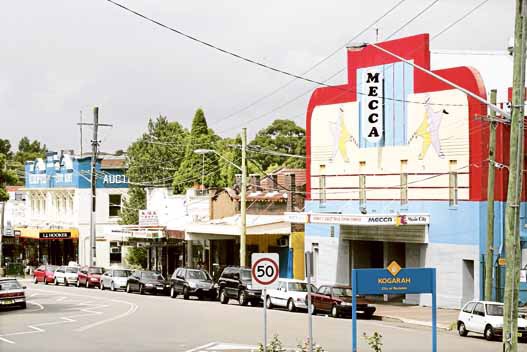
Yet there was one occasion when something almost happened. I would have been about 17, and worked for a menswear company at Roselands called E.L. Downes. There was a Clark Rubber store on the lower ground floor, and the manager there, named Barry, who was quite a handsome older man, served me on several occasions. I used to wave as I passed the store, and he used to sit next to me on the bus after work, as we both lived in Kogarah, though on opposite sides of the railway line. As I passed the store one lunchtime, he grabbed me and asked if I would like to go out with him. Without even a blink, I said yes! Told my workmates, and they just encouraged me…and it just didn’t dawn on me that obviously THEY knew I was gay! Talk about naive! Anyway, that weekend I met him at the station…at this time I was living with just my father (my mother left home in 1965), and there was no way I was telling him I was going out with a guy…and we cabbed it into The Cross to this VERY ritzy restaurant called “Mrs Beeton’s Tent”. I’d never been to such a sophisticated…and expensive… place, so was a bit dazzled by it all. Anyway, we got a cab to go home, and he was holding my hand in the back seat. All I could think was…what’s going to happen from here…what am I expected to do! If he asks me home, I’ll go…just to see what happens! The cab got back to Kogarah, and dropped us off at a small park in the main street. He grabbed me by the arm, and started pulling me towards the toilet block, telling me he couldn’t take me home, as he lived with his mother! A toilet block for my first sexual experience with a guy was NOT the romantic experience I was expecting, so broke his grip, said “my father’s expecting me home!” and fled up the street. Missed opportunities! Oh well, such is the life of the shy and naive! Not surprisingly, Barry never spoke to me again, and caught a later bus home from that time on.. When I think about it now, I just shake my head. Considering how outrageous I was to become…I can’t believe my actions that night!

Just after this I started renting with friends in Granville. It was around this time that I started buying bits and pieces of gay porn, and buying “Campaign” newspaper (it became a magazine at a later date). One old closeted gay guy I worked with at Pellegrini & Co knew I was gay, and he evidently wasn’t the only one. My flatmates took me to a party at the home of two gay guys they knew…John & Ray. They had me sussed out in the blink of an eye, but I ignored their innuendo and sly comments and continued to deny it. My flatmates found out by mistake when I went to Campbelltown in the latter half of the 70s to help my step-brothers (he also later turned out to be gay) wife who had had a stroke. I asked my housemates to bring up some clothes for me as I was staying a while, and…much to my horror, and despite a phone plea to ignore the magazines in the drawer (like that was going to happen!)…they unearthed my stash of gay porn mags, and actually kept hush about it until after I came out. In the interim, I had sex with one girl…Veronica…a friend of my female housemate, and who had a young daughter who actually idolised me…just to make sure I wasn’t straight!After having to fantasize about a man to get to orgasm with her, I think the dye was pretty well set…though Barry may have seen Kharma at work, as I shouted her a very expensive meal at the Millionaires Club in Darlinghurst on our first date, and she said no to sex as she wasn’t on the pill…that came after our second date. Yet I still didn’t come out, despite knowing for sure.

Me just before leaving for Melbourne at the Capitan Torres restaurant in Sydney circa 1978

However, circumstances were about to present me with the window of opportunityI needed, and the wherewithal to come crashing out of my closet!

In late 1978 my father committed suicide in bushland near his home in Vincentia, on the NSW south coast.. I am not going to go into details of life with my father, but suffice it to say it was tense. I cried a few crocodile tears, then clicked my heels and rejoiced. My sense of freedom at last was overwhelming! I don’t know what I would have done if this situation hadn’t presented itself. I could never have openly come out to him, as the repercussions could have been dire. As it was, I was moving further and further away…in a relationship sense…from all my family (I am not going into the complexities here, but…oh boy!) so it is possible that to live my own life, and be who I had to be, I would have cut them all off earlier than I did…or maybe Melbourne would have happened anyway, irrespective of anything, and I would just have cut them out of my life. I guess the simple fact was that I was an outcast…the black sheep of my family. One way or another…I really didn’t give a fuck!

In the middle of 1980, the retail company I worked for – Pellegrini & Co Pty Ltd – asked me if I would be interested in going to Melbourne and troubleshooting two stores they had down there. I jumped at the chance. So I flew to Melbourne, set up house in Cumming St, West Brunswick, and started to set in motion the cogs that would change my life, starting a whole new phase that would take me in directions I could never have imagined.

Now, this was no easy matter. Cogs can be complicated mechanisms. The two stores – one in the Myer Centre and one in Hardware Street were in a mess, and by the time Christmas 1980 rolled around, I had not even started having any social life, let alone coming out and banging my way through Melbourne! That was to come! After spending that Christmas and Boxing Day on my own with a bottle of whisky, I decided I needed to do something about it! But what? I went through the classifieds and social group listings in the gay press, mentally started ticking or crossing them out, then going through a process of elimination with the ticked ones, according to where I thought I might or might not fit in. One group seemed to stand out – Acceptance Gay Catholics. I knew not only all the ins and outs of the Catholic Church…but I managed businesses for a Catholic retailer. Seemed like a match made in heaven, so to speak! So I made a phone call, found out whose home the next First Friday Mass was held at, and the next First Friday found me heading out to suburbia to Max’s house for my first gay outing. I told no one I was not yet out, and not being from Melbourne they wouldn’t know if I was or not. Right up to the day I left Melbourne no one I knew was any the wiser.

So the guys all started piling in…and not exactly a pack of spunks, though a couple of lookers amongst them. Turns out the Servite Fathers conducted the masses for them. Not being under the jurisdiction of the local bishop, they were free to do what they liked.

A clone is born…Cumming St West Brunswick 1981.

After the mass there was a meal, then we hit Melbourne for a night out. My first gay club…The University Club in Swanston St. It was gay there every Friday and Saturday night. Started dancing with the guys from the group, and decided to play it safe by dancing with, then going home with, one of the older, plainer guys. At the grand age of 25 I was about to have my first gay sexual experience. It wasn’t the bells, whistles and fireworks I was expecting! In fact…it was a total dud!

Frank, naturally thrilled to bits to have a quite handsome bit of fluff come on to him (actually he made the first move – on the dancefloor! I wasn’t experienced enough to know that if you weren’t really interested, you said a polite “no thanks” and moved onto the next). I didn’t want to seem rude, so said yes when he invited me home, despite fancying a couple of the younger guys more. A steep learning curve here! So, Frank had a car and offered me a night at his place. I can’t remember where he lived now, but it was quite a drive out of the Melbourne CBD. No sooner was I in the car than he had my cock out, and out it remained all the way to his place, despite several near misses due to his…distraction! I often wonder what other drivers thought as Frank’s head disappeared from sight at every red light! Once we got indoors, I decided the ball was in his court and I would leave it up to him to drive proceedings. He assumed I was a young slut and would know how all the mechanisms of gay sex unfolded. Frank was also a bit old and stale, and not the most sexually adventurous person to go home with. From my perspective, I wouldn’t even be leaving the starters blocks with this one. Not an auspicious beginning to my gay sex life, having held myself back for so long. The next morning, it was breakfast, then finding out that I would be getting myself back into the city…on a train. Well, fuck you too, Frank!

At an Acceptance function just prior to returning to Sydney. Fred Diamond (left), Max (Centre) and me.

I started attending not just the First Friday Masses, but Sunday Evening masses as well, held in the Holy Trinity Catholic Church in North Fitzroy, and any of the other Acceptance social occasions that cropped up on the calendar. Thankfully, Frank attended pretty well none of these with any regularity, so it was quite a long time before I ran into him again. In the interim, I found out from Fred – we’ll get to Fred shortly – that he and the other young guys at the University Club that night were quite surprised to see me go home with him. Learn to say no is the first rule of survival on the gay scene!. So over the next few months I met the other members of Acceptance through the masses, or parties in their homes, and get-togethers in a few local eateries, and gay venues such as The Laird Hotel in Collingwood, Smarties Nightclub in North Melbourne, and Pokies, a Sunday night drag venue in St Kilda. My evil plan was working…I was starting to lead a gay life!

In the meantime, I wanted the world to know I was gay. I wrote to my ex-Granville flatmates and ‘fessed up…only to find out that they had known since the night they packed my luggage for Campbelltown. They had met my mother, who I had only just been reunited with prior to coming to Melbourne. On a visit to see her, they notified me by mail, they had accidentally outed me, thinking that I had notified her at the same time as them! They also informed me that she already suspected that I was gay, though she never brought the subject up with me. Years later, back in Sydney, I made no effort to hide my sexuality from her, though on a mother/son lunch in the city one day, she informed me that she blamed herself for it. It became a moot point between us, and she has never really reconciled herself to it. Tough shit! I wasn’t taking a step back for anyone!

After my rather unsettling encounter with Frank, where nothing more exciting than some oral happened, things went from bad to worse. I fell in love with Fred, who edited the Acceptance newsletter, and did a gossip column under the pseudonym of Jodi A Frean. Fred and I had a difficult sex life for the 6 months we were together, and being the innocent I was, I never picked up on the signals about his sexuality. Firstly, he was into light S&M…at least I knew that was, thanks to reading “The Joy Of Gay Sex” before venturing into the Gay void…and secondly…he was a beat quean! He, Danny (who was the second man to fuck me, and went to it like a rabbit on heat) and Jim (who gave me a handjob in the shower, after a swim at a beach house we went to for an overnight stay) were the only three Acceptance members I got off with. Another, Tony, who I should have been more attuned to, as he was more my type, had a crush on me, which I suspected, but unfortunately never followed up on.

At a Mass at my flat in West Brunswich, a very handsome man…Barry (I know…the same names seem to keep cropping up in my life)…caught my eye. He stayed after everyone else left. We chatted, he helped clean up, we drank some more wine, and ended up in the bedroom, where he had the great distinction of being the first man to fuck me. The sheer eroticism and intensity of getting fucked blew my mind! I took to it like a duck to water, and never looked back!

So, that was the start of my sex life. The next thing to do was to expand my horizons. A lot of thought went into it…I wasn’t a risk-taker so the beats held no appeal, no did the shadowy world of the sauna. I had been…unnecessarily… steeling and prodding myself to go to a nightclub in St Kilda called “Mandate”. It was to be another life-changing experience! I was terrified when I ventured there for the first time. It was unlike any nightclub I had been to before in that it didn’t have an entry where you just walked in. The door was closed, so I went and stood on the oppisite side of the street to see what was going on. It didn’t take long for it to dawn on me that, after watching several patrons arrive, that one knocked to gain entry. A security measure, obviously. So, over I go, knock on the door to find that a tiny window in the door opened, and I was being scrutinised by a drag queen. In my clone gear I obviously passed muster, as the door opened, I paid my entry, and up the stairs I went (NOTE: it was a good deal later that I found out that there were also under-stairs activities…though not my scene).

With Glenn W, the Sydney guy, at an Acceptance function. I foolishly allowed him to talk me into returning to Sydney…a mistake for both of us!

Here, I entered a world of men, and music, that set my heart blazing. There was a bar area to the left of the stairs, to the right was a communal area with a barred cruising area surrounding it, and to the rear was a copper dance floor that was to be pretty well my sole obsession over many, nany visits there. I loved Mandate. I loved its masculinity,  its testosterone-charged atmosphere, the pure maleness of it. If I had to imagine Nirvana in these early coming out days, Mandate was it and in the not too-distant future, the Midnight Shift in Sydney when I returned to my roots. I had my first pick-ups there, had my first public blow-job on the edge of the dance floor, met some wonderful men including a man called Brian Pryke who I had the most esoteric sexual experience with (and communicated with for a while after returning to Sin City), and some of my worst sexual experiences including a Dutch pilot who had the most disgusting dose of smegma I have ever encountered, and left me with the gift of anal warts. We live and learn! At Mandate I was introduced to dance floor filling icons such as Lime, Phyllis Nelson, Carol Jiani, 202 Machine, Shirley Lites, Tantra, KC and the Sunshine Band, Patrick Cowley, Sylvester, Divine, Paul Parker, Seventh Avenue, Peter Griffin, Hall & Oates, and many other artists who started my ongoing love for dance music. The wonderful nights I had in Mandate will live in my memory forever.

I continued my work and socialising with Acceptance (including some cross-denominational “spiritual shenanjgans” with a member of Angays (the Anglican version of Acceptance) until I returned to Sydney. They gave me a wonderful set of friends that kept me ocvupied constantly, and a rather frantic social life. I think that what disturbed me the most about being an out gay man in a Catholic social group was the “subtle” stigmatisation that we just seemed to accept. Though the Servite Fathers, who celebrated our home masses, were unequivocal in their support for the gay community, the particularly internalised discrimination and alienation that was integral within the Catholic church itself,  seemed to be tolerated more so than finding ways to support us. I always felt that much of the support came more from obligation than caring and understanding.

And while talking of the Servite Fathers, I must relate a home mass story here. First Friday Masses were shared amongst the various homes of Acceotance members. When I volunteered my flat in West Brunswick for one, I found I faced a dilemma. Confessions before mass were usually held in a private room, and the only one in my flat was the bedroom. The entire back of my bedroom door was covered in pictures of men in various poses and states of undress…mainly naked…and erect! In my wisdom, I decided that this was not an appropriate thing to have on display in a room where gay men were confessing their sins. Rather than remove all the pictures, I decided to tape a large sheet of brown paper over them.  Evidently during one of the confessions, the tape gave way, causing the paper to fall to the floor. Evidently there was a brief pause in the confession as the priest eyed off the door full of naked males, then continued on as if nothing had happened. The exposition was the cause of much hilarity for the rest of the night, with the priest commenting on my “good taste in art” as he departed.

The only other churches that catered to us were St Francis in Lonsdale St, and Holy Trinity Church in North Fitzroy. And even then we could only attend masses at certain times on Sundays. It felt very alienating, and was one of the reasons for me joining the Gay Rights Lobby when I returned to Sydney. For me personally, well….I was an Athiest disguised as a Catholic…just to secure myself a social life, though going through the actions of being a Catholic, and arguing stronly against the banality of much of Catholic belief and doctrine at every opportunity, which caused me no qualms. Only once was I dressed down regarding my staunchly held opinions, and I was stronly supported by the group I was with, as they did not believe in blind faith. There is hope yet in the world.

I went on to become Secretary on the Acceptance committee, and also a member of their social activities sub-committee. But I was about to make a really fucked-up decision that was about to yet again change my life’s direction.

It was at an Acceptance barbecue that I was to meet Glenn W, who was visiting Melbourne, and lived in Waverton in Sydney. It was a period where the Pellegrini head office in Sydney were quietly hassling for my return. Glenn quite swept me off my feet, and after several months of correspondence and with a position as assistant to the General Manager offered to me back in Sydney I rather foolishly decided to return.

So ended my wonderful, unforgettable life in Melbourne. Plans were afoot for a massed goodbye for me at Tullamarine, but to avoid what would have been a very tearful occasion, I quietly flew out the night before.

Glenn W turned out to be a psychopath! Another disastrous love encounter! Would I never learn! But that is a Sydney story! As is the early days of HIV, already being hinted at in the Melbourne gay press. Hard times ahead…and just as I was starting to enjoy the life that “coming out” was presenting to me. The Sydney story was about to begin!

Tim Alderman

(C) 2015
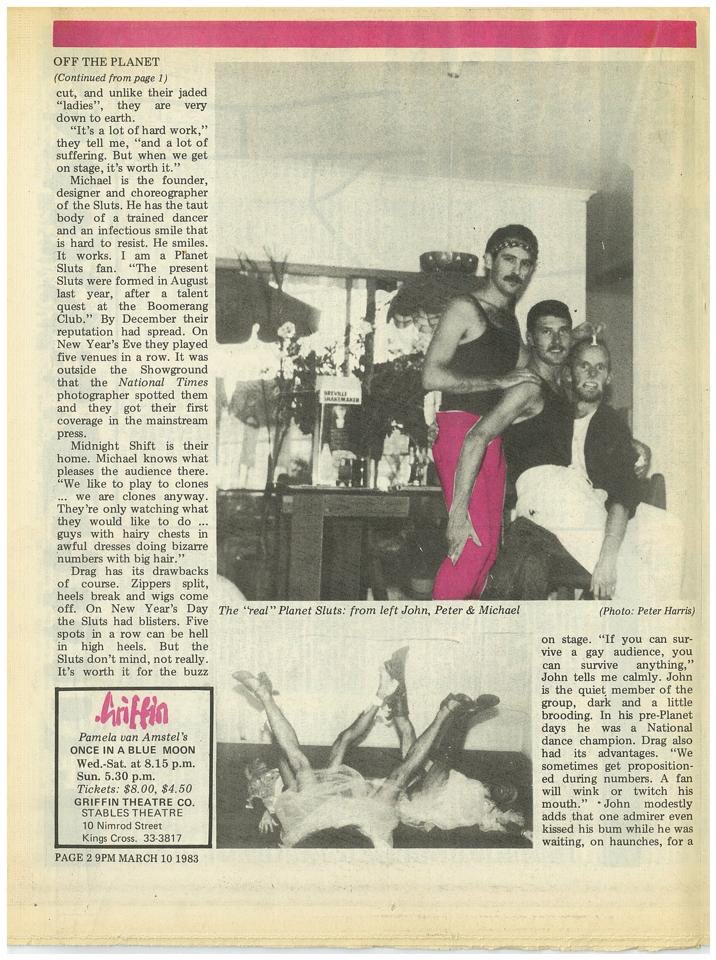
Australian Icons:The Ferocious Australian Drop Bear

phascolarctos malum or Thylarctos plummetus, depending on what area they are from.

According to Wikipedia (http://en.m.wikipedia.org/wiki/Drop_bear) “A dropbear or drop bear is a fictitious Australian marsupial.[1] Drop bears are commonly said to be unusually large, vicious, carnivorous marsupials related to koalas (although the koala is not a bear) that inhabit treetops and attack their prey by dropping onto their heads from above.[2][3] They are an example of local lore intended to frighten and confuse outsiders and amuse locals, similar to the jackalope, hoop snake, wild haggis or snipe.

Various methods suggested to deter drop bear attacks include placing forks in the hair, having Vegemite or toothpaste spread behind the ears or in the armpits, urinating on oneself, and only speaking English in an Australian accent.”

I have never really looked into the lore behind our local super marsupial…the drop bear. However, this morning – it being Australia Day here – I jokingly made a reference to them in a Facebook post, saying to be careful, as I had seen them heading into the bush with a slab (carton of beer). Then my writer instinct kicked in, and I wondered just how had this mythology around the drop bear started, and just how ingrained into our iconology had it become.

Us Aussies find the whole tourist scare “campaign” about drop bears hilarious. I have a friend – an Australian – who lives in NYC and has a lot of American friends. He gets great delight out of scaring them to death, relating stories about the dangers of drop bears if touristing here, backed up with comments from us over here. I tend to wonder about the gullibility of people.

The wonderful thing about the drop bear myth is how it has come to be backed up with some pretty credible research from believable organisations and publications. It would seem that everyone wants to be in on the joke. This from the Australian Museum:

http://australianmuseum.net.au/Drop-Bear

If ever there was an institution to give legitimacy to a subject, anything with the word “museum” in it would be right up there. Also, some “serious” research work from the “Australian Geographic”:

http://www.australiangeographic.com.au/news/2013/03/drop-bears-target-tourists,-study-says/

The research, done in a NSW drop bear Hot-Spot, has found that talking with an Australian accent helps keep them at bay.

Needless to say, spoof sights for drop bears have cropped up as well, and one has to wonder just how many overseas tourists have clicked on this link and booked a Drop Bear Adventure. Too funny.

http://www.dropbearadventures.com.au/drop-bear/

And this from Buzzfeed:

http://www.buzzfeed.com/cconnelly/10-terrifying-facts-about-the-australian-dropbear-s3x

There are also three apps to play games of Drop Bear.

Drop Bears are a great example not only of the often perverse Australian sense of humour, but is one of our endearing qualities…not taking ourselves too seriously, and liking to laugh at ourselves.

This link has someone even creating a history for them:

https://picsandstuff.wordpress.com/tag/drop-bear/

But perhaps more than anything is the proliferation of photos and graphics that depict drop bears. You can never say Australians don’t have a sense of humour!

2015/01/img_3136.jpg

2015/01/img_3134.jpg

2015/01/img_3135.jpg

2015/01/img_3138.png

2015/01/img_3139.jpg

2015/01/img_3140.jpg

2015/01/img_3141.jpg

2015/01/img_3142.jpg

2015/01/img_3143.jpg

2015/01/img_3145.jpg

2015/01/img_3144.jpg

2015/01/img_3147.jpg

2015/01/img_3146.gif

2015/01/img_3148.jpg

2015/01/img_3151.jpg

2015/01/img_3153.jpg

2015/01/img_3149.jpg

2015/01/img_3150.png

2015/01/img_3152.jpg

2015/01/img_3154.jpg

2015/01/img_3155.jpg

2015/01/img_3157.jpg

2015/01/img_3156.jpg

2015/01/img_3158.png

2015/01/img_3163.jpg

2015/01/img_3161.jpg

2015/01/img_3162.jpg

2015/01/img_3160.jpg

2015/01/img_3159.jpg

Tim Alderman
(C) 2015

Destroyed (or Almost) Icons: The Sad Life and Demise of a Majestic Cinema.

What a sad story on the life of what was a majestic cinema. The old Mecca cinema in Kogarah, New South Wales, which was affiliated to the Mecca cinema (originally The Savoy) in Hurstville, New South Wales.

I used to go the beautiful Savoy cinema in Hurstville, as I’m sure my cousins Donna and Jeffrey would have done, as they wereliving in Riverwood at the time. My father moved us to Ocean St in Kogarah – the ugly apartment building is still there on the corner – in 1966, and I went to the Mecca there to see movies. In fact, I had a dispute with the ticket-seller on one occasion, after the new decimal currency had been introduced, and some of the coinage…I can’t remember which – had a double value until the coins went out of circulation. As a business they took the coins at the lower value. As a consumer I took them at the higher, and by law they had to take the coins at the higher value. She was trying to tell me I didn’t have enough for the ticket, and I was arguing that my handful of mixed currency was enough -to the cent/penny. I won! Lol

http://pastlivesofthenearfuture.com/2014/09/29/mecca-theatreresidential-kogarah-nsw/
That the two cinemas ended up in the hands of a “cinema Paedophile – follow the links from the first story – is indeed disturbing, though in a way adds to the colourful history of the cinemas.
Originally The Savoy in Hurstville – which became The Mecca – shows the very sad demise of the Grand Dames of Art Deco cinemas as the advent of television put a temporary halt – or rather a slowing – on cinema audiences. This was the Savoy on its opening night in 1937…

http://pastlivesofthenearfuture.com/2014/07/29/opening-night-at-the-hurstville-savoy-1937/
And this, sadly, is what it became…

http://pastlivesofthenearfuture.com/2015/01/22/intencitytarget-hurstville-nsw/
Just as an aside, right next to my home in Samford Rd, Gaythorne, there is a building that used to be a Civic cinema, but which is now a row of nearly all “For Lease” business premises. Another sad loss.

2015/01/img_3056.jpg

Tim Alderman (C) 2015
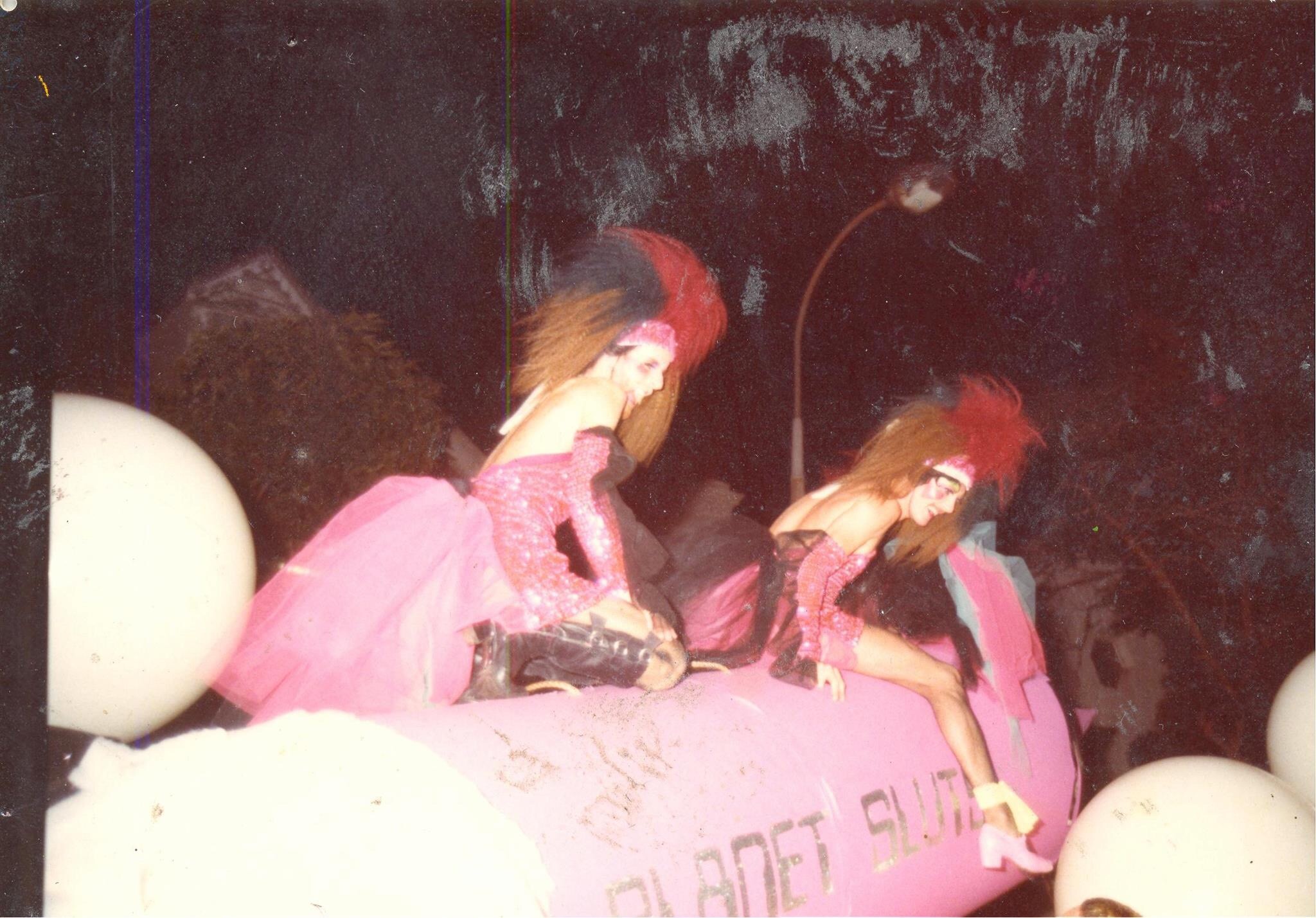
2015/01/img_3055.jpg