Category Archives: Gay Interest
Gay History: LGBT Rights In The 1950s-60s
Gay History: Watch the Scary 1961 Anti-Gay PSA – “Boys Beware” – Video
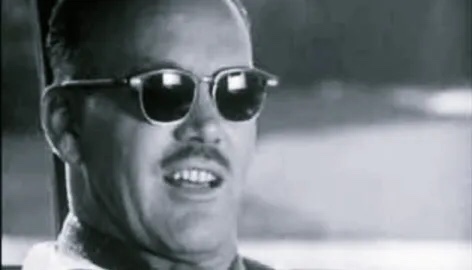
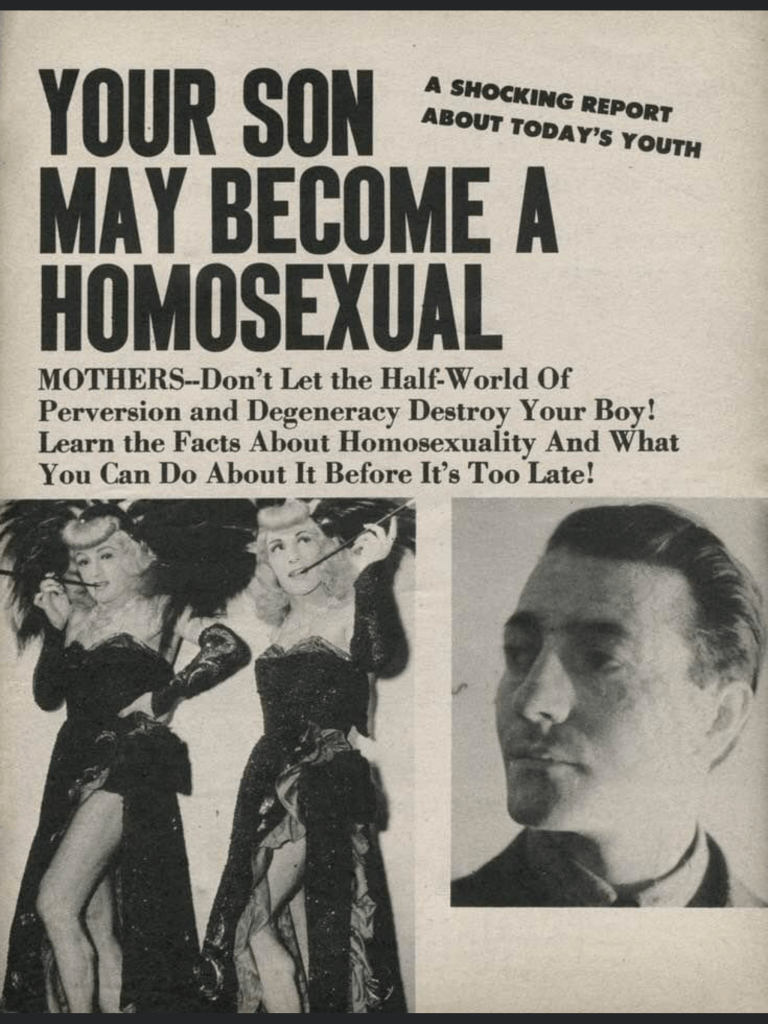
Boys Beware was a short PSA film produced by Sid Davis productions in 1959 on the suggestion of the Inglewood Police Department in Southern California. It was ostensibly was made to warn young boys of the danger of predatory men on purpose.
What Jimmy didn’t know was the Ralph was sick. A sickness not visible like smallpox, but no less dangerous and contagious- a sickness of the mind. You see Ralph was a homosexual, a person who demands an intimate relationship with members of their own sex.”
At one point in time Boys Beware was required viewing for males in many school districts across the country.
Reference
- Watch the Scary 1961 Anti-Gay PSA – “Boys Beware” – Video, Back2Stonewall, 16 May 2021, by Will Kohler http://www.back2stonewall.com/2021/05/watch-the-scary-1950s-anti-homosexual-psa-boys-beware-video.html
Gay History: Julian Eltinge The World’s Greatest Forgotten Female Impersonator – RARE 1929 Video

May 14, 1883 – On this day of America’s foremost female impersonator is born in Newtonville, Massachusetts. Julian Eltinge was a stage and silent film star who few actually realized was a man. So popular was he that during the Korean War a troop ship was named in his, or rather, her honor.
After appearing in the Boston Cadets Revue at the age of ten in feminine garb, Eltinge garnered notice from other producers and made his first appearance on Broadway in 1904. As his star began to rise, he appeared in vaudeville and toured Europe and the United States, even giving a command performance before King Edward VII. Eltinge appeared in a series of musical comedies written specifically for his talents starting in 1910 with The Fascinating Widow, returning to vaudeville in 1918. His popularity soon earned him the title of “Mr. Lillian Russell” for the equally popular beauty and musical comedy star.
Hollywood beckoned Eltinge and in 1917 he appeared in his first feature film, The Countess Charming. This would lead to other films including 1918s The Isle of Love with Rudolph Valentino and Virginia Rappe. By the time Eltinge arrived in Hollywood, he was considered one of the highest paid actors on the American stage,
Eltinge was an intimate of the top Hollywood stars and a wealthy man, worth over $250,000. He built Villa Capistrano, one of the most lavish villa’s in the Hollywood area, where he lived with his mother and entertained lavishly. He also built a ‘dude ranch’ for men in Alpine, CA near San Diego But times were changing. The outrageous performances of female impersonators Francis Renault and Bert Savoy, and the drag balls and gay speakeasies of the 20’s “pansy craze” in New York made Eltinge’s style appear old-fashioned. He began to drink heavily and in 1923 was caught smuggling liquor from Canada. Despite a sensational trial and bad press, he managed to get an acquittal.
It was the beginning of his decline and with the arrival of the Great Depression and the death of vaudeville, Eltinge’s star began to fade.. Eltinge resorted to performing in nightclubs. Crackdowns on cross-dressing in public, a misguided attempt to curb homosexual activity, prevented Eltinge from performing in costume. At one appearance in a Los Angeles club, Eltinge stood next to displays of his gowns while describing his old characters.
On May 7, 1941, Eltinge fell ill while performing at Billy Rose’s Diamond Horseshoe nightclub. He was taken home and died in his apartment ten days later. His death certificate lists the cause of death as a cerebral hemorrhage.
Julian Eltinge leaves a legacy as one of the greatest and most forgotten female impersonators of the 20th.century.
Raise a glass and remember Julian/Vestta!
“My heart is simply melting at the thought of Julian Eltinge;
His alter ego, Vesta Tilley, too.
Since our language is so dexterous, let us call them ambi-sexterous –
Why hasn’t this occurred before to you?”
Dorothy Parker, “A Musical Comedy Thought” – Vanity Fair, June 1916
Reference
- Gay History – May 14, 1883: Julian Eltinge The World’s Greatest Forgotten Female Impersonator – RARE 1929 Video, Back2Stonewall, 14 May 2021, by Will Kohler http://www.back2stonewall.com/2021/05/gay-history-may-14-1883-worlds-greatest-female-impersonator-julian-eltinge.html
Gay History: John F. Kennedy Had A Gay Best Friend Who Even Had His Own Room At The White House
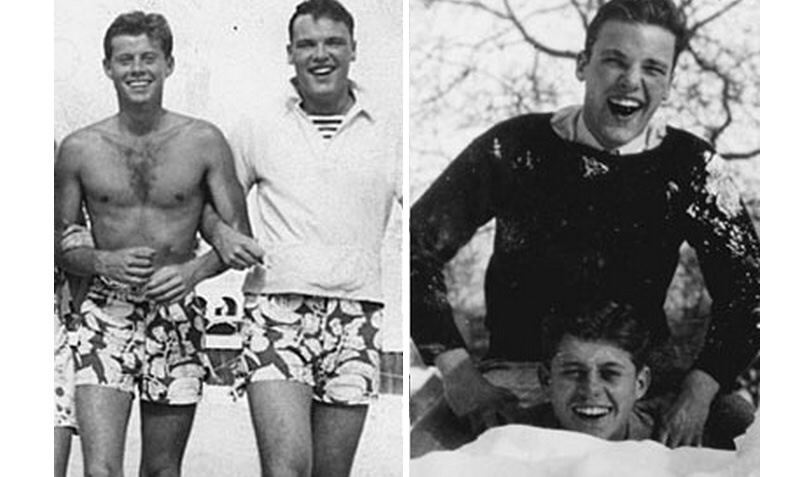
The book “Jack and Lem: John F. Kennedy and Lem Billings: The Untold Story of an Extraordinary Friendship,” details the extraordinary relationship between two unlikely friends.
JFK, or ‘Jack’ as he was known by his close friends and family, had a gay best friend named Lem Billings, who he met in prep school when Kennedy was 15 and Lem was 16.
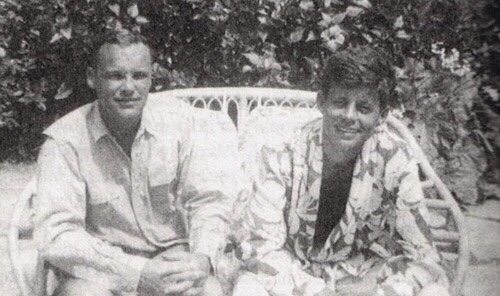
The pair became the best of friends who wrote letters to each other when they were apart, traveled to Europe together and were so close that Joseph Kennedy Sr. thought of Billings as another son, according to GregInHollywood.

The book details JFK’s angry reaction to Lem after he made a sexual advance towards him, saying: “I’m not that kind of boy.” But this misunderstanding did not end the duo’s relationship.
Writes GregInHollywood:
From the time he and Kirk LeMoyne “Lem” Billings met at Choate, until the President’s assassination thirty years later, they remained best friends.
Lem was a virtual fixture in the Kennedy family who even had his own room at the White House.

The book about their friendship draws on hundreds of letters and telegrams between the two, Billings’s oral history and interviews with family and friends like Ben Bradlee, Gore Vidal, and Ted Sorensen.
It was a friendship that endured despite an era of rampant homophobia.
Billings was a graduate of Princeton University and Harvard Business School and was an advertising executive at the Manhattan advertising firm Lennen & Newell. He put his business career on hold to work on Kennedy’s campaign for president.

Bradlee says in the book: “I suppose it’s known that Lem was gay….It impressed me that Jack had gay friends.”
Billings obviously never came out but did once say: “Jack made a big difference in my life. Because of him, I was never lonely. He may have been the reason I never got married.”

Kenneth Hill of WoolfAndWilde, conducted a fascinating interview with David Pitts, the author of ‘Jack and Lem’, to uncover some more details about the extraordinary relationship between the two unlikely friends:
Kenneth Hill: How would you characterize the friendship between JFK and Lem Billings?
David Pitts: The way I would characterize it is that is was a very close, deep, friendship across sexual orientation lines.
KH: You said that this was the story of a friendship that crossed sexual orientation lines, which I think is really an interesting element of it, but talk a little bit about the depth of this friendship. The fact that it started when they were very young and, from what I read in the book, they were basically inseparable for the rest of their lives except when circumstances had them in distant cities.
DP: Yes, indeed. I think there were a number of elements to it. First of all, there were a series of bonding events early on. One was the fact that they both hated that school [Choate] in which they met. And were engaged in all kinds of pranks which almost got them expelled twice. That was obviously a bonding phenomenon. Secondly, they roomed together for part of the time at the school.
Thirdly, and I think this is really important, John Kennedy was so sick most of his life, far earlier than when most people think, including when he was at Choate, and Lem was the person at boarding school — his mother and father did not come to the school when he was ill; Lem was there. Lem was the person who was always there for him and took care of him. And then fourthly, there was the two month trip to Europe that they took, just before WWII in 1937, just the two Americans at that pivotal time, I think that was obviously a very strong bonding event.
And then over and above these issues, I would say this — and this is kind of a complicated thought because we really don’t have language to express these kinds of relationships — and that is, I’m firmly convinced after working on this book that John Kennedy’s sexual interests were in women. We don’t need much evidence of that, the evidence is all over the place. But his strongest emotional attachments were to men — and principally, to Lem. We don’t have a word for that, right? Somebody who prefers the opposite gender for sexuality, and the same gender for deep, emotional attachments.
KH: We don’t really have a word for that. I guess “man’s man” used to sort of mean that, but JFK took it so much further in a way because he loved being around men, he knew some men were attracted to him and even seemed to enjoy it. He liked the stimulation of those relationships, there was nothing sexual about it, but there was something about that male-male dynamic that fed him.
DP: I think that’s exactly right. There was one reviewer who wrote, “What’s the big deal here? This guy’s writing that JFK was comfortable with gay men, so big deal, we all knew that.” But of course it’s not the fact that he had a friend named Lem Billings who was gay. This was the closest person in all the world to him outside of his family for 30 years. He wasn’t just “a gay friend” on the side.
KH: One of the very surprising facts that comes out in this book is that Lem had his own room at the White House?
DP: Yes, that’s one of the revelations in the book that’s really surprising. And actually some of the people who were working in the White House very close to JFK didn’t know it. For example, Ted Sorensen whom I interviewed for the book, perhaps the closest aide to JFK, saw Lem around the White House all the time, but he told me he didn’t know that he’d had his own room there and was staying there so much of the time. But yeah, that’s another indication of the depth of the attachment.
One thing I was intent on doing when I wrote this book, because I thought it would be open to various forms of attack, is that I never went beyond what the documents said. The book is a lot of quotes from documents, or that interviewees said. This friendship might have contained a lot of things that I wasn’t able to find out because I didn’t want to enter the area of speculation.
KH: It seems without a doubt that Lem was in love with JFK. But it’s never stated explicitly because you don’t have any record of his ever saying that.
DP: No, I think the closest … I mean, these were more sedate times, especially where homosexuality is concerned. Even in the various documents, Lem is never overt in his statements. But there was one statement from one of the documents, and I have it in front of me here, that I think is just expresses his feelings. Here’s the quote: “Jack made a big difference in my life. Because of him, I was never lonely. He may have been the reason I never got married.”
This is somewhat of a difficult thought as well, but I think gay people had a way back then of telegraphing to future generations what their feelings were that they could not express candidly at the time. And anybody who reads some of these words today would have no doubt what Lem’s feelings were, but in the context of that time it was not obviously understood.
Reference
- John F. Kennedy Had A Gay Best Friend Who Even Had His Own Room At The White House, The Gaily Grind, 23 November 2013, by Adrian Garcia https://thegailygrind.com/2013/11/23/john-f-kennedy-gay-best-friend-even-room-white-house/
Gay History: Pride, Prejudice and Punishment: Gay Rights Around The World
Australians have voted in favour of legalising same-sex marriage — but elsewhere in the world gay people can struggle to simply stay out of jail.
Being openly gay is effectively illegal in more than 70 countries — and can result in severe punishment, sometimes even death.
See how Australia’s position on same-sex marriage compares around the world.
The state of marriage rights

Voters’ ‘yes’ response to the SSM postal survey is Australia’s latest step towards allowing same-sex couples to marry, and may prove close to the culmination of a long campaign.
Campaigners have suggested Australia is lagging behind rest of the world.
It is fair to say that most countries with similar cultural backgrounds to Australia have now legalised same-sex marriage, but based on total country numbers, Australia remains part of the majority in restricting marriage to couples made up of a man and a woman.
Out of 209 countries the ABC examined, only 24 allow same-sex couples to marry.
There is no same-sex marriage in Asia or the Middle East, and South Africa is the only country in Africa to have legalised it.
In Europe, the legal status of same-sex marriage is mixed. The Netherlands was the first country in the world to legalise same-sex marriage in 2001, with other Western countries including the United Kingdom, France, Spain and Germany following it.
Yet more than half of European Union members have not.
Reuters: Antonio Bronic
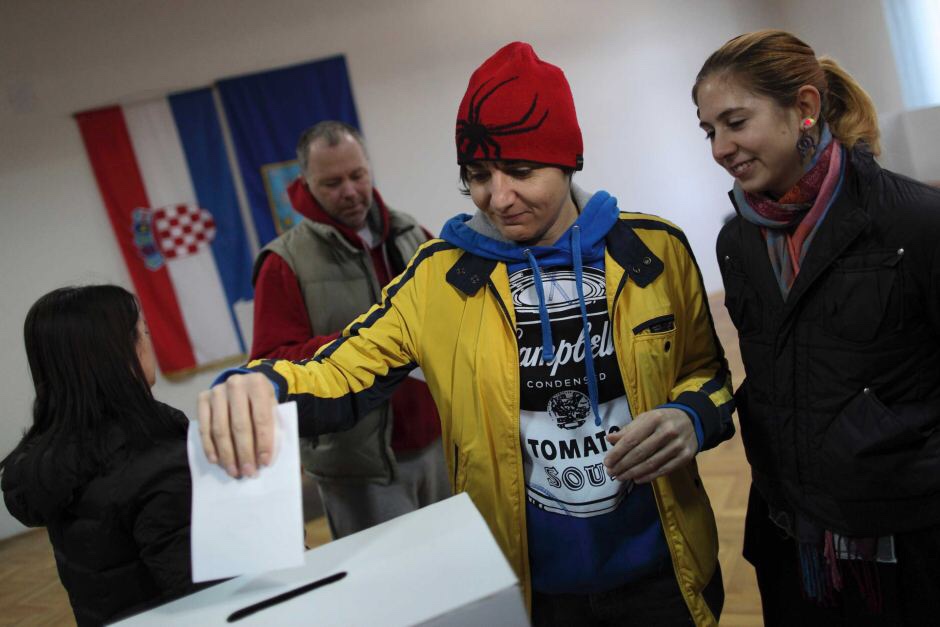
Some countries in Eastern Europe have recently sought to amend their constitutions to entrench the “traditional definition” of marriage:
- Hungary brought in a new constitution in 2011 that specifically restricts marriage to heterosexual couples.
- Voters in Croatia (2013) and Slovakia (2015) voted to change the definition of marriage in their constitutions so that it applies only to a union of a man and a woman, although the Slovakian referendum was invalid due to a low turnout.
- In December 2015, Slovenian voters rejected the legalisation of same-sex marriage in a referendum.
Australia made a similar amendment to its Marriage Act in 2004, adding a definition of marriage as “the union of a man and a woman to the exclusion of all others”.
How have countries legalised same-sex marriage?
In Australia, Parliament can legalise same-sex marriage by amending the Marriage Act but the Government’s policy has been that its MPs will only be able to vote for same-sex marriage if a majority of Australians support the change via a plebiscite.
The Government’s compulsory plebiscite proposal was defeatedin the Senate. Instead, the non-compulsory Australian Marriage Law Postal Survey was run by the Australian Bureau of Statistics between September 12 and November 7.
After the survey returned a yes outcome, a private member’s bill will now be debated in Parliament to legalise marriage between people of the same sex.
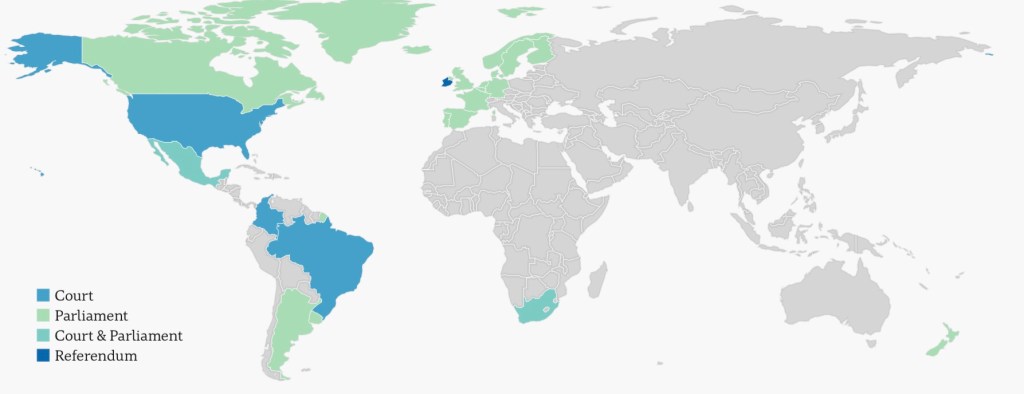
Out of the countries that have legalised same-sex marriage:
- Only one country, Ireland, put the change to a people’s vote. A referendum was legally required, held in May 2015, and overwhelmingly passed.
- Parliaments legalised same-sex marriage in 20 countries.
- Court rulings prompted the change in five countries.
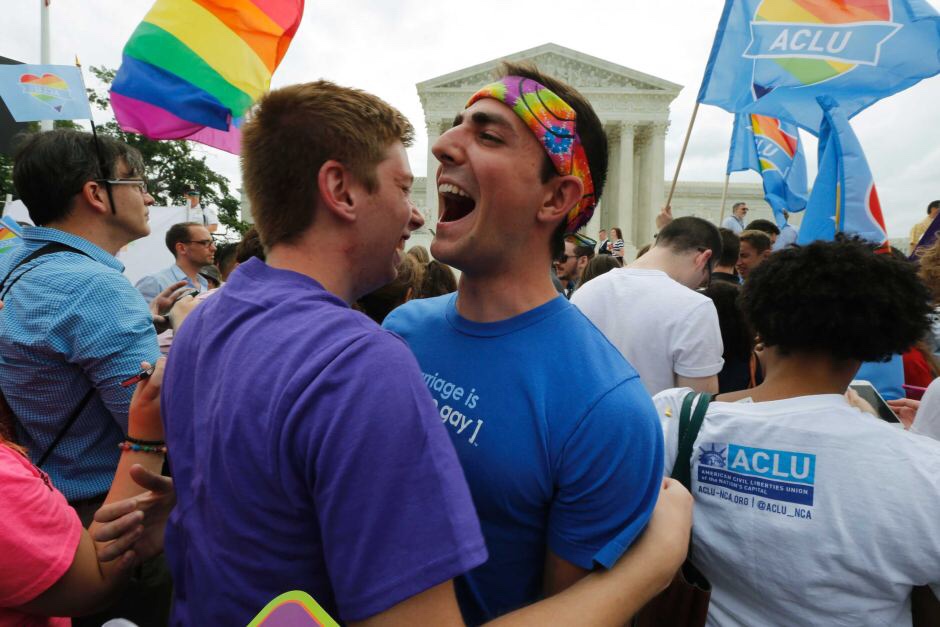
The highest-profile court decision was in the United States in 2013, when the Supreme Court effectively legalised same-sex marriage by finding the Defence of Marriage Act was unconstitutional.
Most recently, in April 2017, the Constitutional Court of Taiwan (Republic of China) ruled that the Taiwanese law defining marriage as a union between a man and a woman was unconstitutional. It ordered that a change in the law had to occur within two years. At the time of writing, same-sex marriage is still unavailable in Taiwan.
Where is being gay illegal?

Marriage is an important issue in Western countries but elsewhere in the world, LGBT people can struggle to simply stay out of jail.
There are more than 70 countries where homosexual acts are illegal.
The countries shaded in the map above are those where there is a law that prohibits homosexual acts in part or all of the country.
Most of these countries fall within two main categories — just over half are former colonies mostly in Africa that inherited discriminatory laws but never repealed them, while the others are majority-Muslim countries.
The International Lesbian, Gay, Bisexual, Trans and Intersex Association (ILGA) publishes an annual report of “state-sponsored homophobia”.
What exactly is outlawed varies from country to country. Twenty-eight states only prohibit relations between men.
A common formulation is a prohibition of “carnal intercourse against the order of nature”.
Sometimes gay sex is placed in the same category as bestiality.
- In India it is an offence to “voluntarily [have] carnal intercourse against the order of nature with any man, woman or animal”.
- In Mauritius, it is a crime to commit “sodomy or bestiality”.
- In Uganda, a law provides for a seven-year jail term for anyone who conducts a same-sex marriage ceremony.

Reuters: Thomas Mukoya
Not all the countries with these laws actually enforce them for consensual sex at home.
The Singapore Penal Code prohibits “any act of gross indecency with another male person” in “public or private”, with a maximum penalty of two years in prison.
But National University of Singapore Assistant Professor Lynette Chua says the ban has “seldom been applied in private, consensual situations and [is] typically used in non-consensual situations or cases involving minors”.
Similarly, Shakira Hussein of the National Centre of Excellence for Islamic Studies at the University of Melbourne suggests that in Islam “on all sexual matters … it isn’t the act itself that is to be punished but the public commission of it”.
“Some sharia scholars say that the laws against illicit sex should basically be regarded as laws against public indecency, since they require four witnesses.”
Even if bans aren’t strictly enforced, they often still have a harmful impact on LGBT people.
Achim Hildebrandt of the University of Stuttgart says such bans “represent an ever-present threat of blackmail and public disgrace … they drive gays and lesbians out of public life and prevent them from demanding more far-reaching reforms such as the outlawing of discrimination in the workplace and the housing market”.
Where do LGBT people risk the death penalty?

The death penalty is in place for same-sex sexual acts in at least 11 countries.
According to the IGLA, the death penalty applies in Sudan, Iran, Saudi Arabia and Yemen and in parts of Nigeria and Somalia.
In theory the death penalty could also be imposed in Mauritania, Afghanistan, Pakistan, Qatar and the United Arab Emiratesthrough sharia law, but this does not appear to have occurred in practice.
Information on when the death penalty has been carried out is not readily available.
The “Erasing 76 Crimes” blog, which advocates for the repeal of anti-LGBT laws around the world, indicates that only Iran and Saudi Arabia have actually carried out executions for same-sex activity in recent times.
The blog’s founder, Colin Stewart, says that in Saudi Arabia“beheadings have been imposed for homosexual behaviour in the past, including three men in 2002, but imprisonment and lashings are a more common punishment”.
“Iran is second in the world for frequency of executions [after China], including executions for homosexual activity, although the facts about the offences being punished are often unclear or misrepresented in news accounts.”

Reuters: Fayaz Aziz
At the same time, Dr Hussein points out the existence of established trans communities in Iran and Pakistan. She tells the ABC:
“Some same-sex male couples circumvent laws against homosexuality by getting a doctors’ certificate to say that one half of the couple is a trans woman. Supposedly, this is meant to be followed up with surgery, but that isn’t necessarily carried through.
“Pakistan has had a ‘third gender’ option on the national ID card for a few years now [and] Iran has one of the highest rates of male-to-female trans surgery in the world.”
What other forms of harassment take place?
Intimidation of LGBT people is not restricted to the threat of jail or death.
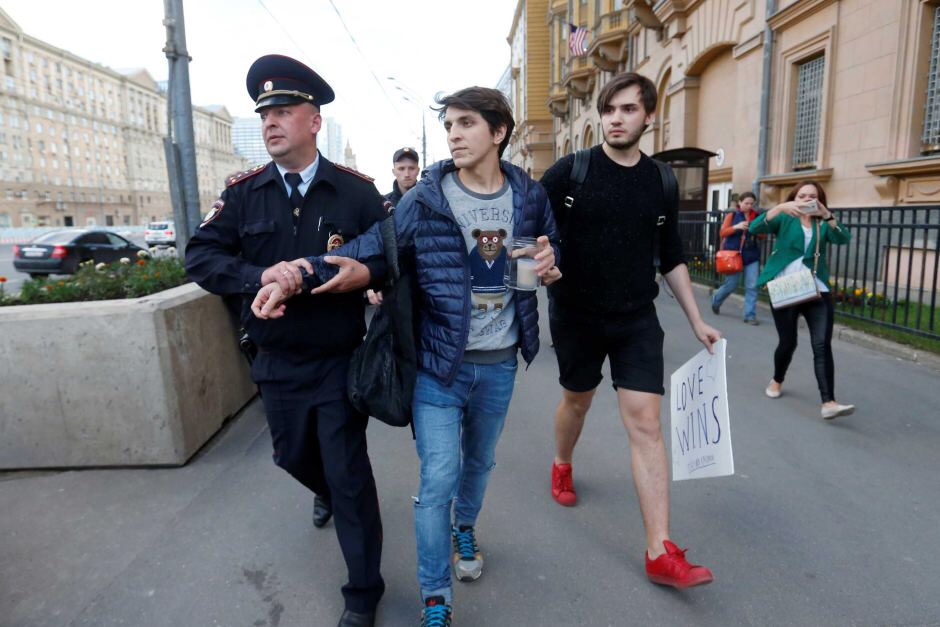
Homosexuality is legal in Russia but in recent years the Government has imposed laws that ban “promotion” of “sodomy, lesbianism, bisexuality and transgenderism”.
Omar G Encarnacion of Bard College in New York suggests thatRussia’s law “is so broad that it outlaws gay pride parades, public displays of affection by same-sex couples, gay symbols such as the rainbow flag, and even a public admission of homosexuality, unless made in the way that casts homosexuality in a negative light”.
Reuters: Maxim Zmeyev
Closer to home, Singapore takes a tough line on “promotion” of LGBT issues — on paper at least.
According to Assistant Professor Chua, “Singaporean media are banned from carrying content that “promotes”, “justifies” or “glamorises” “lifestyles such as homosexuality, lesbianism, bisexualism, transsexualism [and] transvestism”.
In mid-2014, the National Library of Singapore announced it would pulp its copies of three children’s books with LGBT themes. According to the Government-linked Straits Times Newspaper:
“And Tango Makes Three is based on the true story of a pair of male penguins who raise a chick together; The White Swan Express features adoptive parents such as a lesbian couple; and Who’s In My Family highlights different family structures and includes same-sex parents.”
After a public outcry, two of the books were returned to the library but placed in the adults’ section.
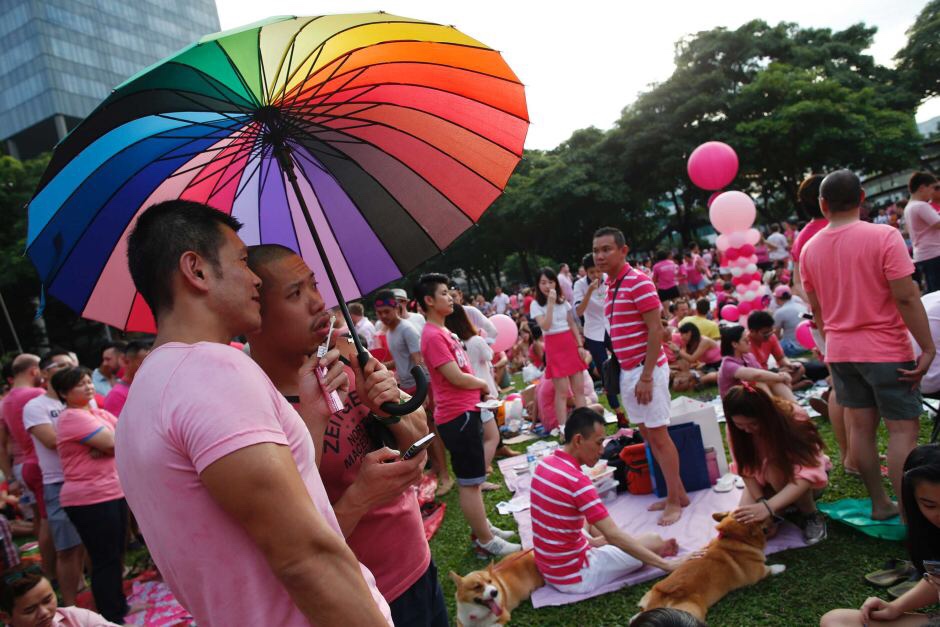
In June 2016, the Singapore Government announced that“foreign entities should not fund, support or influence” Pinkdot, an annual LGBT event held in a Singapore park.
Brad Adams, Asia director of Human Rights Watch, suggests“Singapore’s demand that foreign companies stop sponsoring PinkDot encourages corporations to discriminate against LGBT people”.
Reuters: Edgar Su
Leaders in other countries freely use discriminatory language against LGBT people:
- In 2015, the mayor of Budapest in Hungary described the city’s Gay Pride rally as “repulsive”.
- In Africa, Ugandan president Yoweri Museveni has describedhomosexual people as “disgusting”.
The ABC has recently reported on LGBT Ugandans fleeing the country as refugees.

Reuters: Philimon Bulawayo
Zimbabwe President Robert Mugabe has previously said that:“Homosexuals are worse than dogs and pigs; dogs and pigs will never engage in homosexual madness,” and followed this up in 2013 by stating that LGBT people were “worse than pigs, goats and birds”.
In 2016 the ageing ruler vowed that Zimbabwe would reject any foreign aid that is “given on the basis that we accept the principle of gay marriages”.
Are things getting better for LGBT people?
With LGBT harassment and criminal penalties continuing in Africa, Asia, the Middle East and parts of Europe, the picture may seem bleak.
But veteran campaigner Peter Tatchell, who famously attempted a citizen’s arrest of Robert Mugabe in March 2001 and was then beaten by the president’s bodyguards, is more optimistic.
“There are rays of hope [in Africa], with the Seychelles, Mozambique and Sao Tome & Principe recently decriminalising homosexuality [and] in 2014, the African Commission on Human Rights and People’s Rights urged member states to protect LGBT people against discrimination and violence,” he says.
Ty Cobb from Human Rights Campaign said: “We have seen great progress with regards to global LGBTQ rights in recent years, with three countries decriminalising same-sex activity just [in 2016], 20 countries and certain jurisdictions in Mexico have marriage equality and more and more countries are taking measures to improve the lives of trans individuals.”
At the same time, Mr Cobb notes that anti-LGBT movements continue to work against the community.
“Extremists have organised marches against marriage equality efforts in Mexico, American evangelicals have resorted to exporting their dangerous messages of hate from Eastern Europe to Africa, and [Islamic State] continues to target and kill members of the LGBTQ community throughout the Arab world,” he says.
In Singapore, there are signs of increased cultural acceptance of the LGBT community, with the 2016 release of home-grown web drama People Like Us taking place with no real backlash.
Telling the stories of four gay men in Singapore, the series has been well-received by the local community.
Filmaker Leon Cheo says apart from some “thumbs-down” on YouTube, “we haven’t received flak or negative emails or comments from Singaporeans at large”.
Mr Cheo says while the situation for LGBT people in Singapore is improving, “challenges such as censorship of neutral and positive LGBT news, film and TV, and archaic anti-sodomy laws still exist”.
“One of our creative objectives was to portray Asian gay men neutrally or positively [so that the] series could play a part in changing the hearts and minds of the citizens and government of Singapore,” he says.
In the Middle East, LGBT rights remain strongest in Israel although it is unclear whether or when same-sex marriage might be legalised there.
Reference
- Pride, prejudice and punishment: Gay rights around the world, ABC News, 15 November 2017, by Paul Crossley, Colin Gourlay, and Ben Spraggon https://www.abc.net.au/news/2017-03-04/gay-lesbian-mardi-gras-rights-around-the-world/8126828?nw=0
When Mom Blamed Eldest Son Of “Spreading Gayness” To Gay Teen Brother, He Adopted Him

Sadly, not every coming out story has a happy ending – but this recent Reddit post by a gay brother has a beautiful happy ending.
jason45q originally posted:My mother is a very complicated woman. She can be really sweet, but fucking batshit crazy at other times. I moved out a long time ago, I’m 27 and I left the house as soon as I turned 18 (also right after coming out). She didn’t disown me, but made a lot of homophobic remarks about me “joining the fags” and denying her grandchildren.
…
Today, I received a very angry phone call from my mom. I have a younger brother who’s 14 who lives with my parents and my sister. My mom snooped through his phone and apparently found a few texts to his friend confessing that he was gay. Suddenly, I’m responsible for engulfing him with my rainbow wrath when I barely see him.
…
I have considered trying to get him to move here with me but I don’t think he’d want to leave everything behind. My family would also have a fit.
Jason was overwhelmed by the flood of advice he received from his original post, and he updated his supportive Redditors on the dramatic turn of events that came next:I read all the comments, each and every single one. However, about an hour after writing the post, I grew impatient and just drove to my parents’ house…My mom lost her shit when I came, said that I was going to make it worse. She’s kept a little quiet though (probably because she realized she can’t do much at this point).
My younger brother is fine…He believes he’s 90% gay. He doesn’t notice girls, but notices guys. He said he’s felt deeper connections with them and is crushing on his friend (basically all the things we all had to deal with when we were young anyway).
…
I told him about moving in with me and switching schools. I tried to make him understand that he needs to be in a healthier environment and does not need to be taking any shit from my mom. He was very hesitant about leaving his friends, but he’s agreed to move in with me in the next month or so. And for those of you asking if I can afford it, I very much can.
Today morning I told my mother he was going to stay with me. She wanted to argue, but held back. She knows she crossed my patience limit a long time ago, so it was relatively easy. I’m getting forms from the lawyer tomorrow about making me his legal guardian. My mom agreed to sign it saying “it’s probably better for me that you two will be gone anyway” and my dad gives negative two shits about anything so that’ll be easy.
I guess I can say this is off to a more positive start. I can get to know him better now and at the same time protect him from emotional abuse. He’s a very soft spoken kid, a little too passive and lets people run over him. I was the opposite- and by that I mean very stubborn, rebellious and maybe a bit of an asshole…but it’s what helped me move out I guess. Now I’ll be able to toughen him up a little and build some more confidence in him.
Thanks for all the advice, it was very much appreciated. I will not call child services anymore, since he’s not going back anyway. I’d rather she suffers in silence as she realizes she drove her sons away. She’ll never admit it but I’m sure it’s there.
Reference
- When Mom Blamed Eldest Son Of “Spreading Gayness” To Gay Teen Brother, He Adopted Him, The Gaily Grind, 24 September 2015, by Gaily Grind Staff https://thegailygrind.com/2015/09/24/when-mom-blamed-eldest-son-of-spreading-gayness-to-gay-teen-brother-he-adopted-him/
Gay History: Sodomy; The Law in England, 1290-1885
There was no royal or parliamentary law against homosexual activity in England until 1533, but a number of medieval legal sources do discuss “sodomy:.
Fleta, xxxviii.3: Those who have dealings with Jews or Jewesses, those who commit bestiality, and sodomists, are to be buried alive after legal proof that they were atken in the act, and public conviction”
[Fleta, seu Commentarius Juris Anglicani, (London: 1735), as trans in Derrick Sherwin Bailey, Homosexuality and the Western Christian Tradition, (London: Longmans, Green, 1955), 145]
Bailey notes that it is improbable that the penalty or burial alive was ever inflicted in medieval times [although Tacitus refers to it among ancient Germans in Germania 12].
Britton, i.10: “Let enquiry also be made of those who feloniously in time of peace have burnt other’s corn or houses, and those who are attainted thereof shall be burnt, so that they might be punished in like manner as they have offended. The same sentence shall be passed upon sorcerers, sorceresses, renegades, sodomists, and heretics publicly convicted”
[Britton, ed. F.M. Nichols, (Oxford: 1865), Vol 1:41-42 and Bailey, 146]
Bailey notes that this implies a process in which ecclesiastical courts made the charges and convictions and the state put them into effect. There do not seem, however, to have been serious efforts made to put theory into practice. The preamble to the 1533 Law seems to make this clear.
25 Henry VIII. C6
Le Roy le veult
“Forasmuch as there is not yet sufficient and condign punishment appointed and limited by the due course of the Laws of this Realm for the detestable and abominable Vice of Buggery committed with mankind of beast: It may therefore please the King’s Highness with the assent of the Lords Spiritual and the Commons of this present parliament assembled, that it may be enacted by the authority of the same, that the same offence be from henceforth ajudged Felony and that such an order and form of process therein to be used against the offenders as in cases of felony at the Common law. And that the offenders being herof convict by verdict confession or outlawry shall suffer such pains of death and losses and penalties of their good chattels debts lands tenements and hereditaments as felons do according to the Common Laws of this Realme. And that no person offending in any such offence shall be admitted to his Clergy, And that Justices of the Peace shall have power and authority within the limits of their commissions and Jurisdictions to hear and determine the said offence, as they do in the cases of other felonies. This Act to endure till the last day. of the next Parliament”
[Bailey, 147-148, and H. Montgomery Hyde, The Love That Dared Not Speak Its Name: A Candid History of Homosexuality in Britain, (Boston: Little, Brown, 1970) [British title: The Other Love]
Note that the law only ran until the end of the next Parliament. The law was reenacted three times, and then in 1541 it was enacted to continue in force for ever. In 1547, Edward VI’s first Parliament repealed all felonies created in the last reign [I Edw. VI. C.12]. In 1548 the provisions of the 1533 Act were given new force, with minor amendments – the penalty remained death, but goods and lands were not forfeit, and the rights of wives and heirs were safeguarded. Mary’s accession brought about the repeal of all Edward’s acts in 1548 [1 Mar c.1]. It was not until 1563, that Elizabeth I’s second Parliament reenacted the law [5 Eliz I. C.17] and the law of 1533 (not 1548) were given permanent force.
In 1828, the statute of 1563 was revoked by a consolidating act, but the death penalty was retained. In 1861 life imprisonment, or a jail time of at least ten years, was substituted for the death penalty. All these laws were against buggery, and indeed the law of 1828 had discussed matters of proof in terms of penetration. Note that other sexual activities were not specifically criminalised.
In 1885 Mr. Labouchere introduced an amendment to the Criminal Amendment Act of 1885. It read:-
48&49 Vict. c.69, 11: “Any male person who, in public or private, commits or is party to the commission of, or procures or attempts to procure the commission by any male person of any act of gross indecency with another male person, shall be guilty of a misdemeanour, and being convicted thereof shall be liable at the discretion of the Court to be imprisoned for any term not exceeding two years, with or without hard labour”
So for the first time private acts were brought under the scope of the law, as were acts other than anal penetration. This became the famous blackmailer’s charter, and was the law used to convict Oscar Wilde.
[for all the above see Bailey 145-152]
It was the Act of 1533, then, which first made buggery an offense under English criminal law. This law survived in various forms England until 1967, although it was amended in 1861 to substitute life imprisonment for the penalties of death and forfeiture of property.
But the direct effects of this law were not restricted to England. Because of England’s success as a colonial power, and its tendency to impose its entire legal structure on the ruled areas, legal prohibitions against homosexual activity derived from this law extended well outside England. In Scotland, for instance, (which has a separate legal system) the law was not changed until 1979. In many American states “sodomy” laws are still on the books, as also in former British colonies in the Caribbean.
The original document of 1533 survives – select the link for a a jpg image
.
[ref. H. Montgomery Hyde, The Love That Dared Not Speak Its Name: A Candid History of Homosexuality in Britain, (Boston: Little, Brown, 1970)
Reference
- The Law in England, 1290-1885, Sourcebooks Fordham University, https://sourcebooks.fordham.edu/pwh/englaw.asp
Gay History: Omnisexual, Gynosexual, Demisexual: What’s Behind The Surge In Sexual Identities?
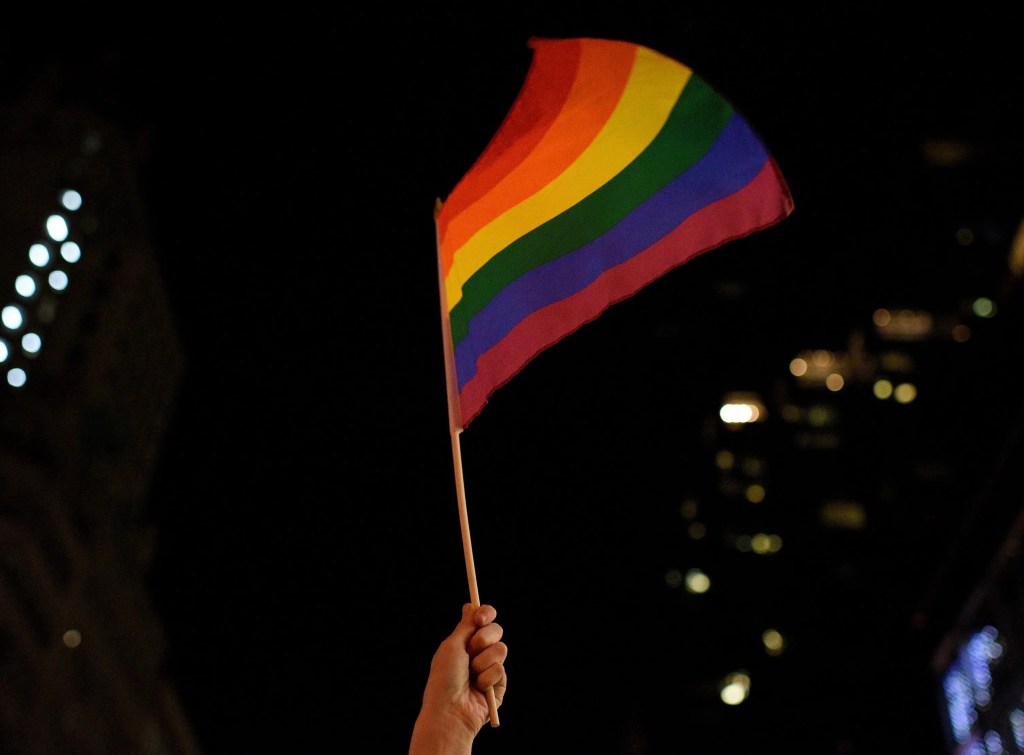
In 1976, the French philosopher Michel Foucault made themeticulously researched case that sexuality is a social construct used as a form of control. In the 40 years since, society has been busy constructing sexualities. Alongside the traditional orientations of heterosexual, homosexual, and bisexual, a myriad other options now exist in the lexicon, including:
- pansexual (gender-blind sexual attraction to all people)
- omnisexual (similar to pansexual, but actively attracted to all genders, rather than gender-blind)
- gynosexual (someone who’s sexually attracted to women—this doesn’t specify the subject’s own gender, as both “lesbian” and “heterosexual” do)
- demisexual (sexually attracted to someone based on a strong emotional connection)
- sapiosexual (sexually attracted to intelligence)
- objectumsexual (sexual attraction to inanimate objects)
- autosexual (someone who prefers masturbation to sexual activity with others)
- androgynosexual (sexual attraction to both men and women with an androgynous appearance)
- androsexual (sexual attraction towards men)
- asexual (someone who doesn’t experience sexual attraction)
- graysexual (occasionally experiencing sexual attraction, but usually not)
Clearly, people felt that the few existing labels didn’t apply to them. There’s a “demand being made to have more available scripts than just heterosexual, homosexual, and bisexual,” says Robin Dembroff, philosophy professor at Yale University who researches feminist theory and construction.
Labels might seem reductive, but they’re useful. Creating a label allows people to find those with similar sexual interests to them; it’s also a way of acknowledging that such interests exist. “In order to be recognized, to even exist, you need a name,” says Jeanne Proust, philosophy professor at City University of New York. “That’s a very powerful function of language: the performative function. It makes something exist, it creates a reality.”
The newly created identities, many of which originated in the past decade, reduce the focus on gender—for either the subject or object of desire—in establishing sexual attraction. “Demisexual,” for example, is entirely unrelated to gender, while other terms emphasize the gender of the object of attraction, but not the gender of the subject. “Saying that you’re gay or straight doesn’t mean that you’re attracted to everyone of a certain gender,” says Dembroff. The proliferation of sexual identities means that, rather than emphasizing gender as the primary factor of who someone finds attractive, people are able to identify other features that attract them, and, in part or in full, de-couple gender from sexual attraction.
Dembroff believes the recent proliferation of sexual identities reflects a contemporary rejection of the morally prescriptive attitudes towards sex that were founded on the Christian belief that sex should be linked to reproduction. “We live in a culture where, increasingly, sex is being seen as something that has less to do with kinship and reproduction, and more about individual expression and forming intimate bonds with more than one partner,” Dembroff says. “I think as there’s more of an individual focus it makes sense that we have these hyper-personalized categories.”
The same individuality that permeates western culture, leading people to focus on the self and value their own well-being over the group’s, is reflected in the desire to fracture group sexual identities into increasingly narrow categories that reflect personal preferences.
Some believe this could restrict individuals’ freedom in expressing fluid sexuality. Each newly codified sexual orientation demands that people adopt increasingly specific criteria to define their sexual orientation.
“Language fixes reality, it sets reality,” says Proust. “It paralyzes it, in a way. It puts it in a box, under a tag. The problem with that is it doesn’t move. It negates or denies any instability or fluidity.”
There’s also the danger that self-definition inadvertently defines other people. Just as the terms “heterosexual” and “homosexual” demand that people clarify their sexual preference according to their and their partner’s gender, “sapiosexual” asks that we each of us define our stance towards intelligence. Likewise, the word “pansexual” requires people who once identified as “bisexual” clarify their sexual attraction towards those who don’t identify as male or female. And “omnisexual” suggests that people should address whether they’re attracted to all genders or oblivious to them.
In Foucault’s analysis, contemporary society turns sex into an academic, scientific discipline, and this mode of perceiving sex dominates both understanding and experience of it. The Stanford Encyclopedia of Philosophy summarizes this idea neatly:
Not only is there control exercised via others’ knowledge of individuals; there is also control via individuals’ knowledge of themselves. Individuals internalize the norms laid down by the sciences of sexuality and monitor themselves in an effort to conform to these norms.
The new terms for sexual orientations similarly infiltrate the political discourse on sexuality, and individuals then define themselves accordingly. Though there’s nothing that prevents someone from having a demisexual phase, for example, the labels suggest an inherent identity. William Wilkerson, a philosophy professor at the University of Alabama-Huntsville who focuses on gender studies, says this is the distinctive feature of sexual identities today. In the past, he points out, there were plenty of different sexual interests, but these were presented as desires rather than intrinsic identities. The notion of innate sexual identities “seems profoundly different to me,” he says. “The model of sexuality as an inborn thing has become so prevalent that people want to say ‘this is how I feel, so perhaps I will constitute myself in a particular way and understand this as an identity’,” he adds.
In the 1970s and 80s there was a proliferation of sexual groups and interests similar to what we’ve seen over the past five to 10 years, notes Wilkerson. The identities that originated in earlier decades—such as bears, leather daddies, and femme and butch women—are deeply influenced by lifestyle and appearance. It’s difficult to be a butch woman without looking butch, for example. Contemporary identities, such as gynosexual or pansexual, suggest nothing about appearance or lifestyle, but are entirely defined by intrinsic sexual desire.
Dissatisfaction with existing labels doesn’t necessarily have to lead to creating new ones. Wilkerson notes that the queer movement in earlier decades was focused on anti-identity and refusing to define yourself. “It’s interesting that now, it’s like, ‘We really want to define ourselves,’” says Wilkerson.
The trend reflects an impulse to cut the legs out from under religious invectives against non-heteronormative sexualities. If you’re “born this way,” it’s impossible for your sexuality to be sinful because it’s natural, made of biological desires rather than a conscious choice. More recently, this line of thinking has been criticized by those who argue all sexualities should be accepted regardless of any link to biology; that sexuality is socially constructed, and the reason no given sexuality is “sinful” is simply because any consenting sexual choice is perfectly moral.
Though it may sound ideal to be utterly undefined and beyond categories, Proust says it’s impossible. “We have to use categories. It’s sad, it’s tragic. But that’s how it is.” Constructs aren’t simply necessary for sexual identity or gender; they’re an essential feature of language, she adds. We cannot comprehend the world without this “tag-fixing process.”
The proliferation of specific sexual identities today may seem at odds with the anti-identity values of queer culture, but Dembroff suggests that both work towards the same ultimate goal of eroding the impact and importance of the old-fashioned binary sexual identities. “Social change always happens in non-ideal increments,” Dembroff notes. So while today we may have dozens of sexual identities, they may become so individualized and specific that they lose any significance for group identities, and the entire concept of a fixed sexual identity is eroded.
“We demand that sex speak the truth,” wrote Foucault in The History of Sexuality. “We demand that it tell us our truth, or rather, the deeply buried truth of that truth about ourselves which we think we possess in our immediate consciousness.” We still believe sex reveals an inner truth; now, however, we are more readily able to recognize that the process of discovering and identifying that truth is always ongoing.
Reference
- Omnisexual, gynosexual, demisexual: What’s behind the surge in sexual identities?, Quartz, 22 March 2018, by Olivia Goldhill https://qz.com/1230638/omnisexual-gynosexual-demisexual-whats-behind-the-surge-in-sexual-identities/
Gay History: 7 Little-Known Facts About James Dean
More than six decades after his untimely death, James Dean remains one of Hollywood’s most enduring and enigmatic icons.
It’s been more than 60 years since his tragic death and still Hollywood is looking for “the next James Dean.” The young actor made only three movies in his career – East of Eden (1955) where he played the bad boy brother in the “Cain and Abel” retelling, his signature role as an angst-fueled teen in Rebel Without a Cause (1955), and Giant (1956) where he stepped into the cowboy boots of a nonconformist ranch hand. All of his movies became Hollywood classics, but he only saw one, East of Eden, completed.
He was only 24 years old on September 30, 1955, when he was driving down Route 466 in his Porsche 550 Spyder and a car collided with his, killing him almost instantly. The young star’s life and career was cut short, but his premature death contributed to the legend he would become. Rebel Without a Cause and Giant were released posthumously, and Dean came to epitomize the sensitive, troubled rebel who fans still connect with today. Who was the man behind the brooding Hollywood sex symbol? Here are 7 revealing facts that might give you a clue.
He had family issues
Dean was born in Marion, Indiana on February 8, 1931. Dean’s father Winton left farming to become a dentist and moved the family to Santa Monica, California. But when Dean’s mother died from cervical cancer when he was 9, the family broke apart. His father sent him back to Indiana to live on his aunt and uncle’s Quaker farm, and this was the beginning of an estrangement between father and son that would haunt them for the rest of their lives.
Dean had some dirty habits
He was the symbol of sexy cool onscreen, but off-camera the 5’8,” 135-pound star had some quirky and dirty (as in unwashed) habits. Dean supposedly didn’t care much about his public appearance and went for the disheveled look. At one formal luncheon, he showed up barefoot and in filthy jeans and was known to appear at rehearsals in pants held together with safety pins. He was also known for having pretty extreme mood swings, according to friends, who said he also had the habit of calling or visiting them late at night. “He’d be up one minute, down the next. He was uncomfortable in his own skin,” one of them said.

Photo: Bettmann/Getty Images
He looked up to Marlon Brando
Dean respected another brooding actor of the day, Marlon Brando. While Dean was just emerging in Hollywood, the slightly older Brando had major success as Stanley Kowalski in A Streetcar Named Desire (1951), his iconic role as a motorcycle gang leader in The Wild One (1953), and he won an Oscar for On the Waterfront (1954). Dean attempted to call Brando and see him socially, but Brando rebuffed his attempts at a friendship. “I gave him the name of a [psycho]-analyst, and he went. At least his work improved,” Brando said.
Dean wanted to be Billy the Kid
In his short career, Dean played fictional non-conformists who played by their own rules, but if he had lived he may have taken on the role of a real-life outlaw. He read and re-read the book The Authentic Life of Billy the Kid and frequently spoke of wanting to portray the Wild West gunslinger in a film.
He confused Ronald Reagan with his acting method
Before he made it in the movies, Dean worked a lot on live television. A fan of improvising, he went off-script on one show and threw a few ad-libs at one of his co-stars, actor and future president Ronald Reagan, who was totally confused by Dean’s acting method. Reagan wasn’t the only one who disliked Dean’s spontaneity. “Just make him say the lines as they’re written,” one actor said once.
His sexuality has been a matter of debate
Although Dean was briefly engaged to actress Pier Angeli, his sexuality has been a matter of debate. A number of biographers doubt his relationship with Angeli was a physical one. Some biographers believe he was bisexual; others characterize him as a homosexual who had one or two brief affairs with women. It was rumored that his first sexual experience occurred as a teenager when a local minister seduced him.
Dean liked to perform magic tricks
When he wasn’t acting or racing cars, Dean liked to practice magic tricks. A smoker, who was often photographed with a cigarette dangling from his mouth, Dean put a magical spin on his tobacco habit: he would put an unlit cigarette and a flaming match into his mouth and then pull out a burning cigarette. Another reason why Dean was smoking hot.
James Dean’s Death: Inside His Tragic Passing at Age 24
Though he only released one film before his dying in a car crash, the actor became a lasting figure in pop culture.
At the time of his sudden death on September 30, 1955, at age 24, James Dean had starred in only one motion picture released in theaters. He would become a cultural icon to generations and a touchstone for the burgeoning youth movement of the era, due largely to his shocking demise in a car accident that would make international headlines in a pre-digital world, and the subsequent movies that would be released posthumously in which he portrayed inward-looking, disaffected adolescents on the verge of adulthood.
When the word “teenager” was still in relatively new usage, Dean’s brief life — on- and of-screen — and sudden death from injuries sustained in a car accident would come to represent a symbol of modern masculinity in the mid-to-late 1950s, a precursor to the counter-culture movement of the 1960s and 1970s.
“Jimmy represented something that was happening in the States after the Second World War. Until that moment in time, grown-ups — adults — set the style for clothing, set the styles for music, set the styles for everything that was going on,” Dean’s acting contemporary Martin Landau once saidof his friend’s cultural legacy.
Dean got his start acting in commercials and TV shows
Born James Byron Dean on February 8, 1931, in Marion, Indiana, his father was a farmer-turned-dentist father who moved his family to Santa Monica, California, where his son attended Brentwood Public School. An only child, Dean’s adored mother died of cancer when he was age 9 and he was sent to live on his aunt and uncle’s Quaker farm. He returned to California after graduating high school, studying theater at the University of California, Los Angeles.
After dropping out of college, the aspiring actor first appeared on television in a Pepsi advertisement followed by uncredited parts in minor Hollywood pictures before heading to New York City in 1951, where he studied at the Actors Studio under Lee Strasberg. Television roles followed in Danger, Omnibus and General Electric Theater and he appeared on Broadway in See the Jaguar and The Immoralist before Hollywood took notice of his talent and brooding good looks.

Photo: Sunset Boulevard/Corbis via Getty Images
He filmed his three most-famous films shortly before his death
Dean was soon cast as Cal Trask in the 1954 film adaptation of the John Steinbeck novel East of Eden. It would be the only film released prior to the actor’s death and for which he would be nominated posthumously for Best Actor in a Leading Role at the 1955 Academy Awards. As misunderstood, rebellious Cal, the role foreshadowed Jim Stark, the late-adolescent, angst-ridden character he portrayed in Rebel Without a Cause(1955) alongside Natalie Wood, which would become a teen favorite of the era and forever be identified with the image and legacy of Dean, the tragic movie star.
Fearing he would be typecast as an angry, rebellious teen, Dean’s next role was as a rags-to-riches Texan ranch hand in Giant (1956), co-starring Elizabeth Taylor and Rock Hudson. It would be his final film and would garner him another posthumous Academy Award nomination, making him the only actor ever to be nominated twice following death.
It was soon after wrapping shooting on Giant that Dean returned to his other love – motorsport, in which he first competed professionally prior to filming Rebel Without a Cause. With reported ambition of one day competing in the Indianapolis 500 race, Dean’s financial success from East of Eden had allowed him to purchase a Triumph Tiger motorcycle and Porsche 356 speedster, the latter he traded in on the more powerful convertible Porsche 550 Spyder.

Photo: Bettmann/Getty Images
Dean was ticketed for speeding hours before his deadly crash
German Porsche-trained mechanic Rolf Wütherich encouraged Dean to drive the Porsche from Los Angeles to Salinas to get a feel for the new automobile, rather than tow it on a trailer behind the Ford station wagon in which he originally planned to make the journey. Dean was ticketed for speeding at 3:30 p.m., just over two hours before his untimely death.
Dean was killed when the 550 Spyder he was driving collided with a Ford Tudor sedan along then-U.S. Route 446 near Cholame, California. The Ford, driven by 23-year-old Cal Poly student Donald Turnupseed, was turning at an intersection when the two cars hit almost head-on, resulting in massive damage to Dean’s Porsche. The actor died almost instantly while his passenger, Wütherich, was badly injured but survived.
His left foot crushed between the clutch and brake pedal, Dean’s neck was broken and he suffered massive internal injuries. Along with Wütherich, he was transported to the Paso Robles War Memorial hospital 28 miles away where he was pronounced dead on arrival at 6:20 p.m. As well as a broken neck, both his arms were broken, he had fractures of the upper and lower jaw and massive internal injuries. Wütherich suffered a fractured jaw, fractured hip and body lacerations. Turnupseed received only minor injuries and after being interviewed by attending California Highway Patrol officers at the scene, was released.
Dean’s legacy has grown in the decades since his death
An inquest into the crash in the days following found Dean at fault due to speeding, though a 2005 article in the Los Angeles Times cited an attending Highway Patrol Officer who recalled the wreckage and position of Dean’s body indicated a speed around 55 mph, not the 90 mph that had been widely reported.
Following the tragic collision, rumors spread over the years and decades that Dean had not really died but was living a secret, hidden life; that he was a closeted homosexual; that the Porsche in which he was driving on that fateful day was cursed. Alongside such rumors, the myth of Dean — the man and the actor — only grew as the years passed. “An actor must interpret life,” Dean once said. On screens and in photographs he remains forever on the cusp of adulthood, a representation of anti-establishment teenage disillusionment and social estrangement, an enduring representation generations have looked to as an interpretation and projection of their own inner lives.
Reference
- 7 Little-Known Facts About James Dean, Biography, 29 September 2014, by Biography.com editors https://www.biography.com/news/james-dean-facts
- James Dean’s Death: Inside His Tragic Passing at Age 24, Biography, 28 September 2020, by Colin Bertram https://www.biography.com/news/james-dean-death?li_source=LI&li_medium=bio-mid-article&li_pl=208&li_tr=bio-mid-article


