“What has grabbed my attention today?”
Australian bushrangers have become part of our national mythology.
We know the names.
Ned Kelly.
Ben Hall.
Thunderbolt.
Captain Starlight.
Yet hidden among these famous outlaws is perhaps the most remarkable bushranger of them all—a man whose final letters reveal one of the most moving expressions of love in nineteenth-century Australia.
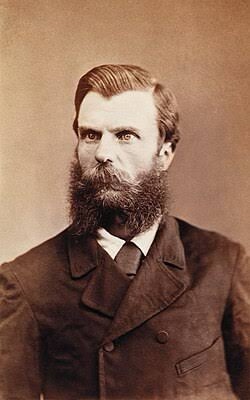
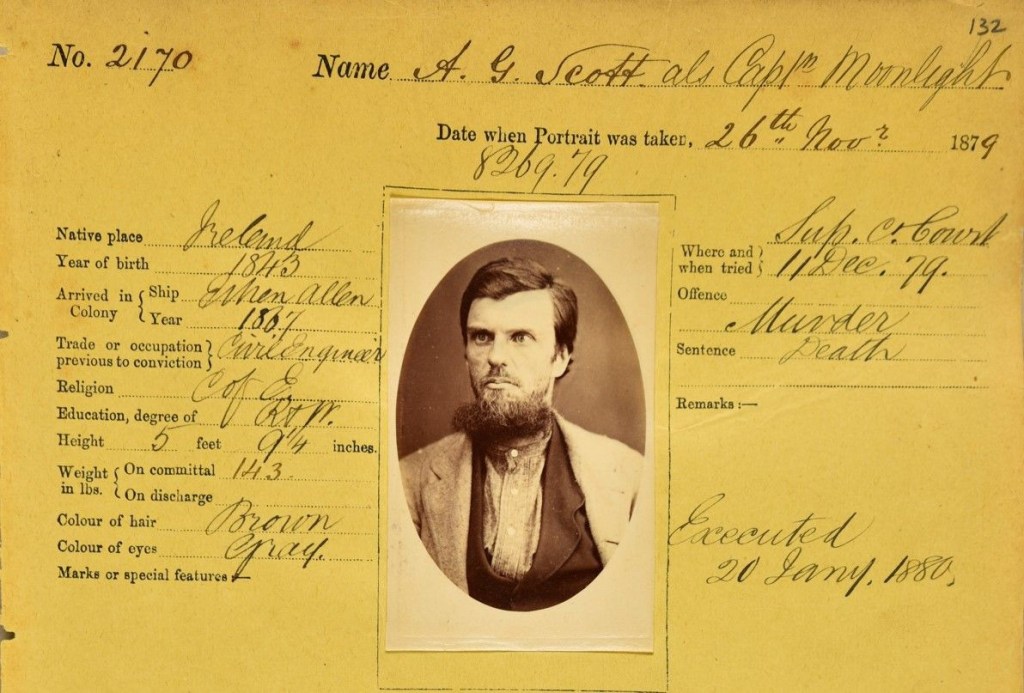
His name was Andrew George Scott.
History remembers him as Captain Moonlite.
An Unlikely Bushranger
Andrew George Scott was born in Ireland in 1842 into a respectable Presbyterian family.
Unlike the stereotypical bushranger, he was well educated, articulate and charismatic.
He even spent time as a lay preacher before his life took an unexpected turn.
Following financial difficulties and criminal convictions, Scott adopted the flamboyant persona of “Captain Moonlite.”
He robbed a bank.
Escaped.
Was captured.
Escaped again.
Eventually he found himself imprisoned in Melbourne’s Pentridge Prison.
It was there that history changed.
Meeting James Nesbitt
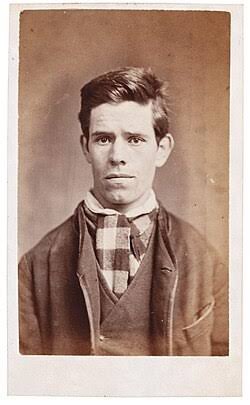
While serving his sentence, Scott met a much younger prisoner named James Nesbitt.
Whatever developed between the two men appears to have become extraordinarily close.
When both men were eventually released, they remained together.
They lived together.
Travelled together.
Eventually they became members of the gang that carried out the infamous hold-up at Wantabadgery Station in New South Wales in 1879.
During the siege that followed, police bullets struck several members of the gang.
James Nesbitt was mortally wounded.
Scott rushed to his side.
Witnesses described him kissing the dying man and weeping openly over his body.
Even hardened policemen reportedly found the scene deeply affecting.
The Prison Letters
Captured and sentenced to death, Scott was taken to Darlinghurst Gaol.
Awaiting execution, he wrote numerous letters.
These letters survive.
They are among the most remarkable documents in Australian history.
Writing about James Nesbitt, Scott declared:
“We were one in heart and soul.”
In another letter he wrote:
“My dearest friend has gone before me. I am to follow. I hope to be with him through eternity.”
Perhaps his most poignant request concerned his burial.
Scott asked that he be buried beside James.
His wish was refused.
Instead, after his execution in January 1880, he was buried separately in Sydney.
Only in 1995—115 years later—were his remains reinterred beside Nesbitt in Gundagai, finally fulfilling the wish he had expressed before his death. (Environment NSW)
Were They Lovers?
This is the question historians continue to discuss.
Modern readers naturally ask whether Captain Moonlite was gay.
The honest historical answer is that we cannot know with absolute certainty.
Nineteenth-century Australians did not generally understand sexual identity in the way we do today.
Terms such as “gay,” “homosexual” and “bisexual” belong largely to later periods.
What we can say is that Scott’s surviving letters express extraordinary affection for James Nesbitt.
Several historians believe they strongly suggest a romantic relationship.
Others urge caution, noting that expressions of intense male friendship were often more emotionally demonstrative in the nineteenth century than they are today.
Nevertheless, many scholars argue that if identical letters had been exchanged between a man and a woman, few people would hesitate to describe them as love letters. (ABC News)
Rediscovering a Forgotten Story
For many years Captain Moonlite’s relationship with James Nesbitt received relatively little attention.
Recent scholarship, however, has revisited their story as part of Australia’s LGBTQ+ history.
In 2025 the graves of Captain Moonlite and James Nesbitt were entered on the New South Wales State Heritage Register.
The listing recognised not simply two bushrangers, but the historical significance of one of Australia’s earliest publicly acknowledged same-sex love stories. (Environment NSW)
Beyond the Bushranger Legend
Captain Moonlite reminds us that LGBTQ+ Australians did not suddenly appear in the twentieth century.
They have always been part of Australia’s story.
Often they lived quietly.
Sometimes they left almost no trace.
Occasionally, however, history preserves something extraordinary.
Captain Moonlite’s prison letters are one such treasure.
Whether one ultimately describes Andrew Scott and James Nesbitt as lovers, soulmates or devoted companions, their story speaks of profound affection, loyalty and grief.
It also reminds us that love has always found ways to express itself—even in an age when society lacked the language to describe it openly.
Perhaps the final word belongs to Captain Moonlite himself.
“We were one in heart and soul.”
More than 140 years later, those simple words continue to resonate.
Tim Alderman ©️ 2026
PS I should add that Garry Wotherspoon, whose work has helped preserve so much of Sydney’s gay history, is someone I know personally. We moved through the Sydney scene at the same time, and I have several of his books on Sydney gay history. That gives this story an added resonance for me: it is not simply about reclaiming Captain Moonlite, but about the broader work of recovering the lives, loves and communities that official history too often ignored.
Sources
Garry Wotherspoon, research on Captain Moonlite and Australian LGBTQ+ history.
Museums of History NSW, research on Captain Moonlite and James Nesbitt.
ABC News, “Story of Captain Moonlite reflects NSW’s queer history, historian says” (2025). (ABC News)
NSW Government, “Graves of Captain Moonlite and James Nesbitt listed on the State Heritage Register” (2025). (Environment NSW)
Matthew Grubits, “Was famous bushranger Captain Moonlite gay?” Fuse Magazine. (FUSE Magazine)

