“What has grabbed my attention today?”
Few religious movements of the twentieth century are as fascinating, controversial, or as astonishingly self-confident as the Palmarian Catholic Church. Depending upon whom one asks, it is either the last bastion of authentic Catholicism in an apostate age, or an isolated schismatic sect built upon visions, charismatic leadership, and extraordinary claims.
Whatever judgement one reaches, one thing is certain: the Palmarian Church is impossible to ignore.
Its story possesses all the ingredients of a historical drama: Marian apparitions, mystical revelations, rival popes, claims of divine election, political conservatism, accusations of cult-like behaviour, and a fortified cathedral complex in rural Spain which some observers have described as an alternative Vatican.
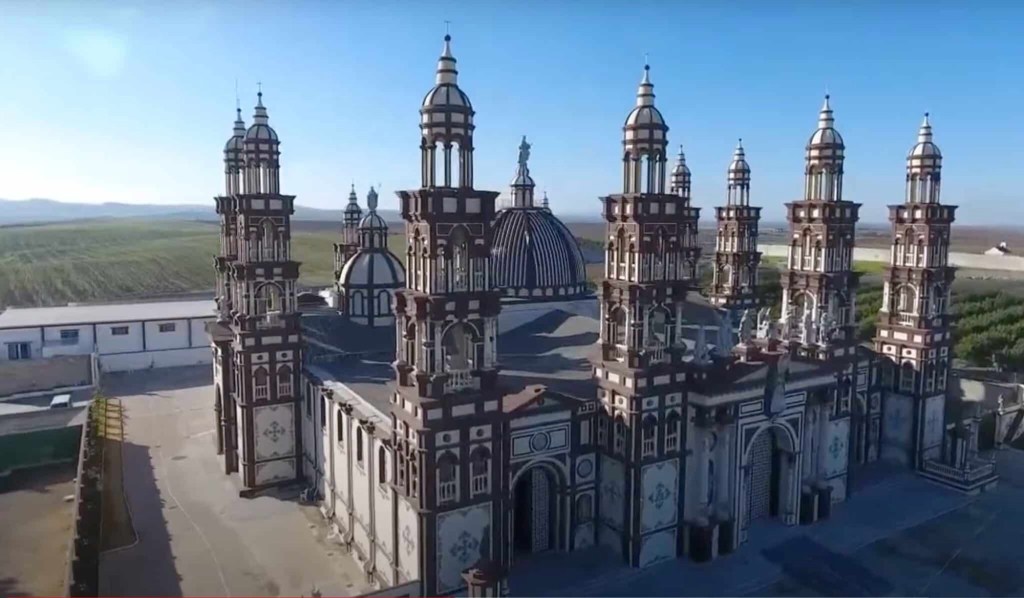
The Apparitions at El Palmar
The origins of the movement lie in the small Andalusian village of El Palmar de Troya, near Seville.
In March 1968, four young girls claimed to have witnessed an apparition of the Virgin Mary upon a lentisk tree.
Such events were not unprecedented within Catholic history.
For centuries, reports of Marian apparitions have periodically captured the imagination of the faithful.
Lourdes, Fatima and Guadalupe had all become major pilgrimage centres.
What distinguished El Palmar was not merely the apparition itself, but what followed.
Pilgrims began arriving.
Prayer meetings were organised.
Individuals reported ecstasies, visions and supernatural experiences.
Claims emerged that messages were being received from heaven concerning the state of the Catholic Church.
The timing proved significant.
Only a few years earlier, the Second Vatican Council had concluded.
For many Catholics, the reforms represented a necessary adaptation to the modern world.
For others they constituted a dangerous departure from tradition.
Latin liturgy diminished.
Ecumenism expanded.
New forms of worship appeared.
A sense of uncertainty permeated certain conservative circles.
El Palmar became a magnet for those who believed the Church had abandoned its ancient path.
Clemente Domínguez: Visionary, Mystic and Pope
Among the pilgrims who visited El Palmar was a businessman from Seville named Clemente Domínguez y Gómez.
He soon became the dominant personality within the movement.
Domínguez claimed to receive mystical revelations.
Witnesses reported ecstasies.
He asserted that he experienced stigmata.
Supporters believed him to possess extraordinary spiritual gifts.
Critics regarded him as a gifted religious enthusiast with an exceptional capacity for self-belief.
Over time his revelations became increasingly ambitious.
According to these messages, Rome was falling into corruption.
The Catholic hierarchy had become compromised.
Modernism threatened the true faith.
The world stood in spiritual crisis.
Eventually the revelations suggested that God intended to establish a purified remnant of Catholicism.
And El Palmar would be its centre.
In 1975, the movement took an extraordinary turn.
Domínguez and several followers were consecrated bishops by the excommunicated Vietnamese archbishop Ngo Dinh Thuc.
These episcopal consecrations remain among the most controversial episodes in modern Catholic history.
The Vatican considered them illicit.
Supporters regarded them as providential.
Whatever one thinks of them, they provided the Palmarian movement with a claim—however disputed—to apostolic succession.
Then came 1978.
Pope Paul VI died.
The Roman Catholic Church elected Pope John Paul I, whose reign lasted only thirty-three days before his sudden death.
John Paul II was then elected.
For most Catholics, the succession proceeded normally.
For Clemente Domínguez, however, events unfolded very differently.
He claimed that Christ Himself had mystically crowned him Pope.
Not in Rome.
Not before the College of Cardinals.
But directly from heaven.
He assumed the title Gregory XVII.
In Palmarian theology, the papacy had effectively departed Rome.
The true Church was now centred in El Palmar de Troya.
The Vatican had become illegitimate.
The authentic successor of Saint Peter resided in Andalusia.
It was an astonishing assertion.
Yet it became the foundation stone of the movement.
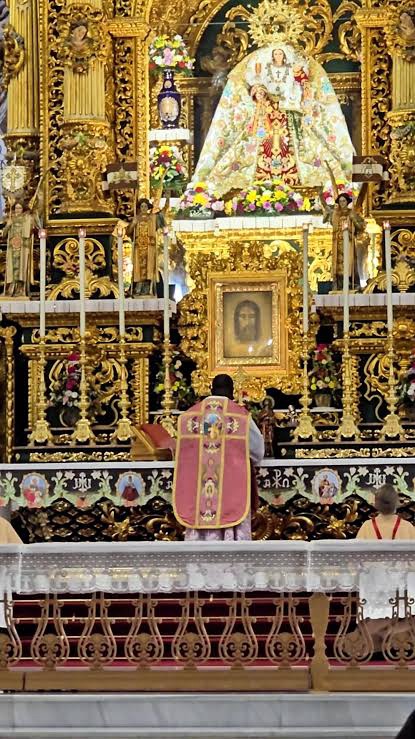
Holy Mass in the Palmarian Catholic Church
Holy Palmarian See – El Palmar de Troya – Seville – Spain
Building an Alternative Vatican
As years passed, the Palmarian Church became increasingly institutionalised.
A cathedral complex was constructed.
Walls surrounded the site.
Security measures increased.
The movement developed its own hierarchy.
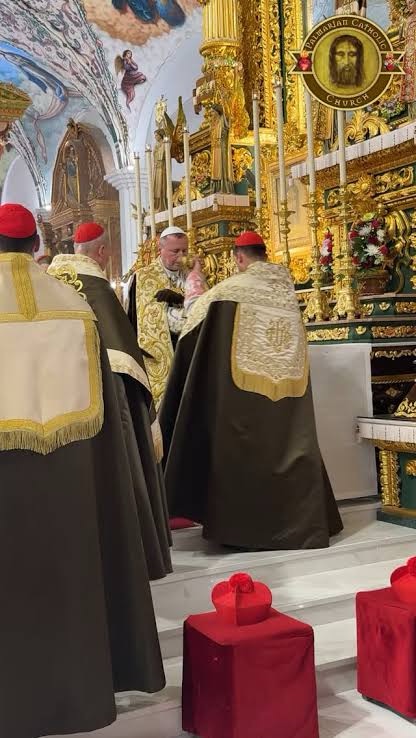
Its own cardinals.
Its own bishops.
Its own saints.
Its own liturgical calendar.
Its own canon law.
Its own popes.
If Rome represented the Catholic Church of two thousand years, the Palmarians regarded themselves as its faithful continuation.
The Palmarian liturgy diverged significantly from Roman Catholic practice.
Masses were abbreviated.
Ceremonies became highly distinctive.
Traditional symbolism was emphasised.
Rules governing personal behaviour became notably strict.
Members were expected to conform to rigorous standards.
Critics and former adherents have alleged restrictions involving:
television viewing;
secular entertainment;
reading materials;
friendships outside the community;
modes of dress;
contact with former members.
Supporters maintain that these practices preserve spiritual purity in a morally degraded world.
Opponents have described the movement as insular and controlling.
The debate continues.
Popes in Andalusia
Gregory XVII ruled until his death in 2005.
He was succeeded by Peter II.
Born Manuel Alonso Corral, Peter II had once practised law before becoming deeply involved in the movement.
He presided over the church until 2011.
Then came Gregory XVIII.
His pontificate produced perhaps the most unexpected chapter in Palmarian history.
In 2016, Gregory XVIII resigned.
He left the church.
He subsequently married.
He granted interviews.
He criticised the institution he had once led.
For observers of religion, it was almost surreal.
The head of a breakaway papacy had renounced his office and departed to begin an ordinary married life.
History possesses numerous antipopes.
History possesses many religious reformers.
But very few former popes have resigned, married and publicly reflected upon their experiences in the manner of Gregory XVIII.
His departure attracted considerable media attention and renewed scrutiny of the movement.

Visions, Authority and Certainty
The Palmarian Church raises intriguing questions.
What persuades people that a visionary possesses divine authority?
Why do some communities accept extraordinary claims while others reject them?
How do charismatic movements evolve into institutions?
The Palmarians are hardly unique.
Religious history contains numerous examples.
The medieval world produced prophets and visionaries.
The Great Schism witnessed rival papacies.
Mystics claimed direct communication with heaven.
Communities often formed around individuals convinced they had been chosen to restore authentic religion.
The Palmarians represent a modern expression of an ancient phenomenon.
They emerged in a period of rapid social change.
They offered certainty amidst uncertainty.
Tradition amidst reform.
Absolute answers in an era of ambiguity.
To believers, this represented fidelity.
To critics, it represented authoritarianism.
To historians, it offers an extraordinary case study.
A Church Apart
Today the Palmarian Church remains comparatively small.
Its exact membership is difficult to determine.
Its internal life is largely hidden from outsiders.
Its cathedral complex remains enclosed behind walls.
Visitors are generally unwelcome.
Former members occasionally speak publicly.
Current adherents tend to remain discreet.
And yet the movement endures.
For nearly six decades it has survived criticism, defections, scandal and ridicule.
Its members remain convinced that theirs is the authentic continuation of Catholic Christianity.
Most Christians disagree.
The Vatican certainly disagrees.
But the Palmarians persist.
And perhaps that is what makes the movement so compelling.
History is filled with empires that vanish.
Dynasties that collapse.
Ideologies that fade.
Yet small groups of determined believers, convinced they alone possess the truth, can display remarkable resilience.
El Palmar de Troya reminds us that the human search for certainty, revelation and divine favour remains as powerful in the twentieth and twenty-first centuries as it was in the Middle Ages.
One can only imagine what a bewildered medieval pilgrim might make of a fortified cathedral in southern Spain ruled by self-proclaimed successors of Saint Peter.
Then again, medieval Christianity had its share of surprises.
Perhaps they would simply nod knowingly and say:
“Ah yes. Another antipope.”
Tim Alderman ©️2026

