There are moments in history when a drink becomes more than a drink.
It becomes a social problem.
A political problem.
A moral problem.
And, eventually, a convenient explanation for practically everything supposedly wrong with society.
In eighteenth-century London, that drink was gin.
For several decades, particularly from the 1720s through the 1750s, cheap spirits flooded the streets of the rapidly expanding capital. Gin became associated with poverty, crime, prostitution, abandoned children, violence and death.
It acquired one of the most enduring nicknames in the history of alcohol:
Mother’s Ruin.
But behind the lurid stories lies a more complicated history.
London undoubtedly had a serious problem with cheap spirits.
Yet the famous Gin Craze was also wrapped in class prejudice, anxiety about women drinking, fear of the urban poor and some spectacular political propaganda.
The gin glass therefore allows us to peer into Georgian society itself.
And what we see isn’t always pretty.
From William of Orange to the Gin Shop
The story begins partly with politics.
After the Glorious Revolution of 1688, William III came to the English throne. England was repeatedly at war with France, and French brandy was hardly an ideal beverage for patriotic English drinkers.
Government policy encouraged domestic distilling.
Grain could be turned into spirits.
English distillers expanded production.
The Dutch spirit jenever helped inspire what the English came to call gin.
It was relatively easy to produce.
More importantly, it could be extraordinarily cheap.
And Londoners discovered it with enthusiasm.
Recorded per-capita gin consumption rose dramatically during the first decades of the eighteenth century. Parliamentary historical evidence puts it at roughly half a gallon per person annually around 1700 and around two gallons by 1740. (UK Parliament)
Those averages disguise the obvious fact that some people drank little or none while others drank prodigiously.
Gin had arrived.
Why Gin?
To understand its popularity, we need to abandon our modern bottle of carefully distilled London Dry Gin with tonic, ice and lime.
The gin consumed by poor Londoners could be rough stuff.
But it had several advantages.
It was strong.
It was cheap.
It was readily available.
And for people enduring grinding poverty, exhausting work, miserable housing, disease and insecurity, intoxication offered temporary escape.
That doesn’t make excessive drinking harmless.
It does make it understandable.
The authorities tended to ask:
Why are the poor drinking so much?
A more uncomfortable question was:
Why might the poor want to be drunk?
London Was Exploding
Eighteenth-century London was becoming one of the great cities of the world.
It was also dirty, crowded and profoundly unequal.
The wealthy enjoyed town houses, servants, theatres, pleasure gardens and fashionable coffee houses.
Nearby, families lived in rooms and cellars.
Employment could be irregular.
There was no modern welfare state.
Illness could destroy a family’s income.
Child mortality was dreadful.
Debt could lead to imprisonment.
And alcohol was everywhere.
Beer and ale had long been part of everyday English life.
But gin was different.
A small quantity produced a considerable effect.
That made it attractive to people with very little money.
“Drunk for a Penny”
The most notorious gin establishments supposedly advertised:
“Drunk for a penny, dead drunk for twopence, clean straw for nothing.”
The phrase became emblematic of the Gin Craze, although, like many irresistible historical quotations, its precise circulation and origins are harder to pin down than popular retellings suggest.
But it captures something real.
Gin could provide very cheap intoxication.
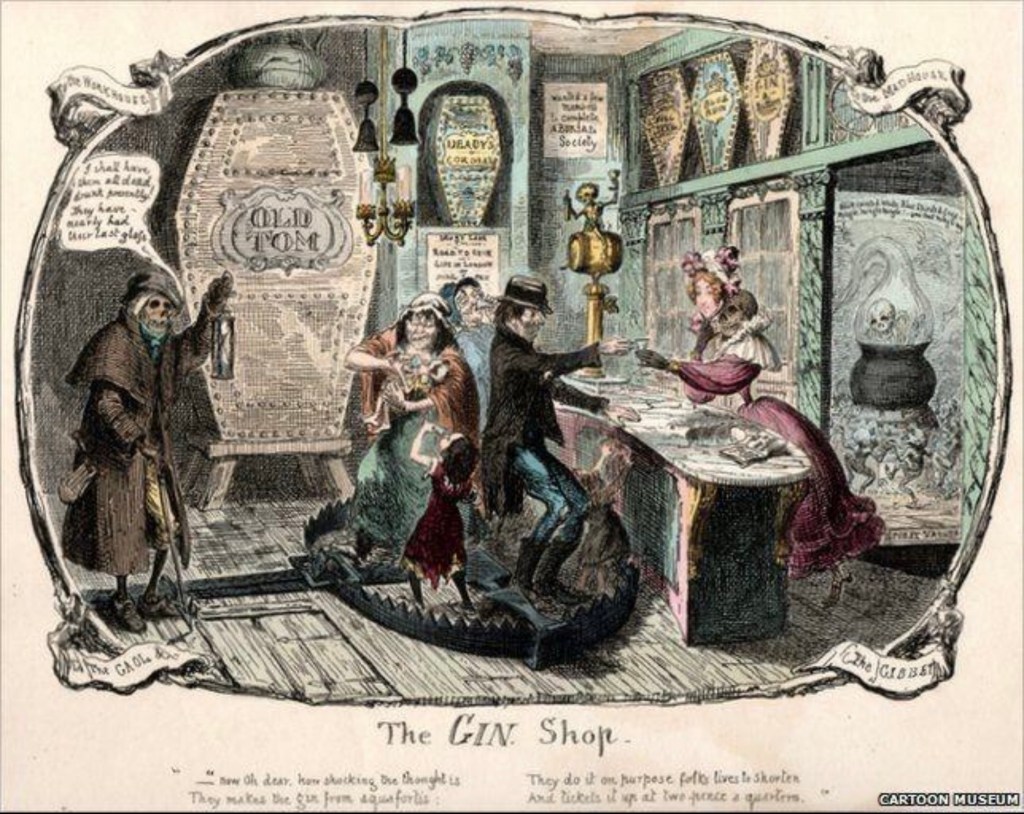
It could also be sold in surprisingly informal circumstances.
Before licensing was tightened, spirits were available through thousands of retailers.
Some were conventional drinking establishments.
Others were effectively rooms, shops or makeshift outlets.
Gin had become embedded in the street economy.
And Women Drank It
Here we encounter one of the reasons gin caused such extraordinary alarm.
Women drank gin.
Poor women drank it.
Women working in markets drank it.
Domestic servants drank it.
Women involved in prostitution drank it.
Mothers drank it.
And eighteenth-century society found female drunkenness particularly disturbing.
Male drinking had long possessed socially acceptable forms. Men drank together in taverns, clubs and other male spaces. Heavy drinking could even be associated with masculine sociability.
A drunken woman represented something different.
She supposedly threatened the household.
Who would care for the children?
Who would prepare meals?
Who would maintain respectable domestic life?
And what happened if pregnant women drank?
Parliamentary evidence examining the history of British drinking notes that eighteenth-century concern focused heavily upon consumption among women and the urban poor, including fears about parental drinking and harm to children. Modern historians warn, however, that separating genuine harm from contemporary assumptions about poor women is difficult. (UK Parliament)
Gin therefore became gendered.
Beer could be portrayed as nourishing, masculine and English.
Gin became dangerous, disorderly and feminine.
Hence:
Mother’s Ruin.
The Mother Who Became a Nightmare
One real case became notorious.
In 1734, a woman named Judith Dufour was convicted with John Cope of murdering her young child.
The child had been removed from a workhouse and provided with new clothing.
Dufour and Cope took the child away.
They strangled it.
They disposed of the body.
Then they sold the child’s clothes.
The proceeds were reportedly spent on gin.
Dufour was executed.
It was an appalling crime.
And it became perfect ammunition for those arguing that gin was destroying motherhood itself.
But there is an important historical trap here.
One horrific murder does not tell us how thousands of ordinary women behaved.
Moral panics frequently work this way.
Find an extreme case.
Publicise it relentlessly.
Then allow the exceptional case to represent an entire social group.
Enter William Hogarth
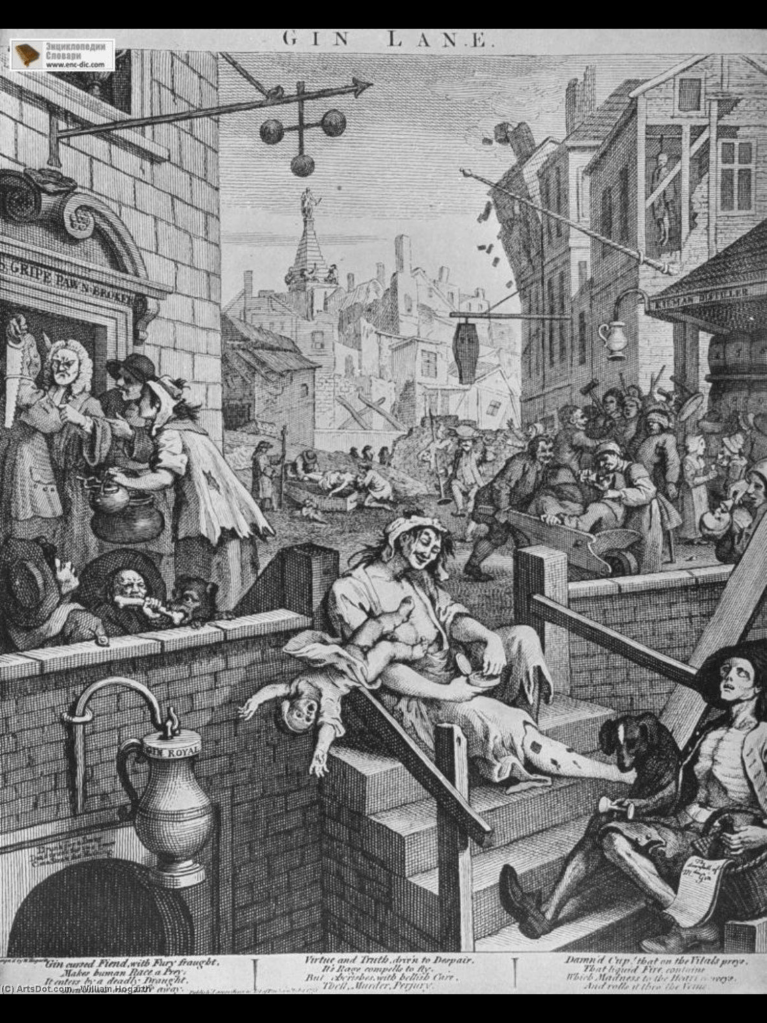
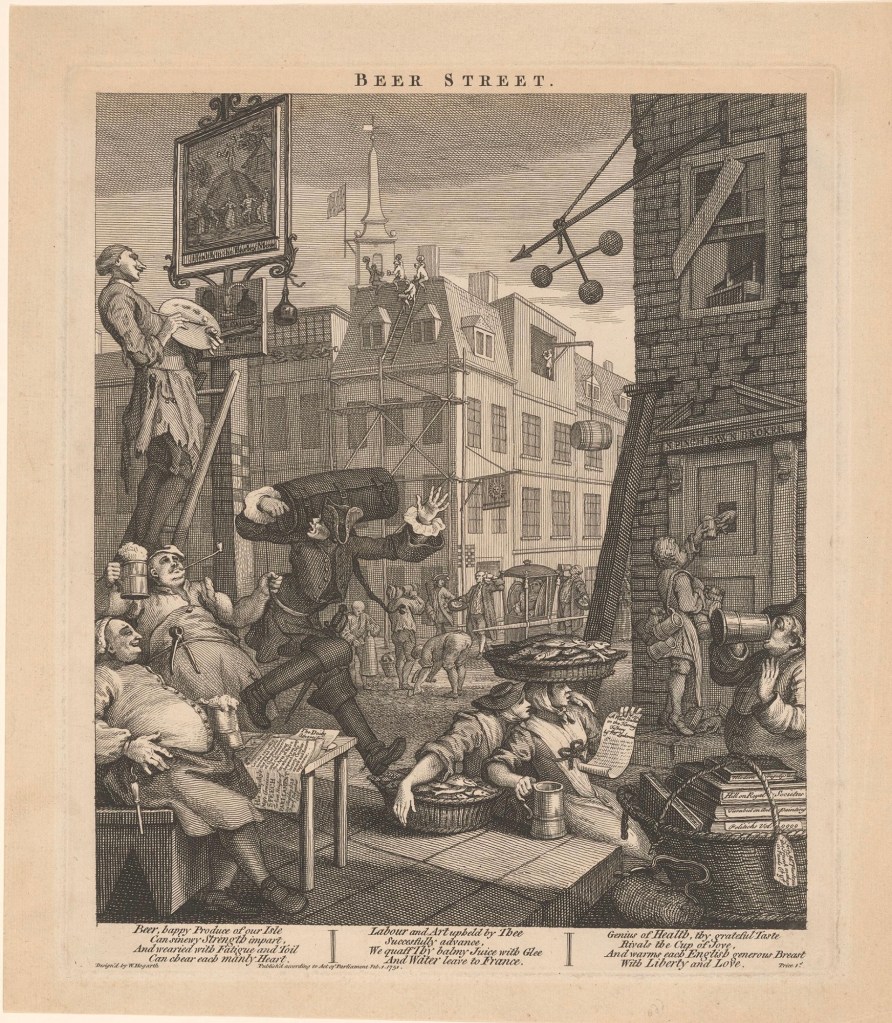
Nobody created a more memorable image of the Gin Craze than William Hogarth.
In 1751 he published two prints designed to be viewed together:
Beer Street
and
Gin Lane.
The comparison was anything but subtle.
Beer Street is prosperous.
People work.
People eat.
Buildings are maintained.
Tradesmen appear healthy.
English beer supposedly produces healthy English citizens.
Then turn to Gin Lane.
Everything collapses.
There is starvation.
Violence.
Suicide.
Madness.
Pawnbroking.
Crime.
Buildings literally crumble.
And at the centre sits one of the most disturbing mothers in British art.
A drunken woman, covered with signs of disease, barely notices as her baby falls from her arms toward the stairway below.
Hogarth wasn’t recording an ordinary afternoon.
He was making an argument.
Beer builds society. Gin destroys it.
Propaganda — Brilliant Propaganda
Gin Lane is so powerful that it can easily be mistaken for documentary evidence.
It isn’t.
It is social propaganda.
That does not mean the problems it depicts were imaginary.
Excessive gin consumption genuinely caused misery.
Alcohol dependence existed.
Families suffered.
Accidents occurred.
Violence occurred.
Money desperately needed for food could disappear into alcohol.
But Hogarth deliberately assembled practically every imaginable consequence of social collapse into one horrifying street.
He created eighteenth-century shock advertising.
And it worked.
More than 270 years later, we still use Gin Lane to visualise the Gin Craze.
Government Discovers a Problem It Helped Create
There is considerable irony here.
Government policy had helped encourage domestic spirit production.
Then government became horrified when people actually drank the stuff.
Parliament responded with legislation.
Again.
And again.
And again.
There were a series of attempts to control gin during the first half of the eighteenth century.
The most infamous came in 1736.
The Gin Act imposed an enormous annual licence fee of £50 upon retailers and heavy duties on spirits.
For small sellers, £50 was effectively impossible.
Parliament had essentially attempted prohibition.
London responded with the Georgian equivalent of:
Absolutely not.
Gin Goes Underground
The 1736 legislation produced widespread evasion.
Illegal gin continued to be sold.
Informers became hated.
Ingenious methods appeared for selling spirits anonymously.
The most famous was the legendary Puss and Mew device.
A customer approached a sign or wooden figure depicting a cat.
Money was inserted.
Some form of signal was given — the customer supposedly called “Puss” and received a “Mew”.
Gin emerged through a concealed pipe or opening.
Whether every picturesque detail later attached to these devices is accurate is debatable, but clandestine gin-selling certainly flourished.
The law had achieved something governments have repeatedly discovered when attempting prohibition:
It had not eliminated demand.
It had created an illegal market.
The 1736 experiment became such a failure that the legislation was eventually abandoned. Parliamentary historical evidence describes it bluntly as disastrous, producing disorder and contempt for the law. (UK Parliament)
Hic.
The Gin Acts Keep Coming
Government gradually learned that outright suppression was less effective than regulation.
The crucial legislation came in 1751.
The Gin Act 1751 restricted retailing more realistically, tied spirit sales more closely to licensed premises and strengthened regulatory controls.
This was the environment in which Hogarth published Gin Lane and Beer Street.
Art and legislation were therefore working together.
But something else helped end the Gin Craze.
Economics.
Poor harvests increased grain prices.
Gin became less affordable.
Real incomes declined.
Consumption was already falling.
Modern historical assessments consequently warn against the neat story in which Parliament heroically passed one law and instantly sobered London.
The decline reflected regulation, taxation, changing economic circumstances and changing drinking habits. (UK Parliament)
Tea Helped Defeat Gin
And then there was perhaps the most English solution imaginable.
Put the kettle on.
Tea, coffee and chocolate became increasingly important alternatives to alcoholic drinks.
Coffee houses had already created new forms of sociability.
Tea consumption expanded enormously during the eighteenth century.
Parliamentary historical research notes that even beer consumption fell substantially as tea, coffee and chocolate became more popular. (UK Parliament)
Britain wasn’t becoming abstinent.
Its drinking culture was changing.
The tea cup joined Parliament in defeating the gin glass.
Was There Really a Gin Epidemic?
Yes.
And no.
Gin consumption unquestionably increased dramatically.
Cheap spirits created genuine social and health problems.
Contemporary observers were not simply imagining drunkenness.
But historians have become much more cautious about accepting eighteenth-century descriptions at face value.
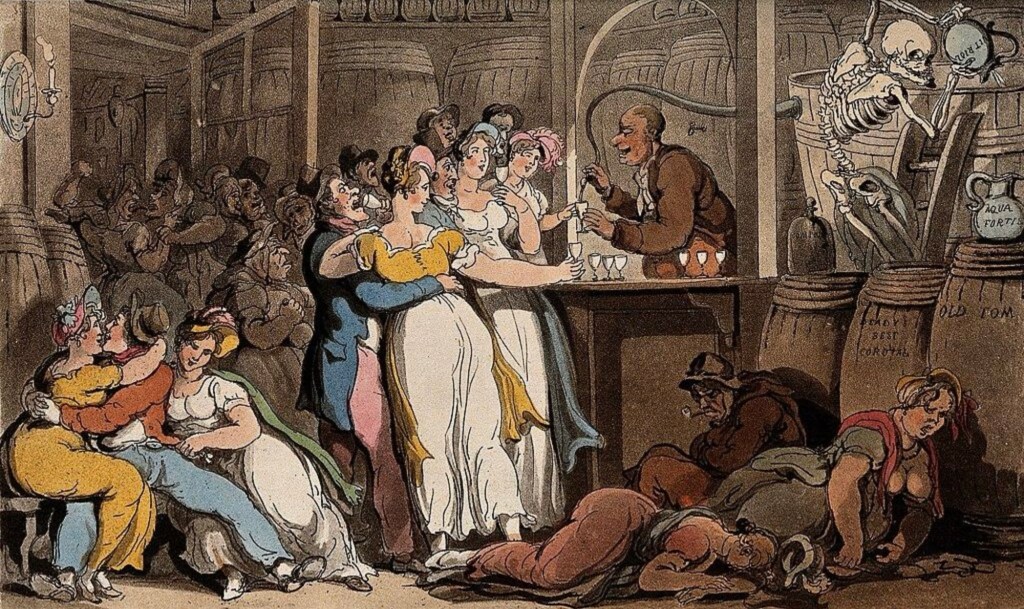
The Gin Craze was also a moral panic.
Its imagery concentrated overwhelmingly upon the poor.
Nobody produced an equivalent Brandy Lane depicting wealthy gentlemen drinking themselves senseless behind the doors of fashionable clubs.
Elite drinking could be convivial.
Poor people’s drinking became depravity.
That distinction tells us as much about Georgian class attitudes as it does about alcohol.
And What About “Mother’s Ruin”?
The precise origin of the expression is frustratingly murky.
It is frequently linked directly to the eighteenth-century Gin Craze and the perceived effects of gin upon mothers and families.
But the phrase’s documented history is less straightforward than the popular story suggests, and we should be cautious about claiming that Londoners in the 1730s universally called gin “Mother’s Ruin.”
What is certain is that the expression eventually became inseparable from gin.
And it perfectly encapsulates the gendered mythology surrounding the drink.
Not:
Father’s Ruin.
Not:
Worker’s Ruin.
Not:
Society’s Ruin.
Mother’s Ruin.
The woman becomes responsible for the collapse of the family.
That should make us suspicious.
Behind the Gin Glass
The Gin Craze becomes much more interesting when we stop treating it merely as a bizarre episode of mass drunkenness.
It was about alcohol.
But it was also about poverty.
It was about gender.
It was about class.
It was about governments encouraging an industry and then trying to control its consequences.
It was about respectable society deciding which forms of intoxication were acceptable.
And it was about how frightened people become when the poor behave in ways that cannot easily be controlled.
There is genuine tragedy here.
Alcohol dependency destroys lives.
It did so in 1730.
It does so now.
But people rarely become dependent upon substances in a social vacuum.
Behind Hogarth’s collapsing Gin Lane were real Londoners dealing with overcrowding, insecure employment, disease, hunger and hopelessness.
Gin didn’t create all those problems.
Sometimes it merely made them easier to forget for a few hours.
Last Orders
Eventually London’s Gin Craze subsided.
Gin itself did not.
It became respectable.
Distillation improved.
Commercial brands emerged.
The drink moved steadily away from the filthy reputation Hogarth had immortalised.
Eventually someone added tonic water.
Someone else added ice.
And, mercifully, somebody discovered the lime.
The drink once blamed for destroying Georgian civilisation became something ordered before dinner.
Perhaps that is the strangest ending of all.
The poor woman staggering through Gin Lane with a cheap dram and the modern drinker holding a beautifully made gin and tonic are consuming versions of the same spirit.
But society looks at them very differently.
One was evidence of degeneracy.
The other is having a cocktail.
And somewhere in that difference lies the real history of Mother’s Ruin.
Tim Alderman ©️2026
Sources
UK Parliament, House of Commons Health Committee, Alcohol: First Report of Session 2009–10 — historical evidence on British alcohol consumption and the eighteenth-century Gin Craze. (UK Parliament)
UK Parliament, Health Committee evidence — discussion of historical alcohol panics, women, children and interpretations of social harm. (UK Parliament)
William Hogarth, Beer Street and Gin Lane (1751), collections of the British Museum and other major institutions.
Jessica Warner, Craze: Gin and Debauchery in an Age of Reason.
Patrick Dillon, Gin: The Much-Lamented Death of Madam Geneva.
Peter Clark, The English Alehouse: A Social History 1200–1830.

