Tag Archives: LGBT

Gay History: Radical Faeries: SF’s Fabulously Weird Progressive Queers

By Katie Conry; Designed by Nic Buron; Photography by Lauren Crew

1111-01

Gay Spirituality and the Radical Faeries

When developing gay life in America starts to surface in books about the era, gay spirituality will emerge as one of the more fascinating subjects. A significant new book that deals with the subject has just appeared. It is “The Fire In Moonlight: Stories from the Radical Faeries,” edited by Mark Thompson, assisted by Richard Nealy and Bo Young and published by White Crane Books. The book has been nominated as one of 74 LGBT Books for Adult Readers by the Gay, Lesbian, Bisexual and Transgender Round Table of the American Library Association.

Described as “the gay community’s last authentic global grassroots movement,” the Radical Faeries had their inception on a remote site of the American Southwest in 1979. The book honors two men who played a key pioneering role, Harry Hay and Don Kilhefner. That historic “First Spiritual Conference for Radical Faeries” gave Hay an opportunity to pronounce: “I am saying to everybody who will hear that now we must begin to maximize the differences between us.” In other words, Hay was talking clearly about “shedding the ugly green frog-skin of hetero imitation.”

Will Roscoe, author of “The Zuni Man-Woman,” which received the Margaret Mead Award of the American Anthropological Association, has written a brilliant Introduction to the new book. “Same-sex love is distinguished from heterosexual love by the sameness and equality of those it united,” he says. Roscoe cites Walt Whitman as a gay teacher of primary significance. He finds that Harry Hay took Whitman’s insights one step further, “giving a name to the distinct mode of awareness this love of sames and equals fosters—subject-SUBJECT consciousness.”

“The Fire In Moonlight” has many remarkable storytellers among its collection of authors. The book is staggering in its scope and depth. Robert Croonquist is a Founder and Program Director of Youth Arts New York. He describes in detail a Faerie Camp gathering. “We circle the grove and call out names.” After many names from within the Faerie community “Others called out Marilyn Monroe, Allen Ginsberg, Judy Garland, Walt Whitman, Oscar Wilde. The young Faeries, it dawned on me, didn’t know anybody who had died. I kind of felt sorry for them and kind of felt better than them. And kind of, but not really, felt they were lucky.”

William Stewart has embarked on a quest to connect with other gay men who share an aspiration to live together in collective commitment and consciousness. His contribution to this book is a prophetic piece entitled “Stewarding the Future: A Call for Sacred Witness.” He cites “typical gay traits” as “the skills of artists, healers, tricksters, ritual makers, shamans and intermediaries between the worlds.” Stewart believes that Harry Hays’ assertion “that social function rather than sexual preference should be seen as the defining characteristic of our kind is as radical now as when he first conceived of it in the dark days of McCarthyism.”

Another contributor to the book is Allen Page who describes himself as “an intuitive spiritual counselor, channeler, teacher and gay elder.” He writes: “We are fathers, artists, athletes and sissies. We do not fear gentleness and have no need to compete. We believe in the power of contradictions and the magic of laughter. That the quality of energy exchanged in lovemaking is more important than the gender of bodies.”

Mark Thompson poignantly pulls together a description of the historic 1979 Faerie Gathering in Arizona with his personal vision of the future:

“Music was played again and each man made an offering to a basket that was passed around: a feather from Woolworth’s, a stone from the Ganges River, a lock of hair, a handwritten poem. We began to dance with the music and in a few moments noticed we were being joined in our merriment by a large horned bull. Naturally shy, the animal was drawn close in. The bull stood and watched motionless, like some ancient hieroglyphic painted on a cave wall, then he just as inexplicably vanished.

Soon, we too began to drift away into the dark chill air. None of us would ever find again this particular place of red earth that had nourished us so. But even to prompt a return would be missing the point. Our journeys as a new kind of men, having been thusly inaugurated, meant that we would have many destinations, far and wide, still to attend.”

“The Fire In Moonlight: Stories from the Radical Faeries” is a boundless delight to read, a poem that stirs up magic thoughts, and a piece of history as solid as the stone Lincoln

Following the Pansy Path

Forty years after its initial publication, does The Faggots and Their Friends Between Revolutions have anything to offer the queer present?

Ned Asta/Nightboat Books

This post is part of Outward, Slate’s home for coverage of LGBTQ life, thought, and culture. Read more here.

In 1977, author Larry Mitchell formed Calamus Press to self-publish his first book, The Faggots and Their Friends Between Revolutions. The slim volume was originally conceived, according to Mitchell, as a children’s book complete with whimsical illustrations by his friend Ned Asta, a fellow member of the Lavender Hill queer commune in Ithaca, New York.

In short, simple passages, the book describes the lives of “the faggots” and their various groups of friends—the “strong women,” the “queens,” the “queer men”—as they attempt to survive and find joy, beauty, humor, pleasure, and freedom in Ramrod, an empire in decline dominated by the oppressive, militaristic “men.” In The Faggots and Their Friends, Mitchell depicted queer life as it was beginning to emerge from the shadows in the late ’60s and ’70s, as communities formed and a movement blossomed. He turned his observations of pre-AIDS gay culture into a kind of parable conveying its values and conventions—such as they were—and imparting lessons meant to sustain future generations of queer people, with the ultimate goal of guiding them toward the social and sexual revolutions Mitchell hoped to see. Here is the queer world, here are its tribes, here is how they managed to survive and even thrive within a system of oppression. Beauty is currency; sexuality is sustenance. But more valuable than that is friendship—which usually involves some degree of sexual intimacy. Pleasure will keep you going. So will humor, possibly more effectively.

Out of print since 1988, a new edition of The Faggots and Their Friends was recently published by Nightboat Books. It is at once heartening and chilling how relevant it remains more than four decades later. The various queer tribes and their individual quirks and characteristics are likely recognizable to anyone with a passing familiarity with contemporary LGBTQ culture (though Mitchell’s characterization of all women as nurturing earth mammas could stand to be complicated). Faggots—whether we embrace the reclamation of the term or not—persist in our pursuit of pleasure. We still cruise; we still create. We still run headlong toward our fantasies and embrace those discarded by mainstream culture, sprinkling them with fairy dust and reviving them as camp. “Some of the faggots are trashy. In fact, with the inspiration of the outcast women, the faggots developed ‘trashy’ into a high form of disruptive behavior.” Yeah, that tracks with the rambunctious queer scenes in places like Bushwick.

Ned Asta/Nightboat Books

The (drag) queens, still fearlessly irreverent, are even more visible today, embraced by a generation of fan girls thanks to VH1. The (radical) faeries still have their gatherings in their mountain retreats. I don’t know that we have a term now for Mitchell’s “queer men,” but you know who they are: The gay suits who concern themselves with respectability politics, who just want to get married, a few of whom probably still think the rest of us are setting a bad example, embodying “stereotypes” with our scantily clad antics at the pride parade. Some of them, corrupted by Reagan-era neoconservatism, probably became today’s Log Cabin Republicans. And it’s hardly a stretch, within Mitchell’s woolly, loving cosmology, to read gestures toward today’s genderqueers and pansexuals of all stripes.

I want to give a Xeroxed copy to Pete Buttigieg.

As much as he relished taxonomy, Mitchell recognized the fluidity of his categories long before we spoke of sexuality and gender as spectrums. “All the men could be faggots or their friends,” he writes. And later: “There is more to be learned from wearing a dress for a day than there is from wearing a suit for a lifetime.” Mitchell is invested in dismantling boundaries—between acceptable and unacceptable behavior, between sexual categories, between gender, but most importantly between people, a project that today’s radical queers continue.

More troublingly, the descriptions of Ramrod’s disintegration and the men’s hostility toward the faggots and their friends are echoed in Trump’s America. “Everyday the faggots and their friends can see, hear, and feel Ramrod’s empire disintegrating as the men lose more and more things they never owned in the first place.” Is it even possible to read that without stressing out over the apparent failures of American democracy or the wave of illiberal populism sweeping Europe? Mitchell recognized that social progress breeds backlash: “The men’s viciousness will grow as their panic increases.” And yet, you have to wonder whether he could have predicted just how bad it would get: the upticks in anti-LGBTQ violence as pro-LGBTQ sentiment increases even among younger conservatives, the push to limit legal protections for queer and trans people post–marriage equality. “It’s been a long time since the last revolutions and the faggots and their friends are still not free.” Word.

Reading The Faggots and Their Friends for the first time in 2019, I am of two minds about the philosophy it imparts. The vision it presents of a different way of being is heartening. I want to believe that we can set aside the master’s tools and open a magic portal within ourselves, to a more peaceful, loving world. The simple language Mitchell employs to convey queer values gives queer culture the weight of wisdom passed down through the ages. In the decades since it was published, bootleg copies of The Faggots and Their Friends were passed around like an occult text. I want to give a Xeroxed copy to Pete Buttigieg.ADVERTISEMENTnull

The artist and activist Tourmaline, who wrote the preface to the new edition, has described The Faggots and Their Friends as “an invitation to be dependent and reliant on each other’s care.” Mitchell’s involvement in queer communes like Lavender Hill was a reaction to the alienation and loneliness of the closet. Before Armistead Maupin wrote his tales of “logical families” filling the void left when LGBTQ people were rejected by their biological relatives, Mitchell was turning the notion of chosen family, of radical queer communities, into a quasi-spiritual wisdom. I can’t think of a more necessary ethos at a time when social media has left us paradoxically more disconnected than ever. The Faggots and Their Friends is a timely reminder that human connection is essential for revolution, not to mention survival. As the strong women advise: “We gotta keep each other alive any way we can ’cause nobody else is goin’ do it.”

At the same time, however, I’m uncomfortable with what seems to me like Mitchell’s ultimate strategy of divestment from the world of the men. “The fairies have left the men’s reality in order to destroy it by making a new one.” When I read that, I can’t help but think of those people who want to terraform Mars instead of passing legislation that could effectively combat climate change. The closing passages of The Faggots and Their Friends seem to suggest a kind of nihilism. “They begin to know … that they cannot be free until this dance is stopped,” Mitchell writes of his queer tribes. “The faggots and their friends and the women who love women can … stop and do no-thing.”

My friend, the performance artist Dan Fishback, points out that queer culture has often flourished most in separatist environments—New York’s ball scene, the leather community, faerie communes. But in 2019, tuning in, turning on, and dropping out—doing “no-thing”—isn’t an option. It’s tempting, for sure; our individual efforts can feel futile in the face of … you know, everything. But we’ve seen what happens when we lose faith in democracy, when we sit out elections, and stop paying attention. It may seem like a revolutionary strategy to retreat to the gardens of the faeries, to unplug and go off the grid. But who gets left behind when we do that? Which of our friends suffer from our disengagement? And how long before the men find their way into those gardens?

The Faggots and Their Friends Between Revolutions reads today almost like a sacred text from the queer past. As with any sacred text, our job is not simply to receive its wisdom, but to engage with it (passionately, critically, seriously) and apply it the best way we can to the world as we find it today.

Reference

Gay History: 10 Anti-Gay Myths Debunked

Battling the ‘homosexual agenda,’ the hard-line religious right has made a series of incendiary claims. But they’re just not true.
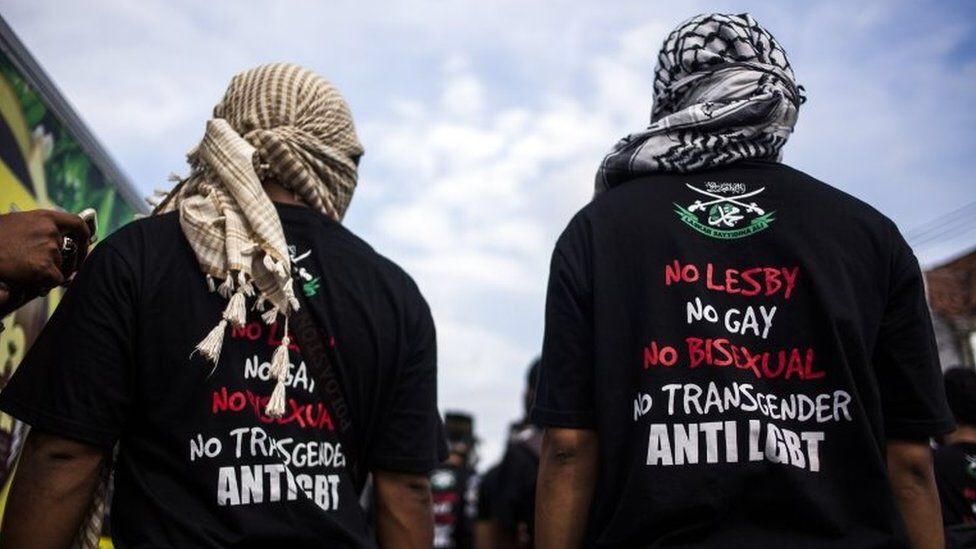
Ever since born-again singer and orange juice pitchwoman Anita Bryant helped kick off the contemporary anti-gay movement some 40 years ago, hard-line elements of the religious right have been searching for ways to demonize gay people — or, at a minimum, to find arguments that will prevent their normalization in society. For the former Florida beauty queen and her Save Our Children group, it was the alleged plans of gay men and lesbians to “recruit” in schools that provided the fodder for their crusade. But in addition to hawking that myth, the legions of anti-gay activists who followed have added a panoply of others, ranging from the extremely doubtful claim that sexual orientation is a choice, to unalloyed lies like the claims that gay men molest children far more than heterosexuals or that hate crime laws will lead to the legalization of bestiality and necrophilia. These fairy tales are important to the anti-gay right because they form the basis of its claim that homosexuality is a social evil that must be suppressed — an opinion rejected by virtually all relevant medical and scientific authorities. They also almost certainly contribute to hate crime violence directed at the LGBT community, which is more targeted for such attacks than any other minority group in America. What follows are 10 key myths propagated by the anti-gay movement, along with the truth behind the propaganda.

MYTH # 1
Gay men molest children at far higher rates than heterosexuals.

THE ARGUMENT
Depicting gay men as a threat to children may be the single most potent weapon for stoking public fears about homosexuality — and for winning elections and referenda, as Anita Bryant found out during her successful 1977 campaign to overturn a Dade County, Fla., ordinance barring discrimination against gay people. Discredited psychologist Paul Cameron, the most ubiquitous purveyor of anti-gay junk science, has been a major promoter of this myth. Despite having been debunked repeatedly and very publicly, Cameron’s work is still widely relied upon by anti-gay organizations, although many no longer quote him by name. Others have cited a group called the American College of Pediatricians (ACPeds) to claim, as Tony Perkins of the Family Research Council did in November 2010, that “the research is overwhelming that homosexuality poses a [molestation] danger to children.” A related myth is that same-sex parents will molest their children.
THE FACTS
According to the American Psychological Association, children are not more likely to be molested by LGBT parents or their LGBT friends or acquaintances. Gregory Herek, a professor at the University of California, Davis, who is one of the nation’s leading researchers on prejudice against sexual minorities, reviewed a series of studies and found no evidence that gay men molest children at higher rates than heterosexual men.

Anti-gay activists who make that claim allege that all men who molest male children should be seen as homosexual. But research by A. Nicholas Groth, a pioneer in the field of sexual abuse of children, shows that is not so. Groth found that there are two types of child molesters: fixated and regressive. The fixated child molester — the stereotypical pedophile — cannot be considered homosexual or heterosexual because “he often finds adults of either sex repulsive” and often molests children of both sexes. Regressive child molesters are generally attracted to other adults, but may “regress” to focusing on children when confronted with stressful situations. Groth found, as Herek notes, that the majority of regressed offenders were heterosexual in their adult relationships.

The Child Molestation Research & Prevention Institute notes that 90% of child molesters target children in their network of family and friends, and the majority are men married to women. Most child molesters, therefore, are not gay people lingering outside schools waiting to snatch children from the playground, as much religious-right rhetoric suggests.

Some anti-gay ideologues cite ACPeds’ opposition to same-sex parenting as if the organization were a legitimate professional body. In fact, the so-called college is a tiny breakaway faction of the similarly named, 60,000-member American Academy of Pediatrics that requires, as a condition of membership, that joiners “hold true to the group’s core beliefs … [including] that the traditional family unit, headed by an opposite-sex couple, poses far fewer risk factors in the adoption and raising of children.” The group’s 2010 publication Facts About Youth was described by the American Academy of Pediatrics as not acknowledging scientific and medical evidence with regard to sexual orientation, sexual identity and health, or effective health education. Francis Collins, director of the National Institutes of Health, was one of several legitimate researchers who said ACPeds misrepresented the institutes’ findings. “It is disturbing to me to see special interest groups distort my scientific observations to make a point against homosexuality,” he wrote. “The information they present is misleading and incorrect.” Another critic of ACPeds is Dr. Gary Remafedi, a researcher at the University of Minnesota who wrote a letter to ACPeds rebuking the organization for misusing his research.

In spite of all this, the anti-LGBT right continues to peddle this harmful and baseless myth, which is probably the leading defamatory charge leveled against gay people.

MYTH # 2
Same-sex parents harm children.

THE ARGUMENT
Most hard-line anti-gay organizations are heavily invested, from both a religious and a political standpoint, in promoting the traditional nuclear family as the sole framework for the healthy upbringing of children. They maintain a reflexive belief that same-sex parenting must be harmful to children — although the exact nature of that supposed harm varies widely.

THE FACTS
No legitimate research has demonstrated that same-sex couples are any more or any less harmful to children than heterosexual couples.

The American Academy of Child & Adolescent Psychiatry affirmed in 2013 that “[c]urrent research shows that children with gay and lesbian parents do not differ from children with heterosexual parents in their emotional development or in their relationships with peers and adults” and they are “not more likely than children of heterosexual parents to develop emotional or behavioral problems.”

The American Academy of Pediatrics (AAP) in a 2002 policy statement declared: “A growing body of scientific literature demonstrates that children who grow up with one or two gay and/or lesbian parents fare as well in emotional, cognitive, social, and sexual functioning as do children whose parents are heterosexual.” That policy statement was reaffirmed in 2009 and in 2013, when the AAP stated its support for civil marriage for same-gender couples and full adoption and foster care rights for all parents, regardless of sexual orientation.

The American Psychological Association (APA) noted in 2004 that “same-sex couples are remarkably similar to heterosexual couples, and that parenting effectiveness and the adjustment, development and psychological well-being of children is unrelated to parental sexual orientation.” In addition, the APA stated that “beliefs that lesbian and gay adults are not fit parents have no empirical foundation.” The next year, in 2005, the APA published a summary of research findings on lesbian and gay parents and reiterated that common negative stereotypes about LGBT parenting are not supported by the data.

Similarly, the Child Welfare League of America’s official position with regard to same-sex parents is that “lesbian, gay, and bisexual parents are as well-suited to raise children as their heterosexual counterparts.”

2010 review of research on same-sex parenting carried out by LiveScience, a science news website, found no differences between children raised by heterosexual parents and children raised by lesbian parents. In some cases, it found, children in same-sex households may actually be better adjusted than in heterosexual homes.

A 2013 preliminary study in Australia found that the children of lesbian and gay parents are not only thriving, but may actually have better overall health and higher rates of family cohesion than heterosexual families. The study is the world’s largest attempt to compare children of same-sex parents to children of heterosexual parents. The full study was published in June 2014.

The anti-LGBT right continues, however, to use this myth to deny rights to LGBT people, whether through distorting legitimate research or through “studies” conducted by anti-LGBT sympathizers, such as a 2012 paper popularly known as the Regnerus Study. University of Texas sociology professor Mark Regnerus’ paper purported to demonstrate that same-sex parenting harms children. The study received almost $1 million in funding from anti-LGBT think tanks, and even though Regnerus himself admitted that his study does not show what people say it does with regard to the “harms” of same-sex parenting, it continues to be peddled as “proof” that children are in danger in same-sex households. Since the study’s release, it has been completely discredited because of its faulty methodology and its suspect funding. In 2013, Darren Sherkat, a scholar appointed to review the study by the academic journal that published it, told the Southern Poverty Law Center that he “completely dismiss[es]” the study, saying Regnerus “has been disgraced” and that the study was “bad … substandard.” In spring 2014, the University of Texas’s College of Liberal Arts and Department of Sociology publicly distanced themselves from Regnerus, the day after he testified as an “expert witness” against Michigan’s same-sex marriage ban. The judge in that case, Bernard Friedman, found that Regnerus’ testimony was “entirely unbelievable and not worthy of serious consideration,” and ruled that Michigan’s ban on same-sex marriage was unconstitutional. Despite all this, the Regnerus Study is still used in the U.S. and abroad as a tool by anti-LGBT groups to develop anti-LGBT policy and laws.

MYTH # 3
People become homosexual because they were sexually abused as children or there was a deficiency in sex-role modeling by their parents.

THE ARGUMENT
Many anti-gay rights activists claim that homosexuality is a mental disorder caused by some psychological trauma or aberration in childhood. This argument is used to counter the common observation that no one, gay or straight, consciously chooses his or her sexual orientation. Joseph Nicolosi, a founder of the National Association for Research and Therapy of Homosexuality, said in 2009 that “if you traumatize a child in a particular way, you will create a homosexual condition.” He also has repeatedly said, “Fathers, if you don’t hug your sons, some other man will.” 

A side effect of this argument is the demonization of parents of gay men and lesbians, who are led to wonder if they failed to protect a child against sexual abuse or failed as role models in some important way. In October 2010, Kansas State University family studies professor Walter Schumm released a related study in the British Journal of Biosocial Science, which used to be the Eugenics Review. Schumm argued that gay couples are more likely than heterosexuals to raise gay or lesbian children through modeling “gay behavior.” Schumm, who has also argued that lesbian relationships are unstable, has ties to discredited psychologist and anti-LGBT fabulist Paul Cameron, the author of numerous completely baseless “studies” about the alleged evils of homosexuality. Critics of Schumm’s study note that he appears to have merely aggregated anecdotal data, resulting in a biased sample.

THE FACTS
No scientifically sound study has definitively linked sexual orientation or identity with parental role-modeling or childhood sexual abuse.

The American Psychiatric Association noted in a 2000 fact sheet available on the Association of Gay and Lesbian Psychiatrists, that dealing with gay, lesbian and bisexual issues, that sexual abuse does not appear to be any more prevalent among children who grow up and identify as gay, lesbian or bisexual than in children who grow up and identify as heterosexual.

Similarly, the National Organization on Male Sexual Victimization notes on its websitethat “experts in the human sexuality field do not believe that premature sexual experiences play a significant role in late adolescent or adult sexual orientation” and added that it’s unlikely that anyone can make another person gay or heterosexual.

Advocates for Youth, an organization that works in the U.S. and abroad in the field of adolescent reproductive and sexual health also has stated that sexual abuse does not “cause” heterosexual youth to become gay.

In 2009, Dr. Warren Throckmorton, a psychologist at the Christian Grove City College, noted in an analysis that “the research on sexual abuse among GLBT populations is often misused to make inferences about causation [of homosexuality].”

MYTH # 4
LGBT people don’t live nearly as long as heterosexuals.

THE ARGUMENT
Anti-LGBT organizations, seeking to promote heterosexuality as the healthier “choice,” often offer up the purportedly shorter life spans and poorer physical and mental health of gays and lesbians as reasons why they shouldn’t be allowed to adopt or foster children.

THE FACTS
This falsehood can be traced directly to the discredited research of Paul Cameron and his Family Research Institute, specifically a 1994 paper he co-wrote entitled  “The Lifespan of Homosexuals.” Using obituaries collected from newspapers serving the gay community, he and his two co-authors concluded that gay men died, on average, at 43, compared to an average life expectancy at the time of around 73 for all U.S. men. On the basis of the same obituaries, Cameron also claimed that gay men are 18 times more likely to die in car accidents than heterosexuals, 22 times more likely to die of heart attacks than whites, and 11 times more likely than blacks to die of the same cause. He also concluded that lesbians are 487 times more likely to die of murder, suicide, or accidents than straight women. 

Remarkably, these claims have become staples of the anti-gay right and have frequently made their way into far more mainstream venues. For example, William Bennett, education secretary under President Reagan, used Cameron’s statistics in a 1997 interview he gave to ABC News’ “This Week.”

However, like virtually all of his “research,” Cameron’s methodology is egregiously flawed — most obviously because the sample he selected (the data from the obits) was not remotely statistically representative of the LGBT population as a whole. Even Nicholas Eberstadt, a demographer at the conservative American Enterprise Institute, has called Cameron’s methods “just ridiculous.”

Anti-LGBT organizations have also tried to support this claim by distorting the work of legitimate scholars, like a 1997 study conducted by a Canadian team of researchers that dealt with gay and bisexual men living in Vancouver in the late 1980s and early 1990s. The authors of the study became aware that their work was being misrepresented by anti-LGBT groups, and issued a response taking the groups to task.

MYTH # 5
Gay men controlled the Nazi Party and helped to orchestrate the Holocaust.

THE ARGUMENT
This claim comes directly from a 1995 book titled The Pink Swastika: Homosexuality in the Nazi Party, by Scott Lively and Kevin Abrams. Lively is the virulently anti-gay founder of Abiding Truth Ministries and Abrams is an organizer of a group called the International Committee for Holocaust Truth, which came together in 1994 and included Lively as a member.

The primary argument Lively and Abrams make is that gay people were not victimized by the Holocaust. Rather, Hitler deliberately sought gay men for his inner circle because their “unusual brutality” would help him run the party and mastermind the Holocaust. In fact, “the Nazi party was entirely controlled by militaristic male homosexuals throughout its short history,” the book claims. “While we cannot say that homosexuals caused the Holocaust, we must not ignore their central role in Nazism,” Lively and Abrams add. “To the myth of the ‘pink triangle’ — the notion that all homosexuals in Nazi Germany were persecuted — we must respond with the reality of the ‘pink swastika.'”

These claims have been picked up by a number of anti-gay groups and individuals, including Bryan Fischer of the American Family Association, as proof that gay men and lesbians are violent and sick. The book has also attracted an audience among anti-gay church leaders in Eastern Europe and among Russian-speaking anti-gay activists in America.
THE FACTS
The Pink Swastika has been roundly discredited by legitimate historians and other scholars. Christine Mueller, professor of history at Reed College, did a 1994 line-by-line refutation of an earlier Abrams article on the topic and of the broader claim that the Nazi Party was “entirely controlled” by gay men. Historian Jon David Wynecken at Grove City College also refuted the book, pointing out that Lively and Abrams did no primary research of their own, instead using out-of-context citations of some legitimate sources while ignoring information from those same sources that ran counter to their thesis.

The myth that the Nazis condoned homosexuality sprang up in the 1930s, started by socialist opponents of the Nazis as a slander against Nazi leaders. Credible historians believe that only one of the half-dozen leaders in Hitler’s inner circle, Ernst Röhm, was gay. (Röhm was murdered on Hitler’s orders in 1934.) The Nazis considered homosexuality one aspect of the “degeneracy” they were trying to eradicate.

When Hitler’s National Socialist German Workers Party came to power in 1933, it quickly strengthened Germany’s existing penalties against homosexuality. Heinrich Himmler, Hitler’s security chief, announced that homosexuality was to be “eliminated” in Germany, along with miscegenation among the races. Historians estimate that between 50,000 and 100,000 men were arrested for homosexuality (or suspicion of it) under the Nazi regime. These men were routinely sent to concentration camps and many thousands died there.

Himmler expressed his views on homosexuality like this: “We must exterminate these people root and branch. … We can’t permit such danger to the country; the homosexual must be completely eliminated.”

MYTH # 6
Hate crime laws will lead to the jailing of pastors who criticize homosexuality and the legalization of practices like bestiality and necrophilia.

THE ARGUMENT
Anti-gay activists, who have long opposed adding LGBT people to those protected by hate crime legislation, have repeatedly claimed that such laws would lead to the jailing of religious figures who preach against homosexuality — part of a bid to gain the backing of the broader religious community for their position. Janet Porter of Faith2Action, for example, was one of many who asserted that the federal Matthew Shepard and James Byrd Jr. Hate Crimes Prevention Act — signed into law by President Obama in October 2009 — would “jail pastors” because it “criminalizes speech against the homosexual agenda.”

In a related assertion, anti-gay activists claimed the law would lead to the legalization of psychosexual disorders (paraphilias) like bestiality and pedophilia. Bob Unruh, a conservative Christian journalist who left The Associated Press in 2006 for the right-wing, conspiracist news site WorldNetDaily, said shortly before the federal law was passed that it would legalize “all 547 forms of sexual deviancy or ‘paraphilias’ listed by the American Psychiatric Association.” This claim was repeated by many anti-gay organizations, including the Illinois Family Institute.

THE FACTS
The claim that hate crime laws could result in the imprisonment of those who “oppose the homosexual lifestyle” is false. The First Amendment provides robust protections of free speech, and case law makes it clear that even a preacher who publicly suggested that gays and lesbians should be killed would be protected.

Neither do hate crime laws — which provide for enhanced penalties when persons are victimized because of their “sexual orientation” (among other factors) — “protect pedophiles,” as Janet Porter and many others have claimed. According to the American Psychological Association, sexual orientation refers to heterosexuality, homosexuality and bisexuality — not paraphilias such as pedophilia. Paraphilias, as defined (pdf; may require a different browser) by the American Psychiatric Association, are characterized by sexual urges or behaviors directed at non-consenting persons or those unable to consent like children, or that involve another person’s psychological distress, injury, or death.

Moreover, even if pedophiles, for example, were protected under a hate crime law — and such a law has not been suggested or contemplated anywhere — that would not legalize or “protect” pedophilia. Pedophilia is illegal sexual activity, and a law that more severely punished people who attacked pedophiles would not change that.

MYTH # 7
Allowing gay people to serve openly will damage the armed forces.

THE ARGUMENT
Anti-gay groups have been adamantly opposed to allowing gay men and lesbians to serve openly in the armed forces, not only because of their purported fear that combat readiness will be undermined, but because the military has long been considered the purest meritocracy in America (the armed forces were successfully racially integrated long before American civil society, for example). If gays serve honorably and effectively in this meritocracy, that suggests that there is no rational basis for discriminating against them in any way.

THE FACTS
Gays and lesbians have long served in the U.S. armed forces, though under the “Don’t Ask, Don’t Tell” (DADT) policy that governed the military between 1993 and 2011, they could not do so openly. At the same time, gays and lesbians have served openly for years in the armed forces of 25 countries (as of 2010), including Britain, Israel, South Africa, Canada and Australia, according to a report released by the Palm Center, a policy think tank at the University of California at Santa Barbara. The Palm Center report concluded that lifting bans against openly gay service personnel in these countries “ha[s] had no negative impact on morale, recruitment, retention, readiness or overall combat effectiveness.” Successful transitions to new policies were attributed to clear signals of leadership support and a focus on a uniform code of behavior without regard to sexual orientation.

A 2008 Military Times poll of active-duty military personnel, often cited by anti-gay activists, found that 10% of respondents said they would consider leaving the military if the DADT policy were repealed. That would have meant that some 228,000 people might have left the military the policy’s 2011 repeal. But a 2009 review of that poll by the Palm Center suggested a wide disparity between what soldiers said they would do and their actual actions. It noted, for example, that far more than 10% of West Point officers in the 1970s said they would leave the service if women were admitted to the academy. “But when the integration became a reality,” the report said, “there was no mass exodus; the opinions turned out to be just opinions.” Similarly, a 1985 survey of 6,500 male Canadian service members and a 1996 survey of 13,500 British service members each revealed that nearly two-thirds expressed strong reservations about serving with gays. Yet when those countries lifted bans on gays serving openly, virtually no one left the service for that reason. “None of the dire predictions of doom came true,” the Palm Center report said.

Despite the fact that gay men and lesbians have been serving openly in the military since September 2011, anti-LGBT groups continue to claim that openly gay personnel are causing problems in the military, including claims of sexual abuse by gay and lesbian soldiers of straight soldiers. The Palm Center refutes this claim, and in an analysis, found that repealing DADT has had “no overall negative impact on military readiness or its component dimensions,” including sexual assault. According to then-Secretary of Defense Leon Panetta in 2012, the repeal of DADT was being implemented effectively and was having no impact on readiness, unit cohesion or morale. Panetta also issued an LGBT Pride message in 2012.

MYTH # 8
Gay people are more prone to be mentally ill and to abuse drugs and alcohol.

THE ARGUMENT
Anti-LGBT groups want not only to depict sexual orientation as something that can be changed but also to show that heterosexuality is the most desirable “choice,” even if religious arguments are set aside. The most frequently used secular argument made by anti-LGBT groups in that regard is that homosexuality is inherently unhealthy, both mentally and physically. As a result, most anti-LGBT rights groups reject the 1973 decision by the American Psychiatric Association (APA) to remove homosexuality from its list of mental illnesses. Some of these groups, including the particularly hard-line Traditional Values Coalition, claim that “homosexual activists” managed to infiltrate the APA in order to sway its decision.

THE FACTS
All major professional mental health organizations are on record as stating that homosexuality is not a mental disorder.

The American Psychological Association states that being gay is just as healthy as being straight, and noted that the 1950s-era work of Dr. Evelyn Hooker started to dismantle this myth. In 1975, the association issued a statement that said, in part, “homosexuality per se implies no impairment in judgment, reliability or general social and vocational capabilities.” The association has clearly stated in the past that “homosexuality is neither mental illness nor mental depravity. … Study after study documents the mental health of gay men and lesbians. Studies of judgment, stability, reliability, and social and vocational adaptiveness all show that gay men and lesbians function every bit as well as heterosexuals.”

The American Psychiatric Association states that (PDF; may not open in all browsers) homosexuality is not a mental disorder and that all major professional health organizations are on record as confirming that. The organization removed homosexuality from its official diagnostic manual in 1973 after extensive review of the scientific literature and consultation with experts, who concluded that homosexuality is not a mental illness.

Though it is true that LGBT people tend to suffer higher rates of anxiety, depression, and depression-related illnesses and behaviors like alcohol and drug abuse than the general population, that is due to the historical social stigmatization of homosexuality and violence directed at LGBT people, not because of homosexuality itself. Studies done during the past several years have determined that it is the stress of being a member of a minority group in an often-hostile society — and not LGBT identity itself — that accounts for the higher levels of mental illness and drug use.

Richard J. Wolitski, an expert on minority status and public health issues at the Centers for Disease Control and Prevention, put it like this in 2008: “Economic disadvantage, stigma, and discrimination … increase stress and diminish the ability of individuals [in minority groups] to cope with stress, which in turn contribute to poor physical and mental health.”

Even as early as 1994, external stressors were recognized as a potential cause of emotional distress of LGBT people. A report presented by the Council on Scientific Affairs to the AMA House of Delegates Interim Meeting with regard to reparative (“ex-gay”) therapy noted that most of the emotional disturbance gay men and lesbians experience around their sexual identity is not based on physiological causes, but rather on “a sense of alienation in an unaccepting environment.”

In 2014, a study, conducted by several researchers at major universities and the Rand Corporation, found that LGBT people living in highly anti-LGBT communities and circumstances face serious health concerns and even premature death because of social stigmatization and exclusion. One of the researchers, Dr. Mark Hatzenbuehler, a sociomedical sciences professor at the Mailman School of Public Health at Columbia University, said that the data gathered in the study suggests that “sexual minorities living in communities with high levels of anti-gay prejudice have increased risk of mortality, compared to low-prejudice communities.”

Homosexuality is not a mental illness or emotional problem and being LGBT does not cause someone to be mentally ill, contrary to what anti-LGBT organizations say. Rather, social stigmatization and prejudice appear to contribute to health disparities in the LGBT population, which include emotional and psychological distress and harmful coping mechanisms.

MYTH # 9
No one is born gay.

THE ARGUMENT
Anti-gay activists keenly oppose the granting of “special” civil rights protections to gay people similar to those afforded black Americans and other minorities. But if people are born gay — in the same way that people have no choice as to whether they are black or white — discrimination against gay men and lesbians would be vastly more difficult to justify. Thus, anti-gay forces insist that sexual orientation is a behavior that can be changed, not an immutable characteristic.

THE FACTS
Modern science cannot state conclusively what causes sexual orientation, but a great many studies suggest that it is the result of both biological and environmental forces, not a personal “choice.” A 2008 Swedish study of twins (the world’s largest twin study) published in The Archives of Sexual Behavior concluded that “[h]omosexual behaviour is largely shaped by genetics and random environmental factors.” Dr. Qazi Rahman, study co-author and a leading scientist on human sexual orientation, said: “This study puts cold water on any concerns that we are looking for a single ‘gay gene’ or a single environmental variable which could be used to ‘select out’ homosexuality — the factors which influence sexual orientation are complex. And we are not simply talking about homosexuality here — heterosexual behaviour is also influenced by a mixture of genetic and environmental factors.” In other words, sexual orientation in general — whether homosexual, bisexual or heterosexual — is a mixture of genetic and environmental factors.

The American Psychological Association (APA) states that sexual orientation “ranges along a continuum,” and acknowledges that despite much research into the possible genetic, hormonal, social and cultural influences on sexual orientation, scientists have yet to pinpoint the precise causes of sexual orientation. Regardless, the APA concludes that “most people experience little or no sense of choice about their sexual orientation.” In 1994, the APA noted that “homosexuality is not a matter of individual choice” and that research “suggests that the homosexual orientation is in place very early in the life cycle, possibly even before birth.”

The American Academy of Pediatrics stated in 1993 (updated in 2004) that “homosexuality has existed in most societies for as long as recorded descriptions of sexual beliefs and practices have been available” and that even at that time, “most scholars in the field state that one’s sexual orientation is not a choice … individuals do not choose to be homosexual or heterosexual.”

There are questions about what specifically causes sexual orientation in general, but most current science acknowledges that it is a complex mixture of biological, environmental, and possibly hormonal factors but that no one chooses an orientation.

MYTH # 10
Gay people can choose to leave homosexuality.

THE ARGUMENT
If people are not born gay, as anti-gay activists claim, then it should be possible for individuals to abandon homosexuality. This view is buttressed among religiously motivated anti-gay activists by the idea that homosexual practice is a sin and humans have the free will needed to reject sinful urges.

A number of “ex-gay” religious ministries have sprung up in recent years with the aim of teaching gay people to become heterosexuals, and these have become prime purveyors of the claim that gays and lesbians, with the aid of mental therapy and Christian teachings, can “come out of homosexuality.” The now defunct Exodus International, the largest of these ministries, once stated, “You don’t have to be gay!” Meanwhile, in a more secular vein, the National Association for Research and Therapy of Homosexuality describes itself as “a professional, scientific organization that offers hope to those who struggle with unwanted homosexuality.”

THE FACTS
“Reparative” or sexual reorientation therapy — the pseudo-scientific foundation of the ex-gay movement — has been rejected by all the established and reputable American medical, psychological, psychiatric and professional counseling organizations. In 2009, for instance, the American Psychological Association adopted a resolution, accompanied by a 138-page report, that repudiated ex-gay therapy. The report concluded that compelling evidence suggested that cases of individuals going from gay to straight were “rare” and that “many individuals continued to experience same-sex sexual attractions” after reparative therapy. The APA resolution added that “there is insufficient evidence to support the use of psychological interventions to change sexual orientation” and asked “mental health professionals to avoid misrepresenting the efficacy of sexual orientation change efforts by promoting or promising change in sexual orientation.” The resolution also affirmed that same-sex sexual and romantic feelings are normal.

A very large number of professional medical, scientific and counseling organizations in the U.S. and abroad have issued statements regarding the harm that reparative therapy can cause, particularly if it’s based on the assumption that homosexuality is unacceptable. As early as 1993, the American Academy of Pediatrics stated that“[t]herapy directed at specifically changing sexual orientation is contraindicated, since it can provoke guilt and anxiety while having little or no potential for achieving change in orientation.”

The American Medical Association officially opposes reparative therapy that is “based on the assumption that homosexuality per se is a mental disorder or based on an a priori assumption that the person should change his/her homosexual orientation.”

The Pan-American Health Organization, the world’s oldest international public health agency, issued a statement in 2012 that said, in part: “Services that purport to ‘cure’ people with non-heterosexual sexual orientation lack medical justification and represent a serious threat to the health and well-being of affected people.” The statement continues, “In none of its individual manifestations does homosexuality constitute a disorder or an illness, and therefore it requires no cure.”

Some of the most striking, if anecdotal, evidence of the ineffectiveness of sexual reorientation therapy has been the numerous failures of some of its most ardent advocates. For example, the founder of Exodus International, Michael Bussee, left the organization in 1979 with a fellow male ex-gay counselor because the two had fallen in love. Other examples include George Rekers, a former board member of NARTH and formerly a leading scholar of the anti-LGBT Christian right who was revealed to have been involved in a same-sex tryst in 2010. John Paulk, former poster child of the massive ex-gay campaign “Love Won Out” in the late 1990s, is now living as a happy gay man. And Robert Spitzer, a preeminent psychiatrist whose 2001 research that seemed to indicate that some gay people had changed their orientation, repudiated his own study in 2012. The Spitzer study had been widely used by anti-LGBT organizations as “proof” that sexual orientation can change.

In 2013, Exodus International, formerly one of the largest ex-gay ministries in the world, shut down after its director, Alan Chambers, issued an apology to the LGBT community. Chambers, who is married to a woman, has acknowledged that his same-sex attraction has not changed. At a 2012 conference, he said: “The majority of people that I have met, and I would say the majority meaning 99.9% of them, have not experienced a change in their orientation or have gotten to a place where they could say they could never be tempted or are not tempted in some way or experience some level of same-sex attraction.”

Reference

Gay History: Has Orange Juice Turned Bluto And Popeye Gay?

Classic cartoon enemy musclemen Popeye and Bluto haven’t kissed but they have made up in this animated campaign behind Minute Maid orange juice. The two have overcome their differences to such a degree that some in the gay community (and the straight media too, such as Slate.com ad reviewer Rob Davis) have wondered if the sailors are supposed to suddenly be romantic partners. 

The two play like school children on a swing, a see-saw, bury each other in sand on the beach, and get tattoos together that say “Buddies for Life.” At the end, they ride a two-person bicycleùpassing usual romantic interest Olive Oyl, who calls out “Oh, boys!” and they ride past her without notice. She offers a confused, if not suspicious, look as they pedal away. 

An ironic development for Minute Maid, given the anti-gay “Save Our Children” crusades by former Florida Orange Juice spokeswoman Anita Bryant in the 1970s.

Before the campaign was conceived, Dave Linne, the Popeye ad’s creative director at ad agency Leo Burnett Co says the concept is “the opposite of the clich? of getting up on the wrong side of the bedö where people wake up in a good mood. 

Linne came up with about 12 conceptual examples of people acting out of character and being nicer than normal, including an elementary school cafeteria line that resembles a Depression-era soup kitchen — except for one cheery server. Another example has a husband doing “wifely” weekend activities such as laundry and brings breakfast in bed to his wife to her surprise as she wakes up. 

They also wanted an example of classic enemies who become friends. “We looked at movie villains and there are so many arch enemies, so we thought, ‘Let’s do an animated spot.’ We looked at lots of cartoon characters and we liked Popeye and Bluto for two reasons: I haven’t seen them in a commercial before, and they’re human characters instead of animals.” 

So as they were making the ad, the creative team decided to put Popeye and Bluto in various playful situations. “The only reason we put them on a two-person bicycle was because it seemed so stupid,” Linne says. As they pass Olive Oyl, who Linne notes “is usually the catalyst to make them fight” not even she can get between them this time. 

Linne says gay innuendo was not intentional but is intrigued about its possibility. “I think it’s interesting if you can read it both ways. I guess it’s working on all kinds of levels,” he mused. 

While Linne seems impressed that his work can be read into by the gay community, the same cannot be said for officials at Minute Maid headquarters. “We’re not going to go there,” says Dan Shafer, a spokesman for Houston-based Minute Maid. “Any intent to draw a (gay relationship) parallel would be wrong. Anyone who knows Popeye and Bluto understands that’s not the case, there’s no intent like that.”

Commercials: Out of the Closet

Is Popeye gay? An ad company using the cartoon sailor’s likeness says no, but the commercial is still being featured on a new site of gay-themed ads.

POPEYE AND BLUTO may be the most recent celebrity couple to be outed by the media. 

In a recent Minute Maid orange juice ad, the pair is seen palling around on a swing-set, burying each other in sand on the beach and riding a bicycle built for two as they gleefully pass by a scorned Olive Oyl. They even get matching tattoos that say “Buddies for Life.”

The animated spot, created by the ad agency Leo Burnett, is one of the latest additions to The Commercial Closet, an online museum of gay-themed ads from around the world, which launched Monday.

CommercialCloset.org compiles video clips and storyboard stills of hundreds of commercials featuring gay characters or themes, including several that never made it on the air. The archive includes ads representing 150 different ad agencies and 250 major advertisers, including American Express, Coca-Cola, Nike and the Gap.

Ranging from innocuous to offensive, the ads are grouped into four major categories: positive, negative, neutral and gay vague; and 50 subcategories such as “hustlers/ pornographers/murderers/pedophiles” and “sissies and queens.”

Michael Wilke, a former reporter for Advertising Age, created the site to promote awareness of the “evolution in the portrayal of lesbians and gays in advertising as it reflects the public’s perception of them,” and to raise money for a documentary film he’s making to further explore that theme.

Over the past 30 years, “there’s been an evolution from complete invisibility to popular stereotypes to more neutral and positive portrayals of gays in advertising,” Wilke said.

While there’s an increasing number of gay-themed ad campaigns cropping up today, according to Wilke, it’s still a mixed bag. “There’s definitely an increase in gay-positive ads, but the negative stereotypes continue to be a popular source of comedy in commercials,” he said.

Transgendered individuals in particular almost always end up the butt of the joke in commercials, which earned them their own sub-category in Wilke’s archive, called “(Straight) Dude Looks Like A Lady.”

But not all ads in this category are negative. Some manage to cast transgender characters in funny situations without making them out to be villains or clowns.

A 1996 Australian commercial for air-freshening spray Domestos, for instance, riffs off the cult classic Priscilla: Queen of the Desert, featuring a Terrance Stamp look-alike who asks to use the ladies’ room in a roadside bar. Finding it filthy, she pulls Domestos out of her purse and clears the air. Later she proclaims the bathroom “fit for a queen.”

“It’s not that transgendered people can’t be funny,” Wilke said, “but there’s a difference between laughing at someone and laughing with them.”

Although there may be more gay-themed ads on the air today, there’s a popular misconception in the media about who gay people are and what motivates them as consumers, according to Kathy Renna, a director at the media advocacy organization Gay & Lesbian Alliance Against Defamation (GLAAD).

“There’s the perception that gays and lesbians are very affluent, own three cars and buy 100 CDs,” Renna said. “That’s not reflective of the whole gay community. One thing that is true is that it’s a very loyal demographic.”

Companies with gay-positive reputations include American Airlines, Absolut vodka and Coors, she said.

But while marketing to gays and lesbians is an important priority for many corporations, advertisers and ad agencies must still walk a fine line when depicting them in ads.

Today, ads featuring gay people among other minorities in a happy-people world are relatively safe bets for corporations wanting to project a multicultural image.

A 1994 Ikea ad about a gay couple buying a dining table together, for instance, was controversial as one of the first gay-positive commercials by a major corporation.

Part of a three-part ad campaign depicting people in alternative lifestyles buying furniture -– the other two being a single mom and a white couple with an adopted Asian baby -– the ad was meant to “reflect real life and real people and not the middle-of-the-road all-American family,” according to Kathy Delaney, the executive creative director at Deutsch, the agency that made the ad.

But while homosexuality remains a touchy subject fraught with political correctness, that doesn’t mean advertisers should only approach it with kid gloves, Wilke said. Still, many agencies and advertisers would rather avoid the topic altogether than open a can of worms.

Then there’re companies such as Calvin Klein, Diesel and Benetton that, instead of shying away from controversy, promote a fashion-forward or youth-oriented brand and deliberately provoke people with their ads.

A notorious example is Benetton’s 1992 “Pieta” print ad depicting AIDS activist David Kirby on his deathbed. The emaciated Kirby, surrounded by his friends and family, bore an eerie resemblance to Jesus, which sparked controversy among Christian groups and AIDs activists who were uncomfortable with the religious tone used in association with the disease and, ultimately, to sell clothes.

On the other hand, the ad was also one of the first in many countries to show AIDs in the context of real human suffering and compassion. Although it was singularly criticized, the ad was part of a larger, ongoing campaign for AIDs prevention and awareness that included the distribution of condoms in Benetton stores.

Some companies, by contrast, seem reluctant to acknowledge any controversy their ads may create.

The Popeye and Bluto spot, for instance, is included in the “Gay Vague” category, because the advertiser’s message related to gay people isn’t very clear. In fact, there’s no substantial proof that the two adversaries are in fact lovers, as they are never seen kissing.

In a interview with Wilke, the creative director for the Popeye ad seemed pleasantly surprised at the suggestion that it implied a relationship between the two erstwhile foes, and that the spot was simply meant to show two enemies who become friends, supposedly transformed by drinking Minute Maid orange juice.

Minute Maid, meanwhile, firmly denied that Popeye and Bluto are an item.

“Any intent to draw a (gay relationship) parallel would be wrong,” Minute Maid spokesman Dan Shafer told Wilke. “Anyone who knows Popeye and Bluto understands that’s not the case, there’s no intent like that.”

Ad Report Card: Minute Maid Makes You Gay! (Happy, That Is)

Some months ago the Ad Report Card devoted not one but two installments to commercials that turned on references (oblique or otherwise) to homosexuality. Often the reference served as a punch line of one sort or another, and in some cases I was critical of the way in which this or that advertiser used gayness as a joke. Responses were many and spirited. Some suggested I was being ridiculous, seeing gay themes where there were none. Others, some claiming to have inside knowledge of the ad business, argued I was naïve, overlooking the benign influence of gays who work in “ad creative.” I have no way of checking the latter claim, but both critiques came to mind when a couple of people e-mailed me recently about a Minute Maid orange juice spot featuring Popeye and Bluto. The ad is part of a series, the theme of which is that drinking Minute Maid makes you gay.

As in happy.

Now, some observers have suggested that, in addition to promoting the happy-making power of Minute Maid, the Popeye spot might just be an example of “gay vague,” along with another commercial that I haven’t seen, which is airing in Europe—read this for more. You can see the spots in the U.S. campaign below: the Popeye one, another featuring Bobby Knight, a third about a “helpful hubby,” and a fourth centered on a suspiciously cheerful lunch lady. My main focus is the Popeye spot.

Popeye The ad: Here they are, two of the most famous rivals in cartoondom, playing happily together on a swing and then a seesaw. Popeye good-naturedly pats sand over Bluto on the beach; sappy pal music plays. The pair gets matching “Buddies for Life” tattoos. What’s going on? An announcer says cheerfully: “Somebody had their Minute Maid this morning. It takes a minute, but the feeling”—the unbridled joy and affection we’re seeing here—“lasts all day.” Popeye and Bluto pedal along on a tandem bike. Olive Oyl waves (“Oh boys!” she calls), but they ride straight past, blithely ignoring the object of their traditional erotic rivalry.ADVERTISEMENThttps://39598048fe002d9e70fc861e576fdf63.safeframe.googlesyndication.com/safeframe/1-0-38/html/container.html

Coach Hmmm. Perhaps it’s ridiculous of me to ask, but what exactly is it that’s preventing these Minute-Maid-drunk boys from including Olive in their fun? On the other hand, what is it that makes it inevitable that almost any prominent male pair is inevitably subject to some kind of what-if-they-were-gay speculation—good-natured, homophobic, or somewhere in between? (Perhaps you’ve heard spurious gossip about the relationship between Ben Affleck and Matt Damon. Or read my Slatecolleague David Plotz’s exploration of the fan fiction subgenre devoted to the imagined couplings of Kirk and Spock, among others. Or recall a New Yorkercartoon that one of my correspondents remembers, featuring none other than Popeye and Bluto holding hands, having finally figured out “where all that anger was coming from.”)

Bed What about the other Minute Maid spots? You could say that they all play it straight. Hothead basketball coach Bobby Knight, having had his Minute Maid, coddles and dotes on his players, bursting into the post-game locker room to ask “Who wants a treat?” A spot featuring a surprisingly helpful husband has him forsaking football to bustle around neatening things up, heading off to “market,” and setting his iron for chiffon. A chipper lunch lady minces through a school cafeteria asking, “Who wants tiramisu?”

School Anyway, subtext or no subtext, this is a pretty good campaign. All the spots, but especially the Popeye one, are attention-getting and make a clear case for the alleged powers of a morning glass of Minute Maid. The helpful hubby installment is the weakest, but the Bobby Knight one is hilarious. Mushing together grades for all four into one composite score, I’d give them a solid B. When I watch these ads, I feel … happy.

Reference

Gay History: NOT The Only Gay In Village! Plans Revealed For ‘No Straights’ Commune

A PLAN to build a “gays only” gated housing estate “with all mod cons” has been revealed as an elaborate hoax.

ALL ABOARD: Would a gays only commune be of any benefit at all to society? [GETTY]

The Gay Village project described itself as a scheme to create a prejudice-free community in Tilbery, Netherlands, complete with a cooking school and tennis courts.

The plan was endorsed by officials, estate agents and developers when it looked like building may go ahead.

Tilburg mayor, Peter Noordanus, welcomed the plan.https://get-latest.convrse.media/?url=https%3A%2F%2Fwww.dailystar.co.uk%2Fnews%2Flatest-news%2Fgay-only-commune-in-netherlands-18734601&cre=top&cip=6&view=web

He said: “A tolerant city is pleased to have a gay community within its borders.”

It later emerged that the officials were persuaded to play along by the Roze Maandag (Pink Monday) foundation which hosts an annual day at the Tilburg Fair, dedicated to LGBT issues.

HOAX: The plan for the housing estate was an elaborate joke to raise awareness [GETTY]

Roze Maandag posted on its website stating: “Although Gay Village is not real, intolerance against the gay community is.”null

The website explained how they were inspired to act by recent surveys showing that nearly a quarter of all gay men in the Netherlands – regarded as one of the most tolerant countries in the world – did not feel safe in their own neighbourhoods.

Despite being a hoax the story was met with intense criticism when it was first revealed.

Many argued that by “ghettoising” itself the LGBT community were doing nothing to help tackle homophobia and transphobia.

The group said it was pleased that the story gathered negative attention, stating: “to the effect that a gay village is indeed ‘ridiculous’”.

A spokesperson told the Netherlands Times: “We are happy with the thousands of negative, and the fewer positive, reactions.

“It is great to hear that the majority is against the idea. All we wanted was to create an awareness, and we are certain that we succeeded in this.”

EQUAL: The hoax highlighted the need for society to be more inclusive of all members of all communities [GETTY]

Reference

Gay History: Gangster Twins Ronnie And Reggie Kray ‘Had Secret Gay Sex With Each Other’

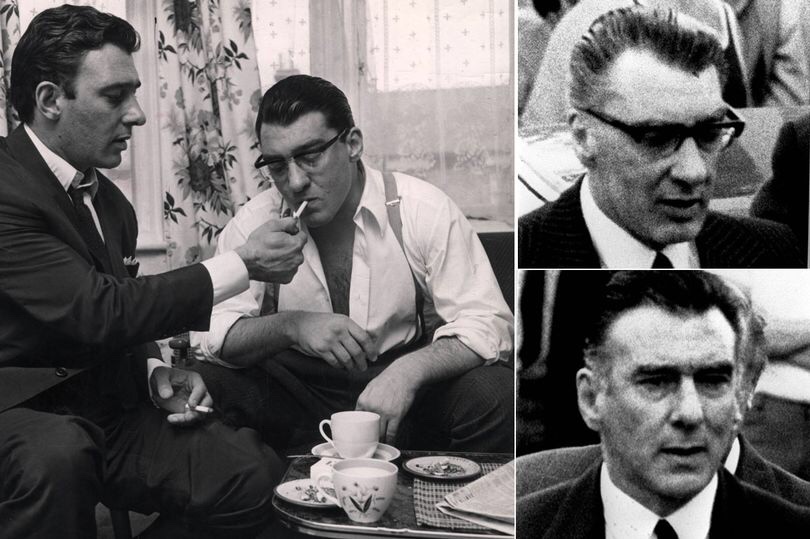
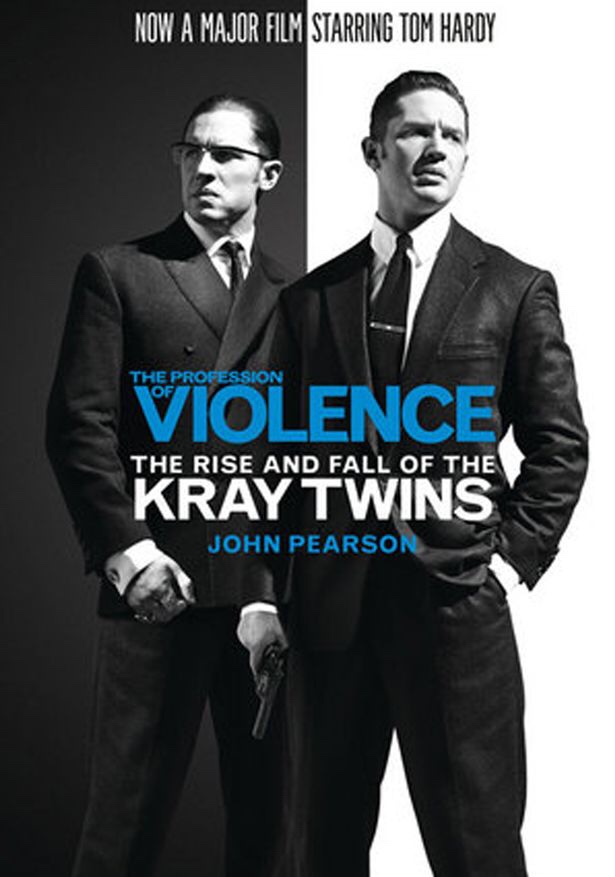
Ronnie and Reggie Kray had a secret incestuous relationship with each other so criminal rivals would not discover they were gay according to author John Pearson who interviewed them both

Kray Twins

Vicious gangster twins Ronnie and Reggie Kray had an incestuous sexual relationship with each other as they were growing up.

The pair, who ran a cruel and violent criminal empire in London’s East End in the 1960s, were terrified of their secret coming out.

They were worried that rivals would see their sexuality – Ronnie was a homosexual and Reggie was bisexual – as a sign of weakness so only had sex with each other in order to keep the secret.

Author John Pearson who extensively interviewed the brothers and their associates has made the revelation as a new film comes out on the twins.

John said: “Homosexuality was nothing to be proud of in the East End.

“But as they became more notorious, Ronniebecame quite shameless about it.

“According to Ron in the early days they had sex with each other because they were terrified about people finding out.”

Smart: Twin brothers and organised crime bosses Ronnie and Reggie Kray (Image: Getty)

It has long been known that Ronnie was a homosexual and Reggie was bisexual but the news they had a sexual relationship with each other gives a telling insight into their close connection.

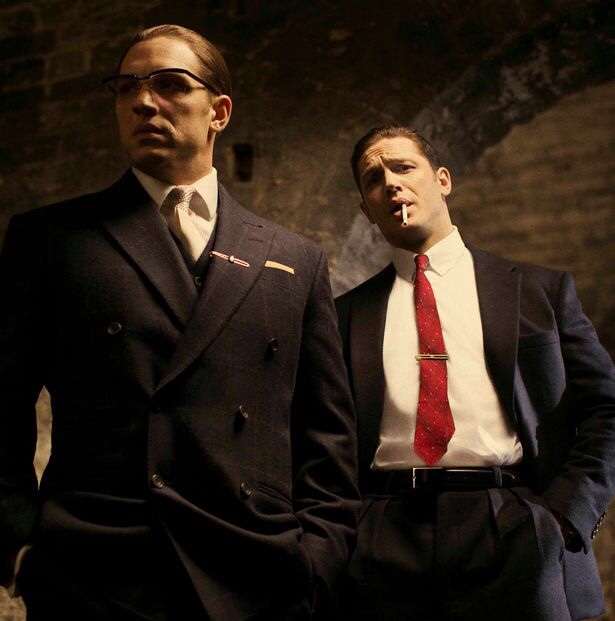
Actor Tom Hardy stars as both brothers in a new film , Legend, based on the lives of the murderous pair as told in a book by John.

Actor: Tom Hardy in his latest roles as Ronnie (left) and Reggie Kray in the film, Legend (Image: PA)

John has written three books on the brothers and says Ronnie told him the twins dark secret during one of their chats.

He says while he knew about the the incest he waited until the brothers were both dead before revealing it for fear of retribution.

Ronnie died in Broadmoor secure hospital of a heart attack in 1995 and Reggie died of cancer in 2000 having been released from prison on compassionate grounds.

In his book Notorious: The Immortal Legend of the Kray Twins , John said the pair were spoilt by their mother Violet, Grandma Lee and their two aunties, May and Rose, while their father was soon dominated by the increasingly violent brothers.

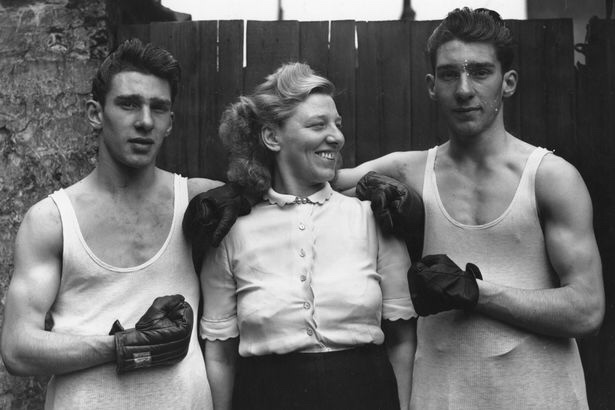
Brotherly love: Amateur boxers Reggie (left) and Ronnie Kray with their mother Violet Kray (Image: Getty)

John wrote: “All of which conformed, of course, to a classic pattern; and with their warm, indulgent mother, their ineffectual father, and their surrounding cast of loving women, it was not surprising that, with adolescence, the Twins discovered that they were gay.

Given their identical genetic make-up, it was virtually inevitable that if one twin was, the other would be too.”

Tome: Author John Pearson’s book on the Kray Twins

However there was a problem for the twins as back in the macho world of 1950s East End it was seen as a weakness to be gay.

John wrote: “So it was hardly surprising that, for the time being, both the twins kept their sexual preferences to themselves.

Claims: Author John Pearson says the brothers had an incestuous relationship(Image: Twitter)

The brothers ran a notorious criminal network in the 1960s building up an empire of nightclubs though hijacking, armed robbery and arson.

Fighters: Ronnie and Reggie during their amateur boxing days in their youth

As they moved from the East End to the West End their became big names rubbing shoulders with Frank Sinatra and Judy Garland and being photographed by David Bailey.

Eventually the police got them and the Krays went to prison for murdering fellow gangsters George Cornell and Jack McVitie.

Reference

Gay History: Pride, Prejudice and Punishment: Gay Rights Around The World

Australians have voted in favour of legalising same-sex marriage — but elsewhere in the world gay people can struggle to simply stay out of jail.

Being openly gay is effectively illegal in more than 70 countries — and can result in severe punishment, sometimes even death.

See how Australia’s position on same-sex marriage compares around the world.

The state of marriage rights

Voters’ ‘yes’ response to the SSM postal survey is Australia’s latest step towards allowing same-sex couples to marry, and may prove close to the culmination of a long campaign.

Campaigners have suggested Australia is lagging behind rest of the world.

It is fair to say that most countries with similar cultural backgrounds to Australia have now legalised same-sex marriage, but based on total country numbers, Australia remains part of the majority in restricting marriage to couples made up of a man and a woman.

Out of 209 countries the ABC examined, only 24 allow same-sex couples to marry.

There is no same-sex marriage in Asia or the Middle East, and South Africa is the only country in Africa to have legalised it.

In Europe, the legal status of same-sex marriage is mixed. The Netherlands was the first country in the world to legalise same-sex marriage in 2001, with other Western countries including the United KingdomFrance, Spain and Germany following it.

Yet more than half of European Union members have not.

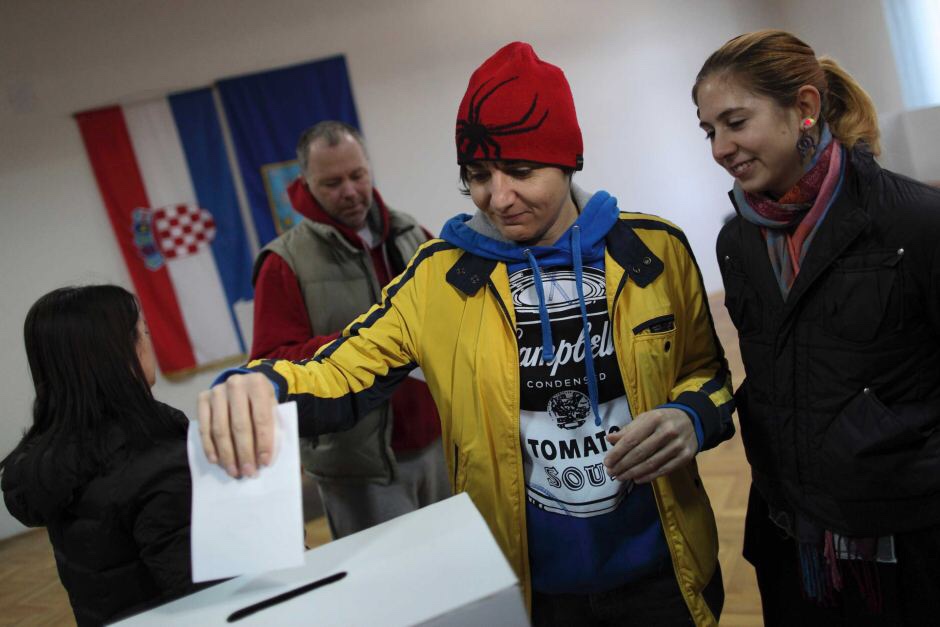
Mima Simic and her girlfriend Marta Sisak vote in Croatia’s referendum on defining marriage as a “union of man and woman”.
Reuters: Antonio Bronic

Some countries in Eastern Europe have recently sought to amend their constitutions to entrench the “traditional definition” of marriage:

  • Hungary brought in a new constitution in 2011 that specifically restricts marriage to heterosexual couples.
  • Voters in Croatia (2013) and Slovakia (2015) voted to change the definition of marriage in their constitutions so that it applies only to a union of a man and a woman, although the Slovakian referendum was invalid due to a low turnout.
  • In December 2015, Slovenian voters rejected the legalisation of same-sex marriage in a referendum.

Australia made a similar amendment to its Marriage Act in 2004, adding a definition of marriage as “the union of a man and a woman to the exclusion of all others”.

How have countries legalised same-sex marriage?

In Australia, Parliament can legalise same-sex marriage by amending the Marriage Act but the Government’s policy has been that its MPs will only be able to vote for same-sex marriage if a majority of Australians support the change via a plebiscite.

The Government’s compulsory plebiscite proposal was defeatedin the Senate. Instead, the non-compulsory Australian Marriage Law Postal Survey was run by the Australian Bureau of Statistics between September 12 and November 7.

After the survey returned a yes outcome, a private member’s bill will now be debated in Parliament to legalise marriage between people of the same sex.

Out of the countries that have legalised same-sex marriage:

  • Only one country, Ireland, put the change to a people’s vote. A referendum was legally required, held in May 2015, and overwhelmingly passed.
  • Parliaments legalised same-sex marriage in 20 countries.
  • Court rulings prompted the change in five countries.
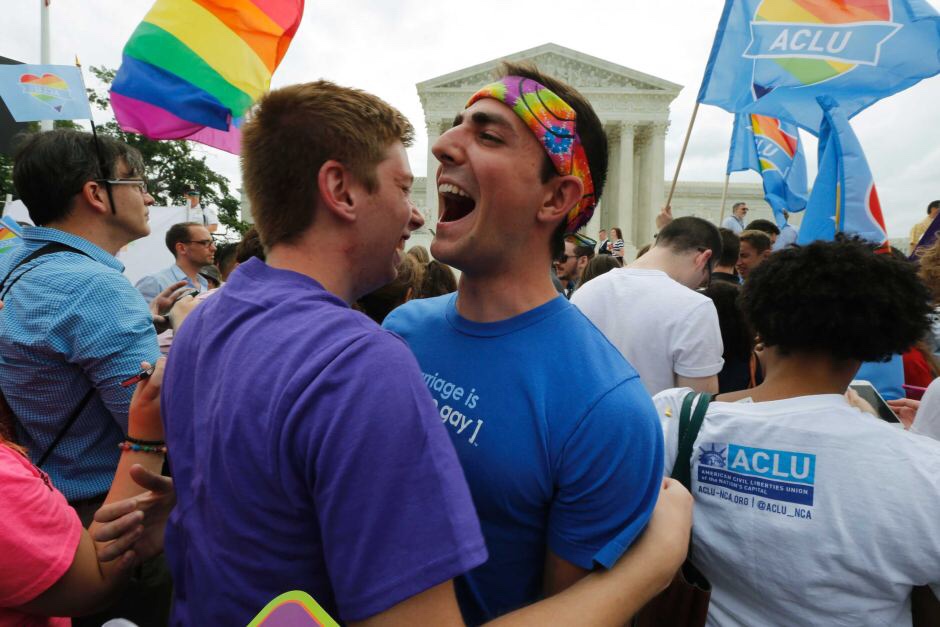
Gay rights supporters celebrate after a US Supreme Court ruling that same-sex couples have the right to marry

The highest-profile court decision was in the United States in 2013, when the Supreme Court effectively legalised same-sex marriage by finding the Defence of Marriage Act was unconstitutional.

Most recently, in April 2017, the Constitutional Court of Taiwan (Republic of China) ruled that the Taiwanese law defining marriage as a union between a man and a woman was unconstitutional. It ordered that a change in the law had to occur within two years. At the time of writing, same-sex marriage is still unavailable in Taiwan.

Where is being gay illegal?

Marriage is an important issue in Western countries but elsewhere in the world, LGBT people can struggle to simply stay out of jail.

There are more than 70 countries where homosexual acts are illegal.

The countries shaded in the map above are those where there is a law that prohibits homosexual acts in part or all of the country.

Most of these countries fall within two main categories — just over half are former colonies mostly in Africa that inherited discriminatory laws but never repealed them, while the others are majority-Muslim countries.

The International Lesbian, Gay, Bisexual, Trans and Intersex Association (ILGA) publishes an annual report of “state-sponsored homophobia”.

What exactly is outlawed varies from country to country. Twenty-eight states only prohibit relations between men.

A common formulation is a prohibition of “carnal intercourse against the order of nature”.

Sometimes gay sex is placed in the same category as bestiality.

  • In India it is an offence to “voluntarily [have] carnal intercourse against the order of nature with any man, woman or animal”.
  • In Mauritius, it is a crime to commit “sodomy or bestiality”.
  • In Uganda, a law provides for a seven-year jail term for anyone who conducts a same-sex marriage ceremony.
Kenyan MP Irungu Kang’ata leads an anti-gay caucus protest in Kenya’s capital, Nairobi.
Reuters: Thomas Mukoya

Not all the countries with these laws actually enforce them for consensual sex at home.

The Singapore Penal Code prohibits “any act of gross indecency with another male person” in “public or private”, with a maximum penalty of two years in prison.

But National University of Singapore Assistant Professor Lynette Chua says the ban has “seldom been applied in private, consensual situations and [is] typically used in non-consensual situations or cases involving minors”.

Similarly, Shakira Hussein of the National Centre of Excellence for Islamic Studies at the University of Melbourne suggests that in Islam “on all sexual matters … it isn’t the act itself that is to be punished but the public commission of it”.

“Some sharia scholars say that the laws against illicit sex should basically be regarded as laws against public indecency, since they require four witnesses.”

Even if bans aren’t strictly enforced, they often still have a harmful impact on LGBT people.

Achim Hildebrandt of the University of Stuttgart says such bans “represent an ever-present threat of blackmail and public disgrace … they drive gays and lesbians out of public life and prevent them from demanding more far-reaching reforms such as the outlawing of discrimination in the workplace and the housing market”.

Where do LGBT people risk the death penalty?

The death penalty is in place for same-sex sexual acts in at least 11 countries.

According to the IGLA, the death penalty applies in Sudan, Iran, Saudi Arabia and Yemen and in parts of Nigeria and Somalia.

In theory the death penalty could also be imposed in Mauritania, Afghanistan, Pakistan, Qatar and the United Arab Emiratesthrough sharia law, but this does not appear to have occurred in practice.

Information on when the death penalty has been carried out is not readily available.

The “Erasing 76 Crimes” blog, which advocates for the repeal of anti-LGBT laws around the world, indicates that only Iran and Saudi Arabia have actually carried out executions for same-sex activity in recent times.

The blog’s founder, Colin Stewart, says that in Saudi Arabia“beheadings have been imposed for homosexual behaviour in the past, including three men in 2002, but imprisonment and lashings are a more common punishment”.

Iran is second in the world for frequency of executions [after China], including executions for homosexual activity, although the facts about the offences being punished are often unclear or misrepresented in news accounts.”

Pakistanis rally in Peshawar in support of a trans woman who was arrested at her wedding.
Reuters: Fayaz Aziz

At the same time, Dr Hussein points out the existence of established trans communities in Iran and Pakistan. She tells the ABC:

“Some same-sex male couples circumvent laws against homosexuality by getting a doctors’ certificate to say that one half of the couple is a trans woman. Supposedly, this is meant to be followed up with surgery, but that isn’t necessarily carried through.

“Pakistan has had a ‘third gender’ option on the national ID card for a few years now [and] Iran has one of the highest rates of male-to-female trans surgery in the world.”

What other forms of harassment take place?

Intimidation of LGBT people is not restricted to the threat of jail or death.

Homosexuality is legal in Russia but in recent years the Government has imposed laws that ban “promotion” of “sodomy, lesbianism, bisexuality and transgenderism”.

Omar G Encarnacion of Bard College in New York suggests thatRussia’s law “is so broad that it outlaws gay pride parades, public displays of affection by same-sex couples, gay symbols such as the rainbow flag, and even a public admission of homosexuality, unless made in the way that casts homosexuality in a negative light”.

A Russian police officer detains a man who planned to place a tribute to the victims of a shooting at a gay nightclub in Orlando in front of the US Embassy in Moscow.
Reuters: Maxim Zmeyev

Closer to home, Singapore takes a tough line on “promotion” of LGBT issues — on paper at least.

According to Assistant Professor Chua, “Singaporean media are banned from carrying content that “promotes”, “justifies” or “glamorises” “lifestyles such as homosexuality, lesbianism, bisexualism, transsexualism [and] transvestism”.

In mid-2014, the National Library of Singapore announced it would pulp its copies of three children’s books with LGBT themes. According to the Government-linked Straits Times Newspaper:

“And Tango Makes Three is based on the true story of a pair of male penguins who raise a chick together; The White Swan Express features adoptive parents such as a lesbian couple; and Who’s In My Family highlights different family structures and includes same-sex parents.”

After a public outcry, two of the books were returned to the library but placed in the adults’ section.

In June 2016, the Singapore Government announced that“foreign entities should not fund, support or influence” Pinkdot, an annual LGBT event held in a Singapore park.

Brad Adams, Asia director of Human Rights Watch, suggests“Singapore’s demand that foreign companies stop sponsoring PinkDot encourages corporations to discriminate against LGBT people”.

Singapore’s annual Pink Dot event promotes acceptance of the LGBT community.
Reuters: Edgar Su

Leaders in other countries freely use discriminatory language against LGBT people: 

  • In 2015, the mayor of Budapest in Hungary described the city’s Gay Pride rally as “repulsive”.
  • In Africa, Ugandan president Yoweri Museveni has describedhomosexual people as “disgusting”.

The ABC has recently reported on LGBT Ugandans fleeing the country as refugees.

Members of a breakaway faction of the Anglican Church in Zimbabwe protest against homosexuality in Harare.
Reuters: Philimon Bulawayo

Zimbabwe President Robert Mugabe has previously said that:“Homosexuals are worse than dogs and pigs; dogs and pigs will never engage in homosexual madness,” and followed this up in 2013 by stating that LGBT people were “worse than pigs, goats and birds”.

In 2016 the ageing ruler vowed that Zimbabwe would reject any foreign aid that is “given on the basis that we accept the principle of gay marriages”.

Are things getting better for LGBT people?

With LGBT harassment and criminal penalties continuing in AfricaAsia, the Middle East and parts of Europe, the picture may seem bleak.

But veteran campaigner Peter Tatchell, who famously attempted a citizen’s arrest of Robert Mugabe in March 2001 and was then beaten by the president’s bodyguards, is more optimistic.

“There are rays of hope [in Africa], with the Seychelles, Mozambique and Sao Tome & Principe recently decriminalising homosexuality [and] in 2014, the African Commission on Human Rights and People’s Rights urged member states to protect LGBT people against discrimination and violence,” he says. 

Ty Cobb from Human Rights Campaign said: “We have seen great progress with regards to global LGBTQ rights in recent years, with three countries decriminalising same-sex activity just [in 2016], 20 countries and certain jurisdictions in Mexico have marriage equality and more and more countries are taking measures to improve the lives of trans individuals.”

At the same time, Mr Cobb notes that anti-LGBT movements continue to work against the community.

“Extremists have organised marches against marriage equality efforts in MexicoAmerican evangelicals have resorted to exporting their dangerous messages of hate from Eastern Europe to Africa, and [Islamic State] continues to target and kill members of the LGBTQ community throughout the Arab world,” he says.

In Singapore, there are signs of increased cultural acceptance of the LGBT community, with the 2016 release of home-grown web drama People Like Us taking place with no real backlash.

Telling the stories of four gay men in Singapore, the series has been well-received by the local community.

Filmaker Leon Cheo says apart from some “thumbs-down” on YouTube, “we haven’t received flak or negative emails or comments from Singaporeans at large”.

Mr Cheo says while the situation for LGBT people in Singapore is improving, “challenges such as censorship of neutral and positive LGBT news, film and TV, and archaic anti-sodomy laws still exist”.

“One of our creative objectives was to portray Asian gay men neutrally or positively [so that the] series could play a part in changing the hearts and minds of the citizens and government of Singapore,” he says.

In the Middle East, LGBT rights remain strongest in Israel although it is unclear whether or when same-sex marriage might be legalised there.

Reference

When Mom Blamed Eldest Son Of “Spreading Gayness” To Gay Teen Brother, He Adopted Him

Sadly, not every coming out story has a happy ending – but this recent Reddit post by a gay brother has a beautiful happy ending.

jason45q originally posted:My mother is a very complicated woman. She can be really sweet, but fucking batshit crazy at other times. I moved out a long time ago, I’m 27 and I left the house as soon as I turned 18 (also right after coming out). She didn’t disown me, but made a lot of homophobic remarks about me “joining the fags” and denying her grandchildren.

Today, I received a very angry phone call from my mom. I have a younger brother who’s 14 who lives with my parents and my sister. My mom snooped through his phone and apparently found a few texts to his friend confessing that he was gay. Suddenly, I’m responsible for engulfing him with my rainbow wrath when I barely see him.

I have considered trying to get him to move here with me but I don’t think he’d want to leave everything behind. My family would also have a fit.

Jason was overwhelmed by the flood of advice he received from his original post, and he updated his supportive Redditors on the dramatic turn of events that came next:I read all the comments, each and every single one. However, about an hour after writing the post, I grew impatient and just drove to my parents’ house…My mom lost her shit when I came, said that I was going to make it worse. She’s kept a little quiet though (probably because she realized she can’t do much at this point).

My younger brother is fine…He believes he’s 90% gay. He doesn’t notice girls, but notices guys. He said he’s felt deeper connections with them and is crushing on his friend (basically all the things we all had to deal with when we were young anyway).

I told him about moving in with me and switching schools. I tried to make him understand that he needs to be in a healthier environment and does not need to be taking any shit from my mom. He was very hesitant about leaving his friends, but he’s agreed to move in with me in the next month or so. And for those of you asking if I can afford it, I very much can.

Today morning I told my mother he was going to stay with me. She wanted to argue, but held back. She knows she crossed my patience limit a long time ago, so it was relatively easy. I’m getting forms from the lawyer tomorrow about making me his legal guardian. My mom agreed to sign it saying “it’s probably better for me that you two will be gone anyway” and my dad gives negative two shits about anything so that’ll be easy.

I guess I can say this is off to a more positive start. I can get to know him better now and at the same time protect him from emotional abuse. He’s a very soft spoken kid, a little too passive and lets people run over him. I was the opposite- and by that I mean very stubborn, rebellious and maybe a bit of an asshole…but it’s what helped me move out I guess. Now I’ll be able to toughen him up a little and build some more confidence in him.

Thanks for all the advice, it was very much appreciated. I will not call child services anymore, since he’s not going back anyway. I’d rather she suffers in silence as she realizes she drove her sons away. She’ll never admit it but I’m sure it’s there.

Reference

Gay History: Omnisexual, Gynosexual, Demisexual: What’s Behind The Surge In Sexual Identities?

There’s been a proliferation of sexual identities.

In 1976, the French philosopher Michel Foucault made themeticulously researched case that sexuality is a social construct used as a form of control. In the 40 years since, society has been busy constructing sexualities. Alongside the traditional orientations of heterosexual, homosexual, and bisexual, a myriad other options now exist in the lexicon, including:

  • pansexual (gender-blind sexual attraction to all people)
  • omnisexual (similar to pansexual, but actively attracted to all genders, rather than gender-blind)
  • gynosexual (someone who’s sexually attracted to women—this doesn’t specify the subject’s own gender, as both “lesbian” and “heterosexual” do)
  • demisexual (sexually attracted to someone based on a strong emotional connection)
  • sapiosexual (sexually attracted to intelligence)
  • objectumsexual (sexual attraction to inanimate objects)
  • autosexual (someone who prefers masturbation to sexual activity with others)
  • androgynosexual (sexual attraction to both men and women with an androgynous appearance)
  • androsexual (sexual attraction towards men)
  • asexual (someone who doesn’t experience sexual attraction)
  • graysexual (occasionally experiencing sexual attraction, but usually not)

Clearly, people felt that the few existing labels didn’t apply to them. There’s a “demand being made to have more available scripts than just heterosexual, homosexual, and bisexual,” says Robin Dembroff, philosophy professor at Yale University who researches feminist theory and construction.

Labels might seem reductive, but they’re useful. Creating a label allows people to find those with similar sexual interests to them; it’s also a way of acknowledging that such interests exist. “In order to be recognized, to even exist, you need a name,” says Jeanne Proust, philosophy professor at City University of New York. “That’s a very powerful function of language: the performative function. It makes something exist, it creates a reality.”

The newly created identities, many of which originated in the past decade, reduce the focus on gender—for either the subject or object of desire—in establishing sexual attraction. “Demisexual,” for example, is entirely unrelated to gender, while other terms emphasize the gender of the object of attraction, but not the gender of the subject. “Saying that you’re gay or straight doesn’t mean that you’re attracted to everyone of a certain gender,” says Dembroff. The proliferation of sexual identities means that, rather than emphasizing gender as the primary factor of who someone finds attractive, people are able to identify other features that attract them, and, in part or in full, de-couple gender from sexual attraction.

Dembroff believes the recent proliferation of sexual identities reflects a contemporary rejection of the morally prescriptive attitudes towards sex that were founded on the Christian belief that sex should be linked to reproduction. “We live in a culture where, increasingly, sex is being seen as something that has less to do with kinship and reproduction, and more about individual expression and forming intimate bonds with more than one partner,” Dembroff says. “I think as there’s more of an individual focus it makes sense that we have these hyper-personalized categories.”

The same individuality that permeates western culture, leading people to focus on the self and value their own well-being over the group’s, is reflected in the desire to fracture group sexual identities into increasingly narrow categories that reflect personal preferences.

Some believe this could restrict individuals’ freedom in expressing fluid sexuality. Each newly codified sexual orientation demands that people adopt increasingly specific criteria to define their sexual orientation.

“Language fixes reality, it sets reality,” says Proust. “It paralyzes it, in a way. It puts it in a box, under a tag. The problem with that is it doesn’t move. It negates or denies any instability or fluidity.”

There’s also the danger that self-definition inadvertently defines other people. Just as the terms “heterosexual” and “homosexual” demand that people clarify their sexual preference according to their and their partner’s gender, “sapiosexual” asks that we each of us define our stance towards intelligence. Likewise, the word “pansexual” requires people who once identified as “bisexual” clarify their sexual attraction towards those who don’t identify as male or female. And “omnisexual” suggests that people should address whether they’re attracted to all genders or oblivious to them.

In Foucault’s analysis, contemporary society turns sex into an academic, scientific discipline, and this mode of perceiving sex dominates both understanding and experience of it. The Stanford Encyclopedia of Philosophy summarizes this idea neatly:

Not only is there control exercised via others’ knowledge of individuals; there is also control via individuals’ knowledge of themselves. Individuals internalize the norms laid down by the sciences of sexuality and monitor themselves in an effort to conform to these norms.

The new terms for sexual orientations similarly infiltrate the political discourse on sexuality, and individuals then define themselves accordingly. Though there’s nothing that prevents someone from having a demisexual phase, for example, the labels suggest an inherent identity. William Wilkerson, a philosophy professor at the University of Alabama-Huntsville who focuses on gender studies, says this is the distinctive feature of sexual identities today. In the past, he points out, there were plenty of different sexual interests, but these were presented as desires rather than intrinsic identities. The notion of innate sexual identities “seems profoundly different to me,” he says. “The model of sexuality as an inborn thing has become so prevalent that people want to say ‘this is how I feel, so perhaps I will constitute myself in a particular way and understand this as an identity’,” he adds.

In the 1970s and 80s there was a proliferation of sexual groups and interests similar to what we’ve seen over the past five to 10 years, notes Wilkerson. The identities that originated in earlier decades—such as bears, leather daddies, and femme and butch women—are deeply influenced by lifestyle and appearance. It’s difficult to be a butch woman without looking butch, for example. Contemporary identities, such as gynosexual or pansexual, suggest nothing about appearance or lifestyle, but are entirely defined by intrinsic sexual desire.

Dissatisfaction with existing labels doesn’t necessarily have to lead to creating new ones. Wilkerson notes that the queer movement in earlier decades was focused on anti-identity and refusing to define yourself. “It’s interesting that now, it’s like, ‘We really want to define ourselves,’” says Wilkerson.

The trend reflects an impulse to cut the legs out from under religious invectives against non-heteronormative sexualities. If you’re “born this way,” it’s impossible for your sexuality to be sinful because it’s natural, made of biological desires rather than a conscious choice. More recently, this line of thinking has been criticized by those who argue all sexualities should be accepted regardless of any link to biology; that sexuality is socially constructed, and the reason no given sexuality is “sinful” is simply because any consenting sexual choice is perfectly moral.

Though it may sound ideal to be utterly undefined and beyond categories, Proust says it’s impossible. “We have to use categories. It’s sad, it’s tragic. But that’s how it is.” Constructs aren’t simply necessary for sexual identity or gender; they’re an essential feature of language, she adds. We cannot comprehend the world without this “tag-fixing process.”

The proliferation of specific sexual identities today may seem at odds with the anti-identity values of queer culture, but Dembroff suggests that both work towards the same ultimate goal of eroding the impact and importance of the old-fashioned binary sexual identities. “Social change always happens in non-ideal increments,” Dembroff notes. So while today we may have dozens of sexual identities, they may become so individualized and specific that they lose any significance for group identities, and the entire concept of a fixed sexual identity is eroded.

“We demand that sex speak the truth,” wrote Foucault in The History of Sexuality. “We demand that it tell us our truth, or rather, the deeply buried truth of that truth about ourselves which we think we possess in our immediate consciousness.” We still believe sex reveals an inner truth; now, however, we are more readily able to recognize that the process of discovering and identifying that truth is always ongoing.

Reference

Gay History: The Real ‘Gentleman Jack’: The Secret Life Of Anne Lister, Britain’s ‘First Modern lesbian’

Ellie Cawthorne talks to Angela Steidele about the 19th-century gay pioneer Anne Lister | Complements the eight-part BBC One drama Gentleman Jack

At 2am one night in the 1890s, amateur code-breakers John Lister and Arthur Burrell were hard at work. The pair had been up for hours poring over mysterious documents John had inherited, among swathes of ageing ledgers and paperwork, when he had become master of Shibden Hall near Halifax. Entitled the ‘Diaries and Journals of Mrs Lister’, the 24 volumes documented the business affairs, social life and travels of one of Shibden Hall’s previous owners, Anne Lister (1791–1840), who had inherited the house in 1826.

While John, a distant relation of Anne, found the diaries diverting enough, what really intrigued him were large sections tantalisingly concealed in code. He enlisted the help of Burrell, an antiquarian, and the pair set to work deciphering Anne’s code of numerical figures, Greek letters and invented symbols.

Once they had cracked it, however, “the part written in cipher turned out to be entirely unpublishable…” What had been revealed was, in the words of Arthur Burrell, “an intimate account of homosexual practices among Miss Lister and her many ‘friends’; hardly any one of them escaped her”. Burrell was so appalled by the “unsavoury” discovery that he advised his friend to burn the diaries immediately.

Thankfully, John resisted the urge to fling the volumes directly onto the fire. Instead, he sealed them into a small chamber in Shibden Hall, keen to prevent anyone uncovering such salacious family secrets. Concealed behind wood panelling, they would go undiscovered until after his death in 1933.

Sexual adventures

Although Lister and Burrell may not have appreciated it at the time, the diaries they had decoded that night would go on to become a seminal source of British LGBTQ history – one that would force historians to reassess lesbian relationships in the early 19th century.

Running to more than 4 million words, Anne Lister’s journals are densely packed with the minutiae of her everyday life. Yet buried between exhaustive entries on the political situation in Prussia, canal tolls and toenail cutting are extraordinary accounts of her romantic and sexual adventures with women.

Lister embarked on her career as a master of seduction while still at school, starting up a relationship with her friend and roommate Eliza Raine, who she later reflected was “the most beautiful girl I ever saw”. Sexual encounters with various female acquaintances followed. As Anne boasted in 1816: “The girls liked me and had always liked me. I had never been refused by anyone.” According to Angela Steidele, author of a new biography of Lister, “it was easy for Anne to find lovers because she was a very attractive character: charming, flattering, witty and well educated. She was the heart of every party and could talk you in or out of anything.”

The greatest passion documented in Anne’s diary comes from her relationship with Mariana Belcombe, the “mistress of [her] thoughts and hopes”. For almost 20 years, the pair were involved in an on-off love affair which continued even after Mariana married – an institution that Anne bitterly compared to legitimised prostitution. The relationship eventually broke down after Mariana became increasingly anxious about its true nature being uncovered, leaving Anne with a heart “almost agonised to bursting”.

Despite this crushing rejection, Anne maintained that she had as much right to love and companionship as anyone, and was not afraid to pursue it actively. “There is one thing that I wish for… one thing without which my happiness in this world seems impossible,” she wrote in 1832. “I was not born to live alone… in loving and being loved, I could be happy.”

When she was in her early 40s, Anne began what would be her last – and arguably most significant – relationship, with Ann Walker, from a wealthy neighbouring family. Although she did not inspire the same passion as Mariana once had, Ann did meet many of the criteria of what Lister looked for in a partner: she was younger, pliable, obedient and well-off. “I shall think myself into being in love with her – I am already persuaded I like her well enough for comfort,” the cash-strapped Lister concluded in 1832. “Perhaps after all, she will make me happier than any of my former flames – at all rates we shall have money enough.”

Despite this somewhat lacklustre start, the pair embarked on a relationship. Walker moved in to Shibden Hall and, in 1834, the two women exchanged rings in York’s Holy Trinity Church. They took the Communion together, which they thought to be equivalent to marriage (180 years before same-sex marriages were legalised in England), though their union was not blessed by a priest.

Anne’s conquests were multiple, but “what is clear from reading her diaries is that the biggest love of Anne’s life was Anne herself”, says Steidele. “In fact, you could read these volumes as one long love letter to herself. She truly got lost in her diary, and was writing purely for her own satisfaction.”

And satisfaction really is the right word for it. Lister’s diary is extraordinarily candid in detailing her sexual encounters, going far beyond noting who she had seduced and when. Rather, her code conceals intimate descriptions of specific sexual acts and even keeps a tally of her number of orgasms. Assessments of each encounter are frank to the point of brusqueness – while one lover is praised for “know[ing] how to heighten the pleasure of our intercourse”, another is condemned as “dry as a stick”.

Physical acts

Such explicit details don’t just make the diaries compelling reading, says Steidele, it also gives them huge historical significance. “In earlier research on sexuality in the late 19th and 20th century, there was a legend that women never desired other women physically. The term that was often used was ‘romantic friendship’, implying that while some women enjoyed very close relationships, they never engaged in any physical acts.” Lister’s diaries however, act as the ‘missing link’ in British LGBTQ studies. By speaking directly of sex between women, they reveal the idea of ‘romantic friendship’ to be a false concept. This has led her writings to be hailed as the “Rosetta stone of lesbian history”.

“There have been homosexual acts throughout history, but what makes Lister different is her awareness of her own difference,” says Steidele. “Historians tend to say an awareness of homosexuality as an identity first emerged in the late 19th century, but Lister’s journals are an earlier proof of this development. That’s why she can be seen as Britain’s ‘first modern lesbian’.”

One lover is praised by Anne for “knowing how to heighten the pleasure of our intercourse”

It wasn’t only in her choice of lovers that Anne challenged the conventions of her time, but in her expression of gender too. She rejected the usual path laid out for women of her background, and was unafraid to send out strong signals of her difference. At a time when clothing was an important marker of identity, Lister chose to dress solely in black, adopting a self-consciously masculine appearance. This unconventional attire did not go unnoticed. She was referred to locally as ‘Gentleman Jack’, and wrote in 1818 that, “people generally remark as I pass along, how much I am like a man”.

Lister’s rejection of gender norms went far beyond clothing. As well as being a landowner at a time when few women owned property, she took a keen interest in business, taking on several ambitious, if not entirely profitable, entrepreneurial ventures. She established two coal mines (naming one the ‘Walker pit’ after her lover), ran a stone quarry and even launched a hotel in Halifax.

Her wealth and status as a gentlewoman undoubtedly offered Lister a degree of freedom unavailable to many women at the time. However, it did not render her completely immune against criticism of her unconventional lifestyle choices. She was mocked with anonymous letters, while a fake wedding announcement in the local paper congratulated Ann Walker on her marriage to a “Captain Tom Lister of Shibden Hall”.

Away from Shibden Hall, Anne embarked on numerous foreign adventures, hiking the Pyrenees and travelling as far as Azerbaijan. In fact, it was during one of these adventures that she died, succumbing to a fever at Kutaisi, Georgia in September 1840, aged 49. Ann Walker, who was travelling with Lister at the time, had her lover’s body embalmed and brought back to England. She was buried in Halifax, West Yorkshire.

Sparking controversy

A century later, following the death of Anne’s relative John, Shibden Hall fell to the Halifax Corporation, and Anne’s diaries were rescued from their hiding place. However, their contents were deemed far too scandalous for public consumption, and it would be several more decades until they were shared beyond a small group of archivists and librarians – a first edition wasn’t published until 1988.

More recently, interest in Lister and her diaries has sky-rocketed. In 2016, Shibden Hall was recognised as a “historic LGBTQ venue” by Historic England, and has become an important site of LGBTQ pilgrimage. This year sees Anne’s adventures being brought to life in an eight-part TV drama, Gentleman Jack, airing on BBC One from May.

In 2018, a plaque dedicated to Lister was unveiled at York’s Holy Trinity Church. Referring to Lister as a “gender-nonconforming entrepreneur”, it sparked anger by making no mention of the word ‘lesbian’. Following a petition, the plaque was reworded to describe Anne as a “lesbian and diarist”. In Steidele’s opinion, this is an important distinction. “While Lister did not directly refer to herself as a ‘lesbian’, her diary makes it clear that a big part of her identity was derived from her sexuality. There was no guilt, no self-hatred – Anne felt she too was God’s creation and that God had shaped her nature. This is really unique. That’s why it is so important to include the term ‘lesbian’ when we celebrate Anne with that plaque.”

Two centuries on, the diaries still hold lessons for today, argues Steidele. “In many ways we’re still fighting the same battles as Anne – for equal women’s and LGBTQ rights,” she says. “Anne didn’t accept any limitation placed on her by her sexuality and gender. She refused to believe in the natural inferiority of women, and insisted on living according to her own inclinations. I think that her courage in those convictions makes her an important role model.”

Reference

Gay History: All The Kings And Queens Who Were Allegedly LGBTQ+

For much of history, LGBTQ+ royalty needed to hide their identities. Even though some societies embraced homosexuality, most refused to accept a gay monarch. But before we talk about LGBTQ+ kings and queens, let’s start with the history of sexual identity.

The terms heterosexual and homosexual didn’t exist until the 1860s. And until the 1930s, heterosexual meant an abnormal attraction to the opposite sex. For centuries, many societies didn’t see sexuality in binary terms at all. Ancient Greeks and Renaissance Florentines took both male and female lovers. King Edward II of England openly kissed his male lover on his wedding day. And the Roman emperor Hadrian named a city after his male lover. Many kings and queens needed to keep their sexuality quiet, but others defended their lifestyle openly.

Queen Anne Was Clos4 With Her “Lady Of The Bedchamber”

Photo: Charles Jervas / Wikimedia Commons / Public Domain

The last of the Stuart monarchs, Queen Anne of Great Britain maintained a long-term relationship with Sarah Churchill in the early 1700s. Anne wrote to Sarah, “I hope I shall get a moment or two to be with my dear… that I may have one dear embrace, which I long for more than I can express.”

Anne has been called England’s lesbian queen because of her close relationship with Churchill, who served as “Lady of the Bedchamber.” But when Queen Anne pulled back, Sarah publicly accused the monarch of choosing another woman over her. Anne stayed above the fray, however, and remained popular through her death in 1714.

Pope Julius III Named His Lover A Cardinal

Photo: Girolamo Sicciolante / Wikimedia Commons / Public Doma

Pope Julius III ran the Catholic Church from 1550 to 1555. He also created a scandal thanks to his young male lover. Julius met Innocenzo, a 15-year-old beggar, in 1548, when Innocenzo was fighting with his pet ape on the street. The future pope swept the boy away and named him a cathedral provost.

When Julius became pope two years later, he convinced his brother to adopt Innocenzo, and later named his alleged lover a cardinal. Julius’s enemies called Innocenzo “Cardinal-Monkey” and complained the boy shared the pope’s bed.

Edward II Kissed His Male Lover In Front Of His Bride

Photo: Unknown / Wikimedia Commons / Public Domain

Most stories about a royal’s sexuality were only mentioned in secret and whispers. That’s not the case for King Edward II of England, who openly showed affection for his male lover, Piers Gaveston. When Edward married Isabella of France, he showered kisses on Piers in front of the entire court. 

As chroniclers wrote at the time, Edward’s affection for Gaveston was “beyond measure and reason,” “excessive,” and “immoderate.” One writer even said, “I do not remember to have heard that one man so loved another.” The relationship didn’t end well: Edward’s barons beheaded Gaveston.

Queen Elizabeth’s Partying Sister Allegedly Had A Female Lover

Photo: David S. Paton / Wikimedia Commons / Public Doma

The younger sister of Queen Elizabeth II, Princess Margaret, was known for being a party girl. In addition to multiple affairs, she married bisexual photographer Antony Armstrong-Jones, who explained, “I didn’t fall in love with boys, but a few men have been in love with me.”

Royal reporter Noel Botham claimed in his book Margaret: The Last Real Princess that Margaret had an affair with the American ambassador’s daughter, Sharman Douglas, known as Sass. One of Douglas’s close friends told Botham that Sass confessed to being the princess’s lover in the 1950s.

Richard The Lionheart Shared His Bed With France’s King

Photo: Unknown / Wikimedia Commons / Public Domain

Richard the Lionheart became King of England in 1189. Today, he’s famous for his role in the Third Crusade and his alleged association with Robin Hood. To others, though, Richard I is a gay icon. The king chose not to marry and never fathered an heir. Instead of having a queen by his side at his coronation, Richard invited his mother, Eleanor of Aquitaine, to play the role of his partner. 

According to historical documents written at the time, Richard shared a bed with King Philip II of France. One chronicler even wrote the men were so close that “at night the bed did not separate them.”

Prince George Had A Ménage A Trois With An Ambassador’s Son

Photo: Unknown / Wikimedia Commons / Public Domain

Prince George was the son of George V and the brother to Edward VIII and George VI. Called “the most interesting, intelligent and cultivated member of his generation” by biographer Christopher Warwick, George also allegedly carried on multiple bisexual affairs.

Married to Princess Marina of Greece and Denmark, Prince George never stopped partying. In the 1920s, George became addicted to morphine and cocaine during an affair with American socialite Kiki Preston – known as the girl with the silver syringe. George reportedly had a ménage à trois with Kiki and Jorge Ferrara, the son of Argentina’s ambassador. George died in 1942 in a tragic plane crash.

Hadrian Named A City After His Male Lover

Photo: Unknown / Wikimedia Commons / Public Domai

Roman emperor Hadrian is best remembered for building Hadrian’s Wall, marking the northern border of his empire. And although Hadrian married around the year 100 CE, he also had a male lover. Hadrian’s partner was a young Greek named Antinous. When his lover drowned, Hadrian founded a city in Egypt and named it Antinopolis in his honor. 

The Romans didn’t care about men taking male lovers. It was only important what part a man played during sex:

older men always needed to take a dominant, active role.

Alexander The Great Had Sex With A Eunuch

Photo: Meister der Alexanderschlacht / Wikimedia Commons / Public Domain

Alexander the Great conquered enough land to rule one of the largest empires in ancient history. During a whirlwind military campaign, Alexander toppled the Persian Empire and invaded India. But where did he fall on the spectrum of sexual identity? Historians still debateAlexander’s sexual preferences, but most agree he had sex with men and women.

Alexander’s most likely male lover was Bagoas, a eunuch. Being a eunuch, the Greeks didn’t see him as a man – instead, he was in a third category, between man and woman. Many also believe Alexander maintained a relationship with his companion Hephaestion. The ancient Greeks were very open-minded about homosexuality.

James I Defended His Right To Love Other Men

Photo: John de Critz / Wikimedia Commons / Public Domai

When James I of England took the throne in 1603 after the death of Elizabeth, he had big shoes to fill. England loved Elizabeth, and they remained uncertain of the Scottish ruler with a reputation for homosexual love affairs. In his early years, his new subjects circulated a Latin phrase which translates to “Elizabeth was King: now James is Queen.”

As James rode through the streets of London, people yelled out “Long live Queen James!” James himself defended his right to love other men in 1617, in a speech to his Privy Council: 

I, James, am neither a god nor an angel, but a man like any other. Therefore I act like a man and confess to loving those dear to me more than other men. You may be sure that I love the Earl of Buckingham more than anyone else, and more than you who are here assembled. I wish to speak in my own behalf and not to have it thought to be a defect, for Jesus Christ did the same, and therefore I cannot be blamed. Christ had John, and I have George.

The Last Medici Ruler Lost Tuscany Because He Wouldn’t Have Sex With His Wife

Photo: Franz Ferdinand Richter / Wikimedia Commons / Public Dom

The last Medici to be Grand Duke of Tuscany, Gian Gastone, knew if he didn’t issue a male heir, his domain would go to the Bourbon rulers of Spain. Gian Gastone’s sister arranged his marriage to a German princess, but she refused to move to Florence. Gian moved to her small village, but eventually ignored her and spent his time with a male groom, Giuliano Dami, who reportedly became his lover. 

Gian Gastone also allegedly paid young male prostitutes for sex. They became known as the Ruspanti, after the coins (ruspi) Gastone gave them. Needless to say, Gian Gastone never produced an heir and the Spanish seized Tuscany when he died.

Henry III Of France Was Called A Buggerer And A Sodomite

Photo: Francois Quesnel / Wikimedia Commons / Public Dom

King Henry III of France was the son of Catherine de Medici and the last Valois king of France. In 1589, one of his subjects called the king “Henry of Valois, buggerer, son of a whore, tyrant.” During his lifetime, Henry was attacked for sexual deviancy, and people blamed the calamities of his reign on his sexuality. 

Although Henry endured repeated accusations of sodomy, most historians believe they were just rumors. As Nicolas Le Roux argued, “It is less the supposed or real sexual practices of the king and those close to him that interests the historian than the image of illegitimacy conveyed by the discussion of sex.” In short, regardless of his sexual identity, Henry’s enemies used slurs to attack his masculinity.

King William II May Have Had An Affair With A Bishop

Photo: Matthew Paris / Wikimedia Commons / Public Doma

The third son of William the Conqueror became King of England in 1087. William II, also known as William Rufus, was his father’s favorite, explaining why William the Conqueror skipped over his older sons to make him king. 

For centuries, rumors swirled about William Rufus’s sexuality. The king never married or fathered a child. His close advisor, Ranulf Flambard, is considered a possible sexual partner. William appointed Flambard as the Bishop of Durham in 1099. As William’s reign was over a thousand years ago, however, historians don’t have much to extrapolate from, other than the king’s close friendship with Flambard and his reputation for surrounding himself with attractive men.

Louis XIII Of France Might Not Be The Sun King’s Father

Photo: Philippe de Champaigne / Wikimedia Commons / Public Domain

Most famous for his son, the Sun King, Louis XIII of France became king at 9 and helped transform France into a major European power. He married Anne of Austria at 14, and loathed her. Many assume Louis XIII was gay, and believe Louis XIV might not have been his son at all.

According to rumors, Louis carried on relationships with two men: Charles d’Albert, Duke of Luynes and Henri Coiffier de Ruzé, Marquis de Cinq-Mars. While little proof remains that Louis had sexual relationships with these men, many generally accept the king did not enjoy sex with women.

Reference