Tag Archives: Buddhism

Buddhism 101: Buddhist Monks’ Robes

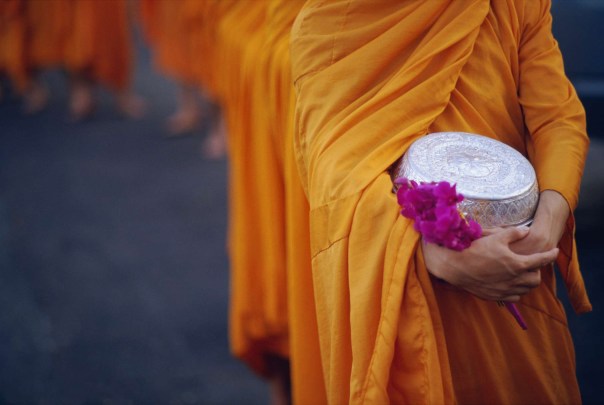
01 – The Saffron Robe
 B.S.P.I./Getty Images

As Buddhism spread through Asia, the robes worn by monks adapted to local climate and culture. Today, the saffron robes of southeast Asian monks are thought to be nearly identical to the original robes of 25 centuries ago. However, what monks wear in China, Tibet, Japan, Korea and elsewhere can look quite a bit different.

This photo gallery doesn’t come close to showing all the variations in styles of monks’ robes. Monks’ robes of the many schools and lineages, and even individual temples can be quite distinctive from each other. There are countless variations of sleeve styles alone, and you could probably find a monks’ robe to match every color in the crayon box.

Instead, this gallery is a sampler of Buddhist robe images that represent and explain common features. The images also illustrate how most robes retain some characteristics of the original robes if you know where to look.

Theravada monks of southeast Asia wear robes thought to be very similar to the robes worn by the historical Buddha and his disciples.

The robes worn by Theravada monks and nuns of southeast Asia today are thought to be unchanged from the original robes of 25 centuries ago. The “Triple robe” consists of three parts:

The uttarasanga or kashaya is the most prominent robe. It is a large rectangle, about 6 by 9 feet, that can be wrapped to cover both shoulders, but most often it is wrapped to cover the left shoulder but leave the right shoulder and arm bare.

The antaravasaka is worn under the uttarasanga. It is wrapped around the waist like a sarong, covering the body from waist to knees.

The sanghati is an extra robe that can be wrapped around the upper body for warmth. When not in use it is sometimes folded and draped over a shoulder, as you see in the photograph.

The original monks made their robes from discarded cloth found in rubbish heaps and on cremation grounds. After washing, the robe-cloth was boiled with vegetable matter—leaves, roots and flowers—and often spices, which would turn the cloth some shade of orange. Hence the name, “saffron robe.” Monks today wear robes made of cloth that is donated or purchased, but in Southeast Asia, the cloth usually is still dyed in spice colors.
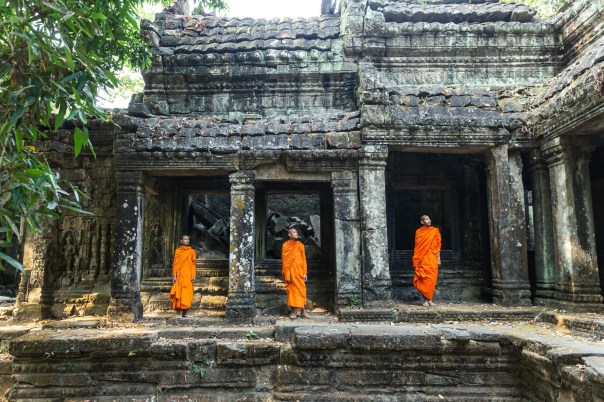
02 – The Buddha’s Robe In Cambodia
Matteo Colombo/Getty Images

When it is too cold to be bare-armed, Theravada monks wrap themselves in the sanghati.  Theravada is the dominant form of Buddhism in Sri Lanka, Thailand, Cambodia, Burma (Myanmar) and Laos. The monks in those countries wear very similar robes in the style of early Buddhist monks’ robes.

The monks have their sanghati robe folded and carried over the shoulder. These monks at Angor Wat, Cambodia, have wrapped the sanghati around their upper bodies for warmth.

03 – The Buddha’s Robe: The Rice Field
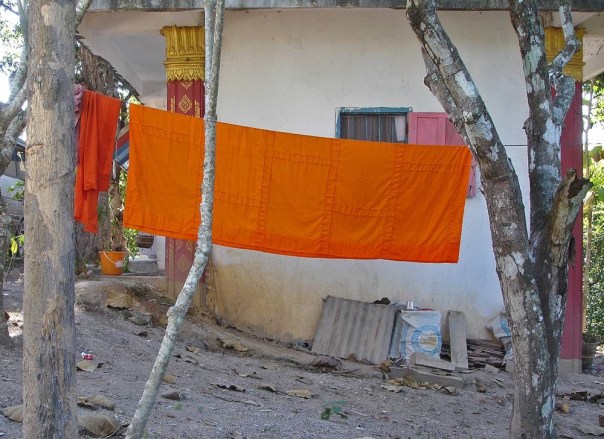
Details of a rice field pattern in a Kashaya Robe. Michael McCauslin/CC BY 2.0/Flickr

The rice field pattern is common to Buddhist robes in most schools of Buddhism. According to the Vinaya-pitaka of the Pali Canon, one day the Buddha asked his cousin and attendant, Ananda, to sew a robe in the pattern of a rice field. Ananda did this, and the pattern has been repeated on monks’ robes in most schools of Buddhism ever since.

Rice paddy fields can be roughly rectangular and separated by strips of dry ground for paths. The rice field pattern in the Theravada robe shown in the photo is in five columns, but sometimes there are seven or nine columns.

04 – The Buddha’s Robe in China
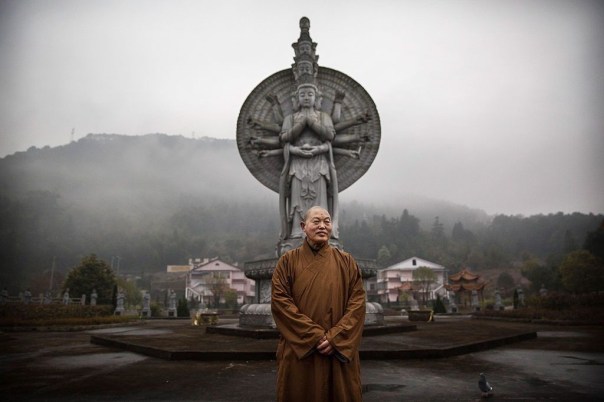
Kevin Frayer/Getty Images 

Chinese monks abandoned the bare-shoulder style in favor of a robe with sleeves. When Buddhism got to China, the bare-shoulder style of the original monks’ robes became a problem. In Chinese culture, it was improper not to keep the arms and shoulders covered in public. So, Chinese Buddhist monks began to wear sleeved robes similar to a Taoist scholar’s robe of the early 1st millennium CE.

Because Chinese Buddhist monks lived in self-sufficient monastic communities, monks spent part of each day doing custodial and gardening chores. Wearing the kashaya all the time was not practical, so it came to be saved for formal occasions. The robe in the photograph is an “everyday” robe for non-ceremonial wear.

05 – The Ceremonial Buddha’s Robe in China
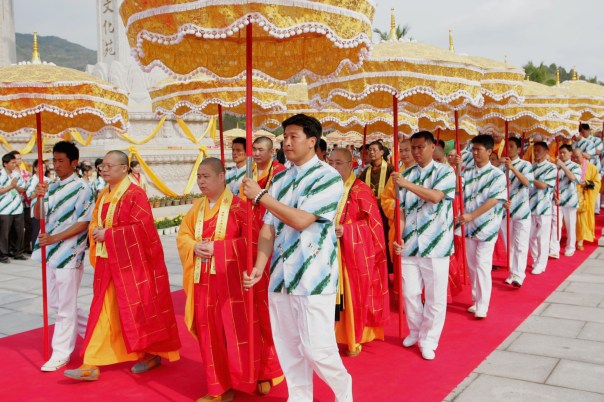
China Photos/Getty Images

Monks in China wear the kashaya over their sleeved robes on ceremonial occasions. The rice paddy pattern is preserved in the Chinese kashaya, although an abbot’s kashaya might be made of ornate, brocaded cloth. Yellow of a common color for monks’ sleeved robes. In China, yellow represents earth and is also the “central” color that might be said to represent equanimity.

06 – The Buddha’s Robe: Kyoto, Japan
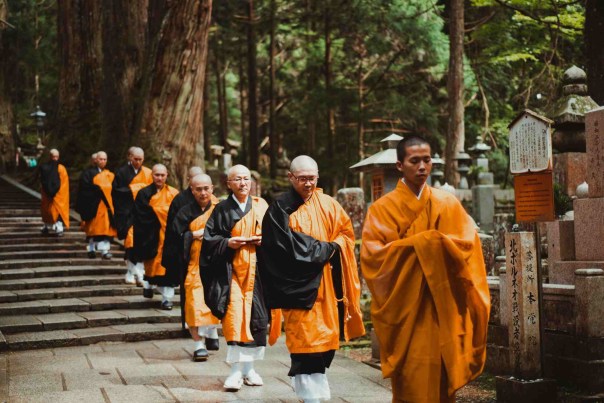
Cultura Exclusive/Getty Images

The Chinese practice of wearing a kashaya wrapped over a sleeved robe continues in Japan. There are many styles and colors of Buddhist monks’ robes in Japan, and they don’t all resemble the ensembles worn by the monks in this photograph. However, the robes in the photograph do illustrate how the Chinese style was adapted in Japan.

The practice of wearing a shorter outer robe over a longer white or gray kimono is distinctively Japanese.

07 – The Buddha’s Robe in Japan
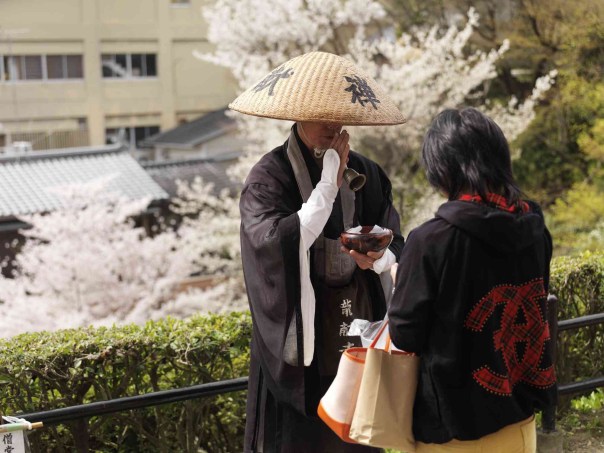
Oleksiy Maksymenko/Getty Images

The rakusu is a small garment representing the kashaya robe that is worn by Zen monks. The “bib” worn by the Japanese monk in the photograph is a rakusu, a garment unique to the Zen school that may have originated among Ch’an monks in China sometime after the T’ang Dynasty. The rectangle worn over the heart is a miniature kashaya, complete with the same “rice field” pattern seen in the third photo in this gallery. The rice field in a rakusu may have five, seven, or nine strips. Rakusu also come in a variety of colors.

Generally, in Zen, the rakusu may be worn by all monks and priests, as well as laypeople who have received jukai ordination. But sometimes Zen monks who have received full ordination will wear a standard kashaya, called in Japanese the kesa, instead of the rakusu. The monks’ straw hat is worn to partly cover his face during the alms ritual, ortakahatsu, so that he and those who give him alms do not see each others’ faces. This represents the perfection of giving—no giver, no receiver. In this photo, you can see the monk’s plain white kimono peaking out from under the black outer robe, called a koromo. The koromo is often black, but not always, and comes with different sleeve styles and diverse numbers of pleats in the front.

08 – The Buddha’s Robe in Korea
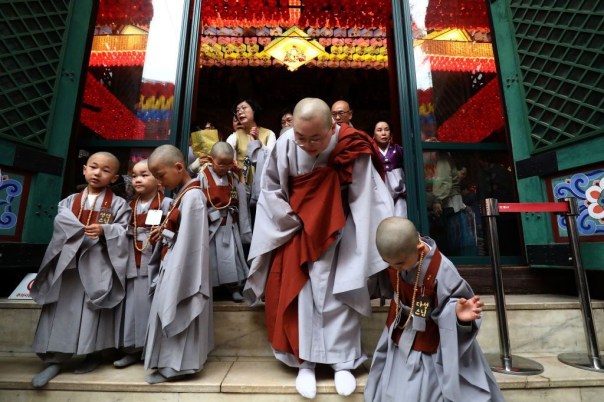
Chung Sung-Jun/Getty Images 

Big and little monks in South Korea wear big and little kashaya robes. In Korea, as in China and Japan, it is common for monks to wrap the kashaya robe over a sleeved robe. Also as in China and Japan, robes can come in a variety of colors and styles.

Every year, this Chogye (Korean Zen) monastery in Seoul “ordains” children temporarily, shaving their heads and dressing them in monks’ robes. The children will live in the monastery for three weeks and learn about Buddhism. The “little” monks wear “little” kashaya robes in the style of a rakusu. The “big” monks wear a traditional kashaya.

09 – The Buddha’s Robe in Tibet
Berthold Trenkel/Getty Images 

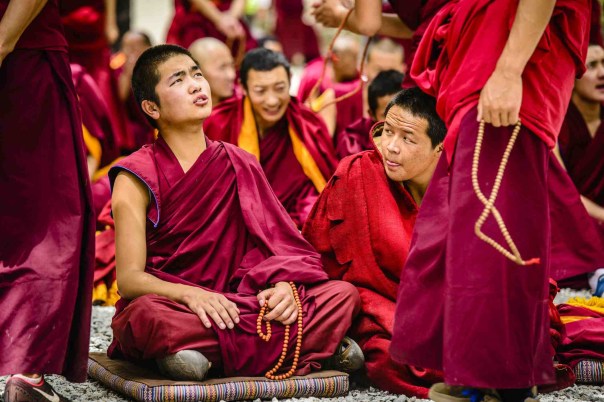
Tibetan monks wear a shirt and a skirt instead of a one-piece robe. A shawl-type robe may be worn as an outer layer. Tibetan nuns, monks and lamas wear an enormous variety of robes, hats, capes, and even costumes, but the basic robe consist of these parts:

  • The dhonka, a wrap shirt with cap sleeves. The dhonka usually is maroon or maroon and yellow with blue piping.
  • The shemdap is a maroon skirt made with patched cloth and a varying number of pleats.
  • The chögu is something like a sanghati, a wrap made in patches and worn on the upper body, although sometimes it is draped over one shoulder like a kashaya robe. The chögu is yellow and worn for certain ceremonies and teachings.
  • The zhen is similar to the chögu, but maroon, and is for ordinary day-to-day wear.
  • The namjar is larger than the chögu, with more patches, and it is yellow and often made of silk. It is for formal ceremonial occasions.

The Gelugpa Tibetan monks in the photograph have shed their zhen robes in the heat of debate.

10 – The Buddha’s Robe: A Tibetan Monk and His Zhen
Keven Osborne/Getty Images

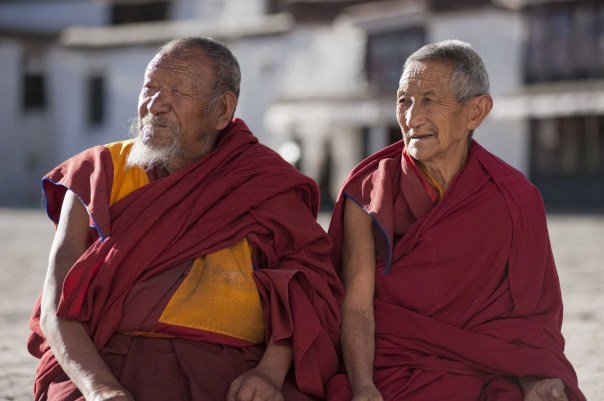
Tibetan Buddhist robes are distinctively from robes worn in other schools of Buddhism. Yet some similarities remain. Monks of the four schools of Tibetan Buddhism wear somewhat different robes, but the dominant colors are maroon, yellow, and sometimes red, with blue piping on the sleeves of the dhonka.

Red and maroon came to be traditional monk robe colors in Tibet mostly because it was the most common and cheapest dye at one time. The color yellow has several symbolic meanings. It can represent wealth, but it also represents earth, and by extension, a foundation. The sleeves of the dhonka represent a lion’s mane. There are a number of stories explaining the blue piping, but the most common story is that it commemorates a connection to China.

The zhen, the maroon “everyday” shawl, often is draped to leave the right arm bare in the style of a kashaya robe.

Reference

  • O’Brien, Barbara. “Buddhist Monks’ Robes.” Learn Religions, Jan. 29, 2020, learnreligions.com/the-buddhas-robe-p2-4123187.

Gay History: Gay Marriage: What Would Buddha Do?

As a gay Buddhist, and someone who has a lot of respect for His Holiness the Dalai Lama, I often have his sometimes controversial/sometimes contradictory comments on gays and gay marriage, thorn at me. It’s a difficult question, I know…how can I support someone who seems to be non-supportive if gays within the Buddhist community, yet support gay issues for non-Buddhists. I personally consider the Dalai Lama as a great man, capable of great compassion and understanding. I also know he is the head of a traditional Tibetan sect of Buddhism called the Gelug sect, and as such has his moral teachings within the beliefs of that sect. I would like to think that being the intelligent and loving man that he is, that these questions are something he has to often contemplate, and try to understand within an old tradition that has to live in the modern world. Buddhism is not just one sect, but many different sects all following diverse interpretations of the Buddha’s teachings. As such, there are conservative and liberal strands of Buddhism, so beliefs are not universal. The Dalai Lama is but the leader of one sect, and only speaks for that sect. I choose not to judge him to harshly! Om mani padme hum 📿🏳️‍🌈

A lot of people ask me what the “Buddhist take” on gay marriage is. Well, it depends on who you talk to. A few years back, in an interview with the CBC, the Dalai Lama rejected same-sex relationships to the surprise of many convert Buddhists, who sometimes too easily assume that Buddhist ethics are consistent with their typically progressive views.

As the Canadian interview bounced around the internet, some people were shocked and perplexed, but the Dalai Lama’s position shouldn’t have come as a surprise to anyone who has followed the issue. After all, he has been consistent. At a conference some 12 years ago, when gay leaders met with him in San Francisco to discuss the Tibetan Buddhist proscriptions against gay sex, he reiterated the traditional view that gay sex was “sexual misconduct.” This view was based on restrictions found in Tibetan texts that he could not and would not change. He did, however, advise gay Buddhist leaders to investigate further, discuss the issue, and suggested that change might come through some sort of theological consensus. But at a time when same-sex marriage has taken front-stage center in American politics, the Dalai Lama’s more recent statements come as unwelcome news to proponents of civil rights.

A lot of people ask me what the “Buddhist take” on gay marriage is. Well, it depends on who you talk to. A few years back, in an interview with the CBC, the Dalai Lama rejected same-sex relationships to the surprise of many convert Buddhists, who sometimes too easily assume that Buddhist ethics are consistent with their typically progressive views.

As the Canadian interview bounced around the internet, some people were shocked and perplexed, but the Dalai Lama’s position shouldn’t have come as a surprise to anyone who has followed the issue. After all, he has been consistent. At a conference some 12 years ago, when gay leaders met with him in San Francisco to discuss the Tibetan Buddhist proscriptions against gay sex, he reiterated the traditional view that gay sex was “sexual misconduct.” This view was based on restrictions found in Tibetan texts that he could not and would not change. He did, however, advise gay Buddhist leaders to investigate further, discuss the issue, and suggested that change might come through some sort of theological consensus. But at a time when same-sex marriage has taken front-stage center in American politics, the Dalai Lama’s more recent statements come as unwelcome news to proponents of civil rights.

Friends of mine have argued that the Dalai Lama doesn’t really look askance same-sex relationships, that he has no choice but to uphold his tradition’s dictates; and that maybe the Dalai Lama is just stuck with the old texts’ proscriptions in the same way that a Catholic, say, must deal with Thomas Aquinas. Of course, we can’t know and must take his public statements at face value. In his case, though, our expectations tend to be different than they might be for the local minister, priest or orthodox rabbi. And so many of us who have benefited greatly from his teachings are apt to feel disappointed.

References

We’re Queer and We’ve Been Here

This article has been reproduced from tricycle.org, and was written by Dr. Jay Michaelson, and published July 02, 2018. To me, this article encapsulates why myself, and many others, have deserted conventional beliefs – and in my case, both Catholicism & Atheism – to follow the path of The Buddha. Atheism gave me a stance, a soap box to denounce what is…and has been for centuries…the hypocrisy of conventional & fundamentalist religion. With its emphasis on bible bashing, “family values” – which is not inclusionist – xenophobia, misogyny, racism, homophobia, general prejudice & discrimination, stigma, and love of power, influence and money, has…well…totally gone against every precept and doctrine that was meant to make it great! Today, especially in light of the recent expose of sexual abuse, which has covered EVERY religion, and their associated charities and institutions, people are deserting churches, mosques and temples in hordes. As a gay man, conventional religion left me bereft of choice and hope decades ago. But like many, I still have this strange yearning for some form of spirituality, or belief or…if you like…enlightenment. Something that has a base in history, something unadulterated, something that isn’t based on ethereal deities, son’s of God, messengers of God, heavily adulterated books, myths and fantasies, something that doesn’t leave me feeling empty and dirty!For me, Buddhism has provided that spark. Not bogged down in doctrines, theologies, enforced beliefs, and lists of do’s and don’ts, it gives you choice. You enter into things voluntarily. If you transgress, you are answerable only to yourself. How deeply you travel down the road to enlightenment is up to you. Nothing is forced upon you! It provides a path that is rich and based in ancient culture. It is a path worthy of investigation.

Om mani padme hum 📿

Rediscovering Buddhism’s LGBT history of gay monks, homoerotic samurai, and gender-nonconforming practitioners and gods

It’s no secret that many LGBTQ people have found refuge in the dharma, and it’s easy to see why.  It helps us work with the wounds of homophobia, recognizing internalized self-hatred for the delusion and dukkha [suffering] that it is. Yet when queer people interact with the dharma, there is often something missing: visibility. It’s nice that Buddhism doesn’t say many bad things about us, but does it say anything good? Where are we among the Dogens and Milarepas and Buddhaghosas?

This is not, of course, a question limited to Buddhism. Everywhere, queers have been erased from history. Often we find ourselves only when we are being persecuted; we have to read in between the lines of our interlocutors, trying to reconstruct a lost past.  

But there is much to be gained from the effort. Finding ourselves in history, for better or for worse, reminds us that we have one. We can see the different ways in which gender and sexuality were understood across time and cultures, and we are reminded that sexual and gender diversity has always been a part of human nature.

The history of queer Buddhism does not always paint a rosy picture. We find a mixed tapestry that includes stories of acceptance and persecution as well as examples that are problematic or offensive to modern Western sensibilities. While books can be (and have been) written about this subject, here I will limit myself to four examples that demonstrate the breadth of queer experience throughout Buddhism.

1. MILD OFFENSES

First, and I think least interestingly, there are various levels of injunctions against male-male sexual behavior. What’s interesting here, apart from the mere visibility—yes, the monks were doing it with each other—is the minor nature of the offense. In the Theravadan monastic code, for example, sexual (mis)conduct between monks or novices was no more egregious than any other sexual misconduct, and did not warrant additional sanctions. The offense is similarly minor in Vajrayana monastic communities, leading both to consensual “thigh sex” (frottage) among monks, and, tragically, to many documented instances of sexual abuse.

Conflicting statements by His Holiness the 14th Dalai Lama have reflected this ambivalence. In 1994, he said that as long as there were no religious vows at issue, consensual same-sex intimacy “is OK.”  But in an interview published two years later, he said that only when “couples use organs intended for sexual intercourse” could sex be considered “proper.” After meeting with gay and lesbian activists in 1997, he noted that the same rules applied to straight and gay people alike, and that they were not part of the direct teachings of the Buddha and thus might evolve over time. In 2014, he reiterated the view that for Buddhists, homosexual acts are a subset of sexual misconduct, but that this was a matter of religious teaching and did not apply to people of another or no religion. Other rinpoches have disagreed and fully affirmed gay and lesbian lives.  There is no clear position. 

2. GENDER-NONCONFORMING ANCESTORS

Second, there are several instances of what today might be called gender-nonconforming people in Buddhist texts, now newly accessible thanks to historian Jose Cabezon’s recently published 600-plus page tome, Sexuality in Classical South Asian Buddhism. Many Theravada and Mahayana texts, for example, refer to the pandaka, a term which, Cabezon shows, has a wide variety of meanings, encompassing “effeminate” male homosexuals, intersex persons, and others who exhibited non-normative anatomical, gender, or sexuality traits. (The term pandaka is often translated “eunuch,” but insofar as a eunuch is someone who chooses to be castrated, this is an inaccurate translation. Because of the breadth of the term, Cabezon himself renders it “queer person.”)

By and large, the pandaka is not depicted positively. As Cabezon describes in great detail, the Theravadan monastic code prohibits the ordaining of a pandaka—“the doctrine and discipline does not grow in them,” it says. And a Mahayana sutra called A Teaching on the Three Vows says bodhisattvas should not befriend them. But to me, just the visibility of the pandaka is encouraging. Here we are! And if we have been stigmatized, well, as Cabezon notes, that is hardly comparable to how queer people have been treated in other religious traditions.

3. SEXUAL SAMURAI

Third, there is a fair amount of male-male homoeroticism in Buddhist textual history. The Jataka tales [parables from the Buddha’s past lives] include numerous homoerotic stories featuring the future Buddha and the future Ananda; in addition to the tales themselves apparently being told without a sense of scandalousness, these stories suggest an interesting appreciation of the homoerotics or at least homosociality of the teacher-disciple relationship. Like Batman and Robin, Achilles and Patroclus, and Frodo and Sam, the Buddha and Ananda are, emotionally speaking, more than just friends.

Japanese Buddhism probably had the most fully developed form of same-sex eroticism—nanshoku—that endured for hundreds of years, beginning in the 1100s and fading out only in the 19th century, under the influence of Christianity.  These relationships—sometimes called bi-do (the beautiful way) or wakashudo (the way of the youth)—were pederastic in nature, often between an adolescent boy (probably aged 12–14) and a young man (aged around 15–20), and thus not role models for contemporary LGBT people, but a queer love nonetheless.

As with Greek pederasty, these relationships combined a sexual relationship with a mentoring relationship. And as in the Greek model, there were clear rules and roles that needed to be followed; nanshoku was not hedonism but a homosexuality that was socially constructed.

The legendary founder of the institution of nanshoku was the 12th-century monk Kukai, also called Kobo Daishi (“the great teacher who spread the dharma”), who was also credited with founding of the Shingon school of Japanese esoteric Buddhism, which incorporates tantric practice. Although there is not much historical evidence for this, it’s interesting that the institution of nanshoku became linked with tantra, which has its own polymorphous eroticism in the service of awakening.

This culture has left us the greatest collection of homoerotic Buddhist texts of which I am aware. Nanshoku Okagami (the Great Mirror of Male Love), published in 1687 and available in a fine translation by Paul Gordon Schalow, is a collection of love stories, some requited and others not, between samurai warriors and Buddhist monks, actors, and townspeople. Now available in multiple translations, the book is an almost unbelievable artifact of Edo-period hedonism, warrior love conventions that closely resemble the Mediterranean ones, and Romeo-and-Juliet-like stories of forbidden love, impossible love, and star-crossed lovers. If you can get past our cultures’ very different ethics regarding intergenerational sex, it’s an amazing queering of history.

4. GENDER FLUIDITY

Finally, the fluidity and play of gender within some Buddhist texts is often inspiring but also frequently problematic. Numerous Buddhist enlightenment stories feature women suddenly transforming into men, for example. On the one hand, that’s kind of awesome from a queer and trans point of view. On the other hand, it’s often a way of explaining how deserving women can become fully enlightened—by becoming men.  

That highlighting the role of a prominent female bodhisattva like Kuan Yin or a female deity like Tara has enabled many Western dharma centers to manifest their commitments to gender egalitarianism—awesome. That Kuan Yin is but one manifestation of the male bodhisattva Avalokiteshvara—less awesome. And yet, that a male bodhisattva occasionally manifests as a female figure—maybe more awesome.

So too the feminization of the principle of wisdom, prajnaparamita, and the Vajrayogini, who is female, erotic, and enlightened. These figures may be gender-essentialistic, gender-binaried, and heteronormative, but especially for Westerners, they productively queer the assumptions of what is masculine and feminine.

These examples of queerness in Buddhist text and history are just a sampling; there are many more. When queers look at these echoes in the past, we’re doing several things: We are finding ourselves in history and theology. We are claiming and acknowledging our existence, albeit in different forms from those we know today. And we are, hopefully, keeping our senses of irony and historicity intact. This isn’t gay-hunting or a naïve apologetics that siphons off the bad and leaves in only the good. We are, instead, searching for a usable past, not with a faux nostalgia or appropriative orientalism, but with a sophisticated relationship to what has gone before and what is present now.

Correction (7/5): An earlier version of this article translated Kobo Daishi as “the great master from Kobo.” A more accurate translation is “the great teacher who spread the dharma.” The article also identified Kukai as the founder of the Shingon school, which is disputed. 

Reference: