On Saturday, 13 November 1002, King Æthelred II of England ordered Danes living within his kingdom to be killed.
Why?
According to the Anglo-Saxon Chronicle, the king had been informed that the Danes intended to murder him and his councillors and seize England.
Æthelred’s response was extraordinary.
The Chronicle records that the king ordered Danish men in England to be slain on the feast day of St Brice.
More extraordinary still, we possess a document issued by Æthelred himself only two years later acknowledging his decree.
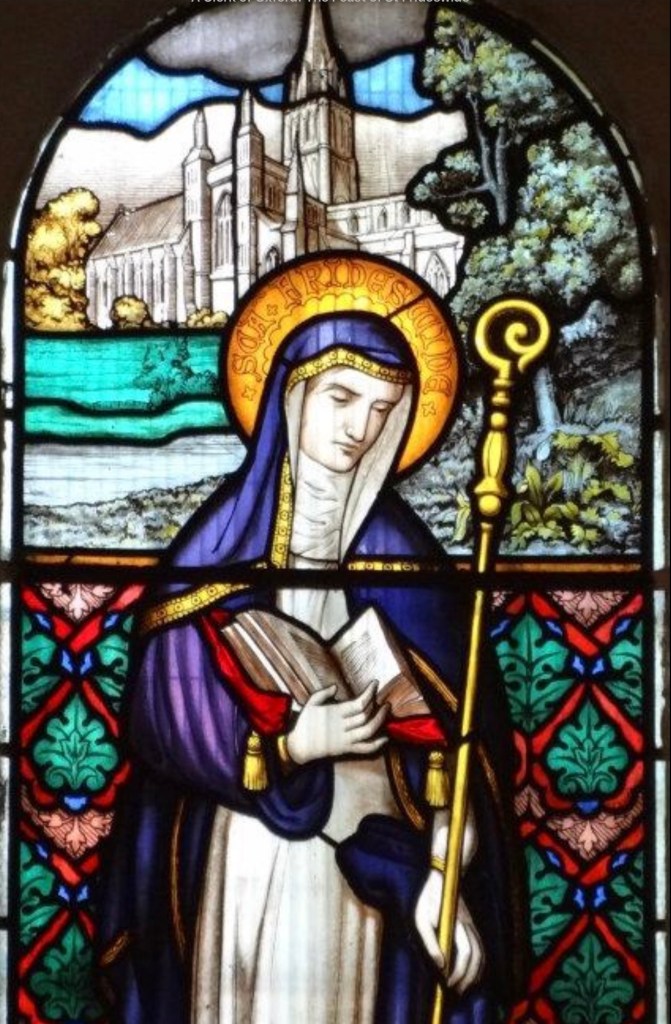
In Oxford, Danes attempted to escape the killings by taking refuge inside the church of St Frideswide.
Their pursuers could not drive them out.
So they set fire to the church.
The people sheltering inside died.
Nearly a thousand years later, archaeologists excavating elsewhere in Oxford discovered a mass grave containing the violently battered remains of dozens of men.
Some had been stabbed.
Some decapitated.
Some showed evidence of burning.
Many appear to have had Scandinavian ancestry.
Had the victims of St Brice’s Day finally been found?
Perhaps.
But, as with almost everything surrounding this extraordinary event, the answer is more complicated than the irresistible headline.
Welcome to Anglo-Saxon England.
And to one of the darkest days of Æthelred the Unready’s troubled reign
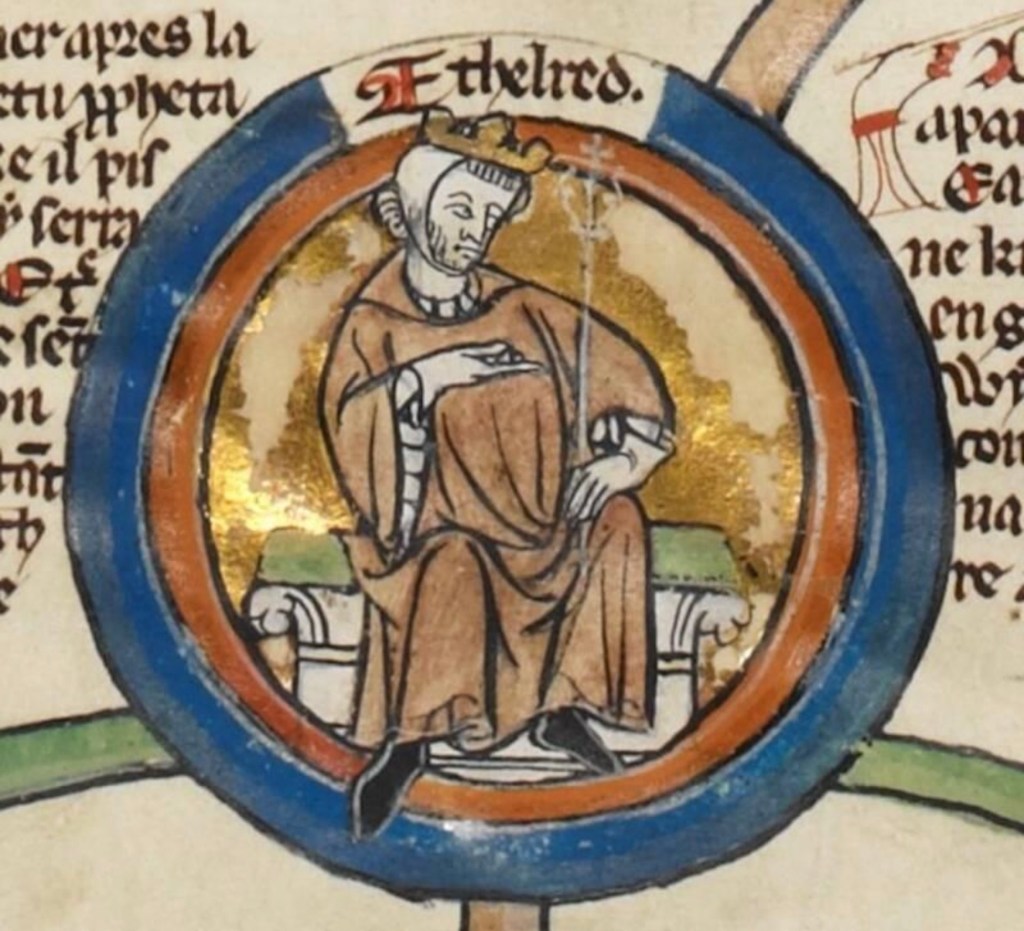
First, Meet the “Unready” King
Æthelred II became king of England in 978, while still a boy.
His reign would eventually become synonymous with political instability, Viking attacks, enormous payments of tribute and military failure.
History subsequently gave him one of the most devastating royal nicknames ever devised:
Æthelred the Unready.
Unfortunately, modern English has ruined the joke.
The nickname did not originally mean that Æthelred habitually turned up without his sword or had forgotten that the Vikings were coming.
His Old English name, Æthelred, can be understood approximately as “noble counsel.”
The later epithet unræd means something closer to “bad counsel,” “ill-advised” or “no counsel.”
It is a pun.
Noble Counsel, Bad Counsel.
Medieval political satire could be wonderfully economical.
The nickname was attached to him after his lifetime, but it reflected a lasting judgement that Æthelred’s reign had been disastrous.
Modern historians have become considerably kinder.
Æthelred wasn’t necessarily the incompetent fool of popular history.
He inherited an extraordinarily difficult political and military situation.
Unfortunately, on St Brice’s Day 1002, he made a decision that has done little to rehabilitate his reputation.
The Vikings Had Never Really Gone Away
To understand Æthelred’s fear, we need to remember that England and Scandinavia had been entangled for generations.
Viking raids on England had begun centuries earlier.
Then raiding developed into conquest and settlement.
Large Scandinavian armies occupied substantial parts of England during the ninth century.
King Alfred the Great and his successors gradually fought back.
Eventually a unified English kingdom emerged.
But Scandinavian settlers didn’t simply disappear.
Large areas of northern and eastern England retained profound Scandinavian cultural influence.
People intermarried.
Communities mixed.
Trade connected England with Scandinavia.
Place names preserve that Scandinavian presence to this day.
By Æthelred’s reign, distinguishing neatly between English and Danish could therefore be extremely difficult.
Some families had Scandinavian ancestry stretching back generations.
Others were more recent arrivals.
Some Scandinavian warriors served English rulers.
Others arrived as raiders.
This is one reason we should immediately be suspicious of the simplistic claim that Æthelred literally attempted to kill every person of Danish ancestry in England.
It would have been practically impossible.
The Vikings Return
During Æthelred’s reign, Scandinavian attacks intensified again.
England was wealthy.
That made it attractive.
Raiding armies could extract enormous amounts of silver.
Æthelred’s government sometimes fought.
Sometimes negotiated.
Sometimes paid.
The famous Danegeld became increasingly important.
The principle was painfully straightforward.
Pay the Vikings to go away.
The problem was equally straightforward.
If somebody pays you a fortune to go away, you may eventually discover that coming back is extremely profitable.
Large payments were made.
The attacks continued.
1002
Early in 1002, Æthelred attempted diplomacy.
He agreed to peace arrangements with Scandinavian forces.
That same year he married Emma of Normandy, strengthening relations with Normandy, whose rulers themselves descended from Scandinavian settlers.
Then something happened.
Precisely what remains uncertain.
According to the Anglo-Saxon Chronicle, Æthelred received information that Danish men in England intended to kill him and his councillors and seize his kingdom.
Was there really a conspiracy?
Possibly.
Æthelred had genuine reasons to fear betrayal.
Some Scandinavian mercenaries and leaders had shifted allegiance before.
His political world was unstable.
But we possess no independent evidence demonstrating the conspiracy described by the Chronicle.
What we do know is what Æthelred did about it.
He ordered killings.
St Brice’s Day
The date chosen was 13 November 1002.
The feast of St Brice — or Brictius — of Tours.
Brice was a fifth-century bishop and successor to the considerably more famous St Martin of Tours.
Why exactly the killings occurred on his feast day has produced fascinating historical speculation.
Recent scholarship has suggested that the date may not have been accidental and that Brice’s religious associations could have carried political meaning for Æthelred’s court.
Another ingenious suggestion has connected the timing with the traditional slaughter season around Martinmas, when communities would already have had equipment for killing animals readily available.
These remain interpretations rather than established fact.
What is established is that later generations gave the event the name by which we still know it:
The St Brice’s Day Massacre.
What Did Æthelred Actually Order?
Here we encounter our biggest problem.
One version of the Anglo-Saxon Chronicle says that Æthelred ordered all Danish men who were in England to be killed.
Read literally, that sounds like an order for nationwide extermination.
But could it actually have been carried out?
Almost certainly not on that scale.
Large populations in former Danelaw territory had Scandinavian ancestry.
Æthelred’s government did not possess a modern bureaucracy capable of identifying and simultaneously murdering everyone fitting an ethnic category across an entire kingdom.
Nor would such a policy make much sense in communities where “Dane” and “Englishman” were no longer cleanly separated identities.
Historians have therefore debated who the intended victims really were.
Perhaps the order primarily targeted more recently arrived Danes.
Perhaps Scandinavian mercenaries were particularly suspected.
Perhaps killings occurred mainly in towns and regions firmly controlled by Æthelred.
Perhaps the decree was sweeping but its implementation highly uneven.
The honest answer is:
We don’t know.
But something happened.
And Oxford provides our strongest evidence.
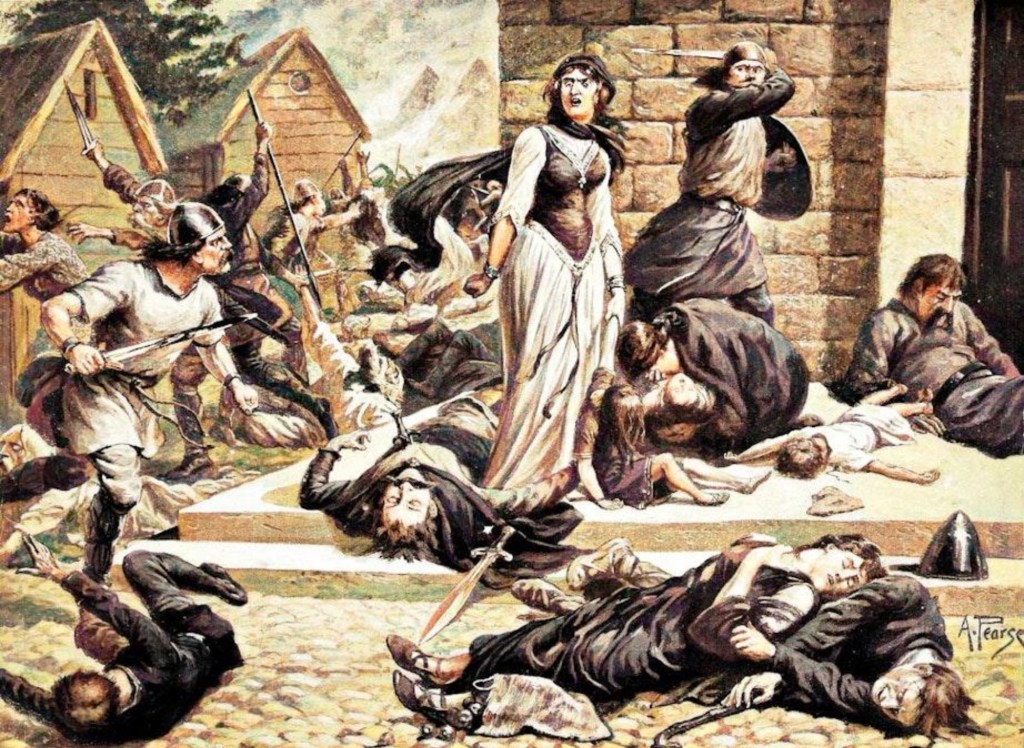
Oxford, 1002
Two years after the massacre, Æthelred issued a royal charter concerning St Frideswide’s church at Oxford.
The document is extraordinary because Æthelred refers directly to his own decree.
He describes an order, issued with the counsel of his leading men, that Danes who had appeared in England were to be killed.
The language is chilling.
The Danes are compared with weeds growing among wheat.
Then Æthelred explains what happened in Oxford.
Danes in the town realised they were in danger.
They fled to St Frideswide’s church.
The church offered sanctuary.
Or should have.
The fugitives forced their way inside and prepared to defend themselves.
The townspeople pursuing them attempted to drive them out.
They failed.
So the attackers set the wooden church on fire.
The building burned.
The Danes inside died.
Books and church treasures were destroyed with them.
Æthelred’s later charter dealt partly with restitution following the destruction.
This isn’t a lurid story invented centuries afterwards.
It comes from a document issued in Æthelred’s own reign.
Something terrible happened at Oxford.
Sanctuary Meant Something
Burning people inside a church carried particular horror in medieval Christian society.
Churches were sacred spaces.
The idea of sanctuary — that a person fleeing violence might find protection within a holy place — possessed profound religious significance.
Yet the Oxford attackers burned the church with the fugitives inside.
Even Æthelred’s charter had to account for the destruction of sacred property.
This reminds us that mass violence often produces its own logic.
Once a group has been declared dangerous enough, ordinary moral boundaries can collapse.
Neighbour becomes enemy.
Sanctuary becomes hiding place.
A church becomes something that can be burned.
Who Was Killed?
Again, frustratingly, we don’t know.
The number of victims across England is unknown.
Claims of thousands of deaths should be treated sceptically.
We simply don’t possess evidence allowing a reliable national death toll.
The massacre may have been extensive.
It may have been concentrated in particular places.
It may have involved several separate local massacres.
Oxford is the clearest documented example.
And then, nearly a millennium later, Oxford produced something extraordinary.
The Bodies Beneath Oxford
In 2008, archaeological work at St John’s College, Oxford, uncovered a mass grave.
Inside were the remains of roughly three dozen males, many of them young.
They had died violently.
The bodies had been thrown into the grave in a disorderly fashion.
Skeletons displayed numerous weapon injuries.
Some individuals had suffered repeated blows.
Some showed evidence associated with burning.
The burial dated broadly to the period surrounding St Brice’s Day.
The obvious question arose immediately.
Had archaeologists found victims of Æthelred’s massacre?
The possibility is tantalising.
Research has shown substantial Scandinavian connections among the group, and more recent archaeogenetic work has strengthened the plausibility that many had southern Scandinavian ancestry.
But archaeology demands caution.
The grave isn’t at St Frideswide’s church.
The dating isn’t precise enough to place every death unquestionably on 13 November 1002.
And England experienced plenty of Anglo-Scandinavian violence around this period.
One interpretation has suggested the men may instead have been a captured Scandinavian raiding party.
So the responsible conclusion is:
They may be victims of St Brice’s Day.
Not:
They definitely are.
Sometimes archaeology gives us answers.
Sometimes it gives us much better questions.
The Weymouth Mass Grave
Another spectacular discovery occurred at Ridgeway Hill near Weymouth in Dorset.
A mass grave contained the remains of more than fifty decapitated men.
Their skulls had been placed separately.
Scientific analysis indicated Scandinavian origins for many of them.
Again the irresistible suggestion appeared:
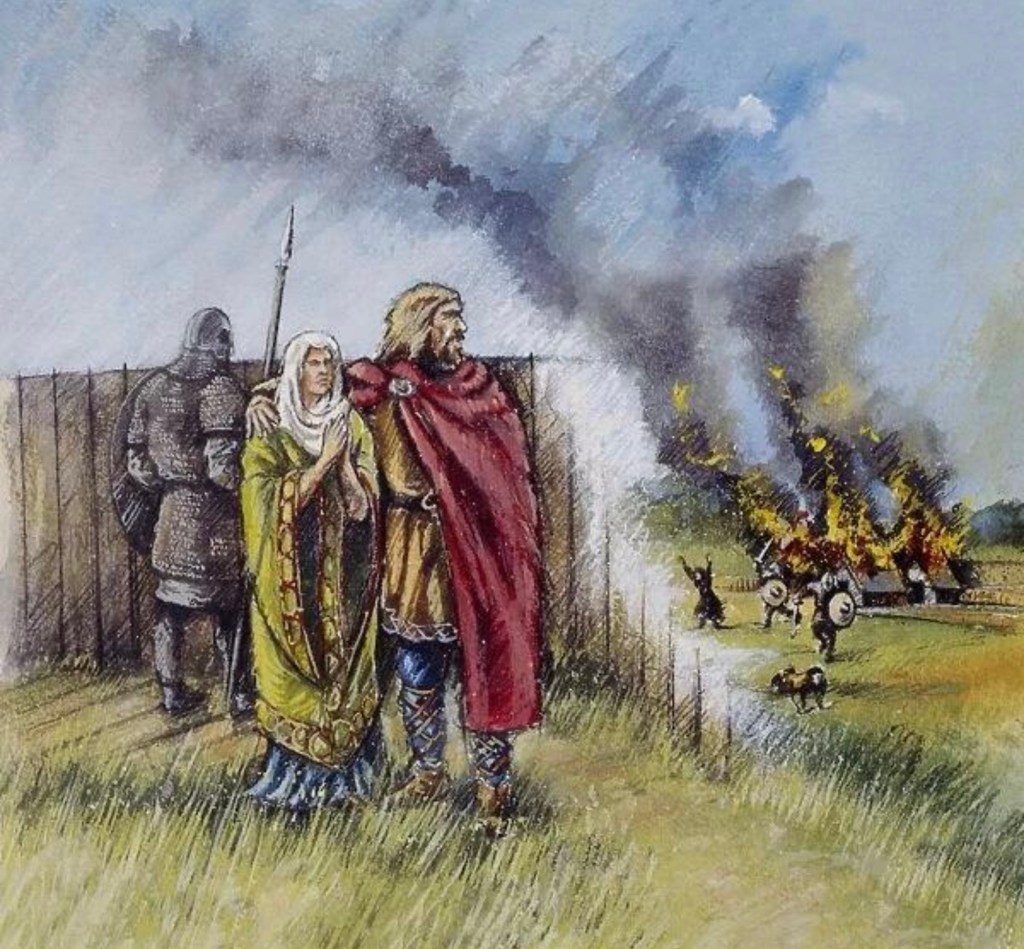
St Brice’s Day victims.
But the dating and interpretation make a direct connection with 1002 uncertain and probably unlikely.
The men may have belonged to a Scandinavian raiding force captured and executed during a somewhat later episode.
The Ridgeway Hill discovery remains extraordinary evidence of violence between English and Scandinavian groups.
It should not simply be recruited into St Brice’s Day because it makes the story more dramatic.
The massacre is dramatic enough already.
Enter Gunhilde
And now we arrive at one of those historical stories that is simply too good not to tell.
But also too uncertain to tell as fact.
Later medieval tradition claimed that among those killed on St Brice’s Day was a Danish noblewoman usually called Gunhilde or Gunnhild.
And she was supposedly the sister of Sweyn Forkbeard, king of Denmark.
Some versions embellish the story further.
Her husband was killed.
Her child was killed.
She herself was killed.
Before dying, she supposedly predicted that Denmark would exact terrible revenge upon England.
Sweyn then invaded.
England suffered.
Æthelred lost his kingdom.
What a story.
There is only one problem.
Contemporary evidence does not securely establish it.
Later chroniclers wrote about a high-status Danish woman associated with the massacre, but the precise genealogy and circumstances became increasingly elaborate.
So Gunhilde belongs in our history.
But beneath a large warning sign:
A VERY GOOD STORY THAT MAY NOT BE TRUE.
History contains quite enough extraordinary reality without quietly promoting legends into facts.
Sweyn Forkbeard
What certainly is true is that England’s Scandinavian troubles became considerably worse.
Sweyn Forkbeard, king of Denmark, launched major campaigns against England.
In 1003 and 1004, Scandinavian forces attacked.
Exeter fell.
Other towns suffered.
Campaign followed campaign.
Whether St Brice’s Day directly caused Sweyn’s renewed attacks is uncertain.
The neat revenge story is attractive.
Real geopolitics rarely behaves so tidily.
Sweyn already possessed ample reasons to attack one of Europe’s wealthiest kingdoms.
But Æthelred’s massacre certainly did nothing to improve Anglo-Danish relations.
Danegeld
Æthelred continued confronting Scandinavian armies with a mixture of military resistance and payment.
The sums became enormous.
England’s sophisticated taxation system enabled the king to raise extraordinary quantities of silver.
That administrative strength is one reason modern historians have reconsidered the traditional picture of Æthelred as hopelessly incompetent.
His government could raise money remarkably effectively.
Unfortunately, raising enormous amounts of money to pay invading armies not to invade again contained a fairly obvious strategic weakness.
They could return.
And they did.
1013: Sweyn Wins
By 1013, Sweyn launched a campaign that finally broke Æthelred’s position.
English resistance collapsed.
Sweyn was accepted as king.
Æthelred fled with his family to Normandy.
Eleven years after ordering Danes killed within England, Æthelred had lost England to a Danish king.
If history were a novelist, an editor might complain that the symbolism was too obvious.
Then Sweyn suddenly died in February 1014.
Æthelred returned.
The story still wasn’t over.
Enter Cnut
Sweyn’s son Cnut — later known as Cnut the Great — continued the struggle.
Æthelred died in 1016.
His son Edmund Ironside fought Cnut for control of England.
After brutal campaigning, the kingdom was divided between them.
Then Edmund died.
Cnut became king of all England.
So fourteen years after St Brice’s Day:
England had a Danish king.
And Cnut proved extraordinarily successful.
He ruled England, Denmark and eventually Norway within a great North Sea empire.
The supposedly foreign enemy became England’s legitimate monarch.
History rarely respects simple ethnic categories for very long.
Did St Brice’s Day Cause the Danish Conquest?
No.
At least, we cannot responsibly say that.
It makes an irresistible narrative:
Æthelred massacres Danes.
Sweyn seeks revenge.
Sweyn conquers England.
Cnut completes the job.
But Scandinavian ambitions in England long predated 1002.
Military campaigns had already occurred.
Political alliances were shifting constantly.
England’s wealth made it an attractive target.
Sweyn’s ambitions had numerous causes.
St Brice’s Day belongs within that deteriorating relationship.
It shouldn’t be turned into the single cause of everything that followed.
History is rarely a row of dominoes.
Was It Genocide?
Modern terminology presents another difficulty.
Some writers have described St Brice’s Day as genocide or attempted genocide.
The order, particularly as preserved in contemporary sources, undeniably contains disturbing language directed at a defined population.
But applying a modern legal category developed in the twentieth century to an event in 1002 can create more certainty than the evidence supports.
We don’t know the intended geographical scope with precision.
We don’t know exactly how “Dane” was defined.
We don’t know how extensively the order was implemented.
We don’t know the death toll.
Calling the event a massacre, a pogrom, or an episode of state-sanctioned ethnic violence may describe what we can establish without pretending we know what we don’t.
The horror doesn’t require exaggeration.
Fear and Collective Guilt
This is where St Brice’s Day becomes something more important than another gruesome medieval episode.
Æthelred reportedly feared a conspiracy.
Perhaps the conspiracy was genuine.
A ruler facing assassination has every reason to investigate.
But there is an enormous moral difference between:
These individuals are plotting to kill me
and
these people are dangerous because they belong to the same group.
That transition has appeared repeatedly throughout history.
An external enemy exists.
A minority within the country shares some identity with that enemy.
Suspicion spreads.
Rumours circulate.
The minority becomes a potential fifth column.
Individual guilt becomes collective guilt.
Then extraordinary measures become imaginable.
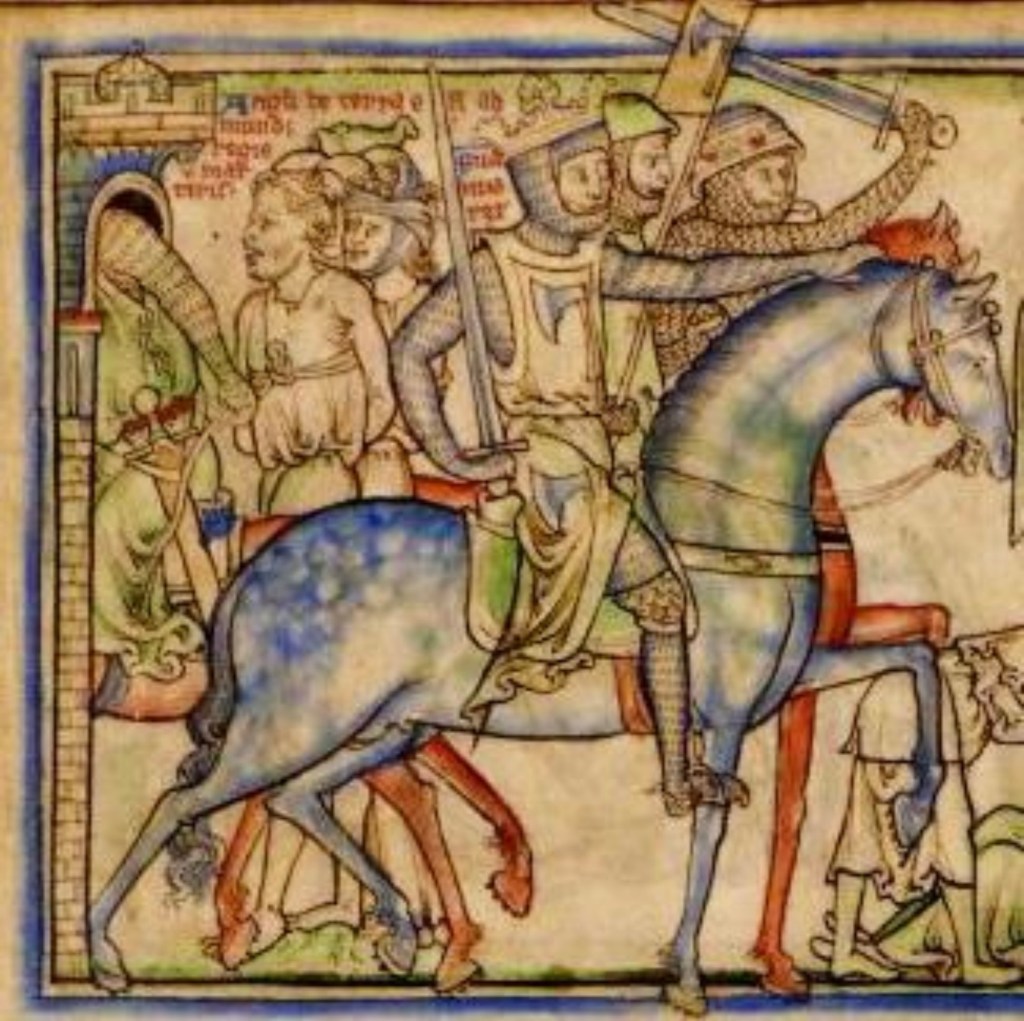
St Brice’s Day gives us a disturbingly early example of that process.
Were These People Foreigners?
Even the word foreigner becomes problematic.
How long does a family have to live somewhere before it belongs?
Scandinavian settlement in England had begun generations earlier.
Some people of Danish ancestry were born in England.
Their parents may have been born there.
They traded with English neighbours.
Married into English families.
Spoke related languages.
Adopted Christianity.
Shared communities.
The England Æthelred ruled was already partly the product of Scandinavian settlement.
That makes an order directed against “Danes” particularly revealing.
Identity wasn’t simply biological.
It was political.
A neighbour could suddenly become a Dane when circumstances made Danishness dangerous.
The Language of Weeds
One of the most unsettling elements in Æthelred’s 1004 charter is the comparison of Danes with unwanted plants growing among wheat.
Dehumanising metaphors matter.
They transform people into contamination.
Weeds are not negotiated with.
They are removed.
Such language has accompanied persecution repeatedly across history.
The metaphor helps convert violence into purification.
The victims cease to be individual human beings.
They become something infecting the healthy body of society.
That makes killing easier to justify.
And What About St Brice?
Poor St Brice himself had nothing whatsoever to do with the massacre.
He was a fifth-century bishop of Tours whose feast happened to fall on the chosen day.
Yet nearly sixteen centuries after Brice lived, his name is remembered largely because an English king ordered Danes killed on his feast day.
There is an interesting historical irony here.
A saint’s day intended to organise sacred memory became attached permanently to political violence.
Recent scholarship has even suggested that the religious meaning of Brice’s feast may have influenced the selection of the date.
We cannot prove that.
But it reminds us that medieval people experienced dates differently from us.
The calendar wasn’t merely Monday, Tuesday, Wednesday.
It was filled with saints.
Feasts.
Fasts.
Holy seasons.
Anniversaries.
Religious meaning structured time.
The fact that the massacre happened on St Brice’s Day mattered enough for the Chronicle to record it.
Æthelred’s Reputation
Was Æthelred a monster?
History is rarely helped by reducing rulers to single adjectives.
He governed England for nearly four decades.
His reign produced sophisticated administration, important legislation, extensive coinage and significant religious patronage.
He also ruled during an extraordinary military crisis.
But none of that removes responsibility for the decree of 1002.
Indeed, the existence of the 1004 charter makes attempts to explain the massacre away particularly difficult.
Æthelred himself acknowledged that a decree had been issued.
The interesting historical task isn’t deciding whether Æthelred was simply good or evil.
It is understanding how a Christian king, advised by leading political and ecclesiastical figures, could persuade himself that such violence represented legitimate government.
That question is considerably more disturbing.
The Massacre We Cannot Count
We will probably never know how many people died on St Brice’s Day.
Ten?
Dozens?
Hundreds?
More?
The evidence cannot tell us.
Nor can we reconstruct every place where killings occurred.
Oxford provides our clearest window.
Other episodes may simply have vanished from the record.
That is one of the great difficulties of early medieval history.
Survival of evidence is uneven.
A massacre could occur in one town and leave a charter.
Another could occur elsewhere and leave nothing.
Absence from the written record isn’t proof that nothing happened.
But neither does it permit us to invent what might have happened.
So we are left with uncertainty.
Good history sometimes requires those three deeply unsatisfying words:
We don’t know.
What We Do Know
But what remains is extraordinary enough.
In 1002, the king of England received or claimed to have received intelligence about a Danish conspiracy.
With the support of his councillors, he ordered killings.
The Anglo-Saxon Chronicle remembered the decree.
Æthelred himself subsequently referred to it.
At Oxford, Danes sought sanctuary inside a church.
Their pursuers burned the church.
People died inside.
Archaeology has uncovered violently killed men from approximately the same period, many with Scandinavian connections, although identifying them conclusively as massacre victims remains impossible.
Scandinavian attacks subsequently intensified.
Sweyn Forkbeard conquered England.
Æthelred fled.
And eventually Cnut became king.
None of that requires Gunhilde dramatically cursing England on her way to execution.
Reality has already provided more than enough plot.
The Long Shadow of 13 November
St Brice’s Day deserves to be remembered not simply because it was bloody.
Medieval history contains no shortage of blood.
It matters because it reveals something about how societies manufacture enemies.
Æthelred’s England had lived with Scandinavian settlement for generations.
English and Scandinavian identities overlapped.
Yet under the pressure of invasion, political instability and fear of conspiracy, “the Danes” could once again become a dangerous category.
People who had lived within English communities became suspect.
A king transformed suspicion into policy.
Policy became violence.
And in Oxford, frightened people ran into a church believing sacred walls might protect them.
The walls burned around them.
Nearly a thousand years later, we are still trying to determine who died and why.
That uncertainty should not diminish St Brice’s Day.
It should make us more careful about remembering it.
Because the most important lesson doesn’t depend upon knowing the exact number of dead.
It lies in the progression:
fear, suspicion, collective blame, dehumanisation, violence.
On 13 November 1002, an English king allowed that progression to become royal policy.
His nickname says he was badly advised.
On St Brice’s Day, at least, history has good reason to agree.
Tim Alderman ©️2026
Sources and Further Reading
The Anglo-Saxon Chronicle — the fundamental narrative source for the order of 1002, recording that Æthelred ordered Danish men in England killed after being told of a conspiracy against himself and his councillors.
Æthelred’s charter for St Frideswide’s, Oxford (1004) — exceptionally important contemporary evidence because the king’s own diploma refers to the decree and describes the burning of the church in which Danes had sought refuge.
Benjamin Savill, “Remembering St Brictius: Conspiracy, Violence and Liturgical Time in the Danish Massacre of 1002,” Journal of Ecclesiastical History — important modern reassessment of the massacre, its political and religious setting, the significance of St Brice’s feast day, and the limitations of the surviving evidence.
Simon Keynes, studies of the reign of Æthelred II — essential for the modern reassessment of Æthelred and for moving beyond the traditional caricature of an incompetent “Unready” king.
Ann Williams, Æthelred the Unready: The Ill-Counselled King — detailed modern study of Æthelred’s reign and the political crisis surrounding renewed Scandinavian attacks.
Levi Roach, Æthelred the Unready — modern biography placing the massacre within the much broader political, military and religious world of Æthelred’s England.
Oxford Archaeology, reports concerning the early-eleventh-century Oxford and Ridgeway Hill mass burials — important archaeological evidence while also demonstrating why caution is necessary when associating mass graves with specific recorded historical events.
University of Oxford / St John’s College research on the Oxford mass grave — interdisciplinary discussion of the remains discovered in 2008 and their possible relationship to the events of 1002.
M. K. Lawson, Cnut: England’s Viking King — useful for the Scandinavian conquest of England and the political world that eventually brought Cnut to the English throne.

