In an effort to scare people away from drinking alcohol, the American government once poisoned certain alcohol supplies; this resulted in the death of over 10,000 American Citizens.
This, of course, was during Prohibition. The government became frustrated with the fact that despite the manufacture, sale, and transportation of alcohol being banned, the number of people drinking alcoholic beverages was markedly higher than it was before Prohibition. So to try to get people to stop drinking, the government decided to try a scare tactic.
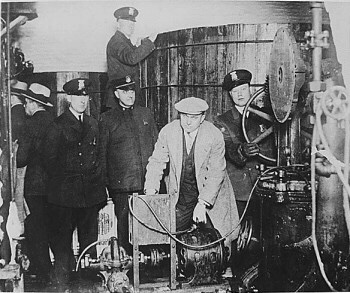
One way bootleggers of this time made alcoholic beverages was to use denatured, industrial alcohol as the base. Denaturing the alcohol is simply a process to make it undrinkable, usually by adding something that makes it taste or smell disgusting or will induce vomiting. This was originally done (and is still done to this day) in order to allow companies to get around having to pay the high taxes associated with the manufacturing and sale of alcohol meant to be drunk. Alcohol used industrially, for non-beverage applications, are denatured and thus, they don’t have to pay these taxes and so it is significantly cheaper, gallon for gallon. Without this tax break, literally thousands of industrial products would become drastically more expensive than they currently are.
During prohibition, this denatured alcohol was often stolen from companies that made industrial alcohol used in various paints and solvents and the like. The bootleggers would then have their own chemists whose job it was to make the alcohol palatable again, basically undoing the denaturing process or to “renature” the alcohol.
With an estimated 60 million gallons of industrial alcohol stolen annually in the 1920s to be later renatured and sold as drinkable alcohol, the government, under President Coolidge, decided to up the stakes and make some of the denaturing formulas lethal, instead of just designed to make the alcohol unpalatable. To do this, they’d generally add things like methyl alcohol (the main denaturing chemical at 10% added, even today); other chemicals added are things such as kerosene, brucine, gasoline, benzene, cadmium, formaldehyde, chloroform, carbolic acid, acetone, and many others that were difficult for the bootlegger’s chemists to get out when they’d renature the alcohol.
After the first 100 or so people died shortly after the new denaturing process was released around Christmas, health officials were outraged and the news media picked up the story as intended. Unfortunately, the government’s plan didn’t quite work from that point on. It didn’t scare people away from drinking and rather had little to no effect on people’s consumption of alcohol; instead, the estimates are that it resulted in the deaths of over 10,000 people with a much larger number severely sickened and many blinded by the poisoning.
As New York City’s medical examiner Charles Norris stated: “The government knows it is not stopping drinking by putting poison in alcohol. Yet it continues its poisoning processes, heedless of the fact that people determined to drink are daily absorbing that poison. Knowing this to be true, the United States government must be charged with the moral responsibility for the deaths that poisoned liquor causes, although it cannot be held legally responsible.” (Chuck Norris fighting the man even back then) 😉
People at the time, though, were split on the poisoning program, even with the deaths that were happening because of it. One side felt that the people who were drinking the illegal alcohol got what they deserved, particularly because they knew the risks and broke the law anyways; the other side felt it was a national experiment on exterminating members of society that the government felt were undesirable as American citizens. As one Chicago Tribune article in 1927 stated: “Normally, no American government would engage in such business. … It is only in the curious fanaticism of Prohibition that any means, however barbarous, are considered justified.”
Now, to be clear, the various governments of the world still require denaturing of alcohol that is not for oral consumption and the standard requirement of 10% methyl alcohol is still in effect in most countries. This isn’t really a problem anymore because people have much better ways to get their alcohol than trying to deal with denatured alcohol. The problem at the time was that the government knew full well that people would be drinking this poisoned alcohol and they hoped the deaths that resulted from this would scare other people away from drinking. Further, when it was clear that it wasn’t scaring anyone away from drinking and literally thousands were dying per year with significantly more than that severely sickened, they kept the program going anyways, though it was hotly debated in Congress.
So next time you start thinking the U.S. government is impossibly screwed up today; headed down the tubes; and beyond fixing, well, if you study American history much at all, it’s pretty clear it used to be a lot more screwed up than it is today, not just concerning this issue, but many, many others. And yet, we’re still here. 🙂
If you liked this article, you might also enjoy our new popular podcast, The BrainFood Show (iTunes, Spotify, Google Play Music, Feed), as well as:
Boring facts
The term “The Real McCoy” originated in the prohibition era. Captain William S. McCoy was a rum runner who coordinated most rum transported by ship during prohibition. He was known for never watering down his imports; thus, his product was “The Real McCoy”.
This wasn’t the only time the U.S. Government decided to poison the supply of some illegal substance in order to try to scare people away from using it. In the 1970s the government sprayed marijuana fields with Paraquat, which is an herbicide. They thought this had the dual benefit of killing large portions of the crop and also scaring people away from buying marijuana in those areas because the surviving plants would essentially be laced with a mild toxin. Public outcry at the time however, forced the government to stop doing this.
It was the 18th Amendment, passed in 1919, which banned the manufacture, sale, and transportation of alcoholic beverages in the United States (note: it didn’t ban the consumption of alcohol). The Volstead Act, officially the “National Prohibition Act”, then laid out the rules for this ban and was passed on October 28, 1919, despite President Wilson’s veto; prohibition itself began on January 1st, 1920. Only 1,520 Federal Prohibition agents were hired to enforce this act, nationwide.
The Volstead Act was amended on March 22, 1933 by the Cullen-Harrison Act, which allowed the manufacturing and sale of certain kinds of alcoholic beverages. The 18th Amendment itself was repealed in December of 1933. When President Roosevelt signed the Cullen-Harrison Act, he made the now famous remark, “I think this would be a good time for a beer.” A mere one day after the Cullen-Harrison Act went into effect on April 7, 1933, Anheuser-Busch, Inc, sent a case of Budweiser to the White House as a gift to President Roosevelt.
As happens quite often when people are told they can’t do something, the banning of alcohol resulted in alcoholic beverages being consumed at an estimated three times the rate it was before the banning took effect.
Prohibition was widely supported by diverse groups across the nation when it first was made law, even among the heavy drinkers. It was widely thought that a ban on alcohol would drastically improve society as a whole (many of society’s problems of the day were thought to be a result of rampant alcohol use; some were even actually valid points, though many were not). Thus, sacrificing alcoholic drinks was a little thing compared to creating a better society. Will Rogers often joked about the southern prohibitionists: “The South is dry and will vote dry. That is, everybody sober enough to stagger to the polls.”
One of the chief controversies of the day among medical professionals was that alcohol was prescribed by physicians for medicinal purposes. As such, medical professionals across the nation lobbied for the repeal of prohibition as it applied to medicinal liquors, such as beer, which was often prescribed.
While the Volstead Act banned the manufacturing, sale, and transport of alcohol, it did allow home brewing of wine and cider from fruit. An individual home was allowed to produce up to 200 gallons per year.
Grape growers of the day began selling “bricks of wine”, which were primarily blocks of “Rhine Wine”. These often included the following instructions: “After dissolving the brick in a gallon of water, do not place the liquid in a jug away in the cupboard for twenty days, because then it would turn into wine.”
Also because the Volstead Act did not ban the consumption or storage of alcohol, before the act went into effect, many people stockpiled various alcoholic beverages.
Notorious gangster Al Capone, Bugs Moran, and many others made their riches primarily through illegal alcohol sales and distribution. Capone controlled over 10,000 speakeasies in Chicago alone. Speakeasies were basically places that discreetly served liquor. They often also served food and had live bands to make themselves look like credible institutions. Others were simply regular businesses that kept alcohol on hand to sell to patrons who knew of their side-business.
The term “speakeasy” comes from bartenders telling patrons to “speak easy” when ordering, so as not to be overheard.
The repeal of the Volstead Act not only took the primary funding away from numerous gangsters, but also created thousands of new jobs at a time when they were desperately needed in the United States.
The Bureau of Alcohol, Tobacco, Firearms, and Explosives (BATF) maintains a list of approved formulas by which torender the ethanol undrinkable, which can be found here. These range from formulas to make it taste gross all the way to being very lethal.
Today in the United States about 50% of people report drinking more than 12 alcoholic beverages in the last year; about 14% say they drank 1-11 alcoholic beverages in the last year; with the remaining 36% abstaining from alcoholic beverages in the calendar year the survey was done.Source: Summary Health Statistics for U.S. Adults: National Health Interview Survey, 2008, table 27
The total for all alcohol related deaths per year in the United States is around 85,000 deaths a year. For comparison, the number of deaths associated with Tobacco annually is around 400,000-500,000; poor diet and physical inactivity at around 365,000; prescription drug related deaths around 32,000; suicide around 30,600; homicide around 20,000; gun-related deaths around 29,000; aspirin related deaths around 7,000; all illicit drug use at around 17,000; and Marijuana deaths around 0. 😉
The word “prohibition” comes from the Latin “prohibitionem”, meaning “hindering or forbidding”. It was used to mean “forced alcohol abstinence” as early as 1851.
Most historians agree that there is evidence of homosexual activity and same-sex love, whether such relationships were accepted or persecuted, in every documented culture.
A brief history of lesbian, gay, bisexual and transgender social movements/Bonnie J. Morris, PhD
On June 12, 2016, the popular gay dance club Pulse in Orlando was the site of a mass shooting by one assailant. With at least 49 dead and another 50 injured, this hate crime is being called the worst mass shooting in U.S. history. It occurred during what was LGBT Pride weekend for towns and cities in and beyond the United States. The immediate, caring response from mayors, police and FBI authorities, local and national politicians, and the President of the United States, who reached out to express outrage and concern, demonstrates the enormous shift toward acceptance and public support for the LGBT community. Although the LGBT community and individuals remain targets for hate violence and backlash throughout the world, the hard work of activists and allies made it possible to reach this era, where the perpetrators of violence, not the victims, are condemned as sick.
Social movements, organizing around the acceptance and rights of persons who might today identify as LGBT or queer, began as responses to centuries of persecution by church, state and medical authorities. Where homosexual activity or deviance from established gender roles/dress was banned by law or traditional custom, such condemnation might be communicated through sensational public trials, exile, medical warnings and language from the pulpit. These paths of persecution entrenched homophobia for centuries—but also alerted entire populations to the existence of difference. Whether an individual recognized they, too, shared this identity and were at risk, or dared to speak out for tolerance and change, there were few organizations or resources before the scientific and political revolutions of the 18th and 19th centuries. Gradually, the growth of a public media and ideals of human rights drew together activists from all walks of life, who drew courage from sympathetic medical studies, banned literature, emerging sex research and a climate of greater democracy. By the 20th century, a movement in recognition of gays and lesbians was underway, abetted by the social climate of feminism and new anthropologies of difference. However, throughout 150 years of homosexual social movements (roughly from the 1870s to today), leaders and organizers struggled to address the very different concerns and identity issues of gay men, women identifying as lesbians, and others identifying as gender variant or nonbinary. White, male and Western activists whose groups and theories gained leverage against homophobia did not necessarily represent the range of racial, class and national identities complicating a broader LGBT agenda. Women were often left out altogether.
What is the pre-history of LGBT activism? Most historians agree that there is evidence of homosexual activity and same-sex love, whether such relationships were accepted or persecuted, in every documented culture. We know that homosexuality existed in ancient Israel simply because it is prohibited in the Bible, whereas it flourished between both men and women in Ancient Greece. Substantial evidence also exists for individuals who lived at least part of their lives as a different gender than assigned at birth. From the lyrics of same-sex desire inscribed by Sappho in the seventh century BCE to youths raised as the opposite sex in cultures ranging from Albania to Afghanistan; from the “female husbands” of Kenya to the Native American “Two-Spirit,” alternatives to the Western male-female and heterosexual binaries thrived across millennia and culture. These realities gradually became known to the West via travelers’ diaries, the church records of missionaries, diplomats’ journals, and in reports by medical anthropologists. Such eyewitness accounts in the era before other media were of course riddled with the biases of the (often) Western or white observer, and added to beliefs that homosexual practices were other, foreign, savage, a medical issue, or evidence of a lower racial hierarchy. The peaceful flowering of early trans or bisexual acceptance in different indigenous civilizations met with opposition from European and Christian colonizers.
In the age of European exploration and empire-building, Native American, North African and Pacific Islander cultures accepting of “Two-Spirit” people or same-sex love shocked European invaders who objected to any deviation from a limited understanding of “masculine” and “feminine” roles. The European powers enforced their own criminal codes against what was called sodomy in the New World: the first known case of homosexual activity receiving a death sentence in North America occurred in 1566, when the Spanish executed a Frenchman in Florida. Against the emerging backdrop of national power and Christian faith, what might have been learned about same-sex love or gender identity was buried in scandal. Ironically, both wartime conflict between emerging nations and the departure or deaths of male soldiers left women behind to live together and fostered strong alliances between men as well. Same-sex companionship thrived where it was frowned upon for unmarried, unrelated males and females to mingle or socialize freely. Women’s relationships in particular escaped scrutiny since there was no threat of pregnancy. Nonetheless, in much of the world, female sexual activity and sensation were curtailed wherever genital circumcision practices made clitoridectomy an ongoing custom.
Where European dress—a clear marker of gender—was enforced by missionaries, we find another complicated history of both gender identity and resistance. Biblical interpretation made it illegal for a woman to wear pants or a man to adopt female dress, and sensationalized public trials warned against “deviants” but also made such martyrs and heroes popular: Joan of Arc is one example, and the chilling origins of the word “faggot” include a stick of wood used in public burnings of gay men. Despite the risks of defying severe legal codes, cross-dressing flourished in early modern Europe and America. Women and girls, economically oppressed by the sexism which kept them from jobs and economic/education opportunities designated for men only, might pass as male in order to gain access to coveted experiences or income. This was a choice made by many women who were not necessarily transgender in identity. Women “disguised” themselves as men, sometimes for extended periods of years, in order to fight in the military (Deborah Sampson), to work as pirates (Mary Read and Anne Bonney), attend medical school, etc. Both men and women who lived as a different gender were often only discovered after their deaths, as the extreme differences in male vs. female clothing and grooming in much of Western culture made “passing” surprisingly easy in certain environments. Moreover, roles in the arts where women were banned from working required that men be recruited to play female roles, often creating a high-status, competitive market for those we might today identify as transwomen, in venues from Shakespeare’s theatre to Japanese Kabuki to the Chinese opera. This acceptance of performance artists, and the popularity of “drag” humor cross-culturally, did not necessarily mark the start of transgender advocacy, but made the arts an often accepting sanctuary for LGBT individuals who built theatrical careers based around disguise and illusion.
The era of sexology studies is where we first see a small, privileged cluster of medical authorities begin promoting a limited tolerance of those born “invert.” In Western history, we find little formal study of what was later called homosexuality before the 19th century, beyond medical texts identifying women with large clitorises as “tribades” and severe punishment codes for male homosexual acts. Early efforts to understand the range of human sexual behavior came from European doctors and scientists including Carl von Westphal (1869), Richard von Krafft-Ebing (1882) and Havelock Ellis (1897). Their writings were sympathetic to the concept of a homosexual or bisexual orientation occurring naturally in an identifiable segment of humankind, but the writings of Krafft-Ebing and Ellis also labeled a “third sex” degenerate and abnormal. Sigmund Freud, writing in the same era, did not consider homosexuality an illness or a crime and believed bisexuality to be an innate aspect beginning with undetermined gender development in the womb. Yet Freud also felt that lesbian desires were an immaturity women could overcome through heterosexual marriage and male dominance. These writings gradually trickled down to a curious public through magazines and presentations, reaching men and women desperate to learn more about those like themselves, including some like English writer Radclyffe Hall who willingly accepted the idea of being a “congenital invert.” German researcher Magnus Hirschfeld went on to gather a broader range of information by founding Berlin’s Institute for Sexual Science, Europe’s best library archive of materials on gay cultural history. His efforts, and Germany’s more liberal laws and thriving gay bar scene between the two World Wars, contrasted with the backlash, in England, against gay and lesbian writers such as Oscar Wilde and Radclyffe Hall. With the rise of Hitler’s Third Reich, however, the former tolerance demonstrated by Germany’s Scientific Humanitarian Committee vanished. Hirschfeld’s great library was destroyed and the books burnt by Nazis on May 10, 1933.
In the United States, there were few attempts to create advocacy groups supporting gay and lesbian relationships until after World War II. However, prewar gay life flourished in urban centers such as New York’s Greenwich Village and Harlem during the Harlem Renaissance of the 1920s. The blues music of African-American women showcased varieties of lesbian desire, struggle and humor; these performances, along with male and female drag stars, introduced a gay underworld to straight patrons during Prohibition’s defiance of race and sex codes in speakeasy clubs. The disruptions of World War II allowed formerly isolated gay men and women to meet as soldiers and war workers; and other volunteers were uprooted from small towns and posted worldwide. Many minds were opened by wartime, during which LGBT people were both tolerated in military service and officially sentenced to death camps in the Holocaust. This increasing awareness of an existing and vulnerable population, coupled with Sen. Joseph McCarthy’s investigation of homosexuals holding government jobs during the early 1950s outraged writers and federal employees whose own lives were shown to be second-class under the law, including Frank Kameny, Barbara Gittings, Allen Ginsberg and Harry Hay. Awareness of a burgeoning civil rights movement (Martin Luther King’s key organizer Bayard Rustin was a gay man) led to the first American- based political demands for fair treatment of gays and lesbians in mental health, public policy and employment. Studies such as Alfred Kinsey’s 1947 Kinsey Report suggested a far greater range of homosexual identities and behaviors than previously understood, with Kinsey creating a “scale” or spectrum ranging from complete heterosexual to complete homosexual.
The primary organization for gay men as an oppressed cultural minority was the Mattachine Society, founded in 1950 by Harry Hay and Chuck Rowland. Other important homophile organizations on the West Coast included One, Inc., founded in 1952, and the first lesbian support network Daughters of Bilitis, founded in 1955 by Phyllis Lyon and Del Martin. Through meetings and publications, these groups offered information and outreach to thousands. These first organizations soon found support from prominent sociologists and psychologists. In 1951, Donald Webster Cory published “The Homosexual in America”, asserting that gay men and lesbians were a legitimate minority group, and in 1953 Evelyn Hooker, PhD, won a grant from the National Institute of Mental Health to study gay men. Her groundbreaking paper, presented in 1956, demonstrated that gay men were as well-adjusted as heterosexual men, often more so. But it would not be until 1973 that the American Psychiatric Association removed homosexuality as an “illness” classification in its diagnostic manual. Throughout the 1950s and 60s, gay men and lesbians continued to be at risk for psychiatric lockup as well as jail, losing jobs, and/or child custody when courts and clinics defined gay love as sick, criminal or immoral.
In 1965, as the civil rights movement won new legislation outlawing racial discrimination, the first gay rights demonstrations took place in Philadelphia and Washington, D.C., led by longtime activists Frank Kameny and Barbara Gittings. The turning point for gay liberation came on June 28, 1969, when patrons of the popular Stonewall Inn in New York’s Greenwich Village fought back against ongoing police raids of their neighborhood bar. Stonewall is still considered a watershed moment of gay pride and has been commemorated since the 1970s with “pride marches” held every June across the United States. Recent scholarship has called for better acknowledgement of the roles that drag performers, people of color, bisexuals and transgender patrons played in the Stonewall Riots.
The gay liberation movement of the 1970s saw myriad political organizations spring up, often at odds with one another. Frustrated with the male leadership of most gay liberation groups, lesbians influenced by the feminist movement of the 1970s formed their own collectives, record labels, music festivals, newspapers, bookstores, and publishing houses, and called for lesbian rights in mainstream feminist groups like the National Organization for Women (NOW). Gatherings such as women’s music concerts, bookstore readings and lesbian festivals well beyond the United States were extraordinarily successful in organizing women to become activists; the feminist movement against domestic violence also assisted women to leave abusive marriages, while retaining custody of children became a paramount issue for lesbian mothers.
Expanding religious acceptance for gay men and women of faith, the first out gay minister was ordained by the United Church of Christ in 1972. Other gay and lesbian church and synagogue congregations soon followed. Parents and Friends of Lesbians and Gays (PFLAG), formed in 1972, offered family members greater support roles in the gay rights movement. And political action exploded through the National Gay and Lesbian Task Force, the Human Rights Campaign, the election of openly gay and lesbian representatives like Elaine Noble and Barney Frank, and, in 1979, the first march on Washington for gay rights. The increasing expansion of a global LGBT rights movement suffered a setback during the 1980s, as the gay male community was decimated by the AIDS epidemic, demands for compassion and medical funding led to renewed coalitions between men and women as well as angry street theatre by groups like AIDS Coalition to Unleash Power (ACT UP) and Queer Nation. Enormous marches on Washington drew as many as one million gay rights supporters in 1987 and again in 1993. Right wing religious movements, spurred on by beliefs that AIDS was God’s punishment, expanded via direct mail. A New Right coalition of political lobby groups competed with national LGBT organizations in Washington, seeking to create religious exemptions from any new LGBT rights protections. In the same era, one wing of the political gay movement called for an end to military expulsion of gay, lesbian and bisexual soldiers, with the high-profile case of Col. Margarethe Cammermeyer publicized through a made-for- television movie, “Serving in Silence.” In spite of the patriotism and service of gay men and lesbians in uniform, the uncomfortable and unjust compromise “Don’t Ask, Don’t Tell” emerged as an alternative to decades of military witch hunts and dishonorable discharges. Yet more service members ended up being discharged under DADT.
During in the last decade of the 20th century, millions of Americans watched as actress Ellen DeGeneres came out on national television in April 1997, heralding a new era of gay celebrity power and media visibility—although not without risks. Celebrity performers, both gay and heterosexual, continued to be among the most vocal activists calling for tolerance and equal rights. With greater media attention to gay and lesbian civil rights in the 1990s, trans and intersex voices began to gain space through works such as Kate Boernstein’s “Gender Outlaw” (1994) and “My Gender Workbook” (1998), Ann Fausto-Sterling’s “Myths of Gender” (1992) and Leslie Feinberg’s Transgender Warriors (1998), enhancing shifts in women’s and gender studies to become more inclusive of transgender and nonbinary identities. As a result of hard work by countless organizations and individuals, helped by internet and direct-mail campaign networking, the 21st century heralded new legal gains for gay and lesbian couples. Same-sex civil unions were recognized under Vermont law in 2000 and Massachusetts became the first state to perform same-sex marriages in 2004; with the end of state sodomy laws (Lawrence v. Texas, 2003), gay and lesbian Americans were finally free from criminal classification. Gay marriage was first legal in the Netherlands, Belgium, Spain and Canada; but the recognition of gay marriage by church and state continued to divide opinion worldwide. After the impressive gains for LGBT rights in post-apartheid South Africa, conservative evangelicals in the U.S. began providing support and funding for homophobic campaigns overseas. Uganda’s dramatic death penalty for gays and lesbians was perhaps the most severe in Africa.
The first part of the 21st century saw new emphasis on transgender activism and the increasing usage of terminology that questioned binary gender identification. Images of trans women became more prevalent in film and television, as did programming with same-sex couples raising children. Transphobia, cissexism and other language (such as “hir” and “them”) became standardized, and film and television programming featured more openly trans youth and adult characters. Tensions between lesbian and trans activists, however, remained, with the long-running Michigan Womyn’s Music Festival boycotted by national LGBT groups over the issue of trans inclusion; like many woman-only events with a primarily lesbian base, Michfest had supported an ideal of ingathering women and girls born female. The festival ended after its fortieth anniversary in August 2015.
Internet activism burgeoned, while many of the public, physical gathering spaces that once defined LGBT activism (bars, bookstores, women’s music festivals) began to vanish, and the usage of “queer” replaced lesbian identification for many younger women activists. Attention shifted to global activism as U.S. gains were not matched by similar equal rights laws in the 75 other countries where homosexuality remained illegal. As of 2016, LGBT identification and activism was still punishable by death in ten countries: Iran, Iraq, Mauritania, Nigeria, Qatar, Saudi Arabia, Somalia, Sudan, Uganda and Yemen; the plight of the LGBT community in Russia received intense focus during the 2014 Winter Olympic Games, to which President Obama sent a contingent of out LGBT athletes. Supportive remarks from the new Pope Francis (“Who am I to judge?”) gave hope to LGBT Catholics worldwide.
Perhaps the greatest changes in the U.S. occurred between spring 2015 and spring 2016: in late spring 2015 Alison Bechdel’s lesbian-themed Broadway production Fun Home won several Tony awards, former Olympic champion Bruce Jenner transitioned to Caitlyn Jenner, and then in June of 2015, the Supreme Court decision recognized same-sex marriage (Obergefell v. Hodges). By spring 2016 the Academy Awards recognized films with both lesbian and transgender themes: Carol and The Danish Girl. And the Supreme Court had avowed that a lesbian family adoption in one state had to be recognized in all states. However, the United States also saw intense racial profiling confrontations and tragedies in this same period, turning LGBT activism to “intersectionality,” or recognition of intersections issues of race, class, gender identity and sexism. With the June 12 attacks on the Pulse Club in Orlando, that intersectionality was made plain as straight allies held vigils grieving the loss of young Latino drag queens and lesbians of color; with unanswered questions about the killer’s possible identification with ISIS terrorism, other voices now call for alliances between the LGBT and Muslim communities, and the greater recognition of perspectives from those who are both Muslim and LGBT in the U.S. and beyond. The possible repression of identity which may have played a role in the killer’s choice of target has generated new attention to the price of homophobia –internalized, or culturally expressed— in and beyond the United States.
Reference
History of Lesbian, Gay, Bisexual and Transgender Social Movements, American Psychological Association, 2009, by Bonnie J. Morris, PhD George Washington University Washington, D.C. https://www.apa.org/pi/lgbt/resources/history
Article References
Alison Bechdel, Fun Home: A Family Tragicomic, Houghton Mifflin, 2006
Kate Bornstein, Gender Outlaws: On Men, Women, and the Rest of Us, Routledge, 1994
Michael Bronski, A Queer History of the United States, Beacon Press, 2011
Devon Carbado and Dwight McBride, eds. Black Like Us: A Century of Lesbian, Gay and Bisexual African-American Fiction, Cleis Press, 2002
David Carter, Stonewall: The Riots That Sparked the Gay Revolution, Macmillan, 2004
Debbie Cenziper and Jim Obergefell, Love Wins: The Lovers and Lawyers Who Fought the Landmark Case for Marriage Equality, Harper Collins Publishers, 2016
Lillian Faderman, The Gay Revolution: The Story of the Struggle, Simon & Schuster, 2015; and To Believe in Women: What Lesbians Have Done for America – A History, Houghton Mifflin, 1999
It was the biggest set ever built for a Hollywood film in the 1920s, and then it was buried in the sands of the California Coast. The real story begins when a young filmmaker embarks on a decades-long attempt to excavate it.
Thirty-three years ago, Peter Brosnan heard a story that seemed too crazy to be true: buried somewhere along California’s rugged Central Coast, beneath acres of sand dunes, lay the remains of a lost city. According to his friend at New York University’s film school, the remains of a massive Egyptian temple, a dozen plaster sphinxes, eight mammoth lions, and four 40-ton statues of Ramses II were all supposedly entombed in the sands 150 some-odd miles north of Los Angeles.
“It was an absolutely cockamamie story,” Brosnan says. “I thought he was nuts.” The ruins weren’t authentic Egyptian ones, of course. They were the 60-year-old remains of a massive Hollywood set—the biggest, most expensive one ever built at the time. The faux Egyptian scenery had played the role of the City of the Pharaoh in one of Hollywood’s first true epics, Cecil B DeMille’s 1923 filmThe Ten Commandments. The set had required more than 1,500 carpenters to build and used over 25,000 pounds of nails. The production nearly ruined DeMille and his studio. When the shoot wrapped, the tempestuous director supposedly strapped dynamite to the structures and razed the whole set, burying it in the sands near Guadalupe, California, to ensure no rival director could benefit from his vision.
“If 1,000 years from now archaeologists happen to dig beneath the sands of Guadalupe,” the director teased, “I hope they will not rush into print with the amazing news that Egyptian civilization…extended all the way to the Pacific Coast.”
Bullshit, Brosnan thought. But then his buddy pointed him to a line in DeMille’s posthumously published autobiography. “If 1,000 years from now archaeologists happen to dig beneath the sands of Guadalupe,” the director teased, “I hope they will not rush into print with the amazing news that Egyptian civilization…extended all the way to the Pacific Coast.”
By 1982, Brosnan had graduated from film school and was earning a living as a freelance journalist, but he couldn’t shake his friend’s story. The film student in him was enchanted by the idea of uncovering and preserving a forgotten bit of Hollywood’s history. That summer, Brosnan and his friend drove across the country, from New York City to a stretch of coast near Santa Barbara, to see the ruins for themselves. The whole affair, he thought, would make for a hell of a documentary.
“We were young, wannabe filmmakers, and I thought this was golden,” Brosnan says today. “We’ll find some archeologists, we’ll find the set, we’ll dig it up. The story writes itself.”
The City of the Pharaoh was not so much a movie set as it was a monument to the man who built it. DeMille was already a towering star in the early days of Hollywood, but in 1922 he was recovering from a streak of critical flops. He had gained a reputation for his sense of spectacle in films likeJoan the WomanandMale and Female, andThe Ten Commandmentswas to be his comeback.
Delivering DeMille’s blockbuster meant deploying a barrage of special effects, at least by the standards of the day. In 1923, set design was the only way to visually transport viewers to the Sinai in the time of Moses. The “desert” DeMille chose for his Israelites to wander, while certainly more convenient than filming on location in Egypt, presented a logistical nightmare. There were no nearby cities, no paved roads, and no place for his cast of thousands to stay. The 22,000 acres of sand dunes that separated the small farming town of Guadalupe from the Pacific Ocean was harsh and desolate. The sharp-grained sand that gives the wind there its added sting is devoid of nutrients, and, combined with constant salt sprays from the sea, makes life a rarity in the dunes. For DeMille, it was perfect.
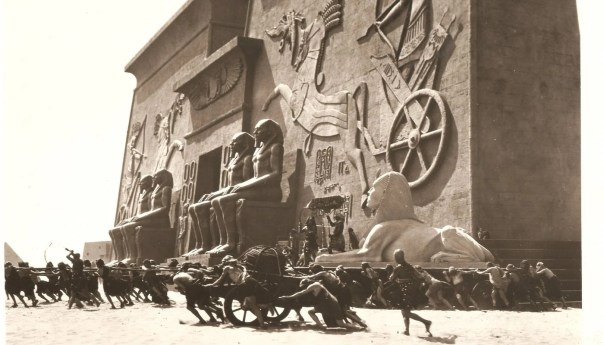
The sphinx on set in 1923. (Photo: Courtesy of the Guadalupe-Nipomo Dunes Center)
“Your skin will be cooked raw,” DeMille told his army of 3,500 actors and extras, according to aLos Angeles Timesreporter on the scene. “You will miss the comforts of home. You will be asked to endure perhaps the most unpleasant location in cinema history. I expect of you your supreme efforts.”
The costs were mounting even before DeMille arrived in Guadalupe to begin shooting. Preproduction expenses were already approaching $700,000—an astronomical sum in the early days of Hollywood. More than a million pounds of statuary, concrete, and plaster were used to construct the 120-foot-tall, 800-foot-long temple and surrounding structures, and whole plaster sphinxes were sculpted and loaded onto trucks bound for the dunes. Every day on location meant feeding and housing the thousands of workers and animals. DeMille drove his construction team to work faster. Paramount Studios, the film’s backer, began sending DeMille increasingly desperate letters demanding that he cut costs. One receipt, for $3,000 spent on a “magnificent team of horses” for the pharaoh, pushed the studio over the edge, according to Sumiko Higashi, a professor emeritus at The College at Brockport, SUNY, and author ofCecil B. DeMille and American Culture: the Silent Era,a biography of DeMille.
“You have lost your mind,” telegraphed Adolph Zukor, founder of Paramount Pictures. “Stop filming and return to Los Angeles at once.” DeMille refused. He took out a personal loan and waived his guaranteed percentage of the movie’s gross to ensure the production continued. “I cannot and will not make pictures with a yardstick,” he wired back to the studio. “What do they want me to do?” he was rumored to have said, according to Higashi. “Stop now and release it asThe Five Commandments?”
Despite the warnings, DeMille pushed on. Bugles sounded every morning to 4:30 a.m. to wake the 5,000 workers and actors that populated the 24-square-mile tent city he’d built in the dunes. (It earned the nickname the City of DeMille.) His workers raised the 109-foot-tall Great Gate—an archway covered in intricate busts of rearing stallions—and buttressed it with two 35-foot-tall clay-and-plaster statues of the Pharaoh. They erected a “city wall”—built 750 feet long because DeMille refused to work with painted backgrounds or limit his cinematic choices. Five mammoth sphinxes, weighing over five tons each, lined the entrance to the ersatz Egyptian city.
Filming was done at a madcap pace and condensed into a mere three weeks, according to Scott Eyman’s biography,Empire of Dreams: The Epic Life of Cecil B. DeMille. But even with the Exodus in the can, one more problem loomed. According to a prior agreement with the landowners, DeMille’s monumental set had to be dismantled before he left. Production costs had already ballooned to over $1.4 million, more than any other film previously made. DeMille considered reneging on the deal, Brosnan says, but likely worried about another issue: If he left is city standing, rival directors from other studios could easily swoop into Guadalupe and produce an epic on the cheap. DeMille would not have that. Rather than pay workers to take the set down, he settled on a faster method. Dynamite was supposedly strapped to the great temple he had built, and the City of the Pharaoh was brought down. According to legend, he ordered bulldozers to mound sand over the scattered remains and quickly left town.
Sixty years later, in 1983, Brosnan arrived at the dunes like the Children of Israel before him—completely lost. He knew the set was buried somewhere, but the dunes stretched nearly 30 miles, across two counties. Looking for clues, he called the Air Force base that occupied much of the coastline. (“Sir,” he says the sergeant on the other end of the line told him, “There is no Egyptian city buried at Vandenberg Air Force Base.”) He haunted local libraries. He hounded municipal politicians. No one could provide hints about the set’s exact location.
Then he stumbled upon an old ranch hand at a local tavern who had run cattle through the dunes for decades. On a cold and dark morning, after a savage storm had rearranged the topography of the dunes, Brosnan and the rancher hiked the sea of hundred-foot-high peaks, making their way a mile toward the pounding surf of the Pacific. Eventually they spied what locals called “the dune that never moves”—the sandy tomb that covered DeMille’s set—and saw a chunk of Plaster of Paris statuary poking through.
The sphinx before excavation. (Photo: Courtesy of the Guadalupe-Nipomo Dunes Center)
The discovery made headlines around the world and Brosnan fielded calls fromThe New York Times,NBC Nightly News, andPeoplemagazine. His documentary idea, which had seemed pie-in-the-sky a few months earlier, looked promising. And his pitch—that the lost city is the oldest existing Hollywood set left; that props from more modern shoots have already been preserved for posterity; that early set design was, in a sense, an American art form—struck a chord in the industry. Brosnan tentatively called his documentary projectThe Lost City.
Charlton Heston, star of DeMille’s 1956 remake of the film, publicly wished the project well, and local archaeologists volunteered their time to help in the excavation. A curator at the Smithsonian expressed interest in acquiring some pieces, once the dig wrapped. Promises for funding came in from Paramount Pictures and Bank of America. Brosnan moved to Hollywood with the intention of pursuing a career in the ‘biz. But first, he had to start digging.
“This will be a scientific exploration by highly trained personnel,” said a Cambridge-educated archaeologist who signed on in 1983. “Not a case of simply digging up stuff like potatoes. And if we’re serious about documenting movie history, then let’s do it properly.”
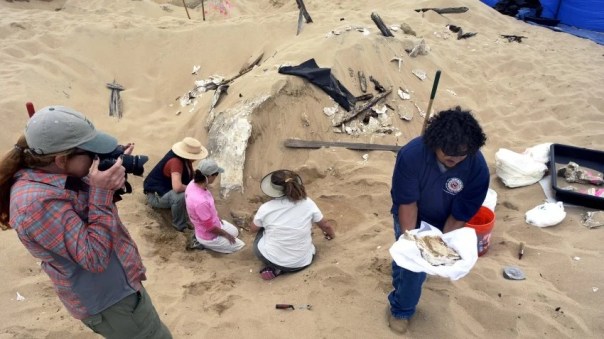
Excavating the City of the Pharaoh. (Photo: Courtesy of the Guadalupe-Nipomo Dunes Center)
The excavation and documentary progressed, but Brosnan constantly faced two problems: funding and permitting. When he had the money, the county wouldn’t let him touch the environmentally sensitive area. (The western snowy plover, a federally protected species that nests along california’s coast, keeps the dunes off limits to people for half the year during breeding season.) By the time he got permission to dig, seven years later, funding had dried up. In 1990, several organizations, including the Smithsonian and the DeMille Family Trust, agreed to partially fund the project, and Brosnan and an archeologist used ground-penetrating radar to show that much of the set remained intact. But he couldn’t raise enough money to excavate the actual ruins. He needed $175,000 for an archeological dig to recover 60-year-old fake relics. “We don’t see this as a fake Egypt,” Brosnan told a reporter at the time. “We see this as real cinema history.”
But by the mid-1990s, Brosnan had been scraping by in the movie business for a decade, writing scripts and directing small projects. Lacking the money, he gave up the dig.
That DeMille’s ruins have survived intact to this day, albeit buried in the sands, is a quirk of geography. The dunes, which cover some 35 square miles of the coast here, formed about 15,000 years ago, according to Doug Jenzen, executive director of the non-profit Dunes Center in Guadalupe. Jenzen and his team run a small museum out of a craftsman on the town’s main (and only) drag and head up conservation efforts for the Dunes preserve. It’s a charming little museum that seems out of place among the shuttered movie theater and boarded up buildings of Guadalupe, but the Dunes and DeMille are the only source of tourism dollars in this largely agricultural area, Jenzen says.
Thousands of years ago, rivers swept mineral-dense rocks and boulders from the nearby coastal range down to the sea, eventually pummeling the earth into fine grain sand. “One of the reasons the movie set is preserved so well is because of the minerals in the sand,” Jenzen says. “You know how when you order something mail order and it comes with the silica packets? The sand actually acted as a natural desiccant that preserved the plaster for the statues.”
For 15 years, the ruins were left undisturbed. Every few years a reporter or a researcher would call and Brosnan would humor him or her with details of his odyssey in the dunes. Each time, he hoped the new round of publicity would inject dollars into the effort, but nothing ever came through.
In October 2014, archeologists preserve decaying remains from wind-blown sand at Guadalupe Dunes. (Photo: AP)
In 2010, though, after theLos Angeles Timesran yet another piece on his unfinished dig, a woman—who wishes to remain anonymous—contacted Brosnan and offered to put up the money needed to finish the film. But by then he was married with children and had been away from the project for two decades. “My first response was a moment of panic,” Brosnan says. “There’s no way I could do this.”
But Brosnan hired a producer and an editor, and last fall, with the help of a Santa Barbara County grant, a team of archeologists excavated most of a sphinx. Brosnan was on hand to film it. “We had always wanted to end with a shot of the sphinx being found. And we got it,” he says. Using his early footage shot in the 1980s, Brosnan has pulled together a rough cut and has an editor working on a final draft. He says he’s looking for distributors and considering the film festival circuit soon.
In the Dune Center, Jenzen and his team display parts of one of the large plaster sphinxes and smaller relics that have been successfully pulled from the sand. “All of the statues were made of plaster,” he says. “They were built to last two months—92 years ago. I don’t think this could have happened anywhere else on earth.”
However, Jenzen says the ruins may not survive another 92 years. Powerful storms in the last few years have shifted the sands of the dunes dramatically—more of the set is now exposed to the elements than ever before. The Dunes Center needs $100,000 to unearth another sphinx to add it to the display, Jenzen says, before it’s too late. “It’s disappearing so fast,” he says, “Archeologists originally thought it’d last until 2090—but every time we go out, more is gone.”
Outside the Black Cat on February 11, 1967 Photograph: Courtesy ONE Archives at the USC Libraries
On New Year’s Eve in 1966, undercover officers atthe Black Cat Tavern inSilver Lakebegan to handcuff and beat the patrons and staff as everyone was exchanging celebratory midnight kisses. An estimated 14 people were arrested, many charged with lewd conduct and forced to register as sex offenders for the rest of their lives.
Other Silver Lake gay bars, including New Faces, a few doors down, were targeted the same evening. Two years before the Stonewall uprising, more than 200 people came together outside the Black Cat for one of the earliest U.S. LGBTQ-rights demonstrations. Picketers gathered on February 11, 1967, to peacefully protest the police raids that had been conducted weeks before. Alexei Romanoff, a former owner of New Faces, describes the Black Cat demonstration as a turning point. During a time in which homosexuality was illegal in most states, LGBTQ people developed elaborate codes and survival strategies to avoid arrest. But that February night, Romanoff says, the community stood up and fought back.
Now 82, he is the last surviving organizer of Personal Rights in Defense and Education (P.R.I.D.E.), one of the groups that helped stage the 1967 stand. We traveled back to that monumental moment with Romanoff.
Romanoff in 1968 Photograph: Courtesy Alexei Romanoff
How were the protests organized?
We didn’t have computers, we didn’t have cell phones, but what we did have was called a phone tree. One person would immediately call another 10 people and tell them what had happened, and then each of them would call 10 more people. It took us about two weeks to organize the protest. The Hub Bar [in Alhambra] was the only place that allowed us to meet. We were cautious. We kept moving the demonstration up and down the block so we couldn’t be charged with loitering. We had flyers printed up. People would ask what was going on. We’d give them a flyer, and if they dropped it, we would rush over, grab it and pick it up so we wouldn’t be considered to be littering.
What was the protest like?
If you look at the pictures, none of the regular news media covered us. They were all from the Free Press at the time. They were the only ones that covered the demonstration. A couple of years ago, I met with [former] police chief [William J.] Bratton, and we were looking at the pictures, when I said, “Do you see anybody smiling there?” He said no. And I said, “That’s because [the protesters] were all terrified to do this, but they knew they had to.” It took place in the evening because they had jobs they would likely lose the next day.
What were the risks?
If the major news media would have covered that demonstration, their faces would have been in the newspapers, but the newspapers didn’t think it was very important because it was only those “unhappy homosexuals.” At that time, we could be put into a sanitarium for being gay. And our families could have us committed if they were embarrassed by us. There, you were subject to shock treatments and chemically castrated. We were afraid, but we couldn’t take it anymore. You couldn’t just come in, beat us up and take us to jail because we were who we were.
What was the aftermath of the protests?
Once you let the cat out of the bag, there’s no stopping it. I started an organization, Santa Monica Bay Coalition for Human Rights. In 1970, we were marching in the LA Pride parade, and we had this big banner. I was in the front, and there were mounted police officers. I was nervous, but one of them turned his horse away from all the rest and gave me a V-for-victory sign. I knew we were going to be okay.
And what was the legacy at the Black Cat?
We got the Black Cat designated as a historic landmark. There’s a plaque on the front of the building now. When I went back one time, there was a note that was attached to the plaque, and all it said was “thank you.” That was enough for everything.
Romanoff discussed the evening’s events with Time Out, and his account has been edited and condensed for length and clarity.
WhenRobert Herbert and John Bramstonsailed home to England after six years in the new colony of Queensland, John’s younger brother remained. A ‘confirmed bachelor’, Henry Bramston played a prominent role in Brisbane life but was quickly forgotten after his death.
Robert Herbert, private secretary to Sir George Bowen, arrived in Brisbane in November 1859 to prepare the official welcome for Bowen in his role as Queensland’s first Governor. On his arrival, Bowen appointed Herbert to head the government of the new colony. John Bramston arrived next in January 1860. He had lived with Herbert since they met at university a few years before. Bramston took over as Bowen’s private secretary and later stood for election to parliament himself. Finally, Bramston’s younger brother Henry disembarked in Brisbane in February. Sailing from England to Australia took about three months at the time, indicating the threesome planned their staggered arrivals.
Henry Bramston
In 1864, Henry and a friend bought a property out in the bush near Roma with Robert Herbert and John Bramston as partners. The next year, the same year that his brother became Attorney-General, Henry received a very convenient government appointment as magistrate at Roma. Such blatant nepotism did not always provoke the same indignation then as now. Henry remained in the public service until the end of his life.
Despite various rural appointments, he mainly lived in Brisbane. He proved a more social animal than either his brother or Herbert. That pair preferred the splendid isolation of their 50-acre farm. However, they were rarely alone at Herston. Robert Herbert and John Bramston welcomed a constant stream of similarly upper-class Englishmen who like themselves favoured boating, fishing, hunting and camping over elegant soirées.
The local squattocracy generally laid on lavish social events in honour of unmarried British gentry resident in the colony. They seized on the opportunity to enhance their social standing by marrying their daughters to toffs. However, it seems the local nobs quickly discerned that Robert Herbert, John Bramston and younger brother Henry had little interest in vows of matrimony.
Herston
Herston with Robert Herbert, left and John Bramston. Images: State Library of Queensland
A busy man
Henry Bramston was a man about town and something of a dandy — an immaculate dresser and partial to fine jewellery.
He served on the Acclimatisation Society, Philharmonic Society, Hospital and Turf Club committees and on the board of the National Association which ran the annual exhibition. He also worked tirelessly to raise funds for the construction of Fortitude Valley’s Holy Trinity Anglican Church.
Henry owned a house opposite where the Normanby Hotel now stands. His gardens were much celebrated, particularly his potted plants and flowering ornamentals.
He was a busy man.
The BrisbaneCourierrecords him ‘donning the pink’ to act as Clerk of Course at the races and organising balls at the School of Arts. He both supervised the Horticultural competition at the Ekka and won many of the prizes in that same competition.
At the 1878 Ekka, he won 21 of the 39 awards for ornamental plants. Although he did not enter any pansies in the competition, he encouraged others to cultivate the large-flowered hybrid. He donated ten shillings for the best three pansies; the same for the best single pansy; and £1 for the best collection of five pansies.
Dear Sir…
Henry’s voluminous correspondence at times made the Letters column of the BrisbaneCourierseem like his personal Facebook page. He reached for his quill to compose comments on any and every topic. Among his favoured subjects — hospital rules. Henry enthralled readers with lengthy treatises seemingly designed to smother with micro-management any patients who survived their ailments.
Henry did not tolerate dissent. Only courageous souls dared propose concepts contrary to the Bramston Manifesto. First and foremost, he objected to charitable endowments that resulted in free treatment for the hoi-polloi. He abhorred benevolence toward a class of people he insisted ‘would never work for what they could get by begging’.
A bit rich coming from a bloke who owed his position in life to a family connection.
He took particular offence at a proposed children’s hospital, concerned that tending to sick children would encourage the lower classes to breed.
A frequent postscript epitomised his routine tone.
Crave pardon
“I have written plainly… and if I have offended or hurt anyone’s feelings, I can only crave pardon for so doing.”
Crave pardon as he might, Henry tolerated neither dissension nor any slight against his esteemed self — nor his prized bay gelding.
When Henry entered the horse in the harness competition at the Ekka, Prince took second place. That bewildered a newspaper editor who thought the prize undeserved. He ridiculed Prince as using ‘his forelegs as though they were a pair of crutches’ and likened the horse to a cockroach.
How very dare he! Henry dashed off an outraged response.
“I must crave permission to take exception to your remarks.”
Henry Bramston eventually ran into financial difficulties. He overspent during the construction of a grand mansion on 20 acres at Ascot and was forced to sell everything, including his prize-winning pot plants.
He then moved to Newstead and died in 1891 in a private hospital on James St.
Following his death, the newspapers eulogised Henry Bramston as ‘a very old citizen of Brisbane’. But Henry was only 55 years of age. He merely seemed old because of his constant fussing and ‘fuddy-duddy’ nature.
Mayfield
Mayfield: The mansion Henry Bramston built at Ascot later hosted Edward VIII when he visited Brisbane as Prince of Wales. The house, which burned down in the 1930s, gave its name to Mayfield St, Ascot.
Bitchy old New Farm Queen
In truth, Henry would fit easily into Brisbane’s inner-city suburbs today. We may loathe to admit it, but most Brisbanites have either said or heard the phrase, ‘bitchy old New Farm queen’.
Unlike the elder brother he followed to Queensland, there is no evidence beyond stereotype to indicate his sexuality.
Assuming Henry Bramston was gay because he fitted a stereotype would now arouse angry indignation. We insist emphatically — and correctly — that our communities are diverse. Not all gay men are effeminate, and not all lesbians are butch.
But stereotypes did not simply emerge from the ether. Something inspired them.
Stereotypes arose because of the commonalities manifested by people the general public became aware were same-sex attracted. The most obvious were generally effeminate men and butch women. While not representative, the individuals who refused to conform to heteronormativity were our public face.
Their visibility promoted tolerance of difference long before we dared advocate for law reform.
Sir Robert Helpmann
Lifesavers once dumped Bobby Helpmann in the surf for daring to promenade on Bondi Beach with plucked eyebrows and painted fingernails. However,the openly gay ballet dancer later became Australian of the Year.How do we quantify the acceptance achieved via the social prominence of that celebrated queen of high camp?
Likewise, many now disparage the mincing Mr Humphries fromAre You Being Served?as a derogatory stereotype. Yet, mainstream television audiences of the 1970s and early 80s loved the character. They laughed with him, not at him.
Here’s a little secret!
LGBTIQ+ people also loved him. He gave us visibility, and the show promoted acceptance. While amused by the camp eccentricities of Wilberforce Humphries, his co-workers never displayed the slightest intolerance towards his sexuality.
Lilian Cooper also warrants mention as Queensland’s pioneering female doctor and one half of a same-sex couple who lived together openly for half a century. Few accounts of Lilian fail to mention her butchness — both in dress and manner. YetLilian Cooper and Josephine Bedfordbecame revered Brisbane citizens for their considerable civic contributions.
In our commitment to repudiating stereotypes, we should not deny their role in advancing our cause. In an era of persecution and prosecution, likeable but stereotypical gay men and women bequeathed our communities visibility and increased acceptance.
Queensland’s arch-homophobe Phyllis Cilento clearly recognised their impact. She admonished her readers on the subject in 1953.
“The danger now is that after the first revulsion of feeling against homosexuality, people will become used to the idea, and take it for granted as ‘just one of those things’…
“They will look around… and find homosexuals among men they formerly admired for their intellectual and artistic achievements or liked for their friendly and gentle manner, and they will feel that really this cannot be so heinous a crime.”
Bachelors and spinsters
The generation of Brisbane bachelors who followed Henry came of age at a time of increased wealth and more frequent social opportunities. Newspapers documented the social lives of nattily dressed ‘eligible bachelors’. Admiring belles surrounded the elegantly attired young men at every garden party, picnic race or masquerade ball. Their ranks included Claude Musson, the stock and station agent who orchestrated the city’s ‘gayest’ balls. And also ‘pretty Willie Morse with his golden curls’, whose father owned the Orient Hotel. Joining their coterie was George Love Warry, scion of a wealthy storekeeping family.
With a wink and a nod, the papers wryly noted that as the years rolled by, some of the town’s most popular single men moved from the column of ‘eligible bachelor’ to that of ‘ineligible bachelor’.
So was the general public as unaware and intolerant of LGBTIQ+ people as commonly asserted?
Or was discussion of LGBTIQ+ people suppressed — and the hatred towards us directed — by the usual suspects? Were they the same people who cause us grief today — clerics insistent on universal submission to their personal god, politicians thirsting for notoriety and sensationalist media?
Let us not forget that those same people acted as arbiters of our history. ‘History is written by the victors.’ But only temporarily. As time goes by, locked archives are accessed and previously hidden memoirs published. However, to some degree, queer history remains hostage to the people who refused us any input into the chronicles of our existence. We were, after all, ‘unfit for publication’.
They told us, for example, how much ‘normal’ people despised homosexuals and illustrated their point with evidence such as the prosecution of Oscar Wilde.
But wait a moment!
Did the public actually despise Oscar Wilde? They continued to buy his books and attend his plays. Decades later, students continued to study Wilde’sThe Importance of Being Earnestas part of the Queensland high school English curriculum. That was despite Premier Joh Bjelke-Petersen banning gay teachers in his quest to eradicate the scourge of homosexuality.
In recent years, as researchers gained access to previously ignored or hidden archives, we learned the stories of less famous LGBTIQ+ people.
We now know that Yorkshire’s Anne Lister, the notorious ‘Gentleman Jack’, managed to live an open, if not publicly discussed, life as a lesbian in the 1830s.
In Brisbane, Lilian Cooper and Josephine Bedford lived together as a couple, worked together as a couple and were invited to social events together which they then attended as a couple. Did no one ever think, “Hold on? I wonder if this couple is a couple?’
Likewise, did no one quietly ponder the living arrangements of Robert Herbert and John Bramston? Just a decade later, Queensland’s elite did not hesitate to employ homophobia against thefoppish Governor Cairns. But Herbert and Bramston supported policies which enriched the local nobs. Cairns, on the other hand, advocated for Aboriginal people to have the same legal rights as anyone else. He fought against their dispossession and murder and was aghast at the enslavement of South Sea Islanders. The local establishment attacked the Governor not because of his sexuality but because of his insistence on fair and proper governance which would impact their profits.
The Elephant in the Room
Were we actually the social pariahs we’ve always thought?
Certainly, members of our communities did risk prosecution even if surprisingly few actually faced it. Definitely, we suffered prejudice, as we still do. We were sometimes subjected to violence, as we still are.
But with increased access to secrets of the past, we learn of LGBTIQ+ people who did not lead furtive and sorrowful lives: people who benefitted from tolerance in their communities even if their difference remained unstated.
Perhaps we were just another elephant in the room.
Public discussion ignored plenty of other social phenomena in days gone by. Issues like domestic violence, child abuse, alcoholism, teenage pregnancy and others remained taboo in polite society.
Holy f***!
One night in the 1990s, I partook of a few drinks with my mother and grandmother. We reminisced about life in my small rural home town in the 1960s. Our memories travelled house to house as we discussed people we remembered. I mentioned an out of the way house which I knew nothing of except that a single man in his early thirties lived there alone — unusual in a small country town.
I once waited in the car while my father popped in there for some reason.
“Ah yes,” they told me, “The barman. That’s where men went when their wives weren’t putting out.”
Holy f***!
I always assumed that only heterosexual sex ever occurred in our remote rural outpost — that even the cattle copulated exclusively in missionary position and with the lights off.
But no! In rural Queensland in the 1960s, gay sex occurred and the entire bloody town — except me apparently — knew about it and tolerated it.
Abbie Hoffman arrives for a 1968 hearing at the Capitol Building in Washington, where he was arrested for wearing a shirt made out of the American flag. Credit… Associated Press
Why it’s impossible to Sorkin-ize the great revolutionary clown.
At the end of his autobiography,Soon to be a Major Motion Picture,60s radical activist Abbie Hoffman includes a sarcastic epilogue retracting everything he has ever believed. At the time he wrote the book, Hoffman was living underground, on the run from the law on drug charges, and he offered to give the following “confession” in exchange for readmission into respectable society:
You know, I’m really sorry and I wanna come home. I love the flag, blue for truth. White for right. Red for blood our boys shed in war. I love my mother. I was wrong to tell kids to kill their parents… Spoiled, selfish brats made the sixties. Forgive me, Mother. I love Jesus, the smooth arch of his back, his long blond curls. Jesus died for all of us, even us Jews. Thank you, Lord. … I love Israel as protector of Western civilization. Most of my thinking was the result of brainwashing by KGB agents… I hate drugs. They are bad for you. Marijuana has a terrible effect on the brain. It makes you forget everything you learned in school… I only used it to lure young virgins into bed. I’m very ashamed of this. Cocaine is murderous. It makes you sex crazy and gets uneducated people all worked up. Friends are kidding themselves when they say it’s nonaddictive. The nose knows, and the nose says no… Once I burned money at the stock exchange. This was way out of line. People work hard to make money. Even stockbrokers work hard. No one works hard in Bangladesh—that’s why they are starving today and we are not. … Communism is evil incarnate. You can see it in Karl Marx’s beady eyes, long nose, and the sneering smile behind his beard….Our artists are all perverts except, of course, for the late Norman Rockwell. …Our system of democracy is the best in the world… Now can I come back?
Part of Hoffman’s life is now indeed a major motion picture, Netflix’sThe Trial of the Chicago 7,written and directed byTheWest Wingcreator Aaron Sorkin. Sorkin is an unfortunate choice to bring Abbie Hoffman to the screen, since Sorkin’s basic worldview is one Hoffman completely rejected.TheWest Wingis known for showing a faith in good liberal technocrats to govern wisely, yet Hoffman was a “burn down the system” anarchistic radical. Sure enough, Sorkin’s Hoffman is almost the Jesus-loving patriot of the actual Hoffman’s biting satire.
The story of the Chicago 7 is one that needs to be remembered, so we can be glad that Netflix chose to bring it to the screen. After the 1968 Democratic convention, at which antiwar protesters clashed with Chicago police and were savagely beaten, shocking the country, the Nixon administration brought charges against a number of the event organizers.Nixon’s justice departmentwanted to teach the New Left a lesson in order to demonstrate it was serious about “restoring law and order,” and the charges against the defendants were flimsy. The trial itself was a farce, thanks in part to a biased judge who saw conviction as a foregone conclusion. But the defendants, instead of accepting their fate, decided to use the media attention being paid to the trial to publicize the cause of the antiwar movement, and called an array of celebrity witnesses (Dick Gregory, Allen Ginsberg, Jesse Jackson, Judy Collins, Norman Mailer, Arlo Guthrie, and even former attorney general Ramsey Clark) to “put the government on trial” and turn a political persecution into a media event that would keep the left’s message on the national agenda. Ultimately, while most of the defendants were convicted of conspiracy to riot, the convictions were overturned on appeal and the government dropped the case. The Chicago 7 trial’s historical significance is (1) as an example of the American government trying to criminalize dissent and intimidate the political left through selective prosecution and (2) as an example of how defendants can successfully fight back through turning a trial into a media spectacle and winning in the “court of public opinion.”
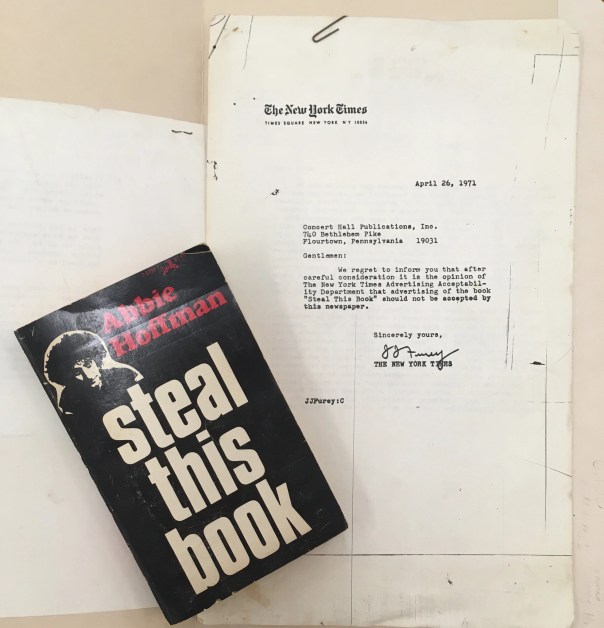
Abbie Hoffman, the most charismatic and media-savvy defendant, was one of the most colorful figures of the ‘60s left. Coming from a serious activist background as part of the Student Nonviolent Coordinating Committee, Hoffman’s Youth International Party (Yippies) engaged in attention-grabbing stunts to publicize left causes. Infamously, Hoffman sneaked into the New York Stock Exchange and dumped dollar bills onto the trading floor, sending brokers scrambling for cash. In a giant antiwar march, he led a group trying to perform an “exorcism” of the Pentagon and send it off into space. At Woodstock, Hoffman scuffled with Pete Townshend of The Who when Hoffman stormed the stage to give a political speech. Hoffman’sSteal This Bookgives advice on how to shoplift, deal drugs, and live free through all manner of scams.
Hoffman was an attention-seeker and provocateur, but he was also serious in his moral commitment to ending the Vietnam War, and his often-ludicrous counterculture antics came from a hatred of selfishness, authoritarianism, racism, and militarism. He was a utopian and an absurdist, but by pushing the boundaries of what civilized society could tolerate, he helped to make it freer.
Sorkin’s film does portray Hoffman relatively positively—even though Sorkinadmittedhe couldn’t really relate to him and found him somewhat intolerable—and Sacha Baron Cohen gives a strong performance. In fact,The Trial of the Chicago 7presents Hoffman as charming, colorful, rebellious, and committed to using theatrics as a serious form of protest, a un-loving counterweight to fellow defendant Tom Hayden, who comes across as a humorless prig (though a somewhat unpleasant note at the end of the film mentions that Hayden went on to serve a number of terms in the California legislature while Hoffman ultimately “killed himself,” perhaps Sorkin’s way of suggesting that in the long run the ‘work within the system’ types will prevail). Sorkin’s Hoffman is not held up as a figure of ridicule, but rather as someone who has a different notion of how to help the antiwar movement.
Yet whileThe Trial of the Chicago 7is sympathetic to Hoffman, it also softens him in a way that ultimately amounts to historical fabrication. In the climax of Sorkin’s film, Hoffman takes to the stand and defends the protesters actions by invoking Lincoln and Jesus, and gives a tribute to democracy that could have come fromTheWest Wing.[Update: have since discovered Sorkin in factdirectly recycledWest Wingdialogue for theChicago 7movie.] “I think our institutions of democracy are a wonderful thing that right now are populated by some terrible people,” Hoffman tells the court. In the film, Hoffman is a relatively benign spokesman for the basic right of dissent.
In reality,Hoffman’s testimonywas far more radical. He even read out the Yippies’ list of demands, which included, among other things:
an immediate end to the war
“a restructuring of our foreign policy which totally eliminates aspects of military, economic and cultural imperialism
the withdrawal of all foreign based troops and the abolition of military draft”
“immediate freedom for Huey Newton of the Black Panthers and all other black people”
“the legalization of marijuana and all other psychedelic drugs;
the freeing of all prisoners currently imprisoned on narcotics charges,”
“the abolition of all laws related to crimes without victims,”
“the total disarmament of all the people beginning with the police,”
“the abolition of money, the abolition of pay housing, pay media, pay transportation, pay food, pay education. pay clothing, pay medical health, and pay toilets,”
“a program of ecological development that would provide incentives for the decentralization of crowded cities and encourage rural living,”
“a program which provides not only free birth control information and devices, but also abortions when desired.”
Hoffman was a revolutionary, not just a critic of the war, and he said so plainly. But Sorkin cuts the bits of Hoffman’s speech that would endear him far less to a mainstream audience. For instance, Sorkin keeps the part of Hoffman’ssentencing statementin which he suggested Lincoln would have been arrested if he had done what the defendants did. He removes the parts where Hoffman offers the judge LSD, says riots are fun, calls George Washington a pothead, and says that Alexander Hamilton probably deserved to be shot. This stuff is, yes, clownish, but it was part of Hoffman’s effort to turn the whole proceeding into an absurdity.
Sorkin takes other creative liberties with history that end up distorting it. Sometimes these are arbitrary, small, and relatively harmless (defendant Lee Weiner wasextremely hairy and hippie-ishbut is presented in the film as clean-cut and nerdy). Bobby Seale, the Black Panther defendant who was infamously bound and gagged in the courtroom when he continuously spoke out about the violation of his right to counsel, actually managed to repeatedly wriggle out of the physical restraints the government put on him; the film portrays the government as effective in silencing him. Worse are things like portraying the prosecutor (an anti-communist ideologue in real life) as an agonized, conflicted idealist who sticks up for civil rights. Or showing Quaker pacifist Dave Dellinger punching a cop. Or treating the Panthers, armed revolutionaries, as peaceniks who preferred words to guns.
The film’s biggest problems come from the fact that Aaron Sorkin subscribes to an ideology I call Obamaism-Sorkinism (like Marxism-Leninism). The tenets of this ideology are that American institutions are fundamentally good, and that while we argue, ultimately our interests do not conflict, and nobody is evil or irredeemable. So of course the prosecutor is good. It could not be that Hoffman et al. want to destroy everything the prosecutor holds dear and create a society of sex, drugs, and rock & roll that would horrify him.
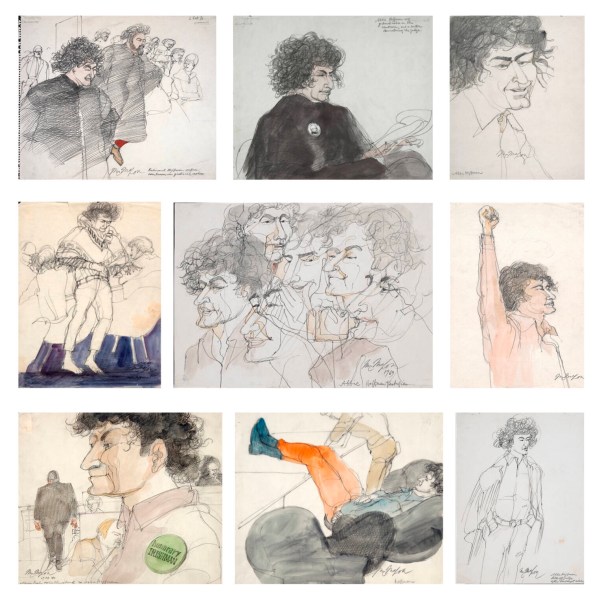
To me, the most disturbing way in which Obamaism-Sorkinism infiltrates the film is in the treatment of the Vietnam War. American liberalshave a tendency to think of the war as a noble mistake, and to focus on the deaths of American troops rather than Vietnamese civilians. In reality, antiwar radicals did not usually speak in the name of the troops against the government, but instead spoke up for the Vietnamese.The Trial of the Chicago 7shows protesters waving American flags; they would probably have been waving Viet Cong flags. (Hoffman got into a tussle with a court marshal when he tried to bring a Viet Cong flag into the courtroom, an incidentcaptured in the courtroom sketches.) The film ends with Tom Hayden upsetting the judge by reading out the names of the American war dead. This incident didn’t happen, but whatdidhappen at sentencing was David Dellinger making a plea on behalf of those oppressed by the United States:
[W]hatever happens to us, however unjustified, will be slight compared to what has happened already to the Vietnamese people, to the black people in this country, to the criminals with whom we are now spending our days in the Cook County jail. I must have already lived longer than the normal life expectancy of a black person born when I was born, or born now. I must have already lived longer, 20 years longer, than the normal life expectancy in the underdeveloped countries which this country is trying to profiteer from and keep under its domain and control… [S]ending us to prison, any punishment the Government can impose upon us, will not solve the problem of this country’s rampant racism, will not solve the problem of economic injustice, it will not solve the problem of the foreign policy and the attacks upon the underdeveloped people of the world. The Government has misread the times in which we live, just like there was a time when it was possible to keep young people, women, black people, Mexican-American, anti-war people, people who believe in truth and justice and really believe in democracy, which it is going to be possible to keep them quiet or suppress them.
Instead of choosing to end with a moment of tribute to American soldiers (as uncontroversial a statement as it is possible to make), Sorkin could have ended with the defendants’ real-life statements calling out the country for its hypocrisy and injustice. He decided not to.
There is something odd and troubling in the way that Sorkin has Abbie Hoffman cite the Book of Matthew on the stand, as if to suggest that every real American is a flag-waving patriot who loves Jesus and the troops. (Recall Hoffman’s epilogue.) In fact, one of the most interesting elements of the real Chicago 7 trial was an ongoing tussle between Abbie and the judge, Julius Hoffman, over the meaning of their shared Jewish identity (not to mention surname). Abbie Hoffman infamously threw Yiddish slang at Judge Hoffman, calling him a “schtunk” (stinker/vulgar person) and a “shanda fur die goyim” (a Jew who embarrasses other Jewish people by doing the dirty work of the gentiles). Abbie called the judge “Julie” and said he would have been a glad servant of the Nazi regime. Abbie Hoffman drew much of his approach to rebellion from Jewish culture—from Jewish anarchism and the prophetic tradition to the comedy records of Lenny Bruce—and he believed the judge was choosing to serve the WASP elite in its persecution of racial and religious minorities. (Interestingly, Judge Hoffman seemed to have a strange soft spot for Abbie; many of Abbie’s most savage criticisms were grounded in a moral appeal to their shared cultural ties.)
WITH THE AID OF A BLACKBOARD, ABBIE HOFFMAN TELLS THE PRESS THE DEFINITIONS OF THE YIDDISH TERMS HE USED TO INSULT JUDGE JULIUS HOFFMAN.
We see, inThe Trial of the Chicago 7, some of the ways that the defendants mocked the court (such as, for example, by coming in wearing judicial robes and talking out of turn). But the transcripts are rich with absurdity, and I think Sorkin left most of it out because it doesn’t really make for a good courtroomdrama, since it was a ridiculous courtroomcomedy. Below are a few of my favorite snippets from a transcript loaded with ludicrousness:
From Allen Ginsberg’s testimony
MR. WEINGLASS (DEFENSE ATTORNEY):
Let me ask this: Mr. Ginsberg, I show you an object marked 150 for identification, and I ask you to examine that object.
THE WITNESS:
Yes. [Ginsberg is handed a harmonium and begins to play it.]
MR. FORAN (PROSECUTOR):
All right. Your Honor, that is enough. I object to it, your Honor. I think it is outrageous for counsel to—
THE COURT:
You asked him to examine it, and instead of that he played a tune on it. I sustain the objection.
THE WITNESS:
It adds spirituality to the case, sir.
THE COURT:
Will you remain quiet, sir.
THE WITNESS:
I am sorry.
MR. WEINGLASS:
Having examined that, could you identify it for the court and jury?
THE WITNESS:
It is an instrument known as the harmonium, which I used at the press conference at the Americana Hotel. It is commonly used in India.
MR. FORAN:
I object to that.
THE COURT:
I sustain the objection.
MR. WEINGLASS:
Will you explain to the Court and to the jury what chant you were chanting at the press conference?
THE WITNESS:
I was chanting a mantra called the “Mala Mantra,” the great mantra of preservation of that aspect of the Indian religion called Vishnu the Preserver. Every time human evil rises so high that the planet itself is threatened, and all of its inhabitants and their children are threatened, Vishnu will preserve a return.
Abbie Hoffman pipes up about the jailing of David Dellinger
THE COURT:
Mr. Marshall, will you ask the defendant Hoffman to remain quiet?
MR. HOFFMAN:
Schtunk.
MR. RUBIN:
You are a tyrant, you know that.
MR. HOFFMAN:
The judges in Nazi Germany ordered sterilization. Why don’t you do that, Judge Hoffman?
MARSHAL DOBKOWSKI:
Just keep quiet.
MR. HOFFMAN:
We should have done this long ago when you chained and gagged Bobby Seale. Mafia-controlled pigs. We should have done it. It’s a shame this building wasn’t ripped down.
THE COURT:
Mr. Marshal, order him to remain quiet.
MR. HOFFMAN:
Order us? Order us? You got to cut our tongues out to order us, Julie. You railroaded Seale so he wouldn’t get a jury trial either. Four years for contempt without a jury trial. No, I won’t shut up. I ain’t an automaton like you. Best friend the blacks ever had, huh? How many blacks are in the Drake Towers? How many are in the Standard Club? How many own stock in Brunswick Corporation? [references to the judge’s condo building andan exclusive club for local Jewish leaders]
THE MARSHAL:
Shut up.
THE COURT:
Bring in the jury, please.
From the testimony of Timothy Leary
MR. KUNSTLER (DEFENSE ATTORNEY):
I call your attention to March of 1968, somewhere in the middle of March, and I ask you if you can recall being present at a press conference?
THE WITNESS:
Yes.
MR. KUNSTLER:
Prior to this press conference had you had any other meetings with Jerry and Abbie?
THE WITNESS:
Yes, we had met two or three times during the spring.
MR. FORAN:
Your Honor, I object to the constant use of the diminutives in the reference to the defendants.
MR. KUNSTLER:
Your Honor, sometimes it is hard because we work together in this case, we use first names constantly.
THE COURT:
I know, but if I knew you that well, and I don’t, how would it seem for me to say, “Now, Billy—”
MR. KUNSTLER:
Your Honor, it is perfectly acceptable to me—if I could have the reverse privilege.
THE COURT:
I don’t like it. I have disapproved of it before and I ask you now to refer to the defendants by their surnames.
MR. KUNSTLER:
I was just thinking I hadn’t been called “Billy” since my mother used that word the first time.
THE COURT:
I haven’t called you that.
MR. KUNSTLER:
It evokes some memories.
THE COURT:
I was trying to point out to you how absurd it sounds in a courtroom.
From the testimony of Judy Collins
MR. KUNSTLER:
Who was present at that press conference?
THE WITNESS:
There were a number of people who were singers, entertainers. Jerry Rubin was there, Abbie Hoffman was there. Allen Ginsberg was there, and sang a mantra.
MR. KUNSTLER:
Now what did you do at that press conference?
THE WITNESS:
Well—[sings] “Where have all the flowers…”
THE COURT:
Just a minute, young lady.
THE WITNESS:
[sings] “—where have all the flowers gone?”
DEPUTY MARSHAL JOHN J. GRACIOUS:
I’m sorry. The Judge would like to speak to you.
THE COURT:
We don’t allow any singing in this Court. I’m sorry.
THE WITNESS:
May I recite the words?
MR. KUNSTLER:
Well, your Honor, we have had films. I think it is as legitimate as a movie. It is the actual thing she did, she sang “Where Have All the Flowers Gone,” which is a well-known peace song, and she sang it, and the jury is not getting the flavor.
THE COURT:
You asked her what she did, and she proceeded to sing.
MR. KUNSTLER:
That is what she did, your Honor.
THE WITNESS:
That’s what I do.
THE COURT:
And that has no place in a United States District Court. We are not here to be entertained, sir. We are trying a very important case.
MR. KUNSTLER:
This song is not an entertainment, your Honor. This is a song of peace, and what happens to young men and women during wartime.
THE COURT:
I forbid her from singing during the trial. I will not permit singing in this Courtroom.
MR. KUNSTLER:
Why not, your Honor? What’s wrong with singing?
MR. FORAN:
May I respond? This is about the fifth time this has occurred. Each time your Honor has directed Mr. Kunstler that it was improper in the courtroom. It is an old and stale joke in this Courtroom, your Honor. Now, there is no question that Miss Collins is a fine singer. In my family my six kids and I all agree that she is a fine singer, but that doesn’t have a thing to do with this lawsuit nor what my profession is, which is the practice of law in the Federal District Court, your Honor, and I protest Mr. Kunstler constantly failing to advise his witnesses of what proper decorum is, and I object to it on behalf of the Government.
THE COURT:
I sustain the objection.
From the testimony of Abbie Hoffman
MR. WEINGLASS:
Did you intend that the people who surrounded the Pentagon should do anything of a violent nature whatever to cause the building to rise 300 feet in the air and be exorcised of evil spirits?
MR. SCHULTZ:
Objection.
THE COURT:
I sustain the objection.
MR. WEINGLASS:
Could you indicate to the Court and jury whether or not the Pentagon was, in fact, exorcised of its evil spirits?
THE WITNESS:
Yes, I believe it was. . . .
The defendants and the witnesses sang, they shouted, they showed utter contempt for the entire process. Defense attorney William Kunstler says that that “defense table was strewn with dozens and dozens of books (plus clothing, papers, candywrappers, and other assorted debris)” because the defendants treated the courtroom like their living room. They read books throughout the trial. They undermined the authority of the court at every turn, calling the judge by his first name (when they weren’t calling him a fascist) and thumbing their noses at all of his rulings. “Our whole defense strategy was geared around trying to give the judge a heart attack,” Hoffmanjoked, “because we weren’t going to beat the charge.” Sorkin portrays little of this, and I’m not surprised: how can someone who believes in process and institutions accurately portray the total breakdown of process and institutions that occurred in the Chicago 7 trial?
I have had a feeling of spiritual kinship toward Abbie Hoffman since my undergraduate years at Brandeis University. He loomed large among leftists on campus when I was there, as one of the university’s most famous alums—although one never boasted about on the admissions brochures. (The Sorkin film does contain a wonderful exchange in which buttoned-up Tom Hayden says to “tell Abbie we’re going to Chicago to protest the war, not to fuck around,” and Abbie replies, “Tell Tom Hayden I went to Brandeis and I can do both.”) Abbie was an inspiration because he was joyous, funny, and never sold out. He did somersaults in front of the courthouse. His colleague Jerry Rubin may have entered the world of business, but Abbie spent much of his post-1960s life fleeing from the government on drug charges, and then as part of the environmental movement. In the years just before his death in 1989, hewas stilla proud warrior for the counterculture. Fellow defendant Lee Weiner, in his autobiographyConspiracy to Riot, describes Abbie as“vibrant, aglow with energy and political wit and satire in the service of changing America and ending the war,” with “long untamed hair and a joyful, full faced smile.” He says Abbie was “impossible not to like—at least most of the time.” Abbie was a revolutionary with a spirit of optimism and fun, the kind of person the left needs if it’s going to build mass support.
ABBIE HOFFMAN IN VARIOUS COURTROOM SKETCHES, 1970
Far from being a Jesus-loving patriot, Abbie Hoffman was a proud loudmouthed communist Jew who spat at everything pious and self-serious. (The epigraph of his autobiography is an anonymous hate letter he received that reads: “Dear Abbie: wait till Jesus gets his hands on you—you little bastard.”) Far from giving sermons on “the institutions of our democracy,” Hoffmandefendedthe true spirit of democracyagainstour institutions. “I believe in democracy with a passion,” he said, “but it’s more than something you believe in, it’s something you do. We are very complacent because we live in Canada or the United States, we live in ‘democracies’—democracy’s not a place you live in, it’s something you learn how to do and then you go out and do it. And if you don’t do it, you don’t have it.”
I like Abbie Hoffman because he knew how to, in his words, “make outrage contagious.” He pissed people off, but he did it in the name of values worth defending. When he wore his American flag shirt on the Merv Griffin show, the network censors were so horrified that they turned the entire screen blue for the duration of his appearance. In retrospect, it seems incredible that this could ever have been controversial, but the counterculture had not yet won. This was a time when people were roughed up and arrested for having long hair, before the right to abortion had been secured. America had to be liberated from the reactionaries and squares, and the hippies and yippies were a vital part of it.
When Hoffman spoke, he said, he “never tr[ied] to play on the audience’s guilt, and instead appeal to feelings of liberation, a sense of comradeship, and a call to make history. I played all authority as if it were a deranged lumbering bull and the daring matador.” This gleeful “fuck you” anarchist spirit is valuable. It is not people like the Abbie Hoffman ofThe Trial of the Chicago 7—those who dare to memorialize the troops and celebrate our institutions while critiquing them within reason—who are most essential to a thriving democracy. It is people like the actual Abbie Hoffman, who could never have been the subject of an Aaron Sorkin film, because Sorkin would never have been able to get a square liberal audience to like him. Abbie Hoffman was an American original, a great dissident clown who could never, and should never, be considered part of respectable society.
Steal This Archive? Abbie Hoffman’s Papers Become a College Collection
Thousands of letters and other artifacts from the life of the radical prankster of the counterculture are sold to the University of Texas at Austin.
There are notes and letters from other icons of the 1960s. Cards from John and Yoko. A letter from Allen Ginsberg, the poet, offering to help him raise defense money. A plea by Norman Mailer to the governor of New York, seeking executive leniency on his behalf.
The papers of Abbie Hoffman, the puckish activist who gained a national reputation as a radical hippie, make clear the extent to which the tumult of that era regularly swirled around him: the showering of the New York Stock Exchange with dollar bills, the nomination of a pig as a presidential candidate, the turbulent demonstrations that rattled the 1968 Democratic National Convention in Chicago.
Now the trove of letters, manuscripts, photographs, F.B.I. surveillance reports, Christmas cards and thousands of other papers that memorialize Mr. Hoffman and his contentious role in American history have been sold to the University of Texas at Austin by Johanna Hoffman Lawrenson, his third wife and companion for the last 15 years of his life.
They will be housed at the university’s Dolph Briscoe Center for American History where some of the items are to go on display Tuesday after a ceremony to mark the acquisition. Later, after much sorting and cataloging, the rest of the collection will become available to scholars and students.
Abbie Hoffman has not gotten his proper due historically,” Don Carleton, executive director of the Briscoe Center, said. “He really was a pathbreaking guy in terms of the street theater approach to gain attention for the causes he advocated, particularly the anti-Vietnam War movement.”
Mr. Hoffman, whose infamously anarchic work, “Steal This Book,” included tips on how to shoplift, might be amused to have his papers end up in so solemn a setting as a university research library. He was arguably the most emblematic figure of the youthful protest movements of the 1960s and 1970s, a man who helped coin the term “Yippie” and co-founded the group that took that name. But he was always more of a comic provocateur than an ideologue, specializing in thumbing his nose at institutions and formalities in zany ways.
In 1971, the New York Times wrote Mr. Hoffman’s publisher to say that it would not accept an ad for his book, “Steal This Book.” Credit… via The University of Texas at Austin
In 1970, for example, when he and the other so-called Chicago Seven were being tried on charges of conspiring to disrupt the 1968 convention, he taunted the judge, Julius C. Hoffman, for having the same last name by calling him his “illegitimate father.”
The Briscoe Center, which has major collections of papers from figures in the civil rights and antiwar movements, paid Mr. Hoffman’s widow $300,000 for the collection. The payment was covered by a donor’
In an interview, Ms. Lawrenson, a photographer and former fashion model, said she had been living in a one-room Manhattan apartment with 75 boxes of Mr. Hoffman’s papers for 30 years, and felt it was time to give them a useful home.
“I’m hoping the archive will help keep his spirit and his radical legacy alive and serve as a great resource for scholars studying 20th-century activism and organizing,” she said. “Abbie dedicated his life to social change, to creating a more egalitarian, compassionate world.”
Another archive of Abbie Hoffman’s letters and family photographs was collected by his younger brother Jack, who donated it about 10 years ago to the University of Connecticut’s Thomas J. Dodd Research Center.
The Dolph Briscoe Center for American History at the University of Texas at Austin, where Mr. Hoffman’s papers will be kept. Credit… The University of Texas at Austin
The trial of the Chicago Seven ended with Mr. Hoffman’s conviction for crossing state lines with intent to riot, but an appellate court overturned that decision in 1973. The same year, he was arrested on cocaine trafficking charges, later jumped bail and spent years as a fugitive, living with Ms. Lawrenson partly in Europe and partly in a remote hamlet in upstate New York, where, under the name Barry Freed, he campaigned to protect the St. Lawrence River.
He surfaced in 1980 with typical Hoffman panache, appearing for a Barbara Walters interview on national television. He pleaded guilty to a reduced charge in the cocaine case and served a four-month sentence. (Mr. Mailer later wrote Gov. Hugh Carey seeking a pardon for this offense.) Through most of the 1980s, he earned a living lecturing at colleges, focusing his activism on environmental issues. Mr. Hoffman, who had long experienced bouts of depression, was found dead at 52 in 1989 at his home in New Hope, Pa., an apparent suicide.
Some of the artifacts in the collection display other sides of Mr. Hoffman’s protean personality: a sober term paper he wrote at Brandeis University about “Internal Group Conflict in the Jewish Community of Worcester, Massachusetts,” for which he received an A grade; a stub of a $150 ticket to Madison Square Garden for the 1971 so- called Fight of the Century between Joe Frazier and Muhammad Ali; several letters defending his authorship of “Steal This Book” in the face of charges from an East Village buddy that he had stolen the text from him.
After Mr. Hoffman’s 1973 arrest on cocaine trafficking charges, supporters created a legal defense fund for him. Credit… via The University of Texas at Austin
One note in the collection suggests that despite Mr. Hoffman’s reputation as an anti-establishment prankster, the seriousness of his intentions was apparent to a broader audience. Former President Jimmy Carter wrote him in 1988, two years after his daughter, Amy, had been arrested with Mr. Hoffman at a protest over campus recruiting by the C.I.A., and discussed the delays in securing the release of American hostages in Iran, who were notably held until the day of Ronald Reagan’s inauguration in 1981. In the note, the former president absolved Mr. Hoffman of any responsibility for the arrest of his daughter, whom he referred to as a “strong and independent” woman. All the protesters were acquitted in 1987.
Robert H. Abzug, a professor of history and American studies at the University of Texas, said he was particularly intrigued by documents that outlined the changes in Mr. Hoffman during his years at Brandeis.
He came to the school as a relatively conventional student, wearing a jacket and tie, winning spots on the tennis and wrestling teams, even becoming the tennis team’s captain. But two unconventional professors, Dr. Abzug said, exerted significant influence: Herbert Marcuse, a Marxist who advocated social revolutions, and Abraham Maslow, a psychologist who argued that fostering human growth and self-actualization was more important than repairing neuroses.
Mr. Hoffman, shown at his bar mitzvah, grew up in Worcester, Massachusetts.
Drawing on their ideas during rising ferment among the young, Mr. Hoffman felt liberated and was able to “unleash his personality” and lead “the theatrics ring of the New Left,” Dr. Abzug said. An example in the collection is a poster featured during the 1968 Democratic convention protests picturing Mr. Hoffman with an obscenity scrawled on his forehead and the caption: “The system is falling apart by itself. We’re just here to give it a little push.”
Mr. Hoffman’s style, Dr. Abzug said, entertained young people drawn to the movements of the 1960s and helped break down a stodgy culture as quickly as the ideas of more serious-minded radicals like Tom Hayden.
“It would have been a different era without the yeast of the Yippies and his making fun of a culture that was about to be challenged,” Dr. Abzug said.
Hijras occupy a special place in Hinduism. But their relationship to modern Mumbai, where transgender people are legally recognized, remains fraught.
Radhika’s “daughters,” as she affectionately calls them, pose for a portrait near their shared settlement in Mumbai, India. The hijra community is hierarchical, such that more experienced and mature hijras act as guardians and superiors to younger hijras. Credit… Sara Hylton for The New York Times
MUMBAI, India — When Lord Rama was exiled from Ayodhya and his entire kingdom began to follow him into the forest, he told his disciples: “Men and women, please wipe your tears and go away.”
So they left. Still, a group of people stayed behind, at the edge of the forest, because they were neither men nor women. They were hijras, which in Urdu means something like eunuchs. Those people waited in the woods for 14 years until Lord Rama returned, which won them a special place in Hindu mythology. There’s a bit of a mystery about the story’s origin — scholars say it’s not in the early versions of ancient Hindu texts — but in the past century this folk tale about the hijras’ loyalty has become an important piece of their identity. Hijras figure prominently in India’s Muslim history as well, serving as the sexless watchdogs of Mughal harems.
Today hijras, who include transgender and intersex people, are hard to miss. Dressed in glittering saris, their faces heavily coated in cheap makeup, they sashay through crowded intersections knocking on car windows with the edge of a coin and offering blessings. They dance at temples. They crash fancy weddings and birth ceremonies, singing bawdy songs and leaving with fistfuls of rupees.
Many Indians believe hijras have the power to bless or curse, and hijras trade off this uneasy ambivalence.
Gurvinder Kalra, a psychiatrist who has studied the hijra community, recalled the time when a troupe showed up uninvited at his nephew’s birth.
“The first thing people said was, ‘Oh my God, the hijras are here.’” Then there was a nervous pause, he said. Then laughter.
“There is this mixture of negativity and positivity, a laughter, a fear, this sense they are oddities,” Dr. Kalra said.
Radhika, 24, originally from Andhra Pradesh makes a living in Mumbai by performing blessings, begging on trains and through sex work. Credit… Sara Hylton for The New York Times
Behind the theatrics are often sad stories — of the sex trade and exploitation, cruel and dangerous castrations, being cast out and constantly humiliated. Within India’s L.G.B.T. community, the hijras maintain their own somewhat secretive subculture.
Radhika, a hijra living near a railway station in Mumbai, didn’t think of herself as different until she started school, a chapter of her life that did not last long. After being teased by other children, she realized she wasn’t exactly a girl, but she wasn’t a boy either. Her mother told her not to dwell on it.
“She told me, ‘You’re a girl. Stick to it.’”
It hasn’t been easy for Radhika. Her parents split up when she was young, and her mother died soon afterward. None of her relatives wanted to take care of her. After she was essentially abandoned , an older prostitute discovered her and put her to work in a garbage-strewn park selling sex. She was 8.
A decade and a half later, Radhika is still a sex worker. She wears dark saris, chipped purple nail polish, a gold ring in her left nostril and her hair down the middle of her back.
When asked how she feels each evening as she heads off to work, to stand in a line of other prostitutes along the railway tracks, waiting for customers, she shrugged.
“Ever since I was a little girl, I learned the world runs on money,” she said. “I learned that if I don’t have money, I don’t exist.’’
Honey, 22, originally from Hyderabad, outside of the room where she has been staying for one year near the Bandra train station in Mumbai. Credit… Sara Hylton for The New York TimesMany hijras live and work around train stations in Mumbai because begging is more profitable in high-traffic areas. Credit… Sara Hylton for The New York Times
In many ways, Radhika’s story is no rougher, lonelier or more desperate than those of many other hijras. Many are engaged in sex work, locked into service for a guru who takes most of their earnings.
Radhika wouldn’t utter her guru’s name. She seemed scared to talk about her. Within the hijra world, gurus fulfill the hybrid role of den mother, godfather, spiritual leader and pimp. The gurus are hijras as well, usually in their 40s or 50s.
There is a bit of a pyramid sales scheme within the hijra community. Younger “chelas,” or disciples, are managed by midranking hijras who report up to gurus, who are often steered by their own elder mentors. For every hijra, the idea is to get as many chelas working for you as possible. The money flows up; the protection from abusive customers or police officers flows down.
Lata, 61, is known as a guru in the hijra community and has live-in disciples: younger hijras who look to her for guidance and survival. Credit… Sara Hylton for The New York TimesLata holding a picture of her guru. Credit… Sara Hylton for The New York Times
When I tried to interview a guru in Radhika’s neighborhood, the guru shook her head and said she had to get permission from her guru.
But one guru opened up. She lives on the second floor of a slum house in Mumbai, up a narrow metal ladder, like on a ship. Different from Radhika and most hijras, who spend their years in small, airless shanties with the smell of feces wafting through cracks in the walls, this guru, who calls herself Chandini, rents a relatively large apartment. She sat on a cleanly swept floor, slumped against a Whirlpool fridge.
“These days, it’s so much easier to be a hijra,” Chandini said. “Now there are doctors. When I had my sex change, we had to do it ourselves.”
In the past, she said with a sigh, countless young men died from sloppy castrations. They were often performed by people with no medical training.
India has come a long way from that. In some states, such as Kerala, in the south, a person can now get a sex change at a government hospital. A few years ago, India officially recognized transgender as a third gender, eligible for welfare and other government benefits. Not all transgender people are hijras or members of guru families.
Mita, 23, applies makeup and gets ready to go out on the trains to give blessings to passengers. In Hinduism, hijras were once revered as demigods. Credit… Sara Hylton for The New York Times
Hundreds of years ago, under traditional Hindu culture, hijras enjoyed a certain degree of respect. But Victorian England changed that. When the British colonized India in the mid-19th century, they brought a strict sense of judgment to sexual mores, criminalizing “carnal intercourse against the order of nature.” That was the beginning, scholars say, of a mainstream discomfort in India with homosexuality, transgender people and hijras.
Rajni, 20, and Puja, 23, from Orissa pose for a portrait while waiting for the train at the Bandra station. Credit… Sara Hylton for The New York TimesFeet symbolize the most impure part of the body in Hinduism. Credit… Sara Hylton for The New York TimesSapna, 23, originally from Andhra Pradesh has been living in Mumbai for six years. She went through part of a sex reassignment surgery last year: “My inside tells me I’m a woman, so now I feel nice.” She is still saving to have breast surgery which she estimates costs $1,500. Credit… Sara Hylton for The New York Times
Many hijras feel a sense of alienation, of being looked at as freaks. They complain about being heckled, harassed and assaulted. Gurus help the young hijras navigate some of this; their networks of disciples are known as “houses” or “families.” The houses operate a bit like street gangs — they fight over territory for begging and prostitution and settle disputes among themselves, sometimes violently, in the shadows of train stations and slums.
Chandini made no bones about how it worked among her 15 chelas.
“They give me what they earn,” she said.
She even keeps a stack of receipt books, heaped by her TV, so anyone making a donation to a hijra in her neighborhood can keep a record of it.
A hijra showing off a tattoo. Credit… Sara Hylton for The New York Times
Rithika, 23 and Ammu, 21, live with their Guru in the Koliwada area of Mumbai. They have adopted each other as sisters. “If we walk on the road or on the street, people watch us like an alien, as something differently created,” Ammu said. “That has to be changed, we have to be seen as an equal.” Credit… Sara Hylton for The New York Times
Puja, a 28-year-old hijra, said she felt a “sisterhood” with the other hijras in her house. Puja seemed a lighter spirit, happy in her own skin. She lives with three other transgender women and they cover their rent by dancing at temples and begging on the street.
“Personally, I don’t want to beg. Nobody wants to beg,” Puja said. “And the situation is worse now for begging. The police harass us. They don’t let us beg anymore on trains. But we aren’t given any other opportunity, and now you ask us not to beg? This is not fair. This is not justice.”
At end of interview, Puja looked at me and asked very earnestly:
“What do transgenders do in your country? Do they do sex work?”
Simran, 30, walks through the Banstand area of Bandra in Mumbai. Each day Simran visits this area and asks tourists and locals for money. She must give a portion of all the money she makes to her guru. Credit… Sara Hylton for The New York Times
(Jeffrey Gettleman is the South Asia bureau chief, based in New Delhi. He was the winner of a Pulitzer Prize in 2012 for international reporting.)
At Bill Clinton’s impeachment trial, Arkansas Senator Dale Bumpers gave an eloquent summation of why a semen-stained dress and the manifold uses of a cigar had become of such absorbing interest: “HL Mencken said one time, ‘When you hear somebody say, “This is not about money” – it’s about money. And when you hear somebody say, “This is not about sex” – it’s about sex.’”
Many of those involved in Britain’s Profumo affair, which took place 50 years ago, also liked to pretend that it wasn’t really about sex. The allegation to which they repeatedly returned was that the Secretary of State for War, John Profumo, 48 years old and married to former actress Valerie Hobson, and a Soviet naval attaché, Yevgeni “Eugene” Ivanov, were sharing the favours of Christine Keeler, a young, beautiful woman who eked out a living by combining erotic dancing and modelling with occasional sex for money. Keeler, who was raised on London’s fringes in a converted railway carriage, met both men at the Cliveden estate of Lord Astor on which her friend, society osteopath Stephen Ward, lived in a cottage. Profumo had been impressed when he and Astor encountered a naked Keeler, trying to shield herself with a towel, at the estate’s swimming pool on a warm July evening in 1961.
That a Tory minister had been involved in some naughtiness was the subject of rumour for several months. While there had been sly hints concerning that minister’s identity in the press, Profumo’s threat of a libel suit managed to keep all but a low-circulation Westminster newsletter in line. But several players in the affair – Keeler, Ward and Mandy Rice-Davies, another “party girl” – were already hawking their stories around Fleet Street. The scandal fully broke on 5 June 1963 when Profumo admitted that he had lied about his relationship with Keeler in an earlier parliamentary statement. Profumo immediately resigned as a minister.
The effect on a conservative government already seen to be reaching its use-by date was dramatic, especially after a blistering attack in the Commons by new Labour leader Harold Wilson. A bewildered Harold Macmillan, the Tory prime minister, never quite seemed to recover from the sordidness of it all, and soon resigned citing ill health (although he would live another 23 years). In the meantime, Macmillan had appointed the eminent judge Lord Denning to investigate the affair’s security ramifications. Denning took his duties seriously, to the extent of arranging for a doctor to inspect a government minister’s penis to see whether it matched one shown being fellated in a photograph. Denning’s published findings, unusually for a government report, became a bestseller.
It was a grubby little book. Richard Davenport-Hines’s fine new account of the scandal, An English Affair (HarperCollins; $35), justly describes the report as “awash with the spite of a lascivious, conceited old man”. Whereas Denning found kindly things to say about Profumo’s loyalty and Astor’s philanthropy, the best he could manage for Keeler was to acknowledge her “undoubted physical attractions”.
Denning could not ignore the fact that Profumo had enjoyed an extramarital affair with a woman less than half his age and then lied about it to both parliament and his party colleagues. Nonetheless, the war minister was spared the lashing that Ward received. An admittedly unattractive figure, whose hobbies included “collecting” aristocrats, celebrities and young, pretty working-class women, Ward served as a convenient scapegoat in the affair. Denning called him “utterly immoral” and a communist sympathiser, and elsewhere accused him of “vicious sexual activities”. In her memoirs, Keeler went so far as to claim he was spying for the Soviets. In August 1963, Ward took his own life during a trial for pimping, a trumped-up charge made to stick through police blackmail of witnesses.
Davenport-Hines has produced a lively book, more than two thirds of which is devoted to establishing the affair’s historical background and main players. Davenport-Hines has no time for the humbug that the scandal was about national security. Rather he sees it as a manifestation of a crisis in a class-bound and hypocritical Britain. In this respect, Davenport-Hines follows other recent scholarship, such as Frank Mort’s Capital Affairs. Mort puts much greater stress on the affair as a product of a changing city, but he is as insistent as Davenport-Hines that the episode was not primarily about its Cold War connections: the scandal crystallised wider apprehensions in Britain about sex, morality, crime, race and gender.
John Profumo
Anxieties about postwar immigration were a critical ingredient. Keeler had relationships with two Caribbean immigrants, “Lucky” Gordon and Johnny Edgecombe, an aspect of the affair that many would later find particularly shocking. In 1963, we are just five years away from Enoch Powell’s notorious “Rivers of Blood” speech, in which the Tory politician warned of the likely violent consequences for British society of mass non-white immigration. The presence in the story of the Caribbean men affected public judgements of Keeler, Ward and even Profumo, connecting Whitehall and Westminster with the unsavoury suburb of Notting Hill. By the early 1960s, this centre of West Indian settlement had acquired a reputation as a hub of violence, prostitution and drugs. The adventurous Keeler and Ward couldn’t resist its offerings of pot and sex. In October 1962, arguing over Keeler, Edgecombe slashed Gordon’s face with a knife in a nightclub. Later, Edgecombe fired shots at Keeler and her companion, Mandy Rice-Davies, after they refused to let him into Ward’s flat.
Keeler and Rice-Davies were not the liberated young women of second-wave feminism, yet nor were they mute and passive victims of the men who wanted to possess them. They sold access to their bodies and their stories because they understood their market value. They were true children of the consumer age. Had Keeler been born 35 years later, says Davenport-Hines, “she would have starred on Celebrity Big Brother and consulted her publicist every time her footballer boyfriend knocked her about”. But, equally, had this troubled working-class girl landed in the Swinging London of 1965 instead of the very different city of 1957, she might well have fallen into a lucrative career in the media or fashion, for she had the look that model Jean Shrimpton was already, by 1963, turning to fame and fortune.
Instead, it was her destiny to be recalled as the “tart” who helped bring down a government. There is a brief comment in Keeler’s recently updated autobiography Secrets and Lies that neatly illustrates how these women were carefully fashioning themselves for the age of celebrity. On trial for perjury, she recalled of herself and Rice-Davies: “We were having our hair done every day for the trial, trying to look our best, at Vidal Sassoon’s in Bond Street.”
This attention to image was not in vain, for the scandal produced one of the most famous photos of the century. The Lewis Morley picture of Keeler sitting naked behind the back of a chair whose lines are almost as sensual and alluring as her own hints at the sexual liberation to come, while leaving enough to the imagination to evoke the more straitlaced era being left behind.
Denning remarked that scandalous material about the famous had turned into “a marketable commodity”. That market was now global. The Australian newspapers of mid 1963 were full of the affair, while models complained about the name of their profession being attached to Keeler: “That tramp never has been and never could be a model,” trilled a former Miss Australia, Patricia Woodley. Pictures of Keeler and Rice-Davies covered the tabloids. The case was debated in serious magazines such as the Bulletin and Nation, and less earnestly among Australia’s schoolchildren, who in a witty playground rhyme calculated that a half a pound of Rice and a half a pound of Keeler added up to one pound of sexy sheila.
Davenport-Hines shows that the Profumo affair was fundamentally a media event. Some newspaper proprietors had scores to settle with the affair’s key players and many journalists were fed up with the government and the self-serving establishment it was seen to embody. Chequebook journalism, which was commonplace, fuelled the scandal, as the major protagonists sought to cash in on their stories. Journalists adopted tactics, such as burglary, that make the phone-hacking scandals of the recent past seem unexceptional.
The media used the Profumo affair as a means of attacking the whole upper class and its way of life. If journalists and newspaper owners were ruthless in their methods, collecting too many innocent victims along the way, there was at least something constructive about the outcome. Old forms of class-based deference were eroded. Women would in future would be able to exercise more independence with less risk. There would be greater sexual freedom. A country that just a few years before looked to have settled in to a decline towards comfortable mediocrity, could once again seem – if only for a few brief years – dynamic, creative and exciting.
Have you ever wondered what sex during the Black Plague was like? It sounds sick and twisted, but life goes on, as they say, even during an epidemic. People are still people, even when a ton of people are swept away (atleast75 million died during the epidemic). Engaging in physical relationships during the Black Plague (another common name for it) was in many ways a lot like how it was during the rest of the Middle Ages, but the extreme conditions led to some extreme expressions of sexuality.
“Bedroom activity” during the Black Plague was in some ways pretty wild, with some “revelers” deciding to hump the rest of their seemingly short lives away. But doctors at the time also told people to avoid overexerting themselves in the bedroom because they thought the “bad air” would reach them easier if they did. Read on to learn more about what making love during the Black Plague was really like.
There Were “Gatherings” In Graveyards
The Black Plague was a stressful time to be alive, for obvious reasons. One way to cope, according to historian David Herlihy inThe Black Plague and the Transformation of the West, was by celebrating life in cemeteries. “Group activities” were one of the ways people celebrated life. At Avignon’s Champfleur cemetery, for example, things got so bad that a papal official had to threaten the “fornicators and adulterers” with excommunication for committing “unseemly acts” on the graves.
Street walkers even took advantage of this desire by hanging out at cemeteries. It wasn’t all fornication: revelers also dared to dance, fight, throw dice, and play other games among the graves as well.
Medical Experts Advised Limited “Physical Activity”
Medical logic at the time said that too much “physical activity” “overheated the body,” according to Joseph Patrick Byrne’sThe Black Plague, and this allowed “bad air” to enter the body through one’s pores, increasing the chances of catching the plague. Heavy breathing during the act might also lead to inhaling too much of that same “bad air.” A German physician even advised that “all physical exertions and emotions of the mind,” including running, jumping, jealousy, and promiscuity, should be totally avoided or risk catching the dreaded Black Plague. Whatcouldpeople do? They could spend their downtime “relating tales and stories and with good music to delight their hearts.”
“Selling Yourself” Was Institutionalized
As the casualty toll of the plague increased, working girls benefited more and more, according toJeffrey Richards.They began to enjoy a “seller’s market” due to a general lack of labor in the era, leading to “a general improvement of their conditions.”
Leah Lydia Otiswrote that as the Black Plague waned, there was a “quantum leap in the institutionalization of [working girls.]” Municipally-owned “parlors” were built, complete with “royal safeguards.” Otis did note, however, that the demand for girls began to wane at that time, as well.
Some Thought Immorality Helped Cause The Plague
Joseph Patrick Byrnewrote that many lawmakers at the time adopted the “Christian belief that sin angered God, who expressed his divine wrath through plague,” and they turned those beliefs into legislation. Many older “moral laws” essentially became just plain laws. This meant sexual immorality was heavily legislated. This “sanitary” legislation targeted sodomy and selling one’s body in particular. In Florence, for example, working girls were “kicked out” of the city in the waning years of the Black Plague. When the industry reemerged in the decades that followed, they were still forbidden to work on the streets. Certain establishments, however, were still allowed to legally operate.
There Was Still An Active Gay Subculture
According to theEncyclopedia of Homosexuality, Volume 2, a “vital urban subculture” of homosexuals existed during the Black Plague. It wasn’t until the Renaissance that “more detailed records of the life and attitudes of homosexual men and women” emerged, but this vital subculture was alive, despite “only fleeting glimpses of it in the literature” of the period.
A few decades before the Black Plague,King Edward IIof England was murdered, and centuries-old rumors say he was executed for homosexual activity. (Mel Gibson’sBraveheartreceived a lot of criticism for its negative portrayal of Edward.) The belief that “sexual immorality” such as “sodomy” helped cause the Black Plague surely was another factor in keeping the subculture hidden during the period.
‘Pseudo-Flagellants’ Performed Acts In Public
So-called “flagellants” during the Black Plague were, according to Professor Mark Damen ofUtah State University, “professional self-torturers” who went around whipping themselves for a fee in order to “bring God’s favor upon a community hoping to avert the bubonic plague.” They were literal whipping boys that people employed to buy “remission from sin.” The Church, of course, outlawed this behavior, but that didn’t have do much to stop the practice. There was also anothergroup of lesser-known “pseudo-flagellants”that went from town-to-town performing “physical acts” in public for a fee. The Church outlawed them, as well.
Incidents Of Incest Increased
InDomestic Violence in Medieval Texts, Eve Salisbury, Georgiana Donavin, and Merrall Llewelyn Price wrote that incest in England actually increased during the Black Plague. Why? Simple arithmetic. The plague “destroyed between one-third and one-half” of the population, making exogamy (marrying only outside their clan or community) “improbable.” The problem, Donavin wrote, wasn’tkeepingcousins from marrying, but instead “finding living cousins with whom one might preserve the patrimony.” A lot of noble families died off during the plague years, meaning “intrafamilial marriages greatly increased.”
Fines For Fornication Increased
Richard M. Smith wrote in Land, Kinship and Life-Cyclethat the severity of fines for fornication in England increased as the severity of other legal fines generally decreased in the middle of the Black Plague period (1349). Smith interpreted the high fines during this period as a punishment for acts that were seen as morally improper. The courts, essentially, decided to ramp up the punishment for immorality in response to the Black Plague. Blame the fornicators, basically. Smith did note, however, that attitudes about unseemly acts such as fornication, and thus the inclination to increase the fines for such acts, may have been changing even before the plague struck.
The Most Intense Symptoms Suffered By Victims Of 14th-Century Black Plague
Responsible for eliminating anywhere between 30 to 60% of Europe’s population between 1346 and 1353, the bubonic plague was a cause of terror. Gruesome symptoms led to mass panic and widespread fear. What happened to people with the black plague? From oozing boils to decaying skin, gross symptoms of the black plague were a common sight in Europe during the 1300s.
The disease occasionally crops up again today. While not always fatal, bubonic plague symptoms can have lasting consequences for sufferers. Early black plague signs include odd lumps and bumps, but also very common ailments. Many plague sufferers initially experience normal symptoms of a cold or flu, like a fever and chills, only to have their health start deteriorating rapidly. Learning about the black plague will leave you second-guessing waiting to see a doctor the next time you come down with a seemingly mild sickness.
Sufferers often end up with gangrene as a result of the virus, which is sometimes treated via drastic measures like amputation. Gangrene causes the skin to turn shades of blue, purple, green, red, or black. Swelling and blisters may also occur, and these emit a foul-smelling pus. Skin may also become cold and tender.
One reason amputation is often necessary is that gangrene can lead to septic shock, an often fatal complication.
Bumps And Boils Eventually Start To Ooze
After their initial appearance, the egg-sized lumps found on plague sufferers get worse. The bumps and boils spread throughout the body. Over time, they begin to rupture and emit blood and pus.
One Complication Will Promptly Shut Down Bodily Functions
Disseminated intravascular coagulation is a medical condition sometimes caused by the plague. This is a serious and potentially fatal complication in which blood clots throughout the body and – as a result – internals organs begin to shut down. This was a death sentence in the early days of the plague, and is often still fatal today.
However, the condition is sometimes successfully treated via a medically induced coma.
Bumps The Size Of An Egg Present As The First Symptom
If you’ve contracted the plague, the first symptom is a little hard to miss. You develop what are called “buboes,” which generally develop a week after you’re exposed to the virus. These are large bumps, about the size of a chicken egg, that are found around the groin, armpit, or neck. In addition to being massive, they’re sensitive.
The bumps are also warm to the touch and tender.
Sufferers Engaged In Self-Flagellating Religious Rituals
When you’re suffering intensely for unknown reasons, it’s not uncommon to look to the skies for an answer. In the 1300s, some sufferers concluded the Black Death was a punishment brought on by an angry God for the impurities in their own souls. Their solution? Intense acts of self flagellation.
Sufferers, especially those in the upper class, would march from town to town. In front of a public audience, they would beat one another and themselves with heavy straps of leather covered in shards of metal. This ritual was repeated three times a day for a 33-and-a-half-day period.
As more and more people began participating, the pope caught wind. Concerned the self flagellants could usurp his power, he condemned the practice. It fizzled out shortly thereafter.
Mutant Bacteria Was Especially Harmful
Plague bacteria spreads rapidly throughout the body, shutting down nearly every vital function. While complications like gangrene and dehydration often led to the end for sufferers, many people were more or lesspoisoned.
This is due to yersinia pestis, a mutant bacteria that causes the plague. This bacteria is particularly violent as it is unable to survive outside a host, and it can penetrate and hide in a host’s cells. In order to survive, the bacteria multiplies quickly and disables a sufferer’s immune system. Yersinia pestis bacteria then clot underneath the skin, in hopes of being picked up by a passing flea.
Even Survivors Have Lasting Side Effects From The Vomiting
Vomiting is par for the course for a wide variety of common illnesses, but this is no minor ailment when it’s related to the black plague. Depending on the duration of the infection, the consequences of months of acid reflux and vomiting can last for years.
Take the case of Katie Simon, a woman who caught the plague on a backpacking trip she took shortly after college in the early 2000s. Her stomach was afflicted that she had to stick to a strict diet comprised of mostly bland foods free of gluten, dairy, alcohol, caffeine, and processed sweeteners. Her upper digestive system was completely inflamed, and she had ulcers covering her stomach and esophagus. Recovery took two and a half years.
Sufferers Bleed Pretty Much Everywhere
In the disease’s later stages,bleeding is common. Septicemic plague occurs when plague bacteria begin multiplying in a sufferer’s body. They may bleed from the nose, mouth, rectum, or even under the skin.
After an initial infection, bacteria begins to multiply in a sufferer’s bloodstream. This can cause a number of side effects associated with more common illnesses, such as fever, chills, and diarrhea. However, one symptom distinct to the black plague is a change in body color.
Sufferers often experienced the blackening of their fingers, toes, and nose.
Overall Skin Color Sometimes Changes
Blackening of the extremities is a common side effect, but some sufferers experience complete changes in skin color.
Take the case ofPaul Gaylord, an Oregon man who contracted the plague from his cat in 2012. After the initial fever, his skin began to turn grey throughout his body. This caused his wife to rush him to the hospital, where he luckily received life-saving treatment.
The Initial Symptoms Mimic Those Of Normal Colds And Flus
One of the scariest things about the black plague is that initial symptoms aren’t really that different from the run-of-the-mill flu or cold. You may experience fever, shaking, general weakness, and increased sweating.
Next time you experience these symptoms, especially if you’ve been near rats or fleas recently, you might want to see a doctor just in case.
The WWII hero saved millions of lives before being chemically castrated for being gay. He killed himself two years later.
“[Alan Turing] was and is a hero of all time…a man who is a gay icon, who didn’t deny his nature, his being, and for that he suffered. … This is a story that celebrates him, that celebrates outsiders; it celebrates anybody who’s ever felt different and ostracized and ever suffered prejudice.”
—Benedict Cumberbatch
I usually find movie award shows to project primarily fluff and silliness, and they rarely stir deep emotions in me. But listening to Benedict Cumberbatch accept the award for Best Actor at the American Film Awards for his portrayal of Alan Turing in the film The Imitation Game two years ago brought me to tears.
This stemmed from a sense of deep pride and an endless abyss of sadness. Cumberbatch’s commitment and passion shined through on stage as he talked about transforming Turing’s story, his brilliance, and his humanity to the silver screen, helping to give Turing the long-overdue wide-scale recognition he rightly deserves.
Alan Mathison Turing was a pioneering computer scientist, and he served as a mid-20th century British mathematician, logician, and cryptanalyst who, working during World War II at England’s Government Code and Cypher School at Bletchley Park, succeeded with his team of scientists and linguists in cracking the “Enigma code” used by the Nazi command to conduct covert communication operations.
Because of Turing and his colleagues’ efforts, Cumberbatch said, there is now general agreement that they shortened the war by at least two years, saving an estimated 17 million lives. Prime Minister Winston Churchill singled out Turing as the person whose work contributed the most to defeating the Germans.
The Imitation Game also highlights the enormous obstacles placed in the way of women entering the sciences, especially mid-century. In this regard, Keira Knightley made an equally moving speech at the American Film Awards in accepting theBest Supporting Actress award for her portrayal of Joan Clarke, who worked with Turing in deciphering the code.
“Particularly now, when women are such a minority in all fields, her story and the fact that she really perseveres, and she had space and time and grace, is really inspiring,” she said.
Though initially considered a national hero in Britain, in 1952, government officials arrested and prosecuted Turing on the antiquated charge of “gross indecency” when he “admitted” to maintaining a same-sex relationship. Rather than serving time in prison, Turing chose to undergo estrogen injections then considered in men a form of “chemical castration” eliminating sex drive. Turing took his life two years later by swallowing cyanide just two weeks short of his 42nd birthday.
I find it deeply ironic that while Turing and his team helped defeat the Nazi war machine, a nation intolerant of any form of difference including same-sex relations (especially between men), the primary “allied” nations fighting Nazi Germany – United States, Britain, and the Soviet Union – all maintained laws criminalizing homosexuality.
Under King Henry VIII in 1533, England passed a “buggery” (or sodomy) law, doling out the penalty of death for “the detestable and abominable Vice of Buggery committed with mankind or beast.” Under the rule of Elizabeth I in 1564, death for same-sex acts between men became a permanent part of English law until the 1880s. British courts at the time concluded that sex between two women was impossible and, therefore, exempted women from the statute. By 1885, English Criminal Law punished homosexuality with imprisonment up to two years. This remained in effect until homosexuality was decriminalized in 1967.
In addition, Soviet dictator Joseph Stalin criminalized homosexuality with eight years imprisonment or exile to Siberia. And in the United States, consensual same-sex relations were against the law at one time in all states, and remained illegal in some states as late as 2003, when the Supreme Court finally overturned such bans in its Lawrence v. Texas decision.
In 2009, British Prime Minister Gordon Brown officially apologized to Alan Turing on behalf of the people of his nation for “the appalling way he was treated.” Parliament finally brought up a bill of “pardon” in 2013, and on 24 December, 2013, Queen Elizabeth granted Turing a posthumous pardon.
Though the English government never actually forced a physical stigma onto Turing’s body, they branded the symbol of the outsider, the pervert, the enemy deeply into his soul. This branding seriously deprived the British nation and the larger world community of his continued genius, his generosity, and the many additional gifts he could have imparted.
I agree with Benedict Cumberbatch that Turing’s wide-scale recognition is long overdue.