Also known as Hugh John Alan McKail, Alan M’Kail, Allan McKail
Designer (Textile Artist / Fashion Designer), Designer (Theatre / Film Designer)
A Melburnian auctioneer, fashion and theatre designer known for his costumes at Melbourne’s Artists’ Balls. Contemporary police and media reactions to his more flamboyant costumes give an insight into attitudes towards gay male and transgender identity in early twentieth century Melbourne.
AS EARLY AS 1868, the Block on Collins Street’s north side, stretching from Elizabeth to Swanston Street, was fashionable: ‘ablaze with its crowds of colonial fashionables and celebrities . . . passing the hour in an easy, careless, lounging, gossipy manner’. Whilst ‘doing the block’ on Saturday mornings, middle-class Melbourne showed that it was the best dressed in Australia. So popular indeed, that soon this celebrated stretch was sold, demolished and replaced, as it has been twice since.
Back then, the most desirable place to be seen in Melbourne was Café Gunsler on the Block, later known as the Vienna Café. In 1916 it was remodelled as the splendid, spacious Café Australia, and in 1927 became the Australia Hotel. In 1939 this was demolished and replaced by the larger, glamorous Hotel Australia, some of whose bars immediately became the most popular meeting place in Melbourne for homosexual (‘camp’) men, particularly the Collins Street first floor cocktail bar and the basement public bar, which from 1970-80 became the Woolshed. In 1992 the Hotel Australia and an adjoining hotel were demolished and replaced by Australia on Collins. This site has a significant architectural history in which creative women played a strong role, but after briefly tracing its development, I want to explore the much less known experiences and memories of its gay clientele, mainly from 1930-1992, as far as evidence allows.
Most of the rich experiences of gay men recounted in this article were concealed from the community and straight historians at least until the 1970s, and even today. Most of the gay men whose stories are quoted here seem to have led happy lives and did not feel oppressed, but they knew the limit of their behaviour, without exposing themselves and their friends to risk. So describing their lives openly for the public record was risky. Aberrant lives are known from court records, but until ALGA oral history interviews, the social experience of ordinary lesbians and gay men in Melbourne before about 1980 remained systematically unexplored. For instance, although it describes other underworlds and minority behaviour, Andrew Brown-May’s Melbourne Street Life, published in 1988, only once mentions homosexuality, and that as a nuisance in public urinals.
There is only the slightest evidence of whether the Café Australia, or the pre-war Prince of Wales supported a gay culture, or even that one existed in private. Other than the legal records and Truth’s prurient histrionics, the earliest evidence of generalised gay social life is from c.1930, from the gays born during the Great War who lived long enough and were courageous enough to record their memories on tape.
The eminent architect Lloyd Tayler designed Harrington’s Buildings (1879-1939) for the new owner and in 1891 the first building of the ambitious Block Arcade was completed. Soon after, Café Gunsler’s (to its left) was bought by Austrians who renamed it the Vienna Café (1890-1915). It remained fashionable and popular: theatre celebrities and famous men gathered there and its Melbourne Cup festivities were the highlight of the year, when Collins Street was thick with hansom cabs and often the vice-regal party attended. Oral history interviews can take us back as far as living memory allows (to about 1930). Before that often the only information about unconventional behaviour we have comes from court records. On 22 September 1908, Alan McKail (aged 20), Douglas Ogilvie (22) and Tom Page (25) were three young men-about-town who decided to dress as fashionable ladies, and have a champagne supper at the Vienna Cafe on the fashionable “Block” of Collins Street. The three were observed “going the pace” at the Vienna Cafe on the evening of 22 September, 1908. According to their statements, the three had come into the city that Saturday night in disguise to attempt to gain entry to the Scandinavian Ball. When refused entry to that function, they went to the theatre and decided to finish off their evening with supper at the most fashionable restaurant in Melbourne. Apparently, while there, “their behaviour was such to attract attention.” As they left the restaurant, a hostile crowd gathered in the street and the three were roughly handled by some of the toughs in the crowd. The police were called and the three found themselves in the City Court. They were charged with behaving indecently in a public place, Collins Street.
The presiding magistrate was unsure as to whether the defendants were “sexual perverts or brainless young idiots who needed to be brought up with a round turn.” He was of the firm opinion that “such conduct as theirs was a menace to every respectable woman, and not only a riot, but even murder, might take place if young men were permitted to carry on in that manner in a public cafe” and stated that the difference between male and female apparel was one of the “cornerstones of civilisation and no-one could be allowed to flaunt that convention.” Page and Ogilvie worked for the Melbourne Steamship Company, whilst McKail was ‘well connected’, had £500 a year and trained as a fashion designer in Paris.
Mr. Fogarty, for defendants, without calling any evidence in defence contended that not the slightest testimony had been given that defendants had behaved in an improper or an indecent manner. Their disguise was obvious. If they could not go to a fancy dress ball in female costume the’ University students’ precession and characters in this Eight-hours demonstration,were also illegal.
Mr. Dwyer, P.M., said the suggestions made against the defendants in the case had not been justified by the evidence. They had not conducted themselves improperly, nor taken other undue advantages of tho costumes they were wearing. Unless there was a law which forbade man to assume the garb of woman, or vice versa, there seemed to be nothing against defendants. Still, they wore silly young donkeys, and he (Mr. Dwyer) did not for a: moment regard their action as a proper proceeding, which only tended to raise scandal and injure their reputations; They were treading on thin ice, and might get themselves into trouble without the intervention of the law if they were not more careful.
‘Defendants were discharged.
In late 1915, the significant Chicago architect of Canberra, Walter Burley Griffin (1876-1937) and his wife Marion Mahony (1871-1961) redesigned and rebuilt the interiors as ‘the most beautiful café in Australia’, and our earliest architectural modernism. When it opened in November 1916 Australia was at war with the Austro-Hungarian Empire whose capital was Vienna, so the name was sensibly switched to Café Australia. Six o’clock closing had been imposed that October, substantially reducing its opening hours. At least one patron remembered the Café Australia as being ‘slightly gay’ in the 1930s.
In 1927 it was renamed the Australia Hotel and by 1932, sold to hotelier Norman Carlyon’s company, The Australia Hotel Pty Ltd.10 Later, Carlyon owned the freehold with Frederick Matear (1888-1968). The State Library of Victoria holds an evocative mid-1930s street photograph looking east, depicting the Block Arcade, the Australia, the Tatler Bar and their neighbours.
The twenties: the decline and fall of our hero Alan McKail.
After getting so much unwanted attention parading around Melbourne’s ‘Block’ dragged-up as a Gibson Girl in the Edwardian years, then charming the social pages as a cubist Pierrot during the Indian Summer of the pre-war era, one would have imagined the Roaring Twenties would have been Alan McKail’s crowning glory. But, although our Alan could obviously still turn heads in the Jazz Age, noted among the well-dressed patrons of the Moonee Valley racecourse in ‘Table Talk’ in January 1925, he seems to have been falling out of the social spotlight.
The twenties began with McKail in a sound enough position to help out friends in need, purchasing ‘The Robins’, artist Penleigh Boyd’s Warrandyte retreat, after Boyd’s tragic death in a car accident in 1923 had left his family in financial limbo. McKail’s company, Decoration Co., who had worked with Penleigh Boyd on the sale of his studio contents only a few month earlier, handled the sale of Boyd’s estate. As Steve Duke pointed out, the security afforded by McKail’s purchase and the estate sale ensured that Boyd’s youngest son Robin would go on to write ‘The Australian Ugliness’, his influential book about poor aesthetic standards in local architecture and design, among many other career highlights.In February 1926 the Decoration Co. auction business, whose shareholders included Alan McKail, his former life partner Cyril John McClelland and his aunt Effie Eliza Ball, was valued by Melbourne ‘Herald’ at £20,000 (about A$1,500,000 in today’s money). Later that year ‘The Herald’ reported that McKail was about to head off to Colombo, Ceylon (Sri Lanka), for a holiday.
But things weren’t all going well in The Robins. Steve Duke often speculated that Alan McKail’s poverty-stricken death from tuberculosis in 1931 may have been caused by the renowned excesses of the age. Evidence has recently emerged from Victoria’s health records which, sadly, confirms Steve’s theory.
In November 1925 Alan McKail checked into the Pleasant View licensed house in his childhood home suburb of Preston, staying there for a week. The idyllic name of the house, which looked across the Lower Yarra Valley towards the Dandenongs, disguised its purpose; it was a clinic for recovering alcoholics. Nineteen months later, and not too long after his return from Colombo, McKail voluntarily checked into the less euphemistically-titled Lara Inebriates Retreat, north of Geelong, for another week’s drying out.
On the 2nd July 1927, Alan McKail checked out of the Lara Inebriates Retreat. At the time of writing, there are no further known references to him in the Melbourne press until his death notices appeared in November 1931. [1]
There is an Alan McKail Day cemetery walk at Box Hill cemetery in January (see link in References) which visits LGBT graves in the cemetery and plants rainbow flags on them.
Citation [1] The twenties: the decline and fall of our hero Alan McKail by Steve Duke BA FRGS (1957-2017) and Eric Ridder. By permission, and with thanks to Eric Riddler, and the Three Mullets Club https://www.facebook.com/threemulletsclub/?fref=ts
Originally published in the Daily Telegraph, March 10, 2015. By Naomi White.
HENRY Louis Bertrand was many things. Husband, father, dentist, self-proclaimed mesmeriser, philanderer… murderer.
His tale of murderous desire and betrayal took place on the streets of Sydney 150 years ago, but is proving intriguing today, revived in an exhibition of historical crime held at the Justice and Police Museum, the former site of the Water Police Courts that operated from 1856-1924, whose walls Bertrand would have passed through after his arrest.
Portraits of Mrs Bertrand, Henry Louis Bertrand and Mrs Kinder, from the Illustrated Sydney News, circa 1865. Picture: NSW State Library
Bertrand, a native of London, had moved to Australia as a young man and set up a dentistry practise in the CBD, building a thriving business on claims he could mesmerise patients so they would feel no pain.
But it would be one of these patients who would be his undoing, after he struck up an affair with a married woman that ended with the murder of her husband in 1865.
“It’s one of those really incredible stories in criminal history and one that not only the Australian public were really interested in, it also ignited quite a bit of interest overseas in New Zealand and London and throughout Europe because it just had so many unusual and dramatic twists and turns in it,” exhibition curator Nerida Campbell said.
As his obsession intensified, his assistant took to arming himself with an axe
“And Bertrand himself was such an unusual character, you know, he was larger than life. The things he said were quite often just remarkable and the way he acted was also. One of the journalists at the time thought he had been influenced by reading too many romantic novels and that was part of the character he had chosen to create for himself.”
THE AFFAIR
Maria ‘Ellen’ Kinder had been married to Henry Kinder, 35, a heavy drinker and teller at City Bank who was in financial strife, for five years when she booked in as a patient at Bertrand’s dental practice.
The two quickly began an affair, with 25-year-old Bertrand imposing himself and his wife Jane and their two children into the Kinders’ lives, striking up a friendship with Mr Kinder and making regular calls to their north shore home over 10 months on the pretence of cards and suppers.
But it would not be the only visits he’d make, with Bertrand regularly forcing his dental assistant, a young man known as Byrne, to row him across the harbour for midnight reconnaissance missions to spy on the couple.
Henry & Ellen Kinder in early undated portrait, Ellen allowed lover Henry Bertrand to kill her husband in 1865 before she moved in with him and his wife.
He reportedly went as far as breaking into their home to survey its layout as part of his master plan to dispose of Mr Kinder.
As his obsession intensified, his behaviour became increasingly erratic, so much so that Byrne, in fear of his own safety, had taken to secretly arming himself with an axe.
Bertrand continued to force him to do his dirty work, dressing as a woman and accompanying Byrne as he visited a gun-shop and negotiated the purchase of two pistols to use in the murder.
Sydney dentist Henry Louis Bertrand in early undated portrait, mastermind of one of the most bizarre ‘crimes of passion’ in Australia when he killed his lover Ellen Kinder’s husband. Picture: Supplied
He then bought a pig’s head which he kept at the surgery to practise his aim on.
“He fell in love, heavily in love with her and she returned his affection and they started an adulterous affair,” Ms Campbell said.
“This went on for a period of time until it became clear to Bertrand that he needed her, that he had to have her, that he wasn’t prepared to share her with her husband any longer. And his plan was to kill her husband, Henry Kinder and divorce his own wife Jane so that the two of them could be together”.
THE CRIME
After travelling to the home several times with the intent to murder him, he finally found the courage to fire a single shot at Kinder’s head, as he sat on a chair in his home, in front of both his wife Jane and his lover.
But it failed to kill him and Kinder was carried to his bed to recover, while Bertrand, with the help of both women, convinced police Kinder’s financial woes and drinking had got the better of him and he had tried to kill himself.
Looking down Margaret Street to George Street showing Wynyard Square on the right where Bertrand worked as a dentist. Picture: NSW State Library
“So Kinder is upstairs in bed and the police have visited, they’ve accepted the story of this attempted suicide, but he’s not dying, he seems to be getting better. It’s at this stage that Bertrand apparently convinced the two women to poison Kinder and apparently it was his own wife Maria that allegedly fed him the poison which ended his life.”
The coroner assessed his death on the evidence of a past suicide attempt and ruled it non-suspicious.
“I am satisfied, thus once more I perish my enemies”
A diary entry from Bertrand
However it brought him no closer to Maria Kinder, who moved to her parent’s home in Bathurst to preserve her reputation. Bertrand at least appeared to have got away with it.
THE BLACKMAILING
That was until a past lover of Maria Kinder’s turned up, got wind of Bertrand’s involvement and sent him a note demanding 20 pounds (more than $2,000 AUD today) for his silence.
“And Bertrand then showed what kind of a daring and quite heartless criminal he could be. He took that letter to the police and said ‘look, this man is attempting to blackmail me, smirch my reputation’ and they charged him. So Francis Jackson actually went through the Water Police Court, which is the current Justice and Police Museum, on trial for attempted blackmail and he was convicted to spend time in prison.”
Water Police Court at Phillip Street, Sydney. Picture: NSW State Library
Bertrand noting in his diary, kept to communicate with Maria Kinder, that “’I am satisfied, thus once more I perish my enemies” after Jackson was handed a 12 month gaol sentence.
And so he may have if it wasn’t for his own boastings that he had murdered Kinder.
This got back to an original juror of the blackmailing trial, who took it to the police who arrested both Bertrand, his wife and Mrs Kinder, charging all three with murder.
THE TRIAL
The cases against the women were dismissed quickly, Mrs Bertrand’s as she could not give evidence against her husband, Mrs Kinder due to lack of evidence.
But Bertrand’s trial was a long and messy affair that captured headlines.
It was said Bertrand had several uncles who had been committed to asylums and there was much speculation that Bertrand, too, was ‘mad.’
“It was really he who stood trial and during that trial of course the media were incredibly interested. It was very salacious, there were stories about the three of them sharing a bedroom and poison and mesmerism and how he could control people and make them do his will through his mesmeric powers. There were all kinds of rumours and I suppose to an extent the journalists beating up the story and making it even more sensational than it was,” Ms Campbell said.
Bone carving by Henry Louis Bertrand while in hospital. Picture: NSW State Libra
Not only the details of the affair, but the cruel treatment of his own wife was exposed in the trial, showing a history of “dreadful” domestic violence, beatings, whippings, control and humiliation in Bertrand inviting Mrs Kinder to live in their home.
“One of the things about Bertrand, one of the things that shocked many people was the way he treated his wife,” Ms Campbell said.
“At that time, because her family had disowned her when she married him, she had two young children and she really had nowhere else to go, there was a lot of sympathy for her and for what she had endured.”
DARLINGHURST GAOL
Bertrand was found guilty of Kinder’s murder, but controversially, spared the nominal punishment of the day — hanging, sentenced instead to 28 years at Darlinghurst Gaol.
The murderer spent his prison time honing his artistic side, producing accomplished watercolours of the inside of the gaol and making intricate bone carvings.
Until his release in 1893 when he slipped into obscurity after boarding a boat to London, believed to have been en-route to live with a well off aunt.
A watercolour of the inside of Darlinghurst Gaol painted by Henry Louis Bertrand in 1891, two years before his release Picture: State Library of NSW
While Jane Bertrand, overwhelmed by the public attention of the case, moved to New Zealand with their two children to begin a new life.
Mrs Kinder is also believed to have settled there, where she had lived previously with late husband.
The two pistols, along with two pen holders carved by Bertrand during his prison term can be seen at the Notorious Criminals exhibition currently on show at the Justice and Police Museum.
A photo of Henry Louis Bertrand by the Zimmer Brothers. National Library of Australia.
The following are newspaper accounts of the life, times, crimes and trials of Henry Louis Bertrand. The details are repeated in many of them, but I am posting them because of the many differences in how individual papers and journalists handled the facts, both at the time, and further down the line.
Sydney Morning Herald, 16 October 1865
Empire, 8 December 1865
Goulburn Herald and Chronicl, 28 February 1866
Illustrated Sydney News, 16 March 1866
Empire, 17 September, 1866
Sydney Mail, 7 September 1867
Armidale Express and New England General Advertiser, 11 January 1889,
Truth, 17 June, 1894
Evening News, 18 June 1894
Newcastle Morning Herald, 18 June, 1894
Crookwell Gazette, 20 June, 1894
Armidale Express and New England General Advertise, 6 July 1894
Zeehan and Dundas Herald, 4 July 1894
Evening News, 16 May 1891
Herald, 18 June 1894
Richmond River Herald and Northern Districts Advertise, 15 February 1895.
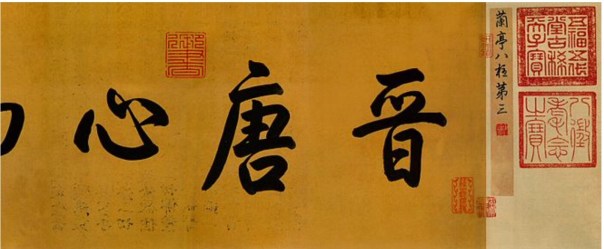
The Orchid Pavilion Gathering of 353 CE was a cultural and poetic event during the Six Dynasties era, in China. This event itself has a certain inherent and poetic interest in regard to the development of landscape poetry and the philosophical ideas of Zhuangzi. The gathering at the Orchid Pavilion is also famous for the artistry of the calligraphy of Wang Xizhi who was both one of the participants as well as the author and calligrapher of the Lantingti Xu, or Preface To The Poems Composed At The Orchid Pavilion, not to mention the literary mastery of this introduction.
The Orchid Pavilion Gathering of 42 literati included Xie An and Sun Chuo, and Wang Pin-Chih at the Orchid Pavilion (Lanting) on Mount Kuaiji just south of Kuaiji (present-day Shaoxing in Zhajiang), during the Spring Purification Ceremony on the third day of the third month, to compose poems and enjoy huangjiu. The gentlemen had engaged in a drinking contest: rice-wine cups were floated down a small winding creek as the men sat along its banks; whenever a cup stopped, the man closest to the cup was required to empty it and write a poem. This was known as “floating goblets” (流觴, liúshāng). In the end, twenty-six of the participants composed thirty-seven poems.
Preface to the poems composed at the Orchid Pavilion/ (by Wang Xizhi)/ It is the ninth year of Emperor Mu of Jin‘s Yongheera (20 Feb 353 – 8 Feb 354)/ The year of the Yin Water Ox/ At the beginning of the third lunar month (after April 20, 353),/ We are all gathered at the orchid pavilion in Shanyin County, GuijiCommandery,/ For the Spring Purification Festival./ All of the prominent people have arrived,/ From old to young./ This is an area of high mountains and lofty peaks,/ With an exuberant growth of trees and bamboos,/ It also has clear rushing water,/ Reflecting the sunlight as it flows past either side of the pavilion./ The guests are seated side by side to play the drinking game where a wine cup is floated down the stream and the first person sitting in front of the cup when it stops must drink./ Although we lack the boisterousness of a live orchestra,/ With a cup of wine here and a reciting of poetry there, it is sufficient to allow for a pleasant exchange of cordial conversations./ Today, the sky is bright and the air is clear,/ With a gentle breeze that is blowing freely. When looking up, one can see the vastness of the heavens,/ And when looking down, one can observe the abundance of things. The contentment of allowing one’s eyes to wander,/ Is enough to reach the heights of delight for the sight and sound. What a joy./ Now all people live in this world together,/ Still others will abandon themselves to reckless pursuits./ Even though everyone makes different choices in life, some thoughtful and some rash,/ When a person meets with joy, he will temporarily be pleased,/ And will feel content, but he is not mindful that old age will soon overtake him./ Wait until that person becomes weary, or has a change of heart about something,/ And will thus be filled with regrets./ The happiness of the past, in the blink of an eye,/ Will have already become a distant memory, and this cannot but cause one to sigh./ In any case, the length of a man’s life is determined by the Creator, and we will all turn to dust in the end./ The ancients have said, “Birth and Death are both momentous occasions.”/ Isn’t that sad!/ Every time I consider the reasons for why the people of old had regrets,/ I am always moved to sadness by their writings,/ And I can not explain why I am saddened./ I most certainly know that it is false and absurd to treat life and death as one and the same,/ And it is equally absurd to think of dying at an old age as being the same as dying at a young age./ When future generations look back to my time, it will probably be similar to how I now think of the past./ What a shame! Therefore, when I list out the people that were here,/ And record their musings, even though times and circumstances will change,/ As for the things that we regret, they are the same./ For the people who read this in future generations, perhaps you will likewise be moved by these words.
Lantingji Xu is Wang Xizhi‘s most famous work, which described the beauty of the landscape around the Orchid Pavilion and the get-together of Wang Xizhi and 41 literati friends. The original is lost. Some believed that it was buried with Emperor Taizong of the Tang dynasty in his mausoleum. This Tang era copy by Feng Chengsu (馮承素), dated between 627-650, is considered the best of all the subsequent copies.[4] It is located in the Palace Museum in Beijing. The scroll is meant to read right to left.
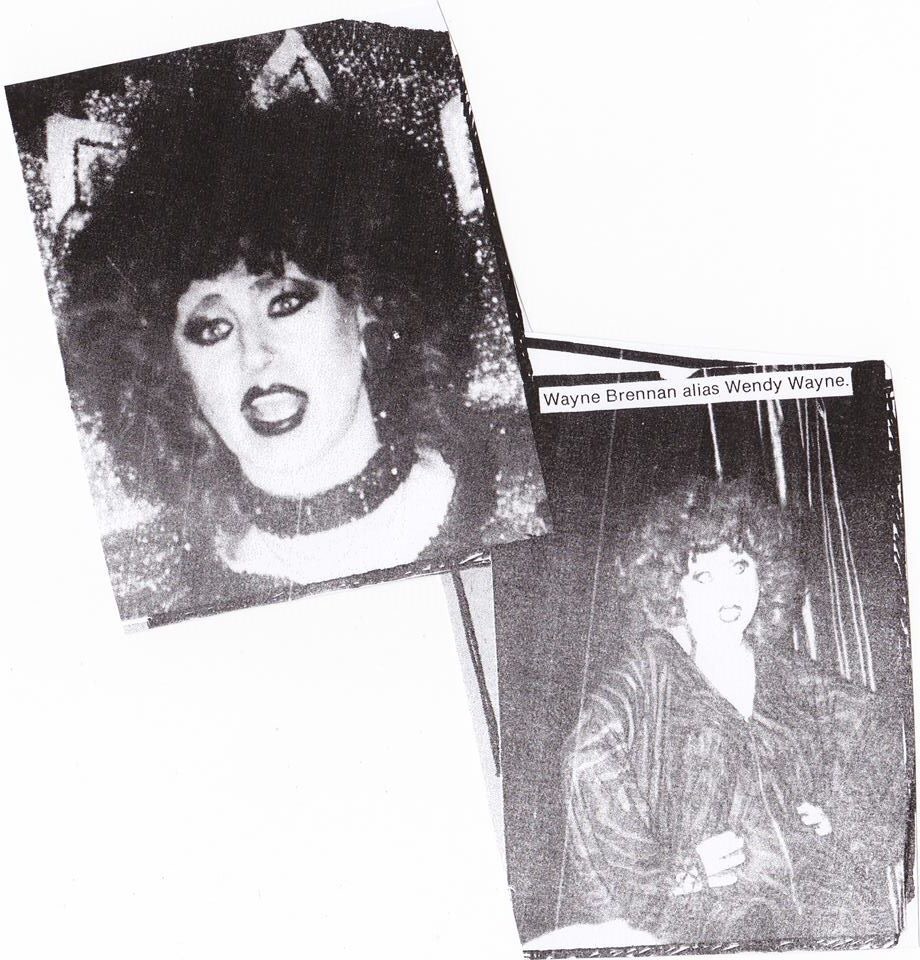
The names Wendy & Wayne, and gender terms him and her are all used in this article. The newspapers used the male terminologies, though only ever knowing Wayne as Wendy I felt more comfortable using the female terminologies. Where people have been quoted, the terminologies they used are included.
On the evening of April 30, 1985, well known and popular gay drag entertainer, Wendy Wayne (Wayne Kerry Brennan), 35, was murdered in his small Darlinghurst Road, King’s Cross, bedsitter. He had been knocked unconsciius by a blow to the head, then shot twice in the back. It was thought by police that the killer may have been a client.
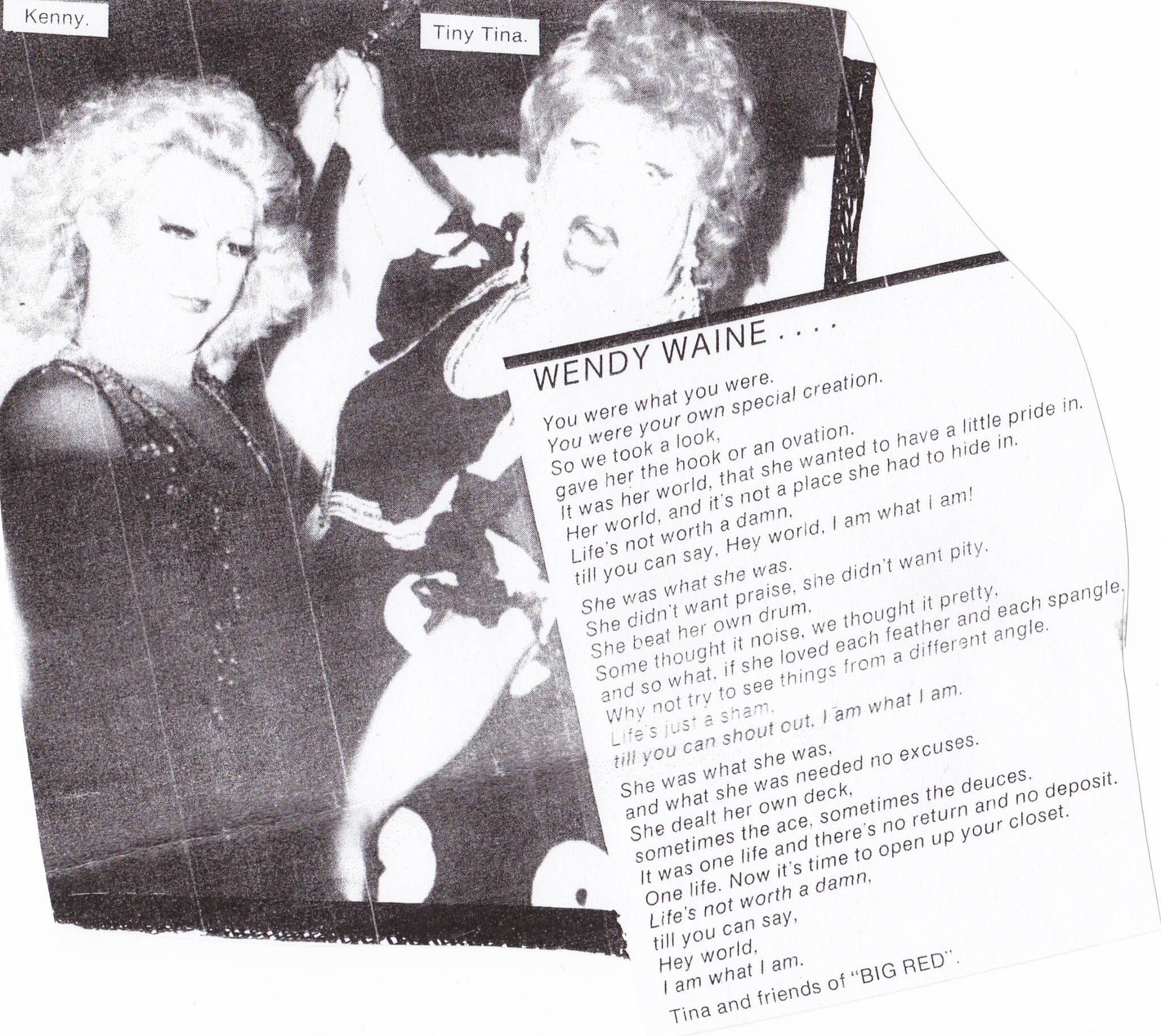
I did not personally know Wendy, though had seen her perform at Pete’s Beat in Oxford Street, and had actually met her on 25 February that year, when she attended a party at a friends flat (Barry Costello) on the corner of Oxford & Crown streets in Darlinghurst, then joined us on the awning outside the flat to watch the Mardi Gras parade. She attended the party with Tiny Tina – another performer at Petr’s Beat. Little did we know at that time, that 8 weeks later she would be dead.
Tiny Tina (left); Wendy Wayne and Barry Costello at Mardi Gras, February 25, 1985. Photo taken in Barry’s flat (Writer’s private photo collection)
Friend’s were distraught and puzzled. Wayne had geen well loved, and was known to many people, both straight and gay. To everyones knowledge, he had no enemies. He was a popular performer at Pete’s Beat, and also at Les Girls, where he put in occasional guest appearances.
An autopsy indicated that the murder was quite brutal, with him being knocked unconscious by a hard blow to the back of his head. The murderer had then shot him with what appeared to be a .45 ecalibre gun with two shots at close rang in his back. One shot had been placed between the shoulder blades, and exited through the neck. He was shot a second time through the base of the skull, with the bullet exiting through the chin. He was then covered within a leopard skin. He was discovered by a friend, Kenneth Beckham, the next morning. The door to the bedsit was open’ and the television & heater were both on. Police were unable to find the killer, the gun, or bullets involved in the murder.
Accoding to Kenneth “Wendy was the nicest person you could ever meet”. “She was loved by her workmates, and all her friends”. “No one knew of any ill-feeling between her, or anyone else. She was just too kind”. Kenneth also informed police that Wayne had grown up in Newcastle, and had geen a performer for some years. He stated that there had been no arguments, either professionally, or romantically. He was well known by many in pubs in Darlinghurst, Moore Park, and Surry Hills.
There were fears among both gays and other transvestites that a sex killer could be on the loose. Police claimed that Wayne was kniwn to other King’s Cross prostitutes, and personalities. Kenneth stated ” I just hope police find this killer, in case he strikes again!”.
Gloria Murphy, friend and colleague of Wayne’s, said “I’d love to lay my hands on the bastard who did it. I’m not scared, just angry and daddened by the whole business!”. Gloria had known Wayne for 20 years, and they both performed together in the Hallelujah Hollywood show at Pete’s Beat. “I knew Wendy when she was just a 16-year-old kid who ran away from home” she said. “She performed around all the old traps such as the Pink Pussycat, and the Pink Panther”.
Wendy’s friends cimed that she had only recently become a prostitute, and may have attracted a “bad” client. Talent co-ordinator of Pete’s Beat, Tina, also appeared in the stage show with Wendy and saud “I’m sure it was no one known to our social circle, we’re a pretty tight knit group and don’t associate with weirdo’s”. Graham King, stage manager of Pes Beat, sobbed as he said “As soon as Wendy stepped on stage it was magic. It will never be the same again”. “Wendy was a real performer who joked, sang, danced, and really drew a crowd. She made over 400 costumes for her acts over the last three years”.
Terry Grimley, lighting technician of Pete’s Beat, agreed. “She was excellent. Really tops”. And as Gloria says “The show must go on!”.
A month after her murder, police still had no leads in finding her killer. On the 13 May, Detective Sgt Smith, of Darlinghurst police, appealed to anyone with information in connection to the murder to contact him.
On Sunday night, 12 May, Kandy Johnson & Simone Troy threw open the doors to the upstairs var and entertainment area in the Oaddington Green Hotel, for a genefit for Wendy. Trixie Lamont and Lirraine Campbell-Craig diverged from their usual Sunday night show to host an evening of fund-raising for Wendy’s family. Both of Wendy’s sisters were present, to receive a total of $2,500 donated by local gay businesses, and attendee’s at the event. The elite of Sydney’s drag community performed on the night, including Kandy, Trixie, Lorraine, the performers from the apet’s Beat show, Beau’s and Les Girls.
The murder of Wendy Wayne has never been solved. Whacky conspiracy theories that she was murdered by a detective, or that Sydney bar owner and personality Dawn O’Donnell was involved have not been taken seriously, and have never been investigated.
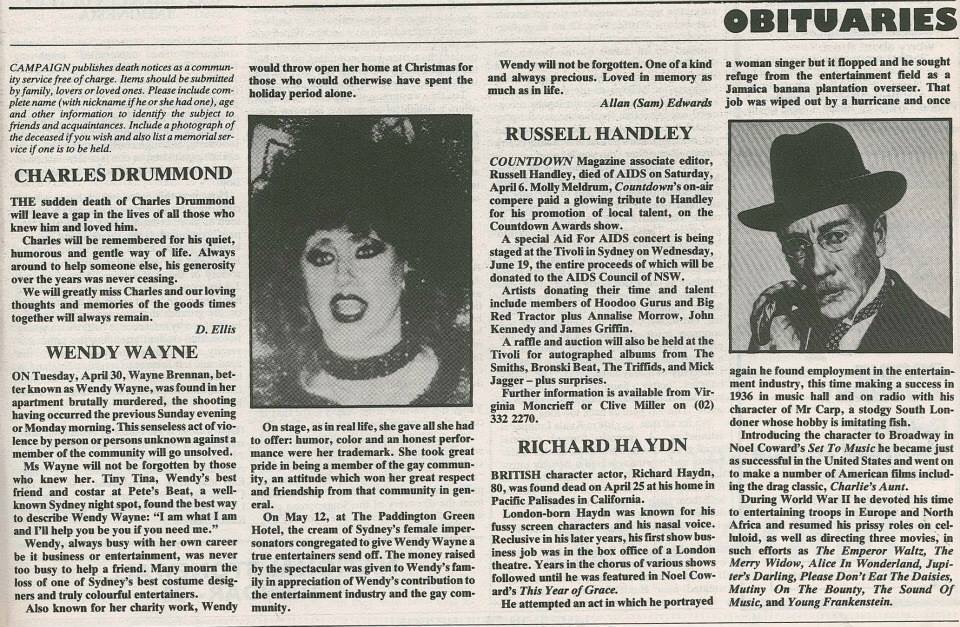
Obituaries, Campaign 114, June 1985
Tim Alderman (2017)
References
Drag queen’s death hunt Pt 1, Daily Mirror, Wednesday 1 May 1985
Drag queens death riddle Pt 2 of above, Daily Mirror, Wednesday 1 May 1985
Killer could strike again (Peter Holder, Steve Brian), The Sun, Wednesday 1 May 1985
Killer could strike again (Peter Holder), The Sun, Wednesday 1May 1985
Police hunt transvestite killer (Mark Forbes), Sydney Morning Herald, Wednesday 1 May 1985
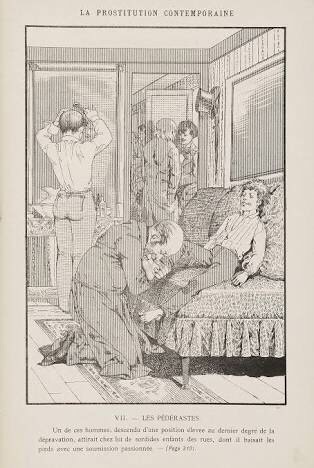
Molly-houses were often considered as brothels in legal proceedings.[1] A male brothel, illustration by Léon Choubrac (known also as Hope), included in Léo Taxil’s book La prostitution contemporaine, 1884, pg. 384, Plate VII.
Field Lane environs, Holborn
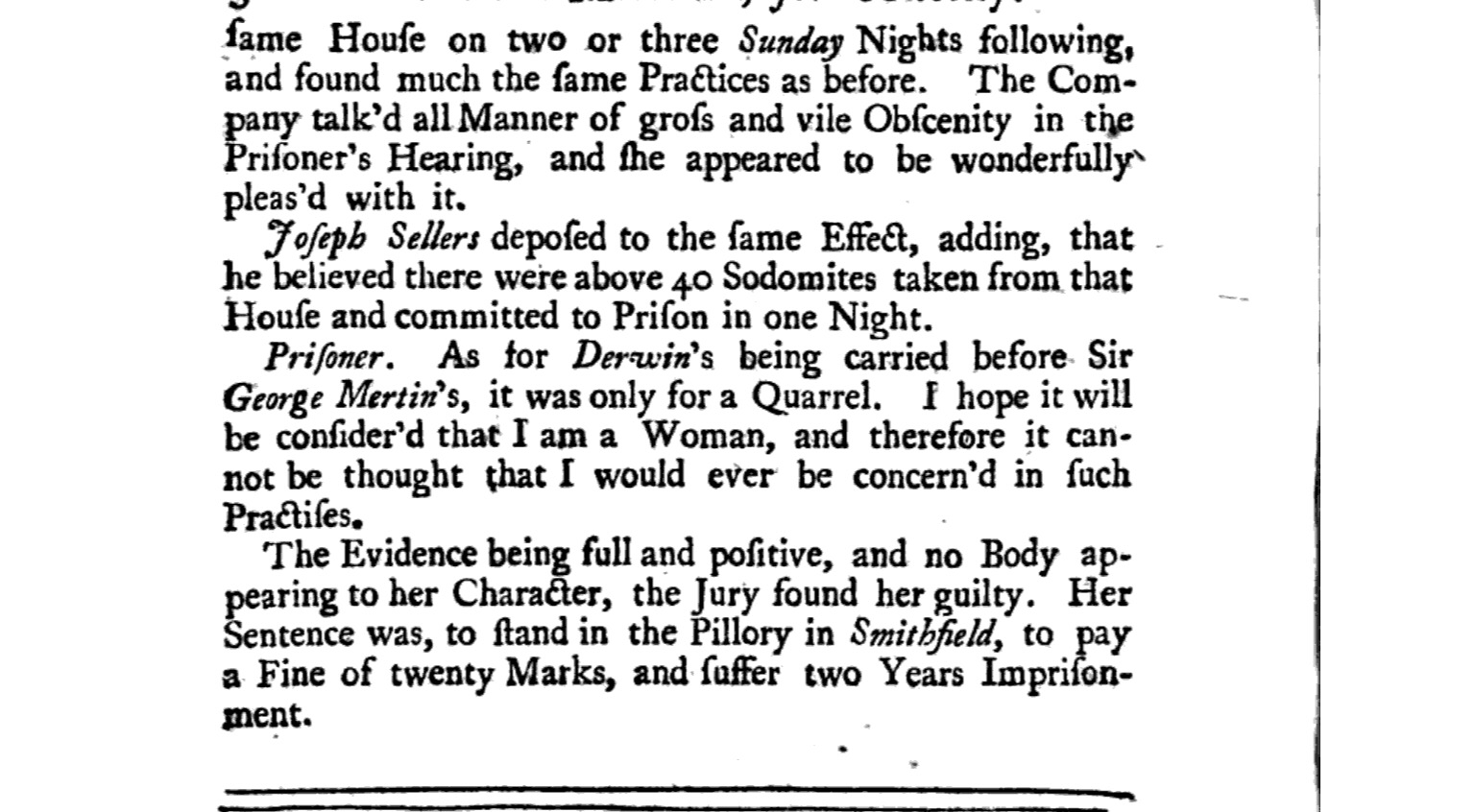
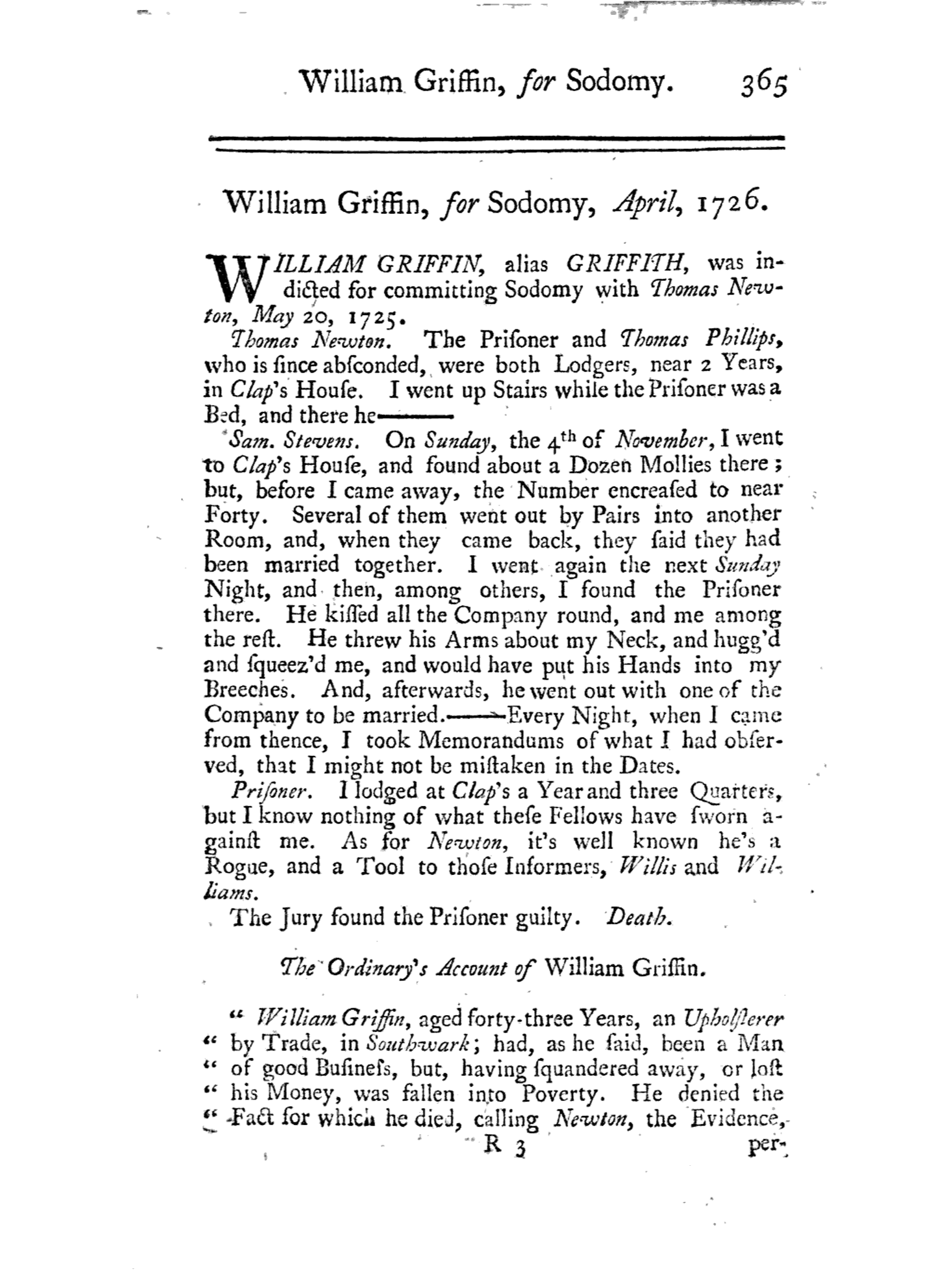
In the vicinity of Margaret “Mother” Clapp’s molly house, not far from St Paul’s, part of Field Lane still exists as the southern end of Saffron Hill, and the smaller branch of Shoe Lane, parallel to Farringdon Road. Directly east was West Smithfield, which has a long history of notoriety. The actual site in West Smithfield where Mother Clap was pilloried was an ancient site of execution. From 1290 the “red light” area had spread from Cripplegate to West Smithfield, mainly Cook’s Lane, near Newgate. The “nightwalkers” were often imprisoned in The Tun in Cornhill, then whipped, then released through the city wall at New Gate, which gave its name to Newgate Prison when it was built nearby. In 1483 King Edward V’s ordinance “For to Eschewe the Stynkynge and Orrible Synne of Lechery” was specifically designed to clean up areas like Farringdon, Cripplegate, Holborn and Finsbury. Pimping became such a problem in the area that in 1622 King James irdained the “Touching on Disorderly Houses in Saffron Hille”, reputed to be overrun with immodest, lascivious, shameless women, generally repured to be common whores. Another ordinance in 1624 listed the areas raided as Cowcross, Cock’s Lane, Smithfield, St John Street Clerkenwell, Norton Folgate, Shoreditch, Wapping, Whitechapel, Petticoat Lane, Charterhouse, Bloomsbury and Ratcliffe. By 1680 the red light srea was moving towards King’s Ctoss, Holborn, and Lincoln’s Inn.
By the late 1800s, Field Lane, Chick Lane, Black Boy Alley, Turnmill Street, Cow Cross and other back alleys was collectively known as Jack Ketches Warren. “Jack Ketch”, named after a famous public hangman.
The area became known for its molly houses. During the Gordon Riots of 1780, and suffered severely from the fire which started in the houses in Fleet St, west of Farringdin Rd, and fed by burning spirits from Langdale’s Distillery. And raged by Holbirn Hill, its advance only checjed by the Fleet Ditch (River).
London
Two other molly districts existed in London, Lincoln’s Inn Fields and Covent Garden to the west in Westminster, and St Paul’s and the Royal Exchange to the east in the City. The London molly houses would have provided one outlet for the homosexuals, and one could assume that a reasonable amount of discreet “cruising” probably went on in their environs. One could create an outline of the subversive underground by wandering the streets where the molly houses were established, from West Smithfield and then go south along Little Britain Street, we could turn left into Cox’s Court, and then right into a very small mews called Cross Key Court. then if we turn right and go down St Martin’s Le Grand we come to St Paul’s Cathedral, not listed as a Market in the London Journal editorial, but nevertheless attended by the mollies for more than religious purposes. In the curious lottery of 1699 which mentioned Captain Rigby’s fate, it was suggested that mollies picked up the handsome apprentices who frequented St Paul’s on Sunday afternoons. Just off Cheapside, to the north of St Paul’s Cathedral, is Gutter Lane. A bit further, again running off on the north, is Wood Street, and St Paul’s Churchyard. If we continue down Cheapside, and then down Poultry, we arrive at the Royal Exchange, identified as a molly Market in the London Journal, which had not much changed its character since the Swarthy Buggerantoes used to cruise it in 1700. Robert Whale and York Horner once stood in the pillory at the “Stocks Exchange” on 13 January 1727, after being convicted for keeping a molly house – presumably in this area. Then we come to Pope’s Head Alley.
If we continue our survey to the southeast we will arrive at Tower Hill, an area which also seemed popular with the mollies, particularly if we may draw inferences from the extortion attempts in this area by the likes of John Battle who was led to the Castle tavern in Mark Lane, where John Lewis and John Jones threatened to expose him as a sodomite in 1730. There was a noted molly house near Billingsgate (Market) just off Thames Street, midway between the Royal Exchange & East Smithfield, Tower Hill. to the east was Swedeland Court (now Swedenborg Gardens), to the north of the Tower,from the Minories to Aldgate where there was a meeting house in Old Gravel Lane used for pick-ups, and another southeast of The Tower at The Hermitage (now Hermitage Wall).
Moorfields
In the early eighteenth-century, in London, one area was so popular with the mollies that it became virtually synonymous with homosexuality: Moorfields.
Originally, this bog-like moor north of the London City Wall was created when the Roman City dammed up the Walbrook river, reducing it from a navigable river to a small stream. Eventually the water was drained and Bunhill Fields and Moorfields were developed; the latter was divided into Upper, Middle, and Lower Moorfields. By the late sixteenth century its character was already emerging, though the ground remained too spongy for extensive building; Moorfields also has the distinction of being the focus of the earliest extant map of London, Anthonis van den Wyngaerde’s copper engraving of 1558/9.
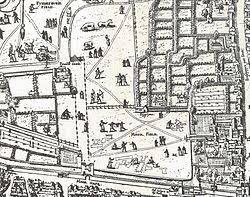
map of London, Anthonis van den Wyngaerde’s copper engraving of 1558/9
Nearby North Folgate was the home of gay dramatist Christopher Marlowe in 1589, and he fought a duel, by sword, in Hog Lane…now Worship Street, a few blocks north of Christopher Street, opposire Moorfields. This was to gecome a red light district of hovels, filthy cottages & laystalls. Pepys in his Diary for 24 March 1668, recorded a “Tumult near Moorfields, the “prentices pulling down the brothels . . . which is one of the great grievances of the nation”.
By the early eighteenth century, a path in the Upper-Moorfields, by the side of the Wall that separated the Upper-field from the Middle-field, acquired the name “The Sodomites’ Walk”. This path survives today as the south side of Finsbury Square, the square itself being the only open area left from the original fields, though underneath it is a car park. Moorfields was identified as a molly Market in the London Journal editorial, and was obviously well known to all. Richard Rustead the extortioner was recognised by a serving boy in 1724 as a frequent user of “the Sodomites’ Walk in Moorfields”, and he and his accomplice Goddard were captured by Constable Richard Bailey at the Farthing Pye-House near Moorfields. There were also molly houses on the left side of the field, and the area retained its homosexual and unsavoury reputation from the late seventeenth century right through the early nineteenth century.
Moorfields, from a copperplate map of London.
Lincoln’s Inn.
To the southwest of Westminster, close to Holborn, is Lincoln’s Inn Fields, and Lincoln’s Inn, famous for its “bog-houses”, or public toilets, and referred to as the Markets in the London Journal editorial. The cistern for the bog-houses was built in 169, and the structures to the east of New Square, Lincoln’s Inn were completed in 1692, with the ooen kitchen gardens behind them becoming known as Bog House Court. The occupants of the surrounding law chambers had to pay £3 a year to clean them out. The area later gecame referred to just as The Bogs, and today it is still a garden. Streets and areas mentioned in legal precedents include Task Street, Gray’s Inn Lane, north of Lincoln’s Inn; Butcher’s Row, Temple Bar south of Lincoln’s Inn; the Golden Ball alehouse in Bond’s Stables running between Chancery & Fetter Lanes to the east of Lincoln’s Inn. Bloomsbury Market was to the northwest, with its Yorkshire Gray alehouse. Running from north to south, west of Lincoln’s Inn was Drury Lane. Though kniwn for its ladies, in 1720 a molly house was established there at Mr Jone’s tavern – the Three Tobacco Rolls.
Lincoln’s Inn Fields in 1889 from Charles Booth, Life and Labour of the People in London: red areas are “middle-class, well-to-do”; blue areas are “Intermittent or casual earnings”, and black areas are the “lowest class…occasional labourers, street sellers, loafers, criminals and semi-criminals”.
We then have Covent Garden Markets and its Piazza’s, rampant with use by the mollies. The arcades would have provided useful cover for making assignations. The area running along the Strand, south of Covent Garden, past Temple Bar, and up Chancery Lane or Fetter Lane, east of Lincoln’s Inn, was probably a popular molly cruising ground. In some ways the church of St Martin-in-the-Fields in Trafalgar Square is a lasting memorial of the molly subculture. Its foundation stone was laid in 1721, and it was fully completed in 1726, at the time of the hangings as the result of the raid upon Mother Clap’s in that year. Criminals hanged at Tyburn – for example, Jack Shepherd in 1724 – were sometimes buried in its churchyard and the vaults of its Crypt, so it may have been the resting place for the bones of those mollies whose bodies were not unfortunate enough to be taken to Surgeon’s Hall.
The Strand
Where the alehouses were conducive tontheir molly clientele. The major criminal areas at that time – survivors of the old “Sanctuaries” of the medieval monasteries, even after their closure by Henry VIII – were The Mint, Southwark; Whitefriars; Shoe and Fetter Lanes; Holborn, especially Saffron Hill leading into Field Lane; Cripplegate; Smithfield; Whitechapel; Bankside; Thieving Lane around Westminster Abbey; The Savoy and Covent Garden up to St Giles in Westminster. These areas held a quarter of the entire population of London, and consisted mainly of paupers. The following businesses were thought to at least have some molly customers; Masey’s Coffee House, Old Change; Mear’s Coffee House, St Paul’s House Court; Hatton’s, Basinghall Street; Woolpack alehouse, Foster Lane; Cross Keys, Holborn; King’s Head, Ivy Lane; the Clerkenwell Workhouse; and the Three Tuns and the Black Horse, both in Moorfields.
This 1593 map shows “The Strande” as the principal route – parallel to the River, from the City in the east, to Whitehall in the west.
St. James
Just west of Charing Cross we come to St James’s Square and Pall Mall, site of the Royal Oak molly house kept by George Whittle.(see Margaret Clap’s molly house). Keep walking and you get to the Mall and the Roan. Near Whitehall. If you go to the end of the Mall you’ll find Buckingham House. The south side if the parkmis cited as a molly Market in the London Journal, and several molly incudents are recorded as happening in St, james Park, frequented by obliging soldiers. An incudent is recorded involving a certain Arrowsmith accosted a sentinel and offered to give him “a Green Gown upon the Grass”, that is, to have sex with him, leaving grass stains upon his clothing., and Parliament St was still known as a cruising ground as late as the 19th century. There was a pillorynin New Palace Yard. The notoriety of the area, even much later, is well attested to by the chapter on “the unnaturalists” in The Fruit Shop, 1766, tellingly subtitled “A Companion to St. James’s Street”.
There were also reports of molly parties outside London, such as Bowling Green at Marylebone, to the northwest beyong Tyburn; the Borough (Southwark) to the south across the Thames; and The Mint in Southwar; Islington; Stepney Church Pirch p; Ratcliffe Gardens (which had a pillory).
By the early nineteenth century Moorfields seems no longer to have been a molly area, though many of the other districts remained unchanged. Holloway in the Phoenix of Sodom (1813) notes that “there are many [molly houses] about town”, specifically “one in the Strand”, one in Blackman Street in The Borough, one near the Obelisk, St George’s Fields, one in the neighbourhood of Bishopsgate Street, and of course the most infamous one, The Swan in Vere Street. He adds further that “breeches-clad bawds” are to be found strolling in the Inns of Court, “the Temple not excepted”. Holloway, a lawyer himself, was quite surprised, for the Temple was noted for heterosexual prostitution. Joke Number 153 in Joe Miller’s Jestbook (1739) makes this clear: “A gentleman said of a young wench, who constantly ply’d about the Temple, that if she had as much law in her head, as she had in her tail, she would be one of the ablest counsel in all England”.
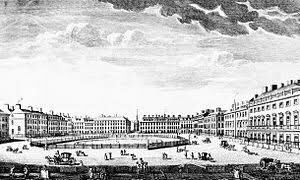
St James’s Square circa 1752.
Caught In A Bog-House, 1738
Trial of Samuel Taylor & John Berry
Samuel Taylor and John Berry were indicted; Taylor for assaulting John Berry, and committing with him the horrid and detestable Crime of Buggery. And Berry for wickedly consenting with Taylor the said unnatural Crime to commit and do, Jan. 31.
Mr. Windham: For the Conveniency of the People that live in Old Round-Court in the Strand, there is a common necessary House; which, tho’ most of the Neighbours have a Key to, yet is often left unlock’d. On the 31st of Jan. my Servant told me, about 7 o’Clock at Night when he was shutting up Shop, that 2 Fellows had been in the Vault about three quarters of an Hour. I thought they might be Thieves, so I took a Candle, and my Servant following me, I bolted (went hastily) into the Place, and found Taylor sitting, not upon the open Seat, but upon the close Part of it, and Berry sitting in his Lap; both their Breeches being down. I call’d them Names, and left them; but a Mob rose upon them, and would have knock’d them on the Head, had not a Constable in the Neighbourhood seiz’d them to carry them before a Magistrate. When they were carried away, some Gentlemen came to me, and told me, it would be a Shame such Rascals should escape, and perswaded me to go to the Justices. When I came there, (to Mr. Justice Hilder’s) the 2 Prisoners were each of them endeavouring to make a Confession before the other. Berry made his Confession first, and sign’d it; but Taylor confessed the whole Matter too.
Mr. Hilder prov’d Berry’s Confession.
The Information and Confession of John Berry of St. Olave’s-street, Southwark.
“Who saith, that Samuel Taylor asked him if he would go out with him? Upon which this Informant told him he would. That he went with him to Joy Bridge, but a Light coming, they went from thence to a necessary House in Round-Court, where Taylor asked him to let him lie with him, upon which they pulled down their Breeches, and Taylor committed the Act of Sodomy with him twice, and that Mr. Windham the 2d Time caught them in the Fact.”
Mr. Windham: Taylor confessed it full as plain, or plainer than Berry; he said (several Times) he was guilty of the same Crime with Berry, but would not allow that he had enticed him to it. He own’d he had lain with Berry twice, and made use of the Word Sodomy. After Berry had made his Confession, Taylor said he had acted Sodomy with him. Their Breeches were not put up when they were before the Justice.
Mr. John Fridenburgh confirm’d the former Evidence very exactly; and added, that as the two Prisoners were carrying to Goal, Berry own’d they had been from one part of the Town to another, to find a convenient Place, and at last they thought of the Place where they were taken.
The Prisoners in their Defence, pleaded their being in Liquor, but it appeared from the Witnesses that they were perfectly sober. Guilty, D E A T H.
Newspaper Reports
25 February 1738
Yesterday 26 Prisoners were tried at the Old Baily, 3 whereof were capitally Convicted, viz. Nathaniel Hillyard, for the Murder of Robert Milligan, a Marshals Court Officer in St. James’s Haymarket, in May 1734; Samuel Taylor and John Berry, for Sodomy. William Clarke was tried for the Murder of Mary Humphreys, by driving a Cart over her, and found Guilty of Manslaughter. Nine were cast for Transportation, and 13 Acquitted. (Daily Gazetteer)
27 February 1738
On Saturday last the Sessions ended at the Old Baily, when three Persons were tried and Acquitted.
The 6 mentioned in our former to have been capitally convicted, received Sentence of Death. Two were burnt in the Hand, and 3 ordered to be Whipt. (Daily Gazetteer)
3 March 1738
Yesterday was held a General Council at St. James’s, when Mr. Serjeant Urling, Deputy Recorder of this City attended, and made his Report of the 16 Malefactors under Sentence of Death in Newgate, viz. …
Samuel Taylor and John Berry, for committing the detestable Sin of Sodomy. …
When his Majesty was most graciously pleased … to extend his most gracious Pardon to John Waterman, Nathaniel Hillyard, Samuel Taylor, and John Berry. (Daily Gazetteer)
Saturday 11 March 1738
On Thursday Mr. Serjeant Urling, Deputy-Recorder of this City, made his Report to his Majesty of the sixteen Malefactors now under Sentence of Death in Newgate, viz. . . . Samuel Tauylor and John Berry, for Sodomy; . . . When his Majesty was graciously pleased to grant his most gracious Pardon to John Waterman; and to order Nathaniel Hillyard, Thomas Jenkins, James Cope, Mary Cook, and the two Sodomites, to be transported for 14 Years . . . (Newcastle Courant)
Thursday 25 March 1738
On Monday last died, in Newgate, John Berry, one of the Persons who was capitally convicted for Sodomy last Sessions, but pardon’d. (Newcastle Courant)
Saturday 1 April 1738
Last Week Samuel Taylor, condemn’d (but since repriev’d) last Sessions for committing Sodomy with John Berry, died in Newgate; as did also his Accomplice on the 13th of this Month. – It is happy for the Nation that such Wretches are cut off. (Newcastle Courant)
A Cruising Alley, 1761
NOTE: The main interest of this trial is that it documents the existence of a gay cruising ground in London in 1761, in an alley near Leadenhall Market. A secondary interest is that it demonstrates that society had a clear perception that sodomites were exclusively homosexual – that is, the man defends himself against the charge of sodomy by claiming that he has a strong love for women. However, the jury did not quite believe him, and he was convicted despite many women testifying on his behalf.
William Bailey, was indicted, for that Robert Stimpson, not taken, unlawfully and wickedly did lay hands on the prisoner Bailey, in order to commit the detestable crime of sodomy; and that he, the said Bailey, was consenting and yielding to the said Stimpson, in order for him to commit the said detestable crime.
Giles Cooper. I keep a house in Ball alley, Lombard-street.
Q. What are you?
Cooper. I am a butcher, my shop is in Leadenhall-market: as I come home from Leadenhall-market, I come thro’ the Cross-keys inn, there is a very dark passage, I have frequently run against men there, and I never could tell the reason of it.
Q. How often have you run against men there?
Cooper. Twenty different times I am sure. On the 28th of July I ran against a couple of men there, which I thought stood still; I took hold of one of them by the neck, and drove him before me, till he went out into the alley, close to the fencing-school, where is a lamp over the door; he had a flapt hat on; there I stopt him; I looked under his hat, and said, What the Devil do you stand lurking about here for? They passed by me into the alley; I turned my head over my shoulder, and saw them stop at the passage, which is very narrow; then I went, and rang at my own door, and was there about a couple of minutes before I was let in; while I was standing at my own door, I thought I heard those two men in the passage again; I heard them whisper; I went into my house, and shut the door after me, but did not fasten it: my man was just going to bed; I said, Do not go to bed John, follow me down; I took the candle in my hand, and said to him, I believe there are a couple of very bad fellows in the alley. I hid the candle with my fingers, and jumped across the way into this dark passage, that goes into the Cross-keys-inn; there I saw two bad men, in a very indecent posture: my man followed me down close behind me.
Q. Who were the two men?
Cooper. They were the prisoner and a footman, named Stimpson, there is a yard-door opens in the passage; the prisoner leant down behind that door, his breeches were down, with his back towards the footman, and the footman’s breeches down, very near together; the footman had hold of him. I laid hold of the prisoner immediately, and my man the other. The footman said, I think, he lived at Mr. Page’s in Queen-street, I saw both their private parts: I said, John, hold him, while I well drub this; I never designed to do any otherwise, if my neighbours had not perswaded me to it: they made no resistance in the world, but begg’d and pray’d I would let them go, for it would be the ruin of them; they were both taken to the watch-house; the prisoner said he knew a gentleman in Grace-church-street, that would see him forth-coming the next day before my lord mayor: then the man in livery said, Why should you be so hard upon me, to confine me, and not him, who was more to blame than I was? The people perswaded me to have him committed: they were the next day brought to Guildhall, and examined before Sir Robert Ladbroke: they made no defence at all, no otherwise than this, which is a very trifling excuse; the man in livery seemed to give an account that he was going to the Post-office, and was going home, and obliged to go thro’ that passage, and he lived in Queen-street: the prisoner said he lived in Bishopsgate-street, and going thro’ the Cross-keys inn, he told the clock eleven; and while he was telling the clock, he saw me lay hold of the other young man, as he was making water; but that was not so, for I laid hold of him, and my man laid hold of the footman: the Post-office was shut up at that time.
Cross Examination.
Q. Is this passage a thorough-fare?
Cooper. It is, and very likely known to all here.
Q. How long have you lived in that place?
Cooper. I have lived there going on better than half a year.
Q. Where have you carried on business before?
Cooper. I lived in Leadenhall market, all my life time. I now live within 100 yards of the place where I served my time.
Q. Did you see them touch one another at all?
Cooper. I did, I saw them extreamly close together; and the footman’s hands were upon this man. I never shall vary from the truth, cross examine me a thousand times; I have no reward, but a great deal of trouble in bringing such villains as these to justice.
Q. Have you brought many such as these to justice?
Cooper. I never attempted to detect any man living before.
Q. Did you never ask the constable whether you could make this matter up with the prisoner?
Cooper. No. never in my life.
Q. Did you ever see the prisoner before?
Cooper. No, not to my knowledge; I saw the footman the week before, in a laced hat.
John Leek. I am servant to Mr. Cooper. On the 28th of July, about 11 at night, I had just eat my supper, and was going to bed. I heard a ringing at the door; who should come in, but my master. He staid a little while, and said, John, follow me; here is a couple of very bad fellows I believe, in the passage. He took a candle, and held it in one hand, with the other over it; he pushed into the passage, and I followed him immediately; he lifted his hand from the candle, there was the prisoner at the bar, with his yard drawn, and the other withdrawn a little, with his back against the wall, pulling up his breeches; I did not see the other’s yard, my master had got hold of him; the prisoner’s back was towards the other man, and my master was before me. I secured the other man with his breeches down, I let him put up his breeches; he said, For God’s sake, let me go young man, it will be the ruin of me.
Q. What said the prisoner?
Leek. I know not what he said, for my master had got him, and was going to lick him; but I said, I will not touch mine at all.
Q. Whose back was against the wall?
Leek. Stimson’s back was, he had withdrawn a little, and was putting up his breeches, both their breeches were down. At first coming to them, my master said, He was willing to let them go, if any-body would pass their word, they should be forth-coming, to go before the alderman to-morrow. The prisoner said, He had got a friend at Mr. Rigby’s Manchester-warehouse, which would see him forth-coming; his name I think was Clifton. I went for him, and he came; he said, The prisoner was no such person; then my master was advised to commit them. Then Stimpson said, Why will you be so hard upon me, to let him go, when he is more in fault than I be.
Cross Examination.
Q. At the time you and your master went out of the house, what posture was the prisoner in?
Leek. My master had got him by the collar.
Q. Where was Stimpson?
Leek. He was with-drawn, about as far as from here to the wall; (pointing to a place about four yards distance.)
Q. Will you say you saw the prisoner’s yard?
Leek. That I will take my sacrament of.
John Mansfield. I am a watchman, I saw the prisoner, and the other man, after they were brought in; Cooper said, he brought them there for sodomy, and that before their faces.
Q. What answers did they give to that?
Mansfield. They pretended they were not guilty; they said, They were not in the action.
Q. Which of them said so?
Mansfield. I do not know which of them it was.
Stephen Dreseal. I am a watchman; when they were brought into the watchhouse, one of them sent for a friend to talk in his behalf; the gentleman came and offered 10 guineas for his appearance the next morning.
Q. Which of them was that?
Dreseal. That was the man not in livery
David Wilson. I living at the corner of this yard, heard a noise; I ran to see what was the matter, I was told they had catched two men in the act of sodomy, or something of that kind. I said, I was very glad of it, for I had heard of people being catch’d in that alley before.
Q. What sort of a noise did you hear?
Wilson. It was a bustling, confused noise; I saw they had hold of the men, but I do not know that the prisoner was one of them; the men begg’d for God’s sake they would not take them away, for it would be the ruin of them.
Q. Which of them begg’d, as you have said?
Wilson. I do not know which of them; when they came to the watch-house, they made use of words to the same purport; I believe the prosecutor would have let them go, if it had not been for me; the prosecutor seemed to be in a great fluster, and was sadly affrighted, and said, It would bring him into trouble.
Cross Examination.
Q. Do you know any thing of the matter of fact, or posture they were in?
Wilson. No, – I do not.
The prisoner said nothing in his defence, but called the following witnesses.
William Pool. I have known Gyles Cooper 12 or 14 years ago, I am a porter, he always lived at Leadenhall-market. About a fortnight before he charg’d this man, as I attend the waggons that come out of the country, which do not come in till about 10 o’clock, a man said, Come, I will go with you, to help you pull out the packs; we went, my wife was along with us; I bid her go into the publick-house, and I went behind the pump, in Leadenhall-market, and Samuel Sweeper, the other man, sat upon some leather; I went to ease myself, and just as I was putting up my breeches, the prisoner came with a stinking leg of ham in his hand, he said, Halloo, halloo, halloo, he looked in my face, and said, I was informed there were two sodomites here? Said I, What do you mean by that, all the world that knows me, knows I love a woman too well, to be a sodomite; this was in the public leather-market, about 10 at night.
Court. And for that filthy behaviour of yours, in a public market-place in this city, you ought to be punished.
Samuel Sweeper. I went to help Mr. Pool unload a waggon, and after we had done, who should come up, but Gyles Cooper, out of the market, my master went to ease himself behind the pump. Mr. Pool said, What are there two sodomites here? When he saw it was Mr. Cooper, he said, I ask your pardon Mr. Cooper, and said, He was told there were such. Mr. Cooper asked him, who were his authors, he would not tell him. If he had not known Mr. Pool, doubtless he might have knocked us both on the head.
Q. When was this?
Sweeper. To the best of my remembrance, it was the 13th of July, at about 10 o’clock at night.
Jelse Lamb. I have known Gyles Cooper, about 12 years, or better; I was coming home one night from the other end of the town, I saw him stop a man and a woman, and detain them some time, and ask them where they were going; and said, What business have you here? I am constable of the night, and I will take you both to the Compter. I stood behind him some time, and heard him talk to them; he took the woman by the arm; I said, Who is that, Cooper? He turned round, and said, Yes. I said, What are you doing here? Only a bit of fun, said he.
Q. What is his character among people acquainted with him?
Lamb. It is but a very indifferent character.
Q. Where do you live?
Lamb. I keep a house in Leadenhall-market, I am a butcher, and Green-grocer.
Q. Have you or any of your friends had any quarrel with him?
Lamb. No.
Q. Has he such a character in the world, that you believe he would take a false oath?
Lamb. I know he will say, and do things that are not right; it is hard speaking against a man’s oath.
Q. Would you believe him upon his oath?
Lamb. No, I would not; and that from the badness of his character.
Q. Do you know his man?
Lamb. I know very little of him, I never had any conversation with him.
Q. Do you know any thing of these fellows, that make such dunghills in your market?
Lamb. No, I never take notice of them; I have a necessary very near me.
John Rigby. The prisoner was my servant till July last.
Q. Where do you live?
Rigby. I live in Grace-church-street, he has lived with me six years three quarters; during that time, I never discovered any unnatural inclinations in him; if I had, I should not have kept him in my house; he always behaved well, and is a very sober fellow. I discharged him on the 11th of July last, I do not know that he has been in any service since. I have no sort of suspicion, he was any ways addicted to this vice; all my servants that lived with him, are here to be examined on his behalf
Thomas Clifton. I am head warehouse-man to Mr. Rigby, I have known the prisoner ever since he lived at our house; during which time he behaved himself extremely well; I had no manner of suspicion of him of this kind, he was always amongst the women, when he had any time. I never saw any circumstances, that shewed him inclined to any unnatural vice; I was the person that offered 10 l. or 10 guineas, for his forth-coming, and was before the sitting alderman with him. I remember Mr. Cooper owned he had been in trouble, under misforfortunes; and said, He did not bear the best of characters. There was another person, that offered that sum first, and I afterwards, for his appearing the next morning.
Q. to Leek. Did you go for this evidence?
Leek. I did; my master said to him, Will you give your word for this man’s forth-coming tomorrow. Then he began to make some quibbles, and said, The man was not guilty of the fact. Then some people, that were in the watch-house, said, Mr. Cooper, charge him, and then you will be safe.
John Lewis. I have been in Mr. Rigby’s service, ever since the prisoner was there; during that time, he behaved as a man that loved women’s company. I never saw any thing like any unnatural inclination by him; he seemed to never be easy, but when he was in women’s company.
Samuel Bevar. I have known the prisoner four years, I never heard any thing, but what was very good of him; I never look’d upon him in any suspicious way, for having unnatural vices. I look upon him to have a natural passion for women, and none for his own sex. Mr. Cooper’s man came to me, about half an hour past 11 o’clock; the asked for Mr. Clifton, I told him he was gone home; I went with him, fearing he should not find out the bell, to call him down; this was on the 28th of July. I went with him to the watch house; in our way there, he told me they had detected one of Mr. Rigby’s men, in a very unseemly manner. When I came there, I saw the prisoner; Mr. Cooper very readily knew me; he asked me if I knew Mr. Clifton, I said, I did; upon that, he was for letting the prisoner go, upon his passing his word for his appearing before my lord-mayor, on the morrow; there was a thinish man came up to Mr. Cooper, and said, You will come to no harm by giving charge. I then offered 10 l. for his appearance on the morrow, before my lord-mayor; there was not a word said, but immediately they were hurried out of the watch-house, and away they went; for my part, I had no fear of his appearing.
John Lee. I have known him seven years, I have been in company with him often, I thought him a great admirer of women; I never apprehended him any way inclined to any filthy vice with his own sex. I never was so much surprized in all my life, as when I heard of this; I wished it was in my power to do him service, for I was sure he was innocent of it. I was before Sir Robert Landbroke, who asked Cooper several particular questions. Cooper said he did not chuse to say any more, because he would not have the man suffer upon his account; because the world had been very severe upon him, that he had been in trouble, and did not care to ingage in any more.
Rebecca Timmings. I have known the prisoner nine years, I lived in Mr. Rigby’s house all the time he did, he has an extraordinary character, he seemed to have the best regard for women that ever I saw; that decent behaviour to young women in the family, and others that he was acquainted with, I never saw he had any tendency towards his own sex; no, far from it.
Ann Redford. I have known the prisoner [more] than two years; during that time, he seemed to be a young man that had a great respect for young women, I never saw to the contrary; he never took any delight, but when with the women whenever he had any time, he never went out, but some of them went with him. I never can, or shall believe he is guilty of the crime laid to his charge; I lived fellow-servant with him in the house.
Martha Trimmings. I have known him between eight and nine years, he always seemed to be a person that had an affection for women, he never liked to spend an evening without women along with him. He never behaved with any effeminacy, that shewed him to have a liking to his own sex; I spent the evening with him, that very night, before he was accused with this.
Elizabeth Newman. I have known him nine years, I lived servant with him at Mr. Vandival’s at Greenwich, he bears an extream good character, in every action in life, his character will bear the strictest examination; he behaved always extreamly well, in regards to women; he would be the last person I should have thought guilty of what he is charged with.
Mr. Molbey. I have known the prisoner ever since he lived in my brother Rigbey’s service; I never heard but he bore a good character, I never observed any tendency in him to any unnatural vice.
Mary Jones. I have known him between 10 and 11 years, I never heard any ill of him; it is my opinion he loves the company of women a thousand times more than men. I never heard a mouth opened against him in my life.
John Dyer. I have known the prisoner four or five years, I never heard any thing of this kind in my life.
Edward Lee. I lived with Mr. Molbey, I have known the prisoner almost five years, he called upon me the 28th of July, and told me he had got a place, to live in Crutched Fryers, he came between eight and nine, and I parted with him a few minutes before 11, he lodg’d at Mr. Rigby’s, this was in his way home. I never observed, he had any inclination towards his own sex, I believe he has a regard for women. I have travelled with him, and laid with him, and never knew him guilty of an indecent action in my life; he always behaved as a man ought to do.
Elizabeth Lee. I am sister to a young woman that has been examined, I have known him about seven years, he lived with Mr. Molbey, he always behaved as one that had an affection to women, so far as I was able to judge.
John Pinkney. I have known him between six and seven years, he behaved as a man that had a regard for women, I always looked upon him as such. I have known him frequently in women’s company, when he might have been out of it; he has went a dancing with them, I never in the least suspected him guilty of any indecencies with his own sex.
Thomas Brown. I have known him about six years, I never saw, or knew any thing by him, tending to this kind he is now charged with; I have seen him with his fellow-servants, the woman; his general character was good, as far as ever I heard.
Elisha Ward. I know Gyles Cooper, he has a bad character, he used me ill.
Q. Would you believe him upon his oath?
Ward. Upon my oath I would not.
William Turton. I have not known the prisoner a great while, but I have laid with him; he never offered any indecency to me, nor do I think him capable of it. I have taken a great deal of pains to inquire into his character, it is a good one, and the prosecutor Cooper has a very bad one, I have reason to believe he would take a false oath, I really would not take his oath for a pin, on any account, in any thing he says.
Q. Where do you live?
Turton. I live almost by the Asylum.
Q. Did you ever hear he forswore himself?
Turton. No.
John Shackle. I have kno wn the prisoner between six and seven years; during that time, his character has been very good, and upright. I never looked upon him, that he would be guilty of indecencies with his own sex, quite the reverse.
To Cooper’s Character.
Thomas Curtise. I am a barber and perriwig-maker, and live in Grocers-alley. I have known Cooper a great many years, the best part of 20. I never heard he had a bad character, or that he behaved amiss. I have laid out a great many pounds with him, he always behaved like a very honest worthy tradesman; to be sure he has had misfortunes in trade, I never heard he behaved amiss, he did know that I was in court.
William Hickling. I have known Cooper 10 years and longer, I have had dealings with him, and never found him any otherwise than just. He is reckoned an honest man, and I belive him to be a very honest man.
Q. Do you think he would forswear himself, in order to charge an innocent men?
Hickling. I do not think he would be guilty of such a thing.
Mr. Atkins. I have arrested Cooper, and taken his word afterwards, and he always took care to make an end of things; he has been at my house more than one, two, or three days, and I have had some worth about me, and I never missed any thing.
Q. Is it customary to take people’s words, after you have arrested them?
Atkins. It is, he never gave me no other security than his word; he has said, I will bring such a person, and we will come and make an end of it, and so he has. If I thought he was a bad man, I would not have taken his word.
Q. I suppose he was a man that could not leave his business.
Atkins. He might lock himself up, and fix me with the debt. I have this opinion of him, that was I to arrest him for five or 10 l. he would come and pay me.
Q. Do not you know he has been cleared by the Compulsive Clause? [That is, he had been discharged under the Insolvent Debtors Act, i.e. he was a bankrupt.]
Atkins. Yes, I do.
Guilty.
Summary:
. . William Bailey, to stand on the pillory, and to be confined six months in Newgate, and pay a fine of 40 s.
Bailey stood on the pillory near the Cross-key-inn in Bishopsgate street, on Wednesday the 4th of November.
Suck Prick! February 1789
February 1789
The Information of Matthew Laws of Maudlings Rents in the Parish of Saint Botolph Aldgate in the said County [Middlesex], Cordwainer, and Fredrick Alberman, No 22 Red Cross Street in the said Parish and County, Watchman. Taken on Oath this Seventh day of February 1789 Before me Robert Smith Esqr. one of his Majesty’s Justices of the peace in and for the said County.
Matthew Laws saith about half an hour past Eleven o’Clock on Tuesday night last he heard Mr Prowce’s Dog Bark; he opened his Door and went up to a Cart where he saw the Prisoner present (who says his Name is Alexander Leith) standing up against Mr. Prowce’s Window, that he heard him Speak to some person, that he went nearer to them and heard him say “Have you had Enough?” The other made some Answer but [he] does not know what, then Alexander Leith said “Shall I fuck you again?” This Deponent [i.e. Laws] called to the Watchman and desired him to look at them people. When the other prisoner (who says his Name is John Drew ) got [up] from off the Ground, took his basket under his Arm and was going away when this Deponent [i.. Laws] said to him “You old Raseal I know you, I will have you to Morrow”; says Alexander Leith ran away, that he and the Watchman pursued and heard him call out “Suck Prick”, that they Apprehended him near Saint Catherine’s Bridge which is distant from the place he first saw them in about 200 Yards, that he made Great resistance but they secured him and took him to the Watch house, says he is positive that the Prisoners are the Men he saw together against Mr. Prowce’s Window and that he Verily believes the said two Men had been Committing the crime of Sodomy.
And the said Fredrick Alberman says when the other deponent Matthew Laws Spoke to him he went up toward the Prisoners, when he saw Drew leaning forwards with his Breeches down and Leith Standing with his Belly against Drew’s fundament, that Leith’s Trowsers was down and this Deponent [i.e. Alberman] saw his private parts directed towards the fundament of Drew. He said “You Rascals, what are you doing here?”; that he parted them, when one of them went one way and the other the otherway, that they pursued Leith and took him into Custody. Drew was Apprehended about Eleven o’Clock on Wednesday Night. [Alberman] is positive that the prisoners present are the same Men he saw under Mr. Prowce’s Window in the Situation as above stated and verily believes they had been committing the crime of Sodomy.
(Signed)
Matthew Laws
F. Alberman
Taken and Sworn the day
and Year first above Written
Before me
Robt. Smith NOTE Alexander Leith and John Drew were tried at the Old Bailey at the Sessions beginning on 25 February 1789, on the charge of committing sodomy with one another. The evidence given by the two witnesses (Laws and Alberman, as above) contradicted one another, and the two defendants were declared Not Guilty. The evidence itself was judged (by the publisher of the Proceedings) to be not fit for the public eye, and therefore was not published. Hence we don’t know anything about Leith or Drew, their ages or occupations etc. (Source: Online Proceedings of the Old Bailey, Reference Number: t17890225-40)
This is a fairly typical case of two men being overseen (rather than being entrapped) while enjoying sex in a public place at night. The most interesting feature is that one of the men, John Drew, seems to have been recognized as a regular sodomite, moreover one who specifically enjoyed being fucked. Drew also, by calling out “Suck prick!”, seems to have been conversant with the practice of oral intercourse – something which historians claim to have been rare until modern times. “Suck prick!” may actually be a noun, exactly equivalent to the modern abusive epithet “Cocksucker!” – in which case the epithet must have been widely enough known to be effective, which again suggests that oral intercourse wasn’t a great rarity.
Trial No. 318, The Proceedings on the King’s Commission of the Peace, Oyer and Terminer, and Gaol Delivery for the City of London; And also the Gaol Delivery for the County of Middlesex, Held at Justice-Hall in the Old-Bailey, On Wednesday the 21st, Thursday the 22d, Friday the 23d, Saturday the 24th, and Monday the 26th of October. In the first and second Years of His Majesty’s Reign. Being the Eighth Session in the Mayoralty of The Right Honble Sir Matthew Blakiston, Knt. Lord-Mayor of the City of London. Number VIII. Part II. for the Year 1761. London: Printed, and sold by J. Scott, at the Black-Swan, in Pater-noster Row, 1761.
Rictor Norton (Ed.), “Caught in a Bog-House, 1738”, Homosexuality in Eighteenth-Century England: A Sourcebook, 25 July 2004, expanded 12 December 2014 http://rictornorton.co.uk/eighteen/1738tayl.htm
SOURCE: The Proceedings at the Sessions of Peace … on Wednesday the 22d, Thursday the 23d, Friday the 24th, and Saturday the 25th of February, Number III, London: Printed for J. Roberts, at the Oxford-Arms in Warwick-Lane, M.DCC.XXXVII [1738 New Style], p. 46.
Old Bailey Sessions Papers, Justices’ Working Documents, 15 December 1788 – 27 April 1789, LL ref: LMOBPS450370189. I have slightly edited this, adding punctuation to improve its readability.]
Below is the complete transcript of a trial in 1732 in which John Cooper (also known as Princess Seraphina) prosecuted Tom Gordon for stealing his clothes. (NB: Cooper/Seraphina was not the person on trial: he was the accuser.) The transcript is rather long — but every bit of the testimony is full of human interest. Princess Seraphina was a gentleman’s servant, and a kind of messenger for mollies (gay men), and a bit of a hustler. More to the point, she was the first recognizable drag queen in English history, that is…the first gay man for whom dragging it up was an integral part of his identity, and who was well known by all his neighbours as a drag queen or transvestite “princess”: everyone called him Princess Seraphina even when he was not wearing women’s clothes. And he does not seem to have had any enemies except for his cousin, a distiller who thought that his behaviour was scandalous.
Gordon (the alleged robber) was acquitted of the charge of robbing Seraphina. Seraphina herself was not on trial — nor was she ever brought to trial for anything afterwards as a result of losing her prosecution.
To set the context: Masquerades flourished in London from the 1720s onward, and took place in assembly rooms, theatres, brothels, public gardens, and molly houses. The commercial masquerades were quasi- carnivals first organized by the impresario John James Heidegger at the Haymarket Theatre from 1717 onwards. His “Midnight Masquerades” were tremendously successful, and drew 800 people a week. They provided many people with the opportunity to explore fetishism and transvestism. Men disguised themselves as witches, bawds, nursing maids and shepherdesses, while women dressed as hussars, sailors, cardinals and boys from Mozart’s operas. In the early days of the fashion, Richard Steele went to one where a parson called him a pretty fellow and tried to pick him up, and Horace Walpole passed for an old woman at a masquerade in 1742. The opportunities for illicit assignations provoked a host of anti-masquerade satires, and many tracts were mainly devoted to attacking the mollies who attended them, allegedly imitating infamous homosexual cross-dressers such as Sporus, Caligula, and Heliogabalus. Seraphina went to the very first Ridotto al Fresco held at Vauxhall Gardens, in June 1732, where he was not the only man disguised as a woman.
Molly houses — pubs and clubs where gay men met, especially on Sunday nights — were very popular in the 1720s in London. On special “Festival Nights” many of the men would wear drag, and sing and dance together, and engage in camp behaviour. For example, on 28 December 1725 a group of 25 men were apprehended in a molly house in Hart Street near Covent Garden and were arrested for dancing and misbehaving themselves, “and obstructing and opposing the Peace-Officers in the Execution of their Duty.” They were dressed in “Masquerade Habits” and were suspected of being sodomites because several of them had previously stood in the pillory on that account; but they were dressed in a range of costumes, not all of which were female, and the date suggests a special holiday event rather than a familiar practice. It is interesting to note that they did not submit sheepishly to their arrest, but put up a show of resistance. None were prosecuted.
For another example, at one molly house in the Mint (in the City of London), according to a contemporary witness: “The Stewards are Miss Fanny Knight, and Aunt England; and pretty Mrs. Anne Page officiates as Clark. One of the Beauties of this Place is Mrs. Girl of Redriff, and with her, (or rather him) dip Candle-Mary a Tallow Chandler in the Burrough, and Aunt May an Upholsterer in the same place, are deeply in Love: Nurse Mitchell is a Barber of this Society.” James Dalton the highwaymay was a witness to molly Festival Nights, which he described in his dying confession published just before he was hanged in 1728, and he briefly mentions John Cooper (Princess Seraphina), who at that time Dalton implied was a butcher. So Seraphina was “on the drag scene” for at least four years before the trial at which she comes dramatically to public notice.
Rictor Norton
Complete Trial Transcript
July 1732
The Proceedings at the Sessions of the Peace, and Oyer and Terminer, for the City of London, and County of Middlesex; on Wednesday the 5th, Thursday the 6th, Friday the 7th, and Saturday the 8th of July 1732, in the Sixth Year of His MAJESTY’s Reign. Being the Sixth Sessions in the Mayoralty of the Right Honourable Francis Child, Esq; Lord Mayor of the City of London, in the Year 1732.
Before the Right Honourable Francis Child, Esq; Lord Mayor of the City of London; the Right Honourable the Lord Chief Baron Reynolds; the Honourable Mr. Justice Probyn; the Honourable Mr. Justice Fortescue; Mr Serjeant Urlin, Deputy Recorder of the City of London; and others of His Majestys Justices of Oyer and Terminer for the City of London, and Justices of Gaol-Delivery of Newgate, holden for the said City and County of Middlesex.
Thomas Gordon was indicted for assaulting John Cooper in a Field in Chelsea Parish, putting him in fear, and taking from him a Coat, a Waistcoat, a pair of Breeches, a pair of Shoes, a pair of Silver Shoe-buckles, a Shirt, a Stock, a Silver Stock- buckle, and 4½d. in Money, May 30.
Trial Testimony
John Cooper. On Whit-Monday, May 29, I dress’d myself and went abroad, and returning between 1 and 2 next Morning to my Lodging at Numb. 11 in Eagle-Court, in the Strand, I knock’d once, but finding no Body answer’d, I went to a Night-Cellar hard by, I call’d for a Pint of Beer, and sitting down on a Bench, the Prisoner came and sat by me; he ask’d me if I did not know Mr. Price, and some other Persons, and so we fell into Discourse; we drank 3 hot Pints together, I paid the Reckoning 9½d. and went up; I was got about 15 or 20 Yards off when the Prisoner came up to me, said it was a fine Morning, and ask’d me to take a Walk; I agreed, and we went into Chelsea Fields, and turning up to a private Place among some Trees, he clap’d his left Hand to the right Side of my Coat, and trip’d up my Heels, and holding a Knife to me, “God damn ye,” says he, “if you offer to speak or stir I’ll kill ye; give me your Ring.” I gave it him, and he put it on his own Finger; then he made me pull off my Coat and Waitcoat, and Breeches; I begg’d that he would not kill me, nor leave me naked; “No,” says he, “I’ll only change wi’ye; come pull off your Shirt, and put on mine”; so he stript, and drest hiimself in my Cloaths, and I put on his; there was 4½d. in my Breeches, and I found 3 ha’pence in his. He ask’d me where I liv’d, and I told him. “I suppose,” says he, “you intend to charge me with a Robbery by and by, but if you do, I’ll swear you’re a Sodomite, and gave me the Cloaths to let you B[ugge]r me.”
While we were dressing, a Man pass’d by at a little Distance, if there had been 2 Men I should have ventur’d to have call’d to them for Help, but as there was but one I was afraid. Then the Prisoner bid me come along, and I follow’d him to Piccadilly, and so to Little Windmill- street, and there I call’d to 2 Men, who took him into an Alehouse; I told them he had robb’d me, and he said that I had given him the Cloaths to let me B[ugge]r him. The Men said they expected to be paid for their Day’s Work, if they lost their Time about my Business; I promis’d them they should be satisfied.
When we came to Justice Mercer’s, he was not up, so we went to the Coach and Horses by St. Giles’s Church, and waited an Hour and an half; while we were there the Prisoner wrote a Letter to his Mother (as he said) and directed it to Numb. 20. in Colston’s-Court in Drury-lane. I had charg’d a Constable with the Prisoner, I told him so; “Go and do it then,” says the Justice, “and swear to the Things, and I’ll commit him.” So we went toward Tyburn-Road, into Marybone- Fields, and there the Men let the Prisoner go; “What do ye do?” says I. “Why what would you have us do,” said they, “he charges you with Sodomy, and says you gave him the Cloaths on that Account.” Another Man coming by at the same time, I desir’d his Assistance; but they telling him that I was a Molly, he said I ought to be hang’d, and he’d have nothing to do with me; then the Prisoner began to run, and I after him; but one of the two Men, who expected to be paid for their Day’s Work, kick’d up my Heels, and as I was rising, he struck me down again; I was very much hurt, and spit Blood, so that I could not follow them, and so they all got over a Ditch and escaped; I went to my Lodgings in Eagle-Court.
They were surprised to see me come home in such a shabby Dress; I told ’em what had happen’d, and describ’d the Man, and said that he sent a Letter to his Mother in Colston’s Court; “O,” says one, “I know him, his Name is Tom. Gordon, and his Mother’s Name is Abbot.” So I got Justice Giffard’s Warrant the same Day, and finding the Prisoner at a Brandy shop Door in Drury-Lane, we seized him, and carried him to Brogdon Poplet’s [a public house], and I set for Mr. Levit, and Mr. Sydney, who lodg’d in the same House as I lodg’d in; so the Prisoner was sent to the Round-house, and carry’d before the Justice next Day. He told the Justice that I put my Yard into his Hand twice; and says the Justice, “You had a long Knife, it seems, why did you not cut it off? I would have done so.” The Prisoner said that he was not willing to expose me so much. He are certain Ladies that belong to Brogdon Poplet, who, I suppose, have abundance to say for the Prisoner.
Court. What Business do you follow?
Cooper. I am a Gentleman’s Servant, but am out of Place at present; the last Place I liv’d in was Capt. Brebolt’s at Greenwich.
Prisoner [i.e. Gordon]. Did we go out of the Night Cellar together?
Cooper. No, you follow’d me.
Christopher Sandford, Taylor [tailor]. On the 29th of May, in the Evening, I was drinking with Mr. Mead at the King’s-Arms by Leicester-Fields when the Prosecutor came in, dress’d in a black Coat, a white Waistcoat, and black Breeches; he sat down and drank, and then paid his Reckoning, and went away. Next Morning I saw Mr. Mead again, he said he had met the Prosecutor in a dirty ragged Suit of Cloaths, and a speckled Shirt, and never set his Eyes on a Man so metamorphos’d. “But how came he in that Condition?” says I, “Why it seems he has been robb’d this Morning,” says he, “by one Gordon, a Leather-breeches Maker.”
I passed with Mr. Mead as I was going by Turnstile in Holbourn, the Prisoner pull’d me by the Coat, and said, “How d’ye do? what don’t ye know me?” and indeed I hardly did know him in that Dress. “What is it to you, Mr. Gordon?” says I, “why I heard you was dead.” “Dead!” says he, “who told you so?” “Why Cooper,” says I, “he drank with me last Night.” “Cooper is a great Rogue,” says he; “What has he done?” says I; “He gave me these Cloaths this Morning,” says he; “And is he a Rogue for that?” says I; “No,” says he, “but he pretends to get ’em again by Force.” “Hark ye, Tom,” says I, “as you have a Soul to be sav’d, I fancy you’ll come to be hang’d; for he has sworn a Robbery against you.” “Has he really done it?” says he; “for God’s Sake help me to make it up, I’ll go and get 3 Guineas of my Uncle in the Temple, and meet you at the Bell and Horse-shoe in Holborn.” I told the Prosecutor [i.e. Cooper] of this, and he went with me, but we could find no such Sign as the Bell and Horse-shoe.
John Sanders. Between 9 and 10 on Tuesday Night I was sent for to the Two Suger-Loaves in Drury-Lane; the Prosecutor gave me a Warrant against the Prisoner; we went before Justice Newton; the Justice having heard the Prosecutor’s Charge, ask’d the Prisoner what he had to say for himself? “Why,” says the Prisoner, “he laid his privy Parts in my Hand, and offer’d to B[ugger] me.” Then says Mr. Newton, “You had better take him before Justice Giffard to-Morrow, he knows more of the Matter, for I see it is his Warrant.” So the Prisoner was sent to the Round- house [a prison in St Giles].
The Prisoner’s Defence.
Thomas Gordon: I was lock’d out, and went to Mrs. Holder’s Night-Cellar; the Prosecutor came and sat by me, and ask’d me to drink, I thought I had seen him before; we fell into Discourse, and had 3 hot Pints of Gin and Ale between us; about 4 in the Morning he ask’d me to take a Walk; we went into Chelsea Fields, and coming among some Trees and Hedges, he kiss’d me, and put his privy Parts into my Hand; I ask’d him what he meant by that, and told him I would expose him; he begg’d me not to do it, and said he would make me amends. I ask’d him what amends? He said he would give me all his Cloaths, if I would accept of them, and so we agreed, and chang’d Cloaths.
After this, I ask’d him to go into the White Horse by Hyde-Park, but he said he would not, for he had Relations there, and did not care to expose himself in that Dress. We went farther, and I would have gone into another House, but he made the same Excuse: then we came to Little Windmill-street, where we found a Man knocking at an Alehouse Door; we thought to have gone in there, but it being early the People would not get up, and so we went to the White-Hart in Knaves-Acre; there he charg’d me with a Robbery, and I charg’d him with a Attempt to commit Sodomy. We went before Justice Mercer, who order’d us to get a Constable, and in going along, the Prosecutor raised a Mob, and squall’d as I had been murdering him, so that I was glad to get away. He afterwards met me again as I was talking with my Master in Drury- Lane, and carry’d me to Mr. Poplet’s.
Margaret Holder. I keep the Night- Cellar, the Prisoner came in about 10 at Night, and staid till 2 in the morning, and then the Prosecutor came in, and sat down by him, and said, “Your Servant, Sir; have you any Company belonging to you, for I don’t love much Company?” Then they had 3 Pints of Huckle and Buff, as we call it, that’s Gin and Ale made hot; and so about 4 o’Clock the Prisoner said he would go home, for his Mother would be up, and he might get in without his Father’s Knowledge; and the Prosecutor said, “If you go, I’ll go too”; so the Prisoner went up first, and the Prosecutor staid to change a Shilling, and went out after him. I believe the Prisoner is an honest Man; but the Prosecutor and Kitt Sandford too, use to come to my Cellar with such sort of People.
Court. What sort of People?
Holder. Why, to tell you the Truth, he’s one of the Runners that carries Messages between Gentlemen in that way.
Court. In what way?
Holder. Why he’s one of them as you call Molly Culls, he gets his Bread that way; to my certain Knowledge he has got many a Crown under some Gentlemen, for going of sodomiting Errands.
Robert Shaw. The Prisoner and Prosecutor, and four more came to my House, the White-Hart in Knaves- Acre, about 6 o-Clock on Tuesday Morning; says the Prisoner, “this Fellow charges me with a Robbery.” “How so?” says I; “Why,” says he, “we have been in Chelsea Fields, and he gave me his Cloaths to let him commit Sodomy with me, and now he wants them again.” After the second Pot, they disputed who should pay; says the Prosecutor, “You know I have but 3 ha’pence, for when I gave you my Breeches there was 4½d. in ’em, and when I took yours, I found but 3 ha’pence in the Pocket.” Then the Prosecutor desir’d to go to his Cousin Smith, a Distiller hard by, to borrow a Shilling; a Man went with him, he brought back a Shilling, and paid his Reckoning.
Court. Did the Prosecutor contradict what the Prisoner said about changing Cloaths?
Shaw. No, not in my hearing.
Edward Pocock. About 5 o’Clock o’ Tuesday Morning, as I was coming along Chelsea-Fields, I saw 2 Men a stripping among some Trees; I thought they were going to fight, but I soon found there was no Quarrel; for when they had put their Cloaths on, they went away lovingly, and the Prisoner smil’d; they look’d as if they had not been a-bed all Night, no more than I had; for you must know, being Holiday time, I got drunk, and fell asleep with my Cloaths on.
Court. How far off was you when you saw them?
Pocock. Within 20 or 30 Yards.
Court. How came the Prisoner to find you out?
Pocock. I happen’d to go to Holder’s Cellar, and there I heard talk of this Robbery; and says I, “I’ll be hang’d if these were not the 2 Men that I thought were going to fight”; so I went to Newgate to see the Prisoner, and knew him to be one of ’em; and he afterwards sent me a Subpoena.
John Thorp. It being Holiday time, I and another Stocking-maker, and 2 Shoe-makers, had been out a merry making, and in the Morning we can to the Two Brewers in Little Windmill-street; the People were not up, and while I stood knocking at the Door, the Prisoner and the Prosecutor came along close together; says the Prosecutor, “this Man has got my Cloaths on his Back”; and says the Prisoner, “He gave them me to commit Sodomy.” We told them it was a scandalous business, and advised them to make it up between themselves, and change Cloaths again. The Prosecutor said he desir’d nothing more than to have his Cloaths again; but the Prisoner would not consent, “For nothing is freer than Gift”, says he, “and I’ll see you out.”
We could not get in at the Two Brewers, and so went to Mr. Shaw’s in Knaves-Acre, and not agreeing there, we went to the Coach and Horses by St Giles’s Church; and there the Prisoner wrote a Letter to his Mother, it was directed to his Father, a Taylor, at Numb 4. in Colston’s-Court, I found the House according to the Direction, and deliver’d the Letter, but his Father was not up, and when I return’d to the Coach and Horses they were all gone.
Prisoner. Did not you go to the Prosecutor’s Cousin, the Distiller, in Warder-street?
Thorp. Yes; he told his Cousin he was pawn’d for a Shilling; says his Cousin, “As you are in the Neighbourhood, I don’t care to be scandaliz’d by you, there’s a Shilling, but go about your Business, and let me hear no more of you, for you are a vile Fellow, and I’m afraid you’ll come to an ill end.”
The Character of the Princess Seraphina.
Jane Jones. I am a Washer-woman in Drury-Lane, I went into Mr Poplet’s, my next Door Neighbour, for a Pint of Beer, and said “There’s the Princess Seraphina!” So I look’d at her, and the Prisoner was in the same Box; and says he to the Princess, “What a vile Villain was you to ——”
Court. What Princess?
Jones. The Prosecutor; he goes by that Name. “What a Villain was you,” says the Prisoner, “to offer so vile a thing? Did not you do so and so?”
Court. So and so; explain yourself.
Jones. Why in the way of Sodomity, whatever that is; so says the Princess, “If you don’t give me my Cloaths again, I’ll swear a Robbery against you; but if you’ll let me have them, I’ll be easy.” “No, you Villain, you shant,” says the Prisoner. Next Day I went to Mr. Stringer the Pawn-broker’s, facing Vinegar-yard in Drury-Lane; I wash for him, and there I saw the Princess a pawning her Shirt; “O Princess!” says I, “are you there? They will be very fine by and by; you will have no Occasion to pawn your Linen, when you get the Reward for hanging Tom Gordon. But how can you be so cruel to swear his Life away, when you have own’d that you chang’d with him?” What if I did,” says he, “I don’t value that, I shall do nothing but what I have been advised to.”
Mary Poplet. I keep the Two Sugar- Loaves in Drury-Lane, the Prisoner and the Princess came into my House, and the Princess charg’d the Prisoner with taking her Cloaths, and the Prisoner call’d her a Villain, and said she gave ’em to him. I have known her Highness a pretty while, she us’d to come to my House from Mr. Tull, to enquire after some Gentlemen of no very good Character; I have seen her several times in Women’s Cloaths, she commonly us’d to wear a white Gown, and a scarlet Cloak, with her Hair frizzled and curl’d all round her Forehead; and then she would so flutter her Fan, and make such fine Curt’sies, that you would not have known her from a Woman: She takes great Delight in Balls and Masquerades, and always chuses to appear at them in a Female Dress, that she may have the Satisfation of dancing with fine Gentlemen. Her Highness lives with Mr. Tull in Eagle-Court in the Strand, and calls him her Master, because she was Nurse to him and his Wife when they were both in a Salivation; but the Princess is rather Mr. Tull’s Friend, than his domestick Servant. I never heard that she had any other Name than the Princess Seraphina.
Mary Ryler. I was standing at the End of our Court in Drury-Lane, and seeing the Prisoner coming along with a Crowd. “Tom!” says I, “what’s the Matter?” “Why,” says he, pointing to the Princess, “this Man gave me his Cloaths to let him B[ugge]r me, and now he charges me with a Robbery.” I know the Princess very well, she goes a Nursing sometimes: She nurs’d his Master Tull and his Wife in their Salivation, and several others; and I was told that he was dress’d in Woman’s Cloaths at the last Masquerade (Ridotto al Fresco at Vauxhall.) Sometimes we call her Princess, and sometimes Miss.
Mary Robinson. I was trying on a Suit of Red Damask at my Mantua-maker’s in the Strand, when the Princess Seraphina came up, and told me the Suit look’d mighty pretty. “I wish,” says he, “you would len ’em me for a Night, to go to Mrs. Green’s in Nottingham-Court, by the Seven Dials, for I am to meet some fine Gentlemen there.” “Why,” says I, “can’t Mrs. Green furnish you?” “Yes” says he, “she lends me a Velvet Scarf and a Gold Watch sometimes.” He used to be but meanly dress’d, as to Men’s Cloaths, but he came lately to my Mantua- maker’s, in a handsome Black Suit, to invite a Gentlewoman to drink Tea with Mrs. Tull. I ask’d him how he came to be so well Rigg’d? And he told me his Mother had lately sold the Reversion of a House; “And now,” says he, “I’ll go and take a Walk in the Park, and shew my self.” Soon after this, my Maid told me that her Highness was robb’d by a Man in a Sailor’s Habit, who had changed Cloaths with him. And so next Morning I sent for him. “Lord, Princess!” says I “you are vastly alter’d.” “Ay, Madam,” says he, “I have been robb’d, but I shall get the Reward for hanging the Rogue.”
Another Time, he comes to me, and says, “Lord, Madam, I must ask your Pardon, I was at your Mantua-maker’s Yesterday, and dress’d my Head in your Lac’d Pinners, and I would fain have borrow’d them to have gone to the Ridotto at Vauxhall last Night, but I cou’d not persuade her to lend ’em me; but however she lent me your Callimanco Gown and Madam Nuttal’s Mob [cap], and one of her Smocks, and so I went thither to pick up some Gentlemen to Dance.” “And did you make a good Hand of it, Princess?” says I. “No, Madam,” says he, “I pick’d up two Men, who had no Money, but however they proved to be my old Acquaintance, and very good Gentlewomen they were. One of them has been transported for counterfeiting Masquerade Tickets; and t’other went to the Masquerade in a Velvet Domine, and pick’d up an old Gentleman, and went to Bed with him, but as soon as the old Fellow found that he had got a Man by his Side, he cry’d out, `Murder’.”
Eliz. Jones. I saw the Princess Seraphina standing at Mr. Poplet’s Door. “What, have you been robb’d, Princess?” says I, “Has Tom Gordon stripp’d your Highness stark naked? An impudent Rogue! And yet, Ma’m, I think, your Highness had better make it up with him, than expose yourself, for some say it was only an Exchange.” “Why,” says he, “at first I would have made it up, and taken my Cloaths again, but now it’s too late, and I must prosecute, for those that were concerned in taking him up, expect their Share in the Reward, and won’t let me drop the Prosecution.”
Andrew Monford. I heard the Prosecutor say to the Prisoner (at Mr. Poplet’s) “Tom! give me my Cloaths.” And the other answer’d, “No, you Rogue, I won’t: Did you not put your Hand in my Breeches, to pull out what I had?”
Several of the Inhabitants of Drury-Lane gave the Prisoner the Character of an honest working Man, and the Jury acquitted him.
References
Rictor Norton (Ed.), “Princess Seraphina, 1732”, Homosexuality in Eighteenth-Century England: A Sourcebook. 2 January 1999, updated 31 January 2006 http://rictornorton.co.uk/eighteen/seraphin.htm
The Proceedings at the Sessions of the Peace, and Oyer and Terminer, for the City of London, and County of Middlesex ((London, 1732), pp. 166-70; Case number 37 out of a total of 67.
Ned Ward was an investigative journalist, who no doubt embellished his facts to make them more sensational than they already were. But he did not wholly invent his material. The most striking part of his description of the molly houses — the mock lying-in ceremony during which a man pretended to be a woman giving birth to a baby — is confirmed by other sources including testimony given at trials, and in fact this gay folk ritual is sporadically described throughout the century. In the 1810s several men were arrested in the act of performing this mock-birth. We should be careful not to conclude that the mollies were habitual transvestites. The cross-dressing and lying-in rituals that Ward describes took place at specific times called “Festival Nights”, which other sources indicate took place towards the end of December. They were virtually always associated with masquerade festivals, and quite possibly represent some kind of survival of folk rituals that still take place today during Mardi Gras carnivals. The Festival Nights in other words were a kind of masquerade ball, with gay trimmings. The camp mimicking of women, however, was a regular feature of molly house gatherings.
Ward’s description of the molly houses was first published in 1709, though no copy of that edition survives. He refers to the trial of 1709 at which nine gay men were arrested at a brandy shop (owned by a gay man) where they met regularly.
Ned Ward, 1731
THE MOLLIES’ CLUB.
THERE are a particular Gang of Wretches in
Town, who call themselves Mollies, & are so
far degenerated from all Masculine Deportment or
Manly exercises that they rather fancy themselves
Women, imitating all the little Vanities that Custom
has reconcil’d to the Female sex, affecting to speak,
walk, tattle, curtsy, cry, scold, & mimick all manner
of Effeminacy. At a certain Tavern in the City,
whose sign I shall not mention, because I am unwilling
to fix an Odium on the House, they have a settled &
constant Meeting. When they are met, together, their
usual Practice is to mimick a female Gossiping &
fall into all the impertinent Tittle Tattle that a merry
Society of good Wives can be subject to. Not long
since they had cushioned up one of their Brethren, or
rather Sisters, according to Female Dialect, disguising
him in a Woman’s Night-Gown, Sarsanet Hood, &
Night-rail who when the Company were men, was to
mimick a woman, produce a jointed Baby they had
provided, which wooden Offspring was to be after-
wards Christened, whilst one in a High Crown’d Hat,
I am old Beldam’s Pinner, representing[ed] a Country
Midwife, & another dizen’d up in a Huswife’s Coif for
a Nurse & all the rest of an impertinent Decorum of a
Christening.
And for the further promotion of their unbecoming
mirth, every one was to talk of their Husbands &
Children, one estolling the Virtues of her Husband,
another the genius & wit of their Children ; whilst a
Third would express himself sorrowfully under the
character of a Widow.
Thus every one in his turn makes scoff of the little
Effeminacy & Weaknesses, which Women are subject
to, when gossiping o’er their cups on purpose to extin-
guish that Natural Affection which is due to the Fair
Sex & to turn their Juvenile desires towards preter-
natural polotions. They continued their practices till
they were happily routed by the conduct of some of
the under Agents to the Reforming Society, so that
several of them were brought to open Punishment,
which happily put a Period to their Scandalous Revels,
‘Tis strange that in a Country where
Our Ladies are so Kind and Fair,
So Gay, and Lovely, to the Sight,
So full of Beauty and Delight;
That Men should on each other doat,
And quit the charming Petticoat.
Sure the curs’d Father of this Race,
That does both Sexes thus disgrace,
Must be a Monster, Mad, or Drunk,
Who, bedding some prepostrous Punk,
Mistook the downy Seat of Love,
And got them in the Sink above;
So that, at first, a T[oa]d and They
Were born the very self same Way, [i.e. from the anus according to folklore]
The following Proposal is sent to be inserted in this Paper, as an Expedient humbly propos’d to the Legislature, for suppressing a Crime which is the most shocking Debasement of Human Nature.
“It being too notorious, that there are vile Clubs of Miscreants in and about this City, who meet to Practise and Propagate the detestable Sin of Sodomy, a Crime which drew down the flaming Vengeance of God upon the City of Sodom, in a Day when they had not that Light which we are bless’d with now, ’tis humbly propos’d that the following Method may not only destroy the Practice, but blot out the Names of the monstrous Wretches from under Heaven, viz. when any are Detected, Prosecuted and Convicted, that after Sentence Pronounc’d, the Common Hangman tie him Hand and Foot before the Judge’s Face in open Court, that a Skilful Surgeon be provided immediately to take out his Testicles, and that then the Hangman sear up his Scrotum with an hot Iron, as in Cases of burning in the Hand.”
Reference
Rictor Norton (Ed.), “A Modest Proposal, 1726,” Homosexuality in Eighteenth-Century England: A Sourcebook. 22 April 2000, updated 20 June 2008 http://rictornorton.co.uk/eighteen/1726mode.htm
In 1728 Black Lion Yard was the site of the house of one Jonathan Muff, which he ran as a Molly house, a resort for gay men and transvestites (a molly being a term for a gay man). It was raided in that year and some of the clientele charged, as sex between men was then a capital offence.1 Some sources give the current Black Lion House at 45 Whitechapel Road as the site of Black Lion Yard but it was further east, running from Whitechapel Road, at a point under the site of the Whitechapel Technology Centre, through the site of Magenta House to a point on Old Montague Street at the east end of Hopetown, the Salvation Army hostel.
Detail from a parodic cartoon depicting male and female crossdressing, c.1780, after a work by John Collet20 NOVEMBER 2016 BY SARAH JACKSON
One of the challenges of uncovering transgender histories is that even where we find stories which hint at trans identities, we can’t go back and ask the individuals in question how they would describe themselves.
Even if we could, concepts of gender identity constantly shift and change throughout history, and the question would probably make very little sense to someone who lived centuries before us.
However, the hints we find show us that in the past, just like today, gender was not a simple binary.
Molly houses
In 18th century London a ‘molly house‘ was a coffeehouse, inn, or tavern at which men could meet in secret to socialise and have sex. ‘Molly’ or ‘moll’ was a slang term for a gay man, and for a lower class woman, or a woman selling sex.
Although at this time in England sex between men was punishable by death, molly houses were part of a thriving gay subculture:
The legal records document investigations into about 30 molly houses during the course of the century. Considering that the population of London was only about 600,000 in the 1720s, having even just a dozen molly houses at that time is a bit like having 200 gay clubs in the 1970s. In some respects, the eighteenth-century molly subculture was as extensive as any modern gay subculture.
One of the main molly districts was on the east of the City, around Moorfields in Shoreditch. What is now the south side of Finsbury Square was a cruising area known as ‘Sodomites’ Walk’.
Cross dressing
Molly houses are a site where gay histories and trans histories intermingle. It was common for men at the molly house to wear women’s clothes and to speak and act in typically ‘feminine’ ways. Most had alternative names such as Plump Nelly, Primrose Mary, Aunt May, Susan Guzzle, Aunt England, and the Duchess of Camomile.
One very famous molly called Princess Seraphina wore her feminine identity beyond these secret meeting places and into her public life. In 1732 she brought a case against a man for stealing her clothes. Her neighbour Mary Poplet described her in her testimony:
“I have known her Highness a pretty while… I have seen her several times in Women’s Cloaths, she commonly us’d to wear a white Gown, and a scarlet Cloak, with her Hair frizzled and curl’d all round her Forehead; and then she would so flutter her Fan, and make such fine Curt’sies, that you would not have known her from a Woman: She takes great Delight in Balls and Masquerades, and always chuses to appear at them in a Female Dress, that she may have the Satisfation of dancing with fine Gentlemen. Her Highness lives with Mr. Tull in Eagle-Court in the Strand, and calls him her Master, because she was Nurse to him and his Wife when they were both in a Salivation (salivation was a mercurial cure for syphilis); but the Princess is rather Mr. Tull’s Friend, than his domestick Servant. I never heard that she had any other Name than the Princess Seraphina.”.
Raids on molly houses
Much of what we know about mollies comes from court proceedings following raids on molly houses, the most well known of which was the raid on Mother Clap’s molly house in 1726, in Holborn. (Incidentally, Mother Clap was a real woman called Margaret Clap.) After the raid several people were tried and three men were hanged at Tyburn for the crime of ‘sodomy’.
One of the best documented examples from east London is a raid on a molly house in Whitechapel.
“Nine male ladies” arrested
The molly house was owned by Miss Muff – also known as Jonathan Muff – and it stood in Black Lion Yard. The yard no longer exists, but Black Lion House now stands on the site at 45 Whitechapel Road.
On 5 October 1728 The Weekly Journal; or, British Gazetteer includes a news item about the raid:
“On Sunday Night last a Constable with proper Assistants, searched the House of Jonathan Muff, alias Miss Muff, in Black-Lyon Yard, near Whitechapel Church, where they apprehended nine male Ladies, including the Man of the House. They were secured that Night in New Prison, and Monday Morning they were examined before Justice Jackson, in Ayliff-streeet; John Bleak Cawlend was committed to Newgate, he being charged on Oath with committing the detestable Sin of Sodomy.”
Of the nine arrested we know that two were whipped, one was fined, two were acquitted, and one – whose name was given as Thomas Mitchell – attempted to end his life in prison:
he attempted, and had near accomplish’d, destroying himself, in cutting the great Artery of his Left Arm almost asunder; but by the immediate Help of some eminent Surgeons he was preserv’d, tho’ at the Point of Death thro’ the great Effusion of Blood.
Trial of John Bleak Cowland
John Bleak Cowland, was indicted for that destableSin of Sodomy, and the Break of the Statute against the said Sin made and provided.
Jonathan Parrey depos’d, That in February last, he first came acquainted with the Prisoner at one Muff’s, in Black-Lion-Yard, White-Chappel. That in May last, the Prisoner went Home with him to his Lodgings, and when they were in Bed, he perswaded him to commit the Sin of Sodomy with him, to which he consented, and that they did then, and there, actually commit the Sin of Sodomy, &c. and afterwards in June last, he did actually commit the said Sin of Sodomy twice more with the Prisoner in the Bar.
This Deponent farther said, That he being weary of this wicked and detestable Practice, took a Resolution to betray the Company which met together, to commit such filthy Actions, and accordingly he gave Information against them, and contrived to be in the Room when the Prisoner and others were apprehended, at the aforesaid Muff’s House, in Black-Lion-Yard, White-Chappel.
The Prisoner said in his Defence, That he only went to Muff’s House, to learn to play on the Violin, and that it was all false which Parrey had swore against him.
The Prisoner’s Brother depos’d, That he knew Parrey to be an idle vagabond Fellow, that would swear a Cow is Horse, and his Oath was therefore not to be taken, but the Jury believing the contrary, found him Guilty. DEATH.
Trial of Richard Challenor
Richard Challenor of St. Mary’s White-Chappel, was indicted for assaulting John Branch Harris, with an Intent to commit that wicked and destestable Sin of Sodomy, with the said John Granch Harris.
He was a second Time indicted for assaulting Jonathan Parrey, with an Intent to commit the said Sin of Sodomy, with him the said Jonathan Parrey.
Jonathan Parrey depos’d, That in February last he first came acquainted with the Prisoner, that they about that Time lay together and equally committed filthy undecent and effeminate Actions; that they likewise did the same at Muff’s Hosue in Black-Lion-Yard White-Chappel, and that the Lodging in an alley near White-Chappel Church, in July last, Richard Challoner and John Branch Harris came to see him, and put their Hands into each other’s Breeches, after which they went out of the House into an Arbour in the Garden, but what they did there he could not tell.
The Jury acquitted him of both Indictments.
Trial of Isaac Milton
Isaac Milton of St. Mary’s White-Chappel, was indicted for assaulting Jonathan Parrey, with an Intent to commit that destable Sin of Sodomy, with the said Jonathan Parrey.
Jonathan Parren depos’d, That in June last, he first became acquainted with the Prisoner, at Muff’s House in White-Chappel. That at the Three-Nuns in White-Chappel, they lay together, when the Prisoner would have had him committed Sodomy with him, but he refused it; that then the Prisoner ofered to act the same Crime of Sodomy with him, but he would not suffer him.
What strengthen’d this Evidence, was the Oath of Mr. Willis, who depos’d, That when Parrey gave Information agianst Muff’s House, he mentioned the Prisoner, as one of the filthy Wretches who resorted there, to committ sodomitical Practices, and accordingly, when they went to search the House, they found the Prisoner amongst the ludicrous Company.
The Jury found him Guilty of the Assault and Misdemeanor.
Newspaper Reports 1728
5 October 1728
On Sunday Night last a Constable with proper Assistants, searched the House of Jonathan Muff, alias Miss Muff, in Black-Lyon Yard, near Whitechapel Church, where they apprehended nine male Ladies, including the Man of the House. They were secured that Night in New Prison, and Monday Morning they were examined before Justice Jackson, in Ayliff-streeet; John Bleak Cawlend was committed to Newgate, he being charged on Oath with committing the detestable Sin of Sodomy. One of them was committed to Bridewell, and Miss Muff, with the other Six were committed to New Prison for Misdemeanors. (The Weekly Journal; or, British Gazetteer)
5 October 1728
Jonathan alias Miss Muff, and nine Male Ladies were all apprehended last Sunday Night at his House in Black Lyon Yard near White Chapel Church, carried to New Prison, and examin’d next Day before a Magistrate, when J. Bleak Cawland charged on Oath with committing the detestable Sin of Sodomy, was committed to Newgate, another to Bridewell, and Miss Muff with the other six to Newgate: Two Persons were also catch’d in that horrid Act last Week at Redding [i.e. Reading, Berkshire]; one of whom was immediately pump’d, thrown into a Bog-House, and then rinsed in stinking Ditches; what will come of the other Beast is not said. (The Flying-Post: or, The Weekly Medley)
19 October 1728
On Thursday … a Bill of Indictment was found at the Old Baily, against one Cowland, for Sodomy.
The same Morning, two Persons were taken in the Act of Sodomy, in the little Cloisters at Westminster-Abbey, and committed to Prison.
And other Bills are found at Hick’s Hall, against divers other Persons, for Sodomitical Practices. (The Weekly Journal; or, British Gazetteer)
26 October 1728
Monday the Sessions ended at the Old Baily, when, with what received Sentence of Death last Saturday, there are 16 Capitally convicted, viz. … John Bleak Cowland for Sodomy …
John Burgess, for Sodomitical Practices, was fin’d five Marks, and order’d to find Sureties for his Good Behaviour for six Months.
Two others indicted for Sodomitical Practices were acquitted. (The Weekly Journal; or, British Gazetteer)
9 November 1728
Saturday last … one John Mitchel stood in the Pillory in Little Britain, pursuant to his Sentence at Guild-Hall, for threatning to swear Sodomy against a Person, in order to extort Money from him; he is also to suffer three Months Imprisonment. (Weekly Journal, or the British Gazetteer) [This was also reported in The Flying-Post: or, The Weekly Medley.]
9 November 1728
Last Wednesday Night the dead Warrant came to Newgate for the Execution of thirteen Malefactors condemned last Sessions at the Old-Bailey, on Monday next at Tyburn, …
But John Bleake Cowland, Samuel Lewis, and John Taylor, are respited ’till his Majesty’s Pleasure, touching them, be further known. (The Weekly Journal; or, British Gazetteer) [The Flying-Post on this day also reported that although John Bleak Cowland was condemned for sodomy, he was reprieved and not executed.]
.
Men arrested at Mrs. Clap’s Molly House and others hung in a public execution at Tyburn in 1726.Notes
: At the end of the Sessions of 16 October 1728, John Bleak Cowland was sentenced to Death. However, he was later reprieved and transported. See News Reports for 1728, 5 October, 19 October, 26 October, 9 November.]
The Proceedings at the Sessions of the Peace, and Oyer and Terminer for the City of London, and County of Middlesex. On Wednesday, Thursday, Friday, Saturday, and Monday, being the 16th, 17th, 18th, 19th, and 21st, of October, 1728, in the Second Year of His Majesty’s Reign. 1728.
Rictor Norton (Ed.), “Newspaper Reports, 1728,” Homosexuality in Eighteenth-Century England: A Sourcebook. 10 August 2002, updated 16 November 2011 http://rictornorton.co.uk/eighteen/1728news.htm
Various newspapers, as noted above, throughout the year 1728. Most of these newspapers were published once a week, on Saturdaysfdg
Margaret Clap (died c. 1726), better known as Mother Clap, ran a coffee house – situated in Field Lane, with an arch on one side, and the Bunch O’ Grapes tavern on the other – from 1724 to 1726 in Holborn, Middlesex, a short distance from the City of London. Notable for running a molly house, an inn or tavern primarily frequented by homosexual men, she was also heavily involved in the ensuing legal battles after her premises were raided and shut down. While not much is known about her life, she was an important part of the gay subculture of early 18th-century England. At the time sodomy in England was a crime under the Buggery Act 1533, punishable by a fine, imprisonment, time in the pillory, or the death penalty. Despite this, particularly in larger cities, private homosexual activity took place. To service these actions there existed locations where men from all classes could find partners or just socialize, called molly houses, “molly” being slang for a gay man at the time. One of the most famous of these was Clap’s molly house.
At the time of the raid on Mother Clap’s, there were a number of Molly house raids going on. Frequented by homosexual men, more commonly known as Mollies, or those “abominable sodomites” – often cited that way in newspaper reports of the day – very few were actually caught “in the act”, though some evidently had their pants unbuttoned, and were trundled off to Newgate prison, or put in the pillory.
Margaret Clap ran a coffee house that served as a molly house for the underground homosexual community.[1][2] Her house was popular during the two years of its existence (1724–1726[3]), being well known within the homosexual community. She cared for her customers, and catered especially to the homosexual men who frequented it. She was known to have provided “beds in every room of the house” and commonly had “thirty or forty of such Kind of Chaps every Night, but more especially on Sunday Nights.” [4] Clap was present during the vast majority of the molly house’s operational hours, apparently only leaving to run across the street to a local tavern, to buy drinks for her customers. Because Clap had to leave the premises to retrieve alcohol to serve to her customers, it is likely that the molly house was hosted in her own private residence.[5][6] Unlike other molly houses, it was not a brothel.[6] Clap’s intentions may have been based more upon pleasure than profit, judging by her goodwill towards her customers. For example, one man lodged at her house for two years and she later provided false testimony to get a man acquitted of sodomy charges.[1][6] Her actions during the charges later laid against her and many of the homosexual community showed her loyalty to her customers.[1][6]
Margaret Clap on the stocks at Smithfield Market
In February 1726, Margaret Clap’s molly house was raided by the police; around 40 of its occupants were arrested.[2] Primarily targeted by the Society for the Reformation of Manners, the house had been under surveillance for two years.[6][Note 1], in particular by a Constable Samuel Stevens, who onfiltrated the house under the guise of being the “husband” of an informer and insider within Mother Clap’s. In a report made by him after a visit on Sunday, 14th November 1725 he noted “I found between 40 and 50 Men making Love to one another, as they call’d it. Sometimes they would sit on one another’s Laps, kissing in a lewd Manner, and using their Hands indecently. Then they would get up, Dance and make Curtsies, and mimick the voices of Women. O, Fie, Sir! – Pray, Sir. – Dear Sir. Lord, how can you serve me so? – I swear I’ll cry out. – You’re a wicked Devil. – And you’re a bold Face. – Eh ye little dear Toad! Come, buss! – Then they’d hug, and play, and toy, and go out by Couples into another Room on the same Floor, to be marry’d, as they call’d it.” The surveillance seems to have been instigated by a collection of vengeful mollies-turned-informants. A man named Mark Patridge was outed by his lover and was then turned as an informant for the police.[1] He led policemen into molly houses, introducing each of them as his “husband” so that they could investigate more thoroughly.[1][Note 2] Patridge was not tried in court for sodomy. Another notable informant was Thomas Newton, who frequently used entrapment to allow constables to arrest men in the act of instigating sodomy.[3][5]. It was not just the molly houses that were targeted, but also public spaces such as Moorfield Park, referred to as “the Sodomite’s Walk”. Newton’s testimony regarding entrapment of a William Brown ‘I was no stranger to the Methods they used in picking one another up. So I takes a Turn that way, and leans over the Wall. In a little Time a Gentleman passes by, and looks hard at me, and at a small distance from me, stands up against the Wall, as if he was going to make Water. Then by Degrees he sidles nearer and nearer to where I stood, ’till at last he comes close to me. – ’Tis a very fine Night, says he. Aye, says I, and so it is. Then he takes me by the Hand, and after squeezing and playing with it a little (to which I showed no dislike), he conveys it to his Breeches, and puts [his penis] into it. I took fast hold, and call’d out to Willis and Stevenson, who coming up to my Assistance, we carried him to the Watch house.’
The whole raid, and all the curcumstances surrounding it reads more like something out of a modern gay enclave! That so many homosexuals frequented the molly houses, the goings-on within them, the gossip and innuendo, the pimps and prostitutes, and the undercover work by the local police is quite something that one would not have expected from life in the 18-century London. The main victims, other than Margaret Clap herself, who were arrested, charged and sentenced consist of William Brown – who went to trial after entrapment; William Griffin; George Kedger – who was accused of buggering Edward “Ned” Courtney in 1725; Gabriel Lawrence; Martin MacKintosh; George Whittle (Whitle); and Thomas Wright – who kept a molly house in Beech Lane, and has been covered in another Gay History article on my blog https://timalderman.com/?s=Thomas+wright. Other protagonists involved with charges or trial are Mark Partridge, the embittered homosexual informer, who quarreled with lover, Mr Harrington. “So by late 1725, Partrdige was leading various constables to all of the London molly houses that he knew of, and introducing one or the other of them as his ‘husband’ so they could be admitted as bona fide members of each group. On Wednesday, 17 November for example, Partridge took constables Joseph Sellers and William Davison to another molly house, one kept by Thomas Wright in Beech Lane, where there was a very big row because the others had heard that they had been informed upon. They called Partridge a ‘Treacherous, blowing-up, mollying-Bitch’, and threatened to kill anyone who would betray them. Partridge, however, was able to mollify them by arguing that it was Harrington who let out the secret in the first place. So they forgave him and kissed him – and kissed the constables too, little suspecting who they were, and little knowing how treacherous Partridge indeed was.”; Edward (Ned) Courtney – hustler & informer‘I was no stranger to the Methods they used in picking one another up. So I takes a Turn that way, and leans over the Wall. In a little Time a Gentleman passes by, and looks hard at me, and at a small distance from me, stands up against the Wall, as if he was going to make Water. Then by Degrees he sidles nearer and nearer to where I stood, ’till at last he comes close to me. – ’Tis a very fine Night, says he. Aye, says I, and so it is. Then he takes me by the Hand, and after squeezing and playing with it a little (to which I showed no dislike), he conveys it to his Breeches, and puts [his penis] into it. I took fast hold, and call’d out to Willis and Stevenson, who coming up to my Assistance, we carried him to the Watch house.’ Prostitute at Yorkshire Grey tavern in Bloomsbury Market. He lived with silk dyer Thomas Orme at Red Lion in Crown Court in Knave’s Acre. By the time of the raids he was a bondservant to George Whittle (or Whitle), who was charged with keeping a molly house at the Royal Oak alehouse at the corner of St James’s Square in Pall Mall. Ned was an habitual rabble-rouser. He had already been sent to Bridewell Prison on three occasions: once for drunkenly hitting an old woman when he was an alehouse boy at the Curdigan’s Head at Charing Cross (he was sacked, since the woman was the tavern-keeper’s mother); a second time for stealing goods from Whittle’s establishment; and a third time for disturbing the peace at an unnamed molly house in Covent Garden. Ned apparently turned informer as a means to spite Whittle, who had caused him to be arrested for theft. The jury’s realisation that this may have been the motive behind his testimony, eventually led to Whittle’s acquittal; and Thomas Newton – hustler & informer. 30yo & employed by Thomas Wright, first at his home in Christopher’s Alley in Moorfields, later at his own molly house in Beech Lane. (See Lawrence’s trial). So, one can see how they were all tied in. There were a number of the Constabulary involved in the raids and arrests, including the already mentioned Samuel Stevens, Joseph Sellers, William Davison, and Constables Willis & Williams.
Margaret Clap’s Old Bailey Trial
Margaret Clap was indicted for keeping a disorderly house in which she procured and encouraged persons to commit sodomy. Her house in the City of London had been under surveillance since 10 December 1725, and was raided in February 1726 (“1725” in the old-style calendar, in which the new year did not begin until March) — an incident which forms the central chapter of my book Mother Clap’s Molly House: The Gay Subculture in England 1700-1830. She can perhaps be characterized as the first “fag hag” to be documented in British history. She seems to have run her molly house more for pleasure than for profit. It was one of the most popular molly houses in London, and had existed at least since autumn 1724. In so far as Mother Clap went out to fetch liquor (probably from the Bunch o’Grapes next door), her house — which bore no specific name — was probably a private residence rather than a public inn or tavern. Hints that it may have been specifically organized as a house of prostitution are very slim, and it is likely that she provided for herself simply by letting out rooms, by taking a percentage on the spirits she procured, and perhaps by accepting the occasional gift from a grateful guest. One man, Thomas Phillips, had lived at her house for two years, and he disappeared after the raid. All in all, Margaret Clap seems to have enjoyed her clientele — who dubbed her “Mother Clap” — and to have taken an active interest in the gay subculture. She was found guilty as charged and was sentenced to stand in the pillory in Smithfield market, to pay a fine of 20 marks, and to two years’ imprisonment. During her punishment, she fell off the pillory once and fainted several times. It is not known what became of her, if indeed she survived prison.
Testimony
SAMUEL STEVENS: On Sunday Night, the 14th of November last, I went to the Prisoner’s House in Field-lane in Holbourn [in the City of London], where I found between 40 and 50 Men making Love to one another, as they call’d it. Sometimes they would sit in one anothers Laps, kissing in a leud Manner, and using their Hand[s] indecently. Then they would get up, Dance and make Curtsies, and mimick the Voices of Women. O, Fire, Sir! — Pray Sir. — Dear Sir. — Lord, how can you serve me so? — I swear I’ll cry out. — Your’re a wicked Devil, — and you’re a bold Face. — Eh ye little dear Toad! Come, buss! — Then they’d hug, and play, and toy, and go out by Couples into another Room on the same Floor, to be marry’d, as they call’d it. The Door of that Room was kept by —— Eccleston, who used to stand pimp for ’em to prevent any Body from disturbing them in their Diversions. When they came out, they used to brag, in plain Terms, of what they had been doing. As for the Prisoner, she was present all the Time, except when she went out to fetch Liquors. There was among them Will Griffin, who has been since hang’d for Sodomy; and —— Derwin, who had been carried before Sir George Mertins* for Sodomitical Practices with a Link-Boy [boy who carries a torch before gentleman to light their way in the streets at night]. Derwin brag’d how he had baffled the Link-boy’s Evidence; and the Prisoner at the same Time boasted that what she had sworn before Sir George in Derwin’s Behalf, was a great Means of bringing him off [i.e. getting him acquitted]. I went to the same House on two or three Sunday Nights following, and found much the same Practices as before. The Company talk’d all manner of gross and vile Obscenity in the Prisoner’s hearing, and she appear’d to be wonderfully pleas’d with it.
[Constable JOSEPH SELLERS confirmed this testimony, and noted that 40 mollies were arrested and imprisoned following the raid on Mother Clap’s.]
MARGARET CLAP: As for Derwin’s being carried before Sir George Mertins,* it was only for a Quarrel. I hope it will be consider’d that I am a Woman, and therefore it cannot be thought that I would ever be concern’d in such Practices.
[ * Sir George Mertins was Lord Mayor in the previous year. On 23 October 1725 Mist’s Weekly Journal reported: “Yesterday the Common-Council voted Sir George Merttins [sic] the Thanks of that Court for his just Administration in the Office of Lord Mayor.” ]
Clap was found guilty as charged and was sentenced to stand in the pillory in Smithfield Market, to pay a fine of 20 marks, and to two years’ imprisonment. During her punishment, she fell off the pillory once and fainted several times. It is not known what became of her, if indeed she survived prison. Actual trial transcript from the Old Bailey regarding Margaret Clap’s trial.
William Brown’s Old Bailey Trial – July 1726
THOMAS NEWTON: Willis and Stevenson the Constables, having a Warrant to apprehend Sodomites, I went with them to an alehouse in Moore-fields, where we agreed that I should go and pick one up, and that they should wait at a convenient Distance. There’s a walk in the Upper- Moorfields, by the side of the Wall that parts the Upper-field from the Middle-field. I knew that this Walk was frequented by sodomites, and was no stranger to the methods they used in picking one another up. So I takes a Turn that way, and leans over the Wall. In a little Time the Prisoner passes by; and looks hard at me, and at a small Distance from me, stands up against the Wall, as if he was going to make Water. Then by Degrees he sidles nearer and nearer to where I stood, ’till at last he comes close to me. — ‘Tis a very fine Night, says he. Aye, says I, and so it is. Then he takes me by the Hand, and after squeezing and playing with it a little (to which I showed no dislike) he conveys it to his Breeches, and puts —— into it. I took fast hold and call’d out to Willis and Stevenson, who coming up to my assistance, we carried him to the Watch house. I have seen him before at the house of Thomas Wright.
WILLIS: We asked the Prisoner why he took such indecent Liberties with Newton, and he was not ashamed to answer, I did it because I thought I knew him, and I think there is no Crime in making what use I please of my own Body.
William Brown was found guilty of the misdemeanour of an attempt to commit sodomy, and sentenced to stand in the pillory in Moorfields, London, to pay a fine of 10 marks, and to go to prison for two months
William Brown’s Old Bailey trial transcript.
A satirical commentary and poem was sent to a newspaper shortly after Brown stood in the pillory:
SIR,
The other Day passing by Moorfields whilst Brown, the Sodomite, stood in the Pillory, I could not help making some Reflections on the Shower of rotten Eggs, dead Cats and Turnip Tops that the Gentlemen of the Mob were pleas’d to compliment him with on that Occasion: This brought to my Mind Mr. Humphry Wagstaff’s lively Description of A City Shower; and imagining that if a Gentleman of his Genius, who could draw so beautiful an Entertainment from so mean a Subject had ever thought it worth his while to give us the Representation of a Shower at the Pillory, it might have been a Present no less agreeable to the Publick. But as we have not often the Advantage of such Hands to adorn our publick Papers, I hope this faint Resemblance will not be unacceptable from
Yours, &c.
When faithless Men perversely tempt the Gods,
To send a Pill’ry Shower, we see the Odds
Betwixt descending Rains, t’ increase the Seed,
And thundring Storms t’ avenge some filthy Deed.
The sentence pass’d, the Clouds begin to rise,
And threaten Tempests from the distant Skies.
Black Welkin’s Frown foretells the Storm must light
On perjur’d Villain, Baud, or Sodomite.
The Caitiff rais’d, the Shower comes tumbling down,
Compos’d of Exhalations from the Town.
Shrink in thy Head vile Wretch! hang down thy Chops,
It rains both addled Eggs, and Turnip Tops,
Young Puppies, Kittens, in the Dirt besmear’d,
Must be a Lather for thy wretched Beard.
For thy vile Sins, poor Spot, the Lap-dog, dies,
And Mrs. Evans’s made a Sacrifice.
The storm continues, and the zealous Croud
With their promiscuous Offerings swell the Cloud.
Dirt, Rags, and Stubble, Bunters sh[itte]n Clouts,
Pour on thy Head as fierce as lofty Spouts;
So fast the Tempest on the Wretch is hurl’d,
It apes the Deluge of the former World;
But not so clean nor long, for in an Hour,
As by Decree, the Ministers of Power
Disperse the Croud and dissipate the Shower.
William Griffin’s Old Bailey Trial
WILLIAM GRIFFIN, alias GRIFFITH, was indicted for committing Sodomy with Thomas Newton on May 20, 1725.
THOMAS NEWTON: The Prisoner and Thomas Phillips, who is since absconded, were both Lodgers, near two Years in Clap’s House. I went up Stairs while the Prisoner was a Bed, and there he ——.
SAM. STEVENS: On Sunday, the 14th of November, [1725] I went to Clap’s House, and found about a Dozen Mollies there; but, before I came away, the Number encreased to near Forty. Several of them went out by Pairs into another Room, and, when they came back, they said they had been married together. I went again the next Sunday Night, and then, among others, I found the Prisoner there. He kiss’d all the Company round, and me among the rest. He threw his Arms about my Neck, and hugg’d and squeez’d me, and would have put his Hands into my Breeches. And, afterwards, he went out with one of the Company to be married. — Every Night, when I came from thence, I took Memorandums of what I had observed, that I might not be mistaken in the Dates.
PRISONER [i.e. GRIFFIN]: I lodg’d at Clap’s a Year and three Quarters, but I know nothing of what these Fellows have sworn against me. As for Newton, it’s well known he’s a Rogue, and a Tool to those Informers, Willis and Williams.
The Jury found the Prisoner guilty. Death. The Ordinary’s Account of William Griffin.
William Griffin, aged forty-three Years, an Upholsterer by Trade, in Southwark; had, as he said, been a Man of good Business, but, haveing squandered away, or lost his Money, was fallen into Poverty. He denied the Fact for which he died, calling Newton, the Evidence, perjured; and saying, that the abominable Sin was always the Aversion of his Soul; for he had lived many Years with a good virtuous Wife, who had several Children, two of which, a Boy and a Girl, are living; and, he said, both of them behave mighty well, and to the Satisfaction of all concerned with them: And he hop’d that the World would not be so unjust, as to upbraid his poor Children with his unfortunate Death.
At the Place of Execution, —— Griffin would not own the Commission of that detestable Sin.
He was hanged at Tyburn, on Monday, May 9, 1726.
William Griffin’s Old Bailey trial transcript.
George Kedger’s Old Bailey Trial
GEORGE KEDGER, alias Keger, was indicted for committing Sodomy with Edward Courtney, aged 18 Years, July 15 [1725].
EDWARD COURTNEY. I have known the Prisoner about a Year. I first became acquainted with him when I lived a Servant at the Yorkshire-Grey in Bloomsbury-market. I went from thence to live at a Cook’s Shop in St. Martin’s-lane, and there the Prisoner follow’d me. One Day in July last, he came there to dine, and sat in a back Room in the Yard. When I went to fetch away the foul [i.e. dirty] Plates, he squeez’d my Hand, and kiss’d me, and took me in his Arms and asked me to let him ——, to which I consented, and he put —— and ——. [i.e. performed anal intercourse]
I went afterwards to live with Thomas Orme, a Silk-Dyer, at the Red-Lyon, in Crown-Court in Knaves-Acre. He kept a Molly-house and sold Drink in private back Rooms to such sort of Company; and there the Prisoner often came after me upon the same Account.
PRISONER [i.e. KEDGER]. Ned Courtney asked me to do it, when he liv’d at the Cooks, but I told him I would not. What, says he, am not I handsome enough for ye? That’s not the Case, says I, but I have got an Injury. That’s only a Pretence, says he, but, if you don’t like me, I have got a pretty younger Brother, and I’ll fetch him to oblige ye. — As for my going to Tom Orme’s, he was my School-fellow, and sold a Pot of good Drink; and there likewise Ned solicited me to do the Story, and would fain have had me to have gone into the Necessary-House [i.e. toilet] with him, for he said, he could not rest till he had enjoy’d me. And afterwards, when he was turn’d out of his Place, I met him by chance in a very poor and ragged Condition, and he told me, that he had nothing to subsist upon, but what he got by such Things. I advised him to leave off that wicked Course of Life; but he said, he wanted Money, and Money he would have, by hook or by crook; and, if I would not help him to some, he would swear my Life away.
FRANCES CROUCH. I always found the Prisoner to be a very civil Man, and I believe he loved a Girl too well to be concern’d in other Affairs.Another Woman deposed to the same Purpose.The Jury found him guilty, and he receiv’d Sentence of Death, but was afterwards reprieved. George Kedger’s Old Bailey trial transcript.
Gabriel Lawrence’s Old Bailey Trial
GABRIEL LAWRENCE was indicted for committing, with Thomas Newton, aged thirty Years, the heinous and detestable Sin of Sodomy, not to be named among Christians, July 20, 1725.
THOMAS NEWTON: About the end of June, or the beginning of July, one Peter Bavidge, who is not yet taken [captured], and —— Eccleston, who died last Week in Newgate, carried me to the House of Margaret Clap, who is now in the Compter, and there I first became acquainted with the Prisoner. Mother Clap’s House bore the publick Character of a Place of Rendezvous for Sodomites. — For the more convenient Entertainment of her Customers she had provided Beds in every Room in the house. She had commonly thirty or forty of such Kind of Chaps every Night, but more especially on Sunday Nights. I was conducted to a Bed up one Pair of Stairs, where, by the Persuasion of Bavidge, who was present all the while, I suffered the Prisoner to ——. He, and one Daniel, have attempted the same since that Time, but I refus’d, though they buss’d [kissed] me, and stroked me over the Face, and said I was a very pretty Fellow. — When Mother Clap was taken up [arrested] in February last, I went to put in Bail for her; at which Time Mr. Williams and Mr. Willis [two Reforming Constables] told me they believed I could give Information; which I promised to do; but at the End of the same Month I was taken up myself.
—— WILLIS. In March, Newton was set at Liberty, but he came the next Day, and made a voluntary Information.
—— WILLIAMS. He [Newton] informed against several of the Sodomites at that Time, but did not discover [inform against] the Prisoner till the 2d of this Month, and then I took his Information at Sir John Fryer’s.
SAMUEL STEVENS. Mother Clap’s House was in Field-lane, in Holbourn. It was next to the Bunch of Grapes on one Side, and join’d to an Arch on the other Side. It was notorious for being a Molly-house. I have been there several Times, in order to detect those who frequented it: I have seen 20 or 30 of them together, kissing and hugging, and making Love (as they called it) in a very indecent Manner. Then they used to go out by Couples into another Room, and when they came back, they would tell what they had been doing, which, in their Dialect, they called Marrying.
JOSEPH SELLERS. I have been twice at that House, and seen the same Practices. The Prisoner’s Defence.
PRISONER [i.e. LAWRENCE]. I own I have been several Times at Mrs. Clap’s House to drink, as any other Person might do; but I never knew that it was a Resort for People that followed such Sort of Practices.
HENRY YOXAN. I am a Cow-keeper, and the Prisoner is a Milk-man. I have kept him Company, and served him with Milk these eighteen Years. I have been with him at the Oxfordshire-Feast, where we have both got drunk, and then come Home together in a Coach, and yet he never offered any such Indecencies to me.
SAMUEL PULLEN. I am a Cow-keeper too, and have served him with Milk these several Years, but never heard any such Thing of him before.
MARGARET CHAPMAN. I have known him seven Years. He has often been at my House, and, if I had suspected any such Stories of him, he should never have darkened my Doors, I’ll assure ye.
WILLIAM PRESTON. I know him to be a very sober Man, and have often been in his Company when he was drunk, but never found any ill by him.
THOMAS FULLER. Nor I neither. He married my Daughter eighteen Years ago: She has been dead seven Years. He had a Child by her, which is now living, and thirteen Years old.
CHARLES BELL. He marry’d my Wife’s Sister. I never heard the like before of the Prisoner; but, as for the Evidence, Newton, I know that he bears a vile Character.
The Jury found him guilty. Death.
He was a second Time indicted for committing Sodomy with P——, November 10. But, being convicted of the former, he was not tried for this. The Ordinary’s Account of Gabriel Lawrence.
Gabriel Lawrence, aged 43 Years, was a Papist, and did not make any particular Confessions to me. He kept the Chapel with the rest for the most part; was always very grave,, and made frequent Responces with the rest, and said the Lord’s Prayer and Creed after me. He owned himself of the Romish Communion; but said, that he had a great Liking to the Church of England, and could communicate with them; but this I would not allow, unless he renounced his Error. He said Newton had perjured himself, and that in all his Life he had never been guilty of that detestable Sin; but that he had liv’d many Years with a Wife who had born several Children, and kept a good sober House. ——
At the Place of Execution he said, that a certain Person had injured him when he took him before a Justice of the Peace, who committed him, in swearing or affirming, that fifteen Years ago he had been taken up for that unnatural Sin, and that it cost him Twenty Pounds, to get himself free, which, he said, was utterly false; for, ’till this Time, he was never suspected.He was hanged at Tyburn, on Monday, May 9, 1726.
Gabriel Lawrence’s Old Bailey trial transcript.
Martin Mackintosh’s Old Baily Trial
Joseph Sellers: P—— carried me and others to several Sodomitical Houses, in order to detect some Persons who frequented them. Among the rest he carried us to the House of ——Jones, a Tallow-Chandler, at the Tobacco-Roll and Crown, or Three Tobacco-Rolls (I forget which) in Drury Lane. As soon as we came in, Gabriel Laurence, who has since been hang’d for Sodomy, began to scold at P——, calling him a vile Dog, a blowing-up Bitch, and other vile names, because P—— had blab’d out something about one Harrington’s being concern’d with him in Sodomitical Practices. P—— excus’d himself, by affirming that Harrington first discover’d the Secret, and that what he had said was only to be even with him. Hereupon P—— and Laurence appeared to be pretty well reconciled. It was agreed beforehand, betwixt P—— and I, that I should pass for his Husband, to prevent my being too far attack’d by any of the Company. The Prisoner sold Oranges, and for that Reason he went by the Maiden Name (as they call’d it) of Orange Deb. He and Laurence were mighty fond of one another; they hug’d and kiss’d one another, and employ’d their Hands in a very vile Manner. — After which the Prisoner came to me, thrust his Hand into my Breeches, and his Tongue into my Mouth, swore that he’d go forty Miles to enjoy me, and beg’d of me to go backwards and let him. — But I refusing he pull’d down his Breeches and offer’d to sit bare in my Lap, upon which P—— snatch’d a red hot Poker out of the Fire and threatened to run it into his Arse.
[Samuel Stevens, another undercover officer, repeated Sellers’ testimony. Mackintosh called three men who said they had slept with him and had no reason to suspect such things, and that he had a wife and child. Mackintosh was found guilty and sentenced to stand in the pillory near Bloomsbury Square, to pay a fine of 10 marks, and to suffer one year’s imprisonment.]
Martin Mackintosh’s Old Bailey trial transcript.
George Whittle’s (Whitle) Old Bailey Trial
GEORGE WHITLE, alias Whittle, was indicted for committing Sodomy with Edward Courtney, December 1, 1725.
EDWARD COURTNEY. The Prisoner kept an Alehouse, the Royal-Oak, at the Corner of St. James’s-Square, in Pall Mall. He had a back Room for the Mollies to drink in, and a private Room betwixt that and the Kitchen. There is a Bed in that middle Room, for the Use of the Company when they have a Mind to go there in Couples, and be married; and for that Reason they call that Room, The Chappel. He has help’d me to two or three Husbands there. One Time indeed, he put the Bite upon me; for, Ned, says he, there’s a Country Gentleman of my Acquaintance, just come to Town, and if you’ll give him a Wedding Night, he’ll pay you very handsomely. So I staid ’till Midnight, but no Gentleman came, and then it being too late for me to go Home, the Prisoner said I should lie with him, which I did. He put his Hand upon —— and promised me a great deal of Money, if I would let him —— which I agreed to, and he did. — But in the Morning he gave me no more than Six-pence.
Mr. RIGGS. For two or three Years past it was commonly reported, that the Prisoner kept a Molly-House, and therefore the Neighbours did not care to go and drink there.
DRAKE STONEMAN. I have known the Prisoner’s House for two or three Years. I have seen Men in his back Room behave themselves sodomitically, by exposing to each other’s Sight, what they ought to have conceal’d. I have heard some of them say, Mine is the best. Yours has been Battersea’d. — I don’t know what they meant by the Expression. — There is a little private Room between the back Room and the Kitchen, — they call lit the Chappel, to which they sometimes retired, but I can’t say for what Purpose. The Prisoner’s Defence.
PRISONER [i.e. WHITTLE]. This Ned Courtney is such a scandalous Fellow that he deserves no Credit. — He has been thrice in Bridewell.
COURTNEY. ‘Tis very true, I have been three Times in Bridewell, but it was for no Harm, as you shall hear. First, when I was a Servant at the Cardigan’s-Head at Charing-Cross, I went to see the Prisoner, and he made me drunk in his Chappel, and when I came Home, I abused my Master’s Mother, for which I was sent to Bridewell, and my Master would not take me in again. Then, Sir, I went to live at a Molly-House; but my Master breaking [breaking into houses], and I helping him to carry off his Goods by Night, a Constable stopt me, and I being saucy, and refusing to tell him where the rest of the Goods were, I was carried before a Justice, and sent to Bridewell a second Time. And the third Time was only for raising a Disturbance about a Mollying-Cull in Covent-Garden.
PRISONER. As to the Report of my being a Sodomite, it was rais’d out of Spight; for I unfortunately let a Barber’s Shop to one Johnson, whose Wife was a cursed Bitch, and had been in Newgate for Perjury. Johnson owed me half a Year’s Rent, and I arrested him, for which his Wife, whenever she got drunk, used to call me Sodomite Dog, and so the Scandal begun, and was spread among my Neighbours. — I had a Wife, but she has been dead these two Years. I had two Children by Her, one of them is dead likewise, but the other is here in the Court, a Girl of 13 Years old. — I was going to marry another Woman, a Widow, just before this Misfortune broke out. — As for what Drake Stoneman says about some Things that he has seen in my back Room, there is nothing in it but this: I was acquainted with several young Surgeons, who used to leave their Injections, and Syringes at my House, and to bring their Patients, who were clapp’d [had venereal disease], in order to examine their Distempers, and apply proper Remedies. I have had them there on that Account eight or ten Times a Week.
PETER GRENAWAY. Ned Courtney was bound to my Master. He told me a Quarter of a Year ago, that one Butler, a Chairman, was the first Man that he had had to do with: And, he has told me since, that the Occasion of his quarreling with the Prisoner was, because the Prisoner refused to let him have a Pint of Beer when it was late. — The Prisoner was a Peace-Maker, he kept a creditable House, and always advised his Customers to go Home betimes to their Wives.
WILL BAYLIS and NICHOLAS CROWARD deposed. That they had lain with the Prisoner several Times when his Wife was living, and had never found any Thing in his Behaviour that might give them the least Ground to suspect him inclinable to sodomitical Practices.
—— STEWARD and ELIZ. STEWARD deposed, That the first News they heard of such a Thing was from the Wife of Johnson, to whom the Prisoner had let a Shop.
ALEXANDER HUNTER and WILLIAM BROCKET deposed, That such a Report was indeed whispered in the Neighbourhood a little before the Prisoner was taken up, but they knew not what Foundation there was for it.
Others of the Prisoner’s Neighbours deposed, That they never heard any Thing like it.
ANN WHITE. I was the Prisoner’s Servant. I know of no Room that was call’d the Chappel. The middle Room, and back Room were publick for any Company, and there was neither Locks nor Bolts to the Doors.
ANN CADLE. I have been the Prisoner’s Servant ever since the 13th of October last. I lay in the House every Night. I don’t so much as know this Ned Courtney. I never saw him at our House: And I think I should have seen him if he had lain there all Night with my Master.
The Jury acquitted the Prisoner. George Whittle’s (Whitle) Old Bailey trial transcript. Notes
Some sources say the house had only been surveilled for a year prior to the raid.
The idea of calling a molly’s lover their husband was based on the faux-marriages that took place at some molly houses, often with a man playing a priest, and others acting as bridesmaids.
Notes on William Brown – In 1726 William Brown was found guilty of the misdemeanour of an attempt to commit sodomy, and sentenced to stand in the pillory in Moorfields, London, to pay a fine of 10 marks, and to go to prison for two months. The case is interesting for revealing a man who, though perhaps not “gay and proud” in the modern sense, nevertheless declared to the authorities that he was not ashamed of his behaviour and that he felt that how he used his body was his own business — a strikingly modern conception. Moorfields was just north of London City Wall. By the early eighteenth century, a path in the Upper- Moorfields, by the side of the Wall that separated the Upper- field from the Middle-field, acquired the name “The Sodomites’ Walk”. The wall itself was torn down in 1752, but the path survives today as the south side of Finsbury Square. John Wilmot, Earl of Rochester, notorious as the author of Sodom, or The Quintessence of Debauchery (1684), was called “the Moor-Fields Author, fit for Bawds to quote”. Moorfields was identified as a molly Market (i.e. a gay cruising ground) in an editorial in the London Journal, and was obviously well known to all — Richard Rustead the extortioner was recognized by a serving boy in 1724 as a frequent user of “the Sodomites’ Walk in Moorfields”. On the east side of Moorfields, Thomas Wright kept a molly house at his home in Christopher Alley (now Christopher Street). Thomas Newton was a 30-year-old a hustler in the employment of Thomas Wright, first at his home in Christopher’s Alley in Moorfields, later at his own molly house in Beech Lane. According to Newton, Wright “has often fetch’d me to oblige Company in that way”. Newton had been arrested in 1725, but he agreed to act as an agent provocateur in order to escape prosecution.
Notes on William Griffin – This is one of the series of trials that took place in 1726 following the raid on Mother Clap’s molly house. Although Griffin denied the charges, the jury did not believe him. One would think that Griffin must have been a gay-identified man, since he actually lived at Mother Clap’s molly house for two years; but he had also been married and had two children. He was a 43yo furniture upholsterer.
Notes on George Whittle – This is one of the series of trials in 1726 that followed the raid on Mother Clap’s molly house. The young hustler Ned Courtney gave evidence in return for immunity from prosecution, as in other related trials. The jury evidently did not believe Courtney’s testimony that Whittle himself kept a molly house, and Whittle was acquitted. That verdict was just, because the evidence obviously was not strong enough to convict him of a capital felony. But nevertheless we can still wonder whether or not he was in fact a molly. It seems odd, for example, that no surgeons appeared to support his claim about their frequent use of his back room for merely medical pu
References
a b c d e Norton, Rictor (Feb 5, 2005). “The Raid on Mother Clap’s Molly House”. Archived from the original on 2010-11-06. Retrieved Feb 11, 2010.
^a b Bateman, Geoffrey (Aug 18, 2005). “Margaret Clap”. glbtq.com. Archived from the original on 2010-03-04. Retrieved Feb 11, 2010. a b Norton, Rictor (June 20, 2008). “The Trial of Margaret Clap”. Retrieved Feb 11, 2010.
^Norton, Rictor (June 20, 2008). “The Trial of Gabriel Lawrence”. Retrieved Feb 11, 2010.
^a b Norton, Rictor (June 20, 2008). “The Trial of Thomas Wright”. Retrieved Feb 11, 2010.
^a b c d e Aldrich, Robert; Wotherspoon, Garry (2001). Who’s Who in Gay and Lesbian History: From Antiquity to World War II. Routledge. p. 98. ISBN 978-0-415-15982-1.
Rictor Norton (Ed.), “The Trial of Margaret Clap, 1726”, Homosexuality in Eighteenth-Century England: A Sourcebook. 5 June 2002, updated 20 June 2008 http://www.rictornorton.co.uk/eighteen/clap.htm
CITATION: Rictor Norton (Ed.), “The Trial of William Brown, 1726”, Homosexuality in Eighteenth-Century England: A Sourcebook. 22 April 2000, updated 20 June 2008 http://rictornorton.co.uk/eighteen/brown.htm
Rictor Norton (Ed.), “The Trial of William Griffin, 1726”, Homosexuality in Eighteenth-Century England: A Sourcebook. 1 Dec. 1999, updated 20 June 2008 http://rictornorton.co.uk/eighteen/1726grif.htm
Rictor Norton (Ed.), “The Trial of George Kedger, 1726”, Homosexuality in Eighteenth-Century England: A Sourcebook. 1 Dec. 1999, updated 20 June 2008 http://rictornorton.co.uk/eighteen/1726kedg.htm
Rictor Norton (Ed.), “The Trial of Gabriel Lawrence, 1726”, Homosexuality in Eighteenth-Century England: A Sourcebook. 1 Dec. 1999, updated 20 June 2008 http://rictornorton.co.uk/eighteen/1726lawr.htm
Rictor Norton (Ed.), “The Trial of Martin Macintosh, 1726”, Homosexuality in Eighteenth-Century England: A Sourcebook. 1 Dec. 1999, updated 20 June 2008 http://rictornorton.co.uk/eighteen/1726mack.htm
Rictor Norton (Ed.), “The Trial of George Whittle, 1726”, Homosexuality in Eighteenth-Century England: A Sourcebook. 1 Dec. 1999, updated 20 June 2008 http://rictornorton.co.uk/eighteen/1726whit.htm

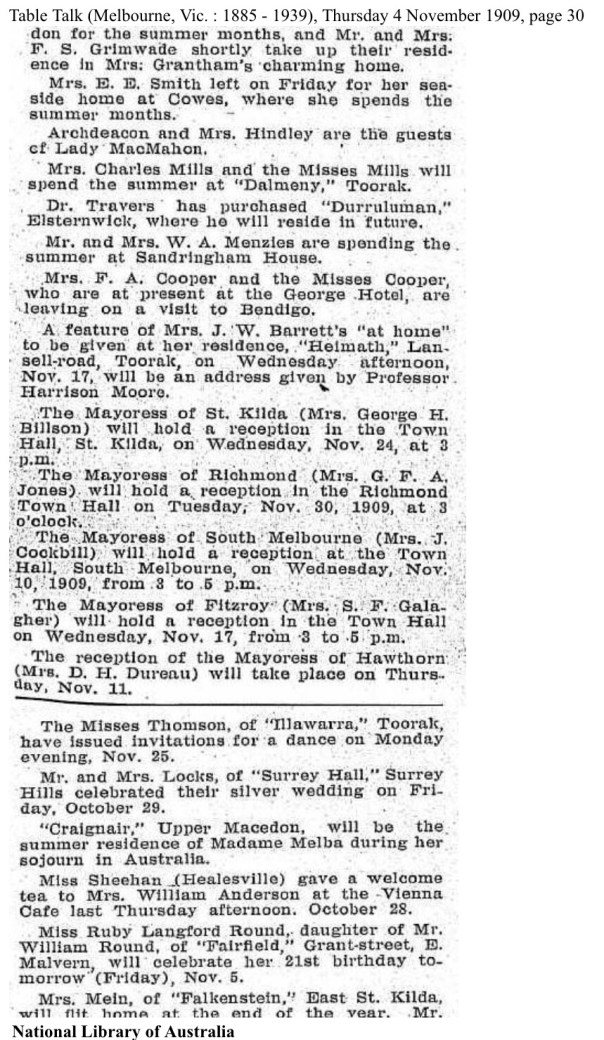
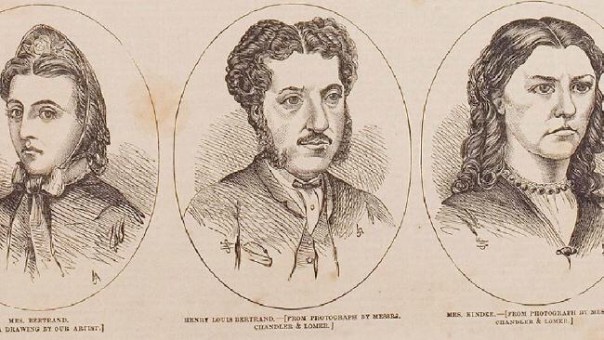


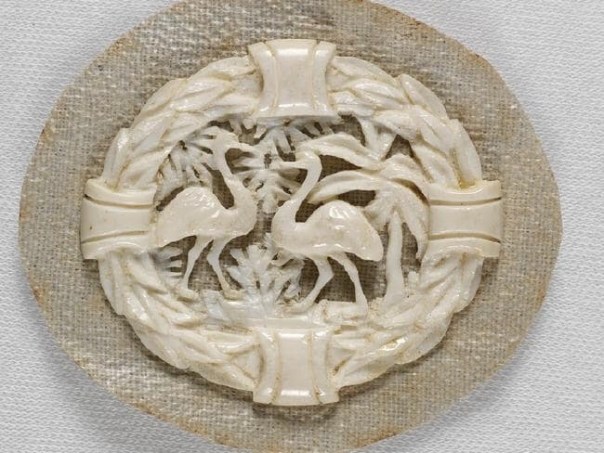


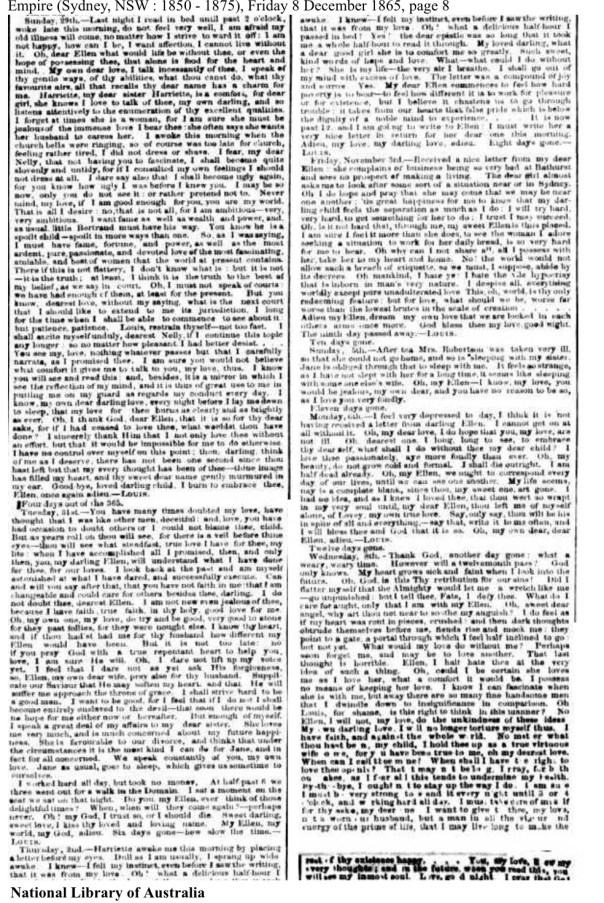


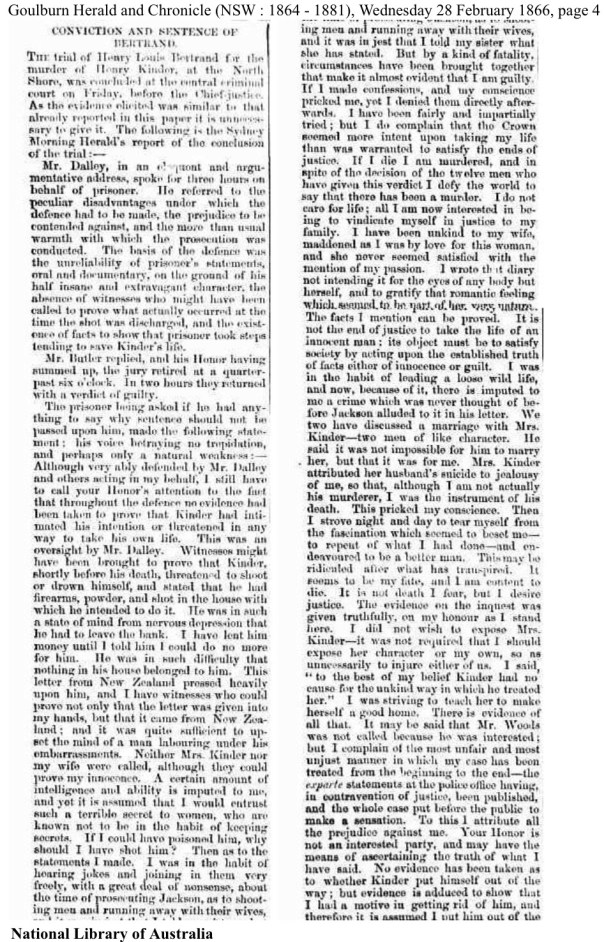


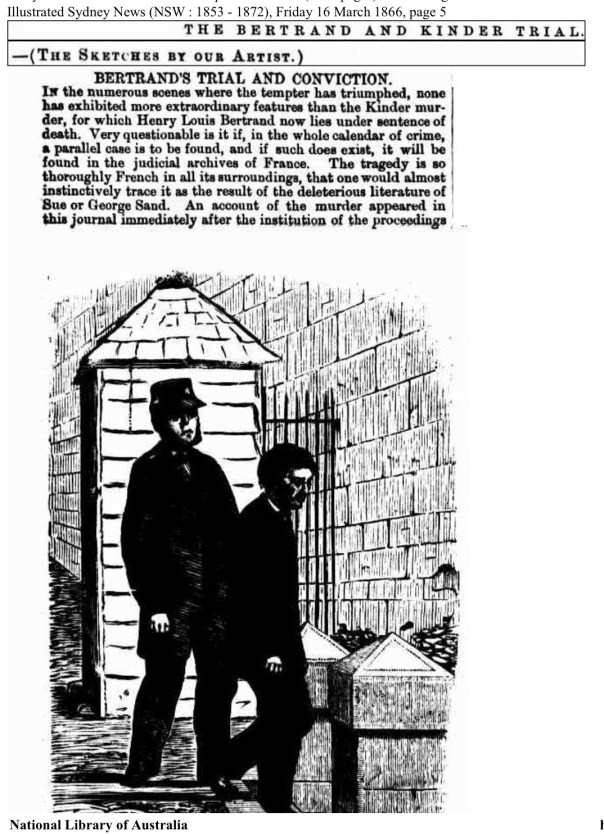
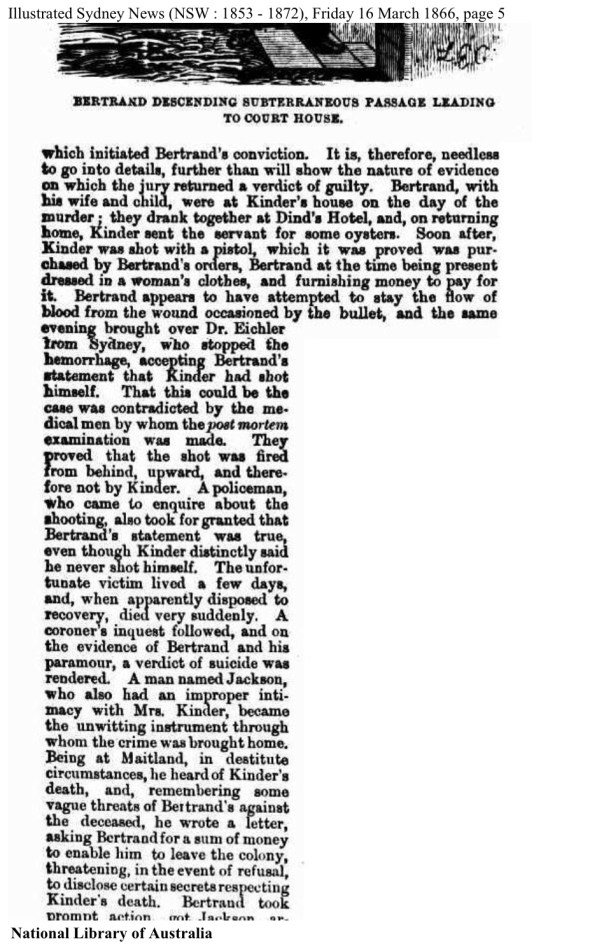


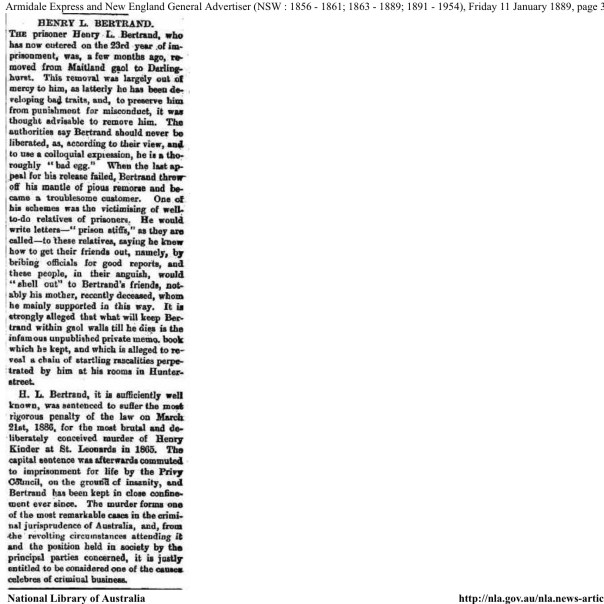

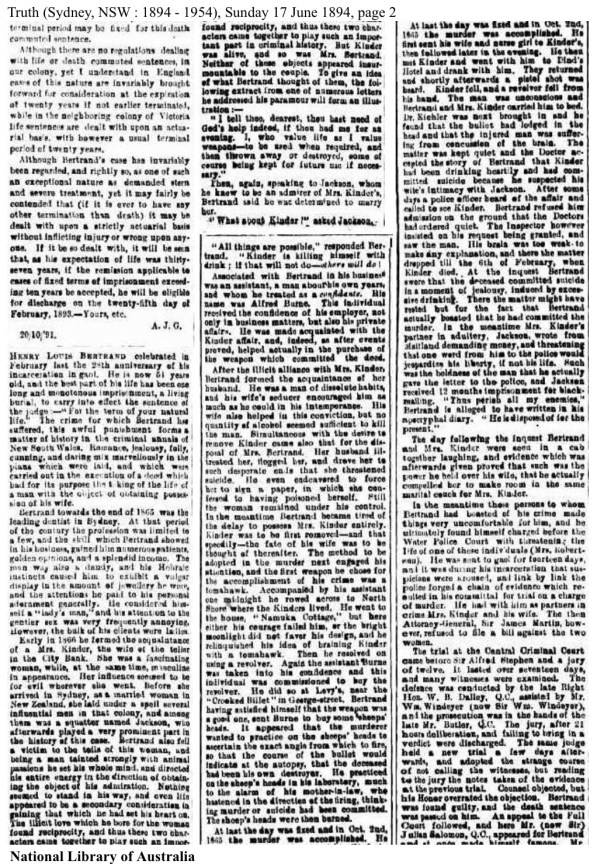


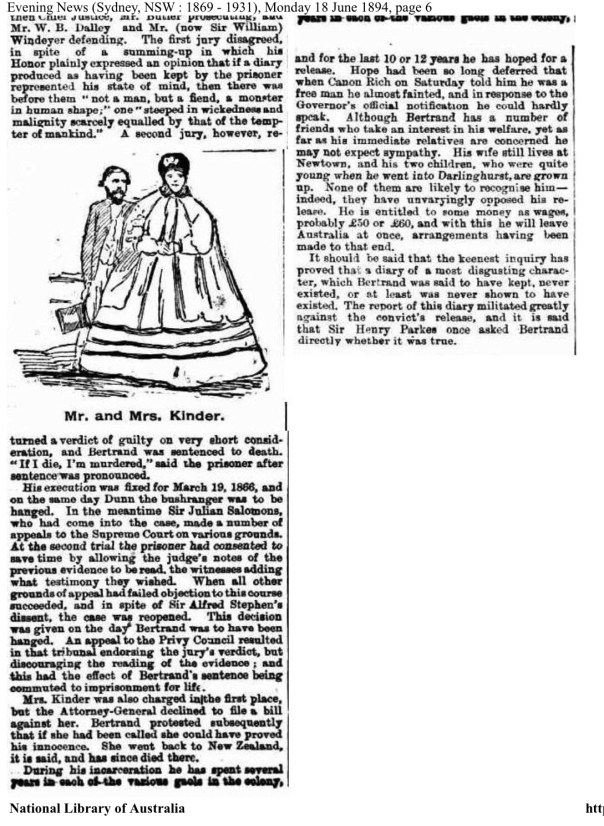
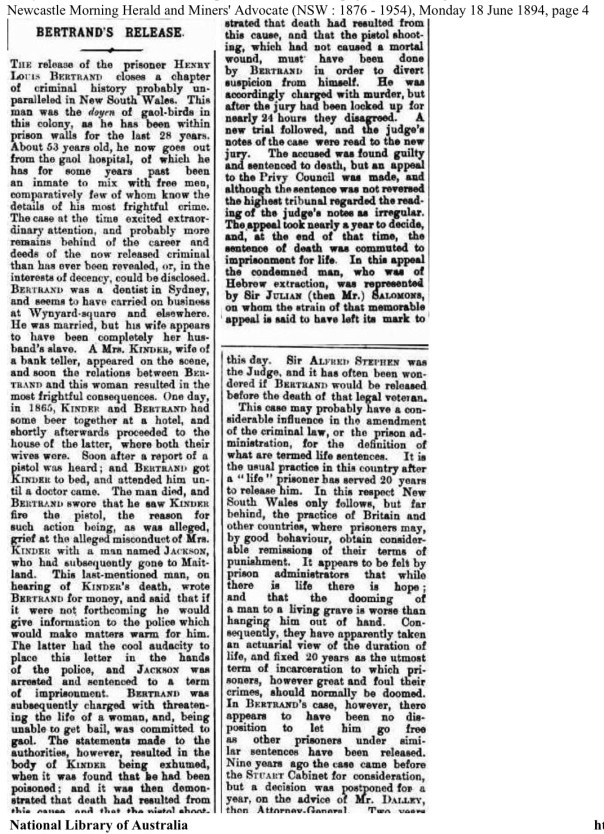
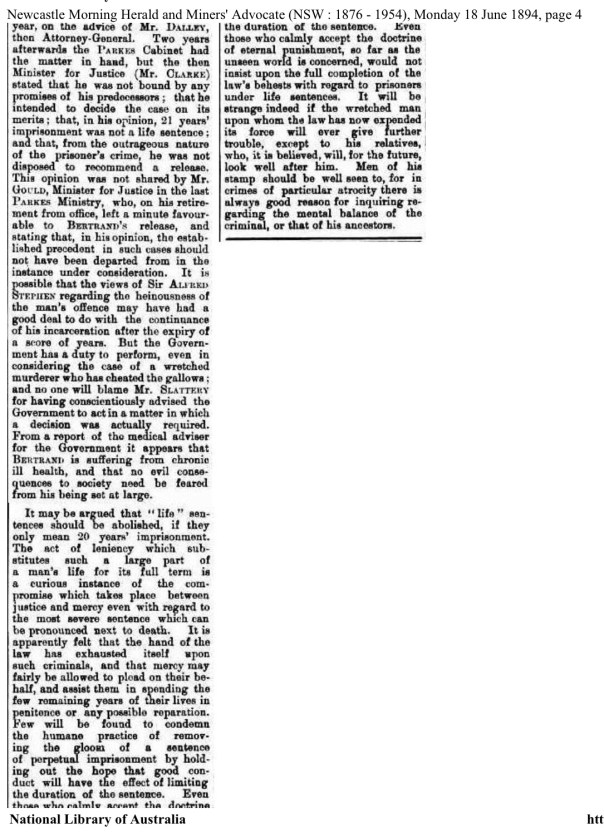


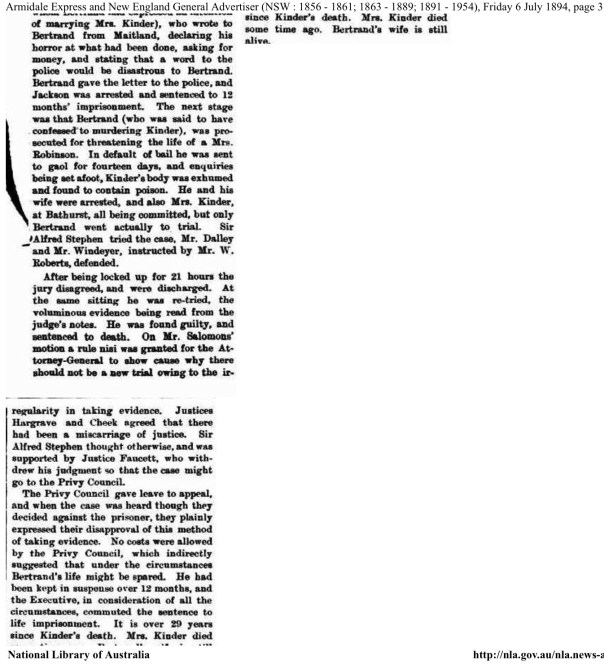

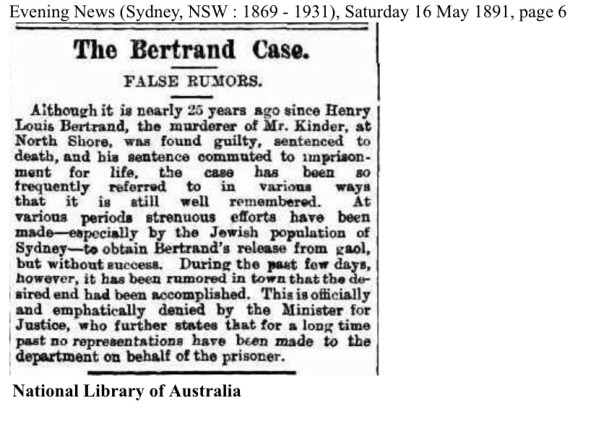
 Richmond River Herald and Northern Districts Advertise, 15 February 1895.






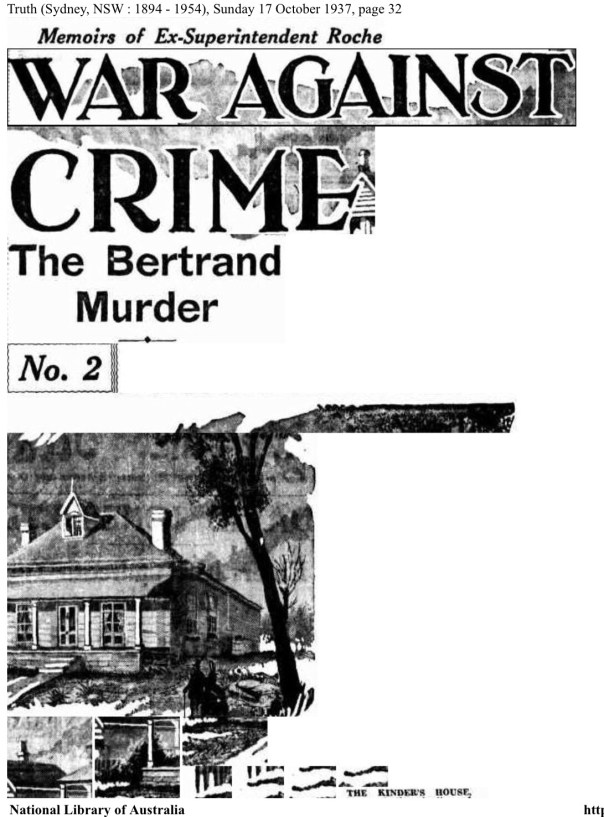

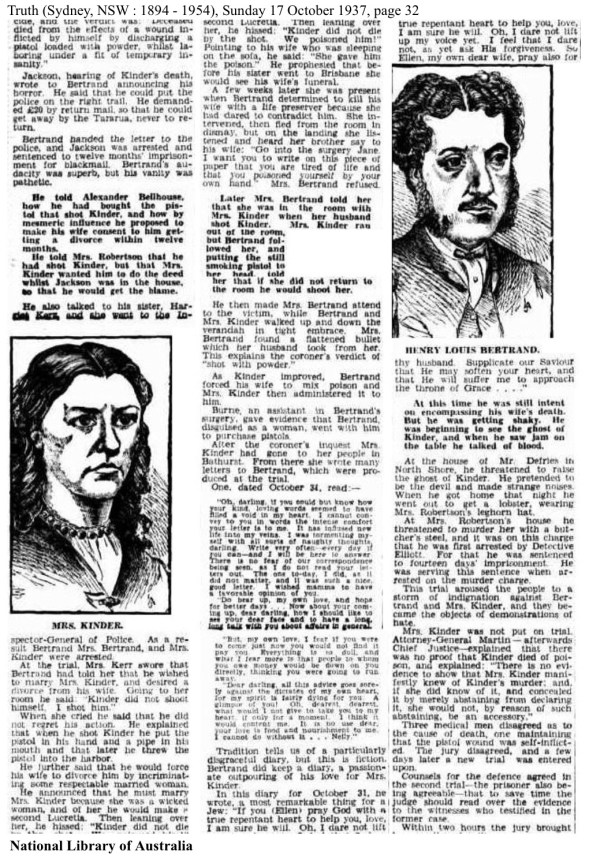
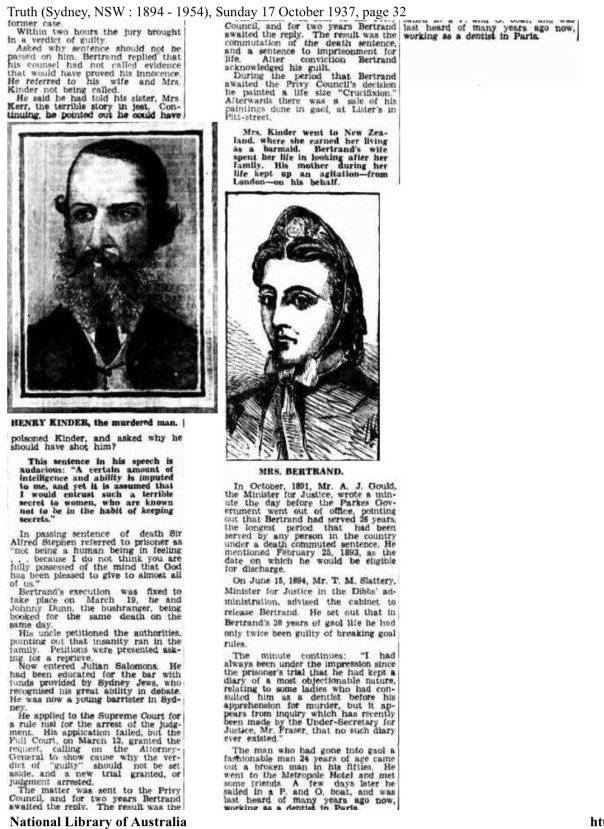

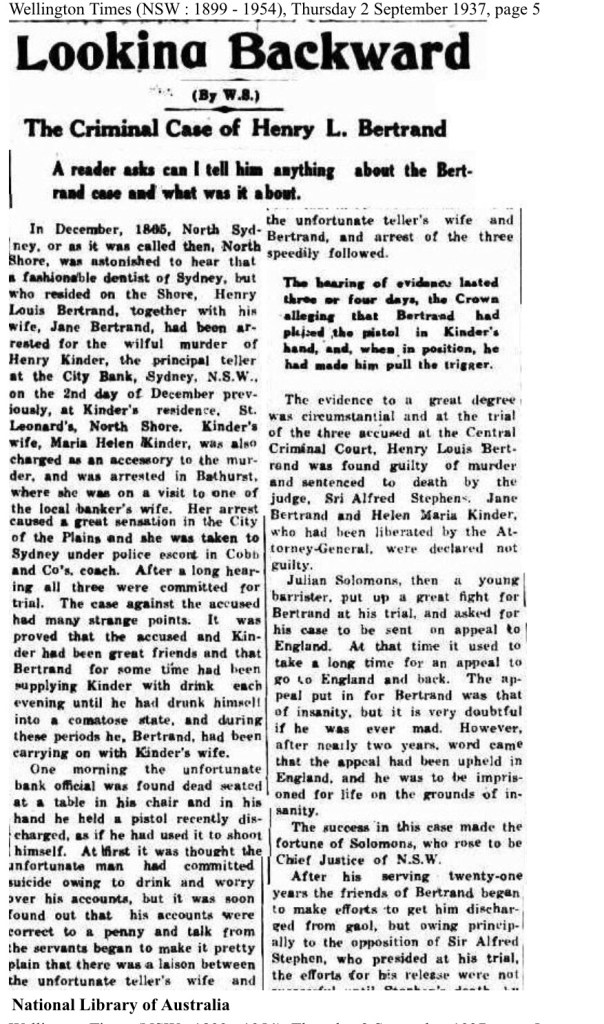

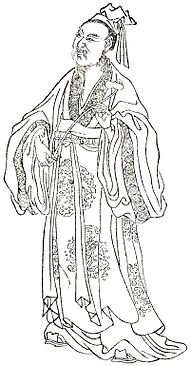

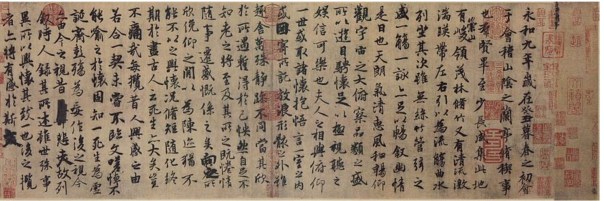 蘭亭集序 lán tíng jí xù