Category Archives: History

A 40 Year Journey Into (And Out Of) Fear Part 6A

We had been forewarned! Told that the new antiretrovirals were game changers. That people who were on the brink of death could be reprieved, could, like Lazarus, be brought back to life. The community organisations were given time to prepare for a change in how HIV/AIDS was handled! Did they listen? From my perspective…no!

I was discharged from Prince Henry Hospital on the 19th June 1996, after ten days in hospital. That was how quickly things were turned around. It was winter. I weighed just under 50kg, and I really felt the cold. I got a taxi from the hospital to Bondi Junction. My first port of call was Target for a new duna, and warm clothing, then home.

And so began a period of self-imposed boredom. For those of us who survived the final ravages of AIDS, we were, for a time, in a no-mans land. Caught between recovering from something we thought would be our end (and under earlier circumstances would have been), and having to mentally and physically readjust ourselves to an ongoing life, with minimal support services, not knowing what to do with ourselves, and realising that nobody else knew what to do with us either. It was a new world for all of us!

For anyone who thinks that surviving something as devastating as AIDS would send me back to my old life…think again! For the next 18 months, life became an often tiring and frustrating round of clinics, doctors appointments, specialists, support services, support groups, and pharmacy trips. When not doing that, I was stuck in front of the television watching “Days of Our Lives” and other trash daytime television. I ruminated on, and disected my previous life, as it was now a pre-AIDS, and post-AIDS existence…as that is what it was! It wasn’t a life! Change was going to be essential!

So reality started setting in…where exactly was I going from here? Taking vast amounts of antiretrovirals came with its own problems. In these early days of HAART, compliance was drummed into you. The drugs came with both dietary and time constraints. You often couldn’t eat fatty foods prior to dosing, or they had to be taken on an empty stomach. This both restricted eating out with friends, or involved rising at ridiculous times to conform. Likewise, doses had to be eight hours apart, so you were often getting out of bed in the early hours just to take pills. So I was often tired, and cranky! Added onto an already heavy pill burden were prophylaxis drugs like bactrim, dapsone, ketaconizole, clarithromycin, and the list goes on, which were often taken a couple of times daily. Then we have side effects…mainly diarrhoea and nausea. I was getting scripts for Imodium as I was buying fifteen by five boxes (yes, 75) at a time. If I was lucky, they’d last one month. They often didn’t! A bucket of Napisan was permanently in the bathroom for soiled underwear. It was a nightmare, and I often wondered if I had survived AIDS, to die of organ failure from all the drugs I was taking! It sounds like an exaggeration when I tell people that initially I was taking around 340 pills a week…but just look at Imodium, where I was taking a staggering 140 pills a week, or more!

Help came from the wonderful, empathetic Pene Manolas, and her “Calao” Project. Caleo was a treatment management program, whose sole purpose was to encourage and empower those attending to remain compliant despite the burdensome load of pills we were taking. Over the 6 (or 8) weeks of the program you were given tools to help you achieve that aim. It was incredibly successful, and lasted for 2 years, then ceased due to funding. It was not my last encounter with Pene.

At the outpatient eye clinic at Prince of Wales (POW) hospital in Randwick, I was still attending on a monthly basis, and continued, at least for a time, to get the ganciclovir injections directly into the left eye. In 1998, Professor Patrick Versace asked me if Ivwas willing to participate in the Vitrasert Implant trial. The tiny implant was inserted into both eyes, and leached ganciclovir into the eyes over a 9 month period. The chances of developing a cataract were estimated at 4%. I was a more than willing participant in this trial, knowing how stressful it was having the intraocular injections. So, two operations to insert the implants, which were held in place with a stitch. The 4% chance of developing cataracts became 100%, so then another two operations to remove the cataracts, and insert new lenses. The whole sad part of this was, that with HAART proving so successful at keeping opportunistic illnesses away, they were never needed, despite their success. It is still present in my right eye.

Then the panic attacks started. I would wake up during the night and feel like my bedclothes were suffocating me, and had to throw them off. I’d get claustrophobic in underground trains, and stopped getting them. I had a panic attack one Sunday night, home on my own watching television. A gay lifeline had been established by one of the community groups… can’t remember who. I rang the line, needing someone to talk to, only to find their phones weren’t manned on Sundays…just an answering machine. They rang me the next day to apologise, but it would have been a bit late if I was suicidal!

I had a transition period getting used to bad vision, and only one eye. I had a couple of serious accidents. I was on my way to the POW eye clinic one week day, and got caught in this crush of people rushing to get a bus on Crown Street. There was a wooden bus seat just out of my line of vision, and my knees hit it, and I went for a sixer. Took the skin off my knees and shins. Only one guy stopped to help me! One! He checked me over, and despite how serious the wounds were, I told him I was on my way to the hospital anyway. He saw me onto the bus, and the nurse in the eye clinic patched me up. The second time, on the opposite side of Crown Street, I tripped over some tree roots which had pushed the asphalt up. This time the skin was off both knees. I then realised that I had no perspective in my one working eye…the footpath looked flat to me. I started slowing down my walking from that time on. My peripheral neuropathy was setting in at this stage as well, moving from my feet to my ankles and lower shin. This caused me to stagger when I walked, and was responsible for getting me banned from three gay hotels over time. I wrote a letter to the Star Observer about it when the bouncers denied me entry to the Colombian Hotel on the night of my 50th birthday, and refused to get a manager or supervisor for me to speak too. The Colombian apologised in a return letter, saying the bouncers had been out of line.

The most serious falls happened in Bondi. I went to visit a favourite gift store down there, and while wandering around the store, my legs just gave out on me and I collapsed on the floor. The shop assistant, who had been talking to the owner, helped me up. Five minutes later, it happened again. Thankfully I didn’t break anything. But this time, with a frustrated look on their faces, without asking me what was wrong (in retrospect, I should have requested an ambulance) and assuming I was either drunk or drugged, just grabbed my arms, ushered me out of the shop, and sat me on the footpath up against their window. I was in a pretty serious state of shock, not knowing what was going on. I sat there for over an hour, not game to try standing again in case the same thing happened. When I eventually tested them, they seemed to be fine. I started walking home…we had moved from Penkivil Street to Ocesn Steet at this time…up Bondi Road. Deciding to visit a cafe on the other side, I crossed at an intersection that had both lights, and a small pedestrian crossing. I crossed through the lights fine, but on using the crossing my legs just gave out again, and I collapsed on the road, hitting my head on the gutter. Thankfully there was no turning traffic, and a guy sitting in the window of a nearby pub rushed out, grabbed me and helped me to the footpath. I eventually got upl had a coffee in the cafe, and walked home. The gash on my head was serious enough to go to hospital. It never happened again, though I suspect it was a precursor for what was to come!

Feeling a bit lonely and outcast at this time, I decided to try a personal classified in the Star Observer. I was quite open about my HIV status, and that I was damaged goods (yes, I really did say that!) from AIDS. I received about 10 letters in reply…I still have them…all from HIV+ guys. I met a number of them, though none really compatible except for about 3. One was a serial replier to classifieds whom I had been warned about. He was a bit of a problem, so dropped very quickly. Had a one-nighter with another (I’d had no secxual encounters for about two years at this time), and I liked him, but he didn’t want anything further. Then I met Michael, who lived at Rose Bay. We started a bit of a “thing”, though I think it was more a matter of us both being lonely, more so than being compatible, and we both had someone to go places with. Having had a number of bad experiences through the classifieds, the first thing he said to me when I knocked on his door was “Wow…you’re actually good looking!”.

Between 1996, and 1997 antiretrovirals started being pumped out at a staggering rate. Over this period, I must have been, in HAART combinations of three or four drugs, on every drug that was released (thank heavens for the PBS, who approved them very quickly). These included AZT, 3TC, Indinavir (a high dosage caused nausea), Nelfinavir (caused chronic diarrhoea), Saquinavir, Neverapine, Retonavir (more on this shortly), Combavir (AZT+ 3TC)l Efavirenz, and Abacavir. The quick approval of drugs, due to their efficacy, had its drawbacks. Long term side effects often popped up as time went on, for example it was found that Indinavir could cause kidney stones. For me, with both AZT and 3TC still being included in my combinations, my peripheral neuropathy got worse (even now in 2025 I have totally numb feet, which now affects my balance).

In early 1998, through a mutual friend I was out with one Sunday night, I met David in the bottom bar of the Midnight Shift. I was in a casual relationship with Michael, and he was in a relationship as well. We finally surfaced a couple of days later, both deciding to end our current relationships. David and I then went on to be in a relationship for 16 years.

Nelfinavir was the worse drug of all as far as diarrhoea went. David and I were both on it, and it was a nightmare. We were both scared to go out for any length of time, as we would inevitability be caught short. Nelfinavir gave you no warning (and it over rode any amount of Imodium) so you were often caught out grocery shopping, at a movie, or on a walk. We discovered that public toilets were disgusting! There were often underwear changes several times a day. I got so fed up with it restricting my life, that I just charged into Cassy’s consulting room, and demanded she change it! She did! Shortly after, David was also taken off it.

However, despite all this, my viral load continued to, initially, drop, then maintained itself at undetectable. My CD4 cells continued to do a slow, but constant, rise. Probably the only reason we put up with what we did.

But even more changes were coming!

Tim Alderman ©️2025

Why HIV/AIDS History Matters!

Please note that my use of language here is deliberate, and of-the-time! I make no apologies for it!

The one thing that really got my back up during the Coronavirus/Covid pandemic was that this was touted as the most devastating pandemic of our times. There was the occasional nod to the 1918 Spanish flu pandemic, but it was almost as if the 40-odd year whispers about the most devastating pandemic of the modern era…HIV/AIDS…had never happened. I looked at the worldwide death figures from Covid, approxiamately 7.5 million, with many millions more recovering from it. I then compare this to the death rates from HIV/AIDS over the last 40+ years which stands at over 43 million and still rising (630,000 in 2023 alone) despite modern treatments. The difference between the two pandemics is staggering! And of course, up until 1996 and the advent of HAART (Highly Active AntiRetroviral Therapy), your chances of recovering from AIDS was almost zero!

In this day and age, your chances of living with HIV with no serious illness implications, and by taking 1 or 2 pills a day, is very high. Yes, stigma and discrimination still exist, and I would never downplay that, but for the ease of maintaining good health for the lifetime you may have it for, there is little recognition now for the 40 year battle that led to now! Most people who seroconvert now, due in many respects to generational experiences, have no knowledge of the history of HIV/AIDS, and may never encounter a long term survivor who has lived that history!

So, why is HIV/AIDS history important? Well for starters, the response was nothing like Covid! HIV/AIDS has to be viewed in its main time setting of the 1980s/90s. This alone is a historically important era, as the LGBT community gained rights under the laws of many countries, where we finally came out into the open and proudly displayed our sexuality to the world. In retrospect, HIV/AIDS could not have picked a worse time to raise its head! It’s effects upon a newly openly emerging sub-culture were devastating, and in a world where hatred, misinformation, prejudice and stigma were still rife within the general communities we lived in, for many it was a rough journey from being closeted, to being “out”. So, just as my journey as a late emerging 26yo gay male, just starting out on my sexual awakening, little knowing that three years later both that journey and my HIV journey would go forward hand in hand, so the journey of the LGBT community would find itself both politically and socially intertwined.

From a community perspective, HIV/AIDS created an affirming group of mixed people. That here in Sydney we created what was an LGBT ghetto gave us great strength. The vast majority of this community lived in the Darlinghurst/Surry Hill/Paddington/Newtown/Kings Cross areas, and in many respects our services were centred in these areas. We had our bars, hotels and nightclubs; our own retail strip; cafes and restaurants; our newspapers; medical, dental and legal services; community and support groups. A self-contained community within the wider communit. There was a security and strength within this.

And this is where the strength of the community becomes historically important when HIV/AIDS appeared in the early 1980s. Despite knowing very little about the origins or eventual outcomes of what was to become a worldwide pandemic, the community stepped in early to put both political, medical and support mechanisms in place, as what started as a dribble of cases became a waterfall.

Out of our community of both positive and negative individuals, gay men and lesbians, we started negotiating with politicians to make funds available to help set up support mechanisms, and fortunately we had the very foresighted health minister Neal Blewett conferring with our community on strategy. As a country, we were among the first in the world to start taking the upper hand with HIV/AIDS,to attempt to minimise its impacts

We established what are now long-standing groups for both political clout, and support for those infected. ACON (AIDS Council of NSW), NAPWA (National Association of People Living with HIV/AIDS), BGF (Bobby Goldsmith Foundation), CSN (Community Support Network), ANKALI, PLWHA (NSW) Inc (People Living with HIV/AIDS), ASHM (Australian Society of HIV Medicine), Maitraya Day Centre, NorthAIDS, HALC (HIV/AIDS Legal Centre), NUAA (NSW Users and AIDS Association), ACTUP, and many other groups (even an AIDS bus at one stage) had their foundations in the 1980s/90s, and many still continue today within the framework of an evolving pandemic.

A lot of negativity also existed alongside this. Misinformation raised its ugly head even in our hospitals, leading to disgraceful headlines regarding full contagion gear, meals being left outside patients doors. Politicians like the Rev Fred Nile openly created fear and religious discrimination through misinformation. People in contact with HIV/AIDS patients wouldn’t touch crockery, cutlery, glassware, bed linen, toothbrushes. There was no open dialogue about those infected sexually, through blood transfusions, or needles. Safe sex messages became confused, and the badly timed Grim Reaper ad appeared. There was a perception of HIV/AIDS being a “gay disease” even when it crossed over into the straight community. Virus’s do not discriminate!

The community itself suffered innumerable and relentless loss as the pandemic ravaged our social circles. Funerals were daily affairs, our newspapers death notices took up pages. It politicised Mardi Gras! St Vincent’s Hospital established Ward 17 South as a dedicated AIDS ward, and set itself up as the premiere health care hospital, along with palliative care at the Sacred Heart Hospice.

Money poured in…not always political funding, but from within the community itself. Pubs ran auctions, and groups like BGF established fund raisers such as the Bake-Off. We had dedicated HIV GPs, and PBS funding for HIV treatments were established, so that care and treatments were always within the financial constraints of those on pensions. Government departments such as Centrelink, and the Department of Housing came on board with fast track pension approvals, and rental subsidies. Centres, such as the Dental Hospital set up trials. Clinics became specialised. We established memorials such as the Candlelight Vigil, the AIDS quilt, World AIDS Day, and the AIDS Memorial Garden in Sydney Park, so that grief could be openly expressed, never alone, but nurtured within a group setting.

This is why HIV/AIDS history in important, not just as to how a community responded to a seemingly chaotic pandemic, bringing all its diverse aspects together to create support and care, but how we, as individuals, have our seperate and diverse stories of how our lives were, in many ways, empowered and enriched within the structures we had created. Our lives, and deaths, mattered.

This history must never be forgotten. Recent pandemics such as Covid could have taken lessons from these pages of history. There is strength in community, provided we evade the negativity of exclusion, stigma and prejudice.

Sometimes, instead of looking forward, we need to look back.

Interestingly, from a historic perspective, there has never been a review, detailed study, or a commission into the handling of the HIV/AIDS pandemic. It would be fascinating to see what was revealed!

And over 40 years down the line from the first infections, we seem to be no closer to having a vaccine, or method of eradication! At this time, despite being able to suppress it using antiretrovirals, it would appear that HIV still has the upper hand!

Tim Alderman ©️2025

A 40 Year Journey Into (And Out Of) Fear Part 5

The period of the Great Denial was about to begin.

I have copies of many of my medical records from around 1994 through to 1999. Included are correspondence between my GP and specialists, information on trials, pathology, viral loads, hospital discharges, along with my own notes giving a chronology to all that was going on. I haven’t actually looked through them for many years. Perusing them now is a very scary process. How I ever survived all this I do not know! There are some frightening prognosis, and the word “enigmatic” appears more than once as my medicos tried to work out just what the hell was going on with many of my symptoms, and test results. If I was religious, I’d say it was a miracle! But I’m not religious! This was pure stubbornness, nothing else!

Ever since having pneumonia, I’d had ongoing problems with anaemia, and though possibly just because I was HIV+, it was later acknowledged by Professor Dwyer, from POW hospital, that there was a distinct possibility it was caused by AZT. I do remember how tired it made me feel. Everything was an effort! I used to walk from Darlinghurst to the then Redfern Mall in Surry Hills to do my groceries…Clancy’s in Darlo were scandalously overpriced…and it was a slow, exhausting walk.

Everything started to decline. For most of the two years between 1994 and 1996, I was put on, and taken off AZT. My CD4 counts dropped to 160, and continued on a slow downhill slide from there. My weight started dropping! In one letter from a specialist to Marilyn McMurchie, it was stated that my weight was 52kg! Considering that for many more recent years my weight was stable at 68kg, and that I now try to maintain it at between 74kg and 76kg, find it hard to visualise myself at 52kg! During my recovery years of late 1996/1997, drinking mates at The Oxford informed me, scarily, that despite wearing baggy clothes to try to disguise it, they could tell I was rapidly losing weight, and speculated on when I would just…disappear, like so many others!

Yet despite all the signs of a rapid decline towards the inevitable end, I went into full denial, and carried on as if nothing was happening. By 1995, the Stronghold Bar had closed, though I continued to DJ at the Oxford Hotel, and for the Dolphin Motor Club at the Midnight Shift. A couple of close friends died which utterly shattered me. Stuart and Don, both whom I did my gutter drag stints with, both passed…Don from stomach cancer, Stuart from AIDS. With them gone, all the wind went out of my sails, and I threw a large party at my apartment…still shared with Tony…and sold off all my costumes and drag. An era had come to an end! The other thing that ended around this time…though in some ways substituted by copious amounts of alcohol…was my sex life. Always pretty healthy up until this time, I just lost interest, and, I gues with my weight dropping at the rate it was, I just didn’t want to be seen stripped down naked!

In early 1996, Tony and I decided to move from The Dorchester in Darlinghurst, to an apartment in Penkivil St in Bondi. It was here that things took a turn for the worst. Initially, I started complaining to Tony about how dark the apartment was…it wasn’t! Then stepping out of the shower one day, I caught sight of myself in the mirror. Who was that person, that emaciated skeleton in the bathroom with me! It was a horror show! Skin stretched over bone! I often went to the French patisserie on the other side of Bondi Rd from the end of our street. Just crossing Bondi Rd was an effort. A couple of years later, I ran into the woman who used to serve me there. She told me she would watch me crossing the road, always fearing I would collapse midway, I was so thin and frail looking. She was astounded that I had survived that period (all that I said was that I had a viral infection on my brain…not quite the truth, not quite a lie…I didn’t go into detail!).

In early June 1996, I collapsed on the footpath outside my apartment building. I could hardly breathe, and had this heavy weight in the centre of my chest. My immediate thought was that a heart attack was going to spirit me away before AIDS got me! It could be a blessing! With no one around to help, I got myself into my apartment, and rang Tony to get me to St Vincent’s. It was a collapsed left lung! Thankfully neither the cardiac problems, or PCP I was suspecting.

I was in St Vincent’s Ward 17 South (the AIDS ward) for 2 weeks. Despite my vision greying out, I kept insisting that I just needed new lenses in my glasses. I saw Dr David Cooper, but although questioned regularly about my eyes, I insisted they were fine! Talk about denial! It is a period of stupidity I’ve never forgiven myself for! To my thinking, having gotten though 13 years of HIV relatively unscathed, it could not possibly get me now! My care at St Vinnie’s could not have been better, despite a massive cut to hospital funding that occurred at this time. Our HIV nurses were walking miracles. I was still on the Oxfords DJ roster at this time, though I remember the shocked look on Sandy’s face (a manager at the Oxford) when, on visiting someone else there, she realised I was in there as well. It probably looked obvious I wouldn’t be returning to the mix-decks anytime soon!

I was discharged at the end of two weeks. It is at this point where I am about to make a decision that would save my life! Feeling that Marilyn had too soft an approach to HIV, and desiring a more aggressive approach to my health care…I had my rather scary discharge papers sent to Dr Cassy Workman! Perhaps more importantly, despite being told it could take three-plus months to get in to see the tee-shirt wearing, chain-smoking Cassy…a week later her receptionist rang to say she wanted to see me…urgently!

So a few days later, I turned up at her (then) Surry Hills surgery. Her consults were far from normal, something patients were thankful for as the casual setting put them more at ease. It is not even a point of despute that Cassy was one of the most knowledgeable, most radical, most aggressive HIV GPs in Sydney at this time. Those under her care adored her. The very first thing she did when I got in was to check my eyes. She immediately suspected CMV (Cytomeglovirus retinitis). She rang Patrick Versace (a leading Sydney ophthalmologist) and arranged for me to visit him at his Hurstville eye clinic the next day. A friend drove me there the next morning. He confirmed the diagnosis. By the time I got back to Bondi Junction, I received a phone call from Cassy to say I was to get to Prince Henry hospital, at Little Bay, IMMEDIATELY! They were waiting for me!

25th June 1996! So, a very scary bus trip to Prince Henry, without even a stop-over at home. It was coming on nightfall when I got there. As promised, the nurse in triage was waiting for me. It was not a healthy boy who turned up that night. Weighing in at 48kgs, I had chronic anemia, chronic candida, chronic bilateral CMV retinitis, and 10 CD4 cells. They didn’t need to tell me prognosis was not good! I was admitted to Mark’s Pavilion (the AIDS ward) that night, then followed 2 weeks of blurred memories…life went into fast-forward! Hooked up to blood, and saline drips. Hourly blood sugar tests…my finger tips were so sore from the pricks! In my mind, this was my final pit-stop. I remember vividly how reconciled I felt about that. Not scared at all…just very much at peace at such an…inevitability!

But the twist was coming!

The ward on the floor above us in Marks Pavilion was for the HIV/AIDS Tuberculosis guys. My first morning there, I was piled into a mini van with other patients from both floors who required care at Prince of Wales (POW) hospital in Randwick. The eye clinic there was to become a very familiar place over the next couple of years. And so my first experience with the very scary ganciclovir intraocular injections. Trust me on this…no matter how necessary it may be, our eyes just don’t want needles poked into them. And will go to any means to avoid it. Trying to keep your eye still when you know a needle is heading towards it…they have to try every trick in the book. The weird thing is that it doesn’t hurt, it’s just the eyes defensive function. Anyway, we got there, and this had to be done quite a few times a week until the CMV became quiescent. Both my eyes were full of the cloudy formations typical of CMV, though my left eye was more severely affected, with only a small window of vision left in it. The optic nerve was severely affected. I was lucky…it never got into my nervous system…a very scary way to die.

There was one very touching incident that happened. One of the TB boys and myself often attended the same eye clinic. He was a good looking lad, and appearing to have little support from family and friends, I sort of took him under my wing. I consider myself to be a pretty tough guy…I’ve had enough hard strikes in my day to make me so…my friends say they admire my pragmatism. I can’t remember the guys name, but we were sitting together in the waiting room and started discussing our situations, our fears. I put my arm around his shoulder, and it was like a trigger…we both ended up in tears. Such a brief, intimate encounter, and it was the last time I saw him, but I’ve never forgotten it. The lonely guy and the tough guy sharing an instant in time. I hope he survived his TB and eye encounter. I hope his fight coontimued.

Under Immunologist Professor Dwyer I was started on a combination of old and new drugs…AZT, 3tc and the new kid on the block…the protease inhibitor Indinivir! This was the start of what was to become known as HAART (High;y Active Antitetroviral Therapy). Viral load counts were started around the same time…my initial reading in Prince Henry was 500,000! The initial high dosage of Indinivir caused nausea, so dosages were modified. I also had a bone marrow biopsy to explore how much AZT was present there. The very nervous male nurse gave me Pethidine. I was so high…an amazing experience. The biopsy was done at the rear top of my thigh, and his first sample wasn’t sufficient. Upon asking my permission to go in again for a better sample, I was so off my face I told him to do whatever he liked! There was a very nice bruise there after,

I was in Prince Henry for 2 weeks. As I stated earlier, most of it was a blur. I’m sure I had visitors, but don’t ask me who! It was all medical…including 8 trips to POW for the ganciclovir injections. At the end of the two weeks…thanks to the new drug regimes, my CD count was doing a slow rise. Handing me over to the care of clinicians and my GP, was a logical step.

So I was discharged from Prince Henry on the 9th July 1996. I got a cab home. One would think…gee this is a really good outcome! And it should have been! I’d survived AIDS! But it was just the start of an 18 month recovery nightmare.

Thrust back into a world that was not prepared for me…for us! We became the HIV worlds Lazarus syndrome survivors! No one knew what to do with us! We were left flailing in the winds of change!

Tim Alderman ©️2025

A 40 Year Journey Into (And Out Of) Fear Part 4

Before diving into the 90s, a brief note on sub-cultures (Tribes) within the gay community at this time…or to be more exact, how I placed myself within the community as far as lifestyle went in the 80s and 90s. After coming out in 1980, I intentionally positioned myself in the Clone sub-culture. It was a Tribe I felt comfortable in, and adopted it with ease. It was a badge I wore with pride pretty well for the duration of my active life on the scene. The short hair, big moustache, white or black tee-shirts (and flannelette shirts during winter), Levi 501 jeans and boots were, in my eyes, the look that defined gay masculinity. I was, at times, known to dip into the leather world, but my interest in leather was never sexual! I just liked its look, so never saw myself as a leatherman. For a number of years I was an active member of the Dolphin Motor Club (DMC), and member of a gang known by the acronym G.O.D. (Girls/Guys of Disgrace) which was established by the girls who founded Wicked Women, and whose purpose was to peruse the scene at night, and report any potential problems…problems which had escalated since the advent of HIV/AIDS thanks to the media, and societal homophobia. This morphing between scenes meant I could indulge my fun-side by doing what was known as “gutter drag”…a sort of respectful parody of drag itself, using huge wigs, over-the-top make-up, big frocks…and no removal of facial,or body hair. Cleo’s “reputation” and antics still live on amongst my friends. My life revolved around the Oxford Hotel, and the Midnight Shift night club.

By the 1990s, what I call the Great Diaspora of the gay community began, starting, in many eyes, the slow demise of the gay ghetto. People fled to the far flung suburbs, the north and south coasts, to the hinterlands, to the bush, and even interstate, and overseas. Some from fear, some to get away from the relentless deaths and illnesses, some to find peace and quiet, some to die.The scene has never recovered.

So we enter the 90s! Little did we know that the apocalyptic start to the decade, with death notices filling page after page in the gay rags, and with no end in sight, would morph into a decade of great hope by the time we hit 1996. It was at its start, a time of monotherapy, and trials. At the start of 1990, I had a CD4 count of 453…and going down! Two of my ex-partners died of AIDS. Damien evidently returned to his family in Victoria, and died in 1991. I found out quite some time later, when running into a mutual acquaintance in the Oxford Hotel one might, just as I was about to attend a DMC dinner. Frank…my first Sydney partner, if I don’t count the psycho who dragged me back to Sydney from a happy Melbourne life…I ran into when leaving my hairdressers (Kulture In Hair) in Goulburn St one day in 1994.I hardly recognised the figure slowly shuffling up the street. He died a short time later.

Personally, I had a fleeting relationship with Anthony. My sex lifestyle was pleasantly fulfilled with three fuck-buddies. Paul I met in the bottom bar of the Midnight Shift in the very late 80s and would have had a serious relationship with him if he wasn’t already married to his job. Graeme I met when he and his partner Peter took me home…after picking me up in the Midnight Shift…for a threesome. The next morning I found myself in the middle of a domestic abuse (verbal) situation. It was like I wasn’t even there. Graeme drove me home, and when I asked him up for a coffee, he told me Peter would have him on the clock for his return. Shortly after, they thankfully split up, and Graeme and and I saw each other regularly for a couple of years. Gregg I met at the Oxford late one night. He wore way too much after-shave, and he had a wife and two daughters in Forbes. One of those marry-to-cover-up-being-gay situations. He came to Sydney every month to tutor on computers at Sydney Uni. We saw each other very regularly for about 2 years…until I started to get serious with him.

I quit my managerial job at Numbers Bookshop, and moved to a managerial position with Liquorland in 1990, whose store was situated under Numbers. This job was to be my last for quite some time. Not only was I out as a gay man, but also out as a HIV+ man. To my thinking, a gay man running a business on the gay strip was a no-brainer. Obviously I had the contacts in the community to bring in business…and I did. Under my management, the store shot up the rankings from 43 to 18. However, not everyone was happy with my presence! More on this shortly.

Healthwise, in 1992 I started seeing Dr. Marilyn McMurchie as my HIV specialist, and she started monitoring my CD4 and CD8 counts, and percentages. At that time, my CD4 count was <350 My greatest fears were realised…I was diagnosed as stage 3 HIV infection, and started on AZT (my thoughts on this have already been mentioned.There was a slow decline in my CD4 counts once I started on it. Having been taken off AZT briefly, I was asked to go on a trial using another monotherapy drug called 3TC (lamivudine). A short way into the trial, it was found that nearly all participants had haematological toxicity and become anaemic, so the trial was stopped. I also went on the p24-VLP (Very Light Protein) trial around this time. It was an injectable, and the theory was that by stimulating the p24 antigen, it may stop the decline to AIDS. It did nothing!

It was also the year I had viral pneumonia in my upper right lung. It was pretty serious, and something I may have shaken off more quickly if I wasn’t a chain smoker. It pretty well crippled me for a couple of weeks, and I pretty well took up residence on the lounge, in front of the tv. Recovery was very slow, and my holiday pay in advance saw me through.

In 1993, I went onto DDI (didanosine). I was reluctant to take ddC due to side effects. DDI was vile. The huge chalky tablets (jokingly called horse tablets) had to be ground down to a powder in a mortar & pestle, then you mixed them into whatever liquid made them palatable…in my case, Nestles chocolate Nesquik. Even then, you had to hold your nose when downing it! It was a nightmare to prepare in the workplace…which was only one of several problems I encountered at Liquorland.

When I started there in late 1990. The area manager was a wonderful man, who believed in inclusion and treated all the staff with respect. He left in late 1991, and replaced by Rowan, pretty well his exact opposite. Not only homophobic, but as it turned out…HIVphobic as well. For the next 18 months I was subjected to relentless bullying, by an expert. Always out of earshot of staff, the smallest thing was picked on. With no witnesses, so a his-word-against-mine situation, knowing from experience that head office would take his side. Things came to a head in late 1993 when he installed an assistant manager at the same pay grade as me. With me working 50-60 hour weeks, smoking and drinking heavily, and with a bad diet…I’d had enough. My health was already in decline, and I was losing weight. I arranged a meeting with Rowan to request that I step back to a position of assistant manager to reduce my work load. At the time of the very uncomfortable meeting, he said to my face…”You should consider quitting. You’ll be dead in a couple of years anyway!”. As it turned out, an assistant manager position opened up at the Surry Hills branch. I then went on 2 weeks vacation. Rowan would not confirm the transfer despite a number of calls. A day before I was due to return to work, he confirmed the transfer…he had been hoping I’d quit in the interim. As an act of planned revenge, I turned up at the Surry Hills store…and handed in my 2 weeks notice. Rowan said not one word to me over that period…not even a farewell!

I had started to indulge in my passion for dance music by becoming a resident DJ at The Oxford Hotel in 1990. I DJd there until 1996, and also at the Stronghold Bar (in the basement of the Clock Hotel in Surry Hills) from 1990-1994. This proved to be a handy source of additional income as time went on.

I met John at The Oxford one night just before quitting Liquorland. A gentle, artistic man (his mother thought I was too old for him) we were together for about 8 months. With my health slowly declining, I pushed him away. I didn’t want him (he was HIV-) to have to nurse me through, what I saw at that time, the inevitable end.

In 1993, Carol Ann King started the Luncheon Club and Larder, providing cheap meals and grocery items to HIV+ boys on pensions. Though never attending the club myself, I did become a disability pensioner that same year. Fred Oberg at ACON was instrumental in getting me onto the pension, and a SAS (Special Assistance Subsidy) with the Department of Housing, who paid a percentage of my private rental in The. Dorchester, in Darlinghurst.

At the same time, the Dental Hospital in Chalmers St, Surry Hills started providing free dental care to those with HIV (a trial). Having ongoing bouts of thrush as a result of a declining immune system, I attended there and had a number of teeth removed that were so loose I could have pulled them out. They also devised a small denture to fill a gap at the front lower jaw. I could smile again without covering my mouth to hide the gap.

Prophylaxis was another term we came to grips with. In 1992 I started on Bactrim for my reoccurring bouts of thrush, and Fluconazole to ensure I didn’t get PCP.

I had my 40th birthday 1n 1994. I considered myself very lucky to have reached this milestone, and threw a big bash at the Stronghold bar, where I was a DJ. Tim Vincent, a close friend and owner opened the bar early in the afternoon, put on a long happy hour, and was an open house until the bars usual opening hour. It was quite a crowd, and quite an afternoon.

By May that year my CD4 count was 160, and I was back on AZT! At this stage I estimated I had maybe 2 years left…if I was lucky, or a miracle happened. On the former, I was accurate, little knowing the latter would happen, and a miracle did happen!

Tim Alderman ©️ 2025

A 40 Year Journey Into (And Out Of) Fear Part 3

We create our own memorials for a growing list of names of friends, acquaitenances, partners, and family members swept away in this new tide, a tide of grief. I attended my first AIDS Candlelight Rally and Vigil…it was the first held… in October 1985. My friend Dietmar Hollman was a reporter for 2SER Gaywaves, and reported from the rally and AIDS Candlelight Vigil,,organised by Sydney City councillors Brian McGahen (died 1990, using voluntary euthanasia) and Craig Johnston. The recording, which can be found on the Australian Film & Sound Archive, includes discussion of the 1985 Public Health Proclaimed Diseases Amendment Act, speeches from Brian McGahen, Craig Johnston, Dorothy McRae-McMahon (Dean of the Pitt Street Uniting Church), Dennis Scott, a performance from Judy Glen and vox pops from the crowd, including Robert French, and Mother Inferior (Sisters of Perpetual Indulgence). The candlelight walk down Oxford Street started in Green Park, had the vigil in Hyde Park…there weren’t many names to read out at that stage, but as the years rolled by the list got longer and longer…and finished with a rally at Parliament house in Castlereagh Street. Along the way, there was a brief halt to remember Michael Stevens, a young gay man who had been bashed to death two months earlier, caught up in the tide of gay hate and hysteria brought about by media reports on the HIV/AIDS pandemic at that time. The whole event was solemn, and tearful.

The other equally emotive memorial was the AIDS quilt. The panels were created as part of the Australian AIDS Memorial Quilt Project, which was founded in September 1988 by Andrew Carter OAM (the brother of Don Carter, known as Dodge Traffic) and Richard Johnson in Sydney. It was formally launched on World AIDS Day, 1 December 1988 by Ms Ita Buttrose. Quilt unfolding started in 1988 with 35 panels, now 122 quilt blocks with 8 panels per block. This was the most powerful of the AIDS memorials, due to its panels being designed and partially put together by friends and family of the deceased. Wandering around the blocks of panels…with conveniently placed boxes of much needed tissues…and hearing the names being read out was a truly moving experience, and no one left with dry eyes, and feeling emotionally drained. Myself and a group of friends assisted with the beautiful, quiet unfolding of the panels at both the Commonwealth Pavilion (in the old Sydney Showgrounds) and the Conference Centre in Darling Harbour. I was also a names reader, and despite the solemnity of the occasion, there was the occasional lapse

Above photo…Peter McCarthy, Peter Gilmore (Deceased), Bevan (Deceased),,Steve Thompson and myself at an AIDS Quilt unfolding (we were in folders) at the Government Pavilion (Sydney Showgrounds ) around 1988/89. The tee-shirts bear the Quilts Insignia, and “Remember Their Names”

into humour when the names of the Sisters if Perpetual Indulgence were read out. It was hard to keep a straight face. It is the one singular AIDS ritual that I miss, and feel that the panels are wasted hanging on a museum wall.

In August 1987, I was approached by The Bulletin to gather some HIV+ friends together for an interview (unfortunately I can’t remember the reporters name). The interview was held in The Oxford Hotel. I still have a copy of it, and when I read it now, I cringe. There was so much naivety back then, as we were still “filling in the gaps” in our knowledge base, so to speak. There was a mixture of positive and negative attitudes about how we rated our chances of survival, but the general feeling amongst all interviewees 3as…we will be killed by it, so let’s party while we can!

Then, despite all this solemnity going on around us, we still managed a bit of dark humour with the publication of “The Daily Plague”. This was a fanzine that had no regular publication dates…it just seemed to pop up out of nowhere. It’s tongue-in-cheek satirical approach to the AIDS pandemic came at a time when it was needed. I also can’t overlook the huge role played by the Sisters Of Perpetual Indulgence. Despite what seemed to be a bit of flippancy, both with their over-the-top names, and the irreligious n and interpretation of Catholic ritual, they were in fact outspoken radicals, and would be seen at most rallies and vigils. I always have great admiration for those who don’t take themselves too seriously.

Much to my amazement, by this stage I was still very healthy. By 1987 I was already four years into the fray, with no sign of illness, though my CD4 counts had slowly started dropping This was the year that the controversial…most toxic and most expensive ever… drug Retrovir (AZT, Zidovudine) was introduced. A failed cancer drug, it was thought that it might “keep the wolf from the door” with HIV huts…yeah, right! Despite several flawed trials, and some evidence to show that it pretty well did nothing, they fostered it onto us.,I wanted nothing to do with it, due to the bad press around its side effects, and the results from the Concorde trial in 1991.. Patients on zidovudine should be monitored closely for nausea, vomiting, diarrhea, headaches, myalgias, insomnia, bone marrow suppression, peripheral myopathy, lactic acidosis, elevated liver enzymes, and hepatotoxicity…oh…and suppression of their immune systems! I fought my doctor on this one. Some patients flatly refused to go on it. They were the lucky ones. My doctor won that battle…and I reluctantly started on it, with massive dosing. I, and many others, paid the price for that decision.

Shortly after my return to Sydney from Melbourne in mid 1082, I met my first partner, Frank. We had an apartment over;poking the harbour in Neutral Bay. We split up around the time I seroconverted, and left my retail job in the city to take up the then far more lucrative jobs…we were paid huge amounts of money under the counter back then…as a bar useful in the Midnight Shift, and doing the graveyard shift in Numbers Bookstore. It 3as an amicable breakup and we remained flat mates. Frank also seroconverted around this time, though we both had a lot of casual sex back then, so it was impossible to pinpoint any one person for causing it. Frank died in the early 90s. While working at Numbers, I met my second partner, Damien. At that time he worked at “Dudes”, a male brothel in Goulburn Street (which later became Kulture In Hair). Damien also worked at the Den Club in Oxford Street. He was also HIV+, and died in October 1991. At the time I was officially flagged as HIV+ in 1985, my partner was Tony. He was HIV-, and the two differing status put what was already a shaky relationship on a downward spiral. We split shortly after, though have remained friends…and occasional housemates…through to the present day. Tony is still HIV-.

As we entered the 90s, things were about to come yo a head.

Tim Alderman ©️ 2025

A 40 Year Journey Into (And Out Of) Fear Part 2

New words were added to our vocabulary, a series of acronyms that would imprint themselves forever into our memories…PCP (Pneumocystis pneumonia); KS (Kaposi sarcoma); CMV (Cytomegalovirus…one I’m intimately familiar with))… MAC (Mycobacterium avium complex); candidiasis (Thrush), toxoplasmosis, to name a few. When we asked how people were, we were really asking what did they have…and what was the prognosis! Meanwhile, the Australian nightmare was well and truly hitting home.

In 1986, my first close friend, Andrew Todd, died. At that time there was no dedicated AIDS ward, and Andrew was shifted between wards as beds were needed for other cases. On Christmas Day, we visited him in what was called St Christopher’s ward (due to patients travelling into and out of it), in Sydney’s St Vincent’s emergency department. He was very thin, and frail, but we had brought gifts for him, including sheet sets, and books. We were going to a friends place in Glebe for Christmas lunch. When the time came to leave, Andrew said to us, something that was quite upsetting for us, I have to say, that he ‘wouldn’t die that day, and ruin everyone’s Christmas lunch’. It unintentionally did, as we waited all day on edge, for a phone call. True to his word, he didn’t pass away on Christmas Day. He died on Boxing Day. It was my unpleasant duty to ring everyone at a party, and inform them. Party pooper status acknowledged!

His funeral at Eastern Suburbs Crematorium, a place we were to visit on far too many occasions, was several days later. His father had travelled from South Australia to oversee it. Myself and Sandro, both close friends of Andrew’s, ended up being the middle men between those of us who wanted a funeral that was honest and respectful, and the leather community who wanted what we considered an over-the-top leather funeral. We won that one.

Towards the end of the crematorium service, as the curtains were closing over the coffin, every door in the chapel suddenly, and very loudly, slammed close. The silence after was eerie. We could say it was just the wind, but one was left wondering. Andrew got the last laugh anyway. I had lent him many novels during his hospital stays, and in his will he bequeathed them all back to me.

Sex became a conundrum. As soon as it was found that HIV was sexually transmitted, the dynamics of sex changed, at least temporarily. Some guys went celibate. Others cut out anal sex altogether. Others went to odd extremes, like standing well apart and just mutually masturbating. For a culture that was heavily geared towards sex, it was a real blow. The dynamics of “picking up” changed significantly. Condoms became the new order of the day, and condom and lube “safe sex” packs were everywhere, from sex venues to pubs and nightclubs.

ACON created the Safe Sex Sluts, who at least put a bit of fun into what was now a serious subject. This, over time, created some reverse, and some dark situations. On the dark side, terms like “bug chasing” came into being. This phrase described those who deliberately sought out HIV+ guys and indulged in unsafe sex on the purely weird chance that they would get infected. “Breed me” could often be seen on sex sites, placed there by guys who wanted to become infected. It was strange times.

Then there were guys like me who just hated sex with condoms. They ruined spontaneity, and were just passion killers. Naturally, this meant we were seeking out guys to have unsafe sex. To this end, I restricted my sex life to sex with HIV+ guys only. It was politely referred to as “negotiated unsafe sex”. I could never have lived with myself if I knowingly passed on HIV to another guy, but the thinking was that it was impossible to infect a guy already infected. Talk of the risk of creating a HIV mutated “super bug” came to nothing.

Of course, this meant constantly outing yourself as HIV+, but that has never greatly concerned me, and by this time I was working on the scene so it wasn’t a risky thing to do. For the record, I had a very fulfilling sex life. There was no shortage of HIV+ guys hunting for skin-on-skin sex. Another term spawned by the era of safe sex was “barebacking”…known as normal sex (or condom-less sex) in earlier times. Yet despite all the restrictions, self imposed or otherwise, the sex-on-premises places such as Numbers Bookstore which I managed in Darlinghurst, the Toolshed, the Hellfire Club (later to become the Den Club), Club 80 (initially thought to be Ground Zero for the Sydney epidemic) and various others, and the saunas such as 253, the Roman Baths, KKK and the Steamworks, and other notorious sites such as the beat in the Green Park toilet block, and The Wall on Darlinghurst Road, thrived.

In 1984, Ward 17 South was established at St Vincent’s Hospital, Sydney which became the dedicated AIDS ward. For the next 10 years it was never empty. Palliative care was through the Sacred Heart Hospice. With the support services in place, pubs and nightclubs started running events to raise money. I think if there was ever a time where I was proud to be a member of the Sydney gay community, it was seeing the huge amounts of money raised at auctions, raffles, and events. Tens of thousands of dollars were raised from the pockets of the grassroots community, and was either spread around the various support groups, or was used to buy things like televisions for Ward 17.

In 1987, Colin Crewes, seeing the need for basic lifestyle support, such as meals, a place to meet and interact with others in the same situation, massages, hair cuts, access to magazines and newspapers, counselling services etc started the “Maitraya Day Centre” in Surry Hills (it later morphed into the “Positive Living Centre”). It had a constant stream of guys socialising there. At Milton’s Point, NorthAIDS (Myrtle Place Centre) offered the same services to those living on Sydney’s northside.

Hospitals such as Westmead, hit the headlines for all the wrong reasons; full contamination clothing for those working with HIV patients, rooms not being cleaned, meals left outside doors. According to the rumourmongers, you get HIV from using plate/cups/cutlery/glasses/toothbrushes/towels/bed linen that any infected person had used. It was anathema despite it being washed, despite all information stating that you could not contract HIV through this means. Even the poor old mosquito copped a hiding as a means of contamination. An advertising campaign in 1987 featuring the Grim Reaper bowling down people indiscriminately, created an apocalyptic vision of HIV that scared the life out of everyone. It was quickly withdrawn three weeks into its six week run.

By this stage, my two years prognosis had become four years…became six…became eight. That was great for me, but not for so many others. The obituary columns in the gay rags went from scattered memoriums to pages as the death toll mounted. My life became a haze of alcohol and cigarettes, not shared alone. Our coping mechanisms were being stretched to their limit. Funerals were a daily occurrence, as were wakes. I attended as many as I could, but I just got to a stage where I was burnt out by the continuing relentless onslaught, and stopped going.

In the 80’s, I held a lot of parties with anywhere from 40-60 friends attending. By 1996, if I had tried to hold a party I would have been lucky to have dug up 10 friends to attend. In the blink of an eye, my social circle was effectively wiped off the face of the earth. In 1997, having finally recovered from AIDS, and thinking it was time to reconnect to the community, I went out one Saturday night to The Beauchamp. For the first time in my life on the gay scene, in a crowded pub, I stood in a bar and could see NOBODY I knew. It was an incredibly lonely sensation.

Tim Alderman 2024

Above photo…Peter McCarthy, Peter Gilmore (Deceased), Bevan (Deceased),,Steve Thompson and myself at an AIDS Quilt unfolding (we were unfolders) at the RHI Pavilion (Sydney Showgrounds ) around 1992. The tee-shirts bear the Quilts Insignia, and “Remember Their Names”

Buddhism 101: Buddhist Ritual Objects

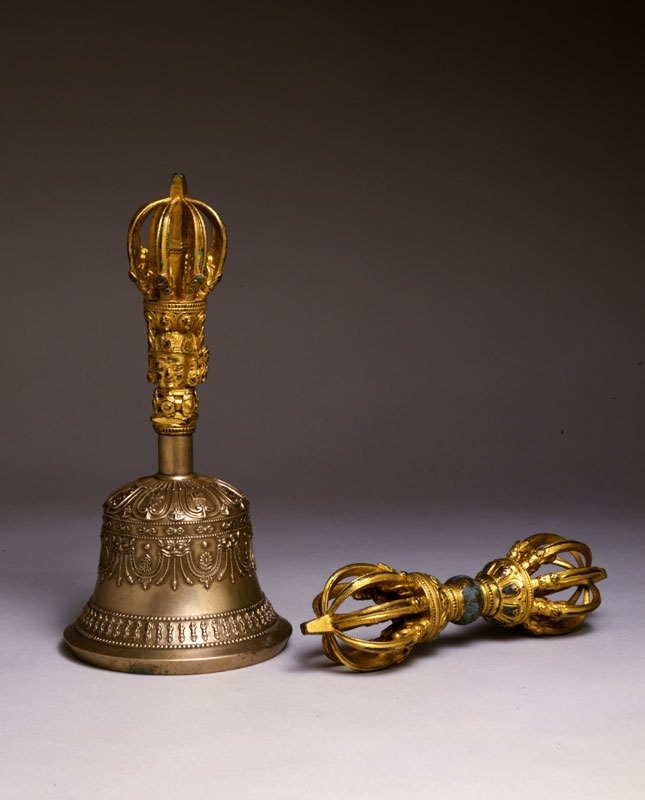
Thunderbolt and Bell

Thunderbolt and bell, 1403–1424. China; Ming dynasty (1368–1644), Reign of the Yongle Emperor (1403–1424).(Opens in a new window) Gilded bronze. Gift of Margaret Polak, B85B3.a and B85B3.b.

What are these ritual objects?

The vajra (Tibetan: Dorjie) and bell (Sanskrit: ghanta; Tibetan: drilbu) are the most important ritual objects of Tibetan Buddhism. Most every lama has a pair and knows how to use them. They represent “method” (vajra) and “wisdom” (bell). Combined together they symbolize enlightenment as they embody the union of all dualities: bliss and emptiness, compassion and wisdom, appearance and reality, conventional truth and ultimate truth, and male and female, etc.

What is meant by method and wisdom?

Method indicates the compassionate activities of the bodhisattva that relieve living beings of their miseries. It is the skillful means that brings about the elimination of ignorance, greed, cruelty, etc. in living beings and causes them to follow the path to enlightenment. Wisdom is the direct insight into ultimate reality; it is the wisdom that realizes emptiness. By combining method and wisdom, the bodhisattva accumulates merit and insight and eventually attains Buddhahood.

What is the symbolism of the Vajra and bell?

Most vajras have five prongs that symbolize the five wisdoms that are attained through the transcendance of five kleshas (greed, anger, delusion, pride and envy). The hub between them signifies emptiness. This one has eight prongs plus the central hub. Vajra is a Sanskrit word, in Tibetan it is called a dorje. It is related to the word for diamond, and appears to be similar to the thunderbolt weapon carried by the Vedic god Indra, and the Olympian Zeus. As a thunderbolt weapon it destroys both internal and external enemies. As a diamond it symbolizes the indestructible and all-penetrating mind of enlightenment.

The sound of the bell calls to mind the empty nature of all things. That is, according to the Buddha, nothing whatsoever can exist independently, all phenomena are empty of true or inherent existence. By being profoundly aware of the empty nature of all things, we become free of attachment and aversion, and are liberated from the painful cycle of birth and death (samsara). The bell is also a musical instrument Its sound, together with other sacred instruments such as the hand-drum (damaru), are played in rituals as musical offerings to the Buddhas and other gods.

How are they used?

The vajra and bell are often seen represented in the hands of deities in art, and in practice are held in the hands of the monks during rituals, the vajra in the right hand, the bell in the left. They are moved in prescribed movements. When the arms are crossed this symbolizes that the two are united—representing enlightenment. The sound of the bell is considered by Tibetan Buddhists as the most beautiful music. This music is presented as one of eight offerings to the deity that is invoked during the ritual.

What are the eight offerings presented in rituals?

When Tibetans Buddhist begin meditation, they will invoke the presence of the deity, bow, and make offerings. For peaceful deities, the offerings are as follows:

  • pure water for the deity to drink
  • water for the deity to wash with
  • scented oil for the deity to be anointed with
  • flowers
  • incense
  • butter lamps
  • food
  • music, played on the ghanta (bell) and the damaru, a small two-faced drum with clappers attached by string, played by twisting back and forth in the hand

This thunderbolt and bell were cast for the Chinese Emperor Yongle (1403–1424) as a gift for a distinguished lama of Tibet. The Emperor possibly wished to gain merit for the commission. This and other gifts like it show the relationship between the Tibetan lamas and the emperors of China. Known as the priest-patron relationship, this was one way that ideas and artistic styles spread between China and Tibet. Artists working in China in imperial workshops were ordered to make Tibetan style objects for either the personal use of the emperor or to send to important lamas in Tibet, who were often considered to be their spiritual teachers.

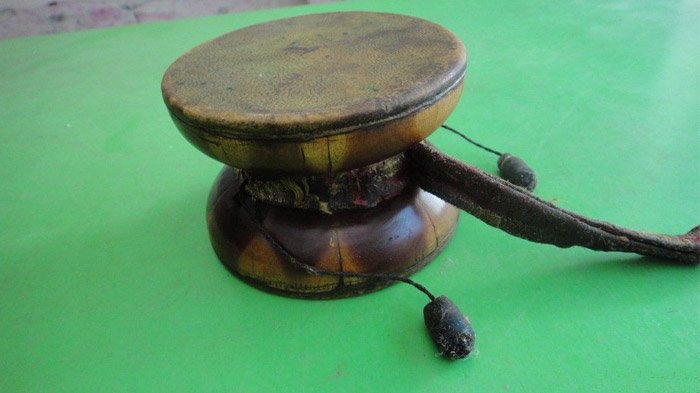
Tibetan Drum (Damaru)

The Tibetan drum, or Damaru, might seem a little familiar. That’s probably because of the way in which you play this instrument. You take the drum and roll it from side to side, whilst small beads on the end of strings will ‘bang’ the leather drum heads. Estimates guess that this instrument reached the Himalayas in around the 8th century, and this wood and leather object has been a staple in the Buddhist faith ever since. Within Buddhism, these Tibetan ritual items hold immense significance during tantric practices.

Tibetan Drum (Damaru)

There are actually three different types of Damaru, each one holding its own properties and purpose. The most widely used is the Chöd Damaru. This tends to be made from wood and covered with leather skins for the drum surface. Usually, they are 8 to 12 inches in diameter, although in rare cases this has been known to vary. The purpose of the Chöd Damaru is to be used during the tantric practice of Chöd, where a believer tries to ‘cut through’ the problems that face them and hinder their quest for enlightenment.

A slightly more grotesque Damaru is that of the Skull Damaru. This is certainly one of the more unusual Tibetan ritual items, and takes the form of a human skull, shaped into that of a drum. This version tends to be used in temples and large festivals, so keep an eye out when visiting Tibetan religious festivals. It’s a unique sight and usually coated in rare and precious stones

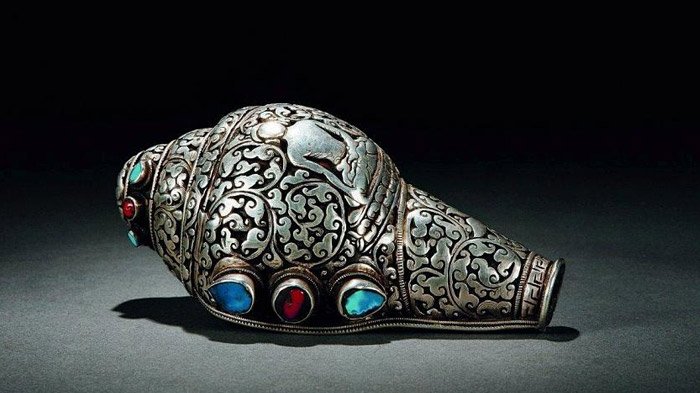
Tibetan Buddhist right-turning conch shell (Shankha)

The Shankha looks like an ornate snail shell. The outside is usually decorated with patterns regarding the Buddhist faith, and is usually painted in light, white colors. The shell is one of the eight auspicious symbols of Buddhism (the Ashtamangala), and represents water and Buddhism’s pervasiveness.

Tibetan Buddhist right-turning conch shell (Shankha)

If you want to see one of the conches in person, it tends to be used to bring together and call on followers to meet. During rituals, it is sometimes used as a musical instrument, but can also be used to carry holy water from one place to another.

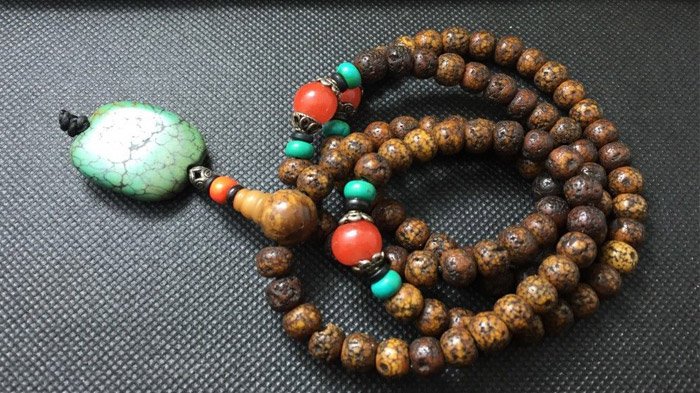
Tibetan prayer beads (malas)

The Malas is probably one of the most well know Tibetan ritual items. These Tibetan prayer beads are composed of 108 beads, each of which signifies the mortal sins of humanity. The beads themselves tend to be made from the wood of a special tree, known as the Ficus religiosa. Sometimes, bodhi seeds are also used, or rattan seeds. The different materials generally signify different uses, with the wooden beads being seen as generally ‘all-purpose’.

Tibetan prayer beads (malas)

A visit to any Buddhist temple will usually allow you to see the Tibetan prayer beads both on sale, and being used by the monks themselves. Monks will usually count the beads whilst praying.

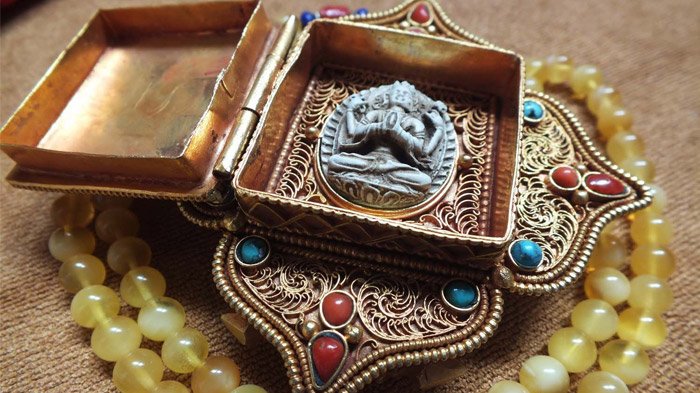
Gawu box

The Gawu box is an amulet usually made from silver, which is used to hold an image of the Buddha made from metal or clay. The outside is usually decorated with expensive and rare stone, with ornate designs and patterns you’ll find on other Tibetan ritual items as well. Usually, the Gawu is used during prayer to ward off evil spirits and bring about the Buddha’s blessing.

Gawu box
Gawu box

Whilst travelling to Tibetan temples, keep an eye out for the differences you’ll see. One of the most striking is that males tend to wear a square shaped amulet, whilst women will adorn a more rounded one.

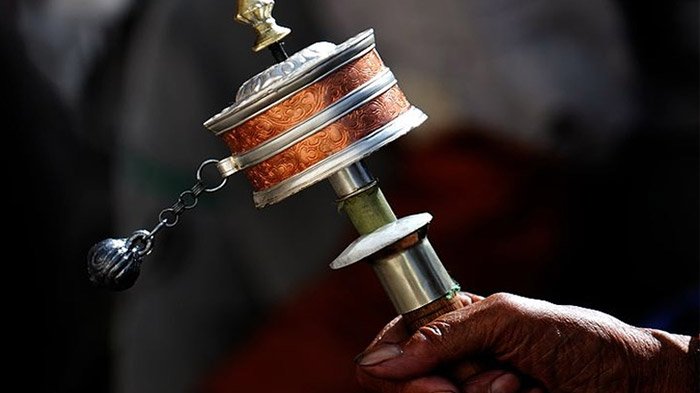
Tibetan prayer wheel

The Tibetan prayer wheel is a cylindrical wheel which comes in many different shapes, sizes, and materials. Whilst small, personal ones can be found, there are also those which are much larger and must be held up by (usually) wooden structures. One thing they tend to have in common, though, is that they usually come in gold. The Prayer wheels also tend to be decorated with the 8 auspicious symbols of Ashtamangala.

Tibetan prayer wheel

Larger, stationary prayer wheels tend to be located in most monasteries. Visitors can usually move the wheels themselves by running their hands over them as they walk past.

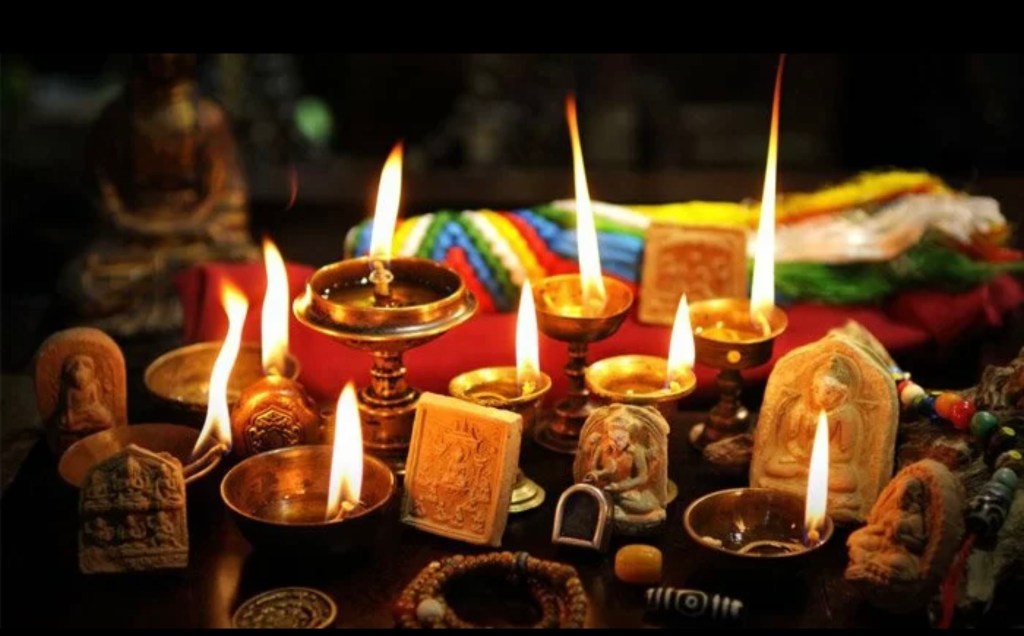
Tibetan butter lamp

The Tibetan Butter Lamp is found in almost all Tibetan temples and sanctuaries. The (usually) golden cup tends to burn Yak Butter, which represents the illumination of Wisdom. If you head to the temples early in the morning, you’ll find monks taking part in their morning ritual, which consists of an offering of the Tibetan butter lamp, along with seven other bowls containing other symbolic offerings. Pilgrims, whilst travelling between temples, tend to supply oil for these lamps to gain favor.

Tibetan butter lamp

Reference

Buddhism 101: A Short History of the Buddhist Schools

The different Buddhist schools of thought, still operating in the present day, developed after the death of the Buddha (l. c. 563 – c. 483 BCE) in an effort to perpetuate his teachings and honor his example. Each of the schools claimed to represent Buddha’s original vision and still do so in the modern era.

Although Buddha himself is said to have requested that, following his death, no leader was to be chosen to lead anything like a school, this was ignored and his disciples seem to have fairly quickly institutionalized Buddhist thought with rules, regulations, and a hierarchy.

Gandhara Relief of Buddha Eating with Monks (Mark Cartwright (CC BY-NC-SA))-

At first, there may have been a unified vision of what Buddha had taught but, in time, disagreements over what constituted the “true teaching” resulted in fragmentation and the establishment of three main schools:

  • Theravada Buddhism (The School of the Elders)
  • Mahayana Buddhism (The Great Vehicle)
  • Vajrayana Buddhism (The Way of the Diamond)

Theravada Buddhism claims to be the oldest school and to maintain Buddha’s original vision and teachings. Mahayana Buddhism is said to have split off from Theravada in the belief that it was too self-centered and had lost the true vision; this school also claims it holds to the Buddha’s original teaching. Actually, however, the two schools may have been established around the same time, just with different focus, and probably emerged from two earlier schools: the Sthaviravada (possible precursor to Theravada) and the Mahasanghika (also given as Mahasamghika, considered by some the earlier Mahayana). The connection between these earlier schools and the later ones, however, has been challenged. Vajrayana Buddhism developed, largely in Tibet, in response to what were perceived as too many rules in Mahayana Buddhism and emphasized living the Buddhist walk naturally without regard to ideas of what one was “supposed” to do and so it, too, claims to be the most authentic.

All three schools maintain a belief in the Four Noble Truths and Eightfold Path as preached by the Buddha but differ – sometimes significantly – in how they choose to follow that path. Objectively, none are considered any more legitimate than the others, nor are the many minor schools which have developed, although adherents of each believe otherwise while, at the same time, recognizing they are all part of Ekayana(“One Vehicle” or “One Path”) in that all embrace Buddha’s central vision and seek to promote harmony and compassion in the world.

ALL BUDDHIST SCHOOLS MAINTAIN A BELIEF IN THE FOUR NOBLE TRUTHS & EIGHTFOLD PATH AS PREACHED BY THE BUDDHA BUT DIFFER IN HOW THEY CHOOSE TO FOLLOW THAT PATH.

Although Buddhism is often perceived by non-adherents as a uniform belief system, it is as varied as any other in practice but, theoretically at least, a modern-day secular Buddhist can participate in rituals with a religious Buddhist without concern or conflict and all work toward the same essential goals.

Buddha & Buddhism

According to the foundational account of Buddha’s life, he was born Siddhartha Gautama, a Hindu prince, and his father, hoping to prevent him from following a spiritual path instead of succeeding him as king, kept him from any experiences which might have made him aware of suffering and death. The king’s plan succeeded for 29 years until Siddhartha witnessed the famous Four Signs while out riding one day – an aged man, a sick man, a dead man, and a spiritual ascetic – and became aware of the reality of sickness, old age, and death.

He renounced his wealth and position and followed the example of the spiritual ascetic, eventually attaining enlightenment upon recognizing the inherent impermanence of all aspects of life and realizing how one could live without suffering. He developed the concept of the Four Noble Truths, which state that suffering in life is caused by attachment to the things of life, and the Eightfold Path, the spiritual discipline one should follow to achieve release from attachment and the pain of craving and loss. Scholar John M. Koller comments:

The Buddha’s teaching of [the Four Noble Truths] was based on his insight into interdependent arising (pratitya samutpada) as the nature of existence. Interdependent arising means that everything is constantly changing, that nothing is permanent. It also means that all existence is selfless, that nothing exists separately, by itself. And beyond the impermanence and selflessness of existence, interdependent arising means that whatever arises or ceases does so dependent upon conditions. This is why understanding the conditions that give rise to [suffering] is crucial to the process of eliminating [suffering]. (64)

Buddha illustrated these conditions through the Wheel of Becoming which has in its hub the triad of ignorance, craving, and aversion, between the hub and rim the six types of suffering existence, and on the rim the conditions which give rise to duhkha (translated as “suffering”). Ignorance of the true nature of life encourages craving for those things one believes are desirable and aversion to things one fears and rejects. Caught on this wheel, the soul is blinded to the true nature of life and so condemns itself to samsara, the endless repetition of rebirth and death.

Stupa in Ajanta (by Jean-Pierre Dalbéra)

Spread & Fragmentation

Buddha preached his vision from the time of his enlightenment until his death at 80 years of age, at which point he requested that his disciples should not choose a leader but that each should lead themselves. He also requested that his remains be placed in a stupaat a crossroads. Neither of these requests was honored as his disciples fairly quickly organized themselves as a group with a leader and divided his remains among themselves, each choosing to place them in a stupa in a location of their choice.

BUDDHIST SCHOOLS HAD TO CONTEND WITH THE WELL-ESTABLISHED BELIEF SYSTEMS &, IN AN EFFORT TO LEVEL THE PLAYING FIELD, DEVELOPED AN ILLUSTRIOUS FOUNDATION STORY

Around 400 BCE, they held the First Council at which they established accepted Buddhist doctrine based on the Buddha’s teachings and, in 383 BCE, they held a Second Council at which, according to the standard account of the meeting, the Sthaviravada school insisted on the observance of ten proscriptions in the monastic discipline which the majority rejected.

At this point, either the Sthaviravada school left the community (known as the sangha) or the majority distanced themselves from the Sthaviravada and called themselves Mahasanghika (“Great Congregation”). All the later schools then developed from this first schism.

These schools had to contend with the more well-established belief systems of Hinduism and Jainism and, in an effort to level the playing field, developed an illustrious foundation story for their founder and attributed to him a number of miracles. Still, Buddhism remained a small sect in India, one among many, until it was championed by the Mauryan king Ashoka the Great (r. 268-232 BCE) who embraced the faith and initiated its spread. He sent missionaries to other nations such as Sri Lanka, ChinaKorea, Thailand, and Buddhism was accepted in these places far more quickly than in its home country.

Doctrinal differences, however, led to further divisions within the community of adherents. As the belief system became more institutionalized, these differences became more significant. Different canons of scripture developed which were held by some as true while rejected by others and different practices arose in response to the scripture. For example, the Pali canon, which emerged from Sri Lanka, maintained that Buddha was a human being who, although endowed with great spiritual power, still attained enlightenment through his own efforts and, when he died, he was set free from samsara and achieved total liberation from human affairs.

The Spread of Buddhism (by Be Zen)

As Buddhism spread, however, the founder was deified as a transcendent being who had always existed and would always exist. Buddha’s death was still understood as his nirvana, a “blowing out” of all attachment and craving, but some adherents no longer saw this as simply an escape from samsara but an elevation to an eternally abiding state; freed from samsara, but still present in spirit. The Mahasanghika school held to this belief as well as many others (such as the claim that the Buddha had never existed physically, only as a kind of holy apparition) which stood in direct contrast to the Sthaviravada and, later, the Theravada schools. Although the central vision of the Buddha was retained by adherents, doctrinal differences like this one led to the establishment of the different schools of Buddhist thought.

Although there were actually many schisms before the establishment of Theravada, Mahayana, and Vajrayana (the Mahasanghika school alone produced three different sects by c. 283 BCE), the division of these schools from the original sangha is said to have been predicted by the Buddha himself in what is known as The Three Turnings. This concept is based on that of the Dharmachakra(wheel of eight spokes, a familiar Buddhist symbol) which represents the Eightfold Path, informed by dharma which, in Buddhism, is understood as “cosmic law”. The Dharmachakra has always been in motion and always will be but, as far as human recognition of it goes, it was set in motion when Buddha gave his first sermon, would then make the first turn with the establishment of Theravada Buddhism, a second with Mahayana, and a third with Vajrayana.

Theravada Buddhism

Theravada Buddhism is said to be the oldest form of the belief system, but this is challenged by modern scholars. Robert E. Buswell, Jr. and Donald S. Lopez, Jr. explain:

Despite the way in which scholars have portrayed the tradition, Theravada is neither synonymous with early Buddhism nor a more pristine form of the religion prior to the rise of the Mahayana. Such a claim suggests a state of sectarian inertia that belies the diversity over time of doctrine and practice within what comes to be called the Theravada tradition. (904)

Even so, many of those who self-identify as Theravada Buddhists do still make the claim that it is the oldest version of Buddhism and the closest to the founder’s vision. It is known as the “Teaching of the Elders” which derives from the same name held by the earlier school of Sthaviravada, and this is sometimes interpreted to mean that its founders were those closest to the Buddha but, actually, the term was commonly used in India to denote any monastic sect, and this applies directly to Theravada.

Adherents focus on the Three Trainings (trisksa):

  • Sila (moral conduct)
  • Samadhi (meditation)
  • Prajna (wisdom)

This discipline is observed as part of the Eightfold Path and is inspired by the central figure of the school, the sage Buddhaghosa (5th century CE) whose name means “Voice of the Buddha” for his ability to interpret and comment upon Buddhist doctrine. They hold the Pali canon to be the most authentic and focus on a monastic interpretation of the Buddhist path in which the individual seeks to become an arhat (saint) and has no obligation to teach others the way toward enlightenment. One may certainly do so if one chooses but, unlike Mahayana Buddhism, the goal is not to become a spiritual guide to others but to free one’s self from samsara.

Seated Buddha Figure Displaying Dharmachakra Mudra (by Prashanth Gopalan)

Theravada Buddhism is divided between a clergy of monks and a congregation of laypeople and it is understood that the monks are more spiritually advanced than the common folk. Women are considered inferior to men and are not thought capable of attaining enlightenment until they are reincarnated as a male. The Theravada school is sometimes referred to as Hinayana (“little vehicle”) by Mahayana Buddhists, but it should be noted that this is considered an insult by Theravada Buddhists in that it suggests their school is not as important as Mahayana.

Mahayana Buddhism

MAHAYANA IS THE MOST WIDESPREAD & POPULAR FORM OF BUDDHISM IN THE WORLD TODAY.

Mahayana Buddhists named themselves the “Great Vehicle” either because they felt they retained the true teachings and could carry the most people to enlightenment (as has been claimed) or because they developed from the early “Great Congregation” Mahasanghika school and wished to distance themselves from it, however slightly. It was founded 400 years after Buddha’s death, probably inspired by the early Mahasanghika ideology, and was streamlined and codified by the sage Nagarjuna (c. 2nd century CE), the central figure of the school. It may have initially been a minor school before interacting with Mahasanghika or, according to some scholars, developed on its own without that school’s influence but, either way, Mahayana is the most widespread and popular form of Buddhism in the world today, spreading from its initial acceptance in China, Korea, Mongolia, Japan, Sri Lanka, and Tibet to points all around the world.

MAHAYANA IS THE MOST WIDESPREAD & POPULAR FORM OF BUDDHISM IN THE WORLD TODAY.

The Mahayana school believes that all human beings possess a Buddha nature and can attain transcendent awareness, becoming a Bodhisattva (“essence of enlightenment”), who can then guide others on the same path. Adherents seek to attain the state of sunyata – the realization that all things are devoid of intrinsic existence, nature, and lasting meaning – a clearing of the mind that enables one to recognize the true nature of life. Having attained this higher state, just as Buddha did, one becomes a buddha. This transcendental state is similar to how gods and spirits were viewed by the Buddha himself – as existing but incapable of rendering any service to the individual – but, as a Bodhisattva, both women and men who have awakened are able to help others to help themselves.

Chinese Bodhisattva Plaque (by Osama Shukir Muhammed Amin)

As with Theravada and every other school of Buddhism, the focus is on the self – self-perfection and self-redemption – and no other can do the spiritual work which one needs to do to release one’s self from suffering. Although Buddha is sometimes seen as a deified being by Mahayana Buddhists, the tenets do not encourage one to call on him for help. Following Buddha’s own vision, a belief in a creator god who is attentive to one’s prayers is discouraged because it attaches one to a power outside of one’s self and sets one up for disappointment and frustration when prayers go unanswered.

This is not to say that no Mahayana Buddhists pray directly to the Buddha; the tradition of representing Buddha in statuary and art, of praying to these objects, and considering them holy – observed in Mahayana Buddhism – was initiated by the Mahasanghika school and is among the many compelling reasons to believe the younger school emerged from the older one.

Vajrayana Buddhism

Vajrayana Buddhism (“Diamond Vehicle”) is so-called because of its association of enlightenment with an unbreakable substance. Its name is also given as “Thunderbolt Vehicle”, especially in reference to Tantric or Zen Buddhism, in that enlightenment falls like a thunderbolt after one has put in the required effort at perfecting the self. It is often considered an offshoot of Mahayana Buddhism – is even referenced as a sect of that school – but actually borrows tenets from both Mahayana and Theravada Buddhism while adding an innovation of its own.

In both Theravada and Mahayana Buddhism, one decides to follow the path, accepts the Four Noble Truths and the Eightfold Path as legitimate, and commits to a spiritual discipline which will lead to enlightenment by renouncing unprofitable habits. In Vajrayana Buddhism, it is understood that one already has a Buddha nature – everyone does, just as Mahayana believes – but, in Vajrayana, one only has to realize this in order to fully awaken. An adherent, therefore, does not have to give up bad habits such as drinking alcohol or smoking right away in order to begin one’s work on the path; one only has to commit to following the path and the desire to engage in unhealthy and damaging behaviors will steadily lose their allure. Instead of distancing one’s self from desire, one steps toward and through it, shedding one’s attachment as one proceeds in the discipline.

Tibetan Star Mandala (by Poke2001)

As with Mahayana Buddhism, the Vajrayana school focuses one on becoming a Bodhisattva who will then guide others. It was systematized by the sage Atisha (l. 982-1054 CE) in Tibet and so is sometimes referred to as Tibetan Buddhism. The Dalai Lama, often referenced as the spiritual leader of all Buddhists, is technically only the spiritual head of the Vajrayana School, and his views are most directly in line with this school of thought.

Other Schools

There are many other Buddhist schools which have developed from these three all around the world. In the West, the most popular of these is Zen Buddhism which traveled from China to Japan and was most fully developed there before arriving in the West. As Zen Masters are fond of saying, “What you call Zen is not Zen; What you do not call Zen is not Zen” meaning that the state of being one wishes to attain cannot be defined; it can only be experienced. One arrives at this state through deep meditation and mental concentration on koans – usually translated as “riddles” – which have no answer, such as the famous “What is the sound of one hand clapping?” – in order to clear the mind, rid the self of attachment, and attain the state of samadhi, a state of psychological and spiritual vision similar to sunyata. Students of Zen Buddhism frequently study with a master who might slap them, shout, or suddenly hit them with a stout stick in order to awaken them from the illusion of who they think they are and what they think they are doing. These sudden attacks without warning are engaged in, like the koans, to snap an adherent out of rational, linear thinking into a higher state of awareness.

Pure Land Buddhism is another which developed from Mahayana Buddhism and its goal is rebirth in a “pure land” of a Buddha Realm which exists on a higher plane. The belief comes from a story in the text known as the Infinite Life Sutra in which the Buddha tells a story of a past buddha named Amitabha who became a Bodhisattva and to whom were revealed the Buddha Realms available to the enlightened. Amitabha’s efforts to save all sentient creatures from suffering resulted in the creation of the realm of Sukhavati, the greatest of all, in which one experiences complete bliss after leaving the body at death. Although Pure Land is its own school, some Mahayana Buddhists observe the same tenets.

An increasingly popular school in the West is Secular Buddhism which rejects all metaphysical aspects of the belief system to focus on self-improvement for its own sake. Secular Buddhism recognizes the Four Noble Truths and Eight-Fold Path but on purely practical and psychological levels. There are no saints, no Bodhisattvas, no Buddha Realms, no concept of reincarnation to be considered. One engages in the discipline as set down by the Buddha in order to become a better version of one’s self and, when one dies, one no longer exists. There is no concept of a reward after death; one’s efforts in being the best person one can be in life is considered its own reward.

Conclusion

It is actually impossible to tell which, if any, of these schools is closest to the original vision of the Buddha. Siddhartha Gautama, himself, wrote nothing down but instead – like many great spiritual figures throughout history whose followers then founded a religion in their name – lived his beliefs and tried to help others in their struggles. Since the earliest Buddhist texts were written centuries after the Buddha lived, and in an era when the events of a famous person’s life were regularly embellished upon, it is unknown whether his so-called “biography” is accurate nor even the dates between which he is said to have lived.

However that may be, and whoever he was, the Buddha established a belief system which attracts over 500 million adherents in the present day and has, for centuries, offered people a path toward peace of mind and inspiration to help others. The Buddhist belief in the sanctity of all life – no matter which school one attaches one’s self to – promotes care for other human beings, animals, and the earth in an effort to end suffering and offer transformative possibilities. In this respect, each school works toward goals that Buddha himself would approve of and differences in how those goals are reached are ultimately irrelevant

Reference

Yuanmingyuan (The Garden of Perfect Brightness), The Old Summer Palace (Qing Dynasty), Beijing, China

I am currently reading Edward Rutherfurd’s “China” and the Yuanmingyuan plays an integral part in much of the story in the 1860s. I find this fascinating

Brief Introduction

Located in the northern part of the Haidian District of Beijing, Yuanmingyuan (Garden of Perfect Brightness), aka Old Summer Palace, was one of the most important imperial gardens of the Qing Dynasty. Its other nickname, King of Gardens, offers a clue to the totality of its physical setting, its splendid – and splendidly laid out – architecture, which included richly adorned halls, temples and pavilions, and its magnificent gardens, both in the narrow and in the broad sense, the latter being in the sense of a park, since some of the Old Summer Palace’s gardens were in fact replicas of entire parks from other localities round about the country, in much the same way that modern-day Chinese theme parks now incorporate reduced-size replicas of famous international landmarks such as Niagra Falls (in USA), the Taj Mahal, the Pyramids, and the Eiffel Tower.

Yuanmingyuan in the Past Source from the web

The park’s many ponds and lakes are dotted with small islets, and countless bridges span the park’s streams, while charming walkways, some tree-lined, connect this vast expanse of grass, trees, water, rockeries, and buildings. Water is in fact the central theme of the Old Summer Palace. Parks are of course synonymous with trees and green grass; the Old Summer Palace has both in abundance, as well as ponds, lakes, and streams. No wonder then, that the original Old Summer Palace park complex was five times larger than the Forbidden City (the official “reception” palace of Chinese emperors) and eight times larger than Rome’s Vatican City.

History of Yuanmingyuan

The park was first built by Emperor Kangxi as a gift to his fourth son Prince Yinzhen, who later succeeded his father as Emperor Yongzheng. After the death of Emperor Yongzheng, his son, Emperor Qianlong, who, it must be said, was an even more ardent lover of gardens, continued to invest heavily in the Summer Palace gardens. Thus the combined effort of three generations of emperors, beginning with Emperor Kangxi and ending with this grandson, Emperor Qianlong, made of Yuanmingyuan an incomparable gem among royal gardens the world over. As the French writer and humanist, Victor Hugo, speaking of the treasure trove of artworks amassed at the Summer Palace once wrote: “All the treasures of our [European] cathedrals could not equal this fabulous and magnificent oriental museum… “.

In its heyday, Yuanmingyuan consisted of three different gardens: Yuanmingyuan, or the Garden of Perfect Brightness proper (the entire imperial garden complex was itself known as the Garden of Perfect Brightness); Qichunyuan, or the Elegant Spring Garden; and Changchunyuan, or the Garden of Eternal Spring. Five Chinese emperors – Emperors Yongzheng, Qianlong, Jiaqing, Daoguang and Xianfeng – spent prodigious amounts not only of money here, but also of their time, receiving guests, discussing the business of state, or simply relaxing with friends and family. In this regard, the Summer Palace served as an extension of the Forbidden City.

However, as feudal China drew to an end, the Qing Dynasty government’s crises multiplied as well as deepened. Yet, amidst these woes, including a reduced income stream that forced the Qing Dynasty emperor to curtail some of his private hunting and holiday activities, the emperor never ceased to lavish money on Yuanmingyuan, so devoted was he to this national treasure. For example, inside the park’s temples are numerous statues of the Buddha and Boddhisatvas in a variety of poses – and in a variety of materials, such as gold, silver, bronze and jade. Alas, most of the treasures of this once glorious summer palace are gone, having been burned or looted during repeated foreign raids, first in 1860 as part of the second Opium War, and again in 1900 as part of the effort to crush the Boxer Rebellion.

In fact, the debacle over the February 25, 2009 auction, staged by Christie’s in Paris, of two bronze fountainheads nominally belonging to the estate of the late fashion designer, Yves Saint Laurent, is directly related to the 1860 looting of the Summer Palace (there was only one imperial summer palace in those days), since the rightful owner of the two fountainheads, one depicting a rabbit, the other a rat, is China. The auction itself was controversial, sparking official protests from the Chinese government, but the outcome of the auction was even more controversial: the winning bidder – a Chinese patriot, it turns out – refused to pay, claiming that the artworks belong to the Chinese people.

Restoration

In China today there is considerable controversy over whether the Old Summer Palace should be restored to its original glory or not. The Chinese people seem to be divided into two mutually exclusive camps on the issue, with one group wishing to keep the park as it is, i.e., as a reminder of past national humiliations, while the other group wishes to draw a line under the past and move forward. The latter group argues that it serves no constructive purpose to hold Beijing’s once glorious Summer Palace hostage to events that occurred over a century ago, and that more could be achieved in returning the park to its original splendor, albeit, sadly lacking in the treasures of which it was looted.

It is an argument that is perhaps echoed in the current American debate over whether “Ground Zero”, the site of the 9/11 attacks that demolished the Twin Towers of New York City, should remain a graveyard-like memorial to the past, or should be rebuilt into something even more spectacular in order to draw a line under the past. A neutral economist might take the view that the best way to avenge the looting of the Summer Palace would be to return the palace to its former glory, thereby making it a first-class tourist destination that could reclaim at least some of the wealth that it lost. It might also strengthen the argument for someday returning the original artworks that this sumptuous palace once housed.

Plan of the Old Summer Palace buildings and gardens — Beijing.
Master plan for Yuanmingyuan in the app, with red lines showing pre-defined visitor route
Photo by Steven Buss

The British and French at their worst? The burning of China’s magnificent Summer Palace

n 1860 Western forces burned the Summer Palace, a wonderful and magnificent building to the northwest of Beijing, China. British and French troops pillaged the palace, and then burned it to the ground in a terrifying act during the Second Opium War. Here, Scarlett Zhu explains what happened and responses to the attack.

The looting of the Summer Palace by Anglo-French forces in 1860.

“We call ourselves civilized and them barbarians,” wrote the outraged author, Victor Hugo. “Here is what Civilization has done to Barbarity.”

One of the deepest, unhealed and entrenched historical wounds of China stems from the destruction of the country’s most beautiful palace in 1860 – the burning of the Old Summer Palace by the British and French armies. As Charles George Gordon, a soldier of the force, wrote about his experience, one can “scarcely imagine the beauty and magnificence of the places being burnt.”

The palace that once boasted of possessing the most extensive and invaluable art collection of China, became a site of ruins within 3 days in the face of some 3,500 screaming soldiers and burning torches. Dense smoke and ashes eclipsed the sky, marble arches crumbled, and sacred texts were torn apart.  At the heart of this merciless act stood Lord Elgin, the British High Commissioner to China, a man who preferred revenge and retaliation to peace talks and compromise. He was also a man highly sensitive to any injustices or humiliation suffered by his own country. Thus, the act was a response to the imprisonment and torture of the delegates sent for a negotiation on the Qing dynasty’s surrender. However, as modern Chinese historians would argue, this was a far-from-satisfactory excuse to justify this performance of wickedness, as before the imprisonment took place, there had already been extensive looting by the French and British soldiers and the burning was only “the final blow”.

The treasures of the Imperial Palace were irresistible and within the reach of the British and French. Officers and men seemed to have been seized with temporary insanity, said one witness; in body and soul they were absorbed in one pursuit: plunder. The British and the French helped themselves to all the porcelain, the silk and the ancient books – there were an estimated 1.5 million ancient Chinese relics taken away. The extent of this rampant abuse was highlighted even more by the burning of the Emperor’s courtiers, eunuch servants and maids – many estimates place the death toll in the hundreds. This atrocious indifference towards human life inflamed international opposition, notably illustrated by Hugo’s radiant criticisms.

The response to the attack

But there was no significant resistance to the looting, even though many Qing soldiers were in the vicinity – perhaps they had already anticipated the reality of colonial oppression or did not bother themselves with the painful loss of the often-distant imperial family. But the Emperor, XianFeng, was not an unreceptive spectator; in fact, he was said to have vomited blood upon hearing the news.

However, there was evidence to suggest that some soldiers did feel that this was “a wretchedly demoralizing work for an army”. As James M’Ghee, chaplain to the British forces, writes in his narrative, he shall “ever regret the stern but just necessity which laid them in ashes”. He later acknowledged that it was “a sacrifice of all that was most ancient and most beautiful”, yet he could not tear himself away from the palace’s vanished glory. Historian Greg M. Thomas went so far as to argue that the French Ambassador and generals refused to participate this destruction as it “exceeded the military aims of their mission”, and would be an irreparable damage to an important cultural monument.

Nowadays, what is left of the palace are the gigantic marble and stone blocks, which used to be backdrops of the European-style fountains situated in the distant corner of the Imperial gardens for entertaining the Emperor, since those made out of timber and tile did not survive the fires. The remains acted as a somber reminder of the West’s ransack and the East’s “century of humiliation”.

This is more than a story of patriotism, nationalism and universal discontent. History used to teach us that patriotism isn’t history, but rather propaganda in disguise. Yet how could one ignore and omit a historical event so demoralizing and compelling on its own, that it is no longer a matter of morality and dignity, but a matter of seeking the truth, tracing the past and its inseparable link with the present? When considering the savage and blatant destruction of the Old Summer Palace, along with the unspoken hatred of the humiliated and the suppressed, it seems therefore appropriate to end with the cries of the enraged Chinese commoners as they witnessed the worst of mankind’s atrocities: “Kill the foreign devils! Kill the foreign devils!”

Destruction of the Summer Palace

Reference

A Cup Of Tea, A BEX, And A Good Lie Down…

1979: Banned powders still on sale in Sydney

First published in the Sydney Morning Herald on September 5, 1979

Compound painkillers which were banned from sale from July 1 are still freely sold across the counter in Sydney.

Chemists as well as other retailers were found breaking the law yesterday.

First thing this morning, Bobbie Spillane reached for her Bex, as she has done every day for the last 40-odd years. And she hopes she’ll be doing for the next 40. “I don’t know what I’d do without them,”she said as she poured middies at an early-opening City hotel today. “If they’re thinking of putting them in prescription, I’d better stock up. “We call them the barmaid’s friend, you know.” Bobbie reckons she knocks back at least half a dozen of powders a day. And she sells around 30 to customers over the bar. “They’re not all women either,” she said. April 25, 1977.CREDIT:STAFF PHOTOGRAPHER

The banned compounds have a mixture of two or more of the substances aspirin, paracetamol, salicylamide and caffeine.

In place of the compound analgesics, drug manufacturers are distributing for open sale single analgesics in similar packets.

But yesterday I bought compound analgesics at four of 14 city shops without difficulty.

At a cafe in George Street, Vincent’s powders made of aspirin, caffeine, citrate and salicylamide were in a plastic cup behind the counter. I was told I could buy only one sachet.

Another George Street cafe kept compound Vincent’s powders on view. Two assistants asked how many I would like.

Two of 10 pharmacies sold me compound analgesics.

A pharmacy in Liverpool Street displayed the new, single-analgesic Bex, but a white-coated man needed no prompting to offer for sale a box of compound-formula Bex. He said it was his last.

He collected the Bex from a back room and said he had been trying to “sell all the old stock” because of the new restrictions.

A Bex and a good lie down… two of the banned products.CREDIT:STAFF PHOTOGRAPHER

When I asked for a packet of Bex powders at a George Street pharmacy the sales assistant said only the new formula Bex was in stock, but would I like some of the old kind of Vincent’s?

When I answered yes, the assistant spoke to a whitecoated man. This man asked how many powders I wanted, collected a box of 24 from a back room, handed them over surreptitiously and whispered the price.

Peter Kennedy, State Political Correspondent, was able to buy a four-sachet-pack of Vincent’s compound powders in Macquarie Street yesterday. He writes:

The regulations on compound analgesics were tightened because substantial evidence of a direct link between overuse of the analgesics and kidney failure.

Retailers who illegally sell them face a maximum penalty of an $800 fine or six months jail.

The executive Officer of the NSW Drug and Alcohol Authority, Mr Brian Stewart, said that retailers of the compound analgesics were clearly breaking the law.

“Ample warning has been given,” he said. “It means the retailers are liable to the stiff penalties and are acting contrary to the interests of public health.”

Bitter pills: a quick fix, and a long road to recovery

The silent generation – those who came before the baby boomers – were a stoic bunch who resisted taking drugs to treat even the worst ailments. Migraines, muscle pain and insomnia were treated through a cup of tea, a warm bath, a lie down or fresh air.

But with the 1960s, a new, medical element was added to that mix when a marketing phrase entered the vernacular: ”Have a cup of tea, a Bex and a good lie down.”

Bex, the analgesic made up of aspirin, phenacetin and caffeine, became an Australian icon. It was recommended to treat headaches, colds, flu, fevers, rheumatism, nerve pain and for ”calming down”.

Dissolving some Bex powder in a cup of tea became particularly common among housewives, widely available and sometimes taken up to three times a day.

It wasn’t until the 1970s that clinicians realised Bex and other similar formulations were responsible for kidney disease and addiction, and was carcinogenic. Phenacetin was pulled from the market by 1983.

But the damage had been done, says the director of the National Centre for Education and Training on Addiction at Adelaide’s Flinders University.

Professor Ann Roche says taking drugs for even mild illness or stress became a ”common Australian tradition” and has remained so.

Aggressive marketing from drug companies meant it was even common to pop an analgesic in children’s lunch boxes. ”Generally we don’t think twice about taking certain medications,” Professor Roche says.

‘We see it as fairly common and benign and something that has been used for decades and there is now this tradition of using drugs for pain relief, sleeping issues or anxiety.”

But this attitude has now extended to stronger, prescription drugs being commonly requested from doctors as a first line of treatment.

The 2013 Global Drug Survey found almost half of all respondents had used prescription drugs in the past year, with up to 10 per cent experiencing signs of dependency. Of 2700 prescription drug users, 12 per cent said they had shared them, while 12 per cent mixed them with alcohol to enhance the effects. People also reported using the drugs, particularly opiates, to induce positive emotional and behavioural states.

Opiates, such as oxycodone, continue to be prescribed for chronic pain, even though scientists have shown in recent years they may not be very effective for long-term use. While they are effective for cancer pain and short-term pain, many doctors and patients have failed to realise there are better first-line treatments.

Benzodiazepines, such as Xanax, Serepax and Valium, are being used for short-term stress and anxiety.

”But the big shift we’ve seen in the last few years is towards oxycodone and the other one is fentanyl, mistakenly seen as innocuous as it enters the blood through a skin patch,” Professor Roche says.

Not only are people using them but they are sharing drugs including sleeping pills and pain relievers with family and friends.

There is no ”typical” drug abuser, Professor Roche says, with varying groups trying to get hold of the drugs. Professionals are using them to cope with the stresses of life, while illicit drug users are turning to prescription drugs as cheaper, easier-to-obtain and perceived ”safer” options.

More people are surviving severe trauma, Professor Roche says, such as car accidents or disabilities, often requiring long-term medication and opening the potential for addiction. People are getting older and fatter and suffering from joint pain, she says, overwhelming doctors who sometimes prescribe drugs as a first-line treatment. ”Another contributing factor to growing use is shortened hospital stays thanks to keyhole surgery and other medical advances,” she says.

”This facilitates a faster discharge, where patients are often given quite a lot of pain medication with repeat scripts that people just keep filling even if they no longer really need them.”

A former prescription drug abuser, Charlotte*, would use anxiety drugs every day, taking up to 35 Valium mixed with 10 to 12 Xanax. They were sometimes mixed with heroin.

That kind of intake saw her overdose and come close to death three times. Because of her schizophrenia, she could tolerate higher doses of the drugs, combined with the fact she had built up a tolerance to prescriptions from the age of 14.

About 20 of her friends have died, either through prescription overdose or from illicit drugs combined with prescription medication. She is 23.

”I started on prescription drugs at about 13 and I guess they were my gateway drug into illicit substances,” she says. ”Xanax was my main problem, followed with Valium and Serapax and then I went on to heroin and ice.

”I used to get it from friends and then I started doctor shopping.”

At 17, she was diagnosed with schizophrenia. And while her psychiatrist refused to prescribe benzodiazepines, Charlotte says it was much easier to use her diagnosis to get the drugs from general practitioners.

She went back to the same doctors again and again.

”My friends and I had a list and all the drug users would see the same people,” she says. ”And they knew we were abusing them. Unless they were really stupid, they knew.”

She has been clean for 14 months, but says weaning off the prescription drugs was harder than stopping heroin.

She went to a rehabilitation clinic in Thailand, taking three months to get off the pills.

”I have seen heaps of bad things from prescription drugs; I think they’re worse than heroin,” she says. ”You’d think meth and heroin would be the worst but the thing is every time my friends or I overdosed on heroin, its always because [it was] mixed with drugs like Xanax and Valium.”

While she acknowledges she was an extreme user, Charlotte says people in general are too often turning to prescription drugs for minor ailments. She would like to see Valium banned.

Alex Wodak was the director of the alcohol and drug service at Sydney’s St Vincent’s Hospital until last July, a position he held for more than 30 years. He has seen first-hand the shift towards people seeking fast comfort.

”People work seven days a week and are always available because of computers and phones, working around the clock,” he says.

”Family life is sacrificed and I think we’re paying the price.

”We have to look at what kind of community we want and we need politicians to implement family-oriented policies.

”We are living in an era where a lot of people are seeking comfort and solace from chemicals; it is a trend that is very supported in our culture.”

Dr Wodak is now working in the area of drug reform. He believes tackling prescription drug abuse is achievable.

”If we stay calm and base policy on evidence I believe we can come out of this,” he says. ”What’s so difficult is the power of the pharmaceutical industry.

”But what we have seen in the cases of tobacco and increasingly with alcohol is that community resentment about a lack of action to fix the problem builds and sooner or later, they will vote for a politician willing to take a stand.”

*Not her real name.

Bex Powders

Bex Powders were a compound analgesic that comprised aspirin (420mg), phenacetin (420 mg) and caffeine (160mg), also known as APC. It was the first APC product marketed in Australia and the most popular. Bex Powders were produced from the 1920s in South Australia by Beckers Pty Ltd. [1] Beckers moved to Sydney in the 1960s and in 1964 was based at the corner of Campbell and Crown Streets, Sydney. [2] Bex Powders were commonly taken by dissolving the powder in water or a cup of tea. The packaging claimed a Bex would relieve ‘Headache, Neuralgia, Rheumatism, Sciatica, Lumbago…Influenza and Cold in early stages’. [3]

Cultural references

Bex were promoted particularly to women with the advertising slogan ‘Stressful day? What you need is a cup of tea, a Bex and a good lie down’. [4] The line has become part of the Australian vernacular and can be used to suggest that someone should relax and ease up. The Bex slogan was immortalised in 1965 when the Phillip Street Theatrestaged a long-running satirical review A Cup of Tea, a Bex and a Good Lie Down, written by John McKellar and starring Reg Livermore and Ruth Cracknell. Over forty years later, in September 2011, Kevin Rudd, addressing suggestions he might challenge the incumbent Prime Minister Julia Gillard, told journalists ‘I just think it would be a good thing if everyone seriously had a cup of tea and a Bex and a long lie down, OK?’ [5]

The problem with Bex

The recommended daily dose of caffeine is 250mg per day and yet Bex packaging advised taking at least two powders, containing 320mg of caffeine. It has been recorded that many women took up to 30-40 doses a day, sometimes washed down with Coca-Cola, adding to the caffeine intake and strengthening the addiction. A further complication was that many of these women were also prescribed Valium, another addictive substance.

In the 1960s Dr. Priscilla Kincaid-Smith discovered that Bex Powders were addictive and that the large doses of phenacetin consumed by habitual users caused kidney disease.

One woman, Norma O’Hara took Bex Powders sometimes twice a day every day for up to eight years from when she was 20. She used to work at Rosebery Wrigley’s factory and said ‘most of the girls took Bex… it was to keep you going. Working the machines, you thought you needed them.’ [6] O’Hara was subsequently diagnosed with kidney failure which was linked to compound analgesic abuse. It was common practice for factory managers to provide Bex Powders free of charge to their workers.

APC compounds were banned in 1977 and painkillers containing them were removed from the Australian market. Over time, this led to a dramatic decline in kidney disease. [7]

Reference