Category Archives: General Interest

The Hidden Side of Sex Offences

As a kid who spent three years in a Catholic boarding school I was exposed to an underworld of dark sex offenses without realising what was going on around me. When I think back on it now, it was quite scary…

In 1967, due to some family problems – a book of stories on it’s own – and with moving the family home from Sylvania to Kogarah, it was decided that instead of sending me to James Cook High School, I would be taken out of the public school system, and sent to a private school. Mind you, being the era it was, I didn’t have a lot of say in this decision.

As a late applicant – and Protestant – to Marist Brothers St Gregory’s Agricultural College at Campbelltown, I had to wait for all the Catholic applications to be processed first, to see if there were any vacancies available. I was to eventually spend three years there, attaining my School Certificate un 1969. There are two events that occurred in my time there that are quire disturbing, and probably part of the current investigations and Royal Commissiom into child sexual abuse.

Being a boarding school, we all spent our mornings and nights in large open dormitories – just called dorms. Brother Brian was the Dorm Master of Dorn 2, and had an enclosed bedroom just off the entry to the dorm. He was also the Instructor for the school swimming team. As with most school swimming teams, we had our own swimming trunks – burgundy and blue – especially made. With the arrival of the swim trunks, along came their time for distribution. It took me a while to work out what was going on. As I lay in bed after lights-out, there would be a stream of kids on the swimming team individually visiting Brother Brian in his room at night. Evidently, Brother was giving the boys specialised fitting of their swim trunks, getting them to strip off, and try the trunks on to “ensure the correct fit”. Shortly after this event, Brother Brian mysteriously disappeared…transferred to somewhere or other. I had just, unwittingly, observed my first instance of sexual abuse. In keeping with the era, no explanation was given, and the incident was never discussed.

Being a Protestant – Congregational – in a Catholic environment, and voluntarily not exempting myself from Mass , rosary, Station of the Cross. Retreats etc, eventually the religion rubbed off on me. Being raised in the simplicity of Protestantism, I found the rituals, devotions and customs of the Catholic church overwhelming, and in 1969 I converted.

Reverend Father Peter Comensoli was the Parish Priest of St John the Evangelist Church in Campbelltown, and St Gregory’s College Chaplain. As such, he baptized me in the college chapel, and in fact bestowed on me his Christian name Peter as my baptismal name, and later that year I was confirmed in the Parish Church in Campbelltown. Yet another name – Francis – to add to my collection. Father Comensoli spent a lot of time at the college, and was very friendly to all the boys.

So you can only imagine my total lack of surprise, when watching the news many, many years later, at seeing Father Cominsole being arrested for molesting his altar boys.

Both incidents made me realise just how close I could have been to being a victim of sexual abuse myself!

http://www.abc.net.au/7.30/content/2013/s3810321.htm
http://www.brokenrites.org.au/drupal/node/194
http://www.christianchat.com.au/christian-chat-articles/1996/4/16/police-were-slow-to-act-on-clergy-sex-assault-claim/

Please – if you have been a victim of sexual abuse, or know of instances of sexual abuse please report it to authorities.

Tim Alderman (C) 2014
  

Daily (Or When The Mood Takes Me) Gripe : Be Afraid and Be Alarmed!

Fear is a complex emotion but it comes in two main forms. There’s anticipatory fear where we perceive a threat, know what to do about it, and take the necessary evasive action.
That happens when you see a dangerous situation looming on the road, or someone threatens you with violence.
Then there’s inhibitory fear, where the threat is too great, too amorphous or too appalling for us to know how to deal with it. Because there’s no way to discharge the fear through action, we are inhibited rather than energised. The term ‘paralysed by fear’ is a good description of inhibitory fear at work.

Hugh Mackay Speech “Be Afraid” 2007

We are again experiencing the politics of fear…however, I don’t know how effective it is going to be this time around. It is not so much that we are immune from it, but in an age of social media, and historical introspection we are all more aware of what it is all about.

There has been so many examples of this whipped up in our own lifetime: fear of Jews; reds-under-the-bed; nuclear holocaust; fear of terrorists; fear of muslims; fear of extremists etc etc,always led by both politicians, and the media. Tony Abbott’s mob are currently trying to whip up both fear of extremists in the follow-up to the crash of flight MH17 in the Ukraine (and by proxy the loss of MH370) implying that we are suddenly involved in the war going on there by sending in both the AFP AND ADF personnel not just to secure the crash sight, but that our army would train Ukrainian army personnel! (Reported 3rd Sept 2014 SMH, then denied on 4th Sept 2014 in The Guardian). We were suddenly confronted by a range of statements between then and now, not only about involvement in the Ukraine, but our insolvent in Iran in the face of the ISAS/ISOS/Islamic State (or whatever they are calling themselves today) THREAT (how quickly did the Ukraine crash become a poor cousin when all this started!), naturally, the media are just wallowing in all this pandemonium that is being whipped up. We were constantly seeing headlines and leading news reports about our sudden involvement in scuffles that have nothing to do with us – though it us essential for us to crawl up the arse of America – because they want to whip up hysteria that this MIGHT (though won’t) happen here! Naturally the lead-on from all this at home has been a redneck hatred of Muslims here – irrespective of their individual or community response – resulting in Mosques being desecrated, the burqa becoming a weapon of fear, new laws covering “supposed” civilian terrorists entering and leaving the country, additional laws allowing police to have even yet mire powers than they already have, and the general generating OF an atmosphere of FEAR, making us, the regular run-of-the-mill Australian (emphasis on that) joe-blow citizens to constantly look over our shoulders, to denigrate anyone who was Muslim or wore a burqa, too generally feel….ill at ease in our day to day lives. This is a frightening scenario, and goes to show how easy it is to manipulate a population using Politics of Fear!

I just loved how after every alarmist report, there was a request to not be afraid and to “carry on as normal”! My response, and that if many others in social media was: like we’ve been doing otherwise!

Of course, that has now carried over to the wanker G20 conference up here in Queensland! What a fucking waste of taxpayer money this giant waste of time is! Police given extra powers; control of protesting ( a supposed democratic right); shutting off of areas weeks before the bloody thing even happens; exclusion zones; cutting off access to roadways while they transport the wankers around; removing…garbage bins (potential terrorists sees no garbage bin…cancel action and go home…not!). Naturally, all the fear being whipped up about a potential terrorist attack over this period (assumes we would miss any of them if anything DID happen!) has been sugar-coated by granting additional public holidays, and telling us not to be scared to shop in the CBD over this period. To my thinking…doesn’t both these actions place more people at risk if anything does happen! Just me being paranoid! Oh no….they’ve got to me!

So are the Politics of Fear really affecting our daily lives? I don’t think it has been as successful as perhaps they like to think. All I see is people “carrying on as normal”. Certainly on social media it has been treated as a joke. Amongst those who think and evaluate, it is just another example if government stupidity, with Tony Abbott and Julie Bishop (who has scored rather well out of all this) striding the world stage like circus clowns, making us out to be bigger and more powerful than we actually are! In some respects…making us a target!

Will be interesting to see what happens here after the G20! My bet…there will be no revocation of given “specific period” powers…and no fucking garbage bins to put my rubbish in!

Tim Alderman
Copyright 2014

IMG_9568.JPG

LGBT History In Surrey – Crime & Punishment

Homosexuality was illegal in England until 1967. The treatment of homosexuals in earlier times is difficult to gauge as the historical record rarely exists for anything other than criminal activity. Early punishments ranged from fines, hard labour, hanging, and the pillory (a wooden frame with holes for the head and hands, in which offenders were placed and exposed to public abuse). From the seventeenth to the nineteenth centuries the court of Quarter Sessions dealt with any complaints and allegations of homosexual behaviour, frequently referred to in the court records as ‘an unnatural crime’.

In Surrey, there are several examples which appear in the records, although survival of all evidence from the arrest to the sentencing of prisoners is not complete. Many of the accused were acquitted through lack of evidence. In the cases found, punishment ranged from the equivalent of a good behaviour bond to the pillory, or imprisonment for up to two years in one of the local houses of correction.

Calendar of prisoners for the House of Correction, Newington, 1812

Prisoner No.54. is Edward Long, committed on 24 Dec 1811.

Following the oath of John Smith, Long is charged with assaulting him at St Saviour’s, Southwark, with intent to commit an ‘unnatural crime’. He was detained for want of sureties (i.e. no one pledged money for his good behaviour) but this was eventually secured.

IMG_8756.JPG
Calendar of prisoners, featuring Edward Long, 14 Jan 1812 (SHC ref QS2/6/1812/Eph)

Calendar of prisoners, featuring Edward Long, 14 Jan 1812 (SHC ref QS2/6/1812/Eph)
Examination regarding an alleged assault, Southwark, 1716

This curious case involved David Dartnall, a carpenter of Brasted, who in his examination claimed that whilst sitting by the fire in the kitchen of the Greyhound Inn, Southwark, he was approached by Thomas Reeves and asked where he would lie that night. Dartnall replied that he was sleeping at the inn and Reeves declared that he would lie with him. The examination gives a graphic account of the activities that took place but Dartnall did not protest and implied that Reeves ‘never threatened or offered to turn him’. The examination finished with Dartnall declaring ‘the reason why he did not cry out was the reason of his greater surprise’!

Unfortunately, as the further evidence for this case has not yet been located we do not know whether Reeves was punished or not. Click on the image below to see a larger version.

IMG_8757.JPG
Transcript of examination of David Dartnall, 1716 (Ref.QS2/6/1717/Eas/87).

The examination of David Dartnall of the ville of Brasted in the said County, carpenter taken upon oath this 16th day of March Anno D[omini] 1716 as followeth viz:
This examinant saith upon oath that on Thursday the seventeenth day of this instant March in the evening as this Def[endant] was sitting by the kitchen fire at the Greyhound Inn in the Burrough of Southwark in the County of Surrey, Mr Thomas Reeves of Cowden being there asked this Def[endant] where he lay that night, he answered him he lay there then the said Mr Reeves said you shall lye with me David, who was contented and accordingly went to bedd together and that as this Def[endant] was saying his prayers the said Mr Reeves putt his hand upon his breast and soo down to his private parts and took hold of them and said he would make him spend and did make him spend. And then said to this Def that he had had a whore who told him the said Reeves that he never had had one in his life, who said he had, and then gott over himin the bedd several times and at last he rubbed himself against one of his thighs and spent against the same and the gott over him and went to sleep – and soo continued the ret of the night; but the said Mr Reeves never threatened or offered to turn him And the reason ehy this Def[endant] did not Cry out was by reason of his greater Surprise.
[signed] David Dartnall
Jucat die et Anno superdictam
Coram
C Farnaby
S lambard Jeff. Arnhurst

LGBT Legislation

The 1885 Criminal Law Amendment Act made any homosexual act illegal, even in private.
Section 11 of the Act stated that any man convicted ‘shall be liable at the discretion of the court to be imprisoned for any term not exceeding two years, with or without hard labour’.
Controversially, this part of the Act was inserted at the last minute after being drafted by the MP Henry Labouchere. It did not fit in with the rest of the Act, which dealt with sex crimes relating to young women, but was still passed by the House of Commons.
The amendment was described as a ‘blackmailer’s charter’ as it effectively outlawed every form of male homosexuality. It prompted a number of prosecutions, most famously Oscar Wilde in 1895. Wilde served his sentence in Reading Gaol.
The Act was repealed in England and Wales in 1956, but homosexuality was not fully legalised until 1967. In Scotland this did not come into force until 1980, and in Northern Ireland, not until 1982.
The Gender Recognition Act of 2004 allowed transsexual people to change their legal gender.
Current legislation bans some anti-gay discrimination, as well as religion-based hate speech against homosexuals.

Information curtesy of Surrey History Centre and Exploring Surrey’s Past
http://www.exploringsurreyspast.org.uk/themes/subjects/diversity/lgbt-history/qs/

Reclaimations

Getting older is one of those things that seems to have caught up with me very quickly. One minute I was 40, then 50 and now at 57 rapidly approaching 60. I’m not complaining. I’ve survived AIDS (with a couple of disabilities but nothing to hold me back), and when all is said and done I am really enjoying the experience of getting older, the quietening down of life and the intuitiveness that seems to come with it. HIV is no longer something I feel concerned about – in fact, it is very much a backwater in my life. Everything is under control, and has been for a long time, so as far as I am concerned it is no longer an issue. It is just something that is, and is so integrated into my life that it is not a seperate issue.

However, there are aspects of ageing that I have not liked. I may be approaching 60 but there is much about the contemporary world that I love – like the latest music (and I still collect dance music) and technology and all the wonders it brings for starteres. I still like to dress well (though I try to avoid the mutton dressed as lamb scenario), I still groom myself well and like the fact that despite my age I can still look pretty good when I hit the streets. However, 12 months ago I started to notice things about my body that were in stark contrast to what I liked to think and feel about myself. Having been blessed with good genes that have allowed me to keep all my hair (most of it in its original black shade) and for most of my life a slim profile I was disconcerted to find that gravity was finally having its wicked way and changing – for the worst – my body shape. I was becoming flabby with a very discernable spare tire waistline, flabby tits, mishapen arse and bad posture. I was actually starting to look so “old” that it was starting to depress me and really knocked my self-esteem around. It also didn’t fit in with how I dressed and groomed myself and I was really aware of the fact that I wouldn’t go out in anything that clung to me, or in anyway showed off my body shape. To make matters worse, I started to go up in clothing sizes (from SM to M in shirts, and from 32” trousers and shorts to 34”. I wasn’t happy! Other nasty things that were happening were finding myself sitting on the edge of the bed to put on trousers and shorts, having my partner comment on how bad my posture was getting (that was a real “shit – is it” moment), and the doctor had started me on cholesterol meds, which was an additional pill that I really wasn’t happy about having to take.

Like others that I know, when I lived in the Eastern Suburbs in the 80’s and 90’s, I made a decision (despite the fashion for toned bodies at the time) to avoid going to the gym. They were places full of gay guys who were there not to get fit but to mould themselves into an image of what it was preceived that gay men looked like. They posed, preened, plucked, depilated and fake-tanned, and when they went oiut to the bars, only ever hung around with, and picked up, guys who looked like themselves. I made sure I hung around with the scrawny brigade so as not to feel out of place. It was a form of body fascism that I disliked then, and still do. However, a move to the outer edges of the Inner West brought about a change in my thinking and perceptions. With the body rapidly getting out of shape, with my self-esteem taking a beating, and with the prospect of 60 looming (and a potentially rickity ride into an unhealthy mature years) it was time to do something about it, so it was off to the gym in Marrickville. The fact that I added the word ‘gym’ to my vocabulary was a good start.

I loved – and still do – the gym, which sort of came as a bit oif a shock to me. From the word go I was made to feel comfortable, and a lot of the fallacies that I attributed to going to the gym were dispelled. To start with, no one else cares about what you are doing, and nobody is actually watching and assessing you (except yourself). Everyone else is too busy doing their own thing, and are too much in their own world to care about what you are up to. I had an initial assessment with a personal trainer who in no way criticised how I
looked, but she did help me to set some goals – the major ones being that I wanted to get fit, I wanted to loose excess fat, generally tighten my whole body up, fix my posture and inprove my general health. I wanted to reclaim my hips and arse, both of which had long ago disappeared. In other words, I had a determination to transform myself. And at 72kg, I wanted to do all this without losing weight, as weight wasn’t the problem. The other encouraging thing I found about just going to a local gym was the number of other mature aged men and women who were there, and really working hard and doing their best to get fit and healthy. There is now a few older role models around to encourage us to do something about being fit and older. Actors like Rob Lowe (God, how hot is that man), Rick Springfield (who despite his demons looks fabulous for someone in his 60’s), and dare I say it – Tony Abbott (hate his politics but admire him for his committment to fitness) – have given us a new way of looking at ourselves as we get older.

So, having set goals, and having been given a regime to follow, it was off to the beginners studio for a 10 week starters program. The first week…I suffered. Every muscle ached, and I looked at the piss-weak weights I was starting with, and wondering if I was ever going to be able to do things at the heavier end. And don’t think it doesn’t get tedious! Doing the same routines over and over again can get very boring. I started to vary things myself, made a lot of changes to what had been set out for me and found that helped me to get through the boredom barrier. I started going three days a week, for 1 hour each visit. And I bloody worked hard! Nothing was going to deter me from my goals. Within 7 weeks of starting, the miracles began. I was using a lot of resistance equipment, and found that the weights started to increase. The spare tire didn’t just reduce – it disappeared. I noticed my pecs tightening up and starting to show a firm profile, muscles appeared in my arms. My energy levels also increased, as did my flexibilty. My self-esteem started to go through the roof, and in turn this promted me to work harder, to really start to challenge myself. At the end of the 10 weeks, I looked fantastic. I couldn’t believe just how different I looked and felt. It was noticeable at the gym how regular I was and how hard I worked, and the gym staff gave me a lot of encouragement.

So, after the 10 weeks in the beginners studio it was time for another assessment, and a harder program of work, starting in what I jokingly called “the big boys room” where all the weights and serious resistence equipment are. I continued to flog myself three days a week (still for a total of three hours a week), and the changes continued. I was still having some problems getting a flat stomach (I wasn’t after a six-pack…I could probably get one but at my age it would be a constant battle to maintain it) so the tweaking of our diet at home started. Now, I’m sure everyone knows from my last column that I cook, so doing a diet tweak wasn’t a big issue as I knew that I had the recipes to over-ride any chance of blandness or boredom. I should point out that I don’t approve of diets, especially fad ones, but I do believe that you can create a healthy diet for yourself without going to extremes, without adding supplements, and without cutting out carbs and proteins. Your body needs these things to function properly – it is all a matter of proportion and balance. We cut out a lot of fatty foods, a lot of sugar (I have a terrible sweet tooth so this wasn’t easy), and increased the amount of raw vegetables, fish and poultry in our diet. This helped a lot, as well as a lot of repititions on the Ultimate Abdominal machine at the gym, and a lot of suspension work (whereby you suspend yourself, and lift your legs as high as you can for as long as you can, or hold your legs out at a 90° angle – you can really feel the pull on your abs). So I pulled, and pushed and strained and grunted through the main weight floor of the gym for the next 3 months.

By this stage, I have to say that I was starting to find it harder and harder to get myself to the gym to go through the routines. I realised that I needed to add some sort of variety to my program, so at New Years weekend this year I decided to do my first class. I looked at all the alternatives, and assessed what I thought I could do, and couldn’t do. I have done yoga before (and enjoyed it) but felt that it wasn’t dynamic enough to maintain the body profile I was aiming for. I still haven’t tried pilates, but it is on my list. Anything that involved balance was out (I have peripheral neuopathy…the numb type, not the painful. This means I have no feeling in my feet and ankles), anything involving too much co-ordination was out (I’m unco-ordinated at the best of times), and anything done in dark rooms – such as Spin – was out, as I’m partially blind and have night-blindness. So, this left me with Body Pump, a class that involves work with weights, and is very dynamic and very muscle and cardio-orientated. You really push your heart rate up doing these classes. I found I really loved Pump, and have stuck with it right through to now. I avoid lunges (for balance reasons), and do squats instead, which means a double session of squats every class, which can really push you to your limits, especially when you have 25- 28 kgs of weight sitting on your upper back to add to the challenge. The routine (all Les Mills classes are done in most gyms these days, so it doesn’t matter where you go, you will always know what to expect from a class) changes every three months, so just as you are getting bored with it, it changes. So, I started doing two morning classes a week (on Monday and Friday, and usually the token male in the class at that time of day), and did one day a week in the weight room to work whatever muscles didn’t get worked in the class. Having just moved from Sydney to Brisbane, I found the break in routine, and to a new gym and environment a bit unsettling.I have just got back into my two Pump classes, and will probably get back to my resistence work sometime in the next couple of weeks.

So, what has the end result of all this been. To be honest, the result has been staggering. I still look in the mirror and think to myself “Is that really you?”. I have my hips and arse back big time, and can walk around in a singlet without feeling embarrassed. I have pecs, I have muscled arms and legs. My posture has improved, as has my energy levels and my flexibility. I have gone off my cholesterol meds. My self esteem has gone through the roof, and I can honestly say that I feel absolutely fantastic, and that is reflected in how I look and dress. I have come to realise that there is more to me than I ever thought there was – I can set goals and challenges and achieve them, I can push myself beyond my limits when I have a reason to, and that I can establish routines and stick to them when I have an end objective. I now feel that I can go into my elder years truly fit and healthy, and that in many ways that is going to help cut back the risks that I would have faced without going through this metamorphisis. I can move forward knowing that I am still flexible, that high blood pressure and cholesterol aren’t going to plague me, and that problems that result from being over-weight have pretty well been eliminated.

What would I recommend to other guys my age? If you smoke…STOP! If you have a bad diet…FIX IT – it’s not rocket science. Don’t think that walking the dog is all you need to do – if you are over-weight, do something about it. Look at the long-term, not the short. It is not about having the body beautiful (though it helps) it is about being fit and healthy, and prolonging your prospects for good health and wellbeing as you progress through the years. Don’t think (like I did) that looking fit and healthy is just for the young. The flow-on affects of a good exercise routine are endless, both in your public and private life. Look good and feel good – you’ll thank yourself for it.

Tim Alderman.
Copyright 2010


Sydney Snippets – Some Historic Facts About Sydney You Might Not Know!

Cities are mysterious places, full of hidden secrets, concealed niches, rickety alleyways full of history and forgotten people and events. No matter how long you live in a city for, you will never know all its secrets, all its snippets of fascinating history.

These are some fascinating snippets about Sydney that I discovered and compiled some time back, intending to use them in a story that never happened. A couple of things I knew, most I didn’t. Hope you are as intrigued by these as I was.

Circular Quay:

•The Tank Stream ran from what were the marshes of Hyde Park, between Market and Park Streets. It followed a course roughly parallel to Pitt Street.

•A wooden bridge was originally built across the stream at the current Bridge Street. A stone bridge replaced it 15 years later.

•It got its name from 3 ‘tanks’ that were hacked into it.

•In 1795, an order was issued forbidding pollution by washing, cleaning and emptying chamber pots into it, as the stream was becoming so polluted it was almost unusable.

•Sydney’s alternate water supply from the Lachlan Swamp Scheme in Centennial Park was completed in 1867.

•By 1860, the Tank Stream stretch from Hunter to Bridge Streets was filled in, and pipes were used to carry the stream underground. It was forgotten about until torrential rain caused basements in Pitt Street to float.

•Originally, only Pitt Street ran right down to Circular Quay. Phillip, Elizabeth and Castlereagh never made it due to the costs involved.

•There was a half-penny toll to use a footbridge that ran over the mud flats of Circular Quay to George Street. When Circular Quay was completed in 1855 (the last of the convict-built enterprises), it totally buried the Tank Stream.

•Point Piper was named after a former Captain in the NSW Corp called John Piper. It was originally called Eliza Point. John Piper built Henrietta Villa.

•First Customs House was completed in 1845, and was a simple, somber two storey structure. The current classic – Revival style building, incorporating the original building, was built in 1885. Other additions were made in 1916-1917.

•The Water Police Court was built in 1853. Designed by Edmund Blackett. An extension was added at the rear in 1885 by Colonial Architect James Barnet. This is now the Justice and Police Museum.

•The Mariners Church was built in The Rocks in 1856, and has a pulpit shaped like the prow of a ship.

THE ROCKS:

•The Rocks originally covered the slopes to the West of Sydney Cove. Those lower down were inundated with sewerage from those higher up. They dug trenches around their homes to prevent it running through them, but this just caused a build-up, which would fester in the heat and humidity.

•The Argyle Cut was originally started by convicts in 1843, but was finished by free labour 16 years later.

•The Chinese had a colony in Lower George Street in the 1870’s, but due to local resentment, moved to the Campbell Street Market area.

•Princes Street, The Rocks main thoroughfare, disappeared in 1926 when the bridge was built, along with 300 homes.

•The bubonic plague started in 1900. It was restricted to the area around the wharves, Millers Point and The Rocks. 303 people contracted it, and 103 died.

•The bridge over Cumberland St was finished in 1864, and in 1868 a bridge linking the north and south ends of Princes Street was finished. This disappeared with the street when the bridge happened along.

•Suez Canal is Sydney’s narrowest street, and was home to the notorious gang known as The Rock’s Push.

•MCA (Museum of Contemporary Art) was originally the Commissariat Stores, this building being demolished in 1940. The Maritime Services Headquarters, which now houses the MCA, was then built.

•The Sydney Observatory on Observatory Hill, was n built in 1858. Its copper-sheathed domes still rotate on the original bearings made from cannon balls.

•Dawes Point Park was named after Lieutenant William Dawes, an astronomer with the First Fleet. He supervised the construction of the Dawes Point Battery, of which only ruins remain.

•Some of the Argyle Stores date back to the time of the first settlement, and were constructed from sandstone and brick. The granite cobblestones in the courtyard were originally brought out to Australia as ship’s ballast in the 1840’s. There are also the remnants of a water hydraulic lift.

•Garrison Church, on the corner of Argyle and Lower Fort Street, was originally called Holy Trinity Church.

HARBOUR BRIDGE:

•Started on 28th July, 1923.

•Opened 19th March, 1932

•Arches met at 4.15 pm, 19th August 1930.

•Architect was J.J.C. Bradfield (Bradfield Highway), Chief Engineer of Sydney Harbour.

OPERA HOUSE:

•Named Bennelong Point after an Aborigine befriended by Govenor Phillip.

•Cattle originally used the site, then a storehouse. 2 brass cannons were in place before being sent to Dawes Point.

•In 1817, Governor Macquarie laid the foundation for a fort, which would, naturally, bear his name. It was completed in 1819. It was originally four square walls, and entered by a drawbridge. It had 10 24-pounder cannon, and 5 6-pounders. There was a two-storey stone tower for 12 artillerymen to live in.

•The fort’s sea wall was removed in 1890 as part of wharf improvements.

•The fort was demolished in 1903, and replaced by a tram terminal with a fortress-like design.

•This was demolished in 1961 to make way for the Opera House.

•Opera House designed by Joern Utzon. It took 15 years to build, and cost, instead of the estimated $7 million, $102 million. The Queen officially opened it on 20th October, 1973.

•Ben Blakeney, an Aboriginal actor, played a digeridoo from the top of the sails at the opening, in memory of Bennelong and his people.

SYDNEY GAOLS:

•The first was built in George Street in 1797. It was 80 feet long, made from logs and thatch, with a clay floor. It had 22 cells. It was set alight by an arsonist.

•A new ‘handsome and commodious’ prison with 6 cells stood behind a high wall in Lower George Street in 1801. Its southern wall ran up Essex Street, where its gallows presented a spectacle for residents of The Rocks. By the 1820’s, it was full.

•In 1826, the disabled vessel ‘Phoenix’ was set up at Lavender Bay for use as a prison.

•Governor Bourke (Bourke Street) ordered the Colonial Architect to design a new gaol on Darlinghurst Hill (Now Eastern Suburbs TAFE, in Forbes Street). It was opened in 1841, when the George Street prisoners were transferred to the new gaol.

THE CITY:

•Until 1840, a 10-foot high, 2-foot thick stone wall ran along George street, and separated the commercial centre from the military centre.

•Within the walls were three double storey blockhouses, which made it the largest military barracks in the British Empire. Governor Macquarie had the wall built to restrain possible intercourse between the citizens and the military.

•The barracks wall began just north of present Margaret Street, and extended to Barrack Street, entirely occupying the area between George and Clarence Streets. The buildings stood between York and Clarence. The main gate, with a guardhouse, was in George Street, close to the present Wynyard Station ramp. In 1826, there was a guardhouse on the corner of Grosvenor and George Streets. There was a Male Orphan Asylum opposite it. The Regent Hotel now occupies much of this site, its restaurant named after early gaoler Henry Kable.

•The George Street Barracks Square became known as Wynyard Square.

•In the tradition of the Royal Navy, a tot of rum was issued to the troops at lunchtime. In 1845, Colonel Maurice O’Connell reduced the rum issue, and the entire regiment refused to attend parade. O’Connell ordered the 11th Regiment up from Tasmania to crush the mutiny. By the time they arrived, it was all over.

•In 1847 the 11th North Devonshire regiment marched out of the George Street barracks to take up billets in Victoria Barracks (Oxford Street, Paddington).

•Original graves were in paddocks on the edge of the settlement, in the ‘lines’. The ‘lines’ were four rows of convict tents between Essex and Grosvenor Streets.

•The original Barracks Square was sub-divided, and coffins were dug up in the vicinity of Clarence and Margaret Streets.

•By 1815, Market Street was the towns perimeter, and the cemetary was situated on the site of the Town Hall. Bodies were often not buried very deep, and during wet weather, the smell could be quite offensive. Over 2000 bodies were placed there over 27 years. During Macquarie’s Governorship, land was set aside one mile west of the town, and was officially called The Sandhills Cemetery, though better known as the Old Devonshire Street Ground. First interment here was in 1819, being the remains of Quartermaster Hugh McDonald of the 46th Regiment. The cemetery was badly neglected, with graves being opened, and the area used as a toilet. One of the oldest graves was of Jane Dundas, a housemaid at Government House during the time of Governor Arthur Phillip. Several vaults, one containing a coffin, were discovered during excavations for a shopping arcade during the 1970’s. Between 1819 and 1968, it is estimated that 5000 were buried in the Sandhills Cemetery. The cemetery was closed when ground was consecrated at Botany. When the Old Devonshire Street Ground was resumed for the building of Central Station, people were invited to relocate the remains of ancestors, and in 1910 they were conveyed to Botany Cemetery, and other suburban cemeteries.

•The original Sydney building allotments, as decided by Governor Phillip, were 60’ x 150’. He also planned, before returning to England, that city streets were to be 200’ wide. This, of cause, never eventuated.

•The second cove to the right of the Opera House (facing North) was originally called Garden Cove.

•Until reclamation, the harbour ran up as far as Hunter Street.

•By 1807, Garden Cove had become Walloomooloo Bay.

•On James Meehans 1807 map for The Plan for The Town of Sydney, land for Government House and what will become the Botanical Gardens is clearly marked as land set aside as ‘Crown Land’.

•The towns earliest breweries were at Kissing Point (North Shore), and what was to become Castlereagh Street.

•The brewery and the Wilshire Tannery at Brickfield Hill were heavily polluting the Tank Stream.

•In the same map, an area near the current MCA is called Market Place. Pitt Street is clearly marked, Castlereagh Street is called Camden Sntreet, and Elizabeth Street is called Mulgrave Street.

•By the time of an 1832 map, street names had become George, Pitt, Castlereagh, Elizabeth, Philip, Macquarie and King, and are clearly marked as such. In this map, Woolloomooloo Bay is called Palmers Cove, and the estate of Palmer runs up to its edge. The street terminology ‘Row’ had become ‘Street’.

•By 1821, the population was 12,000.

•The hospital appears on an 1822 map, as do Barracks and Macquarie Place, with its obelisk from which all distances from the city were marked. Pyrmont is named Piermont. There is something called Rope Walk near Macquarie Place.
•Market street ran from the Market Wharf in Cockle Bay. Parramatta and South Head Road are built, and had tollgates. The Domain is marked, originally called ‘Government Domain’. Government House was still in Bridge St. There was a windmill on the site of The Domain which was removed in 1814. Hyde Park was laid out as a racecourse. The areas of Moore Park and Centennial Park is evident. There is a house called ‘Ultimo House’, which the suburb of Ultimo would obviously have been named after.

•By 1831, the population was 16,000.

•By 1836, Sussex St is one of the cities busiest thoroughfares. On a map, Dr Harris’s Estate is clearly marked, also the suburb of Lyndhurst. As well as Ultimo House, there is an Ultimo Cottage marked. Pyrmont Bay (current spelling) Darling Point and Macquarie Point are named. Woolloomooloo is spelt ‘Wolomoloo’

•In an 1843 map, the city is divided into Wards and Parishes, including Bourke Ward, Macquarie Ward, Phillip Ward (with two’l’s’), the Parish of Alexandria, Parish of St Andrews, Parish of St Lawrence, Parish of St James, Cook Ward, Gipps Ward, and Parish of St Phillip. Balmain is named. Woolloomooloo is still spelt ‘Wolomoloo’

•The population by this time is 35,000.

•The Chippendale Estate was sub-divided in 1838. St Leonards (North Shore) had a population of 412.

•Busby’s Bore was completed in 1837. Gas lighting was introduced, and there was a gas works on the east side of Darling Harbour.

SUBURBS:

:•Redfern was named after an estate granted to naval surgeon Thomas Redfern.

•Paddington was, prior to 1850, sandhills.

•The Brickfields became Brickfield Village, then Brickfield Hill.

STREETS:

:Clarence Street was originally called Middle Soldiers’ Row until 1810, and Kent Street was originally Back Soldiers’ Row.

•York St was originally Barracks Row, and Church Street (probably named after the Garrison Church, and running from The Rocks) ran into it.

•In 1788, George Street was called Main Street, and was probably originally the route walked by people carrying water from the mouth of the Tank Stream to the settlement.

•Oxford Street, from the junction with Liverpool St in Darlinghurst to Bondi Junction, was the original Old South Head Road (and before that, just South Head Road).

•Jersey Road, Woollahra was originally Point Piper Road.

•Palmer Street Darlinghurst was named after Commissary General Palmer.

•Windmill Street in The Rocks was originally named for two windmills (two of five that functioned around the settlement) that operated there.

•Dickson Street was named after John Dickson, who began to grind wheat using a steam driven mill.

Always something new to learn. Hope you enjoyed this as much as I did.

20130930-161728.jpg

Epiphany

“No one wants to die. Even people who want to go to heaven don’t want to die to get there. And yet death is the destination we all share. No one has ever escaped it. And that is as it should be, because Death is very likely the single best invention of Life. It is Life’s change agent. It clears out the old to make way for the new. Right now the new is you, but someday not too long from now, you will gradually become the old and be cleared away. Sorry to be so dramatic, but it is quite true.


Your time is limited, so don’t waste it living someone else’s life. Don’t be trapped by dogma — which is living with the results of other people’s thinking. Don’t let the noise of others’ opinions drown out your own inner vonice. And most important, have the courage to follow your heart and intuition. They somehow already know what you truly want to become. Everything else is secondary.”

Extract from Steve Jobs’ Commencement address, Stanford University, June 14 2005

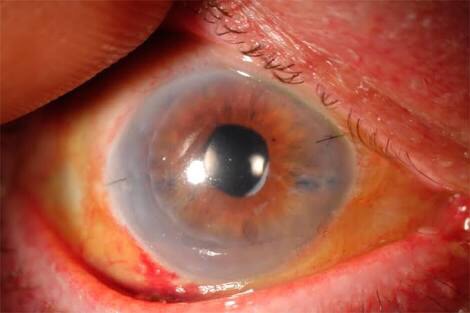
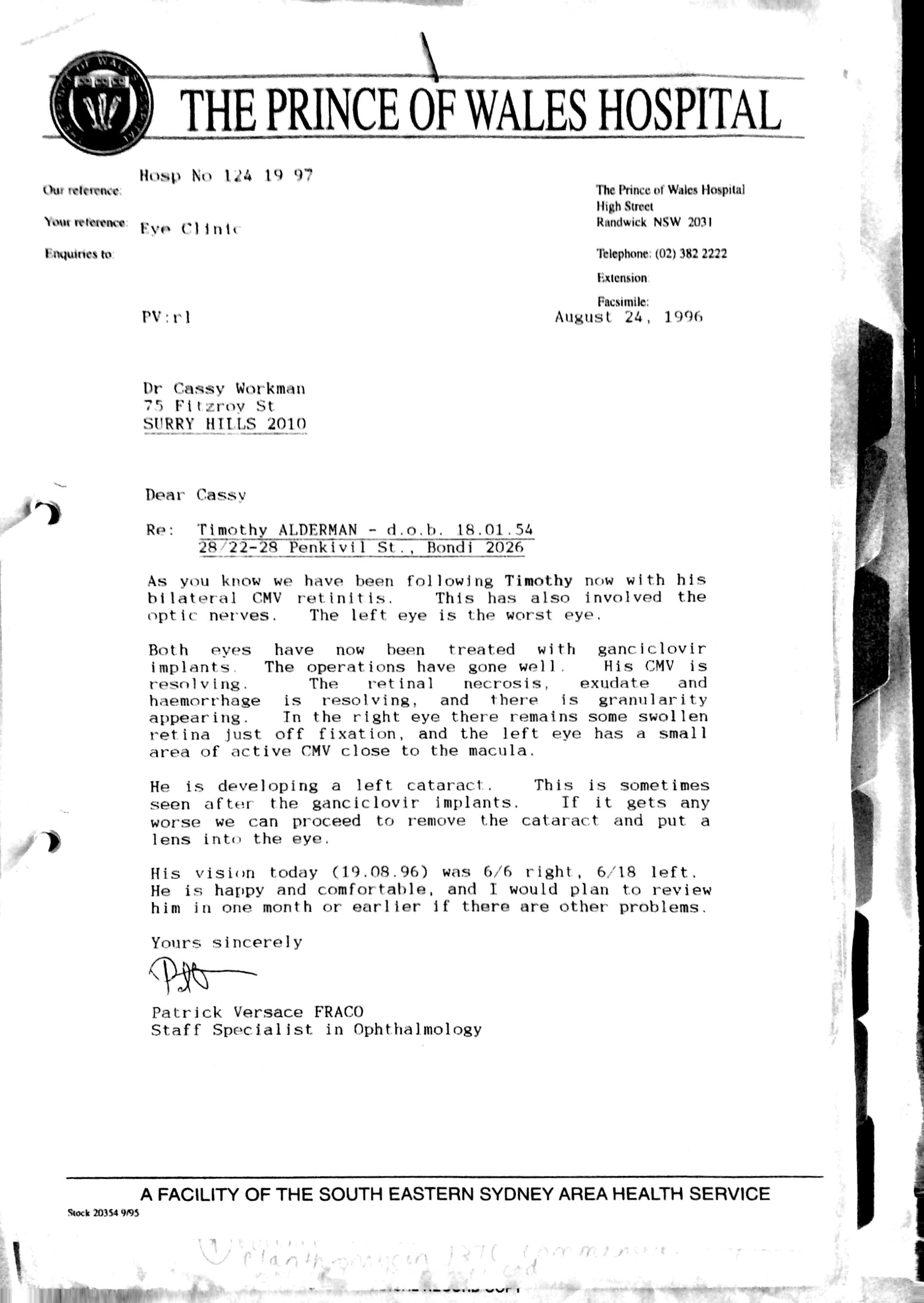
In June 1996 I was admitted to Prince Henry Hospital. I weighed in at 48kg, had 10 CD4’s, chronic anaemia, chronic candida and chronic CMV retinitus. Prognosis was not good, and I truly never expected to walk out of the hospital. In fact, it was thought that I would not last longer than about 2 weeks, especially with the CMV diagnosis, which was a very serious problem, and as I knew only too well, a very unpleasant way to die.

I think what surprised me the most was how calm I was about the whole situation. There was no panic, no despair. Just an acceptance that this was the way it was, and there was little I could do to change it. There was a certain inevitability about it, a knowledge that I had already beaten the odds to get this far with no serious illnesses, and it was just “my turn”. In some respects I had begun thinking that things were starting to get very lonely anyway, with so many I knew already dead, and still more to die before things started to get better. It was a time of reflection, introspection and recollection that was in its own way very calming, and I think I found a certain strength within myself that I wasn’t expecting to find, and a set of beliefs that have stayed with me since.

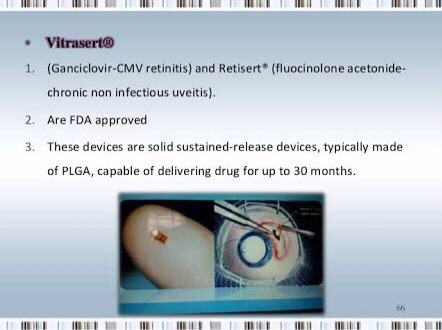
I underestimated modern medicine. This was a time of miracles! Intensive and aggressive treatment for the problems I had – gancyclovir injections into the eyes to halt the CMV, blood transfusions for the anemia and very aggressive dosing with the then new protease inhibitor class of drugs as part of my new combination. Miracles did indeed happen! Two weeks later, though still very thin and very weak, I walked (sort of) out of Prince Henry, and very much into a new life. And the new life was not what myself, nor anyone else, may have expected it to be.

I guess one would expect that after a close brush with death that one would undergo a huge epiphany, a movement towards God, many humble and pliant prayers (and much rattling of rosary beads) to the Power’s-That-Be to thank them for this great deliverance, and to invoke them through bible-bashing, church-going and good deeds to show Them that I was moving myself into a world of piety and religious zeal unequaled since Martin Luther or the Spanish Inquisition. Nah! None of that happened. There was no great enlightenment, no being filled with the Spirit and babbling in tongues. No overwhelming desire to drag myself into the confessional and plead for forgiveness for my sins (whatever they might be) and do 200 Hail Mary’s as penance, nor a need to robe myself in sack-cloth and ashes and disappear into a Cistercian Monastery for the remainder of my life. Was I even disappointed that this didn’t happen? Not really! I was too busy getting my health (and my weight – thanks to decadurabalin) back together and trying to work out what one was supposed to do, when one didn’t die as expected, to worry too much about the spiritual mine-field that I may have been in, but wasn’t. Get my drift!

In fact, with the exception of one (who surprised me, I must say), no one I knew gravitated towards religion as they lay in hospital, or closer to the moment in a hospice. No one! Nought! Zero! Well, except for the one! So did this (or should it) have made me wonder about my own mortality, or about the spiritual desert that I should supposedly have been in? Nah! That didn’t happen either. So exactly what is it that I felt about the great mystery that we call life, what is above and below us – and does it really matter at all? If you are broad-minded, read on. If not, stop here.

Now, before I go into details about my own religious upbringing, it may interest you to know that I come from a background of Yorkshire Wesleyan Baptists. Yes, that came as a shock to me too. In fact one of my first cousins, twice removed up, was the Reverend Alfred Pickles. Alfie (this far down the line I feel I can be familiar) appeared in the 1861 UK census as a watchmaker, then lo and behold 10 years later in the 1871 census he is suddenly a Baptist minister. He preached his way around Rochdale in Lancashire for a while until being made Pastor of North End Baptist Chapel in Towcester, Nothamptonshire frpm 1880 to 1891. It appears that a dwindling congregation forced his resignation, and he and his wife and brood ended up at Dallington in Northhamptonshire as a hatter and hosier. My, how the mighty fall.

I was raised in a household of mixed religion, with my father being Catholic (non-practising), and my mother a Methodist (or Presbyterian or something or other, also non-practising) and religion was something that was never discussed in any shape or form at home. The great wonder to me is why they felt the need to baptise me in the Congregational Church (talk about confusing the issue) at Sylvania. Perhaps, being the newbies in an already close knit commnity, they felt the need to fit in. The fact that we were surrounded on all sides by Congregationals may have had something to do with it (and it is, after all WASP territory), as our neighbours over the road ended up being my Godparents. They were Godly people, but thankfully not preachy so I guess religion was sort of left up to me to work out for myself. I did attend Sunday School, but saw it more as a way to collect scripture cards (“I’ve got more than you”) than to live by the precepts printed on them, and it was a good way to get to blow out birthday candles on the plaster cake used for such occasions even when it wasn’t your birthday (I plead guilty to relieving my boredom one Sunday by saying it was my birthday when it wasn’t – then packing shit that my parents may have found out – or even worse, that one of the other kids may have told his parents it was my “wasn’t” birthday and they would embarrass me by wishing me happy birthday. It caused quite a quandry! I never did it again). I was then sent to a Catholic boarding college at Campbelltown. Now for a while this did induce in me great piety and religious zeal (not to mention the first time I was groped by another guy, even if it was in the swimming pool), as like many other new converts to Catholicism I got caught up in all the rigmorole, ritual and razzamattaz that this religion inspires. What sort of budding gay boy can’t get caught up in all the shiney vestments, the candlelabra, the incense, the sprinkling of holy water, and devotion to Mary and all the saints (well, until they decided that some of them were fairy tales and not pulling their weight, and decided to chuck them out…go figure!). I certainly was inspired, and within 18 months of starting school there I converted, and was baptised in the school chapel by a priest (who later turned out to be a child molester – truly!), and my math teacher (who absolutely reeked of cigarette smoke) and the School Captain (a bit of a spunk) as my Sponsors. It was truly a moment to treasure. I didn’t think much of telling the priest in the confessional that I spanked the monkey like crazy (though truth be told he probably got off on it), but that was the only real drawback. Six months later I was Confirmed by the then Bishop of Wollongong, and started off on a quite short but vigorous religious life as a Catholic. I started hanging
around with the Carmelite Fathers who visited the college for weekly Masses and Confession and decided that I may have had a vocation. Truth be told, I think I just got caught up in the romantic appeal of monastic life (yes, you read that right – just ask any Catholic!), the dedication of my life within a totally male-dominated community devoted to God (I did the male community thing later, but God had nothing to do with it), the thought that I was entering an institution that had been around for centuries, and hey…I got to wear a frock, as uninspired as it may have been. I did enter the religious life for a while about seven years later (yes, into an enclosed community), and I guess this may have been the start of my doubts and probably accelerated my move to Athieism. A small start-up community with a Prior who was an egotist and loved the power trip, doling out penances that were almost medieval, and not one iota of support for new or struggling novices was the order of the day. I gave up out of sheer frustration and moved on. Needless to say, the community didn’t last long.

By this stage I had studied religion and found it wanting. I looked at all the hatred and hypocrisy; all the wars caused by; all the cultures destroyed by; the Catholic church burning and killing people who dared to believe otherwise; all the fundamentalist religions who seem to despise everybody and everything yet insist in ramming down your throat how Godly & Righteous they are; King Henry deciding he was God, and beheading or burning anyone who defied him; all the history and architecture and books and art destryed by same religions; all the lives twisted and destroyed by molestation and lies (and which the Church still tries to deny); all the doomsday and suicide cults who,unbelievably, manage to suck people in until it is too late to get out; attitudes to celibacy, contraception and sex that are so outdated that we may as well be living in the 13th century; the way women are treated in many religions; and the Catholic church being totally unable to reconcile itself to the modern era, and remaining in the past by electing conservative & ancient Popes…and decided it was all bullshit. The whole fucking lot of it! I have recently been reading a series of Historical Fiction novels by C.J.Sansom about a lawyer called Matthew Shardlake, set in the reign of Henry VIII. Everybody, irrespective of social rank or standing or occupation is terrified to express any religious view other than what the King tells them to believe. It delves into the sheer egotism of the time, the Catholic Church forcing itself onto everyone as the ONLY faith that one could have, Henry VIII as the ultimate egotist and dictator saying no, he should be the religion that everyone follows, and the reformists who were at heart no better than either, as they also thought they were right and everybody else was wrong. To be contrary was to be dead. It is a rather terrifying insight into the medieval mind, made more so by the fact that we know this actually happened.

Next, I “came out” at the grand age of 25. I managed to have a total of two years as an active gay man before contracting HIV. Didn’t that make me wish I’d defied everyone and come out a lot earlier! So, did I blame God for this plague on my life? Nah! Unfortunately I had to admit to contracting it from being newly out, and a trash bag. I slutted my way around the scene quicker and more thoroughly than the flu virus spreads through an office. I could sniff out a Yank at 5 metres, and would stalk him until he relented and bedded me…little knowing! It was prolific sex…and wonderful. I have no regrets about that. Though I didn’t know it at the time, over the next 10 years I was to see enough death, desolation and despair to last me the rest of my life. I saw incredible bravery in the face of adversity; I experienced people taking their own lives to avoid the misery of AIDS; the hope on the faces of guys being guinea pigs in an attempt to try to help both themselves and others (and I am indeed in that group); a community coming together and showing that there is power in numbers; and we did gain a voice that was loud and radical and took no compromise in the face of everything that was going on. Oh yeah, and we had the Rev.Fred Nile and his ilk, screaming out in true Christian sympathy, love and compassion that this was a plague from God on the gay lifestyle, that we deserved it (in a Christian way), and that everyone with HIV should be quarantined and locked away from all the “good” members of society (but in a Christian way, of course). Any single, solitary vestige of religion I had left in me (and there would have been very little left) went out the window at this stage. I have never looked back and regretted that.

So, at this point we come back to Prince Henry Hospital, and me being thrust back into the real world, with no tools to get me back on my feet, spiritually, emotionally or psychologically. I guess I could have seen religion as an easy way to acknowledge my survival from what should have been death; as a way of celebrating living and being given a second chance. Nah! Not for this boy. I have never regained any respect or love for religion, and I don’t imagine that I ever will. Some people gravitate towards it as they get older and the prospect of death looms. They seem to join the ratbag fringes for some reason – they start ‘speaking in tongues (also known as glossolalia), or join Opus Dei or call themselves Charismatic, Pentecostal’s or Born-Again’s (to be avoided at all costs! I dislike people who preach without listening). Fear of death obviously causes a lot of people to lose the plot.

So, what then do I believe? Well, I don’t delude myself to start with – Athieism is a belief. Okay, it’s a belief in not believing which in itself is a bit contrary, but perhaps that is getting closer to where I am anyway. I don’t really want to die, but I’m not afraid of it. Perhaps I should consider being truly radical and joining the Baha’i, or Zoroastrian religions. Now, that could be interesting. I guess if I was to go back to any religion – and the arguments would have to be truly convincing – it would be a religion where I was just left to decide my depth of faith for myself. No theology, no liturgy, no preaching, no dictating, no churches, no ministers. Give me the bare-bones of belief (whatever that may mean) and let me devise it for myself. I don’t believe there is any afterlife. No heaven, no hell. It makes no sense to me why we should live this life for something that comes after – one way is good, one way is bad. It’s just stupid and illogical. If heaven and hell do exist, why is it that the Christian religions (and many of them are new arrivals to the religious scene) are the only ones who believe in this concept? Yes, other eligions do believe in an afterlife (and many don’t) but nowhere is it so clearly delineated by pearly gates and streets of gold in one direction, and nothing but flames and misery in the other – like living here and now can’t be misery enough! Does this mean that everybody else is wrong, or irrelevant? If heaven and hell do exist, are the millions who don’t believe in it excluded from this exclusive club? How ridiculous that people actually believe they are so above everyone else that only they are right and deserve this deliverance! And how typical of the superiority of Christian religions that they are ‘holier than thou’ and everyone else be buggered! I belive in the theory of “the right place at the right time” for our evolutionary process, that we are here simply ‘because’. Everything has its time and wears out, as we do, and just passes away and becomes part of the Earth’s recycling process. I don’t see why there should be anything greater or higher, and I don’t know why this imaginery being we call God should be any better than me, nor why I should worship something that can’t even be proved. It is all so ethereal and…silly.

I must admit to finding Buddhism very tantalising. The Dalai Lama is the most amazing man, and far surpasses any leader of any faith that I have ever encountered. His compassion, his piety and his dedication to Buddhism despite being in exhile from his own homeland is truly inspiring. Let’s hope he never gets sucked into doing “Masterchef” again! Having said that, the thought of having to turn vegetarian is definitely a put-off for me, though recently I have found myself putting spiders and other creepy-crawlies that appear in the house back outside…so maybe I’m considering who it might be. I watched Judith Lucy’s recent program on the ABC about her spiritual search (she didn’t find anything that changed her perspective) and at one stage she interviewed a Buddhist nun. This woman had the best attitude to Buddhism, claiming that you didn’t need to follow it in it’s purist form, but you could draw from it the parts that suited you and create your own form of Buddhism around that base. Now, that has almost converted me. If only Christianity had learned such wisdom, understanding and humility. Perhaps it would not have lost me in the first place.

As an ageing HIV+ man, I don’t feel any real need to negotiate with a God. I don’t need to justify my existence, nor do I need to create an afterlife so that I have something comfortable to believe in as death approaches. I don’t know how or when I will die, though I do believe that the time is not yet, and that there are still a few kilometres on the speedo. I used to be concerned that I was not going to leave a legacy behind when I died – something that said to future generations “I’ve been here and I’ve done something”. I do hope that I have done no one true harm, and that somewhere along the line I may have had a positive influence on somebody. Just one would do! It’s not important, but it would be nice. As for a legacy? I hope my writing is my legacy. I hope that at some stage someone will read what I have written, or quote it, or even contemplate it and think to themselves “what an interesting man”. That would be nice indeed!

Tim Alderman
Copyright 2012

IMG_3364

The Reverend Alfred Pickles

The Rev Alfred Pickles
I have been researching my family tree for over 15 years now. In the early days it wasn’t so easy, and I probably had the sum total of about 10 names. The advent of the Internet has changed all that, and I now have four large arch files of information, including one entire file dedicated to one family member – more on him in a later post. I have gone as far back as the late 1500’s in Fylingdales and Robin Hood’s Bay in Yorkshire (the further you go back, the more difficult it gets), and can pretty well trace the family right down the male line to now, with a recent start being made on tracing the maternal lines back from my mother, and my Great Great Great Grandmother. A surprising find, in a site of graveyard inscriptions, were the names of not only my long searched for Great Great Great Grandmother (Clara Pickhills nee Rickinson), but also her husband (Joseph Pickhills), one son (Seth Pickhills) and daughter (Priscilla Pickhills). This was a great find as it connected me further back than my Great Great Grandfather (Rickinson Pickhills) and filled in a few blanks. I had to use a research company to find details, as the trace is difficult if you live in Australia. Clara’s son Seth Pickhills had one son – Alfred – who is important for two reasons (he is my first cousin three times removed). Firstly that he took off down his family line using Pickles instead of Pickhills – and I guess we will never know why. For a while in Rochdale (Lancashire) he lived with his aunt (Priscilla) and she was a Pickhills. Secondly, and the very last thing I would ever have expected to find in my family, after a stint at being a watchmaker he became a Baptist Minister in Rochdale. And here I was thinking that we had always been Catholics! I don’t know when religious affiliations changed, but I suspect it was after the families arrival in Australia, and probably after some Irish heritage had been added by way of the lineages of the Fanning’s and the McConnell’s. With Catholic’s being unable to marry outside the faith, potential spouses of other religions would have had to convert. Thankfully, my family never cared one way or the other, and despite being christened a Congregational, I am now a devout Atheist.

Anyway, this much we do know about Alfred. He was born in the rapidly growing West Riding textile town of Bradford, Yorkshire, in 1843. The son of Seth Pickhills and Jane Bracher, we know little of their actual lives except that they were working class. Seth was a journeyman printer (journeymen, after serving their apprenticeship, were able to move amongst employers), and according to the 1851 census the family were living in Belgrave Place in Bradford, and 8-year-old Alfred was a scholar. Moving on 10 years to the 1861 census, we know that he was 18-years-old, and living with his aunt, Priscilla (Seth’s sister) at 46 Belgrave Place, Bradford, and that he is listed as being a watchmaker. Seth had died in 1859, and it would appear that his sister had taken over the running of the household, though we are unsure of what had happened to Jane. His next mention in the records is in the 1871 census, and both he and Priscilla had moved to 95 Mitchell St in Rochdale, and he was listed as being a Baptist Minister.

We know from his memoir printed in “Memoirs of Ministers and Missionaries who died between 15th January 1917 and 31st October 1919” that he was involved with the Baptist church from a young age, and he became a member of Westgate Church in Rochdale under the pastorate of Henry Dowson, whose teachings had a lifelong influence on him.

On the 19th August, 1864 the following article appeared in the “Bradford Observer” regarding his ordination; “Ordination of a Bradford gentleman at Rochdale – On Tuesday, Mr A. Pickles, son of the late Mr. Seth Pickles, of Belgrave Place, Bradford, was ordained pastor of the Lyceum Baptist Church, Rochdale. A prayer meeting was held in the morning, the ordination followed in the afternoon, when a sermon eas preached. In the evening there was a tea meeting in the Milton Congregational School, presided over by the Rev. A. Pickles. Amongst those who were present at the ceremony were the Rev. E. Parker, Farsley; Rev. J. Smith, Bacup; Rev. H. Dowson, President of the Baptist Theological Institute, Bury; Rev. J. Home, Waterbarn; Rev. L. Nuttal, Ogden; Rev. J. Williams, Oldham; Rev. J. Bloomfield, Bradford; Rev. J. Wilkinson;  Rev. A. Pitt; Rev. A. C. McCoffin; Rev. A. H. Drysdale, and several friends from Bradford. The Rev. A. Pickles was formerly a scholar at the Bradford Grammar School, and afterwards pursued his studies at Bury College under the Rev. H. Dowson.”

In 1874 he married Margaret Elizabeth Shepherd, who was born in Waterbarn, Lancashire in 1844. The couple had two children whilst living in Rochdale – George (1876) and Henry Shepherd (1878). Initially, Alfred’s ministry consisted mainly of cottage and outdoor meetings. He became one of the earliest students of the Baptist Theological Institute, which at the time was newly established at Chamber Hall in Bury, and under the presidency of Henry Dowson. In 1866 the Institute moved from Bury to Manchester and became the Manchester Baptist College, founded on strict Baptist communion lines. The College was to become a founding member of the Theological Faculty of Manchester University. Alfred’s name was the first on the roll of minister’s trained at the college. His pastoral work began in 1870 at the Lyceum in Rochdale, and soon afterwards at the church purchased in Water Street, Rochdale.

Manchester College
This was to become the Water Street Ebenezer Baptist Chapel. During the pastorate of Alfred the congregation grew and prospered. On the evening of February 10, 1878 the Reverend gave a long lecture to his congregation entitled “Turkey, Russia, England and the Jews” which was published in booklet form shortly after. He was also secretary of the local branch of “The Liberation Society”.

The society had been formed by Edward Miall (8 May 1809 – 30 April, 1881) who was a Portsmouth-born journalist, apostle of disestablishment and a Liberal politician. He was also a Congregational minister at Ware, Hertfordshire (1831) and Leicester (1834), and in 1841 founded ”The Nonconformist”, a weekly newspaper in which he advocated the cause of disestablishment.
Miall saw that if the programme of Nonconformity was to be carried through it must have more effective representation in Parliament.
One of the first fruits of his work was the entrance of a John Bright into parliamentary life; and by 1852 forty Dissenters were members of the House of Commons.
This was due largely to the efforts of the British Anti-State-Church Association, which Miall was instrumental in founding in 1844. It was renamed in 1853 as the Society for the Liberation of Religion from State Patronage and Control, known for short as the “Liberation Society”. The Society was never able to secure a parliamentary majority for the disestablishment of the Church of England, but the long fight for the abolition of Compulsory Church Rates was finally successful in 1868. In 1870 Miall was prominent in the discussions aroused by the Education Bill. He was at this time Parliamentary member for Bradford (Yorkshire) from 1860-1874, having previously sat for Rochdale (where Alfred would undoubtedly have encountered him in person) in 1852-1857. In 1874 he retired from public life, and received from his admirers a gift of 10,000 guineas. He died in 1881 at Sevenoaks in Kent
.

After ten prosperous years at Water Street Chapel, throat problems forced Alfred to accept a call to Towcester, in Northamptonshire, which was more rural and had a milder climate. He officially became pastor after a three month trial period. However, it would seem that this move to the North End Baptist Chapel was to have its own trials and tribulations. The chapel at Towcester was opened on 3 October, 1853. There appears to be little interaction with other churches in the area, though the Towcester Baptist Church does record that after re-forming in 1871, it received a letter from the North End Chapel to “renew contacts severed with the old church, as the basis for fellowship was now seen to be biblically established”. What was often referred to as “the Baptist Church”, almost as though it were a separate denomination, later came to be known as the South End Church, though there appears to be no desire to unite the two churches on the part of North End. Most of what we know of Alfred’s pastorate is from the Church Book. The Church Book was used to record baptisms, reception of people previously baptized by the laying on of hands, expulsions, and rebukes of a serious nature. Under the previous pastorate of Samuel Cooper Tite, the book had not been filled out prior to the 1880’s, and he had in fact taken the book with him when he left the church. He returned the Church Book to Alfred in 1886, after his return to the Baptist church. There was a fairly small congregation, possibly due to it being a sect of the Baptist church commonly referred to as Johnsonian Baptists. Founded by John Johnson (1706-1791) who was a Baptist Minister of High Calvinist views, he taught that faith was not a duty required of God, but a grace which it is impossible to convert into a duty. Want of faith, therefore, is no sin. He was repudiated by the local association for “bizarre ideas” , as he questioned whether the Incarnation would have been necessary if man had not sinned, he denied the doctrine of the Trinity, and was highly insular and exclusive. Johnsonian’s were not even allowed to associate with other Baptists, which would have explained the division between the two Baptist churches in Towcester. Other Johnsonian churches were founded in Blackburn, Norwich, Chesterfield, Halifax, Bromley, Duncote and Dublin.

In Towcester, for the 64 years leading up to Alfred’s appointment, about 80 people were associated with the church at one time or another. In 1886 there were 37 members, and Alfred baptized 20 in the 6 years since he became pastor. With the return of the Church Book, he started to record church meetings and one or two other “events”. There is a record of a visit from a person from a nearby congregation to communion “at the Lord’s Table October 2nd 1887 Mr Davidson a Member of the Church of Christ at Banbury requested and was allowed to commune. At the request of the Church he also preached in the evening from 1 Cor 15c 1 – 4 vs”. This is obviously an “Event” and reveals the small congregations isolation. The Churches income was about ₤20 per year, which appeared to cover their expenses. A welcome gift mentioned in the Church Book is of an amount of ₤100, which was on its way in five installments from the sale of a church in Comus Street, Liverpool.

In the meantime, Alfred and Margaret had another two children – Thomas Edward (1881) and Ruth (1884). The family first appear in Towcester in the 1881 census, living in High Street. Alfred and Margaret are listed along with George who is 5-years-old; Henry who is three; infant Pickles (Thomas, and just born); a Maude Clegwidden who is 12-years-old and occupation given as nurse maid (at 12?) born in London, Middlesex; and a Margaret Taylor, 68-years-old and a visitor. Alfred appears to have left his position as pastor of North End Chapel in 1891. The church may have been too small to warrant a pastor at that point, as thirteen members passed the following resolution at a Church Meeting towards the end of 1891 “that in harmony with the suggestion of the Trustees, we request Mr Fidler to preside at our Church Meetings and to advise and assist so that the Services at North End & Duncote Chapels may be maintained in as orderly and efficient manner as possible. Signed by Alfred Pickles. Pastor.” William Fidler accepted the invitation. By July 1893 there was obvious concern about the viability of the Church. Many of the church members had been elderly and had died. The Sunday School had just 11 pupils. A church meeting was held with 8 people present which decided to try to carry on for another few months. “There appeared no disposition to unite with the South End Church. Still the prospects of continuing as at present were doubtful. Mr Garlick was specially anxious that they should try to revive the work by prayer and united effort”. Early in 1894, after the services had been held in the vestry for all winter to save money, the church was officially closed on March 25. There were 16 members listed, 4 of which were discovered to have died. The contents were distributed between the Duncote Chapel, and Towcester Baptist. Church (South End Chapel). Obviously they weren’t too proud to take a donation from a church with opposing views to theirs.

In the 1891 census, Alfred and Margaret are listed as living at 19 The Drapery, Northampton. George is now 15 and an apprentice; Henry is 13 and a school boy; Thomas is 10 and a school boy; and Ruth, the new addition since the last census, is 7 and listed as a “school boy”. Margaret Lyack, 66-years-old, is living with them as a boarder living on her own means. 19 The Drapery (a store) is still there, and currently occupied by Oxfam. I think Alfred would like that.

For the following 6 years, after the official closure of North End Chapel, Alfred travelled from Northampton back to Towcester every Sunday in order to break the bread of life for the Towcester Church, this being done for no renumeration.

Another interesting item that came out of the 1891 census is that Alfred’s occupation is listed as a “Hatter & Hosier” at 19 The Drapery, and he is also listed as a Hatter in two directories of Northampton for that period. However, I am led to the thinking that this was the year they moved to London, possibly in the latter half of that year.. A notice appeared in the “Edinburgh Gazette” dated August 4, 1891 whereby in a listing taken from the “London Gazette” he was listed as bankrupt whilst living in Northampton. We know that at the time of the first meeting and first examination regarding his bankruptcy that he was residing at 160 Regents Park Rd, London, though he returned to Northampton for these meetings. He was still at the Regent’s Park Road address in 1893, when the Public Trustee Alfred Lister Blow was acting on his behalf. It is open to suggestion as to why he declared himself bankrupt. One reason may be that he used all his available cash trying to keep the North End Chapel viable. Another reason might be that with the church being so poor, and with him having to resign his position as pastor (and receiving no pension or renumeration) that there was just no money left for him and his family to survive on until he either obtained work, or started his own business. Who knows! I have tried researching the prevalence of bankruptcy in the 19th century with little success. Alfred is the second family member to have declared bankrupcy. He also started work for the Baptist Tract and Book Society, where he worked for some years. still preaching whenever and wherever he was needed. By the time the 1901 census rolled around, he was residing at 10 Oppidans Road in Hampstead. He is listed as a “Tay Dealer” which I can find nothing about, and suspect it is a deciphering error. Margaret is still listed, as are George (now 25, single and a clerk); Henry (now 23, single and a printer); Ruth (now 17, single and a shop assistant); and Thomas (now 20, single and a printer). They still have a boarder, now an Edward Gounersall, a 24-year-old single electrical engineer. By now Alfred’s eyesight was failing, and The Memoir notes that for several years before his death he was quite blind, and bore it with great patience. It would appear that he did continue to work, possibly as a hatter and hosier seller (perhaps Ruth was a shop assistant in his store), as well as continuing an occasional ministry for as long as his failing eyesight allowed.

Margaret died in 1911, and I think this would have devastated him, as he had described her as “a true help in all his labours”. At the time of the 1911 census he is living at 23 Ainger Road, St Pancras in London. He is listed as a Baptist Minister Retired. Thomas Edward is still with him at 30, and it would seem still single and now a Painter Machine Manager. Ruth is also still listed as being with him at 27, and it would seem that she also is still single and now a costumier.

Alfred died in his sleep (according to The Memoir, which can tend to prettify things) on the 20 February 1920, aged 72, at Hendon. He left behind a family who cherished his memory. “He was a man of faith and prayer, and faithful to the principle, even when fidelity meant loss. His one passion was to preach the gospel and he has now gone to hear his Lord’s “well done” and receive the reward of many soul’s for his hire”. It would appear from The Memoir that he was a very committed and devout man.

Although research continues into this side of the family, it would appear that only two of Alfred’s children married. The 1911 census lists at 10 Oppidans Road in Primrose Hill in London a George Pickles. He is now 35, in the Motor Accessory Trade, and head of the household. His wife is Mary Ellen Pickles who is 39, and born in Co Kildare, Ireland (a resident of Clonkeeran). They have been married for 8 years, though no children mentioned. Thomas Edward appears in the 1917 register of marriages for St Savior in Hampstead. He is 35 and marrying a Mary Turner who is 29. There is a listing for Thomas E Pickles Death in 1965 in Greater London, though if this is indeed Thomas Edward is yet to be verified. He was 84 at the time of his death. There is a death registration for Ruth Pickles, aged 81, at Sidcup in Kent. Again, this needs to be verified.

Further to the Water Street Ebenezer Baptist Chapel in Rochdale. The Water Street Chapel was demolished in 1915, and the demolition was witnessed by a parishioner by the name of “Owd Dob “who was inspired to write an account of his personal memories of the chapel in a short treatise entitled “Th’ Owd Chapel”, for private circulation. It is difficult to read as it is written in the Lancashire dialect, though with perseverance an interesting account of the chapel (including a mention of the pastorate of Alfred Pickles at the beginning) unfolds, and includes a picture of the Church, its banner, a sketch of its interior, and photographs of pastors, the choir and the woman’s class – all looking very “Baptist” in their 19th century severity.

This biography has been put together using information gleaned from census records, Alfred’s memorium in The Memoir, and various newspaper reports from the time. Some suppositions have had to be made, and I hope that some of my conjectures at least are correct. It has been an interesting exercise cobbling someones life together from whatever information is still available. At this time I am still waiting to hear from Northamptonshire Archives of any information they may have on file for Alfred. NB: they never got back to me. There is a payment request for searches on their web site, but I am nit willing to pay money to find they either have nothing, or I already have what they hold. A request to know if they have any information on Alfred before I pay has been ignored. This is the first archive in England to be unhelpful with an information request.

I would personally like to thank Emily Burgoyne from Regent’s Park College Library at the University of Oxford for abridging the “Memoirs of Ministers Who Died Between 15th January 1915 and 31st October 1919” and sending it to me (the Memoir itself is the only copy and is in to fragile a state to scan. It was compiled by the Baptist Union after they decided to stop printing the Baptist Union Handbook during the First World War, as paper was scarce, and printing expensive), along with scanning in his lecture “Turkey, Russia, England and the Jews”. It has all been an invaluable aid in helping to trace my long-lost cousin.

Tim Alderman (formerly Robert John Pickhills)

Note: Ebenezer Baptist Chapel, Water Street (pp 139-140)

This church was formed of members formerly in connection with the West-street Church, and met at first for divine worship in Baillie-street, on the 8th of January, 1867; it continued there up to the time of its removal to the chapel in Water-street. The last mentioned place was built in 1834, by the New Connexion Methodists, and was purchased from them by the Baptists, and re-opened for divine service on the 1st of May, 1870. [a little more]