Category Archives: General Interest

Gay History: 30 years Of Gay Style: From Disco Chic To Hipster Bears

It used to be a tribal signal but as gay style has moved into the mainstream, the look has become harder to pin down. It’s forcing creatives to really push the boundaries if they want to make a statement

Now and then … Sylvester in the 80s and John Grant in 2015. Composite: Getty

When he was studying at Central Saint Martins, London, in the late 00s, Craig Green wrote his dissertation on the adoption of gay style subcultures by straight men. In the preceding decades, perfumed dandies, dilly boys, mods, skins, clones, new romantics, scallies, fierce vogueing divas and muscle Marys had all been sieved out of their natural habitat on to the high street for brief moments of mass consumption. But by the time Green – currently reigning menswear designer of the year at the British fashion awards – was weighing up his thesis, things had changed. The bears – hirsute, gay men – crowded on the dancefloor of London’s XXL nightclub were barely distinguishable from bearded Bon Iver fans.

A reciprocal shared wardrobe, common across menswear emerged. “When I was younger,” says Green, who was born in 1986, “what I thought of as a very gay look was really a metrosexual thing, a bit Italian, clothes a tiny bit too tight, skinny jeans, tanned, tight T-shirt, worked out. Most of the men who dressed like that were straight. Gay men all seemed to be growing beards, too. It was a less specific time. You couldn’t really tell who was who any more. Had we come to a melting point?”

From the vantage point of the DJ booth in the capital’s Horse Meat Disco, Luke Howard has been well positioned to watch the changing appearance of gay men over the past 16 years. He has noticed something similar to Green. “Lads in a straight club in Sheffield or Leeds don’t look that different from an average crowd we get at Horse Meat Disco,” he says. “These days I can barely tell the difference between straight men and gay.”

At the beginning of last year I started writing a book, Good As You, about the mainstreaming of gay pop culture as gay men headed towards complete equality in British law; roughly, a journey from Smalltown Boy to same-sex marriage that felt personal and lived, but would hopefully reflect a wider shift in the country as the gay culture has come into the light. Across the 30 years I looked at (1984-2014), the sheer number and range of signals that gay men sent out through their personal, often tribal, style fitted a wider emerging narrative, reframing the British gay man’s story from victimhood to a kind of valiant heroism. By the time I had finished the book, a moustache was no longer a moustache, it was part of a suit of no-nonsense sex armour.

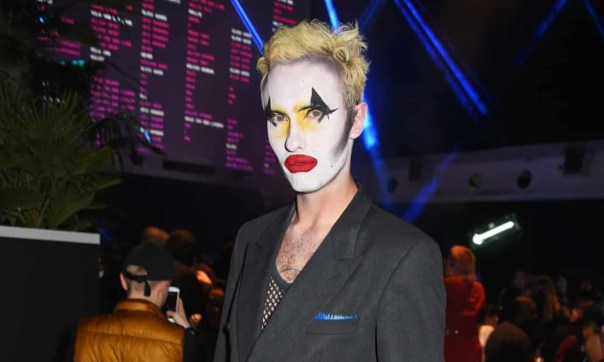
UK designer Charles Jeffrey. Photograph: Dave Benett/Getty Images for Daz

“Traditionally,” says Tim Blanks, editor-at-large of Business of Fashion, “gay style was about men who took a lot of care and attention about their appearance.” The Beckhamification of culture that begot the metrosexual ended all that. The most popular gay cultural figures in its slipstream were visibly paying less attention to their clobber than the majority. For Blanks, this is even truer of gay cultural figures now. “Where is gay style now concentrated?” he asks. “[Singer] John Grant’s statement is the most chic, stylish and sophisticated art. But it isn’t visual.” Like the musician Perfume Genius, AKA Mike Hadreas, Grant favours contemplation of the interior life over the exterior.

Yet just as the gay scruff-as-cultural-archetype boomed, a raft of new figures emerged, reframing sexuality and style, both in and out of high fashion. Demna Gvasalia (Vetements, Balenciaga) and Alessandro Michele (Gucci) became the most influential designers of their era by taking – respectively – utilitarian street style and ornate embellishment down strange, pleasingly radical avenues, upsetting the strict tenets of buttoned-up, sartorial menswear. Meanwhile, American designer Rick Owens has looked to the brilliantly extreme edges of performance art, taking inspiration from the purposefully surreal, absurdist and unsettling physical disposition of David Hoyle and Christeene Vale. Things have shifted. “Oh, I could look at [queer experimentalist] Arca 24 hours a day,” says Blanks. “He is phenomenal. His look embodies transgression, intellectual depth, incredible provocation and sensuality in exactly the way Bowie’s and Lou Reed’s did when I was teenage.”

For a young breed of designers, a sense of controlled, thrilling outrage – a sense incubated in gay nightlife – is once more tickling the underbelly of fashion. “You have all those children of Kim Jones,” Blanks notes. Jones, head of menswear at Louis Vuitton, made a path from 90s London gay club culture to the apex of men’s fashion. He was a regular at 90s gay clubs from Kinky Gerlinky to Queer Nation, which he has heavily referenced in his collections. Young designers including Christopher Shannon and Bobby Abley have done their own idiosyncratic takes on that journey, too. It’s a path that can work in reverse, too. In their earliest incarnation, Take That, five straight men from the north-west, were styled to catch the eyes of ritzy gay clubbers at La Cage in Manchester.

Another who trod that path was Green, whose richly specific fashion vernacular feels technically in the lineage of Yohji Yamamoto and Issey Miyake. Then there’s JW Anderson’s fruity gender play, putting men in frilly boob tubes and thigh boots during his early years.

As Green was writing his thesis, the young designer Charles Jeffrey was being beaten up in Glasgow for his appearance. An obsessive fan of Southend gothic revivalists the Horrors, he tried to emulate their style on a pocket-money budget. “I wanted the panda eyes and the big black hair but I had to buy winklepickers from Burton and women’s blouses from Primark,” he recalls. Hair was a big thing for Jeffrey, his point of differentiation, the “this is me” moment that many men have traditionally alighted on when they adapt publicly into a chosen gay identity. “I was called a ‘faggot’ and a ‘poof’ for having bright orange hair in what I thought of as really quite an aggressive look. I didn’t see it as being gay at all and I was punched in the face in George Square for it.”

“Gay men have co-opted both masculine and feminine imagery,” says Howard, “in an either/or way as regards their choices of clothes.” This delineation has precedent. “In the late 70s, you had new romantics with their velvet and face powder, which coincided with the clone look – handlebar moustache, muir cap, leather and denim – inspired by construction workers and uniformed personnel.” He thinks the reason these polarities exist might be connected to deeper identity questions. “Boys that grow up to become gay men have often personally experienced or at least witnessed anti-gay bullying, which perhaps then becomes either externalised – I’ll be as flamboyant as I want in my attire and to hell with you all – or internalised: I’ll be more masculine-looking than the most heterosexual men.”

Clubbers at Leigh Bowery’s club Taboo in 1986. Photograph: UniversalImagesGroup/UIG via Getty Images

The digital age has complicated personal identity issues for everyone. For many gay men, the closure of bespoke social spaces, as clubs and bars shut up shop, has meant formalising an identity online. “At the Blitz and Taboo,” says Blanks of the legendary London gay clubs, “it was always about not wanting to be stuck at home.” Times change and styles change with them. “Now, it is absolutely all about staying in.” The 2017 gay male archetype could easily be the bearded, topless selfie guy, stomach clenched, puckering up in his bathroom mirror, who routinely clogs the suggestion feeds of gay Facebook and Instagram users.

“What a shame,” Blanks continues. “The notion of community used to be absolute. The internet presents a different sense of immediacy. Your desire is now more important than your style.” In this sense, the most useful arbiter of gay style may be Ernesto Sarezale, the London nightclub fixture who frequently attends, dances and leaves completely naked.

Jeffrey’s Loverboy parties have seen the emergence of a newly radical slant on the club kids who have defined gay culture. “What I love about someone like [Loverboy regular] Harry Charlesworth,” says Blanks, “is that he’s sitting dressed like a southern belle with a hairy chest that Burt Reynolds would be proud of. It’s that visual idea that ties back to the Cockettes.” The revolutionary late 60s/early 70s San Francisco drag ensemble – a template for wild expression – are a touchstone in the gay style story.

“My gay style icon would have to be Sylvester,” says Howard, about the Cockette who broke free from the underground to define the sound, look and spiritual outer edges of disco. “He used his body and the clothes he wore as a way to express his liberation from the oppressive restrictions of heteronormative culture. If only more men, gay and straight, myself included, could be more like him.”

Model wearing a Tom of Finland print swim shorts. Photograph: The Washington Post/Getty Images

Wardrobe constraints can be further complicated by the thorny issue of sex. “Dress codes are generally about getting laid,” says GQ Style’s editor, Luke Day. “The connecting tissue between all gay subcultures is that you’re generally expressing your sexual preference in some sort of way. We are trying to attract. What we put out there is what we fancy.”

“There are gay men that I like the style of,” says Green. He mentions his former stylist and collaborator Julian Ganio, the fashion director of Fantastic Man magazine. “He wears things really well. It’s quite difficult to look good in denim shorts, a bucket hat and a pair of shearling loafers, but he’s got a magic way of holding himself.”

Ganio himself doesn’t think that gay men’s style has changed much over his time. “It never really does,” he says. “In 30 years’ time, it’s more than likely the leather queens will still wear leather, the bears will wear a plaid shirt and beard and the scallies will wear Reebok Classics with a Ralph Lauren polo shirt.”

Howard thinks the real influence of gay men on mainstream style may not even be on their own kind. “Perhaps, traditionally, gay men have had more time and money to spend on their clothes and bodies, but gay men have arguably had more influence on women’s style and fashion than men’s.” The recent appointment of Edward Enninful as editor of British Vogue would suggest that. As for the question that haunts the debate of gay men and style, Ganio has a simple and succinct answer.

Why are so many gay men designers?

“Because gays are fab,” he says.

Seven key gay styles

he Village People. Photograph: PA

The clone

Origins: Tom of Finland.

Subcultural habitat: The End-Up nightclub, San Francisco.

Crossover moment: Tom Selleck as Magum PI, the Village People.

The dilly boy

Origins: The rent boys of yore plying their trade at Piccadilly Circus.

Subcultural habitat: Smoking a Virginia Slim louchely under Eros with a Jean Genet paperback.

Crossover moment: Bowie, Lou Reed, Christiane F, Suede.

The Vogue queen

Origins: Harlem Vogue balls.

Subcultural habitat: A makeshift catwalk on the Chelsea Piers; Paris Is Burning.

Crossover moment: Madonna, Malcolm McLaren, streetdance.

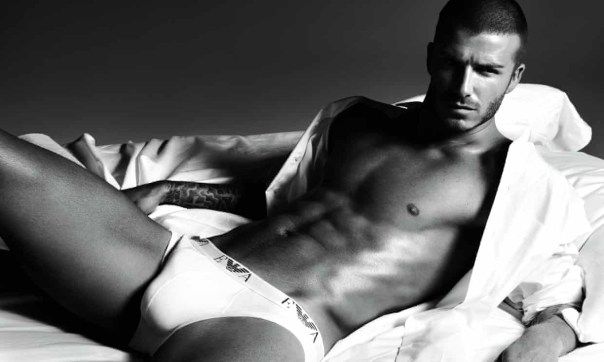
David Beckham’s Armani ad. Photograph: Marcus and Mert/Publicity image from PR company

The muscle Mary

Origins: YMCA locker rooms and Physique Pictorial magazine.

Subcultural habitat: Trade.

Crossover moment: Mark Wahlberg for Calvin Klein, David Gandy for Dolce and Gabbana, and David Beckham for Armani underwear.

The bear

Origins: Christopher Street.

Subcultural habitat: The King’s Arms, Soho, London.

Crossover moment: Ted, beard oil, Rag’n’Bone Man.

The scally

Origins: All Ralph Lauren concessions, department stores, the north, 80s.

Subcultural habitat: Frank Clarke’s 1988 film The Fruit Machine.

Crossover moment: The Streets, Skins, Slaves, Hollyoaks.

The Cockettes in 1972. Photograph: Robert Altman/Getty Images

The Cockette

Origins: The late-60s hippy communes of San Francisco.

Subcultural habitat: Falling over, high, on stage.

Crossover moment: Kenny Everett as Cupid Stunt, David Walliams in Little Britain.

Good As You: From Prejudice to Pride – 30 Years of Gay Britain by Paul Flynn is published by Ebury Press,

Reference

Gay History: Is It Okay to Be Gay (and in the Far-Right)?

How outspoken gay figures like Milo Yiannopoulos and Caolan Robertson go down with right-wingers, who – traditionally – haven’t been big fans of the gays.

MILO YIANNOPOULOS AT THE REPUBLICAN NATIONAL CONVENTION CLEVELAND OHIO, USA, 21ST JULY 2016 (MARK REINSTEIN / ALAMY STOCK PHOTO)

In March of 2017, a terror attack in Westminster left 49 people injured and six dead or dying. While victims were still being driven away in ambulances, English Defence League (EDL) founder Tommy Robinson rushed to the scene with a camera crew to pace around outside the police cordon and rant about Muslims. Not long after he’d started, a younger man took over.

Pinching his thumb and forefinger together, the man raises his pinky and tells the camera: “If you import a culture, you get a culture.” Barking at unimpressed spectators, he finishes: “The blood. Is on. Your. Fucking. Hands,” with all the sassy-camp cadence of a RuPaul’s Drag Race queen.

That man was Caolan Robertson, a video producer with 12,000 YouTube subscribers, 41,000 Facebook followers and 35,000 Twitter followers. Robertson, who is gay, says that while “all religions are pretty bad… Islam is particularly worse”. Like fellow gay right-wing figure Milo Yiannopoulos – who became a darling of the alt-right on an anti-political correctness agenda – he has taken arch-campness to a twisted place.

That two public figures on the hard-right are openly gay might surprise some people, given that poster boys of this political persuasion are usually family-oriented and Christian-leaning, like Tommy Robinson and Britain First, or dullard conspiracy theorists, like Paul Joseph Watson. Also, right-wingers – from small-C conservatives up to neo-Nazis – historically haven’t been that keen on gays.

However, gay right-wingers aren’t actually as uncommon as you might think.

The recent case of neo-Nazi Ethan Stables, for example, who was convicted of preparing a terrorist act after plotting to attack a Pride event in Barrow, sharply counters this idea of heteronormative masculinity, as his defence involved an assertion of his own bisexuality. Elsewhere, European hard-right politicians Geert Wilders and Marine Le Pen have played to an LGB – but not T – crowd, while Germany’s far-right Alternative for Deutschland party promoted lesbian Alice Weidel to its leadership.

But how do people like Yiannopoulos – a gay man who harasses trans students on campuses – fit into the UK’s radical right?

Historically, brief radical right acceptance of white gay men plays against a backdrop of institutionalised homophobia. The Nazis’ momentary permissiveness of the gay Storm Battalion co-founder Ernst Rohm is a blip compared to the 50,000 homosexuals imprisoned and 15,000 homosexuals killed during the Holocaust. In 1999, neo-Nazi nail-bomber David Copeland attacked gay people, Bengali Muslims and black people with equal measures of hatred. Nicky Crane may have been a violent neo-Nazi secretly enjoying gay dalliances, but when he came out in 1992 he cast his political views aside, declaring them incompatible with his sexuality.

Then came 9/11, and a shifting – at least in the radical right’s eyes – of the hierarchy of minorities. Here was an opportunity to knit together different factions of the right against a common enemy: Islam.

Just as the Taliban’s treatment of women was seized upon by the Bush administration and its supporters to justify the war on terror, its treatment of queer people was used to cast all Muslims as anti-gay. In 2009, a Gallup Centre for Muslim Studies report seemingly backed up the radical right’s assertions: while 58 percent of the British general public thought homosexual acts were “morally acceptable”, zero percent of British Muslims agreed.

Even the liberal press focused on this statistic: “Patriotic, respectful, homophobic”, read The Independent’s summation. “Muslims in Britain have zero tolerance of homosexuality, says poll,” said The Guardian. Right-wing outlets, still bothered about gays in the Anglican church and the impending doom of same-sex marriage, didn’t quite know where to pitch up.

The day of the shooting at Orlando’s Pulse gay club in 2016, wChose Islam Over Gays. Now 100 People Are Dead Or Maimed”. In it, he describes the actions of an extremist as representing all of Islam, using the poll to back up his claims: “This isn’t about ‘radical’ Islam. This isn’t a tiny fringe,” he writes. “In Britain, a 2009 Gallup survey found that not one Muslim believed that homosexual acts were acceptable. Not one!”

Days later, Yiannopoulos addressed a small crowd in a YouTube livestream, calling for a Muslim ban on that basis. “This is not radical Islam… this is Muslims in the West,” he said, ignoring the fact that the same poll found that 19 percent of German Muslims and 35 percent of French Muslims thought homosexual acts were acceptable, implying countries with a longer legacy of Muslim immigration have more LGB-tolerant Muslims.which killed 49 people, Yiannopoulos wrote an article for Breitbart titled “The Left Chose Islam Over Gays. Now 100 People Are Dead Or Maimed”. In it, he describes the actions of an extremist as representing all of Islam, using the poll to back up his claims: “This isn’t about ‘radical’ Islam. This isn’t a tiny fringe,” he writes. “In Britain, a 2009 Gallup survey found that not one Muslim believed that homosexual acts were acceptable. Not one!”

Days later, Yiannopoulos addressed a small crowd in a YouTube livestream, calling for a Muslim ban on that basis. “This is not radical Islam… this is Muslims in the West,” he said, ignoring the fact that the same poll found that 19 percent of German Muslims and 35 percent of French Muslims thought homosexual acts were acceptable, implying countries with a longer legacy of Muslim immigration have more LGB-tolerant Muslims.

With that, the clash of civilisations narrative was set.

Weeks later, Donald Trump – whose campaign manager at the time was Stephen Bannon, then-CEO of Breitbart – became the first ever Republican nominee for the US presidency to mention LGBT people, using them as leverage to call for a Muslim immigration ban.

As Matthew Feldman – co-director of the Centre for Fascist, Anti-fascist and Post-fascist Studies, and Professor of the History of Modern Ideas at Teeside University – puts it: “The thinking is: ‘If this is another stick to beat Muslims with, we’ll take it. We’ll be silent on the LGBT question, we’ll just talk about their rights in the abstract.'”

ANNE-MARIE WATERS (PHOTO BY JAMES POULTER)

Trump’s views on LGBT people have since wavered, but other British groups are unafraid to exploit professed support for LGBT rights to attack Islam.

In 2016, a Stockton-on-Tees Pride march was organised by a group with no previous affiliations to the LGBT community, but many links to the EDL and Pegida UK, also founded by Tommy Robinson. The march was “appropriating tragedies to promote further bigotry”, warned anti-Islamophobia project Tell MAMA.

The next year, Gays Against Sharia (GAS) – set up by Tommy English, known as Tommy Cook, founder of the EDL LGBT division – carried the baton. Though Tommy Robinson hijacked one of GAS’s marches, rebranding it Unite Against Hate, in September of 2017 GAS held its own parade in Bristol. Footage shows English holding a rainbow flag reading “UNITED TOGETHER, TODAY AND FOREVER. HELP US STOP THE GROWTH OF AN EVIL, HATE-FILLED IDEOLOGY”. Pictured helping carry this banner is Anne-Marie Waters, the lesbian who ran for candidacy of UKIP on an anti-Islam ticket.

The demonstrators had re-framed Islam as the real and sole oppressors of LGBT people, and the far-right as minorities’ protectors – a narrative that’s as transparent as it is cynical.

As for the Gallup analysis, Dalia Mogahed – Director of Research at the Institute for Social Policy and Understanding – tells VICE it has been misinterpreted: “Saying homosexual acts are morally wrong is not evidence that Muslims will hurt the LGBTQ community.”

“Muslims have been part of the UK for literally hundreds of years, and unlike the Christian right do not advocate against the LGBTQ community,” added Mogahed. “In a democratic society, freedom of thought and belief are central principles, including beliefs that we may not agree with. We erode our own values when we start policing thought.”

Mogahed also pointed out the paradox of Yiannopoulos complaining about Muslim bigotry against LGBT people while advocating for the Muslim ban.

Luckily, Yiannopoulos isn’t the threat he once was, having lost the radical right’s affections, Breitbart’s employ and Robert Mercer’s funding after footage surfaced of him defending pederasty. Mind you, he’s still at it: his new website, Milo Inc, both damns gays and uses them as a shield to deflect accusations of Islamophobia. Two headlines read: “All The Studies Show, Gay Parents Are Not Good For Kids”, and “GOOGLE Aids Indonesia’s Muslim Government In Anti-Gay Crackdown”. There is, after all, a limit to how much homosexuality radical right LGBT people can appear to condone.

Caolan Robertson is more overt in his disdain for gay culture. In a video for far-right Canadian YouTube channel The Rebel Media, he attends London Pride 2017, mocks interviewees and calls the event “the most degenerate festival I’ve ever seen”. He also mentions a 2016 ICM poll with questionable methodology which suggests that 52 percent of British Muslims think homosexuality should be illegal, quoting when the stat before asking left-wing journalist and campaigner Owen Jones, “Do you think that’s something that’s a threat to gays in our country?”

Jones replies, succinctly: “Far-right groups… try to cynically appropriate gay rights for Islamophobia.”

In an another video – this time an interview with radical right vlogger, Millennial Woes – Robertson cites an unknown report alleging that “60 percent of gays in the UK admit to having over 500 partners”, adding, “[Gays] have literally shit all over all of the people who fought for their rights to be able to exist by behaving like this.” The only record which correlates to this is a 1978 sociological study regularly shared on Christian websites.

Robertson later left Rebel Media acrimoniously, and now works behind the camera on documentaries with fellow Rebel alumni, alt-right Canadian vlogger Lauren Southern.

Failed UKIP leader Anne-Marie Waters’ beliefs about LGBT rights and Islam can be summed up by one of her tweets: “I’m a gay woman who values my freedom, believe me, Islam is out to get me.” However, her new party, For Britain, makes no mention of LGBT people in its manifesto. Perhaps this is because the radical-right has little space for lesbians, who, as Patrik Hermansson of Hope Not Hate – who spent a year undercover in the alt-right – explains, “aren’t even discussed” due to its boys’ club chauvinism.

Hermansson understands how gay men come to be part of and celebrated by the radical right: “There’s this glorifying of the male body and an idea that men are the best in every possible way. It makes sense, then, that when men are close together, in those groups, homosexuality doesn’t have to be so strange.” He also cites the manosphere – made up of single men who feel “left out and oppressed by what they perceive as feminism” – as a common entry point to the radical right. Feldman agrees: “A close male bonding can go from homosociality to homoerotic to LGBT.”

There’s an argument to be had about the point at which fetishistic enjoyment of fascist iconography can tip into full-blown appreciation of the Nazi ideal of the Ubermensch – a strong, muscular and healthy Aryan man. Think Kenneth Anger’s Scorpio Rising, Tom of Finland’s predilection for uniformed antagonists and the gay skins culture. As Hermansson points out: “It’s like the bullied turning into bullies, but it only happens to white men because they’ve got that possibility.”

More pressing, though, is supposedly pro-LGBT groups leveraging a minority status to provide a get-out-of-bigotry-free-card in a cynical and manipulative attempt to gain the hard-right ethical kudos and more members. Not only can their arguments – propped up by sloppy and wilfully misinterpreted polling – be convincing, but these people also attempt to cast the left as the real oppressors of gay people. It was a Conservative government which introduced same-sex marriage to the UK, yes, but LGBT rights are more than marriage.

As that long fight showed, sexual orientation doesn’t always imply a political orientation, and it’s incumbent on everyone across ideological and political spectrums to continue the conversation about how the religious and socially conservative consider and treat LGBT people.

The radical right’s rebranding as well-dressed, slick and intellectual operators has worked to give the movement an undue credibility, but the gay-tolerant rendition of Islamophobia is transparently exploitative. It’s only a matter of time before they get found out.

This article originally appeared on VICE UK.

Reference

Gay History: Gay Marriage: What Would Buddha Do?

As a gay Buddhist, and someone who has a lot of respect for His Holiness the Dalai Lama, I often have his sometimes controversial/sometimes contradictory comments on gays and gay marriage, thorn at me. It’s a difficult question, I know…how can I support someone who seems to be non-supportive if gays within the Buddhist community, yet support gay issues for non-Buddhists. I personally consider the Dalai Lama as a great man, capable of great compassion and understanding. I also know he is the head of a traditional Tibetan sect of Buddhism called the Gelug sect, and as such has his moral teachings within the beliefs of that sect. I would like to think that being the intelligent and loving man that he is, that these questions are something he has to often contemplate, and try to understand within an old tradition that has to live in the modern world. Buddhism is not just one sect, but many different sects all following diverse interpretations of the Buddha’s teachings. As such, there are conservative and liberal strands of Buddhism, so beliefs are not universal. The Dalai Lama is but the leader of one sect, and only speaks for that sect. I choose not to judge him to harshly! Om mani padme hum 📿🏳️‍🌈

A lot of people ask me what the “Buddhist take” on gay marriage is. Well, it depends on who you talk to. A few years back, in an interview with the CBC, the Dalai Lama rejected same-sex relationships to the surprise of many convert Buddhists, who sometimes too easily assume that Buddhist ethics are consistent with their typically progressive views.

As the Canadian interview bounced around the internet, some people were shocked and perplexed, but the Dalai Lama’s position shouldn’t have come as a surprise to anyone who has followed the issue. After all, he has been consistent. At a conference some 12 years ago, when gay leaders met with him in San Francisco to discuss the Tibetan Buddhist proscriptions against gay sex, he reiterated the traditional view that gay sex was “sexual misconduct.” This view was based on restrictions found in Tibetan texts that he could not and would not change. He did, however, advise gay Buddhist leaders to investigate further, discuss the issue, and suggested that change might come through some sort of theological consensus. But at a time when same-sex marriage has taken front-stage center in American politics, the Dalai Lama’s more recent statements come as unwelcome news to proponents of civil rights.

A lot of people ask me what the “Buddhist take” on gay marriage is. Well, it depends on who you talk to. A few years back, in an interview with the CBC, the Dalai Lama rejected same-sex relationships to the surprise of many convert Buddhists, who sometimes too easily assume that Buddhist ethics are consistent with their typically progressive views.

As the Canadian interview bounced around the internet, some people were shocked and perplexed, but the Dalai Lama’s position shouldn’t have come as a surprise to anyone who has followed the issue. After all, he has been consistent. At a conference some 12 years ago, when gay leaders met with him in San Francisco to discuss the Tibetan Buddhist proscriptions against gay sex, he reiterated the traditional view that gay sex was “sexual misconduct.” This view was based on restrictions found in Tibetan texts that he could not and would not change. He did, however, advise gay Buddhist leaders to investigate further, discuss the issue, and suggested that change might come through some sort of theological consensus. But at a time when same-sex marriage has taken front-stage center in American politics, the Dalai Lama’s more recent statements come as unwelcome news to proponents of civil rights.

Friends of mine have argued that the Dalai Lama doesn’t really look askance same-sex relationships, that he has no choice but to uphold his tradition’s dictates; and that maybe the Dalai Lama is just stuck with the old texts’ proscriptions in the same way that a Catholic, say, must deal with Thomas Aquinas. Of course, we can’t know and must take his public statements at face value. In his case, though, our expectations tend to be different than they might be for the local minister, priest or orthodox rabbi. And so many of us who have benefited greatly from his teachings are apt to feel disappointed.

References

Gay History:, 25 Violent Attacks at Gay Bars That Preceded Orlando’s Horrific Nightclub Massacre

This litany of gay hate, murder and violence goes on everywhere in the world. Here in Australia alone there are, in Sydney, about 80 unsolved gay murders from the 80s alone. It is not a pleasant subject, but it’s a reality, and whether we like it or not, like war, it is part of our history. This article only goes up to June 2016 – it would be frightening to know the further extent of this awful violence since that date. It is a constant reminder to us that even in what we consider gay-safe spaces…we are not safe!

When a radiant President Obama declared June LGBTQ Pride month, he told the American people that “despite the extraordinary progress of the past few years, LGBT Americans still face discrimination simply for being who they are.” Nobody could have imagined how that statement would take on a tragic enormity just days later.

Sunday, Obama addressed the American LGBTQ community and the rest of the nation again to talk about the worst mass shooting in our history. He talked about the unthinkable contrast of the horror that happened in the early hours of Sunday morning in Orlando: “The shooter targeted a nightclub where people came together to be with friends, to dance and to sing, and to live. The place where they were attacked is more than a nightclub — it is a place of solidarity and empowerment where people have come together to raise awareness, to speak their minds, and to advocate for their civil rights.”

Less than two weeks before the country prepares to celebrate one year of marriage equality, the sight of two men kissing on the street is terrifying enough to someone that a hatred-fueled massacre we experienced at the Pulse in Orlando can be the result.

Unfortunately, Orlando is hardly the first major deadly attack against an LGBT bar or landmark.

Photo credit: GlobalGayz/Facebook

Until today, the deadliest attack had been in New Orleans, over 40 years ago. On the week when the LGBT community celebrated its fourth Gay Pride — four years after Stonewall —  an arsonist set fire to the Upstairs Lounge at the French Quarter, killing 32 people on June 24, 1973. No suspect was ever charged.

On Nov. 18, 1980 a man named Ronald K. Crumpley opened fire outside the Ramrod bar in Greenwich Village in New York City. He said he believed gay men were agents of the devil, stalking him and ”trying to steal my soul just by looking at me.” His father, a minister, said in his testimony that Crumpley maybe had a ”a homosexual problem himself.”

On April 28, 1990 at Uncle Charlie’s, another gay bar in Greenwich Village in Manhattan, three men were injured in an explosion possibly caused by a pipe bomb.  The police didn’t immediately arrest anyone for the crime. Five years later, federal prosecutors accused El Sayyid A. Nosair for bombing Uncle Charlie’s, planning to blow up New York City landmarks and killing a rabbi in 1990. They said Nosair, a muslim, attacked the bar because he objected to homosexuality on religious grounds according to report from the New York Times. In 1996, he was convicted of planning to wage a “war of urban terrorism” and was sentenced to life in prison.

Jon Christopher Buice is serving a 45-year sentence for the killing of Paul Broussard in Houston, Texas on July 4, 1991. Buice and nine of his friends tried go into several bars in a gay area of Montrose, but they were refused entry. They then attacked Buice and two other friends with nail-studded wooden planks, a knife, and steel-toed boots outside Heaven, a gay bar in the city’s heavily LGBT Montrose district.

On Feb. 21, 1997 a nail-laden device exploded at the Otherside Lounge, a lesbian nightclub in Atlanta. Five people were wounded. Eric Rudoplh confessed to the Otherside Lounge bombing, as well as the Atlanta Olympics bombings, and abortion clinics in Atlanta and Birmingham. “Homosexuality is an aberrant sexual behavior,” he wrote in a statement. “Like other humans suffering from various disabilities homosexuals should not attempt to infect the rest of society with their particular illness.”

Two people were killed and 81 were injured after a bomb exploded in a gay bar in London’s Soho, on April 30, 1999. The blast happened at the busy Admiral Duncan pub in the center of London’s very gay neighborhood at the start of a holiday weekend. Just like the Orlando tragedy, the attack happened in a place where people go to socialize and escape. Peter Tatchell, spokesman for the gay rights group OutRage!, said: “A lot of gay people saw the Old Compton Street area as a safe haven.They felt able to relax and hold hands without fear of attack. This outrage has destroyed that cosy assumption.”

In Roanoke, Virginia on Sept. 22, 2000, a man called Ronald Gay asked directions to a gay bar so he could “shoot some people.” He then walked calmly into the Backstreet Cafe on a Friday night, ordered a beer, and  opened fire. He killed one person and injured six. Gay told police he didn’t like being called Gay. He also said it was his mission to make all gays move to San Francisco, which he thought would end AIDS. “He said he was shooting people to get rid of, in his words, ‘faggots,’” Lieutenant William Althoff of the Roanoke police was quoted as saying. He was sentenced to four life terms.

18-year-old Jacob D. Robida walked into a bar in New Bedford, Massachusetts in the evening of February 2, 2006. He asked the bartender if he was at a gay bar, ordered a couple of beers, and moved to the back of the bar, watching a game of pool briefly before taking out a hatchet — a small ax the size of a hammer. The bartender told CNN the man “started swinging the hatchet on top of this customer’s head”. He also struck a second patron with the hatchet, pulled out a gun and shot the first victim in the face and the second twice in the head, Phillip said. A third person also was shot in the abdomen. He killed himself three days later.

At the San Diego Gay Pride festival in July 30, 2006, six men were attacked with baseball bats and knives after leaving the Pride festival. The attackers used anti-gay slurs as they beat the victims. One almost died. Four men pleaded guilty in connection with the attacks and received prison sentences from two years and 11 months to 11 years.

20-year-old Sean William Kennedy was walking to his car outside Brew’s Bar in Greenville, South Carolina on May 16, 2007 when a car approached him. A young man got out, called him a faggot and punched him in the face so hard that caused his brain to disconnect from his brain stem.The killer, 19-year-old Stephen Moller, left the scene and let Kennedy die from his injury. He was sentenced to five years for involuntary manslaughter, but his sentence was reduced to three, because he was father. His mother said he later “left a message on one of the girl’s phones who knew Sean, saying, ‘You tell your faggot friend that when he wakes up he owes me $500 for my ‘broken hand!’”

Osvan Inácio dos Santos was leaving a gay bar in Arapicara a small city in the Alagoas, Northeast of Brazil with a group of friends, after he won a local ‘Miss Gay’ competition on Sept. 15, 2007. On the way home, he got separated from the group. They tried contacting him, but he didn’t answer. His body was found a day later. He’d been raped and beaten to death. Tedy Marques, president of the Alagoas Gay Group, said that “Homophobia is one of the worst problems Brazil faces. It is unacceptable that every other day in our country a homosexual is brutally murdered.”

Lance Neve was with his boyfriend and another friend at Snuggery’s Bar in Spencerport, New York on March 7, 2008 when a man named Jesse D. Parsons approached the group. He said he wanted to shake Neve’s hand because he had never shaken a gay man’s hand before, but Neve refused. Parsons then beat him up and left him unconscious. He was transported to an area hospital, where he was treated for a fractured skull, nose, left eye socket and upper jaw bone and blood on the brain. During his hearing, he told the court that “while he didn’t mean to hurt Neve as badly as he did, Neve deserved it.” He was sentenced to five years and a half in jail, and was ordered to pay $24,000 for Neve’s medical expenses.  

Tony Randolph Hunter, was beaten outside the Be Bar Nightclub in Washington DC by 19-year-old Robert Hannah. He later died from the injuries on September 7, 2008. Hannah was sentenced to 6 months in jail and ordered to pay $50 in court costs. 

On March 1, 2009, three friends threw concrete blocks at patrons inside Robert’s Lafitte Bar, in Galveston, Texas injuring two men. One of the victims, Marc Bosaw, required 12 staples in his head. One of the three suspects later told police their intent was to target homosexuals, said Galveston Police Department Lt.D.J. Alvarez. The trio also hurled homophobic insults, authorities said.

On April 11, 2009 Justin Goodwin was attacked at a bar in Gloucester, Massachusetts by as many as five people, who were using anti-gay remarks. The bashing left him blind in one eye, and deaf in one year. He committed suicide two years later.

On August 29, 2009 a shooting took place at a LGBT youth center in Tel Aviv. Two people died, 15 were injured. Most of them minors. A man named Hagai Feliciano was indicted for murder and a hate crime in 2013, but the charges were dropped in 2014. While not technically a bar, it is the equivalent for LGBT youth – a place of sanctuary and empowerment.

In New York City, a man named Frederick Giunta was charged and arrested on October 17, 2010 for allegedly attacking and assaulting people in two bars in Greenwich Village: Ty’s Bar on Christopher Street and nearby Julius Bar on W 10th St hurling anti-gay remarks. According to NYPD officials, Giunta has a history of committing crimes by targeting men at gay bars. The attack happened two weeks before the NYPD arrested two men on charges they attacked a patron inside the bathroom at Stonewall Inn. 

In October of 2010, two men were arrested after attacking a man in the bathroom at the iconic Stonewall Inn in New York City. The suspects reportedly told the man, “We don’t like gay bars, and we don’t piss next to faggots” before the assault began. He later refused to apologize to the victim, because he has no regrets. “I’m not going to say sorry, because I don’t know what I should be sorry for,” said Francis, who also insisted he’s not a homophobe. “I don’t hate gay people. I don’t hate anybody.”

On October 25, 2011 a man sprayed 21-year-old Russel Banks with liquid fuel and threw a lit match at him at the Rainbow and Dove gay bar in Leicester City, England. Banks suffered third degree burns to 20 percent of his body.

On the first minutes of New Year’s Day, 2014 a man named Musab Masmari poured gasoline in a stairway to the balcony at the Neighbours Nightclub in Seattle, where 750 had gone to celebrate the New Year. An unidentified informant told the FBI that, in the numerous conversations after their first meeting, Masmari often expressed a “distaste for homosexual people,” and that Masmari “opined that homosexuals should be exterminated.” He was arrested a month later, and sentenced for 10 years in prison.

On June 1, 2014 two friends were killed after they left R Place, a gay club in Seattle. Ali Muhammad Brown confessed to the killings. He contacted the men via a hook-up app like Grindr, met them after they left  the club and then shot them multiple times and killed them. Brown told the police the murders were a “bloody crusade” to punish the U.S. government for its foreign policies.

After months of violent anti-gay attacks, Central Station, Russia’s largest  gay club closed its doors on March 27, 2014. The club was considered one of the only symbols of freedom for Russian’s LGBT community.

On October 1, 2014 a man named Wayne Odegard shot a man at the Salon, a popular gay bar in Minneapolis. He was passing by the bar when he saw two men kissing. He grabbed his gun, yelled “f**cking faggots,” and shot at them, injuring one. Odgegard admitted to police he said ‘faggots’ before the shooting, and said that seeing men kissing pisses him off.” He also recited a passage from Deuteronomy. 

On March 22, 2016 a transgender woman was sexually violated inside a bathroom at the Stonewall Inn. According to the NYPD, she said that a man came into the bathroom claiming he only needed to wash his hands, but then proceeded to grope and rape her. 

On April 8, 2016, an employee of a popular West Hollywood gay bar was attacked as he left the bar walking towards his car on an apparent hate crime. The person who attacked him took his wallet, but never used his credit card.

A few hours after the Pulse massacre in Orlando, on the West Coast the LAPD might have stopped another tragedy before it happened. 20-year-old Wesley Howell, a man from Indiana, was arrested on his way to attend the LA Pride festival, allegedly with an arsenal of weapons. Officials found him in a car with three assault rifles, high-capacity magazines, ammunition and a 5-gallon bucket with chemicals that could be used to create an explosive device.

These attacks should remind us all that we must remain vigilant while there are still people out there who remain so threatened by the sight of two men having a simple kiss that they will resort to violence to stop it.

References

Gay History: The Gay Bars and Vice Squads of 1950’s Los Angeles

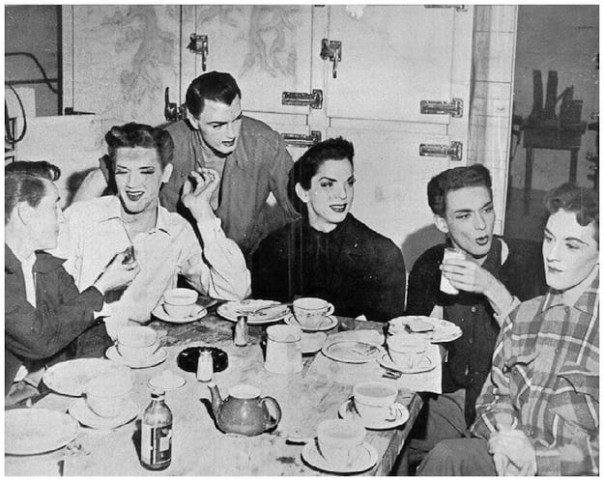
A gathering of gay men in Los Angeles in 1951. This group founded the Mattachine Society

In the wake of World War II a conformist impulse reasserted itself in American society. At the same time thousands of gay men found themselves in California after World War II, and they were presented with the problem of living a life in the midst of social disapproval and police repression.

In Los Angeles throughout the 1950s, the culture of gay men functioned very much below the radar. Under constant harassment by the police, homosexuals risked social ostracism and loss of employment if outed.

Homosexuality as a disease

The dominant perception of homosexuality in the 1950s was that it was a disease. The psychiatric community was nearly unanimous in this assessment and others took their cue from this stance. Most employers and government agencies barred homosexuals with morality clauses and they were widely considered to be security risks. In daily language they were often defined as “deviants”, “perverts”, or “inverts”, when they were not being painted as pedophiles.

Psychiatric opinions

In 1952 the American Psychiatric Association published the Diagnostic and Statistical Manual of Mental Disorders for the first time. It included homosexuality as a mental disease.

This was a predominant view in the mental health profession for the entire decade (an important exception was Evelyn Hooker). It was widely conjectured that homosexuality resulted from emotional traumas in childhood, as is the case with other mental illnesses, and that genetics played little to no role. On this basis the practice of conversion therapy took hold, with widespread attempts to change people from homosexual to heterosexual (here are just a few examples from students at Oberlin College in Ohio).

Employment restrictions

It was common practice for employers to prohibit homosexuality. Homosexuals had long been barred from employment in federal jobs, a policy that was reinforced in 1953 by Dwight Eisenhower’s Executive Order 10450. Private employers varied on this issue, but most would fire any employee who was discovered to be gay. Thus at a very basic level, to identify oneself as a homosexual in public was to invite a lifetime of poverty.

Social mores

The disapprobation of psychiatrists and employers reflected the overt hostility of the mainstream American mindset. An unfortunate tendency was for many people to conflate homosexuals with pedophiles and serial killers. Public safety videos of the time made this connection explicit and helped to spread much fear and misinformation.

A survey conducted as late as 1967 for a CBS documentary (see the full program or a shorter version) determined that two thirds of Americans viewed homosexuals with “disgust, discomfort, or fear” while a majority favored laws against all homosexual acts.

Sodomy was illegal in every state until Illinois decriminalized it in 1961, and the laws on this were well enforced in the 1950s. Campaigns in Sioux City, Iowa and Boise, Idaho resulted in multiple arrests and involuntary confinements. There were very few voices that dissented from this policy.

The rise of the gay bar in L.A.

Due to an important court case in 1951, California became the first state where gay bars could legally operate. Although the patrons were frequent targets of police harassment, Los Angeles had a decent number of such establishments by the mid-1950s. This corresponded with the first, halting steps towards creating advocacy organizations for gay rights.

Stoumen v. Reilly

In 1951 the California Supreme Court ruled that a bar could not lose its liquor license because it catered to gay clientele. The case was Stoumen v. Reilly.

While this did little to advance the public acceptance of homosexuality, it did allow gay bars to operate in much of California. While a number of these bars were established in Los Angeles by the 1930s, a new wave joined the fray in the wake of this decision (It should be noted that many were closed in spite of this court ruling in a mid-1950s wave of enforcement).

The Los Angeles gay bars

Some of the well-known gay bars of this time were the House of Ivy and the Windup in Hollywood, and the Crown Jewel, Harold’s, the Waldorf, and Maxwell’s in downtown Los Angeles.

Many of the gay bars in Los Angeles were located near Pershing Square, which was a cruising ground in

The character of these places varied widely, reflecting divisions within the gay community. The Crown Jewel was known as a rather straight-laced bar, with a dress code and many patrons who wished to remain discreet. Maxwell’s operated on a different end of the spectrum, with a much more flamboyant crowd.

The more conservative group of the gay community took pains to distance themselves from the “obvious” crowd, believing that they perpetuated negative stereotypes and drew unwanted attention. Helen Branson, who operated the Windup, wrote:

“I have not touched on the problem of the obvious homosexual. He is in the minority. I think he brings the censure of the public not only on himself, but is the main cause of all averse judgment against the group as a whole…. I do not welcome this type in the bar. I am rude to them, watch them closely for any infraction of my arbitrary rules, and they soon leave.”

Other recreation: bathhouses, parks, and parties

Bars were not the only place where gay men congregated in this time period. There were bathhouses and parks that were known to be more homosexual, and small groups held house parties and private engagements. None of these places were particularly more safe than the others in regards to police harassment. Even a private home party could be the target of a sting operation and as such, invitations to them were very few. It was thus quite difficult for individual gay men to coalesce into a broader community.

The homophile movement and the Mattachine Society

The creation of the first gay bars in L.A. corresponded with the rise of a group called the Mattachine Society.

The Mattachine Society was an organization founded in 1950 to advocate for the cause of gay rights. For at least a few years it was the only group of its kind in the United States. The initial founders were radical Communists, but the organization was taken over after a couple of years by more mainstream activists. It was in this time that the term “homophile” was coined — explicitly to take the word “sexual” out of homosexual.

ONE Magazine was founded by members of the Mattachine Society

This terminology placed the Mattachines at the more accommodating end of the gay spectrum, vis a vis the “obvious” homosexual. Divisions within the community would eventually come to a head in the late 1960s, and the homophile label fell by the wayside as the gay community asserted itself more forcefully.

The LAPD Vice Squad

The Los Angeles Police combatted the homosexual scourge with a notoriously vigorous Vice Squad. Using a large number of undercover officers who posed as gay man for purposes of entrapment, the Vice Squad harassed the gay community in L.A. for decades.

The entrapment process

It is said that the LAPD recruited heavily from that set of men who had failed to obtain acting roles in Hollywood. Often young and athletic, these men were trained to impersonate the gay mannerisms and language of the time, and were sent around to different bars. Often they had quotas for the number of “perverts” they were expected to bring in for a given week or month.

Helen Branson described it as such:

“They offer someone a ride or accept a ride and that does it. Some of them play fair, inasmuch as they wait for the gay one to make a pass at them, but many others wait only long enough to get in the car before declaring the arrest. The officer’s word, of course, will be taken as true, and they always count on the victim not wanting publicity. They know he will pay the fine and be quiet. The fines for this charge amount to a considerable sum in a year’s time.”

The results of entrapment

One the first successful defenses against this tactic came in 1952, when Dale Jennings of the Mattachine Society took his case to court. Jennings declared himself to be a homosexual, but asserted that the charges against him were manufactured. The charges were dropped after the jury deadlocked.

Most gay men did not realistically have the option of going to court if they could avoid it. Defending the charges in these stings would have nearly always led to loss of employment, and potentially other scandals. The most common outcome was to make a plea bargain for a lesser charge in the hopes of paying a fine. In this manner, the Vice Squad harassment became a recurring shakedown of the gay community, and it continued until well after the 1950s.

Many of those who were convicted of crimes became registered sex offenders. Many lost their jobs or otherwise had their lives ruined. Such was the price of being a gay man in the 1950s.

References

Gay History: There Goes The Gaybourhood; Stories Of Gay Neighbourhoods From Around The World

SYDNEY: Big city gaybourhoods: where they come from and why they still matterIn London, there is Soho; in New York, Chelsea and Greenwich Village; and in San Francisco, there is the Castro. In Sydney, there is Darlinghurst and, more specifically, Oxford Street. These are neighbourhoods of large cities that have, since at least the 1950s and often earlier, developed a reputation as queer spaces.

In more recent years, those reputations have begun to fade and the enduring meanings of the “gaybourhood” have come into question.

But what each of these places represents is the centrality of urban space to the emergence of visible, “out and proud” lesbian, gay, bisexual, transgender and queer identities and communities.

The 1978 Mardi Gras march was a key moment for queer urban visibility. AAP/Australian Lesbian and Gay Archives

Queer Sydney in the ‘Golden Mile’ era

The peak years of Oxford Street’s queer life extended from the mid-1970s until the mid-1990s. In the years after the second world war, many gay men in Sydney socialised in CBD hotels, including the Hotel Australia.

A guide to the ‘Golden Mile’ published in the Oxford Weekender News, one of many ‘bar rag’ newspapers that circulated the 1980s queer scene. Author provided

The first LGBTQ clubs on Oxford Street were Ivy’s Birdcage and Capriccio’s, which both opened in 1969. By the beginning of the 1980s, Oxford Street was home to a string of bars, clubs, saunas and cafes and had become known as Sydney’s gay “Golden Mile”.

The emergence of this gay heartland represents extraordinary social change. Male homosexuality remained illegal in New South Wales until 1984. The homosexual men socialising in 1950s CBD hotels were required to do so with discretion – the consequences of discovery could be devastating.

In contrast, the queerness of a venue like Capriccio’s was defiantly visible and undeniable. As more venues were opened along the Golden Mile, the street itself became a gay space, as did the surrounding neighbourhoods where LGBTQ people – particularly gay men – made homes in the terraces and apartments of Darlinghurst and Paddington.

A simple walk along the street became an act of participation in an emerging community.

Ivy’s Birdcage at 191 Oxford Street was one of Darlinghurst’s first drag bars. Sydney Pride History Group, Author provided

Members of a marginalised social group were thus using urban space to resist oppression and build a community. For some, this produced a kind of utopia. In an interview with Sydney’s Pride History Group, DJ Stephen Allkins described his first visit to the Oxford Street disco Patch’s as a teenager in 1976. He remembers:

I was home. That was it. It was the most fabulous place I’d ever been in my life … It’s full of gay people and they’re all dressed to the nines. They’re not hiding under a rock … They’re expressing and happy.

Finding a place in the Queer community

But these feelings of joy at having found such a space can be complicated by a range of factors. The gay community was certainly not free from sexism, racism and transphobia, meaning that some within the LGBTQ community were granted far easier access to these spaces than others.

Indeed, although Golden Mile-era Oxford Street included venues popular with lesbians, including the women-only bar Ruby Reds, the surrounding neighbourhood was more identifiably gay than lesbian.

Inner-west suburbs including Leichhardt and Petersham were far more significant urban spaces in the lives of many queer women. Lesbian share-houses in these neighbourhoods became central sites of feminist politics, activism, sex and romance.

Penny Gulliver, a resident of legendary 1970s share-house “Crystal Street”, has remembered that women “who were just coming out, because there was nothing like a counselling service then, they’d come to Crystal Street”.

Into the new millennium, Oxford Street’s place as the gay heart of Sydney became less certain. As LGBTQ businesses failed and venues closed, questions emerged as to whether a community now more a part of the mainstream still needed its own spaces.

For a time, King Street in Newtown dominated as a queer alternative. In 1983 gay publican Barry Cecchini took over the Milton Hotel on Newtown’s King Street, renamed it Cecchini’s and launched it as the area’s first gay venue. Shortly after, the Newtown Hotel, just across the road, also became a gay pub. Cecchini told the Sydney Morning Herald in 1984 that gays were leaving “the scene” of Oxford Street looking for a “more cosmopolitan mix” in Newtown.

Through the following decades, venues including The Imperial in Erskineville (made famous as the site from which three drag queens launched their adventures in a bus named Priscilla) and the Sly Fox in Enmore, home to a popular lesbian night, further developed the area’s queer reputation.

Protecting Queer space

In recent years, however, a range of factors, including changes to licensing laws, have produced significant challenges for queer socialising in that neighbourhood.

Newtown sits outside the zone of the so-called “lockout laws”. Late-night partiers who might once have ventured to Kings Cross are instead heading to pubs along King Street, and reports of anti-LGBTQ abuse and violence have increased.

In response, a campaign called “Keep Newtown Weird and Safe” has attempted to maintain the queer meanings of this urban space.

Despite changes in Oxford and King streets, efforts to keep Newtown “weird” highlight the continued value of urban space to LGBTQ communities. Indeed, among a younger generation, new forms of queer identity continue to inspire the search for spaces in which to celebrate difference.

In pockets of the inner west, for example, young queer, transgender and genderqueer people are creating spaces of activism, partying, performance and everyday life. This new generation is exploring the fresh possibilities of queer identity and developing their community. Access to urban space remains central to this.

Like the city itself, the LGBTQ community continues to be less a fixed entity than a process of movement, adaptation and change.

MELBOURNE: Gay Old Time

An asio report from the 1950s, Homosexuals as Security Risks, includes information from an anonymous man about Melbourne’s secret gay subculture. As well as educating the authorities about queer terminology, the source expresses his hope “to find an affectionate, stable and confiding relationship with another homosexual”. The prospect, he acknowledges, is “a probably unattainable dream-wish”.

His account appears in Camp as . . . Melbourne in the 1950s, a Midsumma Festival exhibition. Through photographs, interviews and historical documents, Camp as provides an insight into what homosexual life was like during a grimly repressive era in which gay men and women had reason to cower in the closet.

Homosexuality was not only socially unacceptable in the 1950s, it was also a criminal offence. By 1957 the state vice squad had dedicated a third of its resources to cracking down on what it perceived as a growing problem in Victoria. Throughout the decade, the number of those arrested and jailed continued to grow as officers raided parties or entrapped gay men in public toilets and other popular beats.

Meanwhile, the Truth newspaper attempted to whip up moral outrage by running lurid scare stories about “prowling pests” and “park menaces”. But Graham Willett, a Melbourne University lecturer and curator of the exhibition, suggests that, despite the fear of discrimination and arrest, a tight-knit gay community still evolved during the 1950s. “We’ve constructed this image of Melbourne back then as this terrible place,” he says, “But what’s quite amazing is that people managed, through courage or circumstances, to find ways of meeting other people like themselves and constructing reasonably nice lives.”

Certainly the exhibition challenges the assumption that gay people of the period led lonely, desperate lives. In one photo, for example, a drag queen flounces defiantly about the stage wearing a pink dress and a flower in his hair. “In the ’50s there was no gay scene in a public way,” Willett says, “but there were still places you could go to in the city that accepted the presence of gay men.”

One of the most surprising gay sanctuaries was the Myer department store, thanks to the director of the store’s display unit, Freddie Asmussen, whose sexuality was an open secret. Bald and bespectacled, Asmussen was renowned for the extravagant decor of his South Yarra home, which boasted 13 chandeliers, a black-and-silver dining room and a colour-coded garden in which he would tolerate only white flowers. His willingness to employ young men of a similar sexual orientation turned Myer into an unlikely haven for the gay community.

Hotel Australia on Collins Street was the closest that Melbourne had to a gay bar. The upstairs area catered to a smart, discreet crowd while the downstairs bar, known as “the snake pit”, was aimed at rough trade. An alternative was Val’s, a bohemian coffee lounge on Swanston Street, with a royal-blue carpet and mauve furniture. Val was a flamboyant lesbian who walked the streets dressed in a homburg hat and tailored suit while brandishing a silver-topped cane.

Willett says that during this era there was more pressure on lesbians to conform to these stereotypes. “Lots of women talk about living as butches or femmes in the ’50s and ’60s,” he says. “But women’s liberation challenged a lot of that. It said, ‘You can be what you want to be. You don’t have to conform to these roles.’ ”

Other fragments of queer culture featured in the exhibition are similarly blatant. In the Australian Gay and Lesbian Archives, Willett discovered a stash of magazines promoting body building as a form of homoerotic stimulation. The cartoons in Physique Pictorial devise utterly ridiculous situations to justify the inevitable displays of male nudity. One features a muscle-bound builder, who falls off a roof and lands on a pile of nails, thereby requiring his workmate to extract them from his buttocks. “It just gets more and more camp,” Willett admits.

The brazen nature of such material would seem to suggest a growing confidence within the community. And yet during the 1950s there was just a single attempt to challenge the legal status quo that failed to gain sufficient support. “For most of these people, the idea of changing the law would have seemed impossible,” Willett says. “It would have just seemed inconceivable that you would do that.”

The gay-rights movement only began to emerge in Australia in the 1960s, developing as part of a broader liberal trend that also sought reform on social issues such as abortion, censorship and Aboriginal rights. Victoria didn’t decriminalise homosexuality until 1980, while Tasmania didn’t suit until 1997. Over the past 50 years, gay culture has undergone a makeover as radical as anything on Queer Eye For A Straight Guy. By exploring the formative days of the community, Willett’s exhibition reinforces how much has changed, while presenting an intriguing social history of Melbourne’s secret past.

CANADA & NORTH AMERICA: Dwindling gaybourhoods

Author Amin Ghaziani looks into the future of North American gay villages

Credit: Paul Dotey

Four and a half years ago, Shawn Ewing and her wife left their apartment in Vancouver’s West End to move to the suburbs. For the Ewings, leaving the gaybourhood for Surrey was a question of simple math.

“Two thousand square feet and a yard versus a little under 700 feet in an apartment,” she says. “Accessibility to the party downtown wasn’t important to us anymore. What was important was a house and having a yard and a garden and all of that good stuff.”

Ewing, a former president of the Vancouver Pride Society, is now vice-president of Surrey’s Pride organization. She says that despite Surrey’s conservative reputation and some early fears that they might have to “straighten up,” her family has had no problems at all.

“We haven’t changed any of our behaviour,” she says. “I don’t have a problem holding my wife’s hand when we’re walking down the street or giving her a kiss in my front yard.”

“I probably got called out more living downtown about being a dyke than I certainly have been in Surrey,” she says.

From Vancouver’s Davie Village to Toronto’s Church Street to Montreal’s Le Village, everyone has their own opinion about Canada’s gay neighbourhoods, but few seem to disagree that they are in decline.

Whichever name you call it — the gaybourhood, gayvenue, gay district, gay mecca, gay ghetto — the question of its future isn’t limited to Canada. Across the border in the United States, many notable gay districts are also fading into shadows of their former selves, from San Francisco’s Castro to Chicago’s Boystown to Seattle’s Capitol Hill to countless more.

In his recently released book There Goes the Gayborhood?, Amin Ghaziani, an associate professor of sociology at the University of British Columbia, examines the changing face of the gay neighbourhood. His research is based on census data, opinion polls, more than 600 newspaper articles and more than 100 interviews with gaybourhood residents.

“I myself lived in Chicago’s Boystown district for nearly a decade, starting in 1999. I remember feeling uneasy in those years as I read one headline after another about the alleged demise of my home and other gayborhoods across the country. The sight of more straight bodies on the streets became a daily topic of conversation among my friends — an obsession to be honest,” Ghaziani writes.

“As the years went by, my friends and I bemoaned, perhaps most of all, feeling a little less safe holding hands with our partners, dates, or hookups — even as we walked down what were supposed to be our sheltered streets. I had been called a ‘fag’ on more occasions than I still care to remember, and I was shocked at the disapproving looks that I would receive when walking hand in hand with another man. I knew I could not escape this menacing straight gaze altogether, but I was so angry that I had to deal with it in Boystown. This was supposed to be a safe place,” he writes.

According to statistics, the days where the gay community was drawn to live and work in a single neighbourhood are ending. American census data shows that same-sex-couple households have become “less segregated and less spatially isolated across the United States from 2000 to 2010,” Ghaziani writes. “This is a restlessness that clearly appears in cities across North America. To wonder where gayborhoods are going, debate whether they are worth saving, or question their cultural resonance — all of this announces to us that they are in danger.”

Although gay bars have been around since the start of the 1900s, gaybourhoods are a fairly recent phenomenon. It wasn’t until after the Second World War that they really began to flourish in North America, buoyed first by the thousands of men and women dishonourably discharged from the military for their presumed homosexuality and later by migrating single gay men and lesbians from smaller towns in search of a place to call home. Gaybourhoods promised safety and freedom, as well as places to find love and sex.

Ghaziani points to several factors that are changing these areas today: the increased acceptance of gay men and lesbians by society and under the law, allowing many people to feel safer moving to more spacious accommodations in the suburbs; growing development and gentrification, leading to rising property value and rents, driving some people out of downtown areas; and the increased migration of straight people back into desirable urban areas.

Ron Dutton has lived in Vancouver’s West End for 40 years and has never once wanted to leave. “I like the diversity of people, the sense of openness,” he says. In his opinion, changes are constant, and except for the rapidly increasing cost of living, he doesn’t think the changes are negative.

“Individual businesses come and go, but I don’t see the neighbourhood becoming any less welcoming,” he says. Still, Dutton laments that many seniors on fixed incomes have been leaving the area against their will as rents continue to skyrocket.

As some gay people resist the tide and stay in gay neighbourhoods, many more are undeniably leaving — even as North American cities begin to recognize their cultural and, especially, potential financial value.

The permanent rainbow crosswalks in Vancouver and now in Toronto and the newly installed rainbow LED strip lights in Vancouver are all being used to promote these villages as destinations, to locals and tourists alike. These efforts at urban renewal can also contribute to the gentrification that eventually prices many gays and lesbians out of these areas.

To many, especially to the younger generation, the notion of a single gay district seems antiquated. As gay people, men especially, increasingly turn online to find sexual and romantic connections, their need for gay bars and physical places to meet and hook up diminishes. As the world becomes safer for some sexual minorities, the need for the protective embrace of the gaybourhood also begins to decline. In the early 1990s, there were 16 gay bars in Boston. By 2007, that number had dropped by half.

Ghaziani references these phenomena as part of the “post-gay” era, where gays are being accepted by society and are choosing to assimilate into the mainstream. He says it’s changed the way many of us think about ourselves.

As an example, he points to statistician Nate Silver, who was named one of Time magazine’s 100 most influential people in 2009. In a 2012 interview with Out magazine, Silver said that his friends saw him as “sexually gay, but ethnically straight.”

Ghaziani’s book defines “post-gay” partly as an assertion that who a man has sex with “is not necessarily related to his self-identity or to the cultural communities in which he participates.” He compares this sort of sexual identity with white ethnic identity: “optional, episodic and situational.”

In reviewing media interviews with various gay people — often couples — who have chosen not to live in gaybourhoods and who say they are fitting in, he notes that their tones are often laced with some shame. He wonders why the opposite of “blending in” is having a “scarlet letter on our heads” or being “those people?”

“Assimilation into the mainstream is always accompanied by infighting within a minority group, especially between those who are eager to blend in and those who are determined to hold on to what makes them different,” he writes.

Interestingly, Ghaziani’s book also includes interviews from some of the straight people living in gaybourhoods. He finds that many are “benignly indifferent” to their gay neighbours, while a minority feel that they are victims of reverse discrimination.

He found the responses of straight people so repetitive and almost rehearsed that it was hard to tell if they were being honest about being indifferent or if they were just being politically correct. One single, straight 28-year-old in Boystown told Ghaziani that he would like to see the rainbow pylons and flags taken down because, in his opinion, self-segregation was hurting the gay movement politically.

Ghaziani argues that even while many outgrow them, gaybourhoods remain “culturally relevant as refuges for queer youth of colour, transgender individuals and queers who hail from small towns, because antigay bigotry still affects their everyday life.”

Despite having left the confines of Vancouver’s gay village, Ewing agrees that there will always be a need for the gaybourhood, but she stresses the importance of it needing to be about more than just bars. She would like to see more places that include non-drinkers and youth.

Ghaziani suggests that it’s unreasonable to expect gaybourhoods — or any neighbourhood, for that matter — to remain stable and unchanged but that it’s equally unreasonable to declare them dead.

Neighbourhoods often move, reform and migrate, he says. Toronto’s “Queer West” and Vancouver’s Commercial Drive are two such examples. Many young queer people may want to live in a gay area, but they settle where they can afford the rents, even if that means congregating in — and queering — new neighbourhoods.

Ghaziani further theorizes that these gay-friendly neighbourhoods could eventually become full-fledged gay neighbourhoods in their own right. If the old gaybourhood was an island, these new models are archipelagos. These new villages may eventually supersede the older ones, or they may all coexist.

Dutton says that while we have gained a lot of freedom under the law, that doesn’t negate the need for the gaybourhood. “I think there is much to be said for an accepting environment where people can feel free to dress unusually or where they can express their affection for one another openly. That would be regretful if those things were lost over time,” he says.

“I don’t think the times have progressed to the point where we’re all just equal,” he continues. “There is much to be said for having a place within the city where people can come from elsewhere and feel that this is home — this is where my people congregate.”

CHICAGO: People from LGBT community face subtle discrimination even in ‘gaybourhoods’

Prejudice and discrimination still exist- it’s just more subtle and difficult to detect.(Shutterstock)

Straight people living in neighbourhoods mostly populated by LGBT folks say they support gay rights in theory, but their street interactions contradict those sentiments.

Gaybourhood, or traditionally gay neighbourhood, still face a subtle form of discrimination from ‘straight’ people. According to a study conducted by the University of British Columbia, straight people living in such neighbourhoods, say they support gay rights in theory, but many interact with their gay and lesbian next-door fellas on the street in ways that contradict those sentiments. “There is a mistaken belief that marriage equality means the struggle for gay rights is over,” said Amin Ghaziani, the study’s senior author. “Prejudice and discrimination still exist- it’s just more subtle and difficult to detect.”

The researchers interviewed 53 straight people, who live in two Chicago gaybourhoods – Boystown and Andersonville. They found the majority of residents saying that they support gay people. However, the researchers found their progressive attitudes were misaligned with their actions. While many residents said they don’t care if people are gay or straight, some indicated that they don’t like gay people who are “in your face”.

When asked about resistance from LGBTQ communities to the widespread trend of straight people moving into gaybourhoods, some of the people interviewed responded with accusations of reverse discrimination and described gay people who challenged them as “segregationist” and “hetero-phobic.” Some said they believed they should have open access to cultural gay spaces, and were surprised that they felt “unwelcome” there. “That feeling of surprise, however, exemplifies a misguided belief that gay districts are trendy commodities when they are actually safe spaces for sexual minorities”, added Ghaziani.

When the researchers asked residents if they had done anything to show their support of gay rights, such as marching in the pride parade, donating to an LGBTQ organization, or writing a letter in support of marriage equality to a politician, the majority said they had not. Many also expected their gay and lesbian neighbours to be happy and welcoming of straight people moving into gaybourhoods, expressing sentiments like, “you wanted equality- this is what equality looks like.”

With gay pride celebrations fast approaching around the world, Adriana Brodyn, the study’s lead author, said it is important to pause and reflect on the state of LGBTQ equality. “I hope that our research motivates people against becoming politically complacent or apathetic,” she said. “If we do not motivate ourselves to be aware of this subtle form of prejudice, then it will just continue to perpetuate.” The study appears in the journal City and Community.

REYKJAVIK: Where’s The Gaybourhood?

I’ve asked around. Though the sample size is hardly one that would hold up under intense scrutiny, a pattern has begun to emerge. The question “Where’s the gaybourhood?”, when raised in Reykjavík, will most likely be met with the response (after several, strangely long seconds of quiet contemplation): “Well—it’s a very small city.” Whether my interlocutor is heterosexual, or part of the alphabet soup, the answer is the same.

This strikes me as odd for a number of reasons. The first being that, while yes, relative to some far more populous cities of the world—Shanghai, Istanbul, Lagos, São Paulo, New York City, etc. (thanks, Wikipedia!)—Reykjavík’s approximate 120,000 is rather small. Further, this question also deals greatly with historical population growth over time—go back to 1901, and the population was only a bit over 6,300.

But, still… A population of 120,000 seems significant to me—though to be fair, I did grow up in a small-ish town (15,000 in a good year). And I can think of plenty of cities with populations smaller than Reykjavík’s that foster vibrant gay scenes, if not full-fledged gaybourhoods.

And yeah, the development of “gaybourhoods” was historically aided (though not exclusively) by the existence of a highly trafficked urban space with large international shipping ports, naval and military bases and heavy involvement in major wars, as well as a significant history of cosmopolitanism, internal migration and immigration from abroad, and…

Well, I think I just answered my own question, didn’t I? And it’s nothing against Iceland—that’s just not how things worked here. Historically, at least.

I don’t buy that culture is born exclusively as an act of defiance, or out of need for defence, and thus dies out when the need for shielding is gone.

There are a few historical spaces I was able to read up on. Known to those “in the know,” ya know? Informally, and before LGBT+ was even a conceivable acronym. Walking through Reykjavík, I feel as though I’m surrounded by hidden histories. Historical gay spots, as far as I could find, were highly secretive and unofficial, rarely documented, and limited in number and size out of necessity—this wasn’t especially news to me.

What struck me more, as I learned to accept that a lot of what I was looking for in terms of historical narrative would remain in permanent obscurity, was the following: where exactly were the present scenes? I mean, it’s one thing for a “gaybourhood” to not have existed in the past—but where’s the presence now? Why does it appear as though not much new is forming?

It wasn’t long before I started to find various explanations for the lack of gaybourhood, queer scene, or various cultural presence in contemporary Reykjavík via the wonderfully enlightening netherworld of tourist-information websites. One of the more striking quotations I found goes as follows, taken from Guide to Iceland’s website:

As for gay-culture, there isn’t much, because there does not need to be. Gays participate as regular members of society, and in Iceland there are openly gay people in all sectors and levels of society. And as such, there is no gaybourhood…

Forgetting (as much as I’d prefer not to) the use of “gay” in place of a wide variety of different identities and experiences, I wonder how much truth there is to this sentiment. Yes, Iceland is ahead of the curve in many ways in terms of LGBT+ legal rights—impressively so. But legal rights are hardly the same thing as acceptance (which, by the way, is hardly a victory—see the Riddle Scale), and certainly legal rights are not the same thing as actual safety, security, comfort, self-determined expression, etc. I don’t buy that culture is born exclusively as an act of defiance, or out of need for defence, and thus dies out when the need for protection is gone (which, mind you, it certainly is not).

So, to answer my question, the “gaybourhood” as of now exists alongside the straightbourhood (i.e. the World). Reykjavík has the outward appearance of an assimilationist’s utopia—lesbian beside queer beside trans beside intersex beside bisexual beside gay beside straight beside etc., all dancing contentedly in the same small club, no difference between them. Except that there are differences—different experiences, different wants and needs, different discrete identities and worldviews. And there is no way that everyone can or should always exist together like this.

It’s great that all spaces are open to us, and that many (though not all) can feel relatively safe living as ourselves. But no one wants only to co-mingle—with heterosexuals, or with adjacent letters. In speaking to LGBTQ+ persons of Reykjavík (while knowing there are still many more to talk to, and still much, much more to hear), one does seem to detect a want and a need for them to carve out discrete spaces for themselves. Though I wonder how much room here there actually is to do so.

VANCOUVER: ‘Gaybourhoods’ are expanding, not disappearing: UBC study

Sociology professor Amin Ghaziani says as couples diversify, so does where they call home

The corner of Davie Street and Bute Street in Vancouver, B.C. (Wikimedia Commons)

Gay and lesbian spaces, commonly known as “gaybourhoods,” are expanding across cities, rather than disappearing, a new B.C. study says.

Gaybourhoods, such as Vancouver’s Davie Village, are nothing new. A common perception has been that major cities have just one neighbourhood where all gay people live.

But new research by University of British Columbia sociology professor Amin Ghaziani, released Thursday, shows that members of the LGBTQ community are diversifying where they live, choosing what he calls “cultural archipelagos” beyond the gaybourhood. Only 12 per cent of LGBTQ adults live in a gaybourhood, while 72 per cent have never.

Ghaziani used data from the 2010 U.S. census to track location patterns of lesbians, transgender people, same-sex couples with children, and LGBTQ people of color.

He found queer communities of colour have emerged in Chicago and the outer boroughs of New York. That’s because African-American people in same-sex relationships are more likely to live in areas where there are higher populations of other African-Americans, rather than other LGBTQ people, he found.

Rural areas draw more same-sex female couples than male couples, and female couples tend to live where the median housing price per square foot is lower, which Ghaziani attributed to a possible reflection of the gender pay gap.

The study focuses on the U.S., but the findings are similar to data released in the last Canadian census.

There were 73,000 same-sex couples in the country in 2016, an increase of more than half over the last decade.

Meanwhile, major cities that were historically popular for same-sex couples, such as Toronto and Montreal, saw a nearly five per cent dip in the same time period, while areas such as Victoria are seeing an increase.

CANADA: Same-sex marriages rise, as gaybourhoods change

There were nearly 73,000 same-sex couples in 2016 in Canada, about a 61 per cent increase

The number of same-sex couples in Canada increased by more than half in the last decade, with three times more couples choosing to get married, census data shows.

There were nearly 73,000 same-sex couples in 2016 – about a 61 per cent increase from the 43,000 reported in the 2011 census.

The increase in the number of reported same-sex couples could be due to attitudes liberalizing dramatically since gay marriage was approved in 2005 in Canada and 2013 in the U.S., according to Amin Ghaziani, Canada Research Chair in Sexuality and Urban Studies at the University of British Columbia.

New census data shows a rapid increase in same-sex couples tying the knot – with one-third of couples reportedly being married – including Vancouver-area residents Laura and Jen O’Connor.

The pair got married for all the romantic, fairy-tale reasons: after seven years together, they were deeply in love and wanted to start a family. But on another level, they thought it might just make their life together a little easier.

After all, being gay comes with its own unique set of challenges – challenges they hoped might be easier to navigate if they shared a last name.

“It’s one less thing, one less obstacle that you have to deal with,” says Jen, 27, during an interview in a sun-drenched backyard at Laura’s parents’ house in Cloverdale.

They decided to move in to save money after spending $15,000 on three unsuccessful rounds of in vitro fertilization.

The pair are currently saving up to buy a home of their own in the Vancouver area – the third-most popular metropolitan city for same-sex couples to live in across the country, behind Toronto and Montreal.

Gaybourhoods are nothing new, including Vancouver’s Davie Street – a well-known destination for LGBTQ members in B.C., but are seemingly becoming less of the hotspots they once were, according to Ghaziani.

“Acceptance produces more of a dispersion,” he said, adding that cultural and social factors work hand-in-hand with the economics of where same-sex couples and singles look to live.

Acceptance is only one factor in the decision-making process, though, as real estate prices remain high and unaffordable for many, especially those with children.

Lesbians are considered the trailblazers of LGBTQ migration, Ghaziani said, historically finding trendy neighbourhoods that are progressive, cheaper and have nearby sustainable resources like grocery and book stores.

Due to the gender wage gap and 80 per cent of same-sex couples with kids being female, lesbians are usually the first to be pushed out of neighbourhoods once late-stage gentrification begins, he said.

For example, as Davies Street tends to offer single occupancy units at higher rent – leaving the one-eighth of same-sex couples with children most likely looking to more affordable non-urban areas.

And as more traditional gaybourhoods change, others seem to be beginning in other parts of the province. More than 1,200 same-sex couples resided in Victoria in 2016, according to the census data, compared to about 700 in 2006.
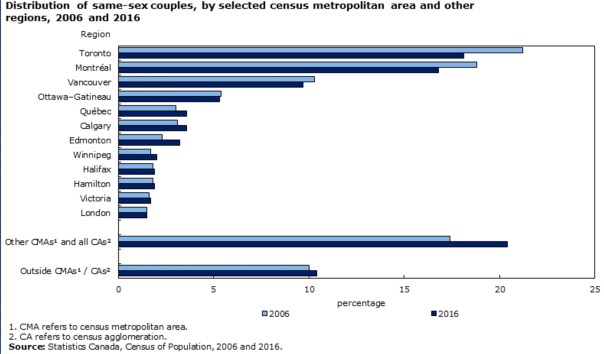
With files from Laura Kane from The Canadian Press

AUSTRALIA: Australia’s biggest ‘Gaybourhoods ‘
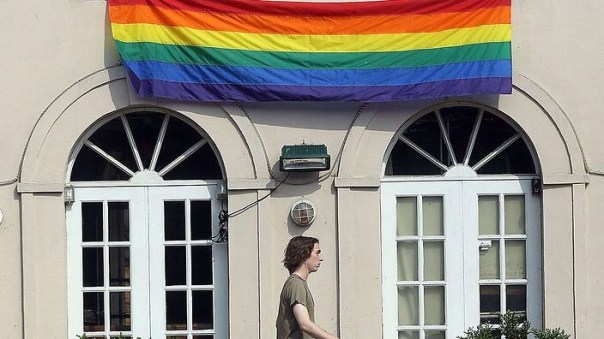
Australia’s “gaybourhoods” are rapidly changing and relocating. We took a look at some of the most prominent LGBTI locales with the help of Australian Census data on same-sex couples.

1. Potts Point (NSW)

Gone are the days Darlinghurst held the crown as Sydney’s queer capital. While the Oxford Street strip still hosts Sydney’s annual Gay & Lesbian Mardi Gras Parade, a few suburbs over to the east of the CBD you’ll find the beating heart of the city’s LGBTI culture in Potts Point. In the 2011 Australian Census, Potts Point had the second-highest concentration of male same-sex couples in capital city suburbs, only .1 of a percentage point off the then leader (Darlinghurst).
Potts Point in Sydney (Greg Wood/AFP/Getty Images).

2. Daylesford (Victoria)

Home to Australia’s largest rural LGBTI festival, ChillOut, Daylesford is a couple of hours outside of Melbourne and is known for its many mineral springs. It’s a popular spot for visitors and mature same-sex couples looking to settle down and invest in a tree-change. People in same-sex couples tend to be more mobile than people in opposite-sex couples. In 2011, 63 per cent of people in same-sex couples lived somewhere else five years ago compared with 40 per cent of people in opposite-sex couples.

A world record attempt at the largest ever simultaneous massage in the popular Victorian spa town of Daylesford in 2010. (Scott Barbour/Getty Images)

3. New Farm (Queensland)

Found in the inner suburbs of Brisbane alongside its winding river, New Farm plays host to the annual Brisbane Pride Festival and is close to the gay nightlife of Fortitude Valley. Brisbane had more than 3500 self-identifying same-sex couples in the 2011 Census, many of whom call New Farm’s leafy streets home.

New Farm Park in Brisbane (Photo by Glenn Hunt/Getty Images)

4. Brunswick (Victoria)

Brunswick isn’t just a hipster hotspot, it’s home to a great many LGBTI people who’ve traded Prahran’s Chapel Street for the northern suburbs of Melbourne. Its culinary and nightlife options have blossomed as Prahran’s famous Commercial Road strip has dwindled in recent years. It also has a higher proportion of female same-sex couples than its southern rival.
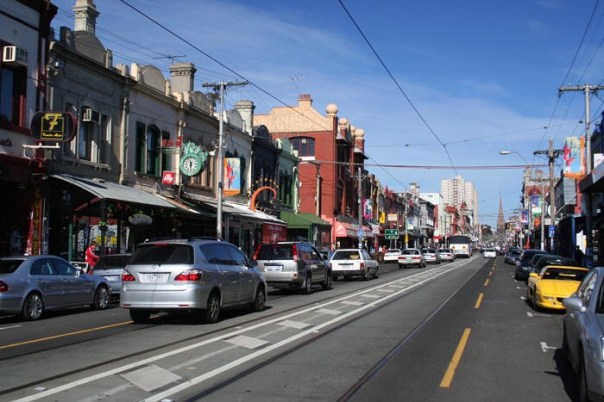
Brunswick, Victoria (Mat Connolley/Wiki Commons).

5. Newtown/Erskineville (NSW)

The Newtown/Erskineville area in Sydney’s Inner West is home to the majority of the nation’s female same-sex couples. In fact, if you were to take in the neighbouring suburbs of St Peters and Enmore, you’d account for a whopping 22.4 per cent of female same-sex couples as a percentage of Australia’s capital cities. Its famous terraces and pocket bars also account for 11 per cent of male same-sex couples.

Cyclists along King St, Newtown (Mark Kolbe/Getty Images)

LONDON: London’s hottest Gaybourhoods

SOHO

Revitalised by the gay community “two or three recessions ago”, according to Coote, but now thoroughly commercialised and “de-gayed”, in the words of photographer Adrian Lourie. Still home to a large collection of clubs and pubs, of course — the Admiral Duncan, Shadow Lounge, G-A-Y — and therefore still a mecca for tourists and out-of-towners. The lesbian Candy Bar closed last year but new bar She Soho is “quite seismic in that it’s the first lesbian bar actually on Old Compton Street”, according to Sophie Wilkinson, news editor of The Debrief.

VAUXHALL

Hot in Vo-zhawl: the Royal Vauxhall Tavern in the heart of SE11 (Pic: Adrian Lourie) ( Adrian Lourie )

The Royal Vauxhall Tavern has been a welcoming destination for gays since the Second World War, and the adjoining Pleasure Gardens contain a popular canoodling hummock more recently dubbed Brokeback Mountain. Vauxhall — formerly VoHo, now Vo-challe or Vo-zhawl — is now home to a sizeable residential community and a massive nightlife scene based around the clubs, bars and saunas under the railway arches: Barcode, Chariots, Fire etc… Possibly on the turn thanks to rising rents. “Going through Vauxhall recently I saw that a gay specialist leather shop had become a halal butcher’s, which is probably the sort of thing that would keep Mr Farage awake at night,” says Ben Summerskill.

HAMPSTEAD

Historically a gay area due to the Heath (before mobile apps made hook-ups easier) and the men’s bathing pond, it’s still beloved of older, wealthier, boho gay residents as well as younger blow-ins or those forced to settle for nearby Kilburn. “It has an upmarket village feel — in a non-Village People way — with a fine housing stock and plentiful high street,” says TV journalist Stefan Levy. There’s also a venerable gay pub, the King William IV (the Willy).

CLAPHAM

As with Hampstead Heath, above, so with Clapham Common: plus, The Two Brewers nightclub and Kazbar remain pivotal venues on the London gay scene. Gays smitten by the “Vale of Cla’am” and able to get on the property ladder there have stayed amid the rising tide of yummy mummies.

SHOREDITCH

A prime example of pioneering gays subsumed within a wider influx of cool, followed by commercialism. The Joiners Arms was a totemic gay venue when Shoreditch felt like “the middle of nowhere” (Summerskill). Then came the Young British Artists, the hipsters, the pop-ups, the City boys and the big chains. Still an LGBT favourite, though, thanks to a thriving art/design and alternative bar/club scene (Sink the Pink nights, etc), though high rents mean gays and lesbians are more likely to settle in Dalston or Hackney (see below). Sophie Wilkinson says Shoreditch is “one of the few pockets of London where I feel I can walk hand in hand with another woman without fear of attack”, along with Soho, Waterloo and Dalston (there are infrequent lesbian club nights at Dalston Superstore).

STOKE NEWINGTON

Home to a sizeable London lesbian community, with social life focused on the nearby parks and the iconic Blush bar on Cazenove Road. Stoke Newington School pioneered the teaching of LGBT History month.

BERMONDSEY

A mixture of Vauxhall and Shoreditch, minus the club culture (though XXL, the club for “bears, cubs and their admirers”, is a short lollop away). It’s near the river but with a large amount of ex-council accommodation and do-up-able warehouse space, plus a burgeoning foodie culture.

CHISWICK

Google “gay Chiswick” and the only result is a car park recommended on a cruising website. But anecdotal reports suggest that many gay air crew — those who can afford it — settle in Chiswick due to its combination of bucolic charm and proximity to Heathrow. One resident claims a W4 postcode is an asset when chatting someone up.

And finally…

PECKHAM

“Definitely the next place!” according to Lourie. His view is echoed by QX magazine, which notes the area’s multicultural vibrancy and arty/student scene fed by Goldsmiths and Camberwell, as well as the queer night Garçonne at the Bussey Building and live art nights at The Flying Dutchman, plus LGBT-friendly bars. Wilkinson also mentions Tooting and Nunhead as potential hotspots as all young creative/club types — not just LGBTQ+ ones — are priced out of central north, west and east London. The next gaybourhood? Look south…

References

Gay History: The “Lavender Scare”.

Interrogations of one’s sexuality became commonplace in the 1950s and 1960s’ federal workplace. Questions like “Do you identify as a homosexual or have you ever had same-sex sexual relations?” were commonplace as employers attempted to root out LGBT employees. This period of time is often known as the Lavender Scare—the interrogation and firing of LGBT-identifying civil servants.

Before the Lavender Scare and post-World War II, LGBT individuals from rural towns began congregating to cities where they could keep anonymity. This newfound peace and community, however, was disturbed in 1947 when the United States Park Police created a Sex Perversion Elimination Act. Primarily targeting these communities in parks, at least five hundred people were arrested and 76 were charged.

As a part of the broader Red Scare that targeted communists, the Lavender Scare’s development was in large fault due to Senator McCarthy, who brought to the Senate his famous list which gave the names of two hundred and five federal employees, two of which were homosexual individuals. While federal agents began to investigate Senator McCarthy’s federal employment list, much of the Red Scare rhetoric also invoked the ideas of morality connected with queer and homosexual people to those of communists. At the time, homosexuals were viewed as sinful and perverted and the public perception of homosexuality shared many similarities with the public view of communists, who were similarly viewed lacking in both moral and mental strength. For the federal government, LGBT employees began to pose a security risk: if they were living double lives, then they may not be loyal nor mentally stable enough to keep government secrets.

Eventually, Senators Wherry and Hill, who were supported by McCarty, interrogated the two LGBT individuals on McCarty’s list, leading to their discharge. In March 1952, the federal government announced its removal of 162 civil servants suspecting of being homosexual. And about a year later on April 27, 1953, President Dwight Eisenhower signed Executive Order 10450, expanding on Truman’s federal employment regulations with a statement to exclude federal employees of “sexual perversion.” Because of this Executive Order, it is estimated that at least ten thousand civil servants lost their jobs.

The Lavender Scare made being publicly LGBT difficult. Although homosexuals were largely closeted before the Lavender Scare, being publicly LGBT during the 1950s was largely challenging and near impossible without staggeringly high consequences. Not only were LGBT federal employees fired, but many others were also simply fired for “guilt of association” in knowing someone who was LGBT. Because of the resulting stigma within federal government as well as in larger public culture, many of the federal investigations and resulting firings lead to dismissed employees’ suicides — most of which were later covered up by the federal interrogators.

Several LGBT people later stepped up to challenge federal government’s “sexual perversion” components, including civil servant Frank Kameny who took his case to the Supreme Court. Although Kameny lost, a few federal courts began ruling in his favor by 1969. More gay rights organizations also developed such as the Mattachine Society (1950) as well as the Daughters of Bilitis (1955). The Lavender Scare’s effects, however, were still lasting.

The Lavender Scare not only broke up and quieted the cities’ queer communities who were afraid of federal employment discrimination and potential hate crime, but it also resulted in a largely conservative, homogenous culture within the government. While most federal organizations overturned their policies on LGBT discrimination, the Federal Bureau of Investigation (FBI) and National Security Alliance (NSA)’s bans on homosexuals lasted into the 1990s, until they were officially overturned by President Bill Clinton in 1995. Later, as recent as 2015, Secretary of State John Kerry apologized to the LGBT community on behalf of the federal government’s Lavender Scare interrogations, stating: “I apologize to those who were impacted by the practices of the past and reaffirm the department’s steadfast commitment to diversity and inclusion for all our employees, including members of the LGBTI community.”

Homosexuals at the State Department

In the 1950s and 60s, security within the U.S. government, including the State Department, was on high alert for internal risks, particularly Communists and what were considered to be sexual deviants—homosexuals and promiscuous individuals. Investigating homosexuality became a core function of the Department’s Office of Security, which ferreted out more people for homosexuality than for being a Communist.

In 1950, a subcommittee chaired by Maryland Senator Millard Tydings convened to investigate Joseph McCarthy’s notorious list of “205 known communists.” Tydings worked to discredit McCarthy’s claim, but, in the process, the subcommittee concluded that the State Department was overrun with “sexual perverts,” part of the so-called “Lavender Scare.” 

During the hearings, Nebraska Senator Kenneth Wherry memorably claimed that as many as 3,000 homosexuals were employed at State. By the end of 1950, 600 people had been dismissed from positions at the State Department on morals charges. In 1973 a federal judge ruled that a person’s sexual orientation alone could not be the sole reason for termination from federal employment; two years later, the Civil Service Commission announced that it would consider applications by gays and lesbians on a case-by-case basis.

The following excerpts give a glimpse behind the curtain as individuals in the Security and Personnel offices discuss how they interrogated suspected homosexuals, who were then forced to leave the Service. Norman V. Shute served as the Administrative Officer of the Near East Asian Affairs (NEA) Bureau at the State Department from 1958-1961. His memoir was given to ADST in July 1995. Robert J. Ryan, Sr. served as the Assistant Chief for Foreign Service Personnel from 1953-1955. He was interviewed by Charles Stuart Kennedy beginning November 1991. Robert Woodward served as the Chief of Foreign Service Personnel from 1952-1953 and was interviewed by Kennedy beginning May 1987.

Joseph C. Walsh served as the Director of the Security Office from 1953-1957. He was interviewed by G. Lewis Schmidt beginning April 1989. Charles Anthony Gillespie Jr. served as the Regional Security Officer (RSO) in Manila, Philippines and Jakarta, Indonesia from 1965-1966. He was interviewed by Kennedy beginning September 1995. Edward L. Lee II served as an Agent in the Field Office of the Security Office in the State Department from 1971-1972. He was interviewed by Charles Stuart Kennedy beginning June 1999.

“Homosexuality in the Service has always been a problem”

Norman V. Schute, NEA Administrative Officer, 1958-1961

SCHUTE:  Homosexuality in the Service has always been a problem. I voice no personal opinion on this. Basically, officially it is believed that homosexuality can lead to the compromise of U.S. Government security.

Both German and Soviet intelligence use homosexuals to establish a close relationship with homosexuals in other countries’ services including our own. Those who cohabited on the outside were developed into informants by their lovers.

Others were or were likely to become targets for blackmail and thence informants. “Traitor” is another term used for it. Back in 1946 as I recall, [someone] had to inform Secretary of State Cordell Hull that a very senior officer had been arrested for pederasty [homosexual relationship between an adult male and a minor male] in Lafayette Park [near the White House].

In Rome, two of my colleagues after interviews confessed and were released from the Service. Three members of the original Foreign Service Security group were reported to be deviants and on interview were promptly released.

And in 1947…, Foreign Service Chief Inspector Merle Cochran, later an Ambassador, sent home seven communications personnel, a veritable “daisy and chain” as it is known. And that’s the way it is, or at least was, in my day.

“’How many homosexuals has the Department fired this year?’”

Robert J. Ryan, Sr., Assistant Chief for Foreign Service Personnel, 1953-1955

RYAN: When I was in Departmental Personnel, we had an individual who had been arrested and then the Security Office ran an investigation on him and found that he was an active homosexual. I remember Arch Gean, who was then the Chief of Departmental Personnel, telling me about going up with Jack Peurifoy, who was the Assistant Secretary for Administration, to see General [and Secretary of State George C.] Marshall and going over the file with him.

When they finished their discussion, as it was reported to me, General Marshall said, “Fire the bastard.” And that was where the policy was inaugurated of terminating people with homosexual backgrounds….

On the issue of the homosexuals, of course, one of the unfortunate incidents that occurred following that is that each year at the time the State Department went up for its hearing before the Appropriations Committee, one of the questions from Congressman [John J.] Rooney [D-NY,  pictured], who was Chairman of the State Department Committee, always was “How many homosexuals has the Department fired this year?”

That was a usual question, so it was a matter of public knowledge each year of how many people left the State Department because of allegations of homosexual activities. The Security Office actually had one guy, John Finletter, who spend his full time following up allegations of homosexuality among the employees of the Department.

Robert Woodward, Chief of Foreign Service Personnel, 1952-1953

WOODWARD: The Security Division was caused to set up standards which were very specific and arbitrary. For example, I had gone to great effort to get a deputy Chief of Mission for Saigon….

Ed Gullion was a very able fellow, and I was hunting for a replacement for him. I found a very, very able guy and this was one of the duties of the Chief of Foreign Service personnel, was to try to get very able people for very important assignments. I went to quite a lot of effort to get this man, and I wanted to persuade him — he’d never been in the Far East — I wanted to persuade him of the importance of the assignment. This was, as I recall, just before Dien Bien Phu. It was a very critical time for the French….

Anyhow, the man was going to take up his duties that I considered important, and I think that he’d been persuaded were important. He was about to depart from the United States. I think he was in New York, when I was suddenly informed through Bob Ryan (see above), who was in constant liaison with the security division, that the man had resigned.

Well, I couldn’t understand it, because I had had several talks with him just a few days before, and everything was going according to plan. I discovered that the security division had brought him in and had a very tough interrogation with him.

They had a criterion that if any person in the Foreign Service were found to have had any kind of a homosexual relationship after a date six months after his 21st birthday, that he must be discharged from the Foreign Service. This man that was going to Saigon was 45- 46 years of age, happily married, had children. There was no question of his homosexuality whatever.

But in the course of the interrogation he admitted some kind of a homosexual incident within that narrow margin just after the cut-off date, six months after his 21st birthday. And he was out of the Foreign Service. Of course, there was nothing I could do about it, and I had to find somebody else to go to Saigon.

Joseph C. Walsh, Director of the Security Office, 1953-1957

WALSH: There were multiple problems. When Congress created USIA [U.S. Information Agency] they directed that everyone then in the Agency be cleared for top secret information. Thus, all were subjected to “full-field” investigations by the FBI to determine whether or not their employment was to be continued.

Also, all applicants for employment with the Agency were subject to the same regulation. This investigational processing consumed long 3 periods of time — as much as four months in some cases — which created untenable problems in the hiring procedures.

As a result of these long delays, the Agency lost many especially suitable applicants for employment. The great bulk of the job didn’t set well with the FBI and, with Congressional approval, transferred the full-field investigations to the Civil Service Commission with the stipulation that should an investigation reveal affiliation with Communism or its organizations, such would be returned to the FBI for their more extensive handling.

This measure reduced considerably the waiting time before the required clearance could be made for an individual’s appointment. The clearance process, of course, fell upon the Office of Security. The staff received the FBI and/or Civil Service reports, studied them carefully and, with no obstacles extant, stamped them with full clearance.

The standard of measurement, our bible, was Executive Order 10450 issued by President Eisenhower shortly before our Agency was formed in 1953. The essence of this Order related to Federal employees as affecting the country’s National Security — denial of such employment was spelled out to include anyone associated with communism, homosexuals, drunks and other social aberrants who might be considered threats to the security of the USA.

All this, I’m sure you remember, happened within the days of the broiling McCarthy investigations so thoroughly exposed under TV lights and avidly consumed by a national audience intrigued and scared by the Wisconsin Senator’s accusations.

As to the denials of the security clearances: It seems to be — now, thirty-plus years later — there were, within our Agency, extremely few individuals (employees or applicants) who were denied security clearance due to their association with communism, or its organizations. By far, the major shares of the total number were those admitted homosexuals.

It was a nasty business, seeking out and identifying people suspected of homosexuality. Disquieting features to me — there were several awfully decent and intelligent people who worked within the Agency whom I got to know well and enjoyed working within the Agency programs who, suddenly and peremptorily, dropped out of the picture — disappeared! Under investigation, they had admitted their homosexuality and had resigned.

“The whole idea was to develop information so that you could confront the individual. Then he would resign.”

Charles Anthony Gillespie Jr., RSO, Manila and Jakarta, 1965-1966

GILLESPIE: I learned when I came into security affairs that there were two sorts of secret or highly sensitive, investigative units – or maybe it was one unit with two parts in the State Department security system. One of these units had to do with real, honest to God, counterintelligence….

Either a separate unit or a part of the same unit dealt with nothing but homosexuality. I remember the first time that when I went into that unit and talked to two or three of the people assigned, I felt almost intimidated myself. They were briefing me on the unit’s activities. There were special code words for the special kinds of investigations. These were formal investigations.

We use a code word system today on the distribution of sensitive policy messages. We have “NODIS,” which means “no distribution outside the State Department.” These security units also used “NODIS CHEROKEE,” “NODIS GREEN,” and so forth, which meant that the message dealt with a particular subject. It could involve China, and so forth. In any event, in the security investigative area, communications were labeled. I don’t remember quite what the label was, but a certain label meant that it concerned a homosexuality case.

The whole idea was to develop enough information so that you could confront the individual and get him to agree that he was a homosexual, if that was what you believed. Then he would resign from the Foreign Service. If he didn’t resign, you would pull his security clearance.

I was never directly involved with one of these cases. I don’t know what it was really like to handle one. However, that confrontation technique as described to me was to face these people, get them to admit what they were, and then they would leave the Foreign Service. That was the whole idea.

It was a little more precise than [looking for somebody who was unmarried or talked with a lisp], although those factors were never far away, because I think that people believed in those days, as they probably have for some time, that in terms of our ethic in the United States, you could probably identify people like that. They were visible if you just looked hard enough.

What I was told when I was briefed in this unit was that I should try to find out whether there were any homosexual hangouts, e.g., nightclubs at my post.

If I heard of anybody from our mission who hung out at these places, I should immediately take the following steps:  find out what they were doing at one of these hangouts. Was the allegation really true? If it was true, they told me, notify us, and we’ll open a case on the person concerned. So that was it, and this unit would undertake follow-up action.

When you did a background investigation on someone or you were updating an investigation on a Foreign Service Officer — let’s say, age 43 or 44 — who had never been married, you were enjoined to make sure that you asked all the right questions which would cover what we today would call sexual orientation. The question might be asked, “Why isn’t he married?” “Does he go out with women?” Really subtle, penetrating questions like that — just as we used to ask questions about drinking.

When I first started in as a Security Officer, questions on drug use were practically never asked. I left the security area in the late 1960s when questions about drugs became very important. Investigations of homosexuality were very important matters. They were big deals.

I don’t think that the homosexuality issue would ever have loomed large in most people’s minds. However, for many of them it was a distasteful area…

The idea was that if an individual engages in any behavior which is prohibited by his social or cultural group, and does it surreptitiously, knows that it’s wrong, by that very fact he or she is now susceptible to pressure. That was the whole theory of it.

Now, I will be very blunt and say that I detected, as a human being talking to other human beings — and this is an intuitive kind of judgment — that there were some people who were firmly and solidly convinced that certain kinds of behavior were not only wrong but abominable.

They considered that this kind of behavior should be ferreted out and eradicated. Some of the people holding those views were certainly in the State Department security system at this time. I think that they gravitated to charges of this kind.

“If a person said they were homosexual, that usually meant terminating the interview”

Edward L. Lee II, Field Agent, Security Office, 1971-1972

LEE: There was a law that is still in place called Executive Order 10450. That goes back to the ‘60s. It authorized federal agencies to investigate people that were coming to work for the U.S. government.

There were certain criteria that you would look at. We did not want at that time people that were involved in activity of moral turpitude. We did not want people that were not loyal Americans. What a loyal American is or is not was never quite well defined.

But we were hoping that people would hold up their hand and say they would be loyal to the Constitution and the system of government, they would not attempt to overthrow it, and what have you. Even in the early ‘70s, the Cold War was well underway. There was a threat of communist aggression worldwide. There was a threat of nuclear superiority. So, there were a lot of things we did not want. We did not want spies or homosexuals.

The belief at that time was that if your sexual orientation was other than heterosexual, you could be co-opted, recruited, blackmailed. Thereby, a very senior person in the Department of State could be forced, co-opted, coerced to turn over documents, violate their loyalty to the United State and what have you. We’ve learned a lot since then.

But we did not want people with bad credit, criminal records, homosexuals, drunks… These were all risks that we were not prepared to accept. Unfortunately, during the early periods that I was in the Foreign Service, people didn’t have that many rights. If the Department chose to turn you down for a position, the ability to get equal treatment under the law was not guaranteed…

The period of free love, the period of Haight Ashbury and Woodstock and free expression sort of helped us become who we later were. There was a lot of jaundiced eye looks at people even if their academic background was good and they scored well on the Foreign Service exam and did well on the orals and what have you.

When they got to the point of getting the clearance, that became a very unpleasant experience. There were no real guarantees of what could and could not be asked. If you were asked, “How would you describe your sexual orientation,” quite often people that were raised in the ‘50s or ‘60s would not lie, they would simply tell the truth.

We’d always been told that if you tell the truth, how can you be wrong? Well, in telling the truth, you end up not being hired. So, people really looked at the security organization, SY, the Office of Security, as this potential group of thugs that could deprive you of being employed. During the late ‘60s/early ‘70s, we grappled with those things….

If a person said they were homosexual, that usually meant terminating the interview, documenting what had been said, and that would be reviewed by a higher authority. Usually, a woman that was living with someone was viewed very negatively. A woman who was divorced was almost looked at as a prostitute in some circles within the old SY organization. It was a very black-and-white environment

References

Exonerating “Patient Zero”: The Truth About ‘Patient Zero’ And HIV’s Origins

The man blamed for bringing HIV to the United States just had his name cleared.

New research has proved that Gaëtan Dugas, a French-Canadian flight attendant who was dubbed “patient zero,” did not spread HIV, the virus that causes AIDS, to the United States.

A cutting-edge analysis of blood samples from the 1970s offers new insight into how the virus spread to North America via the Caribbean from Africa. More than 1.2 million people in the United States currently live with HIV.

The research, conducted by an international team of scientists, was published this week in the journal Nature.

“No one should be blamed for the spread of a virus that no one even knew about, and how the virus moved from the Caribbean to the US in New York City in the 1970s is an open question,” co-author of the research, Dr. Michael Worobey, a professor and head of the ecology and evolutionary biology department at the University of Arizona, said at a news conference Tuesday.

“It could have been a person of any nationality. It could have even been blood products. A lot of blood products used in the United States in the 1970s actually came from Haiti,” he said. “What we’ve done here is try to get at the origins of the first cases of AIDS that were ever noticed. … When you step back in time, you see a very interesting pattern.”

‘Patient zero’ and the power of a name

In 1981, researchers at the Centers for Disease Control and Prevention first documented a mysterious disease. In their research, they linked the human immunodeficiency virus, or HIV, to sexual activity.

In 1987, the National Review referred to him as the “Columbus of AIDS,” and the New York Post called him “the man who gave us AIDS” on its front page.

“We were quite annoyed by that, because it was just simply wrong, but this doesn’t stop people from saying it, because it’s so appealing. You know, ‘The man who brought us AIDS.’ Well, if it were true, it would be annoying, but since it isn’t true,

Gaëtan Dugas was dubbed “patient zero.”

However, the letter O was misinterpreted as a zero in the scientific literature. Once the media and the public noticed the name, the damage was done.

Dugas and his family were condemned for years. In Randy Shilts’ seminal book on the AIDS crisis, “And The Band Played On,” Dugas is referenced extensively and referred to as a “sociopath” with multiple sexual partners.

In 1987, the National Review referred to him as the “Columbus of AIDS,” and the New York Post called him “the man who gave us AIDS” on its front page.

“We were quite annoyed by that, because it was just simply wrong, but this doesn’t stop people from saying it, because it’s so appealing. You know, ‘The man who brought us AIDS.’ Well, if it were true, it would be annoying, but since it isn’t true, it’s even more annoying,” said Dr. James Curran, dean of Emory University’s Rollins School of Public Health and co-director of the university’s Center for AIDS Research.

Curran, who was not involved in the new research, coordinated the AIDS task force at the CDC in 1981 and then led the HIV/AIDS division until 1995.

“The CDC never said that he was patient zero and that he was the first person,” Curran said of Dugas.

“In addition to the potential damage to his reputation, it was also a damage to scientific plausibility. That there would be a single-point source to start the epidemic in the United States is not very likely. It’s more likely that several people were infected,” Curran said. “I think that the concept of patient zero has always been wrong and flawed, and scientists never said it.”

Dugas died in 1984 of AIDS-related complications. Now, more than 30 years later, scientists have used samples of his blood to clear his name.

Going back in time with blood

For the new research, Worobey and his colleagues gathered archival blood samples in New York and San Francisco that were originally collected for a hepatitis B study in 1978 and 1979. The samples came from men who had sex with men.

The researchers screened the samples and noticed that “the prevalence of HIV positivity in these early samples from hepatitis B patients is really quite high,” Worobey said Tuesday.

From the samples, the researchers recovered eight genome sequences of HIV, representing the oldest genomes of the virus in North America. They also recovered the HIV genome from Dugas’ blood sample.

As many of the samples had degraded over time, Worobey’s lab developed a technique called “RNA jackhammering” to recover the genetic material.

The technique involves breaking down the human genomes found in the blood and then extracting the RNA of HIV to recover genetic data about the virus, an approach that’s similar to what has been used to reconstruct the ancient genome of Neanderthals in separate studies.

“The major contribution which interested me the most was their capacity to restore full sequence genomes from very old serum samples using the jackhammer technique,” Curran said of the new research.

After analyzing the genomes, the researchers found no biological evidence that Dugas was the primary case that brought HIV to the United States, and the genome from Dugas appeared typical of the other strains already in the United States at the time.

The researchers discovered strong evidence that the virus emerged in the United States from a pre-existing Caribbean epidemic in or around 1970.

How HIV arrived in the United States

Sequencing genomes allows scientists to take a peek back in time to determine how a virus emerged and where it traveled by examining how many mutations appear in the genome.

Scientists estimate that HIV was transmitting in humans after a chimpanzee infected a single person sometime in the early 20th century in sub-Saharan Africa. The general consensus among scientists is that HIV then crossed the Atlantic and quickly spread through the Caribbean before it arrived in the United States, probably from Haiti, Curran said.

Scientists at the University of Oxford published a separate study in June suggesting that HIV spread through specific migration routes — based on tourism and trade — throughout the past 50 years as it made its way around the world.

The research team behind the new genetic analysis now hopes that its findings may lead to a better understanding of how HIV moved through populations — and how blaming a single patient for the pathogen’s rise remains troublesome.

“In many ways, the historical evidence has been pointing toward the fallacy of this particular notion of patient zero for decades,” Richard McKay, a historian of medicine at the University of Cambridge and a co-author of the new research, said at Tuesday’s news conference.

“The study shines light from different angles to better understand the complexity of an important period in the past,” he said. “In view of this complexity, one of the dangers of focusing on a single patient zero when discussing the early phases of an epidemic is that we risk obscuring important, structural factors that might contribute to its development: poverty, legal and cultural inequalities, barriers to health care and education. These important determinants risk being overlooked.”

Reference

Gay History: Shock the Gay Away: Secrets of Early Gay Aversion Therapy Revealed (PHOTOS)

With the recent announcement from Exodus International that it is closing its doors, and with its leaders offering apologies for their actions, the LGBT community is now left wondering, “Can this really be the end of ex-gay reparative therapy? Is it really over?” While the dust settles on all of this, we have to remind ourselves that it wasn’t too long ago that reparative therapies had less to do with praying the gay away and more to do with physically removing it.

Before the American Psychiatric Association (APA) declassified homosexuality as a mental disorder in 1973, aversion therapy was used routinely in hopes that it would prevent or eliminate homosexual behavior. Devices like the one below were used by therapists treating homosexual patients, and some of them were even available for use in the convenience of your own home.
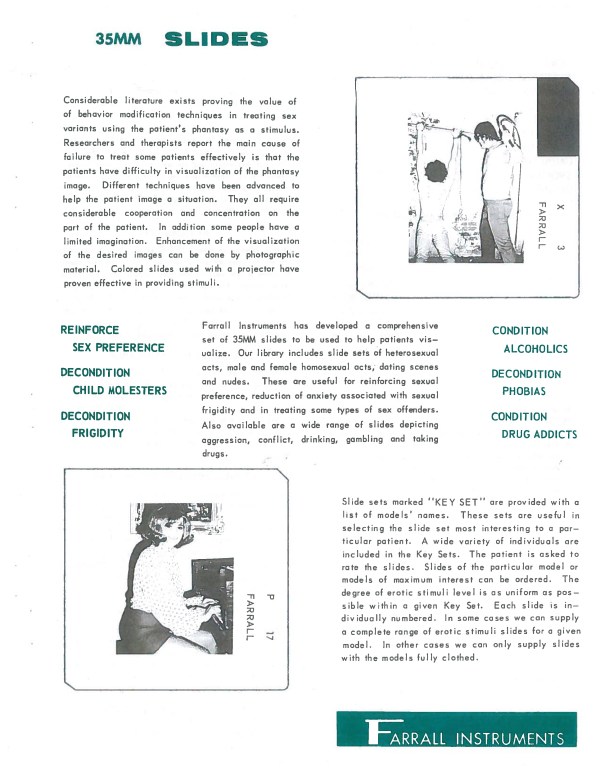
In the more brutal therapy sessions, the shock was delivered directly to the male patient’s genitals every time the patient experienced any form of positive response to the slides being shown to him. The following excerpt from a Farrall Instrument catalogue advertising electroshock therapy products details how the therapies worked:
Aversive conditioning has proven an effective aid in the treatment of child molesters, transvestites, exhibitionists, alcoholics, shop lifters, and other people with similar problems. Stimulus slides are shown to the patient intermixed with neutral slides. Shock is delivered with stimulus scenes but not with neutral scenes. In reinforcing heterosexual preference in latent male homosexuals, male slides give a shock while the stimulus relief slides of females do not give shock. The patient is given a “slide change” hand button which enables him to escape or avoid a shock by rejecting a shock cue scene.

In the 1940s, homosexuals were also involuntarily committed to psychiatric facilities by their families, with the hospitals promising that the patient would eventually leave the facility cured of their “sexual illness.” Not only were they not allowed to leave, but they were often subjected to cruel and inhumane treatments, including castrations, torture drugs, shock therapy, and lobotomies.

The surgeon most credited for the rise of lobotomies was Dr. Walter Freeman, who was best known for his transorbital lobotomy, or “ice pick lobotomy.” In this procedure, the surgeon entered the prefrontal area through the patient’s eye sockets, using an instrument that resembled a common household ice pick. Out of the thousands of lobotomies Freeman performed, up to 40 percent of them were on homosexuals.

In 1941, he performed a botched lobotomy on U.S. President John F. Kennedy’s sister, Rosemary, to help calm her mood swings and occasional violent outbursts. The results were abysmal. She lived the rest of her life seriously disabled in a private psychiatric hospital, along with most of Freeman’s homosexual patients, who were in perfect health before the surgery. By the end of the 1940s, lobotomies had won the acceptance of mainstream medicine and were being performed at Johns Hopkins, Mass General Hospital, the Mayo Clinic, and other top medical institutions.

Ultimately, the fate of the lobotomy would be decided by a pill. In 1954, a new drug called Thorazine began to make its way through state mental hospitals and was initially marketed as a chemical lobotomy. With a viable alternative now in hand that didn’t require surgery, the medical community turned definitively against lobotomy.

The APA removed homosexuality from its official Diagnostic and Statistical Manual of Mental Disorders (DSM) in 1973. This decision occurred against the backdrop of great cultural shifts brought on by the civil rights movements of the 1950s to the 1970s, beginning with the African-American civil rights movement and then continuing on with the women’s and gay rights movements.

In the late 1960s, Christianity Today began printing articles and editorials concerned with the growing homosexual movement. In the early 1970s, ex-gay ministries began to emerge. In 1973, the first contemporary ex-gay ministry, Love in Action, was started in Northern California. In 1976, the first national conference of “ex-gay” ministries was held, resulting in the formation of Exodus International.

Now, 37 years and 260 ministries later, Exodus International is closing its doors. It remains to be seen whether this is truly the demise of the ex-gay movement. What we at ONE National Gay & Lesbian Archives do know for sure is that the LGBT community has persevered, regardless of what was hurled at us physically, psychologically, or spiritually, then and now. We have endured and withstood, and have the history to prove it.

PHOTOS

‘I Was A Homosexual’
Real Magazine, 1953 Courtesy of ONE National Gay & Lesbian Archives at USC Libraries Discover more images from LGBT history at www.onearchives.org

‘What Is A Homosexual?’

Confidential Magazine, 1957 Courtesy of ONE National Gay & Lesbian Archives at USC Libraries Discover more images from LGBT history at www.onearchives.org

‘Homosexuality Is A Mental Illness’
Confidential Magazine, 1957 Courtesy of ONE National Gay & Lesbian Archives at USC Libraries Discover more images from LGBT history at www.onearchives.org
‘New Theory Claims Homosexuality Can Be Cured’
Uncensored Magazine, 1969 Courtesy of ONE National Gay & Lesbian Archives at USC Libraries Discover more images from LGBT history at www.onearchives.org
‘Spitting Image’
Uncensored Magazine, 1969 Courtesy of ONE National Gay & Lesbian Archives at USC Libraries Discover more images from LGBT history at www.onearchives.org

Reference

Gay History: Rules From A 1950s Gay Bar

An un-named Miami-area bar tried to make light of the hostile anti-gay atmosphere in the 1950s by posting the following set of sarcastic rules for its patrons to follow. They were published in One Magazine in 1955.

Rules and Regulations Covering The Behavior Of Our Customers:

1. First of all-remember that the customer is never right.

bostonspiritmagazine.com

2. Before drinking, each customer is to repeat six times “The customer is never right.”

nyinexile.com

3. When a customer wishes to go to the restroom–please raise hand and barmaid will direct you to proper door.

jonnodotcom.tumblr.com

4. Mother and daughter customers are not allowed to hold hands, kiss or pat each other on back. On week-ends they are not allowed to even talk to each other.

tucsongaymuseum.com

5. No after-shave lotion or talcum powder allowed on male customers.

vintageadbrowser.com

6. Lady customers may smoke only if male customer lights cigarette for them.

petermoruzzi.com

7. Lady customers may smoke only cigarettes with ivory tips, jewelled pipes or “Between the Acts” cigars.

chuckmanchicagonostalgia.wordpress.com

8. Male customers may NOT wave at friends or relatives passing by in the street because we’ll have none of those gestures in this place, my dear.

informercantile.com

9. Female customers may not talk at all–they are required to walk around the bar at least once every five minutes, dropping handkerchiefs and swooning at the far turn.

weheartit.com

10. Male customers must have hair on the chest–if you have none–please bring along another chest with the required hair on it. (We will gladly refrigerate it for you while you’re here).

serbagunamarine.com

11. Men may wear only stiff shirts and tails.

epgn.com

12. Women must wear make-up-false eyelashes and beauty marks will be provided at the bar for those women customers who have just come from the beach and don’t have their make-up kits with them.

founder.com

13. Male customers are required to spit periodically. Since we have no spittoons please use the guy next to you.

14. Any male customer caught buying a beer for another male customer will have to buy a beer for the barmaid too so that the management will know that the man customer is of high moral character and not one of those characters.

Brooklyn-lobular.brooklynpubliclibrary.com

15. Please do not be offended if we do not serve you. Here are but a few of the people we could not serve if they were able to patronize us : Socrates, Wilde, Proust, Da Vinci, Michelangelo, Queen Christina, Lord Tennyson etc. and far on into the night.

queermusicheritage.org

Reference