Gay, visually-impaired guy writing professionally (and freelance) about disabilities, being gay, articles, opinion pieces, poems and short stories for over 15 years, mainly for small, local magazines. Obtained my Graduate Certificate in Writing from the University of Technology, Sydney in 2004.
View all posts by timalderman →
A work by Bill Costa, from the Leslie-Lohman collection. Registrar Branden Wallace traces the images of purity (white linen, smooth body) to the advent of AIDS and HIV. (Photo courtesy of the Leslie-Lohman Museum of Gay and Lesbian Art)
Late June’s (2019) 50th anniversary of the Stonewall Riots is making this Pride month a particularly reflective one.
But like a newly minted AARP member flipping through their high school yearbook, the modern gay rights movement’s “Big five-oh” moment brings, with its flood of memories, certain hard questions—not the least of which is: What possessed you to wear that?
“I have, fortunately, no photos publicly available of me during my ’70s platform shoes and glitter rock period,” says Joseph Hawkins, director of the ONE National Gay and Lesbian Library and Archives at the USC Libraries, who spoke with the Blade about how the things we put in our literal closet can liberate us from the figurative one (or keep us there).
“When I look at pictures of people back in the [pre-Stonewall] 1960s,” says the USC Professor of Anthropology and Gender Studies, “there was an assimilationist viewpoint, where you wanted to look like a good citizen. I think of people marching in front of the White House, where they’re dressed in their Sunday best.”
“When the consequences of being an out homosexual were damaging to one’s life and career, there had to be codes to letting people know who you were,” observes registrar Branden Wallace, of NYC’s Leslie-Lohman Museum of Gay and Lesbian Art.
Fashion, Wallace notes, “is a way to express one’s identity, specifically, for the time after Stonewall, when you had this bursting, where queer culture could actually be visible. They took their cues from things that were going on socially, and the trends in fashion, and also developed their own.”
Registrar Branden Wallace, of the Leslie-Lohman Museum of Gay and Lesbian Art. (Photo by Gonzalo Casals)
By the late ’60s, Hawkins recalls, “there was a lot of crossover [between the counterculture and gays]—ripped Hawaiian shirts, and ripped jeans. But later, that gave way that whole ‘clone’ thing, which came as a response to the term ‘sissy.’ Even within the gay community, a sissy would be ‘too’ effeminate. In the clone movement, the gay men were going to out-butch straight men.”
There was very little “humor, in these bastions of gay masculinity… seriousness and masculinity were the same thing. That opaque perspective on masculinity was also a mockery of drag queens and effeminate men. They weren’t really men,” recalled Gerald Busby, in a recent Blade article (“Of cowboy drag, cruising, and cocaine”) about the “cowboy” look he donned to make it past the doors of NYC’s Spike and Eagle’s Nest, during the early 1970s.
“It denoted seriousness of commitment to being gay and being masculine, as well as being decisive about what kind of sex you were after,” Busby noted, of the “alignment of costume and behavior… unmistakable symbols of sexual preference, such as blue or red handkerchiefs in left or right rear pockets of jeans, to indicate top or bottom.”
This exaggerated working class “clone” look, whether denim, lumberjack, or leather, Hawkins observes, was, in its own way, a “liberation ideology. Part of what allowed the sexual revolution to occur was this idea that masculinity could be a gay phenomenon. That’s what fed the ‘clone’ thing. It was a response to the idea that gay men couldn’t be masculine.”
Of his above-mentioned platform shoes ’70s look, Hawkins notes he paired it with skin-tight jeans, shoulder-length hair, and “an old saddle bag I carried. I don’t remember being ‘coded,’ though.” Working in an Office of Economic Opportunity program at the time, Hawkins recalls going on a field trip to Washington, D.C., when “a guy in my group turned to me and said, ‘Oh, girl, if you’re gonna sell that merchandize, you have to advertise.’ There were certain things you wanted to do to look gay, for people to know you were gay. You could walk down the street and catch someone’s glance. That was a different kind of coding.”
In the decades after Stonewall, Wallace notes, cloning reared a new head, and coding morphed with the mainstream, to the point of merger.
Sporting a well-groomed, muscled, manicured look and clingy shirts meant to showcase a sculpted gym body, the “Chelsea Boy” aesthetic ruled the late 1990s and early 2000s.
“I called it the ‘A-Gays,’ a standard that is unobtainable” yet desirable and pursued, Wallace recalls, also noting the Chelsea Boy look shared its time in the sun with “grunge and goth, the alternative kids who, no matter how hard they tried, could not fit in. So it’s amazing that in gay culture [of that time], you have the perfectly coiffed, and this side that just didn’t care, and was for all genders.”
There was also in this era, Wallace notes, “a drastic change in the photographic artwork. With the advent of AIDS and HIV, the art tends to go toward a smooth body, clean appearances. There’s usually white linen and water around. So artists like Herb Ritts and Bruce Weber are using these models for their purity; a perfect-looking body that is not possible.”
Nowadays, “anything goes,” Wallace says. “Beards, which you never saw in a Chelsea Boy in the 1990s, bow ties and sweater vests, and everything… I’m probably raw denim, wearing a T-shirt, got a big keychain in my pocket and a hanky and a Mohawk. That’s usually paired with a suit jacket or a jacket of some sort. You really can do anything now.”
“I don’t know why these things happen,” Hawkins admits, of trends and styles and looks that sometimes seem to defy explanation (he’s still wrapping his head around flip-flops). “Sometimes, in the middle of them, they make no sense. On the other hand, you look back and there are all these political and cultural cues. Maybe there’s an economic downturn or a wave of conservatism based on some sort of military action”—or, an event like Stonewall, which steps over lines in the sand while drawing new ones of its own. “Those things,” Hawkins says, “begin to infiltrate the way people think about fashion, and what they are going to do.”
Gerald Busby in cowboy drag, ready to cruise at the Spike and the Eagle’s Nest. (Photo by Joanna Ney)
In a private cemetery in small-town Arkansas, a woman single-handedly buried and gave funerals to more than 40 gay men during the height of the AIDS epidemic, when their families wouldn’t claim them.
One person who found the courage to push the wheel is Ruth Coker Burks. Now a grandmother living a quiet life in Rogers, in the mid-1980s Burks took it as a calling to care for people with AIDS at the dawn of the epidemic, when survival from diagnosis to death was sometimes measured in weeks. For about a decade, between 1984 and the mid-1990s and before better HIV drugs and more enlightened medical care for AIDS patients effectively rendered her obsolete, Burks cared for hundreds of dying people, many of them gay men who had been abandoned by their families. She had no medical training, but she took them to their appointments, picked up their medications, helped them fill out forms for assistance, and talked them through their despair. Sometimes she paid for their cremations. She buried over three dozen of them with her own two hands, after their families refused to claim their bodies. For many of those people, she is now the only person who knows the location of their graves.
“When Burks was a girl, she said, her mother got in a final, epic row with Burks’ uncle. To make sure he and his branch of the family tree would never lie in the same dirt as the rest of them, Burks said, her mother quietly bought every available grave space in the cemetery: 262 plots. They visited the cemetery most Sundays after church when she was young, Burks said, and her mother would often sarcastically remark on her holdings, looking out over the cemetery and telling her daughter: ‘Someday, all of this is going to be yours.’
‘I always wondered what I was going to do with a cemetery,’ she said. ‘Who knew there’d come a time when people didn’t want to bury their children?’”
The monk’s robe goes back to the Buddha’s own time for, it was He who introduced it to the early monks. The “triple robe” (tricivara) comprises an inner garment or waistcloth (antaravasaka), an upper robe (uttarsanga) and outer robe (sanghati) (Vin 1:94 289). In addition to these, the nun also wears a vest or bodice (samkacchika) and has a bathing-cloth (udakasatika) (Vin 2:272) which altogether comprise her “fivefold robe”.
The Sutras often mention: “Then early in the forenoon, the Blessed One, having robed himself and taking his bowl and (upper) robe, approach . . . “. Those unfamiliar with monastic ways may wonder if the Buddha only half-dressed on His alms-round.
According to the Buddhist Scriptures and the Commentaries, in the early monastic days, the monks would go out on their alms-round dressed only in their waistcloth which was neatly worn, and carrying their upper robe and bowl in their hands. When the monks were in the vicinity of houses, they would put on their upper robe before going to collect alms.
The waistcloth is about the size of a sarong, both the other robes measure about 2m by 7m (about 6 feet by 9 feet). The Vibhanga says that “A monk should wear the waistcloth even all around, covering the area of the navel and the area of the knees.” It is secured to the waist with a flat waistband.
The third robe, the outer robe (sanghati), is not often mentioned in the Scriptures but was permitted by the Buddha for additional use during the cold season. These robes measure about 2m by 3m (about 6 feet by 9 feet). Unlike the upper robe which is only of one layer, the outer robe has two. This is the real meaning of the term, “the triple robe”.
According to the Pali tradition, six kinds of cloth are allowed for making the upper and outer robes: plant fibres, cotton, silk, animal hair (e.g. wool, but not human), hemp, and a mixture of some or all of them. The Buddha recommended that the robe design should be cut in the pattern of the Magadha padi-fields.
Burmese Nuns Robes
The robe dye is allowed to be obtained from six kinds of substances: roots and tubers, plants, bark, leaves, flowers and fruits. They should be boiled in water for a long time to get the dun dye. Saffron and ochre (from the jackfruit’s heartwood) are the most prevalent colours today. Though there is a tendency amongst forest monks to wear ochre and city monks to wear saffron, but this is not always the rule.
There are a number of ways the monks wear their robes (depending usually on their sect and country). The most universal one is that which is worn for the alms-round when the robe is covering both the shoulders. The two top corners are held together and the edges rolled tightly together. The roll is then pushed over the left shoulder, down the back, under the armpit and is pressed down with the left arm. The roll is parted in front through which protrudes the right arm.
Within the monastery or residence and when having an audience with a more senior monk, a simpler style is adopted (as a gesture of respect and to facilitate work). The right side of the robe is pushed under the armpit and over the robe on the left leaving the right shoulder bare.
The Buddhist monastic robe is so versatile that it can be used, besides what is already mentioned, as a blanket, a seat-spread, a groundsheet, a head-cover, a windbreak, etc. It is easy to clean and repair. It is perhaps the oldest style of dress still in fashion after 2,500 years.
The robes serve not just as a kind of uniform to remind the wearer that he or she is a member of a larger universal community, but is itself an object of reflection to be worn “properly considering them: only to ward off cold, to ward off heat, to ward off the touch of insects, wind, sun and reptiles; only for keeping myself decent” (M 1:10). Above all, they remind the wearer that he or she has committed him or herself to high spiritual ideals — to master the Dharma, liberate oneself and show others the Way.
Robes
In Western society where people are wealthier than in other places, it is literally possible to dress in any kind of clothing. Nevertheless, despite all the possibilities, most people wear more or less the same kind of thing. Ritual garments are few and far between: The flowing black robe of a judge is not seen on the street, nor is Queen Victoria’s innovation — the white wedding dress. Gold braid is left for military officers on parade.
Nowadays, elaborate garments are generally reserved for ceremonial occasions. Yet only fifty years ago, certain people went about their public business dressed in sombre medieval costume; some with what appeared to be enormous white birds as head gear. We would know to which order the nun or monk belonged by the features of the various habits (as the robes of Catholic religious are known.)
Hats
The four Tibetan Buddhist denominations are Nyingma, Sakya, Kagyu and Gelug. We sometimes hear them referred to in the following way: Nyingma are called Red Hats, Kagyu are also called Red but sometimes, Black Hats, andGelug, of whom the Dalai Lama is a representative,Yellow Hats. The epithets derive from the crowns or ceremonial headdresses of the lineage-holders and are especially used by speakers of Chinese. That is not to say that these expressions are correct.
Kagyupa
TheKarmapa‘s Black Crown [Tib.:shwa-nag] an image of which is currently displayed on theKhandro.Nethome page, is the actual headdress conferred by the Chinese ruler when he, among many others, witnessed a crown woven from the hair of dakinis suspended above Karmapa’s head.
This crown continues to signify his realization, but it also is reputed to have the ability of instantly liberating those who see it. Hence, in Sanskrit it is calledvajra mukut (thunderbolt crown.)
It is being kept for now at the Karmapa’s monastery in Rumtek, Sikkim. In this photo, we see the replica that is used in certain practices.
Sakyapa
TheSakya(pron. in East Tib.:Shacha) have a distinctive ceremonial hat generally known as thesa-zhu. At a distance itresembles a turban adorned with a diagonal ribbon of rank. This effect is due to the fact that the lappets of the hood are kept in a raised and crossed position. Thoughthis headdress is red, it is not generally referred to by colour.
The original version came into use towards the end of theSakya Pandita‘s (1182 CE) life.It is calledkyang-zhu[sounds likechong ju] meaningextended —a reference to the original long side flaps that formerly were left hanging down on either side of the face.Because of their auspicious benefit for the Sakyas, the lappets that once may have served a utilitarian purpose were folded and crossed like the forearms of meditation deity,Vajradhara.
Gelugpa
The Gelugpa’s pointedyellow hoodhas come to be known as theTsongkhapahat after the 15th century Kadampa reformer who established that denomination.
The fringed hat that resembles a horse’s mane or a Roman helmet, is worn in procession by monks of all 3 of the younger (or, Sarma) denominations. It is often referred to as the Vinaya hat. Here we also see some red pandita or, scholars, hoods.
More About Head-coverings
Like the pointed red hood, a scoop-shaped sun hat is often depicted in historical images ofpanditas. Under the blindingly bright sunlight of the region, it is still common custom, though mainly by country folk, to fold a cloth in such a way that it will sit on the top of the head to act as a sun shade.
According to Vinaya, Buddhist monastic rule, the wearing of hats except for ritual headdresses is prohibited. When His Holiness the Dalai Lama received an International University honorary degree the strength of that prohibition mandated that he immediately remove the “mortar board,” which he held in his hands for the rest of the ceremony.
For public appearances under theatrical lighting, the Dalai Lama has popularized the crown-less eye-shade that was formerly used mainly by tennis players. It is permissible since it is not a head-covering.
In denominations where people’s heads are shaven on a regular basis, when they need to go outdoors in a cold climate the rule is sensibly relaxed. Protection is usually some kind of plain woollen tuque (knitted tubular cap.)
Red Hats in the Kagyu Context
Besides the Black Crown of the Karmapa, there is a distinctive headdress though not as significant, for two other high tulkus [incarnate lamas]:The Red Hat Lamaand that of His Eminence Tai Situpa. The role of these two eminent lamas has traditionally been intertwined with that of the Karmapas. They are teacher and disciple to one another across incarnations in a relationship that is calledthe Golden Rosaryof Mahamudra (GreatSeal, ie.SymbolorAttitude,) which is the supreme teaching of the Kagyu.
Also, at the ritual of celebration of the successful traditional three-year three-month and three-day retreat, celebrants wear the red Kagyu hatassociated with a red form of Chenrezi. Red is also the traditional colour of joy and festivity in many Asian countries.
Since the expressionRed Hatcan refer to two very different things, the Old Schools (Nyingmapa, Shakya and Kagyu) and also the Shemarpas of the latter group, it can perhaps contribute to confusion. This mix-up happened, to the dismay of some members of the media, in a few reports about the emergence of the 17th Gyalwa Karmapa from Tibet.
When it means the Old denominations, it is a reference to the color of the Pandit hats worn by the scholars of these schools.
Later, the Indian tradition of saffron yellow for the pandita hoods was reintroduced and the Gelugpas became known as “Yellow Hats”.
Colours and Clothing
Why Yellow?
There is a kind of irony in the fact that “saffron yellow” is associated with those who reject the pursuit of material goals. Yellow robes are worn, not only by some Buddhist lineages (for example, the Chinese monks of Shao Lin) but also by wandering Hindu ascetics. The contradiction comes from the fact that yellow is the colour of gold — it stands for great wealth.
By association, gold is also the color of nobility. However, although the historical Buddha was the son of a king, it is his Dharma (teachings and methods) that is considered most noble.
In a great part of Asia, the very soil itself is yellowish, so that colour “refers” to our Earth. By extension then, yellow also symbolizes a basis — the Foundation.
“. . . according to Tibetan oral tradition the ceremonial monastic hat in early India had been yellow, the color of the earth, symbol of discipline and the foundation from which all good things are born. However, this had been changed to red, symbol of fire and victory, after the Hindus began gaining the upper hand over the Buddhists in public debate . . . the hat remained red thereafter. The tradition carried over in Tibet during both the early and late phases of the spread of the doctrine, but Tsongkhapa felt that the main threat to Buddhism in Tibet was not unsuccessful debate with non-Buddhists, as it had been in classical India; rather, it was the general laziness and lack of discipline of the Tibetan practitioners. Therefore he changed the color of the hat back to the original yellow, bringing it back to the earth element and the firm foundation required for successful engagement in the higher practices.”
Yellow is also associated with death and dying; it is the colour of dead leaves.
The correct colour is yellow, orange or tawny brown, the same as the kaṇikāra flower,Pterospermum acerifolium(Ja.II,25).<Shravasti Dhammika. buddhismatoz.com/r/Robes.html>
The Tibetan denominations are associated with various colors that distinguish their robes.
For example, theGelugpais sometimes known as the Yellow School. As we have seen, yellow/gold signifiesshilaor discipline. That is the emphasis in the practice of Gelugpas who were known as Kadampa prior to their reformation.
TheNyingma is known as the Red School because of their deep red clothing. Instead of the saffron yellow shirt worn by monks of other denminations, they wear a red or maroon one.
There are several famous Nyingma lineages and two types of religious communities:gendün marpowho are celibate monks and nuns that wear red, andgendün karpo, or white sangha of non-celibate practitioners referred to asgö-kar changlo’i-dé, or “long hair and white kilts.” However, these yogis drape a red shawl (Tib.:zhen) over their white robes.
TheSakyaare known as the Multi-colored School, not after their garments but the stripes that border the outer wall of the original and main Sakya Monastery.
Sa-kyameanspale, orgrey,eartha name referring to the soil’s color at their first monastery’s site. The red stripe stands for Manjushri, the white for Avalokitesvara and the black for Vajrapani. Together they symbolize knowledge, compassion and self-control.
Their distinctive hat identifies them, but its colour does not. Sakya and Kagyu, too, also have traditions in which people dress inwhite.
In fact, theKagyuhave been called the White School, because of the thin white clothing of founders, Marpa and Milarepa (repa: cotton-clad.) Their Indian tantric teachers, Tilopa and Naropa had worn white cotton draped garments. These founders of Kagyu were not monks, but householder-yogis who may also have worn their thin cotton to demonstrate their mastery of tummo(Skt.tapas, heat [generation.]) In Chinese, Kagyupas are referred to as “white robes,” due to the profound impression made by the cotton-clad yogis.
Somengakpas (non-celibate tantric practitioners) wear white to symbolize their life-long commitments. It is meant to underline their having fully accomplished the essence of the Vinaya (the monastic code,) and that they now, in outwardly living in contradiction to the Rule, are trying to transcend it while inwardly scrupulously following its spirit.
That path emulates that of Mahasiddha Saraha who is said to have been able to juggle three iron balls so that all were aloft at the same time. When he left the monastery in order to apply his accomplishments to worldly activity as a yogi, he said, “I have been a monk in name only all my life, but from this day on, I truly am.”
In many cultures, individuals undergoing ritual purification dress in white. Because the cloth is un-dyed, it is considered purer. Also, it resembles snow, clouds and other clean or unearthly substances. White is also the colour of a shroud, the final garment. Therefore when white is worn by a yogi, it can serve as a remembrance of the that there is an urgency to practice. It also indicates to others that the practitioner is in a special state as a result of their proximity to death.
Dyes usedto tint the coarse material used for the robes of religious (and also, military) orders are generally the cheapest — the most readily available. They used mainly to come from plants. In the countries near India the choice was yellow, as from onion skins, and the dark reds fromlacor madder root. Farther east, grey, black and brown are the choice. They can be derived from tree bark.
In China, yellow and red were reserved for the emperor, nobility and officials. There the blue, gray and brown hues worn by peasants are also worn by monastics. The dark blue is from the indigo plant.
Bright blue is the color of the vests of Bonpos, the non-Buddhist practitioners of the old religion of Tibet.
There are two different explanations given for the bright blue border around the armholes of Tibetan monastic robes and vests. One is that it symbolizes Padmasambhava, since it is the bright shade of lapis lazuli, a color that, like purple, is associated with royalty. In depictions, he is portrayed wearing a bright blue inner robe of quality befitting a prince. The other is that it commemoratesHuashang, and though his view of spontaneous enlightenment was defeated, nevertheless it is commemorated and the connection with China is maintained in this symbolic way.
If someone is dressed in a traditional garment, but in unusual colours, you can be reasonably sure that the person is not a celibate monk or nun.
Thezhenor shawl is draped in such a way as to bare the right arm or shoulder. Priests in the earliest cities, as far west as Sumer (Mesopotamia) wore their garments in this fashion. So did those of Mohenjodaro (in the Indus Valley,) as portrayed by the clay figure at left.
In ancient times, cloth was generally not tailored to the body, which entails cutting a precious length of cloth. It was merely draped, or gathered and wrapped. A right-handed person generally finds it awkward to wrap a shawl in such a way as to bare the left side, so this ancient style is also related to modesty as it demonstrates that no other person assisted in dressing. The sari of Indian women when worn in the national style, is also draped in such a way so as to bare the right arm.
But the side a garment is attached can also convey status. Compare the fastening side of the tunics of subjugated peoples with that of the ruling class in traditional China. Notice, too, the subservience inherent in the buttoning practices of western women’s clothing. The garments are meant to be detached by a person facing them!
The exposed right arm is also related to the Western shaking of hands — no weapons are concealed. It is also a sign of the readiness to work, since most people are right-handed. Also, in many parts of the world the left hand is discretely hidden since it is used for cleaning after using the toilet.
This mark of deference is a customary sign of respect to the Buddha. The Sutras mention it speaking of the disciples’ actions as they knelt to ask for teachings. In formal portraits we see garments arranged deliberately to expose the right but conceal the left arm.
Hairdos
Monks shave their heads primarily as a gesture of renunciation in imitation of the Buddha. He cut off his princely topknot in imitation of the wandering ascetics and forest-dwelling yogis of his time.
Itinerant Hindu renunciate practitioners known as sadhus, and other kinds of yogis too may, according to their tradition, dress and act in contrast to monastics. Instead of a shaven head, they may vow to keep their hair (and sometimes, their nails) long. Instead of saffron, they dress in white (seetummoabove) and so on. However, those with high realization may consider such symbolic contradiction elaborate and unnecessary. They dress in whatever way they are used to, including in monastic robes.
When their hair is long it is braided or made into dreadlocks to keep it out of the way and to prevent tiny sentient beings from making their homes in it. Braids can sometimes serve as a kind of mala — a counting device for keeping track of mantras.
Among monks and yogis, as it is in society at large, we cannot judge the importance or role of someone by the details of their garb or general appearance. Therefore, we need to be mindful of the way we react to and behave with people, especially if we are inclined to evaluate status based on appearances only.
~Clothing: The Bare Essentials
Habits or Robes of Monks andNunsCan we judge the book by its cover?
The habit or uniform of Buddhist monastics consists of three outer garments that symbolize the Three Jewels. The robes probably will have been generously donated by lay people.
The main garment in Tibetan orders is the traditionalchubawhich is worn by both men and women in Tibet. It is a wrap-around type of gown that is economically cut and that attaches at the right arm-pit with a special button, brooch or buckle. The sleeveless versiontre.cheis worn by monastics, and it should be visibly repaired or patched to commemorate, among other things,Buddha Shakyamuni‘s poverty after he left his royal estate.
Often the upper-body garment — thezhenor shawl of a ritual costume — is sewn of three pieces, or made of rows of folded squares in such a way as to simulate patchwork. This is especially noticeable intangkas depicting renowned teachers.
The sleeveless robe of women is a wrap-around tunic, or what is called a jumper in North America, that can be adjusted to fit the changing form of a woman. The very generous folds of the traditional pattern has, since the 1970’s, given way to a sleeker contemporary model. It is generally worn with a short, square and complementary-coloured paler, blouse. Often, the collar of the blouse is folded outside the diagonal closing of the outer garment to form a cuffed border resembling a shawl collar.
A similar garment made of thin material can be worn underneath, and there can be more than one of those, as was the custom of Japanese women before Westernization.
Married women wear thepang.den,an apron made of 3 lengths of striped woven cloth sewn longitudinally. Its corners may be embroidered or appliqued with triangular patches in a flower motif. These welcome, frame and protect any new life beneath the apron.
There are prescribed undergarments for both ordained men and women. An outer sleeveless vest was developed for the use of women and it is popular with men, too. As noted above, the various denominations or schools have characteristic colors.
In the West,some individuals and groups have adapted the robes to suit individual occupations or personal requirements. For example, polo shirts or t-shirts or suit jackets in the appropriate hue are an option, and a tubular lower garment (Hindi:lunghi) or a divided skirt similar to that worn by Japanese martial artists may be worn by a woman who prefers to wear trousers.
The wearing of a robe, like other precepts and vows comprisingthepratimoksharule of monastic order, functions as a protection for the wearer. It frees him or her from the problems or attentions associated with the wearing of everyday clothing, and it functions as a reminder to the wearer (and the public) of his or her vows as a renunciate.
There are many other rules concerning distinctions in monastic garb, such as those underlying the differences between the dress of those who have embarked on the renunciate’s path and those who have entirely renounced worldly life. It is considered all right for a yogi (especially one who started out as a monk, e.g. Kyabje Dilgo Khyentse Dorje Chang) to dress as a monk, but it is not all right for a monk to dress as a yogi, or as a “householder.”
It could be considered disrespectful for a layperson to wear these robes, but it is a breach of vows for a monastic NOT to dress in them.
If you like to dress in a Tibetanchuba, try not to emulate monastic dress. Perhaps it is a good idea to ask the lama whether it appears misleading.
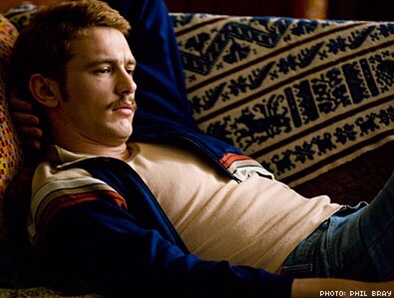
Levis 501 jeans. Skin tight. Sanded down at the knees and crotch for that perfectly worn-in look. Third button unbuttoned to create a bit of allure. T-shirt, also skin tight. A Levis snap-front plaid. That was the uniform of the Castro clone, the gay fashion icon spawned in the 70s that — with surprisingly minor evolution or alteration — can still be seen on the streets of San Francisco today.
Danny Glicker, thankfully, is in love with the look. As the costume designer on Milk, Gus Van Sants biopic of the slain civil rights leader Harvey Milk, Glicker had to outfit hundreds of actors, from leading men Sean Penn, James Franco and Emile Hirsch to an army of extras, all dressed to span a full decades worth of fashion dos and donts.
Period films always present challenges to their costumers, but those based on true stories are that much more complicated. Glicker was saddled with another great expectation while preparing the highly anticipated film: Milks characters are not only real, they lived during a time many viewers can still recall themselves. And Milk owned a camera shop and lived an incredibly well documented life, which took some of the guesswork out of the equation, but also meant that there would be no excuse with eagle-eyed fans for anything less than absolute authenticity.
Simply recreating the clothes wouldnt have been sufficient — the bodies on todays actors are more defined and muscled than those of the leaner Milk and his comrades. Instead Glicker had to tailor the clothes to look as if they were hanging off of a 70s frame.
We created these enormous books of research that specifically address each character within the timeline, says Glicker, a young, unassuming, bespectacled man with a head of thick black curls whose previous work include Transamerica, Thank You For Smoking and HBOs True Blood. It was sort of overwhelming, because after awhile it was hard to edit down the material. I was very interested in recreating outfits exactly as they were, partially because I knew that Gus was going to be incorporating so much archival footage into the movie, and I didnt know exactly where.
Given access to the archives of the San Francisco GLBT Historical Society, Glicker and his team managed to get their hands on a fair amount of Milks actual clothing. Then they went shopping. Glicker, who prefers vintage pieces, combed hundreds of stores and amassed a huge collection of items, which he then authenticated using his research books before altering to fit the actors. No tiny detail of the evolution of fashion went unchecked — there are, after all, key differences between a 1976 shirt and a 1978 shirt (such as the collar width), and Glicker was determined to be accurate.
What couldnt be bought was recreated (and sometimes what was bought was still recreated so that spare sets were available), including T-shirts from now-defunct Castro bars, protest Ts found in the archive, and the suit Milk was killed in, which they had viewed at the Historical Society. That was a very, very meticulous recreation, says Glicker, who had to wear cotton gloves while handling the suit, which is kept in a temperature and light controlled environment and wrapped in acid free tissue. We were measuring everything from the lapels to the belt loops and leg openings. The fabric, every aspect of the fit, it was all done to match as closely as possible.
And when the thrift stores and archives didnt have what he needed, Glicker went to Levis corporate headquarters in San Francisco. The uniform of choice for Harvey Milk, his friends and many in the LBGT community at the time was the Levis 501 button fly jean, says Robert Hanson, President of Levi Strauss & Co.s Levis Brand Division. If you saw anything but Levis in the film it would have been wrong.
Levis gave me a tremendous amount of access to both their archive and retail store, says Glicker. Hanson (who is gay) and Levis, an early pioneer and longtime stalwart supporter for gay causes, thought the film was a perfect match for the brand. The movie is really about a very specific movement at a specific time in the city, Glicker says. These people wore Levis. It was what they were about and where they were. Its more than just a brand of clothes in this case, its an iconic part of America and the Castro.
When I started reading about what people wore, adds screenwriter Dustin Lance Black. I thought, What was that Levis clone look about? It didn’t take much to realize that it was about a group of people who had been called pansies and fags reclaiming their masculinity and being men.
That held true even when going butch went beyond the basics. I remember reading someone complaining that the guys were actually going too far with it — trying to be too butch, actor James Franco, who plays Milks longtime lover, Scott Smith, told Black in his Out cover interview. I saw a lot of guys from the Castro where they [actually] looked like construction workers.
Thats why the Castro clone, Glicker says, is actually a deceptively simple look. It has to be perfectly played, he says. In order to make it look good, you have to find the perfect fit and you have to feel great in it to be able to sell the outfit. It was a uniform because it was accessible for everybody. It wasnt out of peoples grasp. It was about the wearer more than the means of the wearer. And whether or not Milk launches a vintage resurgence, the basic elements havent been put out to pasture. I see the influence of it everywhere. Its not going anywhere. Its like the gay communitys little black dress.
Keith Raniere targeted wealthy and seemingly happy women. But by preying on their insecurities, he got them to do things they never imagined
Keith Raniere was the mastermind behind NXIVM, a self-help group with a sinister side. Photo-illustration by Kyle Rice for Rolling Stone. Photographs used in illustration by Keith Raniere Conversations/Youtube, Seth Wenig/AP/Shutterstock, Justin Lane/EPA-EFE/Shutterstock, Ruth Fremson/The New York Times/Redux, and Jemal Countess/Getty Images
There was a method to the branding. It was supposed to be precisely seven strokes — one line across, and two diagonal lines down to form the sideways K; then four smaller lines to form the sideways R beneath, the little spoon to the big spoon of the K. The women were supposed to be naked. They were supposed to be videotaped. They were supposed to be held down on a table, arms above the head, legs spread, ankles and wrists bound; helpless, vulnerable, exposed. And they were supposed to say the following: “Please brand me. It would be an honor. An honor I want to wear for the rest of my life.”
This last part was the most important. “They should probably say that before they’re held down, so it doesn’t seem like they were being coerced,” Keith Raniere told actress Allison Mack, his lover, disciple, and slave.
“OK,” Mack responded in a soft voice. She already knew most of this, because she had already been branded.
Later, Raniere instructs Mack what to tell the women unwittingly being branded with his initials: “Pain is how we know how much we love. We know the depth of our love through pain. When they feel the pain, they think of that love.”
A recording of this January 9, 2016 conversation was presented as evidence in the criminal trial against Raniere, the 59-year-old head of NXIVM, a company offering self-improvement seminars and workshops that was based in Clifton Park, an Albany, New York, suburb dappled with shopping centers and two-story colonials. NXIVM was founded by Raniere and Nancy Salzman, a former registered nurse with schoolmarm glasses and a sensible haircut; he was called “Vanguard,” while she was known as “Prefect.” Recruits paid more than $7,500 for grueling, 12-hour “intensives” featuring NXIVM’s patented Executive Success Program (ESP) technology, a patchwork of various self-help programs, religious ideologies, and hypnosis techniques. They could also take classes through the smaller companies under the NXIVM umbrella: the Source, a workshop for actors led by Mack; Delegates, a Task Rabbit-esque startup primarily staffed by younger, female members; and JNESS, a female empowerment group whose Facebook wall features Martin Luther King Jr. quotes juxtaposed against a pastel-pink template.
At the head of all of these companies was Raniere, 59, a self-proclaimed former-child-prodigy-turned-guru, who stood trial last summer on sex trafficking, racketeering, and racketeering conspiracy charges. Raniere was accused, among other things, of using NXIVM as a recruitment network for DOS, which prosecutors referred to as a secret “sex cult” within NXIVM. Mack and other female NXIVM members were the “masters,” while Raniere was the “grandmaster” at the head of the group, instructing women in DOS to recruit “slaves” for the purpose of his sexual pleasure. The branding Raniere described in the January 2016 conversation with Mack was part of the slaves’ initiation ritual.
Conversations with Keith Raniere’ episode featuring Alison Mack, Youtube Keith Raniere Conversations, Youtube
The women recruited as DOS slaves, as they recounted on the stand, were told to give up “collateral” as the price of entry, such as videos of themselves masturbating or postmarked “confessions” that relatives or loved ones had sexually abused them. They were told to text their “masters” up-close photos of their unshaven vulvas, always keeping their faces in the shot so they were fully identifiable. They were told to stick to low-calorie diets, to wake up in the middle of the night to respond to “readiness drills” or texts from their “masters” or risk being paddled, and to abstain from sexual activity with anyone but Raniere. They talked about how they were instructed to buy BDSM sex toys as part of a “dungeon” to be built in the basement of DOS headquarters that would include cages, vibrating rubber paddles, and “puppy plugs … perfect for puppy play or naughty slaves.” (Plans for the dungeon were scrapped when the Feds started closing in.) Many, though not all of them, were branded, and they talked about how excruciatingly painful it was: how you could hear the cauterizing pen sizzle against raw skin, how one woman squealed and screamed so loud and so long that the women gave her a cloth to bite on.
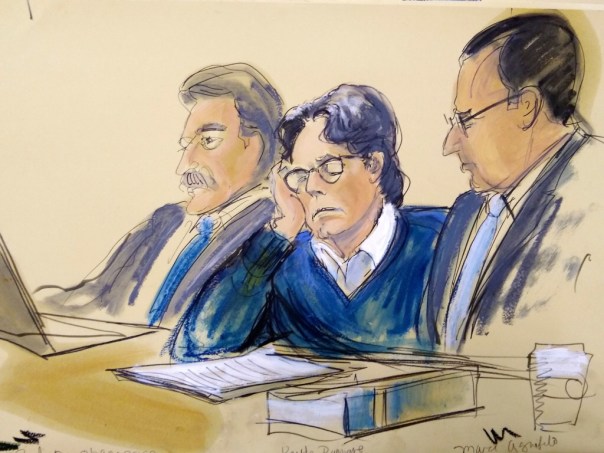
DOS slaves weren’t told that they were being branded with Raniere’s initials, nor were they told that Raniere was the mastermind behind the group. Instead, they were told by Mack and other top-line “masters” that DOS was a badass, if slightly unorthodox, feminist group meant to help women build discipline and overcome their intimacy issues. As assistant U.S. attorney Tanya Hajaar put it during opening remarks, “The defendant maintained a charade: Even though he controlled the victims’ lives, it was about female empowerment.” Through it all, Raniere sat quietly, occasionally scribbling notes on Post-Its to his attorney. On most days, he wore a jewel-toned crewneck and khakis, looking less like the head of a BDSM sex cult than a Latin instructor at a New England prep school.
This contrast between Raniere’s nebbishy, avuncular appearance and his seduction abilities was the second-most frequent topic of conversation among the press during breaks in the trial.
By far the most popular topic of discussion, however, was how these women could have possibly convinced themselves they were signing up for a female-oriented wellness and empowerment group in the first place. No one went so far as to blame the women or accuse them of perpetuating their trauma — as journalists covering sensitive subjects like abuse and consent, we ostensibly knew better than that. Yet on days when the testimony was particularly brutal, the tenor of the discussions would come uncomfortably close. The branding, the nude photos, the seduction tasks, the sexually explicit collateral: Why would they agree to do these things? How could they have not suspected that the man they were being tasked to seduce, ostensibly as a sort of Abrahamic test of faith, was the one pulling the strings all along? How could this endless parade of smart, attractive, accomplished women so easily have given up their freedom and their bodies to this hairy, middle-aged guy who looked like an extra on the set ofRushmore?How could they not have known?
Raniere’s ability to persuadedozens of beautiful women to send him photos of their genitalia was arguably without precedent. But otherwise, very little about him or NXIVM was original.
Executive Success Program (ESP), the patented “technology” that served as the basis of its curriculum, was little more than a mélange of psychotherapeutic and self-help teachings, with a dash of early wellness industry-speak thrown in. It has been referred to as a combination of the 1970s self-help program EST and Objectivism, the ideological system founded by neoliberal icon Ayn Rand.
NXIVM “was an old bag of tricks, repackaged,” regurgitating “universal truths about how to improve yourself and how to look closer at the things that are getting in your way of success and your fears,” says Diane Benscoter, a cult expert who has closely worked with former members. Indeed, Teah Banks, a former NXIVM member in its early years, says that after she left the group, she recognized many ESP techniques in the book Stress Management for Dummies.
Keith Raniere (center) in a courtroom sketch from June <br />Photo by Elizabeth Williams/AP/Shutterstock Elizabeth Williams/AP/Shuttersto
Raniere’s taste for kink — the conflation of love with pain as heard on his call with Mack about DOS — was arguably derivative, too. According to Toni Natalie, Raniere’s ex-girlfriend and an early NXIVM whistleblower, Raniere had little interest in BDSM while they were dating in the 1990s, crediting the popularity ofFifty Shades of Greywith inspiring Raniere’s taste for sadomasochism — or, at the very least, co-opting the language of the consensual-kink community to further his own desires to exploit and control women. “Like I’ve always said, the man is not capable of having an original thought,” Natalie says dryly.
A dark-haired woman in her early sixties with wide eyes and a predilection for understated silver, tribal jewelry, Natalie has spent the past two decades of her life vacillating between trying to fight her ex-boyfriend in court and trying to get people to understand him. Her new bookThe Program: Inside the Mind of Keith Raniere and the Rise and Fall of NXIVM,co-written with journalist Chet Hardin, documents both efforts, detailing her relationship with Raniere and her lengthy legal battles with NXIVM.
Natalie met Raniere in the early 1990s while he was running Consumers’ Buyline, a multilevel marketing scheme. At the time, Raniere was being branded by the company as the “smartest man in the world,” a label that stemmed from the results of a take-home IQ test he took in the 1980s that led to him being included inThe Guinness Book of World Records(albeit just one Australian edition).
At the time she met Raniere, Natalie was 29 and in what she describes as a sexless marriage to her third husband, a tanning-salon owner. Raniere, she says, made her feel special — but perhaps more importantly, he made her feel smart. She’d left high school to get married for the first time at 17, and she was deeply self-conscious about her lack of formal education. “What Keith was able to do was immediately ascertain your weak points and insecurities,” Natalie says. “And then he takes those insecurities and convinces you he’s helping you with them. But it’s just things he uses to hold you hostage.”
For eight years, Raniere and Natalie lived together, with him serving as a father figure of sorts to her young son. All the while, Raniere was surrounded by a cohort of women who worked for his company, including Pam Cafritz, Karen Unterreiner, and Kristin Keeffe. These women, whom Raniere referred to as “the girls,” came from a wide range of backgrounds: Cafritz was the daughter of D.C. Republican socialites, while Keeffe was a former waitress who had met Raniere while waiting tables in Albany. All, however, were united in their fierce devotion to him.
Following the failure of Consumers’ Buyline, Raniere and Natalie opened a health-food store and cafe in upstate New York. It was through this business that Natalie met Salzman, who visited the store to find relief for her chronic constipation (“she was, quite literally, full of shit,” as Natalie puts it). Salzman touted herself as an expert in NLP (neurolinguistic programming), a form of therapy that uses tactics such as body language mirroring and hypnotherapy to help followers overcome personal obstacles. (It haslargely been dismissed as pseudoscience.) She offered to give Raniere and Natalie private NLP sessions to help them with their relationship issues, which led to Raniere taking private meetings with Salzman in the back of the health-food store.
The result of their collaboration, Natalie writes, was “like putting two volatile chemicals together in a mad scientist’s lab: The resulting compound was both explosive and dangerous.” Disillusioned by what Natalie viewed as the exploitative NLP method and Raniere’s increasingly arrogant behavior, the two broke up in 1999. Almost immediately, “the girls” jumped into offense mode, urging Natalie to take him back; when that failed, she says, they stole her mail, hacked into her hard drives, and filed multiple lawsuits accusing her of stealing money from Raniere, strategies they would use against Natalie and any other perceived Raniere enemies for almost two decades.
In 2000, Raniere filed a patent for the “rational inquiry method,” which would serve as the basis for ESP. Raniere’s reputation as the “smartest man alive,” combined with Salzman’s credentials as a nurse and NLP expert, allowed the group to rack up many high-profile supporters fairly early on, most notably Clare and Sara Bronfman, the heiresses to the Seagram’s liquor fortune, who would later go on to spend nearly $140 million bankrolling the group’s lawsuits against Natalie and other detractors. The patented ESP “technology” allowed Raniere to “couch” the group’s methods by basing them in “rational thought,” says Josh Bloch, an investigative journalist and host of the CBC podcast Escaping NXIVM: “I could see how that would sound very attractive to someone who might be turned off by flaky or nonscientific messaging.”
Underneath that thin patina of pseudoscience, however, the leader of NXIVM had some pretty strange ideas. Chief among them were his theories about gender, which emerged into sharper relief as the group gained influence. “One thing that was [taught] was that men biologically, by their nature are primitive. They want to propagate. They want to create more children to create a tribe,” says Barbara Bouchey, a former Raniere girlfriend and high-ranking NXIVM member who left the group in 2009. “So men and their biological chemistry were prone to want to have multiple partners, whereas women based on their biological nature were at home in the cave caring for people.”
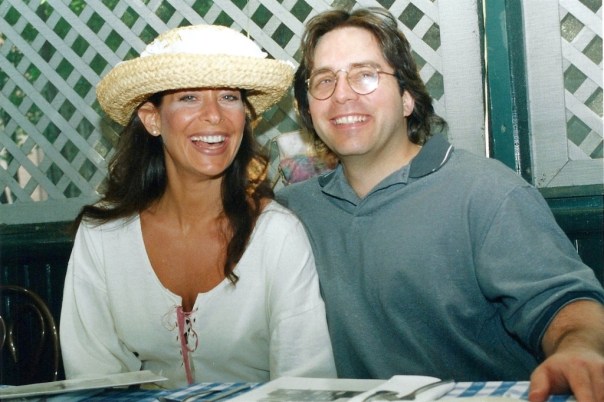
Toni Natalie and Keith Raniere. Courtesy of Joan Schneier Courtesy of Joan Schneier
During the trial, it was often argued by the prosecution that such teachings served as a way to justify Raniere’s polyamorous lifestyle. But this is not exactly true. Only the highest-ranking NXIVM members were aware that Raniere was sleeping with most of the female board members, with most of the group’s lower-ranking members believing him to be something akin to a renunciate. The group “operated in silos,” says Bloch. “[The leadership] did a very good job with the left hand not knowing what the right hand was doing.” Indeed, both Bouchey and Natalie deny having had any knowledge of Raniere’s extracurricular sexual activities while they were involved with him; when Natalie discovered graphic nude photos of “the girls” after their breakup, she said she felt devastated by the betrayal, particularly by Cafritz, whom she had considered “like a sister.”
But as NXIVM grew and Raniere expanded his reach, his views on the biological differences between men and women became more difficult to ignore. JNESS, the women’s group co-founded by Cafritz in 2007, taught that men inherently had more character and fortitude than women, who were more prone to flightiness and “game-playing,” a Raniere term for deceit and manipulation. The male equivalent to JNESS, the Society of Protectors (SOP), took these theories to the next level: according to one former member who testified at the trial, a coed SOP module gave female members tiaras or princess wands for being too “princess-y,” while one woman wearing a low-cut top to a meeting was given a blue ribbon for showing off her “udders.”
It’s difficult to pinpoint exactly what attracted women to this type of messaging. Part of its success was attributable to the fact that Raniere was well-versed enough in the language of corporate female empowerment for his misogyny to escape notice. Indeed, a large part of what attracted women to NXIVM was Raniere openly advocating for women in leadership roles. “His thing was always that the company would be better if there were women in power, because women are stronger, women are this, women are that,” Natalie says. Of course, Raniere did not install women in high-ranking positions within NXIVM because he thought they were smarter or stronger or better qualified; he did it says Natalie, because he believed “women were easier to control.” But it’s easy to see how a female recruit could see the largely female executive board and assume that the company promoted the interests of women.
Yet the misogyny inherent in Raniere’s teachings also appealed to some women on a much deeper level. Some of the women in NXIVM had come of age in an era of body-positive Dove ads and girl-power messaging, and had largely felt failed by its promises. Having sampled all of the wellness industry’s offerings on their path to enlightenment — the teas, the classes, the pastel-hued self-help paperbacks , the meditation apps, the rose-quartz vagina-tightening sticks — many felt disillusioned and more spiritually depleted than before. For many of these women, the goal wasn’t so much toward enlightenment or even fulfillment so much as it was feeling some semblance of OK. But the journey toward self-love proved so exhausting that the prospect of simply accepting their biological fate and ceding all of their power to men proved not just alluring, but irresistible.
This seemed to have been especially true for women like Mack, whom a friend described to the New York Times as someone “constantly searching for something that was missing in her life.” (Mack did not return Rolling Stone’s requests for comment.) Mack started taking NXIVM classes in 2006 when she was 23, in the hopes that she could learn to become a better actress; after Smallville ended in 2011, she struggled to find work and began to immerse herself even deeper into NXIVM, withdrawing from her friends and family members. One of the witnesses at trial, former board member Mark Vicente, testified that he viewed Mack as “unbalanced,” and became concerned about her mental health during this time.
But Mack felt otherwise. In an email to Raniere read at trial, she explained how grateful she was to be deep in his thrall, how disappointing her own strides toward self-empowerment had been, how nothing made her feel so powerful as to be made by him to feel powerless. “I spent so much time throughout my life listening to music about being ‘beautiful without doing anything,’ being ‘an independent woman,’ being every woman,” Mack lamented. “The ‘fierce’ and phenomenal woman’ lie is so encouraged and pervasive. It is the root of such pride, such violence, such prejudice.”” She then thanked Raniere for the threesome they had with another NXIVM member the night before.
Prior to NXIVM, Raniere’s weapon of choice was his small group of “girls” — namely, Unterreiner, Keeffe, and most importantly, Cafritz. But as NXIVM grew, so too did what prosecutors referred to during the trial as Raniere’s “inner circle.” There was Mack, Bouchey, Cafritz, Unterreiner, Keeffe, and Bronfman, but also Lauren Salzman, the daughter of “Prefect” Nancy, a wan, frail woman with dark circles under her eyes; Nicki Clyne, the saucer-eyed blond Canadian Battlestar Galactica actress; and Rosa Laura Junco, the improbably pretty daughter of a powerful Mexican publisher, who was so devoted to Raniere that she offered him her teenage daughter Lauris as his DOS slave and virgin successor.
Actress Allison Mack leaves court in Brooklyn on February 6th, 2019.<br />Photo by Justin Lane/EPA-EFE/Shutterstock Justin Lane/EPA-EFE/Shutterstock
The women all looked somewhat similar: in their early thirties to mid-forties, dark-eyed, tastefully dressed. Above all else, they were slender, almost painfully so: Raniere was obsessed with controlling women’s weight, to the degree that some of their fingers became stained with the color of the carrots and squash they exclusively ate at dinner. He was unabashed about weaponizing their insecurities about weight, telling one partner that the extra 10 pounds she’d gained “hurts my heart physically” and refusing to sleep with her till she shed them.
Within the “inner circle,” sex with Raniere was positioned as a crucial step toward achieving enlightenment, a spiritual reward in and of itself, and women who were having sex with Raniere were said to be “working with” him. Unsurprisingly, this idea was primarily propagated by Raniere himself, who claimed that women who swallowed his semen sometimes saw an ethereal “blue light,” and that those who refused to participate in a group oral sex session weren’t “committed to [their] personal growth.”
The NXIVM inner circle was not just a source of sexual gratification for Raniere. It was also his ultimate weapon. If one girlfriend was unhappy with Raniere, or had committed what was perceived as an ethical “breach” (NXIVM jargon for an act that ran counter to the group’s values), other members of the inner circle, primarily Cafritz, were tasked to bring them back into the fold.
They were tasked with going after NXIVM “enemies,” an ever-growing cast of journalists, defectors, and Raniere ex-girlfriends perceived as threats to the organization. “Alone, he would’ve just been a man,” U.S. attorney Marc Lesko said during closing. “Within his inner circle, he was the ruler of the universe in Clifton Park.”
Bronfman led the charge on this front, funneling $150 million into the group’s legal efforts. A former champion equestrian, Bronfman rose in the ranks to become Raniere’s capo, patron, and arguably most cutthroat defender. “Keith took her and put her on a pedestal. He made her important in the community and gave her a leadership role. She’d never had that before,” Bouchey tells me. The Bronfman-funded lawsuits were intended to, and ultimately did, completely decimate NXIVM critics like Natalie, whose own mother was forced to file for bankruptcy when she could no longer afford to help her daughter fight the suits. “Financially, how do you go up against the Bronfmans? They wiped us out,” Natalie says. “There’s no equalizer there.”
As the inner circle expanded, Raniere exerted ultimate control over his followers. He dictated everything from what they ate to who they slept with (no one but him and other women in the inner circle), and how they groomed their pubic hair. He was particularly skilled at capitalizing on the insecurities shared by many women of mid-to-late childbearing age: whether they were thin enough, whether they were sexual enough, whether they would be able to balance career with family. This was especially true for Salzman, who testified that she desperately wanted to have a child with Raniere, and spent 15 years with him dangling this over her head, only to have it abruptly yanked away after a perceived “ethical breach.” “I committed to stay with nothing. No relationship, no baby. Nothing,” she testified through choked sobs.
Bouchey, who left the group in 2009 and has also been embroiled for years in legal battles with Raniere and NXIVM, believes that the women who were willing to sacrifice so much for Raniere, only to get so little in return, had one trait in common. “They were what I would call weak-willed women,” she says. “They were smart, they were sensitive, they were caring. But were they confident? No.” Raniere, she says, went out of his way to surround himself with women who were successful by societal standards — privileged, attractive, well-educated — but who did not have the financial independence nor street smarts to assert themselves and their own autonomy.
Natalie has a similar theory. While the women in Raniere’s inner circle were all extremely bright, they tended to lack substantive family ties, and all were “insecure and damaged in some fundamental way,” making them easier to control. “He convinces you that your successes are not your own. Your successes are only because he exists,” she says.
Both of these theories, however, actually contradict much of the available research on cults. Aside from a few general demographic traits, such as being white, middle-to-upper-middle-class, and having an above-average IQ, there is no one set of characteristics that differentiates people who join cults from people who don’t, says Dr. Steve Eichel, one of the world’s foremost cult-studies experts. Cult leaders don’t look for people who are any more “broken” than most of the population. What they look for, he says, is people who are in transition, who have just lost a job or ended a marriage or had a child. “You look for people who are vulnerable. And the problem is we are all vulnerable to cultic influence at various times in our lives,” he says. “[The] primary cause of cult membership is bad luck.”
It’s fair to be skeptical about this explanation. After all, in the grand scheme of things, very few people join a cult; even fewer people (about 16,000) actually took NXIVM classes, and fewer still joined DOS. It seems like a bit of a stretch to say that anyone is vulnerable to joining a cult when so few people actually do. But when you consider all of the women who spend thousands on spin classes or serums or pastel-branded all-female co-working startups, who whittle themselves down to nothing to run a race that has no finish line in sight, who are told to surrender all of their power in order to ostensibly build up their own, then, of course, it makes sense that women would feel empowered by Keith Raniere. When you’re taught for years that pain is love and love is pain and one is the only way to measure the depths of the other, it doesn’t make a difference if the person telling you that is your boyfriend or your spin instructor or an Instagram ad for laxative tea or a fleshy-cheeked, nebbishy, middle-aged guy with a seemingly endless supply of crewneck sweaters. It’s the same message from a different messenger. It’s an old bag of tricks, repackaged.
In November 2016, Cafritz died after a lengthy battle with cancer. Her death was devastating for NXIVM members, some of whom shared a meme on Facebook memorializing her work with JNESS, with the quote: “If we want to have more women’s empowerment, we need to have a core essence of what it means to be female and how to uphold the female principle within ourselves.”
But it was arguably more devastating to Raniere, who had been involved with Cafritz for nearly 30 years and who relied on her as a fixer of sorts. She was the one Raniere dispatched to calm down angry girlfriends, and she became such a frequent presence at the local Planned Parenthood, where Raniere would send his partners to get abortions, that the staff recognized her. Natalie, who knew her former best friend had been sick and had been waiting for her to call toward the end of her life, believes Cafritz was both one of Raniere’s last ties to humanity, and one of his most tragic victims. “I wonder what he did to Pam. I wonder why she did the things that she did,” Natalie tells me. “It still haunts me.”
Lauren Salzman leaves Brooklyn federal court on January 28th, 2019. Photo by Seth Wenig/AP/Shutterstock Seth Wenig/AP/Shutterstock
During the trial, both the defense and the prosecution framed Cafritz’s death as formative in Raniere’s decision to create DOS, albeit in totally different ways. Raniere’s lead attorney, Marc Agnifilo, said Cafritz’s death prompted Raniere to consider his “legacy” and what he hoped to leave behind, eventually settling on DOS, which he created with “the best of intentions” as a support system for women. Assistant U.S. district attorney Moira Penza argued that DOS was created to fulfill the role that Cafritz had always played: a pimp for Raniere. She cited 2016 texts between Raniere and a DOS slave named Camilla, in which he tells her it would be good for her “to own a fuck toy slave for me that you could groom as a tool.” The texts were sent in 2015, a year before Cafritz died of cancer.
On paper, the goal of DOS was the same as set forth by Cafritz in JNESS: female empowerment. “It was pitched as women getting together, women supporting women, that kind of thing,” says a a 43-year-old writer whom Mack attempted to recruit to DOS in 2016. (She asked that Rolling Stone keep her anonymous, citing a concern over any potential ties to NXIVM threatening her job security.) “It was not specific at all in terms of the mission,” she says. Raniere wanted to create a worldwide network of female “slaves” and “masters,” using NXIVM’s marketing tools and high-profile members like Mack to cultivate women of influence, such as Emma Watson, Beverley Mitchell, and Jill Filipovic, to join the group. (None ever did.) His vision was dizzyingly ambitious: in one recorded call played during the trial, Raniere envisioned the organization becoming so powerful it would sway the U.S. 2020 general election.
Raniere had a few requirements for admission. You had to be attractive, young, and thin (or at least, willing to become thin in a short period of time). And with a few exceptions, you had to be single, with the logic being it’s easier to persuade women to send you photos of their vulvas if their spouses aren’t around to get in the way. But this criterion also helped winnow down the applicant pool to a specific kind of woman, the type of woman who had felt failed by the “fierce and phenomenal woman” stereotype Mack had maligned in her email, the type of woman who had not yet ticked off the requisite wife and mother and career boxes society demands women to check off one by one, and whose perceived failure to do so likely made her insecure, and therefore more pliable.
Nicole, an aspiring actress with glossy brown hair and the craniofacial structure of a baby sparrow, was one of these women. Unlike Mack, she still believed in the concept of the fierce and phenomenal woman. In fact, as she testified, she dreamed of playing a role like Wonder Woman. “That was the kind of woman I wanted to become,” she said. A Los Angeles transplant in her late twenties who’d moved to New York to kick-start her acting career, Nicole had taken a few classes with the Source, NXIVM’s company for actors. Nicole was in transition: She’d just broken up with her boyfriend, her career was in a downslide, and she was regretting her move to New York to the point that she was borderline suicidal, as she confided in Mack, whom she considered a mentor. A concerned Mack invited her to coffee, where she pitched her on an “an intense, growing empowerment group where women pushed each other to be stronger physically [and] mentally.”
Nicole was intrigued. Her curiosity was further piqued when Mack promised Nicole this secret group would help her live the kind of life she wanted and build the kind of career she wanted; it could, she told her, help her become Wonder Woman. A few days later, Nicole supplied Mack with her collateral: a video of herself masturbating, as well as a letter falsely claiming her father had sexually abused her. A few months later, she would be instructed by Mack to seduce Raniere; a few months after that, she would be branded.
DOS was predicated on the illusion that Raniere had absolutely nothing to do with the organization. “I thought I was getting into a women’s empowerment group,” Nicole testified on the stand through sobs. “[Somehow], I’d become a man’s sex slave.” But even though Raniere’s involvement in DOS was a secret known only to top-line slaves like Mack, so great was his ego that he simply couldn’t help but drop the occasional hint that he was behind it all. Once, while they were in his library together, Raniere told Nicole about how, in the army, recruits would be tasked with scrubbing a tank with a toothbrush, then told they needed to do it all over again when they were done.
When Nicole asked him about the relevance of this anecdote, Raniere responded that just like in the military, “he needed to break me in order to build me back up into a strong woman.”
A man was behind the creation of NXIVM’s secret female empowerment organization.But it took multiple women to help bring it down: Sarah Edmondson, a Vancouver-based actress who had been recruited to DOS by Salzman, then left the group when she was told Raniere was behind it all; and Catherine Oxenberg, theDynastystar and concerned mother of India Oxenberg, who worked for the NXIVM company Delegates and had also been recruited to DOS by Mack.
In the fall of 2017, former NXIVM employee and whistleblower Frank Parlato published a series of articles about DOS on his website, followed byTheNew York Timespublishing a bombshell investigation into the group, featuring photos of Edmondson showing her brand. Oxenberg, too, went to the press, telling Megyn Kelly in November 2017 that India had been branded and instructed to go on a near-starvation diet.
The revelation that the women of NXIVM were running a secret sex cult came as a shock to most within the organization, who had little knowledge of such unsavory activities in the upper ranks. Raniere had, in fact, been so skilled at keeping church and state separate that not even NXIVM co-founder Nancy Salzman knew about DOS, and she was furious that her daughter and other women “went out and got Keith’s initials branded next to their vaginas,” Lauren testified.
Ever the student of 21st-century feminist discourse, Raniere drafted a statement in his defense to the Times, accusing it of waging a “primitive, covertly misogynistic” campaign to shame his female acolytes for their “alternative lifestyles.” At one point, he compared DOS slaves to the authors of the Declaration of Independence. But the damage had already been done. Disgusted by the report, longtime members started slowly peeling off one by one.
True to form, the “inner circle” stayed strong, even after FBI investigators closed in and Raniere fled to Mexico in late 2017, staying in a lavish home in a gated community outside Puerto Vallarta. Somehow, DOS was still active during this time, with Raniere asking a number of the first-line slaves to join him in Mexico for a “recommitment ceremony” — essentially, a group blow job.
The recommitment ceremony never happened. In March 2018, Mexican federales arrested Raniere at the plush mansion where he was staying; as Salzman testified, when they arrived, he tried to hide in a closet. Video footage of the arrest shows the women trailing behind the police as they push Raniere into a car; Mack, looking ever the gringa tourist in a black tank and floral drawstring pants, leads the pack, in a daze. Mack, Salzman, her mother Nancy, bookkeeper Kathy Russell, and Bronfman would be arrested later that spring. All of them would enter guilty pleas rather than stand trial with Raniere.
Sarah Edmondson shows the brand she received as part of a secret sorority ritual while part of the self-help group Nxivm, in Vancouver, Canada, July 27, 2017.<br />Photo by Ruth Fremson/The New York Times/Redux Ruth Fremson/The New York Times/Redux
Every once in a while, during the trial, NXIVM members would show up at the courthouse. Though they rarely sat in the defense’s section, it was easy to pick them out in the crowd: They were clean-cut, tanned, and almost eerily handsome. One of them, Mark Elliott, an inspirational speaker who credits Raniere with curing his Tourette’s syndrome, posted an ad on Instagram for a lecture, “Who’s Next? [TM]. The Rise of Character Assassination and Loss of Human Decency,” which promised to tell the true story behind the media’s attacks on NXIVM. After the media caught wind of it, it was quietly deleted. (Elliott, and all others believed to be current NXIVM members that RS reached out to, declined to be interviewed.)
In light of the evidence presented at trial, the fact that Raniere still had his supporters baffled everyone in the press corps. Vicente, the former board member, a rakishly handsome man in his fifties with thick gray hair and a fondness for profanity, says the NXIVM true believers think that despite the paddlings and the brandings and the calorie-counting and the abuse, the good that Raniere did outweighed the bad. He summarized their line of thinking: “Let’s not focus on what happened in the ovens. Let’s focus on what happened on the train on the way there.”
But it’s not just current members who swear that they got something out of NXIVM. Banks told me that ESP taught her to forgive her parents, who had ignored her as a child when she said she was molested. Bouchey spoke highly of Salzman’s skills as a therapist, and told me a story about a woman in NXIVM with stage fright whom Raniere encouraged to participate in NXIVM’s a cappella group. “In order for him to have gotten away with the bad things he did, there had to be a lot of good people doing a lot of good things,” Bouchey told me.
A few days before Raniere was convicted on all charges, the author Jessica Knoll wrote an op-ed on the wellness industry forThe New York Timesthat quickly went viral. The wellness industry, Knoll argued, is a “function of the patriarchal beauty standard under which women either punish themselves to become smaller or are punished for failing to comply.” “When you have to deprive, punish, and isolate yourself to look ‘good,’ it is impossible tofeelgood,” she notes. Wellness, she wrote, isn’t about being freer or stronger. It isn’t about loosening the shackles of oppression and throwing them to the wind. It’s about slipping them onto our wrists and letting someone else tighten the screws. It’s about powerlessness. It’s about surrender. It’s about love, and pain, and letting people tell us we don’t know the difference. What Knoll’s piece exposed wasn’t so much the stark truth of the wellness industry, but the brutal truth about the condition of womanhood in general, which is that so many of us hate ourselves so intensely and so often that there is no limit to the amount of pain we are willing to endure to change that.
Keith Raniere was wrong about a lot of things. He was right about one: Women are raised to believe that their ability to solve all of their problems is directly correlated with their proximity to a man. And when you are raised to believe that men carry with them the solutions to all of your problems, it isn’t so much of a stretch to conclude that this could mean any man: that one with the ring, or that one with the job offer, or that one with the soft patient voice and the floppy hair and seemingly endless supply of crewneck sweaters, who looks at you like you are his breakfast and tells you, in a soft, patient voice, that breaking you down is the only way for you to become stronger.
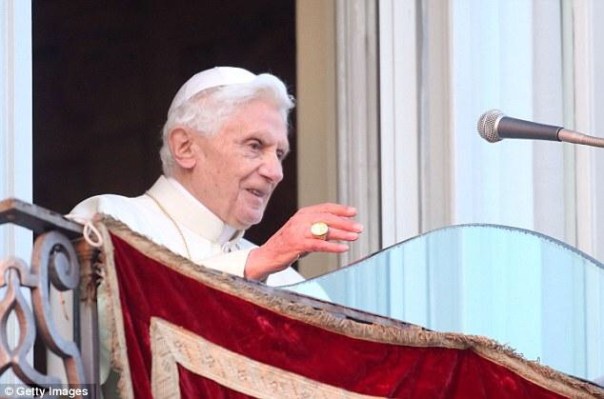
Next-door neighbours: The website of Europe’s largest gay sauna, Europa Multiclub, which is housed in an apartment part-owned by the Holy SeeLocation, location, location: The Europa Multiclub in Via Carducci, Rome, where several priests live nearbyRed faces all round: Cardinal Ivan Dias (pictured), the so-called ‘prince of the church’ has a 12-room apartment located just yards from the Europa MulticlubIn turmoil: Revelations of the sauna come amid claims Pope Benedict XVI (above) resigned in response to a gay cabal in the curia, the Vatican bureaucracyArray
It is already reeling from claims Pope Benedict XVI resigned because of a gay cabal in the Vatican.
Now, as the College of Cardinals prepares to elect his successor later today, the scandal-hit Catholic Church has broken into another sweat, this time over news several priests share an apartment block with Europe’s largest homosexual sauna.
The Holy See owns 19 apartments in the block in Rome after buying a £21million share of the building in 2008.
Several of the flats house priests, notably Cardinal Ivan Dias, the so-called ‘prince of the church’ whose 12-room apartment at 2 Via Carducci is located just yards from the Europa Multiclub.
The 76-year-old, who is the head of the Congregation for Evangelisation of Peoples, would no doubt be horrified to discover what was happening on the floor below.
Cardinal Diaz, who is Indian and a former archbishop of Mumbai, will take part in the conclave to elect a successor to Pope Benedict XVI later today.
According to the Independent, he believes that gays and lesbians can be cured of their ‘unnatural tendencies’ through the ‘sacrement of penance’.
But it’s not known if he has ever nipped downstairs to impart his views on those attending the sauna.
The facility, billed as ‘Italy’s best-known gay sauna’, boasts a Turkish bath, Finnish sauna, whirlpools and massages.
Its website ironically touts one of its ‘bear nights’ with a video of a hairy man stripping down and changing into a priest’s outfit.
It says Bruno is ‘free to the music of his clergyman, remaining in a thong, because he wants to expose body and soul’.
The purchase was apparently the brainchild of Cardinal Tarcisio Bertone, Pope Benedict’s much-disliked right-hand man who held the Vatican’s purse strings during the last pontificate.
Visitors of Italian gay websites were quick to make jokes about the sauna.
One said on Gay.it: ‘Oops, I took the wrong door, I thought it was the chapel.’
The Vatican has declined to comment on the proximity of the sauna to the priests’ accommodation.
The revelations come days after Italian newspapers published claims of homosexuality and blackmail within the Church, with one allegation centering around a secret ‘gay cabal’ of priests.
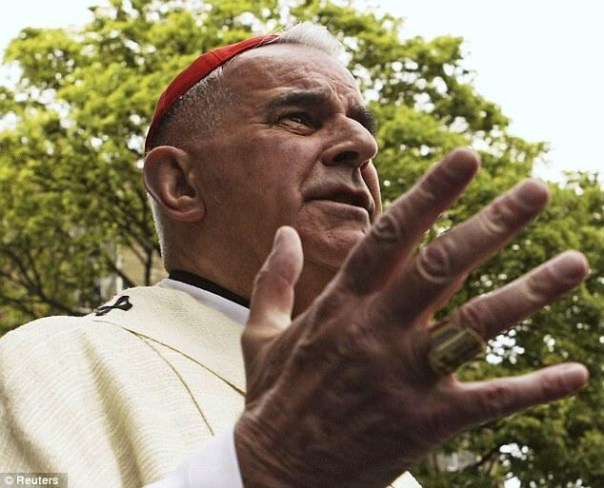
The Vatican has also been hit with further charges of hypocrisy against the Church’s stance on homosexuality following the resignation of disgraced Scottish cardinal Keith O’Brien.
The 74-year-old had been preparing to help choose the next Pope. But earlier this month effectively admitted that allegations that he made homosexual approaches to young trainee priests were true.
He conceded his ‘sexual conduct’ had ‘fallen below the standards expected of me as a priest, archbishop and cardinal’.
The former archbishop will face a Vatican investigation into his behaviour and could be subjected to further punishment if evidence of wrongdoing is found.
His admission left the Roman Catholic church in both England and Scotland in deep crisis over sexual standards and apparent hypocrisy on the part of its most senior priest.
Vatican purchases €23m building that houses Europe’s biggest gay sauna
Faces at the scandal-struck Vatican are even redder than usual after it emerged that the Holy See had purchased a €23 million share of a Rome apartment block that houses Europe’s biggest gay sauna.
The senior Vatican figure sweating the most due to the unlikely proximity of the gay Europa Multiclub is probably Cardinal Ivan Dias, the head of the Congregation for Evangelisation of Peoples, who is due to participate in the election at the Sistine Chapel.
This 76-year-old “prince of the church” enjoys a 12-room apartment on the first-floor of the imposing palazzo, at 2 Via Carducci, just yards from the ground floor entrance to the steamy flesh pot. There are 18 other Vatican apartments in the block, many of which house priests.
The Holy See is still reeling from allegations that the previous pontiff, Benedict XVI, had quit in reaction to the presence of a gay cabal in the curia.
And with disgraced Scottish cardinal Keith O’Brien lending new weight to charges of hypocrisy against the Church’s stance on homosexuality, La Repubblica newspaper noted that the presence of “Italy’s best known gay sauna in the premises is an embarrassment”.
Cardinal Dias, who is seen as a social conservative even by the current standards of the church hierarchy, is no doubt horrified to learn of the activities taking place a floor below.
It is not known, however, if the former archbishop of Bombay has popped downstairs to give spitiual guidances to the clients of the Europa Multiclub, given his belief that gays and lesbians can be cured of their “unnatural tendencies” through the “sacrement of penance”.
The sauna’s website promotes one of its special “bear nights”, with a video (below) in which a rotund, hairy man strips down before changing into a priest’s outfit. It says Bruno, “a hairy, overweight pastor of souls, is free to the music of his clergyman, remaining in a thong, because he wants to expose body and soul”.
There was further embarrassment for the Holy See when the press observed that thanks to generous tax breaks it received from the last Berlusconi government, the church will have avoided hefty payments to the Italian state. The properties are recognised as part of the Holy City.
Cardinal Tarcisio Bertone, Pope Emeritus Benedict’s widely disliked right-hand man, who held the Vatican’s purse strings during the last pontificate, was said to have been the brains behind the purchase of 2 Via Carduccio in 2008.
Readers on Italian gay websites were quick to make jokes at the cardinals’ expense. One on the Gay.it site quipped: “’Oops, I took the wrong door, I thought it was the chapel.’…If you can’t go to the gay sauna for fear of being seen what do you do if you have millions of Euros stolen from Italians? You buy the apartment block with the sauna inside.”
Was John Lennon gay? “Why are you bringing up such a ridiculous question? Who cares if he was gay? I thought this article was about John Lennon almost beating a guy to death.” Well, it is, it is, keep reading and you will see all the pieces to this incredible, little-known chapter in the life of John Lennon and how perilously close his temper came to ending the Beatles entirely, almost before they really got started. This savage beating also helped change Lennon’s life, as he said “It was the last fight I ever got into. That’s when I gave up violence, because all my life I’d been like that.”
In 1963, the Beatles’ were beginning to become famous in England and Europe. A little over a year earlier, they signed with a manager named Brian Epstein (who incidentally died of a drug overdose just four years after this). Epstein was unequivocal in his sexual preferences- he was as gay as they come. (As a point of note, being gay was actually against the law in Britain at the time, and was to remain so until 1966.)
According to Pete Best, the Beatles drummer before Ringo, Brian had tried making passes at all four Beatles (including himself) and was met, each time, with a polite but firm, rejection. Many Beatles fans knew about Brian’s “secret life” and assumed that Paul, the “cute Beatle”, and the one most of the girls liked, was the object of his affections. Nothing could be further from the truth. It was the loud, overbearing, and aggressive John Lennon who Brian was crazy about.
In April of 1963, the Beatles were now one of the hottest acts in Europe. Their records were selling like the proverbial hotcakes. The first album was sitting in the #1 spot on the charts; their concerts were selling out to capacity crowds; and within a few brief months, they would be playing the Royal Variety Performance in front of the Queen herself.
The Beatles arrived at London Airport on Sept. 22, 1964, after a tour of the United States and Canada. From left, George Harrison, Paul McCartney, Ringo Starr, Brian Epstein — the group’s original manager — and John Lennon. Credit… Keystone/Getty Images
It was at this time, out of the blue, that John and Brian decided to take a break in the Beatles’ very busy schedule and go off together for a holiday in Spain. The first suspicious thing about this amongst fans was “Why did John go on holiday, as his wife had recently given birth to a new son?” (Cynthia had gave birth to Julian, John’s first son, on March 8, 1963). John admitted, years later, what a rotten and selfish thing this was for him to have done, but nonetheless, he went with Brian, sparking rumors that it was a romantic get-a-way.
Fellow Beatle, Paul McCartney, has his own take on John’s Spain trip with Brian. According to Paul, the trip’s purpose was for John to assert who the real leader of the Beatles was with Brian. That John took Brian on the holiday “…to make sure Mr. Epstein knew who to listen to in this group”. It is interesting that even in these very early Beatles’ days, John and Paul were already jockeying for an upper hand.
Whatever the case, John and Brian spent 12 days together in Spain. “We used to sit in cafes together”, recalled John, “looking at the boys. I’d say, ‘do you like that one? Do you like this one?’ …I was rather enjoying the experience, thinking like a writer all the time.”
The details of the trip were sketchy, at best, but soon John and Brian had returned and were ready to get back to the business of making Beatles records, performing concerts, and making appearances. But in Liverpool, the “gay” rumors were now intensely swirling. Things came to a head with a disc jockey the Beatles knew named Bob Wooler (1926-2002).
Wooler was a very close friend of the Beatles and had introduced them on stage some 300 times. This incident happened at Paul’s 21st birthday party, on June 18, 1963. At the party, Wooler was joking around with John and said (with heavy gay intimations): “Come on John, what really happened with you and Brian? Everybody knows anyway, so tell us.”
John had been heavily drinking that night and Lennon was a notorious “bad drunk”. In a blind rage, John proceeded to beat the stuffing out of a very surprised Bob Wooler, literally kicking him repeatedly in the ribs as he lay on the ground in a bloody heap.
According to John, the only reason he actually stopped the savage beating was because, “I realized I was actually going to kill him… I just saw it like a screen. If I hit him once more, that’s really going to be it. I really got shocked and for the first time thought: ‘I can kill this guy.’”
Wooler was rushed to the hospital by Brian, who was also present at Paul’s party, and given treatment for a variety of things, including broken ribs. Luckily for John Lennon- and the Beatles’ future amazing run- Wooler survived the ordeal.
Incredibly, John refused to apologize. “He called me a bloody queer, and I bashed in his ribs for it”, he said defiantly. Because of this refusal to apologize, Brian had a writer for The Daily Mirror, Don Short, send a telegram on John’s behalf, apologizing. The telegram read, “Really sorry Bob. Terribly sorry for what I have done. What more can I say? -Signed, John Lennon” In addition to that, a payment of 200 pounds (around $2200 today) was also given as compensation.
Despite their very recent fame in Europe in musical circles, this incident actually got the Beatles their first national press coverage in England in an article in the Daily Mirror. (One can easily imagine what kind of coverage an incident like this would have gotten nowadays, with our current tabloids, twitter, and the blogosphere. And, of course, had Bob Wooler not been the forgiving type, he could easily have raked John over the coals, but chose not to. Or what if John had actually killed Wooler by perhaps kicking him a few more times with Wooler’s broken ribs perhaps puncturing his lungs? It would have finished the Beatles as we remember them right there, not to mention the fact that John Lennon would have been sent to prison for murder!)
Despite the severity of the incident and the coverage in the Daily Mirror, the incident was soon forgotten and the Beatles went on to conquer the musical world.
The one murky question for Beatles fans is obviously “Did John and Brian really?…” Beatles fans and aficionados have been debating the question all these years later.
In 1971, in his classic “Rolling Stone” interview, John stated that of all the Beatles he “was the closest to Brian”. (was this one of John’s inside jokes, did he really mean?…) John later briefly commented on the lingering question about Brian and himself shortly before his tragic death in 1980. “It was almost a love affair, but not quite. It was not consummated. But it was a pretty intense relationship”, he said.
About the gay accusations setting him off, Lennon went on to add, “You know, when you’re 21, you want to be a man. If someone said it now, I wouldn’t give a shit”. (1980). But at the time, John was a very macho, young rock star and he had to prove it to everyone.
One marvels when looking at the incredible, unbelievable career of John Lennon- and the Beatles- at just how close it all came to going up in smoke, because of a needless, drunken beating, all those years ago at a birthday party.
BonusFact:
While he may or may not had a romantic encounter with Brian Epstein, Lennon definitely also loved the ladies. In 1968, he confessed to his first wife, Cynthia, that he had had over 300 extra-marital affairs with women during their six-year marriage. He may have been underestimating himself.
I have not been able to locate the Newsweek actively “Straight Jacket” at the centre of this 2010 controversy…though from what I can gather this is a reproduction.
This story was first posted on the Web on April 26, 2010.
The reviews for the broadway revival of Promises, Promises were negative enough, even though most of the critics ignored the real problem—the big pink elephant in the room. The leading man of this musical-romantic comedy is supposed to be an advertising peon named Chuck, who is madly in love with a co-worker (Kristin Chenoweth). When the play opened on Broadway in 1968, Jerry Orbach, an actor with enough macho swagger to later fuel years and years of Law & Order, was the star. The revival hands the lead over to Sean Hayes, best known as the queeny Jack on Will & Grace. Hayes is among Hollywood’s best verbal slapstickers, but his sexual orientation is part of who he is, and also part of his charm. (The fact that he came out of the closet only just before Promises was another one of those Ricky Martin “duh” moments.) But frankly, it’s weird seeing Hayes play straight. He comes off as wooden and insincere, as if he’s trying to hide something, which of course he is. Even the play’s most hilarious scene, when Chuck tries to pick up a drunk woman at a bar, devolves into unintentional camp. Is it funny because of all the ’60s-era one-liners, or because the woman is so drunk (and clueless) that she agrees to go home with a guy we all know is gay?
This is no laughing matter, however. For decades, Hollywood has kept gay actors—Tab Hunter, Van Johnson, Richard Chamberlain, Rock Hudson, etc.—in the closet, to their detriment. The fear was, if people knew your sexual orientation, you could never work again. Thankfully, this seems ridiculous in the era of Portia de Rossi and Neil Patrick Harris. But the truth is, openly gay actors still have reason to be scared. While it’s OK for straight actors to play gay (as Jake Gyllenhaal and Heath Ledger did in Brokeback Mountain), it’s rare for someone to pull off the trick in reverse. De Rossi and Harris do that on TV, but they also inhabit broad caricatures, not realistic characters like the ones in Up in the Air or even The Proposal. Last year, Rupert Everett caused a ruckus when he told The Guardian that gay actors should stay in the closet. “The fact is,” he said, “that you could not be, and still cannot be, a 25-year-old homosexual trying to make it in the?.?.?.?film business.” Is he just bitter or honest? Maybe both.
Most actors would tell you that the biographical details of their lives are beside the point. Except when they’re not. As viewers, we are molded by a society obsessed with dissecting sexuality, starting with the locker-room torture in junior high school. Which is why it’s a little hard to know what to make of the latest fabulous player to join Glee: Jonathan Groff, the openly gay Broadway star. In Spring Awakening, he showed us that he’s a knockout singer and a heartthrob. But on TV, as the shifty glee captain from another school who steals Rachel’s heart, there’s something about his performance that feels off. In half his scenes he scowls—is that a substitute for being straight? When he smiles or giggles, he seems more like your average theater queen, a better romantic match for Kurt than for Rachel. It doesn’t help that he tried to bed his girlfriend while singing (and writhing to) Madonna’s “Like a Virgin.” He is so distracting I’m starting to wonder if Groff’s character on the show is supposed to be secretly gay.
This is admittedly a complicated issue for the gay community, though it is not, in fact, a uniquely gay problem. In the 1950s the idea of “colorblind casting” became a reality, and the result is that today there’s nothing to stop Denzel Washington from playing the Walter Matthau role in the remake of The Taking of Pelham 1 2 3. Jack Nicholson, by the force of his charm, makes you forget how he’s entirely too old to win Helen Hunt’s heart in As Good as It Gets. For gay actors, why should sexual orientation limit a gay actor’s choice of roles? The fact is, an actor’s background does affect how we see his or her performance—which is why the Denzels or the Tom Hanks-es of the world guard their privacy carefully.
It’s not just a problem for someone like Hayes, who tips off even your grandmother’s gaydar. For all the beefy bravado that Rock Hudson pro-jects onscreen, Pillow Talk dissolves into a farce when you know the likes of his true bedmates. (Just rewatch the scene where he’s wading around in a bubble bath by himself.) Lesbian actresses might have it easier—since straight men think it’s OK for them to kiss a girl and like it—but how many of them can you name? Cynthia Nixon had a male partner when she originated Miranda on Sex and the City, Kelly McGillis was straight when she steamed up Top Gun’s sheets, and Anne Heche went back to dating men (including her Men in Trees costar); we believed their characters before their sexuality became an issue. If an actor of the stature of George Clooney came out of the closet tomorrow, would we still accept him as a heterosexual leading man? It’s hard to say. Or maybe not. Doesn’t it mean something that no openly gay actor like that exists?
Newsweek’s Setoodeh Responds to ‘Straight Jacket’ Backlash
As BroadwayWorld has previously reported, in a recent Newsweek article, Ramin Setoodeh posed the question: “Heterosexual actors play gay all the time. Why doesn’t it ever work in reverse?”
Setoodeh went on to state that Sean Hayes, currently starring in the Broadway revival of PROMISES, PROMISES, cannot come across as straight in the role. He writes “Hayes is among Hollywood’s best verbal slapstickers, but his sexual orientation is part of who he is, and also part of his charm. (The fact that he only came out of the closet just before Promises was another one of those Ricky Martin-duh moments.) But frankly, it’s weird seeing Hayes play straight. He comes off as wooden and insincere, like he’s trying to hide something, which of course he is. Even the play’s most hilarious scene, when Chuck tries to pick up a drunk woman at a bar, devolves into unintentional camp. Is it funny because of all the ’60s-era one-liners, or because the woman is so drunk (and clueless) that she agrees to go home with a guy we all know is gay?”
The comments have drawn the wrath of many, including Hayes’ PROMISES co-star Kristin Chenoweth, who authored a strongly worded response. Writes the actress: “I was shocked on many levels to see Newsweek publishing Ramin Setoodeh’s horrendously homophobic “Straight Jacket,” which argues that gay actors are simply unfit to play straight. From where I stand, on stage, with Hayes, every night — I’ve observed nothing “wooden” or “weird” in his performance, nor have I noticed the seemingly unwieldy presence of a “pink elephant” in the Broadway Theater.”
Cheyenne Jackson and Michael Urie – openly gay actors themselves – weighed in at a Temperamentals Talk back, afterelton.com reported, calling Setoodeh an outright “asshole” and “unconscionable.”
Said Jackson, “It was infuriating on so many levels. Not only does [Setoodeh] say that a gay man can’t play straight, he got personal, picking on Sean Hayes in Promises, Promises, [pointing out] certain scenes where he thinks [Sean] is stiff and uncomfortable…It was very veiled self-loathing. Really upsetting…Everytime we go forward, some asshole like this takes us back a bit.”
Added Urie: “We’re all actors, and the audiences get it. When I saw Sean Hayes in Promises, Promises, it was a full house and everyone was completely in love with him…And to attack, to quote Ugly Betty, someone [like Groff] recently ‘hatched from the gay egg’ is unconscionable and he should strung [up]. [Groff] made everyone want him in Spring Awakening. And Cheyenne was f*cking Elvis in All Shook Up. He was sexy and hot. He’s always playing straight. And people buy tickets to see him. No straight critics accuse Sean Penn of not being able to play Harvey Milk or [criticize] Tom Hanks in Philadelphia.”
Setoodeh has just released a response on Newsweek.com in defense of his original article:
“I wrote an essay in the May 10 issue of NEWSWEEK called “Straight Jacket” examining why, as a society, it’s often hard for us to accept an openly gay actor playing a straight character. You can disagree with me if you like, but when was the last time you saw a movie starring a gay actor? The point of my essay was not to disparage my own community, but to examine an issue that is being swept under the rug…
But what all this scrutiny seemed to miss was my essay’s point: if an actor of the stature of George Clooney came out of the closet today, would we still accept him as a heterosexual leading man?…
I realize this is a complicated subject matter, but the Internet sometimes has a way of oversimplfying things. My article became a straw man for homophobia and hurt in the world. If you were pro-gay, you were anti-NEWSWEEK. Chenoweth’s argument that gay youth need gay role models is true, but that’s not what I was talking about. I was sharing my honest impression about a play that I saw. If you don’t agree with me, I’m more than happy to hear opposing viewpoints. But I was hoping to start a dialogue that would be thoughtful-not to become a target for people who twisted my words. I’m not a conservative writer with an antigay agenda. I don’t hate gay people or myself.”
The headquarters of the Catholic church is a closely guarded city-state – centuries old and resistant to change. Can Pope Francis drag it into the 21st century? (Guardian photographer Christian Sinibaldi was given unprecedented access to his world. Words by Paula Cocozza)
Renzo Cestiè, Pope Francis’s senior driver, waits as the Popemobile is refuelled. Photograph: Christian Sinibaldi
The man holding the keys might have wandered into a fairytale. He faces a pair of towering doors whose knocker is larger than his head. In his hand, the giant hoop clatters as he feels his way towards No 401; it enters the keyhole with a clear, sharp clang. The man starts to push and light from inside the room falls across his shoes.
At 6.30am, the Vatican is awakening. In a few hours, the room Alessio Censoni has just opened, the Sala Rotonda, will be packed with tourists. But, for now, the building is coming to life with workers. Chatter blows along the corridors. Together with four shift-mates, Censoni continues his round of unlocking: 300 doors to go.
Since his election in 2013, Pope Francis has repeatedly praised the dignity of labour (in Buenos Aires, he once did a stint as a bouncer). Group by group, he has invited the Vatican’s 4,800 employees to mass in Casa Santa Marta, the guesthouse where he lives. In January, he baptised Censoni’s daughter. What can his employees – hastening to the clocking-in machine, past the sleepy security guard in a North Face hoodie – tell us about working alongside the pontiff?
Keeper of the keys, Alessio Censoni. Photograph: Christian Sinibaldi
The cleverness of Pope Francis has been to advance the message of Christ simply by being human himself. He has brought divine office down to earth with a revolution in tone. Famously, he is the first pope to use the word “gay” (“If a person is gay and seeks God and has good will, who am I to judge?”). He has described the pay gap between men and women as “pure scandal”, advised Catholics that they needn’t breed “like rabbits”, and called priests who refuse to baptise the children of single mothers “animals”. He has washed the feet of young prisoners. In this sense, Pope Francis is a parable in action.
If his predecessor Pope Benedict was perceived as aloof and scholastic, this pope wears a full-faced grin and wields a thumbs-up. But while he is seen as progressive, Francis’s reform of the curia – the church’s central government, which he has castigated for its insularity and back-biting – is moving slowly. And despite the apparent liberalism of his speeches, the official teaching remains mostly intact: abortion is still “absolute evil”, homosexual acts a sin, gay marriage firmly opposed. Francis has managed to suggest a radical agenda by putting the theme of mercy at the heart of everything he does: in countless speeches, pronouncements and even the current “extraordinary jubilee” year. It’s a message that has secular appeal (who doesn’t believe in compassion?), and it has allowed the pope to sidestep a confrontation with the church’s more conservative forces, by encouraging local priests to use their own discretion.
But still the Vatican remains highly secretive, a world in miniature; packed into its 0.44 sq km is everything a state needs, only smaller. Beyond its museums and St Peter’s Basilica, the frontiers are well guarded. There are high walls, and the famous bank is housed inside an old fortress. The fire engines are the size of minibuses. Under Pope John Paul II, the cinema was busy, but the chairs are now stacked and it looks disused. There is even a tiny jail, used to detain the priest convicted in July for his part in the latest Vatileaks scandal exposing financial mismanagement and corruption at the city’s heart. Petrol costs a minuscule 40 cents a litre, compared with €1.40 over the border in Rome.
[He] says these things, catchy phrases, which are less than 140 characters, so they naturally fit on Twitter
At one of these roadside pumps, the Popemobile is being refuelled. Renzo Cestiè, chatting to the attendant, is Pope Francis’s senior driver. He was second driver for Benedict, “but we had a whole different fleet then”, he says. “We had an armoured Mercedes, an armoured Popemobile. Pope Francis doesn’t want them. He wants contact with the people. See?” He lifts a protective cover to reveal a Popemobile with tinted windows. “This was used by JohnPaul II and Benedict, but the Holy Father fears nothing.” And what about his driver? “I don’t feel fear,” he shrugs. “If it happens, we go to paradise.”
Cestiè sensed that his job was changing from day one. Sent to collect the newly elected pope from his pensione in central Rome, he waited by the entrance in a Mercedes. “An official came rushing out, saying, ‘Take it away!’ Because the pope wanted to get the bus with his cardinals. He said, ‘Do you mind if I go with my friends?’ We didn’t know then that he hated luxury. We didn’t stop to think that these cars weren’t made for him.”
Jobs as cleaners and maintenance workers are often passed down through families. Photograph: Christian Sinibaldi
For the first few weeks, Cestiè, who is 62 and has worked at the Vatican since he was 14, reported for duty in fancy cars. Then the pope visited his garage to see the options for himself, settling on a blue Ford Focus and the smallest, most open Popemobile. Cestiè thumps its bonnet. “For us it was a wonderful thing, the Holy Father so humble.” Now Benedict’s Mercedes is boxed in at the back of the garage, its roof covered with a sheet of bubblewrap.
Cestiè flips open the Popemobile’s glove box, where a white towel is stowed to dry the pope on rainy days. As a rule, he says, the vehicle should feature the papal coat of arms, but the paintwork glints with Benedict’s golden emblem. “Pope Francis doesn’t like crests.” He also insists on shutting his own door. Cestiè lets slip a reference to the pope’s “butlers”, or assistants, and then corrects himself. “He doesn’t want to call them butlers, because we are all the same. We are people who collaborate with him.”
The pope is a quiet passenger who shuns the car radio, he says. But every now and then, Cestiè will glance in his rearview mirror and find his passenger’s gaze. “I always look away,” he says. When Francis meets his eye, “it is as if, in that moment, he looks inside you and he knows who you are”. His voice cracks, the silence eventually broken by his mobile ringtone: Barry White’s Can’t Get Enough Of Your Love, Babe.
Pushed to name the biggest change since Francis was elected, Cestiè’s answer is surprisingly pragmatic: it’s his work-life balance. Unlike Benedict’s retired driver, “who was always here, every day, every holiday”, Cestiè works a six-hour shift. “The Holy Father wouldn’t want it. He is the first to say, ‘Why aren’t you resting today?’”
A team of 80 workers maintain the Vatican’s treasures. Photograph: Christian Sinibaldi
It is a five-minute walk from Cestiè’s carport to the lavish apostolic palace, past the fire engines where the firemen still lean on the bonnet. This is where Benedict lived as pope, and where Francis holds meetings. Sun pours through the windows, making latticed shadows on the wall. The galleried walkways glimmer with the clean, faint fragrance of undisturbed air. At the clip of approaching footsteps, a Swiss guard materialises around a corner. He can’t talk on duty, he says (and this afternoon he is captaining FC Guardia in a match against a Gypsy team), but he promises to meet tomorrow.
He doesn’t want to call them butlers, because we are all the same. We are people who collaborate with him
In the Sala Regia, a vast antechamber to the Sistine Chapel, workers are packing portraits of 19th-century popes into removal crates after an exhibition. Just off this room is the apostolic sacristy where Father Pavel Benedik, a taciturn Slovakian priest, is fiddling with his smartphone. He is the custodian here, and calm prevails. In an hour, the phone rings once. The room is lined with polished wardrobes, a hive of numbered wooden doors in which every item has its place, and every place has a label. Vestments are stowed by size (Pope Francis takes a 3, the most popular) and the drawers are taped with old-fashioned embossed strips: “X IL PAPA [for the pope]”, “VIMPE STOLE [shawls, stoles]”.
Helping Father Pavel is Father Jesus Polentino, 30, from Venezuela. He was ordained just as Benedict resigned, so for him the election of an Argentinian pope felt particularly auspicious. “The first Latin American pope,” he says. “They went to the end of the world to find him. That means that even we, who are from the end of the world, can arrive at the heart of this church.”
He is a volcano! This dynamism – no one expected this. Not even him,’ says Father Federico Lombardi. Photograph: Christian Sinibaldi
Or maybe the heart, its centre, is moving outwards? “Only the style changes a bit,” Father Pavel says. He withdraws a bent cross crosier from a nearby cupboard and lays it next to the original on which it was modelled. This crucifix-topped staff fell into disuse under Benedict, but it has been revived, to the distaste of some Catholics, who find its depiction of Jesus’s suffering too brutal. “Almost the same,” Father Pavel says, looking at the two. And they are, only the Christ in Francis’s version has even thinner legs. Suffering is not something from which he shies away.
A reformer
At 6pm, it is rush hour in the Vatican. Cars file along the road behind the palace of the governatorato, a sort of mayoral building opposite which Francis’s crest has been clipped out of box hedging; maybe it was planted before he made his wishes clear. Nuns unload shopping trolleys into their car boots by the supermarket, and a crowd gathers at the pharmacy where a promotional stand offers samples of Avène skincare. Outside the Swiss Guard barracks, the air is thick with sweat and deodorant. The young soldiers who guard the pope have just finished a football match.
Just beyond the Vatican gates, Father Federico Lombardi, 73, shows the way to his office, up marble stairs, through a room stacked floor-to-ceiling with boxes of paper and ink. For 10 years until this summer, he served as the pope’s spokesperson (though he rejects that title, because “the pope can speak for himself”), working with John Paul II, Benedict and the current pope.
What has Francis been like? “He is a volcano!” Lombardi says, settling into his swivel chair. “This dynamism – no one expected this. Not even him! He is very creative, he has lots of initiatives.”
These have included choosing to launch the pope’s “holy year of mercy” at Bangui cathedral in Central African Republic, rather than Rome. Then there were the 11 Syrian migrants he brought back to Rome from Lesbos in April. Not to mention the free-form press conferences, the reinvigorated synod of bishops, which is devolving power to the regions, and the council of cardinal advisers tasked with reforming the curia. Twelve times in an hour, Lombardi describes Francis as “dynamic” – but would he say the pontiff is a reformer?
“Let’s say he has given a strong impetus to putting us on the road, no? When he speaks about the church ‘going out’, he means a church that is not inside the walls defending itself, not self-referential,” Lombardi replies, cupping his hands as if to enclose a tiny city. “That definitely is a sense he has given us. The church on the road – and, in this sense, I accept the definition of reformer.”
Sisters iron ceremonial robes. Photograph: Christian Sinibaldi
You can almost feel the volcano cool as Lombardi speaks, though such circumspection comes with the territory. “There is what one might call a turf war going on,” Austen Ivereigh, author of Pope Francis: The Great Reformer, explains. “The different departments have their own fiefdom. That’s what he is setting out to change.” Nine communication teams have become one. This month, the Vatican ministries of family, laity and life, which have always overlapped, will merge. Others will follow. Ivereigh calls this “the biggest redesign of the curia in 30 years. It’s radical in the sense that Francis is introducing collegiality, which is allowing the local church to have a much greater say. The reordered Vatican will be a slimmer, more focused structure.”
Crucially, there will be financial reform. Last December, the Vatican appointed PricewaterhouseCoopers as its external auditor. But in April the audit was suspended; the Vatican has since announced that its own Office of the Auditor General, created by Pope Francis, will conduct the audit with PwC in “an assisting role”.
Lombardi waves away these subjects as “very particular arguments. I am not sure it’s worth going into them. The suspension of the deal with Pricewater…” he trails off, apparently having forgotten the name. “If you do a contract for three years, that costs €3m, that looks at all the central institutions – it can happen that you need to correct the odd thing.”
He thinks Francis’s reforms have had “partial results. Certain things are already seeing positive results, but others are still a little in train.”
How difficult is it to bring about change? “Exactly like in all the organisations of the world. I have been here 25 years. I know how things are done and why they are done. If someone comes along and says, ‘Now we are changing everything’, I say, ‘Look, perhaps you haven’t yet understood what we do and why we do it.’ Perhaps I make one or two objections. Is this resistance because I don’t want to change anything, or is it because I simply want to make you understand what we have done and why?”
Florists at work. Photograph: Christian Sinibaldi
The swivel chair is in a state of agitation now, and Lombardi’s shoulders rise and fall in frustration. “I have always found it very simplistic, the way the world is divided between those who want to make things better and those who resist, because they want to conserve their power. If anyone says this about the Vatican, they are saying an idiocy. Perhaps in 3,000 people, you will have three or four who will say, ‘I lose my power!’, and lots of others who will say, ‘No, let’s discuss what we want to change.’ There should be a discussion.
“These ones here, when they came,” he says, casting around for the name of another, previous consultant. “It was very interesting for me: McKinsey. We worked with much friendship and serenity. But at the start,” he says, dropping his voice, “they knew absolutely nothing. They didn’t know about shortwave radio! They had not the least idea, while we had worked on it for 80 years. Do you understand? It’s great to draw up new plans. But there is also a dialogue to be had.” He laughs. “I had the impression I taught them more than they did me.”
As director of communications for an outspoken pope, one imagines Lombardi’s job became tougher with Pope Francis. But, no, he says, it was harder under John Paul II. “For the last five or six years, he was in a chair and didn’t say a word.” And Benedict was also “less concrete in his communication, so it was more challenging”. Pope Francis, meanwhile, has “a great gift” for speaking directly. He “says these things, catchy phrases, which are less than 140 characters, so they naturally fit on Twitter. In this type of communication, Francis is ideal. It’s as if he were made for the purpose.”
The sky is darkening through Lombardi’s office window. “Instead of going about with complete indifference, feeling the church is out of step with the times,” he adds, “Francis has made it closer, more present, with all the suffering and difficulty that humanity experiences today.”
‘Fran-cis-co! Fran-cis-co!’
In St Peter’s Square, crowds have gathered, chatting, chanting, singing a cappella. Soon Pope Francis will descend the steps and faithful hands will grasp the air around him. Renzo Cestiè’s mother will be watching on TV. A murmur rises. An elderly man is pushing a wheelchair; his son, Carmelo, who lost speech and movement after a stroke, sits with a white cap on his lap. He hopes that Pope Francis will wear it. People shout, “Carmelo! Over here!” They know that where a wheelchair is parked, Francis will come.
The Papal Audience in St Peter’s Square. Photograph: Christian Sinibaldi
A cry of “Fran-cis-co! Fran-cis-co!” breaks from the crowd. The pope is coming. Carmelo is bringing him to us. The pope looks thrilled. He is beaming as if he has been waiting for this. He stoops, eyes crinkled, and clasps Carmelo’s head so eagerly, his fingers disappear into his thick hair. Spotting the cap, he gives a magician’s grin and plucks off his own by a tassel. Ta-da! In its place he puts Carmelo’s. He presses it down, to make sure that whatever goodness rises from his head will stick to Carmelo’s cap. He smiles again – something is happening – and returns the cap; the delight on his face suggests that it is he who has met Carmelo, and not Carmelo who has met the pope. The crowd roars. People wipe their eyes. Carmelo has been hugged and it feels like a hug for all. A new chant breaks out. “Car-mel-o! Car-mel-o!” The pope climbs into his jeep, black trousers showing through his white robe. Underneath it all, they seem to say, he is just a parish priest.
Speak to those who work with Francis, and the stories of countless acts of consideration mount (though he could send the nuns help with the ironing). Alessio Censoni, the key-keeper, knows that the rumours the pope encouraged women to breastfeed in the Sistine Chapel are true: at Censoni’s daughter’s christening, when babies wailed, he turned to the mothers and asked, ‘Can’t you hear they’re crying? Feed them tranquilly.”
He asks us … if we’re hungry, if we want to sit down. On my first night shift, he offered me a biscuit
“Yes, I’ve heard that one,” says Filippo Petrignani, who works in the museum’s rights office. “But there are loads. Of him taking a coffee from the vending machine. With coins.” Petrignani rattles off the stories like jokes. “Last summer: ‘Father, it’s very hot in Rome. Would you like to go out of the city for a week?’ ‘And how many people would I have to move to go out of the city? Hmm. We’ll stay at home. What we save, we’ll give to the poor.’”
In another anecdote, Pope Francis offers a chair to a Swiss Guard. “That’s true,” says guard Nico Castelluzzo, today sitting in the visitors’ mess, just after lunch, his colourful livery peeled to the waist to protect the uniform from spatters from his pasta sauce. “It was the same when we did the night shift outside his apartment. He would always ask if we’d slept OK. It took a while for him to understand that we were on duty, that we needed to stay awake. He asks us – he’s a very human person – if we’re hungry, if we want to sit down. On my first night shift, he offered me a biscuit. It tasted good: an Argentinian biscuit.”
Christoph Graf, the 35th commander of the Pontifical Swiss Guard, is dressed by an assistant as his son plays. Photograph: Christian Sinibaldi
According to the Swiss Guards’ website, beneath Castelluzzo’s colourful costume “is actually a state-of-the-art trained Swiss security professional”. So it is surprising to learn that guards are not required to undertake exercise and they have a liberal curfew of 2am (though they are required to shave each day). Castelluzzo passes the solitary hours on duty with a book. “I was never a great reader. I started when I joined the Swiss Guards, so I’m still trying to work out what I like,” he says. Despite the Vatican’s disapproval of its author, he has just finished Dan Brown’s Angels and Demons. “Well,” he says, “it’s good to know the opposition.”
Has Pope Francis’s predilection for entering crowds make Castelluzzo worry? “Security is more complicated. Pope Francis is very close to the people. But he knows what risk he takes, and he still wants to do it.” The Swiss Guards work with the carabinieri, Italy’s military police. “But,” Castelluzzo says, “if someone wants to do something, they will surely find a way.” He shrugs. “You need to pray a lot.”
From the guards’ barracks, the road loops around the rear of St Peter’s to reach the basilica’s maintenance division, near the smokers’ corner and the vending machines. Here, Pietro Zander helps oversee the cleaning and maintenance workers (the job that Renzo Cestiè’s father, grandfather and great-grandfather all did). “We continue that which they who came before us started,” Zander says. The St Peter’s Zander knows is not the one most visitors see. There are 22,000 square metres of floor to be cleaned daily. When a shaft of light enters a window, Zander sees “threads of wool, hairs, all this microdust”. He knows the basilica in its vastness and its particulars. But it is also a home. “St Peter’s house,” he says. “Like a house, the door is closed with a key.”
Pope Francis, whom Zander considers “a neighbour”, likes to greet the cleaners in the basilica, but there are other examples of crossover between the devotional side of things and what Zander calls “contingent necessities”. When, for example, John Paul II required a tomb, it was Zander’s department that solved the problem of where to put him by moving the remains of Pope Innocent XI because otherwise, he says with a straight face, “There was a pedestrian traffic problem. The huge flow [of mourners] would have created jams.”
Driver Renzo Cestiè with the Pope’s Ford Focus. Photograph: Christian Sinibaldi
A colleague enters his office. “Have you seen this?” Zander asks, holding up an old chandelier. He is fascinated by the metal grid that protects the bulb. “If the bulb breaks, the glass won’t fall. And if the grid breaks, the grid won’t fall, because look…” He waggles a small metal tie that acts as a second safety catch. “One of the principles of doing things properly in St Peter’s is to look at what has been done before you. Because here perfection has happened that way.” He rests the chandelier on the table. There is an echo of Father Lombardi and his defence of the curia’s right to question change: for both men, precedent should be upheld to protect the future.
Pope Francis’s critics broadly divide into two camps: those who think he is trying to change too much, and those who would like him to do more. Reform is happening slowly, unevenly. His ad hoc gestures and comments can feel like progress, but in other areas – in confronting institutional child abuse, for example, or tackling financial reform – he can seem wanting. And, of course, devolving authority to local churches has empowered conservative as well as liberal voices. As the pope said in an address last Christmas, “We cannot do everything, yet it is liberating to begin.”
It must be hard to reform a structure when the past is seen to confer its own kind of providence. But Pope Francis’s smile has yet to slip and, at 79, he has “an energy unexpected of a person of his age”, Father Lombardi tells me. “I asked him how he did it, how he managed. He said, ‘Well, God asked me to do it and he gives me the strength to do it.’ His Argentinian friends say, ‘But we don’t recognise him! He seems 20 years younger than when he left.’ In his last years in Buenos Aires, he seemed to be preparing for retirement. Instead, he has taken off again – and he pulls us all along.”
He was not faster than a speeding bullet. He was not more powerful than a locomotive. He was not able to leap tall buildings in a single bound.
In the great pantheon of characters to emerge from the “Superman” universe — Lois Lane, Lex Luthor, Jor-El, General Zod — Jimmy Olsen probably ranks below even Richard Pryor’s wisecracking embezzler in the much-maligned “Superman III.” Jimmy just isn’t that cool. He’s often described as a “cub” reporter. He needs saving more than he saves. He says “Golly.” And he’s sometimes drawn as a redhead.
“Oh, I’m not going in there!” Jimmy whines when hustled into a secret prison after falling prey to the treacherous Von Klaven brothers, identical twins who steal radium, during the 1952 Superman adventure “Double Trouble.” Jimmy’s line when rescued by Man of Steel George Reeves: “Right now, you’re prettier to me than all the movie stars in the world!”
But in a franchise that’s seen its share of tragedy — George Reeves’s reported suicide, Christopher Reeve’s spinal injury — the woes of the actor who played Jimmy in the 1950s went underreported. Jack Larson, who died at 87 on Sunday, was a gifted writer and gay man whose talents and personal struggles were overshadowed by his role as Superman’s flunky.
Even worse: He knew it would turn out this way.
“If I won the Nobel Prize for Literature at 75 and died, they would still say, ‘Jack Larson, best remembered as Jimmy Olsen in the ‘Superman’ series,”’ he said in 1982.
Though Larson never won the Nobel, his swipes at literary greatness were more than the flailing of a teen star gone to seed. Born in California, Larson had dreams of making it big on Broadway as an actor and playwright. After being signed by Warner Brothers while still in high school and a stint in the Marines, the budding thespian found himself at a crossroads.
It was 1951. The old studio system was dying. Though just in his early 20s, Larson had done a few films, but was running out of work — and wanted to get to the Great White Way.
His agent came up with a solution: Play the terrible supporting role of Jimmy Olsen in “Adventures of Superman.”
“I didn’t want to do it,” Larson said, ”but my agent said, ‘Look, you want to get to New York. You don’t have any money. Nobody will ever see this show so take the money and run.”’
Larson did. For $350 an episode, he completed the show and went to the Big Apple. And he was living there when the show he had dismissed became one of the most iconic in TV history — even though it was pretty bad.
“Adventures Of Superman was frequently barely a superhero show — it was more like a dirt-cheap police procedural sprinkled with a few minutes of unconvincing special effects — but it still featured the most famous, popular superhero of all time,” the Onion’s A.V. Club wrote in 2013. “So what else was the nascent geek clan going to watch?”
Larson, meanwhile, became a would-be aesthete fixed in amber as a hapless hanger-on. With a terrible bowtie, no less.
“To me, it was a nightmare,” he said in 2006. “Everywhere I went, it was, ‘Jimmy! Jimmy! Hey, Jimmy, where’s Superman?’ Suddenly, I couldn’t take the bus or the subway anymore. It absolutely freaked me out.”
However, Larson rode the wave. He played Jimmy in 101 episodes of “Adventures of Superman” between 1952 and 1958. And after Reeves’s death — which Larson never believed was a suicide — they tried to get him to do more.
“I refused point blank,” he said. “It made me sick that George had died. He was Superman, and that was the show. I felt, ‘Why go on with it?’ I decided then to quit acting.”
Feeling typecast, he “took up the life of a playwright in New York,” he told the New York Times in 1976 — in a piece that identified him as a “bachelor.”
Larson was far from that. It seemed that one good thing had come of his time as Jimmy: a sexual awakening. While in Hollywood, he became involved with screen legend Montgomery Clift, and met his future longtime companion, director James Bridges (“The Paper Chase,” “The China Syndrome”).
“He realized, in retrospect, that some of his adolescent angst had been due to turmoil over his sexual orientation,” the Times wrote in 1998.
Jack Larson in 2011. (Fred Prouser/Reuters)
That turmoil would be given voice in “The Relativity of Icarus,” a dance piece that premiered at New York’s prestigious Joffrey Ballet in 1974. Larson wrote a poem that accompanied the work. Four decades ago, what some saw as an attempt to mask gay themes in the charged relationship between Daedalus and Icarus was met with controversy.
“It is strange in this day of liberation movements that a homosexual pas de deux has to masquerade as a duet between father and son,” the Times wrote.
Amid the “Icarus” publicity, Larson was outed — as Jimmy Olsen. But Jimmy, he found, was no longer repugnant to him. He began to work the TV nostalgia circuit, and was contemplating hosting a tribute show in 1982.
“I want to host it,” he said. ”I want very much to do it — join up my life with Jimmy Olsen. If you can’t beat ’em, join ’em.”
In the coming decades, he would produce films directed by Bridges and write more plays. And he would appear in what CNN called “winking roles” in “Superman” fare such as “Superboy,” “Lois & Clark” and the film “Superman Returns.”
His sexuality — once hidden — was now an asset.
“Gay fans are gushing over the fact that the director of the new ‘Superman Returns’ (opening June 28) is a gay man, Bryan Singer,” the Chicago Tribune wrote in 2006, “and that, besides the fact that Superman is a real hunk, a new trading card featuring scenes from the film shows the big guy — get this! — actually emerging from a closet.”
The paper, noting Larson’s sexual orientation, added: “What was fun about that show was just the ambiguity of it all. It wouldn’t have mattered if Clark was secretly in love with a co-worker named Lois or Louis Lane.”
Somehow, Larson had ended up with it all: a literary career bolstered by his status as a pop-culture footnote, and both inextricably linked to his life as a gay man.
In some ways, Jimmy had given it to him.
“Everywhere I go, I get the warmest feelings from people about Jimmy,” he said. “They love him, and I grew to feel that I could never have done anything more special than be Jimmy Olsen.”
Los Angeles: Actor and playwright Jack Larson (1928–2015) died yesterday at the age of 87. Best known for his role as Jimmy Olsen, Clark Kent’s boy-reporter sidekick in the 1950s television series “Superman,” Larson met his longtime partner, film producer James Bridges, in 1957; they had been a couple for nearly four decades when Bridges died in 1993.
For many years, Larson and Bridges shared a home in the Brentwood Heights neighborhood. Known as the Sturges House, the structure was designed in 1939 by architect Frank Lloyd Wright. “It was obvious to anyone that since we lived together we were partners,” Larson told the Los Angeles Times in 2011. “We always went places together. We never pretended.'”
Located at 449 Skyway Road, Sturges House is formally listed as a Historic-Cultural Monument by the City of Los Angeles. Larson continued living in the house until his death.
Knowing the Sturges House
I first encountered Frank Lloyd Wright’s Sturges House in courses in the History of Architecture at the University of Wisconsin, Madison, where I was a graduate student in the 1960s. This was indisputably “FLW Country.” He had been born nearby in 1867 in Richland Center, Wisconsin and had lived as a child and teenager and had gone to high school in Madison and had then matriculated as “special student” at the University of Wisconsin. Long after that he had built “Taliesin,” his great longtime home and studio in Spring Green, Wisconsin, northwest of Madison. In 1937, also in Madison, Wright had built his first so-called “Usonian” house for Herbert and Katherine Jacobs, a small, wood and brick, two bedroom, flat-roofed, moderately-priced structure that took its name from various sources, including a play on “US-ian.” It was followed, in the late 1930s and 1940s, by other Usonians in Wisconsin, and in neighboring Illinois and Michigan. Wright’s similar, though distinctive, Sturges house (1939) in the Brentwood district of Los Angeles is generally considered to be his “California Usonian.”
Selma Sturges on the roof of the residence, 1940. Image used with permission, courtesy of the Sturges family. Photographer unknown.
When, in 1968, I received an appointment at UCLA to teach urban, architectural and cultural history, I was fortunate to live first in the 1937 Strathmore Apartments in Westwood, designed by Richard Neutra, one of Wright’s already famous former apprentices—about whom I would soon begin to write a book. At the same time, I began to explore Los Angeles architecture, including ten Neutra structures in Westwood alone and not far away, in neighboring Brentwood: Wright’s great Sturges house. Unlike the generally flat sites of the Usonians in the Middle West, I was surprised to find the Sturges residence perched high on a steep lot among rolling hills. Eager to explore this treasure, I unabashedly knocked on the door one day and was cordially welcomed by its owners, the film director James Bridges and his longtime partner, the actor and writer Jack Larson.
Bridges (1936–1993) directed such acclaimed films as: The Paper Chase (1973), The China Syndrome (1979), and Urban Cowboy (1980). Larson (1928–2015) was best known–to his eternal dismay–for his role as Jimmy Olsen, the cub reporter, in the long-developing series Adventures of Superman. He always lamented that he was not as well known for the libretto he wrote for his and Virgil Thomson’s opera Lord Byron (1972). The couple acquired the house in 1967 and lived there together until Bridges’ death in 1993. Larson continued to inhabit it alone until his death in 2015.
Jack Larson as ‘Jimmy Olsen’ and Noel Neill as ‘Lois Lane’ (Photo by ABC Photo Archives/ABC via Getty Images), c. 1951. Vintage print from the collection of Jack Larson sold to benefit The Bridges/Larson Foundation.Film Director James Bridges on location. Vintage print from the collection of Jack Larson sold to benefit The Bridges/Larson Foundation.
Jim and Jack were the first to tell me of how the Sturgeses were told that it was medically impossible for them to have children and how, as a consolation, they decided to commission a house by Wright, whom they had long admired. It was an ideal cottage for two people, but soon after they moved in, Mrs. Sturges realized that she was, in fact, pregnant. Wright altered the house design to accommodate a nursery. But after another child came along, the couple gave up their dream house and moved around the corner to a larger residence. Their name, however, would always be attached to their Wright-designed home as it went through several owners until Bridges and Larson acquired it.
Robert Imandt photograph of the residence, c. 1946. Vintage print from the collection of Jack Larson sold to benefit The Bridges/Larson Foundation.
Built of steel, concrete, brick and wood, the house is approached from the west at the rear just off the carport at the top of the hill. Visitors could either proceed around the encircling deck to enter through the living room on the eastern side or, as most did, through the small kitchen to the west. With less square footage than the Usonians in the Middle West, the house contains a relatively large living-dining room, two small bedrooms, and one bath on the main level. Tiny stairs lead up to the roof deck and down into the windowless basement, which Bridges used as a dark room and studio. In 1939, Wright had deputized his recent Taliesin disciple, John Lautner, to complete final details of the design and to supervise construction. Both Wright and Lautner created specially designed furniture and other accouterments, such as lamps. Small cabinet spaces were cleverly concealed behind fold-out wall panels. Larson and Bridges would also enjoy pointing out various movie treasures they had acquired over the years such as the actual wrench used by Charlie Chaplin in Modern Times (1936).
Sturges Residence appears on the cover of California Arts and Architecture magazine, April 1940. Vintage magazine from the collection of Jack Larson sold to benefit The Bridges/Larson Foundation.
The house was long enjoyed by such Hollywood visitors as writer Gore Vidal and director John Houseman as well as by actors Jane Fonda and Debra Winger, who starred in Bridges’ films and continued to be friends. Jack and Jim also seemed happy to open the house to admiring architecture people such as historians Vincent Scully and Colin Rowe, museum curators Arthur Drexler and Carter Brown, and architects Richard Meier, Peter Eisenman, Richard Weinstein, Jaque Robertson and Frank Israel. The house thus had several incarnations in the public imagination, first, as it was initially published in the Forties and Fifties and again in later years after it had become so famous that it seemed indispensable to any publication on Wright or on modernist Los Angeles.
It remains a vitally significant monument in the history of both.

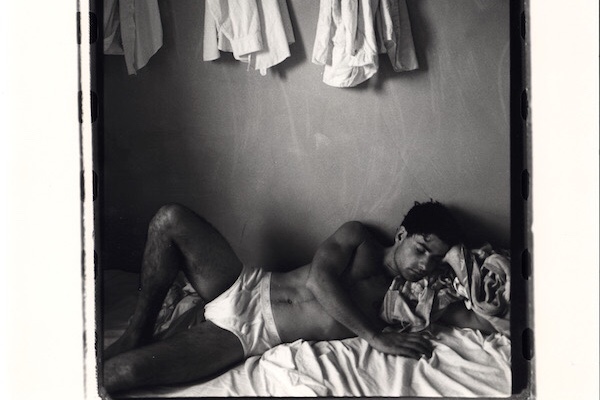
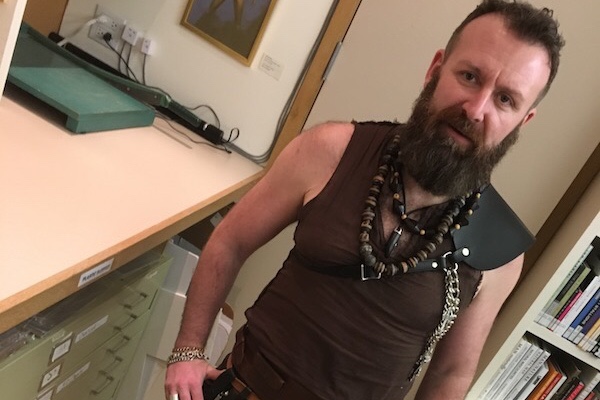
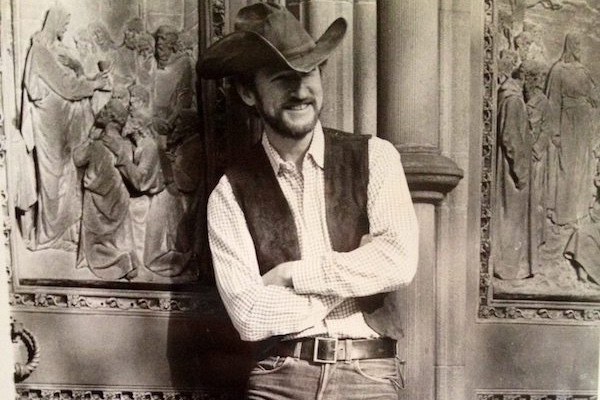


 The
The The Gelugpa’s pointed
 The
The The
The