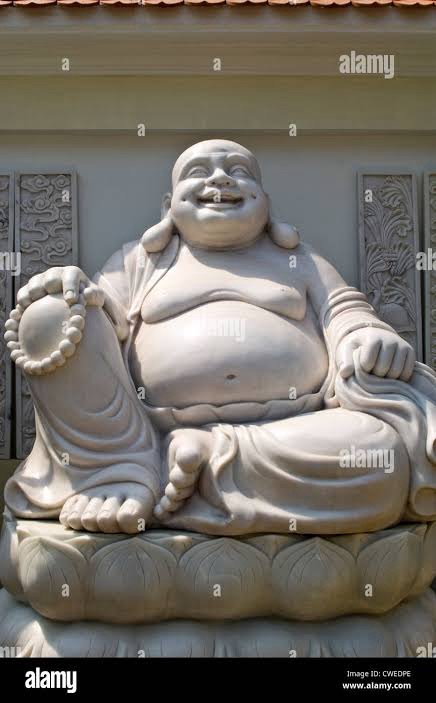
Walk into almost any Chinese restaurant, Asian gift shop or garden centre and you are likely to encounter a smiling, round-bellied figure with a sack slung over one shoulder and children climbing over him. He is often rubbed on the stomach for good luck and is popularly known in the West as the Laughing Buddha.
Many people assume he is Siddhartha Gautama, the founder of Buddhism.
He is not.
The cheerful figure that has become one of the world’s most recognisable religious icons is actually based on a Chinese monk named Budai (布袋), who lived some 1,400 years after the historical Buddha. His transformation from an eccentric wandering monk into a symbol of prosperity, contentment and generosity is one of the most fascinating stories in Buddhist history.
The Historical Buddha
The Buddha who founded Buddhism was Siddhartha Gautama, who lived in northern India during the fifth or sixth century BCE.
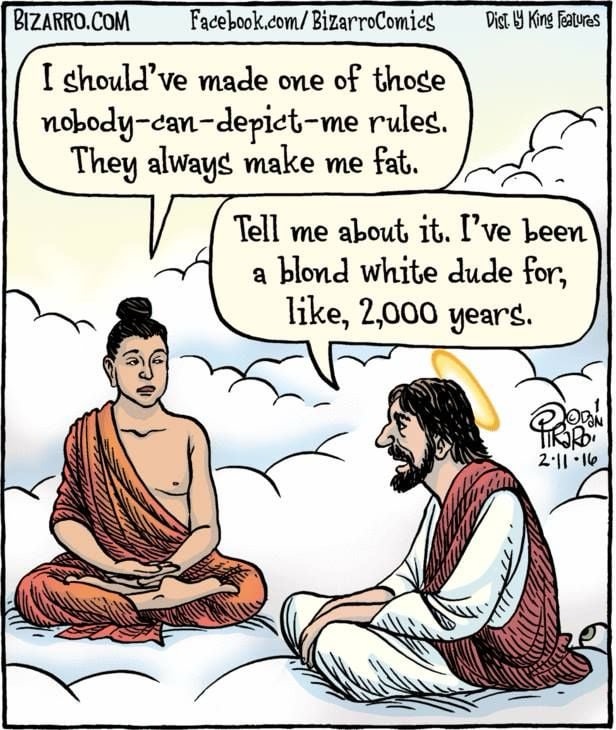
Traditional depictions of Siddhartha present him very differently from the Laughing Buddha.
He is usually shown:
seated in meditation
with a calm, serene expression
possessing a slender body
wearing simple monastic robes
bearing the elongated earlobes and cranial protuberance (ushnisha) that symbolise enlightenment.
These features represent wisdom, self-discipline and inner peace rather than physical wealth or worldly happiness.
For almost a thousand years after his death, this remained the standard image of the Buddha throughout India.
Enter Budai
Around the tenth century CE, during China’s Later Liang Dynasty, there lived an unusual Chan (Zen) monk named Budai.
His name literally means “Cloth Sack” or “Canvas Bag”, referring to the large sack he carried wherever he travelled.
The bag reportedly contained simple possessions and gifts that he freely distributed to children and the poor.
Unlike many monks, Budai was remembered not for scholarly writings or formal sermons but for his infectious laughter, carefree manner and extraordinary generosity.
Descriptions portray him as:
cheerful
humble
approachable
unconventional
fond of children
completely free from concern over material possessions.
His joyful personality made a lasting impression on ordinary people.

An Eccentric Holy Man
Budai wandered from village to village begging for food.
When people asked profound religious questions, he often answered with humour rather than philosophical lectures.
He laughed easily.
He slept outdoors.
He accepted whatever life presented.
Legend tells us that he possessed an uncanny ability to predict the weather.
If he wore wooden sandals, rain was expected.
If he hurried along wearing wet shoes, sunshine would soon return.
Whether true or not, such stories increased his reputation as a wise but unconventional holy man.
Was Budai a Bodhisattva?
Following his death, many Buddhists came to believe that Budai had been an earthly manifestation of Maitreya, the Future Buddha.
According to Buddhist tradition, Maitreya currently resides in a heavenly realm awaiting the time when the teachings of Gautama Buddha have largely disappeared from the world.
When that distant age arrives, Maitreya will appear on Earth, attain enlightenment and teach the Dharma anew.
A famous verse attributed to Budai shortly before his death states:
“Maitreya, the true Maitreya,
manifests countless forms.
Constantly revealing himself to people,
yet they do not recognise him.”
This verse encouraged many followers to identify Budai with the coming Buddha.
From Monk to Icon
As Buddhism evolved in China, Budai’s image became increasingly popular.
Artists emphasised his:
enormous belly
broad smile
relaxed posture
flowing robes
cloth sack
prayer beads.
These features were not intended to suggest gluttony or wealth.
Instead they symbolised:
abundance of spirit
contentment
generosity
freedom from worry
acceptance of life.
His rounded belly came to represent a heart large enough to embrace the world’s troubles with compassion and good humour.
The Symbolism of the Sack
Budai’s sack carries several meanings.
Some traditions say it contained food and gifts for poor children.
Others say it symbolically carried away people’s suffering.
Still others describe it as containing the blessings of good fortune and happiness.
Whatever its interpretation, the sack reinforces Budai’s reputation as someone who gave far more than he received.
Why Rub the Belly?
One of the best-known customs associated with the Laughing Buddha is rubbing his stomach.
This practice developed largely through Chinese folk tradition rather than formal Buddhist teaching.
Many people believe rubbing the belly brings:
good luck
prosperity
happiness
good health
abundance.
While widely practised, it should be understood as a cultural custom rather than a Buddhist religious requirement.
Children and the Laughing Buddha
Many statues depict Budai surrounded by laughing children.
This imagery developed in China to symbolise:
fertility
family happiness
innocence
generosity
blessings upon future generations.
Again, these ideas reflect Chinese popular culture as much as Buddhist doctrine.
Buddhism Meets Chinese Culture
Budai illustrates something important about Buddhism’s history.
As Buddhism spread beyond India, it adapted to local cultures without abandoning its essential teachings.
Chinese civilisation already valued:
harmony
family
generosity
humour
longevity.
Budai embodied these qualities beautifully.
Rather than replacing Gautama Buddha, he became an additional figure who expressed Buddhist ideals in a uniquely Chinese way.
The Laughing Buddha in Feng Shui
Modern Feng Shui has further expanded Budai’s popularity.
Many homes and businesses display his image near entrances to symbolise:
prosperity
protection
happiness
successful business
welcoming energy.
These practices belong more to Chinese folk belief and Feng Shui than to mainstream Buddhist doctrine, although many Buddhists happily appreciate Budai’s symbolism.
The West’s Misunderstanding
As Chinese immigrants established communities around the world during the nineteenth and twentieth centuries, statues of Budai became familiar to Western audiences.
Without knowledge of Buddhist history, many assumed the cheerful figure represented Buddhism’s founder.
The misconception became so widespread that “Fat Buddha” entered everyday vocabulary.
In reality, statues of Siddhartha Gautama and Budai represent two very different figures separated by over a millennium.
One was the historical founder of Buddhism.
The other was a beloved Chinese monk who came to symbolise joy and generosity.
Why Has Budai Become So Popular?
Perhaps Budai’s enduring appeal lies in his humanity.
He does not appear distant or austere.
He laughs.
He smiles.
He enjoys the company of children.
He carries his worldly possessions lightly.
He reminds us that spirituality need not be solemn.
True wisdom may express itself through kindness, humour and an open heart.
For many people, that message is deeply comforting.
Conclusion
The Laughing Buddha is one of Buddhism’s most recognisable figures, yet he is also one of its most misunderstood. Far from being Siddhartha Gautama, he was the Chinese monk Budai, remembered for his carefree nature, generosity and infectious laughter. Over the centuries he came to be identified with Maitreya, the Future Buddha, and his image evolved into a symbol of abundance, happiness and contentment.
His popularity reminds us that Buddhism is not a single, unchanging tradition but a living faith that has adapted creatively to many cultures. Budai’s smiling face has become an enduring emblem of the simple truth that joy, compassion and generosity are themselves profound spiritual qualities.
Whether encountered in a temple, a restaurant or a family home, the Laughing Buddha continues to invite us to smile, to give freely, and to carry the burdens of life with a lighter heart.
Tim Alderman ©️2026
Sources
Peter Harvey, An Introduction to Buddhism: Teachings, History and Practices
Damien Keown, Buddhism: A Very Short Introduction
John Snelling, The Buddhist Handbook
Kenneth Ch’en, Buddhism in China: A Historical Survey
John Kieschnick, The Impact of Buddhism on Chinese Material Culture
The Princeton Dictionary of Buddhism, edited by Robert E. Buswell Jr. and Donald S. Lopez Jr.
Encyclopaedia of Religion, entries on Budai and Maitreya
Chinese Buddhist canonical traditions relating to Budai and Maitreya


It appears that Budai and Santa Clause have a common origin! 🙂 Naked hugs!