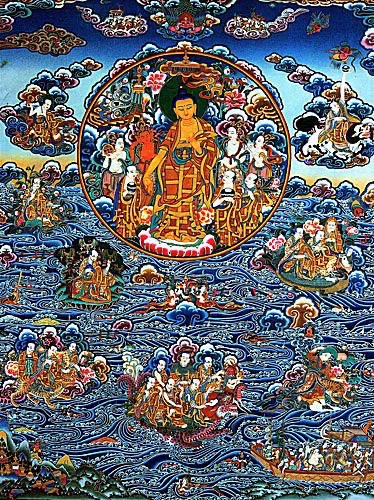
Among the great spiritual figures of human history, few have had an influence as profound and enduring as Siddhartha Gautama, more commonly known as Shakyamuni Buddha. Revered by hundreds of millions of Buddhists around the world, Shakyamuni Buddha is regarded not as a god or divine creator, but as an awakened human being who discovered the path to liberation from suffering and shared it with others.
His teachings, delivered more than 2,500 years ago, became the foundation of Buddhism, one of the world’s major religions and philosophical traditions. From India, Buddhism spread across Asia and eventually the globe, influencing cultures, societies, art, literature, and spiritual practice. Today, followers of traditions as diverse as Theravāda, Mahāyāna, Vajrayāna, Zen, Pure Land, and Nichiren Buddhism all trace their origins back to the teachings of Shakyamuni Buddha.
His story is one of privilege abandoned, truth sought, wisdom attained, and compassion shared. It is a journey that continues to inspire seekers of every background.
What Does “Shakyamuni” Mean?
The title “Shakyamuni” comes from two Sanskrit words. “Shakya” refers to the clan or tribe into which Siddhartha Gautama was born, while “muni” means sage or wise man.
Thus, Shakyamuni means “The Sage of the Shakya Clan.”
This title distinguishes the historical Buddha from other Buddhas who appear in Buddhist scriptures. In Buddhist cosmology, many Buddhas have appeared throughout countless ages, but Shakyamuni Buddha is the Buddha of our present world era.
The Birth of Siddhartha Gautama
According to Buddhist tradition, Siddhartha Gautama was born around the fifth or sixth century BCE in the region of Lumbini, now located in modern-day Nepal.
His father was Suddhodana, a ruler of the Shakya people, and his mother was Queen Maya.
Legend tells that Queen Maya dreamed of a white elephant entering her side shortly before Siddhartha’s birth. Court astrologers interpreted this dream as a sign that the child would become either a great ruler or a great spiritual teacher.
Soon after his birth, a sage named Asita reportedly predicted that the child would attain enlightenment and become a Buddha.
The young prince was given the name Siddhartha, meaning “one who achieves his aim.”
Life in the Palace
Determined that his son would become a powerful ruler rather than a religious teacher, King Suddhodana shielded Siddhartha from the harsh realities of life.
The prince grew up surrounded by luxury, wealth, music, gardens, and every conceivable comfort. He received an excellent education and excelled in athletic and intellectual pursuits.
At a young age he married Yashodhara, and together they had a son named Rahula.
Despite his privileged existence, Siddhartha increasingly sensed that material comfort could not provide lasting happiness or answer the deeper questions of human existence.
The Four Sights
A pivotal moment in Siddhartha’s life occurred when he ventured beyond the palace walls and encountered what Buddhists call the Four Sights.
The first sight was an old man.
The second was a sick person.
The third was a corpse.
The fourth was a wandering ascetic or holy man.
These encounters profoundly affected him. For the first time, Siddhartha confronted the realities of aging, illness, and death. He realized that no amount of wealth or power could protect anyone from these universal experiences.
The serene ascetic suggested that there might be a path to understanding and overcoming suffering.
The Four Sights became the catalyst for Siddhartha’s spiritual quest.
The Great Renunciation
At approximately twenty-nine years of age, Siddhartha made a decision that would change world history.
He left behind his palace, family, title, and possessions in search of truth.
This event is known as the Great Renunciation.
Abandoning royal life, he became a wandering seeker. He studied under renowned teachers and mastered various forms of meditation and spiritual discipline.
Yet despite achieving advanced states of concentration, he remained dissatisfied. None of the teachings he encountered provided a complete solution to the problem of suffering.
Years of Extreme Asceticism
Siddhartha then joined a group of ascetics who practiced severe self-denial.
For six years he subjected himself to rigorous fasting and physical hardship. According to traditional accounts, he became so thin that his ribs were clearly visible and he nearly died from starvation.
Eventually, he realized that extreme self-mortification was no more effective than indulgent luxury.
Both represented extremes that distracted from genuine spiritual understanding.
This realization led to one of Buddhism’s most important principles: the Middle Way.
The Middle Way avoids both excessive indulgence and excessive self-denial, promoting balance, wisdom, and moderation.
Enlightenment Under the Bodhi Tree
After abandoning extreme asceticism, Siddhartha accepted food from a village woman and regained his strength.
He then seated himself beneath a pipal tree in Bodh Gaya, India, vowing not to rise until he discovered the truth.
According to Buddhist tradition, he entered deep meditation and confronted numerous temptations and distractions presented by Mara, the embodiment of delusion and spiritual obstruction.
Through unwavering concentration and insight, Siddhartha penetrated the nature of existence. He understood the causes of suffering, the cycle of rebirth, and the path to liberation.
At the age of approximately thirty-five, he attained enlightenment and became the Buddha, meaning “The Awakened One.”
The Four Noble Truths
Following his enlightenment, the Buddha formulated the core insights of his awakening as the Four Noble Truths.
The first truth is that suffering exists. Life involves dissatisfaction, loss, aging, illness, and death.
The second truth is that suffering arises from craving, attachment, and ignorance.
The third truth states that suffering can be ended.
The fourth truth explains that the path to ending suffering is the Noble Eightfold Path.
These teachings remain central to all Buddhist traditions.
The Noble Eightfold Path
The Buddha taught that liberation is achieved through ethical conduct, mental discipline, and wisdom.
The Eightfold Path consists of:
Right Understanding
Right Intention
Right Speech
Right Action
Right Livelihood
Right Effort
Right Mindfulness
Right Concentration
Rather than a series of rigid commandments, these practices are intended to cultivate wisdom and compassion while reducing suffering.
The First Sermon
After enlightenment, the Buddha initially hesitated to teach. He wondered whether others could comprehend the profound truths he had realized.
Eventually, compassion persuaded him to share his insights.
At the Deer Park in Sarnath, he delivered his first sermon to five former companions.
This event is known as the “Turning of the Wheel of Dharma.”
The sermon explained the Middle Way, the Four Noble Truths, and the path to enlightenment.
It marked the beginning of the Buddhist community, known as the Sangha.
Forty-Five Years of Teaching
For the next forty-five years, the Buddha traveled throughout northern India teaching people from every social class.
Kings, merchants, farmers, laborers, scholars, and outcasts all came to hear him.
His teachings challenged many assumptions of his time. He rejected rigid caste distinctions and emphasized that spiritual awakening was available to all individuals regardless of birth or status.
The Buddha established communities of monks and nuns, creating one of the world’s oldest continuously operating monastic traditions.
His disciples preserved his teachings orally, eventually compiling them into extensive collections of scriptures.
The Buddha’s Character
One reason Shakyamuni Buddha remains so admired is his humanity.
Unlike many religious founders, he did not claim divine status.
He described himself as someone who had discovered a path that others could also follow.
The Buddha emphasized compassion, patience, mindfulness, generosity, and wisdom.
Stories from Buddhist literature portray him as approachable, thoughtful, and deeply concerned with relieving suffering.
His teachings encourage questioning, investigation, and personal experience rather than blind faith.
Parinirvana
Around the age of eighty, the Buddha entered his final passing, known as Parinirvana.
This event took place at Kushinagar in present-day India.
According to tradition, he delivered final instructions to his followers before peacefully passing away.
His last reported words emphasized diligence and mindfulness, encouraging disciples to continue practicing the Dharma.
The Buddha’s physical life ended, but his teachings continued to spread across Asia and eventually the world.
Shakyamuni Buddha in Different Buddhist Traditions
All Buddhist schools honor Shakyamuni Buddha, though they may emphasize different aspects of his teachings.
Theravāda Buddhism regards him primarily as the historical teacher who rediscovered the path to liberation.
Mahāyāna Buddhism views him as both a historical Buddha and a cosmic figure whose wisdom transcends ordinary understanding.
Vajrayāna Buddhism incorporates Shakyamuni Buddha into a rich tradition of meditation practices and symbolic teachings.
Nichiren Buddhism places particular emphasis on Shakyamuni Buddha’s teachings contained within the Lotus Sutra.
Despite these differences, all traditions recognize him as the source of the Dharma.
Influence on World Civilization
The impact of Shakyamuni Buddha extends far beyond religion.
His teachings have shaped philosophy, psychology, ethics, literature, art, architecture, and meditation practices across numerous cultures.
Mindfulness practices derived from Buddhist teachings are now widely studied in psychology and medicine.
Buddhist principles of compassion and nonviolence have influenced leaders, social movements, and humanitarian efforts worldwide.
His message continues to resonate because it addresses universal human experiences: suffering, happiness, mortality, and the search for meaning.
Conclusion
More than two and a half millennia after his death, Shakyamuni Buddha remains one of humanity’s most influential spiritual teachers. Born as Siddhartha Gautama, a prince of the Shakya clan, he renounced a life of privilege to seek answers to the deepest questions of existence. Through his enlightenment beneath the Bodhi Tree, he discovered a path that offered freedom from suffering and shared that path with countless others.
His teachings on compassion, wisdom, mindfulness, and the Middle Way continue to guide millions of people across the globe. Whether viewed as a religious founder, philosopher, ethical teacher, or enlightened being, Shakyamuni Buddha’s legacy endures because it speaks to the fundamental challenges of human life. His message remains as relevant today as it was in ancient India: that through understanding ourselves and the nature of reality, it is possible to cultivate peace, wisdom, and liberation from suffering.
To, Alferman ©️ 2026