Tag Archives: Gay

Notes On The Hairless Man

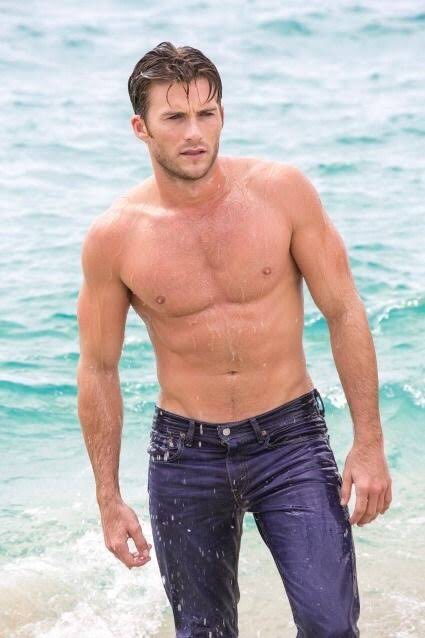
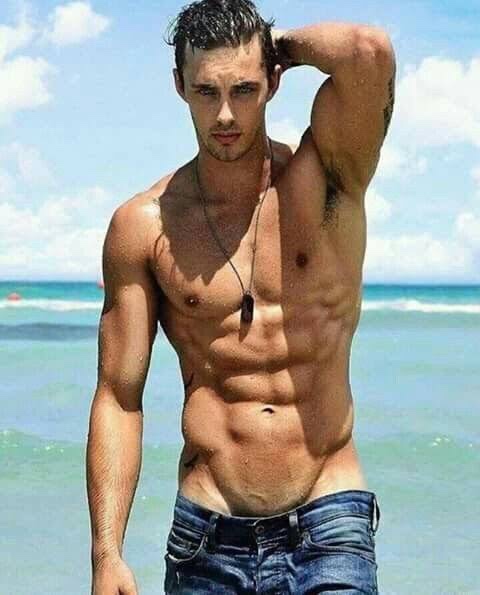
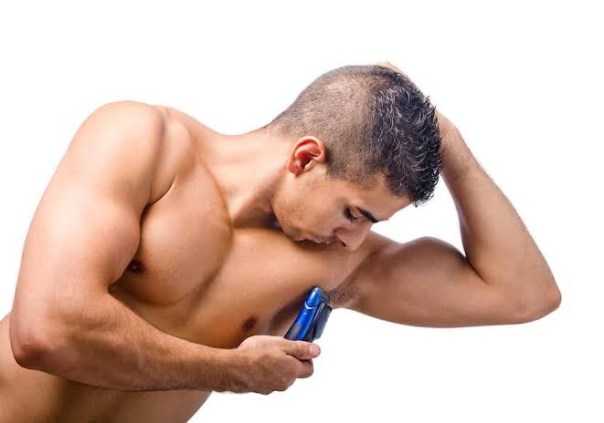
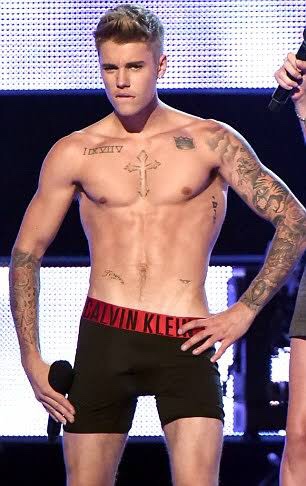
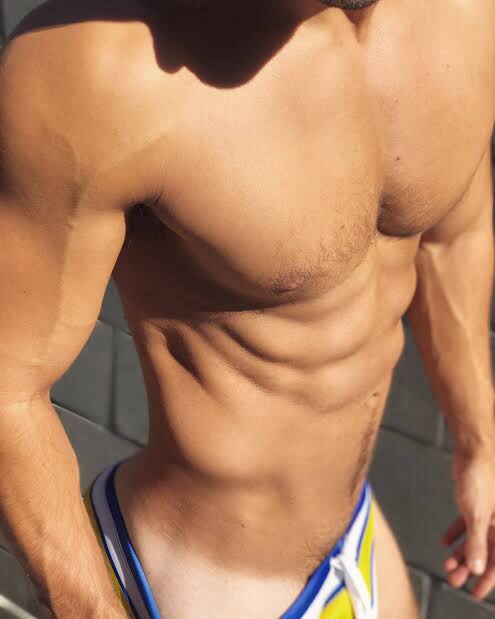
I love hairless men, and possibly amongst my peer group, I am one of the few who admits it! I’ve never been caught up in the whole…often fake…macho ethos! The gay cultural stereotypes such as Bears, Clones, Leathermen etc have always extolled the virtues of hairy men, and as such, I’ve always felt on the outer, and discreetly cringe every time I’m added to yet another “Adoring Hairy Men” FB group. I even hate body hair on myself, and depilate what I do have every month. I don’t totally object to it…some I find quite sexy such as just the centre of the chest, or closely clipped chests…and treasure trails (the line of hair from the navel down) drives me insane with its erotic promise of what’s at the lower end of it. But totally hair-covered bodies I find quite a turn-off, especially if it’s really thick, on a man’s back, and masses of matted pubic hair. I hate that continual delays in foreplay as you pick it out of your mouth. For me, it’s about the sensation of skin, the soft, silky feel,of it as you run your hands…or tongue… down it. I love being able to lick someone all over. But that’s me! Needless to say, I don’t agree with a lot in this article…but it comes down to different strokes for different folks, and that leaves scope for all of us!

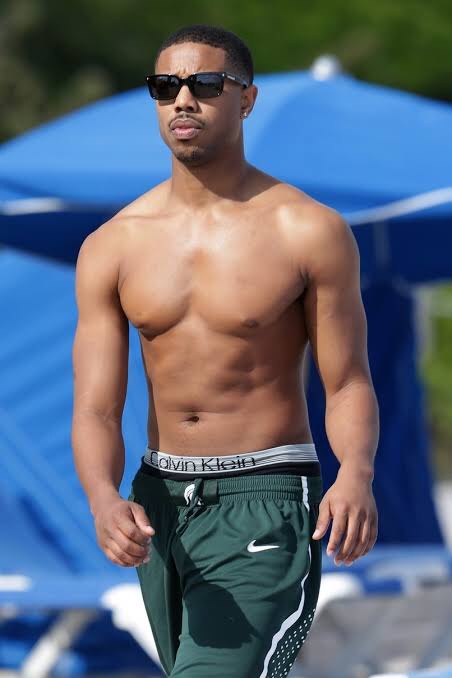
Michael B. Jordan

Men without chests — that was C. S. Lewis’s striking description of graduates of the postwar English schools, with their faculties trained to dismiss the virtues of patriotism and piety. These Englishmen, Lewis worried, would become lifelong enemies of the sublime, unable and unwilling, when push came to shove, to defend themselves or their countrymen. American men, I am happy to report — even the sensitive new age guys — still have something of a chest, thanks to our enduring fitness mania. But have you noticed how bare those chests are? Late twentieth-century America is increasingly a land not of men without chests but of men without chest hair.

Men without chests — that was C. S. Lewis’s striking description of graduates of the postwar English schools, with their faculties trained to dismiss the virtues of patriotism and piety. These Englishmen, Lewis worried, would become lifelong enemies of the sublime, unable and unwilling, when push came to shove, to defend themselves or their countrymen. American men, I am happy to report — even the sensitive new age guys — still have something of a chest, thanks to our enduring fitness mania. But have you noticed how bare those chests are? Late twentieth-century America is increasingly a land not of men without chests but of men without chest hair.

I first realized this a couple of years ago while watching the otherwise forgettable B-movie romance Picture Perfect, starring Jennifer Aniston and Kevin Bacon, who was then just under 40. As the two characters get ready to, well, put the 13 in PG-13, Bacon takes off his shirt and his chest is completely hairless. Okay, Kevin Bacon may not prove much. But not long after that, I saw Al Pacino, whose fuzzy talent has graced the screen in such classics as Scarface and Serpico, appearing as hairless as an angel in The Devil’s Advocate. (Once you’re aware of the hairless-man phenomenon, by the way, you can no longer see a movie without noticing it. Sorry.)

Now, only 20 percent or so of adult white males are totally without what’s technically referred to as “terminal pigmented chest hair.” And yet, in the last few years, practically every Hollywood male sex symbol, when standing half-dressed for his more intimate scenes, looks as if he has absolutely no chest hair. Tom Cruise. Matt Damon. Keanu Reeves. Brad Pitt. All of them look like boys. One even sees older actors depilated to look like the boy-man stars who now capture every significant romantic role. The traditional Hollywood aesthetic in which old was never sexy has been carried to a new extreme: Now only the immature is sexy. Forget heroin chic, the hip aesthetic of the early ’90s; say hello to permanent adolescence. And this new look trickles down. A big-city cop of my acquaintance confided not long ago that he shaves his chest. For several years now waxing salons have not been for women only. One of these days, no doubt, a cosmetic surgeon will come up with the philosopher’s stone of our age — how to transplant hair from men’s chests to their heads — and make a fortune.

But the hairless man represents more than just a simple change in cosmetic fashions, like the widening and narrowing of ties. These men without chest hair carry on, knowingly or not, quite a tradition. In ancient Rome and Greece, the romantic associations of men and boys were jeopardized by the appearance of facial and bodily hair. It meant the boy was now a man, which meant he was no longer available. The Roman epigrammatist Martial lampooned men who plucked their hair to stay boyish.

Why pluck the hairs from your gray fanny?

That’s a chic touch which men admire

In girls, not in a flagrant granny.

Martial also took issue with a man who insisted on calling him brother ( fratere), a term that also meant lover:


I’m shaggy-legged and bristle-cheeked

Daily you depilate

Your silky skin. Your voice is light;

You lisp in a charming way —

My voice, as my loins can testify,

Is gruff, and so, I’ll say:


We’re less alike than eagles and doves

Or lions and does, so Mister

Don’t call me “brother,” or

I’ll have to call you sister.

Obviously today, as ever, the phenomenon cannot be disentangled from the romantic ideals of male homosexuals. As Salon columnist Camille Paglia authoritatively noted in a recent piece, “depilation has become highly fashionable in the gay male world. . . . Not since Greek athletes scraped their oiled, sandy bodies with the strigil . . . have men had such a fetish for girl-smooth skin.” But what is most interesting about the hairless man is that he is no longer exclusively gay; he is, rather, the American male ideal.

Last decade’s gay “clone” has become this decade’s hetero stud. The subject of countless overwrought academic “queer theory” treatises, the gay “clone” was usually defined as an archetypal boy cruising men on the street-corners and in the clubs of big cities. Boyish and neatly dressed (jeans and T-shirt ironed), he displayed a vanity and sense of style that were a “perfect” representation of manliness. And then, somewhere along the line, the straight male began to imitate him. To see the gay clone today, one need only flip through magazines like Men’s Fitness or Men’s Health, two glossies that have made vanity a lifestyle.

A typical article from Men’s Health tells readers how to decrease calories and stress (“Assign numerical values to the major parts of your life, such as work, marriage, and family; this can help you better apportion your time”) while increasing earnings, physical strength, and sex drive. And “if Jane Goodall’s research assistants have been creeping around your backyard, perhaps it’s time to ask a dermatologist about hair removal with lasers. . . . A typical back treatment takes four hours and costs $ 500 to $ 2,000. Nose and ear procedures cost around $ 200. Backside denuding is at the doctor’s discretion.” After which, you can turn over and be made to look like the hairless man on the magazine cover. These magazines are an education in how to look exactly like a ’90s man without having to think about what it means to be one.

Nor is this simply another case of gay fashion being a trendsetter for straights. The newly prominent hairless man is a sign of the convergence of gay and straight culture. Male vanity and the desire to prolong adolescence are becoming mainstream traits, no longer the markers of a subculture. Just two years after Ellen DeGeneres’s “coming out” scored a ratings bonanza for her then-declining, now-off-the-air TV show, the arguments between gay activists and their critics over how visible homosexuality should be on prime time TV are already seeming quaint. Such arguments presume that there is a dominant, hostile majority culture. But there isn’t. There are only tiny protest groups that get laughed at when they count the number of gay characters in TV shows and movies. The mainstream culture is the culture of the hairless man, at best indifferent to old-fashioned, grown-up male traits.

Here is a mainstream cultural moment. Cinematic stud Mark Wahlberg was interviewed earlier this year by Matt Lauer on the Today show. By the admittedly bland standards of morning television, the contrast in personalities should have made it an interesting conversation: Strong silent type who recently played an outsized porn star in the movie Boogie Nights confronts Sensitive New Age Guy, the kind of softy Americans want to see first thing in the morning. Instead, the only contrast in the interview was that of a regular SNAG versus a post-macho SNAG. It took Wahlberg, the post-macho SNAG, only seconds to reveal his vulnerable side: “It’s kind of hard, you know, because the whole macho thing, you know, it’s — coming from Boston, it’s — it’s also an — an athletic place, you know, and there’s not too much opportunity there. So being the tough guy is the thing to do. . . . It was — it was difficult to — to accept the role in Boogie Nights only because I was — and it’s stupid now to think about it, but I was worried about what my friends would think, you know, and — and stuff like that . . .”

Machismo is never so talked about as when it is absent. But there was a worthwhile question answered by the interview: What do you get when you put two SNAGS together? Answer: a conversation about being gay.

LAUER: You said in an article in Premiere magazine that when you were growing up, it was tough to repress the fact that you were . . . creative. It was a little bit like being gay and not being able to tell your parents.

WAHLBERG: Yeah.

LAUER: How does it feel to be in a place right now where it’s cool to be gay — sorry, it’s cool to be creative? You know what, it could be either way.

WAHLBERG: It’s cool to be gay, too. It’s cool to be gay.

LAUER: I loved your look when I said it. You kind of looked at me and said ‘What?’

WAHLBERG: It’s cool to be gay, too.

In fact, there is nothing ironic in Wahlberg’s playing spokesman for the gay community. The rapper formerly known as Marky Mark was central to one of the most important sightings of the hairless man. Before his success in Boogie Nights had him making appearances on Charlie Rose and other talk shows, Wahlberg was a model for the famous Calvin Klein ad that appeared in countless magazines, but nowhere more prominently than on that humongous billboard above Times Square. Striking a pose in his skivvies, Wahlberg looked like a bit of rough trade freshly showered for a special occasion. But more important, he was, except for a butchy hairdo, as smooth skinned as the day he was born.

Not only has the mainstream gone gay — remember the quaintly controversial IKEA commercial featuring two thoroughly domesticated gay men picking out items for their home? — but gay life has gone mainstream. The course of this change can be seen in Hollywood movies. It was just a few years ago that the gay hit The Adventures of Priscilla, Queen of the Desert, a bawdy and occasionally hilarious movie from Australia, inspired a mediocre American imitation starring tough-guys Wesley Snipes and Patrick Swayze — hairless men both. In 1997’s My Best Friend’s Wedding, Julia Roberts’s gay pal, who is her cover date for the wedding, seems to be the only character capable of romance; a faux-heterosexual tic has him stealing all the scenes he is in. Amidst so many public displays of friendship to support the comedy’s bland premise (the possibility of good friends’ getting married) the gay character refreshes the movie by leading the rehearsal dinner in a round of “I Say a Little Prayer.” It’s a weird throwback moment in which the movie’s greatest display of devotion — a scene that could have been stolen from an old Gene Kelly musical — is romantically meaningless. It’s also a reflection of the question at the center of the movie: Is love just an intense form of friendship?

Well, yes, according to various pop-culture trends of the ’90s. The super-successful girl pop band the Spice Girls were practically a propaganda squad detached by the friends of friendship to demote eros to the status of a lower passion. Two of the most popular sitcoms of the decade Seinfeld and Friends were both predicated on the elevation of platonic love, one cynically and the other in a way that was painfully cute. Ross from Friends, the show’s one regular male character of serious romantic intent, doesn’t even merit being called a SNAG. His whiny boyish mannerisms suggest he can barely live up to the guy part. Men who really do love women have been, if not written out of television and Hollywood, playing second fiddle to their emasculated brothers.

In her famous 1964 essay “Notes on Camp,” Susan Sontag, the voice of New York’s then cultural vanguard, felt compelled to explain the obvious overlap between the self-consciously theatrical style described in her essay and homosexual taste, which, she wrote, constitutes “the vanguard of camp”: “The camp insistence on not being ‘serious,’ on playing, also connects with the homosexual’s desire to remain youthful.” In September 1996, New York magazine published a prescient article describing the decline of the other defining characteristic of gay life: militancy. Referring to the “‘Hallmarkization’ of gay sensibility,” the author, Daniel Mendelsohn, argued, “If you take away the edge and the kitsch, there’s not much left — and what remains isn’t all that different from what you find in straight culture.”

This seems to already overstate the difference between the sometimes campy and sometimes edgy singles culture of gays and the less campy and less edgy singles culture of straights. Traditionally, big cities are magnets for both gays and young people who are looking for careers first and spouses later. In places like New York, the romantic lives of a young straight and a young gay — both divisible into units of temporary attachments — aren’t really that different. The difference between young married people and young unmarried people is far greater. If an icon of gay sexuality like the hairless male has gone mainstream over the last decade, it is because mainstream America wasn’t intrinsically hostile to gay visibility to begin with.

What has been lost as the hairless man, an eternal boy, has become our male ideal? Real romance, for one significant thing. The hairless man is perhaps searching for romance, but only insofar as it supplies self-fulfillment and steers him clear of the burdens of love and family. Which is a pity. In order for real romance to occur, there must be some connection with matrimony. The hairless man would have to be robbed of his adolescent affectations and forced to mature. Defenders of a traditional culture have been overly fixated on gay characters, openly gay actors, and gay love stories. Such entertainment will succeed or fail on its merits as entertainment. Yet, it is the embarrassment of heterosexual love that should concern us.

Manliness cannot, after all, be reduced to a hard body, high income, and regular exercise. And yet, a pretty boy, the hairless man, has become the signature of American romance, thus mistaking the acorn for the tree, potential for the final product, leaving us with too many suitors and too few fathers, and stories about sex and love that never end in marriage and family. The problem, to paraphrase C. S. Lewis, is that we cannot raise geldings and expect them to be fruitful. We cannot turn middle-aged men back into boys and expect them to be leaders, elders, the carriers of what wisdom that comes with age. We cannot erase general notions of manliness from popular culture and expect today’s boys to be tomorrow’s protectors and providers. Where can one find reflections of manliness, if everywhere you turn, the American male seems boyish, hairless, shorn of any sign that he is an adult?

Reference

Gay History: The Very Gay and Interesting History Of The Almost Lost Tradition Of The Sunday Tea Dance

Here’s to the Sunday afternoon Tea Dance phenomenon, a gay tradition which is slowly disappearing.

Many gay men under the age of 30 today are totally clueless of almost lost tradition of the Sunday Tea Dance. (A tradition that really must be brought back.) So here’s a little history primer on the tradition of the “Sunday T-dance” and how and why we embraced it in the LGBT culture.

Historically, tea was served in the afternoon, either with snacks (“low tea”) or with a full meal (“high tea” or “meat tea”). High Tea eventually moved earlier in the day, sometimes replacing the midday “luncheon” and settled around 11 o’clock, becoming the forerunner of what we know as “brunch”.

From the late 1800’s to well into the pre-WWI era in both America and England, late afternoon (low) tea service became the highlight of society life. As dance crazes swept both countries, tea dances became increasingly popular as places where single women and their gentlemen friends could meet — the singles scene of the age.

While tea dances enjoyed a revival in America after the Great War, The Great Depression of the 30’s wiped them out. Tea consumption was in steady decline in America anyways and by the 50’s, tea was largely thought of as something “your grandmother drinks”. Also, nightlife was moving later and younger. Working men and women were too busy building the American Dream to socialize so it was left to their teenaged children in the age of sockhops and the jukebox diner. Rock and roll was dark and dangerous — something you sneaked out for after dinner, not took part in before dinner.

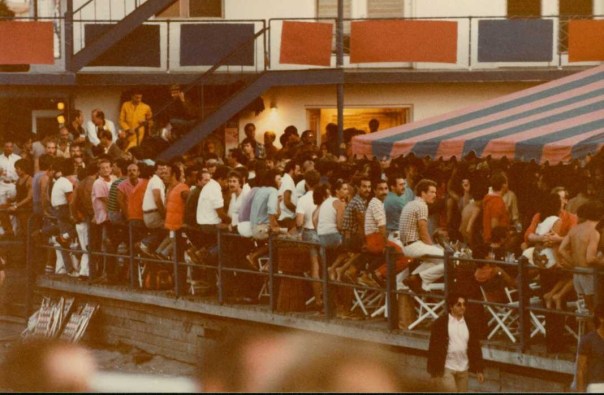
Tea Dance at the Pines on Fire Island, 1980.

Gay people, of course, were still largely underground in the 50s, but it was in these discreet speakeasies that social (nonpartnered) dancing was evolving. It was illegal for men to dance with men, or for women to dance with women. In the event of a raid, gay men and lesbian women would quickly change partners to mixed-couples. Eventually, this led to everyone sort of dancing on their own.

By the late 60s, gay men had established the Fire Island Cherry Grove and also the more subdued and “closeted” Pines (off of Long Island, in New York) as a summer resort of sorts. It was illegal at that time for bars to knowingly sell alcohol to homosexuals and besides many of the venues there were not licensed as ‘night clubs’ or to sell alcohol. To avoid attracting attention, afternoon tea dances were promoted. Holding them in the afternoon also allowed those who needed to catch the last ferry back to the mainland to attend.

The proscription against same-sex dancing was still in effect, so organizers were forced to institute no touching rules. Since there were no lesbians around to change partners with, gay men developed the dancing apart style that club-goers everywhere now take for granted.

June 28, 1969: the Stonewall Riots mark the fiery birth of the so-called “modern gay rights movement”. Following (and in part perhaps inspired by) the death of gay icon Judy Garland, (as the urban legend goes) patrons of the Greenwich Village watering hole The Stonewall Inn fought back against another in a very long line of violent police raids, eventually barricading the police inside the bar and setting off three nights of rioting. The “snapped stiletto heel heard around the world”as some call it is commemorated today with Gay Pride celebrations held around the end of June.

Post-Stonewall, the tea dance moved from the Fire Island Pines to Greenwich Village. A newly-energized gay community around Christopher Street embraced the social dancing craze started on Fire Island. While the Fire Island gays tended to be rich upper-class preppies, the downtown gays of Christopher Street and the Village were working-class and they tended to party at night. As in the straight community, tea dances gradually moved later until they became subsumed into the night club scene.

Through the 70’s, gay men championed the uniform of the working class — t-shirts and denim — as fashion aesthetic. In part because they were affordable, and in part because it projected an appealing hypermasculinity associated with the working class. Gays in the post-Stonewall era were consciously rebelling against the effete stereotypes associated with the manicured, sweater-wearing, tea-drinking gays of the Fire Island set. Real men wore t-shirts and drank beer. Gay men still had afternoon/early evening dances — usually on Sundays, in order to make the most of one’s weekend while still being able to get up for Monday morning’s work.

The downtown gays rejected the term tea dance as being too effete and opted for the supposedly butcher t-dance, and promoted t-shirts and denim as the costume of choice. By the mid 70s, the Christopher Street Clone look (short cropped hair, mustache, plaid shirt over a tight white t-shirt, faded denim jeans that showed off your ass) had made the trans-continental trip from New York City to Los Angeles (gays in Hollywood) and, of course, to San Francisco (follow the Yellow Brick Road and it leads to Castro). It brought with it the tea dance phenomenon, which is slowly dying out and is nothing of its former self and in may places is all but gone.

So grab those fans and poppers boys and and let’s “Ohhhhha, Ooooha” like it’s 1978 again!

Let’s not let Sunday Tea become a piece of our forgotten gay history also.

Reference

Gay History: Why My Own Father Would Have Let IS Kill Me

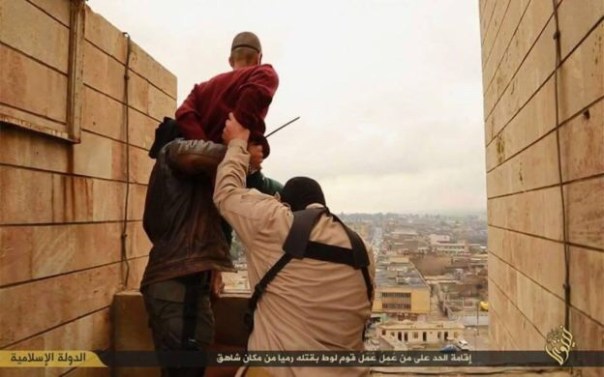
The group that calls itself Islamic State (IS or Isis) has a special punishment for gay people – it kills them by throwing them off high buildings. Taim, a 24-year-old medical student, tells the story of how he only escaped this fate by fleeing from Iraq to Lebanon.

In our society, being gay means death. When Isis kills gays, most people are happy because they think we’re sick.

I first realised I was gay when I was about 13 or 14. I too thought homosexuality was a sickness and I just wanted to feel normal. During my first year of college, I started having therapy for it. My therapist told me to tell friends that I was going through a “difficult phase” and to ask for their support.

I’m of Muslim background but my ex-boyfriend was from a Christian background and I had a bunch of Christian friends, whom I used to hang out with. In 2013 I got into a fight with a fellow student, Omar – who later joined Isis – about hanging out with Christians. A friend of mine told him to go easy on me because I was going through a hard time, having treatment for being gay. That’s how people knew. I think my friend’s intention was noble but what happened as a result ruined my life.

Still from an IS video

In November 2013, Omar attacked me with two of his friends. I was just walking home after a really lovely day. They beat me, threw me to the ground and shaved my head, saying to me: “This is just a lesson to you for the moment, because your father is a religious man. Watch what you do!” He meant that I wouldn’t be killed then and there out of respect for my dad, because I’m from a religious family.

I left town for a few days and didn’t go to university but then I went back, and in March 2014 I made Omar angry again, this time by suggesting that non-Muslims shouldn’t have to pay the “jizya”, the tax paid by non-Muslims to a Muslim government. I was washing my hands in the university bathroom when he and others attacked me again. They came at me from behind, but I recognised one of them from his green watch. It was the same group. They kicked me half-unconscious. I was barely able to walk and stopped going to university for a month.

Then, in the middle of final exams, Isis took over. Omar called me and asked me to repent and join them. I hung up the phone.

Taim with shaved head

On 4 July, a group of fighters from Isis came to my home. My father answered the door and apparently they said to him: “Your son is an infidel and a homosexual and we have come to carry out God’s punishment on him.”

My dad is a religious man and luckily for me he was able to tell them to come back the next day, to give him time to find out whether the accusation was correct. He came inside the house and started screaming. Finally, he said: “If these accusations are true, I will hand you over to them myself, happily.” And I just stood there, not knowing what to do and what to say, or how to defend myself.

I was in shock. But my mother decided that I should leave the house immediately, and she started working on getting me out of Iraq for good. It was midnight and she said to me: “We’re leaving right now.” She took me to her sister’s house. The next day she booked me a plane ticket to Turkey and got me a visa. But I had to travel via Erbil and they wouldn’t let us into Kurdistan. I stayed in a village near Erbil for two weeks, trying to get in but I never managed it. I tried to leave via Baghdad but there were clashes on the road and the driver wouldn’t go on. I tried to get out so many times, and failed.

Eventually, in August, after weeks in hiding, my mum arranged somehow for me to get to Kirkuk, driving there through fields and on unpaved roads. From there, I went to Sulaymaniyah. I’d planned to go to Turkey but the first available flight was to Beirut and I didn’t need a visa – so here I am.

If I’d stayed, Isis would have come for me and killed me the way they’ve killed others. If Isis didn’t get me, members of my family would have done it. A few days after I left, I learned that my uncle – my father’s brother – had taken an oath to cleanse the family honour.

Recently, I received an anonymous Facebook message – but my mother thinks it was from my uncle. It said: “I know you’re in Beirut. Even if you went to hell, I would follow you there.”

All I want now is to be in a safe place, unreachable by my dad or anyone with extremist thoughts. I want to be safe, to be free, and to be myself – to get my degree and start living… I just want to start living.

Human rights lawyers from the Iraqi Refugee Assistance Project have helped me get refugee status and are working on getting me resettled in another country, where I want to continue my studies. Here I’m living in one room, the size of my bathroom back home. I’m in limbo.

I think I will recover eventually but there will always be a memory of this dark period when I literally had to run for my life to avoid being killed. It was very stressful, but luckily I made it.

I’ve lost contact with most of my family. A month after I fled, my younger brother sent me a Facebook message saying: “I have had to leave town. The family is shattered and it’s all because of you.”

I was angry and didn’t reply. But then on New Year’s Eve I missed him, so I wrote to him, saying: “It’s not my fault that I was born this way. They (Isis) are the criminals.” And after that we had a long conversation on Facebook about our childhoods.

I’ve not spoken to my father. What he did was very hurtful. He’s my father. He’s supposed to protect me and defend me, no matter what. But when he said that he’d hand me over to Isis, he knew what they were going to do to me. He knew. Maybe in the future I can forgive him, but right now I don’t even want to think about him. I want him out of my life.

I talk to my mum every week, though. It’s hard for her because there’s no network coverage and she has to go out of town to get a signal. She’s the most amazing woman in the whole world. She’s cultured, respectful – very bright. She loves me and when she was trying to smuggle me out, we never discussed my homosexuality. She was just focused on getting me to safety. Because she is my mother, I think she always knew that I was gay. But all I felt from her was her love, her ultimate love. I never said goodbye to her because when I actually managed to escape, there had been so many failed attempts that I was sure I would be back and see her again.

All I need is a hug from her.

I still have gay friends at home but we’re not in contact any more, for their own safety.

Earlier this year one of my best friends, who stayed behind, was killed.

He was thrown off the main government building.

He was a great man – a very kind person. He was 22 years old, a medical student, and he was really calm and really smart – a bit of a genius. He used to talk to me about the latest scientific discoveries.

He always got straight As. You never saw him without a book.

We met first online – gay Iraqis hang out a lot in online communities – and then face to face. In person, he was quite quiet – but online he never stopped talking. Sometimes he would chat until the power went off and we lost the internet. He shared his deepest secrets with me. As gay men, we all had to lead secret lives. But he was the kind of person you love to talk to.

I don’t know how he was outed because he was very careful – but maybe through a text or online message. When Isis capture people, they go through all their contacts.

The last time I saw him in the flesh was a few days after Isis took over our town, but we continued talking online until I fled.

When I first saw the pictures of him, I can’t describe what I felt. The video images follow me in my nightmares. I see myself falling through the air. I dream that I’m arrested and then thrown from a building – facing the same fate as my friend.

It was devastating to see him go in that brutal way. He was blindfolded but I knew it was him from his skin tone and from his build. It looked like he died immediately but a friend told me he didn’t – perhaps the building wasn’t high enough. The friend said he’d been stoned to death.

I wanted to break down. I couldn’t believe it. One day he was alive, active, just living his life.

And now he is gone.

Isis are professional when it comes to tracking gay people – they hunt them down one by one

Even before Isis arrived, I was living in constant fear. There are no laws to protect you. Militiamen were killing people in secret, and no-one would say anything. To them, we’re just a bunch of dirty criminals they need to get rid of because we bring God’s anger and are – as they see it – the source of all evil.

For the past few years it’s been really, really hard. There were militiamen or security men who – if they found out someone was gay – would arrest him, rape him, torture him. There were lots of murders supervised by the Iraqi army. Videos came out of people being burned alive or stoned and you can see soldiers there. I have seen a video where some gay men had ropes put around their necks and they were dragged around the streets and people were throwing stones at them and when they were half-dead they were set on fire. Some people had their rectums glued up and were then left to die in the desert.

Before Isis, I think that maybe the power of my family protected me. But let’s assume that Isis disappeared this second, the threat to my life would be just as serious, now that I’ve been identified as gay.

The difference now is that Isis has only one horrible method of killing people – throwing them off buildings and, if they don’t die, stoning them. I know that if Isis had captured me, that would have been my fate.

What’s also changed is that the media are focusing on what Isis is doing, because it’s Isis. And Isis films everything and releases the video and says: “We killed these people for being gay and this is their punishment according to our Holy Book.”

Isis are also professional when it comes to tracking gay people. They hunt them down one by one. When they capture people, they go through his phone and his contacts and Facebook friends. They are trying to track down every gay man. And it’s like dominoes. If one goes, the others will be taken down too.

We have feelings and we have souls – stop hating us just because we’re born different

It’s devastating to see the public reaction to the killings. Usually, when Isis posts pictures online, people sympathise with the victims – but not if they’re gay. You should see the Facebook comments after they post video of the killings. It’s devastating. “We hate Isis but when they do things like this, we love them. God bless you Isis.” “I am against Isis but I am totally with Isis when they kill gays.” “Amazing news. This is the least that gays deserve.” “The most horrible crime on earth is homosexuality. Good job Isis.” “The scene is ugly but they deserve it.” “Those dirty people deserve Isis.”

And there are thousands of people agreeing with these comments full of hate. That is what is so disturbing. This is the society I fled from.

Islam is against homosexuality. My father made me study Sharia law for six years because he wanted me to be a religious man like him. There is a hadith [an ethical guideline thought to be a saying of the prophet] that instructs gay men to be thrown off a cliff and then it’s up to a judge or the Caliph to decide if they should be burned or stoned to death.

Imam and Islamic scholar Dr Usama Hasan from the Quilliam Foundation says there are many hadiths and traditions ascribed to the Prophet Muhammad and his disciples on the subject of punishment for homosexuals. “However, all are disputed and there has never been any consensus on them, especially since they seem to contradict the Koran, 4:15-16.” He adds that some scholars have argued that Muhammad could not have given any such ruling since no confirmed case of homosexuality was ever brought to him.

I think Isis is throwing gay men from buildings because our society hates us and it’s a way of gaining support.

I try not to look at Isis’s videos. But to be honest I do look for their martyrdom videos. I want to see if I can see Omar, the man who ruined my life.

I worry a lot about the gay men still left there. I have dozens of friends who can’t leave because they can’t afford to. But, after our friend’s death, I said goodbye to them online and blocked them, for their own safety.

I’m speaking out to honour my friend who was killed – and for the gay men I know who are still in Iraq. I want Iraqis to know that we’re human beings, we’re not criminals. We have feelings and we have souls. Stop hating us just because we’re born different.

I was lucky to get out. I saved my soul. But what about them? Will they be lucky enough to survive? And, if they survive, will they recover from the trauma of being hunted? It’s a disaster. They’re all targets.

Taim told his story to the BBC’s Caroline Hawley. Taim is not his real name, nor is Omar the real name of his persecutor.

Reference

Gay History: Born Free, Killed By Hate – The Price Of Being Gay In South Africa

Betty Melamu is still waiting.

She prays that one day she will face the people who killed her daughter and find out why they did it.

“I want to know, that’s the point,” she says. “I want those who did this thing to my child to be arrested, all of them.”

Almost 4 months after Pasca was murdered, no-one has been arrested.

For many LGBTI people and their families in South Africa, safety, justice, and the promise of a truly rainbow nation still feel a long way off.

South Africa’s constitution was the first in the world to protect people from discrimination because of their sexual orientation. The country was also the first in Africa to legalise same-sex marriage. But after a spate of murders, gay people say more needs to be done to stop hate crimes.

Betty Melamu sits on a brown leather sofa in her living room in the township of Evaton, just south of Johannesburg. She’s cradling a framed picture of her daughter Motshidisi Pascalina, known as Pasca.

In a quiet, wavering voice, she sings Pasca’s favourite song.

“Whenever she would listen to radio or go to church she would sing that song,” she remembers.

When I ask if Pasca was a good singer she says, “Yes,” and laughs – apparently Pasca was more spirited than talented, constantly switching between parts as she sang.

She loved football too, studied hard at school and wanted to be a politician.

“She wanted to do something good,” says Melamu with pride.

But the laughter and happy memories are fleeting, and sadness is etched in her thin, drawn face. Pasca was a lesbian, something her family knew and accepted. She had just turned 21 and completed her final high school exams when she went to a party in December.

“I don’t know what happened after the party,” says Melamu. “But she didn’t come back.”

Two days later Pasca’s body was found in a field in a neighbouring township. She had been beaten and mutilated. At the morgue her family couldn’t recognise her face and could only identify her by a tattoo on her leg.

“At that time I was strong,” Melamu remembers. “But after that I feel like I am crazy woman.”

And as we talk, she repeats one question, over and over.

“Why? Why did this happen to my child?”

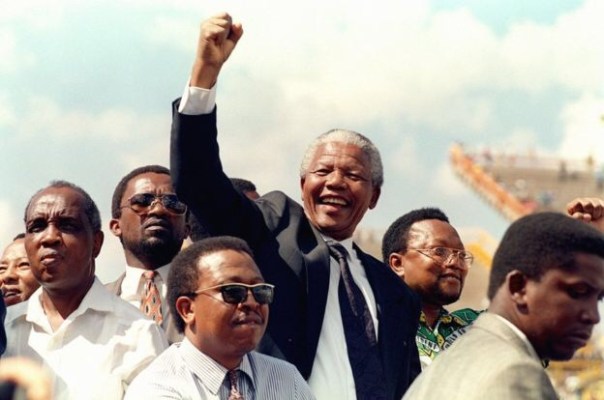
Pasca was was born in 1994, the year apartheid ended and Nelson Mandela was elected president – she was one of the first of South Africa’s so-called born free generation.

In his inauguration speech, Mandela promised to “build a society in which all South Africans will be able to walk tall, without any fear in their hearts… a rainbow nation at peace with itself and the world.”

But 21 years later, this promise remains largely unfulfilled for the country’s lesbian, gay, bisexual, transgender and intersex (LGBTI) community.

In a country where crime rates in general are high, black lesbians in poor townships face particular risks and often suffer the most violent crimes.

As women, they’re vulnerable in a country with one of the highest rates of rape in the world. As lesbians in an often homophobic and patriarchal society, they face a further danger – the idea that they can be “changed” and “made into women” through what is known as “corrective rape”.

It’s suspected this may have happened to Pasca, although the post-mortem was unable to determine this.

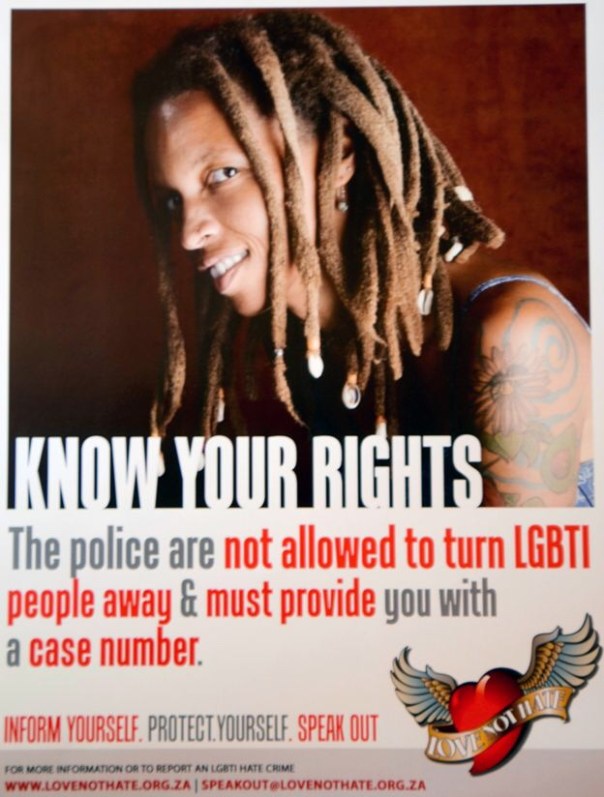
And when crimes happen, there’s no guarantee that the response will be adequate. Victims say they often face secondary harassment by police or health care workers.

Pasca’s case was assigned to a police officer who was on leave at the time, only returning to work two and a half weeks later.

Frustrated at the delay in this and two other rape cases, in January activists took to the streets of Evaton with rainbow flags and banners. Chanting “Pasca is our sister,” they marched to the local police station to demand justice.

“The police are not doing anything,” Lindiwe Nhlapo told me several weeks later. She’s part of Vaal LGBTI, one of the groups that organised the march. “The police are failing us big time.”

Since then, the police have tried to address concerns about the investigation into Pasca’s death, but frustration with the justice system is a common story.

Lindiwe Nhlapo wants justice for Pasca

In the nearby township of KwaThema, silver drapes and rainbow flags adorn the living room of the small house that’s the headquarters of the Ekurhuleni Pride Organising Committee (EPOC).

There’s also a bar down one end and a sign on the wall – Divas and Dykes Lounge. Day or night, this is a safe place for gay and transgender people to socialise.

“I can’t walk with my partner on the street and hold their hand,” says Bontle Kahlo, from EPOC. “I can’t go out at night and say ‘I’m going to dance somewhere,’ because I’m not safe. I might get killed because of who I am, because of who I love.”

Bontle Kahlo (right) with her partner Ntsupe Mohapi

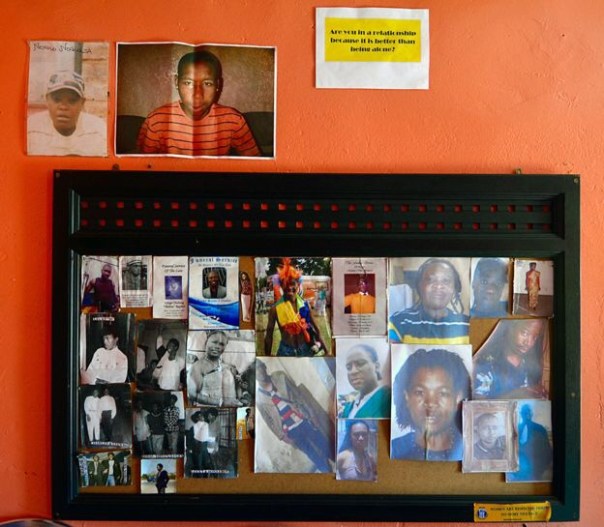
She points to a frame on the wall containing photos of dozens of LGBTI men and women.

“This is our memory wall,” she says. Some of them died of natural causes, but many of the lesbians in the pictures were murdered because of their sexual orientation.

“Women are less than men,” says Kahlo. “If you’re a black woman, you are even less, and if you’re a black lesbian woman you are basically nothing in this country.”

Among the faces on the wall is Noxolo Nogwaza, a 24-year-old lesbian who was raped, mutilated and murdered in 2011.

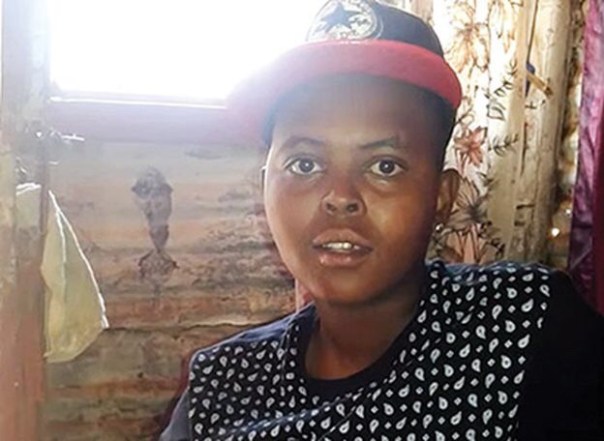
Noxolo Nogwaza’s photo is top left – she is wearing a baseball cap and white top

But five years later, no-one has been prosecuted.

“The feeling we got from the police is that they expected us to do all the work for them,” says Kahlo.

“It’s very tiring to be an activist but to also be a police officer and to try as hard as you can, and to have a government which is not supportive.”

Her partner and fellow campaigner Ntuspe Mohapi nods in agreement.

“They’re good at talking but not at acting,” she says.

When they heard about Pasca’s murder, there was a familiar sadness.

“I think it’s getting worse,” Mohapi says. “And these are just the cases of murder that we are talking about. We haven’t started with rape, or hate speech, and the bullying in schools, and the suicides of gay teenagers.”

South African law doesn’t classify hate crimes differently from other crimes, so there are no official statistics to turn to.

The organisation Iranti-org is funded by the EU to document violence against LGBTI people – it has counted more than 30 murders and rapes in the country since 2012.

Pasca was just one of three LGBTI people killed in South Africa during a six week period late last year. The deaths barely received a mention in the mainstream media.

There hasn’t always been a lack of interest though. After the murder of Noxolo Nogwaza and several other lesbians in 2011, there was a global outcry. 170,000 people signed a petition calling on the government to act.

In response, the government set up a National Task Team and drew up a National Intervention Strategy to reduce hate crimes.

It also established a Rapid Response Team to make sure that hate crimes are properly investigated and the perpetrators prosecuted. This has had some success in clearing a backlog of murders and other crimes.

Mpaseka “Steve” Letsike says more should be done to change attitudes

But the government is not doing enough says Mpaseka “Steve” Letsike, co-chairwoman of the National Task Team and head of LGBTI organisation Access Chapter 2.

“We are not getting it right. There’s a huge gap. We need to invest our energies into prevention, into conversations, into dialogues.”

The government is doing some of this – funding awareness campaigns and training police and health workers. But “it’s still a drop in the ocean,” says Letsike.

To get a sense of the challenge South Africa faces, I travel to the Johannesburg suburb of Yeoville. It’s home to many migrants from more traditional, rural parts of the country.

In a tiny room, barely big enough for a bed and a fridge, I perch on an upturned bucket and speak to two men. The elder of the two speaks softly, but has a fearsome clarity when our conversation turns to homosexuality.

“Homosexuality is a taboo to us,” he says. “I’ll go back to African traditions, there’s no word for that in our language.”

I ask what would happen if one of his daughters told him she was a lesbian.

“I might kill her myself. That thing is unnatural, it’s awkward, so I cannot accept something that is awkward in my house.

“If someone said choose between keeping this child or killing it, I would kill it.”

His views reflect the gap between the law and the attitude of many South Africans. It shows that the government has failed to create a truly rainbow nation, say activists.

“Conditions for LGBTI people in South Africa have improved substantially since 1994,” says John Jeffery, deputy minister of justice and constitutional development. His department is responsible for the National Intervention Strategy.

“We are trying to educate people about LGBTI rights, that gay rights are human rights,” he says, and adds that he is frustrated with the criticism.

“There’s no use complaining outside that government is not doing enough,” he says. “I unfortunately have not heard proposals from civil society organisations about things we should be doing that we’re not doing. They need to tell us where they think we should be improving.”

While open to suggestions, he says there are limits to what he can do.

“More could be done, but the extent to which we can run awareness programmes would depend on budget and what money we’ve got, and unfortunately government is facing budget cuts.”

The government is currently in the process of preparing legislation to outlaw hate crimes and hate speech, which should allow better monitoring of crimes and, it’s hoped, reduce homophobic abuse.

“There’s no magic solution, it’s a process and that process takes time,” says Jeffery.

Betty Melamu is still waiting.

She prays that one day she will face the people who killed her daughter and find out why they did it.

“I want to know, that’s the point,” she says. “I want those who did this thing to my child to be arrested, all of them.”

Almost 4 months after Pasca was murdered, no-one has been arrested.

For many LGBTI people and their families in South Africa, safety, justice, and the promise of a truly rainbow nation still feel a long way off.

Reference

Gay History: What It’s Like To Be Gay And A Muslim?

The Orlando shooting was a hate crime against gay people – even if, once it emerged that the attacker had been a Muslim, many people claimed this as a terrorist attack rather than a hate crime. And, in an important sense, this was also a terror attack, since its aim was to spread fear in the LGBT community.

Since the massacre there has been a lot of speculation about Islam and homosexuality and there are fears that one man’s despicable act of terrorism could fan the flames of Islamophobia and other forms of social exclusion, leading to discord and unrest in an era of elevated Islamophobia.

It is difficult to define the “Islamic position” on homosexuality, as a monolithic phenomenon, simply because Islam is a very diverse faith group with some 1.6 billion followers on six continents. In most Muslim countries, homosexuality is illegal and in some countries, including Iran and Saudi Arabia, it is punishable by death. But in others, such as Jordan and Turkey, homosexuality is not considered a crime.

Most Islamic scholars are in agreement that homosexuality is incompatible with Islamic theology. They tend to draw on the story of Lot in the Koran (also in the Old Testament) which recounts the destruction of the tribe of Lot allegedly due to their engagement in homosexual acts as “evidence” for God’s condemnation of homosexuality. Many scholars also cite the Ahadith (statements attributed to the Prophet Muhammed) that are condemnatory of homosexuality. Theological and legal condemnations of homosexuality can engender perceptions at a social level that homosexuality is wrong and that it should not be permitted.

Muslims on homosexuality

In 2009, a Gallup survey revealed negative attitudes towards homosexuality among European Muslims. In France, 35% of Muslims viewed homosexuality as “morally acceptable” (versus 78% of the general public). In Germany, 19% of Muslims viewed it as morally acceptable (versus 68% of the general public). In the UK, none of the Muslim respondents viewed homosexuality as morally acceptable (versus 58% of the general public who did).

Earlier this year, a survey commissioned by Channel 4 was conducted among a random sample of 1,081 individuals who self-identified as Muslim. The results found that 18% of the British Muslim respondents agreed that homosexuality should be legal in Britain while the majority (52%) disagreed. Conversely, only 5% of the general public thought homosexuality should be illegal. Furthermore, 47% of the British Muslim respondents indicated that they did not believe that it was acceptable for a gay person to become a teacher. These data suggest that there are low levels of acceptance of homosexuality in Muslim communities in the UK.

However, qualitative interview data can provide more nuanced understandings of what Muslims think and why they might hold these views.

In my research into attitudes concerning homosexuality among samples of first and second-generation British Muslims of Pakistani descent, I found that attitudes tend to be largely negative. Although research into attitudes towards homosexuality in the general population points to demographic variables, such as age and level of education, as key determinants of the nature of attitudes, this has not been the case in my own work with British Muslims. Muslims of various ages, education levels and socio-economic backgrounds have participated in my studies and generally perceive homosexuality in negative terms. In substantiating these attitudes people often draw on holy scripture. As one 54-year-old woman said:

It says it in the Koran that it’s wrong and sorry I’m not the one who made it. It’s what the God revealed to the Prophet so it’s the truth and that’s my belief system.

Many interviewees draw upon holy scripture as the basis of their views regarding homosexuality. There appears to be a desire not to “re-interpret” holy scripture – to accommodate homosexuality – because of the divinity of its origin. Moreover, there was a fundamental rejection of essentialist arguments concerning the origins of sexual orientation – that people are born gay and that they do not “choose” to be gay – and interviewees often argued that people had “chosen” to be gay. One 28-year-old man said:

God doesn’t create gay people. It’s a path they’ve chosen and that’s an incorrect path according to our faith.

Indeed, previous research has shown that believing the essentialist argument regarding homosexuality is correlated with less discrimination and greater acceptance.

What does the Koran say about homosexuality? Lord Harris/BritishMuseum, CC BY

First-hand relationships

Although many British Muslims may disapprove of the concept of homosexuality, several individuals reported positive first-hand experiences of contact with LGBT people. A 45-year-old man said:

Homosexuality is wrong, I believe … I have a gay neighbour and he lives with his partner. He’s a very nice guy – both of them [are]. They are very respectful. We consider them friends.

Some people spoke fondly of their LGBT friends, neighbours and acquaintances, suggesting that first-hand contact may challenge homophobia which exists at an abstract, conceptual level. It is also vital to stress that the Muslim interviewees overwhelmingly rejected violence against LGBT people. As one woman put it:

Violence and hate crimes are un-Islamic. We are not supposed to kill or hurt others, as Muslims. No, they can’t have it both ways so they won’t be accepted in our community but it’s for God to punish, not us.

It was difficult for British Muslim interviewees to accept homosexuality given the overwhelming “evidence” of its prohibition in Islam. Individuals simply had no positive theological frame of reference given the absence of LGBT affirmative voices at an institutional level. This led some individuals to view endorsement of homosexuality as a violation of their religious faith and its norms:

Being gay is un-Islamic and so is encouraging it.

Put simply, the acceptance or endorsement of homosexuality was perceived as contravening key tenets of Islam.

Gay Muslims speak out

Clearly, the stigma attached to homosexuality in Islamic communities can have profound effects for those Muslims who also self-identify as gay. For almost a decade, I have been researching the social psychological aspects of being Muslim and gay. In view of the generally negative attitudes towards homosexuality in Muslim communities and the silence that can surround discussions of sexuality, most of my Muslim gay interviewees have manifested a poor self-image and low psychological well-being. Many view their sexual orientation as “wrong” and, thus, express a hope to change it in the future. One young gay Muslim man said:

It’s [being gay] wrong, really, isn’t it? … In the mosque we’re told that Shaitan [Satan] tries to tempt Muslims because he is evil and he makes us do evil things. I know that doing gay things is evil but I hope I’ll change my ways and take the right path soon … It’s all about temptation, really. Life is a big test.

Those gay Muslims who conceptualise their sexuality as immoral and wrong can understandably struggle to derive self-esteem, which is key to well-being. They may come to view their sexual orientation as “evil” and resist it. Some attempt to change their sexual orientation, sometimes by entering into marriages of convenience. This conceptualisation of homosexuality stems from their understanding of the Islamic stance on it. Said by a 28-year-old man:

What the Prophet said was right and that’s always going to stand, yeah. Men having sex with other men was wrong in his eyes. He hated it.

It is easy to see how belief in the negativity of homosexuality from the perspective of one’s faith (which, in countless studies has emerged as an important identity among British Asian Muslims) could cause some gay Muslims to develop internalised homophobia and, in some cases, to doubt the authenticity of their Muslim identity.

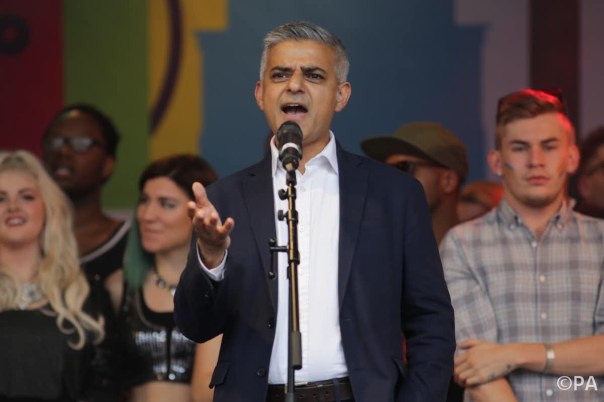
Sadiq Khan, mayor of London, received death threats after voting in favour of same-sex marriage. Daniel Leal-Olivas / PA Wire/Press Association Images

Gay Muslims may cope with this internal conflict in a number of ways. While some hope to change their sexual orientation and to “become” straight, others may deny that they are actually gay:

Maybe I’m not bisexual because I’ve never been with a woman but I can’t call myself gay either … I refuse to do that because I just don’t feel gay.

Crucially, in making sense of the “causes” underlying their sexual orientation, some gay Muslims were of the view that they had “become” gay as a result of their social environment and consequently blamed British society:

I’m gay because I was brought up here [in Britain] but I reckon if I’d been brought up in Pakistan then I would have turned out straight because this doesn’t happen that much there. Like I haven’t heard of any gays in our village. Here there are clubs and that and so I just kind of fell into the gay culture.

We tend to attribute aspects of our identity that we see as undesirable to external factors. This is a means of protecting one’s sense of self from threats. Some of the gay Muslim interviewees in my studies have identified British (or Western) culture as the reason for their sexual orientation.

Reconciling homosexuality and Islam

Many individuals of religious faith struggle to accept homosexuality given the centrality of heterosexuality to faith life, according to most faith groups. Muslims are no exception. Individuals use all sorts of strategies for protecting their sense of identity and some of these strategies can actually have poor social and psychological outcomes. Social psychologists have long argued that intergroup contact is a good starting-point for improving relations between different social groups.

Universities are obvious contexts in which different groups can come together – LGBT and Islamic student societies on university campuses could collaborate with the aim of increasing inter-group contact between Muslims and LGBT people (and indeed those who identify with both categories).

Of course, inter-group contact needs to be characterised by positive images of the outgroup. So there needs to be much more discussion of homosexuality in Muslim communities – which will admittedly be difficult given the cultural taboo around sexuality. Faith and community leaders should broach the topic. My view is that people need to be exposed to LGBT affirmative images. This has already happen to some extent.

As I’ve written elsewhere, the Eastenders storyline concerning Syed Mehmood, a gay Muslim character who struggles to come out to his parents, generated some discussion in the British Muslim community and led some individuals to acknowledge the existence of homosexuality within their community.

Coming out: Syed from Eastenders on Twitter. Twitter

This is a positive step forward and one that can be built on. Similarly, there needs to be more acknowledgement and acceptance of faith groups in LGBT contexts which tend to be secular. In my research, I’ve also found that gay Muslims can face Islamophobia on the gay scene, which can hinder their sense of belonging in these spaces.

In addition to improving relations between groups, it is likely that this exercise will have positive outcomes for well-being among those individuals who self-identify as Muslim and gay. Growing up in an environment in which you are led to believe that your sexual orientation is wrong, sinful or symptomatic of mental illness can lead to profound social and psychological challenges, including internalised homophobia, low self-esteem, depression and, in some cases, suicidal thoughts.

The reasons underlying the horrendous attacks perpetrated by Omar Mateen in Orlando may never be fully understood. But if it is true that he was a closeted homosexual – it was reported that he had used gay dating applications and frequented gay bars, including the one that he attacked – he clearly had a very difficult relationship with this aspect of his identity. There is already some empirical evidence that homophobia is associated with homosexual arousal, which suggests that homophobia might be a means of distancing homosexuality from one’s sense of self.

Could it be that his actions were in part a result of his internalised homophobia? Did he attack the LGBT community in an attempt to distance his own sexuality from his sense of self?

In any case, we as a society have a responsibility to acknowledge diversity and to allow people the space and opportunity to self-identify in ways in which they choose. We have a responsibility to challenge prejudice (of all kinds) when it shows its ugly face. We have a responsibility to support and protect minorities who are vulnerable to marginalisation and exclusion. Sometimes this will be challenging particularly when it means that we have engage with sensitive issues such as religious norms and customs but we must persevere – for the sake of freedom, peace and well-being for all of society.

Reference

Gay History: When The Canadian Government Used “Gay Detectors” To Try To Get Rid Of Homosexual Government Employees

We are all familiar with the colloquialism “gaydar” which refers to a person’s intuitive, and often wildly inaccurate, ability to assess the sexual orientation of another person.

In the 1960s, the Royal Canadian Mounted Police (RCMP) attempted to use a slightly more scientific, though equally flawed, approach- a machine to detect if a person was gay or not.  This was in an attempt to eliminate homosexuals from the Canadian military, police and civil service. The specific machine, dubbed the “Fruit Machine”, was invented by Dr. Robert Wake, a Carelton University Psychology professor.

Taking the lead from the United States’ McCarthyism, the Canadian government considered all homosexual public servants to be a threat to national security for various absurd reasons. In order to deal with the “security threats” posed by gay people, a special team in the RCMP was formed. Section A-3’s sole mission was to identify and dismiss from service every homosexual working for the Canadian government. Identified homosexuals were immediately fired or forced to resign.

Initial efforts included following people around and undercover work at various clubs, but this proved to be extremely costly and somewhat inefficient. Thus, Section A-3 decided they needed a new plan, a way to screen every employee directly. This new plan was the “Fruit Machine”.

The Fruit Machine primarily used the “pupil area response test” as an indicator of a person’s sexual orientation, as well as perspiration levels and pulse rate. While undergoing the test, the subject would sit in a dentist-style chair.  They’d then be shown various images, some completely mundane, while others depicted naked or semi-naked photos of women and men. If the subject’s pupils dilated when being shown erotic photos of people of the same gender, s/he was assumed to be homosexual.

Besides the “science” behind the machine being completely flawed, there were other problems as well.  For instance, each photograph changed the amount of light hitting the person’s eyes. If the difference from one slide to another was large enough, this obviously would change the subject’s pupil dilation, but was not accounted for in the results.

The Fruit Machine was not a stand alone test, but many of the other methods used were just as ridiculous. For instance, another test run by the RCMP included monitoring subjects’ physiological responses to specific words such as queer, gay, drag and even bar.

As you might expect, once word got out that the Fruit Machine test was attempting to determine if you were gay or not, rather than a stress testing machine as people were initially told, getting people to take the test became nearly impossible.  That, along with numerous mechanical failures with the machine itself, soon got funding for that particular part of the program cut off and the RCMP’s dream of having a gaydar to screen all Public Employees with was put on hold, though that didn’t stop them from continuing their work trying to root out “dangerous” homosexuals from the Canadian payroll.

Not to be deterred, the RCMP eventually started using a new type of machine, this one, a type of plethysmograph that measured blood flow to genitals while the subject is shown various images. While not nearly as scientifically flawed as the Fruit Machine, this one also, as you might expect, doesn’t give terribly accurate results on the whole and eventually the program for trying to root out homosexuals was abandoned by the Canadian government, but not before at least 400 people lost their jobs after being accused of being gay (with some estimates being significantly higher).

Bonus Facts:

▪ Despite that penile plethsymograph and the vaginal photoplethysmograph are somewhat flawed in detecting someone’s sexual orientation, it is still used to this day in nations like Canada and the United States to try to measure sexual arousal in certain people, though now being used primarily on pedophiles, ephebophiles, and rapists.  Some have even pushed for its use in trials, but to date such evidence is not generally admissible in court in either the U.S. or Canada owing to the highly flawed nature of the results of the test.  Despite this, there are exceptions, such as that courts do use the results of these tests to monitor convicted offenders to help determine things like if they are likely to become repeat offenders if let out of prison.

▪ In Czechoslovakia, such a test was recently used to try to determine if refugees from Iran were actually gay or not, to see if they should be given asylum. (The penalty for being gay in Iran is death and the two in question claimed if they were sent back to Iran, they’d be killed as the police were looking for them due to their homosexuality.)

▪ Funny enough, according to a 1996 study at the University of Georgia, using the somewhat flawed penile plethsymograph test (so take these results with a grain of salt), they found that homophobic men were more likely to be sexually aroused by depictions of gay sex than non-homophobic men.

Canada is not the only country ashamed to have a Fruit Machine as part of their history. The American version of the Fruit Machine (pictured right) is currently on display at the new war museum in Ottawa, Canada. The Canadian Fruit Machine, which was much more elaborate than its American counterpart, has been lost and thought to have been destroyed when that part of the program was shut down.

▪ Delta airlines once argued in a plane crash litigation case that they should pay less for gay passenger deaths owing to the fact that the gay person may have had AIDS, so at that time would have died soon anyways… Delta Airlines later apologized for making that argument.

▪ In 1952, the Unites States Congress enacted a law banning lesbians and gay foreigners from entering the country. The law was on the books until it was repealed in 1990.

▪ A “beard” is someone of the opposite sex who knowingly dates a closeted lesbian or gay man to provide that person with a heterosexual “disguise,” usually for family or career purposes.

Reference

Gay History: 30 years Of Gay Style: From Disco Chic To Hipster Bears

It used to be a tribal signal but as gay style has moved into the mainstream, the look has become harder to pin down. It’s forcing creatives to really push the boundaries if they want to make a statement

Now and then … Sylvester in the 80s and John Grant in 2015. Composite: Getty

When he was studying at Central Saint Martins, London, in the late 00s, Craig Green wrote his dissertation on the adoption of gay style subcultures by straight men. In the preceding decades, perfumed dandies, dilly boys, mods, skins, clones, new romantics, scallies, fierce vogueing divas and muscle Marys had all been sieved out of their natural habitat on to the high street for brief moments of mass consumption. But by the time Green – currently reigning menswear designer of the year at the British fashion awards – was weighing up his thesis, things had changed. The bears – hirsute, gay men – crowded on the dancefloor of London’s XXL nightclub were barely distinguishable from bearded Bon Iver fans.

A reciprocal shared wardrobe, common across menswear emerged. “When I was younger,” says Green, who was born in 1986, “what I thought of as a very gay look was really a metrosexual thing, a bit Italian, clothes a tiny bit too tight, skinny jeans, tanned, tight T-shirt, worked out. Most of the men who dressed like that were straight. Gay men all seemed to be growing beards, too. It was a less specific time. You couldn’t really tell who was who any more. Had we come to a melting point?”

From the vantage point of the DJ booth in the capital’s Horse Meat Disco, Luke Howard has been well positioned to watch the changing appearance of gay men over the past 16 years. He has noticed something similar to Green. “Lads in a straight club in Sheffield or Leeds don’t look that different from an average crowd we get at Horse Meat Disco,” he says. “These days I can barely tell the difference between straight men and gay.”

At the beginning of last year I started writing a book, Good As You, about the mainstreaming of gay pop culture as gay men headed towards complete equality in British law; roughly, a journey from Smalltown Boy to same-sex marriage that felt personal and lived, but would hopefully reflect a wider shift in the country as the gay culture has come into the light. Across the 30 years I looked at (1984-2014), the sheer number and range of signals that gay men sent out through their personal, often tribal, style fitted a wider emerging narrative, reframing the British gay man’s story from victimhood to a kind of valiant heroism. By the time I had finished the book, a moustache was no longer a moustache, it was part of a suit of no-nonsense sex armour.

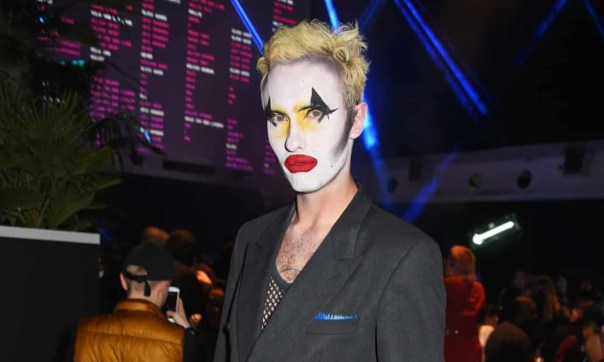
UK designer Charles Jeffrey. Photograph: Dave Benett/Getty Images for Daz

“Traditionally,” says Tim Blanks, editor-at-large of Business of Fashion, “gay style was about men who took a lot of care and attention about their appearance.” The Beckhamification of culture that begot the metrosexual ended all that. The most popular gay cultural figures in its slipstream were visibly paying less attention to their clobber than the majority. For Blanks, this is even truer of gay cultural figures now. “Where is gay style now concentrated?” he asks. “[Singer] John Grant’s statement is the most chic, stylish and sophisticated art. But it isn’t visual.” Like the musician Perfume Genius, AKA Mike Hadreas, Grant favours contemplation of the interior life over the exterior.

Yet just as the gay scruff-as-cultural-archetype boomed, a raft of new figures emerged, reframing sexuality and style, both in and out of high fashion. Demna Gvasalia (Vetements, Balenciaga) and Alessandro Michele (Gucci) became the most influential designers of their era by taking – respectively – utilitarian street style and ornate embellishment down strange, pleasingly radical avenues, upsetting the strict tenets of buttoned-up, sartorial menswear. Meanwhile, American designer Rick Owens has looked to the brilliantly extreme edges of performance art, taking inspiration from the purposefully surreal, absurdist and unsettling physical disposition of David Hoyle and Christeene Vale. Things have shifted. “Oh, I could look at [queer experimentalist] Arca 24 hours a day,” says Blanks. “He is phenomenal. His look embodies transgression, intellectual depth, incredible provocation and sensuality in exactly the way Bowie’s and Lou Reed’s did when I was teenage.”

For a young breed of designers, a sense of controlled, thrilling outrage – a sense incubated in gay nightlife – is once more tickling the underbelly of fashion. “You have all those children of Kim Jones,” Blanks notes. Jones, head of menswear at Louis Vuitton, made a path from 90s London gay club culture to the apex of men’s fashion. He was a regular at 90s gay clubs from Kinky Gerlinky to Queer Nation, which he has heavily referenced in his collections. Young designers including Christopher Shannon and Bobby Abley have done their own idiosyncratic takes on that journey, too. It’s a path that can work in reverse, too. In their earliest incarnation, Take That, five straight men from the north-west, were styled to catch the eyes of ritzy gay clubbers at La Cage in Manchester.

Another who trod that path was Green, whose richly specific fashion vernacular feels technically in the lineage of Yohji Yamamoto and Issey Miyake. Then there’s JW Anderson’s fruity gender play, putting men in frilly boob tubes and thigh boots during his early years.

As Green was writing his thesis, the young designer Charles Jeffrey was being beaten up in Glasgow for his appearance. An obsessive fan of Southend gothic revivalists the Horrors, he tried to emulate their style on a pocket-money budget. “I wanted the panda eyes and the big black hair but I had to buy winklepickers from Burton and women’s blouses from Primark,” he recalls. Hair was a big thing for Jeffrey, his point of differentiation, the “this is me” moment that many men have traditionally alighted on when they adapt publicly into a chosen gay identity. “I was called a ‘faggot’ and a ‘poof’ for having bright orange hair in what I thought of as really quite an aggressive look. I didn’t see it as being gay at all and I was punched in the face in George Square for it.”

“Gay men have co-opted both masculine and feminine imagery,” says Howard, “in an either/or way as regards their choices of clothes.” This delineation has precedent. “In the late 70s, you had new romantics with their velvet and face powder, which coincided with the clone look – handlebar moustache, muir cap, leather and denim – inspired by construction workers and uniformed personnel.” He thinks the reason these polarities exist might be connected to deeper identity questions. “Boys that grow up to become gay men have often personally experienced or at least witnessed anti-gay bullying, which perhaps then becomes either externalised – I’ll be as flamboyant as I want in my attire and to hell with you all – or internalised: I’ll be more masculine-looking than the most heterosexual men.”

Clubbers at Leigh Bowery’s club Taboo in 1986. Photograph: UniversalImagesGroup/UIG via Getty Images

The digital age has complicated personal identity issues for everyone. For many gay men, the closure of bespoke social spaces, as clubs and bars shut up shop, has meant formalising an identity online. “At the Blitz and Taboo,” says Blanks of the legendary London gay clubs, “it was always about not wanting to be stuck at home.” Times change and styles change with them. “Now, it is absolutely all about staying in.” The 2017 gay male archetype could easily be the bearded, topless selfie guy, stomach clenched, puckering up in his bathroom mirror, who routinely clogs the suggestion feeds of gay Facebook and Instagram users.

“What a shame,” Blanks continues. “The notion of community used to be absolute. The internet presents a different sense of immediacy. Your desire is now more important than your style.” In this sense, the most useful arbiter of gay style may be Ernesto Sarezale, the London nightclub fixture who frequently attends, dances and leaves completely naked.

Jeffrey’s Loverboy parties have seen the emergence of a newly radical slant on the club kids who have defined gay culture. “What I love about someone like [Loverboy regular] Harry Charlesworth,” says Blanks, “is that he’s sitting dressed like a southern belle with a hairy chest that Burt Reynolds would be proud of. It’s that visual idea that ties back to the Cockettes.” The revolutionary late 60s/early 70s San Francisco drag ensemble – a template for wild expression – are a touchstone in the gay style story.

“My gay style icon would have to be Sylvester,” says Howard, about the Cockette who broke free from the underground to define the sound, look and spiritual outer edges of disco. “He used his body and the clothes he wore as a way to express his liberation from the oppressive restrictions of heteronormative culture. If only more men, gay and straight, myself included, could be more like him.”

Model wearing a Tom of Finland print swim shorts. Photograph: The Washington Post/Getty Images

Wardrobe constraints can be further complicated by the thorny issue of sex. “Dress codes are generally about getting laid,” says GQ Style’s editor, Luke Day. “The connecting tissue between all gay subcultures is that you’re generally expressing your sexual preference in some sort of way. We are trying to attract. What we put out there is what we fancy.”

“There are gay men that I like the style of,” says Green. He mentions his former stylist and collaborator Julian Ganio, the fashion director of Fantastic Man magazine. “He wears things really well. It’s quite difficult to look good in denim shorts, a bucket hat and a pair of shearling loafers, but he’s got a magic way of holding himself.”

Ganio himself doesn’t think that gay men’s style has changed much over his time. “It never really does,” he says. “In 30 years’ time, it’s more than likely the leather queens will still wear leather, the bears will wear a plaid shirt and beard and the scallies will wear Reebok Classics with a Ralph Lauren polo shirt.”

Howard thinks the real influence of gay men on mainstream style may not even be on their own kind. “Perhaps, traditionally, gay men have had more time and money to spend on their clothes and bodies, but gay men have arguably had more influence on women’s style and fashion than men’s.” The recent appointment of Edward Enninful as editor of British Vogue would suggest that. As for the question that haunts the debate of gay men and style, Ganio has a simple and succinct answer.

Why are so many gay men designers?

“Because gays are fab,” he says.

Seven key gay styles

he Village People. Photograph: PA

The clone

Origins: Tom of Finland.

Subcultural habitat: The End-Up nightclub, San Francisco.

Crossover moment: Tom Selleck as Magum PI, the Village People.

The dilly boy

Origins: The rent boys of yore plying their trade at Piccadilly Circus.

Subcultural habitat: Smoking a Virginia Slim louchely under Eros with a Jean Genet paperback.

Crossover moment: Bowie, Lou Reed, Christiane F, Suede.

The Vogue queen

Origins: Harlem Vogue balls.

Subcultural habitat: A makeshift catwalk on the Chelsea Piers; Paris Is Burning.

Crossover moment: Madonna, Malcolm McLaren, streetdance.

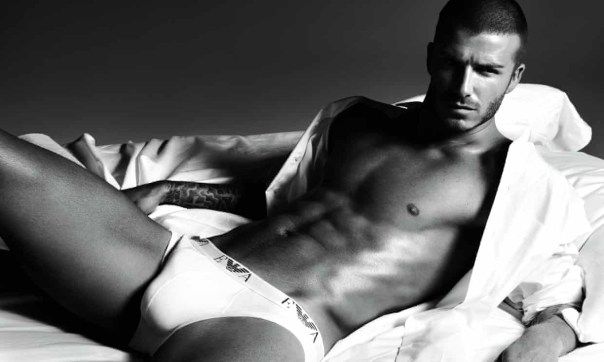
David Beckham’s Armani ad. Photograph: Marcus and Mert/Publicity image from PR company

The muscle Mary

Origins: YMCA locker rooms and Physique Pictorial magazine.

Subcultural habitat: Trade.

Crossover moment: Mark Wahlberg for Calvin Klein, David Gandy for Dolce and Gabbana, and David Beckham for Armani underwear.

The bear

Origins: Christopher Street.

Subcultural habitat: The King’s Arms, Soho, London.

Crossover moment: Ted, beard oil, Rag’n’Bone Man.

The scally

Origins: All Ralph Lauren concessions, department stores, the north, 80s.

Subcultural habitat: Frank Clarke’s 1988 film The Fruit Machine.

Crossover moment: The Streets, Skins, Slaves, Hollyoaks.

The Cockettes in 1972. Photograph: Robert Altman/Getty Images

The Cockette

Origins: The late-60s hippy communes of San Francisco.

Subcultural habitat: Falling over, high, on stage.

Crossover moment: Kenny Everett as Cupid Stunt, David Walliams in Little Britain.

Good As You: From Prejudice to Pride – 30 Years of Gay Britain by Paul Flynn is published by Ebury Press,

Reference

Gay History: Is It Okay to Be Gay (and in the Far-Right)?

How outspoken gay figures like Milo Yiannopoulos and Caolan Robertson go down with right-wingers, who – traditionally – haven’t been big fans of the gays.

MILO YIANNOPOULOS AT THE REPUBLICAN NATIONAL CONVENTION CLEVELAND OHIO, USA, 21ST JULY 2016 (MARK REINSTEIN / ALAMY STOCK PHOTO)

In March of 2017, a terror attack in Westminster left 49 people injured and six dead or dying. While victims were still being driven away in ambulances, English Defence League (EDL) founder Tommy Robinson rushed to the scene with a camera crew to pace around outside the police cordon and rant about Muslims. Not long after he’d started, a younger man took over.

Pinching his thumb and forefinger together, the man raises his pinky and tells the camera: “If you import a culture, you get a culture.” Barking at unimpressed spectators, he finishes: “The blood. Is on. Your. Fucking. Hands,” with all the sassy-camp cadence of a RuPaul’s Drag Race queen.

That man was Caolan Robertson, a video producer with 12,000 YouTube subscribers, 41,000 Facebook followers and 35,000 Twitter followers. Robertson, who is gay, says that while “all religions are pretty bad… Islam is particularly worse”. Like fellow gay right-wing figure Milo Yiannopoulos – who became a darling of the alt-right on an anti-political correctness agenda – he has taken arch-campness to a twisted place.

That two public figures on the hard-right are openly gay might surprise some people, given that poster boys of this political persuasion are usually family-oriented and Christian-leaning, like Tommy Robinson and Britain First, or dullard conspiracy theorists, like Paul Joseph Watson. Also, right-wingers – from small-C conservatives up to neo-Nazis – historically haven’t been that keen on gays.

However, gay right-wingers aren’t actually as uncommon as you might think.

The recent case of neo-Nazi Ethan Stables, for example, who was convicted of preparing a terrorist act after plotting to attack a Pride event in Barrow, sharply counters this idea of heteronormative masculinity, as his defence involved an assertion of his own bisexuality. Elsewhere, European hard-right politicians Geert Wilders and Marine Le Pen have played to an LGB – but not T – crowd, while Germany’s far-right Alternative for Deutschland party promoted lesbian Alice Weidel to its leadership.

But how do people like Yiannopoulos – a gay man who harasses trans students on campuses – fit into the UK’s radical right?

Historically, brief radical right acceptance of white gay men plays against a backdrop of institutionalised homophobia. The Nazis’ momentary permissiveness of the gay Storm Battalion co-founder Ernst Rohm is a blip compared to the 50,000 homosexuals imprisoned and 15,000 homosexuals killed during the Holocaust. In 1999, neo-Nazi nail-bomber David Copeland attacked gay people, Bengali Muslims and black people with equal measures of hatred. Nicky Crane may have been a violent neo-Nazi secretly enjoying gay dalliances, but when he came out in 1992 he cast his political views aside, declaring them incompatible with his sexuality.

Then came 9/11, and a shifting – at least in the radical right’s eyes – of the hierarchy of minorities. Here was an opportunity to knit together different factions of the right against a common enemy: Islam.

Just as the Taliban’s treatment of women was seized upon by the Bush administration and its supporters to justify the war on terror, its treatment of queer people was used to cast all Muslims as anti-gay. In 2009, a Gallup Centre for Muslim Studies report seemingly backed up the radical right’s assertions: while 58 percent of the British general public thought homosexual acts were “morally acceptable”, zero percent of British Muslims agreed.

Even the liberal press focused on this statistic: “Patriotic, respectful, homophobic”, read The Independent’s summation. “Muslims in Britain have zero tolerance of homosexuality, says poll,” said The Guardian. Right-wing outlets, still bothered about gays in the Anglican church and the impending doom of same-sex marriage, didn’t quite know where to pitch up.

The day of the shooting at Orlando’s Pulse gay club in 2016, wChose Islam Over Gays. Now 100 People Are Dead Or Maimed”. In it, he describes the actions of an extremist as representing all of Islam, using the poll to back up his claims: “This isn’t about ‘radical’ Islam. This isn’t a tiny fringe,” he writes. “In Britain, a 2009 Gallup survey found that not one Muslim believed that homosexual acts were acceptable. Not one!”

Days later, Yiannopoulos addressed a small crowd in a YouTube livestream, calling for a Muslim ban on that basis. “This is not radical Islam… this is Muslims in the West,” he said, ignoring the fact that the same poll found that 19 percent of German Muslims and 35 percent of French Muslims thought homosexual acts were acceptable, implying countries with a longer legacy of Muslim immigration have more LGB-tolerant Muslims.which killed 49 people, Yiannopoulos wrote an article for Breitbart titled “The Left Chose Islam Over Gays. Now 100 People Are Dead Or Maimed”. In it, he describes the actions of an extremist as representing all of Islam, using the poll to back up his claims: “This isn’t about ‘radical’ Islam. This isn’t a tiny fringe,” he writes. “In Britain, a 2009 Gallup survey found that not one Muslim believed that homosexual acts were acceptable. Not one!”

Days later, Yiannopoulos addressed a small crowd in a YouTube livestream, calling for a Muslim ban on that basis. “This is not radical Islam… this is Muslims in the West,” he said, ignoring the fact that the same poll found that 19 percent of German Muslims and 35 percent of French Muslims thought homosexual acts were acceptable, implying countries with a longer legacy of Muslim immigration have more LGB-tolerant Muslims.

With that, the clash of civilisations narrative was set.

Weeks later, Donald Trump – whose campaign manager at the time was Stephen Bannon, then-CEO of Breitbart – became the first ever Republican nominee for the US presidency to mention LGBT people, using them as leverage to call for a Muslim immigration ban.

As Matthew Feldman – co-director of the Centre for Fascist, Anti-fascist and Post-fascist Studies, and Professor of the History of Modern Ideas at Teeside University – puts it: “The thinking is: ‘If this is another stick to beat Muslims with, we’ll take it. We’ll be silent on the LGBT question, we’ll just talk about their rights in the abstract.'”

ANNE-MARIE WATERS (PHOTO BY JAMES POULTER)

Trump’s views on LGBT people have since wavered, but other British groups are unafraid to exploit professed support for LGBT rights to attack Islam.

In 2016, a Stockton-on-Tees Pride march was organised by a group with no previous affiliations to the LGBT community, but many links to the EDL and Pegida UK, also founded by Tommy Robinson. The march was “appropriating tragedies to promote further bigotry”, warned anti-Islamophobia project Tell MAMA.

The next year, Gays Against Sharia (GAS) – set up by Tommy English, known as Tommy Cook, founder of the EDL LGBT division – carried the baton. Though Tommy Robinson hijacked one of GAS’s marches, rebranding it Unite Against Hate, in September of 2017 GAS held its own parade in Bristol. Footage shows English holding a rainbow flag reading “UNITED TOGETHER, TODAY AND FOREVER. HELP US STOP THE GROWTH OF AN EVIL, HATE-FILLED IDEOLOGY”. Pictured helping carry this banner is Anne-Marie Waters, the lesbian who ran for candidacy of UKIP on an anti-Islam ticket.

The demonstrators had re-framed Islam as the real and sole oppressors of LGBT people, and the far-right as minorities’ protectors – a narrative that’s as transparent as it is cynical.

As for the Gallup analysis, Dalia Mogahed – Director of Research at the Institute for Social Policy and Understanding – tells VICE it has been misinterpreted: “Saying homosexual acts are morally wrong is not evidence that Muslims will hurt the LGBTQ community.”

“Muslims have been part of the UK for literally hundreds of years, and unlike the Christian right do not advocate against the LGBTQ community,” added Mogahed. “In a democratic society, freedom of thought and belief are central principles, including beliefs that we may not agree with. We erode our own values when we start policing thought.”

Mogahed also pointed out the paradox of Yiannopoulos complaining about Muslim bigotry against LGBT people while advocating for the Muslim ban.

Luckily, Yiannopoulos isn’t the threat he once was, having lost the radical right’s affections, Breitbart’s employ and Robert Mercer’s funding after footage surfaced of him defending pederasty. Mind you, he’s still at it: his new website, Milo Inc, both damns gays and uses them as a shield to deflect accusations of Islamophobia. Two headlines read: “All The Studies Show, Gay Parents Are Not Good For Kids”, and “GOOGLE Aids Indonesia’s Muslim Government In Anti-Gay Crackdown”. There is, after all, a limit to how much homosexuality radical right LGBT people can appear to condone.

Caolan Robertson is more overt in his disdain for gay culture. In a video for far-right Canadian YouTube channel The Rebel Media, he attends London Pride 2017, mocks interviewees and calls the event “the most degenerate festival I’ve ever seen”. He also mentions a 2016 ICM poll with questionable methodology which suggests that 52 percent of British Muslims think homosexuality should be illegal, quoting when the stat before asking left-wing journalist and campaigner Owen Jones, “Do you think that’s something that’s a threat to gays in our country?”

Jones replies, succinctly: “Far-right groups… try to cynically appropriate gay rights for Islamophobia.”

In an another video – this time an interview with radical right vlogger, Millennial Woes – Robertson cites an unknown report alleging that “60 percent of gays in the UK admit to having over 500 partners”, adding, “[Gays] have literally shit all over all of the people who fought for their rights to be able to exist by behaving like this.” The only record which correlates to this is a 1978 sociological study regularly shared on Christian websites.

Robertson later left Rebel Media acrimoniously, and now works behind the camera on documentaries with fellow Rebel alumni, alt-right Canadian vlogger Lauren Southern.

Failed UKIP leader Anne-Marie Waters’ beliefs about LGBT rights and Islam can be summed up by one of her tweets: “I’m a gay woman who values my freedom, believe me, Islam is out to get me.” However, her new party, For Britain, makes no mention of LGBT people in its manifesto. Perhaps this is because the radical-right has little space for lesbians, who, as Patrik Hermansson of Hope Not Hate – who spent a year undercover in the alt-right – explains, “aren’t even discussed” due to its boys’ club chauvinism.

Hermansson understands how gay men come to be part of and celebrated by the radical right: “There’s this glorifying of the male body and an idea that men are the best in every possible way. It makes sense, then, that when men are close together, in those groups, homosexuality doesn’t have to be so strange.” He also cites the manosphere – made up of single men who feel “left out and oppressed by what they perceive as feminism” – as a common entry point to the radical right. Feldman agrees: “A close male bonding can go from homosociality to homoerotic to LGBT.”

There’s an argument to be had about the point at which fetishistic enjoyment of fascist iconography can tip into full-blown appreciation of the Nazi ideal of the Ubermensch – a strong, muscular and healthy Aryan man. Think Kenneth Anger’s Scorpio Rising, Tom of Finland’s predilection for uniformed antagonists and the gay skins culture. As Hermansson points out: “It’s like the bullied turning into bullies, but it only happens to white men because they’ve got that possibility.”

More pressing, though, is supposedly pro-LGBT groups leveraging a minority status to provide a get-out-of-bigotry-free-card in a cynical and manipulative attempt to gain the hard-right ethical kudos and more members. Not only can their arguments – propped up by sloppy and wilfully misinterpreted polling – be convincing, but these people also attempt to cast the left as the real oppressors of gay people. It was a Conservative government which introduced same-sex marriage to the UK, yes, but LGBT rights are more than marriage.

As that long fight showed, sexual orientation doesn’t always imply a political orientation, and it’s incumbent on everyone across ideological and political spectrums to continue the conversation about how the religious and socially conservative consider and treat LGBT people.

The radical right’s rebranding as well-dressed, slick and intellectual operators has worked to give the movement an undue credibility, but the gay-tolerant rendition of Islamophobia is transparently exploitative. It’s only a matter of time before they get found out.

This article originally appeared on VICE UK.

Reference

Gay History: Gay Marriage: What Would Buddha Do?

As a gay Buddhist, and someone who has a lot of respect for His Holiness the Dalai Lama, I often have his sometimes controversial/sometimes contradictory comments on gays and gay marriage, thorn at me. It’s a difficult question, I know…how can I support someone who seems to be non-supportive if gays within the Buddhist community, yet support gay issues for non-Buddhists. I personally consider the Dalai Lama as a great man, capable of great compassion and understanding. I also know he is the head of a traditional Tibetan sect of Buddhism called the Gelug sect, and as such has his moral teachings within the beliefs of that sect. I would like to think that being the intelligent and loving man that he is, that these questions are something he has to often contemplate, and try to understand within an old tradition that has to live in the modern world. Buddhism is not just one sect, but many different sects all following diverse interpretations of the Buddha’s teachings. As such, there are conservative and liberal strands of Buddhism, so beliefs are not universal. The Dalai Lama is but the leader of one sect, and only speaks for that sect. I choose not to judge him to harshly! Om mani padme hum 📿🏳️‍🌈

A lot of people ask me what the “Buddhist take” on gay marriage is. Well, it depends on who you talk to. A few years back, in an interview with the CBC, the Dalai Lama rejected same-sex relationships to the surprise of many convert Buddhists, who sometimes too easily assume that Buddhist ethics are consistent with their typically progressive views.

As the Canadian interview bounced around the internet, some people were shocked and perplexed, but the Dalai Lama’s position shouldn’t have come as a surprise to anyone who has followed the issue. After all, he has been consistent. At a conference some 12 years ago, when gay leaders met with him in San Francisco to discuss the Tibetan Buddhist proscriptions against gay sex, he reiterated the traditional view that gay sex was “sexual misconduct.” This view was based on restrictions found in Tibetan texts that he could not and would not change. He did, however, advise gay Buddhist leaders to investigate further, discuss the issue, and suggested that change might come through some sort of theological consensus. But at a time when same-sex marriage has taken front-stage center in American politics, the Dalai Lama’s more recent statements come as unwelcome news to proponents of civil rights.

A lot of people ask me what the “Buddhist take” on gay marriage is. Well, it depends on who you talk to. A few years back, in an interview with the CBC, the Dalai Lama rejected same-sex relationships to the surprise of many convert Buddhists, who sometimes too easily assume that Buddhist ethics are consistent with their typically progressive views.

As the Canadian interview bounced around the internet, some people were shocked and perplexed, but the Dalai Lama’s position shouldn’t have come as a surprise to anyone who has followed the issue. After all, he has been consistent. At a conference some 12 years ago, when gay leaders met with him in San Francisco to discuss the Tibetan Buddhist proscriptions against gay sex, he reiterated the traditional view that gay sex was “sexual misconduct.” This view was based on restrictions found in Tibetan texts that he could not and would not change. He did, however, advise gay Buddhist leaders to investigate further, discuss the issue, and suggested that change might come through some sort of theological consensus. But at a time when same-sex marriage has taken front-stage center in American politics, the Dalai Lama’s more recent statements come as unwelcome news to proponents of civil rights.

Friends of mine have argued that the Dalai Lama doesn’t really look askance same-sex relationships, that he has no choice but to uphold his tradition’s dictates; and that maybe the Dalai Lama is just stuck with the old texts’ proscriptions in the same way that a Catholic, say, must deal with Thomas Aquinas. Of course, we can’t know and must take his public statements at face value. In his case, though, our expectations tend to be different than they might be for the local minister, priest or orthodox rabbi. And so many of us who have benefited greatly from his teachings are apt to feel disappointed.

References

Gay History:, 25 Violent Attacks at Gay Bars That Preceded Orlando’s Horrific Nightclub Massacre

This litany of gay hate, murder and violence goes on everywhere in the world. Here in Australia alone there are, in Sydney, about 80 unsolved gay murders from the 80s alone. It is not a pleasant subject, but it’s a reality, and whether we like it or not, like war, it is part of our history. This article only goes up to June 2016 – it would be frightening to know the further extent of this awful violence since that date. It is a constant reminder to us that even in what we consider gay-safe spaces…we are not safe!

When a radiant President Obama declared June LGBTQ Pride month, he told the American people that “despite the extraordinary progress of the past few years, LGBT Americans still face discrimination simply for being who they are.” Nobody could have imagined how that statement would take on a tragic enormity just days later.

Sunday, Obama addressed the American LGBTQ community and the rest of the nation again to talk about the worst mass shooting in our history. He talked about the unthinkable contrast of the horror that happened in the early hours of Sunday morning in Orlando: “The shooter targeted a nightclub where people came together to be with friends, to dance and to sing, and to live. The place where they were attacked is more than a nightclub — it is a place of solidarity and empowerment where people have come together to raise awareness, to speak their minds, and to advocate for their civil rights.”

Less than two weeks before the country prepares to celebrate one year of marriage equality, the sight of two men kissing on the street is terrifying enough to someone that a hatred-fueled massacre we experienced at the Pulse in Orlando can be the result.

Unfortunately, Orlando is hardly the first major deadly attack against an LGBT bar or landmark.

Photo credit: GlobalGayz/Facebook

Until today, the deadliest attack had been in New Orleans, over 40 years ago. On the week when the LGBT community celebrated its fourth Gay Pride — four years after Stonewall —  an arsonist set fire to the Upstairs Lounge at the French Quarter, killing 32 people on June 24, 1973. No suspect was ever charged.

On Nov. 18, 1980 a man named Ronald K. Crumpley opened fire outside the Ramrod bar in Greenwich Village in New York City. He said he believed gay men were agents of the devil, stalking him and ”trying to steal my soul just by looking at me.” His father, a minister, said in his testimony that Crumpley maybe had a ”a homosexual problem himself.”

On April 28, 1990 at Uncle Charlie’s, another gay bar in Greenwich Village in Manhattan, three men were injured in an explosion possibly caused by a pipe bomb.  The police didn’t immediately arrest anyone for the crime. Five years later, federal prosecutors accused El Sayyid A. Nosair for bombing Uncle Charlie’s, planning to blow up New York City landmarks and killing a rabbi in 1990. They said Nosair, a muslim, attacked the bar because he objected to homosexuality on religious grounds according to report from the New York Times. In 1996, he was convicted of planning to wage a “war of urban terrorism” and was sentenced to life in prison.

Jon Christopher Buice is serving a 45-year sentence for the killing of Paul Broussard in Houston, Texas on July 4, 1991. Buice and nine of his friends tried go into several bars in a gay area of Montrose, but they were refused entry. They then attacked Buice and two other friends with nail-studded wooden planks, a knife, and steel-toed boots outside Heaven, a gay bar in the city’s heavily LGBT Montrose district.

On Feb. 21, 1997 a nail-laden device exploded at the Otherside Lounge, a lesbian nightclub in Atlanta. Five people were wounded. Eric Rudoplh confessed to the Otherside Lounge bombing, as well as the Atlanta Olympics bombings, and abortion clinics in Atlanta and Birmingham. “Homosexuality is an aberrant sexual behavior,” he wrote in a statement. “Like other humans suffering from various disabilities homosexuals should not attempt to infect the rest of society with their particular illness.”

Two people were killed and 81 were injured after a bomb exploded in a gay bar in London’s Soho, on April 30, 1999. The blast happened at the busy Admiral Duncan pub in the center of London’s very gay neighborhood at the start of a holiday weekend. Just like the Orlando tragedy, the attack happened in a place where people go to socialize and escape. Peter Tatchell, spokesman for the gay rights group OutRage!, said: “A lot of gay people saw the Old Compton Street area as a safe haven.They felt able to relax and hold hands without fear of attack. This outrage has destroyed that cosy assumption.”

In Roanoke, Virginia on Sept. 22, 2000, a man called Ronald Gay asked directions to a gay bar so he could “shoot some people.” He then walked calmly into the Backstreet Cafe on a Friday night, ordered a beer, and  opened fire. He killed one person and injured six. Gay told police he didn’t like being called Gay. He also said it was his mission to make all gays move to San Francisco, which he thought would end AIDS. “He said he was shooting people to get rid of, in his words, ‘faggots,’” Lieutenant William Althoff of the Roanoke police was quoted as saying. He was sentenced to four life terms.

18-year-old Jacob D. Robida walked into a bar in New Bedford, Massachusetts in the evening of February 2, 2006. He asked the bartender if he was at a gay bar, ordered a couple of beers, and moved to the back of the bar, watching a game of pool briefly before taking out a hatchet — a small ax the size of a hammer. The bartender told CNN the man “started swinging the hatchet on top of this customer’s head”. He also struck a second patron with the hatchet, pulled out a gun and shot the first victim in the face and the second twice in the head, Phillip said. A third person also was shot in the abdomen. He killed himself three days later.

At the San Diego Gay Pride festival in July 30, 2006, six men were attacked with baseball bats and knives after leaving the Pride festival. The attackers used anti-gay slurs as they beat the victims. One almost died. Four men pleaded guilty in connection with the attacks and received prison sentences from two years and 11 months to 11 years.

20-year-old Sean William Kennedy was walking to his car outside Brew’s Bar in Greenville, South Carolina on May 16, 2007 when a car approached him. A young man got out, called him a faggot and punched him in the face so hard that caused his brain to disconnect from his brain stem.The killer, 19-year-old Stephen Moller, left the scene and let Kennedy die from his injury. He was sentenced to five years for involuntary manslaughter, but his sentence was reduced to three, because he was father. His mother said he later “left a message on one of the girl’s phones who knew Sean, saying, ‘You tell your faggot friend that when he wakes up he owes me $500 for my ‘broken hand!’”

Osvan Inácio dos Santos was leaving a gay bar in Arapicara a small city in the Alagoas, Northeast of Brazil with a group of friends, after he won a local ‘Miss Gay’ competition on Sept. 15, 2007. On the way home, he got separated from the group. They tried contacting him, but he didn’t answer. His body was found a day later. He’d been raped and beaten to death. Tedy Marques, president of the Alagoas Gay Group, said that “Homophobia is one of the worst problems Brazil faces. It is unacceptable that every other day in our country a homosexual is brutally murdered.”

Lance Neve was with his boyfriend and another friend at Snuggery’s Bar in Spencerport, New York on March 7, 2008 when a man named Jesse D. Parsons approached the group. He said he wanted to shake Neve’s hand because he had never shaken a gay man’s hand before, but Neve refused. Parsons then beat him up and left him unconscious. He was transported to an area hospital, where he was treated for a fractured skull, nose, left eye socket and upper jaw bone and blood on the brain. During his hearing, he told the court that “while he didn’t mean to hurt Neve as badly as he did, Neve deserved it.” He was sentenced to five years and a half in jail, and was ordered to pay $24,000 for Neve’s medical expenses.  

Tony Randolph Hunter, was beaten outside the Be Bar Nightclub in Washington DC by 19-year-old Robert Hannah. He later died from the injuries on September 7, 2008. Hannah was sentenced to 6 months in jail and ordered to pay $50 in court costs. 

On March 1, 2009, three friends threw concrete blocks at patrons inside Robert’s Lafitte Bar, in Galveston, Texas injuring two men. One of the victims, Marc Bosaw, required 12 staples in his head. One of the three suspects later told police their intent was to target homosexuals, said Galveston Police Department Lt.D.J. Alvarez. The trio also hurled homophobic insults, authorities said.

On April 11, 2009 Justin Goodwin was attacked at a bar in Gloucester, Massachusetts by as many as five people, who were using anti-gay remarks. The bashing left him blind in one eye, and deaf in one year. He committed suicide two years later.

On August 29, 2009 a shooting took place at a LGBT youth center in Tel Aviv. Two people died, 15 were injured. Most of them minors. A man named Hagai Feliciano was indicted for murder and a hate crime in 2013, but the charges were dropped in 2014. While not technically a bar, it is the equivalent for LGBT youth – a place of sanctuary and empowerment.

In New York City, a man named Frederick Giunta was charged and arrested on October 17, 2010 for allegedly attacking and assaulting people in two bars in Greenwich Village: Ty’s Bar on Christopher Street and nearby Julius Bar on W 10th St hurling anti-gay remarks. According to NYPD officials, Giunta has a history of committing crimes by targeting men at gay bars. The attack happened two weeks before the NYPD arrested two men on charges they attacked a patron inside the bathroom at Stonewall Inn. 

In October of 2010, two men were arrested after attacking a man in the bathroom at the iconic Stonewall Inn in New York City. The suspects reportedly told the man, “We don’t like gay bars, and we don’t piss next to faggots” before the assault began. He later refused to apologize to the victim, because he has no regrets. “I’m not going to say sorry, because I don’t know what I should be sorry for,” said Francis, who also insisted he’s not a homophobe. “I don’t hate gay people. I don’t hate anybody.”

On October 25, 2011 a man sprayed 21-year-old Russel Banks with liquid fuel and threw a lit match at him at the Rainbow and Dove gay bar in Leicester City, England. Banks suffered third degree burns to 20 percent of his body.

On the first minutes of New Year’s Day, 2014 a man named Musab Masmari poured gasoline in a stairway to the balcony at the Neighbours Nightclub in Seattle, where 750 had gone to celebrate the New Year. An unidentified informant told the FBI that, in the numerous conversations after their first meeting, Masmari often expressed a “distaste for homosexual people,” and that Masmari “opined that homosexuals should be exterminated.” He was arrested a month later, and sentenced for 10 years in prison.

On June 1, 2014 two friends were killed after they left R Place, a gay club in Seattle. Ali Muhammad Brown confessed to the killings. He contacted the men via a hook-up app like Grindr, met them after they left  the club and then shot them multiple times and killed them. Brown told the police the murders were a “bloody crusade” to punish the U.S. government for its foreign policies.

After months of violent anti-gay attacks, Central Station, Russia’s largest  gay club closed its doors on March 27, 2014. The club was considered one of the only symbols of freedom for Russian’s LGBT community.

On October 1, 2014 a man named Wayne Odegard shot a man at the Salon, a popular gay bar in Minneapolis. He was passing by the bar when he saw two men kissing. He grabbed his gun, yelled “f**cking faggots,” and shot at them, injuring one. Odgegard admitted to police he said ‘faggots’ before the shooting, and said that seeing men kissing pisses him off.” He also recited a passage from Deuteronomy. 

On March 22, 2016 a transgender woman was sexually violated inside a bathroom at the Stonewall Inn. According to the NYPD, she said that a man came into the bathroom claiming he only needed to wash his hands, but then proceeded to grope and rape her. 

On April 8, 2016, an employee of a popular West Hollywood gay bar was attacked as he left the bar walking towards his car on an apparent hate crime. The person who attacked him took his wallet, but never used his credit card.

A few hours after the Pulse massacre in Orlando, on the West Coast the LAPD might have stopped another tragedy before it happened. 20-year-old Wesley Howell, a man from Indiana, was arrested on his way to attend the LA Pride festival, allegedly with an arsenal of weapons. Officials found him in a car with three assault rifles, high-capacity magazines, ammunition and a 5-gallon bucket with chemicals that could be used to create an explosive device.

These attacks should remind us all that we must remain vigilant while there are still people out there who remain so threatened by the sight of two men having a simple kiss that they will resort to violence to stop it.

References