THOUGH OF HISTORICAL VALUE, THESE PHOTOGRAPHS PORTRAY A BUDDHIST MONK SELF-IMMOLATING, AND ARE QUITE EXPLICIT. PLEASE DO NOT READ THIS ARTICLE IF THESE PHOTOGRAPHS WILL HAVE AN ADVERSE AFFECT ON YOU!
In 1963, a Vietnamese monk committed self-immolation in front of hundreds of people. While his primary motivation was protest, the full reasoning behind his final act shed unexpected light on a deeply conflicted nation.
In the midst of the Vietnam War, South Vietnam was corrupted by religious intolerance. Although Buddhists comprised about 80% of the population, Ngo Dinh Diem, the newly-declared President of South Vietnam, was a Catholic who had decisively stripped the religious freedoms of Buddhists. This group was not allowed to fly their religious flags and were openly discriminated against by Catholics. Even though there were far fewer Catholics, they often held higher positions of power.
The spring of 1963 saw numerous Buddhist protests, many of which were met with fierce resistance from the police and government. These clashes led to many fatalities – including those of children.
This tension peaked on June 11, 1963, when an older monk named Thich Quang Duc performed a ritualistic ending to his own life in the middle of a busy Saigon intersection. He sat in the traditional lotus position as other monks poured gasoline over his head. After Duc uttered a Buddhist prayer, one of his colleagues lit a match and dropped it into his lap, engulfing him in flames.
The crowd that gathered was stunned by his act of martyrdom, and it was even captured by several Western journalists and photographers. The photos of the burning monk became an indelible image of the 1960s, and his final act of protest was a tipping point for the fight for religious tolerance in Vietnam.
President Diem’s discrimination of the Buddhist population pushed hundreds of monks to protest for change. In May of 1963, they presented the government with five demands, including proposed laws against religious discrimination and the freedom to fly whichever religious flags they chose.
The government had promised the monks a response, but Diem essentially ignored their requests. This silence from their government ultimately pushed the monks to much more drastic action to fight for their convictions.
Duc prepared himself for his fiery demise with a steady, calm demeanor. David Halberstam, a journalist for the New York Times, was present for Duc’s immolation and wrote about the dramatic act:
“I was to see that sight again, but once was enough. Flames were coming from a human being; his body was slowly withering and shriveling up, his head blackening and charring. In the air was the smell of burning human flesh; human beings burn surprisingly quickly. Behind me I could hear the sobbing of the Vietnamese who were now gathering. I was too shocked to cry, too confused to take notes or ask questions, too bewildered to even think… As he burned he never moved a muscle, never uttered a sound, his outward composure in sharp contrast to the wailing people around him.”
As for Duc himself, he left his final words in a letter:
“Before closing my eyes and moving towards the vision of the Buddha, I respectfully plead to President Ngo Dinh Diem to take a mind of compassion towards the people of the nation and implement religious equality to maintain the strength of the homeland eternally. I call the venerables, reverends, members of the sangha and the lay Buddhists to organize in solidarity to make sacrifices to protect Buddhism.”
After Duc’s self-immolation was complete, the other monks placed robes over his body and carried him away in a makeshift wooden coffin. He was later re-cremated for a proper burial, but mysteriously, his heart did not burn and remained intact.
Duc’s heart was placed on display in a glass container in the Xa Loi Pagoda and was seen as a sacred relic representing compassion.
Once photographer Malcolm Browne sent his “monk on fire” photos to the Associated Press, they reached US newspapers within 16 hours. The Western reaction to the images was decidedly shocked, and President Kennedy was quoted as saying, “No news picture in history has generated so much emotion around the world as that one.” Browne was awarded the Pulitzer Prize for the photograph.
The photos, in addition to the news of religious discrimination in Vietnam, supposedly led Kennedy to reexamine America’s policies and presence in the country, ultimately culminating in the US’s involvement in the Vietnam War.
Although Duc’s immolation is known as a pivotal moment in Vietnam’s fight for religious equality, his sacrifice did not instantaneously affect President Diem’s policies. Several other monks followed in Duc’s footsteps in the proceeding weeks, amid continued protests by the Buddhist community.
In November of 1963, members of the South Vietnamese military assassinated Diem and his brother during a coup, ending his Catholic reign over South Vietnam.
For the unenlightened, Buddhism can certainly come across as a mysterious, even confusing, religion. After all, there is no singular deity watching over. No strict commandments to govern with. And no “great book” to live by. So, what is it exactly? And how does Buddhism uniquely define itself in comparison with other religions around the world?
The answer is simple: Buddhism extends beyond the ideas of organized religion, and instead presents itself more as a philosophy of life, focusing on morality, tolerance for others, and wisdom. While others seek to contain (and, in some cases, even control) their members through scripture, followers of Buddhism are taught that individuality and finding one’s own self is the core of their practice. That through a journey of self-discovery, they will gain knowledge not only about themselves – but also about their inner spirit.
With over 2,500 years and 300 million followers behind it, Buddhism certainly has a colorful history, one which is shared all around the world. Below are some of the most interesting facts that have arisen from this unique practice.
You may be familiar with the sight of a rather large bald man, perched cross-legged, and adorned entirely in gold, and perhaps first wonder if this is also what Donald Trump sees when he closes his eyes. But second, you may recognize this as a statue of Buddha himself.
Well, you’d be wrong on one-and-a-half counts.
Turns out, the most recognizable symbol (at least, in Western cultures) of Buddhism is not actually of Buddha, but rather Budai, a zen monk who lived in China during the 900s.
A practicer of Buddhism, Budai was considered such an eccentric and good-spirited figure of the religion that he eventually became its most recognizable face. It was said that Budai always wore a smile, and was so charismatic that he was actually followed by children wherever he went. Because of this, his spirit represented all of which Buddhism strives for, and, as a result, we know his face to be that of one truly enlightened.
The real Buddha, however, was a twenty-nine year-old man named Siddhartha Gautama of Lumbini. Born into wealth, Gautama eventually realized that none of his fortune satisfied him, and he took to studying various religions and meditation practices around the world, before eventually becoming “enlightened,” and ultimately founding Buddhism.
Perhaps ironically, the name “Siddhartha” is Sanskrit for “He Who Achieves His Goal,” a concept which underlines the core intent of Buddhism.
Just imagine no one looking over your shoulder, checking for sins. No one whispering in your ear to do the right thing. Not having to answer to anyone on a Sunday morning.
Such is the way with Buddhism, where there is no “divine creator” lording above. True, there is the concept of the human spirit that dwells within, but the idea is more in sync with our consciousness, rather than with an entity that will eventually make its way up to heaven and join one of many hypothetical “big guys upstairs.”
Instead, Buddhism focuses on the journey of oneself to our own enlightenment rather than seeking the approval of a higher power.
When Buddhism first began, some of the Buddha’s teachings about women were very controversial. Not because he taught that women should be subservient to their husbands (as was the case with most early religions), but that husbands should also respect their wives.
Furthermore, while women were certainly not excluded from the religion (and were actively encouraged to participate), there came some caveats, with the worst of all being perhaps the entire point of Buddhism in the first place:
Despite her dedication to the religion, a woman can never achieve true “Buddhahood.”
For a religion that encourages the exploration of one’s self, sex (both with a partner and without) surprisingly comes with some very serious rules.
First of all, if you’re a Buddhist monk or nun (referred to as Bhikkhus and Bhikkhunis, respectively), you better keep that inner temple to yourself because any act, including masturbation, prevents one from achieving supreme enlightenment.
For the rest of practicing Buddhists, the rules aren’t quite as strict – though most of them are certainly frowned upon. Particularly because the Buddha perceived the craving for sex as a form of suffering. To that end, if one is consumed by the their sexual urges, they too will not be able to reach enlightenment.
Among some of the more common misconceptions about Buddhism, are that all Buddhists believe in reincarnation. Such is not the case, as the belief in life after death is not focused on as much as one would believe. Instead, the focus lands mostly on one’s purpose in this life in order to become enlightened.
Furthermore, there is a common belief that Buddhism originated as a Pagan religion, but this couldn’t be further from the truth. The reason being, because Buddhists don’t worship a god in the first place. Thus, Paganism, which is the worship of any god besides the Christian one, is an entirely different practice.
Alcohol, Onions, Garlic, Leeks, Chives, and Scallions Are a No-no
Like sex, the desire to over-indulge in certain foods is seen as a form of craving, which is, ostensibly, a form of suffering.
But there are also specific guidelines to follow if one wished to truly follow the path. Among them, followers cannot enjoy alcohol. While many who “over-indulge” in occasionally shot-gunning beers or knocking back tequila shots would argue they’re at their most enlightened when hammered, in Buddhism, it is seen as a form of “intoxicant,” which, again, keeps one from being truly spiritually enlightened.
Also, say goodbye to Indian food, as onions, garlic, leeks, chives, and scallions are considered too strong of odors in Buddhist cuisine. The reason? Because their odors are thought to be so pungent, that they incite anger and passion – both of which fall under the umbrella of suffering in Buddhism.
There is also a common misconception about all Buddhist being vegetarian, but this is not the case. In fact, many Buddhist dishes feature meat. The rule behind this, however, is that Buddhist are not allowed to “kill any sentient being.” That is, they are not allowed to kill the animal and eat it themselves, but procuring meat from elsewhere is perfectly fine.
While the core of Buddhism is the journey to self-discovery and enlightenment, there are a few important items to understand along the way. Described as the “essence” of Buddhism, these are theFour Noble Truths:
The Truth of Suffering
The Truth of the Cause of Suffering
The Truth of the End of Suffering
And, finally, The Truth of the Path that Leads to the End of Suffering
Together, these represent the path to self-liberation. A way to understand the plight of all humanity, and that there are certain undeniable events in life that are out of our control – but there is always a way through them. And by understanding and accepting them, we are on our way to true enlightenmen
Spiritual beliefs can sometimes cause a divide among followers. It’s why there are countless iterations of Christianity around the world. Some of whom believe in the spiritual teachings of Christ’s love, others who think it somehow it pleases him to march along funeral processions holding up hateful and often-misspelled picket signs.
Clearly, the spectrum reaches far and wide as to what being a “good Christian” means.
Thankfully with Buddhism, there are only two different practices: on one hand, there is the Theravada (“School of the Elders”), and the Mahayana (“The Great Vehicle”).
Theravada is perhaps the most common type of Buddhist practice, with the end goal of all individuals to reach a state of nirvana, which sees the inner spirit break the cycle of death and rebirth, and ultimately move on.
In the case of Mahayana, an individual strives to achieve “Buddhahood” (supreme enlightenment), in which he or she remains in the cycle of rebirth with the intent of helping others become enlightened as well.
In either following, the end goal of both types of Buddhism are to attain the highest level of spiritual connectedness. That is, once you peak, it’s time to either move on (Theravada) or pay it forward (Mahayana).
Every religion has their one uber-holiday of the year. For some it’s Christmas. Others Dwali. Some people give thanks on that magical day of the year when the McRib finally makes its triumphant return.
Although Buddhism isn’t exactly a religion in the traditional sense, it’s not without its own special day to celebrate the spiritual journey that so many others are on.
That day is called “Uposatha”, a day for the “cleansing of the defiled mind,” which falls in accordance of the four lunar phases, starting with the full moon.
On Uposatha, Buddhist followers intensify their practice, reflecting on their goals to deepen their commitment to themselves and to others.
Located just outside Ho Chi Minh city in Vietnam is the one and only Buddhist theme park — the Suoi Tien Cultural Amusement Park.
Featuring roller coasters, rides, an artificial beach and water park, Suoi Tien offers a glimpse of the true happiness and sense of contentment one could only achieve by, well, practicing Buddhism until they reach spiritual nirvana, I suppose.
Swathed in bright neon colors, the park is said be akin to “Disneyland on acid,” which will certainly help to explain why you’ll encounter men and women dressed up as unicorns, dragons, and Budai himself as they roam around the park grounds.
But the idea of a Buddhist theme park begs the question: if one has already achieved spiritual happiness prior to buying a ticket, does that make a roller-coaster ride less fun?
Also known as Buddhist monasteries, viharas were originally created to help in housing monks who would often only stay in temporary shelters. These early forms were little more than rock-cut caves, carved along trade routes, and which allowed passing monks to reside in and practice their faith safely.
As time went on however, viharas evolved into much more than just a place for wandering monks to stay, but instead became temples themselves, ones which saw the monks recruiting students who wished to learn more about Buddhism.
While the process of constructing viharas has certainly improved, the architects behind them today still retain the aesthetics of those once carved into the rock of caves.
According to Sri Lankan legend, when the Buddha himself died and was eventually cremated in 543 BCE, he left behind a small souvenir for his followers: his left canine tooth.
It was said that whomever came into possession of the tooth had the right to rule the country. Thus, it was fought over many times, but ultimately ended up in the town of Kandy, Sri Lanka, where has been held in reverence on display for over four hundred years.
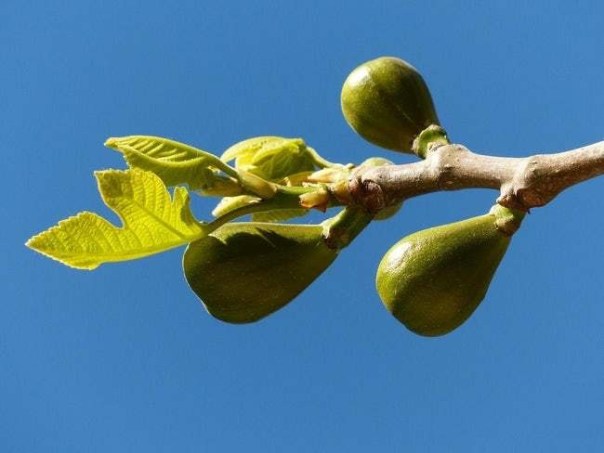
Specifically, the ficus religiosa, a type of fig tree that grows only in southwest China. It earned its divine name for a very specific reason: it was under this type of fig tree that Siddhartha Gautama (Buddha) first achieved his spiritual enlightenment. Ever since, it has been regarded as sacred, and is a celebrated symbol in Buddhism.
There Are Many Different Ways People Practice Buddhism
Like many religions, Buddhists can choose to practice puja – the act of worship – either at home, via a personal shrine, or in a public temple.
If at home, Buddhists create small areas dedicated to connecting with their faith. These shrines typically feature a statue of Buddha himself, as well as various candles, flowers, and incense burners.
Although the practice is a solitary one, Buddhists are never to worship at their shrine with their feet facing the Buddha. Such an act is considered disrespectful.
If worshipping outside of the home, Buddhist will visit temples called Pagodas, which are vaulting, tower-like structures, or Stupas, which are wider, circular buildings.
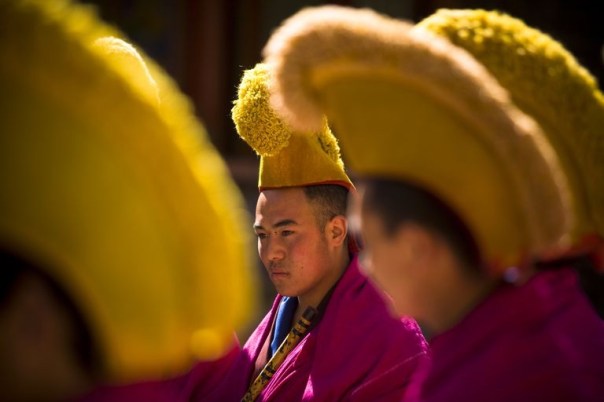
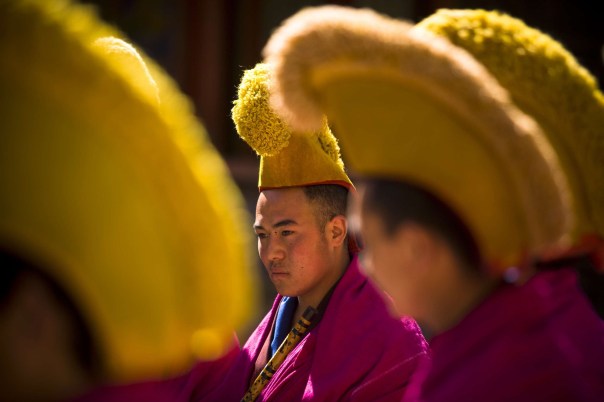
Gelug monks wear the yellow hats of their order during a formal ceremony. Jeff Hutchens / Getty Images
Gelugpa is best known in the West as the school of Tibetan Buddhism associated with His Holiness the Dalai Lama. In the 17th century, the Gelug (also spelled Geluk) school became the most powerful institution in Tibet, and it remained so until China took control of Tibet in the 1950s.
The story of Gelugpa begins with Tsongkhapa (1357-1419), a man from Amdo Province who began studying with a local Sakya lama at a very young age. At 16 he traveled to central Tibet, where the most renowned teachers and monasteries were located, to further his education.
Tsongkhapa did not study in any one place. He stayed in Kagyu monasteries learning Tibetan medicine, the practices of Mahamudra and the tantra yoga of Atisha. He studied philosophy in Sakya monasteries. He sought independent teachers with fresh ideas. He was particularly interested in the Madhyamika teachings of Nagarjuna.
In time, Tsongkhapa combined these teachings into a new approach to Buddhism. He explained his approach in two major works, Great Exposition of the Stages of the Path and Great Exposition of the Secret Mantra. Other of his teachings were collected in several volumes, 18 in all.
Through most of his adult life, Tsongkhapa traveled around Tibet, often living in camps with dozens of students. By the time Tsongkhapa had reached his 50s, the rugged lifestyle had taken a toll on his health. His admirers built him a new monastery on a mountain near Lhasa. The monastery was named “Ganden,” which means “joyful.” Tsongkhapa lived there only briefly before he died, however.
The Founding of Gelugpa
At the time of his death, Tsongkhapa and his students were considered to be part of the Sakya school. Then his disciples stepped up and built a new school of Tibetan Buddhism on Tsongkhapa’s teachings. They called the school “Gelug,” which means “the virtuous tradition.” Here are some of Tsongkhapa’s most prominent disciples:
Gyaltsab (1364-1431) is thought to have been first the abbot of Gendun after Tsongkhapa died. This made him the first Ganden Tripa, or throne-holder of Gendun. To this day the Ganden Tripa is the actual, official head of the Gelug school, not the Dalai Lama.
Jamchen Chojey (1355-1435) founded the great Sera monastery of Lhasa.
Khedrub (1385-1438) is credited with defending and promoting Tsongkhapa’s teachings throughout Tibet. He also began the tradition of high lamas of Gelug wearing yellow hats, to distinguish them from Sakya lamas, who wore red hats.
Gendun Drupa (1391-1474) founded the great monasteries of Drepung and Tashillhunpo, and during his life, he was among the most respected scholars in Tibet.
The Dalai Lama
A few years after Gendun Drupa died, a young boy of central Tibet was recognized as his tulku, or rebirth. Eventually, this boy, Gendun Gyatso (1475-1542) would serve as abbot of Drepung, Tashillhunpo, and Sera.
Sonam Gyatso (1543-1588) was recognized as the rebirth of Gendun Gyatso. This tulku became the spiritual adviser to a Mongol leader named Altan Khan. Altan Khan gave Gendun Gyatso the title “Dalai Lama,” meaning “ocean of wisdom.” Sonam Gyatso is considered to be the third Dalai Lama; his predecessors Gendun Drupa and Gendun Gyatso were named first and second Dalai Lama, posthumously.
These first Dalai Lamas had no political authority. It was Lobsang Gyatso, the “Great Fifth” Dalai Lama (1617-1682), who forged a fortuitous alliance with another Mongol leader, Gushi Khan, who conquered Tibet. Gushi Khan made Lobsang Gyatso the political and spiritual leader of the entire Tibetan people.
Under the Great Fifth a large part of another school of Tibetan Buddhism, Jonang, was absorbed into Gelugpa. The Jonang influence added Kalachakra teachings to Gelugpa. The Great Fifth also initiated the building of Potala Palace in Lhasa, which became the seat of both spiritual and political authority in Tibet.
Today many people think the Dalai Lamas held absolute power in Tibet as “god-kings,” but that is inaccurate. The Dalai Lamas who came after the Great Fifth was, for one reason or another, mostly figureheads who held little real power. For long stretches of time, various regents and military leaders were actually in charge.
Not until the 13th Dalai Lama, Thubten Gyatso (1876-1933), would another Dalai Lama function as a real head of government, and even he had limited authority to enact all the reforms he wished to bring to Tibet.
The current Dalai Lama is the 14th, His Holiness Tenzin Gyatso (born 1935). He was still an adolescent when China invaded Tibet in 1950. His Holiness has been exiled from Tibet since 1959. Recently he relinquished all political power over the Tibetan people in exile, in favor of a democratic, elected government.
The Panchen Lama
The second highest lama in Gelugpa is the Panchen Lama. The title Panchen Lama, meaning “great scholar,” was bestowed by the Fifth Dalai Lama on a tulku who was fourth in a lineage of rebirths, and so he became the 4th Panchen Lama.
The current Panchen Lama is the 11th. However, His Holiness Gedhun Choekyi Nyima (born 1989) and his family were taken into Chinese custody shortly after his recognition was made public in 1995. The Panchen Lama and his family have not been seen since. A pretender appointed by Beijing, Gyaltsen Norbu, has served as Panchen Lama in his place.
Gelugpa Today
The original Ganden monastery, Gelugpa’s spiritual home, was destroyed by Chinese troops during the 1959 Lhasa uprising. During the Cultural Revolution, the Red Guard came to finish whatever was left. Even the mummified body of Tsongkhapa was ordered burned, although a monk was able to recover a skull and some ashes. The Chinese government is rebuilding the monastery.
Meanwhile, exiled lamas re-established Ganden in Karnataka, India, and this monastery is now Gelugpa’s spiritual home. The current Ganden Tripa, the 102nd, is Thubten Nyima Lungtok Tenzin Norbu. (Ganden Tripas are not tulkus but are appointed to the position as adults.) The training of new generations of Gelugpa monks and nuns continues.
His Holiness the 14th Dalai Lama has lived in Dharamsala, India since he left Tibet in 1959. He has dedicated his life to teaching and to gain greater autonomy for Tibetans still under Chinese rule.
Reference
O’Brien, Barbara. “The Gelug School of Tibetan Buddhism.” Learn Religions, Feb. 11, 2020, learnreligions.com/the-gelug-school-of-tibetan-buddhism-449627.
Buddhism first reached Tibet in the 7th century. By the 8th-century teachers such as Padmasambhava were traveling to Tibet to teach the dharma. In time Tibetans developed their own perspectives and approaches to the Buddhist path.
The list below is of the major distinctive traditions of Tibetan Buddhism. This is only a brief glimpse of rich traditions that have branched into many sub-schools and lineages.
Nyingmapa is the oldest school of Tibetan Buddhism. It claims as its founder Padmasambhava, also called Guru Rinpoche, “Beloved Master,” which places its beginning in the late 8th century. Padmasambhava is credited with building Samye, the first monastery in Tibet, in about 779 CE.
Along with tantric practices, Nyingmapa emphasizes revealed teachings attributed to Padmasambhava plus the “great perfection” or Dzogchen doctrines.
The Kagyu school emerged from the teachings of Marpa “The Translator” (1012-1099) and his student, Milarepa. Milarepa’s student Gampopa is the main founder of Kagyu. Kagyu is best known for its system of meditation and practice called Mahamudra.
The head of the Kagyu school is called the Karmapa. The current head is the Seventeenth Gyalwa Karmapa, Ogyen Trinley Dorje, who was born in 1985 in the Lhathok region of Tibet.
In 1073, Khon Konchok Gyelpo (1034-l102) built Sakya Monastery in southern Tibet. His son and successor, Sakya Kunga Nyingpo, founded the Sakya sect. Sakya teachers converted the Mongol leaders Godan Khan and Kublai Khan to Buddhism. Over time, Sakyapa expanded to two subsects called the Ngor lineage and the Tsar lineage. Sakya, Ngor and Tsar constitute the three schools (Sa-Ngor-Tsar-gsum) of the Sakyapa tradition.
The central teaching and practice of Sakyapa is called Lamdrey (Lam-‘bras), or “the Path and Its Fruit.” The headquarters of the Sakya sect today are at Rajpur in Uttar Pradesh, India. The current head is the Sakya Trizin, Ngakwang Kunga Thekchen Palbar Samphel Ganggi Gyalpo.
The Gelugpa or Gelukpa school, sometimes called the “yellow hat” sect of Tibetan Buddhism, was founded by Je Tsongkhapa (1357-1419), one of Tibet’s greatest scholars. The first Gelug monastery, Ganden, was built by Tsongkhapa in 1409.
The Dalai Lamas, who have been spiritual leaders of the Tibetan people since the 17th century, come from the Gelug school. The nominal head of Gelugpa is the Ganden Tripa, an appointed official. The current Ganden Tripa is Thubten Nyima Lungtok Tenzin Norbu.
The Gelug school places great emphasis on monastic discipline and sound scholarship.
JONANGPA
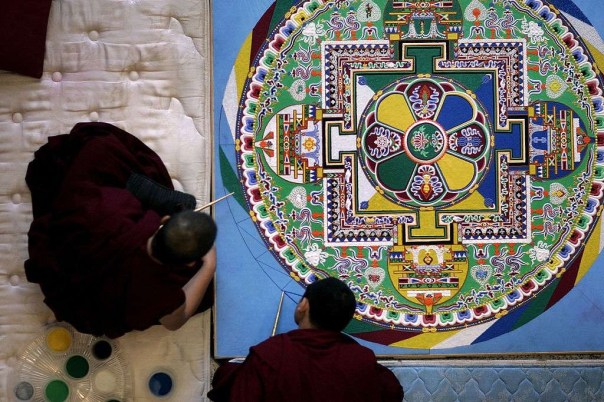
Tibetan monks work on creating an intricate sand drawing, known as a mandala, at the Broward County Main Library February 6, 2007 in Fort Lauderdale, Florida. Joe Raedle / Staff / Getty Images
Jonangpa was founded in the late 13th century by a monk named Kunpang Tukje Tsondru. Jonangpa is distinguished chiefly by kalachakra, its approach to tantra yoga.
In the 17th-century the 5th Dalai Lama forcibly converted the Jonangs into his school, Gelug. Jonangpa was thought to be extinct as an independent school. However, in time it was learned that a few Jonang monasteries had maintained independence from Gelug.
Jonangpa is now officially recognized as an independent tradition once again.
When Buddhism arrived in Tibet it competed with indigenous traditions for the loyalty of Tibetans. These indigenous traditions combined elements of animism and shamanism. Some of the shaman priests of Tibet were called “bon,” and in time “Bon” became the name of the non-Buddhist religious traditions that lingered in Tibetan culture.
In time elements of Bon were absorbed into Buddhism. At the same time, Bon traditions absorbed elements of Buddhism, until Bonpo seemed more Buddhist than not. Many adherents of Bon consider their tradition to be separate from Buddhism. However, His Holiness the 14th Dalai Lama has recognized Bonpo as a school of Tibetan Buddhism.
Sami Sarkis / Photographer’s Choice RF / Getty Images
The standard answer to the question “What is a Buddha?” is, “A Buddha is someone who has realized the enlightenment that ends the cycle of birth and death and which brings liberation from suffering.”
Buddha is a Sanskrit word that means “awakened one.” He or she is awakened to the true nature of reality, which is a short definition of what English-speaking Buddhists call “enlightenment.”
A Buddha is also someone who has been liberated from Samsara, the cycle of birth and death. He or she is not reborn, in other words. For this reason, anyone who advertises himself as a “reincarnated Buddha” is confused, to say the least.
However, the question “What is a Buddha?” could be answered many other ways.
Buddhas in Theravada Buddhism
There are two major schools of Buddhism, most often called Theravada and Mahayana. For purposes of this discussion, Tibetan and other schools of Vajrayana Buddhism are included in “Mahayana.” Theravada is the dominant school in southeast Asia (Sri Lanka, Burma, Thailand, Laos, Cambodia) and Mahayana is the dominant school in the rest of Asia.
According to Theravada Buddhists, there is only one Buddha per age of the earth, and ages of the earth last a very long time.
The Buddha of the current age is the Buddha, the man who lived about 25 centuries ago and whose teachings are the foundation of Buddhism. He is sometimes called Gautama Buddha or (more often in Mahayana) Shakyamuni Buddha. We also often refer to him as ‘the historical Buddha.’
Early Buddhist scriptures also record names of the Buddhas of earlier ages. The Buddha of the next, future age is Maitreya.
Note that the Theravadins are not saying that only one person per age may be enlightened. Enlightened women and men who are not Buddhas are called arhats or arahants. The significant difference that makes a Buddha a Buddha is that a Buddha is the one who has discovered the dharma teachings and made them available in that age.
Buddhas in Mahayana Buddhism
Mahayana Buddhists also recognize Shakyamuni, Maitreya, and the Buddhas of previous ages. Yet they don’t limit themselves to one Buddha per age. There could be infinite numbers of Buddhas. Indeed, according to the Mahayana teaching of Buddha Nature, “Buddha” is the fundamental nature of all beings. In a sense, all beings are Buddha.
Mahayana art and scriptures are populated by a number of particular Buddhas who represent various aspects of enlightenment or who carry out particular functions of enlightenment. However, it’s a mistake to consider these Buddhas as god-like beings separate from ourselves.
To complicate matters further, the Mahayana doctrine of the Trikaya says that each Buddha has three bodies. The three bodies are called dharmakaya, sambhogakaya, and nirmanakaya. Very simply, dharmakaya is the body of absolute truth, sambhogakaya is the body that experiences the bliss of enlightenment, and nirmanakaya is the body that manifests in the world.
In Mahayana literature, there is an elaborate schema of transcendent (dharmakaya and sambhogakaya) and earthly (nirmanakaya) Buddhas who correspond to each other and represent different aspects of the teachings. You will stumble upon them in the Mahayana sutras and other writings, so it’s good to be aware of who they are.
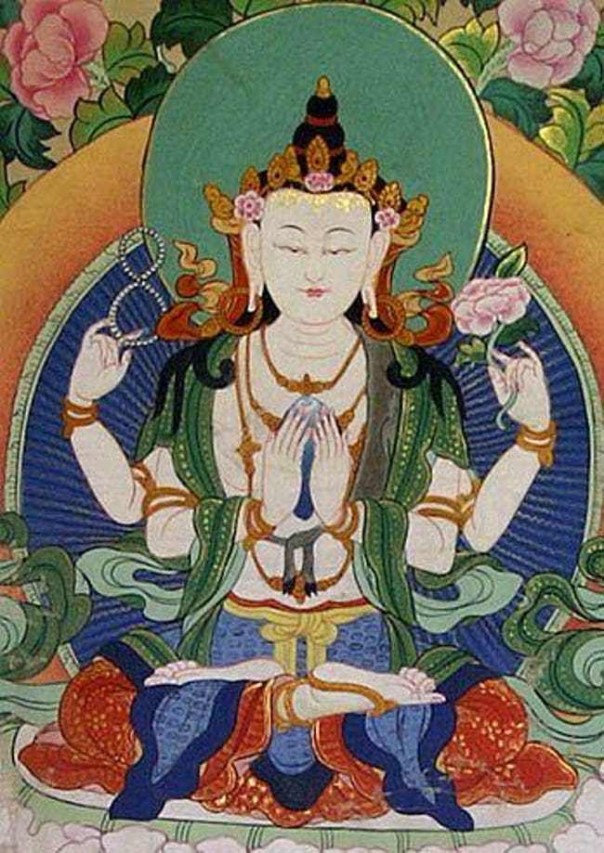
Amitabha, the Buddha of Boundless Light and the principal Buddha of the Pure Land school.
Bhaiṣajyaguru, the Medicine Buddha, who represents the power of healing.
Vairocana, the universal or primordial Buddha.
Oh, and about the fat, laughing Buddha — he emerged from Chinese folklore in the 10th century. He is called Pu-tai or Budai in China and Hotei in Japan. It is said that he is an incarnation of the future Buddha, Maitreya.
All Buddhas Are One
The most important thing to understand about the Trikaya is that the countless Buddhas are, ultimately, one Buddha, and the three bodies are also our own body. A person who has intimately experienced the three bodies and realized the truth of these teachings is called a Buddha.
Reference
O’Brien, Barbara. “What Is a Buddha? Who Was the Buddha?” Learn Religions, Feb. 11, 2020, learnreligions.com/whats-a-buddha-450195.
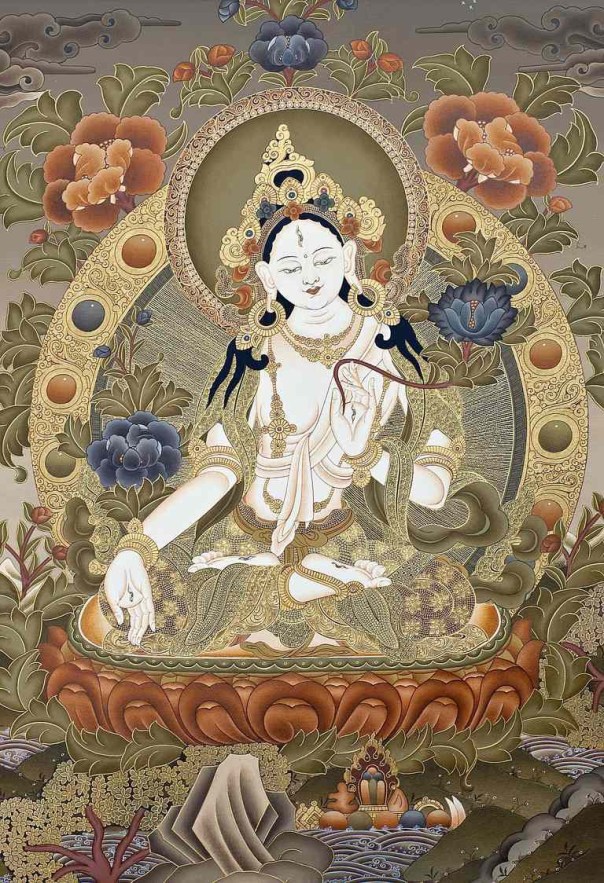
White Tara; detail from a Tibetan Tangka painting. Zzvet / Dreamstime.com
Tara is an iconic Buddhist goddess of many colors. Although she is formally associated only with Buddhism in Tibet, Mongolia, and Nepal, she has become one of the most familiar figures of Buddhism around the world.
She is not exactly the Tibetan version of the Chinese Guanyin (Kwan-yin), as many assume. Guanyin is a manifestation in the female form of Avalokiteshvara Bodhisattva. Avalokiteshvara is called Chenrezig in Tibet, and in Tibetan Buddhism Chenrezig usually is a “he” rather than a “she.” He is the universal manifestation of compassion.
According to one story, when Chenrezig was about to enter Nirvana he looked back and saw the suffering of the world, and he wept and vowed to remain in the world until all beings were enlightened. Tara is said to have been born from Chenrezig’s tears. In a variation of this story, his tears formed a lake, and in that lake, a lotus grew, and when it opened Tara was revealed.
Tara’s origins as an icon are unclear. Some scholars propose that Tara evolved from the Hindu goddess Durga. She appears to have been venerated in Indian Buddhism no earlier than the 5th century.
Tara in Tibetan Buddhism
Although Tara probably was known in Tibet earlier, the cult of Tara appears to have reached Tibet in 1042, with the arrival of an Indian teacher named Atisa, who was a devotee. She became one of the most beloved figures of Tibetan Buddhism.
Her name in Tibetan is Sgrol-ma, or Dolma, which means “she who saves.” It is said her compassion for all beings is stronger than a mother’s love for her children. Her mantra is om tare tuttare ture svaha, which means, “Praise to Tara! Hail!”
White Tara and Green Tara
There are actually 21 Taras, according to an Indian text called Homage to the Twenty-One Taras that reached Tibet in the 12th century. The Taras come in many colors, but the two most popular are White Tara and Green Tara. In a variation of the original legend, White Tara was born from the tears from Chenrezig’s left eye, and Green Tara was born from the tears of his right eye.
In many ways, these two Taras complement each other. Green Tara often is depicted with a half-open lotus, representing night. White Tara holds a fully blooming lotus, representing the day. White Tara embodies grace and serenity and the love of a mother for her child; Green Tara embodies activity. Together, they represent boundless compassion that is active in the world both day and night.
Tibetans pray to White Tara for healing and longevity. White Tara initiations are popular in Tibetan Buddhism for their power to dissolve obstacles. The White Tara mantra in Sanskrit is:
Green Tara is associated with activity and abundance. Tibetans pray to her for wealth and when they are leaving on a journey. But the Green Tara mantra actually is a request to be freed from delusions and negative emotions.
As tantric deities, their role is not as objects of worship. Rather, through esoteric means, the tantric practitioner realizes himself as White or Green Tara and manifests their selfless compassion.
Other Taras
The names of the remaining Taras vary a bit according to the source, but some of the better-known ones are:
Red Tara:is said to have the quality of attracting blessings.
Black Tara:is a wrathful deity who wards off evil.
Yellow Tara:helps us overcome anxiety. She is also associated with abundance and fertility.
Blue Tara:subdues anger and turns it into compassion.
Cittamani Tara:is a deity of high tantra yoga. She is sometimes confused with Green Tara.
Reference
O’Brien, Barbara. “Buddhist Goddess and Archetype of Compassion.” Learn Religions, Feb. 11, 2020, learnreligions.com/tara-archetype-of-compassion-450180.
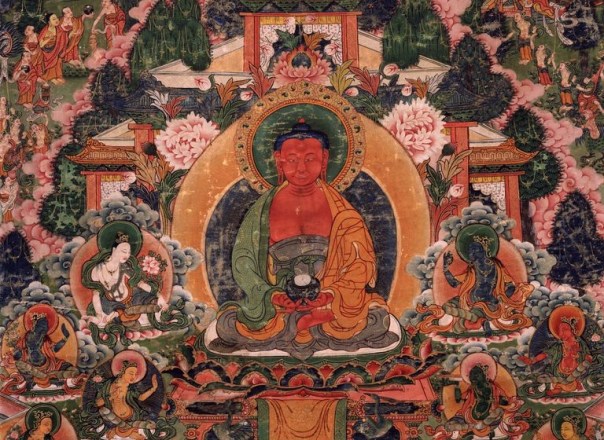
Amitabha Buddha in the Pure Land of Suvakti. Rubin Museum of Art
The “pure lands” of Buddhism can sound a little like heaven; places where “good” people go when they die. But that’s not what they are. There are, however, many different ways to understand them.
A “pure land” often is understood to be a place where dharma teachings are everywhere and enlightenment is easily obtained. This “place” may be a state of mind rather than a physical place, however. If it is a physical place, it may or may not be physically separate from the mundane world.
However one enters a pure land, it is not an everlasting reward. Although there are many kinds of pure lands, for the unenlightened they are best thought of as a place where one may dwell only for a time.
Although pure lands are mostly associated with the Pure Land traditions, such as Jodo Shinshu, you can find references to pure lands in commentaries by teachers of many Mahayana schools. Pure lands also are mentioned in many Mahayana sutras.
Origins of Pure Lands
The concept of a pure land appears to have originated in early Mahayana.in India. If enlightened beings choose to not enter Nirvana until all beings are enlightened, it was thought, then these purified beings must live in a purified place. Such a purified place was called a Buddha-ksetra, or Buddha-field.
Many different views of pure lands arose. The Vimalakirti Sutra (ca. 1st century CE), for example, teaches that enlightened beings perceive the essential purity of the world, and thus dwell in purity — a “pure land.” Beings whose minds are muddled by defilement perceive a world of defilement.
Others thought of pure lands as distinctive realms, although these realms were not separate from samsara. In time a kind of mystical cosmos of pure lands emerged in Mahayana teaching, and each pure land became associated with a particular Buddha.
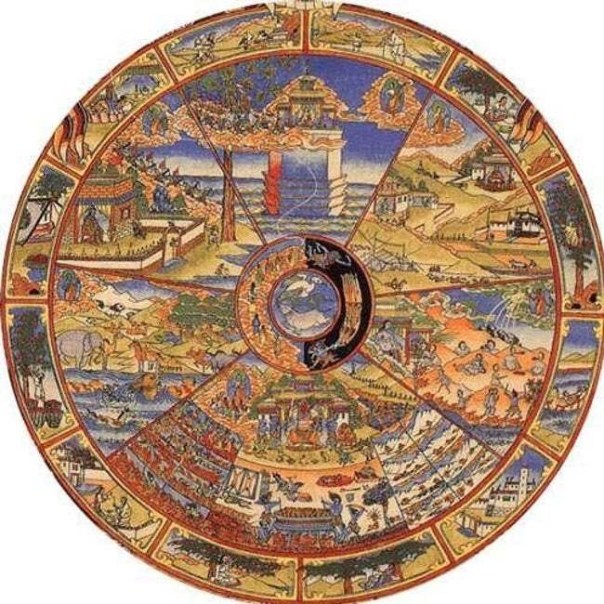
The Pure Land school, which emerged in 5th century China, popularized the idea that some of these Buddhas could bring unenlightened beings into their pure lands. Within the pure land, enlightenment could easily be realized. A being who did not achieve Buddhahood eventually might be reborn elsewhere in the Six Realms, however.
There is no fixed number of pure lands, but there are just a few widely known by name. The three you will most commonly find referenced in commentaries and sutras are Sukhavati, Abhirati, and Vaiduryanirbhasa. Note that directions associated with particular pure lands are iconographical, not geographical.
Sukhavati, the Western Pure Land
Sukhavati the “realm of bliss,” is ruled by Amitabha Buddha. Most of the time, when Buddhists talk about THE Pure Land, they are talking about Sukhavati. Devotion to Amitabha and faith in Amitabha’s power to bring the faithful into Sukhavati is central to Pure Land Buddhism.
Sutras of the Pure Land school describe Sukhavati as a place filled with gentle light, the music of birdsong and the fragrance of flowers. Trees are adorned with jewels and golden bells. Amitabha is attended by the bodhisattvas Avalokiteshvara and Mahasthamaprapta, and he presides over all sitting on a lotus throne.
Abhirati, the Eastern Pure Land
Abhirati, the “realm of joy,” is thought to be the purest of all pure lands. It is ruled by Akshobhya Buddha. There was once a tradition of devotion to Akshobhya in order to be reborn in Abhirati, but in recent centuries this was eclipsed by devotion to the Medicine Buddha.
Vaiduryanirbhasa, the Other Eastern Pure Land
The name Vaiduryanirbhasa means “pure lapis lazuli.” This pure land is ruled by the Medicine Buddha, Bhaisajyaguru, who is often depicted in iconography holding a lapis blue jar or bowl containing medicine. Medicine Buddha mantras often are chanted on behalf of the sick. In many Mahayana temples, you will find altars to both Amitabha and Bhaisajyaguru.
Yes, there is a Southern Pure Land, Shrimat, ruled by Ratnasambhava Buddha and a Northern Pure Land, Prakuta, ruled by Amoghasiddhi Buddha, but these are far less prominent.
Reference
O’Brien, Barbara. “The Buddhist Pure Lands.” Learn Religions, Feb. 11, 2020, learnreligions.com/pure-lands-450045.
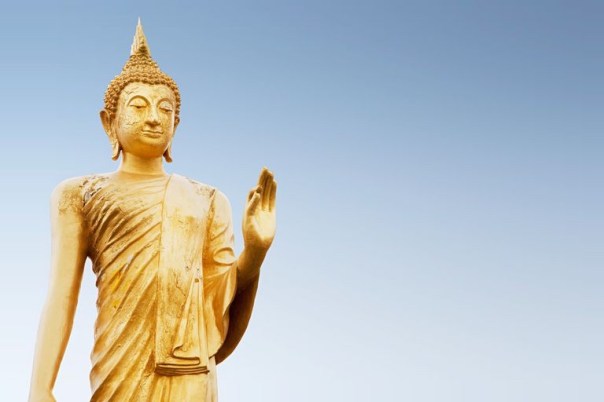
A standing Buddha figure in Thailand. Image Source/Getty Images
The Sanskrit / Pali word Tathagata usually is translated “the one who has thus gone.” Or, it is “one who has thus come.” Tathagata is a title for a buddha, one who has realized enlightenment.
Meaning of Tathagata
Looking at the root words: Tatha can be translated “so,” “such,” “thus,” or “in this manner.” Agata is “came” or “arrived.” Or, the root may be gata, which is “gone.” It’s not clear which root word is intended — arrived or gone — but an argument can be made for either.
People who like the “Thus Gone” translation of Tathagata understand it to mean someone who has gone beyond ordinary existence and will not return. “Thus come” could refer to one who is presenting enlightenment in the world.
Other of the many renderings of the title include “One who has become perfect” and “One who has discovered truth.”
In the sutras, Tathagata is a title the Buddha himself uses when speaking of himself or of buddhas generally. Sometimes when a text refers to the Tathagata, it is referencing the historical Buddha. But that isn’t always true, so pay attention to context.
The Buddha’s Explanation
Why did the Buddha call himself Tathagata? In the PaliSutta-pitaka, in Itivuttaka § 112 (Khuddaka Nikaya), the Buddha provided four reasons for the title Tathagata.
First, everything in this world, “whatever is seen, heard, sensed, cognized, attained, sought, and reflected upon by the mind,” is fully understood by a Tathagata.
Second, from the moment a being realizes complete enlightenment until he passes intoNirvana, leaving no trace behind, whatever he teaches is just so (tatha) and not otherwise.
Third, what he does is in the manner of (tatha) what he teaches. Likewise, what he teaches is what he does.
Fourth, among all other beings in this world, a Tathagata is the conqueror, unvanquished, all-seeing, and the wielder of power.
For these reasons, the Buddha said, he is called the Tathagata.
In Mahayana Buddhism
Mahayana Buddhists connect Tathagata to the doctrine of suchness or tathata. Tathata is a word used for “reality,” or the way things really are. Because the true nature of reality cannot be conceptualized or explained with words, “suchness” is a deliberately vague term to keep us from conceptualizing it.
It is sometimes understood in Mahayana that the appearance of things in the phenomenal world are manifestations of tathata. The word tathata is sometimes used interchangeably with sunyata or emptiness. Tathata would be the positive form of emptiness — things are empty of self-essence, but they are “full” of reality itself, of suchness. One way to think of the Tathagata-Buddha, then, would be as a manifestation of suchness.
As used in the Prajnaparamita Sutras, Tathagata is the inherent suchness of our existence; the ground of being; the dharmakaya; Buddha Nature.
Reference
O’Brien, Barbara. “Tathagata: One Who Is Thus Gone.” Learn Religions, Feb. 11, 2020, learnreligions.com/tathagata-449867.
Although we often speak of “the Buddha,” there are many Buddhas in Buddhism. On top of that, the many Buddhas come with many names and forms and play multiple roles. The word “Buddha” means one who woke up,” and in Buddhist doctrine, any such enlightened individual is technically a Buddha. In addition, the word Buddha is often used to mean the principle of Buddha-nature. But of course, there is one historical figure that normally is considered the Buddha.
Shakyamuni Buddha is a name given to the historical Buddha, especially in Mahayana Buddhism. So it’s nearly always the case that when someone is talking about Shakyamuni, he or she is speaking of the historical figure who was born Siddhartha Gautama but then became known as Shakyamuni only after he became the Buddha. This person, after his enlightenment, is also sometimes called Gautama Buddha.
However, people also speak of Shakyamuni as a more transcendent figure who still is, and not as a historical figure who lived a long time ago. Especially if you are new to Buddhism, this may be confusing. Let’s take a look at Shakyamuni Buddha and his role in Buddhism.
The Historical Buddha
The future Shakyamuni Buddha, Siddhartha Gautama, was born in the 5th or 6th century BCE in what is now Nepal. Although historians believe there was such a person, much of his life story is shrouded in legend and myth.
According to legend, Siddhartha Gautama was the son of a king, and as a youth and young adult, he lived a sheltered and pampered life. In his late 20s, he was shocked to witness sickness, old age, and death for the first time, and he was filled with such dread he resolved to give up his royal birthright to seek peace of mind.
After several false starts, Siddhartha Gautama eventually settled determinately into deep meditation under the famous Bodhi tree in Bodh Gaya, in North Eastern India, and realized enlightenment, at about the age of 35. From this point on he was called the Buddha, which means “one who woke up.” He spent the rest of his life teaching and died at about the age of 80, achieving Nirvana. More detail about the life of the Buddha can be read in The Life of the Buddha.
About the Shakya
The name Shakyamuni is Sanskrit for “Sage of the Shakya.” Siddhartha Gautama was born a prince of the Shakya or Sakya, a clan who appear to have established a city-state with a capital in Kapilavatthu, in modern-day Nepal, about 700 BCE. The Shakya were believed to have been descendants of a very ancient Vedic sage named Gautama Maharishi, from whom they took the name Gautama. There is a bit of legitimate documentation of the Shakya clan that can be found outside of Buddhist texts, so it appears the Shakya was not just an invention of Buddhist story-tellers.
If indeed Siddhartha was the heir of the Shakya king, as legends suggest, his enlightenment may have played a small role in the clan’s downfall. The Prince had married and had fathered a son before he left his home to seek wisdom, but the son, Rahula, eventually became his father’s disciple and a celibate monk, as did many young men of the Shakya nobility, according to the Tipitaka.
Early scriptures also say the Shakya and another clan, the Kosala, had long been at war. A peace agreement was sealed when the Kosala crown prince married a Shakya princess. However, the young woman sent by the Shakya to marry the prince actually was a slave, not a princess–a deception not discovered for a long time. The couple had a son, Vidudabha, who swore revenge when he learned the truth about his mother. He invaded and massacred the Shakya, then annexed Shakya territory into Kosala territory.
This happened near the time of the Buddha’s death. In his book, Confessions of a Buddhist Atheist Stephen Batchelor presents a plausible argument that the Buddha was poisoned because he was the most prominent surviving member of the Shakya royal family.
The Trikaya
According to the Trikaya doctrine of Mahayana Buddhism, a Buddha has three bodies, called dharmakaya, Samb Hoga kaya, and Nirvana kaya. The Nirvana kaya body is also called the “emanation” body because it is the body that appears in the phenomenal world. Shakyamuni is considered a Nirvana kaya Buddha because he was born, and walked the earth, and died.
The samghogakaya body is the body that feels the bliss of enlightenment. A Samb Hoga kaya Buddha is purified of defilement and is free of suffering, yet maintains a distinctive form. The dharmakaya body is beyond form and distinction.
The three bodies actually are one body, however. Although the name Shakyamuni usually is associated with the Nirvana kaya body only, occasionally in some schools Shakyamuni is spoken of as all bodies at once.
Queen Maya’s retreat to Lumbini to gave birth to Prince Siddharta Gautama (Buddha), the panel of Lalitavistara, Borobudur, Central Java, Indonesia. Gunawan Kartapranata/Wikimedia Commons
Aspects of the story of Buddha’s birth may have been borrowed from Hindu texts, such as the account of the birth of Indra from the Rig Veda. The story may also have Hellenic influences. For a time after Alexander the Great conquered central Asia in 334 BCE, there was a considerable intermingling of Buddhism with Hellenic art and ideas. There also is speculation that the story of the Buddha’s birth was “improved” after Buddhist traders returned from the Middle East with stories of the birth of Jesus.
The Traditional Tale of the Buddha’s Birth
Twenty-five centuries ago, King Suddhodana ruled a land near the Himalaya Mountains.
One day during a midsummer festival, his wife, Queen Maya, retired to her quarters to rest, and she fell asleep and dreamed a vivid dream, in which four angels carried her high into white mountain peaks and clothed her in flowers. A magnificent white bull elephant bearing a white lotus in its trunk approached Maya and walked around her three times. Then the elephant struck her on the right side with its trunk and vanished into her.
When Maya awoke, she told her husband about the dream. The King summoned 64 Brahmans to come and interpret it. Queen Maya would give birth to a son, the Brahmans said, and if the son did not leave the household, he would become a world conqueror. However, if he were to leave the household he would become a Buddha.
When the time for the birth grew near, Queen Maya wished to travel from Kapilavatthu, the King’s capital, to her childhood home, Devadaha, to give birth. With the King’s blessings, she left Kapilavatthu on a palanquin carried by a thousand courtiers.
On the way to Devadaha, the procession passed Lumbini Grove, which was full of blossoming trees. Entranced, the Queen asked her courtiers to stop, and she left the palanquin and entered the grove. As she reached up to touch the blossoms, her son was born.
Then the Queen and her son were showered with perfumed blossoms, and two streams of sparkling water poured from the sky to bathe them. And the infant stood, and took seven steps, and proclaimed “I alone am the World-Honored One!
Then Queen Maya and her son returned to Kapilavatthu. The Queen died seven days later, and the infant prince was nursed and raised by the Queen’s sister Pajapati, also married to King Suddhodana.
Symbolism
There is a jumble of symbols presented in this story. The white elephant was a sacred animal representing fertility and wisdom. The lotus is a common symbol of enlightenment in Buddhist art. A white lotus, in particular, represents mental and spiritual purity. The baby Buddha’s seven steps evoke seven directions—north, south, east, west, up, down, and here.
Buddha’s Birthday Celebration
In Asia, Buddha’s birthday is a festive celebration featuring parades with many flowers and floats of white elephants. Figures of the baby Buddha pointing up and down are placed in bowls, and sweet tea is poured over the figures to “wash” the baby.
Buddhist Interpretation
Newcomers to Buddhism tend to dismiss the Buddha birth myth as so much froth. It sounds like a story about the birth of a god, and the Buddha was not a god. In particular, the declaration “I alone am the World-Honored One” is a bit hard to reconcile with Buddhist teachings on nontheism and anatman.
However, in Mahayana Buddhism, this is interpreted as the baby Buddha speaking of the Buddha-nature that is the immutable and eternal nature of all beings. On Buddha’s birthday, some Mahayana Buddhists wish each other happy birthday, because the Buddha’s birthday is everyone’s birthday.
Reference
O’Brien, Barbara. “The Birth of the Buddha.” Learn Religions, Feb. 11, 2020, learnreligions.com/the-birth-of-the-buddha-449783.







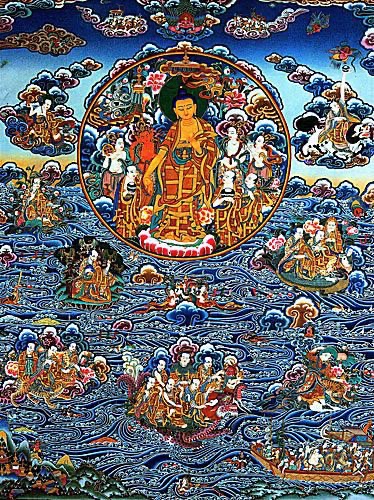

 timalderman


,_Ink,_mineral_pigments,_and_gold_on_silk,_Kimbell_Art_Museum.jpg)


