The Murder Of Police Whistle-Blower, Sallie-Anne Huckstepp

A man was walking his dog through Centennial Park in Sydney on the morning of February 7, 1986 when he noticed the body of a woman floating in Busby Pond. After police were alerted, two uniformed constables rowed out and dragged her in.

When detectives rolled her over on the riverbank, they realised it was 31-year old Sallie-Anne Huckstepp – the high-profile police whistle-blower and sex worker.

Huckstepp knew her days were numbered when she appeared on 60 Minutes in 1981and accused NSW detective sergeant Roger Rogerson of being a cold-blooded killer. The man she claimed Rogerson had killed was her boyfriend, heroin dealer Warren Lanfranchi.

The Lanfranchi hit

After robbing another dealer, Lanfranchi fired shots at a young policeman. To avoid facing charges, he asked his associate, notorious standover man Neddy Smith, to negotiate a price with Rogerson.

At the time, Rogerson had a sterling reputation in the force, and was slated to potentially become the next police commissioner.

Rogerson arranged for Neddy to drop Lanfranchi at Dangar Place in Chippendale, where he was waiting with 18 police officers.

He then shot Lanfranchi twice, later claiming it was in self-defence. Subsequent investigations found that while Rogerson may not have acted in self-defence, he had not done anything untoward. Rogerson was commended for his bravery.

Lanfranchi was the third man Rogerson had shot dead in a public place in five years.

Whistle-blowing

Two weeks later, Huckstepp turned up at police headquarters with her father and detailed a string of allegations against NSW police.

The claims included that Rogerson had executed her boyfriend, and stolen the $10,000 Lanfranchi had turned up to bribe the officer with. Huckstepp also gave details of payments she had been making to Vice and Drug Squad detectives for the past 10 years, while she had been a sex worker on Darlinghurst Road.

A life on the wild side

Huckstepp was born into a middle-class Jewish family and grew up in Sydney’s Eastern Suburbs. She attended the exclusive Dover Heights High School. But there was trouble at home. She didn’t get on with her step-mother and her behaviour became unruly.

At 14, she was sent to the Minda Remand Centre in Lidcombe. After being released, she found a job as a waitress at the Kings Cross club Whiskey A Go Go. She then got into heroin, and to support both her and her boyfriend’s habits, she started working the streets.

It was through her associations in Sydney’s underworld that Huckstepp became keenly aware that NSW police were heavily involved in criminal activities, and that Rogerson was one of the kingpins.

Partners in crime

In 1980, when Rogerson was moved to the Darlinghurst police station, he was the star detective of the Armed Holdup Squad. At the time, the heroin market was going through the roof in Kings Cross, and the opportunity to make some extra cash was hard to resist.

Neddy Smith was one of the top heroin distributors in the city, and he was raking it in. He and Rogerson formed a mutually-beneficial association.

Smith became a police whistle-blower in the early 1990s, testifying at the Independent Commission Against Corruption that Armed Holdup Squad detectives had been supplying information that enabled him to carry out a string of holdups.

However, Smith refused to name Rogerson during the hearing.

Society pages

Huckstepp had always lived a charmed, and somewhat tragic life. She shot to stardom after her television appearance, coming across as an articulate and engaging figure. And she had a significant impact in alerting the public to the high level of corruption amongst NSW police.

Penguin publishers gave her an advance to write an autobiography, and author Richard Neville arranged for her to move into artist Martin Sharp’s house.

Many believe her notoriety prevented Huckstepp from being knocked-off straightaway.

A life cut short

But by the time her body was dragged out of the water, five years had passed. She was using again and back working the streets. No one was paying attention anymore.

On the night she was murdered, Huckstepp received a phone call from heroin dealer Warren Richards: an associate of Rogerson and Smith. She told her flatmate that she had to step out for a moment, and would be back in 10 minutes. That was the last time she was seen alive.

False confessions

Smith ended up serving two life sentences for beating a tow truck driver to death, and for shooting brothel-keeper Harvey Jones. Police suspected that Smith was connected with a string of drug-related murders, so they bugged his cell and got his cellmate to chat with him.

Sure enough, Neddy bragged about killing seven people, one of which was Sallie-Anne. He outlined how he strangled her to death, and held her head under the water. His confession led to her body being exhumed from Rookwood Cemetery for DNA testing.

Smith later claimed he’d made up the story, as he knew he was being recorded. He went to trial for her murder, but was acquitted in 1999.

A clear statement

During a 2005 interview with John Dale – author of Huckstepp: A Dangerous Life – Smith claimed to have been at home with his wife on the night Sallie-Anne died.

He claimed Rogerson wanted Huckstepp dead because she was “bugging” him by “ringing him up and leaving messages that he was a dog.” He said it was an associate of Rogerson who strangled Huckstepp, performing the deed to get on the good side of the detective. He said the man had never been to prison.

Smith added that the reason Huckstepp was left floating in the pond was that Rogerson wanted to leave a message.

Just desserts

Rogerson had an alibi for the night of the murder – he was drinking with police prosecutor Mal Spence in a Merrylands pub.

But Rogerson had no alibi when he stood trial earlier this year for the murder of 20-year-old UTS student Jamie Gao, as he was captured on CCTV footage.

In June, he was found guilty of murdering Gao during a drug deal at a Padstow storage facility in May, 2014. In September, he was sentenced to life in prison.

Reference

Buddhism 101: Padmasambhava the Precious Guru of Tibetan Buddhism

John Elk III/Getty Images

Padmasambhava was an 8th-century master of Buddhist tantra who is credited with bringing Vajrayana to Tibet and Bhutan. He is revered today as one of the great patriarchs of Tibetan Buddhism and the founder of the Nyinmapa school as well as the builder of Tibet’s first monastery.

In Tibetan iconography, he is the embodiment of the dharmakaya. He is sometimes called “Guru Rinpoche,” or precious guru.

Padmasambhava may have been from Uddiyana, which was situated in what is now the Swat Valley of northern Pakistan. He was brought to Tibet during the reign of the Emperor Trisong Detsen, (742 to 797). He is associated with the building of the first Buddhist monastery in Tibet, Samye Gompa.

In History 

The historical narrative of Padmasambhava’s life begins with another Buddhist master named Shantarakshita. Shantarakshita came from Nepal at the invitation of Emperor Trisong Detsen, who was interested in Buddhism.

Unfortunately, Tibetans worried that Shantarakshita practiced black magic and he was kept in detention for a few months. Further, no one spoke his language. Months passed before a translator was found.

Eventually, Shantarakshita gained the Emperor’s trust and was allowed to teach. Some time after that, the Emperor announced plans to build a grand monastery. But a series of natural disasters — flooded temples, castles struck by lightning — stirred Tibetans’ fears that their local gods were angry about the plans for the temple. The Emperor sent Shantarakshita back to Nepal.

Some time passed and the disasters were forgotten. The Emperor asked Shantarakshita to return. But this time Shantarakshita brought another guru with him — Padmasambhava, who was a master of rituals to tame demons.

Early accounts say Padmasambhava divined which demons were causing the problems, and one by one he called them forth by name. He threatened each demon, and Shantarakshita — through a translator — taught them about karma. When he was finished, Padmasambhava informed the Emperor that building of his monastery could begin.

However, Padmasambhava was still viewed with suspicion by many at Trisong Detsen’s court. Rumors circulated that he would use magic to seize power and depose the Emperor. Eventually, the Emperor was worried enough that he suggested Padmasambhava might leave Tibet.

Padmasambhava was angry but agreed to leave. The Emperor was still worried, so he sent archers after Padmasambhava to put an end to him. Legends say Padmasambhava used magic to freeze his assassins and so escaped.

In Tibetan Mythology 

As time passed, Padmasambhava’s legend grew. The full account of Padmasambhava’s iconic and mythological role in Tibetan Buddhism would fill volumes, and there are stories and legends about him beyond counting. Here is a very abridged version of Padmasambhava’s mythic story.

Padmasambhava — whose name means “born of the lotus” — was born at the age of eight from a flowering lotus in Dhanakosha lake in Uddiyana. He was adopted by the king of Uddiyana. In adulthood, he was driven from Uddiyana by evil spirits.

Eventually, he came to Bodh Gaya, the place where the historical Buddharealized enlightenment and was ordained a monk. He studied at the great Buddhist university at Nalanda in India, and he was mentored by many significant teachers and spiritual guides.

He went to the Cima Valley and became the disciple of a great yogi named Sri Simha, and received tantric empowerments and teachings. Then he went to the Kathmandu Valley of Nepal, where he lived in a cave with the first of his consorts, Mandarava (also called Sukhavati). While there, the couple received texts on Vajrakilaya, an important tantric practice. Through Vajrakilaya, Padmasambhava and Mandarava realized great enlightenment.

Padmasambhava became a renowned teacher. On many occasions, he performed miracles that brought demons under control. This ability eventually took him to Tibet to cleanse the site of the Emperor’s monastery from demons. The demons — the gods of indigenous Tibetan religion — were converted to Buddhism and became dharmapalas, or protectors of the dharma.

Once the demons were pacified, the building of Tibet’s first monastery could be completed. The first monks of this monastery, Samye, were the first monks of Nyingmapa Buddhism.

Padmasambhava returned to Nepal, but seven years later he came back to Tibet. Emperor Trisong Detsen was so overjoyed to see him that he offered Padmasambhava all the wealth of Tibet. The tantric master refused these gifts. But he did accept a lady from the Emperor’s harem, the princess Yeshe Tsogyal, as his second consort, provided the princess accepted the relationship of her free will.

Together with Yeshe Tsogyal, Padmasambhava hid a number of mystic texts (terma) in Tibet and elsewhere. Terma are found when disciples are ready to understand them. One terma is the Bardo Thodol, known in English as the “Tibetan Book of the Dead.”

Yeshe Tsogyal became Padmasambhava’s dharma heir, and she transmitted the Dzogchen teachings to her disciples. Padmasambhava had three other consorts and the five women are called the Five Wisdom Dakinis.

The year after Tri-song Detsan died, Padmasambhava left Tibet for the last time. He dwells in spirit in a pure Buddha-field, Akanishta.

Iconography 

In Tibetan art, Padmasambhava is depicted in eight aspects:

  • Pema Gyalpo (Padmaraja) of Uddiyana, the Lotus Prince. He is depicted as a young prince.
  • Lo-den Chokse (Sthiramati) of Kashmir, the Intelligent Youth, beats a drum and holds a skull bowl.
  • Sakya-seng-ge (Bhikshu Sakyasimha) of Bodh Gaya, Lion of the Sakyas, is portrayed as an ordained monk.
  • Nyima O-zer (Suryabhasa) of Cina, the Sunray Yogi, wears only a loincloth and holds a trident pointing to the sun.
  • Seng-ge Dra-dok (Vadisimha) of Nalanda University, the Lion of Debate. He is usually dark blue and holds a dorje in one hand and a scorpion in the other.
  • Pema Jung-ne (Padmasambhava) of Zahor, the Lotus-born, wears monks’ robes and holds a skull bowl.
  • Pemakara of Tibet, Lotus-creator, sits on a lotus, wearing Tibetan monk’s robes and Tibetan boots. He holds a vajra in his right hand and a skull bowl in his left. He has a trident staff and a Nepalese cloth crown.
  • Dorje Dro-lo of Bhutan is a wrathful manifestation known as “Diamond Guts.”

Reference

  • O’Brien, Barbara. “Padmasambhava the Precious Guru of Tibetan Buddhism.” Learn Religions, Aug. 27, 2020, learnreligions.com/padmasambhava-450201.

Buddhism 101: How Buddhism Came to Tibet

A Thousand-Year History, 641 to 1642

Monastery in Tibet
Shigatse monastery in Tibet. Ratnakorn Piyasirisorost/Getty Images

The history of Buddhism in Tibet begins with Bon. The Bon religion of Tibet was animistic and shamanistic, and elements of it live on today, to one degree or another, in Tibetan Buddhism.

Although Buddhist scriptures may have made their way into Tibet centuries earlier, the history of Buddhism in Tibet effectively begins in 641 CE. In that year, King Songtsen Gampo (d. ca. 650) unified Tibet through military conquest and took two Buddhist wives, Princess Bhrikuti of Nepal and Princess Wen Cheng of China. The princesses are credited with introducing their husband to Buddhism.

Songtsen Gampo built the first Buddhist temples in Tibet, including the Jokhang in Lhasa and the Changzhug in Nedong. He also put Tibetan translators to work on the Sanskrit scriptures.

Guru Rinpoche and Nyingma 

During the reign of King Trisong Detsen, which began about 755 CE, Buddhism became the official religion of the Tibetan people. The King also invited famous Buddhist teachers such as Shantarakshita and Padmasambhava to Tibet.

Padmasambhava, remembered by Tibetans as Guru Rinpoche (“Precious Master”), was an Indian master of tantra whose influence on the development of Tibetan Buddhism is incalculable. He is credited with building Samye, the first monastery in Tibet, in the late 8th century. Nyingma, one of the four major schools of Tibetan Buddhism, claims Guru Rinpoche as its patriarch.

According to legend, when Guru Rinpoche arrived in Tibet he pacified the Bon demons and made them protectors of the Dharma.

Suppression 

In 836 King Tri Ralpachen, a supporter of Buddhism died. His half brother Langdarma became the new King of Tibet. Langdarma suppressed Buddhism and re-established Bon as the official religion of Tibet. In 842, Langdarma was assassinated by a Buddhist monk. Rule of Tibet was divided between Langdarma’s two sons. However, in the centuries that followed Tibet disintegrated into many small kingdoms.

Mahamudra 

While Tibet was plunged into chaos, there were developments in India that would be keenly important to Tibetan Buddhism. The Indian sage Tilopa (989-1069) developed a system of meditation and practice called Mahamudra. Mahamudra is, very simply, a methodology for understanding the intimate relation between mind and reality.

Tilopa transmitted the teachings of Mahamudra to his disciple, another Indian sage named Naropa (1016-1100).

Marpa and Milarepa 

Marpa Chokyi Lodro (1012-1097) was a Tibetan who traveled to India and studied with Naropa. After years of study, Marpa was declared a dharma heir of Naropa. He returned to Tibet, bringing with him Buddhist scriptures in Sanskrit that Marpa translated into Tibetan. Hence, is he called “Marpa the Translator.”

Marpa’s most famous student was Milarepa (1040-1123), who is remembered especially for his beautiful songs and poems.

One of Milarepa’s students, Gampopa (1079-1153), founded the Kagyu school, one of the four major schools of Tibetan Buddhism.

The Second Dissemination 

The great Indian scholar Dipamkara Shrijnana Atisha (ca. 980-1052) came to Tibet by invitation of King Jangchubwo. At the request of the King, Atisha wrote a book for the king’s subjects called Byang-chub lam-gyi sgron-ma, or “Lamp to the Path of Enlightenment.”

Although Tibet was still politically fragmented, Atisha’s arrival in Tibet in 1042 marked the beginning of what is called the “Second Dissemination” of Buddhism in Tibet. Through Atisha’s teachings and writings, Buddhism once again became the main religion of the people of Tibet.

Sakyas and Mongols 

In 1073, Khon Konchok Gyelpo (1034-l 102) built Sakya Monastery in southern Tibet. His son and successor, Sakya Kunga Nyingpo, founded the Sakya sect, one of the four major schools of Tibetan Buddhism.

In 1207, Mongol armies invaded and occupied Tibet. In 1244, Sakya Pandita Kunga Gyeltsen (1182-1251), a Sakya master was invited to Mongolia by Godan Khan, grandson of Genghis Khan. Through Sakya Pandita’s teachings, Godon Khan became a Buddhist. In 1249, Sakya Pandita was appointed Viceroy of Tibet by the Mongols.

In 1253, Phagba (1235-1280) succeeded Sakya Pandita at the Mongol court. Phagba became a religious teacher to Godan Khan’s famous successor, Kublai Khan. In 1260, Kublai Khan named Phagpa the Imperial Preceptor of Tibet. Tibet would be ruled by a succession of Sakya lamas until 1358 when central Tibet came under control of the Kagyu sect.

The Fourth School: Gelug 

The last of the four great schools of Tibetan Buddhism, the Gelug school, was founded by Je Tsongkhapa (1357-1419), one of Tibet’s greatest scholars. The first Gelug monastery, Ganden, was founded by Tsongkhapa in 1409.

The third head lama of the Gelug school, Sonam Gyatso (1543-1588) converted the Mongol leader Altan Khan to Buddhism. It is commonly believed that Altan Khan originated the title Dalai Lama, meaning “Ocean of Wisdom,” in 1578 to give to Sonam Gyatso. Others point out that since gyatso is Tibetan for “ocean,” the title “Dalai Lama” simply might have been a Mongol translation of Sonam Gyatso’s name—Lama Gyatso.

In any event, “Dalai Lama” became the title of the highest-ranking lama of the Gelug school. Since Sonam Gyatso was the third lama in that lineage, he became the 3rd Dalai Lama. The first two Dalai Lamas received the title posthumously.

It was the 5th Dalai Lama, Lobsang Gyatso (1617-1682), who first became ruler of all Tibet. The “Great Fifth” formed a military alliance with the Mongol leader Gushri Khan. When two other Mongol chiefs and the ruler of Kang, an ancient kingdom of central Asia, invaded Tibet, Gushri Khan routed them and declared himself king of Tibet. In 1642, Gushri Khan recognized the 5th Dalai Lama as the spiritual and temporal leader of Tibet.

The succeeding Dalai Lamas and their regents remained the chief administrators of Tibet until the invasion of Tibet by China in 1950 and the exile of the 14th Dalai Lama in 1959.

Reference

  • O’Brien, Barbara. “How Buddhism Came to Tibet.” Learn Religions, Aug. 27, 2020, learnreligions.com/how-buddhism-came-to-tibet-450177.

Buddhism 101: Early Buddhist History: The First Five Centuries

Buddhist monks’ procession in the Loy Krathong and Yi Peng Festival on November 24, 2012, in Chiangmai, Thailand.Bidouze Stéphane / Dreamstime.com

Any history of Buddhism must begin with the life of the historical Buddha, who lived and taught in Nepal and India 25 centuries ago. This article is the next part of the history — what happened to Buddhism after the Buddha’s death, about 483 BCE.

This next chapter of Buddhist history begins with the Buddha’s disciples. The Buddha had many lay followers, but most of his disciples were ordained monks and nuns. These monks and nuns did not live in monasteries. Instead, they were homeless, wandering through forests and villages, begging for food, sleeping under the trees. The only possessions monks were allowed to keep were three robes, one alms bowl, one razor, one needle, and one water strainer.

The robes had to be made from discarded cloth. It was a common practice to use spices such as turmeric and saffron to dye the cloth to make it more presentable — and possibly smell better. To this day, Buddhist monks’ robes are called “saffron robes” and are often (although not always) orange, the color of saffron.

Preserving the Teachings: The First Buddhist Council 

When the Buddha died, the monk who became a leader of the sangha was named Mahakashyapa. The early Pali texts tell us that, shortly after the Buddha’s death, Mahakashyapa called a meeting of 500 monks to discuss what to do next. This meeting came to be called the First Buddhist Council.

The questions at hand were: How would the Buddha’s teachings be preserved? And by what rules would the monks live? Monks recited and reviewed the Buddha’s sermons and his rules for monks and nuns, and agreed which were authentic.

According to historian Karen Armstrong (Buddha, 2001), about 50 years after the Buddha’s death, monks in the eastern part of North India began to collect and order the texts in a more systematic way. The sermons and rules were not written down but had been preserved by memorizing and reciting them. The Buddha’s words were set in verse, and in lists, to make them easier to memorize. Then the texts were grouped into sections, and monks were assigned what part of the canon they would memorize for the future.

Sectarian Divisions: The Second Buddhist Council 

By about a century after the Buddha’s death, sectarian divisions were forming in the sangha. Some early texts refer to “eighteen schools,” which did not appear to be markedly different from one another. Monks of different schools often lived and studied together.

The biggest rifts formed around questions of monastic discipline and authority. Among the distinctive factions were these two schools:

  • Sthaviravada: “Sthaviravada” is Sanskrit for “the Way of the Elders.” The Sthaviavada school was conservative, adhering closely to the teachings and rules of the Pali Canon. The school lives today in parts of Asia by its Pali name, Theravada.
  • Mahasanghika: This school probably is a forerunner of Mahayana Buddhism. Mahasanghika developed the idea of the transcendent nature of a Buddha, the ideal of the bodhisattva, and the doctrine of shunyata, or “emptiness.” This school advocated a somewhat more liberal approach to the monastic rules.

A Second Buddhist Council was called about 386 BCE in an attempt to unify the sangha, but sectarian fissures continued to form.

The Emperor Ashoka 

Ashoka (ca. 304–232 BCE; sometimes spelled Asoka) was a warrior-prince of India known for his ruthlessness. According to legend, he was first exposed to Buddhist teaching when some monks cared for him after he was wounded in battle. One of his wives, Devi, was a Buddhist. However, he was still a cruel and brutal conqueror until the day he walked into a city he had just conquered and saw the devastation. “What have I done?” he cried and vowed to observe the Buddhist path for himself and for his kingdom.

Ashoka came to be the ruler of most of the Indian subcontinent. He erected pillars throughout his empire inscribed with the Buddha’s teachings. According to legend, he opened seven of the original eight stupas of the Buddha, further divided the Buddha’s relics, and erected 84,000 stupas in which to enshrine them. He was a tireless supporter of the monastic sangha and supported missions to spread the teachings beyond India, in particular into present-day Pakistan, Afghanistan, and Sri Lanka. Ashoka’s patronage made Buddhism one of the major religions of Asia.

The Two Third Councils 

By the time of Ashoka’s reign, the rift between Sthaviravada and Mahasanghika had grown large enough that the history of Buddhism splits into two very different versions of the Third Buddhist Council.

The Mahasanghika version of the Third Council was called to determine the nature of an Arhat. An arhat (Sanskrit) or arahant (Pali) is a person who has realized enlightenment and may enter Nirvana. In the Sthaviravada school, an arhat is the ideal of Buddhist practice.

A monk named Mahadeva proposed that an arhat is still subject to temptation, ignorance, and doubt, and still benefits from teaching and practice. These propositions were adopted by the Mahasanghika school but rejected by Sthaviravada.

In the Sthaviravada version of history, the Third Buddhist Council was called by Emperor Ashoka about 244 BCE to stop the spread of heresies. After this Council completed its work the monk Mahinda, thought to be a son of Ashoka, took the body of doctrine agreed upon by the Council into Sri Lanka, where it flourished. The Theravada school that exists today grew from this Sri Lankan lineage.

One More Council 

The Fourth Buddhist Council probably was a synod of the emerging Theravada school, although there are multiple versions of this history, also. According to some versions, it was at this council, held in Sri Lanka in the 1st century BCE, that the final version of the Pali Canon was put in writing for the first time. Other accounts say the Canon was written down a few years later.

The Emergence of Mahayana 

It was during the 1st century BCE that Mahayana Buddhism emerged as a distinctive school. Mahayana possibly was an offspring of Mahasanghika, but there probably were other influences also. The important point is that Mahayana views didn’t happen for the first time in the 1st century, but had been evolving for a long time.

During the 1st century BCE The name Mahayana, or “great vehicle,” was established to distinguish this divergent school from Theravada/Sthaviravada school. Theravada was derided as “Hinayana,” or the “lesser vehicle.” The names point to the distinction between Theravada’s emphasis on individual enlightenment and the Mahayana ideal of the enlightenment of all beings. The name “Hinayana” is generally considered to be a pejorative.

Today, Theravada and Mahayana remain the two primary doctrinal divisions of Buddhism. Theravada for centuries has been the dominant form of Buddhism in Sri Lanka, Thailand, Cambodia, Burma (Myanmar) and Laos. Mahayana is dominant in China, Japan, Taiwan, Tibet, Nepal, Mongolia, Korea, India, and Vietnam.

Buddhism at the Beginning of the Common Era 

By the year 1 CE, Buddhism was a major religion in India and had been established in Sri Lanka. Buddhist communities also flourished as far west as present-day Pakistan and Afghanistan. Buddhism had divided into Mahayana and Theravada schools. By now some monastic sanghas were living in permanent communities or monasteries.

The Pali Canon was preserved in written form. It is possible some of the Mahayana sutras were written or being written, at the beginning of the 1st millennium, although some historians put the composition of most of the Mahayana sutras in the 1st and 2nd centuries CE.

About 1 CE, Buddhism began a vital new part of its history when Buddhist monks from India took the dharma to China. However, it would yet be many centuries before Buddhism reached Tibet, Korea, and Japan.

Reference

  • O’Brien, Barbara. “Early Buddhist History: The First Five Centuries.” Learn Religions, Aug. 25, 2020, learnreligions.com/early-buddhist-history-the-first-five-centuries-449898.

The Waratah Spring Festival, Sydney, 1956-1973

Sydney is today touted as a ‘festival hub’ and as one of the best festival cities in the world. Not a week seems to go by without a cultural festival taking place. But 60 years ago, Sydney (and indeed the rest of Australia) was a very different place; it was much more culturally conservative.

Waratah Princess lording it over some nymphettes aboard the City of Sydney float, 1965 (City of Sydney Archives, SRC18952)

The visit of Queen Elizabeth II to Australian shores in 1954marked a change in Australian cultural life. Her visits to the capital cities around the nation, in particular Sydney and Melbourne, attracted record crowds who gathered in the city centres to watch the royal spectacle. In the aftermath of her visit, civic forefathers in both cities saw an opportunity to attract people into the city centres with an annual festival.

: Sutherland Shire Youth Crusade Gymea Baptist Sunday School float, 1965 (City of Sydney Archives, SRC18949)
Sutherland Shire Youth Crusade Gymea Baptist Sunday School float, 1965 (City of Sydney Archives, SRC18949)

Melbourne was first off the rank, with the Moomba Festival first held in March 1955. Not to be outdone, Sydney held its first annual festival, known as the Waratah Spring Festival, in October 1956. It was to be a spring festival, with the native Waratah flower chosen because it was both a symbol of NSW but also a plant indigenous to Sydney.

Marching bands in the Waratah Spring Festival procession, 1950s (City of Sydney Archives, SRC18287)
Marching band in the Waratah Spring Festival procession, 1950s (City of Sydney Archives, SRC18287)

The festival was initiated by the Sydney Committee led by the NSW Premier and the Mayor of Sydney Municipal Council; it was organised by the Council.

An estimated 250,000 spectators lined up to watch the first Waratah Spring Festival procession in 1956 – there were 140 decorated floats, 26 bands and 5,000 ‘marchers’. It was a spring festival – so it was held in October – and because the theme was ‘spring’, over two million flowers (both natural and artificial) were used to decorate the floats. Every year, there was a Waratah Pageant and a ‘Waratah Princess’ was crowned. The first Waratah Princess was Colleen Pike from Newtown.

Sydney County Council's float featuring a large plug, 1950s (City of Sydney Archives, SRC18258 )
Sydney County Council’s float featuring a large plug, 1950s (City of Sydney Archives, SRC18258 )

In 1964, there were 45 decorated floats and up to 5,000 people took part in the procession, which extended almost two miles.

Eighteen Waratah Spring Festivals were held between 1956 and 1973. In addition to the public spectacle of the street parades, the festival grew to encompass other events including an art competition, a decorative floral competition in the lower town hall and cultural events including ballet and theatre.

Waratah Princess 1963 (City of Sydney Archives, SRC17470)
Waratah Princess 1963 (City of Sydney Archives,
SRC17470)

By the early 1970s, the Waratah Festival was attracting ever fewer visitors to the centre of Sydney, and was gaining the reputation of being ‘tatty’.

The final Waratah Spring Festival was held in 1973, to coincide with the opening of the Sydney Opera House. In a report prepared in 1974, the Sydney Committee noted that the major sponsors had withdrawn their support and that the Festival had outlived its usefulness as a major attraction. The event was abandoned.

But three years later, it was relaunched as a summer festival, known as the Sydney Festival. The first Festival of Sydney was held in January 1977. It has been held annually since.

Reference

12 Politically Incorrect Toys We Never Knew We Were Missing

Warning: Some people might find the following images to be offensive.

It seems like just yesterday that Little Suzy and Bobby were playing with miniature minstrel kits and toy dogs that could smoke cigarettes. Well… maybe not yesterday.

Thanks to a Kickstarter campaign titled “Politically Incorrect Toys,” our eyes have been opened to the ridiculous and highly insensitive world of vintage playthings. From a suspiciously accurate replica of a detective’s gun to a packet of “housewife” necessities aimed at young girls, the project seeks to bring odd relics of our past back into the spotlight.

“This project is a social commentary on how toys have changed over the years and how we, as a society can change our views about what is or is not socially acceptable,” explains Hawaii-based photographer David Murphey, the mastermind behind “Politically Incorrect Toys,” on his Kickstarter page.

“As a country, we’ve made great strides to equality, but at the same time we’ve gone backwards in some ways. We’ve lost the ability to laugh at ourselves and enjoy the individuality in each other. Wouldn’t it be great if we could put aside some of our sensitivities (once in a while) and find humor in our differences?”

Murphey has photographed a plethora of strange (and often shocking) toys, hoping to create a limited edition photography portfolio of all the knick knacks that somehow evaded exile on the Island of Misfit Toys. Scroll through a preview of the portfolio below, but be warned — your eyebrows will likely rise in confusion. If you’re hooked on the idea, you can help fund the project here.

1. Tiny Ding Dong

tiny

2. The Smoking Pet

smoking

3. Detective Gun

dick

4. A Gay School Bus

gay

5. Minstrel and Chinese Makeup Kits

makeup

6. A Chemtoy Cap Bomb
7. A Red Indian

red indian

8. ET Finger
9. Mary the Housewife

et

10. Junkyard Dog

dog

11. Beetle Bailey Rubber Band Gun


12. Am I Like Father

Reference

Buddhism 101: The Historical Buddha’s Disciples

The First Generation

Xaume Olleros / Getty Images

We do not know how many monks and nuns were ordained by the Buddha during his lifetime. The early accounts sometimes describe monks and nuns by the thousands, but that is possibly exaggerated.

Of these unknown numbers some outstanding individuals emerge. These are individuals who contributed to the development of Buddhism and whose names one finds in the sutras. Through their life stories we can get at least a glimpse of the first generation of men and women who chose to follow the Buddha and practice his teaching.

Ananda

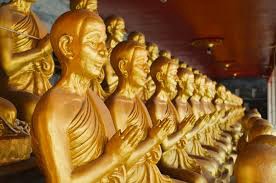
Statues depicting the disciples of the Buddha at Daigan-ji, a temple in Japan.
Sheryl Forbes / Getty Images

Ananda was the historical Buddha‘s cousin and also his attendant during the latter part of his life. Ananda is also remembered as the disciple who recited the Buddha’s sermons from memory at the First Buddhist Council, after the Buddha had died.

According to a possibly apocryphal story in the Pali Tipitika, Ananda persuaded a reluctant Buddha to accept women as his disciples.

Anathapindika

Ruins in Sravasti, India.
Ruins in Sravasti, India, thought to be of the Jeta Grove retreat center. Bpilgrim / Wikimedia Creative Commons

Anathapindika was a wealthy lay disciple and benefactor of the Buddha. His generosity to the poor earned him his name, which means “feeder of the orphans or helpless.”

The Buddha and his disciples traveled for most of the year, but they stayed indoors in seclusion during the summer monsoon season. With the Buddha’s permission, Anathapindika purchased a property that would be called the Jeta Grove. He then built a meeting hall, dining hall, sleeping cells, wells, lotus ponds, and whatever else the monks might need during their solitary rains retreats. This was the first Buddhist monastery.

Today, readers of the sutras may notice that the Buddha delivered many of his discourses “in the Jeta Grove, in Anathapindika’s Monastery.”null

Devadatta

Painting of Devadatta in a temple with deciples.
Devadatta Incites an Elephant to Charge the Buddha. Tevaprapas, Wikipedia Commons, Creative Commons License

Devadatta was a kinsman of the Buddha who became a disciple. According to some traditions, Devadatta became consumed with jealousy of the Buddha. After receiving a particularly harsh rebuke from the Buddha, Devadatta plotted to have the Buddha assassinated.

When his plots failed, he split the sangha by persuading many younger monks to follow him instead of the Buddha. The monks Sariputra and Maudgalyayana were able to persuade the wayward monks to return.null

Dhammadinna

Painting of Dhammadinna and Viskha from from a mural at Wat Pho, a temple in Bangkok, Thailand.
Dhammadinna and Visakha as a married couple. Anandajoti / Photo Dharma / Flickr.com, Creative Commons License

Some of the early sutras of Buddhism are about enlightened women who teach men. In Dhammadinna’s story, the man was the enlightened woman’s ex-husband. The Buddha praised Dhammadinna as “a woman of discerning wisdom.

Khema 

Statue of Khema with deciples.
 กสิณธร ราชโอรส / Wikimedia Commons

Queen Khema was a great beauty who became a nun and one of the chief women disciples of the Buddha. In the Khema Sutta (Samyutta Nikaya 44), this enlightened nun gives a dharma lesson to a king.

Mahakasyapa

Painting of the head of Mahakasyapa.
  Axb3 / Public domain / Wikimedia Commons

After the historical Buddha died, Mahakasyapa assumed a leadership position among the Buddha’s surviving monks and nuns. He convened and presided over the First Buddhist Council. For this reason, he is called the “father of the sangha.” He is also a patriarch of Chan (Zen).

Maudgalyayana 

Carving of Buddha and some of his diciples.
Sariputra and Maudgalyayana become disciples of Buddha. Nomu420craftsmen / Wikimedia Commons

Maudgalyayana was a lifelong friend of Sariputra; the two entered the order together. The Buddha’s instructions to Maudgalyayana as he struggled with his early practice have been valued by the many generations.

Pajapati

Painting of buddhist marriage in temple.
Marraige of Suddhodana and Mahapajapati. Photo Dharma from / Wikimedia Commons

Pajapati is credited with being the first Buddhist nun. She is often called Mahapajapati.

Pajapati was the Buddha’s aunt who raised the young Prince Siddhartha as her own child after the death of his mother, Queen Maya. After the Buddha’s enlightenment she and many of her court ladies shaved their heads, dressed in patched mendicants’ robes, and walked many miles barefoot to find the Buddha and ask to be ordained. In a section of the Pali Tipitika that remains controversial, the Buddha refused the request until persuaded to change his mind by Ananda.

Patacara 

A carving depicting Patacara and buddha in a temple amongst a crowd.
The story of Patacara. Anandajoti, Wikipedia Commons, Creative Commons License

Patacara was a nun who overcame unimaginable grief to realize enlightenment and become a leading disciple. Some of her poems are preserved in a section of the Sutta-pitaka called the Therigatha, or Verses of the Elder Nuns, in the Khuddaka Nikaya.
 

Punnika 

Punnika was a slave who, by chance, heard a sermon of the Buddha. In a famous story recorded in the Pali Sutta-pitaka, she inspired a Brahmin to seek out the Buddha. In time she became a nun and realized enlightenment.

Rahula

Ivory carving of Buddha leaving a woman and child sleeping in bed.
Siddhartha leaving sleeping Yashodhara and Rahula. Nomu420 / Wikimedia Commons

Rahula was the historical Buddha’s only child, born shortly before the Buddha left his life as a prince to seek enlightenment. It is said Rahula was ordained a monk while still a child and realized enlightenment at the age of 18.

Sariputra

Statues of Buddha, Mogallana and Sariputta in a museum.
Buddha with Mogallana and Sariputta. Origamiemensch / Wikimedia Commons

It was said Sariputra was second only to the Buddha in his ability to teach. He is credited with mastering and codifying the Buddha’s Abhidharma teachings, which became the third “basket” of the Tripitika.

Mahayana Buddhists will recognize Sariputra as a figure in the Heart Sutra.

Upali 

The Upali Thein temple on a sunny day.
The Upali Thein temple. Tsaetre / Wikimedia Commons

Upali was a low-caste barber who met the Buddha when he was called upon to cut the Buddha’s hair. He came to the Buddha to ask to be ordained with a group of the Buddha’s high-born kinsmen. The Buddha insisted on ordaining Upali first so that he would be their senior, and superior, in the order.

Upali became known for his faithful devotion to the Precepts and his understanding of the rules of the monastic order. He was called upon to recite the rules from memory at the First Buddhist Council, and this recitation became the basis of the Vinaya.

Reference

  • O’Brien, Barbara. “The Historical Buddha’s Disciples.” Learn Religions, Aug. 27, 2020, learnreligions.com/first-generation-of-buddhas-disciples-449657.

Buddhism 101: The Life of Ananda, Buddha’s Disciple and Attendant

The large Vairocana Buddha with disciples Ananda and Kasyapa. Public Domain

Of all the principal disciples, Ananda may have had the closest relationship to the historical Buddha. Particularly in the Buddha’s later years, Ananda was his attendant and closest companion. Ananda also is remembered as the disciple who recited the Buddha’s sermons from memory at the First Buddhist Council, after the Buddha had died.null

What do we know about Ananda? It is widely agreed that Buddha and Ananda were first cousins. Ananda’s father was a brother to King Suddhodana, many sources say. It is thought that when the Buddha returned home to Kapilavastu for the first time after his enlightenment, cousin Ananda heard him speak and became his disciple.null

Beyond that, there are several conflicting stories. According to some traditions, the future Buddha and his disciple Ananda were born on the same day and were exactly the same age. Other traditions say Ananda was still a child, maybe seven years old, when he entered the Sangha, which would have made him at least thirty years younger than the Buddha. Ananda survived the Buddha and most of the other principal disciples, which suggests that the latter version of the story is more probable.

Ananda was said to be a modest, quiet man who was completely devoted to the Buddha. He also was said to have a prodigious memory; he could recite every sermon of the Buddha-word for word after hearing it only once. Ananda is credited with persuading the Buddha to ordain women into the Sangha, according to one famous story. However, he was slower than other disciples to realize enlightenment and did so only after the Buddha had died.

The Buddha’s Attendant 

When the Buddha was 55 years old, he told the sangha he needed a new attendant. The attendant’s job was a combination of servant, secretary, and confidant. He took care of “chores” such as washing and mending robes so that the Buddha could focus on teaching. He also relayed messages and sometimes acted as a gatekeeper, so that the Buddha would not be mobbed by too many visitors at once.

Many monks spoke up and nominated themselves for the job. Characteristically, Ananda remained quiet. When the Buddha asked his cousin to accept the job, however, Ananda accepted only with conditions. He asked that the Buddha never giver him food or robes or any special accommodations so that the position did not come with material gain.

Ananda also requested the privilege of discussing his doubts with the Buddha whenever he had them. And he asked that the Buddha repeat any sermons to him that he might have to miss while carrying out his duties. The Buddha agreed to these conditions, and Ananda served as attendant for the remaining 25 years of the Buddha’s life.

The Ordination of Pajapati 

The story of the ordination of the first Buddhist nuns is one of the most controversial sections of the Pali Canon. This story has Ananda pleading with a reluctant Buddha to ordain his stepmother and aunt, Pajapati, and the women who had walked with her to become the Buddha’s disciples.

The Buddha eventually agreed that women can become enlightened as well as men, and could be ordained. But he also predicted that the inclusion of women would be the undoing of the sangha.

Some modern scholars have argued that if Ananda really was more than thirty years younger than the Buddha, he would still have been a child when Pajapati approached the Buddha for ordination. This suggests the story was added, or at least re-written, a long time later, by someone who didn’t approve of nuns. Still, Ananda is credited with advocating for the right of women to be ordained.

Parinirvana 

One of the most poignant texts of the Pali Sutta-pitaka is the Maha-parinibbana Sutta, which describes the last days, death, and parinirvana of the Buddha. Again and again, in this sutta we see the Buddha addressing Ananda, testing him, giving him his final teachings and comfort. And as monks gather around him to witnesses his passing into Nirvana, the Buddha spoke in praise of Ananda—”Bhikkhus [monks], the Blessed Ones, Arahants, Fully Enlightened Ones of times past also had excellent and devoted attendant bhikkhus [monks], such as I have in Ananda.”

Enlightenment and the First Buddhist Council 

After the Buddha had passed, 500 enlightened monks came together to discuss how their master’s teachings might be preserved. None of the Buddha’s sermons had been written down. Ananda’s memory of the sermons was respected, but he had not yet realized enlightenment. Would he be allowed to attend?

The Buddha’s death had relieved Ananda of many duties, and he now dedicated himself to meditation. The evening before the Council was to begin, Ananda realized enlightenment. He attended the Council and was called upon to recite the Buddha’s sermons.

Over the next several months he recited, and the assembly agreed to commit the sermons to memory also and preserve the teachings through oral recitation. Ananda came to be called “The Keeper of the Dharma Store.”

It is said Ananda lived to be more than 100 years old. In the 5th century CE, a Chinese pilgrim reported finding a stupa holding Ananda’s remains, lovingly attended by nun. His life remains a model of the path of devotion and service.

Reference

  • O’Brien, Barbara. “The Life of Ananda, Buddha’s Disciple and Attendant.” Learn Religions, Aug. 27, 2020, learnreligions.com/life-of-ananda-449647.

Buddhism 101: The Laughing Buddha

How Buddha came to be fat and jolly

Godong / Getty Images

When many Westerners think of “Buddha,” usually they don’t visualize the Buddha of history, meditating or teaching. This “true” Buddha is known more completely as Gautama Buddha or Shakyamuni Buddha and is almost always depicted in deep meditation or contemplation. The image is very often of a very thin individual with a serious though the sublimely peaceful expression on his face.

The Laughing Buddha 

Most Westerners, though, think of a fat, bald, jolly character called “The Laughing Buddha” when they think of the Buddha. Just where did this figure come from?

The Laughing Buddha emerged from Chinese folktales of the 10th century. The original stories of the Laughing Buddha centered on a Ch’an monk named Ch’i-t’zu, or Qieci, from Fenghua, in what is now the province of Zhejiang. Ch’i-t’zu was an eccentric but much-loved character who worked small wonders, such as predicting the weather. Chinese history assigned the date of 907-923 CE to Ch’t’zu’s life, which means he lived considerably later than the historical Shakyamuni, the true Buddha. 

Maitreya Buddha 

According to tradition, just before Ch’i-t’zu died, he revealed himself to be an incarnation of Maitreya Buddha. Maitreya is named in the Tripitaka as the Buddha of a future age. Ch’i-t’zu’s last words were:

Maitreya, true Maitreya
Reborn innumerable times
From time to time manifested among men
The men of the age do not recognize him.

Pu-tai, Protector of Children 

The tales of Ch’i-t’zu spread throughout China, and he came to be called Pu-tai (Budai), which means “hempen sack.” He carries a sack with him full of good things, such as sweets for children, and he is often pictured with children. Pu-tai represents happiness, generosity and wealth, and he is a protector of children as well as of the poor and the weak.

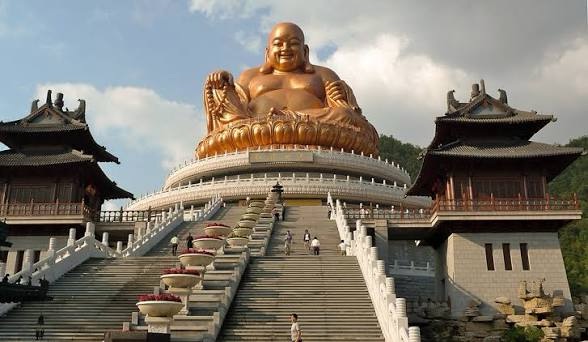
Today, a statue of Pu-tai can often be found near the entrance of Chinese Buddhist temples. The tradition of rubbing Pu-tai’s belly for good luck is a folk practice, however, not a genuine Buddhist teaching. It is indicative of Buddhism’s broad tolerance of diversity that this laughing Buddha of folklore is accepted into the official practice. For Buddhists, any quality that represents Buddha-nature is to be encouraged, and the folklore of the kind, laughing Buddha is not regarded as any kind of sacrilege, even though people unwittingly may confuse him with Shakyamuni Buddha.

An Ideal Enlightened Master 

Pu-tai also is associated with the last panel of the Ten Ox-herding Pictures. These are 10 images that represent stages of enlightenment in Ch’an (Zen) Buddhism. The last panel shows an enlightened master who enters towns and marketplaces to give to ordinary people the blessings of enlightenment.

Pu-tai followed the spread of Buddhism into other parts of Asia. In Japan, he became one of the Seven Lucky Gods of Shinto and is called Hotei. He also was incorporated into Chinese Taoism as a deity of abundance.

Reference

  • O’Brien, Barbara. “The Laughing Buddha.” Learn Religions, Aug. 25, 2020, learnreligions.com/the-laughing-buddha-449784.

The Heartbreaking True Story Of Hachikō, The World’s Most Loyal Dog

When Hachikō’s owner failed to come home from work one day, the faithful dog returned to his master’s train station the day after just to wait for him. He did this every day for nearly a decade.

Hachikō the dog was more than a pet. As the canine companion to a university professor, Hachikō patiently waited his owner’s return from work at their local train station each evening.

But when the professor died suddenly one day at work, Hachikō was left waiting at the station — for nearly a decade. Every day after his master passed, Hachikō the dog returned to the train station, often to the chagrin of the employees who worked there. But his fidelity soon won them over, and he became an international sensation and a symbol of loyalty.

This is his story.

When Hachikō Met Ueno

This statue commemorates the meeting of Hachikō and his master.

Hachikō the golden brown Akita was born on Nov. 10, 1923, on a farm located in Japan’s Akita Prefecture.

In 1924, Professor Hidesaburō Ueno, who taught in the agriculture department at Tokyo Imperial University, acquired the puppy and brought him to live with him in the Shibuya neighborhood of Tokyo.

The pair followed the same routine every day: In the morning Ueno would walk to the Shibuya Station with Hachikō and take the train to work. After finishing the day’s classes, he would take the train back and return to the station at 3 p.m. on the dot, where Hachikō would be waiting to accompany him on the walk home.

Shibuya Station in the 1920s, where Hachikō would meet his master.

The pair kept up this schedule religiously until one day in May 1925 when Professor Ueno suffered a fatal brain hemorrhage while teaching.

That same day, Hachikō showed up at 3 p.m. as usual, but his beloved owner never got off the train.

Despite this disruption in his routine, Hachikō returned the next day at the same time, hoping that Ueno would be there to meet him. Of course, the professor failed to return home once again, but his loyal Akita never gave up hope.

Becoming A National Sensation

Hachikō was only one of 30 purebred Akitas on record at the time.

Hachikō was reportedly given away after his master’s death, but he regularly ran off to Shibuya Station at 3 p.m. hoping to meet the professor. Soon, the lone dog began to draw the attention of other commuters.

At first, the station workers were not all that friendly to Hachikō, but his fidelity won them over. Soon, station employees began to bring treats for the devoted canine and sometimes sat beside him to keep him company.

The days turned into weeks, then months, then years, and still Hachikō returned to the station each day to wait. His presence had a great impact on the local community of Shibuya and he became something of an icon.

In fact, one of Professor Ueno’s former students, Hirokichi Saito, who also happened to be an expert on the Akita breed, got wind of Hachikō’s routine. 

He decided to take the train to Shibuya to see for himself if his professor’s pet would still be waiting.

When he arrived, he saw Hachikō there, as usual. He followed the dog from the station to the home of Ueno’s former gardener, Kuzaburo Kobayashi. There, Kobayashi filled him in on the story of Hachikō’s life.

Visitors came from far and wide to meet Hachikō, a symbol of loyalty.

Shortly after this fateful meeting with the gardener, Saito published a census on Akita dogs in Japan. He found that there were only 30 documented purebred Akitas — one being Hachikō.

The former student was so intrigued by the dog’s story that he published several articles detailing his loyalty.

In 1932, one of his articles was published in the national daily Asahi Shimbun, and Hachikō’s tale spread throughout Japan. The dog quickly found nationwide fame.

People from all over the country came to visit Hachikō, who had become a symbol of loyalty and something of a good-luck charm.

The faithful pet never let old age or arthritis interrupt his routine. For the next nine years and nine months, Hachikō still returned to the station every day to wait.

Sometimes he was accompanied by people who had traveled great distances just to sit with him.

A Legacy Of Loyalty

Since his death, a number of statues have been erected in his honor.

Hachikō’s great vigil finally came to an end on March 8, 1935, when he was found dead in the streets of Shibuya at the age of 11.

Scientists, who weren’t able to determine his cause of death until 2011, found that the dog Hachikō likely died of a filaria infection and cancer. He even had four yakitori skewers in his stomach, but researchers concluded that the skewers were not the cause of Hachikō’s death.

Hachikō’s passing made national headlines. He was cremated and his ashes were placed next to Professor Ueno’s grave in Aoyama Cemetery in Tokyo. The master and his loyal dog had finally reunited. 

His fur, however, was preserved, stuffed, and mounted. It’s now housed in the National Museum of Nature and Science in Ueno, Tokyo. 

The dog had become such an important symbol in Japan that donations were made to erect a bronze statue of him in the exact spot he had faithfully waited for his master. But soon after this statue went up, the nation became consumed by World War II. Consequently, Hachikō’s statue was melted down to use for ammunition.

But in 1948, the beloved pet was immortalized in a new statue erected in Shibuya Station, where it remains to this day. 

As millions of passengers pass through this station daily, Hachikō stands proud.

Hidesaburo Ueno’s partner Yaeko Ueno and the station staff sit in mourning with the deceased Hachiko in Tokyo on March 8, 1935.

The station entrance near where the statue is located is even devoted to the beloved canine. It’s called Hachikō-guchi, simply meaning the Hachikō entrance and exit.

A similar statue, erected in 2004, can be found in Odate, Hachikō’s original hometown, where it stands in front of the Akita Dog Museum. And in 2015, the Faculty of Agriculture at the University of Tokyo erected yet another brass statue of the dog in 2015, which was unveiled on the 80th anniversary of Hachikō’s death. 

In 2016, Hachikō’s story took yet another turn when his late master’s partner was buried alongside him. When Yaeko Sakano, Ueno’s unmarried partner, died in 1961, she explicitly asked to be buried alongside the professor. Her request was rejected and she was buried in a temple far from Ueno’s grave.

This stuffed replica of Hachikō is currently on display at the National Science Museum of Japan in Ueno, Tokyo.

But in 2013, University of Tokyo professor Sho Shiozawa, found a record of Sakano’s request and a buried her ashes beside both Ueno and Hachikō.

Her name was also inscribed on the side of his tombstone.

Hachikō’s Story In Pop Culture

Hachikō’s story first made it to film in the 1987 Japanese blockbuster titled Hachiko Monogatari, directed by Seijirō Kōyama.

The movie trailer for Hachi: A Dog’s Tale.

It became even more well-known when the tale of a master and his loyal dog served as the plot to Hachi: A Dog’s Tale, an American movie starring Richard Gere and directed by Lasse Hallström. 

This version is loosely based on the story of Hachikō, though set in Rhode Island and centered on the relationship between Professor Parker Wilson (Gere) and a lost puppy that had been freighted from Japan to the United States.

The professor’s wife Cate (Joan Allen) is initially opposed to keeping the dog and when he dies, Cate sells their house and sends the dog to their daughter. Yet the dog always manages to find his way back to the train station where he used to go to greet his former owner.

The stuffed Hachikō on display at the National Museum of Nature and Science.

Despite the different setting and culture of the 2009 movie, the central themes of loyalty remain at the forefront. 

Hachikō the dog might have symbolized the quintessential values of Japan, but his story and faithfulness continue to resonate with humans around the world.

Reference