Category Archives: Religion/Lifestyle

How NXIVM Was the Ultimate Wellness Scam

Keith Raniere targeted wealthy and seemingly happy women. But by preying on their insecurities, he got them to do things they never imagined

Keith Raniere was the mastermind behind NXIVM, a self-help group with a sinister side. Photo-illustration by Kyle Rice for Rolling Stone. Photographs used in illustration by Keith Raniere Conversations/Youtube, Seth Wenig/AP/Shutterstock, Justin Lane/EPA-EFE/Shutterstock, Ruth Fremson/The New York Times/Redux, and Jemal Countess/Getty Images

There was a method to the branding. It was supposed to be precisely seven strokes — one line across, and two diagonal lines down to form the sideways K; then four smaller lines to form the sideways R beneath, the little spoon to the big spoon of the K. The women were supposed to be naked. They were supposed to be videotaped. They were supposed to be held down on a table, arms above the head, legs spread, ankles and wrists bound; helpless, vulnerable, exposed. And they were supposed to say the following: “Please brand me. It would be an honor. An honor I want to wear for the rest of my life.”

This last part was the most important. “They should probably say that before they’re held down, so it doesn’t seem like they were being coerced,” Keith Raniere told actress Allison Mack, his lover, disciple, and slave.

“OK,” Mack responded in a soft voice. She already knew most of this, because she had already been branded.

Later, Raniere instructs Mack what to tell the women unwittingly being branded with his initials: “Pain is how we know how much we love. We know the depth of our love through pain. When they feel the pain, they think of that love.”

A recording of this January 9, 2016 conversation was presented as evidence in the criminal trial against Raniere, the 59-year-old head of NXIVM, a company offering self-improvement seminars and workshops that was based in Clifton Park, an Albany, New York, suburb dappled with shopping centers and two-story colonials. NXIVM was founded by Raniere and Nancy Salzman, a former registered nurse with schoolmarm glasses and a sensible haircut; he was called “Vanguard,” while she was known as “Prefect.” Recruits paid more than $7,500 for grueling, 12-hour “intensives” featuring NXIVM’s patented Executive Success Program (ESP) technology, a patchwork of various self-help programs, religious ideologies, and hypnosis techniques. They could also take classes through the smaller companies under the NXIVM umbrella: the Source, a workshop for actors led by Mack; Delegates, a Task Rabbit-esque startup primarily staffed by younger, female members; and JNESS, a female empowerment group whose Facebook wall features Martin Luther King Jr. quotes juxtaposed against a pastel-pink template.

At the head of all of these companies was Raniere, 59, a self-proclaimed former-child-prodigy-turned-guru, who stood trial last summer on sex trafficking, racketeering, and racketeering conspiracy charges. Raniere was accused, among other things, of using NXIVM as a recruitment network for DOS, which prosecutors referred to as a secret “sex cult” within NXIVM. Mack and other female NXIVM members were the “masters,” while Raniere was the “grandmaster” at the head of the group, instructing women in DOS to recruit “slaves” for the purpose of his sexual pleasure. The branding Raniere described in the January 2016 conversation with Mack was part of the slaves’ initiation ritual.

Conversations with Keith Raniere’ episode featuring Alison Mack, Youtube Keith Raniere Conversations, Youtube

The women recruited as DOS slaves, as they recounted on the stand, were told to give up “collateral” as the price of entry, such as videos of themselves masturbating or postmarked “confessions” that relatives or loved ones had sexually abused them. They were told to text their “masters” up-close photos of their unshaven vulvas, always keeping their faces in the shot so they were fully identifiable. They were told to stick to low-calorie diets, to wake up in the middle of the night to respond to “readiness drills” or texts from their “masters” or risk being paddled, and to abstain from sexual activity with anyone but Raniere. They talked about how they were instructed to buy BDSM sex toys as part of a “dungeon” to be built in the basement of DOS headquarters that would include cages, vibrating rubber paddles, and “puppy plugs … perfect for puppy play or naughty slaves.” (Plans for the dungeon were scrapped when the Feds started closing in.) Many, though not all of them, were branded, and they talked about how excruciatingly painful it was: how you could hear the cauterizing pen sizzle against raw skin, how one woman squealed and screamed so loud and so long that the women gave her a cloth to bite on.

DOS slaves weren’t told that they were being branded with Raniere’s initials, nor were they told that Raniere was the mastermind behind the group. Instead, they were told by Mack and other top-line “masters” that DOS was a badass, if slightly unorthodox, feminist group meant to help women build discipline and overcome their intimacy issues. As assistant U.S. attorney Tanya Hajaar put it during opening remarks, “The defendant maintained a charade: Even though he controlled the victims’ lives, it was about female empowerment.” Through it all, Raniere sat quietly, occasionally scribbling notes on Post-Its to his attorney. On most days, he wore a jewel-toned crewneck and khakis, looking less like the head of a BDSM sex cult than a Latin instructor at a New England prep school.

This contrast between Raniere’s nebbishy, avuncular appearance and his seduction abilities was the second-most frequent topic of conversation among the press during breaks in the trial.

By far the most popular topic of discussion, however, was how these women could have possibly convinced themselves they were signing up for a female-oriented wellness and empowerment group in the first place. No one went so far as to blame the women or accuse them of perpetuating their trauma — as journalists covering sensitive subjects like abuse and consent, we ostensibly knew better than that. Yet on days when the testimony was particularly brutal, the tenor of the discussions would come uncomfortably close. The branding, the nude photos, the seduction tasks, the sexually explicit collateral: Why would they agree to do these things? How could they have not suspected that the man they were being tasked to seduce, ostensibly as a sort of Abrahamic test of faith, was the one pulling the strings all along? How could this endless parade of smart, attractive, accomplished women so easily have given up their freedom and their bodies to this hairy, middle-aged guy who looked like an extra on the set of Rushmore? How could they not have known?

Raniere’s ability to persuade dozens of beautiful women to send him photos of their genitalia was arguably without precedent. But otherwise, very little about him or NXIVM was original.

Executive Success Program (ESP), the patented “technology” that served as the basis of its curriculum, was little more than a mélange of psychotherapeutic and self-help teachings, with a dash of early wellness industry-speak thrown in. It has been referred to as a combination of the 1970s self-help program EST and Objectivism, the ideological system founded by neoliberal icon Ayn Rand.

NXIVM “was an old bag of tricks, repackaged,” regurgitating “universal truths about how to improve yourself and how to look closer at the things that are getting in your way of success and your fears,” says Diane Benscoter, a cult expert who has closely worked with former members. Indeed, Teah Banks, a former NXIVM member in its early years, says that after she left the group, she recognized many ESP techniques in the book Stress Management for Dummies.
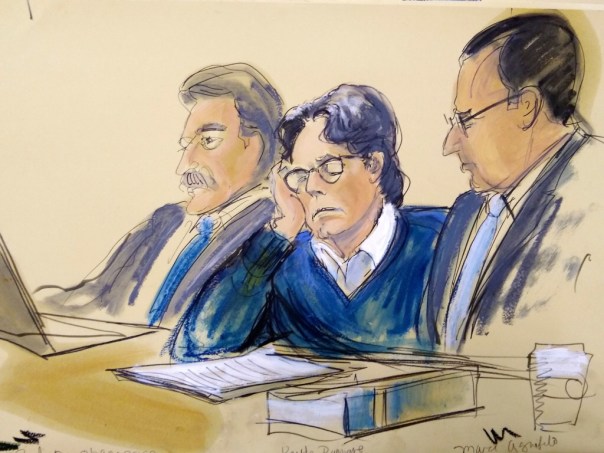
Keith Raniere (center) in a courtroom sketch from June <br />Photo by Elizabeth Williams/AP/Shutterstock Elizabeth Williams/AP/Shuttersto

Raniere’s taste for kink — the conflation of love with pain as heard on his call with Mack about DOS — was arguably derivative, too. According to Toni Natalie, Raniere’s ex-girlfriend and an early NXIVM whistleblower, Raniere had little interest in BDSM while they were dating in the 1990s, crediting the popularity of Fifty Shades of Grey with inspiring Raniere’s taste for sadomasochism — or, at the very least, co-opting the language of the consensual-kink community to further his own desires to exploit and control women. “Like I’ve always said, the man is not capable of having an original thought,” Natalie says dryly.

A dark-haired woman in her early sixties with wide eyes and a predilection for understated silver, tribal jewelry, Natalie has spent the past two decades of her life vacillating between trying to fight her ex-boyfriend in court and trying to get people to understand him. Her new book The Program: Inside the Mind of Keith Raniere and the Rise and Fall of NXIVM, co-written with journalist Chet Hardin, documents both efforts, detailing her relationship with Raniere and her lengthy legal battles with NXIVM.

Natalie met Raniere in the early 1990s while he was running Consumers’ Buyline, a multilevel marketing scheme. At the time, Raniere was being branded by the company as the “smartest man in the world,” a label that stemmed from the results of a take-home IQ test he took in the 1980s that led to him being included in The Guinness Book of World Records (albeit just one Australian edition).

At the time she met Raniere, Natalie was 29 and in what she describes as a sexless marriage to her third husband, a tanning-salon owner. Raniere, she says, made her feel special — but perhaps more importantly, he made her feel smart. She’d left high school to get married for the first time at 17, and she was deeply self-conscious about her lack of formal education. “What Keith was able to do was immediately ascertain your weak points and insecurities,” Natalie says. “And then he takes those insecurities and convinces you he’s helping you with them. But it’s just things he uses to hold you hostage.”

For eight years, Raniere and Natalie lived together, with him serving as a father figure of sorts to her young son. All the while, Raniere was surrounded by a cohort of women who worked for his company, including Pam Cafritz, Karen Unterreiner, and Kristin Keeffe. These women, whom Raniere referred to as “the girls,” came from a wide range of backgrounds: Cafritz was the daughter of D.C. Republican socialites, while Keeffe was a former waitress who had met Raniere while waiting tables in Albany. All, however, were united in their fierce devotion to him.

Following the failure of Consumers’ Buyline, Raniere and Natalie opened a health-food store and cafe in upstate New York. It was through this business that Natalie met Salzman, who visited the store to find relief for her chronic constipation (“she was, quite literally, full of shit,” as Natalie puts it). Salzman touted herself as an expert in NLP (neurolinguistic programming), a form of therapy that uses tactics such as body language mirroring and hypnotherapy to help followers overcome personal obstacles. (It has largely been dismissed as pseudoscience.) She offered to give Raniere and Natalie private NLP sessions to help them with their relationship issues, which led to Raniere taking private meetings with Salzman in the back of the health-food store.

The result of their collaboration, Natalie writes, was “like putting two volatile chemicals together in a mad scientist’s lab: The resulting compound was both explosive and dangerous.” Disillusioned by what Natalie viewed as the exploitative NLP method and Raniere’s increasingly arrogant behavior, the two broke up in 1999. Almost immediately, “the girls” jumped into offense mode, urging Natalie to take him back; when that failed, she says, they stole her mail, hacked into her hard drives, and filed multiple lawsuits accusing her of stealing money from Raniere, strategies they would use against Natalie and any other perceived Raniere enemies for almost two decades.

In 2000, Raniere filed a patent for the “rational inquiry method,” which would serve as the basis for ESP. Raniere’s reputation as the “smartest man alive,” combined with Salzman’s credentials as a nurse and NLP expert, allowed the group to rack up many high-profile supporters fairly early on, most notably Clare and Sara Bronfman, the heiresses to the Seagram’s liquor fortune, who would later go on to spend nearly $140 million bankrolling the group’s lawsuits against Natalie and other detractors. The patented ESP “technology” allowed Raniere to “couch” the group’s methods by basing them in “rational thought,” says Josh Bloch, an investigative journalist and host of the CBC podcast Escaping NXIVM: “I could see how that would sound very attractive to someone who might be turned off by flaky or nonscientific messaging.”

Underneath that thin patina of pseudoscience, however, the leader of NXIVM had some pretty strange ideas. Chief among them were his theories about gender, which emerged into sharper relief as the group gained influence. “One thing that was [taught] was that men biologically, by their nature are primitive. They want to propagate. They want to create more children to create a tribe,” says Barbara Bouchey, a former Raniere girlfriend and high-ranking NXIVM member who left the group in 2009. “So men and their biological chemistry were prone to want to have multiple partners, whereas women based on their biological nature were at home in the cave caring for people.”
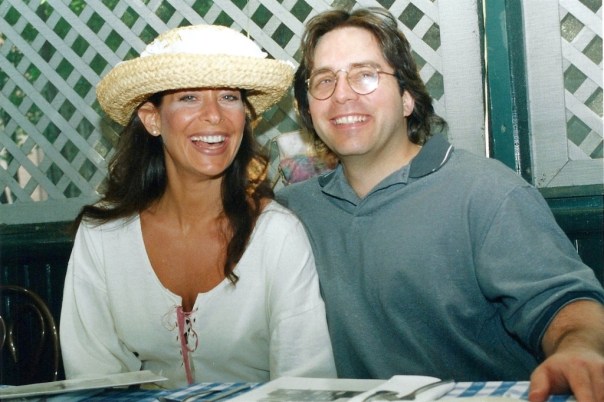
Toni Natalie and Keith Raniere. Courtesy of Joan Schneier Courtesy of Joan Schneier

During the trial, it was often argued by the prosecution that such teachings served as a way to justify Raniere’s polyamorous lifestyle. But this is not exactly true. Only the highest-ranking NXIVM members were aware that Raniere was sleeping with most of the female board members, with most of the group’s lower-ranking members believing him to be something akin to a renunciate. The group “operated in silos,” says Bloch. “[The leadership] did a very good job with the left hand not knowing what the right hand was doing.” Indeed, both Bouchey and Natalie deny having had any knowledge of Raniere’s extracurricular sexual activities while they were involved with him; when Natalie discovered graphic nude photos of “the girls” after their breakup, she said she felt devastated by the betrayal, particularly by Cafritz, whom she had considered “like a sister.”

But as NXIVM grew and Raniere expanded his reach, his views on the biological differences between men and women became more difficult to ignore. JNESS, the women’s group co-founded by Cafritz in 2007, taught that men inherently had more character and fortitude than women, who were more prone to flightiness and “game-playing,” a Raniere term for deceit and manipulation. The male equivalent to JNESS, the Society of Protectors (SOP), took these theories to the next level: according to one former member who testified at the trial, a coed SOP module gave female members tiaras or princess wands for being too “princess-y,” while one woman wearing a low-cut top to a meeting was given a blue ribbon for showing off her “udders.”

It’s difficult to pinpoint exactly what attracted women to this type of messaging. Part of its success was attributable to the fact that Raniere was well-versed enough in the language of corporate female empowerment for his misogyny to escape notice. Indeed, a large part of what attracted women to NXIVM was Raniere openly advocating for women in leadership roles. “His thing was always that the company would be better if there were women in power, because women are stronger, women are this, women are that,” Natalie says. Of course, Raniere did not install women in high-ranking positions within NXIVM because he thought they were smarter or stronger or better qualified; he did it says Natalie, because he believed “women were easier to control.” But it’s easy to see how a female recruit could see the largely female executive board and assume that the company promoted the interests of women.

Yet the misogyny inherent in Raniere’s teachings also appealed to some women on a much deeper level. Some of the women in NXIVM had come of age in an era of body-positive Dove ads and girl-power messaging, and had largely felt failed by its promises. Having sampled all of the wellness industry’s offerings on their path to enlightenment — the teas, the classes, the pastel-hued self-help paperbacks , the meditation apps, the rose-quartz vagina-tightening sticks — many felt disillusioned and more spiritually depleted than before. For many of these women, the goal wasn’t so much toward enlightenment or even fulfillment so much as it was feeling some semblance of OK. But the journey toward self-love proved so exhausting that the prospect of simply accepting their biological fate and ceding all of their power to men proved not just alluring, but irresistible.

This seemed to have been especially true for women like Mack, whom a friend described to the New York Times as someone “constantly searching for something that was missing in her life.” (Mack did not return Rolling Stone’s requests for comment.) Mack started taking NXIVM classes in 2006 when she was 23, in the hopes that she could learn to become a better actress; after Smallville ended in 2011, she struggled to find work and began to immerse herself even deeper into NXIVM, withdrawing from her friends and family members. One of the witnesses at trial, former board member Mark Vicente, testified that he viewed Mack as “unbalanced,” and became concerned about her mental health during this time.

But Mack felt otherwise. In an email to Raniere read at trial, she explained how grateful she was to be deep in his thrall, how disappointing her own strides toward self-empowerment had been, how nothing made her feel so powerful as to be made by him to feel powerless. “I spent so much time throughout my life listening to music about being ‘beautiful without doing anything,’ being ‘an independent woman,’ being every woman,” Mack lamented. “The ‘fierce’ and phenomenal woman’ lie is so encouraged and pervasive. It is the root of such pride, such violence, such prejudice.”” She then thanked Raniere for the threesome they had with another NXIVM member the night before.

Prior to NXIVM, Raniere’s weapon of choice was his small group of “girls” — namely, Unterreiner, Keeffe, and most importantly, Cafritz. But as NXIVM grew, so too did what prosecutors referred to during the trial as Raniere’s “inner circle.” There was Mack, Bouchey, Cafritz, Unterreiner, Keeffe, and Bronfman, but also Lauren Salzman, the daughter of “Prefect” Nancy, a wan, frail woman with dark circles under her eyes; Nicki Clyne, the saucer-eyed blond Canadian Battlestar Galactica actress; and Rosa Laura Junco, the improbably pretty daughter of a powerful Mexican publisher, who was so devoted to Raniere that she offered him her teenage daughter Lauris as his DOS slave and virgin successor.

Actress Allison Mack leaves court in Brooklyn on February 6th, 2019.<br />Photo by Justin Lane/EPA-EFE/Shutterstock Justin Lane/EPA-EFE/Shutterstock

The women all looked somewhat similar: in their early thirties to mid-forties, dark-eyed, tastefully dressed. Above all else, they were slender, almost painfully so: Raniere was obsessed with controlling women’s weight, to the degree that some of their fingers became stained with the color of the carrots and squash they exclusively ate at dinner. He was unabashed about weaponizing their insecurities about weight, telling one partner that the extra 10 pounds she’d gained “hurts my heart physically” and refusing to sleep with her till she shed them.

Within the “inner circle,” sex with Raniere was positioned as a crucial step toward achieving enlightenment, a spiritual reward in and of itself, and women who were having sex with Raniere were said to be “working with” him. Unsurprisingly, this idea was primarily propagated by Raniere himself, who claimed that women who swallowed his semen sometimes saw an ethereal “blue light,” and that those who refused to participate in a group oral sex session weren’t “committed to [their] personal growth.”

The NXIVM inner circle was not just a source of sexual gratification for Raniere. It was also his ultimate weapon. If one girlfriend was unhappy with Raniere, or had committed what was perceived as an ethical “breach” (NXIVM jargon for an act that ran counter to the group’s values), other members of the inner circle, primarily Cafritz, were tasked to bring them back into the fold.

They were tasked with going after NXIVM “enemies,” an ever-growing cast of journalists, defectors, and Raniere ex-girlfriends perceived as threats to the organization. “Alone, he would’ve just been a man,” U.S. attorney Marc Lesko said during closing. “Within his inner circle, he was the ruler of the universe in Clifton Park.”

Bronfman led the charge on this front, funneling $150 million into the group’s legal efforts. A former champion equestrian, Bronfman rose in the ranks to become Raniere’s capo, patron, and arguably most cutthroat defender. “Keith took her and put her on a pedestal. He made her important in the community and gave her a leadership role. She’d never had that before,” Bouchey tells me. The Bronfman-funded lawsuits were intended to, and ultimately did, completely decimate NXIVM critics like Natalie, whose own mother was forced to file for bankruptcy when she could no longer afford to help her daughter fight the suits. “Financially, how do you go up against the Bronfmans? They wiped us out,” Natalie says. “There’s no equalizer there.”

As the inner circle expanded, Raniere exerted ultimate control over his followers. He dictated everything from what they ate to who they slept with (no one but him and other women in the inner circle), and how they groomed their pubic hair. He was particularly skilled at capitalizing on the insecurities shared by many women of mid-to-late childbearing age: whether they were thin enough, whether they were sexual enough, whether they would be able to balance career with family. This was especially true for Salzman, who testified that she desperately wanted to have a child with Raniere, and spent 15 years with him dangling this over her head, only to have it abruptly yanked away after a perceived “ethical breach.” “I committed to stay with nothing. No relationship, no baby. Nothing,” she testified through choked sobs.

Bouchey, who left the group in 2009 and has also been embroiled for years in legal battles with Raniere and NXIVM, believes that the women who were willing to sacrifice so much for Raniere, only to get so little in return, had one trait in common. “They were what I would call weak-willed women,” she says. “They were smart, they were sensitive, they were caring. But were they confident? No.” Raniere, she says, went out of his way to surround himself with women who were successful by societal standards — privileged, attractive, well-educated — but who did not have the financial independence nor street smarts to assert themselves and their own autonomy.

Natalie has a similar theory. While the women in Raniere’s inner circle were all extremely bright, they tended to lack substantive family ties, and all were “insecure and damaged in some fundamental way,” making them easier to control. “He convinces you that your successes are not your own. Your successes are only because he exists,” she says.

Both of these theories, however, actually contradict much of the available research on cults. Aside from a few general demographic traits, such as being white, middle-to-upper-middle-class, and having an above-average IQ, there is no one set of characteristics that differentiates people who join cults from people who don’t, says Dr. Steve Eichel, one of the world’s foremost cult-studies experts. Cult leaders don’t look for people who are any more “broken” than most of the population. What they look for, he says, is people who are in transition, who have just lost a job or ended a marriage or had a child. “You look for people who are vulnerable. And the problem is we are all vulnerable to cultic influence at various times in our lives,” he says. “[The] primary cause of cult membership is bad luck.”

It’s fair to be skeptical about this explanation. After all, in the grand scheme of things, very few people join a cult; even fewer people (about 16,000) actually took NXIVM classes, and fewer still joined DOS. It seems like a bit of a stretch to say that anyone is vulnerable to joining a cult when so few people actually do. But when you consider all of the women who spend thousands on spin classes or serums or pastel-branded all-female co-working startups, who whittle themselves down to nothing to run a race that has no finish line in sight, who are told to surrender all of their power in order to ostensibly build up their own, then, of course, it makes sense that women would feel empowered by Keith Raniere. When you’re taught for years that pain is love and love is pain and one is the only way to measure the depths of the other, it doesn’t make a difference if the person telling you that is your boyfriend or your spin instructor or an Instagram ad for laxative tea or a fleshy-cheeked, nebbishy, middle-aged guy with a seemingly endless supply of crewneck sweaters. It’s the same message from a different messenger. It’s an old bag of tricks, repackaged.

In November 2016, Cafritz died after a lengthy battle with cancer. Her death was devastating for NXIVM members, some of whom shared a meme on Facebook memorializing her work with JNESS, with the quote: “If we want to have more women’s empowerment, we need to have a core essence of what it means to be female and how to uphold the female principle within ourselves.”

But it was arguably more devastating to Raniere, who had been involved with Cafritz for nearly 30 years and who relied on her as a fixer of sorts. She was the one Raniere dispatched to calm down angry girlfriends, and she became such a frequent presence at the local Planned Parenthood, where Raniere would send his partners to get abortions, that the staff recognized her. Natalie, who knew her former best friend had been sick and had been waiting for her to call toward the end of her life, believes Cafritz was both one of Raniere’s last ties to humanity, and one of his most tragic victims. “I wonder what he did to Pam. I wonder why she did the things that she did,” Natalie tells me. “It still haunts me.”

Lauren Salzman leaves Brooklyn federal court on January 28th, 2019. Photo by Seth Wenig/AP/Shutterstock Seth Wenig/AP/Shutterstock

During the trial, both the defense and the prosecution framed Cafritz’s death as formative in Raniere’s decision to create DOS, albeit in totally different ways. Raniere’s lead attorney, Marc Agnifilo, said Cafritz’s death prompted Raniere to consider his “legacy” and what he hoped to leave behind, eventually settling on DOS, which he created with “the best of intentions” as a support system for women. Assistant U.S. district attorney Moira Penza argued that DOS was created to fulfill the role that Cafritz had always played: a pimp for Raniere. She cited 2016 texts between Raniere and a DOS slave named Camilla, in which he tells her it would be good for her “to own a fuck toy slave for me that you could groom as a tool.” The texts were sent in 2015, a year before Cafritz died of cancer.

On paper, the goal of DOS was the same as set forth by Cafritz in JNESS: female empowerment. “It was pitched as women getting together, women supporting women, that kind of thing,” says a a 43-year-old writer whom Mack attempted to recruit to DOS in 2016. (She asked that Rolling Stone keep her anonymous, citing a concern over any potential ties to NXIVM threatening her job security.) “It was not specific at all in terms of the mission,” she says. Raniere wanted to create a worldwide network of female “slaves” and “masters,” using NXIVM’s marketing tools and high-profile members like Mack to cultivate women of influence, such as Emma Watson, Beverley Mitchell, and Jill Filipovic, to join the group. (None ever did.) His vision was dizzyingly ambitious: in one recorded call played during the trial, Raniere envisioned the organization becoming so powerful it would sway the U.S. 2020 general election.

Raniere had a few requirements for admission. You had to be attractive, young, and thin (or at least, willing to become thin in a short period of time). And with a few exceptions, you had to be single, with the logic being it’s easier to persuade women to send you photos of their vulvas if their spouses aren’t around to get in the way. But this criterion also helped winnow down the applicant pool to a specific kind of woman, the type of woman who had felt failed by the “fierce and phenomenal woman” stereotype Mack had maligned in her email, the type of woman who had not yet ticked off the requisite wife and mother and career boxes society demands women to check off one by one, and whose perceived failure to do so likely made her insecure, and therefore more pliable.

Nicole, an aspiring actress with glossy brown hair and the craniofacial structure of a baby sparrow, was one of these women. Unlike Mack, she still believed in the concept of the fierce and phenomenal woman. In fact, as she testified, she dreamed of playing a role like Wonder Woman. “That was the kind of woman I wanted to become,” she said. A Los Angeles transplant in her late twenties who’d moved to New York to kick-start her acting career, Nicole had taken a few classes with the Source, NXIVM’s company for actors. Nicole was in transition: She’d just broken up with her boyfriend, her career was in a downslide, and she was regretting her move to New York to the point that she was borderline suicidal, as she confided in Mack, whom she considered a mentor. A concerned Mack invited her to coffee, where she pitched her on an “an intense, growing empowerment group where women pushed each other to be stronger physically [and] mentally.”

Nicole was intrigued. Her curiosity was further piqued when Mack promised Nicole this secret group would help her live the kind of life she wanted and build the kind of career she wanted; it could, she told her, help her become Wonder Woman. A few days later, Nicole supplied Mack with her collateral: a video of herself masturbating, as well as a letter falsely claiming her father had sexually abused her. A few months later, she would be instructed by Mack to seduce Raniere; a few months after that, she would be branded.

DOS was predicated on the illusion that Raniere had absolutely nothing to do with the organization. “I thought I was getting into a women’s empowerment group,” Nicole testified on the stand through sobs. “[Somehow], I’d become a man’s sex slave.” But even though Raniere’s involvement in DOS was a secret known only to top-line slaves like Mack, so great was his ego that he simply couldn’t help but drop the occasional hint that he was behind it all. Once, while they were in his library together, Raniere told Nicole about how, in the army, recruits would be tasked with scrubbing a tank with a toothbrush, then told they needed to do it all over again when they were done.

When Nicole asked him about the relevance of this anecdote, Raniere responded that just like in the military, “he needed to break me in order to build me back up into a strong woman.”

A man was behind the creation of NXIVM’s secret female empowerment organization. But it took multiple women to help bring it down: Sarah Edmondson, a Vancouver-based actress who had been recruited to DOS by Salzman, then left the group when she was told Raniere was behind it all; and Catherine Oxenberg, the Dynasty star and concerned mother of India Oxenberg, who worked for the NXIVM company Delegates and had also been recruited to DOS by Mack.

In the fall of 2017, former NXIVM employee and whistleblower Frank Parlato published a series of articles about DOS on his website, followed by The New York Times publishing a bombshell investigation into the group, featuring photos of Edmondson showing her brand. Oxenberg, too, went to the press, telling Megyn Kelly in November 2017 that India had been branded and instructed to go on a near-starvation diet.

The revelation that the women of NXIVM were running a secret sex cult came as a shock to most within the organization, who had little knowledge of such unsavory activities in the upper ranks. Raniere had, in fact, been so skilled at keeping church and state separate that not even NXIVM co-founder Nancy Salzman knew about DOS, and she was furious that her daughter and other women “went out and got Keith’s initials branded next to their vaginas,” Lauren testified.

Ever the student of 21st-century feminist discourse, Raniere drafted a statement in his defense to the Times, accusing it of waging a “primitive, covertly misogynistic” campaign to shame his female acolytes for their “alternative lifestyles.” At one point, he compared DOS slaves to the authors of the Declaration of Independence. But the damage had already been done. Disgusted by the report, longtime members started slowly peeling off one by one.

True to form, the “inner circle” stayed strong, even after FBI investigators closed in and Raniere fled to Mexico in late 2017, staying in a lavish home in a gated community outside Puerto Vallarta. Somehow, DOS was still active during this time, with Raniere asking a number of the first-line slaves to join him in Mexico for a “recommitment ceremony” — essentially, a group blow job.

The recommitment ceremony never happened. In March 2018, Mexican federales arrested Raniere at the plush mansion where he was staying; as Salzman testified, when they arrived, he tried to hide in a closet. Video footage of the arrest shows the women trailing behind the police as they push Raniere into a car; Mack, looking ever the gringa tourist in a black tank and floral drawstring pants, leads the pack, in a daze. Mack, Salzman, her mother Nancy, bookkeeper Kathy Russell, and Bronfman would be arrested later that spring. All of them would enter guilty pleas rather than stand trial with Raniere.

Sarah Edmondson shows the brand she received as part of a secret sorority ritual while part of the self-help group Nxivm, in Vancouver, Canada, July 27, 2017.<br />Photo by Ruth Fremson/The New York Times/Redux Ruth Fremson/The New York Times/Redux

Every once in a while, during the trial, NXIVM members would show up at the courthouse. Though they rarely sat in the defense’s section, it was easy to pick them out in the crowd: They were clean-cut, tanned, and almost eerily handsome. One of them, Mark Elliott, an inspirational speaker who credits Raniere with curing his Tourette’s syndrome, posted an ad on Instagram for a lecture, “Who’s Next? [TM]. The Rise of Character Assassination and Loss of Human Decency,” which promised to tell the true story behind the media’s attacks on NXIVM. After the media caught wind of it, it was quietly deleted. (Elliott, and all others believed to be current NXIVM members that RS reached out to, declined to be interviewed.)

In light of the evidence presented at trial, the fact that Raniere still had his supporters baffled everyone in the press corps. Vicente, the former board member, a rakishly handsome man in his fifties with thick gray hair and a fondness for profanity, says the NXIVM true believers think that despite the paddlings and the brandings and the calorie-counting and the abuse, the good that Raniere did outweighed the bad. He summarized their line of thinking: “Let’s not focus on what happened in the ovens. Let’s focus on what happened on the train on the way there.”

But it’s not just current members who swear that they got something out of NXIVM. Banks told me that ESP taught her to forgive her parents, who had ignored her as a child when she said she was molested. Bouchey spoke highly of Salzman’s skills as a therapist, and told me a story about a woman in NXIVM with stage fright whom Raniere encouraged to participate in NXIVM’s a cappella group. “In order for him to have gotten away with the bad things he did, there had to be a lot of good people doing a lot of good things,” Bouchey told me.

A few days before Raniere was convicted on all charges, the author Jessica Knoll wrote an op-ed on the wellness industry for The New York Times that quickly went viral. The wellness industry, Knoll argued, is a “function of the patriarchal beauty standard under which women either punish themselves to become smaller or are punished for failing to comply.” “When you have to deprive, punish, and isolate yourself to look ‘good,’ it is impossible to feel good,” she notes. Wellness, she wrote, isn’t about being freer or stronger. It isn’t about loosening the shackles of oppression and throwing them to the wind. It’s about slipping them onto our wrists and letting someone else tighten the screws. It’s about powerlessness. It’s about surrender. It’s about love, and pain, and letting people tell us we don’t know the difference. What Knoll’s piece exposed wasn’t so much the stark truth of the wellness industry, but the brutal truth about the condition of womanhood in general, which is that so many of us hate ourselves so intensely and so often that there is no limit to the amount of pain we are willing to endure to change that.

Keith Raniere was wrong about a lot of things. He was right about one: Women are raised to believe that their ability to solve all of their problems is directly correlated with their proximity to a man. And when you are raised to believe that men carry with them the solutions to all of your problems, it isn’t so much of a stretch to conclude that this could mean any man: that one with the ring, or that one with the job offer, or that one with the soft patient voice and the floppy hair and seemingly endless supply of crewneck sweaters, who looks at you like you are his breakfast and tells you, in a soft, patient voice, that breaking you down is the only way for you to become stronger.

Reference

Gay History: 2013; Vatican in a Sweat AGAIN: Catholic Church Left Red-Faced As It Emerges Priests Share Apartment Block with Europe’s Largest Gay Sauna

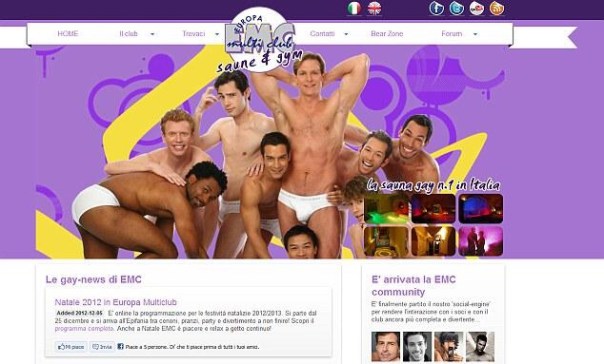
Next-door neighbours: The website of Europe’s largest gay sauna, Europa Multiclub, which is housed in an apartment part-owned by the Holy See
Location, location, location: The Europa Multiclub in Via Carducci, Rome, where several priests live nearby
Red faces all round: Cardinal Ivan Dias (pictured), the so-called ‘prince of the church’ has a 12-room apartment located just yards from the Europa Multiclub
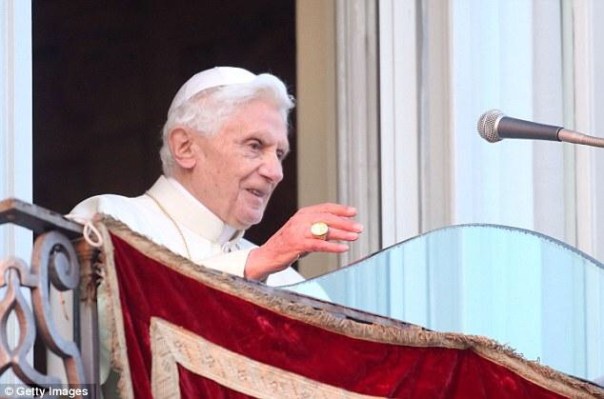
In turmoil: Revelations of the sauna come amid claims Pope Benedict XVI (above) resigned in response to a gay cabal in the curia, the Vatican bureaucracy
Array

It is already reeling from claims Pope Benedict XVI resigned because of a gay cabal in the Vatican.

Now, as the College of Cardinals prepares to elect his successor later today, the scandal-hit Catholic Church has broken into another sweat, this time over news several priests share an apartment block with Europe’s largest homosexual sauna.

The Holy See owns 19 apartments in the block in Rome after buying a £21million share of the building in 2008.

Several of the flats house priests, notably Cardinal Ivan Dias, the so-called ‘prince of the church’ whose 12-room apartment at 2 Via Carducci is located just yards from the Europa Multiclub.

The 76-year-old, who is the head of the Congregation for Evangelisation of Peoples, would no doubt be horrified to discover what was happening on the floor below.

Cardinal Diaz, who is Indian and a former archbishop of Mumbai, will take part in the conclave to elect a successor to Pope Benedict XVI later today.

According to the Independent, he believes that gays and lesbians can be cured of their ‘unnatural tendencies’ through the ‘sacrement of penance’.

But it’s not known if he has ever nipped downstairs to impart his views on those attending the sauna.

The facility, billed as ‘Italy’s best-known gay sauna’, boasts a Turkish bath, Finnish sauna, whirlpools and massages.

Its website ironically touts one of its ‘bear nights’ with a video of a hairy man stripping down and changing into a priest’s outfit.

It says Bruno is ‘free to the music of his clergyman, remaining in a thong, because he wants to expose body and soul’.

The purchase was apparently the brainchild of Cardinal Tarcisio Bertone, Pope Benedict’s much-disliked right-hand man who held the Vatican’s purse strings during the last pontificate.

Visitors of Italian gay websites were quick to make jokes about the sauna.

One said on Gay.it: ‘Oops, I took the wrong door, I thought it was the chapel.’

The Vatican has declined to comment on the proximity of the sauna to the priests’ accommodation.

The revelations come days after Italian newspapers published claims of homosexuality and blackmail within the Church, with one allegation centering around a secret ‘gay cabal’ of priests.

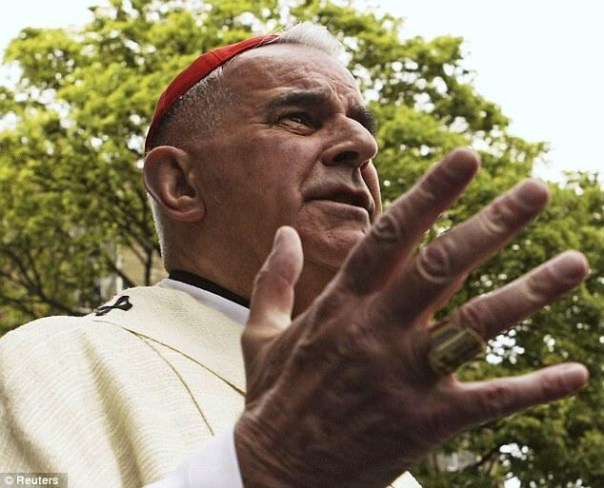
The Vatican has also been hit with further charges of hypocrisy against the Church’s stance on homosexuality following the resignation of disgraced Scottish cardinal Keith O’Brien.

The 74-year-old had been preparing to help choose the next Pope. But earlier this month effectively admitted that allegations that he made homosexual approaches to young trainee priests were true.

He conceded his ‘sexual conduct’ had ‘fallen below the standards expected of me as a priest, archbishop and cardinal’.

The former archbishop will face a Vatican investigation into his behaviour and could be subjected to further punishment if evidence of wrongdoing is found.

His admission left the Roman Catholic church in both England and Scotland in deep crisis over sexual standards and apparent hypocrisy on the part of its most senior priest.

Vatican purchases €23m building that houses Europe’s biggest gay sauna

Faces at the scandal-struck Vatican are even redder than usual after it emerged that the Holy See had purchased a €23 million share of a Rome apartment block that houses Europe’s biggest gay sauna.

The senior Vatican figure sweating the most due to the unlikely proximity of the gay Europa Multiclub is probably Cardinal Ivan Dias, the head of the Congregation for Evangelisation of Peoples, who is due to participate in the election at the Sistine Chapel.

This 76-year-old “prince of the church” enjoys a 12-room apartment on the first-floor of the imposing palazzo, at 2 Via Carducci, just yards from the ground floor entrance to the steamy flesh pot. There are 18 other Vatican apartments in the block, many of which house priests.

The Holy See is still reeling from allegations that the previous pontiff, Benedict XVI, had quit in reaction to the presence of a gay cabal in the curia.

And with disgraced Scottish cardinal Keith O’Brien lending new weight to charges of hypocrisy against the Church’s stance on homosexuality, La Repubblica newspaper noted that the presence of “Italy’s best known gay sauna in the premises is an embarrassment”.

Cardinal Dias, who is seen as a social conservative even by the current standards of the church hierarchy, is no doubt horrified to learn of the activities taking place a floor below.

It is not known, however, if the former archbishop of Bombay has popped downstairs to give spitiual guidances to the clients of the Europa Multiclub, given his belief that gays and lesbians can be cured of their “unnatural tendencies” through the “sacrement of penance”.

The sauna’s website promotes one of its special “bear nights”, with a video (below) in which a rotund, hairy man strips down before changing into a priest’s outfit. It says Bruno, “a hairy, overweight pastor of souls, is free to the music of his clergyman, remaining in a thong, because he wants to expose body and soul”.

There was further embarrassment for the Holy See when the press observed that thanks to generous tax breaks it received from the last Berlusconi government,  the church will have avoided hefty payments to the Italian state. The properties are recognised as part of the Holy City.

Cardinal Tarcisio Bertone, Pope Emeritus Benedict’s widely disliked right-hand man, who held the Vatican’s purse strings during the last pontificate, was said to have been the brains behind the purchase of 2 Via Carduccio in 2008.

Readers on Italian gay websites were quick to make jokes at the cardinals’ expense. One on the Gay.it site quipped: “’Oops, I took the wrong door, I thought it was the chapel.’…If you can’t go to the gay sauna for fear of being seen what do you do if you have millions of Euros stolen from Italians? You buy the apartment block with the sauna inside.”

Reference

Pope and Ceremony: The Secret World of Vatican City

The headquarters of the Catholic church is a closely guarded city-state – centuries old and resistant to change. Can Pope Francis drag it into the 21st century? (Guardian photographer Christian Sinibaldi was given unprecedented access to his world. Words by Paula Cocozza)

Renzo Cestiè, Pope Francis’s senior driver, waits as the Popemobile is refuelled. Photograph: Christian Sinibaldi

The man holding the keys might have wandered into a fairytale. He faces a pair of towering doors whose knocker is larger than his head. In his hand, the giant hoop clatters as he feels his way towards No 401; it enters the keyhole with a clear, sharp clang. The man starts to push and light from inside the room falls across his shoes.

At 6.30am, the Vatican is awakening. In a few hours, the room Alessio Censoni has just opened, the Sala Rotonda, will be packed with tourists. But, for now, the building is coming to life with workers. Chatter blows along the corridors. Together with four shift-mates, Censoni continues his round of unlocking: 300 doors to go.

Since his election in 2013, Pope Francis has repeatedly praised the dignity of labour (in Buenos Aires, he once did a stint as a bouncer). Group by group, he has invited the Vatican’s 4,800 employees to mass in Casa Santa Marta, the guesthouse where he lives. In January, he baptised Censoni’s daughter. What can his employees – hastening to the clocking-in machine, past the sleepy security guard in a North Face hoodie – tell us about working alongside the pontiff?

Keeper of the keys, Alessio Censoni. Photograph: Christian Sinibaldi

The cleverness of Pope Francis has been to advance the message of Christ simply by being human himself. He has brought divine office down to earth with a revolution in tone. Famously, he is the first pope to use the word “gay” (“If a person is gay and seeks God and has good will, who am I to judge?”). He has described the pay gap between men and women as “pure scandal”, advised Catholics that they needn’t breed “like rabbits”, and called priests who refuse to baptise the children of single mothers “animals”. He has washed the feet of young prisoners. In this sense, Pope Francis is a parable in action.

If his predecessor Pope Benedict was perceived as aloof and scholastic, this pope wears a full-faced grin and wields a thumbs-up. But while he is seen as progressive, Francis’s reform of the curia – the church’s central government, which he has castigated for its insularity and back-biting – is moving slowly. And despite the apparent liberalism of his speeches, the official teaching remains mostly intact: abortion is still “absolute evil”, homosexual acts a sin, gay marriage firmly opposed. Francis has managed to suggest a radical agenda by putting the theme of mercy at the heart of everything he does: in countless speeches, pronouncements and even the current “extraordinary jubilee” year. It’s a message that has secular appeal (who doesn’t believe in compassion?), and it has allowed the pope to sidestep a confrontation with the church’s more conservative forces, by encouraging local priests to use their own discretion.

But still the Vatican remains highly secretive, a world in miniature; packed into its 0.44 sq km is everything a state needs, only smaller. Beyond its museums and St Peter’s Basilica, the frontiers are well guarded. There are high walls, and the famous bank is housed inside an old fortress. The fire engines are the size of minibuses. Under Pope John Paul II, the cinema was busy, but the chairs are now stacked and it looks disused. There is even a tiny jail, used to detain the priest convicted in July for his part in the latest Vatileaks scandal exposing financial mismanagement and corruption at the city’s heart. Petrol costs a minuscule 40 cents a litre, compared with €1.40 over the border in Rome.

[He] says these things, catchy phrases, which are less than 140 characters, so they naturally fit on Twitter

At one of these roadside pumps, the Popemobile is being refuelled. Renzo Cestiè, chatting to the attendant, is Pope Francis’s senior driver. He was second driver for Benedict, “but we had a whole different fleet then”, he says. “We had an armoured Mercedes, an armoured Popemobile. Pope Francis doesn’t want them. He wants contact with the people. See?” He lifts a protective cover to reveal a Popemobile with tinted windows. “This was used by John Paul II and Benedict, but the Holy Father fears nothing.” And what about his driver? “I don’t feel fear,” he shrugs. “If it happens, we go to paradise.”

Cestiè sensed that his job was changing from day one. Sent to collect the newly elected pope from his pensione in central Rome, he waited by the entrance in a Mercedes. “An official came rushing out, saying, ‘Take it away!’ Because the pope wanted to get the bus with his cardinals. He said, ‘Do you mind if I go with my friends?’ We didn’t know then that he hated luxury. We didn’t stop to think that these cars weren’t made for him.”

Jobs as cleaners and maintenance workers are often passed down through families. Photograph: Christian Sinibaldi

For the first few weeks, Cestiè, who is 62 and has worked at the Vatican since he was 14, reported for duty in fancy cars. Then the pope visited his garage to see the options for himself, settling on a blue Ford Focus and the smallest, most open Popemobile. Cestiè thumps its bonnet. “For us it was a wonderful thing, the Holy Father so humble.” Now Benedict’s Mercedes is boxed in at the back of the garage, its roof covered with a sheet of bubblewrap.

Cestiè flips open the Popemobile’s glove box, where a white towel is stowed to dry the pope on rainy days. As a rule, he says, the vehicle should feature the papal coat of arms, but the paintwork glints with Benedict’s golden emblem. “Pope Francis doesn’t like crests.” He also insists on shutting his own door. Cestiè lets slip a reference to the pope’s “butlers”, or assistants, and then corrects himself. “He doesn’t want to call them butlers, because we are all the same. We are people who collaborate with him.”

The pope is a quiet passenger who shuns the car radio, he says. But every now and then, Cestiè will glance in his rearview mirror and find his passenger’s gaze. “I always look away,” he says. When Francis meets his eye, “it is as if, in that moment, he looks inside you and he knows who you are”. His voice cracks, the silence eventually broken by his mobile ringtone: Barry White’s Can’t Get Enough Of Your Love, Babe.

Pushed to name the biggest change since Francis was elected, Cestiè’s answer is surprisingly pragmatic: it’s his work-life balance. Unlike Benedict’s retired driver, “who was always here, every day, every holiday”, Cestiè works a six-hour shift. “The Holy Father wouldn’t want it. He is the first to say, ‘Why aren’t you resting today?’”

A team of 80 workers maintain the Vatican’s treasures. Photograph: Christian Sinibaldi

It is a five-minute walk from Cestiè’s carport to the lavish apostolic palace, past the fire engines where the firemen still lean on the bonnet. This is where Benedict lived as pope, and where Francis holds meetings. Sun pours through the windows, making latticed shadows on the wall. The galleried walkways glimmer with the clean, faint fragrance of undisturbed air. At the clip of approaching footsteps, a Swiss guard materialises around a corner. He can’t talk on duty, he says (and this afternoon he is captaining FC Guardia in a match against a Gypsy team), but he promises to meet tomorrow.

He doesn’t want to call them butlers, because we are all the same. We are people who collaborate with him

In the Sala Regia, a vast antechamber to the Sistine Chapel, workers are packing portraits of 19th-century popes into removal crates after an exhibition. Just off this room is the apostolic sacristy where Father Pavel Benedik, a taciturn Slovakian priest, is fiddling with his smartphone. He is the custodian here, and calm prevails. In an hour, the phone rings once. The room is lined with polished wardrobes, a hive of numbered wooden doors in which every item has its place, and every place has a label. Vestments are stowed by size (Pope Francis takes a 3, the most popular) and the drawers are taped with old-fashioned embossed strips: “X IL PAPA [for the pope]”, “VIMPE STOLE [shawls, stoles]”.

Helping Father Pavel is Father Jesus Polentino, 30, from Venezuela. He was ordained just as Benedict resigned, so for him the election of an Argentinian pope felt particularly auspicious. “The first Latin American pope,” he says. “They went to the end of the world to find him. That means that even we, who are from the end of the world, can arrive at the heart of this church.”

He is a volcano! This dynamism – no one expected this. Not even him,’ says Father Federico Lombardi. Photograph: Christian Sinibaldi

Or maybe the heart, its centre, is moving outwards? “Only the style changes a bit,” Father Pavel says. He withdraws a bent cross crosier from a nearby cupboard and lays it next to the original on which it was modelled. This crucifix-topped staff fell into disuse under Benedict, but it has been revived, to the distaste of some Catholics, who find its depiction of Jesus’s suffering too brutal. “Almost the same,” Father Pavel says, looking at the two. And they are, only the Christ in Francis’s version has even thinner legs. Suffering is not something from which he shies away.

A reformer

At 6pm, it is rush hour in the Vatican. Cars file along the road behind the palace of the governatorato, a sort of mayoral building opposite which Francis’s crest has been clipped out of box hedging; maybe it was planted before he made his wishes clear. Nuns unload shopping trolleys into their car boots by the supermarket, and a crowd gathers at the pharmacy where a promotional stand offers samples of Avène skincare. Outside the Swiss Guard barracks, the air is thick with sweat and deodorant. The young soldiers who guard the pope have just finished a football match.

Just beyond the Vatican gates, Father Federico Lombardi, 73, shows the way to his office, up marble stairs, through a room stacked floor-to-ceiling with boxes of paper and ink. For 10 years until this summer, he served as the pope’s spokesperson (though he rejects that title, because “the pope can speak for himself”), working with John Paul II, Benedict and the current pope.

What has Francis been like? “He is a volcano!” Lombardi says, settling into his swivel chair. “This dynamism – no one expected this. Not even him! He is very creative, he has lots of initiatives.”

These have included choosing to launch the pope’s “holy year of mercy” at Bangui cathedral in Central African Republic, rather than Rome. Then there were the 11 Syrian migrants he brought back to Rome from Lesbos in April. Not to mention the free-form press conferences, the reinvigorated synod of bishops, which is devolving power to the regions, and the council of cardinal advisers tasked with reforming the curia. Twelve times in an hour, Lombardi describes Francis as “dynamic” – but would he say the pontiff is a reformer?

“Let’s say he has given a strong impetus to putting us on the road, no? When he speaks about the church ‘going out’, he means a church that is not inside the walls defending itself, not self-referential,” Lombardi replies, cupping his hands as if to enclose a tiny city. “That definitely is a sense he has given us. The church on the road – and, in this sense, I accept the definition of reformer.”

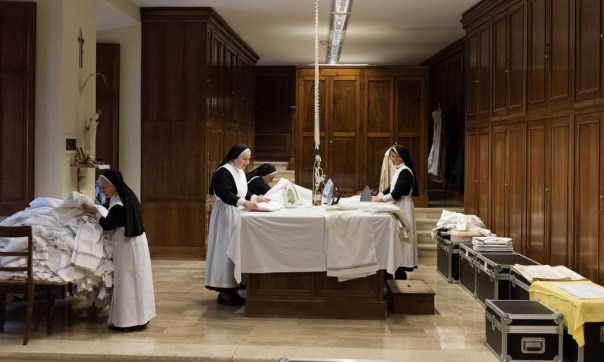
Sisters iron ceremonial robes. Photograph: Christian Sinibaldi

You can almost feel the volcano cool as Lombardi speaks, though such circumspection comes with the territory. “There is what one might call a turf war going on,” Austen Ivereigh, author of Pope Francis: The Great Reformer, explains. “The different departments have their own fiefdom. That’s what he is setting out to change.” Nine communication teams have become one. This month, the Vatican ministries of family, laity and life, which have always overlapped, will merge. Others will follow. Ivereigh calls this “the biggest redesign of the curia in 30 years. It’s radical in the sense that Francis is introducing collegiality, which is allowing the local church to have a much greater say. The reordered Vatican will be a slimmer, more focused structure.”

Crucially, there will be financial reform. Last December, the Vatican appointed PricewaterhouseCoopers as its external auditor. But in April the audit was suspended; the Vatican has since announced that its own Office of the Auditor General, created by Pope Francis, will conduct the audit with PwC in “an assisting role”.

Lombardi waves away these subjects as “very particular arguments. I am not sure it’s worth going into them. The suspension of the deal with Pricewater…” he trails off, apparently having forgotten the name. “If you do a contract for three years, that costs €3m, that looks at all the central institutions – it can happen that you need to correct the odd thing.”

He thinks Francis’s reforms have had “partial results. Certain things are already seeing positive results, but others are still a little in train.”

How difficult is it to bring about change? “Exactly like in all the organisations of the world. I have been here 25 years. I know how things are done and why they are done. If someone comes along and says, ‘Now we are changing everything’, I say, ‘Look, perhaps you haven’t yet understood what we do and why we do it.’ Perhaps I make one or two objections. Is this resistance because I don’t want to change anything, or is it because I simply want to make you understand what we have done and why?”

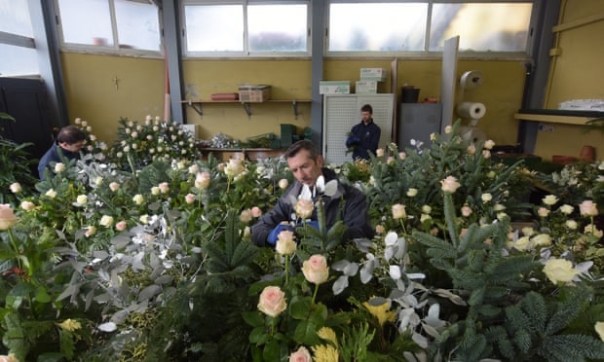
Florists at work. Photograph: Christian Sinibaldi

The swivel chair is in a state of agitation now, and Lombardi’s shoulders rise and fall in frustration. “I have always found it very simplistic, the way the world is divided between those who want to make things better and those who resist, because they want to conserve their power. If anyone says this about the Vatican, they are saying an idiocy. Perhaps in 3,000 people, you will have three or four who will say, ‘I lose my power!’, and lots of others who will say, ‘No, let’s discuss what we want to change.’ There should be a discussion.

“These ones here, when they came,” he says, casting around for the name of another, previous consultant. “It was very interesting for me: McKinsey. We worked with much friendship and serenity. But at the start,” he says, dropping his voice, “they knew absolutely nothing. They didn’t know about shortwave radio! They had not the least idea, while we had worked on it for 80 years. Do you understand? It’s great to draw up new plans. But there is also a dialogue to be had.” He laughs. “I had the impression I taught them more than they did me.”

As director of communications for an outspoken pope, one imagines Lombardi’s job became tougher with Pope Francis. But, no, he says, it was harder under John Paul II. “For the last five or six years, he was in a chair and didn’t say a word.” And Benedict was also “less concrete in his communication, so it was more challenging”. Pope Francis, meanwhile, has “a great gift” for speaking directly. He “says these things, catchy phrases, which are less than 140 characters, so they naturally fit on Twitter. In this type of communication, Francis is ideal. It’s as if he were made for the purpose.”

The sky is darkening through Lombardi’s office window. “Instead of going about with complete indifference, feeling the church is out of step with the times,” he adds, “Francis has made it closer, more present, with all the suffering and difficulty that humanity experiences today.”

‘Fran-cis-co! Fran-cis-co!’

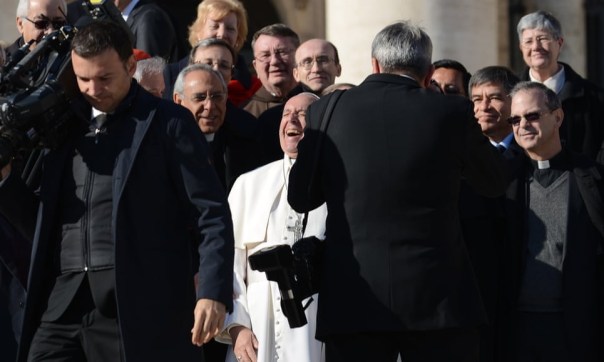
In St Peter’s Square, crowds have gathered, chatting, chanting, singing a cappella. Soon Pope Francis will descend the steps and faithful hands will grasp the air around him. Renzo Cestiè’s mother will be watching on TV. A murmur rises. An elderly man is pushing a wheelchair; his son, Carmelo, who lost speech and movement after a stroke, sits with a white cap on his lap. He hopes that Pope Francis will wear it. People shout, “Carmelo! Over here!” They know that where a wheelchair is parked, Francis will come.

The Papal Audience in St Peter’s Square. Photograph: Christian Sinibaldi

A cry of “Fran-cis-co! Fran-cis-co!” breaks from the crowd. The pope is coming. Carmelo is bringing him to us. The pope looks thrilled. He is beaming as if he has been waiting for this. He stoops, eyes crinkled, and clasps Carmelo’s head so eagerly, his fingers disappear into his thick hair. Spotting the cap, he gives a magician’s grin and plucks off his own by a tassel. Ta-da! In its place he puts Carmelo’s. He presses it down, to make sure that whatever goodness rises from his head will stick to Carmelo’s cap. He smiles again – something is happening – and returns the cap; the delight on his face suggests that it is he who has met Carmelo, and not Carmelo who has met the pope. The crowd roars. People wipe their eyes. Carmelo has been hugged and it feels like a hug for all. A new chant breaks out. “Car-mel-o! Car-mel-o!” The pope climbs into his jeep, black trousers showing through his white robe. Underneath it all, they seem to say, he is just a parish priest.

Speak to those who work with Francis, and the stories of countless acts of consideration mount (though he could send the nuns help with the ironing). Alessio Censoni, the key-keeper, knows that the rumours the pope encouraged women to breastfeed in the Sistine Chapel are true: at Censoni’s daughter’s christening, when babies wailed, he turned to the mothers and asked, ‘Can’t you hear they’re crying? Feed them tranquilly.”

He asks us … if we’re hungry, if we want to sit down. On my first night shift, he offered me a biscuit

“Yes, I’ve heard that one,” says Filippo Petrignani, who works in the museum’s rights office. “But there are loads. Of him taking a coffee from the vending machine. With coins.” Petrignani rattles off the stories like jokes. “Last summer: ‘Father, it’s very hot in Rome. Would you like to go out of the city for a week?’ ‘And how many people would I have to move to go out of the city? Hmm. We’ll stay at home. What we save, we’ll give to the poor.’”

In another anecdote, Pope Francis offers a chair to a Swiss Guard. “That’s true,” says guard Nico Castelluzzo, today sitting in the visitors’ mess, just after lunch, his colourful livery peeled to the waist to protect the uniform from spatters from his pasta sauce. “It was the same when we did the night shift outside his apartment. He would always ask if we’d slept OK. It took a while for him to understand that we were on duty, that we needed to stay awake. He asks us – he’s a very human person – if we’re hungry, if we want to sit down. On my first night shift, he offered me a biscuit. It tasted good: an Argentinian biscuit.”

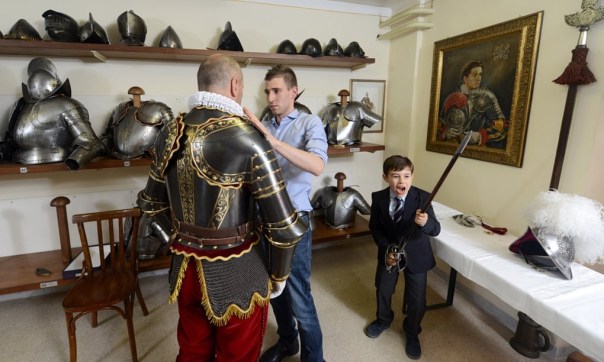
Christoph Graf, the 35th commander of the Pontifical Swiss Guard, is dressed by an assistant as his son plays. Photograph: Christian Sinibaldi

According to the Swiss Guards’ website, beneath Castelluzzo’s colourful costume “is actually a state-of-the-art trained Swiss security professional”. So it is surprising to learn that guards are not required to undertake exercise and they have a liberal curfew of 2am (though they are required to shave each day). Castelluzzo passes the solitary hours on duty with a book. “I was never a great reader. I started when I joined the Swiss Guards, so I’m still trying to work out what I like,” he says. Despite the Vatican’s disapproval of its author, he has just finished Dan Brown’s Angels and Demons. “Well,” he says, “it’s good to know the opposition.”

Has Pope Francis’s predilection for entering crowds make Castelluzzo worry? “Security is more complicated. Pope Francis is very close to the people. But he knows what risk he takes, and he still wants to do it.” The Swiss Guards work with the carabinieri, Italy’s military police. “But,” Castelluzzo says, “if someone wants to do something, they will surely find a way.” He shrugs. “You need to pray a lot.”

From the guards’ barracks, the road loops around the rear of St Peter’s to reach the basilica’s maintenance division, near the smokers’ corner and the vending machines. Here, Pietro Zander helps oversee the cleaning and maintenance workers (the job that Renzo Cestiè’s father, grandfather and great-grandfather all did). “We continue that which they who came before us started,” Zander says. The St Peter’s Zander knows is not the one most visitors see. There are 22,000 square metres of floor to be cleaned daily. When a shaft of light enters a window, Zander sees “threads of wool, hairs, all this microdust”. He knows the basilica in its vastness and its particulars. But it is also a home. “St Peter’s house,” he says. “Like a house, the door is closed with a key.”

Pope Francis, whom Zander considers “a neighbour”, likes to greet the cleaners in the basilica, but there are other examples of crossover between the devotional side of things and what Zander calls “contingent necessities”. When, for example, John Paul II required a tomb, it was Zander’s department that solved the problem of where to put him by moving the remains of Pope Innocent XI because otherwise, he says with a straight face, “There was a pedestrian traffic problem. The huge flow [of mourners] would have created jams.”

Driver Renzo Cestiè with the Pope’s Ford Focus. Photograph: Christian Sinibaldi

A colleague enters his office. “Have you seen this?” Zander asks, holding up an old chandelier. He is fascinated by the metal grid that protects the bulb. “If the bulb breaks, the glass won’t fall. And if the grid breaks, the grid won’t fall, because look…” He waggles a small metal tie that acts as a second safety catch. “One of the principles of doing things properly in St Peter’s is to look at what has been done before you. Because here perfection has happened that way.” He rests the chandelier on the table. There is an echo of Father Lombardi and his defence of the curia’s right to question change: for both men, precedent should be upheld to protect the future.

Pope Francis’s critics broadly divide into two camps: those who think he is trying to change too much, and those who would like him to do more. Reform is happening slowly, unevenly. His ad hoc gestures and comments can feel like progress, but in other areas – in confronting institutional child abuse, for example, or tackling financial reform – he can seem wanting. And, of course, devolving authority to local churches has empowered conservative as well as liberal voices. As the pope said in an address last Christmas, “We cannot do everything, yet it is liberating to begin.”

It must be hard to reform a structure when the past is seen to confer its own kind of providence. But Pope Francis’s smile has yet to slip and, at 79, he has “an energy unexpected of a person of his age”, Father Lombardi tells me. “I asked him how he did it, how he managed. He said, ‘Well, God asked me to do it and he gives me the strength to do it.’ His Argentinian friends say, ‘But we don’t recognise him! He seems 20 years younger than when he left.’ In his last years in Buenos Aires, he seemed to be preparing for retirement. Instead, he has taken off again – and he pulls us all along.”

Reference

Patron Saints of the Nerds…and Hackers

NEW ORLEANS – Here in the oldest church building in New Orleans, tucked into a dark corner by the door as far away from the main altar as possible, stands the statue of St. Expedite – the unofficial patron saint of hackers.

Unofficial because the Roman Catholic Church doesn’t know what to do about St. Expedite. He’s too pagan to be a proper saint, and too popular for his statues to be simply tossed out the door.

Statues of St. Expedite seem to appear at some churches, a puzzling phenomenon. Where do the statues come from? Who sends them? No one really seems to know who St. Expedite was in life or even if he ever existed.

But whatever St. Expedite may or may not be, geeks, hackers, repentant slackers, folks who run e-commerce sites and those who rely on brains and sheer luck to survive have all claimed the saint as their own.

In 2002, the Catholic Church offered up St. Isidore of Seville as the saint of computer programmers. Isidore seemed to be a fine choice – in the 7th century, he produced one of the world’s first databases, a 20-volume encyclopedia called The Etymologies, intended to be a summation of everything that was known about the world he lived in.

But Isidore somehow seems a bit too plodding for hackers, plus his life story includes none of the weird wordplay that makes so many hackers happy.

St. Expedite’s name obviously relates to his attested ability to deliver favors quickly to the faithful. But wait! There’s more – a joke about how St. Expedite manages to maneuver his statues into churches.

In 1781, or so the story goes, a packing case containing the body of a saint who’d been buried in the Denfert-Rochereau catacombs of Paris was sent to a community of nuns in the city. Those who sent the body wrote “Expedite” on the case, to ensure fast delivery of the corpse for the obvious reasons.

The nuns got confused, assumed Expedite was the name of a martyr, prayed to him, had a bunch of prayers answered amazingly quickly and the cult of St. Expedite was born. News of this saint who cheerfully dispensed quick miracles soon spread rapidly through France and on to other Catholic countries.

It’s a swell story, but Italians were asking St. Expedite to grant their wishes well before 1781, so either the date or the entire story is wrong. And the whole thing just screams urban legend anyway.

A different version of the same story is told in New Orleans. Supposedly, the church of Our Lady of Guadalupe received a big shipment of assorted saint statues. Only one didn’t have a proper label on the case identifying the saint whose statue was contained within. But the crate did have an “Expedite” label on it, so the locals decided that must be the saint’s name.

A century and a half later, according to the story, they found out there was no saint called Expedite. However, a little research turned up the obscure St. Expeditus, whose status as a possible Armenian martyr gave the Expedite myth legitimacy.

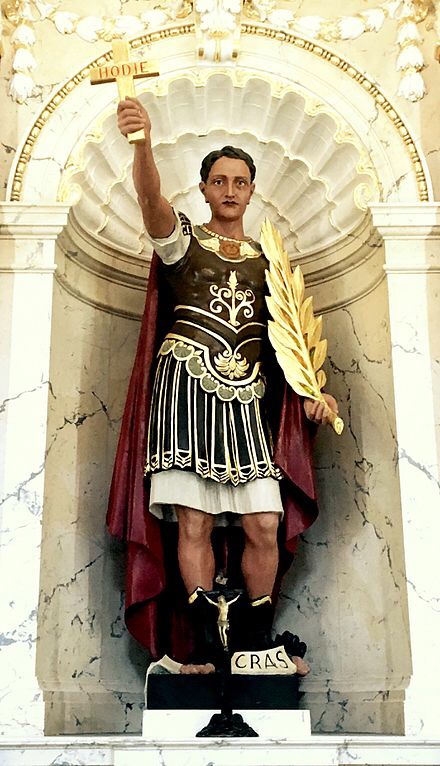
St. Expedite is typically depicted as a young Roman centurion squashing a crow beneath his right foot and hoisting a clock or, in later versions, a cross inscribed with the word hodie (“today” in Latin). A ribbon with the word cras (“tomorrow” in Latin) emerges from the squished crow’s mouth. The idea is that St. Expedite destroys people’s proclivity to procrastinate and vanquishes vague promises of joyous tomorrows in favor of making things happen right now.

Why a crow? English-speaking people tend to mimic the sound a crow makes as “caw caw.” Italians hear it as “cras cras.” In Italian folk tales, crows and ravens are forever yapping on about tomorrow.

St. Expedite is also widely considered, among people who consider such things, to provide real-time assistance on problems – he’s the saint of the fast solution. He is also is the patron saint of people who have to deliver work or products on a tight schedule.

While visiting St. Expedite in New Orleans, we saw half a dozen people come in and tuck notes and flowers by the saint’s statue, ignoring the official saints in the front of the church.

“St. Expedite got me a job fast after my company closed down last month,” said Letish Jackson of New Orleans, who’d come to the church to thank the saint. “If you knew how hard it is to get jobs here you’d know that me being employed is a very big miracle.”

She’s not the only one who turned to the saint for financial help. A recent article that appeared on the front page of The Wall Street Journal noted that St. Expedite has also become the patron of victims of outsourcing.

Jackson, and other Our Lady of Guadalupe parishioners, said that “computer people,” as Jackson described them, often come to visit St. Expedite.

“I asked my friend who runs a computer repair service why those people come here, and he says Expedite is the nerd’s saint,” said Jackson. “My friend said St. Expedite is all about delivering information fast.”

Patron saints in general are broadband connections to the Almighty, passing along messages from the desperate or faithful. And the Catholic Church seems to have a patron saint for every possible need.

St. Joseph of Cupertino, the “flying friar,” is not the patron saint of Mac users – he’s appealed to by skittish air travelers (it’s said the good friar levitated whenever he was happy). Girls who live in rural areas can pray to St. Germaine of Pibrac, the patron of peasant females.

“I’m not a big believer in the saints, but St. Expedite is another whole story – he’s so good he’s scary,” said freelance computer support consultant Kathy Dupon, a resident of New Orleans. “My clients were forever paying me late until I taped a card with the saint’s picture behind my mailbox as a joke last year. Now my checks almost always arrive on time.”

ST ISIDORE OF SEVILLE

St. Isidore of Seville

Born: c.560 in Cartagena, Spain 

Died: April 4, 636

Canonized: pre-Congregation

Feast Day: April 4

Patron Saint of: computers, computer users, computer programmers, Internet

Isidore was born in Cartagena, Spain, about 560 AD, the son of Severianus and Theodora. His elder brother Leander was his immediate predecessor in the Metropolitan See of Seville; whilst a younger brother St. Fulgentius presided over the Bishopric of Astigi. His sister Florentina was a nun, and is said to have ruled over forty convents and one thousand religious. Isidore received his elementary education in the Cathedral school of Seville. In this institution, which was the first of its kind in Spain, the trivium and quadrivium were taught by a body of learned men, among whom was the archbishop, Leander. With such diligence did he apply himself to study that in a remarkably short time mastered Latin, Greek, and Hebrew. Whether Isidore ever embraced monastic life or not is still an open question, but though he himself may never have been affiliated with any of the religious orders, he esteemed them highly. On his elevation to the episcopate he immediately constituted himself protector of the monks. In 619 he pronounced anathema against any ecclesiastic who should in any way molest the monasteries. 

On the death of Leander, Isidore succeeded to the See of Seville. His long incumbency to this office was spent in a period of disintegration and transition. The ancient institutions and classic learning of the Roman Empire were fast disappearing. In Spain a new civilization was beginning to evolve itself from the blending racial elements that made up its population. For almost two centuries the Goths had been in full control of Spain, and their barbarous manners and contempt of learning threatened greatly to put back her progress in civilization. Realizing that the spiritual as well as the material well-being of the nation depended on the full assimilation of the foreign elements, St. Isidore set himself to the task of welding into a homogeneous nation the various peoples who made up the Hispano-Gothic kingdom. To this end he availed himself of all the resources of religion and education. His efforts were attended with complete success. Arianism, which had taken deep root among the Visigoths, was eradicated, and the new heresy of Acephales was completely stifled at the very outset; religious discipline was everywhere strengthened. Like Leander, he took a most prominent part in the Councils of Toledo and Seville. In all justice it may be said that it was in a great measure due to the enlightened statecraft of these two illustrious brothers the Visigothic legislation, which emanated from these councils, is regarded by modern historians as exercising a most important influence on the beginnings of representative government. Isidore presided over the Second Council of Seville, begun 13 November, 619, in the reign of Sisebut. But it was the Fourth National Council of Toledo that afforded him the opportunity of being of the greatest service to his county. At this council, begun 5 December, 633, all the bishops of Spain were in attendance. St. Isidore, though far advanced in years, presided over its deliberations, and was the originator of most of its enactments. It was at this council and through his influence that a decree was promulgated commanding all bishops to establish seminaries in their Cathedral Cities, along the lines of the school already existing at Seville. Within his own jurisdiction he had availed himself of the resources of education to counteract the growing influence of Gothic barbarism. His was the quickening spirit that animated the educational movement of which Seville was the centre. The study of Greek and Hebrew as well as the liberal arts, was prescribed. Interest in law and medicine was also encouraged. Through the authority of the fourth council this policy of education was made obligatory upon all the bishops of the kingdom. Long before the Arabs had awakened to an appreciation of Greek Philosophy, he had introduced Aristotle to his countrymen. He was the first Christian writer to essay the task of compiling for his co-religionists a summa of universal knowledge. This encyclopedia epitomized all learning, ancient as well as modern. In it many fragments of classical learning are preserved which otherwise had been hopelessly lost. The fame of this work imparted a new impetus to encyclopedic writing, which bore abundant fruit in the subsequent centuries of the Middle Ages. His style, though simple and lucid, cannot be said to be classical. It discloses most of the imperfections peculiar to all ages of transition. It particularly reveals a growing Visigothic influence. Arevalo counts in all Isidore’s writing 1640 Spanish words. 

Isidore was the last of the ancient Christian Philosophers, as he was the last of the great Latin Fathers. He was undoubtedly the most learned man of his age and exercised a far-reaching and immeasurable influence on the educational life of the Middle Ages. His contemporary and friend, Braulio, Bishop of Saragossa, regarded him as a man raised up by God to save the Spanish people from the tidal wave of barbarism that threatened to inundate the ancient civilization of Spain, The Eighth Council of Toledo (653) recorded its admiration of his character in these glowing terms: “The extraordinary doctor, the latest ornament of the Catholic Church, the most learned man of the latter ages, always to be named with reverence, Isidore”. This tribute was endorsed by the Fifteenth Council of Toledo, held in 688. 

As a writer, Isidore was prolific and versatile to an extraordinary degree. His voluminous writings may be truly said to constitute the first chapter of Spanish literature. It is not, however, in the capacity of an original and independent writer, but as an indefatigable compiler of all existing knowledge, that literature is most deeply indebted to him. The most important and by far the best-known of all his writings is the “Etymologiae”, or “Origines”, as it is sometimes called. This work takes its name from the subject-matter of one of its constituent books. It was written shortly before his death, in the full maturity of his wonderful scholarship, at the request. of his friend Braulio, Bishop of Saragossa. It is a vast storehouse in which is gathered, systematized, and condensed, all the learning possessed by his time. Throughout the greater part of the Middle Ages it was the textbook most in use in educational institutions. So highly was it regarded as a depository of classical learning that in a great measure, it superseded the use of the individual works of the classics themselves. Not even the Renaissance seemed to diminish the high esteem in which it was held, and according to Arevalo, it was printed ten times between 1470 and 1529. Besides these numerous reprints, the popularity of the “Etymologiae” gave rise to many inferior imitations. It furnishes, abundant evidence that the writer possessed a most intimate knowledge of the Greek and Latin poets. In all, he quotes from one hundred and fifty-four authors, Christian and pagan. Many of these he had read in the originals and the others he consulted in current compilations. In style this encyclopedic work is concise and clear and in order, admirable. Braulio, to whom Isidore sent it for correction, and to whom he dedicated it, divided it into twenty books. 

The first three of these books are taken up with the trivium and quadrivium. The entire first book is devoted to grammar, including metre. Imitating the example of Cassiodorus and Boethius he preserves the logical tradition of the schools by reserving the second book for rhetoric and dialectic. Book four, treats of medicine and libraries; book five, of law and chronology; book six, of ecclesiastical books and offices; book seven, of God and of the heavenly and earthly hierarchies; book eight, of the Church and of the sects, of which latter he numbers no less than sixty-eight; book nine, of languages, peoples, kingdoms, and official titles; book ten, of etymology: book eleven, of man; book twelve, of beasts and birds; book thirteen, of the world and its parts; book fourteen, of physical geography; book fifteen, of public buildings and roadmaking; book sixteen, of stones and metals; book seventeen, of agriculture; book eighteen, of the terminology of war, of jurisprudence, and public games; book nineteen, of ships, houses, and clothes; book twenty, of victuals, domestic and agricultural tools, and furniture.

In the second book, dealing with dialectic and rhetoric, Isidore is heavily indebted to translations from the Greek by Boethius. Caelius Aurelianus contributes generously to that part of the fourth book which deals with medicine. Lactantius is the author most extensively quoted in the eleventh book, concerning man. The twelfth, thirteenth, and fourteenth books are largely based on the writings of Pliny and Solinus; whilst the lost “Prata” of Suetonius seems to have inspired the general plan of the “Etymologiae“, as well as many of its details. 

Similar in its general character to the “Etymologiae” is a work entitled “Libri duo differentiarum“. The two books of which it is composed are entitled respectively, “De differentiis verborum” and “De differentiis rerum“. The former is a dictionary of synonyms, treating of the differences of words with considerable erudition, and not a little ingenuity; the latter an exposition of theological and ascetical ideas, dealing in particular with the, Trinity and with the Divine and human nature of Christ. It suggests, and probably was inspired by, a similar work of Cato’s, It is supplementary to the first two books of the “Etymologiae“. The “Synonyma“, or, as it is sometimes called on account of its peculiar treatment, “Liber lamentationum“, is in a manner illustrative of the first book of the “Differentiae“. It is cast in the form of a dialogue between Man and Reason. The general burden of the dialogue is that Man mourns the condition to which he has been reduced through sin, and Reason comforts him with the knowledge of how he may still realize eternal happiness. The second part of this work consists of a dissertation on vice and virtue. The “De natura rerum” a manual of elementary physics, was composed at the request of King Sisebut, to whom it is dedicated. It treats of astronomy, geography, and miscellanea. It is one of Isidore’s best known books and enjoyed a wide popularity during the Middle Ages. The authenticity of “De ordine creaturarum” has been questioned by some critics, though apparently without good reason. Arevalo unhesitatingly attributes it to Isidore. It deals with various spiritual and physical questions, such as the Trinity, the consequences of sin, eternity, the ocean, the heavens, and the celestial bodies. 

The subjects of history and biography are represented by three important works. Of these the first, “Chronicon“, is a universal chronicle. In its preface Isidore acknowledges, his indebtedness to Julius Africanus; to St. Jerome’s rendering of Eusebius; and to Victor of Tunnuna. The “Historia de regibus Gothorum, Wandalorum, et Suevorum” concerns itself chiefly with the Gothic kings whose conquests and government deeply influenced the civilization of Spain. The history of the Vandals and the Suevi is treated in two short appendixes. This work is regarded as the chief authority on Gothic history in the West. It contains the interesting statement that the Goths descended from Gog and Magog. Like the other Historical writings of Isidore, it is largely based on earlier works of history, of which it is a compendium- It has come down to us in two recensions, one of which ends at the death of Sisebut (621), and the other continues to the fifth year of the reign of Swintila, his successor. “De viris illustribus” is a work of Christian biography and constitutes a most interesting chapter in the literature of patrology. To the number of illustrious writers mentioned therein Braulio added the name of Isidore himself. A short appendix containing a list of Spanish theologians was added by Braulio’s disciple, Ildephonsus of Toledo. It is the continuation of the work of Gennadius, a Semipelagian priest of Marseilles, who wrote between 467 and 480. This work of Gennadius was in turn, but the continuation of the work of St. Jerome. 

[ Source: The Catholic Encyclopedia ]

So, how does Saint Isidore of Seville become the patron saint for the Internet? The Observation Service for Internet, who drew it’s mission from the Pontifical Council for Social Communications, researched the Internet and related technologies to select a patron saint that best reflects the concerns and ideals of computer designers, programmers and users. The saint chosen by the Observation Service for Internet was Saint Isidore. “The saint who wrote the well-known ‘Etymologies’ (a type of dictionary), gave his work a structure akin to that of the database. He began a system of thought known today as ‘flashes;’ it is very modern, notwithstanding the fact it was discovered in the sixth century. Saint Isidore accomplished his work with great coherence: it is complete and its features are complementary in themselves.

ST EXPEDITE

Expeditus with his typical iconographical attributes

Reference

Buddhism 101: More on Hand Mudras; Mudras: Meaning of Sacred Hand Gestures

Mudras are sacred hand gestures or positions that used to evoke a state of mind. The Sanskrit word “mudra” means “seal”, “mark”, or “gesture”. In Tibetan the word is ཕྱག་རྒྱ་ or “chakgya”. Each of these sacred hand gestures has a specific meaning. Many of them symbolize major moments or events in the Buddha’s life.

In this beautiful photo by Olivier Adam, an elderly nun in Zanskar shows a novice nun how to make the Mandala Offering Mudra.

8 Mudras and their Meaning

Sacred hand gestures or mudras are often depicted in Buddhist art. In this blog we’d like to share descriptions and images of some common mudras. The list here is not exhaustive.

The Earth Witness Mudra

When Siddhartha Gautama, the historical Buddha, was meditating under the Bodhi tree, he was assailed by the demon Mara, who tried to disturb his mind. Mara represents the passions that trap and delude us. Siddhartha refused to be tempted from the path to enlightenment and he called on the earth to witness his worthiness to become enlightened, saying, “The earth shall be my witness, I will not let myself be seduced.” In the Earth Witness Mudra, (also known as the Bhumisparsa Mudra or Gesture of Witness), the historical Buddha is seated in the meditation posture and touches the earth with the fingertips of his right hand, palm facing inwards. The left hand is placed in the lap with the palm facing upwards.

In this detail from a thangka print, the historical Buddha is depicted seated in meditation and calling the earth as his witness.

The Mudra of Meditation

The Mudra of Meditation (dhyana) is made by placing both hands on the lap, right hand on the left, with the palms facing upwards, the tips of the thumbs touching, and the fingers fully stretched. This mudra helps to calm the mind for meditation and is used for deep contemplation and reflection. The mudra of meditation is a characteristic gesture of the Buddha Shakyamuni.

This ancient stone sculpture shows the Buddha with his hands in the Mudra of Meditation

The Namaskara or Anjali Mudra

This mudra, while not found in representations of the Buddha or other deities, is commonly used by nuns, monks, and lay people to symbolize devotion, prayer, and admiration. Called the Namaskara Mudra or the Anjali Mudra, it is used as a common form of greeting in most Asian countries. Anjali is a Sanskrit word which means “salutation” or “to offer” and Namaskar is Hindi for “good day”. To make this mudra, you bring your palms together in front of your heart space, fingers pointing upwards, and thumbs close to the chest, to symbolize honor, respect, and devotion.

His Holiness the Dalai Lama holds his hands together in greeting and in offering respect to others. Photo courtesy of Olivier Adam.

Mudra of Holding the Jewel or Manidhara Mudra

The Mudra of Holding the Jewel looks very similar to the Namaskara Mudra or the Anjali Mudra shown above. Also called the Manidhara Mudra, it is made by holding one’s hands together in front but with the palms and fingers slightly arched, holding the precious, wish-fulfilling jewel. This jewel or gem is also depicted in Tibetan prayer flags, carried upon the back of the Lung Ta  or wind horse. This sacred hand gesture of holding the jewel is a mudra of Avalokiteshvara, a bodhisattva who embodies the compassion of all Buddhas. The Tibetan word for Avalokiteshvara is Chenrezig (སྤྱན་རས་གཟིགས་). The Dalai Lamas are believed to be manifestations of Chenrezig,

An elderly nun in Zanskar places her palms together in devotion, holding the wish-fulfilling jewel, a mudra associated with Avalokiteshvara (Tibetan: Chenrezig). Photo courtesy of Olivier Adam.

The Mandala Offering Mudra

The Mandala Offering Mudra is a complex and sacred hand gesture that acts as a symbolic offering of the entire universe for the benefit of all sentient beings. Performing the Mandala Offering Mudra helps to reduce one’s attachment and to purify the clinging mind. Although this mudra is usually made together with prayers and Buddhist chants, non-Buddhists can also perform it to receive its spiritual benefits.

A Tibetan Buddhist nun performs the Mandala Mudra with her mala (Buddhist prayer beads). Photo courtesy of Olivier Adam.

To make this complex mudra, sit in meditation pose with your back straight. Calm your breathing and visualize offering the mandala – the universe – to the Buddha, bodhisattvas, and all holy beings, giving with great joy and with purity of heart. Place your hands palms up and intertwine your fingers. With the tips of your thumbs, press down on the tips of the opposite little finger. Then, with the bent tips of your index fingers, press down on the tip of the opposite middle finger. Finally, take your ring fingers, unclasp them, and put them back to back, pressing the backs together and with both fingers going straight up through the center. Together the ring fingers symbolize Mt. Meru, the sacred mountain, and the four continents described in Buddhist cosmology.

A Tibetan Buddhist nun in Zanskar performs the mandala offering mudra. Photo courtesy of Olivier Adam

Vitarka Mudra or Teaching Mudra

The Vitarka Mudra (the Mudra of Teaching or Discussion) is a common mudra representing the discussion and transmission of Buddhist teachings. It is formed by joining the tips of the thumb and index finger together to form a circle, keeping the other three fingers pointing straight up. The circle formed by the joined fingers symbolizes perfection with no beginning or end.

This mudra is usually made with one hand, most often the right one, with the hand held upward close to the chest and the palm facing outward. However, the mudra may also be made with both hands held in front of the chest, with each index finger and thumb joined in a circle. When two hands are used, the left palm faces inward and the right palm is turned outward. The Teaching Mudra represents the Buddha’s first teaching after becoming enlightened. It also symbolizes the “Turning of the Wheel of the Dharma” or Dharmachakra. There are a great number of variations of this mudra in Mahayana Buddhism. In Tibetan Buddhism, it is the mystic gesture of Taras and bodhisattvas.

This sculpture shows the mudra of teaching or the Vitarka Mudra, with the tips of the thumb and index finger joined to form a circle.
In this detail from a thangka print, White Tara is holding an utpala flower in her raised left hand. The tips of her thumb and fourth or ring finger are touching. This is a gesture of good fortune and shows that, by relying upon her, one may accomplish complete purity of mind and body.

Generosity Mudra or Varada Mudra

The Varada Mudra is the gesture of generosity, charity, and compassion. It is commonly found in representations of the Green and White Tara. This sacred hand gesture represents the granting of blessings, wishes, or even pardon. It also symbolizes the “gift of truth” – the precious gift of the dharma or Buddhist teachings. In the Varada Mudra, the palm faces out and hangs down, usually touching the right leg. This mudra is often used in conjunction with another mudra. The five fingers represent the five perfections: generosity, morality, patience, diligence, and meditation.

Detail of a thangka print depicting White Tara and showing the outward facing palm and downward hand of the Varada Mudra or Mudra of Generosity.

Mudra of Fearlessness or Abhaya Mudra

Abhaya in Sanskrit means fearlessness. The Mudra of Fearlessness or the Abhaya Mudra symbolizes the dispelling of fear. It can look to Westerners like the common hand gesture for “stop”. The mudra is made by raising the right hand to shoulder height, with the arm bent and the palm facing outward. This mudra is more commonly depicted in standing images.

This very ancient hand gesture is also a sign of peace and friendship. Placing one’s hand up and open in this way indicates that one is free of weapons and comes in peace. In Buddhism, the mudra shows the fearlessness and therefore the spiritual power of the Buddha or bodhisattva who makes it.

It is said that the historical Buddha made this sacred hand gesture immediately after gaining enlightenment. At a later time, the Buddha was about to be attacked by a mad elephant. The poor animal had been fed alcohol and tortured by one who hoped to use the elephant as a weapon against the Buddha. The elephant, enraged and in pain, charged at the Buddha and his followers. While others ran away, the Buddha stood calmly, raising his hand in the gesture of fearlessness. He felt great love and compassion for the stricken elephant. In response, the elephant stopped in its charge, became calm, and then approached the Buddha and bowed its head.

A giant Buddha statue in Hong Kong shows the seated Buddha with the mudra of fearlessness or the Abhaya Mudra

A note about the images of mudras: The thangka prints shown in this blog post were donated to the Tibetan Nuns Project by a generous donor. A range of thangka prints are available through our online store, with all proceeds from sales going to help the nuns. We are very grateful to Olivier Adam for sharing his beautiful photos. Many of his photos are available as cards through our online store. Prints of Olivier Adam’s photographs are available through his Etsy shop, Daughters of Buddha.

Additional Sources

YouTube links to videos of some Buddhist hand mudras.

Reference

Buddhism 101: Hand Mudras

Fancy/Veer/Corbis / Getty Images

Mudras are a silent language of self-expression used in Hindu and Buddhist teachings. Mudra hand gestures or poses are often used in yoga practice, meditation, and for healing purposes.

Anjali Mudra
Alternate Name: Namaste Anjali. photo © Joe Desy

The Anjali mudra is used as a salutation or greeting such as gassho or namaste.

How to form the Anjali mudra: Hands are held together in prayer fashion directly over the heart/chest. 

Pushan Mudra

Give and Take Gesture Pushan. photo © Joe Desy

The Pushan mudra demonstrates the understanding that life energy moves with ebb and flow motion.

How to form the Pushan mudra:
Right hand: Thumb, index finger, and middle finger touch at tips. Ring finger and pinky fingers are fully extended.
Left hand: Thumb, middle finger, and ring finger touch at tips. Index and pinky fingers are fully extended.

Apana Mudra

Earth Connection Apana. photo © Joe Desy

The Apana mudra has a grounding force to help you connect with the earth’s energies whenever you are feeling off balance or flighty.

How to form the Apana mudra: Tips of thumb, middle and ring finger are joined. Pinky and index fingers are extended.

Hakini Mudra

Rememberance Mudra Hakini Mudra. photo © Joe Desy

The Hakini mudra helps thinking and concentration. Powers the brain.

How to form the Hakini mudra: Hands and fingers are open and spread apart. Join hands together at the thumbs and fingertips.

Mantangi Mudra

Hindu Goddess of Peace Mantangi. photo © Joe Desy

The Mantangi mudra reates an atmosphere of calmness and serenity. Tames conflicts. This hand gesture resembles the trunk of an elephant.

How to form the Mantangi mudra: Fold both hands together with fingers inter-twined. Extend both middle fingers outward and point them toward the skies.

Akash Mudra

Heart Mudra Akash. photo © Joe Desy

The Akash Mudra helps to “center” your energies. It nourishes any part of your body that is lacking.

How to form the Akash mudra: Thumb and middle finger are joined. Index, ring, and pinky fingers are extended.

Vajra Mudra

Alternate Name: Fist of Wisdom Vajra. photo © Joe Desy

The Vajra mudra transforms ignorance into wisdom. Symbolizes the five elements: earth, water, fire, air, and metal.

How to form the Vajra Mudra: Right-handed fist surrounds left index finger. Remaining fingers of left hand also form a fist below the right hand.

Gyan Mudra

Grounding Gyan. photo © Joe Desy

The Gyan mudra represents the starting place or home. It takes you back to your roots, or a simpler time. Clears the mental facilties.

How to form the Gyan mudra:Thumb and index fingers touch at tips. Middle, ring, and pinky fingers are relaxed, curved slightly.

Ushas Mudra

Stimulates Sacral Chakra Ushas. photo © Joe Desy

The Ushas mudra gesture helps to spark creativity and enliven sexuality. Good catalyst for new projects.

How to form the Kubera mudra:
Females: Interlaced fingers with palms facing upwards. Encircle right thumb between left thumb and index fingers.
Males: Interlaced fingers with palms facing upwards. Right thumb rests on top of left thumb with gentle pressure.

Garuda Mudra

Mystical Bird Garuda. photo © Joe Desy

The Garuda mudra is used to heighten intuition and enable communication with the spirit world.

How to form the Garuda mudra: Place right palm over the top of left hand, spreading fingers apart and crossing thumbs.

Vitarka Mudra

Reasoning Mudra Vitarka.

The Vitarka mudra, a symbol of wisdom, is a variation of the Dharmachakra mudra.

How to form the Vitarka mudra: Thumbs and index fingers of both hands join at tips forming circles. Left hand sits upon lap palm facing upwards. Right hand is held at shoulder height with palm facing downwards.

Prana Mudra

Symbolized Life Force Prana. photo © Joe Desy

The Prana mudra can be used whenever you feel drained or need an extra boost of energy. Good to use in the morning to awaken and fully embrace the new day.

How to form the Prana mudra: Thumb, ring, and pinky are touching. Index and middle finger are extended.

Buddha Mudra

Receptivity Buddha. photo © Joe Desy

The Buddha symbolizes being humble and learning to be grateful. Palms are open to receive gifts.

How to form the Buddha mudra:Both palms open. Rest one hand inside the other hand’s open palm. Thumb tips are touching (traditionally, right hand rests on left for men, left on right for women).

Shunya Mudra

Alternative Name: Heave Mudra Shunya. photo © Joe Desy

The Shunya mudra assists listening and speech. Primarily a remedy for ear afflictions.

How to form the Shunya mudra:Lower the middle finger and place finger pad on the fleshy mound area of your thumb, cover it with your thumb. Index, ring and pinky fingers are extended.

Kubera Mudra

Manifestating / Wish Mudra Kubera. photo © Joe Desy

The Kubera mudra is used for creating wealth and reaching your goals.

How to form the Kubera mudra: Tips of thumb, index, and middle fingers are joined. Ring finger and pinky are folded into the palm.

Uttarabodhi Mudra

Enlightenment Uttarabodhi. photo © Joe Desy

The Uttarabodhi mudra is a gesture that identifies with a supreme power. Symbolizes perfection.

How to form the Uttarabodhi mudra: Index fingers touch one another and are extended, pointing toward the skies. Remaining fingers are crossed and folded down. Thumbs are cross or held next to each other. Clasped hands are held over the head.

Dharmachakra Mudra

Teaching Dharmachakra. photo © Joe Desy

The Dharmachakra Mudra symbolizes the role of the teacher.

How to form the Dharmachakra mudra:Thumbs and index fingers are joined. Middle, ring, and pinky fingers are extended in a relaxed fashion. With left palm facing the body and right palm faced outward join thumbs and index fingers of both hands.

Bhutadamar Mudra

Protection – Wards Off Evil Bhutadamar. photo © Joe Desy

The Bhutadamar mudra serves as a shield keeping negative energies away.

How to form the Bhutadamar mudra: Palms are facing outwards away from the body. Wrists are crossed. Ring fingers are placed down toward the palms.

Ahamkara Mudra

Self Confidence Ahamkara. photo © Joe Desy

The Ahamkara mudra can be used when you are feeling “less-than” or fearful.

How to form the Ahamkara mudra: Index finger is bent slightly. Place thumb on the middle of bent index finger. Middle, ring and pink fingers are extended.

Dhyana Mudra

Meditation Pose Dhyana. photo © Joe Desy

The Dhyana mudra is universally used during meditation and relaxed states.

How to form the Dhyana mudra: Hands form a cup or bowl. Thumbs touch at the tips or comfortably overlapped.

Yoni Mudra

Femininity Yoni. photo © Joe Desy

Feminine Adi Shakti Primal Power Mudra – The Yoni Mudra represents getting in touch with female energies. Symbolizes a woman’s vulva.

How to form the Yoni mudra: Hands form an almond shape with joined thumbs extended upwards. Fingers are joined at tips extended downwards.

Prithivi Mudra

Alternate Name: Earth Mudra Prithivi. photo © Joe Desy

The Prithivi mudra recharges the root chakra aligning it with earth energies.

How to form the Prithivi mudra: Tips of thumb and ring finger are joined. Remaining fingers are extended.

Kapitthaka Mudra

Happiness Kapitthaka. photo © Joe Desy

Smiling Buddha Mudra

How to form the Kapitthaka mudra: Index and middle fingers are held beside each other while extended. Ring and pinky fingers are tucked inside the palm. Thumbs rest on tucked fingers.

Shankh Mudra

Alternate names: Conch or Shell Mudra Shankh. photo © Joe Desy

The Shankh mudra is commonly used during worship or prayer.

How to form the Shankh mudra: The left thumb is placed on the center of the right palm. The right hand forms a firm grip around the left thumb. The left hand rests against the right fist. Right thumb touching the left index finger.

Kalesvara Mudra

Calms Anxieties Kalesvara. photo © Joe Desy

The Kalesvara mudra calms anxious thoughts and agitated feelings.

How to form the Kalesvara mudra: Place both palms together pairing thumbs and all fingers at tips. Fold index, ring, and pinky fingers downward. Middle fingers are extended outward. Point thumbs toward your body.

Linga Mudra

Protective Mudra Linga. photo © Joe Desy

The Linga mudra is used as a remedy for the lungs, guarding against colds and cold weather. Strenghens immune system.

How to form the Linga mudra: Interlace fingers of both hands, extending one thumb upwards, encircle extended thumb with the index finger and thumb of your other hand.

Mukula Mudra

Closed Lotus Mukula. photo © Joe Desy

The Mukula Mudra’s appearance resembles the bud of a lotus flower. Represents new beginnings or start up a new enterprise.

How to form the Mukula mudra:All fingers and thumb are joined together, pointed upwards.

Surabhi Mudra

Alternate Name: Dhenu Mudra Surabhi. photo © Joe Desy

Balances the five elements: Air Fire Water Earth and Metal

How to form the Surabhi mudra: Fingers and thumbs are joined at tips. Thumbs touching each other. Left index finger joins right middle finger. Right index finger joins left middle finger. Left ring finger joins right pinky finger. Right ring finger joins left pinky finger.

Mida-no Jouin Mudra

Dual Worlds Meditation Pose Mida-no Jouin. photo © Joe Desy

The left hand mirrors the right hand representing two worlds: Enlightment and Illusion

How to form Mida-no Jouin mudra: Middle, ring, and pinky fingers create a flat or slightly curved bed resting upon the lap. Two circles are formed with index fingers held together while extended upwards meeting the tips of both thumbs.

Suchi Mudra

Releasing Suchi. photo © Joe Desy

Helpful for chronic constipation. Tames uncontrolled behaviors such as impatience, temper tantrums, clinging to others, etc.

How to form the Suchi mudra: Form a fist, extend index finger pointing up and out away from the body, preferrably arms are extended over the head.

Abhayaprada Mudra

No Fear Abhayaprada. photo © Joe Desy

Abhayaprada mudra is a protective hand gesture symbolizes strength or being fearless.

How to form the Abhayaprada mudra:Hand is held upward with palm facing away from your body.

Varada Mudra

Charity Mudra Varada. photo © Joe Desy

The Varada mudra pose is customarily used whenever a blessing is being offered.

How to form the Varada mudra: Fingers and thumb are downwards. Flattened palm facing outwards away from the body

Ganesha Mudra

Overcoming Obstacles Ganesha. photo © Joe Desy

The Ganesha mudra can be employed whenever you are struggling. Symbolizes strength when facing troubles. Eases tension.

How to form the Ganesha mudra: Palm of your right hands facing your chest. Left hand grasps the right hand forming a locking grasp, tugging firmly.

Mahasirs Mudra

Tension Reliever Mahasirs. photo © Joe Desy

The Mahasirs mudra is used to help give relief for head-related afflictions. Headaches, stress, tension, etc.

hHow to form the Mahasirs mudra: Thumb, index and middle fingers are joined at tips. Ring finger is folded into the palm and tucked into the fleshy part of the thumb. Pinky is extended.

Mushti Mudra

Releasing Mushti. photo © Joe Desy

The Mushti mudra is used as an outlet for “letting go” or releasing pent up emotions or energies.

How to form the Mushti mudra: Hold hand in a fist with thumb placed over the ring finger.

Bhudy Mudra

Intuition Bhudy. photo © Joe Desy

The Bhudy mudra helps you get in touch with your innermost feelings.

How to form the Bhudy mudra: Pinky and thumb tips are touching. Index, middle, and ring fingers are extended.

Mudras Poster: 36 Healing Hand Gestures– Download Free PDF format
Mudra: Gestures of Power DVD – Buy Direct

Reference

  • Desy, Phylameana lila. “Mudra Photo Gallery.” Learn Religions, Feb. 11, 2020, learnreligions.com/mudra-photo-gallery-4051990.

Buddhism 101: Tibetan Buddhist Mantra “Om Mani Padme Hum”

Public Domain

Mantras are short phrases, usually in the Sanskrit language, that are used by Buddhists, especially in the Tibetan Mahayana tradition, to focus the mind with spiritual meaning. The most well-known mantra is probably” Om Mani Padme Hum” (Sanskrit pronunciation) or “Om Mani Peme Hung” (Tibetan pronunciation). This mantra is associated with Avalokiteshvara Bodhisattva (called Chenrezig in Tibet) and means “Om, jewel in the lotus, hum.”

  • The first syllable, OM, is not a word but an evocation of spiritual power and the presence of the absolute. It is known throughout Asia in several religions, especially Hinduism.
  • The word Mani means “jewel” or “bead.”
  • Padme is the lotus flower 
  • Hum represents the spirit of enlightenment 

For Tibetan Buddhists, “jewel in the lotus” represents bodhicitta and the wish for liberation from the Six Realms. Each of the six syllables in the mantra is thought to be directed at liberation from a different samsaric realm of suffering. 

The mantra is most often recited, but devotional practice may also involve reading the words, or writing them repeatedly. 

According to Dilgo Khyentse Rinpoche: 

“The mantra Om Mani Pädme Hum is easy to say yet quite powerful, because it contains the essence of the entire teaching. When you say the first syllable Om it is blessed to help you achieve perfection in the practice of generosity, Ma helps perfect the practice of pure ethics, and Ni helps achieve perfection in the practice of tolerance and patience. Pä, the fourth syllable, helps to achieve perfection of perseverance, Me helps achieve perfection in the practice of concentration, and the final sixth syllable Hum helps achieve perfection in the practice of wisdom.

Reference

  • O’Brien, Barbara. “Om Mani Padme Hum.” Learn Religions, Feb. 11, 2020, learnreligions.com/om-mani-padme-hum-449849.

Buddhism 101: Aspects and Tenets of Buddhism

Marvin Fox / Getty Images

Buddhism is the religion of the followers of Gautama Buddha (Sakyamuni). It is an offshoot of Hinduism with many variations in practices and belief, including vegetarianism, in some, but not all branches. Like Hinduism, Buddhism is one of the major religions of the world with probably more than 3.5 million adherents. Common threads of Buddhism include the 3 jewels (Buddha, Dharma, and Sangha ‘community’), and the goal of nirvana.

The Buddha

Buddha was a legendary prince (or the son of a nobleman), who founded the major world religion (c. the 5th century B.C.). The word Buddha is Sanskrit for ‘awakened one’.

The hanging lobes of the Buddha are supposed to represent wisdom, but originally they likely showed the Buddha’s ears weighed down with earrings.

Dharma

Dharma is a Sanskrit word and concept with different meanings in Hinduism, Buddhism, and Jainism. In Buddhism, Dharma is a “truth” which is held in high regard as one of the 3 jewels. The other 2 jewels are the Buddha and the Sangha ‘community’.

8-Fold Path to Enlightenment

Nirvana is spiritual enlightenment and release from human suffering, lust, and anger. One way to nirvana is to follow the 8-fold path. All 8 paths contribute to and show the “right” way. The 8-fold path is one of the Buddha’s 4 Noble Truths. The 4 Noble Truths deal with eliminating duhkha, or ‘suffering’.

Following the 8-fold path can lead to enlightenment and nirvana. Bodhi is ‘enlightenment’. It is also the name of the tree under which the Buddha meditated when he achieved enlightenment, although the Bodhi tree is also called the Bo tree.

The Spread of Buddhism

After Buddha died, his followers enhanced the story of his life and his teachings. The number of his followers also increased, spreading throughout northern India and establishing monasteries where they went.

Emperor Ashoka (3rd century B.C.) inscribed Buddhist ideas on his famous pillars and send Buddhist missionaries to various parts of his empire. He also sent them to the king of Sri Lanka, where Buddhism became the state religion, and the teachings of the form of Buddhism known as Theravada Buddhism were later written down in the Pali language.

Between the fall of the Mauryan Empire and the next (Gupta) empire, Buddhism spread along the trade routes of Central Asia and into China and diversified.

Great monasteries (Mahaviharas) grew important, especially as universities, during the Gupta Dynasty.

Sources

“An Introduction to Buddhist Archaeology,” by Gina L. Barnes. World Archaeology, Vol. 27, No. 2, Buddhist Archaeology (Oct., 1995), pp. 165-182.

Bodhi. (2009), Bo tree. (2009). In Encyclopædia Britannica. Retrieved February 17, 2009, from Encyclopædia Britannica Online: http://www.search.eb.com/eb/article-9080360, http://www.search.eb.com/eb/article-9015801.

“Buddhas and Bodhisats,” by B. A. de V. Bailey. Parnassus, Vol. 12, No. 2 (Feb., 1940), pp. 26-30+51.

Buddhism. (2009). In Encyclopædia Britannica. Retrieved February 19, 2009, from Encyclopædia Britannica Online:

“Buddhism” A Dictionary of Asian Mythology. David Leeming. Oxford University Press, 2001

Dharma. (2009). In Encyclopædia Britannica. Retrieved February 17, 2009, from Encyclopædia Britannica Online: http://www.search.eb.com/eb/article-9030214

Indian philosophy. (2009). In Encyclopædia Britannica. Retrieved February 18, 2009, from Encyclopædia Britannica Online: http://www.search.eb.com/eb/article-61575

Monks, Caves and Kings: A Reassessment of the Nature of Early Buddhism in Sri Lanka, by Robin A. E. Coningham World Archaeology © 1995

“Nirvana” A Dictionary of Asian Mythology. David Leeming. Oxford University Press, 2001.

Reference

  • Gill, N.S. “Aspects and Tenets of Buddhism.” Learn Religions, Feb. 11, 2020, learnreligions.com/aspects-and-tenets-of-buddhism-119197.

Buddhism 101: Sambhogakaya

Find out more about the bliss body of a Buddha

Mike Moss, flickr.com, Creative Commons license

In Mahayana Buddhism, according to the doctrine of trikaya a Buddha has three bodies, called the dharmakaya, sambhogakaya, and nirmanakaya. Very simply, the dharmakaya is the body of the absolute, beyond existence and non-existence. The nirmanakaya is the physical body that lives and dies; the historical Buddha was a nirmanakaya buddha. And the sambhogakaya might be thought of as an interface between the other two bodies.

Sambhogakaya is the body of enjoyment or the body that experiences the fruits of Buddhist practice and the bliss of enlightenment.

Some teachers compare dharmakaya to vapor or atmosphere, sambhogakaya to clouds, and nirmanakaya to rain. Clouds are a manifestation of atmosphere that enables rain.

Buddhas as Objects of Devotion

Buddhas depicted as idealized, transcendent beings in Mahayana art are nearly always sambhogakaya buddhas. The nirmanakaya body is an earthly body that lives and dies, and the dharmakaya body is formless and without distinction — nothing to see. A sambhogakaya buddha is enlightened and purified of defilements, yet he remains distinctive.

Amitabha Buddha is a sambhogakaya buddha, for example. Vairocana is the Buddha who represents the dharmakaya, but when he appears in a distinctive form he is a sambhogakaya buddha.

Many of the Buddhas mentioned in Mahayana Sutras are sambhogakaya buddhas. When the Lotus Sutra cites “the Buddha,” for example, it is referring to the sambhogakaya form of Shakyamuni Buddha, the Buddha of the present age. We know this from the description in the first chapter of the Lotus Sutra.

“From the tuft of white hair between his eyebrows, one of his characteristic features, the Buddha emitted a beam of light, illuminating eighteen thousand worlds in the east, so that there was nowhere that it did not reach, down to the lowest purgatory and up to Akanishtha, the highest heaven.”

Samghogakaya buddhas are described in the sutras as appearing in celestial realms or Pure Lands, often accompanied by hosts of bodhisattvas and other enlightened beings. The Kagyu teacher Traleg Rinpoche explained,

“It is said that the Sambhogakaya manifests not in any kind of spatial or physical location but in a place that is not really a place; a place of nowhere called Akanishtha, or wok ngun in Tibetan. Wok mi means “not underneath,” suggesting that Akanishtha, because it is a field of nowhere, is all encompassing. Ultimately wok-ngun refers to emptiness, or sunyata.”

Are these Buddhas “real”? From most Mahayana perspectives, only the dharmakaya body is entirely “real.” The samghogakaya and nirmanakaya bodies are just appearances or emanations of the dharmakaya.

Possibly because they manifest in Pure Lands, sambhogakaya buddhas are described as preaching the dharma to other celestial beings. Their subtle form appears only to those ready to see it.

In Tibetan tantra, sambhogakaya is also the speech of a Buddha or the manifestation of the Buddha in sound.

Reference

  • O’Brien, Barbara. “Sambhogakaya.” Learn Religions, Feb. 11, 2020, learnreligions.com/sambhogakaya-449862.

7 Controversial Saints In History

The 19th-century religious scholar and esteemed poet Cardinal John Henry Newman (1801–90) will on Sunday be declared a saint by Pope Francis. A dedicated educator and charitable individual, the “holiness of his life” and his “extraordinary purity of character” were hailed by the likes of William Gladstone. But, as historian Emma J Wells reveals, not all saints in history were altogether saintly…

St Augustine

St Augustine, or Augustine of Hippo as he is better known, is perhaps the most famous saint with a sinful past, which is rather surprising since his own mother (St Monica) was a devout Christian. He is remembered for stating: “God, grant me chastity and continence, but not yet.”

Born at Tagaste, North Africa in AD 354, Augustine was perhaps the greatest Christian ancient philosopher. Raised a devout Christian, he rejected his upbringing to live a life of hedonism, entertainment, and worldly ambition. The playboy had not one, but two mistresses, and an illegitimate son whom he abandoned at the prospect of marrying an heiress. He ran around for decades before having a change of heart, ditching his mistresses and spending the rest of his life celibate as a priest who related his story in a volume titled Confessions, while teaching and spreading the Christian message.

Augustine’s theology would become one of the main pillars on which the Church of the next 1,000 years was founded.

c420 AD, St Augustine, also known as Augustine of Hippo. (Photo by Hulton Archive/Getty Images)

St Angela of Foligno

St Angela of Foligno was recently declared a saint through the procedure of equivocal canonisation by Pope Francis in 2013, but while some saints show signs of holiness from an early age, Angela was somewhat different.

Born in around 1248 to a leading Italian family, she became immersed in the quest for wealth and social position, even though she was a wife of high social standing and mother to several children. More interested in this life of distraction than caring for her family, around aged 40 she experienced a conversion and realised the apparent emptiness of her existence. In 1285 she called upon St Francis, who appeared to her in a vision, and asked his advice on making a competent general Confession (a confessing of all sins of one’s past life, or of an extended period, instead of just those sins committed since a previous confession).

Seeking God’s help in the sacrament of penance, her Franciscan confessor helped Angela to seek His pardon for her previous actions and suggested dedicating herself to prayer and the works of charity. Sadly, just three years later, her mother, husband and children all perished in quick succession (some suggest this was at Angela’s cruel hand – so that she would be free of homemaking to follow God’s path). She therefore sold all her worldly possessions and, in 1291, enrolled in the Third Order of St Francis, a secular Franciscan order, and founded a women’s religious group to serve the poor.

St Dismas

Most Christians know St Dismas by a rather telling name: “The Good Thief”– he was allegedly one of the two thieves who ended up flanking Christ’s side at His crucifixion. It is said that Dismas actually had a run-in with the Holy Family [Jesus, Mary and Joseph] when Jesus was only an infant. Together with an accomplice, heheld up Mary and Joseph as they were fleeing to Egypt to escape Herod’s soldiers. Apparently Dismas is said to have been moved to compassion by the Holy Family and bribed his companion with 40 drachmas to let them pass safely without harm.

The Infant Jesus predicted that the thieves would be crucified with him in Jerusalem and that Dismas would then accompany him to Paradise. When crucified with Jesus, he asked Christ: “Remember me when you come into your kingdom.” (Luke 23:42) Therefore, when Dismas acknowledged his sinfulness, Jesus forgave him and promised that he would be in paradise that very day.

Of course, this story cannot be substantiated and is often considered myth.

Thomas Becket

Perhaps the most controversial historical saint, few among his contemporaries could have predicted that this Archbishop of Canterbury and adviser to King Henry II was destined for sainthood.

The son of a prosperous London merchant, Becket’s talents were noticed by Henry II, who made him his chancellor and the two became close friends. When the current archbishop, Theobald, died in 1161, Henry appointed Becket to the post (just over a year later), assuming his friend would be easily manipulated. He wasn’t – and the pair’s friendship soon fractured when it became clear that Becket was on the side of the church in disagreements with the crown. In 1164, after realising the extent of Henry’s displeasure, Becket fled into exile in France and remained there until 1170. Upon his return, he excommunicated bishops who had diplomatically supported Henry in his pursuit to dislodge clerical privilege. This infuriated the king, leading to the disaster that ensued on 29 December 1170.

c1162, Thomas Becket, whose murder at the orders of Henry II lead to Canterbury Cathedral becoming a popular place of pilgrimage. (Photo by Hulton Archive/Getty Images)

Four knights, believing Henry wanted Becket eliminated, murdered the archbishop, splattering his blood and brains across the northwest transept floor of Canterbury Cathedral and making him an instant martyr. From England and France, people flocked to his shrine, while a cult, associated with the curative power of Becket’s blood, began at Canterbury.

The first recorded miraculous cure occurred in January 1171, with a proliferation recorded thereafter. Canterbury became one of the most popular pilgrimage destinations in Europe, and his murder one of the most infamous events of the Middle Ages. Becket was canonised not even three years after his death, by Pope Alexander III on Ash Wednesday (21 February) 1173 at Segni, Italy.

Junípero Serra

Junípero Serra – a Spanish colonist who built a network of Catholic missions in modern-day California (formerly a province of New Spain), thereby bringing Catholicism in the 18th century – was canonised a saint by Pope Francis in 2015. Serra founded the first nine Catholic settlements from San Diego to San Francisco in the 1770s and 1780s, with the hope of herding native people onto farms and baptising them.

While Pope Francis described him as a priest who protected “the dignity of native communities” from abusers as he developed Catholicism in the New World, others suggest his baptised community were forced to remain in the settlements under terrible conditions such as overcrowding and the rapid spread of disease. The natives were also coerced into working on the settlements, and those who tried to escape were subjected to beatings. Serra, writing in 1780, even admitted supporting corporal punishment because other saints had endorsed it. His holy appointment therefore sparked great outrage, largely because many believed Serra unworthy as he was connected to a system that decimated the population of Native Americans in the colonial era.

Junípero Serra – a Spanish colonist who built a network of Catholic missions in modern-day California. (Photo by Getty Images)

St Colmcille

Few facts are known about St Colmcille, one of Ireland’s three patron saints. Colmcille – meaning “dove of the Church” in Gaelic; Columb (in Irish) or Columba (in Latin) – was born at Gartan in what is now County Donegal in c521 AD. At the age of 30 he entered the priesthood at Clonard Abbey, in modern Co. Meath. When his prince cousin, Fiachra mac Ciaráin, offered him land at Derry, he set about founding his own monastery, which allowed him to travel throughout Northern Ireland teaching about Christianity, and establishing a further 30 monasteries in a decade.

• The murderous history of Bible translations

• A history of the Bible: who wrote it and when?

Nevertheless, Colmcille was no angel – and his zealous character and preaching rankled many people. In AD 563 he was even accused of starting a war between two Irish tribes, while a number of clerics threatened to excommunicate him. Instead, Colmcille was sentenced never to see Ireland again. Exiled to Scotland with 12 companions, in AD 563 Colmcille left Ireland and settled with the Gaels of Dál Riata [a Gaelic kingdom comprising parts of Western Scotland], where he was granted the tiny west coast island of Iona to found his monastery and spend most of his remaining years.

Iona grew into one of the most influential centres of religious and cultural life in the Western world. And we can’t forget that in AD 565, Colmcille is also said to have encountered the Loch Ness Monster – apparently the first ever reference to the mythical beast.

Mary of Egypt

Mary of Egypt, or Maria Aegyptiaca, was born in the northeast African country in AD 344. At the age of 12 she left home, settling in Alexandria. She was said to be adept at using her body to gain what she wanted – some claim she was a harlot or prostitute, though others say she never accepted money for her “services” –  but either way, her life represents dramatic sin followed by holy asceticism. One day, after observing a large group of pilgrims en route to Jerusalem for the Feast of the Exaltation of the Holy Cross, she decided to join, with every intention of using her seduction skills to secure her way from Alexandria to Jerusalem by “corrupting” young men among the pilgrimage group.

• 10 things you (probably) didn’t know about ancient Egypt

• What was life like in Ancient Egypt?

Soon after her arrival, however, Mary abandoned her life of sin and became a model of repentance. This followed a chance encounter with the Virgin Mary, whom she heard telling her: “Cross the Jordan and you will find rest.” Traversing the east bank of the River Jordan, Mary spent the remaining 47 years of her solitary life praying and fasting in the desert – surviving mostly off herbs, according to the 7th-century patriarch, Saint Sophronius – where she could be close to God.

She was found by a monk from a nearby monastery named Zosima, who prayed, listened, and gave her Holy Communion shortly before her death. Zosima buried her, reportedly with the help of a lion that assisted in digging the grave with its paws.

Emma J Wells is an ecclesiastical and architectural historian specialising in the late medieval/early modern English parish church/cathedral and the cult of saints. She is also a broadcaster and the author of numerous books including Pilgrim Routes of the British Isles (Robert Hale, 2016).

 Reference