Category Archives: Political

Gay History: Why My Own Father Would Have Let IS Kill Me

The group that calls itself Islamic State (IS or Isis) has a special punishment for gay people – it kills them by throwing them off high buildings. Taim, a 24-year-old medical student, tells the story of how he only escaped this fate by fleeing from Iraq to Lebanon.

In our society, being gay means death. When Isis kills gays, most people are happy because they think we’re sick.

I first realised I was gay when I was about 13 or 14. I too thought homosexuality was a sickness and I just wanted to feel normal. During my first year of college, I started having therapy for it. My therapist told me to tell friends that I was going through a “difficult phase” and to ask for their support.

I’m of Muslim background but my ex-boyfriend was from a Christian background and I had a bunch of Christian friends, whom I used to hang out with. In 2013 I got into a fight with a fellow student, Omar – who later joined Isis – about hanging out with Christians. A friend of mine told him to go easy on me because I was going through a hard time, having treatment for being gay. That’s how people knew. I think my friend’s intention was noble but what happened as a result ruined my life.
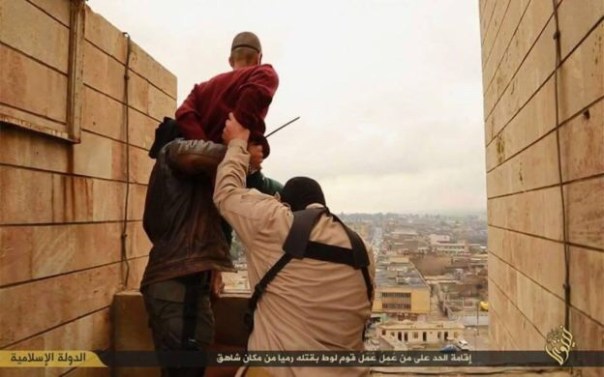
Still from an IS video

In November 2013, Omar attacked me with two of his friends. I was just walking home after a really lovely day. They beat me, threw me to the ground and shaved my head, saying to me: “This is just a lesson to you for the moment, because your father is a religious man. Watch what you do!” He meant that I wouldn’t be killed then and there out of respect for my dad, because I’m from a religious family.

I left town for a few days and didn’t go to university but then I went back, and in March 2014 I made Omar angry again, this time by suggesting that non-Muslims shouldn’t have to pay the “jizya”, the tax paid by non-Muslims to a Muslim government. I was washing my hands in the university bathroom when he and others attacked me again. They came at me from behind, but I recognised one of them from his green watch. It was the same group. They kicked me half-unconscious. I was barely able to walk and stopped going to university for a month.

Then, in the middle of final exams, Isis took over. Omar called me and asked me to repent and join them. I hung up the phone.

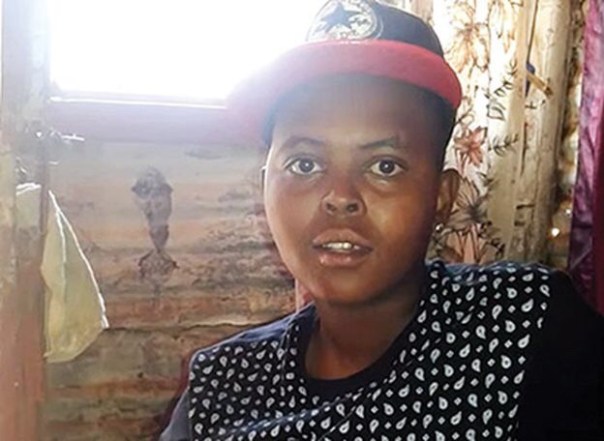
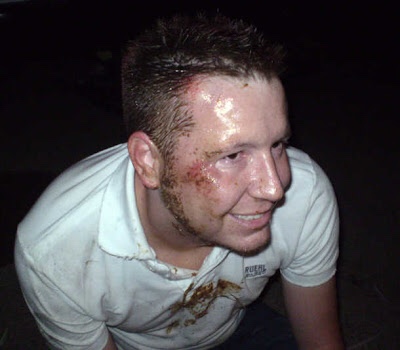
Taim with shaved head

On 4 July, a group of fighters from Isis came to my home. My father answered the door and apparently they said to him: “Your son is an infidel and a homosexual and we have come to carry out God’s punishment on him.”

My dad is a religious man and luckily for me he was able to tell them to come back the next day, to give him time to find out whether the accusation was correct. He came inside the house and started screaming. Finally, he said: “If these accusations are true, I will hand you over to them myself, happily.” And I just stood there, not knowing what to do and what to say, or how to defend myself.

I was in shock. But my mother decided that I should leave the house immediately, and she started working on getting me out of Iraq for good. It was midnight and she said to me: “We’re leaving right now.” She took me to her sister’s house. The next day she booked me a plane ticket to Turkey and got me a visa. But I had to travel via Erbil and they wouldn’t let us into Kurdistan. I stayed in a village near Erbil for two weeks, trying to get in but I never managed it. I tried to leave via Baghdad but there were clashes on the road and the driver wouldn’t go on. I tried to get out so many times, and failed.

Eventually, in August, after weeks in hiding, my mum arranged somehow for me to get to Kirkuk, driving there through fields and on unpaved roads. From there, I went to Sulaymaniyah. I’d planned to go to Turkey but the first available flight was to Beirut and I didn’t need a visa – so here I am.

If I’d stayed, Isis would have come for me and killed me the way they’ve killed others. If Isis didn’t get me, members of my family would have done it. A few days after I left, I learned that my uncle – my father’s brother – had taken an oath to cleanse the family honour.

Recently, I received an anonymous Facebook message – but my mother thinks it was from my uncle. It said: “I know you’re in Beirut. Even if you went to hell, I would follow you there.”

All I want now is to be in a safe place, unreachable by my dad or anyone with extremist thoughts. I want to be safe, to be free, and to be myself – to get my degree and start living… I just want to start living.

Human rights lawyers from the Iraqi Refugee Assistance Project have helped me get refugee status and are working on getting me resettled in another country, where I want to continue my studies. Here I’m living in one room, the size of my bathroom back home. I’m in limbo.

I think I will recover eventually but there will always be a memory of this dark period when I literally had to run for my life to avoid being killed. It was very stressful, but luckily I made it.

I’ve lost contact with most of my family. A month after I fled, my younger brother sent me a Facebook message saying: “I have had to leave town. The family is shattered and it’s all because of you.”

I was angry and didn’t reply. But then on New Year’s Eve I missed him, so I wrote to him, saying: “It’s not my fault that I was born this way. They (Isis) are the criminals.” And after that we had a long conversation on Facebook about our childhoods.

I’ve not spoken to my father. What he did was very hurtful. He’s my father. He’s supposed to protect me and defend me, no matter what. But when he said that he’d hand me over to Isis, he knew what they were going to do to me. He knew. Maybe in the future I can forgive him, but right now I don’t even want to think about him. I want him out of my life.

I talk to my mum every week, though. It’s hard for her because there’s no network coverage and she has to go out of town to get a signal. She’s the most amazing woman in the whole world. She’s cultured, respectful – very bright. She loves me and when she was trying to smuggle me out, we never discussed my homosexuality. She was just focused on getting me to safety. Because she is my mother, I think she always knew that I was gay. But all I felt from her was her love, her ultimate love. I never said goodbye to her because when I actually managed to escape, there had been so many failed attempts that I was sure I would be back and see her again.

All I need is a hug from her.

I still have gay friends at home but we’re not in contact any more, for their own safety.

Earlier this year one of my best friends, who stayed behind, was killed.

He was thrown off the main government building.

He was a great man – a very kind person. He was 22 years old, a medical student, and he was really calm and really smart – a bit of a genius. He used to talk to me about the latest scientific discoveries.

He always got straight As. You never saw him without a book.

We met first online – gay Iraqis hang out a lot in online communities – and then face to face. In person, he was quite quiet – but online he never stopped talking. Sometimes he would chat until the power went off and we lost the internet. He shared his deepest secrets with me. As gay men, we all had to lead secret lives. But he was the kind of person you love to talk to.

I don’t know how he was outed because he was very careful – but maybe through a text or online message. When Isis capture people, they go through all their contacts.

The last time I saw him in the flesh was a few days after Isis took over our town, but we continued talking online until I fled.

When I first saw the pictures of him, I can’t describe what I felt. The video images follow me in my nightmares. I see myself falling through the air. I dream that I’m arrested and then thrown from a building – facing the same fate as my friend.

It was devastating to see him go in that brutal way. He was blindfolded but I knew it was him from his skin tone and from his build. It looked like he died immediately but a friend told me he didn’t – perhaps the building wasn’t high enough. The friend said he’d been stoned to death.

I wanted to break down. I couldn’t believe it. One day he was alive, active, just living his life.

And now he is gone.

Isis are professional when it comes to tracking gay people – they hunt them down one by one

Even before Isis arrived, I was living in constant fear. There are no laws to protect you. Militiamen were killing people in secret, and no-one would say anything. To them, we’re just a bunch of dirty criminals they need to get rid of because we bring God’s anger and are – as they see it – the source of all evil.

For the past few years it’s been really, really hard. There were militiamen or security men who – if they found out someone was gay – would arrest him, rape him, torture him. There were lots of murders supervised by the Iraqi army. Videos came out of people being burned alive or stoned and you can see soldiers there. I have seen a video where some gay men had ropes put around their necks and they were dragged around the streets and people were throwing stones at them and when they were half-dead they were set on fire. Some people had their rectums glued up and were then left to die in the desert.

Before Isis, I think that maybe the power of my family protected me. But let’s assume that Isis disappeared this second, the threat to my life would be just as serious, now that I’ve been identified as gay.

The difference now is that Isis has only one horrible method of killing people – throwing them off buildings and, if they don’t die, stoning them. I know that if Isis had captured me, that would have been my fate.

What’s also changed is that the media are focusing on what Isis is doing, because it’s Isis. And Isis films everything and releases the video and says: “We killed these people for being gay and this is their punishment according to our Holy Book.”

Isis are also professional when it comes to tracking gay people. They hunt them down one by one. When they capture people, they go through his phone and his contacts and Facebook friends. They are trying to track down every gay man. And it’s like dominoes. If one goes, the others will be taken down too.

We have feelings and we have souls – stop hating us just because we’re born different

It’s devastating to see the public reaction to the killings. Usually, when Isis posts pictures online, people sympathise with the victims – but not if they’re gay. You should see the Facebook comments after they post video of the killings. It’s devastating. “We hate Isis but when they do things like this, we love them. God bless you Isis.” “I am against Isis but I am totally with Isis when they kill gays.” “Amazing news. This is the least that gays deserve.” “The most horrible crime on earth is homosexuality. Good job Isis.” “The scene is ugly but they deserve it.” “Those dirty people deserve Isis.”

And there are thousands of people agreeing with these comments full of hate. That is what is so disturbing. This is the society I fled from.

Islam is against homosexuality. My father made me study Sharia law for six years because he wanted me to be a religious man like him. There is a hadith [an ethical guideline thought to be a saying of the prophet] that instructs gay men to be thrown off a cliff and then it’s up to a judge or the Caliph to decide if they should be burned or stoned to death.

Imam and Islamic scholar Dr Usama Hasan from the Quilliam Foundation says there are many hadiths and traditions ascribed to the Prophet Muhammad and his disciples on the subject of punishment for homosexuals. “However, all are disputed and there has never been any consensus on them, especially since they seem to contradict the Koran, 4:15-16.” He adds that some scholars have argued that Muhammad could not have given any such ruling since no confirmed case of homosexuality was ever brought to him.

I think Isis is throwing gay men from buildings because our society hates us and it’s a way of gaining support.

I try not to look at Isis’s videos. But to be honest I do look for their martyrdom videos. I want to see if I can see Omar, the man who ruined my life.

I worry a lot about the gay men still left there. I have dozens of friends who can’t leave because they can’t afford to. But, after our friend’s death, I said goodbye to them online and blocked them, for their own safety.

I’m speaking out to honour my friend who was killed – and for the gay men I know who are still in Iraq. I want Iraqis to know that we’re human beings, we’re not criminals. We have feelings and we have souls. Stop hating us just because we’re born different.

I was lucky to get out. I saved my soul. But what about them? Will they be lucky enough to survive? And, if they survive, will they recover from the trauma of being hunted? It’s a disaster. They’re all targets.

Taim told his story to the BBC’s Caroline Hawley. Taim is not his real name, nor is Omar the real name of his persecutor.

Reference

Gay History: Born Free, Killed By Hate – The Price Of Being Gay In South Africa

Betty Melamu is still waiting.

She prays that one day she will face the people who killed her daughter and find out why they did it.

“I want to know, that’s the point,” she says. “I want those who did this thing to my child to be arrested, all of them.”

Almost 4 months after Pasca was murdered, no-one has been arrested.

For many LGBTI people and their families in South Africa, safety, justice, and the promise of a truly rainbow nation still feel a long way off.

South Africa’s constitution was the first in the world to protect people from discrimination because of their sexual orientation. The country was also the first in Africa to legalise same-sex marriage. But after a spate of murders, gay people say more needs to be done to stop hate crimes.

Betty Melamu sits on a brown leather sofa in her living room in the township of Evaton, just south of Johannesburg. She’s cradling a framed picture of her daughter Motshidisi Pascalina, known as Pasca.

In a quiet, wavering voice, she sings Pasca’s favourite song.

“Whenever she would listen to radio or go to church she would sing that song,” she remembers.

When I ask if Pasca was a good singer she says, “Yes,” and laughs – apparently Pasca was more spirited than talented, constantly switching between parts as she sang.

She loved football too, studied hard at school and wanted to be a politician.

“She wanted to do something good,” says Melamu with pride.

But the laughter and happy memories are fleeting, and sadness is etched in her thin, drawn face. Pasca was a lesbian, something her family knew and accepted. She had just turned 21 and completed her final high school exams when she went to a party in December.

“I don’t know what happened after the party,” says Melamu. “But she didn’t come back.”

Two days later Pasca’s body was found in a field in a neighbouring township. She had been beaten and mutilated. At the morgue her family couldn’t recognise her face and could only identify her by a tattoo on her leg.

“At that time I was strong,” Melamu remembers. “But after that I feel like I am crazy woman.”

And as we talk, she repeats one question, over and over.

“Why? Why did this happen to my child?”

Pasca was was born in 1994, the year apartheid ended and Nelson Mandela was elected president – she was one of the first of South Africa’s so-called born free generation.

In his inauguration speech, Mandela promised to “build a society in which all South Africans will be able to walk tall, without any fear in their hearts… a rainbow nation at peace with itself and the world.”

But 21 years later, this promise remains largely unfulfilled for the country’s lesbian, gay, bisexual, transgender and intersex (LGBTI) community.

In a country where crime rates in general are high, black lesbians in poor townships face particular risks and often suffer the most violent crimes.

As women, they’re vulnerable in a country with one of the highest rates of rape in the world. As lesbians in an often homophobic and patriarchal society, they face a further danger – the idea that they can be “changed” and “made into women” through what is known as “corrective rape”.

It’s suspected this may have happened to Pasca, although the post-mortem was unable to determine this.

And when crimes happen, there’s no guarantee that the response will be adequate. Victims say they often face secondary harassment by police or health care workers.

Pasca’s case was assigned to a police officer who was on leave at the time, only returning to work two and a half weeks later.

Frustrated at the delay in this and two other rape cases, in January activists took to the streets of Evaton with rainbow flags and banners. Chanting “Pasca is our sister,” they marched to the local police station to demand justice.

“The police are not doing anything,” Lindiwe Nhlapo told me several weeks later. She’s part of Vaal LGBTI, one of the groups that organised the march. “The police are failing us big time.”

Since then, the police have tried to address concerns about the investigation into Pasca’s death, but frustration with the justice system is a common story.

Lindiwe Nhlapo wants justice for Pasca

In the nearby township of KwaThema, silver drapes and rainbow flags adorn the living room of the small house that’s the headquarters of the Ekurhuleni Pride Organising Committee (EPOC).

There’s also a bar down one end and a sign on the wall – Divas and Dykes Lounge. Day or night, this is a safe place for gay and transgender people to socialise.

“I can’t walk with my partner on the street and hold their hand,” says Bontle Kahlo, from EPOC. “I can’t go out at night and say ‘I’m going to dance somewhere,’ because I’m not safe. I might get killed because of who I am, because of who I love.”

Bontle Kahlo (right) with her partner Ntsupe Mohapi

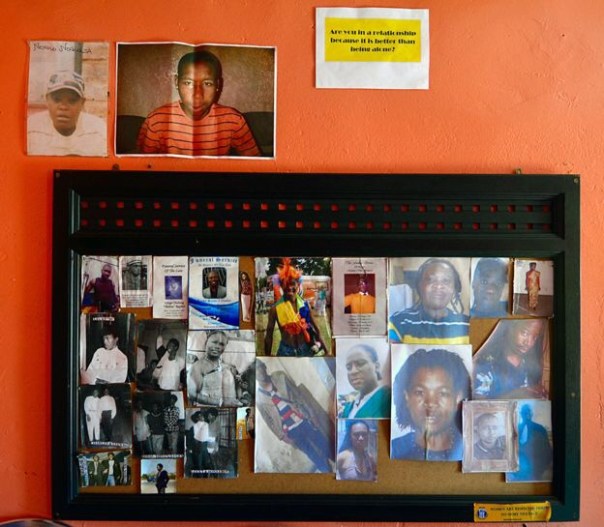
She points to a frame on the wall containing photos of dozens of LGBTI men and women.

“This is our memory wall,” she says. Some of them died of natural causes, but many of the lesbians in the pictures were murdered because of their sexual orientation.

“Women are less than men,” says Kahlo. “If you’re a black woman, you are even less, and if you’re a black lesbian woman you are basically nothing in this country.”

Among the faces on the wall is Noxolo Nogwaza, a 24-year-old lesbian who was raped, mutilated and murdered in 2011.

Noxolo Nogwaza’s photo is top left – she is wearing a baseball cap and white top

But five years later, no-one has been prosecuted.

“The feeling we got from the police is that they expected us to do all the work for them,” says Kahlo.

“It’s very tiring to be an activist but to also be a police officer and to try as hard as you can, and to have a government which is not supportive.”

Her partner and fellow campaigner Ntuspe Mohapi nods in agreement.

“They’re good at talking but not at acting,” she says.

When they heard about Pasca’s murder, there was a familiar sadness.

“I think it’s getting worse,” Mohapi says. “And these are just the cases of murder that we are talking about. We haven’t started with rape, or hate speech, and the bullying in schools, and the suicides of gay teenagers.”

South African law doesn’t classify hate crimes differently from other crimes, so there are no official statistics to turn to.

The organisation Iranti-org is funded by the EU to document violence against LGBTI people – it has counted more than 30 murders and rapes in the country since 2012.

Pasca was just one of three LGBTI people killed in South Africa during a six week period late last year. The deaths barely received a mention in the mainstream media.

There hasn’t always been a lack of interest though. After the murder of Noxolo Nogwaza and several other lesbians in 2011, there was a global outcry. 170,000 people signed a petition calling on the government to act.

In response, the government set up a National Task Team and drew up a National Intervention Strategy to reduce hate crimes.

It also established a Rapid Response Team to make sure that hate crimes are properly investigated and the perpetrators prosecuted. This has had some success in clearing a backlog of murders and other crimes.

Mpaseka “Steve” Letsike says more should be done to change attitudes

But the government is not doing enough says Mpaseka “Steve” Letsike, co-chairwoman of the National Task Team and head of LGBTI organisation Access Chapter 2.

“We are not getting it right. There’s a huge gap. We need to invest our energies into prevention, into conversations, into dialogues.”

The government is doing some of this – funding awareness campaigns and training police and health workers. But “it’s still a drop in the ocean,” says Letsike.

To get a sense of the challenge South Africa faces, I travel to the Johannesburg suburb of Yeoville. It’s home to many migrants from more traditional, rural parts of the country.

In a tiny room, barely big enough for a bed and a fridge, I perch on an upturned bucket and speak to two men. The elder of the two speaks softly, but has a fearsome clarity when our conversation turns to homosexuality.

“Homosexuality is a taboo to us,” he says. “I’ll go back to African traditions, there’s no word for that in our language.”

I ask what would happen if one of his daughters told him she was a lesbian.

“I might kill her myself. That thing is unnatural, it’s awkward, so I cannot accept something that is awkward in my house.

“If someone said choose between keeping this child or killing it, I would kill it.”

His views reflect the gap between the law and the attitude of many South Africans. It shows that the government has failed to create a truly rainbow nation, say activists.

“Conditions for LGBTI people in South Africa have improved substantially since 1994,” says John Jeffery, deputy minister of justice and constitutional development. His department is responsible for the National Intervention Strategy.

“We are trying to educate people about LGBTI rights, that gay rights are human rights,” he says, and adds that he is frustrated with the criticism.

“There’s no use complaining outside that government is not doing enough,” he says. “I unfortunately have not heard proposals from civil society organisations about things we should be doing that we’re not doing. They need to tell us where they think we should be improving.”

While open to suggestions, he says there are limits to what he can do.

“More could be done, but the extent to which we can run awareness programmes would depend on budget and what money we’ve got, and unfortunately government is facing budget cuts.”

The government is currently in the process of preparing legislation to outlaw hate crimes and hate speech, which should allow better monitoring of crimes and, it’s hoped, reduce homophobic abuse.

“There’s no magic solution, it’s a process and that process takes time,” says Jeffery.

Betty Melamu is still waiting.

She prays that one day she will face the people who killed her daughter and find out why they did it.

“I want to know, that’s the point,” she says. “I want those who did this thing to my child to be arrested, all of them.”

Almost 4 months after Pasca was murdered, no-one has been arrested.

For many LGBTI people and their families in South Africa, safety, justice, and the promise of a truly rainbow nation still feel a long way off.

Reference

Gay History: What It’s Like To Be Gay And A Muslim?

The Orlando shooting was a hate crime against gay people – even if, once it emerged that the attacker had been a Muslim, many people claimed this as a terrorist attack rather than a hate crime. And, in an important sense, this was also a terror attack, since its aim was to spread fear in the LGBT community.

Since the massacre there has been a lot of speculation about Islam and homosexuality and there are fears that one man’s despicable act of terrorism could fan the flames of Islamophobia and other forms of social exclusion, leading to discord and unrest in an era of elevated Islamophobia.

It is difficult to define the “Islamic position” on homosexuality, as a monolithic phenomenon, simply because Islam is a very diverse faith group with some 1.6 billion followers on six continents. In most Muslim countries, homosexuality is illegal and in some countries, including Iran and Saudi Arabia, it is punishable by death. But in others, such as Jordan and Turkey, homosexuality is not considered a crime.

Most Islamic scholars are in agreement that homosexuality is incompatible with Islamic theology. They tend to draw on the story of Lot in the Koran (also in the Old Testament) which recounts the destruction of the tribe of Lot allegedly due to their engagement in homosexual acts as “evidence” for God’s condemnation of homosexuality. Many scholars also cite the Ahadith (statements attributed to the Prophet Muhammed) that are condemnatory of homosexuality. Theological and legal condemnations of homosexuality can engender perceptions at a social level that homosexuality is wrong and that it should not be permitted.

Muslims on homosexuality

In 2009, a Gallup survey revealed negative attitudes towards homosexuality among European Muslims. In France, 35% of Muslims viewed homosexuality as “morally acceptable” (versus 78% of the general public). In Germany, 19% of Muslims viewed it as morally acceptable (versus 68% of the general public). In the UK, none of the Muslim respondents viewed homosexuality as morally acceptable (versus 58% of the general public who did).

Earlier this year, a survey commissioned by Channel 4 was conducted among a random sample of 1,081 individuals who self-identified as Muslim. The results found that 18% of the British Muslim respondents agreed that homosexuality should be legal in Britain while the majority (52%) disagreed. Conversely, only 5% of the general public thought homosexuality should be illegal. Furthermore, 47% of the British Muslim respondents indicated that they did not believe that it was acceptable for a gay person to become a teacher. These data suggest that there are low levels of acceptance of homosexuality in Muslim communities in the UK.

However, qualitative interview data can provide more nuanced understandings of what Muslims think and why they might hold these views.

In my research into attitudes concerning homosexuality among samples of first and second-generation British Muslims of Pakistani descent, I found that attitudes tend to be largely negative. Although research into attitudes towards homosexuality in the general population points to demographic variables, such as age and level of education, as key determinants of the nature of attitudes, this has not been the case in my own work with British Muslims. Muslims of various ages, education levels and socio-economic backgrounds have participated in my studies and generally perceive homosexuality in negative terms. In substantiating these attitudes people often draw on holy scripture. As one 54-year-old woman said:

It says it in the Koran that it’s wrong and sorry I’m not the one who made it. It’s what the God revealed to the Prophet so it’s the truth and that’s my belief system.

Many interviewees draw upon holy scripture as the basis of their views regarding homosexuality. There appears to be a desire not to “re-interpret” holy scripture – to accommodate homosexuality – because of the divinity of its origin. Moreover, there was a fundamental rejection of essentialist arguments concerning the origins of sexual orientation – that people are born gay and that they do not “choose” to be gay – and interviewees often argued that people had “chosen” to be gay. One 28-year-old man said:

God doesn’t create gay people. It’s a path they’ve chosen and that’s an incorrect path according to our faith.

Indeed, previous research has shown that believing the essentialist argument regarding homosexuality is correlated with less discrimination and greater acceptance.

What does the Koran say about homosexuality? Lord Harris/BritishMuseum, CC BY

First-hand relationships

Although many British Muslims may disapprove of the concept of homosexuality, several individuals reported positive first-hand experiences of contact with LGBT people. A 45-year-old man said:

Homosexuality is wrong, I believe … I have a gay neighbour and he lives with his partner. He’s a very nice guy – both of them [are]. They are very respectful. We consider them friends.

Some people spoke fondly of their LGBT friends, neighbours and acquaintances, suggesting that first-hand contact may challenge homophobia which exists at an abstract, conceptual level. It is also vital to stress that the Muslim interviewees overwhelmingly rejected violence against LGBT people. As one woman put it:

Violence and hate crimes are un-Islamic. We are not supposed to kill or hurt others, as Muslims. No, they can’t have it both ways so they won’t be accepted in our community but it’s for God to punish, not us.

It was difficult for British Muslim interviewees to accept homosexuality given the overwhelming “evidence” of its prohibition in Islam. Individuals simply had no positive theological frame of reference given the absence of LGBT affirmative voices at an institutional level. This led some individuals to view endorsement of homosexuality as a violation of their religious faith and its norms:

Being gay is un-Islamic and so is encouraging it.

Put simply, the acceptance or endorsement of homosexuality was perceived as contravening key tenets of Islam.

Gay Muslims speak out

Clearly, the stigma attached to homosexuality in Islamic communities can have profound effects for those Muslims who also self-identify as gay. For almost a decade, I have been researching the social psychological aspects of being Muslim and gay. In view of the generally negative attitudes towards homosexuality in Muslim communities and the silence that can surround discussions of sexuality, most of my Muslim gay interviewees have manifested a poor self-image and low psychological well-being. Many view their sexual orientation as “wrong” and, thus, express a hope to change it in the future. One young gay Muslim man said:

It’s [being gay] wrong, really, isn’t it? … In the mosque we’re told that Shaitan [Satan] tries to tempt Muslims because he is evil and he makes us do evil things. I know that doing gay things is evil but I hope I’ll change my ways and take the right path soon … It’s all about temptation, really. Life is a big test.

Those gay Muslims who conceptualise their sexuality as immoral and wrong can understandably struggle to derive self-esteem, which is key to well-being. They may come to view their sexual orientation as “evil” and resist it. Some attempt to change their sexual orientation, sometimes by entering into marriages of convenience. This conceptualisation of homosexuality stems from their understanding of the Islamic stance on it. Said by a 28-year-old man:

What the Prophet said was right and that’s always going to stand, yeah. Men having sex with other men was wrong in his eyes. He hated it.

It is easy to see how belief in the negativity of homosexuality from the perspective of one’s faith (which, in countless studies has emerged as an important identity among British Asian Muslims) could cause some gay Muslims to develop internalised homophobia and, in some cases, to doubt the authenticity of their Muslim identity.

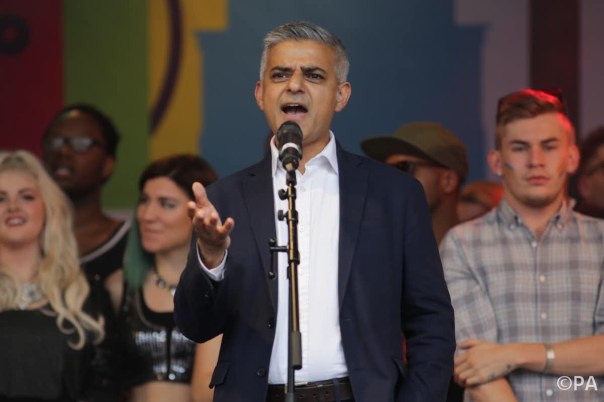
Sadiq Khan, mayor of London, received death threats after voting in favour of same-sex marriage. Daniel Leal-Olivas / PA Wire/Press Association Images

Gay Muslims may cope with this internal conflict in a number of ways. While some hope to change their sexual orientation and to “become” straight, others may deny that they are actually gay:

Maybe I’m not bisexual because I’ve never been with a woman but I can’t call myself gay either … I refuse to do that because I just don’t feel gay.

Crucially, in making sense of the “causes” underlying their sexual orientation, some gay Muslims were of the view that they had “become” gay as a result of their social environment and consequently blamed British society:

I’m gay because I was brought up here [in Britain] but I reckon if I’d been brought up in Pakistan then I would have turned out straight because this doesn’t happen that much there. Like I haven’t heard of any gays in our village. Here there are clubs and that and so I just kind of fell into the gay culture.

We tend to attribute aspects of our identity that we see as undesirable to external factors. This is a means of protecting one’s sense of self from threats. Some of the gay Muslim interviewees in my studies have identified British (or Western) culture as the reason for their sexual orientation.

Reconciling homosexuality and Islam

Many individuals of religious faith struggle to accept homosexuality given the centrality of heterosexuality to faith life, according to most faith groups. Muslims are no exception. Individuals use all sorts of strategies for protecting their sense of identity and some of these strategies can actually have poor social and psychological outcomes. Social psychologists have long argued that intergroup contact is a good starting-point for improving relations between different social groups.

Universities are obvious contexts in which different groups can come together – LGBT and Islamic student societies on university campuses could collaborate with the aim of increasing inter-group contact between Muslims and LGBT people (and indeed those who identify with both categories).

Of course, inter-group contact needs to be characterised by positive images of the outgroup. So there needs to be much more discussion of homosexuality in Muslim communities – which will admittedly be difficult given the cultural taboo around sexuality. Faith and community leaders should broach the topic. My view is that people need to be exposed to LGBT affirmative images. This has already happen to some extent.

As I’ve written elsewhere, the Eastenders storyline concerning Syed Mehmood, a gay Muslim character who struggles to come out to his parents, generated some discussion in the British Muslim community and led some individuals to acknowledge the existence of homosexuality within their community.

Coming out: Syed from Eastenders on Twitter. Twitter

This is a positive step forward and one that can be built on. Similarly, there needs to be more acknowledgement and acceptance of faith groups in LGBT contexts which tend to be secular. In my research, I’ve also found that gay Muslims can face Islamophobia on the gay scene, which can hinder their sense of belonging in these spaces.

In addition to improving relations between groups, it is likely that this exercise will have positive outcomes for well-being among those individuals who self-identify as Muslim and gay. Growing up in an environment in which you are led to believe that your sexual orientation is wrong, sinful or symptomatic of mental illness can lead to profound social and psychological challenges, including internalised homophobia, low self-esteem, depression and, in some cases, suicidal thoughts.

The reasons underlying the horrendous attacks perpetrated by Omar Mateen in Orlando may never be fully understood. But if it is true that he was a closeted homosexual – it was reported that he had used gay dating applications and frequented gay bars, including the one that he attacked – he clearly had a very difficult relationship with this aspect of his identity. There is already some empirical evidence that homophobia is associated with homosexual arousal, which suggests that homophobia might be a means of distancing homosexuality from one’s sense of self.

Could it be that his actions were in part a result of his internalised homophobia? Did he attack the LGBT community in an attempt to distance his own sexuality from his sense of self?

In any case, we as a society have a responsibility to acknowledge diversity and to allow people the space and opportunity to self-identify in ways in which they choose. We have a responsibility to challenge prejudice (of all kinds) when it shows its ugly face. We have a responsibility to support and protect minorities who are vulnerable to marginalisation and exclusion. Sometimes this will be challenging particularly when it means that we have engage with sensitive issues such as religious norms and customs but we must persevere – for the sake of freedom, peace and well-being for all of society.

Reference

Gay History: When The Canadian Government Used “Gay Detectors” To Try To Get Rid Of Homosexual Government Employees

We are all familiar with the colloquialism “gaydar” which refers to a person’s intuitive, and often wildly inaccurate, ability to assess the sexual orientation of another person.

In the 1960s, the Royal Canadian Mounted Police (RCMP) attempted to use a slightly more scientific, though equally flawed, approach- a machine to detect if a person was gay or not.  This was in an attempt to eliminate homosexuals from the Canadian military, police and civil service. The specific machine, dubbed the “Fruit Machine”, was invented by Dr. Robert Wake, a Carelton University Psychology professor.

Taking the lead from the United States’ McCarthyism, the Canadian government considered all homosexual public servants to be a threat to national security for various absurd reasons. In order to deal with the “security threats” posed by gay people, a special team in the RCMP was formed. Section A-3’s sole mission was to identify and dismiss from service every homosexual working for the Canadian government. Identified homosexuals were immediately fired or forced to resign.

Initial efforts included following people around and undercover work at various clubs, but this proved to be extremely costly and somewhat inefficient. Thus, Section A-3 decided they needed a new plan, a way to screen every employee directly. This new plan was the “Fruit Machine”.

The Fruit Machine primarily used the “pupil area response test” as an indicator of a person’s sexual orientation, as well as perspiration levels and pulse rate. While undergoing the test, the subject would sit in a dentist-style chair.  They’d then be shown various images, some completely mundane, while others depicted naked or semi-naked photos of women and men. If the subject’s pupils dilated when being shown erotic photos of people of the same gender, s/he was assumed to be homosexual.

Besides the “science” behind the machine being completely flawed, there were other problems as well.  For instance, each photograph changed the amount of light hitting the person’s eyes. If the difference from one slide to another was large enough, this obviously would change the subject’s pupil dilation, but was not accounted for in the results.

The Fruit Machine was not a stand alone test, but many of the other methods used were just as ridiculous. For instance, another test run by the RCMP included monitoring subjects’ physiological responses to specific words such as queer, gay, drag and even bar.

As you might expect, once word got out that the Fruit Machine test was attempting to determine if you were gay or not, rather than a stress testing machine as people were initially told, getting people to take the test became nearly impossible.  That, along with numerous mechanical failures with the machine itself, soon got funding for that particular part of the program cut off and the RCMP’s dream of having a gaydar to screen all Public Employees with was put on hold, though that didn’t stop them from continuing their work trying to root out “dangerous” homosexuals from the Canadian payroll.

Not to be deterred, the RCMP eventually started using a new type of machine, this one, a type of plethysmograph that measured blood flow to genitals while the subject is shown various images. While not nearly as scientifically flawed as the Fruit Machine, this one also, as you might expect, doesn’t give terribly accurate results on the whole and eventually the program for trying to root out homosexuals was abandoned by the Canadian government, but not before at least 400 people lost their jobs after being accused of being gay (with some estimates being significantly higher).

Bonus Facts:

▪ Despite that penile plethsymograph and the vaginal photoplethysmograph are somewhat flawed in detecting someone’s sexual orientation, it is still used to this day in nations like Canada and the United States to try to measure sexual arousal in certain people, though now being used primarily on pedophiles, ephebophiles, and rapists.  Some have even pushed for its use in trials, but to date such evidence is not generally admissible in court in either the U.S. or Canada owing to the highly flawed nature of the results of the test.  Despite this, there are exceptions, such as that courts do use the results of these tests to monitor convicted offenders to help determine things like if they are likely to become repeat offenders if let out of prison.

▪ In Czechoslovakia, such a test was recently used to try to determine if refugees from Iran were actually gay or not, to see if they should be given asylum. (The penalty for being gay in Iran is death and the two in question claimed if they were sent back to Iran, they’d be killed as the police were looking for them due to their homosexuality.)

▪ Funny enough, according to a 1996 study at the University of Georgia, using the somewhat flawed penile plethsymograph test (so take these results with a grain of salt), they found that homophobic men were more likely to be sexually aroused by depictions of gay sex than non-homophobic men.

Canada is not the only country ashamed to have a Fruit Machine as part of their history. The American version of the Fruit Machine (pictured right) is currently on display at the new war museum in Ottawa, Canada. The Canadian Fruit Machine, which was much more elaborate than its American counterpart, has been lost and thought to have been destroyed when that part of the program was shut down.

▪ Delta airlines once argued in a plane crash litigation case that they should pay less for gay passenger deaths owing to the fact that the gay person may have had AIDS, so at that time would have died soon anyways… Delta Airlines later apologized for making that argument.

▪ In 1952, the Unites States Congress enacted a law banning lesbians and gay foreigners from entering the country. The law was on the books until it was repealed in 1990.

▪ A “beard” is someone of the opposite sex who knowingly dates a closeted lesbian or gay man to provide that person with a heterosexual “disguise,” usually for family or career purposes.

Reference

Gay History: The U.S. Military’s Proposed “Gay” Bomb

One doesn’t commonly associate the slogan “make love not war” with the U.S. military. Indeed, the United States military is feared and formidable precisely because it has proven so effective at conceptualizing clever and innovative ways to search, find and destroy, often with the simple push of a button.

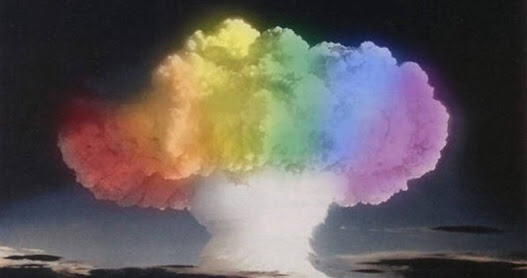
However, in a departure from these hostile traditions, in 1994 the Wright Laboratory, part of the U.S. Air Force, produced a three page proposal for a “gay bomb”.

Documentation obtained by the Sunshine Project, an anti-biological weapons non-governmental organization, found that the Ohio-based Wright Lab requested a 6 year, $7.5 million grant to create a variety of non-lethal weapons. The bluntly titled project, called “Harassing, Annoying and ‘Bad Guy’ Identifying Chemicals” reads like a bawdy proposal penned by a Bond Villian- Auric Goldfinger perhaps?

It proposed a bomb “that contained a chemical that would cause enemy soldiers to become gay, and to have their units break down because all their soldiers became irresistibly attractive to one another”. While the laboratory also came up with similarly questionable ideas, such as bad-breath bombs, flatulence bombs and bombs designed to attract swarms of stinging insects to enemy combatants, one has to admit that the gay bomb is certainly the most novel.

The Pentagon maintains that the love affair with the gay bomb idea was brief. However, the Sunshine Project thinks the Pentagon doth protest too much, finding that they “submitted the proposal to the highest scientific review body in the country for them to consider”. Indeed, the proposal’s information was submitted to the National Academy of Sciences in 2002.

The Pentagon certainly admits giving the project consideration, releasing a statement affirming: “The department of defence is committed to identifying, researching and developing non-lethal weapons that will support our men and women in uniform.”

Nonetheless, the project never made it off the ground. But the question remains: how did they even come up with such an idea? Perhaps the best clue lies in the political climate at the time. When newly elected President Bill Clinton attempted to lift the ban on homosexuals in the military, there was a din of saber rattling, pitchfork sharpening and moral hand-wringing from the military brass.

The general consensus among many leaders of the military was touted by the Department of Defence, “Homosexuality is incompatible with military service.” And that allowing gay people in the military would pose a security risk and disrupt the needed order for the military to be effective.The resulting Don’t Ask Don’t Tell  (later fully called Don’t Ask, Don’t Tell, Don’t Pursue, and Don’t Harass) compromise, which has since been struck down, was less than thrilling for the Pentagon at time.

In such a political climate, with rampant unfounded paranoia about gay people disrupting military discipline and morale, this project seems, notwithstanding its highly flawed premise, somewhat more understandable in terms of how they came up with the idea and why they believed it might be an effective weapon.

As to the science behind this military farce, while various companies, peddling scented sprays and rub-ons, find it expedient to claim that their product contains human pheromones which have an aphrodisiac effect, lab testing has lagged behind somewhat in actually confirming any of this. Admittedly, one section of the documents, entitled “New Discoveries Needed” acknowledges that, thus far, no such chemicals have been found to exist.

While the Gay Bomb project never became perhaps more than a pie in the sky dream of the Wright Lab, it has gained a second lease on life through news media, popular culture and even academia.

The news of this proposed weapon of mass de-lovin’ even spawned a musical, disappointingly entitled “Gay Bomb – The Musical”. Why they chose this title, as opposed to say “Brothers-in-Arms”, “Das Booty”, or “Saving Ryan’s Privates” is a mystery we may never solve…

For the attempt at making a gay bomb, the Wright Lab had the honor of winning the Ig Nobel Peace Prize in 2007. As the prize is organized by the Annals of Improbable Research, it seems to be an excellent home for the project, though perhaps a step down from the National Academy of Sciences.

Among other 2007 IG Nobel prize winners were Mayu Yamamoto (Chemistry), awarded for extracting vanilla flavour from cow dung, and Dan Meyer and Brian Witcombe, (Medicine) awarded for researching the side effects of swallowing swords. The levity of the event seemed lost on the gay bomb creators, however, who kept a straight face about the whole matter; they declined to attend the award ceremony to accept the prize personally. One hopes they were not insulted by this tongue-in-cheek gesture. After all, is all not fair in love and war?

Reference

Gay History: Is It Okay to Be Gay (and in the Far-Right)?

How outspoken gay figures like Milo Yiannopoulos and Caolan Robertson go down with right-wingers, who – traditionally – haven’t been big fans of the gays.

MILO YIANNOPOULOS AT THE REPUBLICAN NATIONAL CONVENTION CLEVELAND OHIO, USA, 21ST JULY 2016 (MARK REINSTEIN / ALAMY STOCK PHOTO)

In March of 2017, a terror attack in Westminster left 49 people injured and six dead or dying. While victims were still being driven away in ambulances, English Defence League (EDL) founder Tommy Robinson rushed to the scene with a camera crew to pace around outside the police cordon and rant about Muslims. Not long after he’d started, a younger man took over.

Pinching his thumb and forefinger together, the man raises his pinky and tells the camera: “If you import a culture, you get a culture.” Barking at unimpressed spectators, he finishes: “The blood. Is on. Your. Fucking. Hands,” with all the sassy-camp cadence of a RuPaul’s Drag Race queen.

That man was Caolan Robertson, a video producer with 12,000 YouTube subscribers, 41,000 Facebook followers and 35,000 Twitter followers. Robertson, who is gay, says that while “all religions are pretty bad… Islam is particularly worse”. Like fellow gay right-wing figure Milo Yiannopoulos – who became a darling of the alt-right on an anti-political correctness agenda – he has taken arch-campness to a twisted place.

That two public figures on the hard-right are openly gay might surprise some people, given that poster boys of this political persuasion are usually family-oriented and Christian-leaning, like Tommy Robinson and Britain First, or dullard conspiracy theorists, like Paul Joseph Watson. Also, right-wingers – from small-C conservatives up to neo-Nazis – historically haven’t been that keen on gays.

However, gay right-wingers aren’t actually as uncommon as you might think.

The recent case of neo-Nazi Ethan Stables, for example, who was convicted of preparing a terrorist act after plotting to attack a Pride event in Barrow, sharply counters this idea of heteronormative masculinity, as his defence involved an assertion of his own bisexuality. Elsewhere, European hard-right politicians Geert Wilders and Marine Le Pen have played to an LGB – but not T – crowd, while Germany’s far-right Alternative for Deutschland party promoted lesbian Alice Weidel to its leadership.

But how do people like Yiannopoulos – a gay man who harasses trans students on campuses – fit into the UK’s radical right?

Historically, brief radical right acceptance of white gay men plays against a backdrop of institutionalised homophobia. The Nazis’ momentary permissiveness of the gay Storm Battalion co-founder Ernst Rohm is a blip compared to the 50,000 homosexuals imprisoned and 15,000 homosexuals killed during the Holocaust. In 1999, neo-Nazi nail-bomber David Copeland attacked gay people, Bengali Muslims and black people with equal measures of hatred. Nicky Crane may have been a violent neo-Nazi secretly enjoying gay dalliances, but when he came out in 1992 he cast his political views aside, declaring them incompatible with his sexuality.

Then came 9/11, and a shifting – at least in the radical right’s eyes – of the hierarchy of minorities. Here was an opportunity to knit together different factions of the right against a common enemy: Islam.

Just as the Taliban’s treatment of women was seized upon by the Bush administration and its supporters to justify the war on terror, its treatment of queer people was used to cast all Muslims as anti-gay. In 2009, a Gallup Centre for Muslim Studies report seemingly backed up the radical right’s assertions: while 58 percent of the British general public thought homosexual acts were “morally acceptable”, zero percent of British Muslims agreed.

Even the liberal press focused on this statistic: “Patriotic, respectful, homophobic”, read The Independent’s summation. “Muslims in Britain have zero tolerance of homosexuality, says poll,” said The Guardian. Right-wing outlets, still bothered about gays in the Anglican church and the impending doom of same-sex marriage, didn’t quite know where to pitch up.

The day of the shooting at Orlando’s Pulse gay club in 2016, wChose Islam Over Gays. Now 100 People Are Dead Or Maimed”. In it, he describes the actions of an extremist as representing all of Islam, using the poll to back up his claims: “This isn’t about ‘radical’ Islam. This isn’t a tiny fringe,” he writes. “In Britain, a 2009 Gallup survey found that not one Muslim believed that homosexual acts were acceptable. Not one!”

Days later, Yiannopoulos addressed a small crowd in a YouTube livestream, calling for a Muslim ban on that basis. “This is not radical Islam… this is Muslims in the West,” he said, ignoring the fact that the same poll found that 19 percent of German Muslims and 35 percent of French Muslims thought homosexual acts were acceptable, implying countries with a longer legacy of Muslim immigration have more LGB-tolerant Muslims.which killed 49 people, Yiannopoulos wrote an article for Breitbart titled “The Left Chose Islam Over Gays. Now 100 People Are Dead Or Maimed”. In it, he describes the actions of an extremist as representing all of Islam, using the poll to back up his claims: “This isn’t about ‘radical’ Islam. This isn’t a tiny fringe,” he writes. “In Britain, a 2009 Gallup survey found that not one Muslim believed that homosexual acts were acceptable. Not one!”

Days later, Yiannopoulos addressed a small crowd in a YouTube livestream, calling for a Muslim ban on that basis. “This is not radical Islam… this is Muslims in the West,” he said, ignoring the fact that the same poll found that 19 percent of German Muslims and 35 percent of French Muslims thought homosexual acts were acceptable, implying countries with a longer legacy of Muslim immigration have more LGB-tolerant Muslims.

With that, the clash of civilisations narrative was set.

Weeks later, Donald Trump – whose campaign manager at the time was Stephen Bannon, then-CEO of Breitbart – became the first ever Republican nominee for the US presidency to mention LGBT people, using them as leverage to call for a Muslim immigration ban.

As Matthew Feldman – co-director of the Centre for Fascist, Anti-fascist and Post-fascist Studies, and Professor of the History of Modern Ideas at Teeside University – puts it: “The thinking is: ‘If this is another stick to beat Muslims with, we’ll take it. We’ll be silent on the LGBT question, we’ll just talk about their rights in the abstract.'”

ANNE-MARIE WATERS (PHOTO BY JAMES POULTER)

Trump’s views on LGBT people have since wavered, but other British groups are unafraid to exploit professed support for LGBT rights to attack Islam.

In 2016, a Stockton-on-Tees Pride march was organised by a group with no previous affiliations to the LGBT community, but many links to the EDL and Pegida UK, also founded by Tommy Robinson. The march was “appropriating tragedies to promote further bigotry”, warned anti-Islamophobia project Tell MAMA.

The next year, Gays Against Sharia (GAS) – set up by Tommy English, known as Tommy Cook, founder of the EDL LGBT division – carried the baton. Though Tommy Robinson hijacked one of GAS’s marches, rebranding it Unite Against Hate, in September of 2017 GAS held its own parade in Bristol. Footage shows English holding a rainbow flag reading “UNITED TOGETHER, TODAY AND FOREVER. HELP US STOP THE GROWTH OF AN EVIL, HATE-FILLED IDEOLOGY”. Pictured helping carry this banner is Anne-Marie Waters, the lesbian who ran for candidacy of UKIP on an anti-Islam ticket.

The demonstrators had re-framed Islam as the real and sole oppressors of LGBT people, and the far-right as minorities’ protectors – a narrative that’s as transparent as it is cynical.

As for the Gallup analysis, Dalia Mogahed – Director of Research at the Institute for Social Policy and Understanding – tells VICE it has been misinterpreted: “Saying homosexual acts are morally wrong is not evidence that Muslims will hurt the LGBTQ community.”

“Muslims have been part of the UK for literally hundreds of years, and unlike the Christian right do not advocate against the LGBTQ community,” added Mogahed. “In a democratic society, freedom of thought and belief are central principles, including beliefs that we may not agree with. We erode our own values when we start policing thought.”

Mogahed also pointed out the paradox of Yiannopoulos complaining about Muslim bigotry against LGBT people while advocating for the Muslim ban.

Luckily, Yiannopoulos isn’t the threat he once was, having lost the radical right’s affections, Breitbart’s employ and Robert Mercer’s funding after footage surfaced of him defending pederasty. Mind you, he’s still at it: his new website, Milo Inc, both damns gays and uses them as a shield to deflect accusations of Islamophobia. Two headlines read: “All The Studies Show, Gay Parents Are Not Good For Kids”, and “GOOGLE Aids Indonesia’s Muslim Government In Anti-Gay Crackdown”. There is, after all, a limit to how much homosexuality radical right LGBT people can appear to condone.

Caolan Robertson is more overt in his disdain for gay culture. In a video for far-right Canadian YouTube channel The Rebel Media, he attends London Pride 2017, mocks interviewees and calls the event “the most degenerate festival I’ve ever seen”. He also mentions a 2016 ICM poll with questionable methodology which suggests that 52 percent of British Muslims think homosexuality should be illegal, quoting when the stat before asking left-wing journalist and campaigner Owen Jones, “Do you think that’s something that’s a threat to gays in our country?”

Jones replies, succinctly: “Far-right groups… try to cynically appropriate gay rights for Islamophobia.”

In an another video – this time an interview with radical right vlogger, Millennial Woes – Robertson cites an unknown report alleging that “60 percent of gays in the UK admit to having over 500 partners”, adding, “[Gays] have literally shit all over all of the people who fought for their rights to be able to exist by behaving like this.” The only record which correlates to this is a 1978 sociological study regularly shared on Christian websites.

Robertson later left Rebel Media acrimoniously, and now works behind the camera on documentaries with fellow Rebel alumni, alt-right Canadian vlogger Lauren Southern.

Failed UKIP leader Anne-Marie Waters’ beliefs about LGBT rights and Islam can be summed up by one of her tweets: “I’m a gay woman who values my freedom, believe me, Islam is out to get me.” However, her new party, For Britain, makes no mention of LGBT people in its manifesto. Perhaps this is because the radical-right has little space for lesbians, who, as Patrik Hermansson of Hope Not Hate – who spent a year undercover in the alt-right – explains, “aren’t even discussed” due to its boys’ club chauvinism.

Hermansson understands how gay men come to be part of and celebrated by the radical right: “There’s this glorifying of the male body and an idea that men are the best in every possible way. It makes sense, then, that when men are close together, in those groups, homosexuality doesn’t have to be so strange.” He also cites the manosphere – made up of single men who feel “left out and oppressed by what they perceive as feminism” – as a common entry point to the radical right. Feldman agrees: “A close male bonding can go from homosociality to homoerotic to LGBT.”

There’s an argument to be had about the point at which fetishistic enjoyment of fascist iconography can tip into full-blown appreciation of the Nazi ideal of the Ubermensch – a strong, muscular and healthy Aryan man. Think Kenneth Anger’s Scorpio Rising, Tom of Finland’s predilection for uniformed antagonists and the gay skins culture. As Hermansson points out: “It’s like the bullied turning into bullies, but it only happens to white men because they’ve got that possibility.”

More pressing, though, is supposedly pro-LGBT groups leveraging a minority status to provide a get-out-of-bigotry-free-card in a cynical and manipulative attempt to gain the hard-right ethical kudos and more members. Not only can their arguments – propped up by sloppy and wilfully misinterpreted polling – be convincing, but these people also attempt to cast the left as the real oppressors of gay people. It was a Conservative government which introduced same-sex marriage to the UK, yes, but LGBT rights are more than marriage.

As that long fight showed, sexual orientation doesn’t always imply a political orientation, and it’s incumbent on everyone across ideological and political spectrums to continue the conversation about how the religious and socially conservative consider and treat LGBT people.

The radical right’s rebranding as well-dressed, slick and intellectual operators has worked to give the movement an undue credibility, but the gay-tolerant rendition of Islamophobia is transparently exploitative. It’s only a matter of time before they get found out.

This article originally appeared on VICE UK.

Reference

Gay History: The Raid On The Rainbow Lounge – Fort Worth, Texas, 28th June 2009

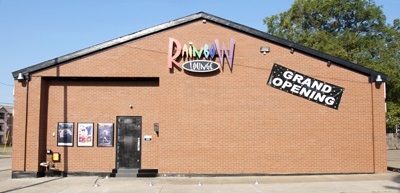
The Rainbow Lounge raid occurred in the early morning hours of June 28, 2009, at the Rainbow Lounge, a newly opened gay bar in Fort Worth, Texas.[1] The raid was carried out by members of the Texas Alcoholic Beverage Commission (TABC) and the Fort Worth Police Department.[2] Several customers were arrested for public intoxication and one customer, Chad Gibson, received a severe head and brain injury while in custody. The police also claimed the customers made sexual advances and contact with them. Other customers were detained and later released without arrest.[3]

In response to this incident, several of the witnesses in the bar that evening, including Todd Camp, the artistic director of the local gay and lesbian film festival, began a grassroots awareness campaign with the launch of the informational Facebook page “Rainbow Lounge Raid.” Over the next several weeks, the page’s membership grew to nearly 15,000. Several local organizers planned a protest on the steps of the Tarrant County Courthouse the next afternoon. The Dallas-based LGBT rights group Queer Liberaction organized a candlelight vigil for the victim, a Milk Box event, and a later more formal protest.

It has been of particular interest to the media that the raid took place on the 40th anniversary of the Stonewall Riots, a notable raid of a gay bar which prompted the modern gay rights movement.[2] The address of the club, 651 South Jennings Avenue, is a classic location of gay bars in Fort Worth.[4]

Todd Camp, Journalist & Patron of the Rainbow Lounge the Night it Was Raided on June

At the City of Fort Worth’s first council meeting since the Rainbow Lounge Raid, and after an attendee of the meeting called out for an apology, the Mayor apologized for the events at the Rainbow Lounge.[5] The next day after the apology was reported nationally and internationally, the Mayor said the apology was taken out of context and that he was referring to the injury not the actual raid.[6]

The Rainbow Lounge in Ft. Worth, Texas

As a result of the raid, the Texas Alcoholic Beverage Commission fired 3 individuals and disciplined two others.[7][8] The agency also completed some previously scheduled changes including increased cultural diversity training.[9]

A separate “Use of Force” investigation determined that two charges: (a) “that the Rainbow Lounge was targeted for being a gay bar”, and (b) that TABC officers “used force beyond what was necessary and reasonable”, were both unfounded.[10] However, TABC Administrator Alan Steen announced that “TABC’s five regional Educational Liaisons are being re-named Community Liaisons, and will be tasked with reaching out to diverse community groups including GLBT organizations as well as associations representing racial, ethnic and religious minorities.”[10] Steen also appointed TABC’s Director of Communications and Governmental Relations as the agency’s liaison to the GLBT community “in an effort to improve communication around the state.”[10]

Raid at a Club in Texas Leaves a Man in the Hospital and Gay Advocates Angry

The Rev. Carol West and Brian Nesbitt at a candlelight vigil on Wednesday outside the Rainbow Lounge in Fort Worth. Credit John F. Rhodes/Dallas Morning News

FORT WORTH — The grand opening sign still hangs above the door of the Rainbow Lounge, but the recently opened dance club has already become a rallying point for gay men and lesbians here, after a raid by law enforcement last week left one man hospitalized with a head injury and prompted complaints of brutality.

The raid in the early hours of June 28 by Fort Worth police officers and agents from the Texas Alcoholic Beverage Commission has set off a political uproar and galvanized gay advocates in Fort Worth, who have traditionally been less vocal than in Dallas and Houston. After years of keeping a low profile, gay men and lesbians in Fort Worth say they are furious, and their complaints have spread on the Internet, attracting support from gay rights groups across the country.

They have organized protests and formed a new organization, Fairness Fort Worth, to keep track of various investigations into the incident that have begun or been requested. They also have taken up collections and organized a benefit concert to help the injured.

“It has brought this community together so tight — it’s almost impermeable now,” said Randy Norman, the manager of the lounge.

The incident has drawn even more attention because of its timing; it came on the 40th anniversary of the Stonewall riot in New York City, widely considered to be the start of the gay rights movement.

Law enforcement officials have begun an investigation into the accusations of brutality, and internal affairs officers from the state liquor authority were interviewing employees of the club on Friday afternoon, sifting through conflicting accounts of what had happened.

Fort Worth’s police chief, Jeffrey W. Halstead, initially stood behind his officers, saying Monday that patrons had provoked the scuffle by making sexual gestures toward officers.

But as the week went on, Chief Halstead backed away from that stance. By Thursday, he had ordered an inquiry, suspended operations with the state beverage commission and promised to give police officers “multicultural training.” He declined a request for an interview.

“Make no mistake, if our officers acted in error, this department will address the problem,” Chief Halstead said in an open letter to the community posted on the city’s Web site on Thursday. Chief Halstead said the state agents, not his officers, had been the ones who had taken the hospitalized man into custody.

Alan Steen, the administrator of the Texas Alcoholic Beverage Commission, has put two officers involved in the raid on desk duty and said an inquiry would be conducted.

Several witnesses said six police officers and two liquor control agents used excessive force as they arrested people during the raid.

Chad Gibson, a 26-year-old computer technician from Euless, about 15 miles northeast of Fort Worth, suffered a concussion, a hairline fracture to his skull and internal bleeding after officers slammed his head into a wall and then into the floor, witnesses and family members said. Mr. Gibson was still hospitalized on Friday evening as doctors monitored a blood clot in his brain, his mother, Karen Carter, said.

Another patron suffered broken ribs, and a third had a broken thumb, said Todd Camp, the founder and artistic director of Q. Cinema, a gay film festival in Fort Worth. Mr. Camp, a former journalist, said he was celebrating his 43rd birthday in the bar when the police arrived at 1:05 a.m.

The officers entered the bar without announcing themselves, witnesses said. Earlier in the night, they had visited two other bars looking for violations of alcohol compliance laws. Those bars do not cater to gay patrons, and the officers had made nine arrests at those establishments on public intoxication charges, officials said.

“They were hyped up,” Mr. Camp said of the officers in the Rainbow Lounge raid. “They came in charged and ready for a fight. They were just telling people they were drunk or asking them if they were drunk, and, if they mouthed off, arresting them.”

More than 20 people were taken out of the bar for questioning, handcuffed with plastic ties and, in some cases, were forced to lie face down in the parking lot, witnesses said. Five were eventually booked on charges of public drunkenness, the police said.

In a statement released Sunday, the police said that two of those arrested had made “sexually explicit movements” toward the officers. Another was arrested after he grabbed a state agent’s groin, the statement said.

Several witnesses dispute that account, saying they had not seen anyone harass the officers. So many questions have been raised about the police account that on Friday afternoon, Mayor Mike Moncrief asked the United States attorney for the Northern District of Texas, James T. Jacks, to review the Police Department’s investigation.

Tom Anable, a 55-year-old accountant who said he was in the bar during the raid, said that for more than a half-hour the officers entered the bar repeatedly in groups of three and escorted people out. Then around 1:40 a.m., he said, the officers started to get rougher, throwing one young man down hard on a pool table.

Minutes later, one of the state agents approached Mr. Gibson, who was standing on steps to a lounge at the back of the bar with a bottle of water in his hands, and tapped him on the shoulder, Mr. Anable said. Mr. Gibson turned and said, “Why?”

Then the officer, who has not been identified, twisted Mr. Gibson’s right arm behind his back, grabbed his neck, swung him off the steps and slammed his head into the wall of a hallway leading to the restrooms, Mr. Anable said. The agent then forced Mr. Gibson to the floor, Mr. Anable said.

“Gibson didn’t touch the officer,” Mr. Anable said. “He didn’t grope him.”

Two police officers and a second state agent arrived and helped subdue Mr. Gibson, kneeling on his back. A lounge employee, Lindsey Thompson, 23, said she saw an officer slam Mr. Gibson’s head into the floor while he was prone with his hands cuffed behind him.

The raid prompted swift action. Hours later, more than 100 people were protesting on the steps of the Tarrant County Courthouse. As the week went on, calls for an independent investigation grew, with a state senator, a group of local business leaders and two churches joining the chorus.

Yet some gay residents said the outcry had been loud in part because what happened at Rainbow Lounge was uncharacteristic for this city of 750,000 people. “This has been unnerving, I know, to a lot of people in Fort Worth because it’s not the Fort Worth we know,” said Joel Burns, a gay member of the City Council. “There is a lot of scratching of people’s heads.”

Kathleen Hicks, a council member who represents the neighborhood where the bar is located, said the accusations of police brutality have rattled the city government and warrant an independent investigation. She added that she had heard no complaints about the bar before the raid.

“It has caused a lot of soul searching within City Hall and beyond,” Ms. Hicks said. “Fort Worth has been able to move quietly along and avoid all the tension and strife that you have seen in other cities, but sometimes you need to have tension and strife. I hope that this will be a wake-up call.”

References

1 Huffstutter, P.J. (2009-07-06). “Police raid at gay club in Texas stirs ugly memories”. Los Angeles Times. Retrieved 2009-07-06.

2 ^ a b McKinley, James (July 4, 2009). “Raid at Club in Texas Leaves Man in Hospital and Gay Advocates Angry”. New York Times. Retrieved 2009-07-04.

3 ^ “Man injured during Rainbow Lounge raid in Fort Worth speaks out”. Dallas Morning News. 2009-07-06. Retrieved 2009-07-06.

4 ^ “Erect-a-Set”. Fort Worth Weekly. May 4, 2005. Retrieved 2009-07-15.

5 ^ Associated Press via the Los Angeles Times: Fort Worth mayor apologizes for gay bar raid

6 ^ Associated Press: Fort Worth mayor says apology for injury, not raid; Accessed: 18 July 2009;

7 ^ First Rainbow Lounge Investigation Report Complete Press release of August 6, 2009, TABC Website. Accessed 1 June 2010.

8 ^ TABC Chief Moreno Takes Action Following Rainbow Lounge Investigation Press release of August 28, 2009, TABC Website. Accessed 1 June 2010.

9 ^ Brown, Angela K., Texas liquor board fires 3 over gay bar raid, Houston Chronicle/Associated Press, 2009-04-28

10 ^ a b c Rainbow Lounge Use of Force Report Complete – Agency Announces Further Operational Changes Press release of November 5, 2009, TABC Website. Retrieved 1 June 2010.

11 ^ [1] Raid of the Rainbow Lounge, IMDB. Accessed May 11, 2012.

12 ^ First Rainbow Lounge Police Raid On Fort Worth’S Rainbow Lounge the Subject of New Documentary Article released February 29, 2012, TowleRoad Website. Accessed March 1, 2012.

13 ^ Raid of the Rainbow Lounge: Official Trailer Trailer posted February 21, 2012. Accessed March 1, 2012.

Gay History: The Gay Bars and Vice Squads of 1950’s Los Angeles

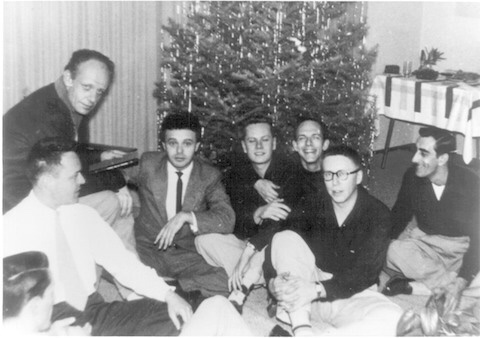
A gathering of gay men in Los Angeles in 1951. This group founded the Mattachine Society

In the wake of World War II a conformist impulse reasserted itself in American society. At the same time thousands of gay men found themselves in California after World War II, and they were presented with the problem of living a life in the midst of social disapproval and police repression.

In Los Angeles throughout the 1950s, the culture of gay men functioned very much below the radar. Under constant harassment by the police, homosexuals risked social ostracism and loss of employment if outed.

Homosexuality as a disease

The dominant perception of homosexuality in the 1950s was that it was a disease. The psychiatric community was nearly unanimous in this assessment and others took their cue from this stance. Most employers and government agencies barred homosexuals with morality clauses and they were widely considered to be security risks. In daily language they were often defined as “deviants”, “perverts”, or “inverts”, when they were not being painted as pedophiles.

Psychiatric opinions

In 1952 the American Psychiatric Association published the Diagnostic and Statistical Manual of Mental Disorders for the first time. It included homosexuality as a mental disease.

This was a predominant view in the mental health profession for the entire decade (an important exception was Evelyn Hooker). It was widely conjectured that homosexuality resulted from emotional traumas in childhood, as is the case with other mental illnesses, and that genetics played little to no role. On this basis the practice of conversion therapy took hold, with widespread attempts to change people from homosexual to heterosexual (here are just a few examples from students at Oberlin College in Ohio).

Employment restrictions

It was common practice for employers to prohibit homosexuality. Homosexuals had long been barred from employment in federal jobs, a policy that was reinforced in 1953 by Dwight Eisenhower’s Executive Order 10450. Private employers varied on this issue, but most would fire any employee who was discovered to be gay. Thus at a very basic level, to identify oneself as a homosexual in public was to invite a lifetime of poverty.

Social mores

The disapprobation of psychiatrists and employers reflected the overt hostility of the mainstream American mindset. An unfortunate tendency was for many people to conflate homosexuals with pedophiles and serial killers. Public safety videos of the time made this connection explicit and helped to spread much fear and misinformation.

A survey conducted as late as 1967 for a CBS documentary (see the full program or a shorter version) determined that two thirds of Americans viewed homosexuals with “disgust, discomfort, or fear” while a majority favored laws against all homosexual acts.

Sodomy was illegal in every state until Illinois decriminalized it in 1961, and the laws on this were well enforced in the 1950s. Campaigns in Sioux City, Iowa and Boise, Idaho resulted in multiple arrests and involuntary confinements. There were very few voices that dissented from this policy.

The rise of the gay bar in L.A.

Due to an important court case in 1951, California became the first state where gay bars could legally operate. Although the patrons were frequent targets of police harassment, Los Angeles had a decent number of such establishments by the mid-1950s. This corresponded with the first, halting steps towards creating advocacy organizations for gay rights.

Stoumen v. Reilly

In 1951 the California Supreme Court ruled that a bar could not lose its liquor license because it catered to gay clientele. The case was Stoumen v. Reilly.

While this did little to advance the public acceptance of homosexuality, it did allow gay bars to operate in much of California. While a number of these bars were established in Los Angeles by the 1930s, a new wave joined the fray in the wake of this decision (It should be noted that many were closed in spite of this court ruling in a mid-1950s wave of enforcement).

The Los Angeles gay bars

Some of the well-known gay bars of this time were the House of Ivy and the Windup in Hollywood, and the Crown Jewel, Harold’s, the Waldorf, and Maxwell’s in downtown Los Angeles.

Many of the gay bars in Los Angeles were located near Pershing Square, which was a cruising ground in

The character of these places varied widely, reflecting divisions within the gay community. The Crown Jewel was known as a rather straight-laced bar, with a dress code and many patrons who wished to remain discreet. Maxwell’s operated on a different end of the spectrum, with a much more flamboyant crowd.

The more conservative group of the gay community took pains to distance themselves from the “obvious” crowd, believing that they perpetuated negative stereotypes and drew unwanted attention. Helen Branson, who operated the Windup, wrote:

“I have not touched on the problem of the obvious homosexual. He is in the minority. I think he brings the censure of the public not only on himself, but is the main cause of all averse judgment against the group as a whole…. I do not welcome this type in the bar. I am rude to them, watch them closely for any infraction of my arbitrary rules, and they soon leave.”

Other recreation: bathhouses, parks, and parties

Bars were not the only place where gay men congregated in this time period. There were bathhouses and parks that were known to be more homosexual, and small groups held house parties and private engagements. None of these places were particularly more safe than the others in regards to police harassment. Even a private home party could be the target of a sting operation and as such, invitations to them were very few. It was thus quite difficult for individual gay men to coalesce into a broader community.

The homophile movement and the Mattachine Society

The creation of the first gay bars in L.A. corresponded with the rise of a group called the Mattachine Society.

The Mattachine Society was an organization founded in 1950 to advocate for the cause of gay rights. For at least a few years it was the only group of its kind in the United States. The initial founders were radical Communists, but the organization was taken over after a couple of years by more mainstream activists. It was in this time that the term “homophile” was coined — explicitly to take the word “sexual” out of homosexual.

ONE Magazine was founded by members of the Mattachine Society

This terminology placed the Mattachines at the more accommodating end of the gay spectrum, vis a vis the “obvious” homosexual. Divisions within the community would eventually come to a head in the late 1960s, and the homophile label fell by the wayside as the gay community asserted itself more forcefully.

The LAPD Vice Squad

The Los Angeles Police combatted the homosexual scourge with a notoriously vigorous Vice Squad. Using a large number of undercover officers who posed as gay man for purposes of entrapment, the Vice Squad harassed the gay community in L.A. for decades.

The entrapment process

It is said that the LAPD recruited heavily from that set of men who had failed to obtain acting roles in Hollywood. Often young and athletic, these men were trained to impersonate the gay mannerisms and language of the time, and were sent around to different bars. Often they had quotas for the number of “perverts” they were expected to bring in for a given week or month.

Helen Branson described it as such:

“They offer someone a ride or accept a ride and that does it. Some of them play fair, inasmuch as they wait for the gay one to make a pass at them, but many others wait only long enough to get in the car before declaring the arrest. The officer’s word, of course, will be taken as true, and they always count on the victim not wanting publicity. They know he will pay the fine and be quiet. The fines for this charge amount to a considerable sum in a year’s time.”

The results of entrapment

One the first successful defenses against this tactic came in 1952, when Dale Jennings of the Mattachine Society took his case to court. Jennings declared himself to be a homosexual, but asserted that the charges against him were manufactured. The charges were dropped after the jury deadlocked.

Most gay men did not realistically have the option of going to court if they could avoid it. Defending the charges in these stings would have nearly always led to loss of employment, and potentially other scandals. The most common outcome was to make a plea bargain for a lesser charge in the hopes of paying a fine. In this manner, the Vice Squad harassment became a recurring shakedown of the gay community, and it continued until well after the 1950s.

Many of those who were convicted of crimes became registered sex offenders. Many lost their jobs or otherwise had their lives ruined. Such was the price of being a gay man in the 1950s.

References

Gay History: The “Lavender Scare”.

Interrogations of one’s sexuality became commonplace in the 1950s and 1960s’ federal workplace. Questions like “Do you identify as a homosexual or have you ever had same-sex sexual relations?” were commonplace as employers attempted to root out LGBT employees. This period of time is often known as the Lavender Scare—the interrogation and firing of LGBT-identifying civil servants.

Before the Lavender Scare and post-World War II, LGBT individuals from rural towns began congregating to cities where they could keep anonymity. This newfound peace and community, however, was disturbed in 1947 when the United States Park Police created a Sex Perversion Elimination Act. Primarily targeting these communities in parks, at least five hundred people were arrested and 76 were charged.

As a part of the broader Red Scare that targeted communists, the Lavender Scare’s development was in large fault due to Senator McCarthy, who brought to the Senate his famous list which gave the names of two hundred and five federal employees, two of which were homosexual individuals. While federal agents began to investigate Senator McCarthy’s federal employment list, much of the Red Scare rhetoric also invoked the ideas of morality connected with queer and homosexual people to those of communists. At the time, homosexuals were viewed as sinful and perverted and the public perception of homosexuality shared many similarities with the public view of communists, who were similarly viewed lacking in both moral and mental strength. For the federal government, LGBT employees began to pose a security risk: if they were living double lives, then they may not be loyal nor mentally stable enough to keep government secrets.

Eventually, Senators Wherry and Hill, who were supported by McCarty, interrogated the two LGBT individuals on McCarty’s list, leading to their discharge. In March 1952, the federal government announced its removal of 162 civil servants suspecting of being homosexual. And about a year later on April 27, 1953, President Dwight Eisenhower signed Executive Order 10450, expanding on Truman’s federal employment regulations with a statement to exclude federal employees of “sexual perversion.” Because of this Executive Order, it is estimated that at least ten thousand civil servants lost their jobs.

The Lavender Scare made being publicly LGBT difficult. Although homosexuals were largely closeted before the Lavender Scare, being publicly LGBT during the 1950s was largely challenging and near impossible without staggeringly high consequences. Not only were LGBT federal employees fired, but many others were also simply fired for “guilt of association” in knowing someone who was LGBT. Because of the resulting stigma within federal government as well as in larger public culture, many of the federal investigations and resulting firings lead to dismissed employees’ suicides — most of which were later covered up by the federal interrogators.

Several LGBT people later stepped up to challenge federal government’s “sexual perversion” components, including civil servant Frank Kameny who took his case to the Supreme Court. Although Kameny lost, a few federal courts began ruling in his favor by 1969. More gay rights organizations also developed such as the Mattachine Society (1950) as well as the Daughters of Bilitis (1955). The Lavender Scare’s effects, however, were still lasting.

The Lavender Scare not only broke up and quieted the cities’ queer communities who were afraid of federal employment discrimination and potential hate crime, but it also resulted in a largely conservative, homogenous culture within the government. While most federal organizations overturned their policies on LGBT discrimination, the Federal Bureau of Investigation (FBI) and National Security Alliance (NSA)’s bans on homosexuals lasted into the 1990s, until they were officially overturned by President Bill Clinton in 1995. Later, as recent as 2015, Secretary of State John Kerry apologized to the LGBT community on behalf of the federal government’s Lavender Scare interrogations, stating: “I apologize to those who were impacted by the practices of the past and reaffirm the department’s steadfast commitment to diversity and inclusion for all our employees, including members of the LGBTI community.”

Homosexuals at the State Department

In the 1950s and 60s, security within the U.S. government, including the State Department, was on high alert for internal risks, particularly Communists and what were considered to be sexual deviants—homosexuals and promiscuous individuals. Investigating homosexuality became a core function of the Department’s Office of Security, which ferreted out more people for homosexuality than for being a Communist.

In 1950, a subcommittee chaired by Maryland Senator Millard Tydings convened to investigate Joseph McCarthy’s notorious list of “205 known communists.” Tydings worked to discredit McCarthy’s claim, but, in the process, the subcommittee concluded that the State Department was overrun with “sexual perverts,” part of the so-called “Lavender Scare.” 

During the hearings, Nebraska Senator Kenneth Wherry memorably claimed that as many as 3,000 homosexuals were employed at State. By the end of 1950, 600 people had been dismissed from positions at the State Department on morals charges. In 1973 a federal judge ruled that a person’s sexual orientation alone could not be the sole reason for termination from federal employment; two years later, the Civil Service Commission announced that it would consider applications by gays and lesbians on a case-by-case basis.

The following excerpts give a glimpse behind the curtain as individuals in the Security and Personnel offices discuss how they interrogated suspected homosexuals, who were then forced to leave the Service. Norman V. Shute served as the Administrative Officer of the Near East Asian Affairs (NEA) Bureau at the State Department from 1958-1961. His memoir was given to ADST in July 1995. Robert J. Ryan, Sr. served as the Assistant Chief for Foreign Service Personnel from 1953-1955. He was interviewed by Charles Stuart Kennedy beginning November 1991. Robert Woodward served as the Chief of Foreign Service Personnel from 1952-1953 and was interviewed by Kennedy beginning May 1987.

Joseph C. Walsh served as the Director of the Security Office from 1953-1957. He was interviewed by G. Lewis Schmidt beginning April 1989. Charles Anthony Gillespie Jr. served as the Regional Security Officer (RSO) in Manila, Philippines and Jakarta, Indonesia from 1965-1966. He was interviewed by Kennedy beginning September 1995. Edward L. Lee II served as an Agent in the Field Office of the Security Office in the State Department from 1971-1972. He was interviewed by Charles Stuart Kennedy beginning June 1999.

“Homosexuality in the Service has always been a problem”

Norman V. Schute, NEA Administrative Officer, 1958-1961

SCHUTE:  Homosexuality in the Service has always been a problem. I voice no personal opinion on this. Basically, officially it is believed that homosexuality can lead to the compromise of U.S. Government security.

Both German and Soviet intelligence use homosexuals to establish a close relationship with homosexuals in other countries’ services including our own. Those who cohabited on the outside were developed into informants by their lovers.

Others were or were likely to become targets for blackmail and thence informants. “Traitor” is another term used for it. Back in 1946 as I recall, [someone] had to inform Secretary of State Cordell Hull that a very senior officer had been arrested for pederasty [homosexual relationship between an adult male and a minor male] in Lafayette Park [near the White House].

In Rome, two of my colleagues after interviews confessed and were released from the Service. Three members of the original Foreign Service Security group were reported to be deviants and on interview were promptly released.

And in 1947…, Foreign Service Chief Inspector Merle Cochran, later an Ambassador, sent home seven communications personnel, a veritable “daisy and chain” as it is known. And that’s the way it is, or at least was, in my day.

“’How many homosexuals has the Department fired this year?’”

Robert J. Ryan, Sr., Assistant Chief for Foreign Service Personnel, 1953-1955
RYAN: When I was in Departmental Personnel, we had an individual who had been arrested and then the Security Office ran an investigation on him and found that he was an active homosexual. I remember Arch Gean, who was then the Chief of Departmental Personnel, telling me about going up with Jack Peurifoy, who was the Assistant Secretary for Administration, to see General [and Secretary of State George C.] Marshall and going over the file with him.

When they finished their discussion, as it was reported to me, General Marshall said, “Fire the bastard.” And that was where the policy was inaugurated of terminating people with homosexual backgrounds….

On the issue of the homosexuals, of course, one of the unfortunate incidents that occurred following that is that each year at the time the State Department went up for its hearing before the Appropriations Committee, one of the questions from Congressman [John J.] Rooney [D-NY,  pictured], who was Chairman of the State Department Committee, always was “How many homosexuals has the Department fired this year?”

That was a usual question, so it was a matter of public knowledge each year of how many people left the State Department because of allegations of homosexual activities. The Security Office actually had one guy, John Finletter, who spend his full time following up allegations of homosexuality among the employees of the Department.

Robert Woodward, Chief of Foreign Service Personnel, 1952-1953

WOODWARD: The Security Division was caused to set up standards which were very specific and arbitrary. For example, I had gone to great effort to get a deputy Chief of Mission for Saigon….

Ed Gullion was a very able fellow, and I was hunting for a replacement for him. I found a very, very able guy and this was one of the duties of the Chief of Foreign Service personnel, was to try to get very able people for very important assignments. I went to quite a lot of effort to get this man, and I wanted to persuade him — he’d never been in the Far East — I wanted to persuade him of the importance of the assignment. This was, as I recall, just before Dien Bien Phu. It was a very critical time for the French….

Anyhow, the man was going to take up his duties that I considered important, and I think that he’d been persuaded were important. He was about to depart from the United States. I think he was in New York, when I was suddenly informed through Bob Ryan (see above), who was in constant liaison with the security division, that the man had resigned.

Well, I couldn’t understand it, because I had had several talks with him just a few days before, and everything was going according to plan. I discovered that the security division had brought him in and had a very tough interrogation with him.

They had a criterion that if any person in the Foreign Service were found to have had any kind of a homosexual relationship after a date six months after his 21st birthday, that he must be discharged from the Foreign Service. This man that was going to Saigon was 45- 46 years of age, happily married, had children. There was no question of his homosexuality whatever.

But in the course of the interrogation he admitted some kind of a homosexual incident within that narrow margin just after the cut-off date, six months after his 21st birthday. And he was out of the Foreign Service. Of course, there was nothing I could do about it, and I had to find somebody else to go to Saigon.

Joseph C. Walsh, Director of the Security Office, 1953-1957

WALSH: There were multiple problems. When Congress created USIA [U.S. Information Agency] they directed that everyone then in the Agency be cleared for top secret information. Thus, all were subjected to “full-field” investigations by the FBI to determine whether or not their employment was to be continued.

Also, all applicants for employment with the Agency were subject to the same regulation. This investigational processing consumed long 3 periods of time — as much as four months in some cases — which created untenable problems in the hiring procedures.

As a result of these long delays, the Agency lost many especially suitable applicants for employment. The great bulk of the job didn’t set well with the FBI and, with Congressional approval, transferred the full-field investigations to the Civil Service Commission with the stipulation that should an investigation reveal affiliation with Communism or its organizations, such would be returned to the FBI for their more extensive handling.

This measure reduced considerably the waiting time before the required clearance could be made for an individual’s appointment. The clearance process, of course, fell upon the Office of Security. The staff received the FBI and/or Civil Service reports, studied them carefully and, with no obstacles extant, stamped them with full clearance.

The standard of measurement, our bible, was Executive Order 10450 issued by President Eisenhower shortly before our Agency was formed in 1953. The essence of this Order related to Federal employees as affecting the country’s National Security — denial of such employment was spelled out to include anyone associated with communism, homosexuals, drunks and other social aberrants who might be considered threats to the security of the USA.

All this, I’m sure you remember, happened within the days of the broiling McCarthy investigations so thoroughly exposed under TV lights and avidly consumed by a national audience intrigued and scared by the Wisconsin Senator’s accusations.

As to the denials of the security clearances: It seems to be — now, thirty-plus years later — there were, within our Agency, extremely few individuals (employees or applicants) who were denied security clearance due to their association with communism, or its organizations. By far, the major shares of the total number were those admitted homosexuals.

It was a nasty business, seeking out and identifying people suspected of homosexuality. Disquieting features to me — there were several awfully decent and intelligent people who worked within the Agency whom I got to know well and enjoyed working within the Agency programs who, suddenly and peremptorily, dropped out of the picture — disappeared! Under investigation, they had admitted their homosexuality and had resigned.

“The whole idea was to develop information so that you could confront the individual. Then he would resign.”

Charles Anthony Gillespie Jr., RSO, Manila and Jakarta, 1965-1966

GILLESPIE: I learned when I came into security affairs that there were two sorts of secret or highly sensitive, investigative units – or maybe it was one unit with two parts in the State Department security system. One of these units had to do with real, honest to God, counterintelligence….

Either a separate unit or a part of the same unit dealt with nothing but homosexuality. I remember the first time that when I went into that unit and talked to two or three of the people assigned, I felt almost intimidated myself. They were briefing me on the unit’s activities. There were special code words for the special kinds of investigations. These were formal investigations.

We use a code word system today on the distribution of sensitive policy messages. We have “NODIS,” which means “no distribution outside the State Department.” These security units also used “NODIS CHEROKEE,” “NODIS GREEN,” and so forth, which meant that the message dealt with a particular subject. It could involve China, and so forth. In any event, in the security investigative area, communications were labeled. I don’t remember quite what the label was, but a certain label meant that it concerned a homosexuality case.

The whole idea was to develop enough information so that you could confront the individual and get him to agree that he was a homosexual, if that was what you believed. Then he would resign from the Foreign Service. If he didn’t resign, you would pull his security clearance.

I was never directly involved with one of these cases. I don’t know what it was really like to handle one. However, that confrontation technique as described to me was to face these people, get them to admit what they were, and then they would leave the Foreign Service. That was the whole idea.

It was a little more precise than [looking for somebody who was unmarried or talked with a lisp], although those factors were never far away, because I think that people believed in those days, as they probably have for some time, that in terms of our ethic in the United States, you could probably identify people like that. They were visible if you just looked hard enough.

What I was told when I was briefed in this unit was that I should try to find out whether there were any homosexual hangouts, e.g., nightclubs at my post.

If I heard of anybody from our mission who hung out at these places, I should immediately take the following steps:  find out what they were doing at one of these hangouts. Was the allegation really true? If it was true, they told me, notify us, and we’ll open a case on the person concerned. So that was it, and this unit would undertake follow-up action.

When you did a background investigation on someone or you were updating an investigation on a Foreign Service Officer — let’s say, age 43 or 44 — who had never been married, you were enjoined to make sure that you asked all the right questions which would cover what we today would call sexual orientation. The question might be asked, “Why isn’t he married?” “Does he go out with women?” Really subtle, penetrating questions like that — just as we used to ask questions about drinking.

When I first started in as a Security Officer, questions on drug use were practically never asked. I left the security area in the late 1960s when questions about drugs became very important. Investigations of homosexuality were very important matters. They were big deals.

I don’t think that the homosexuality issue would ever have loomed large in most people’s minds. However, for many of them it was a distasteful area…

The idea was that if an individual engages in any behavior which is prohibited by his social or cultural group, and does it surreptitiously, knows that it’s wrong, by that very fact he or she is now susceptible to pressure. That was the whole theory of it.

Now, I will be very blunt and say that I detected, as a human being talking to other human beings — and this is an intuitive kind of judgment — that there were some people who were firmly and solidly convinced that certain kinds of behavior were not only wrong but abominable.

They considered that this kind of behavior should be ferreted out and eradicated. Some of the people holding those views were certainly in the State Department security system at this time. I think that they gravitated to charges of this kind.

“If a person said they were homosexual, that usually meant terminating the interview”

Edward L. Lee II, Field Agent, Security Office, 1971-1972

LEE: There was a law that is still in place called Executive Order 10450. That goes back to the ‘60s. It authorized federal agencies to investigate people that were coming to work for the U.S. government.

There were certain criteria that you would look at. We did not want at that time people that were involved in activity of moral turpitude. We did not want people that were not loyal Americans. What a loyal American is or is not was never quite well defined.

But we were hoping that people would hold up their hand and say they would be loyal to the Constitution and the system of government, they would not attempt to overthrow it, and what have you. Even in the early ‘70s, the Cold War was well underway. There was a threat of communist aggression worldwide. There was a threat of nuclear superiority. So, there were a lot of things we did not want. We did not want spies or homosexuals.

The belief at that time was that if your sexual orientation was other than heterosexual, you could be co-opted, recruited, blackmailed. Thereby, a very senior person in the Department of State could be forced, co-opted, coerced to turn over documents, violate their loyalty to the United State and what have you. We’ve learned a lot since then.

But we did not want people with bad credit, criminal records, homosexuals, drunks… These were all risks that we were not prepared to accept. Unfortunately, during the early periods that I was in the Foreign Service, people didn’t have that many rights. If the Department chose to turn you down for a position, the ability to get equal treatment under the law was not guaranteed…

The period of free love, the period of Haight Ashbury and Woodstock and free expression sort of helped us become who we later were. There was a lot of jaundiced eye looks at people even if their academic background was good and they scored well on the Foreign Service exam and did well on the orals and what have you.

When they got to the point of getting the clearance, that became a very unpleasant experience. There were no real guarantees of what could and could not be asked. If you were asked, “How would you describe your sexual orientation,” quite often people that were raised in the ‘50s or ‘60s would not lie, they would simply tell the truth.

We’d always been told that if you tell the truth, how can you be wrong? Well, in telling the truth, you end up not being hired. So, people really looked at the security organization, SY, the Office of Security, as this potential group of thugs that could deprive you of being employed. During the late ‘60s/early ‘70s, we grappled with those things….

If a person said they were homosexual, that usually meant terminating the interview, documenting what had been said, and that would be reviewed by a higher authority. Usually, a woman that was living with someone was viewed very negatively. A woman who was divorced was almost looked at as a prostitute in some circles within the old SY organization. It was a very black-and-white environment

References

Gay History: The Daughters of Bilitis

The scene was 1950’s America where laws prohibited the congregating of “sex perverts”, a term in which homosexuals, crossdressers and transgender folk were routinely lumped in. Any bar or club which permitted this activity would have its liquor license revoked and even face permanent closure. Raids on suspected habitats were rampant and violent as America engulfed itself in the Lavender Scare. Unbeknownst to most citizens, this was a government created fear run by the CIA and the FBI with J. Edgar Hoover at the helm. Decades later the stories would break of the illegal spying and blatant fabrications the government had formed and perpetuated on peaceful institutions. Especially targeting any institute of a minority that could threaten the White, straight, middle-class Utopia some leaders were trying to desperately cling to. Yet despite the obstacles, the fear, and the propaganda two women found each other and would fall into a 55-year romance.

Del Martin and Phyllis Lyon met in Seattle in 1950, two journalists who were both editors of separate Labor Journals. Lyon says that her first impression of Martin stuck in her mind because “She was the first woman I’d ever seen carrying a briefcase!.” The two struck up a friendship with Lyon maintaining that she was straight for the first two years, but eventually giving in and revealing her feelings to Del. The two shared an intimate night but made no commitments. Lyon left soon to return to San Francisco and continue her career; however, her thoughts remained on Martin. The two didn’t stay away from each other long and on Valentine’s Day in 1953 they made their commitment to one another official. The first year was hard, as it is with so many new couples, Lyon often jokes that they only stayed together because they couldn’t decide who would get the cat!

One of the biggest problems Phyllis and Del experienced was loneliness and isolation. While they had a few male gay friends, and some family close by, they were constantly frustrated at their lack of a lesbian circle. With raids and pressure mounting against queer hangouts it became even harder for the couple to meet others like them. This is when a new friend suggested the two come to a secret meeting which would discuss starting a private lesbian club. Phyllis says in her friend asked if she and Del would like to join a society of 6 lesbians and they both exclaimed “YES” because that would mean they’d each know 5 more lesbians. To their delight, the club formed with 8 lesbians, 4 couples and the group began to discuss locations as well as a name. No one is sure who suggested it but the name Bilitis came up. Bilitis was a fictional character from the poem “Songs of Bilitis” written by 19th-century poet Pierre Louys. In his poem, Bilitis falls in love with and seduces the notorious Sappho, who was a real lesbian in early Greece and an icon in lesbian history. In fact, before the term Lesbian, women attracted to other women were referred to as Sapphists. The club knew that any true Saphhist would know the name Bilitis was a subtle reference to the lesbian community. Yet it was certainly obscure enough to throw off the scent of any authorities or anti-gay hounds. For your enjoyment, here is an excerpt from the Songs of Bilitis:

Phyllis Lyon & Del Martín

Love me, not with smiles and flutes or plaited flowers, but with your heart and tears, as I adore you with my bosom and my sobs.

When your breasts alternate with mine, when I feel your very life touching my own when your knees rise up behind me, my panting mouth no longer even knows the way to yours.

Clasp me as I clasp you! See, the lamp has just gone out, we toss about in the night, but I press your moving body and I hear your ceaseless plaint. . .

Moan! moan! moan! oh, woman! Eros drags us now in heavy pain. You’ll suffer less upon this bed in bringing forth a child than you’ll agonize in bringing forth your love.

Panting, I took her hand and pressed it tightly beneath the humid skin of my left breast. My head tossed here and there and I moved my lips, but not a word escaped.

My maddened heart, sudden and hard, beat and beat upon my breast, as a captive satyr would beat about, tied in a goat-skin vessel. She said to me: “Your heart is troubling you..”

“Oh, Mnasidika!” I answered her, “a woman’s heart is not seated there. This is but a little bird, a dove which stirs its feeble wings. The heart of a woman is more terrible.

“It burns like a myrtle-berry, with a bright red flame, and beneath the abundant foam. ‘Tis there that I feel bitten by voracious Aphrodite.”

We are resting, our eyes closed; the quietude is great about our bed. Ineffable summer nights! But she, thinking that I sleep, puts her warm hand on my arm.

She murmurs: “Bilitis, are you asleep?” My heart pounds, but without answering I breathe as calmly as a sleeping woman in her dreams. Then she begins to speak:

“Since you cannot hear me,” she says, “Ah! how I love you!” And she repeats my name: “Bilitis . . . Bilitis . . . ” And she strokes me with the tips of trembling fingers:

Woodsworth quote and poster image from Liz Millward’s book “Making a Scene: Lesbians Community Across Canada 1964-84.”

“This mouth is mine! and mine alone! Is there another in the world as lovely? Ah! my happiness, my happiness! These naked arms are mine, this neck, this hair. . .

On October 19, 1955, the Daughters of Bilitis hosted their first meeting in the home of on the couples. We are going to read off the name of guests but it is important to know that many of these women went under pseudonyms even long after the LGBTQ movement took off. The list of newcomers was “Bobbie, Toni, Gwen, Elizabeth, Noni, Mary and Del, and Phyl.” In this meeting, they agreed to write their two gay affiliates the Mattachine Society and ONE Incorporated. These were of course two male groups and some mistook the DOB (Daughters of Bilitis) as being a direct branch of one of these institutions. But to the surprise of many, including the FBI who were already spying on the group, the women were perfectly capable of creating their own organization without the help of a man.

As instrumental as the DOB was it is important to remember this was still the 1950’s and they were not perfect, often being brainwashed or forced to assimilate to their societal standards. While it is easy to cast judgment on some of their rules and stances, the truth is their progress in such an oppressive time is what should be remembered the most. However, we will discuss some of the issues that caused problems in the beginning. One of the first issues to arise was the dress code. Most of the members believed that masculine clothing could paint the group in a bad light. In fact, a rule was established just a month later that “If slacks are worn they must be women’s slacks”. This was in response to three butch visitors attending a weekly meeting and striking fear into the hearts of some members. Of course, this mirrored the narrative at the time. The editor of the San Francisco Chronicle wrote in 1957 “When ladies young and old wear sloppy slacks or tight pants on Market St. I wish I had a water pistol and could give each one of them a good squirt. Ladies, please be ladies.” We couldn’t find if the editor was a male or a female at this time, however, the stigma still applies.

Another issue the DOB faced was whether they wanted to be a social club or politically active. The women’s rights movement was taking off and the Homophile movement was starting to gain traction with more individuals coming out in public. A side note, the term Homophile was originally preferred as the root word “phile” is derived from the Greek word for love and early activists thought it would be better if people related gays with love rather than sex. But back to the DOB, the group was slowly growing and while some women wanted to further advance the fight for inclusivity, others simply wanted a place to meet where they could enjoy each other’s company without fear of being raided or targeted for violence. This issue would continue to divide members for the next 2 decades until the group would formally disband.

Barbara Gittings picketing Independence Hall as part of an Annual Reminder on July 4, 1966; photo by Kay Lahusen.

Finally, the biggest issue facing the country at this time did not escape the Daughters and its members. Despite the original 8 founders varying in their ethnicities, Racism still played a large factor as the organization expanded. While the first chapter had few issues with People of Color attending their meetings, as the DOB grew and more chapters were established around the country racial prejudice crept into the ranks and discouraged many fellow lesbians from attending the desperately sought meetings. It is sad to remember that simply because one minority group experiences oppression does not exclude them from being just as culpable in delivering that same oppression to another minority group. Throughout LGBTQ history we see exclusions in varying forms from the exclusion of POC, to the exclusion of trans individuals, to those who are too butch or too femme, or simply non-conforming to one standard or one side.

Regardless of these obstacles, the DOB was just getting started and their most influential contribution was yet to come. In 1956 the Daughters of Bilitis decided to go public with their group by officially affiliating themselves with the first and largest gay publication in America, One Incorporated. The magazine announced the Daughters of Bilitis in an issue along with the DOB’s stated purpose. While we won’t take time to read the Purpose on this podcast, you can find it posted on our social media pages. To give a quick rundown though, the organization make 4 statements which covered 1. Educating the Variant (a term used for homosexuals) 2. Educating the Public, 3. Participating in Research, and 4. Investigating the Penal Code (fighting to de-criminalize homosexuality). The plug from One brought a surge of interest to the Daughters. That summer Barbara Gittings attended her first DOB meeting in San Francisco. She says of the meeting “There were about a dozen women in the room and I thought – wow! All these lesbians together in one place! I had never seen anything like it.” This shows how isolated the gay community, and particularly the lesbian community, really were from each other. By the way, Barbara would later go on to become very influential in the party and eventual editor of The Ladder.

In October of 1956, one year after the group’s formation, the DOB published their first edition of The Ladder. The magazine was the first nationally distributed publication of its kind. However, it wasn’t the first lesbian newsletter. In 1947 Vice Versa was written and published by “Lisa Ben” with the subtitle “America’s Gayest Magazine”, distributed only in Los Angeles and often by hand rather than mail. Lisa Ben was a pseudonym of course and an acronym for Lesbian, there are varying reports on what her actual name was. What we did find is that she preferred to remain anonymous so we will keep it that way. Vice Versa was a fun little newsletter that instantly became a hit. However, the constant pressure of being outed took its toll on Ben and rumor has it she lost her job and became increasingly paranoid of certain arrest and imprisonment. After just a few short months she closed down her publication. Nevertheless, it left a lasting impression on the people L.A. and a hunger in the lesbian community for something of their own. When the Daughters of Bilitis released their magazine almost 10 years later the suffering Sapphists were relieved.

While the DOB put plenty of energy in researching a name for their organization, the name for their newsletter The Ladder actually derived from the artwork of the first issue. Simple line drawings that showed figures moving towards a ladder in the distance. Phyllis Lyon did a lot of the writing for the magazine, originally under a pseudonym, but eventually coming out in order to encourage other lesbians to do the same. Right by her side as always was Del as editor of the publication. By 1957 the newsletter had 400 subscribers across the country. Letters of support poured in and one prominent recipient, in particular, wrote to the magazine:

“I’m glad as heck that you exist. You are obviously serious people and I feel that women, without wishing to foster any strict separatist notions, homo or hetero, indeed have a need for their own publications and organizations.”

The writer was Lorraine Hansberry, who would later become the first African- American woman and one of the youngest playwrights in history to have a produced on Broadway. She would go on to produce the award-winning “A Raisin in the Sun”.

As the magazine grew so did the DOB and the lesbian movement as a whole. In 1960 the first National Lesbian Convention was held in San Francisco with 200 female attendees. Another visitor was the San Francisco police always putting the taxpayers’ money hard at work as they looked for women in men’s clothing. And of course, public outcry increased as politicians and pastors warned of the “new evil” of lesbians. “You parents of daughters” one politician screamed into a mic “— do not sit back complacently feeling that because you have no boys in your family everything is all right…To enlighten you as to the existence of a Lesbian organization composed of homosexual women, make yourself acquainted with the name Daughters of Bilitis.” However the more the agitators spoke out against the DOB the more attention they drew to the group and the more their numbers swelled. In cities all around the country, in even the most unlikely places, chapters were springing up.

Unfortunately, the old arguments of how much the group should get politically involved sprang up, again and again, causing deeper rifts. By the 1960’s the civil rights and feminist movements were in full swing and the younger lesbians weren’t interested in outdated dress codes, and racial exclusion, or lack of political involvement. In 1963 Barbara Gittings took over The Ladder and brought a new political charge to the magazine. For the first time the cover was replaced with pictures of real lesbian models and eventually, the models even gave consent to be named. Queer women were no longer willing to sit silently to the side and assimilated to societies outdated and sexist requirements. It was also during this time that the DOB would begin to receive an anonymous $3,000 monthly donation from a contributor known only as “Pennsylvania” who would write a check to a different daughter each time. The total sum donated was estimated at $100,000.

Despite their best efforts, the members of the DOB could not come to an agreement on whether to be involved in politics or even which organizations to endorse. As tension in the organization continued to intensify the Daughters of Bilitis finally disbanded in 1970. The president at the time, Rita LaPorte took The Ladder’s mailing list without knowledge or approval and continued to publish the magazine for another 2 years. However, without the monthly donation from “Pennsylvania” Rita and her co-conspirator Barbara Grier soon ran out of money and the magazine officially folded.

Regardless of its flaws and dramatic demise, the Daughters of Bilitis and their infamous publication The Ladder were game changers for the Lesbian Movement and set a precedent for many LGBTQ organizations to follow. And back to that love story about Phyllis and Del, on June 16, 2008, Phyllis Lyon and Del Martin became the first same-sex couple to be legally married in San Francisco. They had been together 55 years. A few months later, Del passed away at age 87 with Phyllis right by her side as always.

Marcia M. Gallo, the historian and author of Different Daughters: A History of the Daughters of Bilitis and the Rise of the Lesbian Rights Movement, the resource for most of this podcast, wrote about The Ladder:

“For women who came across a copy in the early days, The Ladder was a lifeline. It was a means of expressing and sharing otherwise private thoughts and feelings, of connecting across miles and disparate daily lives, of breaking through isolation and fear.”

Reference