Category Archives: Political

Gay History: 10 Anti-Gay Myths Debunked

Battling the ‘homosexual agenda,’ the hard-line religious right has made a series of incendiary claims. But they’re just not true.
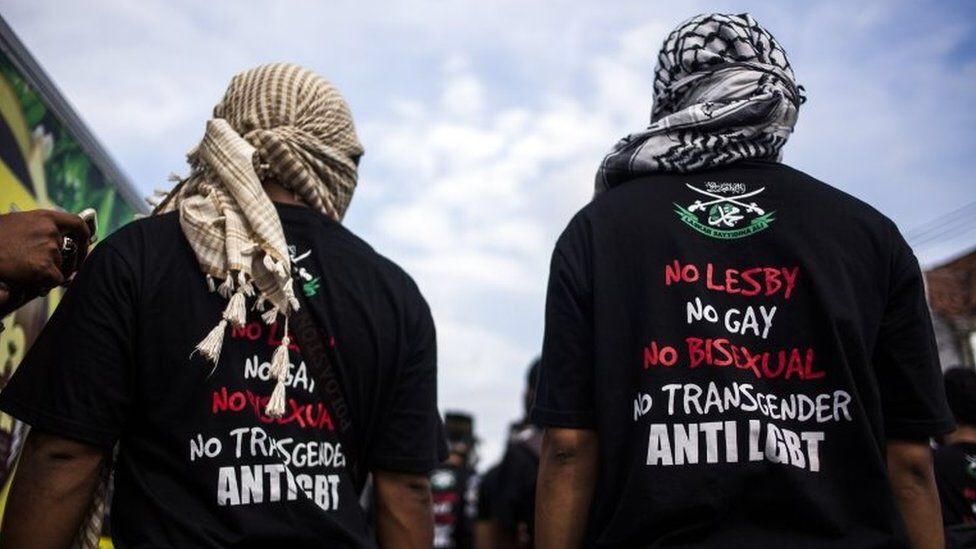
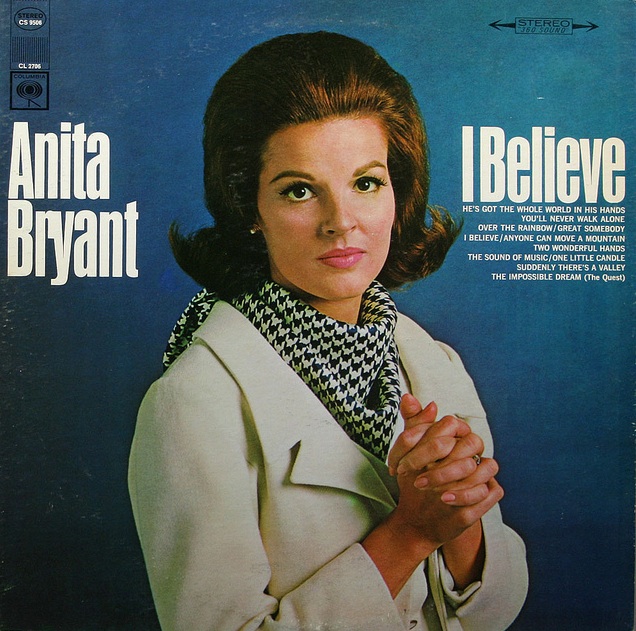
Ever since born-again singer and orange juice pitchwoman Anita Bryant helped kick off the contemporary anti-gay movement some 40 years ago, hard-line elements of the religious right have been searching for ways to demonize gay people — or, at a minimum, to find arguments that will prevent their normalization in society. For the former Florida beauty queen and her Save Our Children group, it was the alleged plans of gay men and lesbians to “recruit” in schools that provided the fodder for their crusade. But in addition to hawking that myth, the legions of anti-gay activists who followed have added a panoply of others, ranging from the extremely doubtful claim that sexual orientation is a choice, to unalloyed lies like the claims that gay men molest children far more than heterosexuals or that hate crime laws will lead to the legalization of bestiality and necrophilia. These fairy tales are important to the anti-gay right because they form the basis of its claim that homosexuality is a social evil that must be suppressed — an opinion rejected by virtually all relevant medical and scientific authorities. They also almost certainly contribute to hate crime violence directed at the LGBT community, which is more targeted for such attacks than any other minority group in America. What follows are 10 key myths propagated by the anti-gay movement, along with the truth behind the propaganda.

MYTH # 1
Gay men molest children at far higher rates than heterosexuals.

THE ARGUMENT
Depicting gay men as a threat to children may be the single most potent weapon for stoking public fears about homosexuality — and for winning elections and referenda, as Anita Bryant found out during her successful 1977 campaign to overturn a Dade County, Fla., ordinance barring discrimination against gay people. Discredited psychologist Paul Cameron, the most ubiquitous purveyor of anti-gay junk science, has been a major promoter of this myth. Despite having been debunked repeatedly and very publicly, Cameron’s work is still widely relied upon by anti-gay organizations, although many no longer quote him by name. Others have cited a group called the American College of Pediatricians (ACPeds) to claim, as Tony Perkins of the Family Research Council did in November 2010, that “the research is overwhelming that homosexuality poses a [molestation] danger to children.” A related myth is that same-sex parents will molest their children.
THE FACTS
According to the American Psychological Association, children are not more likely to be molested by LGBT parents or their LGBT friends or acquaintances. Gregory Herek, a professor at the University of California, Davis, who is one of the nation’s leading researchers on prejudice against sexual minorities, reviewed a series of studies and found no evidence that gay men molest children at higher rates than heterosexual men.

Anti-gay activists who make that claim allege that all men who molest male children should be seen as homosexual. But research by A. Nicholas Groth, a pioneer in the field of sexual abuse of children, shows that is not so. Groth found that there are two types of child molesters: fixated and regressive. The fixated child molester — the stereotypical pedophile — cannot be considered homosexual or heterosexual because “he often finds adults of either sex repulsive” and often molests children of both sexes. Regressive child molesters are generally attracted to other adults, but may “regress” to focusing on children when confronted with stressful situations. Groth found, as Herek notes, that the majority of regressed offenders were heterosexual in their adult relationships.

The Child Molestation Research & Prevention Institute notes that 90% of child molesters target children in their network of family and friends, and the majority are men married to women. Most child molesters, therefore, are not gay people lingering outside schools waiting to snatch children from the playground, as much religious-right rhetoric suggests.

Some anti-gay ideologues cite ACPeds’ opposition to same-sex parenting as if the organization were a legitimate professional body. In fact, the so-called college is a tiny breakaway faction of the similarly named, 60,000-member American Academy of Pediatrics that requires, as a condition of membership, that joiners “hold true to the group’s core beliefs … [including] that the traditional family unit, headed by an opposite-sex couple, poses far fewer risk factors in the adoption and raising of children.” The group’s 2010 publication Facts About Youth was described by the American Academy of Pediatrics as not acknowledging scientific and medical evidence with regard to sexual orientation, sexual identity and health, or effective health education. Francis Collins, director of the National Institutes of Health, was one of several legitimate researchers who said ACPeds misrepresented the institutes’ findings. “It is disturbing to me to see special interest groups distort my scientific observations to make a point against homosexuality,” he wrote. “The information they present is misleading and incorrect.” Another critic of ACPeds is Dr. Gary Remafedi, a researcher at the University of Minnesota who wrote a letter to ACPeds rebuking the organization for misusing his research.

In spite of all this, the anti-LGBT right continues to peddle this harmful and baseless myth, which is probably the leading defamatory charge leveled against gay people.

MYTH # 2
Same-sex parents harm children.

THE ARGUMENT
Most hard-line anti-gay organizations are heavily invested, from both a religious and a political standpoint, in promoting the traditional nuclear family as the sole framework for the healthy upbringing of children. They maintain a reflexive belief that same-sex parenting must be harmful to children — although the exact nature of that supposed harm varies widely.

THE FACTS
No legitimate research has demonstrated that same-sex couples are any more or any less harmful to children than heterosexual couples.

The American Academy of Child & Adolescent Psychiatry affirmed in 2013 that “[c]urrent research shows that children with gay and lesbian parents do not differ from children with heterosexual parents in their emotional development or in their relationships with peers and adults” and they are “not more likely than children of heterosexual parents to develop emotional or behavioral problems.”

The American Academy of Pediatrics (AAP) in a 2002 policy statement declared: “A growing body of scientific literature demonstrates that children who grow up with one or two gay and/or lesbian parents fare as well in emotional, cognitive, social, and sexual functioning as do children whose parents are heterosexual.” That policy statement was reaffirmed in 2009 and in 2013, when the AAP stated its support for civil marriage for same-gender couples and full adoption and foster care rights for all parents, regardless of sexual orientation.

The American Psychological Association (APA) noted in 2004 that “same-sex couples are remarkably similar to heterosexual couples, and that parenting effectiveness and the adjustment, development and psychological well-being of children is unrelated to parental sexual orientation.” In addition, the APA stated that “beliefs that lesbian and gay adults are not fit parents have no empirical foundation.” The next year, in 2005, the APA published a summary of research findings on lesbian and gay parents and reiterated that common negative stereotypes about LGBT parenting are not supported by the data.

Similarly, the Child Welfare League of America’s official position with regard to same-sex parents is that “lesbian, gay, and bisexual parents are as well-suited to raise children as their heterosexual counterparts.”

2010 review of research on same-sex parenting carried out by LiveScience, a science news website, found no differences between children raised by heterosexual parents and children raised by lesbian parents. In some cases, it found, children in same-sex households may actually be better adjusted than in heterosexual homes.

A 2013 preliminary study in Australia found that the children of lesbian and gay parents are not only thriving, but may actually have better overall health and higher rates of family cohesion than heterosexual families. The study is the world’s largest attempt to compare children of same-sex parents to children of heterosexual parents. The full study was published in June 2014.

The anti-LGBT right continues, however, to use this myth to deny rights to LGBT people, whether through distorting legitimate research or through “studies” conducted by anti-LGBT sympathizers, such as a 2012 paper popularly known as the Regnerus Study. University of Texas sociology professor Mark Regnerus’ paper purported to demonstrate that same-sex parenting harms children. The study received almost $1 million in funding from anti-LGBT think tanks, and even though Regnerus himself admitted that his study does not show what people say it does with regard to the “harms” of same-sex parenting, it continues to be peddled as “proof” that children are in danger in same-sex households. Since the study’s release, it has been completely discredited because of its faulty methodology and its suspect funding. In 2013, Darren Sherkat, a scholar appointed to review the study by the academic journal that published it, told the Southern Poverty Law Center that he “completely dismiss[es]” the study, saying Regnerus “has been disgraced” and that the study was “bad … substandard.” In spring 2014, the University of Texas’s College of Liberal Arts and Department of Sociology publicly distanced themselves from Regnerus, the day after he testified as an “expert witness” against Michigan’s same-sex marriage ban. The judge in that case, Bernard Friedman, found that Regnerus’ testimony was “entirely unbelievable and not worthy of serious consideration,” and ruled that Michigan’s ban on same-sex marriage was unconstitutional. Despite all this, the Regnerus Study is still used in the U.S. and abroad as a tool by anti-LGBT groups to develop anti-LGBT policy and laws.

MYTH # 3
People become homosexual because they were sexually abused as children or there was a deficiency in sex-role modeling by their parents.

THE ARGUMENT
Many anti-gay rights activists claim that homosexuality is a mental disorder caused by some psychological trauma or aberration in childhood. This argument is used to counter the common observation that no one, gay or straight, consciously chooses his or her sexual orientation. Joseph Nicolosi, a founder of the National Association for Research and Therapy of Homosexuality, said in 2009 that “if you traumatize a child in a particular way, you will create a homosexual condition.” He also has repeatedly said, “Fathers, if you don’t hug your sons, some other man will.” 

A side effect of this argument is the demonization of parents of gay men and lesbians, who are led to wonder if they failed to protect a child against sexual abuse or failed as role models in some important way. In October 2010, Kansas State University family studies professor Walter Schumm released a related study in the British Journal of Biosocial Science, which used to be the Eugenics Review. Schumm argued that gay couples are more likely than heterosexuals to raise gay or lesbian children through modeling “gay behavior.” Schumm, who has also argued that lesbian relationships are unstable, has ties to discredited psychologist and anti-LGBT fabulist Paul Cameron, the author of numerous completely baseless “studies” about the alleged evils of homosexuality. Critics of Schumm’s study note that he appears to have merely aggregated anecdotal data, resulting in a biased sample.

THE FACTS
No scientifically sound study has definitively linked sexual orientation or identity with parental role-modeling or childhood sexual abuse.

The American Psychiatric Association noted in a 2000 fact sheet available on the Association of Gay and Lesbian Psychiatrists, that dealing with gay, lesbian and bisexual issues, that sexual abuse does not appear to be any more prevalent among children who grow up and identify as gay, lesbian or bisexual than in children who grow up and identify as heterosexual.

Similarly, the National Organization on Male Sexual Victimization notes on its websitethat “experts in the human sexuality field do not believe that premature sexual experiences play a significant role in late adolescent or adult sexual orientation” and added that it’s unlikely that anyone can make another person gay or heterosexual.

Advocates for Youth, an organization that works in the U.S. and abroad in the field of adolescent reproductive and sexual health also has stated that sexual abuse does not “cause” heterosexual youth to become gay.

In 2009, Dr. Warren Throckmorton, a psychologist at the Christian Grove City College, noted in an analysis that “the research on sexual abuse among GLBT populations is often misused to make inferences about causation [of homosexuality].”

MYTH # 4
LGBT people don’t live nearly as long as heterosexuals.

THE ARGUMENT
Anti-LGBT organizations, seeking to promote heterosexuality as the healthier “choice,” often offer up the purportedly shorter life spans and poorer physical and mental health of gays and lesbians as reasons why they shouldn’t be allowed to adopt or foster children.

THE FACTS
This falsehood can be traced directly to the discredited research of Paul Cameron and his Family Research Institute, specifically a 1994 paper he co-wrote entitled  “The Lifespan of Homosexuals.” Using obituaries collected from newspapers serving the gay community, he and his two co-authors concluded that gay men died, on average, at 43, compared to an average life expectancy at the time of around 73 for all U.S. men. On the basis of the same obituaries, Cameron also claimed that gay men are 18 times more likely to die in car accidents than heterosexuals, 22 times more likely to die of heart attacks than whites, and 11 times more likely than blacks to die of the same cause. He also concluded that lesbians are 487 times more likely to die of murder, suicide, or accidents than straight women. 

Remarkably, these claims have become staples of the anti-gay right and have frequently made their way into far more mainstream venues. For example, William Bennett, education secretary under President Reagan, used Cameron’s statistics in a 1997 interview he gave to ABC News’ “This Week.”

However, like virtually all of his “research,” Cameron’s methodology is egregiously flawed — most obviously because the sample he selected (the data from the obits) was not remotely statistically representative of the LGBT population as a whole. Even Nicholas Eberstadt, a demographer at the conservative American Enterprise Institute, has called Cameron’s methods “just ridiculous.”

Anti-LGBT organizations have also tried to support this claim by distorting the work of legitimate scholars, like a 1997 study conducted by a Canadian team of researchers that dealt with gay and bisexual men living in Vancouver in the late 1980s and early 1990s. The authors of the study became aware that their work was being misrepresented by anti-LGBT groups, and issued a response taking the groups to task.

MYTH # 5
Gay men controlled the Nazi Party and helped to orchestrate the Holocaust.

THE ARGUMENT
This claim comes directly from a 1995 book titled The Pink Swastika: Homosexuality in the Nazi Party, by Scott Lively and Kevin Abrams. Lively is the virulently anti-gay founder of Abiding Truth Ministries and Abrams is an organizer of a group called the International Committee for Holocaust Truth, which came together in 1994 and included Lively as a member.

The primary argument Lively and Abrams make is that gay people were not victimized by the Holocaust. Rather, Hitler deliberately sought gay men for his inner circle because their “unusual brutality” would help him run the party and mastermind the Holocaust. In fact, “the Nazi party was entirely controlled by militaristic male homosexuals throughout its short history,” the book claims. “While we cannot say that homosexuals caused the Holocaust, we must not ignore their central role in Nazism,” Lively and Abrams add. “To the myth of the ‘pink triangle’ — the notion that all homosexuals in Nazi Germany were persecuted — we must respond with the reality of the ‘pink swastika.'”

These claims have been picked up by a number of anti-gay groups and individuals, including Bryan Fischer of the American Family Association, as proof that gay men and lesbians are violent and sick. The book has also attracted an audience among anti-gay church leaders in Eastern Europe and among Russian-speaking anti-gay activists in America.

THE FACTS
The Pink Swastika has been roundly discredited by legitimate historians and other scholars. Christine Mueller, professor of history at Reed College, did a 1994 line-by-line refutation of an earlier Abrams article on the topic and of the broader claim that the Nazi Party was “entirely controlled” by gay men. Historian Jon David Wynecken at Grove City College also refuted the book, pointing out that Lively and Abrams did no primary research of their own, instead using out-of-context citations of some legitimate sources while ignoring information from those same sources that ran counter to their thesis.

The myth that the Nazis condoned homosexuality sprang up in the 1930s, started by socialist opponents of the Nazis as a slander against Nazi leaders. Credible historians believe that only one of the half-dozen leaders in Hitler’s inner circle, Ernst Röhm, was gay. (Röhm was murdered on Hitler’s orders in 1934.) The Nazis considered homosexuality one aspect of the “degeneracy” they were trying to eradicate.

When Hitler’s National Socialist German Workers Party came to power in 1933, it quickly strengthened Germany’s existing penalties against homosexuality. Heinrich Himmler, Hitler’s security chief, announced that homosexuality was to be “eliminated” in Germany, along with miscegenation among the races. Historians estimate that between 50,000 and 100,000 men were arrested for homosexuality (or suspicion of it) under the Nazi regime. These men were routinely sent to concentration camps and many thousands died there.

Himmler expressed his views on homosexuality like this: “We must exterminate these people root and branch. … We can’t permit such danger to the country; the homosexual must be completely eliminated.”

MYTH # 6
Hate crime laws will lead to the jailing of pastors who criticize homosexuality and the legalization of practices like bestiality and necrophilia.

THE ARGUMENT
Anti-gay activists, who have long opposed adding LGBT people to those protected by hate crime legislation, have repeatedly claimed that such laws would lead to the jailing of religious figures who preach against homosexuality — part of a bid to gain the backing of the broader religious community for their position. Janet Porter of Faith2Action, for example, was one of many who asserted that the federal Matthew Shepard and James Byrd Jr. Hate Crimes Prevention Act — signed into law by President Obama in October 2009 — would “jail pastors” because it “criminalizes speech against the homosexual agenda.”

In a related assertion, anti-gay activists claimed the law would lead to the legalization of psychosexual disorders (paraphilias) like bestiality and pedophilia. Bob Unruh, a conservative Christian journalist who left The Associated Press in 2006 for the right-wing, conspiracist news site WorldNetDaily, said shortly before the federal law was passed that it would legalize “all 547 forms of sexual deviancy or ‘paraphilias’ listed by the American Psychiatric Association.” This claim was repeated by many anti-gay organizations, including the Illinois Family Institute.

THE FACTS
The claim that hate crime laws could result in the imprisonment of those who “oppose the homosexual lifestyle” is false. The First Amendment provides robust protections of free speech, and case law makes it clear that even a preacher who publicly suggested that gays and lesbians should be killed would be protected.

Neither do hate crime laws — which provide for enhanced penalties when persons are victimized because of their “sexual orientation” (among other factors) — “protect pedophiles,” as Janet Porter and many others have claimed. According to the American Psychological Association, sexual orientation refers to heterosexuality, homosexuality and bisexuality — not paraphilias such as pedophilia. Paraphilias, as defined (pdf; may require a different browser) by the American Psychiatric Association, are characterized by sexual urges or behaviors directed at non-consenting persons or those unable to consent like children, or that involve another person’s psychological distress, injury, or death.

Moreover, even if pedophiles, for example, were protected under a hate crime law — and such a law has not been suggested or contemplated anywhere — that would not legalize or “protect” pedophilia. Pedophilia is illegal sexual activity, and a law that more severely punished people who attacked pedophiles would not change that.

MYTH # 7
Allowing gay people to serve openly will damage the armed forces.

THE ARGUMENT
Anti-gay groups have been adamantly opposed to allowing gay men and lesbians to serve openly in the armed forces, not only because of their purported fear that combat readiness will be undermined, but because the military has long been considered the purest meritocracy in America (the armed forces were successfully racially integrated long before American civil society, for example). If gays serve honorably and effectively in this meritocracy, that suggests that there is no rational basis for discriminating against them in any way.

THE FACTS
Gays and lesbians have long served in the U.S. armed forces, though under the “Don’t Ask, Don’t Tell” (DADT) policy that governed the military between 1993 and 2011, they could not do so openly. At the same time, gays and lesbians have served openly for years in the armed forces of 25 countries (as of 2010), including Britain, Israel, South Africa, Canada and Australia, according to a report released by the Palm Center, a policy think tank at the University of California at Santa Barbara. The Palm Center report concluded that lifting bans against openly gay service personnel in these countries “ha[s] had no negative impact on morale, recruitment, retention, readiness or overall combat effectiveness.” Successful transitions to new policies were attributed to clear signals of leadership support and a focus on a uniform code of behavior without regard to sexual orientation.

A 2008 Military Times poll of active-duty military personnel, often cited by anti-gay activists, found that 10% of respondents said they would consider leaving the military if the DADT policy were repealed. That would have meant that some 228,000 people might have left the military the policy’s 2011 repeal. But a 2009 review of that poll by the Palm Center suggested a wide disparity between what soldiers said they would do and their actual actions. It noted, for example, that far more than 10% of West Point officers in the 1970s said they would leave the service if women were admitted to the academy. “But when the integration became a reality,” the report said, “there was no mass exodus; the opinions turned out to be just opinions.” Similarly, a 1985 survey of 6,500 male Canadian service members and a 1996 survey of 13,500 British service members each revealed that nearly two-thirds expressed strong reservations about serving with gays. Yet when those countries lifted bans on gays serving openly, virtually no one left the service for that reason. “None of the dire predictions of doom came true,” the Palm Center report said.

Despite the fact that gay men and lesbians have been serving openly in the military since September 2011, anti-LGBT groups continue to claim that openly gay personnel are causing problems in the military, including claims of sexual abuse by gay and lesbian soldiers of straight soldiers. The Palm Center refutes this claim, and in an analysis, found that repealing DADT has had “no overall negative impact on military readiness or its component dimensions,” including sexual assault. According to then-Secretary of Defense Leon Panetta in 2012, the repeal of DADT was being implemented effectively and was having no impact on readiness, unit cohesion or morale. Panetta also issued an LGBT Pride message in 2012.

MYTH # 8
Gay people are more prone to be mentally ill and to abuse drugs and alcohol.

THE ARGUMENT
Anti-LGBT groups want not only to depict sexual orientation as something that can be changed but also to show that heterosexuality is the most desirable “choice,” even if religious arguments are set aside. The most frequently used secular argument made by anti-LGBT groups in that regard is that homosexuality is inherently unhealthy, both mentally and physically. As a result, most anti-LGBT rights groups reject the 1973 decision by the American Psychiatric Association (APA) to remove homosexuality from its list of mental illnesses. Some of these groups, including the particularly hard-line Traditional Values Coalition, claim that “homosexual activists” managed to infiltrate the APA in order to sway its decision.

THE FACTS
All major professional mental health organizations are on record as stating that homosexuality is not a mental disorder.

The American Psychological Association states that being gay is just as healthy as being straight, and noted that the 1950s-era work of Dr. Evelyn Hooker started to dismantle this myth. In 1975, the association issued a statement that said, in part, “homosexuality per se implies no impairment in judgment, reliability or general social and vocational capabilities.” The association has clearly stated in the past that “homosexuality is neither mental illness nor mental depravity. … Study after study documents the mental health of gay men and lesbians. Studies of judgment, stability, reliability, and social and vocational adaptiveness all show that gay men and lesbians function every bit as well as heterosexuals.”

The American Psychiatric Association states that (PDF; may not open in all browsers) homosexuality is not a mental disorder and that all major professional health organizations are on record as confirming that. The organization removed homosexuality from its official diagnostic manual in 1973 after extensive review of the scientific literature and consultation with experts, who concluded that homosexuality is not a mental illness.

Though it is true that LGBT people tend to suffer higher rates of anxiety, depression, and depression-related illnesses and behaviors like alcohol and drug abuse than the general population, that is due to the historical social stigmatization of homosexuality and violence directed at LGBT people, not because of homosexuality itself. Studies done during the past several years have determined that it is the stress of being a member of a minority group in an often-hostile society — and not LGBT identity itself — that accounts for the higher levels of mental illness and drug use.

Richard J. Wolitski, an expert on minority status and public health issues at the Centers for Disease Control and Prevention, put it like this in 2008: “Economic disadvantage, stigma, and discrimination … increase stress and diminish the ability of individuals [in minority groups] to cope with stress, which in turn contribute to poor physical and mental health.”

Even as early as 1994, external stressors were recognized as a potential cause of emotional distress of LGBT people. A report presented by the Council on Scientific Affairs to the AMA House of Delegates Interim Meeting with regard to reparative (“ex-gay”) therapy noted that most of the emotional disturbance gay men and lesbians experience around their sexual identity is not based on physiological causes, but rather on “a sense of alienation in an unaccepting environment.”

In 2014, a study, conducted by several researchers at major universities and the Rand Corporation, found that LGBT people living in highly anti-LGBT communities and circumstances face serious health concerns and even premature death because of social stigmatization and exclusion. One of the researchers, Dr. Mark Hatzenbuehler, a sociomedical sciences professor at the Mailman School of Public Health at Columbia University, said that the data gathered in the study suggests that “sexual minorities living in communities with high levels of anti-gay prejudice have increased risk of mortality, compared to low-prejudice communities.”

Homosexuality is not a mental illness or emotional problem and being LGBT does not cause someone to be mentally ill, contrary to what anti-LGBT organizations say. Rather, social stigmatization and prejudice appear to contribute to health disparities in the LGBT population, which include emotional and psychological distress and harmful coping mechanisms.

MYTH # 9
No one is born gay.

THE ARGUMENT
Anti-gay activists keenly oppose the granting of “special” civil rights protections to gay people similar to those afforded black Americans and other minorities. But if people are born gay — in the same way that people have no choice as to whether they are black or white — discrimination against gay men and lesbians would be vastly more difficult to justify. Thus, anti-gay forces insist that sexual orientation is a behavior that can be changed, not an immutable characteristic.

THE FACTS
Modern science cannot state conclusively what causes sexual orientation, but a great many studies suggest that it is the result of both biological and environmental forces, not a personal “choice.” A 2008 Swedish study of twins (the world’s largest twin study) published in The Archives of Sexual Behavior concluded that “[h]omosexual behaviour is largely shaped by genetics and random environmental factors.” Dr. Qazi Rahman, study co-author and a leading scientist on human sexual orientation, said: “This study puts cold water on any concerns that we are looking for a single ‘gay gene’ or a single environmental variable which could be used to ‘select out’ homosexuality — the factors which influence sexual orientation are complex. And we are not simply talking about homosexuality here — heterosexual behaviour is also influenced by a mixture of genetic and environmental factors.” In other words, sexual orientation in general — whether homosexual, bisexual or heterosexual — is a mixture of genetic and environmental factors.

The American Psychological Association (APA) states that sexual orientation “ranges along a continuum,” and acknowledges that despite much research into the possible genetic, hormonal, social and cultural influences on sexual orientation, scientists have yet to pinpoint the precise causes of sexual orientation. Regardless, the APA concludes that “most people experience little or no sense of choice about their sexual orientation.” In 1994, the APA noted that “homosexuality is not a matter of individual choice” and that research “suggests that the homosexual orientation is in place very early in the life cycle, possibly even before birth.”

The American Academy of Pediatrics stated in 1993 (updated in 2004) that “homosexuality has existed in most societies for as long as recorded descriptions of sexual beliefs and practices have been available” and that even at that time, “most scholars in the field state that one’s sexual orientation is not a choice … individuals do not choose to be homosexual or heterosexual.”

There are questions about what specifically causes sexual orientation in general, but most current science acknowledges that it is a complex mixture of biological, environmental, and possibly hormonal factors but that no one chooses an orientation.

MYTH # 10
Gay people can choose to leave homosexuality.

THE ARGUMENT
If people are not born gay, as anti-gay activists claim, then it should be possible for individuals to abandon homosexuality. This view is buttressed among religiously motivated anti-gay activists by the idea that homosexual practice is a sin and humans have the free will needed to reject sinful urges.

A number of “ex-gay” religious ministries have sprung up in recent years with the aim of teaching gay people to become heterosexuals, and these have become prime purveyors of the claim that gays and lesbians, with the aid of mental therapy and Christian teachings, can “come out of homosexuality.” The now defunct Exodus International, the largest of these ministries, once stated, “You don’t have to be gay!” Meanwhile, in a more secular vein, the National Association for Research and Therapy of Homosexuality describes itself as “a professional, scientific organization that offers hope to those who struggle with unwanted homosexuality.”

THE FACTS
“Reparative” or sexual reorientation therapy — the pseudo-scientific foundation of the ex-gay movement — has been rejected by all the established and reputable American medical, psychological, psychiatric and professional counseling organizations. In 2009, for instance, the American Psychological Association adopted a resolution, accompanied by a 138-page report, that repudiated ex-gay therapy. The report concluded that compelling evidence suggested that cases of individuals going from gay to straight were “rare” and that “many individuals continued to experience same-sex sexual attractions” after reparative therapy. The APA resolution added that “there is insufficient evidence to support the use of psychological interventions to change sexual orientation” and asked “mental health professionals to avoid misrepresenting the efficacy of sexual orientation change efforts by promoting or promising change in sexual orientation.” The resolution also affirmed that same-sex sexual and romantic feelings are normal.

A very large number of professional medical, scientific and counseling organizations in the U.S. and abroad have issued statements regarding the harm that reparative therapy can cause, particularly if it’s based on the assumption that homosexuality is unacceptable. As early as 1993, the American Academy of Pediatrics stated that“[t]herapy directed at specifically changing sexual orientation is contraindicated, since it can provoke guilt and anxiety while having little or no potential for achieving change in orientation.”

The American Medical Association officially opposes reparative therapy that is “based on the assumption that homosexuality per se is a mental disorder or based on an a priori assumption that the person should change his/her homosexual orientation.”

The Pan-American Health Organization, the world’s oldest international public health agency, issued a statement in 2012 that said, in part: “Services that purport to ‘cure’ people with non-heterosexual sexual orientation lack medical justification and represent a serious threat to the health and well-being of affected people.” The statement continues, “In none of its individual manifestations does homosexuality constitute a disorder or an illness, and therefore it requires no cure.”

Some of the most striking, if anecdotal, evidence of the ineffectiveness of sexual reorientation therapy has been the numerous failures of some of its most ardent advocates. For example, the founder of Exodus International, Michael Bussee, left the organization in 1979 with a fellow male ex-gay counselor because the two had fallen in love. Other examples include George Rekers, a former board member of NARTH and formerly a leading scholar of the anti-LGBT Christian right who was revealed to have been involved in a same-sex tryst in 2010. John Paulk, former poster child of the massive ex-gay campaign “Love Won Out” in the late 1990s, is now living as a happy gay man. And Robert Spitzer, a preeminent psychiatrist whose 2001 research that seemed to indicate that some gay people had changed their orientation, repudiated his own study in 2012. The Spitzer study had been widely used by anti-LGBT organizations as “proof” that sexual orientation can change.

In 2013, Exodus International, formerly one of the largest ex-gay ministries in the world, shut down after its director, Alan Chambers, issued an apology to the LGBT community. Chambers, who is married to a woman, has acknowledged that his same-sex attraction has not changed. At a 2012 conference, he said: “The majority of people that I have met, and I would say the majority meaning 99.9% of them, have not experienced a change in their orientation or have gotten to a place where they could say they could never be tempted or are not tempted in some way or experience some level of same-sex attraction.”

Reference

Gay History: The Orange Juice Boycott That Changed America

How a breakfast table staple sparked solidarity and protest in the queer community

EC:  assets%2Fmessage-editor%2F1482347233909-anita-bryant-orange-juice-hero-illo
CREDIT: ILLUSTRATION BY LAUREN KOLM

As she heeded the call to come on down, descending the Price Is Right’s audience riser wearing a headscarf with juicy swirls of lemon, tangerine, and lime, Yolanda Bowsley’s breasts jiggled out of her tube top. Producers flashed a thick blue bar over the contestant’s naked bits, people in the studio howled, but Bowsley looked neither freaked nor ashamed. Meanwhile, on ABC’s new sitcom Three’s Company—a show with double entendres about three-ways and casual lust—a pair of tangy orange throw pillows on the set’s central couch visually throbbed, the implied accoutrements of seduction. Sexual freedom in 1977 tended to express itself in fearless, provocative hues of citrus.

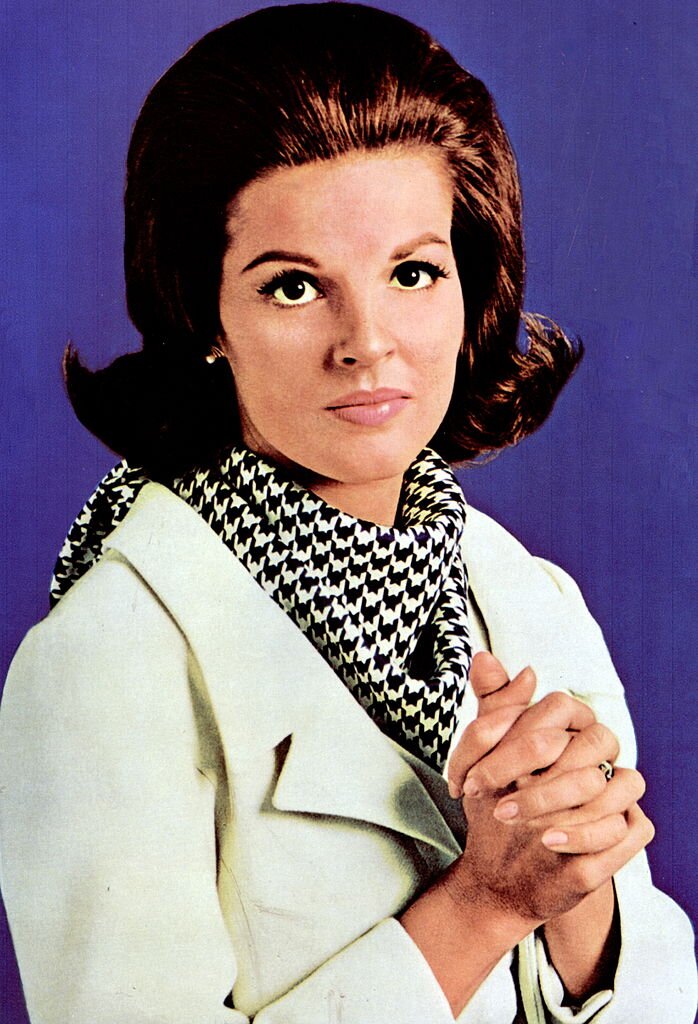
But not for the queen of orange juice herself. Not for Anita Bryant, who wore shirt-dresses the color of lemon meringue pie filling and tangerine cap-sleeve bodices as if they were the armor of the righteous in battle. Bryant saw sexual openness as a challenge to God’s order, a threat to what she liked to call “straight and normal America.” It lacked decency. It corrupted children. It had to be stopped.

Bryant had been Miss Oklahoma once, beautiful, with pale skin and dark eyes. She was Jackie Kennedy with a hard-spray flip and a soft country twang, raised on church suppers and sticky flour gravy. As a tightly poised pop singer in the early ‘60s, she’d built a shortstack of hits, earning three gold records. She married her manager, Bob Green, a hunk with a handsome mess of sandy hair who knew how to pair a blazer with a turtleneck. They were a dream couple, country stylish like Elvis and Priscilla but without the obvious diet pills and demons. They lived in a six-bedroom mansion on Miami Beach’s North Bay Road, where palms rustled and clouds billowed like Rococo scrollwork, framing a crystal blue sky.

In 1969 Bryant began her second and most lucrative career—the Florida Citrus Commission, a politically powerful consortium of the state’s largest growers, crowned Bryant the Sunshine State’s official OJ Sweetheart. She became the star of TV spots and magazine ads, a lifestyle ambassador for frozen concentrated orange juice.

In an early commercial, Bryant strolls a sunny citrus grove, stabs a spigot in a dangling orange and sings a loping jingle, “Come to the Florida Sunshine Tree,” as a five-foot glass fills with juice. She tugs the spigot out and collects the last golden sluice in a tumbler of normal size. She sips. And in an Oklahoma drag that’s genuine, gentle, and perfect, with just enough post-production echo to make it sound infallible, Bryant drops the tagline: “Breakfast without orange juice is like a day without sunshine.

Orange juice was, in a way, the Sun Belt’s symbol: healthy, wholesome, and optimistic, like… well, sunshine. Anita was its avatar. Then she became its avenging angel.

Per capita American OJ consumption would end up just about filling the Citrus Commission’s mighty sloshing prop glass. Houseware manufacturers like Libbey included pony-size juice tumblers in starter sets. Bars invited in a back squad of OJ party cocktails—Screwdrivers and Tequila Sunrises—to soak up the glut of concentrated juice. They invented the Alabama Slammer and the Harvey Wallbanger to keep things percolating in fern bars and fairway lounges.

EC:  assets%2Fmessage-editor%2F1471026827649-gettyimages-85231543
CREDIT: PHOTO BY GAB ARCHIVES VIA GETTY IMAGES

There was something else bending in OJ’s favor: a cultural tilt south. Starting in 1969, the collapse of the Rust Belt—factories in the Northeast and Upper Midwest closing, towns boarding up, labor unions shrinking—became an unavoidable narrative for papers and the evening news. The Sun Belt, a made-up political projection encompassing a westward sweep of the map from Jacksonville to San Diego, was where a new conservatism was spreading like the creep of subdivisions in the desert near Phoenix. Orange juice was, in a way, the Sun Belt’s symbol: healthy, wholesome, and optimistic, like… well, sunshine. Anita was its avatar. Then she became its avenging angel.

The year Bryant stabbed that orange with a spigot, 1969, was a year of events more tumultuous billowing up north. At New York City’s Stonewall Inn, demonstrations smoldered for days following a routine bust of queers, trans women, and drag queens that set off a riot, the official start of the gay liberation movement. In spite of an ambient distaste for homosexuals and the lack of even one openly gay or lesbian elected official anywhere in the nation, by the end of 1976, legislative bodies in 40 cities and counties and one state (Pennsylvania) had passed LGBT nondiscrimination laws in some form. An enlightened consensus was jelling. It said citizens shouldn’t be fired, or evicted, or denied service because they were gay, all standard under the old rules, when America discriminated righteously to thwart sodomy and other acts of moral degeneracy. But righteousness didn’t evaporate in the heat of Stonewall. Righteousness festered, biding its time.

As 1977 dawned in South Florida, liberals on the Miami–Dade County Commission passed a pretty standard homosexual nondiscrimination ordinance. Religious conservatives, including Bryant, representing her church, drew a line in the pale, sugar-fine sand. They spoke against the ordinance at a Commission hearing, arguing that the ordinance violated her rights as a person of faith. When it passed anyway, Bryant promised retribution, spinning a metaphor that, consciously or not, conjured a vision of Florida orange groves choked by a homosexual radicalism inching its sinister tendrils toward Washington and the Constitution. “The seed of sexual sickness,” Bryant said, “that germinated in Dade County has already been transplanted by misguided liberals in the U.S. Congress.”

EC:  assets%2Fmessage-editor%2F1471027453122-gettyimages-515099087
CREDIT: PHOTO BY BORIS SPREMO VIA GETTY IMAGES

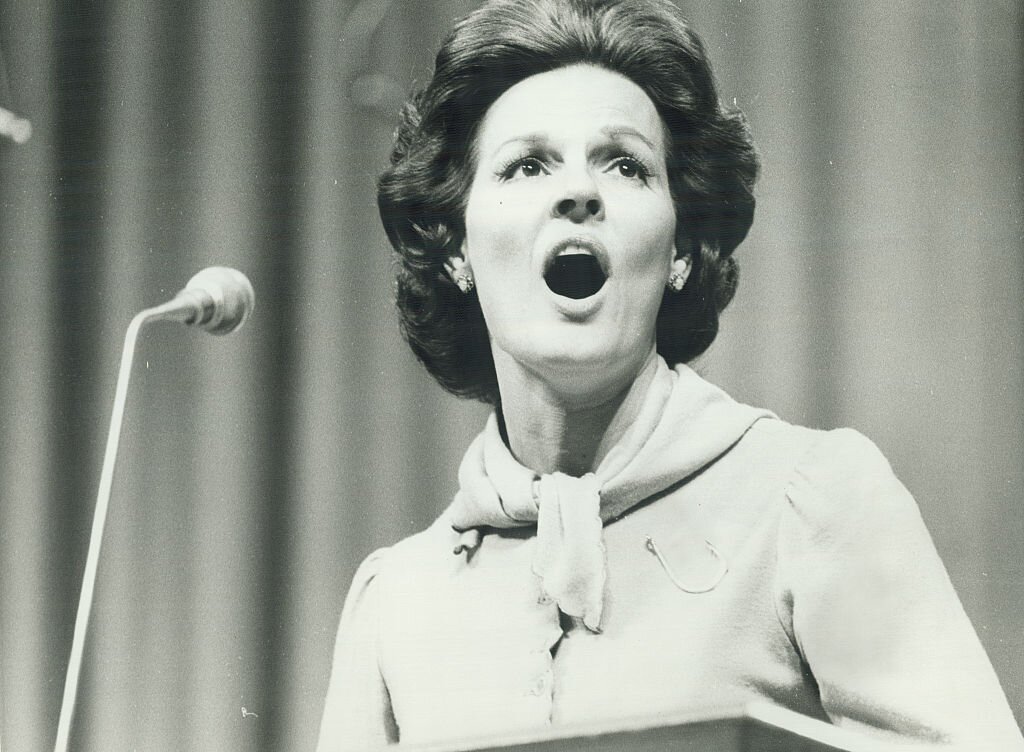
Bryant’s retribution came weeks later, when she and her allies delivered, in an enormous bulging old suitcase wheeled into the county registrar’s office on a dolly, signatures in favor of calling a special referendum on the Miami-Dade ordinance. Bryant and her allies launched Save Our Children, to urge voters to bury the homosexual nondiscrimination ordinance with a special referendum in June. Children were the true victims of the ordinance, which enabled homosexuals (and especially gay teachers) to bend the innocent ones toward a mincing evil. “Gays can’t reproduce,” Bryant would say—often—in variations on the line, “so they have to recruit.”

Gay and lesbian political groups nationally saw what was happening: Suddenly, Miami was America’s test case for the strength of the nascent homosexual civil rights movement. And they were going up against a star, a woman with a national profile, with the strength of one of Florida’s major industries tacitly, at least, behind her. They were up against the queen of frozen concentrated orange juice herself.

Some raised money to send to activists in Miami defending the ordinance. Jim Toy, an LGBT-rights pioneer in Michigan, remembers driving from Ann Arbor to Detroit to make the round of gay bars with a donation jar. Others tried to hurt Bryant at the source of her fame. “We didn’t know any way to get back at her,” says Wayne Friday, who in 1977 was president of San Francisco’s Tavern Guild, a powerful association of gay bar owners and employees. “So we just targeted orange juice.”

EC:  assets%2Fmessage-editor%2F1471028134171-2519596922_6148faee6a_b
CREDIT: PHOTO BY FLICKR USER CHRIS

Weeks after the Miami-Dade special referendum was called, gay bars across the U.S. were boycotting orange juice from the Sunshine State, and activists including Harvey Milk, a vocal organizer in the new queer scene in San Francisco’s Castro neighborhood, were urging people to drop it at breakfast. Consumer boycotts were a persuasive tactic of the left, starting with farm labor organizer César Chávez’s call in 1966 for shoppers to shun California grapes and lettuce. In 1977, organized labor called for a boycott of Coors beer to protest the company’s labor practices, its union-busting and alleged racism and homophobia. But the Florida orange juice boycott was the first organized by gay and lesbian activists. They called it a gaycott. And it was strongest in what was, in 1977, the gayest city in America.

In April, San Francisco’s Tavern Guild printed up notices on orange construction paper for its member bars to post. The signs didn’t state so much as throw down: “TO PROMOTE HUMAN RIGHTS this establishment DOES NOT SERVE FLORIDA ORANGE JUICE or orange juice from CONCENTRATE.”

Wayne Friday says the public boycott started at a Polk Street bar, the N’Touch. Friday tended bar there. “Bars up and down Polk Street,” Friday says, “they’d have a thing where they’d say, ‘Okay, at 11 in the morning everybody pour out your orange juice in the street.’ We even got some non-gay bars to do it. The police would get a little mad but the city would just wash down the street.”

EC:  assets%2Fmessage-editor%2F1471028593262-gettyimages-499297349
CREDIT: PHOTO BY FRANK LENNON VIA GETTY IMAGES

In some bars you could get a Screwdriver for half price if you brought in your own sack of oranges and squeezed them yourself, on little hand squeezers set out on the bar. You could bring in your own juice, but you had to know what you were carrying. “God help you if you brought a bottle of orange juice that was from Florida,” Friday says. “I’ve seen a bartender take it off the bar, look at the label, and pour it right down the drain.” Other bars pushed Greyhounds (vodka and grapefruit juice). Dan Perlman, a member of Ann Arbor’s Gay Student Union during the boycott, remembers a horrible grapefruit Tequila Sunrise, though a grapefruit Alabama Slammer tasted better (and still tastes better, he says) than the OJ original.

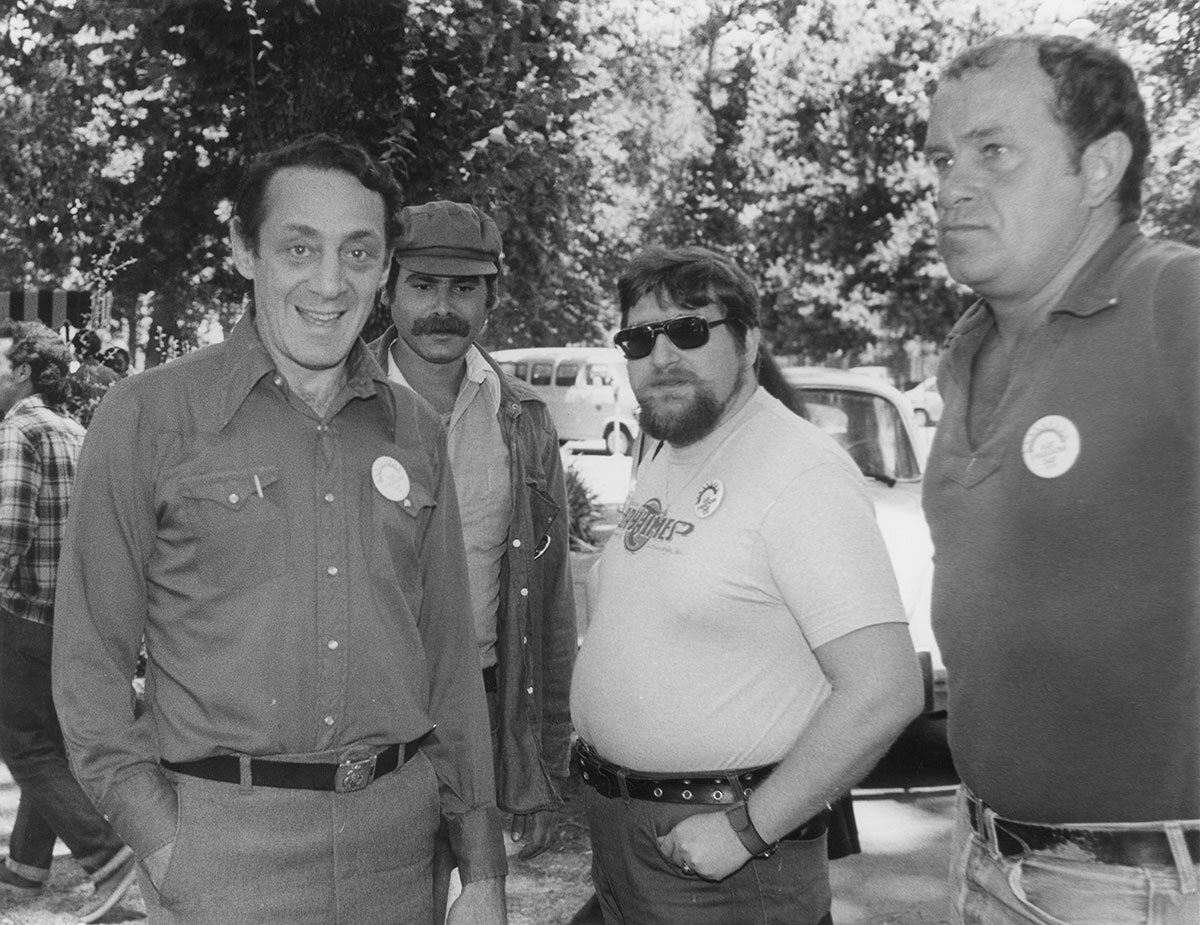
In his April 14 column for the Bay Area Reporter, a weekly gay newspaper, Harvey Milk urged readers to switch to pineapple juice for breakfast. “Some say that ONE can of OJ won’t make any difference,” he wrote. “Before Bryant becomes more powerful, remember that your ONE can adds up to millions of ONE cans throughout the nation. The only way to stop this bigot is to have a fully effective economic boycott.”

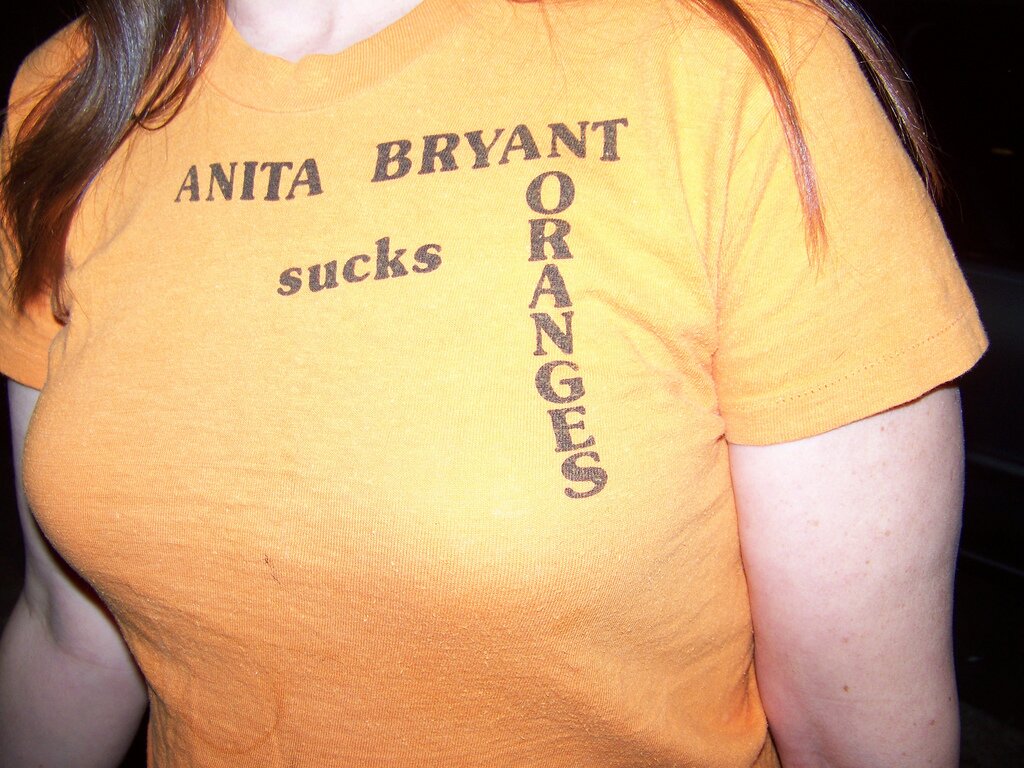
A queer cottage industry of anti-Anita protest gear popped up, with oranges as symbols of active (and sometimes passive) defiance: “Anita, Dear… Cram It”; “Stop V.D. Fuck Oranges.” People wore orange buttons that said “Squeeze Anita!” “A Day Without Human Rights Is Like a Day Without Sunshine,” read a popular T-shirt in all-caps bold, under a rough-skinned orange lurking like the Death Star.

Bryant spent the five months of the Miami-Dade campaign defiant, showing up at her church school to sing “Glory, Glory Hallelujah” with kindergartners as props. “Anita Bryant was once known as an orange juice saleswoman,” the local Miami NBC affiliate reported. “Not anymore. With a religious fervor that has made her the nation’s most controversial woman overnight, she has been selling her Save Our Children group.”

EC:  assets%2Fmessage-editor%2F1471029704602-harvey-milk
CREDIT: PHOTO VIA WIKIMEDIA COMMONS

Bryant portrayed her own martyrdom at the hand of the gaycott. “They’re coming, attacking my livelihood,” Bryant told a TV reporter, “and it has undermined a 10-year relationship with Florida citrus of goodwill. But I feel strongly, and I have great faith in God, that he’s going to take care of me. I’m not afraid. I have not been moved in that respect. And I do not believe that the product and the people I represent will be intimidated by that kind of a force.” She vowed to fight on, even if what she called her livelihood (in 1977 the Florida Citrus Commission paid her $100,000; adjusted for inflation that’s a little over $400,000 today) was stripped from her.

“We’re dealing with a vile and a vicious and a vulgar gang,” a young Jerry Falwell, Bryant’s supporter, said of Save Our Children’s foes.

The gays and their allies were simply outplayed. Save Our Children hired a Republican political consultant to produce a devastating ad, contrasting Miami’s annual Orange Bowl Parade with the San Francisco Pride march. The image of a baton twirler at the Orange Bowl, a girl with rosy cheeks, in a white, stylized military uniform, gives way to washed-out footage from San Francisco of a shirtless man in worn jeans and feathered hair, pelvic-thrusting on a float with a sad-looking palm tree, then cuts to another man in a black jockstrap and studded leather halter.

“The Orange Bowl Parade,” you hear a man say in voiceover, “Miami’s gift to the nation, wholesome entertainment. But in San Francisco, when they take to the streets, it’s a parade of homosexuals, men hugging other men, cavorting with little boys. The same people who turned San Francisco into a hotbed of homosexuality want to do the same thing to Dade County.” The dystopian gay metropolis appears furtive and frantic, fueled by speed and menace.

https://youtu.be/H-A2Ql81WTY

They never really had a chance, the gays and lesbians on OJ pickets at supermarkets or arguing their case at grocery co-op meetings, squeezing oranges or passing donation jars in gay bars. They thought the cause of civil rights, pretty much alone, would rally voters of conscience. They expected easier grounds for common cause with other minorities who’d suffered oppression.

As election news from 3,000 miles away seeped in through TVs, bars bumping Thelma Houston and Donna Summer emptied onto the streets of San Francisco’s burgeoning gay neighborhood that chilly night in June. By a two-to-one margin, voters in Dade County had killed the nondiscrimination ordinance. At an event she called the Lord’s victory supper, Anita Bryant was gleamingly triumphant. She vowed to take the fight to every city, county seat, and state capitol in the nation with laws protecting gay people.

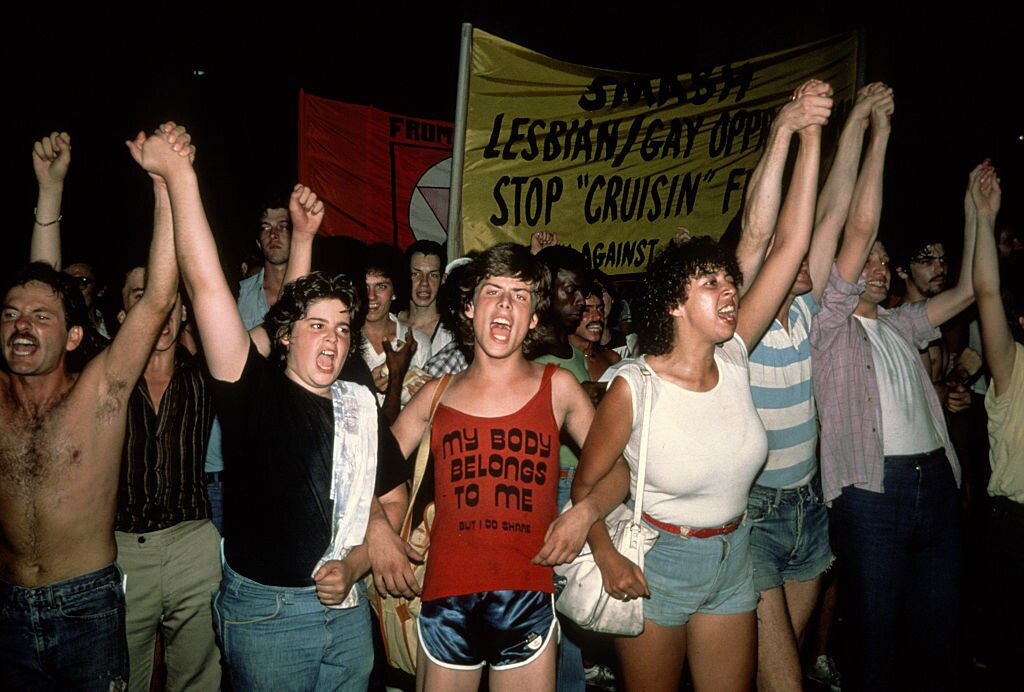
The crowd in San Francisco marched from the Castro to Polk Street, chanting, carrying candles in Dixie cups.. They milled around City Hall, returned to the Castro, and sat down in a busy intersection. Harvey Milk marched at the head of the crowd; later he spoke. Nobody had seen such a large and spontaneous takeover of the streets by so many calling themselves “faggots” and “dykes.” “I feel like the bill of rights has been wadded up on a cheap piece of paper and thrown in the wastebasket,” a woman told a radio reporter that night. You could hear her anger.

EC:  assets%2Fmessage-editor%2F1471031150150-gettyimages-532603233
CREDIT: PHOTO BY IMAGE PRESS VIA GETTY IMAGES

Others glimpsed a measure of victory in defeat. Bob Kunst, Bryant’s opponent on the ground in Miami, said the ordinance fight had galvanized world opinion. “She gave us every access to world media,” Kunst said from the post-referendum party in a quietly reflective at the Fontainebleau in Miami Beach. “We had over 50,000 news clippings, this was the turning point where ‘gay’ became a household word, and we opened up the entire debate on human sexuality.”

For Milk, defeat was a reckoning, a reminder that gays and lesbians had to unify, to organize, and most of all to come out. Later that year, Milk would become the first openly gay person to be elected to public office in America. Just 17 months later he’d be assassinated, shot by a former cop, but not before he’d inspired a more active national LGBT movement and urged every one of the estimated 15 million queer Americans to come out to President Jimmy Carter, by letter. It wasn’t until 1998, 20 years later, that Dade County passed a new gay and lesbian rights ordinance. It’s still in effect, though conservative groups tried to repeal it in 2002.

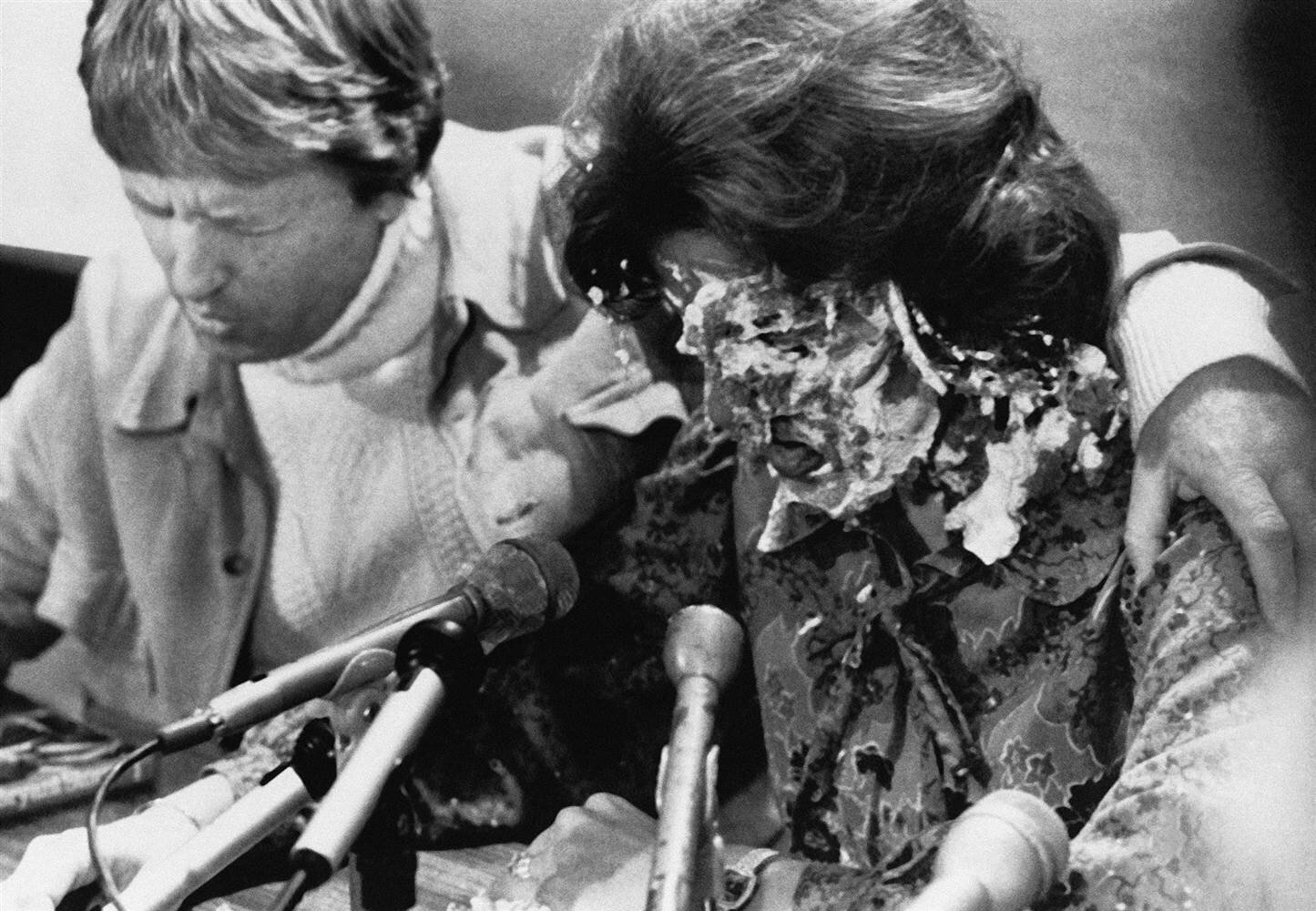
The orange juice gaycott went on after the referendum, petering out gradually. Bryant continued the work of Save Our Children; she was met with picket lines and protests everywhere she went. In Iowa, a protester nailed her with a cream pie. It is, perhaps, the enduring image of Anita, flicking pie crust out of one eye, praying for the man who threw it.

EC:  assets%2Fmessage-editor%2F1471031445639-anita-bryant-nbc
CREDIT: PHOTO VIA NBC NEWS

“At first the Florida Citrus Commission was bombarded,” Bryant told the Miami Herald after the referendum. “I guess people had nothing better to do than to write and to boycott. Then the mothers of America retaliated, I think. Sales are up 15 percent over last year. The citrus people say I’m a private citizen, that I can express my views.” It was an exaggeration, or wishful thinking. Two weeks after the referendum the public relations spokesman for Florida citrus said he wished Bryant would resign. At the end of 1978, in the same month Milk was assassinated, Bryant was fired. In 1980 she and Bob Green divorced. She experienced bankruptcy and decline. In 1990, trying to make a comeback with a new album, Bryant told Inside Story she had no regrets about what she did in Dade County in 1977. “I don’t regret it because I did the right thing.” She now lives quietly in Oklahoma.

On the night of the referendum, people called in to Fruit Punch, a gay radio show broadcast across the bay from San Francisco in Berkeley, to express their anger, fear, or despair. “I just about broke down in tears, something like this happening in our country,” a woman said in a weary tone. Another seemed almost chipper in her resolve. “I’m not gay myself,” she explained. “I just want to say that Anita Bryant has made me really mad because she’s wasting her time on negative things.”

She said she had a solution, said it with the optimism of the perpetually just. “We are giving up orange juice.”

Bob Green, Anti-Gay Bigot, Dies As Resentful As He Lived

Most people have no idea who he was. You can’t blame them. He was just a speed bump on the road toward equality of rights. Behind the scenes, however, he played an important role in creating the “culture war” that still plagues this nation.

Anita Bryant, the anti-gay crusader, was his wife. He didn’t play the role of sidekick; he was the power behind the throne.

Bryant was a would-be beauty queen, a Miss America runner-up who tried a singing career. She managed a small number of songs in the top 100 but was never star material. Green met her when he was a radio station DJ and escorted her to a music industry convention. They married in 1960, and he took control of Anita’s career.

2012-02-25-Anita.jpeg

Her career peaked when the Florida Citrus Commission hired her as a spokeswoman. Her commercials hawking orange juice made her a familiar face in American living rooms, something she used to her advantage in 1977 when she and Bob launched their anti-gay campaign. The couple trotted out all the usual anti-gay stereotypes, right down to naming their organization Save Our Children.

Their campaign resulted in numerous copycats working to repeal anti-discrimination laws around the country — but only those anti-discrimination laws that protected the LGBT community. Jerry Falwell rushed to Miami to support her but stole the lucrative anti-gay issue from under her by forming his Moral Majority.

In addition to pushing the usual stereotypes, Bryant even claimed that her “ministry” was capable of “curing” gay people through prayer. Save Our Children originated most of the talking points still used by the religious right in regard to gay people.

I made my way to Indianapolis on Oct. 7, 1977 to witness Bryant and Green in action. They were there to promote a “Right to Decency” bill introduced by Rep. Don Boys, a fundamentalist minister. Anita Bryant and Jerry Falwell were the draw for an evening rally. Earlier, her fundamentalist followers held a march in support of the bill. Some carried protest signs demanding that gay people be executed. Others seriously told me that the presence of homosexuals caused droughts. I jokingly asked if it were possible to control flooding by busing homosexuals, and one person seriously told me it would work.

Bryant had a concert/rally scheduled in South Bend on the Oct. 27, so I called the sponsoring minister and persuaded him to allow me to spend the day at the auditorium with Bryant and Green. It was eye-opening. Bryant was practicing, but between numbers she and Green would talk with me. When they weren’t talking to me, I was watching them.

Anita was plastered in make-up, though she was only 37 at time. Green, nine years her senior, dominated her completely.

Through the rehearsal he’d chastised her, pointing out every error or flaw. He wasn’t kindly, either. He barked at her. She didn’t talk back, but her body language was unmistakable. She tensed when he neared; her eyes shot barbs of contemptuous anger in his direction. Theirs was obviously a terminally ill marriage. Having experienced an abusive father at home, I was sensitive to the signs. I wondered how much worse it was behind closed doors, without a stranger watching.

At first, Save Our Children was rolling in money. But Falwell and other hate-mongers jumped into the market. Falwell’s television empire easily pushed Save Our Children out of the cash-generating limelight. Bryant’s records weren’t going to make her rich, and by publicly taking a political position, Bryant was poison as a spokeswoman. In 1979 the Florida Citrus Commission didn’t renew her expiring contract.

The final straw was a 1980 divorce. She claimed emotional abuse as the reason. Green insisted that they were still married according to the Bible and opposed her, publicly urging her to return to his side. The messy public divorce angered fundamentalists, her last source of support, guaranteeing her a well-deserved decline into obscurity. And when she was no longer in the public eye, Bob Green became a nobody. It took the media over a month to notice he had died.

Green remained bitter until the end. Bryant had told the world what I already knew, that their marriage “was never much good to begin with.” He never took responsibility for the decline and fall of Anita Bryant. He blamed gays, saying, “Blame gay people? I do. Their stated goal was to put her out of business and destroy her career. And that’s what they did. It’s unfair.” But Bob Green was the one who managed her into obscurity. He encouraged the crusade that lost her the spokeswoman career, and they couldn’t out-compete Falwell in the anti-gay market.

In The Miami Herald Steve Rothaus wrote, “For more than 30 years, Mr. Green lived quietly, alone and resentful.” He didn’t take responsibility for the choices he made. He convinced himself that it was all the fault of “the gays” and his ex-wife. Anita told Rothaus, “Bob internalized a lot of his own anger and frustration and disappointments. … I tried to be his friend, but you can only go so far.”

Reference

Gay History: 9 Things To Know About ‘The Lavender Scare’

(Above, right, powerful and closeted gay lawyer Roy Cohn was instrumental in creating anti-Communist fervor.)

Filmmaker Josh Howard discusses his forthcoming documentary on dark days in American history.

Tomorrow’s a lamentable anniversary for the United States: it was 60 years ago, on April 27, 1953, that President Eisenhower put his John Hancock an executive order demanding all gay and lesbian government employees be fired. Not really something you want to celebrate, right? But it is something you should know about, which is why director Josh Howard began production on The Lavender Scare, a documentary based on Dr. David Johnson’s book of the same name. It’s also the first cinematic account of how our government tracked down gays and lesbians in the mid-20th Century.

This project began in 2009, when Howard, a former Emmy-winning producer for CBS’ 60 Minutes and later CNBC, stumbled across Johnson’s book. He hadn’t intended on turning it into anything, and certainly didn’t intend on leaving his job to direct a documentary, but as he read on, and researched on his own, the subject gripped him.

Unable to shake the feeling that there was more story to tell, Howard approached Johnson, now a professor at the University of South Florida, about optioning the book. Johnson agreed, and for the past two years Howard has tracked down as many sources as possible to fill in the gaps, including Frank Kameny, a government astronomer fired who was fired for being gay in 1957 and went on to lead the first public protests against the anti-American policy.

Howard also managed to find a few of the government agents tasked with spearheading the anti-gay witch hunt. One remains particularly unrepentant. “The people that I got rid of, they were faggots,” he says, under the cloak of darkness, inthe film’s trailer, included below. “I didn’t give a hoot; get rid of the son of a bitch. Put him in the bread line.”

As far away as this may all seem, keep in mind that lawmakers and activists are still fighting for Employment Non-Discrimination, policies that would finally create federal laws making illegal to fire LGBT people. (As you know, it’s legal in 29 states to fire gay and lesbian employees and legally acceptable in 34 to do the same for transgender people as well.) And this isn’t simply about homophobia or jobs. It’s about the nagging, tenacious ability of Americans to participate in or turn a blind eye to injustice, a trait foreign observer EM Forster saw right away. Whether it’s scapegoating gays during then Lavender Scare or Muslims after 9/11 or Japanese-Americans during World War II, this a completely unattractive and persistent quality, and it’s one that Howard hopes this film can help eradicate.

To get to that point, though, Howard and his team need to finish editing and licensing the bundle of archival materials they hope to include, and that requires money. Supporters can give them a little greenback love at Kickstarter. They’re shooting for $50,000 and donations end on May 21, which would have been Kameny’s 88th birthday.

Here, Howard offers us the basics on The Lavender Scare, the policies it spawned, what happened to those policies and why this son of a bitch story still matters.

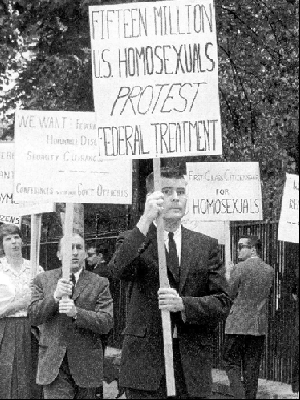
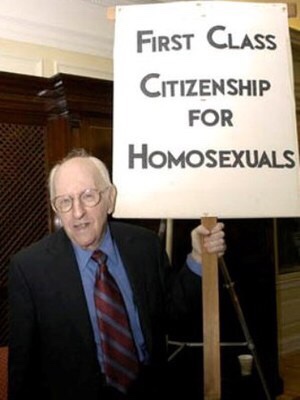
(Left: Frank Kameny can be seen toward the left in this picture from a 1965 White House picket he helped organized. Right: an older Kameny poses with one of those signs.)

1. WHAT IS THE LAVENDER SCARE? It’s the first feature-length film documentary to tell the story of the U.S. government’s decades-long campaign to fire every federal employee found to be gay or lesbian. In what became the most successful witch hunt in American history, thousands and thousands of federal workers lost their jobs. More than a few, with their careers in ruins and unable to find work, committed suicide.

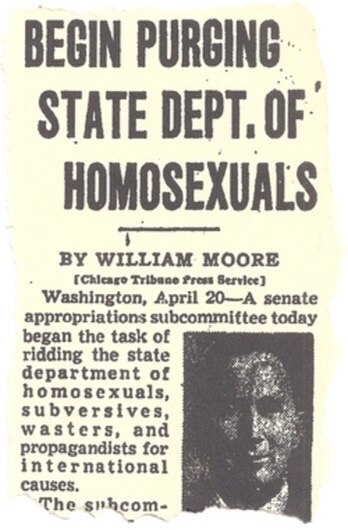
2. WHEN DID THIS HAPPEN, AND WHY? In the 1950s, Senator Joseph McCarthy ignited the Red Scare with his allegations that Communists had infiltrated the U.S. government. He then added the claim that gay men and lesbians were even more dangerous than Reds, because they were susceptible to blackmail by foreign enemy agents and would give up government secrets in order to keep their sexual orientation from being exposed. The fear of this supposed homosexual menace became known as the Lavender Scare.

3. HOW MANY HOMOSEXUALS ACTUALLY GAVE UP SECRETS IN ORDER TO AVOID BEING EXPOSED? After several investigations over many years, not a single case was ever found.

4. WERE LGBT PEOPLE ALWAYS FEARED IN WASHINGTON? No! In fact, in the 1930s and 40s, there was a vibrant and very open gay community in Washington. A large number of new government jobs were created after the Great Depression, and many of the people who came to Washington to fill those jobs were gay men and lesbians. They were eager to make a new life in the growing city, and the government was eager to hire them. Same sex couples could be seen holding hands on the trolley or even kissing on the grounds of the Washington Monument. They enjoyed a comfortable work environment and a lively social life. No one could have anticipated the devastating events that were to come.

5. WAIT, WHY IS THE DATE APRIL 27, 1953 IMPORTANT? That is the day President Eisenhower signed Executive Order 10450, which made it official government policy that gay and lesbian employees were to be hunted down and fired. More than a thousand federal agents – a couple of whom are interviewed in our film -were assigned to the task of determining who was a homosexual. People were subjected to grueling interrogation: “Who do you live with? Who are your friends? What bars do you frequent? Would you like us to call your family back home and ask these questions?” People were ordered to give up the names of their gay and lesbian friends. Most chose to resign immediately, rather than face continued pressure or further scrutiny.

6. DID ANY GOOD COME OF THIS? Yes! In 1957, Dr. Franklin Kameny, a Harvard PhD who had been working for the U.S. Army Map Service, was fired from his job when the government found out he was gay. But unlike the thousands who had been fired before him, he fought back! The purges created a sense of anger and militancy in the gay community that sowed the seeds of the gay rights movement. In 1965, years before Stonewall, Kameny and a small band of brave men and women staged a picket in front of the White House, in what is believed to be the first gay rights demonstration in the country. Kameny went on to devote his entire life to the fight for LGBT rights, and just before his death saw his achievements honored by President Obama.

7. HOW LONG DID THE BAN ON GAY AND LESBIAN WORKERS REMAIN IN EFFECT? People continued to lose their jobs simply through the 1950s, ‘60s, 70s, and 80s. In 1995, President Clinton officially rescinded the policy that had been put in place by President Eisenhower in 1953, and for the first time in four decades, LGBT people could freely work for the civilian agencies of the federal government. Of course, the ban on service in the military continued for many years beyond that.

8. DOES THIS STORY HAVE ANY PRESENT DAY RELEVANCE? Oh, definitely. There are still 29 states in the country in which it is perfectly legal to fire people simply because they are LGBT – a direct result of our government’s homophobic policies that were put in place in the 1950s. We think the story of The Lavender Scare will help educate people about the need for laws on both the state and national level to protect LGBT people from employment discrimination. The federal Employment Non-Discrimination Act, which would extend job protection to LGBT people nationwide, has just been re-introduced in Congress – ironically enough. just as we’re marking the 60th anniversary of the start of the government’s anti-gay witch hunts.

9. WHY DO SO FEW PEOPLE KNOW ABOUT THIS? This is a classic example of the way in which the struggles and contributions of gay men and lesbians are ignored in the telling of American history. It is shocking that with all the books and films about the Cold War and the Red Scare, the story of the Lavender Scare is almost completely ignored. The Lavender Scare will be the first film to shine a light on this important subject – if we can raise the funds to finish production. As philanthropist and activist Jim Hormel has said, “If LGBT people don’t take the lead in preserving our history, who will?”

Reference

Gay History: Watch the Scary 1961 Anti-Gay PSA – “Boys Beware” – Video

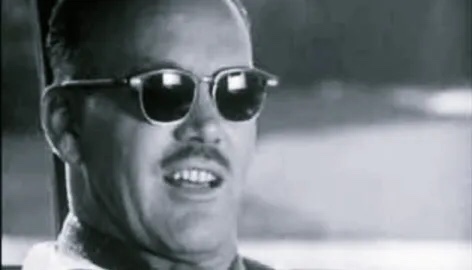
Boys Beware was a short PSA film produced by Sid Davis productions in 1959 on the suggestion of the Inglewood Police Department in Southern California. It was ostensibly was made to warn young boys of the danger of predatory men on purpose.

What Jimmy didn’t know was the Ralph was sick. A sickness not visible like smallpox, but no less dangerous and contagious- a sickness of the mind. You see Ralph was a homosexual, a person who demands an intimate relationship with members of their own sex.”

At one point in time Boys Beware was required viewing for males in many school districts across the country.

Reference

Gay History: John F. Kennedy Had A Gay Best Friend Who Even Had His Own Room At The White House

The book “Jack and Lem: John F. Kennedy and Lem Billings: The Untold Story of an Extraordinary Friendship,” details the extraordinary relationship between two unlikely friends.

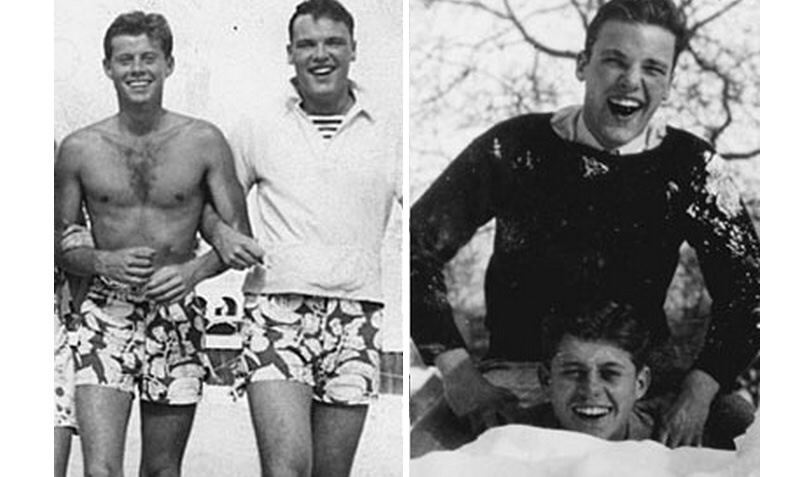
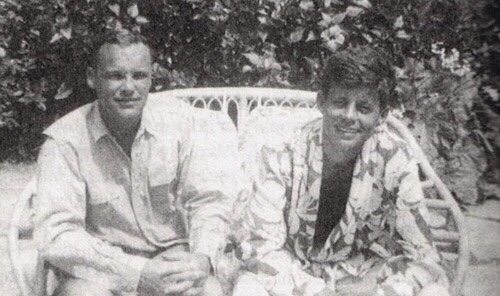
JFK, or ‘Jack’ as he was known by his close friends and family, had a gay best friend named Lem Billings, who he met in prep school when Kennedy was 15 and Lem was 16.

The pair became the best of friends who wrote letters to each other when they were apart, traveled to Europe together and were so close that Joseph Kennedy Sr. thought of Billings as another son, according to GregInHollywood.

The book details JFK’s angry reaction to Lem after he made a sexual advance towards him, saying: “I’m not that kind of boy.” But this misunderstanding did not end the duo’s relationship.

Writes GregInHollywood:

From the time he and Kirk LeMoyne “Lem” Billings met at Choate, until the President’s assassination thirty years later, they remained best friends.

Lem was a virtual fixture in the Kennedy family who even had his own room at the White House.

The book about their friendship draws on hundreds of letters and telegrams between the two, Billings’s oral history and interviews with family and friends like Ben Bradlee, Gore Vidal, and Ted Sorensen.

It was a friendship that endured despite an era of rampant homophobia.

Billings was a graduate of Princeton University and Harvard Business School and was an advertising executive at the Manhattan advertising firm Lennen & Newell. He put his business career on hold to work on Kennedy’s campaign for president.

Bradlee says in the book: “I suppose it’s known that Lem was gay….It impressed me that Jack had gay friends.”

Billings obviously never came out but did once say: “Jack made a big difference in my life. Because of him, I was never lonely. He may have been the reason I never got married.”

Kenneth Hill of WoolfAndWilde, conducted a fascinating interview with David Pitts, the author of ‘Jack and Lem’, to uncover some more details about the extraordinary relationship between the two unlikely friends:
Kenneth Hill: How would you characterize the friendship between JFK and Lem Billings?

David Pitts: The way I would characterize it is that is was a very close, deep, friendship across sexual orientation lines.

KH: You said that this was the story of a friendship that crossed sexual orientation lines, which I think is really an interesting element of it, but talk a little bit about the depth of this friendship. The fact that it started when they were very young and, from what I read in the book, they were basically inseparable for the rest of their lives except when circumstances had them in distant cities.

DP: Yes, indeed. I think there were a number of elements to it. First of all, there were a series of bonding events early on. One was the fact that they both hated that school [Choate] in which they met. And were engaged in all kinds of pranks which almost got them expelled twice. That was obviously a bonding phenomenon. Secondly, they roomed together for part of the time at the school.

Thirdly, and I think this is really important, John Kennedy was so sick most of his life, far earlier than when most people think, including when he was at Choate, and Lem was the person at boarding school — his mother and father did not come to the school when he was ill; Lem was there. Lem was the person who was always there for him and took care of him. And then fourthly, there was the two month trip to Europe that they took, just before WWII in 1937, just the two Americans at that pivotal time, I think that was obviously a very strong bonding event.

And then over and above these issues, I would say this — and this is kind of a complicated thought because we really don’t have language to express these kinds of relationships — and that is, I’m firmly convinced after working on this book that John Kennedy’s sexual interests were in women. We don’t need much evidence of that, the evidence is all over the place. But his strongest emotional attachments were to men — and principally, to Lem. We don’t have a word for that, right? Somebody who prefers the opposite gender for sexuality, and the same gender for deep, emotional attachments.

KH: We don’t really have a word for that. I guess “man’s man” used to sort of mean that, but JFK took it so much further in a way because he loved being around men, he knew some men were attracted to him and even seemed to enjoy it. He liked the stimulation of those relationships, there was nothing sexual about it, but there was something about that male-male dynamic that fed him.

DP: I think that’s exactly right. There was one reviewer who wrote, “What’s the big deal here? This guy’s writing that JFK was comfortable with gay men, so big deal, we all knew that.” But of course it’s not the fact that he had a friend named Lem Billings who was gay. This was the closest person in all the world to him outside of his family for 30 years. He wasn’t just “a gay friend” on the side.

KH: One of the very surprising facts that comes out in this book is that Lem had his own room at the White House?

DP:
 Yes, that’s one of the revelations in the book that’s really surprising. And actually some of the people who were working in the White House very close to JFK didn’t know it. For example, Ted Sorensen whom I interviewed for the book, perhaps the closest aide to JFK, saw Lem around the White House all the time, but he told me he didn’t know that he’d had his own room there and was staying there so much of the time. But yeah, that’s another indication of the depth of the attachment.

One thing I was intent on doing when I wrote this book, because I thought it would be open to various forms of attack, is that I never went beyond what the documents said. The book is a lot of quotes from documents, or that interviewees said. This friendship might have contained a lot of things that I wasn’t able to find out because I didn’t want to enter the area of speculation.

KH:
 It seems without a doubt that Lem was in love with JFK. But it’s never stated explicitly because you don’t have any record of his ever saying that.

DP:
 No, I think the closest … I mean, these were more sedate times, especially where homosexuality is concerned. Even in the various documents, Lem is never overt in his statements. But there was one statement from one of the documents, and I have it in front of me here, that I think is just expresses his feelings. Here’s the quote: “Jack made a big difference in my life. Because of him, I was never lonely. He may have been the reason I never got married.”

This is somewhat of a difficult thought as well, but I think gay people had a way back then of telegraphing to future generations what their feelings were that they could not express candidly at the time. And anybody who reads some of these words today would have no doubt what Lem’s feelings were, but in the context of that time it was not obviously understood.

Reference

Gay History: Pride, Prejudice and Punishment: Gay Rights Around The World

Australians have voted in favour of legalising same-sex marriage — but elsewhere in the world gay people can struggle to simply stay out of jail.

Being openly gay is effectively illegal in more than 70 countries — and can result in severe punishment, sometimes even death.

See how Australia’s position on same-sex marriage compares around the world.

The state of marriage rights

Voters’ ‘yes’ response to the SSM postal survey is Australia’s latest step towards allowing same-sex couples to marry, and may prove close to the culmination of a long campaign.

Campaigners have suggested Australia is lagging behind rest of the world.

It is fair to say that most countries with similar cultural backgrounds to Australia have now legalised same-sex marriage, but based on total country numbers, Australia remains part of the majority in restricting marriage to couples made up of a man and a woman.

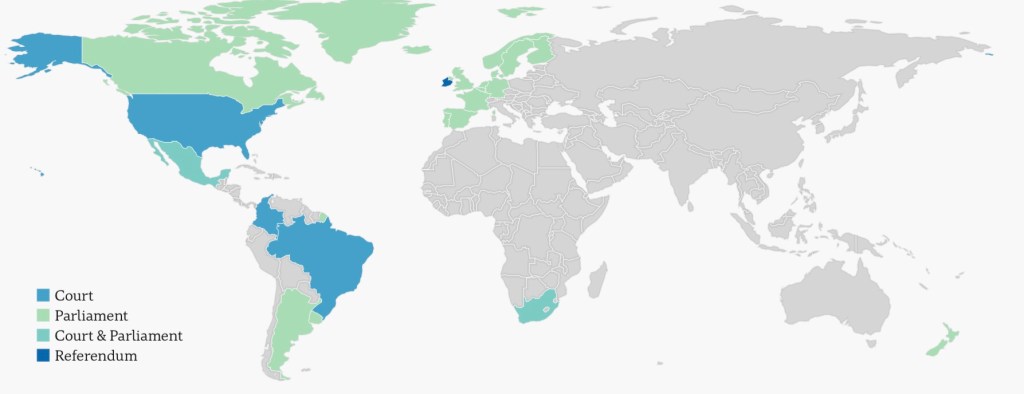
Out of 209 countries the ABC examined, only 24 allow same-sex couples to marry.

There is no same-sex marriage in Asia or the Middle East, and South Africa is the only country in Africa to have legalised it.

In Europe, the legal status of same-sex marriage is mixed. The Netherlands was the first country in the world to legalise same-sex marriage in 2001, with other Western countries including the United KingdomFrance, Spain and Germany following it.

Yet more than half of European Union members have not.

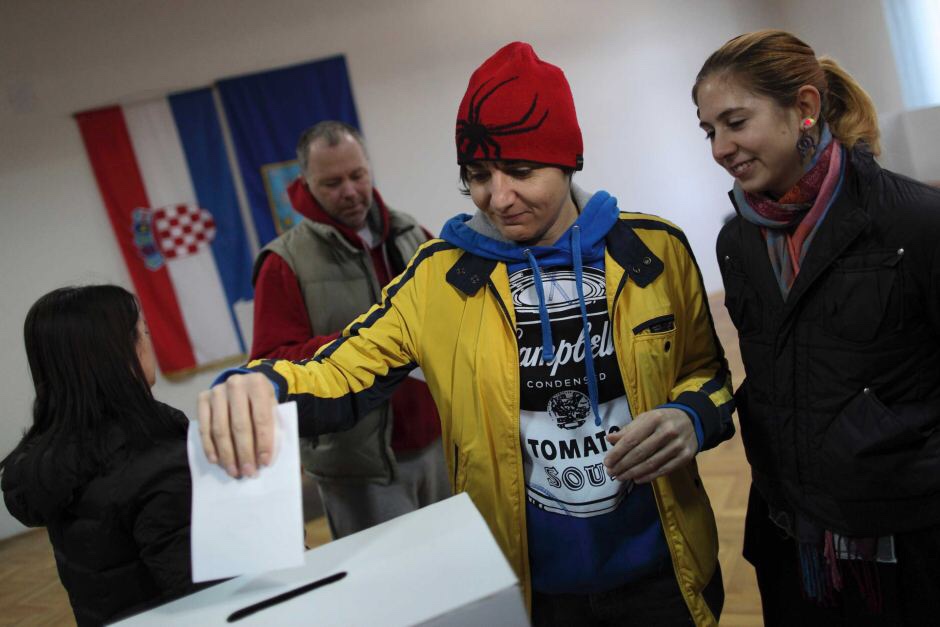
Mima Simic and her girlfriend Marta Sisak vote in Croatia’s referendum on defining marriage as a “union of man and woman”.
Reuters: Antonio Bronic

Some countries in Eastern Europe have recently sought to amend their constitutions to entrench the “traditional definition” of marriage:

  • Hungary brought in a new constitution in 2011 that specifically restricts marriage to heterosexual couples.
  • Voters in Croatia (2013) and Slovakia (2015) voted to change the definition of marriage in their constitutions so that it applies only to a union of a man and a woman, although the Slovakian referendum was invalid due to a low turnout.
  • In December 2015, Slovenian voters rejected the legalisation of same-sex marriage in a referendum.

Australia made a similar amendment to its Marriage Act in 2004, adding a definition of marriage as “the union of a man and a woman to the exclusion of all others”.

How have countries legalised same-sex marriage?

In Australia, Parliament can legalise same-sex marriage by amending the Marriage Act but the Government’s policy has been that its MPs will only be able to vote for same-sex marriage if a majority of Australians support the change via a plebiscite.

The Government’s compulsory plebiscite proposal was defeatedin the Senate. Instead, the non-compulsory Australian Marriage Law Postal Survey was run by the Australian Bureau of Statistics between September 12 and November 7.

After the survey returned a yes outcome, a private member’s bill will now be debated in Parliament to legalise marriage between people of the same sex.

Out of the countries that have legalised same-sex marriage:

  • Only one country, Ireland, put the change to a people’s vote. A referendum was legally required, held in May 2015, and overwhelmingly passed.
  • Parliaments legalised same-sex marriage in 20 countries.
  • Court rulings prompted the change in five countries.
Gay rights supporters celebrate after a US Supreme Court ruling that same-sex couples have the right to marry

The highest-profile court decision was in the United States in 2013, when the Supreme Court effectively legalised same-sex marriage by finding the Defence of Marriage Act was unconstitutional.

Most recently, in April 2017, the Constitutional Court of Taiwan (Republic of China) ruled that the Taiwanese law defining marriage as a union between a man and a woman was unconstitutional. It ordered that a change in the law had to occur within two years. At the time of writing, same-sex marriage is still unavailable in Taiwan.

Where is being gay illegal?

Marriage is an important issue in Western countries but elsewhere in the world, LGBT people can struggle to simply stay out of jail.

There are more than 70 countries where homosexual acts are illegal.

The countries shaded in the map above are those where there is a law that prohibits homosexual acts in part or all of the country.

Most of these countries fall within two main categories — just over half are former colonies mostly in Africa that inherited discriminatory laws but never repealed them, while the others are majority-Muslim countries.

The International Lesbian, Gay, Bisexual, Trans and Intersex Association (ILGA) publishes an annual report of “state-sponsored homophobia”.

What exactly is outlawed varies from country to country. Twenty-eight states only prohibit relations between men.

A common formulation is a prohibition of “carnal intercourse against the order of nature”.

Sometimes gay sex is placed in the same category as bestiality.

  • In India it is an offence to “voluntarily [have] carnal intercourse against the order of nature with any man, woman or animal”.
  • In Mauritius, it is a crime to commit “sodomy or bestiality”.
  • In Uganda, a law provides for a seven-year jail term for anyone who conducts a same-sex marriage ceremony.
Kenyan MP Irungu Kang’ata leads an anti-gay caucus protest in Kenya’s capital, Nairobi.
Reuters: Thomas Mukoya

Not all the countries with these laws actually enforce them for consensual sex at home.

The Singapore Penal Code prohibits “any act of gross indecency with another male person” in “public or private”, with a maximum penalty of two years in prison.

But National University of Singapore Assistant Professor Lynette Chua says the ban has “seldom been applied in private, consensual situations and [is] typically used in non-consensual situations or cases involving minors”.

Similarly, Shakira Hussein of the National Centre of Excellence for Islamic Studies at the University of Melbourne suggests that in Islam “on all sexual matters … it isn’t the act itself that is to be punished but the public commission of it”.

“Some sharia scholars say that the laws against illicit sex should basically be regarded as laws against public indecency, since they require four witnesses.”

Even if bans aren’t strictly enforced, they often still have a harmful impact on LGBT people.

Achim Hildebrandt of the University of Stuttgart says such bans “represent an ever-present threat of blackmail and public disgrace … they drive gays and lesbians out of public life and prevent them from demanding more far-reaching reforms such as the outlawing of discrimination in the workplace and the housing market”.

Where do LGBT people risk the death penalty?

The death penalty is in place for same-sex sexual acts in at least 11 countries.

According to the IGLA, the death penalty applies in Sudan, Iran, Saudi Arabia and Yemen and in parts of Nigeria and Somalia.

In theory the death penalty could also be imposed in Mauritania, Afghanistan, Pakistan, Qatar and the United Arab Emiratesthrough sharia law, but this does not appear to have occurred in practice.

Information on when the death penalty has been carried out is not readily available.

The “Erasing 76 Crimes” blog, which advocates for the repeal of anti-LGBT laws around the world, indicates that only Iran and Saudi Arabia have actually carried out executions for same-sex activity in recent times.

The blog’s founder, Colin Stewart, says that in Saudi Arabia“beheadings have been imposed for homosexual behaviour in the past, including three men in 2002, but imprisonment and lashings are a more common punishment”.

Iran is second in the world for frequency of executions [after China], including executions for homosexual activity, although the facts about the offences being punished are often unclear or misrepresented in news accounts.”

Pakistanis rally in Peshawar in support of a trans woman who was arrested at her wedding.
Reuters: Fayaz Aziz

At the same time, Dr Hussein points out the existence of established trans communities in Iran and Pakistan. She tells the ABC:

“Some same-sex male couples circumvent laws against homosexuality by getting a doctors’ certificate to say that one half of the couple is a trans woman. Supposedly, this is meant to be followed up with surgery, but that isn’t necessarily carried through.

“Pakistan has had a ‘third gender’ option on the national ID card for a few years now [and] Iran has one of the highest rates of male-to-female trans surgery in the world.”

What other forms of harassment take place?

Intimidation of LGBT people is not restricted to the threat of jail or death.

Homosexuality is legal in Russia but in recent years the Government has imposed laws that ban “promotion” of “sodomy, lesbianism, bisexuality and transgenderism”.

Omar G Encarnacion of Bard College in New York suggests thatRussia’s law “is so broad that it outlaws gay pride parades, public displays of affection by same-sex couples, gay symbols such as the rainbow flag, and even a public admission of homosexuality, unless made in the way that casts homosexuality in a negative light”.

A Russian police officer detains a man who planned to place a tribute to the victims of a shooting at a gay nightclub in Orlando in front of the US Embassy in Moscow.
Reuters: Maxim Zmeyev

Closer to home, Singapore takes a tough line on “promotion” of LGBT issues — on paper at least.

According to Assistant Professor Chua, “Singaporean media are banned from carrying content that “promotes”, “justifies” or “glamorises” “lifestyles such as homosexuality, lesbianism, bisexualism, transsexualism [and] transvestism”.

In mid-2014, the National Library of Singapore announced it would pulp its copies of three children’s books with LGBT themes. According to the Government-linked Straits Times Newspaper:

“And Tango Makes Three is based on the true story of a pair of male penguins who raise a chick together; The White Swan Express features adoptive parents such as a lesbian couple; and Who’s In My Family highlights different family structures and includes same-sex parents.”

After a public outcry, two of the books were returned to the library but placed in the adults’ section.

In June 2016, the Singapore Government announced that“foreign entities should not fund, support or influence” Pinkdot, an annual LGBT event held in a Singapore park.

Brad Adams, Asia director of Human Rights Watch, suggests“Singapore’s demand that foreign companies stop sponsoring PinkDot encourages corporations to discriminate against LGBT people”.

Singapore’s annual Pink Dot event promotes acceptance of the LGBT community.
Reuters: Edgar Su

Leaders in other countries freely use discriminatory language against LGBT people: 

  • In 2015, the mayor of Budapest in Hungary described the city’s Gay Pride rally as “repulsive”.
  • In Africa, Ugandan president Yoweri Museveni has describedhomosexual people as “disgusting”.

The ABC has recently reported on LGBT Ugandans fleeing the country as refugees.

Members of a breakaway faction of the Anglican Church in Zimbabwe protest against homosexuality in Harare.
Reuters: Philimon Bulawayo

Zimbabwe President Robert Mugabe has previously said that:“Homosexuals are worse than dogs and pigs; dogs and pigs will never engage in homosexual madness,” and followed this up in 2013 by stating that LGBT people were “worse than pigs, goats and birds”.

In 2016 the ageing ruler vowed that Zimbabwe would reject any foreign aid that is “given on the basis that we accept the principle of gay marriages”.

Are things getting better for LGBT people?

With LGBT harassment and criminal penalties continuing in AfricaAsia, the Middle East and parts of Europe, the picture may seem bleak.

But veteran campaigner Peter Tatchell, who famously attempted a citizen’s arrest of Robert Mugabe in March 2001 and was then beaten by the president’s bodyguards, is more optimistic.

“There are rays of hope [in Africa], with the Seychelles, Mozambique and Sao Tome & Principe recently decriminalising homosexuality [and] in 2014, the African Commission on Human Rights and People’s Rights urged member states to protect LGBT people against discrimination and violence,” he says. 

Ty Cobb from Human Rights Campaign said: “We have seen great progress with regards to global LGBTQ rights in recent years, with three countries decriminalising same-sex activity just [in 2016], 20 countries and certain jurisdictions in Mexico have marriage equality and more and more countries are taking measures to improve the lives of trans individuals.”

At the same time, Mr Cobb notes that anti-LGBT movements continue to work against the community.

“Extremists have organised marches against marriage equality efforts in MexicoAmerican evangelicals have resorted to exporting their dangerous messages of hate from Eastern Europe to Africa, and [Islamic State] continues to target and kill members of the LGBTQ community throughout the Arab world,” he says.

In Singapore, there are signs of increased cultural acceptance of the LGBT community, with the 2016 release of home-grown web drama People Like Us taking place with no real backlash.

Telling the stories of four gay men in Singapore, the series has been well-received by the local community.

Filmaker Leon Cheo says apart from some “thumbs-down” on YouTube, “we haven’t received flak or negative emails or comments from Singaporeans at large”.

Mr Cheo says while the situation for LGBT people in Singapore is improving, “challenges such as censorship of neutral and positive LGBT news, film and TV, and archaic anti-sodomy laws still exist”.

“One of our creative objectives was to portray Asian gay men neutrally or positively [so that the] series could play a part in changing the hearts and minds of the citizens and government of Singapore,” he says.

In the Middle East, LGBT rights remain strongest in Israel although it is unclear whether or when same-sex marriage might be legalised there.

Reference

Gay History: Sodomy; The Law in England, 1290-1885

There was no royal or parliamentary law against homosexual activity in England until 1533, but a number of medieval legal sources do discuss “sodomy:.

Fleta, xxxviii.3: Those who have dealings with Jews or Jewesses, those who commit bestiality, and sodomists, are to be buried alive after legal proof that they were atken in the act, and public conviction” 

[Fleta, seu Commentarius Juris Anglicani, (London: 1735), as trans in Derrick Sherwin Bailey, Homosexuality and the Western Christian Tradition, (London: Longmans, Green, 1955), 145] 

Bailey notes that it is improbable that the penalty or burial alive was ever inflicted in medieval times [although Tacitus refers to it among ancient Germans in Germania 12].

Britton, i.10: “Let enquiry also be made of those who feloniously in time of peace have burnt other’s corn or houses, and those who are attainted thereof shall be burnt, so that they might be punished in like manner as they have offended. The same sentence shall be passed upon sorcerers, sorceresses, renegades, sodomists, and heretics publicly convicted” 

[Britton, ed. F.M. Nichols, (Oxford: 1865), Vol 1:41-42 and Bailey, 146]

Bailey notes that this implies a process in which ecclesiastical courts made the charges and convictions and the state put them into effect. There do not seem, however, to have been serious efforts made to put theory into practice. The preamble to the 1533 Law seems to make this clear.

25 Henry VIII. C6

Le Roy le veult
“Forasmuch as there is not yet sufficient and condign punishment appointed and limited by the due course of the Laws of this Realm for the detestable and abominable Vice of Buggery committed with mankind of beast: It may therefore please the King’s Highness with the assent of the Lords Spiritual and the Commons of this present parliament assembled, that it may be enacted by the authority of the same, that the same offence be from henceforth ajudged Felony and that such an order and form of process therein to be used against the offenders as in cases of felony at the Common law. And that the offenders being herof convict by verdict confession or outlawry shall suffer such pains of death and losses and penalties of their good chattels debts lands tenements and hereditaments as felons do according to the Common Laws of this Realme. And that no person offending in any such offence shall be admitted to his Clergy, And that Justices of the Peace shall have power and authority within the limits of their commissions and Jurisdictions to hear and determine the said offence, as they do in the cases of other felonies. This Act to endure till the last day. of the next Parliament” 

[Bailey, 147-148, and H. Montgomery Hyde, The Love That Dared Not Speak Its Name: A Candid History of Homosexuality in Britain, (Boston: Little, Brown, 1970) [British title: The Other Love

Note that the law only ran until the end of the next Parliament. The law was reenacted three times, and then in 1541 it was enacted to continue in force for ever. In 1547, Edward VI’s first Parliament repealed all felonies created in the last reign [I Edw. VI. C.12]. In 1548 the provisions of the 1533 Act were given new force, with minor amendments – the penalty remained death, but goods and lands were not forfeit, and the rights of wives and heirs were safeguarded. Mary’s accession brought about the repeal of all Edward’s acts in 1548 [1 Mar c.1]. It was not until 1563, that Elizabeth I’s second Parliament reenacted the law [5 Eliz I. C.17] and the law of 1533 (not 1548) were given permanent force. 

In 1828, the statute of 1563 was revoked by a consolidating act, but the death penalty was retained. In 1861 life imprisonment, or a jail time of at least ten years, was substituted for the death penalty. All these laws were against buggery, and indeed the law of 1828 had discussed matters of proof in terms of penetration. Note that other sexual activities were not specifically criminalised.

In 1885 Mr. Labouchere introduced an amendment to the Criminal Amendment Act of 1885. It read:-

48&49 Vict. c.69, 11: “Any male person who, in public or private, commits or is party to the commission of, or procures or attempts to procure the commission by any male person of any act of gross indecency with another male person, shall be guilty of a misdemeanour, and being convicted thereof shall be liable at the discretion of the Court to be imprisoned for any term not exceeding two years, with or without hard labour” 

So for the first time private acts were brought under the scope of the law, as were acts other than anal penetration. This became the famous blackmailer’s charter, and was the law used to convict Oscar Wilde.

[for all the above see Bailey 145-152]

It was the Act of 1533, then, which first made buggery an offense under English criminal law. This law survived in various forms England until 1967, although it was amended in 1861 to substitute life imprisonment for the penalties of death and forfeiture of property. 

But the direct effects of this law were not restricted to England. Because of England’s success as a colonial power, and its tendency to impose its entire legal structure on the ruled areas, legal prohibitions against homosexual activity derived from this law extended well outside England. In Scotland, for instance, (which has a separate legal system) the law was not changed until 1979. In many American states “sodomy” laws are still on the books, as also in former British colonies in the Caribbean.

The original document of 1533 survives – select the link for a a jpg image

.
[ref. H. Montgomery Hyde, The Love That Dared Not Speak Its Name: A Candid History of Homosexuality in Britain, (Boston: Little, Brown, 1970)

Reference