In early 1994, I had a huge 40th birthday party at the Stronghold Bar, in the basement of the Clock Hotel in Surry Hills. At the same time, I dumped the beautiful man who had been my boyfriend.
With declining health, I thought it would be my last big birthday party.. I hoped I might get another year…maybe 2. I did not want my boyfriend to be lumbered with the care of a dying man. There were others better equipped to do that. At that stage, I had no inkling that my guess would almost come to fruition, and that within those two years, HAART (Combination Therapy) would appear. It whisked me…literally…from the arms of death. Battered and bruised from my encounter with AIDS, I was thrown unceremoniously back into society.
Even at that stage I was already, along with others who walked similar though divergent paths, a long term survivor. According to the statistics, I should have departed this life around 1987. Four years would have been considered a good run, let alone thirteen! That I had survived that long…longer than most of my social circle…filled me with a strange mix of guilt, thanks, and hope. Having been given a second chance, nothing was going to be the same again! And it wasn’t!
Now at 70…way past the self-imposed 40 deadline…and as a 41-year long term survivor, the trepidation of those earlier days is way back in the dark past. Though I still get a jolt when I fully realise the implication of those two figures…70…41! It seems surreal. I did grab the opportunity, and reinvented myself…a university degree in writing, and two TAFE degrees in both cooking (chef), and fitness have positively changed my life direction.
As a long term survivor…and I wear the badge with modest pride, having beaten the odds…the other significant aspect of having been where I have, is the knowing that I have lived…and continue to…through the entirety of a pandemic. What irks me is that, as a valuable historical resource, my knowledge is overlooked, pushed into the background of history. Covid was nasty…and still is…but was treated as though it was the worst thing to happen to mankind. Yet only 40 years earlier, one of the worst pandemics of modern times had started to run its course, and over 40 million people have died as a result of it.
Let’s get one thing straight…I’m NOT a conspiracy theorist! I would like to think I weigh things up before coming to a conclusion. I’ve seen…and heard… a lot over the last 41 years of my life with both HIV, and AIDS! Some good, some not so good. Many will not agree with me on some, or all of these points, and that’s fine! But there are also a lot who will! There will never be a Royal Commission, not even a dissection of how HIV was handled “back in the day”. There was a thinking that drastic times called for drastic actions, and thus everything was acceptable, despite any damage it caused. I’m one of those who begs to differ, even if it makes me out to be a crackpot! Oh…and another point I need to make…yes, I AM suspicious of Big Pharma! Both their intentions, and practises!
So…why am I defending myself? Well…I have some “outside-the-square” theories/thinking on how the HIV community has been used by the drug companies over the decades. Of course, they are BIG, so have a lot of clout, and nobody ever seems to question their intentions.
I have always considered it a bit odd that there have been investigations into how Covid was handled, federally and on a state level, but nothing into the handling of the HIV pandemic. As stated already, it is almost like there was an “anything goes” attitude towards issues regarding HIV. As long as an action could be justified, it was okay!
In 2018, I had a chapter dedicated to me in the “HIV Book Project” publication of the same name. Over the decades, I have had many interviews by media, including Good Weekend, and a segment on the television series Healthy, Wealthy & Wise. Apart from a very cringy article in The Bulletin in 1987, back when we knew fuck all about HIV treatment, and survival rates, my story, as interesting as it is, as told in interviews and photographic sessions, had never been published in the mainstream media. This has always appeared to be the domain of activists, HIV “hierarchy”, and academics. So much for the voice of the HIV guy on the street!
My interview and photography session for the HIV Book Project took place in Sydney Park, with an ex, and my dog, Benji tagging along. When they decided to include me in the book, I was, to a point, surprised! My opinions were controversial, and my actions to handle my HIV drug treatments my own way must have raised many an eyebrow. After all, compliance had been rammed down our throats for over 20 years, and that someone like me dared to defy the norm was, to say the least, foolhardy! To my way of thinking, our doctors didn’t decide our medication dosing…the drug companies did!
After being on one regime or another…extending back to the days of mono therapy…for over 25 years I was greatly concerned about how these drugs must have been knocking my body around. At that time, I was on a regime of three drugs twice a day. Over a 7 year period, I had made the very personal decision to halve my regime to once a day. This effectively cut out side effects I was experiencing at that time. It also gave my body some respite from the continued battering of long-term drug dosing. To make things worse…I was also taking a drug holiday every weekend. So these views and actions were published in the book. I had never admitted to anyone that I had taken this action. Not even my doctor!
After publication, I read the other stories in the book. Comparing my story to theirs, I actually felt as though I had come across as a bit of a weirdo! Perhaps to my own detriment, what I hadn’t explained was that when I started this action, my intention had been that if by halving my dosing my viral load climbed, or my CD4 count dropped, I would resume the prescribed dosing. Yet after 7 odd years of doing this, my viral load was still undetectable, and my CD4 count continued to climb! So much for the need for compliance! I’m not advocating that everyone on HIV drug regimes should do this…but it is food for thought!
And it doesn’t stop there! I openly defied those who love to claim that AZT was beneficial, and kept the wolf from the door! This was an incredibly toxic drug! Having failed as a cancer drug due to its toxicity, it was suddenly hailed as a breakthrough drug in the treatment of HIV, despite trials such as the Concorde trial (Britain/Ireland/France) labelling it as “human rat sac”. Anyone who saw “Dallas Buyers Club” would be familiar with the disdain in which the drug was held. Its side effects…and we were dosed massively with it…were horrendous, including liver and kidney damage, peripheral neuropathy, knocked the immune system around (immune suppression), and anaemia. On a HIV forum many years ago, I posted that I personally held AZT responsible for the sudden decline in my CD4 count, and the immune suppression that brought about my run in with AIDS. I thought I would cop a slamming for expressing such an opinion, only to find in the comments that many agreed with me! Like me, many regretted taking it!
I also question…please note that word…the ethics behind the pricing of HIV drugs! At one time, the actual retail price of the drug…usually in the many hundreds of dollars…was printed on the pharmacy label. Anyone on three or four drugs would never have been able to afford to buy them every month, especially anyone on a pension. One has to wonder that, without the PBS, would the drug companies have just allowed us to die…or would we also have had to run buyers clubs!
Which brings me to resistance testing…another drug company instigated test, and one I have always been…vocally…doubtful about. Excuse my cynicism, but if a drug company is developing and pushing a particular test, there has to be something in it for them!Has anyone noticed…and I’m sure you must have…that pretty well everyone who had a drug resistance test was taken off the older drugs (despite them still working) and placed on the newer drug regimes! Logic decrees that, considering the costs of research and development, Big Pharma would prefer us all to be on the newer drugs, considering that they would have the highest financial outlay! I reckon we were really duped on this one, especially considering that currently those who are experiencing weight gain…another point worth raising…from the newer drug regimes are requesting a return to the older drugs…which at some stage they would have been told they are resistant too. Interesting, that!
So call me a weirdo, or a ratbag! To be honest, I really don’t care! For no reason has the term HIV Industry been coined! Someone is making money from it, and undoubtedly keeping the shareholders happy…and it’s not US! I would rather be called a whacko…at the least, after 41 years being HIV+…that I’ve experienced enough, indeed seen enough, to know that if you are not one of the sheep who just goes along with the flow, if you are someone who thinks for themselves with a moderate dose of cynacism, you are always going to be attacked and slammed.
I have broad shoulders. I can handle a bit of criticism.
I’m a 41 year long term survivor of HIV/AIDS. I’m severely vision-impaired from CMV, and mobility challenged from one of the early drugs designed to prolong our lives.
I used to see HIV disability as a singular issue, but ageing…I’m now 70…has turned that thinking around. No matter if you are disabled as a result of birth, accidents, stupidity, or illness such as HIV, all disabled people share one thing in common. We’re disabled! And quite often, this world is designed manufactured and built by people who aren’t. To make things worse, many think they know what disabled people need…without consulting with us!
I live in a Central Coast village. Footpaths here are a luxury. Residents usually walk on the roads, as having a sand base, the grass verges are a minefield. I’m lucky in that we have several new paths, though to use them when walking into the village adds several minutes to the journey. I also have to cross 3 busy roads. There is a pedestrian refuge on one, and a crossing on another, but the busiest middle one has no safe crossing. You not only need to watch traffic from four directions, but you have to step onto the road to see around parked vehicles. I’ve had several close calls crossing this road, and I dread crossing it!
In consultation with my local member…also disabled and in a wheelchair…we have put in a submission to council to have some sort of crossing put in there, not just for disabled people, but also to guard the safety of school kids, and the elderly using that path. Considering council is supposedly disabled-aware,they are certainly procrastinating. Safety aware indeed! Not!
Likewise the car park and entry access area of our local RSL were badly edge marked, and with a dangerous ramp to the clubs entry area. In bright sunlight, you could not see the pale yellow fluro markings at all! Coming out of the club into sunlight, I could not see the access ramp at all, and relied on friends or kindly members to get me safely to the ramp. Submissions from me and several other vision impaired people saw the whole car park remarked, and the club entryway reconfigured.
It is very empowering when you are listened to, and suggestions are acted on.,
I used to be frightened to speak up about these things, but if nothing is said, nothing changes. As disabled people, we have a right to be able to move safely around our local areas. Whether able-bodied or disabled, if you know of dangers in your local area, be an advocate and speak up. Small changes can save a life.
How often have you asked yourself “what the hell am I doing with my life?”. How often have you sat at work and wondered,”’why am I doing this?”. I’ve found that as I get older, it’s a question that rears its ugly head more often. You ponder the missed opportunities, the wasted time in jobs you hated; you envy those who are happily going about their chosen careers, fulfilling ambitions, doing what they enjoy.
I sometimes feel I’ve lived a life of quiet desperation. Most of my work life has been for nothing. I’ve nearly always been unhappy in my job choices…despite being very good at it…and developed the I’m-just-doing-it-for-the-pay-packet mentality. Sure, my latter years have been a lot more fulfilling, but the operative word is ‘latter’.
I wasn’t offered a lot of opportunities to select a fulfilling career. I left school at 15, in 1969, with the School Certificate under my belt and no idea what I wanted to do. According to my father and his family, I needed to get myself a “career”. By ‘career’, they meant becoming a plumber, electrician, carpenter or any of the associated trades. Considering the current sexy status attributed to tradies, I’m wondering if it may not have been a bad choice. I loved working with food and even when I was at school used to create my own recipes. However, it was the wrong time to be a foodie. My father suggested becoming a hospital cook (and tried to get me into that area), but the prospect of being stuck in a hospital kitchen for years was daunting. Let’s face it, hospitals are not prestige culinary establishments, especially in the ’70s. I begged out of it, though despite the severe lack of a restaurant culture at that time, the TAFE course may have been of benefit – at least I would have got a grounding in the basics. I had an uncle who was a pastry cook and he helped get me work experience at a bakery (Isoms) in Campsie. Now, if I hadn’t been 16 years old, if I hadn’t had to get up at five every morning and if I hadn’t had washing up and measuring ingredients as the full account of my day, maybe I would have stuck with it. Four months and I was out.
I spent the next 12 months (A) as a presser at a dry cleaning outlet and (B) doing repetitive work at a battery factory, where at the age of 16 I was getting adult wages due to the high turnover of workers, and the mind-numbing repetitiveness of the work. Not very inspiring and certainly not life choices. While in the dry cleaning job, I saw an ad in the window of a menswear store for a junior shop assistant in a high end menswear store . I got the job and…
…pretty well set my career path for the next 28 years. A quick timeline from there would read clothing, records, religious and church paraphernalia, monastery, back to religious paraphernalia, bar useful, sex shop, liquor, community work, cash office manager, data entry/doctor surgery receptionist, office work (at ASHM – the Australian Society for HIV Medicine). At least a variety. Could I really say I loved any of this? Well, it was a job.
The option of continuing education, through TAFE or university, was never presented to me early in my life. Doing anything creative was frowned upon and indeed one would have had one’s ‘inclinations’ (read sexuality) put in jeopardy by even suggesting that you might want to write, be a window dresser, hairdresser, clothes designer, interior decorator, artist or anything else creative. I was told in no uncertain terms that this was unacceptable.
This isn’t to say I didn’t do a few things that fulfilled my creative streak. I did some window dressing as part of general retail; I did quite a bit of writing, though none of it published at that time; I did some costume-making (as well as making my own drag outfits); some catering from home for a delicatessen; made my own jams and preserves (winning quite a few prizes in the process); and I was a DJ in two Darlinghurst gay pubs and bars for five years – the only job I’ve ever truly loved. Who knows, I could still become the oldest Trance DJ in Australia given the opportunity.
What other options would I have chosen for my life? In retrospect, I would love to have been an investigative journalist, in print or television. I enjoy research, and love history, and personally think I would have made a decent career out of it. I love gardening and would have made a successful landscaper or horticulturist. I love athletics and was a good high jumper, relay and short distance runner in my day. With the right encouragement before I started smoking, I would have loved that; or working on the stage; or a singing career (again we come back to smoking!) I have an intense interest in history, both local and global, which could have led in many directions. All these not to be.
What do I do now? I write! I love writing. It’s the flow of ideas; having that fledgling phrase circling in your head that just has to be put somewhere; the one word that can become an article; anger that can be released; opinions that can be controversial; comments that create debate; taking the collective consciousness of many and making it your own; pent-up frustrations released; intelligent argument put forward; comedy to induce a smile; information to be exchanged. Writing is wonderful.
Why suddenly 15 years ago did I head in this direction? And more importantly, where can it lead at this late stage? Well, HIV brought about this huge shift in my life.
As part of my self-organised repatriation after getting out of Prince Henry Hospital and surviving AIDS, I decided to take on some volunteer work to get out of the house and away from Days of Our Lives and the panic attacks I’d started having as a result of my swift and unexpected return to life. A life of clinics, counsellors and support groups was great for filling in time, but I also needed to do something that wasn’t medical. I’d started to see one of Sydney’s more eccentric doctors at that stage and felt a need to write about my experiences with her. This opened the floodgates, which haven’t closed since. I started writing about my experiences with HIV, the processes I was going through, the strategies I was using to cope, the sheer bloodiness of being HIV+ and having had AIDS, the questioning one went through and the realisation that one had to get on with it.
I think therefore I write.
I have always, even as a young kid, loved books. My compositions at school were always a bit over-the-top, much to the amusement of my teachers, and my parents were always being told I had a very fertile mind. Shame they never took this seriously.
On leaving St Gregory’s in 1969, Brother Geoffrey, who taught English, took me aside and told me I should take up a career in writing. Stupid me just let that comment drop.
In the 1980s I was a member of Acceptance Melbourne l and had quite an intense affair with the editor of their newsletter, and contributed regularly to it. I was a prolific letter writer. I edited the newsletter for the Dolphin Motor Club and was responsible for them starting a media sub-committee. I did several courses through community colleges on fiction and life writing and had two poems published overseas.
In 2001 I was accepted into the Humanities Faculty at UTS to do a degree in writing. But the first year of an undergrad degree is full of everything except writing. UTS uses authors to run tutorials, which might sound great in theory, but is just a means for them to push their own writing agendas and methodologies. As a mature-aged student, I clashed! I also didn’t feel comfortable with the often snobbish, elitist attitudes to reading and writing. The tutorial class was horrified that my favourite authors are Stephen King, Dean Koontz, Dan Brown, Michael Crichton, and Edward Rutherfurd. Well…fuck them!
By the second year, and finding yet another author being given their own tutorial, I looked to changing the degree to a Masters. At least by doing this I was just writing. The writing courses did give me the opportunity to publicly write about my drag persona Cleo and in a short story course to talk about my murdered brother, which had never been discussed with anyone. This making public some previously private parts of my life (other than HIV) was very liberating. I had at this stage done enough subjects to get my Graduate Certificate in Writing, so I took that and fled.
My university experience is not something I wish to repeat. The one thing I did learn is that it is extremely difficult to make a living out of writing in Australia. In the meantime I continued writing for Talkabout and the more I wrote, the more I wanted to write. I began to realise that all these articles had become a timeline of my journey with HIV, from the days of illness to the healing process to the return-to-work issues, from treatment issues to regaining my health, redirecting myself and finally my movement away from a life centred around HIV, and a spiritual reawakening through Buddhism. In a way, writing freed me. I took advantage of the beginnings of the Internet to do HIV site reviews and eventually my cooking column. Before leaving Talkabout after 15 years of writing articles and columns, I did a series of articles on Getting On With It, about reshaping life, ageing, and how to cope with its inherent problems.
I would love to widen the scope of my writing. For many years people have been telling me to write about my family and upbringing which was a complex, sometimes sad, sometimes happy experience. Perhaps a bit late in my life – or not – I’m thinking of getting into freelance journalism. Everything HIV that has happened to me over the last 30 years has led to this. It has presented me with new opportunities and opened doors that had previously been closed to me. I am contemplating a course for 2024 – not a cheap thing to do, so I have to consider carefully. In the meantime I will continue to write. Am I self-opinionated? I hope so. Am I controversial? I hope so. Can I see both sides of an argument? I hope so! But most importantly, do I love writing? You bet!
The long-term survival journey is one where it is easy to get lost along the way. Low motivation, low self esteem, social isolation, lethargy, and a victim mentality can lead to feelings of worthlessness, seeing no value in your own existence, and survivor guilt…all my friends have died so why am I still here! It can be overwhelming.
We have already spent 30+ years of our lives popping life saving pills, thousands of pills…and still with no end in sight. Pretty well every organ in our bodies has been subjected to incredible stress. Our minds have been tested beyond belief. We have been so low that we thought there was no coming back. Lipodystrophy and lipoatrophy have ravaged and aged us early, made us unrecognisable, made us feel ashamed of our own bodies, reticent to strip in front of strangers, in front of even lovers. We have lived without immune systems, a state of inherent danger, not knowing what was going to attack you next, a world where even a cold or the flu could be deadly. We have been eroded by strange diseases, live right now with their devastating consequences. And now we live in a world where younger generations don’t understand us, don’t understand why we carry rage, why we roll our eyes at recent seroconversions, who carry on as though death was lurking around the corner. We have met death, witnessed its cruelty. You have nothing to fear!
Yet…we are here! Present! Sentient! We carry a world of knowledge that no one seems to want to know about.
So what do we do, wandering in this alien landscape? Do we bend, fold and cower…or do we BLOOM! This world is trying to put us down, humble us when we have already been humbled. But there is one thing this world doesn’t know…we are, and always have been, fighters. We make a fist and punch the shit out of it! Then we stand back and roar at it “You are not going to win!”. Our world is not what it was! Having already been deconstructed, the only choice left is…reconstruction. So we stop! Re-evaluate! Pry around our fragile edges, gouge out the positives! Rip our lives to pieces, then sew it back together again into a fabric of renewal. We re-educate, for our past is not our present! We reconnect, seek out those from our past who valued us for who we are…and take steps to make new acquaintances, find those who bring joy, laughter and value into our lives. We feed our bodies, this indestructible machine, with goodness, purity, health. We strip ourselves naked, stand proudly in the light, and rebuild our broken frames. We glare at those who put us down, and yell “FUCK YOU…if you want to learn, come to me…otherwise, bring others down with your ignorance!”. We reconnect with life! Everything is right there in front of us…you just need the hunger to grab it by the balls, and say “make me whole again!”. Don’t give it choices! Never accept no as the answer! Take it…mould it…your new, renewed life waits! Don’t waste the opportunity! Long term survivor is not three dirty words! It is empowerment! Having survived, you rise up…proud…arrogant…and step confidently into the new.
The virgin cleansing myth (also referred to as the virgin cure myth, virgin rape myth, or simply virgin myth) is the belief that having sex with a virgin girl cures a man of HIV/AIDS or other sexually transmitted diseases.
Anthropologist Suzanne Leclerc-Madlala says the myth is a potential factor in infant rape by HIV-positive men in South Africa. In addition to young girls, who are presumed to be virgins because of their age, people who are “blind, deaf, physically impaired, intellectually disabled, or who have mental-health disabilities” are sometimes raped under the erroneous presumption that individuals with disabilities are sexually inactive and therefore virgins.
History
The myth was first reported in 16th-century Europe and gained prominence in 19th-century Victorian England as a cure for syphilis and gonorrhea among other sexually transmitted diseases. The origin is unknown, but historian Hanne Blank writes that the idea may have evolved from Christian legends of virgin–martyrs, whose purity served as a form of protection in battling demons.
Prevalence
People all over the world have heard this myth, including in sub-Saharan Africa, Asia, Europe and the Americas.
A survey by the University of South Africa (UNISA) in South Africa found that 18 percent of laborers thought that having sex with a virgin cures HIV/AIDS. An earlier study in 1999 by sexual health educators in Gauteng reported that 32 percent of the survey participants believed the myth.
According to Betty Makoni of the Girl Child Network in Zimbabwe, the myth is perpetuated by traditional healers advising HIV-positive men to cure their disease by having sex with virgin girls. In Zimbabwe, some people also believe that the blood produced by raping a virgin will cleanse the infected person’s blood of the disease.
In 2002, psychologist Mike Earl-Taylor wrote that the virgin cure myth may explain the staggering rise in child or infant rapes in South Africa, which is facing an HIV/AIDS epidemic. UNICEF has attributed the rape of hundreds of girls to the virgin cleansing myth.
However, it is unknown exactly how common the myth is and to what degree rapes happen because of the belief in it. The claim that the myth drives either HIV infection or child sexual abuse in Africa is disputed by researchers Rachel Jewkes and Helen Epstein, as well as by research on convicted sex offenders in Malawi, where no evidence was found to support the idea that the virgin cleansing myth prompted any rapes.
Importance of education
Ignorance with regards to HIV and AIDS infection serves as a barrier to prevention in numerous African nations.
Education has helped women such as Betty Makoni speak out against the myth and attempt to dissuade people from believing the virgin cleansing myth.
According to UNICEF, culture-based gender roles that prize innocence and ignorance in girls and that accept sexual licentiousness in men promote this myth. Girls may be forced to marry older men, which can increase the likelihood of HIV transmission to girls. The stigma attached to AIDS also stops many people from seeking information or health services to shield their status, contributing to further transmission.
In popular culture
The virgin cleansing myth is referenced in the Broadway musical The Book of Mormon. The minor character Mattumbo is stopped from raping a baby based on the belief that sex with a virgin will cure his AIDS. During the song “Making Things Up Again”, Elder Cunningham tells Mattumbo that raping babies is against God’s will, and invents a passage in the Book of Mormon in which God tells Joseph Smith to instead have sex with a frog to cure his AIDS.
Why people living and aging with HIV will lead the way
Tuesday, 9/18 is National HIV/AIDS and Aging Awareness Day. Long-term survivors of HIV face unique challenges; they are the “hidden” survivors of the epidemic. When I was diagnosed with HIV in 1989 I wasn’t sure I’d be here in 2018 to talk about it. At the time there was no effective treatment for people living with HIV, it
was basically a death sentence. For those of us who did have access to health care and treatment, we were given what we now know is suboptimal therapy that not only rendered us resistant to more effective medications that were being developed, but also had life-altering side effects that remain with some of us to this day. These side effects from those earlier, more toxic treatments have added to the stigma of aging with HIV and have disfigured us, made us frailer, and caused our hearts to literally skip a beat.
Don’t get me wrong, I am grateful to be here. As a white, gay, cis man living with HIV who turns 60 this year, I also recognize and acknowledge my privilege. I have access today to a one pill, once-a-day therapy that keeps my virus fully suppressed, so that I’m unable to pass on HIV to others, and I experience virtually no side effects to my current regimen. But I also know that when I walk into a room, I have “the look”—the sunken cheeks, the veiny arms and legs, the extended belly. “You should be grateful to be here,” we’ve been told, “thankful to be alive!” But to what end? Grateful to be here to suddenly be rolled off of disability after being out of work for 20–30 years, expected to join the ranks of the work force without any specialized training or support? Grateful to be here only to fall into addiction or isolation because our support networks, friends and former lovers no longer exist? Grateful to be here while there is scant culturally competent care for aging LGBTQ+ seniors who are living with HIV? We as a society in general do not value our elders—how does the LGBTQ+ community regard those of us aging, let alone aging with HIV?
There is much work to be done, but if anyone can lead the way, it’s people living with HIV and our allies. We were the ones who took care of each other back at the start of the epidemic, and we will come to the forefront of the battle once again. The lesbian community was there for many gay men back in the 1980s when we were dropping like flies and when no one else would touch us; thank heavens for these unsung heroes. Community-based organizations like TPANwere founded by people living with HIV so that we could survive and thrive. Informational resources like Positively Aware delivered the information we needed to live healthy, happy lives.
Earlier this year The Reunion Project convened a community-led, diverse coalition of survivor advocates to discuss the needs and priorities of survivors, and issued a report in June. Go to tpan.com/reunion-project for more info. As someone living with HIV for 29 years, I am excited to be part of a national network of survivors that is giving voice to those who don’t have one and who have in many respects been left behind.
Currently 50% of people living with HIV are over the age of 50, and by 2030 it will be 70 percent. But we knew this was coming. Where is the sense of urgency? Where is the crisis task force taking up our agenda? Do we matter?
I believe we do. As the saying goes, with age comes wisdom. Long-term survivors have an opportunity to come together and join forces, mentor those coming up behind us on how to age and live with HIV gracefully, and to advocate for those who have no voice. An entire generation was lost, so who now is going to step up and advocate for us?
A work by Bill Costa, from the Leslie-Lohman collection. Registrar Branden Wallace traces the images of purity (white linen, smooth body) to the advent of AIDS and HIV. (Photo courtesy of the Leslie-Lohman Museum of Gay and Lesbian Art)
Late June’s (2019) 50th anniversary of the Stonewall Riots is making this Pride month a particularly reflective one.
But like a newly minted AARP member flipping through their high school yearbook, the modern gay rights movement’s “Big five-oh” moment brings, with its flood of memories, certain hard questions—not the least of which is: What possessed you to wear that?
“I have, fortunately, no photos publicly available of me during my ’70s platform shoes and glitter rock period,” says Joseph Hawkins, director of the ONE National Gay and Lesbian Library and Archives at the USC Libraries, who spoke with the Blade about how the things we put in our literal closet can liberate us from the figurative one (or keep us there).
“When I look at pictures of people back in the [pre-Stonewall] 1960s,” says the USC Professor of Anthropology and Gender Studies, “there was an assimilationist viewpoint, where you wanted to look like a good citizen. I think of people marching in front of the White House, where they’re dressed in their Sunday best.”
“When the consequences of being an out homosexual were damaging to one’s life and career, there had to be codes to letting people know who you were,” observes registrar Branden Wallace, of NYC’s Leslie-Lohman Museum of Gay and Lesbian Art.
Fashion, Wallace notes, “is a way to express one’s identity, specifically, for the time after Stonewall, when you had this bursting, where queer culture could actually be visible. They took their cues from things that were going on socially, and the trends in fashion, and also developed their own.”
Registrar Branden Wallace, of the Leslie-Lohman Museum of Gay and Lesbian Art. (Photo by Gonzalo Casals)
By the late ’60s, Hawkins recalls, “there was a lot of crossover [between the counterculture and gays]—ripped Hawaiian shirts, and ripped jeans. But later, that gave way that whole ‘clone’ thing, which came as a response to the term ‘sissy.’ Even within the gay community, a sissy would be ‘too’ effeminate. In the clone movement, the gay men were going to out-butch straight men.”
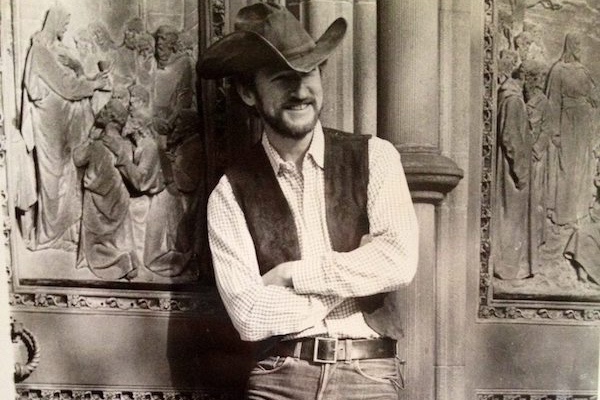
There was very little “humor, in these bastions of gay masculinity… seriousness and masculinity were the same thing. That opaque perspective on masculinity was also a mockery of drag queens and effeminate men. They weren’t really men,” recalled Gerald Busby, in a recent Blade article (“Of cowboy drag, cruising, and cocaine”) about the “cowboy” look he donned to make it past the doors of NYC’s Spike and Eagle’s Nest, during the early 1970s.
“It denoted seriousness of commitment to being gay and being masculine, as well as being decisive about what kind of sex you were after,” Busby noted, of the “alignment of costume and behavior… unmistakable symbols of sexual preference, such as blue or red handkerchiefs in left or right rear pockets of jeans, to indicate top or bottom.”
This exaggerated working class “clone” look, whether denim, lumberjack, or leather, Hawkins observes, was, in its own way, a “liberation ideology. Part of what allowed the sexual revolution to occur was this idea that masculinity could be a gay phenomenon. That’s what fed the ‘clone’ thing. It was a response to the idea that gay men couldn’t be masculine.”
Of his above-mentioned platform shoes ’70s look, Hawkins notes he paired it with skin-tight jeans, shoulder-length hair, and “an old saddle bag I carried. I don’t remember being ‘coded,’ though.” Working in an Office of Economic Opportunity program at the time, Hawkins recalls going on a field trip to Washington, D.C., when “a guy in my group turned to me and said, ‘Oh, girl, if you’re gonna sell that merchandize, you have to advertise.’ There were certain things you wanted to do to look gay, for people to know you were gay. You could walk down the street and catch someone’s glance. That was a different kind of coding.”
In the decades after Stonewall, Wallace notes, cloning reared a new head, and coding morphed with the mainstream, to the point of merger.
Sporting a well-groomed, muscled, manicured look and clingy shirts meant to showcase a sculpted gym body, the “Chelsea Boy” aesthetic ruled the late 1990s and early 2000s.
“I called it the ‘A-Gays,’ a standard that is unobtainable” yet desirable and pursued, Wallace recalls, also noting the Chelsea Boy look shared its time in the sun with “grunge and goth, the alternative kids who, no matter how hard they tried, could not fit in. So it’s amazing that in gay culture [of that time], you have the perfectly coiffed, and this side that just didn’t care, and was for all genders.”
There was also in this era, Wallace notes, “a drastic change in the photographic artwork. With the advent of AIDS and HIV, the art tends to go toward a smooth body, clean appearances. There’s usually white linen and water around. So artists like Herb Ritts and Bruce Weber are using these models for their purity; a perfect-looking body that is not possible.”
Nowadays, “anything goes,” Wallace says. “Beards, which you never saw in a Chelsea Boy in the 1990s, bow ties and sweater vests, and everything… I’m probably raw denim, wearing a T-shirt, got a big keychain in my pocket and a hanky and a Mohawk. That’s usually paired with a suit jacket or a jacket of some sort. You really can do anything now.”
“I don’t know why these things happen,” Hawkins admits, of trends and styles and looks that sometimes seem to defy explanation (he’s still wrapping his head around flip-flops). “Sometimes, in the middle of them, they make no sense. On the other hand, you look back and there are all these political and cultural cues. Maybe there’s an economic downturn or a wave of conservatism based on some sort of military action”—or, an event like Stonewall, which steps over lines in the sand while drawing new ones of its own. “Those things,” Hawkins says, “begin to infiltrate the way people think about fashion, and what they are going to do.”
Gerald Busby in cowboy drag, ready to cruise at the Spike and the Eagle’s Nest. (Photo by Joanna Ney)
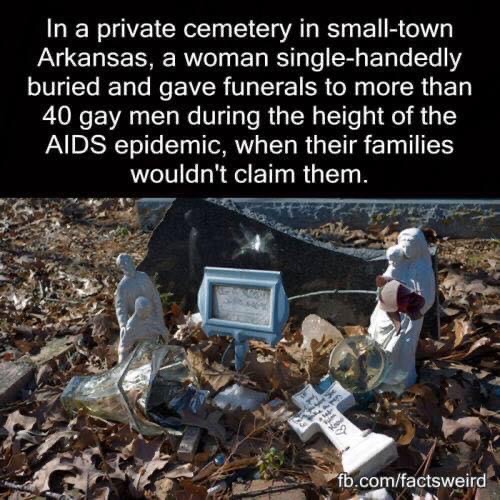
In a private cemetery in small-town Arkansas, a woman single-handedly buried and gave funerals to more than 40 gay men during the height of the AIDS epidemic, when their families wouldn’t claim them.
One person who found the courage to push the wheel is Ruth Coker Burks. Now a grandmother living a quiet life in Rogers, in the mid-1980s Burks took it as a calling to care for people with AIDS at the dawn of the epidemic, when survival from diagnosis to death was sometimes measured in weeks. For about a decade, between 1984 and the mid-1990s and before better HIV drugs and more enlightened medical care for AIDS patients effectively rendered her obsolete, Burks cared for hundreds of dying people, many of them gay men who had been abandoned by their families. She had no medical training, but she took them to their appointments, picked up their medications, helped them fill out forms for assistance, and talked them through their despair. Sometimes she paid for their cremations. She buried over three dozen of them with her own two hands, after their families refused to claim their bodies. For many of those people, she is now the only person who knows the location of their graves.
“When Burks was a girl, she said, her mother got in a final, epic row with Burks’ uncle. To make sure he and his branch of the family tree would never lie in the same dirt as the rest of them, Burks said, her mother quietly bought every available grave space in the cemetery: 262 plots. They visited the cemetery most Sundays after church when she was young, Burks said, and her mother would often sarcastically remark on her holdings, looking out over the cemetery and telling her daughter: ‘Someday, all of this is going to be yours.’
‘I always wondered what I was going to do with a cemetery,’ she said. ‘Who knew there’d come a time when people didn’t want to bury their children?’”
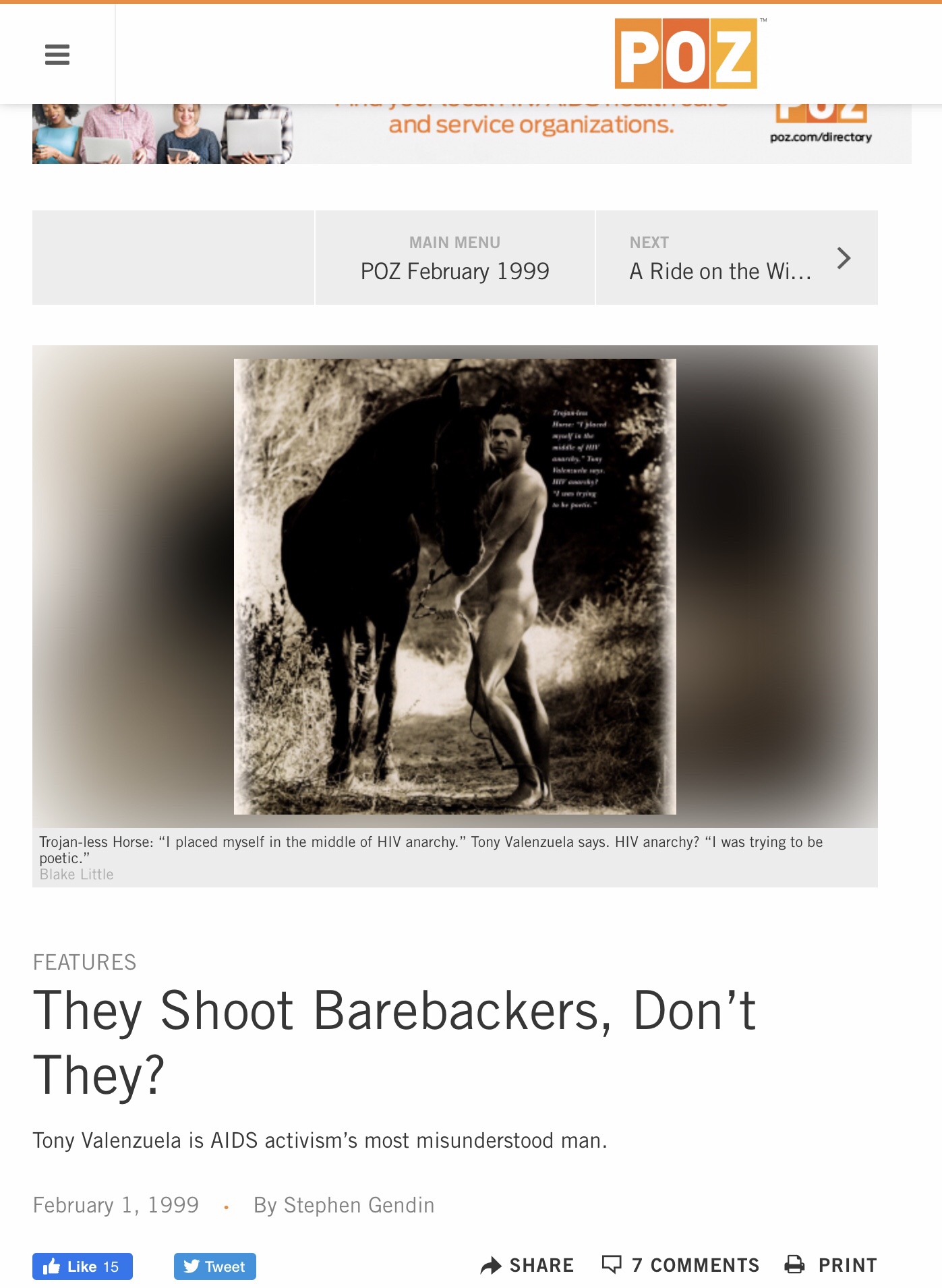
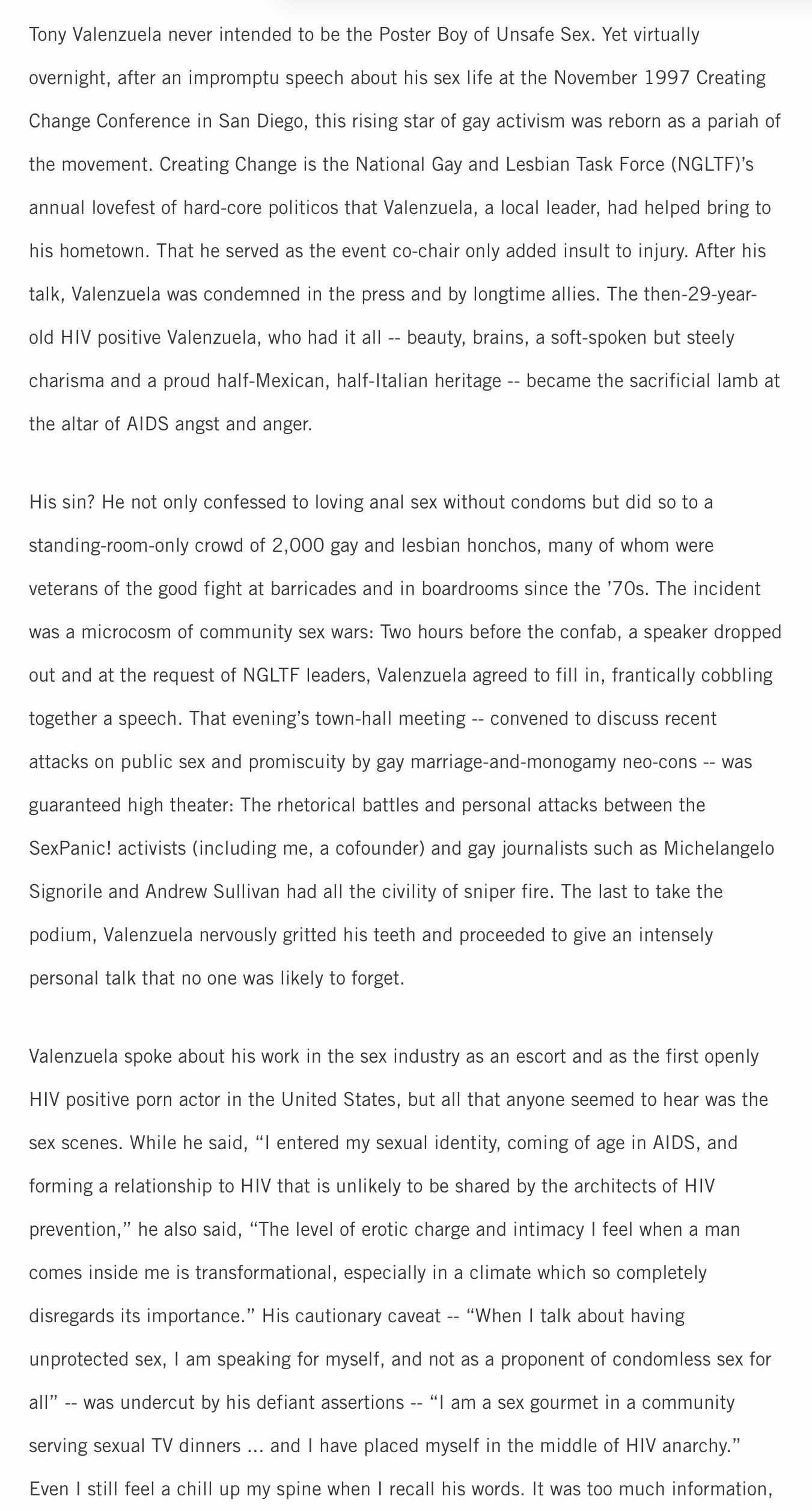
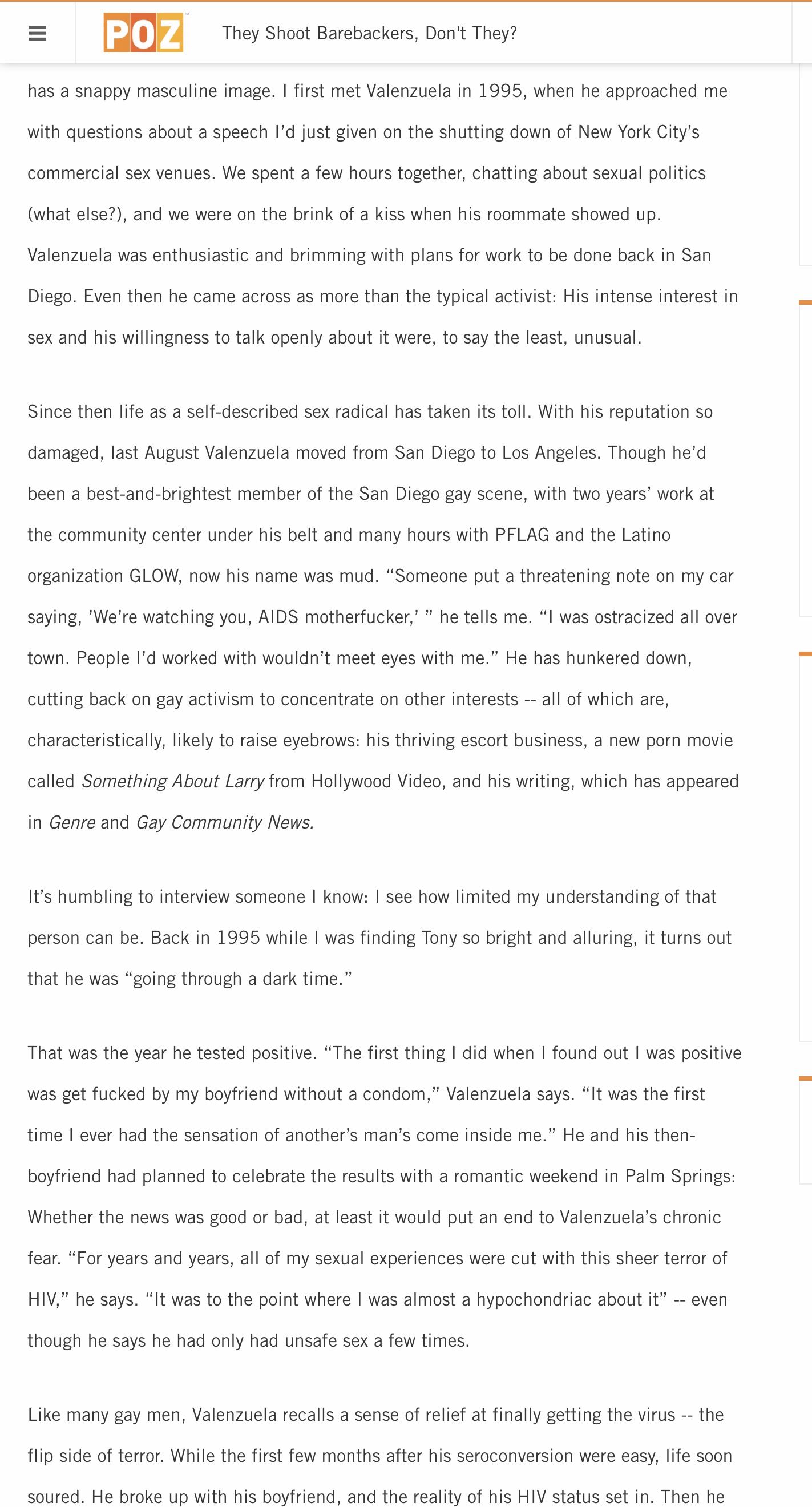
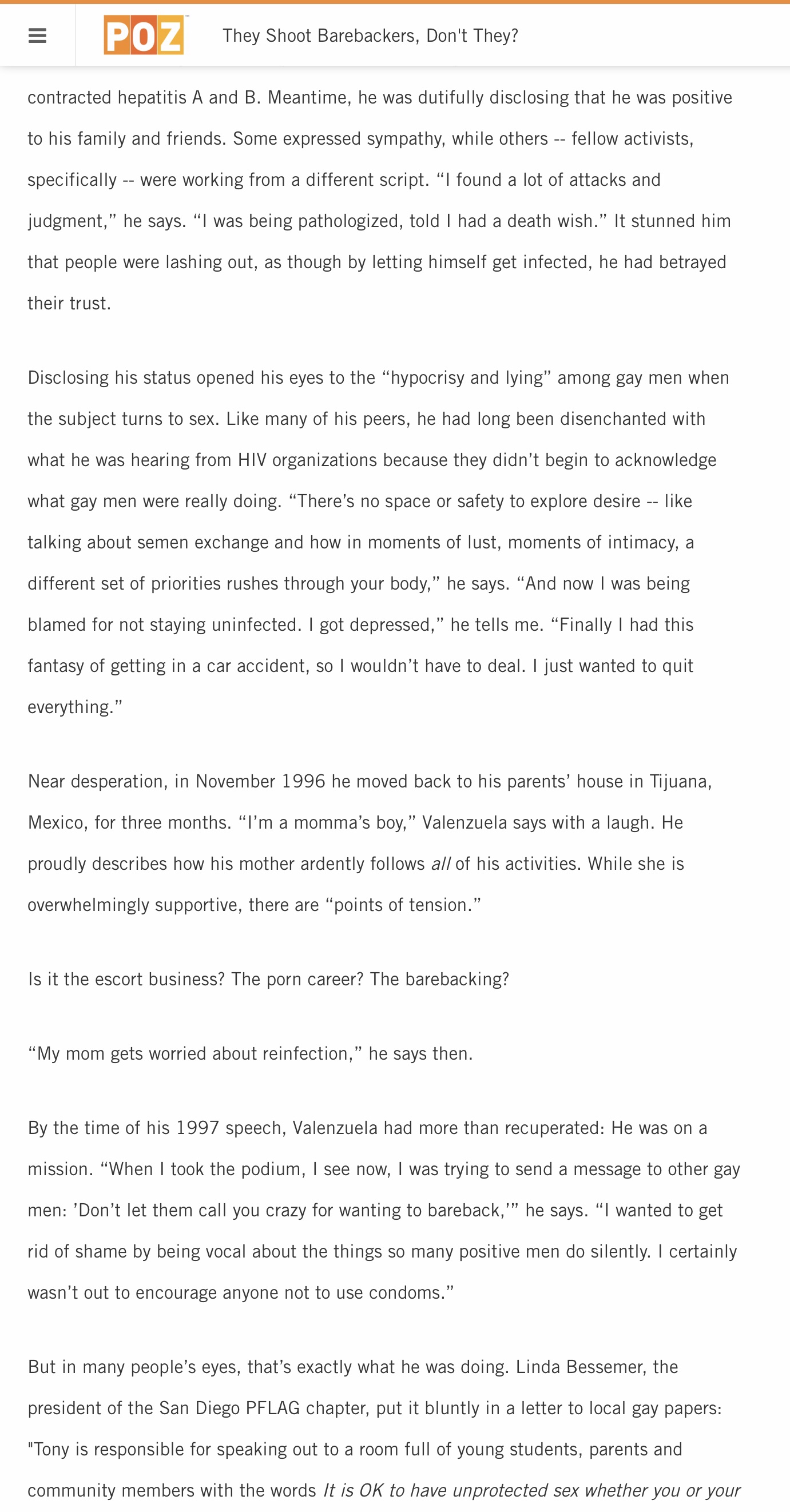
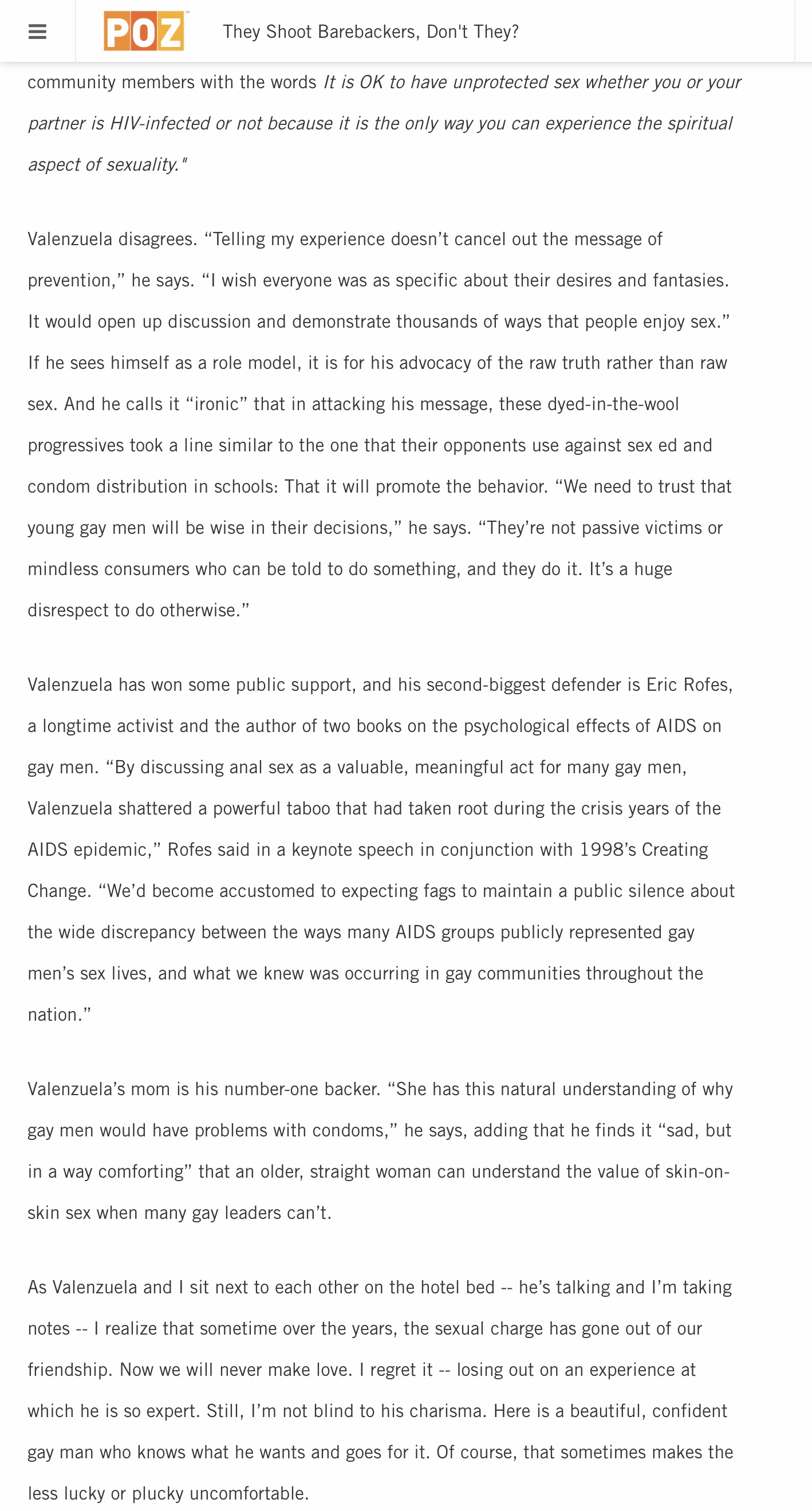
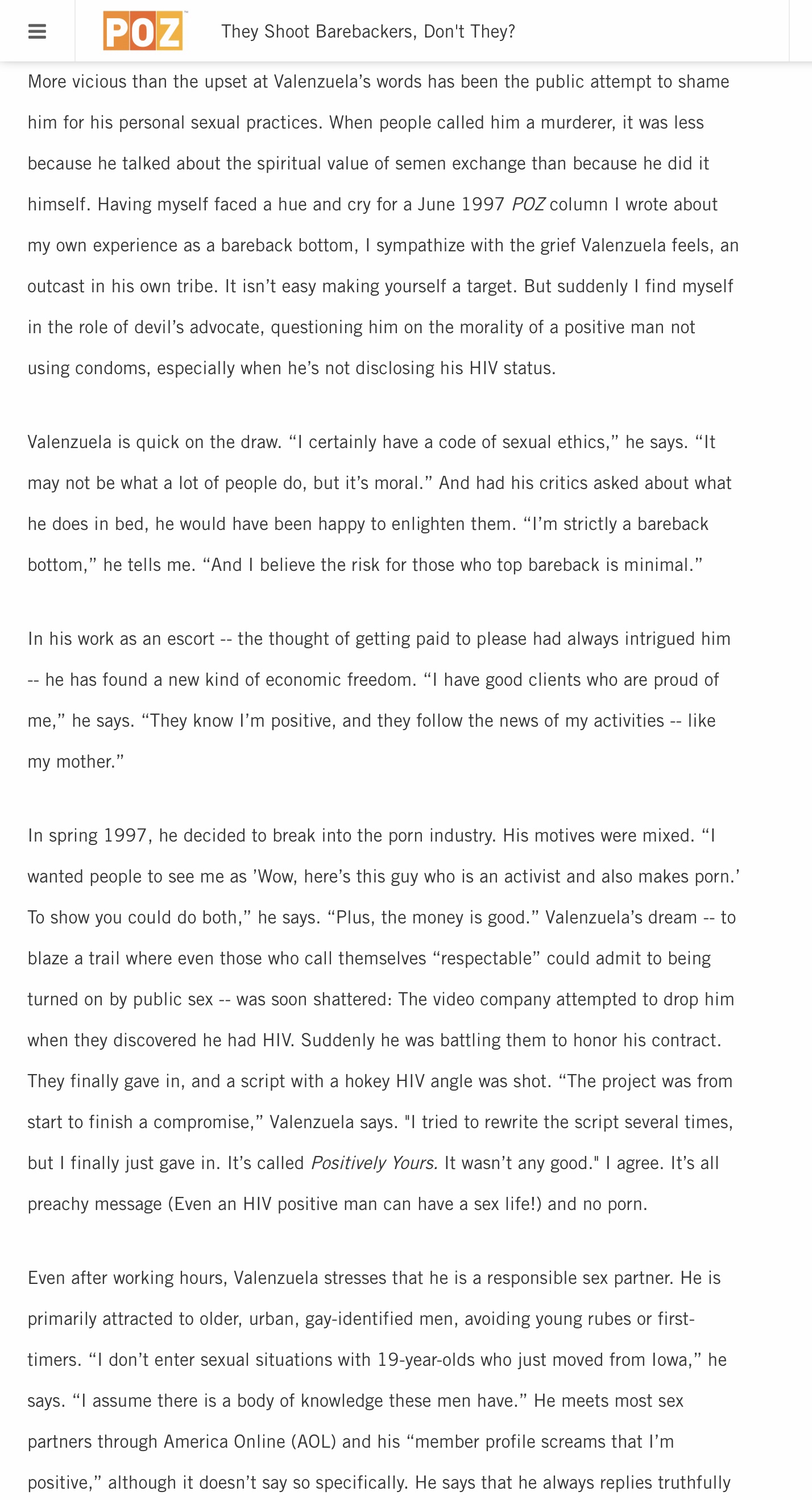
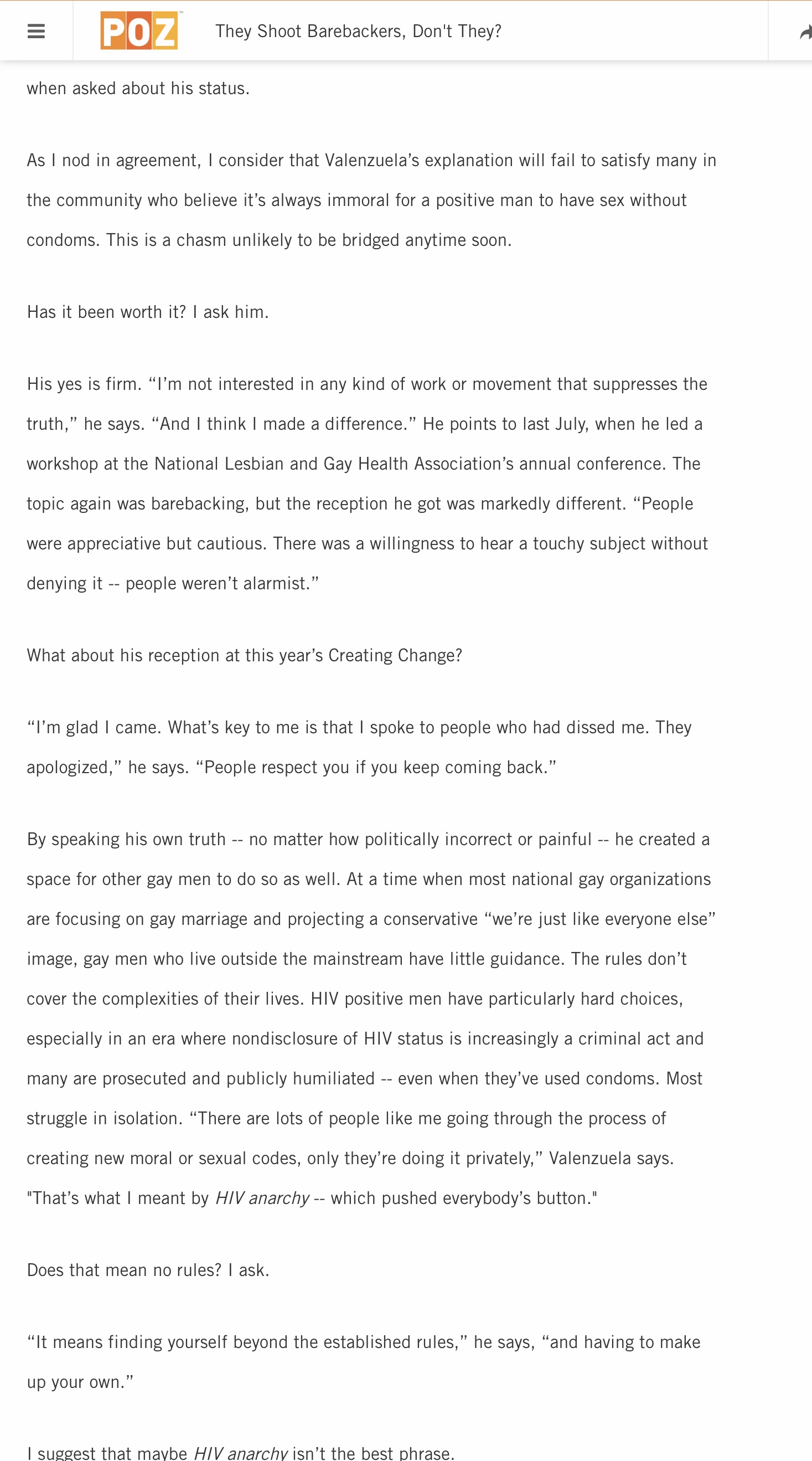
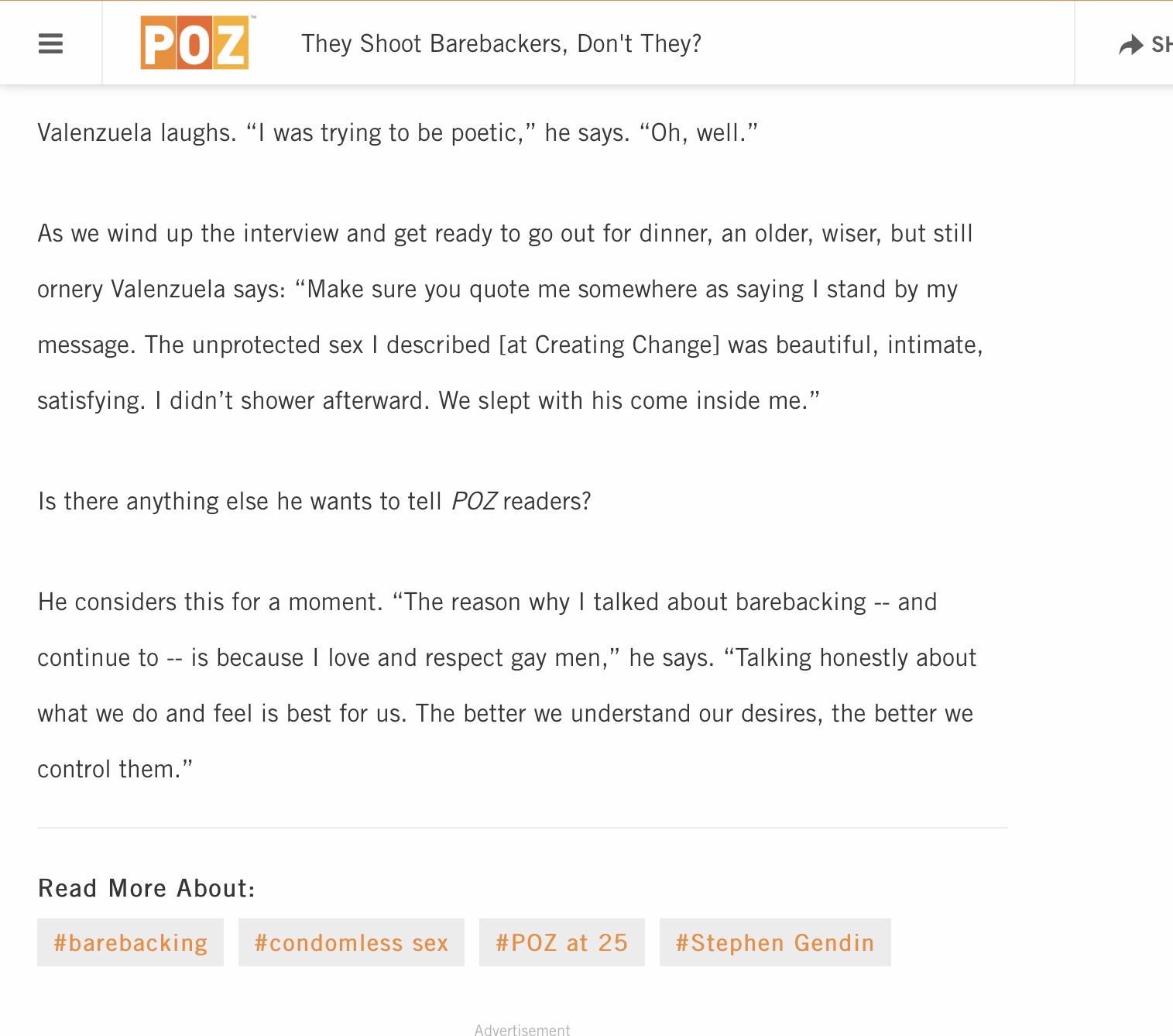
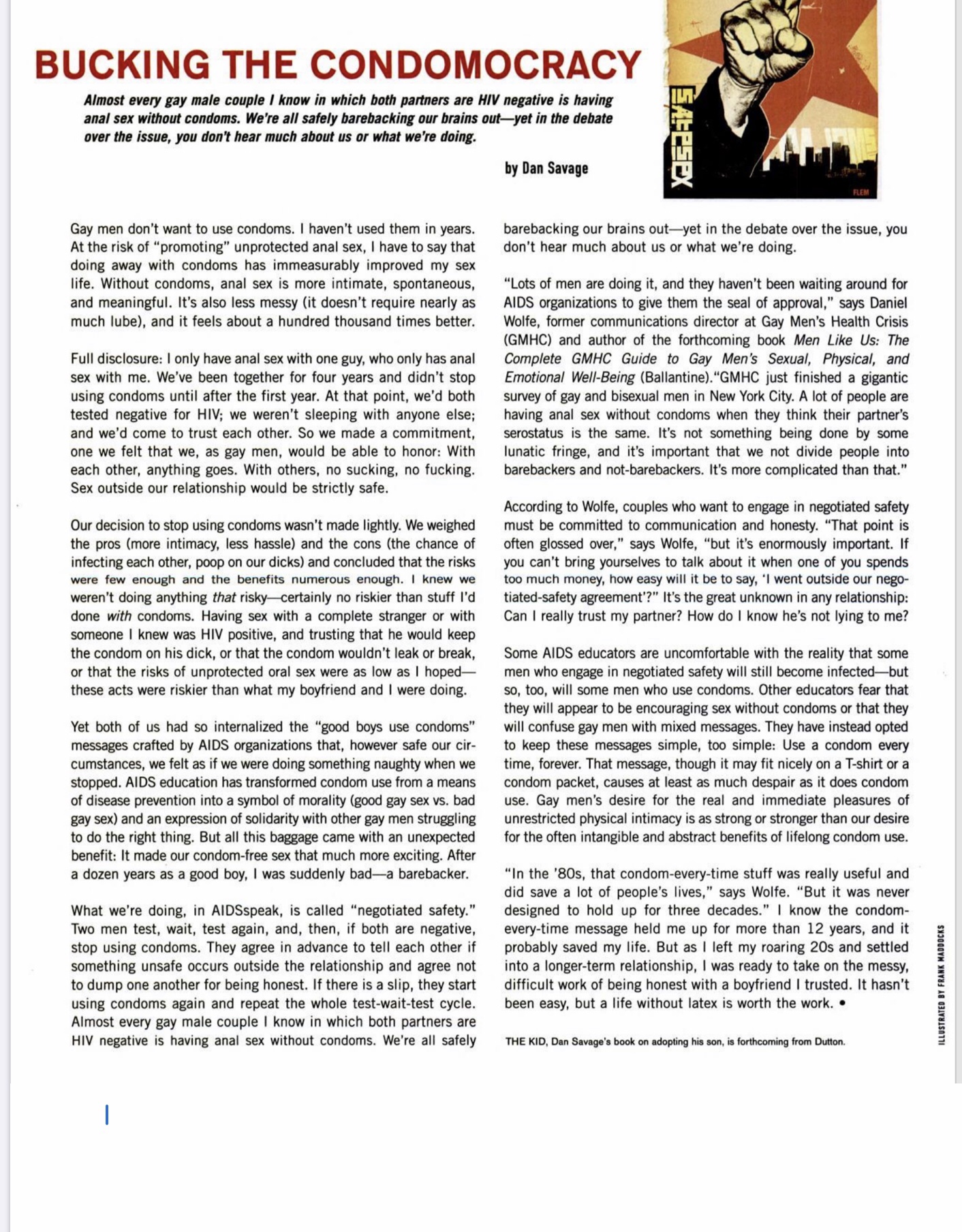
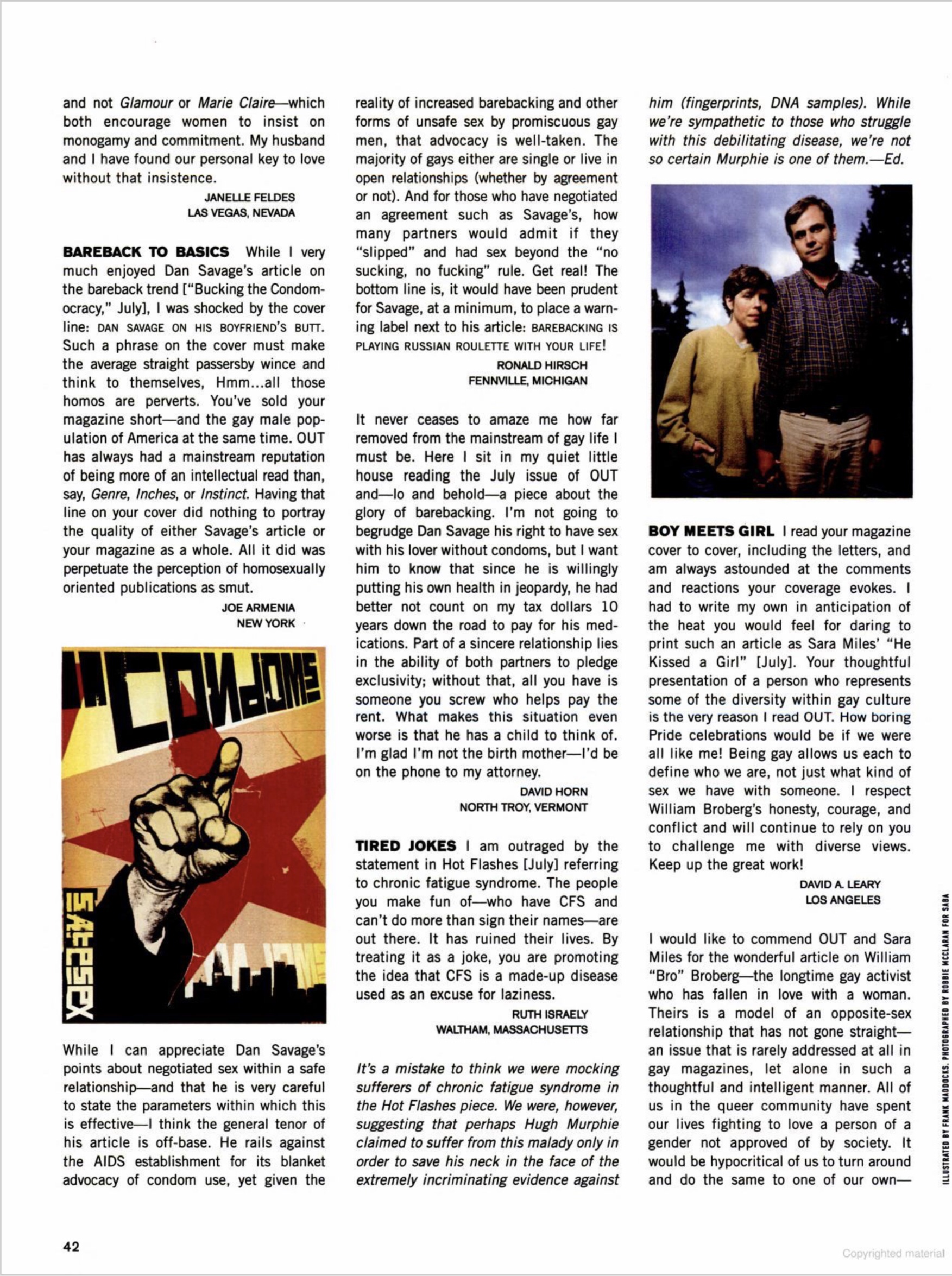
In 1999, both “Blue” magazine (the “Bucking the Condomocracy” article, also reprinted in “Out” Magazine, July 1999, Vol. 7, No.12), and “HQ” magazine (“They Shoot Barebackers Don’t They?”) published articles on barebacking, the one in “HQ” being a reprint of an article from “Poz” magazine. The latter caused a bit of a furore in both “The Sydney Star Observer”, and in the “Sydney Morning Herald”…probably understandably. Read in the context of HIV education and safe sex messages at that time, they read almost as a promotion of barebacking.
I was writing regularly for “Talkabout” magazine at the time, and was on the magazines working group. When I read both articles, I thought they elicited a response, and started to put an article about it together. However, several things were going on at “Talkabout”’ at that time, most notably was a new editor, and I was unsure of how liberal she was going to allow the writing to be, and secondly was an article I had written about the “Options” Employment Agency, which was operating on Oxford St at the time, supposedly to assist HIV/AIDS people to return to work after surviving AIDS, or to re-educate. I had written an expose of them not really doing much to actually assist people, and using said clients to do unpaid “work experience” in their offices. The editor, in all fairness, had sent the article to them… and their response was to threaten to sue the organisation (PLWHA NSW), the magazine, and myself. It was “Bring it on!” from my perspective, but obviously from the organisations…and funding…perspective, it wasn’t something they wanted..As it turned out, my accusations were accurate (I had been quite outspoken about what was going on there for some time,…and had the written testimony of a number of guys who had personally encountered the rort…and had even had the office manager of Options…whose name escapes me now…invite me into his office, and made veiled threats about what I was saying) and the agency had its funding stopped, and closed down shortly after. The article was published, but was so heavily edited that it lost all its clout. I was very disappointed.
However, this made me a bit dubious about publishing another controversial article, and being unsure about the editors response to this piece, and time then passing, I never completed the article. I have been republishing most of my “Talkabout” articles on my blog over the last couple of years…some re-edited, some not…and came across the original draft for this article. I couldn’t actually remember the content of the magazine articles, so did a bit of googling, and thanking the gods of cyberspace that nothing ever disappears completely in the ethos…I found both original articles. I will now include them in my article, to have a permanent record of them. They both make interesting reading.
About 18 months or so further down the line, and with a different editor, I wrote yet another controversial piece on bug chasing…heavily researched, so unbiased…that was totally pulled from publication by the then “Talkabout” working group. It was with great trepidation that Glenn, the then editor, rang to tell me the decision. He knew how much work had gone into it, and I cannot ever recollect an article, written by a HIV+ man, being pulled from publication before in “Talkabout”. The reasoning: it was a great article, but because “Talkabout” was funded by NSW Community Health, there was a perception that said organisation may have seen it as a “promotion of the act of bug chasing” rather than an expose. I was furious. Bug chasing was being talked about within the HIV community, the whole sex dating mentality of “breed me” was a reality…it was happening! To my thinking…it was as if they were burying their heads in the sand, and pretending this just wasn’t happening! The mentality defied me!
Below is my original article with the articles now included. At the end is letters published regarding the “Bucking the Condomocracy” article, and a more recent article on the same subject. My bug chasing article can be found on this blog simply by searching for “barebacking”.
HIV Hyped
My, hasn’t the HIV community been blessed this month, with both a quarterly and a bi-monthly magazine taking up the HIV cause. I wish I could think that the sort of hype they give HIV/AIDS is harmless, but unfortunately, after reading through both articles – twice – just to make sure I hadn’t miss a subtle point, my conclusion is not so.
The article in HQ magazine (They Shoot Barebackers, Don’t They?), which has also received publicity via both the Sydney Star Observer, and the Sydney Morning Herald, is a reprint of an article from the American POZ magazine in February 1, 1999. When my partner and myself (also HIV+) read the article earlier this year, we were both quite horrified. It described in quite detailed account the so-called phenomena of ‘barebacking’, a current catch-cry for unsafe sex, especially between HIV positive and HIV negative men. This is supposedly by people who are ‘over’ practising safe sex and using condoms, and desire the thrill of ‘skin-to-skin’ sex. It reports on private parties in the USA for people who wish to indulge in this type of sex, and consider the risks of catching HIV minimal, compared to the joy of unprotected sex. Needless to say, the people who run the parties make sure everyone present signs a disclaimer. Wouldn’t want to get sued by people becoming infected, would we! The phenomena has reached as far as the Internet, where there are advertisements placed by HIV negative people to get HIV positive people to supposedly ‘father’ their own HIV infection. The mere implications of this sort of mentality would be enough to frighten anybody. There are also porn sites promoting galleries of photos with guys barebacking. Make it erotic, and you make it right, or so it would seem.
Of cause, the obvious question to ask is why is this happening? Have we stretched the limits of the practice and promotion of safe sex as far as it can go? Have people become so accepting of HIV that it is no longer considered a dangerous disease? Does the fact that we now have an arsenal of drugs to control HIV infection reducing people’s fear of infection? Do younger people consider the entire AIDS issue as a ‘generational’ thing? Is it just a millennium trend? Considering the current arguments going on around compliance and drug holidays, I don’t think it is feasible to even consider that HIV is either ended, or under control. Ask anyone infected and on drug regimes what they think of this! Ask them how much they enjoy taking the handfuls of pills everyday, and how much they enjoy the side effects of same. Ask them about how secure and comfortable they feel in the knowledge of a possible ten to twenty years with such regimes; always hoping the next generation of drugs is going to be easier on us. A vaccine is still a long way off.
Likewise, I also loved the article in ‘Blue” (“Bucking the Condomocracy”) which hit you in the face with the fabulous attention grabbing statement (in bold font) ‘POST-AIDS’. Now this article isn’t quite as bad as I originally thought. In the context in which it is written, it is in many respects correct. However, it does overlook a major point. If we are living with a ‘Post-AIDS’ mentality, then why are so many people in their mid twenties seroconverting? The article tends to cover the promise given by new treatments, but not the fact that playing down HIV is a dangerous road to take. It is full of trendy language, and as someone who has lived with HIV day in and day out for the last seventeen years, I haven’t heard of any of the expressions mooted by the author. Terms such as a ‘Protease Moment’, ‘vaccine optimism’ and ‘vaccine positive’ (in respect to forth coming language in the vaccine age) are all nice terms, and factually the article is right-there is more emphasis being placed on a preventative vaccine than a therapeutic, but that possibly is still a decade away. The article is, I grant you, full of positive images, which perhaps isn’t so bad in a world where doom and gloom are never far from the headlines. But it does seem to have made it look as though HIV is no longer happening. By being so nicey nicey about HIV, I feel it tends to play down the actual dangers inherent in contracting it. Again, ask anybody HIV positive if the would change sero status if possible, and you would get an almost one hundred percent resounding yes!
I felt, when originally reading the barebacking article earlier this year that it demanded a response, but being in an American magazine, and being a phenomena that I had not heard of occurring here (not, of cause, taking into account the many unsafe sex stories one hears from the saunas and backrooms), I decided to let it lie. The fact that HQ magazine has done a sideline on the Australian reaction to barebacking does not change the fact that, having the subject announced on the front cover is irresponsible journalism, to the extreme. The editor can defend it however she likes, but then she is not working in mainstream HIV/AIDS, and obviously knows very little about the subject, or the implications of the article. Trying to make barebacking a mainstream and fashionable pastime is not funny! An article published by Capital Q the same week as the SSO had its piece on HQ, showed the possible incidence of contracting HIV through unsafe sex. Odds of 120 to 1 (for unsafe anal) may sound good to many people, but considering the sex life of your average horny gay male, that makes the risk of infection from unsafe practices highly likely very early in their lives.
I grant that freedom of the press is a much-nurtured principle, but it can go too far, and the press often plays a major role in influencing people in a particular course of action that they may not otherwise take, and are often paramount in establishing new trends (Desirable, and undesirable). Journalists must stop looking at just headline stories to sell magazines, and consider the implications of what they are publishing.
LETTERS PUBLISHED IN “OUT” MAGAZINE SEPTEMBER 1999, VOL 8, NO. 3 IN RESPONSE TO “BUCKING THE CONDOMOCRACY”.
Barebacking is Dead. Long Live Barebacking!
Treasure Island Media
Leave it to science and rational thinking to ruin a popular sexual taboo.
The “bareback” label for sex without a condom has faded in the age of pre-exposure prophylaxis (PrEP) and U=U. People not living with HIV who are taking PrEP are protecting themselves from transmission, while people living with HIV who have an undetectable viral load are unable to transmit the virus to their sex partners at all. As the very definition of HIV risk is being rearranged, the problematic term “barebacking” is finally being relegated to the dust bins of history.
We all know the nature of taboo. The naughty, furtive longing for something forbidden. As the AIDS pandemic lurched from the murderous 80s into the 90s, sexual behavior among gay men pivoted, from horror at the very thought of sex without a condom to, well, something we just might like to do. Real bad. “Barebacking” instantly became part of the lexicon, spurred by maverick porn producers who capitalized on our carnal desire to have sex without a barrier.
Sex without a barrier. Unprotected sex. Barebacking. Also known as having sex. Ask a straight person.
Gay men have always barebacked, of course (along with every other human being and their parents), certainly before HIV ever showed up and yes, even immediately after. If we all had stopped fucking without barriers we would have halted the HIV epidemic in its tracks. Instead, we kept behaving like human beings, making mistakes or getting horny or saying yes when we should have said no or getting drunk or falling in love or being young and stupid.
And sometime, even in the darkest and deadliest years of the epidemic, to unload inside our partner was an enormous “fuck you” to AIDS. You might not understand the humanity of that choice, the triumph of it, or the search it represented for some kind of spiritual and physical release in the midst of relentless mortality. I guess you had to be there.
Not long after we emerged from the 1990s, shell shocked but ready to rumble openly again now that we were armed with effective medications, a renegade porn star bottom named Dawson collected orgasms in the double digits on video and his flick was so polarizing that it was banned in gay video stores. Today, his exploits seem positively quaint, and those same video stores and the countless internet sites that followed transformed themselves from featuring a barebacking category to dropping the category and lumping everything together. Sex without condoms in porn is now customary. Condoms are the outlier.
The actual term has lost its wicked luster. These days, you rarely hear your sex partner say, “oh yeah, fuck me bareback, man.” I mean, sure I will, dude. Yawn.
And gone, too, hopefully, is the judgment of those who labeled barebacking a deviant, destructive pathology. This may be the most painful aspect of our prevention legacy; the rush to demonize those who admitted to having sex without condoms before it became agreeable again, not to mention the furor over those of us who have spoken empathetically about sex without a barrier.
Activist and writer Tony Valenzuela became a community pariah when he wrote a piece in 1995 about being a young man living with HIV who had condomless sex with his boyfriend. He thumbed his nose at his detractors when he appeared naked on a horse for an infamous 1999 POZ Magazine cover (“They Shoot Barebackers, Don’t They?”) in which he discussed how the controversy angered and confused him. Valenzuela’s personal character was questioned and his professional life was derailed for years.
The late social anthropologist and author Eric Rofes (Reviving the Tribe) nearly caused a riot at a 1996 Atlanta town hall event for gay men when he discussed the spiritual and emotional value of sharing semen with a partner. And even as recently as 2013, my essay, “Your Mother Liked It Bareback,” produced one apoplectic comment, among many others, that remains the pinnacle of my blog infamy. “You,” it said, “are a vile merchant of death.”
Maybe, with our new biomedical tools of HIV prevention, those same people who once blindly damned sexual behaviors they didn’t understand — whether out of puritanical beliefs or their fear of their own desires – have reconciled their fantasies and their HIV risk. I hope they’re enjoying totally hot sex and the fluids are flying.
It is difficult to ignore the appalling homophobia, internalized and otherwise, that runs through this aspect of HIV prevention history. We held ourselves as gay men to a more grueling standard than the countless non-queers who get an STI (several of them life-threatening) or an unplanned pregnancy every year.
I have no illusions. Sexually transmitted infections continue, even if the very thought of gonorrhea just makes me feel nostalgic. The PrEP train hasn’t reached everyone who might benefit from it and there is misinformation about its efficacy and side effects. Meanwhile, nearly half of those living with HIV in the United States have not reached viral suppression. There is still reason to be cautious about the who and the when and the how of sex. Now, as ever, we are responsible for our own bodies and the risks we take.
Frankly, behavioral change has not served us well in the grand scheme of HIV prevention. There has always been some debate, tension even, between those who believed the answer to HIV infections is behavior modification, and those who welcome the advent of biomedical interventions such as PrEP and “treatment as prevention” (TasP) that don’t rely upon sexual behavioral choices to work.
Throughout the decades, we have all witnessed the dominant, primal pull that sexual desire has exhibited over caution, so I know which prevention strategy my money is on. But hey, to each his own strategy. For that matter, condoms are a golden oldie and a perfectly legitimate choice. You do you.
What has changed are the conversations and information gathering that happen between partners. PrEP, medications, who is undetectable or not, what sexual positioning in what combination will occur, all of these exist in a more informed landscape, at least among gay men in this country.
Barebacking, as an urban phrase and a taboo, is dead. Thank god and good riddance to this divisive bit of sexual branding. Sex, meanwhile, motors happily onward, unbothered by the judgments of man.






 timalderman