Category Archives: History

Gay History: When Hate Came To Town!

My Thanks To Robert French, who posted this on Lost Gay Sydney:

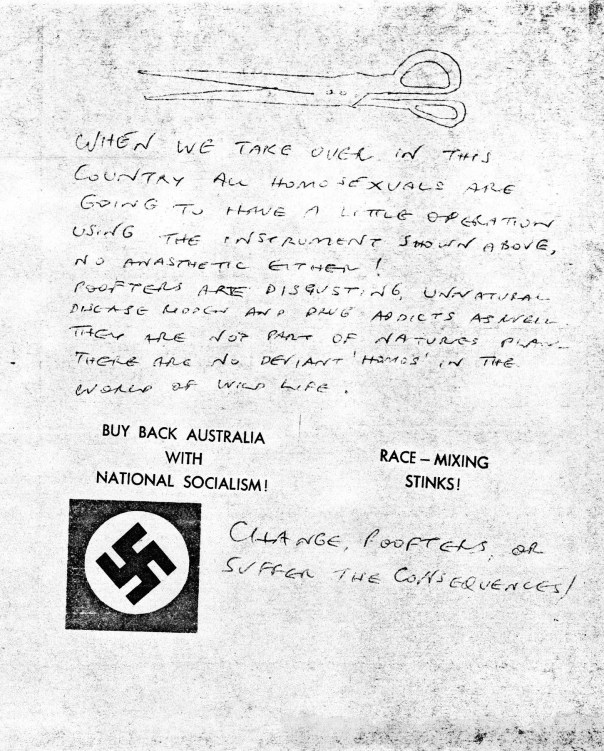
This flyer, from the latter half of the 1970’s, turned up when a friend was sorting his personal papers recently.

Charming, isn’t it…not!

That such hate, such violence, such bile, such vitriol could exist in this world – let alone Australia – is almost beyond comprehension. Unfortunately, as a gay man, I am more than aware of its existence! Perhaps not quite as bad as it used to be back then, but don’t worry…it’s still there…hiding under rocks, and in dark corners, lurking down dank corridors!

The only good thing to be said about this is that the National Socialist Party had a very brief existence, was bogged down in disarray when it was around, and had very few members. These views, and the Nazi symbolism just don’t work in this country! A small blessing!

For, despite not finding roots here, the same hate has – and still does – exist in other countries, under many guises. Call it what you like, but it’s name is…disgust! That the lives of a very small social minority could foster such hate in someone shows more our strength as a community, for our lives go on, than your delusion that hate and discrimination will win out! A group of people who want nothing more than to be left alone to get on with their lives.

As a Buddhist, my road to enlightenment is pock-marked by people and events like this! I should feel sorrow for this person, look for the good in them! But I can’t with this sort of hate! It leaves a sour taste in the mouth, gets under your skin and leaves a savage itch that must be scratched to get it out! There is no good here…no redemption!

I can’t help but wonder (wish?) what kharma had in store for this person, but I reckon it would have been swift, and brutal! It tends to be unforgiving!

There is no place for this kind of hate in this world! It can only weigh you down, consume you, bar your way to progressing yourself down your path! It twists and distorts, poisons and bruises your soul! It is a lesson for all of us that – in the long run- hate cannot…and will not…win out!

Tim Alderman 2019

National Socialist Party of Australia

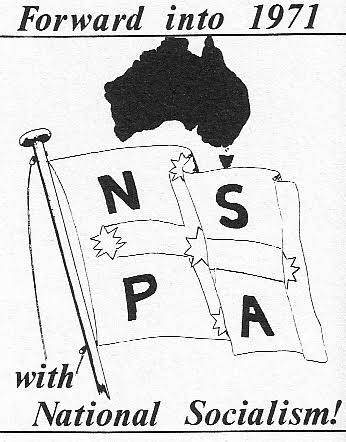
The National Socialist Party of Australia (NSPA) was a minor Australian neo-Nazi party that operated between 1967 and early 1970s. It was formed in 1967 as a more moderate breakaway from the Australian National Socialist Party (ANSP). The NSPA was led by Ted Cawthron

Cawthron and Frank Molnar launched the party in late 1967, explicitly rejecting the “jackbooted ‘Nazi’ image” associated with Arthur Smith’s ANSP. They focused particularly on Smith’s criminal convictions from a 1965 raid on ANSP headquarters. Although there were a number of attempts to reunite the two parties, the NSPA eventually attracted a number of other Australian national socialists disenchanted with Smith’s leadership.[2]

In May 1968, Smith resigned as leader of the ANSP and his successor, Eric Wenberg, merged the ANSP into the NSPA. Wenberg was accepted into a leadership position in the party, alongside Molnar as chairman, Cawthron as director of publications, Les Ritchie, and John Stewart. Early in 1969, however, Cawthron and Molnar fell out, with Molnar accusing Cawthron of being a closet Bolshevist. Molnar was expelled from the party.[3]

In early 1970, the party’s third congress in Canberra was attended by around 30 members. Later in the year, Cawthron became the first national socialist in Australia to run for public office, contesting the May 1970 ACT by-election. Cawthron came last out of seven candidates with 173 votes (0.32%),[4] but claimed to be content with the result considering the minimal nature of the NSPA’s campaign.

The party also ran three Senate teams for the 1970 Senate election: John Stewart and Michael McCormick in New South Wales, Ken Gibbett and Kevin Thompson in Queensland, and Cass and Katrina Young in Victoria. The Queensland team won the first place on the ballot paper and benefited from the donkey vote and received over 10,000 votes (1.51%), while the results for the other teams were insignificant.[5] The national NSPA vote was 24,017 (0.43%).[6] However, the actual support may be understated as NSPA did not field candidates nation-wide.

By 1972 the party was collapsing. The strong Queensland branch collapsed through infighting, and the involvement of three party members in a bomb attack in April on the Queensland offices of the Communist Party of Australia.[7] Establishment of a Sydney branch was frustrated by standover tactics of former members of ANSP. The Western Australian branch had collapsed and the ACT branch went into total eclipse. Only Victorian and South Australian branches survived the initial schism for a time, and even South Australia had to import a candidate from Melbourne.[5]

Jim Saleam, then only 17 years of age, was deputy leader of the party between 1972 and 1975, after Molnar was expelled from the party, under Cawthron‘s leadership. After the demise of NSPA, Saleam went on to found National Action in 1982, which existed until 1991, and then the Australia First Party in 1996.

Australia First Party

The Australia First Party (NSW) Incorporated (normally referred to as Australia First Party or AFP) is an Australian far-right political party founded in 1996 by Graeme Campbell and currently led by Jim Saleam. The policies of Australia First have been described as nationalistic, anti-multicultural and economic protectionist. The party’s logo includes the Southern Cross of the Eureka Flag.

Saleam is a convicted criminal, a former member of the neo-Nazi National Socialist Party of Australia and founder of the militant Australian white supremacist group National Action.

Campbell era

The Australia First Party was established in June 1996 by Graeme Campbell, and registered as a political party by the Australian Electoral Commission (AEC) on 13 September 1996. Campbell had been the federal Labor member for Kalgoorlie since 1980. However, he was disendorsed by the ALP in 1995, and continued to sit in parliament as an independent. He was reelected as an independent at the 1996 Australian federal election, and formed AFP soon after. However, AFP was not successful at the 1998 federal election and Campbell lost his seat, blaming his loss on Australia First being eclipsed by One Nation. In 2009, he claimed that, if not for the presence of a One Nation candidate, he would have picked up an additional 8.5% of the vote, which would have been enough to keep him in the race.

Campbell remained Australia First’s leader until June 2001, when he left the party to stand (unsuccessfully) as a One Nation Senate candidate in Western Australia. At the 2004 federal election, Campbell attempted unsuccessfully to regain his old federal seat as an independent. He again stood for the Senate in Western Australia at the 2007 federal election as an independent, but only achieved 0.13% of the vote.[3]

Salem era

Saleam has served two jail terms, one for property offences and fraud in 1984 and one for being an accessory before the fact in 1989 for his involvement in the shotgun attack on the home of African National Congress representative Eddie Funde.[4]

In 2002, Jim Saleam ran as an AFP candidate for a seat on Marrickville council, New South Wales, claiming “to oppose Marrickville being a Refugee Welcome Zone”. Later that year the party formed its youth wing, the Patriotic Youth League. AFP was deregistered by the AEC on 13 August 2004 for failing to nominate candidates at elections for four years. By 2007, Saleam had reestablished AFP, and in July 2009, Saleam claimed that the party had 500 members, and announced that he was registering its New South Wales branch, Australia First Party (NSW) Incorporated, with the AEC. The branch was registered by AEC on 13 June 2010, in time for the 2010 federal election.[5]

At the 2013 federal election, AFP was involved in Glenn Druery’s Minor Party Alliance. Saleam stood in the seat of Cook on a platform to end refugee intakes, running against Scott Morrison, and received 617 votes, or 0.67% of the vote.[6]

On 14 July 2015, the AEC de-registered the AFP due to its failure to demonstrate the required 500 members. It was re-registered on 1 March 2016 as “Australia First Party (NSW) Incorporated”.[7]

AFP contested the 2016 federal election, without any success. Saleam stood in the seat of Lindsay, New South Wales, receiving 1068 votes or 1.2% of the vote. In October 2016, the Australia First Party joined with the Australian Protectionist Party, Nationalist Alternative, Eureka Youth League, and Hellenic Nationalists of Australia to form the Australian Coalition of Nationalists, as a framework for cooperation between these entities.[8]

Saleam also stood for AFP in the 2018 Longman by-election, receiving 709 votes or 0.8% of the vote.[9]

Saleam stood in the seat of Cootamundra, New South Wales, in the 2017 by-election as an independent, though still a member of Australia First, as the party was not registered for NSW elections. He received 453 votes, 1% of the total. He again stood in the seat at the 2019 New South Wales state election as an independent. Saleam’s platform included the reintroduction of the White Australia policy and opposition to Chinese immigration.[10]

On 2 May 2014 the party aligned itself with the Golden Dawn party of Greece, a Metaxist fascist organisation, and on 24 July 2016, the party endorsed former Grand Wizard of the Ku Klux Klan David Duke for the 2016 Louisiana election via Twitter.[11]

Policies and electoral performance

The party stands on a nationalist, anti-multicultural and economic protectionist platform.[12]

The Australia First Party has been largely unsuccessful electorally. It has been elected to two local council seats, one in City of Penrith and one in City of Prospect. Saleam ran as a candidate in the 2018 Longman by-election, receiving 684 votes or 0.8% of the vote.[13]

In the 2019 Australian federal election, the party put up three candidates: Susan Jakobi in Lalor, Peter Schubeck for Longman, and Michael Chehoff for Swan.[14]

Activities

General

The Australia First Party’s activities have mainly consisted of distributing pamphlets and protesting. AFP members have repeatedly distributed racist pamphlets and stickers, on some occasions attempting to deny having done so in the aftermath. The AFP have also held numerous rallies, most of which have been labelled racist by the media and opponents, some of these rallies have ended in violent altercations. AFP claim that 150 members and supporters attended the Cronulla Riot.[15][16][17]

Patriotic Youth League

The Patriotic Youth League (PLY) was formed in 2002 by former One Nation activist Stuart McBeth as the youth wing of the Australia First Party. It has been described by numerous media commentators and academics as a far right, white nationalist youth organisation that has been linked to neo-Nazism, including the now-disbanded US-based Volksfront, and hate crimes.[18]

Nathan Sykes arrest

On 20 March 2019, Australia First member Nathan Sykes, described as a “prolific online troll and a lieutenant of Australia’s most prominent white supremacist Jim Saleam”, was charged with at least eight offences, after allegations that he made repeated and detailed violent threats to Melbourne journalist and lawyer Luke McMahon. He had previously made numerous racist and intimidating online comments targeting high-profile Australians, including ex-Racial Discrimination Commissioner Tim Soutphommasane, activist Mariam Veiszadeh and Guardian journalist Van Badham.[19]

Racism allegations

Australia First Party is as of March 2019 led by convicted criminal and neo-Nazi Jim Saleam. Saleam was a member of the short-lived National Socialist Party of Australia as a teenager during the early 1970s and the founder of the militant Australian white supremacist group National Action.[20][12]

Australia First also endorsed independent candidate John Moffat, who was later criticised by B’nai B’rith Anti-Defamation Commission chairman Michael Lipshutz, Cronulla Liberal MP Malcolm Kerr and Lebanese Muslim Association spokesman Jihad Dib for “inciting racial hatred”.[21]

On 10 July 2009, the Sydney Morning Herald reported that David Palmer, the Imperial Wizard of the Ku Klux Klan in Australia, said several Klan members had secretly joined Australia First. Palmer said Australia First had been identified as an Aryan party and would prove useful “in case the ethnics get out of hand and they need sorting out.” The Australia First Party later endorsed former Grand Wizard of the Ku Klux Klan David Duke for the 2016 Louisiana election via Twitter.[22]

In July 2010, it was reported that Australia First was distributing leaflets comparing Africans to monkeys, and “blaming Africans for the social problems in Sydney’s west”. Australia First denied responsibility for the leaflets, claiming that they had been distributed in an attempt to discredit the party.[23]

The Australia First Party used Sinophobia and fear of “African Australians” in their campaign during the 2019 election.[14][24]

References

^1 Henderson, Peter (November 2005). “Frank Browne and the Neo-Nazis”. Labour History (89): 73–86. JSTOR 27516076.

2 ^ Harcourt, David (1972). Everyone Wants to be Fuehrer: National Socialism in Australia and New Zealand. Angus and Robertson. pp. 25–28. ISBN 978-0207124150.

3 ^ Harcourt, pp. 31-32.

4 ^ Historic Glebe mansion Lyndhurst, once Australia’s Nazi Party headquarters, on market for $7.5m

5 ^ a b Harcourt, David (2007). “An assault on the jew‐democratic nut‐mad house”. Politics. 8: 111–112. doi:10.1080/00323267308401333.

6 ^ Harcourt, pp. 36-39.

7 ^ Brisbane’s Radical Books

Australia First Party

^ 1 “Identity Independence Freedom”. 14 September 2012. Retrieved 16 March 2016.

2 ^ “Policy 2: Rebuild Australian Manufacturing Industries”. Australia First Party. Retrieved 29 June 2016.

3 ^ Cambell Era:

• Scott Bennett (16 February 1999). “The Decline in Support for Australian Major Parties and the Prospect of Minority Government”. Archived from the original on 13 July 2010. Retrieved 24 January 2010.

• ?Antony Green (2007). “Senate Results Western Australia”. Federal Election 2007. ABC News. Retrieved 24 January 2010.

• Australian Electoral Commission

• Antony Green (21 December 2007). “Kalgoorlie”. Australia Votes 2007. ABC News. Retrieved 24 January 2010.

4 ^ Gibson, Jano; Frew, Wendy (12 January 2008). “No apology for white Australia policy”. The Sydney Morning Herald. Retrieved 4 February 2013.

5 ^ Marrickville Council:

• West, Andrew (29 February 2004). “White separatist takes on Marrickville”. The Sydney Morning Herald. Retrieved 14 July 2006.

• Jensen, Erik (9 July 2009). “Right-wing genie out of the bottle”. Sydney Morning Herald. Retrieved 9 July 2009.

• “Parties and Representatives”. AEC redirection page – Australian Electoral Commission.

6 ^ 2013 election:

• “Bitter dispute erupts over Senate preferences in Queensland”. ABC. 5 September 2013.

• “Alliance of micro parties boosts odds for likes of One Nation or Shooters and Fishers gaining Senate spot through preferences”. Daily Telegraph. 5 September 2013.

7 ^ Registration:

• “Deregistered/renamed political parties”. Australian Electoral Commission. Retrieved 14 July 2015.

• “Australia First Party (NSW) Incorporated”. Australian Electoral Commission. 7 March 2016. Retrieved 16 March 2016.

• “Party Formation”. Australia First Party. Retrieved 16 May 2018.

8 ^ The formation of the Australian Coalition of Nationalists

9 ^ Longman by-election:

• Murray, Oliver (26 April 2016). “Far-right-wing parties after your vote on election day”. The Daily Telegraph. Retrieved 3 June 2016.

• Pollard, Krystyna (19 May 2016). “Controversial Saleam to stand for Australia First in Lindsay”. Penrith City Gazette. Retrieved 3 June 2016.

• 26, scheme=AGLSTERMS.AglsAgent; corporateName=Australian Electoral Commission; address=50 Marcus Clarke Street, Canberra, ACT 2600; contact=13 23. “House of Representatives division information”. Australian Electoral Commission. Retrieved 29 July 2018.

10 ^ Cootamundra election:

• Grey, Lachlan (27 August 2017). “Australia First leader Jim Saleam to contest Cootamundra by-election in November”. Cootamundra Herald. Retrieved 10 September 2017.

• “Right wing extremist makes election bid in sleepy NSW ‘cherry capital'”.^ 11^Golden Dawn:

• Gemenis, Kostas; Nezi, Roula (January 2012), The 2011 Political Parties Expert Survey in Greece (PDF), University of Twente, p. 4

• Repoussi, Maria (2009), “Battles over the national past of Greeks: The Greek History Textbook Controversy 2006–2007” (PDF), Geschichte für heute. Zeitschrift für historisch-politische Bildung (1): 5

• Grumke, Thomas (2003), “The transatlantic dimension of right-wing extremism”, Human Rights Review, 4 (4): 56–72, doi:10.1007/s12142-003-1021-x, “On October 24, 1998 the Greek right-wing extremist organisation Chrisi Avgi (Golden Dawn) was the host for the 5th European Youth Congress in Thessaloniki.”

• “Australia FirstParty (@AustFirstParty)”. Retrieved 1 February 2018.

12 ^ a b Greason, David (1994), I was a teenage fascist, pp.283,284,289, McPhee Gribble

13 ^ By-elections:

• “Profile of Cr. Bruce Preece”. City of Prospect. Archived from the original on 19 September 2006. Retrieved 20 January 2007.

• “2006 Local Government Election Results” (PDF). Local Government Association of South Australia. p. 47. Archived from the original (PDF) on 30 June 2007. Retrieved 20 January 2007.

• Schiller, Emma (14 September 2012). “Australia First Party council candidate elected”. Penrith Press. Retrieved 22 September 2012.

14 ^ a b Hood, John (23 January 2019). “Susan Jakobi, Australia First Party for Lalor in 2019”. Australia First Party. Retrieved 14 May 2019.

15 ^ Australia First Denies Racist Mailbox FlyersArchived 20 November 2010 at the Wayback Machine

16 ^ Baker, Richard (14 December 2005). “Australia First: reclaiming the agenda”. The Age. p. 11. Archived from the original on 3 February 2006. Retrieved 25 February 2006.

17 ^ Mulcair, John (10 October 2006). “Rally held at MP’s office”. St. George and Sutherland Shire Leader (Sutherland edition). p. 11. Archived from the original on 7 November 2006. Retrieved 13 October 2006.

18 ^ Patriotic Youth League:

• “Neo-Nazi link to campus anti-foreigner campaign”. Sydney Morning Herald. 2 December 2004. Retrieved 1 July 2010.

• Adam Bennett (19 December 2004). “Race hate group unstuck”. Retrieved 17 May 2018.

• Danny Ben-Moshe (2006). “The Far-Right and the 2005 Cronulla Riots in Sydney”. Retrieved 17 May 2018.

• Ewin Hannan; Richard Baker (13 December 2005). “Nationalists boast of their role on the beach”. Retrieved 17 May 2018.

• Sarah Price (29 August 2004). “Campus racism rises” The Sydney Morning Herald”.

19 ^ McKenzie, Nick; Baker, Richard (22 March 2019). “Police swoop on right-wing troll over alleged violent threats”. Sydney Morning Herald. Retrieved 23 March 2019.

20 ^ West, Andrew (29 February 2004). “No Apology For White Australia Policy”. Sydney Morning Herald. Sydney Morning Herald. Retrieved 4 February 2013.

21 ^ Roberts, Greg (5 January 2007). “Cronulla candidate campaigns for race hatred”. The Australian. p. 4. Retrieved 18 May 2011.

22 ^ Jensen, Erik (10 July 2009). “We have infiltrated party: KKK”. The Sydney Morning Herald. Fairfax. p. 1. Archived from the original (reprint) on 10 July 2009. Retrieved 10 July 2009.

23 ^ “Racist leaflets not ours: Australia First”. ABC Online. ABC. 27 July 2010. Archived from the original on 25 July 2010. Retrieved 31 July 2010.

24 ^ Campaign poster for Lalor with caption “No China city in Werribee”

Everything You Ever Wanted To Know About Vatican Fashion – But Were Too Afraid (Or Too Ambivalent) To Ask!

APOLOGY: This is my second post of this blog…tidied up and re-edited. The first post had dot-points all over the place, and I have no reason why! Nothing I do gets rid of them, and the post just got messier and messier. The only way to fix the problem was to redo the entire post. So…here it is as it should be!

GAMMARELLI

His name never appears in the list of Italy’s top fashion designers, who bring worldwide prestige to the country’s high fashion, yet he left a deep mark, and that’s because he created the robes the Pope wore (and still wears).

His name was Annibale Gammarelli.

For over two hundred years the famous Gammarelli family have been at the heart of serving the clergy. From deacons to Popes everyone experiences the same courtesy and attention to detail.There is an old saying, ‘you get what you pay for’ this is certainly true here. Quality is at the heart of the service offered by the Gammarelli family.

Now, after the death of manager Annibale Gammeralli (July 2016), the business will pass to the hands of the sixth generation.

Established in 1798 by Giovanni Antonio Gammarelli, the “Ditta” was founded under Pius VI as a tailor for the Roman clergy. After Giovanni died, management of the shop passed to his son Filippo, and then to Filippo’s son Annibale.

In 1874 Annibale moved the shop from its original location to its current spot on Via Santa Chiara 34,  just steps away from the Pantheon. It’s located inside the building of the Pontifical Ecclesiastical Academy, the institute that forms future Vatican diplomats.

When Annibale died, his sons Bonaventura and Giuseppe decided to keep the name “Ditta Annibale Gammarelli” as a homage to their father – a name that has since become known to clergy throughout Italy and the world.

In an additional act of homage, Bonaventura decided to name his own son after his father: making the late Annibale Gammarelli the second to carry the name of the family business and to carry it forward.

Annibale passed away July 12 in Rome after a long career managing the sartorial workshop, leaving it in the care of his son Stefano Paolo and his nephews Maximillian and Lorenzo, who are the sixth generation to sew garments for the Pope.

During each conclave the Gammerellis are charged with making three white cassocks in different sizes –  small, medium and large – which sit ready and waiting for the new Successor of Peter.

And though Francis doesn’t use it, the white cassocks are always accompanied by the red mozzetta (the papal half-cape of choir dress that buttons in the front and covers the shoulders), as well as the white pellegrina (the buttonless white shoulder cape worn with a cassock and open in front), the white fascia (the waistband typically embroidered with the papal coat of arms, though Francis opted out of this), and the white zucchetto (or skullcap).

(A point worthy of noting is that Popes typically change cassocks more or less every two months, since the silver cross they wear oxidizes, leaving a stain on the white fabric).

In 2000 the Ditta Annnibale Gammarelli was added to the list of historic shops in the city of Rome, and is likely the oldest shop to still be managed by the direct descendants of its founder.

The shop has served thousands of priests and hundreds of bishops and cardinals, and sewn garments for the Roman Pontiffs since Blessed Pius IX, who was elected Bishop of Rome in 1846.

Photos of the past nine Popes decorate the walls inside the workshop, which will continue to dress Popes under the guidance of yet another generation of Gammarellis.

POPE SOCKS: A FAVOURITE ROMAN SOUVENIR
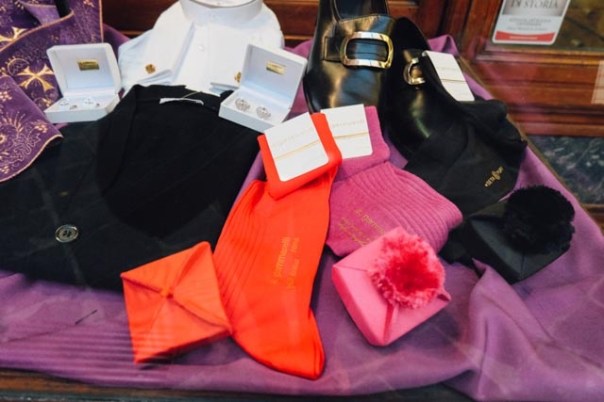
Deep in my heart I still believe that the best gift ever given to anyone in the history of the world was given by me, to my sister.

She was the lucky recipient of a combination bottle opener/toe-nail clipper in the shape of Pope John Paul II’s face.

But in case you missed it because the rock you are living under is pret-ty soundproof, Pope Francis is the new big deal around here.  That means his tailor is a big deal too.

Lest you believe those robes make themselves, I’ll let you in on a little secret: the pope gets all his sweet swag from Gammarelli.

Gammarelli is a small ecclesiastical shop near the Pantheon, that technically anyone can visit.

I say “technically” because, well, it is a little bit awkward to walk into a tiny store that sell exclusively priest clothes when you are dressed like an Italian teenager in ripped jeans and black tennis shoes.

Please, learn from me, and do not wear ripped jeans to Gammarelli’s.  They will be nice about it, but you might (like me) end up weirdly hovering outside while waiting for actual priests to leave the store.

Any. Ways.

The whole reason that you would want to visit the Pope’s tailor is so you can get your hands on Pope socks.

The actual socks that the Pope actually wears. (Bishops and Cardinals, too, no doubt).
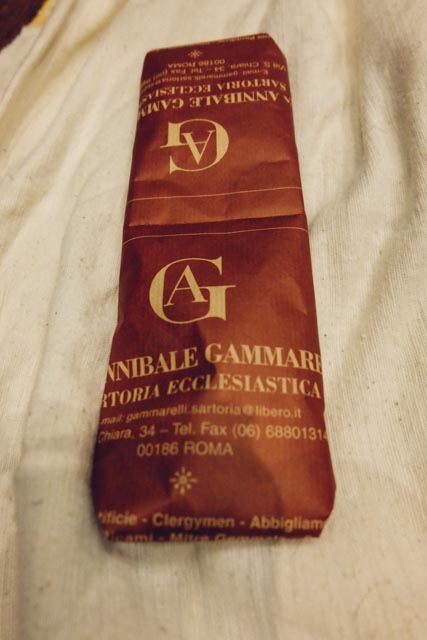
Pope socks make an excellent Christmas present or unique Roman souvenir. (Or at least that is what I told my father-in-law when I gave him a pair over the holidays last year).

At €12 (approx A$19) a pop, you get a great story and some excellent quality socks.

HOW MUCH DOES IT COST TO GET OUTFITTED AS A CARDINAL?

On the eve of the next consistory, the six new cardinals may be finding that those red hats don’t come cheap.
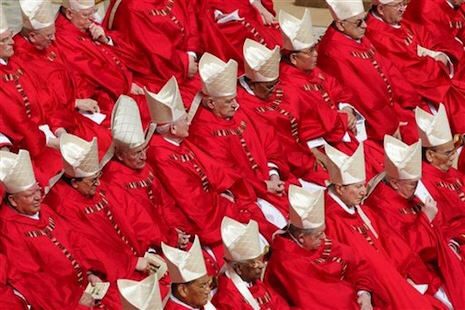
On Saturday Benedict XVI will create six new cardinals, just nine months after last February’s consistory. Addressing the Synod’s bishops, the Pope explained the reasons for this “informed” choice of new cardinals, none of whom are European: this is a way for the Church to show its true universality after the batch of cardinals created during the last consistory, who were mainly Curia members or Italian.

The new cardinals are: James Harvey, the American head of the Papal Household; His Beatitude Bechara Boutros Raï, patriarch of the Maronite Church in Lebanon; His Beatitude Baselios Cleemis Thottunkal, head of the Syro-Mankar Church in India; Archbishop John Olorunfemi Onaiyekan of Abuja; Archbishop Rubén Salazar Gómez of Bogota, Colombia and Archbishop Luis Antonio Tagle of Manila in the Philippines.

Even though there are only six of them, Rome’s ecclesiastical tailors started work immediately on the vestments for the Church’s newly elected “princes”. When a bishop is created a cardinal, they stop wearing the violet coloured garments they donned previously and replace these with red coloured ones. Tailors prepare a list of all the garments and accessories cardinals will need. Those who wish to make a gift to a cardinal can consult this list.

Here are the current prices for items prepared by Rome’s most renowned tailor, Gammarelli, which has traditionally been the Pope’s tailor:

*The red mozzetta  which cardinals wear with their choral vestments, costs about 200 Euro (A$319). but the price goes up if one chooses cord buttons  – which are hand made and more sought after (they cost 20 Euro (A$32) each) – instead of cloth buttons.

*The red cassock costs approximately 800 Euro (A$1,274),

*while the three-cornered hat without a bow, which is typical for cardinals, can cost between 80 (A$127) and 120 Euro (A$191).

*The red and golden cord for the pectoral cross costs around 80 Euro (A$127): the price varies according to how elegant it is and the size of the bow on the back.

*The red fascia which is worn with the red cassock and the black cassock with red piping, costs about 200 Euro (A$319).

*A black cassock with red piping costs approximately 600 Euro (A$955),

*while the cardinal’s red zucchetto is priced at around 40 Euro (A$64).

*Finally, the red socks cost about 15 Euro (A$24) for a pair.

 Given that cardinals usually purchase two sets of each of these outfits, they can expect to spend around four to five thousand Euro(A$6371-7964) to complete their wardrobe. The cardinal’s ring is a gift from the Pope.

FROM LIPSTICK-RED LOAFERS TO PONTIFF BLING RINGS; THE MOST FASCINATING PAPAL FASHION CHOICES

On Wednesday, Catholic cardinals in Vatican City ended their 2013 search for the Next Top Catholic by electing Jorge Mario Bergoglio from Argentina as the world’s 266th pope. Bergoglio, who will go by Francis, greeted his following while wearing traditional white vestments, an austere crucifix, and understated glasses on the balcony of St. Peter’s Basilica—a sartorial tabula rasa for the vintage accessories and bold-colored papal attire that may be to come. Because, as tradition-bound as the Catholic Church is, its leaders have historically exhibited a daring sense of style over their 2,000 years in the high office. (What other men outside the rap community can get away with red slippers, fur-trimmed caplets, ruby bling, white skullcaps, and engraved chalices?) In anticipation of Pope Francis defining his personal papal style, we look back at some of the highlights in pontiff fashion—the jaunty headware, flamboyant footwear, and designer eyewear that have separated the Carrie Bradshaws of Catholic leaders (Benedict XVI) from the Mirandas (John Paul II).
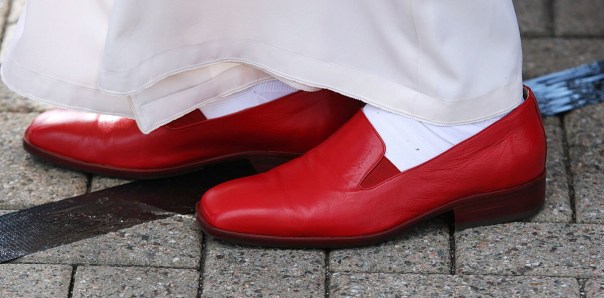
Red Papal Loafers: Pope Benedict XVI’s decision to incorporate these vintage papal accessories into his daily ensemble~ was so popular that Esquire named him “Accessorizer of the Year” in 2007. Following widespread reports that Pope Benedict’s footwear was Prada, Vatican officials felt the need to clarify that the pope was not a designer-clotheshorse with statements like “he wouldn’t know Gucci from Smoochi” and “[t]he pope, in summary, does not wear Prada, butChrist.”

Saturno, Fedora’s Cousin: While Popes Leo XII, John XXIII, John XIII, and John Paul II have all worn this style of wide-brimmed hat—named for Saturn’s rings, popular in summer, and often constructed from beaver hair or straw—no one looked quite as fly in the style as Benedict XVI. Here he is peacocking during a St. Peter’s Square audience.
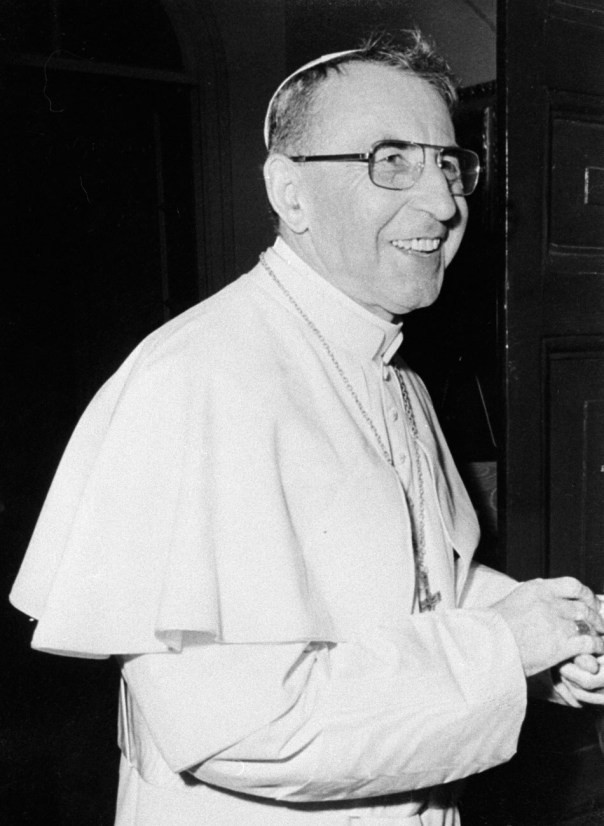
Metal-Rimmed “Shop Teacher” Glasses: With thin, rectangular metal frames, John Paul I’s “cheaters” communicated several important messages: “Go easy on the bandsaw” and “Someone clean up that linseed-oil spill.” Although Pope Francis appeared at his first audience wearing a similar style—with what appear to be transition lenses—he had already ditched the outdated eyewear by mass on Thursday morning after what we can only assume was a Vatican-mandated She’s All That–style makeover. For cooler shades, refer to Benedict XVI’s Serengeti sunglasses—a popular brand with Val Kilmer and Jack Nicholson.

Rainbow Vestments: In 1997, French designer Jean-Charles de Castelbajac managed to convince John Paul II and several thousand priests to wear multicolored vestments for a World Youth Day state visit—because the rainbow represented God’s promise of peace to Noah. When Castelbajac also suggested that his design symbolized homosexual liberation, the Vatican responded that no one had a copyright on the rainbow—or, apparently, clever retorts on colorful fashion statements.

The Mozzetta: Of the five versions of the mozzetta—in essence, an elbow-length cape—worn by the pope, the most glam is the winter version, which is red velvet and lined with white ermine fur. (In a pinch, it could also be used as a Christmas-tree skirt.) While the mozzetta has been depicted in portraits of the pope since at least the 14th century, John Paul II—who, preferring cleaner lines, was the Calvin Klein of Catholic leaders—buried it in the back of the papal closet before you-know-who (Benedict XVI) revived the style.

The Camauro (Matching-Accessory Alert!): What better to pair with that red-velvet, white-ermine-fur-trimmed cape than a matching cap? The hat has been part of the papal wardrobe since the 12th century, when it was apparently much more in vogue. Benedict XVI once tried to pull off this look during a 2005 St. Peter’s Square appearance. When he received criticism from both the fashion and eyesight-capable communities—he was cruelly called “Santa Pope” and narrowly avoided appearing in *Us Weekly’*s “What Not to Wear” column—the pope made like a million excuses for the hat and vowed never to wear it again. “I was just cold, and I happen to have a sensitive head,” he was quoted as saying. “And I said, since the camauro is there [in the closet], let’s put it on. But I was really just trying to fight off the cold.” Sure, sure.
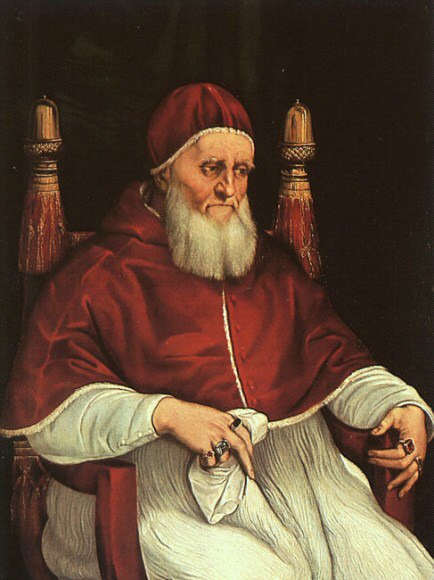
Papal Bling Rings: The most famous papal finger jewelry is the “Ring of the Fisherman,” which traditionally shows St. Peter (a fisherman) casting his net. A new ring is cast in gold for each pope and, in the past, was extravagantly destroyed in Thor-like fashion with a silver hammer at the end of his term. (Recognizing that this seems extreme, the Church now just scratches a cross-shaped mark into the ring.) Pope Pius IX, apparently the Paris Hilton of pontiffs, eschewed tradition by reportedly wearing a cameo of himself constructed almost entirely out of tiny diamonds. While it is rare for popes to wear self-portrait signets, it is not uncommon for popes to wear additional ecclesiastical rings set with stones—more ornate depending on the fashion of the era—and pectoral crosses affixed with diamonds, rubies, and sapphires.

The Papal Tiara: The most regal of the papal accessories, the pontiff’s ornamental headpiece seems less like a tiara and more like an extravagantly bejeweled conehead. The three-tiered style (“triregnum”) has many symbolic interpretations and for centuries was most famously exhibited during the traditionally six-hour-long coronation ceremonies. Because they are usually constructed from silver and enriched with, on some occasions, hundreds of jewels, the elaborate neck-straining devices can weigh upwards of 10 pounds. In somewhat fitting tiara trivia, the heaviest papal headpiece was provided by Napoleon, supposed inferiority-complex sufferer, who gifted Pope Pius VII an 18-pound crown. As an added bonus, the triregnum can be melted down for ransom money in emergency situations and used as an easy conversation starter in literally every situation imaginable. (Unlike the camauro, which Benedict XVI discovered the hard way. Learn from his mistake, Francis!).

PAPAL ACCESSORIES

MANTUM

The mantum or papal mantle differs little from an ordinary cope except that it is somewhat longer, and is fastened in the front by an elaborate morse. In earlier centuries it was red in colour; red, at the time being the papal color rather than white. In the eleventh and twelfth centuries the immantatio, or bestowal of the mantum on the newly elected pope, was regarded as specially symbolical of investiture with papal authority: Investio te de papatu romano ut praesis urbi et orbi, “I invest thee with the Roman papacy, that thou rule over the city and the world” were the words used in conferring it at the Papal Coronation. The use of the mantum by the popes ceased under Paul VI, following the reforms of Vatican II. This is the first of the traditional papal vestments restored by the current Pope, Benedict XVI. In the image above we see Pope Benedict XVI wearing the mantum. [Wikipedia]

CAPPELLO ROMANO

A cappello romano (literally Roman hat) or saturno (because it is reminiscent of the ringed planet Saturn) is a hat with a wide, circular brim and a rounded rim worn by Catholic clergy. It is made of either beaver fur or felt, and lined in white silk. Unlike many other articles of ecclesiastical attire, it serves no ceremonial purpose, being primarily a practical item, worn in private life. The pope wears a red cappello with gold cords. Cardinals formerly also had the privilege of wearing a red cappello, but this rule was overturned by Paul VI, and now Cardinals’ cappelli are black, as are those of all other clerics. [Wikipedia]

CAMAURO
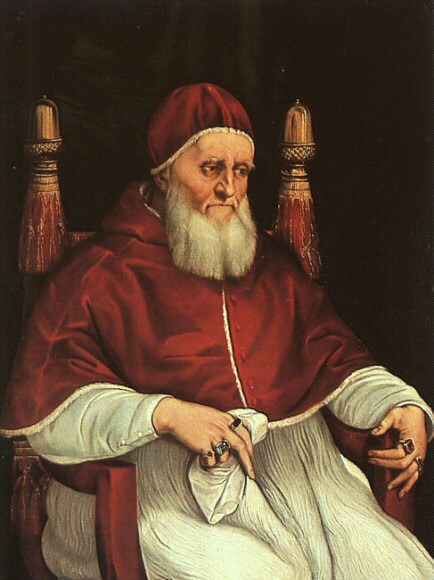
In the image above we see Pope Julius II. This is another tradition restored by Benedict XVI. Papal camauros are of red wool or velvet with white ermine trim and are worn, usually in winter, in place of the zucchetto, which in turn takes the place of the biretta worn by other members of the clergy. Like the biretta (priest’s hat) worn by lower clergy and the mortarboard worn by academics, the camauro derives from the academic cap (the pileus), originally worn to protect tonsured clerical heads from the cold. It is often worn with a shoulder winter cloak (mozzetta), also sometimes fur-lined. The papal camauro fell into disuse after the death of Pope John XXIII in 19

PAPAL SLIPPERS

The Papal Slippers are a historical vestment of the Roman Catholic Church traditionally worn by the pope. They are a form of episcopal sandals worn by early bishops. Red in color to symbolize the blood of the martyrs, the slippers altogether symbolized the submission of the pope to the ultimate authority of Jesus Christ. Pope Paul VI discontinued their use in favor of the outdoor red papal shoes. Pope Benedict XVI has chosen to wear the red papal shoes, similar to those worn by Paul VI. [Wikpedia]

FANON

In the photo above we see Pope John XXIII wearing the fanon. The fanon consists of a doubled shoulder-cape (somewhat like a mozzetta) of white silk ornamented with narrow woven golden stripes, so that the colors alternate white and gold. The pope wears it only when celebrating a solemn Pontifical Mass, that is, only when all the pontifical vestments are used. The manner of putting on the fanon recalls the method of assuming the amice universal in the Middle Ages and still observed by some of the older religious orders. [Wikipedia]

PALLIUM

The Pallium or Pall (derived from the Roman pallium or palla, a woollen cloak) is an ecclesiastical vestment in the Roman Catholic Church, originally peculiar to the Pope, but for many centuries bestowed by him on metropolitans and primates as a symbol of the jurisdiction. The modern pallium is a circular band about two inches wide, worn about the neck, breast and shoulders. It has two pendants, one hanging down in front and one behind, which are about two inches wide and twelve inches long, and are weighted with small pieces of lead covered with black silk. The remainder of the pallium is made of white wool, part of which is supplied by two lambs presented annually as a tax by the Lateran Canons Regular. [Wikipedia]

SEDIA GESTATORIA

The sedia gestatoria is the portable throne on which Popes were once carried. It consists of a richly-adorned, silk-covered armchair, fastened on a suppedaneum, on each side of which are two gilded rings; through these rings pass the long rods with which twelve footmen (palafrenieri), in red uniforms, carry the throne on their shoulders. The Sedia gestatoria is an elaborate variation on the sedan chair. Two large fans (flabella) made of white ostrich feathers—a relic of the ancient liturgical use of the flabellum, mentioned in the Constitutiones Apostolicae, VIII, 12—are carried at either side of the sedia gestatoria. In the picture above, we see Pope Pius XII on the throne. [Wikipedia]

PAPAL CROSS

Above we see Pope Saint Sylvester I carrying the traditional Papal cross. The practice of Popes carrying a Crosier (shepherd’s crook) was gradually phased out and had disappeared by the time of Innocent III’s papacy in the eleventh century. In the Middle Ages, popes would carry a three-barred cross (one more bar than on those carried before archbishops), in the same manner as other bishops carried a crosier. This was in turn phased out, but Paul VI introduced the modern papal pastoral staff, which instead of the triple cross depicts a modern rendition of the crucified Christ, whose arms are fixed to a crossbar that is curved somewhat in the manner of an Eastern crozier. [Wikipedia]

RING OF THE FISHERMAN

Above we see Pope Saint Sylvester I carrying the traditional Papal cross. The practice of Popes carrying a Crosier (shepherd’s crook) was gradually phased out and had disappeared by the time of Innocent III’s papacy in the eleventh century. In the Middle Ages, popes would carry a three-barred cross (one more bar than on those carried before archbishops), in the same manner as other bishops carried a crosier. This was in turn phased out, but Paul VI introduced the modern papal pastoral staff, which instead of the triple cross depicts a modern rendition of the crucified Christ, whose arms are fixed to a crossbar that is curved somewhat in the manner of an Eastern crozier. [Wikipedia]

TIARA
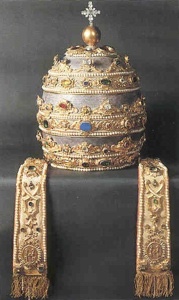
The Papal Tiara (Triregnum) is the three-tiered jewelled papal crown, supposedly of Byzantine and Persian origin, that is a prominent symbol of the papacy. The Supreme Pontiff’s arms have featured a “tiara” since ancient times, notably in combination with Saint Peter’s crossed keys. Though not currently worn as part of papal regalia (though still permissible), the continuing symbolism of the papal tiara is reflected in its use on the flag and coats of arms of the Holy See and the Vatican. Although often referred to as the Papal Tiara, historically there have been many, and twenty-two remain in existence. [Wikipedia]

THE EPISCOPAL OR PONTIFICAL GLOVES
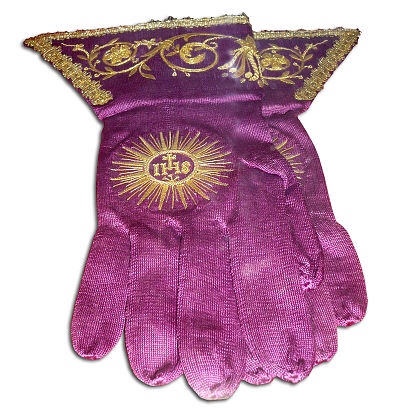
(chirothecœ, called also at an earlier date manicœ, wanti) are a Roman Catholic pontifical vestment worn a by bishop when celebrating Solemn Pontifical Mass. They are worn from the beginning of the Mass until the offertory, when they are removed, they can be elaborately embroidered and generally match the liturgical color of the Mass. They are not worn for Good Friday or Requiem Masses. While normally reserved for bishops, other prelates entitled to use pontificals, including abbots, may also use them without a special papal privilege. The gloves are considered symbolic of purity, the performance of good works and carefulness in procedure. The Caeremoniale Episcoporum, as revised in 1984, omits all mention of episcopal gloves, they are very rarely seen today except in celebrations of the 1962 form of the Roman Rite or yet earlier forms by some traditionalist Catholics. Anglo-Catholic and Old Catholic bishops also sometimes make use of the Episcopal gloves.[citation needed] Episcopal gloves are used only at a Pontifical Mass, and then only up to the washing of the hands before the Eucharistic Sacrifice. In the pre-Vatican II rite of consecration of a bishop, the consecrator, aided by the assisting bishops, put the gloves on the new bishop just after the blessing. As of 1909, Episcopal gloves are knitted by machine or hand-woven from silk thread. They are normally ornamented on the back with a cross; the border of the opening for the hand is also, as a rule, embellished; the colour of the gloves must correspond with the liturgical colour of the feast or day in the services of which they are worn; episcopal gloves, however, are never black, as they are not used on Good Friday nor at a Requiem. The use of episcopal gloves became customary in Rome probably in the tenth century, outside of Rome they were employed somewhat earlier. Apparently they were first used in France, as the earliest traces of the custom are found in this country, whence it gradually spread into all other parts and eventually to Rome; the chief reason for the introduction of the usage was probably the desire to provide a suitable adornment for the hands of the bishop, rather than practical considerations such as the preservation of the cleanliness of the hands etc. Episcopal gloves appertained originally to bishops, but at an early date their use was also granted to other ecclesiastics, thus no later than 1070 the abbot of the monastery of San Pietro in Cielo d’Oro at Pavia received this privilege, the first certain instance of such permission. In the Middle Ages these gloves were either knitted or otherwise produced with the needle, or else they were made of woven material sewed together; the former way seems to have been the more usual. Gloves made by both methods are still in existence, as for example, in Saint-Sernin at Toulouse, at Brignoles, in S. Trinità at Florence, in the cathedrals of Halberstadt and Brixen, in New College at Oxford, Conflens in Savoy and other places. In the later Middle Ages it became customary to enlarge the lower end, giving it the appearance of a cuff or gauntlet, and even to form the cuff with a long joint which hung downwards and was decorated with a tassel or little bell; the back of the glove was always ornamented, sometimes with an embroidered medallion or some other form of needlework, sometimes with a metal disk having on it a representation of the Lamb of God, a cross, the Right Hand of God, Saints etc., the disk being sewn on to the glove, or, at times, the ornamentation was of pearls and precious stones. The gloves were generally made of silk thread or woven fabric, rarely of woollen thread, sometimes of linen woven material. Up to the end of the Middle Ages the usual colour was white, although the gloves at New College, Oxford, are red; apparently it was not until the sixteenth century that the ordinances as to liturgical colours were applied to episcopal gloves. Even in the Middle Ages the occasions on which the gloves were worn were not many, but their use was not so limited as later, for in the earlier period they were occasionally worn at the pontifical Mass after Communion, at solemn offices and during processions.

PECTORAL CROSS OR PECTORALE

Pectoral of Pope Paul VI

(from the Latin pectoralis, “of the chest”) is a cross that is worn on the chest, usually suspended from the neck by a cord or chain. In ancient and medieval times pectoral crosses were worn by both clergy and laity, but by the end of the Middle Ages the pectoral cross came to be a special indicator of position worn by bishops. In the Catholic Church, the wearing of a pectoral cross remains restricted to popes, cardinals, bishops and abbots.[1] The modern pectoral cross is relatively large, and is different from the small crosses worn on necklaces by many Christians. Most pectoral crosses are made of precious metals (platinum, gold or silver) and some contain precious or semi-precious gems. Some contain a corpus like a crucifix while others use stylized designs and religious symbols.

THE DALMATIC

Is a long, wide-sleeved tunic, which serves as a liturgical vestment in the Catholic, Lutheran, Anglican, United Methodist, and some other churches. When used, it is the proper vestment of a deacon at Mass or other services. Although infrequent, it may also be worn by bishops above the alb and below the chasuble, and is then referred to as pontifical dalmatic.

Like the chasuble worn by priests and bishops, it is an outer vestment and is supposed to match the liturgical colour of the day. The dalmatic is often made of the same material and decoration as a chasuble, so as to form a matching pair. Traditional Solemn Mass vestment sets include matching chasuble, dalmatic, and tunicle.

A dalmatic is also worn by the British monarch during the Coronation service.

THE EPISCOPAL SANDALS

Also known as the pontifical sandals, are a Roman Catholic pontifical vestment worn by bishops when celebrating liturgical functions according to the pre–Vatican II rubrics, for example a Tridentine Solemn Pontifical Mass.

In shape, the episcopal sandals more closely resemble a pair of loafers than actual sandals. The liturgical stockings (caligae) are worn over the episcopal sandals and cover the episcopal sandals and the ankle. The episcopal sandals and liturgical stockings usually match the liturgical color of the Mass. However, when black vestments are worn, the pontifical footwear is not used.

After the Second Vatican Council, the episcopal sandals fell out of common use following the revisions of the liturgy resulting in the Mass of Paul VI, which is now known as the Ordinary Form of the Roman Rite. While still permitted for use in the Ordinary Form of the Mass, they are rarely used in that context. Today, the use of the episcopal sandals is primarily seen in those celebrating the Tridentine Mass.

The episcopal sandals should not be confused with the velvet papal shoes, which were recently reinstated by Pope Benedict XVI. The papal shoes evolved as the outdoor counterpart of the papal slippers, which are similar to the episcopal sandals, except that the papal slippers are worn by the Pope outside liturgical functions and are always red.

THE MITRE

(British English) (/ˈmaɪtər/; Greek: μίτρα, “headband” or “turban”) or miter (American English; see spelling differences), is a type of headgear now known as the traditional, ceremonial head-dress of bishops and certain abbots in traditional Christianity. Mitres are worn in the Orthodox Church, Roman Catholic Church, as well as in the Anglican Communion, some Lutheran churches, and also bishops and certain other clergy in the Eastern Catholic Churches and the Oriental Orthodox Churches. The Metropolitan of the Malankara Mar Thoma Syrian Church also wears a mitre during important ceremonies such as the Episcopal Consecration.

Three types of mitres are worn by Roman Catholic clergy for different occasions:

• The simplex (‘simple’, referring to the materials used) is made of undecorated white linen or silk and its white lappets traditionally end in red fringes. It is worn most notably at funerals, Lenten time, on Good Friday and by concelebrant bishops at a Mass. Cardinals in the presence of the Pope wear a mitre of white linen damask.

• The auriphrygiata is of plain gold cloth or white silk with gold, silver or coloured embroidered bands; when seen today it is usually worn by bishops when they preside at the celebration of the sacraments.

• The pretiosa (‘precious’) is decorated with precious stones and gold and worn on the principal Mass on the most solemn Sundays (except in Lent) and feast days. This type of mitre is rarely decorated with precious stones today, and the designs have become more varied, simple and original, often merely being in the liturgical colour of the day.

The proper colour of a mitre is always white, although in liturgical usage white also includes vestments made from gold and silver fabrics. The embroidered bands and other ornaments which adorn a mitre and the lappets may be of other colours and often are. Although coloured mitres are sometimes sold and worn at present, this is probably due to the maker’s or wearer’s lack of awareness of liturgical tradition.[dubious – discuss]

On all occasions, an altar server may wear a shawl-like veil, called a vimpa, around the shoulders when holding the bishop’s mitre.

FASHION: THE POPE WEARS PRADA

He may never make the best-dressed lists, but Pope Benedict XVI is nothing short of a religious-fashion icon, riding in the Popemobile with red Prada loafers under his cassock and Gucci shades. But his penchant for designer wear and a move to ditch the papal tailors who have dressed popes for more than 200 years are causing new wrinkles in the Vatican.

Benedict has favored his tailor from his days as cardinal, Alessandro Cattaneo, and the 20-year-old religious-fashion house of Raniero Mancinelli, which has provided the pope with dazzling new vestments (some with shimmering, sequinlike details). At risk of losing the papal-dress contract are the Annibale Gammarelli tailors, who have made papal wear since 1792. But they blundered when Benedict had to make his debut blessing in a cassock that was too short, ending just above his ankles. Subsequent celebratory vestments made by Gammarelli are reported to have made the pope uncomfortable.

The Vatican won’t comment on papal attire, and Gammarelli denies it is getting the ax: “We are still in contact with the Holy Father. Perhaps there was only an occasional gift by some friend of the pontiff,” the tailor says.

THE POPE’S NEW (BESPOKE) SHOES
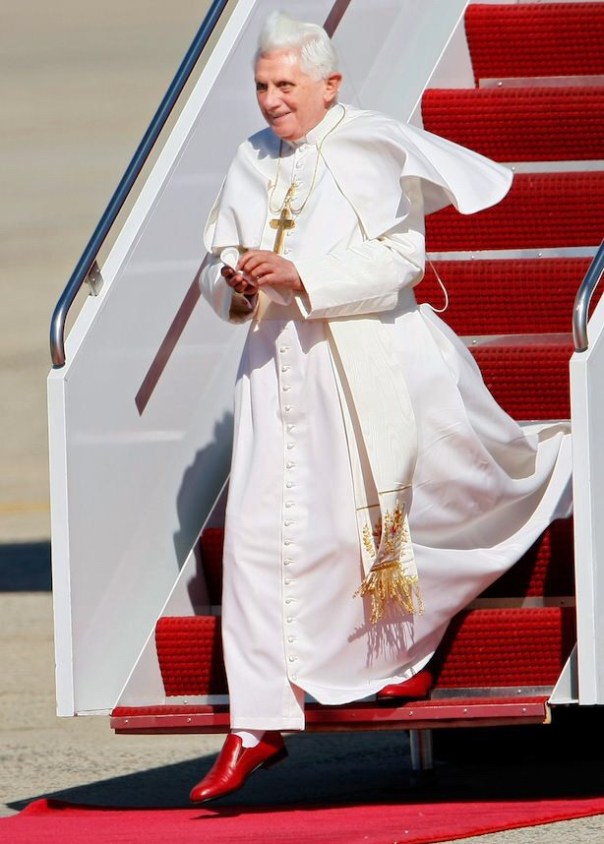
Say what you will about Pope Benedict XVI, but the man knows his loafers: hand-made, size 42 (8.5, American), and a bright cardinal red, which adds serious panache to a guy who otherwise < target=”_blank”>resembles the emperor from Star Wars. The slippers became his signature look — so much so that we named him the accessorizer of the year in 2007. But now that he’s stepping down and becoming an “emeritus pope,” he’s sadly letting them go.

As most personal papal possessions do — like Benedict’s Serengeti sunglasses, iPod Nano, and a leather-upholstered golf cart (and bulletproof popemobile) — the red shoes came as a gift. When the Pope first donned the shoes, rumors spread that they were Prada, but that turned out not to be the case. In 2005, Adriano Stefanelli, a Roman with a three-generation shoemaking lineage, hand-delivered a pair to Benedict in St. Peter’s Square. Stefanelli, who quickly became Benedict’s cobbler, had given a different style of shoe to John Paul II in 2002, but, as he explains, Benedict chose a ruby red instead of John Paul’s oxblood shade. (Most pontiffs have had unique shoe style — often picking between a cross, golden insignia, or buckles, by way of adornment.)

But as he departs the Vatican, officials say Benedict wil keep the cassock, but leave the reds behind. Apparently he plans to slip into a pair obtained during a trip to Leon, Mexico. Artisanal, of course.

THE POPE DOESN’T WEAR PRADA: VATICAN NEWSPAPER

Pope Benedict wears his Saturno sun hat as he arrives to lead a weekly general audience at the Vatican June 25, 2008. REUTERS/Chris Helgren

ROME (Reuters) – After years of speculation that Pope Benedict wears shoes by Prada, the Vatican’s official newspaper denied such talk as “frivolous”.

Esquire magazine last year named the 81-year-old pontiff “accessorizer of the year” for his red leather loafers that fashionistas had said were probably made by the Italian fashion house.

While the Vatican had never confirmed or denied if the shoes were Prada, continued chatter about the pope’s dress sense led the Vatican daily Osservatore Romano to print a condemnation of media stories it said trivialized the head of the church.

Esquire’s inclusion of the pope on its best-dressed men list was, it said, “of a frivolity that is very characteristic of an era that tends to trivialize and does not understand”.

The article explained that the pope’s shoes, like his range of flamboyant hats, are nothing to do with vanity but all to do with tradition. “The pope, in summary, does not wear Prada, but Christ,” it said.

The article did not say who did make the shoes.

Benedict’s choice of garments has often been striking. On recent drives through St. Peter’s Square he shaded himself from the fierce June sun under a wide-rimmed bright red hat known as a “Saturn” after the planet with the rings.

Around Christmas 2005 he delighted pilgrims by appearing in a red velvet cap trimmed with white fur which, together with a scarlet cape, gave him the look of Santa Claus.

The Osservatore noted that both hats, far from being fashion items, are in fact traditional papal accessories that have been worn at various points in history by previous popes.

THE FABLE OF BENEDICT’S RED SHOES

In 1948 the British masters Powell and Pressburger made a film called The Red Shoes. Moira Shearer played a ballerina whose dream is to perform on stage. She gets her wish, playing in a new production wearing special shoes. They take her places she has never been and always wanted to go.

But she cannot take them off, and is trapped in an unending cycle of dance. Her one hope of escape from this growing nightmare is to take off the red shoes, but can she?

It is a modern fable, based on a story by Hans Christian Andersen. In the original a vain, spoilt girl tricks her adoptive mother into buying a pair of red shoes. She shows them off in church and other places, only to find that the shoes take over. They dance her everywhere. She is cursed by an angel and forced to wear them forever.

Even when her feet are amputated the shoes keep showing up and dancing before her eyes. Only after repeated efforts to seek forgiveness, to be humbled, is the girl finally forgiven.

The Red Shoes would, for obvious reasons, come to my mind during the last pontificate. It’s hard to trace the rumour that Benedict XVI’s shoes were designed by Prada. Perhaps it was just a mischievous allusion to The Devil Wears Prada, but nothing so vulgar! The Pope’s shoes were actually made by a local Vatican shoemaker out the back of Borgo Pio and one thing you had to say about them, they were not the shoes of a fisherman.

Whatever Benedict had in mind when he donned his gay apparel will go with him to the grave, but one reason seems to be a message that popes are unique. Because John Paul II wore brown Polish loafers, and no one paid much mind to his predecessors’ footwear, Benedict’s stepping out caused a sensation. Sydney went seismic.

Popes in previous centuries wore red shoes, hence Benedict’s harking back to an age of papal prestige. He would know that in Byzantium only three people were allowed to wear red shoes: the Emperor, the Empress, and the Pope. They are symbols of imperial power, in keeping with the opulent dress sense exhibited by monarchs. Even on a normal day, Queen Elizabeth II is still the best-dressed person in the room. Power treads the boards.

Benedict is a wily fox, which is why we can be sure his red shoes were there to invite symbolic interpretations. Only thing is, red shoes have a life of their own. They take the wearer where he would not go. He has always wanted total control, but it’s the red shoes that control him.

The only way this giddy madness can stop is by taking them off, which Benedict did on 11 February when he announced his resignation. The cardinals stared at one another in disbelief. They were living in a fable.

Benedict’s close theological friend Rowan Williams teaches a theology of letting go of control. ‘For the Spirit to be free in us, our expectations of possession and understanding and control need to go,’ he says. ‘Our expectations of being in charge have to go, and any experience whether grievous or joyful that begins to break our hold of control, any such experience is the beginning of an opening to the Holy Spirit.’

Letting go of control lets the Spirit in, and something new happens. This is what seems to be happening now that Benedict has taken off the red shoes. Almost anything could happen, and it won’t be easy for anyone.

Williams wears sensible black shoes. When Archbishop of Canterbury he rarely wore a purple shirt, but plain black, itself a break with tradition. To wear black was an example to others about not showing off. It was about sharing the humility of a servant and was of a piece with his reintroduction after 400 years of the practice of the Archbishop himself washing the feet of 12 others at Maundy Thursday services in Canterbury Cathedral.

At foot washing, participants remove socks, whether designer, off-the-rack, or holey, and shoes, black, red, whatever. The iridescent vanities of their life no longer dance before their eyes in perpetual torment; they have been put aside. Each person is on the same level as everybody else. They have let go of control. What now?

VATICAN TAILOR’S, COBBLERS TRY TO ADAPT TO FRANCIS’S “PAPAL ATHLEISURE”

(Credit: Claire Giangravè.)

ROME – An exclusive group of tailors and cobblers who cater to the Vatican are slowly adapting to Pope Francis’s penchant for simple and plain clothing, which has inspired a demand for more practical and comfortable frocks from clergy around the world.

The Argentinian pope’s call for a Church that is dynamic and “on the move” has translated into a preference for religious clothing reflecting that zeal, and is no longer constrained by heavy fabrics and embellishments.

“Maybe once we were a bit excessive, and now slowly…” said Raniero Mancinelli, who has been a tailor for the clergy and popes for decades, in an interview with Crux.

Popes through history have always been fashion trendsetters, since they exercise influence over a vast community and their choice of jewelry and clothing often says a lot about the mission and message of the pontificate.

The past three “foreign popes,” meaning not from Italy, took a unique approach to classic papal style, and, sharing an astute grasp of the media, have left us with iconic images that will last for the ages.

No one could rock a cape like Pope John Paul II, and pictures showing his red mantle billowing in the wind, or gently wrapped around children, have left a lasting impression on Christian and secular culture. Emeritus Pope Benedict XVI, a European, dusted off the classic papal staples and ushered them into the new millennium with his unique sense of style.

Francis’s preference for ‘papal athleisure,’ meanwhile, has already begun to leave its mark on history.

In 2013, the magazine Esquire, which focuses mostly on male fashion, named Pope Francis ‘The Best Dressed Man of the Year.’ The choice was obviously controversial, and the magazine explained it by saying that the pope’s style has “signaled a new era (and for many, renewed hope) for the Catholic Church.”

Adapting to Pope Francis’s style

In a small shop on the Borgo Pio, a picturesque street next door to the Vatican, Raniero Mancinelli slices away at fabric on the counter, scarlet and black scraps falling to the ground with every cut of his scissors.

Over his head, etched in wood is his name and the date the shop was opened: 1962. Mancinelli has been in the business of dressing popes for a long time, and therefore has had a front-row seat to the changes that occurred in religious garb from the Second Vatican Council (1962-1965) to this day.

“It’s not as if before the clothes were more luxurious or pricey, maybe a bit more flashy and rich with details,” Mancinelli said. “Today this has changed a bit. Now with Pope Francis’s direction, people want things that are much lighter, simpler and more sober…. and consequently less expensive.”

As an example, the veteran tailor said that the cross usually worn by bishops and cardinals used to be adorned with gems and gold plating.

“Now these are more popular,” he said pointing to plain crosses made of metal and wood. A quick look at the tags shows a significant difference in price.

Asked if this pope is not very good for his business, Mancinelli laughed.

“Yes… a bit,” he said, because the demand has diminished and the clothes are less costly. “A double loss, in a sense.

“It’s not a question of agreeing. One accepts this manner he has of doing things in a simpler fashion,” Mancinelli said.

But the tailor is not saddened by the change, though he admits that, to him, religious clothing has become a little plain.

“Maybe too plain compared to how they were before,” he added.

Mancinelli started his business just as the Church underwent a profound revolution. He was there when Pope Paul VI eliminated the train that cardinals used to wear, which could be up to seven meters long.

He spoke of a time when “a crease could not be ignored,” while today anything is acceptable. Pope Francis’s torn-up sleeve as he returned from a visit to the beach town of Ostia, for instance, took over the Internet in 2013.

“His vestment is very simple, he has had it for a long time,” Mancinelli said, adding that white is a very sensitive color and, by being in close contact with so many people, is susceptible to being ruined.

“I don’t exclude the possibility that in the evening he just puts it to wash, and wears it again the next morning,” he sighed.

Pope Francis also chose to have a smaller sash that is not made of silk, and breaking with tradition he refused to have his emblem etched on it.

“He’s not picky,” Mancinelli said. “I wanted to make him a new pair of trousers. His are black, and I wanted to make lighter pants to wear under the cassock. ‘No,’ he said. ‘These are fine.’

“In everything, the pope has chosen simplicity,” he said. “Things that are not expensive.”

Mancinelli admits that having grown up in a different time, he has a preference for things that are well-fitted and precise, but he also recognizes that “if the pope decided to take this position, it means that there is a reason.

“Maybe now we can concentrate more on the will of God instead of men,” he added.

The two main things to keep in mind when working for the pope, he said, are discretion and adaptability.

“The first day can be a bit shocking,” Mancinelli said, since you have to get used to a different taste and aesthetic, but after a few days he says, “you learn the differences.”

Mancinelli had a good relationship with Pope Benedict XVI. He “used vestments that were a bit more beautiful, let’s say, in the sense that they were more beautiful to look at,” he said.

Now, clergy from around the world ask Mancinelli for Pope Francis-inspired cassocks, ready for the daily wear and tear. But this new style has its advantages when it comes to time consumption.

“Once we only used silk, today the fabrics are simpler. I am making clothes for some cardinals,” Mancinelli added pointing to the scarlet scraps that littered the floor. “The fabric is very simple, made of wool and light [material].”

Silk takes much more time to sow, and the simpler fabrics mean less time to make the clothes, he said.

Pope Francis “is more focused on being a good father, a good shepherd, rather than having a beautiful cassock or pants, or even shoes,” Mancinelli said. “I wish I could live many more years, so I can see what happens next!”

The Case Of The Red Shoes

Any Italian will tell you that one key to a good look is a fine pair of shoes. Footwear is not taken lightly in the Bel Paese, and a poor choice is guaranteed to provoke criticism and directions to some cousin who can fix you up.

Pope Benedict XVI knew the importance of a good pair of shoes, and his custom-made red slippers became a trademark of his style and even earned him the title of ‘Best Accessorizer of the Year’ by Esquire magazine in 2007.

Gossip ran wild with who might be the maker of the ruby-colored papal slippers, with some claiming that they were made by the Italian fashion powerhouse Prada. But in 2005 the rumors were finally put to rest when the a cobbler from a small town in northern Italy presented Pope Benedict XVI with the shoes for all the world to see during a general audience at St. Peter’s Square.

“Dressed in white with that red shoe… it really catches the eye!” Adriano Stefanelli, a cobbler and the creator of the famous slippers, told Crux in a phone interview.

“When it comes to clothes and such things he is a very, very elegant person,” Stefanelli said about the emeritus pope, adding proudly that “the peak of his splendor” took place when he first wore the red shoes.

Italian cobbler Adriano Stefanelli presents Pope Benedict XVI with his custom made red shoes at the Vatican. (Credit: Adriano Stefanelli.)

Stefanelli prepared six shoes in total for the German pope throughout his pontificate. He was commissioned by the Vatican for the first time in late 2013, but the high-ranking client was not satisfied with the order. Stefanelli had made the shoes in claret, the color preferred by the now-saint John Paul II, but the demand was clear: They had to be red.

“During his pontificate I received requests from all over the world for the same slipper, some wanted it red, others black,” Stefanelli said, citing among the buyers the former president of the United States, George Bush, for whom he made an identical pair in black.

The cobbler from Novara defines Pope Francis’s style as “rustic simplicity,” and places him as the “polar opposite of Pope Benedict” in terms of fashion.

“Pope Francis represents humility. Very plain clothing and a simple cross,” Stefanelli said.

“… He doesn’t wear the red shoes.”

Pope Francis opted for the services of his cobbler in Buenos Aires, Carlos Samaria, after he was elected. Speaking to the Italian daily La Stampa, Samaria said that the pope insisted that there be “no red shoes, black as always.”

And again, speaking to his niece Maria Ines, the pope said: “See that I am not wearing the red shoes?”

Stefanelli denies being hurt by the pope choosing not to wear his flamboyant slippers.

“Every man has his style,” he said.

He began his career as a papal cobbler by gifting a pair of shoes to Pope John Paul II, who preferred them to be dark brown and was so pleased with them that he became a regular client.

“Pope Wojtyla is kind of similar to Pope Francis. Maybe Pope Wojtyla was slightly more refined, while Pope Francis views clothing and style in a very humble way,” Stefanelli added.

When asked if he would be happy to make red shoes for Pope Francis, should he ask, Stefanelli said “Gladly. But I have my doubts.”

THE HIDDEN MEANING BEHIND SOME OF THE POPES CLOTHES
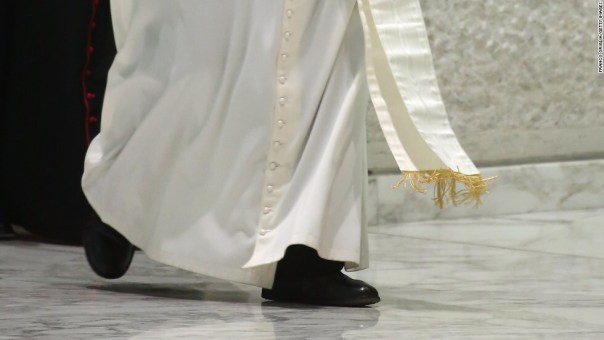
Here, Pope Francis wears a cassock. The cassock, also called a soutane, can be worn by all clerics, Beck said, but the papal one is white. According to Beck, legend has it that Pope Pius V was used to wearing a white religious habit and he wanted to keep the tradition going. “And so ever since,” Beck said, “it has remained white.”

The mantum is a long cape that popes sometimes wear as a sign of their authority, Beck said. It’s a vestment that fell out of use, but was revived by Benedict XVI, seen here. The mitre, Beck said, is a cone-like head dress worn by all bishops as a sign of their episcopacy. “Abbots can also wear it,” Beck said. “It is not unique to the pope, but it replaced the tiara on the Papal Coat of Arms with Benedict, and now Francis.”
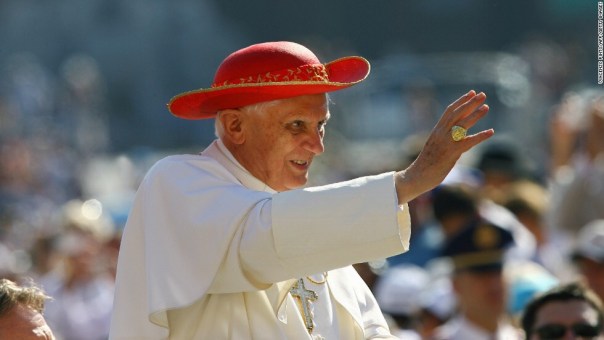
Pope Benedict XVI, seen here wearing a saturno, blesses the faithful in St. Peter’s Square at the Vatican, in 2006. The saturno is a wide-brimmed red hat that gets its name from its resemblance to the planet Saturn and its rings, Beck said. “It has been used as the summer alternative to the winter camauro, ” he said, but unlike the winter hat, it’s not not unique to the pope.

The zucchetto is a skullcap worn by clerics in the Roman Catholic Church and some other churches, Beck said. Priests wear black zucchettos and prelates wear violet or red, while white is reserved for the pope.

Rowan Williams, the archbishop of Canterbury, left, greets Pope Benedict XVI at his official residence, Lambeth Palace, in central London in September 2010. Here, Benedict XVI wears a mozzetta, a cape worn by the pope and some other religious leaders. “The winter one matches the camauro because it is also red velvet or wool and adorned with ermine,” Beck said. “This was also brought back by Benedict XVI after having fallen into disuse. There’s also a white summer version.”

Pope Benedict XVI is seen here wearing the pallium, a woolen cloak with five or six crosses. It’s worn only by the pope and archbishops as a sign of their unity to the pope, Beck said. “It is made from the wool of lambs raised by monks and woven by nuns. It is rich in symbolism, as the pope, who is shepherd, literally carries the ‘sheep’ on his shoulders, especially the lost ones,” Beck said.

Pope Benedict XVI wears a green chasuble in October, 2012. A chasuble is a liturgical vestment worn by all priests, including the pope, when saying mass, Beck said. There are a few liturgical seasons in the church, he said, each of which is associated with a color of chasuble. Green is the color worn most Sundays, known as “ordinary time,” essentially, not during Advent, Lent or Easter.
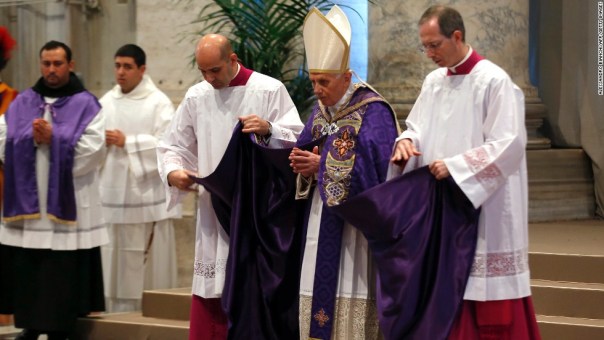
Pope Benedict XVI arrives to lead the mass for Ash Wednesday, on February 13, 2013. He wore this purple chasuble to open Lent, the 40-day period of abstinence and deprivation for the Christians, before the Holy Week and Easter. Purple is worn during the seasons of Advent and Lent.

The rose-colored chasuble is only used for two Sundays of the liturgical calendar, Beck said: Gaudete Sunday, which is the third Sunday of Advent, and Laetare Sunday, the fourth Sunday of Lent. “During both seasons,” Beck said, “the color diverges from the traditional purple as a sign that both seasons are nearing and end and rejoicing is close at hand.”

It may be hard to tell at first glance, but not all popes dress exactly alike: there are different articles of clothing for different traditions and seasons. And sometimes a pope will inject their own personal style. Pope Francis, for example, prefers a simple iron cross and plain black shoes that are notably more understated than the red pair favored by his predecessor. We spoke with Father Edward Beck, a CNN contributor and Roman Catholic priest of the Passionist order, to find out more about the pope’s wardrobe.

CLOTHES AND THE MAN: HOW POPES COMMUNICATE THROUGH CLOTHING

Satin capes. Leather shoes. Embroidered stoles. Ermine trim. Gold rings. What sounds like a list of extravagant accessories from a fashion magazine inspired much discussion during the recent papal transition. Naturally, news reports and expert analysis focused on the historic nature of Benedict XVI’s resignation and the election of a pope of firsts—first Jesuit, first Francis, first from the Americas. Woven into the media’s narratives, a parallel narrative unfolded as fabric, thread and robes provided a visual account of a church in transition. Even now, more than two months after Pope Francis’ election, the news media follows the pope’s every move to see what he will “say” next through his actions and appearance. Francis has already established himself as a pope of images and dress has proven to be an important part of his vocabulary.  

The richly symbolic garments of Catholic prelates have always been infused with meaning. They speak a language that is theological, historical and structural. A “vestimentary code”—everything from the ermine-trimmed mozetta of the pope to the simple brown habit of Franciscan friars—contributes to a sort of “Catholic dialect” of clothing that communicates within the church itself and to the world at large. Shortly after the election of Pope Francis, Matt Malone, S.J., wrote a piece for America placing the attention to clothing in the context of a “sacramental worldview,” where symbols, and particularly material symbols, matter. He also reminds us that proper Catholic sartorial protocol has been meticulously legislated.

Yet, transitional times often see the challenging and relaxing of past norms, and the establishment of new ones. Clothing participates in conversations about the past and the future. It is not just that clothing matters, but who wears what and when, stitching together a grammar of transition.

The unprecedented circumstances of Pope Benedict’s abdication required new definitions. Unlike the previous two popes who resigned, Benedict was neither coerced by a council nor locked up by his successor. Though he has vowed to remain hidden to the world, he will continue to occupy a position that has not been occupied before. The Vatican spokesperson, Federico Lombardi, S.J., was dogged with questions about new definitions: What would Benedict be called? Where would he live? And what would he wear? At a press conference two days before Benedict’s resignation, Lombardi announced that the pope emeritus would continue to wear the white cassock and skullcap, but without the sash and elbow-length cape known as a mozzetta. The media also made much of Benedict’s decision to put aside his famous red shoes for brown leather loafers made in Leon, Mexico.

For a church with a long history, including a history of rival claimants to the papacy, setting careful precedents was important. The dress of the pope emeritus establishes his identity and relationship to his previous office and to his successor. The white cassock recognizes the place Benedict held in the succession of St. Peter—reverting to the black cassock or the scarlet accessories of cardinals would have been a disrespectful demotion. The absence of the mozzetta carefully distinguishes him from Francis, and from others exercising episcopal authority. Benedict’s removal of the white sash, or fascia—reserved for the reigning pope—signals that he is no longer functioning as part of the church hierarchy. Putting aside red shoes reserves the privileged combination of white and red for the new pope.

Rome’s Tailor

Moving from the clothing of the former pope to those of the future pope, the media became fascinated with Gammarelli’s, the Roman tailor shop charged with making the ensemble for the new pope’s first appearance. A Roman tradition when it comes to papal elections, the display of the papal outfit in three sizes—ready for any size pope!—served almost as a pre-conclave chimney. When the cassocks disappeared from the window, it meant the conclave was ready to begin. The empty garments invited speculation in the days between their unveiling and their disappearance. Which one would be filled and by whom? All three would enter the Vatican, but, as with the cardinals themselves, only one would remain.

Speculation abounded about which cardinals were papabili, and the international media became fascinated by some of the American cardinals. Among these was Boston Archbishop Cardinal Sean O’Malley, a Franciscan, who for a period participated in daily press briefings. Appearing dressed in his brown Franciscan habit, O’Malley was asked if he would swap his current garb for the papal white. O’Malley laughed away the sartorial question, joking that he planned no wardrobe change because he did not expect to be elected. One wonders what the Capuchin would have done if elected. When appointed cardinal in 2006, he made it clear that he would continue to wear his habit, and he joked about the vibrant red he was expected to wear, a stark contrast to his usual earthy brown. The question posed to O’Malley about his choice of clothing, though tongue in cheek, revealed the kind of speculation that accompanied this transition. He was a non-traditional candidate with a shot—not Italian, not European, not even a native Romance language speaker. To many he represented an appealing “alternative pope” and his eschewing of the traditional papal wardrobe, or at least speculation about it, revealed the hopes of some that someone like him, a candidate elected from a religious order, would introduce a new kind of papal leadership. Though O’Malley himself didn’t “expect a change of wardrobe,” in hindsight we know that this kind of speculation was not without merit.

In some more unusual moments, unauthorized clothing was used by some to challenge or disrupt the election process. Photos of a man who posed as a bishop and nearly made his way into the early pre-conclave proceedings circulated on the internet. His clothing temporarily aided him, but ultimately betrayed him. Ralph Napierski (who also went by the name Basilius) claimed to be a legitimately ordained Catholic bishop in the line of the late Archbishop Pierre Martin Ngo Dinh Thuc and head of the otherwise unknown order “Corpus Dei.” (He also has a blog called “JesusYoga.org”). Dressed in a black cassock with a fedora, sash and pectoral cross, Napierski was able to pass through Vatican security and even took pictures with some of the cardinals. But he was ejected when a close look at his clothing gave him away—his cassock was too short and his sash was actually just a scarf. In another incident, Italian police detained Janice Sevre-Duszynska who came to St. Peter’s Square dressed in a white alb and stole carrying a sign that read “Women priests are here.” Even the lack of clothing acted as a voice of protest when a group of topless women protested in the Piazza calling for women’s ordination.

Francis Speaks

From his first appearance, Pope Francis has communicated his vision of the Petrine ministry through a visual code of sartorial choices. When he first appeared on the balcony of St. Peter’s Basilica, what he was wearing—and in this case, what he was not wearing—spoke volumes before he even said his now famous “Buona sera!” That Francis chose not to wear the red mozzetta with white ermine trim and the gold embroidered papal stole—a tradition since at least the time of Pope Pius XI’s election in 1922 went unnoticed to most, but to those who understood the language of ecclesiastical garments, this was a shout. Moreover, instead of the gold pectoral cross, Francis emerged wearing the silver cross he had worn as bishop of Buenos Aires. He donned the stole for the papal blessing, then promptly removed it. Like his choice of the name of Francis, the new pope was sending several messages, not all of them immediately clear.

Even St. Francis spoke volumes through clothing. In his youth, he shocked his family and his bishop by stripping naked before them, casting aside his extravagant clothing in a public act of self-dedication to a life of poverty. Pope Francis’ act might be seen in a similar light, as a kind of Franciscan disrobing. Yet there is an ambiguity in the language of dress. Some understood the pope’s choices as indicative of the simplicity and austerity of his namesake, a vestimentary expression of a church that he proclaimed would embrace the poor. Others, however, have seen it as an assault on pre-Vatican II tradition and a renunciation of the efforts of Benedict XVI to advocate a hermeneutic of continuity for understanding the council. Benedict masterfully employed a vestimentary language in service of this vision, reintroducing luxurious papal vestments that had fallen out of use as an expression of the majesty and honor of the Supreme Pontiff. Even in the days following Francis’ election, we learned more about his wardrobe choices. No red shoes, no ornate liturgical vestments and simple mitres. A comparison of Francis’ and Benedict’s vesture at the 2013 and 2012 Easter Urbi et Orbi addresses accentuates the differences.

As a scholar of early Christianity, what brought my attention to all this recent talk about clothing is a current project of mine on the representation of clothing in early Christian literature and art. One piece of clothing in particular, the philosopher’s robe, sparked debate in the early church—was it appropriate apparel for the Christian? Some, like Justin Martyr and Tertullian, found it to be the perfect garment for the Christian sage, while others, like Pope Damasus, condemned it as the garb of the faithless. Meanwhile, images of Jesus and the apostles dressed in the robe decorated churches from west to east. This ancient debate over dress was expressed in words and images, typifying the doctrinal and cultural issues facing the young church. In the current period of transition and expectation, clothing still plays a significant role in the fabric of Catholic Christian life. From mere curiosity to ecclesial vision, papal garments in particular will continue to be observed and decoded for indications of how and where Pope Francis will lead the church.

POPE FRANCIS’ SIMPLE STYLE STATEMENT

The pope eschews many of the rich trappings of his predecessors.

Pope Francis’ personal style is as humble and simple as that of his predecessor, Benedict XVI, was traditional and rich.

Unlike his predecessors, the current pope prefers austere white cassocks to the red velvet “mozzetta,” a short hooded cape trimmed with ermine. Gone, too, are the traditional gold crosses — he wears the same iron model he has donned since his anointment as auxiliary bishop of Buenos Aires in 1992.

He also recycled a ring, known as the Ring of the Fisherman, which was not created specifically for him. According to media reports, the ring “was in the possession of Archbishop Macchi, Pope Paul VI’s personal secretary.” This is a historical departure since traditionally a new ring is cast for each pope. Pope Benedict XVI’s ring was made of gold while Francis’ is made of gold-plated silver.

Pope Benedict was also known to favor red shoes, often by Prada, but Pope Francis only wears sensible black leather shoes, understood to be made by a friend, Carlos Samaria, in Buenos Aires. His basic black watch with a white dial, reportedly a Swatch priced at around $56, has no particular functions. According to one report, when the strap broke, it took some convincing to buy a new one as Francis simply wanted to replace the strap. He agreed to the purchase only when he was assured that a new watch would not have cost more than the strap.

Similarly, Francis in September changed the lenses of his old simple frames, refusing to buy new ones. His visit to the optician in Central Rome made the news, as he was photographed checking out the lenses in the tiny store owned by Alessandro Spiezia.

Francis’ tailor Lorenzo Gammarelli is also in Rome, a sixth generation of papal tailors, near the Pantheon. According to the Web site “Il Mio Papa [My Pope],” Francis “wears exactly the same outfits” throughout the year: Cassocks in heavier, warmer woolen cloth during the winter and lighter woolen fabrics during the summer. “He wants only natural white, not optical, which is obtained only with a dye. Natural wool is cream ivory,” according to the site. Reflecting Francis’ lack of attention to appearance, one photograph earlier this year created a stir as it showed a frayed sleeve. He also wears a simple white wool scarf with fringes and a white wool double-breasted coat, with peak lapels and eight buttons, of which four are decorative.

A further sign that he shuns excess is that his sash does not feature a coat of arms.

Under the sober cassock, Francis wears a shirt, a sweater and pants. In spring time, he wears the “pellegrina,” which is a short mantel open on the front, sewn on the robe, always white.

He shaves more than once a day — even three times — out of respect for those whom he embraces on his visits. His electric shaver is one of the few possessions he carries in his vintage leather briefcase when traveling — and even boarding planes, as seen in photographs circulating in the media. The briefcase is non-branded and has bellows pockets.

“It’s normal. We must be normal…It’s strange that this photo has traveled around the world. We must get used to being normal. It’s the normality of life,” Francis said of the sensation created by the image.

SWISS GUARD MAKE A FASHION STATEMENT WITH DEBUT OF NEW HELMETS
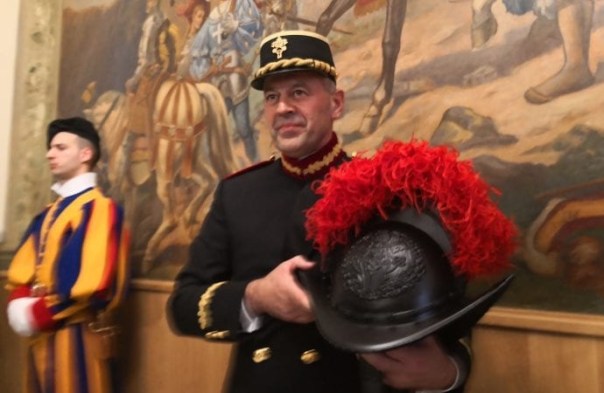
Commander Christoph Graf, of the Vatican’s Swiss Guards. (Credit: Inés San Martín.)

ROME – Just as New York readies to host the biggest night of the fashion world’s annual calendar tomorrow night at the Met Gala, this time with a Catholic theme, back in Rome the Swiss Guard made a fashion statement of its own on Friday.

Perhaps the world’s smallest army, and certainly one of its most celebrated, the Guard debuted an early look Friday at a much lighter version of their traditional cast iron helmets, which are being produced in PVC with the aid of 3D printing technology.

Designed mostly to resemble the old helmets, the new version nonetheless does sport another distinctive touch: The coat of arms of Pope Julius II, who instituted the army in 1506. They should be ready for use sometime in 2019.

Hence the stylish new helmets won’t be worn today for the Swiss Guard’s annual swearing-in ceremony, in which 33 new members will swear to “faithfully, loyally and honorably serve the supreme pontiff,” in a ceremony that, despite the absence of the pope, is usually one of Rome’s hottest tickets during the month of May.

It always takes place on the same day, May 6, on the anniversary of the sack of Rome in 1527. On that date, 147 soldiers died protecting Pope Clement VII.

The ceremony is one of pomp and circumstance. The entire army, close to 110 men on Sunday, will be in full dress uniform, accompanied in the Vatican’s St. Damaso Courtyard by religious personalities and political and military representatives of Switzerland, a country Francis will visit later this year.

The new helmets were presented on Friday in Rome during a press event ahead of Sunday’s ceremony.

The new helmet of the Swiss Guards, the pope’s personal army. Made of PVC, they’re made using 3D printing technology. (Credit: Inés San Martín.)

According to Commander Christoph Graf, the helmets have been purchased through what might be considered an informal crowdfunding campaign, led by layman Peter Portmann, introduced on Friday as a “friend of the Swiss Guards.”

The new helmets come at a price of roughly $1,000, half of what the older ones cost.

Portmann was the man behind the idea of printing this mostly ceremonial element of the uniform, as it’s been some time since a Swiss Guard actually wore one into battle. Together with his friends, he’s paying for the production.

Among the many benefits of the new helmets, which will be used when the pope welcomes a head of state, or an ambassador presenting their credential letters, is the fact that it weighs far less than those cast in iron, which guard members say would overheat during Rome’s summer days and sometimes burn their heads.

Who are the Swiss Guards?

The contingent of highly trained guards was born of an alliance between the Swiss and the Holy Roman empire, and they’ve been protecting the pontiff for more than 500 years.

To be eligible for the job, which pays $1,800 a month courtesy of the pope, one has to be male, Catholic, single, a Swiss citizen, aged between 19 and 30, at least 5’8″, and willing to be a member of the guard for at least two years.

If you run into the Swiss Guards at the Vatican, either guarding the doors or during the pope’s public events in St. Peter’s Basilica and/or Square, don’t let their colored uniforms in shades of blue, red, orange and yellow reminiscent of the Renaissance fool you: All of them have received basic Swiss military training, and are prepared in unarmed combat and small arms.

When it comes to what Graf looks for in new recruits, he said a key thing is their ability to be a part of the group. Since the guards live and work together in very small quarters, being able to get along is central.

Hence, he said, “many forge friendships that last a lifetime.”

Graf said that also fundamental in the life of the guards is their faith, even if “because of the situation in Switzerland,” not all recruits are Mass-going Catholics.

“If we only accepted guards who go to Mass every Sunday, who receive the sacraments regularly, the army wouldn’t exist anymore,” he said.

Therefore, for him, evangelizing is part of his mission: “We need to give the young men the possibility of growing in their faith. I believe that with the closeness to the Holy Father, those who have an open heart are able to discover the faith.”

“It’s part of our job, as officials, to be witness, not to be afraid to talk about our faith, something that is no longer done in Switzerland,” Graf said.

Nicolas Albert, 19, is one of the new recruits who on Sunday will swear to give his life for the pope if necessary. He told Crux that ever since he was a child he “dreamed” of becoming one of the guards with “a shiny armor.”

Eventually the dream was forgotten, but in his junior year of high school, a friend invited him to apply together, reviving that childhood passion. He joined the Swiss army and was eventually admitted to be one of the pope’s private soldiers.

“There’s also a spiritual motivation behind my joining the army, and that’s broadening my faith,” Albert s

Safety concerns, due to terrorism and the pope’s “Latin ways”

Asked about an increased security regarding the constant threats of terrorist attacks in Europe, Graf first said that he didn’t want to talk about it, because “I know what you [journalists] will write.”

However, he acknowledged it’s evident in the area surrounding the Vatican what the Italian government does to guarantee the safety of tourists and pilgrims. Though he didn’t specify, in recent years the presence of military vehicles along with large cement plant-pots blocking access to Via della Conciliazione, the famous avenue that leads to St. Peter’s Square have been obvious.

“We can say that the guards are more attentive,” he said. “I see that 10 or 15 years ago, the Swiss Guards were more at ease, but the situation has unfortunately changed in recent years.”

Despite their training, the men guarding the pope don’t have heavy artillery, tanks or planes.

“What we have is faith, hope and charity,” Graf said, listing the three theological virtues. “We cannot always speak of guns, but also about other ways to defeat war, such as faith and prayer.”

Asked about Pope Francis’s proclivity to go out of his way to greet as many pilgrims as he can wherever he goes, Graf said that at the beginning, they weren’t necessarily ready.

“We, who come from northern countries, found it to be something new. But when you think about it, it’s normal that he wants to hug a person,” he said. “After five years, we’ve gotten used to it.”

THE TRUTH BEHIND THE POPE’S RUBY RED SLIPPERS

If the clothes make the man, then the shoes make the Pope – and more specifically, his ruby red shoes. The scarlet slippers have been reincarnated for thousands of years for his Holiness, and each pair has a story to tell…

But before we delve into the Vatican’s shoe closet, we might note that the Pope usually has two kinds of red shoes: indoor “liturgical slippers” made of silk and gold brocade, and an outdoor, loafer-like pair that is often plain red.
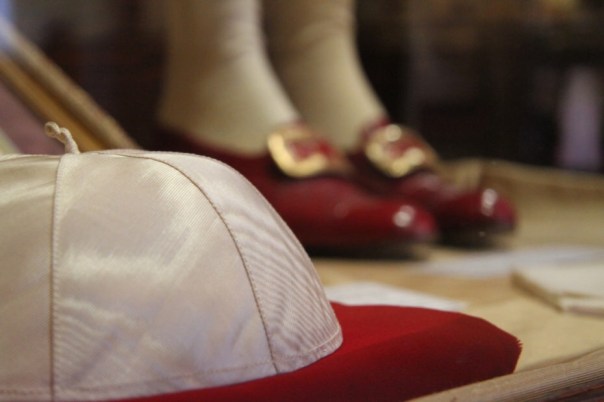
The shoes’ origins go back to Byzantine days, when they were donned by Norman kings as symbols of bloody martyrdom. Their successors, the Roman Emperors, stuck with it – in fact, they became a standard high-fashion accessory for aristocrats. If your shoes were red, you were a somebody.
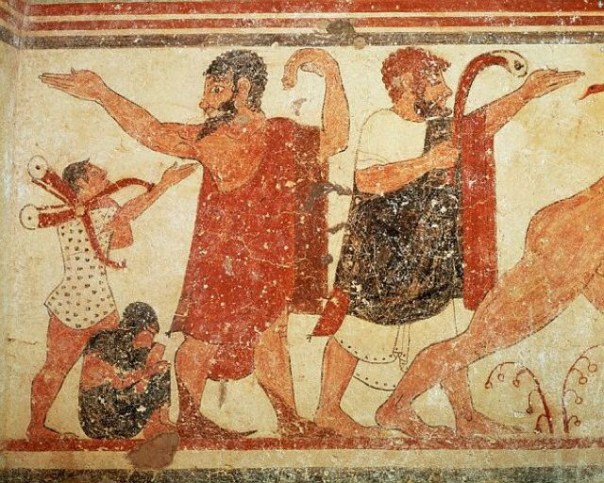
Now, historically speaking, Vatican life was pretty luxurious. Pope Martin IV spent a fortune to import his favourite delicacies of melon, and eels boiled in wine. Pope Leo X had a pet white elephant named “Hanno.” Extravagance was standard, and not even the Pope’s shoes escaped it. They became more and more ornate, and were even kissed by visitors just as one kisses the ring of the papa today…

Pope Pius X suffered from poor blood circulation, and was in a constant state of shaky health, so his sisters made him a pair of no-fuss, white slippers…

But he also had a red pair prioritising some seriously fluffy comfort.

The shoes also started their fare share of drama. In 1958, Pope John XXIII’s habit of adding golden buckles and crosses to the shoes was given the boot by his successor, Pope Paul VI, in 1969; he also did away with the papal foot kissing, and nixed the indoor slippers entirely. Although we’d sure like to hear him explain this lavish pair from his wardrobe:

As time went by, so did memories of more opulent shoes, with Pope John Paul II opting for a pair of more brownish loafers:
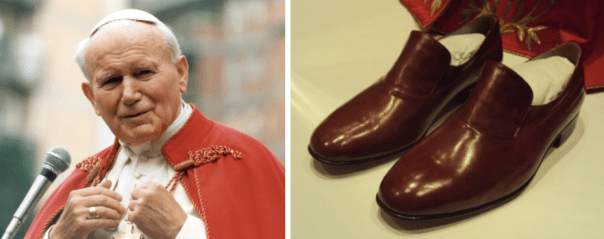
Fast-forward to 2005. Pope Benedict XVI comes on the scene with a pair of swanky, bright red slippers, and for many, their revitalisation is seen as an extension of his traditional, conservative positions within the church. Of all the popes, his may be the most fascinating relationship with the sacred slippers.

Rumour had it that his shoes were designer made, giving him the nickname “Pope Prada.” In 2007, Esquire went so far as to crown him “Accessorizer of the Year.” As it turns out, the shoes were made by Italian Adriano Stefanelli, whose other clients have included Barack Obama and Ferrari:

The media frenzy around the shoes was so nuts that a photo was (serendipitously) released of Stefanelli gifting the Pope his shoes in 2005:

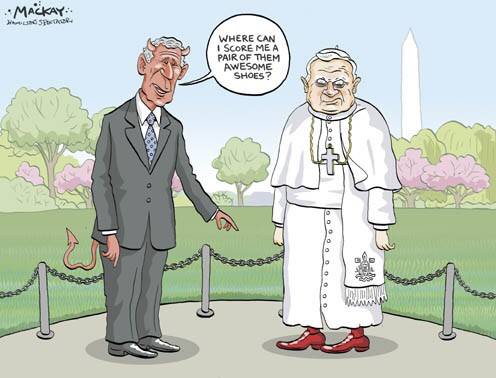
Then, the unthinkable happened. In 2013, Benedict resigned — with lighting even string the Vatican moments after his announcement.  “When Pope Benedict XVI left the Vatican and his papacy,” reported NPR, “he slipped out of his trademark red shoes and put on a pair of Mexican leather loafers. The shoes, actually three pairs, two burgundy and one brown, were a gift to the Pope during his trip last year to Mexico.” It was a symbolic departure from his habitual ways.

Today, we’re in the era of the less traditional Papa Francesco, who has gone back to basics with his sartorial tendencies. Instead of getting a new ring cast (as is typical practice), he chose a hand-me-down. He rides buses, and gives TED Talks. Oh, and his papal shoes? Plain black.

If you’re keen on getting pair of loafers by Stefanelli, they usually start at about €400, and are available for anyone to buy at his little shop in Novara, Italy. Though chances are, they probably won’t come with gilded buckles.

P.S. Is anyone else now itching to watch that Jude Law HBO show, “The Young Pope“?

BENEDICT XVI, THE BEST DRESSED POPE

Pope Benedict XVI, sporting a fur-trimmed hat in the rich red color of a Santa hat, waves to pilgrims upon his arrival in St. Peter’s Square at the Vatican. The red hat with white fur trimming is known in Italian as the “camauro.”(Alessandra Tarantino / Associated Press)

I’m a Catholic, but I’ll admit it (or should I say “confess” it?): When Pope Benedict XVI announced his pending resignation, my first thought wasn’t religious. It was in fact downright superficial. “There goes the best-dressed pontiff ever!”

During his nearly eight years on the throne of St. Peter, Benedict has always looked absolutely perfect, sartorially speaking, whether garbed in elaborate vestments for an Easter liturgy or clad in the simple but meticulously tailored white caped cassock (it’s called a “simar” in church lingo) that he wears on more ordinary occasions. He’s been the Duke of Windsor of popes.

My own fashion sense is nearly nonexistent, but that only makes me more appreciative of Benedict’s. Some highlights: Benedict saying Mass in 2008 at Washington’s Nationals Park stadium in a billowing scarlet satin chasuble (a priest’s outermost liturgical garment) trimmed with crimson velvet and delicate gold piping. Benedict greeting worshipers in Rome, his chasuble this time woven of emerald-green watered silk with a pattern of golden stars. Benedict on Oct. 21 canonizing Kateri Tekakwitha, the first Native American saint, while attired in a fanon, a gold-and-white striped shoulder covering, dating to the 8th century, that only popes may wear.

Benedict’s immediate predecessor, Pope John Paul II, was a saintly figure and a commanding intellectual presence, but he had little interest in clothes, tending to wear whatever was handed to him and shunning elaborate adornments. Pope Paul VI, who reigned from 1963 to 1978, started out dressing fancy, but he gradually simplified his attire, abandoning, for example, the papal tiara, the high triple crown that popes had worn since the early Middle Ages.

Benedict didn’t bring back the tiara, but he has revived many other traditional papal garments and accessories. For his public appearances he almost always wears the bright red shoes that popes have worn since Roman times (John Paul preferred brown or black footwear). Benedict also began wearing the mozzetta, a waist-length cape, and the camauro, a red velvet cap with a white fur border that reminded Americans of a Santa Claus hat. Neither of those items had been seen much on popes since the end of the Second Vatican Council in 1965.

Benedict’s sartorial revivals have offended many liberal Catholics, who argue that he has been trying to “turn back the clock,” as they often put it, on the churchly reforms of Vatican II. The cattiest critic was Hans Kung, the dissident German priest who had once been a colleague of Benedict, or Josef Ratzinger as he was then called, on the faculty of the University of Tubingen. In a 2008 op-ed article for the Italian newspaper La Stampa, Kung called Benedict’s style of dress “pompous” and compared him to Pope Leo X of the 16th century, notorious for selling indulgences and famously painted by Raphael in fur-trimmed mozzetta and camauro.

Others have used the phrases “over the top” and “major bling” to describe Benedict’s taste in vestments, deeming the pope a foppish aesthete. Still others, such as the gay blogger Andrew Sullivan, have speculated that Benedict is himself gay. Catholic conservatives counter that Benedict’s attire exemplifies a “hermeneutic of continuity,” a deliberate symbolic effort to link his 21st century papacy to centuries of Catholic tradition.

My own take on Benedict’s wardrobe is somewhat different. I don’t believe that aesthetics is mere window-dressing. In her 2005 book “The Substance of Style,” economics pundit Virginia Postrel wrote: “Aesthetics is the way we communicate through the senses…. Aesthetics shows rather than tells, delights rather than instructs. The effects are immediate, perceptual and emotional.” Plato argued that the beautiful, while not exactly the same as the good, is a kind of complement to the good that points to the good and shows off the good via sensory media.

That is what I believe is exactly Benedict’s aim. Over the last couple of decades, the Roman Catholic Church has been besmirched with ugliness, scarred by clerical sexual predation abetted by clueless and self-promoting bishops. Benedict has used beauty to demonstrate tangibly that the Catholic faith that he and the members of his church share is itself beautiful and indestructible, and that it shines through despite all human efforts to wreck it.

It is especially fitting for our time that the pope has chosen his own liturgical apparel as an aesthetic medium. In the world of what passes for sophisticated culture these days, beauty and art have become nearly unmoored from each other. Art is supposed to be transgressive, while beauty is judged merely ornamental. Paint a Madonna, and you’ve got calendar kitsch. Paint a Madonna, and add some elephant dung and pictures of female genitalia cut out from porn magazines, and you’ve got a work to be exhibited in an exclusive gallery. Only in the decorative and useful arts — jewelry, fabrics, home furnishings, clothing, the design of cars, machines, and even humble objects — are beauty and fine craftsmanship still the criteria by which we judge value.

Pope Benedict XVI has been the pope of aesthetics, the pope who plays Mozart on the piano for his own private entertainment and who can write theological books in such lucid, limpid prose that ordinary people can read them for pleasure. He has reminded a world that looks increasingly ugly and debased that there is such a thing as the beautiful — whether it’s embodied in a sonata or an altarpiece or an embroidered cope or the cut of a cassock — and that earthly beauty ultimately communicates a beauty that is beyond earthly things.

POPE FRANCIS SAYS IT’S “ABUSE” TO WEAR CRUCIFIX’S AS ACCESSORIES

Pope Francis has criticised those who wear crucifixes as fashion items, labelling it “abuse” in a recent speech.

Speaking at St Peter’s Square in the Vatican after a Sunday Angelus service, the 81-year-old said the religious symbol should be “contemplated and understood” rather than commercialised as a trendy accessory.

“The crucifix is not an ornamental object or a clothing accessory which is sometimes abused,” he said.

“The image of Jesus crucified reveals the mystery of the death of the Son as the supreme act of love, the source of life and salvation for humanity of all times.”

The Pope went on to explain how the cross should be perceived as more than just an aesthetic object, reminding listeners of its potent religious meaning by explaining what it means to him.

“How do I look at the crucifix?” he said, “like a work of art, to see if it’s beautiful or not beautiful?

“Or do I look inside, within the wounds of Jesus up to his heart?

“I look at the mystery of God annihilated to death, like a slave, like a criminal.

“Jesus wants to make it clear that his extreme affair – that is, the cross, death and resurrection – is an act of fruitfulness.

“His wounds have healed us – a fruitfulness that will bear fruit for many.”

Despite Pope Francis’ comments, the crucifix has been a popular sartorial staple for years, with the likes of Madonna, Jennifer Aniston and Naomi Campbell all sporting cross jewellery in the past, typically in the name of style rather than religion.
Madonna pictured wearing crucifix-inspired earrings (SWNS)

Controversies surrounding the growing trend came to a head in 2002, when Pope John Paul II was leader of the Catholic Church.

After noticing a rise in the crucifix’ sartorial popularity, the Vatican released a sternly-worded editorial via Fides, a charity organisation based in the Vatican, that denounced media personalities for wearing crosses as accessories, describing the trend as “the mania of the moment”.

However, just because Pope Francis disapproves of the crucifix being merchandised for sartorial gain does not mean that he’s opposed to self-expression via subversive trends.

Speaking to a group of young students in Rome on Monday, the Pope expressed his approval of tattoos, telling listeners: “Don’t be afraid of tattoos,” adding that Christians have been getting tattoos on their foreheads for centuries as markers of their allegiance to the faith.

“Of course, there can be exaggerations,” he added, “but a tattoo is a sign of belonging,” he said.

CARDINAL FASHION SHOW: THE DO’S AND DON’TS OF VATICAN WEAR THIS CONCLAVE SEASON (PHOTOS)

The Huffington Post casts a tongue-in-cheek observers eye over the 2013 conclave

The Good Book teaches us judge not, lest ye be judged. But we’re going to break that rule to pick apart the couture of 115 stylin’ high-ranking Catholic officials who’ve arrived in Rome to pick the next pope.

The 115 Roman Catholic cardinals filed into the Vatican Monday morning, readying themselves to judge the papabili — possible pontiffs — at the conclave opening tomorrow. We know they answer to a higher authority, but that didn’t stop HuffPost Weird News from filing into our New York offices to judge who’s hot and who’s not when it comes to holy attire.

Whose cassock had the best hem? Who wore the holiest hue of red? And who committed the Cardinal Sin of fashion?

DON’T

Cardinal Odilo Pedro Scherer, right, and compatriot Cardinal Geraldo Majella Agnelo wore matching outfits. They’re practically inseparable. That’s not a faux pas in itself — too bad they copied all the wrong fashions. Leave Alexander VIII’s fashion sense back in 1691, you guys.

DO

That’s the perfect sock for your cassock, Cardinal Bechara Boutros Rai. Comfortable and easy on the eyes yet it makes a bold statement at the same time.

DO

As you can see, Cardinal Gianfranco Ravasi is wearing the Jesus line of bling…
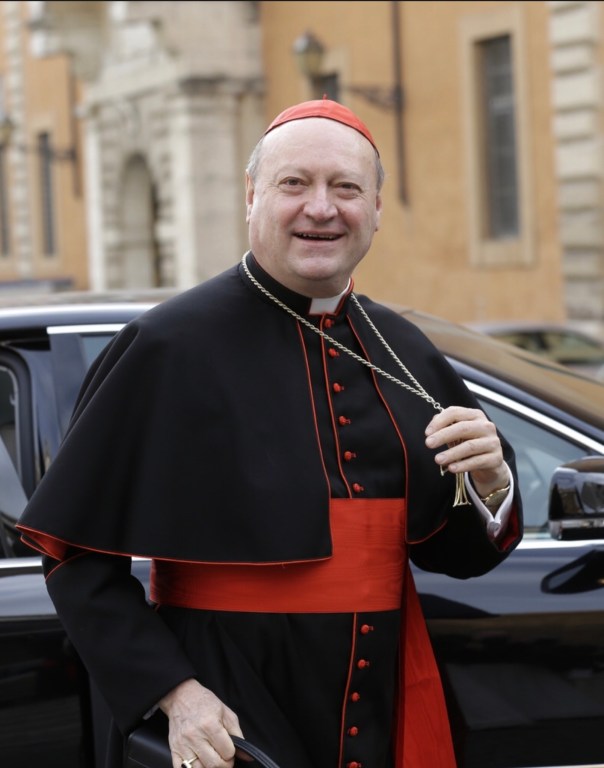
DO

… And he knows he’s lookin’ fly.
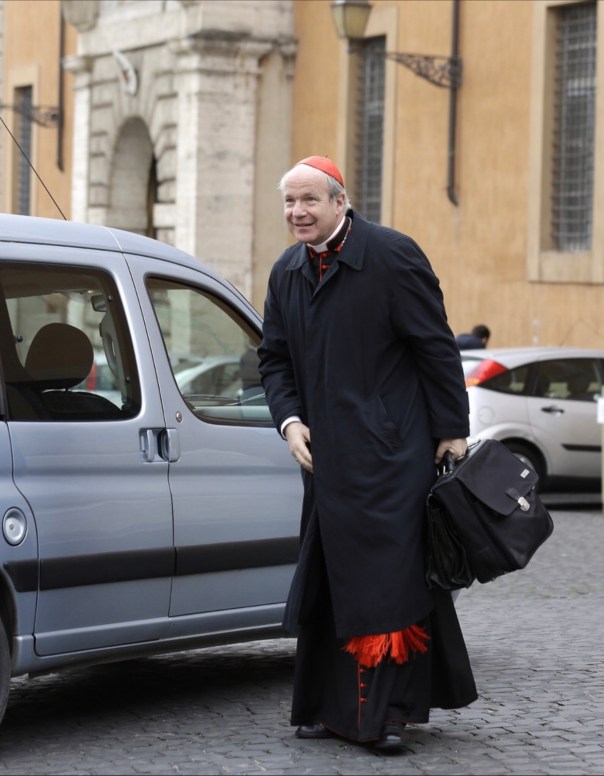
DON’T

We didn’t come all the way to the Vatican to fade away into obscurity. Rock that man-frock or bust, Cardinal Christoph Schoenborn.

DO

Ain’t nothin’ wrong with overindulging on the Blood of Christ before the pre-conclave party, Cardinal Marc Ouellet. Especially if you lookin’ good.
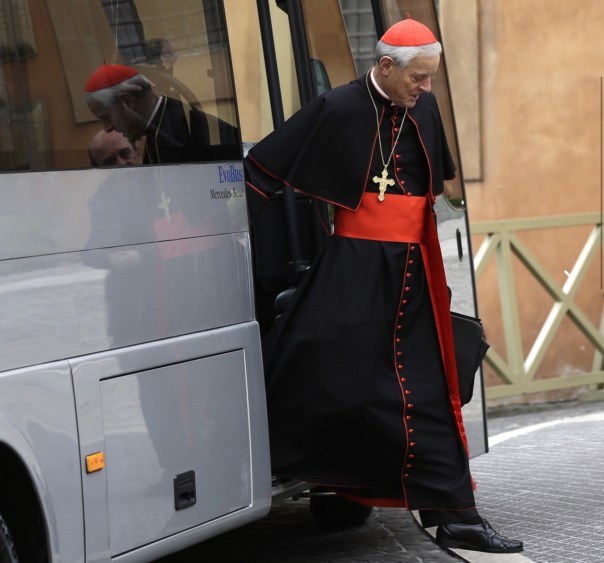
DO

Cardinal Donald Wuerl chose an interesting take on the classic cassock color scheme: black with a splash of red. Not too much, not too little. All class.
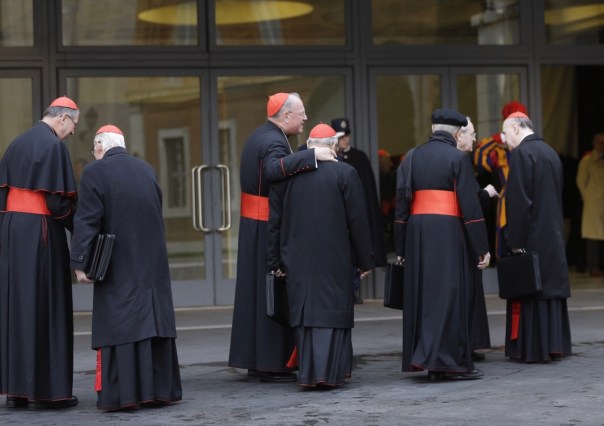
DON’T

Umm, guys… Let’s remember to coordinate next time, you’re all wearing the same thing. How embarrassing! Cardinal Sin, indeed.

DO

Cardinal Stanislaw Dziwisz’s new beanie is a power move, and is that an Alexander McQueen sash? We can’t tell.

DO

HAHAHAHAHAHA. Oh how we love you, Cardinal Reinhard Marx. You wouldn’t know the difference between a Balenciaga bag and a Gap purse, but we love you all the same. Just look at those dance moves!

DON’T

Ugh, the same cassock AGAIN, Cardinal Gianfranco Ravasi? But seriously, the dude in the back has swag. Yellow, blue and red pinstripes? Take note, Cardinal. Take note.
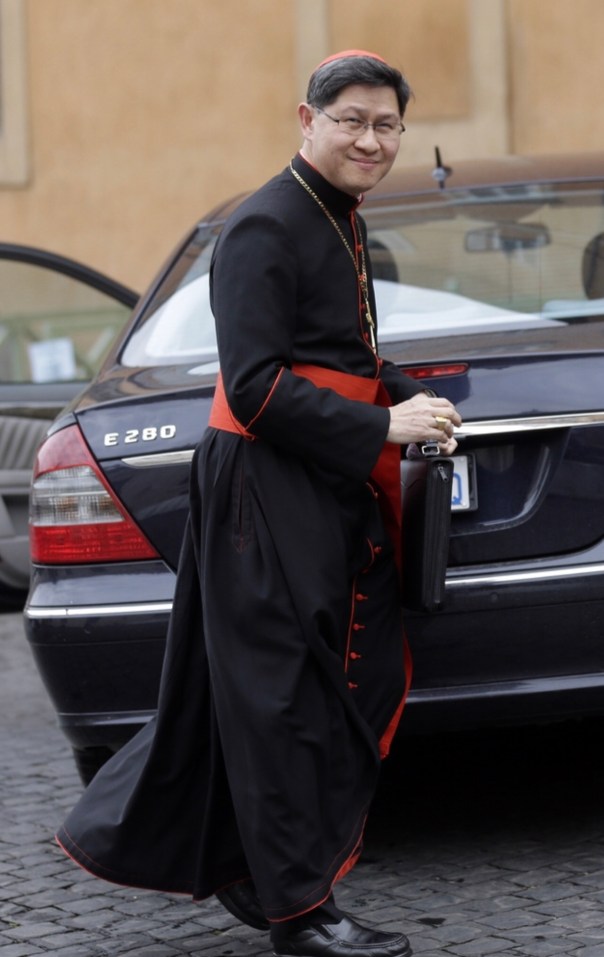
DO

Cardinal Luis Antonio Tagle knows how to be subtle with his cuts, but his colors? He’ll be standing out among the more conservative Cardinals.
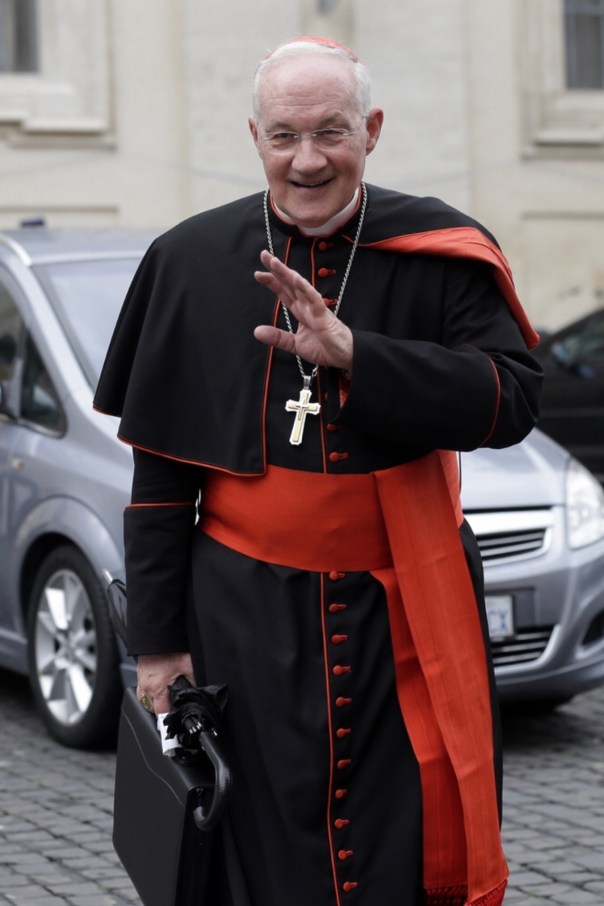
DON’T

We’re usually stunned by Cardinal Marc Ouellet’s getups. But this? We’re not even sure he ironed whatever THIS is.
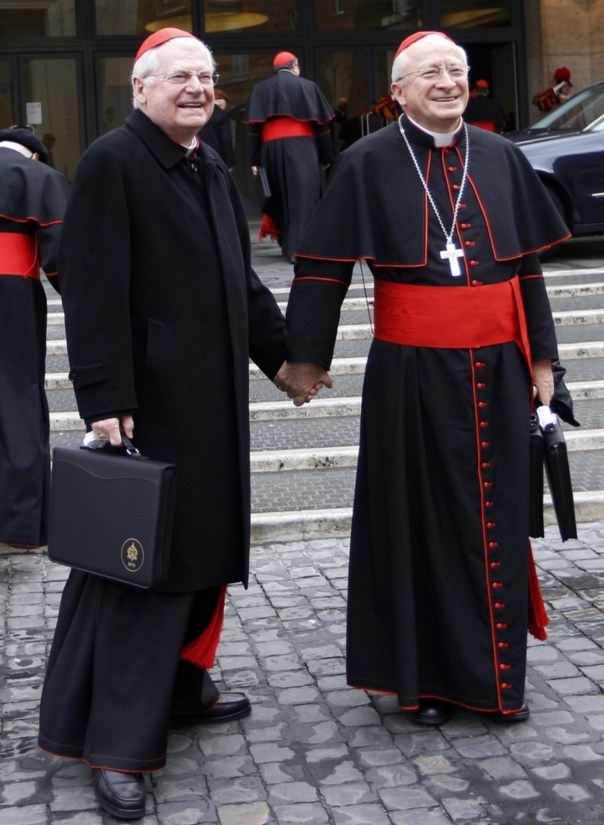
DO

Never to be outdone, Cardinals Angelo Scola, left, and Ennio Antonelli have always been fashion forward at shows. The shading in Antonelli’s tunic, the perfection in Scola’s briefcase accessorizing… It’s almost perfect.

DON’T

You can’t come to a fashion show, Cardinal Gianfranco Ravasi, and not expect to have some pictures taken. He was so reclusive this year.
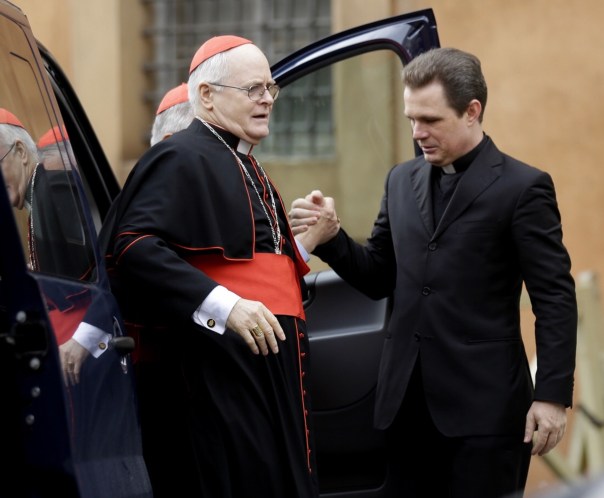
DON’T

The cape Cardinal Odilo Pedro Scherer chose clashes a little too much with his sash. And what have you done with your collar? Loosen ‘er up, the Pope isn’t here yet.

References and Sources

Gay History: The Vatican’s Secret Life…

We all know that gay men & women exist in all areas of the religious life, and in all denominations and faiths. It’s one of those blatantly hypocritical “Don’t ask, don’t tell” situations, so easily instigated by churches, institutions and governments to dispel the “myth” that any gay people could possibly work or minister there! My encounters at boarding school, with the St. John of God brothers, with Catholic clergy in general suggests to me that the high statistical prevalence of gays, quoted in this article, is correct. My thoughts are that, due to societal rejection of gay people, especially up to 1990s, many men and women entered the religious life – both clerical and monastic – as a way to avoid persecution. Of course, it doesn’t quite work that way. Having a religious “calling” is not going to stop your natural sexual urges…but nice try! This article by Michael Joseph Gross, and published in “Vanity Fair” on November 15, 2013 shows the difficult balance between sexuality and the religious life, and how it is viewed within the walls of Vatican City, and amongst the Catholic hierarchy.

Despite headlines about a powerful “gay lobby” within the Vatican, and a new Pope promising reform, the Catholic Church’s gay cardinals, monks, and other clergy inhabit a hidden netherworld. In Rome, the author learns how they navigate the dangerous paradox of their lives.

Naked but for the towel around his waist, a man of a certain age sat by himself, bent slightly forward as if praying, in a corner of the sauna at a gym in central Rome. I had not met this man before, but as I entered the sauna, I thought I recognized him from photographs. He looked like a priest with whom I’d corresponded after mutual friends put us in touch, a man I had wanted to consult about gay clerics in the Vatican Curia. My friends told me that this priest was gay, politically savvy, and well connected to the gay Church hierarchy in Rome.

But this couldn’t be that priest. He had told me that he’d be away and couldn’t meet. Yet as I looked at the man more closely, I saw that it was definitely him. When we were alone, I spoke his name, telling him mine. “I thought you were out of the country,” I said. “How lucky for me: you’re here!” Startled, the priest talked fast. Yes, his plans had changed, he said, but he was leaving again the next day and would return only after I was gone.

During the previous few days, I had heard a lot about this man. I had heard that he is a gossip, a social operator whose calendar is a blur of drinks and dinners with cardinals and archbishops, principessas and personal trainers. Supposedly, he loves to dish male colleagues with campy female nicknames. But I would never have the experience firsthand. The priest was embarrassed: to have been chanced upon at this place; to have had his small evasions revealed. The encounter was awkward. No, he did not wish to discuss the subject I was interested in. No, he did not think the subject worthwhile. These things he made clear. We left the sauna and, after further conversation, civil but stilted, went our separate ways.

I could understand his discomfort. But in Rome these days the topic of gay priests in the upper reaches of the Holy See is hard to avoid. In February of this year, not long before the College of Cardinals gathered in the Sistine Chapel for the conclave to choose the 266th Pope, the largest Italian daily newspaper, La Repubblica, reported that a “gay lobby”—a more or less unified cabal of homosexual power brokers—might be operating inside the Vatican. According to the newspaper, the possible existence of this gay lobby was among the many secrets described in a two-volume, 300-page report bound in red and presented to Pope Benedict XVI by three cardinals he had appointed to investigate the affair known as “VatiLeaks.” That scandal, which raised fresh suspicions of endemic corruption within the Curia, had broken the previous year after Paolo Gabriele, the papal butler, made off with some of Benedict’s private papers and leaked them to the press.

The internal VatiLeaks report, according to La Repubblica, indicated that gay clerics in the Vatican were being blackmailed. The report was also said to document the alleged gay lobby’s social structure and customs. Yet details concerning gay priests’ gatherings added up to old news: the tales had been told in articles previously published by La Repubblica itself. Sensationally, the newspaper suggested that Benedict’s concern about the alleged gay lobby was one reason he had suddenly resigned the papacy.

Months later, another leak of confidential information brought the subject of a gay lobby back into the news. Someone took notes during what was meant to be a private meeting between Latin-American Church leaders and the new Pope, the former cardinal Jorge Bergoglio, Archbishop of Buenos Aires, now known as Francis. In June, those notes were published on a progressive Catholic Web site. Francis was quoted as saying, “The ‘gay lobby’ is mentioned, and it is true, it is there … We need to see what we can do.”

A Closet with No Door

Gay lobby? It depends on what you mean. The term could refer to a shadowy group like the Illuminati, whose members quietly exercise supreme power. This is the sort of idea that lights up the tinfoil hats of conspiracy theorists, and it doesn’t capture the slow, feudal, inefficient workings of the Vatican. “Gay lobby” is really shorthand for something else. At the Vatican, a significant number of gay prelates and other gay clerics are in positions of great authority. They may not act as a collective but are aware of one another’s existence. And they inhabit a secretive netherworld, because homosexuality is officially condemned. Though the number of gay priests in general, and specifically among the Curia in Rome, is unknown, the proportion is much higher than in the general population. Between 20 and 60 percent of all Catholic priests are gay, according to one estimate cited by Donald B. Cozzens in his well-regarded The Changing Face of the Priesthood. For gay clerics at the Vatican, one fundamental condition of their power, and of their priesthood, is silence, at least in public, about who they really are.

Clerics inhabit this silence in a variety of ways. A few keep their sexuality entirely private and adhere to the vow of celibacy. Many others quietly let themselves be known as gay to a limited degree, to some colleagues, or to some laypeople, or both; sometimes they remain celibate and sometimes they do not. A third way, perhaps the least common but certainly the most visible, involves living a double life. Occasionally such clerics are unmasked, usually by stories in the Italian press. In 2010, for the better part of a month, one straight journalist pretended to be the boyfriend of a gay man who acted as a “honeypot” and entrapped actual gay priests in various sexual situations. (The cardinal vicar of Rome was given the task of investigating. The priests’ fates are unknown.)

There are at least a few gay cardinals, including one whose long-term partner is a well-known minister in a Protestant denomination. There is the notorious monsignor nicknamed “Jessica,” who likes to visit a pontifical university and pass out his business card to 25-year-old novices. (Among the monsignor’s pickup lines: “Do you want to see the bed of John XXIII?”) There’s the supposedly straight man who has a secret life as a gay prostitute in Rome and posts photographs online of the innermost corridors of the Vatican. Whether he received this privileged access from some friend or family member, or from a client, is impossible to say; to see a known rent boy in black leather on a private Vatican balcony does raise an eyebrow.

The Vatican holds secrets so tightly that it can make Fort Meade look like a sloppy drunk. Yet dozens of interviews with current and former gay priests, gay monks, veteran Vatican journalists, Italian aristocrats, and gay men at Roman gyms, bars, nightclubs, sex clubs, and restaurants suggest that, riveting as the more graphic stories are, they convey a limited part of the reality of gay clerical life in Rome. To be gay in the Vatican is no guarantee of success, mark of belonging, or shortcut to erotic intrigue. Most basically it is a sentence of isolation. Gays in the Vatican are creatures of a cutthroat bureaucracy whose dogmatic worldview denies or denigrates their own existence. They live in a closet that has no door. Among recent Popes, Benedict made the most concerted effort to sharpen Church doctrine on homosexuality, which he once called “a more or less strong tendency ordered toward an intrinsic moral evil.” He tried to cull gays from clerical ranks, most notably in 2005, when men with known “deep-seated homosexual tendencies” were prohibited from being ordained, even if they were celibate.

Denunciation and exposure have made gay priests figures of fascination—though less as people than as symbols—especially to the secular far left and the religious far right. Both sides find these clerics to be politically useful. The left uses them to level charges of hypocrisy. The right sees them as a stain in need of removal. They all got a shock late last July when Francis made his first direct public statement about gay clerics since becoming Pope.

During an impromptu press conference aboard the papal jet, en route from Rio de Janeiro to Rome after his first overseas trip, Francis was asked about the so-called gay lobby. His response, delivered with casual humor and punctuated by shrugs and smiles, was as follows: “So much has been written about the gay lobby. I still haven’t run into anyone in the Vatican who has shown me an identity card with ‘gay’ on it.” He pantomimed holding up such a card in his left hand and then went on: “When you find yourself with a person like that, you have to distinguish between the fact of a person being gay and the fact of somebody forming a lobby. . . . If a person is gay and is searching for the Lord and has goodwill, who am I to judge him?”

He spoke these words with a palpable warmth, unlike the embattled, wary tone that other Popes have adopted. This may well have been the first time in history that a Pope has publicly uttered the term “gay”—the word that most men who feel romantic love for other men use to describe themselves—instead of the pathologizing 19th-century medical term “homosexual.” Then, in a lengthy interview with a Jesuit journal, the Pope went further, stating that the Church’s ministry should not be “obsessed” with a few divisive moral issues such as abortion and gay marriage. “When God looks at a gay person, does he endorse the existence of this person with love, or reject and condemn this person?” the Pope asked rhetorically. “We must always consider the person.”

Every Man for Himself

Tales of gays in the Vatican have been told for more than a thousand years. Pope John XII, who reigned from 955 to 964, was accused of having sex with men and boys and turning the papal palace “into a whorehouse.” While trying to persuade a cobbler’s apprentice to have sex with him, Pope Boniface VIII, who reigned from 1294 to 1303, was said to have assured the boy that two men having sex was “no more a sin than rubbing your hands together.” After Paul II, who reigned from 1464 to 1471, died of a heart attack—while in flagrante delicto with a page, according to one rumor—he was succeeded by Sixtus IV, who kept a nephew as his lover (and made the nephew a cardinal at age 17). Some such stories are better substantiated than others. Even while their reliability is questionable, they demonstrate that playing the gay card (even if you yourself are gay) is an ancient Curial tactic. “There are closeted gay priests who are vipers,” observes the theologian Mark D. Jordan, the author of The Silence of Sodom: Homosexuality in Modern Catholicism. “They are really poisonous people, and they work out their own inner demonology by getting into positions in power and exercising it” against other gay men, women, and anyone whom they perceive to be a threat. “Alongside that are suffering priests who seem sincere all the way down, who are trying to be faithful to God, and also to take care of people and change the institution. They are the ones who are always forgotten, and read out of the story from both sides.”

The Catholic priesthood’s contemporary gay cultural memory begins in the middle of the last century. When Paul VI assumed the throne, in 1963, by one account he took his papal name not from any predecessor but from a former lover, a film actor. That at least was the contention of the provocative gay French writer Roger Peyrefitte, whose 1976 allegations about Paul VI caused such a stir that Paul took to the balcony of St. Peter’s to denounce the “horrible and slanderous” accusations. Paul looked a laughingstock, and the Curia learned a lesson: better to ignore such charges than to amplify them by denial.

Meanwhile, some gay clerics were outgrowing the “particular friendships” that had long been part of monastic life and joining the sexual revolution. By the 1970s, the center of gay life in Rome was a cruising area called Monte Caprino, on the Capitoline Hill. At a small party of gay monks and their friends in Rome last summer, conversation turned to recollections of that place. “It was like its own little city,” one monk remembered, “with hundreds of people—everyone from seminarians to bishops—and then there were, conveniently, bushes off to the side.” The fellow feeling at Monte Caprino was compromised by the air of secrecy around the place. The area was a target for muggers and thieves, who figured rightly that clerics would make ideal victims because they had much to lose by the public act of pressing charges. One gay former seminarian recalled a night when three men beat him up and stole his wallet while numerous men in the crowded park stood by. Left bloodied by the thieves, the seminarian hollered at the bystanders, “There’s three of them and 300 of us!”

He told me this story, with its echoes of the parable of the Good Samaritan—in which a traveler is robbed, beaten, and left by the side of the road, and pious men do nothing to help him—to illustrate the every-man-for-himself dynamic of Rome’s gay clerical culture. Gay clerics often fail to help one another, he says, for the same reason that no one tried to help him the night that he was robbed: solidarity entails the risk of being outed.

“La Maledetta”

Self-centeredness can breed a sense of entitlement. “A certain part of the clergy feels that no one will care what they do if they are discreet,” says Marco Politi, a prominent Italian journalist and longtime Vatican correspondent, and the author of several books about the papacy and the Church. In 2000, Politi published a book-length interview with an anonymous gay priest, entitled La Confessione, republished in 2006 as Io, Prete Gay (I, Gay Priest). “Rumors are O.K., but not scandal,” Politi observes.

There has been plenty of scandal, though. In 2007, Monsignor Tommaso Stenico met a young man in an online chat room and invited him to his Vatican office, where their conversation—in which Stenico denied that gay sex was a sin, touched the man’s leg, and said, “You’re so hot”—was secretly videotaped and then broadcast on Italian television. (Stenico tried to persuade Italian newspapers that he’d just been playing along in order “to study how priests are ensnared” into gay sex as part of “a diabolical plan by groups of Satanists.” He was suspended from his Vatican position.) In 2006 a priest in the Vatican’s Secretariat of State injured police officers and smashed into police cars during a high-speed chase through a district in Rome known for transsexuals and prostitutes. (The priest was acquitted on all charges after claiming that he fled because he feared he was being kidnapped.) In a 2010 investigation of contract fixing for construction projects, Italian police wiretaps happened to catch a papal usher and Gentleman of His Holiness, Angelo Balducci, allegedly hiring male prostitutes, some of whom may have been seminarians, through a Nigerian member of a Vatican choir. (The choir member was dismissed; Balducci was convicted on corruption charges.)

Pope Benedict was rumored to have ordered that prelates who were living double lives be retired or removed from Rome. Marco Politi speculates that perhaps as many as 30 were eased out. The most senior prelate to lose his job was Cardinal Keith O’Brien, the archbishop of St. Andrews and Edinburgh. A staunch opponent of gay marriage who had publicly called homosexuality a “moral degradation,” O’Brien was brought down in February by three priests and one ex-priest who accused him of “inappropriate contact” and predatory behavior when he was their bishop. The episodes recounted by the four men involved such consistent patterns over more than 30 years that some of O’Brien’s colleagues surely must have had their suspicions. When I asked one archbishop if he had known that O’Brien was gay, however, the archbishop said he had not. When I asked the archbishop who among the other cardinals were O’Brien’s closest friends, he coldly answered, “I don’t think he had any.” Every man for himself, indeed.

Even Benedict has been dogged by rumors that he is gay. Though no solid evidence has ever emerged, it is treated as common knowledge by many in Rome, who cite stereotypes galore, including his fussy fashion sense (his ruby-red slippers, his “Valentino red” capes); his crusade to nail down why “homosexual actions” are “intrinsically disordered” (many closeted gay men, from Roy Cohn to Cardinal O’Brien, have made the most extraordinary efforts to condemn homosexuality); and his bromance with Archbishop Georg Gänswein, his longtime personal secretary. (Nicknamed Bel Giorgio, or “Gorgeous George,” the rugged Gänswein skis, plays tennis, and pilots airplanes. He inspired Donatella Versace’s winter 2007 “clergyman collection.”) Perhaps the most vicious of Benedict’s nicknames is “La Maledetta.” The word means “cursed” in Italian, but the pun derives from the fact that the term means the exact opposite of Benedict’s own name in Italian, Benedetto, which means “blessed”—with a gender change achieved in the process.

Neither Benedict nor Gänswein has publicly responded to any of this. The chatter’s main consequence has been not to hurt them personally (though surely it must, at least a little) but to help lock down genuine conversation about the everyday lives of gay priests, whether celibate or not. It is more or less impossible for gay clerics to articulate their affections in any way that does not amount to what an Anglo-Saxon mind might see as hypocrisy. Yet such a dualistic existence is very much a part of Church tradition. “This is almost an aspect of the Catholic religion itself,” Colm Tóibín has written in an essay on gays and Catholicism, “this business of knowing and not knowing something all at the same time, keeping an illusion separate from the truth.” It is also typical of Italian sexuality in general, and Italian homosexuality in particular. This is the country that tolerated the sexual escapades and serial frauds of former prime minister Silvio Berlusconi with scarcely a hint of protest from the hierarchy of the Catholic Church. This is the country where countless married women ignore their husbands’ dalliances with men.

La Bella Figura

The culture of deception operates according to signals and conventions by which gay clerics navigate their lives. Camp is perhaps the most powerful and pervasive of these codes, though it can be difficult to define. Ironic, effeminate self-mockery—allowing priests to exercise some limited rebellion against their own isolation and invisibility—is one form of clerical camp. For fear of laughing out loud, priests sometimes try to avoid making eye contact with one another in church when hymns with titles like “Hail, Holy Queen” are sung. After Bergoglio became Pope Francis, YouTube clips of a sequence from Fellini’s Roma went viral among gay priests in Rome. It shows a plain-looking cardinal watching a runway show of over-the-top clerical attire—which ends when the departed Pope steals the show by appearing in the glorious garb of a Sun God.

One gay former priest, who still lives in Rome, describes clerical camp as “a natural way of expressing [gay identity] while celibate.” Socially, he says, it is “a key that unlocks a further element of trust.” There’s nothing earth-shattering about this—it’s what every institution does—but “the Church has a lot more experience and practice at protecting itself. As far as that goes,” he says, with a nod to Cole Porter, “they’re the tops.”

When this former priest began his education in Rome, a professor told him, “There shouldn’t be a subculture. We are all male here, so it’s inappropriate to say ‘her’ or to refer to other men with feminine pronouns.” The former priest says that “none of this instruction was about our behavior. It was about how we should appear.” He believes that such instruction illustrates a little-noted change in official thinking about Catholic identity, and what should be at its center. “The symbols of the Church should be the sacraments,” such as the Eucharist, he argues, but over time the people who administer the sacraments have come to displace them in prominence. In other words, “the priests become the symbols” that are deemed most important. Which in turn puts a premium on outward appearance and enforces conformity to a certain official ideal. The Church, therefore, is increasingly preoccupied with making sure its leaders are groomed from among “boys who look holy: playing dress-up at the American College and going down to Piazza Navona at nine P.M. to say their Breviaries.” Sacraments and liturgy, the former priest says, are “the kernel of what makes the Church important. This is what makes us powerful. Not the protection of medieval institutions.”

Yet in the Church, as in Italian society, it’s often the case that right appearance—la bella figura—is all. In every detail, parties celebrating appointment to the Vatican and other high Church offices can be lavish—“like a posh girl’s wedding”—with many clerics in attendance being “gay men wearing everything handmade, perfect, queer as it comes,” observes one prominent figure in the Roman art world. But la bella figura matters just as much at ordinary moments. Especially for clerics who break the vow of celibacy, it is crucial to keep up appearances in the normal course of life.

Gay saunas are good places to meet other gay priests and monks. The best times to find clerics at the saunas are late afternoon or evening on Thursdays (when pontifical universities have no classes) or Sundays (after Mass). Some gay celibate clerics use the saunas not for sex but to experience a sense of fellowship with others like themselves. One calls his sauna visits “something to confirm myself as I am.” (Rome has few gay bars, and John Moss, the American owner of the largest and oldest one, the Hangar, says that the rise of Internet cruising, combined with the Vatican’s crackdown on gay priests, has decimated his gay clerical clientele. “There used to be so many seminarians—such beautiful men—who came to the bar, and we would even get hired to take parties to them in some of the religious houses. Now there’s nobody.”)

Once you make a connection, it’s possible to use your monastery cell for sexual assignations, as long as you don’t make much noise. “You can sneak people in, no problem,” one gay monk says, “but try to avoid consistent patterns of movement.” In other words, don’t invite a guy over on the same day of the week, or at the same time of day, very often. That said, “no one has sex” with other residents of his own monastery, a former monk told me, “because it is like a Big Brother house. Everyone knows everything.”

The more senior the cleric, the more likely he may be to play loose with the rules. One leading Vatican reporter (who says that, among journalists on the beat, the two most common topics for gossip about Church officials are “who’s gay and who’s on the take”) describes the logic of such behavior. “Everything is permitted because you are a prince of the court,” he says. “If you are truly loyal and entrusted with the highest level of responsibility, there has to be an extra liberty attached in order to be able to pull it off.”

Vows of celibacy don’t say anything about eye candy. Some Curia officials are said to handpick extremely handsome men for menial jobs in order to make Vatican City more scenic. A layman I know whose job requires frequent trips to the Vatican used to enjoy flirting with a muscular go-go boy who danced on the bar at a gay nightclub in Rome. One day at the Vatican, this layman was amazed to see the dancer out of context, dressed in the uniform of a security guard. When he made to greet the man, the guard signaled him to stay back, raising a finger to his lips in a quiet “Shhhhh … ”

Where silence can’t strictly be kept, word games can compartmentalize the truth. In the Vatican office of a monsignor who I’d been told might have some firsthand knowledge concerning recent gay scandals in the Church, I asked, point-blank, “Are you gay?,” and he serenely answered, “No.” I replied, “I wonder, if a priest is homosexual—but does not participate in mainstream secular gay culture—could he say that he is not ‘gay’ and still think he’s telling the truth?” “What an interesting question,” the monsignor said, immediately standing up and gesturing me to the door. “I’m afraid I don’t have any more time to talk.” He insisted on personally walking me out of the building, and as we passed along a grand hallway I remarked upon its beauty. “I don’t see it,” he replied archly. “To me, other hallways are ‘beautiful.’ ” Was this an innocent remark, or a coded answer to my question? Sometimes talking to gay priests feels like reading stories by Borges.

For those who want it, organized networks can provide some grounding. A few small groups of gay Catholics in Rome operate publicly, but because anyone can come to their meetings, it can be risky for priests, especially Vatican officials, to be part of them. One private group of about 50 gay priests and laymen meets once a year, for a kind of retreat. A Vatican priest I met with—he actually invited me to stop by his office near St. Peter’s because he said he wanted “to show that this is no secret,” though it’s secret enough that he can’t be named—is involved with this group, as part of an unofficial ministry in addition to his official duties. He says that his superiors, including at least one very prominent Vatican official, have long known he is gay, and have even promoted him since learning that fact.

Yet gays in the Vatican, like spies in intelligence services, inhabit boxes within boxes. The priest who helps with the group of 50 raised his eyebrows when I repeated to him something an archbishop had told me. “I know a priest who ministers to people in the Curia in that situation,” the archbishop said, though “he is not assigned officially.”

“That is not me,” the priest said, amazed. “I wonder who it could be.”

Don’t Ask, Don’t Tell

As you would expect, the priest I met in the sauna looks rather different with vestments on. When I walked into church a few days later, for Sunday-morning Mass, he was the celebrant—even though, when we met, he had said he was about to leave town. Maybe his plans had changed again.

He was preaching a homily on the Gospel reading, the parable of the Good Samaritan. The priest told the congregation that this story was a challenge. A challenge to accept “risk in favor of compassion.” A challenge to “look more deeply at ‘Who is my neighbor?’ ” A challenge to be generous, unlike “the religious, spiritual person who did nothing to help.” Listening to these words, I could not help but wonder: where, in that parable, does this priest see himself?

From the day after the conclave ended—when Francis went back to his hotel and personally checked out, paid his bill, and picked up his suitcase—the new Pope has surprised people with his actions. During Holy Week, he went to a juvenile prison and washed the feet of inmates, including two girls and two Muslims. One morning, he reportedly made a sandwich for the Swiss Guard who had stood sentinel outside his room all night. He invited 200 homeless people for dinner in the Vatican gardens.

Francis has also said some things that, from a Pope’s mouth, seem extraordinary simply because they are so down to earth—like his choice to end one homily with the untraditional exhortation “Have a good lunch!” Yet the first time this Pope’s words, rather than his actions, made significant headlines was in connection with his comments about the “gay lobby.”

As noted, the phrase first gained currency before Francis came on the scene, but it returned to public discussion just as he got serious about what may be a hallmark of his papacy: a cleanup of Vatican corruption. The scope of his concern about abuse of power seems total. He is reforming everything from the Vatican bank’s bookkeeping to the contents of the papal wardrobe.

For a long time, gay priests have made for convenient scapegoats and handy pawns in Church power games. All of them, whether actively or passively, have helped create these roles for themselves, and they can hardly imagine a different reality—unless they were to emerge from the closet and get thrown out of the priesthood. One monk told me, “A lot of us will not condemn. But not speak out. We’re in a system that controls us. The longer you’re in it, the more it controls, the more you assume the clerical position.” They keep hope small, or snuff it entirely. They believe that nothing and no one could make the Church safe for them. Might this change? “Not in my lifetime,” they all say.

Yet, before he became Francis, Jorge Bergoglio was a Jesuit. As *National Catholic Reporter’*s John Allen, the dean of the American Vatican-watchers, told me, “There’s a kind of Catholic version of ‘Don’t ask, don’t tell’ that the Jesuits would be particularly noted for. There are guys in the Jesuit world that everybody knows are gay, but they don’t go around making a big deal out of it.” While Pope Benedict’s Vatican attempted to make sure gays knew they were unwelcome in the priesthood, the Jesuits developed a reputation for tolerating and even protecting their gay brethren.

In the collegial Jesuit spirit, Francis appointed eight cardinals to serve as his core advisers on significant issues, and in the coming years, this group may have as much influence on the situation of gays in the priesthood as Francis himself. When I asked an archbishop how he thinks the cardinals’ conversation about their gay brothers will go, he answered with reference not to the Holy Spirit but to the god of Fortune. “Right now the surest thing I can say is that there’s change in the air,” he said. “If you could say what will happen, you could say who’d win the lottery.”

The next time I heard mention of a lottery was a few days later, at dinner with a gay monk who told me that he had recently fallen in love for the first time, with a man. “Am I a clerical hypocrite? I guess in one way I am,” he said, in the middle of a long and emotional narrative, before bringing the conversation to bedrock reality. “But I’m over 60. I have nothing financially. I can’t leave.” And then he said, “If I won the Powerball lotto, I would leave.”

Note: An alteration was made in the passage about Marco Politi’s La Confessione, republished as Io, Prete Gay, in order to give a more accurate description of the book.

Reference

Gay History: Ronnie Kray – “The Queen Mother”.

When Ronnie Kray fancied you, you made yourself scarce says veteran entertainer Jess Conrad – Mirror Online

It is pretty hard not to have heard of the Kray twins, Reggie and Ronnie, especially after the film “Legend”. The two London gangsters robbed, bashed and murdered their way through the London underworld in the 60s, and owned and ran a string of nightclubs and protection rackets.

As boys in 1940s England, Ronald and Reginald Kray were wartime evacuees. They called Bethnal Green home, had a dog named Freda, an older brother named Charlie, and a sister who died as a baby.

No strangers to malfeasance, the two got started early, racking up a lengthy rap sheet before they could even order a pint. Violence, gang activity, and running from the law were all just after-school activities for the twins. They even knocked a police constable around and were briefly imprisoned in the Tower of London—two of the last inmates to be locked up in the infamous facility.

In the early 1950s, the Kray twins displayed a talent for boxing as young men. Reggie was a particularly potent force in the ring. Yet a life of crime kept calling them back. So a life of crime it was.

Glamorous as they were, trouble loomed in the shadows. Ronnie was diagnosed as a paranoid schizophrenic in 1959, a disorder that came to haunt him in the coming years. After helping a criminal associate named Frank “The Mad Axeman” Mitchell escape prison in December 1966, the brothers struggled to keep their newly freed friend under control and allegedly had him killed.

Ronnie had a thing for orgies mixed with politics, and carried on an affair with Tory peer Lord Boothby. And while Ronnie was known as “The Queen Mother” in London’s gay underworld, they both had alleged bisexual tendencies. Reggie married a woman named Frances Shea in 1965, though the tumultuous relationship allegedly involved Reggie’s attempted rape of his wife’s brother.

It is rumoured that both brothers had gay sex encounters, though Reggie has been labelled more as a bisexual than a gay male. In a Mirror (UK) article dated 31 August, 2015, Deputy Features Editor, Steve Myall, headlined an article claiming that the brothers had had secret gay sex with each other. The eye-opening revelation was made by author John Pearson, who interviewed them both. “Ronnie and Reggie Kray had a secret incestuous relationship with each other (as they were growing up) so criminal rivals would not discover they were gay”, he claimed. The cruel and violent East End pair were terrified of coming out (as gay). He further revealed “They were worried that rivals would see their sexuality as a sign of weakness so only had sex with each other in order to keep the secret”.

It has long been known that Ronnie was a homosexual and Reggie was bisexual but the news they had a sexual relationship with each other gives a telling insight into their close connection. John said the pair were spoilt by their mother Violet, Grandma Lee and their two aunties, May and Rose, while their father was soon dominated by the increasingly violent brothers.

Smart: Twin brothers and organised crime bosses Ronnie and Reggie Kray (Image: Getty)

He says while he knew about the incest he waited until the brothers were both dead before revealing it for fear of retribution. John wrote: “All of which conformed, of course, to a classic pattern; and with their warm, indulgent mother, their ineffectual father, and their surrounding cast of loving women, it was not surprising that, with adolescence, the Twins discovered that they were gay“. The brothers ran a notorious criminal network in the 1960s building up an empire of nightclubs though hijacking, armed robbery and arson. As they moved from the East End to the West End they became big names, rubbing shoulders with Frank Sinatra and Judy Garland and being photographed by David Bailey.

Brotherly love: Amateur boxers Reggie (left) and Ronnie Kray with their mother Violet Kray (Image: Getty)

But onto Ronnie.

Veteran entertainer Jess Conrad was a young man in London and in awe of the Kray twins and recalls the fear they instilled, the protection they offered to stars like Barbara Windsor and Diana Dors, and a very strange gig in Broadmoor Prison.

Ronnie Kray was a predatory homosexual who terrified young men in Soho in the 1960s so much that they hid when they knew he was coming. According to legendary singer and actor Jess Conrad, who knew the Kray twins well, good looking young men used to vanish for fear of catching Ronnie’s eye and being invited back to “a party”. He said: “You had to keep your wits about you if you were a young man and Ronnie really fancied you. Word used to go out that the Krays were on their way to a certain pub and all the good looking boys used to piss off. Because otherwise if he asked you to go back to the house you had to go back and that was it“.

It’s always been known Ronnie Kray was gay with a fondness for violence but Jess’ recollection is one of the few accounts of how he exerted power for sexual ends. Jess said many men, including himself, were in awe of the gangsters and the way they dressed and carried themselves and were attracted to them.

Sharp dressers: Ronnie and Reggie Kray in their heyday (Image: Mirrorpix)

In an interview with author John Pearson, Ronnie indicated he identified with the 19th century soldier Gordon of Khartoum (Lawrence of Arabia): “Gordon was like me, homosexual, and he met his death like a man. When it’s time for me to go, I hope I do the same.” A British television documentary, The Gangster and the Pervert Peer (2009), showed that Ronnie Kray was a rapist of men. The programme also detailed his relationship with Conservative peer Bob Boothby, as well as an ongoing Daily Mirror investigation into Lord Boothby’s dealings with the Kray brothers.

Ronnie Kray shocked his older brother Charlie by admitting his homosexuality and goaded his twin brother Reg into experimenting with gay sex, a new (2001) biography reveals.

Laurie O’Leary, author of A Man Among Men and a childhood friend of the Krays, says Ronnie summoned him to Broadmoor Hospital eight weeks before he died. Kray asked him to write the ‘warts-and-all’ story of his life. ‘Don’t make me into a nice person,’ he told O’Leary. ‘Just say I was nice with nice people, but a bastard with bastards.’

O’Leary, who grew up next door to the Kray brothers, was a pallbearer at Reggie Kray’s funeral on 11 October last year. ‘Ron discussed his homosexuality with only a very few people, but put simply it was a part of his nature he discovered, explored and enjoyed,’ O’Leary said. ‘He was at ease with it. It did not seem to conflict with his “tough guy” image or cause him any problems on any level.’

Ronnie Kray first admitted to O’Leary he was gay in his mid-teens, after falling in love with a younger boy called Willy. But when O’Leary told Willy, who ran an unofficial school for card sharps, of Kray’s attachment, he reacted badly.

‘He was terrified and said he would never dare go round to Ron’s house again unless I was there too,’ O’Leary said. ‘But I refused: Ron would have assumed [Willy and I] were having an affair.

‘I could easily understand Willy’s feelings, though_ [Ron] could be frightening.’

The members of the twins’ gang, known as the Firm, were overwhelmingly tolerant of Kray’s homosexuality. ‘Even if they objected, Ron just smiled at them and told them they didn’t know what they were missing,’ O’Leary said.

Kray’s mother, Violet, was comfortable with her son’s homosexuality, but his father and older brother, both called Charlie, were horrified.

‘Ron’s father thought it was degrading and disgusting, and his older brother was totally flabbergasted,’ O’Leary said. ‘But Ronnie told him that he had been like it for years and that not only could nobody change him but that he wouldn’t let them try. He said his brother Charlie just had to accept him as he was.’

Ronnie further shocked Charlie by telling him that Reggie was a bisexual. When Charlie confronted Reggie, according to O’Leary, the twin confirmed the claim, adding: ‘Don’t you think that boys are nice, Charlie? I think I could fancy a few myself.’

Despite this acknowledgment, Reggie habitually denied he was a bisexual. ‘I would say that Reg fought the fact he could also be bisexual more than Ron, but I knew of his affection for quite a few young male teenagers with whom he kept company,’ said O’Leary.

‘Ron would goad Reg when he went out with women and tried to influence Reg with his own appetite for young men.’

Although Ronnie Kray did have a number of regular sexual partners and strong friendships with other homosexual men – including Lord Boothby, for whom he obtained youths – O’Leary says he had a particular penchant for dark, clean-cut, boys with very white teeth.

During the Sixties, Ronnie fell in love with a young Arab boy on one of his many trips to Tangier in North Africa. ‘Ronnie showed me a photo,’ O’Leary said.

‘He told me that the boy loved him and showed me a letter the boy had written. It was a real love letter that said how much the boy wanted to come to England and live with Ronnie.’

Although Kray lost interest in the Arab boy, O’Leary says Ronnie was often very possessive of his boyfriends. ‘When he was sentenced, he still had many boyfriends and would do anything he could to make them happy,’ he said.

But perhaps Ronnie’s greatest claim to notoriety was his headline grabbing involvement with Tory peer, Lord Boothby.

According to BBC News, 23 October, 2015 “An association between Conservative peer Robert Boothby and London gangster Ronnie Kray was the subject of an MI5 investigation, documents have revealed. The men went to “homosexual parties” together and were “hunters” of young men, declassified MI5 files claim.

Allegations in 1964 about the pair’s relationship caused such concern within Downing Street that the then head of MI5 was summoned to the Home Office.

The government feared a scandal greater than the so-called Profumo Affair.

Rumours that notorious gangster Kray and Lord Boothby – a popular TV presenter and former MP for East Aberdeenshire – were having an affair were published in 1964.

The Sunday Mirror – which did not name the pair – claimed to have a photo of Kray and Boothby together with the bisexual peer’s chauffeur and lover, Leslie Holt.

The men were later identified in a German magazine.

Lord Boothby publicly denied having a homosexual or any other close relationship with Kray.

At the time, he said the photograph showed them discussing “business matters”, dismissing rumours about his personal life as a “tissue of atrocious lies”.

The Sunday Mirror ended up paying £40,000 in damages to Boothby.

But the papers – released as part of 400 declassified files by the Security Service (MI5), Foreign Office and Cabinet Office – reveal new information about their association.

They show how home secretary Henry Brooke was so concerned about the matter he summoned the head of MI5, Sir Roger Hollis, to ask what the security services knew.

Brooke feared the allegations might erupt into a scandal to rival the Profumo affair, which helped to bring down the Conservative government of Harold Macmillan.

Sir Roger told the home secretary how MI5 had received reports that Lord Boothby was bisexual and had contacts with the Krays.

But, since he had no access to official secrets, MI5 concluded that Boothby’s private life was of no concern, the papers reveal.

According to an MI5 source, Lord Boothby was in a relationship with Holt – his chauffer and ex-boxer who also went by the name Johnny Kidd.

Holt told the source how Lord Boothby and Kray had “been to a couple of (homosexual) parties together”.

The report suggested the Sunday Mirror was tipped off about the “affair” between Lord Boothby and Kray by the rival Nash gang.

The MI5 report said: “Certainly the suggestion that Boothby has been having an affair with the gangster Kray is hardly true.”

Dr Richard Dunley, records specialist at the National Archives, said the story was “one of the greatest scandals that never was”.

“If this had come out in 1964 it would have been a huge scandal,” he said.

Dr Dunley said the files do not mention well-known claims that Lord Boothby had a long-term relationship with former prime minister Harold Macmillian’s wife.

“As tabloid headlines go, you can imagine what would have happened,” he said.

“The Mirror did effectively get hold of the story but couldn’t publish it, they got sued for libel.”

Lord Boothby, left, with Ronnie Kray, centre, and Leslie Holt, the former’s chauffeur and lover ( )

Footnote:

9 Interesting facts about the Kay brothers.

1) In 1952 after refusing to do National Service the twins were jailed and became among the last prisoners held at the Tower of London, before being transferred to Shepton Mallet military prison in Somerset for a month, to await court-martial.

2) In 1960 the notorious slum landlord Peter Rachman gave Reggie a nightclub called Esmeralda’s Barn in Wilton Place where the Berkeley Hotel now stands.

3) In 1964 the Sunday Mirror reported Scotland Yard was investigating a homosexual relationship between an unnamed peer and a major figure in the criminal underworld – Ronnie and Conservative MP Robert Boothby. Despite the pair not being named Boothby chose to go public with a letter to The Times in which he denied being gay and stated that he had only ever met Kray three times, always to discuss business matters and always in the company of other people. Facing the threat of a libel defeat, the Sunday Mirror issued an apology to the peer and paid out £40,000, equivalent to £500,000 today while newspaper’s editor, Reg Payne, lost his job over the affair.

4) In 2000 when Reggie died those sending wreaths included Barbara Windsor, Who singer Roger Daltry and pop star Morrissey. There was also a wreath believed to be from the American Mafia – next to a photo of Manhattan was the message: “In deep respect, from your friends in New York.”

5) Jack “the Hat” McVitie, was a minor member of the Kray gang who had failed to fulfil a £1,500 contract paid to him in advance to kill a rival. As punishment McVitie was lured to a basement flat in Stoke Newington, on the pretence of a party. As he entered, Reggie Kray pointed a handgun at his head and pulled the trigger twice, but the gun failed to discharge. Instead Ronnie held McVitie in a bearhug and Reggie stabbed him to death with a carving knife – at one stage his liver came out and had to be flushed down the toilet.

6) In 1985, officials at Broadmoor Hospital discovered a business card of Ronnie’s, which prompted an investigation.It revealed the twins – incarcerated at separate institutions – plus their older brother Charlie Kray and an accomplice were operating a “lucrative bodyguard and ‘protection’ business for Hollywood stars” called Krayleigh Enterprises. Documentation of the investigation showed that Frank Sinatra hired 18 bodyguards from Krayleigh Enterprises during 1985.

7) In prison Reggie claimed to have become a born-again Christian while Ronnie got married in Broadmoor to a twice-divorced former topless kissogram girl.

8) Patsy Kensit’s dad James ‘Jimmy The Dip’ Kensit was not only a member of the notorious Richardson gang – who made most of their money from fraud and earned a terrifying reputation as ruthless torturers who nailed their victims to the floor – but was also a close friend of their rivals, Reggie and Ronnie Kray.

9) Artist Lucian Freud ran up half a million pounds in gambling debts with the Krays. The late artist confessed he once cancelled an exhibition out of fear they would demand more money if they saw he was earning.

Splash: Daily Mirror announces the pair GUILTY OF MURDER (Image: Daily Mirror)

References

  1. “Gangster twins Ronnie and Reggie Kray ‘had secret gay sex with EACH OTHER” Mirror.co.uk 31 August 2015 by Steve Myall. https://www.mirror.co.uk/news/real-life-stories/gangster-twins-ronnie-reggie-kray-6354591
  1. When Ronnie Kray fancied you, you made yourself scarce says veteran entertainer Jess Conrad, Mirror.co.uk. By John Myall 3 Sept 2015. https://www.mirror.co.uk/news/uk-news/ronnie-kray-fancied-you-you-6376849
  2. Krause Twins: The killer truth behind the killer legends. Huffington Post, 6th December 2016, by DeAnna James. https://www.huffingtonpost.com/the-lineup/kray-twins-the-killer-tru_b_8631552.html
  3. Katy’s death bed secrets revealed. The Guardian (UK). 25th March 2001, by Amelia Hill. https://www.theguardian.com/uk/2001/mar/25/ameliahill.theobserver
  4. BBC News, 23 October, 2015. https://www.bbc.com/news/uk-34612729
  5. 9 things you never knew about the notorious Kray twins. Mirror.co.uk. 31 August 2015, by Steve Myall. https://www.mirror.co.uk/news/uk-news/9-things-you-never-knew-6357210

The Potala Palace (Winter Palace); Norbulingka (Summer Palace); and Jokhang Temple Monastery, Lhasa, Tibet.

The saddest thing about the Potala is that it is devoid of its spiritual head, the Dalai Lama. There is something desolate about lines of tourists and pilgrims circumnavigating the massive, empty complex. One can only hope that, given time, His Holiness will return, and give life back to this icon.

Namaste.

POTALA PALACE

Potala Palace in simplified Chinese (top), traditional Chinese (middle) and Tibetan (bottom).

The Potala Palace (Tibetan: ཕོ་བྲང་པོ་ཏ་ལ་, Wylie: pho brang Potala) inLhasa,Tibet AutonomousRegion,China was the residence of theDalaiLama until the 14th Dalai Lama fled to India during the1959 Tibetan Uprising. It is now a museum and World Heritage Site

The palace is named afterMount , the mythical abode of the Bodhisattva Avalokiteśvara. The 5th Dalai Lama started its construction in 1645 after one of his spiritual advisers, Konchog Chophel (died 1646), pointed out that the site was ideal as a seat of government, situated as it is between Drepung and Sera monasteries and the old city of Lhasa. It may overlay the remains of an earlier fortress called the White or Red Palace on the site, built by Songtsen Gampon 637.

The building measures 400 metres east-west and 350 metres north-south, with sloping stone walls averaging 3 m. thick, and 5 m. (more than 16 ft) thick at the base, and with copper poured into the foundations to help proof it against earthquakes. Thirteen stories of buildings—containing over 1,000 rooms, 10,000 shrines and about 200,000 statues—soar 117 metres (384 ft) on top of Marpo Ri, the “Red Hill”, rising more than 300 m (about 1,000 ft) in total above the valley floor.

Tradition has it that the three main hills of Lhasa represent the “Three Protectors of Tibet”. Chokpon, just to the south of the Potala, is the soul-mountain (Wylie: bla ri) of Vajrapani , Pongwari that of Manjushri, and Marpori, the hill on which the Potala stands, represents Avalokiteśvara.

The walls of the Red Palace

The site on which the Potala Palace rises is built over a palace erected by Songtsen Gampo on the Red Hill. The Potala contains two chapels on its northwest corner that conserve parts of the original building. One is the Phakpa Lhakhang, the other the Chogyel Drupuk, a recessed cavern identified as Songtsen Gampo’s meditation cave. Lozang Gyatso, the Great Fifth Dalai Lama, started the construction of the modern Potala Palace in 1645. The external structure was built in 3 years, while the interior, together with its furnishings, took 45 years to complete. The Dalai Lama and his government moved into the Potrang Karpo (‘White Palace’) in 1649. Construction lasted until 1694, some twelve years after his death. The Potala was used as a winter palace by the Dalai Lama from that time. The Potrang Marpo (‘Red Palace’) was added between 1690 and 1694.

The new palace got its name from a hill on Cape Comorin (Kanyakumari) att the southern tip of India—a rocky point sacred to the bodhisattva of compassion, who is known as Avalokiteśvara, or Chenrezi. The Tibetans themselves rarely speak of the sacred place as the “Potala”, but rather as “Peak Potala” (Tse Potala), or most commonly as “the Peak”.

The palace was slightly damaged during the Tibetan uprising against the Chinese in 1959, when Chinese shells were launched into the palace’s windows. Before Chamdo Jampa Kalden was shot and taken prisoner by soldiers of the People’s Liberation Army, he witnessed “Chinese cannon shells began landing on Norbulingka past midnight on March 19th, 1959… The sky lit up as the Chinese shells hit the Chakpori Medical College and the Potala.” It also escaped damage during the Cultural Revolution in 1966 through the personal intervention of Zhou Enlai who was then the Premier of the People’s Republic of China. Tibetan activist Tsering Woeser claims that the palace, which harboured “over 100,000 volumes of scriptures and historical documents” and “many store rooms for housing precious objects, handicrafts, paintings, wall hangings, statues, and ancient armour”, “was almost robbed empty.”On the other hand, tibetologist Amy Heller writes that “the invaluable library and artistic treasures accumulated over the centuries in the Potala have been preserved.”

The Potala Palace was inscribed to the UNRSCO World Heritage List in 1994. In 2000 and 2001Jokhang Temple and Norbulingka were added to the list as extensions to the sites. Rapid modernisation has been a concern for UNESCO, however, which expressed concern over the building of modern structures immediately around the palace which threaten the palace’s unique atmosphere.[18] The Chinese government responded by enacting a rule barring the building of any structure taller than 21 metres in the area. UNESCO was also concerned over the materials used during the restoration of the palace, which commenced in 2002 at a cost of RMB180 million (US$22.5 million), although the palace’s director, Qiangba Gesang, has clarified that only traditional materials and craftsmanship were used. The palace has also received restoration works between 1989 and 1994, costing RMB55 million (US$6.875 million).

The number of visitors to the palace was restricted to 1,600 a day, with opening hours reduced to six hours daily to avoid over-crowding from 1 May 2003. The palace was receiving an average of 1,500 a day prior to the introduction of the quota, sometimes peaking to over 5,000 in one day.[19] Visits to the structure’s roof were banned after restoration efforts were completed in 2006 to avoid further structural damage.[20] Visitorship quotas were raised to 2,300 daily to accommodate a 30% increase in visitorship since the opening of the Quinsang railway into Lhasa on 1 July 2006, but the quota is often reached by midmorning . Opening hours were extended during the peak period in the months of July to September, where over 6,000 visitors would descend on the site.

The former quarters of the Dalai Lama. The figure in the throne represents Tenzin Gyatso,The incumbent Dalai Lama

Built at an altitude of 3,700 m (12,100 ft), on the side of Marpo Ri (‘Red Mountain’) in the center of Lhasa Valley,[23] the Potala Palace, with its vast inward-sloping walls broken only in the upper parts by straight rows of many windows, and its flat roofs at various levels, is not unlike a fortress in appearance. At the south base of the rock is a large space enclosed by walls and gates, with gold porticos on the inner side. A series of tolerably easy staircases, broken by intervals of gentle ascent, leads to the summit of the rock. The whole width of this is occupied by the palace.

The central part of this group of buildings rises in a vast quadrangular mass above its satellites to a great height, terminating in gilt canopies similar to those on the Jokhang. This central member of Potala is called the “red palace” from its crimson colour, which distinguishes it from the rest. It contains the principal halls and chapels and shrines of past Dalai Lamas. There is in these much rich decorative painting, with jewelled work, carving and other ornamentation.

The Chinese Putuo Zongchen Temple, UNESCO World Heritage Site, built between 1767 and 1771, was in part modeled after the Potala Palace. The palace was named by the American television show Good Morning America and newspaper USA Today as one of the “New Seven Wonders”.

The Leh Palace in Leh, Ladakh, India is also modelled after the Potala Palace.

The Lhasa Zhol Pillars

Lhasa Zhol Village has two stone pillars or rdo-rings, an interior stone pillar or doring nangma, which stands within the village fortification walls, and the exterior stone pillar or doring chima, which originally stood outside the South entrance to the village. Today the pillar stands neglected to the East of the Liberation Square, on the South side of Beijing Avenue.

The doring chima dates as far back as c. 764, “or only a little later”, and is inscribed with what may be the oldest known example of Tibetan writing.

The creation of the Tibetan script is traditionally attributed to Thonmi Sambhota who is said to have been sent to India early in the reign of Songsten Gampo where he devised an alphabet suitable for the Tibetan language by adapting elements of Indian scripts.

The pillar was erected during the reign of the early Tibetan emperor, Trisong Detsen (755 until 797 or 804 CE) in the village of Zhol (which has disappeared because of recent construction), which stood just before the Potala Palace. It was commissioned by the powerful minister Nganlam Takdra Lukhong, generally considered an opponent of Buddhism.

The inscription starts off by announcing that Nganlam Takdra Lukhong had been appointed Great Inner Minister and Great Yo-gal ‘chos-pa (a title difficult to translate). It goes on to say that Klu-khong brought to Trisong Detsen the facts of the murder of his father, Me Agtsom (704-754) by two of his Great Ministers, ‘Bal Ldong-tsab and LangMyes-zigs, and that they intended to harm him also. They were then condemned and Klu-kong was appointed Inner Minister of the Royal Council.

It then gives an account of his services to the king including campaigns against Tang China which culminated in the brief capture of the Chinese capital Chang’an (modern Xi’an) in 763 CE during which the Tibetans temporarily installed as Emperor a relative of Princess Jincheng Gongzhu (Kim-sheng Kong co), the Chinese wife of Trisong Detsen’s father, Me Agtsom.

It is a testament to the generally tolerant attitude of Tibetan culture that this proud memorial by a subject was allowed to stand after the re-establishment of Buddhism under Trisong Detsen and has survived until modern times.

The pillar contains dedications to a famous Tibetan general and gives an account of his services to the king including campaigns against China which culminated in the brief capture of the Chinese capital Chang’an (modern Xian) in 763 during which the Tibetans temporarily installed as Emperor a relative of Princess Jincheng Gongzhu (Kim-sheng Kong co), the Chinese wife of Trisong Detsen’s father, Me Agtsom.

Traditionally among the celebrations for Tibetan New Year, or Losar, a team of sportsmen, usually from Shigatse, would perform daredevil feats such as sliding down a rope from the top of the highest roof of the Potala, to the Zhol Pillar at the foot of the hill. However, the 13th Dalai Lama banned this performance because it was dangerous and sometimes even fatal.

As of 1993 the pillar was fenced off so it could not be approached closely (see accompanying photo).

Potala adorned with two Buddhist silk banners, Koku, (gos sku) for the Sertreng ceremony (tshogs mchod ser spreng) with the Shol Doring (pillar) is in the foreground in 1949

The Lhasa Zhol pillars in 1993.

NORBULINGKA

(Standard Tibetan: ནོར་བུ་གླིང་ཀ་; Wylie: Nor-bu-gling-ka; simplified Chinese: 罗布林卡; traditional Chinese: 羅布林卡; literally “The Jewelled Park”) is a palace and surrounding park in Lhasa, Tibet, China, built from 1755. It served as the traditional summer residence of the successive Dalai Lamas from the 1780s up until the 14th Dalai Lama’s exile in 1959. Part of the “Historic Ensemble of the Potala Palace”, Norbulingka is recognized as a UNESCO World Heritage Site, and was added as an extension of this Historic Ensemble in 2001. It was built by the 7th Dalai Lama and served both as administrative centre and religious centre. It is a unique representation of Tibetan palace architecture.

Norbulingka Palace is situated in the west side of Lhasa, a short distance to the southwest of Potala Palace. Norbulingka covers an area of around 36 hectares (89 acres) and considered to be the largest man made garden in Tibet.

Norbulingka park is considered the premier park of all such horticultural parks in similar ethnic settings in Tibet. During the summer and autumn months, the parks in Tibet, including the Norbulinga, become hubs of entertainment with dancing, singing, music and festivities. The park is where the annual Sho Dun or ‘Yoghurt Festival’ is held.

The Norbulingka palace has been mostly identified with the 13th and the 14th Dalai Lamas who commissioned most of the structures seen here now. During the invasion of Tibet in 1950, a number of buildings were damaged, but were rebuilt beginning in 2003, when the Chinese government initiated renovation works here to restore some of the damaged structures, and also the greenery, the flower gardens and the lakes.

In Tibetan, Norbulingka means “Treasure Garden.” or Treasure Park”. The word ‘Lingka’ is commonly used in Tibet to define all horticultural parks in Lhasa and other cities. When the Cultural Revolution began in 1966, Norbulingka was renamed People’s Park and opened to the public.

The palace, with 374 rooms, is located 3 kilometres (1.9 mi) west of the Potala Palace, which was the winter palace. It is in the western suburb of Lhasa City on the bank of the Kyichu River. When construction of the palace was started (during the 7th Dalai Lama’s period) in the 1740s, the site was a barren land, overgrown with weeds and scrub and infested with wild animals.

The park, situated at an elevation of 3,650 metres (11,980 ft) had flower gardens of roses, petunias, hollyhocks, marigolds, chrysanthemums and rows of herbs in pots and rare plants. Fruit trees including apple, peach and apricot were also reported (but the fruits did not ripen in Lhasa), and also poplar trees and bamboo. In its heyday, the Norbulingka grounds were also home to wildlife in the form of peacocks and brahminy ducks in the lakes. The park was so large and well-laid-out, that cycling around the area was even permitted to enjoy the beauty of the environment. The gardens are a favourite picnic spot, and provide a beautiful venue for theatre, dancing and festivals, particularly the Shodun or ‘Yoghurt Festival’, which is at the beginning of August, with families camping in the grounds for days, surrounded by colourful makeshift windbreaks of rugs and scarves and enjoying the height of summer weather.

There is also a zoo at Norbulingka, originally to house the animals which were given to the Dalai Lamas. Heinrich Harrer helped the 14th Dalai Lama build a small movie theatre there in the 1950s.

Norbulingka Palace of the Dalai Lamas was built about 100 years after the Potala Palace was built on the Parkori peak, over a 36 hectares (89 acres) land area. It was built a little away to the west of the Potala for the exclusive use by the Dalai Lama to stay in during the summer months. Tenzing Gyatso, the present 14th Dalai Lama, stayed here before he fled to India. The building of the palace and the park was undertaken by the 7th Dalai Lama from 1755. The Norbulingka Park and Summer Palace were completed in 1783 under Jampel Gyatso, the 8th Dalai Lama, on the outskirts of Lhasa. and became the summer residence during the reign of the Eighth Dalai Lama.

The earliest history of Norbulingka is traced originally to a spring at this location, which was used during the summer months by the 7th Dalai Lama to cure his health problems. Qing Dynasty permitted the Dalai Lama to build a palace at this location for his stay, as a resting pavilion. Since subsequent Dalai Lamas also used to stay here for their studies (before enthronement) and as a summer resort, Norbulingka came to be known as the Summer Palace of the Dalai LamaThe 8th Dalai Lama was responsible for many additions to the Norbulingka complex in the form of palaces and gardens.

However, it is sometimes reported that 6th 5(4@through to 12th Dalai Lamas died young and under mysterious circumstances, conjectured as having been poisoned. Most of the credit for the expansion of Norbulingka is given to the 13th and the 14th Dalai Lamas.

It was from the Norbulingka palace that the Dalai Lama escaped to India on 17 March 1959, under the strong belief that he would be captured by the Chinese. On this day, the Dalai Lama dressed like an ordinary Tibetan, and, carrying a rifle across his shoulder, left the Norbulinga palace and Tibet to seek asylum in India. As there was a dust storm blowing at that time, he was not recognized. According to Reuters, “The Dalai Lama and his officials, who had also escaped from the palace, rode out of the city on horses to join his family for the trek to India”. The Chinese discovered this “great escape” only two days later. The party journeyed through the Himalayas for two weeks, and finally crossed the Indian border where they received political asylum. Norbulingka was later surrounded by protesters and subject to an attack by the Chinese.

The summer residence of the Dalai Lama, located in the Norbulingka Park, is now a tourist attraction. The palace has a large collection of Italian chandeliers, Ajanta frescoes, Tibetan carpets, and many other artifacts. Murals of Buddha and the 5th Dalai Lama are seen in some rooms. The 14th Dalai Lama’s (who fled from Tibet and took asylum in India) meditation room, bedroom, conference room and bathroom are part of the display and are explained to tourists.

Built in the 18th century, the Norbulingka Palace and the garden within its precincts have undergone several additions over the years. The vast complex covers a garden area of 3.6 km2 including 3.4 km2 of lush green pasture land covered with forests. It is said to be the “highest garden” anywhere in the world and has earned the epithet “Plateau Oxygen Bar.”

The Norbulingka is the “world’s highest, largest and best-preserved ancient artificial horticultural garden”., which also blends gardening with architecture and sculpture arts from several Tibetan ethnic groups; 30,000 cultural relics of ancient Tibetan history are preserved here. The complex is demarcated under five distinct sections. A cluster of buildings to the left of the entrance gate is the Kelsang Phodang (The full name of this palace is “bskal bzang bde skyid pho brang”), named after the 7th Dalai Lama, Kelsang Gyatso (1708–1757). It is a three-storied palace with chambers for the worship of Buddha, bedrooms, reading rooms and shelters at the centre. The Khamsum Zilnon, a two-storied pavilion, is opposite the entry gate. The 8th Dalai Lama, Jamphel Gyatso (1758–1804) substantially enlarged the palace by adding three temples and the perimeter walls on the south east sector and the park also came to life with plantation of fruit trees and evergreens brought from various parts of Tibet. The garden was well developed with a large retinue of gardeners. To the northwest of Kelsang Phodrong is the Tsokyil Phodrong, which is a pavilion in the midst of a lake and the Chensil Phodrong. On the west side of Norbulingka is the Golden Phodron, built by a benefactor in 1922, and a cluster of buildings which were built during the 13th Dalai Lama’s time. The 13th Dalai Lama was responsible for architectural modifications, including the large red doors to the palace; he also improved the Chensel Lingkha garden to the northwest. To the north of Tsokyil Phodrong is the Takten Migyur Phodrong which was built in 1954 by 14th Dalai Lama and is the most elegant palace in the complex, a fusion of a temple and villa. The new summer palace, which faces south, was built with Central Government funds, and completed in 1956.

The earliest building is the Kelsang Palace built by the Seventh Dalai Lama which is “a beautiful example of Yellow Hat architecture. Dalai Lamas watched, from the first floor of this palace, the folk operas held opposite to the Khamsum Zilnon during the Shoton festival. Its fully restored throne room is also of interest.”

The Norbulingka ’s most dramatic area was the Lake Palace, built in the southwest area. In the centre of the lake, three islands were connected to the land by short bridges. A palace was built on each island. A horse stable and a row of four houses contained the gifts received by the Dalai Lamas from the Chinese emperors and other foreign dignitaries.

Construction of the ‘New Palace’ was begun in 1954 by the present Dalai Lama, and completed in 1956. It is a double-story structure with a Tibetan flat roof. It has an elaborate layout with a maze of rooms and halls. This modern complex contains chapels, gardens, fountains and pools. It is a modern Tibetan-style building embellished with ornamentation and facilities. In the first floor of this building, there are 301 paintings (frescoes) on Tibetan history, dated to the time when Dalai Lama and the Panchen Lama met Chairman Mao Zedong As of 1986, the palace had an antique Russian radio, and a Philips console still containing old 78 rpm records.

The entire Norbulingka complex was delimited by two sets of walls. The area encompassed by the inner wall, painted yellow, was exclusively for the use of the Dalai Lama and his attendants. Officials and the Dalai Lama’s royal family lived in the area between the inner yellow wall and the outer wall. A dress code was followed for visitors to enter the palace; those wearing Tibetan dress were allowed; guards posted at the gates controlled the entry, and ensured that no western hat-wearing people (which was made popular in Tibet during Lhamdo Dhondups time) were allowed inside. Wearing shoes inside the park was banned. Guards at the gate offered a formal arms salute to the nobles and high-ranking officials. Even the officials at the lower category also received a salute. The gates outside the yellow wall were heavily protected. Only the Dalai Lama and his guardians could pass through these gates. Tibetan mastiff dogs kept in niches of the compound walls, and tied with long yak hair leashes, were the guard dogs that patrolled the perimeter of the Norbulingka.

On the east gate to the Norbulingka there are two Snow Lion statues covered in khatas (thin white scarves offered as a mark of respect), the Snow Lion on the left is accompanied by a lion cub. The mythical Snow Lion is the symbol of Tibet; according to legend they jump from one snow peak to another. Most of the buildings are closed now; have become storehouses or used as offices for those who take care of the maintenance works. Some additional buildings seen now are souvenir kiosks catering to the visitors.

During the Cultural Revolution, the Norbulingka complex suffered extensive damage. However, in 2001, the Central Committee of the Chinese Government in its 4th Tibet Session resolved to restore the complex to its original glory. Grant funds to the extent of 67.4 million Yuan (US$8.14 million) were sanctioned in 2002 by the Central Government for restoration work; restoration work beginning in 2003 mainly covered the Kelsang Phodron Palace, the Kashak Cabinet offices and many other structures.

Norbulingka was declared a “National Important Cultural Relic Unit”, in 1988 by the State council. On 14 December 2001, UNESCO inscribed it as a World Heritage Site as part of the “Historic Ensemble of the Potala Palace”.The historic ensemble covers three monuments namely, the Potala Palace, winter palace of the Dalai Lama, the Jokhang Temple Monastery and the Norbulingka, the Dalai Lama’s former summer palace built in the 18th century considered a masterpiece of Tibetan art. The citation states: “preservation of vestiges of the traditional Tibetan architecture”. This is viewed in the context of extensive modern development that has taken place under Chinese suzerainty in Tibet. The Chinese State Tourism Administration has also categorized Norbulingka at a “Grade 4 A at the National Tourism (spot) level,” in 2001. It was also declared a public park in 1959.

Takten Migyur Potrang

Tyokyil Potrang

Norbulingka Shoton Festival

Beautiful Norbulingka Park

JOKHANG TEMPLE MONASTERY

Plan of the complex from Journey to Lhasa and Central Tibet by Sarat Chandra Das, 1902

The Jokhang (Tibetan: ཇོ་ཁང།, Chinese: 大昭寺), also known as the Qoikang Monastery, Jokang, Jokhang Temple, Jokhang Monastery and Zuglagkang (Tibetan: གཙུག་ལག་ཁང༌།, Wylie: gtsug-lag-khang, ZYPY: Zuglagkang or Tsuklakang), is a Buddhist temple in Barkhor Square in Lhasa, the capital city of Tibet. Tibetans, in general, consider this temple as the most sacred and important temple in Tibet. The temple is currently maintained by the Gelug school, but they accept worshipers from all sects of Buddhism. The temple’s architectural style is a mixture of Indian vihara design, Tibetan and Nepalese design.

The Jokhang was founded during the reign of King Songtsen Gampo. According to tradition, the temple was built for the king’s two brides: Princess Wencheng of the Chinese Tang dynasty and Princess Bhrikuti of Nepal. Both are said to have brought important Buddhist statues and images from China and Nepal to Tibet, which were housed here, as part of their dowries. The oldest part of the temple was built in 652. Over the next 900 years, the temple was enlarged several times with the last renovation done in 1610 by the Fifth Dalai Lama. Following the death of Gampo, the image in Ramcho Lake temple was moved to the Jokhang temple for security reasons. When King Tresang Detsen ruled from 755 to 797, the Buddha image of the Jokhang temple was hidden, as the king’s minister was hostile to the spread of Buddhism in Tibet. During the late ninth and early tenth centuries, the Jokhang and Ramoche temples were said to have been used as stables. In 1049 Atisha, a renowned teacher of Buddhism from Bengal taught in Jokhang.

Around the 14th century, the temple was associated with the Vajrasana in India. In the 18th century the Qianlong Emperor of the Qing dynasty, following the Gorkha-Tibetan war in 1792, did not allow the Nepalese to visit this temple and it became an exclusive place of worship for the Tibetans. During the Chinese development of Lhasa, the Barkhor Square in front of the temple was encroached. During the Cultural Revolution, Red Guards attacked the Jokhang temple in 1966 and for a decade there was no worship. Renovation of the Jokhang took place from 1972 to 1980. In 2000, the Jokhang became a UNESCO World Heritage Site as an extension of the Potala Palace (a World Heritage Site since 1994). Many Nepalese artists have worked on the temple’s design and construction.

The temple, considered the “spiritual heart of the city” and the most sacred in Tibet, is at the centre of an ancient network of Buddhist temples in Lhasa. It is the focal point of commercial activity in the city, with a maze of streets radiating from it. The Jokhang is 1,000 metres (3,300 ft) east of the Potala Palace. Barkhor, the market square in central Lhasa, has a walkway for pilgrims to walk around the temple (which takes about 20 minutes). Barkhor Square is marked by four stone sankang (incense burners), two of which are in front of the temple and two in the rear.

Jokhang Temple interior building

Rasa Thrulnag Tsuklakang (“House of Mysteries” or “House of Religious Science”) was the Jokhang’s ancient name. When King Songtsen built the temple his capital city was known as Rasa (“Goats”), since goats were used to move earth during its construction. After the king’s death, Rasa became known as Lhasa (Place of the Gods); the temple was called Jokhang—”Temple of the Lord”—derived from Jowo Shakyamuni Buddha, its primary image. The Jokhnag’s Chinese name is Dazhao; it is also known as Zuglagkang, Qoikang Monastery, Tsuglakhang and Tsuglhakhange.

Tibetans viewed their country as a living entity controlled by srin ma (pronounced “sinma”), a wild demoness who opposed the propagation of Buddhism in the country. To thwart her evil intentions, King Songtsen Gampo (the first king of a unified Tibet) developed a plan to build twelve temples across the country. The temples were built in three stages. In the first stage central Tibet was covered with four temples, known as the “four horns” (ru bzhi). Four more temples, (mtha’dul), were built in the outer areas in the second stage; the last four, the yang’dul, were built on the country’s frontiers. The Jokhang temple was finally built in the heart of the srin ma, ensuring her subjugation.

To forge ties with neighbouring Nepal, Songtsen Gampo sent envoys to King Amsuvarman seeking his daughter’s hand in marriage and the king accepted. His daughter, Bhrikuti, came to Tibet as the king’s Nepalese wife (tritsun; belsa in Tibetan). The image of Akshobhya Buddha, which she had brought as part of her dowry, was deified in a temple in the middle of a lake known as Ramoche.

Gampo, wishing to obtain a second wife from China, sent his ambassador to Emperor Taizong (627–650) of the Tang dynasty for one of his daughters. Taizong rejected the king’s proposal, considering Tibetans “barbarians”, and announced the marriage of one of his daughters to the king of Duyu, a Hun. This infuriated Gampo, who mounted attacks on tribal areas affiliated with the Tang dynasty and then attacked the Tang city of Songzhou. Telling the emperor that he would escalate his aggression unless the emperor agreed to his proposal, Gampo sent a conciliatory gift of a gold-studded “suit of armour” with another request for marriage. Taizong conceded, giving Princess Wencheng to the Tibetan king. When Wencheng went to Tibet in 640 as the Chinese wife of the king (known as Gyasa in Tibet), she brought an image of Sakyamuni Buddha as a young prince. The image was deified in a temple originally named Trulnang, which became the Jokhang. The temple became the holiest shrine in Tibet and the image, known as Jowo Rinpoche, has become the country’s most-revered idol.

The oldest part of the temple was built in 652 by Songtsen Gampo. To find a location for the temple, the king reportedly tossed his hat (a ring in another version) ahead of him with a promise to build a temple where the hat landed. It landed in a lake, where a white stupa (memorial monument) suddenly emerged over which the temple was built. In another version of the legend, Queen Bhrikuti founded the temple to install the statue she had brought and Queen Wencheng selected the site according to Chinese geomancy and feng shui. The lake was filled, leaving a small pond now visible as a well fed by the ancient lake, and a temple was built on the filled area. Over the next nine centuries, the temple was enlarged; its last renovation was carried out in 1610 by the Fifth Dalai Lama.

The temple’s design and construction are attributed to Nepalese craftsmen. After Songtsen Gampo’s death, Queen Wencheng reportedly moved the statue of Jowo from the Ramoche temple to the Jokhang temple to secure it from Chinese attack. The part of the temple known as the Chapel was the hiding place of the Jowo Sakyamuni.

During the reign of King Tresang Detsan from 755 to 797, Buddhists were persecuted because the king’s minister, Marshang Zongbagyi (a devotee of Bon), was hostile to Buddhism. During this time the image of Akshobya Buddha in the Jokhang temple was hidden underground, reportedly 200 people failed to locate it. The images in the Jokhang and Ramoche temples were moved to Jizong in Ngari, and the monks were persecuted and driven from Jokhang. During the anti-Buddhist activity of the late ninth and early tenth centuries, the Jokhang and Ramoche temples were said to be used as stables. In 1049 Atisha, a renowned teacher of Buddhism from Bengal who taught in Jokhang and died in 1054, found the “Royal Testament of the Pillar” (Bka’ chems ka khol ma) in a pillar at Jokhang; the document was said to be the testament of Songtsen Gampo.

Life-sized Statue of Shykamuni

Beginning in about the 14th century, the temple was associated with the Vajrasana in India. It is said that the image of Buddha deified in the Jokhang is the 12-year-old Buddha earlier located in the Bodh Gaya Temple in India, indicating “historical and ritual” links between India and Tibet. Tibetans call Jokhang the “Vajrasana of Tibet” (Bod yul gyi rDo rje gdani), the “second Vajrasana” (rDo rje gdan pal} and “Vajrasan, the navel of the land of snow” (Gangs can sa yi lte ba rDo rje gdani).

After the occupation of Nepal by the Gorkhas in 1769, during the Gorkha-Tibetan war in 1792 the Qianlong Emperor of the Qing dynasty drove the Gorkhas from Tibet and the Tibetans were isolated from their neighbors. The period, lasting for more than a century, has been called “the Dark Age of Tibet”. Pilgrimages outside the country were forbidden for Tibetans, and the Qianlong Emperor suggested that it would be equally effective to worship the Jowo Buddha at the Jokhang.

In Chinese development of Lhasa, Barkhor Square was encroached when the walkway around the temple was destroyed. An inner walkway was converted into a plaza, leaving only a short walkway as a pilgrimage route. In the square, religious objects related to the pilgrimage are sold.

During the Cultural Revolution, Red Guards attacked the Jokhang in 1966 and for a decade there was no worship in Tibetan monasteries. Renovation of the Jokhang began in 1972, and was mostly complete by 1980. After this and the end of persecution, the temple was re-consecrated. It is now visited by a large number of Tibetans, who come to worship Jowo in the temple’s inner sanctum. During the Revolution, the temple was spared destruction and was reportedly boarded up until 1979. At that time, portions of the Jokhang reportedly housed pigs, a slaughterhouse and Chinese army barracks. Soldiers burned historic Tibetan scriptures. For a time, it was a hotel.

Two flagstone doring (inscribed pillars) outside the temple, flanking its north and south entrances, are worshiped by Tibetans. The first monument, a March 1794 edict known as the “Forever Following Tablet” in Chinese, records advice on hygiene to prevent smallpox; some has been chiseled out by Tibetans who believed that the stone itself had curative powers. The second, far older, pillar is 5.5 metres (18 ft) high with a crown in the shape of a palace and an inscription dated 821 or 822. The tablet has a number of names; “Number One Tablet in Asia”, “Lhasa Alliance Tablet”, “Changing Alliance Tablet”, “Uncle and Nephew Alliance Tablet” and the “Tang Dynasty-Tubo Peace Alliance Tablet”. Its inscription, in Tibetan and Chinese, is a treaty between the Tibetan king Ralpacan and the Chinese emperor Muzong delineating the boundary between their countries. Both inscriptions were enclosed by brick walls when Barkhor Square was developed in 1985. The Sino-Tibetan treaty reads, “Tibet and China shall abide by the frontiers of which they are now in occupation. All to the east is the country of Great China; and all to the west is, without question, the country of Great Tibet. Henceforth on neither side shall there be waging of war nor seizing of territory. If any person incurs suspicion he shall be arrested; his business shall be inquired into and he shall be escorted back”.

According to the Dalai Lama, among the many images in the temple was an image of Chenrizi, made of clay in the temple, within which the small wooden statue of the Buddha brought from Nepal was hidden. The image was in the temple for 1300 years, and when Songtsen Gampo died his soul was believed to have entered the small wooden statue. During the Cultural Revolution, the clay image was smashed and the smaller Buddha was given by a Tibetan to the Dalai Lama.

In 2000, the Jokhang became a UNESCO World Heritage Site as an extension of the Potala Palace (a World Heritage Site since 1994) to facilitate conservation efforts. The temple is listed in the first group of State Cultural Protection Relic Units, and has been categorized as a 4A-level tourist site.

Pilgrims prostrating before entering the Johkang Temple, Lhasa, Tibet

On February 17, 2018, the temple caught fire at 6:40 p.m. (local time), before sunset in Lhasa, with the blaze lasting until late that evening. Although photos and videos about the fire were spread on Chinese social media, which showed the eaved roof of a section of the building lit with roaring yellow flames and emitting a haze of smoke, these images were quickly censored and disappeared. The official newspaper Tibet Daily briefly claimed online that the fire was “quickly extinguished” with “no deaths or injuries” at the late night, while The People’s Daily published the same words online and added that there had been “no damage to relics” in the temple; both of these reports contained no photos. The temple was temporarily closed after the fire but were reopened to public on February 18, according to official Xinhua news agency. But the yellow draperies had been newly hung behind the temple’s central image, the Jowo statue. And no one was allowed to enter the second floor of the temple, according to the source of Radio Free Asia’s Tibetan Service. The fire burned an area of about 50 square meters. The temple’s golden cupola had been removed to guard against any collapse and protective supports had been added around the Jowo statue, according to Xinhua On February 19, 2018, the Dalai Lama’s supporters based in India reported eyewitness accounts that “the source of the fire is not the Jowo chapel but from an adjacent chapel within the Jokhang temple premises known in Tibetan as Tsuglakhang” and confirming that there were “no casualties and damage to property is yet to be ascertained”.

The Jokhang temple covers an area of 2.51 hectares (6.2 acres). When it was built during the seventh century, it had eight rooms on two floors to house scriptures and sculptures of the Buddha. The temple had brick-lined floors, columns and door frames and carvings made of wood. During the Tubo period, there was conflict between followers of Buddhism and the indigenous Bon religion. Changes in dynastic rule affected the Jokhang Monastery; after 1409, during the Ming dynasty, many improvements were made to the temple. The second and third floors of the Buddha Hall and the annex buildings were built during the 11th century. The main hall is the four-story Buddha Hall.

The temple has an east-west orientation, facing Nepal to the west in honour of Princess Bhrikuti. Additionally, the monastery’s main gate faces west. The Jokhang is aligned along an axis, beginning with an arch gate and followed by the Buddha Hall, an enclosed passage, a cloister, atriums and a hostel for the lamas (monks). Inside the entrance are four “Guardian Kings” (Chokyong), two on each side. The main shrine is on the ground floor. On the first floor are murals, residences for the monks and a private room for the Dalai Lama, and there are residences for the monks and chapels on all four sides of the shrine. The temple is made of wood and stone. Its architecture features the Tibetan Buddhist style, with influences from China, Indian vihara design and Nepal. The roof is covered with gilded bronze tiles, figurines and decorated pavilions

The central Buddha Hall is tall, with a large, paved courtyard. A porch leads to the open courtyard, which is two concentric circles with two temples: one in the outer circle and another in the inner circle. The outer circle has a circular path, with a number of large prayer wheels (nangkhor); this path leads to the main shrine, which is surrounded by chapels. Only one of the temple murals remains, depicting the arrival of Queen Wencheng and an image of the Buddha. The image, brought by the king’s Nepalese wife and initially kept at Ramoche, was moved to Jokhang and kept in the rear center of the inner temple. This Buddha has remained on a platform since the eighth century; on a number of occasions, it was moved for safekeeping. The image, amidst those of the king and his two consorts, has been gilded several times. In the main hall on the ground floor is a gilded bronze statue of Jowo Sakyamuni, 1.5 metres (4 ft 11 in) tall, representing the Buddha at age twelve. The image has a bejewelled crown, cover around its shoulder, a diamond on its forehead and wears a pearl-studded garment. The Buddha is seated in a lotus position on a three-tiered lotus throne, with his left hand on his lap and his right hand touching the earth. A number of chapels surround the Jowo Sakayamuni, dedicated to gods and bodhisattvas. The most important bodhisattva here is the Avalokiteshwara, the patron saint of Tibet, with a thousand eyes and a thousand arms. Flanking the main hall are halls for Amitabha (the Buddha of the past) and Qamba (the Buddha of the future). Incarnations of Sakyamuni are enshrined on either side of a central axis, and the Buddha’s warrior guard is in the middle of the halls on the left side.

In addition to the main hall and its adjoining halls, on both sides of the Buddha Hall are dozens of 20-square-metre (220 sq ft) chapels. The Prince of Dharma chapel is on the third floor, including sculptures of Songtsen Gampo, Princess Wencheng, Princess Bhrikuti, Gar Tongtsan (the Tabo minister) and Thonmi Sambhota, the inventor of Tibetan script. The halls are surrounded by enclosed walkways.

Decorations of winged apsaras, human and animal figurines, flowers and grasses are carved on the superstructure. Images of sphinxes with a variety of expressions are carved below the roof.

The temple complex has more than 3,000 images of the Buddha and other deities (including an 85-foot (26 m) image of the Buddha)[9] and historical figures, in addition to manuscripts and other objects. The temple walls are decorated with religious and historical murals.

On the rooftop and roof ridges are iconic statues of golden deer flanking a Dharma wheel, victory flags and monstrous fish. The temple interior is a dark labyrinth of chapels, illuminated by votive candles and filled with incense. Although portions of the temple has been rebuilt, original elements remain. The wooden beams and rafters have been shown by carbon dating to be original, and the Newari door frames, columns and finials dating to the seventh and eighth centuries were brought from the Kathmandu Valley of Nepal.

In addition to walking around the temple and spinning prayer wheels, pilgrims prostrate themselves before approaching the main deity; some crawl a considerable distance to the main shrine. The prayer chanted during this worship is “Om mani padme hum” (Hail to the jewel in the lotus). Pilgrims queue on both sides of the platform to place a ceremonial scarf (katak) around the Buddha’s neck or touch the image’s knee. A walled enclosure in front of the Jokhang, near the Tang Dynasty-Tubo Peace Alliance Tablet, contains the stump of a willow known as the “Tang Dynstay Willow” or the “Princess Willow”. The willow was reportedly planted by Princess Wencheng.

The Jokhang has a sizeable, significant collection of cultural artefacts, including Tang-dynasty bronze sculptures and finely-sculpted figures in different shapes from the Ming dynasty. Among hundreds of thangkas, two notable paintings of Chakrasamvara and Yamanataka date to the reign of the Yongle Emperor; both are embroidered on silk and well-preserved. The collection also has 54 boxes of Tripiṭaka printed in red, 108 carved sandalwood boxes with sutras and a vase (a gift from the Qianlong Emperor) used to select the Dalai Lama and the Panchen Lama.

SYDNEY MORNING HERALD

FEARS FOR ANCIENT TIBETAN JOKHANG TEMPLE AFTER FIRE

By KIRSTY NEEDHAM

18 February 2018 — 3:47pm

The most important Tibetan pilgrimage site, the Jokhang Temple in old Lhasa, was ablaze on Saturday night but few details have been released by the Chinese government about the extent of the damage.

The 7th Century Tibetan building, which sprawls over 2.5 hectares, is protected by law and is listed for its “outstanding universal value” by the United Nations cultural protection agency, UNESCO.

Jokhang Monastery, one of the oldest Tibetan monastery in Lhasa, western China’s Tibet province, in 2007.

Photo: AP

London-based Tibetan expert Robert Barnett told Fairfax Media: “The Jokhang is widely regarded as the most sacred site in Tibetan Buddhism, with thousands of pilgrims travelling across the plateau for centuries to reach there and still doing so today, when allowed to.”

“It was the earliest Buddhist temple to be built in Tibet and is seen by many Tibetans as the symbolic heart of the country and of its cultural heritage.”

A UNESCO report in 2016 stated the temple was in a good state of conservation but noted fire was a “high disaster risk” and prevention measures were in place.

After multiple videos of the large fire in Lhasa’s old town, in which Tibetans can be heard gasping and crying, spread on social media on Saturday night, Chinese state media confirmed there had been “a partial fire in the Jokhang Temple. The fire was quickly extinguished and no casualties reported”.

Dharma wheel on Jokhang Temple.

Photo: Alamy

The fire had broken out at 6.40pm, and the Communist Party secretary for the district, Wu Yingjie, had “rushed to the scene”, the official Tibet Daily reported on its social media account.

Barnett, author of Lhasa: Streets with Memories, dismissed later reports by some people on social media that the Jokhang Temple was not affected.

“This kind of confusion reflects the control on information in Tibet, where there is extremely limited official news as well as constant campaigns threatening people who ‘spread rumours’, meaning anything seen by the authorities as supporting the Dalai Lama and ‘hostile forces’ or as potentially leading to unrest,” he said.

While the fire may have started in the adjoining Meru Nyingpa on the Barkor Circuit, it had spread to the eastern part of the main Jokhang Temple, and could be seen on the video, he said.

“The extent of the damage remains unclear.”

The news agency Xinhua was among the Chinese official media outlets reporting the fire, and said the Jokhang Temple was “renowned” for Tibetan Buddhism and had a “history of more than 1300 years and houses many cultural treasures, including a life-sized statue of Sakyamuni when he was 12 years old”.

According to UNESCO reports, the hall surrounded by accommodation for monks on four sides was constructed of wood and stone, and housed more than 3000 images of Buddha and other deities, as well as treasures and manuscripts. Its murals depicted historical scenes.

Tibetan scholars said official information about the fire was limited, raising concerns about damage. Access to the temple area was said to have been restricted.

Tibetans had celebrated the start of the Losar Tibetan New Year on Friday.

Xinhua reported on Sunday afternoon that the Barkhor square around the temple had reopened to the public after a closure caused by the fire.

The Jokhang Temple would be closed from Monday to Thursday in a “scheduled” closure, Xinhua said.”

View Potala Palace from Jokhang Temple

Devouted Pilgrim in front of Barkhor Temple

* A note on Dhvaja (flags or banners)

These are not how Westerners perceive flags to be.

Dhvaja (Victory banner) – pole design with silk scarfs, on the background the Potala Palace

Kosigrim at English Wikipedia • Public domain

Dhvaja (Skt. also Dhwaja; Tibetan: རྒྱལ་མཚན, Wylie: rgyal-msthan), meaning banner or flag, is composed of the Ashtamangala, the “eight auspicious symbols.”Dhvaja in Hindu or vedic tradition takes on the appearance of a high column (dhvaja-stambha) erected in front of temples. Dhvaja, meaning a flag banner, was a military standard of ancient Indian warfare. Notable flags, belonging to the Gods, are as follows:

▪ Garuda Dhwaja – The flag of Vishnu.

▪ Indra Dhwaja – The flag of Indra. Also a festival of Indra.

▪ Kakkai kodi – The flag of Jyestha, goddess of inauspicious things and misfortune.

▪ Kapi Dhwaja or Vanara dwaja (monkey flag) – The flag of Arjuna in the Mahabharata, in which the Lord Hanuman himself resided

▪ Makaradhvaja – The flag of Kama, god of love.

▪ Seval Kodi – The war flag of Lord Murugan, god of war. It depicts the rooster, Krichi.

Dhvaja (‘victory banner’), on the roof of Jokhang Monastery.

Within the Tibetan tradition a list of eleven different forms of the victory banner is given to represent eleven specific methods for overcoming “defilements” (Sanskrit: klesha). Many variations of the dhvaja’s design can be seen on the roofs of Tibetan monasteries (Gompa, Vihara) to symbolyze the Buddha’s victory over four maras.

In its most traditional form the victory banner is fashioned as a cylindrical ensign mounted upon a long wooden axel-pole. The top of the banner takes the form of a small white “parasol” (Sanskrit: chhatra), which is surrounded by a central “wish granting gem” (Sanskrit: cintamani). This domed parasol is rimmed by an ornate golden crest-bar or moon-crest with makara-trailed ends, from which hangs a billowing yellow or “white silk scarf'”(Sanskrit: khata) (see top right).

Dhvaja (‘victory banner’), on the roof of Sanga Monastery.

As a hand-held ensign the victory banner is an attribute of many deities, particularly those associated with wealth and power, such as Vaiśravaṇa, the Great Guardian King of the north. As roof-mounted ensign the victory banners are cylinders usually made of beaten copper (similar to toreutics) and are traditionally placed on the four corners of monastery and temple roofs. Those roof ornaments usually take the form of a small circular parasol surmounted by the wish-fulfilling gem, with four or eight makara heads at the parasol edge, supporting little silver bells (see the Jokhang Dhvaja on the left). A smaller victory banner fashioned on a beaten copper frame, hung with black silk, and surmounted by a flaming “trident” (Sanskrit: trishula) is also commonly displayed on roofs (see the dhvaja on the roof of the Potala Palace below.

References

▪ Bass, Catriona. 1990. Inside the Treasure House: A Time in Tibet. Victor Gollancz, London. Paperback reprint: Rupa & Co., India, 1993

▪ Dowman, Keith. 1988. The Power-places of Central Tibet: The Pilgrim’s Guide. Routledge & Kegan Paul, London and New York. ISBN 0-7102-1370-0

▪ Palin, Michael (2009). Himalaya. London: Penguin. ISBN 978-0-7538-1990-6.

▪ Seth, Vikram (1990). From Heaven Lake: Travels through Sinkiang and Tibet. Penguin. ISBN 0-14-013919-2.

▪ Tibet: A Fascinating Look at the Roof of the World, Its People and Culture. Passport Books. 1988. p. 71.

▪ This article incorporates text from a publication now in the public domain: Chisholm, Hugh, ed. (1911). “Lhasa”. Encyclopædia Britannica. 16 (11th ed.). Cambridge University Press. pp. 529–532. (See p. 530.)

▪Beckwith, Christopher I. (1987). The Tibetan Empire in Central Asia. Princeton University Press. Princeton, New Jersey. ISBN 0-691-02469-3.

▪ “Reading the Potala”. Peter Bishop. In: Sacred Spaces and Powerful Places In Tibetan Culture: A Collection of Essays. (1999) Edited by Toni Huber, pp. 367–388. The Library of Tibetan Works and Archives, Dharamsala, H.P., India. ISBN 81-86470-22-0.

▪ Das, Sarat Chandra. Lhasa and Central Tibet. (1902). Edited by W. W. Rockhill. Reprint: Mehra Offset Press, Delhi (1988), pp. 145–146; 166-169; 262-263 and illustration opposite p. 154.

▪ Larsen and Sinding-Larsen (2001). The Lhasa Atlas: Traditional Tibetan Architecture and Landscape, Knud Larsen and Amund Sinding-Larsen. Shambhala Books, Boston. ISBN 1-57062-867-X.

▪Richardson, Hugh E. (1984) Tibet & Its History. 1st edition 1962. Second Edition, Revised and Updated. Shambhala Publications. Boston ISBN 0-87773-376-7.

▪ Richardson, Hugh E. (1985). A Corpus of Early Tibetan Inscriptions. Royal Asiatic Society. ISBN 0-94759300-4.

▪ Snellgrove, David & Hugh Richardson. (1995). A Cultural History of Tibet. 1st edition 1968. 1995 edition with new material. Shambhala. Boston & London. ISBN 1-57062-102-0.

▪ von Schroeder, Ulrich. (1981). Indo-Tibetan Bronzes. (608 pages, 1244 illustrations). Hong Kong: Visual Dharma Publications Ltd. ISBN 962-7049-01-8

▪ von Schroeder, Ulrich. (2001). Buddhist Sculptures in Tibet. Vol. One: India & Nepal; Vol. Two: Tibet & China. (Volume One: 655 pages with 766 illustrations; Volume Two: 675 pages with 987 illustrations). Hong Kong: Visual Dharma Publications, Ltd. ISBN 962-7049-07-7

▪ von Schroeder, Ulrich. 2008. 108 Buddhist Statues in Tibet. (212 p., 112 colour illustrations) (DVD with 527 digital photographs). Chicago: Serindia Publications. ISBN 962-7049-08-5

▪ An, Caidan (2003). Tibet China: Travel Guide. 五洲传播出版社. ISBN 978-7-5085-0374-5.

▪ Barnett, Robert (2010). Lhasa: Streets with Memories. Columbia University Press. ISBN 978-0-231-13681-5.

▪ Barron, Richard (10 February 2003). The Autobiography of Jamgon Kongtrul: A Gem of Many Colors. Snow Lion Publications. ISBN 978-1-55939-970-8.

▪ Brockman, Norbert C. (13 September 2011). Encyclopedia of Sacred Places. ABC-CLIO. ISBN 978-1-59884-655-3.

▪ Buckley, Michael (2012). Tibet. Bradt Travel Guides. ISBN 978-1-84162-382-5.

▪ Dalton, Robert H. (2004). Sacred Places of the World: A Religious Journey Across the Globe. Abhishek. ISBN 978-81-8247-051-4.

▪ Davidson, Linda Kay; Gitlitz, David Martin (2002). Pilgrimage: From the Ganges to Graceland : an Encyclopedia. ABC-CLIO. ISBN 978-1-57607-004-8.

▪ Dorje, Gyurme (2010). Jokhang: Tibet’s Most Sacred Buddhist Temple. Edition Hansjorg Mayer. ISBN 978-5-00-097692-0.

▪ Huber, Toni (15 September 2008). The Holy Land Reborn: Pilgrimage and the Tibetan Reinvention of Buddhist India. University of Chicago Press. ISBN 978-0-226-35650-1.

▪ Jabb, Lama (10 June 2015). Oral and Literary Continuities in Modern Tibetan Literature: The Inescapable Nation. Lexington Books. ISBN 978-1-4985-0334-1.

▪ Klimczuk, Stephen; Warner, Gerald (2009). Secret Places, Hidden Sanctuaries: Uncovering Mysterious Sites, Symbols, and Societies. Sterling Publishing Company, Inc. ISBN 978-1-4027-6207-9.

▪ Laird, Thomas (10 October 2007). The Story of Tibet: Conversations with the Dalai Lama. Grove Press. ISBN 978-0-8021-4327-3.

▪ Mayhew, Bradley; Kelly, Robert; Bellezza, John Vincent (2008). Tibet. Ediz. Inglese. Lonely Planet. ISBN 978-1-74104-569-7.

▪ McCue, Gary (1 March 2011). Trekking Tibet. The Mountaineers Books. ISBN 978-1-59485-411-8.

▪ Perkins, Dorothy (19 November 2013). Encyclopedia of China: History and Culture. Taylor & Francis. ISBN 978-1-135-93569-6.

▪ Powers, John (25 December 2007). Introduction to Tibetan Buddhism. Snow Lion Publications. ISBN 978-1-55939-835-0.

▪ Representatives, Australia. Parliament. House of (1994). Parliamentary Debates Australia: House of Representatives. Commonwealth Government Printer.

▪ Service, United States. Foreign Broadcast Information (1983). Daily Report: People’s Republic of China. National Technical Information Service.

▪ von Schroeder, Ulrich. 2001. Buddhist Sculptures in Tibet. Vol. One: India & Nepal; Vol. Two: Tibet & China. (Volume One: 655 pages with 766 illustrations; Volume Two: 675 pages with 987 illustrations). Hong Kong: Visual Dharma Publications, Ltd. ISBN 962-7049-07-7

▪ von Schroeder, Ulrich. 2008. 108 Buddhist Statues in Tibet. (212 p., 112 colour illustrations) (DVD with 527 digital photographs mostly of Jokhang Bronzes). Chicago: Serindia Publications. ISBN 962-7049-08-5

Coming Out Of The Dark Ages! (The UK Fight For LGBT Rights).

Originally published in the UK Guardian, 24 June, 2007. By Geraldine Bedell.

For most people the Sixties was a time of sexual awakening and experimentation. But it wasn’t until 1967 that gay and bisexual men could share that freedom. On the 40th anniversary of the decriminalisation of homosexuality, we revisit the appallingly repressive atmosphere of the Fifties and Sixties that ruined lives, destroyed reputations and finally sparked a campaign for change.

Forty years ago in Britain, loving the wrong person could make you a criminal. Smiling in the park could lead to arrest and being in the wrong address book could cost you a prison sentence. Homosexuality was illegal and hundreds of thousands of men feared being picked up by zealous police wanting easy convictions, often for doing nothing more than looking a bit gay.

At 5.50am on 5 July 1967, a bill to legalise homosexuality limped through its final stages in the House of Commons. It was a battered old thing and, in many respects, shabby. It didn’t come close to equalising the legal status of heterosexuals and homosexuals (that would take another 38 years). It didn’t stop the arrests: between 1967 and 2003, 30,000 gay and bisexual men were convicted for behaviour that would not have been a crime had their partner been a woman. But it did transform the lives of men like Antony Grey, who had fought so hard for it, meaning that he and his lifelong partner no longer felt that every moment of every day they were at risk.

It is hard for us to imagine now how repressive was the atmosphere surrounding homosexuality in the 1950s. ‘It was so little spoken about, you could be well into late adolescence before you even realised it was a crime,’ says Allan Horsfall, who campaigned for legal change in the north west, where he lived with his partner, a headmaster. ‘Some newspapers reported court cases but they talked of “gross indecency” because they couldn’t bring themselves to mention it, so young people were lucky if they could work out what was going on.’

Antony Grey, who later became secretary of the Homosexual Law Reform Society (HLRS), describes having to make ‘painstaking circular tours through the dictionary’ to articulate the feelings he’d had since he was nine. The one thing he did manage to pick up was that ‘there was a hideous aura of criminality and degeneracy and abnormality surrounding the matter’. Grey, a middle-class boy, fearful of breaking the law, remained ‘solitary, frustrated and apprehensive’ until he met his partner at the age of 32.

Grey is now 89 and has a civil partnership with that same man (Grey’s partner has always remained anonymous and prefers to do so now). I met them at their house in north-west London, where we talked in a room overflowing with books. Grey is tall and used to look distinguished; he has had leukaemia and is gaunt now. But his memories of the period are precise. In the early days, they tell me, living together was a dangerous business. When a drunk coach driver crashed into their car outside their house in the night, ‘the first thing we had to do was make up the spare bed. We knew from experience that if you called the police and they suspected you were homosexual, they would ignore the original crime and concentrate on the homosexuality.’

This was what happened to Alan Turing, the mathematician and Enigma codebreaker. In 1952, he reported a break-in and was subsequently convicted of gross indecency. Though he escaped prison, he was forced to undergo hormone therapy and lost his security clearance; he later committed suicide by eating an apple laced with cyanide.

For all that the law was draconian, it was also unenforceable. As a result, arrests often seemed to have an arbitrary, random quality. When Allan Horsfall became a Bolton councillor in 1958, he discovered that a public lavatory used for cottaging was well known to police and magistrates, yet there hadn’t been a conviction in 30 years. On the other hand, there would be intermittent trawls through address books of suspected homosexuals, with the result that up to 20 men at a time would appear in the dock, accused of being a ‘homosexual ring’, even though many of them might never have met many of the others.

A case of this kind, involving eight men in Bolton, spurred Horsfall to set up the North Western Homosexual Law Reform Society (later the Campaign for Homosexual Equality). He explains: ‘In this case, there was no public sex, no underage sex, no multiple sex. Yet they were all dragged to court and a 21-year-old considered to be the ringleader was sentenced to 21 months. I wrote a letter to the Bolton Evening News. They had four more letters in support and none against and the deputy editor was visited by the local police, who wanted to know if he thought this was what the people of Bolton really thought about the enforcement of this law.’

Horsfall thought it probably was and set up his campaigning group, which would play an important role in demonstrating to politicians that reform wasn’t merely the preoccupation of a metropolitan coterie. When the objection was made, as it often was, that the powerful miners’ groups wouldn’t stand for legalisation, Horsfall was able to point out that he ran his campaign from a house in a mining village where he lived with another man and had never had any trouble with the neighbours.

In the mid-1950s, there was an atmosphere of a witch-hunt (probably not unrelated to what was happening in America with McCarthy), with consequent opportunities for blackmail. Leo Abse, who eventually piloted the Sexual Law Reform Act through Parliament, recalls that, as a lawyer in Cardiff, his fees from criminals suddenly all started coming from the account of one man. He investigated and found he was ‘a poor vicar. The bastards were bleeding him. I sent for one of the criminals and told him if I had another cheque from this man, I’d get him sent down for 10 years. I sent for the vicar and told him to come to me if they approached him again.’

MPs on both sides of the House began to demand action. One or two newspapers ran leaders. And then there was another high-profile case in which the police were called on one matter and ended up prosecuting another. Edward Montagu, later Lord Beaulieu, contacted the police over a stolen camera and ended up in prison for a year for gross indecency. Two of his friends, Michael Pitt-Rivers and Peter Wildeblood, got 18 months. Their trial in 1954 probably played into the decision of the Home Secretary, David Maxwell-Fyfe, to establish the Wolfenden Committee to consider whether a change in the law was necessary.

As Lord Kilmuir, Maxwell-Fyfe led the opposition to law reform in the Lords, so it was ironic that he started the process. Perhaps he thought, by handing over to a committee, to shelve the issue. Perhaps he assumed Wolfenden would find against, in which case, he chose a curious chairman, because Wolfenden had a gay son, Jeremy. Antony Grey told me that when Wolfenden accepted the job, he wrote to Jeremy saying it would be better if he weren’t seen around him too often in lipstick and make-up.

Allan Horsfall believes homosexuality was tacked on very late in the day to the business of a committee that had already been set up to look into the legal status of prostitution. (Certainly, its remit covered both; its findings were popularly referred to as the Vice report.) That would make sense of the choice of chairman, although it is also possible that, given the secretive atmosphere of the time, Maxwell-Fyfe didn’t know Wolfenden had a son who wore make-up.

The Wolfenden Committee sat for three years and recommended that homosexual acts between consenting adults in private should no longer be illegal. Setting the tone for the discussion about law reform that would follow, it made no attempt to argue that homosexuality wasn’t immoral, only that the law was impractical. The age of consent should, in the committee’s view, be set at 21 (it was 16 for heterosexuals). The weedy reasoning behind this was that young men left the control of their parents for university or national service. In fact, it seems to have reflected a general prejudice that homosexuals were even more simple-minded than girls.

I met Leo Abse at his beautiful house overlooking the Thames at Kew where, he says, he is kept alive by his young wife Ania. He is 90 now and deaf, but mentally acute and still writing books. We talked in his first-floor drawing room as swans floated by outside. For all its shortcomings, the Wolfenden report is usually regarded as the key turning point in the fight for legalisation, the moment at which a government-appointed body said unequivocally that the law should change.

Abse insisted that its importance has been exaggerated. ‘People talk sloppily about Wolfenden, which was not by any means a key turning-point. A myth has grown up: the myth of pre-Wolfenden and after. It was only a staging post. When I arrived in the Commons after Wolfenden, the vote against it was overwhelming. Ten years of struggle came after.’

It’s true that an awful lot of lobbying remained to be done. The HLRS got off the ground in 1958, following a letter to the Times signed by 30 of the great and the good, including former Prime Minister Clement Attlee, philosophers AJ Ayer and Isaiah Berlin, poets C Day Lewis and Stephen Spender, playwright JB Priestley and various bishops. (From our perspective of the early 21st century, when the churches seem so afraid of homosexuality, it’s interesting that in this period they consistently and visibly backed reform.)

Antony Grey became secretary in 1962, using the pen name he used for any letters he had published (his real name is Anthony Edward Gartside Wright): ‘My father was dying. I didn’t tell my parents I was gay until I was nearly 30 and they thought it was some foul disease. They were never comfortable with it.’

A long campaign ensued of talks to the WI and Rotary Clubs, university debates, public meetings and letter-writing. The meagre amount that the HLRS could afford to pay Grey was supplemented by means of a Saturday sub-editing job on The Observer, offered him by David Astor, then the paper’s owner and editor, who was a supporter of reform.

The campaigning work was exhausting and often thankless and the opposition a mixture of vituperative and mad. Grey once caused consternation at a Rotary dinner when asked what homosexuals were really like, by answering, ‘rather like a Rotary Club’. An opponent in a Cambridge University debate, Dame Peggy Shepherd, asked him over a nightcap at their hotel, ‘Tell me, why are you so concerned about these unfortunate people?

Various stabs were made at bringing the matter before Parliament, but the first really promising development came with a bill in the Lords in July 1965. It was sponsored by Lord Arran, an unlikely reformer: known to his friends as Boofy, he kept a pet badger. Grey recalls going for tea with him, with the creature in his lap. He had inherited the title because his older brother, who was gay, had committed suicide.

‘He wasn’t the sort of person you’d think would do it,’ Grey says. ‘But he was invaluable. He was related to everyone and was always saying things like, “I’ll have a word with Cousin Salisbury about that.” He was a bit mad – he referred to the bill as William – and he became an alcoholic while he was doing it. He more or less had to be dried out afterwards.’

For the opposition, Lord Kilmuir warned against licensing the ‘buggers’ clubs’ which he claimed were operating behind innocent-looking doors all over London. But Arran, supported by the Archbishops of Canterbury and York, won his third reading by 96 votes to 31.

In the Sixties, the Lords led the way, quite unlike the situation in 2000, when the age of consent was finally equalised after the government invoked the rarely used Parliament Act to overrule a House of Lords that had thrown it out three times. Like the churches, the Lords has become more conservative about homosexuality over the years. The Catholic Archbishops of Westminster and Birmingham argued for exemptions in the 2007 Equality Act which would have allowed homosexuals to be turned away from soup kitchens and hospices.

Arran’s bill ran out of parliamentary time, but its success meant the pressure was now on for the Commons. A Conservative MP, Humphrey Berkeley, tried to sponsor a bill in the lower house. He was gay and in many ways, the lobby, certainly Grey, would have preferred him. ‘He was a nice person and not as quirky as Leo,’ Grey says now. ‘Both Arran and Abse thought that having got so far, they needed to make concessions, placate the implacable. It seemed to me that most people weren’t worried about the details.’

Abse takes a different view. ‘The House didn’t like Humphrey Berkeley. He was gay and everyone knew. He was an enfant terrible who never grew up. I don’t think he could have got it through.’ Berkeley ran out of parliamentary time and then lost his seat at the 1966 general election. Back in the new Parliament, Abse gave notice in the July that he intended to move a 10-Minute Rule bill. By his own account, he was not the man the Home Secretary, Roy Jenkins (who wanted reform, fought for it in cabinet, guaranteed parliamentary time and assiduously sat through all the debates) would have chosen to pilot it through. ‘We had a reconciliation before he died, but when Roy Jenkins talked to me in those days, he used to shut his eyes, as though he wanted to blot me out.’

Abse believes Jenkins would have preferred Michael Foot, for two reasons. First, he says, Jenkins wanted ‘to bog down Michael’, whom he saw as a potential rival in any leadership contest; and second, he ‘thought I was too dangerous a character. I was too colourful’. He points to a shield on the wall, given to him by the Clothing Federation for being the best-dressed MP in Parliament. ‘I used to dress up. My wife – my first wife – used to dress me up. By God, they needed some colour in Parliament! It wasn’t only my narcissism. It was a part of opening up society. But I think Jenkins found it somewhat… he didn’t feel comfortable.’

Abse’s story is that he and Foot, who were and are great friends, outmanoeuvred the Home Secretary. Foot didn’t want the job. ‘He hadn’t specially involved himself in the homo issue’ (even allowing for the fact that he is 90, Abse’s language seems a bit odd here), and when he realised what was involved, politely backed off. Jenkins did then give his support, Abse acknowledges, ‘although on the way there were a couple of occasions when he lost his nerve and I didn’t’.

Human-rights campaigner Peter Tatchell points out: ‘The tone of the parliamentary debate alternated between vicious homophobia on one side and patronising, apologetic tolerance on the other.’ The Earl of Dudley’s contribution in the Lords sums up the level of the opposition’s argument: ‘I cannot stand homosexuals. They are the most disgusting people in the world. I loathe them. Prison is much too good a place for them.’

But, as Tatchell suggests, the tone of the supporters is, from this distance, hardly less cringe-inducing. No one mentioned equality or love. The consistent position was that homosexuals were pitiful and in need of Christian compassion. Abse argues now that much of this was tactical. ‘The thrust of all the arguments we put to get it was, “Look, these people, these gays, poor gays, they can’t have a wife, they can’t have children, it’s a terrible life. You are happy family men. You’ve got everything. Have some charity.” Nobody knew better than I what bloody nonsense that was.

‘My inspiration was ideology. It’s a dirty word these days, but I was and am an ideologue. I am a Freudian. And I had been taught by Freud that men and women are bisexual. People should come to terms with their bisexuality, not repudiate it and become homophobic. You knew you were doing more than releasing thousands of people from criminality,’ he explains. ‘It was the start of opening up society to be more caring and sensitive. One was battling for all men and women to have a greater freedom.’

Commentators have argued over whether Abse was sufficiently ambitious with the substance of the bill, but there is no doubt that he was an adept tactician. He kept the mining MPs away from all the votes, ‘calling in my debts’. He used his friendship with the chief whip, John Silkin, to ensure there was enough time and he drew the opposition’s sting by gingering up a row over whether the law should apply to merchant seamen.

For a bit, it looked as though this arcane dispute might scupper the bill, but then Abse produced a compromise which, though patently absurd (merchant seamen could have homosexual sex with passengers and foreign seamen, but not each other) wrong-footed his opponents at a crucial moment. Right at the end, in the report stage, he managed to keep the required 100-plus supporters in the chamber all night so as to call for closure on the various amendments. On the last of these, he had 101 people there, which was all he needed but which, he says, ‘shows how precarious the bill was, and it’s why I get so damned annoyed when people say Wolfenden was a watershed. We got that bill through on one vote.’

Perhaps Abse is so anti-Wolfenden because his bill has been accused of being even more tentative than that report a decade earlier. Certainly, for those who had been lobbying, the act was a disappointment in several respects, not least in its confirmation of Wolfenden’s age of consent. ‘Of course, 21 was absurdly high,’ Abse acknowledges now, ‘but I wouldn’t have had a hope of getting it through under that.’ This does not seem to be his entire thinking though because he also says: ‘Adolescence is a difficult time and many young men go through a homosexual phase. Great care is needed in that you don’t corroborate them in their fixation.’

To make matters worse, the maximum penalty for any man over 21 committing acts of ‘gross indecency’ (which included masturbation and oral sex) with a 16- to 21-year-old was increased from two years to five years. Same-sex relations were also legal only in private, which was interpreted, as Tatchell says, as being ‘behind locked doors and windows and with no other person present on the premises’.

While sex may have been legal, most of the things that might lead to it were still classified as ‘procuring’ and ‘soliciting’. ‘It remained unlawful for two consenting adult men to chat up each other in any non-private location,’ Tatchell says. ‘It was illegal for two men even to exchange phone numbers in a public place or to attempt to contact each other with a view to having sex.’ Thus the 1967 law established the risible anomaly that to arrange to do something legal was itself illegal.

We shouldn’t think this provision was quietly ignored either. In 1989, during the Conservative campaign for family values, more than 2,000 men were prosecuted for gross indecency, as many as during the 1950s and nearly three times the numbers in the mid-Sixties.

So, is Abse right that he got as much as he could in the circumstances? Antony Grey thinks certainly not; Allan Horsfall is more equivocal. It is hard to judge at this distance, although the experience of recent years suggests there is a lot to be said for moving swiftly to consolidate positions gained, as Stonewall has done in sweeping on from Section 28 to civil partnership to protections for sexual orientation legislation. Stonewall’s chief executive, Ben Summerskill, acknowledges that in recent years, MPs with trade union backgrounds like John Prescott or Alan Johnson have been prepared to assert that equality means equality, which simply wasn’t the case in the 1960s. Other Labour ministers of the recent past have been susceptible to arguments about their legacy, where Harold Wilson’s government was mainly preoccupied with economic troubles and international crises.

Abse was disappointed in a different way by the aftermath of his Sexual Offences Act. ‘Those of us putting the bill through thought that, by ending criminality, we’d get the gays to integrate. But I was disconcerted and frightened at first because they were coming out and turning themselves into a self-created ghetto.’ Abse’s views of integration sound rather more like wholesale capitulation to majority behaviour. But, in any case, he is wrong. Horsfall says: ‘Nobody in the circles I moved in realised things had changed. It was 1970 before the Gay Liberation Front appeared and we were well into the Seventies before the Labour Party campaign for gay rights.’

Abse is disappointed that ‘the gays’ weren’t more grateful. ‘On my 90th birthday, I had lots of telegrams. I never had one word of thanks from any gay activist or lobby. When I’ve shown any reservations about the gays, they haven’t forgotten. The ghetto suggests they are not at ease. They’ve got to have a gay world. Perhaps it was presumptuous to think they would integrate and become part of society. They use the excuse of external pressure and discrimination, but really it’s not good enough.’

He is, unfortunately, taking a partial view. The single thing that more than any other has ‘normalised’ gay relationships has been civil partnerships. They could only have come about through lobbying, not by bien pensant intellectuals as before 1967, but by gay people themselves. And while it seems inconceivable now that we could ever go backwards, it is worth remembering the discrimination Abse dismisses was unchecked only recently.

Summerskill points out that recent events in Russia when gay activists, including Tatchell, were beaten up, possibly by plainclothes police, ‘were not unthinkable in Britain 20 years ago’. Those archbishops arguing for the exclusion of homosexuals from hospices in 2007 offered a glimpse of a grimy homophobia that still sits mouldering on the underbelly of some British institutions.

The 1967 act was terribly flawed, but the world changed overnight for those like Antony Grey and Allan Horsfall who lived with their partners. The law also emboldened them and others to campaign for the right for those partnerships to have the same standing in law as any other marriage and for other rights to be themselves and have the same freedoms as everyone else. Mealy-mouthed, half-hearted, embarrassed by itself as it was, the act made possible the equality that has since been so painstakingly fought for.

A 40-year journey from shame to pride

1967 Sexual Offences Act in England and Wales decriminalises homosexual acts between two men over 21 years and in private. Scotland legalises it in 1980; Northern Ireland in 1982.

1971 First ever gay march in London, finishing with a rally in Trafalgar Square.

1976 Tom Robinson releases ‘Glad to be Gay’, which reaches No 18 in the singles chart.

1979 First ever gay television series Gay Life commissioned by LWT.

1982 UK’s first HIV/Aids charity, the Terrence Higgins Trust launched.

1983 Labour Party candidate Peter Tatchell defeated in Bermondsey by-election after anti-gay campaign by tabloid press and local Liberals.

1984 Chris Smith, the UK’s first openly gay MP, comes out while in office.

1988 Section 28, preventing the ‘promotion’ of homosexuality, introduced as part of the Local Government Act on 24 May.

1992 London hosts the first international Europride festival with a crowd of 100,000.

1994 Age of consent lowered to 18 from 21, despite unsuccessful campaign to lower it to 16, the consensual age for heterosexuals.

1998 Waheed Alli, one of the world’s few openly gay Muslims, becomes the youngest and first openly gay life peer in Parliament.

2000 Government lifts ban on lesbian and gay men in the armed forces.

2001 Age of consent lowered to 16.

2003 Section 28 successfully repealed on 18 November.

2005 First civil partnerships take place.

Gordon Agar

· The following correction was printed in the Observer’s For the record column, Sunday July 1 2007. The article above referred to Allan Horsfall as ‘a former Bolton councillor’. Although in 1963 he was a resident of Bolton when he set up what became the Campaign for Homosexual Equality, he wasn’t a councillor there. He was, however, a councillor in Nelson, Lancashire in the late 1950s.

Gay History: Alan McKail, Designer, Melbourne (1888-1931).

Alan McKail

b. 31 January 1888,

Beaumont, Hay, New South Wales

d. 5 November 1931

Warrandyte, Victoria

Buried Box Hill, Melbourne, Victoria

Also known as Hugh John Alan McKail, Alan M’Kail, Allan McKail

Designer (Textile Artist / Fashion Designer), Designer (Theatre / Film Designer)
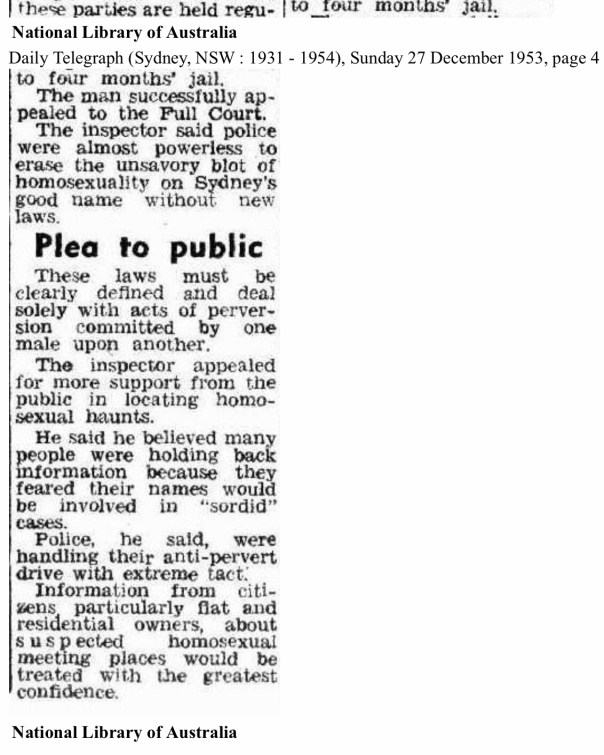
A Melburnian auctioneer, fashion and theatre designer known for his costumes at Melbourne’s Artists’ Balls. Contemporary police and media reactions to his more flamboyant costumes give an insight into attitudes towards gay male and transgender identity in early twentieth century Melbourne.

AS EARLY AS 1868, the Block on Collins Street’s north side, stretching from Elizabeth to Swanston Street, was fashionable: ‘ablaze with its crowds of colonial fashionables and celebrities . . . passing the hour in an easy, careless, lounging, gossipy manner’. Whilst ‘doing the block’ on Saturday mornings, middle-class Melbourne showed that it was the best dressed in Australia. So popular indeed, that soon this celebrated stretch was sold, demolished and replaced, as it has been twice since.

Back then, the most desirable place to be seen in Melbourne was Café Gunsler on the Block, later known as the Vienna Café. In 1916 it was remodelled as the splendid, spacious Café Australia, and in 1927 became the Australia Hotel. In 1939 this was demolished and replaced by the larger, glamorous Hotel Australia, some of whose bars immediately became the most popular meeting place in Melbourne for homosexual (‘camp’) men, particularly the Collins Street first floor cocktail bar and the basement public bar, which from 1970-80 became the Woolshed. In 1992 the Hotel Australia and an adjoining hotel were demolished and replaced by Australia on Collins. This site has a significant architectural history in which creative women played a strong role, but after briefly tracing its development, I want to explore the much less known experiences and memories of its gay clientele, mainly from 1930-1992, as far as evidence allows.

Most of the rich experiences of gay men recounted in this article were concealed from the community and straight historians at least until the 1970s, and even today. Most of the gay men whose stories are quoted here seem to have led happy lives and did not feel oppressed, but they knew the limit of their behaviour, without exposing themselves and their friends to risk. So describing their lives openly for the public record was risky. Aberrant lives are known from court records, but until ALGA oral history interviews, the social experience of ordinary lesbians and gay men in Melbourne before about 1980 remained systematically unexplored. For instance, although it describes other underworlds and minority behaviour, Andrew Brown-May’s Melbourne Street Life, published in 1988, only once mentions homosexuality, and that as a nuisance in public urinals.

There is only the slightest evidence of whether the Café Australia, or the pre-war Prince of Wales supported a gay culture, or even that one existed in private. Other than the legal records and Truth’s prurient histrionics, the earliest evidence of generalised gay social life is from c.1930, from the gays born during the Great War who lived long enough and were courageous enough to record their memories on tape.

The eminent architect Lloyd Tayler designed Harrington’s Buildings (1879-1939) for the new owner and in 1891 the first building of the ambitious Block Arcade was completed. Soon after, Café Gunsler’s (to its left) was bought by Austrians who renamed it the Vienna Café (1890-1915). It remained fashionable and popular: theatre celebrities and famous men gathered there and its Melbourne Cup festivities were the highlight of the year, when Collins Street was thick with hansom cabs and often the vice-regal party attended. Oral history interviews can take us back as far as living memory allows (to about 1930). Before that often the only information about unconventional behaviour we have comes from court records. On 22 September 1908, Alan McKail (aged 20), Douglas Ogilvie (22) and Tom Page (25) were three young men-about-town who decided to dress as fashionable ladies, and have a champagne supper at the Vienna Cafe on the fashionable “Block” of Collins Street. The three were observed “going the pace” at the Vienna Cafe on the evening of 22 September, 1908. According to their statements, the three had come into the city that Saturday night in disguise to attempt to gain entry to the Scandinavian Ball. When refused entry to that function, they went to the theatre and decided to finish off their evening with supper at the most fashionable restaurant in Melbourne. Apparently, while there, “their behaviour was such to attract attention.” As they left the restaurant, a hostile crowd gathered in the street and the three were roughly handled by some of the toughs in the crowd. The police were called and the three found themselves in the City Court. They were charged with behaving indecently in a public place, Collins Street.

The presiding magistrate was unsure as to whether the defendants were “sexual perverts or brainless young idiots who needed to be brought up with a round turn.” He was of the firm opinion that “such conduct as theirs was a menace to every respectable woman, and not only a riot, but even murder, might take place if young men were permitted to carry on in that manner in a public cafe” and stated that the difference between male and female apparel was one of the “cornerstones of civilisation and no-one could be allowed to flaunt that convention.” Page and Ogilvie worked for the Melbourne Steamship Company, whilst McKail was ‘well connected’, had £500 a year and trained as a fashion designer in Paris.

Mr. Fogarty, for defendants, without calling any evidence in defence contended that not the slightest testimony had been given that defendants had behaved in an improper or an indecent manner. Their disguise was obvious. If they could not go to a fancy dress ball in female costume the’ University students’ precession and characters in this Eight-hours demonstration,were also illegal.

Mr. Dwyer, P.M., said the suggestions made against the defendants in the case had not been justified by the evidence. They had not conducted themselves improperly, nor taken other undue advantages of tho costumes they were wearing. Unless there was a law which forbade man to assume the garb of woman, or vice versa, there seemed to be nothing against defendants. Still, they wore silly young donkeys, and he (Mr. Dwyer) did not for a: moment regard their action as a proper proceeding, which only tended to raise scandal and injure their reputations; They were treading on thin ice, and might get themselves into trouble without the intervention of the law if they were not more careful.

‘Defendants were discharged.

In late 1915, the significant Chicago architect of Canberra, Walter Burley Griffin (1876-1937) and his wife Marion Mahony (1871-1961) redesigned and rebuilt the interiors as ‘the most beautiful café in Australia’, and our earliest architectural modernism. When it opened in November 1916 Australia was at war with the Austro-Hungarian Empire whose capital was Vienna, so the name was sensibly switched to Café Australia. Six o’clock closing had been imposed that October, substantially reducing its opening hours. At least one patron remembered the Café Australia as being ‘slightly gay’ in the 1930s.

In 1927 it was renamed the Australia Hotel and by 1932, sold to hotelier Norman Carlyon’s company, The Australia Hotel Pty Ltd.10 Later, Carlyon owned the freehold with Frederick Matear (1888-1968). The State Library of Victoria holds an evocative mid-1930s street photograph looking east, depicting the Block Arcade, the Australia, the Tatler Bar and their neighbours.

The twenties: the decline and fall of our hero Alan McKail.

After getting so much unwanted attention parading around Melbourne’s ‘Block’ dragged-up as a Gibson Girl in the Edwardian years, then charming the social pages as a cubist Pierrot during the Indian Summer of the pre-war era, one would have imagined the Roaring Twenties would have been Alan McKail’s crowning glory. But, although our Alan could obviously still turn heads in the Jazz Age, noted among the well-dressed patrons of the Moonee Valley racecourse in ‘Table Talk’ in January 1925, he seems to have been falling out of the social spotlight.

The twenties began with McKail in a sound enough position to help out friends in need, purchasing ‘The Robins’, artist Penleigh Boyd’s Warrandyte retreat, after Boyd’s tragic death in a car accident in 1923 had left his family in financial limbo. McKail’s company, Decoration Co., who had worked with Penleigh Boyd on the sale of his studio contents only a few month earlier, handled the sale of Boyd’s estate. As Steve Duke pointed out, the security afforded by McKail’s purchase and the estate sale ensured that Boyd’s youngest son Robin would go on to write ‘The Australian Ugliness’, his influential book about poor aesthetic standards in local architecture and design, among many other career highlights.In February 1926 the Decoration Co. auction business, whose shareholders included Alan McKail, his former life partner Cyril John McClelland and his aunt Effie Eliza Ball, was valued by Melbourne ‘Herald’ at £20,000 (about A$1,500,000 in today’s money). Later that year ‘The Herald’ reported that McKail was about to head off to Colombo, Ceylon (Sri Lanka), for a holiday.

But things weren’t all going well in The Robins. Steve Duke often speculated that Alan McKail’s poverty-stricken death from tuberculosis in 1931 may have been caused by the renowned excesses of the age. Evidence has recently emerged from Victoria’s health records which, sadly, confirms Steve’s theory.

In November 1925 Alan McKail checked into the Pleasant View licensed house in his childhood home suburb of Preston, staying there for a week. The idyllic name of the house, which looked across the Lower Yarra Valley towards the Dandenongs, disguised its purpose; it was a clinic for recovering alcoholics. Nineteen months later, and not too long after his return from Colombo, McKail voluntarily checked into the less euphemistically-titled Lara Inebriates Retreat, north of Geelong, for another week’s drying out.

On the 2nd July 1927, Alan McKail checked out of the Lara Inebriates Retreat. At the time of writing, there are no further known references to him in the Melbourne press until his death notices appeared in November 1931. [1]

There is an Alan McKail Day cemetery walk at Box Hill cemetery in January (see link in References) which visits LGBT graves in the cemetery and plants rainbow flags on them.

Citation [1] The twenties: the decline and fall of our hero Alan McKail by Steve Duke BA FRGS (1957-2017) and Eric Ridder. By permission, and with thanks to Eric Riddler, and the Three Mullets Club https://www.facebook.com/threemulletsclub/?fref=ts

References

The Demon Dentist of Wynyard Square – Henry Louis Bertrand.

Originally published in the Daily Telegraph, March 10, 2015. By Naomi White.

HENRY Louis Bertrand was many things. Husband, father, dentist, self-proclaimed mesmeriser, philanderer… murderer.

His tale of murderous desire and betrayal took place on the streets of Sydney 150 years ago, but is proving intriguing today, revived in an exhibition of historical crime held at the Justice and Police Museum, the former site of the Water Police Courts that operated from 1856-1924, whose walls Bertrand would have passed through after his arrest.

Portraits of Mrs Bertrand, Henry Louis Bertrand and Mrs Kinder, from the Illustrated Sydney News, circa 1865. Picture: NSW State Library

Bertrand, a native of London, had moved to Australia as a young man and set up a dentistry practise in the CBD, building a thriving business on claims he could mesmerise patients so they would feel no pain.

But it would be one of these patients who would be his undoing, after he struck up an affair with a married woman that ended with the murder of her husband in 1865.

“It’s one of those really incredible stories in criminal history and one that not only the Australian public were really interested in, it also ignited quite a bit of interest overseas in New Zealand and London and throughout Europe because it just had so many unusual and dramatic twists and turns in it,” exhibition curator Nerida Campbell said.

As his obsession intensified, his assistant took to arming himself with an axe

“And Bertrand himself was such an unusual character, you know, he was larger than life. The things he said were quite often just remarkable and the way he acted was also. One of the journalists at the time thought he had been influenced by reading too many romantic novels and that was part of the character he had chosen to create for himself.”

THE AFFAIR

Maria ‘Ellen’ Kinder had been married to Henry Kinder, 35, a heavy drinker and teller at City Bank who was in financial strife, for five years when she booked in as a patient at Bertrand’s dental practice.

The two quickly began an affair, with 25-year-old Bertrand imposing himself and his wife Jane and their two children into the Kinders’ lives, striking up a friendship with Mr Kinder and making regular calls to their north shore home over 10 months on the pretence of cards and suppers.

But it would not be the only visits he’d make, with Bertrand regularly forcing his dental assistant, a young man known as Byrne, to row him across the harbour for midnight reconnaissance missions to spy on the couple.

Henry & Ellen Kinder in early undated portrait, Ellen allowed lover Henry Bertrand to kill her husband in 1865 before she moved in with him and his wife.

He reportedly went as far as breaking into their home to survey its layout as part of his master plan to dispose of Mr Kinder.

As his obsession intensified, his behaviour became increasingly erratic, so much so that Byrne, in fear of his own safety, had taken to secretly arming himself with an axe.

Bertrand continued to force him to do his dirty work, dressing as a woman and accompanying Byrne as he visited a gun-shop and negotiated the purchase of two pistols to use in the murder.

Sydney dentist Henry Louis Bertrand in early undated portrait, mastermind of one of the most bizarre ‘crimes of passion’ in Australia when he killed his lover Ellen Kinder’s husband. Picture: Supplied

He then bought a pig’s head which he kept at the surgery to practise his aim on.

“He fell in love, heavily in love with her and she returned his affection and they started an adulterous affair,” Ms Campbell said.

“This went on for a period of time until it became clear to Bertrand that he needed her, that he had to have her, that he wasn’t prepared to share her with her husband any longer. And his plan was to kill her husband, Henry Kinder and divorce his own wife Jane so that the two of them could be together”.

THE CRIME

After travelling to the home several times with the intent to murder him, he finally found the courage to fire a single shot at Kinder’s head, as he sat on a chair in his home, in front of both his wife Jane and his lover.

But it failed to kill him and Kinder was carried to his bed to recover, while Bertrand, with the help of both women, convinced police Kinder’s financial woes and drinking had got the better of him and he had tried to kill himself.

Looking down Margaret Street to George Street showing Wynyard Square on the right where Bertrand worked as a dentist. Picture: NSW State Library

“So Kinder is upstairs in bed and the police have visited, they’ve accepted the story of this attempted suicide, but he’s not dying, he seems to be getting better. It’s at this stage that Bertrand apparently convinced the two women to poison Kinder and apparently it was his own wife Maria that allegedly fed him the poison which ended his life.”

The coroner assessed his death on the evidence of a past suicide attempt and ruled it non-suspicious.

“I am satisfied, thus once more I perish my enemies”

A diary entry from Bertrand

However it brought him no closer to Maria Kinder, who moved to her parent’s home in Bathurst to preserve her reputation. Bertrand at least appeared to have got away with it.

THE BLACKMAILING

That was until a past lover of Maria Kinder’s turned up, got wind of Bertrand’s involvement and sent him a note demanding 20 pounds (more than $2,000 AUD today) for his silence.

“And Bertrand then showed what kind of a daring and quite heartless criminal he could be. He took that letter to the police and said ‘look, this man is attempting to blackmail me, smirch my reputation’ and they charged him. So Francis Jackson actually went through the Water Police Court, which is the current Justice and Police Museum, on trial for attempted blackmail and he was convicted to spend time in prison.”

Water Police Court at Phillip Street, Sydney. Picture: NSW State Library

Bertrand noting in his diary, kept to communicate with Maria Kinder, that “’I am satisfied, thus once more I perish my enemies” after Jackson was handed a 12 month gaol sentence.

And so he may have if it wasn’t for his own boastings that he had murdered Kinder.

This got back to an original juror of the blackmailing trial, who took it to the police who arrested both Bertrand, his wife and Mrs Kinder, charging all three with murder.

THE TRIAL

The cases against the women were dismissed quickly, Mrs Bertrand’s as she could not give evidence against her husband, Mrs Kinder due to lack of evidence.

But Bertrand’s trial was a long and messy affair that captured headlines.

It was said Bertrand had several uncles who had been committed to asylums and there was much speculation that Bertrand, too, was ‘mad.’

“It was really he who stood trial and during that trial of course the media were incredibly interested. It was very salacious, there were stories about the three of them sharing a bedroom and poison and mesmerism and how he could control people and make them do his will through his mesmeric powers. There were all kinds of rumours and I suppose to an extent the journalists beating up the story and making it even more sensational than it was,” Ms Campbell said.

Bone carving by Henry Louis Bertrand while in hospital. Picture: NSW State Libra

Not only the details of the affair, but the cruel treatment of his own wife was exposed in the trial, showing a history of “dreadful” domestic violence, beatings, whippings, control and humiliation in Bertrand inviting Mrs Kinder to live in their home.

“One of the things about Bertrand, one of the things that shocked many people was the way he treated his wife,” Ms Campbell said.

“At that time, because her family had disowned her when she married him, she had two young children and she really had nowhere else to go, there was a lot of sympathy for her and for what she had endured.”

DARLINGHURST GAOL

Bertrand was found guilty of Kinder’s murder, but controversially, spared the nominal punishment of the day — hanging, sentenced instead to 28 years at Darlinghurst Gaol.

The murderer spent his prison time honing his artistic side, producing accomplished watercolours of the inside of the gaol and making intricate bone carvings.

Until his release in 1893 when he slipped into obscurity after boarding a boat to London, believed to have been en-route to live with a well off aunt.

A watercolour of the inside of Darlinghurst Gaol painted by Henry Louis Bertrand in 1891, two years before his release Picture: State Library of NSW

While Jane Bertrand, overwhelmed by the public attention of the case, moved to New Zealand with their two children to begin a new life.

Mrs Kinder is also believed to have settled there, where she had lived previously with late husband.

The two pistols, along with two pen holders carved by Bertrand during his prison term can be seen at the Notorious Criminals exhibition currently on show at the Justice and Police Museum.

A photo of Henry Louis Bertrand by the Zimmer Brothers. National Library of Australia.

The following are newspaper accounts of the life, times, crimes and trials of Henry Louis Bertrand. The details are repeated in many of them, but I am posting them because of the many differences in how individual papers and journalists handled the facts, both at the time, and further down the line.

Sydney Morning Herald, 16 October 1865

Empire, 8 December 1865

Goulburn Herald and Chronicl, 28 February 1866

Illustrated Sydney News, 16 March 1866

Empire, 17 September, 1866

Sydney Mail, 7 September 1867

Armidale Express and New England General Advertiser, 11 January 1889,

Truth, 17 June, 1894

Evening News, 18 June 1894

Newcastle Morning Herald, 18 June, 1894

Crookwell Gazette, 20 June, 1894

Armidale Express and New England General Advertise, 6 July 1894

Zeehan and Dundas Herald, 4 July 1894

Evening News, 16 May 1891

Herald, 18 June 1894

Richmond River Herald and Northern Districts Advertise, 15 February 1895.
Queensland Times, 29 April, 1916

Smith’s Weekly, 16 August 1919

Truth, 28 December 1924

Truth, 15 March, 1925

Daily Standard (Brisbane), 28 April 1934

Truth, 17 October 1937

Wellington Times, 2 September 1937